Executive Summary for Governance Leads
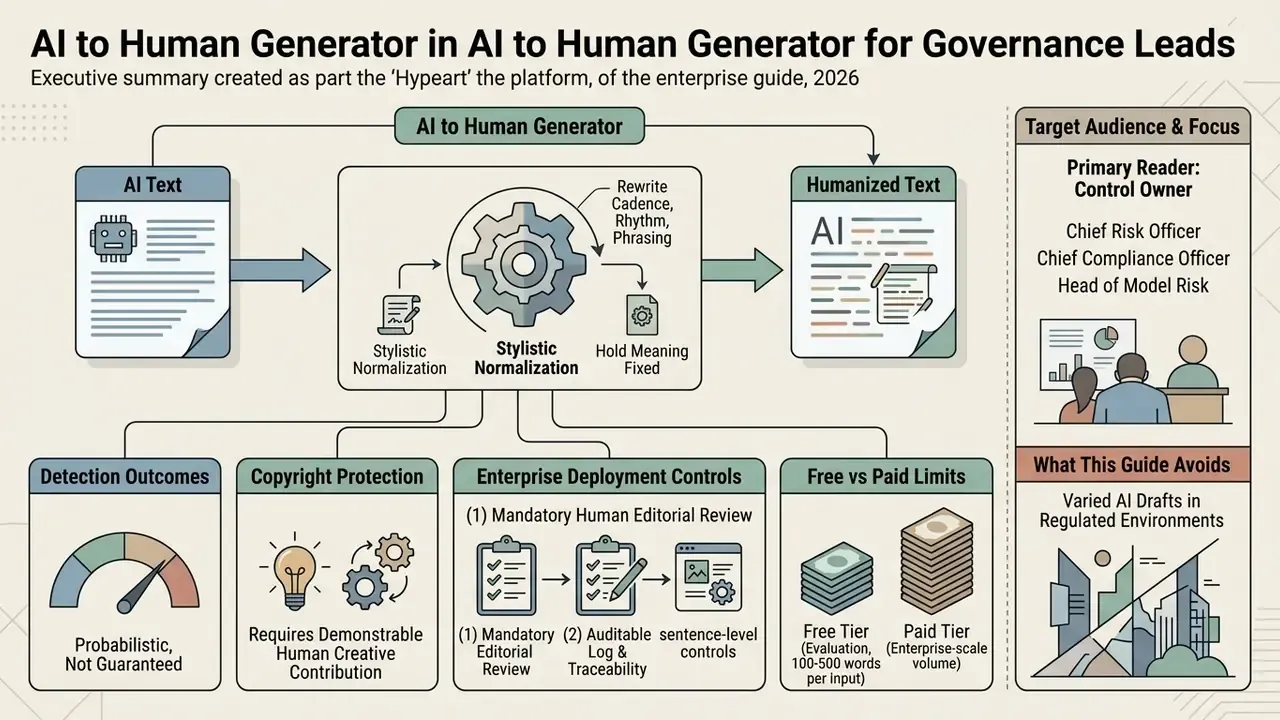
- An AI to human generator is a post-generation stylistic normalization layer: it rewrites cadence, rhythm, and phrasing of machine text while holding meaning fixed. It is not a fact-checker, not a plagiarism remover, and not a source of legal authorship.
- Detection outcomes are probabilistic, never guaranteed. Modern content-aware classifiers still flag a large share of humanized text: Pangram and GPTZero flagged 92.8% and 86.7% of humanized AI reviews as “AI” or “Mixed.”
- Copyright protection requires demonstrable human creative contribution. Humanization alone does not convert machine output into a protected work.
- Any enterprise deployment needs three controls: (1) mandatory human editorial review, (2) an auditable evidence trail per document, (3) contractual zero-retention and no-training guarantees, ideally with RAM-only execution.
- Free tiers are for evaluation (100–500 words per input). Production use requires Pro/Enterprise tiers with API access, custom voice profiles, and compliance attestations.
Who this guide is written for, and what it deliberately avoids
The primary reader is a control owner: a Chief Risk Officer, Chief Compliance Officer, Head of Model Risk, or an AI governance lead who has to approve (or block) a text-transformation tool inside a bank, insurer, or mature fintech. The secondary reader sits in Finance or Operations and wants cleaner narrative commentary in reporting packs, close memos, and vendor correspondence without opening a new data-leakage channel.
What this guide avoids is equally important. No vendor is recommended, no bypass rate is promised, and no claim is made that stylistic processing changes the legal or factual status of a document. Where the evidence is thin, that is stated in the sentence itself rather than buried in a footnote. Treat every audience assumption here as a hypothesis until your own analytics, interviews, or CRM data confirm it.
In financial services and regulated corporate environments, AI-generated drafts often lack the varied rhythm, nuanced tone, and subtle stylistic shifts required for institutional communication. An AI to human generator is a post-generation text transformation layer designed to convert synthetic, machine-generated output into natural, human-like writing while preserving original meaning.
What Is an AI to Human Generator?
An AI to human generator is a software solution that restructures synthetic text to mirror human writing patterns, cadence, and vocabulary choices. Unlike generic rewriting, an ai humanizer is specifically engineered to eliminate machine artifacts, such as uniform sentence structures and formulaic transitions, without altering the underlying factual intent.
Enterprise teams frequently encounter synthetic text generated by models such as ChatGPT, Claude, or Gemini during draft generation. These models retrieve and assemble information fast. Their default output, though, carries distinct stylometric fingerprints. An ai text humanizer adjusts lexical variety, sentence length, and prosody to refine drafts before final editorial review or public deployment.
Understanding how an ai generator to human text workflow functions requires distinguishing humanization from traditional text editing. A dedicated text humanizer operates as a stylistic normalization layer rather than a synonym swapper. When teams need to humanize ai output, they are adjusting statistical predictability, not replacing core domain terminology.
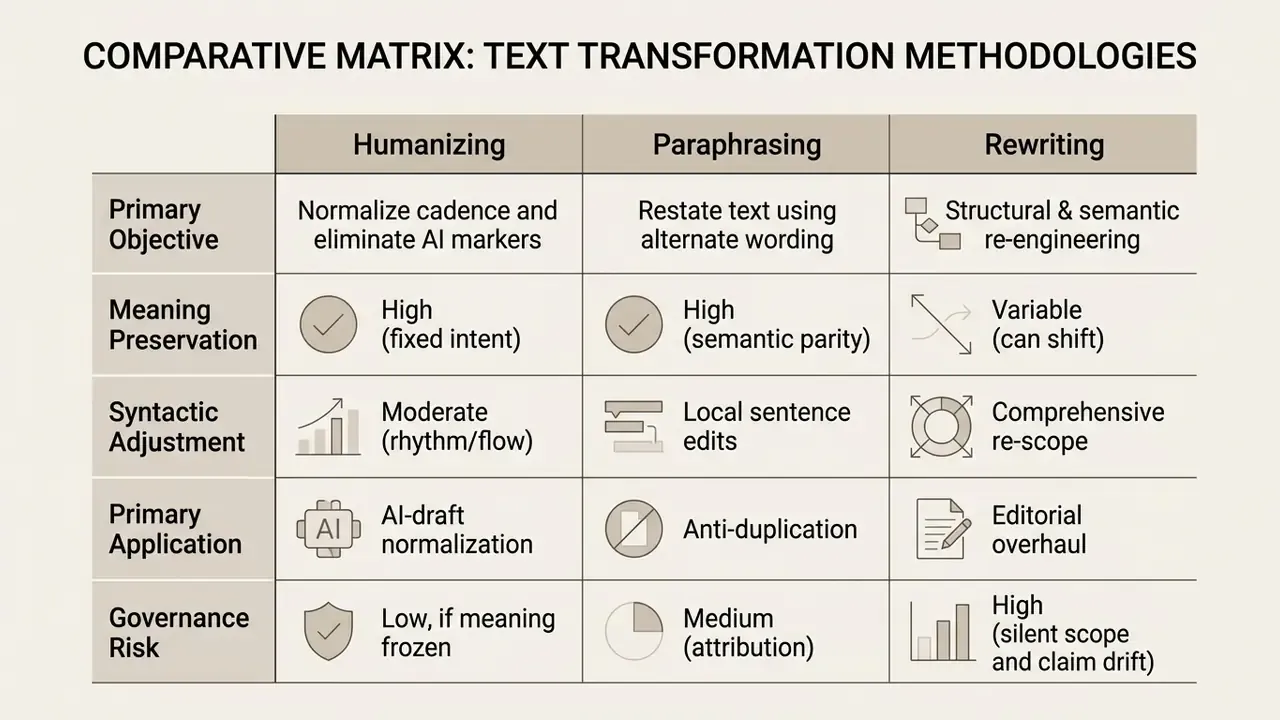
AI Humanizing, Paraphrasing, and Rewriting: What Changes?
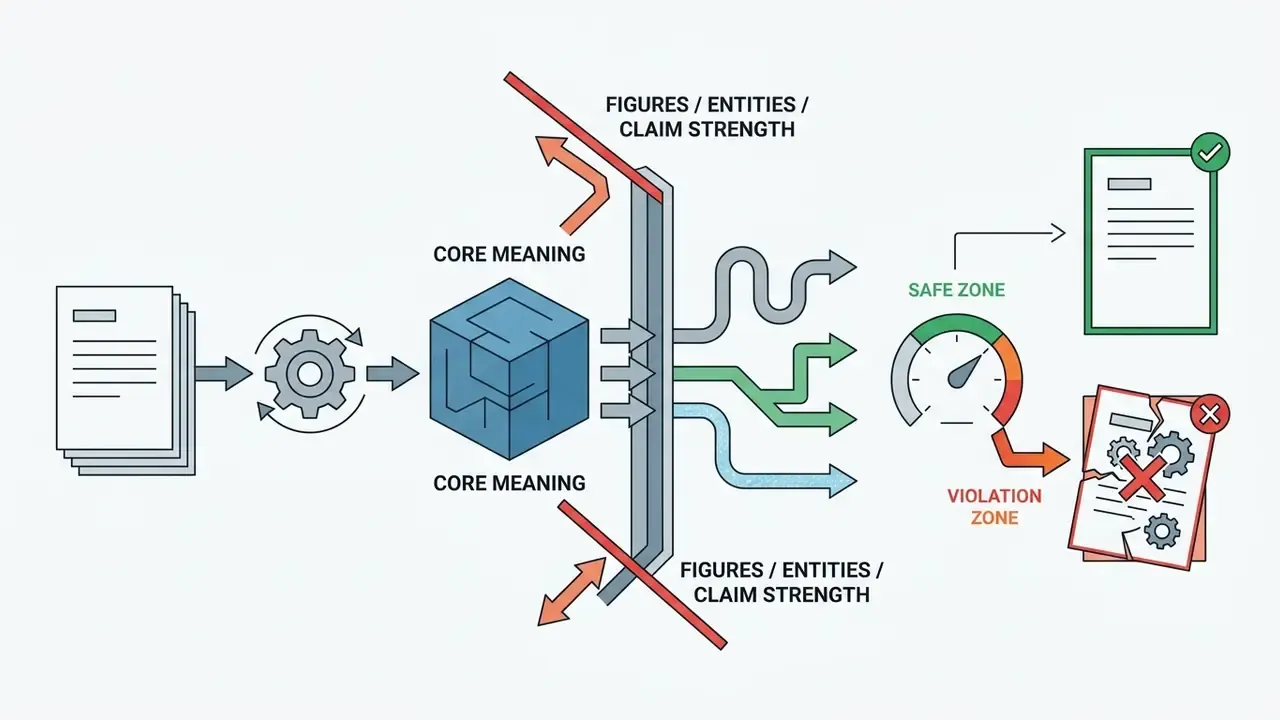
Humanizing targets sentence cadence, tone, and lexical variance while keeping core semantic meaning strictly fixed. Paraphrasing substitutes specific words or phrases to express the same statement in alternate language. Generic rewriting restructures whole paragraphs and may alter informational scope or emphasis.
In empirical evaluations, the PlagBench benchmark treats paraphrasing as rephrasing that maintains semantic equivalence and structural bounds. That definition rests on a large, controlled dataset rather than marketing copy.
«PlagBench comprises 46,500 synthetic plagiarism cases across three types, generated by three LLMs; paraphrase plagiarism is defined as restating source meaning and structure without attribution.»
Humanization, by contrast, applies targeted stylistic transfer to modify predictable token distributions rather than merely swapping words.
«Humanization is paraphrasing plus deliberate stylistic modification aimed at imitating human writing and evading automated detection.»
Rewriting allows broader structural compression or expansion, which risks semantic drift if applied without strict boundaries. For model-risk purposes, the distinction is not academic: humanization keeps the informational payload auditable against the source draft, while unconstrained rewriting can quietly change scope, hedging language, or the strength of a claim inside a regulated document. One softened qualifier in a credit memo can change what the document actually asserts.
Which AI-Generated Text Can Be Humanized?
Practically any text generated by large language models, including ChatGPT, Claude, and Gemini, can undergo humanization. The primary candidates: academic essay drafts, long-form blog articles, executive summaries, client emails, and formal compliance reports. Teams that also review synthetic visual assets typically pair text workflows with AI image detectors for the same governance reason. Provenance must be traceable across modalities.
Research on LLM-assisted drafting shows that instruction-tuned models exhibit recognizable stylistic fingerprints across formats:
- ChatGPT tends toward symmetrical sectioning, explicit three-part lists, and formulaic introductory phrases.
- Claude frequently produces clause-heavy, highly fluid prose that can suffer from repetitive transitional structures.
- Gemini demonstrates direct, list-first formatting with high structural uniformity.
«Instruction-tuned models display stable stylometric fingerprints: templated openings, homogeneous transitions, and predictable section structure.»
Applying an ai generator to human pipeline helps smooth these model-specific tendencies into a consistent organizational voice.
Agentic and multi-step reasoning output
A separate category deserves attention: text produced by agentic AI systems that chain retrieval, tool calls, and multi-step reasoning before drafting. Such output tends to be more uniform than single-prompt generation, because each intermediate step re-imposes the same template scaffolding. Numbered findings. Restated objectives. Closing summaries that echo the opening paragraph.
Practically, humanization of agentic output requires two passes: first a structural pass that dissolves the repeated scaffold (removing duplicated restatements across sections), then a stylistic pass that varies cadence. Reviewers should also verify that intermediate tool outputs, say figures pulled from a database or retrieved citations, survive rewriting unchanged. Agentic drafts embed factual payloads that stylistic engines were never designed to protect.
For institutions running agentic workflows in KYC triage, AML alert narratives, or credit-file summaries, one governance rule applies before any humanizer touches the text: the agent needs a named owner, an approved role, access limits, an escalation path, an audit trail, and a shutdown mechanism. Style comes after control.
How an AI Humanizer Makes Text Sound More Natural
An AI humanizer makes text sound natural by dismantling template phrasing, varying sentence lengths, and applying controlled stylistic irregularity. Machine-generated text typically displays low perplexity and predictable burstiness. Humanization restores the rhythmic variance present in real human writing.
By evaluating the statistical distribution of words across a document, humanizer tools replace mechanical transitions with context-aware connections. This improves overall flow without compromising domain accuracy or corporate messaging standards.
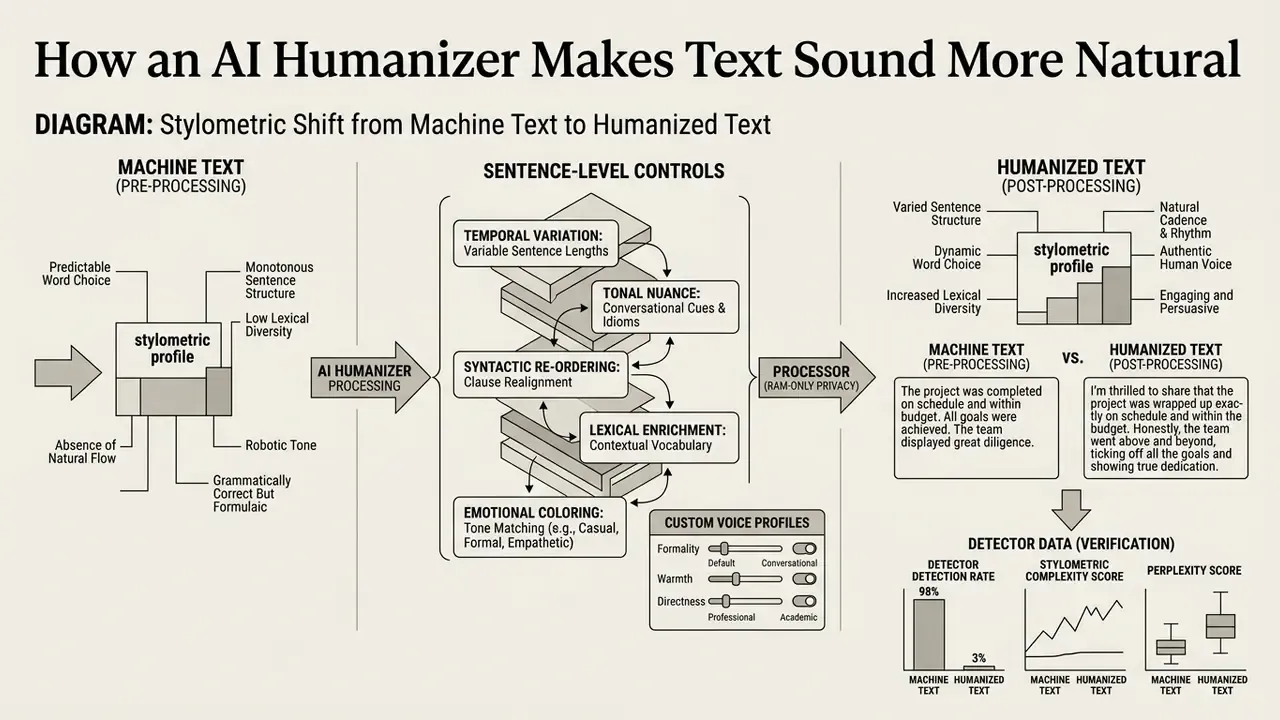
Real-World Transformation: Before and After Humanization
To understand how stylometric normalization works in practice, look at how an AI-generated corporate statement gets restructured.
Example 1, corporate reporting (raw ChatGPT-4o draft):
Humanized output (normalized cadence, active voice):
Example 2, academic summary (raw Claude draft):
Humanized output:
Notice what did not change in either example. No number, entity, or claim direction was altered. That constraint is the practical dividing line between humanization and rewriting, and it is exactly the property auditors will test with a sample of ten documents and a diff viewer.
Template Phrasing and Mechanical Transitions
«Humanizers systematically substitute high-frequency AI tokens with less predictable alternatives while preserving semantic fit.»
Sentence Length, Cadence, and Readability
Human writing mixes short, energetic assertions with longer, complex observations. Synthetic text often runs at one uniform length, which produces the flat, metronomic feel readers describe as “machine-written” before they can explain why.
Editorial style guidance widely used in government and institutional publishing (for example, the Australian Government Style Manual) recommends mixing sentence lengths, with an average around 15 words and long sentences capped near 25 words. Rather than treating those figures as a hard standard, treat them as an operational target: average sentence length between 12 and 18 words, long sentences capped at 25, punctuated by short 5-to-8 word statements. That combination reproduces the rhythmic variety of authentic human output.
Structural variation is not cosmetic. Experimental work on AI-essay detection shows how strongly sentence-level structure drives classifier behaviour:
Tone, Voice, and Consistent Writing Style
Maintaining a distinct brand voice requires aligning synthetic drafts with explicit style guidelines, active verb usage, and audience-appropriate terminology. An ai humanizer adjusts emotional tone and voice parameters so content does not read as sterile or detached. The same discipline governs adjacent asset pipelines: teams standardizing visual identity often apply comparable rules through their AI photo editing workflows.
Custom Voice Profiles: training the humanizer on your own corpus
Modern enterprise humanizers go beyond static tone presets (Formal, Casual, Academic, Executive). By uploading three to five representative samples of your organization’s published content, the humanization engine builds a vector profile of your specific stylometrics: burstiness targets, preferred industry nomenclature, sentence-opening variety, and prohibited phrasing. Later runs are benchmarked against that custom profile instead of a generic “human-like” baseline.
Operationally, a custom voice profile should be treated as a controlled artifact:
- Source control. Only approved, published material enters the sample set. Never unreleased filings or client documents.
- Versioning. Each profile carries a version ID recorded in the output metadata, so an auditor can reconstruct which style rules produced a given document.
- Ownership. A named editorial owner approves profile updates. Uncontrolled retraining creates silent tone drift across the whole content estate.
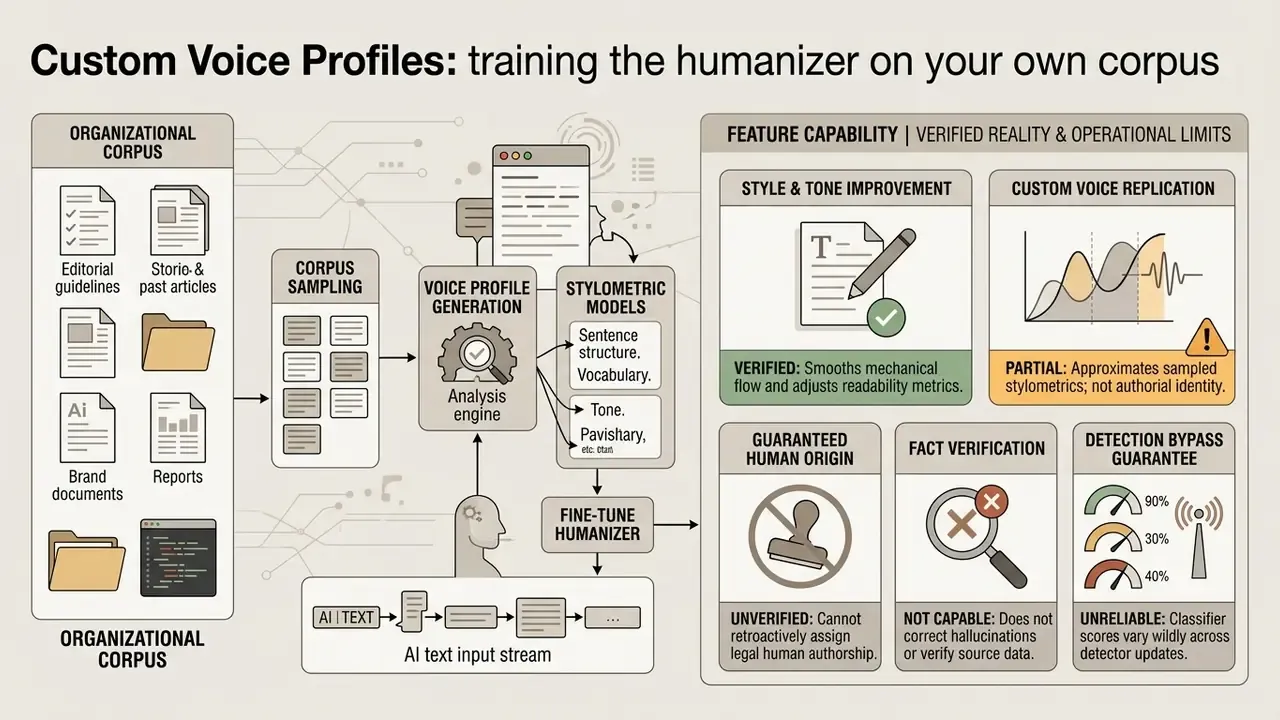
Even a well-tuned voice profile does not make authorship invisible to trained human readers:
«Although humanization sharply reduces automated detector accuracy, expert annotators in aggregate still recognize AI authorship in humanized articles.»
AI Detection, Originality, Privacy, and Responsible Use
Using an ai humanizer means navigating detection mechanics, intellectual property standards, and data security policy at once. Humanizer tools modify statistical markers and genuinely improve prose. Relying on them to bypass oversight, without verification, creates operational and regulatory exposure. This section deliberately precedes the step-by-step workflow: in regulated organizations, risk boundaries must be set before anyone pastes a draft into a browser tab.
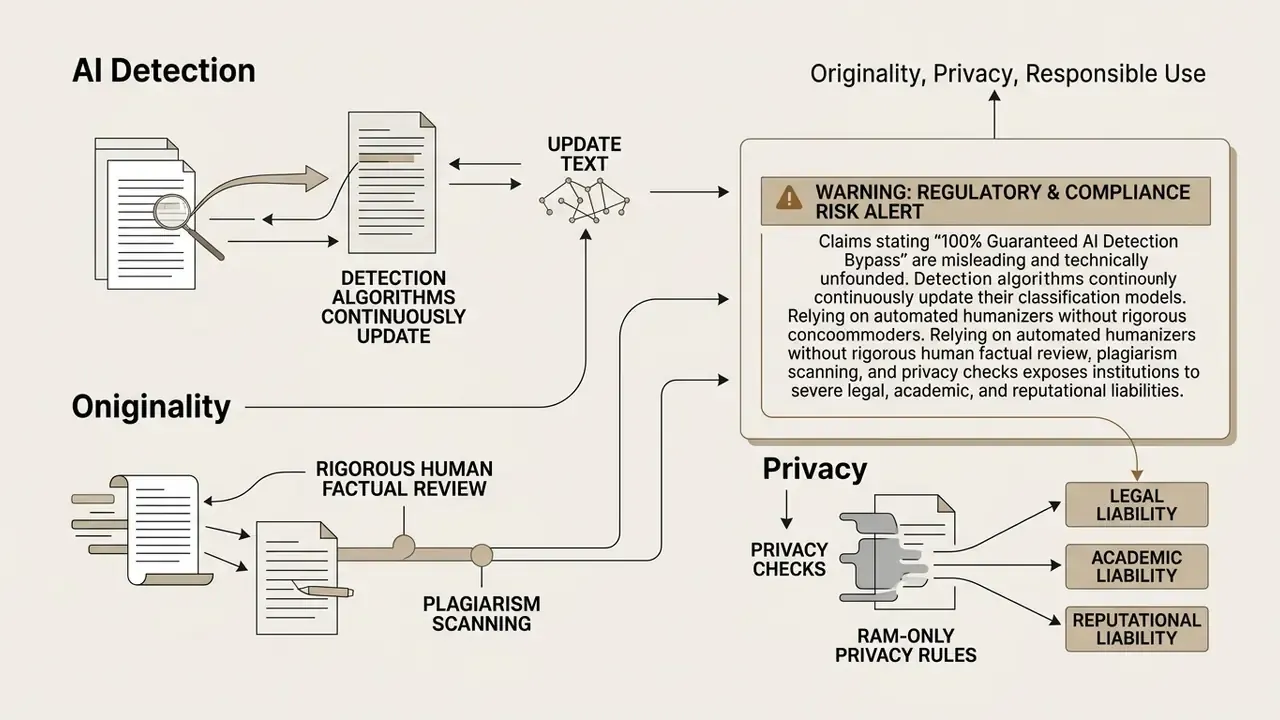
Can Humanized Text Pass AI Detection Tools?
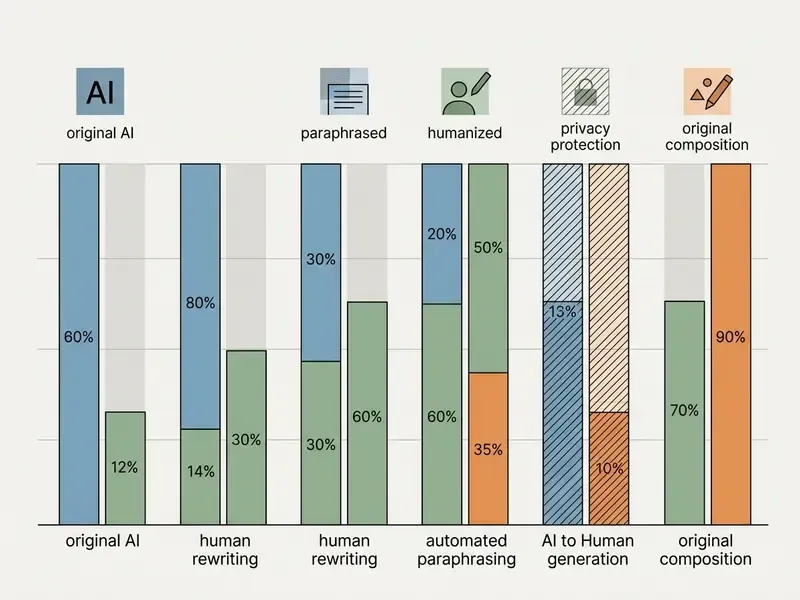
«A 2D detection method that decouples content from linguistic expression improves AUROC from 0.705 to 0.849 at level-2 and from 0.807 to 0.886 on the RAID benchmark.»
«Pangram and GPTZero correctly identified 98.3% and 95.8% of fully AI-generated reviews; after humanization they still flagged 92.8% and 86.7% as “AI” or “Mixed.”» Fokkens et al., LLM-Assisted Peer Reviews: Detection and Policy Implications (2026). https://arxiv.org/abs/2506.01234
The governance conclusion is blunt: humanization shifts a probability, it does not remove a signal.
Detector-testing transparency: what a credible vendor should publish
Several consumer humanizers now publish recurring detector benchmarks, for example monthly runs of a fixed 50-sample set against GPTZero, Turnitin, and Copyleaks, with pass rates in the mid-to-high nineties for their strongest mode. Whether those figures replicate in your domain is an open question. The practice, though, is the right benchmark for procurement. Require the following before purchase:
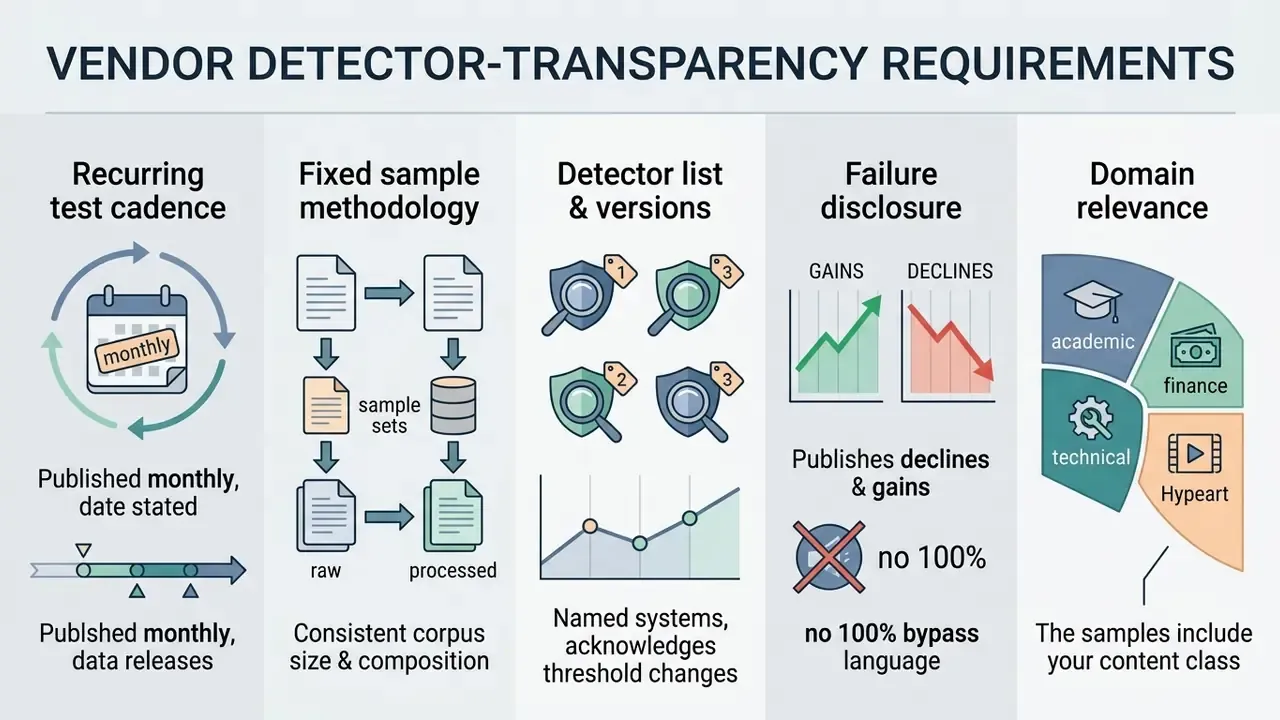
Any vendor promising a specific score on every detector, every time, is describing a market that does not exist. Detectors also misclassify fully human writing, which is precisely why a bypass promise is worthless as a control.
Does AI Humanizing Remove Plagiarism or Guarantee Originality?
Humanizing AI content does not automatically eliminate plagiarism or guarantee originality. If the source draft reproduces another author’s structure, ideas, or unique arguments without attribution, changing the wording merely converts verbatim plagiarism into paraphrase plagiarism.
«GPT-4 outperforms other LLMs and commercial tools by roughly 20 percentage points in detecting paraphrase plagiarism via semantic similarity.»
Semantic-similarity detection is improving faster than surface rewriting. So originality checks belong in the editorial workload as substantive work, not as a checkbox. Real originality still requires independent analysis, unique structure, and explicit citation of external sources.
What to Check Before Pasting Sensitive Content into a Humanizer
Before submitting internal drafts, customer data, or proprietary code into a third-party humanizer, enterprise operators must review the provider’s privacy policy and data retention terms.
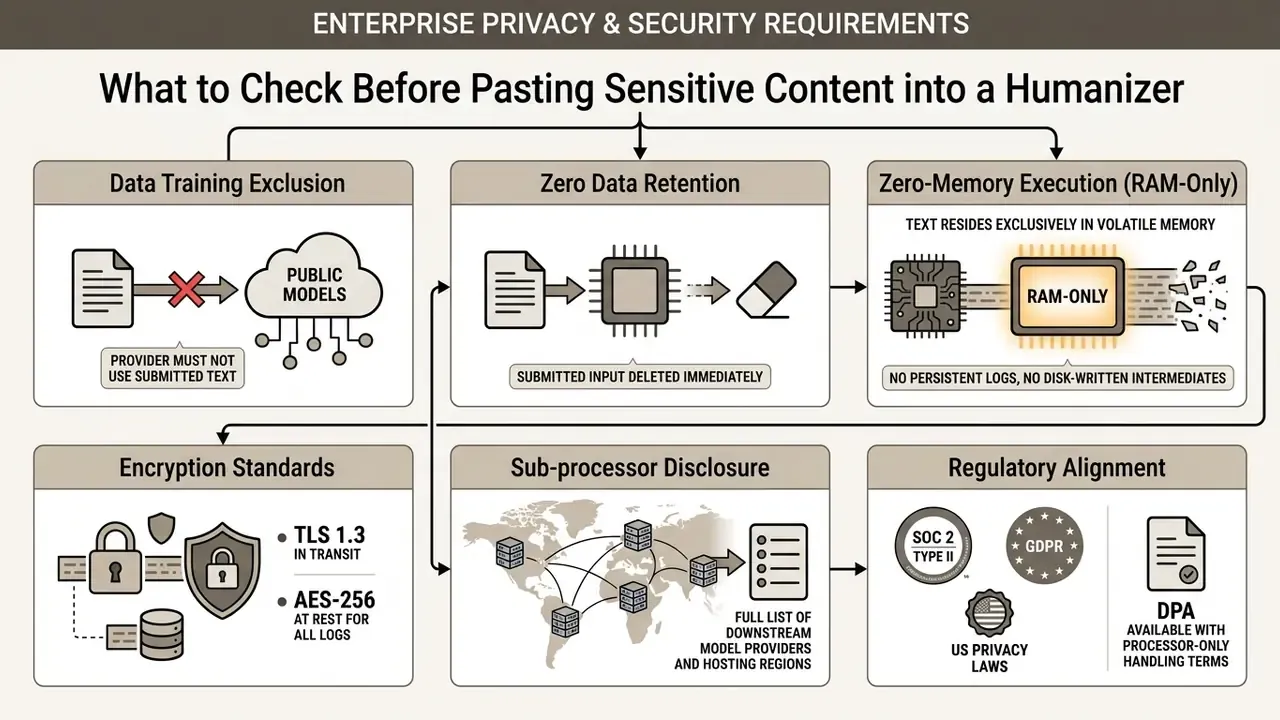
Consumer-grade tools increasingly advertise a strict no-retention protocol in which text is processed in temporary memory and wiped the moment the session closes. That claim is verifiable only through contract language and third-party attestation. Treat the marketing statement as a hypothesis and the DPA as evidence.
«Submitting student work to third-party humanization services raises confidentiality and intellectual-property concerns.»
Shadow AI: controlling unsanctioned humanizer use
The largest practical exposure in most organizations is not the approved tool. It is the unapproved one. Employees paste confidential drafts into free browser humanizers precisely because those tools need no signup, no ticket, no waiting. A minimum Shadow AI control set:
- Discovery.Monitor egress traffic and browser-extension inventories for known humanizer domains; maintain an allow-list.
- Classification gate.Prohibit any input labelled Confidential or Restricted, or containing PII or MNPI, regardless of tool approval status.
- Sanctioned alternative.Provide an internally approved humanizer via API so the compliant path is also the convenient path; see AI Media API Guides for integration patterns used in adjacent generative pipelines.
- Attestation.Annual employee attestation naming the AI tools used, mapped to the approved register.
- GRC/MRM linkage.Register the humanizer as a model-adjacent component: owner, version, input/output controls, and review frequency recorded in the model inventory.
One caveat worth stating plainly: a control that adds three days of latency to a routine memo will be bypassed, and the register will quietly go stale. Convenience is a control requirement, not a nicety.
When troubleshooting system integration errors or resolving workflow bottlenecks, technical staff use the AI Media Support and Troubleshooting portal.
Enterprise media teams expanding into multi-modal workflows can evaluate complementary asset generation tools under the same governance rules. Detailed technical guides cover platforms such as the Microsoft AI Image Generator, specialized outpainting in the AI outpainting tool comparison, portrait generation via the AI headshot generator guide, and asset modification using the online photo editor guide.
How to Use an AI Generator to Human Text
Converting synthetic content into natural prose requires a systematic input, configuration, generation, and verification workflow. A structured execution model keeps semantic integrity intact while delivering the stylistic fluidity you actually wanted.
To evaluate workflow tools across content production lines, organizations consult the AI Media Glossary for standardized terminology and operational definitions.
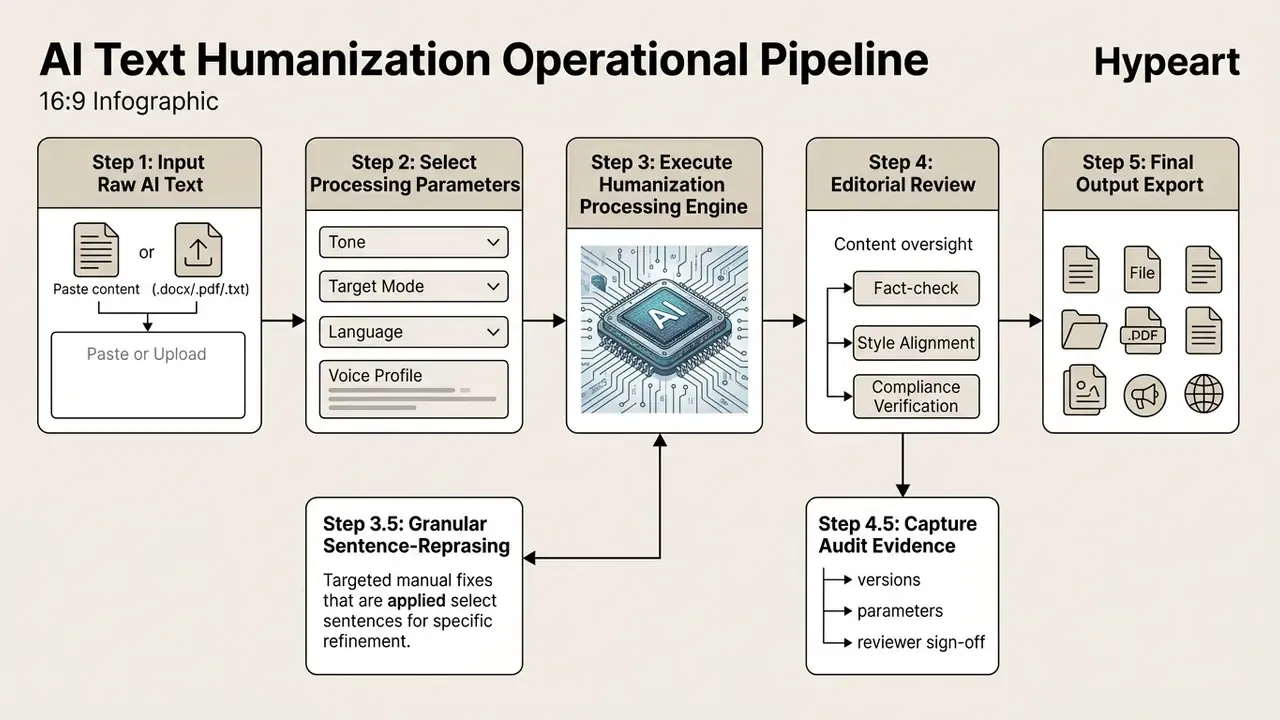
3.5 Granular Sentence-Level Rephrasing: if a specific sentence inside a humanized draft feels out of context, do not re-process the whole document. Advanced humanizers let operators highlight individual sentences and toggle alternative stylistic variations (More Concise, More Formal, Broader Vocabulary) while leaving surrounding paragraph logic untouched. This preserves already-approved passages, prevents fresh drift in verified sections, and keeps the diff small enough for meaningful review.
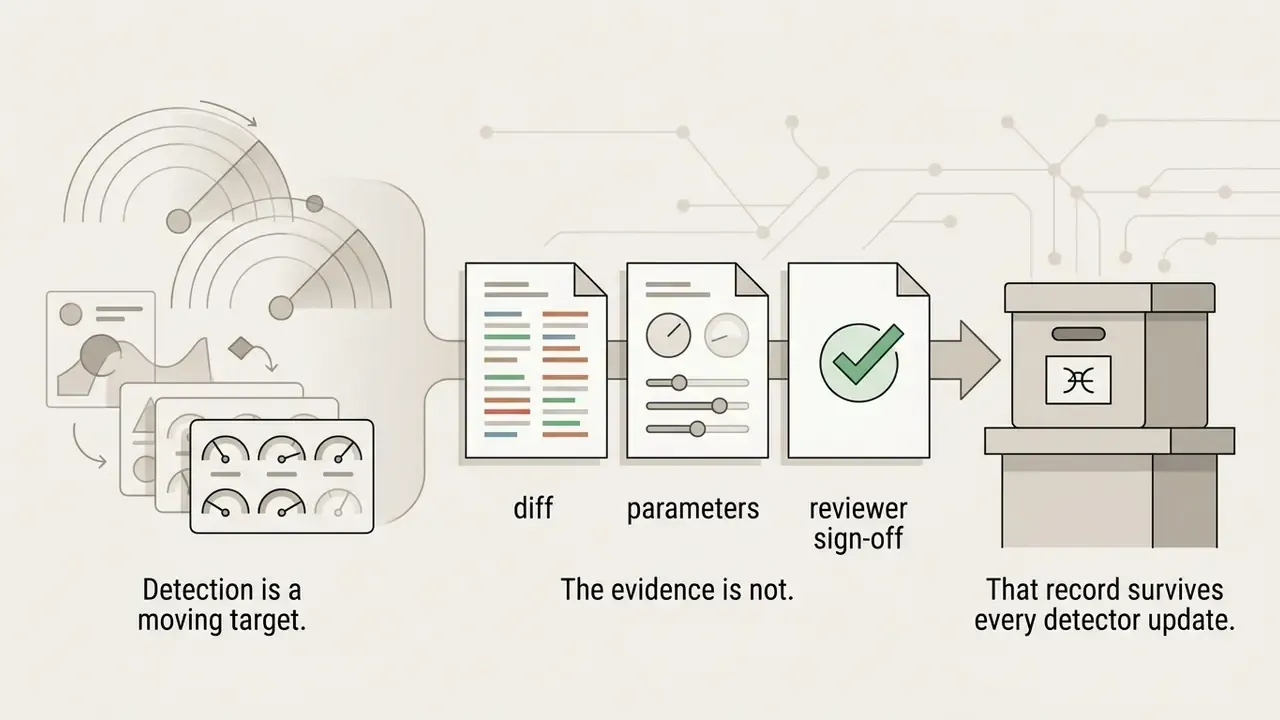
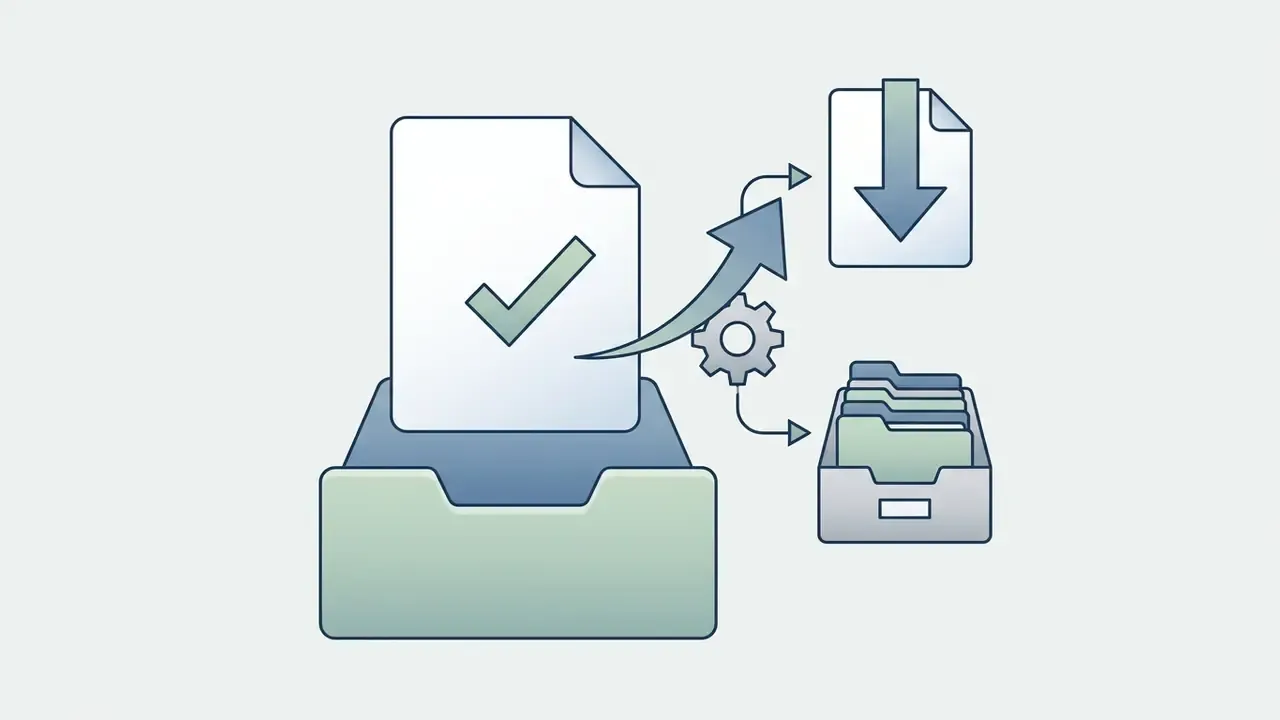
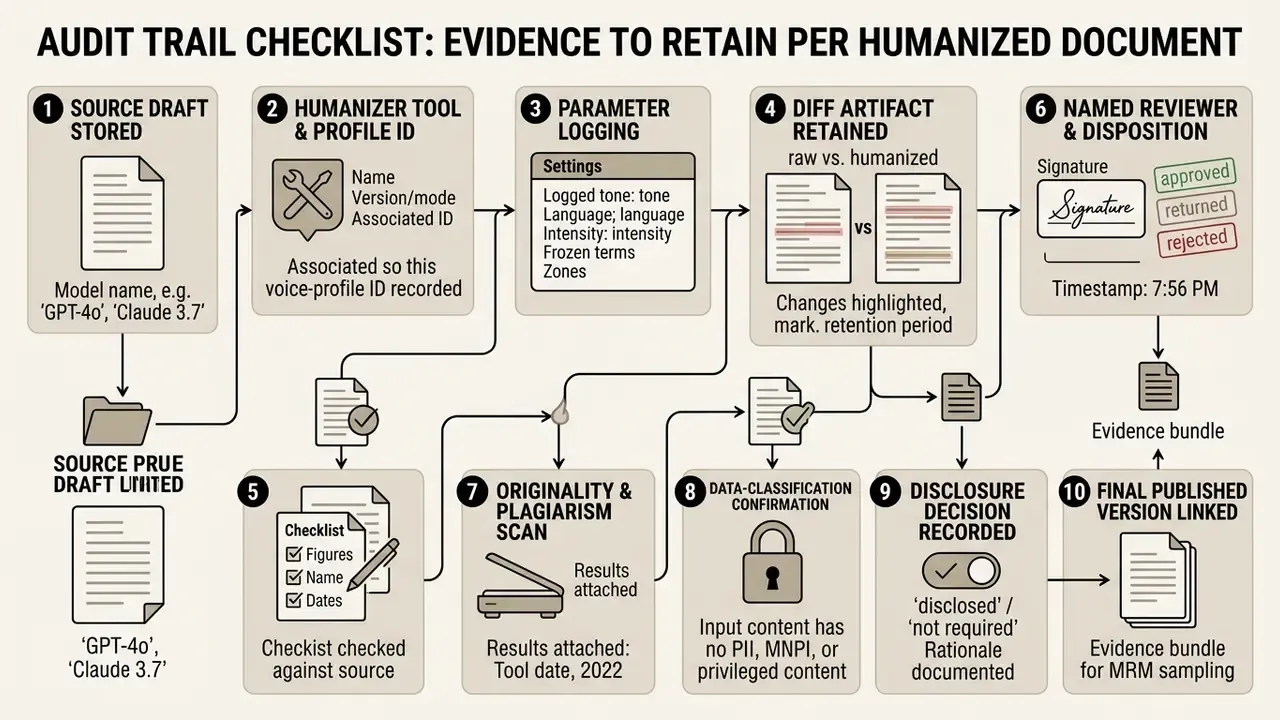
4.5 Capture Audit Evidence: record the artifacts an auditor will request (checklist below) before export.



Paste or Upload the Original AI Text
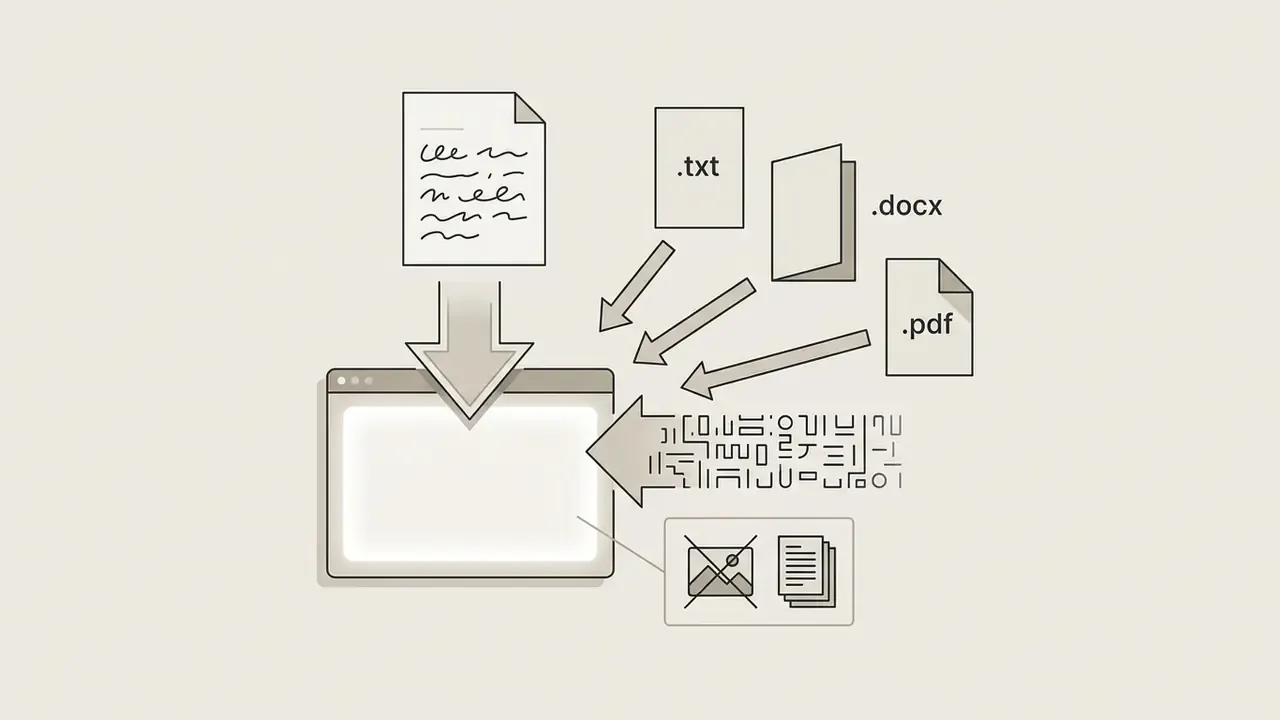
The process begins by placing raw synthetic text into the input interface. Most tools accept direct pasting or support file uploads, including Microsoft Word (.docx), PDF (.pdf), and plain text (.txt).
When preparing large document batches, technical teams frequently inspect implementation guides such as the Google Veo API integration walkthrough to model document ingestion and bulk processing pipelines with equivalent rate-limit and cost controls.
Choose a Tone, Mode, and Language
Selecting the processing mode, whether Standard, Academic, Formal, or Creative, determines how aggressively the algorithm alters syntax and vocabulary. Configuring target language settings ensures correct grammar application and regional phrasing adjustments.
For global deployments, specifying regional variants (US English versus UK English, for instance) prevents cross-border terminology mismatches during processing. Where documents mix languages, tag the default document language explicitly and mark internal language switches. Accessibility guidance (PDF/UA and WCAG techniques) requires this, and it also improves rendering and pronunciation for assistive technology.
Review the Humanized Output Before Using It
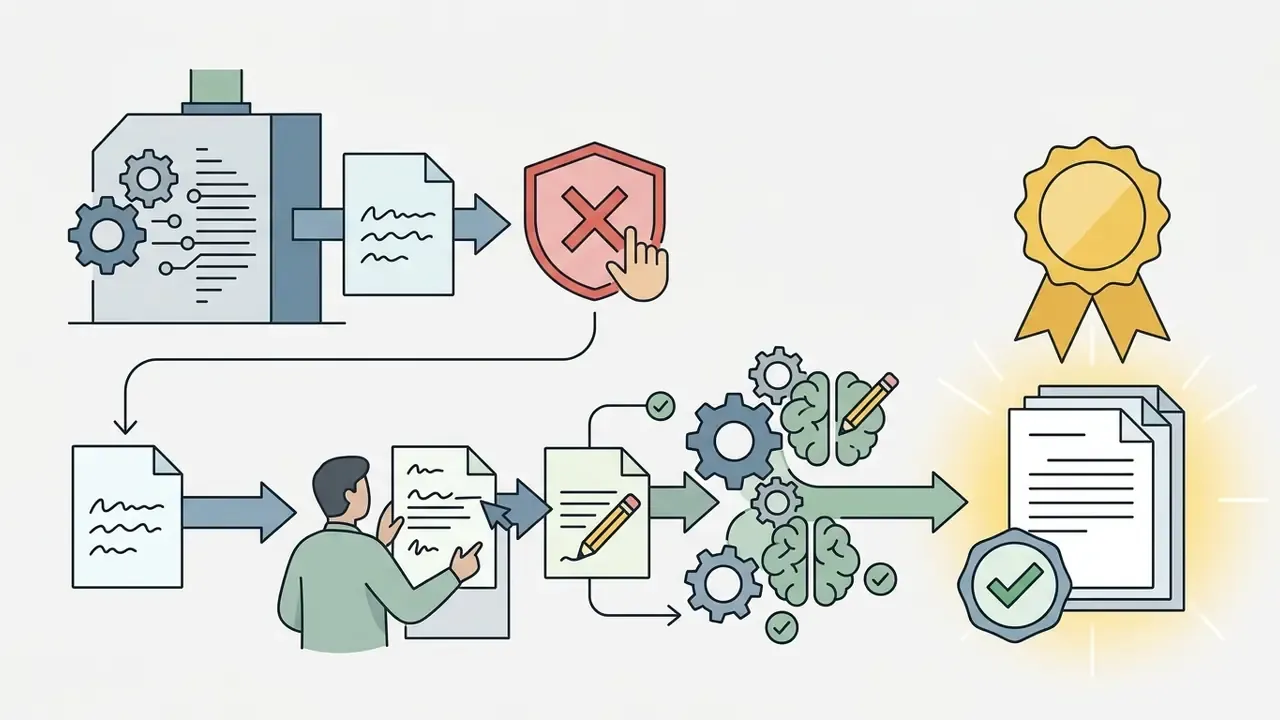
Automated transformation must always be followed by human editorial review. Editors verify that factual statements, technical terminology, and numerical data remain identical to the original draft. Human-in-the-loop review is the control that regulators and internal audit will test, so it has to produce evidence, not just an approval click.
When reviewing content generated for specialized digital workflows, operators reference the AI Media Comparison portal to benchmark tool capabilities against specific industry requirements.
AI Human Generator for Essays, Blogs, Emails, and Reports
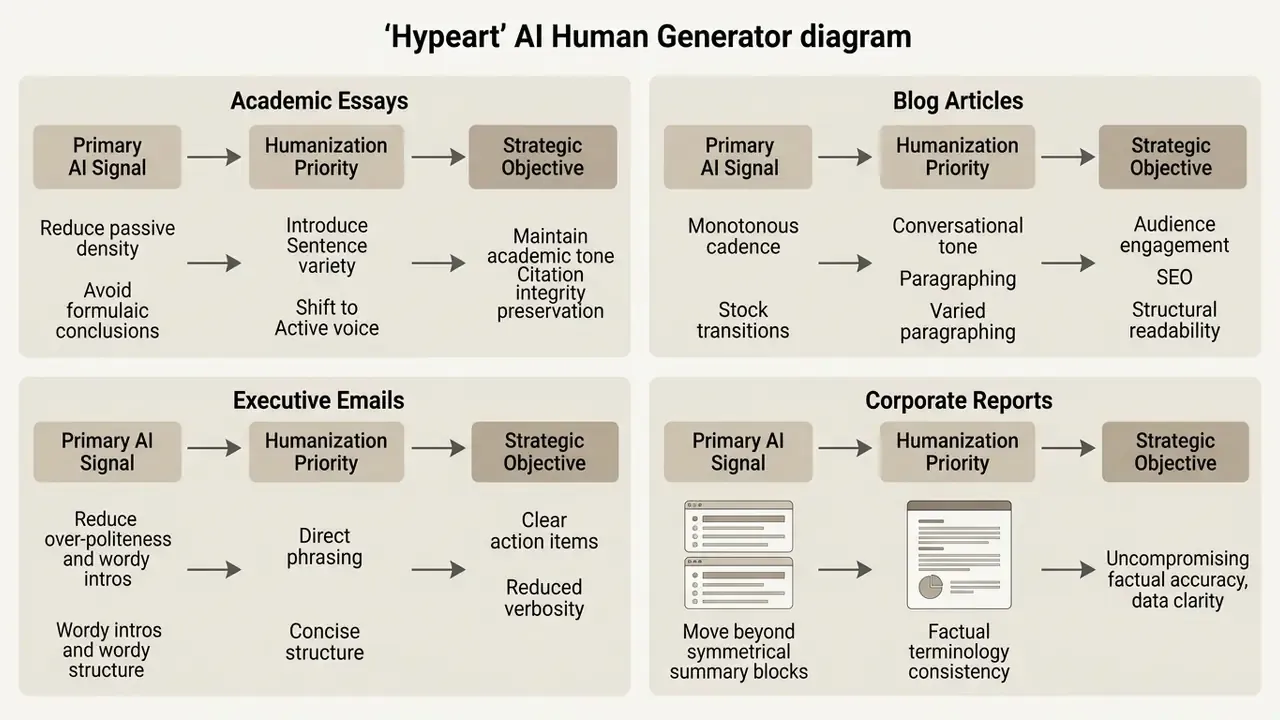
Content formats need different humanization strategies, driven by their formal constraints, audience, and compliance obligations. A setting that flatters a marketing blog post can be entirely wrong for a financial audit report.
Essays, Research Summaries, and Academic Drafts
Academic drafts generated by AI often suffer from passive constructions, repetitive transitions, and formulaic conclusions. An ai human generator essay tool helps restore natural argument progression while preserving citations and specialized terminology.
An illustrative, hypothetical case: a mid-sized credit risk advisory firm needs to publish white papers based on internal analytical drafts. Early drafts carry repetitive AI discourse markers that dilute institutional authority. By applying targeted syntactic restructuring, freezing all citations and figures against edits, and verifying every reference against the original source, the firm converts sterile drafts into publications that clear internal review, with the evidence bundle above retained per document. The example is composite and not a documented client result.
In academic and research contexts, fidelity to original sources is non-negotiable. Rather than relying on a single institutional citation, note that journals are formalizing disclosure regimes directly:
«Journals are formalizing AI-disclosure policy: authors must report LLM assistance regardless of detection outcomes.»
Human authors stay fully accountable for submitted material, whether or not an ai essay human generator touched the draft. Quotes, references, and equations must survive humanization verbatim. If a tool cannot lock those segments, it is unsuitable for academic use, full stop.
Blog Posts, Marketing Copy, Emails, and Reports
Marketing copy and enterprise communications need conversational clarity, brand alignment, and some energy in the verbs. An ai human generator writing process strips stiff phrasing from customer emails and blog drafts while retaining approved claim language and regulatory footnotes. That last part is where most consumer tools quietly fail: they smooth the disclaimer along with everything else.
Practical rules by format:
- Blog posts: vary paragraph length (2–4 sentences), replace stock openers with a concrete detail, keep one idea per paragraph.
- Marketing copy: protect trademarked phrasing and legal qualifiers as frozen zones; humanize only the surrounding narrative.
- Executive emails: lead with the decision or the ask; cut ceremonial openings entirely; cap the message at three short paragraphs.
- Reports: never let the engine touch tables, figures, dates, or defined terms; humanize commentary sections only.
Digital teams managing multi-channel campaigns frequently consult the AI Media Commercial-Use Hub to review rights management and commercial execution standards, and compare adjacent creative tooling through the best AI art generator comparison when text and visual assets ship together.
Free AI Humanizer vs Paid Plans: Limits, Features, and Commercial Use
Evaluating an ai humanizer generator free option against enterprise paid tiers means reviewing word limits, model capabilities, processing speed, and commercial licensing terms. Free tiers work fine for testing individual paragraphs. Paid tiers exist for bulk document handling and custom style controls.
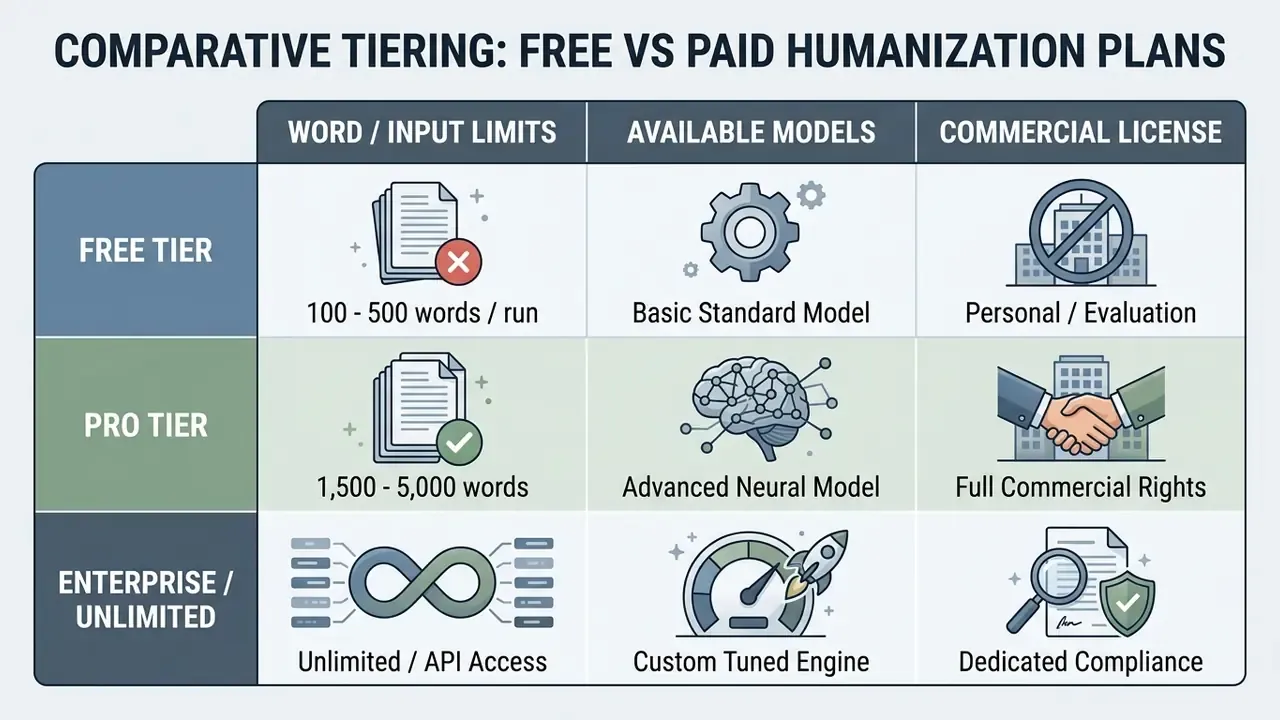
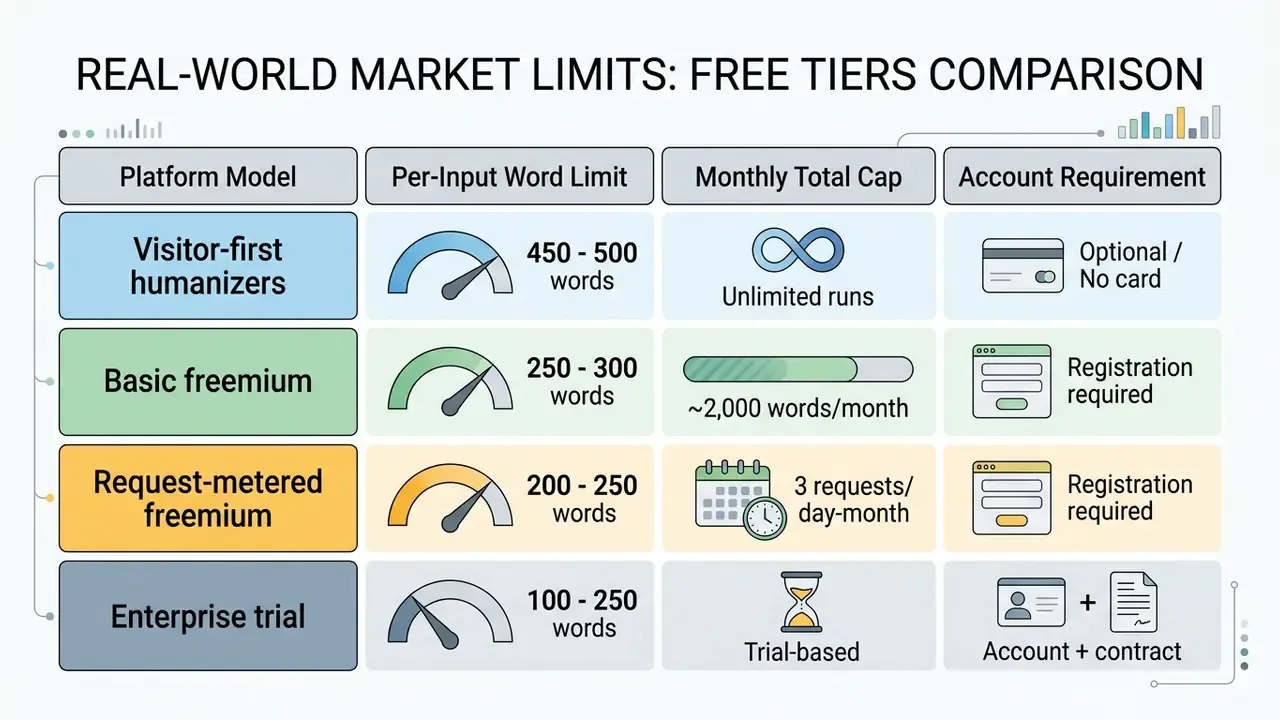
Note the metering mismatch across vendors. Some cap words per input, others cap total words per month, others cap requests. Those units are not interchangeable, and any procurement comparison that ignores the unit will misprice the contract, sometimes by an order of magnitude. When assessing subscription costs and operational overhead, teams reference the AI Media Pricing Guides for cost modeling.
Total Cost of Ownership: the review cost dominates
The subscription line item is rarely the largest cost. A defensible TCO model looks like this:
TCO per 1,000 published words =
      (subscription cost allocated per 1,000 words)
    + (editorial review minutes × loaded hourly rate)
    + (fact-verification minutes × loaded hourly rate)
    + (originality/plagiarism scan cost)
    + (evidence capture & storage overhead)
    + (rework rate % × full cycle cost)
In regulated environments, review and verification typically dominate total cost. That reverses a common procurement instinct: the cheapest tool is the one that cuts review time, through frozen zones, sentence-level control, clean diffs, and stable voice profiles, not the one with the lowest monthly fee. Model it on your own content mix before signing; the delta between two vendors is usually a staffing question, not a licensing one. Engineering managers running these estimates use the AI Media Calculators to size throughput and cost per published unit.
What Is Included in a Free AI Humanizer?
A free ai humanizer typically provides access to a standard rewriting engine capped at short limits, commonly between 100 and 500 words per submission, depending on whether the user is signed in. These entry-level options let users test an ai human generator free text interface without mandatory account registration.
While a humanizer free tier demonstrates basic transformation, it generally lacks custom tone settings, custom voice profiles, multi-document processing, per-sentence controls, and advanced semantic preservation guarantees. Free tiers also rarely offer a Data Processing Agreement, which alone disqualifies them for confidential material. That single gap ends most enterprise evaluations before the quality debate even starts.
When Do Pro or Advanced Humanization Features Matter?
Upgrading to Pro or Ultra tiers becomes necessary when teams process lengthy reports, need custom brand voice tuning, want per-sentence rephrasing, or require direct API integration. Advanced plans run larger neural architectures that execute complex style transfer while holding domain context, and typically raise per-input limits into the 2,000-word range.
Organizations comparing platform capabilities across creative tools can review guides such as the Canva AI Generator overview or the technical evaluation of the Google Veo AI video generator.
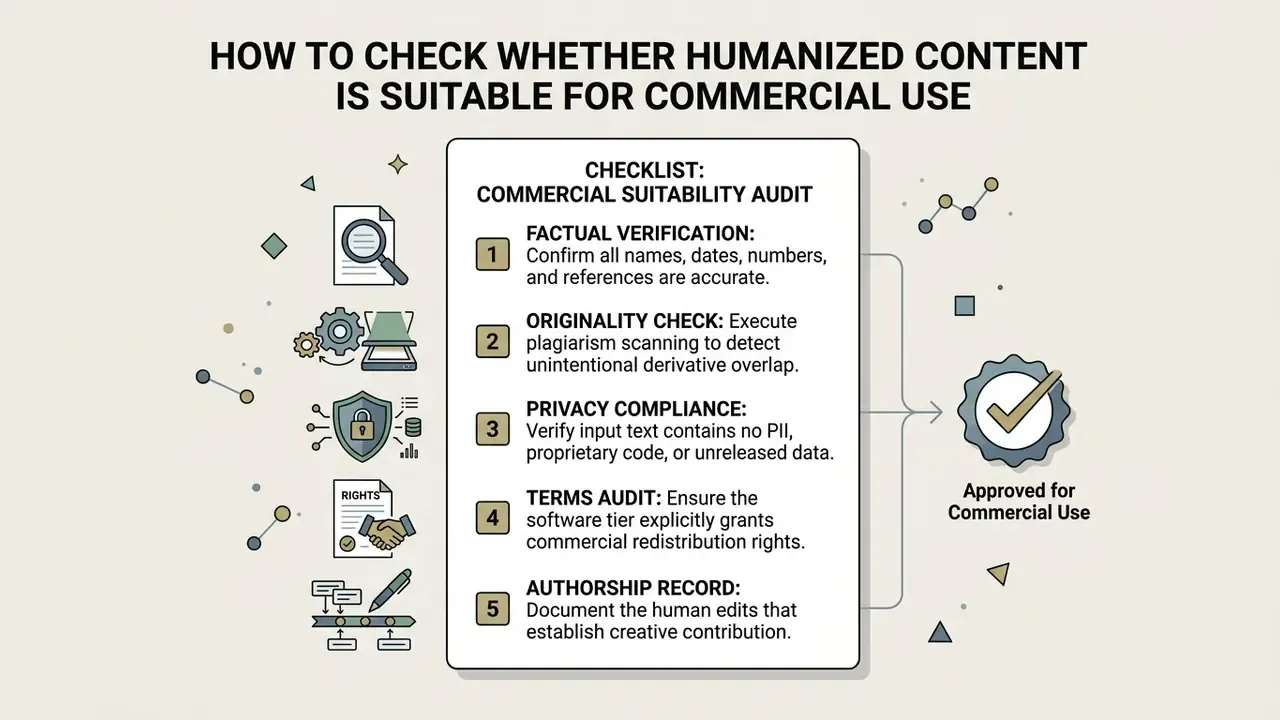
How to Check Whether Humanized Content Is Suitable for Commercial Use
Commercial suitability requires verifying that the transformed text does not infringe original copyrights, expose confidential data, or violate platform terms of service. According to U.S. Copyright Office guidance, pure AI-generated text lacks human authorship; prompting alone is not authorship. Humanization adds stylistic value, but demonstrable human creative modification, meaning selection, arrangement, and substantive revision, is what establishes copyright protection.
«Paraphrase plagiarism preserves the source’s meaning and structure without attribution: it remains plagiarism even when the wording changes.»
FAQ: AI to Human Generators
Do AI Humanizers Support Multiple Languages and Fast Processing?
Yes. Modern AI humanizers support major global languages, including English, Spanish, French, German, Portuguese, Italian, Chinese, Russian, and Japanese, with vendor claims ranging from 6 to 60+ supported languages. Typical published latency is roughly 3 to 10 seconds for a 450–500-word input, with sub-second-per-paragraph figures reported by some libraries. Careful here: vendor numbers are measured on different sample sizes and are not directly comparable.
«Adversarial humanization frameworks can compromise detectors in under 10 seconds per sample.» Zhou et al., Humanizing Machine-Generated Content (2024). https://arxiv.org/abs/2404.01907 Multi-modal production teams also standardize automated tooling across audio and visual formats. Operators review implementation benchmarks in guides covering the AI voice generator guide, free editing tools in the free photo editor guide, specialized media processing via the video compressor guide, and publishing frameworks in the YouTube video editor guide.
Can I Rephrase Just One Sentence Instead of the Whole Document?
Yes, on tools that expose sentence-level controls. Highlight the sentence, request an alternative variation, accept or reject it in isolation. This is the preferred method after the first full pass, because re-running an entire approved document reintroduces drift into sections that were already fact-checked and signed off.
Can a Humanizer Learn My Brand or Personal Writing Style?
Advanced tools build a custom voice profile from three to five samples of your published writing, then benchmark later runs against that profile instead of a generic baseline. Treat the profile as a governed artifact: an owner, a version ID, and a source-approval rule. Only published, non-confidential material should ever be uploaded as a style sample.
Is My Text Stored Anywhere?
It depends entirely on the vendor. The strongest posture is RAM-only execution with no persistent database logging and immediate purge at session end, contractually backed by a no-training clause and a DPA. Anything weaker should be treated as public disclosure of the input text.
Does Humanized Content Rank Well in Search?
Search guidance rewards helpful, original content regardless of production method, and demotes low-value content regardless of production method. Humanization improves readability and removes repetitive patterns, which can help engagement metrics. Ranking still depends on the substance, accuracy, and usefulness of what you publish.
Is Using an AI Humanizer Ethical?
Editing your own draft for clarity and tone is ordinary editorial practice. Using humanization to conceal AI assistance where disclosure is required is not, and institutional policies, employer guidelines, and publisher rules apply with or without a humanizer. If your context requires disclosure, disclose it.
What Should a Bank Do First, Before Buying Anything?
Start small and reversible. Register the tool as a model-adjacent component in your inventory, pick one low-risk content class (external blog commentary, not credit memos), define frozen zones, run 20 documents through the full evidence checklist, and measure review minutes per 1,000 words. If the evidence bundle cannot be reconstructed after the fact, the pilot has already answered your procurement question. Teams that extend text workflows into multimedia can compare delivery options in the best free AI video generator comparison under the same controls.
Key Operational Takeaways
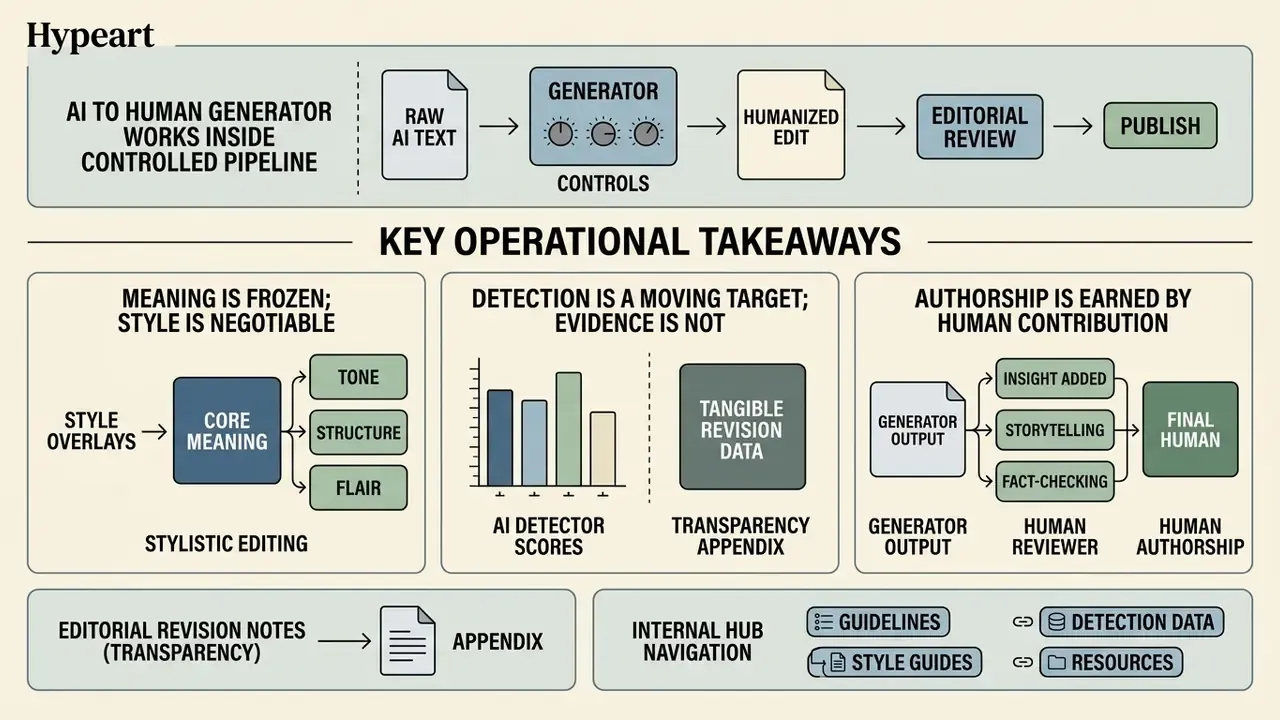
An ai to human generator works well as a stylistic editing tool inside a controlled content pipeline. An ai generator text to human workflow improves sentence cadence, removes mechanical transitions, and lifts readability. It must always be paired with human editorial review, factual verification, auditable evidence capture, and strict data governance.
Three closing principles for regulated deployments:
Open questions this guide cannot settle. Whether vendor detector benchmarks hold in finance-specific corpora is unproven. Whether supervisory expectations will treat humanizers as in-scope models or as ordinary productivity software is still unclear in 2026. And the residual reputational risk of undisclosed AI assistance is not quantifiable from public data. Where that uncertainty matters, err toward disclosure and toward keeping the evidence trail longer than you think you need.