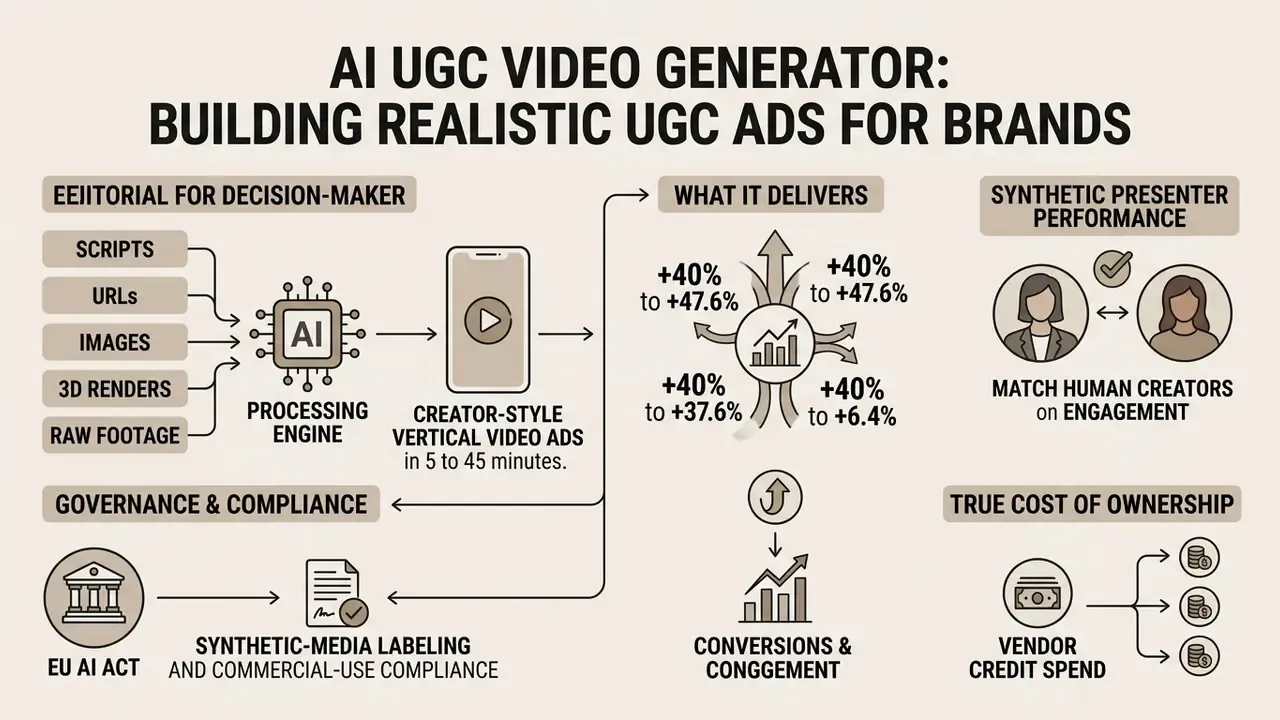
«Deploying synthetic content creators at scale requires moving beyond viral novelty to measurable risk control, brand safety, and verifiable compliance. When evaluating an ai ugc video generator, enterprise marketing teams and governance officers must scrutinize decision ownership, model risk, and input data integrity before launching autonomous ad campaigns.»
— Marcus Hale, author
Key Takeaways for Decision-Makers
What an AI UGC Video Generator Is and Which Tasks It Solves
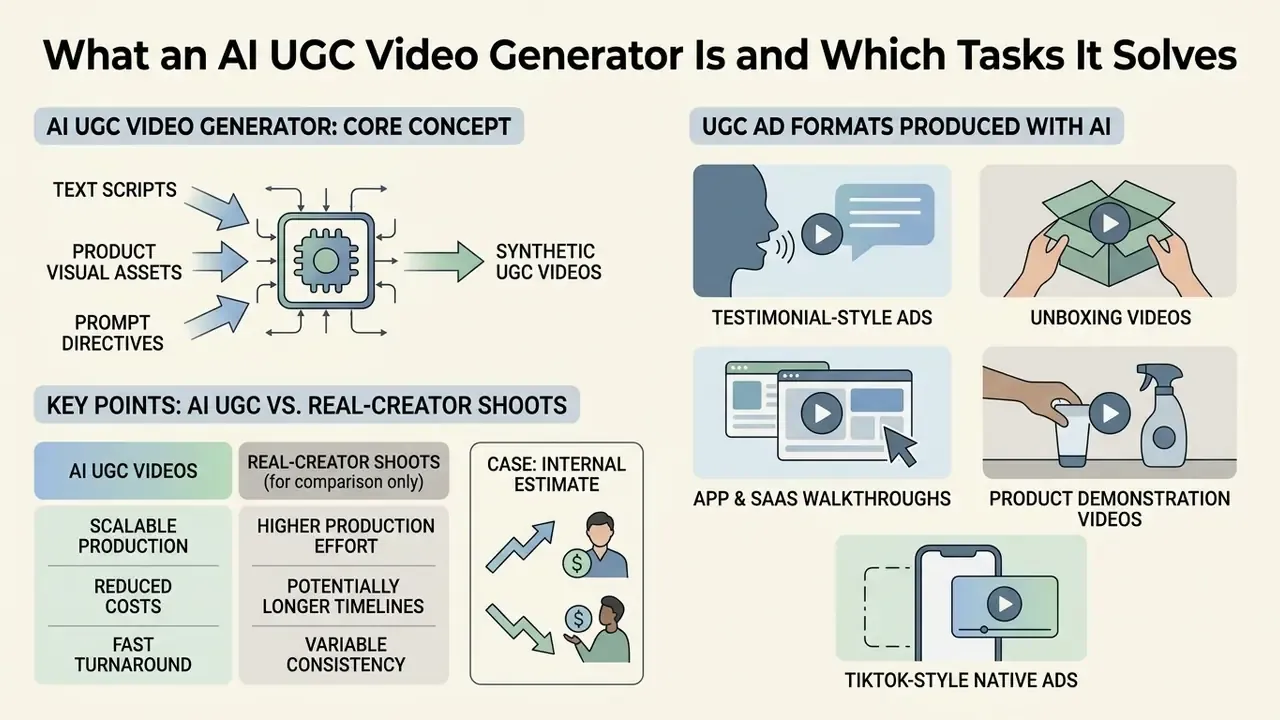
An ai ugc video generator is a software platform that turns text scripts, product visual assets, and prompt directives into synthetic, user-generated-style video advertisements. These tools resolve the creative bottleneck by replacing manual talent recruitment, studio filming, and labor-intensive editing with algorithmically rendered ai generated ugc videos.
Marketing teams deploy an ai ugc generator for four jobs: high-volume performance marketing, fast creative testing, localized international expansion, and automated ad variation. Traditional user-generated content (UGC) relies on real customers or commissioned creators filming raw video on personal hardware. A generated ugc platform, by contrast, synthesizes digital actors, speech, and dynamic backgrounds in minutes. With an ai ugc content generator, brands keep tight brand controls while producing native-looking short-form video ads for direct-to-consumer (DTC) e-commerce, mobile apps, and software products.
Accepted input sources (multi-input flexibility). Modern platforms are no longer script-only. Production teams can seed a render from a plain-text script or campaign brief, a raw product photo or packshot, a 3D/CAD model or pre-launch prototype render, existing raw footage, a recorded voice memo from a marketer, or a live product URL from Shopify, Amazon, or a marketplace listing. This flexibility is what lets one asset library feed dozens of downstream ad variants.
How AI-Generated UGC Videos Differ from Real-Creator Shoots
AI generated ugc videos differ from traditional creator production in four dimensions: execution speed, per-unit cost structure, script control, and physical asset dependency. Traditional creator workflows need product shipping, contract negotiation, and multi-week turnaround. An ai ugc creator platform renders a finished asset within 15 to 45 minutes of script submission. Industry cost benchmarks place traditional video production at roughly $1,000 to $5,000 per finished minute with freelancers, and $15,000 to $50,000 per minute at agency level, against roughly $0.50 to $30 per minute on AI-avatar platforms.
Academic research shows clear structural trade-offs between human creators and synthetic presenters.
«Virtual influencers generate engagement on par with humans, yet fall significantly short on trust, brand attitude, and behavioral intention.»
That meta-analysis, covering 210 experimental studies and 643 effect sizes, reports that virtual creators reach engagement parity with human influencers largely on novelty. Synthetic presenters, however, face measurable baseline discounts in audience trust and long-term brand credibility whenever an endorsement claim depends on lived personal experience.
Neurophysiological evidence complicates the «AI feels colder» assumption:
«AI advertising can elicit emotional responses equal to or exceeding human-made advertising, even when viewers consciously describe it as colder.»
So the stated preference and the measured response can diverge. Worth remembering before you dismiss synthetic creative on gut feel.
Case (internal estimate, figures reported by the client team, not independently audited):
Total cost of ownership (TCO), not just render cost. Enterprise readers should model three cost layers that vendor pricing pages omit:
| TCO Layer | What It Covers | Typical Load per Campaign Batch |
|---|---|---|
| Vendor / render cost | Subscription fee plus credit burn per second of output | $2 to $30 per finished video |
| Legal & compliance review | Claim verification, disclosure wording, likeness release checks | 0.5 to 3 legal hours per script family |
| Model / brand validation | Human-in-the-loop QA of hallucinated figures, logo placement, artifact review | 5 to 15 minutes per rendered variant |
| Governance overhead | Audit-trail storage, prompt and version logging, vendor risk reassessment | Fixed annual allocation |
For teams evaluating adjacent generation mechanics, our reference material on AI text-to-video generation explains how prompt-to-frame rendering pipelines actually work. To complement video creation workflows, teams frequently convert asset frames into still marketing assets using a video to image converter.
Which UGC Ad Formats You Can Produce with AI
An ai ugc maker produces five primary performance-ad formats for direct response: video testimonial reviews, product unboxing sequences, mobile software UI walkthroughs, e-commerce product demonstrations, and 9:16 vertical social feeds. Teams comparing execution engines can review our roundup of the best AI video generators before committing budget to a single vendor.
When developing diverse visual concepts, teams often adapt pre-built layout patterns from a library of video templates to keep brand visuals consistent across campaigns.
| Production Stage | Traditional UGC Production | AI UGC Video Creation Tools |
|---|---|---|
| Creator sourcing | 5 to 10 days (outreach, vetting, contracts, product shipping) | Instant (avatar library or custom clone) |
| Scripting and control | Variable compliance; creators alter lines on set | Exact script adherence; instant text updates |
| Video generation | 3 to 7 days (shooting, footage review, reshoots) | 5 to 20 minutes (cloud rendering) |
| Editing and captions | Manual post-production, styling, subtitling | Automated captions, aspect-ratio formatting, motion overlays |
| Cost per finished video | $150 to $500+ per creator video | $2 to $30 per rendered video depending on plan |
| Multilingual scaling | Requires native speakers per target market | One script auto-translated, dubbed, and lip-synced into 175+ languages and dialects |
| Library build-out (50 videos) | 12 to 18 months at enterprise scale | 4 to 8 weeks with parallel batch rendering |
Empirical data supports the format hierarchy above, rather than vendor claims alone:
«Across 2,578 TikTok videos, presenter trustworthiness, expertise, and attractiveness correlated positively with purchases; authenticity influenced sales in a U-shaped pattern.»
The U-shaped authenticity finding is operationally important. Excessively polished renders and excessively rough «fake amateur» renders both underperform. The commercial sweet spot is a controlled, slightly imperfect creator aesthetic.
Which UGC Ads and Channels AI Video Ad Generation Fits
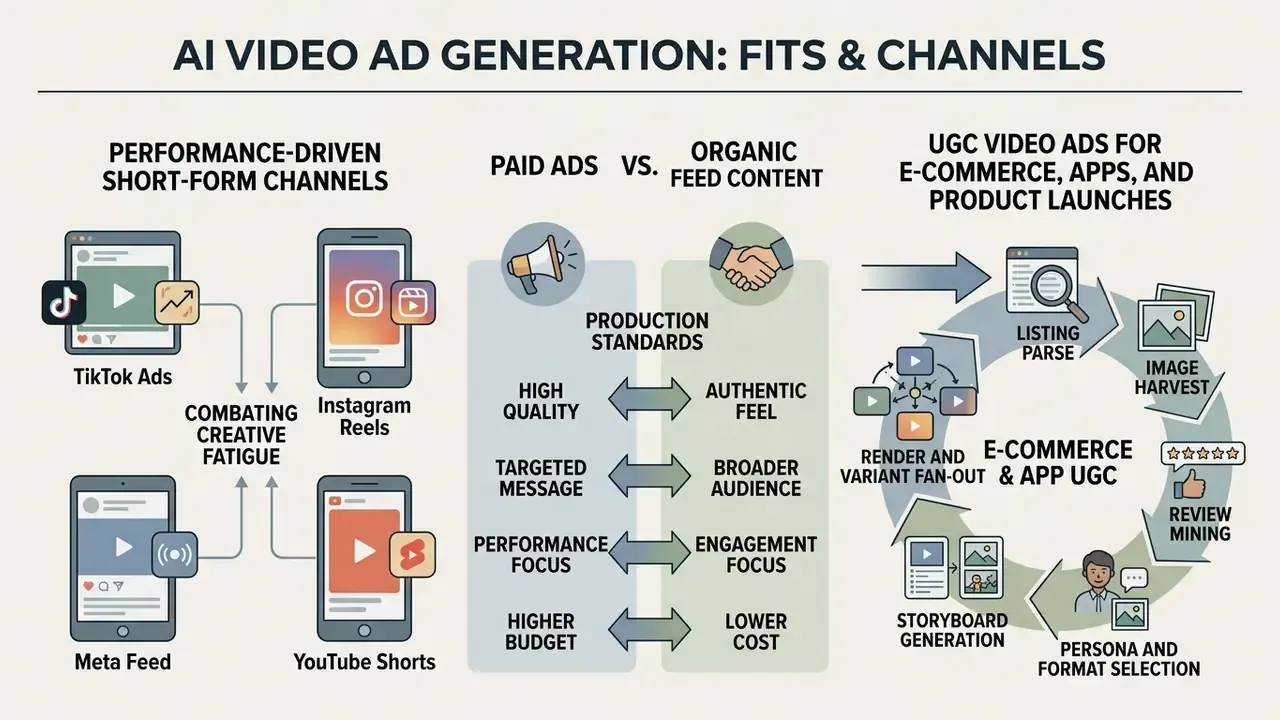
AI video ad generation gen ugc workflows are built for performance-driven short-form channels: TikTok Ads, Instagram Reels, Meta Feed, and YouTube Shorts, where creative fatigue demands continuous variation. These high-velocity platforms reward frequent iteration, which makes ugc ads rendered by synthetic platforms effective for rapid campaign scaling.
«Systematic meta-analysis confirms viewers watch user-generated videos for entertainment, information, and social interaction; AI content must satisfy the same needs.»
Channel selection depends on the campaign's risk appetite and the product category. High-margin physical goods, mobile app installs, seasonal promotional launches, and software-as-a-service (SaaS) trials are the strongest candidates. Teams running low-budget validation cycles often start with free AI video generators before committing to enterprise seats. Regulated financial products, healthcare disclosures, and high-consideration enterprise tools need stricter disclosure governance when synthetic actors appear on screen.
Paid Ads vs. Organic Feed Content: Two Different Production Standards
Mixing paid and organic requirements into one creative brief is the most common cause of underperformance. The two channels reward opposite signals.
| Dimension | Paid UGC (Meta / TikTok / YouTube Ads) | Organic UGC (Reels / Shorts / TikTok feed) |
|---|---|---|
| Primary objective | Direct response: click, install, purchase | Watch time, saves, shares, algorithmic distribution |
| Structure | Strict timing: hook 0 to 3s, pain 3 to 10s, proof 10 to 20s, CTA 20 to 30s | Loose narrative, trend-led opening, delayed or implicit CTA |
| Overlays | Discount badges, price stamps, high-contrast burned-in captions, offer bands | Native platform-style captions, minimal graphic furniture |
| Audio | Licensed royalty-free or generated tracks (ad-account safe) | Trending audio where licensing permits; conversational voice |
| Aesthetic | Controlled brand-safe lighting, legible product framing | Deliberately imperfect handheld feel, natural room lighting |
| Compliance load | Full claim substantiation, synthetic-media disclosure, likeness releases | Disclosure still required; claim scrutiny lower but not absent |
| Iteration cadence | Weekly variant swaps driven by CPA and ROAS thresholds | Continuous posting, trend-reactive within 24 to 72 hours |
UGC Video Ads for E-commerce, Apps, and Product Launches
For e-commerce brands and mobile apps, an ai ugc content creator turns store URLs and catalog pages into complete ad creatives without filming physical inventory.
Product URL-to-video workflow (direct listing parsing). The fastest 2026 workflow removes manual asset assembly entirely. The operator pastes a live product link (Shopify, Amazon, WooCommerce, or another marketplace listing) and the agent runs this sequence:
- Listing parseextracts the product title, bullet-point benefits, price, variant options, and specification tables.
- Image harvestpulls gallery images and packshots, isolates the product on a clean background, and normalizes framing to the 85%-of-frame commercial standard.
- Review miningclusters recurring phrases from customer reviews into ranked pain points and benefit claims.
- Persona and format selectionmatches the extracted category to a UGC format (testimonial, unboxing, demo, listicle) and picks a matching presenter persona.
- Storyboard generationwrites the hook, pain block, proof beat, and CTA, then assigns each line to a scene with product-in-hand or product-on-surface framing.
- Render and variant fan-outproduces the master video plus hook and CTA variants for testing, with no designer, no photoshoot, and no manual scripting.
In product launch scenarios, an ai ugc generator lets marketing teams build teaser videos from 3D renders, CAD models, or prototype photos before physical inventory reaches fulfillment centers. Feed the feature list into the workflow and pre-order campaigns can go live on TikTok and Meta within hours of design freeze.
Metadata quality also decides whether generated assets ever reach an audience on UGC-native platforms:
«Introducing an AI title-generation tool increased the likelihood that a video had a title by 41.4%, directly improving discoverability and reach.»
Marketing operations routinely process raw footage or clean up existing ad assets with a video summary generator to extract narrative hooks for script writing.
Creative Testing for TikTok, Reels, and Meta Ads
| Metric | Reported Range | Mechanism |
|---|---|---|
| CTR (click-through rate) | +40% to +47.6% | Rapid replacement of the first 3-second hook across 10+ variants |
| CPA (cost per acquisition) | Up to −45% on Meta and TikTok | Faster identification of winning hook × avatar combinations |
| ROAS (return on ad spend) | +73% average | Sustained weekly testing volume (10+ hypotheses per week) |
| Production volume | Up to 50× increase; 300 to 1,000+ creatives per month via API | Batch rendering from spreadsheet script inputs |
| Cost per creative | From roughly $3,000 (filmed) down to $2 to $30 (generated) | Removal of talent, crew, and post-production line items |
| Time saved | Up to 97% of production cycle time | Elimination of sourcing, shipping, and reshoot loops |
These figures are aggregated from published vendor case libraries (including Creatify AI customer results) and client-reported accounting. They are directional benchmarks, not audited averages. Results vary by category, offer strength, and account maturity.
Case (internal estimate, client-reported figures, methodology not externally audited):
Teams managing performance budgets use tools such as AI Media Calculators to estimate credit spend, render costs, and campaign ROI before scaling volume.
AI UGC Creator Capabilities: Avatars, Scripts, and Brand Control
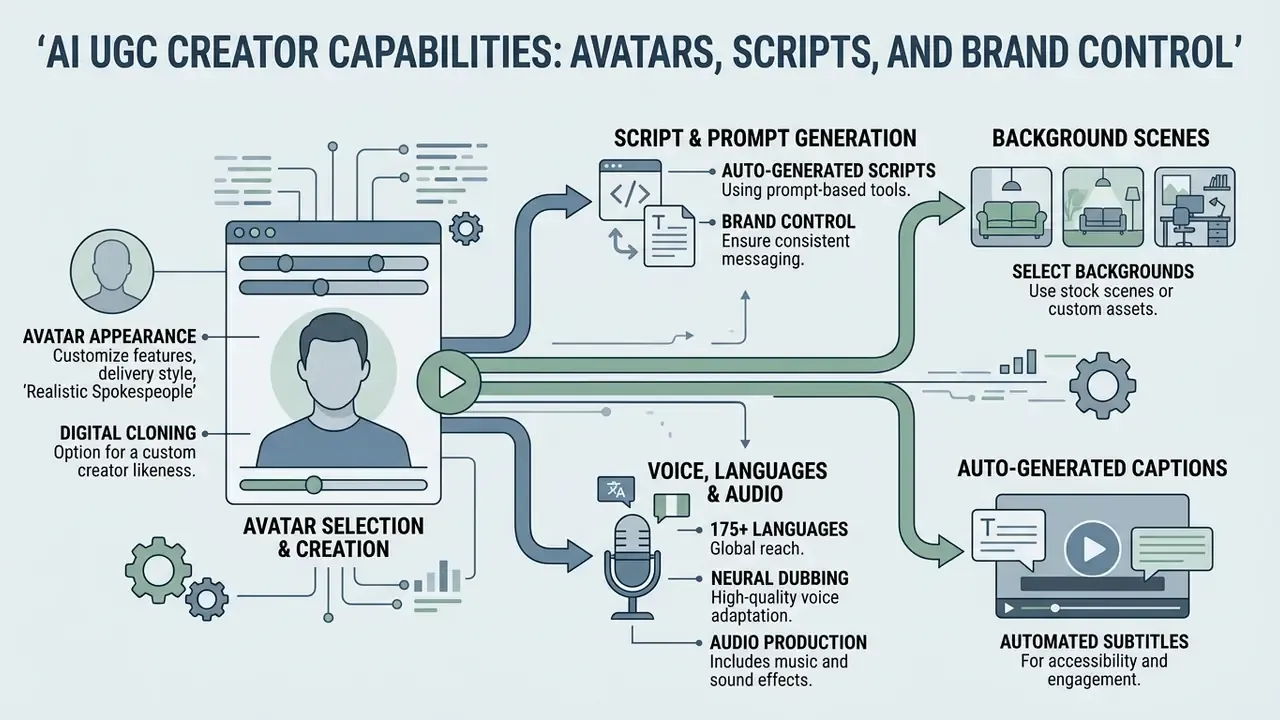
Modern ugc ai creator platforms centralize control over avatar appearance, delivery style, prompt and script generation, background scenes, and auto-generated captions. By unifying those settings in one dashboard, an ai ugc creator replaces a disjointed toolchain of editors, voice tools, and subtitle utilities.
Systematic reviews in Computers in Human Behavior (2024) evaluate virtual character design parameters and emphasize that visual realism, lip-sync accuracy, and vocal naturalness decide whether viewers accept a synthetic character or reject it through uncanny valley distortion. Precise administrative control over generative assets is what lets brands protect identity while testing creative at scale.
Documented vendor control surfaces converge on four layers: avatar selection or custom-avatar creation from a photo; script paste or AI script generation with editable text; voice and language settings with adjustable speed, pitch, volume, clarity, stability, pauses, and pronunciation overrides; and brand-asset inputs (logos, palettes, product info, tone-of-voice rules) that persist across renders.
Choosing AI Avatars, Creators, and Realistic Appearance
Selecting an ai ugc video creator avatar means balancing photorealism with behavioral naturalness: gesturing, gaze tracking, and sub-surface skin scattering.
Recent computer-vision research on audio-driven avatar architectures, including CVPR-level work published in 2024 and 2025 on speech-driven photorealistic avatars, shows that natural micro-articulations reduce perceived artificiality sharply. The relevant details are bilabial closures during lip-sync speech, realistic cheek inflation, nasolabial line movement, subtle blinks, and fine hand gestures. Earlier codec-avatar work (WACV, 2021) established that natural facial motion requires audio plus gaze and eye-tracking signals, alongside explicit geometry and texture modeling for real-time photorealistic rendering. When choosing a ugc ai creator, enterprise teams pick avatars with subtle physical micro-imperfections rather than flawless airbrushed renders that read as artificial.
The persuasion mechanism depends on how human-like the avatar looks:
«For highly anthropomorphic virtual personas, trust is a stronger mediator of persuasion than novelty; for stylized personas, the reverse holds.»
Custom digital cloning of real spokespeople. Beyond stock libraries, enterprise platforms build a custom avatar from one high-resolution photo or a 30-second consent-recorded video of an employee, founder, or contracted spokesperson, reproducing facial identity, voice timbre, and delivery cadence. This route requires a documented likeness and voice release before any paid deployment. See the legal section below.
To supplement full-body avatars with localized subtitles, media teams integrate a dedicated video subtitle generator to format dynamic on-screen captions across target languages.
Scripts, Prompts, and Product Assets for UGC Video
Producing effective ai generated ugc videos means structuring prompts, script templates, and product visuals against platform advertising guidelines.
Prompt engineering standards documented by AI research labs specify a framing hierarchy: persona role assignment, audience pain point, visual scene background, explicit product display rules, and negative exclusion constraints such as competitor logos, unauthorized watermarks, or unnatural camera jitter. Published prompting guidance recommends a fixed order (background and scene, then subject, then key details, then constraints) with brand invariants such as identity, geometry, layout, and logo placement listed separately from exclusions, so drift becomes detectable in QA.
Standardized e-commerce asset guidelines from GS1 (2024) require product-in-hand footage to show clear hand-and-forearm interaction without obscuring primary packaging text. GS1 GDSN image specifications define a «held» shot as a product held by one hand or a pair of hands, with no part of the person other than hands and forearms visible. Amazon's main-image policy additionally requires the whole product to occupy roughly 85% of the frame on a pure white background. That is exactly why locked framing ratios belong in the prompt template, not in post-production.
Appeal type also shifts response to synthetic presenters measurably:
«Consumers rate AI-generated advertising higher when it uses agentic appeals (competence, problem-solving) rather than communal appeals (warmth, caring).»
Situation: A beauty brand launched a synthetic UGC campaign but hit ad rejections on social platforms over inaccurate product label positioning and inconsistent avatar lighting.
Action: The creative team rebuilt the AI UGC generator pipeline with locked prompt rules that enforced pure white backgrounds, an 85% product frame ratio, and explicit lighting parameters.
Result: Ad approval rates reached 100% for the next batch, and output stayed visually consistent across 25 localized ad variants.
For campaigns that need raw audio extraction or custom sound design, teams use a video to audio converter online free utility to separate voice tracks from renders.
Voice, Languages, Captions, Audio, and Content Adaptation
Global expansion through an ai ugc content generator relies on neural AI voice generators: neural text-to-speech (TTS), automated dubbing, lip-sync alignment, and burned-in captions across 175+ languages and dialects.
Neural dubbing standard. The 2026 market baseline is no longer flat translation. Leading platforms perform neural dubbing that preserves the original speaker's cloned voice timbre and re-fits articulation to the translated audio across 175+ languages and regional dialects. One master script, native-sounding localized variants, no re-recording.
Global media delivery standards, including Netflix's Localization, Accessibility, and Dubbing Branded Delivery Specifications, require subtitle files to align within 0.5 seconds of the delivered mezzanine or proxy audio. That sets a hard timing rule for auto-generated captions. Professional dubbing practice (ATAA, Subtitling and Dubbing for Film and Television) structures localization as detection, adaptation, verification, where voice-style selection is constrained by lip movement, breathing, and technical direction rather than chosen freely.
Modern ugc ai generator platforms integrate automatic speech recognition (ASR) to build dynamic caption overlays styled for TikTok and Reels viewing habits.
Voice choice, though, is not cost-neutral in engagement terms:
«AI voices are cost-efficient, yet underperform human voices in sustaining audience engagement in video advertising.»
Audio production and background music. Production-grade platforms also handle the soundtrack layer. They auto-match background music tempo to cut rhythm from a cleared royalty-free library, or generate an original score matched to mood and pacing. Both routes exist to prevent DMCA takedowns and ad-account restrictions caused by unlicensed trending audio, a frequent cause of paid-social rejections. Practical controls include per-track ducking under voiceover, loudness normalization to platform targets, and one-click swap of the music bed across a whole variant batch.
Production workflows often export short segments into lightweight animated formats using a video to gif online converter for email embeds and landing pages.
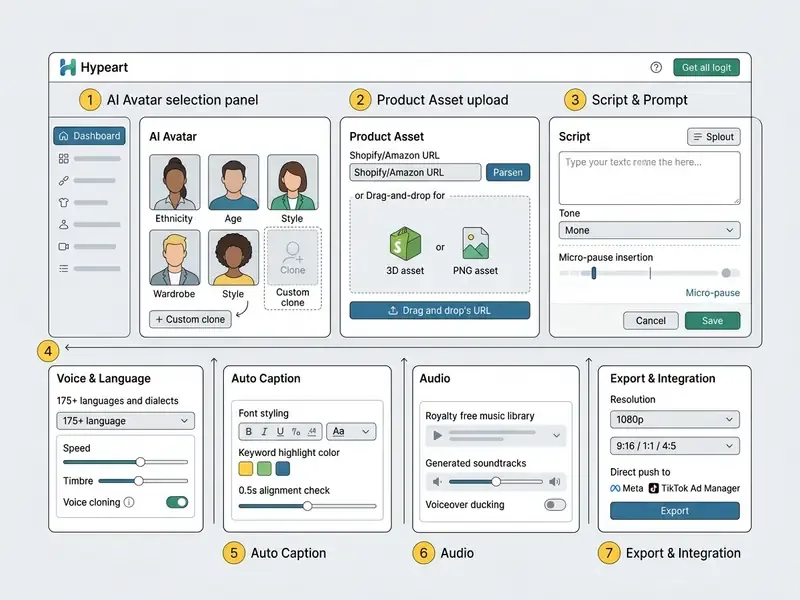
How to Create UGC Videos with AI: Step-by-Step Process
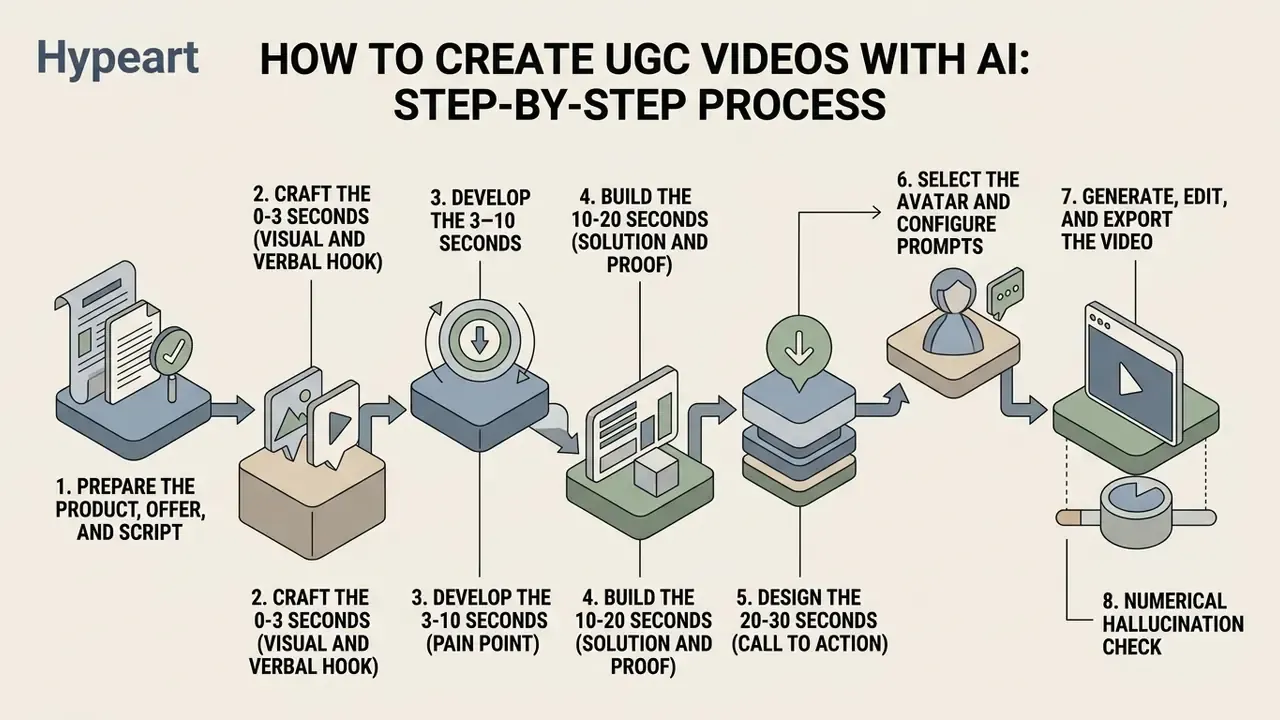
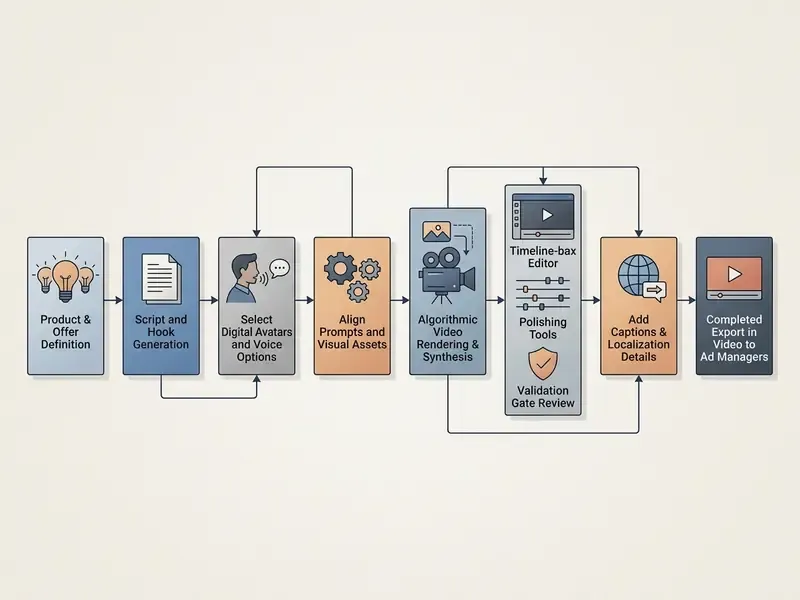
To create ugc content with ai systematically, marketing teams follow an eight-step pipeline from brief to export. Using ai ugc video creation tools this way keeps quality control reproducible, messaging compliant, and iteration fast. Inputs at step one may be text, raw footage, product photos, 3D models, or a marketer's audio note. The pipeline normalizes all of them into a scripted storyboard.
Prepare the Product, Offer, and Script
Pre-production for create ugc videos with ai means selecting one compelling offer, mapping consumer pain points, and writing a direct-response script on a proven 30-second UGC framework:
- 0 to 3 seconds (visual and verbal hook). A high-impact problem statement or surprising visual claim built to stop the scroll.
- 3 to 10 seconds (pain point). Clear articulation of one specific frustration that resonates with the target segment.
- 10 to 20 seconds (solution and proof). Demonstration of the product resolving that pain, with high-resolution product visuals.
- 20 to 30 seconds (call to action). One direct instruction: click, download, or purchase.
Offer preparation means choosing one clear product angle that resolves one explicit pain, then writing the CTA as one concrete next action, not a menu of options.
When budgeting across campaign tools, teams consult AI Media Pricing Guides to compare operational expenditure per output unit.
Select the Avatar and Configure Prompts
During avatar setup, marketers choose a presenter whose demographic profile, voice pitch, and tone match the customer persona. Prompt parameters are then locked to enforce background stability, professional lighting, and precise product positioning. Worth locking explicitly: framing (close-up, wide, top-down, eye-level, low-angle), lighting (soft diffuse, golden hour, high-contrast), mood, materials, and style cues, plus the exclusion list that prevents watermark, stray text, and third-party logo drift.
Generate, Edit, and Export the Video
The rendering phase turns inputs into a finished vertical 1080p file. Marketers polish inside the built-in editor: caption timing, brand color palettes, logo watermarks, then export platform-ready MP4 files to ad channels. Teams needing deeper timeline control move the master into dedicated video editing tools for frame-accurate trims and graphic layering. Subtitles can be burned in or delivered as sidecar SRT/VTT files for platform-side upload.
Mandatory pre-export validation checklist (the step 6 gate):
Teams comparing alternative platforms use AI Media Comparison Matrices to evaluate rendering speed and feature sets side by side.
How to Choose an AI UGC Video Generator for Ads
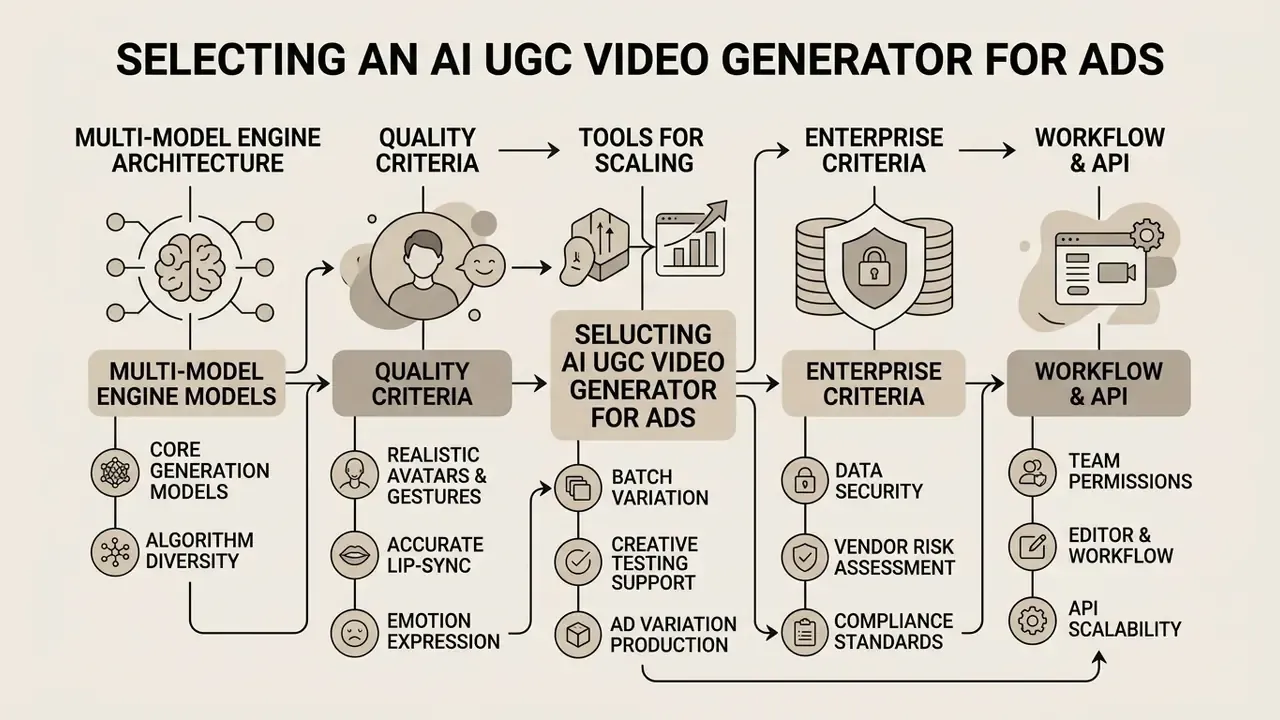
Selecting among competing ai ugc video generator tools means evaluating render realism, batch variation support, dubbing accuracy, team permissions, and API scalability. Readers new to the category can start from our overview of AI video generators for baseline terminology. An enterprise ai ugc generator has to support high-volume creative testing while holding data governance controls in place.
Multi-Model Engine Architecture: What Sits Under the Hood
Single-model platforms are being displaced by hybrid pipelines that route each production stage to a specialist engine. The stack matters because render realism, cost per second, and failure modes differ by layer.
| Pipeline Stage | Model Class | Representative Engines | Function in the UGC Ad |
|---|---|---|---|
| Script and storyboard | LLM | Qwen-class flash models, GPT-4o-class assistants | Hook writing, pain-point framing, variant fan-out, CTA phrasing |
| Product and model imagery | Image generation and editing | Nano-Banana-class editors, Flux-class generators | UGC-style model shots, product-in-hand placement, virtual try-on |
| Facial animation and lip-sync | Audio-driven avatar | Avatar4-class, Hedra-class character models | Micro-expressions, multilingual lip-sync, gaze behavior |
| B-roll and scene rendering | Text/image-to-video | Sora2-class, Veo3-class engines | Demo scenes, before/after beats, cinematic motion |
| Voice and dubbing | Neural TTS and voice cloning | Cloned-timbre TTS across 175+ languages | Localized narration preserving speaker identity |
| Assembly and captions | ASR plus editor | Whisper-class ASR, timeline editor | 0.5s-aligned captions, music ducking, aspect-ratio exports |
Multi-model studios expose 14+ selectable video models, letting operators preview and route by need: cinematic motion for launch teasers, character performance for testimonials, product animation for feature demos. That beats accepting one locked template workflow.
Enterprise Data Security and Vendor Risk Criteria
For regulated organizations, feature parity is secondary to control parity. Add these procurement gates to any shortlist.
| Control | What to Verify | Why It Matters |
|---|---|---|
| SOC 2 Type II | Current report, scope covering the generation environment | Independent assurance over security, availability, confidentiality |
| No-data-training clause | Contractual ban on training vendor models with uploaded scripts, product assets, or brand data | Prevents leakage of unreleased products and proprietary copy |
| Tenant isolation | Logical or physical separation of workspace assets and renders | Blocks cross-client asset bleed in agency and multi-brand setups |
| SSO / SCIM / RBAC | Enterprise identity integration, role-scoped permissions, deprovisioning | Eliminates shadow AI accounts and orphaned access |
| Data residency and retention | Storage regions, deletion SLAs, prompt and log retention windows | Required for GDPR and internal records policies |
| Audit logging and export | Retrievable logs of prompts, model versions, approvals, renders | Supplies reproducible evidence for internal and external auditors |
| Provenance tooling | Watermarking, C2PA-style metadata, detection support | Supports synthetic-media disclosure obligations |
Data privacy note: enterprise tiers of major vendors typically isolate customer inputs and contractually exclude them from model training, while free and consumer tiers frequently do not. Verify the clause in the executed order form, not on the marketing page, before uploading unreleased product assets or regulated ad copy.
Quality Criteria: Realistic Avatars, Gestures, and Lip-Sync
Technical quality evaluation of a ugc ai generator leans on objective benchmarks from computer vision frameworks and standards bodies. NIST's synthetic-content work, including Reducing Risks Posed by Synthetic Content (NIST AI 100-4, 2024) and the NIST GenAI evaluation program (2024 to 2025), frames generator assessment around distinguishability from human-made content, watermarking, provenance metadata, and detection, with a reported target discrimination AUC near 0.5 for indistinguishable generators. On the audiovisual side, SyncNet-derived lip-sync metrics (LSE-D and LSE-C) plus landmark-based lip distance and velocity measures quantify mouth-audio alignment. Enterprise buyers test whether avatars show robotic facial freeze, unnatural blinking, or lip-sync latency on complex sentences. They also separate visual realism (physical resemblance) from behavioral realism (gesture timing and appropriateness), because the two fail independently.
Tools for Creative Testing and Ad Scaling
High-volume ad management demands programmatic batching. Enterprise platforms accept uploaded spreadsheets containing dozens of script hooks and render corresponding variations in parallel, which accelerates A/B testing considerably. Our AI video generator comparison flags which platforms support true batch fan-out versus manual duplication. Comparable patterns exist across the wider ad stack: Google Ads supports bulk upload templates and full campaign creation via BatchJobService, Ads Creative Studio builds offline variants from an uploaded variant sheet, Adobe GenStudio edits generated variants individually or in batch, and image tools such as Ideogram drive bulk generation from a spreadsheet prompt template.
When You Need an Editor, Workflow, and API
Integrated timeline editors, multi-user workspaces, and REST APIs become decisive once output exceeds manual dashboard capacity. In practice, the API is the core automation requirement (programmatic create, extend, edit, webhook-driven async rendering). The built-in editor matters mainly when editable templates or post-generation fixes belong to the workflow. Workspaces become mandatory when assets, API keys, and approvals must stay isolated per team or per client. Enterprise developers use AI Media API Guides to automate generation from internal CRM systems or product catalogs.
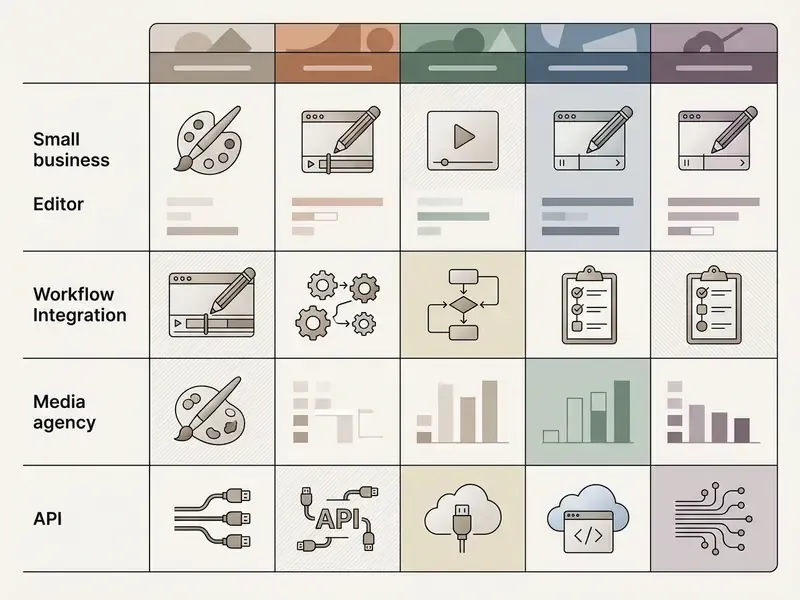
| Business Scenario | Key Tool Requirements | Recommended Functionality | Limitations and Risks |
|---|---|---|---|
| E-commerce and DTC | High-volume product URL rendering, Shopify/Amazon integration | Product URL-to-video parsing, automated unboxing mockups, review-mined benefit claims | Visual mismatch between rendered catalog images and physical goods |
| Mobile app marketing | UI screen recording embeds, fast hook testing | Phone mockup overlays, dynamic app store CTAs, 9:16 native feeds | Ad network policy checks on app UI representation; Google Play treats AI-generated content under its UGC policy |
| Marketing agencies | Multi-client asset isolation, white-label exports | Multi-workspace permissions, bulk batch rendering, SRT export, RBAC | Managing localized rights releases across diverse client ad accounts |
| Multilingual campaigns | Global dubbing, auto-translation, lip-sync tuning | 175+ language neural voice library with cloned timbre, 0.5s caption alignment | Dialect nuance variation in regional audio synthesis |
| High-volume creative testing | Batch spreadsheet processing, automated A/B variations | REST API access, programmatic script-to-video engines, 300 to 1,000+ renders per month | Cloud queue latency during peak campaign build-outs |
| Regulated industries (finance, health) | SOC 2 Type II, no-data-training, audit logging | Locked approved-copy templates, mandatory human sign-off, prompt and version logs | Disclosure obligations, claim substantiation, likeness-release management |
Who Owns the Decision: A Governance Map for Synthetic Creative
Tooling rarely fails first. Ownership does. Before scaling synthetic UGC, write down who decides what, and where escalation goes when a render breaks a rule. The principle worth borrowing from model risk management is blunt: no evidence, no autonomy.
| Decision | Accountable Owner | Evidence Required | Escalation Trigger |
|---|---|---|---|
| Approve the vendor and workspace configuration | Procurement plus information security | SOC 2 Type II report, no-training clause, tenant isolation confirmation | Any change of subprocessor or data region |
| Approve script families and claim wording | Marketing compliance or legal review | Substantiation file, approved copy version, disclosure wording | New product category or a numeric claim without a source |
| Approve avatar identity and voice | Brand owner plus legal | Signed likeness and voice release covering paid media and territory | Reuse of a clone outside the licensed scope |
| Release the render to an ad account | Named human approver | Completed pre-export checklist, prompt and model version log | Detected hallucinated figure, artifact, or missing label |
| Retire or roll back a creative | Performance lead | Ad platform notice, complaint record, or metric breach | Regulatory inquiry or platform policy strike |
Two operational habits carry most of the weight here. First, keep an inventory of every generation tool actually in use, including trial accounts opened by individual marketers, since unrecorded tools are where shadow AI starts. Second, log the human approver by name for each published asset. Auditors do not accept «the platform approved it» as a control.
Commercial Use of AI-Generated UGC Videos and Brand Rights
This section is general information and does not replace advice from a qualified professional. Verify obligations with your own legal counsel before launching synthetic-media advertising.
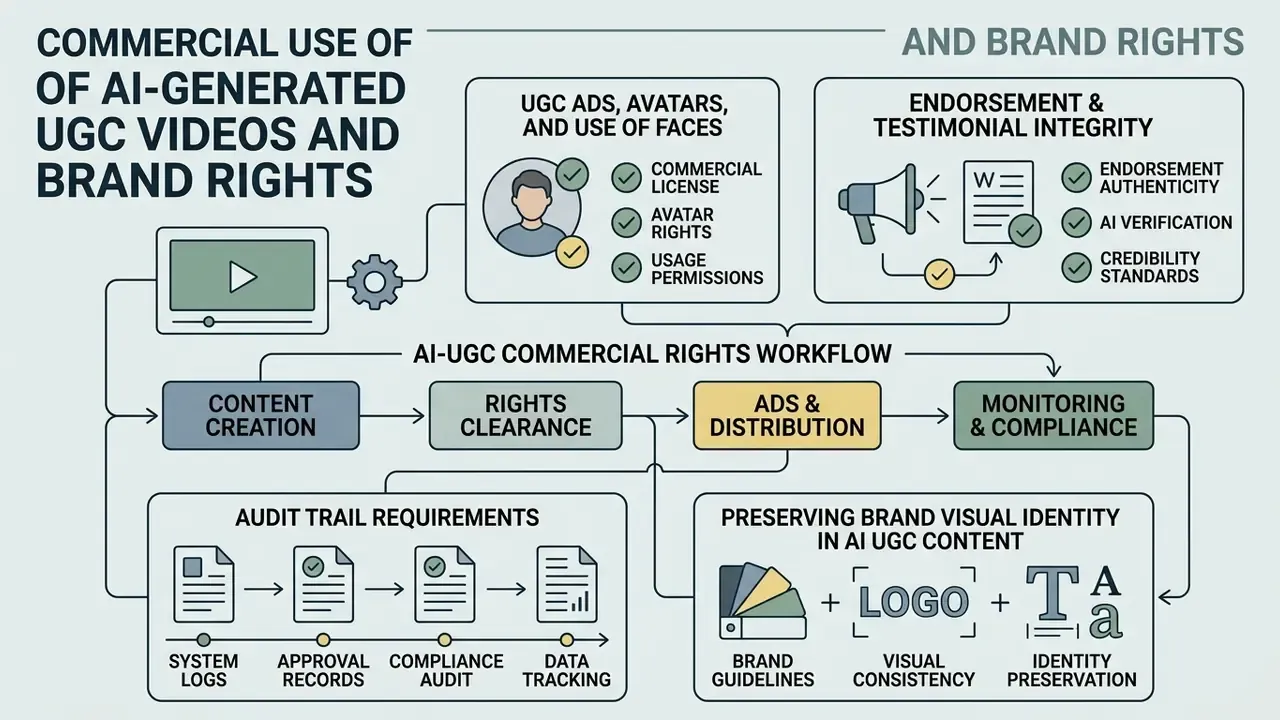
Commercial deployment of ai generated ugc videos for brand visual identity in paid advertising requires verifying likeness licenses, copyright ownership boundaries, and statutory disclosure mandates. Brands using an ai ugc maker must ensure campaigns do not breach right-of-publicity laws or platform policies. Adjacent rights questions for still assets are covered in our reference on commercial use of AI images.
Transparency is not only a compliance cost. It partially recovers the trust discount documented earlier:
«When a virtual influencer's brand affiliation is transparent, its effectiveness gap versus a real human narrows, and in nonprofit contexts donations were higher.»
Organizations seeking detailed guidance on legal rights, compliance frameworks, and synthetic asset licensing consult the AI Media Commercial-Use Hub.
Rights to UGC Ads, Avatars, and Use of Faces
Legal frameworks governing synthetic media in advertising set distinct rules for intellectual property and likeness rights.
- Copyright protection. Administrative guidance from the U.S. Copyright Office (2023, updated 2024 and 2025) and European Parliament legal studies confirm that purely machine-generated outputs lacking direct human expressive control are ineligible for copyright and may sit in the public domain. Copyright attaches only to human-authored elements, such as a human-written script or custom post-production edits. Primary sources: U.S. Copyright Office, Copyright and Artificial Intelligence guidance, https://www.copyright.gov/ai/; European Parliament study on generative AI and copyright (2025).
- Content classification, and why the type of AI content matters legally.
«Researchers distinguish two categories of generative AI video advertising: human-AI collaborative (a real person plus an AI character) and fully synthetic, with different psychological effects on audiences.» — «Generative AI advertisements and human-AI collaboration,» Journal of Business Research (2024). https://doi.org/10.1016/j.jbusres.2024.114621
This distinction maps directly onto rights management. Collaborative formats require performer consent and compensation records, while fully synthetic formats concentrate risk in disclosure and claim substantiation.
- Right of publicity and synthetic likeness. Using an AI actor's face or voice avatar in a commercial paid ad requires explicit, documented likeness consent from the original human model. Digital replica provisions in SAG-AFTRA commercial contracts (2025) require separate written authorization and compensation for synthetic performance replication in advertising, with separate consent for each separate use. U.S. right-of-publicity exposure arises from unauthorized commercial use of a person's name, image, likeness, or voice (Congressional Research Service summary, 2024). New York's synthetic-performer advertising law additionally requires conspicuous disclosure when a synthetic performer appears in an advertisement.
- Regulatory disclosures. Article 50 of the EU AI Act mandates clear labeling of artificially generated or manipulated synthetic media (deepfakes) in public communications and advertising feeds, and the obligation falls on deployers, not only providers. Primary
- Endorsement and testimonial integrity. Because synthetic testimonials depict experiences no real consumer had, advertisers should treat AI presenters under the same endorsement-substantiation logic that governs paid testimonials: truthful claim support plus clear material-connection or synthetic-content disclosure. This matters most for financial and health products, where fabricated experiential claims carry regulatory exposure on top of platform-policy risk.
Audit trail requirements. For each published asset, retain the script hash and version, the prompt set and negative constraints, the model and engine versions used, the likeness and voice release document reference, the music license or generation record, the human approver identity and timestamp, and the final exported file checksum. Define a retention period, commonly aligned with the advertising claims-substantiation window applicable in your jurisdiction, and store logs outside the vendor environment where feasible.
Legal departments monitoring synthetic content disclosures and regulatory developments review updates in the AI Litigation and compliance hub.
Preserving Brand Visual Identity in AI UGC Content
Holding brand visual identity steady during automated generation requires locked visual guidelines, custom avatar development, and mandatory human-in-the-loop review before publication. Institutional brand policies converge on three rules: never let a model recreate or alter trademarks, logos, or mascot assets; require marketing approval for any graphic that mimics official branding; and keep a consistency regulator, whether template rules or automated checks, enforcing image-text alignment across generated social outputs.
When rendering errors surface during campaign scaling, internal operations teams coordinate with technical support channels for pipeline resolution.
Free AI UGC Video Generators, Plans, and Credits
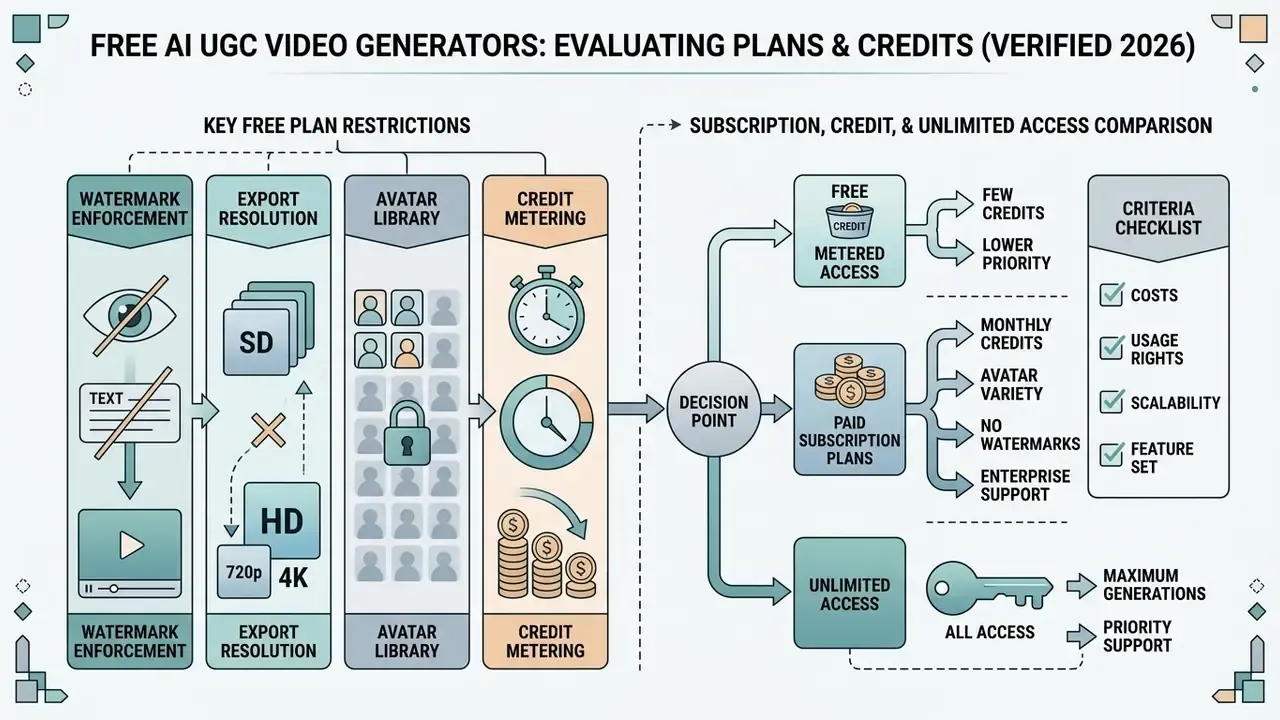
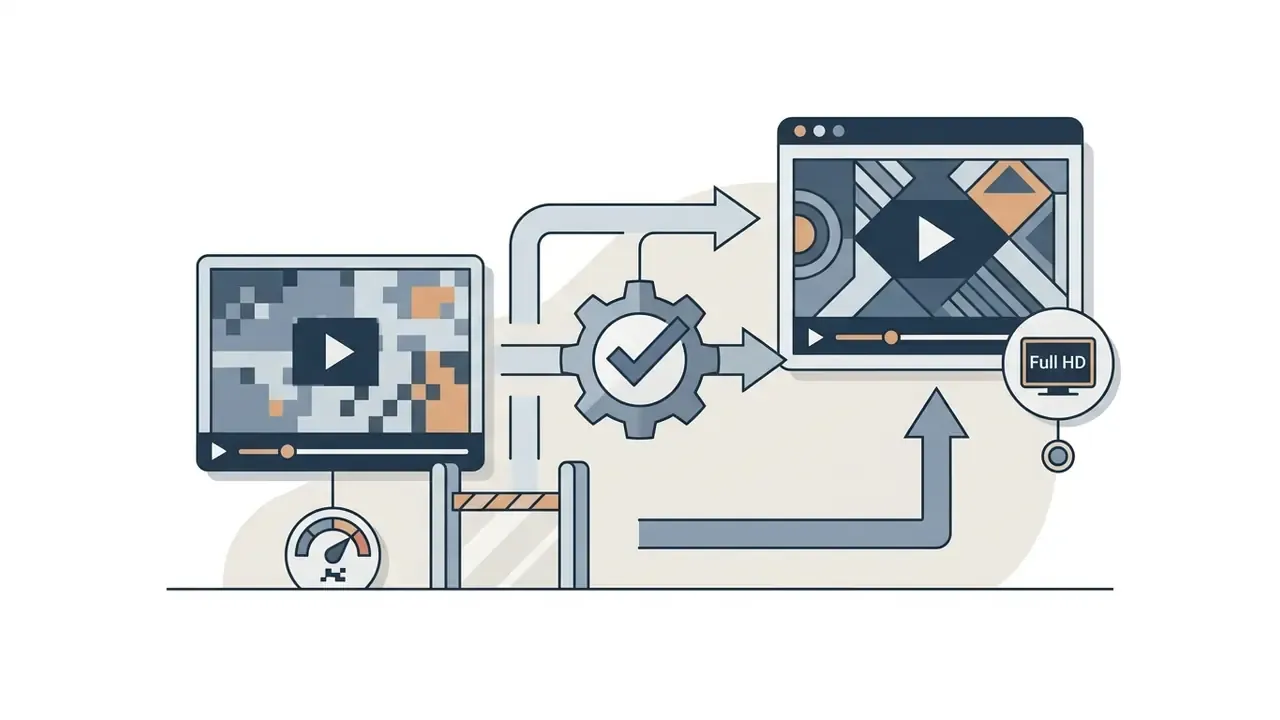
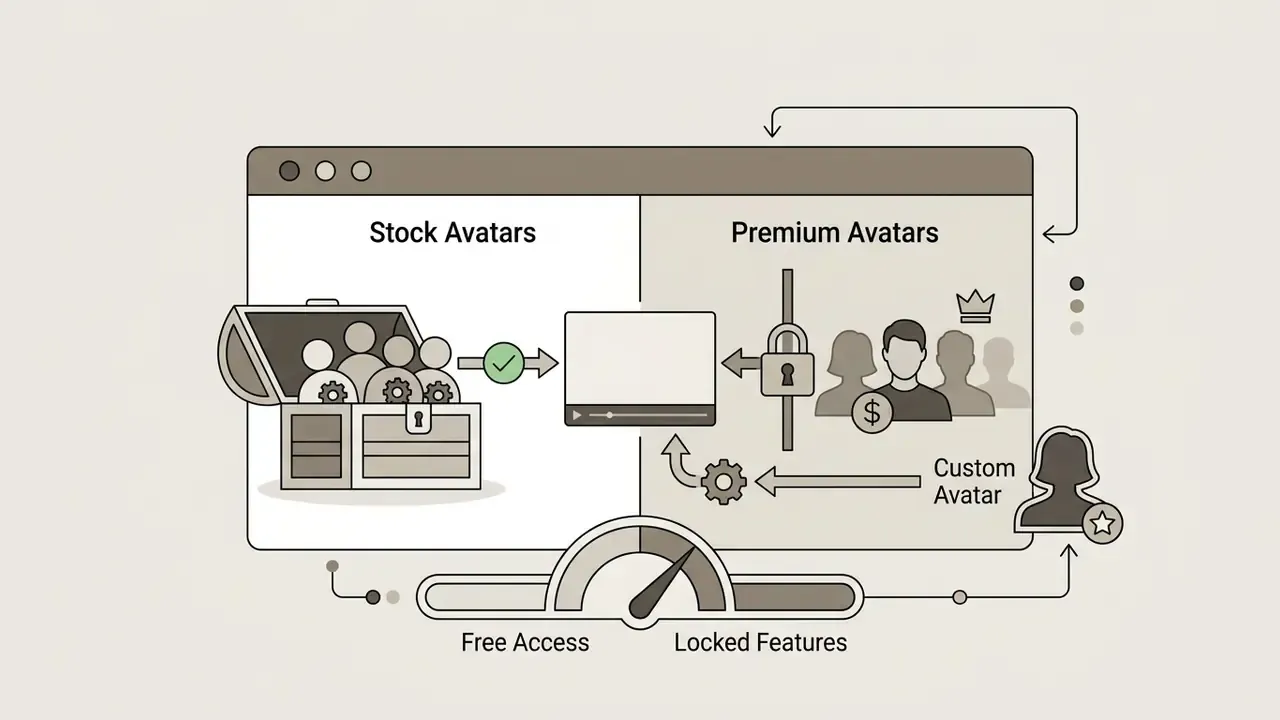
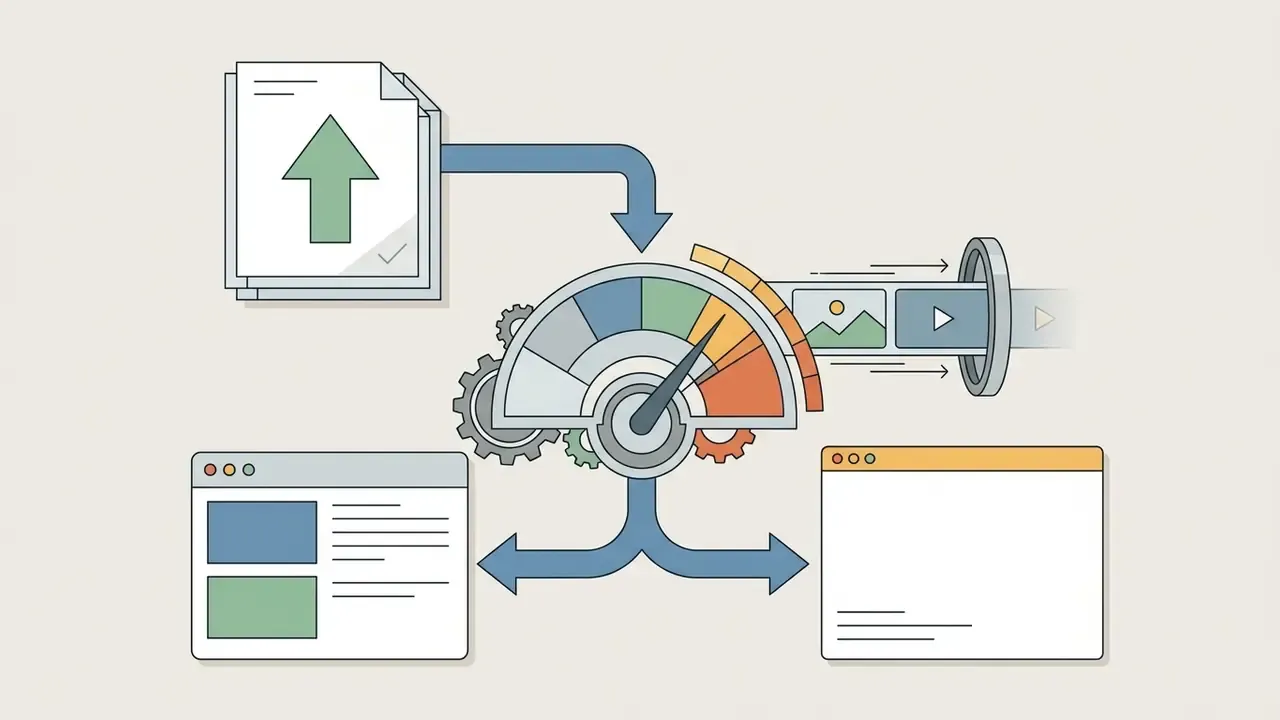
Evaluating a free ai ugc video generator means understanding freemium restrictions, credit consumption math, export watermarks, and usage rights. Our side-by-side free AI video generator comparison details which trials permit commercial export. Most platforms marketing a free ugc ai video generator provide evaluation trial credits rather than a permanent free production tier.
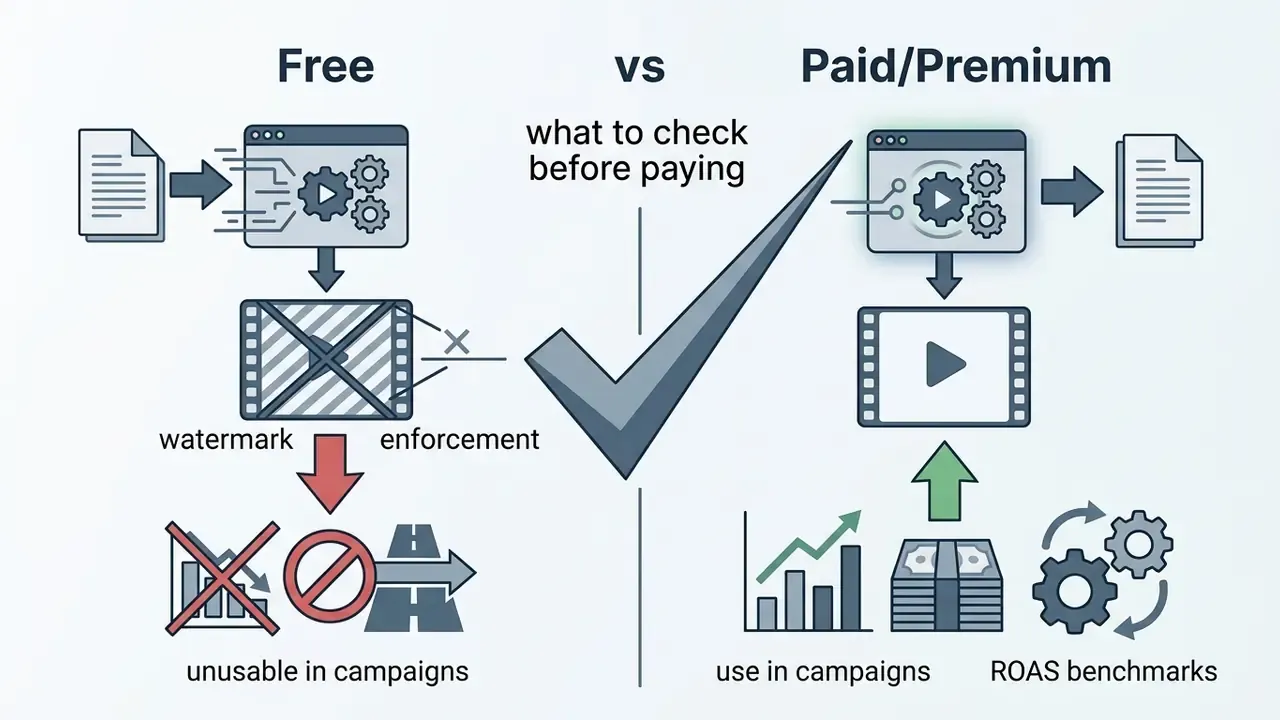
What to Check in a Free AI UGC Video Generator Before Paying
Before running a ugc ai generator free tier for marketing tests, media buyers inspect four operational parameters:
A fifth check belongs on every enterprise list: data-use terms on the free tier. Consumer and trial plans commonly reserve the right to use uploads for model improvement, which disqualifies them for unreleased products and regulated ad copy.
How to Compare Subscriptions, Credits, and Unlimited Access
Commercial pricing clusters into recurring monthly subscriptions, pay-as-you-go credit top-ups, and tiered team plans. The unit of pricing is the real difference. Subscriptions charge per month for a quota, credit packs charge per usage unit, and «unlimited» plans charge a fixed fee for catalog access during the term. Some vendors market unlimited generation, yet the fine print usually enforces fair-use monthly caps or restricts high-definition downloads. One vendor advertises year-long unlimited generations, while another's «Unlimited» tier still caps downloads at 100 per month plus 30 premium credits. Credit bundles in this category commonly ship in 50, 500, 1,000, 3,000, or 30,000-credit increments per billing cycle, which means vendor revenue scales with output volume rather than seat count.
E-E-A-T Verification: Pricing and Plan Status (Verified 2026)
| AI UGC Service | Free Tier / Trial Status | Entry Paid Tier Pricing | Credit Metering and Terms | Commercial Usage Rights |
|---|---|---|---|---|
| My UGC Studio | 10 credits free (watermarked, 2 video limit) | $48/mo (100 credits, no watermark) | ~5 credits per 15s output | Full commercial rights on paid tiers |
| Creatify AI | 10 starter credits (watermarked export) | $39/mo Starter (100 monthly credits) | 5 credits per 15s rendered video | Included on active paid subscriptions |
| HeyGen | Free trial credits (watermarked export) | $29/mo Creator (600 monthly credits) | ~20 credits per minute of Avatar IV render | Commercial license included on Creator and above |
| MakeUGC / UGCdrop | Limited trial credits on registration | Subscription packages ($29 to $99/mo) | Credit packs or monthly download caps (for example 100 downloads plus 30 premium credits) | Commercial ad usage permitted on paid plans |
Data verified against platform pricing documentation as of August 2026. Terms, credit burn rates, and watermark policies remain subject to vendor adjustment. Budget models should add the control-cost layers described in the TCO table above.
FAQ: Frequently Asked Questions About AI UGC Video Generators
Can AI UGC videos be used in paid advertising (Meta Ads, TikTok Ads)?
Yes. Generated videos can run in paid campaigns provided the platform grants a commercial license covering the avatar and the synthesized voice. You must also comply with platform requirements for labeling synthetic content and, in the EU, with Article 50 of the AI Act. Claim substantiation rules apply exactly as they would for a filmed testimonial.
Do I need a real creator to make AI UGC videos?
No. Modern generators build the video entirely from a text script and uploaded product assets. You can also create a digital clone of a real company spokesperson from one photo plus a 30-second consent video, provided you hold documented rights to that person's likeness and voice.
How realistic do AI avatars look in 2026?
Current models reproduce natural micro-expressions, skin texture, gestures, and accurate lip-sync. For short social UGC formats, realism is sufficient to hold attention and deliver competitive conversion rates. For long-form, high-consideration, or heavily regulated messaging, human-reviewed or hybrid human-AI formats remain safer.
How do I avoid the uncanny valley in synthetic video?
Write conversational scripts, avoid over-idealized prompts, keep subtle physical imperfections in the avatar, add auto-captions and rhythmic background music, and overlay real B-roll of the physical product on top of avatar narration. Remember the U-shaped authenticity effect: neither flawless nor artificially rough footage converts best.
Can I generate an ad directly from a product URL?
Yes. URL-to-video workflows accept a Shopify, Amazon, or marketplace link, then extract the title, gallery images, benefit bullets, and recurring review phrases, select a UGC format, and generate a full storyboard with a matched presenter. No designer involved.
How many languages are supported, and is dubbing lip-synced?
Leading platforms cover 175+ languages and dialects, with neural dubbing that preserves the original speaker's cloned timbre and re-fits articulation so lip movement matches the translated audio. Subtitle alignment should be validated within 0.5 seconds of spoken audio, per global media delivery specifications.
Is there a watermark on free plans, and can free output run as an ad?
Free tiers almost always watermark exports and frequently cap resolution at 720p, which makes them unsuitable for paid placements. Treat free credits as a hook-and-script testing sandbox, then upgrade for clean 1080p commercial exports.
What should a regulated enterprise verify before onboarding a vendor?
Request a current SOC 2 Type II report scoped to the generation environment, a contractual no-data-training clause, tenant isolation details, SSO/SCIM and RBAC support, data residency and retention terms, and exportable audit logs covering prompts, model versions, approvals, and renders.
Should paid and organic UGC use the same creative?
No. Paid creatives need strict hook and CTA timing, high-contrast captions, offer overlays, and full claim compliance. Organic feed content performs better with looser narrative structure, trend-aligned audio where licensing permits, and a deliberately native, non-broadcast look.
Who owns the copyright to a generated UGC ad?
Purely machine-generated output generally lacks human authorship and is therefore not protectable. Copyright attaches only to human-authored contributions such as your written script, selection and arrangement choices, and manual post-production edits. Structure the workflow so human authorship is documented.
Appendix A: Corrections and Superseded Data Points (Transparency Log)
To preserve verifiability, the following statements from earlier revisions of this guide were revised. Original wording is retained alongside the reason for the change.
| Superseded Statement (earlier revision) | Correction Applied |
|---|---|
| «one script auto-translated and dubbed into 50+ languages»; «50+ language neural voice library»; «50+ languages» in the interface annotation | Updated to 175+ languages and dialects with cloned-timbre neural dubbing, matching the current market standard. |
| «Recent advances published at CVPR (2026) on AudioAvatar models…» | Rewritten to reference CVPR-level audio-driven avatar research published in 2024 and 2025 plus WACV 2021 codec-avatar work; a 2026 conference could not be cited as an existing publication. |
| «Netflix Branded Delivery Specifications (2026) mandate that localized captions align within 0.5 seconds…» | Year attribution removed; the 0.5-second alignment requirement is cited to Netflix's Localization, Accessibility, and Dubbing Branded Delivery Specifications without a forward-dated edition. |
| «NIST Synthetic Content Governance Guidelines (2026)…» | Replaced with NIST AI 100-4, Reducing Risks Posed by Synthetic Content (2024) and the NIST GenAI evaluation program (2024 to 2025). |
| «Production costs dropped from an estimated $12,000 to under $400, while turnaround time compressed from 18 days to 4 hours.» | Reframed as a client-reported internal estimate with ranges, flagged as not independently audited. |
| «reducing overall CAC by 31% while expanding monthly creative testing output by 400%» | Reframed as team-reported figures (~30% CAC improvement, roughly four-fold output increase) for a single account and vertical. |
| «Official advertiser documentation from TikTok Ad Systems (2025) and Meta Business Help Center (2024)…» (no URLs) | Replaced with named, linkable sources: TikTok Ad Testing Guide and Meta Business Help Center A/B testing documentation, including Meta's minimum two-week test duration. |
Appendix B: Pre-Launch Compliance and Audit Checklist
Use this as the final gate before any synthetic UGC creative reaches an ad account.
Checklist0 / 19
General information only; not legal, financial, or medical advice. Regulated advertisers should obtain jurisdiction-specific counsel before deploying synthetic presenters.
Explore authoritative terminology, legal frameworks, and implementation guides in our AI Media Glossary.