If you sit in a bank, an insurer, or a mature fintech, there is a second question behind the creative one. Who touches your pre-release screens, your control documentation, your disclosure language? That question shapes the vendor shortlist as much as the reel does.
Last updated: February 2026. Reviewed for pricing accuracy, vendor-selection criteria, and enterprise procurement risk.
Executive Summary
For decision-makers who need the short version before the full breakdown:
- What studios actually sell: a seven-step pipeline. Discovery and strategy, script, storyboard, style development, voiceover, animation, post-production and revisions. Pre-production alone typically eats one to two weeks of the schedule.
- What it costs in 2026: roughly $1,000-$4,000 for freelancer or entry-tier work, $6,000-$12,000 for a mid-tier specialised agency project, and $20,000-$60,000+ for Tier-1 studio production. Per finished minute, published market guidance spans about $1,000 to $25,000+ depending on style and rigging complexity.
- What drives the price: animation style, number of custom-designed characters and scenes, voiceover licensing scope, number of revision rounds, and delivery deadline. Rush work carries documented surcharges from 15% up to 300%.
- Which format to pick: animated explainers for top-of-funnel why, product demos for mid-funnel how, spokesperson and hybrid live-action for trust and authority, microlearning modules of three to five minutes for internal governance training.
- How to choose safely: verify niche portfolio depth, demand written IP ownership of source files, confirm voiceover usage rights, lock storyboard-to-keyframe milestones, and require frame-accurate review tooling before you sign the statement of work.
- Enterprise risk note: if the material touches customer data, model documentation, or regulated disclosures, treat the studio as a third-party processor. NDA, data-handling terms, and a written policy on generative-AI use are mandatory, not optional.
How to Read This Guide
Different readers need different parts of this page, so here is the map without a clickable index.
- Procurement and finance leads start with the pricing benchmarks and the total-cost-of-ownership formula further down. Both are built to be pasted into a business case.
- Marketing owners the format and animation-style sections answer the "which asset, which funnel stage" question first.
- Risk, compliance, and audit owners the enterprise risk section and the vetting checklist are the operative parts. Everything else is context.
- Anyone comparing models the agency versus freelancer versus in-house versus AI table is deliberately blunt about where each option breaks.
One caveat before we go further. Vendor price bands move annually, sometimes quarterly. Treat every figure here as a benchmark to argue with, not a quote.
What an Animated Explainer Video Company Does
An animated explainer video company provides end-to-end strategy, creative design, and technical production to turn a complex product into a clear visual narrative. These specialised agencies handle business messaging, scripting, graphic asset design, character animation, voiceover recording, and post-production mixing. By consolidating those disciplines under one production workflow, an animated explainer video studio removes the friction that usually sits between marketing teams and technical subject-matter experts.
That friction is expensive. Every handoff between a copywriter, a designer, and an engineer who "just wants the diagram to be accurate" costs calendar days.
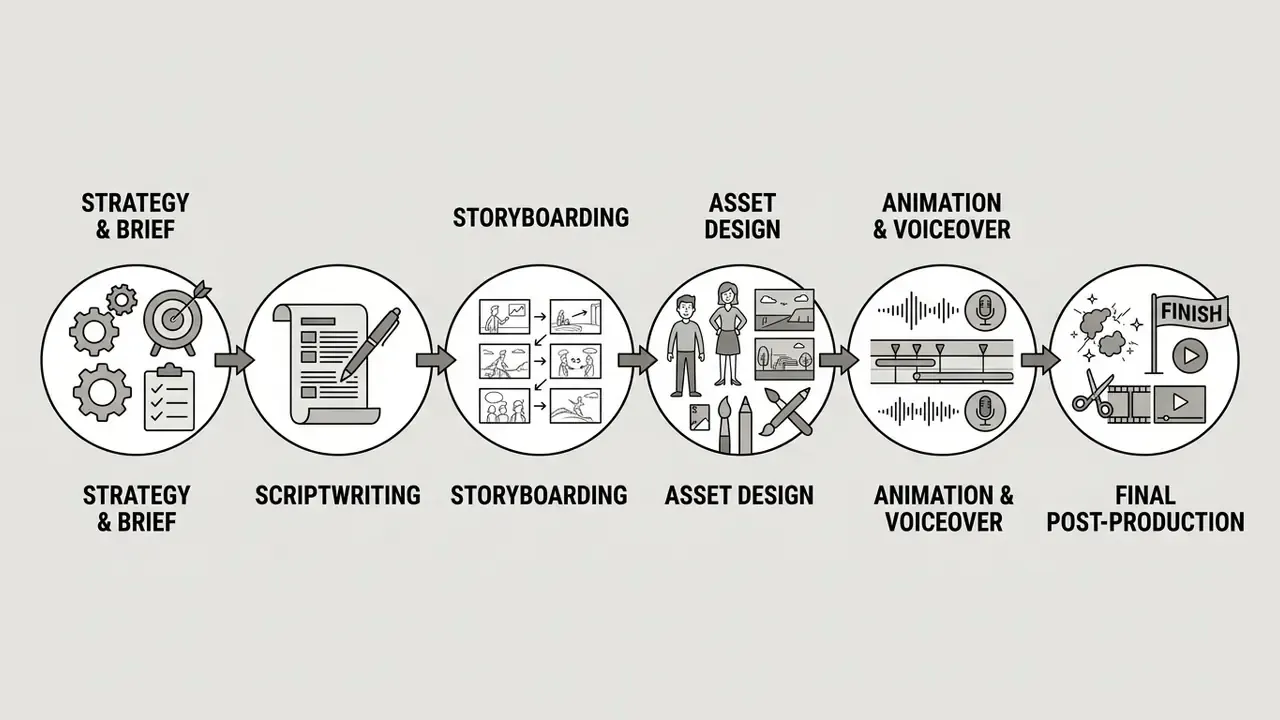
| Stage | Primary Activities | Key Deliverables | Strategic Objective |
|---|---|---|---|
| Strategy & Discovery | Define target persona, core problem statement, and key performance indicators. | Creative brief and objective map. | Align the script narrative with a specific funnel position. |
| Scriptwriting | Craft narrative arc, problem framing, solution presentation, and call to action. | Locked audio script with scene descriptions. | Cut jargon and focus on one customer transformation. |
| Storyboarding & Visual Design | Develop visual style frames, character designs, and scene-by-scene layouts. | Vector storyboards and style boards. | Pre-visualise motion graphics and confirm brand consistency. |
| Animation Production | Animate 2D/3D elements, integrate motion dynamics, and sync voiceover. | Raw animation sequences. | Maintain visual pacing and prevent cognitive overload. |
| Voiceover & Sound Design | Record professional voice talent, compose audio cues, and mix final sound. | Master audio track and sound-effects layer. | Reinforce emotional tone and support narration clarity. |
| Post-Production & Formatting | Render the final video, add closed captions, and export aspect ratios. | Multi-platform video files (16:9, 9:16, 1:1). | Prepare localised, channel-ready assets for immediate distribution. |
Strategy, Message and Script Development
Strategic messaging and scriptwriting form the foundation of any animated explainer video project. Video is no longer an experimental line item in the marketing budget. It is the default format for product explanation.
Within the same annual dataset, roughly three-quarters of businesses report that video content directly improved customer understanding of their products or services. Which is, precisely, the job an explainer video is hired to do. Agencies therefore begin by establishing a single core message aimed at one specific buyer persona, instead of covering an entire feature catalogue. Wyzowl's own explainer methodology recommends defining key messages, audience, brand voice, and the customer problem before a single line of narration is written (Ultimate Guide To Explainer Video, 2025).
"When evaluating creative automation platforms, enterprise leaders must treat video pipelines like managed systems with defined risk boundaries and auditability." Marcus Hale
Effective explainer scripts follow a four-beat framework: an immediate hook, a clear problem statement, a solution overview, and a concise call to action. Pacing is calibrated to roughly 140 to 160 words per minute, which lets viewers process visual information without fatigue.
«Aim for a narration pace of roughly 140-160 words per minute, leaving room for motion, transitions, and visual beats.»
Quick Script Duration Formula
Total seconds = (Word count ÷ 145) × 60 + 5 seconds (intro and outro pauses)
Example: a 220-word script yields roughly 96 seconds of finished video. A 60-second hero explainer therefore needs about 130-140 words of narration, not 300.
For technical B2B SaaS platforms, the script leans on business outcomes and operational time-to-value rather than software architecture. Voiceover text is written first. Visuals are mapped to it afterwards, scene by scene. Teams planning scripts for interactive decks or automated marketing material often outline the narrative sequence in a structured framework such as a tome ai presentation before studio production starts.
A small observation from review calls: the scripts that survive legal review are almost always the ones where the claim was written as a sentence first, then illustrated. Not the reverse.
Storyboard, Design and Asset Creation
Storyboarding translates approved narration into a scene-by-scene visual blueprint before active animation begins. Designers establish custom style frames, colour palettes, vector assets, and character turnarounds that match corporate brand identity.
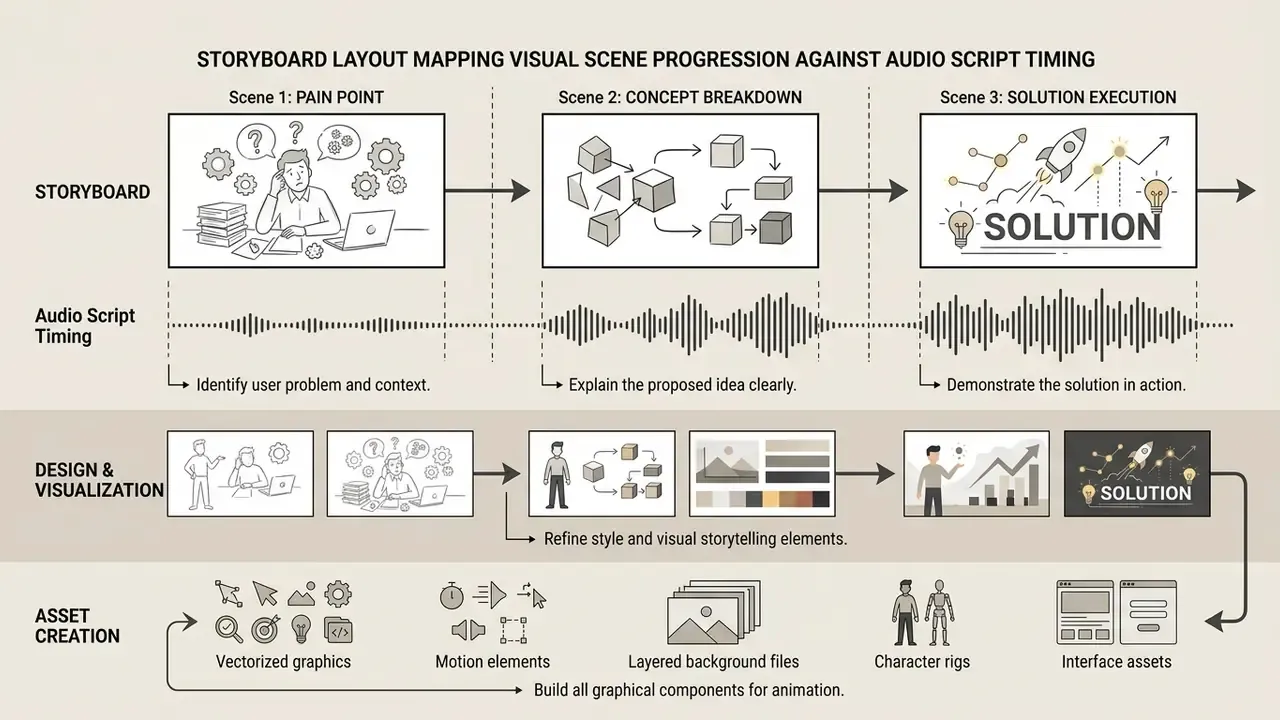
Proper asset preparation ensures vector artwork is correctly layered and rigged for motion. Character design specifies facial expressions, limb articulation points, and consistency rules that keep figures visually stable across transitions, usually documented through model sheets, turnarounds, location keys, and reference boards. Lock the storyboard early and you avoid expensive rework during keyframing later. Teams that also manage still assets for landing pages and thumbnails often pair this stage with a dedicated photo editor workflow, so video stills and web imagery share one visual system.
Animation, Voiceover and Post-Production
The final stage combines motion-graphics execution, professional voiceover recording, audio mixing, and video mastering. Animators apply keyframe interpolation, camera moves, and scene transitions to hold continuity. Voice talent is recorded in acoustically treated rooms, producing clean tracks that align with animation keyframes.
Post-production covers compositing, sound effects, colour grading, and closed captions. In documented 2D pipelines this stage also includes noise selection, speech and ambience voiceover passes, music recording, re-recording mixdown, and final output. An animated explainer video producer then delivers files across several aspect ratios for websites, social channels, and sales enablement platforms. Teams shipping to bandwidth-constrained intranets usually add a video compressor step to hit internal file-size limits without visible quality loss. If you need technical specifications for high-volume workflows, our AI Media API Guides cover automated asset distribution options.
Which Animated Explainer Video Format Fits Your Business Goal
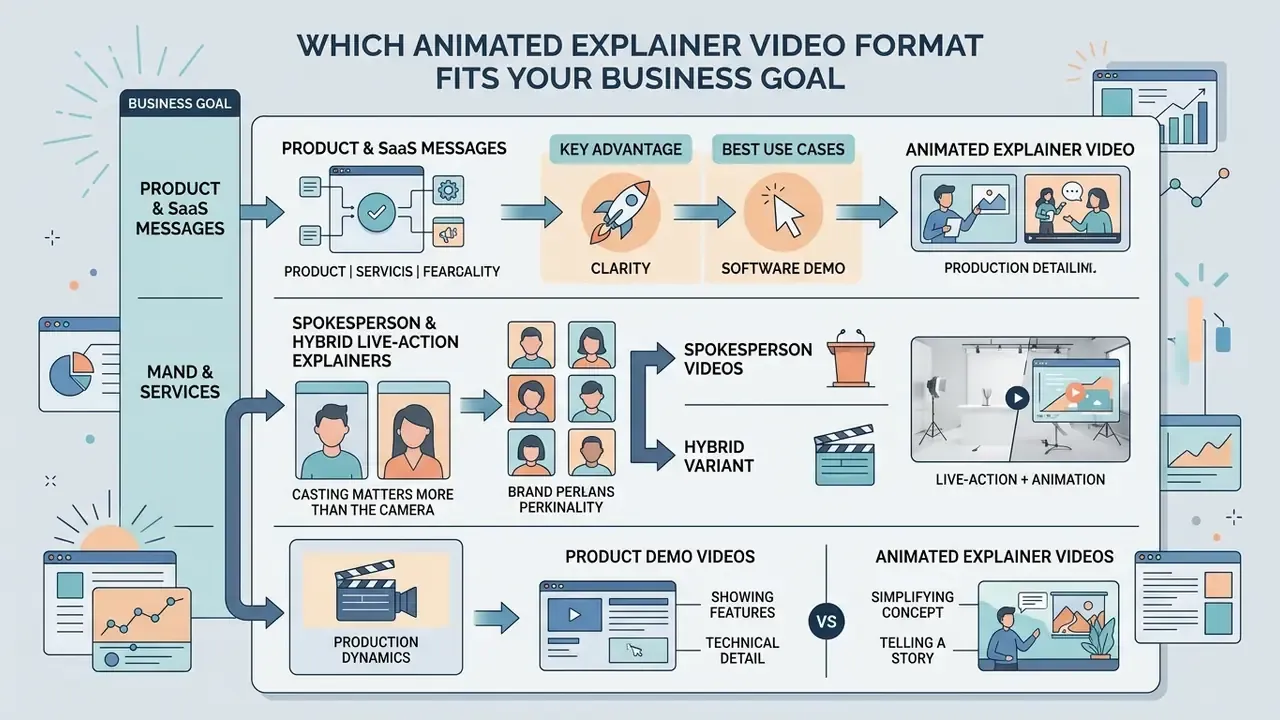
Choosing the right animated explainer video format depends on funnel stage, product complexity, and distribution channel. Align duration, visual style, and narrative density with how your buyers actually make decisions.
| Video Format | Primary Business Objective | Best-Fit Product Complexity | Optimal Duration | Primary Distribution Channel |
|---|---|---|---|---|
| Animated Explainer | Brand awareness and value-proposition framing. | High (abstract SaaS, compliance, fintech). | 30 to 90 seconds. | Homepage, landing pages, paid campaigns. |
| Product Demo Video | Feature evaluation and interface validation. | Medium to high (software platforms, workflows). | 90 to 180 seconds. | Product pages, sales calls, documentation. |
| Spokesperson / Hybrid Live-Action | Credibility, authority, executive thought leadership. | Low to medium (services, high-ticket B2B, fintech). | 60 to 120 seconds. | Corporate site, LinkedIn, investor decks. |
| Live-Action Explainer | Trust building, human connection, testimonials. | Low to medium (services, physical products). | 60 to 120 seconds. | Corporate site, LinkedIn, investor decks. |
| Microlearning / Corporate | Internal compliance, onboarding, employee training. | Medium (procedures, governance frameworks). | 2 to 5 minutes. | Intranet, LMS, internal messaging tools. |
Animated Explainers for Product and SaaS Messages
Animated explainer videos are strongest where the product is intangible: software platforms, cloud infrastructure, complex enterprise services. Research from Demand Gen's 2024 Content Preferences Benchmark Survey shows that roughly two-thirds of B2B buyers rank short-form content as the most valuable asset type during research. The same dataset also explains why generic explainers fail.
"A successful SaaS explainer collapses multi-layered operational complexity into a clear 60-second value statement that decision-makers can digest immediately." Marcus Hale
For a B2B SaaS offering, the explainer focuses on the operational "future state" after adoption. Rather than touring interface menus, it uses conceptual motion graphics to show data flows, automated compliance checks, and time recovered.
A mid-market fintech firm commissioned a 60-second animated explainer for its primary landing page to explain an automated reconciliation engine. Once the message was reduced to a single outcome, page engagement improved and demo requests rose by 28% within ninety days. (Client-reported figure from an anonymised engagement. Treat it as directional, not benchmarked, because the campaign ran alongside a page redesign.) Industry-wide data points the same way:
Teams that want to test the message before commissioning a studio can benchmark AI video generators against agency quotes. For a wider platform view, our AI Media Comparison Matrices set out tool trade-offs side by side.
Spokesperson & Hybrid Live-Action Explainers
A spokesperson explainer features a human presenter, filmed in studio or rendered as a high-fidelity avatar, speaking to camera while motion graphics illustrate the numbers on screen. This is the format most often missing from animation-only shortlists. It is frequently the highest-converting option for high-ticket, trust-sensitive purchases.
- Key advantage it humanises technical brands and builds credibility in mid-funnel consideration, because a named executive or product lead becomes accountable for the claim on screen.
- Best use cases high-ticket B2B services, fintech platforms, compliance and risk software, healthcare providers, and executive pitch decks where a real face beats an abstract character.
- Production dynamics teleprompter calibration (typically 130-140 words per minute on camera, slower than voiceover), controlled lighting, wardrobe and set continuity, plus motion-graphic tracking in post so on-screen data stays locked to the presenter's gestures.
- Casting matters more than the camera intonation, body language, and brand fit decide whether the video reads as authoritative or staged. Studios that specialise in this format keep rosters of vetted presenters and hundreds of pre-built sets, with delivery cycles as short as ten business days.
- Hybrid variant film the spokesperson for the opening hook and the closing call to action, then hand the technical middle to 2D motion graphics. That roughly halves studio time while keeping the human trust signal at both ends.
Product Demo Videos vs Animated Explainer Videos
Product demos and animated explainer videos do different jobs. The explainer sits at the top of the funnel and answers why the solution matters. The demo sits mid-funnel and shows how the software works.
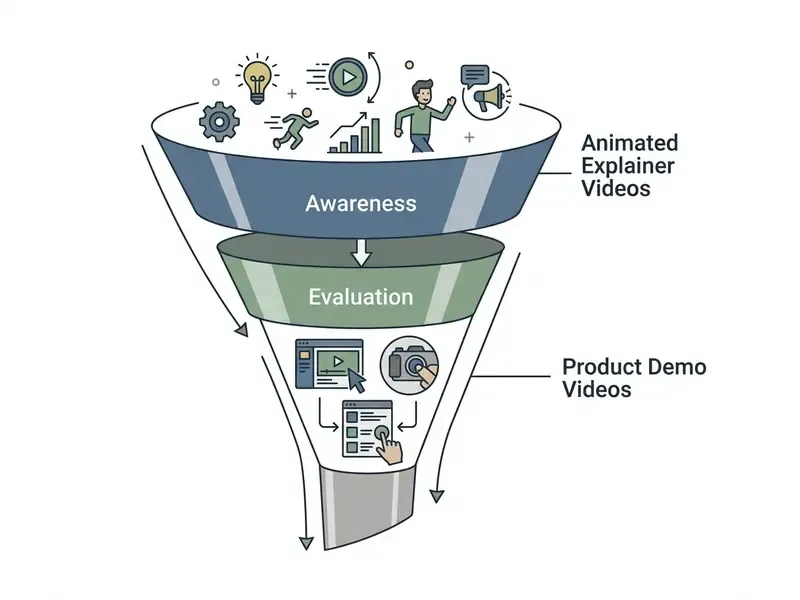
- Animated explainer videos vector graphics, abstract metaphors, and character narratives that explain a broad business problem. They deliberately omit interface detail to prevent clutter and keep pacing fast.
- Product demo videos real screen recordings, interface walkthroughs, step-by-step navigation. They give technical buyers tangible proof of usability. Screen-recorded demos are also usually cheaper per minute than fully custom animation.
Run both and the journey works: a 60-second animated explainer captures interest, then an embedded two-minute demo validates the features. Simple sequencing, often skipped.
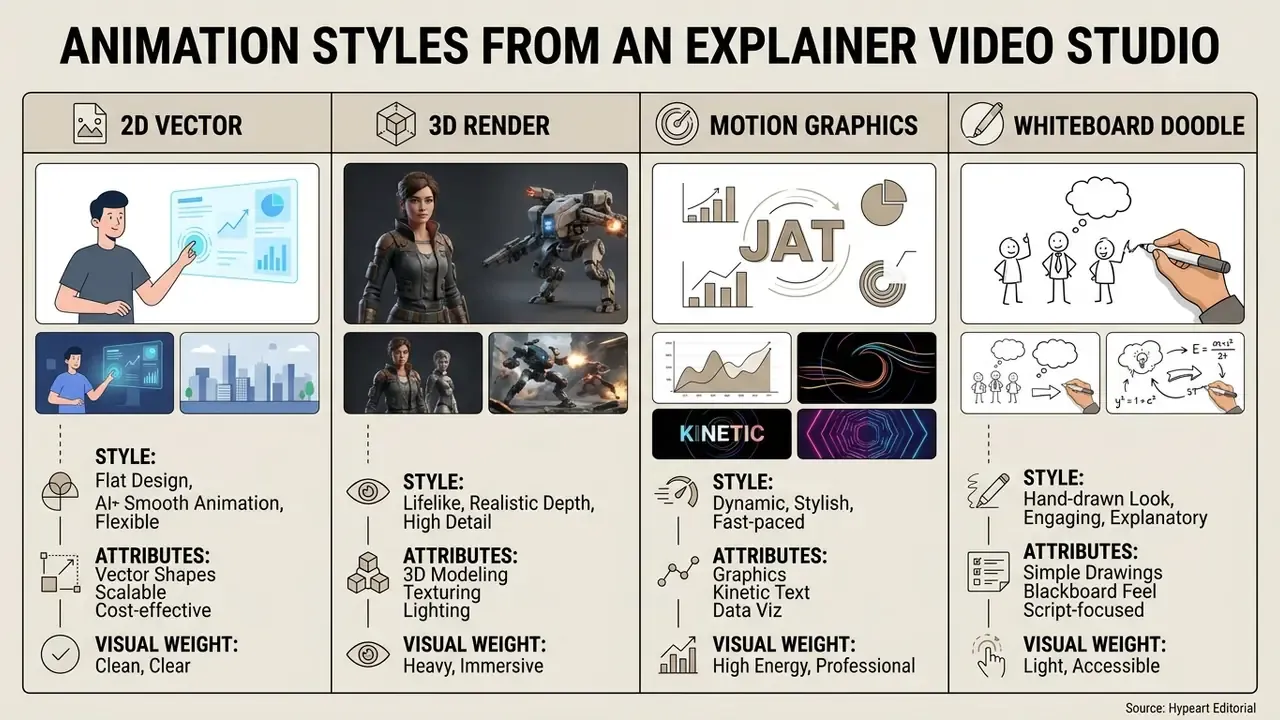
Animation Styles Available From an Explainer Video Studio
Studios offer distinct animation styles that balance visual impact, timeline, and total cost. The right animation style matches your brand identity and your audience's expectations, nothing more mystical than that. Teams testing narrative concepts before committing budget often start with text-to-video AI tools to visualise a rough animatic.
2D Animation and Motion Graphics
Two-dimensional vector animation and motion graphics are the most widely used styles for enterprise explainer projects, which is why a 2D animation explainer video company is usually the first quote a buyer collects. The style uses flat design, dynamic typography, geometric transformation, and custom character rigging to make abstract ideas legible.
Motion graphics work particularly well for statistics, network architecture, financial workflows, and data transitions. Research from City, University of London (Empirical Guidelines for Animated Data Visualization, Springer) shows that animated graphical transitions improve comprehension when movement is staged clearly: slow objects down, limit simultaneous changes, leave history traces, highlight only what matters.
«Segmenting instructional content reduces the negative effect of transient information and supports deeper cognitive processing.»
Modern agencies lean on accelerated rendering engines to streamline 2D asset work, and in-house teams increasingly evaluate template-driven animation makers for lower-stakes assets. For licensing and operational guidance on those tools, see the AI Media Commercial-Use Hub.
3D Animation, Character Animation and Mixed Media
Three-dimensional animation and character-driven storytelling add depth, tactile product rendering, and stronger emotional pull. 3D suits physical hardware, medical devices, architectural systems, and high-impact brand films. The documented 3D pipeline (modelling, texturing, rigging, layout, animation, rendering, assembly, final output) explains why 3D quotes usually start where premium 2D quotes end.
"3D animation provides volumetric clarity for physical engineering, but it requires significantly heavier asset rigging and longer render pipelines than flat vector design." Marcus Hale
Mixed media combines live footage with 2D or 3D animated overlays. That hybrid lets you feature real executives or customer interviews while animated data graphics sit over the live layer. Published work on harmonising 2D and 3D notes that placing 3D models inside 2D scenes preserves stylistic identity while cutting production complexity. Rigging automation is improving too: the CVPR 2025 paper Make-It-Animatable reports preparing an animation-ready 3D humanoid in under one second, compressing one of the most labour-intensive steps in character work. Even so, 3D character animation still demands extensive rigging and long render queues. It buys production value, and it buys calendar.
Whiteboard and AI-Assisted Video Production
Whiteboard animation, also called doodle animation, simulates a hand drawing on a digital canvas with voiceover narration. Updated: the underlying research is more nuanced than "procedural sketching aids learning."
«Narrative embedding of content in whiteboard animations influences learning success at least as much as the procedural character of the presentation.»
In practice: a whiteboard explainer without a story spine underperforms even when the drawing sequence is technically flawless. The hand-drawn effect is a delivery mechanism, not the learning driver.
AI-assisted production tools now accelerate asset generation, script drafting, and animatic creation. Published 2026 pipeline data makes the delta concrete. A four-scene AI whiteboard video rendered in roughly 2 minutes 47 seconds wall-clock, with the doodle render itself taking 90-120 seconds, at an all-in compute cost of about $0.18 per video (script ≈ $0.002, images ≈ $0.10, narration ≈ $0.04, render ≈ $0.04). Source: How to Create AI Whiteboard Animation, Thinking Line (2026). https://www.thinkingline.com/blog/how-to-create-ai-whiteboard-animation-2026. Comparative cost guidance puts AI whiteboard tooling at $50-$150 per finished minute, against $200-$1,500 for freelancers and $1,000-$5,000+ for agencies (Knowlify, Whiteboard Animation Cost, 2026. https://knowlify.com/articles/whiteboard-animation-cost).
Pacing still matters, even in generated output:
Generic AI generation, though, tends to miss fine-grained character consistency and strict brand compliance. Documented failure modes include ghosting, temporal flickering, and multi-scene continuity breaks that per-frame quality checks simply do not catch. So enterprise brands use AI for rapid prototyping and keep studio animators for final polish. Teams exploring these platforms can compare capabilities across the best free AI video generators before paying for a tier.
Animated Explainer Video Pricing: What Affects Cost
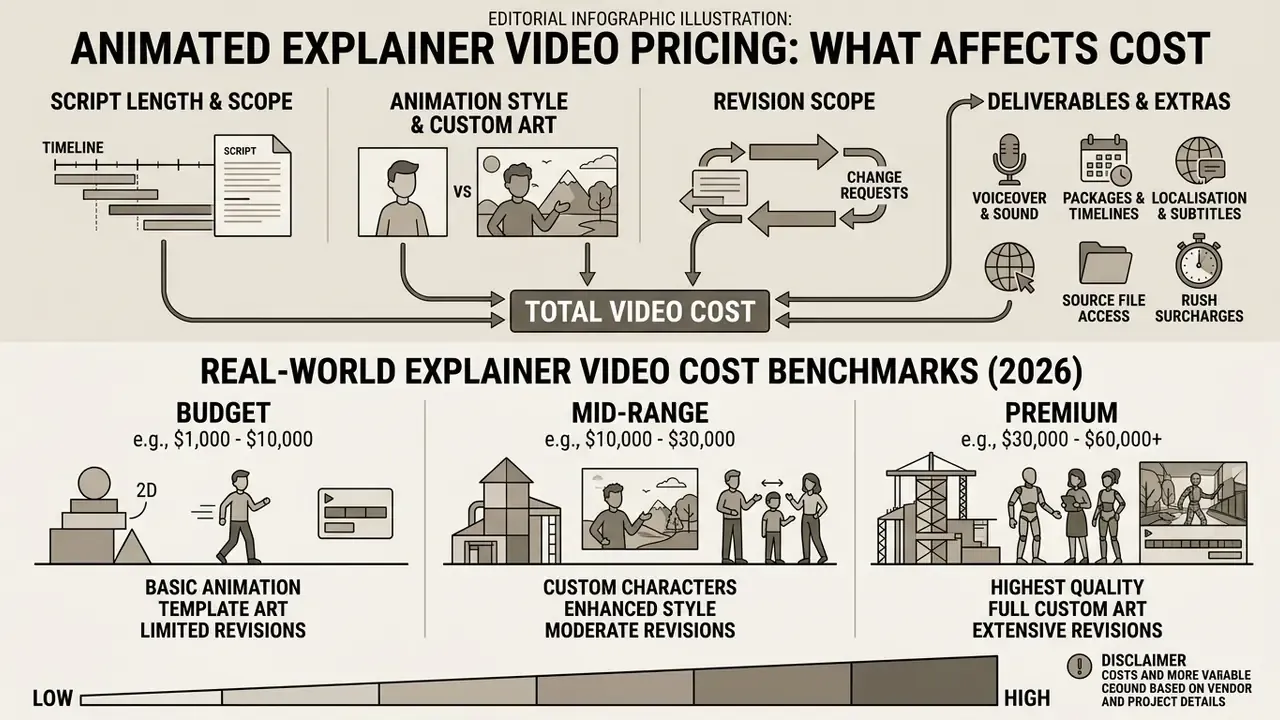
Animated explainer video pricing swings widely with script length, style complexity, custom artwork, and revision scope. Instead of accepting a fixed quote at face value, evaluate cost through a factor-based model, then sanity-check proposals against published benchmarks.
| Pricing Factor | Low Cost Impact | Moderate Cost Impact | High Cost Impact |
|---|---|---|---|
| Animation Style | Kinetic typography, basic whiteboard. | Custom 2D character animation, motion graphics. | Complex 3D modelling, photorealistic rendering. |
| Custom Design | Stock vector assets, standard templates. | Custom illustrated assets and brand iconography. | Bespoke character design and multi-angle rigging. |
| Voiceover Talent | Synthetic AI voiceover, non-union talent. | Professional regional voice talent with commercial rights. | Celebrity voice actors or multi-language localisation. |
| Revision Policy | One round of structural feedback per stage. | Two to three standard review loops included. | Unlimited open-ended creative revisions. |
| Production Timeline | Standard four to six week turnaround. | Compressed two to three week schedule. | Expedited rush delivery under seven business days. |
Real-World Explainer Video Cost Benchmarks (2026 Data)
| Studio Tier / Model | Cost per Finished Minute | Typical Full Project Cost | Turnaround Time | Included Deliverables | Best Used For |
|---|---|---|---|---|---|
| AI platform / template DIY | $50 - $150 | $0 - $500 (subscription) | Minutes to 3 days | Auto-generated script, stock visuals, synthetic voice, template motion. | Internal updates, prototyping, personalised sales outreach. |
| Budget / Freelance Network | $1,000 - $3,000 | $1,500 - $4,000 | 2 - 3 weeks | Basic 2D animation, stock audio, one revision loop. | Early-stage MVP tests, internal social snippets. |
| Mid-Tier Specialised Agency | $4,000 - $8,000 | $6,000 - $12,000 | 4 - 6 weeks | Custom vector design, professional VO, sound design, 2-3 revision loops. | B2B SaaS landing pages, growth-stage launches. |
| Enterprise / Tier-1 Studio | $10,000 - $25,000+ | $20,000 - $60,000+ | 6 - 10 weeks | Bespoke 3D and character rigging, custom score, multi-channel ratios, full rights buyout. | Flagship rebrands, broadcast, enterprise sales enablement. |
Published vendor pricing supports these bands. Premium US studios such as Demo Duck quote from around $15,000 per video, rising past $60,000 with scope. Explainer specialists such as Yum Yum Videos quote roughly $6,000-$15,000 per minute of finished duration. Mid-market studios such as Darvideo publish a $1,000-$5,000 project range, and on-demand producers such as Lemonlight start near $3,500. Independent buying guides converge on $5,000-$10,000+ as the realistic expectation for a professionally produced explainer, with cost driven by length, complexity, and track record.
Style-level ranges per finished minute, from 2026 production cost guides: motion graphics $1,000-$15,000+, 2D animation $1,500-$20,000, script development $500-$3,000, storyboarding $1,000-$5,000. 3D sits consistently at the top of the range.
Scope, Script and Animation Style
Scope and script length set total labour hours across design, rigging, and keyframing. Pricing is normally calculated per finished second or minute, which makes the script duration formula above a budgeting tool as much as a creative one. Every 145 words of narration is roughly another minute you are paying for.
A simple 60-second 2D motion-graphics video needs far fewer hours than a three-minute piece with custom rigged characters and layered environments. Automation is compressing the baseline hard:
That decline applies to standardised short-form output. Bespoke high-end craft, original character design, custom scoring, broadcast-grade 3D, keeps premium pricing, because the cost lives in human art-direction hours that generative tooling does not replace. At least not yet.
Voiceover, Sound, Revisions and Deliverables
Professional voiceover recording and audio mixing add discrete lines to an explainer budget. Published 2026 guidance budgets standard professional voice talent at $200-$500 per project, stock music licences at $15-$80 per track, and custom composition from $1,000 upward. Revisions are billed explicitly in voice contracts too: one 2025 rate card sets revisions at $220 per track, per hour. Teams weighing synthetic alternatives can compare quality and licensing terms across AI voice generators before locking a human casting budget.
Commercial usage rights for voice actors and licensed soundtracks vary by distribution scale, broadcast region, and campaign duration. A voice licensed for 12 months of paid social is not licensed for a three-year TV flight, and retroactive extensions are consistently pricier than buying the wider term upfront.
"Unmanaged revision loops during keyframe animation are the single largest source of budget overruns in corporate video production." Marcus Hale
Revision policy is the other big variable. Most contracts include one or two formal passes at each milestone: script, storyboard, animatic, final render. Structural narrative changes requested after keyframing has started attract additional fees, because they force re-rigging, lip-sync retiming, and re-rendering of effects. Good contract templates state exactly what counts as a revision, how many rounds are included, and the rate beyond that allowance. For budget modelling, our AI Media Pricing Guides and the interactive tools in AI Media Calculators help finance managers pressure-test a proposal before sign-off.
How to Choose an Animated Explainer Video Agency
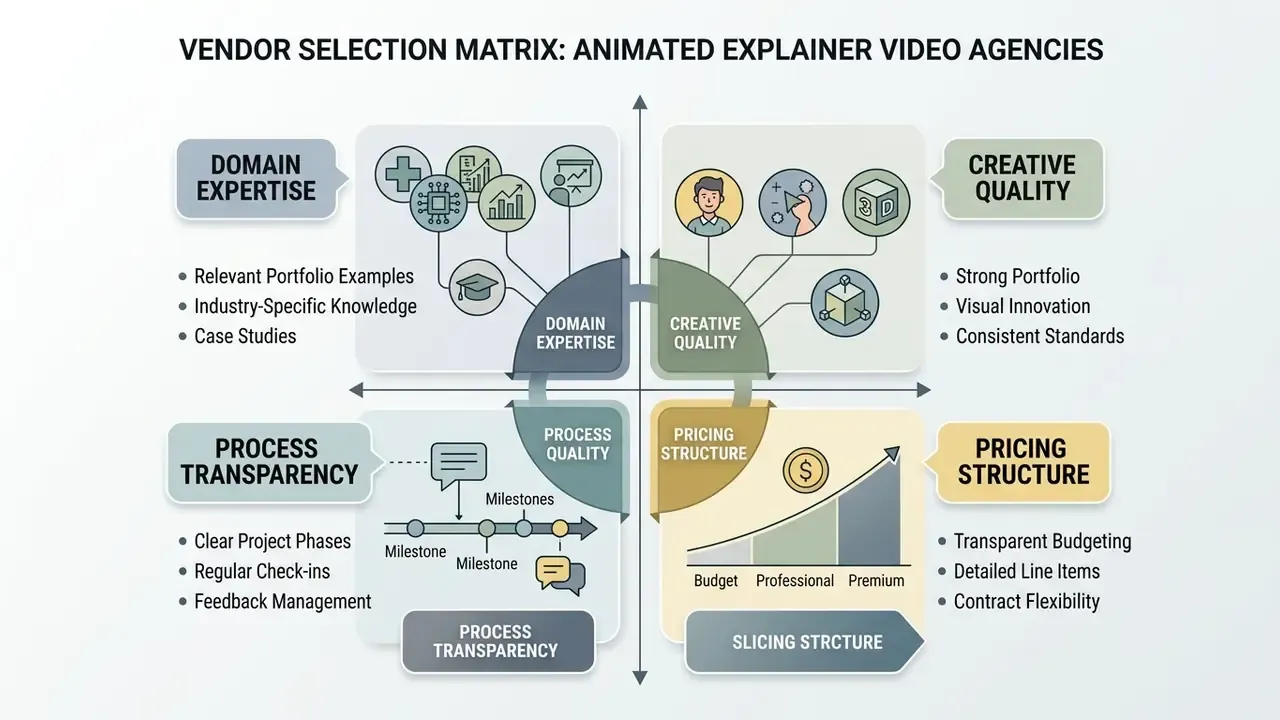
Choosing an animated explainer video agency means testing industry experience, reading verified case studies, and probing production transparency. A qualified partner shows creative capability and a working grasp of your business model. Formal agency-selection guidance is consistent on method: define evaluation criteria and weightings before the pitch, then run a transparent question-and-answer process open to every shortlisted vendor (CMA, Guidance on the Media Agency Selection Process, 2026; VoxComm, Agency Selection Guiding Principles, 2025).
Industry Expertise and Understanding of Your Product
An agency's ability to grasp complex B2B, SaaS, or fintech models decides the project. Creative teams without domain knowledge produce generic scripts padded with marketing fluff instead of addressing real customer pain, which is the exact failure mode half of B2B buyers already complain about.
Review past work inside your vertical. An animation explainer video company familiar with financial compliance, enterprise cybersecurity, model risk documentation, or healthcare data rules will translate technical terminology into engaging messaging far more reliably than a generalist studio. Fintech-focused shops are typically assessed on three things: vertical experience, compliance-aware content practice, and fluency in adjacent categories. Enterprise-focused firms should be able to describe your buying committee, the economic buyer, the technical evaluator, the risk owner, without being prompted.
If they cannot name the risk owner, they have never shipped into a regulated environment.
Portfolio, Case Studies and Creative Quality
A portfolio review tells you about design consistency, animation smoothness, audio mixing quality, and storytelling clarity. Look for complete case studies covering the original objective, the creative strategy, and measurable outcomes.
Use three filters:
- Brand fit. Does the case explain brand context, the problem, the strategic choice, and how the visual system holds across channels? Or is it a reel of pretty frames?
- Craft quality. Check legibility, design consistency, motion smoothness, render quality, and finish. Sloppy easing and drifting character proportions are the tells.
- Proven outcome. Strong cases report engagement, completion rate, conversion, or ROI. Also check operating history, process transparency, and whether production is quietly outsourced to low-cost third parties. Vimeo and Dribbble profiles are useful cross-checks on individual animators' real output.
Verified Agency Case Studies
To evaluate vendor performance objectively, consider these documented campaign benchmarks, grouped by relevance.
B2B, SaaS and regulated-sector engagements
Consumer and product marketing engagements
Vendor Evaluation & Risk Mitigation Checklist
Before signing a statement of work, require written answers to each of these:
Checklist0 / 10
Top Explainer Video Agencies by Market Focus
A brief orientation list of animated explainer video companies in the US and abroad, useful for building a first shortlist rather than a final decision.
- Pricing tier: $15,000 - $60,000+
- Core focus: high-concept corporate, healthcare and education video. Clients include Google, Netflix, Dropbox.
- Pricing tier: $6,000 - $15,000 per finished minute
- Core focus: tailored 2D character animation, whiteboard, training and educational B2B campaigns.
- Pricing tier: premium / enterprise
- Core focus: product launches and software ecosystem overviews (Salesforce, Zendesk, Slack, Discord). Mixes animation, live action, and screencast.
- Pricing tier: subscription models from roughly $3,999-$7,999 per month
- Core focus: 2D and 3D animation, motion graphics, short-form and product overview video for SaaS and eCommerce.
- Pricing tier: $1,000 - $5,000
- Core focus: rapid 2D and 3D motion design, localised international assets, 50+ person team.
- Pricing tier: mid to upper mid-market
- Core focus: whiteboard and 2D explainers for HR, technology, and healthcare. Strong at translating dense subject matter.
- Pricing tier: from roughly $10,000
- Core focus: explainer, demo, and interactive video. 4,000+ videos produced.
- Demo Duck, best for brand storytelling and hybrid live-action.
- Yum Yum Videos, best for B2B explainer customisation.
- Thinkmojo, best for tech and SaaS enterprise programmes.
- Vidico, best for end-to-end, multi-format programmes.
- Darvideo Animation Studio, best for mid-market and startup budgets.
- IdeaRocket, best for whiteboard done professionally.
- Wyzowl, best for high-volume explainer output with published research backing.
Positioning and price bands are compiled from publicly published vendor pages and industry buying guides. Confirm current rates directly, since tiers move annually.
Production Process, Team and Revision Policy
A transparent agency hands you a structured roadmap with milestones, dedicated project management, and defined feedback protocols. Insist on a single dedicated producer as your point of contact, and ask for a RACI-style map of who is accountable at each stage: script, boards, animatic, final render.
Review communication channels, review tooling, and formal change-order procedure before signature. Integrated change-control practice requires every request to be logged, impact-analysed, decided, communicated, and documented before implementation. A studio that cannot describe that loop will absorb your timeline instead of protecting it. For ongoing operational assistance or account questions, our support portal is the fastest route.
Enterprise Risk, Data Privacy and IP Rights in Video Production
For regulated organisations, banks, insurers, healthcare providers, listed companies, a video project is a third-party engagement, not just a creative purchase. The material handed to a studio routinely includes pre-release product screens, internal control documentation, customer-facing disclosures, and sometimes real data. Treat the pipeline as a managed system with defined risk boundaries.
1. Confidentiality and data handling. Execute the NDA before the discovery call, not after kickoff. Specify storage location, cloud regions, who on the studio side has access, retention after delivery, and deletion confirmation. If footage or screenshots contain personal or account data, require synthetic or masked data instead of production records.
2. Generative-AI exposure. Ask directly whether the studio will paste your brief, script, or product documentation into third-party generative tools. Uploading confidential material into a consumer-tier AI service can constitute an uncontrolled disclosure. Require a written policy: permitted platforms, enterprise no-training terms, and how AI-assisted assets are logged for provenance.
3. Intellectual property and source files. Confirm in writing that the client owns the final render and the underlying layered assets, character designs, and project files. Absent an explicit clause, many studios retain source files and charge a release fee later. If the asset may be re-cut or localised,
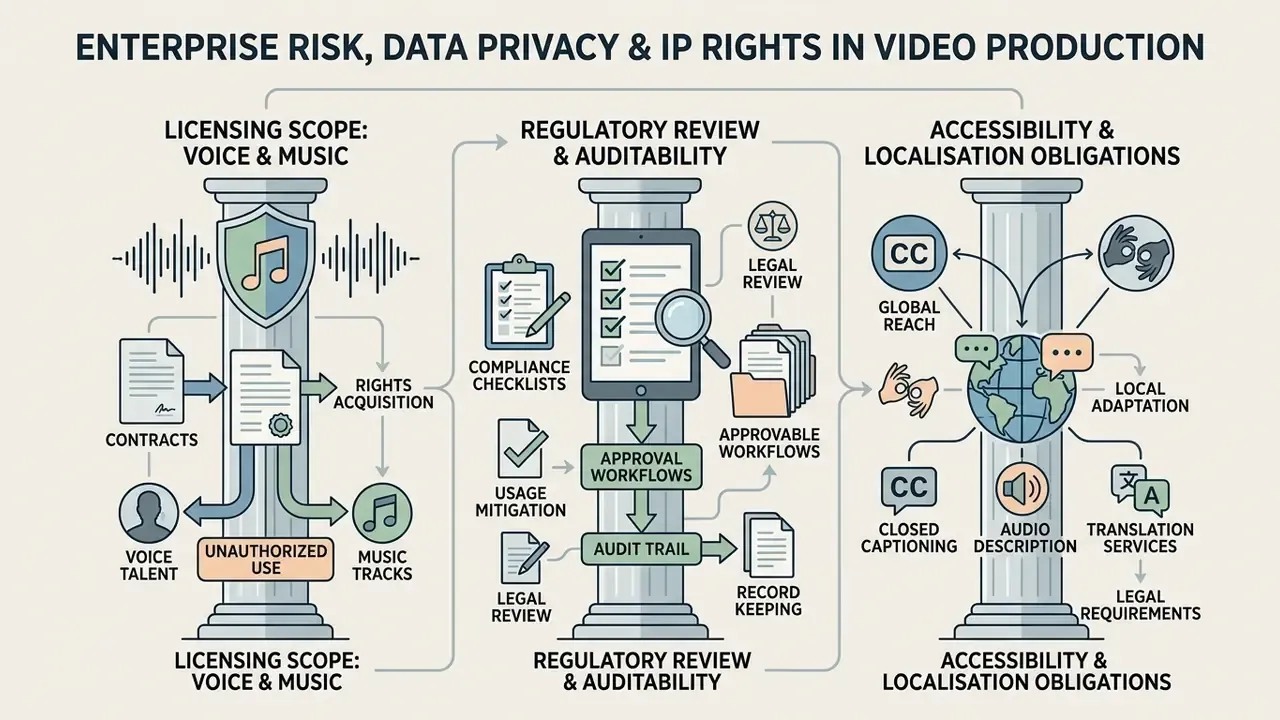
4. Licensing scope for voice and music. Define territory, channel, and duration. A perpetual, worldwide, all-media licence costs more at signature and far less than a retroactive extension mid-campaign.
5. Regulatory review and auditability. Any video making performance, pricing, safety, or compliance claims should pass the same review gate as written marketing collateral. Keep the evidence trail: approved script version, approver name, date, and the final file hash or asset ID. That is what makes a claim defensible eighteen months later, when nobody remembers the call.
6. Accessibility and localisation obligations. Captions, transcripts, and colour-contrast checks are frequently mandatory for public-sector and enterprise intranet distribution. Scope them into the original SOW rather than treating them as post-delivery extras.
"Creative vendors sit inside your control perimeter the moment they touch pre-release material. The contract, not the kickoff enthusiasm, is what defines the risk boundary." Marcus Hale
This section is general information on procurement and risk practice and does not constitute legal advice. Consult qualified counsel and your compliance function before executing vendor agreements involving confidential or regulated material.
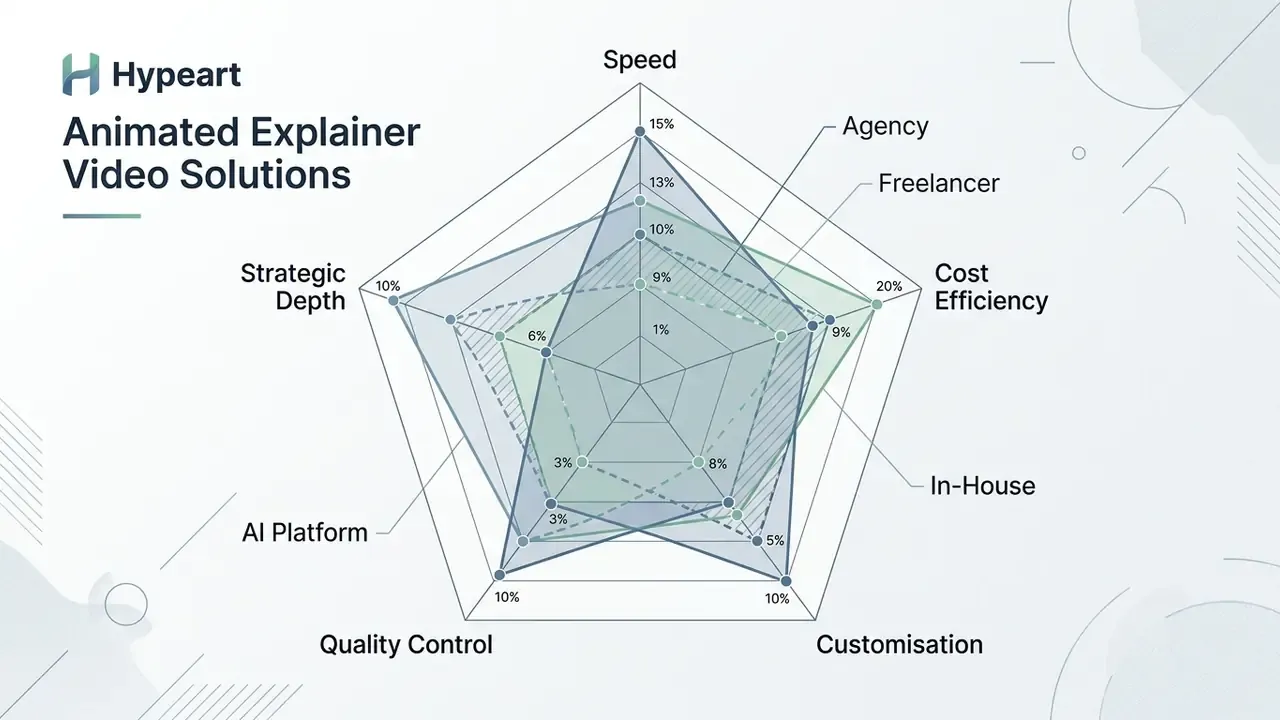
Agency vs Freelancer vs DIY and AI Video Platforms
Organisations comparing animated video services can pick from four execution models: full-service agencies, independent freelancers, internal in-house teams, and self-service AI platforms. Budget-constrained teams often start by testing free AI video platforms to establish a quality floor before requesting agency proposals.
| Production Model | Strategic Depth | Visual Customisation | Turnaround Speed | Production Cost | Best-Fit Usage Scenario |
|---|---|---|---|---|---|
| Full-Service Agency | High (full strategy and scripting). | Bespoke (100% custom assets). | Moderate (4 to 8 weeks). | ~$5,000-$25,000+ per video. | Flagship launches, rebrands, hero website videos. |
| Freelancer | Variable (depends on the individual). | Moderate to high. | Flexible (2 to 4 weeks; 3-7 days for simple work). | ~$50-$100+ per finished minute upward. | Ad-hoc marketing assets, smaller budgets. |
| In-House Team | High internal product knowledge. | Standardised (brand-kit focused). | Fast (ongoing pipeline). | ~$170,000-$250,000/yr team cost plus $25,000-$50,000 first-year setup. | High-volume social content, internal training, routine updates. |
| AI Video Tools | Low (prompt-dependent). | Template-restricted. | Instant to rapid (minutes to 3 days). | ~$0.50-$5 per clip or $20-$100/month. | Rapid prototyping, personalised outreach, basic clips. |
When an Animation Studio or Agency Is the Best Choice
A full-service animation studio is the right call for high-stakes work that needs creative strategy, bespoke design, and multi-stakeholder management. Agencies own the pipeline end to end, supplying scriptwriters, art directors, animators, and sound engineers. Procurement guidance supports the logic: choose the model by weighing risk, benefit, and the cost, time, quality constraint set, and maintain a risk register from day one (RICS risk guidance).
Agencies fit best for:
- Homepage hero explainer videos that define corporate positioning.
- Major product launches and rebrand announcements.
- Investor pitch videos and enterprise sales enablement assets.
- Regulated product communications in fintech, healthtech, or cybersecurity, where strict brand compliance matters and one accountable contractor must own scope, price, and deliverables.
Trade guidance in the animation industry stresses that transaction terms must be written clearly at order time. Which is precisely why full-service is preferable when responsibility cannot be split across four vendors.
When a Freelancer or In-House Video Producer Fits
Hiring an independent freelancer or standing up an internal producer suits organisations with steady video demand and existing creative direction.
- Freelancers cost-effective for individual components, such as a specialist character animator or motion designer supplementing an in-house marketing team. At one to two videos per month, freelancers usually win on cost. Note that typical freelance capacity is 800-1,200 billable hours from a 2,000-hour year, so administration and revision time is already priced into rates.
- In-house producers fast turnaround and deep product knowledge for companies shipping several videos monthly. The economics turn favourable at roughly three or more videos per month, and clearly favourable at eight or more, especially where consistent branding and motion-graphics standards matter.
Internal teams typically spend that capacity on social snippets, customer support guides, and feature update clips. When configuring internal publishing pipelines, video managers often evaluate dedicated editing software such as a youtube video editor to streamline output, while smaller teams frequently start with free video editing software before buying licences.
When Templates and AI Video Tools Make Sense
DIY templates and AI video platforms deliver fast, cheap video for high-volume, short-lifespan content.
"Generative video tools allow rapid asset concepting, but maintaining long-term character consistency across multi-scene narratives still requires human oversight." Marcus Hale
AI video generators synthesise voiceover, assemble template graphics, and render motion clips from text prompts, URLs, PDFs, or document uploads within minutes. Document-to-video platforms now claim explainer drafts in five to ten minutes, with scene, style, voice, and brand controls applied after auto-generation. Adoption is measurable:
FAQ: Animated Explainer Video Companies, Costs and Contracts
How much does an animated explainer video cost in 2026?
Expect $1,500-$4,000 from freelancers, $6,000-$12,000 from a mid-tier specialised agency, and $20,000-$60,000+ from a Tier-1 studio. Per finished minute, published ranges run from about $1,000 for basic motion graphics to $25,000+ for bespoke 3D character work. AI platforms sit at $50-$150 per finished minute but shift the quality-control burden to your team.
How long should an explainer video be?
Thirty to ninety seconds for a homepage or paid-social explainer. Ninety to 180 seconds for a product demo. Three to five minutes for internal microlearning. Use the script formula: word count ÷ 145 × 60 + 5 seconds.
How long does production take?
Four to eight weeks for a standard agency project, including one to two weeks of pre-production. Rush delivery under three weeks typically adds 15% to 150%, and sub-48-hour work can reach 300%.
Animated explainer or product demo, which comes first?
Explainer first if prospects do not yet understand the category or the problem. Demo first if they already know what they want and need to validate that your interface delivers it. Most mature funnels use both, in that order.
Do I own the video files and the source artwork?
You own the final render if the contract says so. Source files, layered vectors, After Effects projects, character rigs, are frequently retained by the studio unless an IP release is negotiated upfront. Ask before signature. Retroactive buyouts cost more.
Can AI replace an explainer video agency?
For internal updates, prototypes, and personalised outreach, yes. For hero brand assets, multi-scene narratives with consistent characters, and regulated claims requiring auditable review, no. Generative output still shows temporal artefacts and weak gesture control, and it carries no accountability for your compliance claims.
What should a regulated enterprise require before signing?
NDA, defined data-handling and retention terms, a written generative-AI usage policy, IP ownership of source files, perpetual voice and music licensing, documented change control, and an approval evidence trail for every claim made on screen.
How do I brief an animated explainer video creation service properly?
Bring one objective, one audience, one measurable outcome, and the approval chain. Attach brand assets, prior video links you like and dislike, and any regulatory language that cannot be paraphrased. Briefs that skip the approval chain are the ones that slip by three weeks.
Conclusion: Next Steps for Video Production
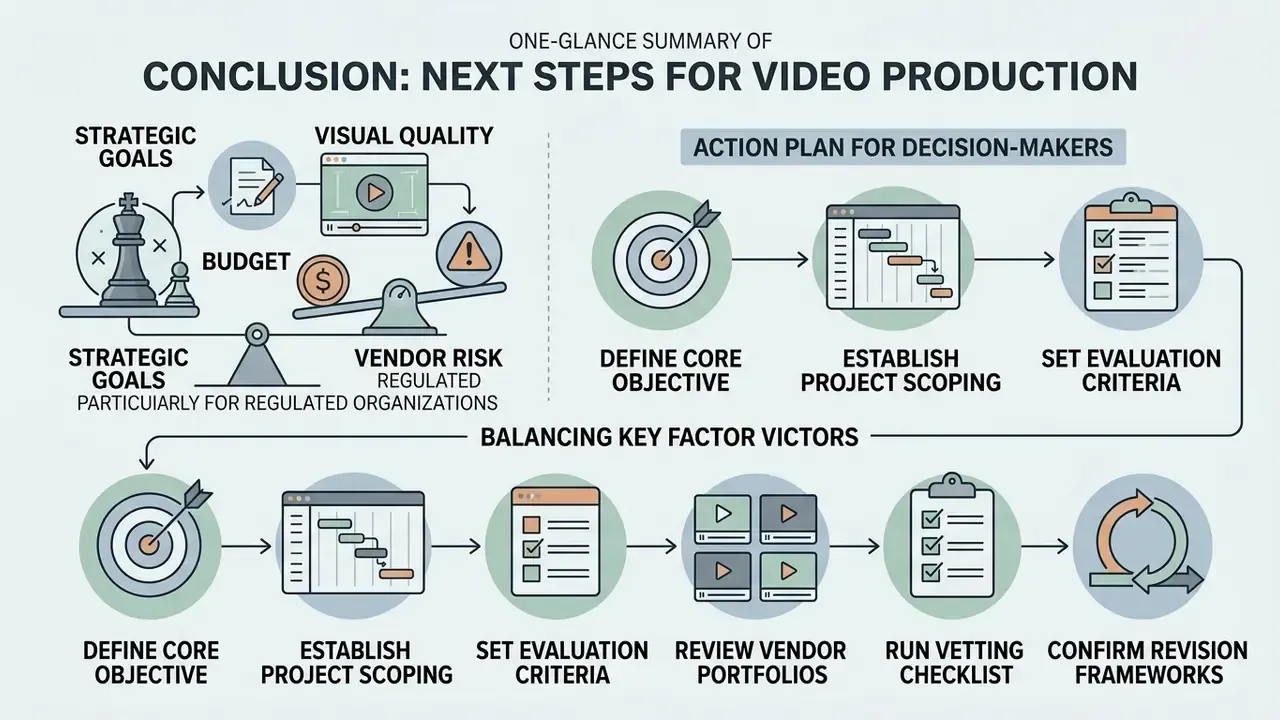
Choosing the right animated explainer video company means balancing strategic goals, visual quality, budget, and, for regulated organisations, vendor risk. Set clear messaging objectives, pick an appropriate animation style, validate pricing against published benchmarks, and match the production model to your internal capacity. Do those four things and the project stops being a gamble.
Action Plan for Decision-Makers
Appendix A: Editorial Corrections and Source Notes
Appendix B: Quick Definitions for Buyers
Useful when a studio proposal starts using terms your finance or risk reviewer has never seen.
- Animatic a timed, rough version of the storyboard cut against scratch or final voiceover. It is the cheapest place to catch a narrative problem.
- Rigging building the control skeleton that lets a character or object move. Heavy rigging is the single biggest cost driver in character animation.
- Keyframe a defined position in time that the software interpolates between. Once keyframing starts, structural script changes become expensive.
- Motion graphics animated typography, shapes, charts, and diagrams without character performance. The default style for financial workflows and system diagrams.
- Mixed media live footage combined with 2D or 3D overlays, common in spokesperson formats.
- Source files layered, editable project assets. Own them, or you will pay twice for the next localisation.
- Change order a written amendment to scope, price, and delivery date. If a studio has no change-order process, your timeline is the buffer.