An AI voice generator turns written text into synthetic speech with deep neural networks, then lets you export the result as an MP3 or WAV file. In 2026, most free options run in a browser under credit-limited or character-capped trial tiers. Full commercial rights, uncompressed audio, and voice cloning usually sit behind a paid plan.
Why should a risk or compliance leader care about a consumer audio tool? Because the search query "ai voice generator free download" is exactly the kind of thing an employee types before pasting an internal script into an unvetted third-party service. That is a data-transfer event with no contract behind it.
Author note: Marcus Hale writes about AI governance and model risk for this publication.
Executive Summary
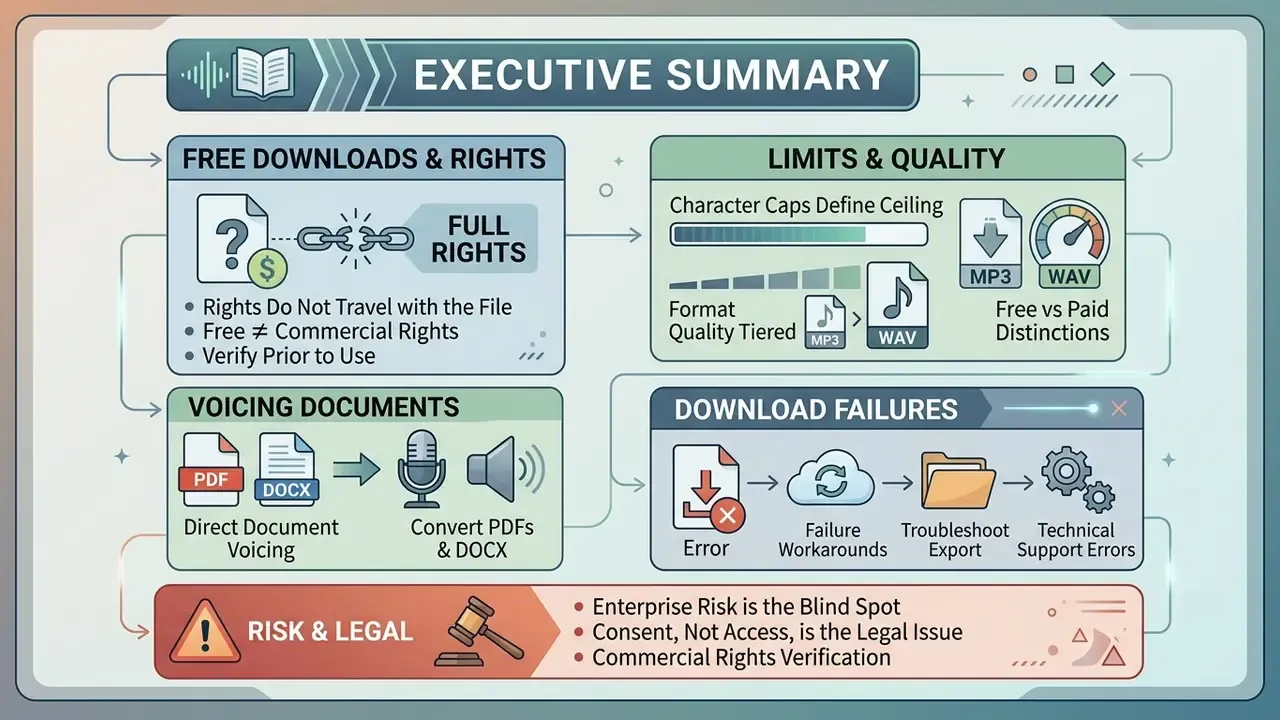
- Free downloads exist, but rights do not travel with the file. Free-tier exports from major platforms are generally licensed for personal, non-commercial testing. Monetized use requires a paid plan and, on some services, mandatory attribution.
- Character caps define the ceiling. Free allowances range from 10,000 characters per month (ElevenLabs) to 5 million Standard characters per month for the first 12 months (AWS Polly). Google Cloud offers 4 million Standard plus 1 million WaveNet characters monthly.
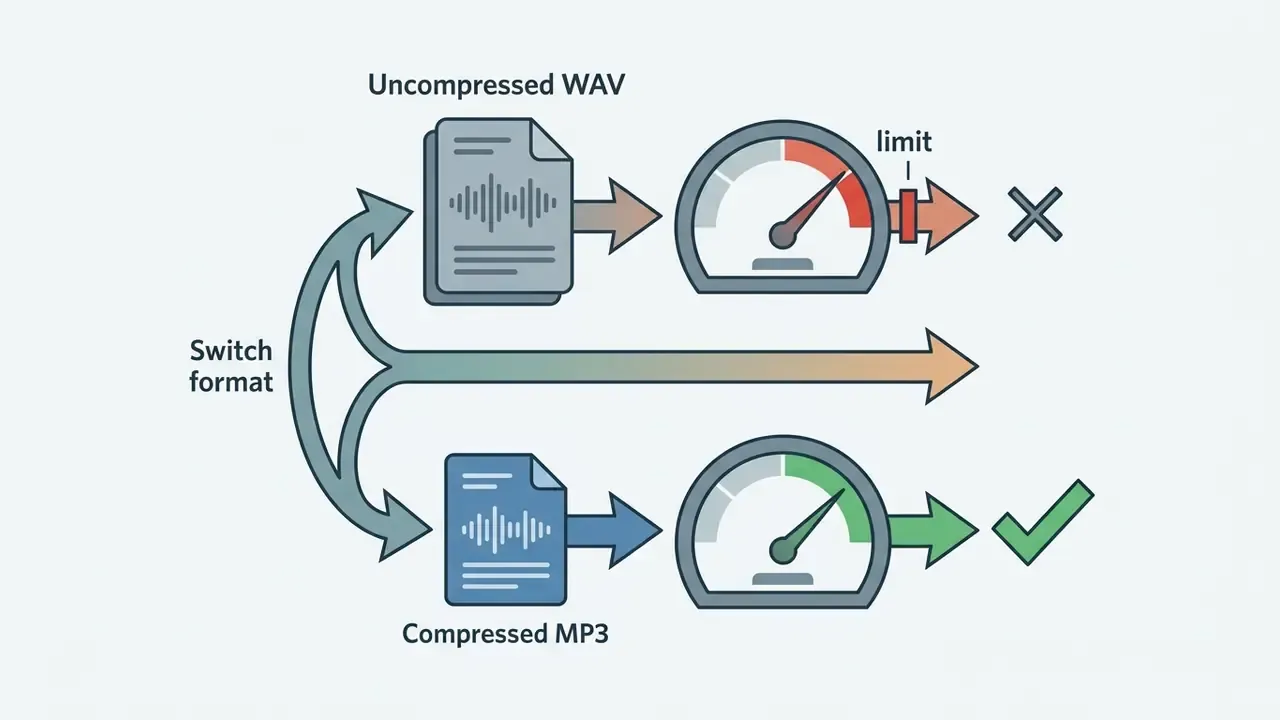
- Format quality is tiered. Free plans typically deliver 128 kbps MP3. Paid plans unlock 320 kbps MP3, uncompressed 44.1 kHz WAV, FLAC, PCM, and Ogg Opus.
- Documents can be voiced directly. Advanced generators accept PDF, DOCX, PPTX, and TXT uploads up to roughly 50 MB, which removes manual copy-paste for books, reports, and training decks.
- Download failures have workarounds. When browser preview and server-side export use different engines, system-audio capture (Audacity, OBS Studio) or offline PWA generation preserves the exact voice you auditioned.
- Enterprise risk is the blind spot. Free web generators rarely provide a signed Data Processing Agreement, SOC 2 Type II attestation, or GLBA/HIPAA-aligned controls. Never paste PII, NPI, or unreleased scripts into them.
- Consent, not access, is the controlling legal issue. Voice cloning requires explicit, informed, revocable consent. FCC rules treat AI-generated human voices in automated calls as artificial or prerecorded voices requiring prior express consent.
Who This Guide Is For and What It Answers
Three readers usually land here at the same time, with different questions.
A content producer wants the mechanics: paste a script, pick a voice, click download, get an MP3 that sounds usable. A finance or operations lead wants to know whether a free tool can carry narration for training modules and internal comms without a procurement cycle. A risk owner wants one thing only: what happens if this output ends up in a client-facing asset.
This guide covers all three layers in one pass. Practical workflow first, then export formats and failure modes, then free-tier economics, then the control set that makes synthetic voice defensible in a regulated environment. Where the evidence is thin, that is stated plainly rather than smoothed over.
What an AI Voice Generator Is and Whether You Can Download Voices Free
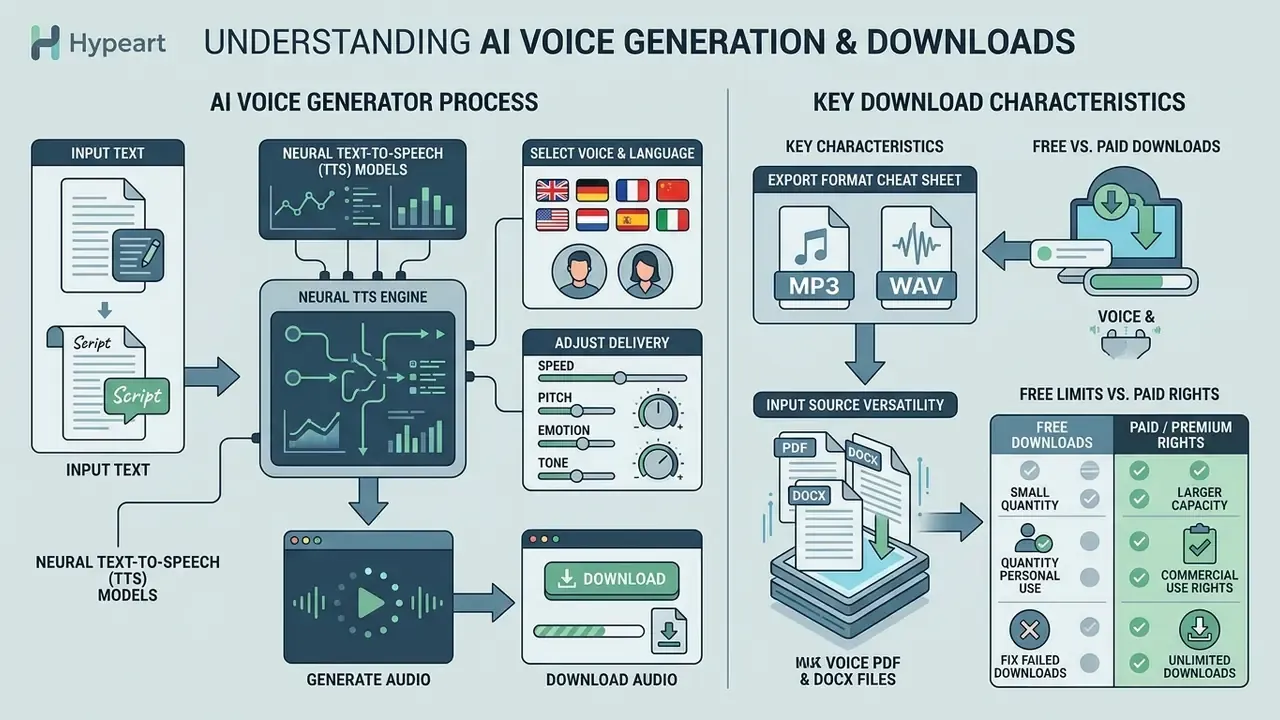
An AI voice generator is a software application or cloud platform that uses neural text-to-speech (TTS) models to turn written scripts into natural-sounding spoken audio. Free downloading of generated voices is widely available across major platforms. Free access usually arrives with monthly character caps, non-commercial usage terms, or mandatory attribution. For a broader capability and licensing overview, see the reference guide to AI voice generators, which compares voice quality, language support, pricing, and commercial licensing side by side.
To evaluate audio generation capabilities across workflows, developers and enterprise risk managers often consult the AI Media Glossary to keep model definitions and audit standards consistent between teams.
Online AI Voice Generators and the Downloadable Result
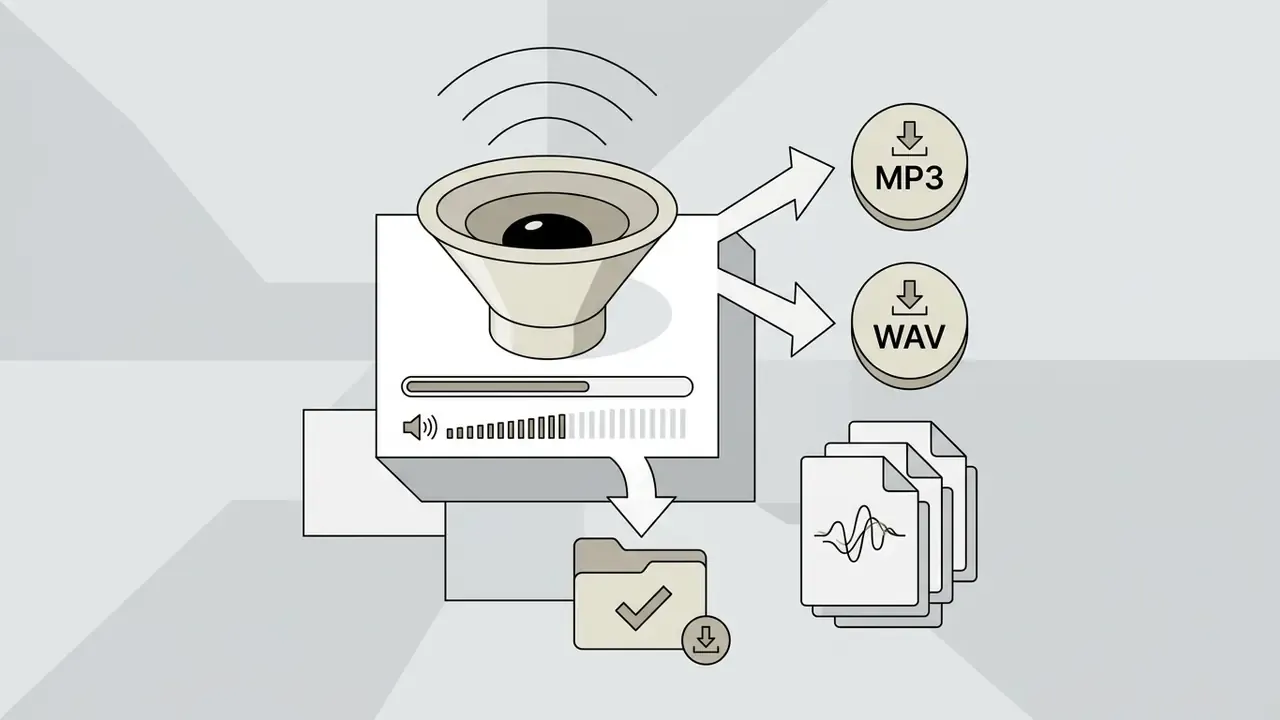
Browser-based tools run text normalization and speech synthesis on remote cloud servers or client-side runtime engines, with no local install. Once processing completes, you receive an exportable audio file. MP3 dominates, with WAV, AAC, FLAC, Opus, or PCM available on supporting platforms. Note how the pipeline itself, not the marketing page, determines what the export step can produce.
«Modern TTS pipelines convert acoustic tokens into a waveform, then encode it into a downloadable file: MP3, WAV, or FLAC depending on the platform.»
Online tools shorten content pipelines by streaming audio in the browser before final file delivery. You judge voice quality in real time, then trigger an ai voice generator online download once the delivery sounds right. Vendor documentation across OpenAI, Azure OpenAI, and Google Cloud converges on one pattern: MP3 is the default container, WAV is the standard uncompressed option, and preview is either a separate short-sample endpoint or a partial stream played before the full render finishes.
Export format cheat sheet:
| Format | Typical Bitrate / Encoding | Best Use | Availability |
|---|---|---|---|
| MP3 128 kbps | Lossy, compressed | Drafts, social clips, previews | Free tiers |
| MP3 320 kbps | Lossy, high quality | YouTube, podcast publishing | Paid tiers |
| WAV 44.1 kHz | Uncompressed PCM | Broadcast, film mixing, LMS masters | Paid tiers / API |
| FLAC | Lossless compressed | Archival masters, audiobook delivery | Selected platforms |
| Ogg Opus / PCM | Low-latency streaming | IVR, real-time agents, embedded apps | API-first platforms |
How AI Voices Differ from Standard Text to Speech
Neural AI voices learn acoustic representations, prosody patterns, and vocal timbres from large speech datasets. Classical engines stitched together pre-recorded snippets instead. That difference is measurable, not merely aesthetic.
«A benchmark of 35 TTS systems from 2008 to 2024 shows that neural models after 2017 cluster at the top of the TTSDS scale, well above legacy architectures.»
Older systems followed rigid rules and produced monotone cadence with unnatural pauses. Academic reviews describe those architectures as plateaued: naturalness and expressiveness lagged expectations until neural networks were applied to synthesis itself. Contemporary models condition generation on speaker embeddings, which supports believable emotion, sensible sentence rhythm, and steady narration across content types.
«DS-TTS reaches speaker similarity of 0.863 to 0.868 and naturalness MOS near 4.0 out of 5 in zero-shot cloning on the VCTK dataset.»
One caution for procurement teams. Empirical work notes that listeners are frequently fooled by modern TTS, yet vendor claims of "human-like" realism are not always backed by openly available data, and evaluation methodology remains unstandardized. Treat marketing MOS figures as directional, not contractual.
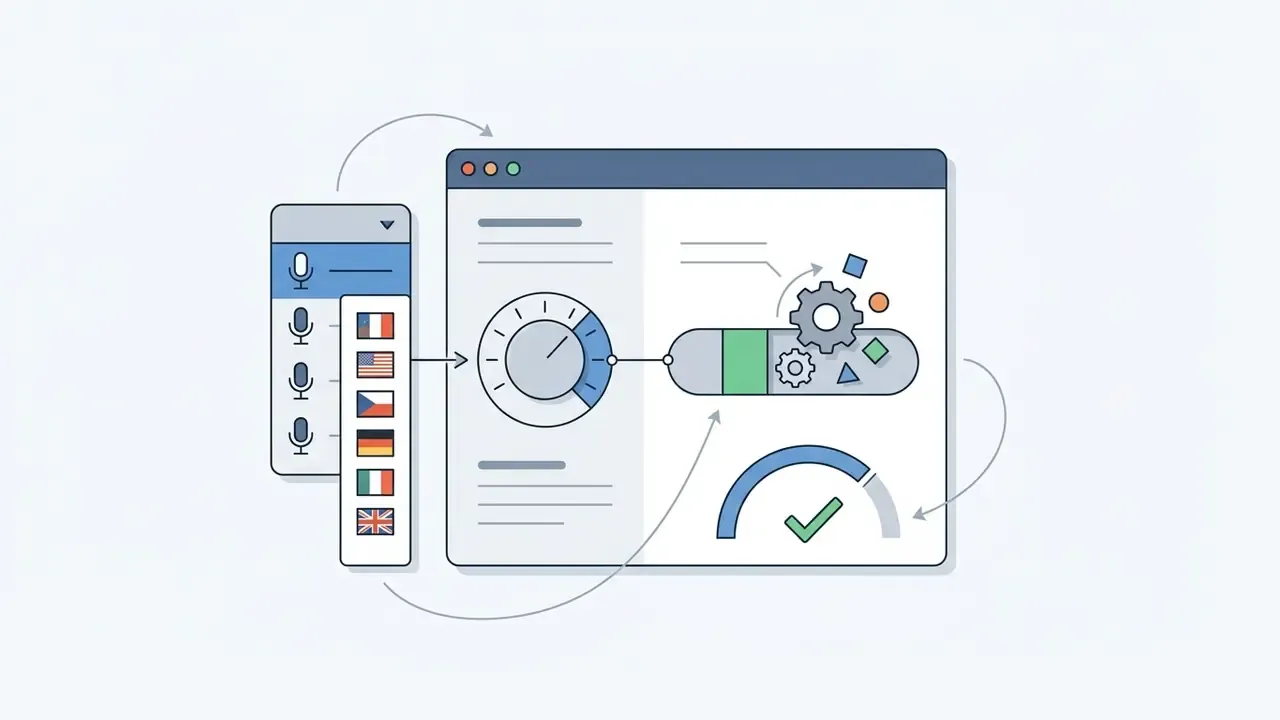
languageCode parameter or a dropdown filter.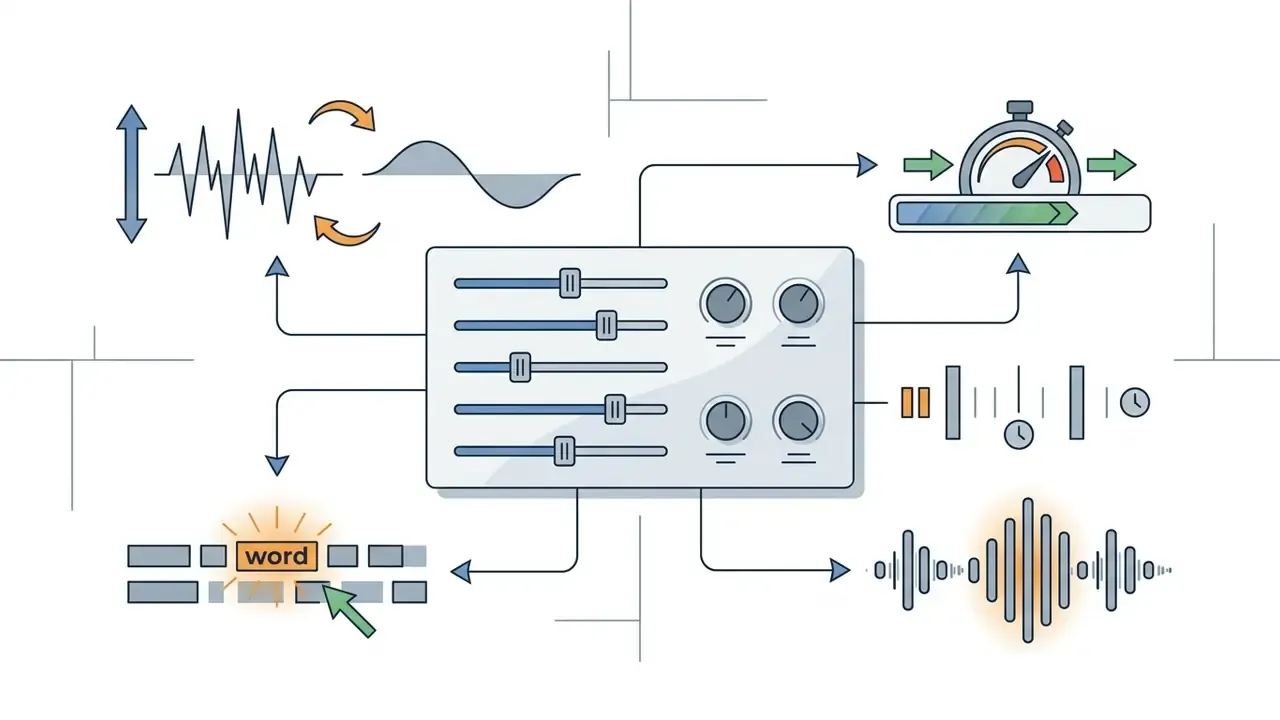
How to Create an AI Voiceover and Download the Audio
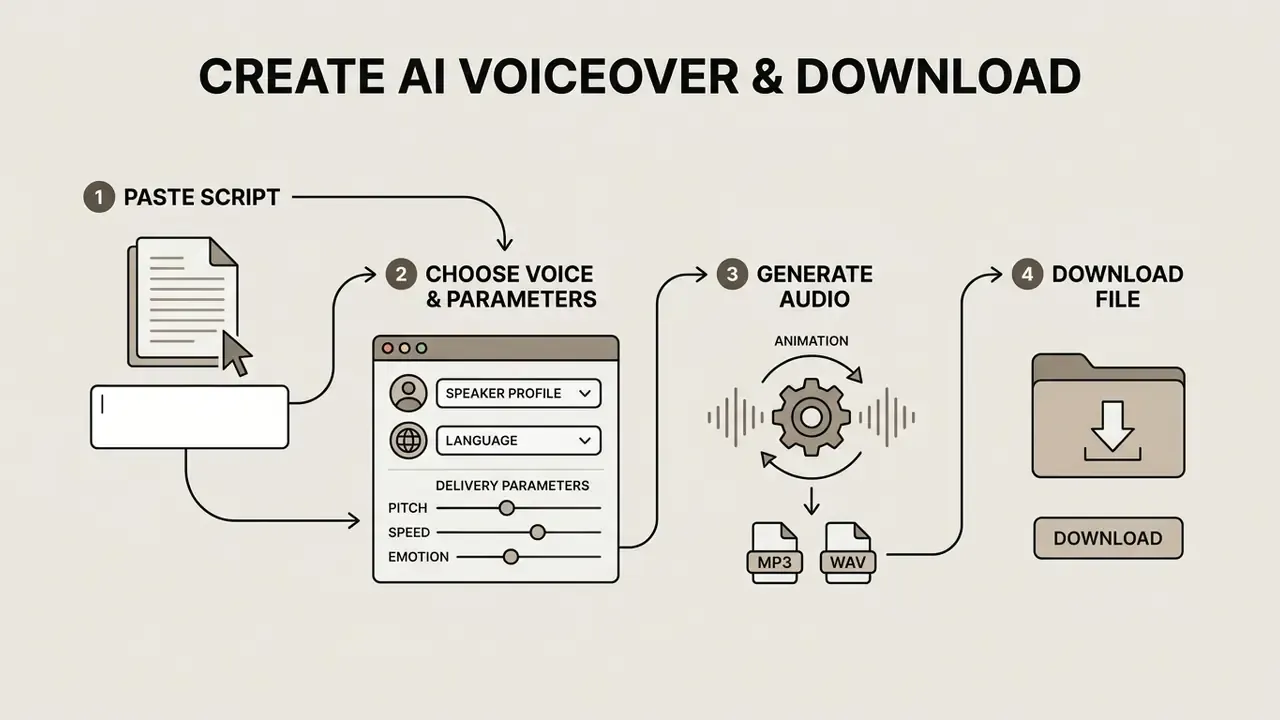
Enter or Paste the Text You Want Voiced
Prepare plain linear scripts, or structured Speech Synthesis Markup Language (SSML) that spells out speech boundaries and phonetic pronunciations. This is grounded in phonetic-representation research, not in general policy guidance.
«Using IPA as a unified phonetic representation in multilingual TTS models reduces synthesis errors and secures correct pronunciation across 30 languages.»
Dropping complex tables, stray symbols, and untested jargon prevents synthesis errors and keeps the flow natural. Script-preparation rules that consistently reduce rework:
- Spell out abbreviations the model may mispronounce, or wrap them in an SSML
<sub alias="...">tag. - Insert deliberate silence with
<break time="600ms"/>rather than trusting punctuation alone. - Control pacing per sentence with
<prosody rate="95%" pitch="-2st">, which beats a single global speed slider. - Write for the intended audience and avoid jargon with no phonetic precedent in the training data.
Select Voice, Language, and Delivery Parameters
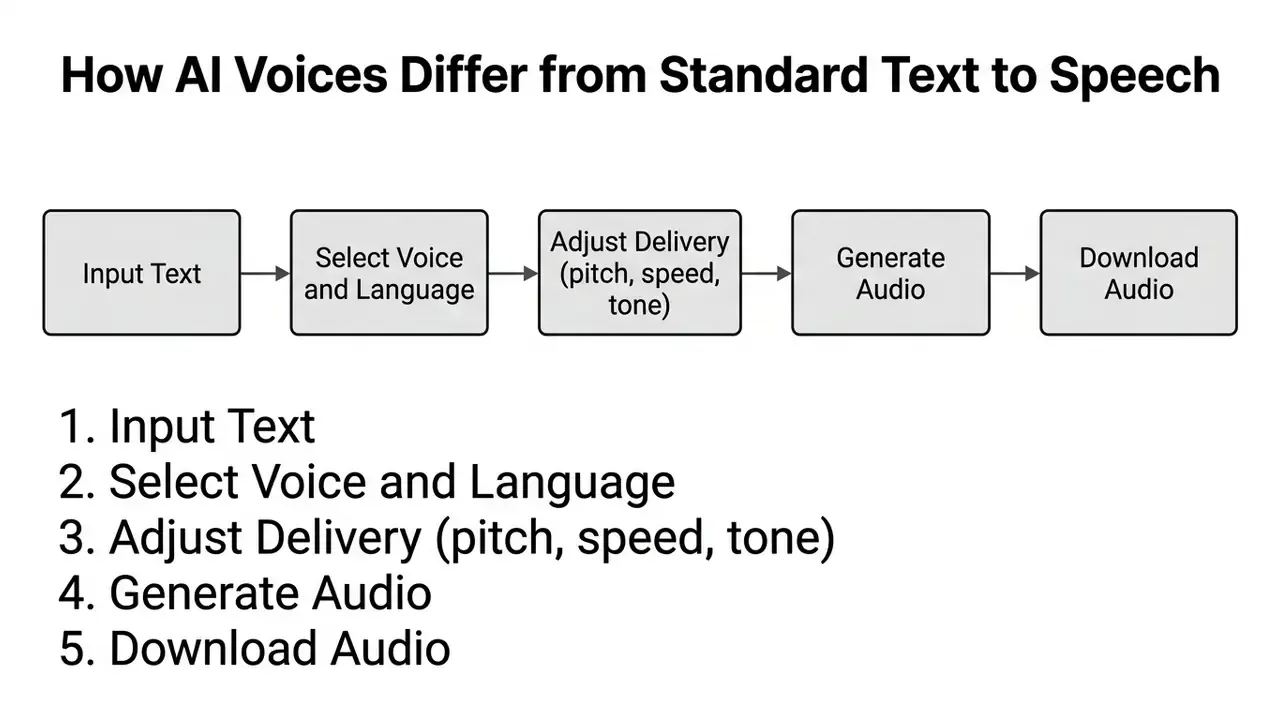
Filter the voice library by language, regional dialect, apparent age, gender, and emotional tone. Then tune speaking speed, pitch height, and intra-sentence pauses so the narration matches intent, whether that is a marketing video, a podcast segment, or corporate training material. A calm 0.95x read suits compliance content. A 1.15x read suits a short-form hook. Same model, different job.
Generate and Download the Audio File
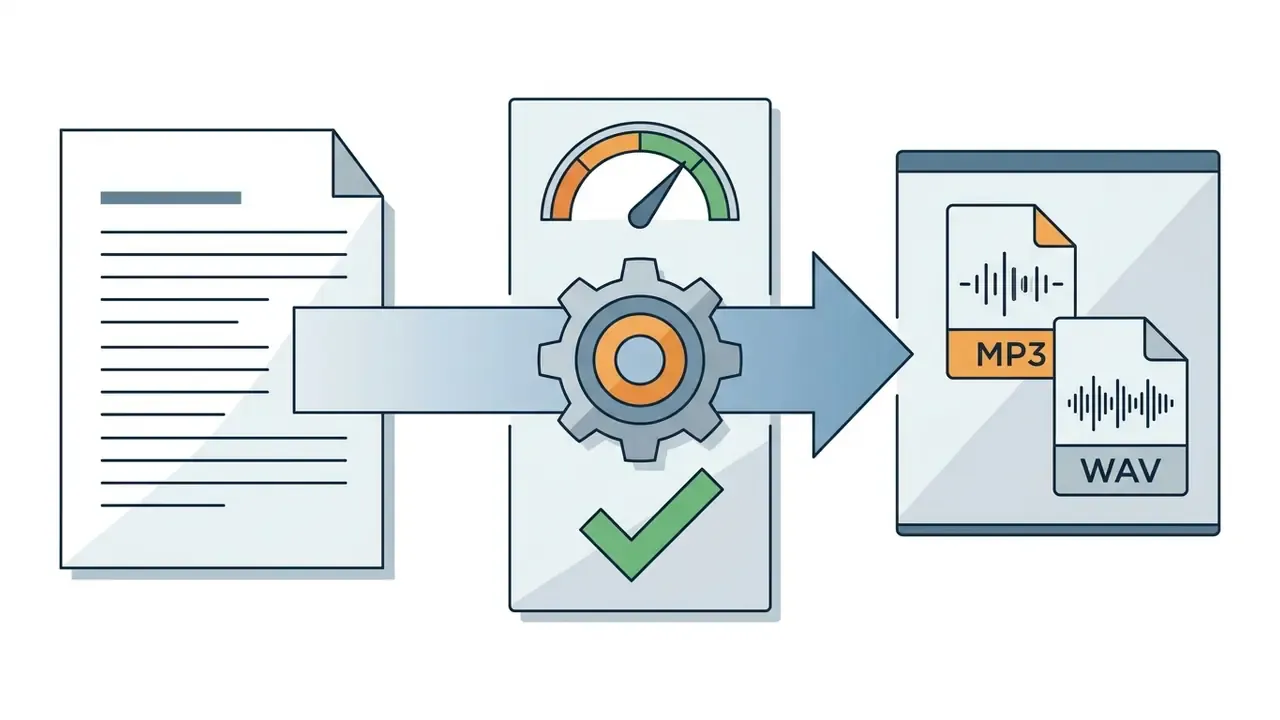
Clicking generate converts text into acoustic tokens, then decodes them into an audio file. Preview the speech in the browser, pick your output format, standard MP3 or uncompressed WAV, and save the file. Some platforms implement preview as a separate short-sample endpoint. Others stream partial audio before the full render finishes, which is exactly why the preview sometimes differs from the final export.
- Insert script paste linear plain text into the input field, with punctuation that supports natural pauses.
- Configure speaker and parameters select voice character, language, speaking rate (0.25x to 2.0x), and emotional style.
- Generate and download synthesize the audio, audition the preview stream, then download the finished MP3 or WAV file.
How to Voice Ready-Made Files: PDF, DOCX, and Presentations
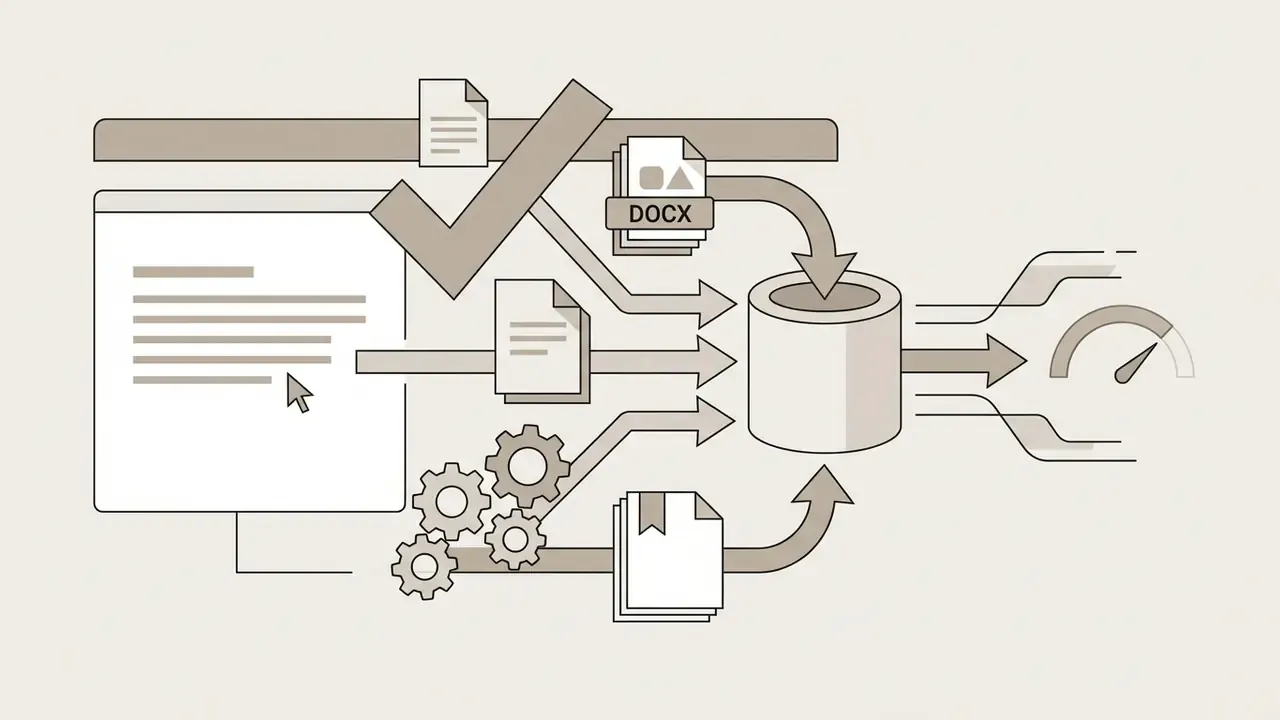
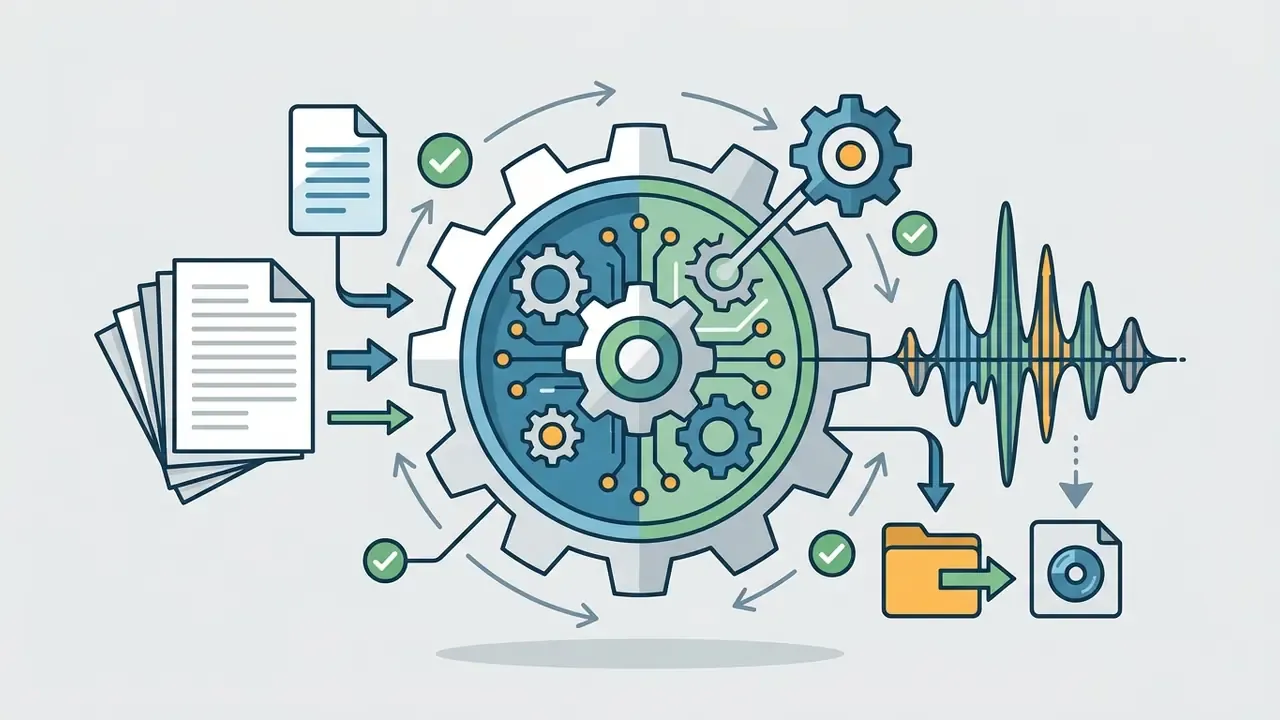
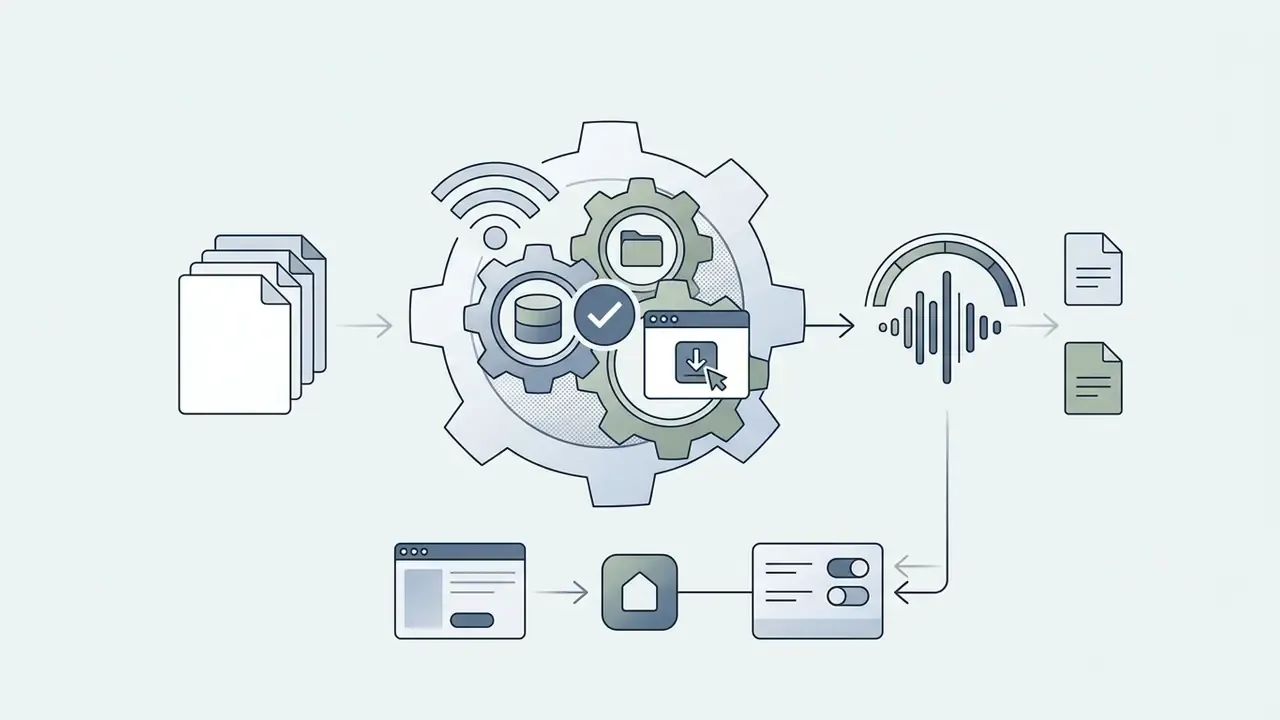
You do not need to retype long-form material. Advanced generators accept direct uploads of PDF, DOCX, PPTX, TXT, EPUB, and even image files up to roughly 50 MB, then parse them into a clean synthesis script. That closes the gap between a finished document and a listenable file.
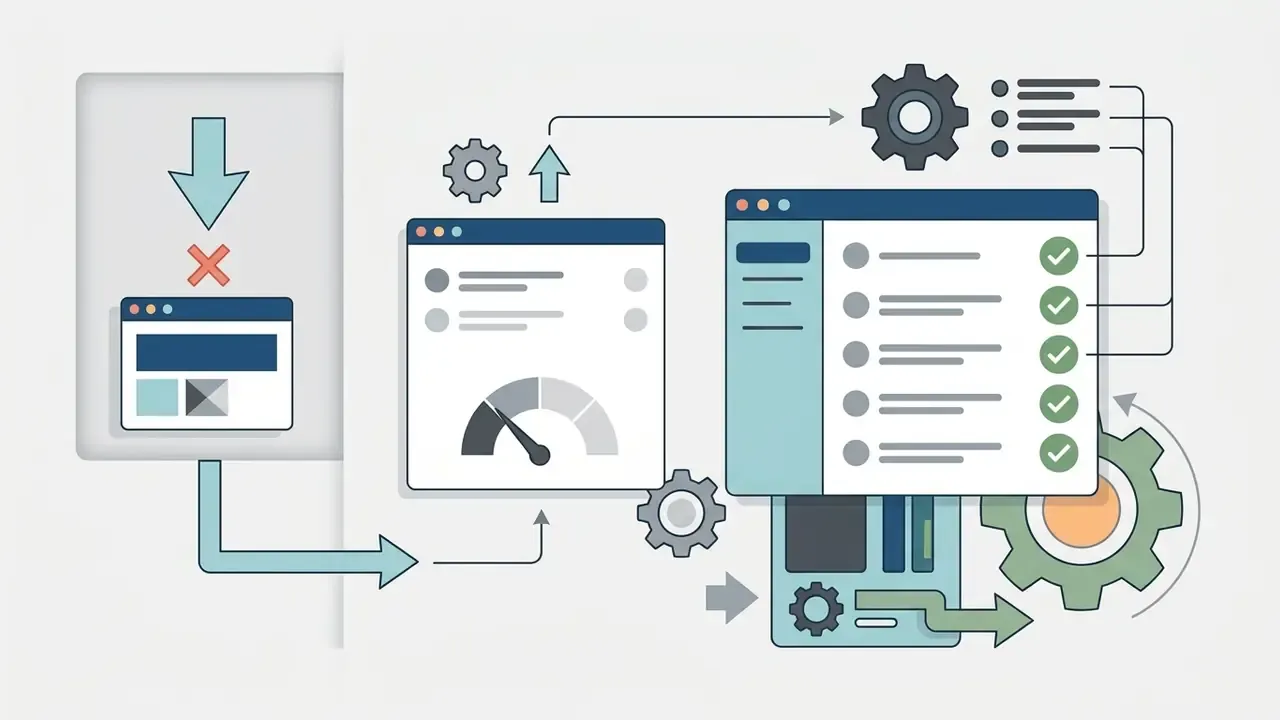
Step-by-step document processing workflow:
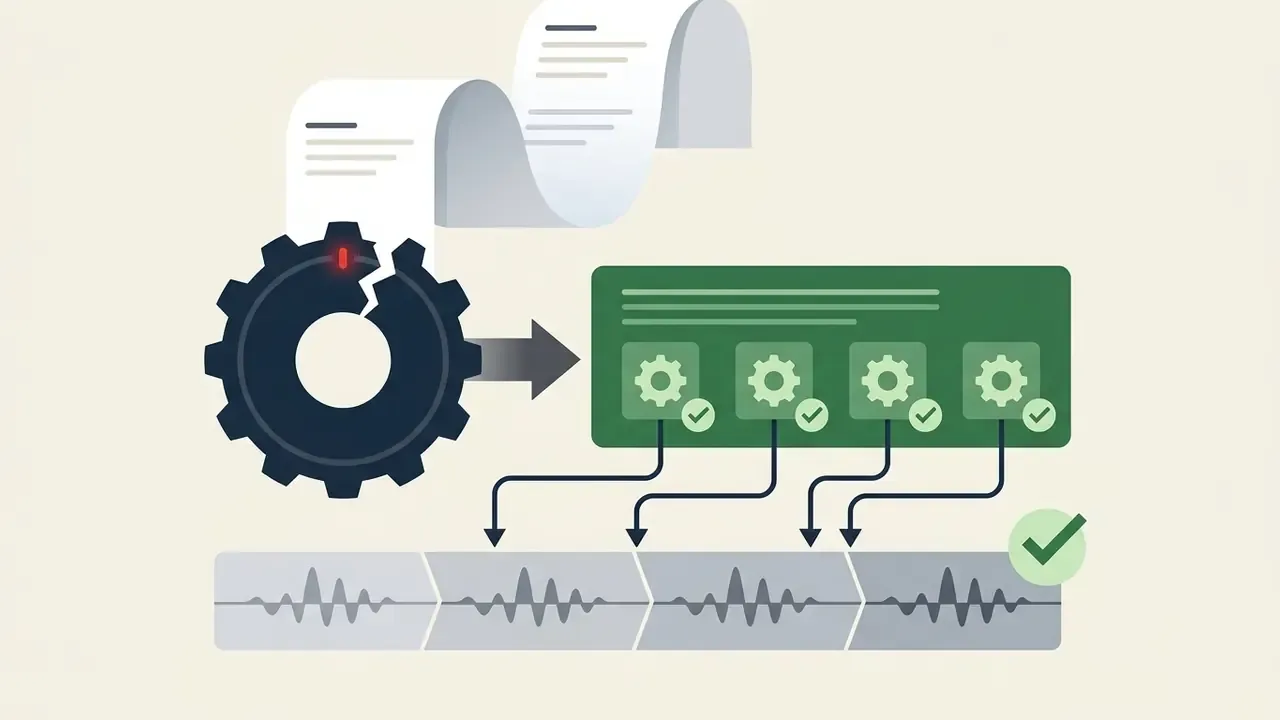
Check three limits before committing a large document: the per-clip character cap on free tiers, the total monthly quota, and whether batch synthesis writes output to your own cloud storage or the vendor's. Long-audio endpoints from Google Cloud (synthesizeLongAudio) and Azure (Long Audio API) exist precisely because single-request synthesis is capped on real-time endpoints.
- Upload the filedrop the document into the drag-and-drop form, or select it from local storage.
- Automatic parsingthe model strips running headers, page breaks, footnote markers, and page numbers, leaving a clean linear script.
- Chapter segmentationfor long documents, assign different voices to chapters, dialogue lines, or pull quotes, so a report does not read as one monotone block.
- Review and correctaudition the first minute of each chapter, fix mispronounced proper nouns with SSML aliases, then re-render only the affected segment.
- Exportdownload one continuous file, or per-chapter MP3s for chaptered audiobook distribution.
What to Do If the Audio Will Not Download or the Exported Voice Sounds Different
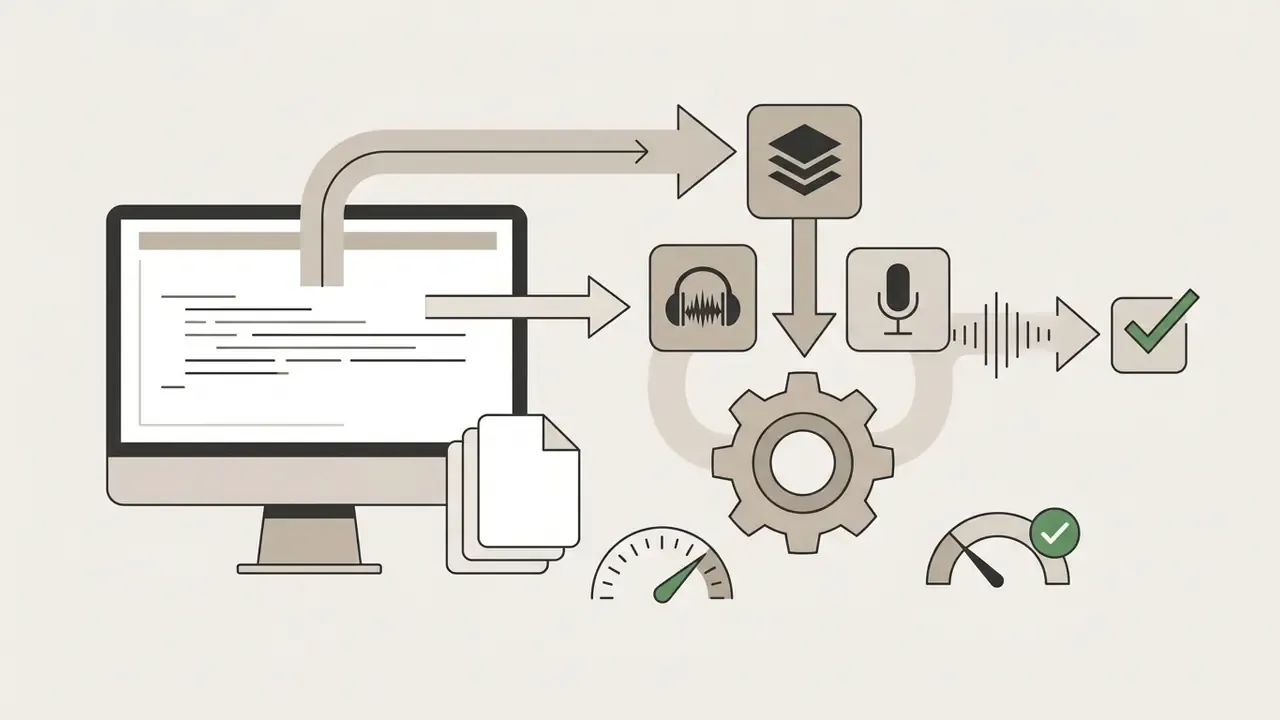
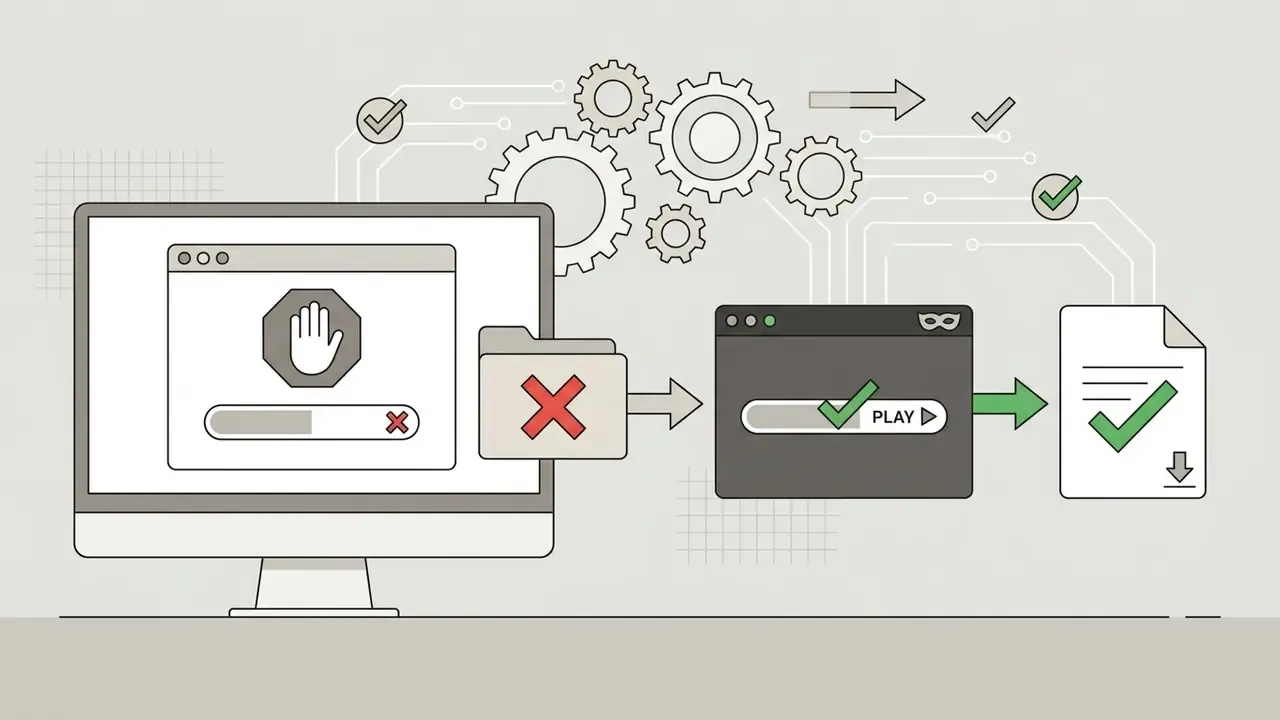
A frequent and genuinely confusing failure: the voice in the browser preview is not the voice in the downloaded MP3. The cause is architectural. Some free tools synthesize the live preview with the browser's Web Speech API, which uses voices installed in your operating system, while the download button sends the same text to an external TTS server with a completely different voice inventory.
Alternative ways to save the audio you actually auditioned:
One caveat about local capture. Recording system audio reproduces the preview faithfully, but it changes nothing about your licence. If the terms restrict free-tier output to non-commercial use, a screen-recorded copy carries the identical restriction. Capture solves an engineering problem, never a legal one.
How to Choose a Realistic AI Voice: Languages, Tone, and Speech Control
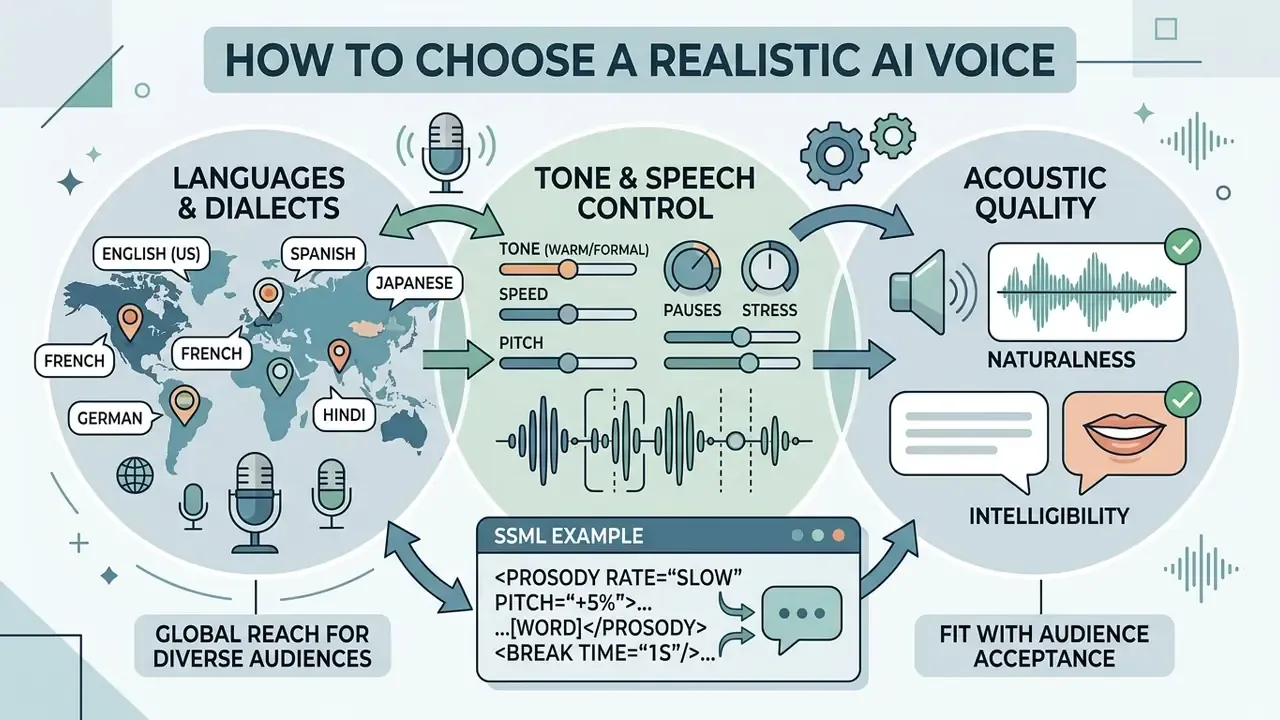
Choosing a realistic voice means balancing three things: acoustic naturalness, pronunciation intelligibility, and fit with the audience. Modern benchmarks evaluate synthetic voices on two axes, human-like timbre and communicative appropriateness for the application context (LREC Speech Evaluation Study, 2024). Recent evaluations add five delivery domains, AI assistant, reader, actor, animated character, and spontaneous speaker, because a voice can score high on human-likeness and still be wrong for the content.
When multimedia pipelines extend beyond narration, teams often add a video transcript generator for caption alignment, or a video upscaler to lift visual resolution alongside high-bitrate voice tracks.
Voices, Languages, and Dialects for Different Audiences
Leading generators support dozens of languages and regional accents, which lets organizations keep one voice identity across international markets. ElevenLabs supports roughly 29 to 32 languages with native accent consistency, and Murf.ai covers 33 languages and accents (ElevenLabs Documentation, 2026; Murf.ai Help Center, 2026). Murf's Gen 2 models handle language-specific prosody, phonemes, and accents separately to preserve native pronunciation, and its API advertises 40+ languages and accents.
Accent selection is not cosmetic. A voice not trained in the target language can retain its original accent, or drift between accents mid-sentence, which native listeners notice immediately.
«In a 250-person study, 53.8% of respondents said American and British accents dominate as the AI voice standard, excluding speakers of other English varieties.»
Controlling Tone, Speed, Pitch, Pauses, and Stress
Granular prosody control comes from numeric speaking rates, pitch offsets, and explicit pause durations, set in SSML or through UI sliders. Google Cloud Text-to-Speech documents speaking rates from 0.25 to 2.0, with API headroom to 4.0, and pitch from -20 to +20 semitones (Google Cloud TTS Docs, 2026). Scales are not portable: W3C SSML 1.1 uses relative labels (x-slow, slow, medium, fast, x-fast), Google uses multipliers and semitones, and the Web Speech API uses a 0 to 2 pitch scale where 1 is the platform default.
| Prosody Parameter | Control Mechanism | Typical Adjustment Range | Impact on Speech Delivery |
|---|---|---|---|
| Speaking rate | Speed multiplier / SSML rate | 0.25x to 2.0x (85 to 355 WPM) | Controls narrative tempo and comprehension speed. |
| Pitch contour | Semitone shift / SSML pitch | -20 to +20 semitones | Modifies voice gravity, depth, and inflection. |
| Pause duration | Silence insertion / SSML break | 100 ms to 5000 ms | Sets phrasing, rhythm, and emphasis. |
| Word or sentence stress | SSML emphasis / stress tokens | Reduced, moderate, strong | Directs attention to key terms and claims. |
| Emotional style | Prosody embeddings / presets | News, conversational, empathetic | Shapes intonation and emotional resonance. |
Emotional speech research maps predictable prosodic signatures. Happiness correlates with higher pitch and faster rate, sadness with lower pitch and slower rate, anger with a wider pitch range and accelerated delivery. When a platform offers no named emotion preset, those three levers approximate the effect by hand.
SSML example combining the controls:
<speak>
  <prosody rate="95%" pitch="-1st">
    Your account balance has been updated.
  </prosody>
  <break time="700ms"/>
  <emphasis level="strong">Please review the statement</emphasis>
  before the deadline.
</speak>
Applying Audio Effects and Voice Processing Modes
Beyond natural speech, generators and post-processing modules let you layer stylised effects onto the generated voice. That is the dominant use case for game dialogue, streaming overlays, animation, and comedy edits.
- Robotisation and synthetic tone rapid formant smoothing plus mild ring modulation produces a robot or assistant timbre from an otherwise natural read.
- Environmental effects dropping pitch 5 to 10 semitones creates a monster or giant character. Plate or room reverb simulates radio broadcast, cave acoustics, or a large hall.
- Inversion and speed modulation tempo changes from 0.25x to 4.0x create chipmunk, slow-motion, and comedic effects. Reversing the waveform produces the classic backwards-message gag.
- Ghost, demon, and anonymous-caller presets layered detune, formant shifting, and band-limited distortion are the standard recipe, shipped as one-click chains in most free editors.
- Age and gender shifting small pitch offsets of two to four semitones combined with rate adjustment shift perceived age without obvious artefacts.
Workflow tip: generate a clean neutral read first, download the highest-quality format available, and apply effects only on a copy. Effects stacked on a 128 kbps MP3 amplify compression artefacts. The same chain on a 44.1 kHz WAV master stays clean.
What a Free AI Voice Generator Includes: Limits, Features, and Pricing
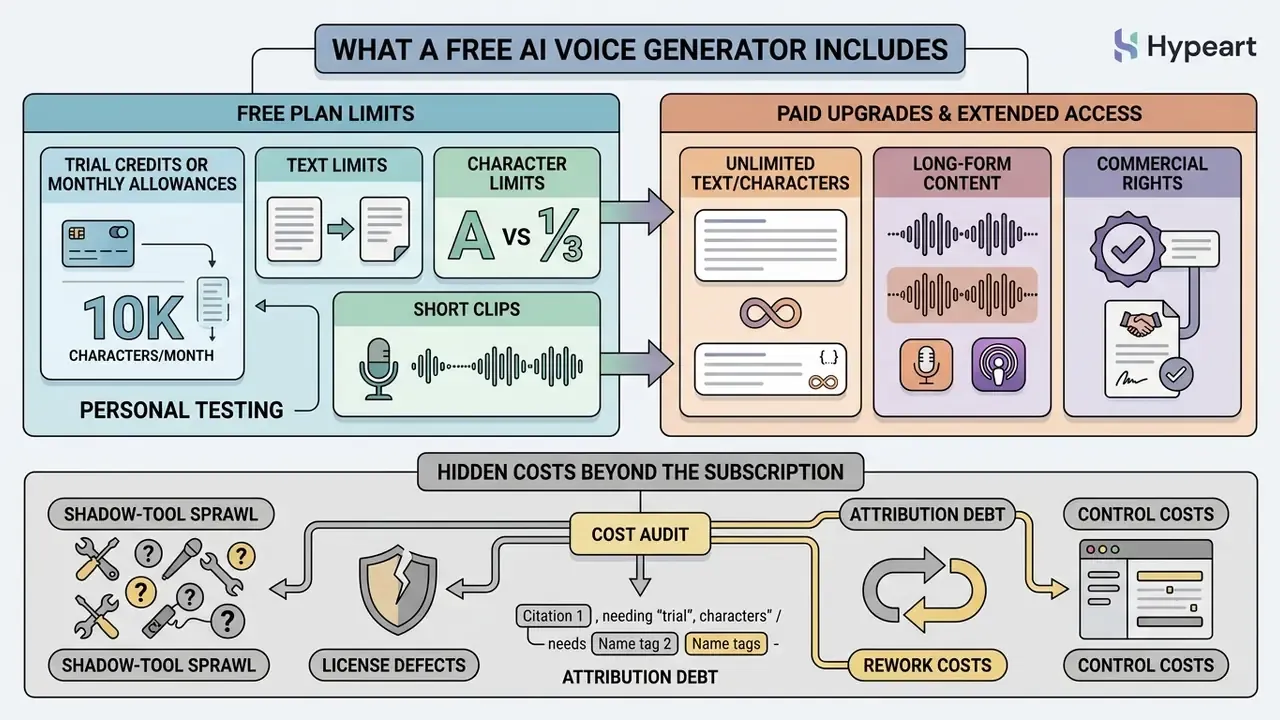
Free tiers hand out trial credits or recurring monthly character allowances, enough for personal testing and short clips. Commercial rights, voice cloning, and API integrations sit behind paid plans. The constraint pattern mirrors what you see across free AI content tools: quota caps, watermarks or attribution, and licence limits rather than feature removal alone.
When allocating software budgets for content tooling, teams compare recurring operating costs against internal budgets using published AI Media Pricing tiers.
Free Limits on Text, Characters, and Generations
Free plans cap both monthly volume and export behaviour. ElevenLabs offers 10,000 credits per month. AWS Polly provides 5 million Standard characters per month free for the first 12 months, alongside 1 million Neural, 500,000 Long-Form, and 100,000 Generative characters (ElevenLabs Pricing, 2026; AWS Polly Pricing, 2026). Google Cloud Text-to-Speech grants 4 million Standard and 1 million WaveNet characters per month before per-million-character billing starts.
Smaller specialist tools sit at both extremes. SpeechGen grants 1,000 free characters with MP3, WAV, and FLAC export. Narakeet allows 20 free audio files. Fish Audio issues 8,000 free credits monthly. So a free ai voice generator download can mean a full month of narration or a single paragraph, depending entirely on the vendor. Free plans also tend to lock output to compressed 128 kbps MP3.
When Paid Features and Extended Access Are Required
Paid tiers unlock full commercial licensing, uncompressed WAV export, custom voice cloning, and direct REST API access. They also add multi-user collaboration, higher character quotas, and priority generation during peak hours. Industry pricing coverage indicates commercial licensing and instant voice cloning appear from entry-level paid plans upward, professional cloning at mid-tier, and API plans billed separately from interface plans at minute-based rates.
| Feature / Capability | Free Tier | Paid / Subscription Tier |
|---|---|---|
| Monthly character allowance | 10,000 to 1,000,000 chars | 100,000 to 10,000,000+ chars |
| Audio export formats | Compressed MP3 (128 kbps) | MP3 320 kbps, WAV 44.1 kHz, PCM, FLAC, Opus |
| Commercial usage rights | Restricted, non-commercial only | Full commercial and redistribution rights |
| Voice cloning access | Unavailable or basic design | Instant and professional voice cloning |
| API developer access | Rate-limited or blocked | High-throughput REST and gRPC endpoints |
| Document upload (PDF/DOCX/PPTX) | Often capped or unavailable | Up to ~50 MB per file, batch processing |
| Attribution requirement | Mandatory service link on some platforms | None (white-label commercial output) |
| Data Processing Agreement | Not offered | Available on business and enterprise contracts |
Read the table as a decision aid, not a scoreboard. For a faceless YouTube channel, every row above the licence line is irrelevant. For a bank publishing customer-facing audio, the last two rows decide the purchase.
«Voxtral TTS, released under a CC BY-NC licence, was preferred in 68.4% of comparisons against ElevenLabs Flash v2.5 for zero-shot cloning across nine languages.»
Shadow AI and Data Privacy Alert for Regulated Teams
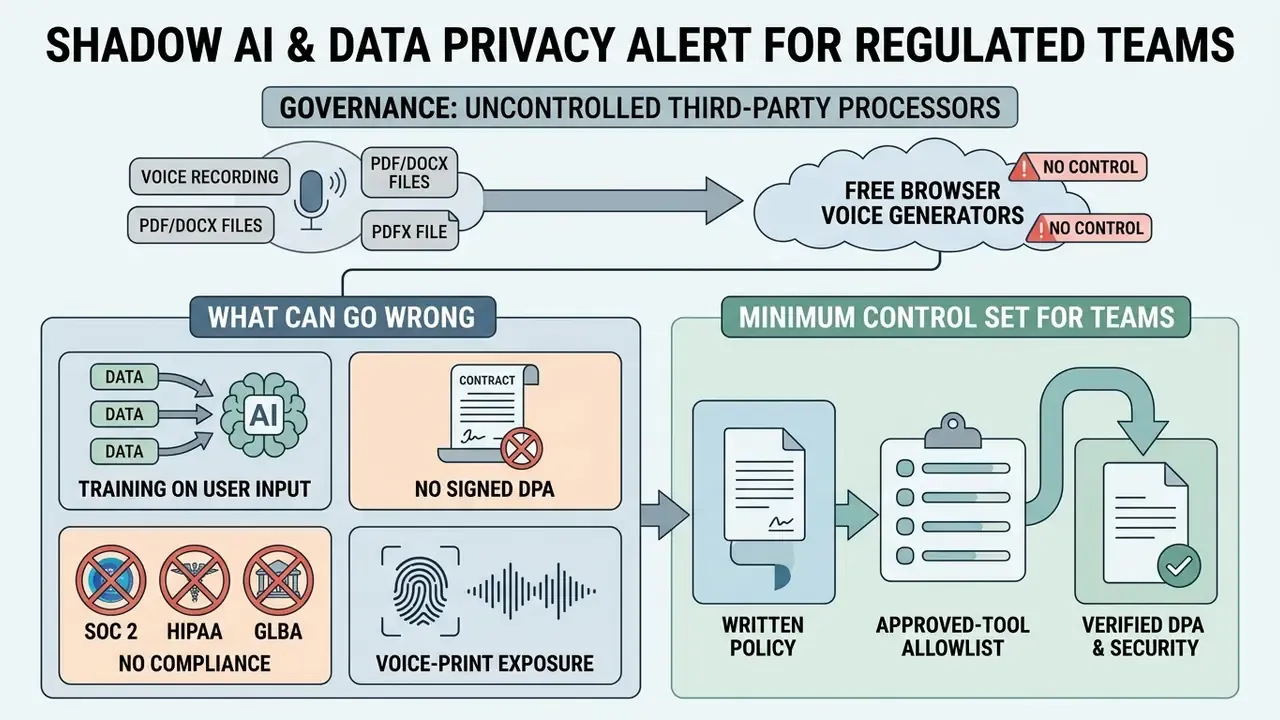
From a governance standpoint, free browser voice generators are uncontrolled third-party data processors. Pasting a script into one is a data transfer. In regulated industries it may be a reportable one.
What can go wrong:
- Training on user input. Unless the terms say otherwise in writing, submitted text may be retained and used to improve models. Scripts with customer names, account numbers, internal roadmaps, or unreleased financial disclosures do not belong there.
- No signed DPA. Free tiers rarely offer a Data Processing Agreement, so there is no contractual basis for processing personal data on your behalf under GDPR or CCPA-style regimes.
- No SOC 2, HIPAA, or GLBA alignment. Consumer-grade tools generally make no attestation about operational security controls. Assume none exist until an audit report appears.
- Unclear retention. Real-time synthesis on major cloud platforms often processes text in memory without storage at rest. Batch and long-audio pipelines write files to storage that persists until active deletion.
- Voice-print exposure. Uploading a colleague's or client's voice sample creates biometric-adjacent data with its own consent and deletion obligations.
«AI clones rely on vast personal data, including voice, and users often fail to grasp the long-term consequences of storage.»
Minimum control set before any team touches a free voice tool: an approved-tool allowlist, a written prohibition on entering PII, NPI, or PHI, mandatory de-identification of sample scripts, and an internal record of which assets were produced on which licence tier. Four controls. None of them expensive.
This information is general in nature and does not replace consultation with a data-protection specialist about the policies of a specific service.
Can You Use Downloaded AI Voiceovers in Commercial Projects?
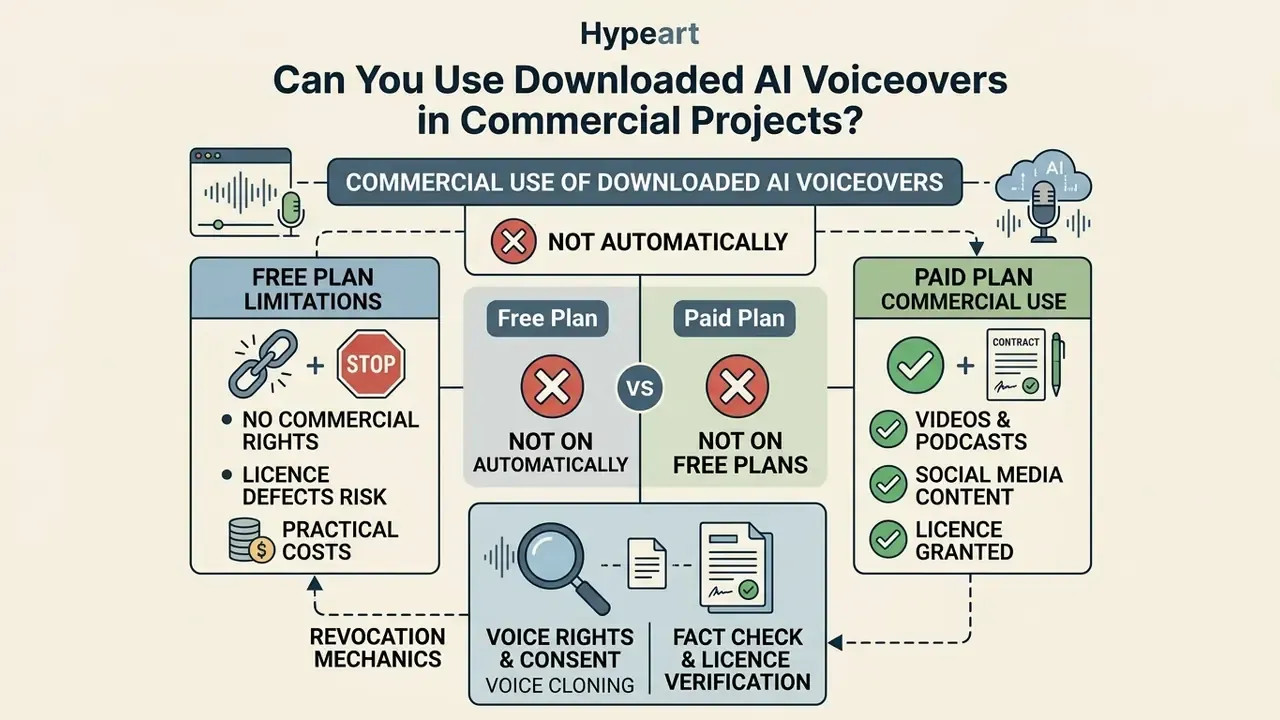
Not automatically, and not on free plans. Commercial rights depend on vendor contractual terms and explicit licensing. Under US federal rulings, commercial voice deployment also requires verifiable consent chains when an identifiable human voice is replicated (FCC TCPA AI Voice Ruling, 2024; US Copyright Office Report, 2024). The same licence-tier logic governs adjacent media categories, as the AI Media Commercial-Use Hub shows for image and design tools.
«Legal analysis in 2026 argues that AI voice cloning erodes the unique value of the human voice and opens gaps in publicity, privacy, and post-mortem rights.»
For IP risk assessment and copyright monitoring, media compliance teams track the AI Litigation and Case Timelines database to follow judicial developments on synthetic media and vocal identity.
This section is general information and does not substitute for advice from a qualified attorney on copyright, right of publicity, and AI content licensing.
Voice Cloning, Consent, and Voice Rights
Voice cloning creates a digital replica from a vocal sample. It requires explicit, informed, and revocable consent from the speaker to avoid civil liability under state right-of-publicity laws. That requirement shows up in both regulatory analysis and incident research.
«A 2024 harms taxonomy records a sharp rise since March 2023: actor Stephen Fry found his voice cloned without consent to narrate a documentary.»
The US Copyright Office has stated that the Copyright Act does not preempt state laws restricting unauthorized digital replicas of a person's voice, which means voice-clone disputes can proceed entirely outside copyright. FCC rules mandate prior express consent for synthetic human voices in automated telecommunications, treating AI-generated human voices as "artificial or prerecorded" under the TCPA. Disclosure adds a third layer: Utah's campaign-audio statute requires synthetic-audio ads to disclose AI generation, and industry frameworks require verbal or visual disclosure when a synthetic voice imitates a real person.
Fact check and licence verification:
Free-tier audio downloads from major AI voice platforms, including ElevenLabs and Fish Audio, do not grant commercial usage rights by default. Using free-tier exports in monetized advertising or client deliverables without a paid plan breaches platform terms of service and creates potential exposure around unauthorized exploitation of voice rights (ElevenLabs TOS, 2026; Fish Audio Terms, 2026).
«Consent to a recording does not automatically extend to synthetic utterances; professional actors found their voices in unauthorized political and commercial material.» — Can AI be Consentful?, arXiv (2026). https://arxiv.org/pdf/2507.01051.pdf
Enterprise Compliance Assessment Checklist for TTS Deployment
Run this before a synthetic voice tool touches production content in a regulated environment.
Checklist0 / 12
Data Security and Corporate Standards Compliance
In enterprise deployments, protecting intellectual property and personal data matters as much as voice quality. Use the table below as a procurement screen.
| Standard / Certification | Platform Requirement | Guarantee for the User |
|---|---|---|
| SOC 2 Type II | Independent audit of operational security controls over time. | Assurance that scripts are protected against cloud-side leakage. |
| GDPR / CCPA | Documented lawful basis, data-subject rights, sub-processor transparency. | Deletion of voice prints and scripts on request. |
| AES-256 at rest, TLS 1.2+ in transit | Encryption of stored and transmitted assets. | Protection of confidential audio against interception. |
| ISO/IEC 27001 | Certified information security management system. | Repeatable, audited security governance instead of ad-hoc controls. |
| HIPAA / GLBA alignment | Sector-specific safeguards and BAA availability. | Required before any healthcare or financial script is processed. |
| Third-party access control | Explicit authorization for any external access. | No silent data sharing with partners or advertisers. |
Free consumer tiers rarely satisfy more than the first two rows, and often none. That gap, not audio quality, is the decisive factor in most enterprise rejections.
Enterprise and Accessibility Deployment Scenarios
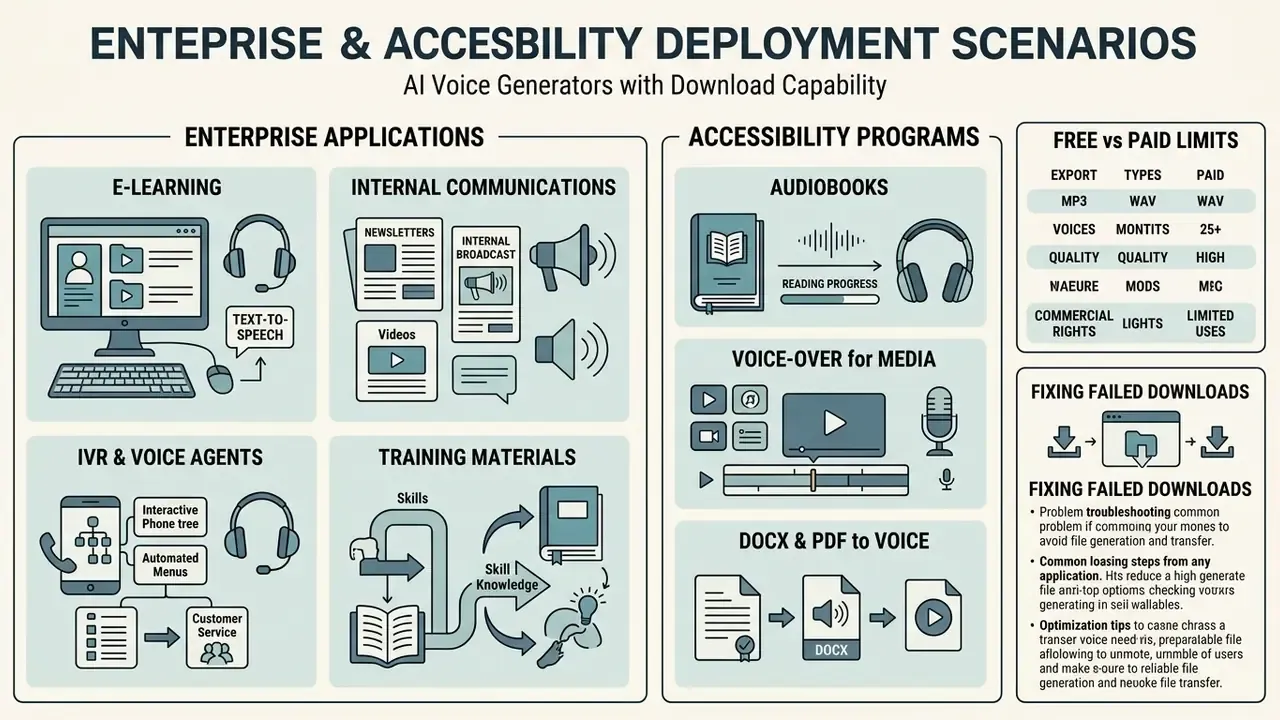
AI voice generators with download capability are deployed across corporate e-learning, internal training, audiobooks, accessibility programmes, IVR and voice agents, video production, and digital marketing. Local audio files import directly into a video editor, including lightweight desktop options such as the videopad video editor, or upload into an LMS as SCORM-packaged narration.
In an illustrative media workflow transformation, a digital publishing team evaluated synthetic narration to automate audiobook production for backlist titles. With downloadable neural voice tracks, the team published 150 accessible audio titles in six months while holding quality control and lowering total audio production costs by roughly 65% (hypothetical composite scenario, 2025 to 2026; figures illustrative). Enterprise media teams review licensing templates for broad distribution before committing to that scale.
E-learning, Podcasts, Audiobooks, and Accessibility
Educational institutions and publishers use AI voice generation to convert course materials into accessible audio and multi-language audiobooks. Library and vendor documentation describes voice-synthesizer narration with MP3 download as a shipped feature, while the effectiveness of multilingual synthesis rests on training-strategy research rather than policy documents alone.
«Multilingual pre-training with informed source-language selection outperforms monolingual training on intelligibility and naturalness for low-resource languages.»
Quality assurance matters most in long-form work, where degradation is systematic rather than random.
«RVCBench (225 speakers, 14,370 utterances, 18 scenarios) exposed systematic cloning weaknesses: degradation on long texts, post-processing, and adversarial perturbations.»
The practical mitigation for audiobooks and courses is chunked synthesis. Render chapter by chapter, spot-check the first and last 60 seconds of each segment for drift in pace and timbre, and re-render individual blocks instead of whole titles. Tedious? Yes. Cheaper than a full reissue.
Accessibility framing. US federal accessibility practice, reflected in Section 508 guidance on accessible PDFs and in NIST accessibility resources, establishes text-to-speech and properly tagged documents as the core accessibility layer for blind and low-vision users, rather than mandating a specific export button. Library guidance notes that free audiobooks may be read by voice synthesizers, and academic database documentation shows text-to-speech with MP3 download as a shipped read-aloud feature. In short: the legal obligation is that content be perceivable and readable by assistive technology. Downloadable TTS audio is one standard mechanism for meeting it. W3C guidance further recommends saving the spoken version as an audio file, linking to it, and naming the format (.MP3, .WAV, .AU) so users know what they are downloading.
IVR, Voice Agents, and Internal Communications
Low-latency formats such as Ogg Opus and 16-bit PCM exist specifically for interactive voice response menus and conversational agents, where a 300 ms difference in synthesis latency is audible. Two governance notes bite harder here than anywhere else. The FCC's TCPA position brings AI-generated human voices in outbound calls under prior-express-consent requirements. Disclosure guidance holds that listeners should be told they are hearing a synthetic voice. Design that disclosure into the call script, not into a footnote nobody hears.
Integrating Voice into Video: Dubbing and Lip-Sync
Modern platforms pass the generated audio straight into video editors and neural dubbing modules, so the deliverable is a finished video rather than a bare audio file.
- Multilingual AI dubbing translate the source track into 100+ languages and dialects while preserving timbre, timing, and cadence. One documented enterprise workflow shipped a 65-minute presentation in eight languages in four days and cut translation costs by roughly 80%.
- Lip-sync with AI avatars bind the downloaded MP3 or WAV to a digital presenter that matches articulation and facial movement to the synthesized speech. Pipelines that start from a still image, such as vidnoz image to video, plug into the same step.
- Voice cloning as a signature narrator train once from about a minute of clean speech, then hold identical delivery across hundreds of lessons or episodes.
- Batch media export download the audio track, auto-generated .SRT subtitles, and rendered 1080p or 4K video from one workspace, instead of exporting and re-importing across three tools.
- Auto-captions for accessibility generating subtitles from the same script guarantees caption-audio alignment, which manual transcription rarely achieves on the first pass.
Compliance note: dubbing that puts words into the mouth of an identifiable person, living or deceased, is precisely the scenario disclosure frameworks target. Authorized branded voice replication and generic synthetic narration sit in a different, lower-risk category.
Consumer Use Cases: YouTube, Social Media, and Marketing Videos
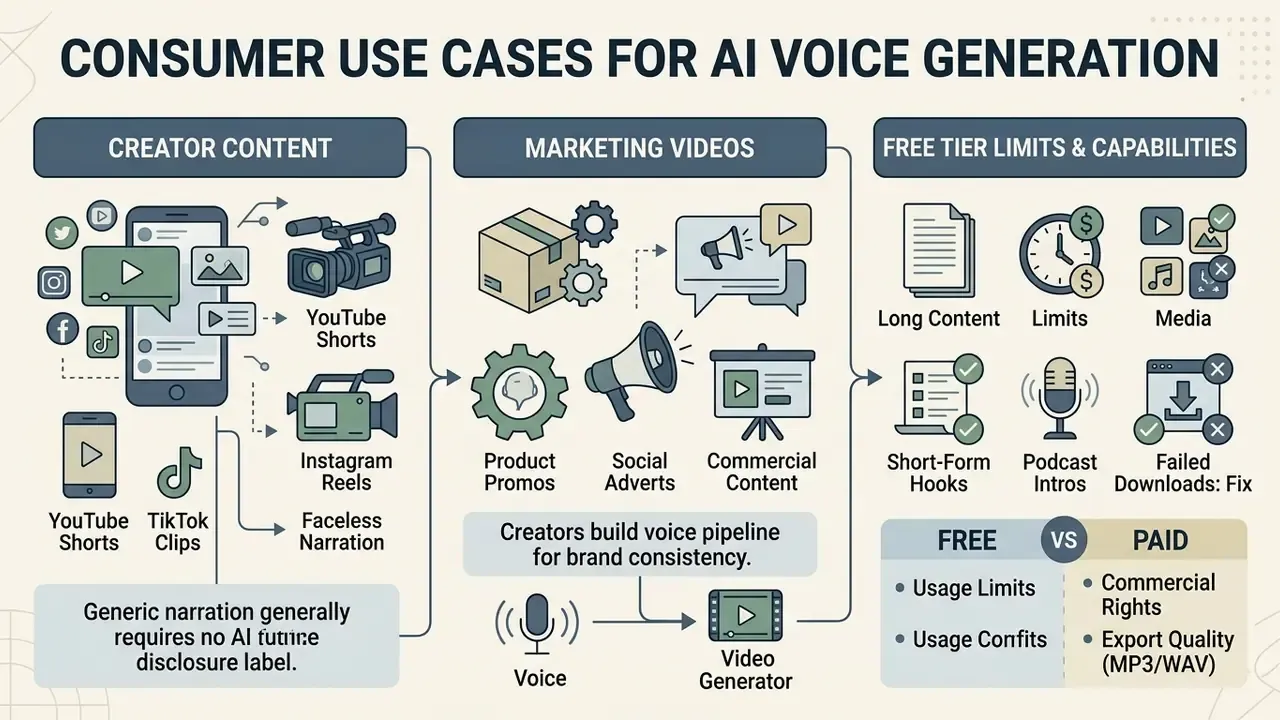
Creators use downloaded AI voice tracks for YouTube shorts, TikTok clips, Instagram Reels, and product promos. Adoption is no longer marginal.
«By 2024, more than half of the surveyed films used AI-generated voiceovers, for dubbing, temporary narrative tracks, and localization.»
Generic narration in promotional content generally does not require a visual AI disclosure label, while deceptive voice imitations of public figures trigger mandatory disclosure under advertising industry standards (IAB Canada AI Transparency Framework, 2026). Where disclosure is required in audio-only formats, it should be spoken before or after the AI segment, or signalled with a distinct audio cue. In video, on-screen text or a standardized visual label is acceptable.
Creators building a full pipeline can weigh options among the best AI video generators, align downloaded MP3 tracks with visual clip transitions, and publish through a structured YouTube editing workflow to keep levels, captions, and thumbnails consistent. On mobile, the vn video editor app interface is a common place where those voice tracks land first.
Scenarios that free tiers cover comfortably: faceless narration channels, short-form hooks, podcast intros and mid-roll reads, character voices for animation tests, and voice-over drafts used to time an edit before a human performer records the final track. Every one of those becomes a paid-tier scenario the moment the content earns money.
Limitations and Open Questions
A Reasonable Next Step
Nothing here argues against free tools. It argues against unlabelled ones. A workable first move takes about a week: inventory which voice generators your teams already use, classify each by data sensitivity and licence tier, then publish one sanctioned option with a documented DPA. Pilot on internal, non-sensitive narration. Keep provenance metadata from the first file, not from the first audit request.
If a synthetic voice is going to speak for your institution, someone should own that voice. Preferably by name.
FAQ on Free AI Voice Generator Downloads
Do I Need Software or Hardware to Generate and Download?
No specialized hardware or desktop install is required for cloud-based generators, since synthesis runs on remote servers reachable from a standard browser. After download, most people pair the file with free video editing software or a free audio editor rather than installing a dedicated TTS application. That said, modern client-side WebGPU runtimes can execute local speech generation on device CPUs and GPUs when using privacy-focused open-source frameworks (Google LiteRT.js Documentation, 2026). WebGPU still draws on the local GPU, so on low-power devices cloud synthesis stays faster. Conversely, local execution is the only option with no network available, which is what makes a text to voice ai generator free download attractive for offline work.
Are Scripts and Generated Audio Retained After Creation?
Retention depends on account settings and vendor data governance. The pattern to check is real-time versus batch. Real-time text-to-speech on major cloud platforms typically processes input in server memory without keeping text or audio at rest. Long-audio and batch pipelines write generated files to cloud storage until active deletion. Enterprise suites document explicit windows, for example 30 days for active deletion and up to 180 days for passive deletion of customer content, and some APIs keep optional debugging logs in-region for 30 days. Federal records schedules can independently require destruction once business use ends, or a defined period after account termination. This information is general in nature and does not replace consultation with a data-protection specialist about the policies of a specific service.
Is There an API for Text to Speech and Voice Generation?
Yes. Major cloud providers and voice AI platforms offer REST, gRPC, and streaming interfaces for automated integration. Google Cloud documents synthesize, synthesizeLongAudio, voice listing, and bidirectional StreamingSynthesize with SSML input. Azure AI Speech, OpenAI's audio speech endpoint, and the Gemini API offer comparable single- and multi-speaker generation. The W3C Web Speech API covers in-browser synthesis as a community-group specification rather than a ratified standard. Developers can review api documentation and platform tooling across the AI Media Comparison Matrices to compare endpoint latency, supported prosody parameters, and character pricing. For monthly cost modelling, use the character-based calculators; for integration questions, enterprise teams rely on dedicated support channels.
Is There a Character or Word Limit per Generation?
Free plans impose both a per-clip character cap and a monthly quota. Paid plans raise both ceilings, and enterprise tiers are built for audiobook and course workloads with no practical project-length limit. When a long script fails silently, the per-clip cap is usually the culprit, not the monthly quota.
Can I Preview Voices Before Generating the Final Audio?
Yes. Most platforms expose a short sample per voice, a full preview of your own script, or a dedicated preview endpoint that renders a brief MP3 or WAV before a billed full-length job. Auditioning your actual script instead of the vendor demo line is the single highest-value quality step, because demo lines are chosen to flatter the model.
How Does Voice Cloning Work?
Cloning trains a model on a short clean sample, often about one minute, then generates new lines in that voice from any script. It requires explicit, informed, written, and revocable consent from the speaker, with defined scope and deletion terms. Never clone a voice you do not own or have documented permission to use.
Does Free-Tier Output Require Attribution?
On some platforms, yes. ElevenLabs requires free-plan users who publish content to attribute the service by including "elevenlabs.io" or "11.ai" in the title. That is a publishing condition, and it does not by itself grant commercial permission. Other vendors define commercial rights in their current public terms without an equivalent free-tier attribution rule, so verify per platform before you ship.
Appendix A: Superseded Source Attributions
For transparency, the following earlier attributions were replaced in the main text by peer-reviewed or primary-research citations with published methodology and accessible URLs. They are preserved here for version traceability.
- Export formats paragraph
- previously cited as (OpenAI API Documentation, 2026), replaced with X-Voice, arXiv (2026).
- Neural versus classical TTS naturalness
- previously cited as (TTSDS Benchmark, 2024) without figures or URL, replaced with the full TTSDS arXiv reference plus DS-TTS MOS data.
- Script preparation guidance
- previously cited as (NIST AI Guidance, 2024), replaced with X-Voice phonetic-representation findings, with the underlying clarity principles retained in the bullet list.
- Voice cloning consent requirements
- previously cited as (NIST AI Risk Management Framework, 2026) and (FCC TCPA Ruling, 2024) without URLs. Regulatory substance retained in prose and supplemented with the Sony AI harms taxonomy and Can AI be Consentful? research.
- Data retention
- previously cited as (Microsoft Azure Speech Privacy Docs, 2026). Vendor behaviour described in prose and supplemented with independent Digital Doppelgangers research.
- Accessibility mandate
- previously phrased as (Section508.gov, 2026) mandating text-to-speech export and (Library of Congress Audiobook Guidance, 2026). Reframed to reflect that the obligation is perceivability and assistive-technology readability, with TTS download as one standard mechanism.