Author note: Marcus Hale writes about AI governance and model risk for this publication.
Executive Summary: The Operational Answer First
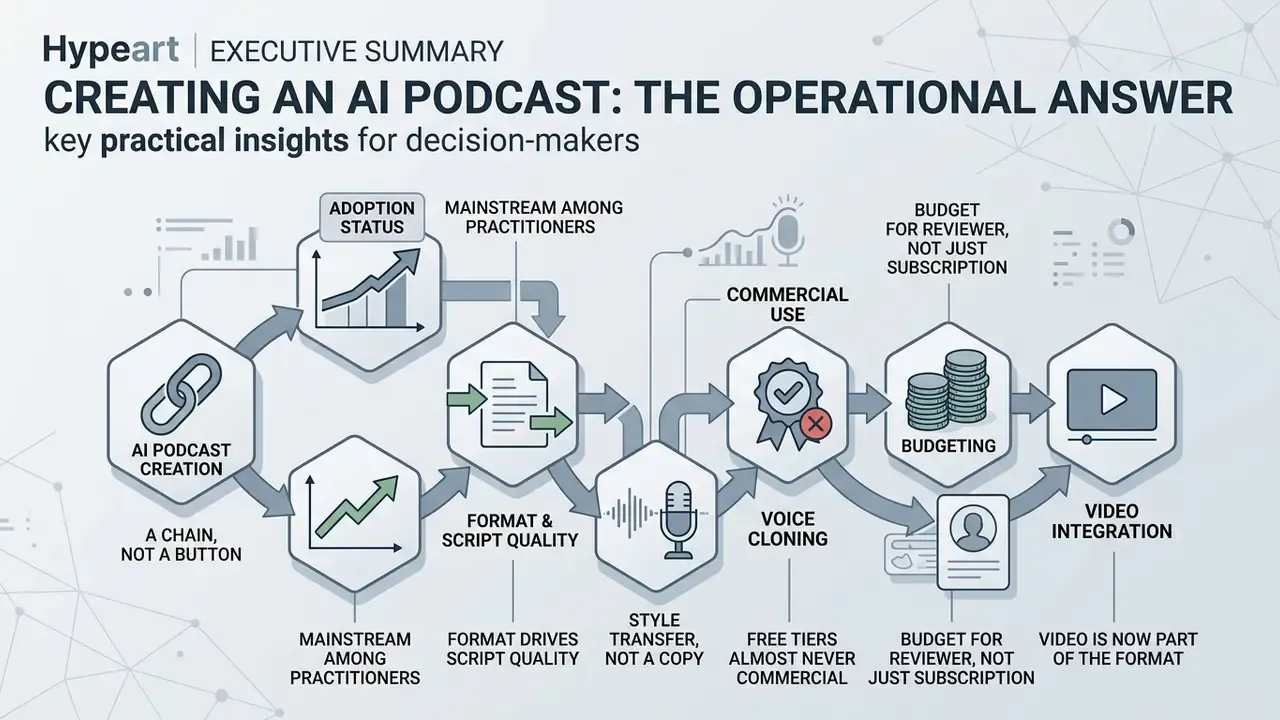
For decision-makers who want the practical answer before the technical detail:
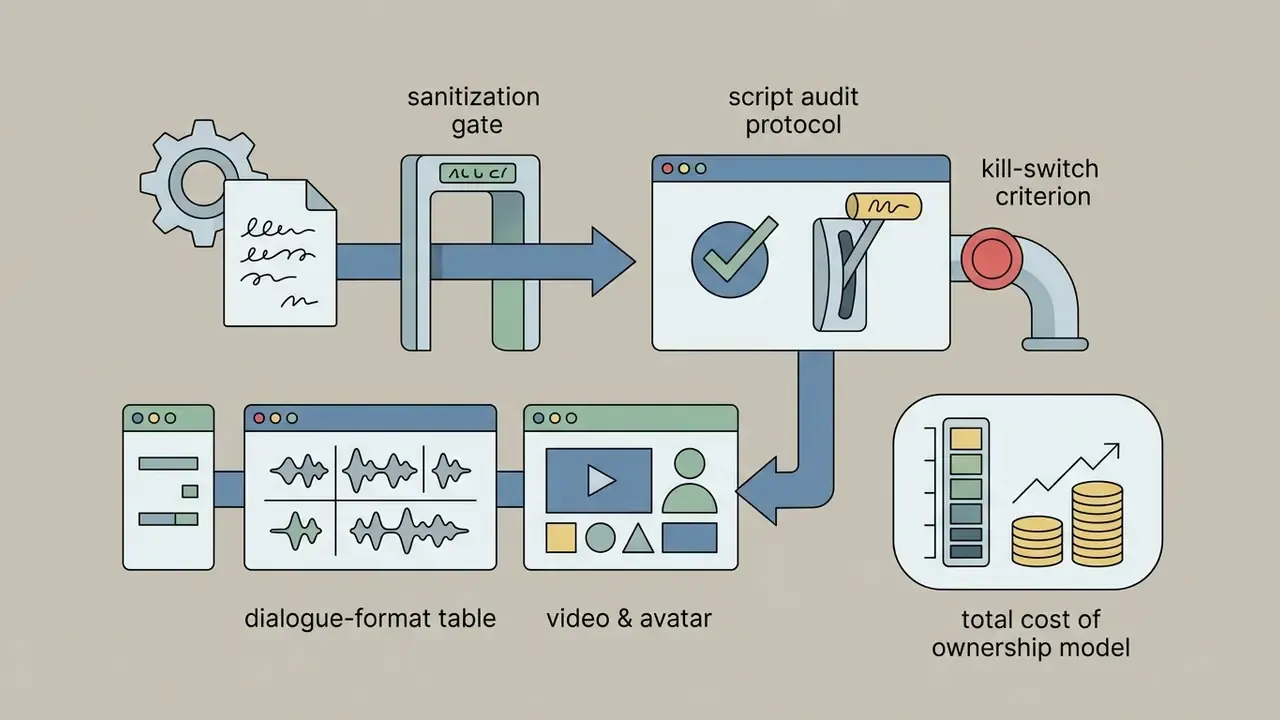
- AI podcast creation is a chain, not a button. Six controllable stages: source ingestion, PII sanitization, LLM script generation, human script audit, voice assignment and synthesis, then export with transcript and disclosure.
- Adoption is already mainstream among practitioners. In a survey of 384 active podcast producers, 50.4% already use AI tools, 63.4% apply them in post-production, and 69.1% name ChatGPT as their primary text tool (Podigee producer survey, 2026).
- Format choice drives script quality. Pick deliberately between Conversation (50/50 turn balance), Interview (roughly 70% host questions, 45 to 60 second expert answers), and Debate (opposed positions with explicit objection cues).
- Voice cloning is a style transfer, not a copy. Cloned voices are rated more authoritative and warmer than the human original, and listeners misidentify AI voices as human in roughly 80% of identification tasks. That is exactly why documented consent and RSS-level disclosure are non-negotiable.
- Free tiers are almost never commercial. Commercial rights must be live at the moment of generation. Retroactive licensing of free-tier audio is generally prohibited by vendor terms.
- Budget for the reviewer, not just the subscription. Total cost of ownership for a governed programme is dominated by human-in-the-loop audit hours, not API credits.
- Video is now part of the format. AI avatar tools (HeyGen) and multitrack video recording (Adobe Podcast, 2026) turn one audio master into a YouTube and Spotify Video ready asset.
Who This Guide Is For and How to Use It
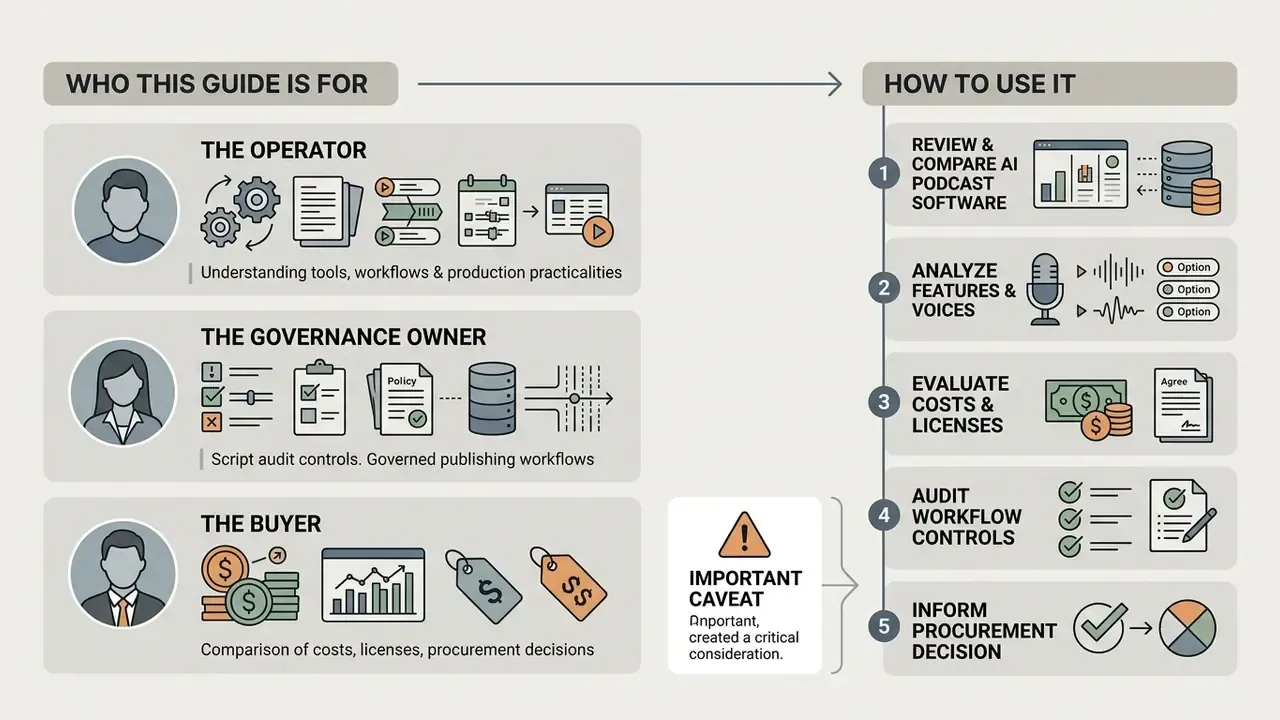
Three reader profiles keep landing on this page, and they need different things from it.
The operator. You want to create a podcast with AI this week: source file in, MP3 and transcript out. Start with the step-by-step workflow, then the quality control routine. Roughly 90 minutes of reading and doing gets you a publishable pilot episode.
The governance owner. You are asked to approve someone else's pilot. Read the sanitization gate, the LLM script audit protocol, and the commercial rights matrix. Those three blocks are the ones internal audit will actually ask about.
The buyer. You need to compare ai podcast creation software before a procurement decision. The tool table, the generation limits table, and the total cost of ownership model carry the numbers you will be challenged on.
One honest caveat before we go further. Vendor terms, free-tier caps, and disclosure rules on Apple Podcasts and Spotify changed more than once during 2025 and again in early 2026. Verify anything commercially material on the vendor's own page on the day you sign.
What Is an AI Podcast and What Can It Create?
In two sentences: An AI podcast is an audio programme generated by software that converts source material into a structured, multi-speaker script and renders it with synthetic voices. It differs from a recorded show because ingestion, scripting, speaker attribution, and synthesis are separate automated stages, each of which can be audited on its own.
An AI podcast is an audio programme where software processes source inputs such as text, documents, or web pages, auto-generates structured script dialogue, and converts it into natural spoken-word tracks using synthetic voices. Unlike traditional voice recording, ai podcast creation automates content extraction, script generation, speaker attribution, and voice synthesis into one unified audio asset.
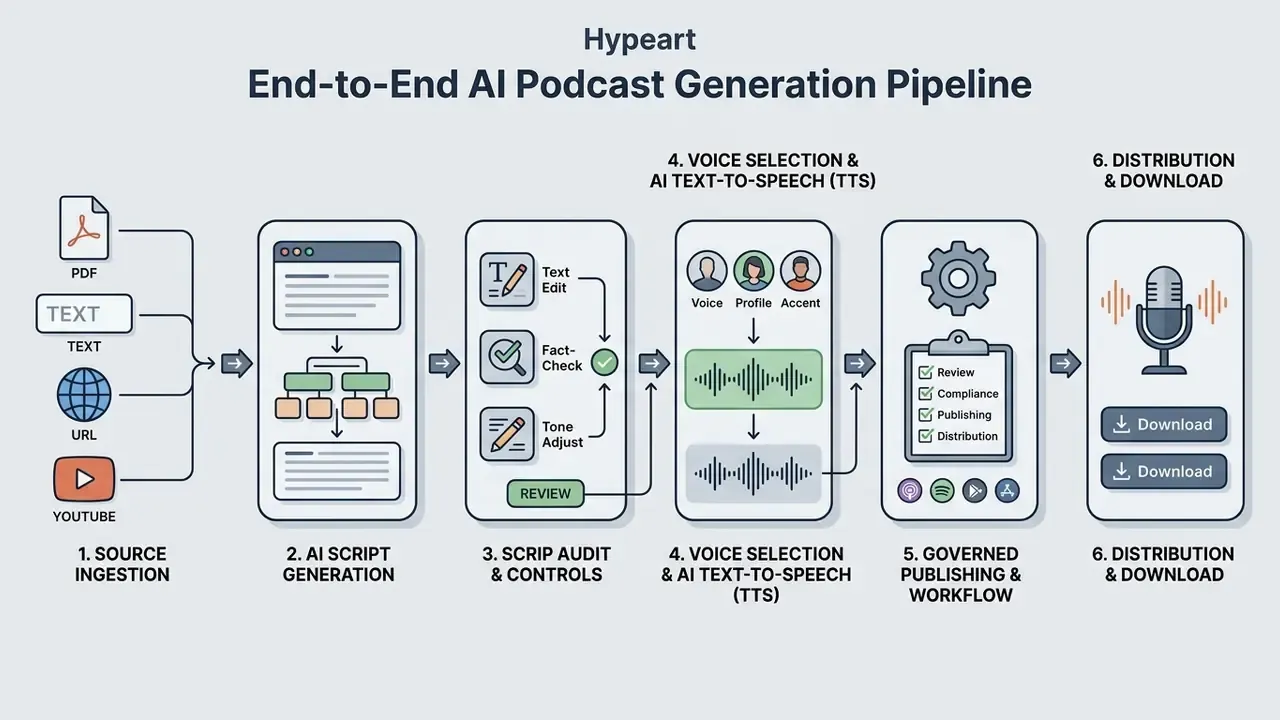
From Text, URL, and Sources to Podcast Audio
Converting source material into audio relies on an ingestion engine that parses written text, PDF documents, or web page URLs into clean textual data suitable for script formatting. Modern platforms extract the core arguments, discard non-essential elements such as footnotes or visual tables, and pass the remaining text to a large language model (LLM) that restructures the data into a conversational podcast script.
«AI podcasts implement an end-to-end pipeline: from text extraction to multi-voice audio synthesis, rather than simply voicing static sentences.»
For instance, tools like Adobe Acrobat Web let users ingest PDFs directly into an audio workflow, while specialised research tools parse published academic papers or URLs into structured two-host interviews.
Video-host parsing (YouTube to podcast). Contemporary generators such as NoteGPT and Google NotebookLM extract the text layer, captions or transcripts, directly from a YouTube video URL. They strip timecodes, sponsor reads, and filler intros, then re-author the remaining substance into a structured audio discussion. In practice, the supported input matrix now covers raw text (up to roughly 100,000 characters on most consumer tools), PDF, DOCX, PPT, EPUB, scanned images processed via OCR, article URLs, and YouTube links. Enterprise-grade blueprints, including the NVIDIA and AMD PDF-to-podcast reference architectures, enforce a single target document plus optional context documents. Terminology from the supporting files informs the script without polluting the narrative. A small distinction, but it is the difference between a tight episode and a mush of five sources.
AI Podcast Generator vs. Text-to-Speech
An AI podcast generator differs fundamentally from a basic text-to-speech (TTS) engine because it adds an automated editorial and dialogue-structuring layer. Basic TTS utilities convert static sentences sequentially into spoken audio without altering narrative structure or managing turn-taking between speakers. A podcast generator, by contrast, uses an LLM layer to extract key insights from raw data, draft multi-speaker transcripts with distinct host personalities, assign separate synthetic voice models to speaker tags such as [Host 1] or [Guest], and balance conversational pacing before rendering the final track.
| Capability | Basic TTS engine | AI podcast generator |
|---|---|---|
| Input | Finished script | Topic, PDF, URL, YouTube link, notes |
| Narrative restructuring | None | LLM summarization and dialogue authoring |
| Speaker management | Single voice per request | Role tags mapped to distinct voice IDs (up to 5 speakers) |
| Conversational dynamics | Pitch, rate, volume only | Questions, interjections, transitions, pacing |
| Output bundle | Audio file | Audio plus transcript, chapters, show notes |
Why Create a Podcast with AI?
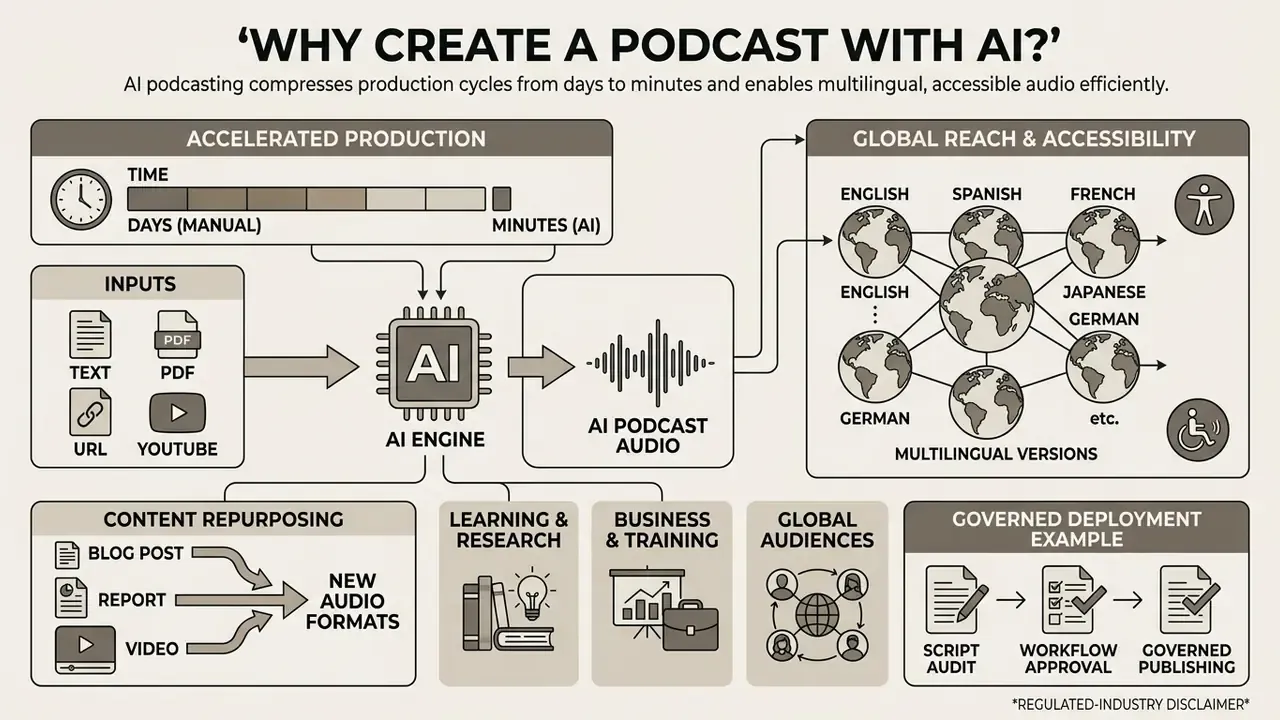
In two sentences: AI podcasting compresses the production cycle from days to minutes and makes multilingual, accessible audio economically viable. The measurable benefit appears only when a human review layer sits between script generation and synthesis.
Choosing to create ai podcast episodes at scale lets institutions convert dense written material into accessible, multi-lingual audio while cutting production overhead. Organizations use these workflows for internal employee training, executive briefing distribution, academic research dissemination, and localized global communications.
How podcasters actually use AI, field data from a survey of 384 active producers:
- 50.4% already use AI tools in production.
- 71.5% of AI adopters touch these tools at least weekly.
- 63.4% apply AI primarily in post-production: noise removal, leveling, filler-word and silence editing.
- 46.7% use AI for scriptwriting and research, 43.7% for marketing, 40.7% for topic development.
- 69.1% name ChatGPT as their main text-preparation tool.
- Around 80% report being satisfied or very satisfied with AI-assisted results, while more than 51% still call themselves beginners. The entry barrier is lower than most teams assume.
Content Repurposing, Learning, and Research
AI podcast generation lets teams transform technical whitepapers, textbook chapters, and corporate reports into spoken media people actually finish.
«180 college students rated AI podcasts as more engaging than textbooks; personalized versions produced statistically significant learning gains across several subjects.»
That study used a 3×3 experimental design comparing textbook reading, generic AI podcasts, and personalized AI podcasts. For learning and development teams evaluating audio repurposing, it is currently the most directly applicable evidence base we have found.
News and briefing formats show a parallel effect on listener affect:
«In an experiment with 65 participants, constructively framed AI podcasts significantly reduced negative emotions and, in several contexts, increased listener self-efficacy.»
Critically, the framing intervention preserved factual integrity. Tone control is available without compromising accuracy, provided the underlying facts have been verified first. Organizations using an ai text generator can re-engineer existing blog posts, governance documents, and analyst reports into multi-speaker episodes without booking studio hours.
Interactivity, though, is not automatically an improvement:
«With 36 students, reflective prompts inside AI podcasts did not improve learning outcomes and reduced the perceived appeal of the podcast.»
Small sample, single context. Still, it is a useful brake on the instinct to bolt interactive features onto every episode.
Business, Training, and Global Audiences
For corporate communication and compliance training, AI podcasts deliver uniform instructional material to distributed teams across regions. Modern speech synthesis tools produce localized audio tracks in anywhere from 24 to 76 languages from an identical source script, which removes the operational complexity of hiring voice talent per locale. Vendor-documented ranges vary widely: AnySpeech publishes 24+ languages, ElevenLabs 30+, and Google NotebookLM expanded Audio Overviews to 76 additional languages in 2025. Verify the count per tool and per voice family rather than assuming parity. Teams comparing providers can weigh multilingual speech synthesis options against their required locale list before committing budget.
Research on omnilingual synthesis suggests the technical ceiling sits well above current commercial menus:
«OmniVoice, trained on 581,000 hours of speech, delivers zero-shot synthesis in more than 600 languages with better intelligibility and speaker similarity than competing systems.»
Best AI Podcast Creation Tools by Task
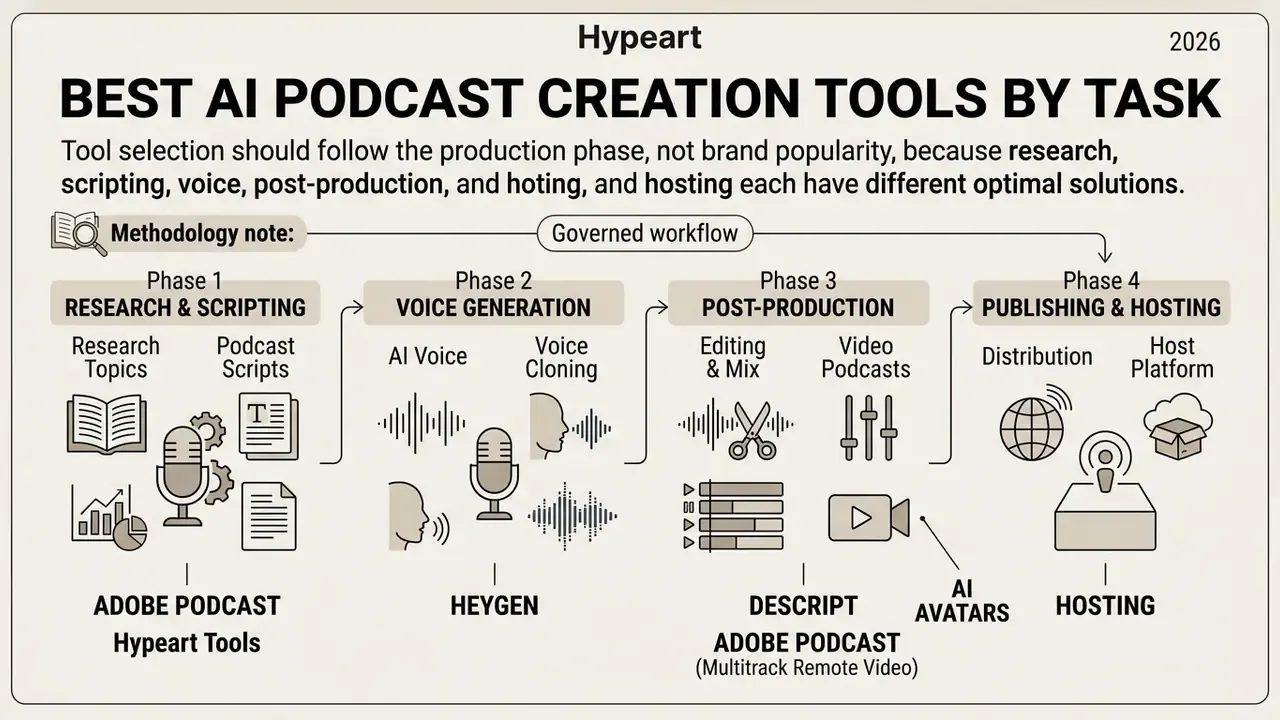
In two sentences: Tool selection should follow the production phase, not brand popularity, because research, scripting, voice, post-production, and hosting each have different leaders. For enterprise buyers, data-retention posture and API availability matter more than raw voice count.
Selecting ai podcast creation software means aligning platform capabilities with a specific production phase: research, scripting, voice generation, post-production, or hosting.
| Tool Name | Primary Category | Script Editing Support | Multi-Speaker Voices | Free Access Tier | Export Formats | Enterprise Signals (Privacy / API) | Approx. Cost per 10-min Episode | Primary Use Case |
|---|---|---|---|---|---|---|---|---|
| Google NotebookLM | Document research and Audio Overviews | Source-grounded prompt control | Yes (2-host default) | Yes (free tier) | Audio stream / MP3 export | Workspace admin controls; public sharing disabled for Enterprise and Education | Included in plan | Converting uploaded documents into conversational podcasts |
| Wondercraft | Scripting and end-to-end production | Full interactive script editor | Yes (custom speaker mapping) | Free trial available | MP3, WAV, transcript | Team workspaces; API on higher tiers | Subscription-metered minutes | Production-grade podcast creation from URLs, notes, or PDFs |
| ElevenLabs Studio | AI voice generation and cloning | Full text block editing | Yes (multi-host assignment) | Free tier (10k credits/mo) | MP3, WAV | Documented API and SDK; enterprise tiers offer zero-retention options | ~8,000 to 12,000 characters | High-fidelity synthesis and custom voice cloning |
| Descript | Audio editing and post-production | Text-based audio editing | Yes (Overdub / AI Speakers) | Free tier (60 mins/mo) | MP3, WAV, video, transcript | Business tier adds admin and SSO controls; cloning requires verified consent | ~10 min of plan minutes | Text-based editing, filler-word removal, voice cloning |
| AnySpeech | Multi-host podcast generation | Auto-Podcast and Custom Script modes | Yes (single or multi, 24+ languages) | Free to start | MP3 plus transcript | Commercial use stated on all plans | ~10,000 credits | Fast topic-to-dialogue episodes in three show formats |
| HeyGen | AI avatar video | Script-driven | Avatar per speaker | Free tier | MP4, MP3 | API available; consent verification for avatars | Credit-metered per minute | Video podcast versions for YouTube |
| Podigee | Hosting and distribution | Metadata and transcript support | System dependent | Paid plans (trial available) | MP3, RSS feed | EU hosting, GDPR-oriented posture | Flat monthly hosting | Enterprise hosting, dynamic ad insertion, analytics |
Tools for Research, Topics, and Podcast Scripts
Research-oriented platforms ingest dense academic papers, corporate archives, or web feeds to draft contextually grounded scripts. Google NotebookLM offers Audio Overviews, which generate dynamic two-host conversational summaries grounded strictly in user-provided documents. Google labels the feature experimental, notes that hosts can introduce inaccuracies, and warns that large notebooks may take several minutes to process. Wondercraft accepts raw URLs or uploaded drafts and returns a fully editable podcast script. Open-source blueprints such as Meta's NotebookLlama and Mozilla's document-to-podcast Blueprint give full transparency over ingestion, script generation, and synthesis. Perplexity is the better pick when cited sources must accompany every claim. Teams testing script generation without a subscription can start with an ai text generator free unlimited for preliminary drafting.
Tools for AI Voice Generation and Voice Cloning
Dedicated speech synthesis engines prioritise acoustic naturalness, prosody control, and multi-speaker cloning. ElevenLabs provides high-precision instant and professional voice cloning plus a large library of synthetic voice models tuned for long-form narration.
«SpeechArenaBench collected over 120,000 pairwise comparisons from 1,900+ native speakers across six axes: intelligibility, expressiveness, voice quality, liveliness, noise, and hallucinations.»
Treat that six-axis framework as a procurement checklist. Score candidate voices separately for intelligibility and for hallucination behaviour instead of trusting a single impression of "naturalness". Soniox and Descript map custom speaker profiles directly into text-based editing environments, while Typecast and MiniMax expose cloning through REST endpoints that return a reusable voice_id. For a deeper analysis of synthetic voice features, licensing, and provider options, see our Guide to AI Voice Generators.
Tools for Editing, Publishing, and Hosting
Post-production and hosting platforms automate raw audio cleanup, transcript synchronization, and distribution to global streaming networks. Teams handling mixed media can also review adjacent workflows for video editing and post-production. Descript and Riverside let creators edit audio by modifying text transcripts, removing silence gaps and filler words automatically. Adobe Podcast, out of beta in 2026, adds AI Source Separation to isolate vocals, music, and ambience into discrete stems. Alitu automates mastering and jingle insertion. Whisper, open source, covers transcription and subtitle generation at zero licence cost. On distribution, platforms such as Podbean, Captivate, Zencastr, Acast, and Podigee handle RSS feed generation, dynamic advertising insertion, and automated WebVTT transcript delivery to Apple Podcasts and Spotify. To compare feature matrices and technical trade-offs across workflow tools, use our AI Media Comparison Matrices.
Tools for Video Podcasts and AI Avatars
Publishing to YouTube and Spotify Video means pairing the audio master with a synchronized visual layer:
- HeyGen generates hyper-realistic AI avatars whose lip movements sync to an exported ElevenLabs or Descript track, producing an MP4 ready for YouTube.
- Adobe Podcast (2026 Multitrack Remote Video) supports multitrack video recording and separation of video stems, which simplifies mixing synthesized voices with live camera footage of human co-hosts.
- Descript renders a text-edited timeline into video with captions burned in, useful for short vertical clips cut from the full episode.
- Podigee manages audio and video assets from one dashboard so hybrid shows keep a single RSS identity.
Disclosure caution: platform guidelines increasingly require labelling AI-generated audio and video, including synthetic hosts and avatars, in both the episode content and its metadata.
How to Create a Podcast with AI Step by Step
In two sentences: A production-ready AI podcast follows six auditable stages, with sanitization inserted before any data reaches a third-party model. Skipping the script audit is the single most common cause of published factual errors.
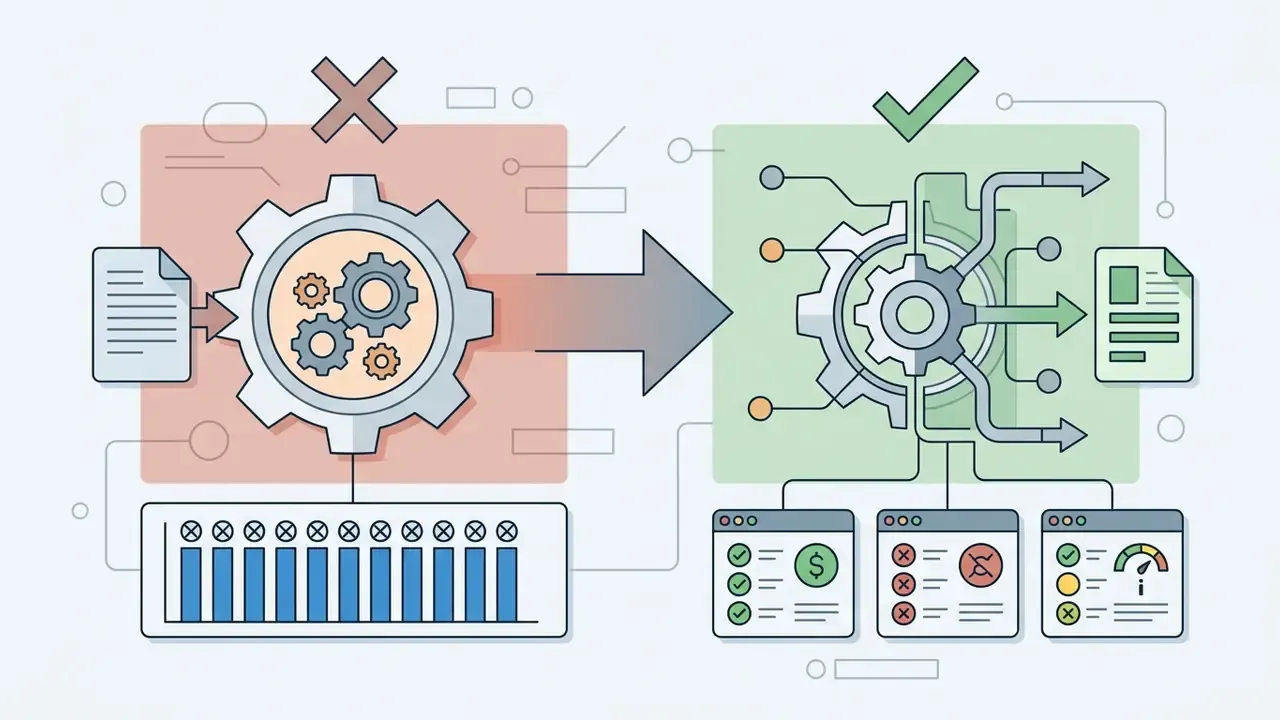
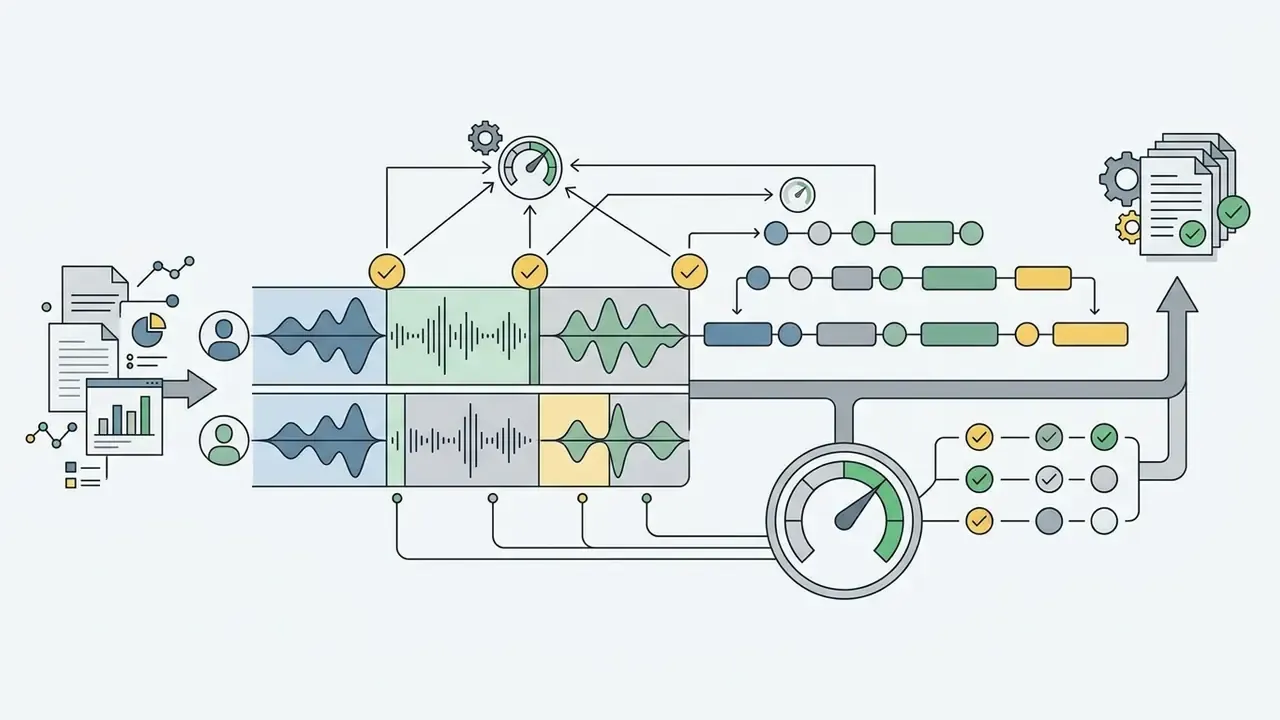
Learning how to create a podcast with AI in a governed environment means running five operational stages, source intake, script editing, voice allocation, audio generation, master publishing, with a mandatory data-sanitization step bolted on at the front.
Checklist above is deliberately readable as plain text, not only as an image, so it can be pasted into a runbook.
- Define source intake.Upload the primary target document (PDF, TXT) or enter a target URL or YouTube link.
- Sanitize inputs.Redact PII, client names, and confidential identifiers before upload.
- Generate and verify the script.Produce the multi-speaker draft, then verify factual accuracy against the source.
- Configure voice and style.Assign distinct synthetic voices to Host and Guest profiles.
- Synthesize audio.Render the asset using high-fidelity TTS engines.
- Run the quality and transcript audit.Download the MP3 access copy plus WebVTT or TXT transcripts for compliance, and add AI disclosure metadata.
Choose a Topic, Text, URL, or Other Source Content
The workflow begins with the primary source files: a single target PDF, a web article URL, or a raw text document, plus optional background context files. Systems built on enterprise blueprints such as the NVIDIA or AMD PDF-to-podcast reference architectures isolate the target text, perform optical character recognition (OCR) on scanned documents, and strip non-speakable elements like footnotes, data matrices, and graphic placeholders. Three practical intake rules: one target file defines the narrative, context files supply terminology only, and scanned PDFs must be OCR-verified before ingestion. OCR errors propagate silently into spoken audio, and nobody catches "2.5 basis points" versus "25 basis points" by ear on the first listen.
Sanitize Inputs: PII Redaction and Shadow AI Controls
Before a single page reaches a third-party model, run an ingestion gate. This is the step most consumer guides skip, and the first one internal audit will ask about.
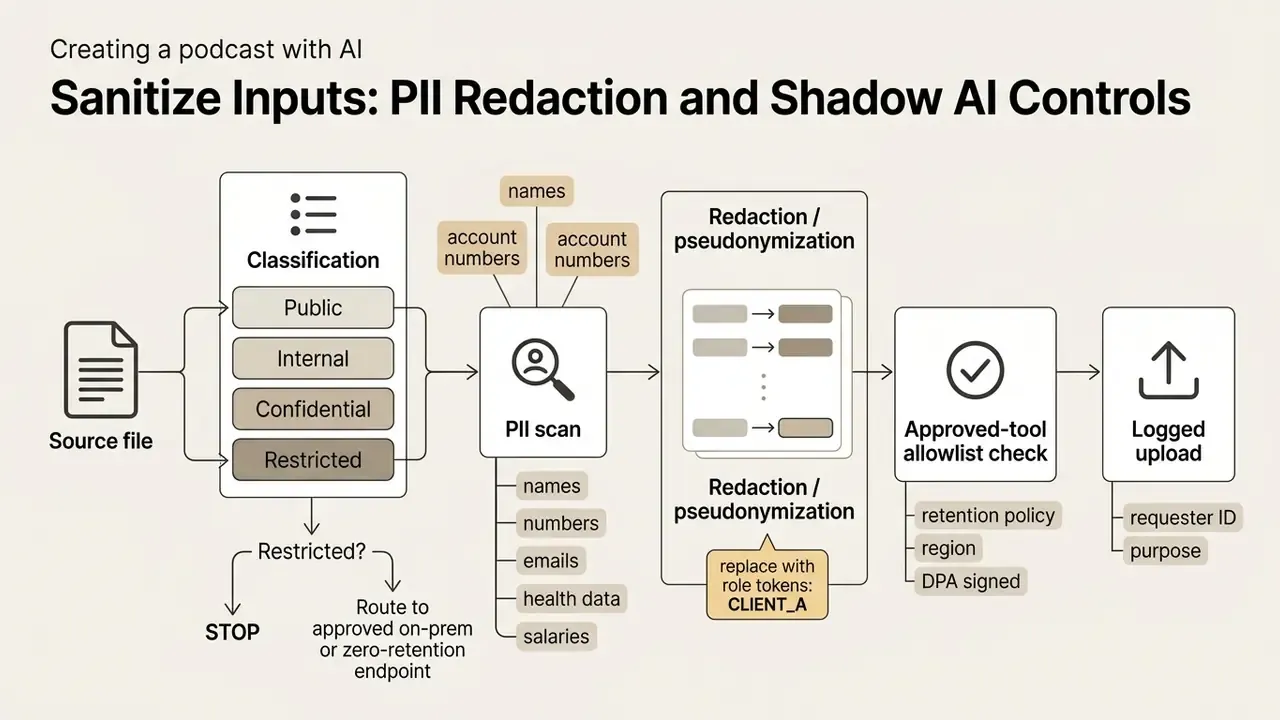
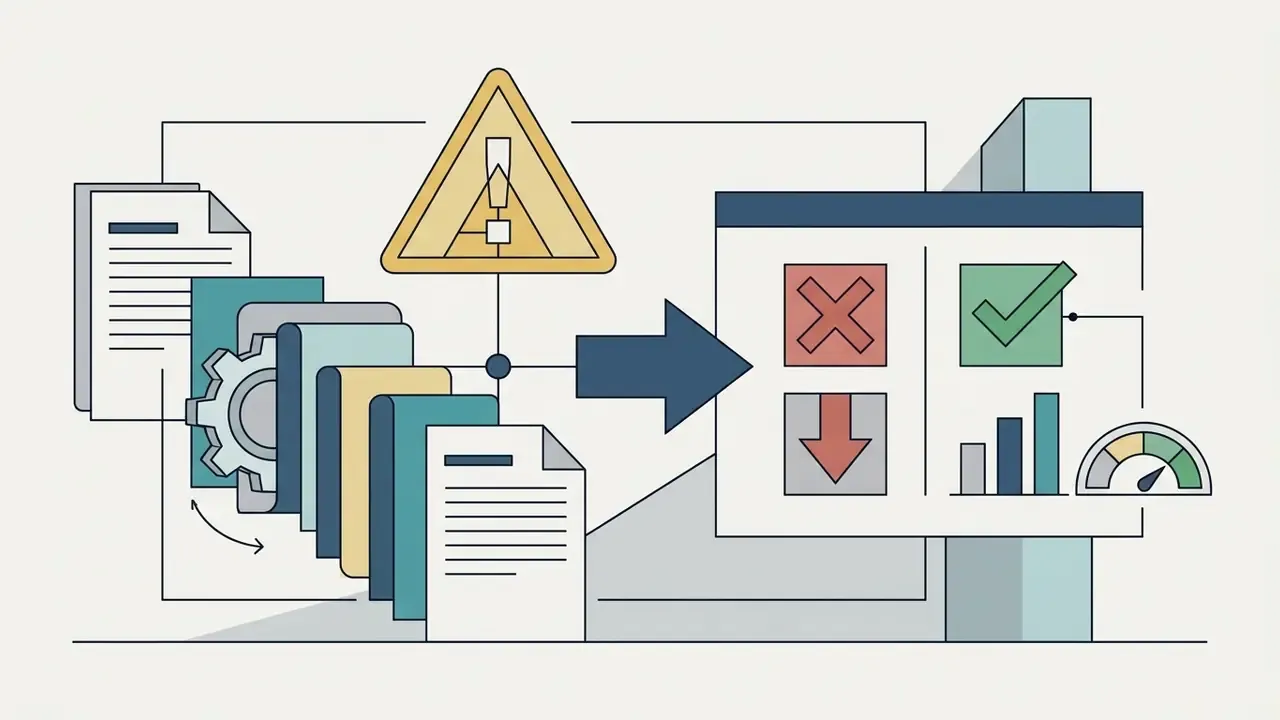
Diagram: data ingestion and anonymization gate that prevents PII leakage and Shadow AI usage.
Controls worth codifying now rather than after an incident:
- Tool allowlist. Publish an approved list of podcast generators with signed data-processing agreements. Anything outside it counts as Shadow AI.
- Zero data retention. Prefer endpoints that contractually exclude prompt data from training and delete inputs after processing.
- Region pinning. Match the processing region to the residency requirement of the source data.
- Consent registry. Store voice consent artifacts with the episode record, not in someone's personal drive.
- Purpose logging. Record who uploaded what, for which episode, and under whose approval.
Generate or Edit the Podcast Script
Once text is extracted, the LLM produces a structured script: an introduction, main narrative points split into conversational turns, and a short conclusion. Review the output before synthesis, every time:
- Rewrite formal academic phrasing into spoken language patterns.
- Keep sentences short and conversational, roughly 10 to 18 words.
- Check numerical values, data points, and technical names against source documentation.
- Insert explicit speaker attribution tags (
[Speaker 1],[Speaker 2]) to govern dialogue flow. - Read the draft aloud with a timer. A 6 to 12 minute episode usually maps to a 1 to 2 minute intro, 4 to 8 minutes of main content, and a 1 to 2 minute close.
- Break lines at sentence ends and number them, so re-generating one line does not disturb the surrounding audio.
Creators can speed up drafting with an ai text generator gpt to structure dialogue before rendering.
Choose Your Dialogue Format: Conversation, Interview, or Debate
Show format determines turn distribution, question density, and the pacing profile the TTS engine must reproduce. Choose it before generation, not after.
| Format | Turn distribution | Typical turn length | Signature devices | Best for |
|---|---|---|---|---|
| Conversation | Roughly 50/50 between two hosts | 15 to 30 seconds | Mutual build-ons, shared discovery, light agreement markers | Content repurposing, news roundups, explainers |
| Interview | Host asks ~70% of turns, short bridges | Guest answers 45 to 60 seconds | Follow-up probes, clarifying restatements, credential intros | Expert briefings, research dissemination, product deep-dives |
| Debate | Alternating opposed positions | 30 to 45 seconds | Objection cues ("I'd push back on that", "The counter-evidence is"), concession then rebuttal | Strategy discussions, policy analysis, trade-off framing |
A prompting pattern that reliably produces each style: "Turn this source into a 15-minute podcast [format] between Host A (analytical, structured) and Host B (curious, asks follow-ups). Enforce the turn distribution for this format, keep sentences under 18 words, and mark every speaker turn with [Speaker 1] or [Speaker 2]."
Run the LLM Script Audit Protocol
| Check | What to test | Pass criterion | Action on failure |
|---|---|---|---|
| Grounding check | Every factual claim traceable to the target or context file | 100% of numbers, names, dates, quotes located in source | Delete the claim or replace with a sourced statement |
| Hallucination scan | Invented studies, statistics, regulations, product features | Zero unsupported entities | Regenerate that segment with a source-only constraint |
| Numeric fidelity | Figures, percentages, sample sizes, currency units | Digit-for-digit match with source | Correct manually; do not trust regeneration |
| Terminology control | Regulated or brand-specific terms | Matches the approved glossary | Apply glossary substitution before synthesis |
| Tone and framing | No unauthorized advice, guarantees, or comparative claims | Neutral, disclaimed where required | Rewrite and add the disclaimer |
| Omission review | Material caveats present in the source | Key limitations retained | Reinstate the caveat |
| Kill-switch trigger | Two or more grounding failures in one episode | Episode blocked from synthesis | Return to script stage and log the incident |
| Sign-off | Named reviewer, timestamp, source version | Recorded in episode metadata | No publication without sign-off |
For high-risk categories, regulatory, medical, or financial, require a second reviewer and archive the approved script version alongside the audio master. Yes, it slows things down. It also keeps the programme alive after the first mistake.
Choose Style, Voices, and Speakers
Select synthetic voice profiles that match the intended tone: warm narrative, authoritative executive, or inquisitive interviewer. In multi-host configurations, assign acoustically distinct voice models to each speaker tag so the ear can separate them. Platforms with advanced multi-speaker engines, such as Google Cloud en-US-Studio-MultiSpeaker or ElevenLabs host and guest models, allow granular control over pitch, speaking rate, and delivery style per role. Pair contrasting timbres, for example a lower-register host with a brighter-register guest, so listeners track turn-taking without visual cues.
How to Create a Custom AI Voice for Podcasts
In two sentences: A custom voice gives a show consistent acoustic branding without recurring studio sessions. It also creates identity and consent obligations that must be documented before the first render.
A custom synthetic voice lets creators and institutions build recognizable acoustic branding and maintain voice consistency across episode pipelines, without depending on studio availability.
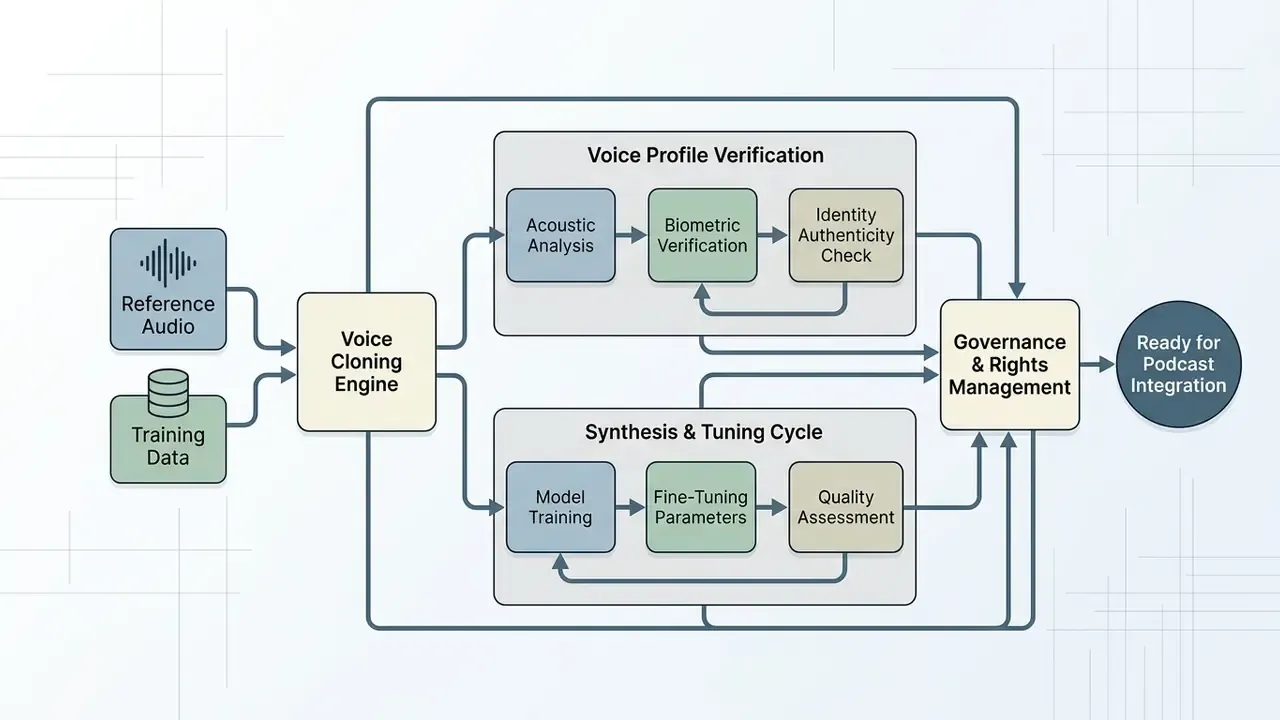
Custom Voice Cloning Pipeline
- Audio Consent & Verification (recording of mandatory consent phrase)
- Training Sample Upload (10 seconds to 10+ minutes of clean audio input)
- Model Training & Voice ID Generation (neural acoustic profile creation)
- Script Synthesis Integration (mapping Voice ID to designated transcript tags)
- Consent Artifact Archiving (retained with the episode record)
Choose Realistic AI Voices for a Podcast Format
Choosing realistic synthetic voices means evaluating prosodic controls, pause handling, and acoustic naturalness rather than raw pitch. Research in speech prosody, including CMU prosody analysis standards, shows that inserting natural phrase breaks (silences above 20 ms) and removing unnatural micro-pauses (under 80 ms) is critical for perceived naturalness.
«TTSDS2 is the only one of 16 tested metrics maintaining Spearman correlation above 0.50 across all domains; average correlation with listener ratings was ρ ≈ 0.67.»
Because the benchmark spans 14 languages, it works as a shortlisting instrument. Prefer models scoring highly on prosodic similarity in your target locale, which measurably reduces listener fatigue across long-form episodes.
Upload Your Own Voice and Create a Custom Voice
To clone a voice, users upload clean samples ranging from 10 seconds of high-fidelity speech (instant cloning) to 10 minutes or more of structured studio audio (professional cloning). Requirements differ sharply by vendor. Inworld AI requires at least 10 minutes split across files. Typecast accepts WAV or MP3 up to 25 MB and returns a voice_id from POST /v1/voices/clone for use in POST /v1/text-to-speech. MiniMax requires a two-stage upload that yields a file_id before cloning. Podcastle's Revoice does not accept uploaded files at all and instead requires in-app recording of roughly 70 prewritten phrases. Most enterprise platforms return a unique voice_id string referenced inside TTS API requests to render dialogue.
{
  "script_id": "pod_episode_104",
  "speaker_mapping": [
    {
      "role": "Host",
      "voice_id": "usr_clone_8841a",
      "stability": 0.75,
      "similarity_boost": 0.85
    },
    {
      "role": "Guest",
      "voice_id": "stock_voice_narrator_02",
      "stability": 0.65,
      "similarity_boost": 0.75
    }
  ]
}
Teams implementing custom voice workflows should track legal developments on identity rights. For current updates, review our resource on AI Litigation and Case Timelines.
It is worth understanding the psychological and acoustic transformations that occur during cloning.
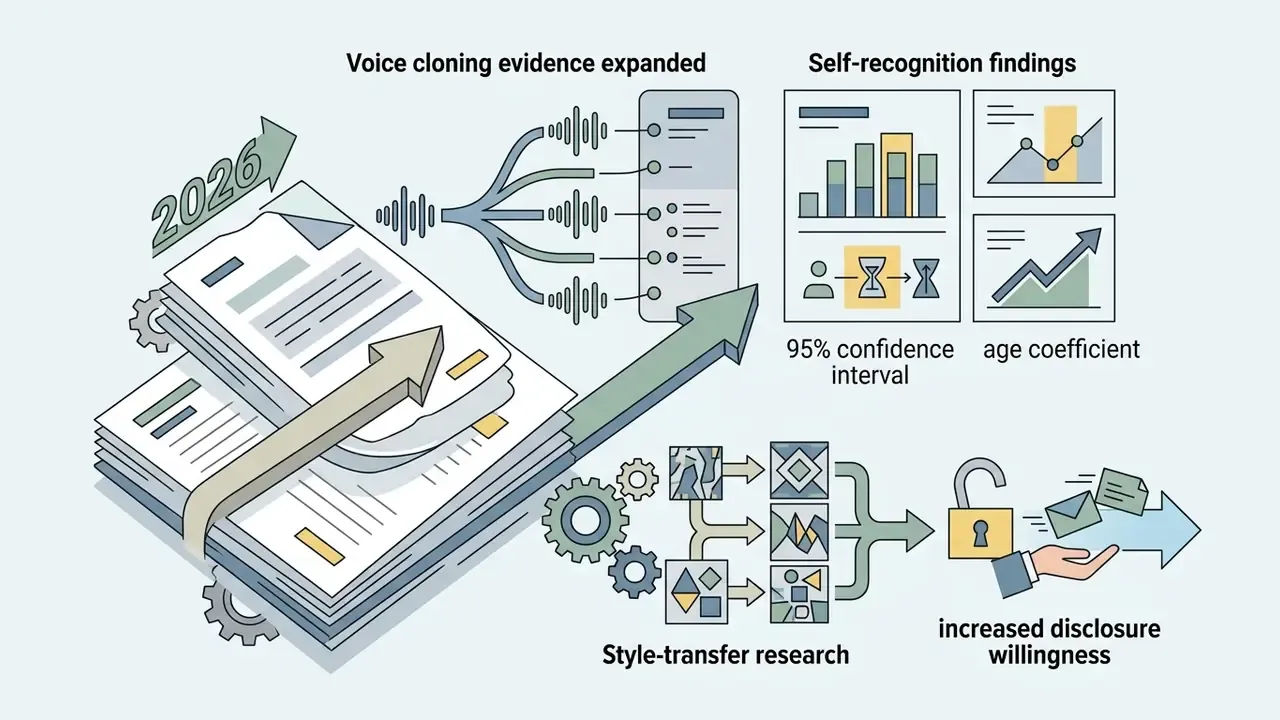
«Above 35.2% morphing (95% CI [31.4; 38.1]) participants stopped reliably recognizing their own voice; older participants showed a higher threshold (β = 0.617, p = 0.048).»
The practical consequence is uncomfortable. A voice owner is not a reliable auditor of their own clone once acoustic drift passes roughly a third, so identity verification has to rest on documented consent and technical fingerprinting rather than the speaker's ear.
«Cloned voices are perceived as more authoritative, warmer, and more call-center-like; listeners show greater willingness to disclose personal information to cloned voices.»
Put plainly, cloning behaves as a style transfer rather than a neutral copy. Accent variation and pitch variance get homogenized, while perceived authority and warmth rise. For shows that solicit listener responses, that measured increase in disclosure willingness is an ethical design constraint, not a growth feature.
Create Multi-Speaker Conversations
Simulating multi-host shows requires dialogue orchestration models that manage turn-taking, interjections, and speaker transitions. Frameworks such as CoVoMix (arXiv:2404.02674) and MOSS-TTSD (arXiv:2602.04987) process multi-speaker scripts by converting dialogue text into distinct parallel token streams for up to five speakers, using speaker tags plus reference audio for explicit identity control. The result is smooth transitions between hosts without cross-talk artifacts or volume jumps.
«Participants mistook an AI voice for a real one in roughly 80% of identification tasks; accuracy on short clips (<10 s) was only 59.3%.»
This information is general in nature and does not replace consultation with a qualified specialist. Since audiences cannot reliably distinguish synthetic hosts, the disclosure duty sits with the publisher. Label synthetic voices in episode metadata, retain recorded consent from every cloned speaker, and avoid using cloned voices for endorsements, financial guidance, or identity-sensitive announcements without explicit written authorization. Advanced multimodal analysis tooling can be reviewed via our guide on ai that can analyze videos.
Quality Control: Scripts, Audio, Music, and Generation Limits
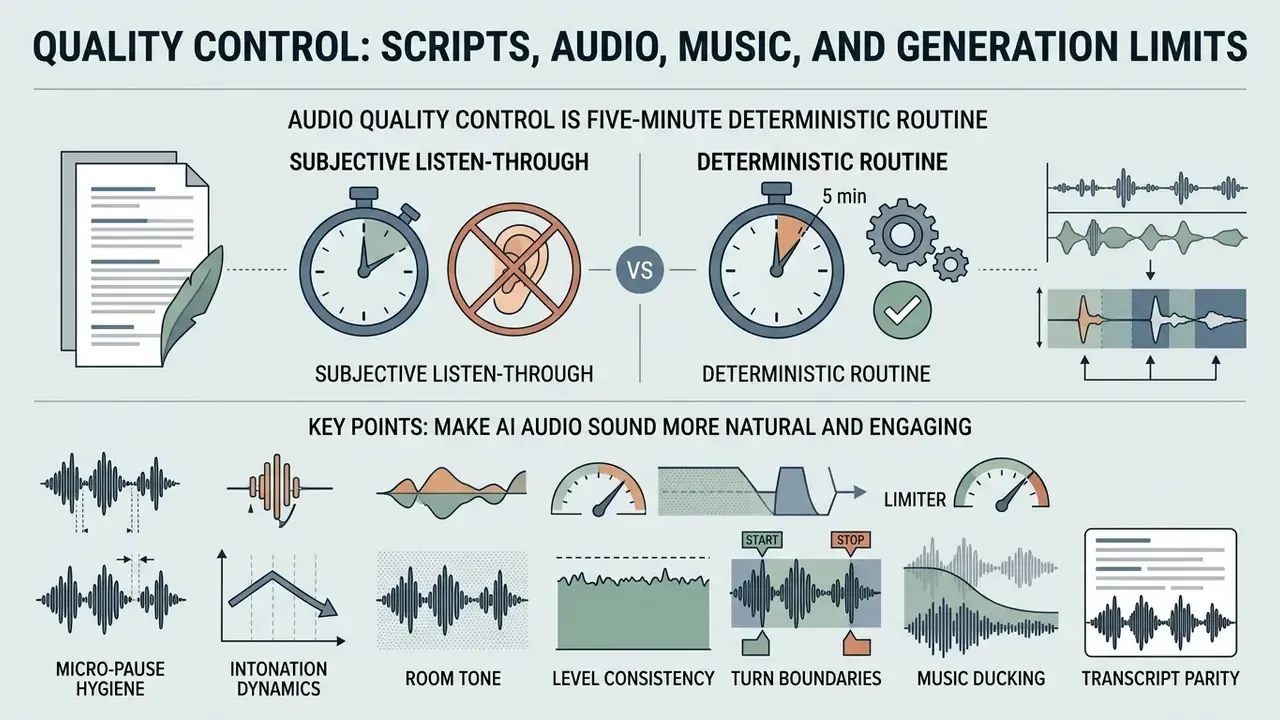
In two sentences: Audio quality control is a five-minute deterministic routine, not a subjective listen-through. Platform limits on file size and duration should be checked before scripting, since they cap episode length.
Maintaining technical quality means auditing both script accuracy and audio production parameters before publication.
Make AI Audio Sound More Natural and Engaging
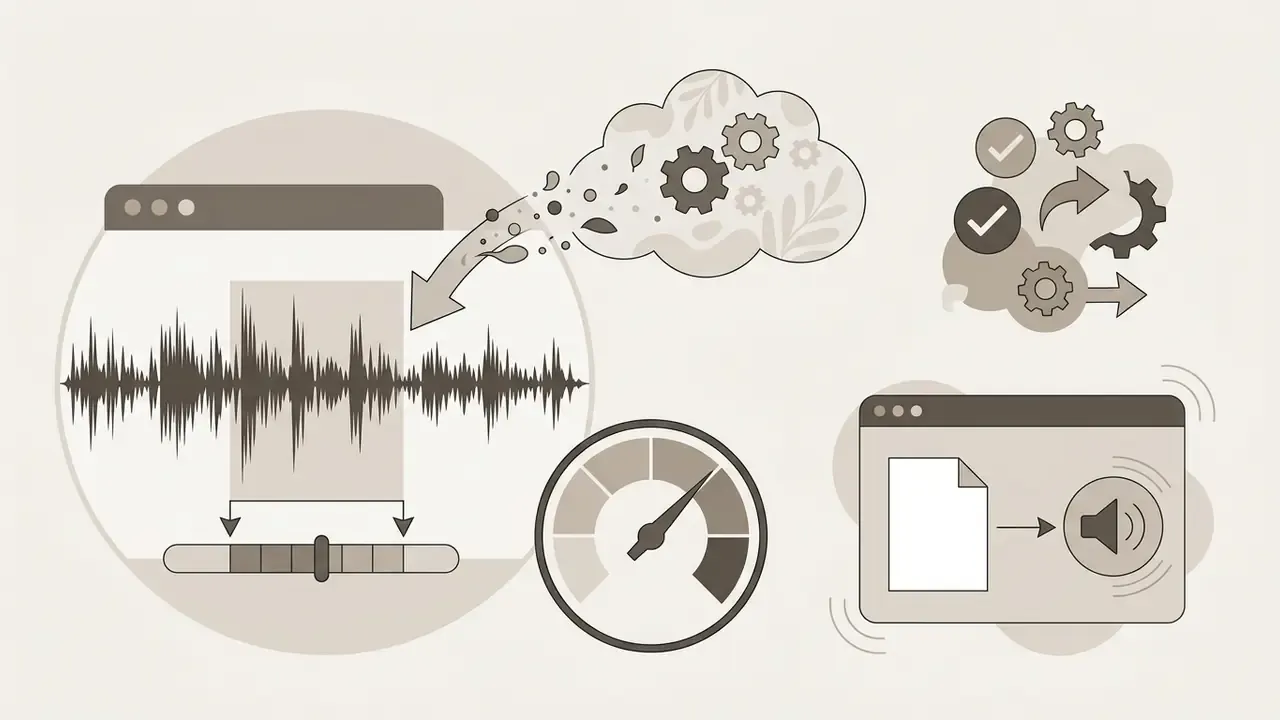
To stop synthetic audio sounding flat, creators use Speech Synthesis Markup Language (SSML) or the inline control tags their TTS platform supports:
- Pause control: use
- Emphasis and rate: modulate speaking rate, for example
rate="95%", during complex technical explanations. - Background music: layer low-volume ducked music, 18 to 22 dB beneath voice tracks, to maintain energy.
- Sound effects: insert subtle transition chimes between major script sections.
«Per MINT-Bench, Gemini 2.5-Flash leads perceptual ratings for style and timbre across 10 languages; multilingual robustness of instruction-following TTS remains uneven.»
Engine choice matters most when a show depends on instruction-level style control ("read this line skeptically", "slow down here") in a non-English language.
<speak>
  <p>
    <s>Welcome back to the briefing.</s>
    <break time="250ms"/>
    <s>Today we are analyzing model risk management framework extensions for agentic AI.</s>
    <prosody rate="92%">
      This requires strict operational audit trails and deterministic kill switches.
    </prosody>
  </p>
</speak>
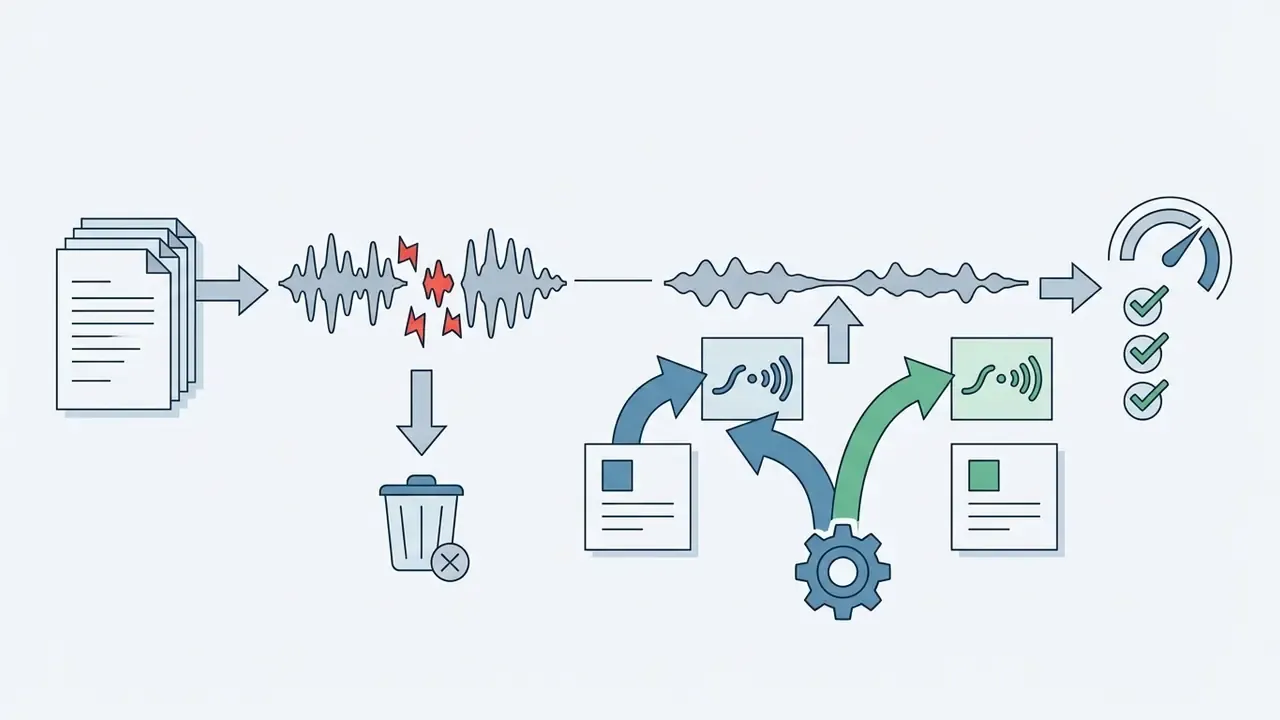
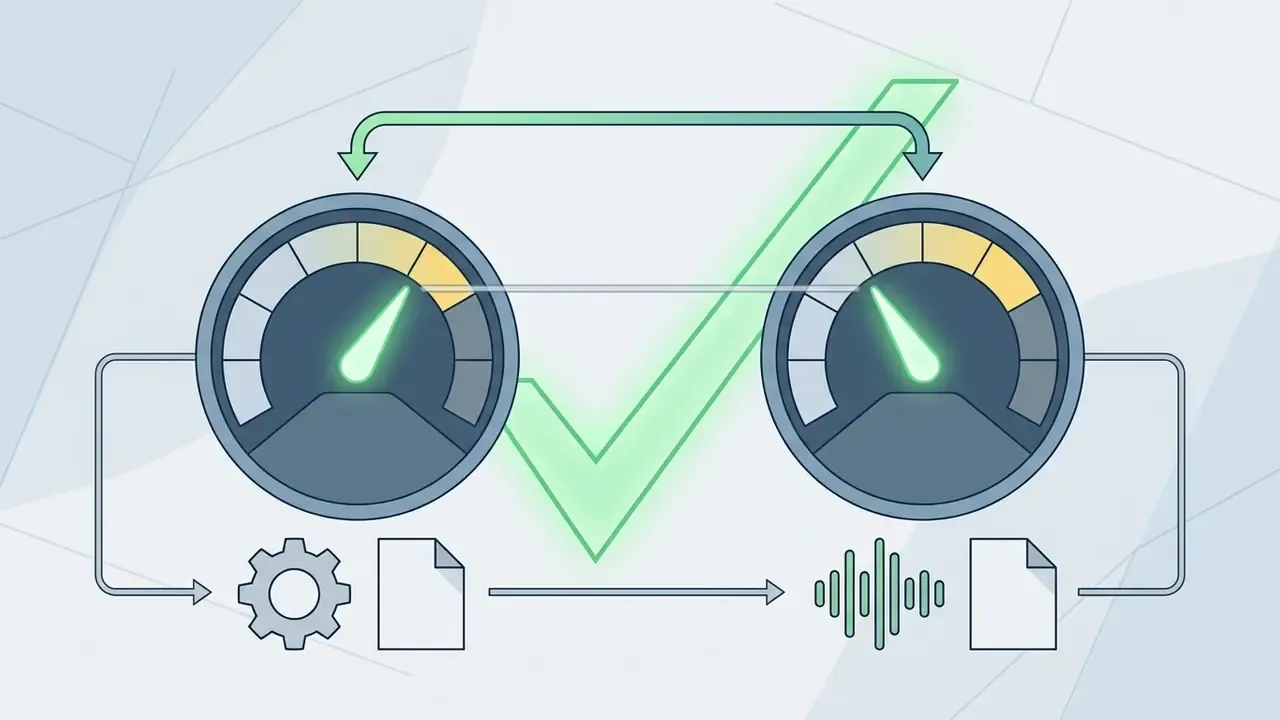
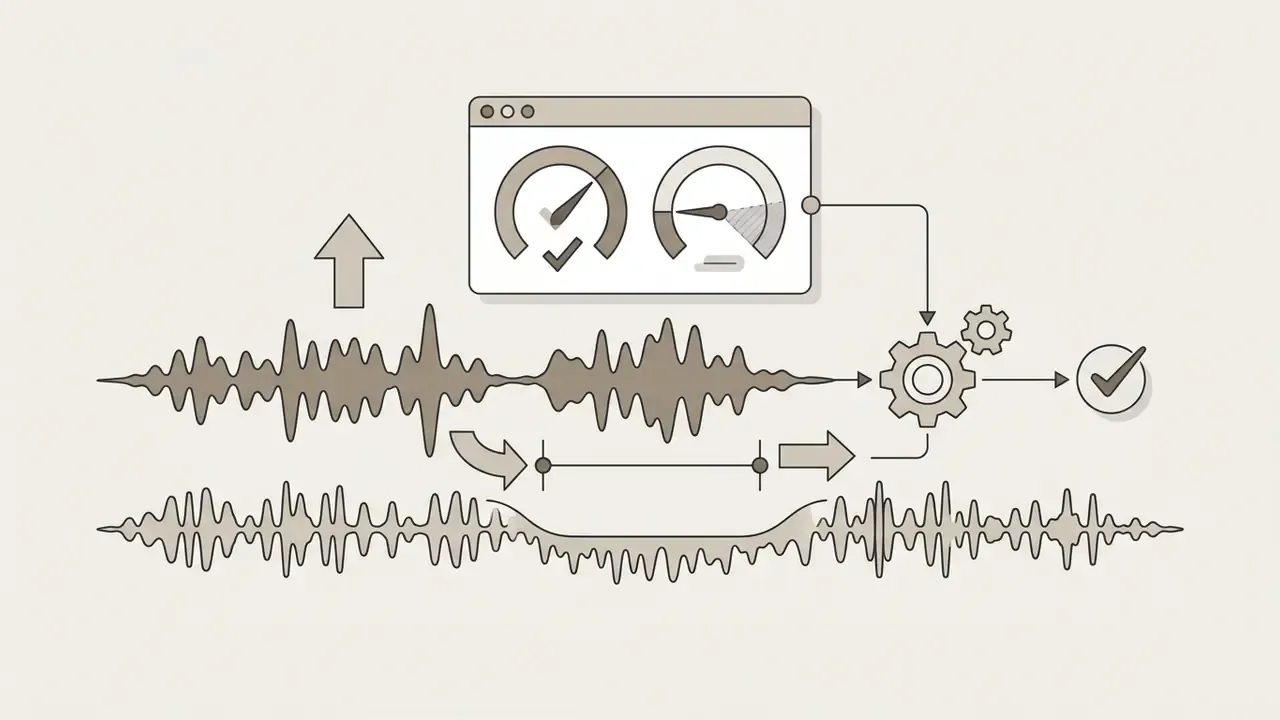
A disciplined five-minute check of this kind catches the large majority of typical AI-audio defects before an audience ever hears them.
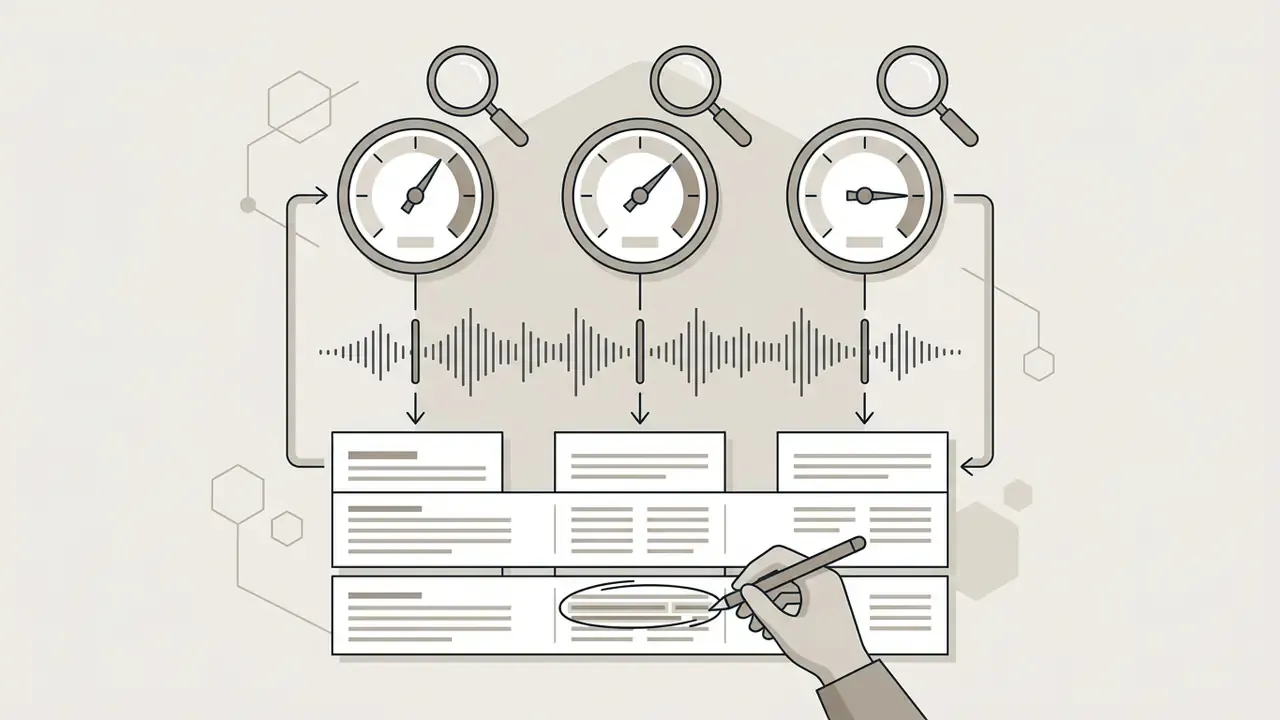
«Cloned voices receive higher intelligibility ratings than the originals, especially for accented speech, while perceived speaker similarity declines for accented speakers.»
That trade-off deserves an explicit editorial decision rather than a default. Cloning may improve clarity for international audiences while flattening the accent that carries a host's identity. Teams refining conversational or auto-reply dialogue can also examine an ai text reply generator.
Check Generation Limits Before Publishing
AI voice synthesis platforms impose file-size, character-count, and runtime processing limits that vary across subscription tiers. Check them before you write, not after.
| Provider / Platform | Single File Upload Cap | Max Audio Duration | Free Tier Generation Allowance | Primary Technical Constraint |
|---|---|---|---|---|
| Adobe Podcast | Up to 5 GB | Up to 2 hours (paid), 30 mins (free) | 30 mins per day max | Upload size and daily duration processing limits |
| Microsoft Azure AI | Up to 1 GB (.spx) | Up to 4 hours processing | Credit-based trial allowance | Container type and real-time quotas; direct video upload capped at 200 MB / 30 mins |
| Google Cloud TTS | 100 MB per file | 60 minutes per audio example | Character-based monthly quota | Byte payload limits per API call (en-US-Studio) |
| ElevenLabs | Unspecified file cap | Character count dependent | 10,000 characters per month | Monthly credit pool consumption per generation call |
| Descript | Plan dependent | Plan dependent | 60 minutes per month, 100 AI credits | Minute-based transcription and AI credit caps |
For help resolving synthesis artifacts or export formatting errors, visit AI Media Support and Troubleshooting.
Free Plans, Pricing, and Commercial Use of AI Podcasts
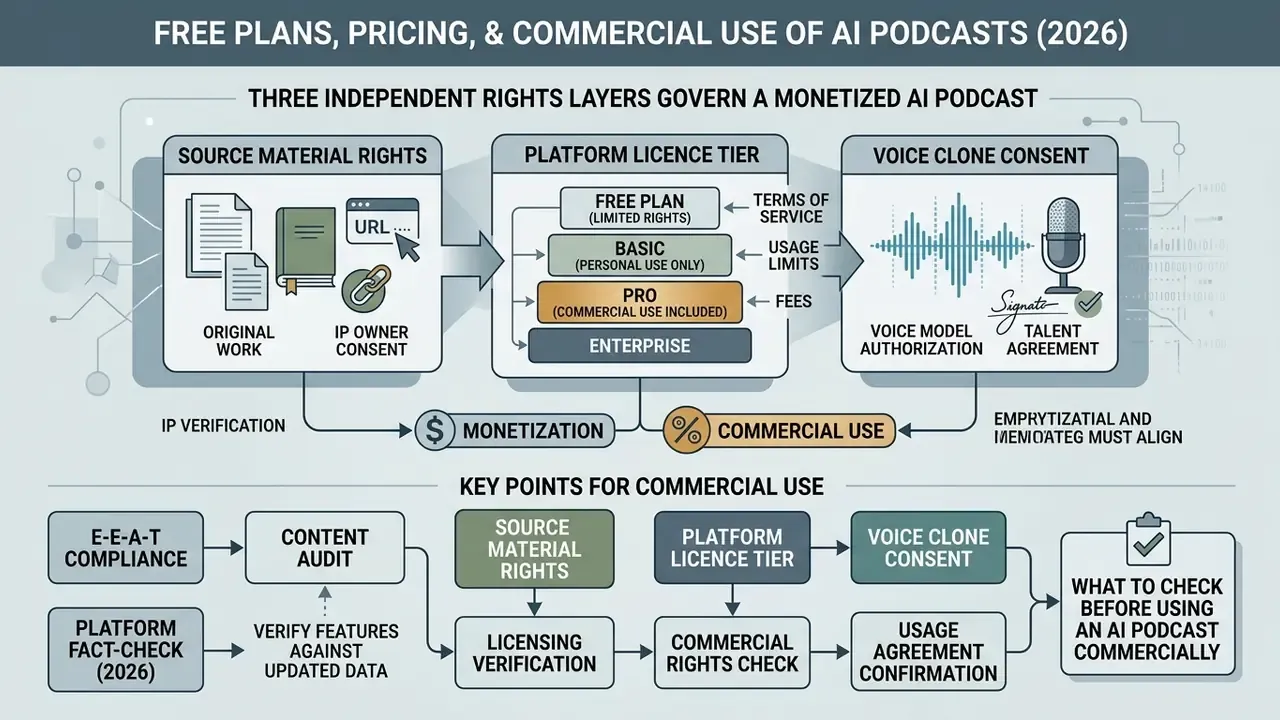
In two sentences: Three independent rights layers govern a monetized AI podcast: the source material, the platform tier, and the voice itself. A paid tier alone does not clear the other two.
Commercial usage rights for AI-generated podcasts are governed by tool subscription terms, underlying voice licensing, and source material copyright ownership. The same layered logic runs across synthetic media formats, as covered in our overview of commercial use rights for AI-generated content.
What to Check Before Using an AI Podcast Commercially
Before monetizing, broadcasting, or distributing an AI podcast through commercial RSS feeds, complete a licensing review.
Commercial use and rights verification matrix (record the date you checked each vendor page, and link the official pricing or terms URL in your internal copy of this table).
| Verification Checkpoint | Free Tier Policy | Paid Tier Policy | Compliance Action Required |
|---|---|---|---|
| Source text rights | User responsibility | User responsibility | Verify text ownership or copyright clearance |
| Stock AI voice rights | Personal or non-commercial (vendor dependent) | Commercial rights granted | Confirm the paid subscription was active during generation |
| Custom voice cloning | Prohibited or restricted | Permitted with consent | Retain a written or recorded consent statement from the speaker |
| Background music licensing | Non-commercial stock | Commercial or royalty-free stock | Verify track inclusion rights for monetized RSS feeds |
| Third-party voice of a real person | Prohibited | Requires separate publicity or consent clearance | Obtain a signed release and log it in the consent registry |
| Platform disclosure | Mandatory attribution | Platform rules apply | Add AI disclosure tags to RSS metadata (Apple, Spotify) |
| Records retention | Not addressed | Organization policy | Archive script version, consent artifact, and audio master |
This information is general in nature and does not replace consultation with a qualified specialist. Licensing, copyright, publicity rights, and the treatment of voice as biometric data differ by jurisdiction. Some 2026 legal analyses argue voice may qualify as biometric personal data, which would stack data-protection obligations on top of tool terms. Get qualified legal advice for your jurisdiction and use case.
Total Cost of Ownership and Risk-Adjusted ROI
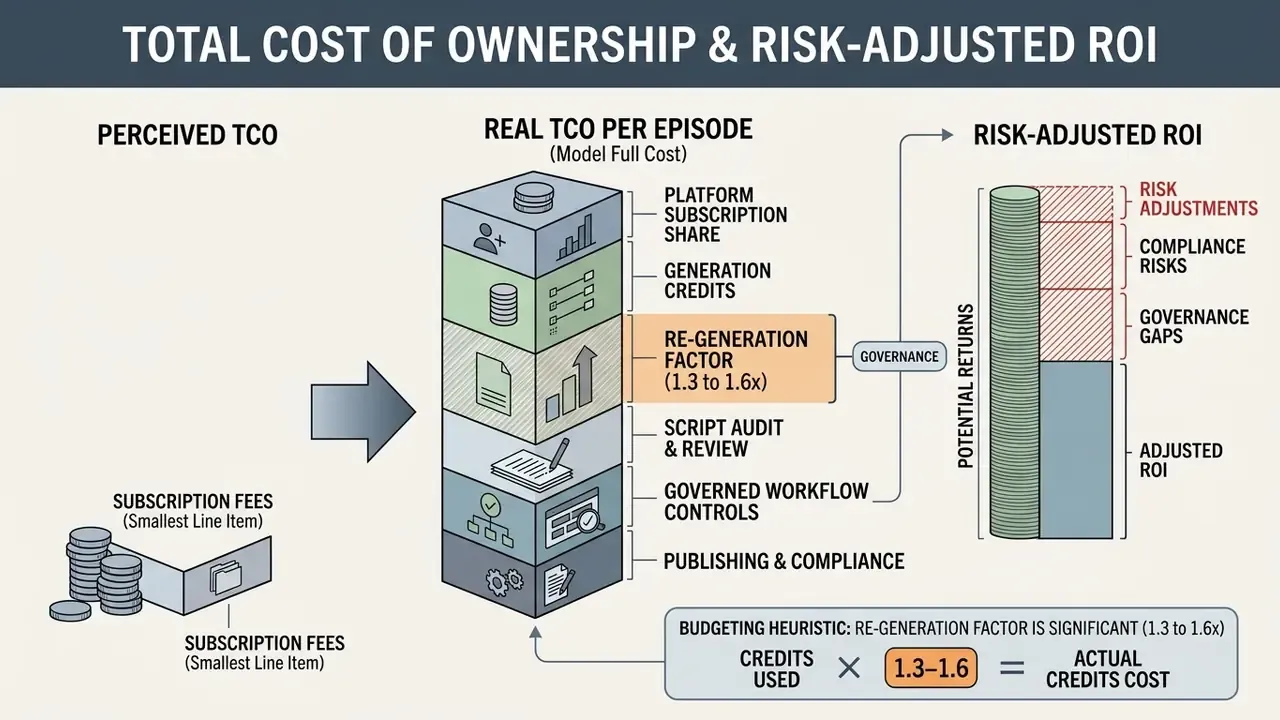
In two sentences: Subscription fees are the smallest line item in a governed AI podcast programme. Reviewer time and rework dominate, and omitting them produces ROI figures that collapse under audit.
Model the full cost per episode, not the credit price:
TCO per episode =
    (platform subscription share)
  + (generation credits x re-generation factor)
  + (script audit hours x loaded reviewer rate)
  + (audio QC hours x loaded editor rate)
  + (legal / consent administration amortized per episode)
  + (hosting & distribution share)
  + (video render cost, if applicable)
Risk-adjusted ROI =
    (value of episode: reach x conversion, or training hours saved)
  - TCO per episode
  - (expected cost of error: probability of factual or consent failure
     x remediation + reputational cost)
| Model | Production time per 10-min episode | Dominant cost | Error exposure | Typical fit |
|---|---|---|---|---|
| Traditional recorded podcast | 4 to 8 hours (record, edit, master) | Talent and studio time | Low factual risk, high scheduling cost | Flagship interview shows |
| AI podcast, no review layer | 10 to 25 minutes | Credits only | High: hallucinations, terminology drift, consent gaps | Personal experiments only |
| AI podcast with MRM controls | 60 to 120 minutes | Reviewer hours, usually 60 to 75% of TCO | Low, with logged sign-off | Regulated training, briefings, research dissemination |
Budgeting heuristics that have held up in practice: assume a re-generation factor of 1.3 to 1.6x on credits, because few episodes render correctly on the first pass; assume 30 to 45 minutes of script audit per 10 minutes of finished audio for regulated content; and treat consent administration as a fixed setup cost per cloned voice rather than a per-episode cost. To model production costs, ROI, and commercial software licensing, review AI Media Pricing and run the numbers in our interactive AI Media Calculators. Technical implementation standards for enterprise streaming sit in the AI Media API Guides, while rights terms are detailed under AI Media Commercial-Use.
FAQ: Shadow AI, Deepfake Liability, and Data Loss
What is Shadow AI in podcast production, and why does it matter?
Shadow AI is the use of unapproved AI services by employees, for example pasting an unreleased earnings summary into a consumer podcast generator. The risk is dual: confidential data may be retained or used for training, and the resulting audio has no auditable provenance. Mitigation is a published tool allowlist, signed data-processing agreements, a zero-retention requirement, and an upload log tied to requester identity.
Who is liable if an AI podcast uses someone's voice without permission?
Liability generally sits with the publisher, not the tool vendor. Reputable platforms require verification before cloning precisely to move that burden. Unauthorized voice replication can implicate copyright in the source recording, right-of-publicity or personality rights, privacy law, and under some 2026 legal readings, biometric data protection. Never generate a real person's voice without a signed, dated release, and keep that release with the episode record.
Can I use a free plan and upgrade later to make the episode commercial?
Usually no. Vendor terms commonly tie rights to the plan active at the moment of generation, and retroactive conversion of free-tier output is generally prohibited. Regenerate the audio on a paid tier if you intend to monetize it.
How do I prevent LLM hallucinations from reaching listeners?
Apply the grounding check from the script audit protocol above. Every number, name, date, quote, and regulation must be locatable in the target source. Two or more grounding failures should trigger a kill switch that blocks synthesis and returns the episode to the script stage.
Can I turn a YouTube video into a podcast?
Yes, by supplying the video URL to a generator that extracts the caption or transcript layer, then re-authoring it as dialogue. Rights caution: that transcript is someone else's copyrighted expression unless it is yours, licensed, or clearly permitted. Extraction capability is not a licence.
What about video podcasts and AI avatars?
Export the audio master, then drive an avatar (HeyGen) or a multitrack video timeline (Adobe Podcast 2026) from it. Disclose the synthetic avatar in the video description and platform metadata. YouTube and Spotify Video treat synthetic presenters as disclosable content.
How long can an AI-generated episode be?
Length is constrained by provider caps rather than the model. Adobe Podcast supports up to 2 hours on paid tiers and 30 minutes free, Azure processes up to 4 hours, Google Cloud caps a single audio example at 60 minutes and 100 MB, and ElevenLabs bills by character. Plan script length against these ceilings before writing.
Do I need a transcript?
Treat it as mandatory. US Digital.gov guidance requires text transcripts for audio-only content posted online, and transcripts also drive search indexing, chapter markers, and clip repurposing. Always review AI-generated transcripts before publishing, particularly where technical terminology is involved.
Limitations, Open Questions, and a Safe Next Step
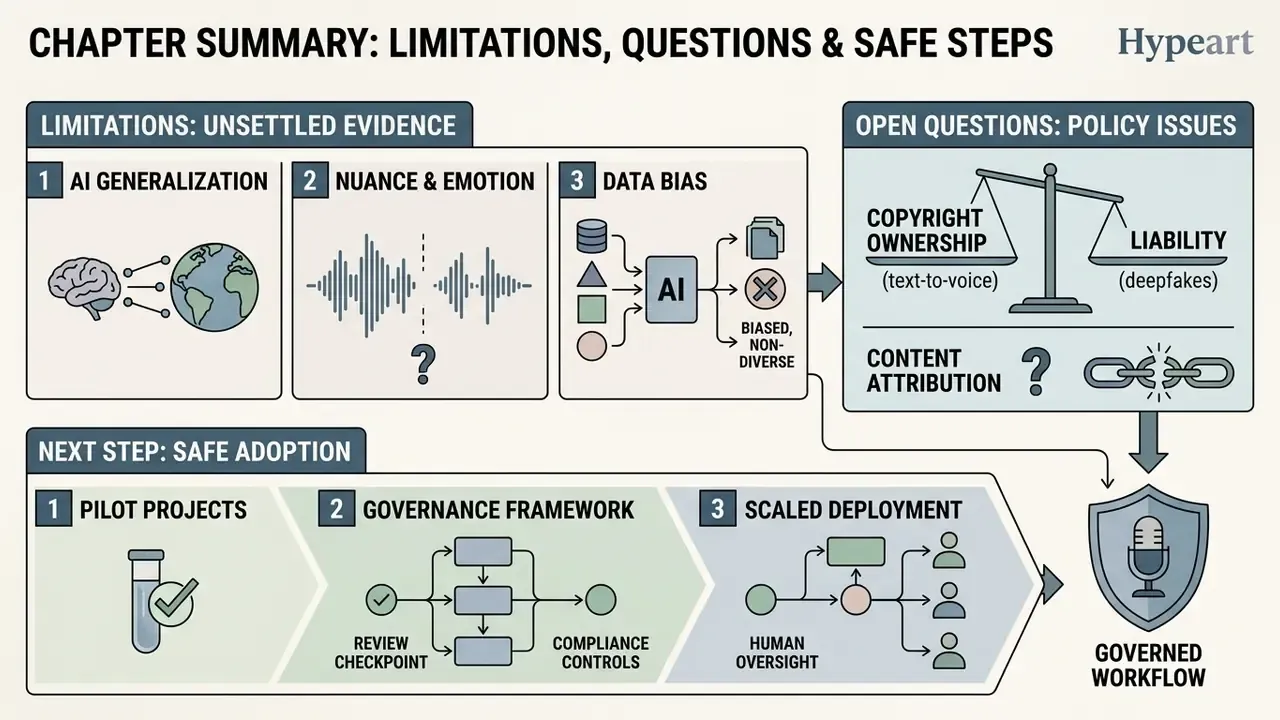
Honest limits, stated plainly, because a governance page that claims certainty is not a governance page.
What the evidence does not yet settle. The learning-gain studies cited here involve 36 to 180 participants in academic settings, not thousands of employees in a regulated bank. Transfer is plausible, not proven. The 70% production-time reduction in the deployment example is self-reported and unaudited. Voice benchmark scores such as TTSDS2 correlate with listener ratings at ρ ≈ 0.67, which is strong for the field and still far from deterministic.
What remains unresolved in policy. Whether voice constitutes biometric personal data varies by jurisdiction and is actively litigated. Platform disclosure requirements for synthetic hosts are tightening but are not harmonised between Apple, Spotify, and YouTube. Retention obligations for AI-generated client communications in US financial services depend on channel and content, and firms are interpreting them differently right now.
What this means for a control framework. Treat an AI podcast pipeline the way you would treat any other automated production process with a model in the middle: named owner, approved role, access limits, logged inputs, documented human sign-off, escalation path, and a kill switch that a single reviewer can pull. No evidence, no autonomy.
A safe next step. Run one non-sensitive pilot episode end to end, using public source material only, and measure three things: reviewer minutes per finished audio minute, number of grounding failures caught, and total cost including those reviewer minutes. That single data point is worth more than any vendor benchmark, and it will not put a single confidential document at risk. If the pilot survives your own audit, then scale, one content category at a time.
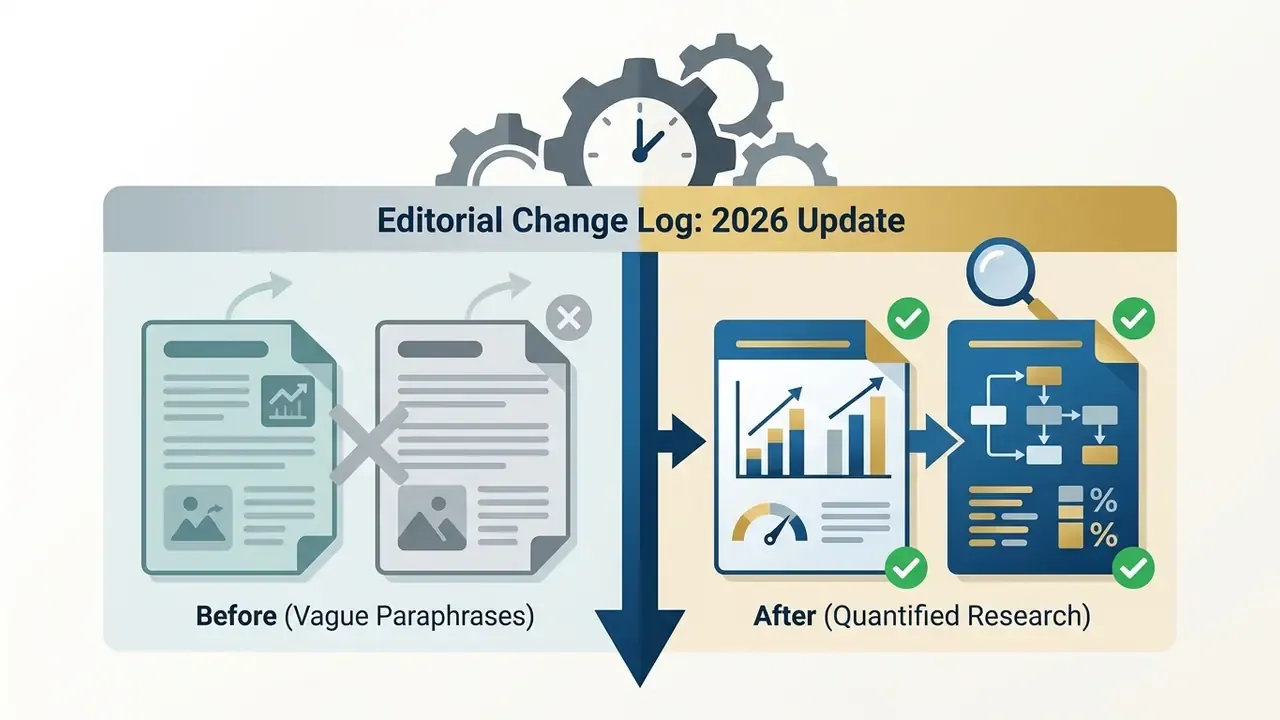
Editorial Change Log: 2026 Update
Kept for editorial traceability, because readers deserve to know what moved and why.