Last updated: February 2026 · Reviewed for: model versions, free-tier limits, commercial-use terms · Editorial standard: every statistic below links to its primary source.
An online free ai content generator is a software application powered by Large Language Models (LLMs) that produces written text (articles, marketing copy, social posts, product descriptions) from user-provided prompts without upfront payment. In 2026, these tools rely primarily on transformer-based neural architectures to process contextual inputs and predict sequential word tokens.
A free content ai generator lowers the barrier to rapid drafting and ideation. But free tiers run under defined constraints: daily message limits, reduced context windows, and restricted commercial usage rights. That gap between "free" and "usable in production" is where most teams get burned.
Executive Summary
For readers who need the decision, not the essay:
- What "free" actually means in 2026: freemium access to a capable model behind hard walls. Rolling message windows (ChatGPT free: roughly 10 messages per 5 hours on the flagship model before automatic fallback to a mini variant; Claude free: a dynamic 10 to 25 message window per 5-hour cycle), monthly credit buckets (Copy.ai ≈ 2,000 words/month, Rytr ≈ 10,000 characters/month, Canva Magic Write ≈ 25 uses), and feature gating (no uploads, no custom instructions, no API, no team workflows).
- What free tools are genuinely good at: zero drafts, outlines, headline and subject-line variants, paraphrasing, tone shifts, and repurposing one asset across channels.
- What they are not good at: verified facts, original research, regulated claims, and anything that must survive an audit without a human in the loop.
- Legal position in one line: under current US Copyright Office guidance, purely AI-generated text without sufficient human creative authorship is not eligible for copyright protection, and several free tiers reserve commercial rights for paying customers.
- Governance position in one line: never paste PII, client data, unreleased financials, or trade secrets into a consumer free tier, because free plans commonly reserve the right to use inputs for model improvement.
- SEO position in one line: Google does not penalize AI authorship as such, but it does penalize scaled, unhelpful content. Ahrefs found effectively zero correlation (0.011) between the share of AI text on a page and its ranking position, while Semrush found human-led pages dominate position 1.
- The workflow that works: structured prompt (COSTAR/RTF) → grounded retrieval where available → human fact-check → tone and readability edit → plagiarism and originality check → logged approval.
One line summary of the summary: the model drafts, a named human owns the claim.
What Is a Free AI Content Generator and How Does It Work?
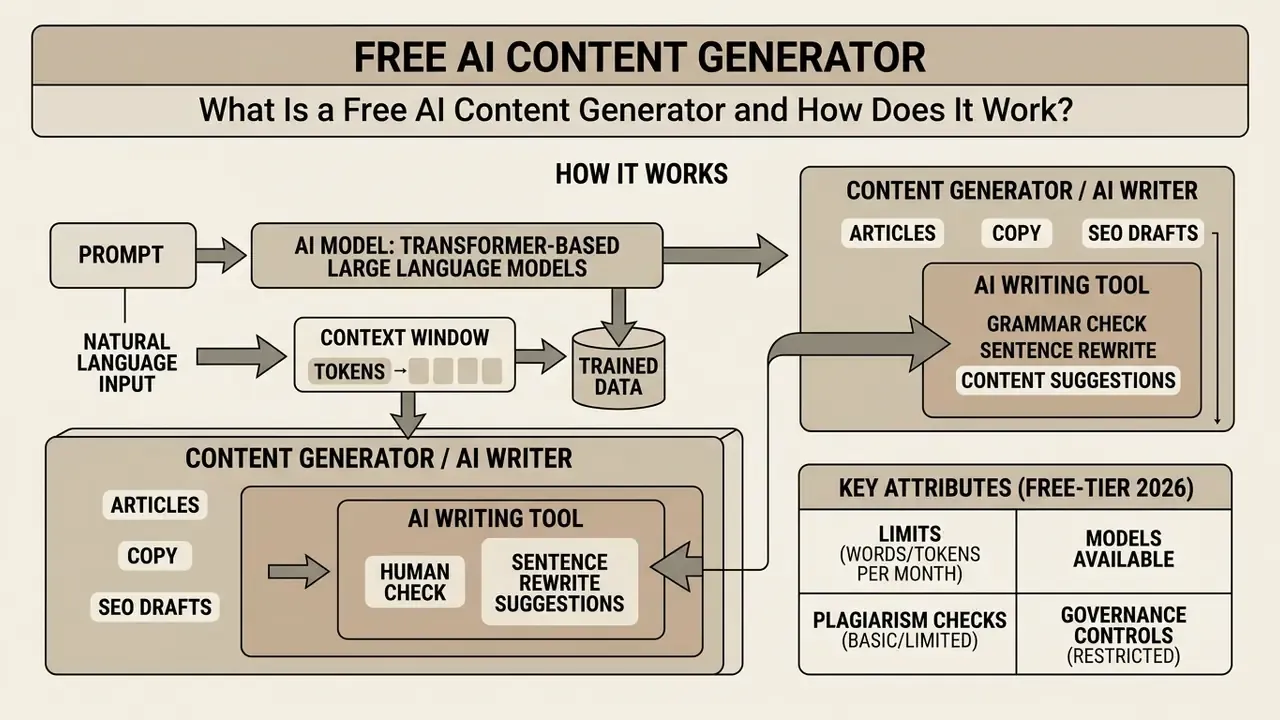
A free ai content generator is a web-based or application-based interface that leverages transformer-based Large Language Models to generate human-like text from natural language instructions. The underlying system predicts the most statistically probable next token (a word or sub-word unit) based on the context supplied in your prompt. Modern ai text generator systems use self-attention mechanisms inside the transformer architecture. That design lets the model weigh relationships between all words in an input prompt at once, which preserves thematic coherence and syntactic structure across long paragraphs.
When you open an ai content generator online free, the algorithm processes your parameters (topic, target audience, desired tone) and returns generated text through autoregressive token prediction. Two technical concepts govern output quality more than anything else:
- Tokens models do not read words, they read sub-word units. Free tiers meter and cap usage by tokens, which is why a long pasted document burns quota far faster than a short question.
- Context window the maximum number of tokens the model can consider in one pass. Anything beyond the window is simply invisible to the model. Claude's Sonnet-class models expose roughly a 200,000-token window, which is why they handle long briefs and multi-document analysis more gracefully than smaller free models.
In enterprise environments and grounded research systems, the generation pipeline is frequently combined with Retrieval-Augmented Generation (RAG). RAG fetches verifiable data chunks from external databases or web indices before generation begins, grounding output in retrievable fact rather than probability alone.
This distinction matters commercially. A free chat tool without retrieval will happily invent a plausible citation, while a retrieval-grounded tool (Perplexity, Gemini with Search grounding) returns clickable sources you can check. Google's own documentation confirms that grounding returns inline annotations and search-result steps with citation data only when grounding actually succeeds. In other words, "source-backed" is a conditional state, not a guarantee.
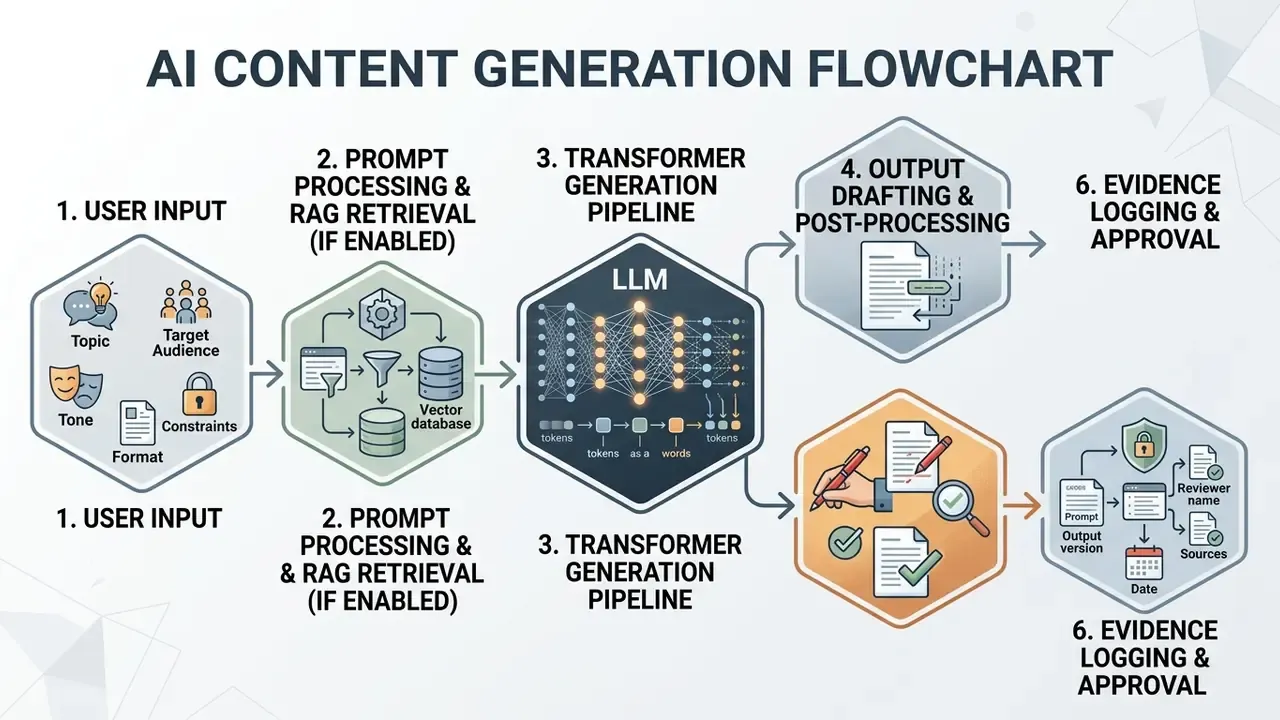
Prompt-to-Text Pipeline
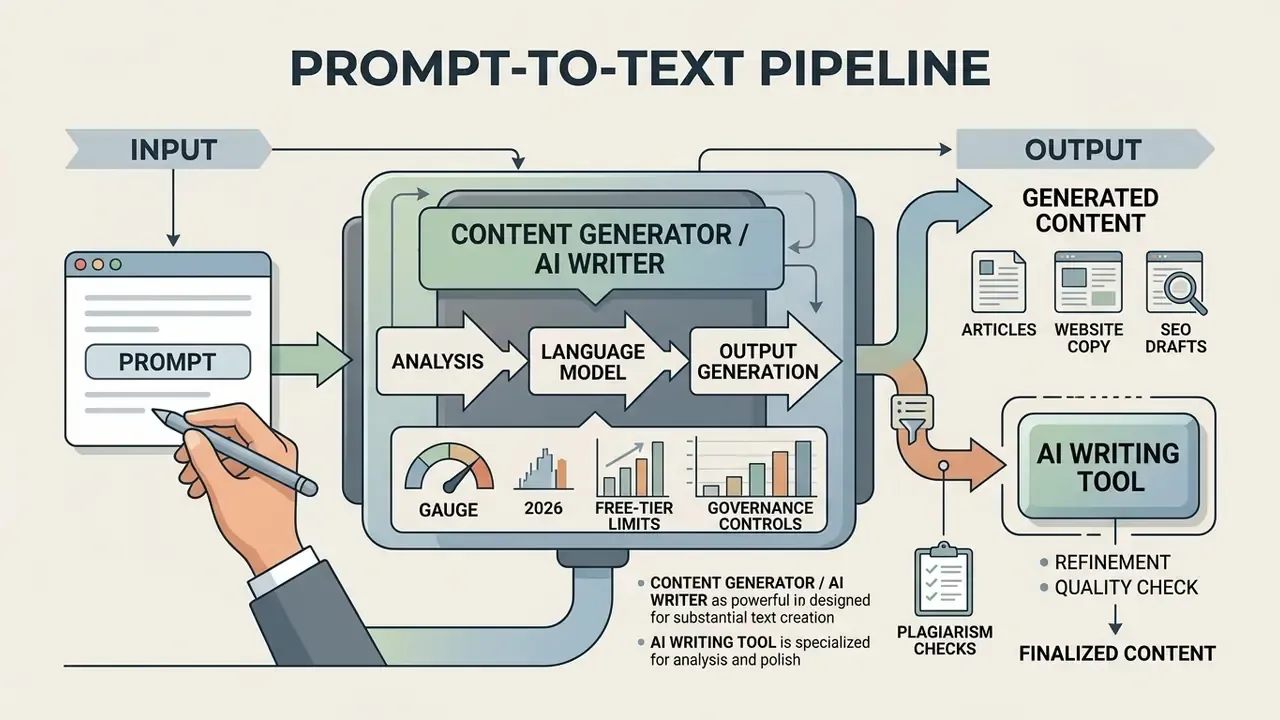
Prompt-to-Text Pipeline.
From Prompt to Generated Content
Turning a prompt into finished content follows a structured, multi-stage path. First, you supply instructions containing the core task, contextual background, and structural requirements. Second, the system tokenizes that input, mapping words into high-dimensional vector embeddings that capture semantic intent.
Third, the transformer evaluates those embeddings against its trained parameters. It applies attention scores to weight critical context (specific keywords, tone directives) over secondary noise. Finally, the model emits text token by token, appending each prediction to the running context.
Empirical work on structured prompting frameworks points the same way. The CONTEXT framework asks you to "articulate the task" and "outline the context" before requesting output, and OpenAI's prompt-engineering documentation recommends supplying identity, instructions, examples, and context. Clear task boundaries and explicit context reduce generic output and structural hallucination during the generation sequence. OpenAI defines prompt engineering as "writing effective instructions so the model consistently generates content that meets your requirements" (OpenAI API documentation, 2026, https://platform.openai.com/docs/guides/prompt-engineering).
The productivity effect of that discipline is measurable:
«Access to ChatGPT reduced task completion time by 0.8 standard deviations and raised output quality by 0.4 standard deviations across 444 professionals.»
Worth a caveat: that trial covered short professional writing tasks, not regulated disclosure drafting. Extrapolate carefully.
Content Generator, AI Writer and AI Writing Tool: What Is the Difference?
Vendor marketing uses these terms interchangeably. Functionally, they split by primary operational focus.
- Content generator / AI writer systems designed for generation-first workflows. They build new text from scratch based on a prompt: a complete 1,000-word blog post draft, an ad campaign brief, a batch of product descriptions.
- AI writing tool a broader category covering both zero-draft generation and editing-first assistance. Summarization, sentence rephrasing, tone adjustment, grammar correction, structural analysis.
| Tool Category | Core Operational Focus | Primary Input | Typical Output | Primary Use Case |
|---|---|---|---|---|
| Content Generator | Zero-draft creation | Topic / short prompt | Full articles, ad copy, posts | Rapid ideation and initial drafting |
| AI Writer | Long-form drafting | Detailed structured brief | Outlines, sections, long text | Blog posts, reports, guides |
| AI Writing Tool | Editing and refinement | Existing text draft | Polished, corrected text | Proofreading, rewriting, tone polish |
Public-sector definitions reinforce the split. Oregon's 2025 generative-AI guideline defines GenAI as technology for "producing, editing, summarizing, and reshaping content," while Old Dominion University's teaching materials separate generation tools from correction-and-analysis tools such as DeepL Write and Hemingway Editor. In practice, most teams need one tool from each column: one to break the blank page, one to make the result publishable.
What Does "Free" Mean in an AI Content Generator?
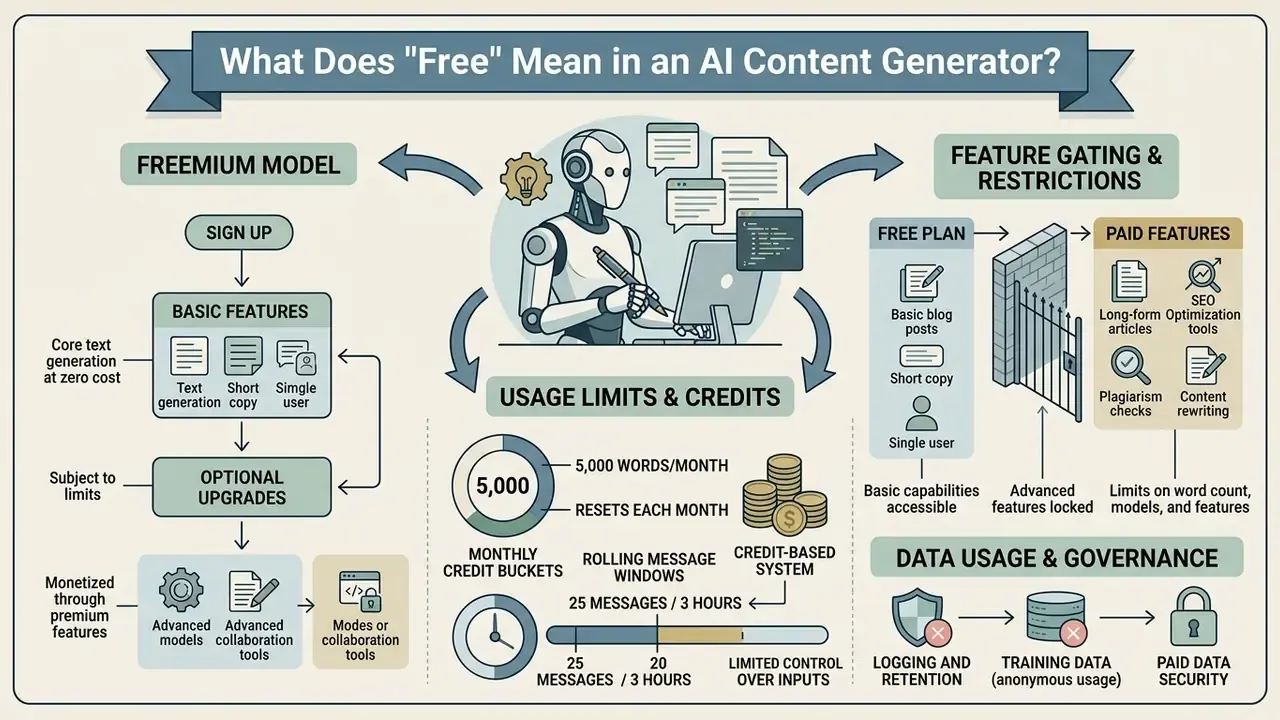
"Free" in an ai content generator for free usually means a freemium pricing structure: you get core text generation at zero cost, subject to daily, monthly, or feature-based limits. Vendors offer that access to build acquisition channels, gather feedback, and demonstrate value before nudging you toward a paid tier.
The scale of that funnel is now visible in the web index itself:
«Of 900,000 newly created web pages analyzed in April 2025, 74.2% contained at least some AI-generated content.»
Practically, "free" arrives in three commercial shapes, and vendors rarely label which one you are getting:

When you use an ai content generator free of charge, the provider's token cost does not disappear. To manage infrastructure expense, platforms apply technical boundaries to free accounts: capping daily prompts, throttling generation speed at peak traffic, or routing free requests to smaller, cheaper language models. That last one is the sneaky part. Your prompt did not get worse; the model behind it did.
Free Plans, Credits and Usage Limits
Free AI services control usage through three mechanisms: fixed usage windows, monthly credit allocations, and feature gating. Understanding them prevents an unpleasant interruption halfway through a deadline.
- Rolling message windows ChatGPT and Claude commonly limit free users to a set number of interactions (roughly 10 to 25 messages) per 3-to-5-hour window. Once you hit it, access drops to a lower-capacity model or pauses until the window resets. Claude's documentation describes this as a rolling five-hour session window rather than a fixed daily count.
- Monthly credit buckets Copy.ai and Canva Magic Write assign a fixed allocation of generation credits (for example 100 prompts or 2,000 words per month) that resets on a 30-day cycle. Adobe's generative-credit documentation adds a second wrinkle: credits can expire one month after allocation, and free access is limited to a curated subset of models.
- Feature gating free plans routinely disable file uploads, real-time browsing, custom system instructions, API access, or automated team workflows. The same constraint logic governs adjacent media categories. Compare the limits behind free AI video generators and free photo editors, where watermarking, resolution caps, and export restrictions simply replace word caps.
- Logging and retention rarely advertised, always relevant. Free tiers typically offer no prompt-level audit logs, no retention controls, no data-processing agreement. Which is precisely what a risk function needs before it signs off.
The upside, when governed, is real. In one corporate field experiment with a GPT-3.5-based assistant, measured time savings ranged from 3.3% on email drafting to 69% on text summarization (Trane Technologies PAT experiment, preprint 2024, https://papers.ssrn.com/). Microsoft's larger study points the same direction:
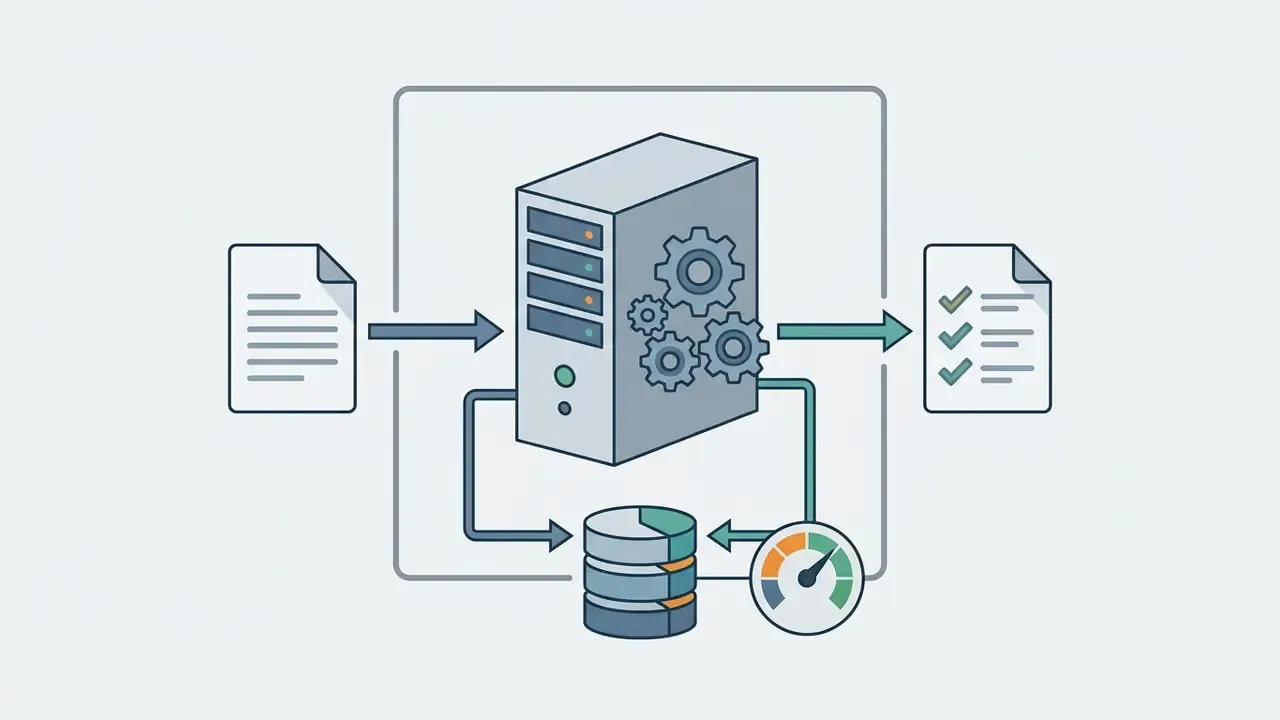
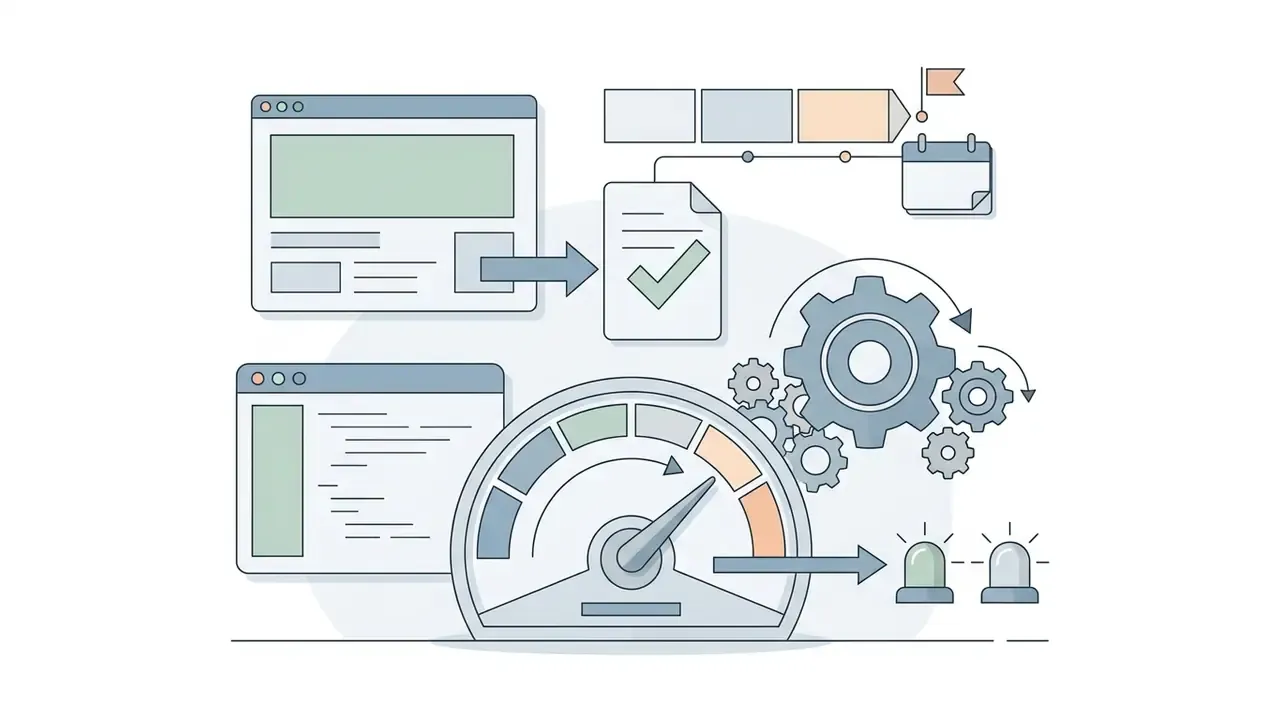
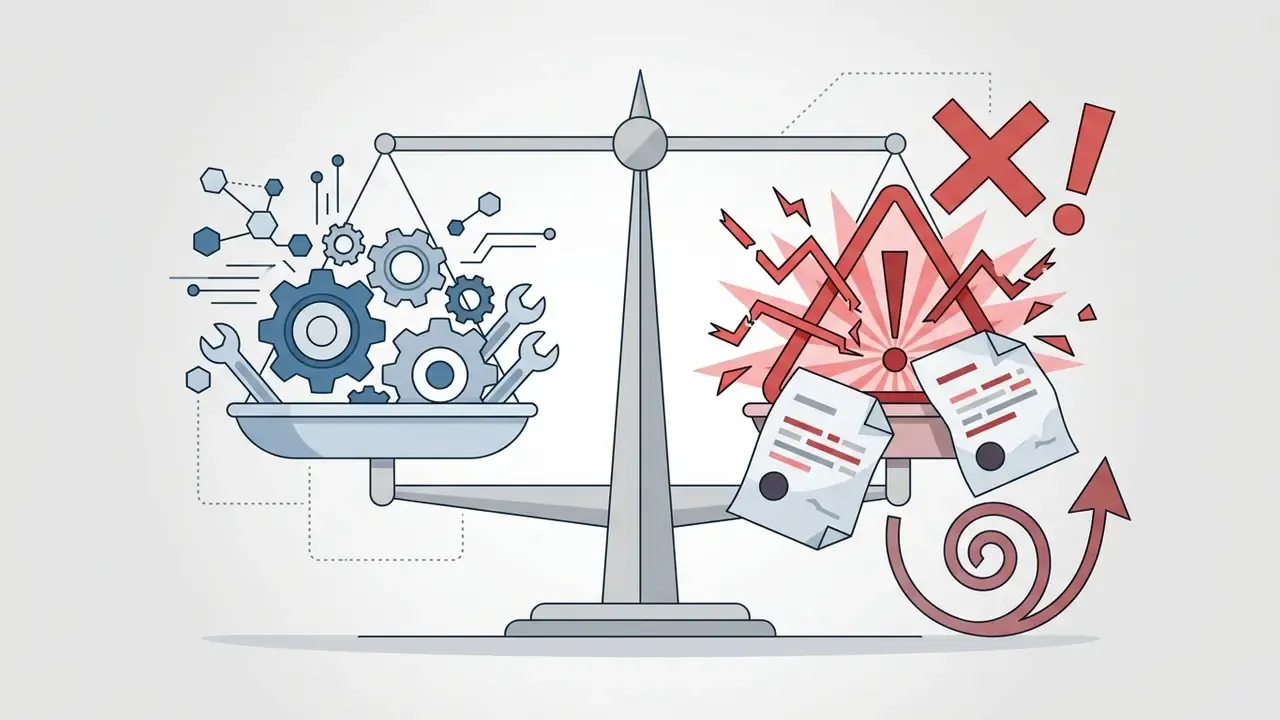
In one illustrative operational risk assessment for a financial analytics team (composite example, not a named client), unmonitored reliance on a free ai tool generator produced delays when mid-tier model caps hit during peak reporting hours. Moving the workflow to an open-source local model with daily quota monitoring removed the throttling and preserved data confidentiality.
Shadow AI: Security Checklist Before You Approve a Free Tool
Free tools spread through organizations without procurement review. That is the working definition of Shadow AI. Run this checklist before granting internal permission to use any free content generator ai.
| # | Control question | Pass condition |
|---|---|---|
| 1 | Are inputs used to train the vendor's models by default? | Training on inputs is off, or the plan never touches sensitive data |
| 2 | What is the stated retention period for prompts and outputs? | Documented, bounded, acceptable to your data policy |
| 3 | Is a data-processing agreement available on the free tier? | Usually no on free tiers, so treat it as a blocker for regulated data |
| 4 | Does the ToS permit commercial use of outputs? | Explicitly permitted in writing, not inferred |
| 5 | Can prompts and outputs be exported for audit? | Manual export at minimum, API or log export preferred |
| 6 | Is access authenticated via corporate SSO? | SSO available, or usage restricted to non-sensitive tasks |
| 7 | Is there a documented human-review step before publication? | Named reviewer, recorded approval |
| 8 | Are PII, PCI, MNPI, and client identifiers technically blocked? | DLP rule, or failing that a written prohibition plus training |
| 9 | Does the tool disclose which model version served the output? | Model name and version visible for reproducibility |
| 10 | Is there an approved alternative for sensitive workloads? | Internal or enterprise-tier tool exists and is documented |
Features to Check Before You Start Writing
| Tool / Platform | Login Required? | Free Tier Limits | Model Access (2026 Standard) | Export Formats | Best For |
|---|---|---|---|---|---|
| ChatGPT (Free) | Yes | ~10 msgs / 5 hrs, then Mini fallback | GPT-5.2 / GPT-5 Mini | Copy, TXT | General drafting and complex ideation |
| Claude (Free) | Yes | Dynamic 5-hr window (10 to 25 msgs) | Claude Sonnet 4.5 | Copy, TXT | Structured long-form and nuanced analysis |
| Gemini (Free) | Yes | Standard daily caps | Gemini 2.0 Flash / Pro | Google Docs, Gmail | Live web research and Workspace integration |
| Perplexity (Free) | No (Basic) | Unlimited basic search, limited Pro | Model Router + Live Web | Copy, MD | Cited academic and market research |
| QuillBot | No (Basic) | Paraphraser limit (~125 words/run) | Proprietary Rewriter | TXT, DOCX | Sentence rephrasing and style adjustments |
| Canva Magic Write | Yes | ~25 monthly uses on Free tier | Canva Design AI | PDF, PNG, DOCX | Social graphics copy and visual slides |
| Copy.ai (Free) | Yes | ~2,000 words/month, limited workflows | Vendor-routed LLM | Copy, TXT | Ads, snippets, short-form campaigns |
| Rytr (Free) | Yes | ~10,000 characters/month, 30+ languages | Vendor-routed LLM | TXT, DOCX | Product blurbs, multilingual short copy |
| Grammarly (Free) | Yes | Grammar/clarity checks, ~100 AI prompts/mo | Grammarly AI | DOCX, in-app | Editing, corporate tone, proofreading |
Two takeaways from the table. Research-grade work belongs on a grounded tool with citations; volume short-form copy belongs on a credit-metered tool where the cap matches your monthly output. Pricing structures shift quarterly, so cross-check current tiers against our AI Media Pricing Guides before locking a production budget.
Best Free AI Content Generator Tools for Different Tasks
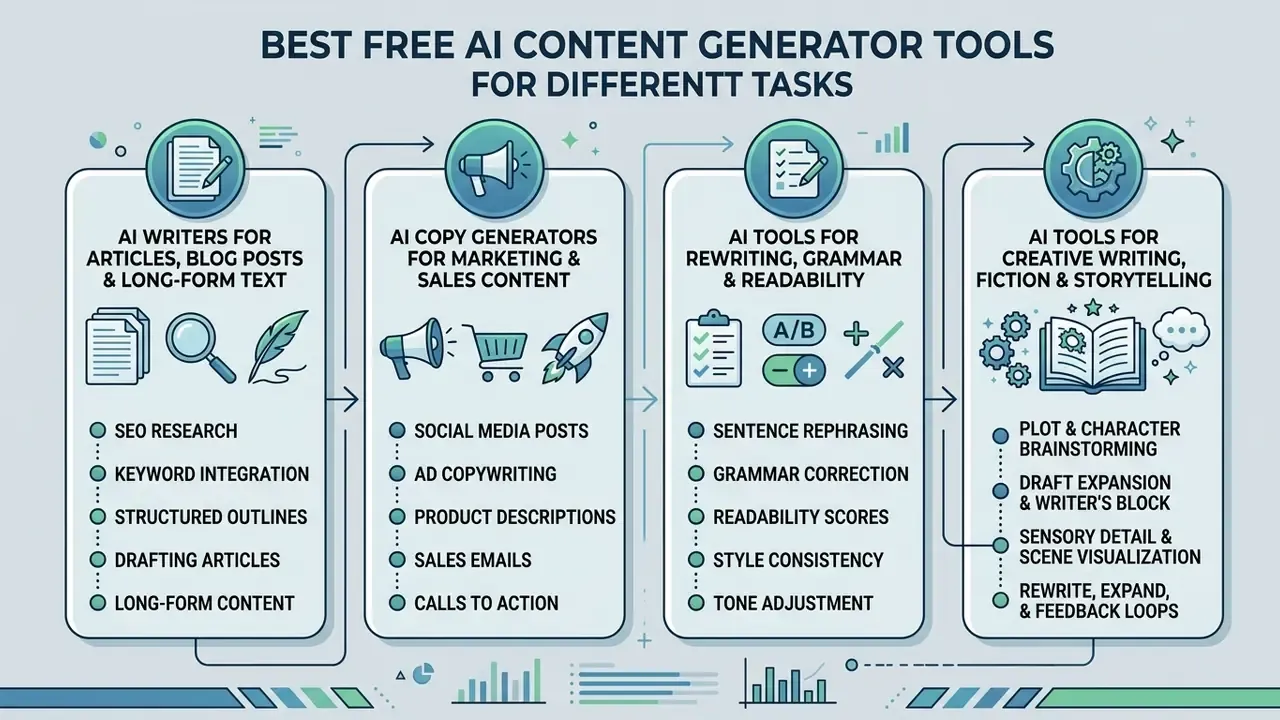
Different writing tasks need different capabilities. Choosing among free ai content generator tools depends on whether the project demands deep research, concise marketing copy, or careful editing. The same task-first logic applies across modalities. See how it plays out for visuals in our comparison of the best AI art generators.
AI Writers for Articles, Blog Posts and Long-Form Text
For long-form editorial work, general-purpose LLM interfaces (ChatGPT, Claude, Gemini) act as drafting engines. They are strong at multi-section article outlines, summarizing dense research papers, and expanding detailed bullets into cohesive body paragraphs.
For structured blogging, Canva Magic Write and Grammarly's AI outline generator help establish a logical hierarchy before drafting starts. HubSpot's free blog-post outline generator and Type.ai's long-form editor do the same job for teams that prefer a template-driven start. On technical or heavily regulated subjects, though, general AI writers demand strict human verification. They generate confident-sounding but inaccurate statements whenever contextual evidence is thin.
A long-form sequence that survives editing:
- Generate 10 angle options from a single topic line, then pick one manually.
- Ask for an H2/H3 outline with the search intent of each section stated explicitly.
- Draft section by section rather than whole-article, so each block stays inside a controllable context window.
- Request a "claims list" from the model: every factual assertion it made, extracted as bullets for verification.
- Rewrite the introduction and conclusion yourself. Those carry the most brand and expertise signal.
AI Copy Generators for Marketing and Sales Content
Marketing copy needs concision, emotional resonance, and a clear call to action. Specialized free ai copy generator interfaces (free generators from HubSpot, Copy.ai, WordStream) come pre-prompted to follow proven copywriting frameworks such as AIDA (Attention, Interest, Desire, Action) or PAS (Problem, Agitate, Solve). HubSpot's free Campaign Assistant goes further and reformats the same message per platform: landing page, email, Google Ads, LinkedIn, social.
These tools let a marketer produce multiple ad variants, e-commerce product descriptions, and email subject lines in minutes. The commercial effect has now been measured under experimental conditions:
«Across seven randomized field experiments on a large e-commerce platform, AI-generated marketing messages increased clicks by 3.1%, orders by 2.8%, and purchase probability by 3%.»
That is the strongest available evidence for AI-assisted short-form copy: modest per-message lifts that compound at volume, and only when the copy is reviewed before it ships. Send unreviewed claims into paid media and the arithmetic reverses fast.
AI Tools for Rewriting, Grammar and Readability
Refining existing text calls for editing assistants, not zero-draft generators. QuillBot, Wordtune, LanguageTool, and Grammarly all offer dedicated rewriting modes that improve readability, correct passive voice, and shift formality.
QuillBot provides instant paraphrasing without mandatory account creation, which makes it handy for quick sentence restructuring, and its grammar checker exposes rewrite, expand, and simplify commands. Grammarly's free tier pairs real-time grammar detection with basic tone detection, useful for keeping corporate emails and client communications on a professional register. Wordtune's free version supports formal and casual tone switching plus sentence-length control, while LanguageTool's paraphraser offers five distinct tones. The same "polish, don't create" principle governs adjacent tooling. Compare how enhancement-first workflows operate in online photo editors.
| Scenario / Task | Recommended Free AI Tool | Core Strengths | Primary Limitation |
|---|---|---|---|
| Long-form articles | ChatGPT / Claude | Deep context handling, structured outlines | Usage window caps during peak hours |
| Real-time web research | Perplexity / Gemini | Live web grounding with source links | May miss niche paywalled sources |
| Short marketing copy | Copy.ai (Free) / HubSpot | Framework-driven (AIDA/PAS), fast variants | Strict monthly credit allocations |
| Sentence rewriting | QuillBot / Wordtune | Instant rephrasing, tone switching | Character or word count limits per run |
| Grammar and proofreading | Grammarly / LanguageTool | In-line syntax, punctuation, clarity flags | Advanced style suggestions behind paywall |
| Multilingual short copy | Rytr / DeepL Write | 30+ languages, native idiom handling | Character caps on free plan |
| Creative fiction | Sudowrite (trial) / Claude | Scene expansion, sensory description | No permanent free plan on Sudowrite |
Practical read: pick one grounded research tool, one drafting tool, one editor. Three tabs, not eleven.
AI Tools for Creative Writing, Fiction and Storytelling
Unlike structured B2B copy, fiction demands narrative depth, character consistency, and sensory texture. Dedicated creative tools (Sudowrite's trial tier, Plot Generator's free utilities, Rytr's story-plot and song-lyric use cases) split storytelling into phases rather than templates:
- Plot and character brainstorming character backstories, world-building rules, motivation conflicts, and plot-twist options from a one-line premise, organized on a canvas before drafting begins.
- Draft expansion and writer's block "Write"-style modes that generate the next 300 words or so in your established voice when momentum stalls.
- Sensory detail and scene visualization "Describe" functions that enrich prose along one chosen sense (sight, sound, smell, texture) instead of stacking generic adjectives.
- Rewrite, expand and feedback loops rewriting whole sections at different lengths, then asking for three concrete improvement areas per pass, repeated until the scene holds.
Creative and games-adjacent teams live in the same free-tier economy, where playful utilities such as a video game name generator, a video game maker toolkit, or video face swap tools sit beside text generators with the same credit logic. Teams pairing prose with narration should check adjacent limits early too. See our guide to AI voice generators for narration licensing and quality constraints.
What Content Can You Create With a Free AI Writer?
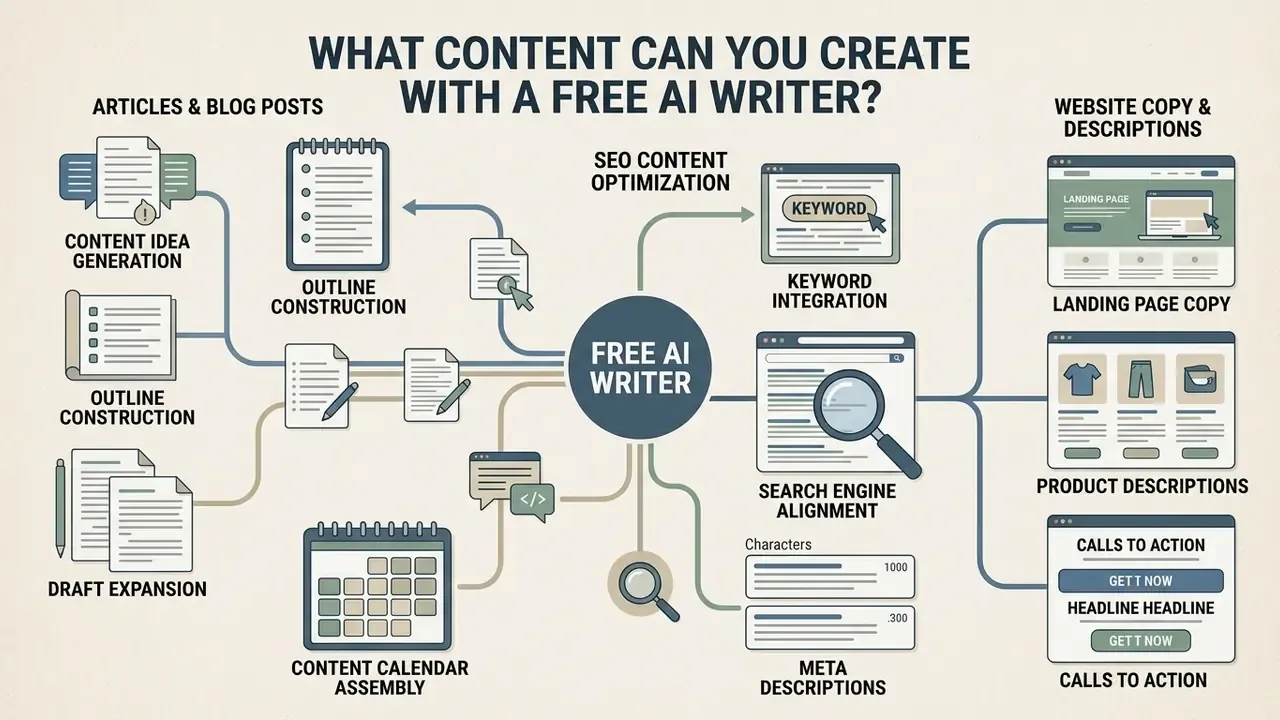
A free ai article generator or copy generator can produce a wide spread of written formats across editorial, commercial, and technical domains: website pages, ads, blog posts, emails, job descriptions, reports, proposals, cover letters, academic summaries, literature reviews, SOPs, onboarding docs, and internal knowledge-base drafts.
Articles, Blog Posts and Content Ideas
Writers use a free content ai generator mainly to beat blank-page syndrome in the early phase of article production:
- Content idea generation prompt the tool with a niche topic and get dozens of sub-topics, headline options, and angle variations.
- Outline construction generate structured H2 and H3 headings so coverage of user intent is checked before full paragraphs exist.
- Draft expansion turn research notes into a readable first draft and shorten the production cycle measurably.
- Content calendar assembly group selected topics against goals, channels, and publication dates to produce a 4-week or quarterly plan instead of scattered posts.
Teams standardizing production costs across text, image, and video assets can benchmark unit economics with our interactive AI Media Calculators. If you staff around those assets, the adjacent role economics matter as well: our references on video editor skills, video editor jobs, and video editor salary give a sense of what human production actually costs next to a free generator.
SEO Content Optimization and Search Engine Alignment
Website Copy, Product Descriptions and Calls to Action
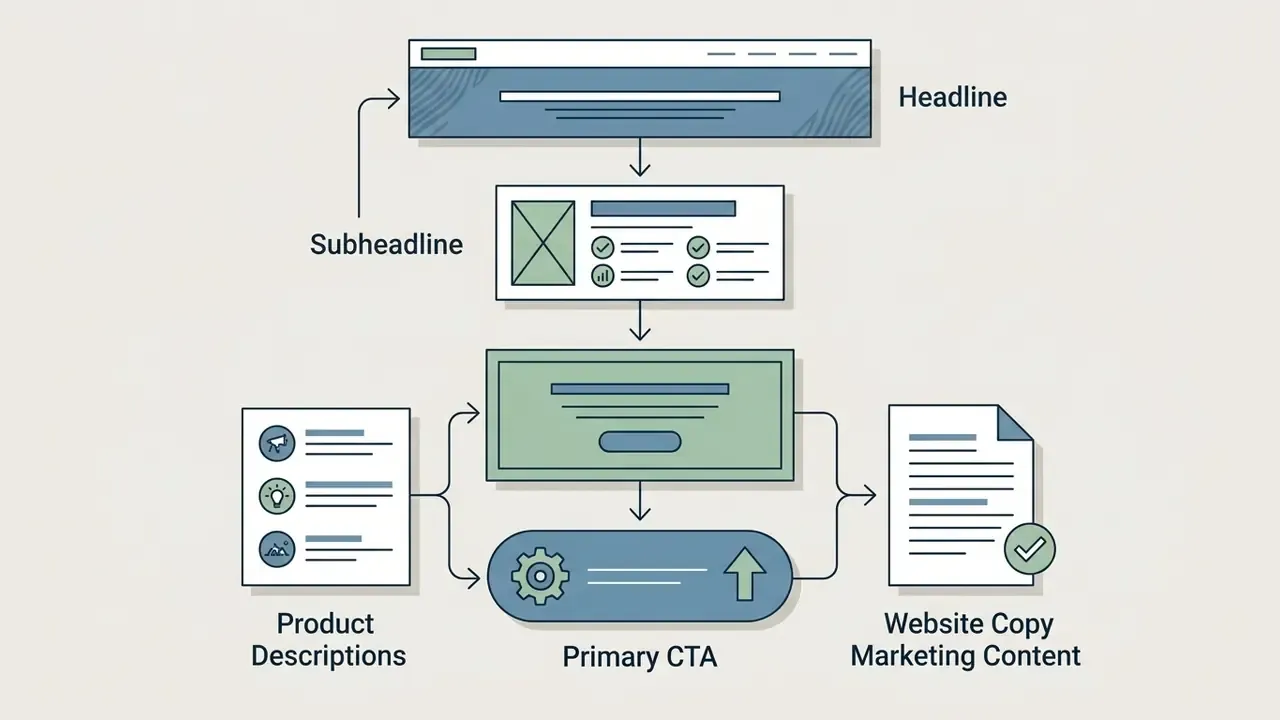
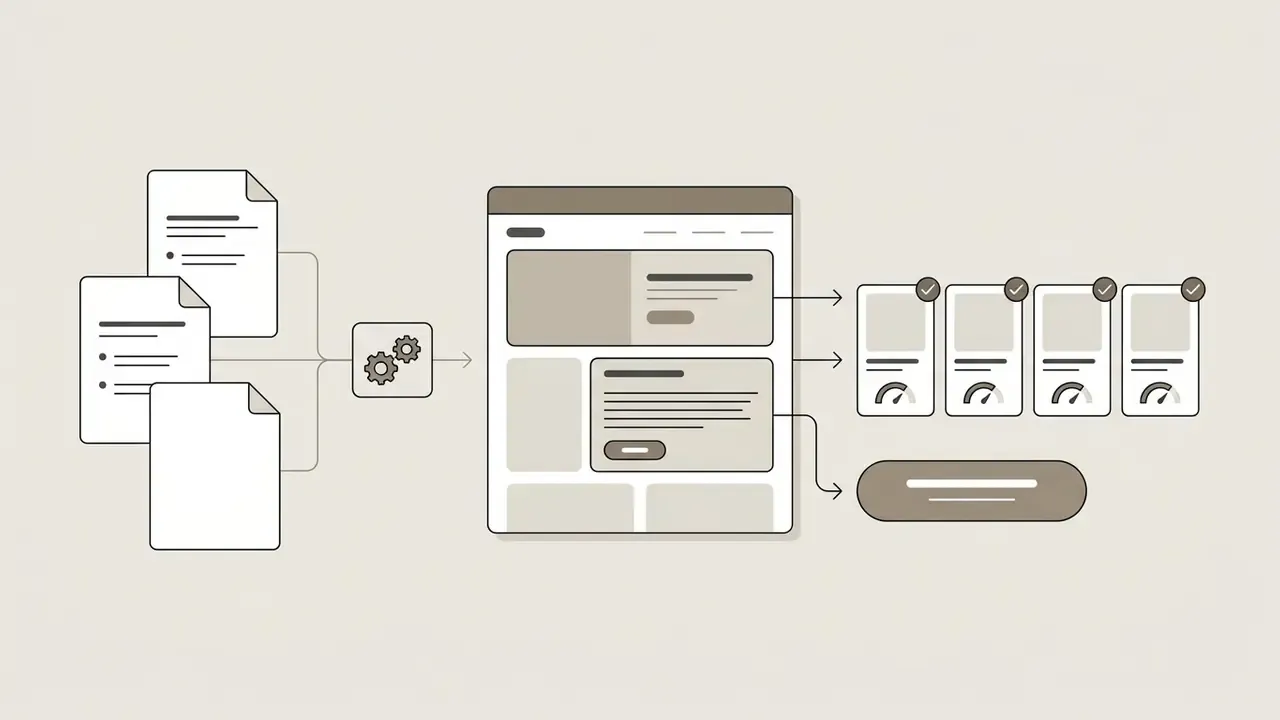
Keeping conversion-oriented copy fresh across hundreds of pages is a primary use case for an ai website content generator free of charge:
Product pages usually need imagery next to the copy. If you source visuals from generative tools, confirm licensing first through our overview of the Canva AI generator's commercial terms.

How to Get Better Results From a Free AI Content Generator
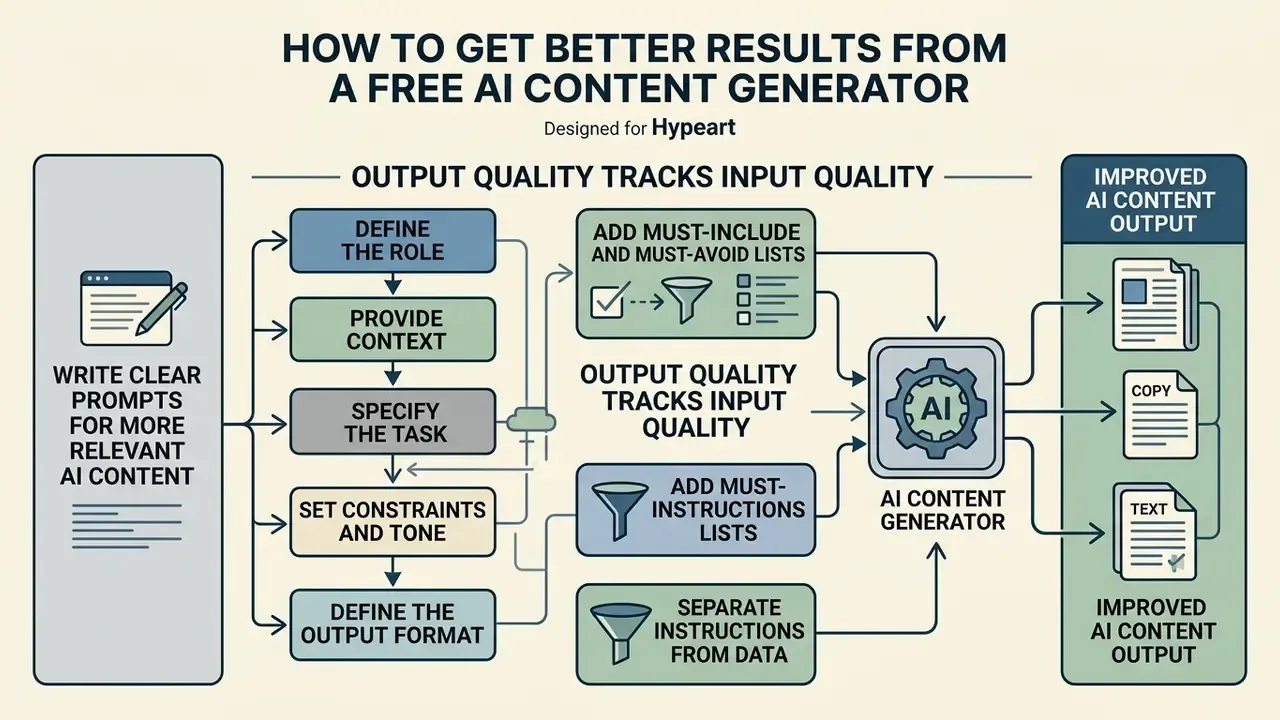
Output quality tracks input quality almost linearly. Treat an ai free content generator as an executing assistant rather than an autonomous author and results improve immediately.
Write Clear Prompts for More Relevant AI Content
For precise, contextually relevant text, structure prompts with an established framework: COSTAR (Context, Objective, Style, Tone, Audience, Response), RTF (Role, Task, Format), or the four-part Prompt Canvas (persona and audience; goal and steps; context and references; format and tonality).
- Define the role "Act as a senior B2B marketing strategist."
- Provide context "We are launching a compliance reporting feature for mid-sized credit unions."
- Specify the task "Draft a 300-word product announcement blog post highlighting auditability."
- Set constraints and tone "Professional, analytically confident. Avoid hype words like 'revolutionary' or 'game-changing'."
- Define the output format "Opening summary, three bulleted benefits, one clear call to action."
- Add must-include and must-avoid lists naming required terminology and banned claims strips irrelevant output and stops free credits from funding drafts you cannot use.
- Separate instructions from data Stanford's practical prompting guidance recommends keeping instructions short, specific, and placed at the start or end of the prompt, clearly delimited from pasted source material.
Skill still matters more than tooling. Frameworks raise the floor, not the ceiling:
«34% of students showed no writing improvement when using ChatGPT, and higher-ability students extracted greater benefit from AI assistance.»
The operational implication: pair AI access with prompt training and editorial standards, or the tool amplifies your weakest writer's judgment instead of your strongest editor's.
Multilingual Drafting and Plagiarism Verification
Across global markets, translation alone is not enough. Rytr and DeepL Write generate directly in 30+ languages, adapting idiom, formality register, and cultural framing natively instead of mapping English structures onto another grammar. Three rules keep multilingual output usable:
- Generate natively in the target language, then have a native speaker review. Do not translate a finished English draft and publish it.
- Localize proof points, currencies, units, legal disclaimers, and examples, not just wording.
- Keep a per-language glossary of brand and product terminology inside the prompt so terms stay consistent across markets.
Because LLMs predict statistically probable text, accidental similarity to existing web copy happens, especially in factual definitions and product boilerplate. Always run zero-draft output through a plagiarism and originality check (Copyscape, or the built-in checkers offered by tools like Rytr, which screens all generated content) before publication. Record the result alongside the draft. An originality report is one of the cheapest pieces of audit evidence you will ever produce.
Edit AI-Generated Text for Grammar, Accuracy and Readability
FACT CHECK & EDITORIAL VERIFICATION REQUIREMENT
Evidence trail: what to log for every published AI-assisted asset. Verification that leaves no record is indistinguishable from no verification. Store the following as one record per asset:
| Field | Why it matters |
|---|---|
| Prompt text (final version) | Reproducibility of the output |
| Tool, model name and version | Model behavior changes between releases |
| Raw output (pre-edit) | Shows the delta contributed by human authorship |
| Published version | The claim of record |
| Named reviewer plus approval date | Accountability and ownership |
| Source list per factual claim | Fact-check defensibility |
| Originality/plagiarism check result | Duplicate-content and IP defense |
| Data-sensitivity attestation | Confirms no PII or confidential input was used |
That mirrors the control logic public bodies now impose internally. The U.S. Consumer Product Safety Commission's generative-AI use policy (2026) requires cross-referencing outputs with official sources, fact-checking citations, testing outputs, and involving subject-matter experts on specialized topics.
In one editorial review of corporate technical documentation, an unedited free ai website content generator draft introduced conflicting API parameter instructions. A mandatory human review step, supported by our technical references such as the api documentation and the AI Media Support and Troubleshooting hub, caught the inaccuracies before deployment and protected live integrations. Small step, large saved incident.
Can You Use Free AI-Generated Content for SEO, Business and Client Work?
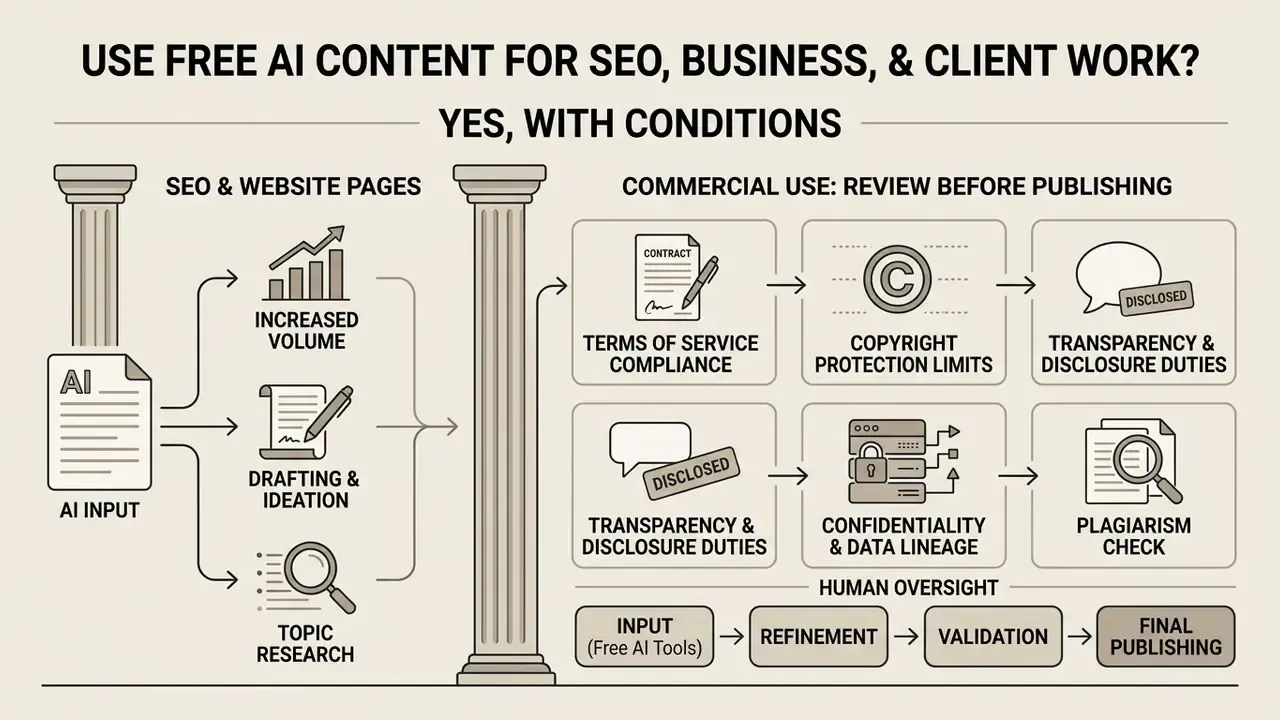
Yes, with conditions. Commercial and SEO use is permissible provided the published material delivers genuine value, accurate information, and a decent reading experience.
The economic pull is obvious, which is exactly why governance is needed:
«AI content is on average 4.7× cheaper than human content, enabling roughly 47% more published output on the same budget.»
Cheaper production only creates value if the published result still earns trust. Volume without verification is how sites acquire scaled-content-abuse problems instead of traffic.
Using AI Content for SEO and Website Pages
Official guidance from Google states that using AI or automation to generate content is not inherently against search guidelines. Google's published position: "appropriate use of AI or automation is not against our guidelines," and its systems reward original, high-quality, people-first content demonstrating E-E-A-T regardless of how it was produced (Google Search Central, Google Search and AI-generated content, https://developers.google.com/search/blog/2023/02/google-search-and-ai-content). Google's 2026 spam policies simultaneously prohibit scaled content abuse and content created primarily to manipulate rankings.
Use an ai copy generator free of charge to mass-produce spun text aimed at rankings, and you are squarely inside those spam policies. The ranking data supports a nuanced reading:
«Pages ranking in position 1 were eight times more likely to be classified as human-led than AI-generated.»
In that same Semrush study, human-led content held an 80.5% probability of occupying position 1. The counterweight comes from Ahrefs:
«86.5% of top-20 pages contain at least some AI content, and the correlation between AI-text share and ranking position is 0.011, effectively zero.»
Read together, the two datasets say the same thing from opposite directions. AI involvement is neither a penalty nor an advantage. Search engines reward helpful, verifiable content, not unedited automated volume.
Commercial Use: What to Review Before Publishing
Before you put text from a free ai writing generator app into client projects, paid advertising, or a commercial product, run a legal and terms-of-service review:
- Terms of service compliance verify whether the free plan permits commercial usage. Some providers reserve commercial rights for paid subscribers and restrict free accounts to personal or educational evaluation. OpenAI's Terms of Use, for instance, assign all right, title, and interest in output to the user. That is a contractual position, not a copyright grant, and it does not generalize across vendors.
- Copyright protection limits under current US Copyright Office guidance, purely AI-generated text lacking sufficient human creative authorship is not eligible for copyright protection (U.S. Copyright Office, Copyright and Artificial Intelligence, https://www.copyright.gov/ai/). Prompting alone is not authorship. To hold IP rights in a commercial asset, human writers must substantially edit, structure, and refine the draft. The same authorship threshold governs generated visuals. Compare the licensing analysis in our AI Media Commercial-Use Hub.
- Transparency and disclosure duties in the EU, the AI Act's Article 50 transparency regime and the accompanying Code of Practice on Transparency of AI-generated Content require providers to support machine-readable marking of synthetic content and to inform users when they interact with an AI system. For client-facing operations in European markets, disclosure is a compliance requirement, not a stylistic choice.
- Confidentiality and data lineage free platforms often reserve the right to use submitted prompts to train future model iterations. Never input proprietary business data, trade secrets, or client PII into an unencrypted free generator. The convenience is never worth the incident report.
For legal background on AI IP disputes and past regulatory rulings, consult our AI Litigation and Case Timelines overview.
Limitations, Open Questions and a Safe Next Step
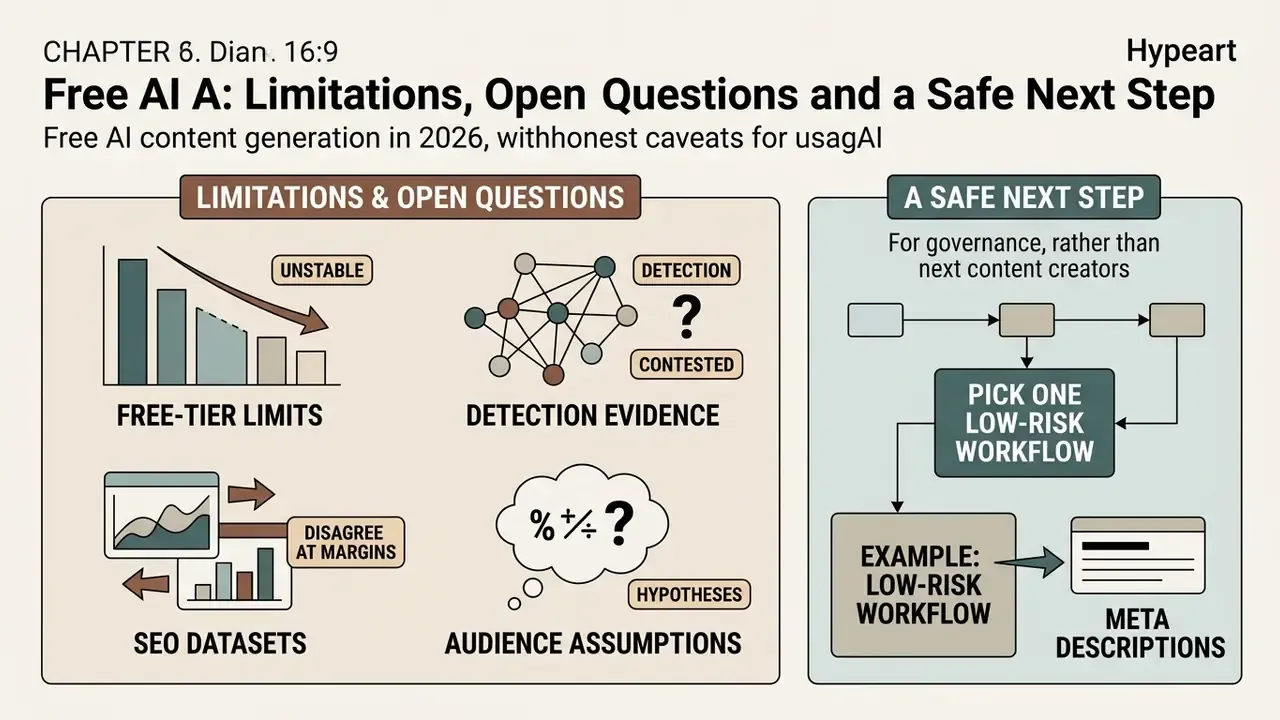
Honest caveats belong in any guide that touches governance.
- Free-tier limits are unstable. Every cap listed here reflects Q1 2026 vendor documentation. Providers adjust windows and credits without notice, sometimes weekly.
- Detection evidence is contested. AI-text classifiers produce false positives on non-native English writing, so treat detector scores as a signal for review, never as a verdict.
- The SEO datasets disagree at the margins. Semrush and Ahrefs use different classifiers and different page samples. Their broad agreement (quality wins, authorship method is neutral) is more reliable than either headline number.
- Audience assumptions remain hypotheses. Statements about how risk and finance leaders evaluate these tools should stay labeled as hypotheses until analytics, interviews, or CRM data confirm them.
A safe next step, if you own governance rather than content: pick one low-risk workflow (meta descriptions, internal FAQ drafts), run it through the ten-question Shadow AI checklist, log the evidence fields for 30 days, then decide whether to widen access or move the workload to an internal model. Small pilot, real record, reversible decision.
FAQ: Free AI Content Generators and Free AI Writers
People searching for an ai information generator free of charge usually want cited answers rather than polished prose. These short answers cover the questions that follow that intent.
Which Free AI Writer Includes Citations?
Perplexity AI and Google Gemini provide real-time web grounding with inline source citations on their free tiers. Perplexity displays numbered, clickable citations linking directly to the pages used to build the answer. Gemini shows inline source links and annotation panels whenever web search grounding is triggered, and Google's help documentation notes that a Sources button appears only when sources are available. Standard free chat tools such as base ChatGPT do not include live web citations unless browsing is active. Note the distinction between product citations and academic citation: APA and Chicago both require you to credit AI-generated text you use, whatever the interface displays.
Can a Free AI Writing Generator App Replace a Human Writer?
No. A free AI writing generator app speeds up drafting, brainstorming, and editing, but it does not replace writers. Models lack real-world experience, empathy, strategic judgment, and original research capability. NIST guidance emphasizes that human oversight is essential for reviewing AI-generated content to manage operational and reputational risk.
«A meta-analysis of 46 studies (2000 to 2025) found a positive average effect of AI writing support: Hedges' g = 0.601 (95% CI [0.437, 0.766], p < 0.001).» Wu et al., meta-analysis (2026). https://doi.org/
The effect is real but bounded. AI support measurably improves writing quality when a competent human directs it. The workable model is hybrid: AI handles routine drafting, humans own strategy, fact-checking, tone control, and brand alignment.
Can an AI Text Generator Create Content From a Short Idea?
Yes. Modern autoregressive models can take a five-word topic or a single sentence and expand it into a structured article, outline, or paragraph. The mechanism is simple in principle: predict one token, append it to the running context, repeat until a stopping condition is met. Research on prompt-to-story generation demonstrates the same behavior for long narrative text. To keep the expansion accurate and relevant, supply constraints on audience, structure, and tone. And note the legal consequence: a short prompt alone does not create copyrightable authorship in the output.
Do Free AI Generators Support Languages Other Than English?
Yes. Rytr advertises generation in 30+ languages on its free plan, DeepL Write handles multilingual rewriting, and the major chat interfaces generate competently in dozens of languages. Quality is uneven, though. Fluency degrades on lower-resource languages, and idiom, formality register, and legal phrasing often need native-speaker correction. Generate natively in the target language rather than translating a finished English draft, and localize proof points, units, and disclaimers along with the wording.
Is AI-Generated Text Considered Plagiarism?
Not by definition, since the text is newly generated rather than copied. But because language models produce statistically probable phrasing, accidental overlap with existing web copy does occur, especially in definitions, boilerplate, and product descriptions. Run every draft through a plagiarism checker (Copyscape, or a built-in detector such as Rytr's) before publication and keep the report as audit evidence. Separately, in academic and journalistic contexts, undisclosed use of AI text may breach integrity policies even when the wording is original.
Which Free AI Content Generator Tool Should a Small Team Standardize On?
Pick by dominant task, not by brand. If most output is long-form editorial, a free chat interface with a large context window plus a grammar checker covers the majority of the work. If most output is short-form ads and product copy, a credit-metered content generator ai free plan such as Copy.ai or Rytr fits better, since caps are measured in words rather than messages. Research-heavy teams should default to a grounded tool with citations. Whatever the pick, document it: one approved free ai content generator tool with a written review step beats five unapproved ones.
When Should an Organization Stop Using Free Tools and Move to Enterprise or Local Models?
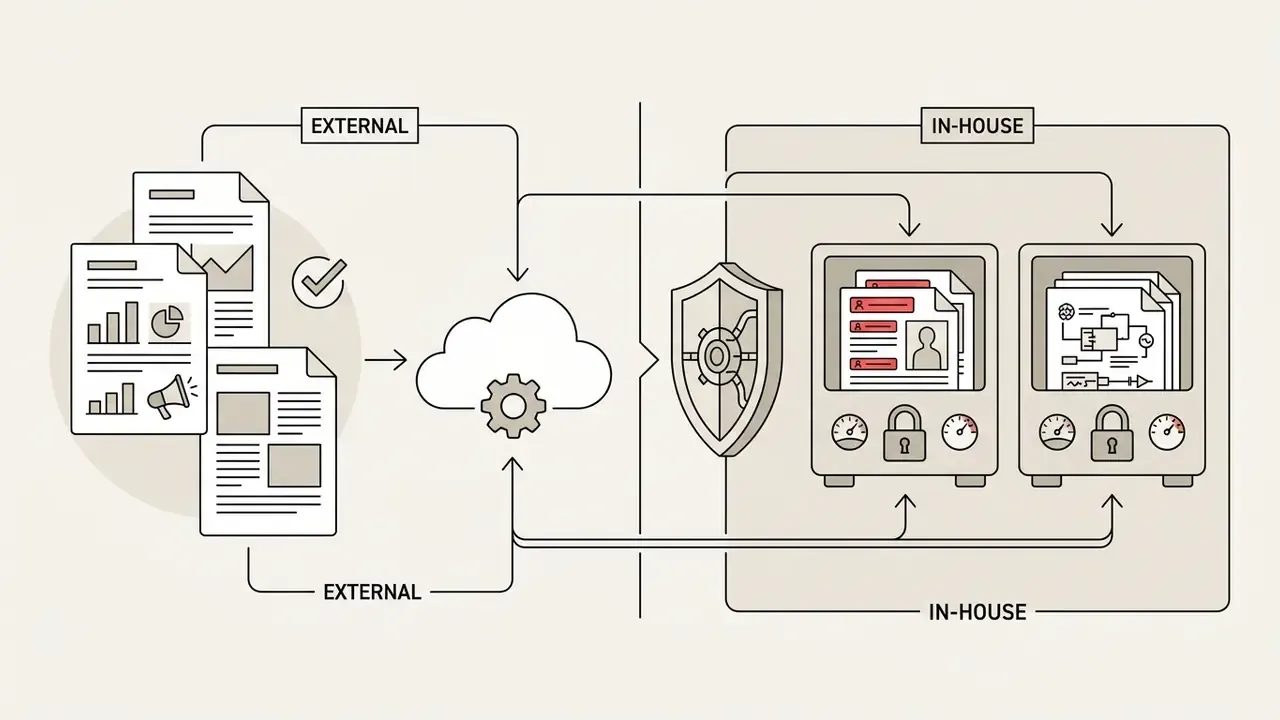
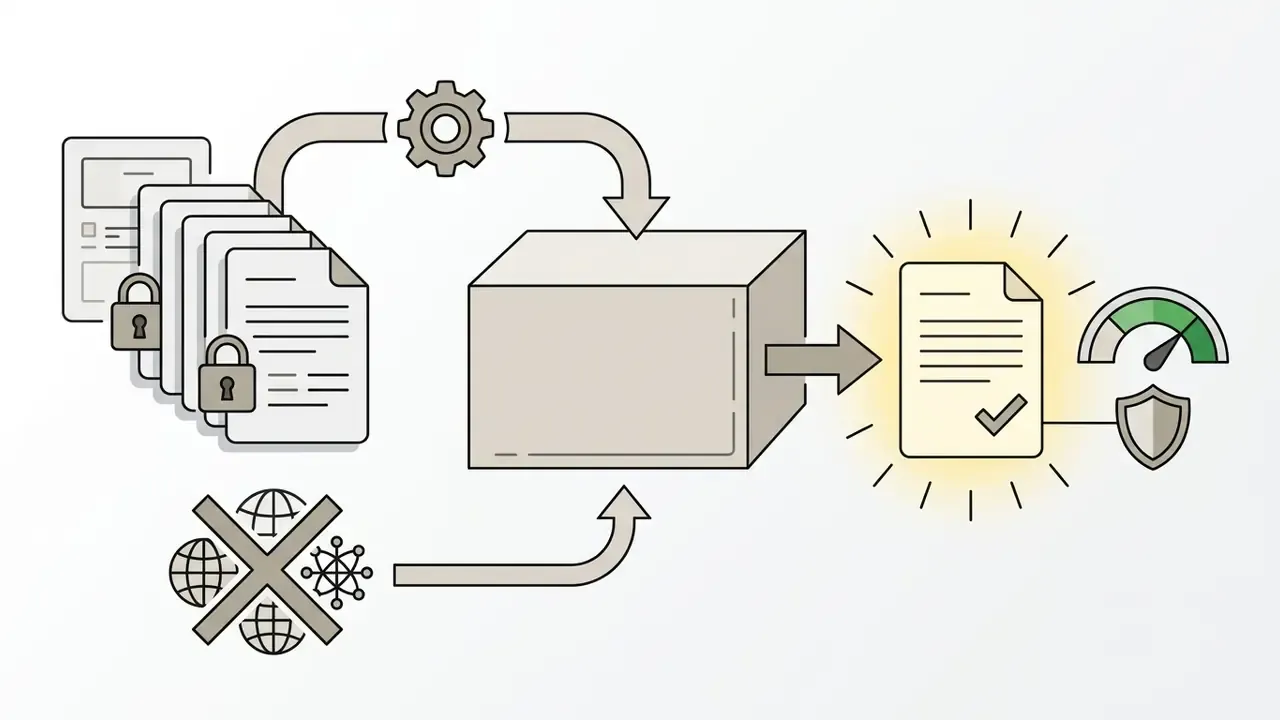
Four triggers, any one of which is sufficient. First, prompts would contain PII, client identifiers, or material non-public information. Second, the workflow needs prompt-level logs and retention controls for regulatory review. Third, throughput exceeds free-tier caps and throttling threatens deadlines. Fourth, commercial use of output is required and the free tier's terms do not clearly grant it. The migration pattern is usually a locally hosted open-weight model plus a RAG layer over approved internal sources, with logs written to an internal store: the same architecture described earlier in this guide.
Appendix A: Superseded Statements (Version Record)
Retained for transparency, since earlier versions of this page were cited elsewhere.