Evaluating video editor jobs means reading four things at once: role specialization, technical stack, market pay, and contract terms. The modern video editing labor market spans corporate marketing departments, social channels, newsrooms, and full-scale post-production studios. Matching your own capabilities to the right operational environment matters more than chasing a title. So read every job description for pipeline autonomy, distribution channels, and measurable output quality first. Editors comparing their own toolchain against market expectations can start with our overview of video editing tools and their commercial licensing terms.
One caveat before the numbers. Wage tables describe a market, not your offer.
Executive summary: what the numbers actually say
- Market size and pay U.S. official data reports roughly 25,610 employed film and video editors, a median wage of $75,420/year ($36.26/hour), and about 5,600 annual openings with 3% projected growth over the 2025–2035 decade.
- Pay spread matters more than the median the occupation ranges from $38,990 (10th percentile) to $154,480 (90th percentile). That is why level (junior, mid, senior, lead) and industry sector decide whether an offer is fair.
- Four role clusters marketing editors, social media editors, production and post-production editors, and broadcast or studio editors. They differ by content type, deadline pressure, team structure and delivery standards.
- Technical baseline employers assume delivery in 1080p HD or 4K at 24–60 fps, Rec.709 or Rec.2020 color, dialogue peaking between –6 dB and –12 dB, and broadcast loudness near –24 LKFS.
- Employment formats are legally distinct remote is a work arrangement. Freelance, fixed-term contract, part-time and internship are employment statuses with different tax, benefit and intellectual-property consequences.
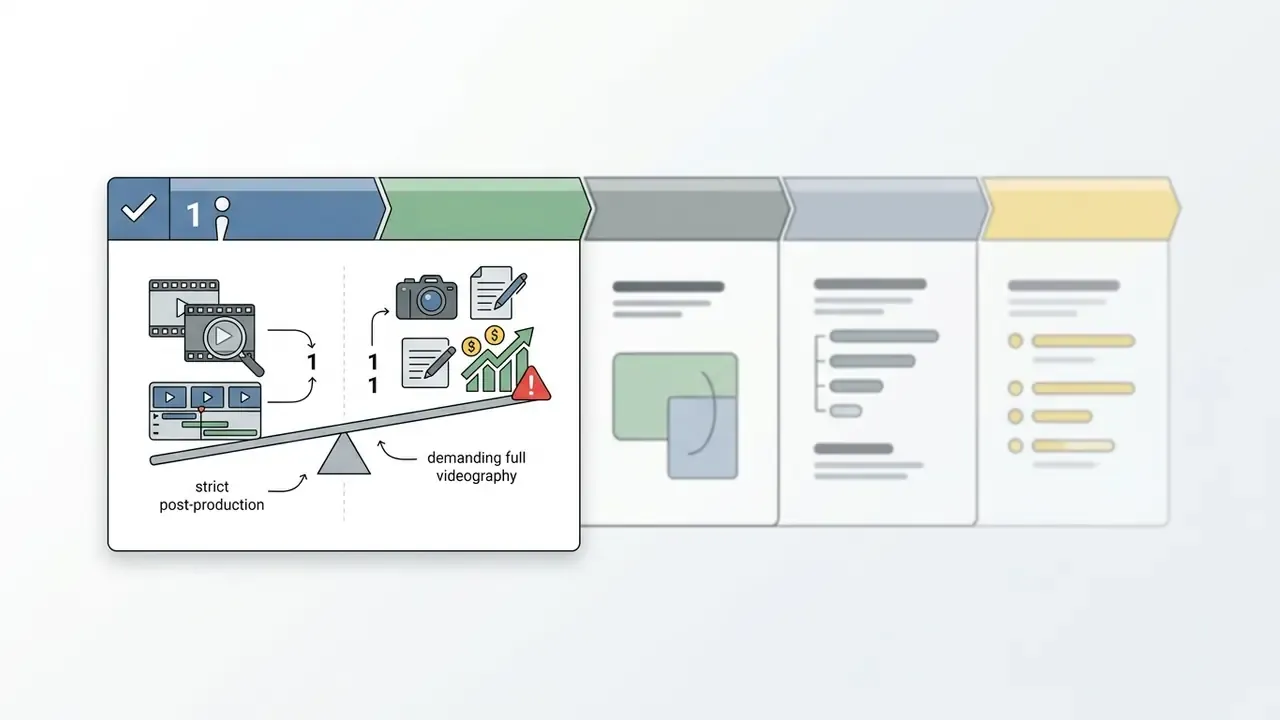
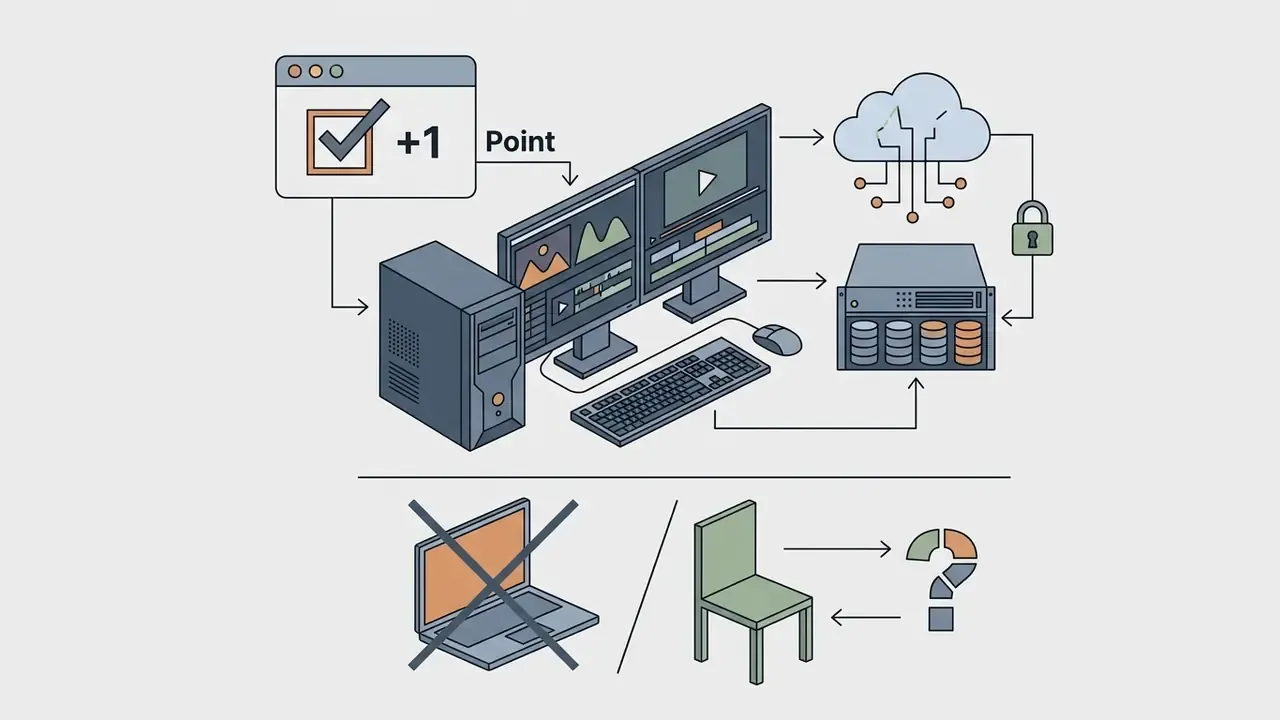
- Before applying score the vacancy on workload scope, hardware provision, pay transparency, test-task limits and approval hierarchy. A 5-point scorecard sits further down this page.
- Before hiring or being hired agree in writing on IP assignment, AI-tool usage, footage confidentiality and portfolio rights.
What video editor jobs are available?
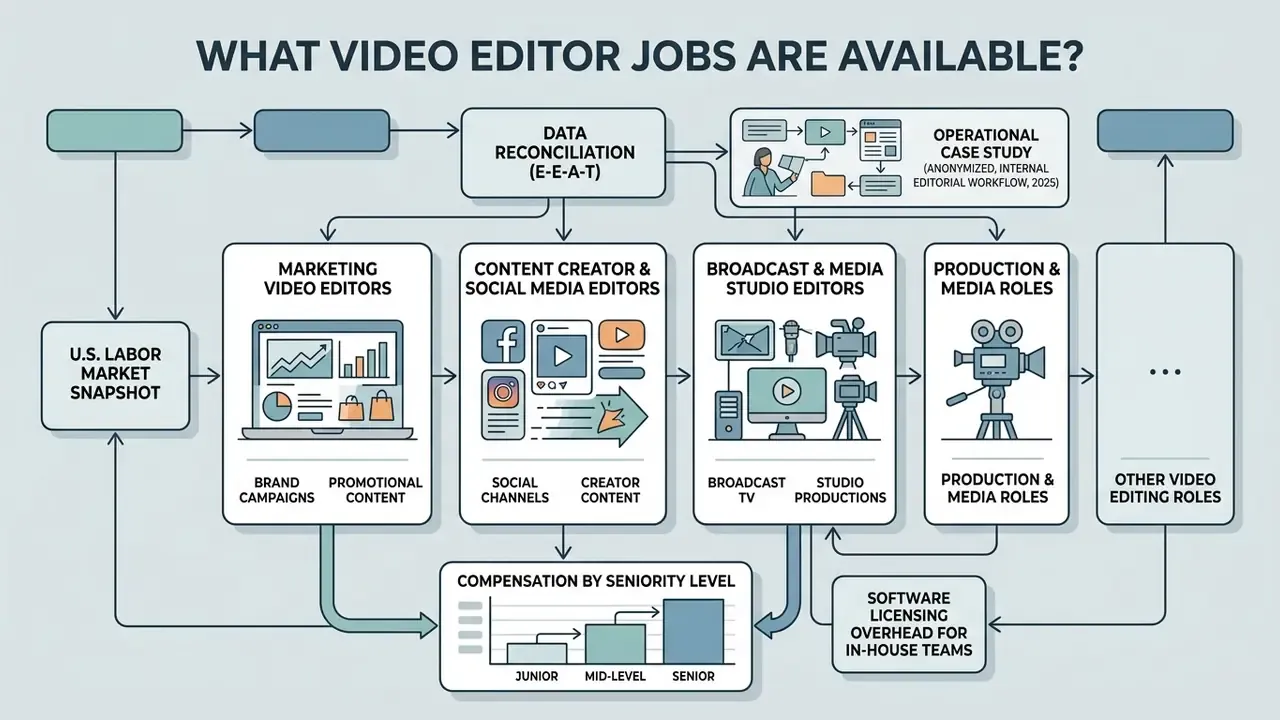
The video editing job market in 2026 splits into four primary role clusters: marketing video editors, content creator and social media editors, broadcast or media studio editors, and narrative post-production editors. Each cluster asks for a different mix of technical stack expertise, narrative pacing instinct, and distribution channel knowledge. Adjacent titles show up in the same searches too: video maker jobs, motion designer, assistant editor, videographer and producer roles frequently overlap in smaller teams.
According to the latest Occupational Employment and Wage Statistics (OEWS) release from the U.S. Bureau of Labor Statistics, approximately 25,610 film and video editors are employed across the United States. These professionals earn a median annual wage of $75,420, which works out to $36.26 per hour. Overall employment is projected to grow by 3% across the 2025–2035 decade, generating about 5,600 openings annually through industry expansion and net occupational turnover.
U.S. video editor labor market snapshot
| Labor market indicator (U.S.) | Value (BLS OEWS / Occupational Outlook) |
|---|---|
| Total employed film and video editors | 25,610 specialists |
| Median annual wage | $75,420 ($36.26/hour) |
| 10th percentile wage | $38,990/year |
| 90th percentile wage | $154,480/year |
| Projected annual openings | ≈5,600 per year |
| Projected employment growth (2025–2035) | ≈3% |
| Median wage, all U.S. occupations (benchmark) | $50,980/year |
Data reconciliation note (E-E-A-T): occupational databases do not fully agree, and pretending otherwise would be dishonest. BLS OEWS reports 25,610 employed editors inside the narrower "Film and Video Editors" wage series. O*NET reports a broader base of roughly 43,500 workers and about 3,600 projected annual openings for its 2024–2034 window. Wage figures line up ($36.26/hour, $75,420/year); employment and openings diverge because the datasets use different sampling frames and projection periods. Treat both as ranges, not absolutes.
Operational case study (anonymized, internal editorial workflow, 2025): a digital media initiative producing short-form commercial video needed to double weekly output without adding headcount. The creative team restructured raw footage intake into standardized assembly timelines (fixed bin hierarchy, proxy generation at ingest, locked sequence presets) and introduced templated lower-third and end-card graphics. Measurable result: weekly finished deliverables rose from 6 to 12 clips, average revision rounds fell from 3 to 1.6 per asset, and brand-standard checks (safe margins, logo placement, caption legibility) passed on first review in over 90% of cases. The lesson for job seekers is blunt: employers increasingly buy workflow systems, not raw cutting speed.
Industry demand concentrates in motion picture and video industries, which employ 14,790 film and video editors at a mean annual wage of $92,070. Advertising and public relations agencies employ 2,220 editors at a mean of $81,470. Streaming platforms and social media networks employ 2,370 editors earning an average of $82,310 annually.
That distribution carries a practical implication. The highest-paying editor roles are often not in entertainment at all. In-house video teams at financial, legal, consulting and enterprise SaaS firms compete for the same skill set, pay above studio averages, and add full employee benefits on top.
Compensation by seniority level
| Level | Typical experience | Core scope | Indicative U.S. pay range |
|---|---|---|---|
| Assistant editor / intern | 0–1 years | Ingest, transcode, sync, bin organization, exports | $15–$20/hour (intern); $28–$33/hour (assistant) |
| Junior editor | 0–2 years | Assembly cuts, social cutdowns, template graphics | ≈$39,000–$55,000/year |
| Mid-level editor | 3–5 years | Independent project ownership, motion graphics, audio cleanup | ≈$60,000–$85,000/year |
| Senior editor | 5+ years | Narrative pacing decisions, color and conform turnovers, client-facing reviews | ≈$85,000–$120,000/year |
| Lead editor / post supervisor | 7+ years | Quality standards, junior editor supervision, resourcing and pipeline architecture | ≈$110,000–$154,000+/year |
Ranges are modeled on BLS OEWS wage percentiles plus published hourly rates in contractor and part-time postings. Individual offers vary by metro market, industry and union coverage.
Software licensing overhead for in-house teams
Hiring managers budgeting a video seat should count tooling on top of salary. The usual line items: a Creative Cloud All Apps license, a DaVinci Resolve Studio key, an asynchronous review seat (Frame.io or equivalent), cloud and shared storage capacity, stock media plus music subscriptions, and audio repair plug-ins. Individually small against a salary; across a team of five or more, noticeable. Unbudgeted tooling is one of the most common reasons editors get asked to supply personal licenses and personal hardware, which is a quiet form of pay cut. Teams modeling render time, storage and throughput can use our AI Media Calculators, and license-tier comparisons are covered on our pricing overview.
Content creator and marketing video editor jobs
Content creator video editor jobs and marketing video editor jobs revolve around brand-aligned assets: product explainers, customer testimonials, webinar cutdowns, and high-performance social content. These roles prioritize message clarity, audience engagement and multi-platform format adaptation over long-form narrative storytelling.
Marketing video editors work shoulder to shoulder with growth marketers, creative directors and brand strategists. Daily tasks include converting raw interview footage into polished marketing clips, adding lower thirds, integrating call-to-action motion graphics, and formatting assets for websites, digital ad networks and email campaigns. Candidates comparing accessible toolchains for high-volume output can review our breakdown of free AI video generators and their export limits, plus licensing and deployment strategy in the AI Media Commercial-Use Hub.
Typical marketing workflows follow a repeatable sequence: audience and script definition, storyboard, capture or asset sourcing, timeline assembly, graphics with music and SFX, titles and subtitles, then platform-specific export. Throughput expectations are explicit in many postings. Short-form teams batch-shoot and batch-edit, so the role is measured on consistency and turnaround as much as on craft. Music-driven briefs also appear here, and editors who handle them well tend to know both a music video maker toolchain and where to source clean beds, including a music maker online free no sign up option for scratch tracks.
Social media video editors specialize in short-form vertical content for TikTok, Instagram Reels, YouTube Shorts and LinkedIn. Their responsibilities demand rapid pacing, platform-specific trend adaptation, caption integration and thumbnail creation. Teams producing promotional teasers often build high-impact hooks under tight deadlines with trailer-style templates and pre-built kinetic typography packs, which is where a movie trailer maker workflow earns its keep. Small practical detail that surfaces constantly in real briefs: silent autoplay. Knowing how to mute video online and rebuild a caption-first version is a routine ask, not a niche one.
Production, media and studio editing roles
Production, media and studio editing roles cover long-form narrative films, broadcast television, commercial production and live studio feeds. Editors here operate inside established post-production pipelines where timeline continuity, audio synchronization and technical color spaces are non-negotiable.
In broadcast news and television studios, editors assemble news packages, sports highlights and live-to-tape interview segments against the clock. Their workflows depend on multi-camera ingesting, shared storage architectures and precise timecode alignment. Technical setups commonly use Avid MediaCentral, Adobe Premiere Pro multi-camera source sequences, or Final Cut Pro multicam angle switching. Studio editors weighing where generative tooling fits a heavy-media pipeline can compare capabilities in our review of AI art and media generation tools, and check output-policy limits in our note on no filter ai claims before anything reaches a client timeline.
The canonical multicam pipeline in vendor documentation is consistent across platforms: ingest, sync by timecode or audio, multicam assembly, live angle switching in the angle viewer, picture and audio refinement, export to house delivery spec.
«Create angles, arrange clip order, then sync angles using a common sync point before cutting between angles in the angle viewer.»
«Import clips from different camera angles, then create a multi-camera source sequence for editing.» Adobe, Premiere Pro Help: multi-camera sequences (2026). https://helpx.adobe.com/premiere/desktop/edit-projects/set-up-multi-camera-sequences-for-editing/create-a-multi-camera-source-sequence.html
| Specialization | Typical video content | Core responsibilities | Team and organizational context |
|---|---|---|---|
| Marketing video editor | Brand videos, product explainers, client testimonials, webinars, corporate training | Edit high-quality commercial assets, integrate lower thirds, enforce brand consistency | Embedded in corporate marketing or PR departments; collaborates with marketers and executives |
| Social media editor | Short-form vertical videos, TikTok, Instagram Reels, YouTube Shorts, social ads | Create fast-paced content, add animated captions, adapt formats for platform algorithms | Digital or growth marketing teams; works alongside content strategists and copywriters |
| Production / post-production | Feature films, TV series, streaming shows, documentaries, national commercials | Assemble long-form narrative sequences, manage story pacing, coordinate sound and visual effects | Post-production houses or film studios; collaborates directly with directors and producers |
| Broadcast / studio editor | News packages, live studio broadcasts, sports highlights, network promotions | Rapid assembly under live deadlines, multi-camera switching, enforce broadcast technical standards | Television networks and newsrooms; collaborates with producers, directors and control room crews |
| Assistant editor | All of the above, in support capacity | Ingest and transcode, timecode and audio sync, bin structure, turnovers and exports | Reports to lead editor or post supervisor; low-to-moderate autonomy, house-standard driven |
Studio post-production roles mean managing heavy camera originals, holding bin organization together, and generating rough cuts for director review. Senior lead editors set visual standards, oversee assistant editors, and coordinate final conform turnovers for color grading and audio dubbing. Delivery formats vary more than newcomers expect, so competence with a plain mp4 video editor path for review copies still matters next to ProRes mastering.
Skills and video editing experience employers require
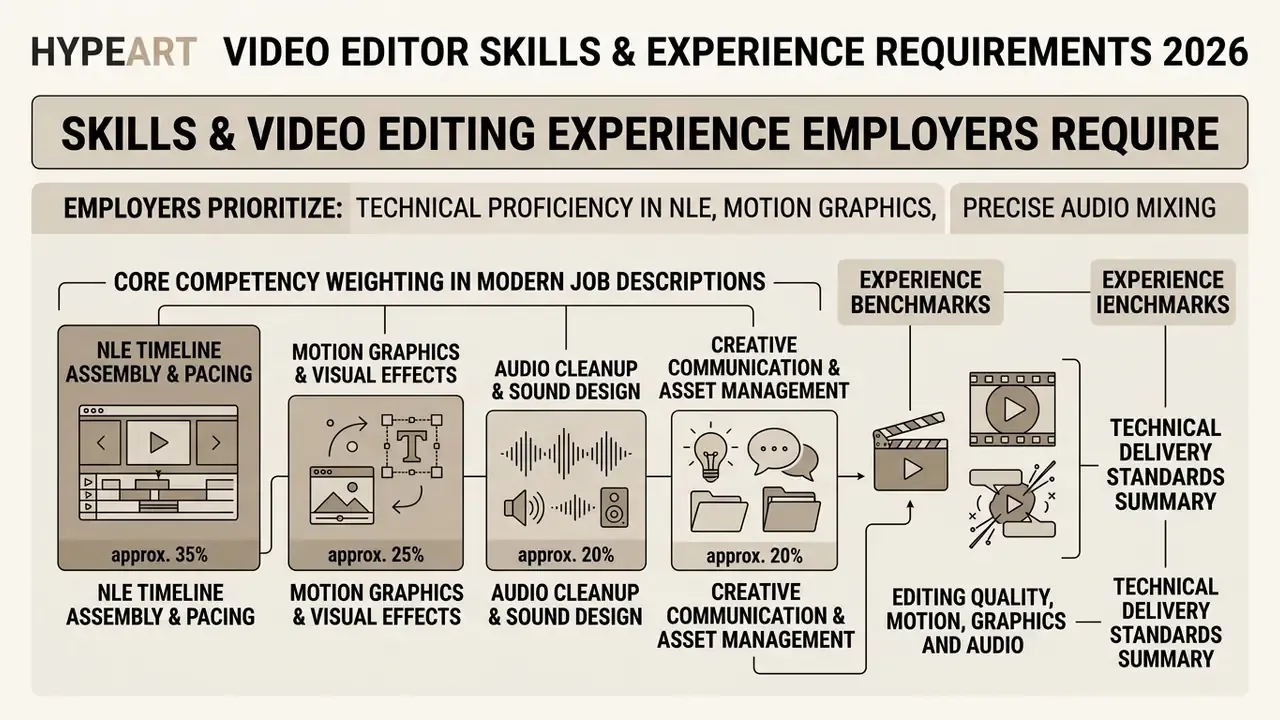
Employers screening candidates for a video editor job opening prioritize technical proficiency in non-linear editing software, motion graphics capability, precise audio mixing, and clear cross-functional communication. Demonstrating relevant video editing experience means presenting a portfolio that shows complete project ownership, not isolated pretty shots.
According to BLS occupational data, film and video editors hold a creativity and innovation skills score of 4.2 out of 5, placing the role among the most creative occupations in the professional sector.
«New skill needs are emerging at the intersection of digital, technical and creative competences»
Experience benchmarks. Hiring benchmarks put entry-level editors at 0–2 years of practical experience. Mid-to-senior roles ask for 3–5+ years plus proven project leadership. Lead editor and post-supervisor postings commonly require 5–7+ years and documented supervision of junior staff. Public occupational profiles describe the same core task set at every level: select footage, assemble and edit sequences, collaborate with directors and producers, add effects, sound and music, and keep organized project records.
Core competency weighting in modern job descriptions
- NLE timeline assembly and pacing, ≈35%. Adobe Premiere Pro, DaVinci Resolve, Final Cut Pro or Avid Media Composer; multicam source sequences, nested sequences, keyboard-driven trimming.
- Motion graphics and visual effects, ≈25%. Kinetic typography, lower thirds, title cards, compositing and tracking in After Effects; template systems for repeatable brand output.
- Audio cleanup and sound design, ≈20%. Dialogue equalization, de-noise and de-reverb (iZotope RX, Adobe Essential Sound), music ducking, loudness compliance.
- Creative communication and asset management, ≈20%. Frame.io annotation workflows, proxy generation, bin and folder discipline, version control, turnover documentation.
Those weights are directional, drawn from posting language rather than a formal survey. Read them as a hypothesis to test against the specific job description in front of you.
Editing quality, motion, graphics and audio
Professional editing quality rests on technical delivery standards, visual pacing, disciplined color management and clean audio balancing. Modern postings expect editors to work as multi-skilled technical operators who can finish to broadcast or commercial specification without hand-holding.
«Transform raw footage into polished videos that meet brand standards», including graphics, animation and subtitles. Job posting analysis, professional-services video editor role (2024); occupational description via BLS. https://www.bls.gov/ooh/arts-and-design/film-and-video-editors-and-camera-operators.htm
Technical specifications commonly required by enterprise employers include final exports in 1080p HD or 4K resolution, at 24 to 60 frames per second, in Rec.709 or Rec.2020 color spaces, with stereo audio at 48 kHz AAC-LC for web delivery. Editors use Adobe After Effects for lower-third animations, title cards and kinetic typography; adjacent motion tooling is covered in our guide to animation makers and template-based motion systems. Color workflows lean on Lumetri Color or DaVinci Resolve to hold visual consistency across multi-camera shoots. A growing share of postings now expect familiarity with generative assistance as well, so see our overview of Google Veo and API-based video generation for how these tools slot into a production pipeline, and the broader AI Media API Guides hub for implementation detail.
Technical delivery standards summary
| Delivery parameter | Common employer requirement |
|---|---|
| Resolution | 1080p HD minimum; 4K preferred for capture and mastering |
| Frame rate | 24–60 fps, matched to broadcast or platform spec |
| Color space | Rec.709 (HD/web) or Rec.2020 (HDR/UHD) |
| Broadcast loudness | –24 LKFS integrated program loudness |
| Dialogue level | Speech peaks between –6 dB and –12 dB; music ducked below |
| Audio format | Stereo, 48 kHz, AAC-LC for web masters |
| Master codecs | ProRes 422 / DNxHR for mastering; H.264/H.265 for distribution |
Audio decides more hires than most candidates believe. Speech dialogue is balanced to peak between –6 dB and –12 dB, with background music ducked underneath. Dialogue cleanup needs noise reduction, equalization and compression through tools like Adobe Essential Sound or iZotope RX. Editors handling mixed media perform baseline transcoding to editing codecs such as ProRes or DNxHR, strip unwanted camera scratch audio during track replacement, and run clean visual processing before final grade. Where deliverables must hit strict platform weight limits, good editors manage compression trade-offs deliberately instead of accepting presets. Our guide to video compressors and quality loss walks through the bitrate decisions involved.
Communication and collaboration with a creative team
Collaboration between a video editor and a creative team runs on structured review protocols, precise timecode feedback, and plain communication with directors, producers and art directors. Editors have to translate subjective notes into concrete technical adjustments, sometimes on the fly.
Modern post-production teams lean heavily on asynchronous review software such as Frame.io. It supports frame-accurate visual annotations, timecoded comments, version comparisons and direct Camera-to-Cloud integrations. Review links let external stakeholders leave feedback without an account, which removes the single most common friction point in client approval cycles. The net effect: fewer ambiguous revision requests, fewer lost email threads.
«Work in the arts and entertainment sector is inherently collaborative, bringing together creative, technical, managerial and administrative workers.»
Effective editorial communication starts with targeted questions before heavy revisions begin. Which angle serves the emotional beat? Should this transition be motivated or invisible? Is the pacing problem in the cut or in the score? Timecode-specific, question-driven feedback consistently outperforms open-ended subjective debate. Lead editors also own asset handoffs, making sure assistant editors inherit organized bins and standardized folder structures rather than a mystery drive.
Work formats: remote, freelance, contract and part-time video editing
«Only 24% of surveyed UK screen production workers held a permanent employment contract; the majority worked freelance or on short-term contracts.»
That figure reframes the market. Non-permanent work is the default operating condition in screen production, not an exception. Which is precisely why contract terms deserve the same scrutiny as the creative brief.
Hybrid staffing case study (anonymized agency engagement, multi-episode documentary, 2025): a production company needed scalable post capacity for an eight-episode series with roughly 140 hours of raw footage across three camera bodies. The post-production supervisor kept two in-house lead editors on narrative structure and story continuity, then contracted four remote editors for stringouts and selects, all synchronized through cloud proxies and a single Frame.io review structure with locked naming conventions. Measurable outcome: assembly cuts landed two weeks ahead of the contractual deadline, fixed overhead stayed flat with no additional full-time headcount, and version conflicts dropped to zero once a shared bin template was enforced at ingest.
Remote and freelance video editor jobs
Remote and freelance video editor jobs open access to commercial clients, media agencies and production studios regardless of geography. Freelancers operate as independent business entities, responsible for client acquisition, contract negotiation, insurance and self-employment tax obligations. Freedom with paperwork attached.
Global platform data indicates hundreds of millions of online gig workers worldwide, and creative work sits among the largest demand categories on those platforms.
«Creative and multimedia projects represent 20.8% of demand on major online labour platforms, second only to software development.»
Freelance marketplaces such as Upwork list video editing rates from roughly $20 to $150 per hour depending on technical specialization and client base, and they support two contract structures: hourly contracts with time tracking, and fixed-price contracts with escrow milestones. Local and regional boards more often post flat per-video fees. Freelancers extending their service menu into AI-assisted deliverables should review capability and licensing limits documented in our comparison of free AI video generators.
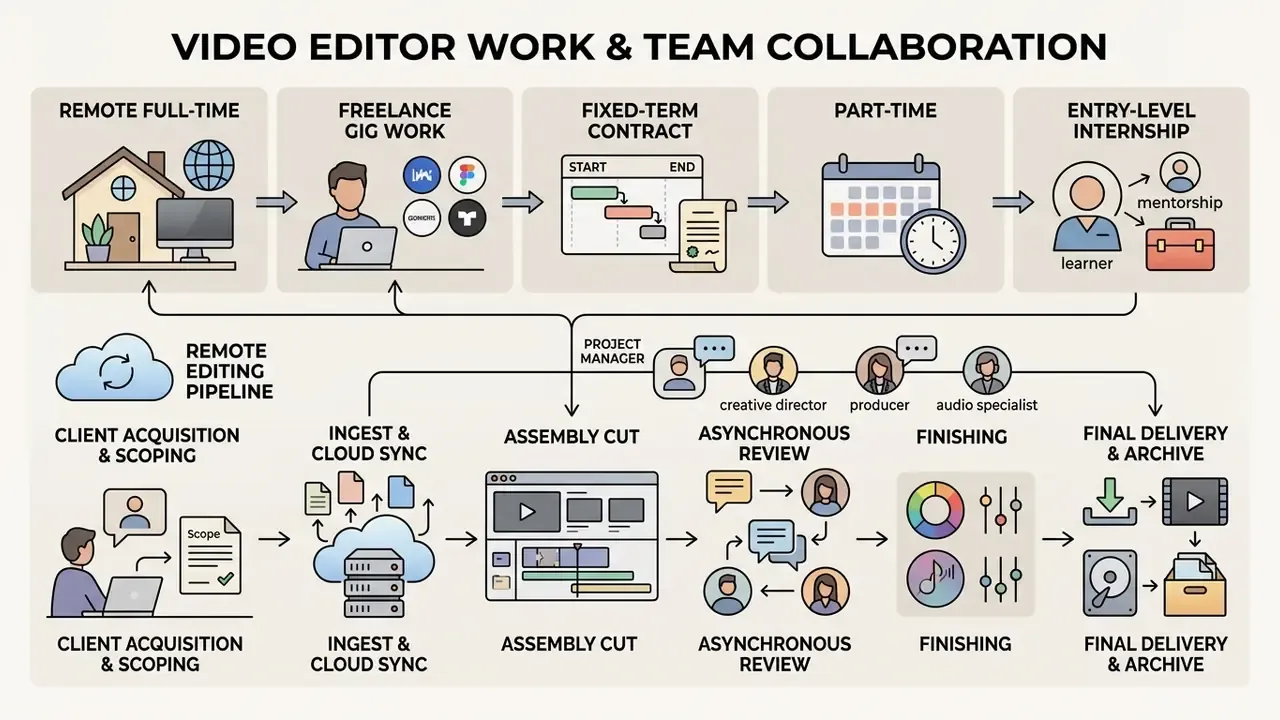
Standardized remote editing pipeline
- Client acquisition and scoping.Brief, deliverable count, aspect ratios, revision rounds and payment structure fixed in writing before any ingest.
- Ingest and cloud sync.Footage transfer to shared storage, proxy generation, naming convention applied, Frame.io project structure created.
- Assembly cut.Selects, stringout and a structure pass delivered for early directional approval.
- Asynchronous review.Timecoded comments and annotations collected in one round; scope creep flagged against the contract.
- Finishing.Motion graphics, color, audio mix to spec, caption burn-in or sidecar files.
- Final delivery and archive.Master plus platform variants, project files and LUTs handed over per the IP clause, source media retention agreed.
Pricing model choice. Hourly billing protects the editor when footage volume or revision count is unknown. Fixed-project pricing rewards efficiency on well-specified, repeatable deliverables such as social cutdowns. Hybrid arrangements, a fixed fee plus hourly overage after a defined number of revision rounds, are becoming standard for agency work. If a client refuses any revision cap, that is information about the project, not a negotiation detail.
Contract, part-time and intern positions
Contract, part-time and intern video editor positions offer structured entry paths into the industry while giving employers flexible capacity. These roles usually specify hourly commitments and distinct compensation structures.
Part-time video production assistant roles typically pay between $28 and $33 per hour, requiring 15 to 20 hours of weekly availability. Some postings quote higher flat day or hourly rates for specialist coverage. Short-term contractor video editor roles range from $30 to $70 per hour based on specialized skills such as DaVinci Resolve grading or After Effects motion graphics, usually at 10 to 40 hours per week.
| Work format | Relative income stability | Team and organizational structure | Typical project types | Typical compensation structure |
|---|---|---|---|---|
| Remote full-time employee | High; predictable salary and full benefits | Integrated in-house team; daily syncs with creative directors and marketers | Continuous brand campaigns, internal video assets, product tutorials | Salaried ($75,000–$92,000/yr median U.S. range) plus health and retirement benefits |
| Freelance / gig worker | Variable; income follows project flow | Independent operator; coordinates per project with diverse external clients | Commercial ads, YouTube content, social clips, event videos | Hourly ($20–$150/hr) or fixed per-project fee; no employer benefits |
| Fixed-term contractor | Moderate during active contract duration | Temporary integration into studio or production company teams | TV series post-production, seasonal ad campaigns, film assembly | Day rate or fixed contract sum; no long-term benefits coverage |
| Part-time employee | Moderate; limited weekly hours | Small marketing or educational media team; regular weekly schedule | Ongoing weekly editing, webinar trimming, social cutdowns | Hourly ($28–$33/hr average assistant rates); pro-rated or minimal benefits |
| Intern / assistant editor | Short-term; learning-focused position | Works directly under senior editors or post-production supervisors | Media ingest, file organization, sync, assembly cuts, export management | Hourly ($15–$20/hr); unpaid only when tied to formal academic credit |
Internships and assistant editor roles center on technical support duties: media ingesting, transcode management, audio syncing and assembly cuts. Under U.S. labor guidelines, internships must deliver structured educational value. Unpaid internships are defensible only as part of an approved training, work-experience or vocational placement program, and paid internships commonly offer $15 to $20 per hour. Assistant work is undervalued in conversation and overvalued in practice, since it teaches pipeline discipline faster than any course.
Where to find companies hiring video editors
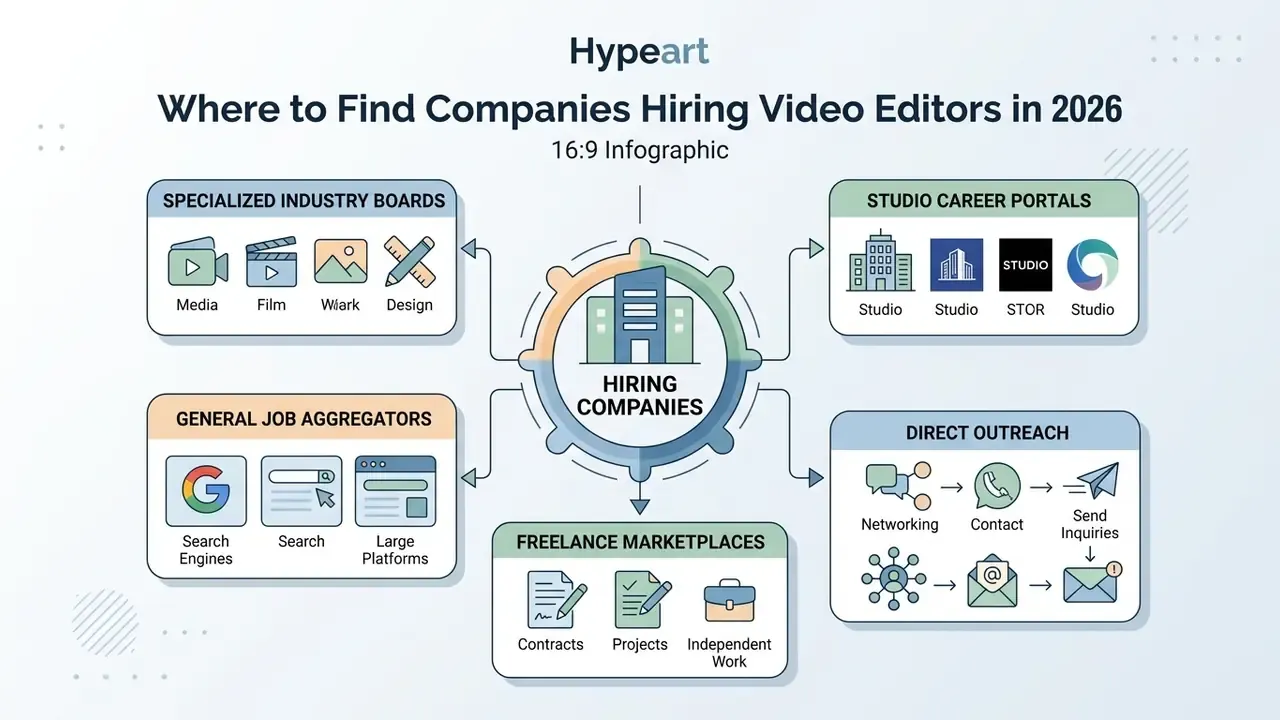
Companies running active video editor hiring concentrate postings across specialized industry job boards, studio career portals, media recruitment agencies and major metropolitan media hubs. Finding legitimate openings means targeting channels built for creative media production rather than scrolling general feeds.
California remains the largest geographic hub for video editing employment in the United States. BLS OEWS state data shows California employing roughly 10,820 film and video editors, with an employment location quotient of 2.83, nearly three times the national concentration average. Annual mean wages for editors in California reach $92,330, with clusters in Los Angeles, Culver City, Santa Monica, Universal City, San Francisco and Sacramento.
| California media hub indicator | Value (BLS OEWS state data) |
|---|---|
| Total state employment | 10,820 editors |
| Location quotient | 2.83 (≈283% of U.S. average concentration) |
| Annual mean wage | $92,330 |
| Primary clusters | Los Angeles, Culver City, Santa Monica, Universal City, San Francisco, Sacramento |
Key recruitment platforms and channels:
- Specialized industry boards. Entertainment-focused boards regularly list 200+ active post-production openings across film studios and broadcast networks, tagged by department and union status.
- Studio career portals. Career pages at production facilities, TV networks and streaming providers host unaggregated postings for lead and assistant roles. Many require a resume, cover letter and reel in the first submission. Editors targeting streaming and creator-economy employers should also study platform-native craft standards in our guide to YouTube video editing workflows.
- General job aggregators. Indeed and LinkedIn surface corporate marketing video editor openings filterable by metro area and remote status. Most California listings specify Adobe Premiere Pro plus 3–5+ years of experience.
- Freelance marketplaces. Upwork and specialized creative talent networks connect freelance editors with commercial project budgets and escrow-protected milestones.
- Direct outreach. Applying through a studio careers page with a portfolio link remains one of the highest-conversion methods, mostly because those postings are rarely aggregated and attract fewer applicants.
Beyond California, watch New York, Atlanta, Austin and Chicago for corporate and streaming in-house teams. Remote-first employers list by time zone overlap rather than city, so read the fine print on required hours.
How to evaluate a video editor job opening before applying
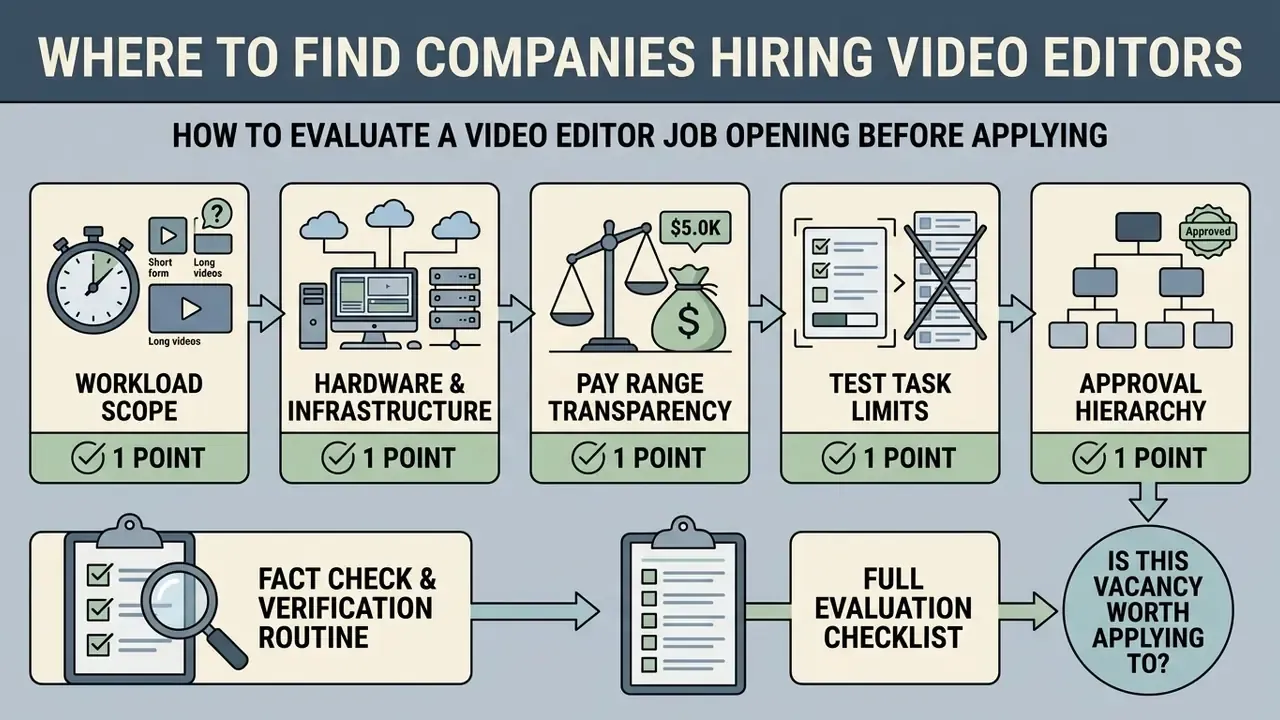
5-point job offer scorecard: is this vacancy worth applying to?
Score your target posting on five criteria; award 1 point for each one met.
Score interpretation: 4–5 points, high-quality offer, proceed. 3 points, proceed with caution and clarify the missing terms during screening. 0–2 points, high risk of role overload, unpaid scope expansion and burnout.



Full evaluation checklist
Checklist0 / 8
European Union labor directives, including EU Directive 2019/1152 and recent pay transparency rules, require employers to disclose objective salary ranges and detailed remuneration components before interviews. Overtime, bonuses and other entitlements count. The rules also demand gender-neutral, objective pay and job-classification criteria. The 2026 EU/EIGE job-evaluation toolkit recommends applying those criteria step by step rather than benchmarking by job title alone.
AI, copyright and data security risks in the editing pipeline
Generative tooling has moved from experiment to budget line in post-production, which changes what employers and candidates must agree on in writing. Three risk categories dominate.
1. Output licensing and commercial-use rights. AI-generated footage, voice-overs, music beds and upscaled frames carry platform-specific licensing terms that differ by subscription tier. Free tiers frequently restrict commercial use, embed watermarks, or reserve broad rights over submitted inputs. Before an AI-assisted asset enters a client deliverable, confirm the tier's commercial-use clause and keep proof of license. Our commercial-use hub documents the terms attached to major generation platforms, and voice-specific licensing is broken down in our guide to AI voice generators and commercial licensing.
2. Intellectual property assignment and portfolio rights. Employees generally create work-for-hire assets owned by the employer. Independent contractors own their output unless the contract assigns rights explicitly. That single clause causes most portfolio disputes I have seen described publicly. Freelancers should negotiate a portfolio-use carve-out at signature, meaning the right to display a specified excerpt after a defined embargo, rather than asking permission after delivery. Employers should spell out assignment scope, including project files, LUTs, templates and prompt logs for AI-assisted work.
3. Confidentiality, likeness and synthetic media. Unreleased footage, executive interviews, financial results and customer testimonials are confidential assets. Uploading them to a consumer AI service can count as disclosure to a third party. Maintain an approved-tool list, prohibit ingestion of confidential footage into unvetted models, require synthetic voice and likeness consent documentation, and log where each generated element originated. Copyright and likeness disputes over AI-generated media remain an active litigation area, so track developments through our AI Litigation and Case Timelines.
Practical controls to request or implement:
- Approved-tool register with tier-level license evidence per tool.
- NDA plus a secure transfer path (managed cloud workspace, not personal drives) for all pre-release footage.
- Provenance metadata retained for generated elements, so a deliverable can be audited after release.
- A test-task policy stating that submitted edits will not be used commercially and will be deleted after evaluation.
No evidence, no autonomy. The same principle governing automated decisions in regulated industries applies to generative assets in a post pipeline: if you cannot show where an element came from, it should not ship.
How to prepare for video editor hiring
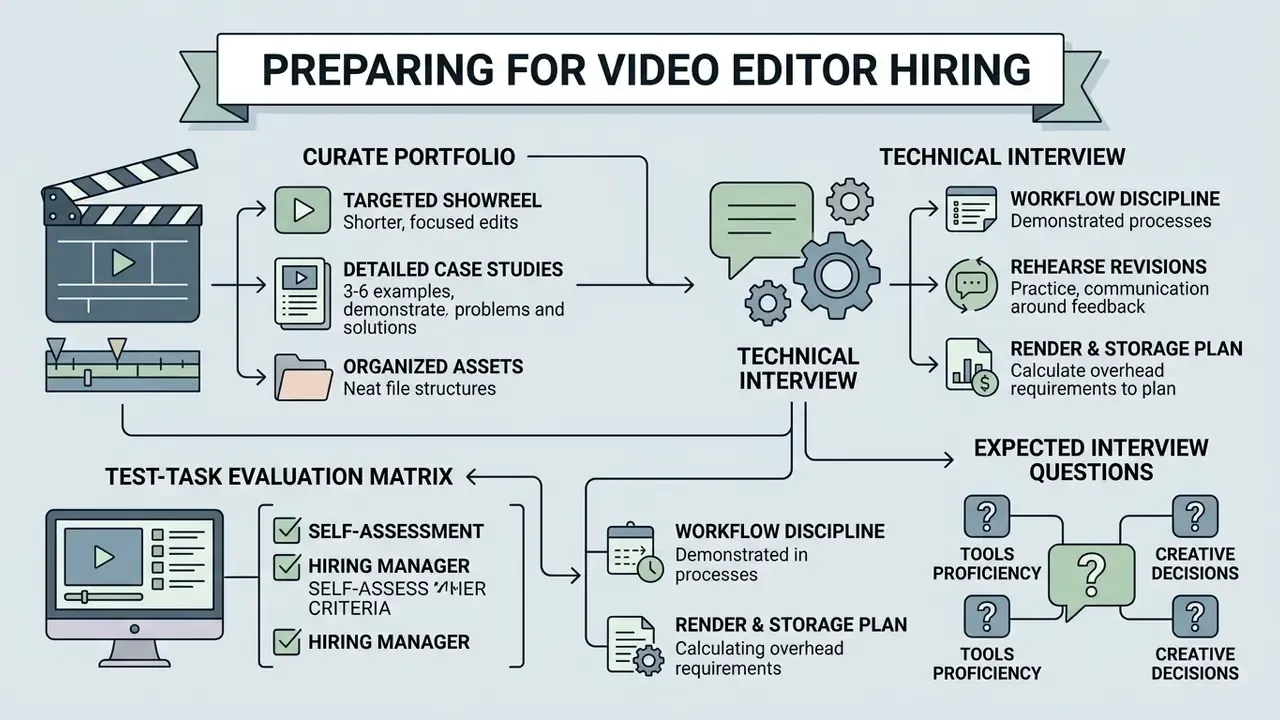
Preparing for video editor hiring means assembling a targeted showreel, building detailed project case studies, organizing clean portfolio assets, and rehearsing for technical evaluation. Employers examine how candidates structure a workflow almost as closely as they judge the finished cut.
Hiring research and academic portfolio guidelines both recommend keeping showreels short: 60 to 90 seconds for junior editors, 90 to 120 seconds for senior editors, with the strongest 15 seconds placed at the very start. Some institutional submissions prefer a single continuous excerpt over a fast-cut montage.
«Submit one short film or the best two minutes of work; a single continuous excerpt is preferred over a trailer-style showreel.»
«Employers assess workflow structure, folder organization, timeline tidiness and bin systems, not only the finished cut.» Job posting analysis, video editor and creative director roles (2024); occupational description via BLS. https://www.bls.gov/ooh/arts-and-design/film-and-video-editors-and-camera-operators.htm
Showreel and portfolio preparation specs
| Preparation element | Recommended specification |
|---|---|
| Showreel duration | 60–90 s (junior) / 90–120 s (senior) |
| Opening hook | Strongest 15 seconds first, no slate or long title card |
| Project case studies | 3–6 detailed breakdowns with brief, constraints, decisions, result |
| Technical talking points | Codecs (H.264 versus ProRes 422/DNxHR), proxy workflow, color management, folder hierarchy |
| Delivery of assets | Streaming link with password option; no unsolicited large file transfers |
When structuring a portfolio for employer review:
Technical interview questions to expect
- Walk me through your ingest-to-delivery pipeline on your last multicam project.
- How do you sync three or more cameras without matching timecode?
- What export settings would you use for a broadcast master versus an Instagram Reel, and why?
- How do you get dialogue to sit cleanly under music at broadcast loudness?
- Describe a project where the director's note contradicted the brief. What did you do?
- Which parts of your workflow, if any, involve AI-assisted tools, and how do you handle licensing?
Test-task evaluation matrix (for hiring managers and self-assessment)
| Criterion | Weight | What "pass" looks like |
|---|---|---|
| Project organization | 20% | Named bins, sequential versions, no orphaned media, proxies linked |
| Story and pacing | 25% | Clear structure, motivated cuts, no dead air in the first 5 seconds |
| Technical delivery | 20% | Correct resolution, frame rate, color space and loudness for the stated spec |
| Audio treatment | 20% | Dialogue intelligible and level-consistent, music ducked, no clipping |
| Brief compliance | 15% | Deliverable length, aspect ratios and mandatory elements all present |
Keep unpaid test tasks under 2 minutes of footage and under 3 hours of work, and get written confirmation that the output will not be used commercially.
Quick-response cover letter template for editors
FAQ: video editor jobs, contracts and pay
What is a realistic salary for a video editor in 2026?
The U.S. median is $75,420 per year ($36.26/hour), with the occupation spanning $38,990 at the 10th percentile to $154,480 at the 90th. California averages $92,330, and editors in professional services can clear $100,000. Compare any offer to the percentile band for your level and metro area, not to the median alone.
W-2 employee or 1099 contractor, which should I accept?
It depends on control and risk, not preference. If the employer sets your hours, supervises daily work and supplies the workstation, employee classification is usually correct, and it brings benefits plus tax withholding. Contractor status suits editors who control their schedule, use their own tooling and bill per project, but it shifts self-employment tax, insurance and downtime risk onto you. Classification follows behavioral control, financial control and the nature of the relationship, not the label on the contract.
Who owns the footage and the edit I deliver?
Employees typically create work-for-hire assets owned by the employer. Contractors own their output unless the agreement assigns rights. Settle IP assignment and a portfolio-display carve-out before delivery, never after.
Can I show client work in my portfolio?
Only with permission or a contractual carve-out. Negotiate a specific excerpt length and an embargo date at signature. Embargoed or NDA-covered footage should never appear in a public reel.
How long should an unpaid test task be?
Under 2 minutes of source footage and under 3 hours of work, with written confirmation that the result will not be used commercially. Anything larger should be paid at your standard rate.
Is AI reducing demand for video editors?
Current official projections show modest growth, roughly 3% over the decade and about 5,600 openings per year, not contraction. What is shifting is task composition. Routine transcription, rough selects, caption generation and upscaling are increasingly automated, while pipeline design, narrative judgment, licensing compliance and quality control gain weight. Editors who can document AI-tool governance inside their workflow are strengthening their position, not weakening it.
Do I need a degree?
Postings overwhelmingly specify software proficiency, years of practical experience and a reel. Formal education helps in institutional and broadcast environments, and for internship eligibility, but the portfolio and the technical interview decide most hires.
What should freelancers do about storage and confidentiality?
Use employer-provided or managed cloud workspaces for pre-release media, keep a signed NDA on file, set a retention and deletion date for source footage, and never route confidential footage through unvetted consumer AI services.
What to do next
General information only. Employment classification, pay transparency obligations and intellectual-property rules vary by jurisdiction. Consult a qualified employment lawyer or tax professional before signing a contract.
Terminology used across this guide is defined in the AI Media Glossary.