Scope note (read first): this guide speaks to two audiences at once. Sections marked Production describe hands-on generation workflows for creators, songwriters, and media teams. Sections marked Governance cover data handling, Shadow AI exposure, licensing enforceability, and validation criteria for risk, legal, and procurement owners deciding whether a free browser tool may touch internal or client-facing material. Recommendations for internal prototyping differ materially from recommendations for public commercial release, and the two are labelled separately throughout. If your team only needs a scratch demo, most of the governance detail will feel heavy. Read it anyway before anything ships.
On this page: definitions and architecture, then what you can create (text-to-song, speech-to-singing, voice conversion, voice blending, choir stacking), enterprise data protection and Shadow AI controls, a step-by-step generation and evaluation protocol, the parameters that drive vocal quality, free-tier limits, pricing and commercial rights, a selection matrix, and the FAQ.
What Is a Free AI Singing Voice Generator Online?
A free AI singing voice generator online is a web-based software tool that uses neural network voice models to synthesize human-sounding singing from text lyrics, musical scores, or recorded audio files without requiring local installation. These platforms apply specialized singing voice synthesis (SVS) algorithms to control fundamental pitch (), rhythmic duration, and vocal timbre across dynamic musical scales.
«Singing voice synthesis generates vocal signals from musical scores, controlling pitch, duration and timbre, unlike speech-oriented TTS models». Synthetic Singers: A Review of Deep-Learning-based Singing Voice Synthesis (2026). https://arxiv.org/abs/2601.13910
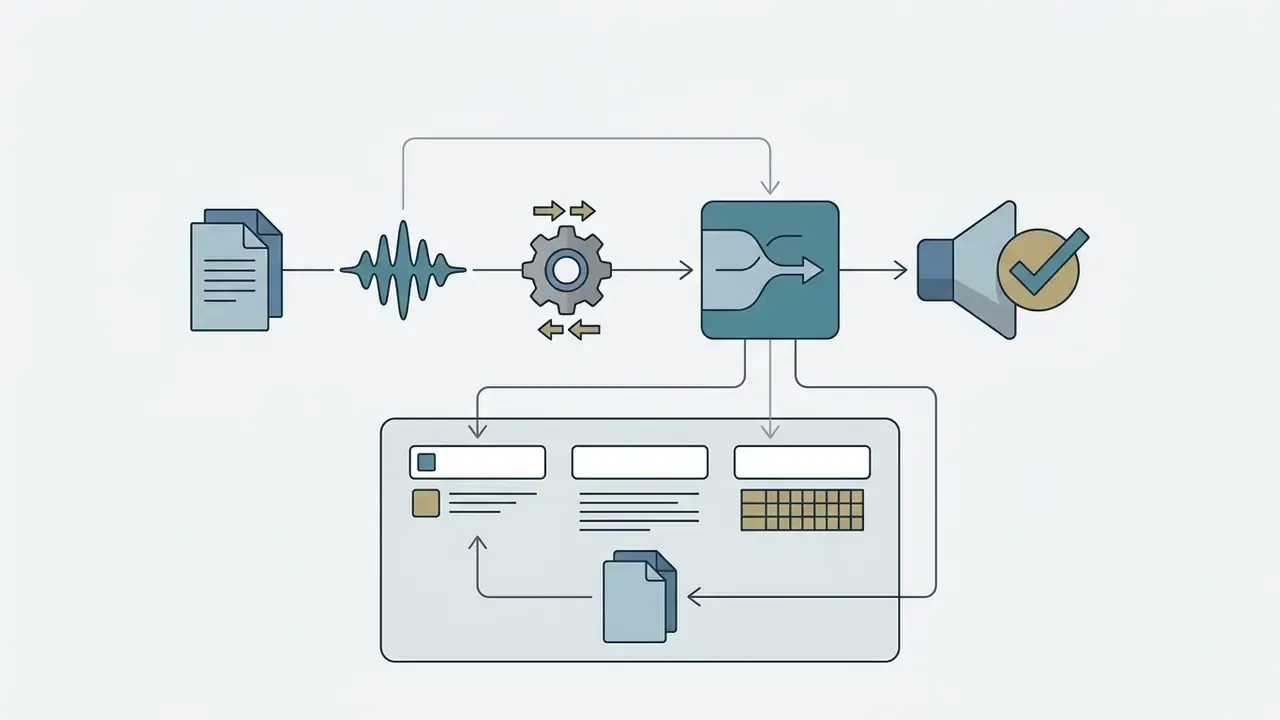
Unlike a standard text-to-speech engine that models conversational cadence, a dedicated free ai singing voice generator online aligns phonemes with melody structures to generate realistic ai vocals. In practice that means three extra conditioning layers on top of a speech stack: a note grid (pitch and onset), a phoneme-to-note alignment map, and a style or technique token set that governs vibrato, breathiness, and register. Miss any one of them and the output reads as speech pretending to sing.
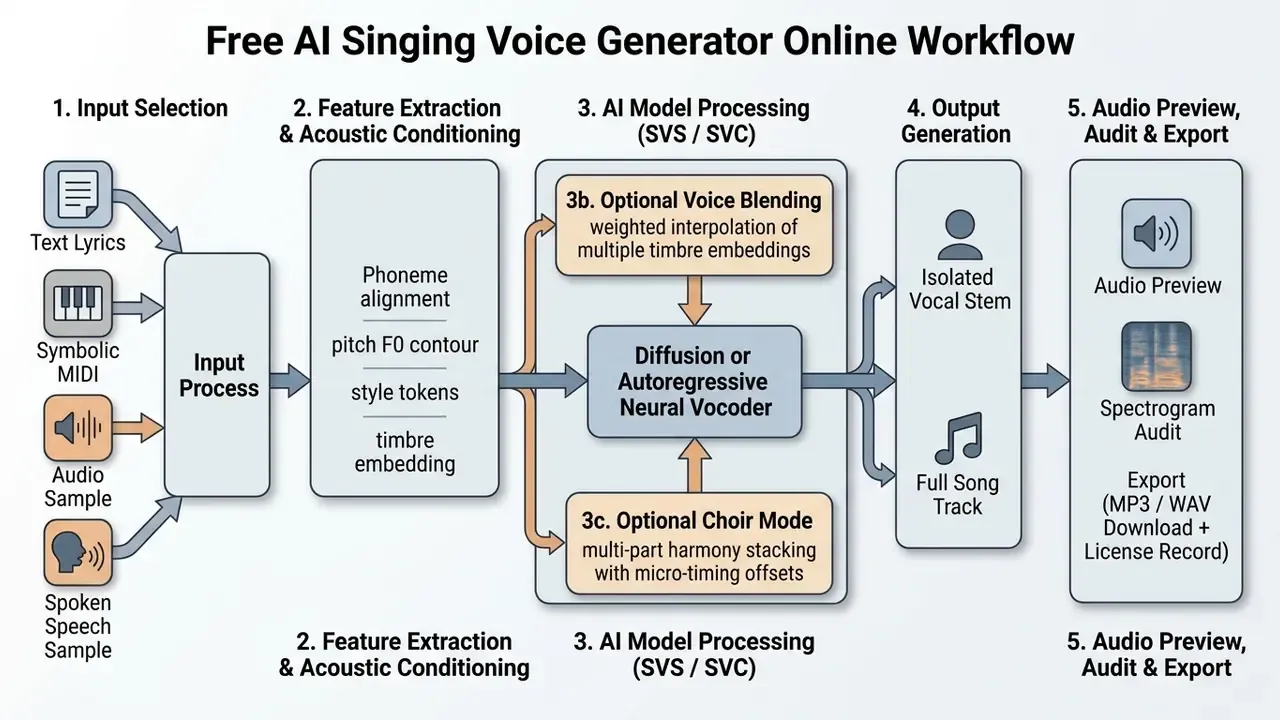
From text, lyrics, or audio to AI-generated vocals
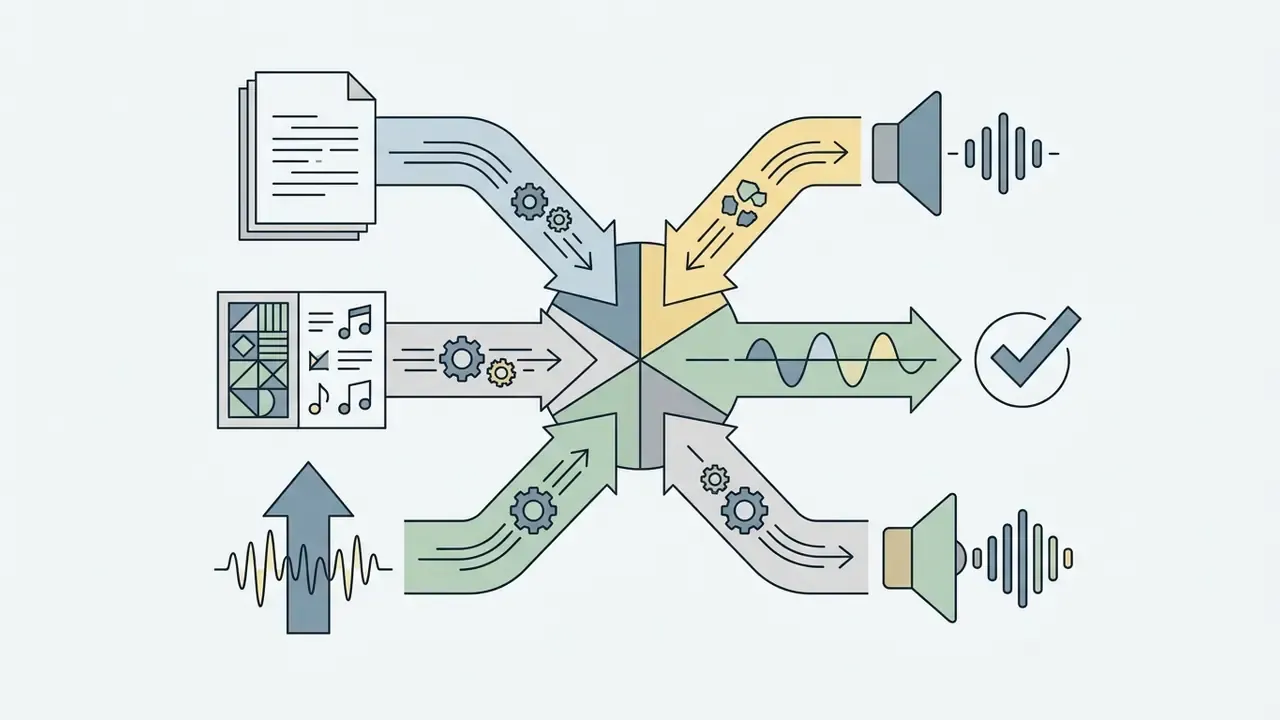
Converting raw input into synthetic vocal performances relies on two distinct primary pipelines: Text-to-Song synthesis and Audio-to-Audio voice conversion. In Text-to-Song systems, typed lyrics are parsed into phonetic units and mapped to pitch trajectories, allowing the system to build artificial singing voices from scratch (SpeechGen, 2026). Audio-to-Audio models work the other way round. They accept an uploaded vocal recording, extract linguistic features while stripping the original voice print, and re-synthesize the melody using a target voice model (Singing-to-speech conversion, Springer, 2025).
This dual-input capability lets creators turn text prompts directly into melodic phrases, or transform rough guide takes into polished studio performances. Creators comparing adjacent synthesis categories can review our AI voice generators guide, which covers voice quality benchmarks, language coverage, and commercial licensing for speech-first tools.
AI singing voice generator vs. AI song generator
Understanding this distinction helps producers choose between isolated vocal synthesis for DAW mixing and complete automated track generation. If your deliverable is a mixed background track for a video, a song engine is sufficient. If you need a replaceable lead vocal that a mix engineer will tune, compress, and time-align, only stem-level vocal tools are viable. That one question settles most tool disputes before they start.
What Can You Create With an AI Singing Generator?
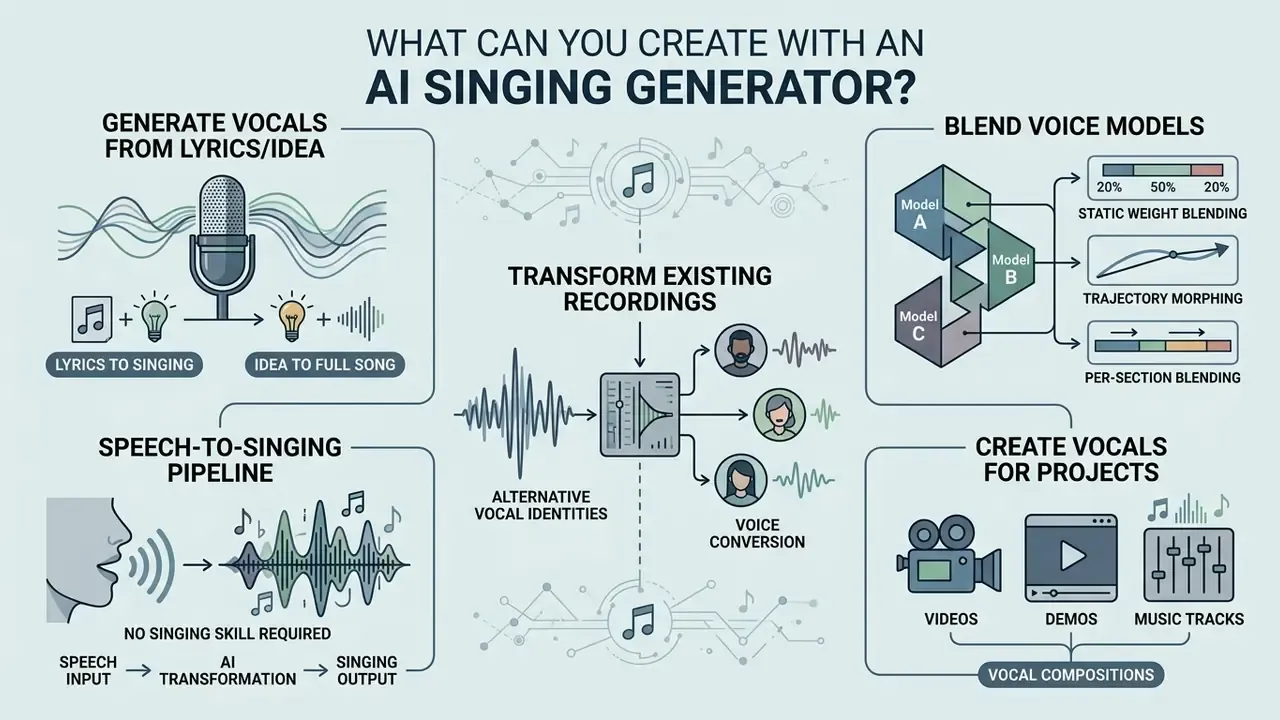
An AI singing generator lets users build full vocal compositions from text, transform existing recordings into alternative vocal identities, blend several voice models into an original hybrid timbre, generate multi-part choirs, and produce commercial-grade vocal demos for multimedia projects.
Datasets at that scale are the reason browser tools can now render pop, rock, jazz, and classical vocal styles across varied pitch ranges without per-genre fine-tuning. These capabilities serve content creators, indie musicians, and media producers who need rapid vocal prototyping without booking session vocalists.
Generate a complete song with vocals from an idea or lyrics
Users can generate full musical tracks complete with lead singing by supplying custom lyrics plus genre and mood prompts. Platforms such as ElevenLabs Music and fal.ai YuE take user-supplied lyrics, analyze phrase structure, and generate cohesive vocal lines alongside matching instrumental backing (ElevenLabs Documentation, 2026; fal.ai YuE, 2025). Kits AI's text-to-voice flow returns three vocal variations per lyric block, while Suno exposes a separate lyric-generation step before song rendering, so writers can iterate on words and melody independently.
This text-to-song approach allows non-musicians to translate creative ideas directly into structured songs without mastering notation or a DAW. Readers evaluating adjacent generative categories for the same campaign can compare capabilities in our AI voice generators reference before committing to a vocal-first stack. Teams building comprehensive creative workflows can also consult our ai blueprint generator overview for technical planning, and content leads who need launch copy alongside the audio often draft it with an ai blog post generator in the same sprint.
Transform recorded audio into a new singing voice
Uploading a raw audio file lets an AI voice singing generator online free act as a song cover generator, replacing the original singer's timbre while preserving exact timing, pitch bends, and lyric delivery.
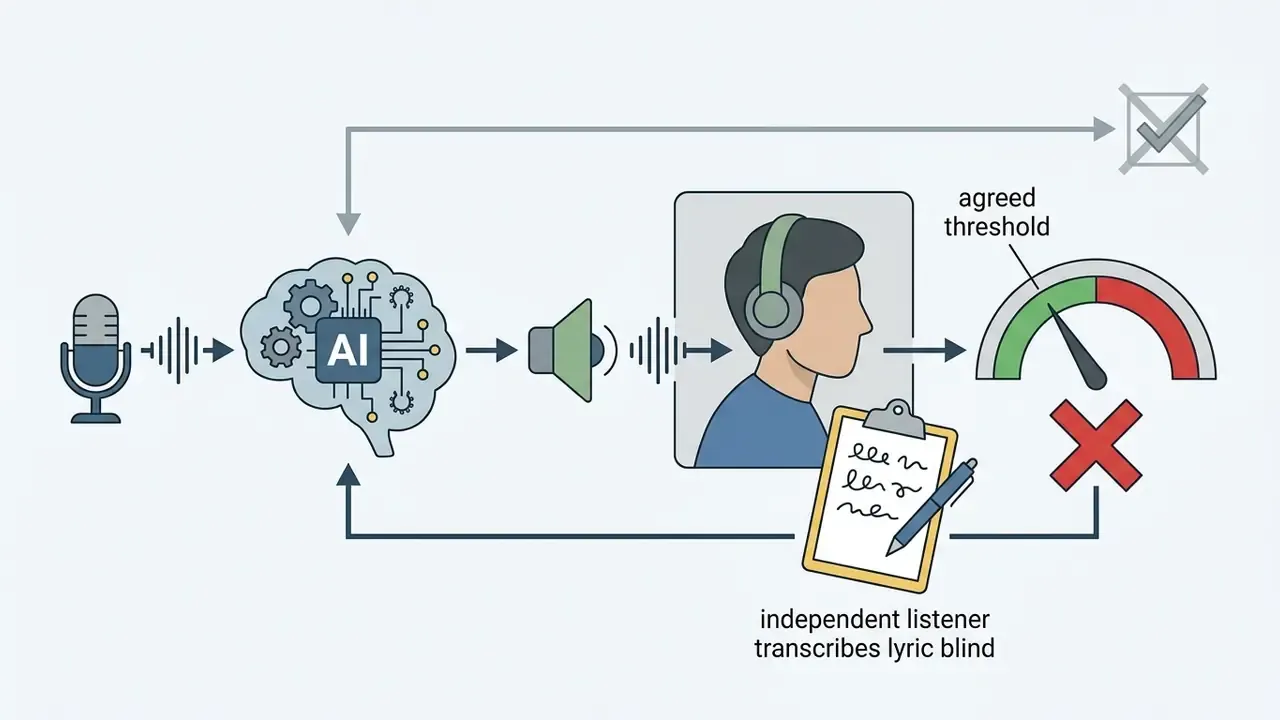
That gap is the practical planning constraint. Naturalness is effectively solved for clean inputs; exact identity matching is not, which is why blind A/B similarity checks belong in every acceptance test. Current zero-shot singing voice conversion (SVC) models, such as YingMusic-SVC, separate lead vocals from accompaniment and apply a target voice model over the clean vocal track.
Handled properly, the process turns guide vocals or spoken phrases into distinct singing identities while avoiding pitch-tracking errors.
Speech-to-Singing Pipeline (no singing skill required): modern SVS platforms no longer need dry sung stems to build a custom voice model. Using phonetic alignment and fundamental frequency mapping, systems can extract timbre and formant structures from 1 to 10 minutes of clean conversational speech (16 kHz or higher, dry WAV, single speaker, no reverb, no background noise). The neural model decouples the speaker's acoustic identity from prosodic pitch patterns, so the synthesized model can execute scales, vibrato, and pitch bends across musical keys while keeping the speaker's original timbre.
Consumer tools push this further. Several web apps accept up to five separate clips of the same speaker to build a more consistent model, and let the operator assign the output gender independently of the source recording: a female speaking sample can drive a male AI singer model and the reverse works too. Vendor documentation converges on roughly 10 minutes of clean mono speech as the accuracy sweet spot, with 1 minute as a usable floor and 30 minutes as the point of diminishing returns.
Blend multiple voice models into hybrid vocal identities
Advanced web tools let creators interpolate between two or more AI voice models to design unique, untraceable vocal timbres. By applying weight-slider vectors (say, 60% pop female falsetto plus 40% gritty rock male), the system morphs acoustic representations, combining the breathy high register of one singer with the chest resonance of another. Done deliberately, this reduces voice identity overlap and helps avoid digital replica infringement while engineering original vocal avatars for custom music tracks.
Operationally, blending works in three ways across current platforms:
- Static weight blending.Two trained models are mixed at a fixed ratio and saved as a new reusable voice slot; the result behaves like any other library voice and can be re-used across a catalogue for brand consistency.
- Trajectory morphing.A morphing plugin visualizes each analyzed sample as a node in a timbre space and lets the producer drag a target point between nodes, targeting a profile from samples as short as 10 seconds.
- Per-section blending.Different weights are applied to verse, pre-chorus, and chorus, so the vocal gains brightness and grit as the arrangement builds. It is a manual approximation of dynamic register change, and it is fiddly, but it works.
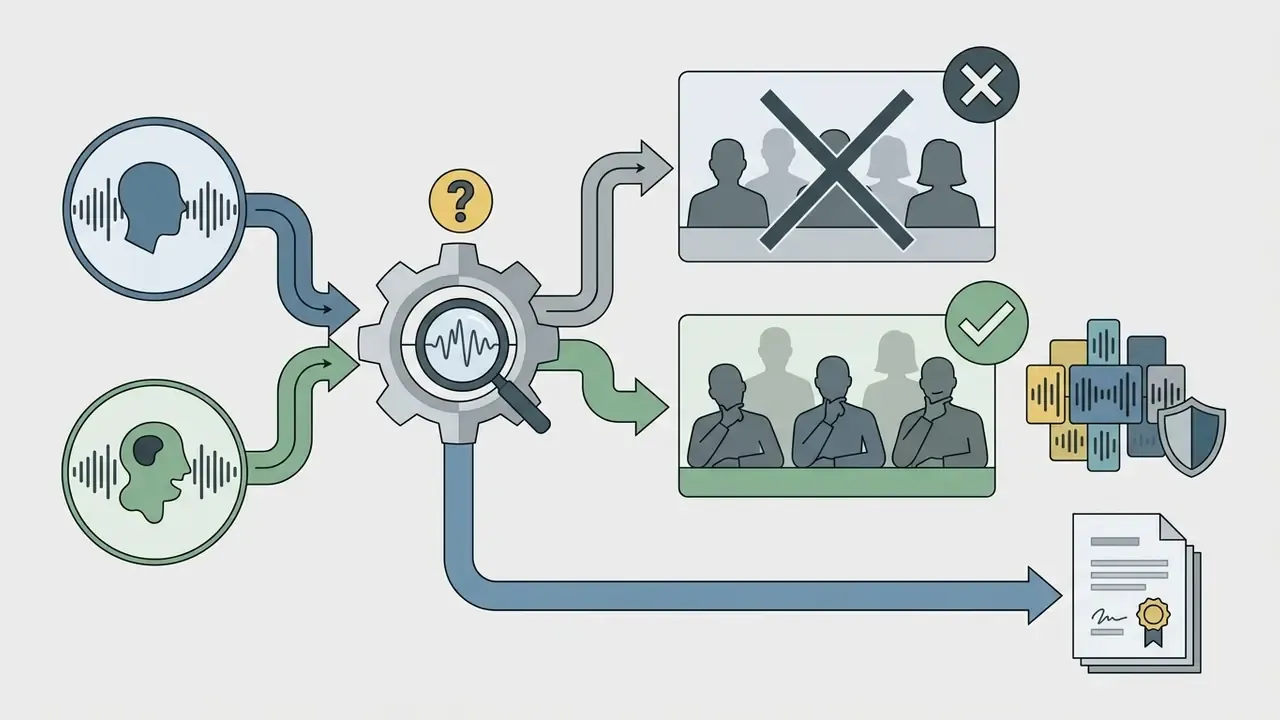
Governance note: a blended voice is not automatically clearance-safe. If one contributing model was trained on a recognizable artist, similarity may still be perceptible. Blend weights should be documented per release, and blind listening panels should confirm that no single real performer is identifiable.
Create vocals for videos, demos, and music projects
Media producers and songwriters use free ai singing voice generator online tools to create guide vocals, background harmonies, and commercial video soundtracks. During a pre-production trial for a regional ad campaign, a production team needed a female pop vocal demo within four hours. By feeding custom lyrics into an online SVS tool, they generated three distinct vocal stems, picked the cleanest pop performance, and delivered the client preview on schedule. (Illustrative composite example, not a documented client engagement.)
Tools like ACE Studio provide commercial export certificates, so video creators and ad agencies can license generated vocals for commercial media under cleared platform terms (ACE Studio Docs, 2026). Teams pairing synthetic vocals with motion assets often evaluate AI video generators in the same procurement cycle, since audio and video licensing terms must match before a campaign ships, and publishing teams can align delivery specs using our YouTube video editor workflow guide. Release packaging pulls in neighbouring tools too: single artwork is sometimes drafted with an ai book cover generator, synthetic-artist bios with an ai bio generator, and virtual performer visuals with an ai body generator. Each of those carries its own rights questions, so treat them as separate clearance items rather than one bundle.
Polyphonic Choir & Harmony Generation: beyond solo tracks, modern AI engines feature one-click Choir Modes that convert a single monophonic vocal line or MIDI input into multi-part arrangements (Soprano, Alto, Tenor, Bass). By introducing micro-timing variations, subtle pitch-offset tolerances (), and distinct voice model assignments per layer, the platform renders realistic background harmonies and wide choral stacks without phase cancellation or robotic doubling artifacts.
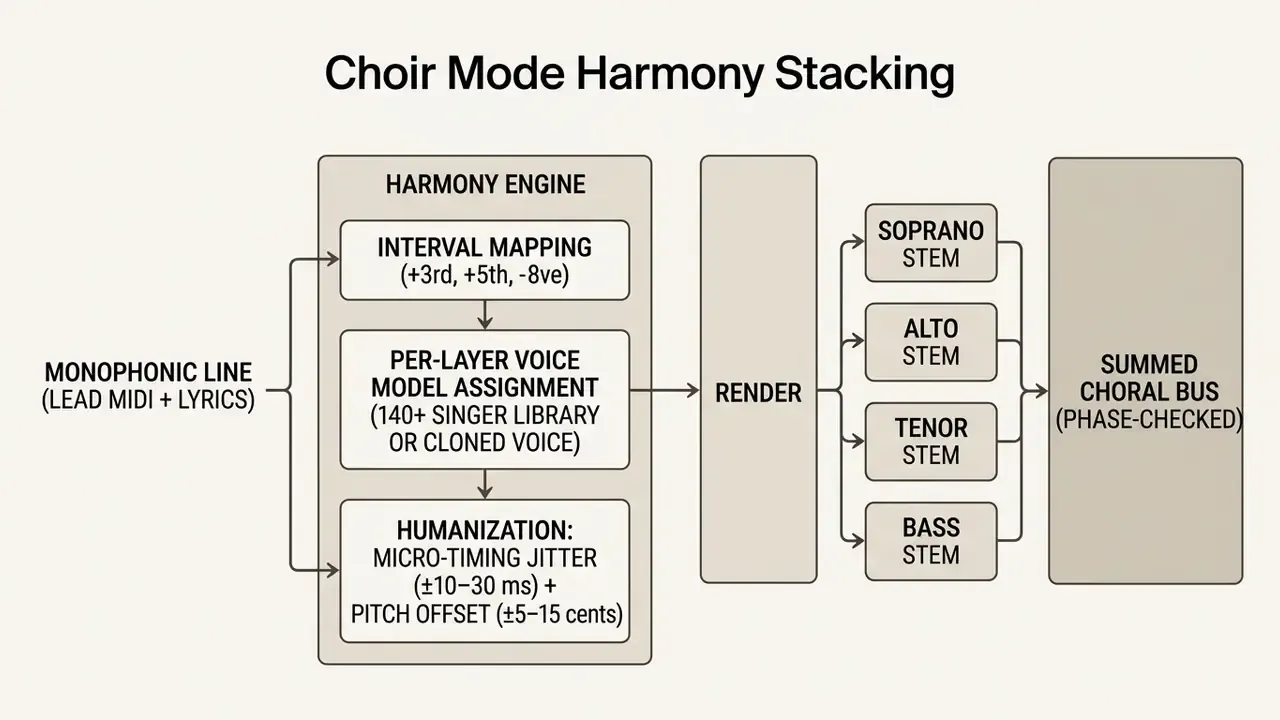
Typical production uses include gospel and cinematic choir beds, doubled chorus stacks in pop, and multilingual choral arrangements where each layer is assigned a language on a per-note basis. Because layers export as separate stems, mix engineers keep independent control over panning, reverb depth, and level automation instead of receiving a fixed choral bounce. Motion designers building lyric or performance visuals around those stems can review options in our animation maker guide.
Enterprise Data Protection, Shadow AI, and Model Risk Controls (Governance)
Free browser-based vocal tools are the most common Shadow AI entry point in media and marketing teams. No procurement, no installation, no admin approval. The material risk is not audio quality. It is what leaves the perimeter: unreleased campaign music, an executive's voice sample, a client's confidential jingle draft, or lyrics that reveal an unannounced product name.
Three exposure classes should be assessed before any tool is approved:
- Content retention.Does the vendor store uploaded audio and generated output, and for how long? Suno's privacy notice states that when users record or upload music, sound, or voice recordings to generate output, the data contained in and associated with that content is collected (Suno Privacy Notice, 2026).
- Training reuse.Is user-uploaded audio eligible for model training, and is an opt-out available on the free tier or only on paid and enterprise plans? Free tiers frequently lack opt-out entirely.
- Identity and impersonation risk.A cloned executive voice is a social-engineering asset. Financial and other regulated organizations should treat voice-model creation from internal speech samples as a deepfake exposure, not merely a creative experiment, and pair any approval with voice-verification controls on payment and access workflows.
| Governance Control | What to Verify Before Approval | Acceptable Evidence |
|---|---|---|
| Data retention window | Whether uploads and outputs are deleted on request and on a defined schedule | Published retention clause in privacy notice or DPA |
| Training opt-out | Whether user audio is excluded from model training by default | Written opt-out setting or contractual exclusion |
| Transport & storage encryption | TLS in transit and encryption at rest for uploaded stems | Security page, SOC 2 / ISO 27001 report on request |
| Sub-processor list | Which third parties receive audio (separation, moderation, CDN) | Published sub-processor register |
| Content screening | Whether uploads are scanned against reference catalogues | Vendor statement on rights-screening providers |
| Provenance marking | Whether generated audio carries content credentials or watermarks | Documented C2PA / watermark policy |
| Voice-consent workflow | Whether the vendor requires proof of consent for cloned voices | Consent form or verification step in the cloning flow |
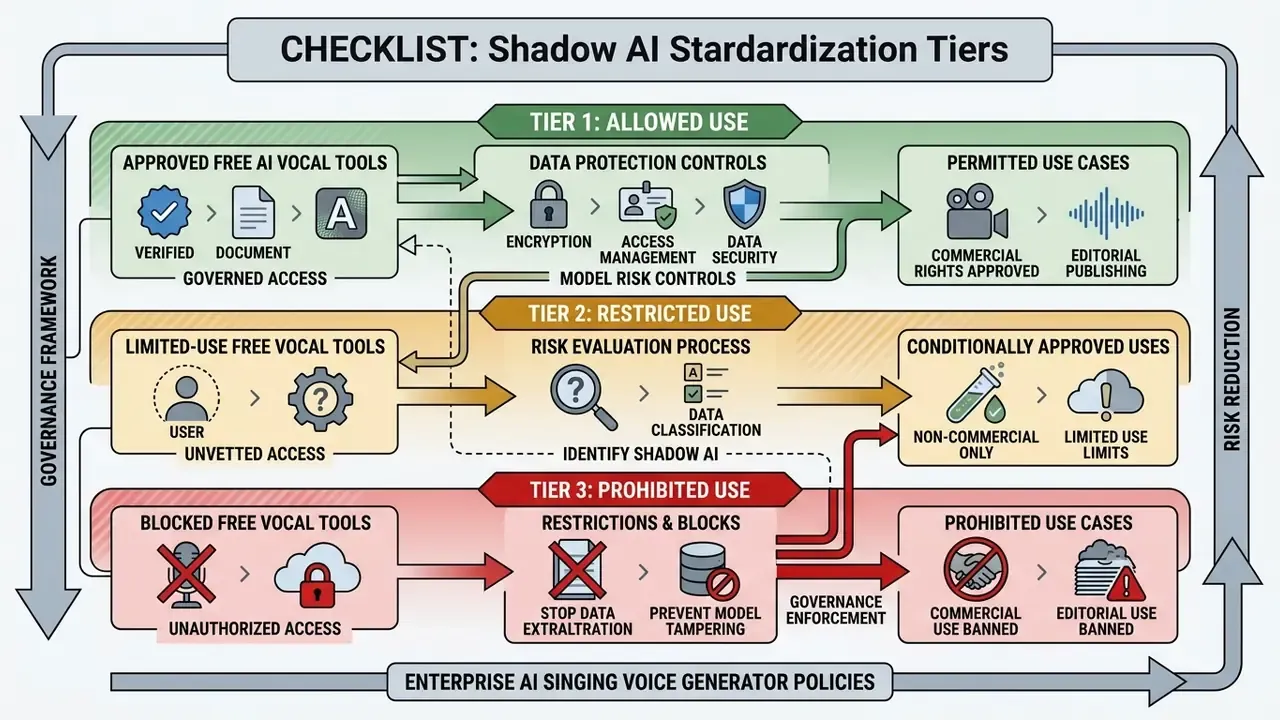
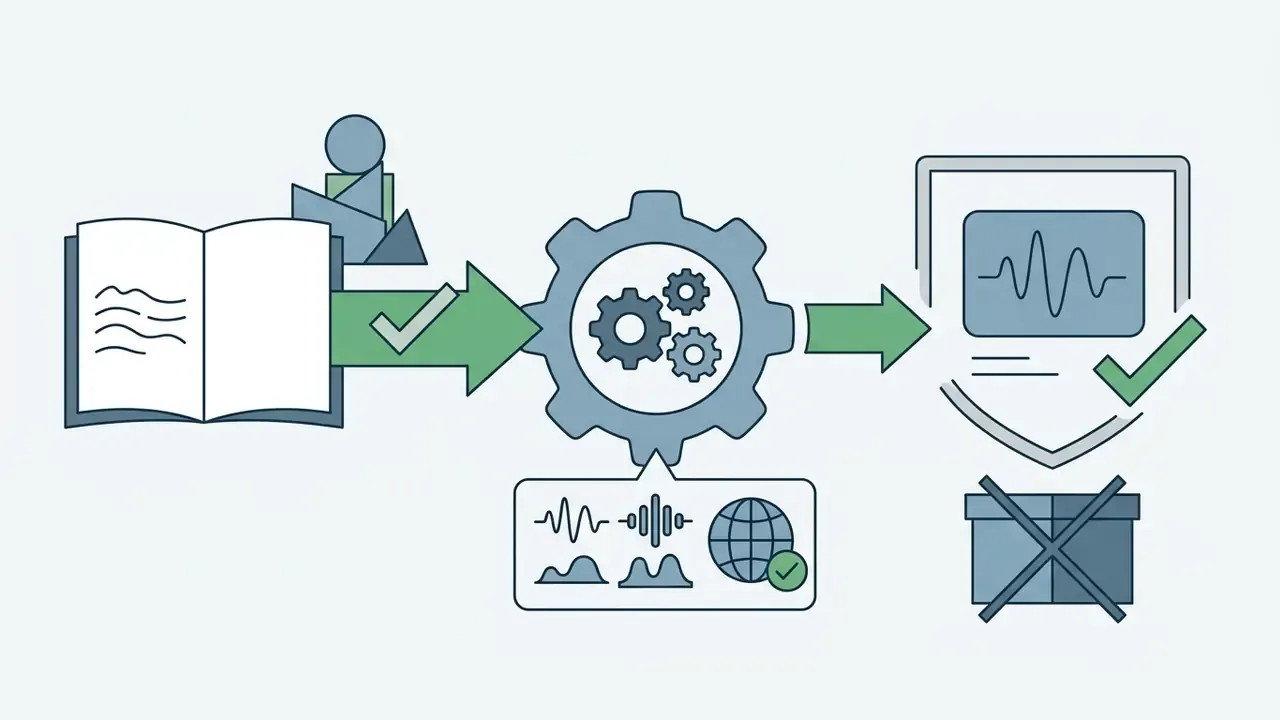
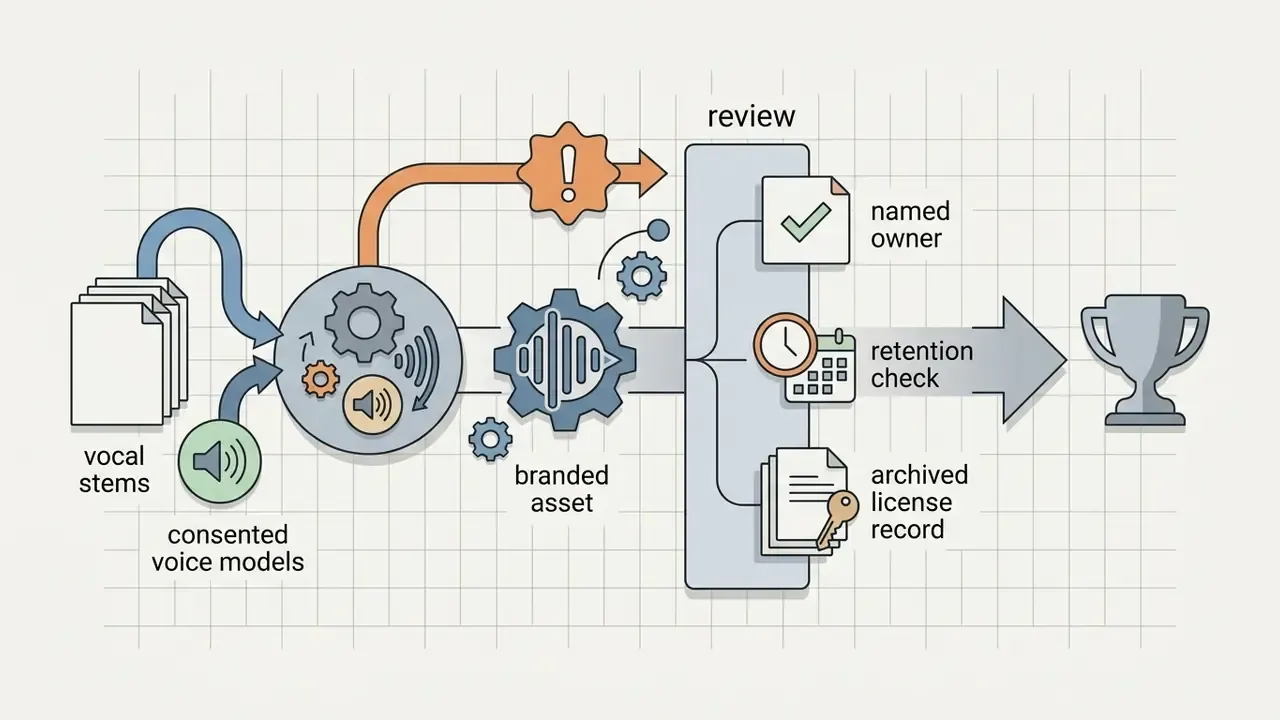
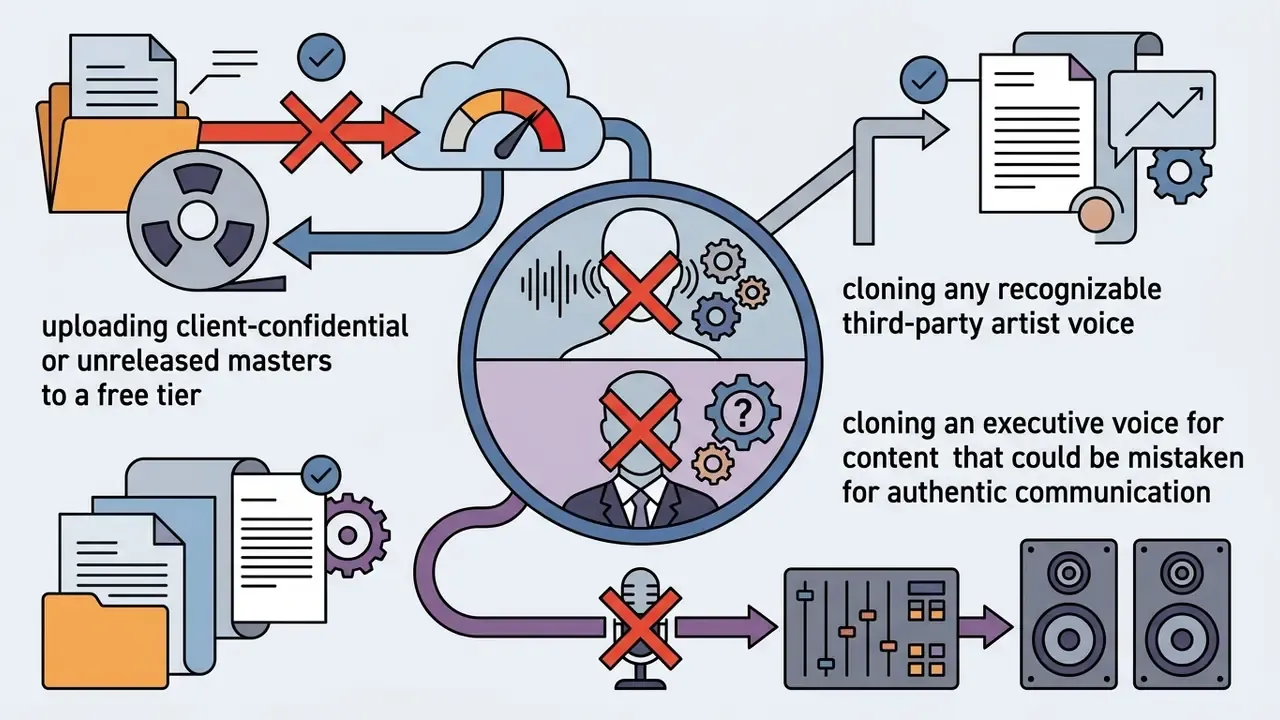
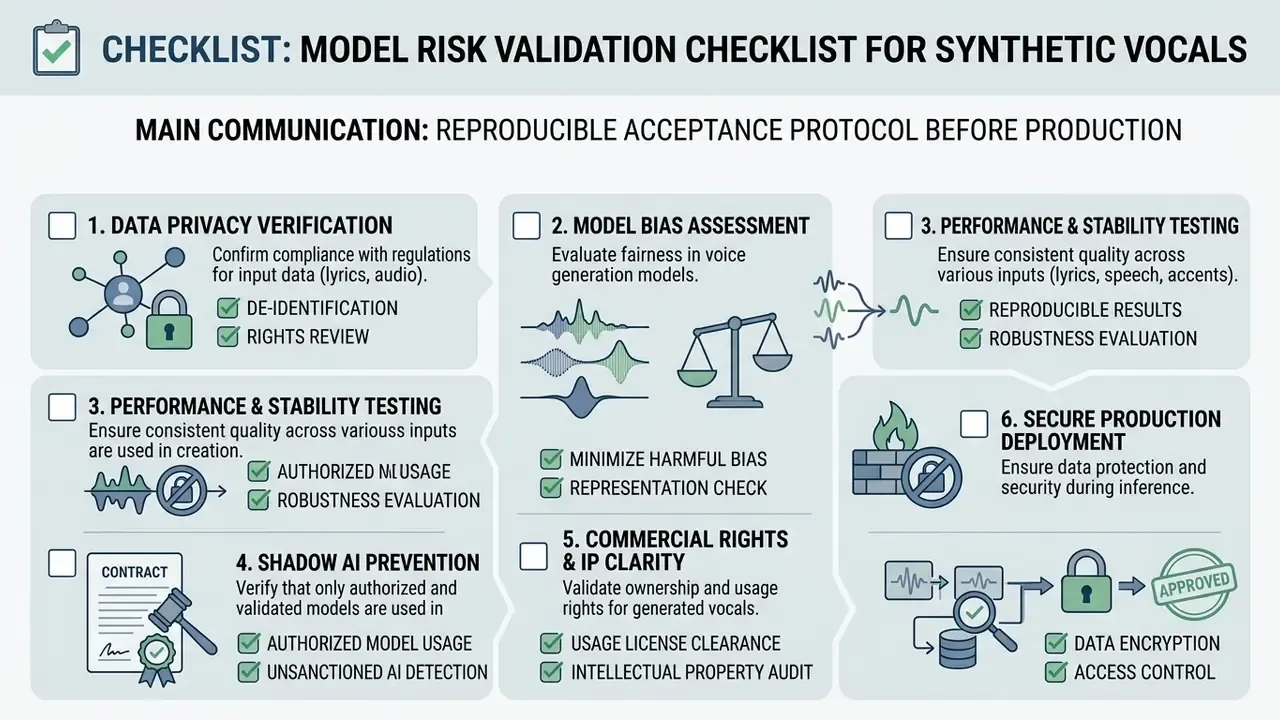
Who owns each step matters as much as the steps themselves. Name one accountable owner per release, define the escalation path when a check fails, and keep the shutdown option explicit: no evidence, no autonomy.
This section describes internal control practice. It is general information and does not constitute legal, security, or compliance advice for your organization.
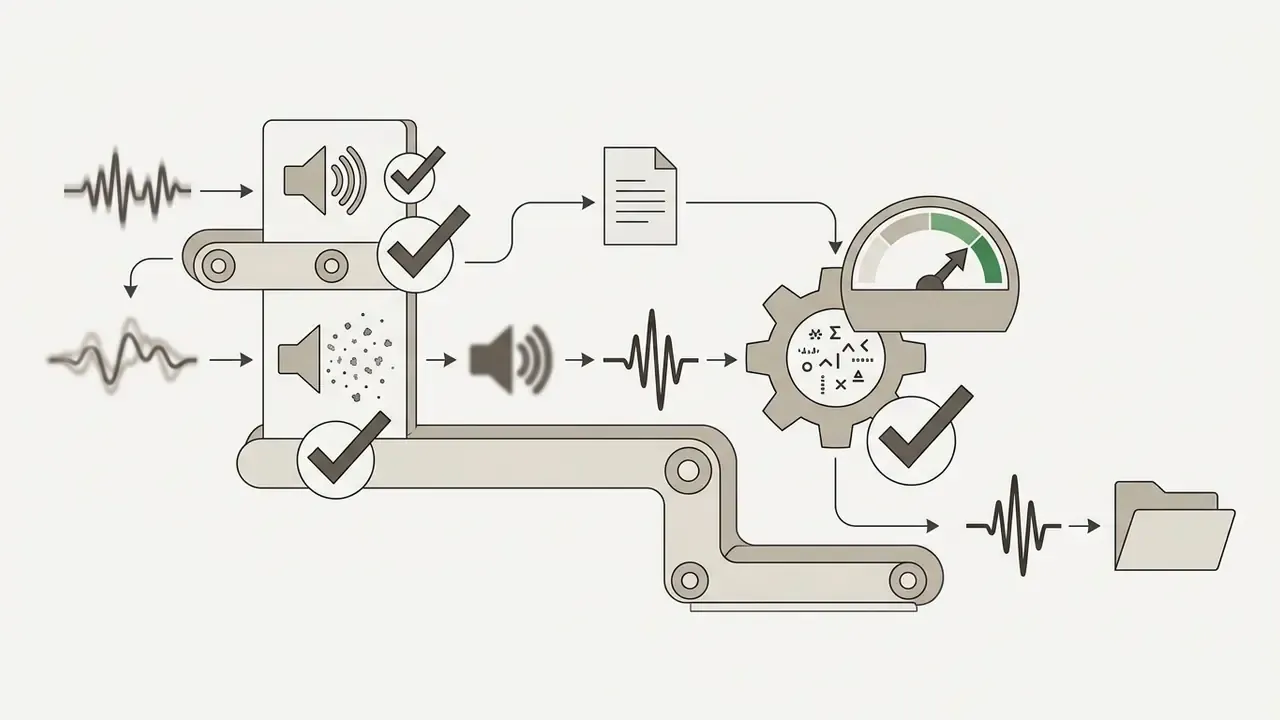
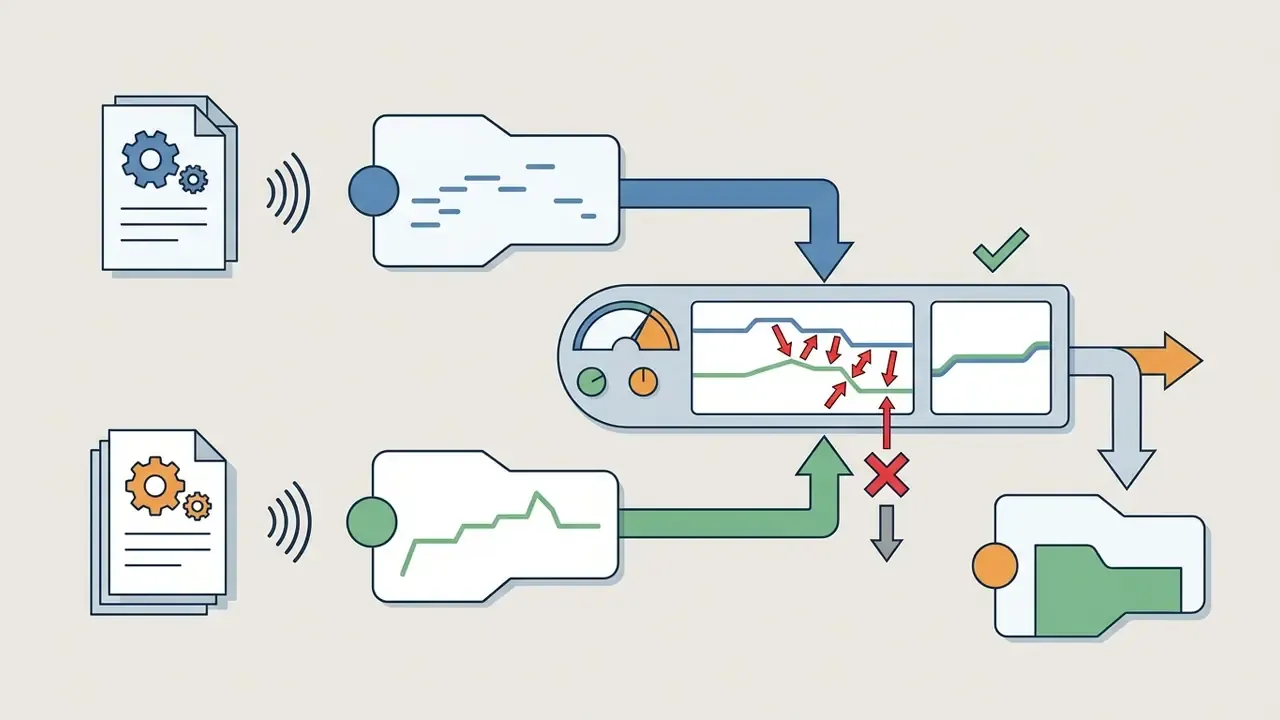
How to Use an AI Singing Voice Generator Free Online (Production + Evaluation Protocol)
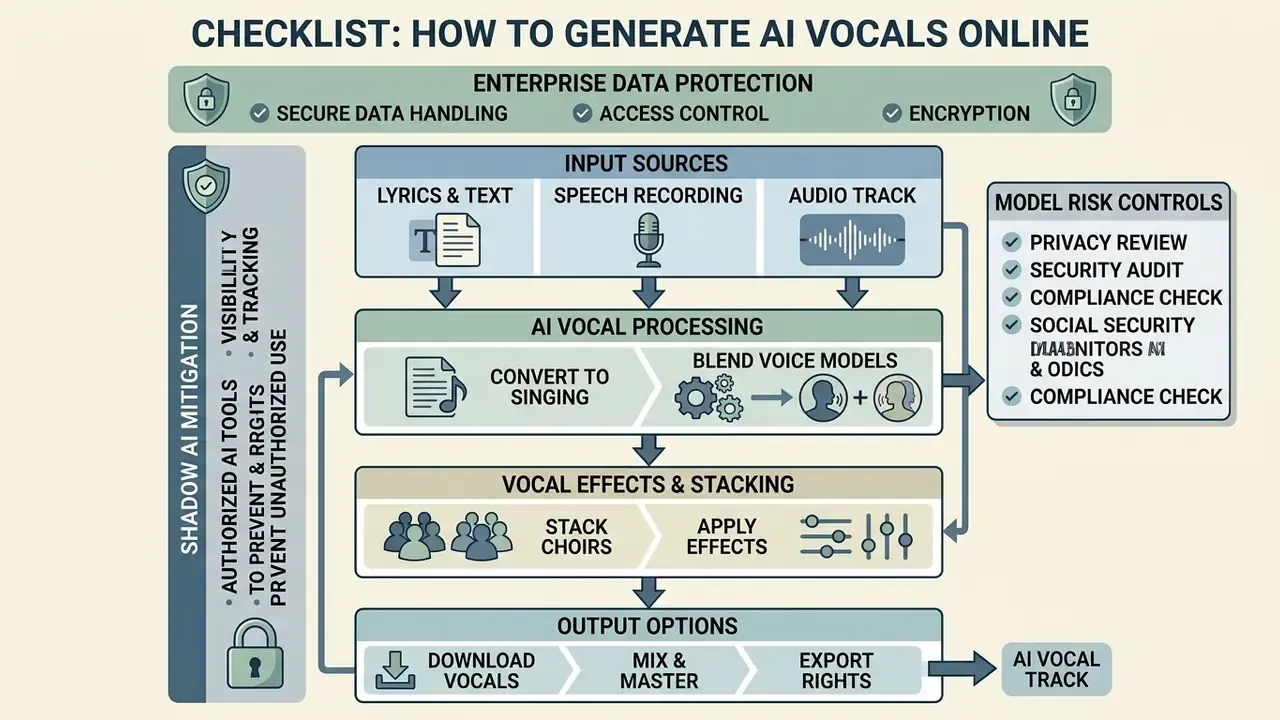
Choose text, lyrics, or an uploaded audio file
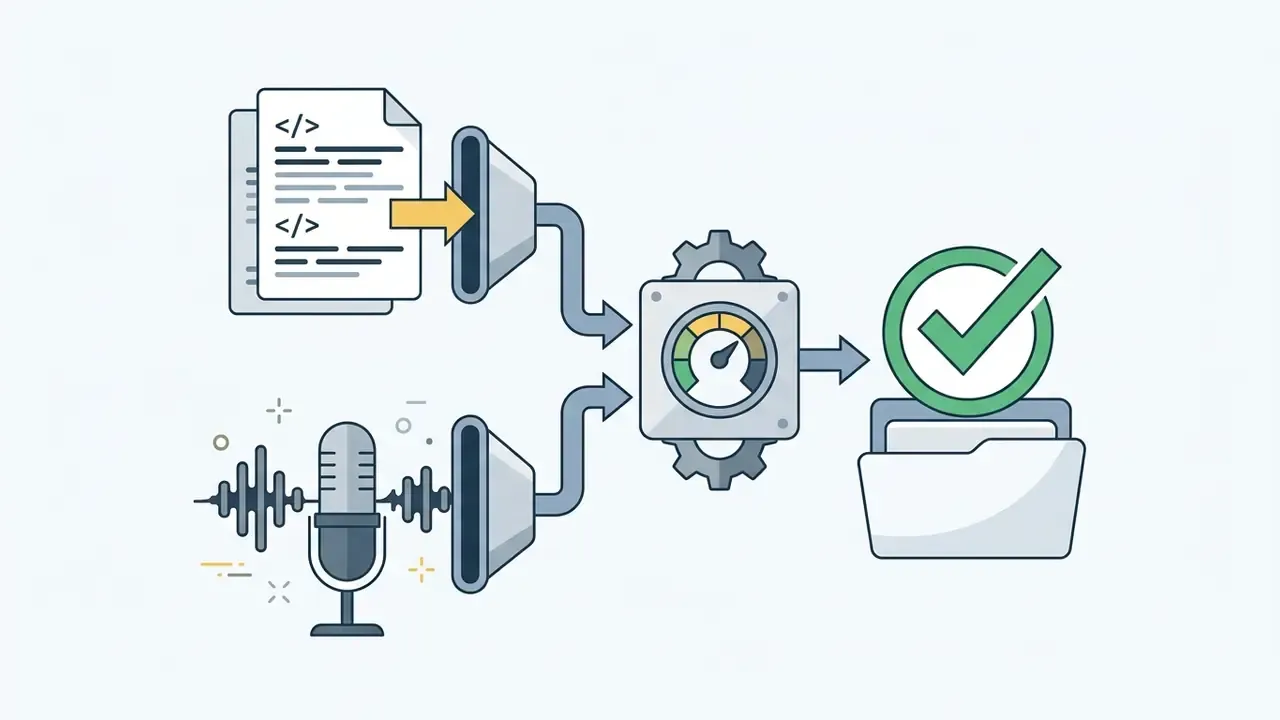
Picking the right input format depends on whether you are building a new vocal line or modifying an existing performance. Text and lyric inputs suit original melodies in text-to-song tools; uploaded audio files give strict melodic guidelines to AI voice conversion tools (OpenAI Audio API Docs, 2026). When uploading audio, systems support standard formats including MP3, WAV, and M4A up to 25 MB (OpenAI Speech API, 2026).
Note the modality split in vendor documentation: generation endpoints take text or lyric fields as primary input, while transcription and conversion endpoints take audio. Lyric-conditioned engines often expect a dedicated lyrics field or a separate lyric text file rather than a single free-form prompt. For long-form text workflows, reference our ai book generator documentation.
Select a singer voice, genre, and vocal style
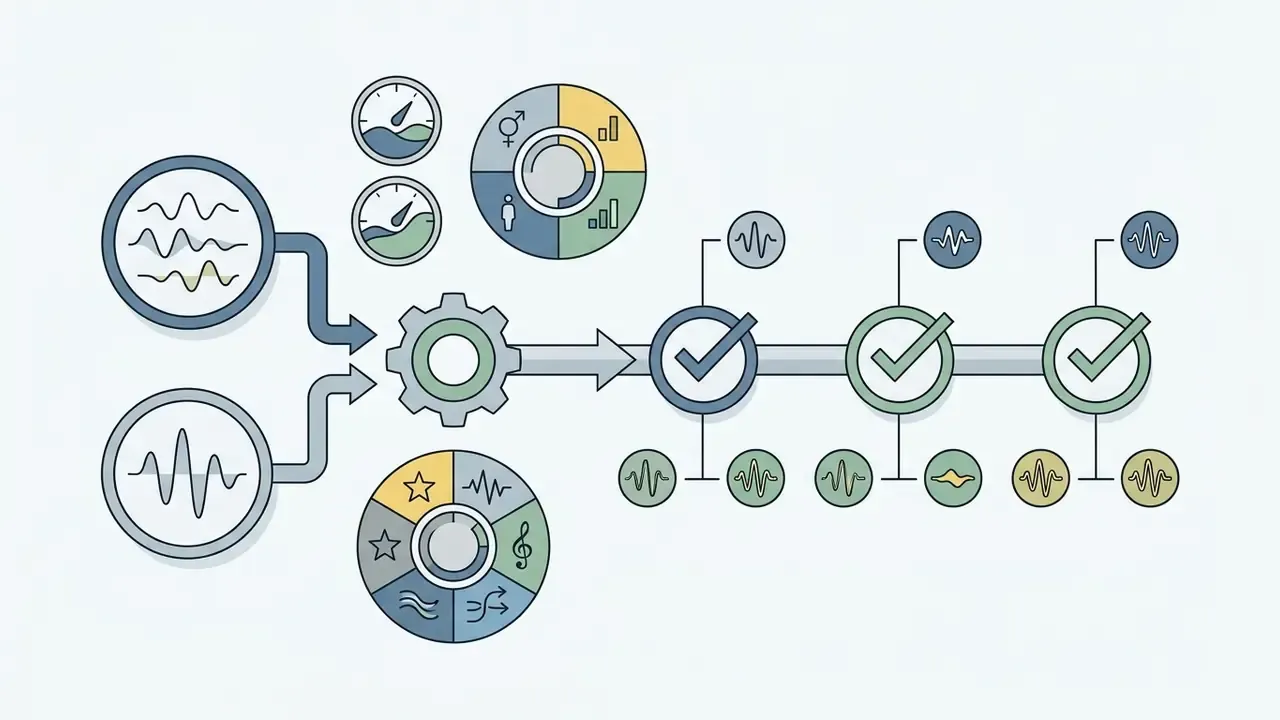
Configuring the synthetic voice means choosing an AI voice model matched to the target age, gender, dynamic range, and musical style. Advanced platforms leverage SSML tags and voice roles, such as YoungAdultFemale or OlderAdultMale, to shape tone, while style tokens adjust performance intensity across pop, rock, or jazz (Microsoft Azure AI Speech, 2026).
Matching the voice model's natural pitch range to your song's key prevents unnatural vocoder artifacts during synthesis. Transposing a chest-register model into a falsetto range is the single most common cause of glassy, robotic output. One more nuance: genre labels in vendor libraries are usually curation tags, not hard parameters. Azure-style documentation exposes style and role rather than explicit Pop/Rock/Jazz switches, so genre feel comes from style tokens, delivery tags, and arrangement context.
Generate, review, and download your AI vocals
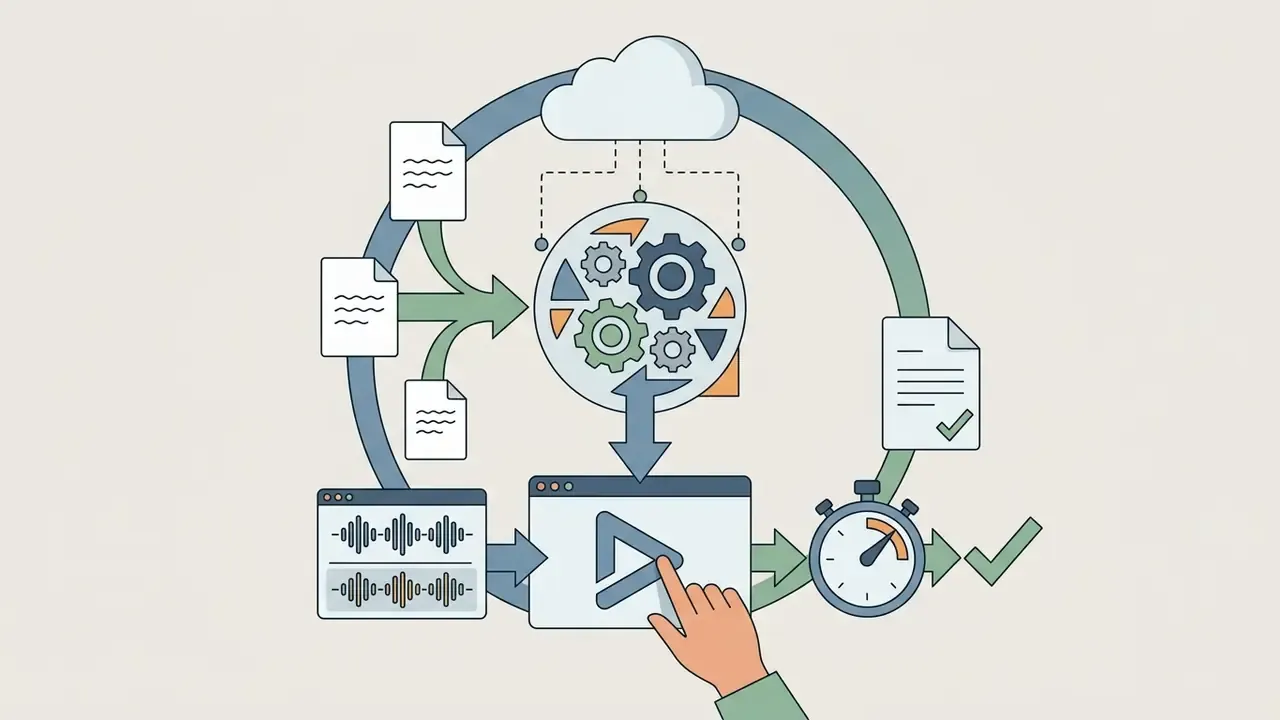
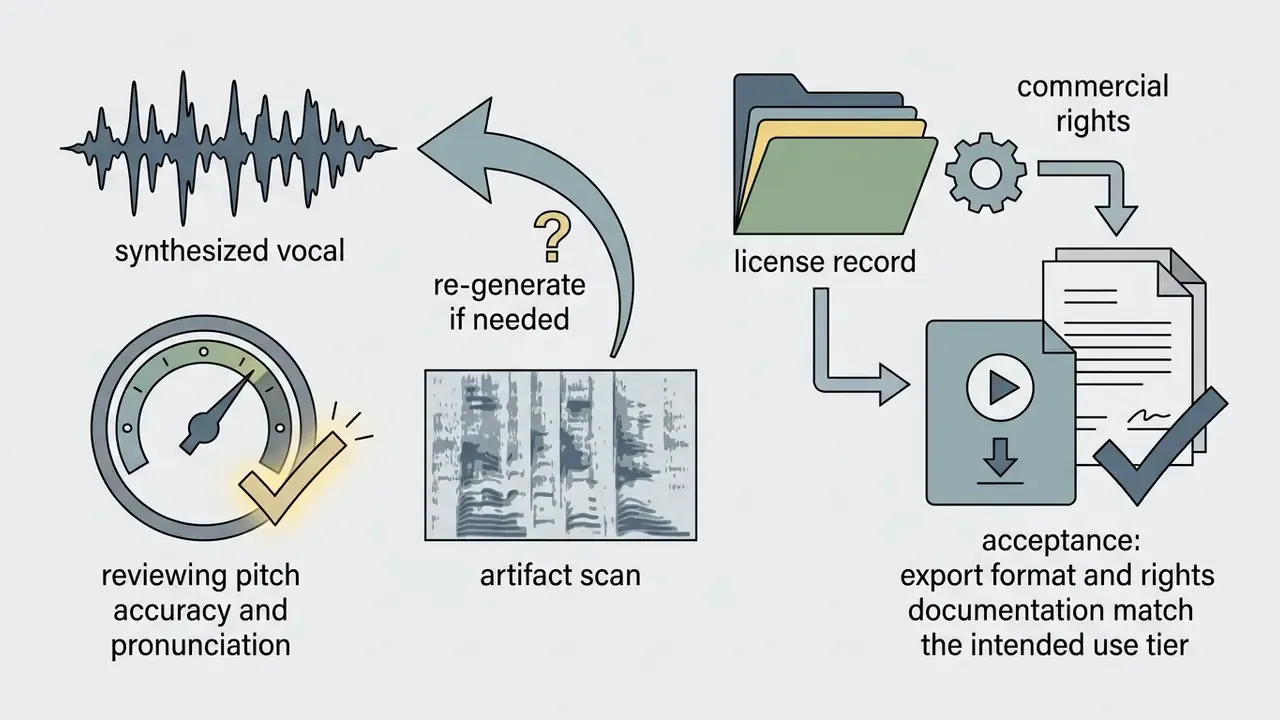
Clicking generate triggers prompt-to-audio processing, yielding a playable stream within seconds to minutes depending on track length (SongDriver, ACM, 2022). Users evaluate the result with subjective listening criteria: pitch stability ( trajectory), consonant clarity, and emotional expression (ISCA Archive, 2016). Subjective testing remains the most appropriate primary method for singing synthesis, normally combined as ACR/MOS scoring plus paired comparison against a reference take.
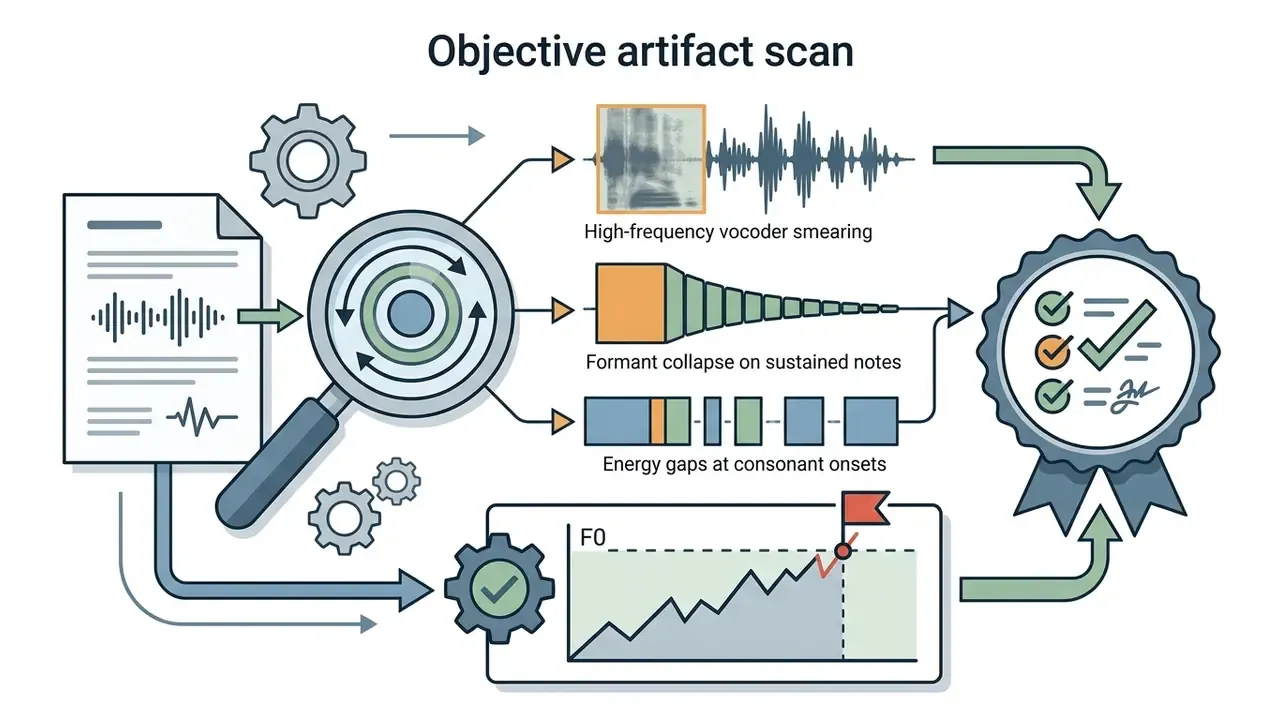
Pair that with instrumental verification, a spectrogram pass and an overlay against the reference melody, so failures get diagnosed rather than merely disliked. If artifacts or mispronunciations appear, tweaking input punctuation, adjusting delivery tags, or re-selecting the voice model allows iterative refinement before downloading the final WAV or MP3 stem. To estimate resource requirements, review our AI Media Calculators.
AI Singing Voice Features That Affect Vocal Quality
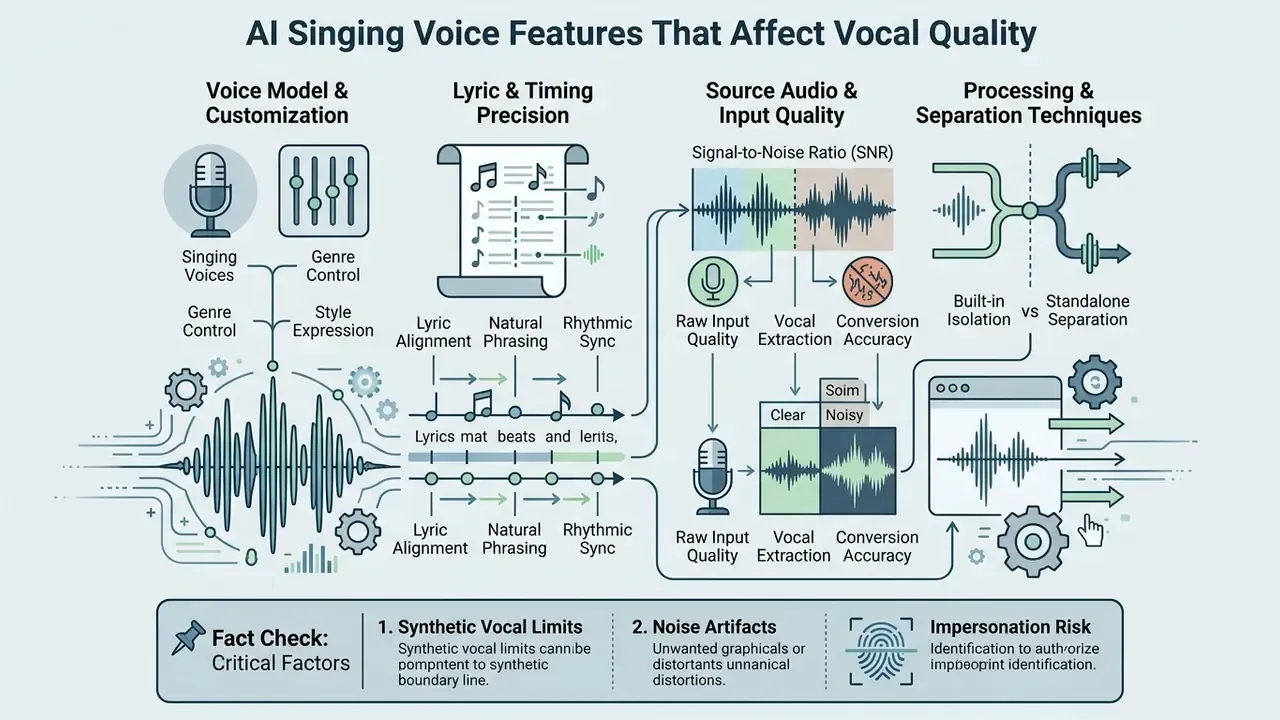
Naturalness and expression in an ai singing voice depend on acoustic parameter controls, precise lyric alignment, and the signal-to-noise ratio (SNR) of the uploaded source audio. Key parameters such as fundamental frequency (), intensity contours, and duration modeling govern how realistically a synthetic voice moves between notes.
«A systematic review confirms F0 contour, intensity and phoneme duration are the key prosodic parameters determining synthesized vocal naturalness». A Systematic Review of Prosodic Parameters in Speech Synthesis (2026). https://arxiv.org/abs/2601.09876
| Vocal Quality Parameter | Underlying Mechanism | Impact on Generated AI Vocals |
|---|---|---|
| Fundamental Frequency () | Pitch contour trajectory modeling | Controls pitch accuracy, vibrato smoothness, and key adherence across musical scales. |
| Duration & Timing | Phoneme-level temporal alignment | Manages syllable elongation, note lengths, and natural breath pauses in song meter. |
| Intensity & Loudness | Dynamic energy variation | Shapes vocal volume, belting emphasis, and soft emotional delivery tags. |
| Timbre & Voice Model | Deep neural acoustic representation | Defines identity, singer resonance, vocal range, and harmonic richness. |
| Vocal Tension & Breathiness | Sub-glottal pressure and air-flow simulation | Adjusts the balance between a dry, pressed belting voice and a soft, breathy falsetto. |
| Vibrato Rate & Depth | Oscillatory pitch modulation modeling | Controls the speed (Hz) and pitch deviation width of sustained notes to avoid synthetic stiffness. |
| Pitch-Line Curve Editing | Continuous pitch trajectory vs. MIDI-snapped scale | Allows manual drawing of glissando, pitch scoops, and micro-tonal bends over time-aligned lyrics. |
| Voice Blend Weighting | Interpolation of two or more timbre embeddings | Produces hybrid vocal identities and reduces similarity to any single source performer. |
| Audio Input Cleanliness | Source signal isolation (SNR) | Eliminates background bleed, reducing vocoder distortion in audio conversion workflows. |
Voice models, singing voices, and customization
Modern AI voice models use multi-factor conditioning to separate singer timbre from pitch, duration, and emotional expression. Models like Microsoft's MAI-Voice-2 allow sentence-level tone adjustments, while open research architectures use phone-aligned pitch and energy signals to preserve timbre while altering delivery (MAI-Voice-2 Model Card, 2026; CtrlSpeech, 2026). Customization options let creators blend voice characters or adjust vibrato rate without distorting the underlying identity.
In DAW-style environments the same controls appear as editable curves rather than prompts. Producers drag notes in a hybrid waveform/MIDI editor, draw the pitch line by hand for scoops and slides, and automate breath, energy, and tension per phrase. Cloud rendering keeps this responsive without taxing local hardware, and per-slot model management determines how many custom voices a plan permits.
Lyrics, genre, and style control
Getting correct pronunciation and rhythm from custom lyrics starts with aligning syllable counts to musical phrase lengths.
«Controllable neural lyric translation shows rhythm-pattern matching is critical so stress patterns align with pitch peaks and note duration». Singable and Controllable Neural Lyric Translation, ACL (2025). https://aclanthology.org/2025.acl-long.0
Placing explicit delivery tags such as [Pause], [Soft Delivery], or [Belting] helps steer genre-specific phrasing in pop, rock, or classical arrangements (Berklee Online Songwriting Handbook, 2025). Classical diction handbooks add two practical rules that transfer straight to synthetic vocals: divide syllables before consonants where possible so the model does not clip onsets, and delay diphthongs on long notes so sustained vowels stay open instead of collapsing early.
Audio input quality and vocal conversion results
The acoustic purity of the uploaded source audio directly determines the clarity of audio-to-audio voice conversion outputs. Background noise, electrical hum, or instrument bleed in source files causes pitch tracking errors and vocoder artifacts in converted tracks.
Running a vocal remover before conversion isolates the lead vocal, so the AI singing voice model processes clean acoustic data (Ultimate Vocal Remover GUI v5.6, 2026).
Built-in isolation vs. standalone separation: browser tools offer one-click vocal isolation that runs automatically at upload, but standalone local tools such as Ultimate Vocal Remover GUI (UVR5) with MDX-Net or Demucs models deliver superior separation ( SNR improvement on typical mixes). Built-in web isolators often leave background artifact bleed and reverb tails, which then drive vocoder phase distortion during conversion. Two further input rules hold across published pipelines: feed lossless WAV or FLAC rather than low-bitrate MP3, because encoding artifacts get re-synthesized as noise, and split long files into short chunks (roughly 20 seconds or less) with silence minimized, which is standard preprocessing in recent SVC work. To assess subscription costs across generation platforms, see our AI Media Pricing Guides.
📌 Fact check: synthetic vocal limits, noise artifacts, and impersonation risk. Independent research indicates that synthetic voice naturalness degrades significantly when source audio SNR drops under vocoder conversion (Statistical Voice Conversion Evaluation, ISCA). Detection research shows AI-synthesized voices can be identified by neural vocoder artifacts in the signal rather than by biological breath control (CVPRW, 2023). Practically, AI singers lack biological breath mechanics and live articulation micro-variation, so models can break when a melody crosses the trained register, producing hallucinated falsetto, doubled formants, or a flattened vibrato on sustained notes. Source audio isolation, in-range key selection, and a spectrogram audit are therefore essential for high-fidelity output. Separately, the same cloning capability that produces a demo vocal produces a convincing impersonation: organizations in finance and other regulated sectors should treat voice-clone creation as a fraud-surface change and avoid voice-only verification for sensitive transactions.
Free AI Singing Generator Limits, Pricing, and Commercial Use
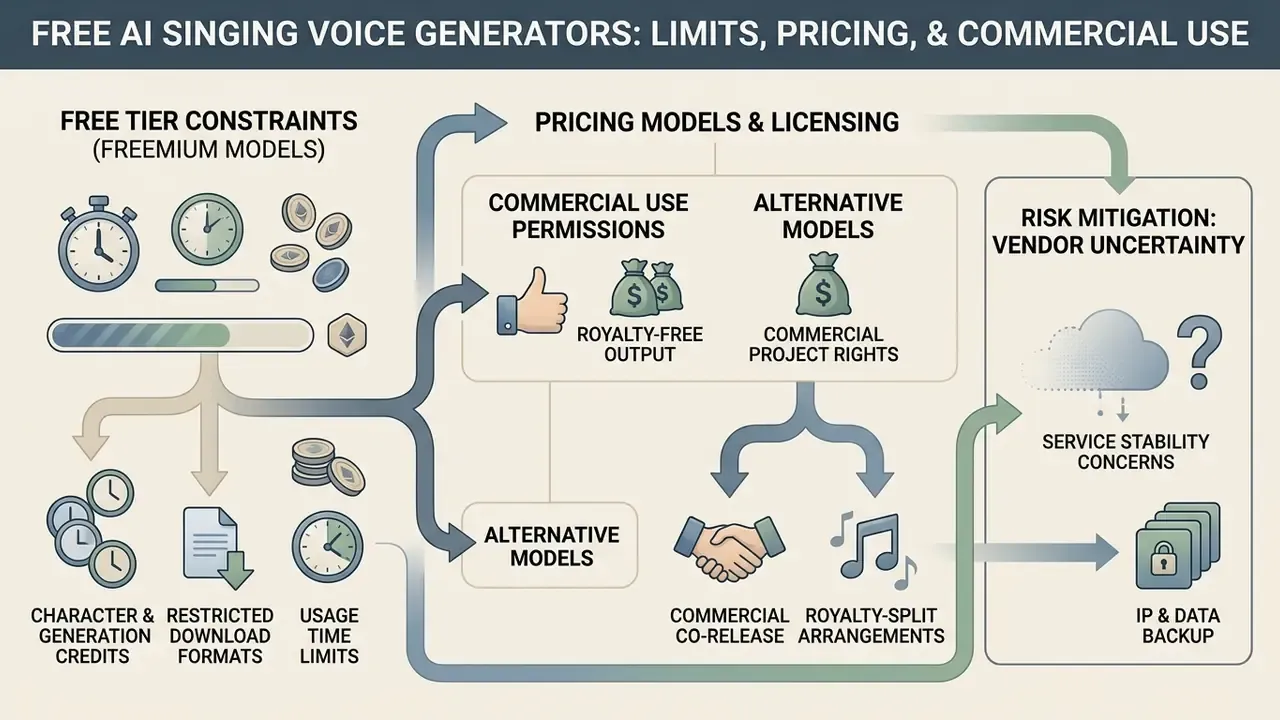
Free tiers for online AI singing voice generators operate under freemium constraints, restricting character counts, daily generation credits, audio download formats, or commercial usage rights. Free accounts allow testing and demo creation; commercial monetization typically requires a paid subscription (ElevenLabs Pricing, 2026; Suno Terms, 2026). Readers comparing freemium mechanics across adjacent categories can review how limits are structured for free AI video generators, where credit resets and watermark policies follow the same commercial logic.
| Service / Platform | Free Tier Quotas & Limits | Commercial Rights on Free Tier? | Data Ownership & Training Opt-Out | Premium Upgrade Starting Price |
|---|---|---|---|---|
| ElevenLabs | 10,000 credits / month; standard voices | ❌ Personal / non-commercial use only | Commercial license bundled from paid tiers; review workspace data terms | $6.00 / month (Starter Plan) |
| Suno AI | 50 credits / day (~10 song generations) | ❌ Non-commercial use; platform retains output rights | Privacy notice states uploaded audio and generated content are collected; uploads screened via rights providers | $10.00 / month (Pro Plan) |
| Google Cloud TTS | $300 promo credit + 1M standard / up to 4M free chars per month | Subject to Cloud terms (per-character billing) | Enterprise cloud data terms; per-character pricing from $4 per 1M chars | $4.00 per 1M characters (Standard) |
| Adobe Firefly (Audio) | Free daily generative credits; web preview | ❌ Personal / trial evaluation | Documented generative credit model; commercial terms tied to paid plan | $9.99 / month (Premium Tier) |
| Stability AI Core | Free usage under $1M annual revenue limit | ✅ Commercial rights included below $1M revenue cap | Self-hosting possible, removing third-party upload exposure | $20.00 / month (Pro Membership) |
| Kits AI (Splice) | Train 2 custom voice models; royalty-free voice library access | ⚠️ Royalty-free library usable; artist voices require co-release terms | Custom-model training from user-uploaded a cappella (up to ~30 min); check slot and retention limits | Paid tiers unlock additional model slots |
| Controlla Voice | Credit-based onboarding (for example 600 credits, no card required) | ⚠️ Depends on voice source; blended or own models safest | Ethically-trained model claim; paid plan supports unlimited custom voice models | Paid plan for unlimited models |
Prices, quotas, and rights language change frequently. Verify each vendor's current pricing and terms page before procurement.
What "free" includes in an AI singing voice generator
Free plans provide temporary access to basic voice model libraries, web playback, and limited monthly or daily credits. ElevenLabs offers 10,000 free monthly credits for personal testing; Suno provides 50 daily credits, roughly ten song attempts, without export rights (ElevenLabs, 2026; Suno, 2026). Comparison coverage of competing tools reports tighter practical ceilings than marketing pages imply: around 15 minutes of total conversion time, restricted voice counts (as few as 14 voices), and trial-only or download-disabled exports. Free tiers rarely permit high-resolution WAV downloads or advanced voice cloning. Technical troubleshooting advice sits in our AI Media Support and Troubleshooting portal.
Royalty-free output and commercial project permissions
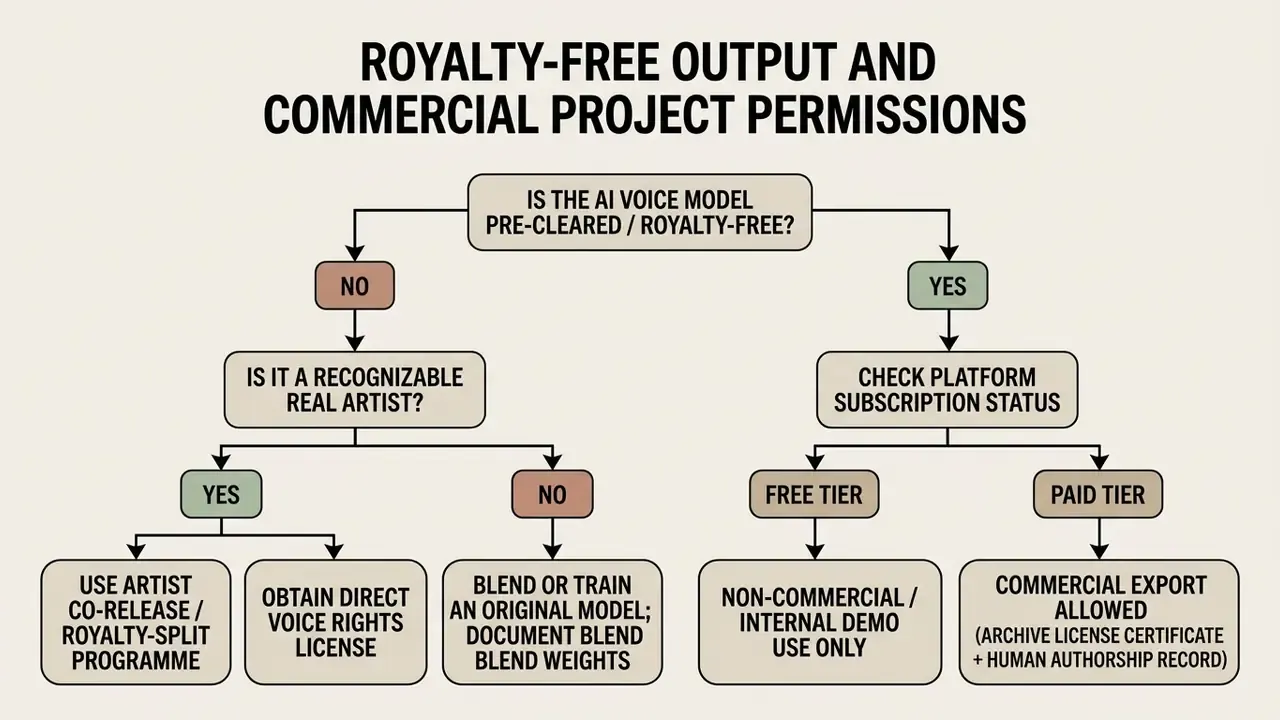
Commercial usage of AI-generated music depends strictly on platform licensing terms and human authorship contributions under applicable copyright law. The U.S. Copyright Office specifies that purely AI-generated works lacking human creative input are ineligible for copyright registration (USCO Guidance Letter on AI-Created Works, 2026).
«Under UK law authorship of computer-generated works is attributed to the programmer, but it is unclear whether that means the AI developer or the user». Protecting Human Creativity in AI-Generated Music, OUP Journal (2024). https://doi.org/10.1093/oxfordjournals/ai-music-2024
Using an AI voice model that replicates a recognizable real artist without explicit consent also triggers right-of-publicity and digital replica liabilities (U.S. Copyright Office Digital Replicas Report, 2025).
Commercial releases require authorized, royalty-free stock voice models supplied under paid platform licenses (ACE Studio Docs, 2026). Vendor "royalty-free" claims are product-specific: the same documentation that grants broad commercial use for pre-made voices can simultaneously require a direct third-party license for particular voices, and can generate a PDF license certificate as proof for client delivery. Claims that any generated output is automatically royalty-free, including outputs that imitate celebrity singers, should be treated as unreliable, because platform terms cannot override a performer's publicity rights.
Commercial co-release and royalty-split models: to resolve copyright deadlocks, some platforms deploy direct artist licensing frameworks. Creators can use official, cloned voice models of commercial artists under agreement terms, such as automated 50/50 streaming royalty splits (the approach popularized when Grimes publicly permitted use of her AI voice in exchange for half of royalties) or curated distribution through platform-sanctioned releases such as Kits AI's commercial co-release programme, where a track built on an official artist voice is submitted for release alongside that artist. This provides legal clearance while returning revenue to the voice owner, and it is currently the only reliable path to publishing a recognizable-artist AI vocal commercially.
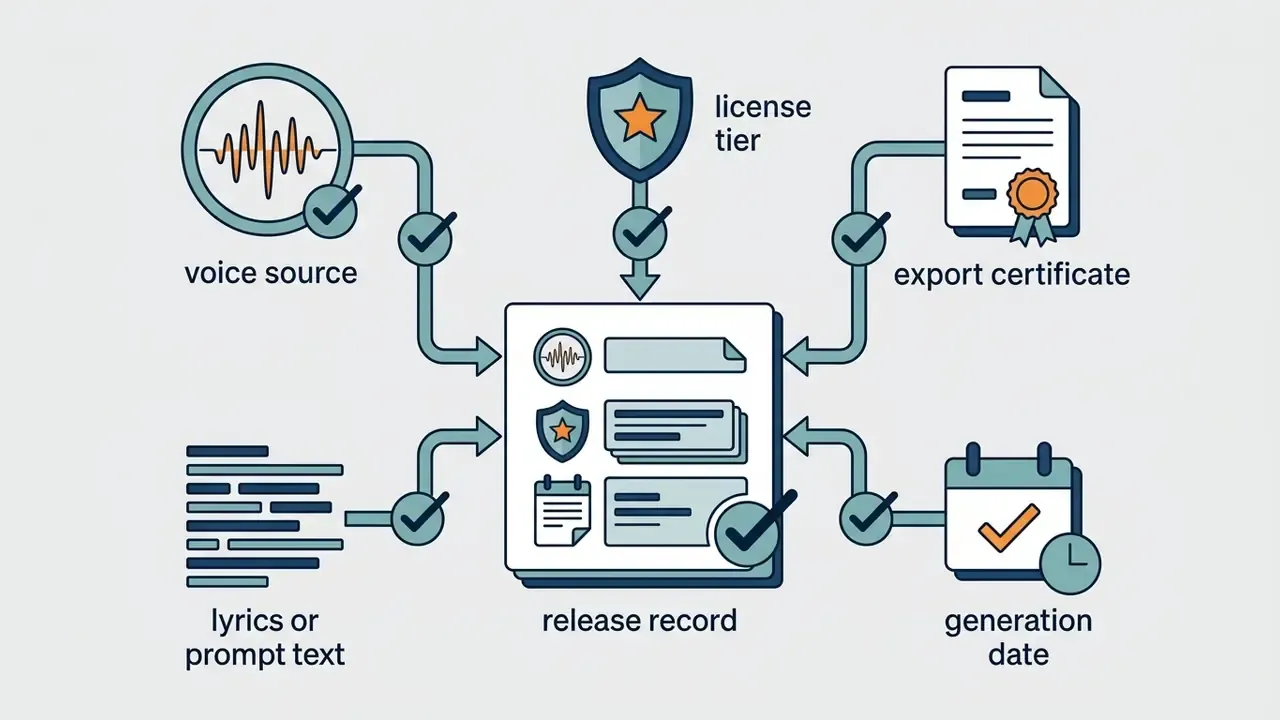
"What if the vendor disappears?" Free tools consolidate and shut down often, so rights hygiene must survive the platform. Before a synthetic vocal enters a paid campaign: download and archive the license certificate or a terms snapshot as of the generation date; store the exported stems and the source lyric or prompt locally rather than trusting cloud history; record voice-model provenance (stock library, own clone, blended weights, or licensed artist voice); and confirm in your client contract who indemnifies a later rights claim. If a platform closes, the license you already exercised generally remains evidenced only by what you archived, and the surviving obligation to clear or replace the vocal typically falls on the party that delivered the asset.
Legal disclaimer: this information is general in nature and does not replace advice from a qualified attorney on copyright, publicity rights, and AI content licensing in your jurisdiction.
How to Choose the Best AI Singing Voice Generator Free
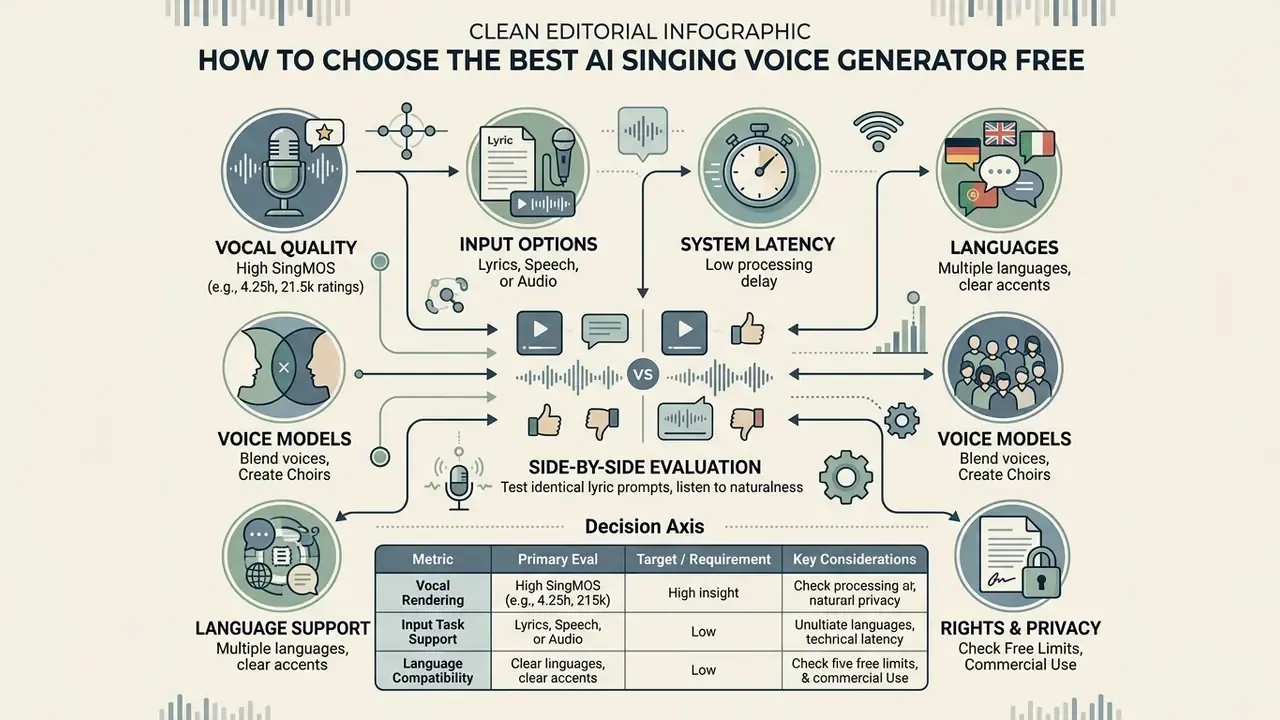
Selecting the best free ai singing voice generator online means evaluating six operational metrics: vocal rendering quality, input task compatibility, system latency, language support, export restrictions, and data privacy policies. Comparing tools across these parameters keeps the choice aligned with your actual production requirements rather than a demo reel.
Benchmarks matter because a naturalness target is only meaningful against a rated reference set. Industry evaluation frameworks published in 2026 similarly anchor voice quality near MOS 4.3 or above, task success above 85%, and time-to-first-audio under 500 ms, which is where the thresholds in the table below originate.
| Decision Axis | Primary Metric to Evaluate | Ideal Target / Requirement | Key Considerations |
|---|---|---|---|
| Vocal Quality | Mean Opinion Score (MOS) | MOS for naturalness (4.3+ for release-grade) | Evaluates pitch stability, vibrato, and absence of vocoder distortion against a rated benchmark. |
| Task Fit | Input format support | Lyrics-to-Song / Audio Conversion / Speech-to-Singing | Match system capabilities to text prompting, stem replacement, or model training from speech. |
| Expression Control | Micro-parameter availability | Tension, breathiness, vibrato rate, editable pitch line | Determines whether takes can be fixed by editing instead of re-rolling. |
| Inference Latency | Time-to-First-Audio (TTFA) | for real-time preview | Faster processing enables efficient iterative prompt tuning. |
| Language Support | Multilingual voice libraries | Native accent rendering; per-note language assignment | Ensures correct phonetic alignment for non-English lyrics. |
| Export Quotas | Free monthly character or time limit | chars or 10 daily tracks; WAV export | Determines how much testing is permitted before payment. |
| Rights & Privacy | Commercial license, training opt-out, retention | Royalty-free commercial export plus documented opt-out | Protects against voice cloning liabilities and unauthorized training on your uploads. |
When testing candidates, evaluate audio quality side by side using identical lyric prompts, then read the license terms with the same care. Run the same 30-second lyric block through every shortlisted tool, hold key and tempo constant, and score naturalness, intelligibility, and artifact count blind. Comprehensive comparisons live in our AI Media Comparison directory, including the methodology behind our ranking of the best AI video generators, while developers can check integration options in our AI Media API Guides and review a worked cost model in the Google Veo implementation guide.
FAQ: Frequently Asked Questions About AI Singing Voices
Do you need singing or music production experience?
No formal singing ability or production experience is required to operate a free online ai singing voice generator. Web platforms automate complex vocal synthesis tasks using natural language prompts, preset genre controls, and automated phonetic alignment (Pearson AI Guidance, 2025).
«A melody-driven SVS system generates singing from raw melody audio and lyrics without annotations, letting users without musical training join the creative process». Zero-shot Singing Voice Synthesis with Annotation-free Melody Control (2025, preprint). https://arxiv.org/abs/2502.07029 Experienced producers still benefit from exporting isolated stems into a DAW for mixing, while beginners can generate complete vocal tracks in the browser from basic text lyrics (Berklee Online, 2026). Formal prerequisites appear only in training contexts. A Berklee Online AI course expects basic DAW literacy; the tools themselves do not. And you do not need to sing at all: a clean 1 to 10 minute speech sample is enough to build a song-ready voice model.
Can you generate songs in different vocal styles and languages?
Modern AI singing voice generators support multilingual voice models that sing across languages and distinct genres like pop, rock, jazz, and classical. Platforms such as ACE Studio and Azure Speech allow language assignment on a per-note basis, detecting phoneme shifts and native accent nuances automatically (ACE Studio Docs, 2026; Microsoft Azure AI Speech, 2026).
«TCSinger is the first zero-shot SVS model with multi-level style control, singing method, emotion, rhythm and technique, for cross-lingual speech-to-singing transfer». TCSinger (2025, preprint). https://arxiv.org/abs/2502.09101 Voice tools like Cartesia and Hume Octave 2 support multi-accent rendering across up to 11 languages without losing core vocal character, with Cartesia capping a single voice at ten accents and Octave 2 predicting speaker accent when rendering a different language (Cartesia, 2026; Hume AI, 2026). Readers benchmarking multilingual capability across categories can cross-reference our AI voice generators guide for language-coverage tables.
Are uploaded audio files and generated songs private?
Privacy policies vary by platform. Public freemium services may collect user-uploaded audio and generated tracks to train acoustic models or to screen them for rights violations; enterprise platforms offer contractual data protections instead. Suno's privacy policy, for example, notes that uploaded audio and generated content are collected and screened using content verification tools, including third-party rights-screening providers, to prevent unauthorized copyrighted material use (Suno Privacy Notice, 2026). Users working with proprietary audio should review platform terms to ensure uploaded files are not stored, shared, or used for public model training (OpenAI Terms, 2026). OpenAI's usage policies additionally prohibit using another person's voice or likeness without consent in ways that could confuse authenticity.
«Copyright rarely protects the voice itself; performers' rights offer stronger protection but remain limited by consent and context of use». Do you own your own voice? Voice cloning and intellectual property, SSRN (2024–2025). https://ssrn.com/abstract=voice-cloning-ip-2024 For licensing policies, visit our AI Media Commercial-Use Hub, and track pending disputes in our AI Litigation and Case Timelines. This information is general in nature and does not replace advice from a qualified data-protection or intellectual-property specialist.
Frequently Asked Questions
Is there a 100% free AI singing voice generator online with unlimited commercial rights?
No commercial web platform offers unlimited generation with full commercial licensing entirely for free. Free plans are constrained by daily credits, non-commercial licenses, or personal-use clauses. Commercial rights require paid subscriptions or open-source local model deployment under open-source software licenses.
Can I clone my own singing voice for free?
Yes. Several web platforms offer free trial voice cloning from short audio uploads (15 to 60 seconds), and some free plans include one or two permanent custom model slots. Free clones usually carry watermark artifacts or restrict downloads to low-bitrate MP3 files without commercial release rights.
Can AI make my speaking voice sing?
Yes. Speech-to-singing pipelines build a voice model from 1 to 10 minutes of clean conversational speech (dry, mono, 16 kHz or higher), separating your timbre from your speech prosody so the model can perform scales, vibrato, and pitch bends in any key. You never record a sung take, and output gender can be assigned independently of the source recording.
Can I mix two AI voices into one new singer?
Yes. Blending interpolates the timbre embeddings of two or more models at chosen weights, producing a hybrid vocal identity that matches no single source performer. Some plugins let you target a profile from samples as short as ten seconds and drag between analyzed voices in a visual timbre map. Document blend weights per release so similarity claims can be answered later.
Can AI generate a choir or backing harmonies from one vocal line?
Yes. One-click choir modes convert a single monophonic line or MIDI part into Soprano, Alto, Tenor, and Bass layers, applying micro-timing jitter and pitch offsets of roughly ±5 to 15 cents so the stack sounds like separate singers rather than a duplicated file. Layers export as separate stems for independent mixing.
What is the difference between SVS and voice conversion?
Singing Voice Synthesis (SVS) generates singing audio directly from text lyrics and musical prompts. Voice Conversion (VC) takes an existing recorded singing voice and alters its timbre to match a target voice while preserving the original pitch and timing.
Should I use the built-in vocal isolator or a standalone separator?
For conversion work, standalone separators such as UVR5 with MDX-Net or Demucs models generally yield cleaner lead vocals (roughly 20 dB SNR improvement or better on typical mixes) than one-click browser isolators, which often leave reverb tails and instrument bleed that surface as vocoder phase artifacts after conversion.
What if the platform shuts down after we published the track?
Archive the license certificate or terms snapshot, exported stems, prompt and lyric text, model provenance, and generation date at the moment of delivery. If the vendor disappears, that archive is your only evidence of the license you exercised, and your client contract should state who is responsible for re-clearing or replacing the vocal.
Appendix A: Superseded References and Corrections
Retained for transparency and version traceability. The main text above contains the corrected, source-verified versions.
Page Metadata
- SEO Title Free AI Singing Voice Generator Online, Create AI Vocals
- SEO Description Free AI singing voice generator online: create vocals from lyrics, speech or audio, blend voices, build choirs, compare free limits, privacy and commercial rights.