Post-production skills no longer sit behind film school tuition or a proprietary software subscription. In 2026, a free video editing course online gives beginners a structured route into timeline editing, visual storytelling, color correction, sound design and platform-specific export workflows. Whether you want viral short-form content for TikTok, educational tutorials for YouTube, or a first paid freelance gig, the best free video editing course for you depends on three things: your target platform, your software, and the learning format you will actually finish.
That last point matters more than most course listings admit.
«Formal education or degrees are not a prerequisite to becoming a video editor.»
So the real skill is evaluation: reading a course structure honestly, separating open-access lessons from optional paid certificates, and applying the same technical vocabulary across desktop and mobile tools. Get that right and you build a reproducible editing pipeline instead of a folder of half-watched tutorials.
The One-Minute Summary
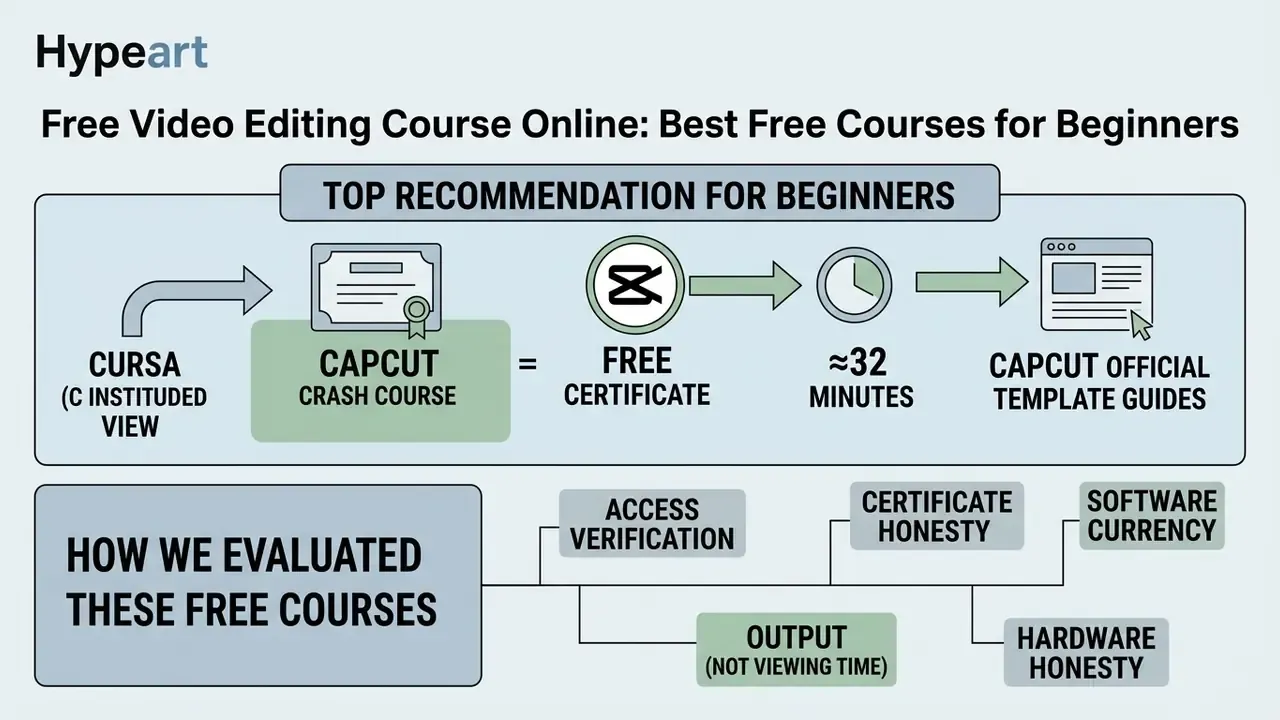
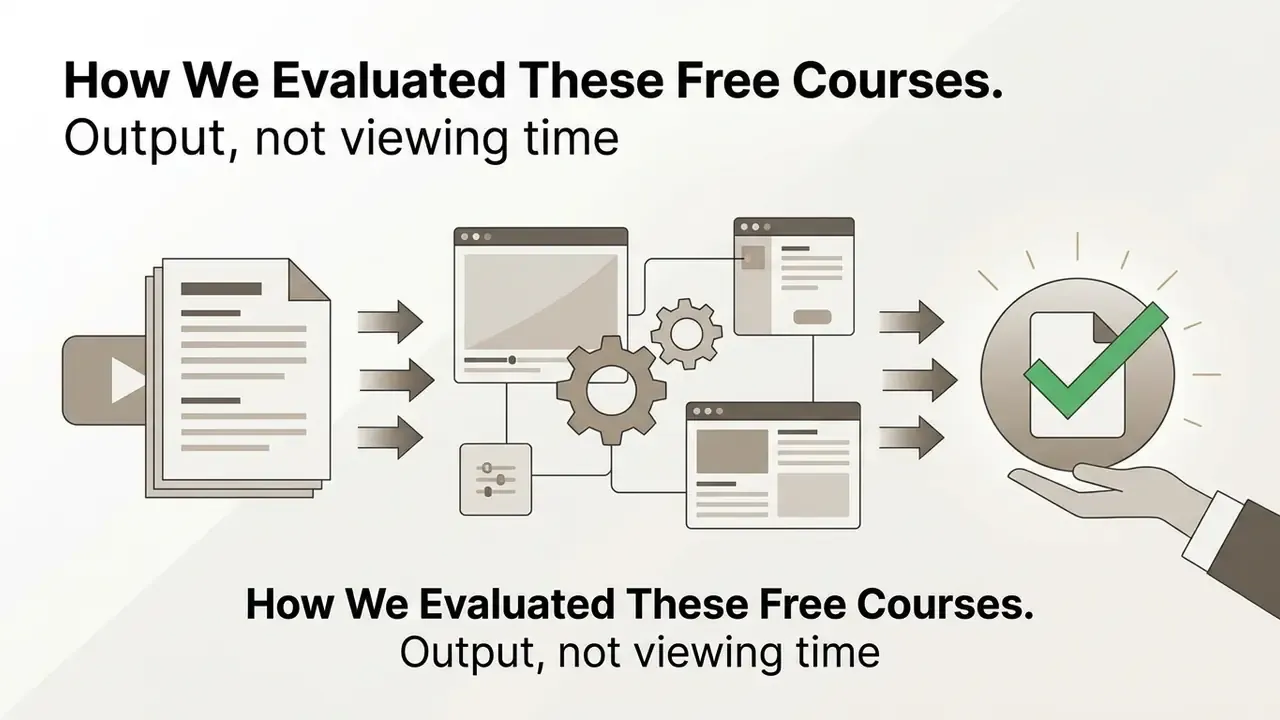
How We Evaluated These Free Courses
Every recommendation below was checked against the same five criteria, because "free" is used loosely across the category:
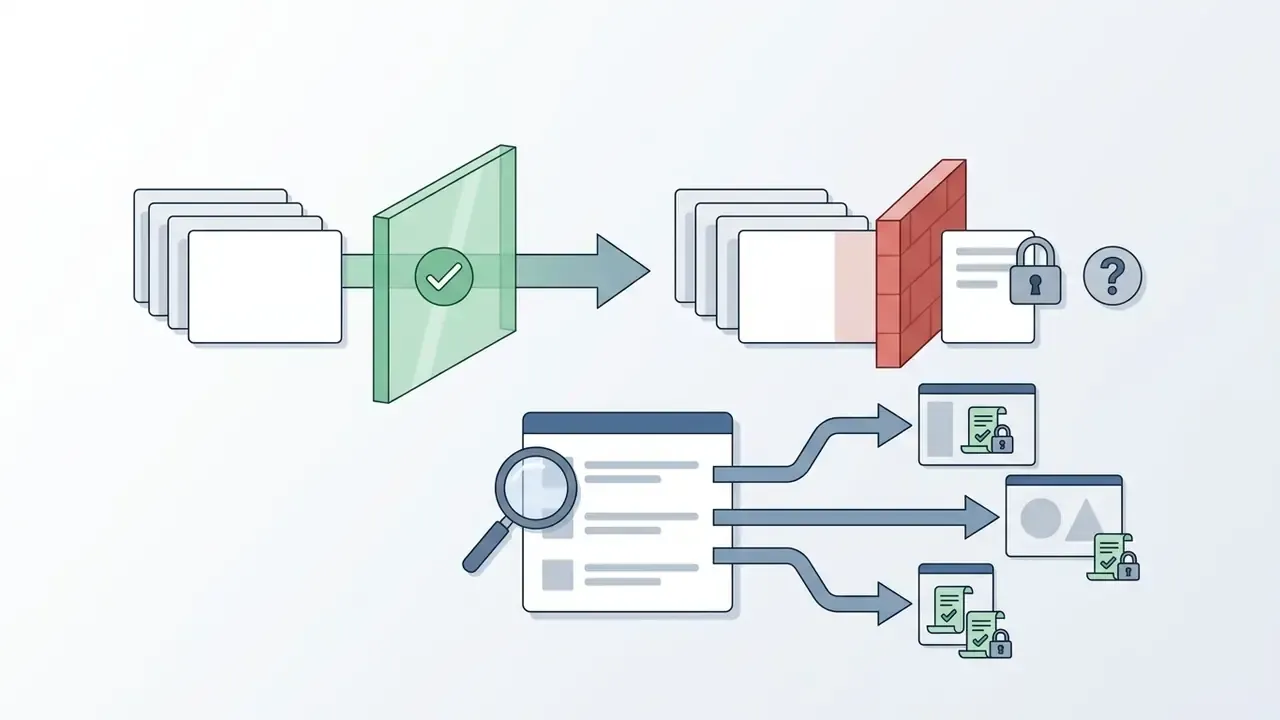
Several roundups still circulating as "best free video editing courses online 2025" are the same lists, lightly refreshed. We re-verified access terms for 2026 rather than assuming they held.
What You Can Learn in a Free Video Editing Course Online
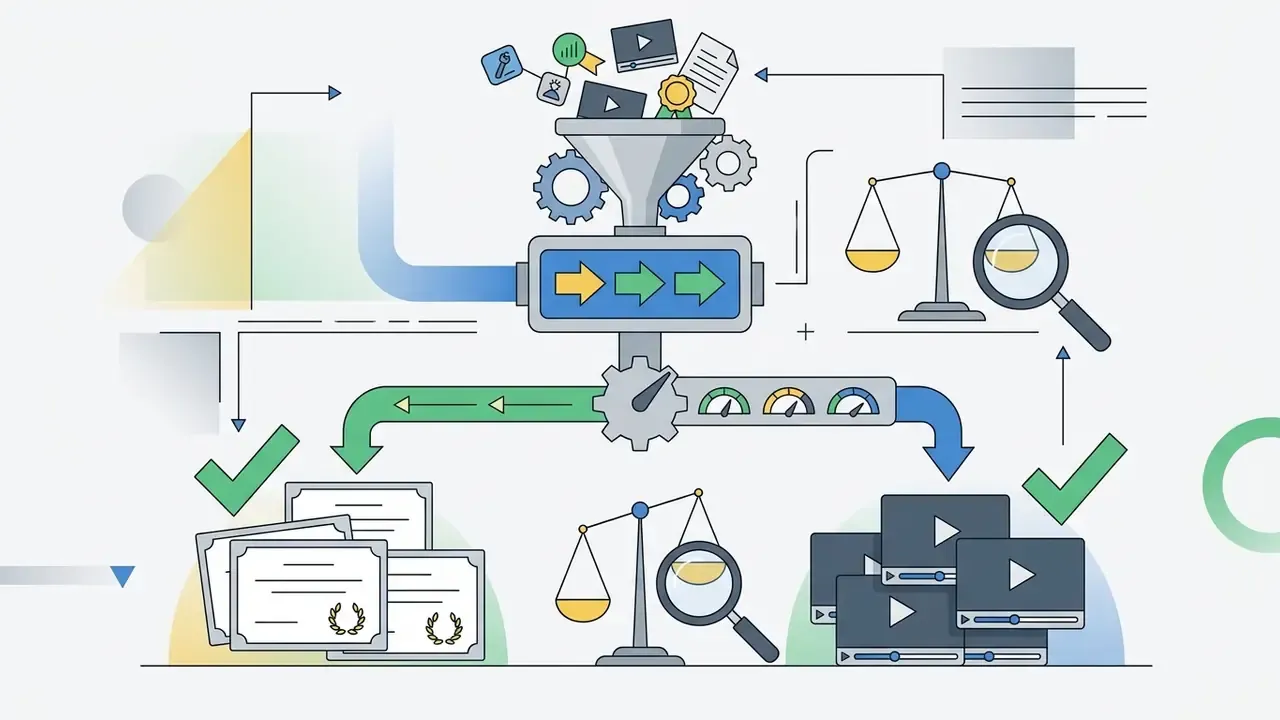
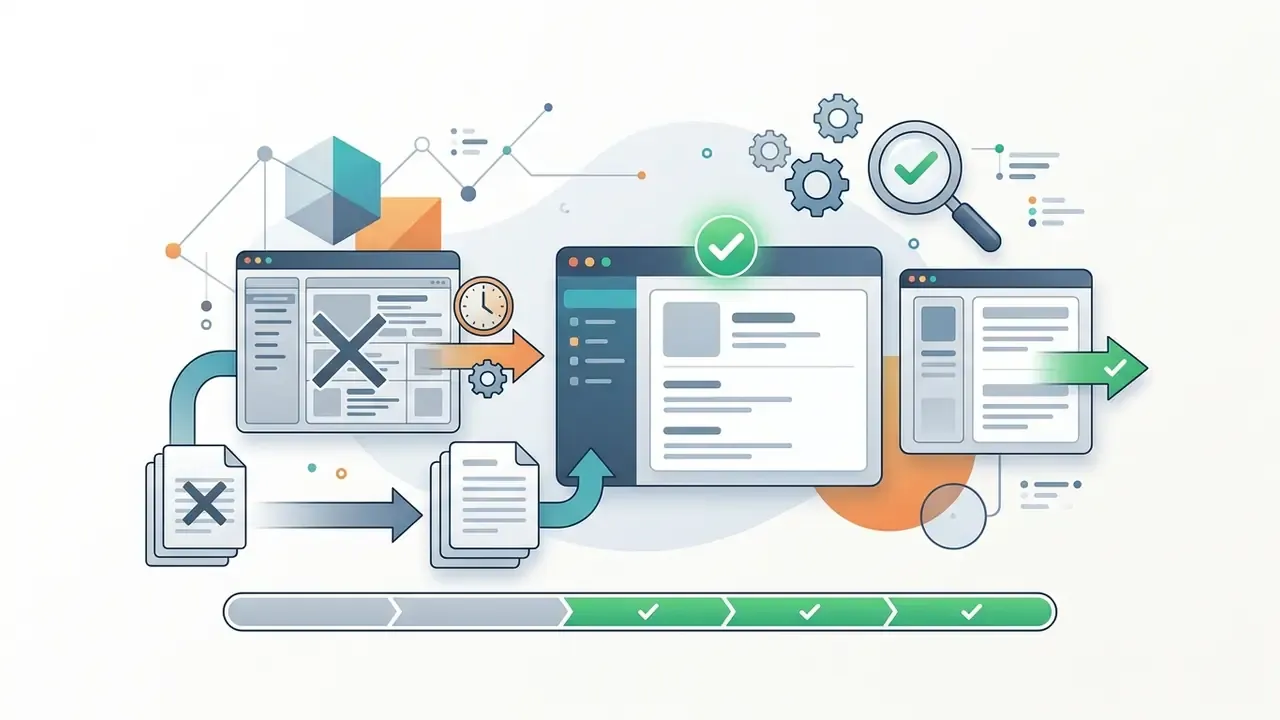
A free video editing course online teaches the fundamental post-production workflow: footage organization, timeline trimming, audio balancing, basic color correction, simple visual effects, and platform-specific export settings. Learners get hands-on time inside a modern video editor, turning raw camera files into a finished digital media asset.
Research comparing open-access and paid digital-skill curricula finds that technical depth at the introductory level is broadly equivalent. The differences show up in structure, feedback and credentialing, not in the knowledge itself.
«Free and paid courses are equivalent in content depth at the beginner level; differences appear in structure, feedback and certification, not in knowledge.»
For creators feeling their way around media tools for the first time, structured training lowers the entry barrier and, just as usefully, installs professional standards early.
Video Editing Basics for Beginners
Beginners learn non-linear editing fundamentals: project setup, source clip importing, timeline navigation, cutting technique, and basic transitions. Introductory modules exist mostly to demystify the interface, teach you to organize asset bins, and explain frame rates and aspect ratios before they bite you.
Mastering the basics of any editing course starts with familiar control over a handful of tools:
- Source clip vs. sequence: selecting a sub-section of a clip in the source monitor before dropping it into the primary sequence.
A small note on terminology. Older classroom material still calls the editing area a "montage table," while every current vendor manual says timeline. Learn the vendor vocabulary first. It makes official documentation searchable and saves you from following a tutorial that seems to describe a different application.
- Timeline and playhead navigation
- positioning clips chronologically across multi-track video and audio layers. Adobe's own documentation defines the timeline as the workspace where video, audio and images are arranged, trimmed and layered.
- Importing raw media
- ingesting video clips, audio tracks and graphic elements into project media panels from local drives, cloud storage or stock libraries (Source: official Adobe Premiere Pro documentation, https://helpx.adobe.com/premiere-pro/user-guide.html).
- Basic cut and trim
- using the razor tool, ripple edit and trim controls to remove mistakes and set clip boundaries.
- Panel literacy
- recognizing the four core Premiere Pro panels (Project, Source Monitor, Timeline, Program Monitor) so tutorial instructions map onto your actual screen.
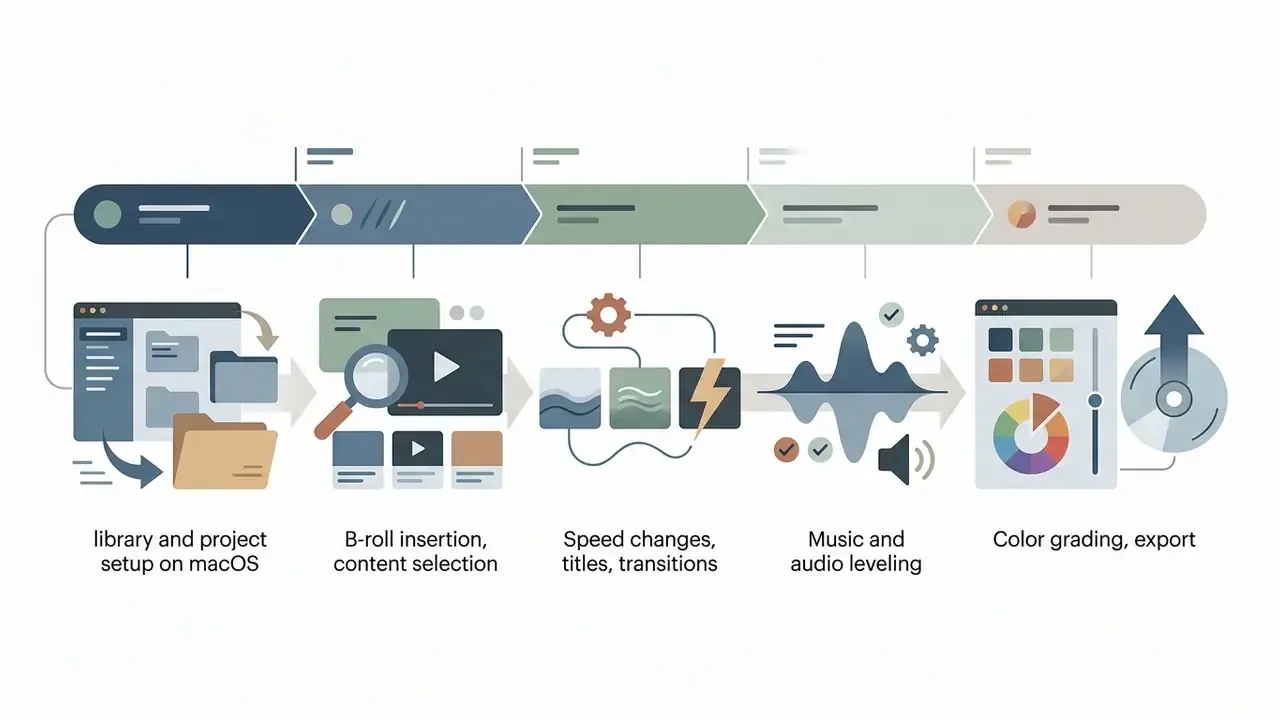
Universal 3-Step Action Workflow for Any NLE
If you want a finished file today rather than a finished syllabus, this sequence works in Premiere Pro, DaVinci Resolve, Final Cut Pro, CapCut and Filmora with only minor naming differences:
- Import and bin setup open the software → select
New Project→ drag media files into theMedia Pool / Bin→ confirm the sequence frame rate matches your footage. - Timeline assembly drag clips onto Video Track 1 (V1) → press
C(Razor Tool) to trim unwanted edges → pressV(Selection Tool) to arrange the sequence → apply aCross Dissolvebetween jarring cuts. - Export master press
Ctrl+M(Windows) orCmd+M(macOS) → select the presetMatch Source – High BitrateorH.264 / MP4→ clickRender / Exportand watch the file back at full screen before publishing.
Understanding your software options early saves relearning later. Creators exploring lighter desktop utilities can check reviews of the AVS Video Editor alongside broader NLE platforms, and reach for a video compressor whenever a deliverable exceeds a platform upload limit.
From Raw Media to Final Export: The Complete Pipeline
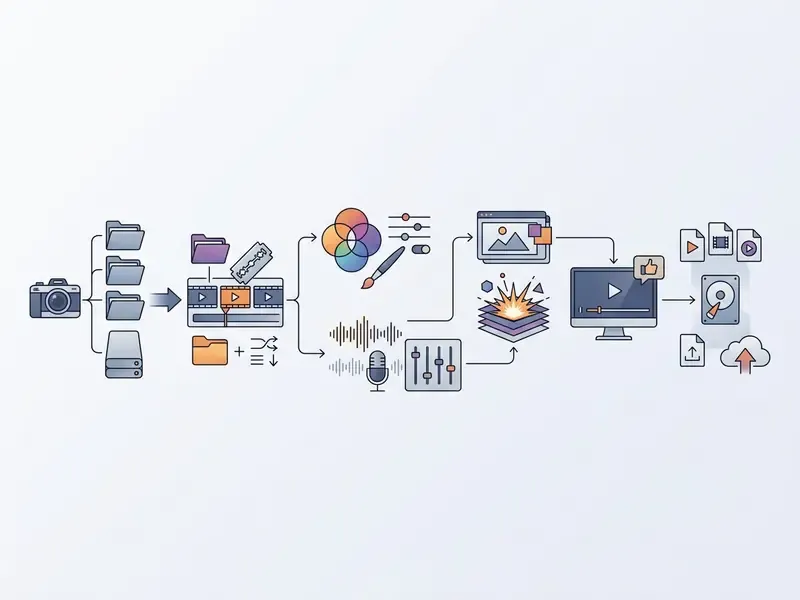
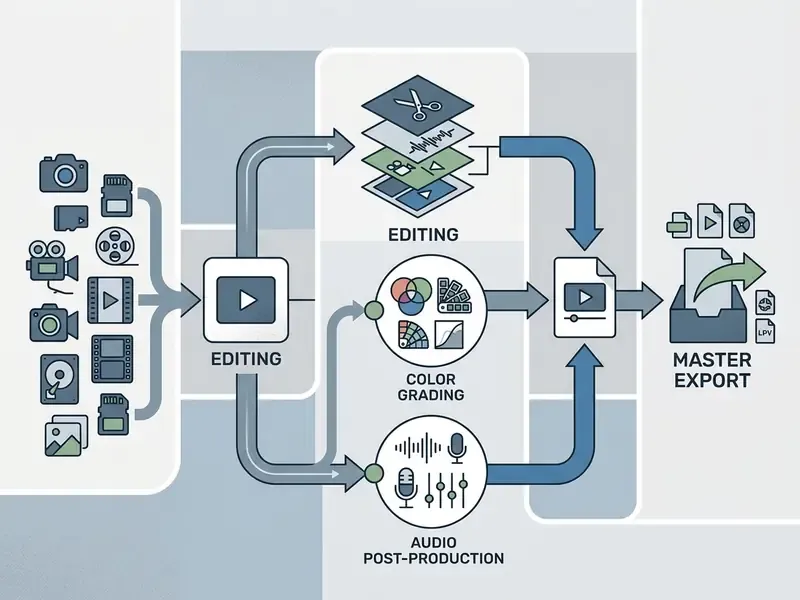
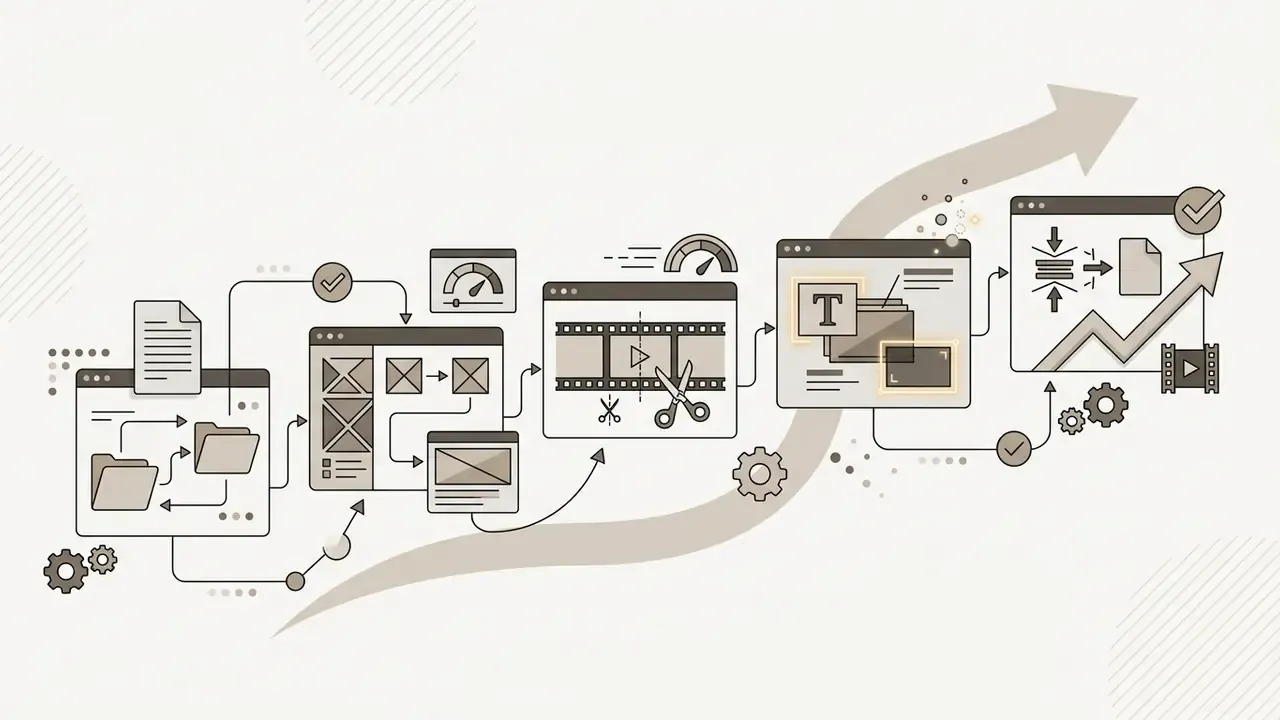
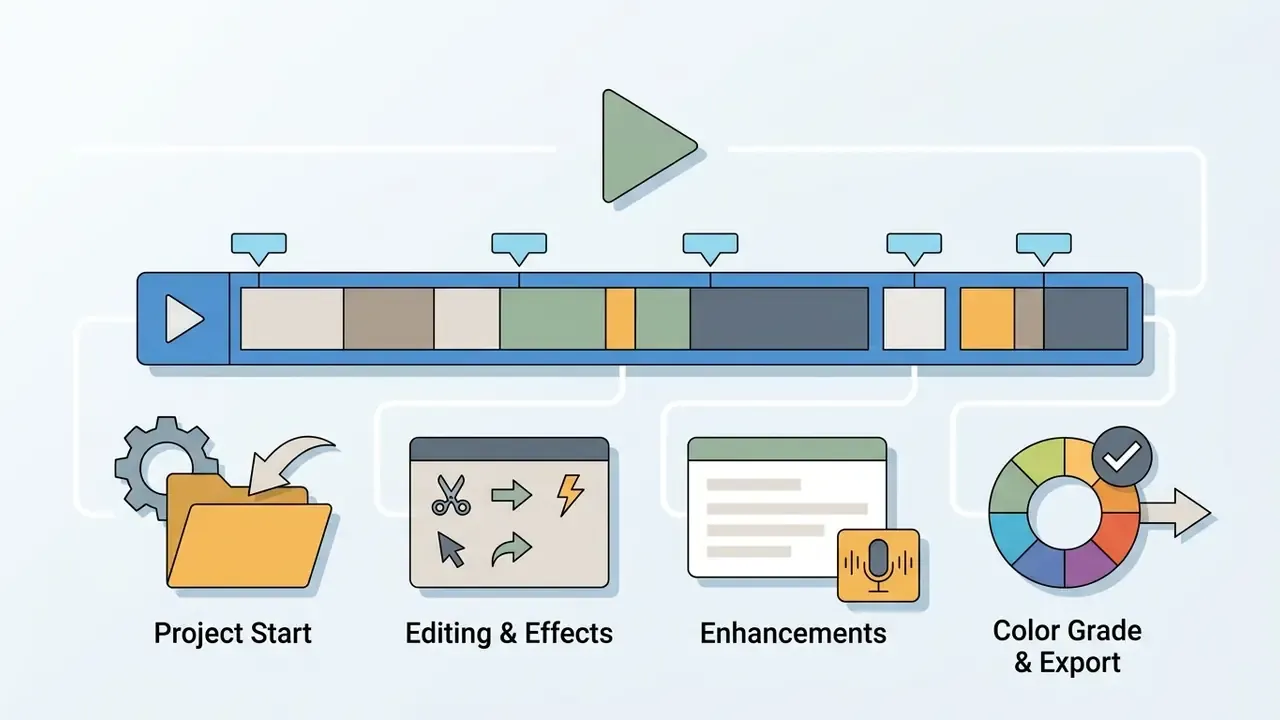
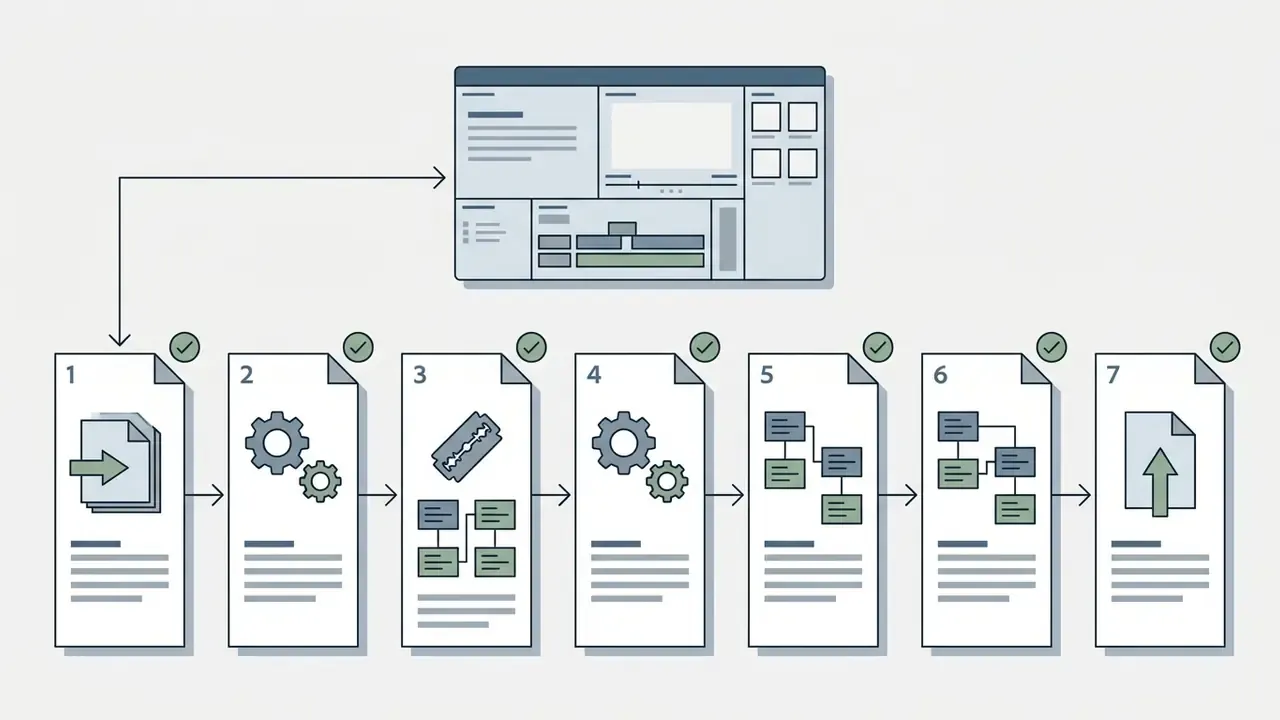
The end-to-end workflow moves raw source files through folder structuring, rough assembly, audio mixing, color adjustment, title overlay, quality control and optimized rendering. A serious free online course video editing curriculum breaks this pipeline into sequential modules, and because it is the one reproducible backbone behind all post-production, it is worth learning properly once instead of improvising per project.
- Folder setup and project hygieneestablish standardized directories (
01_RAW_FOOTAGE,02_AUDIO,03_GRAPHICS,04_EXPORTS) before importing anything, and verify autosave intervals. - Ingest, media management and proxiesorganize assets by file type, set project frame rates (23.976 fps, 25 fps or 29.97 fps), and generate low-resolution proxies so timelines play back smoothly on a modest laptop.
- Rough assemblyarrange primary A-roll clips to establish narrative structure and pacing. Lock the story cut before adding polish. Reordering scenes after grading burns hours you will not get back.
- Audio balancing and sound designlevel dialogue, remove background noise, duck music stems, align sound effects. Voice-driven formats often mix recorded narration with synthesized narration; our guide to AI voice generators covers licensing and quality considerations.
- Color correction and gradingfix white balance, contrast and exposure for consistency across shots, then apply a deliberate look.
- Graphics and titlesoverlay lower-thirds, captions and brand assets inside broadcast-safe boundaries. Animated intros and kinetic titles can be built with an animation maker when your NLE lacks motion tooling, and stylized display type is easy to prototype with a novelty tool such as a barbie font generator before you commit to a licensed typeface.
- Final export renderingselect target codecs (H.264 or HEVC), resolution profiles (1080p vs 4K) and container formats (MP4, MOV), confirming audio channel layout, sample rate and bitrate before rendering (Source: Universitat Oberta de Catalunya, Basic Guide to Video Editing, 2024).
- Master render and QCexport the deliverable, then run a full-screen quality control pass on a phone as well as a monitor before publishing.
How to Choose the Best Free Video Editing Course for Your Goals
Choosing the best free video editing course means matching the curriculum to your target output, your video editing software, the hours you honestly have, and the amount of structure or certification you need. Short-form social creators and long-form narrative editors need different first courses, so evaluating parameters up front prevents wasted weeks.
For pricing structures, licensing constraints and feature comparisons across tools, our AI Media Pricing Guides go deeper, and the AI Media Calculators help estimate render and storage costs before you commit.
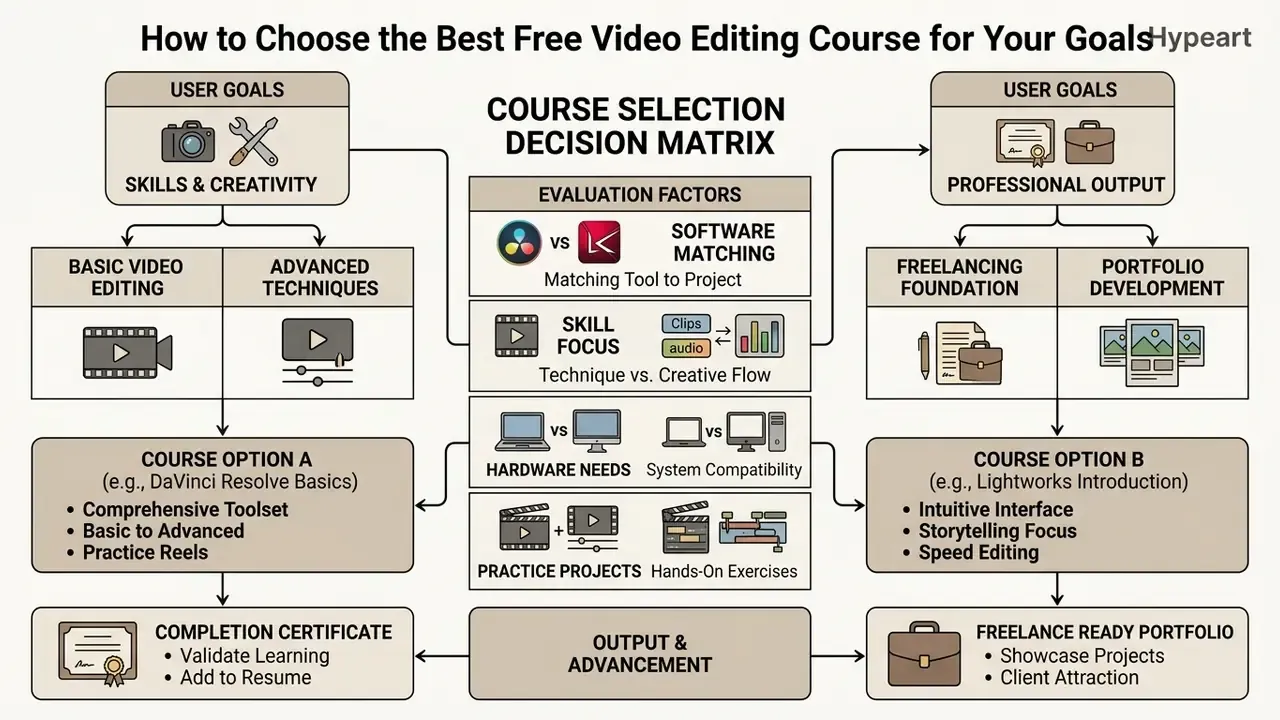
Course Selection Flowchart
Here is a structured path to the best free video editing course for beginners, based on goal, hardware and certificate needs:
- 1. What is your primary editing objective?
- Social media / short-form (Reels, TikTok, Shorts): fast-turnaround mobile or desktop tools. → Recommended path: CapCut crash courses, Canva video templates, short-form tutorials.
- YouTube / corporate / educational content: standard multi-track non-linear editors. → Recommended path: Adobe Premiere Pro or DaVinci Resolve introductory courses.
- Cinematic / documentary / advanced color: node-based color and high-grade audio. → Recommended path: Blackmagic Design official DaVinci Resolve training.
- 2. What software do you plan to use?
- Adobe Premiere Pro: vendor tutorials or university open-audit modules.
- DaVinci Resolve: official Blackmagic lesson books plus free video modules.
- CapCut: short-form vertical template guides and web-based micro-courses.
- Final Cut Pro X: Apple Support documentation and free macOS community guides.
- Canva or Filmora: the vendor's own template walkthroughs. Both are designed for learners with zero timeline experience.
- 3. How much time can you commit this week?
- Under 30 minutes: one YouTube micro-course (11 to 25 minutes) and one exported project.
- 2 to 5 hours: a certificate-bearing beginner course such as Great Learning or Cursa.
- 10+ hours across weeks: vendor lesson books or a Coursera specialization audit.
- 4. Do you need a verified completion credential?
- Yes (résumé or LinkedIn): look for a free online video editing course certificate (Great Learning, Cursa) or a freemium audit course with an upgrade option.
- No (skills only): self-paced vendor tutorials, YouTube intensives and open documentation.
Choose a Course by Skill Level and Learning Format
Beginners do best with modular, step-by-step tutorials. Intermediate editors gain more from project-based free online video editing classes with community feedback. Large-scale data covering more than 26,000 online courses shows that format directly changes the odds you finish.
«Courses with lesson-level discussions are completed by 50.9% of learners versus 37.3% without them; cohort-based courses reach 53.4% versus 41.9% for self-paced formats.»
| Learning Format | Key Characteristics | Completion Probability | Ideal Skill Level | Typical Time Commitment |
|---|---|---|---|---|
| Self-Paced Video Tutorials | Modular, pre-recorded clips; open access; self-directed schedule. | 10% – 20% | Absolute beginners | 15 min – 6 hours |
| Interactive Courses with Exercises | Video lessons plus downloadable sample assets and quizzes. | 35% – 50% | Beginner to intermediate | 1.5 – 12 hours |
| Cohort-Based / Scheduled Classes | Live sessions, fixed deadlines, community discussion boards. | 50% – 70% | Intermediate to advanced | 2 – 8 weeks |
«Learners who complete at least one lesson in the first week finish the course 78.3% of the time, versus 17.2% for those who do not start in week one.»
Pick the format that matches your self-discipline profile, not the one that looks most impressive. And note the single highest-leverage action in that dataset: finish lesson one within seven days of enrolling. Everything else is downstream of that.
Independent research on video pedagogy points the same way for procedural learning. Engagement drops sharply after roughly six minutes of continuous instruction, which is why effective beginner curricula chunk lessons into brief single-task segments rather than hour-long lectures.
Match the Course to Your Video Editing Software
Alignment between course material and your specific non-linear editor (Premiere Pro, DaVinci Resolve, CapCut, Final Cut Pro) speeds up skill acquisition and removes a whole category of confusion. If you have not chosen yet, compare free video editing software options against your hardware and output format before enrolling.
- Adobe Premiere Pro: industry-standard timeline NLE for broadcast, film and digital content. Courses cover panel workflows, sequence settings, keyframing and Media Encoder delivery (Source: Adobe Premiere Pro user guide, https://helpx.adobe.com/premiere-pro/user-guide.html).
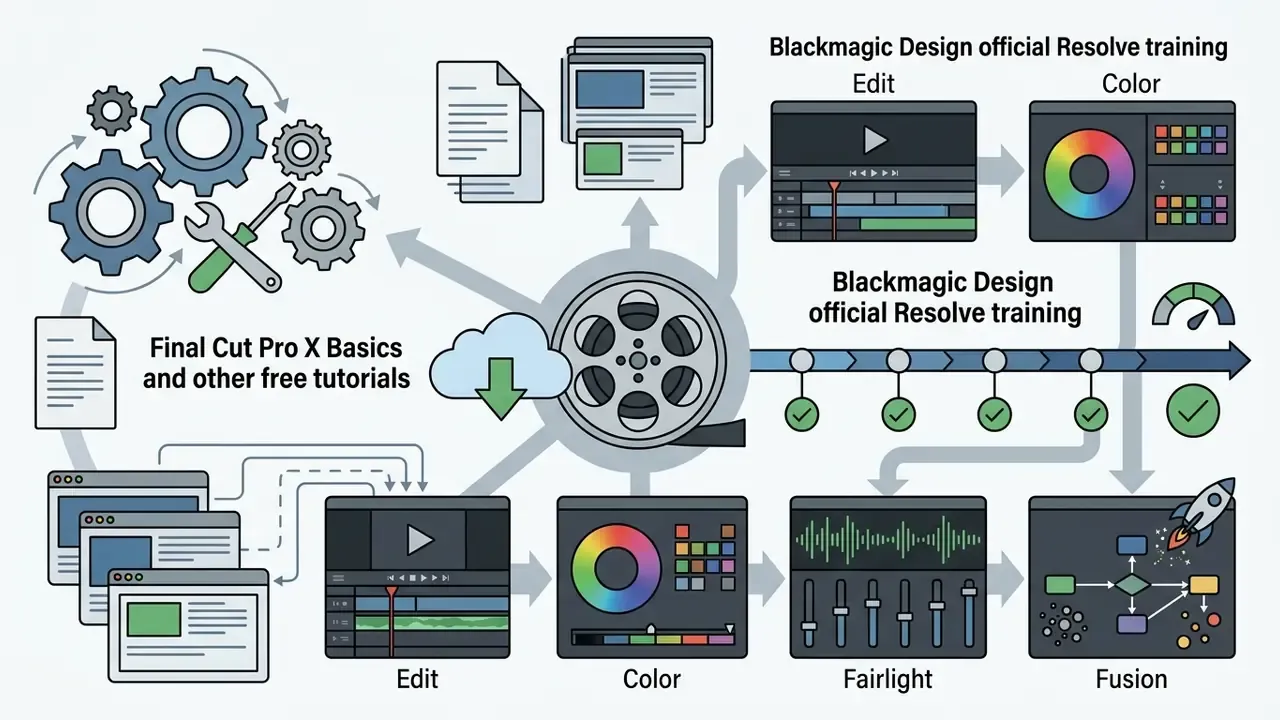
- DaVinci Resolve: professional-grade NLE with node-based color grading, Fairlight audio and Fusion motion graphics. Vendor training ships free lesson books and project files (Source: Blackmagic Design Training, https://www.blackmagicdesign.com/products/davinciresolve/training).
- CapCut: lightweight editor tuned for mobile and desktop social creators: templates, automated captions, background removal, rapid vertical transitions.
- Final Cut Pro X: proprietary macOS editor built on magnetic timelines and Apple silicon acceleration. The official user guide is free and downloadable as a PDF (Source: Apple Support, https://support.apple.com/guide/final-cut-pro/welcome/mac). To weigh feature sets and pricing across the category, see our reference on video editor tools.
- Canva Video Editor: browser-based drag-and-drop editing, ideal for absolute beginners making social overlays, quick presentations and simple promos. Course reviewers on aggregator platforms consistently rank Canva modules among the friendliest entry points.
- Wondershare Filmora: entry-level desktop NLE with preset motion templates, drag-and-drop transitions and simplified keyframing. A reasonable bridge before Premiere Pro.
- AVID Media Composer: the long-standing standard in broadcast and feature post, built around shared storage and multi-user bin locking. Beginners rarely start here, but anyone targeting scripted television should plan to learn it eventually.
Thumbnails, title cards and frame grabs usually start outside the NLE. A capable photo editor or a free photo editor handles logo cleanup and thumbnail composition at no cost, which keeps your spend at zero while you learn.
Minimum Hardware Requirements Before You Enroll
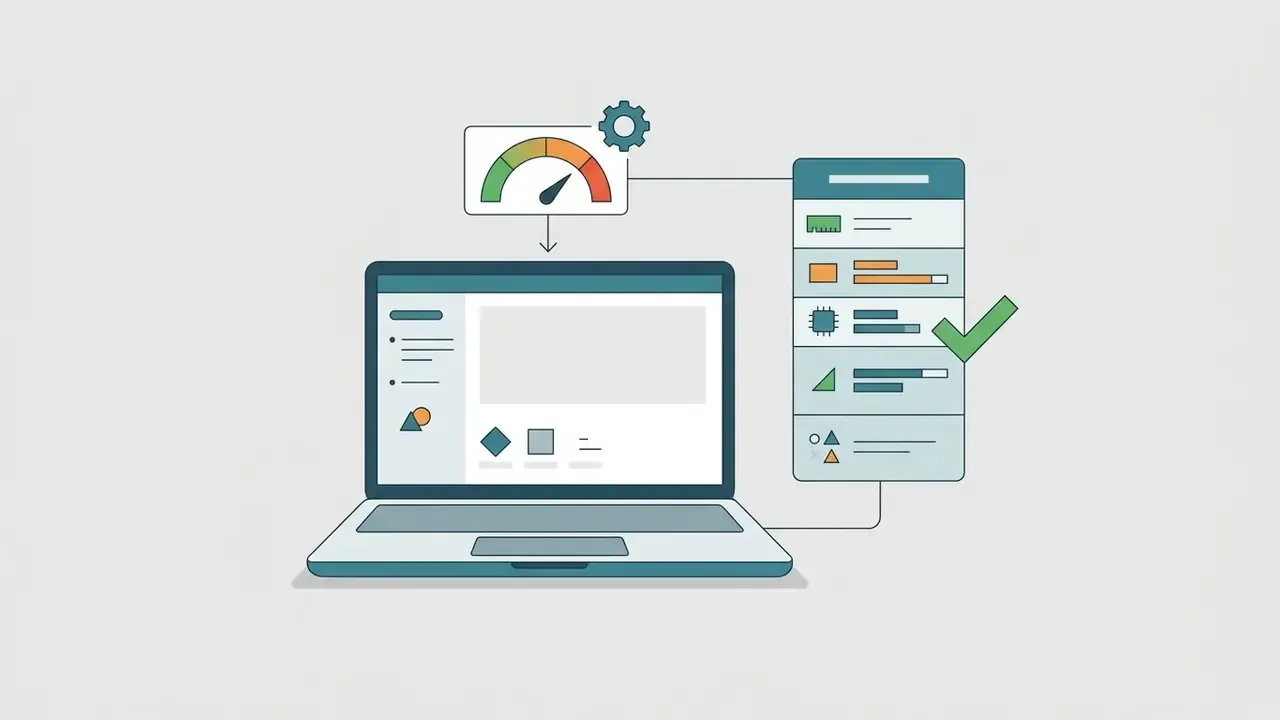
Abandoned courses are often a hardware problem rather than a motivation problem. A node-based grade in Resolve will stutter on the same laptop that runs CapCut comfortably. Check your machine before committing to a curriculum.
| Software | Realistic Minimum | Comfortable 1080p Setup | 4K / Grading Setup | Notes |
|---|---|---|---|---|
| CapCut (Desktop/Mobile) | 8 GB RAM, integrated graphics | 8–16 GB RAM, SSD | 16 GB RAM | Lightest option; runs on most modern phones and budget laptops |
| Canva Video | Modern browser, stable connection | 8 GB RAM | Not intended for 4K finishing | Cloud-based; performance depends on bandwidth |
| Wondershare Filmora | 8 GB RAM, dedicated GPU optional | 16 GB RAM, SSD scratch disk | 16–32 GB RAM, dedicated GPU | Preset-driven, forgiving on mid-range machines |
| Adobe Premiere Pro | 16 GB RAM, 2 GB VRAM GPU | 16–32 GB RAM, NVMe SSD | 32 GB RAM, 8 GB VRAM GPU | Use proxies on minimum specs (Source: Adobe system requirements) |
| Final Cut Pro | Apple silicon Mac, 8 GB unified memory | 16 GB unified memory | 32 GB unified memory | Requires a current macOS release |
| DaVinci Resolve (free) | 16 GB RAM, dedicated GPU | 16–32 GB RAM, dedicated GPU | 32 GB+ RAM, high-VRAM GPU | GPU-dependent; Fusion and noise reduction are the heaviest loads |
Creators building automated or hybrid visual pipelines often pair an NLE with synthetic asset generators. You can compare creative software configurations in our AI Media Comparison portal.
Best Free Online Video Editing Courses and Tutorials
The strongest free online video editing courses in 2026 combine three sources: vendor-official documentation, free-to-audit university programs, and dedicated tutorial platforms. Together they cover introductory through intermediate technique without a single payment.
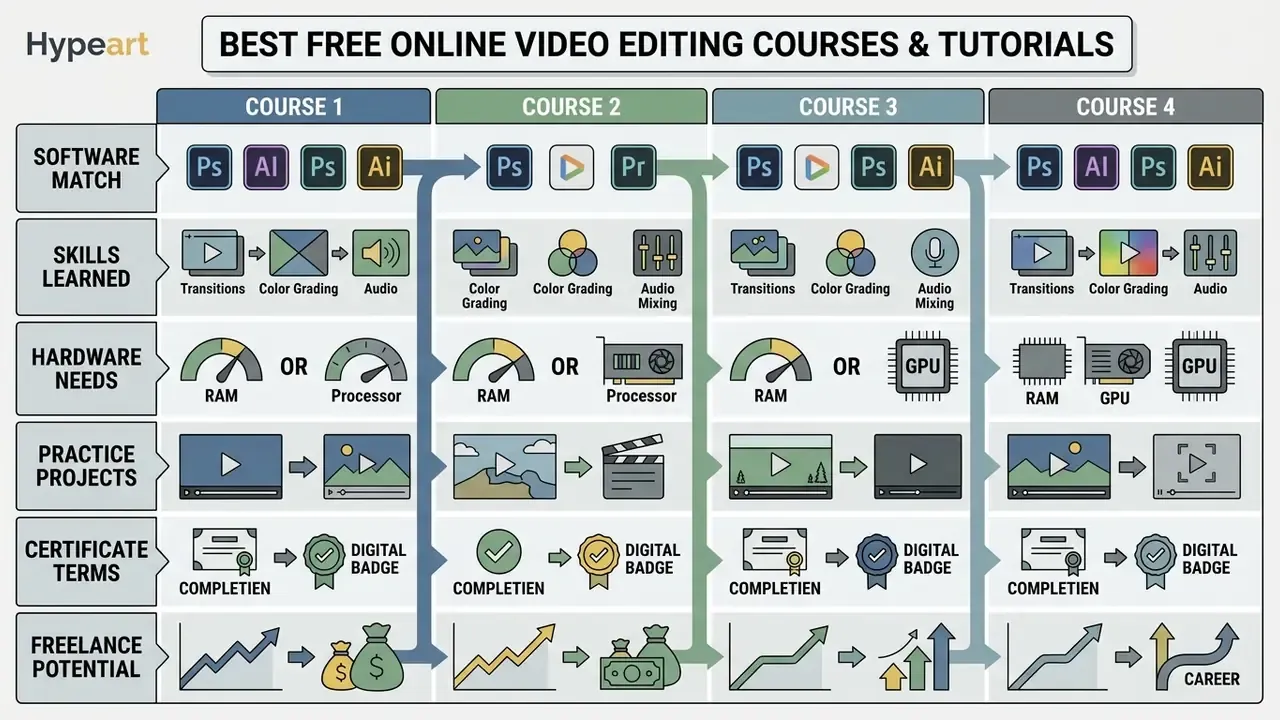
Top Free YouTube Micro-Courses for Fast Learning
Need a finished project today rather than a multi-week audit? These highly rated micro-tutorials deliver an immediate practical workflow:
Treat these as ignition rather than education. They get a file out the door in under half an hour; a structured course then fills the gaps in audio, color and delivery discipline.
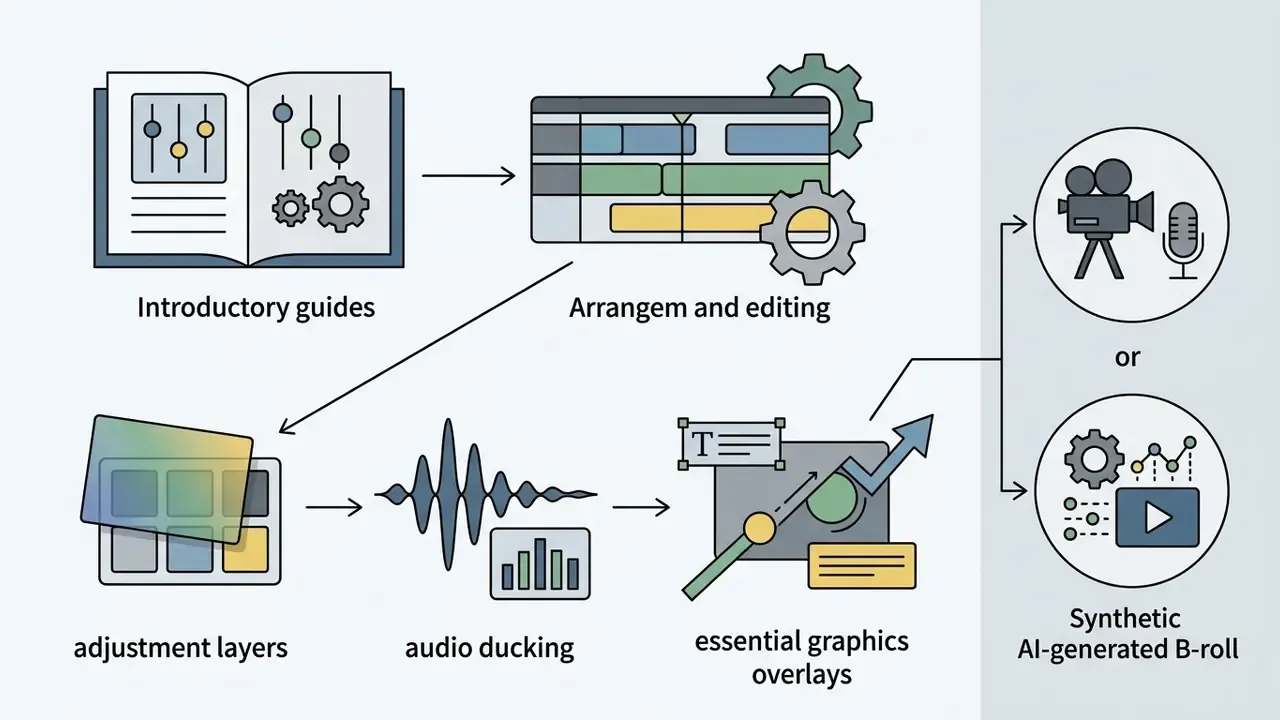
Adobe Premiere Pro for Beginners
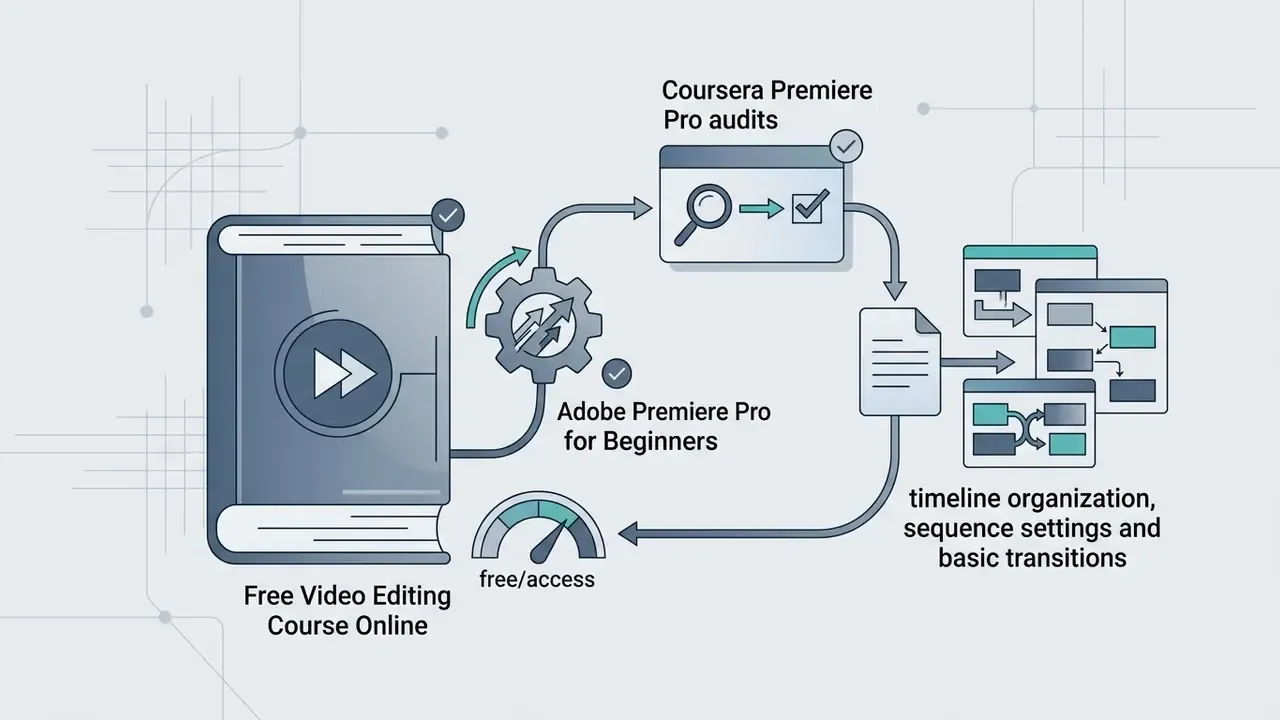
Official and third-party free courses for video editing in Premiere Pro cover the application's core interface well, and they are kept current with each release.
CapCut Video Editing Tutorials for Content Creators
For social media managers and creators, the best free online video editing courses built around CapCut teach vertical assembly quickly.
- Cursa CapCut crash course a free structured course of roughly 32 minutes covering desktop installation, auto-caption generation, vertical 9:16 canvas resizing and trend transition overlays, with a free digital certificate (https://cursa.app/free-courses-video-edition-online).
- CapCut official resource center step-by-step web guides on AI caption template customization, speed ramping, background removal, vertical conversion templates and direct TikTok or Reels export. CapCut's own beginner guide also documents free background music, sound effects and MP4/MOV export.
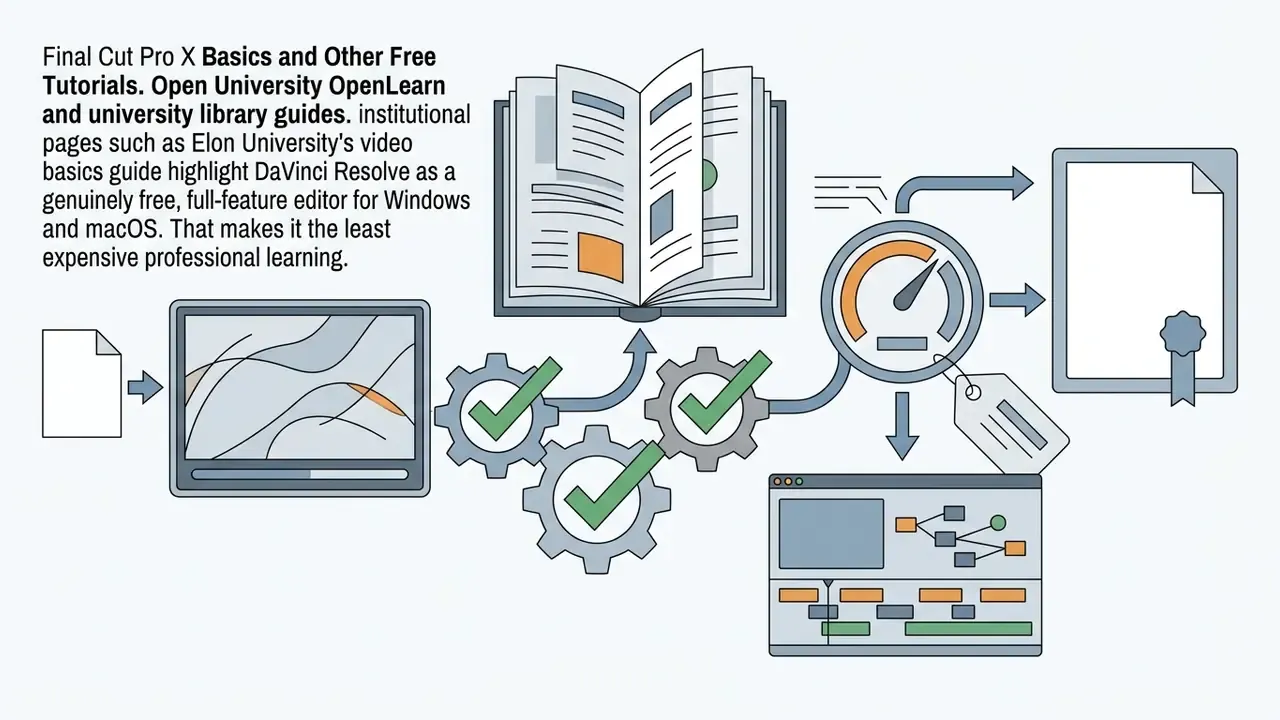
Final Cut Pro X Basics and Other Free Tutorials
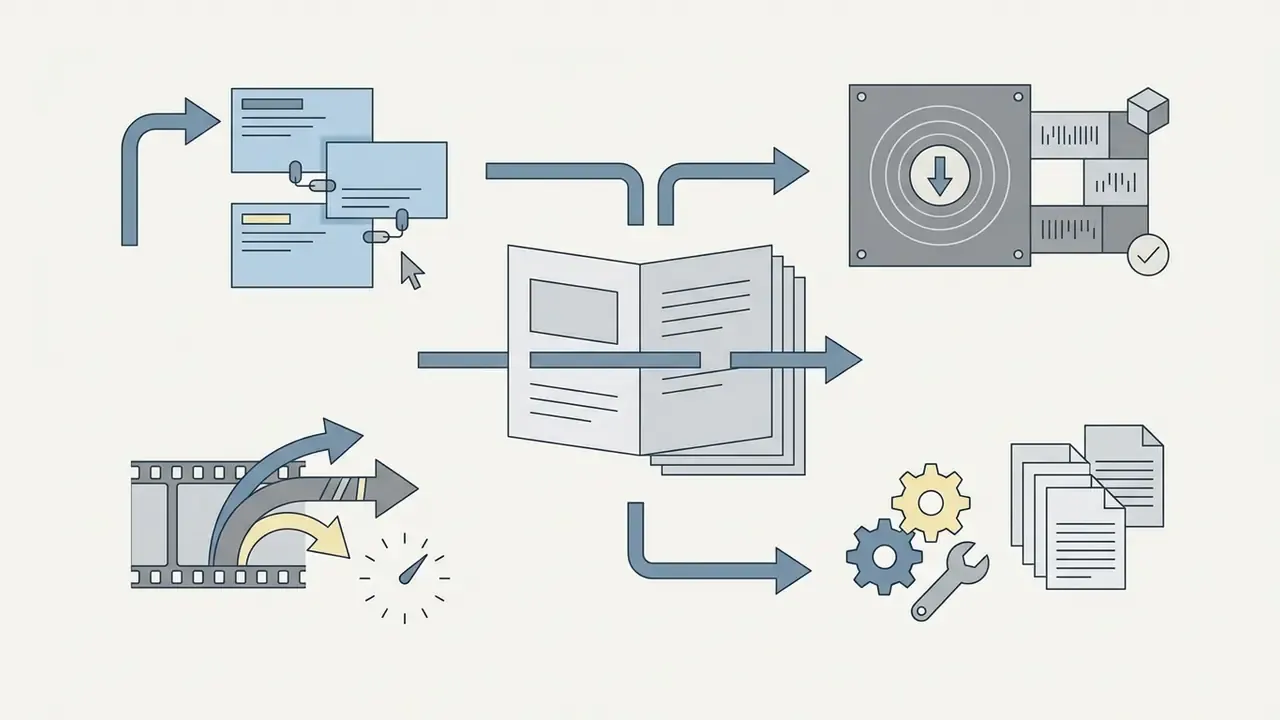
Cross-platform creators and macOS users have solid structured options too, and several of these double as the best free courses on video editing available at professional depth:
Comparative Overview of Top Free Video Editing Courses
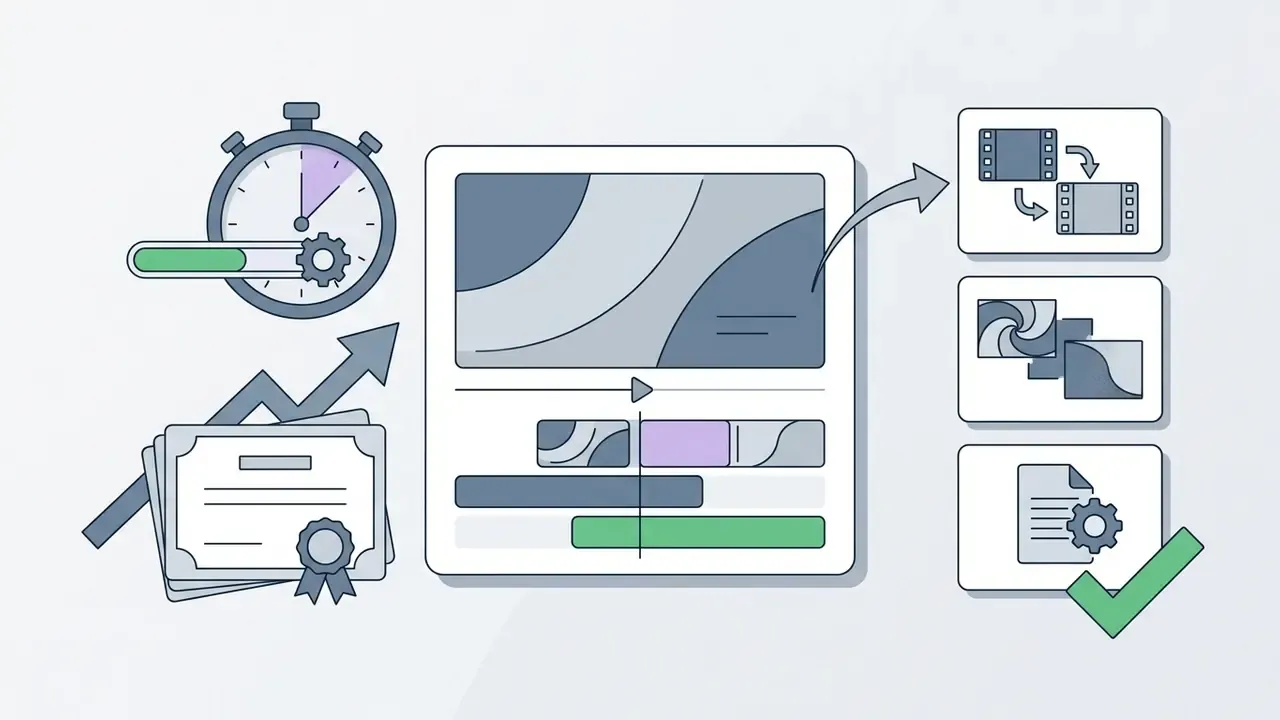
This table summarizes the best free video editing courses online by software, structure, time commitment, output project and certificate terms:
| Course / Platform | Software Focus | Skill Level | Est. Time Commitment | Output Project | Certificate Terms | Key Focus Areas |
|---|---|---|---|---|---|---|
| Think Media (YouTube) | Adobe Premiere Pro | Absolute beginner | ~11 minutes | First exported MP4 talking-head edit | None | File organization, cuts, text, export |
| Vince Opra (YouTube) | Adobe Premiere Pro | Absolute beginner | ~17 minutes | Short edited clip with music and grade | None | Sequences, shortcuts, effects, audio, basic grade |
| Primal Video (YouTube) | Final Cut Pro | Absolute beginner | ~25 minutes | B-roll-driven vlog edit | None | Libraries, titles, retiming, audio levels |
| Great Learning Academy | General NLE / Premiere | Beginner | ~1.5 hours | Guided assembly exercise + quiz | Free upon completion | Timeline basics, cutting, audio alignment, export |
| Cursa CapCut Crash Course | CapCut Desktop | Beginner | ~32 minutes | 9:16 social promo with captions | Free digital certificate | Vertical video, auto-captions, transitions, TikTok presets |
| Coursera Video Specializations | Premiere Pro / Resolve / Canva | Beginner – Intermediate | 1–4 weeks (audit) | Peer-reviewed capstone (paid tier) | Paid upgrade; free audit access | Visual storytelling, cinematic grading, motion graphics |
| Adobe Learn Official Hub | Adobe Premiere Pro | Beginner | 2–4 hours, modular | Practice sequence per tutorial | No formal certificate | Panels, toolbars, keyframing, Media Encoder |
| Blackmagic Resolve Training | DaVinci Resolve 19/20 | Beginner – Professional | 10–40 hours (lesson books) | Full graded and mixed short film | Free official certification via exam | Cut page, node grading, Fairlight, Fusion VFX |
| Envato Tuts+ Free Guides | Premiere / After Effects | Beginner – Advanced | 30+ modular lessons | Technique-specific mini-edits | No certificate | Advanced NLE features, interpolation, motion graphics |
E-E-A-T Verification and Access Rules
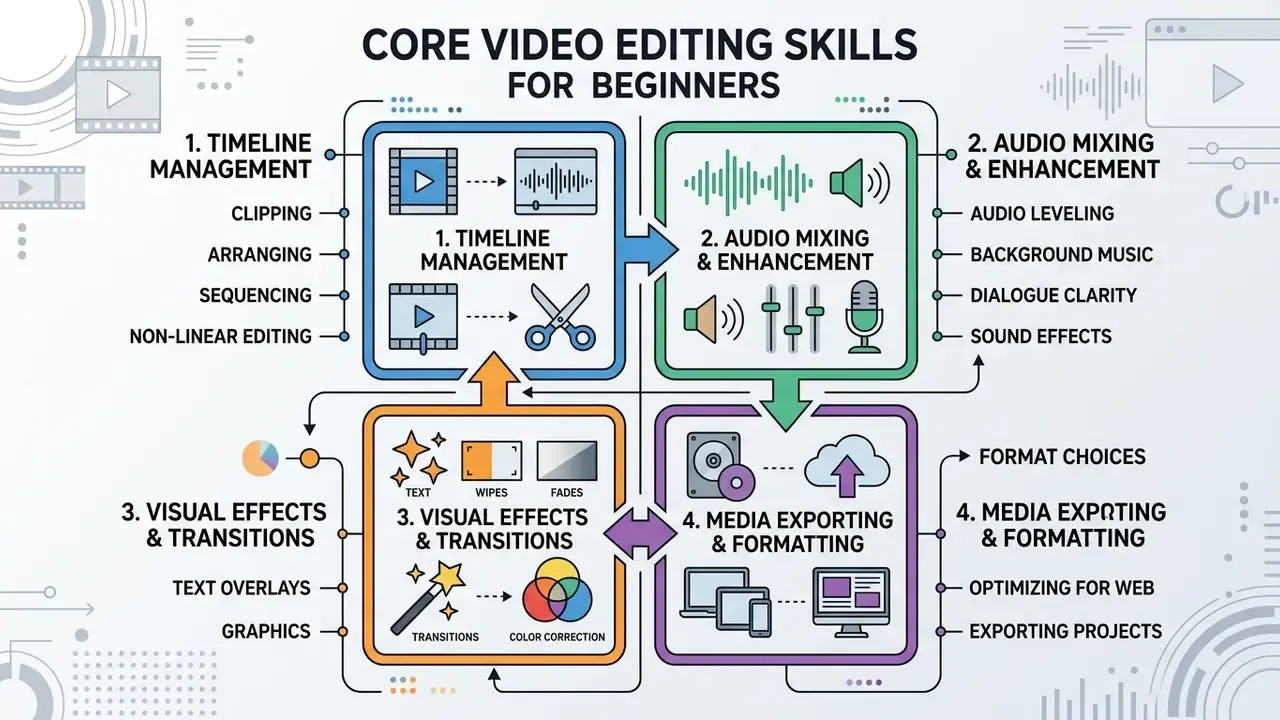
Core Video Editing Skills Covered in Free Online Courses
The core skills taught across free online courses video editing are timeline trimming, audio noise reduction, color grading, keyframed motion graphics and platform-specific export configuration. Master those and you can hold pacing and narrative flow, which is what clients actually notice.
Cutting, Transitions and Timeline Editing Techniques
Timeline editing is the backbone of post-production, and the best free video editing tutorials online drill these methods first:
- Standard straight cut
- joining two clips end to end to keep narrative progression continuous.
- J-cut and L-cut
- overlapping audio and video so audio precedes video (J-cut) or video cuts while audio continues (L-cut). This is what makes conversation feel natural.
- Ripple edit and roll edit
- adjusting edit points while automatically shifting downstream assets (ripple) or preserving total sequence length (roll).
- Transition selection
- cross-dissolves for passage of time, wipes for scene changes, hard cuts for emphasis. Vendor documentation agrees on mechanics: drop the transition onto a clip boundary, then drag the handles to set duration.
- Continuity and pacing
- matching eyelines, screen direction and action across cuts so nobody notices the edit. This is the skill that separates a competent assembly from a professional one.
Color Grading, Audio and Effects
Image tone and sound balance are where amateur clips and professional assets part company.
- Color correction vs. color grading correction fixes exposure error and white balance so footage from different cameras and lighting conditions matches. Grading then shapes overall color and tonal balance into a deliberate look, for example the familiar teal-and-orange separation of skin tones from backgrounds. Blackmagic's free Color page training covers both stages in one project-based path.
- Audio ducking and leveling automatically dropping music when dialogue is present so vocal frequencies stay clear. Target roughly -12 dB to -6 dB peaks for dialogue and about -22 dB for music beds under speech.
- Sound design fundamentals room-tone fills, ambience beds and layered effects, taught free through Fairlight modules in Resolve training.
- Adjustment layers applying filters, Lumetri profiles or effects across multiple tracks at once instead of clip by clip.
Online instruction has measurable limits, and it is only fair to say so before you enroll:
«After a 14-hour synchronous online creativity course, learners generated significantly more varied ideas, but scores for originality and practical usefulness did not improve.»
The practical reading: courses reliably expand technical vocabulary and idea range. Taste and originality come from repetition, critique and reference study, which no syllabus can shortcut.
For creators generating experimental stills or stylized assets to drop into a timeline, our notes on bad ai art and bad ai images catalogue the aesthetic defects that give synthetic media away. Spec projects sometimes lean on novelty generators for character work as well, from a baby picture generator for a family-brand mockup to a baby name generator when your fictional presenter needs a name that does not belong to a real person.
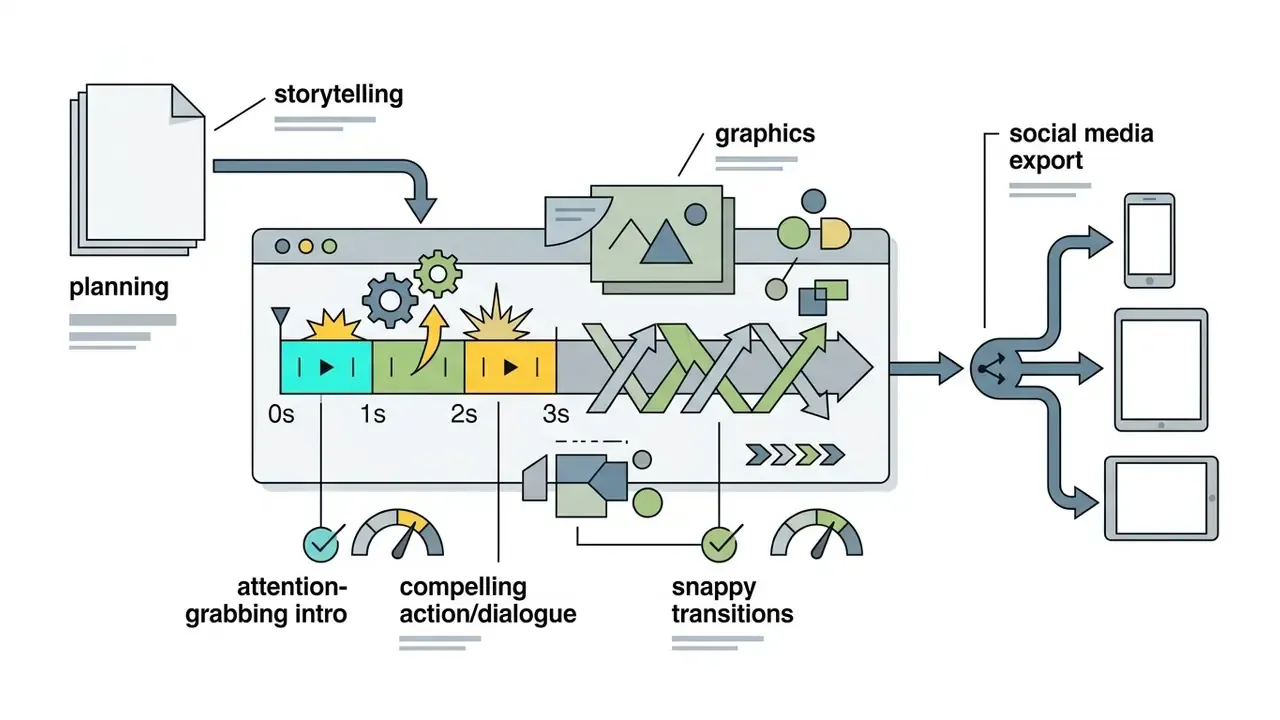
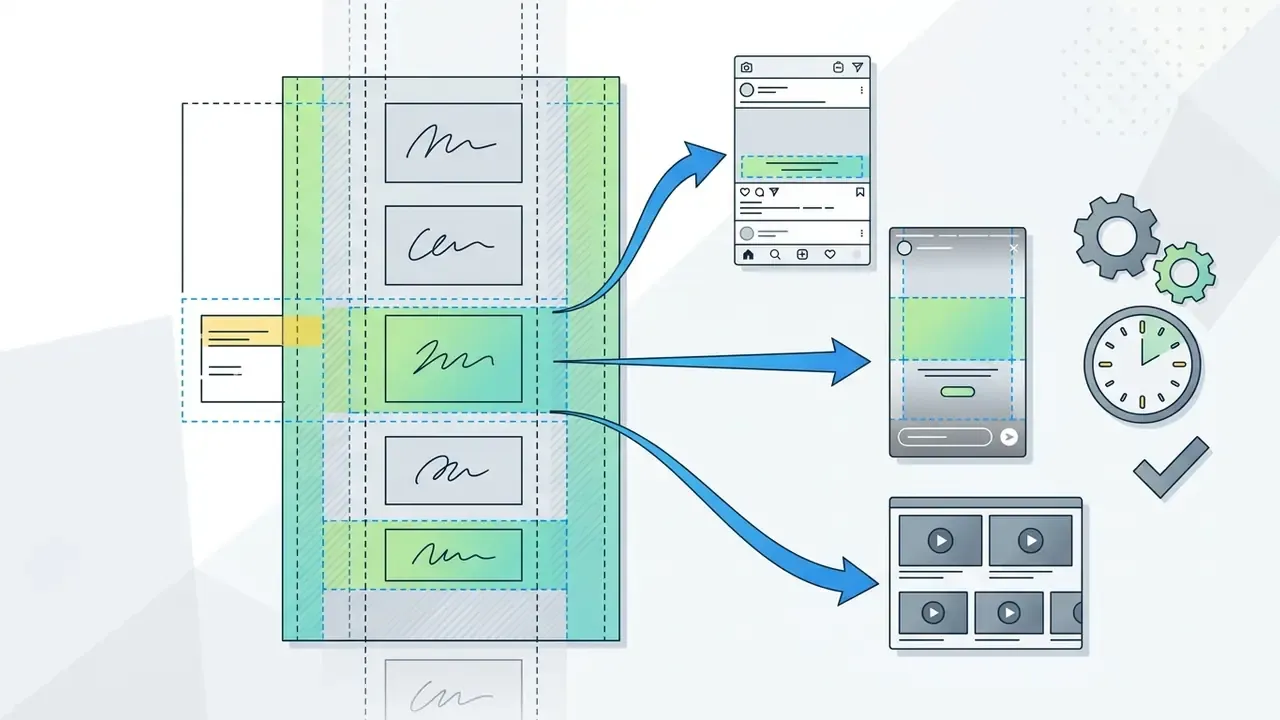
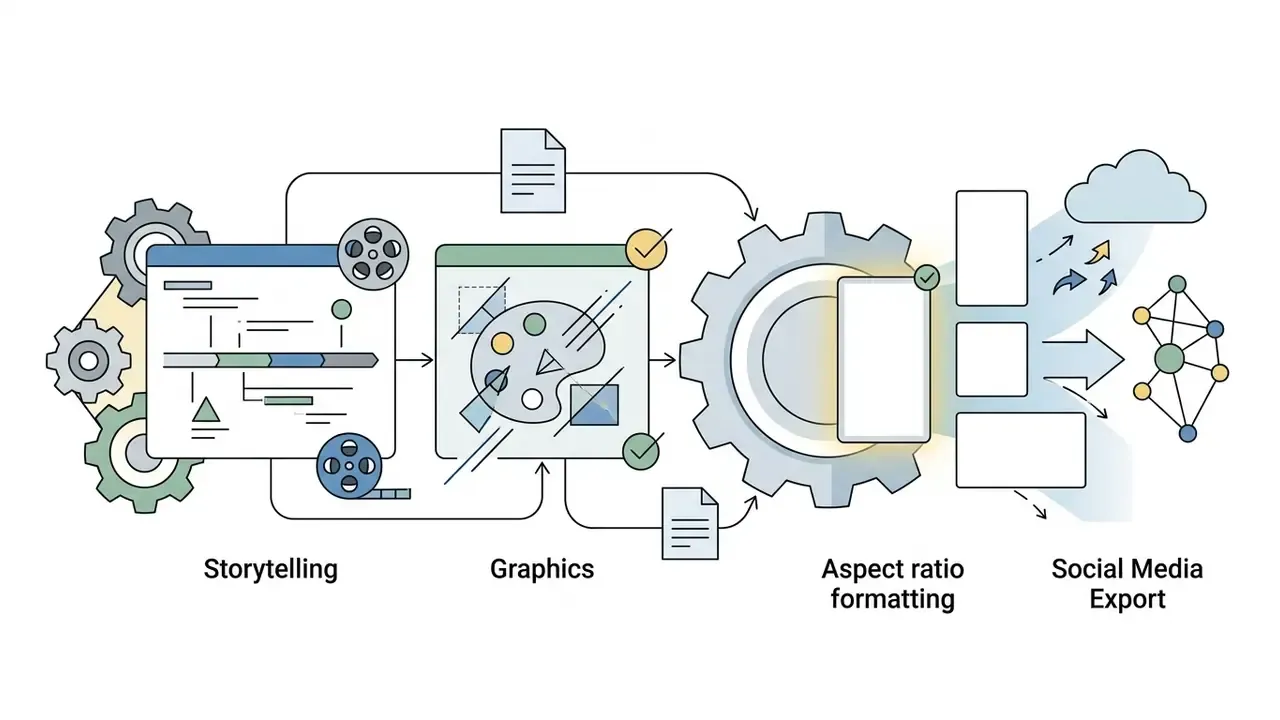
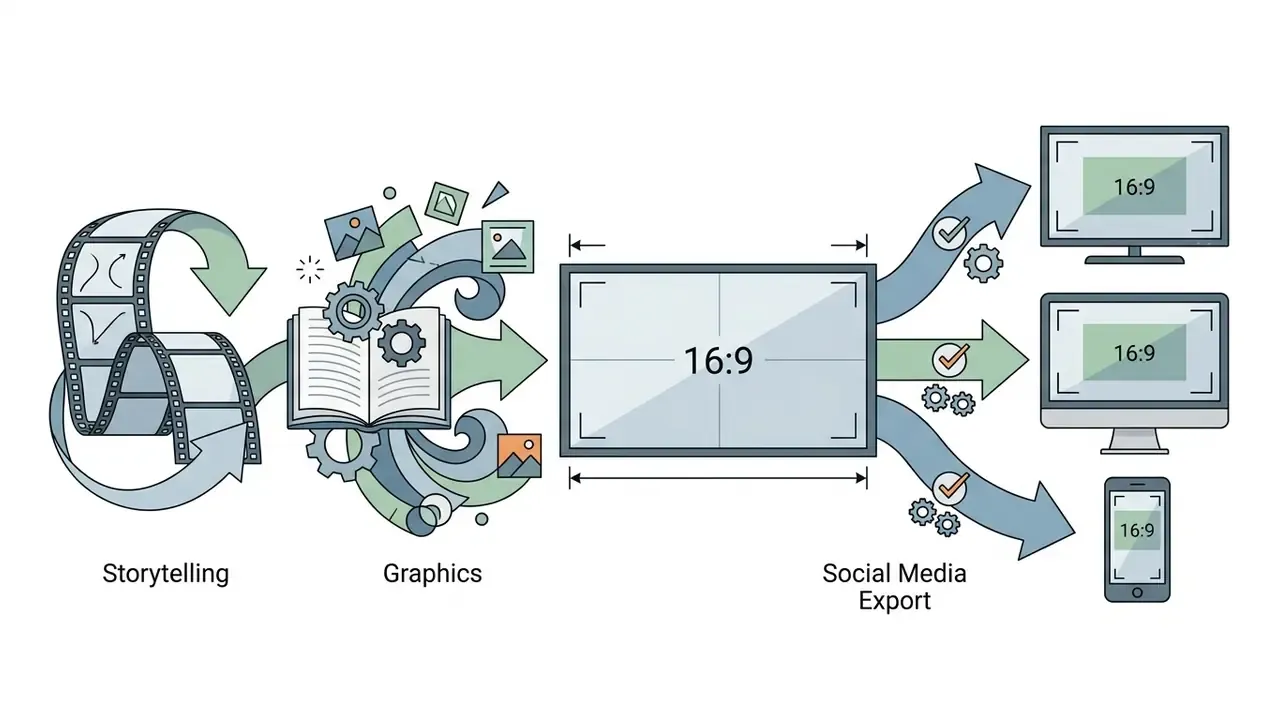
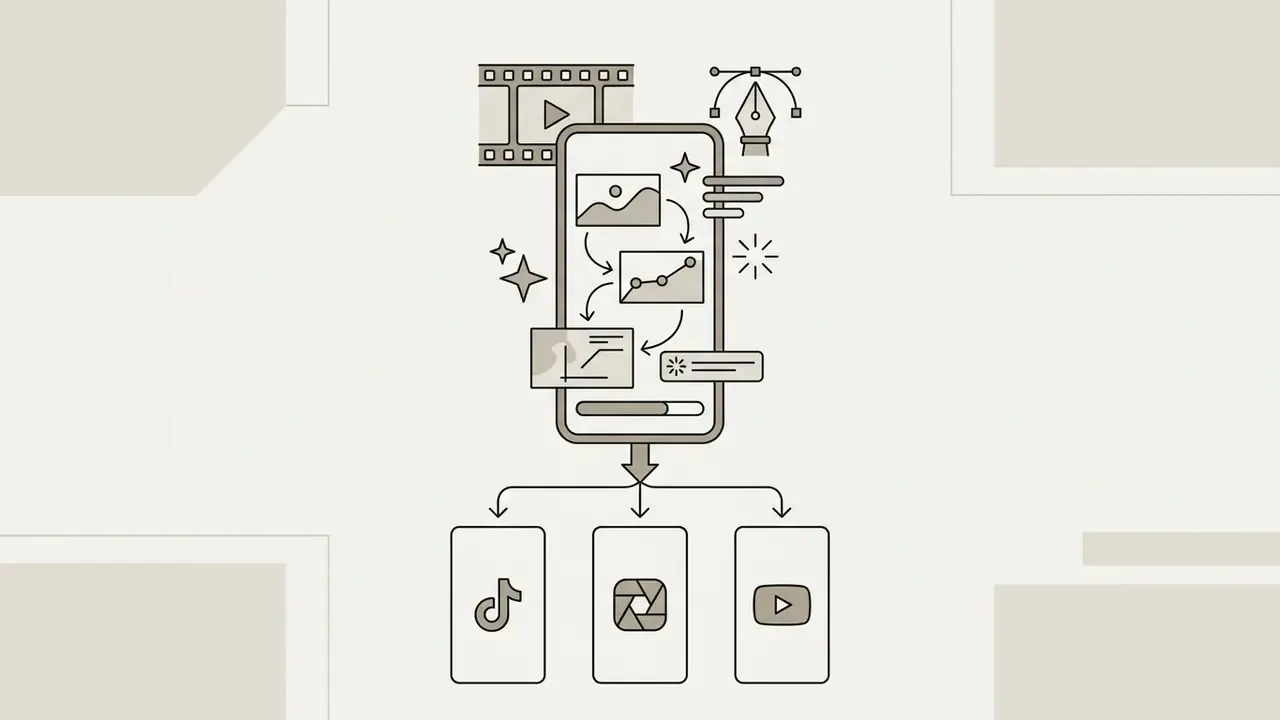
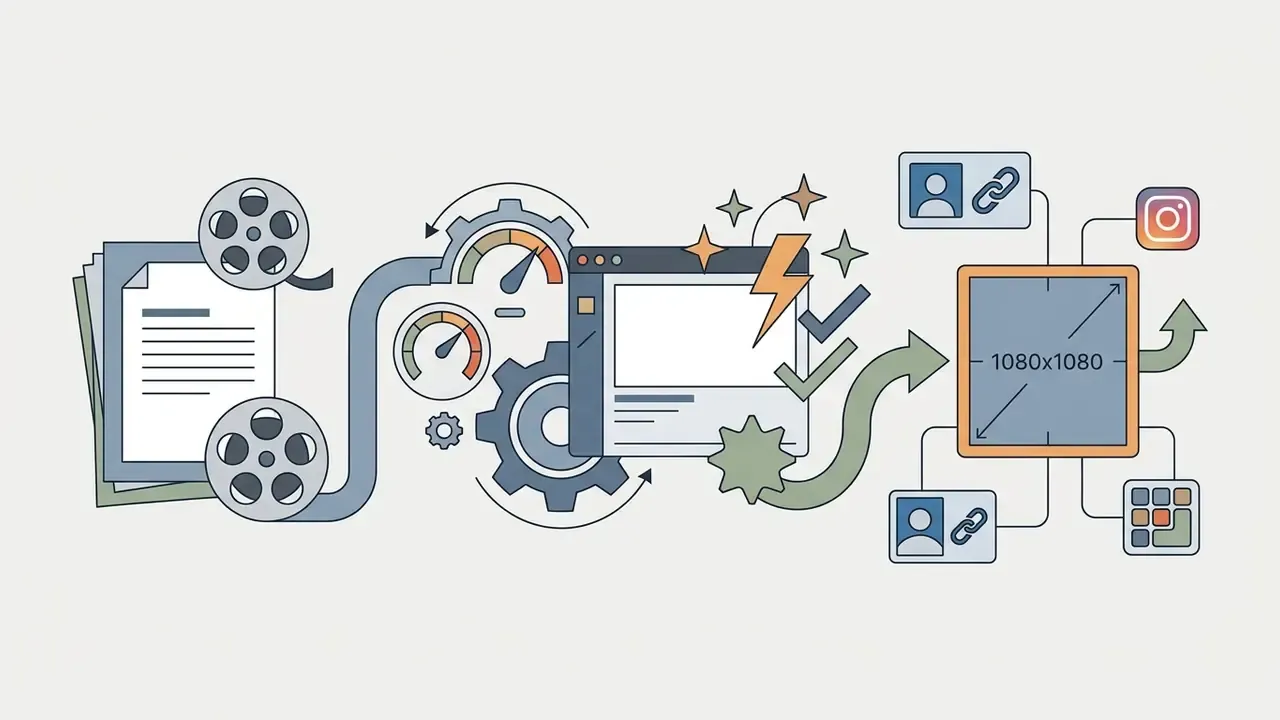
Storytelling, Graphics and Social Media Export
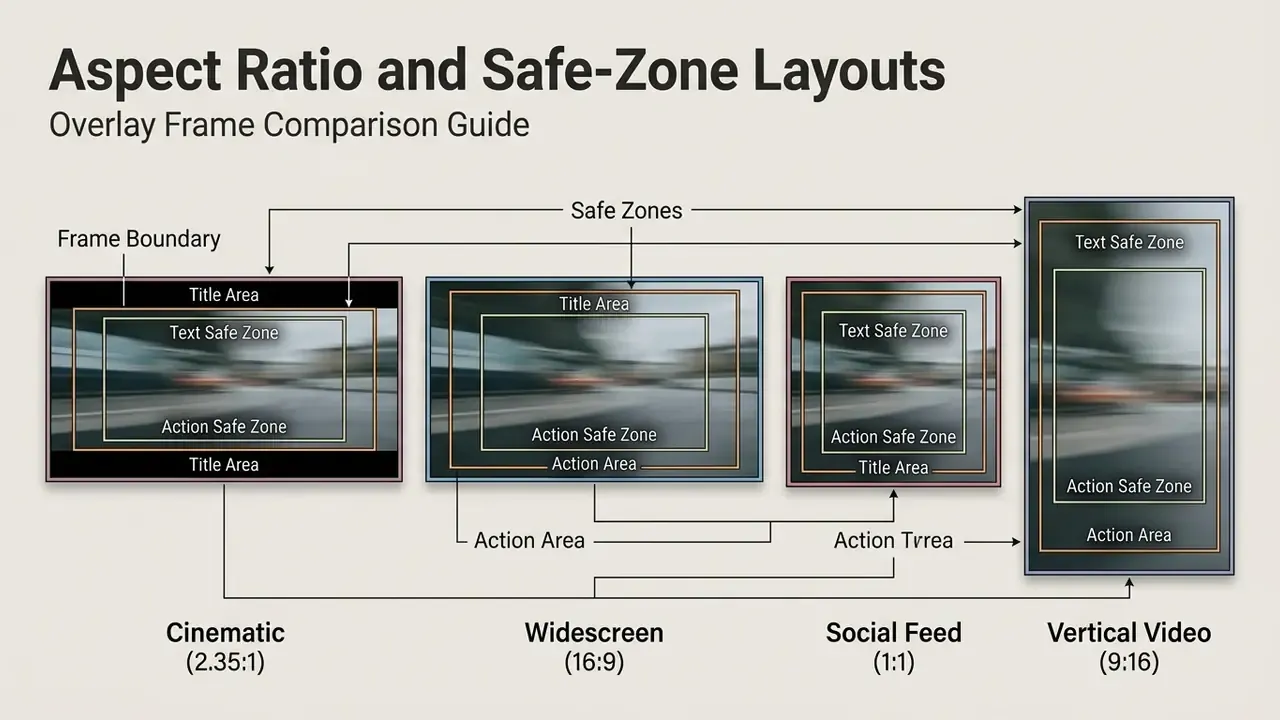
Visual storytelling aligns pacing, structure and text graphics with how audiences behave on each platform.
Short-form creators increasingly build hybrid timelines mixing camera footage with synthetic shots. If that is your pipeline, compare capability limits across AI video generators before you commit a paying client project to one.
Are Free Video Editing Courses Really Free?
Free Lessons vs Optional Paid Certificates
The distinction between free learning access and paid credential attestation is the single most important thing to check when enrolling in free online courses for video editing.
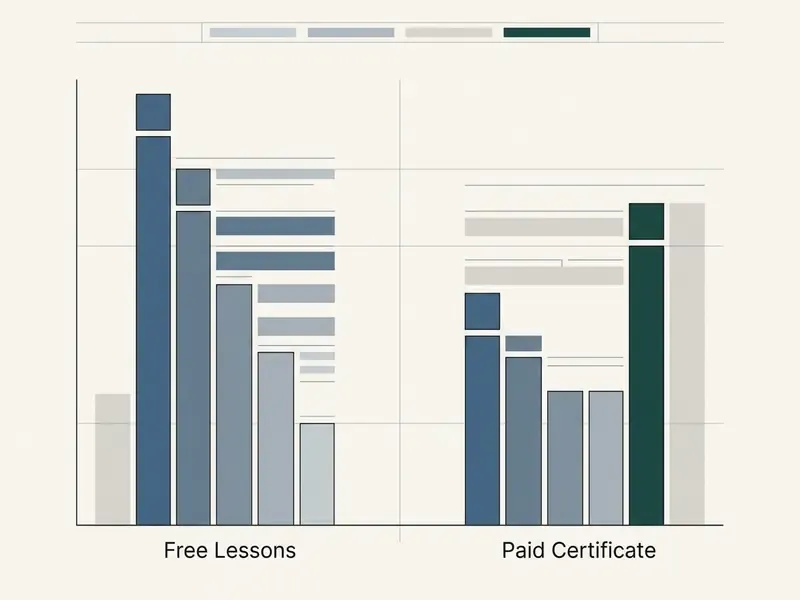
«Sharing MOOC certificates on LinkedIn increased the likelihood of new employment by 6% and of holding a job related to the certificate by 8–9% within a year.»
For creative editing roles specifically, a polished portfolio remains the primary selection criterion hiring managers use. The certificate opens the conversation; the showreel closes it.
When a Paid Video Editing Course May Be Worth It
Upgrading from a free video editing course online to a paid program or bootcamp is defensible in three scenarios:
- You need mentorship and feedback.Self-guided study tends to leave gaps in complex tooling such as Resolve Fusion or After Effects expressions. Mentorship research links effectiveness to structured, recurring contact and defined goals, not to content access alone.
- You need structured portfolio review.Moving into professional freelancing usually requires direct critique from working editors, which no free course provides.
- You need enforced accountability.If self-paced completion rates of 10 to 15 percent describe your history honestly, rigid assignment schedules and cohort deadlines are worth paying for.
«Courses with active communities reach roughly 65.5% completion; community support raises completion likelihood by about 54% compared with fully self-paced formats.»
Certificates also carry measurable labour-market weight in lower-income contexts, which belongs in any free-versus-paid decision:
«Event analysis showed a significant average increase of 5.1% in formal employment after earning free MOOC certificates, with stronger effects for lower-income participants.»
Training Model Comparison Matrix
The table below sets out the feature differences across the three primary learning models:
| Feature / Dimension | Fully Free Course | Freemium (Free Audit / Paid Cert) | Paid Bootcamp / Professional Class |
|---|---|---|---|
| Lesson Access | 100% free | Free (video lectures and readings) | Paid enrollment only |
| Assignments & Quizzes | Basic self-checks | Locked behind paywall | Graded with personalized feedback |
| Portfolio Projects | Self-directed pet projects | Standardized course prompts | Comprehensive capstone projects |
| Instructor Mentorship | None or community forums | Limited peer forums | Direct 1:1 or small group guidance |
| Completion Certificate | Included free (where offered) | Optional paid upgrade ($49–$199) | Included in tuition |
| Typical Completion Rate | 10% – 20% | 35% – 50% | 50% – 70%+ |
| Best Suited For | Casual learning and skill exploration | Structured learning on a budget | Rapid professional career transition |
Read across those rows once more before paying. If what you lack is feedback, buy feedback. If what you lack is footage, no purchase helps.
How to Learn Video Editing Online and Build Practical Skills
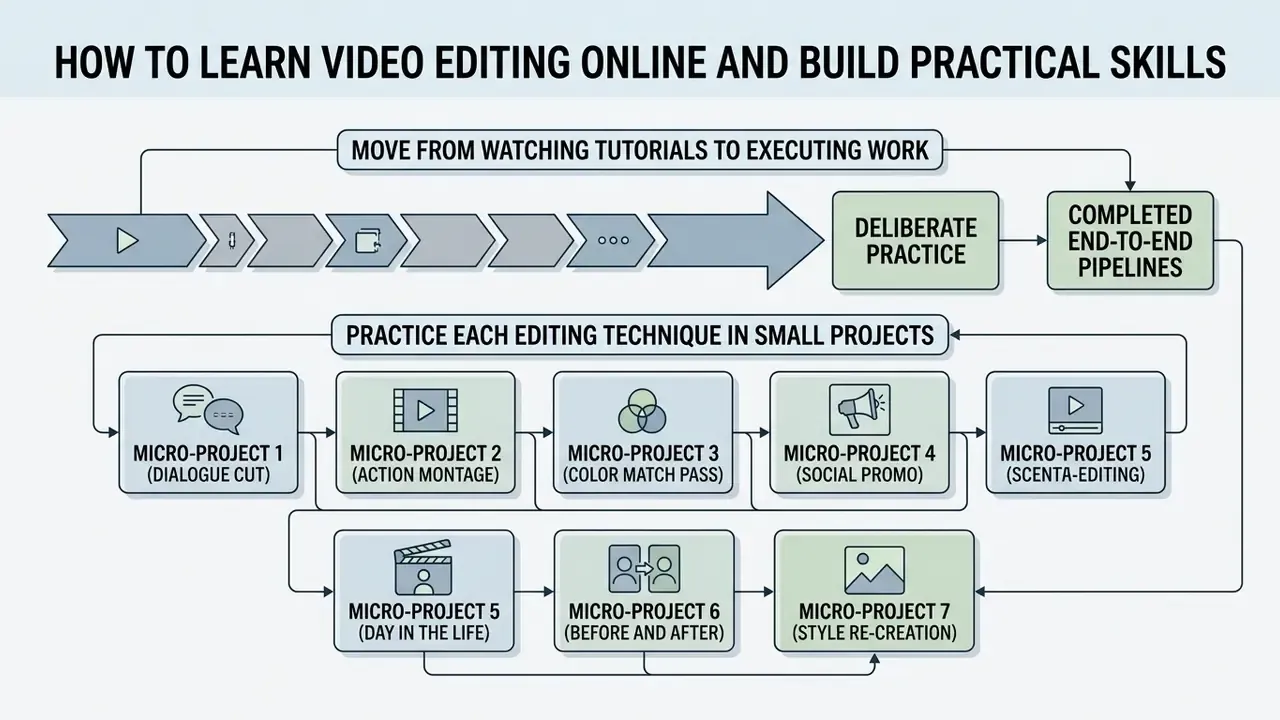
Moving from watching tutorials to executing work requires micro-projects, deliberate practice and completed end-to-end pipelines. Behavioural data from large open courses shows which habits actually predict finishing:
«Days of interaction, video views, chapters studied and written activity significantly predicted course completion and certification (model AUC: 0.80 and 0.92).»
In plain terms, consistency of contact beats intensity of contact. Four short sessions a week outperform one heroic weekend. Almost always.
Practice Each Editing Technique in Small Projects
Specific techniques stick fastest through 30-to-90-second pet projects, each focused on one variable: cutting rhythm, audio ducking, color matching.
- Micro-project 1 (dialogue cut) assemble a 45-second two-person interview using J-cuts and L-cuts to remove pauses without visual jarring.
- Micro-project 2 (action montage) cut 15 raw sports or travel clips precisely to the beat of a music track using ripple trims.
- Micro-project 3 (color match pass) correct three shots filmed under different lighting until skin tones and white balance match.
- Micro-project 4 (social promo) build a 30-second vertical video with automated captions, lower-third callouts and background music.
- Micro-project 5 (day in the life) turn 10 to 20 unrelated clips into a coherent one-minute narrative to train sequencing and story logic.
- Micro-project 6 (before and after) edit the same scene twice, flat and fully graded, to isolate what color and effects actually contribute.
- Micro-project 7 (style re-creation) replicate a favourite 60-second edit shot for shot to reverse-engineer trims, transitions and audio treatment.
Build a Deliberate Practice Schedule
Deliberate-practice frameworks describe skill building as progressive, cyclical, reflective and narrow: repeated work on the same material in short high-concentration sessions, spread over time to support retention (Association for Talent Development, Examples of Deliberate Practice, 2024).
Applied to editing, that becomes a simple weekly cadence:
- Isolate one variable per session.Trims on Monday, audio levels on Wednesday. Mixing five skills in one sitting slows all five.
- Space repetition on the same footage.Re-cut the same 60 seconds once a week for a month. The delta between versions is your real progress metric.
- Self-review with playback.Watch your export full screen and write down three specific defects. Reviewing your own recorded performance is the standard reflection mechanism in deliberate-practice guidance (UCSF, Deliberate Practice).
- Run timed constraint drills.Twenty minutes to deliver a publishable 30-second cut. Speed under constraint is what clients pay for.
- Study references frame by frame.Log every cut point in a professional sequence you admire. Imitation precedes voice.
Once fundamentals feel stable, formalize delivery. Our YouTube video editor workflow guide documents the publishing-side settings, thumbnails and chapter structure that free courses tend to skip entirely.
Post-Course Practical Checklist
To consolidate what a free video editing course beginner curriculum gave you, work through this checklist end to end:
Checklist0 / 7
- Download and install your chosen video editor (Premiere Pro, Resolve, CapCut, Filmora or Canva).
- Customize workspaces and verify project autosave settings.
- Import raw test clips, voiceover tracks and background music into project bins.
- Create sequences matching source footage frame rates (23.976 fps or 29.97 fps, for example).
- Perform a rough assembly with the razor (
C) and selection (V) tools. - Apply J-cuts and L-cuts to polish audio transitions between dialogue clips.
- Perform a rough assembly with the razor (
- Balance dialogue to peak between -12 dB and -6 dB.
- Duck background music to roughly -22 dB under speech.
- Adjust white balance and contrast across clips, then apply a look.
- Insert lower-third text inside title-safe boundaries.
- Configure H.264 export at target platform resolution (1080p or 4K) via
Ctrl+M/Cmd+M. - Run a full playback QC pass on both mobile and desktop screens.
- Configure H.264 export at target platform resolution (1080p or 4K) via
- Save the project file plus a flattened master to a second drive, and label exports with version numbers (
_v01,_v02).
- Save the project file plus a flattened master to a second drive, and label exports with version numbers (
From Free Courses to Paid Freelancing: Career Expectations
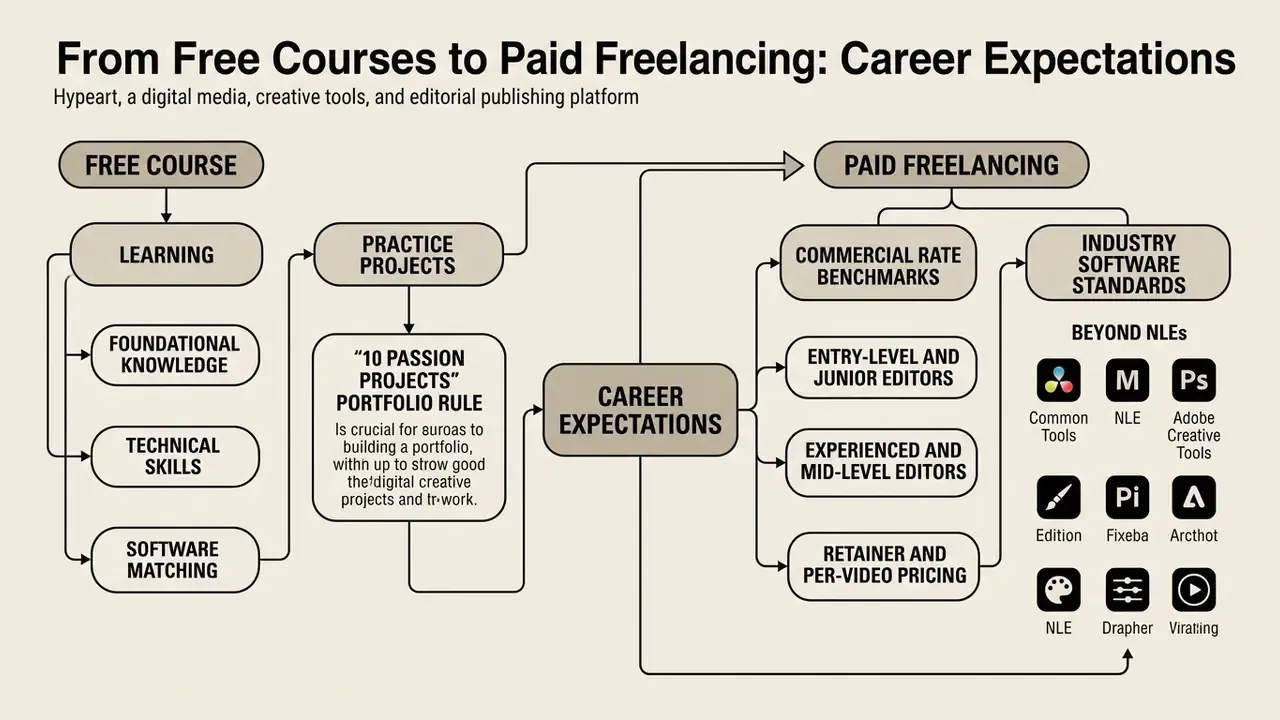
A free course delivers foundational technical knowledge. Getting paid requires portfolio evidence, delivery reliability and a working sense of what the market pays.
Commercial Rate Benchmarks
- Entry-level and junior editors typical day rates run roughly $150 to $250 per day (about £120 to £200) for basic social edits, cuts and corporate assembly. UK agency guidance places beginners at around £150 per day for simple work.
- Experienced and mid-level editors commercial, broadcast or high-end YouTube editors command $300 to $1,200+ per day (roughly £200 to £1,200), depending on specialization such as advanced grading or motion graphics, and on the profile of the project.
- Retainer and per-video pricing many creator-economy editors price per deliverable rather than per day. A repeatable 8-to-12-minute YouTube edit is usually quoted as a fixed package once turnaround and revision limits are agreed in writing.
The "10 Passion Projects" Portfolio Rule
Clients and employers rarely hire on a completion certificate alone. Before you apply for entry-level roles or pitch anyone:
- Complete at least 10 un-commissioned passion projects: spec commercials, re-edited trailers, social shorts, event recaps.
- Package them into a 60-to-90-second showreel highlighting cuts, audio mixing, pacing and color balance, with your strongest three seconds first.
- Publish two or three full-length case pieces alongside the reel so clients can judge sustained pacing, not just highlights.
- Document your turnaround times and revision policy. Reliability gets quoted as often as craft in repeat hiring, which surprises most new editors.
Industry Software Standards Beyond NLEs
Premiere Pro and DaVinci Resolve dominate general digital content, but broadcast and feature post environments frequently mandate AVID Media Composer for shared storage and bin locking. Final Cut Pro remains widely used in owner-operator and corporate video teams on macOS. The pragmatic sequence: learn one accessible NLE deeply, then add the industry tool your target sector actually requires. Not both at once.
Career and rate information is provided for general orientation only. Rates vary by country, sector, client size and negotiation, and are not a guarantee of earnings.
Free Video Editing Course Online: FAQ
Do I Need Prior Experience to Start a Beginner Course?
No prior technical experience or media degree is required to enroll in a free beginner video editing course online. Introductory courses start with interfaces, mouse controls, file formats and basic timeline tools before touching anything complex (Adobe Certified Professional; Universitat Oberta de Catalunya, Basic Guide to Video Editing, 2024). Expect attrition, though. Enrollment is easy; completion is not:
«In the treatment group, 91.4% were active on Coursera and 42.2% enrolled in at least one MOOC, but only 10.0% completed at least one course, versus 0.3% in the control group.» Source: Is Online Job Training for All? Experimental Evidence, ScienceDirect (2024), RCT with 4,272 treated participants, https://www.sciencedirect.com/ Plan around that. Pick a free online video editing course beginner track you can finish in one or two sittings, then scale up to the long vendor books.
How Long Does It Take to Learn Video Editing?
Beginner courses range from 10 minutes to 45 hours depending on depth. A realistic timeline looks like this: basic assembly and export within one day via a micro-course, comfortable independent editing after three to six weeks of regular practice, and paid-quality output after roughly ten completed projects. Talent shifts those numbers a little. Frequency shifts them a lot.
Can I Learn Video Editing on Mobile?
Yes, and a free mobile video editing course is genuinely enough for short-form social content. Advanced multi-track composition and node-based grading still belong on desktop. Mobile applications like CapCut offer robust touch tools for cutting, auto-captioning and transitions, and CapCut's own localized beginner guides document the whole start flow, from an App Store or Google Play install through to the first project import. The constraints are real, however. Research on mobile editors confirms core editing tasks are feasible on a phone, while mobile UX studies note small screens, single-window visibility and fragmented attention, with average mobile sessions around 72 seconds, which limits long multi-step edits. Engineering literature adds that desktop pipelines cannot be ported directly, since phones are constrained in processing power, RAM, storage and battery.
Do Free Courses Include a Certificate?
Some do, some do not. Great Learning and Cursa issue free completion certificates. Udemy's free tier issues none. Coursera and edX allow free auditing but charge for verified credentials or grant them through financial aid. Blackmagic Design's certification requires passing an exam after its free training materials, which is arguably the most respected free-to-earn credential in the category.
What Should I Prepare Before the First Online Class?
Preparation is short: install the NLE, organize test media, verify hardware, and block out practice time.
- Software installation: download and launch your editor (DaVinci Resolve free version, an Adobe Premiere Pro trial, CapCut Desktop or Filmora).
- Hardware verification: confirm minimum RAM (16 GB is a sensible floor for 1080p and 4K NLE work) and free SSD space for media cache. Check the requirements table above.
- Sample footage: download royalty-free stock or shoot 10 to 15 clips on a smartphone for course exercises.
- Audio assets: collect one voiceover track, one music bed and two sound effects so audio exercises are not blocked by missing material.
- Dedicated time slot: schedule fixed 30-to-60-minute daily blocks to build first-week momentum, the strongest single predictor of completion in the Ruzuku dataset.
- A delivery target: decide now where the first export will be published (YouTube, Reels, a portfolio site). A real destination forces real export decisions. Technical teams integrating automated video workflows, AI pipelines or API controls will find implementation specifications in our AI Media API Guides, plus compression trade-offs in the guide to video compressors.
Footer Navigation and Authority Hubs
Explore our digital media indexes, structural definitions and feature breakdowns:
- Core knowledge base: the AI Media Glossary covers non-linear editing, digital rendering and media codecs.
- Tool comparisons: use the AI Media Comparison portal to weigh editors, generators and delivery tools against your hardware and licensing needs.
- Customer support and guidance: the AI Media Support hub handles platform assistance and technical resources.