- Author
- Marcus Hale, AI Governance & Model Risk Editorial Analysis. Marcus Hale, author. Frameworks and examples below are illustrative or composite unless a source is cited.
- Last updated
- February 2026
- Reading profile
- model risk, compliance, brand governance, creative operations
Executive summary
Bad AI images are not random bad luck. They are predictable outputs of five artifact classes (anatomical, stylistic, functional, physics, sociocultural), produced when a diffusion model loses balance between semantic coherence, structural layout, and physical grounding. Humans detect these defects far better than automated detectors, which means uncorrected assets reach audiences already primed to spot them. The fastest remediation path is not endless regeneration but seed locking plus masked inpainting at controlled denoising strength, followed by deterministic upscaling. Before publication, every commercial asset needs a documented anatomy, text, physics, and intellectual property review, with provenance metadata (C2PA or SynthID) attached and a named sign-off owner.
What this guide answers, and what it deliberately leaves open
Four questions drive the sections below. What exactly counts as a failure? Why does the model produce it? What is the cheapest correction path? And who signs the asset off before it reaches paid media?
Two things stay explicitly uncertain. First, the causal link between visible artifacts and conversion loss is directional in the published evidence, not quantified with harmonized metrics. Second, artifact-based detection is a decaying control: as models improve, forensic tells thin out, and provenance signals have to carry more weight. Treat anything below that resembles a settled number as a working hypothesis until your own analytics confirm it.
What counts as bad AI images and why generation looks unnatural
Bad AI images are synthetic outputs that contain visible anatomical implausibilities, broken physics, unreadable pseudotext, or severe structural divergence from the original user prompt. A synthetic asset is classified as an ai art fail when its underlying generative process fails to balance semantic coherence, structural layout, and physical knowledge grounding.
«Functional implausibilities appear in 58.7% of annotated AI images, anatomical ones in 51.4%, and stylistic artifacts in 39.0%.»
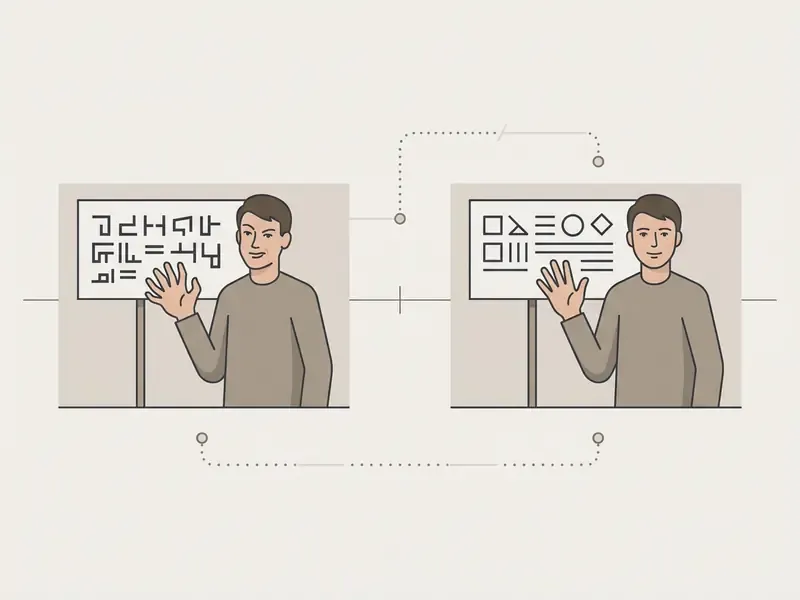
Research in diffusion-based image generation models categorizes ai bad images into five core artifact classes: anatomical, stylistic, functional, physics violations, and sociocultural implausibilities (Kamali et al., 2025). An intentional artistic style shows consistent, repeatable choices in brushwork, lighting, or abstraction. A technical ai image fail looks different: localized geometric collapses, mismatched vanishing points, texture smudging. In empirical studies, human evaluators correctly flag ai generated images fail cases with up to 81.7% accuracy by identifying localized anatomical flaws and spatial incoherence (SafeIMG Benchmark, 2025).
«The best specialized detector model identifies generated images in only 33.1% of cases, while humans reach 81.7% accuracy.»
The operational conclusion is uncomfortable. Your audience is a better artifact detector than your tooling. Automated screening reduces volume, but it cannot replace a human validation gate for public-facing assets. That single sentence is the reason this article exists.
Typical examples of AI art gone wrong
Recurring visual defects across generative diffusion models stem from the model's reliance on statistical pattern matching rather than explicit 3D spatial geometry. When complex multi-object prompts are processed, ai art gone wrong shows up as fused body parts, floating artifacts, and broken perspective fields.
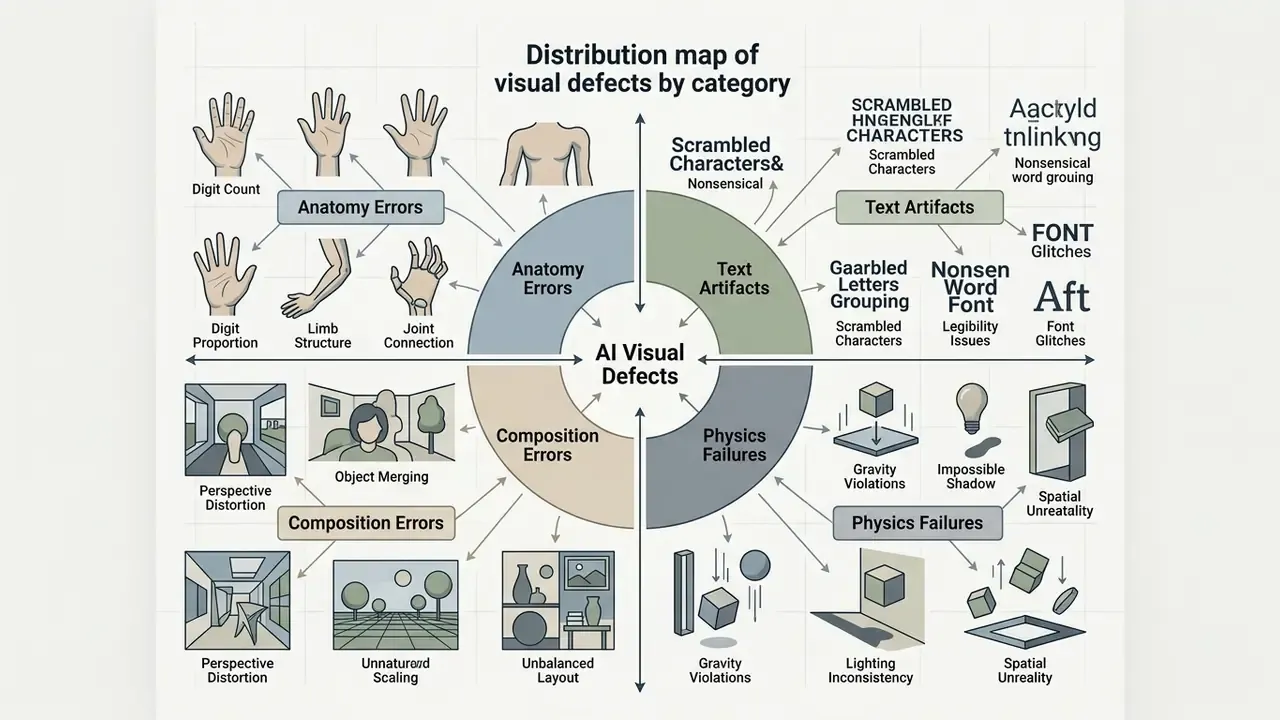
Analyzing ai images gone wrong reveals a pattern: localized anomalies in high-variance regions, mainly hands and faces, are the primary triggers for audience distrust. The same ai fail images in enterprise environments create immediate brand liabilities when protected trademarks or unreadable font glyphs appear in the frame. Nobody zooms into a background column. Everybody zooms into a hand.
Faces, hands, fingers and human anatomy
Anatomical errors in generated figures occur because text-to-image architectures predict pixel density from learned latent distributions without an explicit topological blueprint of the human body. The most common anatomical failures in ai bad pictures include hands with six or more digits, fused phalanges, dislocated joints, and asymmetrical facial features (PMC Anatomical Evaluation, 2026).
«Anatomical implausibilities were recorded in 51.4% of the AI image sample of people, including extra fingers, fused limbs, and unnaturally empty gazes.»
| Anatomical element | Common defect (AI fail) | Technical cause | Correction method |
|---|---|---|---|
| Hands & fingers | Extra digits, fused fingers, impossible joint bends | High degree of freedom in training data without 3D joint bounds | HanDiffuser / Depth ControlNet inpainting |
| Facial landmarks | Asymmetrical eyes, overlapping teeth, plastic skin texture | High-frequency noise collapse during late sampling steps | CodeFormer / GFPGAN post-processing |
| Limbs & torsos | Floating legs, merged torsos in crowds, disjointed hips | Multi-subject prompt blending in latent attention maps | Bounding-box attention masking (regional prompts) |
| Contact points | Fingers clipping through cups, tools, phones | No collision model between subject and object meshes | Depth-guided ControlNet plus manual mask repair |
Here is an illustrative case, composite rather than client-specific. During a governance review of automated advertising assets at a financial services institution, an automated pipeline produced marketing imagery containing subtle finger duplications in 14% of outputs. The team integrated a human artifact detection model (HADM) into the staging environment to screen all generated human figures before asset rendering. That validation layer, comparable to commercially available automated AI image detectors, flagged anatomical anomalies before campaign deployment and prevented high-visibility publishing errors.
For repeatable portrait output, the highest-risk category for anatomical failure, a specialized pipeline such as an AI headshot generator constrains pose and framing far more reliably than an open-ended prompt.
Illegible text, logos and recognizable details
Diffusion models frequently fail at text rendering because characters are treated as high-frequency visual textures rather than structured linguistic tokens. Standard image models generating signage or packaging produce garbled, non-existent characters, commonly called gibberish text (DEsignBench, 2024).
«DALL-E 3 reaches 65.2% word-level accuracy, while Midjourney reaches only 1.1%, SDXL 25.0%, and IF 45.0% in the DEsignBench evaluation.»
Illogical objects, backgrounds and complex scenes
Complex multi-object prompts frequently produce spatial overlapping errors, broken shadow trajectories, and inconsistent vanishing points. Projective geometry evaluations show that diffusion models consistently fail to enforce strict physical laws, so shadows fall in opposing directions from a single light source (Sarkar et al., CVPR 2024).
«Explanation models cover only 15.0% of annotated common-sense conflicts and 12.0% of physical inconsistencies in the SafeIMG benchmark.»
Background elements in ai picture mistakes often feature floating structures, disconnected architectural columns, and foreground objects that fade seamlessly into distant backgrounds. Practitioner reports describe the same class of failure: rolling library ladders that vanish halfway up a shelf, cookbooks with two spines and three sections, kitchen scenes that only collapse under zoom. These physical implausibilities break viewer immersion and betray the synthetic origin of the image.
Real-world AI brand fails and what they cost
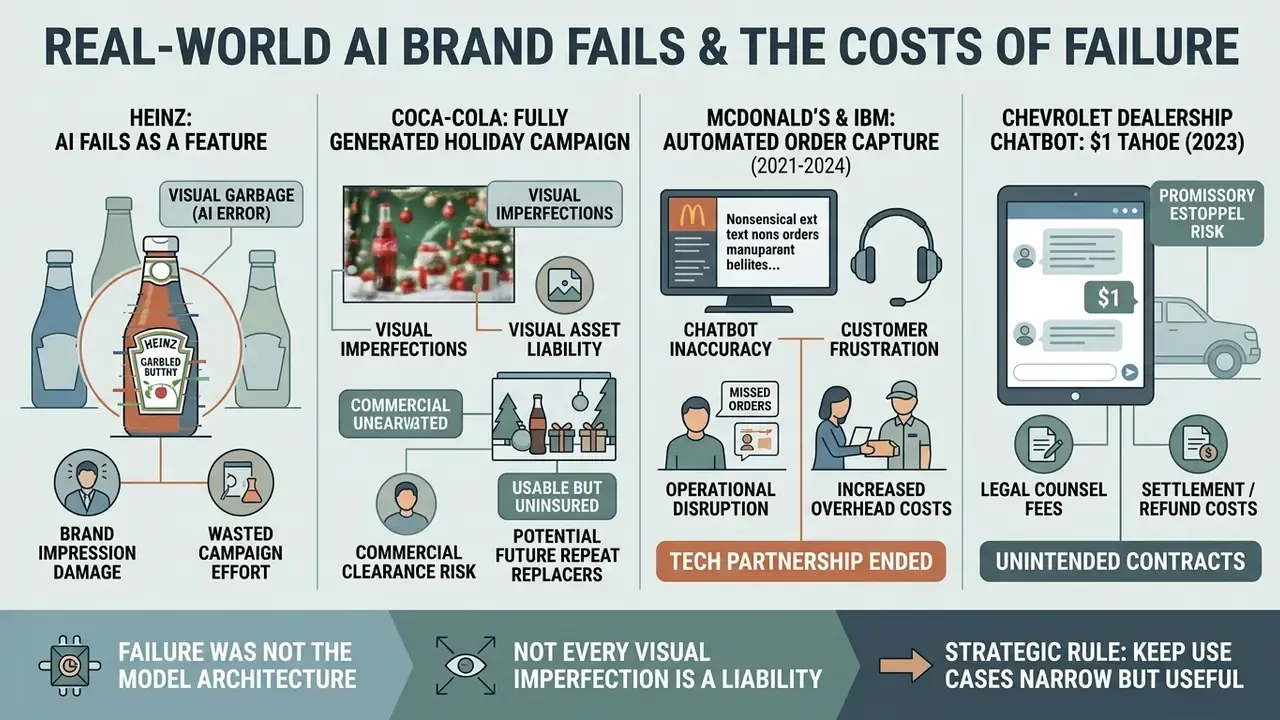
Technical taxonomy is only half the risk picture. The reputational cost of ungoverned generative output has already been demonstrated publicly by global brands, and those cases are the most persuasive internal argument for a validation gate.
Coca-Cola, 2024, the fully generated holiday campaign. The brand released a Christmas spot built with generative AI and framed it as “a collaboration between human storytellers and generative AI.” Public reception was largely negative. Audiences read the campaign as low-effort and as an attempt to avoid commissioning artists, and creative-industry figures amplified the backlash on social platforms. The lesson for governance teams: a technically clean asset can still fail on perceived authenticity, a failure mode no anatomy checklist detects.
McDonald's and IBM, 2021 to 2024, automated order capture. An AI voice-ordering pilot was rolled out across roughly 100 locations before being shelved. Widely shared clips showed the system adding McNuggets that customers never ordered and refusing to remove bacon from a McFlurry. The pilot cost mattered less than the meme cycle. McDonald's has since re-announced broader AI ambitions across tens of thousands of restaurants, which underlines the real point: brands do not abandon AI after a failure, they add guardrails.
Chevrolet dealership chatbot, 2023, the $1 Tahoe. An unconstrained retail chatbot was talked into a "legally binding" $1 offer on a 2024 Chevy Tahoe, then into four-figure discounts by a user who simply claimed to be a dealership manager. Guardrails were added and immediately bypassed again by a user claiming to be an AI-lab CEO. Ungoverned generative surfaces create contract-adjacent legal exposure, not just embarrassment, and they dent customer satisfaction in exactly the channels brands are trying to automate.
Mango, 2024, AI fashion models. Replacing photographed models with generated ones accelerated content production but shifted the conversation from the product to the ethics of displaced creative labor. Cost savings were real. The earned-media outcome was not the one planned.
Across all four cases the failure was not the model architecture. It was the absence of a review gate that asked two questions before publication: is this structurally correct? and is this defensible in public?
AI fails as a feature: the Heinz case
Not every visible imperfection is a liability. Heinz built its first fully AI-generated ad campaign around a simple mechanic. Consumers submitted prompts containing the word "ketchup," and the surreal, imperfect outputs kept reproducing the silhouette of the Heinz bottle. The generative quirk became proof of brand recognition, and the best submissions were promoted into social posts and print.
The strategic rule is narrow but useful. An artifact can be an asset when the imperfection is the message and the brand explicitly frames the output as machine-made. An artifact is a defect whenever the asset is presented as photographic reality. Policy should distinguish the two intents in writing, because the same six-fingered hand is a viral ingredient in one campaign and a trust breach in the other.
Why AI image generation fails
An ai image generation fails state occurs when the generative trajectory drifts away from the intended data manifold, usually because of ambiguous prompts, parameter misconfigurations, or latent score-function smoothing.
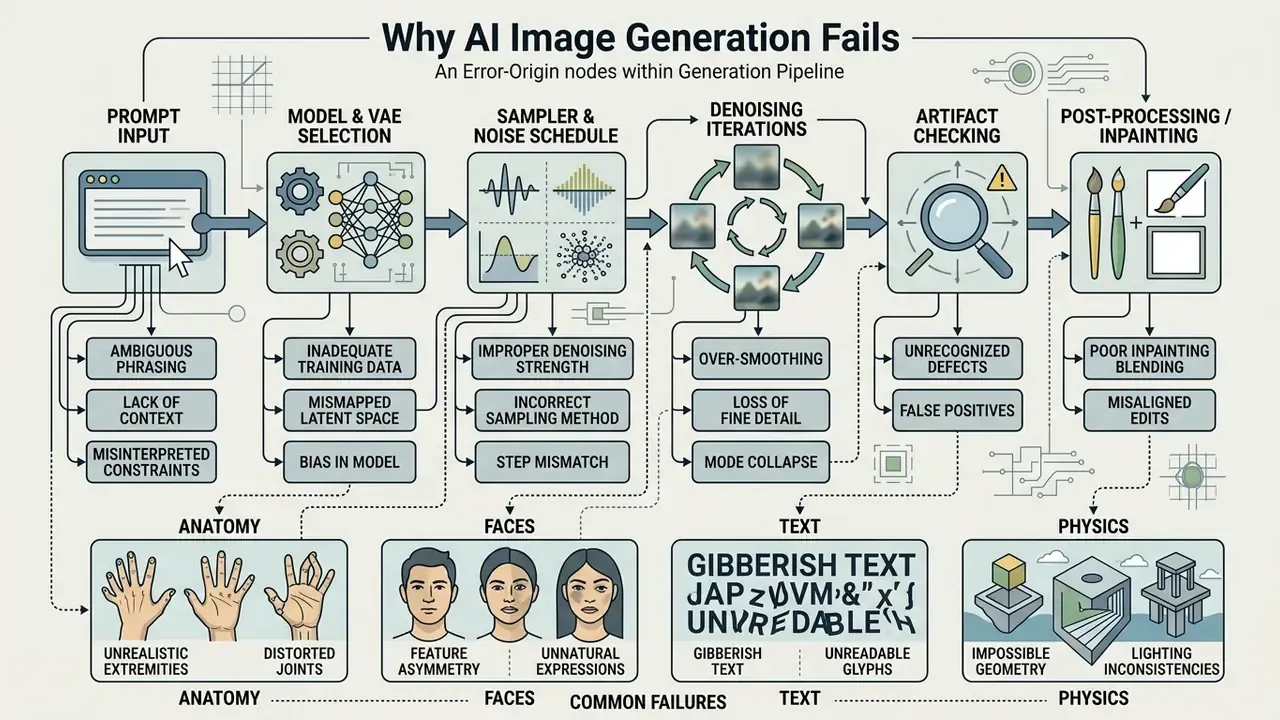
When an ai generator fails, the root cause usually sits in how the diffusion process converts random Gaussian noise into deterministic pixel structures. Knowing whether an ai generated image fails because of prompt ambiguity or latent mode interpolation is what determines the correct remediation strategy. Guess wrong, and you burn GPU hours on the wrong fix.
«Hallucinations arise from an imbalance across three axes: semantic coherence, structural alignment, and knowledge grounding, as the model drifts beyond the ideal manifold.»
Vague and contradictory prompts
Abstract, over-promoted, or contradictory inputs force the model to interpolate between mutually exclusive latent concepts. Peer-reviewed work on ambiguity resolution in text-to-image systems reports that ambiguous requests push models toward an unintended interpretation, and that stage-aware prompt decomposition reduces the resulting visual failures. The mechanism is usually described as trajectory drift in latent space, producing hybrid artifacts and missing elements (Resolving Ambiguities in Text-to-Image Generative Models, ACL 2023).
«Ambiguous prompts such as "a horse in a field" leave pose and action undefined, increasing the risk of anatomical errors during sampling.»
Over-prompting with redundant buzzwords ("hyperrealistic, 8k, photorealistic, ultra detailed") dilutes the attention weights assigned to core subject descriptors and raises the probability of an ai picture fail. More adjectives, less control. That trade-off surprises most first-time users.
Unsuitable model and generation parameters
Picking the wrong base checkpoint or misconfiguring core hyperparameters guarantees visual degradation. Using a standard SDXL base model without an explicit VAE (Variational Autoencoder) yields washed-out colors and smudged edges.
Sampler choice matters just as much. Applying unstable ancestral samplers such as Euler a to tasks that require strict deterministic reproducibility means minor seed variations produce completely different compositions. Resolution must match the model's native training dimensions too. Forcing a 1024×1024 native model to output 512×2048 induces body duplication and stretched geometry. Excessive LoRA weighting produces a related failure: over-saturated, "fried" textures that no inpainting pass can rescue. Parameter and cost trade-offs are documented across the AI Media Pricing Guides and in vendor implementation docs; when a pipeline breaks repeatedly, the AI Media Support and Troubleshooting hub is the faster route than another reseed.
Hallucinations, over-editing and prompt-interpretation errors
Neural hallucinations in vision models appear when learned latent representations substitute missing training data with mode-interpolated noise patterns. In multi-entity prompts, that means object omission or unprompted background structures arriving uninvited.
«FID does not correlate with counting errors: models achieve low FID while simultaneously generating six-fingered hands or duplicating scene objects.»
Over-editing errors occur during image-to-image strength over-allocation, where high denoising values erase the structural integrity of the original seed image and produce severe ai messed up images and ai mistakes images. Practitioner accounts of repeated Midjourney edit rounds describe exactly this collapse. After several passes, a celebrating football team dissolves into an unidentifiable blob, and nobody, including the model, can reconstruct which edit caused it. When over-editing is detected, discarding the batch is cheaper than continuing. Sunk-cost thinking is expensive here.
How to fix bad AI generated images
Correcting bad ai generated images efficiently requires targeted local editing (inpainting) rather than continuous, unconstrained full-image regenerations. Comparative reviews of AI image enhancement tools show the same pattern: local repair beats regeneration on both cost and consistency.
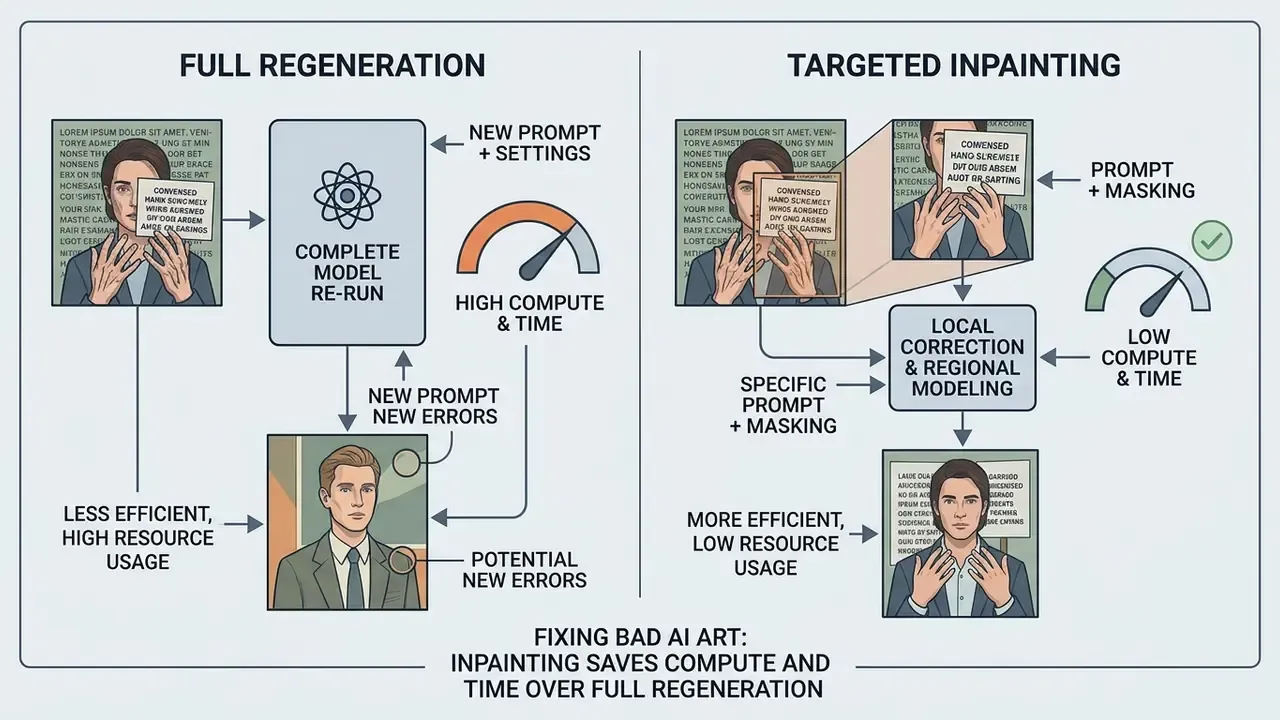
When you hit an ai image fail or an ai picture fail, resetting the global random seed while keeping the prompt static rarely resolves localized hand or face issues. Surgical mask operations do: they isolate the artifact while preserving background coherence. In mask conventions used by most inpainting pipelines, white pixels are modified and black pixels are preserved, and a small blur or gradient at the mask boundary prevents visible seams.
Refine the prompt and use negative prompts
Structuring prompts in a logical hierarchy improves output fidelity: background scene first, primary subject second, fine details third, explicit rendering constraints fourth. The prompt-ordering rule and the "change only X, keep everything else the same" edit pattern are documented in current model-provider prompting guidance and in peer-reviewed work on negative prompting, which describes negative prompts as deleting concepts through mutual cancellation in latent space (Understanding the Impact of Negative Prompts, 2024).
«Early detection of object omissions through cross-attention maps (HEaD+) allows faulty generation trajectories to be interrupted before sampling completes.»
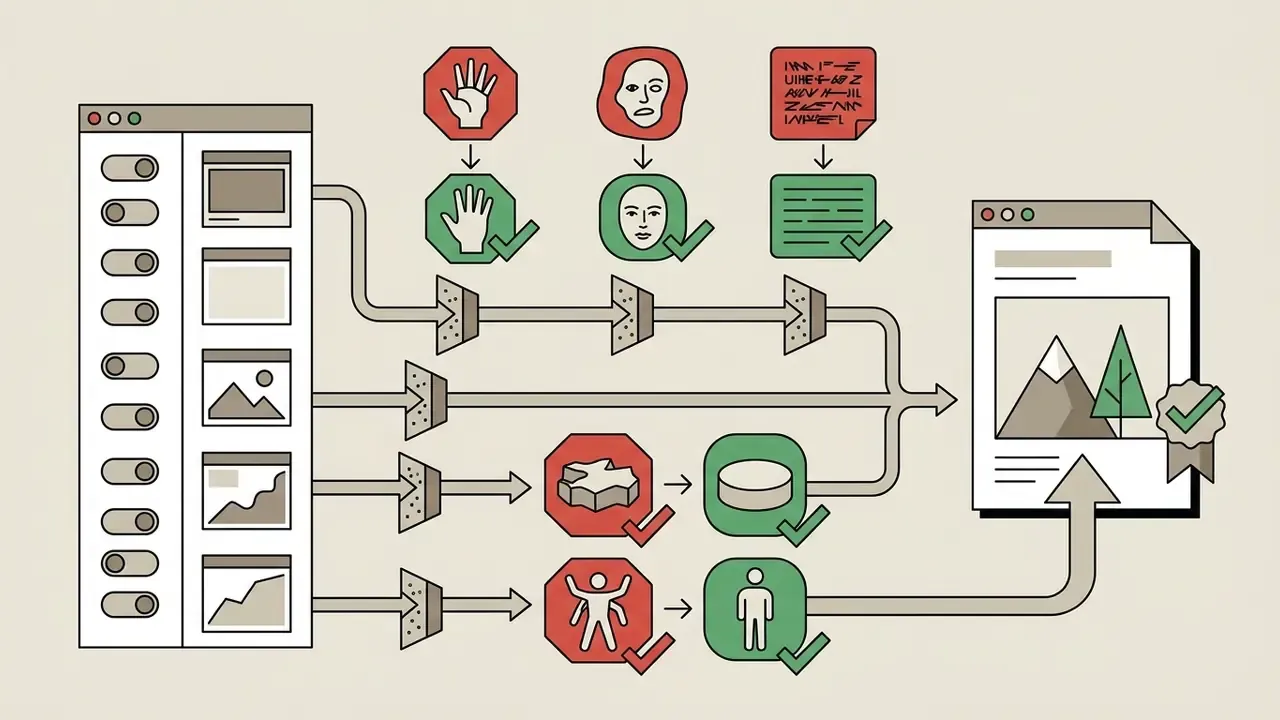
ugly, deformed hands, extra fingers, missing digits, fused fingers, distorted face, unreadable text, low quality, artifact, bad anatomy, bad proportions, duplicate limbs.
extra fingers, missing fingers, fused digits. Abstract negatives such as "ugly" or "wrong" steer weakly and can be dropped from the standard block.
Fix resolution, framing and lighting
Framing and composition failures often trace back to prompt wording that omits camera positioning. Standard cinematography terminology ("wide angle shot," "close-up portrait," "three-quarter view") establishes fixed boundary limits for the model. Prompt-engineering studies are blunt about the limits of wording alone: rephrasings that reuse the same keywords do not significantly change output quality, whereas image conditioning and initial images measurably improve subject coherence and composition control. That is why image-to-image generators outperform text-only retries on framing defects.
Lighting descriptors should name explicit physical sources, such as "directional sunlight," "soft studio key light," or "high-contrast rim lighting," to prevent the multi-directional shadow conflicts typical of ai generated images gone wrong. Where the frame itself is too tight, controlled outpainting via AI image expansion tools beats re-rolling the entire composition.
Regeneration and post-processing of the result
When an initial output has strong composition but local defects, lock the random seed and switch to mask-based inpainting.
An illustrative workflow evaluation for institutional reporting assets makes the point. An analyst team replaced complete regeneration loops with a two-stage editing process: malformed hands masked at 0.45 denoising strength in an inpainting pipeline, then a deterministic image upscaler. Iteration time per finalized graphic dropped by 68% while background consistency held across published materials. Advanced workflows can be compared using the AI Media Comparison Matrices.
Escalation matrix: who fixes what
Correction economics collapse when a designer spends an hour on a frame that should have been rejected in thirty seconds. Fix the routing rule first.
| Defect severity | Example | Owner | Action | Time budget |
|---|---|---|---|---|
| L1, cosmetic | Minor texture smudge, single soft edge | Prompt engineer | Negative prompt tweak, one reseed | ≤ 5 min |
| L2, localized structural | Six fingers, overlapping teeth, garbled sign | Prompt engineer | Seed lock plus masked inpainting at 0.35 to 0.50 denoise | ≤ 15 min |
| L3, global structural | Conflicting shadow directions, broken perspective field | Senior designer | Manual composite or reshoot brief; discard batch | ≤ 60 min |
| L4, non-remediable | Recognizable trademark, protected character, defamatory likeness | Compliance / legal | Reject asset, log incident, retrain prompt library | Immediate reject |
Two rules make this matrix work. An asset may cross at most one escalation level before rejection, and every L4 event is logged as a model-risk incident rather than a creative revision.
How to choose the model and settings for better AI images
Preventing ai image generator fails depends on matching base architecture capabilities to the domain requirement: photorealism, text rendering, or stylized illustration.
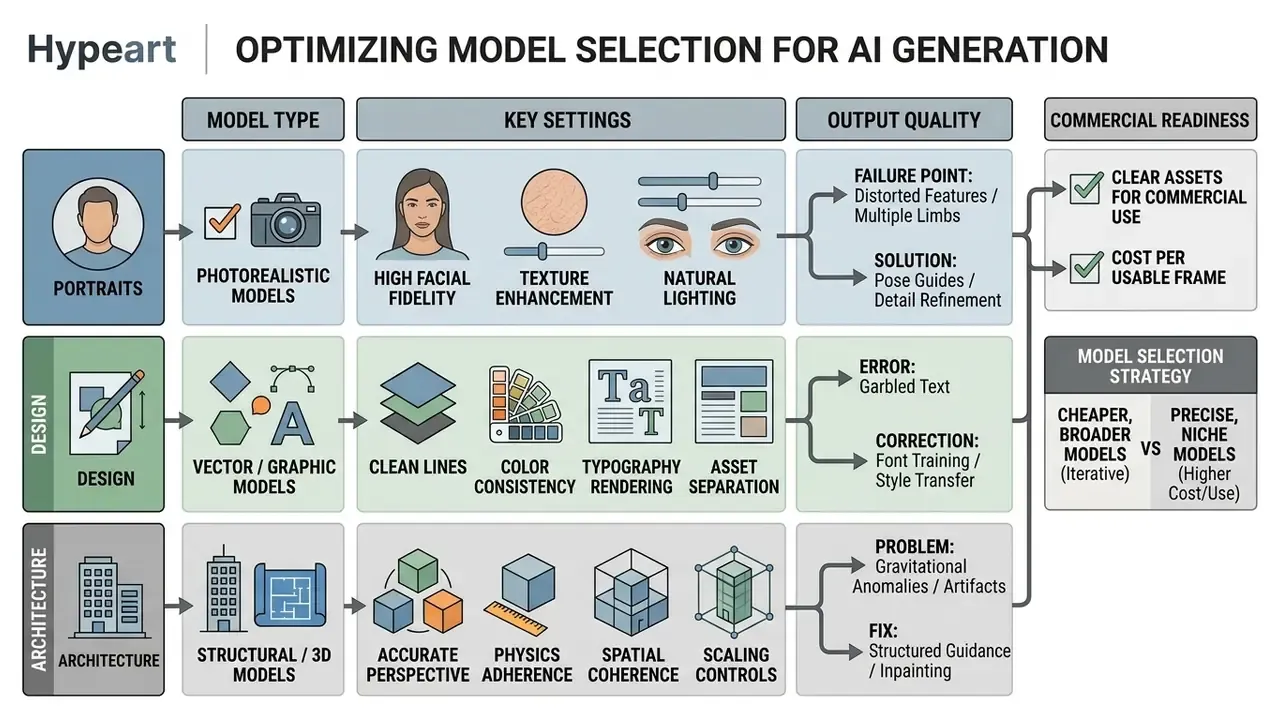
Evaluating model performance means inspecting both photorealism scores (such as GLIPS) and text-alignment benchmarks (such as TIFA and I-HallA). Relying only on Fréchet Inception Distance (FID) misleads, because FID often overlooks localized counting errors and small ai images fails.
«GLIPS correlates with human ratings more strongly than FID or SSIM: camera photographs score 4.06/5, DALL-E 2 scores 3.63, Stable Diffusion 3.30, and DALL-E 3 2.75.»
Match the model to people, objects and visual style
No single architecture excels across all visual domains. Benchmark assessments show distinct strengths:
- Photorealism and human anatomy: FLUX and Stable Diffusion XL, coupled with specialized LoRAs, show superior skin texture rendering and structural facial symmetry (MMIG-Bench, 2025).
«Stable Diffusion achieves an FID of 21.70 for faces on COCO versus 115.50 for LAFITE G, demonstrating significantly higher quality for images of people.»
- Text and graphic design: DALL-E 3 and Recraft lead in short-text rendering and vector composition adherence (DEsignBench, 2024). A side-by-side view of the best AI image generators and of leading AI art generators clarifies where quality, price, and usage rights diverge.
- Stylized illustration: style-specialized endpoints, including Ghibli-style AI image generators, outperform general checkpoints on aesthetic consistency but carry higher IP-adjacency risk and need a stricter legal review pass.
- Custom fine-tuning: open-weight diffusion models allow enterprise deployment of domain-specific LoRA adapters trained on proprietary design systems. Benchmarks are task-split by design: OneIG-Bench separates general object, portrait, anime and stylization, text rendering, reasoning, and multilingual tracks, so a model can lead on style and lag badly on typography.
- Cross-modal pipelines: if the same brief also produces presenter video, evaluate avatar tooling separately. The synthesia ai video generator sits in a different risk class than a text-to-image checkpoint, and the synthesia ai video generator features breakdown shows which controls exist for likeness consent and script approval.
Verify resolution, sampler, VAE and seed before generating
To prevent recurring ai generated images fails, enforce standardized baseline settings across pipelines:
- Resolution generate at the model's native trained resolution (1024×1024 for SDXL or FLUX) before scaling.
- Sampler use non-ancestral deterministic samplers such as DPM++ 2M Karras or UniPC for reproducible results across identical seeds.
- VAE configuration load the explicit VAE recommended by the base model developer to prevent color desaturation and edge bleeding.
- Noise schedule where the pipeline exposes it, prefer zero-terminal-SNR schedules with sampling from the last timestep, aligning training and inference behavior (WACV 2024).
- Guidance treat guidance scale as a tunable hyperparameter, not a value to maximize. NeurIPS 2024 results show that applying guidance only within a middle interval of sampling steps improved FID over full-path guidance.
- Seed governance record exact numeric seeds alongside full prompt metadata for auditing and precise iterative editing. Parameter integration can be automated via the AI Media API Guides; for cross-modal pipelines, see the Google Veo implementation guide. Post-generation cleanup belongs in a dedicated AI photo editor or a conventional online photo editor, not in additional generation passes.
Generation cost and how to evaluate a pricing plan before commercial use
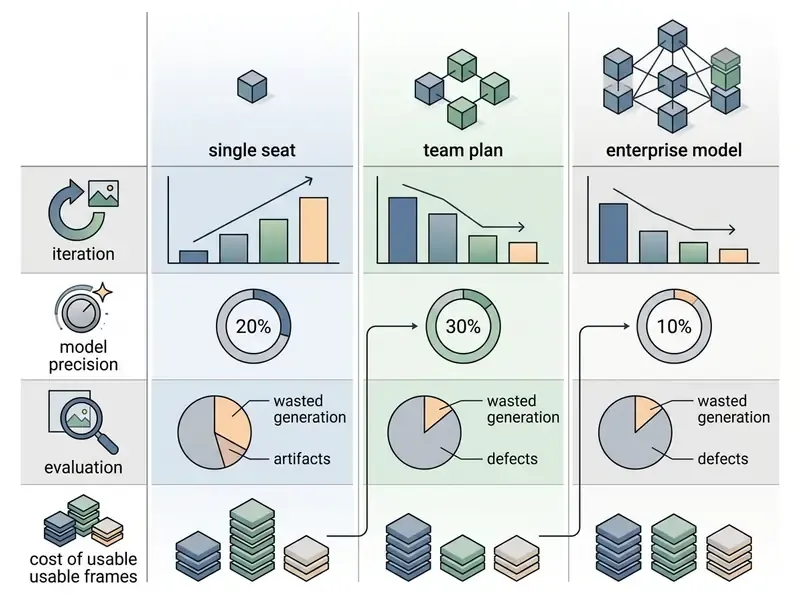
| Pricing model | Base cost per calibrated image (1024×1024) | Share of unusable generations (AI fails) | True cost of one publishable commercial frame |
|---|---|---|---|
| API per-token / per-image | $0.02 to $0.08 | 20% to 35% | $0.03 to $0.12 including inpainting |
| Flat-rate subscription | $20 to $60 per month | Depends on GPU-hour allowance | Distributed cost depends on volume |
| Enterprise dedicated node | Fixed GPU lease | Minimal with LoRA calibration | Optimal above 10k images per month |
When selecting an enterprise subscription, calculating pure cost-per-generation leads to inaccurate budgeting. Financial decision-makers should evaluate the total cost of asset production, including iteration multipliers and manual correction overhead. Vendor billing units differ materially: some providers price image models per million tokens, others per image by quality and size, and inpainting is frequently a separate line item rather than a discounted retry.
True cost formula. Model the human layer explicitly, because it dominates total cost of ownership above a few thousand assets per month:
Cost per publishable frame = (Generations per accepted frame × price per generation) + (Validation minutes × loaded hourly rate ÷ 60) + (Inpainting minutes × loaded hourly rate ÷ 60) + (Compliance review minutes × loaded hourly rate ÷ 60)
With a 25% fail rate, 3 minutes of validation, 8 minutes of inpainting on one frame in three, and a $65 loaded hourly rate, compute cost becomes a rounding error and human time becomes the budget. Which is exactly why cutting L2 defects at the prompt and parameter stage returns more than switching vendors for a cheaper per-image rate.
What to check in a generator plan before you start
Before committing to a vendor plan, evaluate these operational parameters:
Pre-publication checklist for AI-generated images
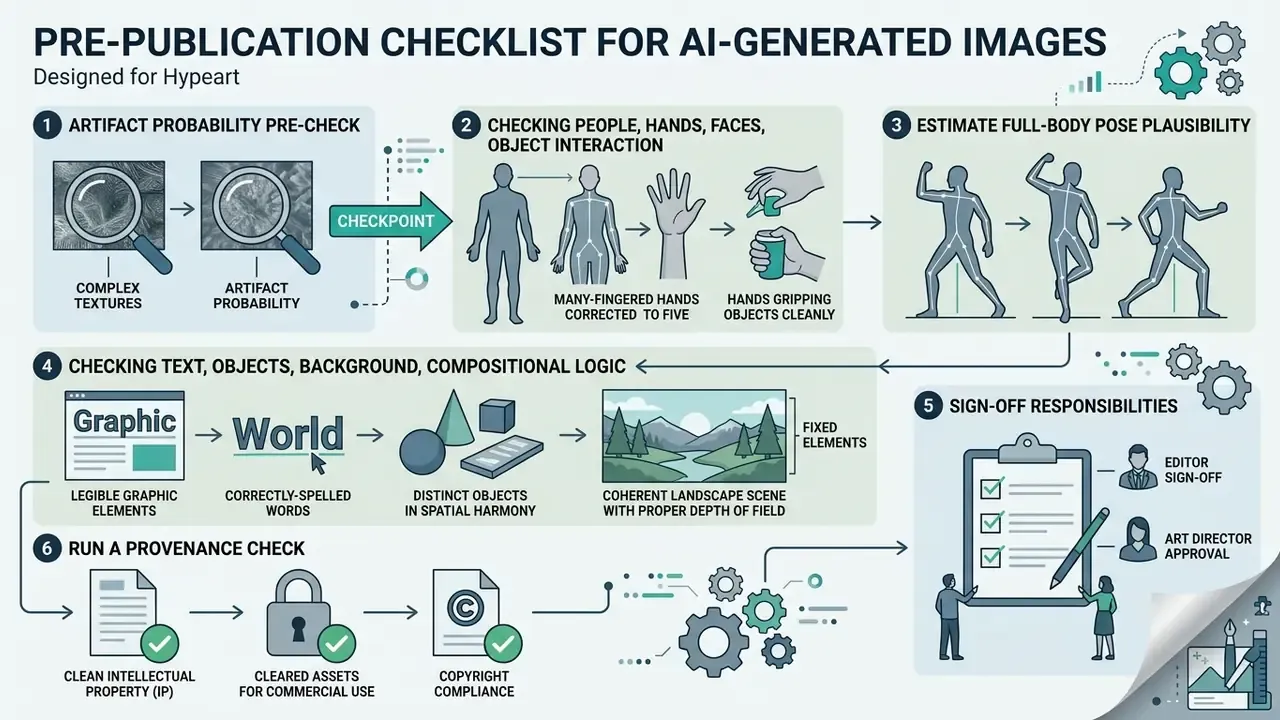
A structured pre-publication review mitigates the operational risk of publishing defective synthetic content. Governance frameworks such as NIST AI RMF 1.0 recommend explicit verification protocols for all commercial AI outputs (NIST AI 100-4, 2024).
«NIST AI RMF 1.0 recommends explicit verification protocols for all commercial AI outputs, including documentation of model versions and generation metadata.»
«MindScore decomposes evaluation into four modules: alignment, fidelity, quality, and realism, mirroring how humans cognitively process images.» - MindScore Framework for Human Preference Evaluation (2025). https://arxiv.org/abs/2406.08651
Artifact probability pre-check. Before generating, estimate defect likelihood and route high-risk briefs to a constrained pipeline (pose conditioning, regional prompts, or licensed stock photography):
Artifact probability ≈ (number of people in frame × 15%) + lighting complexity factor (single source 0%, mixed 10%, backlit or reflective 20%) + text-in-frame factor (0% none, 25% short string, 50% long text)
Any brief scoring above 60% should not be attempted as a single-pass generation. Treat this heuristic as a working estimate, calibrated against your own rejection logs rather than published benchmarks.
Checking people, hands, faces and object interaction
Reviewers should inspect human figures at 100% zoom:
- Verify digit count, exactly five per visible hand, and check joint articulation.
- Inspect facial geometry for pupil roundness, iris symmetry, and natural dental structure. Landmark-level asymmetry between eyes, ears, jawline, and mouth is the fastest tell. Correct it in a dedicated AI portrait retouching editor, and remember that consumer-grade tooling such as a teeth whitening app can smooth a dental line but will not repair a malformed one.
- Ensure physical contact points, hands gripping cups or tools, follow natural anatomical contours without clipping through objects, and that grip depth matches the object silhouette. Repeatable portrait output benefits from a constrained AI headshot generator pipeline.
- For animated derivatives, apply the same anatomy gate before any motion pass. A talking photo online workflow amplifies facial defects rather than hiding them, because the viewer watches the face for several seconds instead of a glance.
Checking text, objects, background and compositional logic
Audit non-human scene elements for structural consistency:
- Confirm every visible character string forms legible text and matches brand guidelines, including required clear space and approved logo backgrounds.
- Examine straight architectural lines, reflection angles, and shadow vectors for physical plausibility. Cast shadows and reflections that fail to converge on a common intersection are forensic evidence of synthesis.
- Validate background depth so secondary subjects contain no structural merging or cut-out compositing seams.
- For asset-origin verification and duplicate discovery, AI reverse-image-search tools help confirm whether a composition echoes an existing protected work.

Sign-off responsibilities
Audit evidence requires a named owner per gate, not a shared inbox.
| Gate | Owner | Evidence artifact |
|---|---|---|
| Technical validation (anatomy, physics, text) | Creative operations lead | Completed checklist with timestamp and asset hash |
| IP and trademark clearance | Compliance / legal counsel | Clearance note plus reverse-image-search log |
| Model risk record (version, seed, prompt, LoRA) | Model risk function | Generation metadata entry in the model inventory |
| Final publication approval | Brand owner (marketing) | Countersigned release referencing the two prior gates |
Financial institutions should map this table onto existing model risk management expectations (SR 11-7 and OCC guidance). Third-party generative image services are vendor models producing unstructured outputs. They belong in the model inventory, with documented validation, ongoing monitoring, and change control for the moment a vendor silently updates a checkpoint. That silent update is the failure mode most inventories still miss.
Can you use bad AI images in commercial content
Using unverified or defective synthetic imagery in public-facing campaigns introduces substantial financial, legal, and reputational risk.
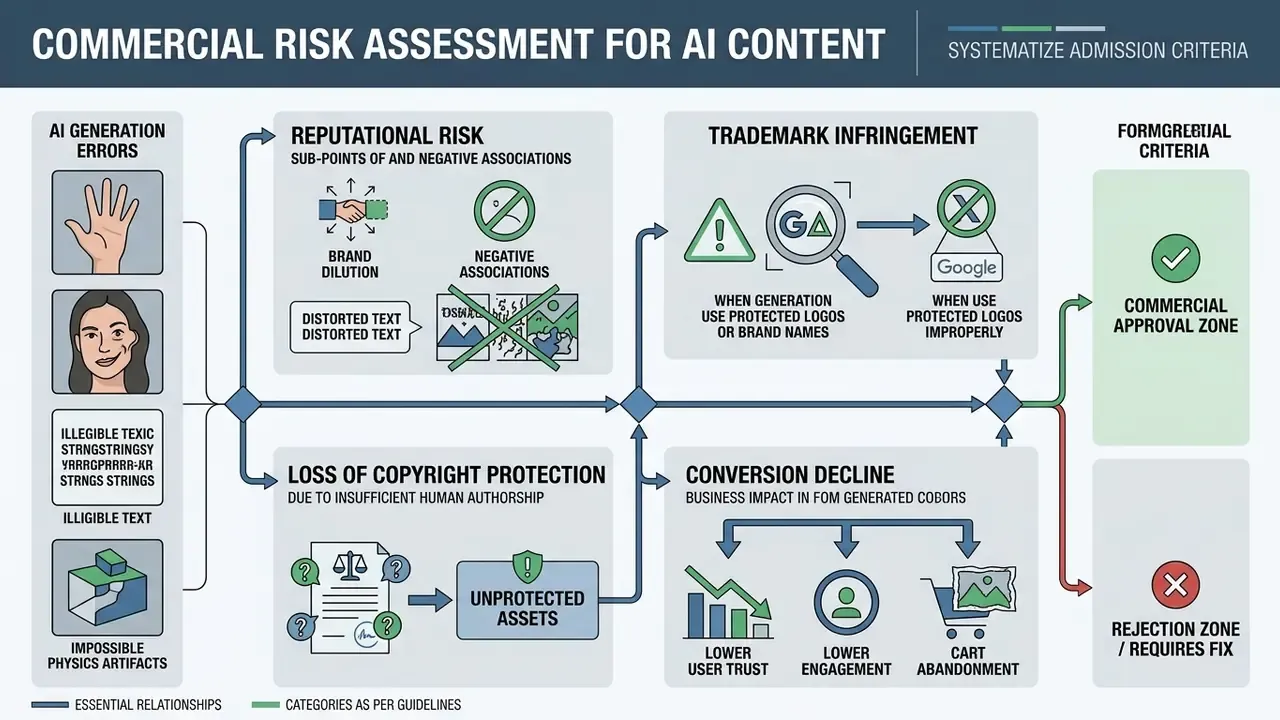
Publishing bad ai generated images signals weak quality control, which erodes consumer trust and depresses ad conversion. Enterprise marketing policy needs clear compliance parameters for every generated asset. Disclosure regimes differ by jurisdiction: Canadian and Australian frameworks require labeling, watermarking, or metadata where consumers could be materially misled, while UK advertising guidance imposes no blanket AI-disclosure duty but applies existing misleading-advertising rules in full.
Visual errors that reduce brand trust
Consumer perception research shows that visible synthetic artifacts, plastic skin textures, glassy eyes, extra fingers, trigger an immediate "uncanny valley" response.
«Participants in a large-scale user study correctly identified AI images in 76% of cases, relying on extra fingers, asymmetrical eyes, and illegible details.»
Qualitative studies of branded AI imagery report that unnatural expressions, glassy eyes, over-smoothed textures, and generation errors are consistently linked to a "something is off" reaction that reduces perceived authenticity and, downstream, purchase intent. This article treats the causal link between artifacts and conversion as directional rather than quantified, pending harmonized measurement. High polish cannot compensate for structural errors. Maintaining standards for commercial use and understanding the terms of commercial AI image generation protects brand integrity better than a bigger retouching budget.
Bad AI images in the scam economy and cybersecurity
Artifacts are not only a marketing problem. They are the primary forensic marker in synthetic-media fraud investigations. Generative art platforms and deepfake pipelines already impersonate public figures for fake product endorsements, fabricate statements by officials, and lure victims to spoofed news pages and payment forms.
Two attack patterns matter most for enterprise security and financial crime teams:
- Romance and dating-profile fraud. Criminals generate synthetic portraits to build fake profiles, then extract money or personal data. Detecting six-fingered hands, malformed ear cartilage, or smeared jewelry textures lets fraud teams auto-flag suspect accounts at onboarding, which folds neatly into existing KYC screening.
- Tragedy donation fraud. Fabricated disaster photographs are used to solicit donations that never reach real victims. Verification here is provenance-first: cross-check the claim against an official source before any payment rail opens.
Practical countermeasures mirror consumer guidance from university information-security offices. Verify the claim from an independent source, treat unusual details such as extra fingers or impossible lighting as a stop signal, and pause when an image looks too good to be true. For institutions, that means automated artifact scoring at account creation plus manual escalation, using AI image detectors as one input among several. Note the trend line: as models improve, artifact-based detection degrades, so provenance signals such as C2PA and SynthID must carry increasing weight in the control design.
Recognizable characters, trademarks and logos in AI-generated images
Models trained on public web datasets frequently output protected intellectual property: trademarked logos, recognizable pop-culture characters. Under US Copyright Office guidance, purely machine-generated visual elements lack human authorship and cannot be protected by copyright (US Copyright Office Guidance, 2025).
«Images created solely by AI without substantial human creative contribution are not eligible for copyright protection under US Copyright Office guidance.»
Accidental inclusion of trademarked logos in commercial campaigns also creates false endorsement risk under Lanham Act provisions, and can overlap with right-of-publicity claims when a name or persona implies endorsement. Registration practice compounds the exposure: applicants must claim only human contributions and explicitly disclaim AI-generated material, which means the most distinctive part of a campaign asset may be unprotectable.
Platform behavior differs, and that difference is a legal variable, not a feature preference:
| Platform | Behavior with trademarks and protected characters | Practical governance implication |
|---|---|---|
| DALL-E 3 | Strong prompt-level refusal for named brands, logos, and living public figures | Lowest accidental-IP risk; weakest for deliberate brand-mark reproduction |
| Midjourney v6+ | Blocks many named-IP prompts, but style mimicry and near-miss marks still pass | Requires manual clearance of every hero frame; see the Midjourney comparison |
| Leonardo AI | Permissive on stylized characters; complex overlapping scenes degrade | Suitable for concepting, not for final commercial frames |
| Google Gemini / ImageFX | Reported in 2026 device rollouts producing accurate-looking renditions of characters such as Mickey Mouse and Pikachu | High infringement exposure if outputs reach paid media |
| Grok (X) | Reported by paying users to generate political figures and protected characters with looser filtering | Treat outputs as unclearable for commercial use without legal review |
| Canva AI / Bing Image Creator | Consumer-grade filtering with template-bound licensing terms | Check tier-specific licensing in Canva AI Generator and Bing AI image terms |
One rule generalizes across platforms: if the concept requires a specific mark, do not generate it, composite a licensed asset instead. Ask whether the design truly needs the platform logo, or merely a phone displaying vertical video. Screening candidates with AI image detectors and reverse-image search before release closes most of the remaining gap. A formal Synthetic Media Disclosure procedure supports regulatory compliance and transparent attribution, and the current AI Litigation and Case Timelines show how quickly the case law is moving.
Disclaimer: this information is general in nature and does not replace consultation with a qualified attorney on copyright and trademark matters. Legal standards for AI-generated works, including US Copyright Office practice and EU AI Act implementation, continue to evolve and require periodic legal review.
Editorial standard for AI image verification (SOP-AI-2026):
FAQ: frequently asked questions about bad AI images
Why do AI generators fail most often on hands and fingers?
Neural networks treat hands as statistical pixel patterns, not as a three-dimensional anatomical system with rigid skeletal and joint constraints. Because training data contains enormous variation in viewing angles and finger occlusion, the model miscounts digits and articulations. Architectures that encode 3D hand shape and joint positions explicitly, such as HanDiffuser with MANO parameters, materially reduce these artifacts.
Can a text artifact be fixed without regenerating the whole frame?
Yes. Use local inpainting with a mask covering only the text region, or overlay vector type in an editor on top of the generated background. The second option is preferable for brand-critical typography, since it guarantees exact glyph fidelity and clear-space compliance.
How do negative prompts help avoid bad AI images?
Negative prompts cancel computation along latent-space directions associated with defects, for example extra digits, blurry, distorted, which lowers the probability of anatomical failures and smeared textures. Concrete physical terms outperform abstract adjectives: "ugly" steers far less effectively than "fused fingers."
Are bad AI images protected by copyright?
Under US Copyright Office guidance, images created solely by artificial intelligence without substantial human creative contribution are not eligible for copyright protection. Human-authored contributions can be claimed, but AI-generated material must be identified and disclaimed at registration.
Do we have to disclose that a commercial image is AI-generated?
It depends on jurisdiction and materiality. EU AI Act provisions require machine-readable marking of synthetic image content and disclosure for deepfake-like output. Canadian and Australian frameworks require labeling where consumers could be misled. UK guidance imposes no blanket duty but enforces existing misleading-advertising rules. Best practice for global brands: embed provenance metadata universally and label visibly where realism could deceive.
When should a defective asset be discarded instead of repaired?
When the defect is global rather than local, so conflicting shadow directions, broken perspective fields, or collapse after multiple edit rounds, repair costs exceed regeneration. Any asset containing a recognizable trademark or protected character is rejected outright, regardless of visual quality.
Which metric should we track to prove quality is improving?
Track the share of generations rejected at each escalation level (L1 to L4) per campaign, alongside minutes of human validation per publishable frame. FID is unsuitable as a governance metric because it does not correlate with counting errors. Perceptual metrics such as GLIPS align far more closely with human judgment.
What is a safe first step if we have no governance gate today?
Start narrow. Pick one campaign, add the pre-publication checklist and the four sign-off gates, and log every rejection by level for four weeks. That log becomes your baseline fail rate, your budget model, and your audit evidence at once, without pausing production.
Appendix A: superseded citations and revised claims
For transparency, two claims in earlier revisions of this article were rewritten after source verification:
- Original claim: "exposure to uncorrected AI artifacts reduced brand perception metrics and purchase intent among consumers (Gen Z Ad Perception Study, 2026)". The cited URL did not resolve to a marketing brand-perception study. The revised text states the directional finding and cites the large-scale human artifact study plus qualitative branded-imagery research instead.
- Original claim: prompt hierarchy attributed to "OpenAI Prompting Guide, 2026" with a URL pointing to Stability AI's Stable Diffusion 3 research paper. The attribution mismatch has been corrected. Prompt-ordering and negative-prompt mechanics are now attributed to current provider prompting guidance and to peer-reviewed negative-prompting research.
Reference resources and documentation
- Glossary of terms
- AI Media Glossary
- Cost calculators
- AI Media Calculators
- Pricing guides
- AI Media Pricing Guides
- Troubleshooting and support
- AI Media Support and Troubleshooting
- Comparison matrices
- AI Media Comparison Matrices
- API documentation
- AI Media API Guides
- Legal context
- AI Litigation and Case Timelines