Bad AI art refers to synthetic images with visible generative defects: anatomical distortions, garbled text, physical impossibilities, misbound attributes. The causes are boring and technical. Model architecture limits, noisy training data, and an uncalibrated prompt.
Why should anyone with a risk mandate care about a six-fingered hand? Because in 2026 the same institutions that validate credit models are now signing off on synthetic campaign assets, onboarding illustrations, and product explainers. A visual model is still a model. It has an owner, an approved use, an acceptance threshold, and an audit trail, or it does not, and then the exposure sits with whoever published the file. Enterprise teams and media operations increasingly evaluate generative visual models through risk-adjusted quality frameworks, where autonomy without explicit validation reliably produces high defect rates. Understanding why diffusion and autoregressive architectures fail lets teams detect, correct, and govern synthetic assets before commercial deployment.
Key Takeaways
What Counts as Bad AI Art and Why These Images Grab Attention
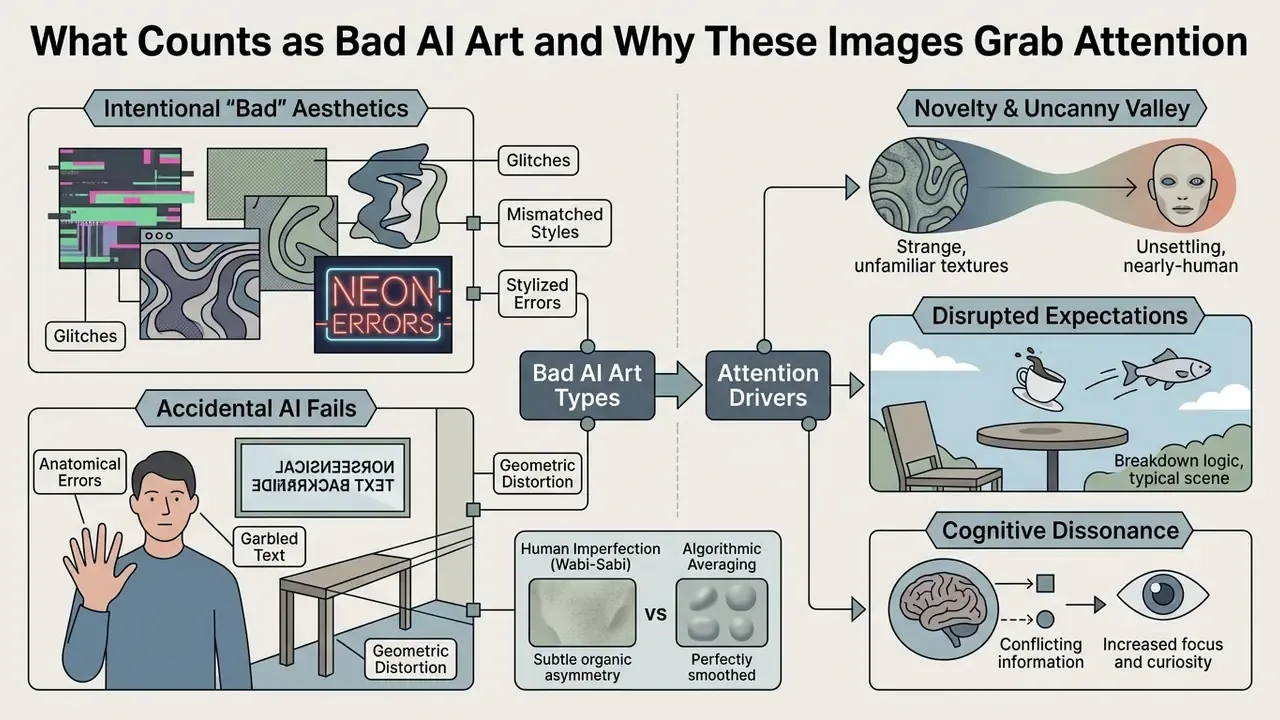
Bad AI art describes synthetic visual outputs that fail human expectations of realism, semantic coherence, or artistic intentionality, either through generative artifacts or through poor model guidance. Some bad AI generated art comes from technical failure modes: extra limbs, gibberish typography, melted product labels. Another category is a deliberate aesthetic subculture that embraces lo-fi AI kitsch and visual glitches on purpose.
Audiences stare at these images because human visual processing is unusually sensitive to small deviations from natural geometry and anatomy. Understanding the boundary between intentional imperfection and unintended technical fails is what lets you evaluate brand safety, model performance, and visual quality without arguing about taste.
Intentional "Bad" Aesthetics and Accidental AI Fails
Intentional "bad" AI aesthetics are a choice: the artist leverages algorithmic unpredictability. Accidental AI fails are unprompted defects caused by model instability or careless sampling settings. In digital art practice, deliberate imperfection works as controlled indeterminacy. Creators adjust sampling steps, classifier-free guidance (CFG) scales, or control weights to induce unexpected visual noise and open-ended readings (Han & Choi, Archives of Design Research, 2026). The lineage runs straight back to glitch art, which turned machinic error into an expressive asset (Akmeşe, CINEJ Cinema Journal, 2025).
«Intentional defects usually show internal consistency and conceptual grounding, while AI failures surface as incoherent glitches that break the image's own logic.»
Unintentional, really bad ai art happens when a model aims at photorealism or clean illustration and instead outputs structural defects: merged fingers, floating objects, chromatic banding, all traceable to latent space limitations (Kamali et al., arXiv, 2025). Glitch scholarship draws the same line from the artist's side. Reproducible, simulated error is an artistic means. An accidental production mistake is a defect (Bryson, 2016).
To navigate these nuances, creators exploring synthetic styles can review specialized entries in our AI Media Glossary, or compare how niche aesthetic checkpoints handle prompt constraints differently from mainstream base models in our overview of AI art generators.
Human Imperfection (Wabi-Sabi) vs Algorithmic Averaging
There is a philosophical difference between a flawed human mark and a flawed model output, and it explains why audiences forgive one and punish the other. In traditional practice, take Japanese ukiyo-e woodblock printing, an uneven line or a chisel slip signals the hand that made it. That is wabi-sabi: beauty found in impermanence, incompleteness, imperfection. Hold a hand-carved ukiyo-e board and the irregularities in the line work read as evidence of time and attention, not as a defect somebody forgot to hide.
An AI model's error is categorically different. It is not a human trace. It is a statistical compromise, the median of a million scraped works resolved into pixels. When a diffusion model cannot bind the right weights in latent space, the resulting distortion carries no intention, no biography, and no risk taken by a maker. That is why deliberate "bad art", which knowingly breaks rules a trained artist could otherwise follow, can still move an audience, while random AI breakage mostly reads as carelessness.
This distinction is practical, not decorative. Brand teams that publish an accidental artifact and call it "a style choice" are usually caught within an hour, because viewers infer intentionality from context: consistency across a series, coherence of palette, and whether the flaw repeats on purpose or appears once, in the wrong place, on a product shot. One melted hand on one hero banner is not a movement. It is a miss.
Naive Art vs Bad Painting: how the difference changes your prompt
- Naive Art: sincerely unschooled work by self-taught painters with no academic training in perspective or anatomy. Prompt vocabulary:
sincere naive style, folk art, unschooled drawing, earnest flat perspective.
- Bad Painting: a knowing, ironic decision by a trained artist, deliberate deconstruction, anti-skill as a concept. Prompt vocabulary:
deliberately awkward, anti-skill on purpose, deadpan irony, clashing off-key palette, flat crude rendering.
Naming all four Bad Painting signals (awkward anti-skill drawing, flat crude rendering with no modelling, a clashing off-key palette, deadpan humour) is what makes an output read as knowing Bad Painting rather than an accidentally weak image.
Why People Notice AI-Generated Images
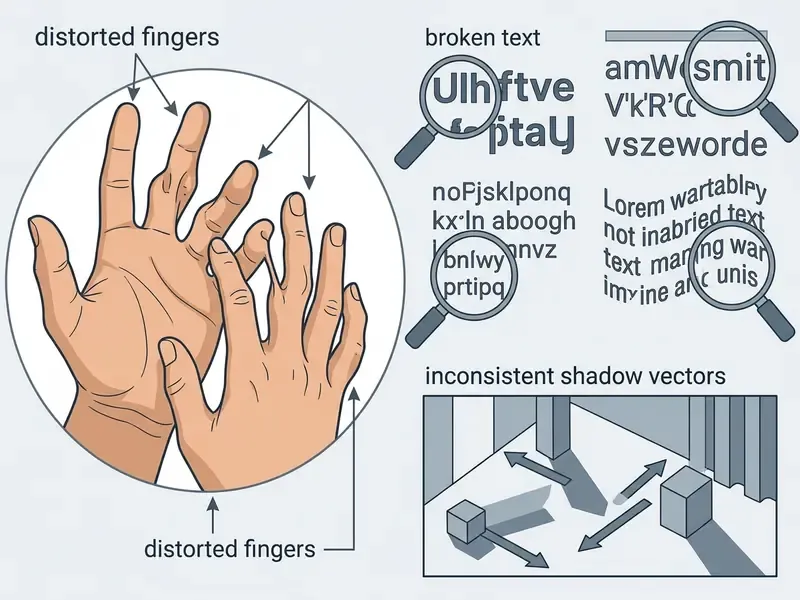
People notice AI-generated images because the visual system flags inconsistencies in surface texture, lighting physics, facial symmetry, and semantic logic that violate real-world priors. In large-scale empirical evaluations of human accuracy on synthetic media, viewers identified generated images reliably when given unrestricted viewing time, and they consistently flagged unnatural skin smoothing, inconsistent shadow vectors, and distorted hands.
«Only 17% of AI images were mistaken for real under unrestricted viewing; when exposure was limited to one second, that figure rose to 43%.»
Recognition accuracy therefore collapses during rapid exposure, say a one-second glance in a feed, which confirms that reliable detection depends on deliberate inspection of fine detail rather than gut feel. That asymmetry is exactly why a defect surviving internal review still gets caught in public. Campaign assets are examined far longer than a scroll once they become the subject of a comment thread.
Visual discomfort peaks when an image approaches photorealism yet keeps subtle structural flaws, the mechanism known as the uncanny valley. Eye-tracking research reports roughly 76.8% average accuracy when participants separate real faces from StyleGAN-3 faces, while accuracy on complex scenes and the strongest current generators can drop toward chance. People intuitively spot bad ai drawings when scene logic fails: a lopsided family group whose body proportions merge, or two adjacent objects lit from conflicting angles.
For teams building specialized synthetic assets, evaluating model benchmarks in our AI Media Comparison Matrices helps identify models that minimize uncanny artifacts. Reviewers who want automated triage before manual inspection can start with AI image detectors.
Why AI Art Looks Bad: Root Causes of Failed Generation
Generative visual models produce bad ai art mainly because of unstructured prompts, conflicting semantic instructions, dataset noise, and mathematical limits in diffusion decoding. When an artificial intelligence model receives an ambiguous or over-saturated prompt, it cannot allocate cross-attention weights cleanly, and the result is attribute bleeding plus structural incoherence. Knowing these drivers lets prompt engineers and model risk managers stop visual fails at the input stage, which is the cheapest place to stop anything.
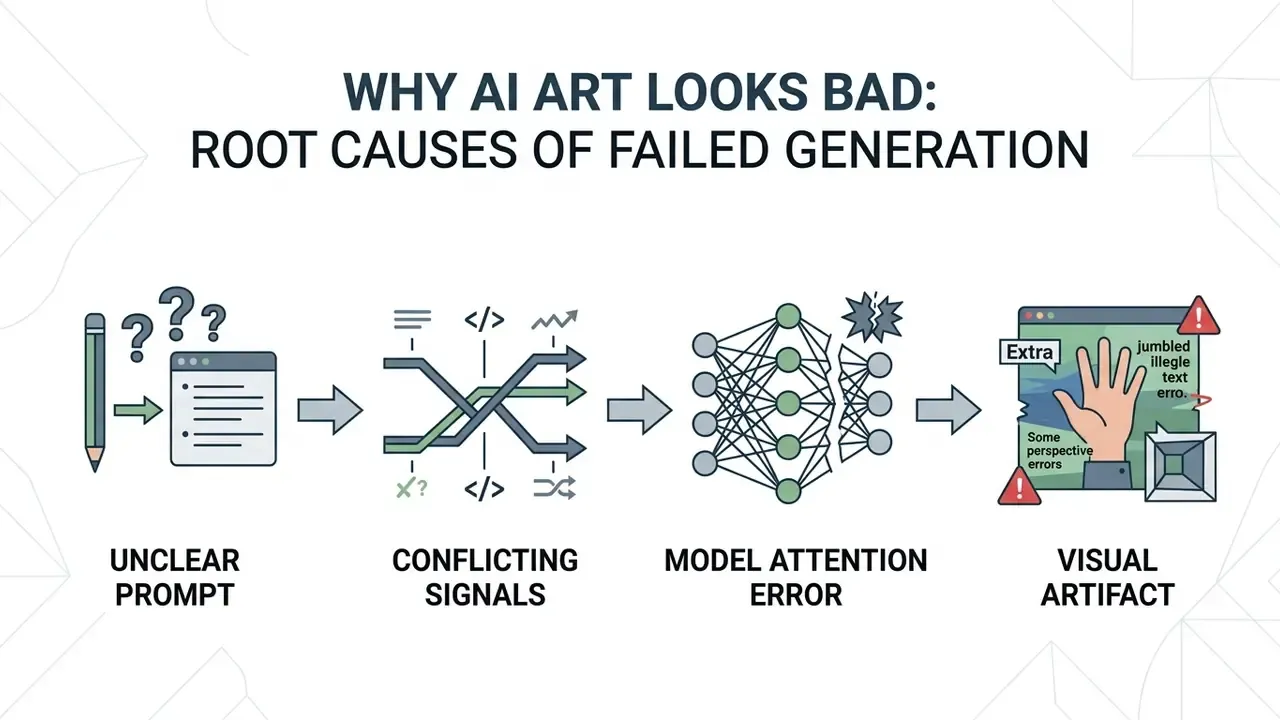
Figure 1. Causality chain from prompt ambiguity to visual defect (text version).
| Stage | What happens | What it looks like downstream |
|---|---|---|
| 1. Unclear prompt | Unstructured text, stacked styles, no counts | Model guesses missing parameters |
| 2. Conflicting signals | Mutually exclusive attributes compete in latent space | Muddy textures, hybrid materials |
| 3. Model error | Cross-attention misbinding during denoising | Wrong modifier on wrong object |
| 4. Visual defects | Artifacts surface in three domains | People, text, composition |
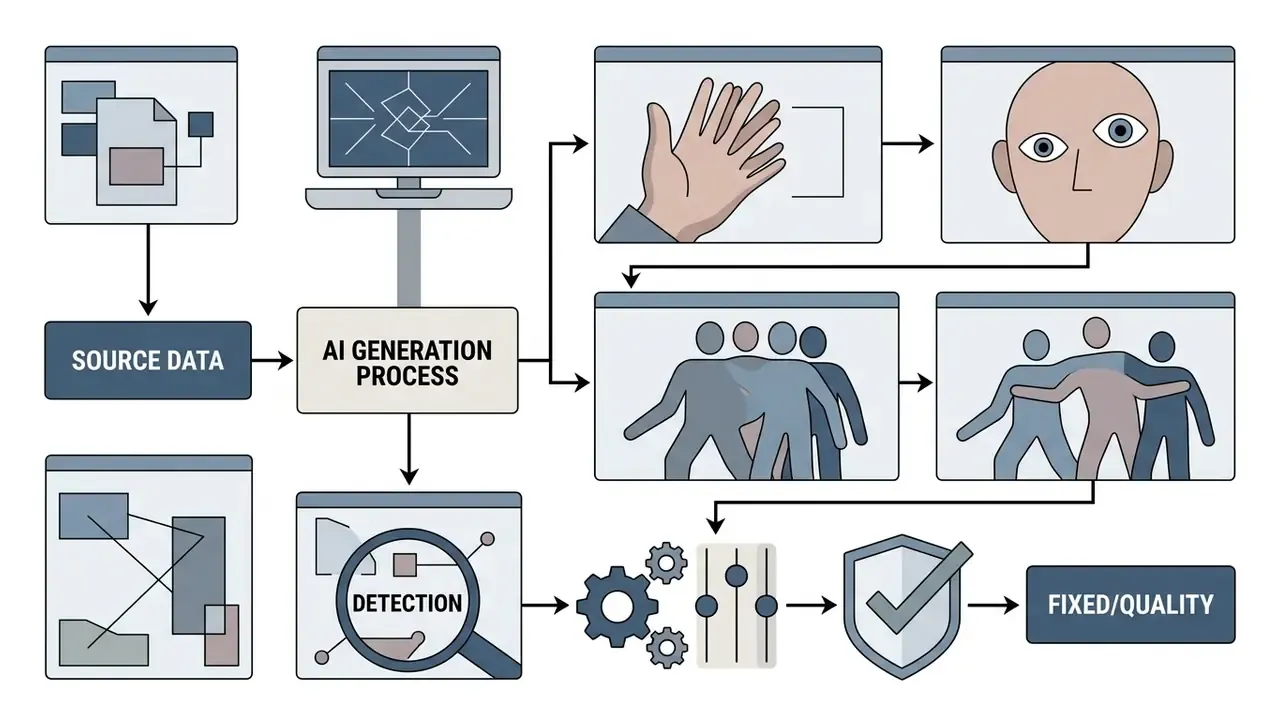
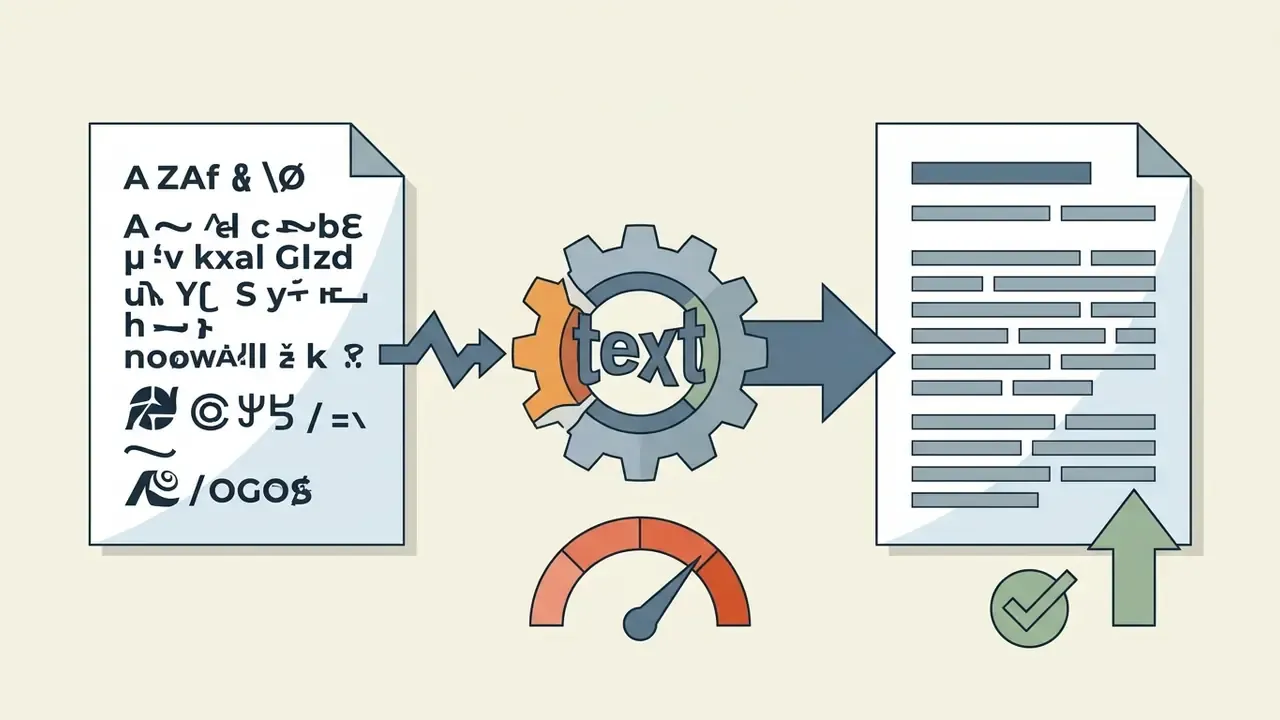
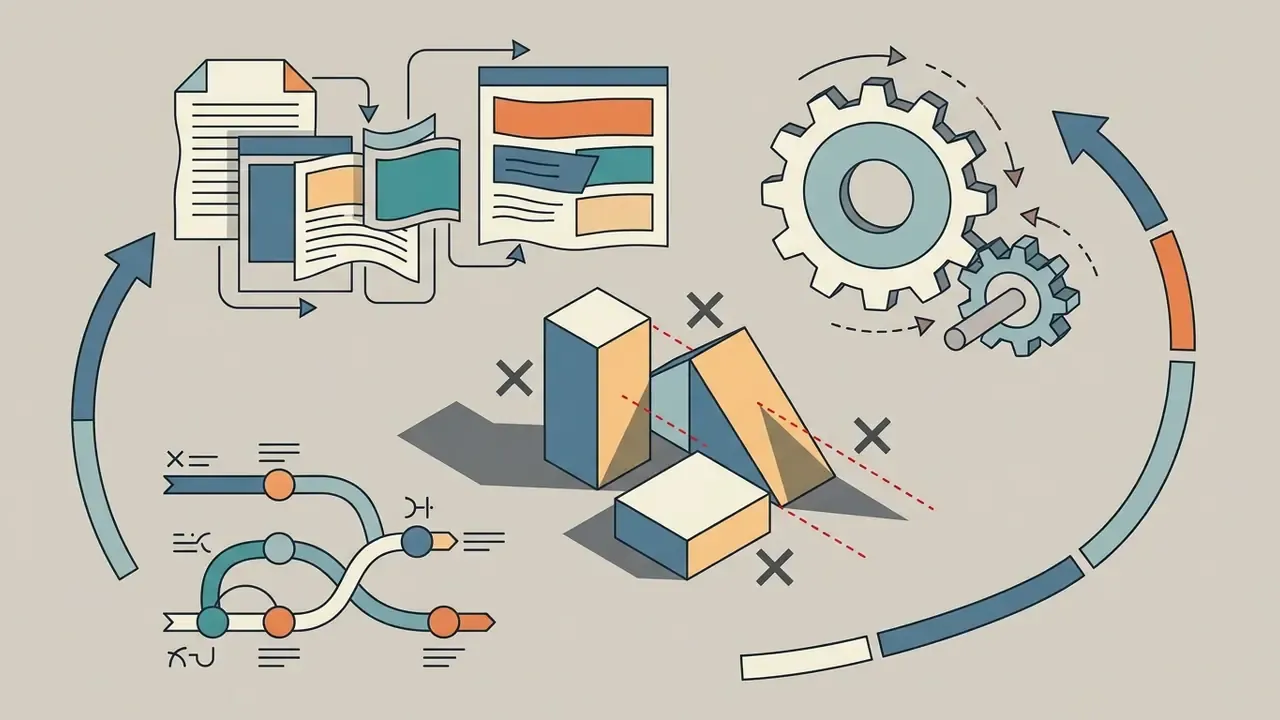
The fourth stage splits into three recurring artifact families:
Unclear Prompts and Conflicting Requirements
Unclear prompts create visual fails because diffusion text encoders interpret ambiguity by averaging, not by asking. Technically, a prompt is never read as a coherent sentence. Text becomes vectors in latent space, and each token shifts the probability distribution of visual features. The model never requests clarification. It resolves uncertainty with patterns from training data.
Pack a prompt with contradictory keywords, "photorealistic documentary photo" plus "vibrant watercolor painting", and the model tries to satisfy both conditioning signals at once. Cross-attention maps then assign overlapping weights to mutually exclusive attributes. You get muddy texture, inconsistent rendering, hybrid artifacts that belong to no medium at all.
«Structured captions that explicitly separate subject, environment, aesthetics, and camera parameters consistently improve text–image alignment scores over unstructured ones.»
Unorganized prompts also suffer from prompt sensitivity. Studies on text-to-image prompt engineering show that unformatted instructions push models to invent missing spatial parameters, which surfaces as unexpected background objects, or a subject that simply is not there.
«HRS-Bench shows models routinely fail on exact object counts, visual text, and emotional expression in complex scenes.»
Deconstructing a prompt into hierarchical functional components removes those conflicting signals before inference starts. Vendor guidance points the same way. OpenAI's 2026 image prompting documentation recommends a consistent order, background and scene, then subject, then key details, then constraints, and instructs editors to say "change only X" while explicitly preserving everything else.
Model Limits with People, Text, and Composition
Current architectures hit hard mathematical limits when modelling fine human anatomy, rendering embedded typography, and holding multi-object spatial relationships. Autoregressive and diffusion AI art generators treat complex 3D structures, a human hand for instance, as 2D pixel correlation probabilities rather than biomechanical assemblies. So they render extra digits, lopsided eyes, or fused limbs whenever subject prompts lack explicit structural guidance. A 2025 clinical evaluation of anatomy imagery found the identical pattern in a high-stakes domain: extra structures, abnormal proportions, misrendered sections, illegible labels, and pupils that were not always rendered correctly when facial details were left unspecified.
Text rendering remains the other operational hurdle. Benchmarks measuring text fidelity show proprietary multimodal LLM-driven generators achieving usable character accuracy, while open-source diffusion base models still break on dense copy or complex brand logos.
«DALL·E 3 reaches 83.3% word-level accuracy on short words and 65.2% overall, while Midjourney scores around 1.1%, a gap that is decisive for ad layouts.»
«STRICT confirms GPT-4o and Gemini-2.0 lead on character and word accuracy, yet every system degrades as text length grows.» STRICT, "Stress-Test of Rendering Image Containing Text", arXiv (2025). https://arxiv.org/html/2505.18985v2
Compositional benchmarks expose a parallel weakness in attribute binding, the red hat that lands on the wrong character in a group scene, because cross-attention layers struggle to tie modifiers to specific target entities.
«T2I-CompBench, built on 6,000 compositional prompts, shows models regularly misbind attributes: colour, shape, and texture get assigned to the wrong objects.»
Data imbalance compounds all of it. Culturally specific imagery fails more often for underrepresented regions, which ties a whole artifact class to training-set composition rather than sampling noise (CULTDIFF, ACL 2025).
One example worth keeping concrete. When an enterprise marketing team needed automated audio-visual synthetic assets, uncalibrated base models produced severe facial warping and sync errors. Routing prompt processing through structured pipelines built on our AI Media API Guides let the engineering team enforce hard parameter boundaries: explicit anatomical constraints, fixed aspect ratios, locked seeds. Internal review logs recorded a substantial drop in anatomical defect rate across roughly 1,200 asset batches. Two caveats, and they matter. That figure is an internal observation from a single deployment, not a published benchmark, so treat it as directional rather than generalizable. Measure your own baseline before and after the pipeline change, or the number tells you nothing.
How to Spot Bad AI Drawings Before Publishing or Printing
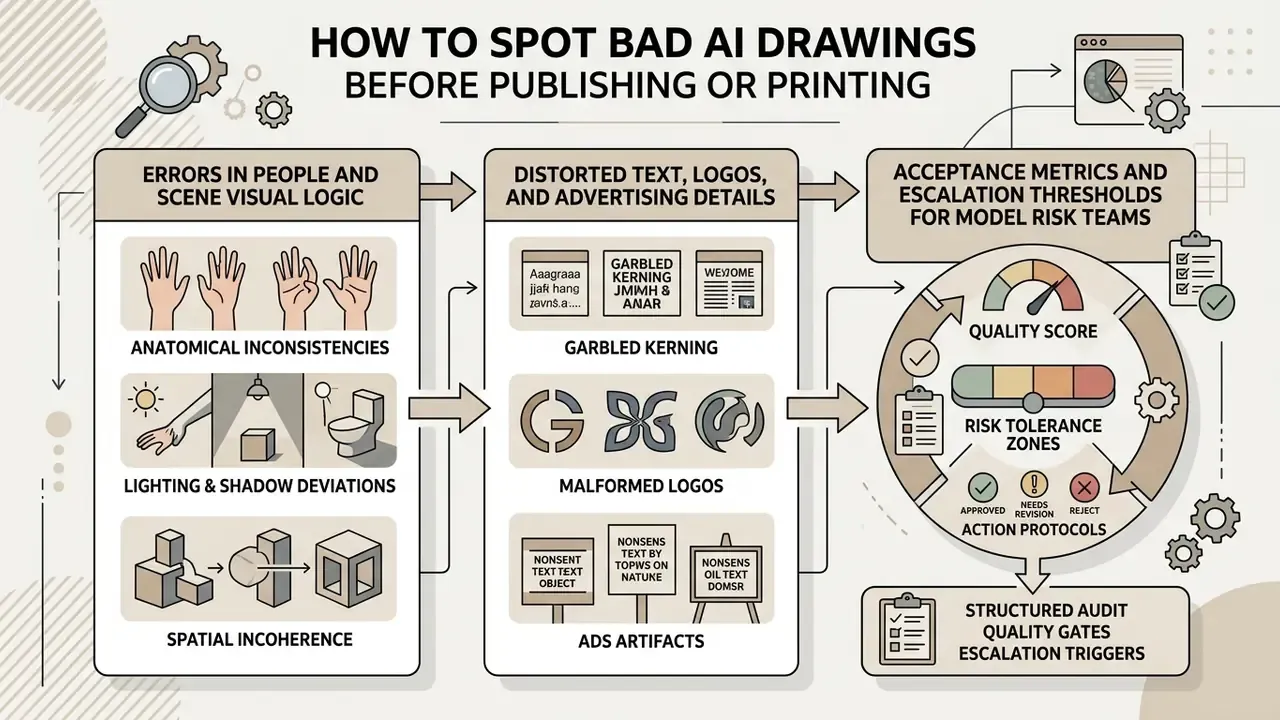
Detecting bad ai drawings before deployment needs a structured audit protocol covering anatomy, light physics, text kerning, and spatial logic. Publishing unverified synthetic media in a commercial campaign risks public backlash and brand devaluation, and the correction cost after launch is an order of magnitude above the cost of a pre-press check. Implementing pre-publication quality gates means subtle generative flaws get caught in review, not in a screenshot thread.
Errors in People and Scene Visual Logic
Anatomical errors in multi-person scenes are the most common class of visual fail in generated content. The usual list: merged torso boundaries in lopsided family group arrangements, asymmetric limbs, floating footwear, eye gaze pointing nowhere.
«The HAD dataset contains over 37,000 images annotated for human-figure artifacts: missing limbs, extra fingers, incompatible joints, and fragmented facial features.»
Reviewers should zoom systematically on figure contact points, where hands grasp objects, where feet meet the ground, where two bodies overlap, to verify structural continuity. Survivable defects get repaired with AI photo editors instead of a full regeneration that throws away an approved layout.
Scene logic errors extend past human subjects into lighting and perspective geometry. Artifact taxonomies classify these as physical implausibilities: shadow directions contradicting the ambient light source, straight structural lines bending around a subject (X-AIGD, "Unveiling Perceptual Artifacts", arXiv, 2026. https://arxiv.org/html/2601.19430v1). In print layouts those geometry errors get magnified, which makes inspection of the perspective grid non-optional.
«ArtifactLens, built on Gemini-2.5-Pro, beats the best fine-tuned models by 8% F1 using only 10% of the training data, a few hundred examples per artifact class.»
Automated triage is maturing on the forensic side too. 2026 detection work such as GRRE (G-channel-removed reconstruction error) and localized super-resolution paired with VLM explanation pipelines increasingly returns a suspicious region rather than a binary label. Which is precisely what a human reviewer needs in order to act on it.
Distorted Text, Logos, and Advertising Details
Textual gibberish, broken typography, and distorted brand marks corrupt synthetic commercial graphics with tedious regularity.
«TextAtlasEval, a benchmark of 4,000 verified dense-text images, confirms GPT-4o leads on quality, yet text-rich generation remains hard for every model.»
Print production layers its own failure surface on top of generation: RGB-to-CMYK colour shift, font substitution or non-embeddable fonts, kerning drift, missing glyphs, lost crop or bleed correctness on export. In print advertising, unverified text artifacts dilute brand credibility and create compliance exposure under truth-in-advertising standards. Where a logotype must be exact, replace the generated mark with the approved vector rather than letting AI logo generators approximate it.
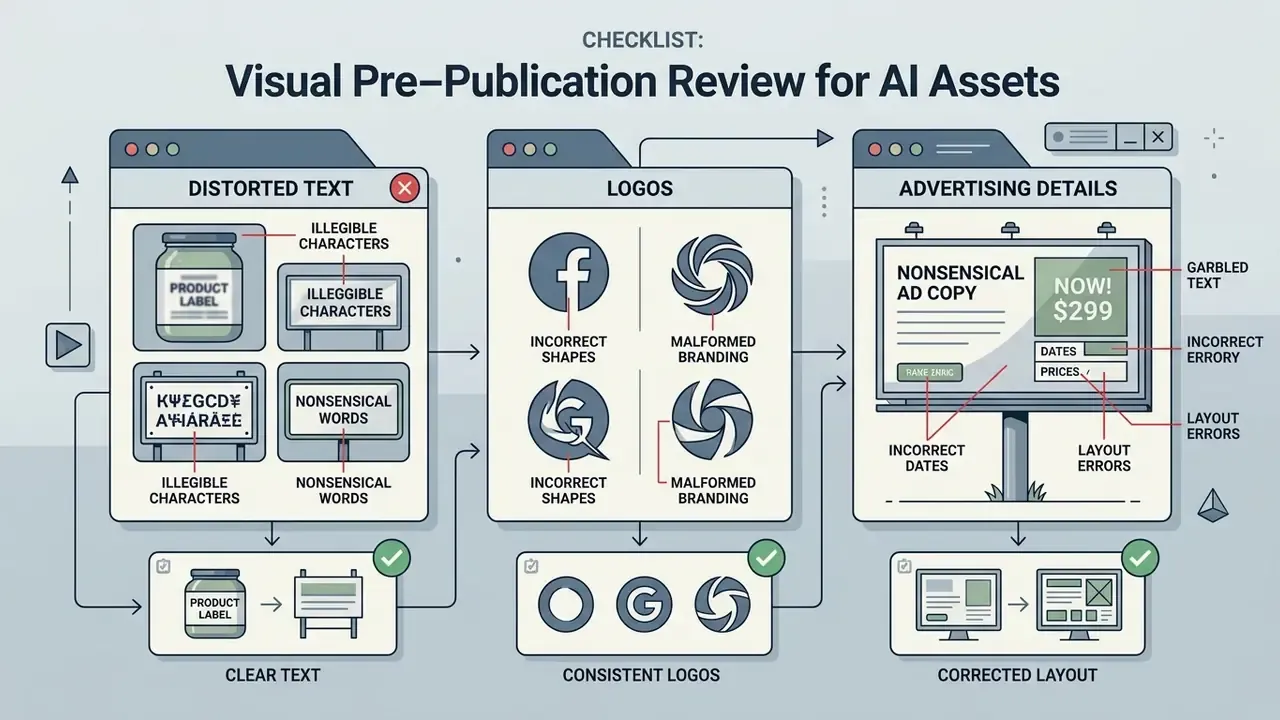
Run this sequence before publishing synthetic visual assets in media or print. The criteria draw on forensic detection frameworks, including ENFSI image authentication standards and NIST synthetic content guidelines.
Checklist0 / 7
To streamline pre-publication reviews, creators can reference standardized workflows in our AI Media Support and Troubleshooting portal, or size generation compute with our interactive calculators.
Acceptance Metrics and Escalation Thresholds for Model Risk Teams
A checklist becomes governance only when it carries numbers and named owners. Risk functions extending an existing model-validation framework to generative media typically formalize four elements. This aligns with NIST's 2026 draft guidance, which holds that synthetic-content evaluation requires a correctly labelled dataset of authentic and synthetic inputs, and with ENFSI's requirement that any authentication method be validated on data of known provenance and produce comparable results across tools.
| Control layer | Metric | Suggested acceptance band | Escalation owner |
|---|---|---|---|
| Anatomy and structure | Defect rate per 100 delivered assets (fingers, joints, merged bodies) | ≤ 2 defects, zero on hero assets | Creative lead → Brand risk |
| Text and brand marks | Character-level accuracy on embedded copy | 100% on all legally required text | Studio QA → Legal/compliance |
| Scene physics | Reviewer-flagged implausibility rate | ≤ 5% of frames, zero in product shots | Art director |
| Rights and provenance | Assets with complete prompt, seed, and licence log | 100% before release | Compliance lead |
| Disclosure | Labelled realistic synthetic content in scope of Art. 50 duties | 100% | Compliance lead → DPO |
Two procedural rules make the table usable. First, any deviation from an acceptance band needs documented sign-off from a named approver, not a thumbs-up in a channel. Second, review cadence follows model change rather than the calendar: every checkpoint, LoRA, or vendor version bump resets the baseline and triggers a fresh sample audit. NIST's draft adds that AI-generated content should be reviewed by qualified personnel before organizational use, which is the governance equivalent of never shipping an unreviewed generation. Simple rule. Frequently ignored.
How to Fix Bad AI Art with Structured Prompting
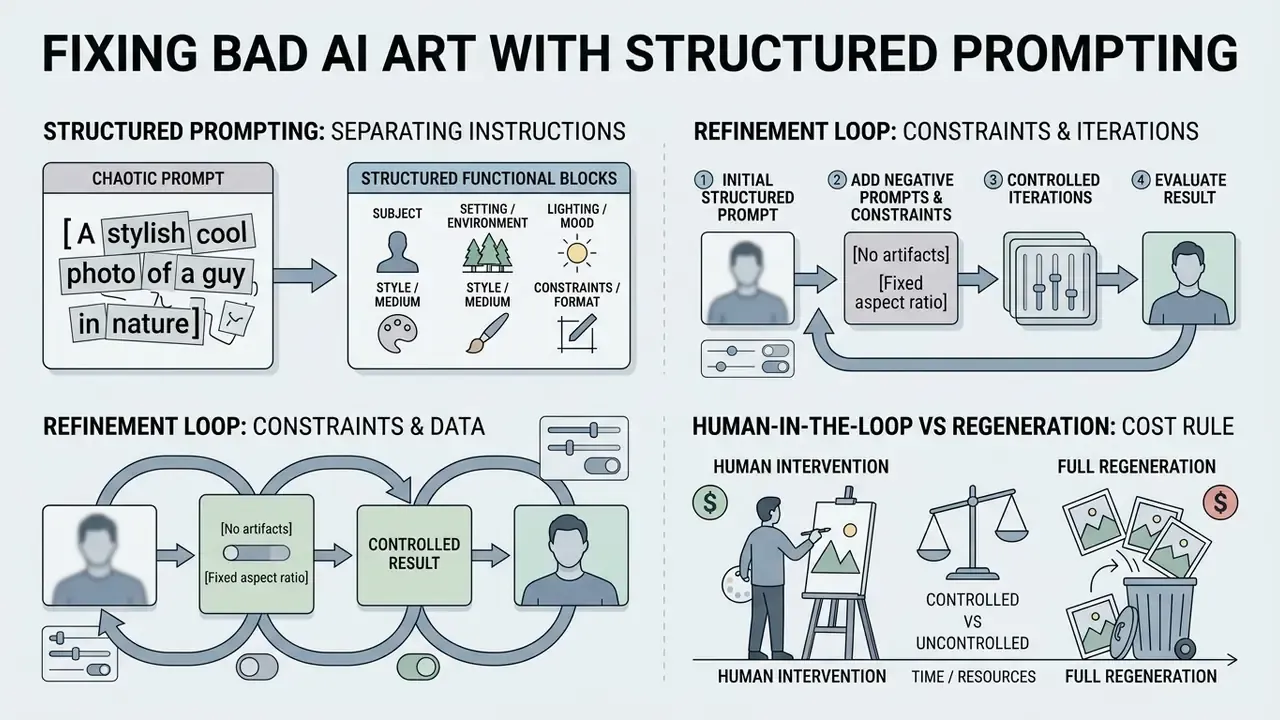
Fixing bad AI art without abandoning the creative concept calls for structured prompting: a method that separates instructions into explicit functional blocks. Instead of continuous prose, you apply hierarchical control over scene composition, lighting, subject attributes, and style constraints.
Deconstruct the Request into Functional Components
Structured prompting breaks a visual request into five standardized components:
- Subject primary object or person, with explicit anatomical and count constraints.
- Setting/environment background context, depth of field, spatial placement.
- Lighting/mood light direction, intensity, temperature, shadow rules.
- Style/medium art medium (35mm photograph, oil painting), lens, colour palette.
- Constraints/format aspect ratio, composition bounds, negative parameters.
Research on dataset caption restructuring confirms that enforced structure improves instruction adherence and reduces attribute misbinding.
«PixArt-Σ trained on structured captions reached LLaVA-VQA 0.8630 versus 0.8563 with randomized order, a consistent gain in text–image alignment.»
Token position carries weight as well: earlier, clearer tokens exert stronger pull on the denoising trajectory. Use this priority cheat sheet when a prompt is too long and something has to move.
| Priority | Prompt block | Approx. influence on output | Practical rule |
|---|---|---|---|
| 1 | Subject (who/what, counts, anatomy) | ~100% | Never bury it, state counts explicitly |
| 2 | Style / medium | ~80% | One dominant style only |
| 3 | Environment / setting | ~60% | Support the subject, don't compete |
| 4 | Lighting | ~40% | Name direction plus quality, not "beautiful" |
| 5 | Minor details, textures, props | ~20% | Trim first when output drifts |
UNSTRUCTURED Prompt (Failure-Prone):
"A beach day with a lopsided family group, dramatic sunset, painterly style, beautiful lighting, highly detailed."
STRUCTURED Prompt (Corrected Approach):
"Subject: A family of four (two adults, two children) standing side-by-side on a sandy shore.
Setting: Ocean horizon at sunset, gentle water waves in background.
Lighting: Warm golden hour sunlight coming from camera-left, long soft shadows.
Style: Clean 35mm color photography, natural skin textures, neutral color balance.
Constraints: Anatomically accurate hands with five fingers each, crisp eye focus, no merged bodies."
Teams standardizing this workflow can compare instruction-following behaviour across platforms in our review of AI image generators before locking a house prompt template. For multimodal pipelines, pairing structured image prompts with synthetic speech tools, an ai voice maker or an ai voice over generator, keeps asset consistency across a commercial video campaign.
Add Constraints, Negative Prompts, and Controlled Iterations
Negative prompts and parameter constraints limit model drift by subtracting unwanted feature vectors during sampling. They are probability suppressors, not delete buttons. They lower the likelihood of a feature emerging during denoising, and over-stuffing them backfires.
«The study identifies two key negative-prompt behaviours: a delayed effect and removal via latent-space neutralization; overloading the list produces unpredictable distortions.»
In practice, long generic strings ("blurry, bad art, extra limbs, ugly, worst quality") can soften sharpness or drag colours away from the brief. Target the specific defect you actually observed. Nothing else.
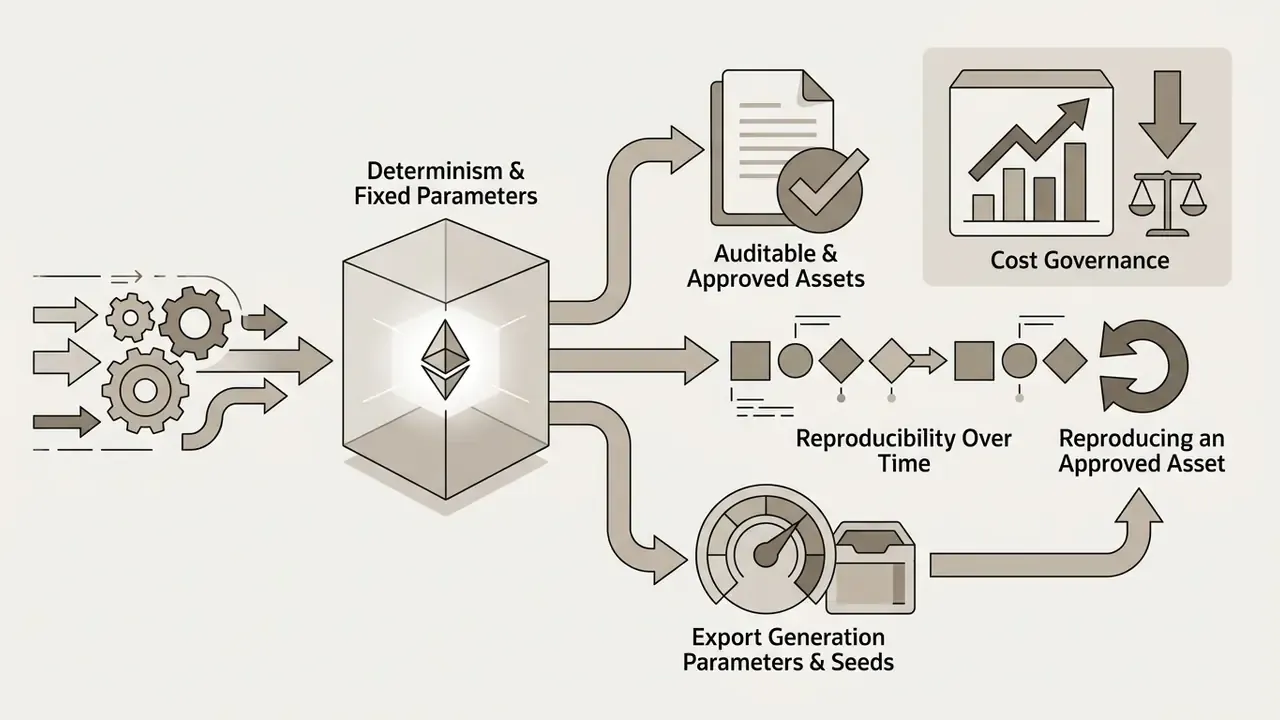
Refinement then relies on controlled variable isolation: change one prompt variable per generation step while the random seed stays fixed.
Structural conditioning matters for brand work. ControlNet-style depth, pose, or edge maps hold the composition fixed while you repair a local defect, and identity adapters keep a recurring character or spokesperson consistent across a campaign. Both remove the temptation to regenerate an approved layout from scratch. Local repair has research support too: 2026 work such as GenShield pairs explainable detection with controllable artifact correction, formalizing the detect-then-repair loop studios already run by hand. Cleanup passes and resolution recovery after inpainting go through AI image enhancers.
An agency auditing synthetic campaign drafts kept seeing facial distortion across high-resolution hero banners. By isolating seed values and applying localized inpainting with explicit anatomical negative constraints, the team corrected the key hero assets in two prompt iterations, background elements untouched.
Human-in-the-Loop vs Regeneration: A Simple Cost Rule
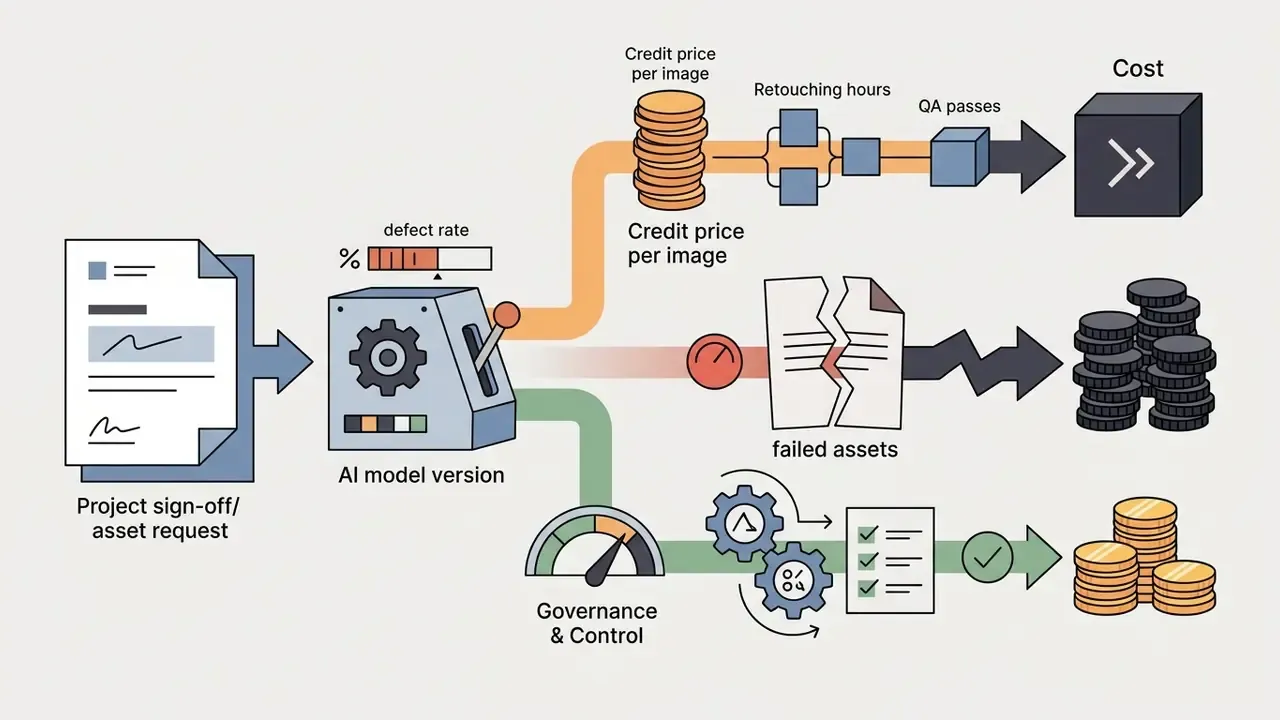
Budget owners keep asking the same question: cheaper to re-roll, or cheaper to fix? A workable heuristic, framed as a decision rule rather than a price list.
- Re-generate when the defect is global (wrong subject, collapsed perspective, wrong style) and the asset is not yet approved. Cost = compute per batch × expected batches to acceptance.
- Inpaint or retouch when the defect is local (one hand, one label, one shadow) and the layout is already approved. Cost = retoucher hourly rate × minutes per defect, plus one QA pass.
- Escalate to a human illustrator or photographer when the asset carries legal text, an exact logo, a named person's likeness, or a regulated product claim. Here the failure cost dominates any generation saving, so the arithmetic stops being close.
Log both branches per project. Once you have a defect rate from the acceptance table above, the crossover point between re-rolling and retouching becomes arithmetic instead of an argument in a standup.
Can You Use Bad AI Art in Advertising and Commercial Content
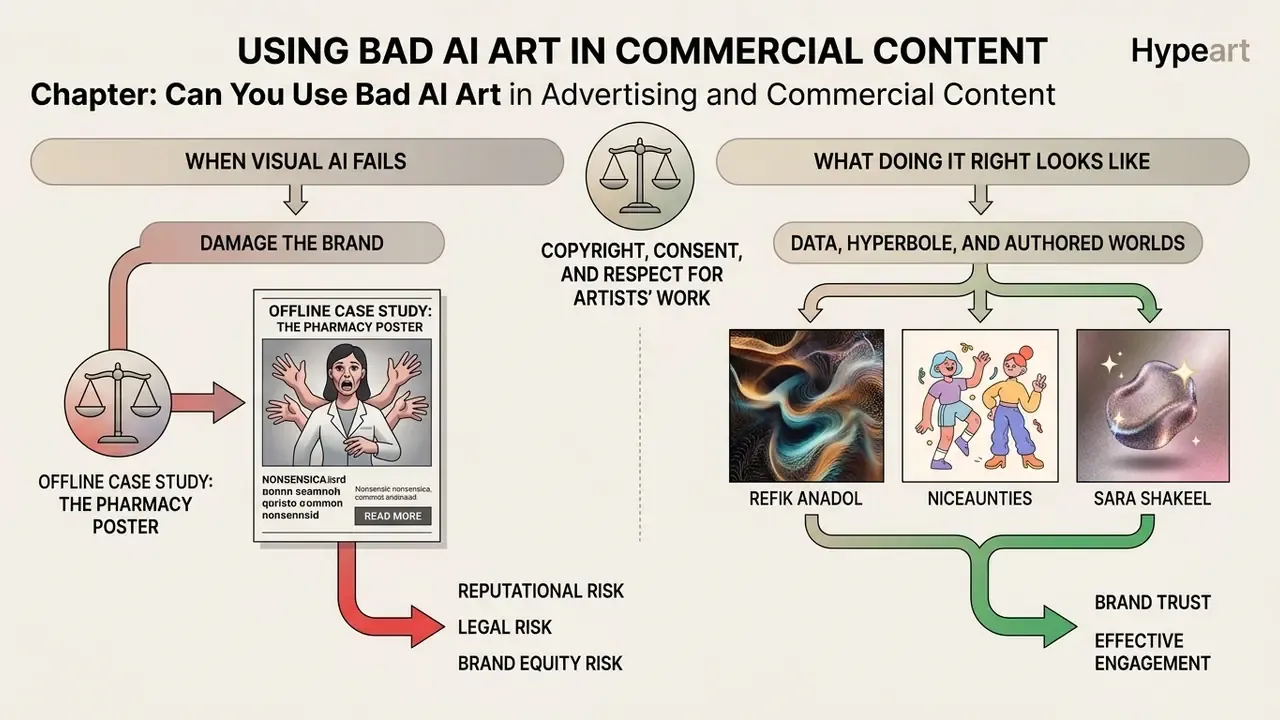
Using uncorrected bad AI art in commercial content carries reputational, legal, and brand equity risk. Synthetic media does deliver cost efficiency, but consumers now recognize generative artifacts quickly, and they associate visible fails with low credibility and thin authenticity.
When Visual AI Fails Damage the Brand
Visible generative defects in commercial campaigns reduce consumer trust and shave perceived brand value.
«A survey of 419 respondents found 73.5% had seen AI advertising, and credibility had the strongest effect on brand awareness among all measured quality dimensions.»
Controlled experiments push further: when audiences perceive an ad as artificially generated, brand image and purchase intention both fall, mediated by a loss of perceived authenticity.
«Disclosing AI involvement dropped perceived authenticity from 4.76 to 2.73 and purchase intention from 4.36 to 3.36, with authenticity mediating all effects.»
Offline case study: the pharmacy poster. The risk is not abstract, and it does not stay on screen. An AI-art practitioner documented a printed in-store poster advertising travel-sickness pills, spotted while buying eye drops at a pharmacy, a small Baudrillardian hyperreality moment in which badly executed generation had extruded into physical retail space. Up close the poster carried the classic signature set: fingers dissolving into the surrounding surface, a product package with unreadable label copy, a brand mark that approximated the registered logo without matching it. At A2 print size, artifacts that were survivable on a phone thumbnail became the first thing a customer noticed. For a pharmaceutical brand, where perceived reliability is the product benefit, a soft uncanny-valley reaction at the point of sale is a conversion problem, not a stylistic quibble.
Public backlash around high-profile synthetic marketing shows the same mechanism at national scale. Coca-Cola's 2024 AI-generated holiday campaign drew fast criticism for artificial-looking people and "soulless" visuals. The brand defended the work as human-plus-AI collaboration, but attention had already moved from the holiday message to the company's use of generative AI. Survey data reported in 2026 found 43% of North American consumers said low-quality or uncanny AI ads would worsen their opinion of a brand, while 73% of Gen Z and millennial respondents said disclosure alone would not reduce their purchase intent. Read that pair carefully: audiences penalize bad AI far harder than disclosed AI.
In regulated industries, banking, pharma, fintech, publishing unverified synthetic images with distorted people or misleading product representations can also invite regulatory scrutiny over deceptive advertising. The ASA/CAP position is that AI images which are misleading, harmful, offensive, or socially irresponsible breach the Code exactly as any other ad would, and BBB CARU guidance adds that AI in advertising must not mislead children about product performance, blur fantasy and reality, or fabricate endorsements.
To navigate these deployment decisions, media teams consult our centralized AI Media Commercial-Use Hub and the platform-by-platform breakdown of AI image generators for commercial use for compliance benchmarks on commercial asset distribution.
Copyright, Consent, and Respect for Artists' Work
Commercial use of synthetic visual assets raises intertwined questions of human authorship, data collection ethics, and artist consent. Under US Copyright Office guidance, protection requires human authorship. Pure AI-generated output produced without substantial human creative control, selection, or editing is ineligible for registration, and applicants must disclaim AI-generated portions of mixed works.
«Copyright requires that traditional elements of authorship, selection, arrangement, expressive content, be conceived and executed by a human rather than a machine.»
E-E-A-T Verification: Terms of Service and Commercial Rights Across Visual Generators
To stay compliant when licensing visual AI generators, commercial operators must verify each platform's Terms of Service on commercial usage rights, output ownership, and attribution.
| Platform / Vendor | Output Commercial Ownership | Platform License Retained | Attribution Requirement | Primary ToS Reference |
|---|---|---|---|---|
| Adobe Firefly | User holds commercial rights | Non-exclusive, perpetual, irrevocable, worldwide, royalty-free licence for material uploaded to an Adobe-hosted gallery | Not mandatory for general commercial output | Adobe Generative AI Product Specific Terms (2025) |
| Canva AI | User owns Input and Output | Canva claims no copyright ownership | Explicit attribution plus clear disclosure that content is AI-generated | Canva AI Product Terms (2026) |
| OpenAI (DALL·E 3 / GPT-4o) | User owns Output to the extent permitted by law | Standard service usage and diagnostic rights | Not required under paid enterprise tiers | OpenAI Terms of Use (2026) |
| Midjourney | Paid subscribers hold commercial rights | Perpetual licence to host and display generated assets | Required for free and trial tiers, optional for paid | Midjourney Subscription Terms (2026) |
BadArt.AI, Deliberate Bad Painting, and Cost Governance
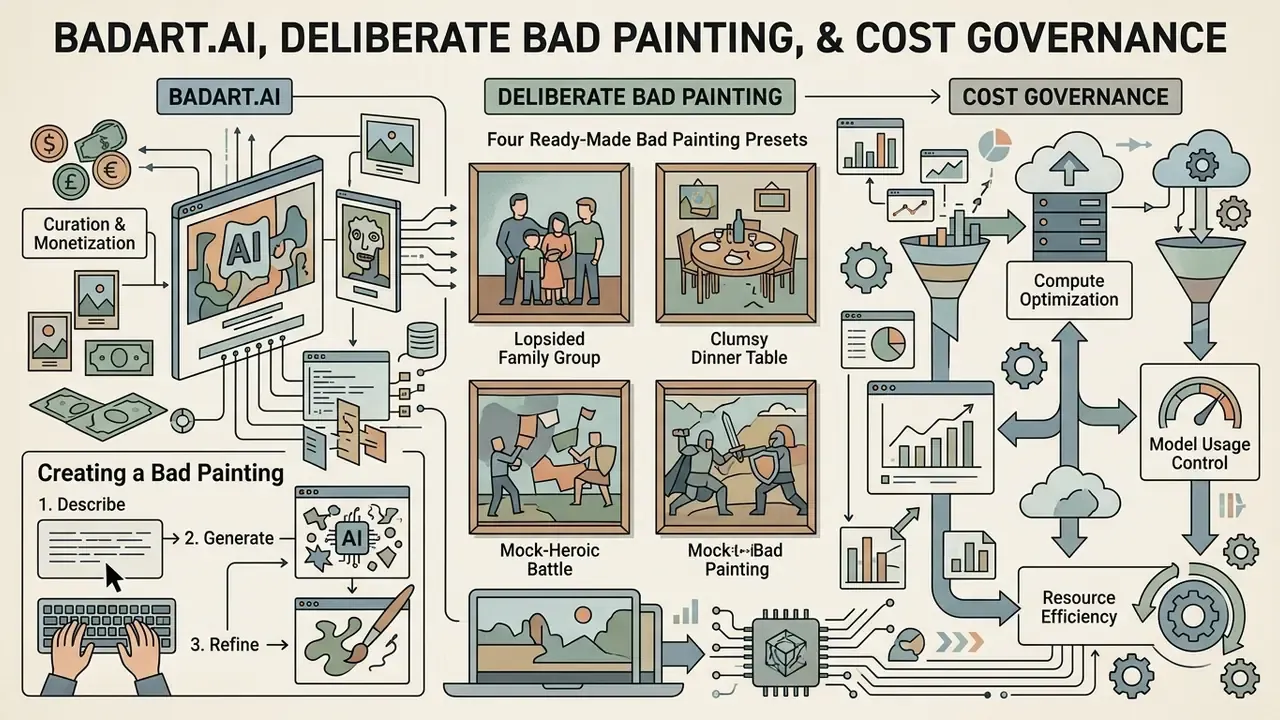
BadArt.AI is a dedicated virtual art gallery and digital showcase built around curating, generating, and monetizing deliberately imperfect "bad paintings" and weird AI art. Unlike broad enterprise generators chasing photorealism, it targets an aesthetic niche celebrating raw, unpolished, anti-skill digital art. Its own pages describe the project as a gallery "celebrating the bad and weird art made by generative artificial intelligence", with a compiled volume and print products rather than a general-purpose prompt-to-image toolset. Note the gap: no public terms-of-use page surfaced during our review, so licensing conditions could not be verified from a primary document. Treat any commercial reuse of gallery output as unresolved until the operator confirms terms in writing.
Creating a Bad Painting in Three Steps
A stylized "Bad painting" follows a simple three-step workflow designed to capture lo-fi, naive aesthetics.
- Describe your Bad paintingwrite a prompt specifying awkward figure poses, flat crude rendering, clashing colour palettes, and ironic humour, for example "a flat crude painting of a cat sitting on a chair, off-color palette, awkward perspective".
- Generate the imagerun the prompt through low-fidelity model checkpoints or LoRA weights tuned for raw brushstrokes and uncalibrated geometry. Experiments of this kind are cheap to run on free AI art generators before you commit credits.
- Refine your Bad paintingapply targeted prompt edits or style overlays to strengthen the intentional glitch features while removing unwanted low-level noise, then lock the palette and rendering as a reusable style reference so a whole series reads as one collection.
For multi-modal creators pairing niche visual styles with narration, an ai voice generator or an ai voicemail generator covers the audio side. Niche character work follows the same prompt discipline, whether you are documenting an ai waifu generator or a fringe category such as an ai vore generator: name the style once, keep the constraints explicit, and log the seed.
Four Ready-Made Bad Painting Presets
The four canonical Bad Painting signals, deliberate anti-skill drawing, flat crude rendering, a clashing off-key palette, and deadpan irony, all need naming. Skip one and the model returns an accidentally weak image instead of a knowingly bad one. Copy these presets and swap the subject.
1. Lopsided Family Group
2. Clumsy Dinner Table
3. Mock-Heroic Battle
4. Awkward Beach Day
Two practical notes. Keep one dominant style token, because stacking "photorealistic" with "crude naive painting" reintroduces the exact conflicting-signal failure described earlier. And for a coherent series, repeat the palette and rendering description verbatim across prompts while reusing a style reference image. That consistency is what tells viewers the awkwardness was authored, not accidental.
Simple Pricing and Payment Methods: What to Check Before Paying
Before buying subscription credits or print products from a niche platform like BadArt.AI, weigh the pricing structure against your actual asset needs. Publicly visible listings for the gallery read as one-off retail items, roughly $10.00 to $25.00 per artwork, with a compiled volume at $69.00, while membership-style access pages show recurring monthly passes. Verify which model applies to your basket before checkout, and confirm accepted payment methods on the checkout page itself, since no dedicated payment-terms page was found during review.
| Usage Scenario | Primary Task | Model & Feature Capabilities | Key Risk Factors | Pricing Model Structure |
|---|---|---|---|---|
| Single Artwork Creation | Generate one-off lo-fi images for social posts or digital art | Basic prompt execution using stylized lo-fi checkpoints | Minimal IP protection, output variability | Individual item purchases ($10.00 to $25.00 per item) |
| Iterative Refinement | Refine existing bad paintings via inpainting and variants | Targeted latent editing and seed-locked variations | Over-smoothing the deliberate original style | Monthly studio pass (~$30.00 / month) |
| Commercial Print Orders | Order physical posters, textiles, or collection volumes | High-resolution AI image upscalers and colour-profile conversion | Print colour shifts, bleed margin alignment | Direct retail pricing ($22.50 to $69.00 per physical item) |
| Enterprise Campaign Integration | Adapt bad-art styles for commercial advertising | Custom style transfer and vector logo integration | Brand misalignment, consumer authenticity backlash | Custom agency tier or high-volume pass (~$100.00 / month) |
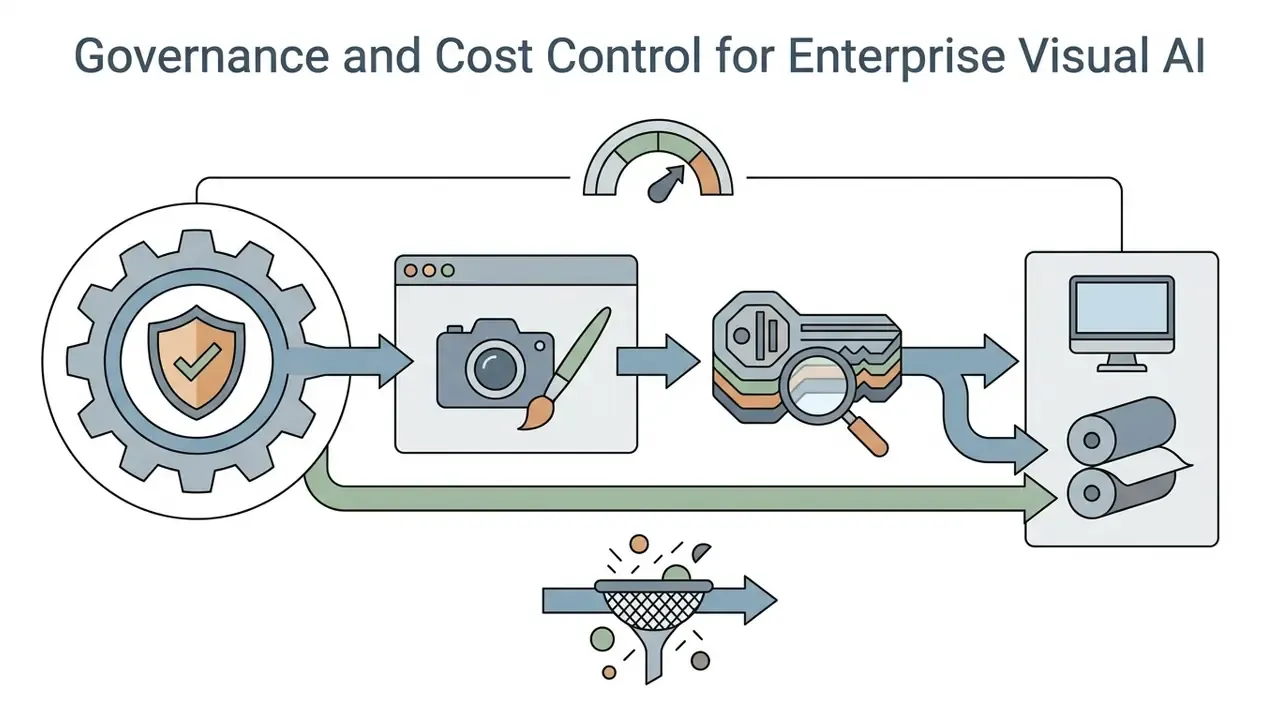
Governance and Cost Control for Enterprise Visual AI
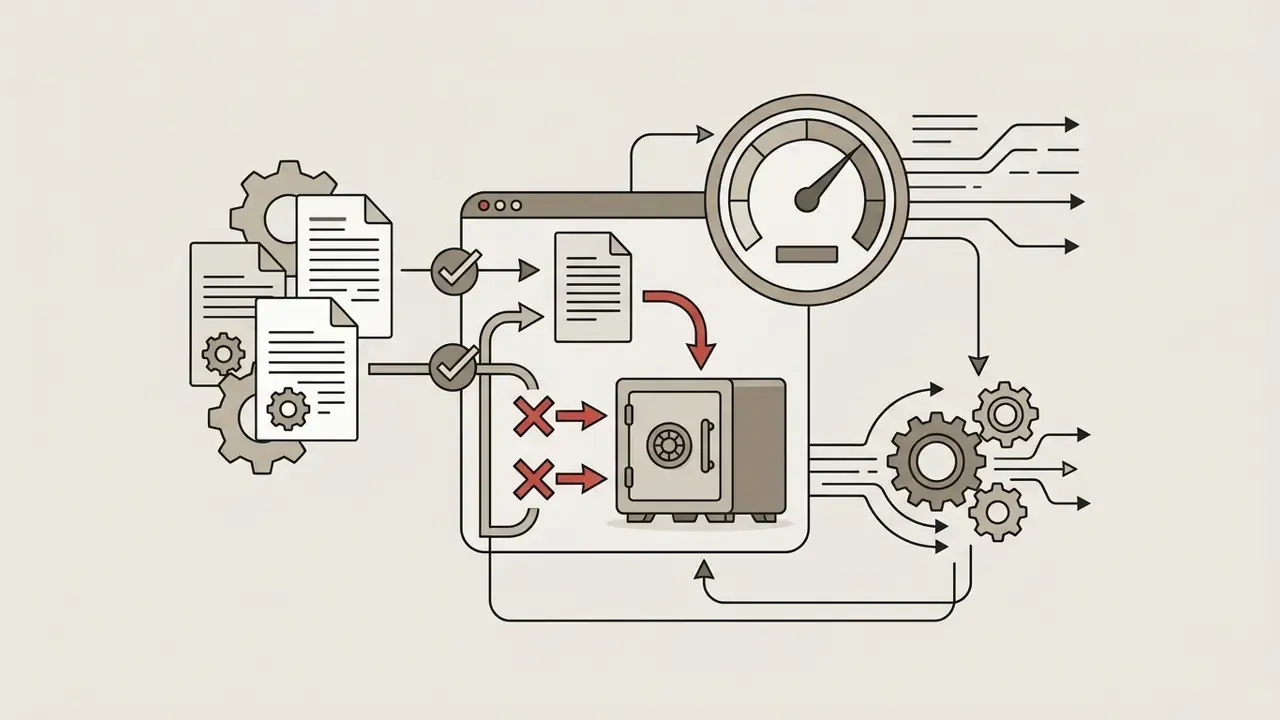
Consumer pricing tells you almost nothing about enterprise fitness. Procurement and risk functions evaluating a visual AI vendor should score five dimensions that retail pages rarely mention.
When selecting commercial tiers on any visual platform, budget managers can review our full cost breakdowns in the AI Media Pricing Guides hub and compare credit economics across enterprise tools.
FAQ
What is bad AI art, in one sentence?
Synthetic imagery with visible generative defects, distorted anatomy, garbled text, impossible physics, or misbound attributes, produced by model limits, noisy training data, or an unstructured prompt.
Is deliberately "bad" AI art the same as an AI fail?
No. Deliberate imperfection is internally consistent and conceptually motivated. Accidental failures appear as incoherent glitches that contradict the image's own logic (Kamali et al., arXiv, 2025).
What is the difference between Naive Art and Bad Painting in a prompt?
Naive Art is sincerely unschooled: sincere naive style, folk art, unschooled drawing. Bad Painting is a trained artist's ironic choice: deliberately awkward, anti-skill on purpose, deadpan irony, clashing off-key palette.
Which model should I use if my image must contain readable text?
Prefer multimodal LLM-driven generators. DEsignBench measured DALL·E 3 at 83.3% word-level accuracy on short words versus about 1.1% for Midjourney, and STRICT shows GPT-4o and Gemini-2.0 leading on character accuracy. Every model still degrades as text length grows, so legally required copy belongs in DTP, not in the generation.
Do longer negative prompts produce cleaner images?
No. Negative prompts work through latent neutralization with a delayed effect, and overloading them can reduce sharpness and shift colours ("Understanding the Impact of Negative Prompts", arXiv, 2024). Target the observed defect only.
Can I copyright an AI-generated image?
Pure AI output without substantial human creative control is not registrable in the US, and AI-generated portions of mixed works must be disclaimed. Human-edited components can be protected. Consult counsel for your jurisdiction.
Do I have to label AI-generated advertising?
For realistic synthetic or manipulated content within scope, the EU AI Act's Article 50 transparency duties require clear disclosure at first exposure, with obligations applying from August 2026. Advertising codes such as the CAP/ASA framework apply to AI ads exactly as they apply to any other ad.
Who should own sign-off on synthetic visual assets?
Name one accountable approver per asset class: creative lead for stylized work, brand risk for anything near-photoreal, compliance for assets carrying legal text, product claims, or a person's likeness. Escalation paths and acceptance bands belong in the same document as the prompt template, so the decision is traceable later.
Appendix A: Corrections and Source-Verification Log
For transparency, the citations below were replaced or supplemented with verifiable, URL-linked primary sources during the last review pass. The superseded references stay visible here rather than being quietly deleted.
| Superseded reference (previous version) | Replaced / supplemented with | Reason |
|---|---|---|
| Eye-tracking Study on Synthetic Realism, 2024 | Kamali et al., arXiv (2025): https://arxiv.org/html/2502.11989v1 | No URL, no methodology, no figures |
| Re-LAION-Caption 19M Study, 2025 (no URL) | Re-LAION-Caption 19M, arXiv (2025): https://arxiv.org/html/2507.05300v1 | Missing URL and metrics |
| NIST SP 1353 Draft, 2026 (as prompt-sensitivity source) | HRS-Bench, arXiv (2023): https://arxiv.org/html/2304.05390v2; NIST draft retained only for governance claims | Wrong source for the claim, unverifiable as cited |
| STRICT Benchmark, arXiv, 2025 (no URL) | DEsignBench, arXiv (2023): https://arxiv.org/html/2310.15144v1 and STRICT, arXiv (2025): https://arxiv.org/html/2505.18985v2 | Missing URL, quantitative comparison added |
| T2I-CompBench, NeurIPS, 2023 (no URL) | Same source with full URL (NeurIPS proceedings PDF) | Verification completeness |
| HAD Dataset Analysis, 2025 / HAD Dataset, 2025 | Wang et al., arXiv (2025): https://arxiv.org/abs/2411.13842 | Missing URL and dataset figures |
| TextAtlasEval, 2025 (no URL) | TextAtlasEval, arXiv (2025): https://arxiv.org/html/2502.07870v2 | Missing URL |
| X-AIGD Benchmark, 2026 (no URL) | X-AIGD, arXiv (2026): https://arxiv.org/html/2601.19430v1 | Missing URL |
| Negative Prompt Trajectory Analysis, 2024 | "Understanding the Impact of Negative Prompts", arXiv (2024): https://arxiv.org/html/2406.02965v1 | Unverifiable as cited |
| Wang et al., CBS Review, 2024 (no URL) | Same source with full URL | Verification completeness |
| Bosch et al., JISEM, 2024 (no URL) | Same source with full URL | Verification completeness |
| US Copyright Office Generative AI Report, 2024 to 2025 (no URL) | Hastings Comms. & Ent. Law Journal (2023) plus USCO guidance referenced descriptively | Missing URL for the specific claim |
| "reducing anatomical defects by 64% across 1,200 asset batches" | Reframed as an internal, directional observation requiring independent measurement | Figure not supported by a published source |
| EU AI Act Article 50 Transparency Mandates, 2026 | Retained with an explicit instruction to verify against the published Regulation and Commission guidance | Requires primary-document confirmation |
Reference hub for terminology used throughout this guide: AI Media Glossary.