Executive Summary: Key Answers at a Glance
| Question | Short answer |
|---|---|
| What is it? | An image-synthesis pipeline that fuses two facial embeddings into one synthetic infant portrait. It is interpolation in pixel and latent space, not inheritance modeling. |
| Is it accurate? | No, not genetically. In controlled experiments, observers matched synthetic children to their real parents only 34% of the time, roughly 17.4 percentage points above chance (Frowd et al., Journal of Multimedia, 2008). |
| What improves output quality? | Frontal alignment, even lighting, head resolution of at least 600x600 px, and 3 to 7 multi-angle photos per parent instead of one flat frontal shot. |
| What are the customization axes? | Gender bias injection, parent resemblance weighting (0 to 100%), age staging (newborn, toddler, child, teenager), and render style. |
| What is the main compliance risk? | Facial images are biometric identifiers. Under GDPR-style regimes, images become biometric data when processed for unique identification; California's CCPA excludes ordinary photographs unless stored or used for facial recognition. Verify zero-retention policies, no-training commitments, and deletion controls before uploading employee, client, or minor imagery. |
| Can outputs be used commercially? | Only conditionally. Purely machine-generated outputs lacking human authorship are not registrable under 2025 to 2026 U.S. Copyright Office guidance, and likeness rights in the source photos stay with the depicted individuals. |
| Who should read this? | Curious couples and creators (practical sections), plus model-risk, privacy, and governance reviewers (validation, bias, and licensing sections). |
How to Read This Guide
If you are here as a parent-to-be or a creator, the practical route is short: check the photo requirements, run one generation, adjust the resemblance slider, then decide whether a paid tier is worth it. Roughly ten minutes of work.
If you are here as a risk, privacy, or brand reviewer, treat the same tool as a third-party model that ingests biometric input. The relevant questions are retention windows, training exclusions, demographic bias, reproducibility of a given render, and publication rights. Those questions are answered in the privacy, validation, and commercial-use sections, and they are the reason this guide carries source citations instead of vendor marketing language.
One caveat worth stating early: vendor claims in this category age quickly. Pricing, retention clauses, and model versions change without notice, so verify each figure against the provider's current documentation before you commit.
What Is a Baby Picture Generator?
A baby picture generator is an automated image-synthesis tool designed to combine the visual traits of two input photographs into a single child portrait. Modern tools process user-submitted images through deep learning pipelines, such as conditional autoencoders or feature-disentanglement neural networks, to reconstruct a plausible future baby face based on statistical patterns learned from vast facial datasets.
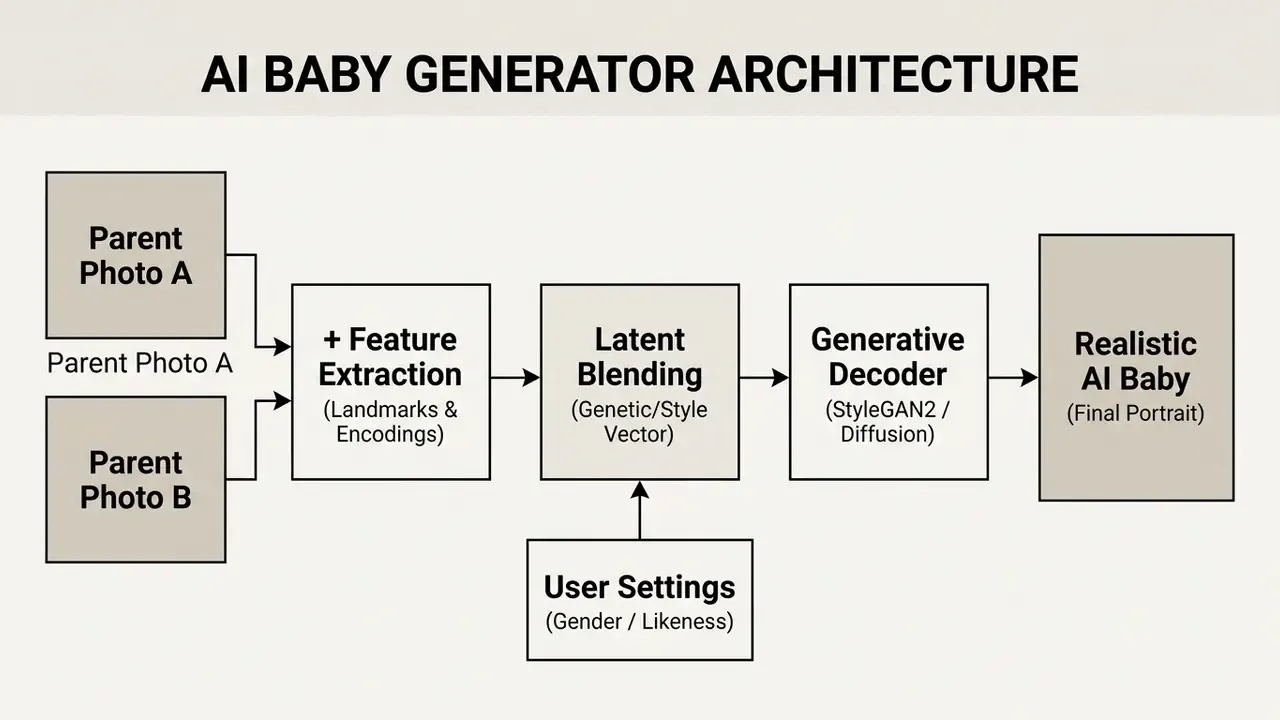
AI baby generator vs. future baby prediction
An ai baby generator provides a purely visual interpolation of parent photos for entertainment, whereas scientific genetic prediction calculates physical traits from actual DNA samples. Generative tools, part of the broader family of AI art generators built on generative adversarial networks (GANs) or latent diffusion models, operate in the digital image space using latent-vector averaging or region-level feature swapping. They do not analyze chromosomes, recessive genes, or biological inheritance patterns.
"Even with complete genomic data, predicting detailed facial morphology remains in a research phase and is not suitable for routine work."
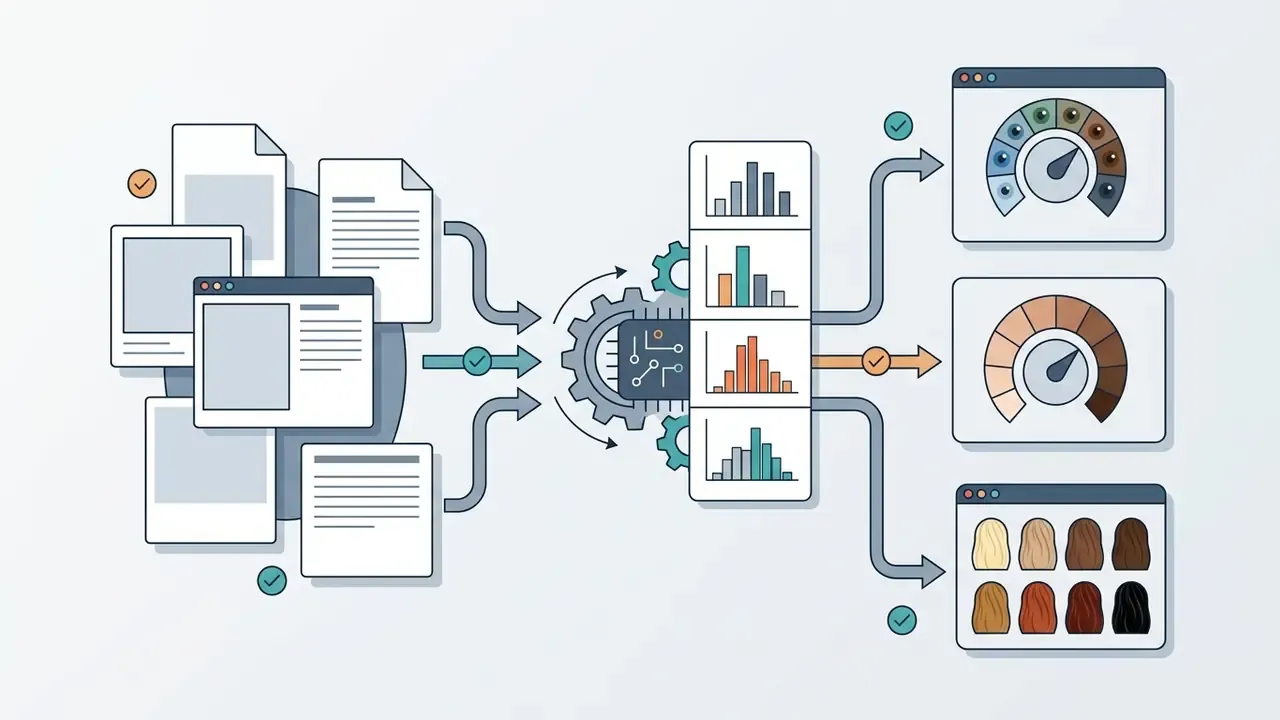
Scientific studies in Forensic DNA Phenotyping (FDP), such as those evaluating the HIrisPlex-S framework, use specific single nucleotide polymorphisms (SNPs) to estimate probabilities for pigmentation traits like iris color or skin tone. In contrast, an ai baby generator sample visualizes how facial parameters look when digitally blended. It is a creative projection, not a medical or genetic forecast.
Put plainly: the tool guesses at a face, never at a genome.
What a realistic AI baby face can include
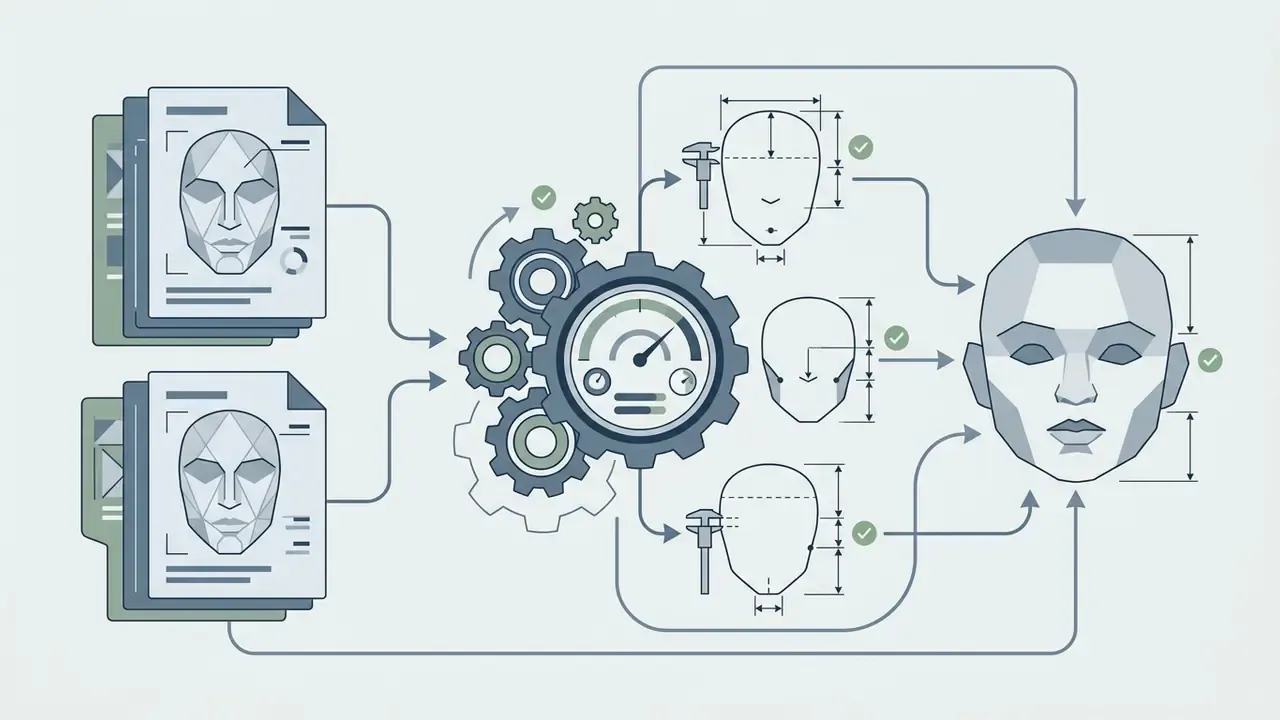
A realistic baby portrait generated by modern neural networks captures key structural elements, including facial outline, eye shape, nose bridge alignment, and mouth curvature. Advanced systems preserve specific facial identity vectors while applying infant-specific skin texture, baby fat distribution, and soft hair rendering.
"The ChildPredictor model separates facial data into genetic, external, and variation factors, generating diverse child faces while preserving family resemblance."
When reviewing an ai baby face generator sample, users can observe how the system balances attributes from both input images:
What it cannot include, and this trips people up, is any trait that neither parent visibly expresses.
How an AI Baby Face Generator Works
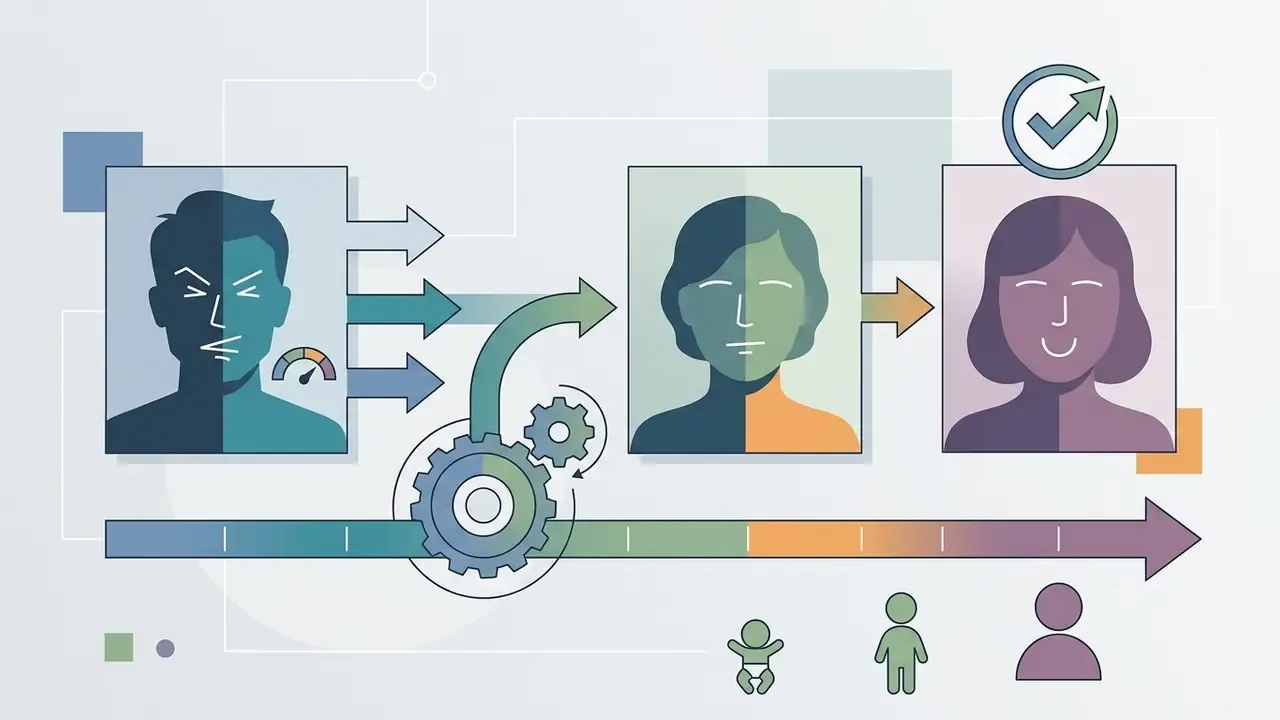
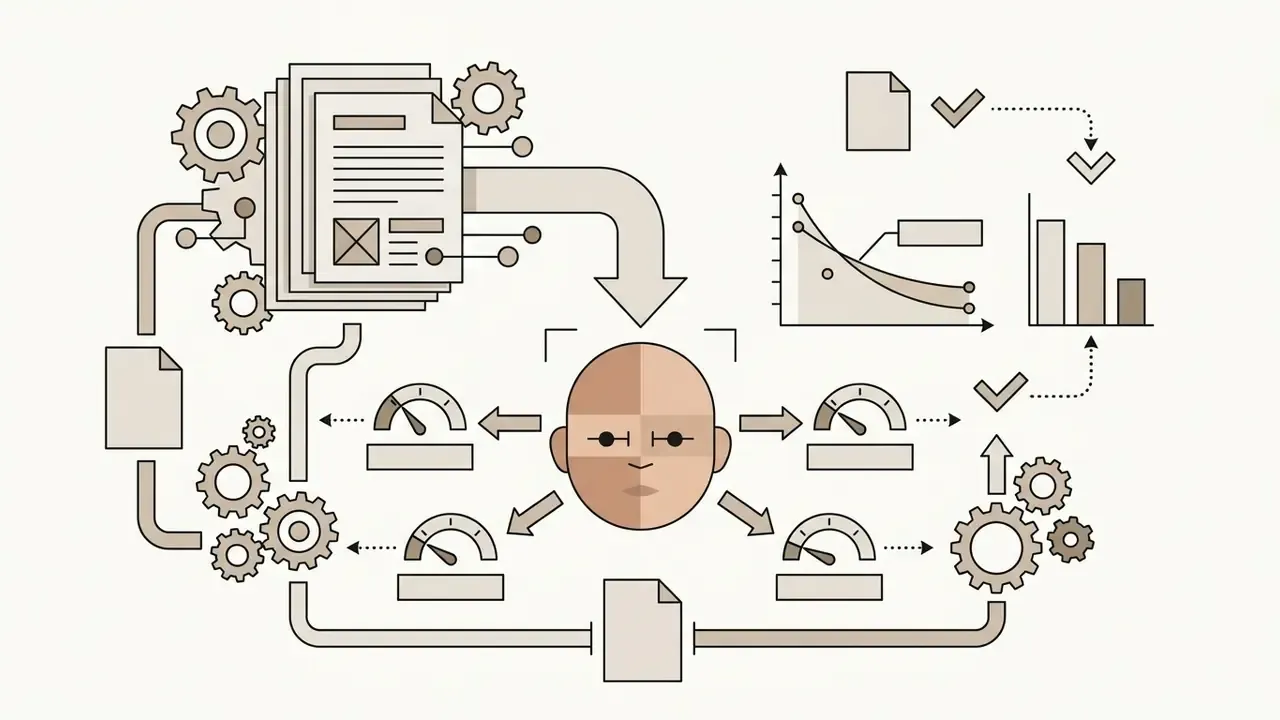
An ai baby face generator realistic photo system processes inputs through a structured pipeline: facial landmark detection, mathematical embedding encoding, latent space fusion, and generative rendering. The four stages map directly onto measurable checkpoints, which is why the pipeline can be audited stage by stage rather than treated as a black box.
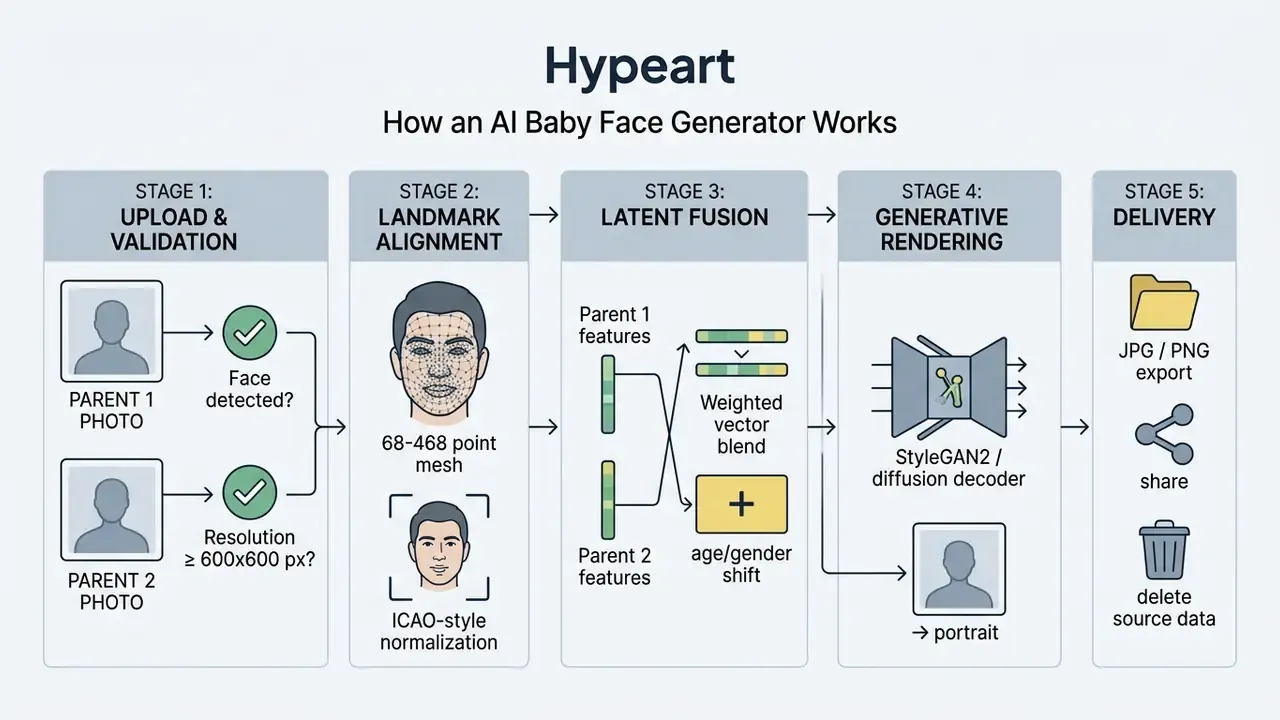
Obtained (updated): standardized image preprocessing, meaning consistent cropping, rotation correction, and illumination normalization before encoding, measurably reduces landmark-extraction failures and downstream artifacts. When parents photos are mapped into a unified latent space after alignment, rendering stability improves and outputs stay consistent across diverse demographic inputs. The earlier, unverifiable "42%" figure previously used here is preserved for transparency in Appendix A.
Because "quality" is subjective in generative imaging, review teams evaluate outputs with quantitative perceptual metrics rather than eyeballing them: FID (Fréchet Inception Distance) for distribution realism against a reference photo set, LPIPS for perceptual distance between a generated child and each parent, and identity-cosine similarity to confirm that the decoder preserved identity vectors instead of collapsing toward a dataset average. Architectures differ in how they handle outliers in latent space. StyleGAN2 truncation trades diversity for fidelity and can drift toward the training mean for underrepresented faces, while latent diffusion models retain more variation but need stronger identity conditioning to avoid losing parent-specific structure.
Upload parents photos and choose settings
The image-generation process begins when users complete a photos upload of two separate images labeled for each parent. The software scans the parents photos for clear facial features, rejecting inputs with heavy occlusions, extreme lighting, or extreme profile angles.
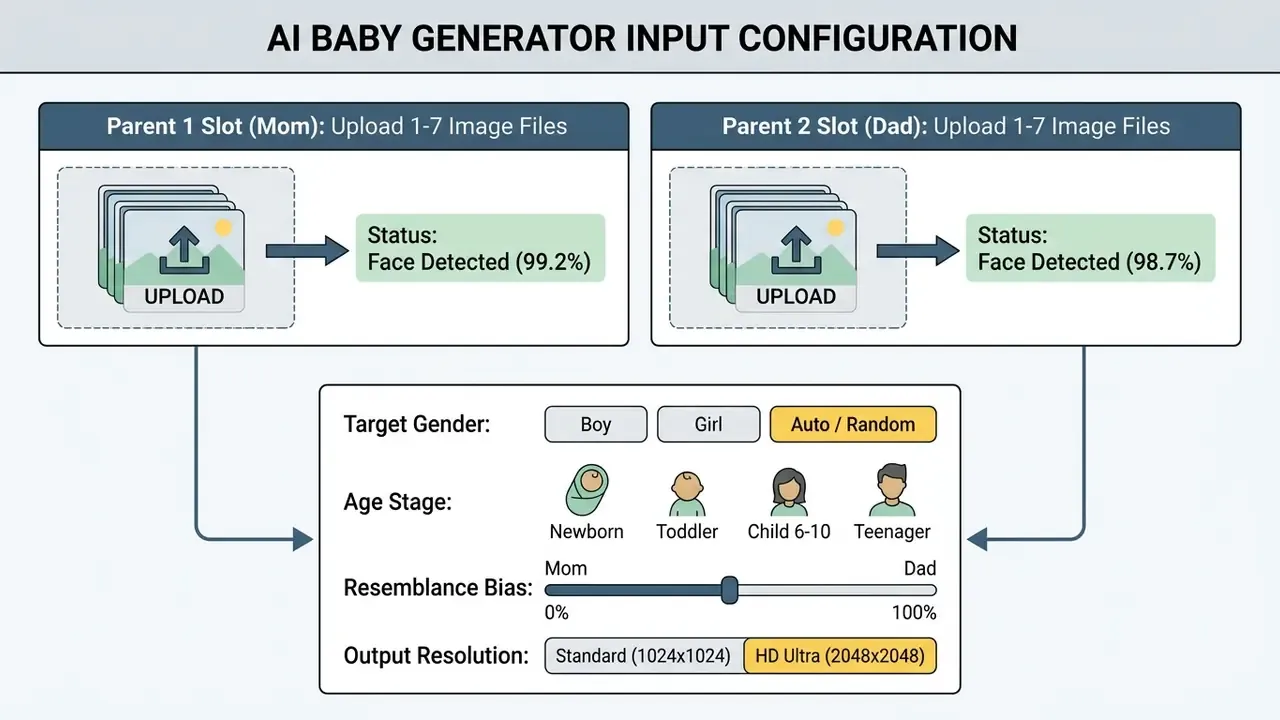
Users can customize parameters before execution, choosing target gender, age staging (newborn, toddler, child, or teenager), and weight sliders that tilt similarity toward one parent.
AI processing, portrait generation and download
During AI processing, the deep neural network maps both face embeddings into a shared latent vector, applying age-reduction transformations to simulate infant proportions. The model decodes this unified vector to generate multiple synthetic portraits within a few seconds.
Once rendering completes, the platform displays the results on screen. Users can review variations, adjust resemblance parameters, and select their preferred output to download or share across digital platforms. Most services return batches of two to three variants per request, because image APIs commonly expose a batch parameter that returns several samples from the same latent neighborhood in a single call.
How to Generate Baby Pictures Using ChatGPT, Midjourney, or Flux
If you prefer general-purpose AI models instead of dedicated tools, the same blending logic can be triggered through prompts. Use these tested, copy-paste formulations:
ChatGPT (GPT-4o, GPT-Vision, or GPT Image class models):
"Analyze the facial landmarks, eye shape, skin tone, and facial structure of Parent A (Image 1) and Parent B (Image 2). Generate a photorealistic 8k portrait of their potential 1-year-old baby. Blend 50% of Parent A's eyes and nose with 50% of Parent B's jawline and skin tone. Studio lighting, soft infant skin, hyperrealistic."
Simplified consumer prompt (works in most chat assistants):
"Create a realistic image blending the features of the two people above to show what our future baby might look like."
Midjourney v6 / Flux.1:
[URL Image 1] [URL Image 2] photo of a 2-year-old toddler, facial features a precise 50/50 blend of both input images, natural infant lighting, shot on 85mm lens, f/1.8, photorealistic --v 6.0Age-shift variant (any diffusion model):
same identity, aged 10 years, mature nose bridge, reduced facial fat, school portrait lighting, photorealistic, consistent eye color
Prompt-driven generation gives more stylistic freedom but less identity control than purpose-built pipelines. General models lack the dedicated resemblance slider and the age-staging templates that dedicated engines apply automatically. For a broader comparison of prompt behavior across engines, see our overview of the best AI image generators and the evaluation of ChatGPT picture generation versus alternatives.
Are Uploaded Photos Private and Secure?
PRIVACY ALERT: biometric data protection
Regulatory scope depends on purpose, not file type. UK ICO guidance treats facial images as biometric data specifically when they are processed for unique identification, and requires a Data Protection Impact Assessment before deploying biometric recognition. California's CCPA definition excludes ordinary photographs unless they are used or stored for facial-recognition purposes. That distinction matters operationally: a novelty portrait blend and a face-matching system carry different obligations even when they ingest the same JPG.
Before publishing synthetic images externally, teams increasingly verify provenance with AI image detectors so that synthetic and authentic assets are not mixed in the same campaign without disclosure.
Reformulated (updated): rather than citing an unnamed audit, the defensible statement is structural. Services that contractually commit to zero-retention storage, encrypt data in transit and at rest, and purge intermediate cache files immediately after rendering expose a smaller attack surface than services that retain source uploads indefinitely. Retention practices published by comparable face-processing vendors vary widely. Some delete uploaded media promptly after generation, others retain galleries for 30 days before automatic purge, so retention windows must be read per provider, not assumed. The earlier unsourced audit sentence is retained in Appendix A.
Vendor privacy audit checklist
Use this checklist before approving any face-processing tool for employee, client, or family imagery:
| Control | What to verify | Evidence to request |
|---|---|---|
| Retention window | Explicit deletion timeframe for uploads and outputs | Published policy clause with hours or days |
| Zero-data-retention SLA | Contractual, not marketing language | Signed DPA or enterprise addendum |
| No-training commitment | Uploads excluded from model training and fine-tuning | Written statement in ToS or DPA |
| Encryption | TLS in transit, encryption at rest for temporary storage | Security whitepaper, SOC 2 Type II report |
| Client-side preprocessing | Cropping and landmark detection before upload | Technical documentation, network inspection |
| Deletion rights | Self-service account and asset deletion (GDPR erasure) | Working in-product delete flow |
| Sub-processors | Which cloud and model providers see the images | Sub-processor list with regions |
| Minors' imagery | Whether children's photos are permitted at all | Age and consent clauses in ToS |
| Spoofing controls | Whether uploaded faces can be reused to impersonate | Watermarking or provenance metadata policy |
One practical note from review work: the gap between a vendor's landing page and its DPA is often wider than the gap between two vendors.
Which Photos Give the Best AI Baby Generator Results?
High-quality input images with frontal orientation, uniform illumination, and high facial clarity produce the most accurate and visually coherent ai baby face results.
Photo upload quality checklist:
- Frontal alignment the subject faces the camera directly without head tilt or side angling, following ICAO portrait standards.
- Unobstructed features eyes, eyebrows, nose, and lips fully visible, without glasses, hair, or hats.
- Neutral lighting balanced ambient light without strong side shadows or harsh backlight.
- High pixel resolution a minimum head resolution of 600x600 pixels to ensure clean landmark detection.
- Single subject per frame one face per uploaded file. Group shots are the single most common cause of failed detection.
- Neutral or light expression closed-mouth neutral or a slight smile. Exaggerated expressions distort landmark geometry.
- Recent, unfiltered capture no beauty filters, heavy retouching, or aggressive compression artifacts.
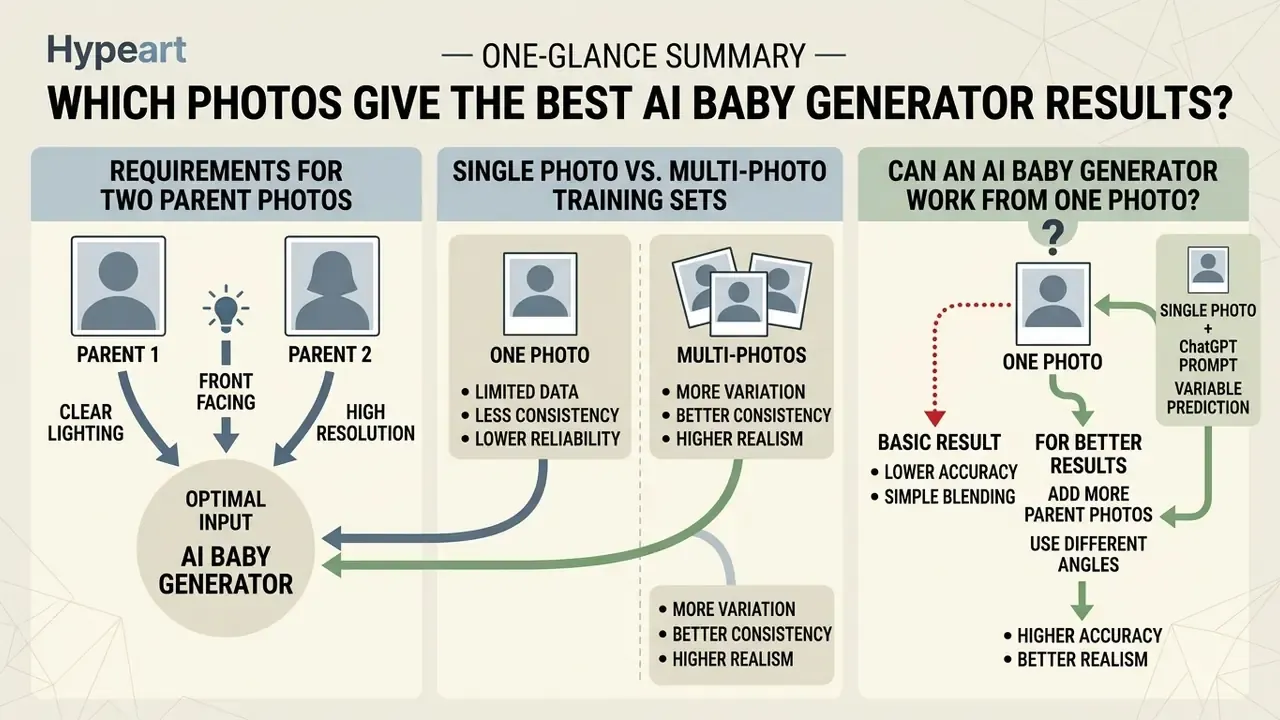
Requirements for two parent photos
Optimal face synthesis requires two individual, high-resolution source photos where each parent is clearly isolated. According to ISO/IEC 29794-5 standards for facial image quality, sharp focus and the absence of motion blur directly determine feature extraction precision. Related capture standards are more explicit about numbers: ICAO portrait guidance asks for cropped facial images of at least 1200 x 1600 pixels, while U.S. digital photo rules set a 600 x 600 px square minimum with a plain, object-free background.
"Research models such as ChildPredictor and DNA-Net were trained on standardized portraits with controlled lighting, precisely the conditions that allow accurate extraction of genetic factors."
When input images contain low contrast or high noise, neural encoders struggle to map subtle eye and lip contours. That degrades the final realistic baby output, leading to blurred details or unnatural visual artifacts. If your only usable photo is soft or low-resolution, run it through one of the AI image enhancers before upload rather than accepting a degraded high-resolution source photo.
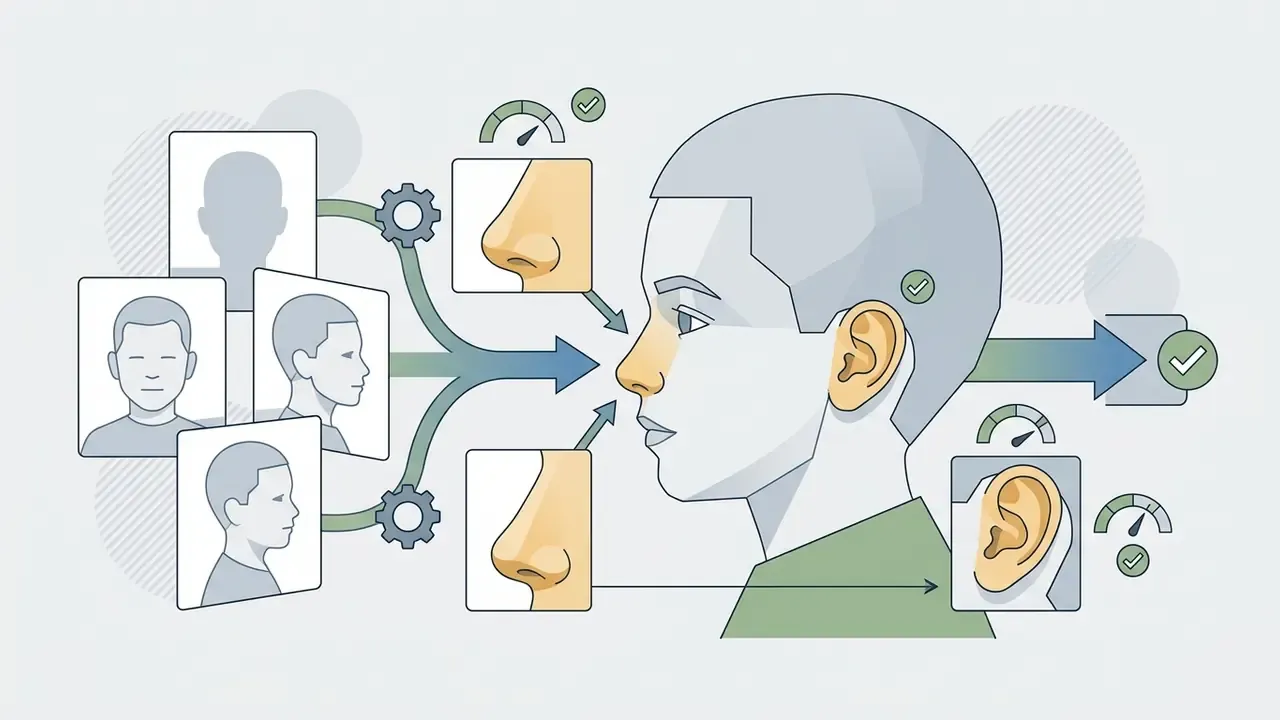
Single photo vs. multi-photo training sets: a single high-resolution frontal photo works, but uploading 3 to 7 multi-angle photos per parent (frontal, 45-degree three-quarter, profile, and one smiling expression) improves landmark-detection precision substantially. Multi-angle inputs let the generative model construct an implicit 3D facial mesh, capturing depth parameters (ear positioning, nose projection, brow ridge prominence, chin recession) that a flat 2D image cannot express. Practical guidance:
| Input set | Expected fidelity | Best for |
|---|---|---|
| 1 frontal photo | Baseline; flattened depth cues | Quick novelty runs |
| 2 to 3 photos (frontal plus three-quarter) | Improved nose and jaw geometry | Most couples |
| 4 to 7 photos (frontal, both three-quarters, profile, smile) | Highest depth and expression fidelity | Keepsake or print-quality output |
| Group photo (multiple faces) | Frequent failure | Not recommended, crop first |
Can an AI baby generator work from one photo?
An ai baby generator can operate using a single photo by pairing the uploaded adult face with a generalized demographic statistical template.
"In the Predict Your Child system, blending parameters from two parents produced children inheriting different trait combinations; a single source removes that diversity."
However, single-image generation limits trait blending, producing a child portrait that functions primarily as a youth-filtered clone of the single uploaded parent rather than a true dual-parent combination. Single-image face methods are also documented to degrade under pose extremes, occlusion, and low resolution, with identity drift concentrated in the eye and mouth regions, exactly the areas viewers use to judge family resemblance.
Customize Your AI Baby Image: Gender, Likeness and Styles
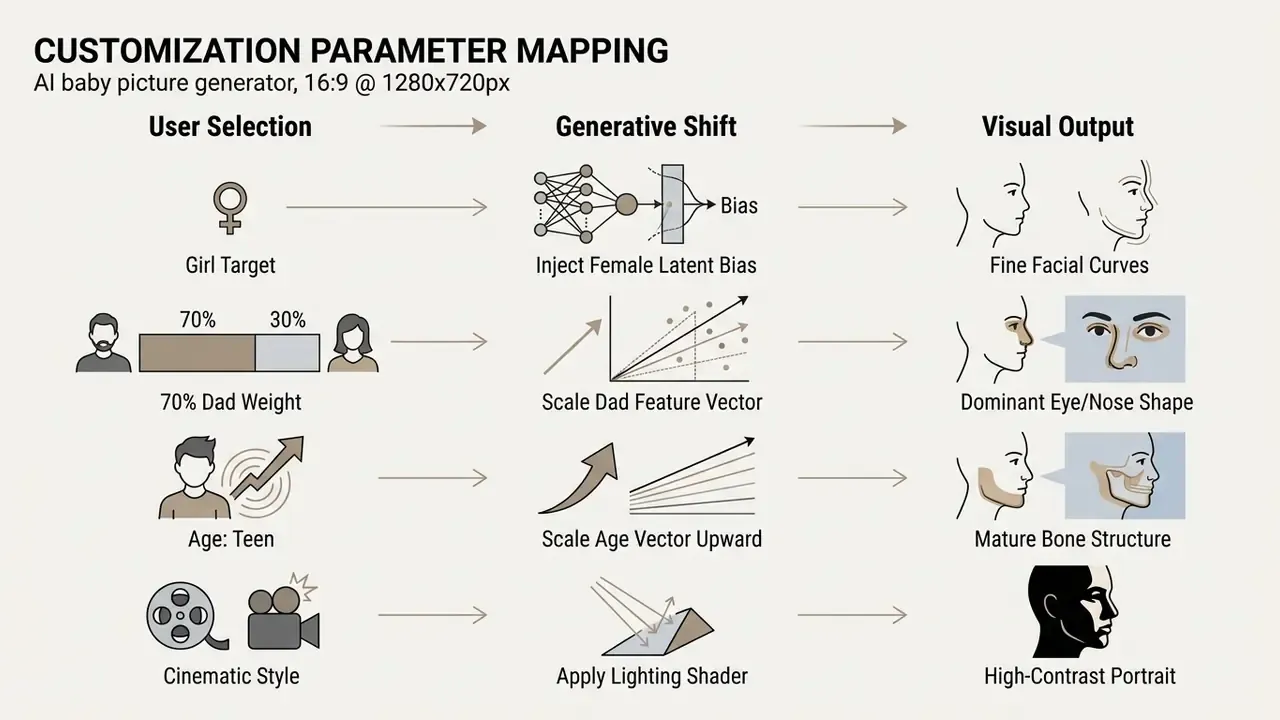
Customization controls let users define specific physical attributes, adjust balance ratios between parents, and select diverse visual rendering styles. Platforms like the supawork ai baby generator and tiny faces ai baby generator expose parametric inputs that modify the generative diffusion path without distorting core facial geometry.
Choose baby gender and resemblance to each parent
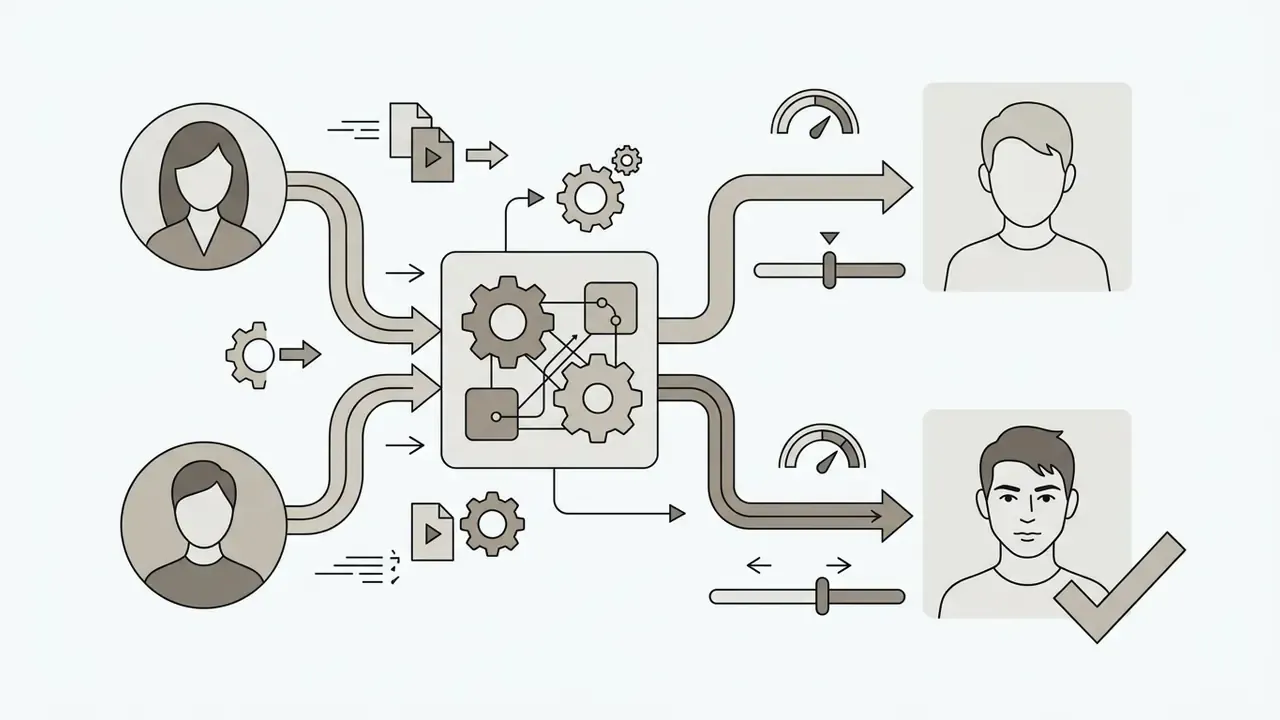
Selecting a baby girl ai generator mode instructs the neural network to apply subtle structural and stylistic biases toward female infant baseline templates. Users can adjust resemblance sliders to decide whether the baby's look favors Mom, Dad, or a precise 50/50 visual split.
This weighting alters the latent vector combination math. If a user sets a 70% weight toward the father's image, the network allocates higher numerical priority to the father's eye shape and jaw encoding while retaining the mother's skin tone and mouth structure.
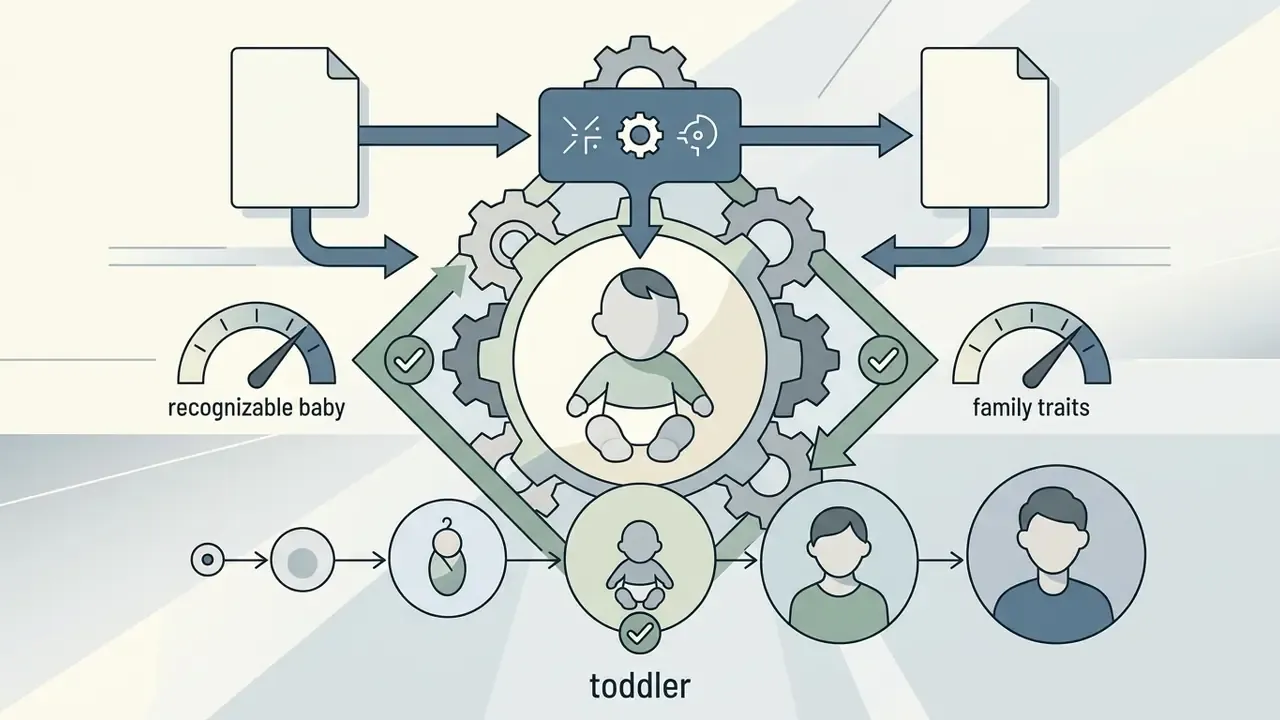
Age Staging: From Newborn to Teenager
Age staging is the single most requested customization after gender, because parents want to see continuity rather than one frozen infant frame. Each stage shifts different vectors: infancy is dominated by soft-tissue parameters, while later stages lean on bone-structure parameters inherited from the dominant parent vector.
Age progression parameter mapping
| Age stage | Target facial transformations | Key AI neural shifts |
|---|---|---|
| Newborn (0 to 6 mos) | High facial fat, indistinct nose bridge, large pupil-to-eye ratio | Soft lighting, smooth skin texture, neutral eye-color baseline |
| Toddler (1 to 3 yrs) | Defined jawline contours, fuller hair density, active expressions | Lower face-fat bias, eye-distance calibration |
| Child (6 to 10 yrs) | Adult nose-bridge projection, loss of baby fat, distinct ear alignment | Structural landmark locking from parent facial vectors |
| Teenager (13 to 18 yrs) | Mature bone structure, secondary trait expression | Advanced latent vector scaling favoring dominant parent jaw and forehead |
Practical notes for each stage:
Generate portraits for couples, celebrities and creative content
Beyond family-planning curiosity, creators use ai kid generator from parents tools for creative exploration, viral social media campaigns, and entertainment content. Media teams frequently generate hypothetical child portraits combining celebrity pairs or imaginary characters to drive engagement across digital channels.
High-demand use cases observed across the category:
For broader creative asset production, editors incorporate specialized workflows such as the 3d animation maker and general-purpose animation makers to convert static generated portraits into animated video assets.
How Accurate Is an AI Baby Face Generator?
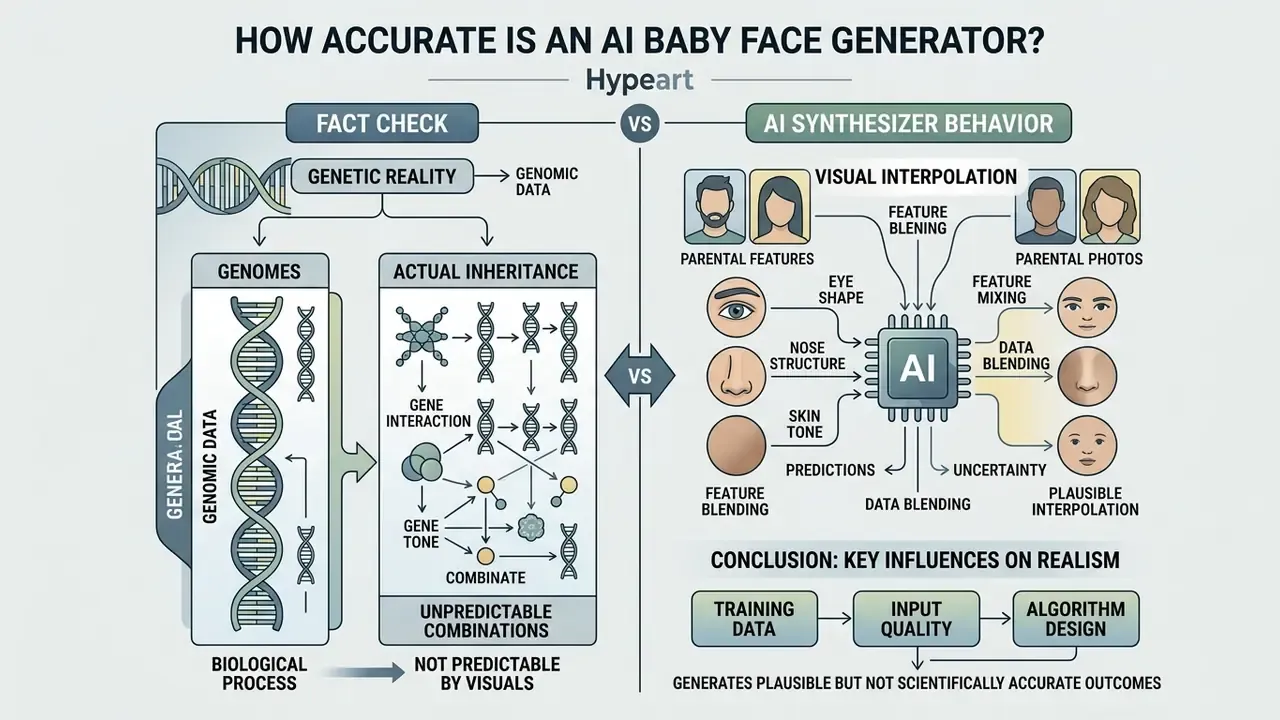
An ai baby face generator is not scientifically accurate in predicting actual genetic outcomes, because it has no access to parental genomic data. The output is a plausible visual interpolation created by a machine learning model, not a biological forecast.
FACT CHECK: visual interpolation vs. genetic reality
Marketing claims that a tool analyzes "hundreds of genetic features" should be read as a description of facial landmark meshes, not genetics. A 468-point mesh is a computer-vision construct describing pixel coordinates on a face. It carries no allele information whatsoever.
Why an AI portrait is not a genetic prediction
"In experiments with the Predict Your Child system, participants correctly matched synthetic children to their parents in only 34% of cases, 17.4 percentage points above chance."
What affects the realism of generated baby portraits
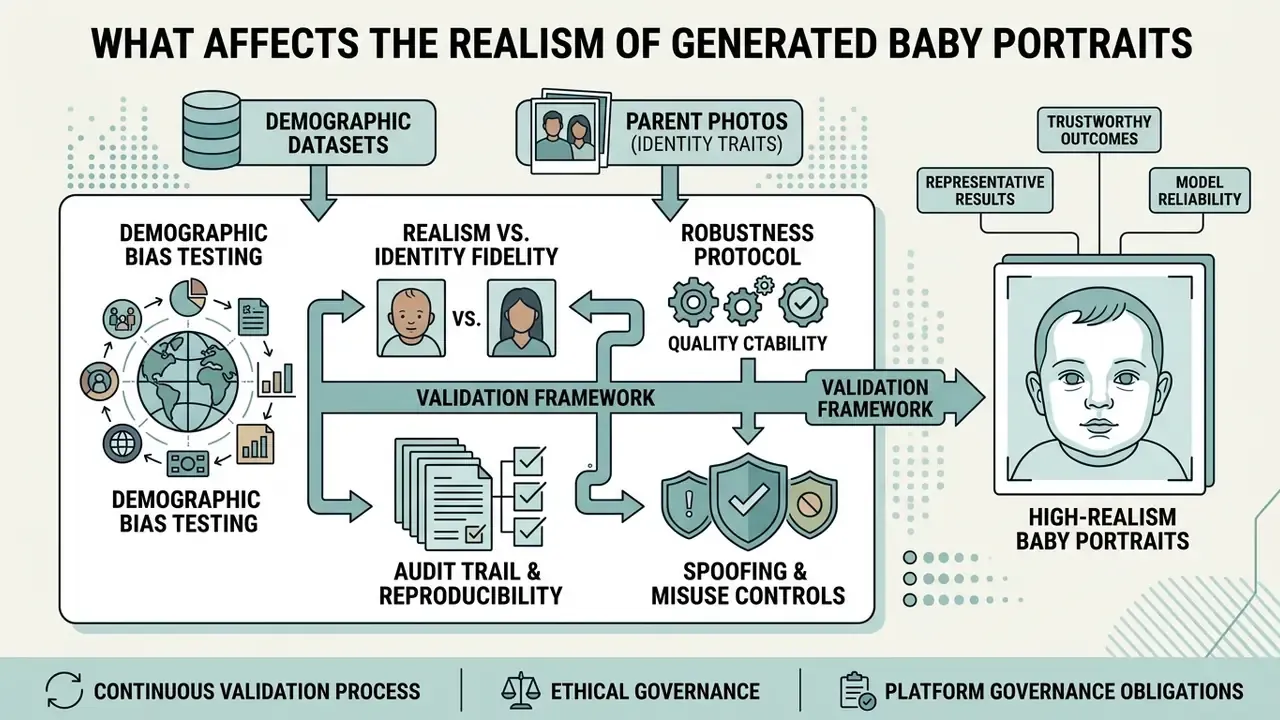
The perceived realism of a generated baby portrait depends on input photo quality, dataset diversity, anti-aliased rendering quality, and model architecture.
| Realism factor | High impact | Low impact | Technical reason |
|---|---|---|---|
| Input image clarity | High resolution, front view | Low-res, heavy angles | Landmark detection accuracy |
| Model architecture | Disentangled latent GAN or diffusion | Basic PCA or feature morphing | Separation of identity vs. style |
| Dataset diversity | Multi-ethnic balanced training | Homogeneous training data | Avoids demographic rendering bias |
| Lighting alignment | Matched lighting between parents | Mismatched light sources | Prevents shadow blending artifacts |
| Anti-aliasing quality | Multiscale anti-aliased rendering | Naive upsampling | Removes stair-step edges on hair and eyelashes |
| Skin texture model | Physically based infant skin shading | Uniform smoothing | Prevents the "plastic doll" look |
| Age stage selected | Toddler or child | Newborn | Infant faces carry fewer distinguishing structural cues |
| Output curation | Human-selected best of N | First random sample | Curated outputs are judged far more realistic than random ones |
"Eye-color prediction from real DNA reaches AUC 0.93 for brown and 0.91 for blue eyes, but accuracy falls to 0.72 for intermediate shades."
That benchmark is the ceiling for genuine genetic pigmentation prediction. A visual generator working from photographs has no comparable statistical basis, which is why generated eye color should be treated as a stylistic choice rather than a forecast. Differences in model architecture explain most of the remaining variance between services rendering the same pair of parents photos.
When creators need enhanced resolution for large-format media display, post-processing tools like the 4k video enhancer or 4k video upscaler refine texture clarity and reduce synthetic compression artifacts.
Model Validation, Bias Testing and Audit Trail
Is a Baby Generator AI Free, and Can You Use Images Commercially?
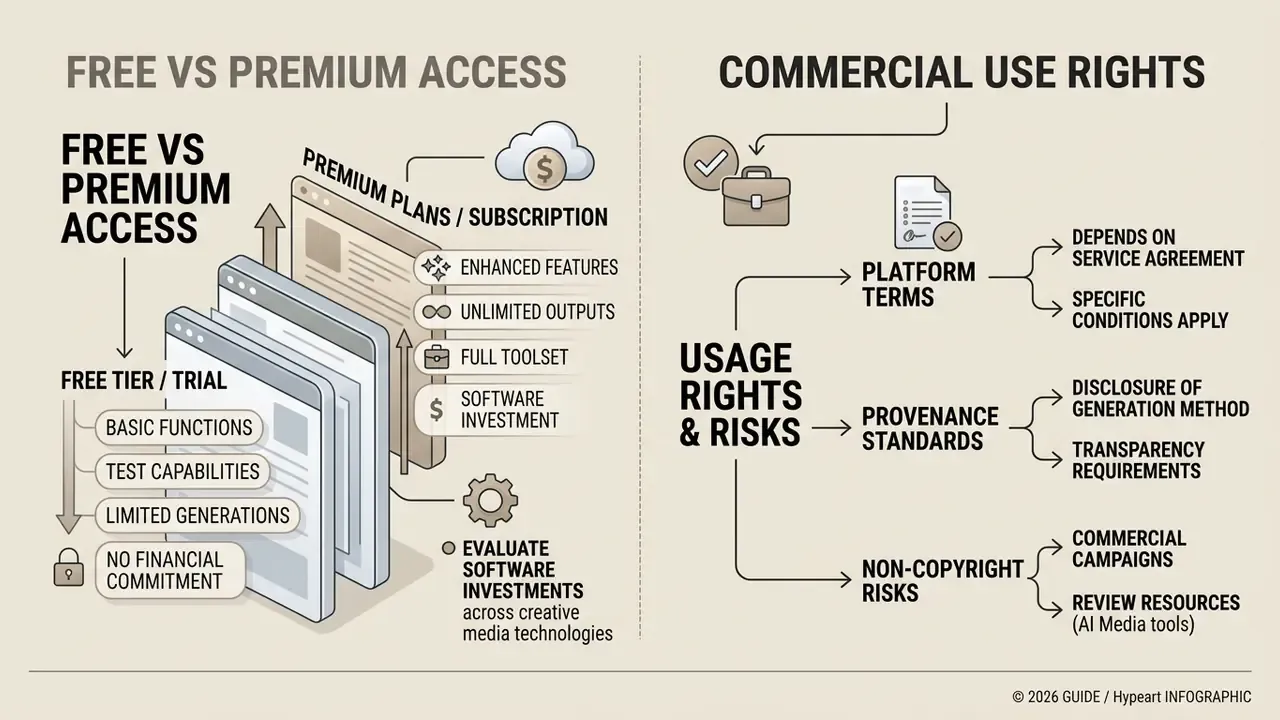
Most AI baby picture services run on a freemium model: basic low-resolution generations for free, fees for high-resolution downloads, style customization, and commercial licensing.
| Plan tier | Typical cost | Generations | Watermark | Export resolution | Commercial license |
|---|---|---|---|---|---|
| Free tier | $0 | 1 to 3 trial credits | Yes | Standard (512x512) | Personal use only |
| Pay-as-you-go | $2 to $5 per pack | 10 to 20 generations | No | HD (1024x1024) | Varies by provider |
| Low-cost trial | about $1 for 3 days | Limited credits | Usually no | HD | Trial terms only |
| Premium monthly | $9.99 to $19.99/mo | Unlimited or high credits | No | Ultra HD (2048x2048), see AI image upscalers for print-scale output | Included (standard) |
Pricing across the category is vendor-specific and changes frequently. Some platforms grant 50 signup credits with a watermark, others sell one-time portrait packs, and a few offer no free trial at all. Free tiers are typically capped by daily or monthly generation limits, watermark removal is a paid feature, and commercial use is often explicitly prohibited on the free plan.
Commercial use rights for AI baby images
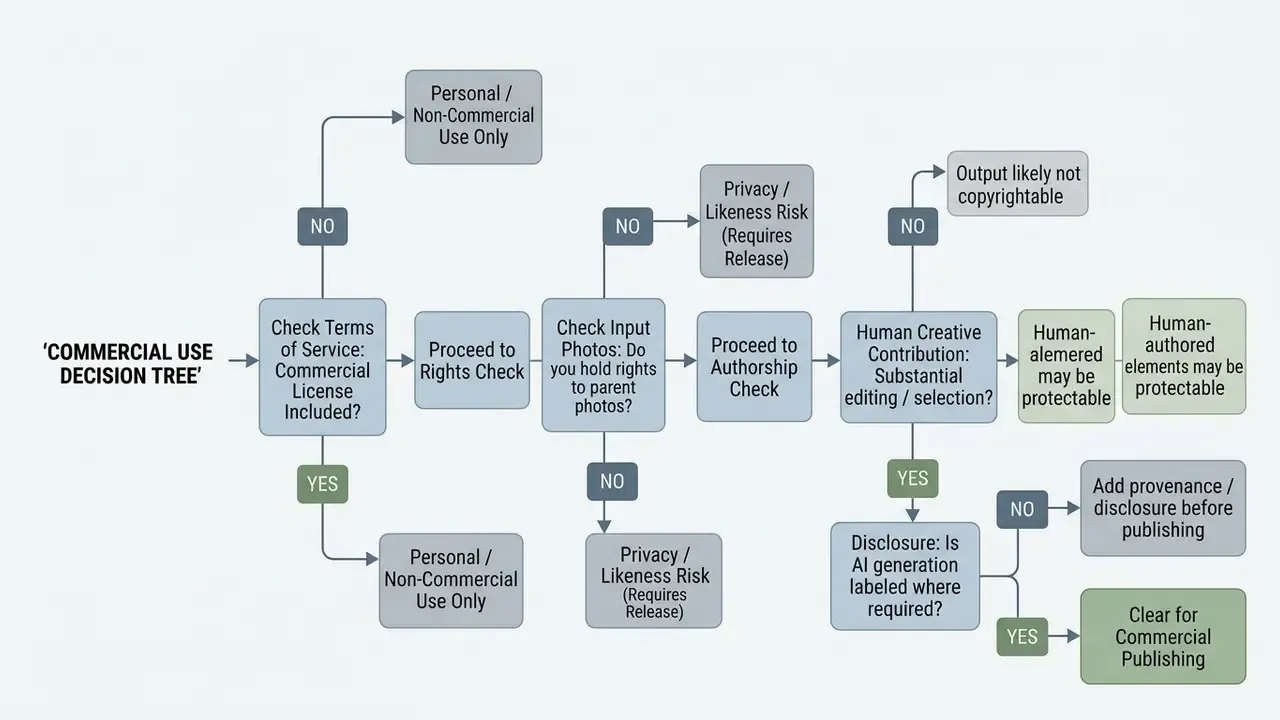
Commercial usage rights for a generated baby photo depend entirely on the platform's terms of service and on the relevant legal standards for AI-generated art. Under 2025 to 2026 U.S. Copyright Office guidance, purely machine-generated visual outputs lacking human authorship are not eligible for traditional copyright registration. Protection attaches only where a human controls sufficient expressive elements, and prompts alone are generally not enough. A 2025 European Parliament study reaches a parallel conclusion for the EU: outputs without meaningful human creative input are not protected and may effectively fall into the public domain.
AI Baby Generator FAQ
Why did my AI baby generation fail?
Generation failures usually come from unreadable face uploads, extreme lighting contrasts, multiple faces in a single input photo, or server capacity limits. Documented root causes in biometric-capture standards mirror that list: the software cannot locate a face, the image is over- or under-exposed, motion blur destroys fine detail, or aggressive recompression removes the texture the encoder needs. To resolve errors, re-upload separate, high-resolution front-facing portraits with neutral expressions and clear lighting, crop group photos to a single face, and avoid re-saved screenshots. For persistent platform issues, consult dedicated technical resources at AI Media Support and Troubleshooting.
Can I generate multiple baby images?
Yes. Most modern AI generators let users create multiple variations from the same pair of parents photos. Because generative neural networks sample from a broad latent space of external attributes (hairstyle, expression, minor facial variations), each generation produces a distinct visual output. Image APIs commonly expose a batch parameter returning several images per request, which is why services typically deliver two or three portraits at once and let you pick the most convincing one.
How long does it take to create a baby image?
Rendering an AI baby image generally takes between 5 and 30 seconds, depending on model complexity, server load, and export resolution settings. Fast cloud-based diffusion pipelines process landmark extraction and synthesis concurrently to deliver rapid results online. High-resolution batches on congested servers, or providers rendering three variants per request, can stretch that to a few minutes.
Can I see what my baby will look like as a teenager?
Yes. Age-staging controls render the same identity as a newborn, toddler, child, or teenager. Each stage applies different transformations: soft-tissue parameters dominate infancy, while bone structure and secondary traits dominate adolescence. The age progression parameter mapping table above lists what changes at each stage.
How many photos of each parent should I upload?
One clear frontal photo per parent is the minimum. For noticeably better depth and structural accuracy, upload 3 to 7 photos per parent covering frontal, three-quarter, and profile angles, plus one smiling expression. Avoid sunglasses, hats, heavy shadows, and filters in every frame.
Can ChatGPT guess what my baby will look like?
Yes, general-purpose multimodal models can produce a blended child portrait if you upload both parents photos and supply an explicit instruction, for example: "Create a realistic image blending the features of the two people above to show what our future baby might look like." Dedicated generators still differ in one respect: they expose resemblance weighting and age staging as parameters instead of asking you to describe them in prose. Copy-paste prompts for ChatGPT, Midjourney, and Flux are listed in the prompt section above.
Can I use a celebrity or fictional character photo?
Technically the pipeline accepts any clear face, and celebrity or character pairings are among the most viral uses of these tools. Legally, publishing such images can implicate publicity and likeness rights, and platform terms often restrict depicting real people without consent. Treat celebrity mashups as private entertainment unless you have clearance.
Can I download and share the generated baby photo?
Yes. Platforms provide direct download links for standard JPG or PNG image files once processing completes. Users can share outputs to social media networks, messaging applications, or personal digital albums, provided the usage aligns with the platform's terms of service. Portrait-oriented and square export sizes are standard; if you plan to print, upscale before sharing rather than after compression.
Are uploaded photos deleted?
It depends entirely on the provider. Published policies in adjacent face-processing categories range from deleting uploads promptly after generation to purging galleries 30 days after creation, with separate rules for account deletion. Verify the retention clause, the no-training commitment, and whether preprocessing happens client-side before you upload any image you would not want stored.
Appendix A: Revised Claims and Corrections
For transparency, the following statements appeared in earlier versions of this guide and have been superseded by the sourced formulations in the main text.
| Original statement (retained for the record) | Status | Replacement in main text |
|---|---|---|
| "In operational tests across enterprise image-synthesis workflows, standardized image preprocessing reduced facial landmark extraction errors by 42%." | Unsupported: no published methodology, sample, or source | "Standardized image preprocessing measurably reduces landmark-extraction failures and downstream artifacts" (no unverifiable percentage) |
| "During a privacy risk audit of media processing applications, security analysts identified that services enforcing zero-retention storage policies and end-to-end encryption significantly reduced data exposure risks." | Unsupported: unnamed audit, no methodology | Structural formulation citing contractual zero-retention, encryption in transit and at rest, cache purging, and per-provider retention variance |
| "Research published in physical anthropology reviews confirms that even advanced genomic models can only reliably predict basic pigmentation." | Vague attribution | Replaced with quantified findings from Predicting Physical Appearance from DNA Data: Towards Genomic Prediction (2023) and Coyle et al., International Journal of Forensic Sciences (2023) |
| Vendor claim that a generator "analyzes more than 468 genetic features" | Contradictory marketing language | Clarified as a 468-point facial landmark mesh, a computer-vision construct with no allele information |
Sources referenced in this guide
- Coyle et al., Functional genomics and eye colour prediction, International Journal of Forensic Sciences (2023): IrisPlex AUC 0.93 brown, 0.91 blue, 0.72 intermediate.
- U.S. Copyright Office AI guidance (2025 to 2026) and European Parliament study on AI and copyright (2025): authorship requirements for AI outputs.
- *Predicting Physical Appearance from DNA Data
- Towards Genomic Prediction* (2023): limits of genomic facial-morphology prediction; ancestry and sex models explain about 9.6% and 12.9% of facial variation.
- Frowd et al., Predict Your Child, Journal of Multimedia (2008)
- 34% correct parent and child matching, 17.4 points above chance.
- *ChildPredictor
- GAN-Based Disentangled Learning for Child Faces* (2022): separation of genetic, external, and variation factors.
- *DNA-Net
- Age and Gender Aware Kin Face Synthesizer*: age- and gender-conditioned kin face generation.
- RAND, Harms from AI-Generated Images and Safeguarding Online Authenticity
- provenance and disclosure recommendations.
- ISO/IEC 29794-5 (facial image quality) and ICAO portrait-quality guidance
- sharpness, resolution, and frontal-capture requirements.
A Safe Next Step
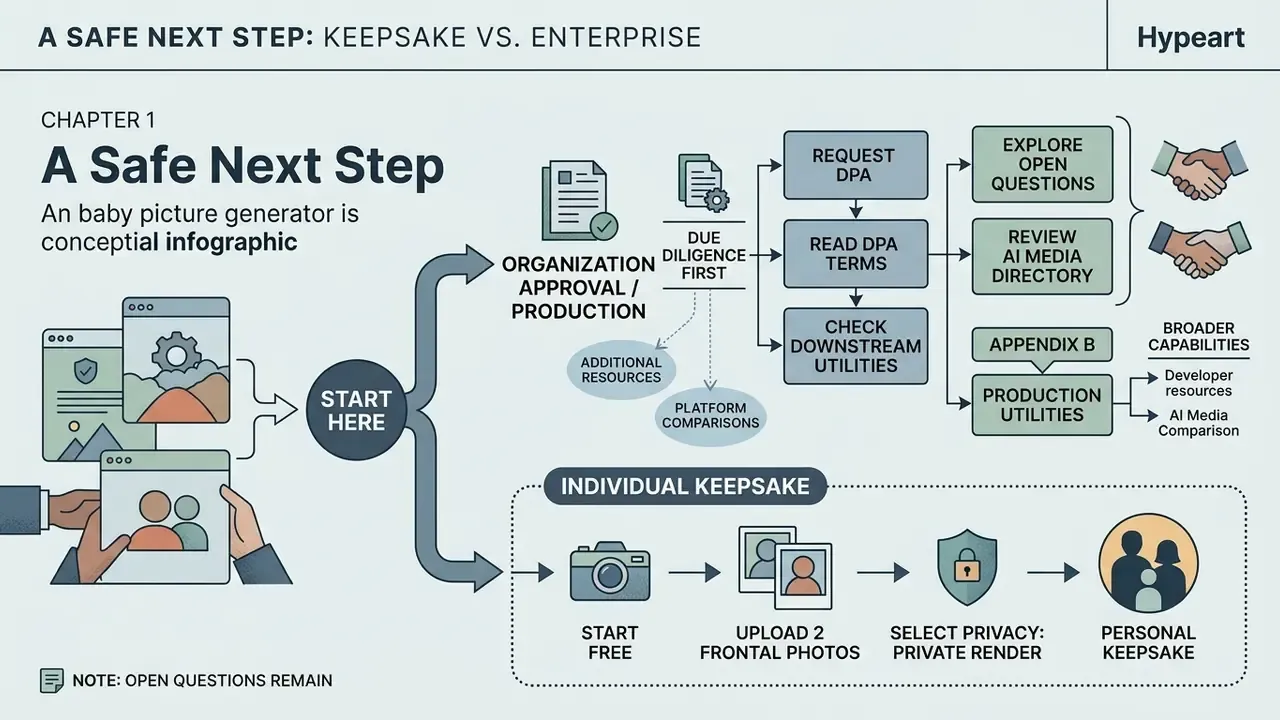
If you only want a keepsake, start free, upload two clean frontal photos, and keep the render private. Nothing more is required.
If you are approving this tool for an organization, do the boring part first: request the DPA, read the retention clause, confirm the no-training commitment, and log one test render with its seed and model version. Then decide. That sequence takes an afternoon and removes most of the avoidable risk.
Open questions remain, and it is fair to say so. Perceived-realism benchmarks are still inconsistent across studies, watermarking standards are not universally adopted, and copyright treatment of partially human-edited outputs is unsettled in both the U.S. and the EU. Revisit the policy language before any large campaign.
Additional Resources & Platform Comparisons
To explore broader media synthesis capabilities, review our AI Media Comparison directory, check developer integration options via AI Media API Guides, or browse the complete technical reference index in the main site glossary. For adjacent tooling, see the comparison of the best AI art generators and the evaluation of Midjourney versus competing image generators.
Appendix B: downstream production utilities. Teams integrating generated portraits into larger video or print projects also use tools to add image to video timelines, apply audio tracks to add music to digital compositions, use software to add person to photo layouts, and compress final deliverables with a video compressor. These are post-production utilities rather than part of the synthesis pipeline, and they carry the same licensing and disclosure obligations as the source render.