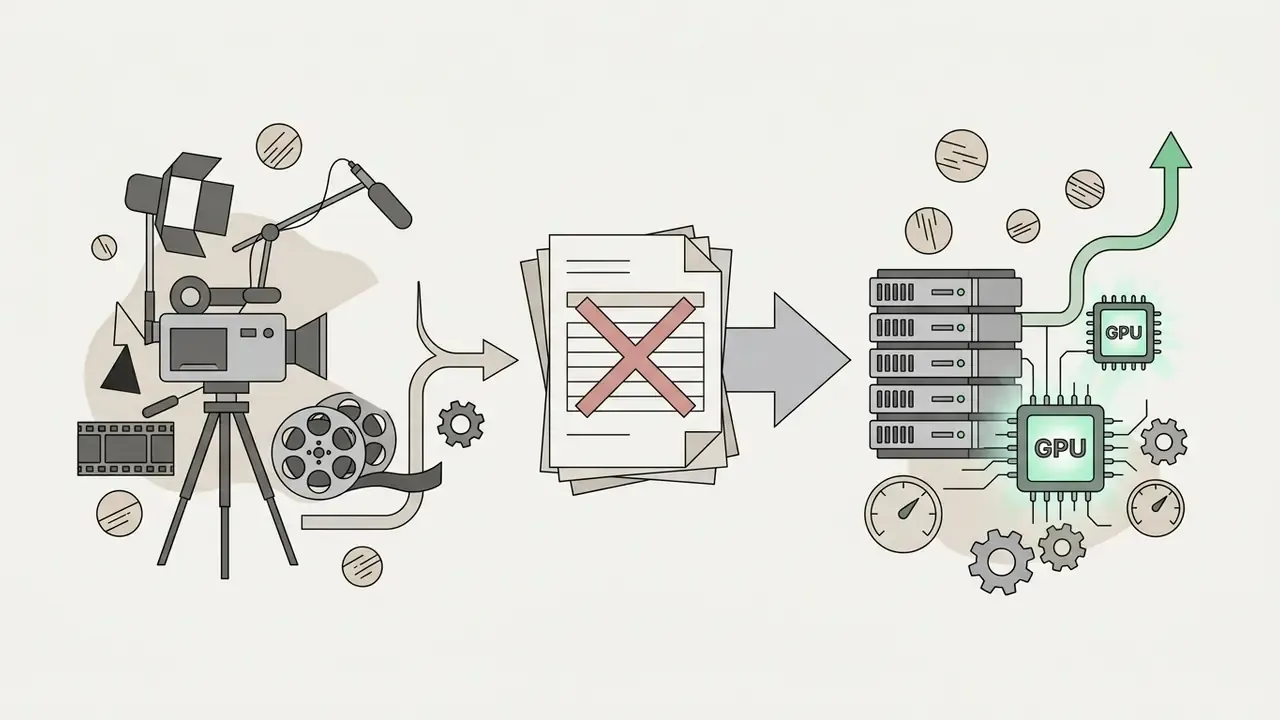
"In institutional AI deployment, operational governance relies on one foundational rule: no evidence, no autonomy. Generative video tools present real workflow efficiencies, but risk frameworks must weigh probabilistic pixel synthesis against auditability, factual fidelity, and residual risk before granting operational autonomy."
— Marcus Hale, author
Reviewed by: Senior AI Model Validation and Content Risk Desk · Last updated: June 2026 · Reading time: ~22 minutes
Executive Summary
- What it is: Text-to-video AI is a class of generative models that converts written prompts, documents, or URLs into moving image sequences by sampling from learned probability distributions. It does not simulate physics, and it does not "understand" the world.
- How it works: Production-grade systems run a three-layer pipeline: an LLM scripting and scene-planning layer, a spatiotemporal diffusion or Diffusion Transformer (DiT) generation layer, and an audio/assembly layer handling TTS, lip-sync, music, and captions.
- Where it works today: Short B-roll and teaser clips (typically under 20 seconds), avatar-led training and compliance modules, template-driven repurposing of decks and articles, and high-volume creative variant testing.
- Where it fails: Long-range identity drift, physical causality, fine motor detail, and legible on-screen text. Independent benchmarks still record majority failure rates on physics-critical scenes.
- Governance bottom line: Cost savings are real at the GPU layer but partially offset by control costs: human review, provenance labeling (C2PA), prompt logging, rights verification, and PII/BII exposure controls when prompts travel to third-party APIs.
- Decision rule for regulated environments: Treat AI video as a drafting accelerator with mandatory human sign-off, not an autonomous publishing system.
How to Read This Guide
This is a working reference, not a product tour. Each capability below is paired with its failure mode and its control point, in that order, because that pairing is what a validator or an internal auditor will ask for.
Three reader paths, depending on your seat:
Text-to-video artificial intelligence marks a real shift in visual content creation across commercial, educational, and enterprise environments. The technology translates natural-language descriptions into dynamic visual frame sequences without camera crews, physical lighting setups, or live actors. Understanding how these generative systems function requires looking at their definitions, their neural architectures, their production tradeoffs, and their practical governance limits.
The framing here is deliberately institutional. A creator publishing a stylized teaser and a bank publishing an anti-phishing training module use the same generative model, yet carry radically different residual risk. Same pixels. Very different consequences.

What Is Text-to-Video AI? Definition and Meaning
Text-to-video AI is a class of generative artificial intelligence models that transforms written natural-language prompts into sequential video frames. These systems process text inputs to generate corresponding motion, spatial layouts, lighting, and visual subjects as a continuous video output. That is the short answer to what is text-to-video AI, and the meaning holds across vendors regardless of interface.
At its core, an AI video generator replaces manual filming and asset collection with neural network inference. Instead of capturing light through a physical lens, the model samples from high-dimensional statistical probability distributions learned from millions of video-text pairs during training.
Researchers evaluating diffusion and transformer architectures define text-to-video AI as prompt-conditioned temporal video synthesis. Rather than understanding real-world physics the way a human operator does, the system predicts pixel patterns that align with text tokens over a given timeline.
"Text-to-video models generate frames by sampling from probabilistic distributions rather than through explicit physical modelling: realism emerges from pattern matching over training data."
This distinction is the single most important input into any model-risk assessment. A validator reviewing a text-to-video deployment is not validating a simulation engine with traceable parameters. They are validating a stochastic renderer whose outputs are plausible rather than verified. Which is why factual, numerical, or safety-critical claims must never originate inside a generated frame. They must be authored upstream in a reviewed script, then only rendered by the model.
Tool vs Platform: The Product Distinction That Matters
Buyers routinely compare products that are not in the same product class. The market label "text-to-video" covers both single-function utilities and end-to-end production systems. The difference decides how much manual work, and how much uncontrolled handoff of data between vendors, remains after generation.
| Dimension | AI Video Tool (single-layer) | AI Video Platform (multi-layer) |
|---|---|---|
| Scope | Executes one step: a 4 to 10 second clip, a voiceover, a caption pass, an avatar render | Orchestrates scripting, generation, narration, captions, assembly, export |
| Typical input | One prompt or one asset | Prompts, scripts, PDFs, PPT decks, URLs, brand kits |
| Output state | Raw component requiring assembly | Publishable sequence with audio and captions |
| Handoffs | Multiple manual transfers between apps | Single workflow, single audit surface |
| Governance impact | Each handoff is an uncontrolled data-egress point | Centralized logging, roles, and approval gates are feasible |
A practical test: if the product leaves scripting, voiceover, assembly, and captioning to the user, it is a component tool. Useful, but it does not remove production overhead. A platform reduces handoffs; a tool relocates them. For risk teams, fewer handoffs mean fewer places where a confidential script fragment can leak into a third-party inference log.
What Input Does an AI Video Generator Use?
An AI video generator relies primarily on descriptive text prompts as its baseline input signal. These natural-language prompts specify visual elements such as character actions, environmental settings, camera angles, lighting conditions, and aesthetic styles.
Advanced platforms also accept hybrid inputs to guide frame generation with higher precision. Text-conditioned image-to-video AI (TI2V) frameworks, for instance, combine a static seed image with a descriptive prompt to establish subject identity before generating continuous motion.
"The TI2V task is formalised as a conditional distribution p(x̂|x₀,y) = p(x|x₀,y): the model animates a static frame x₀ according to the textual description y."
Some platforms add secondary input streams to control temporal timing and narrative structure. Those assets include audio files for speech alignment, structural storyboards, frame layouts, and explicit camera motion vectors specifying panning, tilting, or zooming behavior.
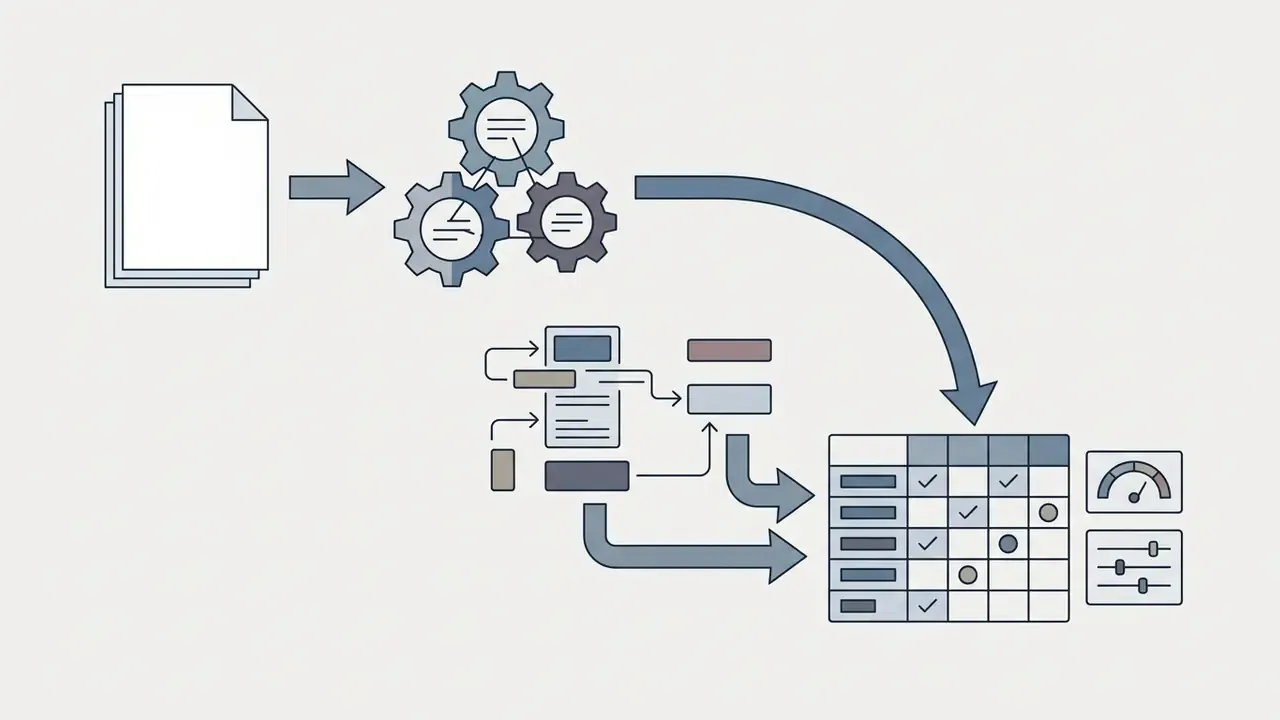
Beyond basic text, enterprise platforms support Document-to-Video (PDF/PPT) and URL-to-Video ingest pipelines, where an LLM parses web pages, policy manuals, employee handbooks, standard operating procedures, or pitch decks to generate a production script before any pixel is rendered. Vendor documentation across 2026 describes the same ingest ladder: prompt, then script, then link, then deck, then PDF, each producing a scene-segmented draft rather than a single clip.
This input ladder is also the first governance checkpoint. Uploading an internal handbook to a SaaS generator is a data-transfer event, not merely a convenience feature. Document-to-video pipelines must be scoped against classification policy: public marketing collateral behaves very differently from an internal control narrative containing customer identifiers, account structures, or unreleased financial data.
| Input signal | What it controls | Primary risk to screen |
|---|---|---|
| Text prompt | Subject, action, setting, style | Prompt leakage of confidential context |
| Seed image / reference | Subject identity, composition | Third-party image rights, likeness consent |
| Document (PDF/PPT/DOCX) | Script, scene order, factual content | PII/BII egress, unreviewed policy language |
| URL | Script from live web content | Ingesting inaccurate or unlicensed content |
| Audio track | Timing, lip-sync, pacing | Voice cloning consent, biometric handling |
| Motion vectors / storyboard | Camera trajectory, shot order | Low, mostly a quality control |
Text-to-Video AI vs Traditional Video Production
"CogVideoX generates a continuous 10-second video in a single diffusion pass at 768×1360 resolution and 16 frames per second."
Human creators in traditional workflows control every physical variable on set during filming. In AI-driven workflows, creative control shifts to prompt engineering, seed selection, iterative output review, and post-generation timeline editing. Teams comparing specific vendors before committing can benchmark output ceilings across AI video generators and, for programmatic pipelines, review per-second Google Veo API implementation economics before modelling cost at volume.
| Parameter | Traditional production | Text-to-video AI |
|---|---|---|
| Time to first draft | Days to weeks | Minutes |
| Marginal cost per variant | High (reshoot or re-edit) | Low (regenerate) |
| Frame-level determinism | Full | Partial; stochastic |
| Physical accuracy | Inherent | Approximated, frequently violated |
| Revision flexibility | Constrained by footage shot | Near-instant regeneration |
| Audit trail | Call sheets, contracts, footage logs | Prompts, seeds, model versions, approvals |
| Hidden cost centre | Logistics and scheduling | Review, rights, provenance, re-generation |
How Does Text-to-Video AI Work?
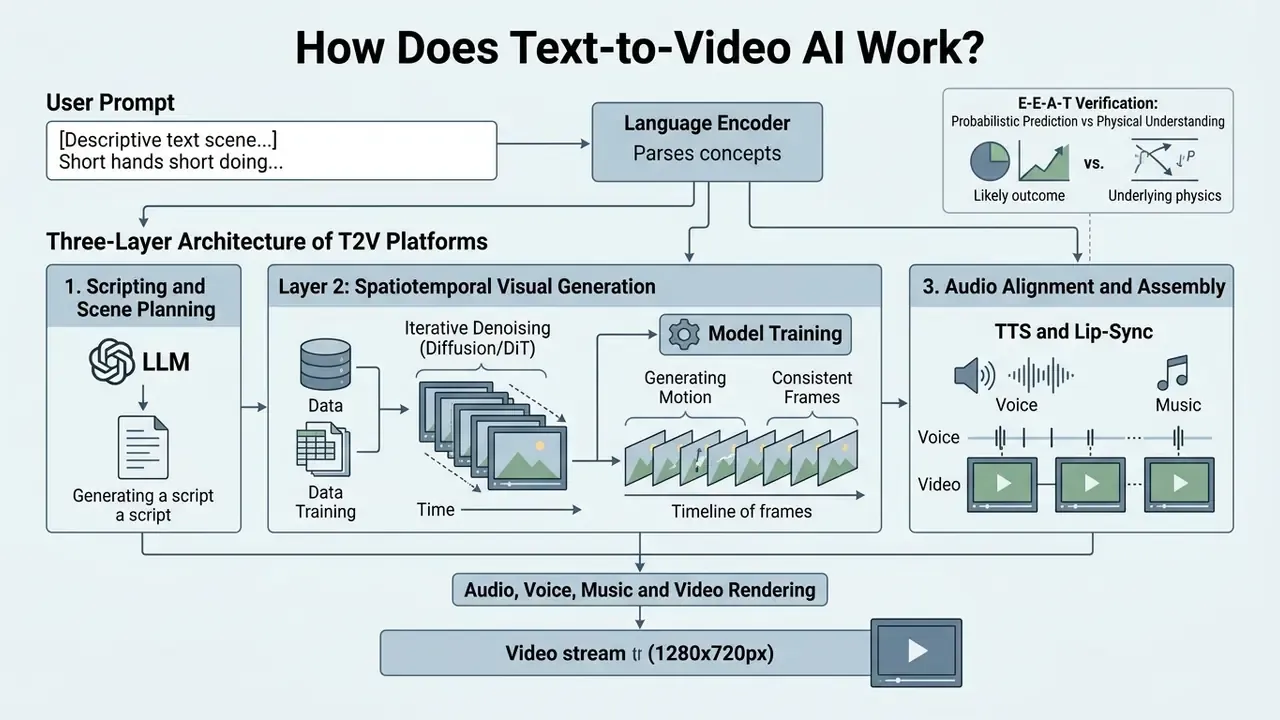
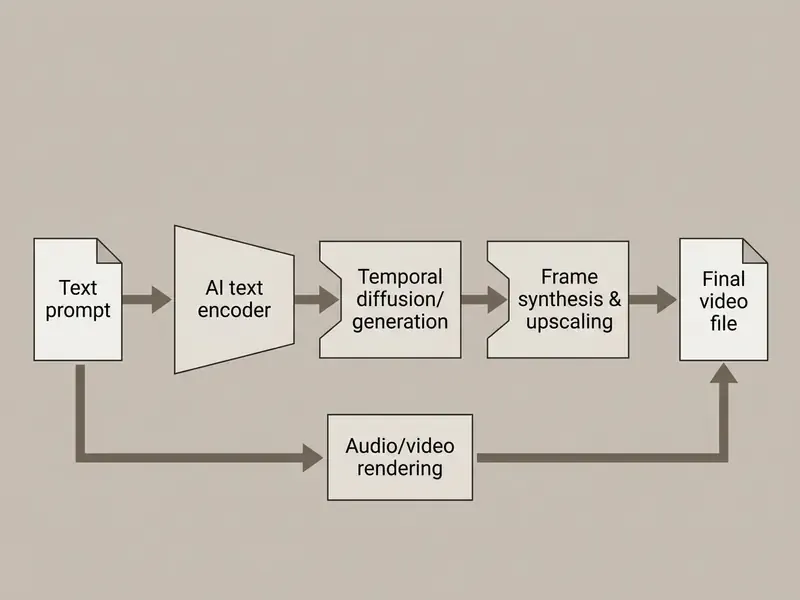
Text-to-video AI works by passing a user prompt through a language encoder, mapping those concepts into a latent visual space, then iteratively denoising visual frames over time. The system aligns visual features with text tokens to produce smooth motion, spatial layouts, and coherent scene transitions.
Modern AI video systems decouple input text analysis from temporal motion frame synthesis. By treating video generation as a series of probabilistic token predictions, these systems synthesize visual scenes frame by frame using spatiotemporal attention networks.
The Three-Layer Architecture of T2V Platforms
Modern platforms do not rely on a single model; they operate a three-layer pipeline. No model today accepts a paragraph and returns a coherent, narrated, multi-scene video in one pass. None. Vendor demo reels sometimes imply otherwise.
- Scripting and Scene Planning Layer (LLM).Parses raw prompts, URLs, or documents into structured, scene-by-scene visual blueprints and script beats. Research implementations describe this as decomposing a prompt into object bounding boxes, per-object descriptions, and a background prompt, or into a narrative graph with canonical attributes and consistency seeds for recurring characters and settings.
- Spatiotemporal Visual Generation Layer (DiT/Diffusion).Synthesizes frame sequences from latent space while attempting to preserve spatial and temporal consistency. Contemporary designs frequently split a content branch (appearance) from a motion branch (dynamics) to improve motion quality.
- Audio Alignment and Assembly Layer (TTS and Lip-Sync).Generates multilingual voiceovers, synchronizes phonemes to character mouths, aligns background music and sound effects, renders automated subtitles, and encodes the final file.
Distinction: an AI Video Tool executes a single layer (generating a standalone 4-second clip, say, or rendering an avatar), whereas an AI Video Platform orchestrates all three layers into an end-to-end publishable output. Pricing, credit models, and generation limits vary widely precisely because vendors absorb different amounts of this pipeline.
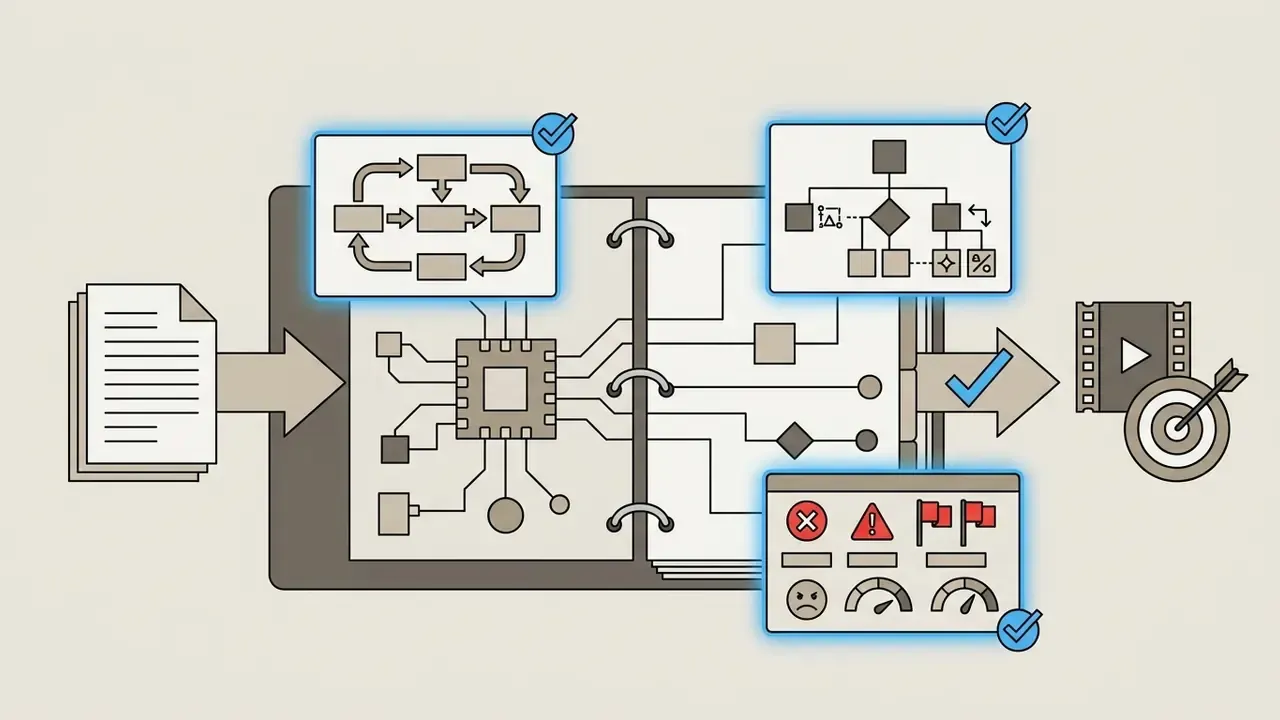
For validators, the three layers are three distinct control surfaces. The scripting layer governs factual fidelity. The generation layer governs visual reliability and identity stability. The assembly layer governs consent, likeness, and provenance labeling. A single "AI video risk" rating that ignores this separation will misprice the exposure, usually downward.
From Prompt to Visual Concept
The transformation of a prompt into a visual concept begins when a text encoder converts natural-language words into high-dimensional vector embeddings. Large language models decompose complex prompts into structured scene blueprints, extracting background parameters, foreground subjects, spatial boundaries, and visual style cues.
Once text tokens are mapped, the system generates initial spatial layouts in latent space. The model aligns semantic attributes, including object color, scale, and lighting, with corresponding latent features.
When a prompt requests "a retro-futuristic city street illuminated by neon rain reflections," the encoder extracts distinct attributes for time, lighting, material surfaces, and atmosphere. The neural backbone then constructs a baseline latent representation matching those combined textual requirements.
Because this stage fixes meaning, it is also where hallucination originates. If the scene blueprint mis-binds an attribute, assigning a color, count, or role to the wrong object, every downstream frame inherits the error. Compositional benchmarks test exactly this binding behavior across spatial relations, motion binding, action binding, object interactions, and numeracy. Models still fail these categories at material rates.
How AI Models Generate Motion and Consistent Frames
AI models maintain frame-to-frame consistency using spatiotemporal transformers or space-time diffusion architectures. These networks process spatial features across consecutive frames simultaneously, applying temporal attention mechanisms to suppress visual flickering and object distortion.
Architectures such as space-time U-Nets and Diffusion Transformers (DiTs) evaluate full video clips as unified token sequences rather than isolated static frames. This holistic processing lets the model calculate fluid trajectories for moving subjects and stable camera paths.
"A Space-Time U-Net generates the entire temporal duration of the video in a single pass, achieving global temporal consistency, unlike cascaded keyframe systems."
To enforce temporal coherence, models apply cross-attention layers that preserve object identity tokens across timesteps. Transformer-based video models add unified spatial-temporal mask modeling to capture long-range correspondences, while dedicated temporal-consistency objectives are used in video super-resolution to retain fine detail during upscaling. Despite all those mechanisms, keeping subtle features stable, facial detail or text on screen for example, remains genuinely hard across longer sequences.
Published measurements make the drift concrete. Identity-preservation studies report significant temporal decay in standard image-to-video models when frames are sampled across a clip, and long-form generation work documents identity flicker across 60-second outputs. Whatever the architecture, one practical rule holds: reliability decreases as duration increases.
Audio, Voice, Music and Video Rendering
Audio integration in modern AI video platforms runs through parallel processing pipelines combining text-to-speech synthesis, automated sound effect matching, and background music layering. The combined audio channels are timed to match visual events before final file encoding.
Speech synthesis converts text scripts into vocal waveform tracks using neural audio generators. Teams selecting a narration stack independently of the visual model can compare voice quality, language coverage, and licensing terms across AI voice generators before committing to a bundled platform. Enterprise voice pipelines commonly mix a synthesized speech track with a separately declared background audio layer, then hand the mixed composition to the render stage.
Alignment modules then map acoustic phonemes directly to facial character movements, driving frame-level lip synchronization.
"ConsistentAvatar uses a diffusion neural renderer that integrates audio features with 3D facial geometry for stable lip-sync and expression across the full video."
The final rendering stage converts denoised latent video representations into standard pixel formats such as MP4. Super-resolution spatial upscalers sharpen clip resolution to high definition, while frame interpolation algorithms smooth temporal motion prior to export. Platform render services typically package the composition (avatar, graphics, music, sound effects) and inject asset URLs at render time. That is why the render log is such a useful audit artifact: it records exactly which assets entered the published file. When storage or distribution limits bite, a video compressor applied after render preserves the approved master while producing channel-specific derivatives.
E-E-A-T Verification: Probabilistic Prediction vs Physical Understanding
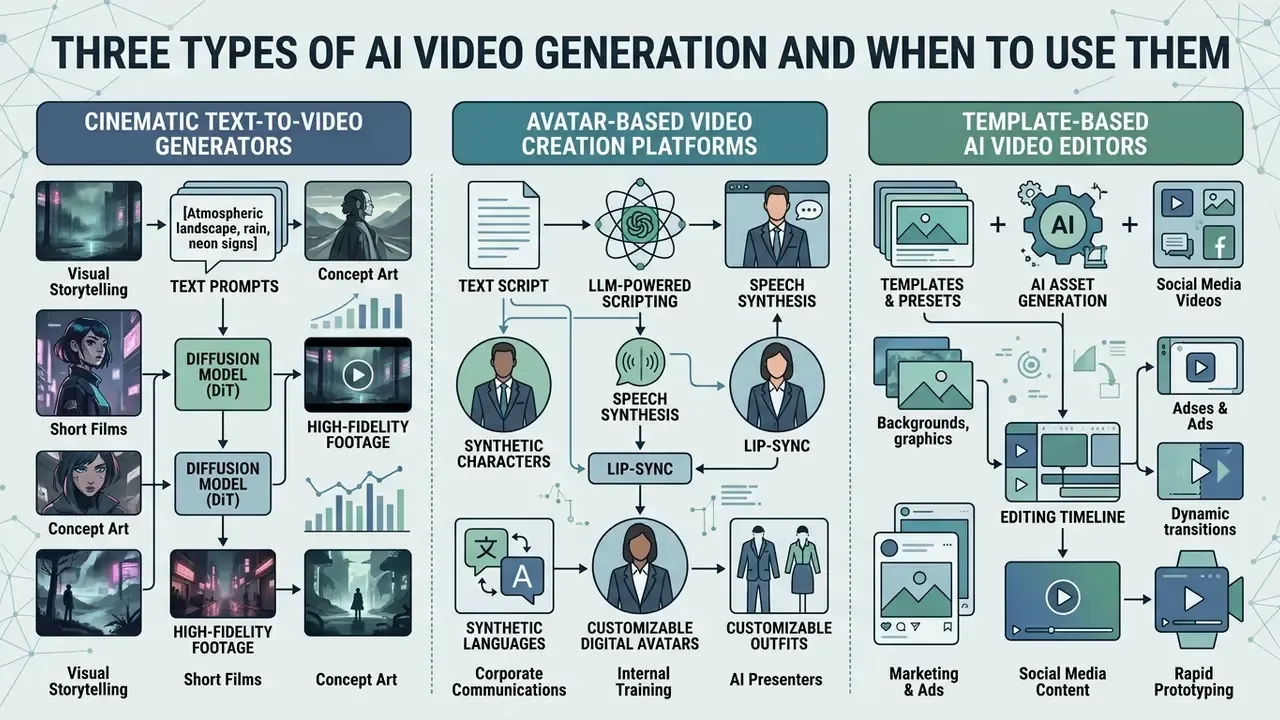
Three Types of AI Video Generation and When to Use Them
AI video generation tools fall into three functional categories: prompt-driven cinematic generators, presenter-led avatar platforms, and automated template-based editors. Each targets distinct commercial use cases, asset inputs, and production requirements.
| Generation Type | Primary Inputs | Typical Outputs | Creative Control | Best Commercial Use Cases |
|---|---|---|---|---|
| Cinematic Generators | Text prompts, seed images, motion vectors | High-definition synthetic clips (5 to 20s) | High prompt flexibility, lower frame precision | Creative concepting, B-roll generation, social teasers, visual FX |
| Avatar-Based Platforms | Scripts, audio voice tracks, presenter profiles | Lip-synced talking-head presenter videos | Medium template control, high facial alignment | Corporate training, multilingual onboarding, customer support explainers |
| Template-Based Editors | Web URLs, documents (PDF/PPT), stock assets | Assembled branded promotional videos | High asset control, lower motion synthesis | Product showcases, automated blog-to-video, social media ads |
Overlay the enterprise dimension and the ranking changes considerably:
| Generation Type | Editing complexity after generation | Deployment options commonly offered | Governance profile |
|---|---|---|---|
| Cinematic Generators | High: manual assembly, trimming, audio layering | Mostly multi-tenant SaaS or API | Highest variance; hardest to make reproducible |
| Avatar-Based Platforms | Low to medium: script edits regenerate the take | SaaS with enterprise tiers, SSO, brand controls | Likeness consent and voice cloning are the core controls |
| Template-Based Editors | Low: layout is preset, assets swap in | SaaS, often with brand-kit and role permissions | Most reproducible; main risk is stock-asset licensing |
Cinematic Text-to-Video Generators
Cinematic generators build visually complex scenes directly from text prompts and initial image conditions. Platforms in this tier emphasize expressive camera angles, artistic styles, detailed atmospheric lighting, and fluid motion dynamics.
These tools let creators specify detailed shot parameters such as camera trajectory, depth of field, and lens movement. Vendor prompting documentation treats camera motion as a first-class prompt element, using patterns like "camera [motion description] as the subject [action]", while research systems condition generation on sparse or dense motion trajectories and on user-supplied camera paths projected through a 3D cache. Production teams use cinematic systems mainly for short promotional teasers, dynamic background footage, and conceptual pre-visualization sequences.
Duration ceilings matter for planning. Published model documentation in this tier has described outputs up to 1080p and roughly 20 seconds per generation, with 8-second native-audio clips common. Product availability also shifts quickly, so any procurement assumption should be re-verified against current vendor documentation rather than secondary guides.
Avatar-Based Video Creation Platforms
Avatar platforms generate synthetic digital presenters that deliver scripted spoken content with precise lip-sync. These systems accept natural-language scripts or recorded voice tracks to drive digital character movements in multiple languages. Vendor claims in this category currently range from roughly 130 to 175+ supported languages, dialects, and accents. The discrepancy comes from how each vendor counts dialects versus accents, and whether stock voices, dubbing, and custom avatars are pooled into one figure.
Organizations deploy avatar generators to build scalable training modules, operational policy walkthroughs, and localized explainer videos. By decoupling video updates from presenter schedules, teams refresh visual compliance assets whenever internal policies change.
The control that matters most here is consent. A custom avatar is a biometric likeness and a cloned voice is a biometric identifier. Both require documented, revocable authorization, retention limits, and a defined process for de-provisioning a departing employee's avatar from the asset library. That last point gets forgotten with striking regularity.
Template-Based AI Video Editors
Template-based AI editors automate visual assembly by matching uploaded brand materials, slide decks, and articles with stock visual sequences. These platforms produce formatted videos by layering text captions, voiceovers, background audio, and branded scene transitions over structured timeline layouts. Documented capabilities in this tier include auto-caption generation with editable timing and styling, subtitle restyling or removal, and one-click reformatting to vertical 9:16 for Reels, Shorts, and TikTok.
Marketing and publishing teams use template tools to convert written blog posts and product documentation into short video summaries. The approach speeds up social media content delivery by automating repetitive editing work such as auto-captioning and frame resizing. Because layout and pacing are fixed, template outputs are also the easiest category to reproduce exactly, an underrated advantage when an approved compliance module must be regenerated identically after a policy amendment.
What Can You Actually Create With AI Video Today?
Current text-to-video technology reliably creates short visual clips, stylized animations, digital presenter modules, and dynamic B-roll footage lasting under 20 seconds. Constraints persist when generating longer continuous scenes, complex multi-subject physical interactions, or stable on-screen typography.
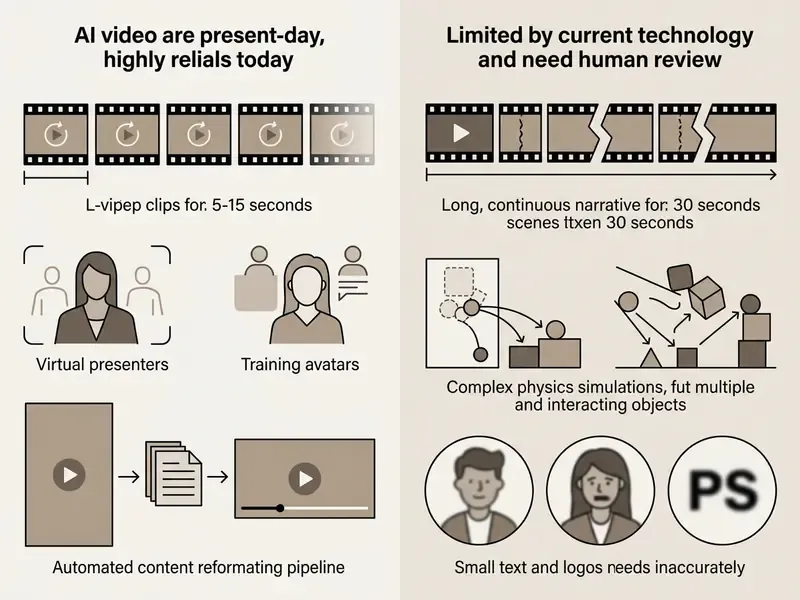
Benchmark evidence supports this split, rather than vendor demo reels. World-knowledge benchmarks published for 2026 tested ten advanced models and found most failed on prompts requiring real-world knowledge, with the best systems averaging roughly 0.68 and overall scores generally below 0.70. Dedicated text-rendering benchmarks found that most models cannot produce legible, frame-consistent on-screen text, especially for longer strings.
Video Formats, Visual Styles and Content Outputs
AI video tools support diverse output formats tailored for specific distribution channels, including vertical 9:16 aspect ratios for mobile feeds and 16:9 widescreen for web viewing. Rendered visual styles range from photorealistic landscapes and 3D architectural renders to 2D vector animations and stylized artwork. Brand motion-design guidance usually separates realistic animated illustration, refined line-based graphics, and shaded three-dimensional treatments, while broader style taxonomies add 2.5D, stop-motion, mixed media, and whiteboard formats. That map is useful when defining an internal house style, and it intersects naturally with dedicated animation makers for stylized or character-led outputs.
Commercial teams routinely produce short social media teasers, digital product showcases, and narrated training segments with these tools. For broader platform comparisons across different commercial workflows, an AI Video Tools Comparison Matrix gives structured insight into feature sets, output constraints, and pricing tiers.
Quality, Consistency and Creative Control
Maintaining visual quality, character identity, and precise spatial composition across multiple generations remains the primary technical bottleneck. Individual short clips can look strikingly photoreal, yet subject appearance often drifts when the camera angle or scene condition changes.
Multi-subject interactions frequently introduce visual artifacts: morphing limbs, unstable backgrounds, unnatural physics.
"T2V-CompBench evaluates 1,400 prompts across seven categories and exposes systematic failures: models frequently confuse object attributes and lose object identity between frames."
Prompt engineering alone cannot guarantee frame-level precision, which makes human review essential in production workflows. Review literature adds a subtler failure mode: video diffusion models can inherit static priors from reference inputs, producing repetitive or unnaturally damped motion that looks technically clean but reads as lifeless. Automated quality metrics often miss it. A human reviewer catches it in seconds.
Documented failure taxonomy for QA checklists:
| Failure mode | Typical trigger | Detection method |
|---|---|---|
| Identity drift | Viewpoint change, clip length over ~10s | Frame-to-reference facial comparison |
| Motion flicker / static prior | Reference-image conditioning | Frame-by-frame playback at 0.25× speed |
| Attribute mis-binding | Multi-object prompts, counting | Compare frame content to prompt spec line by line |
| Physics violation | Contact, collision, gravity, causality | Human review of interaction frames |
| Illegible on-screen text | Any embedded typography | Read text at 100% zoom; prefer overlaid text in post |
How to Create a Video With Text-to-Video AI: An Auditable Workflow
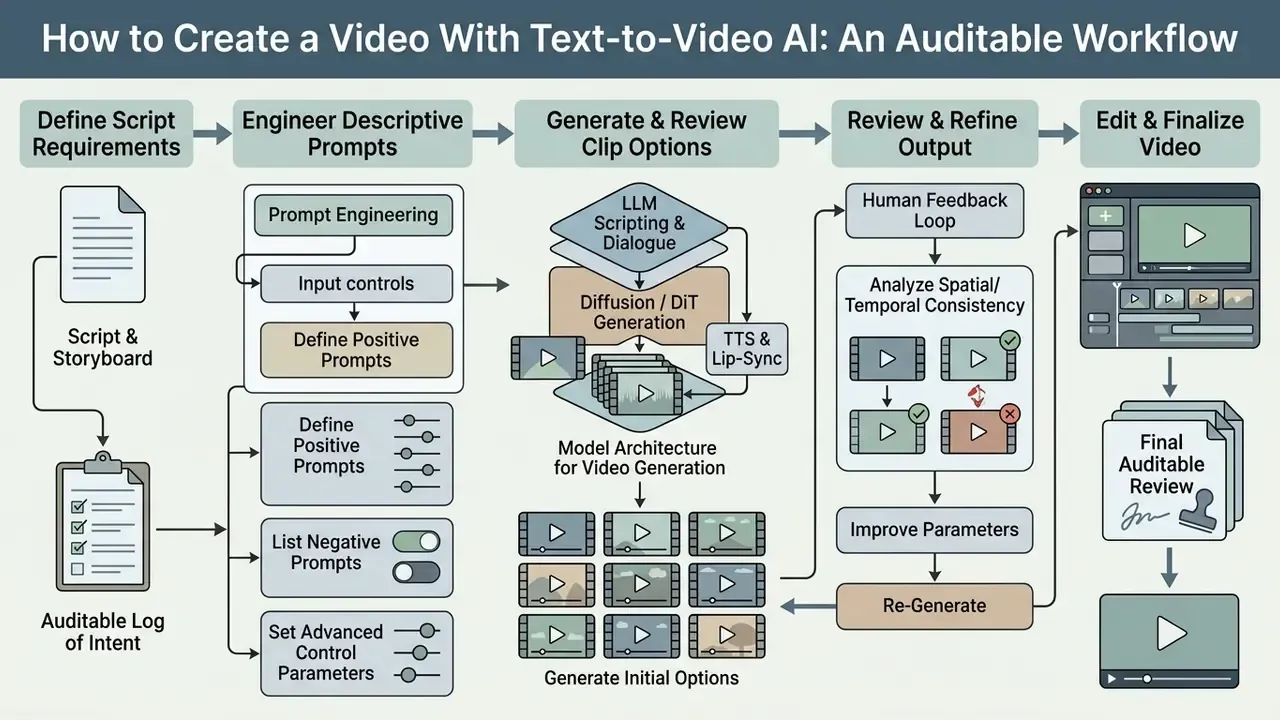
Creating a video with text-to-video AI follows a structured sequence: define script requirements, engineer descriptive prompts, generate initial clip options, review spatial artifacts, log decisions, then edit final clips on a timeline. Teams working without budget approval can prototype the same sequence using free AI video generators before scaling to a licensed platform.
Treat the checklist below as the operating procedure rather than a summary of one. This is the practical core of any text-to-video AI explained guide: each step carries its detail inline, including the evidence it must leave behind.
Step 1 — Define objective and format. Select target aspect ratios (9:16 vertical, 16:9 wide), duration parameters, distribution channel, and visual style standards before writing prompts. Record the intended audience and whether the output is internal, customer-facing, or regulated communication. That classification sets the depth of review required at Step 5.
Step 2 — Structure the baseline prompt. Draft prompt strings incorporating subject, explicit action, environmental setting, camera movement, lighting, and style keywords. See Section 16 for the full prompt grammar, negative prompts, and motion controls.
Step 3 — Select platform and seed settings. Choose the generator class matching project requirements (cinematic, avatar, or template), and lock random seed values when testing prompt adjustments so that visual changes are attributable to the prompt rather than to sampling noise.
Step 4 — Generate iterative variations. Run multiple generation batches per scene, isolating prompt adjustments from random noise variations. Where a scene is critical, generate 5 to 8 variants and select, rather than iterating blindly.
Step 5 — Quality assurance check. Inspect rendered clips for identity drift, unnatural physics, flickering, attribute mis-binding, illegible embedded text, and temporal alignment errors, using the failure taxonomy in Section 14. Regulated content requires a named human approver, not a generic sign-off.
Step 6 — Audit logging and provenance labeling. Record the exact prompt, negative prompt, seed, model name and version, platform, generation timestamp, reviewer identity, and approval decision. Attach content credentials or visible labeling to the approved asset before distribution. This step separates a defensible workflow from an undocumented one.
Step 7 — Timeline assembly and post-editing. Import approved AI clips into an editor, add transitions, layer background music, align voiceovers, and apply text overlays.
Step 8 — Final export and archival. Export master files to delivery specifications, archive prompts and seeds alongside the master for future scene updates, and store the approval record with the asset so a later audit can reconstruct how the file was produced.
Turn an Idea Into a Clear Video Prompt
An effective video prompt structures details in a clear sequence: subject definition, physical action, setting, camera movement, lighting type, then visual aesthetic. Vague descriptors produce unpredictable results, whereas explicit spatial terms guide latent feature sampling accurately. Vendor prompting guides published through 2026 converge on roughly the same ordering, shot type, subject, action, location, aesthetic, with camera move and lighting direction treated as the minimum viable specification.
A prompt such as "A drone shot flying through a fog-covered forest, soft morning sunlight filtering through trees, cinematic 8k, continuous forward camera motion" supplies clear spatial and movement cues. Avoiding ambiguous phrasing reduces unwanted background artifacts.
Advanced Control Parameters: Negative Prompts and Motion Vectors
High-precision generation requires defining both what to include and what to exclude:
- Positive structure
[Subject] + [Action] + [Environment] + [Camera Trajectory] + [Lighting/Style] - Negative prompts Explicitly strip undesirable artifacts with parameters such as
morphing limbs, text overlays, flickering, extra fingers, low-res background, unintended slow motion, watermark. - Motion controls Use motion brushes or directional vectors (pan, tilt, zoom speed on a 1 to 10 scale) to force deterministic camera paths instead of relying on ambiguous text descriptors. Research systems demonstrate the same principle through explicit trajectory conditioning: the more the camera path is specified numerically, the less it is guessed statistically.
- Consistency anchors Keep character and environment descriptions byte-identical across scenes in a multi-scene sequence, and reuse the same seed for recurring subjects.
A reproducible prompt record contains all four elements plus the seed. Without the negative prompt and the seed, a "successful" generation cannot be recreated, which makes it unusable as a controlled asset even when the output looks perfect.
Generate, Review and Improve Video Output
During generation, operators evaluate output clips against the original visual objectives. When minor artifacts appear, adjusting prompt parameters while locking seed values helps identify whether the distortion stems from the description or from generation noise.
The iterative loop is deliberately narrow: generate, analyze, adjust one variable, regenerate. Keep the seed fixed to isolate prompt effects, and change the seed only when composition itself must be re-sampled. Targeted artifact removal uses negative prompts or inpainting on the affected region rather than a full rewrite of the prompt. Selection should favor the result closest to the brief, not the most visually polished one. And the winning prompt and seed must be recorded at the moment of selection, not later from memory.
One illustrative example, composite rather than a named client: a media team needed consistent visual B-roll for an internal compliance campaign. By fixing seed parameters across iterations and refining explicit lighting descriptors, the team eliminated recurring background flickering while keeping scene composition stable across three distinct promotional segments.
Edit the Generated Video for Final Use
Post-generation editing aligns generated clips with brand guidelines, external audio, and delivery requirements. Editors combine individual AI segments on a timeline, trimming awkward motion frames and inserting smooth transitions between cuts. Editor documentation across major suites describes the same finishing toolkit: drag-and-drop transitions such as dissolves, slides, and wipes; separate audio crossfades using constant-power curves; per-clip transition control; and independent volume balance between narration and background music. Teams standardizing this stage can compare timeline features across mainstream video editing tools before locking a house workflow.
Generative in-text editing. Unlike traditional NLE (non-linear editing) software requiring manual cut adjustments, modern AI platforms let creators "edit with words." Modifying a word in the script regenerates the corresponding scene, adjusting timing, voiceover, and visual alignment without rebuilding the timeline. Correcting a policy figure in an onboarding module becomes a text edit followed by a re-render, not a reshoot. Which is precisely why the script, not the timeline, becomes the master document and the primary object of review and version control.
At this stage, teams layer text overlays, professional voice tracks, and audio cues over generated assets. Overlaid text is also the correct remedy for the illegible-typography failure mode: render captions and lower-thirds in the editor instead of asking the model to draw letters. For short-form campaigns, creators often adapt these techniques using dedicated AI Video for YouTube Shorts production strategies.
Where Text-to-Video AI Is Used: Marketing, Education and Business
Text-to-video AI is actively deployed across digital marketing, employee training, customer onboarding, and corporate communications. Organizations use these platforms to raise video creation throughput, lower external production expenses, and localize content quickly for international audiences.
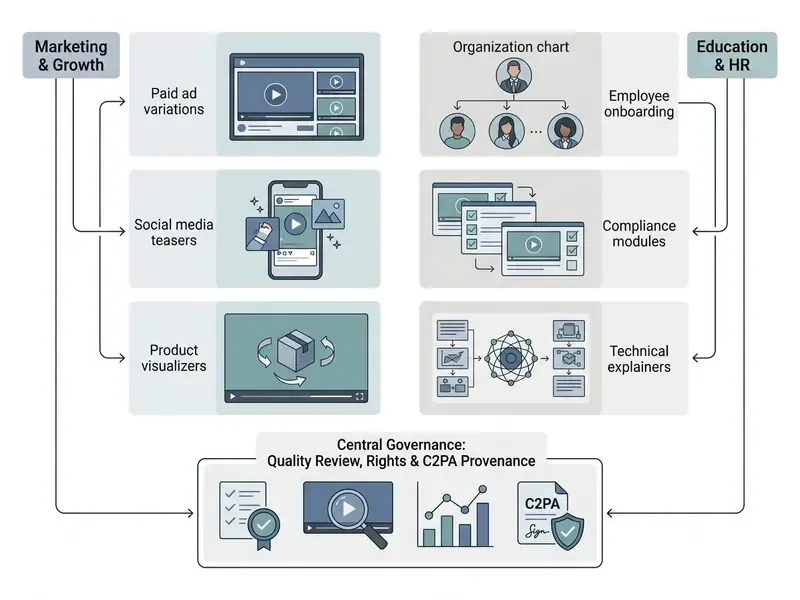
Beyond the two core clusters above, several additional niches now appear consistently in production usage:
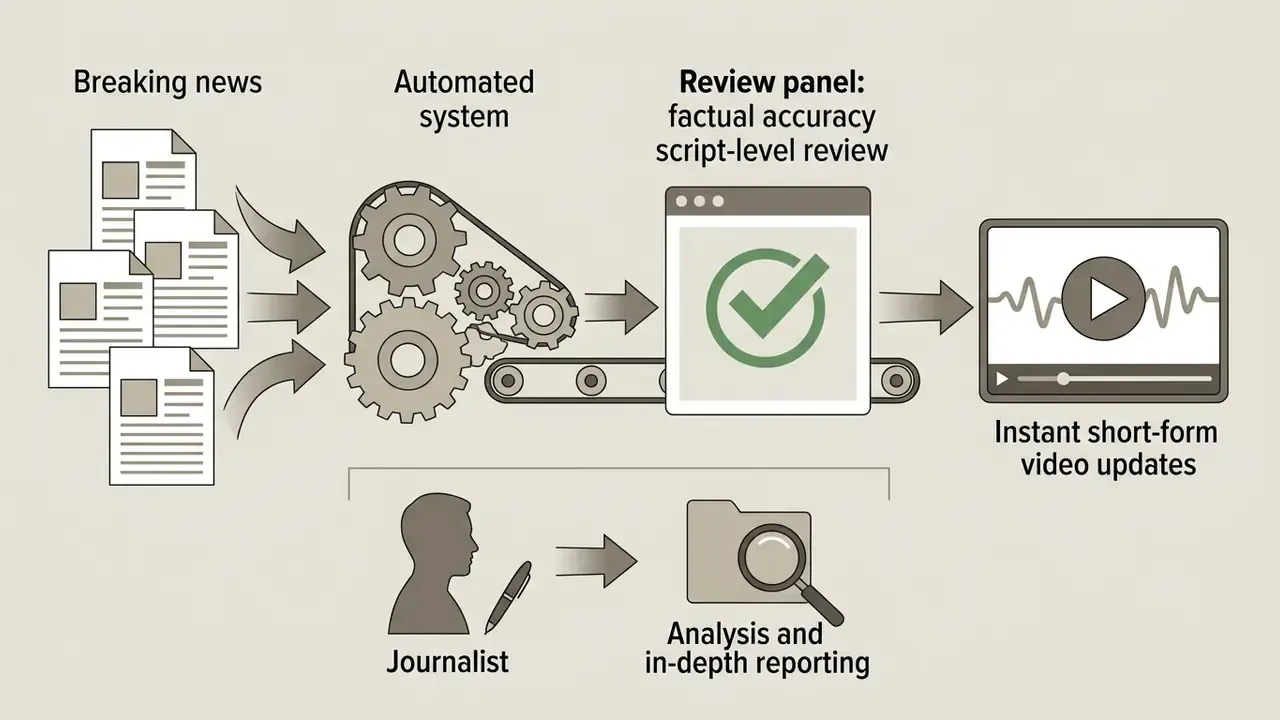
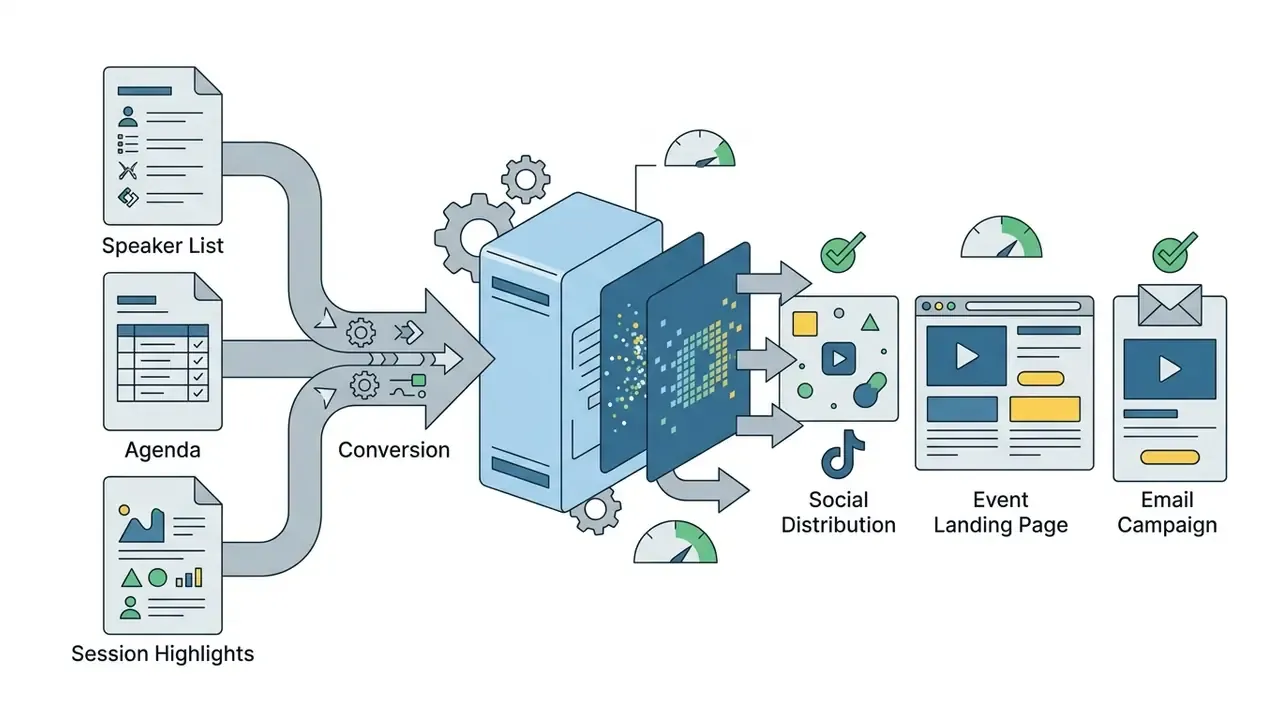


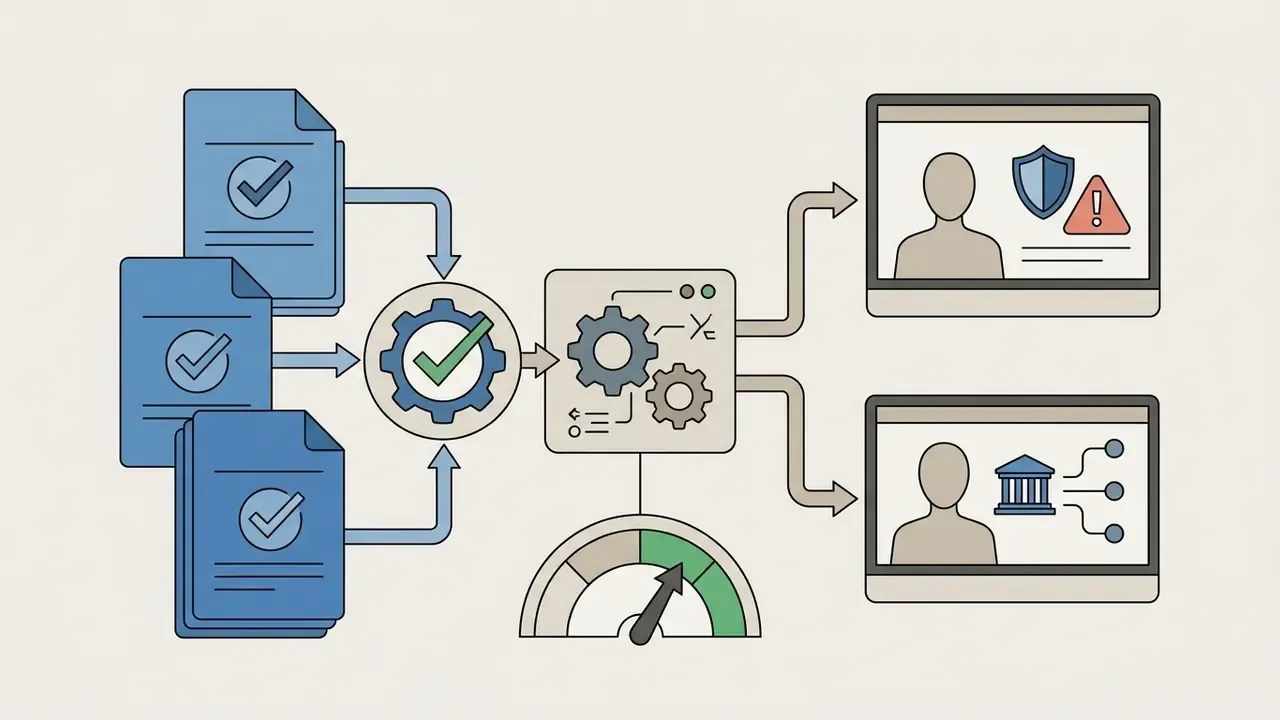
Training, Education and Explainer Videos
"A randomized experiment (n=83) found that both traditional-video and synthetic-video groups showed significant knowledge gains (p<0.001), with no statistically significant difference between conditions (p=0.80)."
That equivalence lets corporate training teams scale educational materials without continuous filming sessions, and it reframes the decision as an economics question rather than a pedagogy question. If comprehension is statistically indistinguishable in short modules, the deciding variables become production cost, update latency, and governance overhead.
Replacing text documentation with video also affects retention. Commercial audience-engagement data widely cited in marketing and learning research suggests viewers retain approximately 95% of a message delivered through video, against roughly 10% when reading static text. That figure originates in industry engagement studies rather than peer-reviewed replication, so present it as directional commercial evidence. Still, the direction is consistent enough to explain why enterprises are migrating policy walkthroughs and compliance modules to avatar-led formats.
Federal guidance sets the guardrails for this use case. NIST's generative-AI profile directs organizations to assess outputs for accuracy, privacy, bias, and intellectual-property risk before operational use, and U.S. agency training materials instruct employees to use non-sensitive inputs and to review generated content for accuracy and relevance before official use. Applied to training video, that means the script is a reviewed control artifact and the model is a rendering service. Nothing more.
How to Choose Text-to-Video Tools for a Workflow
Selecting an AI video platform means evaluating licensing terms, enterprise API integrations, data privacy controls, export formats, and custom avatar options. Production teams must align software capabilities with organizational needs and risk management requirements, in that order.
Enterprise Selection Matrix
| Criterion | Question to answer during procurement | Evidence artifact to request |
|---|---|---|
| Deployment model | Multi-tenant SaaS, dedicated VPC, or on-premises inference? | Architecture diagram, data-flow map |
| Data retention | Is zero-data-retention available for prompts, documents, and uploads? | Contractual DPA clause, not marketing copy |
| Training on customer data | Are inputs excluded from model training by default? | Written opt-out or contractual exclusion |
| Provenance support | Are content credentials or visible watermarks applied automatically at export? | Sample exported file with metadata intact |
| Auditability | Are prompts, seeds, model versions, and approvals logged and exportable? | Log schema and export sample |
| Identity and access | SSO, role-based permissions, brand-kit enforcement, approval gates? | Admin console walkthrough |
| Likeness and voice consent | How is avatar or voice consent captured, stored, and revoked? | Consent workflow documentation |
| Content rights | Who owns outputs; what commercial use is permitted; what is restricted? | Terms of service, licensing schedule |
| Integration surface | API, webhooks, LMS/DAM connectors, CI-style automation? | API reference and rate limits |
| Vendor concentration | Can assets, prompts, and templates be exported if the vendor is discontinued? | Export tooling; note that products in this category have been discontinued at short notice |
Total Cost of Ownership, Including Control Costs
Headline generation pricing is the smallest line item in a governed deployment. A defensible TCO model adds:
TCO = platform licence + generation credits + re-generation waste + human review hours + legal/rights clearance + provenance tooling + logging & storage + training and enablement
Two adjustments dominate outcomes in regulated environments. First, review hours scale with risk classification, not with video length: a 30-second compliance clip can require more sign-off than a five-minute internal recap. Second, re-generation waste is systematic, because artifact rates on multi-subject and physics-adjacent scenes remain high. Budgeting a single generation per scene understates true cost, sometimes by a wide margin.
On content rights, the U.S. Copyright Office position is that protection depends on human authorship: AI-generated expressive elements are not protected, and protection attaches to the human contribution in mixed works. Some vendors additionally require that submitters hold all necessary rights for generative AI video offered for commercial licensing, and disclosure obligations differ across jurisdictions. Procurement should therefore capture ownership, permitted commercial use, training-data transparency, and labeling duties in writing.
Organizations evaluating commercial visual platforms often review broader image and visual generation options within an AI Art Generators Comparison framework to assess vendor support, rights management, and generation flexibility across creative workflows. For adjacent asset classes with their own consent and likeness questions, corporate portraits and speaker imagery for example, the same due-diligence lens applies to AI headshot generators and to any photo editor inserted into the pipeline.
Limitations, Ethical Risks and the Future of AI Video
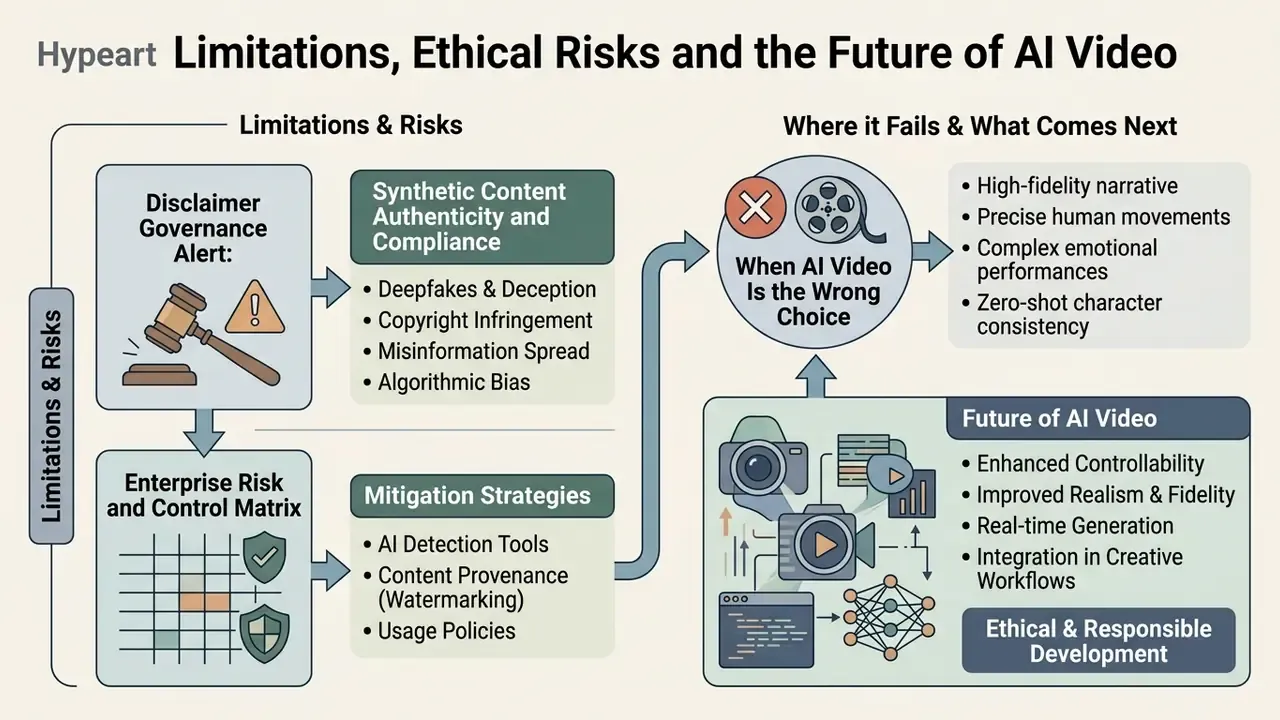
Despite rapid technical progress, text-to-video AI carries operational challenges: temporal inconsistency, physics violations, deepfake misuse risk, copyright ambiguity, and high computational inference costs.
"No evidence, no autonomy. Generative video tools present significant workflow efficiencies, but risk frameworks must evaluate probabilistic pixel synthesis against auditability, factual fidelity, and residual risk before granting operational autonomy."
Governance Alert: Synthetic Content Authenticity and Compliance
"As models such as Imagen Video, CogVideo and Sora proliferate, the barrier to producing convincing deepfakes drops: people without technical skills gain access to realistic synthetic video generation."
The applicable standards are specific enough to reference directly. NIST AI 100-4, Reducing Risks Posed by Synthetic Content (2024), identifies provenance metadata, digital signatures, and watermarking as the primary technical transparency mechanisms, and describes how C2PA stores and signs provenance metadata including origin, edit history, and chain of provenance across images, audio, and video. NIST's AI Risk Management Framework generative-AI profile recommends digital signatures, watermarking, metadata analysis, reverse image and video search, plus forensic analysis to trace origin and modification. U.S. Department of Defense material from 2025 notes that C2PA now supports Durable Content Credentials, where a watermark links provenance to a fingerprint retrievable from a database. That matters, because metadata alone is stripped by most social platforms. Separately, the U.S. Copyright Office defines a "digital replica" as a recording digitally created or manipulated to realistically but falsely depict an individual, treating deepfake harm as a distinct policy problem from copyright infringement. National regimes add disclosure and watermark requirements: Saudi Arabia's SDAIA deepfake guidelines (2025) require disclosure, visible watermarks, consent, and secure distribution controls, and China's generative-AI rules add provider disclosure and training-data transparency obligations.
For financial institutions, the practical mapping is straightforward. Treat generative video as a model-adjacent process under existing model-risk governance, apply the documentation and validation discipline already used for other inference systems, and record residual risk explicitly wherever the control is human review rather than technical assurance.
Enterprise Risk and Control Matrix for AI Video
| Risk | How it materializes | Impact | Control procedure | Audit artifact |
|---|---|---|---|---|
| Shadow AI | Teams generate brand or policy video on unapproved consumer tools | Unlogged publication, untraceable provenance, brand and regulatory exposure | Approved-tool register, egress monitoring, procurement gate, employee training | Tool inventory, exception log |
| Confidential data egress (PII/BII) | Handbooks, SOPs, customer data, or unreleased financials pasted into prompts or uploaded as documents | Data-protection breach, contractual violation | Input classification policy, redaction before upload, zero-data-retention contracts, VPC deployment for sensitive content | DPA clause, prompt log review |
| Factual hallucination | Model renders incorrect figures, dates, policy terms, or on-screen text | Misinformed employees or customers; regulatory misstatement | Script authored and approved upstream; text rendered as post-production overlay, never generated | Approved script version, reviewer sign-off |
| Identity drift / visual defect | Character or product appearance changes mid-sequence | Brand inconsistency, credibility loss | Seed locking, per-frame QA against failure taxonomy, defined defect tolerance | QA checklist per asset |
| Deepfake and impersonation misuse | Executive likeness or cloned voice used without authorization | Fraud, publicity-rights claims, reputational harm | Documented consent with revocation, restricted avatar library, de-provisioning on exit, visible synthetic labeling | Consent record, avatar access log |
| Copyright and asset-rights ambiguity | Training-data provenance unclear; stock or third-party assets reused beyond licence | Infringement claim, unprotectable output | Rights verification for all inputs, vendor indemnity review, human-authorship documentation for protectable elements | Licence file, rights checklist |
| Provenance absence | Synthetic asset published without labeling or content credentials | Non-compliance with disclosure rules, audience deception | Automated C2PA or content-credential application at export plus visible on-asset label | Exported file metadata sample |
| Non-reproducibility | Prompt or seed not recorded; approved asset cannot be regenerated | Loss of control evidence, costly re-creation | Mandatory prompt, negative-prompt, seed, and model-version logging | Generation log entry |
| Vendor concentration | Platform discontinued or repriced at short notice | Workflow interruption, asset lock-in | Export tooling in contract, second-source assessment, prompt library kept vendor-neutral | Continuity plan |
When AI Video Is the Wrong Choice and What Comes Next
AI video is currently unsuitable for high-stakes physical demonstrations, complex narrative feature films, or scenarios demanding exact historical precision and fine motor control. In those situations, physical filming remains necessary to prevent glitches, object morphing, and identity drift.
"VideoVerse (2026) exposes a persistent gap between T2V model capability and world-model requirements: systems routinely violate physical causality and event logic."
The quantitative picture reinforces the boundary. Physics-oriented evaluation published for 2026 reports that 83.3% of exocentric and 93.5% of egocentric generated clips contained at least one human-identifiable physical glitch, and separate 2025 work found that leading models, including Sora, Runway, Pika, Lumiere, Stable Video Diffusion, and VideoPoet, still fail basic physical principles even when output looks photoreal. Safety demonstrations, equipment handling procedures, medical technique, and any content whose instructional value depends on physical accuracy should be filmed.
Future advances focus on physics-aware neural architectures, real-time streaming frame synthesis, and hybrid human-AI production workflows. Recent physics-aware and simulator-in-the-loop methods report improved adherence to gravity, inertia, and collision, with one approach improving physical commonsense scores by roughly 33% over baseline generators. Meaningful progress, though still far from the reliability required for safety-critical demonstration. Longer single-shot generations, stronger character consistency, and real-time preview rendering are the announced near-term directions. As models move toward genuine spatiotemporal stability, AI video tools will increasingly function as collaborative assistants rather than autonomous production systems.
FAQ
Is text-to-video AI the same as an AI video editor?
No. A generator synthesizes new frames from a prompt; an editor assembles, trims, captions, and formats existing footage. Template-based platforms sit between the two, generating a structure from a document or URL and populating it with stock or generated assets.
How long can a generated clip be?
Reliable output remains short. Published model documentation in the cinematic tier has described up to roughly 20 seconds at 1080p, with 8 to 10 second generations common. Consistency degrades as duration increases, and long-form work documents identity flicker across 60-second sequences. Longer videos are produced by assembling multiple approved clips, not by a single generation.
Can AI video be used commercially?
It depends on the vendor's terms and on your rights to every input. In the United States, the Copyright Office position is that AI-generated expressive elements are not protected by copyright; protection attaches to human contributions. Some vendors additionally require submitters to hold all necessary rights for generative video licensed commercially. Verify licensing per platform.
Does AI-generated video have to be labeled?
Disclosure requirements vary by jurisdiction and channel, and several regimes now mandate visible watermarks, consent, and disclosure for synthetic depictions of people. Regardless of the minimum legal threshold, labeling plus content credentials is the defensible default for public distribution.
What is the single most common failure that reaches publication?
Illegible or incorrect on-screen text. The remedy is procedural rather than technical: never ask the model to render typography, numbers, or logos. Overlay them in post-production from an approved script.
Can prompts be treated as confidential?
Only under contract. Unless the vendor offers documented zero-data-retention and exclusion from training, assume prompt and document content is retained. Classify inputs before upload and route sensitive material to a dedicated deployment.
Is on-premises or VPC deployment realistic?
For open-weight video models, yes, at material GPU cost. Most commercial avatar and template platforms remain SaaS with enterprise tiers. There, the practical control is contractual retention terms plus network egress policy rather than local inference.
How should model risk teams classify these systems?
As model-adjacent processes with stochastic output and no verifiable internal logic. Validation should focus on input controls, human review effectiveness, provenance, and reproducibility evidence rather than on parameter-level explainability.
Key Takeaways and Technical Summary
- Definition: Text-to-video AI uses generative neural networks (diffusion models and spatiotemporal transformers) to synthesize moving visual sequences directly from descriptive text prompts. Practitioners comparing specific products can start from a curated overview of text-to-video AI tools.
- Product classes: An AI video tool executes one pipeline layer; an AI video platform orchestrates scripting, generation, and audio assembly end to end. Confusing the two is the most common procurement error.
- Core workflow: Turning prompt text into a finished file involves prompt parsing, latent spatial layout creation, temporal frame denoising, audio synthesis, and final super-resolution rendering, plus, in governed environments, provenance labeling and audit logging.
- Three-layer architecture: LLM scene planning, then spatiotemporal DiT or diffusion generation, then TTS, lip-sync, captions, and assembly. Each layer is a separate control surface.
- Input ladder: Prompt, seed image (TI2V), audio, storyboard, motion vectors, plus Document-to-Video (PDF/PPT) and URL-to-Video ingest. Every ingest path is also a data-egress decision.
- Tool categories: Enterprise solutions fall into prompt-driven cinematic generators, script-led presenter avatar platforms, and automated template-based editors.
- Primary capabilities: Best suited for short B-roll clips, social media teasers, digital presenter explainers, news and event teasers, personal branding, e-learning modules, and high-volume creative variant testing.
- Prompt control: Positive structure, negative prompts, explicit motion vectors, and a locked seed. All four recorded, or the output is not reproducible.
- Generative in-text editing: Editing the script regenerates the scene, which makes the script the master document and the primary review artifact.
- Business case: Comparable comprehension to traditional instructional video in randomized testing (no significant difference, p=0.80), against widely cited commercial engagement data of ~95% message retention for video versus ~10% for static text.
- Current limits: Physical reasoning errors (majority-failure rates on physics-critical scenes), long-range identity drift, flickering, illegible embedded text, fine-grained control constraints, and deepfake risk.
- Governance minimum: Human review gate, prompt/seed/model logging, rights verification, consent management for likeness and voice, C2PA or equivalent provenance labeling, and a TCO model that prices control costs alongside GPU costs.
A Safe Next Step
If AI video is already in use somewhere in your organization, and it usually is, the first move is not a platform decision. It is an inventory question: which teams generate video, on which tools, with which inputs, and where does the approval evidence live?
A low-risk sequence, roughly two to four weeks of effort: No autonomy granted until the evidence exists. That single rule handles most of what follows.
- Inventory current AI video usage, including consumer accounts and free tiers.
- Classify inputs against your existing data classification policy.
- Pick one low-stakes use case (event promotion, internal recap) as the controlled pilot.
- Run the eight-step workflow above end to end, and keep the log.
- Review the log with model risk and internal audit before extending scope.
Appendix A: Superseded Formulations
Retained for transparency; the main text carries the updated versions.