That shift is the real story of the past year. Not prettier pixels.
Last reviewed and updated: September 2026.
Executive Summary for Risk, Compliance and Content Leaders
- Leadership changed hands.The current global leaderboard is no longer led by U.S. labs. Alibaba ATH's HappyHorse-1.0 holds the #1 position for video-only generation (1357 Elo on Artificial Analysis), while ByteDance Seedance 2.0/2.5 leads the with-audio category (1213 Elo). Google Veo 3.1 and Kling 3.0 Omni remain the most enterprise-accessible flagships.
- OpenAI Sora is exiting.Sora 2 was deprecated on April 26, 2026, and its API permanently shuts down on September 24, 2026. No new commercial pipeline should be built on it; existing integrations require a documented migration plan with a named owner.
- Pricing has standardized around per-second metering.Realistic budgeting bands run from $0.03/sec (Veo 3.1 Lite, 720p, no audio) to $0.50-$0.70/sec (4K and premium tiers), with credit-based platforms such as Runway at $0.01 per credit (10 to 12 credits per second).
- The main residual risk is intellectual property, not visual quality.Most vendors grant commercial usage rights on paid tiers but disclaim indemnification against third-party copyright and right-of-publicity claims. Adobe Firefly Video (from $10/month) remains the clearest commercially safe standard, trained exclusively on licensed and public-domain material.
- Provenance is now a control requirement.Google applies SynthID watermarking by default to Veo output, and C2PA Content Credentials are becoming the de facto audit artifact for regulated industries. Prompt, seed, model version, and reference-asset logging should be treated as part of your model inventory evidence, not as a creative team's private notes.
How to Use This Briefing
A short orientation, because the material below serves two different readers.
If you sit in risk, compliance, or internal audit, the sections that matter most are provenance and logging, the licence checklist, and the pre-deployment gate. Those give you defensible evidence and a decision trail. If you own content production or finance transformation, start with the comparison and pricing sections, then read the total cost of ownership model before you sign anything. Both audiences should read the deprecation notice. It is the cheapest lesson in vendor lifecycle risk available right now.
One caveat up front: every leaderboard figure here is a snapshot. Record the date you read it.
Video Generation Model News Today: The Main Market Updates
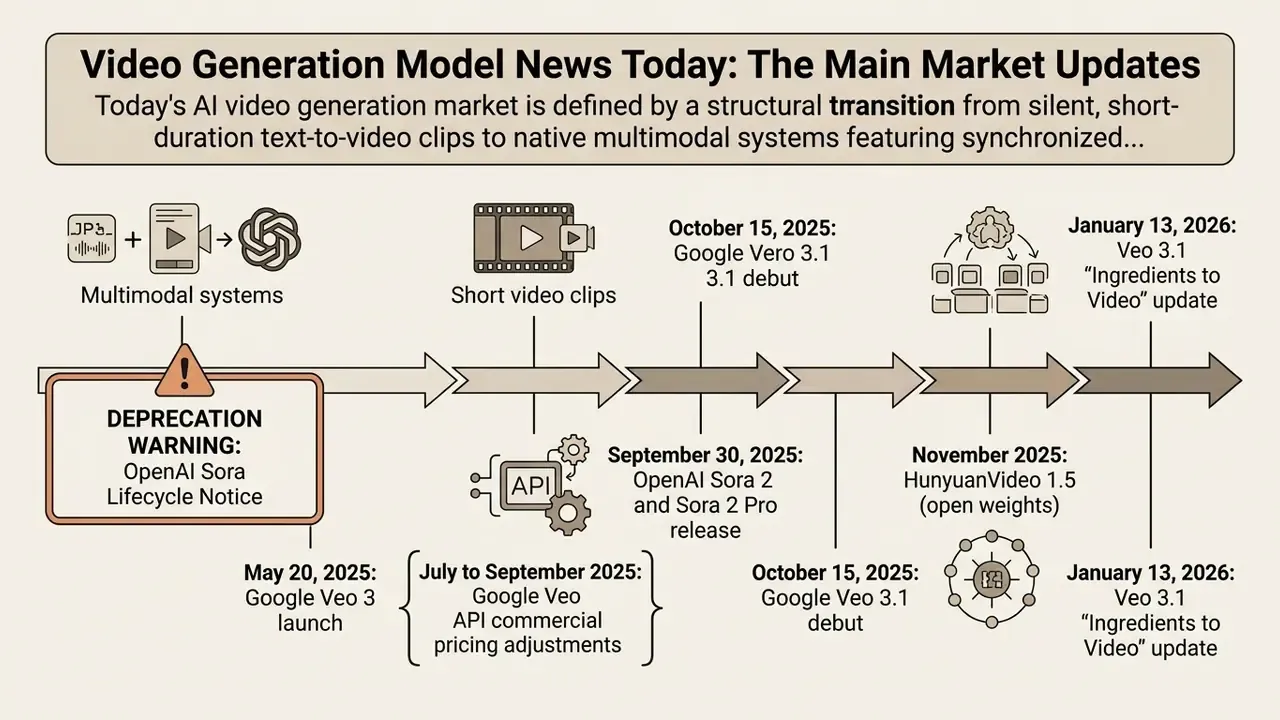
Today's AI video generation market is defined by a structural transition from silent, short-duration text-to-video clips to native multimodal systems featuring synchronized audio, per-second API pricing, and continuous multi-shot controls. Major providers including Google, Alibaba, Kuaishou, Runway, and ByteDance have updated their model architectures to address enterprise demand for spatial-temporal realism and predictable deployment costs. OpenAI has moved in the opposite direction and withdrawn from the consumer video market entirely.
DEPRECATION WARNING: OpenAI Sora Lifecycle Notice
Which AI Video Model Releases Deserve Attention
Major 2025-2026 releases are distinguished from minor parameter updates by fundamental structural improvements in multimodal conditioning, native audio synthesis, and extended context retention. Flagship platforms, including Google Veo 3.1, Kling 3.0 Omni, Runway Gen-4/4.5, ByteDance Seedance 2.0/2.5, Alibaba HappyHorse-1.0, and the open-source Wan 2.7 and LTX-2.3 suites, represent full generational jumps rather than incremental fine-tuning patches. Teams that need a side-by-side feature view before committing budget can start from our overview of the best AI video generators.
Independent evaluation frameworks such as WorldJen (2026) and VBench-2.0 (2025) categorize these major releases based on their ability to execute complex instruction prompts without temporal motion degradation or identity drift.
Minor updates typically address rendering speed or surface UI adjustments. Major releases introduce new model families capable of handling complex physics, multi-shot storyboard continuity, and strict character reference binding. Here is a practical operational test: if migrating to the new version requires re-validating your prompt library and re-running acceptance checks, it is a major release for model-risk purposes, whatever the version number says.
What Changes After Video Generation Model Updates
Recent updates to video generation models have altered production economics by reducing reliance on manual post-production audio pairing and multi-pass clip stitching. The integration of native audio, capable of rendering dialogue, sound effects, and ambient sound in a single inference pass, has lowered baseline production latency while introducing clearer operational standards for video editing and content workflows. Where earlier "native audio" meant room tone and nothing more, 2026-class systems generate lip-synced spoken lines: Veo 3.1 at 48 kHz, Kling 3.0 with multilingual lip-sync, and HappyHorse-1.0 across seven languages.
Furthermore, API pricing adjustments have established standardized billing units, moving from unpredictable flat subscriptions to metered usage based on resolution and clip length. Organizations monitoring media workflows can reference established standards in our AI Media Pricing Guides to evaluate per-second processing costs against traditional footage acquisition, and review downstream delivery constraints in our guide to video compressors.
What Modern AI Video Generation Models Can Do
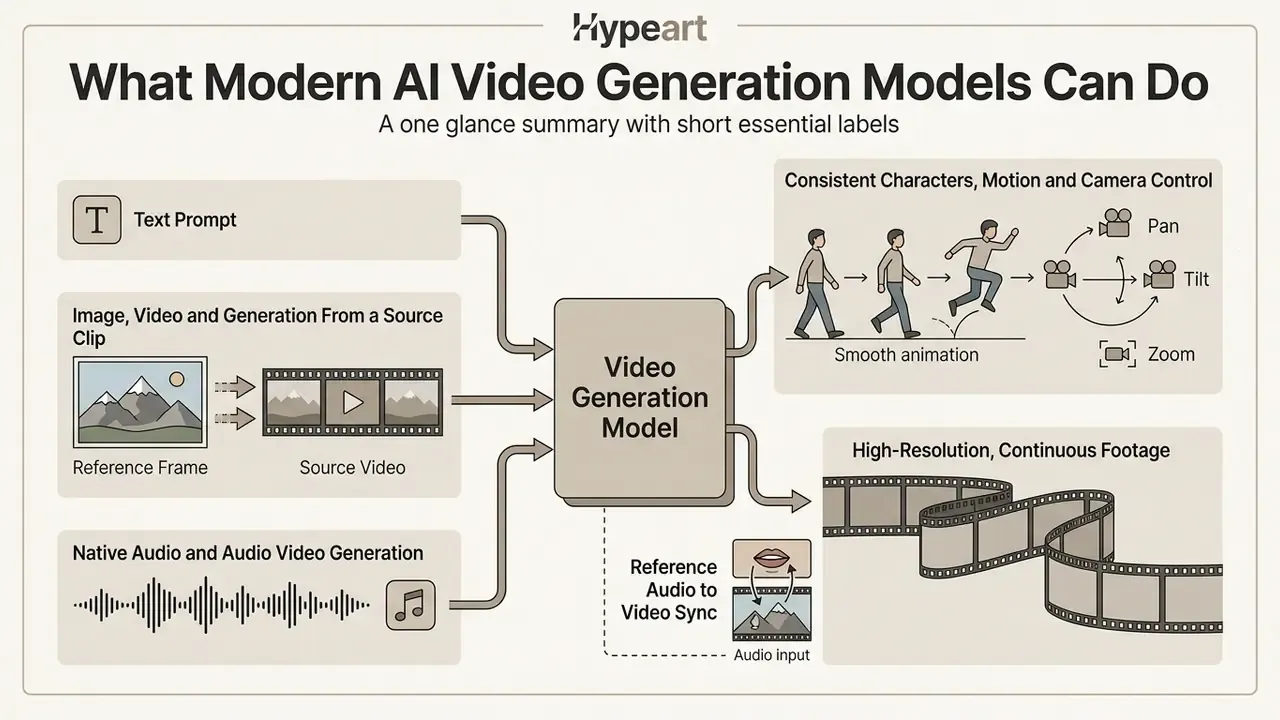
Modern AI video generation models process text, static images, reference audio, and source video clips to synthesize high-resolution, continuous footage with controlled camera motion and synchronized ambient sound. Standard enterprise capabilities now encompass text-to-video synthesis, image-conditioned animation, video-to-video style transfer, native audio generation, multi-shot character consistency, and, in the newest releases, localized regional editing of an existing generation.
Text Prompt, Image Video and Generation From a Source Clip
Text-to-video generation constructs visual footage entirely from semantic text descriptions, requiring the model to synthesize spatial geometry, lighting, and temporal motion from scratch. Readers who need a foundational primer can review our explainer on text-to-video AI tools.
Image-to-video (or image video) workflows use an uploaded still image as an explicit structural anchor, preserving exact visual branding, character appearance, or product design before applying motion vectors. For regulated brand assets this is usually the safer entry point, because the visual identity is supplied rather than invented. Practical implementation patterns are covered in our guide to image-to-video AI tools.
Video-to-video generation conditions output on an existing video clip, constraining performance dynamics while allowing users to alter artistic style, environmental lighting, or foreground elements. Luma's Ray3 Modify extends this into direct editing of live-action actor footage, and Seedance 2.5 adds timestamp-level regional edits. A concrete example: correcting a character's hair colour inside a 30-second take without losing the preferred performance, facial expression, or lighting of the original render.
For broader context on how generative models evolved to support these complex transformations, readers can explore our background analysis on when did ai art start as well as our detailed breakdown explaining what is sora in enterprise video creation.
Native Audio and Audio Video Generation
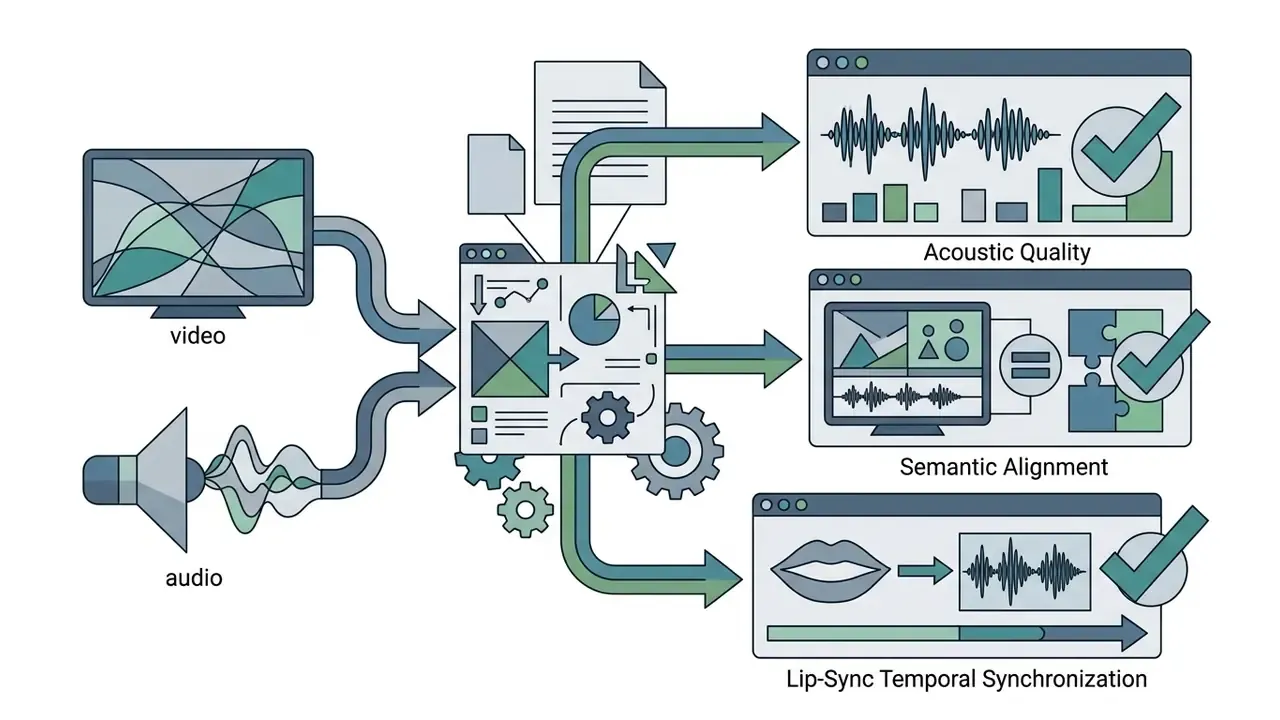
Native audio generation synthesizes synchronized speech, environmental acoustics, and background music simultaneously with visual frame generation within a unified diffusion architecture. Recent research models such as NAVA (2026) and MOVA (2026) use joint multimodal attention mechanisms to eliminate temporal latency between visual actions, such as object impacts or lip movements, and their corresponding sound waves. NAVA reports Sync-C 7.791 and Sync-D 7.566 on Verse-Bench/Seed-TTS, while MTV (2025) separates audio into distinct speech, effects, and music tracks so that lip motion, event timing, and mood can be controlled independently.
«Seedance 2.0 is a native multimodal audio-video model with a unified architecture that accepts text, image, audio and video and generates synchronized content of 4-15 seconds.»
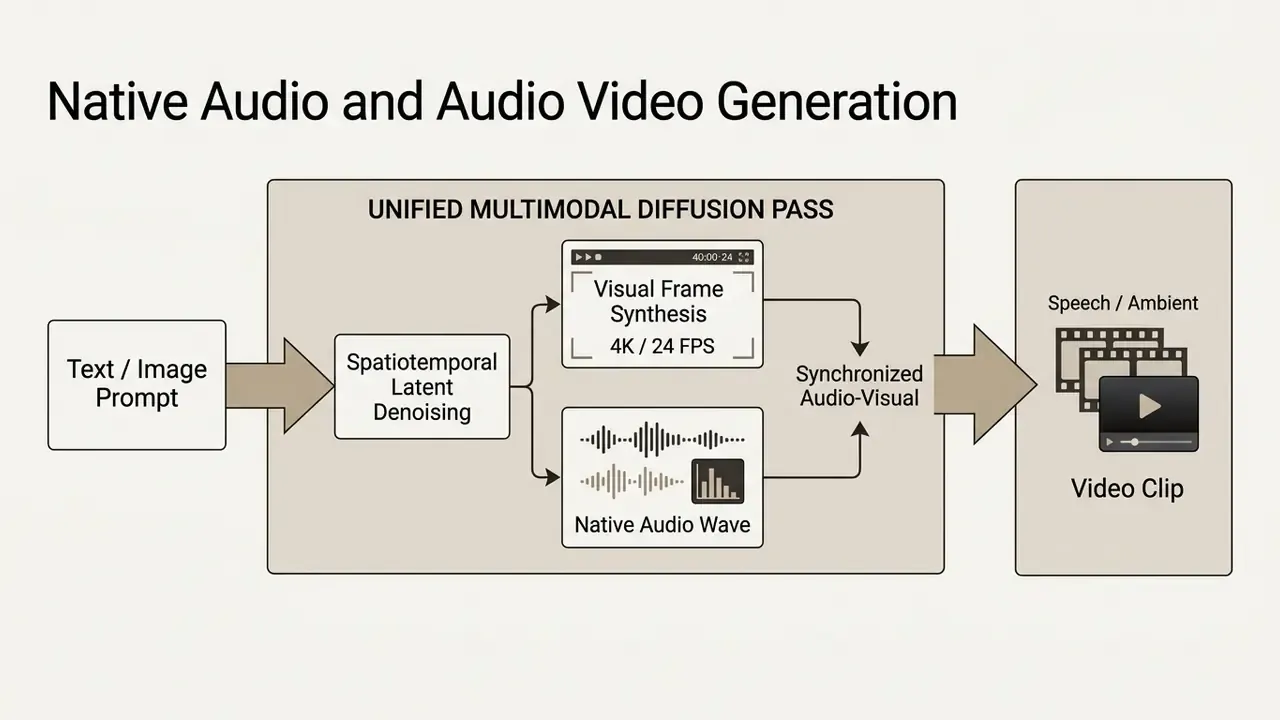
This joint generation process replaces traditional workflow sequences where audio had to be manually recorded, timed, and composited in external editors. Updated on evaluation sourcing: rather than relying on a single audio benchmark claim, the measurable standard is now embedded in general-purpose suites.
Teams that still prefer a decoupled pipeline, for example to keep brand-approved voice talent, can pair a silent-video model with a dedicated voice stack. See our guide to AI voice generators for licensing and voice-cloning consent requirements. Consent records matter here more than audio fidelity does.
Consistent Characters, Motion and Camera Control
Maintaining consistent characters across disparate scenes and controlling camera trajectories are primary requirements for commercial storytelling. Advanced architectures achieve character consistency through identity-conditioned feature sharing, where reference facial features and anatomical traits are embedded into persistent latent vectors across multiple generation requests.
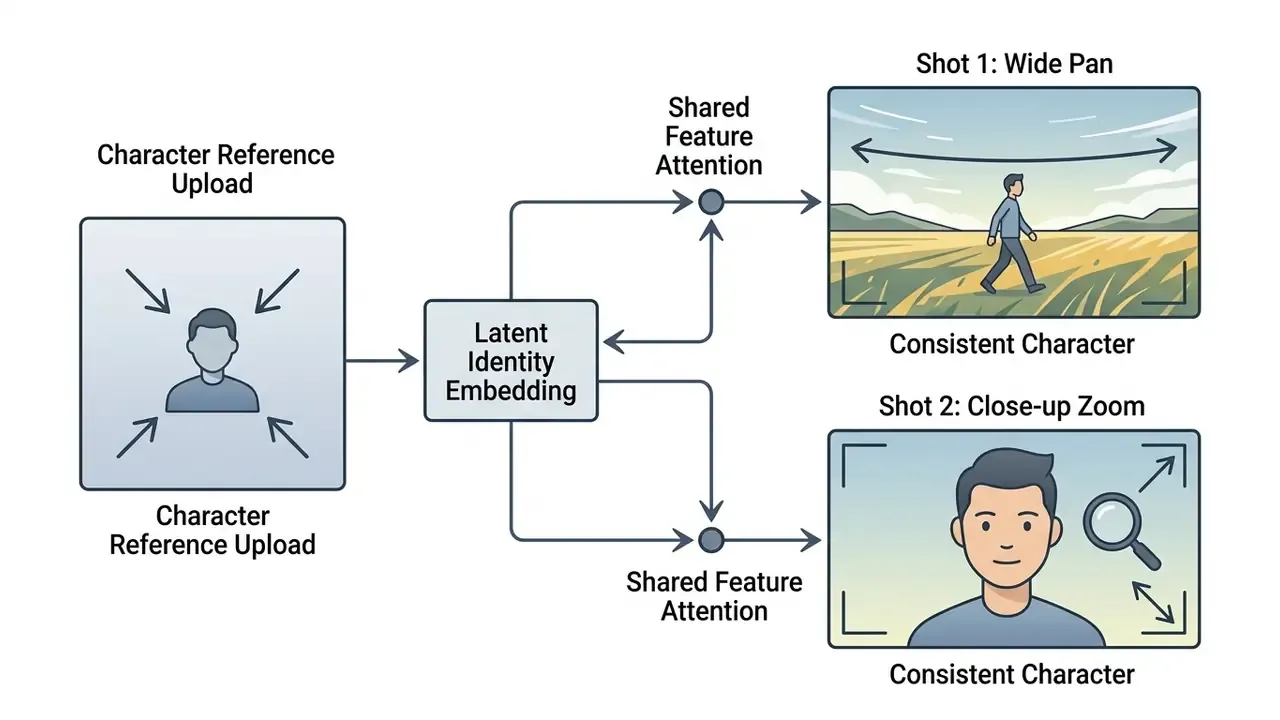
Camera control mechanisms use explicit 3D camera-pose conditioning signals, allowing directors to prompt specific maneuvers such as tracking shots, crane lifts, pan sweeps, and dolly zooms. Kling 3.0 exposes this as six-axis camera control plus object path drawing; Runway exposes separate camera and subject motion channels; Wan 2.7 adds explicit first-to-last frame trajectory control. Updated on source verification: reference-image binding and camera conditioning are best assessed through compositional benchmarks rather than vendor demos.
«T2V-CompBench evaluates 23 models across seven categories, including motion binding and object interaction, showing which models retain character attributes over time.»
For professional colour grading workflows, Luma Ray 3.14 introduces native 16-bit HDR video generation. Output can be exported directly as uncompressed EXR sequences, letting VFX teams perform precise colour transforms and camera matching inside Nuke or DaVinci Resolve without compression clipping. It is the only current model that fits cleanly into an ACES-based finishing pipeline.
Teams reviewing tool capabilities across various platforms can use our AI Media Comparison Matrices to evaluate camera controllability metrics.
Comparison of Leading Video Generation Models: Veo, Kling, Runway, Seedance, HappyHorse and Wan
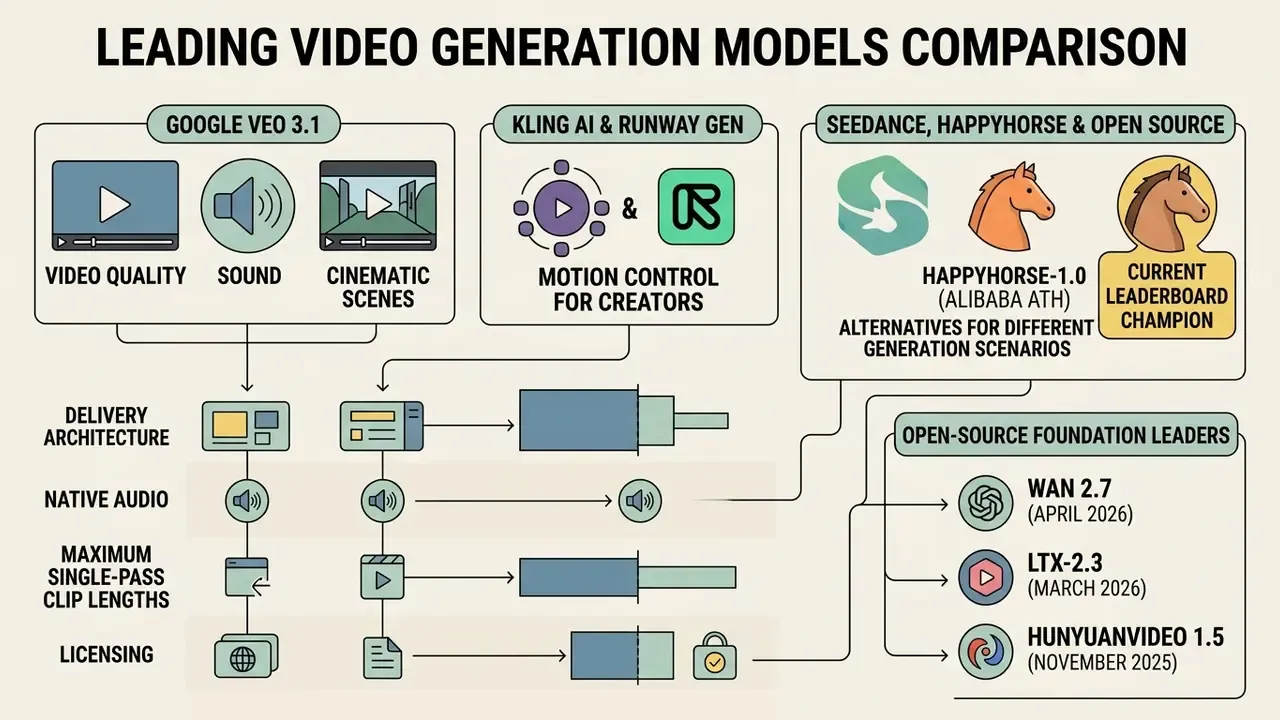
Leading video generation models differ significantly across delivery architectures, native audio support, maximum single-pass clip lengths, and licensing structures. Commercial decision-makers must evaluate whether a proprietary cloud API or a self-hosted open-source model best aligns with their operational security, latency requirements, and budgetary constraints. In regulated environments that question is rarely settled by quality scores alone.
«WorldJen (2026) ranks Veo 3.1 Fast and Kling v2.6 Pro in the top tier of six tested models across 16 quality dimensions, reproducing human annotator judgements.»
MULTIMEDIA BLOCK
Table: leading AI video generation models, capability, duration, access and commercial terms (verified September 2026).
| Model | Model type | Native audio | Camera and motion control | Max single-pass duration | Native resolution | Benchmark standing | Access channels | Pricing and commercial rights |
|---|---|---|---|---|---|---|---|---|
| HappyHorse-1.0 (Alibaba ATH) | Proprietary cloud (15B params) | Yes, 7-language lip-sync | Strong temporal coherence; reference-driven | ~10 seconds | 1080p | #1 Artificial Analysis, video-only (1357 Elo); roughly #1 with audio (1212 Elo) | fal.ai API | Metered API; commercial rights per fal.ai and Alibaba terms |
| ByteDance Seedance 2.0 / 2.5 | Proprietary multimodal | Yes (native joint dialogue, SFX, ambient) | Reference-based multimodal editing; regional and local edits in 2.5 | 15 s (2.0 multi-shot), 30 s native (2.5), 3 min beta | HD to native 4K | #1 Artificial Analysis with audio (1213 Elo) | Doubao app (mobile, desktop, web); regional API routes | Subscription or credits; commercial rights per agreement and region |
| Google Veo 3.1 | Proprietary cloud | Yes, 48 kHz synchronized dialogue | Advanced prompting, camera trajectories, 3 reference images | 4 / 6 / 8 seconds (24 fps), extendable | 720p / 1080p / up to 4K upscale | Top tier on WorldJen; #3 with audio on Artificial Analysis | Gemini API, Vertex AI, Google Flow, Gemini app, YouTube Create, Google Vids | $0.03-$0.50/sec API; AI Pro $19.99/mo, Ultra $249.99/mo; commercial rights on paid and enterprise tiers; SynthID applied |
| Kling 3.0 Omni | Proprietary cloud | Yes (5+ languages, multilingual lip-sync) | Six-axis camera control, object path drawing, element binding, motion transfer | 15 seconds | Native 4K at 60 fps | Four entries in the Artificial Analysis top 10 | Kling API, web platform (Basic to Ultra plans) | Subscription from about $10/mo plus unit API packages (180-day validity); commercial rights on paid plans |
| Runway Gen-4 / 4.5 | Proprietary cloud | External or integrated audio tools | Motion brushes, keyframe motion, camera and subject channels, GWM-1 world model | 5-10 seconds (extendable to ~40 s) | 1280x768, 4K capable | #1 on Artificial Analysis at late-2025 launch (1247 Elo); now displaced, best control surface | Web app, developer API | $0.01/credit (10-12 credits/sec; Gen-4.5 at 12 credits/sec); Standard $12, Pro $28, Max $76/mo; commercial rights on paid tiers |
| Adobe Firefly Video | Proprietary cloud (licensed training data) | No native sync; AI audio added afterwards | Camera motion presets, style controls, reference video for composition and motion | 5 seconds | 540p-1080p | Not leaderboard-leading; optimized for compliance | Firefly web app, Premiere Pro, Photoshop, Express | From $10/mo; explicit commercial-safety guarantee; does not train on customer content |
| Luma Ray 3 / Ray 3.14 | Proprietary cloud | Partial or external | Photorealistic motion, video-to-video (Ray3 Modify) on actor footage | ~10 seconds | Native 16-bit HDR, EXR export | First model with a native HDR pipeline | Luma web app, API | From $7.99/mo; commercial rights on paid tiers |
| Wan 2.7 (Alibaba) | Open source (Apache 2.0) | External | 9-grid image input, first and last frame trajectory control, 5,000-character prompts, fine-tuning | Variable (hardware dependent) | 720p / 1080p | Leads Wan-Bench 2.0 | Self-hosted (GitHub), cloud hosts | Free weights, compute cost only; permissive open licence |
| LTX-2.3 (Lightricks) | Open source (Apache 2.0, 22B params) | Yes, stereo 24 kHz | Vertical-native training, fast and pro variants | Up to 20 seconds | Native 4K at 50 fps | Leads the Artificial Analysis open-weights category (video-only) | Self-hosted, cloud hosts | Free; tiered terms above $10M ARR |
| HunyuanVideo 1.5 | Open source (8.3B params) | External | Standard prompt plus reference conditioning | Variable | 720p | Fastest local renders in class (~75 s on RTX 4090) | Self-hosted | Free; compute cost only |
| OpenAI Sora 2 / Sora 2 Pro | Deprecated proprietary cloud | Yes (synchronized) | Multi-shot persistence, precise moves | Up to 20 seconds | Up to 1080p | Video-Bench: image quality 4.68, aesthetics 4.64, temporal consistency 4.96 out of 5 | App ended April 26, 2026; API shuts down September 24, 2026 | Do not build new pipelines. Historical: $0.10/sec (Sora 2), $0.30-$0.70/sec (Pro), see Appendix A |
Key takeaway: proprietary models (HappyHorse-1.0, Seedance 2.x, Veo 3.1, Kling 3.0) lead in turnkey native audio integration and managed infrastructure. Adobe Firefly leads on legal safety rather than raw fidelity. Open foundation models such as Wan 2.7, LTX-2.3, and HunyuanVideo 1.5 provide complete data privacy and customizable deployment for organizations with dedicated GPU resources. Readers narrowing a shortlist can continue with our comparison of AI video generators and our overview of animation makers for template-driven alternatives.
Google Veo 3.1: Video Quality, Sound and Cinematic Scenes
Google Veo 3.1, developed by Google DeepMind, is a top-tier multimodal model optimized for photorealistic physics, cinematic visual framing, and native sound generation. Operating through the Gemini API and Vertex AI, Veo 3.1 synthesizes 4-, 6-, or 8-second clips at 24 fps in resolutions reaching 4K via upscaling, supporting up to three image references for identity anchoring through the "Ingredients to Video" workflow. Portrait 9:16 output, one video per request, and mandatory SynthID watermarking are documented platform constraints rather than optional settings.
Consumer and enterprise access paths differ materially. Google AI Pro at $19.99/month bundles roughly 1,000 Flow credits (about 100 Lite, 50 Fast, or 10 Quality renders), Google AI Ultra sits at $249.99/month, and API access is billed per second from $0.03/sec (Veo 3.1 Lite, 720p, no audio) up to $0.50/sec at the top of the Vertex AI schedule, with 4K priced as a separate premium tier. For a bank, the relevant path is almost always the enterprise Vertex AI route, because that is where data residency and no-training commitments live.
Developers integrating Google's video stack can review comprehensive API specifications, code implementations, and rate limits in our technical overview of the Google Veo implementation guide.
Kling AI and Runway Gen: Motion Control for Creators
Kling AI (Kling 3.0 Omni) and Runway Gen (Gen-4 and Gen-4.5) emphasize precise motion directing and multi-shot continuity for creative teams. Kling 3.0 offers dedicated full-body and facial expression motion transfer, moving human performance dynamics from a source reference clip onto a synthetic target character. Its documentation notes that motion reference works best with single-shot, continuous source video, since cuts and camera moves can truncate the transferred performance. Kuaishou reports more than 60 million creators and 600 million generated videos since Kling's mid-2024 launch, making it one of the most widely adopted stacks for short-form social output.
Runway Gen-4 uses a keyframe-based control system, enabling creators to set specific visual anchors across initial, middle, and terminal frames, with separate camera and subject motion channels for directed movement. Operating at a baseline of 10 to 12 credits per second, which works out to roughly $0.10-$0.12/sec, Runway offers flexible clip extension mechanisms up to 40 seconds. Gen-4.5 requires the Standard tier or higher and bills at 12 credits per second.
Seedance, HappyHorse and Open Source: Alternatives for Different Generation Scenarios
ByteDance's Seedance 2.0 is a proprietary joint multimodal platform accepting, per generation, up to nine static reference images, three reference video clips, and three audio tracks alongside the text prompt. That is the most permissive input grid of any current model, which makes it effective for complex reference-based editing and brand-asset binding. Output is 5 or 10 seconds single-shot, with a multi-shot mode threading sequences to roughly 15 seconds. Seedance 2.5 (July 2026) extends this to 30 seconds of native single-pass video with up to 50 multimodal references, 4K output, and localized region editing. However, public downloadable model weights are not provided, restricting usage to hosted cloud environments; outside China, distribution depends on Doubao's international rollout. For US institutions, that last point is a procurement question before it is a quality question.
HappyHorse-1.0 (Alibaba ATH): Current Leaderboard Champion
Released in April 2026, Alibaba ATH's HappyHorse-1.0 established a new baseline for non-audio video synthesis, achieving a rank-1 score of 1357 Elo on the Artificial Analysis leaderboard. Built on a 15-billion-parameter transformer architecture, HappyHorse-1.0 specializes in complex temporal coherence and features native seven-language lip-sync (English, Mandarin, Cantonese, Japanese, Korean, German, French) at 1080p resolution. It is accessible for enterprise workflows via the fal.ai API, which makes it the most straightforward way for Western teams to test the current state of the art without a Chinese app account.
Wan 2.7 and LTX-2.3: Open-Source Foundation Leaders
The open-source landscape is anchored by Alibaba's Wan 2.7 and Lightricks' LTX-2.3, both Apache 2.0 licensed:
- Wan 2.7 (April 2026)
- Leads the Wan-Bench 2.0 benchmark. Introduces a 9-grid reference image input, explicit first-to-last frame trajectory control, and extended prompt context parsing up to 5,000 characters.
- LTX-2.3 (March 2026)
- A 22-billion-parameter model capable of generating native 4K footage at 50 fps with integrated 24 kHz stereo audio, trained vertical-native for portrait delivery. Renders local 720p drafts in under 75 seconds on a single RTX 4090 GPU in the 8.3B fast variant class.
- HunyuanVideo 1.5 (November 2025)
- 8.3B parameters, roughly 75-second renders on a single RTX 4090. The pragmatic choice for iteration-heavy internal workflows.
For hardware planning: the earlier Wan 1.3B class runs from roughly 8.2 GB VRAM for 720p output, while 14B-class checkpoints require substantially more memory and, in practice, multi-GPU nodes. This makes the Wan family the most accessible self-hosted option for teams prioritizing data privacy, custom fine-tuning, and zero per-second API fees. It is also the natural fit for regulated environments where prompts may contain confidential product or customer information.
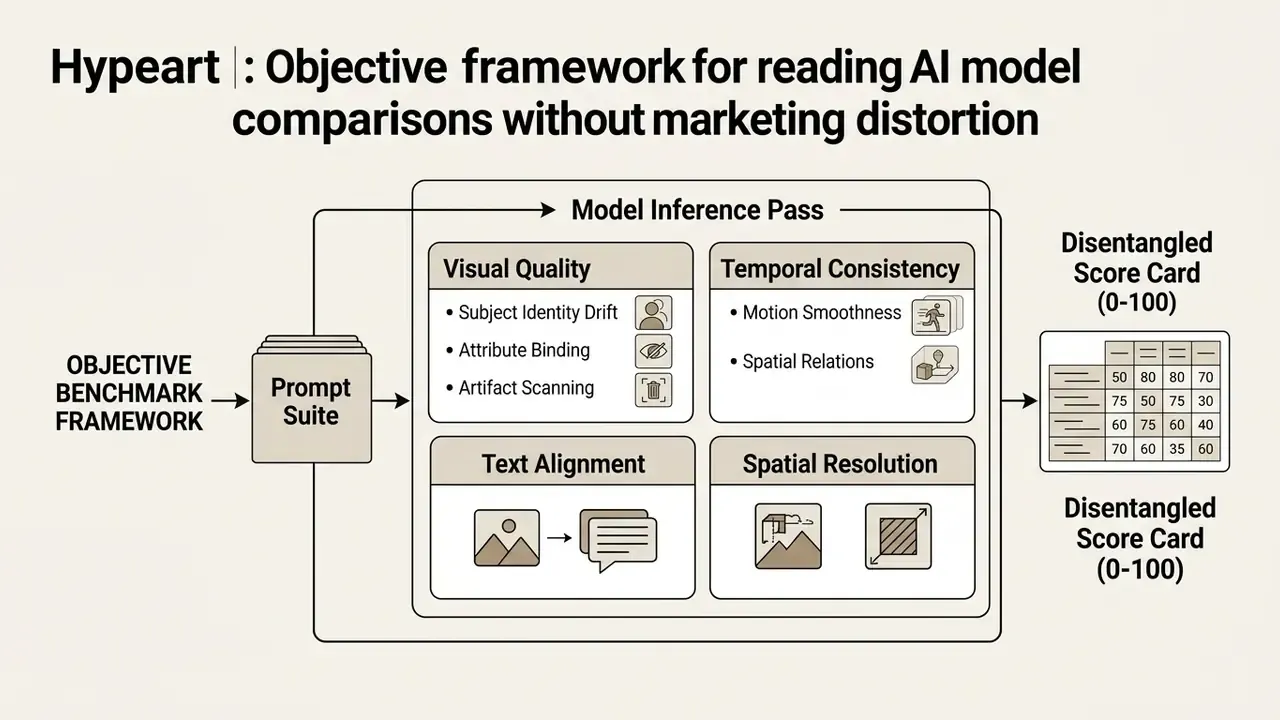
How to Read AI Model Comparisons Without Marketing Distortion
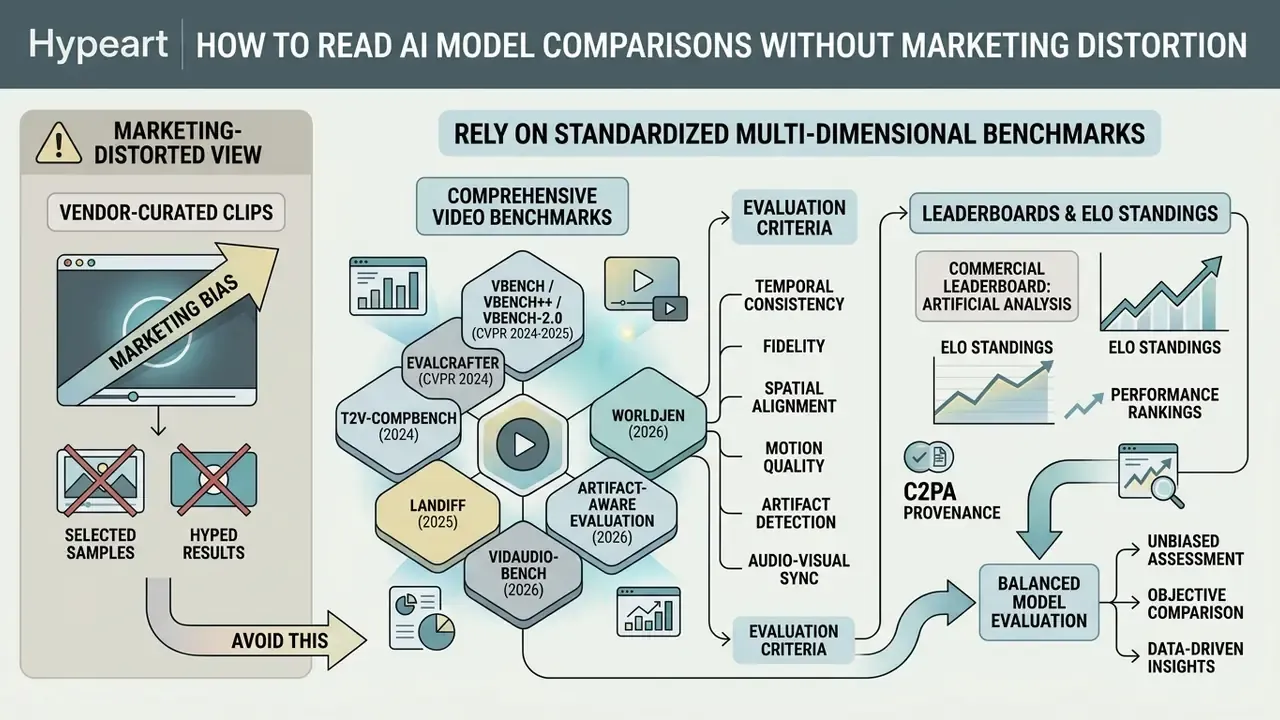
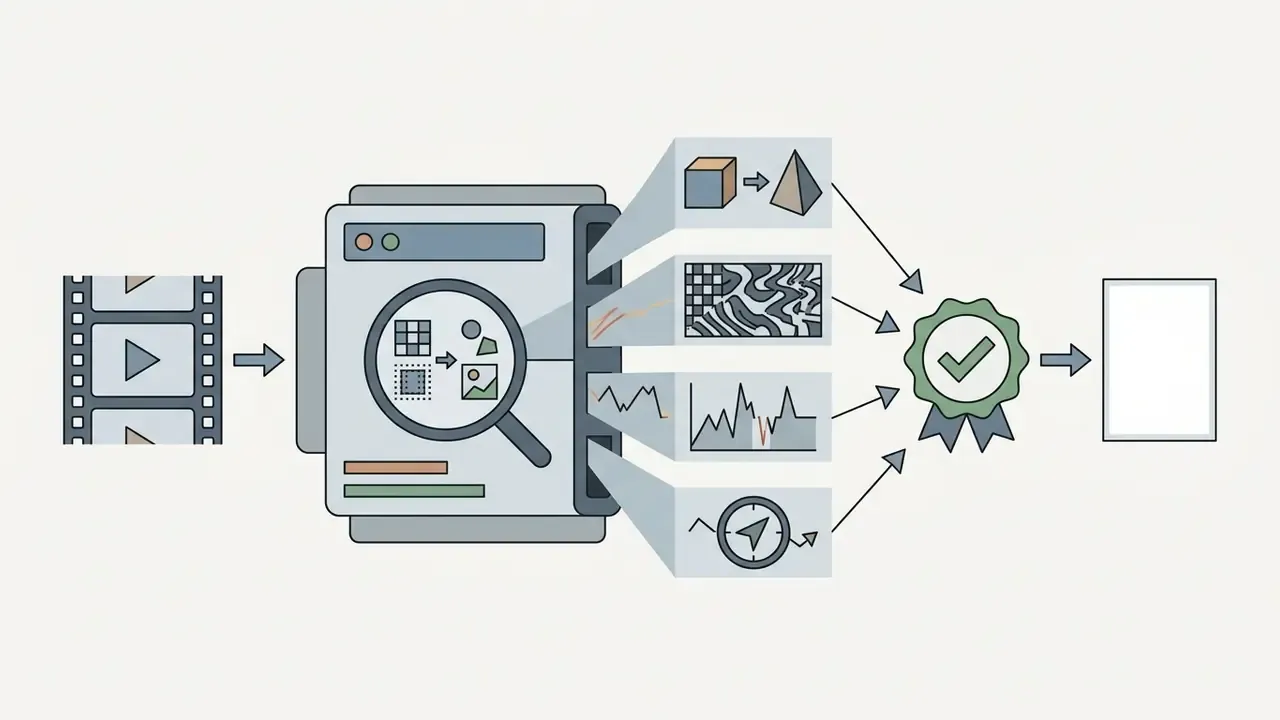
Evaluating video generation models without marketing bias requires relying on standardized multi-dimensional benchmarks rather than vendor-curated promotional clips. Prominent academic evaluation frameworks isolate specific functional dimensions to prevent high visual fidelity from masking structural failure modes:
«Video-Bench records Sora at 4.68 average imaging quality, 4.64 aesthetics and 4.96 temporal consistency out of 5, but only mid-range text-video alignment.»


Commercial Leaderboard: Artificial Analysis Elo Standings
Academic benchmarks isolate failure modes. The industry's practical ranking standard is the Artificial Analysis Arena, where pairwise human preference votes are converted into Elo scores. Using both together prevents two opposite errors: trusting a vendor demo reel, and trusting a single academic score that ignores subjective appeal.
Table: Artificial Analysis global model leaderboard, 2026 standings.
| Model | Elo score (with audio) | Elo score (video only) | Primary modality and input limits |
|---|---|---|---|
| HappyHorse-1.0 | 1212 Elo | 1357 Elo (#1) | 15B params, 7-language lip-sync, fal.ai API |
| Seedance 2.0 / 2.5 | 1213 Elo (#1) | 1340 Elo | 9 images plus 3 clips plus 3 audio inputs |
| Google Veo 3.1 | 1198 Elo | 1310 Elo | 48 kHz synchronized dialogue, 3 reference images |
| Kling 3.0 Omni | 1185 Elo | 1295 Elo | Native 4K at 60 fps, six-axis motion control |
| Runway Gen-4.5 | not ranked | 1247 Elo (at late-2025 launch, since displaced) | Motion brushes, camera and subject channels, GWM-1 |
| Grok Imagine (xAI) | 1078 Elo (#10) | not ranked | Distributed via Higgsfield and the xAI API |
Pricing, Access and Commercial-Use Rights for AI Generated Videos
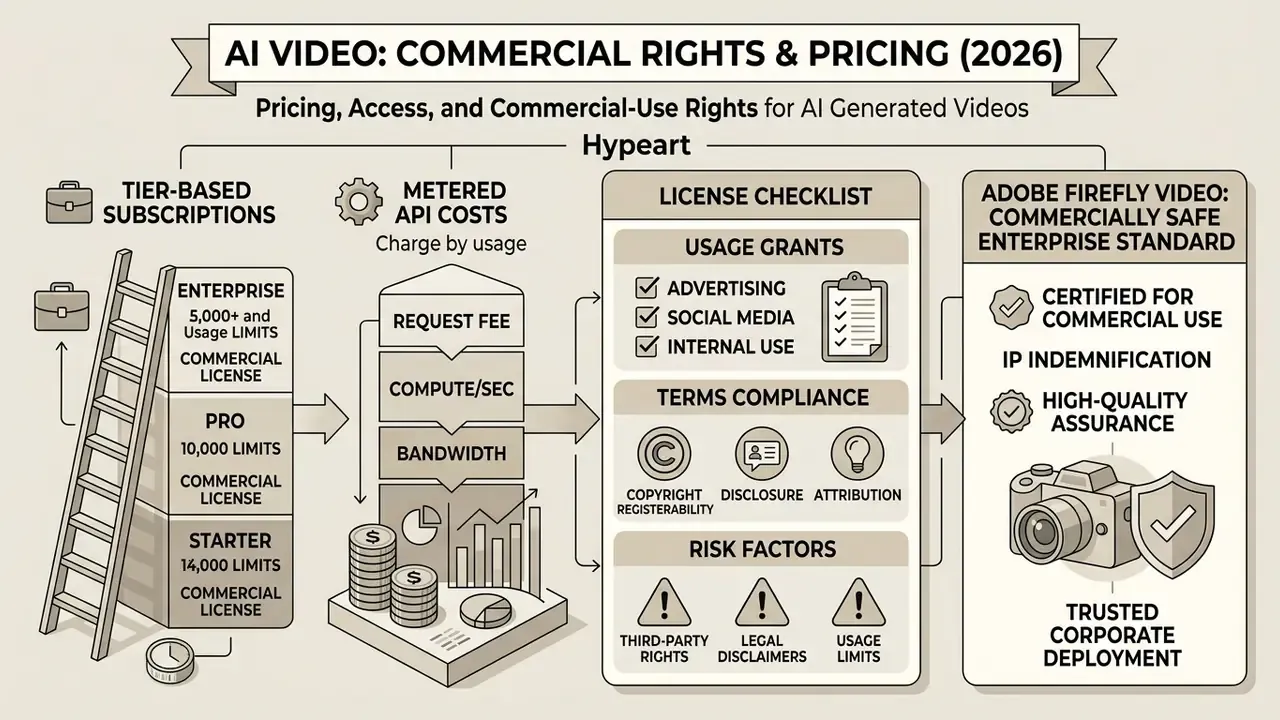
Commercial deployment of AI-generated video requires a clear understanding of tier-based subscription limits, metered API costs, and corporate licensing rights. Operating models have largely shifted from unmetered flat-rate tiers to consumption-based pricing calculated per second of generated video. In practice, five billing units coexist across the market: per second, per credit, per token, per video, and metered per input (reference images, source clips, audio tracks).
MULTIMEDIA BLOCK
Table: pricing, free-tier limits and commercial-use rights for active AI video platforms (verified September 2026; verify current Terms of Service before purchase).
| Platform or service | Free tier and trial limits | Entry subscription tier | Metered API cost per second | Premium model access | Commercial-use rights and indemnification |
|---|---|---|---|---|---|
| Google Veo 3.1 | Gemini API trial credits | Google AI Pro $19.99/mo (about 1,000 Flow credits); Ultra $249.99/mo | $0.03/sec (Lite 720p, no audio), $0.40/sec (720p or 1080p with audio), $0.50-$0.60/sec (premium and 4K) | Veo 3.1 Standard, Fast, Lite, 4K | Permitted via paid Gemini API and enterprise Vertex AI; SynthID watermark mandatory; enterprise indemnity available under Google Cloud terms, confirm with your account team |
| Kling AI | Daily login credits (watermarked, non-commercial) | Standard from about $10/mo (Basic, Standard, Pro, Premier, Ultra) | Unit package bundles (180-day validity) | Kling 3.0 Pro and Omni, IMAGE 3.0 Omni | Commercial rights on paid tiers; no indemnity commitment published |
| Runway Gen-4 / 4.5 | 125 one-time credits (watermarked) | Standard $12/mo; Pro $28/mo; Max $76/mo | $0.01 per credit (10-12 credits/sec) | Gen-4, Gen-4.5, Gen-4 Aleph, Act-Two, upscaling | Strictly prohibited on the Free plan; allowed on Standard, Pro and Max; no blanket indemnity |
| ByteDance Seedance 2.0 / 2.5 | Limited in-app allowance (region dependent) | Bundled with Doubao subscription tiers | Credit-metered; reference images and audio often free, output billed per second (for example 30 credits/sec at 720p on partner routes) | Seedance Pro, Fast, Mini routes | Commercial rights per agreement and jurisdiction; review regional terms carefully |
| HappyHorse-1.0 | Pay-as-you-go trial credits via fal.ai | No consumer tier, API-first | Metered per second via fal.ai | HappyHorse-1.0 / 1.1 | Commercial rights per fal.ai and Alibaba model terms |
| Adobe Firefly Video | Limited monthly generative credits | From $10/mo | Credit-based, not per second | Firefly Video Model plus selected third-party models | Commercially safe by design; trained on licensed Adobe Stock and public domain; does not train on customer content |
| Luma Ray 3 / 3.14 | Trial credits | From $7.99/mo | Credit-metered | Ray3, Ray3 Modify, HDR and EXR export | Commercial rights on paid tiers |
| Wan 2.7 / LTX-2.3 / HunyuanVideo 1.5 | Fully free weights (self-hosted) | None, infrastructure cost only | Your own GPU cost per second | All checkpoints and fine-tunes | Apache 2.0 and permissive licences; LTX tiers apply above $10M ARR; you own the deployment and the compliance burden |
| OpenAI Sora 2 / Pro | No longer available | Formerly included in ChatGPT Pro ($200/mo) | Historical: $0.10/sec (Sora 2); $0.30/sec at 720p, $0.50/sec at 1024p, $0.70/sec at 1080p (Pro) | Deprecated | Do not transact. API terminates September 24, 2026, migrate active pipelines now |
Note: pricing schedules and licensing terms are subject to platform revisions. Organizations must verify active Terms of Service prior to commercial execution. Teams evaluating low-cost entry paths before committing budget can review our breakdown of free AI video generators and the export limits that typically apply to them.
What Makes Up the Pricing of AI Video Generation
The financial cost of generating synthetic video is determined by five primary variables: clip duration, rendering resolution, frame rate, native audio inclusion, and specialized control overlays.
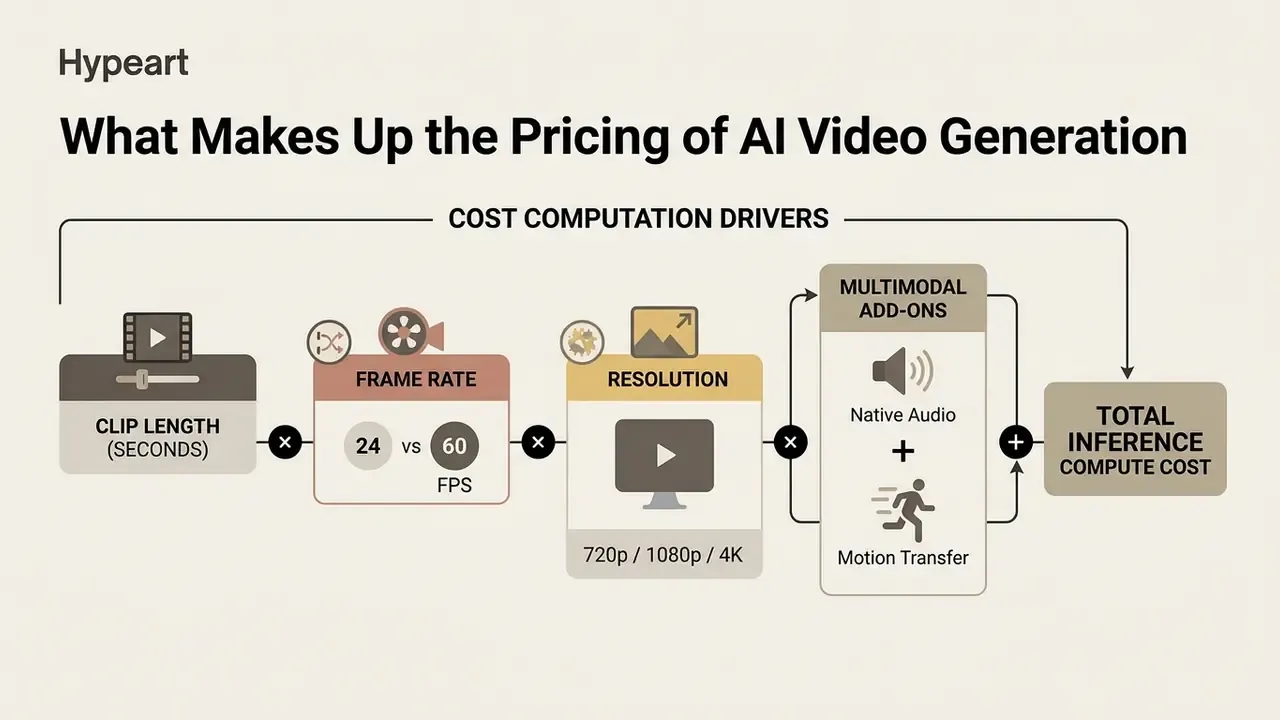
High-resolution outputs such as 4K require significantly higher latent tensor processing memory, raising per-second API fees from a baseline of $0.03-$0.30 up to $0.50-$0.70 per second. The scaling is close to linear in duration and steeper in resolution. Published vendor examples show 480p at $0.05/sec, 720p at $0.10/sec, and 1080p at $0.20/sec on the same route, which turns a 30-second render from $1.50 into $6.00 purely through resolution choice.
Two cost lines are frequently omitted from first-pass budgets. The first is input metering: reference video and source clips are often billed separately from output, while reference images and audio may be free. The second is editing overlays: upscaling, audio tooling, and act-transfer features are usually priced outside base generation. Organizations seeking to model video production budgets can use our interactive AI Media Calculators and review operational guidance in AI Media Support and Troubleshooting.
What to Check in the Licence Before Commercial Use
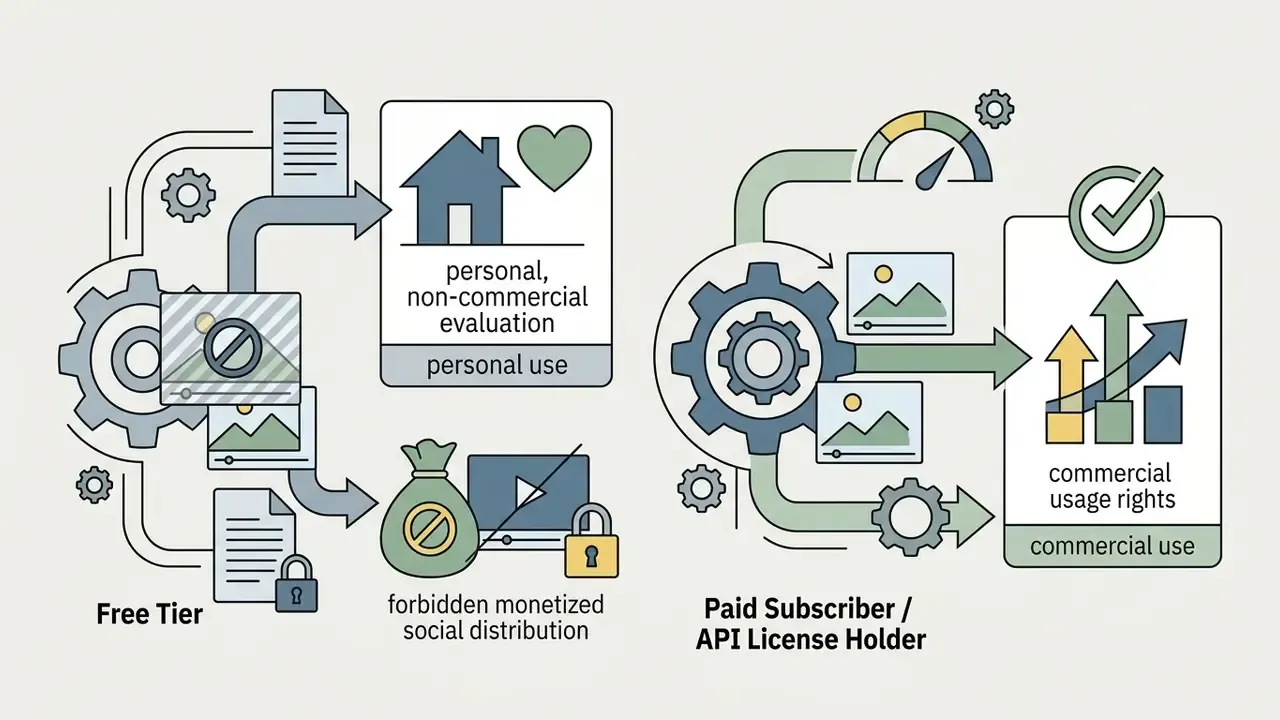
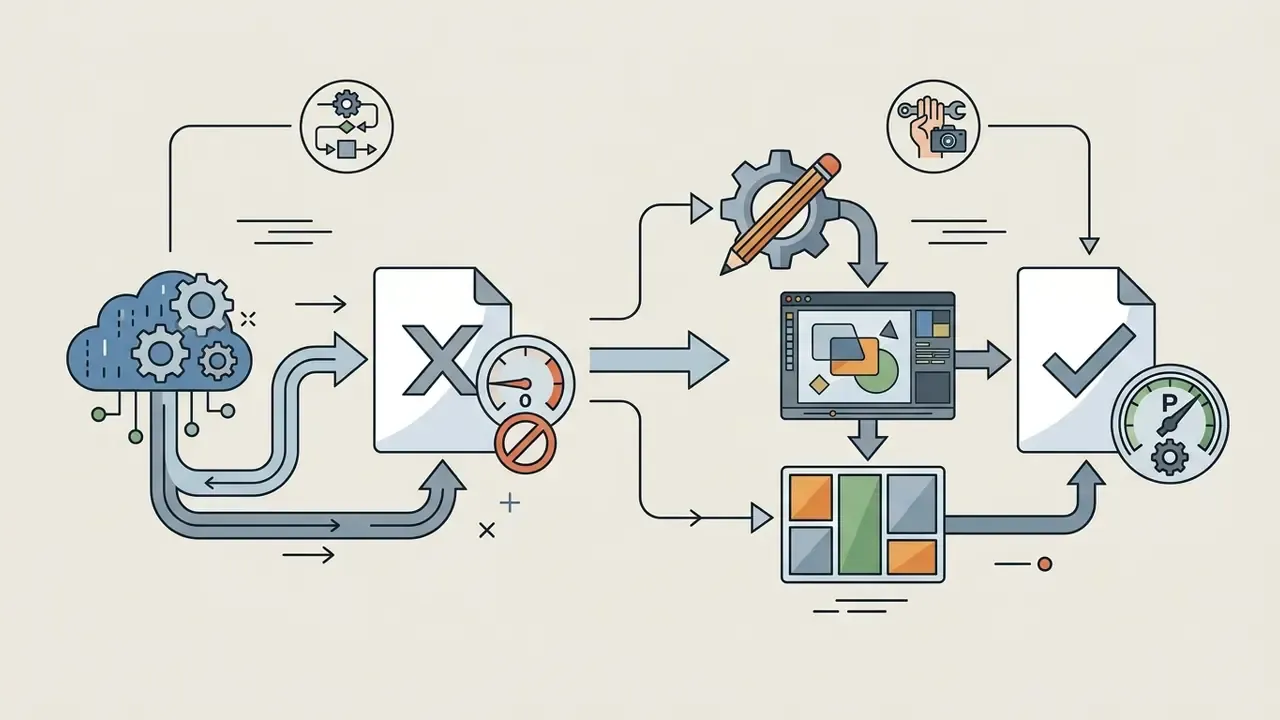
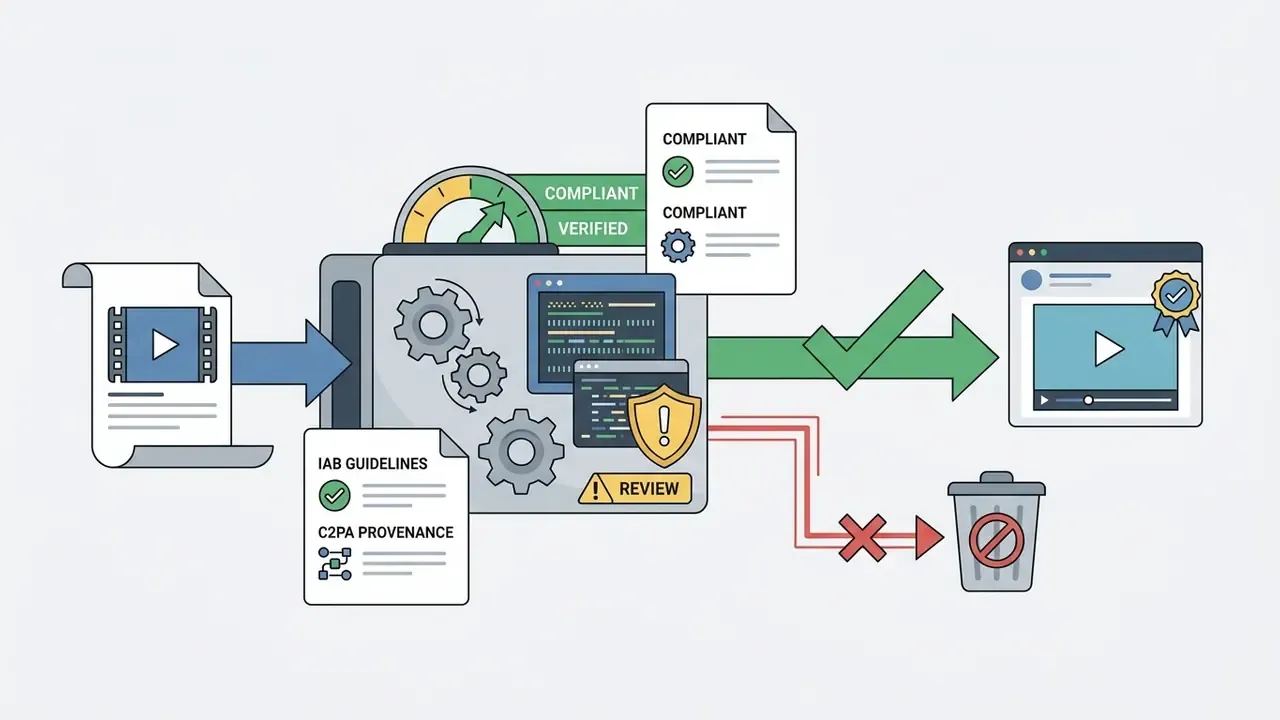
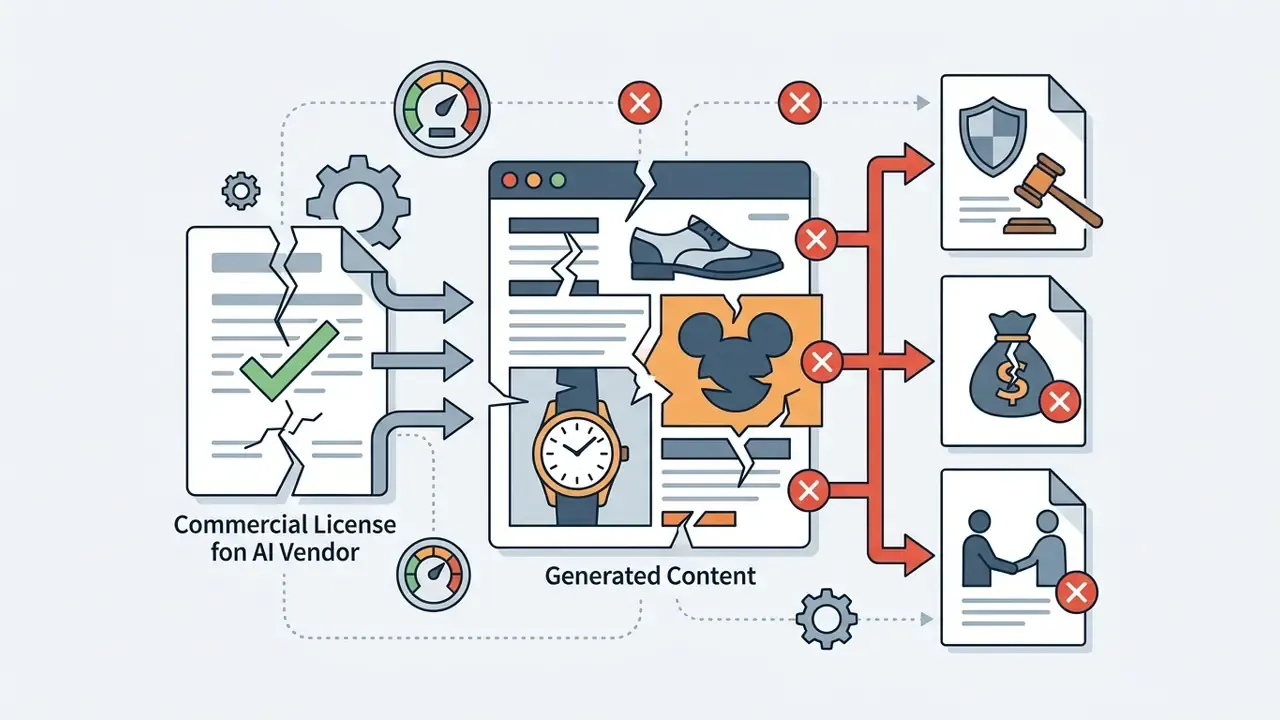
Before deploying synthetic footage in public campaigns or commercial products, legal and compliance teams must verify four key intellectual property considerations:
Adobe Firefly Video: The Commercially Safe Enterprise Standard
For commercial creative teams requiring strict IP risk reduction, the Adobe Firefly Video Model provides a legally cleaner alternative. Unlike models trained on unvetted public web scrapes, Firefly is trained exclusively on licensed Adobe Stock assets and public domain content. Starting at $10/month, Adobe provides explicit commercial safety guarantees, states that it does not train on customer content, and positions outputs as safe for global corporate advertising pipelines. The trade-offs are real: clip length is capped around 5 seconds, resolution runs 540p to 1080p, and there is no natively synchronized audio, so sound must be added afterwards. For regulated advertising, that trade is frequently worth making.
When a Paid Video Model Is Justified for the Business
Investing in paid enterprise video models is economically justified when it replaces traditional live-action or animated video production costs. Traditional commercial video creation, involving camera crews, studio rentals, talent fees, and post-production editing, typically ranges from a few thousand dollars for basic internal assets to over $50,000 for high-end brand advertising, with training video built from slides or SOPs cited at $5,000-$30,000 (Visla production cost guide, 2026). Verification note: these are vendor-published market estimates rather than audited survey data; treat them as directional and benchmark against your own historical production invoices.
By contrast, generating synthetic video clips via high-tier APIs costs between $0.03 and $0.70 per second, yielding a 20-second rendered clip for roughly $0.60 to $14.00 in compute charges. For high-volume marketing teams requiring rapid iteration and localized media assets, AI video integration offers significant cost and speed advantages.
Risk-adjusted total cost of ownership, the number a CRO should actually approve. Raw inference cost is the smallest line item in a regulated deployment. A defensible model looks like this:
TCO = (Inference cost per accepted clip x Accepted clips)
    + (Rejected-render waste: typically 3-10 attempts per accepted clip)
    + Prompt engineering and creative labour
    + Legal / brand review per asset
    + Provenance, logging and archival storage
    + Validation and periodic re-benchmarking of model versions
    + Residual IP / publicity-claim risk reserve
Applied honestly, a "$4 clip" often lands between $80 and $400 fully loaded once a 5:1 render-acceptance ratio, one hour of creative labour, and one legal review pass are included. That is still an order of magnitude below a traditional shoot for short-form assets, but it is not a rounding error, and it is the figure that should appear in the business case. High-volume, low-variance formats such as product loops, localized captions, and internal training segments carry the strongest return. Regulated customer-facing claims carry the weakest, because review cost per second rises fastest there. Teams planning publishing pipelines can review practical delivery workflows in our guide to YouTube video editors.
Governance, Provenance and Data Security: C2PA, SynthID, Shadow AI
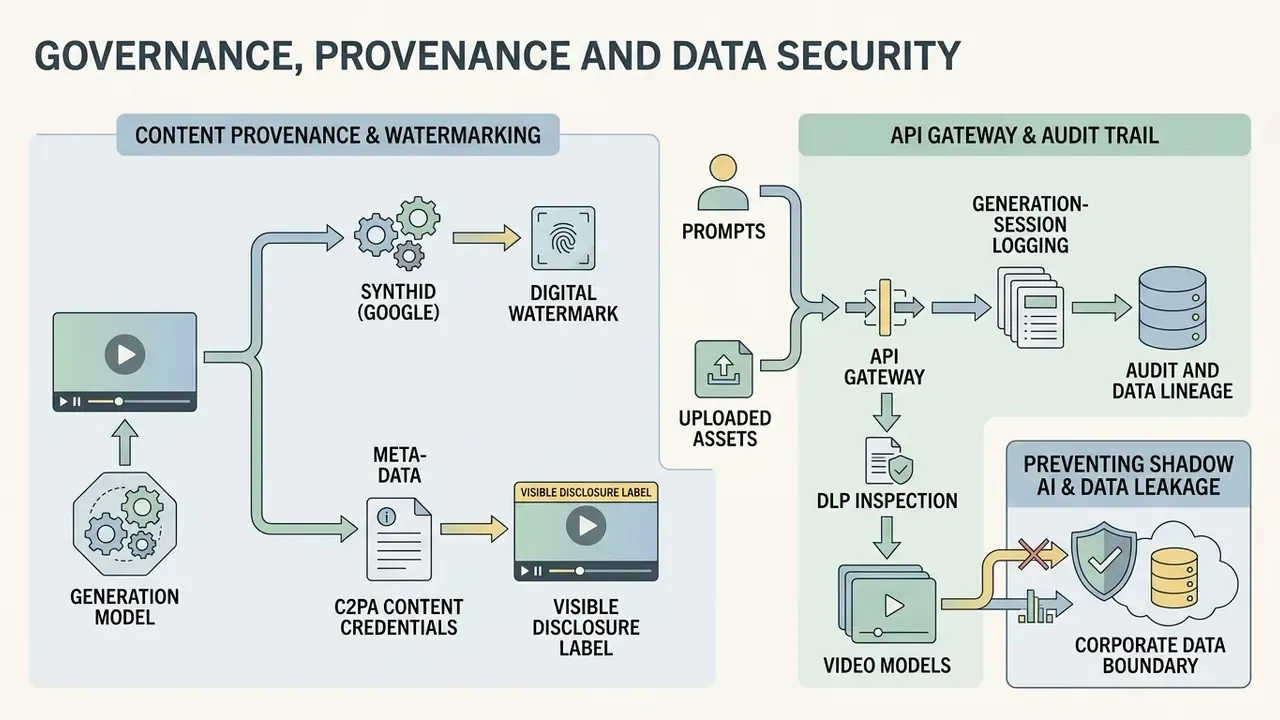
The controls below close the gap between "we generated a video" and "we can evidence how that video was generated." That is the requirement implied by any model risk framework, and it is where most pilots quietly fail their first audit.
Content Provenance and Watermarking
- SynthID (Google) Applied by default and non-optionally to Veo output, embedding an imperceptible signal that survives common re-encoding and can be detected by Google's verification tooling. For Veo-based pipelines, this is your baseline provenance artifact.
- C2PA Content Credentials The cross-vendor standard, backed by Adobe and adopted across the Content Authenticity Initiative, that attaches a cryptographically signed manifest recording tool, model, edits, and issuer. Where a regulator or broadcaster asks for verifiable origin, C2PA manifests are the transferable evidence format. Visible watermarks are not.
- Visible disclosure labels Required by several platform policies and increasingly by advertising standards. Note the distinction: disclosure satisfies audience-facing transparency, while SynthID and C2PA satisfy technical verifiability. You generally need both.
Generation-Session Logging for Audit and Data Lineage
Treat each generation as a reproducible record. The minimum evidence set for an auditable pipeline:
Table: minimum audit record per generated video asset.
| Field | Why it is required |
|---|---|
Model identifier and exact version (for example veo-3.1-generate-001) | Model versions change output behaviour; validation evidence is version-specific |
| Full prompt text and negative prompt | Reproducibility and review of prohibited-content controls |
| Seed and determinism parameters where exposed | Enables re-generation for dispute resolution |
| Reference asset hashes (images, clips, audio) | Data lineage: proves inputs were licensed and consented |
| Requesting identity and business justification | Attribution of decisions; shadow AI detection |
| Provenance artifacts (SynthID flag, C2PA manifest ID) | Downstream verification by third parties |
| Review outcome and approver | Human-in-the-loop evidence; also establishes human authorship for copyright purposes |
| Retention and deletion schedule | Privacy and biometric-data compliance |
A useful side effect: documented human creative control across prompt iteration, arrangement, and editing is exactly the evidence that supports registerability of the human-authored elements discussed above. One control, two benefits.
Preventing Shadow AI and Data Leakage
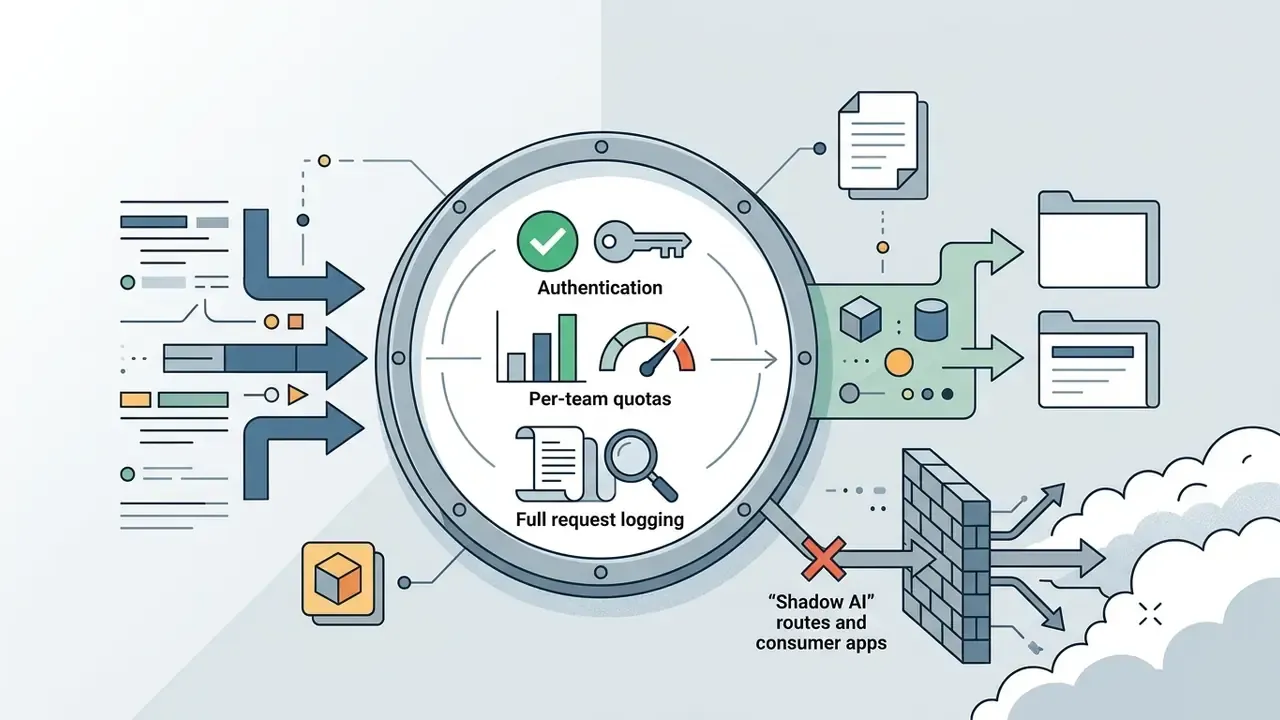
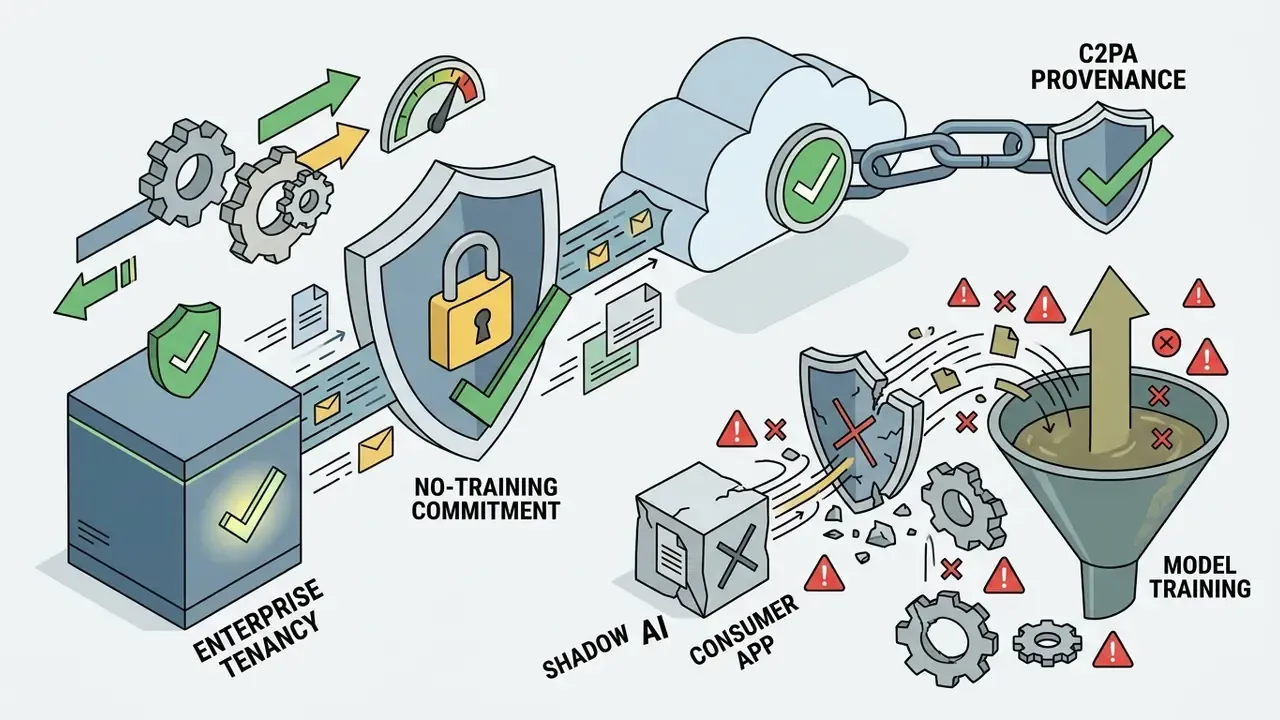
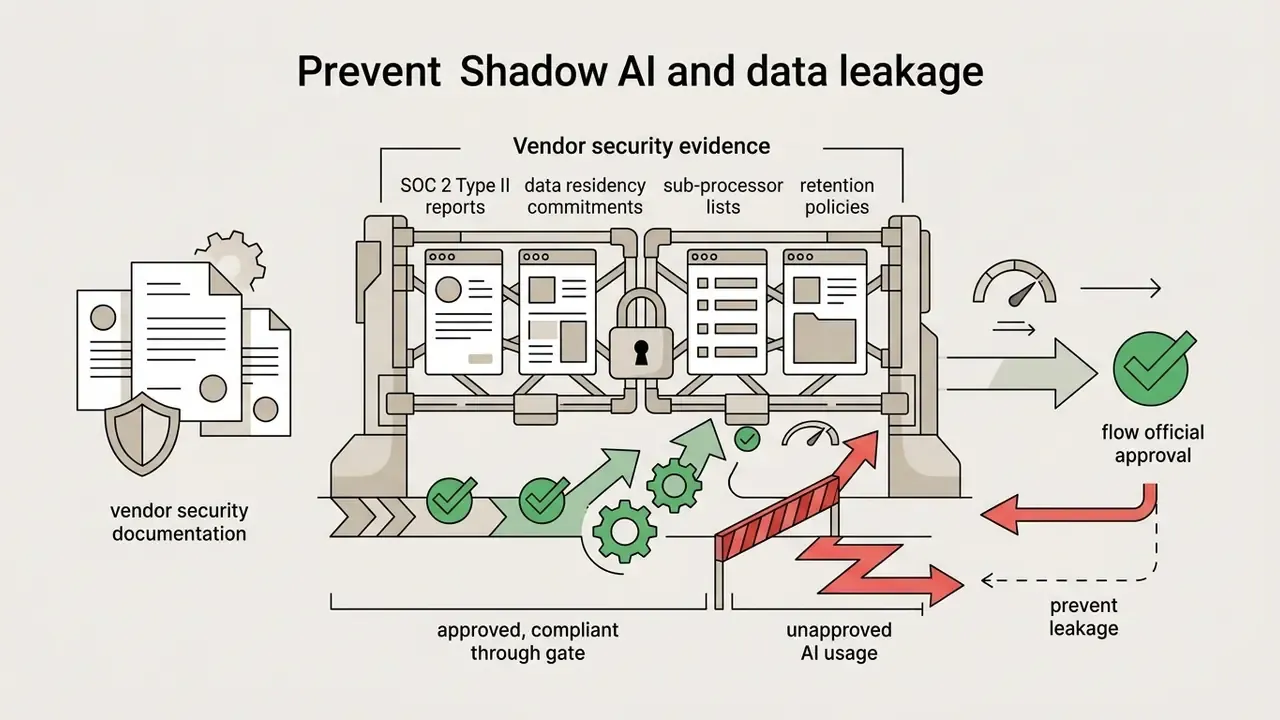
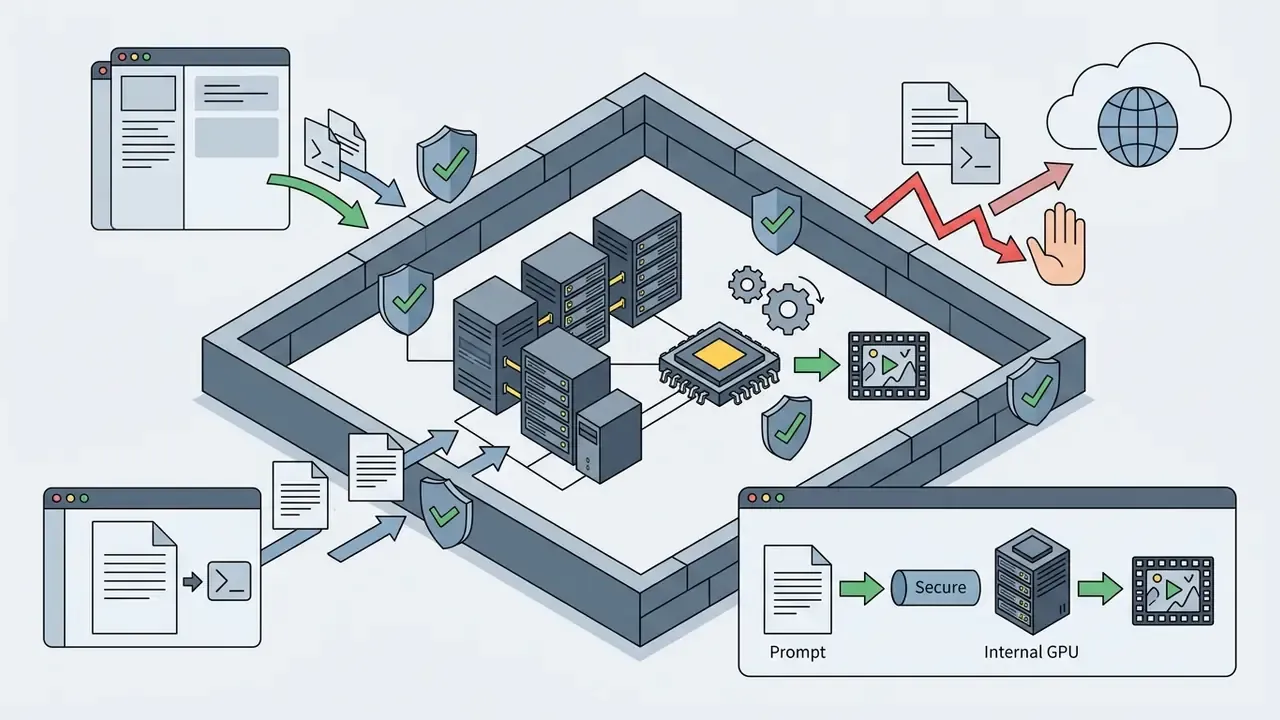
Video prompts are an underestimated exfiltration channel. A single reference image can contain a customer document, an unreleased product, or a biometric identifier. Recommended architectural controls:
Illustrative deployment pattern, composite and not a named client: a Tier-1 bank running internal compliance-training video through an isolated Veo 3.1 deployment on Vertex AI, with prompts screened by DLP, SynthID retained, C2PA manifests written at export, and every asset reviewed by a named compliance approver before distribution. No customer data in prompts, no external app access, full replay capability for the internal audit function.

How to Choose an AI Video Model for Content Creation Tasks
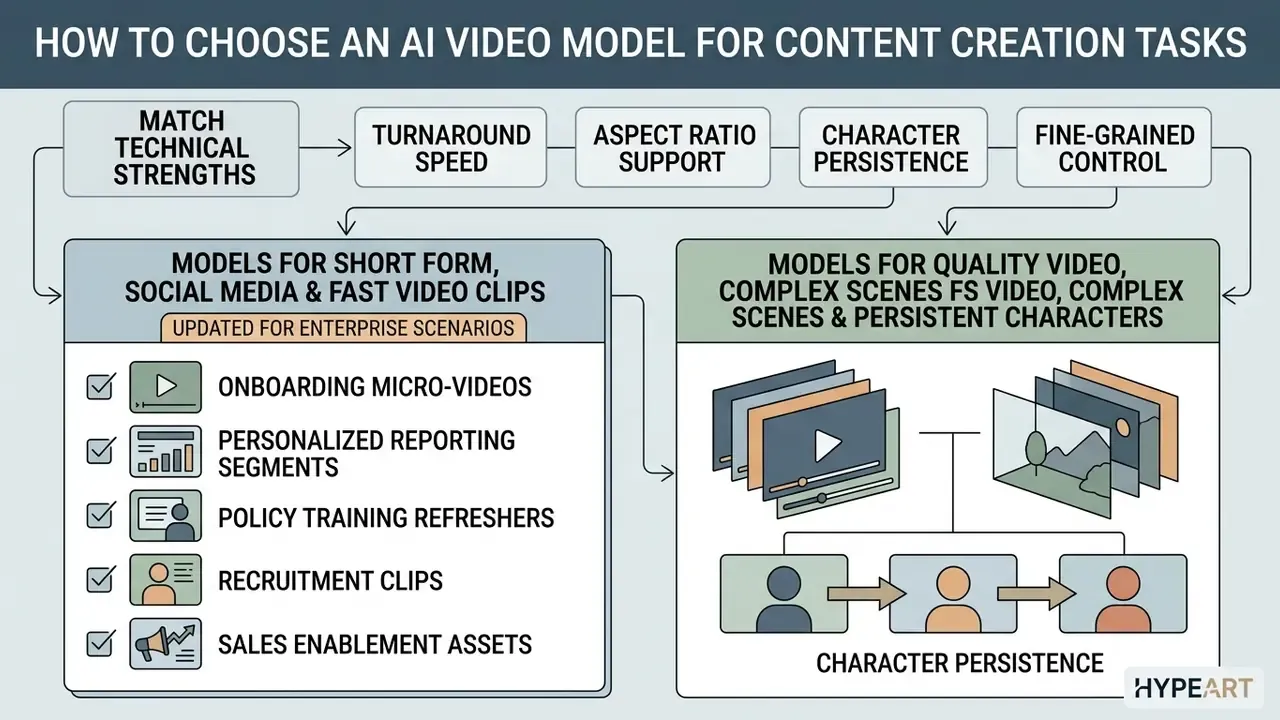
Selecting the optimal AI video generation model requires matching technical strengths, such as turnaround speed, aspect ratio support, character persistence, and fine-grained camera controls, to specific content production goals. Readers who want the foundational vocabulary first can start with our primer on AI video generators.
Models for Quality Video, Complex Scenes and Persistent Characters
High-end narrative productions, such as brand commercials, cinematic storyboards, and corporate training media, demand high temporal consistency, multi-character persistence, and strict prompt adherence. Flagship options include Google Veo 3.1 Standard and 4K, Kling 3.0 Omni, ByteDance Seedance 2.5, Alibaba HappyHorse-1.0, Runway Gen-4.5 for control-surface depth, Luma Ray 3.14 for HDR finishing, and self-hosted Wan 2.7 or LTX-2.3.
«LanDiff (5B parameters) scores 85.43 on VBench, outperforming Sora (84.28) and Hunyuan Video, showing that a joint language-diffusion architecture improves semantic fidelity.»
By employing reference-image conditioning and multi-shot attention mechanisms, these models maintain subject identity across multiple scene cuts. Reference-image control, whether Veo 3.1's three-image Ingredients workflow, Seedance's nine-image plus three-clip plus three-audio grid, Wan 2.7's 9-grid input, or Kling's element binding, has effectively replaced "longer prompts" as the reliable path to character continuity. Developers and technical architects building custom media production pipelines can examine setup protocols in our AI Media API Guides.
Enterprise Video Model Risk Assessment Checklist
Use this as a pre-deployment gate. Any unchecked item is an open finding, not a nice-to-have.
Checklist0 / 18
FAQ on Video Generation Models News
How Does an AI Video Model Differ From a Video Tool
An AI video model is the core neural network engine, such as a latent diffusion transformer or multimodal joint network, that converts input prompts into synthetic video frames and audio waveforms via API calls.
An AI video tool, or video platform, is the user-facing software wrapped around one or more underlying models. Video tools provide timeline editors, keyframe controls, text caption overlays, credit management systems, and the export capabilities needed for end-to-end media editing. Readers can compare interface-level capabilities in our guide to video editing tools. The distinction matters operationally: Google documents veo-3.1-generate-001 as a model endpoint, while Flow, Firefly, and Runway's web app are products that may swap the model underneath. That is precisely why model-version pinning belongs in your risk register.
What Is a Diffusion Model in AI Video Generation
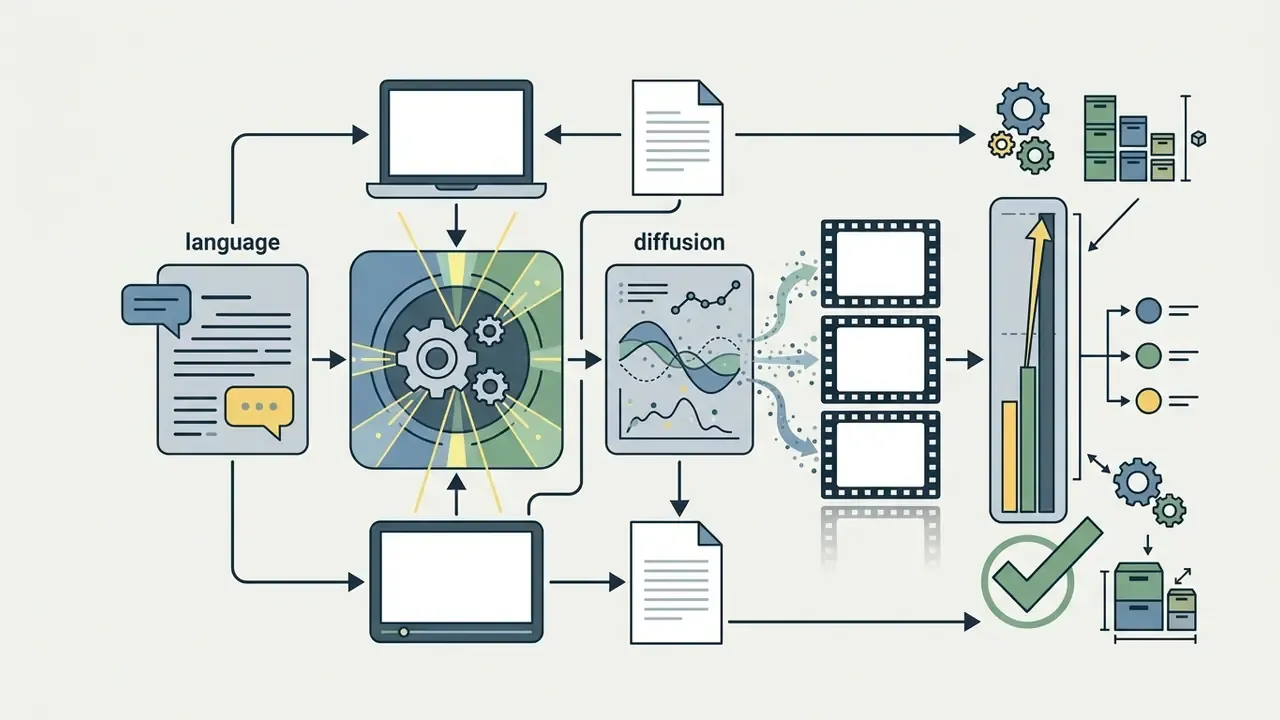
A diffusion model in video generation is a generative neural architecture that synthesizes media by systematically removing noise from a randomized latent tensor over successive denoising steps. Readers can explore practical applications in our overview of diffusion-based AI video generators.
Operating across both spatial dimensions (width and height) and the temporal dimension (time and frames), spatio-temporal diffusion transformers use cross-attention layers to align generated visual frames with input text prompts, reference images, or control signals. Many implementations bootstrap from a pretrained text-to-image backbone, the approach used by Lumiere (2024) and by CVPR 2024 work fine-tuning Stable Diffusion for video, which is why image-model strengths and weaknesses often carry over into video output.
Why Do AI Models Often Limit the Length of Second Clips
Video generation models restrict single-pass clip lengths to 5 to 15 seconds, with Seedance 2.5 now pushing to 30 seconds, for three main technical reasons:
- Memory growth. Processing 3D video tensors across space and time requires substantial GPU VRAM, scaling steeply as frame count and resolution increase. Published figures indicate a single second of video can consume on the order of 1.5 GB, and memory grows roughly linearly when past frames are retained as references.
- Attention context costs. Transformer attention compute grows quadratically relative to context length, introducing latency and high inference costs for longer sequences.
- Temporal error drift. Denoising errors accumulate across consecutive frames, leading to visual flickering, structural warping, or character identity drift over extended durations. Content that leaves the frame and returns may come back subtly different.
«CogVideoX generates continuous 10-second videos at 16 fps and 768x1360; Veo 3.1 supports 4, 6 or 8 seconds at 24 fps, and both limits reflect a trade-off between GPU memory and quality.» - CogVideoX, ICLR 2025; Veo 3.1 documentation, Google DeepMind (2025-2026). https://arxiv.org/abs/2408.06072
«ShotAdapter adds a "transition token" and local attention masking to existing T2V models, improving character and background consistency in multi-shot video without degrading text alignment.» - Text-to-Multi-Shot Video Generation (ShotAdapter), 2025. https://arxiv.org/abs/2501.04068
The practical implication is that architectural work, including transition tokens, reference-grid conditioning, and regional editing, is loosening the length ceiling faster than raw hardware scaling. Plan pipelines around stitched or multi-shot sequences today, then re-evaluate every two release cycles.
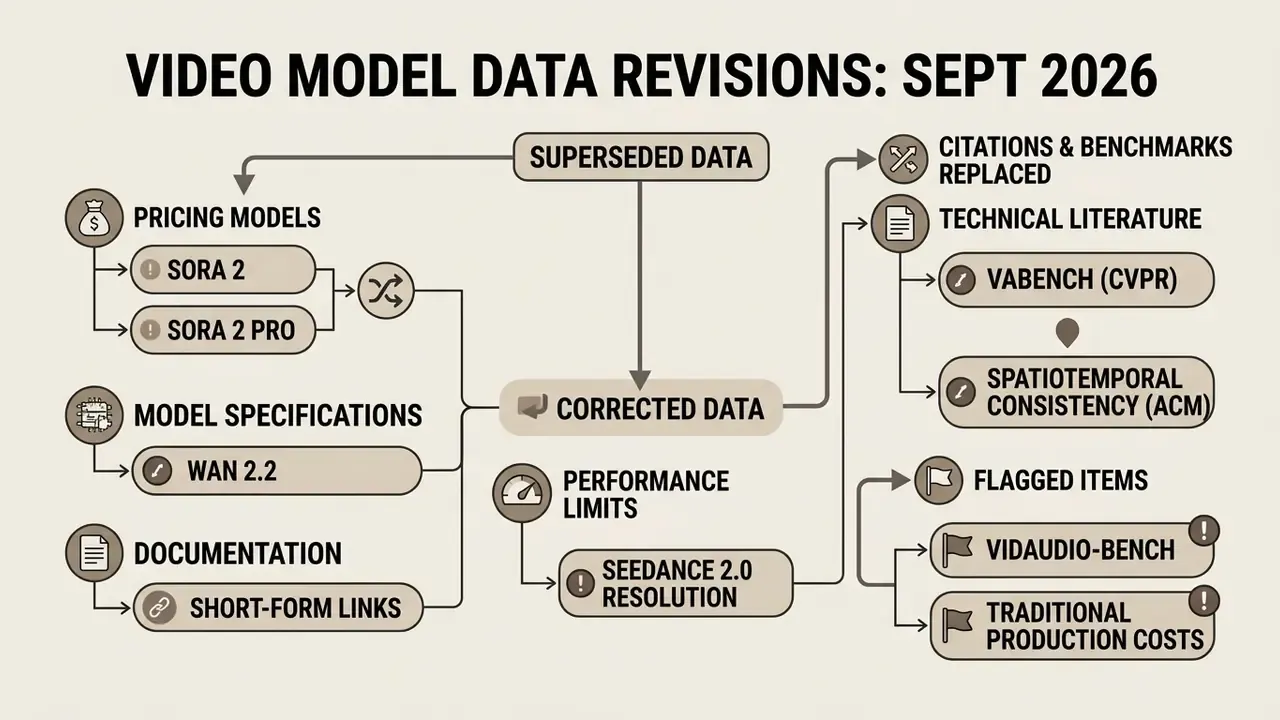
Appendix A: Editorial Revisions and Superseded Data
https://arxiv.org/abs/2311.17982
A Safe Next Step
You do not need a platform decision this quarter. You need a defensible starting position.
A low-risk sequence: pick one internal, non-customer-facing format (compliance training is the usual candidate), run it through a single approved model with full generation logging, and measure the render-acceptance ratio and review hours over 30 days. That produces two things your committee actually needs: a real TCO figure, and an audit record you can show to internal audit before anything reaches a customer. Everything else, including leaderboard position, can wait for the next release cycle.