Executive summary
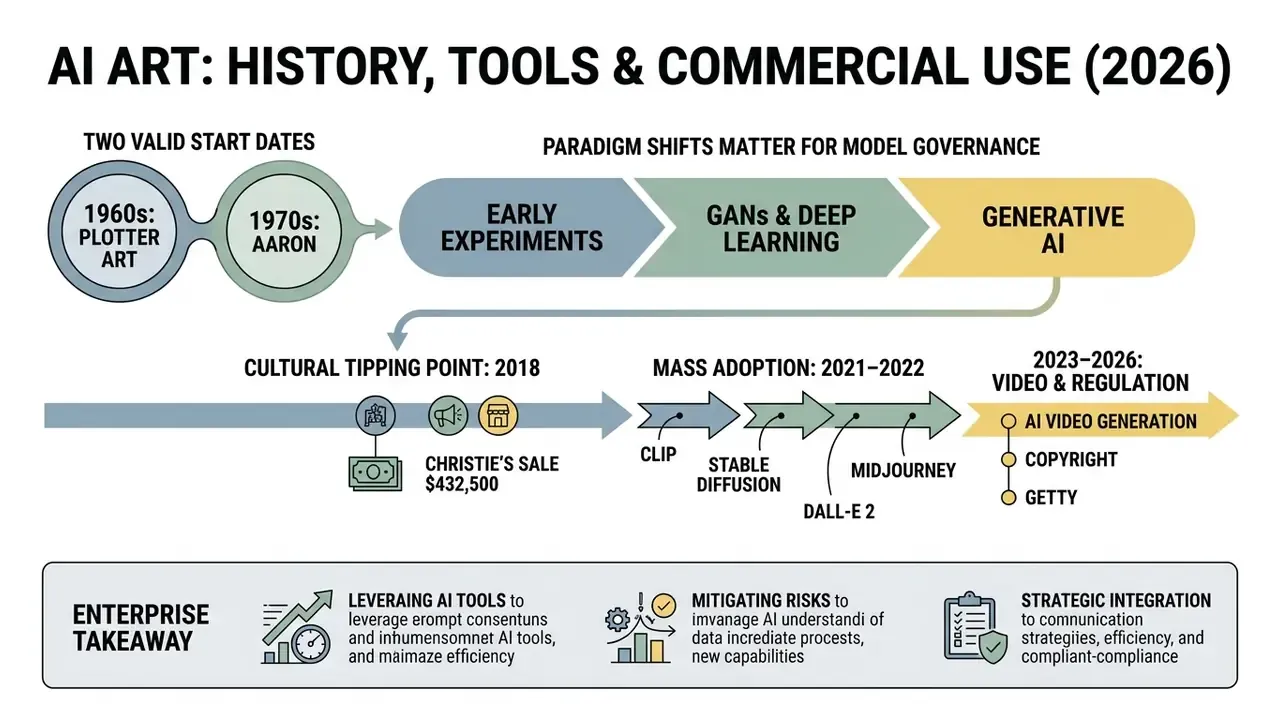
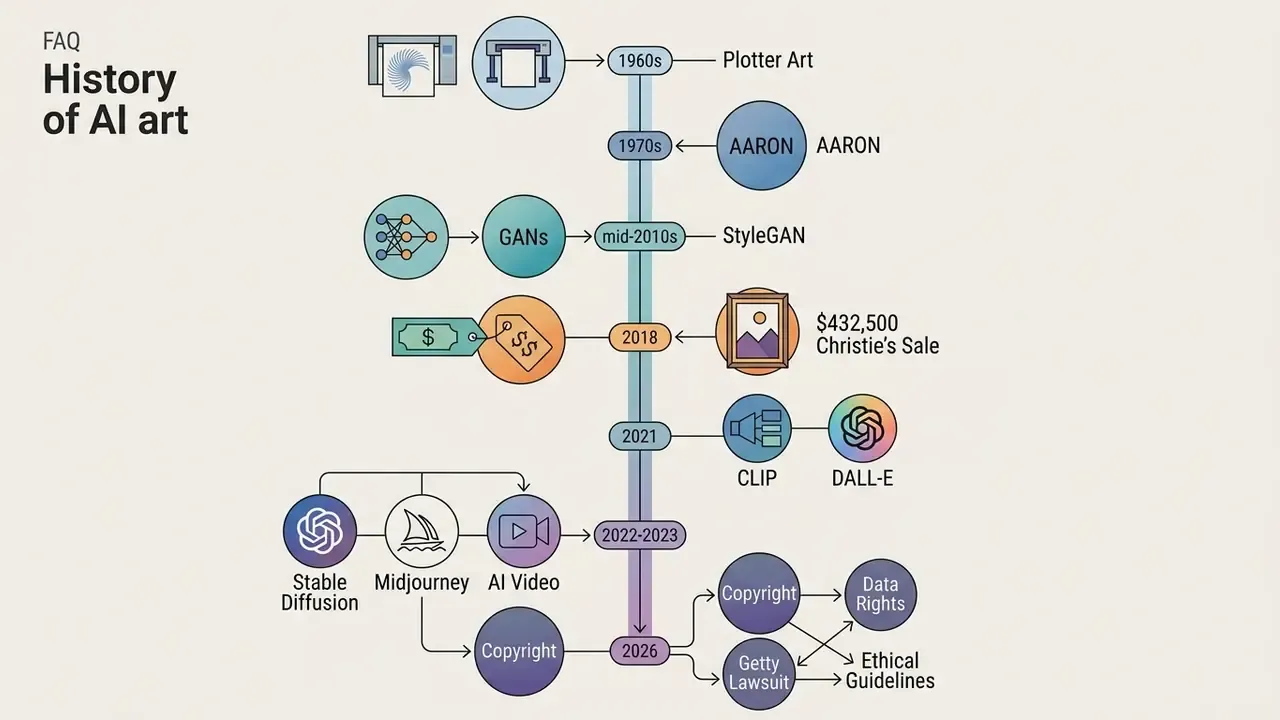
- Two valid start dates. AI art started in the 1960s if you count deterministic, rule-based plotter art (Nees, Nake, Noll, 1962 to 1965). It started in 2012 to 2014 if you count learned statistical models (AlexNet, then Goodfellow's Generative Adversarial Networks).
- Three paradigm shifts matter for model governance. Hand-coded symbolic rules (AARON, 1973), then adversarial learned distributions (GANs, 2014), then iterative latent denoising conditioned on text (CLIP 2021, Stable Diffusion 2022).
- Cultural tipping point: 2018. Christie's New York sold Edmond de Belamy, a GAN print by the collective Obvious, for $432,500 against a $7,000 to $10,000 estimate.
- Mass adoption: 2021 to 2022. CLIP removed the programming barrier. The open-weights release of Stable Diffusion (22 August 2022) moved generation onto consumer and air-gapped hardware.
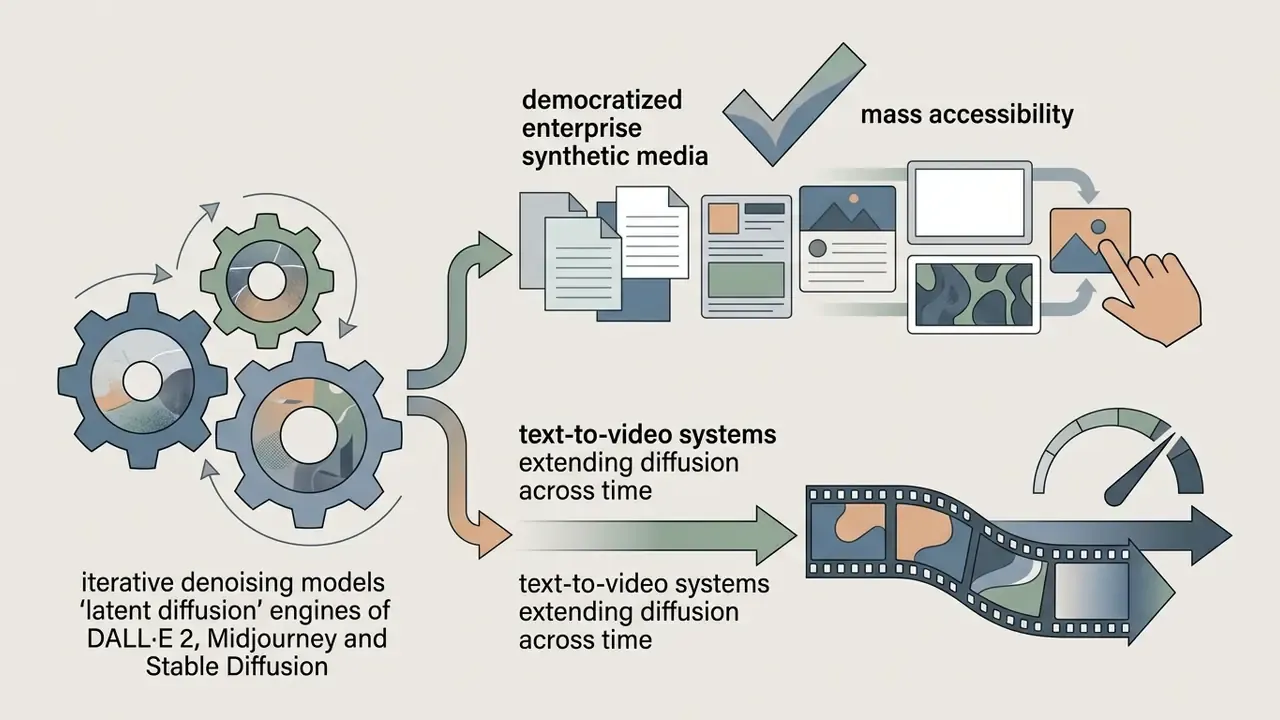
- 2023 to 2026: video and regulation. Generative models extended from static images to temporally consistent video (Make-A-Video, Gen-2/Gen-3, Sora), while the U.S. Copyright Office confirmed that prompt-only outputs lack human authorship and Getty Images sued Stability AI (January 2023).
- Enterprise takeaway. The way training corpora were assembled in 2021 and 2022 is the direct source of today's provenance, bias and intellectual-property risk. Treat generative image models as probabilistic models inside your model risk management (MRM) inventory, not as design software.
Why this history matters to a regulated institution
A fair question before you read further: why should a Chief Risk Officer at a US bank care when AI art started?
Because the answer sets the control baseline. Marketing, investor relations, KYC training material and customer communications all now pass through generative image tooling. If your model inventory treats that tooling as a Photoshop replacement, you have an unregistered probabilistic model in production. Auditors notice. Regulators eventually ask.
This article moves in a deliberate order. First, the historical question itself, because the dating dispute is genuinely substantive, not pedantic. Second, the technical shift from hand-coded rules to learned weights, which is the exact moment auditability became hard. Third, the popularity spike of 2021 and 2022, which explains why shadow AI usage appeared inside institutions before any policy existed. Fourth, the practical apparatus: licensing checks, a cost and residual-risk matrix, and an audit evidence template you can lift into your own control library. Readers who want to move straight from history to tooling can review current AI art generators and return to the timeline afterwards.
One caveat up front. Parts of this field are still unsettled, particularly litigation outcomes and bias measurement. Where evidence is incomplete, the text says so rather than rounding it into confidence.
When did AI art start? The short answer
AI art started in the 1960s with early rule-based computer art experiments, but modern deep-learning AI art emerged in the 2010s with generative adversarial networks and accelerated exponentially in 2021 and 2022 with text-to-image diffusion models.
Understanding when did ai art start requires distinguishing between rule-based code execution and learned statistical models. In the 1960s, pioneer programmers used explicit mathematical instructions and physical plotters to generate abstract computer graphics. That early phase laid the foundational history of artificial intelligence in visual disciplines. However, the modern era of ai generated art history began when algorithms stopped following human-coded drawing instructions and started learning visual patterns directly from training data.
So how did ai art start? Not with a prompt box. It started with punched instructions, pseudo-random number generators and a pen on a moving arm.
The timeline of how long has ai art been around depends directly on the methodology used to define artificial intelligence. If measured from the first public computer graphics exhibitions in 1965, the practice is roughly six decades old. If measured from the emergence of deep neural networks capable of image synthesis, early ai art transitioned into contemporary generative systems around 2012 to 2014. Asked more narrowly, how long has ai generated art been around in the learned-model sense, the honest answer is a little over a decade. According to technical surveys, the shift to latent diffusion models after 2021 turned machine learning from an academic research experiment into an enterprise-grade technology for digital art creation.
Antecedents: automatons, Ada Lovelace and the philosophy of machine-made art
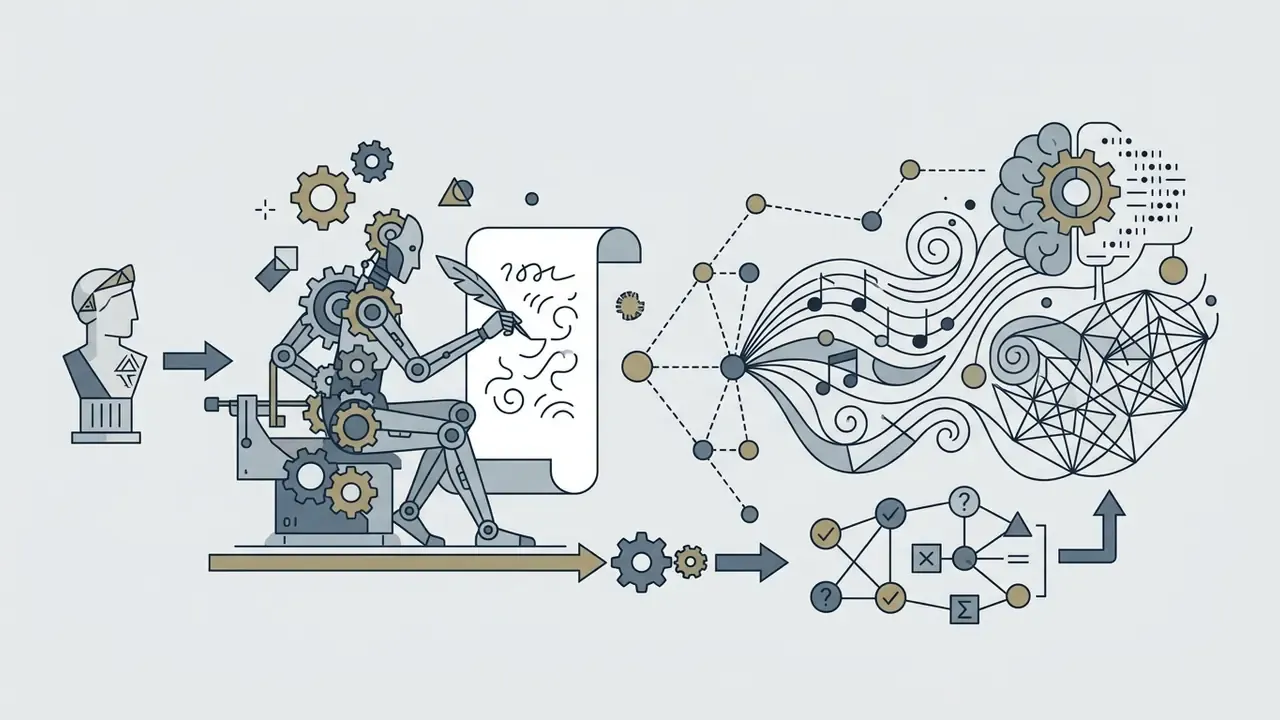
The idea of delegating art-making to a machine is far older than the computer. It combines ancient mechanical automation with centuries of philosophical argument about what art actually is.
The philosophical foundation of automated art stretches back to antiquity, when inventors such as Hero of Alexandria and Philo of Byzantium were described as designing machines capable of writing text, generating sounds and playing music. Mechanical automatons flourished again in the eighteenth and early nineteenth centuries. Jacques de Vaucanson's mechanical figures and the Maillardet automaton (built around 1800) could draw pictures and write verses using cam-driven memory. In 1843, Ada Lovelace observed that Charles Babbage's Analytical Engine might one day compose elaborate music and visual patterns if it were programmed with the right operational heuristics. A century later, Alan Turing's 1950 paper "Computing Machinery and Intelligence" reframed the question as whether machines can imitate human behaviour convincingly, and the discipline of artificial intelligence was formally named in the 1955 Dartmouth research proposal by John McCarthy, Marvin Minsky, Nathaniel Rochester and Claude Shannon.
These technical antecedents intersect with four classical positions in the philosophy of art, all of which are now invoked in debates about generative models:
| Theory of art | Core claim | Relevance to AI-generated images |
|---|---|---|
| Mimesis (Plato) | Art is imitation; value follows fidelity to the subject. | Diffusion models are literally trained to reproduce a data distribution: mimesis as an optimisation objective. |
| Expression (Romanticism) | Art transmits a definite feeling and evokes emotional response. | A model has no feeling; expression must be supplied by human prompting, curation and editing. |
| Formalism (Kant) | Judge the work on formal qualities, not represented beauty. | Supports evaluating synthetic output on composition, colour and structure independent of authorship. |
| Institutional theory (George Dickie) | An object becomes art within the institution of "the art world". | Explains why the 2018 Christie's sale mattered more culturally than any single technical benchmark. |
Art has served humanity for millennia to communicate political, social, spiritual and philosophical ideas, to record a specific time or person, to create beauty, to explore perception, to educate, to entertain, to heal and to generate strong emotion. Generative models do not remove those functions. They change who executes the marks.
Early AI art: from generative algorithms to machine learning
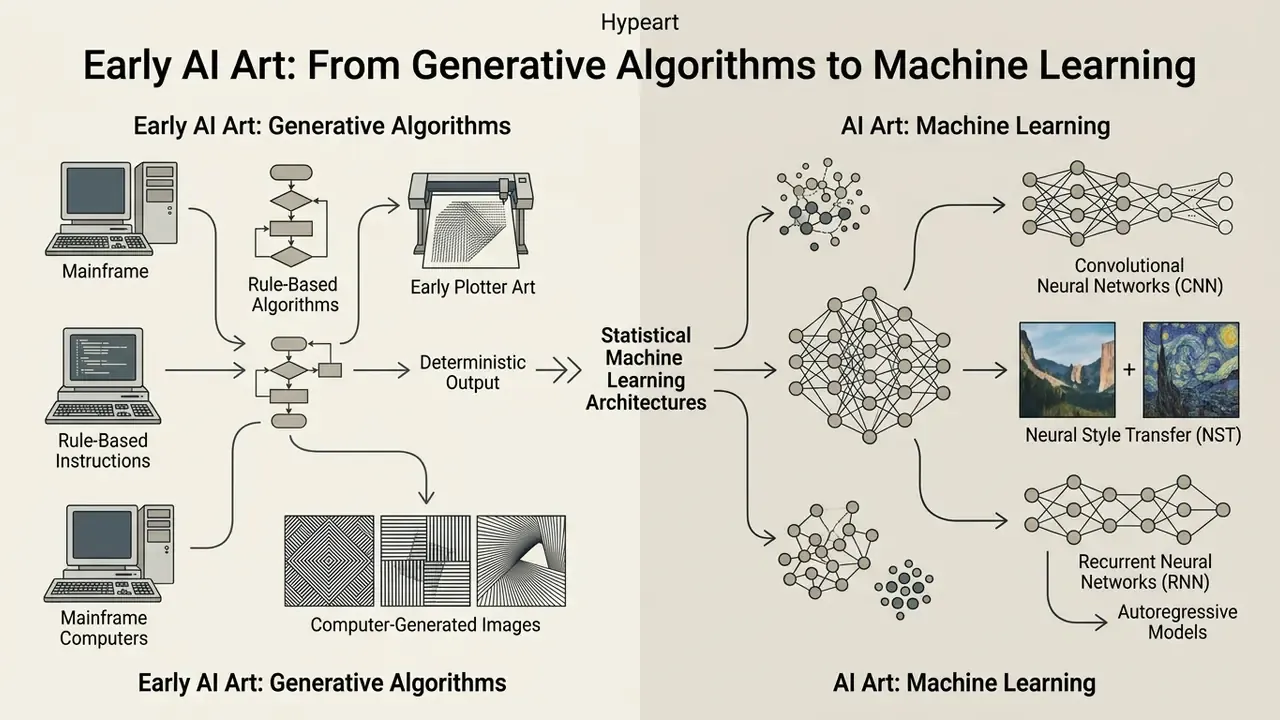
Early AI art evolved from deterministic rule-based instructions executed on mainframe computers into statistical machine learning architectures capable of autonomous pattern recognition.
The transition from early computer graphics to modern machine learning marks a fundamental shift in technical methodology. In early systems, human operators manually programmed every geometric coordinate, line angle and conditional logic branch. Modern machine learning systems invert this model by analyzing vast datasets to infer structural representations independently. For a model risk function, this is the difference between a fully specified deterministic process and a high-dimensional parameter space that resists line-by-line inspection. It is the same distinction that separates a rules engine from a neural credit model.
Algorithmic art and the first computer-generated images
Algorithmic art originated in the 1950s and 1960s when engineers programmed analog and digital computers to render geometric patterns using mechanical plotters.
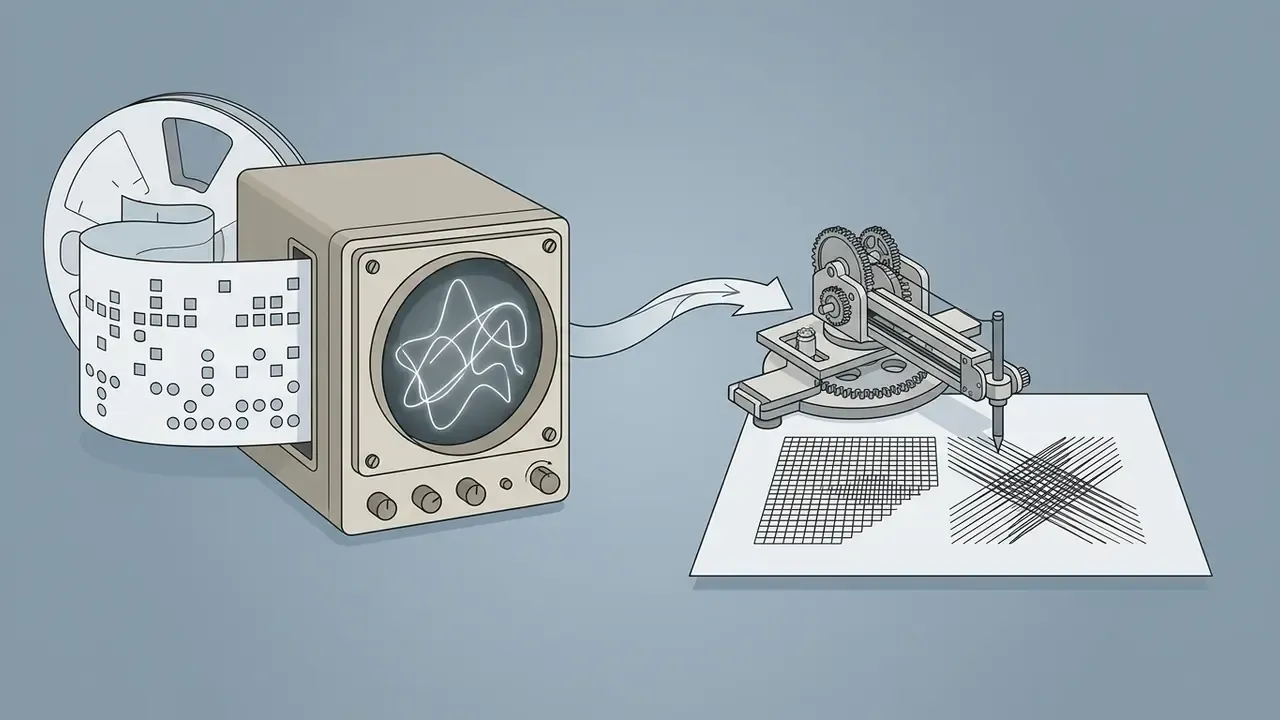
In 1952, Ben F. Laposky created "Electronic Abstractions" using an analog computer and a cathode-ray oscilloscope to manipulate electrical waveforms into visual art. By summer 1962, A. Michael Noll programmed an IBM 7090 mainframe at Bell Labs, driving a Stromberg-Carlson microfilm plotter to generate abstract compositions inspired by Piet Mondrian using pseudo-random number generators. Frieder Nake's Random Polygon series applied random selection of the next direction and distance, making stochastic choice an explicit artistic parameter. Vera Molnár pursued parallel systematic variation in Paris, and her notebooks read, oddly enough, like early experiment logs.
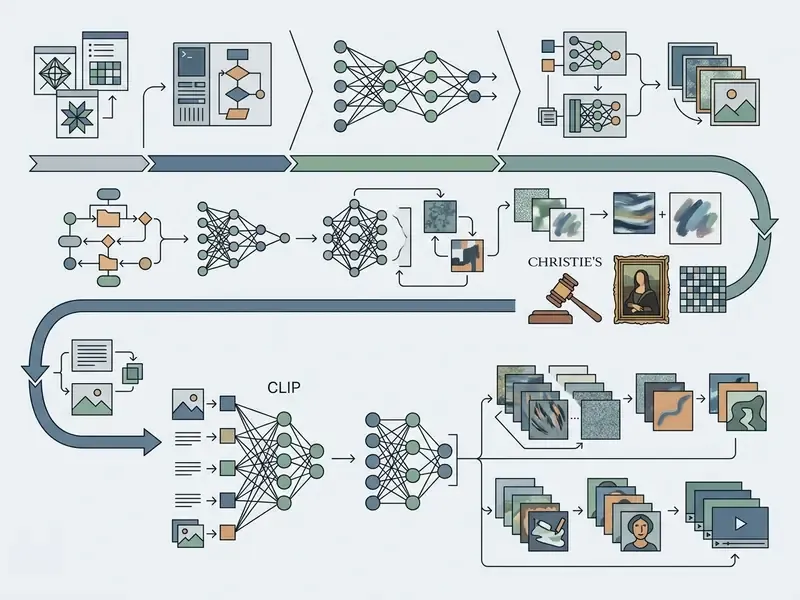
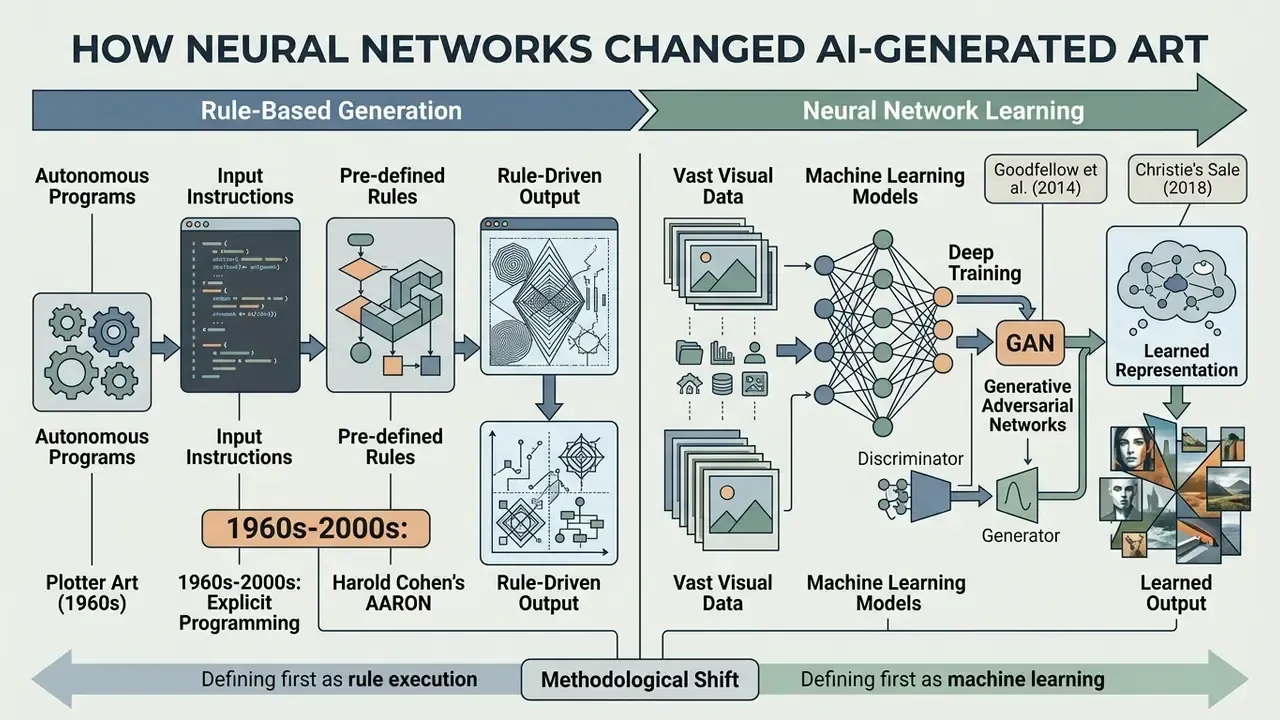
Figure 1. Algorithmic code (1960s) versus a learned neural network (2020s): the evolution of control over graphical output.
| Dimension | Algorithmic art (1960s to 1990s) | Learned generative models (2014 to 2026) |
|---|---|---|
| Source of visual rules | Hand-written by the programmer-artist | Inferred from millions of image and caption pairs |
| Where "style" is stored | Explicit source code and parameter tables | Distributed floating-point weights in latent space |
| Reproducibility | Deterministic: same code, same output | Stochastic: reproducible only by fixing the seed and sampler |
| Failure mode | Logic bug, plotter fault | Mode collapse, artifacts, dataset bias, hallucinated structure |
| Auditability | Line-by-line code review | Dataset provenance review, prompt and output logging, red-teaming |
| Governance analogue | Rules engine, deterministic model | Probabilistic model requiring validation, monitoring and challenger testing |
In February 1965, German mathematician Georg Nees held the first public exhibition of computer-generated drawings at the University of Stuttgart. Shortly afterwards, Frieder Nake displayed algorithmic works created using the Telefunken TR 4 computer and Zuse Z64 Graphomat plotter. These experiments established the baseline for algorithmic digital art, demonstrating that mathematical procedures could produce structured visual forms without direct manual drawing. Whether that counts as first ai generated art is exactly the definitional argument the next section takes apart.
How neural networks changed AI-generated art
Deep neural networks fundamentally altered the history of ai art by replacing human-written instructions with statistical parameter weights learned directly from image datasets.
Between 2006 and 2012, researchers developed unsupervised pre-training for deep belief networks, Hessian-free optimization, stacked denoising autoencoders, rectified linear units (ReLU) and scaled initialization schemes that made deep architectures practical. Instead of coding explicit drawing rules, developers fed thousands of digitized images into multi-layered neural networks. The system adjusted internal parameters through gradient descent to capture low-level textures and high-level structural features.
The 2012 breakthrough of AlexNet in image classification proved that convolutional neural networks (CNNs) could build complex internal hierarchies of visual concepts. Researchers quickly inverted these classification networks to synthesize images from latent features, setting the technical foundation for modern generative models.
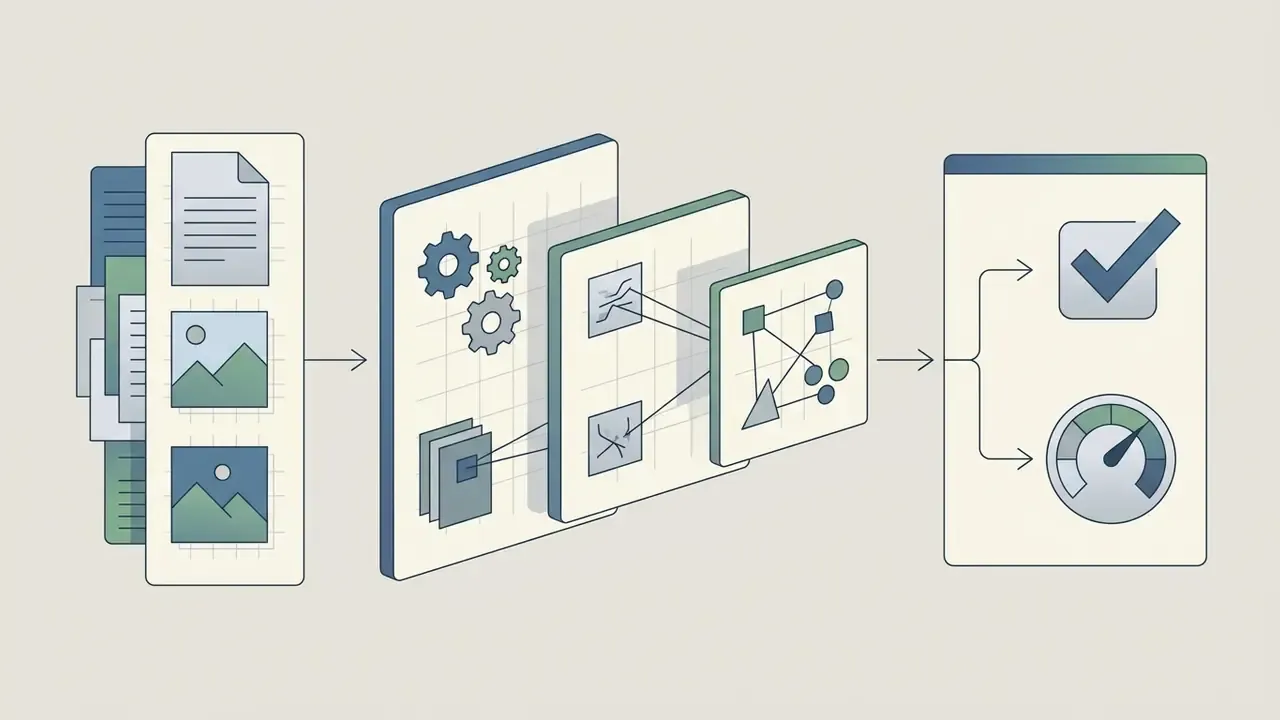
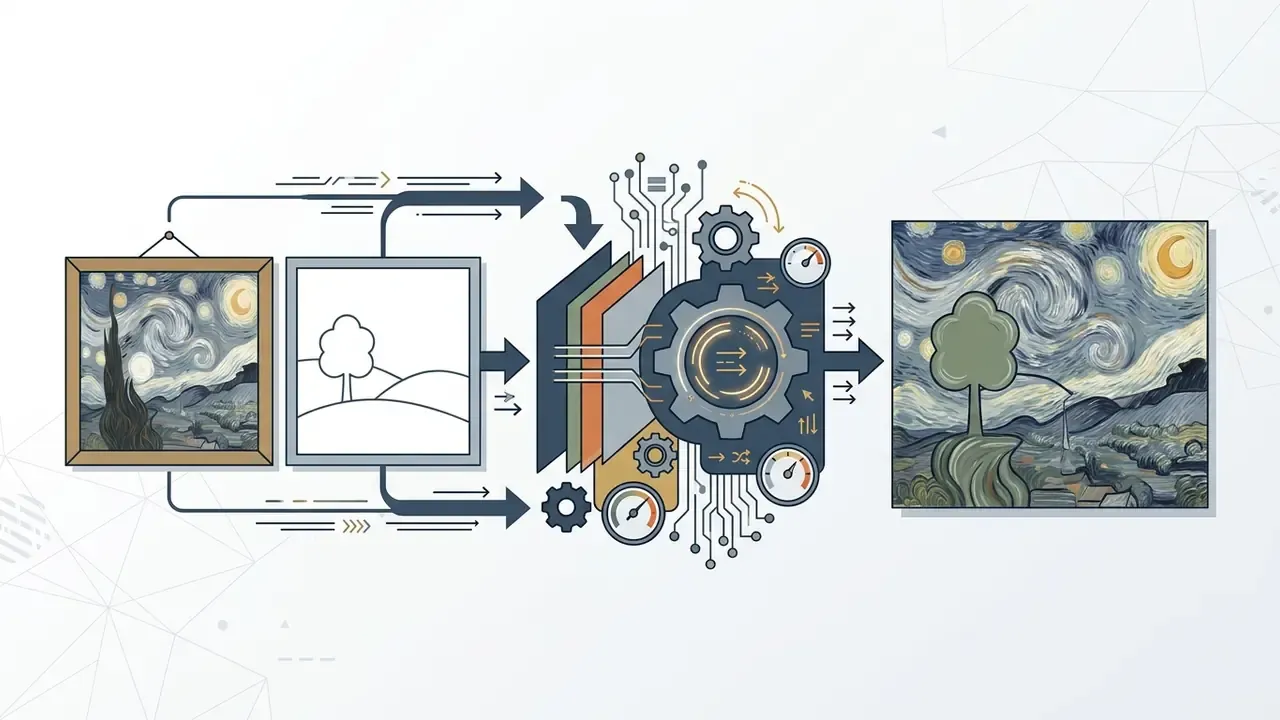
Three other learned architectures shaped this period and remain visible in production tooling:
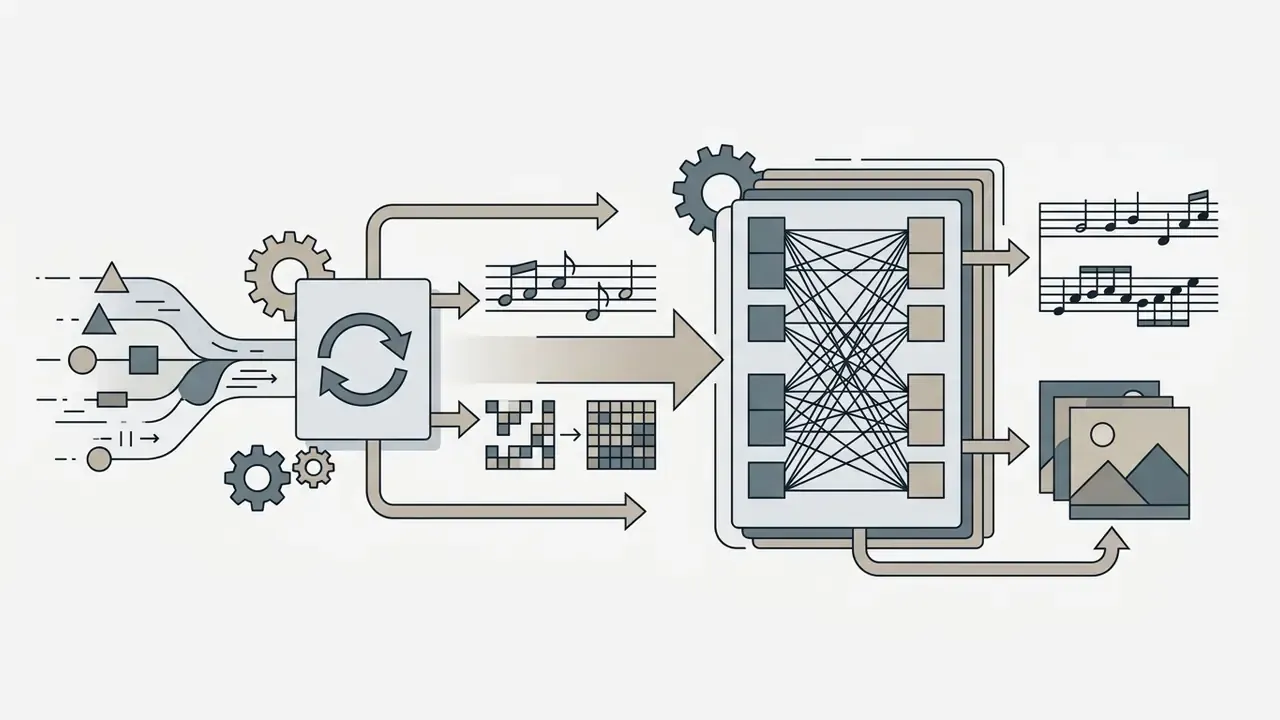
What was the first AI art generator?
| System name | Debut year | Core technology | Machine learning capability |
|---|---|---|---|
| AARON (Harold Cohen) | 1973 | Rule-based expert system | None; explicit hand-coded rules |
| The Painting Fool | 2001 | Heuristic feature extraction | Limited supervised training |
| GANs (Goodfellow et al.) | 2014 | Adversarial neural networks | Deep unsupervised learning |
| DeepDream (Google) | 2015 | Convolutional gradient optimization | Pre-trained classification weights |
| Latent Diffusion / SD 1.x | 2022 | Iterative denoising in latent space | Deep multimodal, text-conditioned |
Under modern enterprise definitions, a true ai image generator combines learned neural representations with generative capabilities. Consequently, many machine learning researchers mark Ian Goodfellow's 2014 Generative Adversarial Networks paper as the official starting point for modern ai generated art tools. That same publication is the usual answer to when did ai start making art without a human specifying every stroke, and it anchors most accounts of the history of ai art tools.
The existence of million-scale detection benchmarks confirms how quickly GAN and diffusion outputs reached a level of photorealism that requires specialised classifiers. That is why provenance verification with AI image detectors has become a standard control rather than an optional extra.
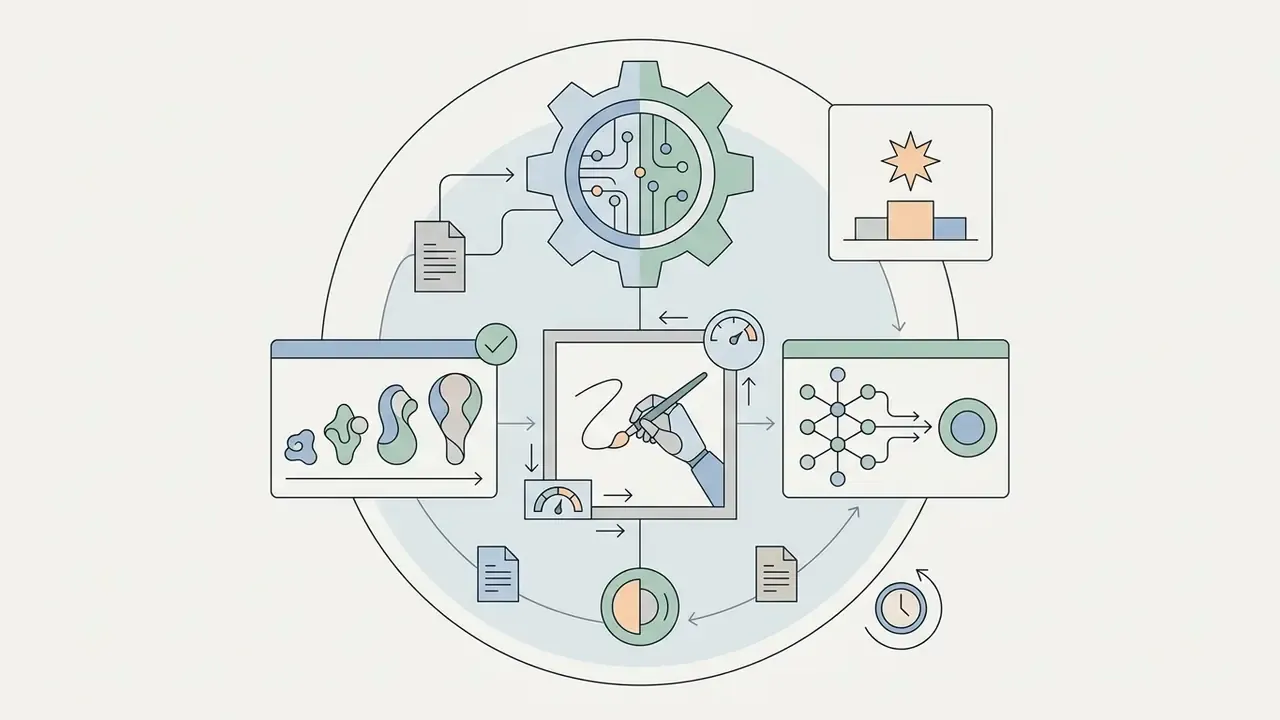
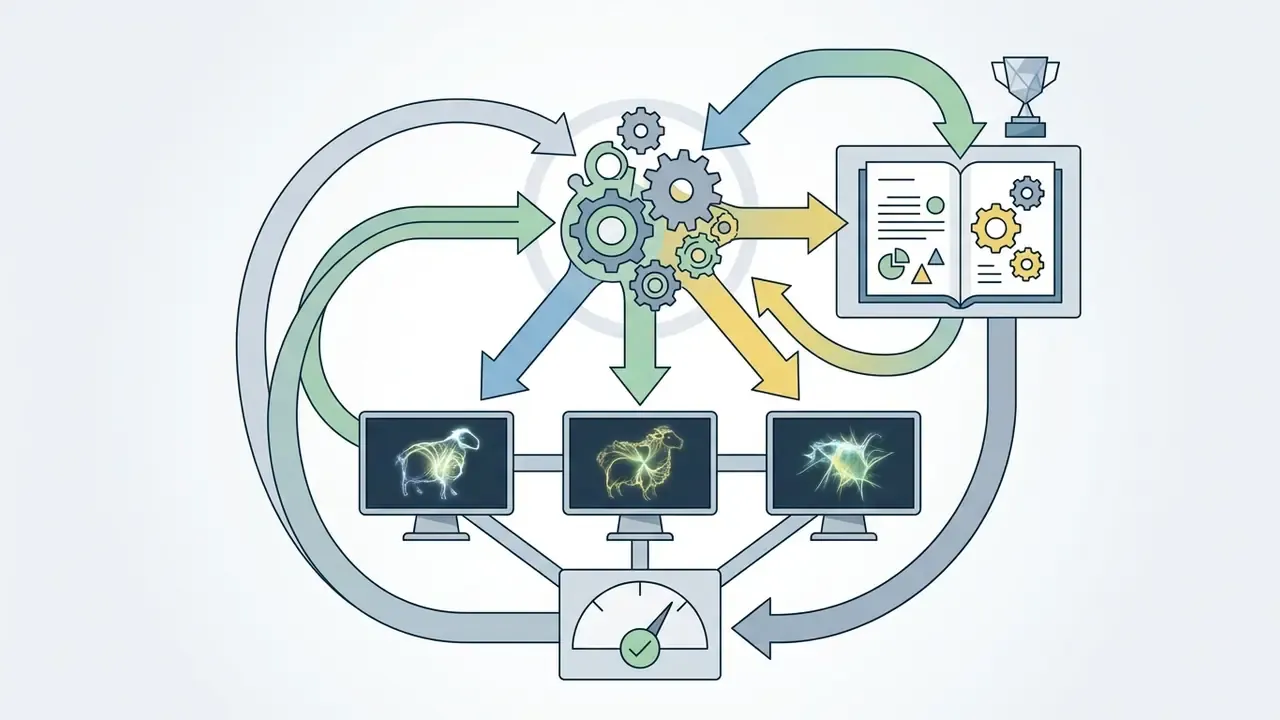
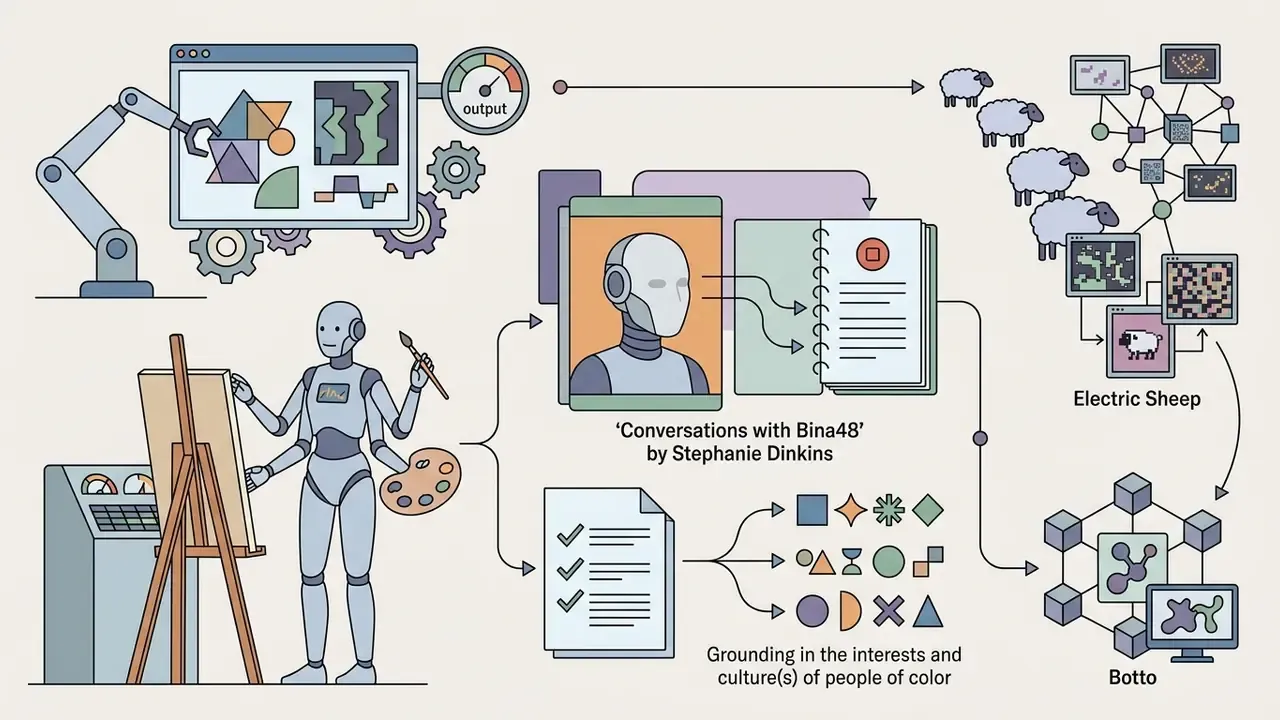
Robotic and interactive AI artists: Galápagos, Electric Sheep, Ai-Da, Botto
The evolution of generative systems also branches into physical robotics, evolutionary computation and autonomous agents governed by communities rather than by a single author.
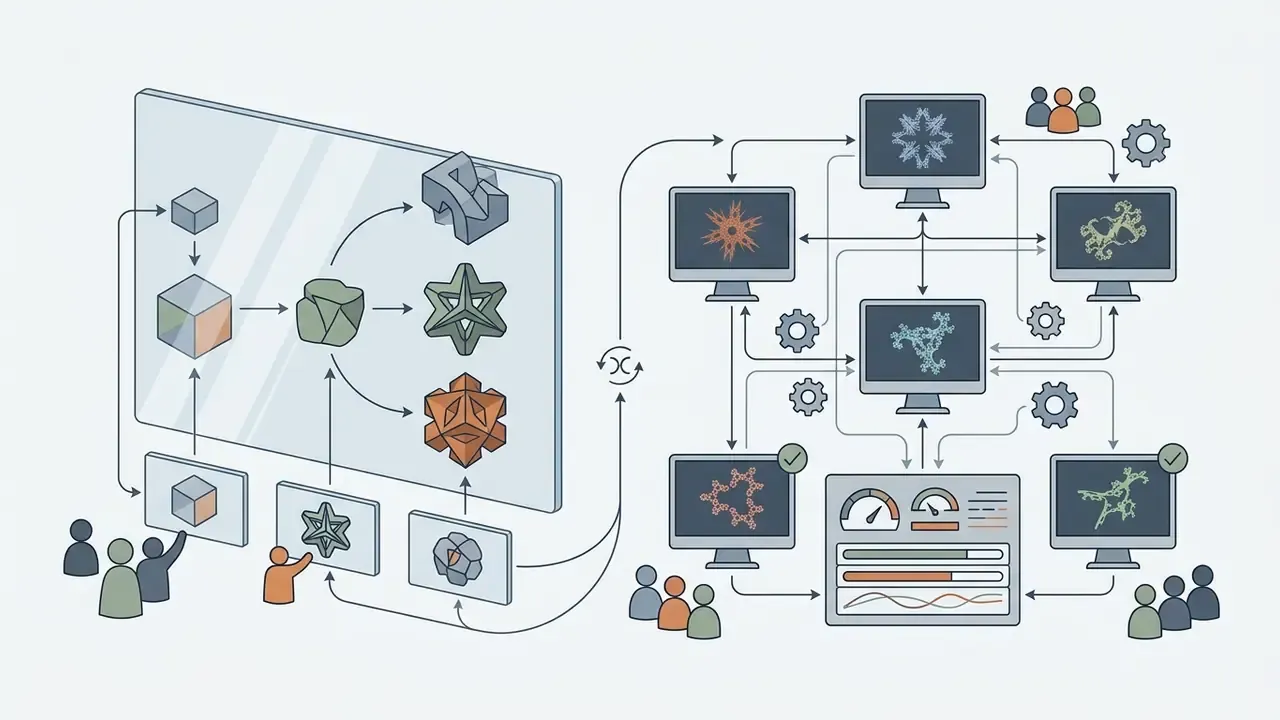
For governance teams, these projects illustrate an under-discussed control problem. When curation is crowdsourced, as with Botto, or audience-driven, as with Electric Sheep and Galápagos, the effective objective function sits outside the organisation's change-management perimeter. Who signs off on a model whose direction is set by a weekly vote? Nobody, in practice. That is precisely the gap.
How generative AI art evolved: GANs, training data and diffusion
Generative AI art evolved from adversarial neural competition into iterative denoising diffusion processes guided by multi-modal text embeddings.
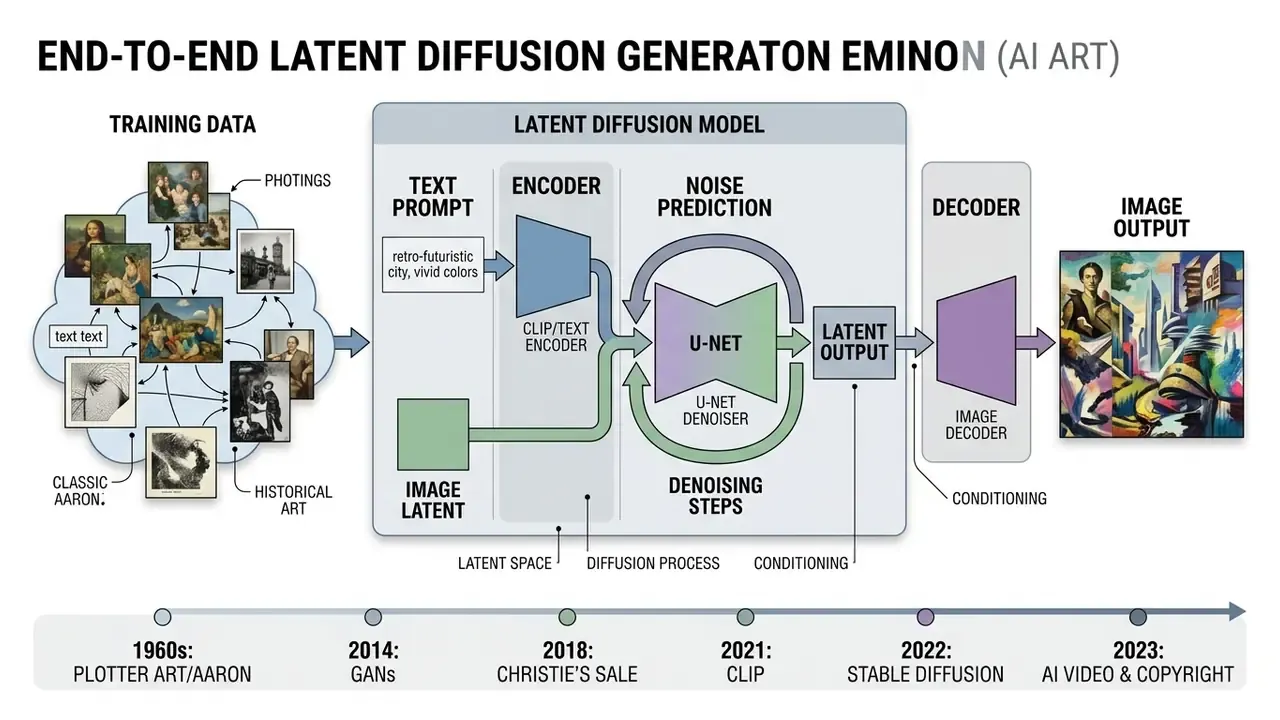
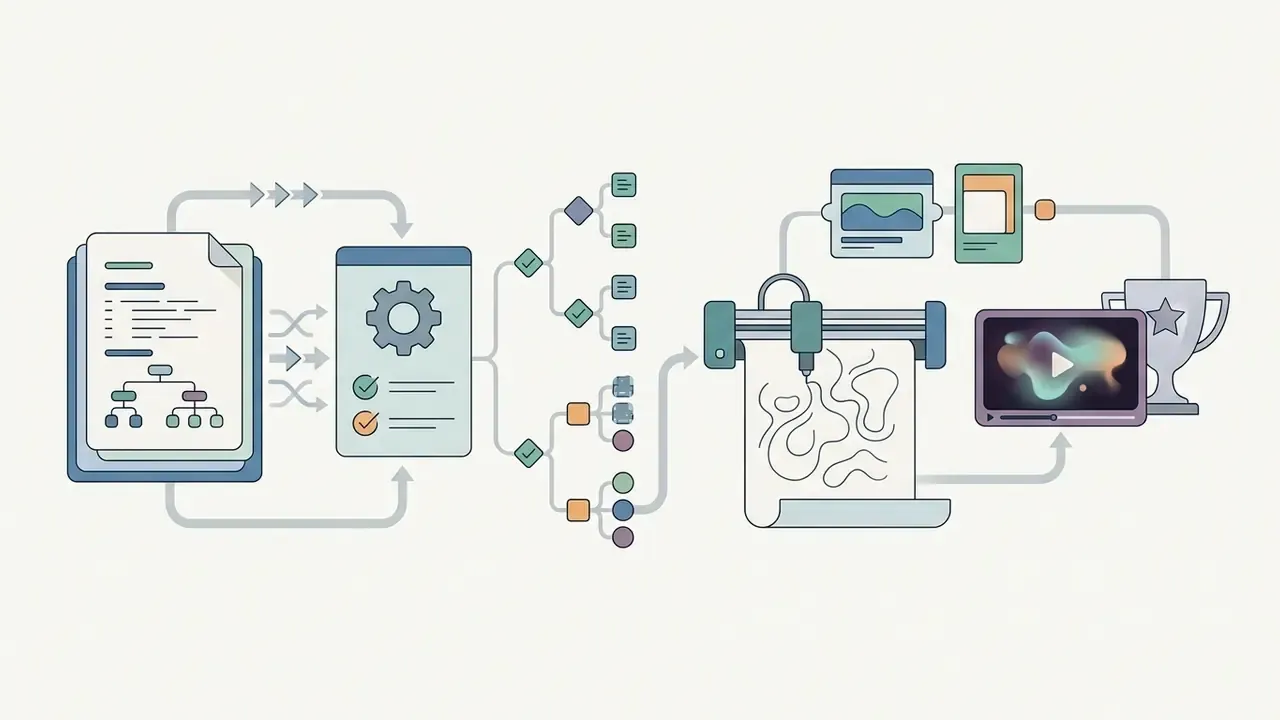
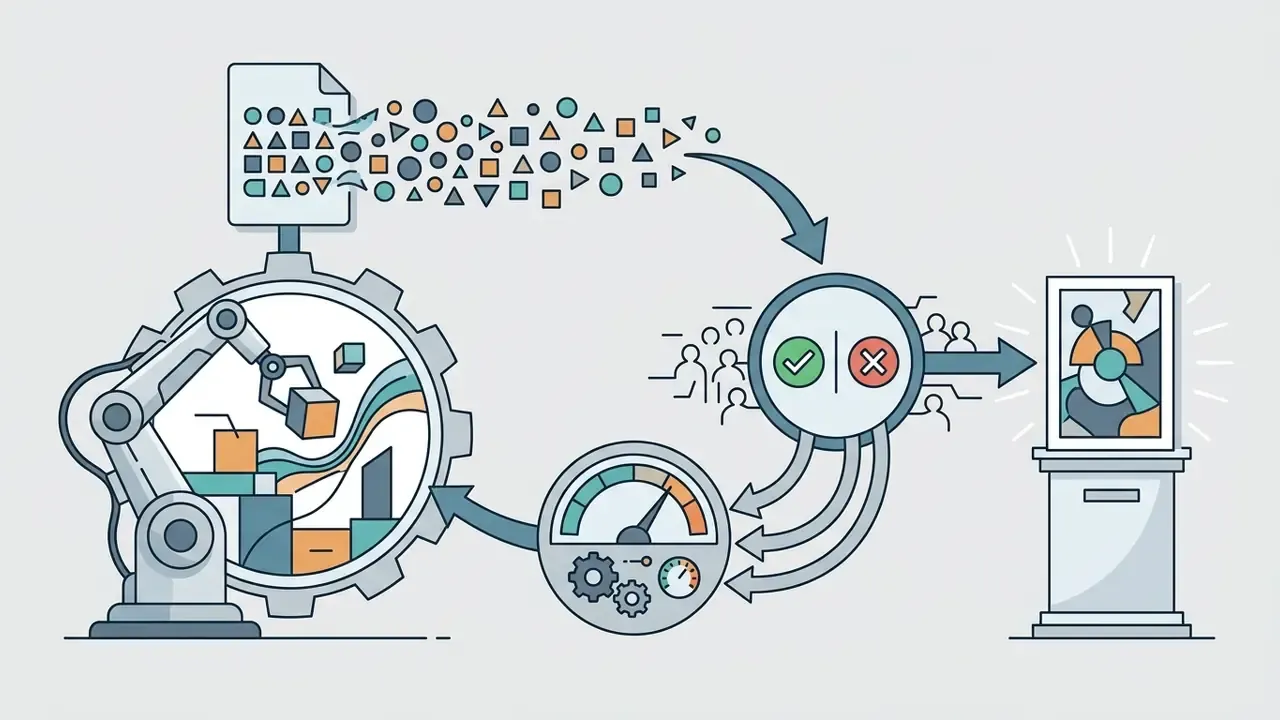
Pipeline steps in text form:
- Training dataimage and caption pairs are collected at scale, then filtered for resolution, aesthetics and safety.
- Neural network traininga variational autoencoder compresses images into a latent space, and a U-Net learns to reverse added Gaussian noise inside that space.
- Text promptsa CLIP-style text encoder converts the prompt into embeddings that condition each denoising step.
- AI tools and outputthe sampler iterates a fixed number of steps, the decoder returns pixels, and post-processing finishes the asset.
Why generative adversarial networks were a turning point
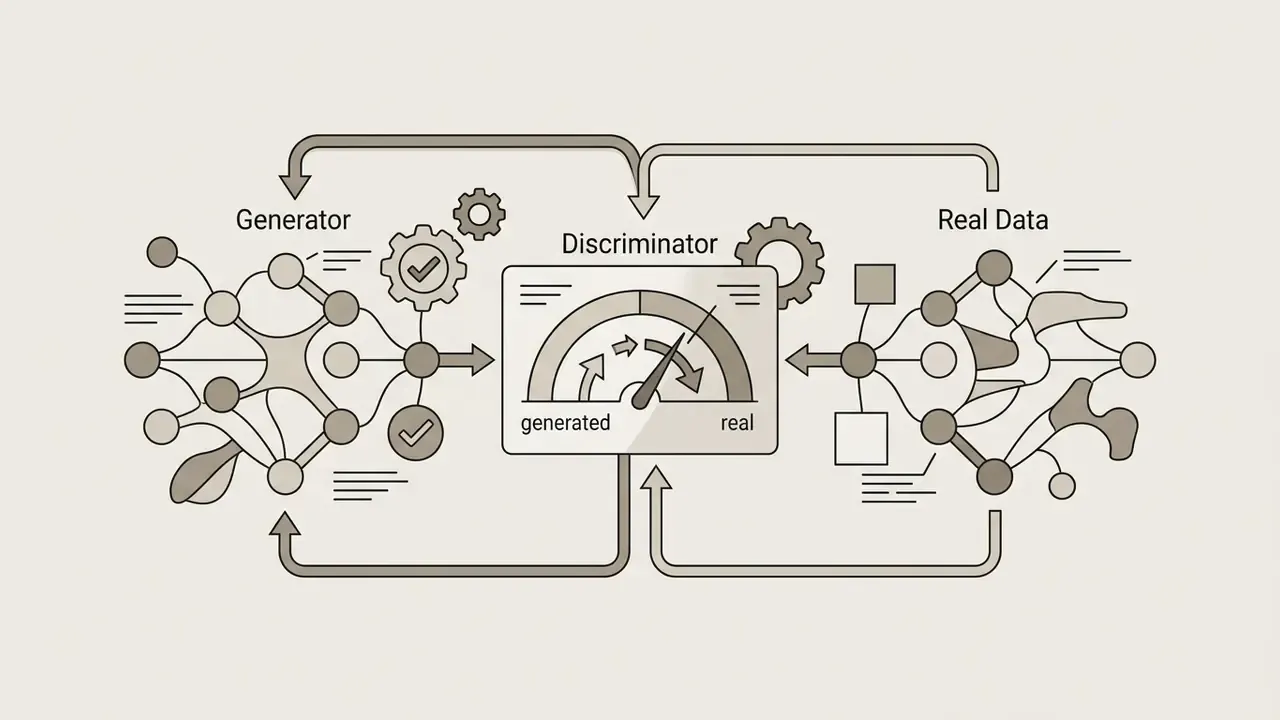
Generative adversarial networks (GANs) established a critical turning point by enabling neural networks to synthesize photorealistic images without explicit manual feature modeling.
Introduced by Ian Goodfellow and his colleagues in 2014, GANs operate using two competing neural networks trained in an adversarial zero-sum game:
- The Generator (): takes a random noise vector and attempts to produce synthetic images that resemble real data.
- The Discriminator (): evaluates real images alongside synthetic samples from and calculates the probability that a given image is authentic.
Why this formula matters to a risk owner, not only to a researcher. The objective is a saddle-point problem, not a convex loss with a single minimum. Training therefore has no clean convergence guarantee. If the discriminator overwhelms the generator, gradients vanish. If the generator finds a narrow high-scoring region, it collapses onto a small set of outputs. That is the mathematical origin of mode collapse, a model that appears to work in spot checks while silently losing output diversity. In validation terms, GAN-era models require diversity and stability metrics as first-class monitoring indicators, because eyeballing a handful of samples cannot detect distributional narrowing.
Through continuous backpropagation, the generator improves its synthetic distribution while the discriminator refines its evaluation boundaries. By 2016, improved GAN training techniques had reached the point where human evaluators could not reliably separate generated MNIST digits from real ones, and CIFAR-10 human error reached 21.3%. By 2018 and 2019, advanced architectures like NVIDIA's StyleGAN achieved exceptional visual fidelity in generating high-resolution human faces. Despite these advances, GANs suffered from training instability and mode collapse, where the generator produces a limited range of repetitive outputs.
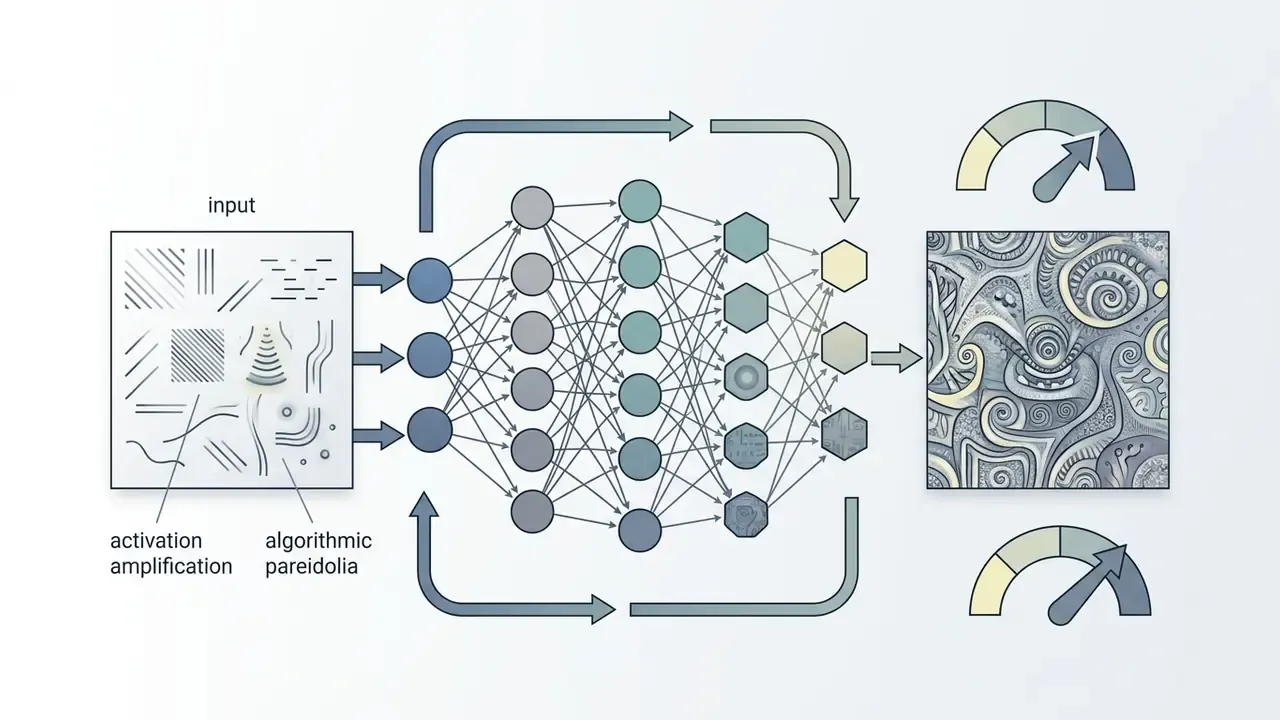
Google's DeepDream (2015) took the opposite route. Instead of adversarial training, it iteratively amplified the activations of a chosen layer in a pre-trained classifier, a process often described as algorithmic pareidolia. Different layers produced different visual regimes: edges and swirls in shallow layers, repeated eyes, dog snouts and recursive architecture in deeper ones. Google reported "tremendous interest" from both machine-learning and creative-coding communities after open-sourcing the code, and the hallucinatory DeepDream aesthetic became the first mass-recognisable signature of neural-network art.
How training data affects generated images
The structural quality, diversity and labeling consistency of training data directly determine the stylistic boundaries, artifact frequency and bias patterns of generated outputs.
When trained on broad web-scraped collections such as LAION-5B or LAION-Aesthetics, generative models associate specific professions with restricted demographic traits unless explicitly counterbalanced during fine-tuning. Art-specific corpora behave differently. WikiArt supports style conditioning, while purpose-built benchmarks such as AI-ArtBench (185,015 images across 10 styles) and the AI-Pastiche Dataset (953 AI-generated artworks) mark a shift from generic web scrapes toward curated style benchmarks with documented provenance.
Dataset curation also shapes spatial detail. NVIDIA's StyleGAN architecture studies demonstrated that generated images "lack some of the pixel-level detail" of the training corpus, and that normalized feature layers can induce recurring water-droplet artifacts across synthetic backgrounds. Replacing simple feature normalization with weight demodulation directly eliminated these visual distortions, proving that architectural controls must align with dataset statistics. Peer-reviewed GAN work also links label entropy and sample diversity to output quality: low-entropy conditional labels combined with high marginal diversity correlate with more semantically meaningful generations. A 2025 photorealism study of diffusion outputs classifies residual failures into anatomical implausibilities and stylistic artifacts whose visibility depends on curation and scene complexity.
The governance translation is blunt. Data lineage is not a documentation nicety. It is the upstream determinant of both your legal exposure and your fair-treatment exposure.
When did AI art become popular?
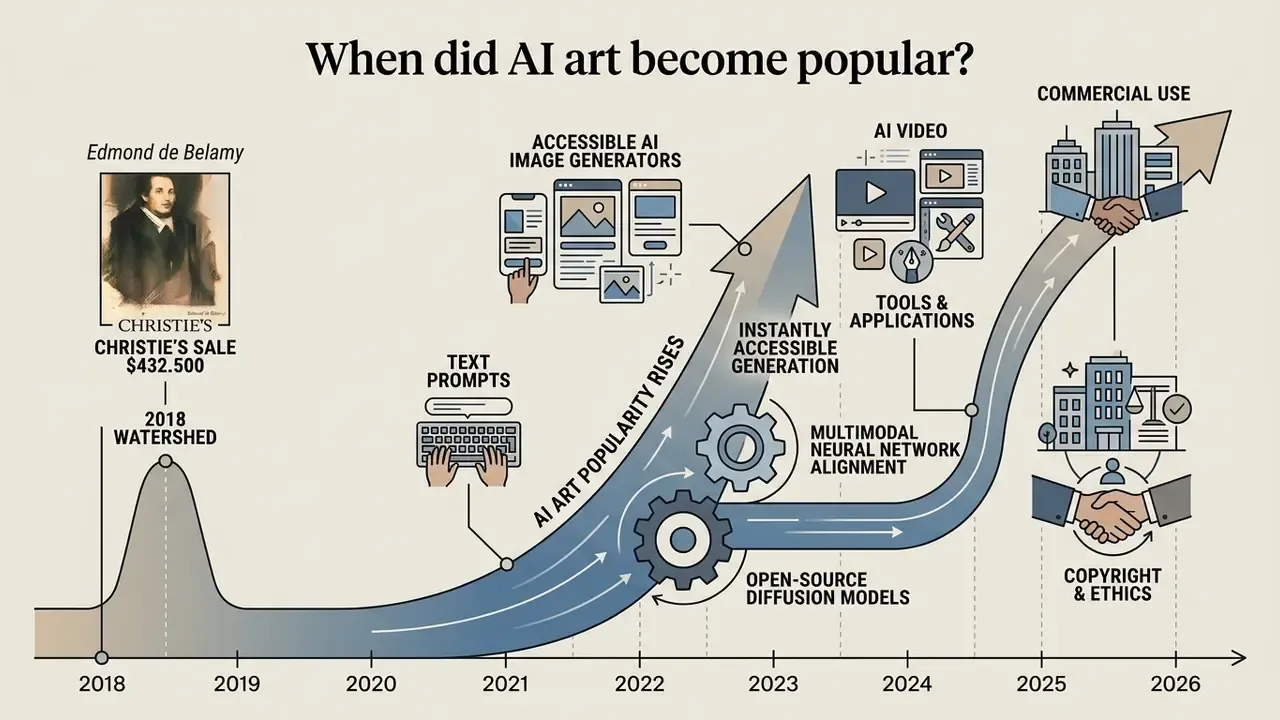
AI art became popular between 2021 and 2022, when multimodal neural network alignment and open-source diffusion models made synthetic image generation instantly accessible to non-technical users. The cultural breakthrough that put machine-generated imagery into a major auction house, however, happened four years earlier. So the answer to when did ai art become a thing splits by audience: 2018 for the art world, 2022 for everyone else.
The Christie's 2018 watershed: Edmond de Belamy
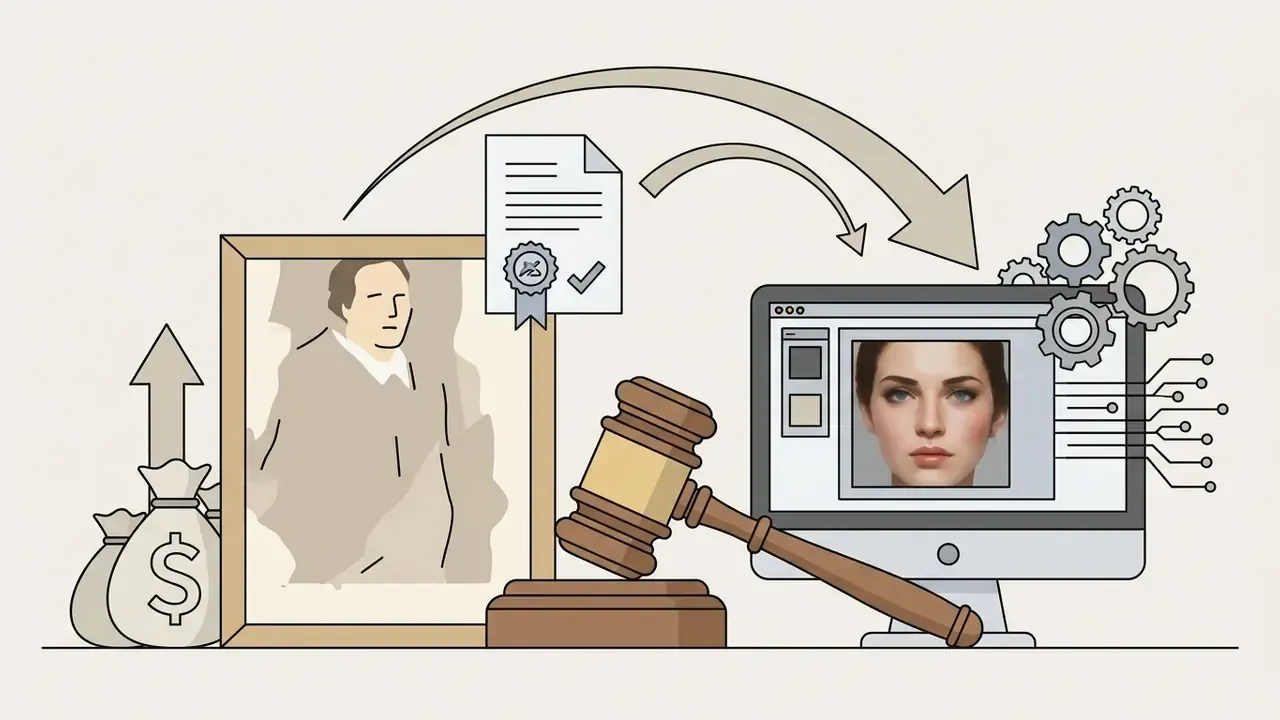
A major cultural watershed occurred in October 2018 when Christie's New York auctioned its first AI-generated print, Edmond de Belamy, produced by the Paris-based collective Obvious using a Generative Adversarial Network. Estimated at $7,000 to $10,000, the artwork fetched $432,500, roughly 45 times the high estimate. Printed on canvas, it belongs to a generative series titled La Famille de Belamy. The name is a bilingual pun honouring Ian Goodfellow, since "bel ami" is French for "good friend". Instead of a conventional signature, the canvas carries the GAN's mathematical loss function, marking the moment machine-generated visual media entered formal fine-art institutions. Under George Dickie's institutional theory of art, that sale, and not any benchmark score, is the point at which AI art was ratified by "the art world".
Figure 3. From research artefact to mass practice: measurable milestones, 2020 to 2026.
| Period | Access model | Measurable signal of adoption |
|---|---|---|
| Before 2021 | Research code, GPU clusters, Python required | Papers and gallery installations; no consumer footprint |
| Jan 2021 | CLIP and DALL·E 1 announced (5 Jan 2021) | Prompt engineering emerges as a public skill |
| 2021 to Mar 2023 | Hosted betas plus open weights | TWIGMA recorded 800,000+ AI images on Twitter alone |
| Mar to Jul 2022 | Midjourney closed beta (Mar), open beta (Jul) | Discord-native generation reaches mainstream creators |
| Aug 2022 | Stable Diffusion open weights (22 Aug 2022) | Local execution on consumer GPUs; explosion of fine-tunes |
| 2024 | Generators embedded in consumer suites | About 12.33% of US presidential-campaign images on X identified as AI-generated |
| 2025 to 2026 | Diffusion is the default image stack; video arrives | Text-to-video pipelines and enterprise governance frameworks |
Before 2021, generating synthetic imagery required technical expertise in Python, GPU environment configuration and machine learning framework optimization. The public launch of accessible web platforms democratized generation workflows, allowing creators to execute complex rendering tasks using simple natural language text prompts. That is also the practical answer to when did ai art come out for ordinary users: the moment the barrier dropped from code to a sentence.
Text prompts and accessible AI image generators
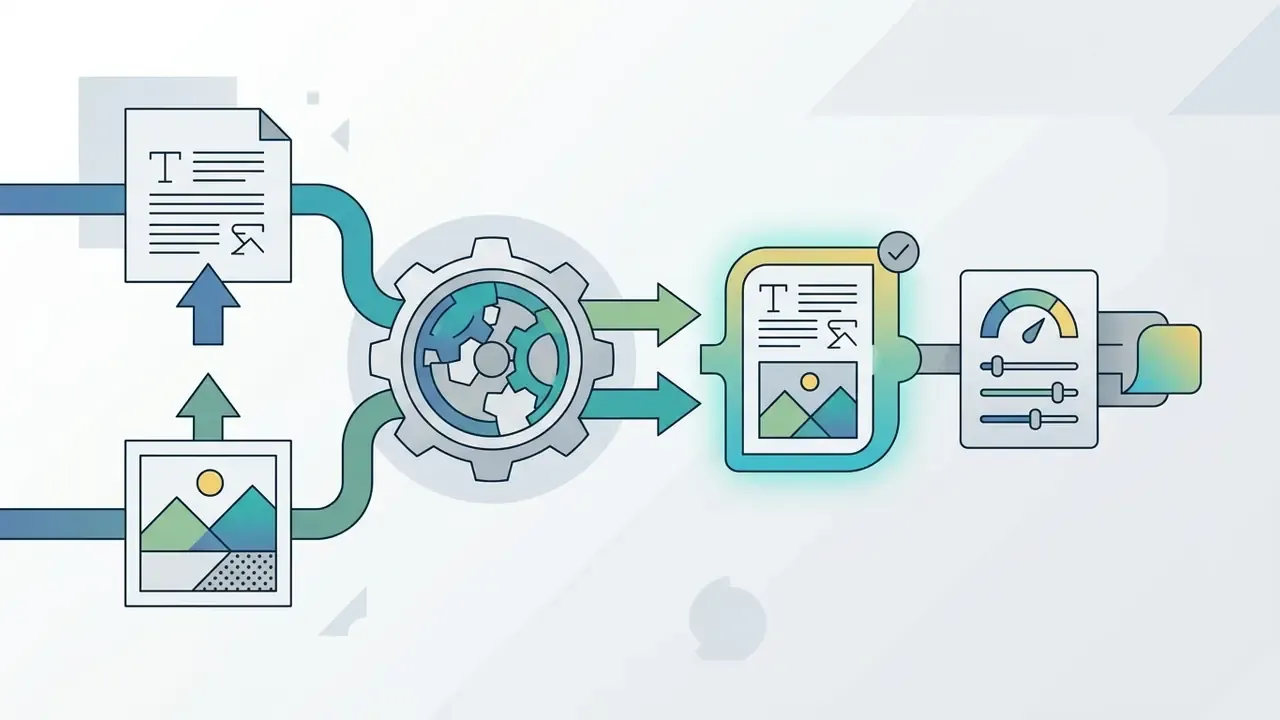
Text-to-image interfaces simplified graphic creation by deploying multimodal alignment models that connect natural language instructions to latent visual features.
In January 2021, OpenAI introduced CLIP (Contrastive Language-Image Pre-training) alongside DALL-E 1. CLIP trained dual encoders on 400 million image-text pairs to evaluate how accurately a given caption describes a visual image. By projecting text strings and visual tokens into a shared vector space, CLIP enabled researchers to guide generative neural networks using text prompts instead of manual code execution.
«CLIP resolved the semantic translation barrier, converting user intent directly into latent space coordinates without requiring technical programming skills.»
Subsequent implementations, such as StyleCLIP (ICCV 2021), allowed artists to modify facial expressions, lighting conditions and artistic styles in pre-trained GANs using basic descriptive sentences, explicitly replacing manual latent-space editing. CLIP-GEN (2022) generated images directly from CLIP text embeddings. This eliminated technical barriers and turned prompt writing into a primary creative interface. It also shifted the control surface of the model from source code to natural language, where change management is far harder to evidence.
Advanced prompt and fine-tuning controls
Modern inference pipelines allow artists, and enterprise production teams, to go far beyond basic text prompts through granular, loggable control parameters:
- Positive and negative prompts positive prompts describe desired content; negative prompts explicitly suppress concepts, artifacts or styles such as "extra fingers", "watermark" or "text", acting as a lightweight output-safety filter.
- Classifier-Free Guidance (CFG) scale controls how strictly the model adheres to the text prompt versus latent sampling freedom. Low CFG yields loose, creative output; high CFG yields literal but sometimes over-saturated and artifact-prone results.
- Seed control freezes the pseudo-random noise initialised in the diffusion process, making a generation deterministically reproducible. For audit purposes, prompt plus seed plus sampler plus model checkpoint hash is the minimum reproducibility record.
- Samplers and step count the numerical solver, for example Euler or DPM++, and the number of denoising iterations trade inference cost against detail stability.
- Structural conditioners, ControlNet constrains spatial composition using edge maps, depth masks, pose skeletons or segmentation maps, converting generation from a lottery into a repeatable layout process.
- Low-Rank Adaptation (LoRA) and hypernetworks freeze base checkpoint weights and train small adapter matrices on a targeted concept, character or brand style. Cheaper than full fine-tuning and easier to version-control.
- Textual inversion and embeddings teach the model a new token for a user-provided concept from only a handful of reference images, then invoke it by that token.
- IP-adapter and image-to-image condition generation on a reference image rather than text alone, enabling style continuity across an asset series.
- Inpainting and outpainting regenerate a masked region or extend the canvas beyond its original borders. See our comparison of AI outpainting tools for commercial terms.
- Upscalers and post-processing super-resolution networks plus traditional retouching finish the asset and, importantly for copyright, constitute documentable human creative intervention.
- Noise manipulation before inference injecting or shaping initial latent noise gives additional control over composition and variance.
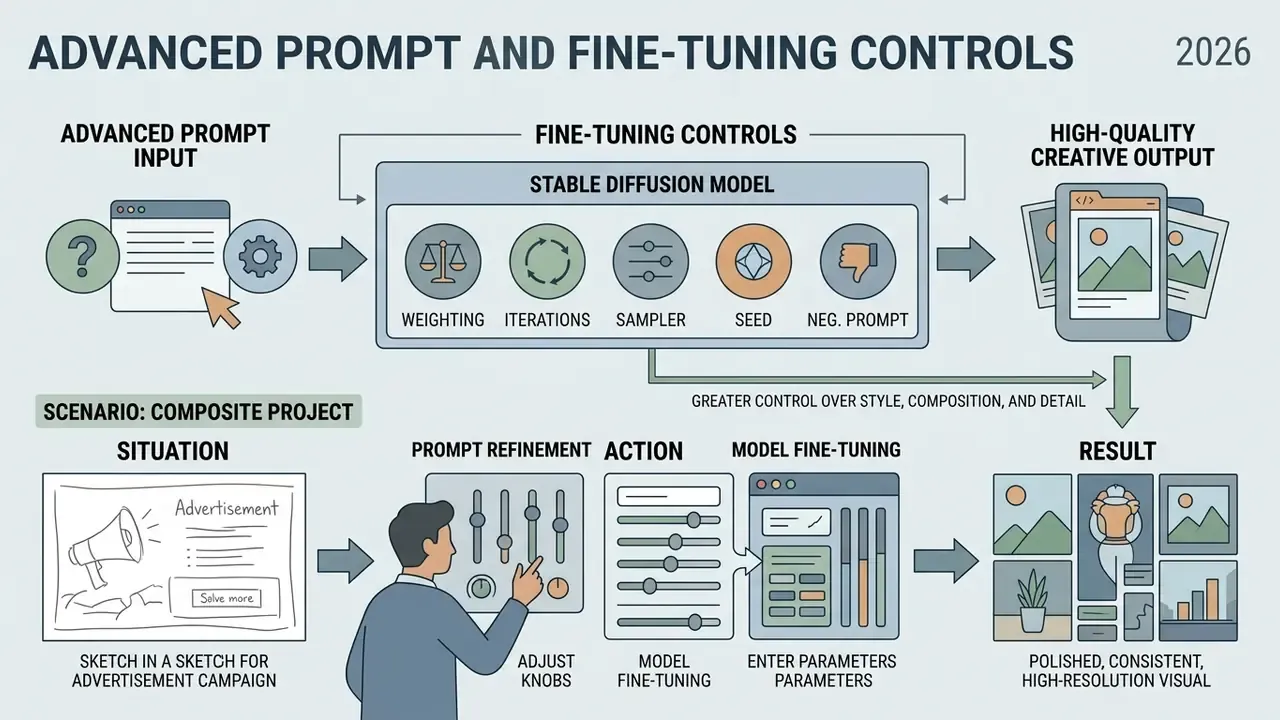
Consumer-facing applications deliberately hide most of these parameters and expose only a positive prompt. Professional web interfaces and notebooks expose all of them but demand capable GPUs. Teams choosing between these tiers can consult our comparison of free AI image generators and our evaluation of Midjourney against alternative platforms.
One practical warning from control testing. If a pipeline hides the seed and sampler, you cannot reproduce the asset later. That single omission breaks the evidence chain more often than any model weakness.
Stable Diffusion and the AI art boom
Stability AI's open-weights release of Stable Diffusion on 22 August 2022 triggered a global explosion in AI art adoption by enabling local model execution on consumer hardware.
Unlike proprietary cloud platforms such as Midjourney or early DALL-E iterations, Stable Diffusion made model parameters publicly downloadable under the CreativeML OpenRAIL-M license, released together with DreamStudio Lite. This open distribution model allowed developers to integrate image generation directly into custom desktop software, web applications and local creative suites, and it supported image-to-image style transfer so users could build bespoke visual identities.
Illustrative scenario (composite, not a named client):
- Situation
- an enterprise digital design department needed to produce thousands of promotional graphics monthly while keeping sensitive project concepts confidential.
- Action
- the team deployed local Stable Diffusion pipelines on air-gapped workstations, using custom fine-tuned weights without sending data to external APIs.
- Result
- internal reporting described a materially shorter asset turnaround versus the previous outsourced workflow, reduced recurring per-seat cloud spend and, the decisive control benefit, no project concepts leaving the internal network, since no prompt or reference image was transmitted to a third-party vendor log. Precise speed and cost deltas are organisation-specific and should be measured against your own baseline rather than assumed.
The open release enabled massive community fine-tuning through Low-Rank Adaptation (LoRA) and ControlNet plugins. Creators could freeze base model parameters and apply precise structural controls over poses, edge maps and depth channels, shifting generative tools from novel toys into controllable production workflows. Asked when did generative ai art start behaving like infrastructure rather than a demo, that August is the defensible answer.
From still images to AI video (2023 to 2026)
Starting in 2023, generative models extended their temporal boundaries from static spatial diffusion to frame-consistent video synthesis, using 3D latent representations to maintain character, motion and lighting coherence across sequences.
Meta researchers demonstrated Make-A-Video, producing short clips such as "fireworks over Manhattan" and "robots watching fireworks" directly from text. Runway shipped Gen-2 and later Gen-3 as commercial text- and image-to-video products. Google announced faster, higher-quality diffusion techniques and later the Veo family. OpenAI's Sora pushed duration and scene consistency further. The engineering problem is no longer "does the frame look real" but "does frame 48 agree with frame 1", which is temporal consistency, identity preservation and physically plausible motion.
Three governance consequences follow directly from that shift:
From academic experiments to regulatory control: why history defines today's risk models
The historical sequence above is not trivia. It is the causal chain behind every current legal and control question about generative imagery.
Between 2014 and 2022, the research community optimised for one variable: output quality. The fastest route to quality was scale, and the fastest route to scale was indiscriminate web scraping of image and caption pairs. Nobody in that pipeline was building an audit trail, because the artefact was a paper, not a regulated production asset. When those same checkpoints were released publicly in August 2022 and immediately absorbed into commercial workflows, enterprises inherited a technology whose data lineage was never designed to be evidenced. That single inheritance explains the copyright litigation, the bias findings, the inability to register purely machine-made output, and the difficulty of answering a regulator's simplest question: where did this asset come from?
For institutions operating under model risk management expectations, including Federal Reserve and OCC supervisory guidance SR 11-7, the NIST AI Risk Management Framework (2023) and the risk-tiering obligations of the EU AI Act, three practical translations apply:
| Historical phase | Model type in the inventory | Validation approach |
|---|---|---|
| Rule-based (1965 to 2001) | Deterministic rules engine | Code review, logic walkthrough, exhaustive test cases |
| GAN era (2014 to 2021) | Probabilistic generative model | Stability and diversity metrics, mode-collapse monitoring, sample-set testing |
| Diffusion plus text conditioning (2021 to 2026) | Probabilistic multimodal model with an open-ended input surface | Prompt-level control testing, invariance and robustness testing, dataset provenance review, output screening, human-in-the-loop sign-off |
NIST's AI RMF explicitly recommends that organisations establish terms of use and acceptable-use policies and track dataset modifications and provenance for generative AI systems. The remaining sections convert that expectation into a usable checklist, a cost and residual-risk matrix, and an audit evidence template.
Using AI-generated art commercially: what to check before choosing a tool
Commercial deployment of AI-generated art requires rigorous verification of platform licensing terms, confirmation of human authorship for copyright registration, and comprehensive auditing of training data provenance. Start by mapping vendor obligations against our overview of platform licensing terms for commercial AI image use.
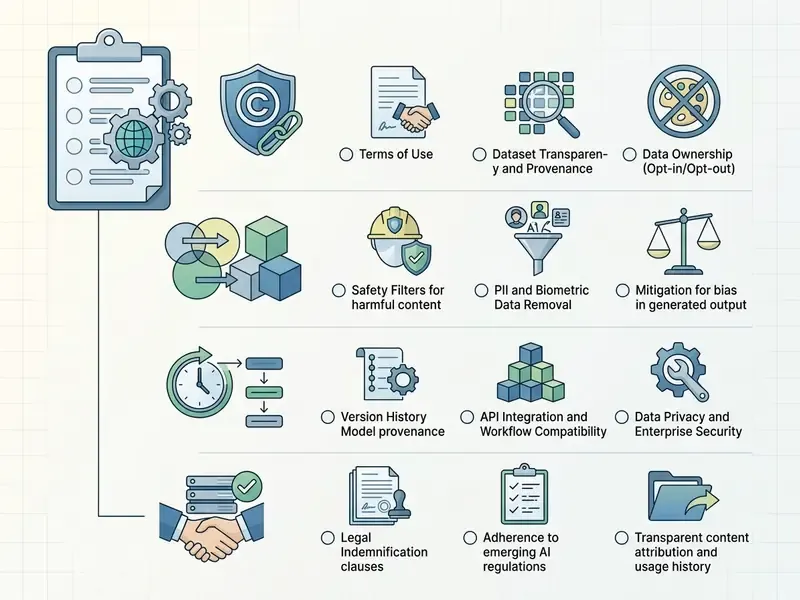
Illustrative scenario (composite):
To evaluate platforms, enterprise risk managers rely on objective tools and comparative benchmarks for AI art generators:
- Review structural software differences on our compare matrix to balance cloud accessibility against local execution privacy.
- Consult our comprehensive AI Media Calculators to estimate infrastructure costs and control residual risk before enterprise scaling.
- Verify API throughput and integration limits using our dedicated AI Media API Guides.
- Monitor ongoing federal class-action copyright lawsuits and regulatory shifts across our updated AI Litigation and Case Timelines.
- Check style-specific exposure where outputs imitate a protected visual identity, using our analysis of style-imitating generators.
- For ongoing technical guidance or compliance support, consult our official AI Media Support and Troubleshooting portal.
Cost and residual-risk matrix: SaaS versus private or air-gapped deployment
Deployment topology, not model choice, drives most of the residual risk in a regulated environment. The matrix below compares the three realistic options.
| Dimension | Public cloud SaaS (hosted UI or API) | Private cloud or VPC deployment | On-premise or air-gapped |
|---|---|---|---|
| Prompt and reference-data confidentiality | Prompts and uploads traverse vendor infrastructure and may be logged | Data stays in a tenant-controlled network; vendor retains model artefacts | No egress; strongest confidentiality posture |
| Direct cost profile | Per-seat or per-credit operating expense; near-zero setup | Mixed: reserved GPU capacity plus engineering | Capital expenditure on GPUs plus ongoing MLOps staffing |
| Cost of control | Low build cost, high monitoring cost, since vendor terms change and outputs must be screened | Moderate on both axes | High build cost, lower recurring third-party risk cost |
| Model change management | Vendor may silently update the model; reproducibility can break | Version pinning possible | Full checkpoint pinning and hash control |
| Reproducibility for audit | Often partial: seed and sampler may be hidden | Good, if the pipeline is instrumented | Complete: prompt, seed, sampler and checkpoint hash all under control |
| Licensing exposure | Governed by vendor terms of service; output rights may be assigned contractually | Vendor terms plus internal policy | Governed by the model licence, for example CreativeML OpenRAIL-M, plus internal policy |
| Third-party and vendor risk | Highest: concentration, outage and terms-change risk | Moderate | Lowest external dependency, highest internal operational risk |
| Typical fit | Experimentation, low-sensitivity marketing assets | Scaled production with data residency requirements | Confidential concepts, regulated disclosures, pre-release product imagery |
How to use it: score each row against your risk appetite, then compare total cost of control, not licence price alone. A cheap SaaS tier that forces manual screening of every asset, and cannot reproduce an image for an audit, is frequently more expensive in control effort than a pinned internal deployment. Model the trade-off with our AI Media Calculators.
Audit evidence template
Use one record per released asset. This is the minimum set that lets a validator or external auditor reconstruct how an image came into existence.
| Field | Example value | Why the auditor needs it |
|---|---|---|
| Asset ID | MKT-2026-0417-A | Links the artefact to the approval record |
| Model or checkpoint plus hash | SDXL-base-1.0 · sha256:9a4c… | Establishes which model version produced the output |
| Deployment topology | On-premise, air-gapped node GPU-04 | Evidences data-egress controls |
| Prompt (positive) | Full literal text | Reproducibility and content-risk review |
| Prompt (negative) | Full literal text | Shows which content was actively suppressed |
| Seed, sampler, steps, CFG | seed 774512 · DPM++ 2M · 30 · CFG 6.5 | Makes the generation deterministically reproducible |
| Conditioners used | ControlNet depth map ref-882; LoRA brand-style-v3 | Discloses external artefacts and their provenance |
| Training-data provenance statement | Base model licence plus LoRA source images (owned, release-signed) | Core copyright-infringement control |
| Human creative intervention log | Composited 3 generations, repainted background, colour-graded (2h 15m, named operator) | Basis for a copyright claim and for Copyright Office disclosure |
| Screening results | Trademark scan passed, likeness scan passed, reverse-image scan passed | Demonstrates output-level due diligence |
| Approvals | Legal (name, date), Model Risk (name, date), CRO exception reference if any | Evidences that the escalation path actually operated |
| Retention | Stored 7 years in evidence repository EVD/AI-MEDIA | Matches records-retention policy |
A small operational note. Teams that log these fields automatically at inference time keep the records. Teams that promise to fill in a spreadsheet afterwards do not. That is the whole difference between a control and an intention.
FAQ about the history of AI art
How long has AI-generated art been around?
AI-generated art has been around for approximately sixty years if measured from 1960s algorithmic computer art experiments, or roughly twelve to fourteen years if calculated from the modern deep learning era. The earliest computer-generated graphics emerged in 1962 when A. Michael Noll programmed plotters at Bell Labs, followed by public European exhibitions in 1965 by Georg Nees and Frieder Nake. Machine-learning-based generation, where neural networks learn visual structures directly from datasets, began around 2012 to 2014 with deep neural networks and Generative Adversarial Networks. The gap between the two timelines is roughly 48 years, which is why two different "ages" for AI art are both defensible, and why when did ai generated art start produces such inconsistent answers online.
Is AI art the same as AI-generated art?
No. AI art is a broad artistic movement and cultural practice, whereas AI-generated art refers specifically to visual outputs produced by a trained generative model. AI art encompasses conceptual installations, human and algorithmic collaborations, software engineering, and societal critiques of automation. AI-generated art denotes the synthetic image files, textures or media outputs generated by machine learning architectures such as GANs or latent diffusion models, often initialized through natural language prompts.
«Participants could not reliably distinguish real photographs from AI-generated images.» (Perceptions and Realities of Text-to-Image Generation, ACM, 2024). https://dl.acm.org/ Because human observers cannot reliably separate the two categories by eye, the practical distinction has shifted from aesthetics to documentation. In an enterprise context, what separates AI art from AI-generated art is the recorded human contribution, not the visual result.
When did AI art become mainstream rather than experimental?
Between March and December 2022. Midjourney opened its closed beta in March 2022 and its open beta in July. Stable Diffusion's weights were published on 22 August 2022. DALL·E 2 opened to the public in September. By 2023, copyright offices and academic surveys were treating AI art as a mainstream policy issue rather than a research curiosity. If someone asks when was ai art popularized, that nine-month window is the most defensible answer.
When was AI art created, and when was AI art made in its current form?
Two different questions, two different answers. When was ai art created points to 1962 to 1965, the first plotter-drawn algorithmic works exhibited publicly. When was ai art made in its current, learned form points to 2014 for the architecture and 2022 for the usable product. The history of AI art is genuinely layered, and any single date hides a methodological choice.
Who owns the copyright to an AI-generated image?
In the United States, no one owns copyright in the purely machine-generated portion. Protection attaches only to identifiable human creative contributions, such as composition, substantial editing or the arrangement of multiple generations, and AI-generated material must be disclosed and excluded when registering. Separately, a platform's terms of use may contractually assign whatever output rights exist to the user. Both the statutory test and the contractual test must be checked. This is general information, not legal advice.
How do we audit training-data provenance and defend against infringement claims?
Run provenance as a three-layer control. Layer 1, model layer: record the base checkpoint, its licence and any published dataset documentation, and prefer models whose training corpora are documented or licensed. Layer 2, adapter layer: for every LoRA, embedding or fine-tune, retain the source images and written permission or ownership evidence. This is where most avoidable exposure originates. Layer 3, output layer: run reverse-image and trademark screening on released assets, log the results, and retain prompt, seed, sampler and checkpoint hash so any image can be regenerated on demand. Document known ambiguities as accepted risk rather than leaving them unrecorded, and monitor the active litigation set, including Getty Images v. Stability AI and related class actions, because outcomes may change the control requirement.
Does bias in training data create a compliance issue, not just an ethical one?
Yes. Research surveys document occupational, gender, racial and geo-cultural bias inherited from uncurated web datasets, and note that no unified evaluation metric yet exists. Where synthetic imagery depicts customers, employees or protected groups in regulated communications, biased output can create fair-treatment and conduct exposure. Practical controls: maintain a representativeness test set, sample outputs for demographic skew, and require human review for any people-depicting asset.
Are AI art models in scope for model risk management?
Treat them as in-scope probabilistic models wherever their output affects customers, disclosures or brand representations. Register the model, record its version and owner, define acceptable use, test robustness and invariance at the prompt level, and require human-in-the-loop sign-off. The control set differs from a credit model, because the input surface is open-ended natural language, but the governance obligations under SR 11-7-style expectations and the NIST AI RMF are directly analogous.
Appendix A: editorial revision notes