«When an enterprise AI pipeline consumes balance without delivering verified output, the primary governance failure is an unmonitored execution boundary.»
Last updated: February 2026 · Scope: enterprise AI inference billing, credit ledgers, refund disputes
Executive summary for risk, FinOps and operations leads
- Charges follow the execution boundary, not the output.Billing engines meter allocated GPU time and invocation calls. If a job crosses into active compute before failing, a debit can legitimately appear even when no media file is delivered.
- Telemetry identifiers are mandatory for recovery.Without an
x-request-id, a generation ID and a UTC timestamp, neither automated reversal logic nor a support engineer can trace the transaction. Capture them before retrying anything. Yes, before. - Never loop automated retries on 4xx errors.Content-policy blocks and malformed requests are deterministic; repeating them multiplies spend and can trigger account throttling. Retry only transient
503and429states, with exponential backoff and jitter behind a circuit breaker. - Most legitimate reversals land in 5 to 15 minutes, not 24 to 48 hours.Check the billing ledger (not the workspace header) after a browser session refresh before escalating a ticket.
- Billing behaviour is tier-dependent.Self-serve and pay-as-you-go plans meter per render; Enterprise agreements frequently use fixed seats or dedicated concurrency, where credit deduction does not apply at all.
When an AI image or video generation job fails, users often notice that account credits have still been deducted. The discrepancy usually appears because cloud infrastructure charges for spent GPU compute or API invocations before it detects a terminal execution failure. Understanding the execution lifecycle, the audit trail and the platform's refund rules helps enterprise teams reverse incorrect charges and prevent future balance losses.
Why does this matter to a bank or a mature fintech? Because an untracked spend anomaly inside an AI pipeline is also an untracked control gap. If nobody owns the ledger reconciliation for generative workloads, nobody owns the evidence either.
The guidance below applies to enterprise inference platforms (Azure OpenAI, AWS Bedrock, Google Vertex AI, Anthropic API), to orchestration layers and agentic pipelines, and to self-serve creative studios where the same ledger mechanics surface through a consumer-style credit counter.
Why a failed generation can still show charged credits
A failed generation can show charged credits because cloud billing engines calculate cost from allocated compute resources rather than from user-visible output. When a request enters the processing queue, the system reserves GPU time or runs pre-generation token checks. If a provider-side timeout, a model crash, or a mid-pipeline policy trigger occurs after execution begins, the billing pipeline may record the invocation as a consumed unit.
«The FaaS pricing principle is to charge for the duration of allocated resource usage plus a flat invocation fee, independent of the result.»
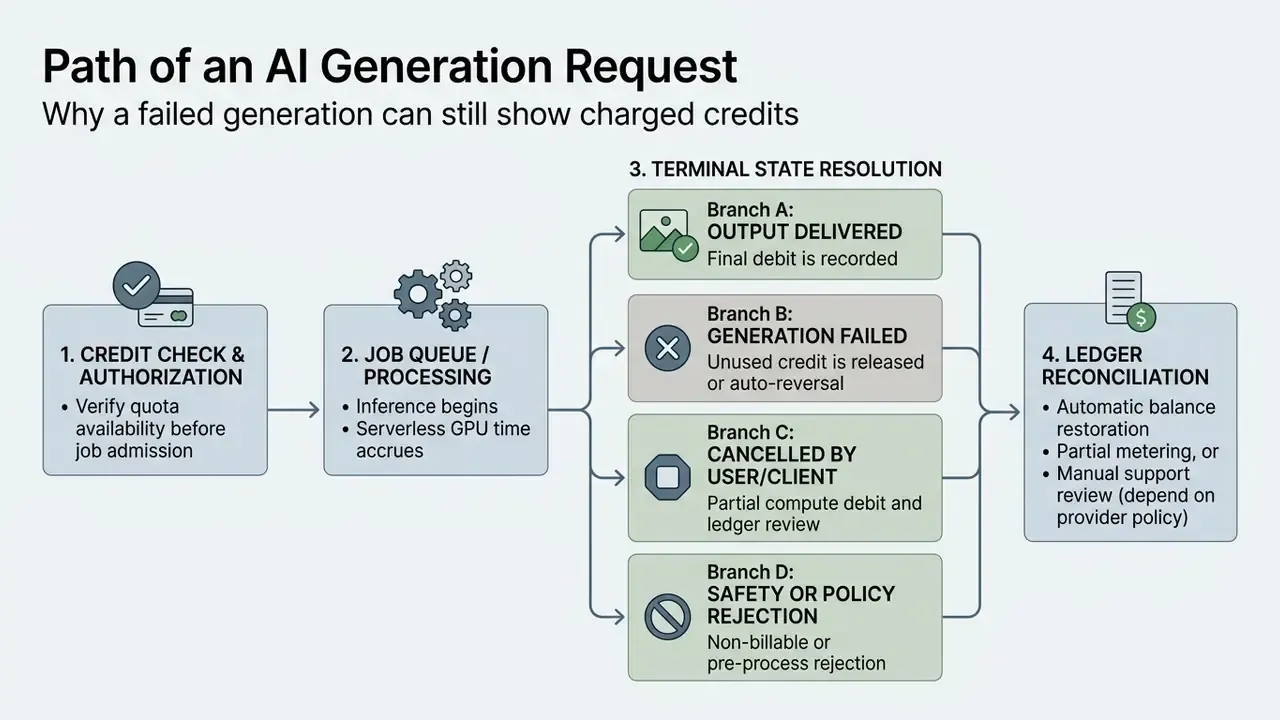
Every node in the diagram is a billing checkpoint: admission control (quota verification), metered execution (accruing compute), terminal classification (delivered, failed, cancelled or blocked), and reconciliation, the moment the ledger writes a permanent debit or a reversal. Disputes almost always originate between node 2 and node 4: work started, but nothing usable arrived.
Failed, cancelled and processing generations are different states
A processing generation is an active job burning cloud compute. A failed generation is a job terminated by a system error or a policy rejection. A cancelled generation happens when a user or a client process aborts an in-flight job before completion. Three words, three ledgers.
«49.8% of incidents manifest as performance degradation, 35.7% as deployment failures, and 14.5% as invalid inference.»
- Processing state
- credits are often reserved or held temporarily, pending output delivery.
- Failed state
- the execution engine returns an error object; billing then depends on whether the failure happened pre-compute or post-compute. Anthropic documents that failed requests are not charged, yet a client disconnect or timeout on a request that was on track to succeed is still billed, because the work was already performed (Anthropic API Documentation, 2025).
- Cancelled state
- inflight compute up to the cancellation timestamp may be charged, depending on provider policy. Azure records a
cancelled_atUnix timestamp marking the exact metering cut-off, and partial results may still exist after cancellation.
For teams standardising on a single provider, mapping these three states to internal incident categories is the fastest way to separate a genuine billing defect from expected metered behaviour. One caveat: the mapping ages quickly, so re-verify it after every provider API version change. Teams comparing provider-level differences in status semantics can start from the Google Veo implementation guide, which documents API access, cost structure and job limits for a large video model.
When credits are checked and when a charge may appear
Platforms enforce quota checks before job execution, but the final credit debit may land either immediately on submission or later, during batch ledger processing. Some platforms show an instant deduction in the UI as a pre-authorization hold, which then converts into a permanent charge or into an automatic reversal once the job resolves. Consumer-facing AI video generator credit models expose the same reservation logic through a simplified balance counter.
Research on Function-as-a-Service (FaaS) pricing, the billing model where you pay for allocated runtime rather than for a provisioned server, shows that platforms bill primarily for allocation duration plus flat invocation calls. The meter starts with resource allocation, not with output delivery (Pre-provisioned FaaS Pricing Study, 2025; public URL not available). So if an image or video pipeline spends three seconds rendering frames before hitting an upstream 503 gateway timeout, the metering system may well register those consumed GPU cycles.
Platforms vary in how they handle these edge cases:
- Pre-execution check
- systems verify active quota before admitting a job to the queue. OpenAI returns a
429withcredit_balance_exhaustedwhen an organisation has no prepaid credits left (OpenAI API Error Codes, 2026). - Mid-process deduction
- compute duration is tracked in real time, so server errors during active processing may temporarily appear as debits (ALLO Usage Documentation, 2025). Fal.ai states that only inference time is billed and that server errors (
HTTP 500+) are never charged, while client-side invalid-input errors can still be charged if GPU time was spent before detection (Fal.ai Documentation, 2026). - Post-output settlement
- credits are permanently debited only when rendered artifacts are written to the user asset library (SketchUp AI Gallery Documentation, 2025).
- Zero-completion insurance
- some gateways suppress token charges entirely when a response returns zero completion tokens with a null or error finish reason, even though the provider still incurred prompt-processing cost (OpenRouter Documentation, 2026).
Partial batch generation billing
In multi-asset workflows, a batch of four images, a multi-frame video render, or a slide deck that calls the image endpoint per slide, billing engines debit per successful unit. If the pipeline breaks mid-batch, a modern ledger reconciles by charging only for delivered assets. A four-image task that crashes after rendering two returns roughly 50% of the allocated credits to the active balance, while the two completed items stay in the asset library.
Vendor documentation states the pattern plainly: pre-checks compute credits_per_image × num_images and block the job when the pool is insufficient; deduction happens only when images are successfully saved; a request for four images that yields two successes bills for two, not four (Zense AI Credit Documentation, 2026). Video studios follow the same logic, where an estimate derived from model, duration and resolution gates admission, and the deduction routine runs only inside the successful-result handler after upload completes.
Two operational consequences follow. First, a partially successful batch is not a refund case. It is correct metering, and support teams will decline a full reversal. Second, when auditing spend on batch pipelines, reconcile at the asset level rather than the request level; a request-level view systematically overstates loss, sometimes by a factor of two or three.
Common issues that cause a generation to fail
Generations fail for three main operational reasons: prompt safety filtering, model inference crashes, and infrastructure quota exhaustion. Reading the root cause out of the log message is what prevents repeated failed attempts and needless credit consumption.
| Error Message / Symptom | Probable Cause Category | Safe Immediate Action (Zero-Credit Risk) |
|---|---|---|
RESOURCE_EXHAUSTED / 429 | Server capacity overload or rate limit | Pause retries; inspect the current quota dashboard before resubmitting. |
Content Policy Warning / 400 | Automated moderation trigger | Redact restricted keywords; do not retry identical prompt text. |
Timeout / 503 Service Unavailable | Provider-side GPU infrastructure outage | Check external provider status pages; wait for system recovery. |
Null Output / Completed with No Media | Third-party model execution failure | Inspect the job request ID; contact platform support for a balance review. |
Insufficient Credits / 402 | Exhausted workspace allowance | Verify the billing ledger; replenish balance before starting new runs. |
404 Generation Not Found | Invalid or expired generation identifier | Re-query the job list; confirm project and key scope before retrying. |
500 Internal Server Error | Provider-side execution fault | Capture x-request-id; escalate rather than retry in a loop. |
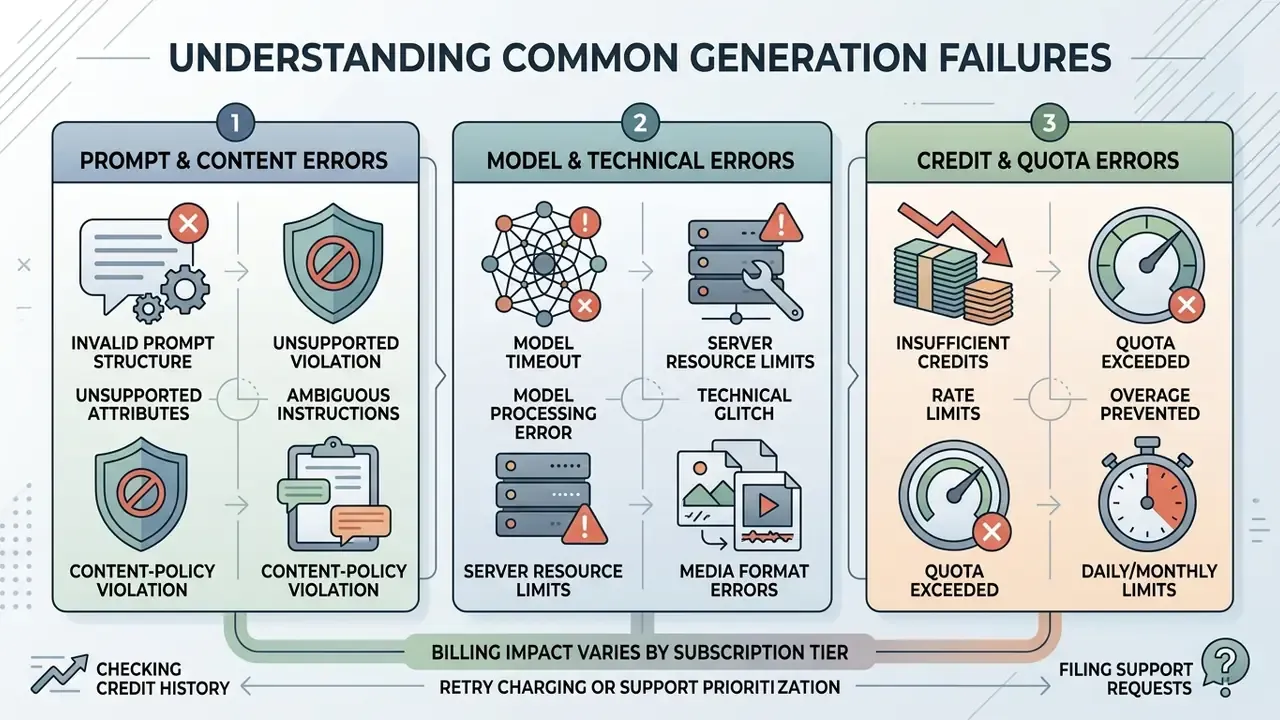
Prompt and content-policy errors
Content-policy errors appear when automated moderation classifies prompt text or an input image as a violation. Resubmitting the same flagged prompt produces deterministic re-rejections, consuming API tokens or screening capacity without producing any media.
When safety filters block a generation mid-pipeline, billing outcomes diverge by architecture. Some cloud providers charge for the input token screening performed before the moderation block (Third-Party API Integration Guide, 2025). Platforms with cached moderation layers, by contrast, may record zero-unit charges for immediate pre-execution blocks (Creem Moderation Documentation, 2025). Rewording the prompt to remove ambiguous terms is still the required operational step, not an optional one.
Support desks cannot override a moderation decision. Runway states plainly that support staff cannot unblock inputs, and that repeatedly attempting the same blocked content may lead to account suspension; false-positive reports go to a research feedback channel and do not retroactively unlock the original request (Runway Help Center, 2026). Teams building brand-safe prompt libraries can compare moderation strictness across engines with the AI art generator comparison and the Midjourney evaluation.
Model, image and video generation errors
Model errors come from hardware memory limits, unsupported aspect ratios, or third-party inference outages. In complex multi-stage video workflows, a job can report "completed" in the orchestration layer while returning null media files, because a downstream renderer failed (Fal.ai Documentation, 2026).
«49.8% of incidents manifest as performance degradation and 14.5% as invalid inference; 38.3% of incidents in GenAI services are detected by humans rather than automated monitoring.»
Credit, quota and resource errors
Resource errors occur when request frequency exceeds organizational rate limits, or when the prepaid balance limit is reached. A 429 Rate Limit Exceeded message signals a temporal throughput ceiling, whereas an Insufficient Quota error signals total account allowance exhaustion (OpenAI API Error Codes, 2025). The practical difference is simple: throttling clears with time, quota exhaustion does not.
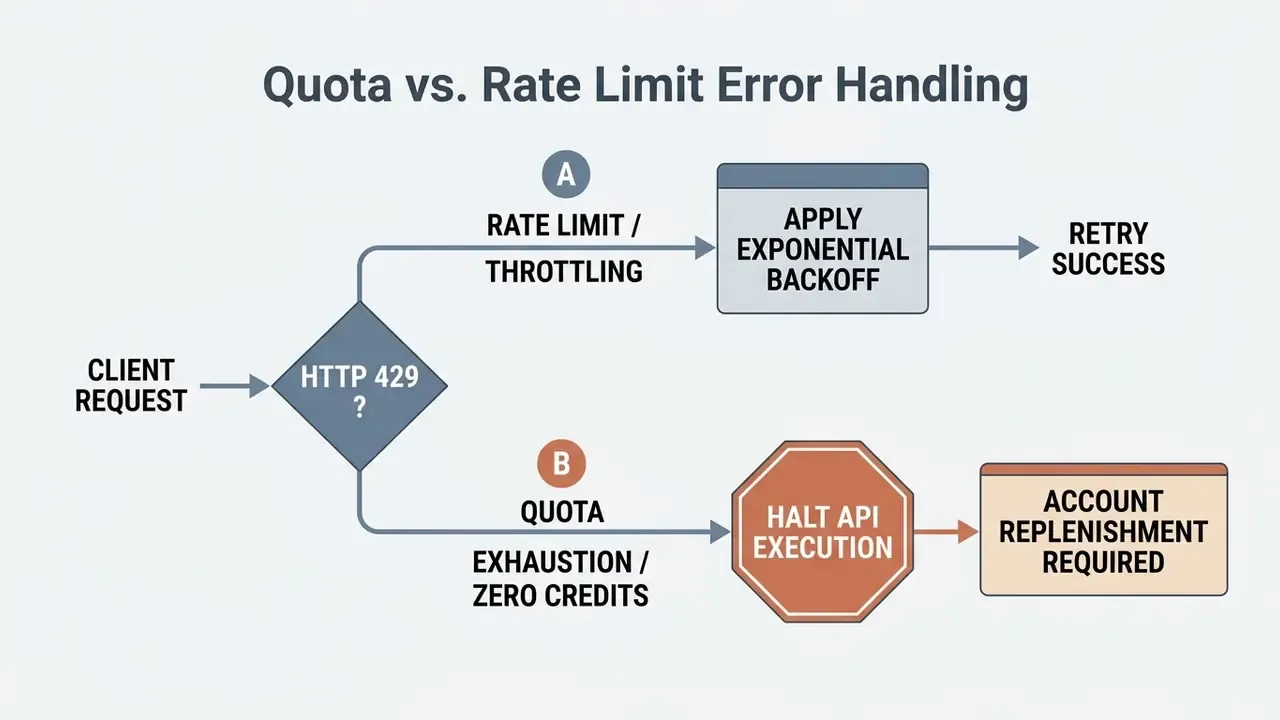
Retrying during an active quota failure cannot succeed, and it risks generating cascading API error logs that later obscure the real incident window. Verify the active ledger status in the platform billing dashboard before launching high-resolution batch jobs, and confirm that the organisation, project and API key scope match the scope that issued the failing request. Scope mismatches masquerade as billing bugs surprisingly often.
Billing impact varies by subscription tier. Self-serve, pay-as-you-go and Creator-tier plans consume metered credits based on render duration or resolution, so every failure has a direct balance consequence. Enterprise plans usually run on fixed seats, committed spend or dedicated GPU concurrency, where credit deduction errors do not apply in the same way. Synthesia, for example, states that Enterprise customers do not consume credits when generating videos, while Basic, Starter and Creator plans meter by video length (Synthesia Help Center, 2026). Before opening a dispute, confirm which metering model your contract actually uses. A "missing credit" on a seat-based Enterprise agreement is usually a concurrency or entitlement issue, not a ledger debit.
How to fix a failed generation charged credits issue
Fixing an uncredited failure takes a structured sequence: capture the error metadata, audit the transaction log, adjust the job parameters, then issue a targeted support request. In that order.
«The IBM Cloud dataset contains 39,365 rows and 117,448 columns of telemetry, the basis for anomaly detection in large-scale cloud systems.»
The scale of that telemetry surface is exactly why a dispute without identifiers dies quietly: engineers cannot search a dataset of that width without an index key.
Check the error message, generation status and credit history
⚠️ UI DISPLAY VS. LEDGER REALITY (Updated)
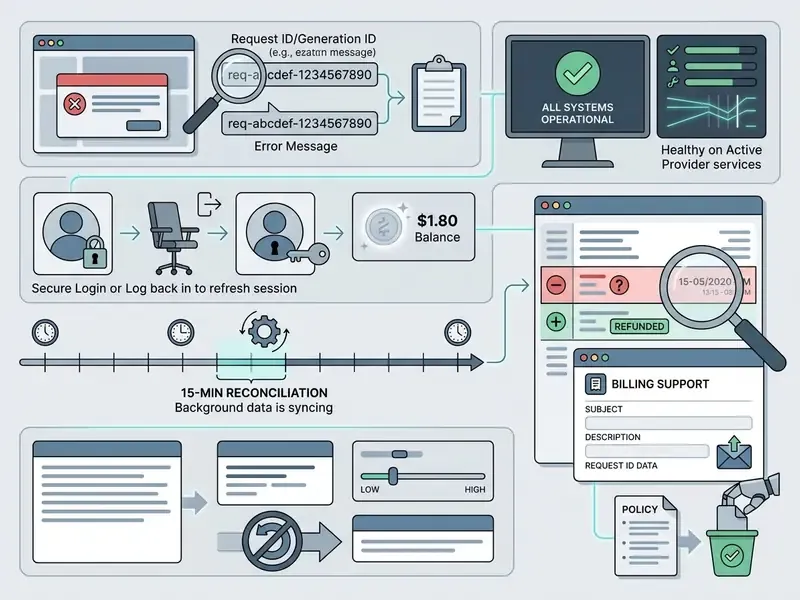
If a generation shows a deducted balance without returning a media asset, open the generation detail view. Check whether the job is stuck in an unresolved processing state, or whether a 500 Internal Server Error came back. If an error code is present, copy the unique x-request-id or job identifier. That string is the primary index support engineers need to trace server-side telemetry. Where a token count is exposed, expand the charge: a debit backed by millions of processed tokens indicates real compute, while a charge attached to a session that visibly did nothing is the clearest candidate for reversal.
For regulated organisations, forward these records into the GRC or SIEM stack (Splunk, Datadog, or an equivalent audit store) at capture time. Generative-AI audit-logging guidance recommends recording the full prompt, the model identifier and version, and precise timestamps, the same fields a billing dispute requires. One control then satisfies both financial reconciliation and model-risk documentation, which is the sort of double duty a CRO can defend in a budget review.
Retry only after changing the relevant prompt or model setting
Immediate retries without changing job variables compound credit losses. If the first attempt failed on invalid parameters or a policy trigger, resubmitting the same request reproduces the same failure mode (Google AI for Developers, 2026).
«Current LLMs handle proactive error handling poorly; fine-tuning on error-correction examples improves these capabilities.»
Safe retry workflows need four adjustments:
- Reduce output complexity.Lower the output resolution or shorten video frame counts to stay inside standard memory limits.
- Refine prompt terminology.Remove abstract phrasing or keywords likely to trip safety screening.
- Apply exponential backoff.Wait at least 60 seconds before resubmitting so transient capacity issues can clear, and add jitter plus a hard maximum retry count. Google's guidance limits retries to transient
429,408and5xxstates, and explicitly excludes400and403, which indicate invalid syntax or credentials. - Wrap the call in a circuit breaker.At the gateway layer, trip the breaker after a threshold of consecutive failures per model endpoint, so a failing upstream cannot drain budget through parallel workers. Pair the breaker with per-key rate limiting and an open-ended financial exposure becomes a bounded one.
Teams comparing lower-cost or free tiers as a sandbox for retry testing can review free AI art generator limits before running experiments against a production key. When evaluating workflow changes or alternative tooling for enterprise media pipelines, teams can weigh the options in Cancel, Downgrade, or Switch AI Tools and align software spend with actual operational need.
Quantifying financial exposure from a retry loop
Model the worst case before it happens. A simple exposure formula makes the risk board-legible:
Exposure = Parallel workers × Cost per invocation × (Time window ÷ Time-to-timeout) × Retry multiplier
| Scenario | Workers | Cost / call | Timeout | Undetected window | Approx. exposure |
|---|---|---|---|---|---|
| Single analyst, manual retries | 1 | $0.40 | 30 s | 10 min | ~$8 |
| Batch job, no backoff | 8 | $0.40 | 30 s | 60 min | ~$384 |
| Agentic pipeline, no breaker | 32 | $0.90 | 15 s | 4 h (overnight) | ~$27,600 |
These figures are illustrative, not benchmarked. Still, use the highest-tier row as the justification for a circuit breaker and a per-key spend cap; overnight is when unattended agents do their most expensive thinking. For per-project estimates, the AI Video Credit Calculator converts render duration and resolution assumptions into unit costs.
When credits should be reviewed or refunded
Cases that may qualify for an automatic credit adjustment
Automatic adjustments fire when platform telemetry detects system crashes, upstream outages, or unfulfilled rendering jobs. Under standard service agreements, confirmed server errors (HTTP 500 series) return consumed units to the balance automatically (Photoroom Refund Policy, 2026; Mubert Terms, 2026).
«Deployment failure and invalid inference incidents account for 50.2% of all GenAI service incidents, which makes automated reversals technically justified.»
Progressive metering and intermediate output retention
Multi-stage generation platforms, including AI game engines, multi-step agent tools and code-and-render pipelines, use progressive metering. Under that model, if a generation fails at step 9 of 10, the compute for steps 1 through 8 is already spent, and interim assets (base meshes, partial code, draft frames) are saved to your project space. These platforms bill for tokens and compute consumed up to the failure timestamp instead of issuing a full refund, because usable work existed before the interruption.
Vendor reasoning is explicit: "failed" is rarely all-or-nothing, a run that errors on step 9 of 10 still did 90% of the work, and automatic full refunds would let anyone obtain unlimited free AI work by deliberately forcing errors (Rosebud/AI game-engine billing documentation, 2026). The same logic covers user-initiated cancellation: pressing Stop bills only the work completed before the stop, never the full projected build, and nothing is metered while a session pauses to ask the user a question.
Two practical implications for dispute preparation:
- Check whether interim artifacts exist. If partial code, frames or assets landed in the project, expect partial billing to stand.
- Distinguish "no work" from "incomplete work." A charge attached to a session with near-zero token throughput is a defect. A charge attached to a session with millions of processed tokens is metered work, and the real problem is usually prompt design rather than billing.
When a manual review is needed
Manual review is required when a job reports success in the UI but yields corrupted, blank or incomplete media. Automated telemetry counts those jobs as completed, so no automatic reversal fires.
«Users observe failure bursts earlier than providers classify them as incidents, based on three years of data across three major cloud providers.»
That reporting lag is the structural reason manual review exists: your evidence often predates the provider's own incident record. Claims submitted for manual review need supporting technical evidence. Accepted materials include system activity logs, timestamped console screenshots and unique job identifiers (Secureframe Audit Standards, 2026). Screenshots should carry a visible URL and a computer-generated date stamp to establish origin and timing, and raw evidence should be preserved separately rather than rewritten into tidy summaries. Where output integrity itself is contested, independent verification of the delivered file, including tooling that inspects whether an asset was machine-generated at all, as covered in the AI reverse-image-search comparison, strengthens the record. Unedited log extracts move faster through a helpdesk queue than polished narratives do.
Timing rules matter as much as evidence quality. Consumer billing-dispute guidance advises submitting written notice within 60 days of the first statement showing the deduction, with issuer acknowledgement expected inside 30 days and resolution inside 90 days or two billing cycles, while undisputed amounts remain payable during the dispute (CFPB Billing Dispute Guidelines, 2024; FTC, 2022). Several AI vendors impose tighter internal windows, and 30 days from the affected generation is common, so file promptly rather than batching disputes at quarter end.
Comparison: how major providers handle credits on failed jobs
| Provider / tier | Failure with zero output | Client disconnect or timeout | Content-policy block | Reversal timing |
|---|---|---|---|---|
| OpenAI (image generation, self-serve) | Not charged | Charged if work completed | Prompt must change; no override | No debit recorded |
| Anthropic API | Failed requests not charged | Charged, work already performed | Charged per processed input | Ledger-level, per invoice cycle |
| Azure OpenAI (Batch) | failed on validation = non-billable | cancelled_at marks metering cut-off | 400-class rejection, modify prompt | Reconciled in batch settlement |
| Google Vertex AI / Gemini | RESOURCE_EXHAUSTED blocks pre-compute | Retryable 5xx/408 guidance | Safety threshold configurable | Quota resets on window; no credit ledger |
| fal.ai | Server errors (500+) never charged | Inference time only | Invalid input may bill GPU time used | Not billed at all |
| Runway (self-serve) | Auto-returned within minutes | Not charged if pre-charge failure | No credit consumed on block | 5 to 15 minutes |
| Batch-oriented studios (e.g. Zense-style) | No deduction on FAILED session | Per-unit metering | Blocked pre-provider call | Immediate; per successful asset |
| Enterprise seat-based (e.g. Synthesia) | No credit consumption model | Not applicable | Not applicable | Concurrency entitlement, not credits |
Use this matrix to set internal expectations per vendor before an incident, and attach the relevant row to the operational-loss register entry, so model-risk reviewers can see whether an exposure is contractual or purely technical. Aligning that evidence with model-risk management documentation practice, the same discipline applied to model inventories and validation files under supervisory guidance, keeps billing anomalies inside the existing control framework instead of an untracked spreadsheet on someone's laptop.
How to contact support about a failed generation charge
A well-structured support request shortens resolution time and removes a full round of clarifying questions. Tickets with complete metadata let support verify server logs immediately.
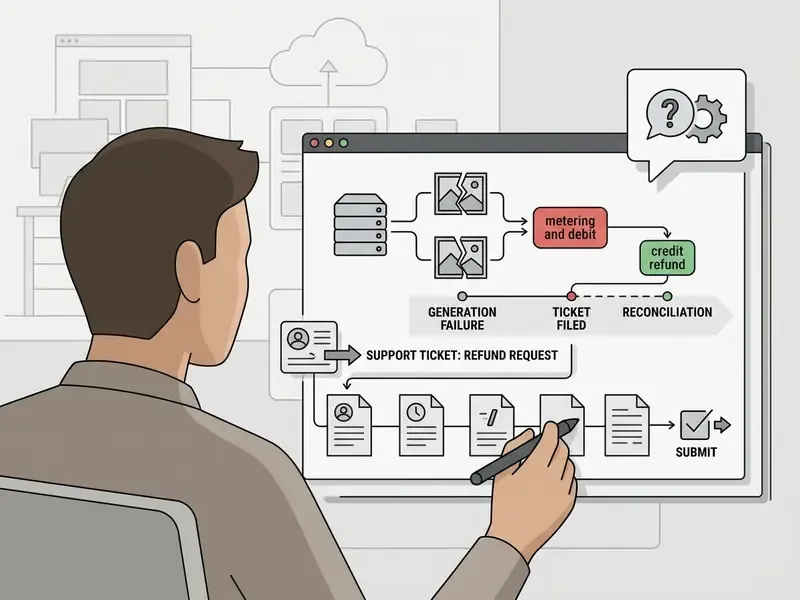
When you contact support, present the log detail plainly and skip the adjectives. Keep structured documentation of charge dates, deducted amounts and system error responses to speed up dispute processing (CFPB Billing Dispute Guidelines, 2024).
Escalation path by contract type. Self-serve accounts route through the in-product help widget or a public support address, with a first response measured in business days and a single-tier review. Enterprise agreements usually provide a named technical account manager or customer success manager, a contractual response SLA, and access to provider-side incident correlation. Use that channel for anything above your materiality threshold, and reference the incident window rather than a single request ID, so the provider can reconcile the whole affected queue at once. Where the dispute touches committed spend or an SLA service credit, involve procurement early: SLA service credits and in-product generation credits are different instruments, claimed through different processes, and confusing the two costs weeks.
How to avoid credit charges on future failed generations
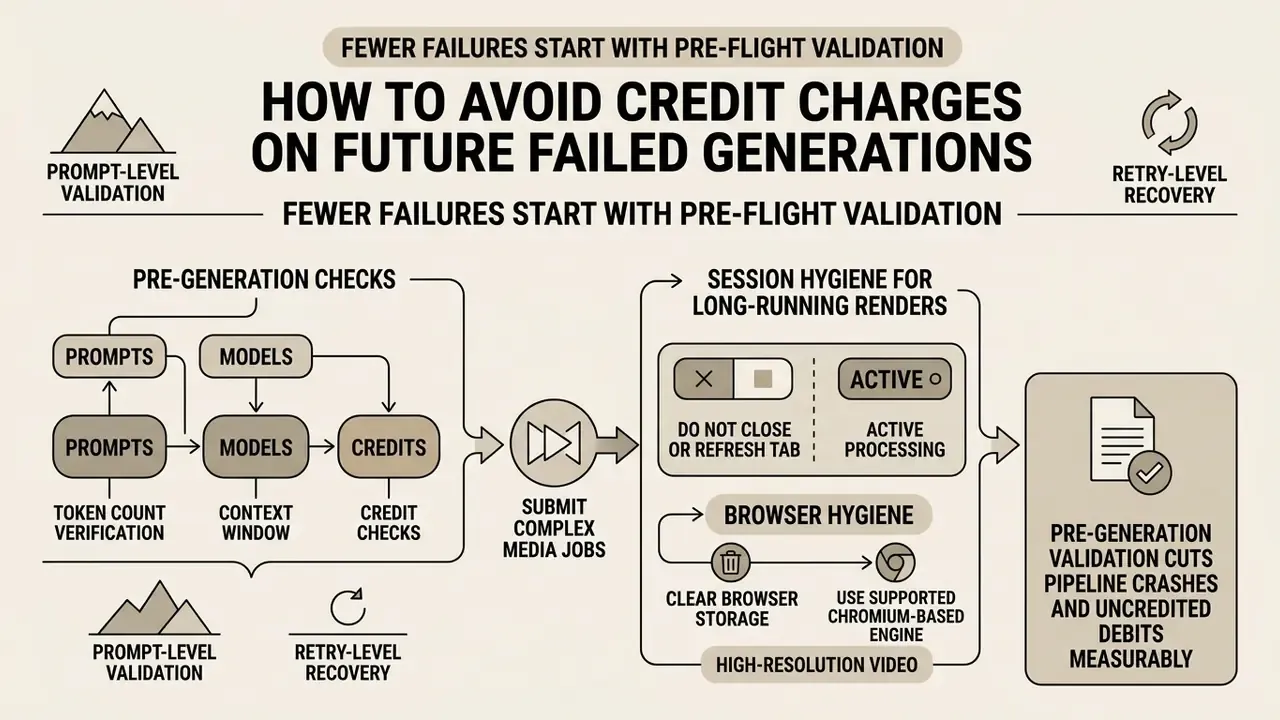
Fewer failures start with pre-flight validation before you submit complex media jobs. Structured input checks catch the preventable errors and protect the operational balance reserve.
«Denial-of-Wallet attacks exploit pay-as-you-go billing to inflict financial damage without disrupting service availability.»
For enterprise teams, that threat model reframes retry hygiene as a security control rather than a cost optimisation. An exposed generation endpoint without rate limiting is a budget vulnerability, and it will be found.
Pre-generation checks for prompts, models and credits
Pre-generation validation cuts pipeline crashes and uncredited debits measurably. Verifying prompt parameters and system limits before execution keeps failure rates inside manageable bounds (NIST AI RMF GenAI Profile, 2024).
«FailureAtlas identified more than 247,000 previously unknown error slices in Stable Diffusion 1.5, linking them to data gaps in the training set.»
The scale of that failure landscape explains why prompt-level validation beats retry-level recovery. Many failures are properties of the model's coverage gaps, not of your request.
- Prompt length verification: keep prompt token counts comfortably inside the context window of the target model, and set explicit
max_prompt_tokensandmax_completion_tokensat run creation (OpenAI API Documentation, 2026). - Safety pre-screening: scan prompt text for restricted terms or ambiguous language before launching a high-cost video render. Comparing pre-screening behaviour across engines, for example through the AI image generator comparison or the Canva AI generator overview, helps you pick a platform whose moderation profile matches your content category.
- Parameter boundary enforcement: confirm that aspect ratio, frame rate, candidate count (1 to 8), temperature (0.0 to 1.0) and top-p (0.0 to 1.0) all sit strictly inside supported vendor ranges (Google AI for Developers, 2026). Documentation for text-to-video pipelines and their credit models lists the supported parameter envelope per model version.
- Quota auditing: check the account credit balance before starting bulk batch tasks, so a job does not die halfway on quota exhaustion (LockLLM Usage Protocols, 2025).
- Provenance and output controls: record origin and history data at generation time, and apply provenance signals or watermarks for high-risk outputs, as recommended by NIST AI 100-4 (2024) and the Hong Kong Generative AI Technical and Application Guideline (2024). This produces the metadata trail that later supports both audit and dispute.
Session hygiene for long-running renders
[ ]Do not close or refresh the tab while an asynchronous render job sits in active processing.[ ]Clear browser storage, or use a supported Chromium-based engine, when running high-resolution video renders, to avoid WebSocket disconnection errors that orphan a job.[ ]Do not launch many large generations at once from a single session; stagger submissions to stay under concurrency ceilings.[ ]Export and archive credit history periodically, so a dispute never depends on a UI view that has already rolled over.[ ]Confirm the balance counter after each batch completes rather than mid-run, when reservation holds distort the displayed figure.[ ]For pipelines that hand off between tools, render then compress then publish, validate each stage's input constraints separately. A video compression step with unsupported parameters can invalidate an otherwise successful render.
Combine systematic pre-generation checks with a structured troubleshooting sequence and the organisation keeps control of its AI media budget while output reliability improves. Not perfectly. Measurably.
Limitations and open questions
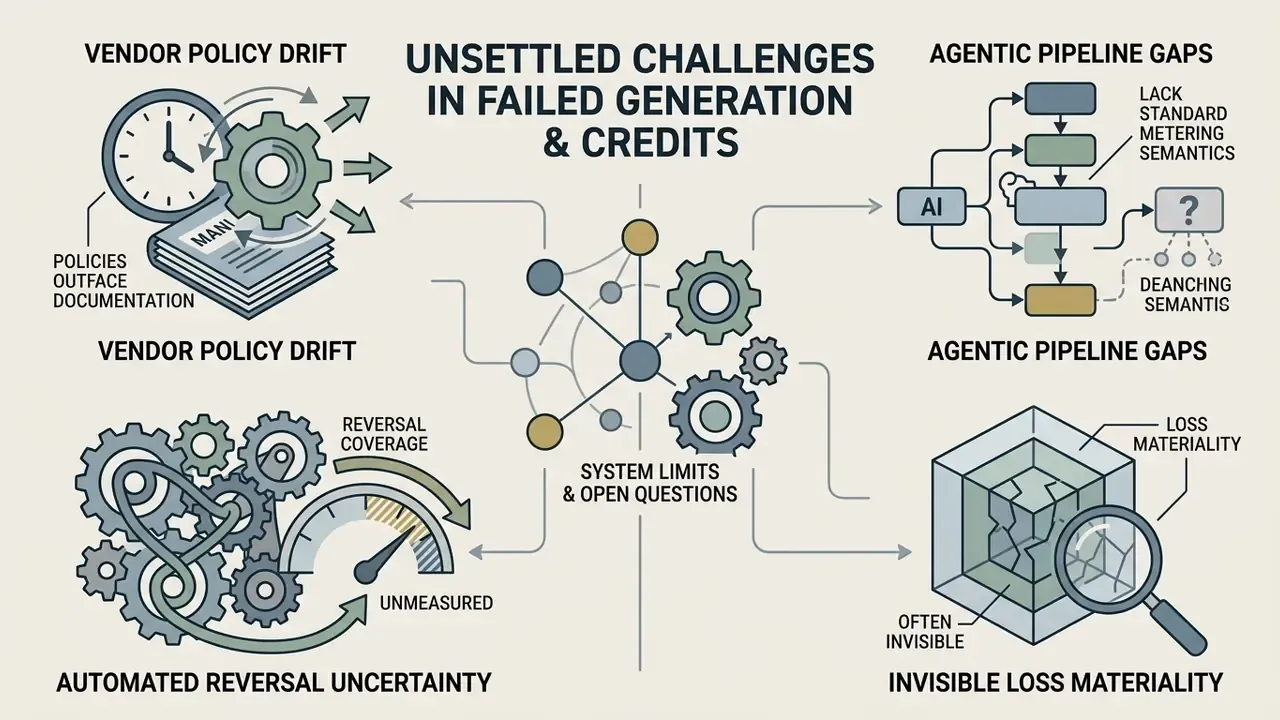
A few things remain genuinely unsettled, and pretending otherwise would be unhelpful.
- Vendor policies move faster than documentation. Several billing statements cited here were revised inside a single quarter. Re-verify before you rely on them in a dispute.
- Agentic pipelines lack standard metering semantics. When one agent invocation spawns twelve downstream model calls, there is no shared convention for which failures are billable. Expect ambiguity, and negotiate it into the contract.
- Automated reversal coverage is unmeasured. No public dataset quantifies what share of legitimate failed-generation debits are reversed without a ticket. Treat the 5 to 15 minute window as observed vendor behaviour, not a guarantee.
- Loss materiality is often invisible. Credit losses land in software spend rather than operational loss, so they rarely reach the risk committee. That is a reporting choice, and it is worth revisiting.
FAQ: failed generations and credit charges
Why were credits deducted when I received no file at all?
Because metering usually starts at resource allocation, not at delivery. If the job reached active compute before failing, the invocation may be recorded. A charge attached to a session with negligible token throughput, though, is a defect worth reporting.
How long should I wait before opening a ticket?
Refresh the session, then allow 15 minutes for automated reconciliation. If no Refunded entry appears in billing history after that window, file the ticket with the full identifier set.
I asked for four images and got two. Is that a billing error?
No. Per-successful-unit metering charges for delivered assets only. Two delivered images means two units billed, and the remainder is released.
My run failed at the last step. Why is there no full refund?
Progressive metering bills for compute consumed up to the failure timestamp. If interim assets were written to your project, that work was performed and is billable.
Does a content-policy block cost credits?
It depends on architecture. Pre-execution blocks are typically non-billable; blocks applied after input screening may bill for tokens already processed. Either way, resubmitting the same prompt reproduces the block.
Do Enterprise plans have this problem?
Usually not in the same form. Seat-based or committed-concurrency contracts often have no per-generation credit ledger at all, so a "missing credit" is more likely an entitlement or concurrency issue.
What single field speeds up resolution most?
The x-request-id. It is the index that lets support search provider-side telemetry directly.
Appendix A: corrections and superseded guidance
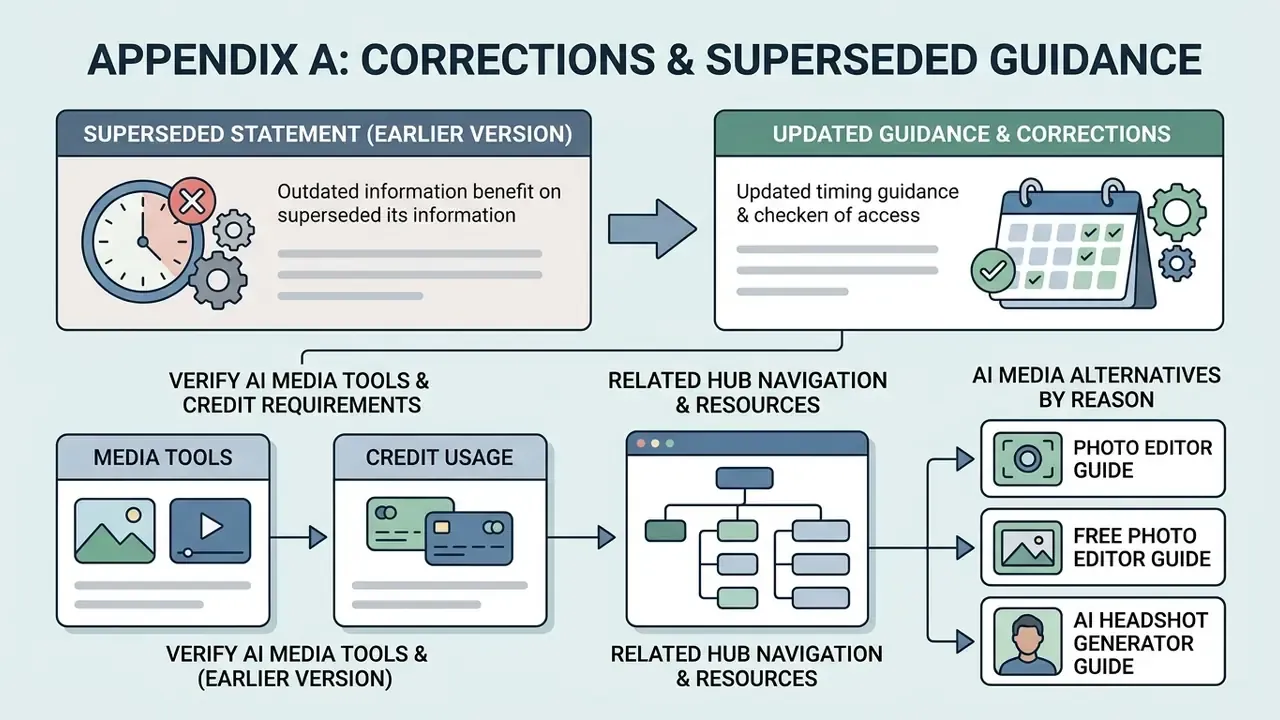
For transparency, the following statement appeared in an earlier version of this guide and has been superseded by the updated timing guidance above:
- Superseded: "Platform-side infrastructure crashes automatically trigger credit reversals within 24 to 48 hours."
- Current: automated reversals for confirmed platform failures typically complete within 5 to 15 minutes. The 24 to 48 hour range applies to manually escalated support reviews, and longer windows generally reflect card-network chargeback timelines rather than in-product credit adjustments.
Several cited studies are referenced from abstracts or industry papers for which no stable public URL was available at the time of writing; those are marked in-line. Provider policies quoted here reflect public documentation and may differ from negotiated enterprise terms.
Verify AI media tools and credit requirements
To evaluate credit pricing structures, model API inference cost, or project-specific rendering budgets, use the AI Video Credit Calculator and estimate resource usage before launching large-scale generation jobs. For adjacent cost centres in the same pipeline, see the AI voice generator guide and the YouTube publishing workflow guide.