Key Takeaways
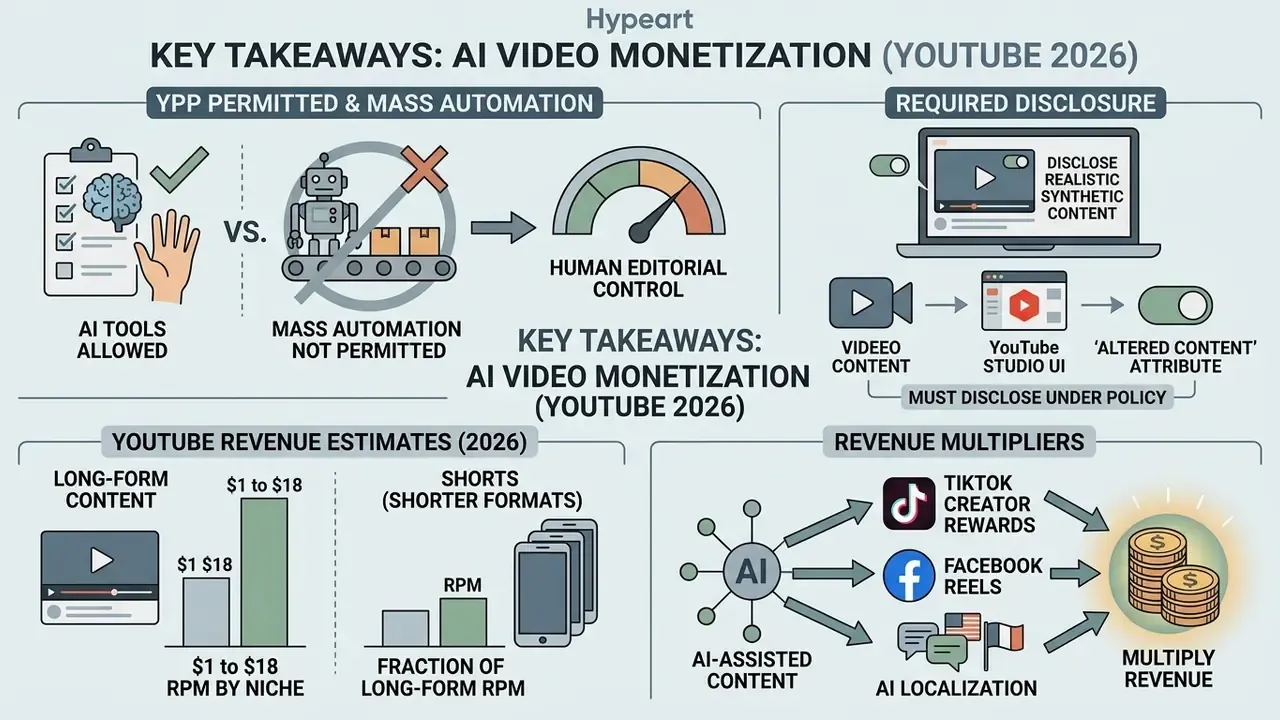
- AI tools are permitted inside the YouTube Partner Program; mass automation is not.
- The decisive test is originality and human editorial control, not the software used to render pixels or audio.
- Realistic synthetic content must be disclosed in YouTube Studio under the "Altered content" attribute. Disclosure does not reduce reach or ad eligibility.
- Long-form AI-assisted content earns roughly $1 to $18 RPM depending on niche; Shorts monetize at a fraction of that rate but drive acquisition.
- Cross-platform syndication (TikTok Creator Rewards, Facebook Reels) and AI localization multiply revenue from the same production pipeline.
How to use this guide. The sections below move from the plain answer to the enforcement mechanics, then to the control framework you can actually operate. Each policy claim is tied to a dated primary source, because monetization rules drift faster than most creator advice. Where evidence is incomplete, that uncertainty is stated rather than smoothed over. If you are evaluating this as an operational process rather than a hobby, pay closest attention to the six-checkpoint workflow table and the pre-publishing audit checklist: those are the artifacts that survive a review, a Content ID dispute, or an advertiser inquiry.
Can AI-Generated Videos Be Monetized on YouTube? The Direct Answer
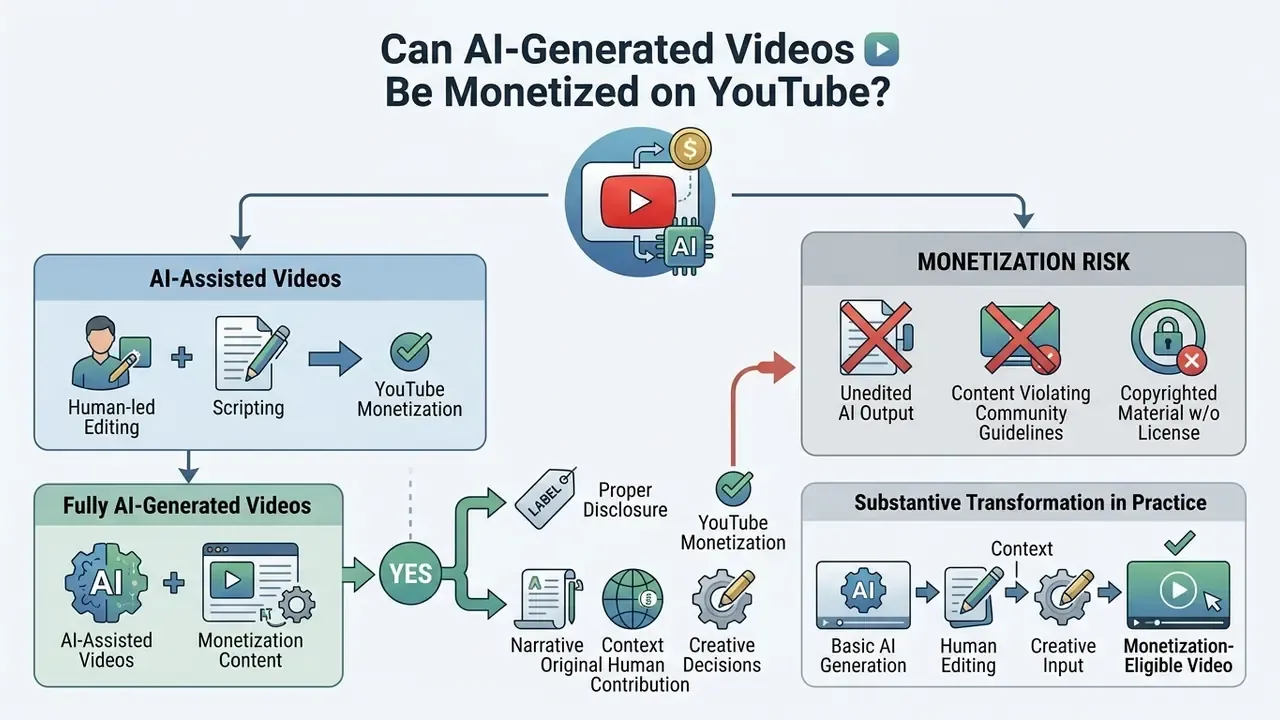
YouTube explicitly permits the monetization of AI-generated and AI-assisted videos through the YouTube Partner Program (YPP), provided the channel adds significant original human value, commentary, or educational structure. Channels that rely on automated, low-effort pipelines to churn out templated or repetitive videos are classified as inauthentic content and lose monetization eligibility.
Monetization policy evaluates the presence of independent human creativity rather than the underlying software used during production. Creators who deploy artificial intelligence to assist with script drafting, visual asset rendering, or audio processing remain eligible for ad revenue when the final output reflects distinct editorial oversight. Channels uploading automated outputs without substantive modification face demonetization under platform authenticity guidelines, often within a single review cycle.
So yes, you can post AI videos on YouTube. Whether you can monetize them depends entirely on what a human contributed.
«Creators mainly present AI as a productivity tool integrated into broader content strategies that still rely on human curation, storytelling, and channel branding». Wagner et al., "Monetizing Generative AI: YouTubers' Collective Practices," arXiv (2026). https://arxiv.org/abs/2603.07036
YouTube updated its channel monetization policies on July 15, 2025, formally renaming its "repetitious content" framework to "inauthentic content." That update clarified the point most automation sellers skip: mass-produced uploads, generic template-driven narratives, and synthetic channels offering no unique perspective are barred from revenue sharing.
The table below outlines how YouTube and regulatory frameworks categorize different tiers of AI integration for monetization and compliance purposes.
Classification of AI integration tiers for YouTube monetization
| Category | Originality and human authorship | Demonetization risk | Synthetic disclosure requirement |
|---|---|---|---|
| AI-assisted videos | Human author directs narrative, script, and editorial structure; AI tools assist with drafting, B-roll, or audio editing under direct oversight. | Low risk. Fully eligible for YPP if the video provides original commentary or unique educational and entertainment value. | Mandatory if the video generates realistic depictions of real people, places, or events; optional for stylized or non-realistic media. |
| Fully AI-generated videos | Scripts, visuals, and narration are produced via automated prompts with minimal human editing or manual curation. | High risk. Frequently flagged as reused or inauthentic content unless substantive transformation is clearly demonstrated. | Mandatory for all realistic synthetic outputs, across sensitive and general topics alike. |
| Mass-produced generic content | Automated pipelines generating high volumes of template-based, near-identical videos with low narrative variation. | Critical risk. Explicitly ineligible under YouTube's inauthentic content policy; channel suspension is possible. | Mandatory where applicable, though disclosure alone does not grant monetization eligibility for low-value mass uploads. |
AI-Assisted Videos and Fully AI-Generated Videos
AI-assisted videos integrate machine learning software into specific stages of a human-led production workflow. A creator might use an AI script generator to outline research topics, render stylized background graphics, or run audio noise reduction, while keeping full ownership of the narrative framing and the argument itself.
Fully AI-generated videos rely on automated prompts to render scripts, visuals, and voiceovers in one pass. When human participation is limited to entering a few text prompts, the upload usually lacks the distinctive creative control that platform reviewers and copyright authorities look for. Not always, but usually, and the exceptions require documentation.
When AI Videos Become a Monetization Risk
AI videos cross into high-risk territory when they show signs of low effort, mass production, or missing human value. Reviewers routinely flag channels that publish dozens of near-identical explainer videos built from generic stock footage, automated text-to-speech, and unedited AI scripts.
When a channel's uploads look templated or scraped from existing web content, moderation tooling classifies the media as inauthentic or reused content. Channels operating in sensitive niches, such as financial advice, legal commentary, or medical guidance, face immediate demonetization if they use synthetic personas disguised as human domain experts. In regulated topics, that is not just a policy problem. It is a consumer-protection problem.
How substantive transformation protects a channel in practice. Two concrete patterns show what reviewers are actually weighing. A history channel writes a 2,400-word original script from archival primary sources, records a voice performance with custom pacing, renders twelve bespoke illustrative scenes, and layers on-screen citations. It passes review, because the narrative framing, sequencing, and sourcing are demonstrably human. A second channel uses the same AI renderer to publish forty near-identical "Top 10 Facts" videos assembled from scraped article summaries and stock loops. It is rejected under the inauthentic content rule. Same tooling. Different editorial contribution. That asymmetry is the point.
YouTube Monetization Policy for AI Content: What Is Allowed and Flagged
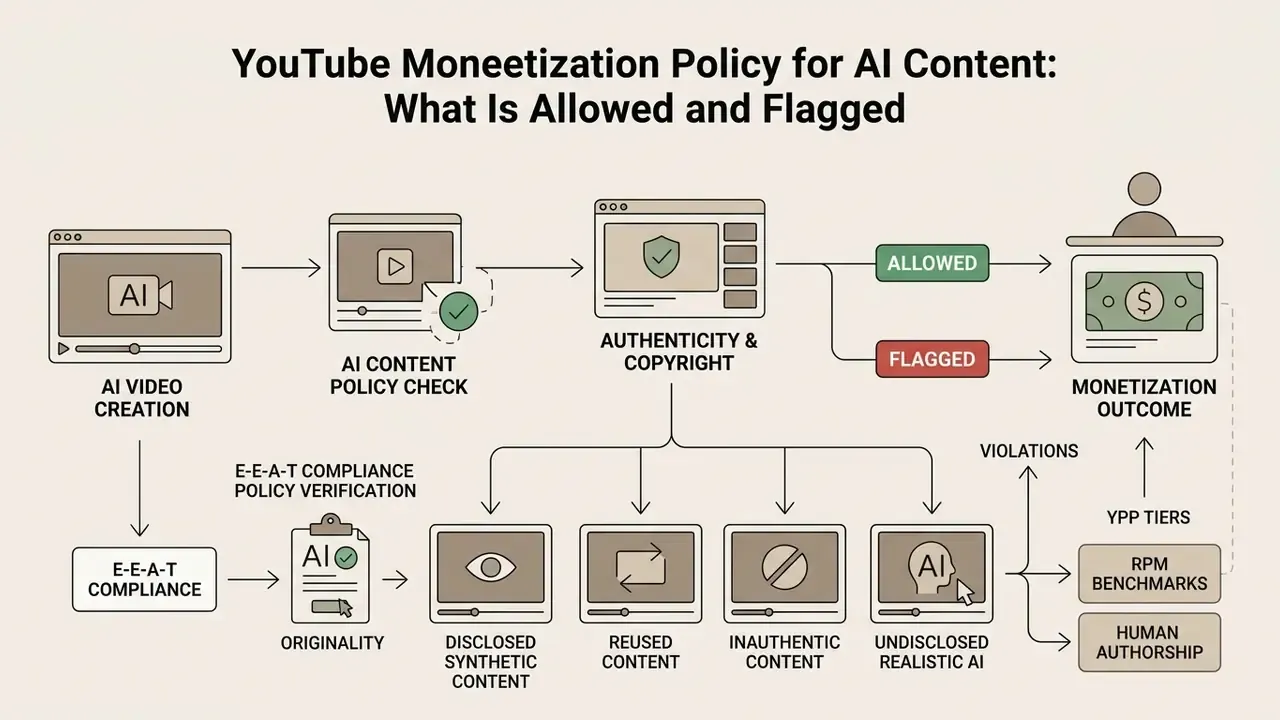
YouTube monetization policy evaluates content authenticity, copyright compliance, and viewer protection rather than banning specific software tools. Content stays eligible for ad revenue share when it presents original insights, substantive commentary, or a unique educational structure.
The platform's moderation system flags synthetic media that deceives viewers, infringes intellectual property, or operates as low-value automation at scale.
«Platforms combine user-facing disclosure requirements with automated detection and removal of harmful synthetic content». Jiang et al., "Governance of AI-Generated Content: A Case Study on Social Media Platforms," CHI (2026). https://dl.acm.org/doi/10.1145/3706598.3713389
To keep monetization status, your production workflow has to satisfy three separate policy surfaces at once: reused content rules, synthetic disclosure rules, and general viewer transparency expectations.
E-E-A-T compliance and policy verification
Originality, Reused Content and Inauthentic Content
Reused content means uploads that do not reflect a creator's own original work or a meaningful secondary transformation. In AI production, scraping text from online articles and pairing an automated voiceover with stock footage is textbook reused content.
Inauthentic content covers mass-produced videos made primarily to capture search views rather than deliver viewer utility. To establish original value, a creator needs to inject personal analysis, distinctive editorial pacing, custom visual arrangement, or verified subject-matter expertise, something that separates the upload from raw algorithmic output. One useful internal test: if a competitor could generate a near-identical video from the same three prompts, you have not transformed anything.
Synthetic Content Disclosure and Realistic AI
YouTube requires creators to disclose uploads containing realistic synthetic media that could be mistaken for actual events, real places, or living people. The requirement applies whenever AI tools generate lifelike footage, manipulate recordings of real events, or construct synthetic voices of identifiable individuals.
«Creators must indicate when content is "meaningfully altered or synthetically generated and appears realistic," especially on sensitive topics». YouTube AI Disclosure Announcement, Google Help (2024). https://support.google.com/youtube/answer/14328491
Disclosing synthetic media does not hurt a video's algorithmic distribution or ad eligibility. Failing to disclose realistic synthetic usage can, and does, trigger automated platform labels, content removal, or removal from the YouTube Partner Program. Disclosure is not required when AI is used purely for productivity tasks such as outlining, ideation, captioning, or colour correction, or when the visual style is obviously non-realistic. Cartoon physics, cartoon rules.
YouTube Partner Program Requirements for AI Video Channels
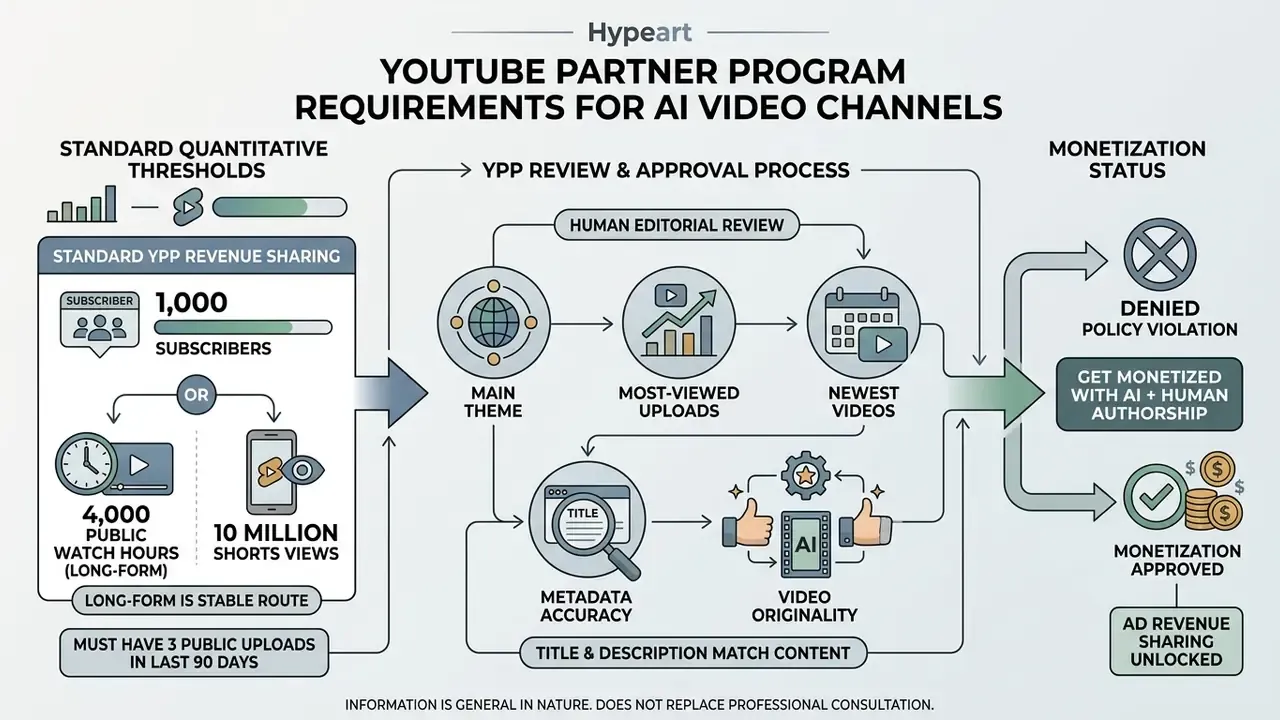
AI-driven channels must clear the standard YouTube Partner Program quantitative thresholds and then pass human editorial review. Hitting subscriber and watch-time milestones guarantees nothing if the channel depends on automated, low-effort generation.
The review process inspects channel coherence, metadata accuracy, and video originality. Creators building around synthetic media need both their long-form and short-form uploads to show clear human oversight before they apply.
Subscribers, Watch Hours and Long-Form Video
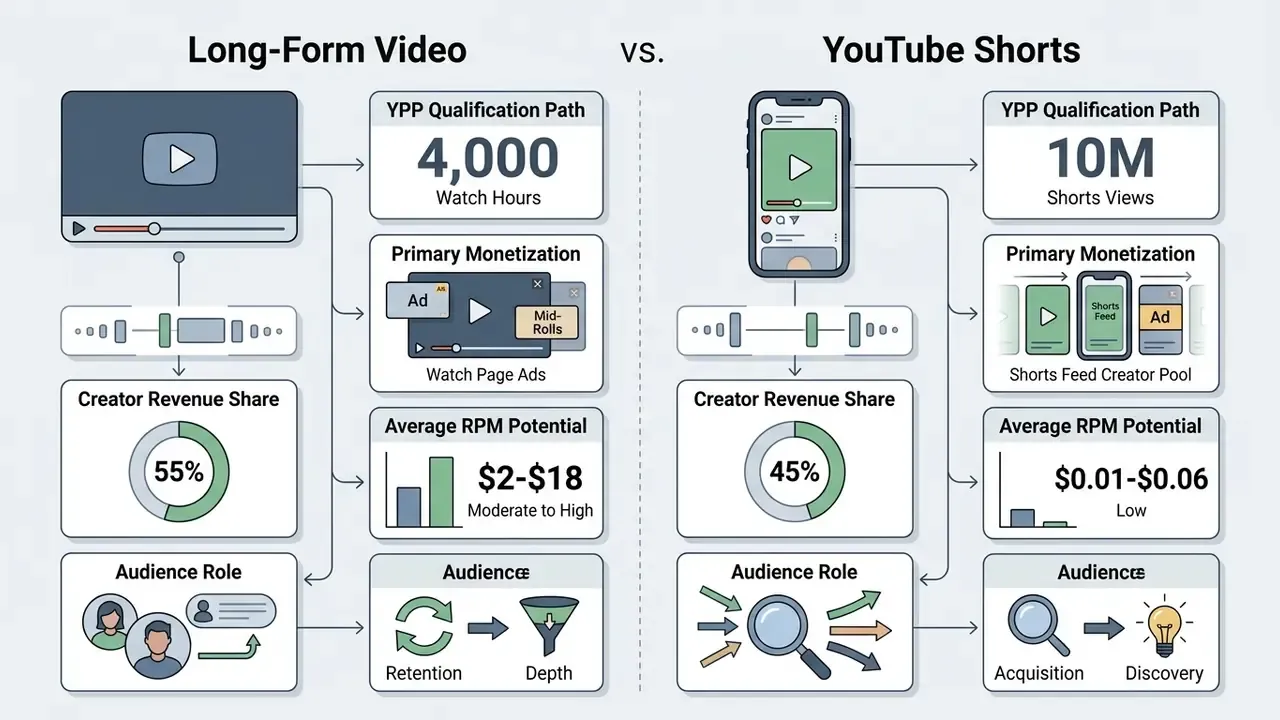
Standard YPP ad revenue sharing requires 1,000 subscribers plus either 4,000 valid public watch hours on long-form content in the past 12 months, or 10 million valid YouTube Shorts views in the past 90 days.
«Expanded YPP opens monetization features at 500 subscribers with 3,000 watch hours or 3 million Shorts views». YouTube Partner Program Overview, Google Help (2025). https://support.google.com/youtube/answer/72851
YPP eligibility at a glance:
| YPP tier level | Subscribers | Long-form watch hours (12 months) | Shorts views (90 days) | Monetization features unlocked |
|---|---|---|---|---|
| Tier 1 (early access) | 500 | 3,000 hours | 3 million | Fan funding, channel memberships, Super Thanks, Super Chat, YouTube Shopping |
| Tier 2 (full revenue share) | 1,000 | 4,000 hours | 10 million | Watch Page ad revenue share, Shorts Feed ad revenue share, YouTube Premium revenue, all Tier 1 features |
Tier 1 also requires at least three public uploads within the previous 90 days and a channel in good standing, with no active Community Guidelines strikes.
Long-form videos remain the most stable route to the 4,000 watch hours requirement. Watch time accumulated through the Shorts Feed does not count toward that long-form threshold, so a dedicated long-form strategy has to run alongside short-form output. If you want to model the maths on your own view volumes, our calculators cover watch-hour pacing and revenue scenarios.
This information is general in nature and does not replace consultation with a qualified professional. Platform thresholds and revenue-share terms change without notice.
Channel Review Before Monetization Approval
During YPP review, human reviewers assess the main theme, most-viewed uploads, newest videos, metadata, and the About section. They are checking whether the channel reflects authentic human creative decisions or leans on mass-produced templates.
If an AI video channel publishes near-identical explainers or automated text-to-speech slideshows, reviewers reject the application under the inauthentic content framework. Establishing a consistent niche, maintaining distinct editorial styling, and verifying script originality are prerequisites, not nice-to-haves.
For governance-minded operators, log each review-relevant signal internally: which videos carry the largest share of watch time, whether titles and thumbnails accurately describe the content, and whether the About section states the channel's editorial mission and AI usage policy in plain language. It takes twenty minutes. It saves an appeal.
Copyright Risks in AI-Generated Videos
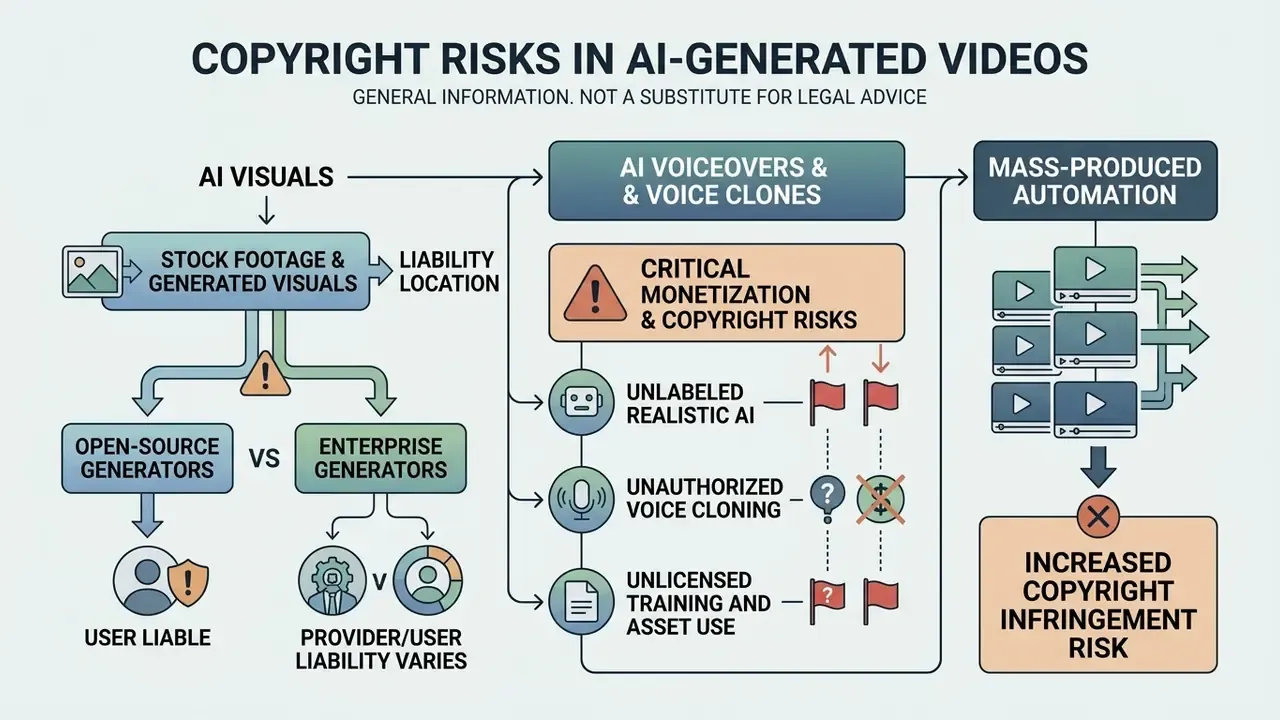
This section is general information about intellectual property and does not replace consultation with a qualified attorney.
Copyright protection requires human creative control over expression. Purely machine-generated media without human authorship cannot secure protection under U.S. Copyright Office guidance, which leaves unedited AI output exposed to copycats and licensing disputes.
Alongside the legal exposure, using unauthorized training assets, licensed-only stock footage, or unapproved voice clones creates platform enforcement risk. YouTube's Content ID system automatically flags synthetic media that incorporates protected third-party audio or visual material without permission, and it does not care that a model generated the mix.
AI Visuals, Stock Footage and Generated Visuals
Generating visuals from text prompts does not automatically grant exclusive commercial rights, particularly when the output reproduces protected artistic expression. According to the U.S. Copyright Office 2025 AI Report (Part 2: Copyrightability), simple prompting alone does not satisfy the human authorship threshold. Protection attaches only where a human determines sufficient expressive elements through authorship, arrangement, or substantive modification (full report PDF).
Third-party visual presets and repetitive model renders can also trigger platform copyright claims when the underlying assets carry copyrighted source media. License your stock assets properly, use verified generation platforms, and keep records of manual editing steps. Licensing terms by tool category are collected in our AI Media Commercial-Use Hub, which is worth a read before you scale output.
Open-source versus enterprise generators: where liability sits. Self-hosted open-weight models put the entire compliance burden on the operator. No vendor indemnity, no documented training-data provenance, no contractual commercial-use grant. Enterprise and commercial SaaS generators typically supply written commercial-use terms, some form of output indemnification, and machine-readable provenance metadata. For channels operating at scale, the enterprise route is materially lower-risk. For experimental or stylized work, open models are acceptable, provided every third-party asset entering the pipeline is separately licensed and logged.
AI Voiceovers and Voice Clones
Simulating identifiable public figures without express consent can lead to immediate channel suspension and legal action under misleading synthetic media rules. There is no gray zone worth exploring here.
This information is general in nature and does not replace consultation with a qualified legal professional.
Alert: critical monetization and copyright risks
Types of AI-Generated Videos That Can Be Monetized
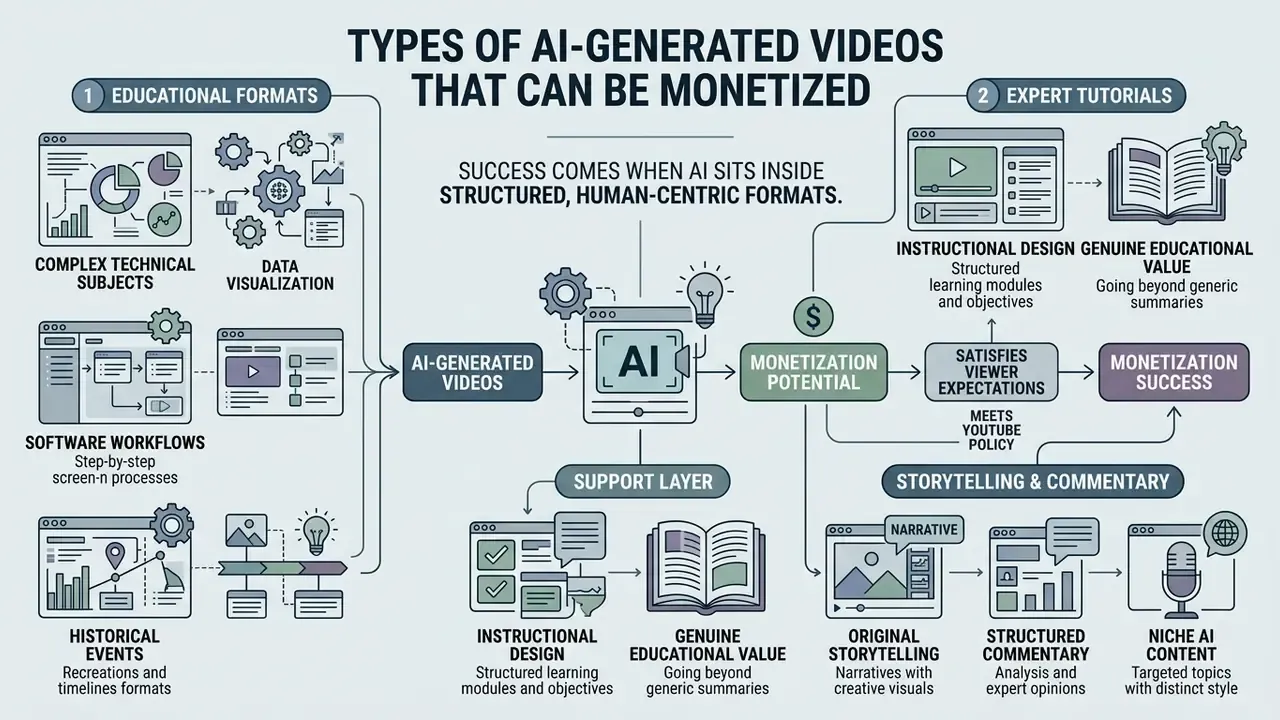
Videos built with AI tools succeed over the long run when they sit inside educational formats, expert tutorials, storytelling, or structured commentary. Those formats demand human editorial curation, script structure, and thematic context by their nature.
Position AI software as a support layer rather than the author, and you satisfy both viewer expectations and platform originality requirements at the same time.
Seven proven monetizable AI video formats:
- Educational breakdownsoriginal script plus AI-rendered diagrams and commentary.
- Historical and science-fiction faceless storytellinghuman-written narrative, AI-illustrated scenes, clearly labeled as fiction where applicable.
- Software, AI tool and workflow tutorialsscreen recordings combined with generated motion graphics.
- Data visualization and animated case studiesproprietary data, AI-assisted chart animation.
- News and industry analysis with a personal perspectiveyour interpretation, not machine-read headlines.
- Opinion, review and commentary formatsAI assists production; the argument stays yours.
- Productivity, marketing and career explainersAI charts and B-roll supporting first-hand professional experience.
Educational Videos, Tutorials and Explainers
Educational videos explaining complex technical subjects, software workflows, or historical events perform strongly under YPP review. Creators who demonstrate specific software tools, combining step-by-step screen recordings with custom AI visual diagrams, establish human value that a reviewer can see in thirty seconds.
Peer-reviewed instructional-design literature points the same direction: structured video that uses segmenting, coherence, and learner control holds attention better than dense continuous narration.
«Structured instructional video design using segmenting, coherence and learner control maximizes viewer engagement». "Improving Instructional Video Design: A Systematic Review," ERIC (2022). https://eric.ed.gov/?id=EJ1363010
Applied properly, those principles turn a generic AI summary into genuine educational value. In practice, that means chunking explanations into 60 to 120 second conceptual segments, removing decorative visuals that compete with narration, and adding chapter markers so viewers control pacing themselves.
Storytelling, Commentary and Niche AI Content
Original storytelling and commentary channels can monetize synthetic visuals effectively when the narrative framing stays distinctly human. Write the fiction script, the historical analysis, or the industry commentary yourself, then use AI image generators to render background B-roll and illustrative scenes. Archive-heavy channels sometimes animate stills for the same purpose; our walkthrough on how to turn live photo into video covers that technique, and the reverse process, how to turn video into live photo, is useful for thumbnail and social assets.
In these formats, artificial intelligence functions as a digital storyboard tool. Nothing more.
«Creators emphasize that scripting, topic selection, channel branding and audience interaction remain human responsibilities». Wagner et al., "Monetizing Generative AI: YouTubers' Collective Practices," arXiv (2026). https://arxiv.org/abs/2603.07036
The commentary, the narration pacing, and the editorial structure carry the creative weight. That is what keeps the upload clear of YouTube's reused content rules.
Choosing AI Tools for Monetizable YouTube Videos
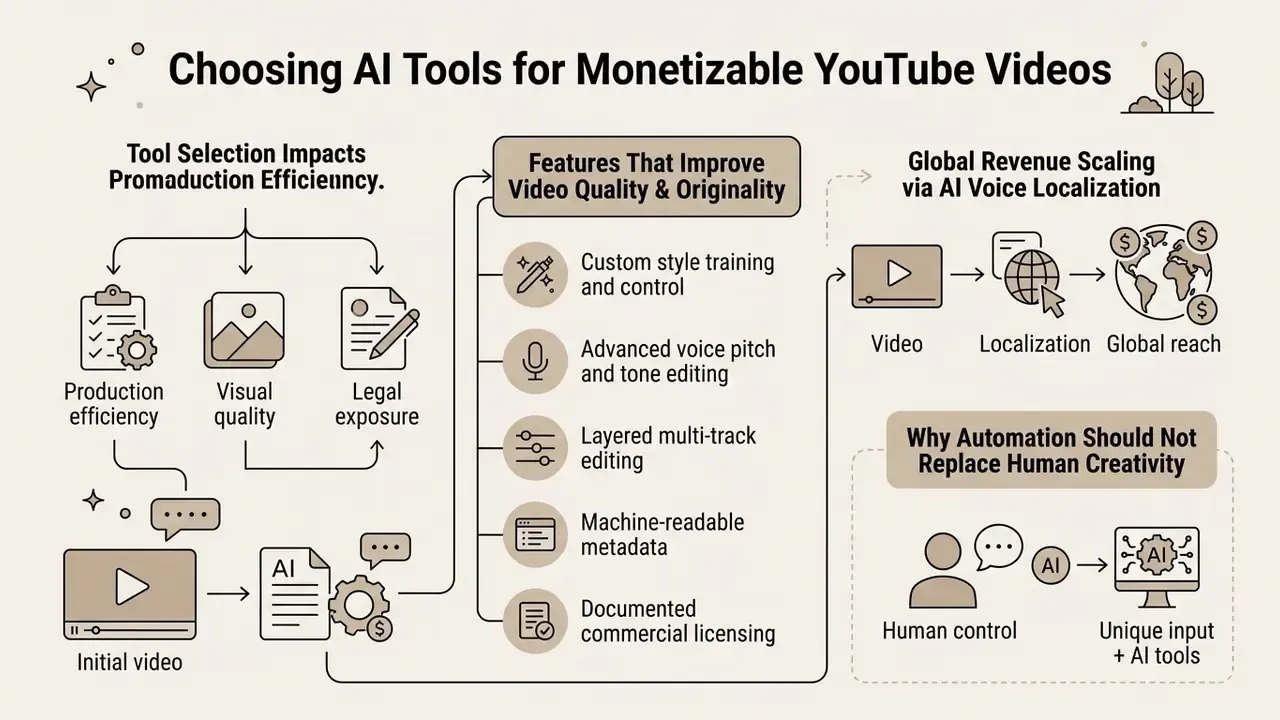
Tool selection affects production efficiency, visual quality, and legal exposure all at once. Prioritize platforms offering granular editing control, high-definition output, transparent asset licensing, and clear provenance metadata.
Tools built purely for mass automation tend to produce generic visuals and robotic voice synthesis, which raises demonetization risk. Audiences now police output quality themselves, sometimes more aggressively than moderators do.
High-quality production software lets creators customize style parameters, adjust pacing, and keep editorial control where it belongs.
Features That Improve Video Quality and Originality
Professional AI generation services expose advanced settings that help maintain a distinctive brand identity. Key features worth evaluating:
- Custom style training and control ability to input reference images, control lighting parameters, and enforce consistent visual styling across scenes.
- Advanced voice pitch and tone editing voice design controls for cadence, emotional emphasis, inflection, and accent choices.
- Layered multi-track editing export of isolated audio stems, visual layers, and raw captions for manual refinement in professional NLE software.
- Machine-readable metadata compliance with C2PA provenance standards that embed creation history directly into media files.
- Documented commercial licensing written commercial-use grants, output ownership terms, and, at enterprise tiers, indemnification against third-party IP claims.
Enterprise evaluation matrix for governance-led teams:
| Evaluation criterion | Consumer / free tier | Professional tier | Enterprise tier |
|---|---|---|---|
| Commercial-use rights | Often restricted or watermarked | Granted with attribution limits | Granted, contractually documented |
| C2PA provenance metadata | Rarely supported | Partially supported | Embedded by default |
| Training-data disclosure | None | Summary statement | Auditable documentation |
| Output indemnification | None | None | Available |
| Multi-track / layered export | No | Yes | Yes, with API automation |
| Audit logging of generations | No | Limited | Full, exportable |
Global Revenue Scaling via AI Voice Localization
Creators can multiply existing channel revenue by localizing high-performing English scripts into Tier-1 language markets: German, Spanish, Japanese, French. Professional AI dubbing tools with voice design capabilities let a single operator run a small localized channel network, capturing higher-RPM international ad inventory with modest additional production overhead. On-screen text needs the same treatment, and our guide on how to translate image text handles that step.
Localization is also the cheapest form of substantive transformation available. A translated, re-voiced edition of an original script is not reused content, because a human authored the underlying script and the localized narration requires fresh timing, terminology, and cultural adaptation. Two caveats apply. First, if the localized voice clones a real identifiable person, consent documentation is mandatory. Second, each localized channel must hold its own coherent niche and metadata. Publishing eight language variants of one video onto a single channel trips repetition filters, every time.
Why Automation Should Not Replace Human Creativity
Full automation strips out the personal perspective that drives long-term retention. Viewers subscribe for distinct editorial opinions, expert analysis, or a creative direction they cannot get elsewhere.
Automate the whole pipeline and your uploads become indistinguishable from thousands of competing automated channels. Keeping human editorial direction protects the channel against algorithm updates aimed at low-effort content, and it preserves brand value you can actually sell. There is a second, quieter cost: because copyright authorship standards still require a human author, fully automated output weakens your ownership claim, which weakens licensing, syndication, and brand-deal leverage downstream.
How to Create AI Videos That Stay Eligible for Monetization
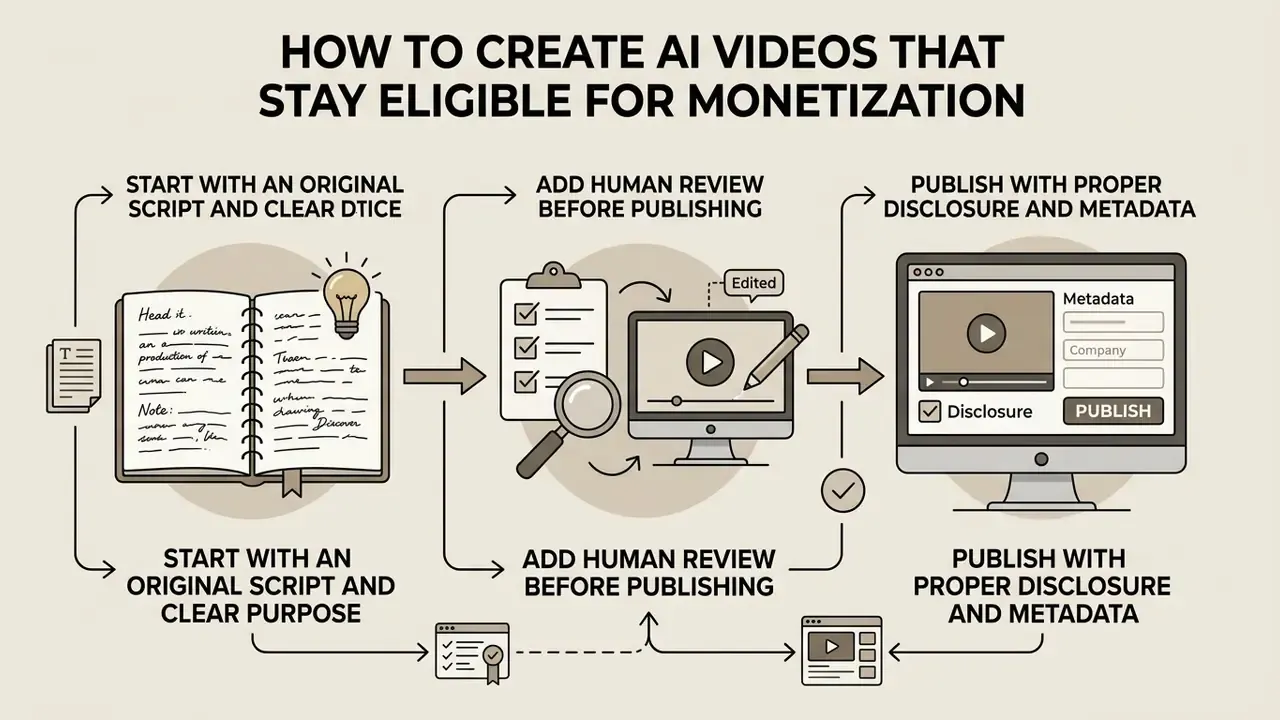
To keep ad eligibility, build a structured production workflow that puts human authorship at every stage. End-to-end hands-off generation creates compliance holes you cannot patch after the fact.
A safe pipeline starts with human research, moves through script refinement, integrates curated AI asset generation, and finishes with manual quality control, copyright checks, and correct metadata disclosure.
Compliant AI video monetization workflow, six mandatory checkpoints:
| Step | Stage | Human control point | Artifact to log |
|---|---|---|---|
| 1 | Idea and original scripting | Topic selection, thesis, narrative structure written or substantially rewritten by a human | Script draft with revision history |
| 2 | Asset generation (visuals and voice) | Prompt authorship, style direction, scene selection, take approval | Prompt log, model and version used |
| 3 | Manual quality control and fact-checking | Every consequential claim verified against primary sources; artifacts removed | Completed audit checklist |
| 4 | Copyright and licensing audit | Licenses confirmed for music, stock, fonts, voices, generated assets | License register with dates |
| 5 | Metadata and synthetic disclosure | "Altered content" attribute set correctly; description and chapters written | Upload settings screenshot |
| 6 | Publish and track engagement | Retention review, comment moderation, policy-change monitoring | Retention report per upload |
Keep those six artifacts per video and you hold an internal audit trail that is defensible during a YPP appeal, a Content ID dispute, or an advertiser brand-safety inquiry. Evidence first. Autonomy second.
Start With an Original Script and Clear Purpose
Every monetizable video starts with a custom script and a clear narrative goal. Generative models are fine for brainstorming outlines or compiling raw research, but the draft has to go through extensive manual rewriting so it reflects original analysis, your voice, and accurate structure.
Publisher and university authorship standards converge on one requirement: the human author retains sole accountability for accuracy, insights, and expression, and AI systems cannot be credited as authors.
A script built on unedited model output lacks human perspective and raises the odds of factual errors reaching publication. The working rule is simple enough: prompt in small structured tasks, then rewrite until the core ideas, interpretations, and conclusions are demonstrably yours.
Add Human Review Before Publishing
Before export, run a full human quality-control audit. This step verifies factual claims, removes visual and audio artifacts, and confirms asset licensing rights. Assign it to a named person, not to "the team."
Checklist0 / 9
Publish With Proper Disclosure and Metadata
During upload in YouTube Studio, configure video metadata and synthetic content disclosure accurately. On the upload details page under "Altered content," select "Yes" if the video features realistic synthetic media generated by AI. On mobile, the same control sits under Add details → Altered content / Attributes → AI use.
Selecting "Yes" produces a viewer label in the video description, or on the player itself for sensitive topics such as finance, health, news, and elections. The disclosure preserves audience trust and satisfies YouTube's transparency rules without harming search indexing or ad eligibility. Repeated non-disclosure is where it turns ugly: YouTube may apply the label itself, then escalate to removal or YPP suspension. And detection can be triggered by C2PA metadata that your generation tool embedded automatically, whether or not you remembered it was there.
Monetizing AI Videos Through Ads, Long-Form Content and YouTube Shorts
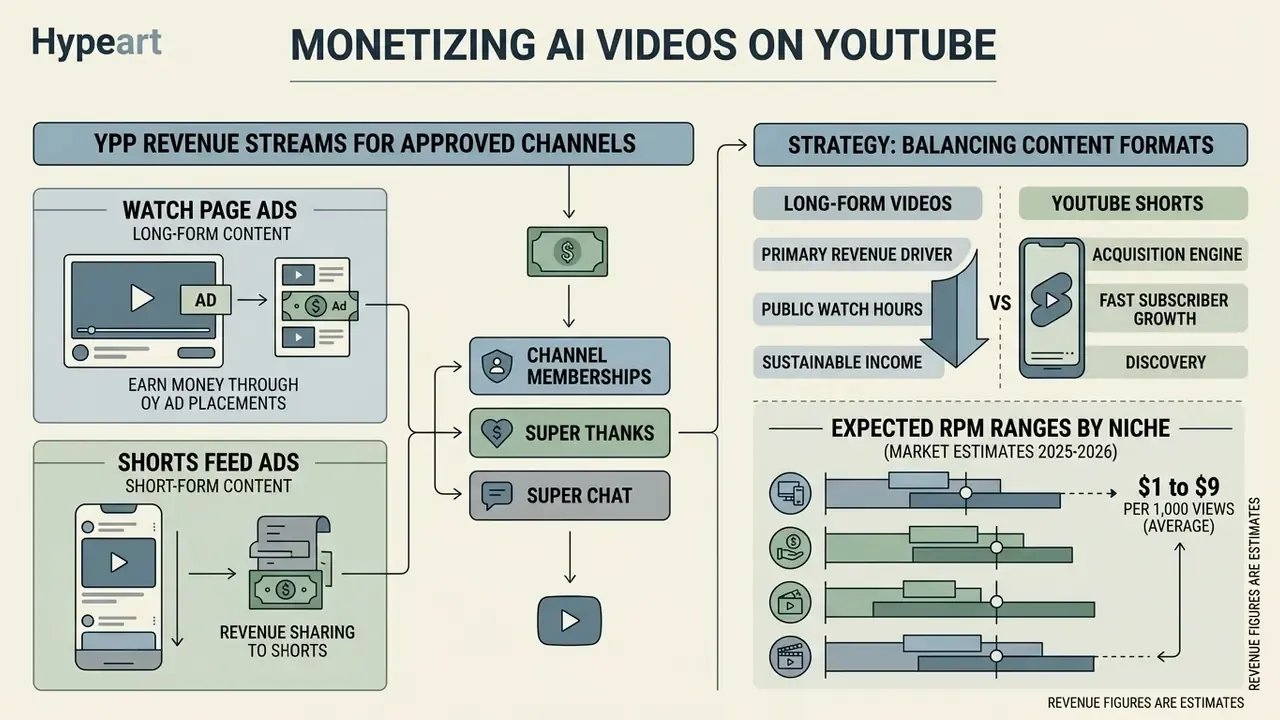
Approved YPP channels can earn money across several streams: Watch Page ad placement, Shorts Feed ad revenue sharing, channel memberships, Super Thanks, Super Chat during live streams, YouTube Shopping, and affiliate marketing integrations.
Maximizing total revenue means balancing long-form production against short-form outreach, with each format earning its keep on retention and authentic engagement.
Expected RPM ranges by AI content niche (2025 to 2026 market data):
| Niche | Typical RPM range | Notes |
|---|---|---|
| Finance, investing and business | $8.00 to $18.00 | Highest advertiser demand; strictest E-E-A-T and disclosure oversight required |
| Software tutorials and tech reviews | $4.00 to $9.00 | High commercial intent, strong affiliate overlay potential |
| Career, productivity and B2B explainers | $4.00 to $10.00 | Premium CPM inventory, smaller audience volumes |
| History, science and educational explainers | $2.00 to $5.00 | Broad reach, moderate CPM, excellent retention |
| Faceless fiction and ambient storytelling | $0.50 to $2.50 | High view volume, lower monetization efficiency |
Aggregate platform averages usually land between $1 and $9 per 1,000 monetized views, with the upper band concentrated in finance, technology, and career content. Geography matters as much as topic. The same finance video served to a United States or German audience can earn three to five times the RPM of an identical view from a low-CPM market, which is exactly why Tier-1 localization compounds revenue rather than merely adding to it.
Revenue figures are market estimates for orientation only. They are not a forecast of individual channel earnings and do not constitute financial advice.
Long-Form Videos vs YouTube Shorts for Channel Growth
Long-form videos remain the primary driver of sustainable ad revenue and public watch hours. Ad placement on long-form content generates higher RPM (revenue per mille) than short-form feed distribution, because long-form inventory supports pre-roll, mid-roll, and post-roll placements, while Shorts revenue is pooled across the Creator Pool. For financial viability, long-form is not optional.
YouTube Shorts work as an acquisition engine, driving fast subscriber growth and discovery. Shorts ad revenue is pooled and, per YouTube's published Shorts monetization terms, monetizing creators retain 45% of their allocated Shorts revenue after music licensing costs are deducted from the pool. Modest per view, valuable per funnel: short-form excels at pushing viewers toward deeper long-form uploads.
«Ad revenue access requires 1,000 subscribers plus 4,000 long-form watch hours or 10 million Shorts views in 90 days». YouTube Partner Program Overview, Google Help (2025). https://support.google.com/youtube/answer/72851
For creators refining editing and publishing pipelines, our dedicated resources on YouTube video editors offer practical guidance for structuring professional long-form and short-form projects.
Diversifying distribution without triggering repetition filters. Rather than re-uploading identical files to every surface, treat each channel as a distinct edit of one human-authored core asset: a vertical hook cut for Shorts, a platform-native Reel with fresh voiceover, a LinkedIn or newsletter embed with written analysis, and the full long-form video as the monetization anchor. Per-platform originality signals stay intact, and production cost stays flat.
Multi-Platform AI Video Revenue: TikTok and Facebook Syndication
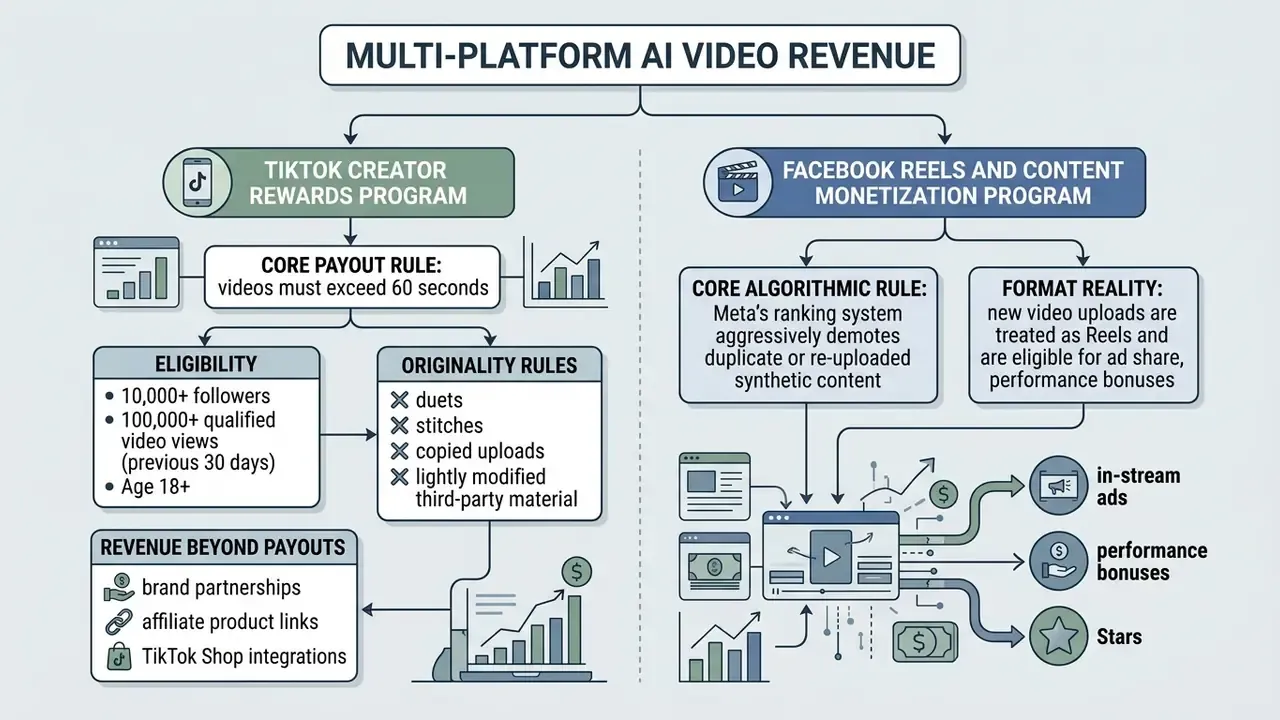
Monetizing AI videos extends beyond YouTube. To maximize audience lifetime value, run a multi-platform distribution engine with platform-specific compliance rules baked in.
1. TikTok Creator Rewards Program
- Core payout rule: videos must exceed 60 seconds to earn payouts. Fifteen-second clips generate engagement and follower growth but zero ad-pool revenue, a trap for creators optimizing purely for reach.
- Eligibility: at least 10,000 followers, 100,000 qualified video views in the previous 30 days, age 18 or older, and a personal account in good standing.
- Originality rules: duets, stitches, copied uploads, and lightly modified third-party material do not count as original content. Synthetic media depicting realistic figures must carry the in-app AI label.
- Revenue beyond payouts: brand partnerships, affiliate product links, and TikTok Shop integrations typically outperform native Creator Rewards income per post.
2. Facebook Reels and Content Monetization Program
- Core algorithmic rule: Meta's ranking system aggressively demotes duplicate or re-uploaded synthetic content to protect the original uploader. Reposting a clip that already circulated on Facebook suppresses distribution.
- Format reality: new video uploads are treated as Reels and are eligible for ad share, performance bonuses, and Stars tipping.
- Strategy: use isolated AI visual renders with unique voiceover tracks tailored for Facebook in-stream ads and Stars monetization, rather than mirroring the YouTube master file.
- Community layer: subscription groups, paywalled membership content, and branded content deals stack on top of Reels ad revenue, a mix other platforms replicate less easily.
3. Cross-platform governance baseline
Treat AI disclosure as a non-negotiable publishing step on every surface, not a YouTube-only obligation. Maintain one provenance record per asset, covering model, version, prompt, licenses, and consent documents, so the same video can be defended under YouTube's synthetic-content policy, TikTok's authenticity checks, and Meta's photorealistic-media disclosure expectations without rebuilding evidence from scratch.
Where the evidence is still thin. Two open questions deserve honesty. First, platforms publish enforcement thresholds in qualitative language, so "substantive transformation" has no measurable bright line; operators are managing a judgment call, not a formula. Second, public data on detection accuracy for AI-assisted content is limited, which means false positives are a live operational risk. Plan appeals capacity accordingly, and keep your audit artifacts current rather than reconstructing them under deadline.
FAQ: Monetizing AI-Generated Videos on YouTube
Does YouTube automatically demonetize channels using AI text-to-speech?
No. YouTube monetization policy evaluates script originality and overall video value, not the narration technology. High-quality synthetic voices reading original, well-researched scripts with custom editing remain fully eligible for YPP. Monetization is rejected only when automated TTS reads unedited, scraped, or templated content.
Will checking the "Altered or Synthetic Content" box reduce my ad revenue?
No. Disclosing realistic AI usage in YouTube Studio satisfies transparency guidelines and shields the channel from enforcement strikes. YouTube states explicitly that the disclosure label does not affect recommendations or monetization status.
Can I monetize a fully AI-generated faceless storytelling channel?
Yes, provided the narrative framing, story script, and video assembly show distinct artistic transformation and human editorial control, rather than automated stock-image slideshows. Fictional content should be clearly labeled as fiction.
Are AI videos allowed on YouTube if I never show my face?
Yes. Faceless production is permitted, and it says nothing about eligibility either way. What matters is whether the script, sequencing, and commentary reflect a human author, and whether realistic synthetic visuals carry the correct disclosure attribute.
Do AI-generated videos get monetized on TikTok and Facebook as well?
Yes, under each platform's own rules. TikTok pays through the Creator Rewards Program only for original videos of 60 seconds or longer, with 10,000 followers and 100,000 views in 30 days. Facebook monetizes Reels through its Content Monetization Program, but the algorithm demotes duplicated uploads, so each platform needs a genuinely distinct edit.
How much can an AI-assisted YouTube channel realistically earn?
Earnings depend on niche, audience geography, and retention. Long-form RPMs generally run from roughly $0.50 in ambient storytelling to $18 in finance and business content, while Shorts contribute $0.01 to $0.06 per 1,000 views. Memberships, affiliates, and brand deals frequently exceed platform ad revenue for niche expert channels.
Who owns the copyright in an AI-generated video?
Only the human-authored contributions are protectable. Under U.S. Copyright Office guidance, purely machine-generated elements produced from simple prompts are not copyrightable, and AI-generated material that is more than de minimis must be disclosed and disclaimed during registration.
Technical Summary and Compliance Checklist
To keep AI-assisted YouTube videos durably monetizable, implement the following governance rules:
- Verify original valueensure every script contains original analysis, custom narrative framing, or human expert commentary.
- Eliminate mass automationavoid template-driven pipelines designed for high-volume, low-effort uploading.
- Disclose realistic AIalways check the "Altered content" flag in YouTube Studio when publishing lifelike synthetic media, and apply the equivalent label on TikTok and Facebook.
- Audit intellectual propertyverify commercial licenses for all AI voice models, generated visuals, stock media, and audio tracks.
- Document provenanceretain prompt logs, model versions, C2PA metadata, license registers, and signed consent for any replicated voice or likeness.
- Prioritize viewer utilitydesign content that educates, entertains, or informs, with retention at the centre of channel strategy.
- Monitor policy driftre-read YouTube's monetization and disclosure pages quarterly. The July 2025 "inauthentic content" rename shows how quickly enforcement language shifts.
Next steps. Copy the six-checkpoint workflow table and the pre-publishing audit checklist into your internal content governance document, assign a named human reviewer to every upload, and run a one-time retrospective audit of your ten most-viewed existing videos against the disclosure and licensing criteria above before your next YPP review. Small, low-risk, reversible. Start there.
General disclaimer: this article provides general information on platform policy, intellectual property, and revenue benchmarks. It is not legal, tax, or financial advice. Platform rules and monetization terms change frequently; verify current requirements with the official sources linked above and consult qualified counsel for jurisdiction-specific questions.
Further reading: explore our full library of AI Media Workflows for production, localization, and compliance playbooks.