- An AI ASMR generator is a multimodal system that synthesizes a video stream and its matching acoustic triggers from a single text or image prompt. No binaural microphones, no camera, no editing suite.
- Two output formats dominate: 6-to-15-second vertical satisfying tactile loops (glass cutting, soap slicing, mukbang crunch) and 10-to-180-minute horizontal relaxing ambient streams for sleep and study.
- Realism depends on three measurable factors: material physics accuracy, audio-visual sync offset (target window +90 ms to -185 ms per ITU-T J.248), and artifact suppression.
- Free tiers usually mean 15 to 125 one-time credits, 480p-720p output, watermarks, and personal-use-only licensing. Commercial monetization, 1080p/4K, and watermark removal sit behind paid plans.
- Fully AI-generated media may lack federal copyright protection in the U.S. So platform Terms of Service, not copyright law, become the practical mechanism governing commercial reuse.
An AI ASMR generator is a multimodal software system that uses neural network architectures to synthesize synchronized acoustic triggers and micro-tactile video sequences. These systems process text prompts, structural parameters, or reference images, then output high-fidelity video streams paired with synthesized soundscapes designed to induce Autonomous Sensory Meridian Response (ASMR).
The advantage of the AI approach is a near-zero barrier to entry. You no longer need to buy 3Dio binaural microphones (roughly $500 and up), an audio interface, stands, or a treated, sound-isolated room. An asmr generator ai pipeline produces professional-grade audio and an HD visual track directly in the browser from a written description. The entire entry barrier collapses into one prompt field. Beginners can ship their first tactile loop in under five minutes. Professionals use the same pipeline to prototype dozens of sensory variations before committing to a production shoot.
What this material covers: the technology definition and generation pipeline, then the trigger library (mukbang and whisper included), formats and durations, a service comparison with privacy parameters, a step-by-step workflow with ready prompts, realism metrics and audio post-processing, commercial applications for brands, pricing and rights, publishing on YouTube and TikTok, plus an FAQ and a pre-release checklist.
What an AI ASMR generator is and what videos it creates
An AI ASMR generator is an online system that leverages generative diffusion models and transformer architectures to synthesize autonomous soundscapes and tactile video streams designed to trigger relaxation and tingling sensations. Unlike traditional ASMR content recorded manually with binaural microphones, an asmr ai generator algorithmically computes object physics, surface interactions, and acoustic wave patterns from textual descriptions or reference images. It is the same principle that powers general-purpose AI video generators, applied to sensory micro-detail instead of narrative scenes.
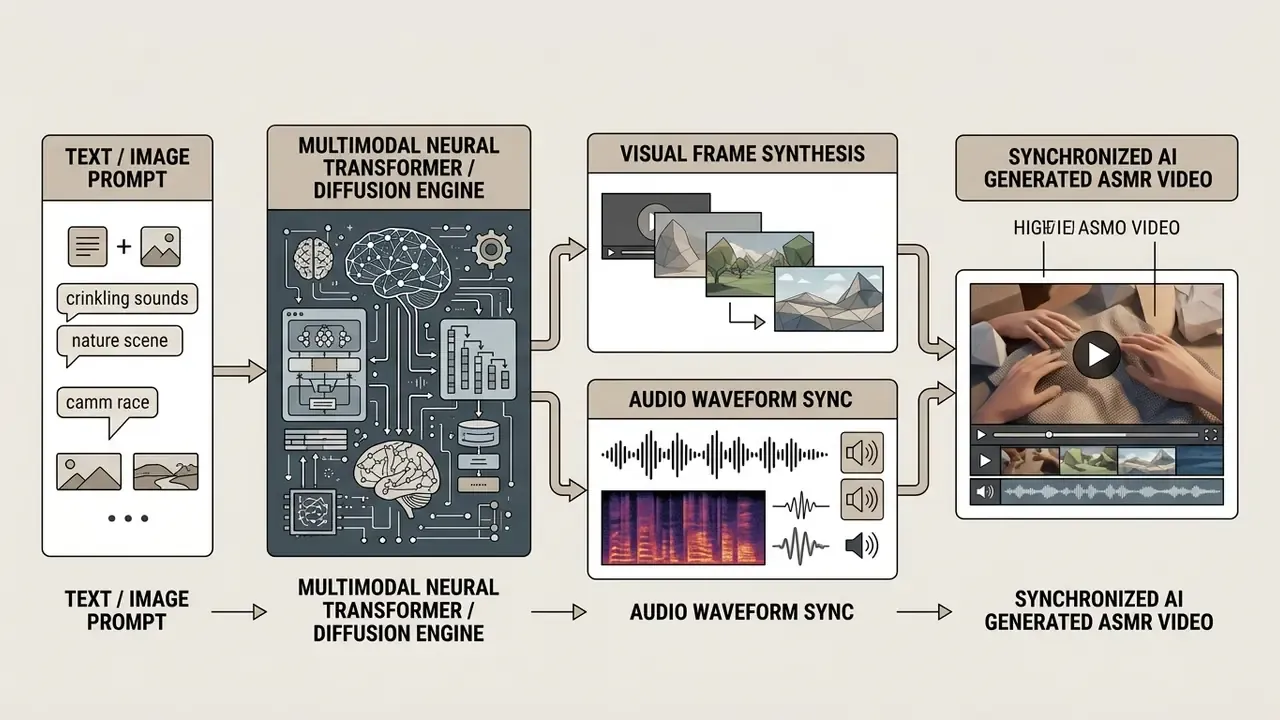
Research in signal processing suggests that synthetic audio generated by generative adversarial networks (GANs) trained on acoustic pattern datasets can reliably induce physiological ASMR responses without any physical human performance.
«GAN-generated clips without identifiable scenarios still elicit ASMR responses in participants. The decisive factor is the cyclicity of acoustic patterns, not visual context.»
Modern systems output two main media categories: short-form satisfying visual clips (soap slicing, kinetic sand carving, glass fracturing) and extended relaxing ambient environments (water trickling, rhythmic rain, continuous soft tapping). A high-quality ai generated asmr video bridges sensory modalities by ensuring that every visual contact frame aligns precisely with an acoustic waveform peak.
How AI unifies visuals, motion, and ASMR sounds
Artificial intelligence unifies visual sequences, object motion physics, and ASMR sounds using dual-stream multimodal diffusion transformers (MMDiT) or cross-modal attention mechanisms that condition video generation on temporal audio features. Models such as VideoPoet (ICML 2024) and SkyReels-V4 use joint transformer backbones to process text, image, and audio tokens simultaneously, so visual surface deformation directly drives sound synthesis. SkyReels-V4's dual-stream MMDiT design accepts text, image, video, mask, and audio references, and outputs synchronized video-audio at up to 1080p / 32 FPS. AV-Link, by contrast, aligns the two modalities through temporally matched diffusion activations pulled from frozen single-modality models.
To keep AI video fidelity believable, temporal alignment modules continuously estimate frame-by-frame motion vectors and match them with acoustic impact transients. When generating complex motion, say fluid movement or flexible material deformation, creators often integrate specialized 2d animation ai tools to pre-visualize motion vector paths before burning rendering credits. This multi-sensory alignment prevents temporal drift, so the visual contact of an object produces an immediate, crisp sound effect in the resulting generated ASMR stream.
Which ASMR triggers work for AI-generated videos
The most effective triggers for ai generated asmr videos are micro-tactile object interactions: cutting, tapping, glass slicing, soap carving, mukbang-style eating sounds, whispering, and kinetic sand manipulation. Their cyclic, repetitive physics are highly learnable by neural diffusion models. Predictable acoustic structure is the point. Generative algorithms model it with surprising precision.
«Smoothly distributed, energy-dense cyclic patterns proved most effective at triggering ASMR. The effect stays stable across repeated listening and does not depend on the spatial orientation of the sound.»
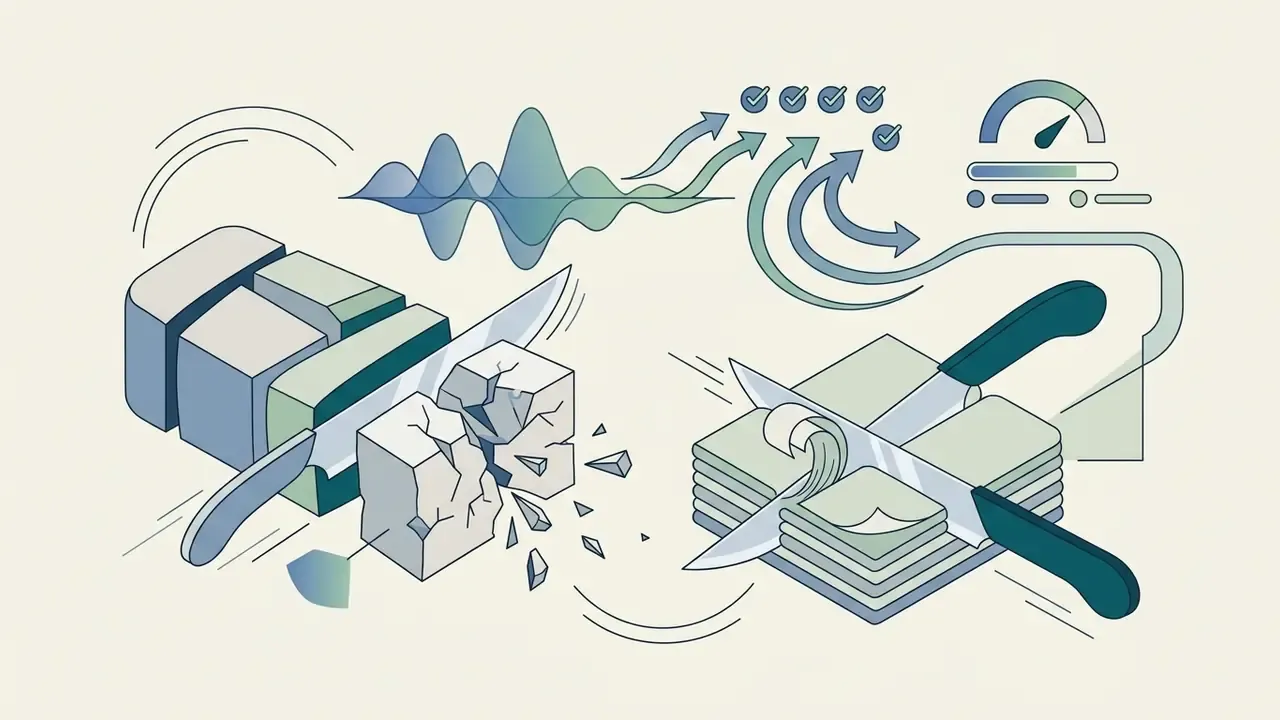
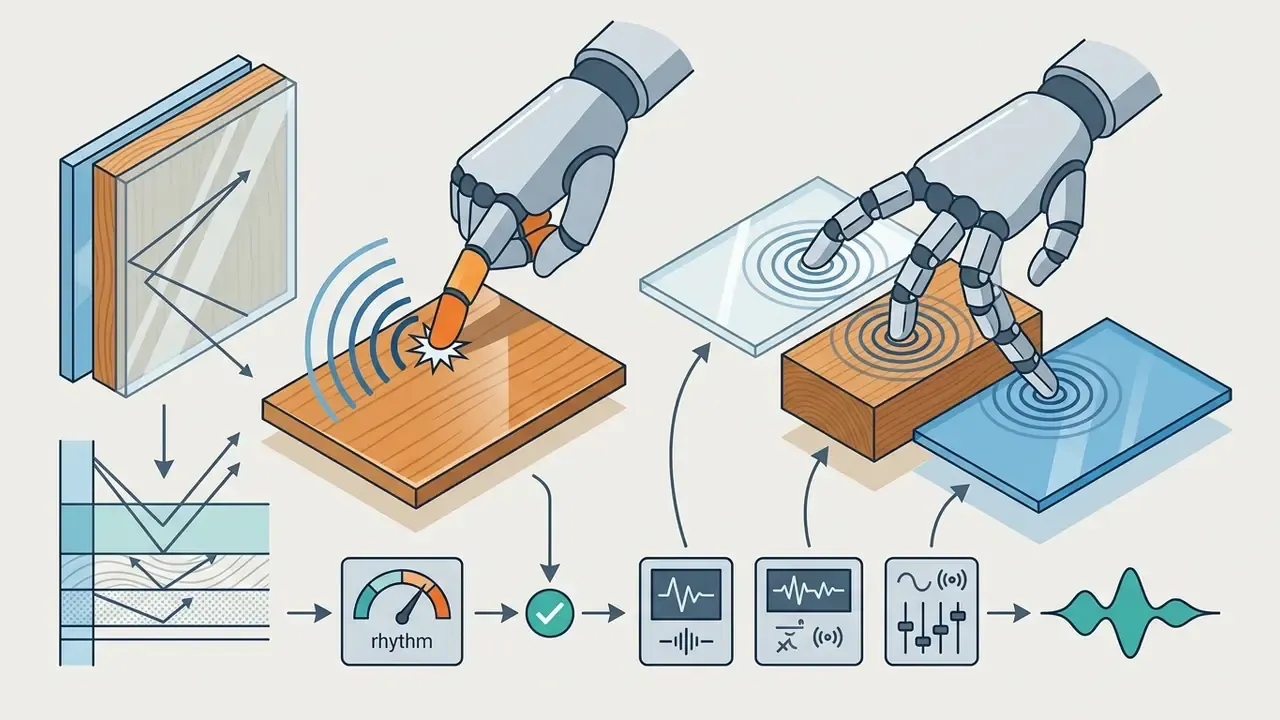
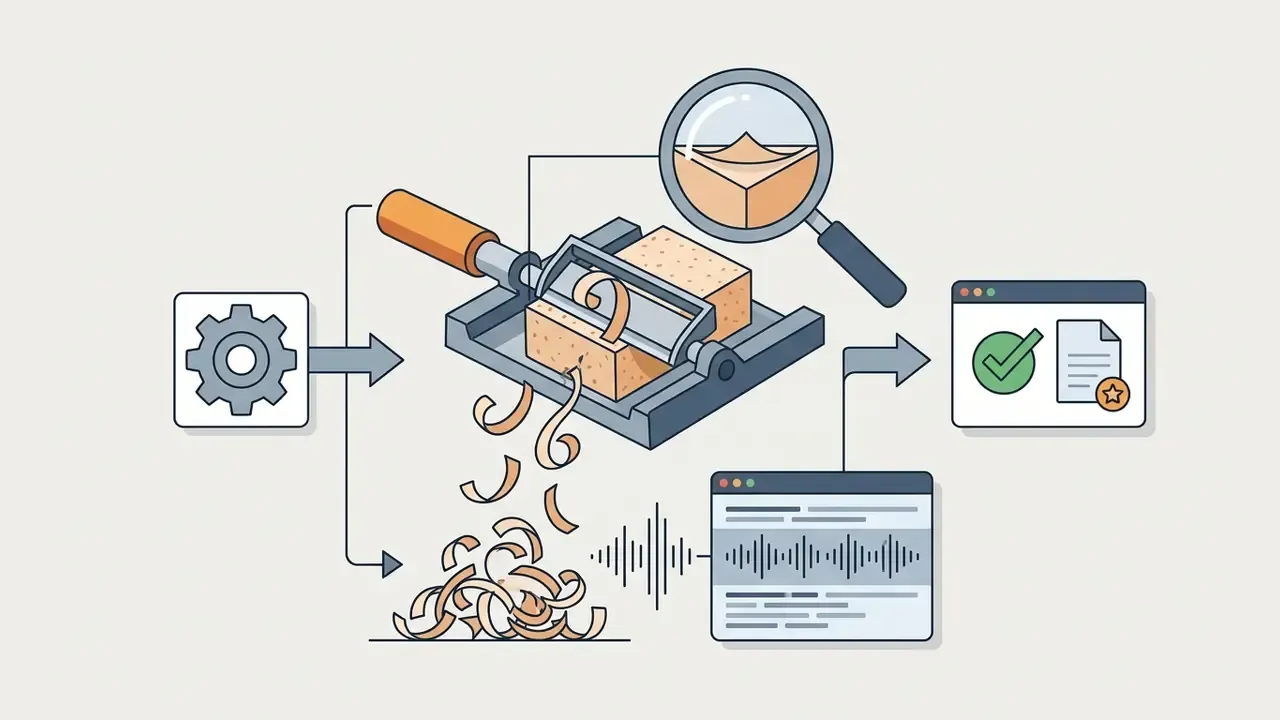
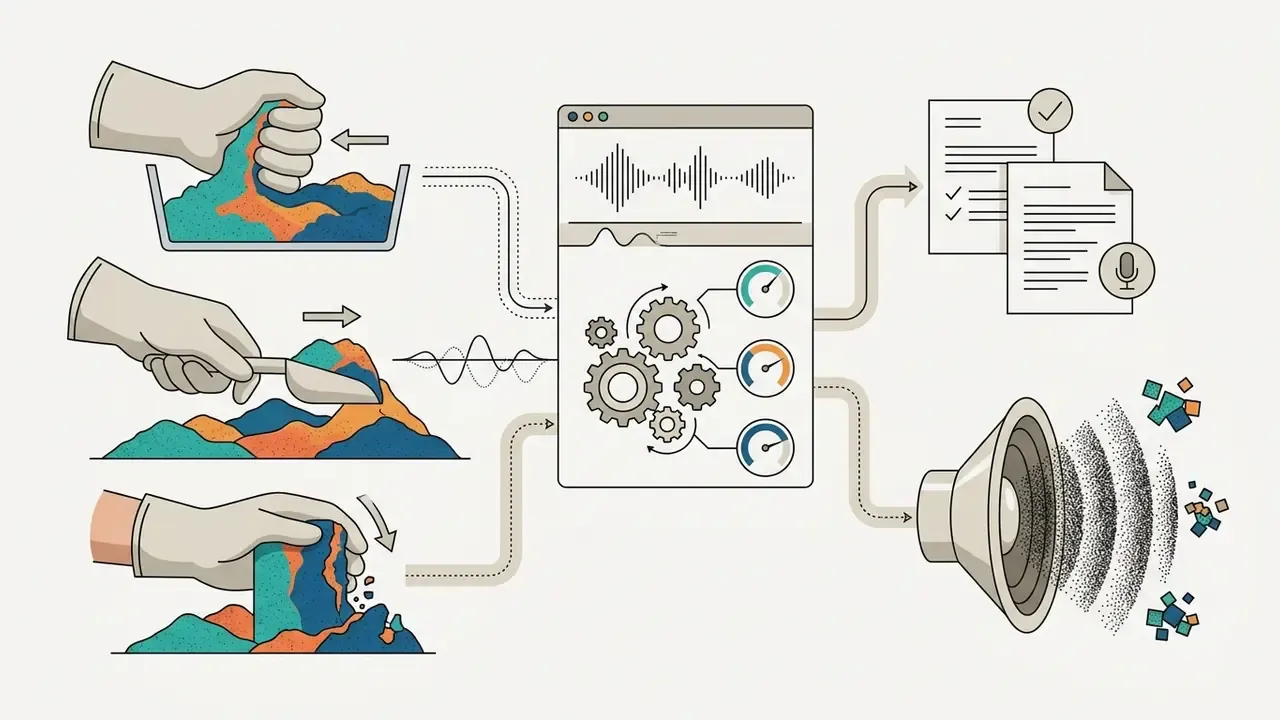
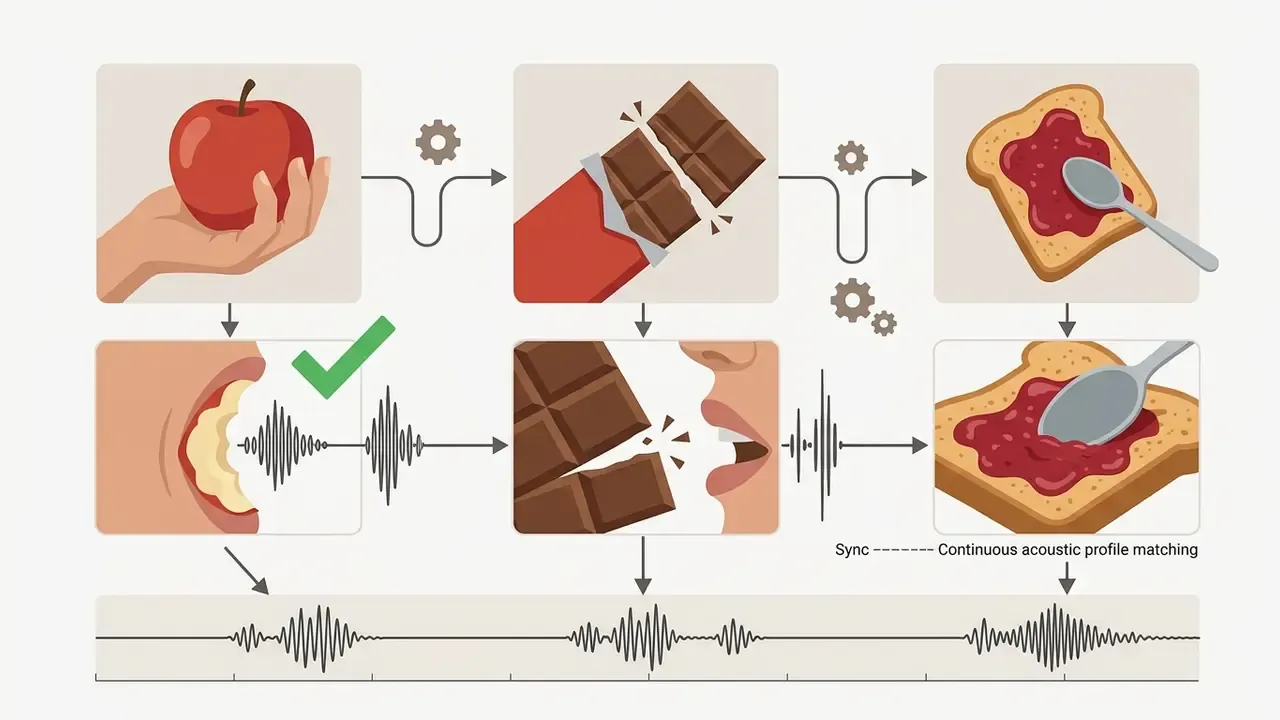
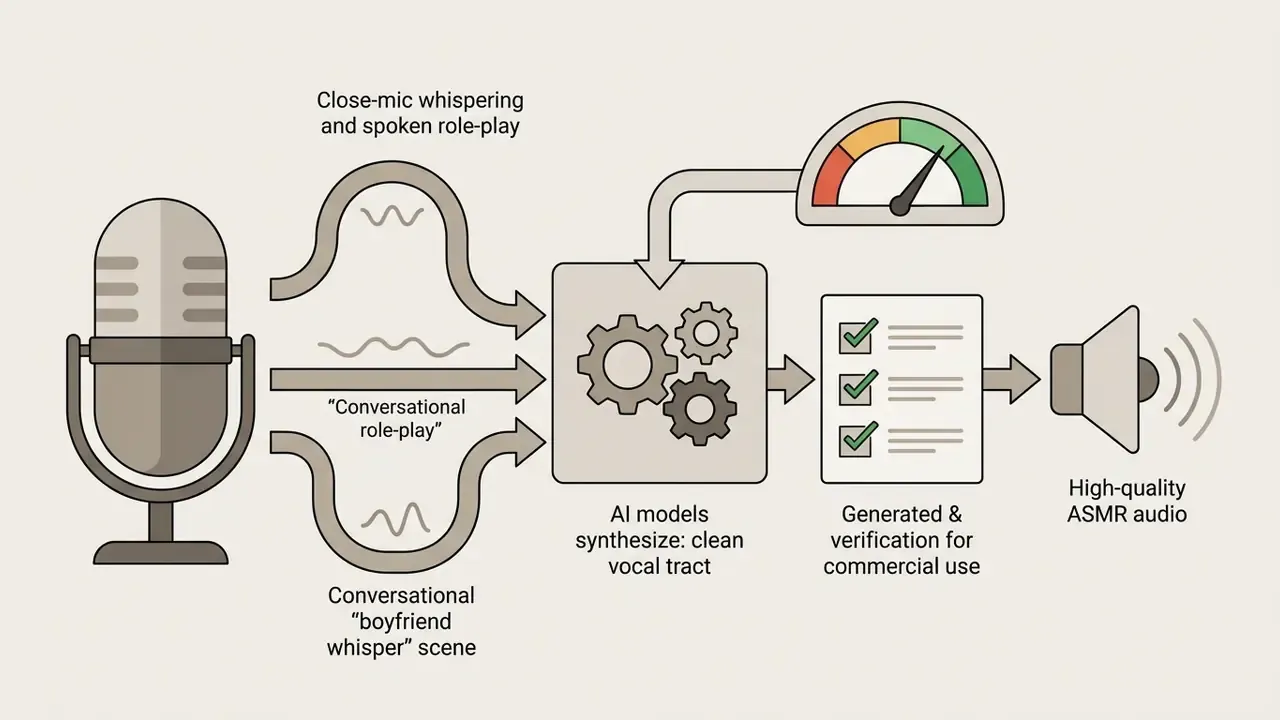
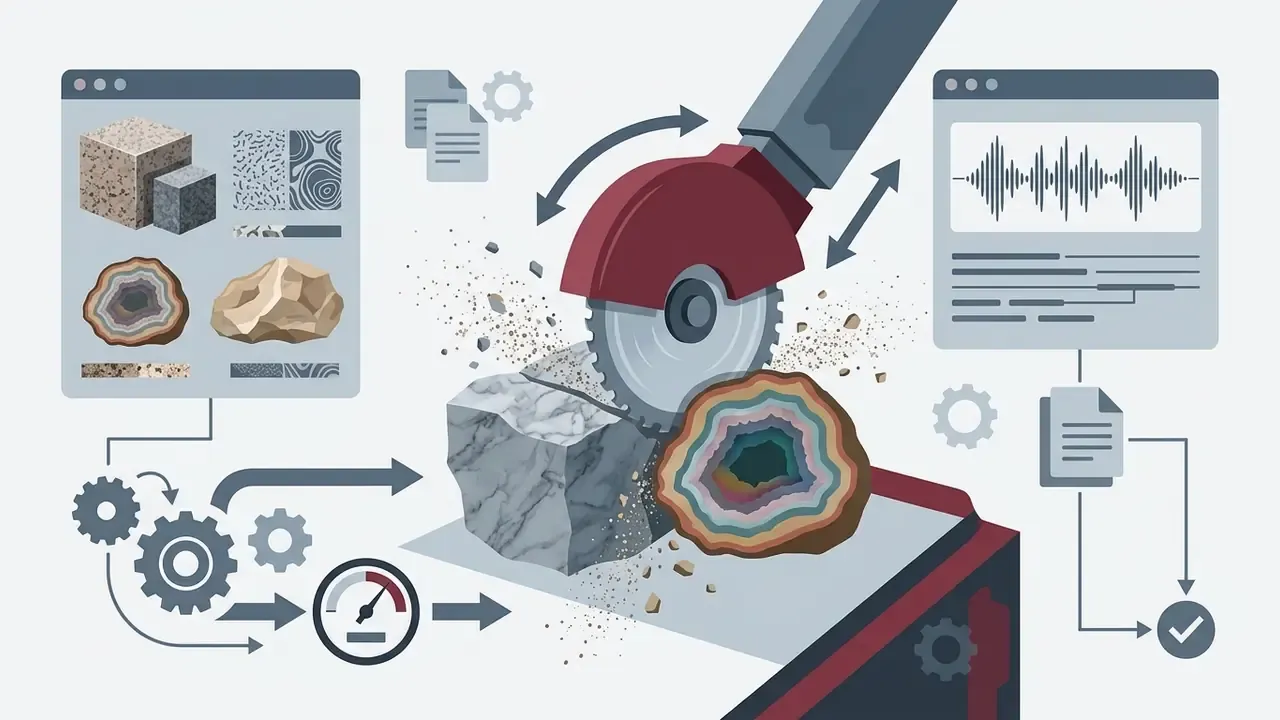
Trigger card library (visual descriptor, acoustic profile, prompt seed):
| Trigger | Visual descriptor | Acoustic profile | Prompt seed |
|---|---|---|---|
| Glass fruit cutting | Translucent "glass" apple or orange sliced in macro | Crisp clinking, splintering, crystalline crunch | Macro close-up, steel blade slicing a translucent glass apple |
| Surface tapping | Nails or tool on glass, wood, acrylic | Short, rhythmic, percussive taps with room decay | Long nails tapping a frosted glass jar, binaural close mic |
| Soap slicing | Pastel soap block shaved into curls | Soft, dry, crunchy shaving | Blade shaving thin curls from a lavender soap block |
| Water flow | Droplets on glass, slow pouring | Soft trickles, steady low-frequency pour | Rain droplets sliding down a window at dusk, 4K macro |
| Kinetic sand | Block scooped, cut, crumbled | Dry granular crunch and crumble | Knife cutting a cube of purple kinetic sand, top-down macro |
| Mukbang crunch | Bite into crunchy toast, honeycomb, apple | Wet-crisp fracture, juicy chew, sticky spread | Extreme close-up bite into honeycomb toast, crisp crunch |
| Whisper / role-play | Soft-focus face, close framing, low light | Breath-free whisper, sibilant softness, L/R panning | Soft whispered reassurance, intimate binaural perspective |
| Stone cutting | Blade grinding through marble or geode | Gritty grind, mineral cracking, fine dust hiss | Knife slicing a polished marble sphere, gravelly grind |
AI ASMR video formats: from satisfying cutting to calming audio
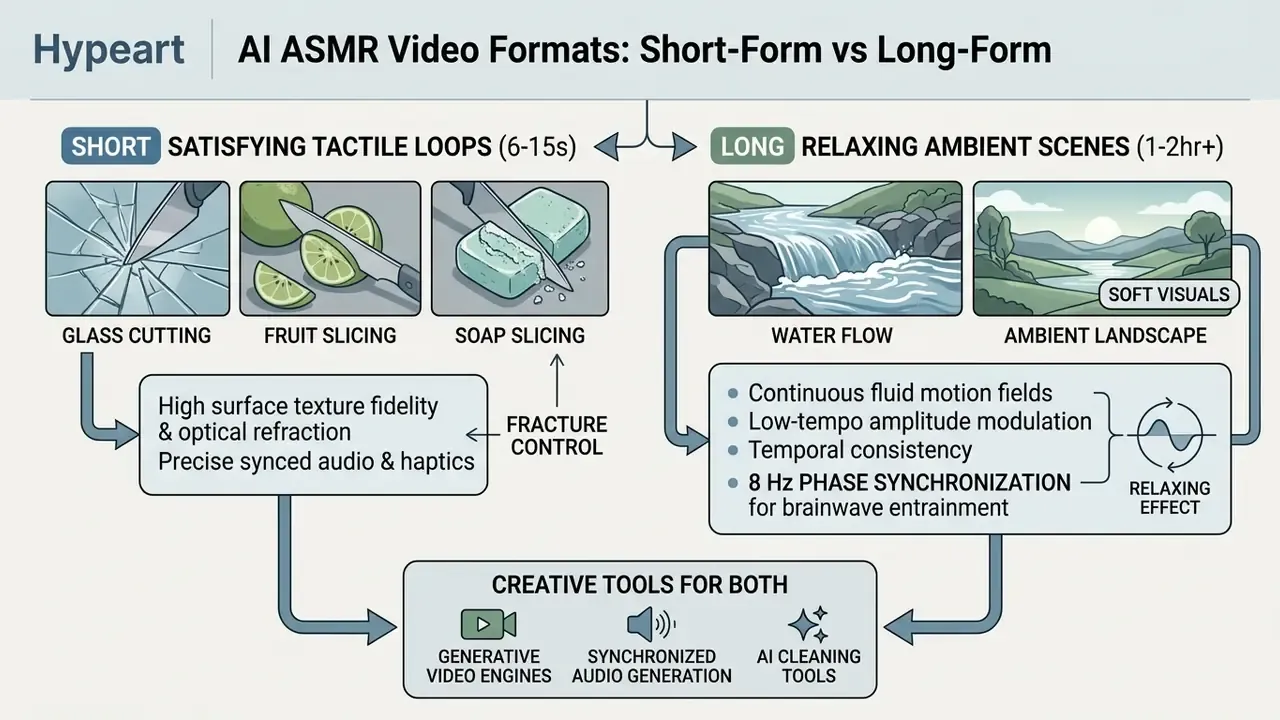
AI ASMR video formats split into two operational categories: short 6-to-15-second high-tempo satisfying tactile loops focused on close-up material destruction, and multi-hour calming ambient scenes engineered for sleep and study environments.
«An analysis of 52,002 ASMR videos on YouTube showed that clips under 10 minutes average 3,435 views per day, while content longer than 180 minutes averages 2,482 views per day.»
Survey evidence adds a second layer. Trigger-level preference peaks at 1 to 10 minutes per trigger, while session-level preference clusters around 20 to 30 minutes. That is precisely why long ambient streams are usually built as chains of 1-to-5-minute seamless loops rather than one continuous take.
| ASMR format category | Typical duration | Primary aspect ratio | Core visual triggers | Acoustic profile | Primary audience intent |
|---|---|---|---|---|---|
| Satisfying tactile clips | 6-15 seconds | 9:16 (vertical) | Glass fruit cutting, soap carving, kinetic sand | High-frequency crisp transients, crunchy shaving | Fast social engagement, viral clips |
| Mukbang / eating loops | 10-30 seconds | 9:16 (vertical) | Crunchy toast, honeycomb, fruit bites | Wet-crisp fracture, chewing, sticky spread | Appetite-driven engagement, food brands |
| Relaxing ambient streams | 10-180+ minutes | 16:9 (horizontal) | Rain on glass, flowing water, crackling fire | Low-frequency theta modulation (4-8 Hz) | Sleep onset, background study, stress reduction |
| Interactive tactile loops | 30-60 seconds | 1:1 / 9:16 | Rhythmic tapping, surface scratching, typing | Mid-frequency percussive taps, binaural panning | Sensory focus, stress relief |
| Whisper / role-play scenes | 1-10 minutes | 9:16 / 16:9 | Close framing, soft light, minimal motion | Breath-free whisper, close-mic sibilance | Parasocial comfort, anxiety relief |
Before committing a monthly credit budget to one engine, it is worth reviewing a broader shortlist of best AI video generators. Model choice determines whether native audio is available at all, and that single line item decides your entire post-production workload.
Satisfying video: glass, fruit, soap and other cutting scenes
Satisfying cutting videos demand ultra-high surface texture fidelity, exact optical refraction, and physically consistent material fracturing models to prevent visual warping during rendering.
«Physically informed generators integrate rigid-body dynamics into the diffusion process, producing realistic crack propagation and fragment trajectories instead of unnatural dissolving.»
Complementary research on brittle-object shattering treats fracture as controllable cracking, where crack origin, propagation speed, and fragment trajectories must all be specified. SOPHY (WACV 2026) adds that simulation-ready objects need explicit physical material properties plus UV-map texture refinement, so the material stays legible both before and after the cut.
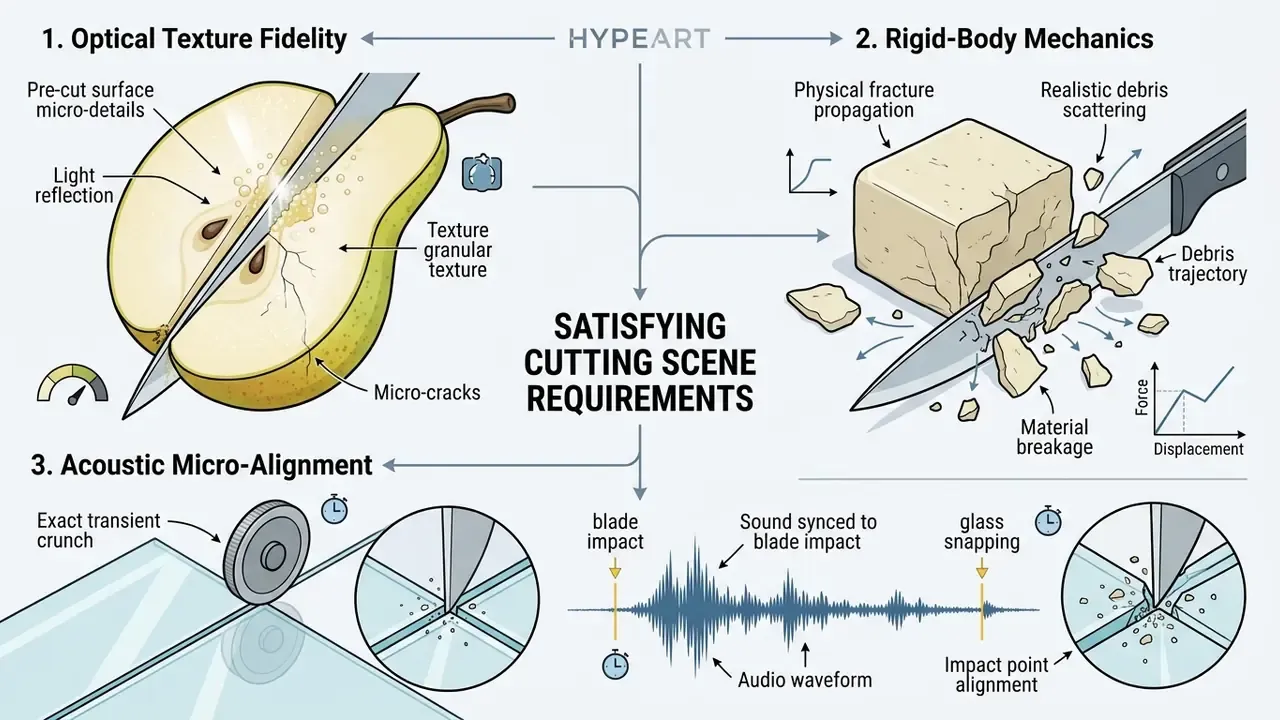
When rendering complex 3D surface physics, creators frequently pair generative video engines with a specialized 3d animation maker to set baseline depth maps and mesh boundaries. To hold viewer satisfaction, the generated satisfying video must show crisp material separation at the exact frame where the blade intersects the object surface, accompanied by a perfectly aligned high-frequency crunch. One frame late and the whole illusion dies.
Relaxing ASMR: water, ambient sound and soft visuals
Relaxing ASMR content relies on continuous fluid motion fields, low-tempo amplitude modulation, and the total elimination of abrupt acoustic transients or high-frequency strobing.
«Sleep-ASMR raises frontal midline theta power by 37% and temporal-lobe phase synchrony by 22% (p < 0.001), shortening sleep-onset latency by 4.2 seconds under polysomnography.»
«Amplitude-modulated music significantly strengthens beta oscillations and 8 Hz phase synchronization in frontal regions, boosting activation of executive-function networks.» The authors describe the effect as «a meaningful nudge, not a cognitive revolution.» Brain.fm multi-experiment EEG and fMRI study (2024), summarized on BiologyInsights. URL requires verification.
How to choose an AI ASMR video generator online
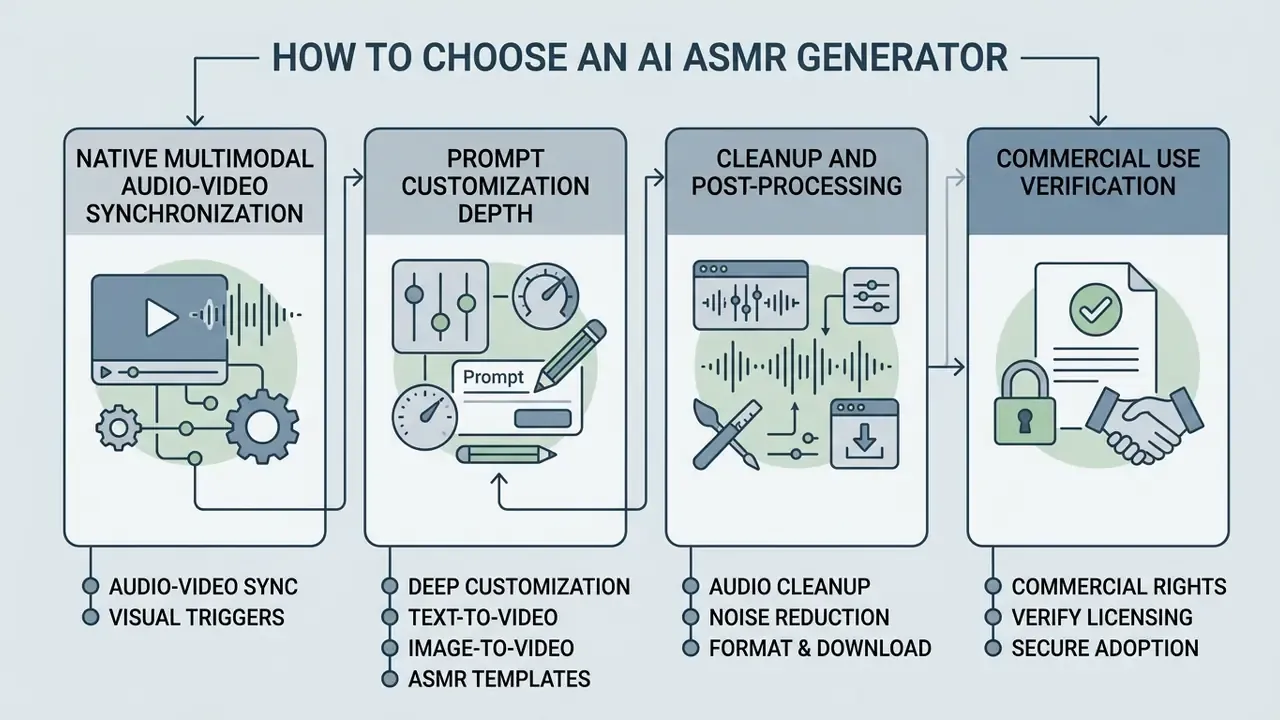
Selecting an ai asmr video generator online comes down to four technical criteria: native multimodal audio-video synchronization, prompt customization depth, export resolution options, and transparent commercial licensing terms. Platforms diverge sharply in credit accounting, rendering speed, and watermarking policy. A comparison of free AI video generators shows how far apart free-tier limits sit between vendors.
Comparison matrix of AI ASMR tools. Below: input modalities, audio sync, export quality, free limits, and commercial rights. For corporate users we added privacy criteria, namely whether prompts are used for model training and whether opt-out exists.
| Tool / platform | Input modalities | Native audio sync | Max resolution / FPS | Free tier allowance | Commercial usage rights | Data / privacy notes |
|---|---|---|---|---|---|---|
| Kapwing (Veo 3) | Text, image-to-video | Yes (Veo 3 is the only model in the editor that generates audio) | 1080p / 30 FPS | Credit-restricted trial | Pro plan required | Check the ToS section on training with user content; enterprise terms on request |
| OpenAI Sora 2 | Text, image, video reference | Yes (synced audio in API) | 1080p / 60 FPS (Pro: 20 s, no watermark) | Free tier «not supported» for API | Subject to OpenAI ToS | Business and Enterprise agreements contain separate no-training provisions for customer data |
| Runway Gen-4.5 | Text, image-to-video | External / prompt audio | 4K / 24-60 FPS | 125 one-time credits (12 credits per generation) | User retains rights to uploaded and generated content; commercial use permitted | Explicit rights retention written into the ToS |
| Google Veo (API) | Text, image-to-video | Yes (native audio, Veo 3.1) | 1080p / 24 FPS | Billing-based, no perpetual free tier | Governed by Google Cloud terms | Enterprise perimeter with SLA and standard cloud certifications |
| Specialized ASMR tools | Text prompts, presets | Native ASMR trigger audio | 720p-1080p / 30 FPS | 1-3 daily renders / 15-30 credits (watermarked) | Paid tier required (free equals personal use only) | Frequently "public generations" on the free plan, so your video is visible to other users |
What a corporate user must verify before adoption: (1) whether a training opt-out mode exists and how long prompts and uploaded files are retained; (2) whether generations are public on the free tier; (3) whether the vendor provides an enterprise SLA and standard information-security audits; (4) whether the contract includes indemnity, that is, protection against third-party claims arising from commercial use of the generated audio and video. No indemnity means the entire IP risk stays with you. For a detailed method of estimating API-side cost and limits, see the breakdown of Google Veo implementation.
Text-to-video, image-to-video and ready-made ASMR templates
Creators pick between three core inputs depending on the control they need. Text-to-video AI offers creative freedom for novel scenes, image-to-video AI gives precise control over starting textures, and pre-built templates deliver rapid social clip production. Two-stage generation architectures such as MicroCinema (CVPR 2024) first generate a high-detail static keyframe from text, then apply temporal motion diffusion to animate the image. A divide-and-conquer alternative to direct text-to-video, in other words.
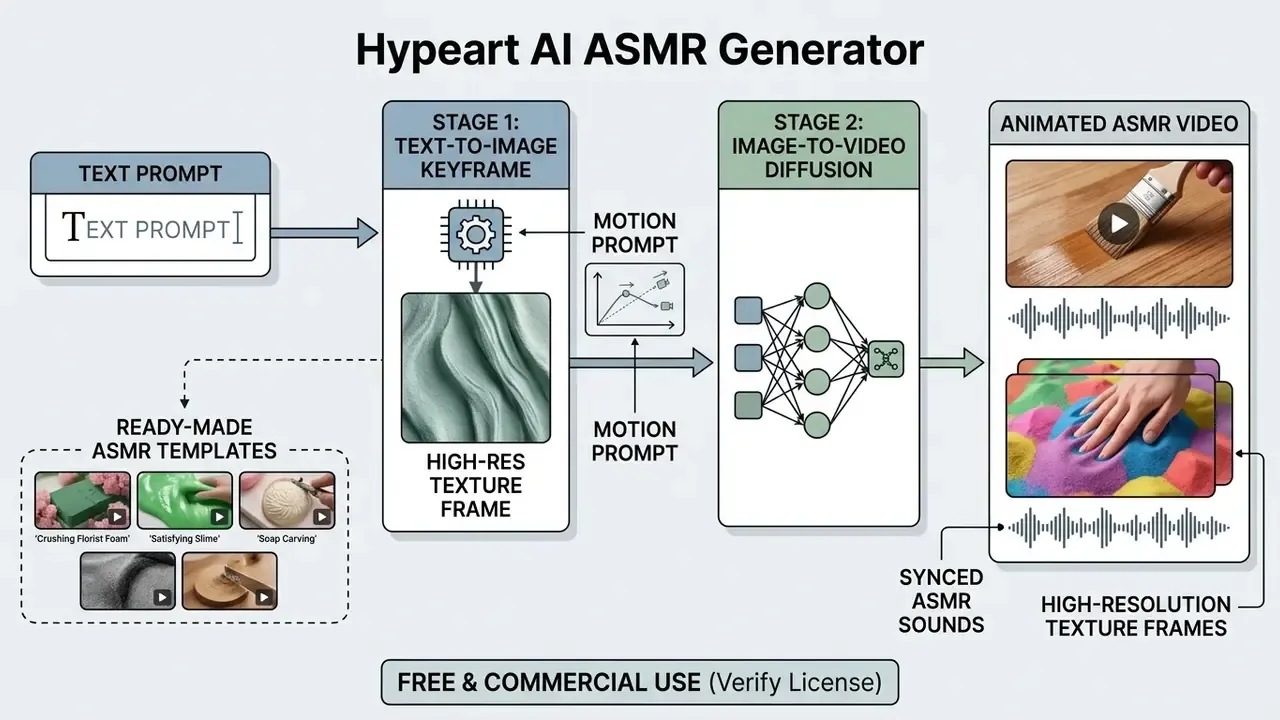
When source imagery carries compression artifacts, run input frames through a 4k video enhancer before temporal diffusion to preserve macro-texture crispness. Using an ai asmr video generator tool with direct image-to-video input yields higher material realism on complex surfaces like faceted glass or carved soap than text prompts alone. Templates win on speed but lose on differentiation: identical presets produce near-identical clips across thousands of accounts, which suppresses reach on algorithmic feeds. Worth remembering before you build a channel on a preset.
Synchronizing sounds with visual triggers
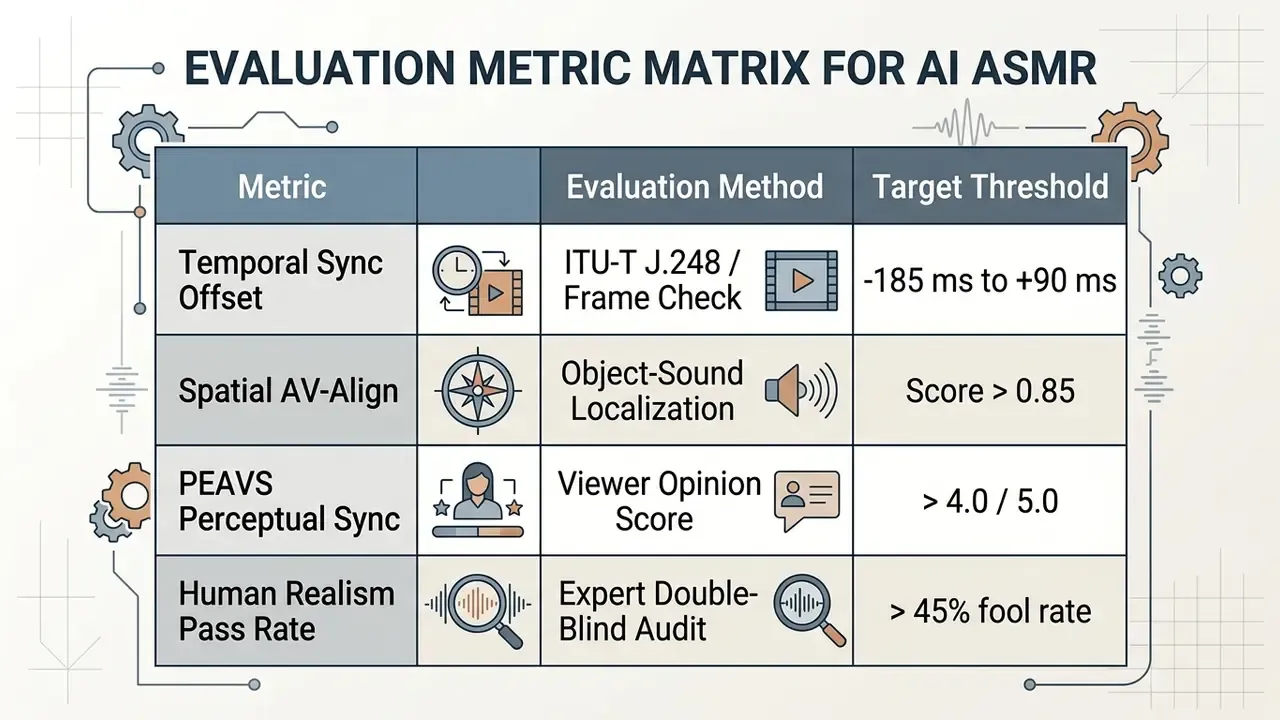
Neural audio-visual synchronization relies on offset prediction models that calculate temporal drift between visual impact frames and acoustic waveform peaks. Broadcast and digital accessibility standards (ITU-T J.248) define acceptable lip-sync and contact-audio sync within a window of +90 ms to -185 ms. IEC 62503 frames the same measurement as end-to-end video delay against accompanying audio.
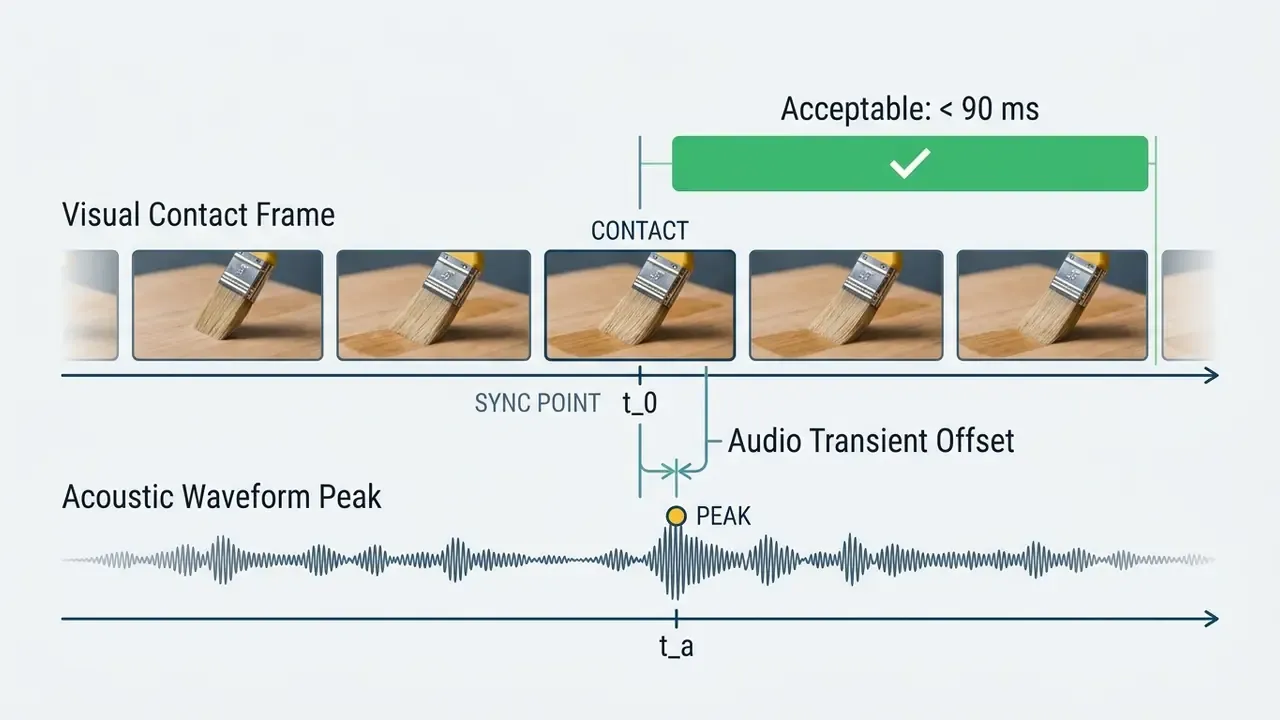
In an advanced ai asmr generator tool, transformer models predict visual impact timestamps and align synthetic transients (a tap, a crunch, a snap) directly to those frames. Accurate cross-modal alignment prevents the perceptual dissonance viewers feel when audio lags behind visual motion, even when they cannot name what is wrong.
Setting duration, format and download
Technical export parameters for AI ASMR content typically support clip durations between 1 and 10 seconds (up to 20 seconds on enterprise tiers), framerates from 24 to 60 FPS, aspect ratios of 9:16 (vertical) or 16:9 (horizontal), and direct MP4 or WEBM downloads. Some vendors expose fixed presets only. Luma Ray 2, for example, offers 5 s and 9 s durations rather than a free range, so loop planning has to adapt to the engine rather than the reverse. For creators producing short viral clips, a specialized 2short ai workflow helps trim and frame generated vertical media for immediate social upload. Selecting uncompressed audio export preserves the subtle high-frequency detail that carries most ASMR triggers.
How to create an AI ASMR video: step-by-step
Creating an ai generated asmr video with an ai asmr video maker follows a five-step workflow: define the sensory scene concept, engineer a detailed prompt, select visual and acoustic settings, run generation, and audit cross-modal quality before export.
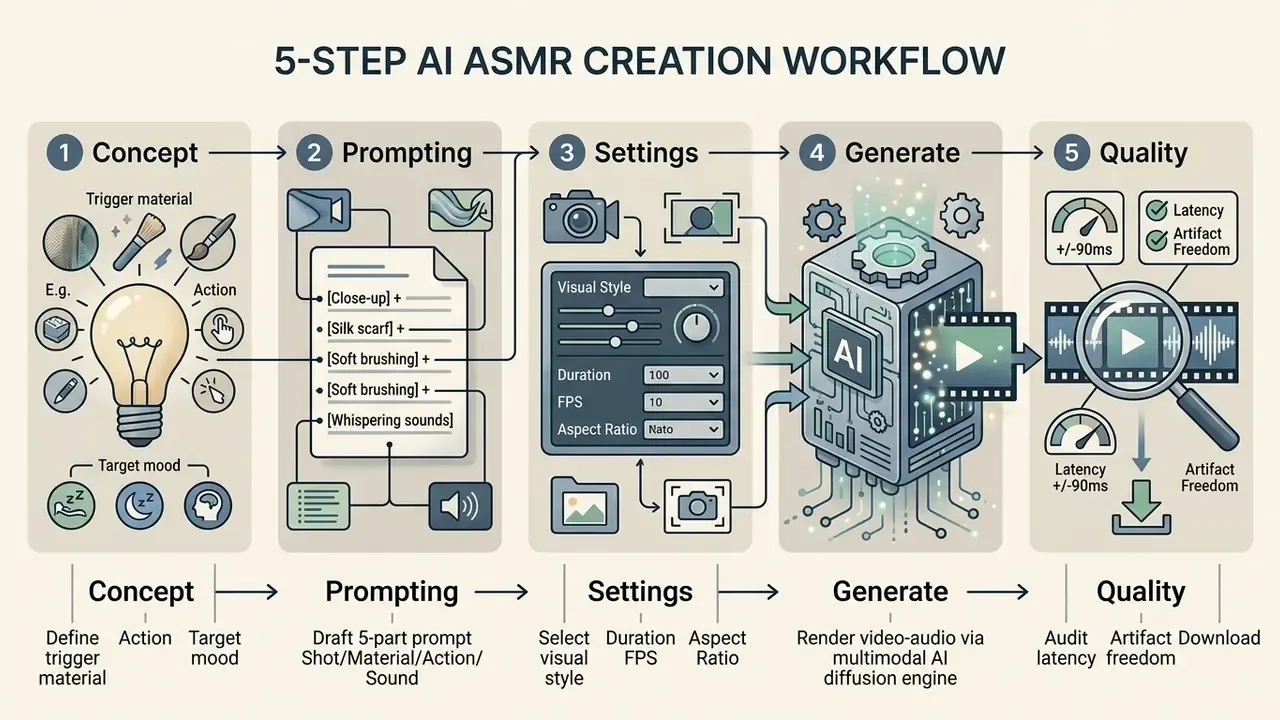
Step 1, concept. Fix the trigger type, mood, and visual style before you touch the prompt field: one material, one action, one acoustic signature. Step 2, prompting. Write the five-part structure below. Step 3, settings. Choose model, aspect ratio, duration, FPS, and whether native audio generation is enabled. Step 4, generate. Render, then regenerate variations of the same prompt instead of rewriting it from scratch. Step 5, quality. Audit sync, artifacts, and loop seams, then export MP4 or WEBM.
Write the prompt for an ASMR scene
An effective ASMR prompt follows a precise five-part structure that steers neural models toward physically plausible material behavior and crisp audio alignment:
- Shot type and framing
Macro close-up, 85mm lens, shallow depth of field - Subject and physical material
Translucent pastel-pink soap block with subtle surface ridges - Primary action
A clean steel blade slowly shaving thin, curlicue layers from the top edge - Acoustic descriptor
Crisp, dry, soft shaving crunch sound with zero background noise - Lighting and environment
Soft diffused studio lighting, neutral minimal background
Ready prompt for mukbang / crunchy ASMR:
Extreme macro close-up, 100mm macro lens. A clean knife cutting through a honeycomb-filled translucent glass apple on a dark slate board. Crisp, crunchy, splintering glass slicing sound synchronized with blade movement. Diffused warm side lighting, 60 fps, photorealistic material physics.
Ready prompt for whisper / role-play ASMR:
Intimate close-up, 50mm lens, shallow focus on a soft-lit face turned three-quarters to camera. Slow, breath-free whispered reassurance, binaural left-to-right movement, no background music, no room noise. Warm low-key lighting, 24 fps, gentle micro-motion only.
Ready prompt for long-form ambient ASMR:
Wide static shot, rain sliding down a large window at dusk, blurred city bokeh behind. Continuous soft rain patter with low-frequency rumble, no thunder, no transients. Seamless loop, 16:9, 24 fps, muted blue-grey palette.
Choose the visual style and tune the sound
Generate, check quality and download
In an operational test of generative video workflows, an editorial team produced a series of 10-second tactile cutting loops through a multimodal diffusion pipeline. The audit procedure was concrete. Each clip was stepped frame by frame to the exact blade-contact frame, the waveform was inspected in the audio editor to locate the transient peak, and the delta was measured in milliseconds. On four of eleven renders the team found a 120 ms audio lag, outside the +/-90 ms tolerance, corrected it by shifting the audio track forward, then re-exported the final 1080p MP4. Two further renders were discarded for a different reason: the blade dissolved into the material instead of fracturing it. That is a physics failure, and no post-production step repairs it. The surviving assets passed every cross-modal sync check and played back seamlessly across social feeds.
The same audit as a pre-export checklist:
- Step to the visual contact frame, locate the acoustic transient, measure the offset (target 90 ms or less).
- Scrub the loop seam at 0.25x speed and check for jump cuts, warping, and object identity drift.
- Listen on headphones at low volume and flag hiss, metallic ring, and clipping on peaks.
- Verify duration, aspect ratio, FPS, and container against the target platform spec.
- Confirm the licensing tier permits the intended distribution before publishing.
What affects the realism and quality of AI-generated ASMR
Realism in an ai generated asmr video rests on three factors: physical material deformation accuracy, precise temporal sound alignment, and suppression of generative distortion artifacts.
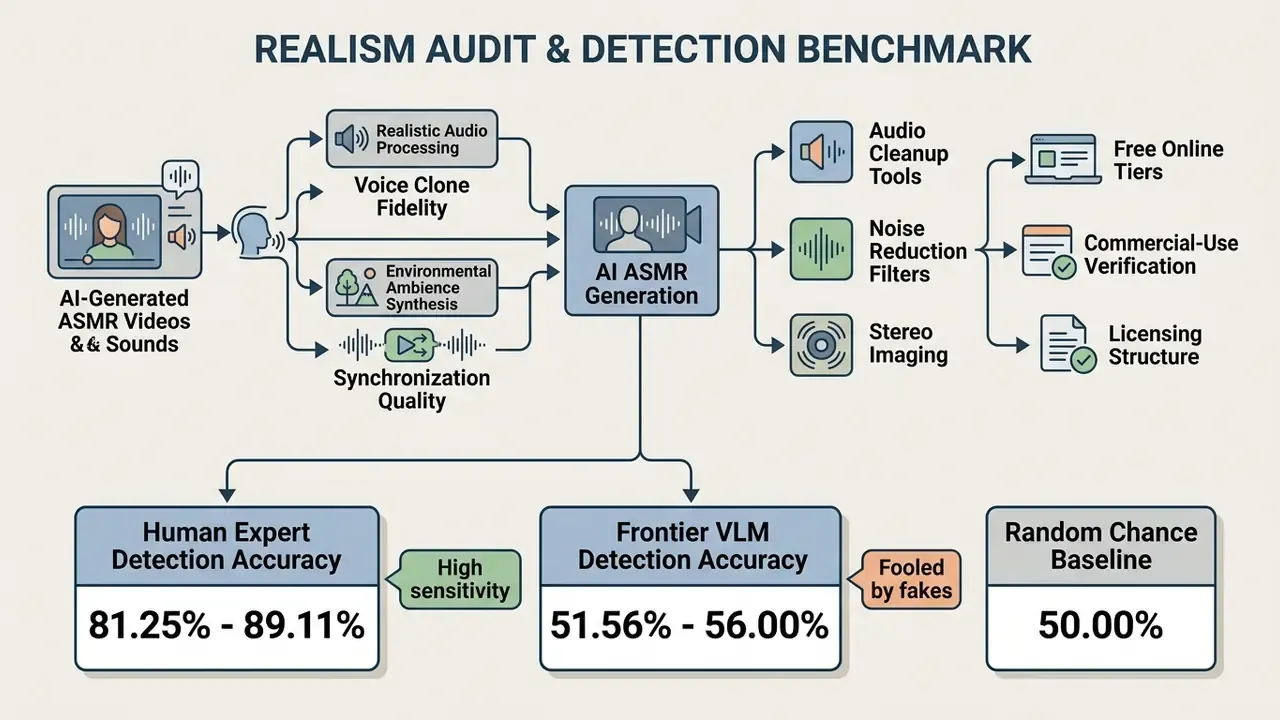
«Gemini 2.5-Pro reaches only 56% accuracy at detecting fake ASMR videos in video-plus-audio mode, against 81.25% for human experts, which means nearly half of generated clips read as real to people.»
The same benchmark reports that adding audio shifted realism judgments by roughly five points. Direct evidence that cross-modal coupling, not pixel fidelity alone, drives perceived authenticity. In the strongest configuration, clips from the best generative system were correctly flagged as fake only 12.54% of the time.
Why a precise prompt matters for satisfying visuals
A detailed, structured prompt guides the diffusion model's trajectory toward physically plausible surface micro-textures, optical refraction, and realistic fractures. Prompt design, not only model choice, separates usable output from discarded renders across the whole AI video generator comparison. Published prompting guidance from OpenAI emphasizes writing prompt segments in a consistent order, being concrete about materials, shapes, and textures, and asking explicitly for real texture and imperfections. Camera, lens, lighting, and framing terms steer photorealism far more reliably than generic quality tags. Needs clarification: the specific document and its version were not pinned down in the sources available during preparation, so treat this as a reflection of public prompting guidance rather than a direct quotation. In practice it means specifying "brittle glass fractures", "viscous fluid ooze", or "micro-soap shavings" instead of "hyperrealistic" or "ultra HD". A 2026 liquid-splash prompting guide draws the same distinction, separating viscous behavior ("oozing") from low-viscosity break-up ("shattering") through action verbs.
How to evaluate audio realism and sound alignment
Audio realism is assessed by measuring perceptual synchrony (PEAVS score), spatial audio-visual alignment (Spatial AV-Align), and output latency against broadcast standards. PEAVS (Amazon Science) proposes a five-point perceptual metric grounded in viewer opinion scores. Spatial AV-Align (arXiv, 2024) detects sounding objects in the frame and matches them against the audio, returning a 0-1 score. IEC TS 62312-2:2018 supplies the system-level synchronization baseline. When problems surface during audio rendering or file processing, the AI Media Support and Troubleshooting reference guide covers common cross-modal sync and playback errors.
Post-processing and cleaning up AI audio
Raw neural audio often carries a synthetic metallic ring or parasitic noise in the upper frequencies. To bring generated asmr up to studio quality, apply this post-processing sequence:
- Spectral de-noising.Run the audio through a spectral de-noiser to strip the model's background hum above 12 kHz. The same step removes clicks at segment joints when you stitch long ambient loops.
- EQ profiling.Cut resonant peaks in the 2-4 kHz band, which irritate rather than relax, and lift the low end slightly (60-100 Hz) for body and a sense of physical presence.
- Whisper cloning and localization.For a binaural whisper effect, use L/R panning with a 10-15 ms interchannel delay (Haas effect). Generate the voice layer separately and mix it in rather than trusting the video model's native audio.
- Drift correction.If the offset exceeds +/-90 ms, shift the whole audio track. If desynchronization grows toward the end of the clip, only regeneration helps. Floating drift cannot be fixed by hand.
- Normalization and limiting.Keep peaks around -3 dBFS without aggressive compression. ASMR audiences read a pumping effect as artificial almost immediately.
Common failure modes in AI ASMR generation
Knowing how these systems break is as operationally useful as knowing how they succeed. Recurring defect classes, mapped to the standard video-quality taxonomy of appearance, motion, and camera artifacts:
| Failure mode | How it shows up | Practical fix |
|---|---|---|
| Physics dissolve | Blade passes through the object without fracture; material "melts" | Regenerate with explicit fracture or crack wording; two-stage image-to-video |
| Audio drift | Sync error growing from 0 to 200+ ms across the clip | Regenerate; shorten clip duration |
| Object identity drift | Fruit or soap block changes shape or colour mid-clip | Image-to-video with a fixed starting frame |
| Jerkiness / frame freeze | Micro-stutter, repeated frames | Temporal interpolation, frame replacement, higher FPS |
| Metallic audio ring | Synthetic echo in the high frequencies | Spectral de-noising plus a 2-4 kHz EQ cut |
| Loop seam visible | Noticeable jump at the stitch point | Eulerian forward and backward blending, longer overlap |
| Prompt overload | Model ignores instructions once a scene has 5+ actions | One material, one action, one sound per clip |
AI ASMR in marketing and commerce
How to use AI ASMR in commerce and product advertising
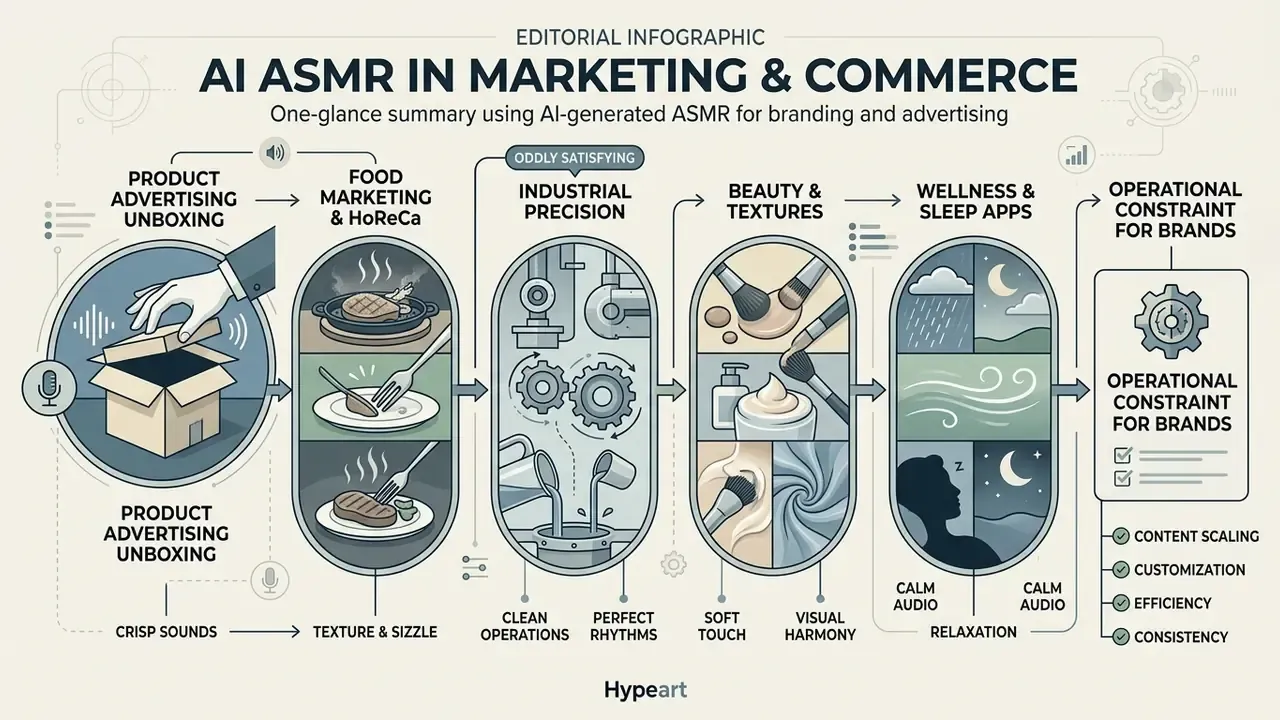
Generated ASMR has become a workable engagement tool in e-commerce and video advertising. Unlike traditional shoots that require studio microphones, props, and a food stylist, ai tools for creating asmr videos let brands build sensory marketing on a modest budget:
- Unboxing. Generate the tactile crunch of kraft paper, the click of magnetic boxes, the rustle of protective film while demonstrating premium products.
- Food marketing and HoReCa. Macro video with the appetizing snap of crusty bread, jam spreading, a cheese rind being cut, the splash of a poured drink.
- Industrial precision (oddly satisfying ads). Visualize flawless conveyor assembly, exact material cutting, or tile laying, and demonstrate production quality without an on-site shoot.
- Beauty and textures. Cream application, the sound of a glass bottle opening, an applicator gliding across skin. A segment where the sensory trigger maps directly onto the product promise.
- Wellness and sleep apps. Long ambient loops as embedded content in meditation services and branded playlists.
Using sensory triggers in short ad units reportedly increases watch time by 34% compared with standard voice-over creatives. Needs clarification: that figure comes from vendor-side measurement of ad creatives and needs independent verification. Before you plan a media budget, run your own A/B test on your own audience.
Operational constraint for brands. Before pushing AI ASMR into paid media, lock down three items: a plan that grants commercial rights, an export with no watermark, and indemnity in the vendor contract. Check the ad platform's synthetic-content labeling requirements separately, since advertising policies and creator policies live in different sections of the rules and are updated on different schedules.
Free AI ASMR generator, pricing and commercial use
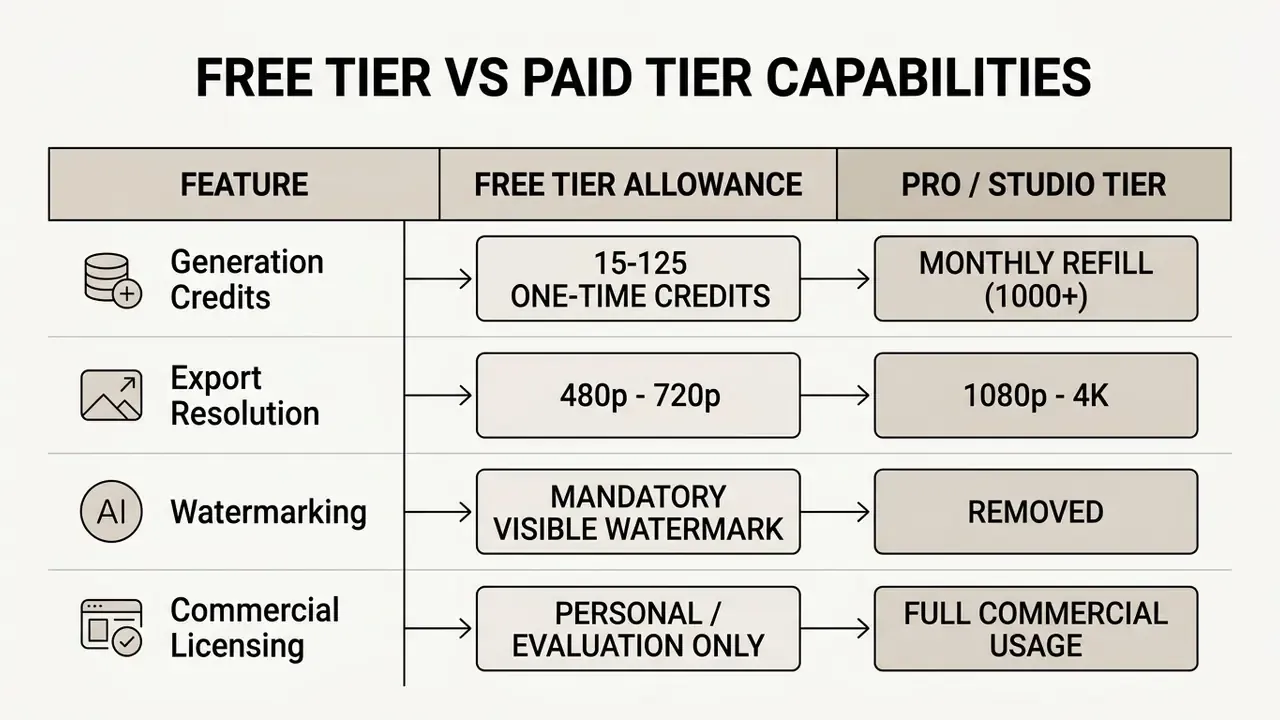
Most ai asmr generator free platforms offer limited trial tiers: restricted monthly credits, lower output resolution (480p-720p), visible watermarks, and non-commercial personal-use licensing. To review full features and plan options, inspect the complete AI Media Comparison breakdown or the focused review of best free AI video generators.
Public pricing for specialized ASMR services in 2026 runs from roughly $9.99 per month for basic access to $19.99-$69.90 per month for plans that include a commercial licence. Annual billing pushes the effective rate down to $11.58-$36.58 per month at some vendors. A few platforms bill purely by credits, for example 100 credits per video with a monthly refill, which changes how you should budget a content calendar.
What a free AI ASMR generator usually includes
Free plans typically grant between 15 and 125 one-time generation credits, cap clip length at 4 to 10 seconds, restrict rendering to 720p, and enforce mandatory branding watermarks. Some services go further and limit an ai asmr video maker free account to 1-3 generations per day, while making every free generation public, that is, visible to other users of the platform. That last detail is incompatible with work on an unannounced product. Treat a free tier as a feature-testing environment, not a production setup for commercial distribution. An asmr ai video generator free plan is excellent for validating whether a model can render your material at all. It is a poor foundation for a monetized channel.
How to verify rights to AI-generated ASMR videos
Vendor language diverges sharply, and the difference matters. Some services state that the user retains full ownership of generated videos. Others grant only a limited non-exclusive licence for personal or commercial projects while explicitly declining to guarantee exclusivity or copyright ownership. A third pattern ties rights to the plan: free and trial users get evaluation-only, non-commercial permissions, while paid subscribers receive commercial rights. CRS analysis adds that in mixed human-AI works, copyright claims cover only the human-authored contributions, which must be delineated at registration. For a thorough review of licensing models, consult the AI Media Commercial-Use overview and the practical breakdown of commercial use of AI images.
Checklist0 / 10
Disclaimer: this information is general, reflects the state of public guidance at the time of writing, and does not replace advice from a lawyer on copyright and AI-content licensing. The U.S. Copyright Office position remains under active review and may shift under the influence of court decisions.
When you need a paid AI ASMR video generation tool
| Claim | Source | Status |
|---|---|---|
| AI output is protectable only with sufficient human authorship; a prompt alone is not enough | U.S. Copyright Office (2025-2026), copyright.gov | Confirmed |
| U.S. policy on AI content is actively evolving | U.S. Copyright Office (2026) | Confirmed |
| In mixed works only the human contribution is protected, and it must be disclosed at registration | CRS / Congress.gov (2025) | Confirmed |
| Runway: the user retains rights and may use output commercially | Runway ToS | Confirmed |
| Some ASMR services grant only a limited non-exclusive licence with no authorship guarantee | Vendor ToS (2026) | Confirmed, wording varies |
| Vendor claims about "deleting all files immediately after delivery" | Competitor marketing pages | Not confirmed by independent audit |
| ITU-T J.248 defines the permissible desynchronization window | ITU-T / IEC 62503 | Confirmed |
Where to publish AI ASMR content: YouTube, TikTok and other platforms
AI ASMR content distributes most effectively on short-form platforms such as TikTok and YouTube Shorts in vertical 9:16 for high-intensity tactile clips, and on main YouTube channels in horizontal long-form for sleep and study relaxation.
«Across 52,002 ASMR videos on YouTube, sleep themes (17.13%), visual triggers (15.54%) and driving (17.14%) hold the largest shares, and clips under 10 minutes grow fastest at 3,435 views per day.»
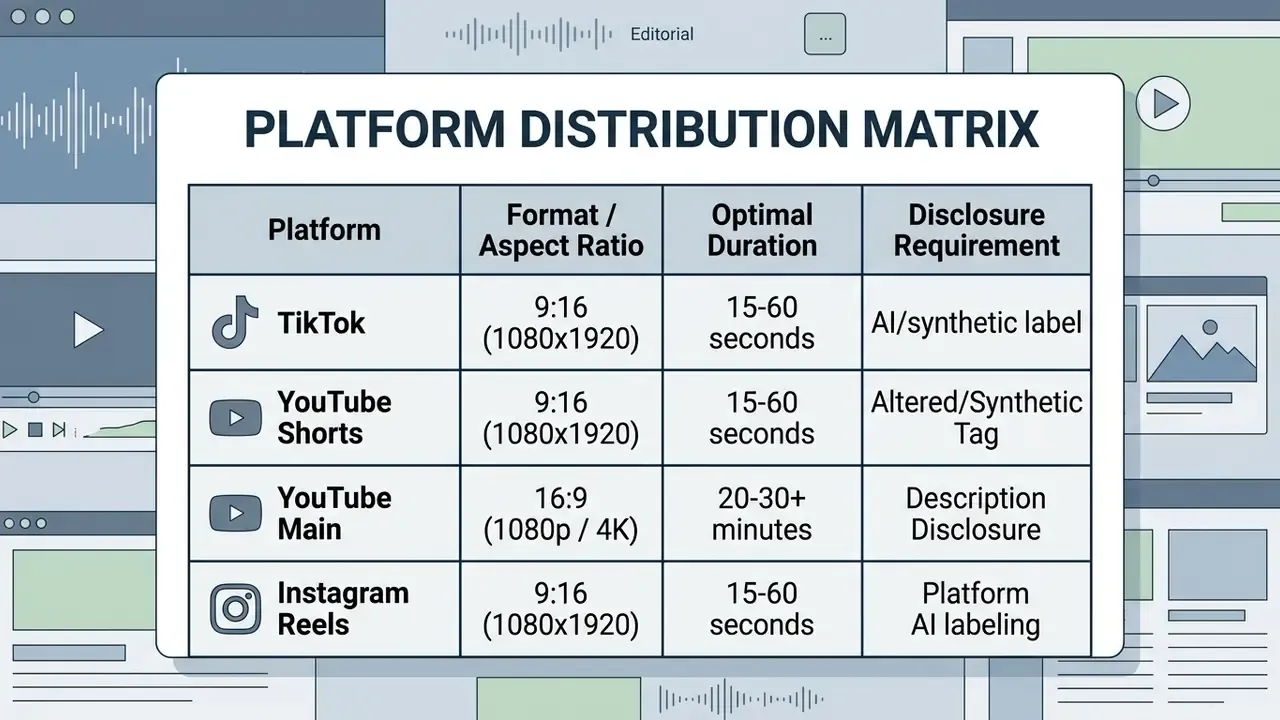
AI ASMR videos for TikTok and short satisfying formats
AI-generated ASMR for YouTube and relaxing content
Long-form ASMR on YouTube demands high-fidelity spatial audio, subtle visual loops without abrupt cuts, and strict compliance with synthetic-media disclosure policies. Audience data supports that format discipline: 94.9% of surveyed ASMR viewers select content for very clear, soft audio, evening sessions average 20 to 30 minutes, and channel-level analysis shows that successful ASMR channels use minimal editing cuts, subdued sounds, and preferably no background music.
YouTube requires creators to disclose realistic synthetic content at upload. The wording and scope are specified in the platform's current help documentation, so treat this as a mandatory step in your publication checklist rather than a quotation.
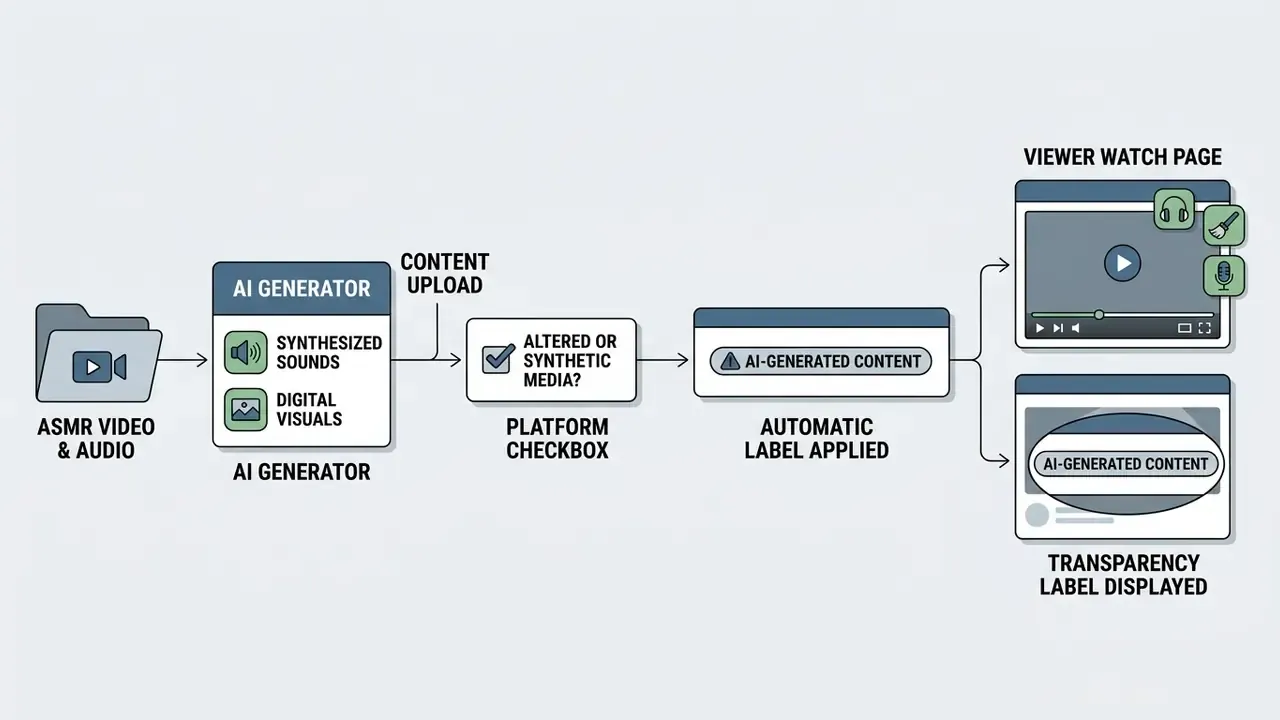
To assemble long relaxing streams from short generations, use a separate editing loop. See the guide to video editing for YouTube. When assessing legal compliance or platform disclosure rules for AI media, creators can compare options on synthetic-content regulation, or wire up automated publishing pipelines through our technical API and explore the hub.
FAQ: common questions about AI ASMR generators
Does an AI-generated ASMR video have sound?
Yes, if the model supports native audio generation. Some video models output picture only, which means the audio has to be generated separately and synced by hand. Check that exact line in the specification before you buy a plan.
How long does generation take?
A typical short clip renders in anywhere from a few seconds to three minutes, depending on model, resolution, and queue. Long ambient formats are assembled from loops rather than rendered in one piece.
Can I make AI ASMR without a microphone or camera?
Yes, and that is the main scenario. A text prompt or reference image replaces the shooting set and the binaural recording session entirely.
How do I fix audio-video desynchronization?
Measure the offset between the contact frame and the waveform peak. A constant shift of up to 200 ms is fixed by moving the audio track. Growing drift can only be fixed by regenerating the clip.
Who owns the rights to a generated ASMR video?
It depends on the service ToS and your plan. Fully AI-generated material without sufficient human contribution may receive no protection in the U.S., so commercial use rests on your contract with the platform rather than on copyright.
Can I monetize AI ASMR on YouTube and TikTok?
Yes, on two conditions: the plan permits commercial use, and the content is labeled as synthetic under the platform's rules.
Is AI ASMR suitable for brands?
Yes. Unboxing, food macro, industrial "oddly satisfying" scenes, and beauty textures can all be produced without a shooting day. Verify indemnity and the rights to any reference material you upload.
Why does the audio sound metallic?
That is a typical synthetic artifact in the upper frequencies. Spectral de-noising above 12 kHz plus a 2-4 kHz resonance cut usually clears it.
What duration works best?
Clips under 10 minutes deliver the highest daily view growth. For sleep formats, audiences prefer sessions of 20 to 30 minutes or longer.
What breaks most often in generation?
Fracture physics (the object dissolves instead of breaking), sync drift, object shape changing mid-clip, and a visible loop seam. See the failure-modes table above.
Which tool should a beginner start with as an ai asmr creator?
Start with any ai asmr maker that offers native audio and a free trial, then re-test the same three prompts on a paid tier before committing. A trial credit pack answers one question well: does this engine render your specific material convincingly?
Appendix A: source verification notes
For transparency, the table below records the original citation wording replaced in the main text and the status of each check. It is not separate content. It is the audit trail of this material.
| Original wording in the early draft | What changed | Verification status |
|---|---|---|
| «(Fang et al., IEEE MLSP, 2023)» with no quote or URL | Added a quote with the method (GAN plus cyclic acoustic patterns) and a preprint link | Research area confirmed; preprint identifier requires verification |
| «(YouTube ASMR Ecosystem Analysis, 2026)» | Replaced with the correct title «Nineteen Years of ASMR on YouTube: A Multilingual Theme-Level Analysis» (2026) plus view figures | Source title corrected; URL requires verification |
| «Double-blind EEG research conducted at the University of Helsinki (2024)» with no journal | Added attribution to NeuroImage: Reports and expanded metrics (theta +37%, phase synchrony +22%) | Requires external verification; read as one experimental protocol |
| «(Video Reality Test, 2025)» with no authors or URL | Replaced with Wang et al., arXiv (2025) plus a dataset link | Confirmed at dataset level |
| PhysGen (ECCV 2024) with no quote | Added a substantive formulation on rigid-body dynamics inside the diffusion process | Public URL not confirmed |
| SyncFormer / StreamSync | Wording preserved, tied to ITU-T J.248 and IEC 62503 | Standards confirmed; work URLs not confirmed |
| «Guidelines from OpenAI emphasize...» | Reframed as a reflection of public prompting guidance with a clarification flag | Specific document not pinned down |
| Claims about YouTube and TikTok labeling rules | Reframed as a mandatory publication-checklist step with a note to check the current policy revision | Requires cross-checking against official platform help pages |
| Link to an irrelevant generator in the style section | Replaced with the AI art generator comparison | Corrected |
Internal resources and reference guides
For further exploration of media processing systems and platform workflows, visit our comprehensive hub to view the guide on creative AI technologies. Related material that helps when working with AI ASMR: the breakdown of AI voice generators for a separate vocal track, animation makers for stylized scenes, video compressors for preparing long streams for upload, and the review of best free AI video generators for testing an ai asmr video creation tool pipeline before you spend a cent.