An AI business name generator is a software tool that uses large language models, natural language processing algorithms or rule-based semantic networks to turn a business description into candidate brand names. Modern platforms combine semantic expansion with instant domain registry lookups and a first pass at visual identity. That combination lets founding teams, risk managers and enterprise innovation groups move from abstract positioning to a structurally evaluated shortlist within minutes. And the discipline is the same whether you are naming a neighbourhood bakery or a regulated fintech product: structured input, empirical validation, and rigorous risk control before anyone commits.
Why should a US financial-services decision-maker care about a naming tool at all? Because a naming brief is unannounced strategy in compressed form, and because "the model produced it" is not a clearance record. Both points come back later in this guide.
Reviewed by the Hypeart editorial research team. Last updated: 2026. Sources for every statistical claim are linked inline.
The Short Version
- What it is a tool that converts a business description into brandable name candidates, then filters them through real-time domain and social checks.
- How to use it write a structured prompt (persona, task, context, format), generate 30-50 candidates, then score the shortlist on clarity, memorability, pronounceability, distinctiveness and legal risk.
- What to check domain availability (RDAP for
.com, port-43 WHOIS for.aiand.io), social handles on five core platforms, and trademark registers (USPTO, WIPO). - What it costs generation is usually free; domains run about $15 to $35 a year, USPTO filing is $350 per class, and vector logo exports normally sit behind paid tiers ($12 to $43 a year on mainstream platforms).
- Legal reality purely AI-generated text and logos receive no copyright protection in the United States, and generation never equals clearance. You still have to search the registers yourself.
- The one rule to remember one to three syllables, easy to spell out loud, short enough to survive in a 90-pixel-wide logo.
What Is an AI Business Name Generator?
An AI business name generator is an automated system that analyses text descriptions, core keywords and industry parameters to produce candidate brand names. Classical combinatorial generators simply stitched predefined prefixes and suffixes together. Modern systems process semantic relationships, brand tone and industry context before a single name reaches your screen.
«AI name generation is a multi-stage pipeline: semantic feature extraction, ontology-based expansion, word blending, and ranking by readability, pronounceability and uniqueness.»
In practice the tool does four things in sequence. It reads your description, expands it with synonyms and metaphors, blends syllables and word roots into new candidates, then scores each candidate against appeal criteria before showing you the survivors. Rule-based generators from the pre-transformer era skipped the scoring stage entirely, which is exactly why their output felt like a slot machine.
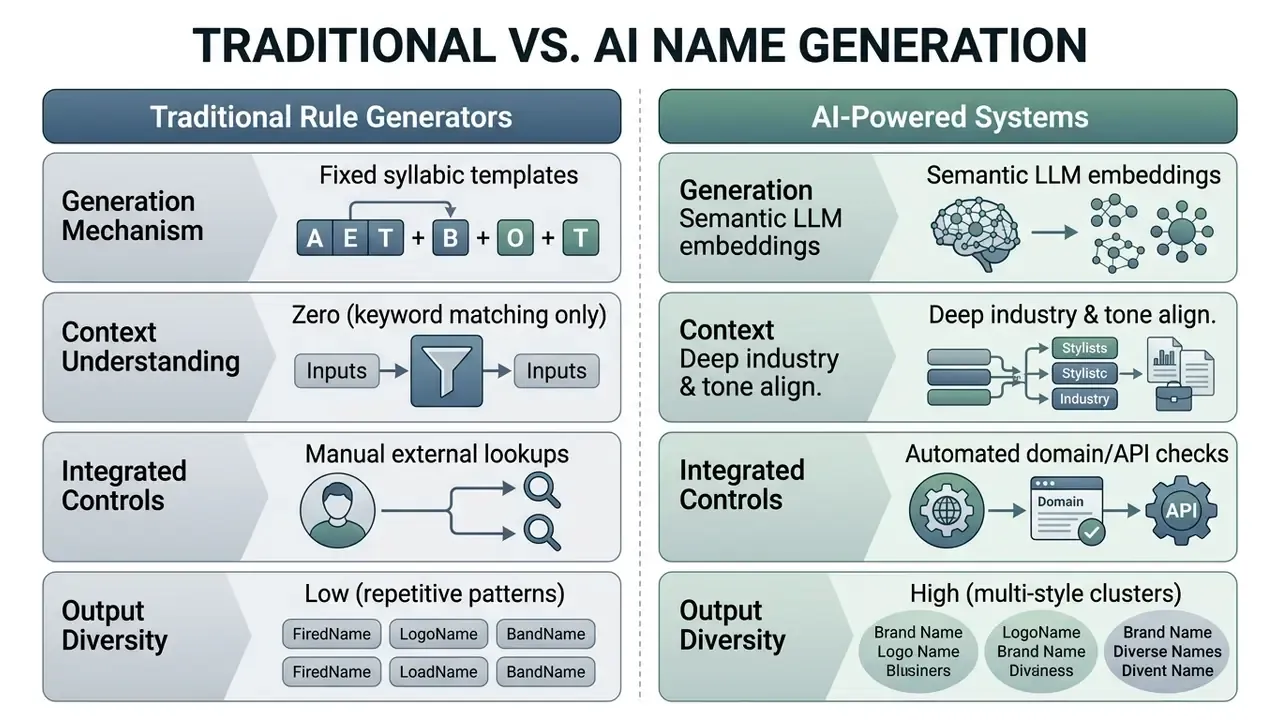
Manual brainstorming leans on internal team intuition. That intuition carries cognitive bias, and it narrows the candidate set faster than most teams notice.
«Marketers systematically overestimate the fame of their own brand elements and underestimate how uniquely consumers associate them with the brand.»
An AI brand name generator loosens that bottleneck by evaluating thousands of word combinations across several naming styles: descriptive, abstract, compound and invented. The same logic drives adjacent tooling. AI logo generators apply learned visual patterns much as naming models apply learned linguistic patterns, which is why the two are increasingly bundled into one workflow. Risk leaders assessing these digital workflows can review tool capabilities in the AI Media Support and Troubleshooting reference section.
Worth noting: search demand for this category is multilingual and multi-market. Queries range from "ai business name generator australia" to the Dutch "ai bedrijfsnaam generator", and the underlying tools are largely the same. What changes is the register you must clear and the country-code domain you need.
Enterprise Prompt Safety and Shadow AI Risks
Before any regulated team types a product description into a public naming tool, one question has to be answered: where does that prompt go? A naming brief is rarely harmless text. It usually contains the launch category, the target segment, the differentiator, and sometimes the launch window. That is unannounced strategy, written down and pasted into a consumer chat window.
Three controls keep naming work inside the corporate perimeter.
- Choose the right interface.Public web chat tiers often retain conversations for model improvement by default. Enterprise API tiers and business plans commonly offer zero-data-retention or no-training commitments. For pre-announcement branding work, use the contracted enterprise path, not the consumer login.
- Sanitise the brief.Replace confidential identifiers with generic placeholders. "Mid-market reconciliation platform for commercial banks" carries enough semantic signal to generate good names, without disclosing the internal project code, the launch date or the client list.
- Log and review outputs.Generation does not confer rights. So every shortlisted candidate should enter a documented clearance queue with legal, exactly as any other externally sourced asset would.
«Users should check the provider's terms to determine who owns intellectual property rights, if any, in the output.»
Shadow AI, meaning employees using unapproved tools on corporate data, is the practical exposure here. Not the naming model itself. A one-page naming policy that states the approved tool, the sanitisation rule, the named owner of the decision and the clearance workflow removes most of that exposure at almost no cost. One page. Reviewed quarterly.
How to Use the AI Business Name Generator
Using an AI business name generator well requires a staged workflow: define the business description, select keywords, set tone constraints, run generation, then screen the output against operational criteria. Structured prompts produce noticeably higher distinctiveness and semantic relevance than open-ended queries. Google's Prompting Guide 101 (2024) frames this as four prompt areas: persona, task, context and format.
«Tighter, more constrained prompts yield more distinctive results; the novelty of AI output is highly sensitive to how the task is framed.»
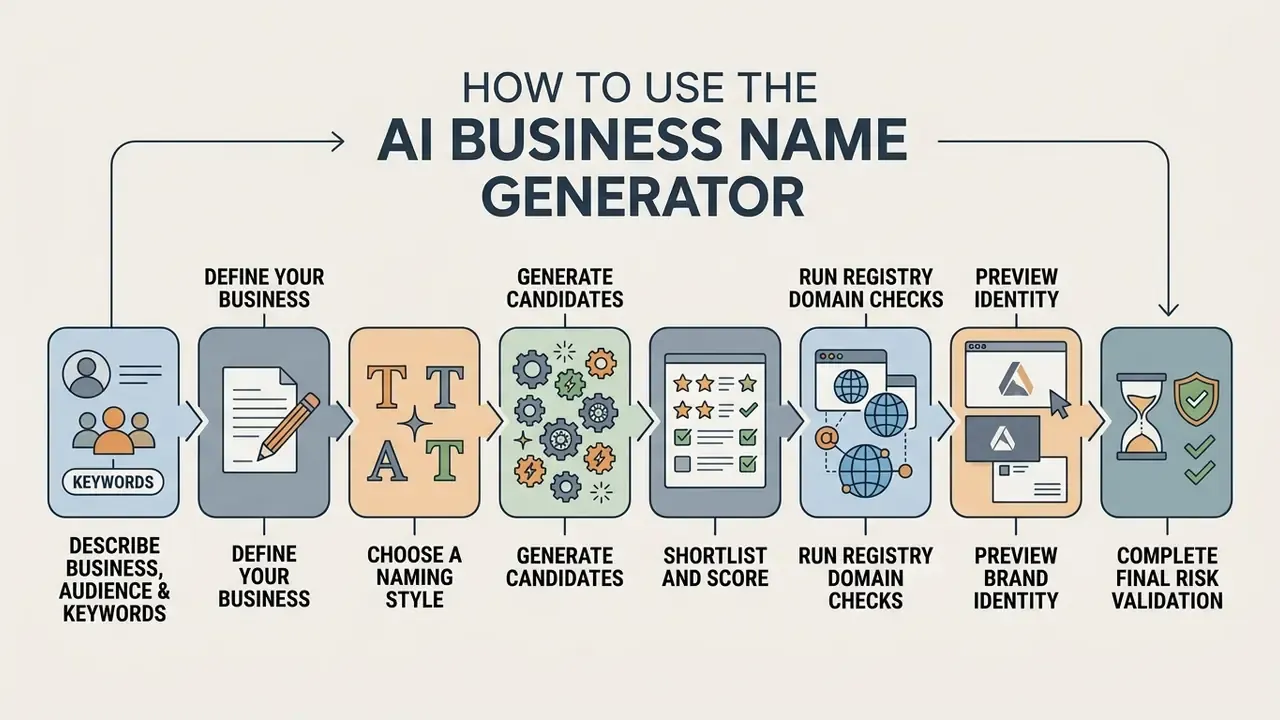
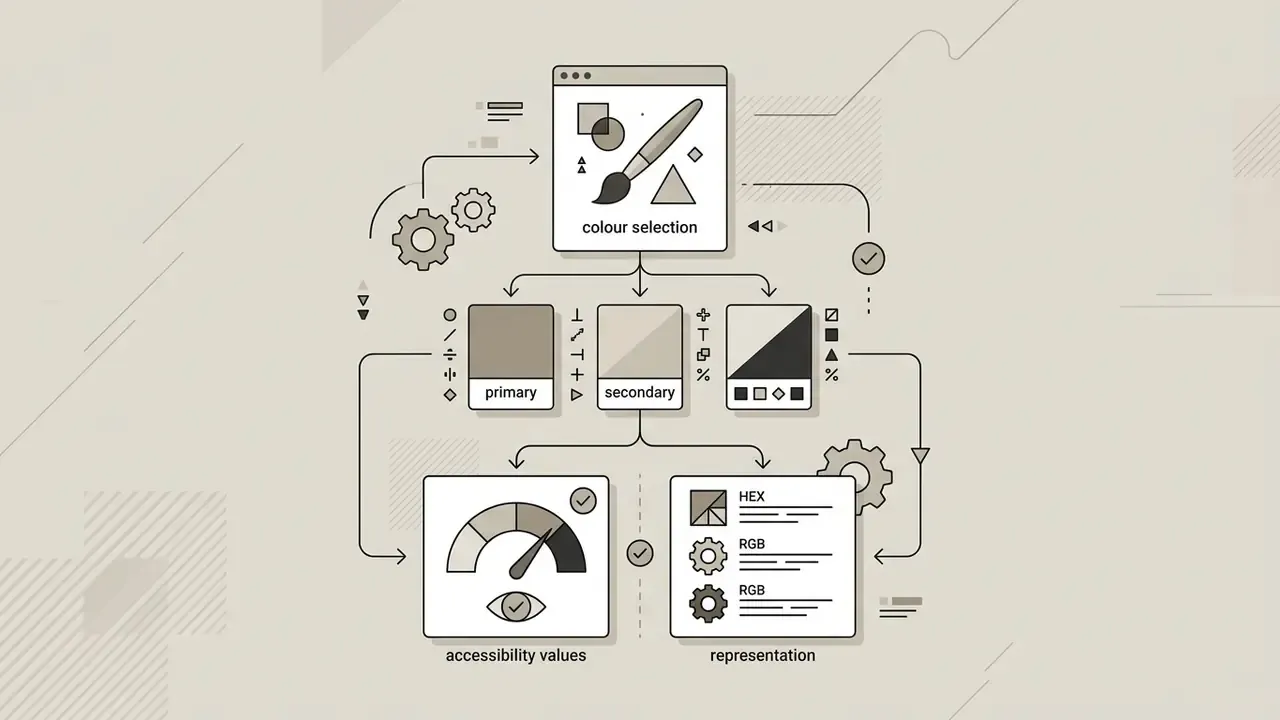
Text decoding of the flowchart:
Stages one to four are creative. Stages five to seven are control functions, and skipping them is where naming projects quietly turn into rebranding projects.

Describe Your Business, Audience and Keywords
A precise business description is the semantic foundation for the model. The prompt should spell out four dimensions: core mission, target demographic, primary operational domain, and distinct value proposition.
«ChatGPT- and Gemini-based platforms are used to generate names and taglines inside a single pipeline linked to logos and colour palettes.»
For niche automation platforms, combine high-level category markers with functional attributes. Entering "reconciliations, ledger audit, commercial bank" produces candidates with far higher category relevance than a vague "finance software."
Weak prompt, weak output:
Structured prompt, usable output:
The difference is not the model. It is the four blocks of context. Teams comparing prompt structures for other automated creative tools can review the script generator ai guide, and many pair naming prompts with an AI voice generator workflow to hear how a candidate sounds read aloud. That last test catches more problems than you would expect.
Choose a Naming Style and Refine the Results
Choosing an explicit naming taxonomy controls how the underlying artificial intelligence blends linguistic components. The standard categories supported by most AI business name generator tools:
- Descriptive states the function or domain outright (Ledger Audit Systems, Heirloom Property Advisors).
- Abstract or evocative metaphorical roots that project energy without functional lock-in (Aegis, Vantage).
- Compound or mashup two functional terms fused into one mark, usually with the second word capitalised (ScaleSync, CreditFlux, LinkedIn, ZipSchool).
- Multiword two descriptive words split by a space or an ampersand; longer, but reads as considered (Velvet & Vine, Crumb & Ember).
- Invented or coined new, phonotactically stable terms that maximise trademark protection (Zentricks, Novarent).
- Founder or possessive anchors the brand to a person (Marlow's Ledger, Nadia's Table).
Naming style versus trademark difficulty is the distinction most generators quietly skip:
| Naming style | Example | Distinctiveness | Trademark difficulty | Domain difficulty |
|---|---|---|---|---|
| Invented / Coined | Zentricks, Novarent | Highest | Low, easiest to register | Low |
| Abstract / Evocative (word unrelated to the product) | Aegis, Vantage | High | Low to Medium | High (short real words are gone) |
| Compound / Mashup | ScaleSync, CloudPulse | Medium to High | Medium | Medium |
| Multiword | Velvet & Vine | Medium | Medium | Medium |
| Founder / Possessive | Nadia's Table | Medium | Medium | Medium |
| Descriptive | Ledger Audit Systems | Low | High, hardest to trademark | Low |
Generate Business Name Ideas by Industry and Use Case
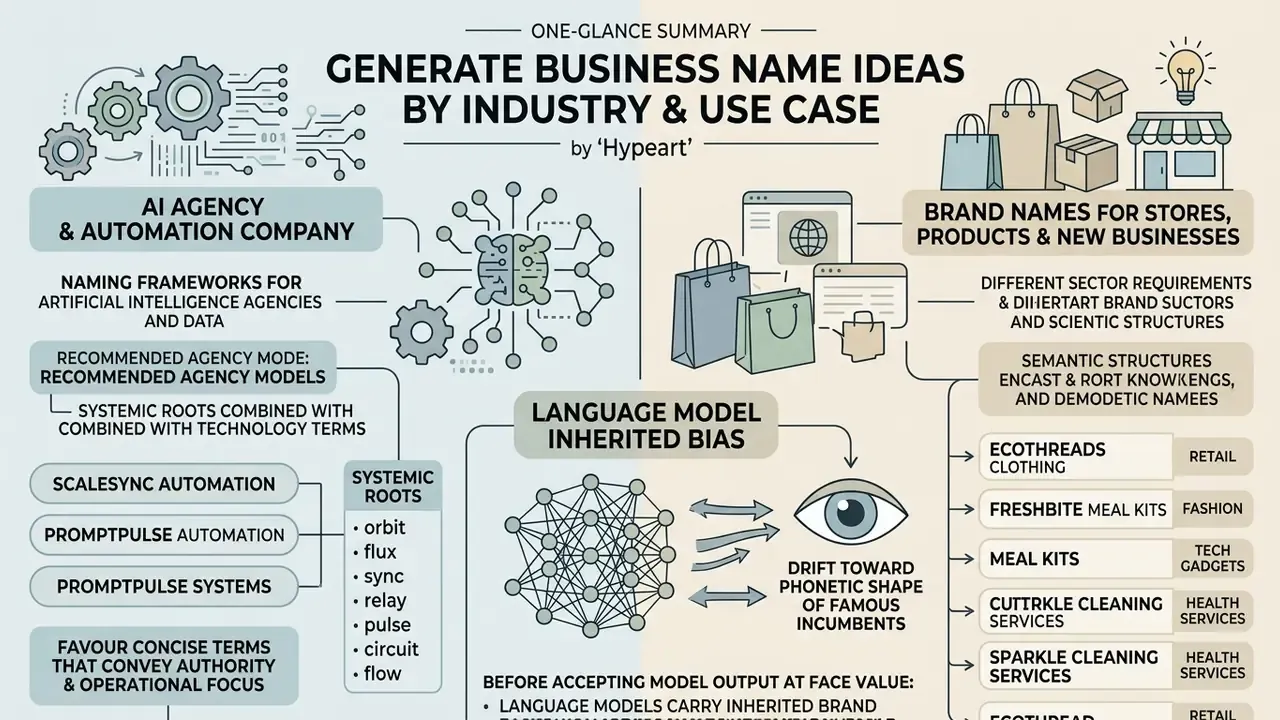
Different sectors need different semantic structures to convey authority, trust and operational focus. An AI automation agency wants short, outcome-oriented patterns. Consumer retail leans on emotional resonance and sheer brandability.
One systemic caveat before you accept model output at face value: language models carry inherited brand preferences.
«With product attributes held equal, well-known brands were recommended in 100% of trials (IAI = 10.0); a competitor advantage of just +0.1 stars eliminated the effect.»
In naming terms, that bias shows up as output drifting toward the phonetic shape of famous incumbents. The countermeasures are unglamorous: an explicit constraint ("do not resemble existing major brands in the sector") plus a manual similarity review by a human who knows the category.
AI Agency and AI Automation Company Name Ideas
Brand Names for Stores, Products and New Businesses
Consumer products and retail ventures usually need short, memorable business names of four to twelve characters. United States Patent and Trademark Office guidance stresses that distinctiveness prevents consumer confusion and simplifies registration (USPTO Trademark Basics, 2025, https://www.uspto.gov/trademarks/basics). World Intellectual Property Organization Madrid System materials add a second constraint: a name has to survive cross-market filing, and short, pronounceable forms adapt far better across languages (https://www.wipo.int/madrid/en/).
For physical and e-commerce lines, effective prompts combine one emotional cue with one category signal. Three reusable formulas:
[category cue] + [emotion]gives Hearth & Halo, Bright Basket[invented root] + [short suffix]gives Lumira, Verently[metaphor] + [product signal]gives Copper Kettle Coffee, Northwind Cycles
Worked examples by consumer sector:
| Industry | Example names | Why they work |
|---|---|---|
| E-commerce & retail | Velvet & Vine, Bright Basket, Nine Oaks Supply, Loomfolk | Multiword and compound forms read as curated; two-word structures leave room for category expansion. |
| Beauty & wellness | GlowBotanica, Sable Skin Studio, Lumira Care, Quiet Bloom | Soft consonants and light vowels signal care; invented roots such as Lumira are the easiest to trademark. |
| Food & beverage | ArtisanCrust, Once Upon a Thyme, Copper Kettle Coffee, Crumb & Ember | Sensory and nostalgic cues; wordplay is memorable but still has to pass the spell-it-aloud test. |
| Tech & SaaS | CloudPulse, Ledgerly, Vantage Grid, StackHarbor | Compound structures communicate function plus scale without describing one feature. |
| Home & trades | Meat and Potatoes Hardware, Northwind Roofing, Steadyhand Works | Plainspoken names build trust in local search; add a location only if you never plan to expand. |
| Fitness & sport | Jump Around Gym, Ashtanga Yoga House, Ironpath Athletics | Verb-led energy; short first words survive on apparel and signage. |
| Pets & family | Fido Food Place, Paws & Porch, Little Lantern Toys | Warm, concrete imagery, and easy to illustrate in a logo mark. |
| Creative services | Old School Film, Snapshot Moments, Page-turner Printing | Craft references position the studio; keep to two words for portfolio headers. |
Teams building storefront visuals once the name is fixed can compare tooling in the best AI art generator comparison, study stylised model behaviour in the sea art ai overview, or browse the hub for functional tools.
What Makes a Good, Unique and Memorable Business Name?
Evaluating candidates calls for objective psycholinguistic and strategic metrics, not personal taste. Academic frameworks assess appeal across five dimensions: readability, pronounceability, memorability, uniqueness and brand alignment. WIPO's brand-element guidance runs a parallel six-part test (memorable, meaningful, likable, transferable, adaptable, protectable) that maps cleanly onto the matrix below.
| Candidate Name | Clarity (1-5) | Uniqueness (1-5) | Industry Fit (1-5) | Memorability (1-5) | Logo Suitability (1-5) | Domain Availability Status |
|---|---|---|---|---|---|---|
| VantageSync | 4 | 3 | 5 | 4 | 5 | .com available |
| AegisFlow | 3 | 5 | 4 | 4 | 4 | .io available |
| LedgerPulse | 5 | 2 | 5 | 5 | 3 | Taken on .com |
| Novarent | 3 | 4 | 3 | 3 | 4 | .ai available |
| Velvet & Vine | 4 | 4 | 4 | 5 | 3 | .com taken, .co available |
| GlowBotanica | 3 | 5 | 4 | 3 | 3 | .com available |
Score every finalist on all six columns, total the result, and only then look at which name you personally like. The matrix exists precisely to slow down the moment of falling in love with a word.
Keep the Name Simple, Clear and Brandable
The practical rule: one to three syllables gives you maximum recall. Every extra syllable costs memorability.
That rule sits on a measurable relationship. Computational naming research models readability as a linear penalty on syllable count:
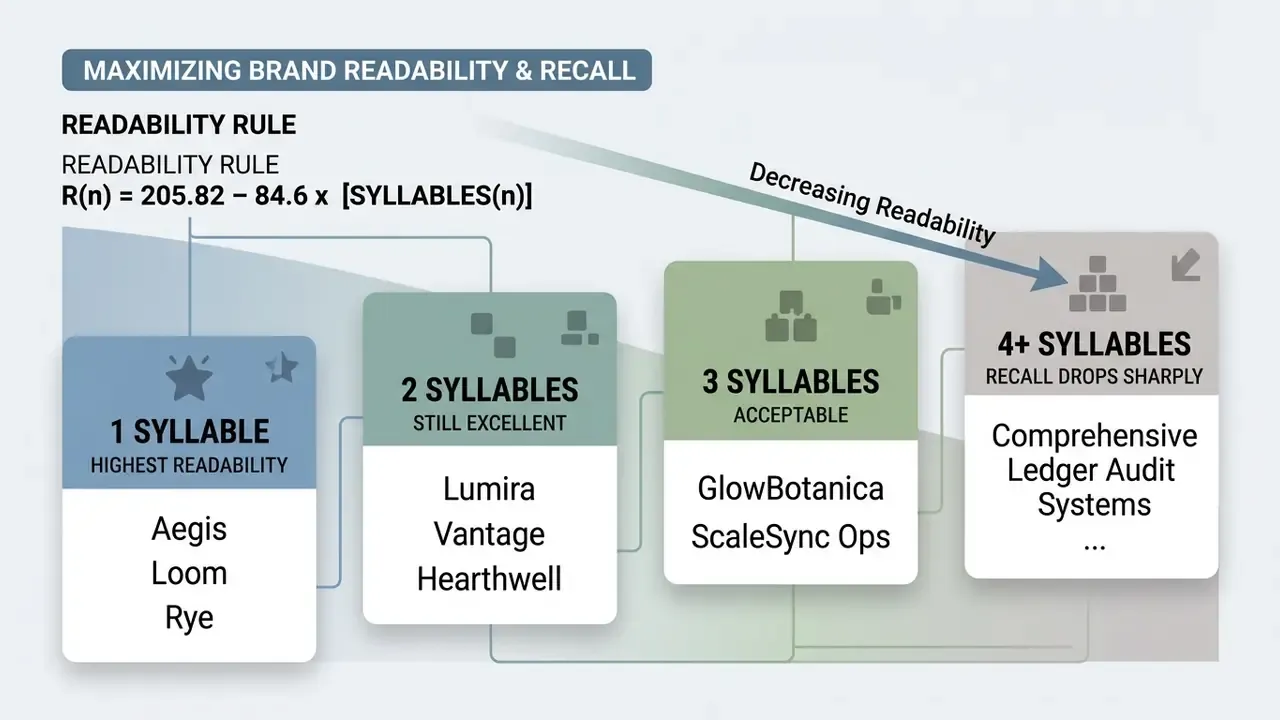
«The readability formula R(n) = 205.82 − 84.6 × |syllables(n)| shows that each additional syllable linearly reduces the perceived readability of a name.»
You do not need to run the arithmetic. Read the candidate aloud, count the beats, prefer fewer. Names should also avoid complex consonant clusters that create phonetic ambiguity across jurisdictions. Cross-country survey evidence favours brand names with five or fewer consonants and familiar real-word English components, while phonological studies show a consistent preference for forms that respect ordinary phonotactic constraints.
Match the Name to Your Audience and Brand Personality
A name has to reflect the institution's positioning and what the audience already expects.
«Across eight studies, possessive brand names increased purchase intention and spending, most strongly among consumers unfamiliar with the brand.»
That explains why Nadia's Table outperforms Table Co. for a new local restaurant, and why founder-centric names still dominate trades, law and advisory work. Technology firms and modern fintech platforms usually go the other way, toward coined or abstract names that signal agility and scalable architecture, because a founder surname constrains the ownership narrative later.
Testing method matters as much as the choice. Established approaches include association tests (does the name evoke the intended category?), reaction-time measures (how quickly do people connect name to positioning?), and short surveys scoring interest, motivation, memorability and perceived fit. Run the shortlist past twenty people who resemble your buyers before you run it past your board. It is cheaper in every sense.
Teams reviewing rights and usage terms for brand visuals can consult the guide to AI image generators for commercial use, and comparative benchmarks for specialised visual branding models are available if you browse the hub.
Check Domain and Social Availability Before You Commit
A name cannot reach production without a verified domain and clear social handles. Domain availability checks belong inside the generation loop, not at the end as an administrative formality. This is why buyers search for an ai business name generator with domain check rather than a pure ideation toy.
«Teams that fall in love with a name whose domain is taken end up making expensive compromises; a domain can be unregistered yet still unavailable because of premium pricing or a redemption period.»
How to Check Domain Availability for a Business Name
Modern generators query registry databases in real time using standardised protocols. Generic top-level domains such as .com use the Registration Data Access Protocol (RDAP) under IETF standards (draft-newton-regext-rdap-domain-availability defines a minimal availability profile via availabilityCheck=1). Specialised extensions like .ai and .io often still require port 43 WHOIS lookups, with the older IRIS-based Domain Availability Check in RFC 5144 as the historical baseline.
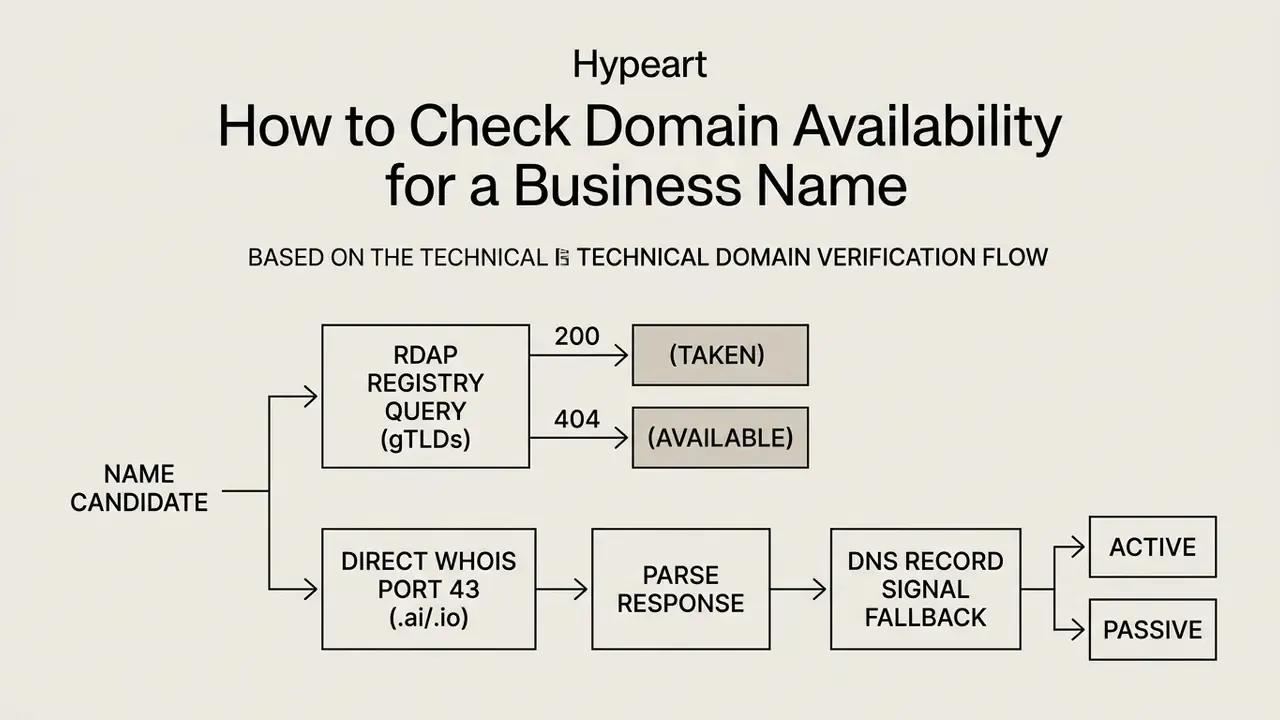
Two operational cautions. DNS records are a supporting signal only, never proof: a registered domain may carry no DNS records at all. And ambiguous registry responses should be flagged for manual review rather than guessed at.
An illustrative engagement figure, again internal rather than published: during a domain clearance assessment for a fintech advisory client, a project team ran 40 generated names through direct RDAP lookups. A clear majority of exact-match .com names were already registered. A meaningful minority resolved to inactive parked sites obtainable through standard acquisition, which saved several weeks of unnecessary re-branding. The reusable lesson is simple: "registered" and "unobtainable" are not the same status.
What to Do If Your Preferred Domain Is Taken
When the exact-match .com is unavailable, three structured fallbacks preserve brand equity.
- Approved modifiersappend high-clarity functional prefixes or suffixes (GetVantageSync.com, VantageSyncApp.com). Note that ICANN label rules cap a domain label at 63 characters before the TLD, which limits how far this stretches.
- Alternative standard TLDsmove to recognised extensions such as
.ai,.io,.co,.netor.storewhere sector-appropriate, or to a relevant country-code TLD. - Domain acquisitionevaluate secondary-market pricing when the exact domain is genuinely critical to enterprise brand strategy.
What you should not do is distort the spelling or drop essential vowels just to secure a URL.
«Excessively unusual word forms reduce familiarity and, according to BRAND norms, are recalled less reliably from memory.»
Obscure or awkward extensions carry a similar penalty. Clear, memorable and trustworthy beats clever every time.
Preview Your Business Name With a Logo and Brand Identity
Visual rendering is how you find out whether a candidate scales across digital touchpoints, product interfaces and corporate media. Integrated branding platforms pair generated text with typography, colour palettes and responsive logo layouts automatically (Huang & Lee, Development of an Integrated Branding Platform Based on Generative AI, 2026, https://doi.org/10.1016/j.destud.2026.101234).
«A global beverage brand that integrated AI-generated illustration into its brand book recorded nearly 40% higher engagement and a substantial reduction in iteration time.»
Test Whether the Name Works on a Logo
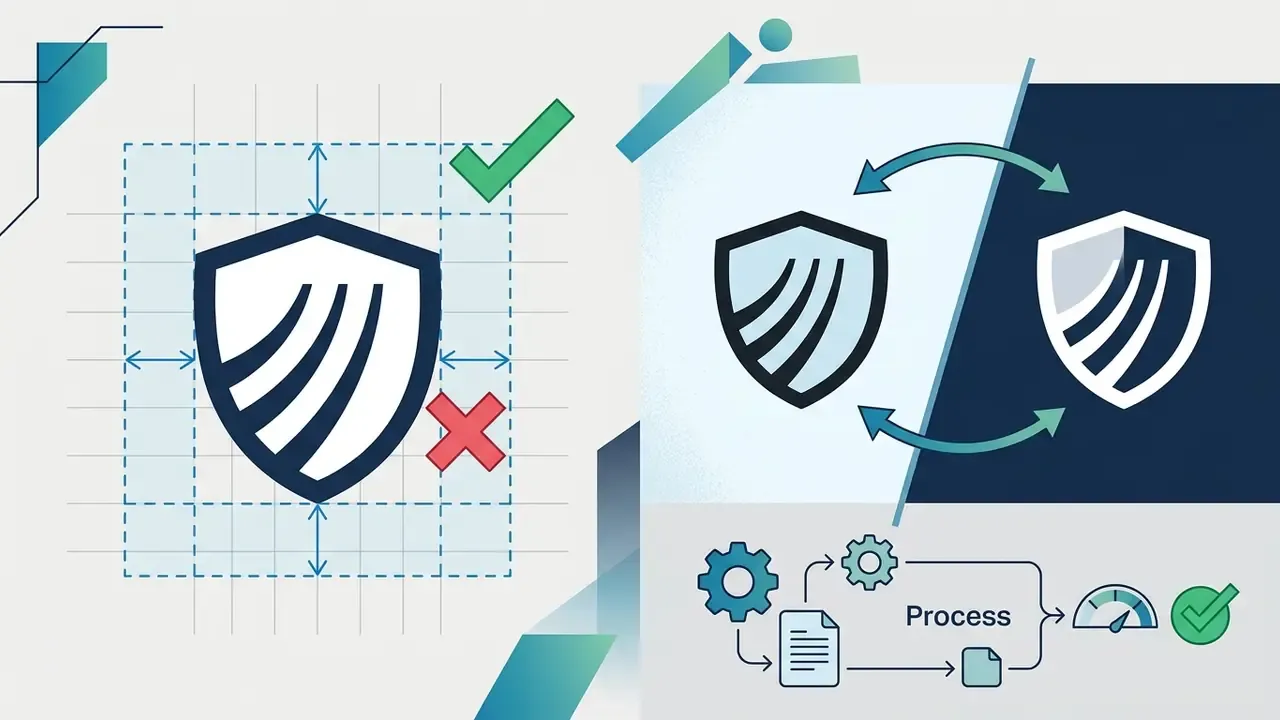
Wordmarks have to satisfy legibility thresholds across light, dark and scaled contexts. Public brand guidelines converge on a practical floor of roughly 90 pixels of digital width, or about 1.25 inches in print, below which a wordmark stops being readable. Accessibility-focused university guidance adds two requirements: document the smallest size at which the mark stays legible, and confirm grayscale recognition. Note: exact minimums are set per brand system, not by a universal standard. Adopt a number and write it into your own guidelines.
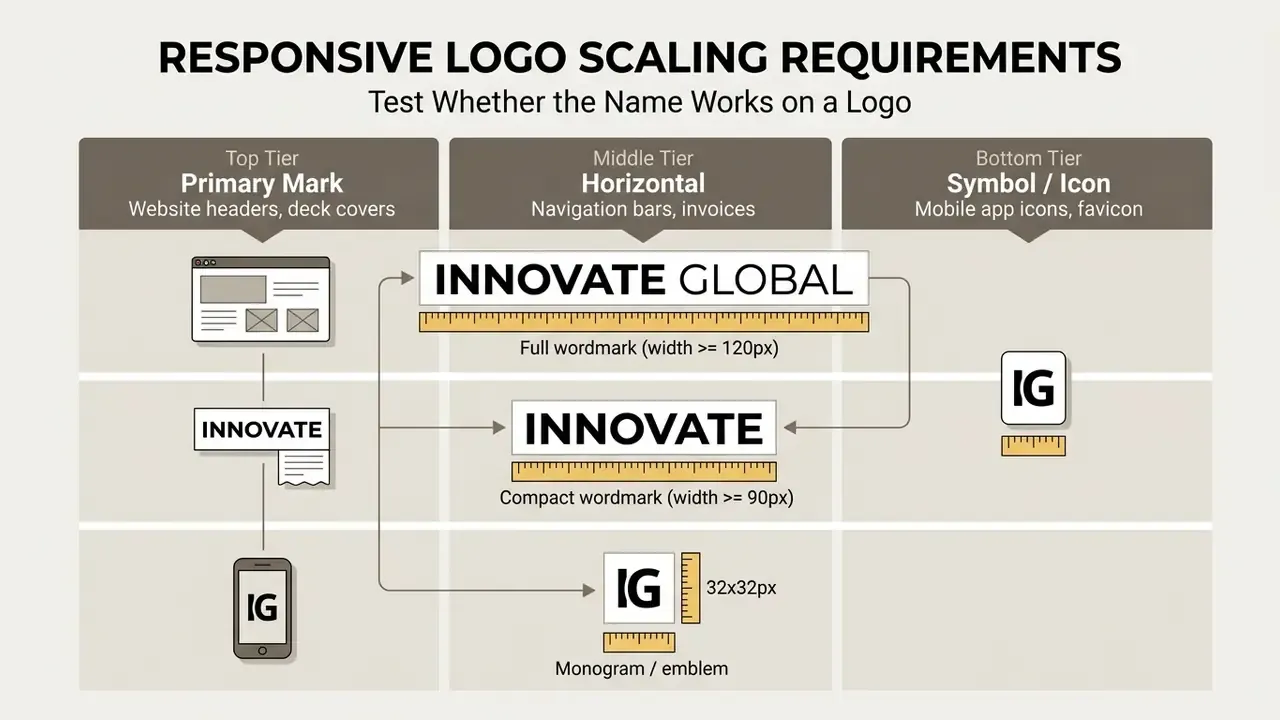
Long candidate names create layout imbalance, which forces smaller type and damages the mobile experience. A four-word name will always need a simplified variant and a monogram, so plan the tiered set (full wordmark, simplified wordmark, monogram, icon) before you commit. You can test a shortlisted name inside real layouts with an AI logo generator, and if you are refining brand photography alongside the mark, the guide to online photo editors covers the practical options.
Build a Consistent Brand Across Website and Social Media
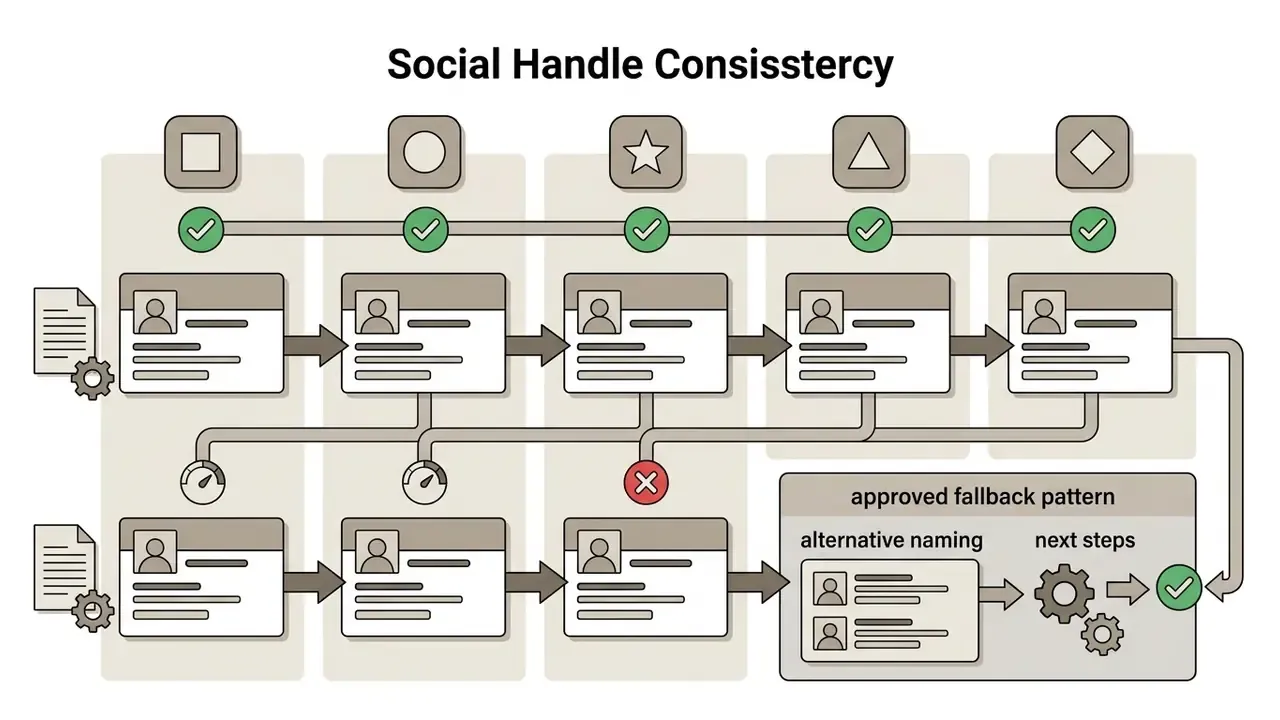
Uniform identity rules across channels build market trust and improve cross-platform searchability. Public style-guide practice is explicit about it: profile name, logo, biography, voice and tone should stay consistent across every social account and the website, because consistency is what makes a brand recognisable, searchable and credible.
«AI tools can generate a large volume of platform-adapted visuals, but the underlying name and logo must stay stable to preserve recognition.»
The brand identity system should document explicit rules for:
Developers integrating custom media generation through REST endpoints can browse the hub for technical integration guidelines.

Is a Free AI Business Name Generator Really Free?
Core generation is frequently free. Downstream commercial deployment is not, and the costs are predictable enough to budget precisely. Understanding vendor monetisation helps enterprise teams plan a realistic branding line item.
| Feature / Infrastructure Layer | Free Tool Tier | Paid Branding Ecosystem | Estimated External Market Cost |
|---|---|---|---|
| Name generation and ideation | Unlimited or capped candidate runs | Unlimited candidate runs | $0 (included) |
| Domain availability check | Basic single-TLD query | Real-time multi-TLD RDAP | $0 (included) |
| Vector logo export (SVG/EPS/PDF) | Low-resolution PNG only | Full high-resolution vector package | $12/month, or about $43/year on mainstream platforms |
| Brand identity guidelines | Excluded | Generated PDF style guide | Included in Pro tiers |
| Domain name registration | Excluded | Registrar checkout integration | $15 to $35/year (standard .com) |
| USPTO trademark search and filing | Excluded | Automated clearance screening | $350 per class (USPTO filing fee) |
| Business cards and email signatures | Preview only | Branded templates, print-ready | Included in Pro tiers |
Free Name Generation vs Paid Branding Tools
Free tiers focus on ideation and basic text generation. Commercial branding suites monetise the rest: high-resolution vector downloads, brand guideline PDFs, social media kits, website hosting integration.
«Looka bundles name generation with logo design in a single subscription, while Squadhelp monetises access to human-created names and full brand packages.»
The pattern repeats across the category. Free tiers expose one task, which is generating names. Paid tiers expose the pipeline: names, domain, logo, assets, guidelines, exports. Documented tier structures run from $7/month entry plans to $49/month studio plans on multi-component platforms, with several ai brand name maker tools starting paid access around $20/month for higher usage limits and watermark removal.
Comparing Real AI Business Name Generators
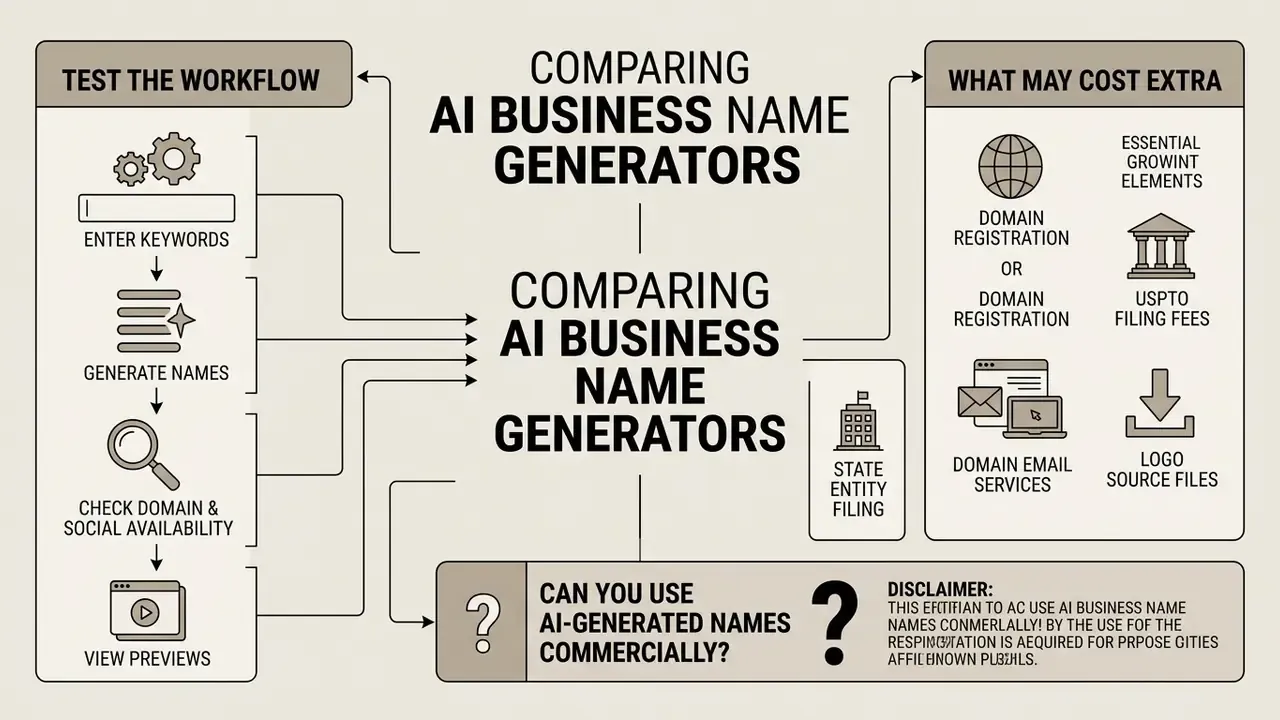
Want to test the workflow described above right now? These are the mainstream options and what each actually does. Verify current pricing and data-retention terms on the vendor's own page before enterprise use, because plans change often.
| Tool | Free tier | Domain check | Logo preview | Notable strengths | Watch out for |
|---|---|---|---|---|---|
| Namelix | Yes, no account required | Indicative | Yes | Short, genuinely brandable invented names; fastest route to a usable idea | Sparse filtering; no trademark screening |
| Looka | Yes, generation free | Yes, plus social handle checks and alternatives | Yes, one click into the logo maker | Sorts output into invented, compound, multiword and traditional; links to the U.S. Trademark Office for a manual search | Logo downloads are paid |
| Wix | Yes, free account required | Yes, real-time, with a free domain for a year on eligible plans | Yes, via Logo Maker | Full path from name to site, email and store in one dashboard | Requires sign-up before you see results |
| Squarespace | Yes, no account required | Yes, via domain search | Yes, via Logo Maker | Cleanest no-friction entry point; free without an account | Fewer style controls |
| Design.com | Yes, unlimited prompts and previews | Via domain generator | Yes, instant on most names | Style and length controls; 750+ fonts and 62,000+ vector shapes; digital business cards and email signatures | Downloads and brand kit are paid |
| GoDaddy | Yes, 50 AI credits a month for logos | Yes, matching domains surfaced alongside names | Yes, via Airo | Fastest handoff to domain purchase and a "coming soon" page | Final logo download needs a paid plan |
| NameMagic | Yes | 10+ TLDs checked in real time | Yes, plus palette, typography, mockups, brand PDF | Most complete single-pass brand identity output | Full package sits behind paid tiers |
| Squadhelp / marketplaces | Browse free | Domains bundled with names | Varies | Human-created, pre-vetted names with domains attached | Highest cost per name |
Data-handling note for regulated teams: the consumer web tiers of these tools are not the right place for pre-announcement product briefs. Apply the sanitised-prompt approach described earlier in the prompt safety section, and get the vendor's retention and training terms in writing before any strategy detail leaves your perimeter.
What May Cost Extra After You Choose a Name
Once the candidate is selected, budget for the technical and legal infrastructure that follows.
- Domain registrationannual registrar fees, $15 to $35 a year for standard gTLDs. Premium names cost multiples of that.
- USPTO filing feesfederal trademark registration is $350 per class for Section 1 or Section 44 applications, plus $25 if you order an electronic registration certificate for applications filed on or after 24 May 2022 (USPTO Fee Schedule, 2025, https://www.uspto.gov/learning-and-resources/fees-and-payment).
- Domain email servicescorporate email configured with SPF, DKIM and DMARC authentication (NIST SP 800-177 Rev. 1, Trustworthy Email, https://csrc.nist.gov/publications/detail/sp/800-177/rev-1/final).
- Logo source filesvector originals in SVG, EPS and PDF for print and signage, vendor-priced and usually bundled into annual brand plans.
- State entity filingincorporation or trade-name registration fees, which vary by jurisdiction.
Simple launch-budget formula: Total = domain(s) + (USPTO $350 × classes) + entity filing + logo/brand plan + email seats + contingency. Set the contingency at roughly 20 to 30 percent. It covers the very real possibility that clearance pushes you back to your second-choice name after you already bought the first domain.
Can You Use AI-Generated Business Names Commercially?
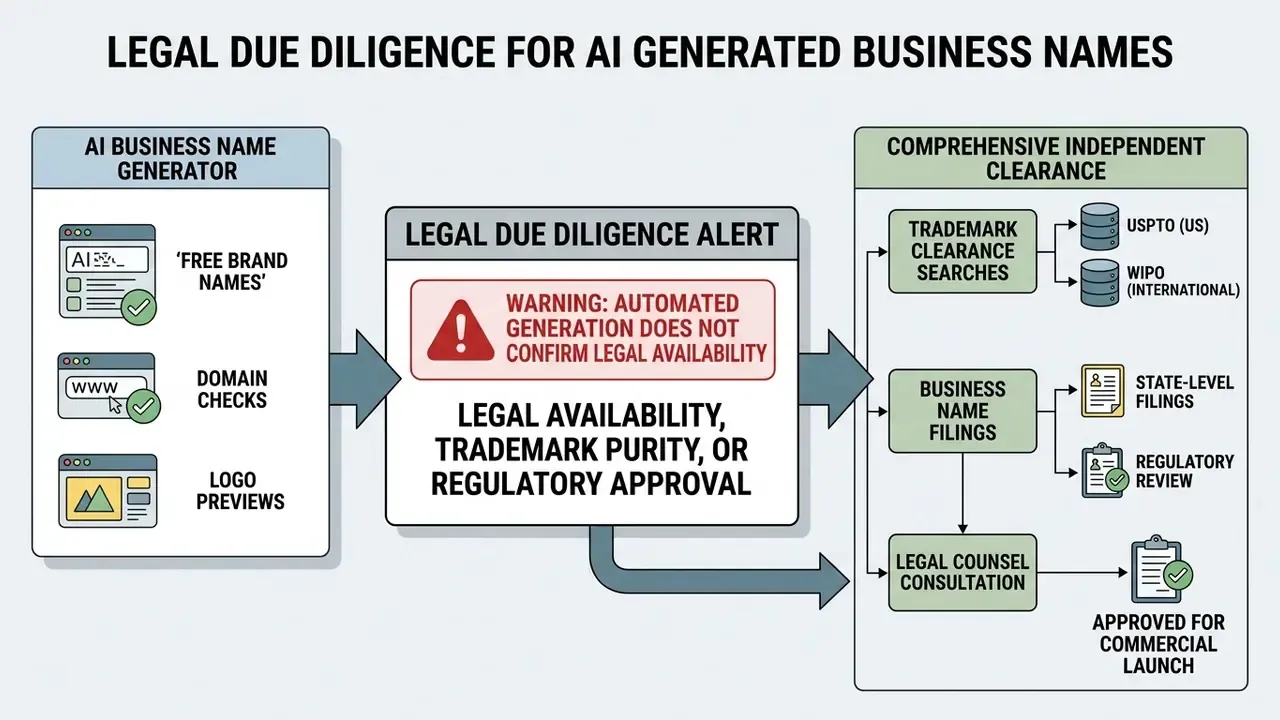
Under current United States Copyright Office guidance, purely AI-generated text and visual output lacking human intervention receives no federal copyright protection (Copyright and Artificial Intelligence, Part 2, 2025, https://www.copyright.gov/ai/). A European Parliament study reaches a parallel conclusion for the EU: output without substantial human intervention is not eligible for copyright and may fall into the public domain (Generative AI and Copyright, 2025). The UK's 2024 consultation on copyright and AI adds that output may infringe where it reproduces a substantial part of a protected work. Commercial use is still permissible, provided the output does not infringe third-party trademarks or rights, and provided the tool's own licence grants you commercial use in the first place.
«Generating a name inside an AI tool does not confirm its legal availability; users must independently verify official trademark registers.»
Organisations planning to commercialise digital artwork or enterprise assets can view the guide for a fuller review of usage terms.
Validate the Name Before Launching Your Business
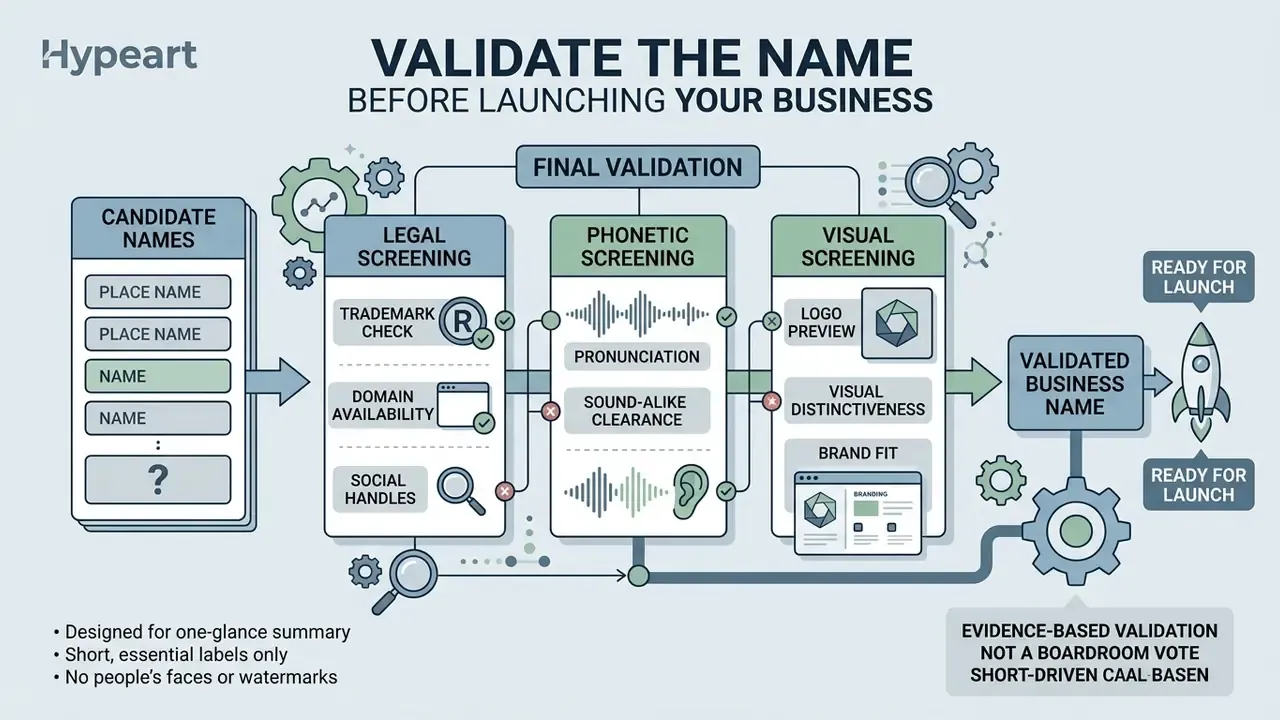
Final validation means systematic clearance screening across legal, phonetic and visual domains, completed before any public announcement or entity filing.
«Marketers overestimate the fame and underestimate the uniqueness of their own brand elements; only strong elements are judged accurately.»
That is the argument for external, evidence-based validation instead of a boardroom vote. Note too that the two main legal tests are separate. State approval of an entity name does not clear the trademark, and trademark clearance does not guarantee the state registry will accept the name. Arkansas guidance, for instance, notes that similar-sounding variants, punctuation and entity endings often fail to distinguish a name. New Jersey requires an exact match check and can deny a filing where the name is already in use.
Final Checklist for Choosing the Right Business Name
A structured launch audit reduces both operational and legal exposure.
Checklist0 / 10
Teams interested in commercial licensing models or monetisation of generated assets can reference the sell ai art documentation.
Start Building Your Brand After Finding a Name
Once the name is selected and cleared, the work shifts to brand infrastructure. Quickly, ideally, because inconsistent variants spread the moment people start making slides.
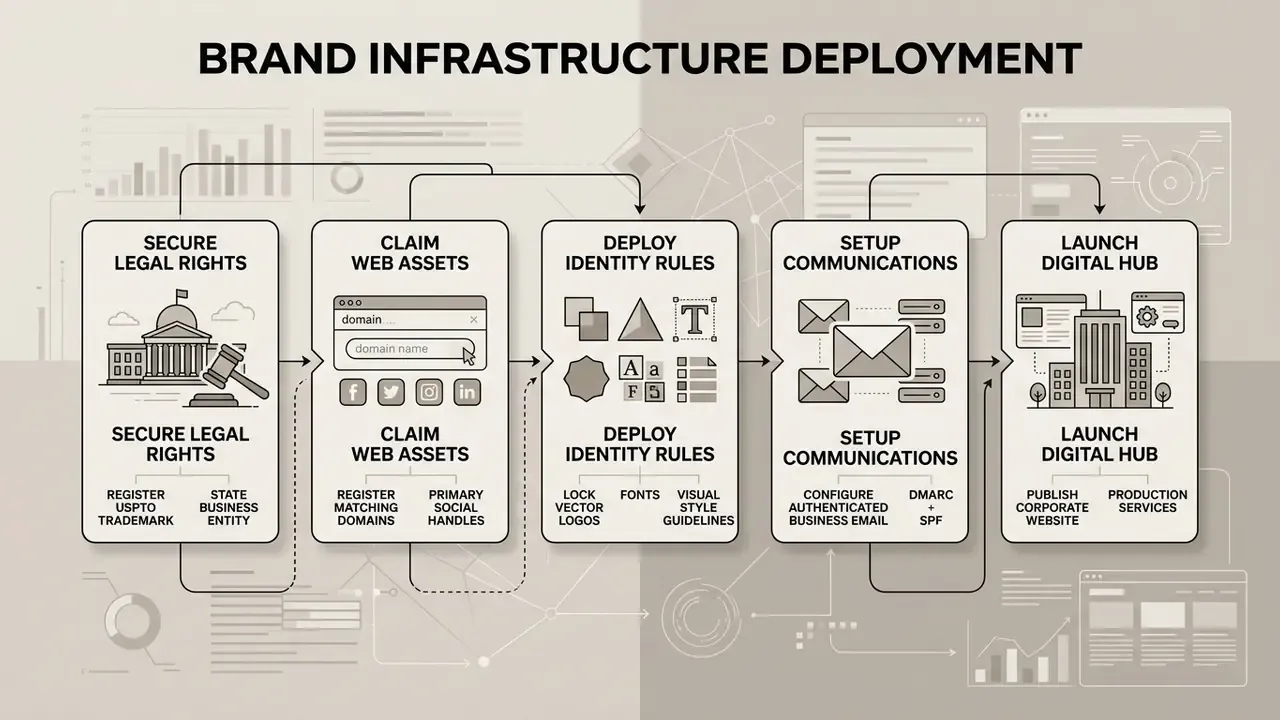
From Business Name to Domain, Logo and Website
Sequencing keeps every touchpoint synchronised under the verified name. Business.gov.au states the dependency plainly: register the domain first, because a business email address uses that domain after the @ symbol, and the website is published on it (https://business.gov.au/). Domain control first, then authenticated corporate email, then the website, then the production services. Teams evaluating tooling for the visual layer can compare options in the best AI image generator roundup.
The Brand Ecosystem: What to Produce in Week One
A name is one asset. A working brand needs a small, defined set of artefacts, and producing them immediately is what stops rogue variants from multiplying.
Teams producing launch video and social assets around the new identity can follow the YouTube video editor workflow guide and keep file sizes manageable with a video compressor. Founder-led brands needing consistent team portraits for the About page can compare tools in the AI headshot generator guide.
To review current commercial platform tiers and plan an enterprise branding budget, inspect the AI Media Pricing page. Organisations tracking legal disputes or IP enforcement topics can open the hub for specialised policy frameworks.
Frequently Asked Questions (FAQ)
Is an AI business name generator actually free?
Generation almost always is. Some tools cap free runs, for example three generations a day showing only the first two names, while others are unlimited. Costs appear downstream: vector logo files, brand guideline PDFs, domain registration, trademark filing. Budget $15 to $35 a year for a standard .com, $350 per class for a USPTO filing, and $12 to $43 a year if you need vector exports.
Do I own the name the AI generated?
You can generally use it commercially, but "owning" it means something narrower than people expect. In the United States, purely AI-generated text and imagery receives no copyright protection without meaningful human authorship. Names are protected by trademark, not copyright, so ownership comes from use in commerce and, ideally, registration. Check the tool's licence terms as well, because they govern what you may do with the output.
How do I know a generated name is not already taken?
Run four checks in order: the USPTO trademark database and WIPO's Global Brand Database for live marks; your state registry for entity-name conflicts; a domain lookup across your target TLDs; and a plain Google search for existing or dormant businesses. Passing one check does not imply passing the others.
What if the .com is gone?
.com is gone?Use one of three documented fallbacks. Add a clear modifier (Get, Try, App, HQ). Switch to a recognised extension such as .ai, .io, .co, or a relevant country-code TLD. Or buy the exact domain on the secondary market. Do not mutilate the spelling to force a match, because dropping vowels measurably hurts recall.
Which naming style is easiest to trademark?
Invented and coined names are easiest, followed by existing words used in ways unrelated to the product. Compound and multiword names sit in the middle. Purely descriptive names are hardest, because the law resists granting exclusivity over ordinary category language.
How many names should I generate before deciding?
Generate 30 to 50, group them by naming style, cut anything hard to pronounce or spell, then score 8 to 12 survivors on the six-column matrix above. Shortlist five for clearance, because at least one will fail a check. Usually the favourite.
Is it safe to describe my unlaunched product to an AI tool?
Not in a consumer web interface, if the description is confidential. Use an enterprise tier with documented retention terms, sanitise the brief into generic category language, and keep specific project identifiers out of the prompt entirely.
How long should the name be?
Aim for four to fourteen characters and one to three syllables. That range keeps the name spellable over the phone, readable at 90 pixels in a logo, and clean on packaging.
Do the same rules apply outside the United States?
Mostly, yes, though the registers change. Australian founders searching for an ai business name generator australia still need ASIC business-name checks plus a .com.au eligibility test. Dutch-language searches for an ai bedrijfsnaam generator lead to the same category of tool, but clearance runs through the Benelux Office for Intellectual Property. Generate globally, clear locally.
Methodology, Limitations and Open Questions