Four Decisions That Determine Whether AI Art Sells Profitably
- Licences first.Commercial rights originate with the generator's subscription tier, not with the marketplace. Free and trial tiers usually prohibit resale. Midjourney requires Pro or Mega plans for businesses grossing over $1,000,000 per year, while Adobe Firefly is positioned as commercially safe by design.
- Rights and provenance second.Purely machine-generated output is not copyrightable in the United States. Human editing, selection, and arrangement create the protectable layer. C2PA Content Credentials plus prompt logs create the evidence chain that survives an audit or a takedown dispute.
- Channels third.Etsy, Creative Fabrica and Gumroad serve digital downloads. Redbubble, Society6 and Displate handle print-on-demand. Adobe Stock and Freepik handle licensing. PromptBase monetizes prompts themselves, and OpenSea handles tokenized collectibles.
- Unit economics last.Net profit must absorb platform fees, payment processing, AI subscriptions, print base costs, compliance review time, and refund reserves. Not just retail price minus commission.
Can You Legally Sell AI-Generated Art?
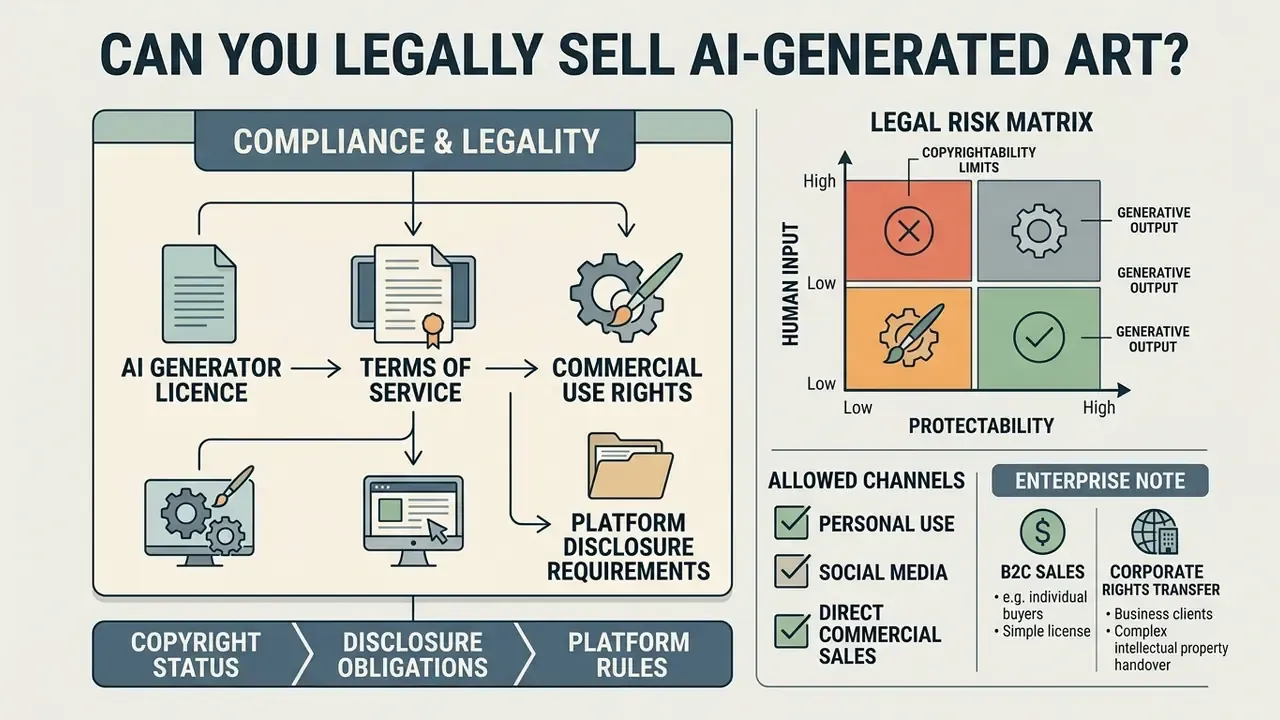
Selling AI-generated art is legally permissible when you comply with the generator's commercial terms of service and satisfy platform disclosure requirements. There is a catch. Purely machine-generated outputs generally lack exclusive copyright protection in major jurisdictions, which means sellers cannot stop others from copying unedited synthetic files.
"Copyright requires originality and fixation; AI images generally satisfy fixation but fail the human authorship criterion."
In practice this creates a two-layer rights model. The raw synthetic layer sits effectively in the public domain. The human-authored layer, meaning retouching, compositing, colour grading, curation of a series, typography and layout work, can be registered and enforced. Sellers who document that human layer convert an unprotectable file into a defensible commercial asset. That documentation habit is boring. It is also what separates a hobby shop from a business.
Legal Risk Matrix: Human Input vs Protectability vs Allowed Channels
| Level of human creative input | Copyright protectability | Recommended sales channels | Channels to avoid |
|---|---|---|---|
| Raw prompt output, no edits | None (public domain layer only) | Redbubble, DeviantArt, personal portfolio | Society6, Saatchi Art, editorial stock |
| Prompt output plus artifact cleanup and upscaling | Thin protection on the edits | Etsy, Creative Fabrica, Gumroad, Freepik | Editorial licensing, exclusive rights deals |
| Composited multi-asset work with manual painting, layout, typography | Protectable human authorship layer | Adobe Stock, ArtStation, Society6, direct storefront | None material |
| Client-commissioned custom work with documented iteration | Protectable, assignable with warranties | Custom commissions, B2B licensing, enterprise deals | Marketplaces that forbid rights transfer |
Commercial Use Rights: Check the AI Generator Licence First
Commercial use authorization originates with the underlying AI image generator's subscription agreement and licence terms. Paid plans on platforms like Midjourney grant explicit commercial rights, whereas free or trial tiers restrict outputs to non-commercial evaluation. Midjourney, for example, requires enterprises grossing over $1,000,000 annually to hold Pro or Mega subscriptions for valid commercial usage. Before committing to a plan, compare Midjourney vs competing image generators on licensing scope, not only on output quality.
Adobe Firefly structures its outputs to be commercially safe by training models on licensed Adobe Stock and public domain content.
"For small AI models, granting copyright holders protection increases social welfare relative to no protection at all."
That economic logic explains why licence verification is not a formality. The value of a licensed generation pipeline is priced into the subscription, and using an unlicensed tier transfers legal exposure straight to the seller. Creators should shortlist AI image generators with commercial rights and cross-check their conditions against the best AI image generators before scaling production. Teams evaluating commercial media workflows at scale can review licensing structures across our AI Media Commercial-Use Hub.
Enterprise note: B2C sales vs corporate rights transfer. Selling a $9 printable on Etsy and delivering brand assets to a regulated enterprise are different risk categories. Consumer marketplaces rely on seller warranties. Enterprise buyers increasingly demand contractual IP indemnification, model-provenance statements, and confirmation that the generation tier used was commercially licensed. If your buyer requires indemnification, generate exclusively on vendor tiers that extend such protection to outputs, and record the tool, model version, date, and account used for every delivered asset.
In one illustrative enterprise rollout, a commercial design team generated 1,200 marketing graphics using basic free-tier tool accounts. A compliance audit revealed that the vendor terms prohibited commercial resale on free tiers, so campaigns were paused. The organization replaced the assets with paid-tier outputs under documented licences and restored clean distribution rights. Remediation cost roughly three weeks of regeneration and legal review, which exceeded the entire annual subscription cost the team had tried to avoid. Cheap tiers are rarely cheap.
Copyright, Disclosure and Platform Rules for AI Art
According to official U.S. Copyright Office guidance, works generated purely by AI prompts, without substantial human creative arrangement or modification, cannot obtain copyright protection.
"Simply providing text prompts to a generative model is not authorship, because the model determines the expressive elements of the result."
Human creative selection, arrangement, or digital post-processing can secure protection for the human-authored additions, while the raw AI elements remain in the public domain. Registration applicants must also disclose AI-generated content and briefly explain the human author's contribution. Legislative updates and case tracking are collected in our AI Litigation and Case Timelines.
"Purely AI-generated material lacks human authorship and is not copyrightable. Human creative editing, selection, and arrangement can be protected under copyright registration." — U.S. Copyright Office, Copyright and Artificial Intelligence, 2025
Marketplaces enforce their own operational rules on AI disclosure and trademark safety. Etsy requires sellers to label synthetic listings as "Designed by" the seller while disclosing AI usage in the product description, and it bans reselling prompt bundles. Platforms also prohibit generating images that contain protected corporate logos, trademarked characters, or recognizable celebrity likenesses. Adobe Stock goes further: artist names, real people's names, fictional character names, and creative-work titles are not allowed inside titles, keywords, or prompts.
"Artists filed class actions against Stability AI, Midjourney and DeviantArt, alleging their works trained the models without consent."
Because disclosure is now mandatory on most venues, and machine-readable labelling becomes enforceable under EU transparency rules from 2 August 2026, verify how your files are classified before listing. AI image detectors help confirm whether an asset will be flagged as synthetic. For tool-specific legal breakdowns, see our AI Media Comparison Matrices.
Choose What to Sell: Digital Files, Prints, Merch, Licences or Prompts
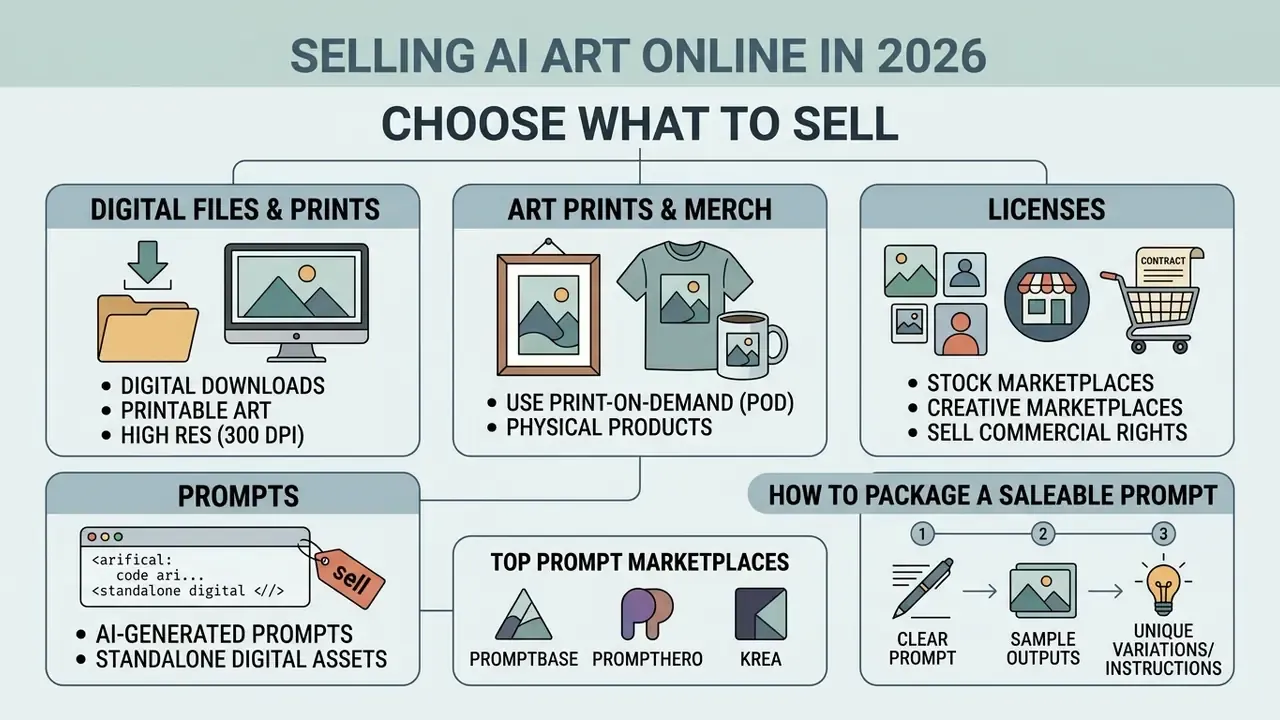
You can monetize AI artwork through digital product downloads, physical print-on-demand merchandise, stock imagery licensing, prompt engineering assets, or custom client commissions. The right product format depends on your production budget, target margins, and how much fulfilment you want to own.
| Format | Production complexity | Revenue profile | Typical price band |
|---|---|---|---|
| Digital downloads | Low | Immediate, repeatable | $3 to $35 |
| Print-on-demand merch | Low | Margin above base cost | $19 to $150 |
| Stock licensing | Medium | Recurring royalties, slow ramp | $0.30 to $3 per download |
| Prompt sales | Very low | Passive, niche demand | $1.99 to $9.99 |
| NFT / collectibles | High | Volatile, resale royalties 5% to 10% | $20 to $1,000+ |
| Custom commissions | High | High ticket, non-passive | $25 to $1,000 |
Sell AI Images as Digital Downloads and Printable Art
Digital downloads carry the highest margins because they remove physical production costs, shipping delays, and inventory. Creators package downloadable AI art into printable wall art bundles containing several aspect ratios at 300 DPI. These bundles suit home decor shoppers who want instant access rather than a shipped package. Choosing between diffusion models, vector-capable tools and stylistic engines gets easier once you review how modern AI art generators handle resolution, tiling and style consistency.
To build buyer trust, format digital packages as structured ZIP archives containing high-resolution JPG or PNG files, with a short PDF that explains the licence in plain words. Detailed pricing models for download bundles sit in our AI Media Pricing Guides.
Sell AI Art Prints and Merch with Print-on-Demand
Print-on-demand (POD) lets you sell physical prints, apparel, and home decor without upfront inventory. When a customer orders a poster or a framed canvas, the POD partner prints, packs, and ships it.
"One AI print-on-demand business generated roughly 500 orders and $16,000 in revenue over 12 months at a $30 average order value."
Physical merchandise demands file discipline. Most POD vendors expect 300 DPI at final print size, accept sRGB rather than CMYK input, and convert colour internally. Oversized posters viewed from a distance are sometimes accepted at 150 DPI. Confirm the exact profile requirement in the provider's file specification before batching uploads, because a CMYK conversion applied too early produces dull, shifted prints. I have seen a whole poster series lose its blues that way.
License AI-Generated Images Through Stock and Creative Marketplaces
Stock licensing provides recurring royalty income by granting commercial usage rights to advertisers, publishers, and designers. Microstock platforms review uploaded assets for resolution, technical cleanliness, and metadata accuracy before listing them. Adobe Stock enforces a 4-megapixel minimum, accepts generative vectors as AI, EPS or SVG, requires model releases for identifiable people and property releases for recognizable property, and excludes AI content from illustrative editorial collections.
Stock platforms also expect you to confirm that prompts exclude artist names, brand trademarks, and public figures. For technical asset parameters and integration limits, developers can consult our AI Media API Guides.
Sell AI Art Prompts as Standalone Digital Assets
Best Platforms to Sell AI Art Online
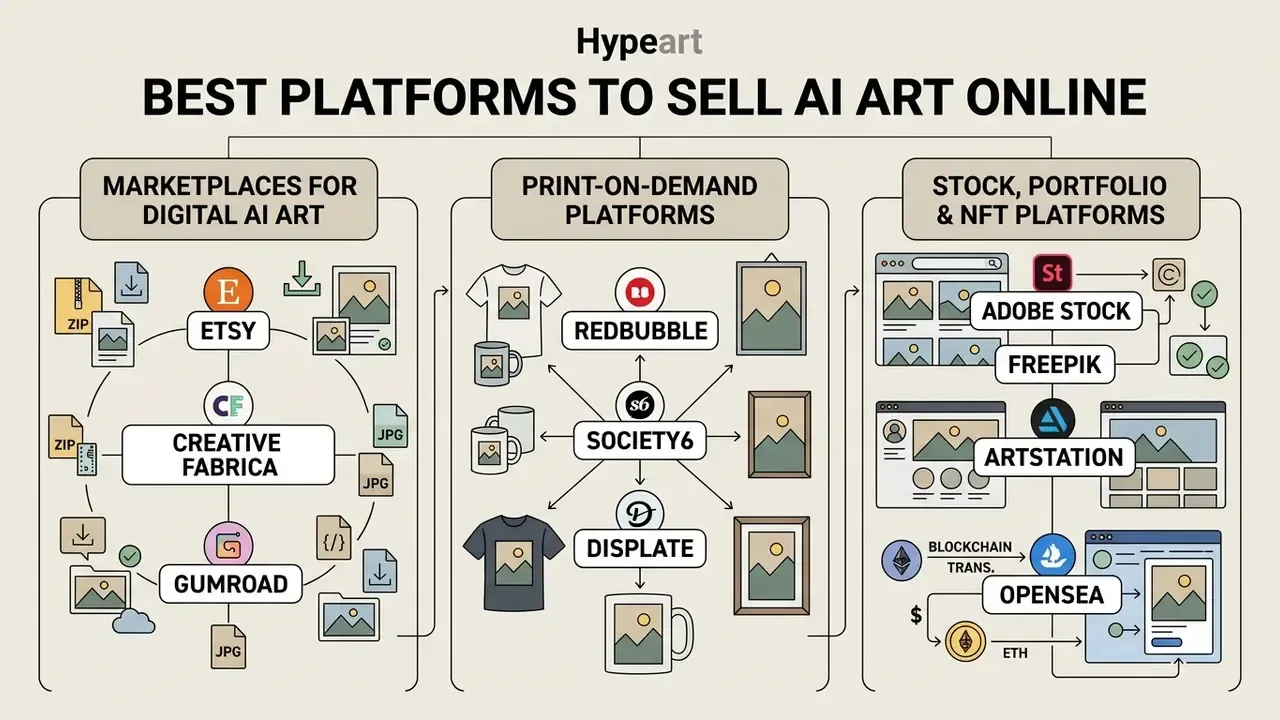
The best platforms to sell AI art online include Etsy and Creative Fabrica for digital downloads, Redbubble and Society6 for print-on-demand merchandise, and Adobe Stock for microstock licensing. Each venue keeps distinct policies on AI disclosure, seller fees, listing formats, approval delays, and minimum upload batches. Because tool choice affects which websites will accept your files, pair this table with an AI art generator comparison before committing a catalogue to one channel.
| Platform | Product Type | AI Policy & Disclosure | Fee Structure | Approval Wait Time | Min. Initial Upload Batch | Personal Storefront Required? | Commercial Rights Requirement |
|---|---|---|---|---|---|---|---|
| Etsy | Digital downloads, prints, merchandise | Allowed; must disclose AI use and label as "Designed by" seller; prompt bundles banned | $0.20 listing fee plus 6.5% transaction fee plus payment processing | Instant | 1 asset | Yes (Etsy Store) | Seller must hold full generator commercial rights |
| Creative Fabrica | Digital design assets, clipart, SVG bundles | Allowed; explicit AI tag required in upload metadata | Revenue share based on subscription downloads | 24 to 48 hours | 1 store asset | Yes (Seller Store) | Commercial licence required; no trademark infringement |
| Redbubble | Print-on-demand apparel, posters, home decor | Allowed; mandatory "AI Generated" tag to avoid copyright flags | Base product cost subtracted from seller-defined markup | Instant (automated indexing, no pre-screening) | 1 asset | Yes (Artist Profile) | Must warrant non-infringement of third-party IP |
| Society6 | Fine art prints, canvas, home lifestyle merch | Restricted; requires meaningful human creative input | Flat 10% royalty on default merch; customizable markup on prints | Instant (subject to review and removal) | 1 asset | Yes (Artist Shop) | Forbids purely prompted raw AI outputs |
| Adobe Stock | Stock photos, vectors, illustrations | Allowed; mandatory "Created using generative AI tools" checkbox | Royalty percentage per download (33% raster/vector, 35% video) | 1 to 3 months | 1 asset | No (Contributor Account) | Full commercial rights; model and property releases required |
| Freepik | Stock photos, PSD mockups, design elements | Allowed; mandatory _ai_generated tag and metadata disclosures | Download-based contributor revenue share | 5 to 10 business days | 10 assets (initial qualification test) | No (Contributor Account) | Full commercial licence; 100% original creative assets |
| ArtStation | Digital portfolios, prints, asset marketplace | Allowed with conditions; mandatory AI tagging in listings | Marketplace commission (12% to 30% depending on tier) | Instant | 1 asset | Yes (ArtStation Store) | Must own rights; no unauthorized style scraping |
| DeviantArt | Portfolio prints, digital asset downloads | Allowed; native AI system integration and automated tagging | Percentage fee on digital downloads and print commissions | Instant | 1 asset | Yes (User Profile) | Respect copyright; mandatory AI disclosure tags |
| OpenSea | NFT digital art, blockchain collectibles | Allowed; relies on creator disclosures and IP reporting | 2.5% marketplace fee on secondary sales plus gas fees | Instant (blockchain deployment) | 1 NFT | No (Web3 wallet store) | Creator must possess full asset ownership rights |
Marketplaces for Digital AI Art: Etsy, Creative Fabrica and Gumroad
Etsy reported 96.6 million active buyers in 2024, which makes it the default answer when someone asks where they can sell AI images to consumers (Etsy annual disclosure, 2024). Sellers pay a $0.20 listing fee per item plus a 6.5% transaction fee on final order totals, plus Etsy Payments processing of 3% and $0.25 per order. Creative Fabrica targets craft enthusiasts and graphic designers, so curated pattern packs and clipart perform well there; contributor payouts on referred downloads are reported at up to 75%, and sellers set their own prices inside a hosted shop. Gumroad runs as a direct-to-consumer storefront and charges 30% on discovery-marketplace sales according to its published fee documentation, while giving you complete access to the customer email list. That last point is the strategic one, because it makes repeat sales possible.
Print-on-Demand Platforms: Redbubble, Society6 and Displate
Redbubble handles fulfilment, printing, and customer support for physical merch, paying creators a margin above base product costs. Its user agreement states that publication is fully automated and content is not pre-screened, so the compliance burden sits entirely with the seller. Society6 requires meaningful human creative edits and rejects artwork produced primarily by AI tools without them; it applies a flat 10% royalty on most products while allowing custom markup on art prints, framed prints and canvases. Displate specializes in metal wall art and enforces strict intellectual property checks before accepting uploaded illustrations.
Stock, Portfolio and NFT Platforms: Adobe Stock, Freepik, ArtStation and OpenSea
Adobe Stock is a leading microstock venue that accepts synthetic media, provided contributors tick the "Created using generative AI tools" box on submission. Plan for a long queue: review commonly takes one to three months, which makes quality control before upload far cheaper than resubmission.
"After AI images appeared on the platform, total sales rose 39%, but purchases of human artists' work declined."
Freepik accepts synthetic vectors and raster files tagged with _ai_generated metadata, requires 100% original authorship, and activates contributor accounts only after an initial qualification batch of ten assets passes review. ArtStation combines portfolio hosting with digital asset sales for entertainment industry artists, and DeviantArt offers native AI tagging alongside print commissions. OpenSea lets creators mint AI-generated artwork as blockchain tokens for digital collectors.
For AI-art sellers, that concentration means NFT monetization behaves like a lottery with reputational prerequisites, not a predictable catalogue business. Treat it as an optional high-variance tier, never as your launch channel.
How to Choose the Best Place to Sell AI Art
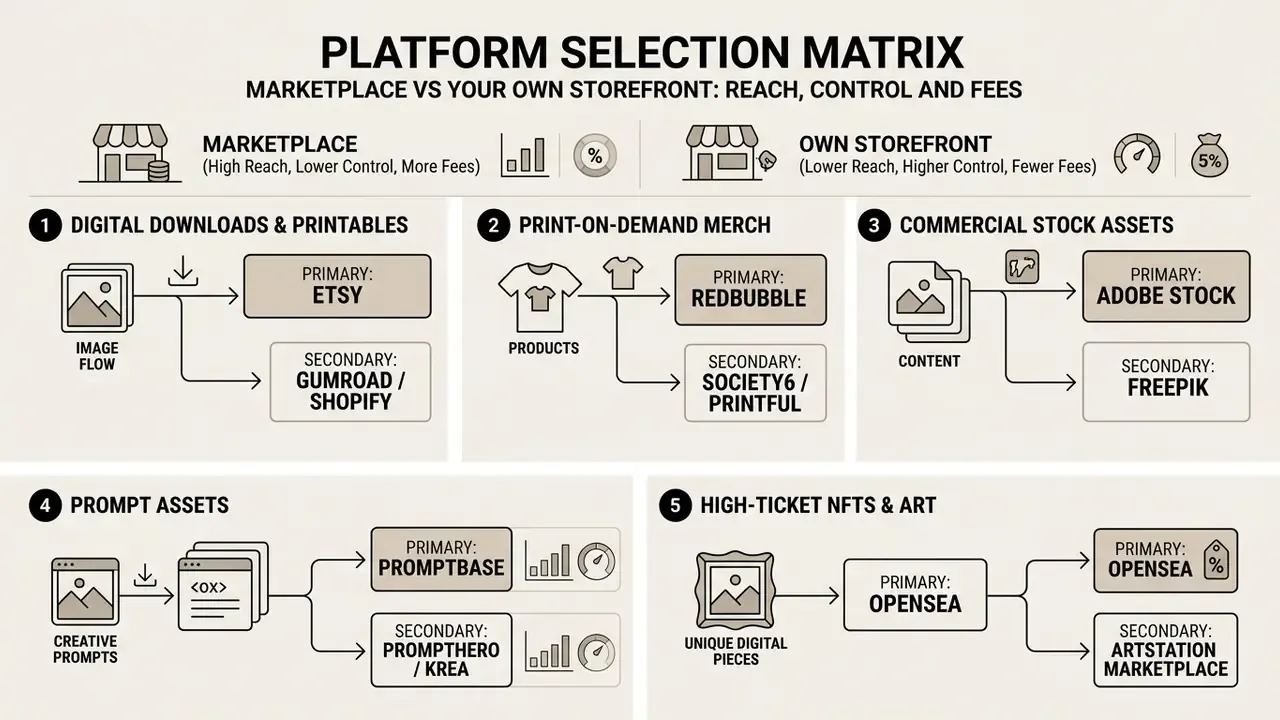
Choosing the best place to sell AI art means balancing build cost, audience reach, marketplace fees, and branding control. The core fork is simple: third-party platforms with built-in traffic, or a self-hosted website with higher margins.
Marketplace vs Your Own Storefront: Reach, Control and Fees
Marketplaces give instant access to existing buyer search traffic but charge transaction fees and enforce rigid listing layouts. Self-hosted storefronts on Shopify or WooCommerce hand you full control over branding, pricing, and customer relationships. The trade-off is traffic: you pay for it with ads, content, or social effort.
The decision rule is arithmetic. Compare the marketplace take rate against your realistic cost per acquired visitor. If a marketplace charges roughly 10% all-in and delivers buyers who would otherwise cost you $0.40 per click at a 2% conversion rate, the marketplace is cheaper. Once organic and email traffic mature, migrating repeat buyers to a direct store recovers that commission. Most sellers run both, which is honestly the sane answer.
Can You Sell AI Art Online Free or With No Upfront Fees?
You can sell AI art online free of upfront capital by combining free-tier tools, print-on-demand fulfilment, and no-listing-fee marketplaces. Read the licence text closely first: most free AI image generators restrict output to personal evaluation only. And "no upfront fee" is not the same as "no fees". Hidden operating costs still bite:
A detailed cost evaluation tool sits in our AI Media Calculators.
Prepare AI-Generated Images for Sale
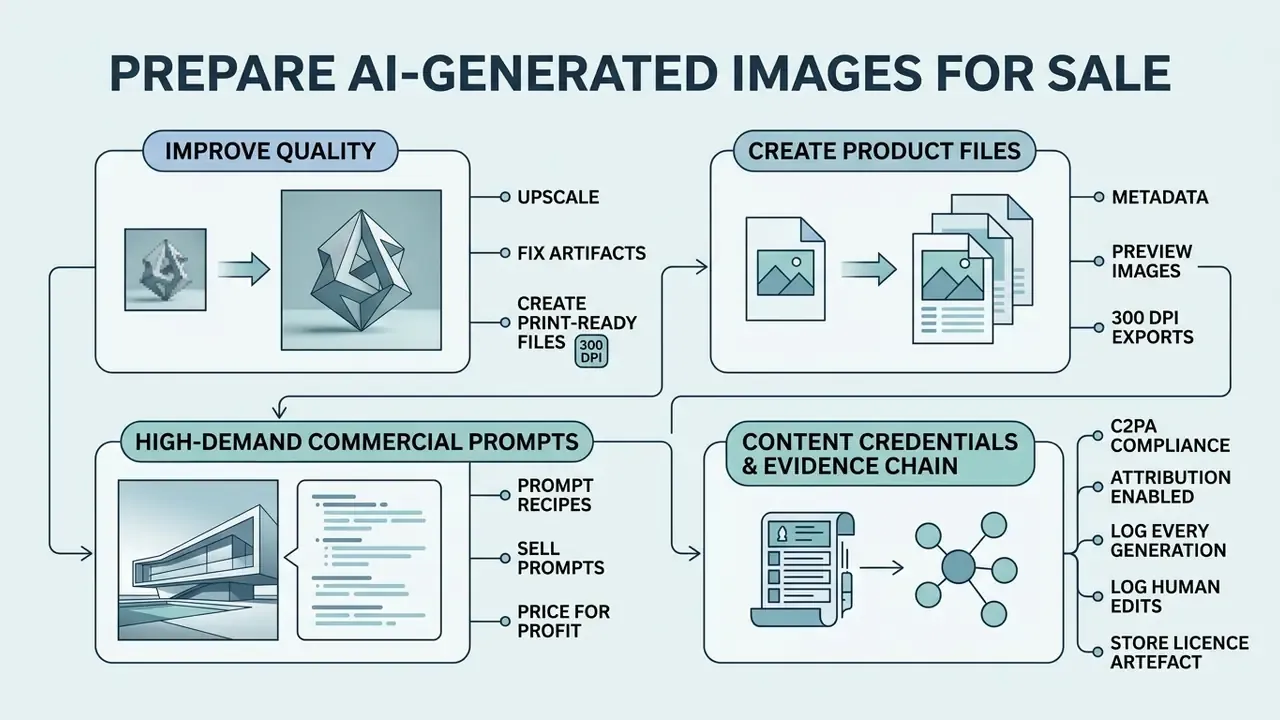
Preparing AI artwork for sale means upscaling resolution, removing visual artifacts, and organizing export metadata so files clear marketplace review. Raw generator output rarely meets professional print or stock standards without manual refinement.
Improve Quality: Upscale, Fix Artifacts and Create Print-Ready Files
Modern generative models now export natively at 1024 to 2048 pixels on the long edge, and some pipelines exceed that. Even a 2048-pixel file remains insufficient for large-format physical prints without enlargement. Creators use specialized upscalers such as Topaz Gigapixel or Upscayl to reach 300 DPI at target physical dimensions. Topaz documents a 1x "Fix Compression" pass for pure artifact cleanup, a Recover V2 pre-downscaling step for false-resolution files, and a multi-pass generative workflow up to 32,000 pixels on the longest side, while Upscayl exposes 2x and 4x tasks. Comparative specifications for AI image upscalers help match the tool to the target print size.
An 8x10 inch print requires a file of at least 2400x3000 pixels. You will also need to fix common AI defects by hand: distorted hands, extra fingers, unnatural lighting. A shortlist of AI photo editors covers inpainting and retouching workflows suited to synthetic artifacts. Stock reviewers reject anatomical errors, inconsistent lighting, unrealistic proportions, embedded text, watermarks, artifacting, banding and nonsensical lettering, so a defect pass is not optional. Where fine detail must be rebuilt rather than merely enlarged, AI image enhancers restore texture before the final 300 DPI export.
High-Demand Commercial Prompt Recipes
To jumpstart production, use these field-tested prompt formulas aimed at popular commercial micro-niches:
Recipe 1: Commercial seamless pattern (printable merch and wallpaper)
Recipe 2: Isometric 3D tech icon (digital downloads and web design)
Recipe 3: Fine art wall canvas (print-on-demand)
Recipe 4: Celestial large-format print
Recipe 5: Japanese architectural series
Keep prompts, seeds, model versions, and negative parameters in a spreadsheet. Reproducibility is what turns a lucky render into a sellable collection, and it doubles as your audit record.
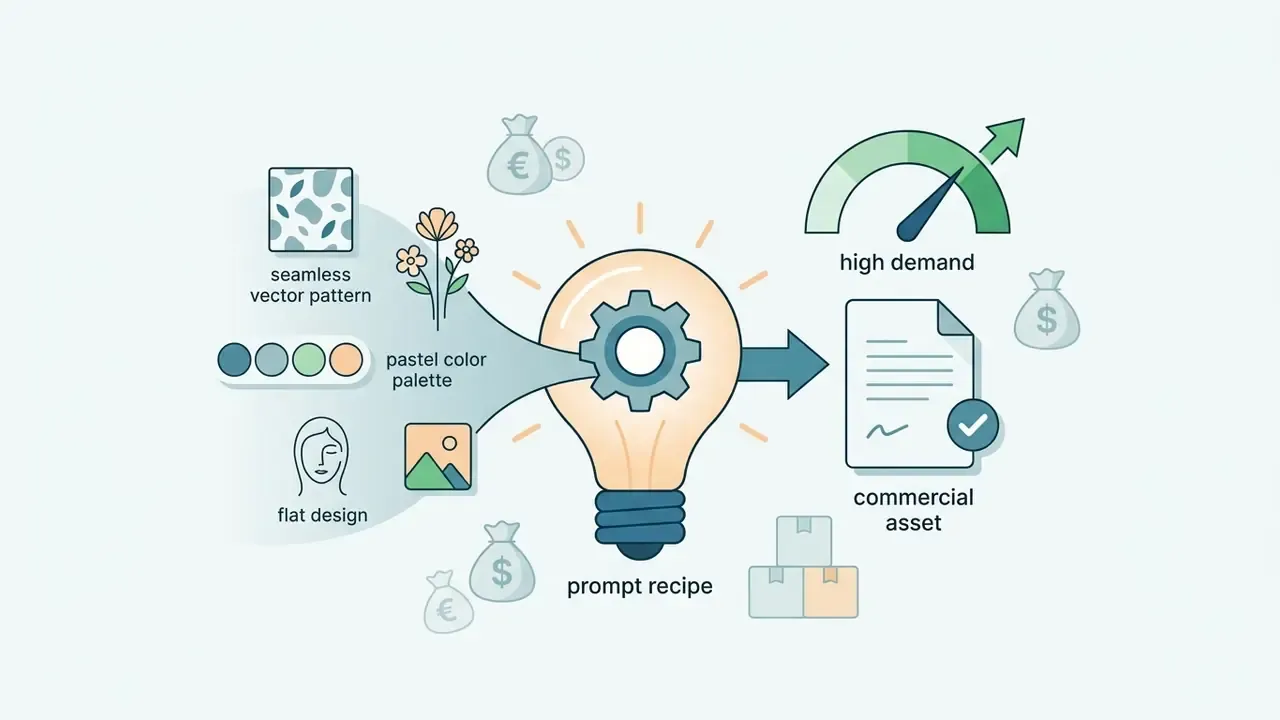
Seamless vector pattern of vintage botanical wildflowers, pastel color palette, minimalist line art, white background, flat design --tile --ar 1:1 --v 6.0
Isometric 3D render of a cloud computing security shield, glowing neon accents, frosted glass material, clean studio background, octane render, 8k --ar 4:3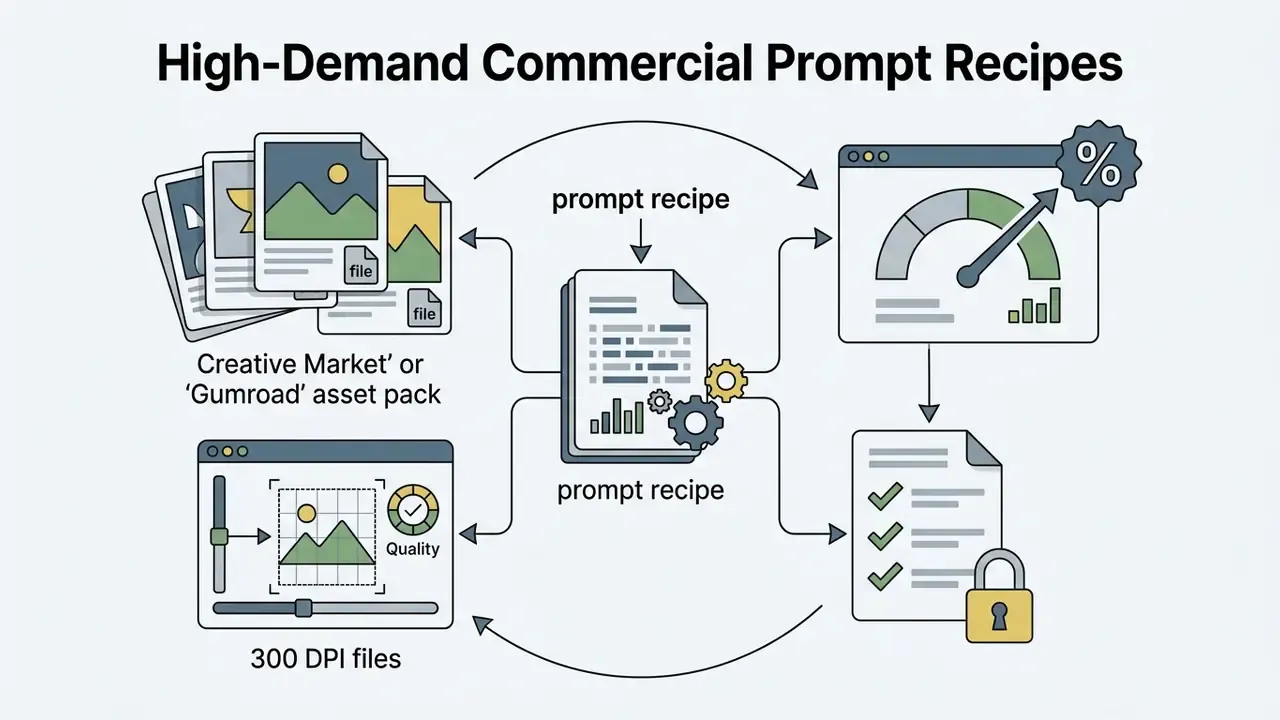
Ethereal gothic cathedral architecture in misty morning light, monochromatic charcoal style, dramatic shadows, highly detailed pencil sketch aesthetic --ar 3:4
Cosmic solar flares and planetary spirals, deep indigo and gold palette, ultra-fine grain, museum poster composition --ar 2:3
Traditional Japanese wooden architecture at dusk, ukiyo-e influence, soft bold brush strokes, layered mist, restrained palette --ar 4:5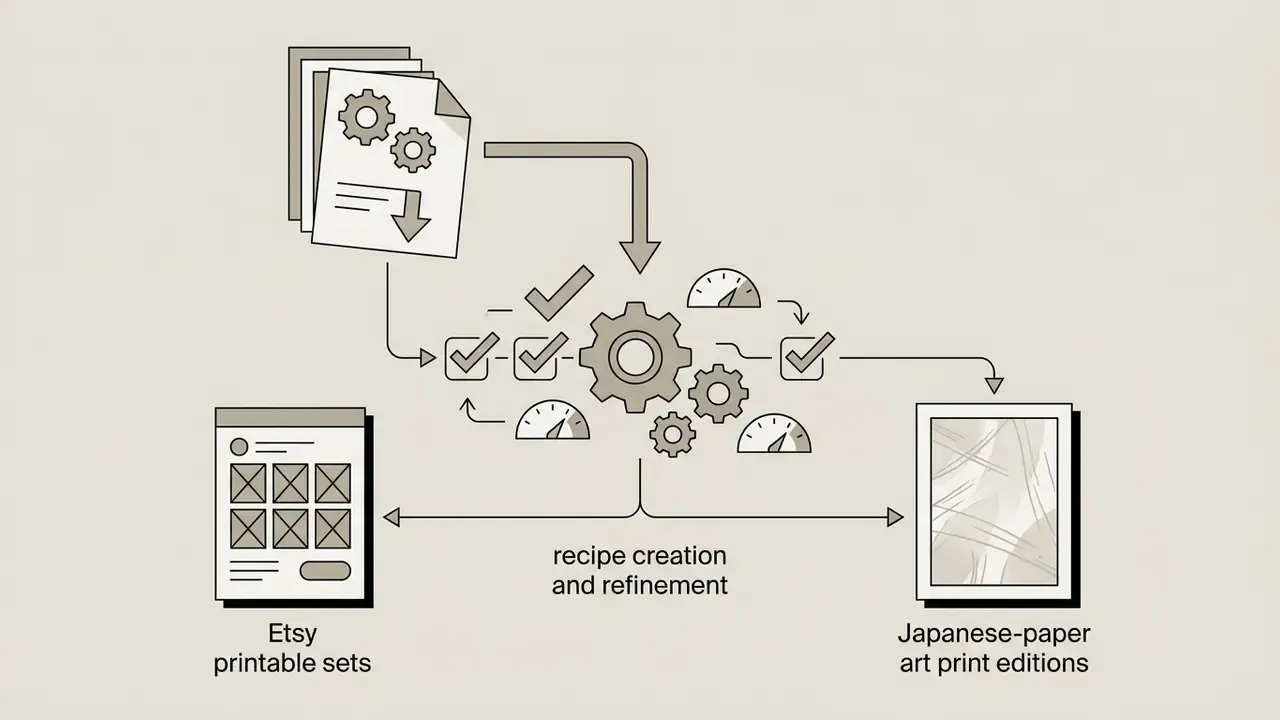
Create Product Files, Metadata and Preview Images
Before listing anything, organize files into predictable formats and build previews that actually convert:
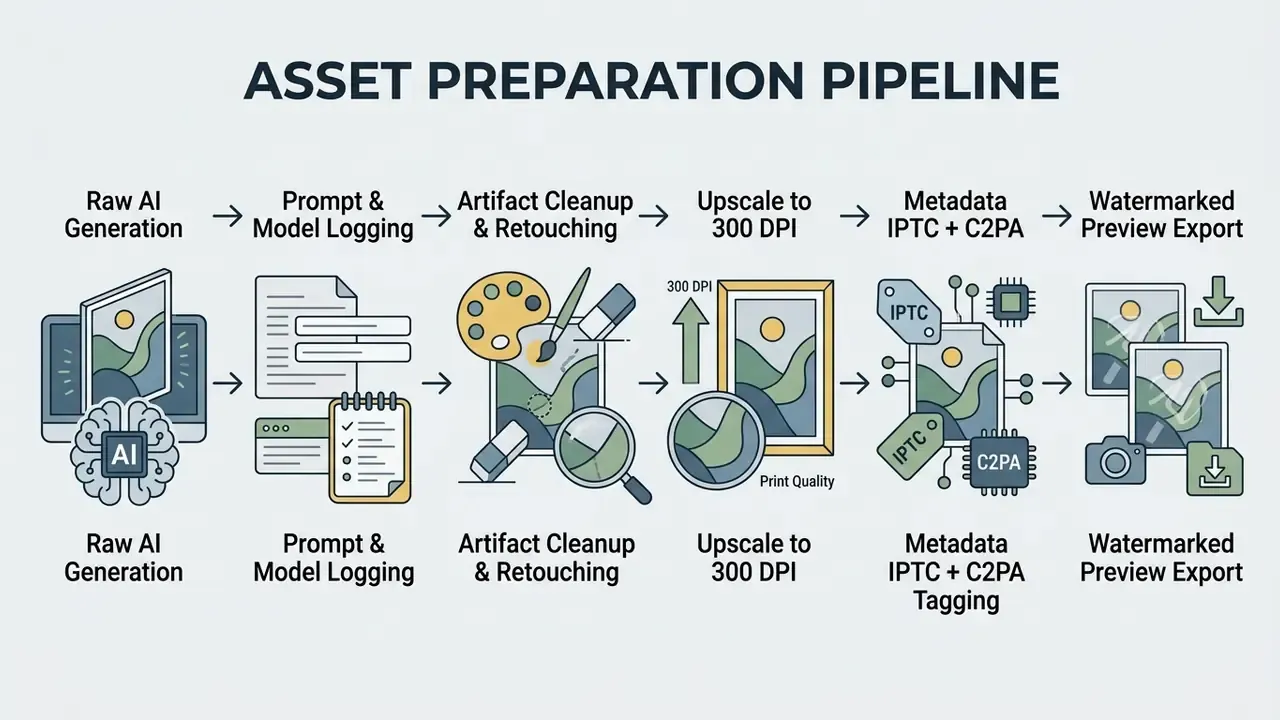
Export digital print bundles as standardized ZIP archives containing JPG or PNG files. Apply watermarks to public previews so assets resist scraping. IPTC metadata should carry descriptive titles, relevant search keywords, and explicit AI tool attribution. Titles on Adobe Stock must describe the main subject without prompt parameters or the phrase "generative AI", and keywords must exclude artist names, personal names, agencies, and third-party IP references.
Content Credentials, C2PA and Your Evidence Chain
| Asset ID | Date | Tool & model version | Plan / licence tier | Prompt reference | Human edits performed | C2PA present | Release docs | Channels published | Retention until |
|---|---|---|---|---|---|---|---|---|---|
| AI-2026-0001 | 2026-01-14 | Firefly Image 4 | Paid team | P-014 | Composite, colour grade, typography | Yes | Not applicable (fictional subject) | Etsy, own store | 2031-01-14 |
For organizations, the same register neutralizes shadow AI risk. If only registered tools and tiers may be used, and every commercial asset must carry a register row before publication, unauthorized generation becomes visible at review time rather than during a dispute. Ownership matters as much as tooling: each register row should name a human owner who can answer for that asset.
Digital Asset Protection and Anti-Piracy Safeguards
Selling high-resolution digital files exposes you to redistribution and scraping. A few operational safeguards close most of the gap:
- Download limits on direct storefronts (Shopify, Sellfy, Gumroad), cap download attempts. Five attempts per unique purchase link is the common standard and it curbs link sharing.
- Unique per-purchase links issue a distinct download URL per order so leaked links can be traced and revoked individually.
- Time-gated access tokens set expiry windows, for example a link that dies 72 hours after purchase.
- Steganographic metadata tagging inject invisible author metadata, copyright notices, and licence IDs into EXIF/IPTC headers before zipping bundles, so recovered files map back to the original buyer.
- Preview discipline publish only downsampled, watermarked previews, and never expose the 300 DPI master through a public CDN path.
Price AI Art for Profit Without Undervaluing Your Work
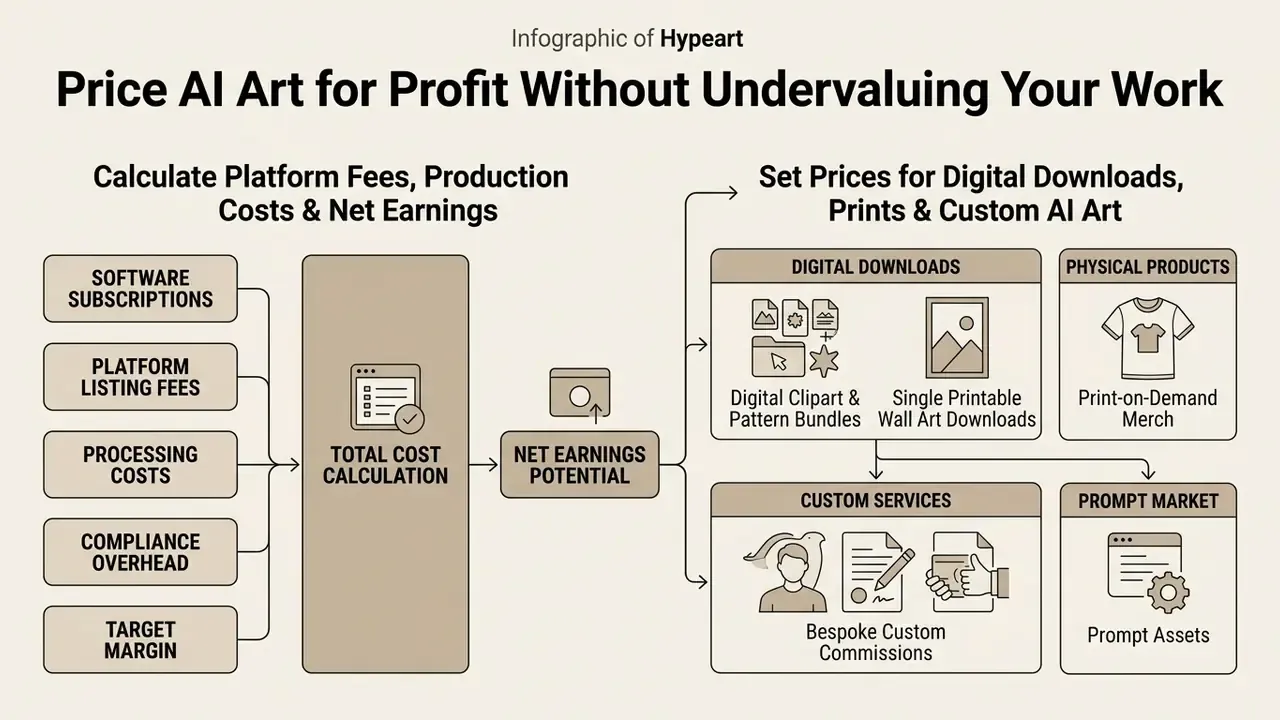
Pricing AI art requires counting software subscriptions, platform listing fees, processing costs, compliance overhead, and target margin. Price too low and perceived value collapses; price too high on undifferentiated output and volume dies. The durable pattern is tiered pricing with a margin floor: low-priced entry items for acquisition, mid-priced bundles for order value, and premium custom or commercial-rights tiers that carry the profit.
Set Prices for Digital Downloads, Prints and Custom AI Art
Market pricing varies by format and licensing scope:
- Digital clipart and pattern bundles $5 to $25 per multi-file package; premium curated collections reach $25 to $50.
- Single printable wall art downloads $3 to $15 per high-resolution bundle; sets of three to five prints sell at $15 to $30.
- Print-on-demand merch $20 to $45 for apparel, $35 to $120 for framed prints, $60 to $150 for canvas.
- Bespoke custom commissions $50 to $300 depending on manual editing complexity; brand asset packages with commercial rights run $200 to $1,000.
- Prompt assets $1.99 to $9.99 per prompt, with bundles priced by niche depth.
One illustrative case: a small studio launched ten digital clipart sets at $4 each and generated almost no interest. Repackaged as a themed 100-asset mega-bundle at $29 with full commercial licensing, average order value jumped and monthly gross revenue finally covered the subscription stack. Same files. Different offer.
Benchmark against five to ten close competitors and price in the upper-middle of the observed range rather than at the floor. Exclusivity, documented commercial rights, and visible provenance are the three levers that justify a premium without triggering a race to the bottom.
Calculate Platform Fees, Production Costs and Net Earnings
Net earnings equal retail revenue minus commissions, processing fees, software overhead, compliance costs, refund reserves, and manufacturing costs:
Card processing follows a two-part structure, a percentage of revenue plus a fixed amount per transaction, so low-priced single files lose a disproportionate share of revenue to the fixed leg. Budget the compliance line explicitly: licence verification, release paperwork, metadata and provenance tagging typically consume 2% to 5% of gross on catalogue-scale operations. A refund reserve of 1% to 3% absorbs quality-related returns, which are more common with synthetic imagery than sellers expect.
"A leaked advanced anime generator cut average prices by 64%, but order volume rose 121% and total platform revenue increased 56%."
The strategic reading is blunt. AI compresses unit prices but expands demand, so the sellers who win are those who scale documented, differentiated catalogues, not those defending a high price on generic output.
How to Start Selling AI Art Online and Get Your First Sales
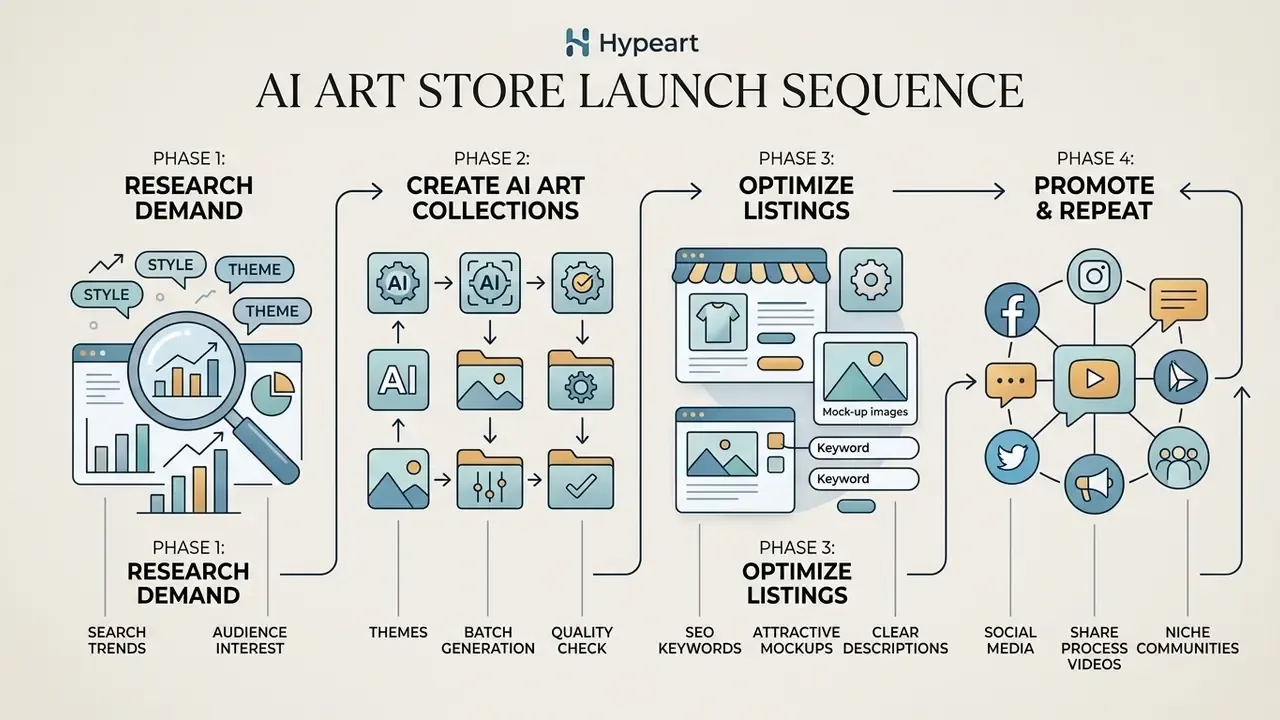
Launching an AI art shop is a sequence, not a leap: research demand, organize collections, optimize listings, then market to a specific audience.
AI ART STORE LAUNCH SEQUENCE
Checklist0 / 9
Research Demand Before Creating AI Art Collections
Before you generate a single asset, check search volume and buyer demand on Pinterest, Etsy, and Google Trends.
"Agent-based simulations show AI increases market concentration and displaces low-skill creators, while experienced authors strengthen their positions."
That finding argues for niche research over volume dumping. Underserved micro-niches, say vintage botanical illustrations, bohemian nursery decor, or minimalist line art, convert better than generic fantasy art. Pinterest Trends normalizes search volume as a ratio of trend searches to total platform searches in the same window, while Marmalead layers a three-month forecast onto twelve months of keyword performance. Use both to separate a durable niche from a two-week spike.
Optimize Listings for Marketplace Search and Buyer Trust
Marketplace SEO rests on accurate titles, descriptive tags, and complete metadata. Clear AI disclosure builds trust and keeps you inside platform rules. Describe both the generation software used and the manual post-processing applied. The second half of that sentence is what converts a sceptical buyer, because it signals human craft rather than bulk output.
Every listing should carry: the exact deliverable list (formats, dimensions, DPI), the licence scope in plain language, the AI disclosure statement, and a provenance note if Content Credentials are embedded.
FAQ: Selling AI Art
Is it legal to sell AI-generated art?
Generally yes, provided the generator's licence permits commercial use, the marketplace allows disclosed AI content, and the work does not infringe trademarks, characters, or personality rights. Legal permission to sell is not the same as owning enforceable copyright.
Can I copyright my AI art?
Only the human-authored contributions. Purely prompted output is not copyrightable in the United States. Edits, compositing, curation and arrangement can be registered, with disclosure of the AI-generated portions.
Which platform pays fastest?
Direct storefronts and Creative Fabrica-style shops release funds soonest. Microstocks such as Adobe Stock pay royalties per download after review cycles that can run one to three months before an asset even goes live.
Do I have to disclose AI use?
On most marketplaces, yes. Under EU transparency rules, machine-readable marking of AI-generated content applies from 2 August 2026. Disclosure is also commercially useful: it prevents takedowns and pre-empts buyer complaints.
What sells better, files or prompts?
Files generate higher revenue per unit. Prompts are lower-effort passive income with a narrower buyer base. Mature sellers run both, using prompt listings as discovery funnels into full asset bundles.
Can I sell AI art with no money at all?
You can start with no upfront cash using POD fulfilment and no-listing-fee venues, but you cannot operate at zero cost. Subscriptions, per-order fees, processing charges, and compliance time all appear the moment you sell.
Appendix A: Superseded and Reference Notes
Superseded resolution statement (retained for transparency). An earlier version of this guide stated: "Generative AI tools typically produce raster images at resolutions around 1024x1024 pixels, which are insufficient for large physical prints." Current models frequently export at 2048 pixels or above. The requirement to upscale for large-format printing has not changed, but the baseline resolution figure has been updated in the main text.
Superseded citations (retained for transparency). The claim "total sales on image marketplaces increased by 39% following the introduction of AI-generated content, though competition among sellers intensified (Stanford University Marketplace Analysis, 2025)" and the reference "arXiv Empirical Market Research, 2024" have been replaced in the main text with fully identified sources: Goldberg & Lam's Stanford marketplace natural experiment (2025) and The Impact of Generative Artificial Intelligence on Market Equilibrium: Evidence from a Natural Experiment (arXiv, 2024).
Adjacent tooling reference block. For creators extending an AI art business into video, audio and general media production, the following guides sit outside the compliance workflow above and are listed here to keep the operational sections uncluttered: movavi video editor, movie trailer maker, movie maker free, mp4 video editor, AI voice generator, music maker online free no sign up, photo editors and momo ai photo generator.
Checklist0 / 10
Last updated: 2026. This guide is general information on commercial practice and does not constitute legal, tax, or financial advice. Consult a qualified professional in your jurisdiction before entering licensing agreements or transferring rights.