An ai dialogue generator is a specialized natural language processing architecture built to synthesize multi-turn, multi-character conversational text and scripts from defined contextual parameters, persona constraints, and narrative objectives. In enterprise deployments, creative workflows, and interactive software, these systems turn a high-level scene definition into a structured exchange while holding character voice steady, pacing emotion, and respecting policy limits.
Executive Summary
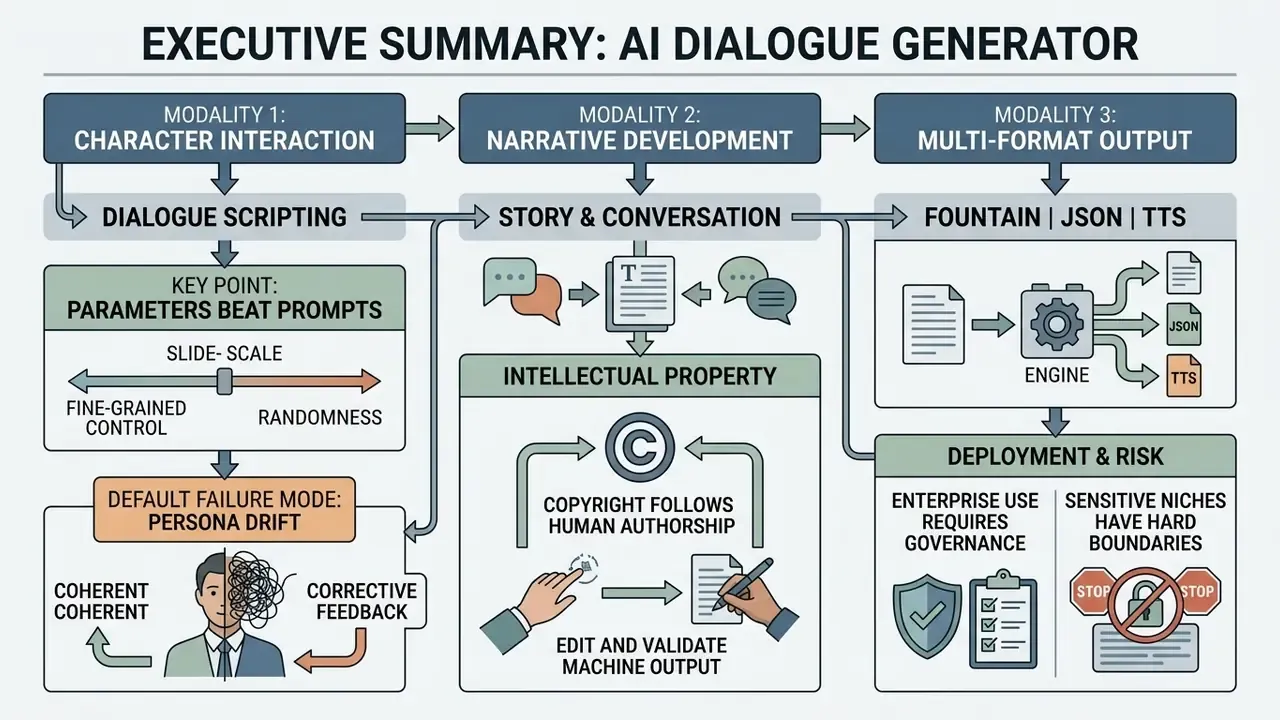
- Three modalities, three toolchains. Text-based generators produce transcripts and turn logic; script-based generators enforce screenplay structure (Fountain, JSON); voice generators (TTS) synthesize multi-speaker audio with prosody control.
- Parameters beat prompts. Output quality depends on six conditioning variables: personas, scene context, dialogue objective, tone, format, and language plus decoding constraints (temperature, turn budget, stop sequences).
- Persona drift is the default failure mode. A three-pass loop, generate, persona filter, structural rewrite, plus lexical, rhythmic, and emotional differentiation layers, keeps characters from collapsing into one neutral voice.
- Copyright follows human authorship. In the United States, purely machine-generated dialogue is ineligible for registration. Human editing, selection, and arrangement must be documented before commercial release.
- Enterprise use requires governance. Regulated teams should treat a dialogue generator as a model under management: guardrail testing, PII masking, reproducible logs, RBAC, and Shadow AI controls before any pilot moves into controlled production.
- Sensitive niches have hard boundaries. Adult content is prohibited by most frontier vendors. Defense-sector deployments fall under ITAR and EAR export controls plus DoD verification, validation, and accreditation (VV&A) requirements.
Three Questions to Settle Before Your First Run
Most disappointing first results trace back to unanswered questions, not weak models. Settle these three before you type a prompt.
- Who owns the output?A named human owner, not a team inbox. Ownership decides who signs off on tone, facts, and release.
- What class of data may enter the prompt?Public and synthetic material is safe. Client names, account data, and non-public financials are not.
- What does "good" look like, measurably?Turns per scene, sentences per turn, persona-identification accuracy without name tags, and rework rate after editorial review.
Write the answers down. That single page becomes your brief, your acceptance test, and later your audit evidence.
What Is an AI Dialogue Generator and What Problems Does It Solve
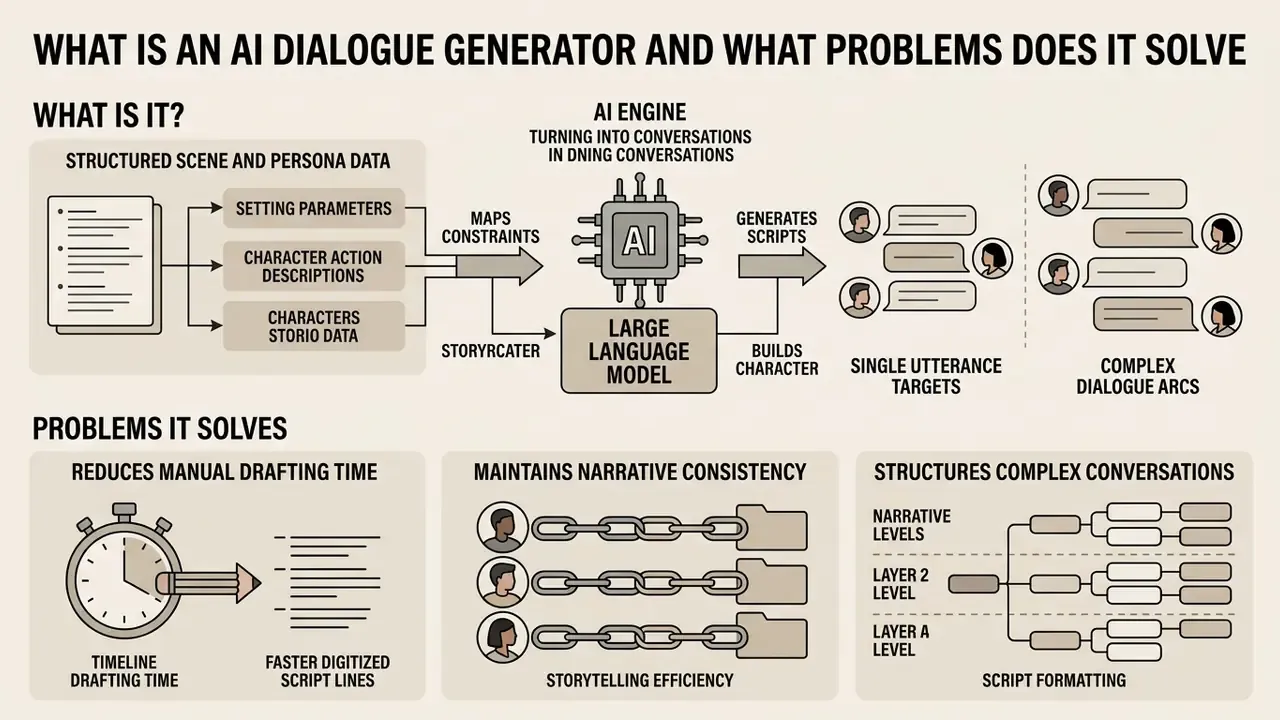
In two sentences: An AI dialogue generator turns structured scene and persona inputs into multi-turn conversations between two or more speakers. It differs from generic text completion because it manages speaker identity, turn-taking, and context retention across an entire exchange.
An ai dialogue generator (also written as dialogue ai generator, ai dialog generator, or, in stray search logs, ai dialouge generator) is an automated text generation framework that creates structured conversational exchanges between two or more participants. Unlike a standard single-turn completion system, a dedicated dialogue generator ai tracks multi-turn context, speaker identification, turn-taking dynamics, and persona-specific speech patterns. Organizations and independent creators deploy these systems to accelerate script writing, simulate interactive training scenarios, and automate dynamic non-player character (NPC) interactions.
By leveraging large language models tuned on structured conversational datasets, an ai dialogue maker lets a user generate dialogue aligned to precise narrative goals. Research indicates that models fine-tuned on multi-turn self-chat corpora, including a 1.5-million-conversation dataset built with a paired-LLM self-chat method, hold coherence and follow-up tracking better than zero-shot base models.
«Models fine-tuned on multi-turn corpora demonstrate superior coherence and follow-up tracking compared with zero-shot baselines.»
These tools cut manual drafting time while holding structure steady across complex narrative arcs. A second, less obvious benefit: because the input is structured, the same brief can be re-run with different tone presets. You get comparable variants for editorial A/B review instead of one unrepeatable draft. That single property is what makes the tool defensible in a governed environment.
Dialogue, Conversation, and Script Scene: What AI Can Create
Modern ai generator dialogue engines produce three tiers of conversational output: single-utterance targeted replies, multi-turn casual conversations, and fully formatted dramatic script scenes. Single-utterance outputs solve immediate turn-taking needs. Multi-turn conversations sustain context over an extended dialogue history. For scriptwriting and game development, an ai script dialogue generator outputs structured scenes with speaker tags, stage directions, and parenthetical tone cues. Multi-party research systems push further, sustaining 4 to 10 round exchanges in which every utterance must match a declared identity.
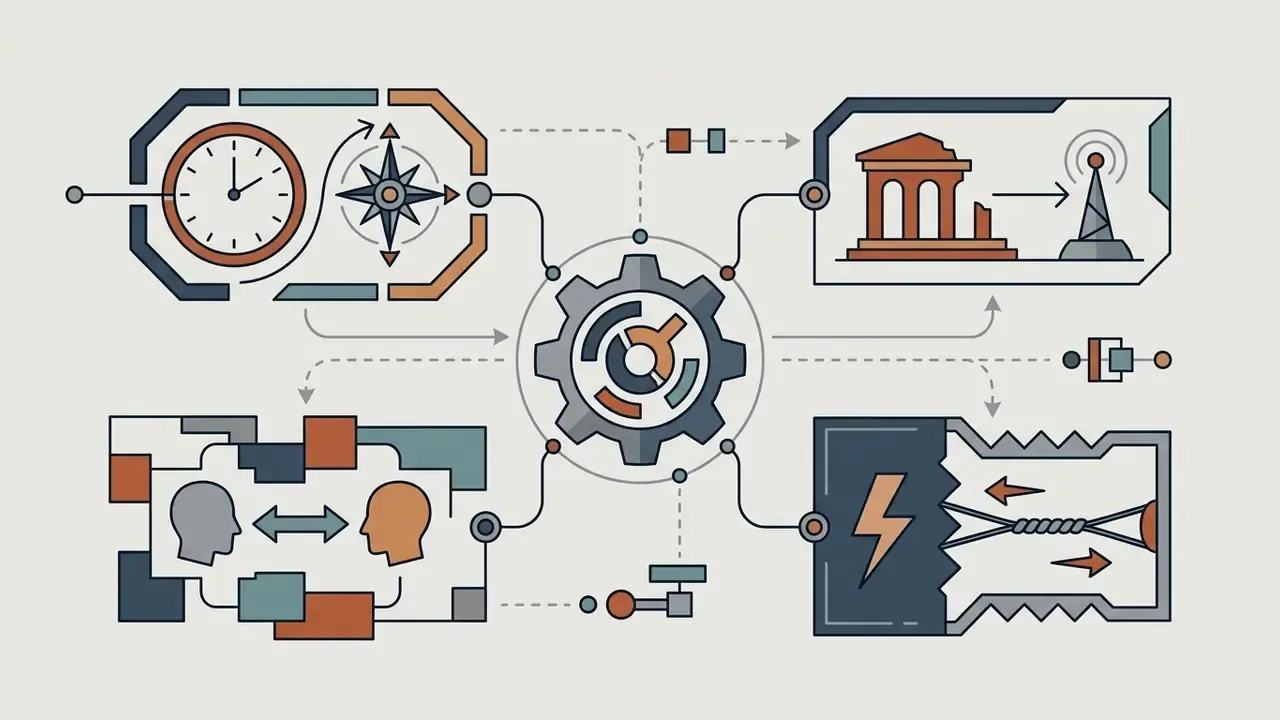
Advanced pipelines use structured inputs, such as setting parameters (p₁) and character action descriptions (p₂), to synthesize character-grounded narrative dialogue.
«A setting description (p₁) paired with a character action (p₂) yields dialogue grounded in a specific scene and consistent with character behavior.»
Frameworks like Action2Dialogue show that mapping scene-level constraints directly into the generation pipeline improves character grounding and situational plausibility. Adding a domain-specific knowledge graph lets a dialogue generator reference established lore and factual constraints without inventing contradictions. Teams building multimodal narratives often pair these dialogue layers with AI video generators so that scripted beats and rendered footage share one source of truth.
Text-Based AI Dialogue Generator vs Dialogue Voice Generator
There is a foundational split between text-centric generation and voice-centric synthesis. A text-based ai dialogue creator produces written transcripts, speaker turns, and screenplay formatting. A dialogue voice generator converts written text into multi-speaker spoken audio using neural Text-to-Speech models with distinct voice profiles and prosodic modulation.
«DeepDialogue contains 40,150 multi-turn dialogues across 41 domains with 20 emotions and synthesized speech, the first large open multimodal dialogue dataset preserving emotional context.»
| Dimension | Text-Based AI Dialogue Generator | Script-Based AI Dialogue Generator | Dialogue Voice Generator (TTS) |
|---|---|---|---|
| Primary Output | Plain text multi-turn utterances | Formatted screenplay or JSON scripts with stage directions | Multi-speaker audio files (.wav / .mp3) |
| Input Requirements | Text prompts, persona traits, turn context | Scene setting (p₁), action cues (p₂), character profiles | Structured text script, speaker-to-voice mappings, emotion tags |
| Core Function | Generates conversational content and turn logic | Enforces narrative pacing and structural layout | Synthesizes natural prosody, pitch, and vocal cadence |
| Primary Use Cases | Chatbots, fiction drafting, ideation | Screenwriting, game NPC menus, playwriting | Audiobooks, game voice-over, interactive voice agents |
| Latency Profile | Low (seconds per turn); batchable | Low to medium; scene-level batch generation | Medium to high; render time scales with audio duration |
| Security and Access Controls | Prompt-level PII masking; RBAC on prompt libraries | Version control on scripts; approval gates before export | Voice-clone consent records; RBAC on voice profiles |
| Retention Considerations | Prompt and response logs (text only) | Script revisions plus diff history | Audio artifacts require storage policy and deletion schedule |
| Audit Trail Needs | Prompt hash, model version, temperature, timestamp | Scene ID, reviewer sign-off, format validation log | Voice ID, emotion tag, render job ID, output checksum |
In short: text engines optimize conversational logic, while spoken-voice systems prioritize acoustics, speech rate, and emotional resonance across audio turns. Understanding that split saves architecture teams from buying the wrong layer. For deeper detail on audio pipelines, review our guide on the ai voice generator.
Who Needs an AI Dialogue Generator
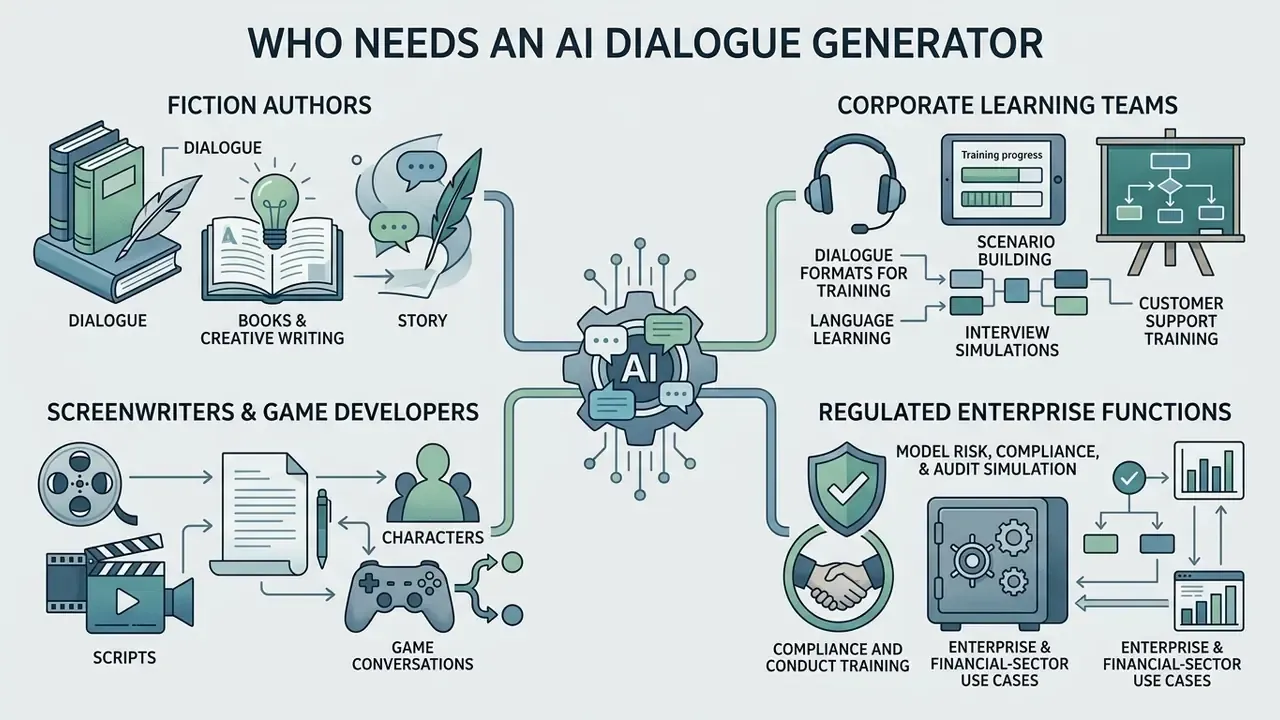
In two sentences: Four core segments use dialogue generation: fiction authors, screenwriters and game developers, corporate learning teams, and regulated enterprise functions such as compliance and model risk. Each optimizes for a different constraint, whether creative velocity, branching structure, scenario realism, or auditability.
An ai dialogue generator serves these groups by removing specific bottlenecks, from a stalled scene to the cost of staffing role-play facilitators at scale.
| User Segment | Primary Use Case | Key Problem Solved | Output Format |
|---|---|---|---|
| Literary fiction and prose | Character dialogue, subtext testing | Identical "voices," writer's block, stalled scenes | Standard prose text |
| Screenwriters and game dev | Branching dialogue, NPC lines | Lore context loss, character drift across turns | Fountain markup, JSON |
| Corporate learning (ICF-style) | Coaching simulations, objection handling | High cost of hiring actors and role-play facilitators | Dialogue scripts, TTS audio |
| Language education | CEFR-graded conversation drills | Scarcity of level-matched practice material | Text plus voice pairs |
| Regulated enterprise (finance, risk) | Audit interviews, escalation drills, fraud role-play | Non-reproducible manual scenarios; weak audit evidence | Logged scripts with version IDs |
Dialogue, Books, and Creative Writing
Scripts, Characters, and Game Conversations
Screenwriters and game narrative designers rely on an ai character dialogue generator to build branching dialogues and multi-speaker script scenes. In game development, static dialogue trees are increasingly supplemented by runtime generation anchored to knowledge graphs and local memory models.
«Embedding a game knowledge graph into GPT-4 prompts yields contextually appropriate NPC lines consistent with world lore and character personality.»
Earlier baseline systems generated dialogue menu items at runtime from semantic representations rather than authoring them fully at development time. Contemporary LLM-based prototypes in Unreal Engine 5 go further, producing free-form NPC lines in real time while retrieving prior interaction memory before each response. Developers export those outputs straight into JSON or Fountain markup, then synchronize the lines with character rigs and cutscenes using an animation maker. Creators who also need visual assets for character concepts can browse the hub for expanded asset workflows.
Dialogue Formats for Training and Content Tasks
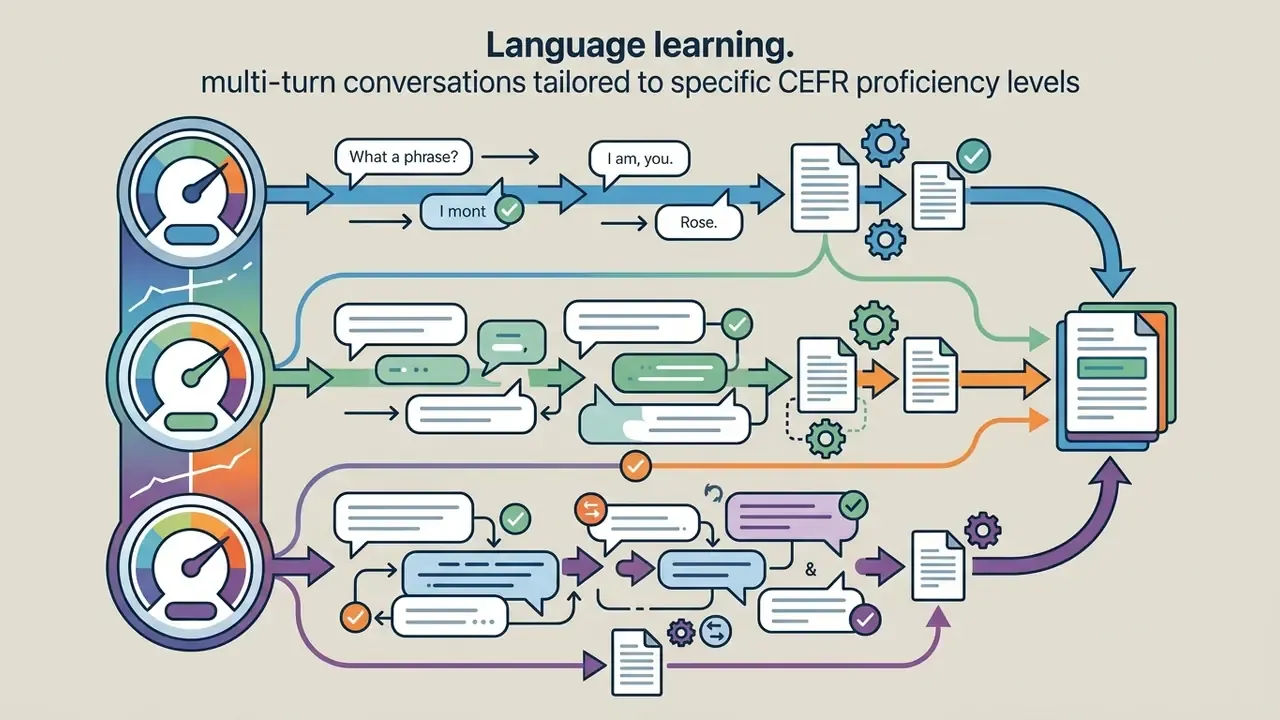
Educational institutions and corporate learning departments use an icf ai dialogue generator pattern to build role-play simulations, language exercises, and interview practice. By simulating a difficult client interaction or a compliance edge case, an organization gives trainees a scalable, low-risk rehearsal space.
Learning teams that publish these scripts as video modules often start with free AI video generators before committing to paid rendering pipelines.
For broader media production, teams frequently combine generated dialogue scripts with text-to-video AI and narrower tools such as a promo video maker or a profile picture generator to finish polished educational assets.
Enterprise and Financial-Sector Use Cases: Model Risk, Compliance, and Audit Simulation
Regulated institutions apply dialogue generation to a narrower, higher-scrutiny set of tasks. Creative variety is not the goal here. Reproducibility is: the same scenario must be re-runnable, logged, and defensible to a second-line reviewer.
- Compliance and conduct training mis-selling, suitability, and disclosure conversations, so that first-line staff rehearse escalation paths before facing a customer.
- Fraud and AML role-play scripted social-engineering attempts that test whether frontline representatives follow verification protocol under pressure.
- Audit and examination rehearsal simulated risk-committee questioning or examiner interviews, letting model owners practice defending assumptions, limitations, and monitoring evidence.
- Complaint-handling validation adversarial customer complaints used to stress-test the tone, accuracy, and escalation logic of a customer-facing assistant before deployment.
- Communications stress-testing internal and external messaging variants for adverse scenarios, reviewed against disclosure and fair-treatment standards.
Which Parameters You Can Set When Generating Dialogue
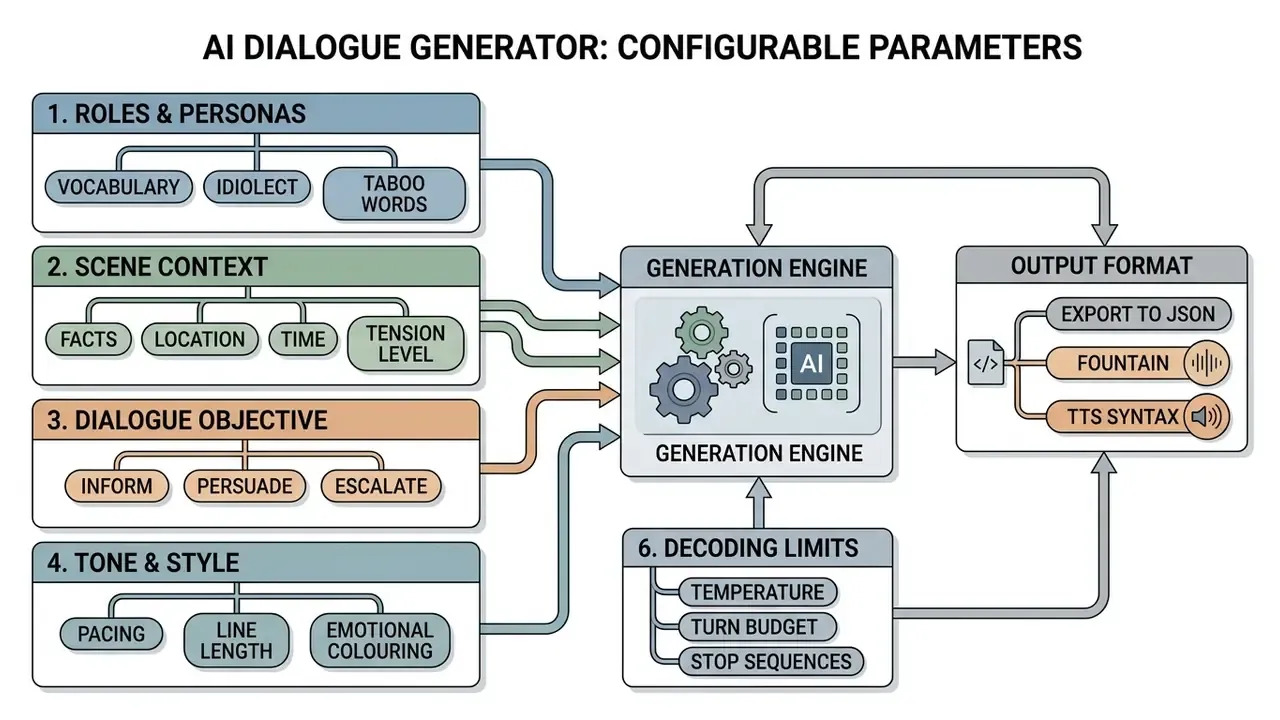
In two sentences: Six parameter families control dialogue output: personas, context, objective, tone, format, and language plus decoding settings. Unconditioned prompts default to generic, over-polite, repetitive exchanges, so fill every field explicitly.
Getting quality from an ai dialogue maker or ai generator dialogue system means configuring the conditioning variables on purpose.
Characters, Roles, and Distinct Voices
To keep characters from sounding identical, define individual verbal markers, vocabulary limits, and background details. Advanced prompting architectures separate identity from tone, specifying speech cadence, preferred idioms, and taboo words per speaker. That pattern appears in vendor prompting guidance (Vapi Voice AI Prompting Guide, 2026, vendor documentation), which asks for an "Identity and Personality" block encoding name, role, tone, and communication style. Voice-design templates from TTS vendors extend the same structure into persona, emotion, timbre, pacing, and delivery.
Empirical evaluation of this technique is now benchmarked directly:
«CharacterBench contains 22,859 annotated samples across 3,956 characters in 25 categories, the largest bilingual benchmark for character voice consistency.»
Conversation Objective, Style, and Tone of Lines
Every scene needs a dialogue objective, the specific outcome each character is chasing. Dialogue acts can be standardized using the multi-dimensional model in ISO 24617-2 (Semantic annotation framework, Part 2: Dialogue acts), which separates communicative function (inform, persuade, escalate, commit) from an open-class emotion and attitude dimension layered over the same utterance. Updated: the standard defines no fixed set of "dramatic" or "comedic" labels. Tone and register stay application-specific, so keep your own controlled vocabulary on top of the ISO act taxonomy.
Practical tone control is easiest with a preset library. The matrix below maps common presets to the prompt directive that produces them.
| Tone Category | Tonal Presets | Example Prompt Directive |
|---|---|---|
| Dramatic / conflict | Serious, Tense, Sarcastic, Defensive, Grumpy, Tough, Firm | "Use short, clipped sentences. Speaker A never answers the question directly." |
| Comedic / light | Witty, Sassy, Playful, Cheeky, Upbeat, Cheerful, Cool | "Add irony, wordplay, and one non-verbal reaction in brackets per turn." |
| Emotional / romantic | Flirty, Romantic, Sympathetic, Nervously cute, Mysterious | "Lengthen pauses with ellipses. Carry meaning through subtext and implication." |
| Business / instructional | Formal, Professional, Informative, Educational, Direct, Matter-of-fact | "Use domain jargon precisely. Prohibit emotional interjections and filler." |
| Motivational / persuasive | Motivational, Inspirational, Confident, Helpful, Friendly | "Each turn must end with a concrete next action, never an abstraction." |
| Stylized / literary | Flowery, Sophisticated, Casual, Cute | "Vary sentence length deliberately; one extended metaphor maximum per scene." |
Formatting, Length, and Dialogue Language
Define the output structure before you fire the generation call. That means turn budgets, line character limits, target languages, and export syntax. Vendor documentation is consistent on decoding: a temperature near 0 suits factual and compliance-critical dialogue, stop sequences create hard termination points, and long-form context belongs near the top of the prompt.
| Parameter | User Specification Example | Operational Impact on Dialogue |
|---|---|---|
| Characters and Personas | "Speaker A: conservative bank auditor. Speaker B: aggressive fintech founder." | Controls vocabulary, syntax complexity, deference markers, and domain jargon. High impact on wording and identity. |
| Context and Setting | "Q3 Risk Committee meeting following an unauthorized model deployment." | Grounds facts, sets environmental constraints, and dictates situational tension. High impact on relevance and coherence. |
| Dialogue Objective | "Speaker A must force Speaker B to sign a model shutdown order." | Drives scene progression, turn-taking strategy, and negotiation logic. High impact on outcome, low on wording. |
| Style and Tone | "Formal, tense, emotionally restrained; maximum 2 sentences per turn." | Regulates emotional cadence, sentence length, and removes filler. High impact on surface style. |
| Output Format | "Fountain screenplay format with explicit stage directions in brackets." | Guarantees parser compatibility with script editors or game engines. High impact on layout, low on semantics. |
| Language and Constraints | "US English; zero corporate buzzwords; strict temperature = 0.2." | Removes regional variance, holds factual consistency, prevents invented slang. High impact on determinism. |
| Turn Budget and Stop Rules | "Exactly 8 turns; stop sequence: END SCENE." | Prevents runaway generation, enforces pacing, keeps runs comparable. |
Multilingual work deserves one extra note. Ask for the target locale, not just the language: "US English" and "UK English" produce different idiom and punctuation habits, and a Spanish scene written for Madrid will read oddly in Bogotá.
How to Use an AI Dialogue Generator: From Scenario to Finished Text
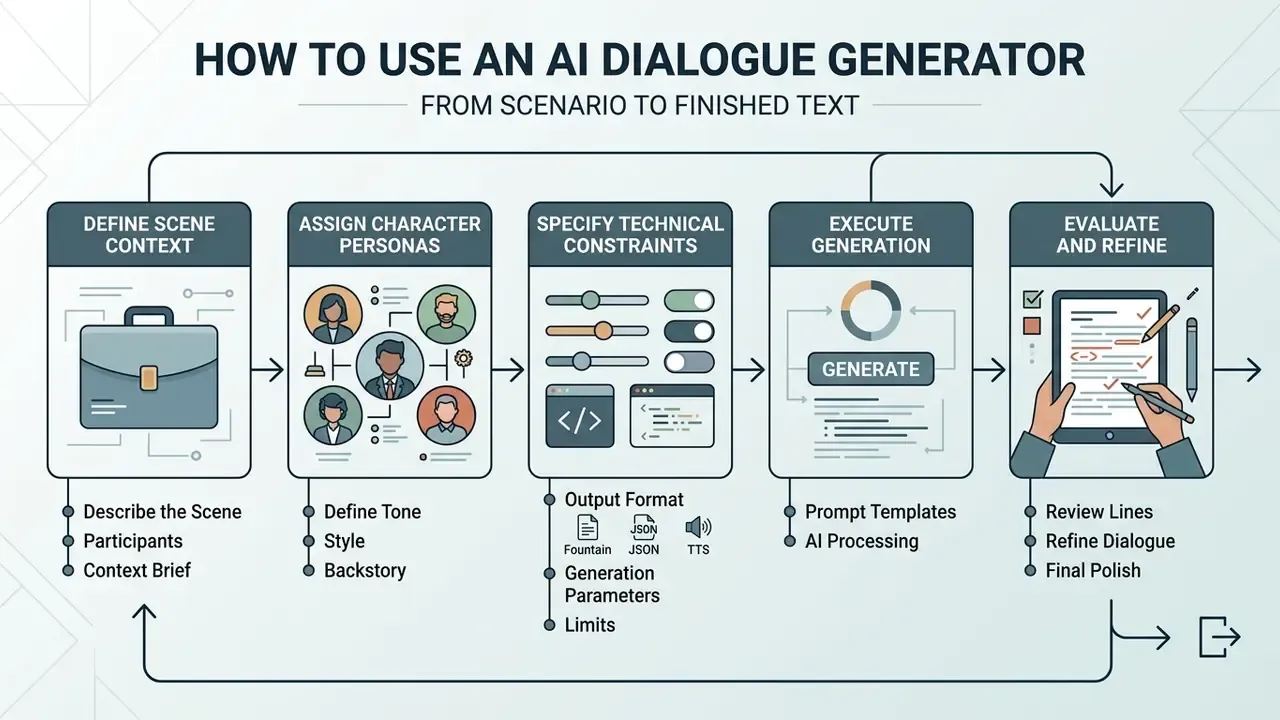
In two sentences: A repeatable workflow moves from context brief to persona assignment, technical constraints, generation, refinement, and export. Skip the brief and the model falls back on average training distributions, the main cause of bland output.
A structured process is what makes generated dialogue publishable rather than merely interesting.
Describe the Scene, Participants, and Context
The opening prompt must fix the physical setting, the history between participants, and the immediate catalyst. Leave that out and the model guesses. Research-grade scene briefs keep three fields distinct and immutable inside a scene: location, time, and environment, with relationship history and the opening action declared separately. One sentence per field is usually enough.
Choose Style, Tone, and Output Format
Pick the register, anywhere from formal executive debate to colloquial street talk, and name the export format (plain text, Fountain markup, or structured JSON). Conventions differ by medium. Screenplay drafts use 12-point Courier with INT./EXT. plus DAY/NIGHT scene headings and no scene numbers in reader drafts. Prose manuscripts use double spacing with one-inch margins. Game scenes are written against a short outline that states player goals and key features explicitly.
Generate, Review, and Refine Lines
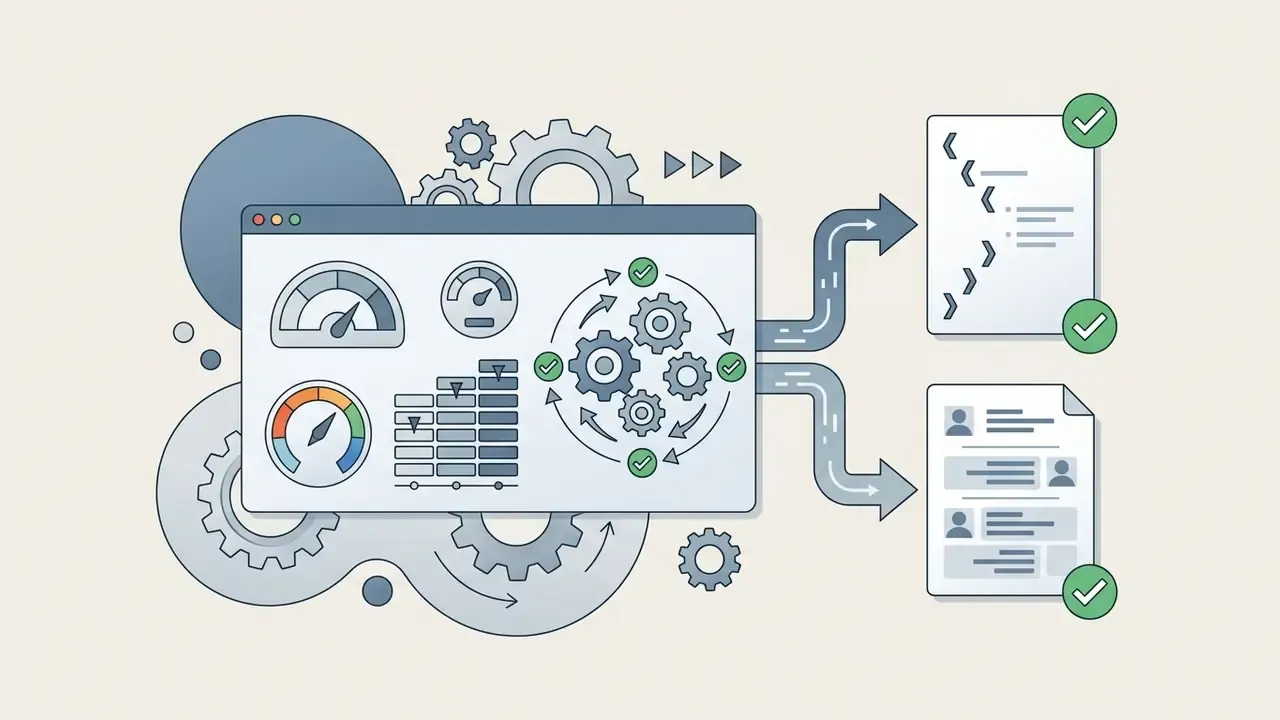
Run the pass, check turn balance, then apply refinement prompts to fix pacing or strip phrasing that no longer sounds like the character.
Teams managing multi-tier software options across creative departments can review our detailed pricing guide to align token budgets with operational needs.

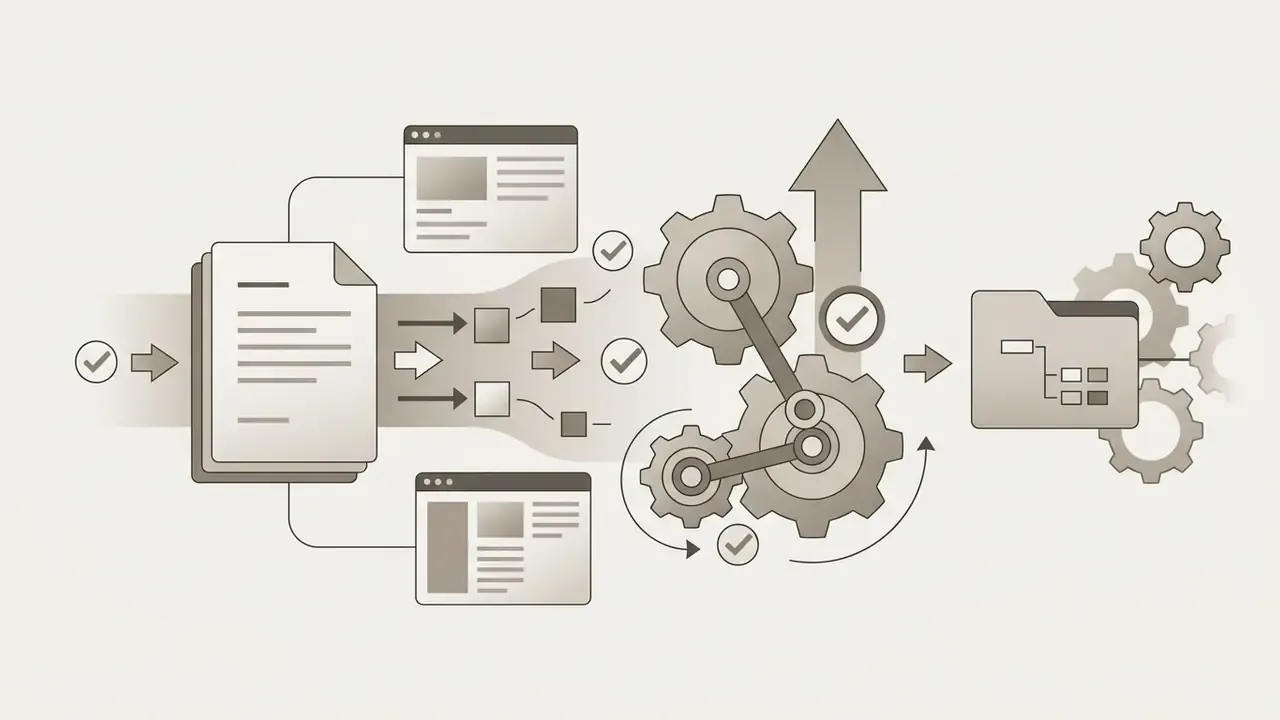
Structured Output Examples: Fountain, JSON, and TTS Markup
The same scene can be exported in three machine-readable shapes. Copy whichever matches your downstream pipeline.
1. Screenplay format (Fountain markup):
INT. COFFEE SHOP - NIGHT
MARCUS
(leaning forward, hushed)
The audit is clean. But the data pipelines aren't.
SARAH
Define 'not clean'. Are we talking compliance or criminal?
MARCUS
I'm talking about a lineage gap nobody signed off on.
2. JSON format (for game engines and NPC systems):
{
  "scene_id": "cafe_confrontation_01",
  "turns": [
    {
      "speaker": "Marcus",
      "emotion": "anxious",
      "line": "The audit is clean. But the data pipelines aren't.",
      "next_node": "node_02"
    },
    {
      "speaker": "Sarah",
      "emotion": "skeptical",
      "line": "Define 'not clean'. Are we talking compliance or criminal?",
      "next_node": "node_03"
    }
  ]
}
3. Markup for a dialogue voice generator (TTS):
(voice: en-US-Marcus-Neural, emotion: tense)
The audit is clean. But the data pipelines aren't.
(voice: en-US-Sarah-Neural, emotion: skeptical)
Define 'not clean'. Are we talking compliance or criminal?
Two mechanical rules matter for multi-speaker TTS. Declare the voice above the text it should read, and leave at least one blank line between the directive and the spoken line. Speaker names in the script must match the names in the voice configuration exactly, or the renderer quietly falls back to a default voice. That mismatch is the single most common support ticket in audio pipelines.
Universal Master Prompt Template
Copy and fill this template for predictable, comparable results across runs:
[ROLE & CONTEXT]
Act as an expert dialogue writer. Create a multi-turn dialogue between Speaker A and Speaker B.
Scene Context: [scene description, location, time, and the immediate conflict]
Relationship History: [how A and B know each other; unresolved tension]
[CHARACTER A PERSONA]
Name: [name] | Role: [role] | Voice/Tone: [e.g. Sarcastic] | Constraints: [banned words, register limits]
[CHARACTER B PERSONA]
Name: [name] | Role: [role] | Voice/Tone: [e.g. Formal] | Constraints: [banned words, register limits]
[TECHNICAL REQUIREMENTS]
- Dialogue Objective: [what A must achieve; what B must resist]
- Max turns: [number] | Max sentences per turn: [number]
- Format: [Plain text / Fountain / JSON / TTS markup]
- Temperature: [0.2 for factual, 0.7-0.9 for creative]
- Stop sequence: END SCENE
- Subtext Instruction: Do not state intent explicitly. Show emotion through subtext,
  deflection, understatement, or non-verbal beats.
Enterprise Validation Path: From Pilot to Controlled Production
Creative teams can ship after an editorial pass. Regulated teams cannot. The sequence below adds the control steps a second-line reviewer will ask about anyway.
- Scope and intended use statement.Document what the dialogue generator will and will not be used for, and who owns the output.
- Data classification check.Confirm that no confidential, personal (PII or NPI), or classified information enters the prompt, and apply masking or tokenization where inputs are unavoidable.
- Guardrail validation.Test refusal behavior, prompt-injection resistance, and off-topic drift with a fixed adversarial test set.
- Red-teaming pass.Attempt to elicit non-compliant advice, fabricated policy references, or persona breakage. Log every successful bypass.
- Reproducibility test.Re-run the same prompt with fixed temperature and seed where available. Record model version, prompt hash, and settings.
- Human review and effective challenge.A subject-matter reviewer signs off on factual accuracy, tone, and regulatory phrasing.
- Risk committee approval and monitoring plan.Define ongoing sampling, drift checks, incident escalation, and a retirement trigger.
Organizations sizing the cost of this pipeline can estimate per-token generation cost against human editorial overhead with our internal calculators.
Measuring Risk-Adjusted Value
Here is the part most business cases skip: control cost. A dialogue generator that halves drafting time but adds two review cycles has not saved anything.
Track four numbers over a fixed pilot window, ideally one quarter. First, drafting hours per finished scene, before and after. Second, rework rate, meaning the share of generated turns rewritten by a human. Third, control overhead, covering review time, logging, and validation effort. Fourth, residual risk events such as policy breaches, factual errors reaching publication, or confidential data pasted into an unapproved tool. Net value is the first number minus the third, discounted by the fourth.
Most institutions find the honest answer sits between "clear win" and "wash," depending on how heavy the review layer is. That uncertainty is worth stating out loud in the business case rather than hiding it inside an optimistic time-saving figure.
How to Make AI Dialogue Sound Natural and Preserve Character Voices
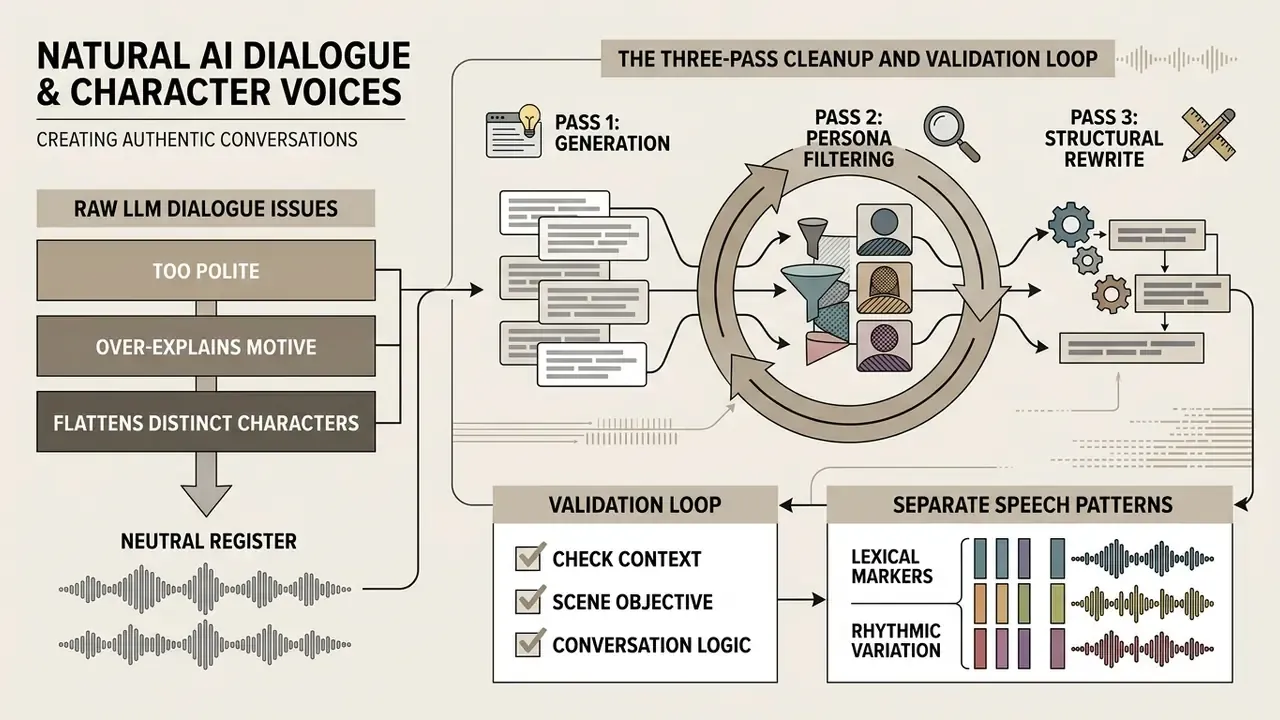
In two sentences: Raw LLM dialogue is too polite, over-explains motive, and flattens distinct characters into one neutral register. A three-pass loop plus explicit differentiation layers restores subtext and identity.
Beating those default behaviors takes engineering controls, not wishful prompting. Peer-reviewed pipelines converge on a generate, delete, rewrite pattern paired with a naturalness module and a consistency check. Work from 2025 adds preference-based alignment and post-persona refinement across sessions.
The Three-Pass Cleanup and Validation Loop
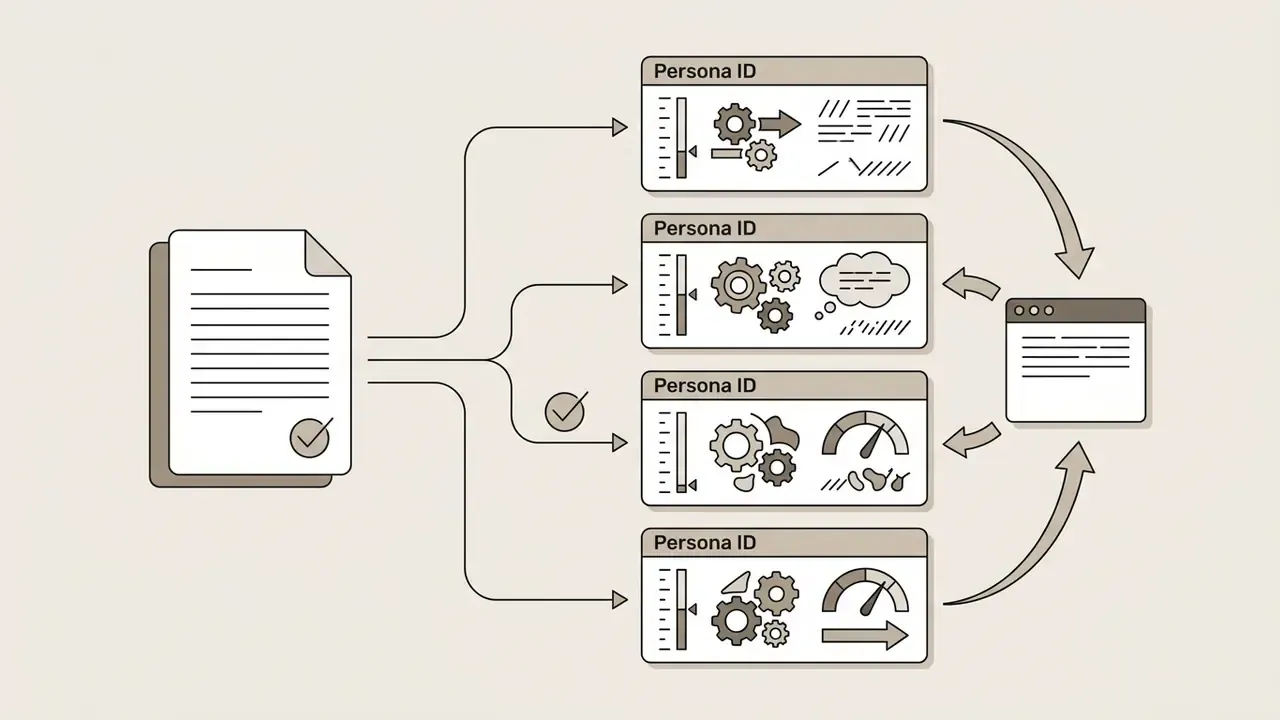
- Pass 1, generation.Produce candidate turns under the declared context constraints, personas, and turn budget. Do not edit yet. Generate two or three variants for comparison.
- Pass 2, persona filtering.Check each line against its speaker profile: lexical markers, rhythm, register, taboo words. Delete or flag any turn that could plausibly belong to another character. That is the classic symptom of voice drift.
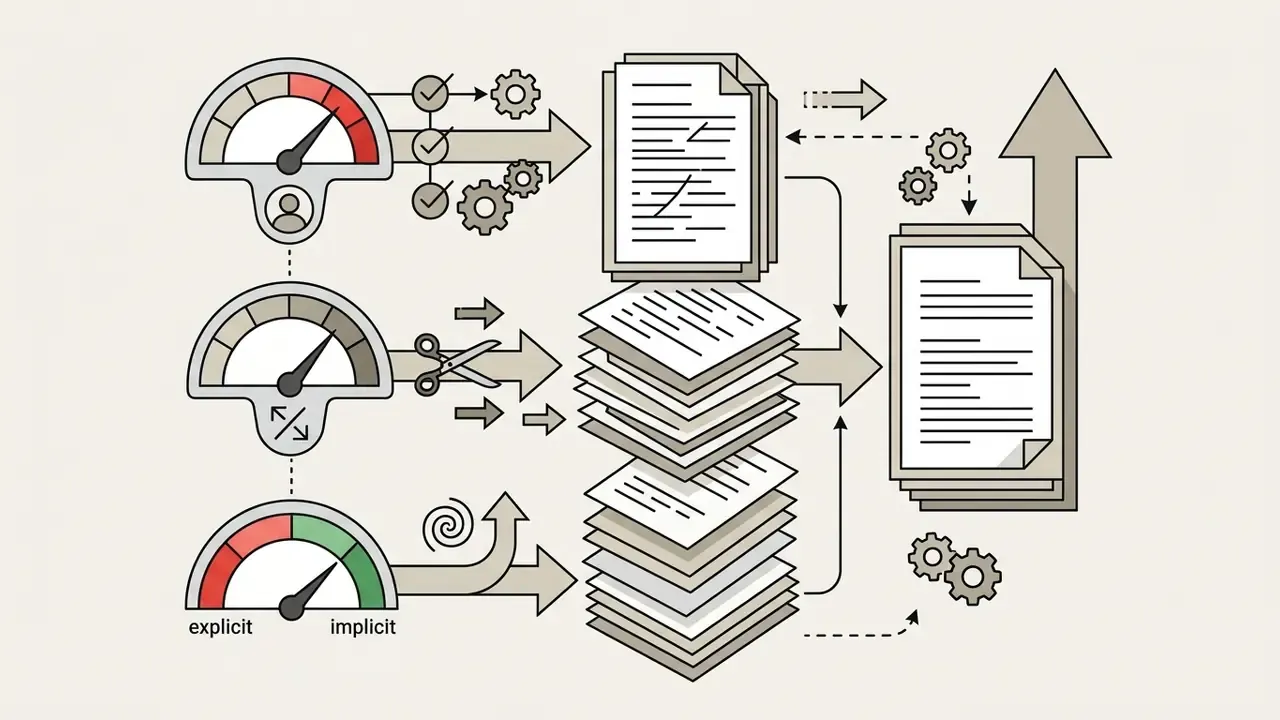
- Pass 3, structural rewrite.Strip polite boilerplate ("That's a great question," "I completely understand"), compress overlong turns to the declared sentence budget, and convert stated motive into subtext. Cap refinement at a fixed number of iterations, or you will smooth the dialogue back into blandness.
Voice-dialogue guidance suggests concrete brevity targets to keep utterance length balanced: roughly 1 to 2 sentences per conversational reply, and 2 to 3 sentences for explanatory turns.
Check Context, Scene Objective, and Conversation Logic
Real conversation is rarely linear. Characters speak with subtext, saying one thing and meaning another, and they use indirect speech acts: teasing, wit, mockery, deceit, understatement, exaggeration. Often the non-verbal beat contradicts the spoken line outright.
«Systems produce grammatically correct turns but fail to reproduce the emergent organisation, indexicality and recipient-design of live talk.»
Separate the Speech Patterns of Different Characters
To stop characters converging into one neutral voice, use a three-layer differentiation framework.
- Lexical markers assign unique filler words, discourse markers, regional idioms, and sentence starters per speaker. Dialogue-emotion studies treat filled pauses, fillers, stutters, laughter, and breath as separately codable features, which makes them useful proxies for idiolect.
- Rhythmic variation contrast short, clipped declarations for assertive characters against long compound sentences for analytical ones. In spoken output, pitch range, articulation rate, and pause placement carry the same load.
- Emotional reaction tags define unique triggers. Speaker A turns overly formal when challenged; Speaker B deflects criticism with humor. Annotate emotion shifts at turn level rather than pooling them across the scene.
«Persona-aware graph constraints preserve character voice across multi-turn interactions and reduce persona conflict.»
For creators producing multimedia packages, adding customized audio or visual identifiers with a producer tag generator or a qr code generator keeps brand consistency across asset sets.
Dialogue Self-Audit Checklist
Run this pass before publishing, shipping, or recording. Any "no" sends the scene back to Pass 3.
Checklist0 / 9
Governance, Auditability, and Shadow AI Controls
Free AI Dialogue Generator, No Sign Up, and Commercial Use Terms
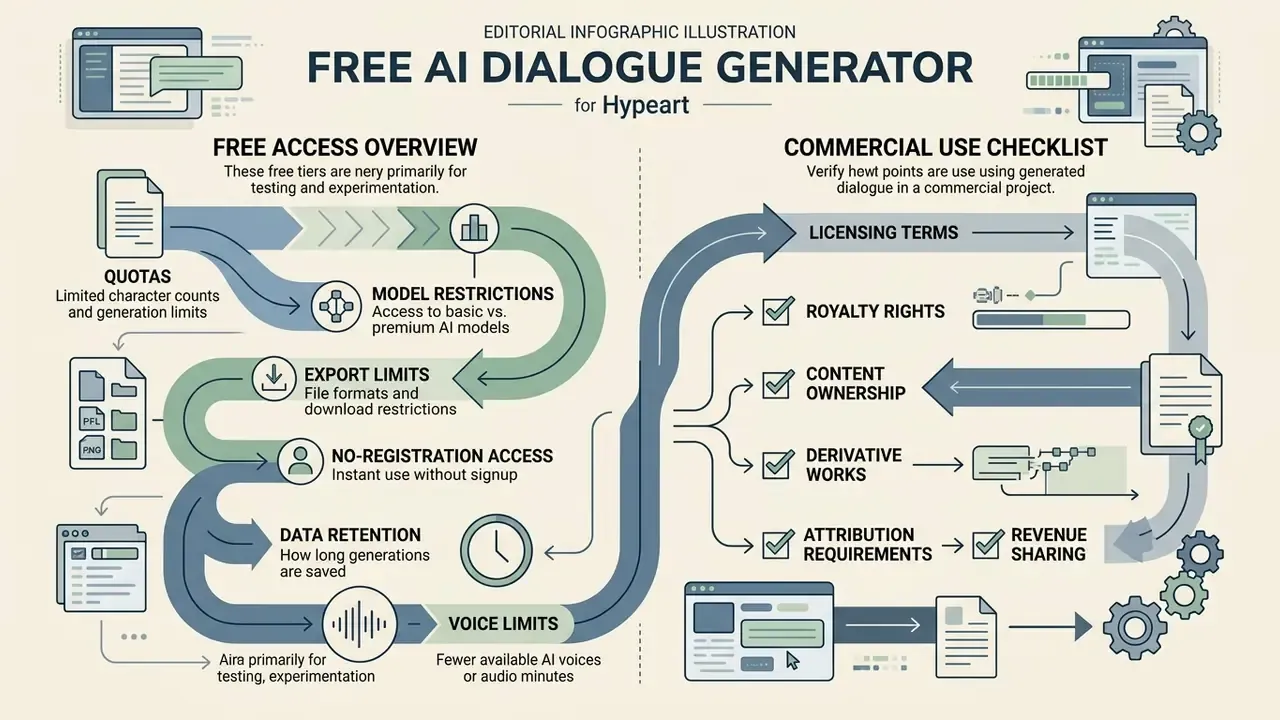
In two sentences: Free tiers are built for testing, not production, and they vary widely in quotas, model access, export rights, and data retention. Commercial rights depend entirely on the vendor's terms plus the human-authorship rules of copyright law.
Anyone searching for an ai dialogue generator free, a free ai dialogue generator, or an ai dialogue generator no sign up option should read the functional limits and the licensing clauses before wiring the tool into a commercial workflow.
What Free Access Usually Includes
Free and free ai dialogue tiers generally provide basic access designed for individual testing and low-volume drafting.
- Usage quotas daily turn limits, rolling per-five-hour caps on premium models, or monthly token allowances. Some tools advertise "unlimited" text chat while metering uploads, images, and voice separately.
- Model restrictions access to base or default models rather than frontier multi-modal engines. Once a quota is hit, advanced model access pauses until reset.
- Export limits plain text copy-paste only, with structured script exports (Fountain, JSON) behind a paywall. Bulk export is rarely a guaranteed free-tier right.
- No-registration access some vendors genuinely allow generation without sign-up, typically a small fixed number of variants per day, expanding after registration.
- Data retention input prompts and generated outputs may be logged to train vendor models. For enterprise users, that is the single most important clause on the page.
- Voice limits free TTS accounts usually cap audio length and withhold commercial usage rights, reserving them for paid plans.
Readers benchmarking free-tier trade-offs in adjacent categories can compare our analysis of free AI generators available without sign-up.
What to Check Before Using Dialogue in a Commercial Project
Before shipping generated dialogue in a commercial game, a published book, or corporate media, run legal and technical due diligence.
«Where the traditional elements of authorship were produced by a machine, the work lacks human authorship and the Office will not register it.»
Limitations of AI Dialogue Generators in Sensitive Scenarios
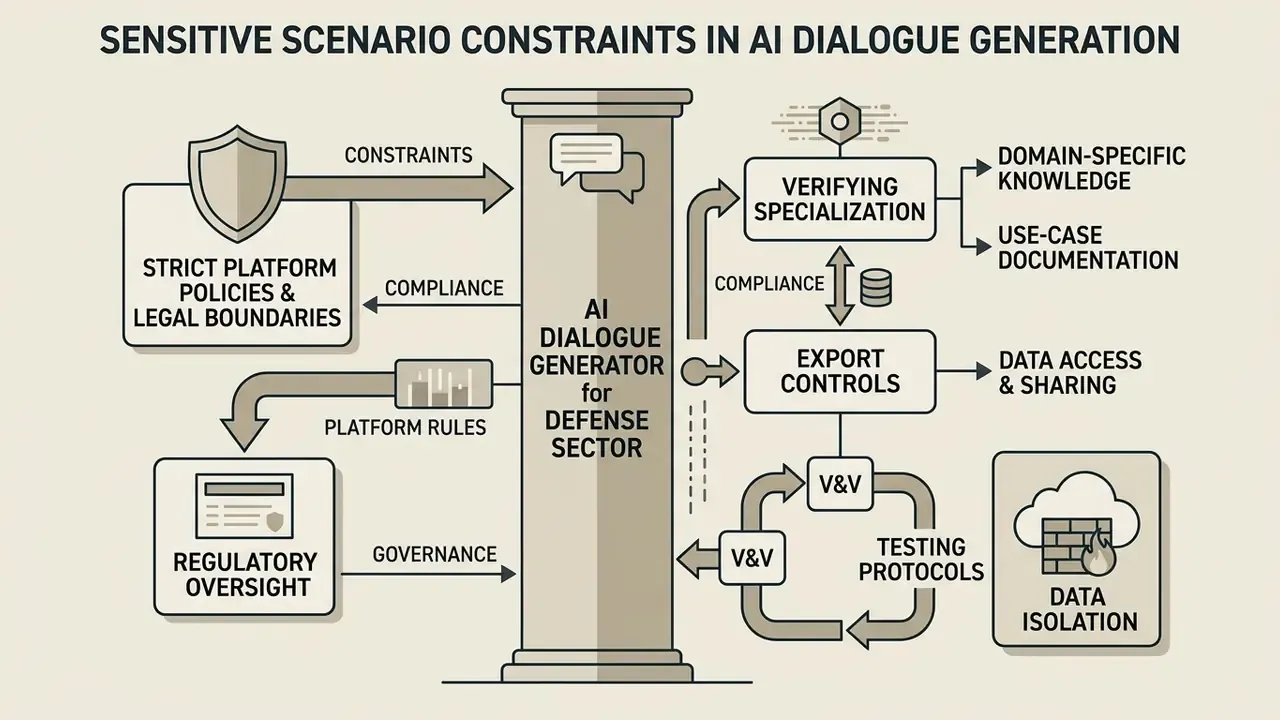
Some domains carry strict platform policies, legal boundaries, and regulatory oversight around automated dialogue generation.
AI Adult Dialogue Generator: Verifying Platform Rules
AI Dialogue Generator for Defense Sector DSJ: Verifying Specialization and Constraints
Disclaimer: general information only; it does not replace consultation with specialists in export control, military law, or information security.
The query ai dialogue generator for defense sector dsj points to high-security military simulations, tactical communication analysis, and synthetic threat role-play. Defense applications operate under rigorous frameworks.
Teams navigating enterprise compliance, governance frameworks, and data protection standards can see the overview of legal risk factors, or compare options for enterprise API deployments.
FAQ and Verification Summary
What is the primary difference between a text dialogue generator and a voice dialogue generator?
A text dialogue generator creates written transcripts, turn-taking logic, and script formatting. A dialogue voice generator uses neural Text-to-Speech models to synthesize multi-speaker spoken audio from those scripts. In practice they are two layers of one pipeline: generate the conversation, then render it.
How do I make multiple voices speak in one audio file?
Do not select a single global voice. Place a voice directive above each block of text, for example (voice: mandy), leave a blank line, then write the spoken line. Repeat the directive whenever the active speaker changes. A single file can hold as many voices as the platform allows.
Can AI-generated dialogue be copyrighted for commercial products?
In the United States, purely machine-generated dialogue cannot be copyrighted. Protection applies only to human-authored elements, substantial revisions, or creative selections and arrangements made by human writers (US Copyright Office, 2023). AI-generated material that is more than de minimis must be disclosed and excluded from the registration claim.
What parameters best prevent characters from sounding identical?
Distinct lexical markers (vocabulary, filler words), contrasting rhythmic sentence structures, and specific emotional reaction tags inside the system prompt. Benchmarks such as CharacterBench exist precisely to measure that consistency.
How many characters can a dialogue generator handle at once?
Multi-party research systems commonly define 2 to 5 participants with explicit personas, relationships, setting, topic, and an opening line, then sustain 4 to 10 rounds while keeping each speaker identity-consistent. Beyond roughly five active speakers, turn allocation and persona fidelity both degrade, so scenes are usually split.
What temperature should I use?
Use a low temperature, around 0 to 0.3, for factual, compliance-sensitive, or lore-constrained dialogue where determinism matters. Use 0.7 to 0.9 for exploratory creative variants, then re-run the best variant at low temperature to stabilize it.
Is it safe to use a free no-sign-up generator at work?
Only for non-confidential material. Free tiers frequently retain inputs for model training, and pasting client, employee, or non-public data into an unapproved tool is the textbook Shadow AI incident. Use an approved internal deployment for anything sensitive.
How do I keep an audit trail for generated dialogue?
Log the prompt hash, model name and version, decoding parameters, timestamp, requesting user, output ID, and human reviewer sign-off. Without the model version, the scene cannot be reproduced after a vendor upgrade.
Which export format should I choose?
Fountain for screenplays and readable scripts, JSON for game engines and NPC systems that need branching node references, plain text for prose manuscripts, and voice-tagged markup when the destination is a TTS renderer.
Can dialogue generators support multiple languages?
Yes. Text engines commonly cover major world languages, and leading voice platforms advertise coverage across 100 or more languages and regional accents. Validate idiom quality with a native reviewer, because grammatical correctness does not guarantee a natural register.
Pre-Publication Checklist
Checklist0 / 13
Appendix A: Source Corrections and Revision Log
For transparency, the following citation corrections were applied during editorial review.
| Earlier wording | Correction applied |
|---|---|
| "UltraChat Benchmark Report, 2024" | Attributed to Survey on Multi-Turn Conversational AI (2026), with corpus size (1.5M conversations) and the paired-LLM self-chat method stated. |
| "Action2Dialogue Study, 2024" | Retained as Action2Dialogue: Character-Centric Narrative Generation (2024), with the p₁/p₂ structured-prompt method described. |
| "Game Knowledge Graph Dialogue Study, 2024" | Retained as Dynamic Dialogue Generation for Video Games with Knowledge Graphs (2024) with method summary. |
| "EMNLP Dialogue Synthesis Findings, 2025" | Replaced with CharacterBench (2024), arXiv:2412.11912, including sample and character counts. |
| "Corbett, Dialogue as Action, 2025" (naturalness claim) | Corrected to Voss, "When ChatGPT can't Chat: The Quest for Naturalness" (2025). Corbett's Dialog as Action retained only for the subtext and indirection techniques it actually supports. |
| "Vapi Voice AI Prompting Standard, 2026" | Reclassified as vendor documentation (Vapi Voice AI Prompting Guide, 2026) rather than a standard, and supplemented with CharacterBench for empirical support. |
| "ISO 24617-2 Dialogue Act Standard" | Reformulated: ISO 24617-2 standardizes communicative functions and an open-class emotion/attitude dimension; tone labels such as "dramatic" or "comedic" are application-specific, not ISO-defined. |
| "38% reduction in voice drift; three weeks per book" | Flagged as self-reported internal editorial audit data, not independently verified. |
| Links to adult-content glossary pages | Removed as out of scope for this article; replaced with licensing and tool-comparison resources. |
Three [image placeholder] blocks | Replaced with a user-segmentation table, a parameter-hierarchy diagram, and a three-pass cleanup procedure. |
| Anchor-linked table of contents | Removed. Replaced with a pre-run decision block and a risk-adjusted value measurement section. |
Footer navigation and authority hub: For additional technical standards, architectural guides, and governance frameworks, please see the overview in our primary resource directory. To reach our technical team about model risk controls, please see the overview of platform services. To review enterprise license terms, please browse the hub.