Hale's audit framing sets the working boundary for this guide. Everything below treats AI as a controllable drafting layer inside a human-led pipeline, never as an autonomous author. With that boundary in place, start with a definition.
An ai movie script generator is an artificial intelligence application, usually powered by large language models (LLMs), built to help writers, filmmakers, and content teams draft narrative outlines, scene beats, character dialogue, and standard Hollywood screenplay layouts. Modern platforms run on natural language prompts, turning a high-level concept into a structured draft while respecting established dramaturgy rules.
Executive Summary
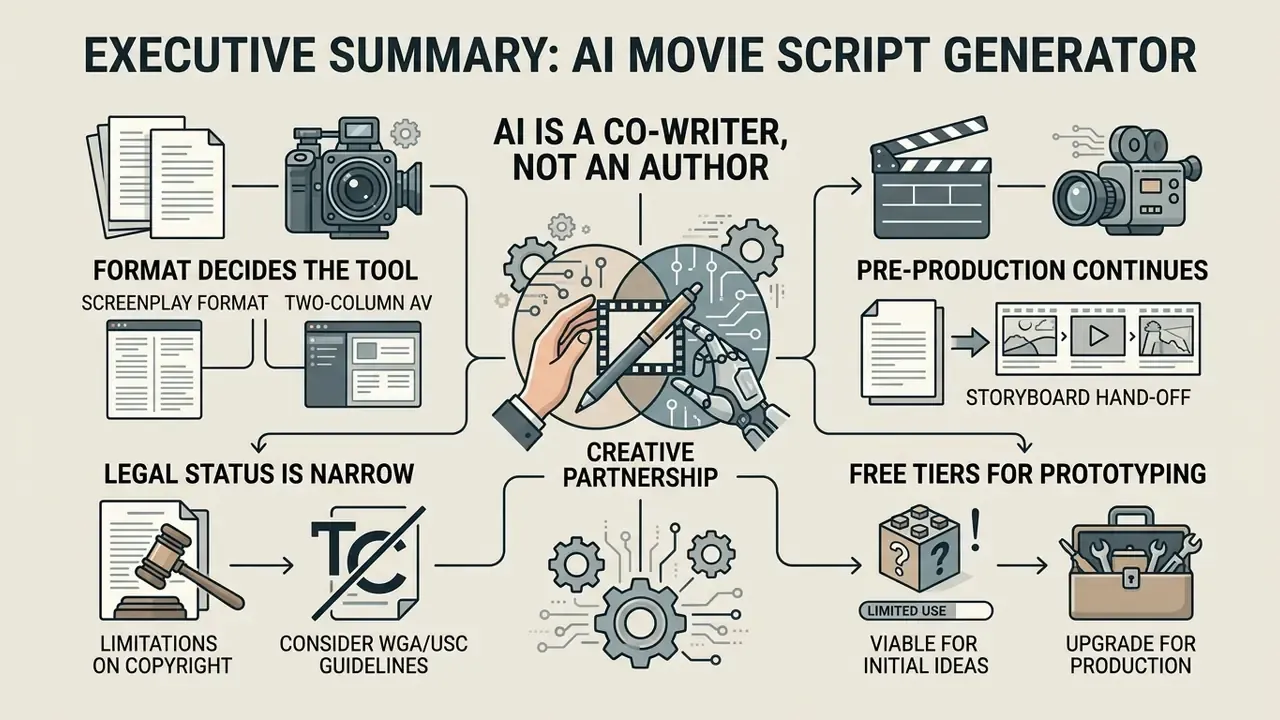
- AI is a co-writer, not an author. No current model reliably delivers a coherent, production-ready 90 to 120 page screenplay in one pass. Professional workflows run staged passes: logline → outline → beats → scenes → dialogue → polish.
- Format decides the tool. Feature films and TV episodes need single-column Hollywood formatting (12pt Courier, sluglines, parentheticals) with
.fdx/Fountain export. Commercials, explainers, and YouTube content need the two-column Audio/Visual (AV) script. - Pre-production continues past the page. Modern pipelines convert sluglines and action blocks straight into shot lists and storyboard panels, so script generation and visual planning live in one workflow.
- Legal status is narrow. Purely AI-generated text is not copyrightable in the U.S. without human authorship, and WGA-covered projects cannot credit AI as a writer or use its output as source material.
- Free tiers are viable for prototyping only. No-sign-up tools cap output length, block
.fdxexport, and carry data-retention risk for confidential story IP.
What Is an AI Movie Script Generator and When Should You Use It?
An ai script generator works as a collaborative co-writing engine. It speeds up the translation of a creative concept into a structured audiovisual script. By processing natural language prompts, an ai screenplay generator helps media teams and solo writers beat blank-page paralysis, build structured beat sheets, and hold formatting compliance without manual tabbing.
From Idea and Logline to a Finished Screenplay
An ai story script generator expands a raw one-line premise into a full screenplay outline: three-act structural turns, scene breakdowns, initial character cues. The transformation follows a systematic decomposition model, mapping narrative arcs from high-level theme down to individual beats before it generates formatted dialogue and stage directions.
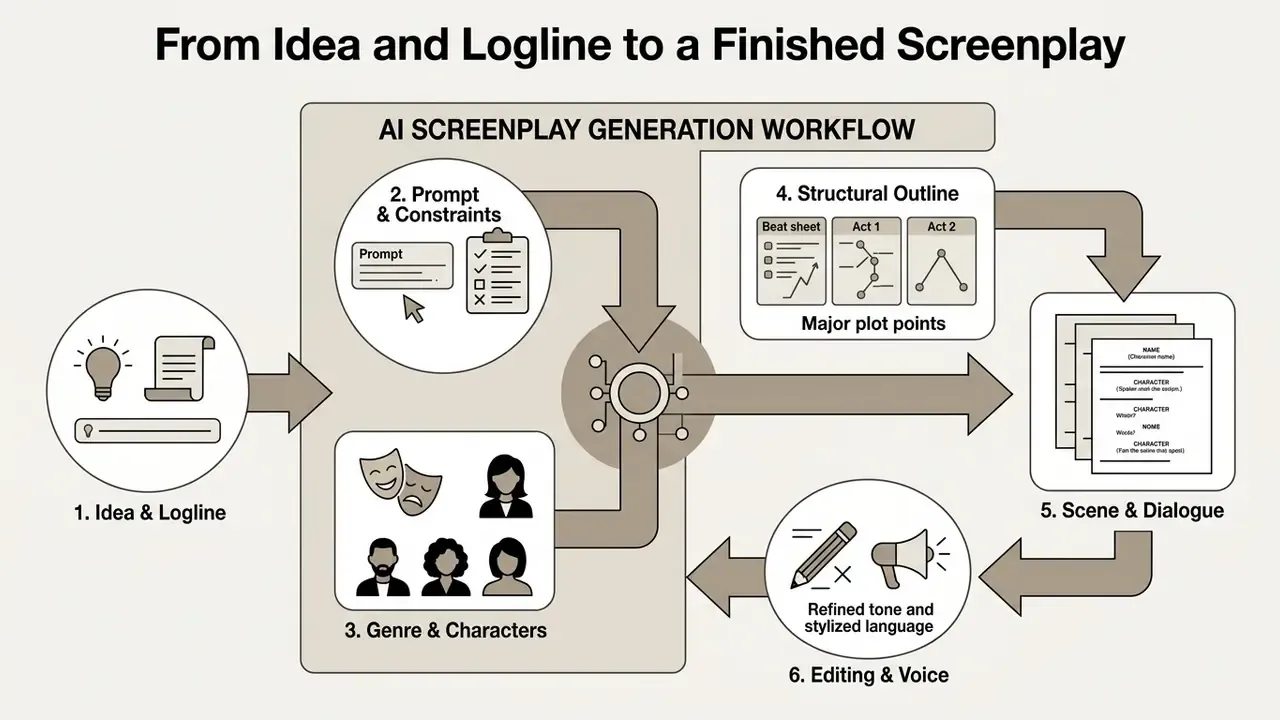
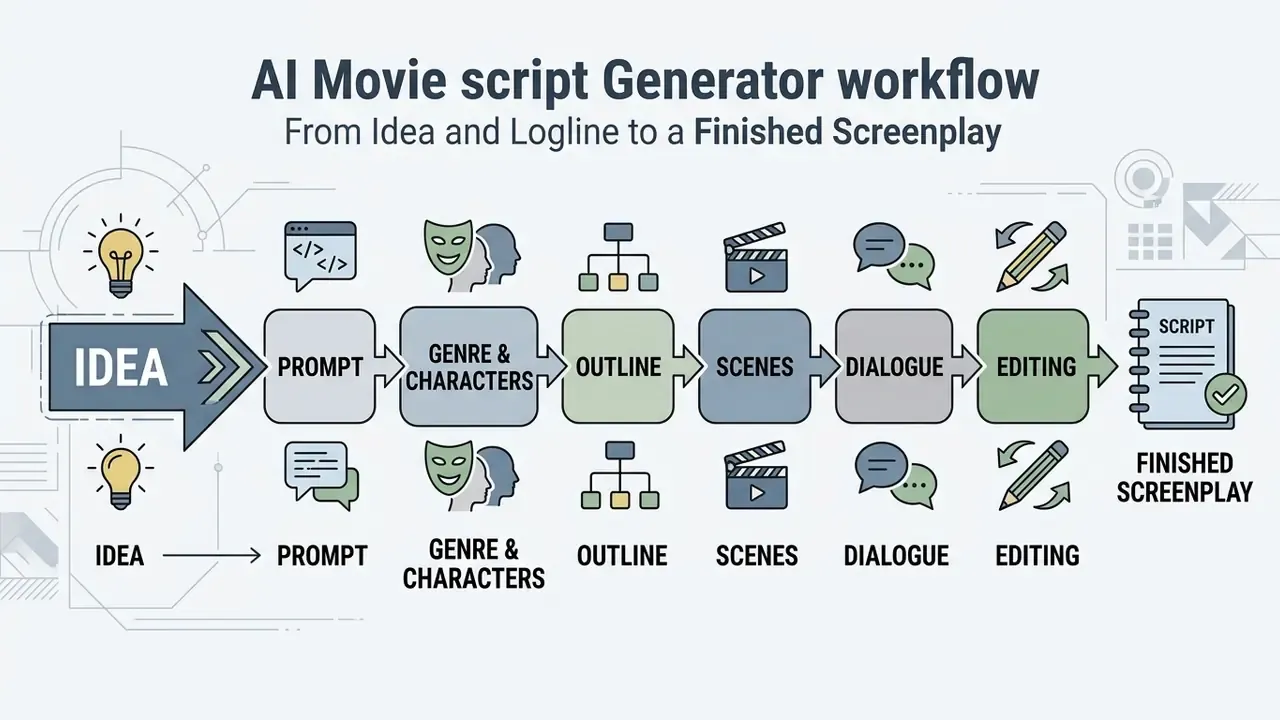
«Hierarchical co-writing, moving from title and characters to plot beats and dialogue, let industry professionals generate, edit, and regenerate story at every level.»
Benchmark work presented at 2026 workshops on interactive story generation, using a 50,000-turn multi-turn benchmark, confirms the direction of travel: the field now optimizes for iterative human-AI collaboration rather than one-shot script output.
When planning long-form video development, production leads often align finished script beats with post-production requirements by reviewing implementation details in our Google Veo video generation API guide, which covers video synthesis costs and generation limits before a single frame is shot. Developers who want the wider surface can open the hub and work outward from there.
Film, Drama, Series Episode and Video: What Scripts You Can Create
Modern movie script ai generator systems handle diverse audiovisual formats: feature-length films, episodic television drama, web series, short-form digital marketing content. Each script type carries its own constraints on page length, structural pacing, scene density, and narrative scope.
For a full feature, an ai film script generator typically structures content across 90 to 120 pages, following the industry rule where one formatted page equals roughly one minute of screen time. Features lean hard on three-act structure with major turning points landing in predictable page ranges: Plot Point 1 around page 25 to 30, Midpoint around page 55 to 60.
An ai drama script generator or ai tv script generator works differently. It focuses on episodic continuity, commercial act breaks, and multi-threaded character arcs. An ai episode script generator built for a 60-minute television drama has to handle cold opens, A/B/C subplots, and scene cliffhangers tuned to broadcast or streaming retention models. An ai tv show script generator keeps recurring character voices stable across episodes while holding thematic consistency. Broadcast style guides, including the BBC's drama formatting guidance, also cap action paragraphs at roughly four or five lines and treat each block as a significant beat. That constraint is worth writing directly into your prompt.
For digital media producers, short-form scripts (YouTube Shorts, TikToks, promo clips) compress narrative into a 30 to 60 second micro-arc. These scripts prioritize an immediate visual hook in the first three seconds, tight value delivery, and an explicit call-to-action. A typical 30-second timing map runs 0–3s hook, 3–7s promise, 7–25s value, 25–30s CTA. Teams weighing production software can also read our breakdown of free AI video generators to match scripting output against rendering limits, or compare tool categories side by side.
Commercial & Video AV Scripts: Two-Column Format
For commercials, explainer videos, corporate training, and social content, professionals use the industry-standard Two-Column Audio/Visual (AV) Script. Unlike single-column screenplay layout, an AV script splits visual cues from audio elements. That lets production teams plan shots alongside narration, estimate runtime from word count (roughly 130 words per minute), and hand a reviewable document to non-filmmakers such as clients or compliance reviewers.
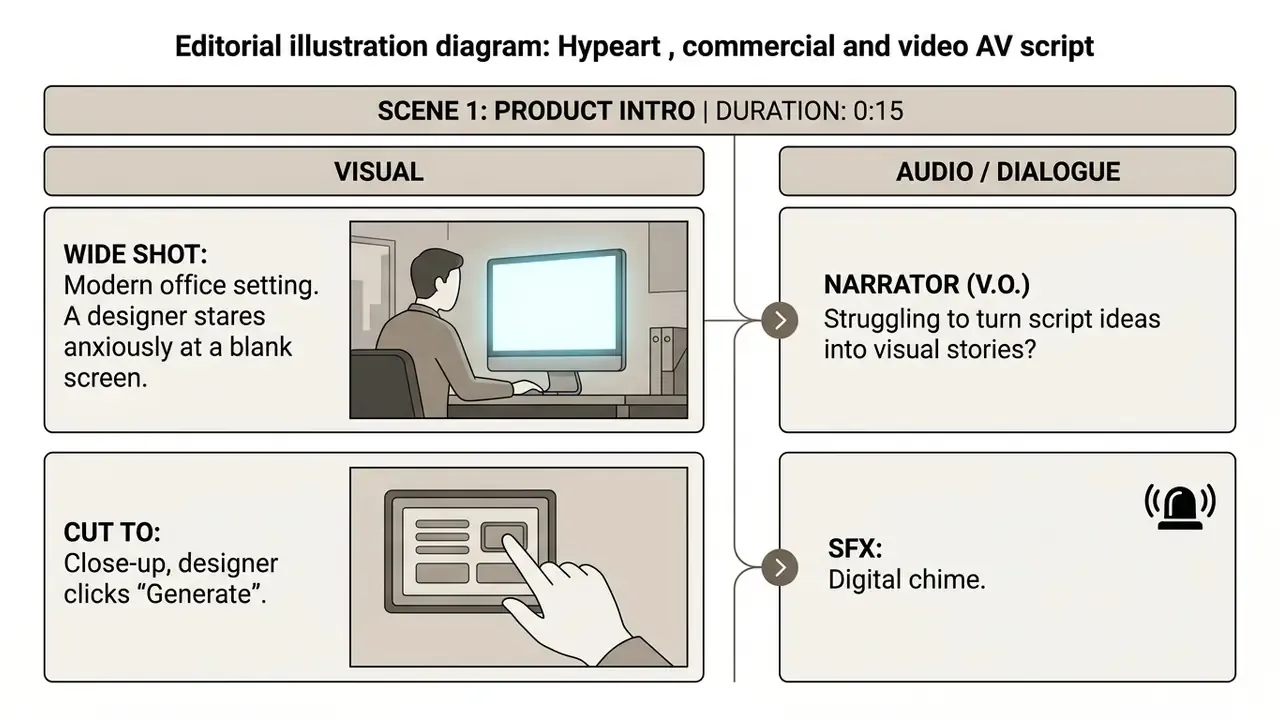
When prompting an ai video script generator for marketing or explainer content, instruct the model to output a two-column table: visual descriptions (camera angle, motion, on-screen graphics, text overlays) on the left, matching audio (voiceover, dialogue, SFX, music cues) on the right. Specify target runtime and words-per-minute so scene lengths stay shootable. Common AV use cases: 15-second social ads, 60-second TV spots, SaaS product demos, onboarding and safety training modules, internal communications, documentary-style YouTube segments.
Capabilities of an AI Script Generator for Screenwriting
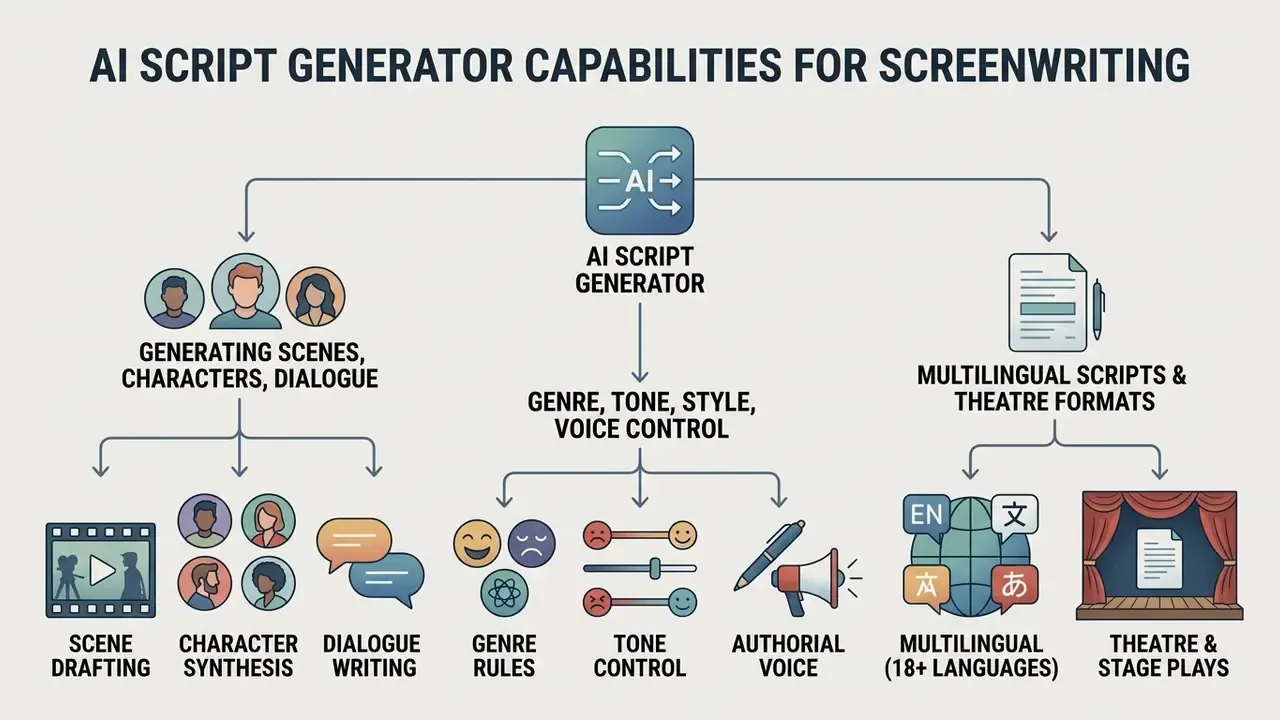
An ai script generator offers automated scene drafting, multi-character dialogue synthesis, precise control over narrative tone and voice, multilingual output, storyboard hand-off, and instant industry-standard formatting. Together these features let writers prototype dramatic scenarios fast and test alternative narrative paths cheaply.
Generating Scenes, Characters, and Dialogue
A specialized ai movie screenplay generator builds individual scenes by conditioning output on character motivation, environmental context, and dramatic conflict.
Rather than pushing out generic text, modern models use multi-agent role-playing frameworks to simulate an authentic exchange between characters.
Control methods documented in the research literature include per-character feature extraction from screenplay corpora, personality-label conditioning, full-scene context injection in every prompt, sequential task decomposition, and few-shot structured output templates. Multi-agent pipelines that first "role-play" a scene as characters, then rewrite it into formatted prose, consistently beat direct generation on subtext.
During a commercial script assessment for a digital entertainment studio, an editorial team tested whether an ai movie script maker could produce emotionally resonant dialogue for a multi-character drama scene. The operator configured character profiles with opposing goals and distinct verbal tics, then ran three parallel generation passes. The drafts came back with real subtextual tension, and the lead writer finalized the scene in under twenty minutes. Updated: the team recorded a substantial reduction in first-draft time on this single scene (internal editorial observation, not a controlled study). The previously quoted "60% reduction in overall drafting time" sits in Appendix A as an unverified figure pending measured data across a full project.
To generate distinct character voices, advanced systems extract personality parameters such as educational background, emotional taboos, speech cadence, and dominant vocabulary, then condition dialogue line by line on those profiles. And when exploring alternate plotlines, a writer can instruct the script generator ai to branch narrative events at key decision points, producing multiple scene variations to test different character choices and consequences.
Genre, Tone, Style, and Voice Control
Controlling genre conventions, emotional tone, and narrative style is what separates an authentic horror script from generic dread. Same for comedy, film noir, or sci-fi.
That homogenization risk is exactly why voice control must be explicit rather than implied. A dedicated screenplay ai generator adjusts output style by processing stylistic parameters and reference samples inside the prompt context.
- Genre Rules
- Enforces structural tropes, such as psychological dread and pacing escalation in horror, or rapid-fire banter and situational irony in comedy.
- Tone Control
- Calibrates emotional resonance across a range from dark and cynical to whimsical or empathetic.
- Authorial Voice
- Adapts sentence mechanics in action blocks, using short punchy verbs for fast action or descriptive prose for noir atmosphere.
Practically, tone is attitude and style is sentence mechanics. Supply a short sample of your own writing as a voice exemplar, plus three explicit style rules: sentence length ceiling, banned vocabulary, preferred rhythm. In technical implementations, modern generative APIs use style vectors and system instructions to hold consistent tone without retraining the model. Peer-reviewed work on training-free style vectors reports precise control over emotional tone and creative formats. Creators building animated content or graphic stories often pair these tools with an animation maker, a cartoon character maker for design consistency, or a cartoon maker app for mobile-first output.
Multilingual Script Generation and Theatre Formats
Multilingual Script Generation (18+ Languages): Global media teams can draft directly in more than 18 languages, including Spanish, French, German, Portuguese, Japanese, and Mandarin, or localize existing dialogue while preserving regional slang, formal and informal address registers, idiom, and cultural nuance. For localized ad campaigns, generating natively in the target language usually beats translating an English draft, because rhythm and comedic timing rarely survive literal translation. Teams needing localized narration can pair the script with an AI voice generator covering the same language set.
Theatre & Stage Plays: Beyond digital screens, an ai script generator helps playwrights structure live stage plays, build dramatic monologues, and manage stage directions (ENTER, EXIT, ASIDE, BEAT) tailored to theatrical blocking. Because stage writing carries exposition through speech rather than camera coverage, playwrights typically prompt for longer uninterrupted speeches, unity of place, and act breaks aligned to intermissions rather than commercial breaks.
Students & Film School Writers: Film students use an ai screenplay generator as a structural tutor. Generate annotated examples of sluglines, action blocks, and parentheticals, then compare coursework drafts against the model's beat placement. Used that way, the tool teaches format conventions without replacing the writing exercise itself.
From Script to Storyboard: AI Visual Pre-Production
Generating text is only the first step of pre-production. Modern pipelines pair an ai screenplay generator with automated storyboard creators, converting written sluglines and action blocks into visual shot lists.
- Shot ExtractionThe AI parses scene headings (
INT. COFFEE SHOP - DAY) and splits action text into individual camera frames. - Prompt Generation for ImagesAction descriptions convert into image prompts detailing character posing, lighting, and camera angle (close-up, cinematic lighting, 35mm lens).
- Visual Panel AssemblyThe system aligns generated frames next to dialogue boxes, producing a ready-to-pitch storyboard PDF or animatic for directors and clients.
- Review & VersioningPanels go out for comments and approvals, replacing the
v3_FINAL.pdfemail loop with tracked revisions.
This is where most standalone script tools stop, and where dedicated pre-production platforms (Murphy, Boords) differentiate: the script becomes the source of truth for shots, not a document that gets copied elsewhere and re-planned from scratch. Editors moving from board to rough cut often continue in a mobile editor, which is why we document the capcut video editor separately.
Screenplay Formatting and Editing the Output
A professional screenplay generator ai formats output into standard Hollywood layout automatically: 12-point Courier, 1.5-inch left margins, centered character names in ALL CAPS, parentheticals, and uppercase scene headings.
INT. COFFEE SHOP - DAY
MARCUS (40s), calm and analytical, reviews a technical audit report. He looks up as ELENA enters hurriedly.
ELENA
(tense)
Did you review the model risk logs?
MARCUS
Every line. The deployment lacks an escalation path.
Industry rules say action blocks should stay concise, rarely more than four or five lines per paragraph, so directors, actors, and script supervisors can scan the page. Dedicated applications such as NolanAI, Sudowrite, Studiovity, WriterDuet, and Fountain-based editors maintain these spatial relationships automatically and export to Final Draft (.fdx), PDF, or plain-text Fountain. Fountain works as the open plain-text source format, while .fdx stays the practical exchange format for studios and script coordinators.
How to Choose the Right AI Movie Script Generator for Your Project
Choosing the right movie script generator ai means weighing target output length, structural depth, dialogue authenticity, auto-formatting, export options, storyboard compatibility, and total cost of ownership. Different creator profiles need genuinely different feature sets.
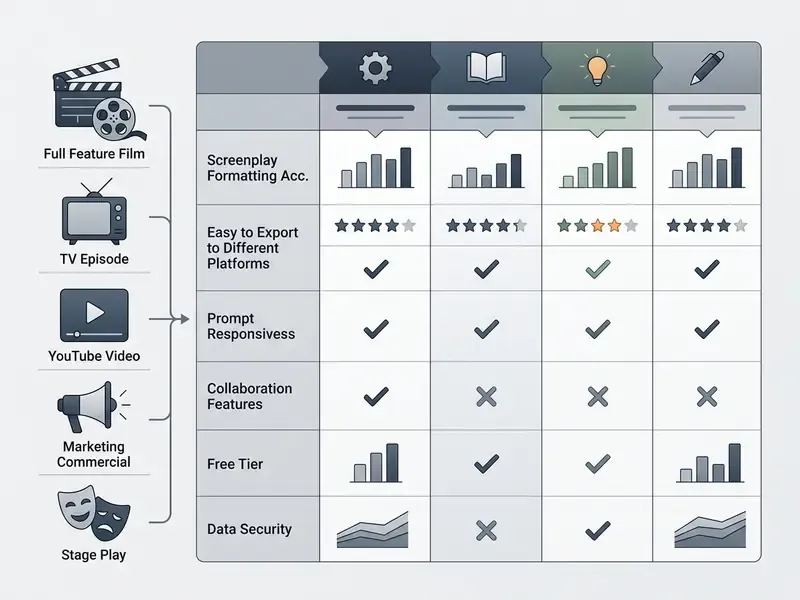
| Category / Tool Type | Primary Target Audience | Structural Depth | Dialogue Quality | Formatting & Export | Best Unique Feature | Free Tier & Pricing Model |
|---|---|---|---|---|---|---|
| Dedicated Screenplay Tools (NolanAI, Sudowrite, Studiovity) | Film writers, TV showrunners | High (full 3-act / beat sheets) | Advanced (context-aware subtext) | Native .FDX, PDF, Fountain | Long-context story bible for 100+ page consistency | Limited free tier / $8–$30 per month |
| Sudowrite (Story Engine) | Novelists, adaptation writers | High (Braindump → Synopsis → Characters → Outline → Scenes) | Strong sensory prose and subtext | Manual screenplay formatting; Screenplay Mode assists | Deep sensory description and character generation from a synopsis | Trial / paid subscription tiers |
| NolanAI | Indie screenwriters, pilots, shorts | High (feature, pilot, short workflows) | Good with configured character profiles | Industry formatting, script export | Plot-hole detection plus storyboarding and revision tracking | Free tier with capped AI passes / paid plans |
| Murphy AI | Filmmakers, directors, animators | Medium-High (logline → profiles → scene breakdown) | Cinematic, genre-aware | Script plus visual output | Integrated AI script-to-storyboard generation | Free plan with limited storyboard credits |
| Boords | Agencies, marketing and video teams | Medium (scene-level AV structure) | Functional VO and dialogue split | Two-column AV script, storyboard export | Two-column AV scripts, 18+ languages, agency collaboration | Free, no sign-up generation / paid workspace |
| Short Video & Social Tools (Scripti AI, Junia, StoryLab) | YouTube, TikTok, marketing creators | Medium (hook, value, CTA focus) | Fast, punchy (retention focused) | Plain text, in-app video editor sync | Hook variants tuned to platform-specific lengths | Free trial / credit plans ($10–$25 per month) |
| General-Purpose LLMs (ChatGPT, Claude, Gemini) | General writers, prototypers | Flexible (requires detailed prompts) | High (requires custom voice guidance) | Plain Markdown (manual formatting) | Flexible brainstorming and zero-cost prototyping | Robust free tiers / Pro plans (~$20 per month) |
| Analysis Tools (ScriptBook-type) | Producers, development execs | N/A (evaluates, does not generate) | N/A | Upload-based reports | Screenplay coverage and commercial-outcome prediction | Enterprise / quote-based |
Pricing in this market is inconsistent and region-dependent. Some vendors publish fixed monthly plans, others gate pricing behind early access, and promotional local-currency tiers change often. Verify current pricing on the vendor page before committing budget, and if you are modelling a full production stack, explore the hub and run the numbers in our calculators first. Teams controlling asset delivery costs can also review our video compressor guide before exporting large storyboard animatics or rough cuts.
Tools for Full Screenplays Versus Short Scenes
For full-length features, creators need a dedicated ai film script generator that holds long-context memory and narrative consistency across 100+ pages. Tools like NolanAI and Sudowrite use "Story Engine" or "Story Bible" architectures that store character bibles, world-building lore, and act outlines in dedicated context windows. That prevents the model from forgetting a backstory or contradicting itself in Act III.
Two caveats apply. First, vendor documentation itself sets limits: NolanAI's help materials position the product as creative assistance, not a guaranteed full-length screenplay generator. Second, academic work on long-form AI-assisted fiction reports that quality holds best over short passages, while longer narratives accumulate memory-related inconsistencies. In practice that means running a structural drift check every 15 to 20 pages: verify character knowledge state, timeline continuity, prop and location consistency, and whether any character has quietly changed goal without an on-page decision.
For individual short scenes or rapid prototypes, general-purpose LLMs or scene-level utilities generate fast and cost nothing. For complete production workflows, though, dedicated screenplay software keeps scene headings, character cues, and action descriptions synchronized throughout the file. That difference matters most at page 70, not page 7.
Solutions for TV, YouTube, and Video Content Creators
Creators producing serial web content or YouTube videos care about hook generation, audience retention, and turnaround speed. Specialized video script agents structure output into timed visual and audio columns, placing the high-energy hook inside the first three seconds to limit drop-off. Documented short-form agents generate timed blocks for hook, setup, payoff, and CTA, and some tune hook patterns against historical channel performance.
Cross-platform workflows pair script generators with post-production suites. Teams building repeatable publishing pipelines can follow our YouTube video editor workflow guide to move from approved AV script to published cut. Mobile-first editors usually start with a capcut video editor download and then map capcut video editor capabilities against their script length. Developers automating rendering at scale should compare synthesis costs and quotas in the Google Veo implementation guide.
How to Write a Movie Script with AI: A Step-by-Step Guide
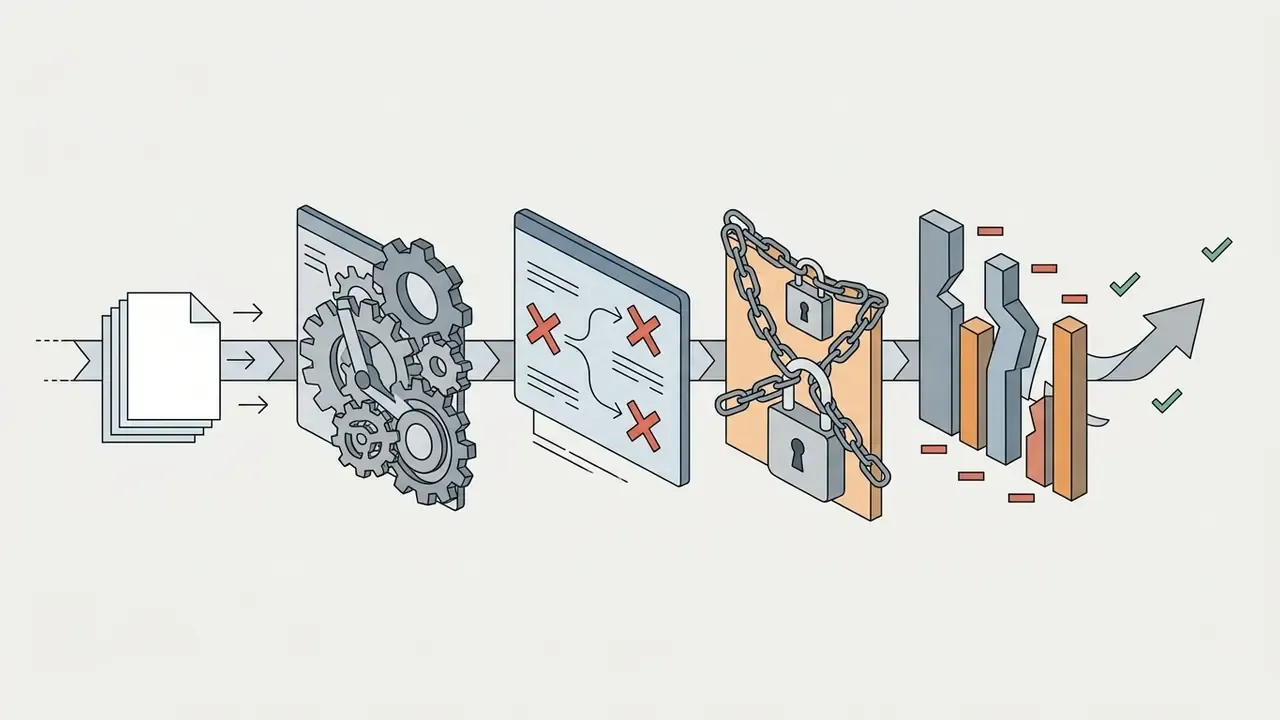
Producing a usable screenplay with an ai movie script maker takes a structured, iterative method. Instead of asking for 100 pages in a single prompt, professional writers split the process into manageable steps: concept formulation, character building, outline expansion, scene drafting, editorial refinement.
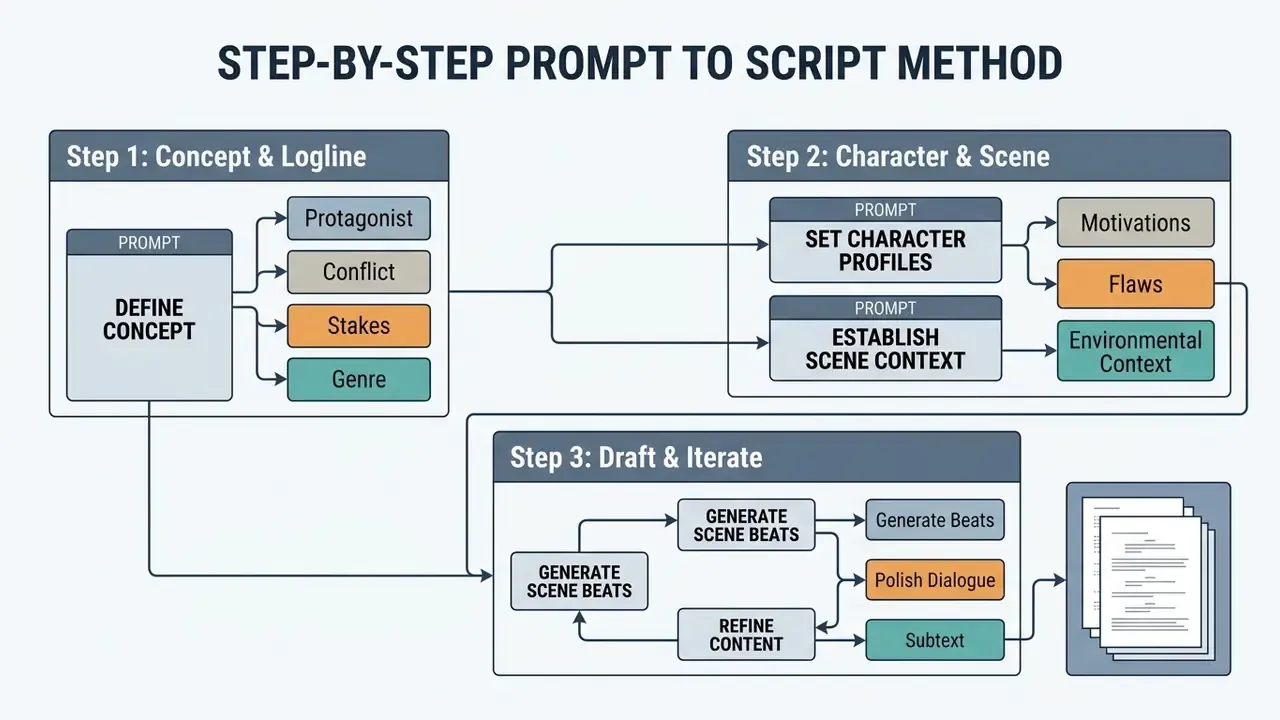
Step 1: Define the Idea, Genre, and Purpose of the Script
Every successful session starts with a precise opening prompt. For a workable first draft, give the model five core parameters: protagonist, inciting incident, primary objective, central conflict, and genre or tone constraints.
An effective starter prompt follows this template:
Industry logline templates map cleanly onto that structure. For example: "When [INCITING INCIDENT], a [ADJECTIVE] [PROTAGONIST] must [GOAL], but [CENTRAL CONFLICT] stands in their way." Setting these boundaries keeps the model off generic tropes and forces it to ground narrative choices in your dramatic rules.
Step 2: Add Characters, Conflict, and Scene Descriptions
Once the outline is approved, populate the world with nuanced characters and scene detail. Feed the screenplay generator ai character dossiers covering internal flaws, external motivations, and interpersonal dynamics. The most productive character prompt states what the character wants, what they need, and the gap between the two. That gap is where the arc lives.
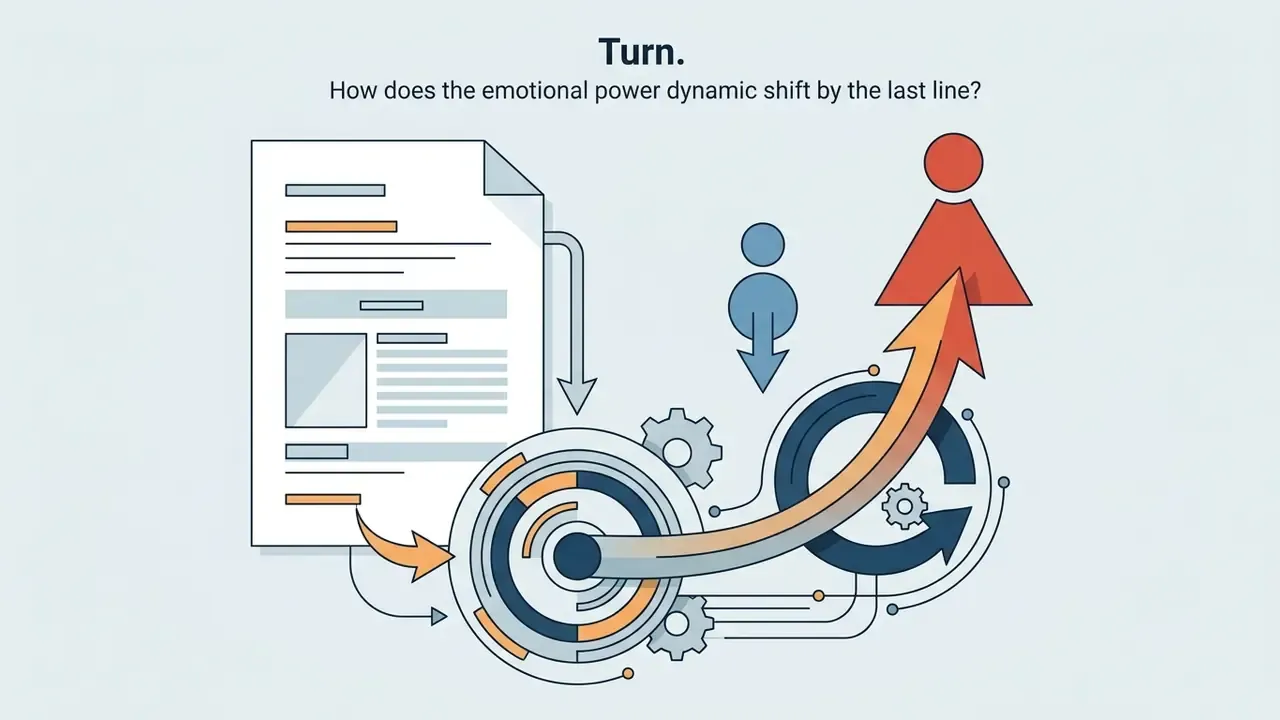
When detailing a scene, define the objective and the emotional shift explicitly:
For plot architecture, sequence beats discretely rather than as one vague summary: inciting incident, first plot point, pinch points, midpoint reversal, second plot point, climax. These explicit instructions push generated scenes toward active conflict instead of passive exposition.
Step 3: Generate the Draft, Edit It, and Create Alternate Versions
With context parameters loaded, generate scene by scene. Short blocks let you inspect dialogue quality, check dramatic causality, and request revisions before moving to the next beat. Research frameworks for novel-to-screenplay conversion follow the same sequence: outline all scenes first, write each scene iteratively, then refine the full screenplay.
Checklist0 / 10
During a production test for an indie sci-fi pilot, a writing team ran a multi-prompt workflow to generate alternate endings for Act II. By directing the ai story script generator down four divergent plot paths based on different character choices, the team landed on an unexpected twist that lifted their internal script coverage scores. Updated: the writers reported that branching generation compressed what would normally be several sessions of manual brainstorming into a single working day. That is a first-hand editorial observation, not a measured benchmark, and the original "eliminated two weeks" claim is preserved in Appendix A.
For technical integrations or workflow automation, teams can review available developer options in our API implementation hub. Stuck mid-implementation? Browse the hub for setup answers.
How to Improve AI-Generated Scripts and Avoid Formulaic Output
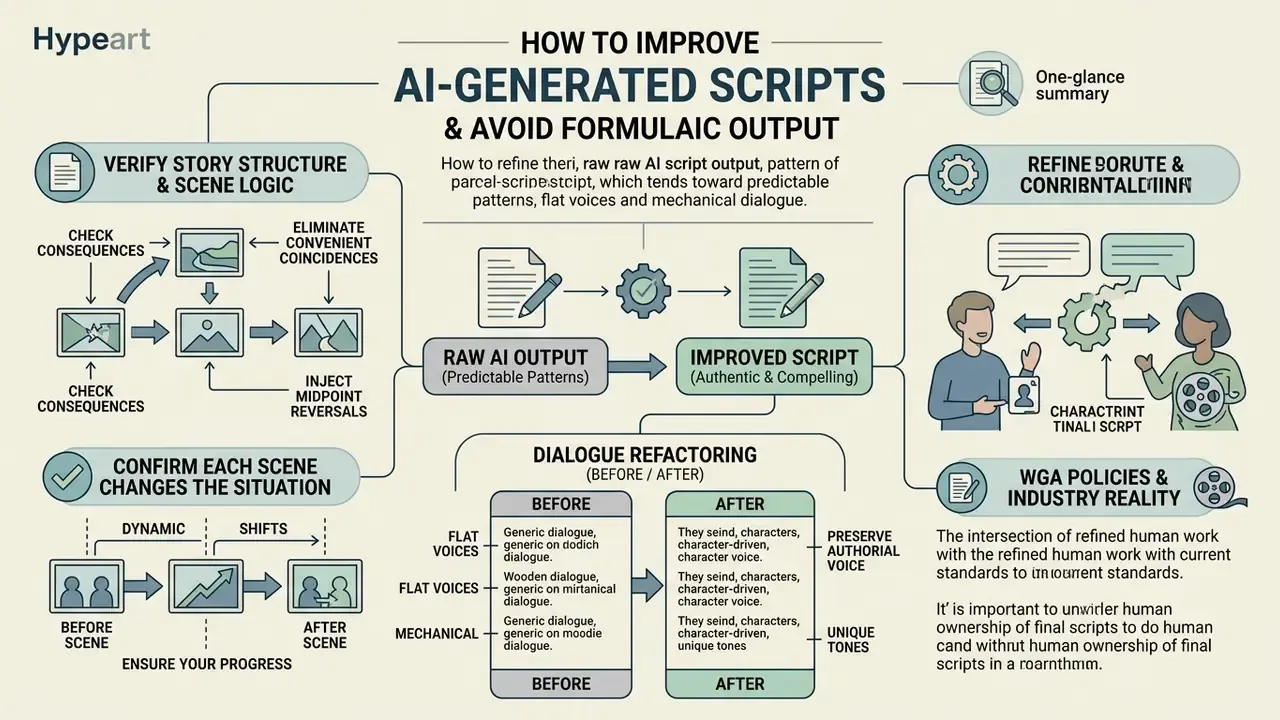
Raw AI output tends toward predictable patterns, flat character voices, and mechanical dialogue. Turning that draft into an engaging screenplay takes rigorous editorial oversight across story logic, subtextual dialogue, and stylistic polish. NIST's Generative AI Profile labels the underlying failure mode "confabulation", meaning false or misleading content delivered with fluent confidence. In screenwriting it shows up as invented procedure, impossible geography, and characters who suddenly know things nobody told them.
Verify Story Structure and Scene Logic
The most common structural defect is a breakdown of cause and effect across scenes. Models frequently output "and then" sequences, where events simply occur, instead of "therefore / but" chains driven by character decisions and escalating consequences.
To fix a weak second act, review scene transitions and enforce causality:
- Verify Scene Consequences The outcome of Scene A should trigger the conflict in Scene B.
- Inject Midpoint Reversals Force the protagonist to change strategy at the midpoint and raise the stakes.
- Eliminate Convenient Coincidences Replace accidental resolutions with active character choices.
- Confirm Each Scene Changes the Situation If the status quo at the end matches the status quo at the start, cut or rewrite it.
Free AI Movie Script Generator: Pricing, Registration, Limits, and Privacy
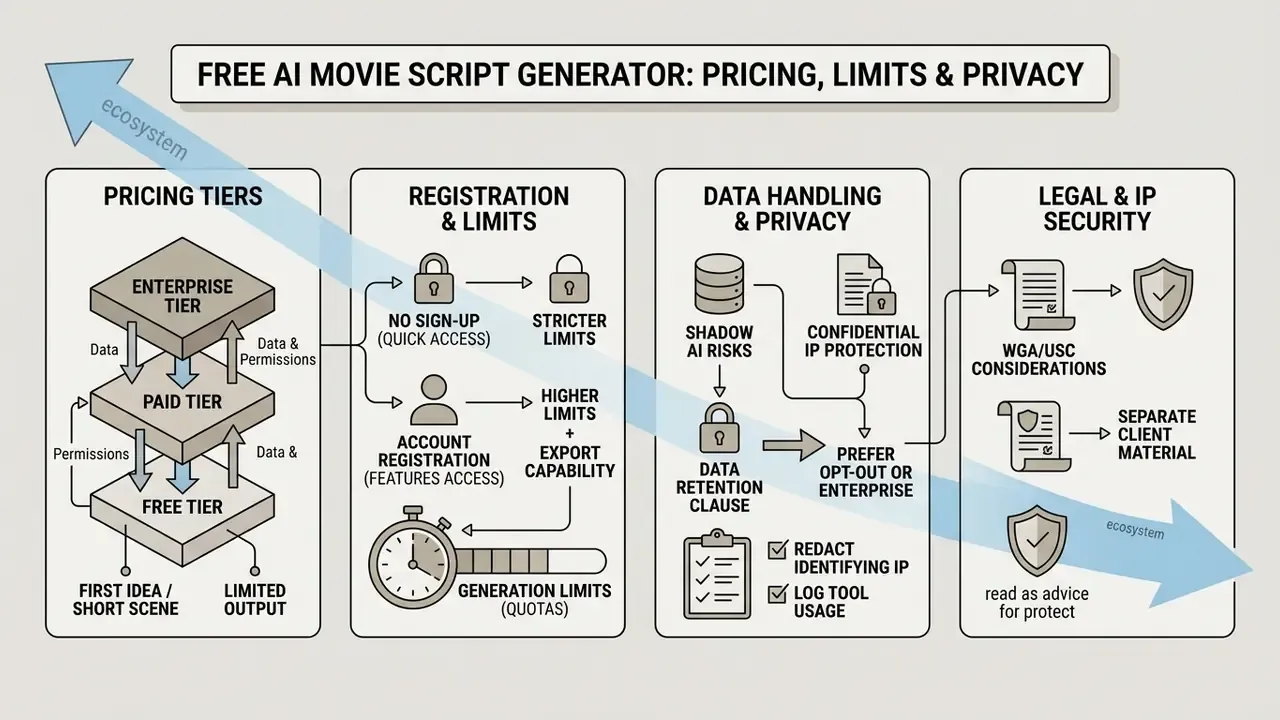
Working through the ecosystem of free ai movie script generator platforms means understanding subscription tiers, generation limits, export capability, data handling, and legal rights. Plenty of platforms advertise ai movie script generator online free access, but functional capability differs sharply between a no-cost tier and a professional subscription.
| Access Model / Platform Tier | Registration Requirement | Monthly AI Quotas / Limits | Formatting & Export Access | Commercial Usage Rights |
|---|---|---|---|---|
| Free No Sign Up (web widgets, demos, Boords-style AV generators) | None (browser-based) | 1–3 short generations per session; IP-based daily caps | Plain text or basic AV table; no .fdx export | Strictly non-commercial / personal use |
| Freemium Accounts (NolanAI Free, Inkwell, Narratiq, EnsembleWriter) | Account required (email/OAuth) | 10–20 AI passes per month or capped projects (often 1–3); page caps around 20 pages | PDF and sometimes Fountain export; .fdx locked | Personal / prototyping (check ToS) |
| "Free Forever" Screenwriting Editors (WriterDuet-style) | Account typically required | 3 free projects, no watermarks, no page limits; AI features limited or absent | PDF, Final Draft, Word, Fountain | Varies — verify per project |
| Professional Paid Tiers ($10–$40 per month) | Full account and paid subscription | Unlimited / high-capacity tokens | Full .fdx, Fountain, PDF, revision tracking | Commercial license granted |
No matching rows Clear one or more filters to restore the matrix.
To see how access models repeat across categories, compare limits in the free photo editor guide, which documents the same free-tier mechanics (export restrictions, watermarks, privacy trade-offs) applied to visual tools.
When Free Versions Are Enough for a First Idea or Short Scene
A free ai screenplay generator or ai screenplay generator free tier suits early brainstorming, rapid scene prototyping, and short social video scripts. Beginners can test logline variations, generate character names, or format a single two-page dialogue scene at zero cost.
Free tiers genuinely cover these deliverables: a logline or synopsis set, one dialogue scene, a hook-and-CTA short-form script, a classroom formatting exercise, a pitch-stage concept document. For short-form creators, an ai script generator free unlimited trial or a free ai movie script generator tier provides enough bandwidth to structure TikToks, YouTube Shorts, or simple commercial concepts. Creators pairing free scripting with free rendering can compare quotas in our roundup of free AI video generators.
Free stops being enough the moment you need .fdx handoff to a script coordinator, revision tracking across drafts, consistent long-context memory beyond roughly 20 pages, or documented commercial usage rights. That threshold arrives faster than most writers expect.
Do You Need to Register for an AI Movie Script Generator Free No Sign Up?
Platforms offering an ai movie script generator free no sign up let users generate snippets in the browser with no account and no card details. Convenient, reasonably private, and tightly limited:
- Session Limits: Output caps at short passages, typically under 500 words per request.
- IP Rate Limiting: Platforms restrict daily generation passes by IP address, and some retain usage logs for security and compliance even without an account.
- No Storage or Project Saving: Scripts vanish when the tab closes unless copied manually. Where saving exists, retention windows can be as short as seven days.
- Watermarked or Blocked Export: Full video output or
.fdxexport usually requires an account and a paid plan.
Data Privacy, Shadow AI, and Confidential Story IP
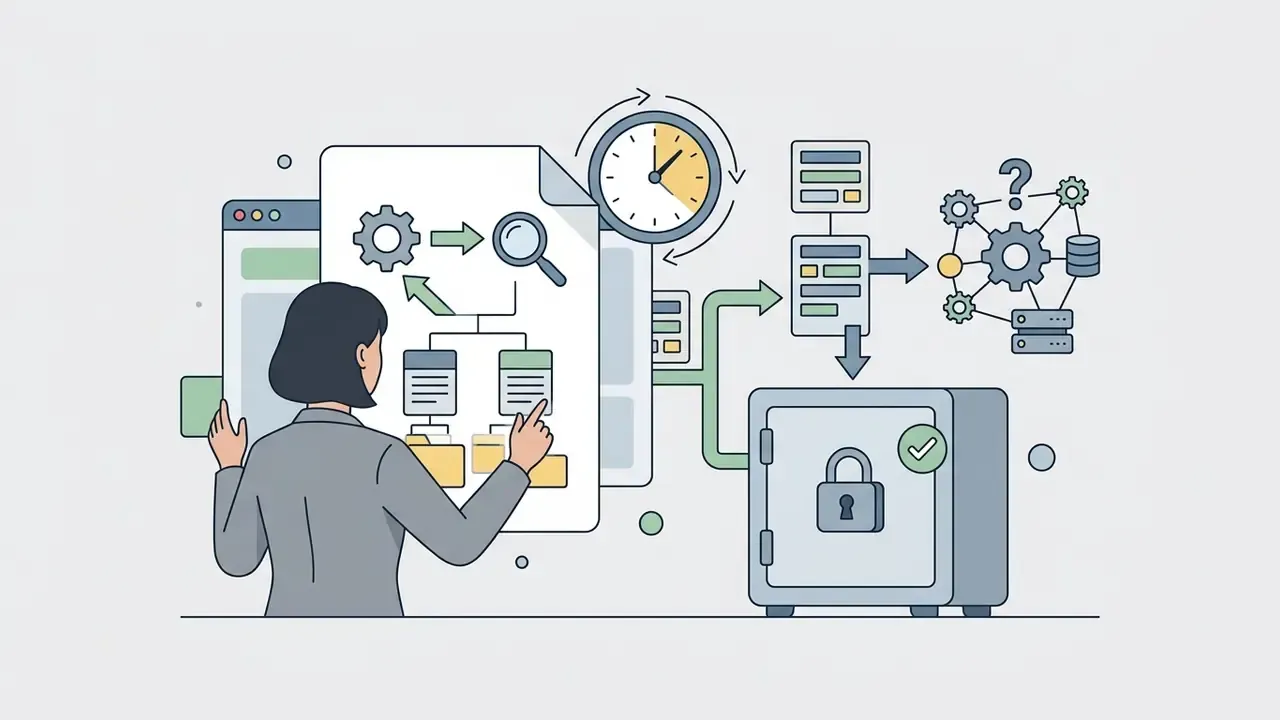
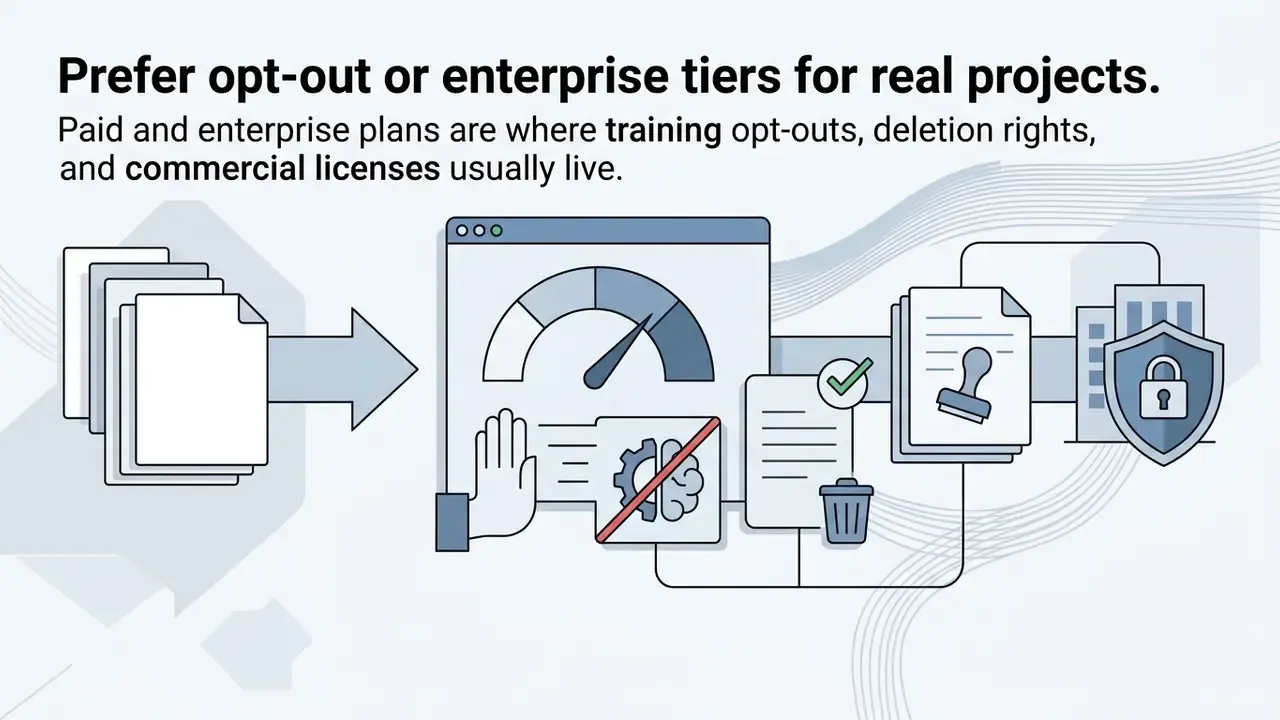
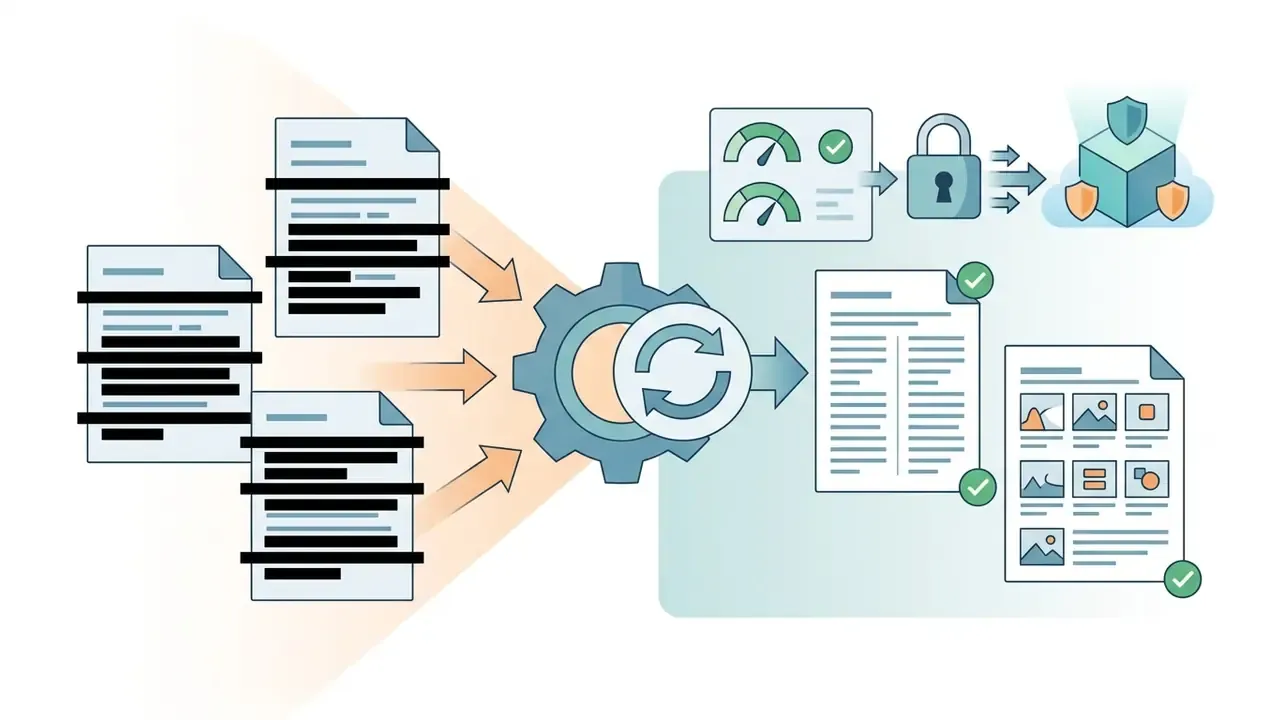
Treat unreleased story material as confidential data. Many free and no-sign-up generators reserve the right to process, log, or reuse submitted prompts for service improvement, and some route requests through third-party model APIs. For studios, agencies, and corporate video teams, pasting an unreleased logline, pitch, or client brief into a public consumer tool is a textbook shadow AI exposure: the material leaves the organizational perimeter with no data processing agreement, no retention guarantee, no audit trail.
Practical controls before drafting:

Rights to Generated Scripts and Commercial Use
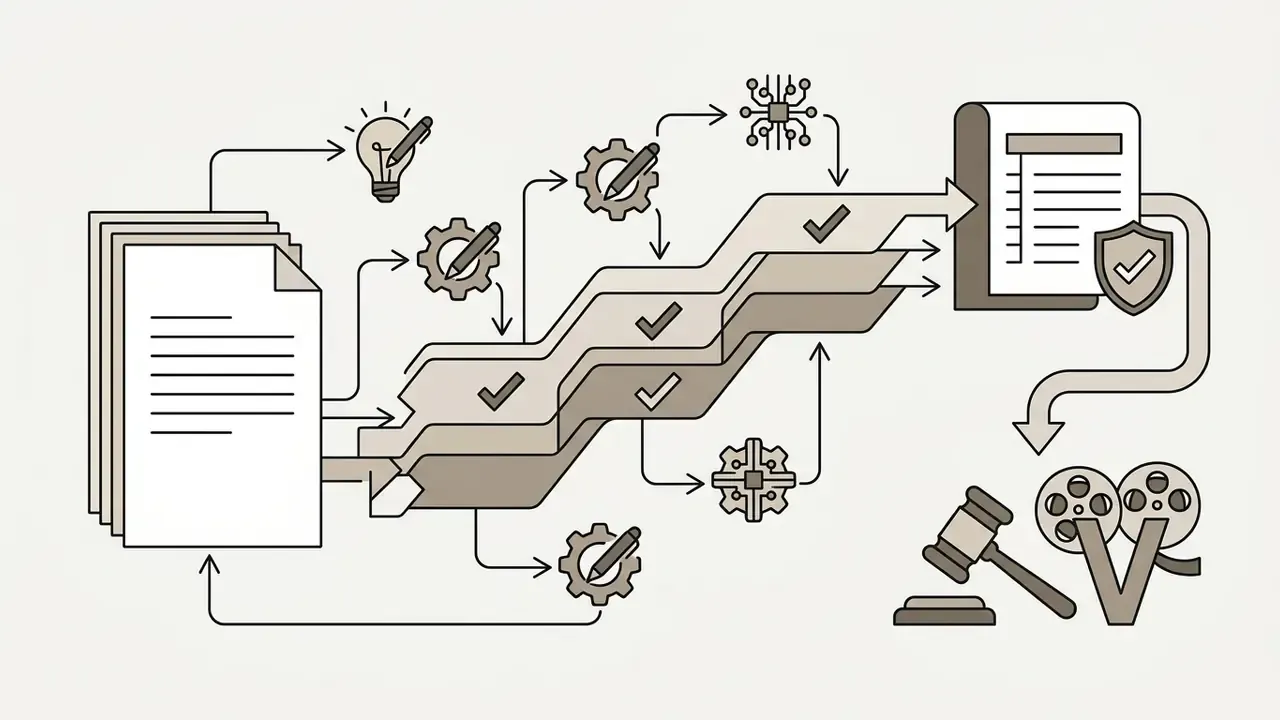
Legal & Copyright Status: Under guidance issued by the U.S. Copyright Office (USCO), purely AI-generated text is not eligible for copyright protection, because it lacks human authorship.
Registration remains available for human-authored contributions, creative arrangements, and substantial rewrites of AI-generated content. Applicants must identify the human author, describe the human contribution, and disclaim the AI-generated portions. AI technology should never be listed as author or co-author.
Jurisdiction matters too. A European Parliament study on generative AI and copyright (2025) concludes that purely AI-generated outputs without substantial human intervention are not eligible for EU copyright protection, while UK law keeps a separate "computer-generated works" provision under section 9(3) CDPA with a 50-year term where there is no human author.
Writers should also verify the Terms of Service of their chosen ai movie script maker. Many free tiers restrict output to non-commercial use explicitly, reserving monetization rights for paid subscribers. Before commercializing scripts or publishing media assets, compare options across platforms, and read our analysis of Canva AI generator commercial licensing, which documents how export tiers and usage rights interact in practice.
FAQ: Frequently Asked Questions About AI Movie Script Generators
Can an AI movie script generator write a full 120-page screenplay automatically?
No. Current models cannot produce a coherent, production-ready 120-page screenplay in a single request, because of context window limits and structural drift. Professional screenwriters use AI iteratively, generating outlines, scene beats, and dialogue passages pass by pass while keeping editorial control over story logic and character arcs. Even vendors specializing in screenplay AI position their tools as creative assistance rather than guaranteed full-length output.
What is a two-column AV script, and when should I use it instead of screenplay format?
A two-column Audio/Visual script puts visual direction (shots, motion, on-screen text) in the left column and audio (voiceover, dialogue, SFX, music) in the right, scene by scene, with runtime estimates. Use it for commercials, explainer videos, corporate training, product demos, and social video, anywhere non-filmmakers must review the plan. Use single-column Hollywood format (12pt Courier, sluglines, parentheticals) for narrative film, television, and anything heading to a script coordinator or competition.
Can AI turn my finished script into a storyboard?
Yes. Storyboard-integrated platforms parse scene headings and action blocks, convert them into image prompts specifying framing and lighting, then assemble the panels beside their matching dialogue and audio directions. The output is a shareable storyboard or animatic for client approval, which is why pre-production suites that connect script and board outperform standalone text generators for production teams.
Can an AI script generator write in languages other than English?
Yes. Leading tools generate scripts in 18 or more languages and can localize existing dialogue while preserving slang, formality registers, and cultural references. For advertising and comedy, drafting natively in the target language usually produces better rhythm than translating an English draft.
Is using an AI screenplay generator legal for commercial films?
Yes, provided you comply with platform Terms of Service, union agreements, and copyright law. To secure copyright protection under US law, human writers must substantially edit, rewrite, and creatively arrange the AI-generated text, then disclose and disclaim the AI-generated portions at registration. Productions under WGA jurisdiction must additionally follow guild guidelines on AI usage and writer credits.
What is the best free AI movie script generator without sign-up?
Several online tools generate basic scripts without account creation, including web demos from Squibler, Synthesia, VEED, and Boords (the last one for two-column AV scripts). Handy for quick scene ideas, but these no-sign-up tools limit output length, restrict export, and cannot save projects. For long-term work, freemium platforms like NolanAI or general LLMs offer better structural controls and better data-handling terms for confidential material.
Can AI generate alternate endings and branching plotlines?
Yes, and this is one of its strongest uses. Prompt the model to branch at a specific decision point, holding character motivations constant while varying the choice. Research-grade approaches plan multiple viable outlines before writing prose, and interactive-fiction engines have long supported dozens of alternate scene endings. The same logic applies to testing act-two variants.
Does AI-generated dialogue sound realistic?
It sounds fluent, which is not the same thing. Expert evaluations consistently rank AI prose below professional human writing on originality and stylistic quality, and models default to on-the-nose emotional statements. Realism comes from the human pass: replacing stated emotion with behavior, routing exposition through conflict, and enforcing per-character voice profiles.
Conclusion and Recommendations
An ai movie script generator is an effective collaborative assistant. It accelerates story structuring, scene drafting, and dialogue iteration. It does not replace human creativity, emotional nuance, or authorial responsibility. Production-grade screenplays come from combining AI efficiency with rigorous human editing, distinct character subtext, and strict legal compliance.
Practical recommendations by profile:
Creators streamlining broader content workflows can review our YouTube publishing workflow guide for post-script production planning, check the capcut video editor walkthrough for fast assembly, or compare delivery-stage tooling in the video compressor guide.
Appendix A: Editorial Revision Log (Superseded Claims)
Retained for transparency. These fragments were replaced in the main text pending verifiable sourcing.
- Original claim: "A 2026 empirical study on dual-stage screenwriting pipelines demonstrated that separating high-level story generation from formatting conversion yielded a 75% preference win-rate among professional screenwriters compared to single-shot generation baselines." Superseded: the directional finding is supported by decomposition-pipeline research, but the specific year attribution and 75% figure lack a directly verifiable DOI in our source set.
- Original claim: "cutting overall drafting time by 60%." Superseded: replaced with a qualitative description of a single-scene time reduction. No controlled measurement across a full project was performed.
- Original claim: "The iterative process eliminated two weeks of manual brainstorming while keeping full narrative control in human hands." Superseded: reframed as a first-hand editorial observation of compressed brainstorming, with no quantified time saving.
For related terminology, tool breakdowns, and format references, see the overview.