Author note: Marcus Hale writes about AI governance and model risk for this publication.
Why should a compliance or finance leader care about music tools? Because marketing teams already use them. Usually without a license record.
Executive Summary
Short on time? Here is the compressed version for anyone approving generative audio in production.
- "Free unlimited" almost always means "free with credits."Suno's free tier grants 50 credits per day (roughly 10 generations). Udio caps free usage near 10 credits per day and about 100 per month, with track length up to 2:10 and downloads locked under its updated terms. Genuinely uncapped access lives either in free-first services such as Sonauto, or in local open-source models.
- The only technically honest free unlimited setup is local.Meta MusicGen / AudioCraft, Stable Audio Open and ACE-Step 1.5 run on your own GPU: no credits, no watermarks, no paid export. The price is hardware, engineering time, and zero vendor indemnification.
- Commercial rights are a contract, not a copyright.A fully AI-generated track cannot be registered with the US Copyright Office (Part 2 report, January 2025). Monetization therefore rests on a platform license, not on IP ownership.
- Training-data provenance matters more than the landing page.Platforms trained on an in-house catalog (SOUNDRAW, for example) grant a perpetual worldwide license and lower DMCA exposure. Models trained on web scraping sit in a weaker legal position (see GEMA v. OpenAI, Munich I, November 2025).
- Export format decides production fitness.MP3 at 128 kbps is a preview asset. Editing and broadcast need WAV 24-bit/48 kHz, STEMs and MIDI. MP4 matters for AI video clips and Spotify Canvas.
- Run a four-step audit before the first commercial releasetier at the moment of generation, then territory and media scope, then indemnification, then YouTube Content ID eligibility.
Who Owns Which Decision: A Lightweight Control Map
Generative audio rarely fails on sound quality. It fails on ownership of the decision. The pattern is familiar to anyone who has extended a model-risk framework to new tooling: the tool arrives before the policy.
A minimal, hypothetical allocation of accountability looks like this.
| Decision | Accountable owner | Evidence to retain | Escalation trigger |
|---|---|---|---|
| Tool approval and tier selection | Marketing operations lead, countersigned by procurement | Vendor terms snapshot, invoice, plan name | Vendor changes export or license terms mid-contract |
| Prompt and lyric content | Content owner (named person, not a team) | Prompt log, revision history | Prompt references a living artist or protected lyrics |
| Commercial clearance | Legal or compliance reviewer | License text at generation date, clearance file | Paid advertising, broadcast, or client delivery |
| Distribution and monetization | Release manager | Distributor agreement, platform policy check | Content ID claim or takedown notice |
| Shadow AI detection | Security and IT | Endpoint inventory, self-hosted model scans | Local model found outside approved inventory |
One caveat, and it is not a small one: the table above is illustrative. Map it against your own inventory before treating it as policy.
What "AI Music Generator Free Unlimited" Actually Means
An AI music generator free unlimited refers to a generative artificial intelligence service marketed as allowing users to create music without payment or fixed quantitative constraints. In technical practice, platforms split functionality into three separate layers: prompt-based generation, audio export, and commercial IP licensing. Some tools do offer un-metered creation during beta phases. Mature commercial engines enforce credit caps, daily generation throttles, or export restrictions on non-paid tiers. Evaluating any of these systems means analyzing generation volume, download formats, and legal rights independently.
The economics explain the gap between promise and product. GPU inference costs money. So "unlimited" migrates into paid plans or hides behind a fair-use policy, while free access serves as the funnel.
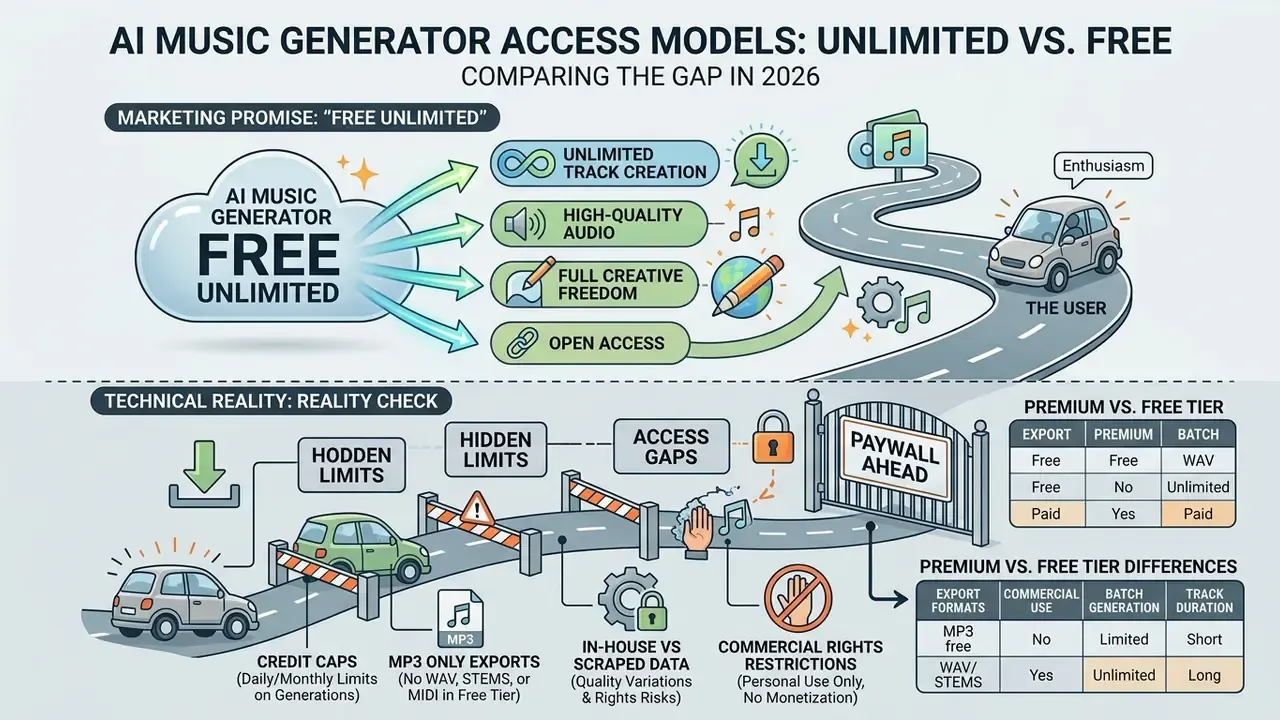
| Access Format | Daily / Monthly Generation Volume | Download Options (MP3 / WAV) | Commercial Use Rights | Common Operational Constraints |
|---|---|---|---|---|
| Free (Limited) | 10-50 daily credits (about 2-10 tracks) | Streaming only or restricted MP3 | Non-commercial, personal use only | No credit rollover, public track visibility, watermarking |
| Freemium | Capped monthly allotment | MP3 (128-320 kbps) | Restricted or non-commercial | Export locks on high-quality WAV/STEMs, platform branding |
| Unlimited Paid | Uncapped or high fair-use cap | High-fidelity MP3, WAV (24-bit), STEMs, MIDI | Full commercial license during active subscription | Fair-use throttling under server load, non-retroactive rights |
| Free Unlimited (Beta / Open) | Uncapped generations | MP3 / WAV (availability varies) | Research or non-commercial | Service instability, abrupt policy changes, no legal indemnification |
| Local Open-Source (self-hosted) | Truly uncapped (GPU-bound only) | WAV / FLAC / any output format | Defined by the model and weights license | Requires a CUDA GPU, Python 3.11-3.12, no vendor indemnification |
Policies are dynamic as of Q1 2026. Pricing terms for AI audio platforms shifted at least twice during 2025, so re-check limits on the vendor pricing page before any commercial launch.
AI Music Generator vs AI Song Generator
An AI music generator focuses on instrumental compositions, background soundscapes and cinematic score cues, without human or synthetic vocals. An AI song generator adds full vocal synthesis, lyric processing and structural sectioning: verses, choruses, bridges, hooks.
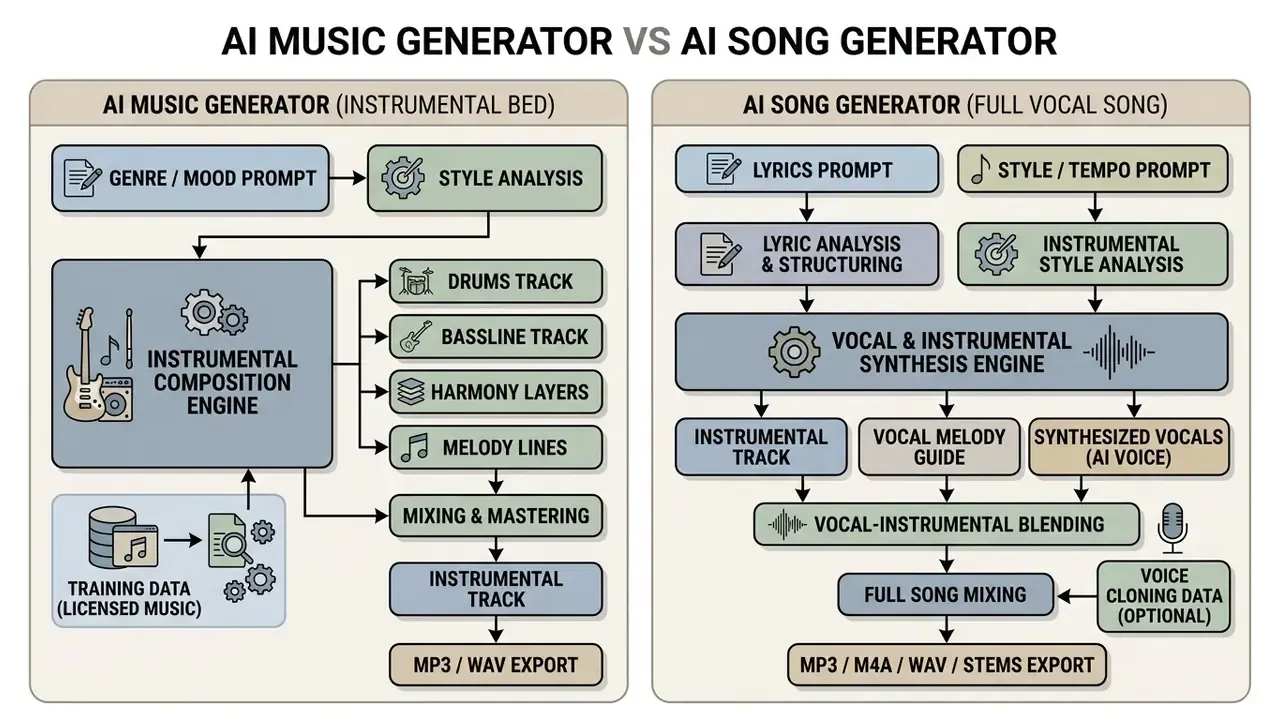
- AI music generators process style parameters, tempo (BPM), harmony and instrumentation (acoustic guitar, synth pads, orchestral strings) to deliver background music for media.
- AI song generators apply natural language processing to map written lyrics onto melodic contours, then layer synthetic vocal timbres (male, female, custom voice profiles) over the arrangement.
Most current platforms ship both as switchable modes: instrumental mode for beds, song mode for full vocal tracks. When a media team needs vocal customization, tools such as a d id ai video generator or dedicated voice cloning models enable precise lip-sync and narrative alignment across multi-channel video assets.
Where Teams Use Free AI Music and AI Songs
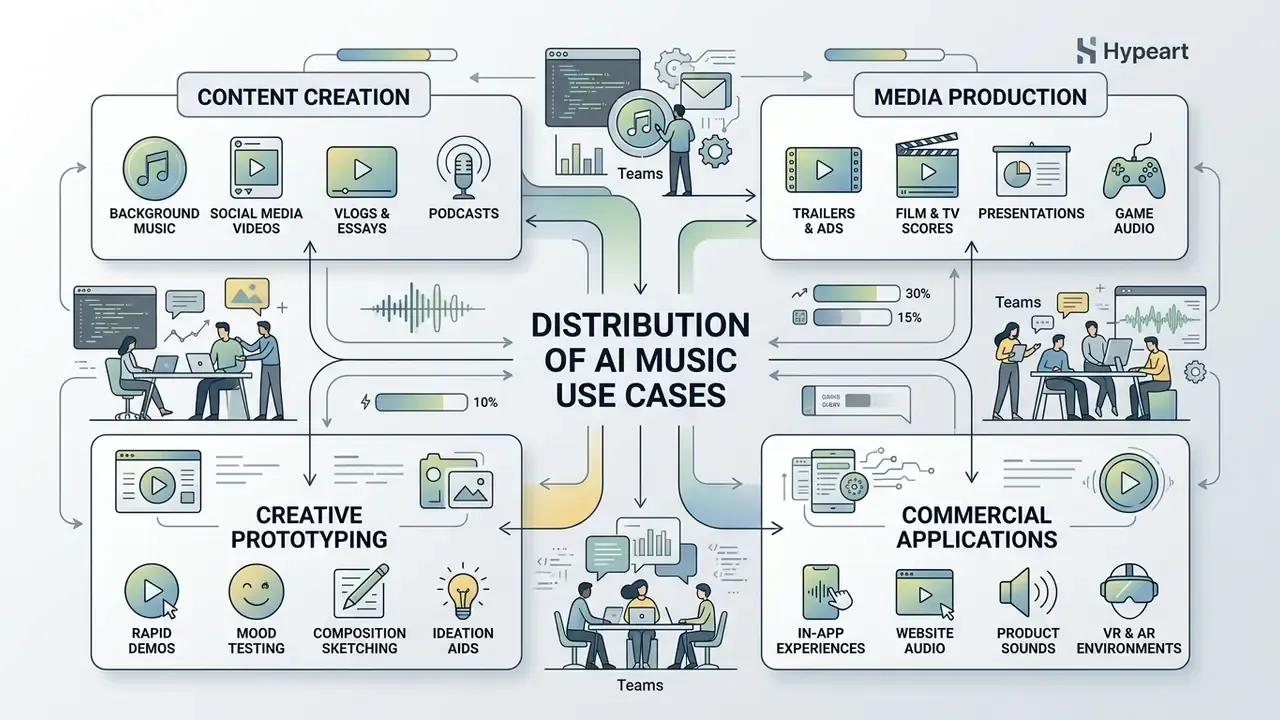
Free AI music and AI songs cover a wide application range, from background audio for social video to dynamic score prototyping in game development. Content creators, marketing teams, indie developers and commercial producers use generative audio engines to compress production timelines and bypass conventional stock music licensing friction.
Custom Music for Games, Advertising and Independent Musicians
Commercial workflows use AI music engines for specialized composition and fast arrangement prototyping.
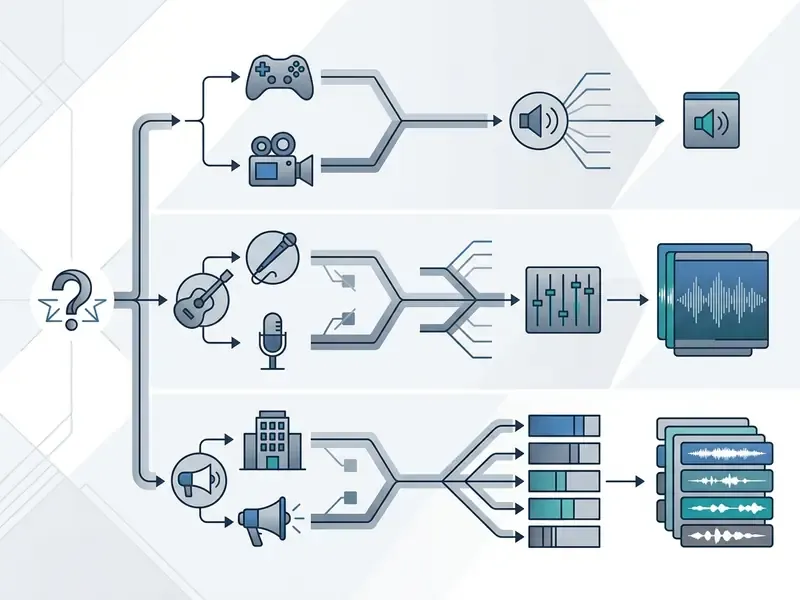
Marketing teams building multimodal campaigns usually pair audio generation with visual tooling, from the best AI image generators to Canva AI Generator for quick platform-format assembly. Producers extending into visual assets can also consult an AI Media Commercial-Use framework for cross-asset compliance standards. Note that a generated visual layer brings its own failure modes: the uncanny distortions catalogued under cursed ai images are a useful reminder that an AI music video needs the same review gate as the audio.
Commercial Jingles and Audio Logos
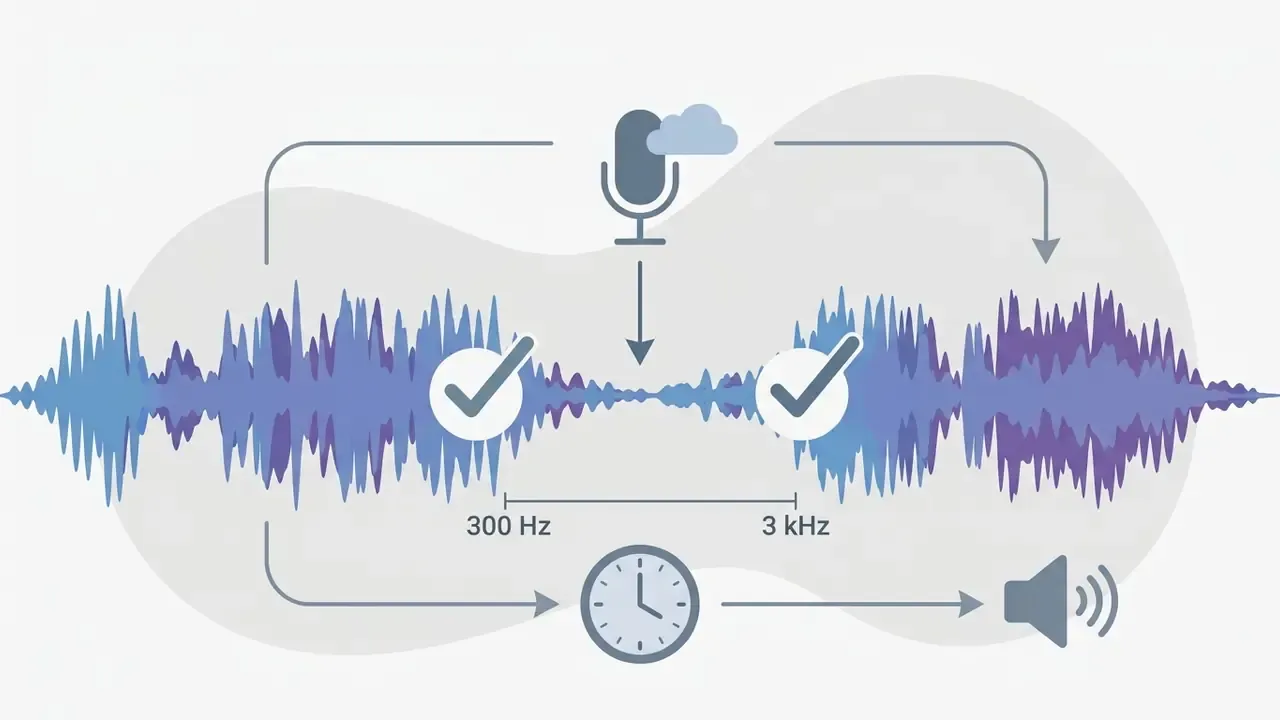
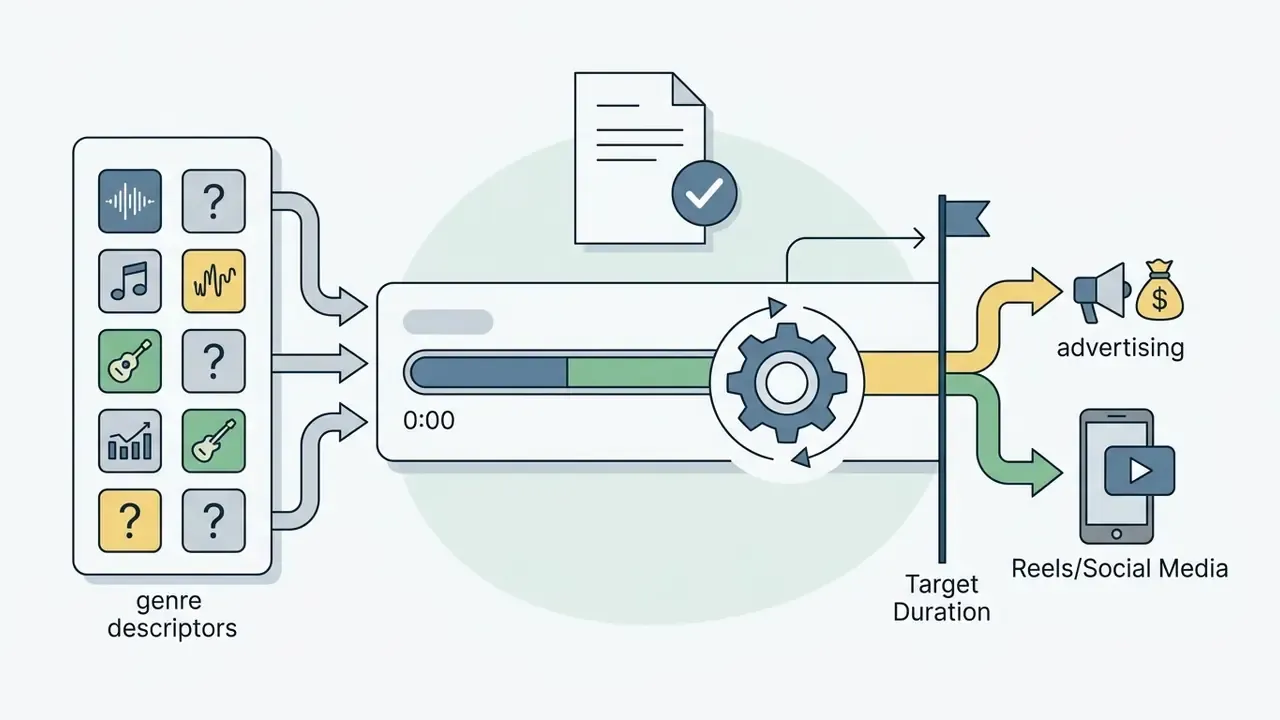
Advertising audio is its own genre with unforgiving timing rules. For a 6 to 15 second spot, the peak has to land on a specific frame, so the prompt must describe timeline structure, not only style:
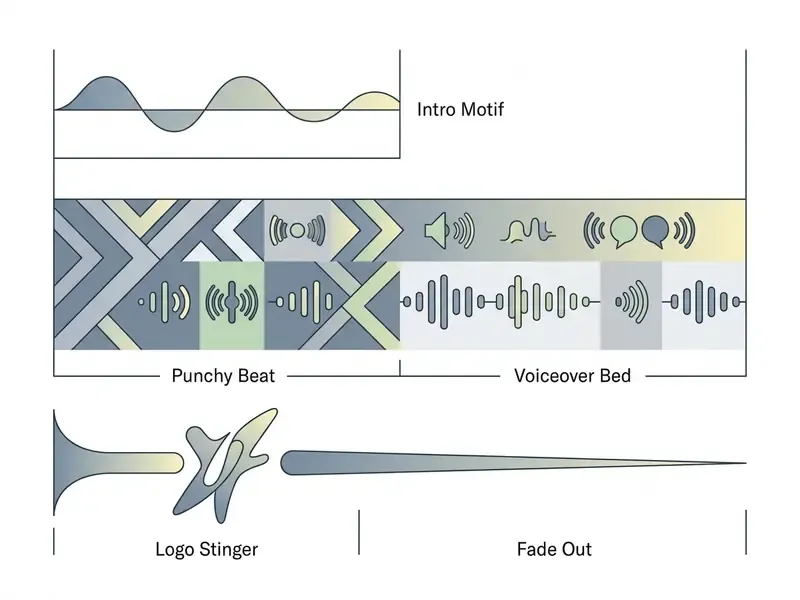
Practical rules for jingle generation:
How to Create a Song in a Free AI Music Generator
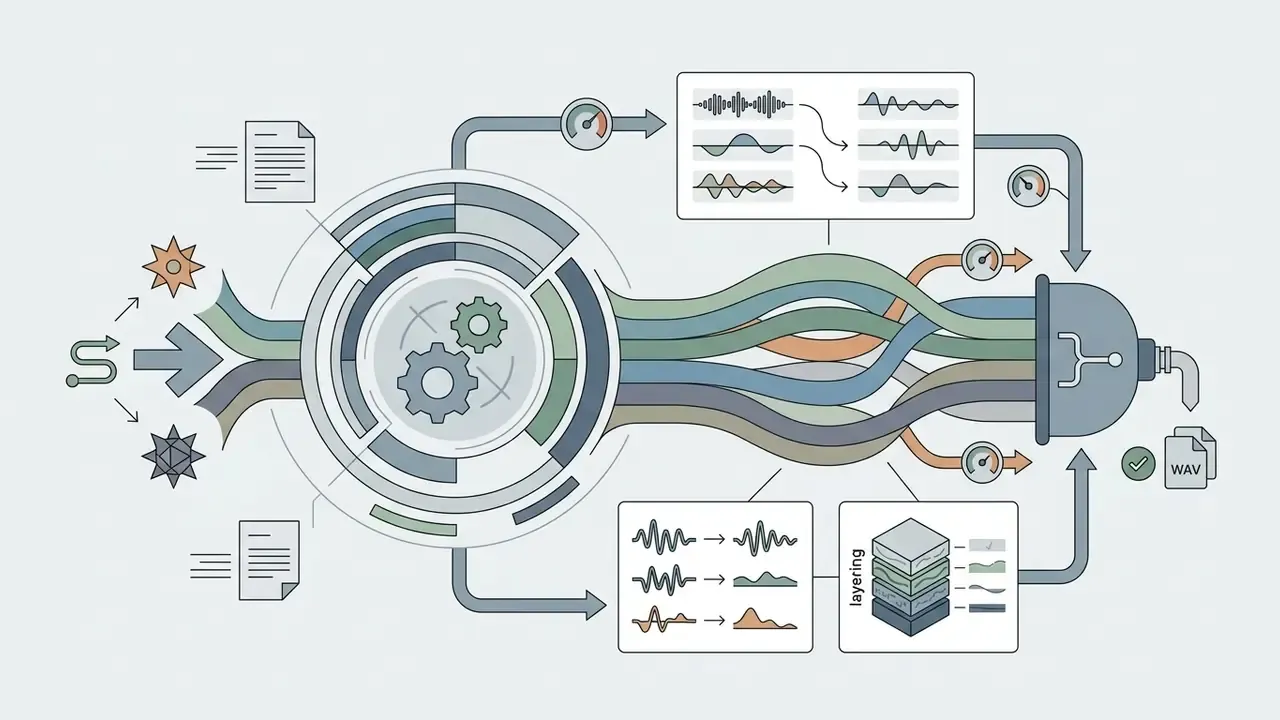
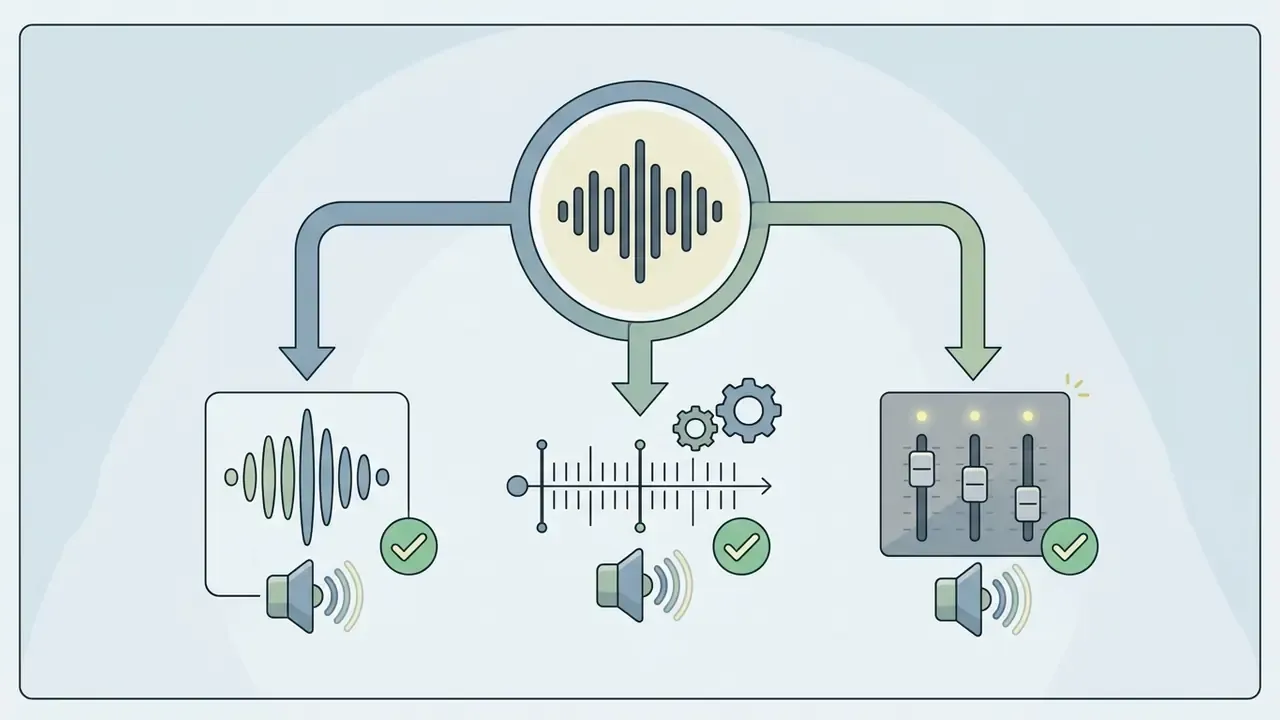
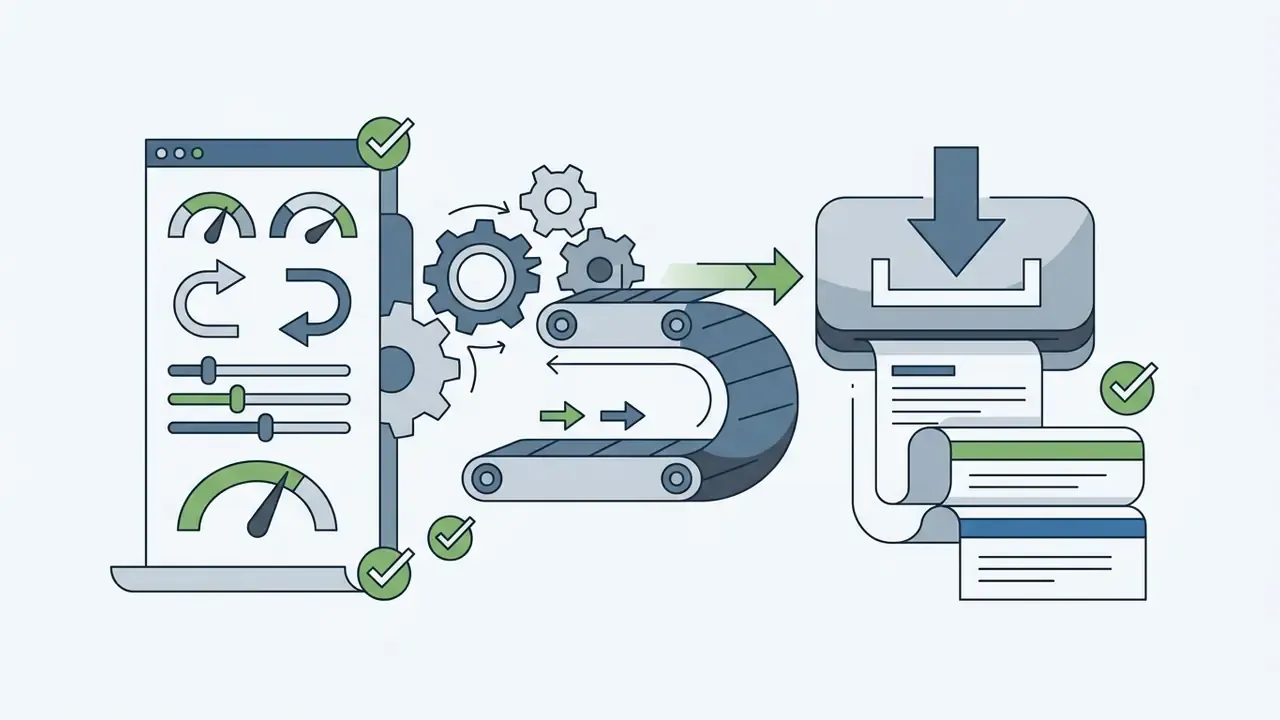
Creating a song in a free AI music generator involves choosing a creation mode, entering descriptive prompts or structured lyrics, configuring musical parameters, generating options, and evaluating the export. Modern systems use text-to-music (TTM) diffusion and autoregressive transformer models to convert plain language into structured stereo audio in seconds. Consistent production-quality output depends on precise prompt construction, clear section tagging and deliberate arrangement choices.
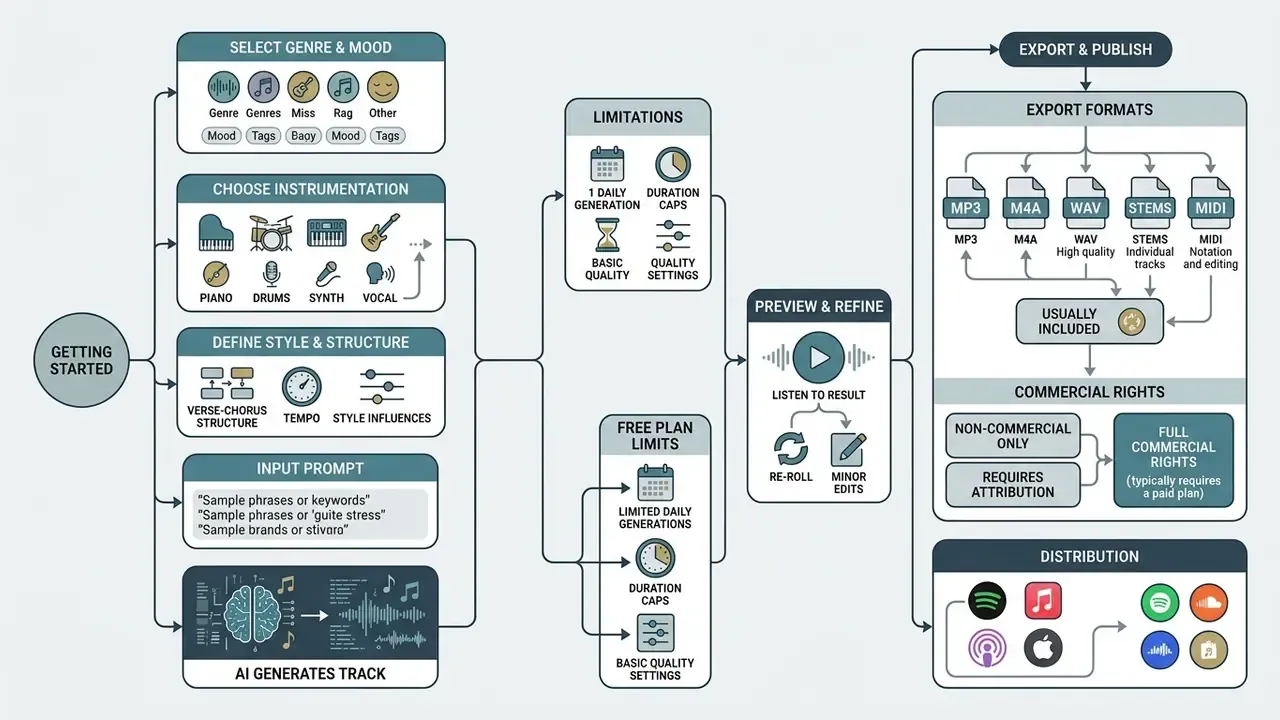
The iteration rule that appears in every serious practical guide: change no more than one or two parameters per run, then compare against the previous version. Rewrite the whole prompt at once and you lose track of which descriptor produced the improvement.
Description Mode: Music From a Text Prompt
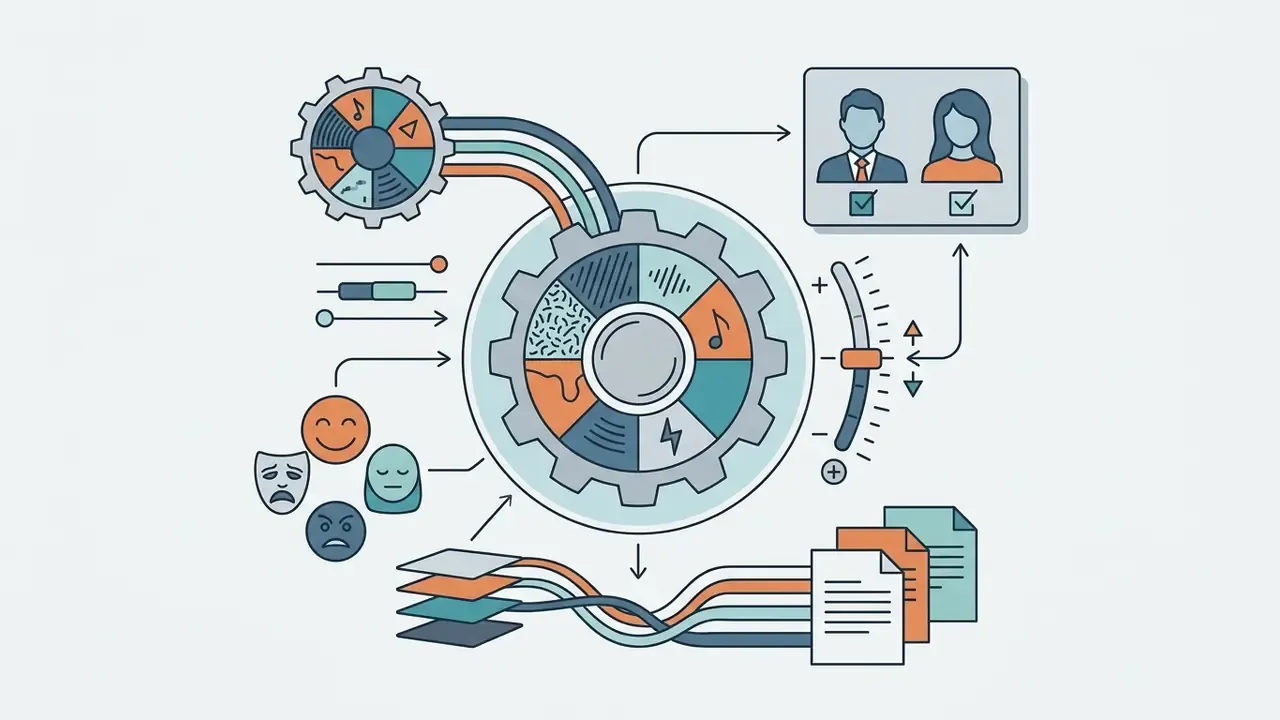
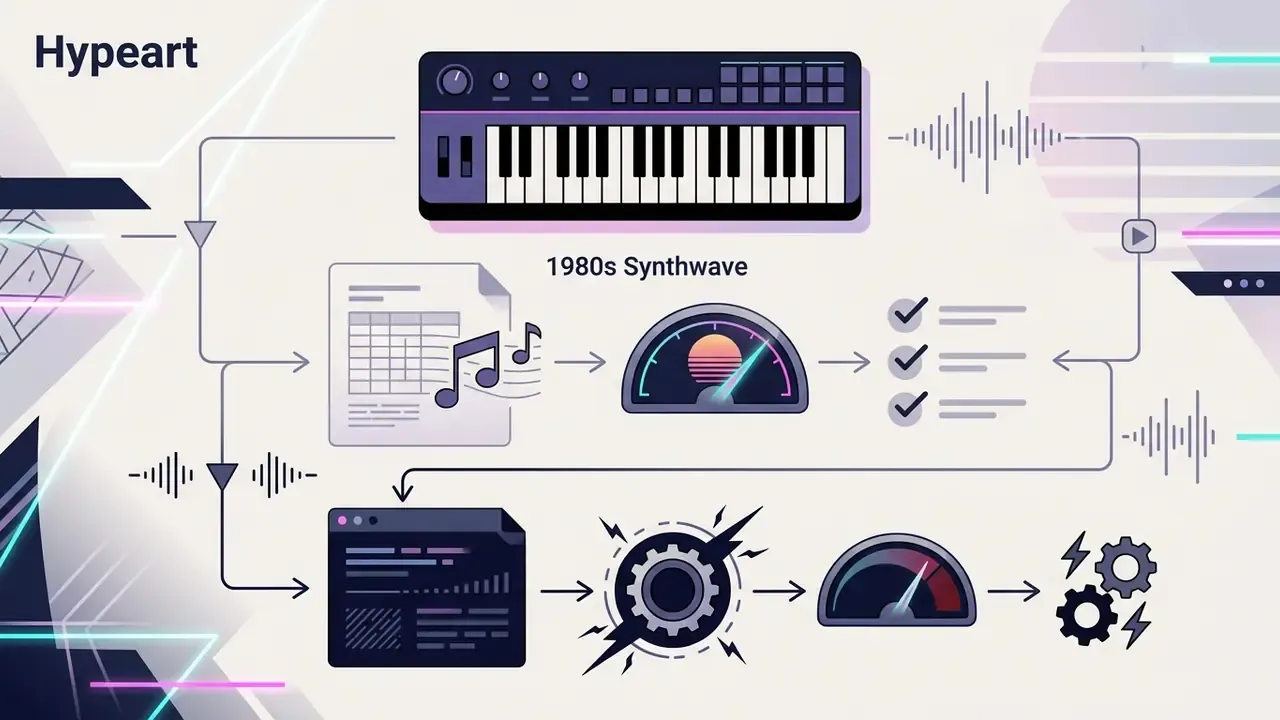
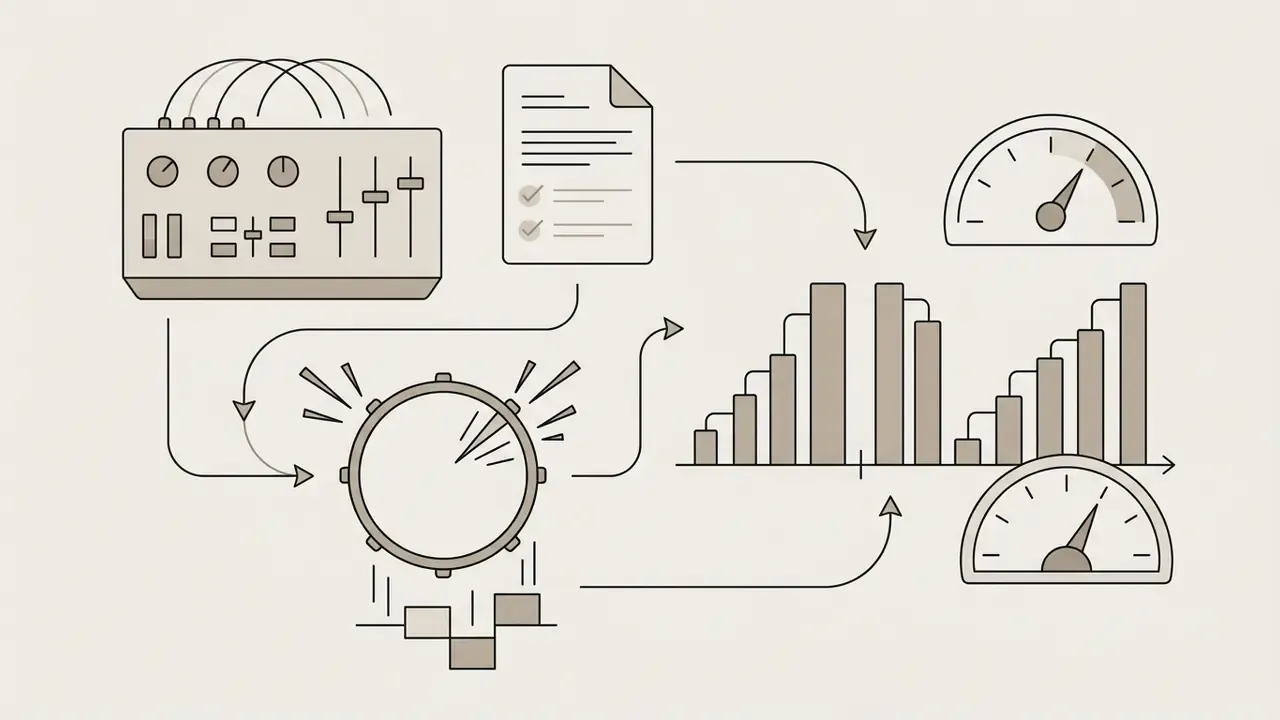
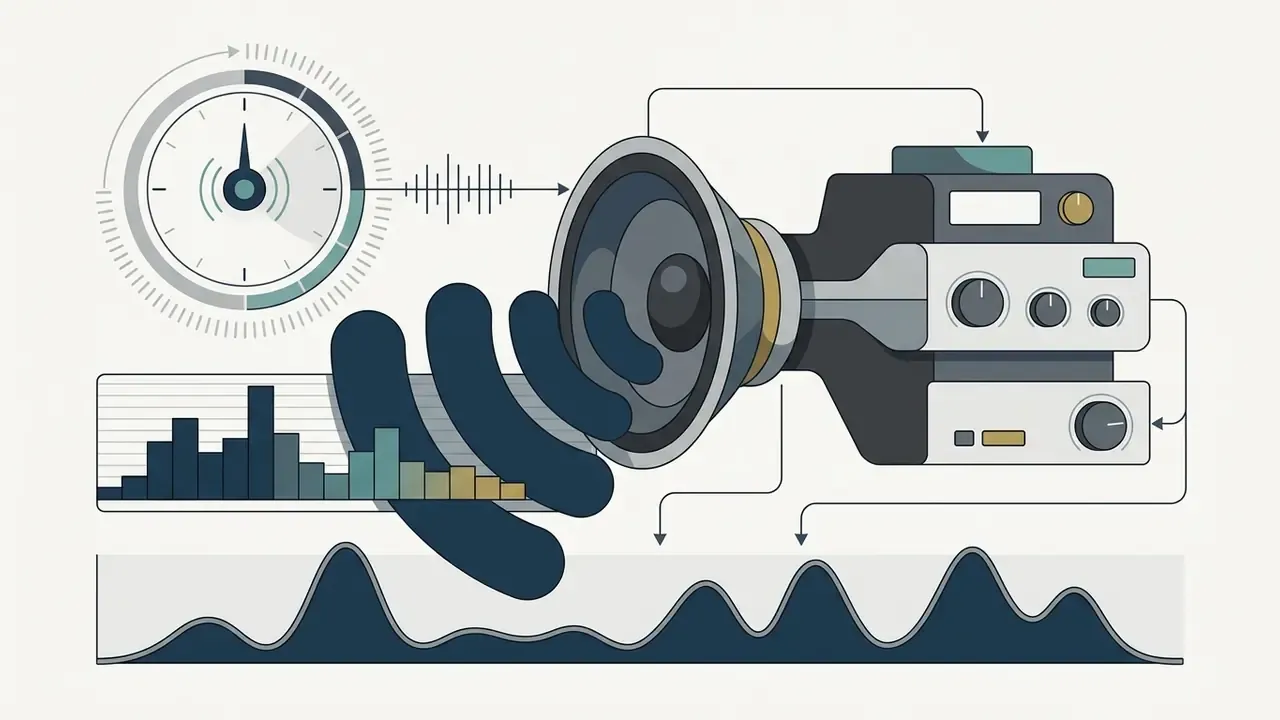
Description mode (text-to-music) synthesizes tracks from natural language covering genre, mood, instrumentation, tempo and production character. Leading TTM frameworks use dual conditioning: text encoders such as T5 for local semantic parsing, plus cross-modal models such as CLAP for global stylistic alignment. Updated: a 2025 preprint on a diffusion TTM model with dual conditioning reports that combining local T5 embeddings with global CLAP embeddings improves prompt adherence.
To maximize control, structure prompts systematically:
A before / after example for Description Mode
| Version | Prompt | Result |
|---|---|---|
| ❌ Weak prompt | "sad song with piano" | Unpredictable length, random tempo, blurred genre, vocals that appear and vanish between runs. |
| ✅ Strong prompt | "Cinematic neo-classical, melancholic and restrained, solo felt piano + sustained cello pad + subtle vinyl noise, 72 BPM, A minor, instrumental only, wide stereo reverb, film-score master" | Stable tempo and key, no vocals, repeatable output on regeneration, ready to cut against picture. |
The difference is systematic rather than lucky. The working formula: genre/sub-genre, then mood, then instruments, then tempo (BPM), then key, then mix character, then use case. For beds, state instrumental only or solo explicitly. For vocal-only parts, use a cappella.
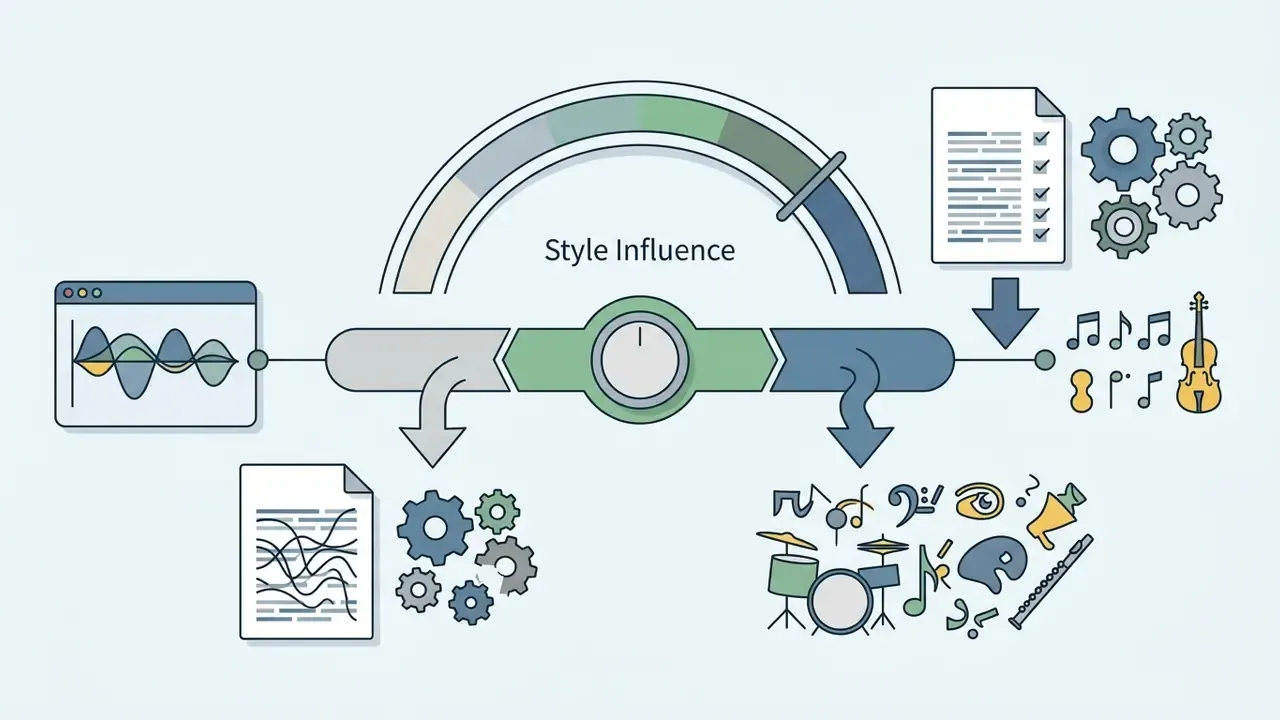
Advanced sliders worth understanding:
Lyrics to Music: Turning Text Into a Full Song
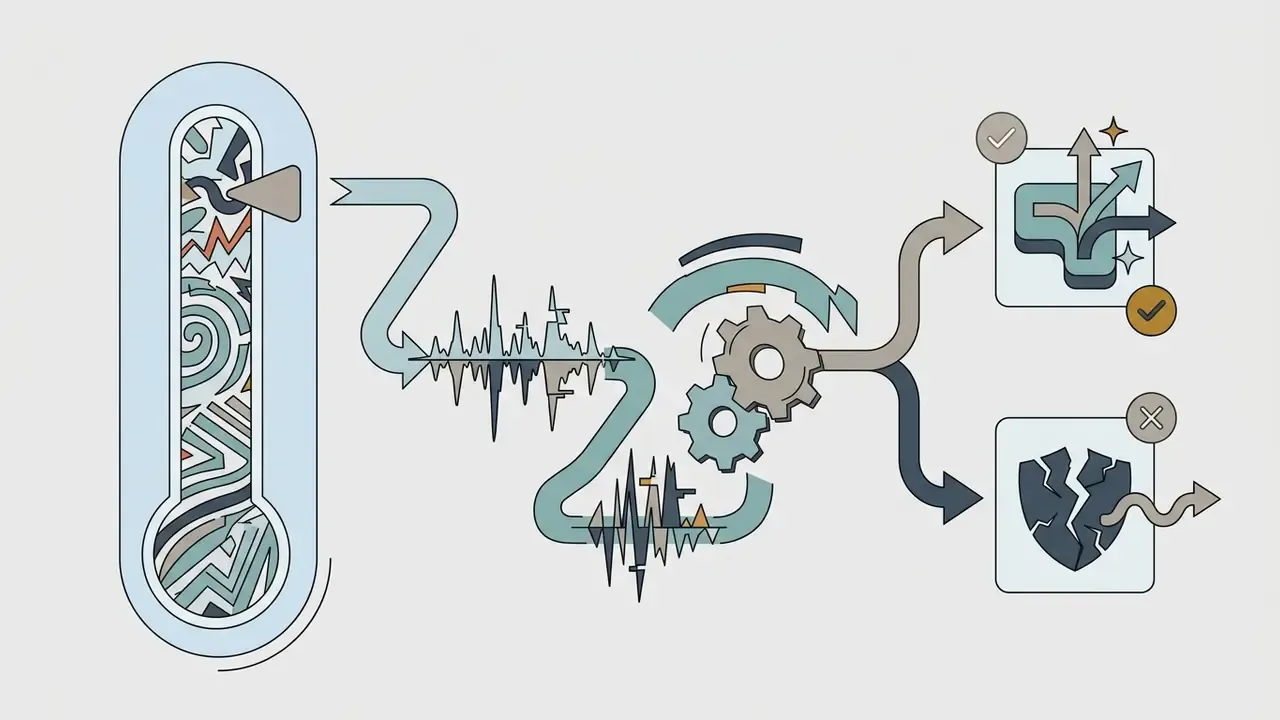
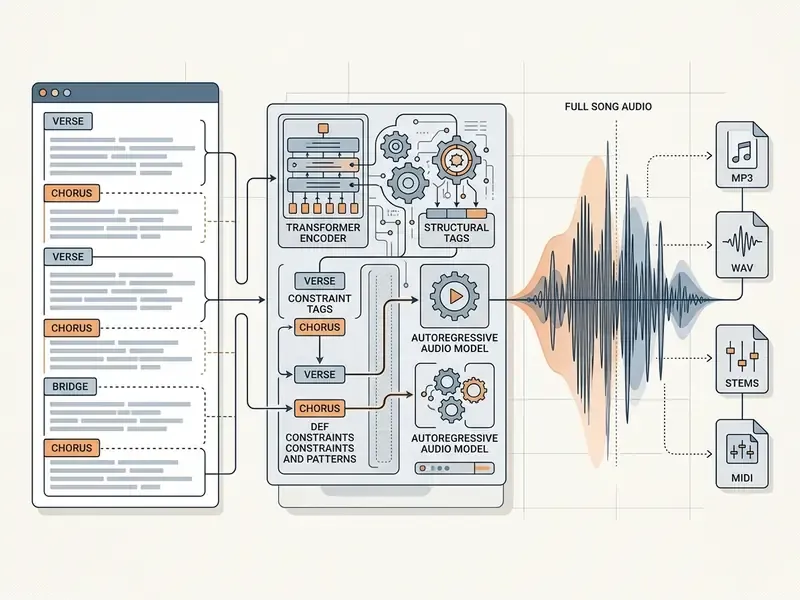
Lyrics-to-music functionality converts written verse into a structured song with synthesized vocal melodies over a rhythmic backing. Advanced engines rely on structural section tokens, including [Verse], [Chorus], [Bridge] and [Outro], to guide the model through song dynamics and syllable phrasing.
The Interspeech 2025 work describes a scheme where each section opens with a song-form token followed by a syllable-count token. That link is what ties text generation to musical structure. A separate ACL 2026 paper on singable lyric translation confirms that multilingual pipelines already support line-aligned notation for Chinese, Japanese and English.
AI Lyrics Studio: what the text editor should include
A distinct tool class sits inside the generator: the lyric studio. A workable feature floor looks like this.
- Autosave and version history with undo/redo, so drafts survive between generations.
- Lyric generation from theme, mood or keywords, with a direct hand-off into custom mode with instrumental mode switched off.
- Bilingual editing with line-by-line alignment, which becomes critical for localized releases.
For complex multi-language projects, creators often pair song engines with tools to create your own ai voice and with AI voice generators for localization, keeping vocal identity consistent across English, Spanish, Japanese or German passes.
Genre, Vocals and Instrumental Sound
Genre, vocal timbre and arrangement settings define the sonic boundary of the output. Most generators let users toggle between full vocal arrangements and pure instrumental modes. Vocal parameters typically include gender (male, female, duet), emotional delivery (soulful, aggressive, whispery, operatic) and language accent.
- Pop and electronic: benefit from clean vocal synthesis, tight compression and prominent synth leads.
- Rap and hip-hop: require precise syllable cadence, rhythmic delivery and strong bass/drum separation.
- Rock and metal: demand distortion-tolerant vocal modeling, acoustic kit modeling and layered electric guitars.
- Classical and cinematic: rely on dynamic orchestration, acoustic realism and long reverb tails, with no vocal interference.
Academic reviews assess instruction following along four axes: genre/style, emotion, vocals, instrumentation. Emotion is usually modeled through valence and arousal; vocals through timbre quality and appropriateness. The practical takeaway is small but useful. Describe emotion through physical delivery traits ("breathy, restrained, low register") rather than the abstract word "sad".
How to Download AI Music: MP3, Audio and Finished Tracks
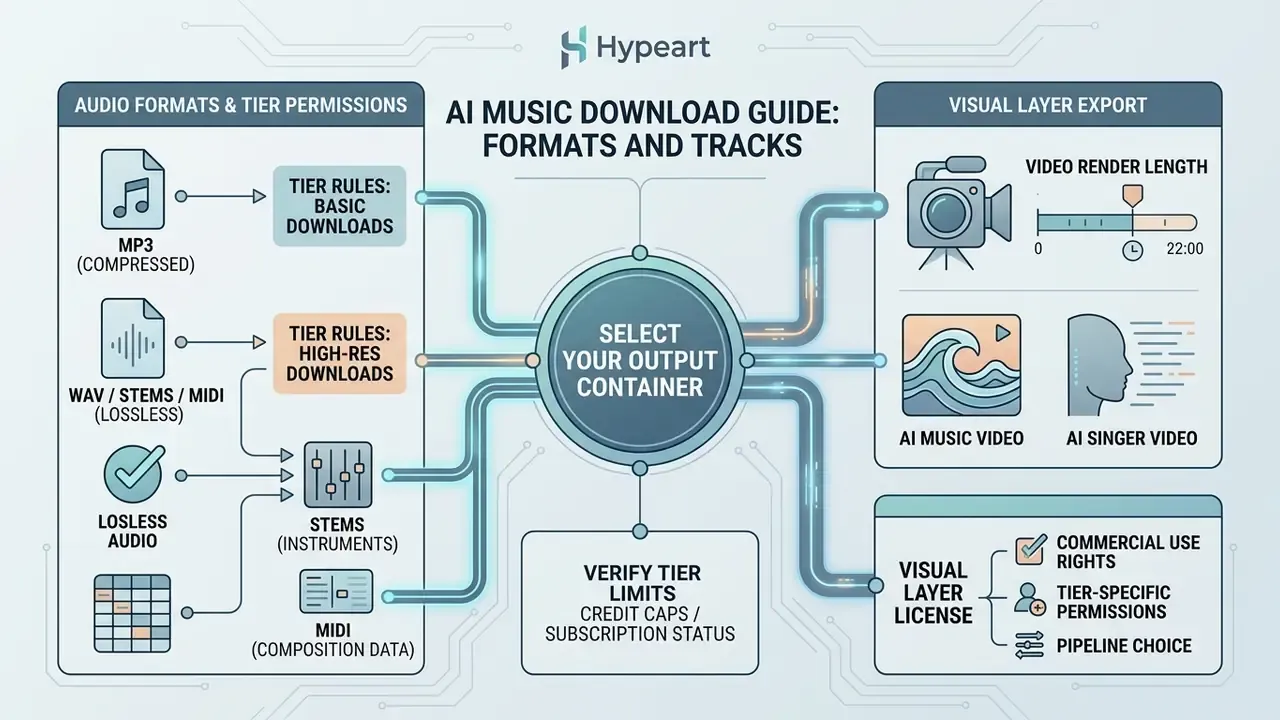
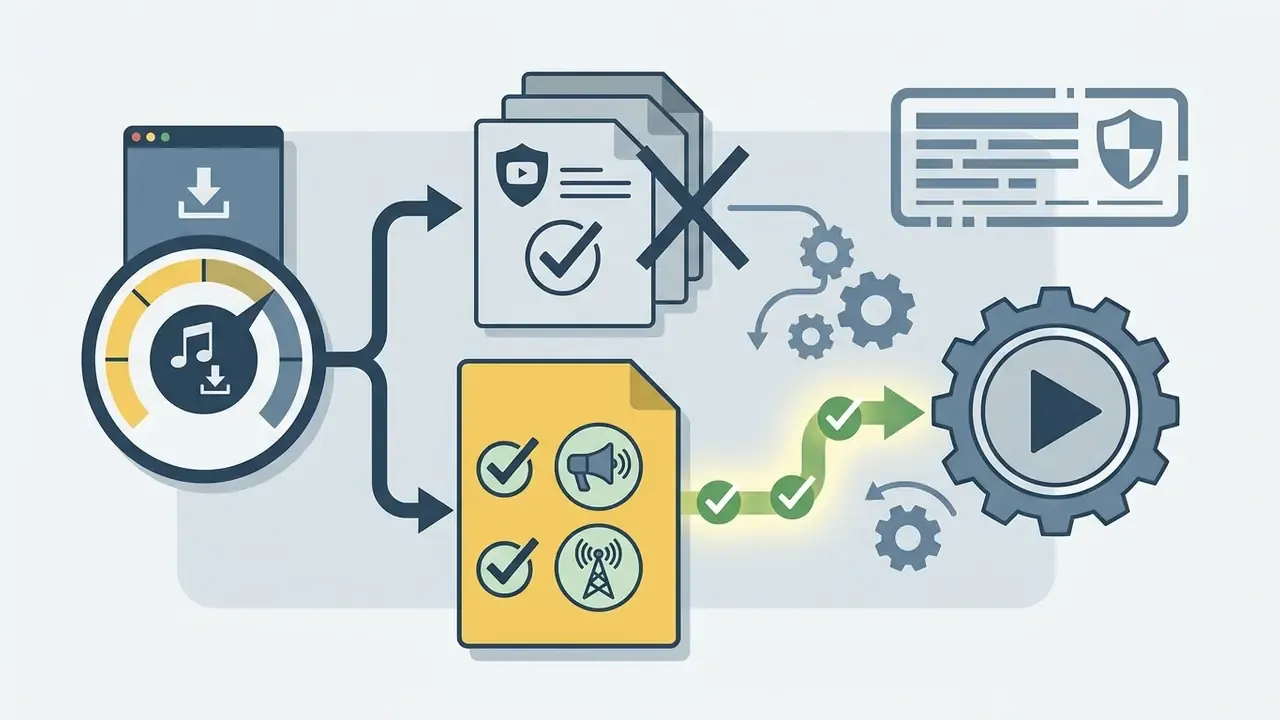
Downloading AI-generated music means choosing an output container (MP3, WAV and so on) and verifying export permission on your current tier. Browsers stream previews instantly, but file export depends on plan restrictions, credit balance and license terms. Evaluate bitrate, sample rate and multi-track availability against your post-production software before you commit.
When Free Download of Generated Music Is Available
Free download availability varies widely and changes with terms of service. Some platforms grant a limited number of free MP3 downloads at signup. Others allow unlimited streaming while restricting file saving to paid tiers. Updated: documented platform policies indicate that free accounts receive either a hard-capped export quota (public descriptions have referenced single-digit lifetime downloads) or reduced-bitrate export under promotional terms. Udio restricted export options after major label litigation settlements in late 2025, including a brief 48-hour window for previously created tracks, after which downloads closed again.
One nuance breaks budgets more often than any other. On several services, tracks created on a free tier remain non-commercial permanently, even if the user upgrades later. Rights do not apply retroactively.
In enterprise media production, relying on unverified free downloads creates downstream legal exposure. Production teams often standardize licensing definitions through asset indexes such as the AI Media Glossary before pushing generated audio into public broadcast pipelines. When terms read ambiguously, escalate to the vendor in writing; AI Media Support is the right first stop for clarifying an export or license question rather than guessing.
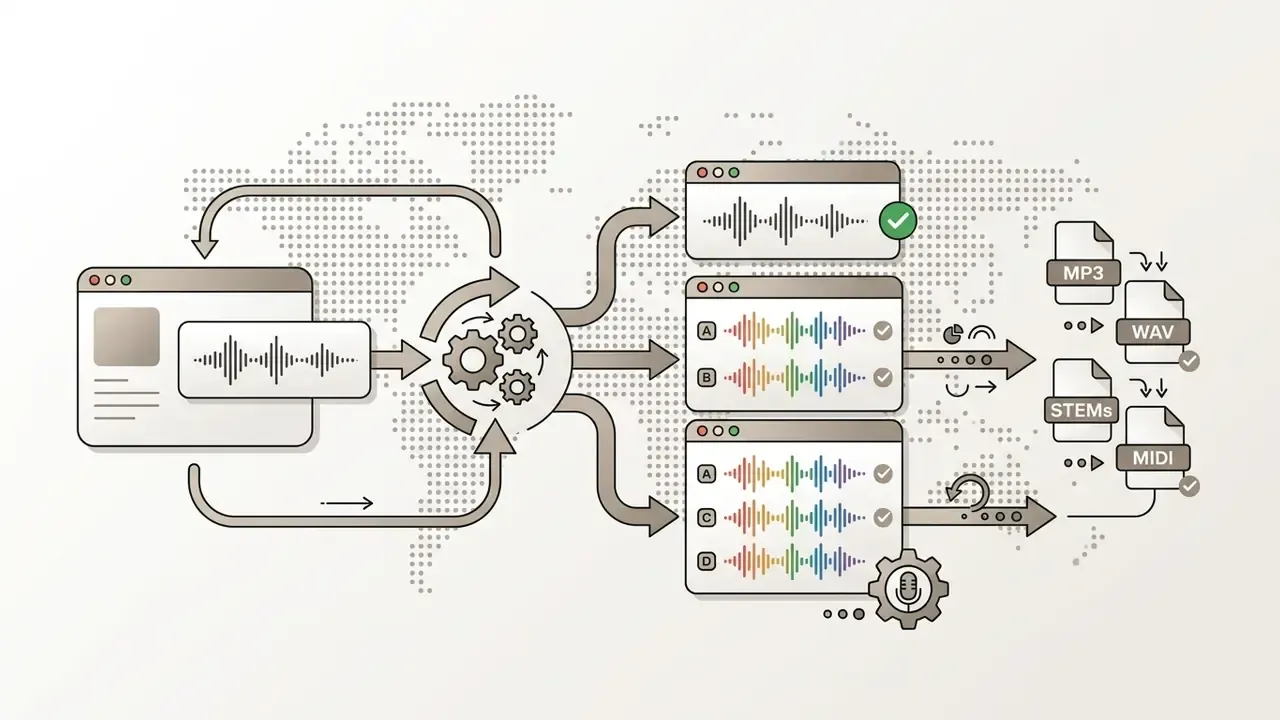
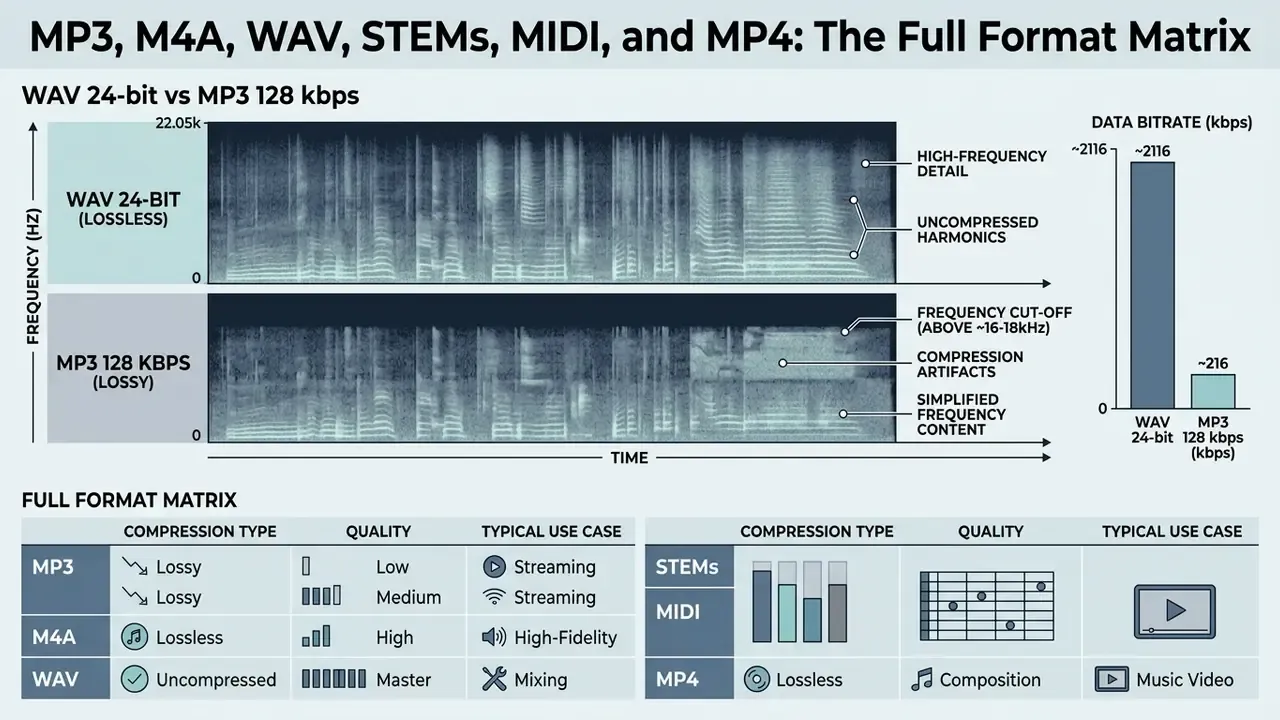
MP3, M4A, WAV, STEMs, MIDI and MP4: The Full Format Matrix
Format choice affects editing workflow, sound design quality and streaming compliance.
| Audio / Video Format | Bitrate / Specification | Compression and Structure | Primary Use Case | Editing Headroom and Features |
|---|---|---|---|---|
| MP3 (Standard) | 128-192 kbps | Lossy | Quick previews, draft sync, light web content | Low headroom; artifacts compound on re-compression. |
| MP3 (High Quality) | 320 kbps | Lossy | Podcasts, social video, YouTube upload | Moderate headroom; the practical MP3 ceiling. |
| M4A (AAC container) | 160-256 kbps | Lossy (Advanced Audio Coding) | Streaming, iOS integration, mobile apps | Better perceived quality than MP3 at smaller size; minimal phase drift. |
| WAV (Uncompressed) | 24-bit / 44.1-48 kHz (about 2,304 kbps stereo) | Lossless PCM | Professional video editing, film scoring, game audio | Maximum dynamic and frequency range; meets broadcast specs. |
| STEMs (Multitrack) | Separate WAVs (drums, bass, melody, FX, vocals; up to 12 tracks) | Lossless PCM | Professional mixing, vocal removal, DAW arrangement | Full channel isolation, independent level and EQ control. |
| MIDI File | Serial event data | Non-audio note data | Re-sampling on your own synths, score printing | Complete instrument replacement inside any DAW. |
| MP4 (AI video sync) | 1080p / 4K, H.264 + AAC | Container (audio plus visual) | YouTube Shorts, TikTok, Spotify Canvas | Built-in visualizer render and lip-synced singing character on export. |
For high-end editing in a DAW or NLE, editors normally import raw WAV files or stem bundles. Video professionals working in a davinci video editor need 24-bit/48 kHz WAV to prevent phase distortion and frequency degradation on final export. Streaming delivery inverts the logic: platform specifications target AAC or MP3 between 128 and 320 kbps at 48 kHz, with WAV used as the master exchange format rather than the publication format.
AI Music Video and AI Singer Video: Exporting the Visual Layer
A separate export branch generates video directly from the track. Practically it runs in two steps: audio first, then an MP4 assembled with a visualizer or a phoneme-synced singing AI character. Three limits deserve a check before release.
- Video render length is usually shorter than the audio. Typical caps sit near 60 seconds on entry plans and 120 seconds at the top.
- The visual layer license may differ from the audio license. A right to monetize the track does not always extend to the generated imagery.
- Pipeline choice: for social platforms, assembling the final clip yourself is often cleaner. Track from the generator, visuals from an animation maker, framing fixed with crop video online.
Advanced Editing: In-Painting, Stem Isolation and Bar-Level Controls
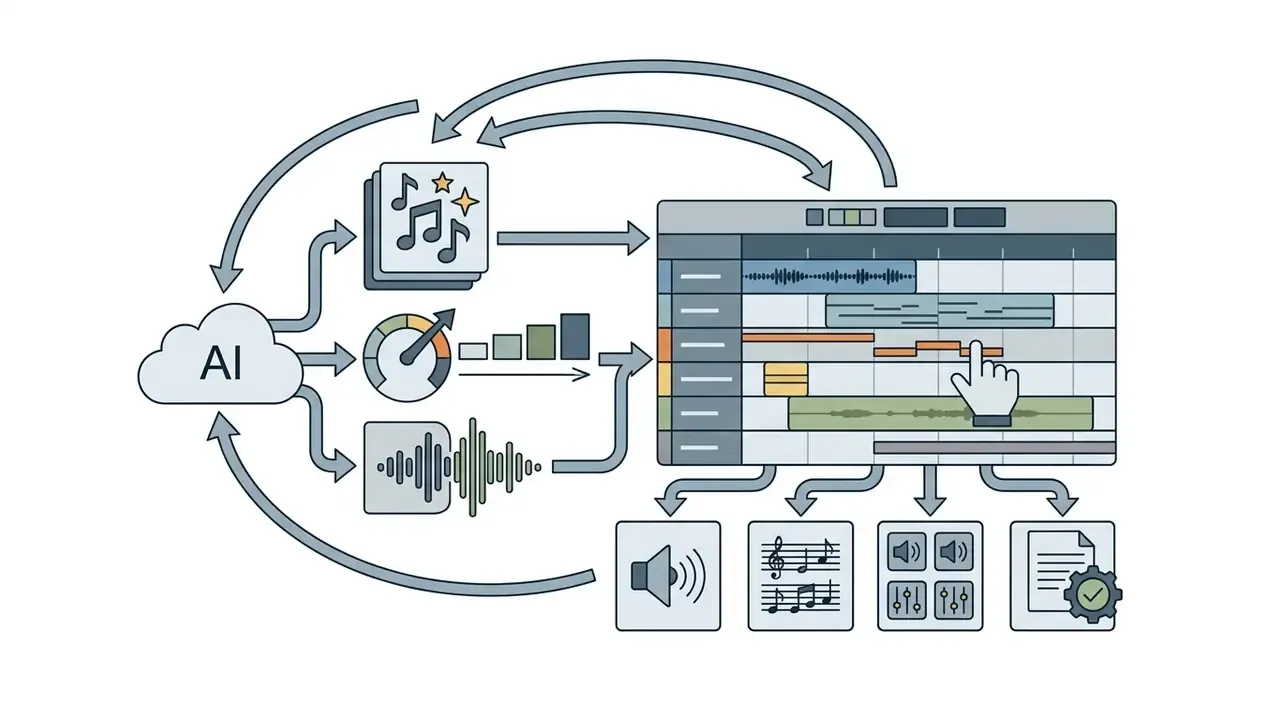
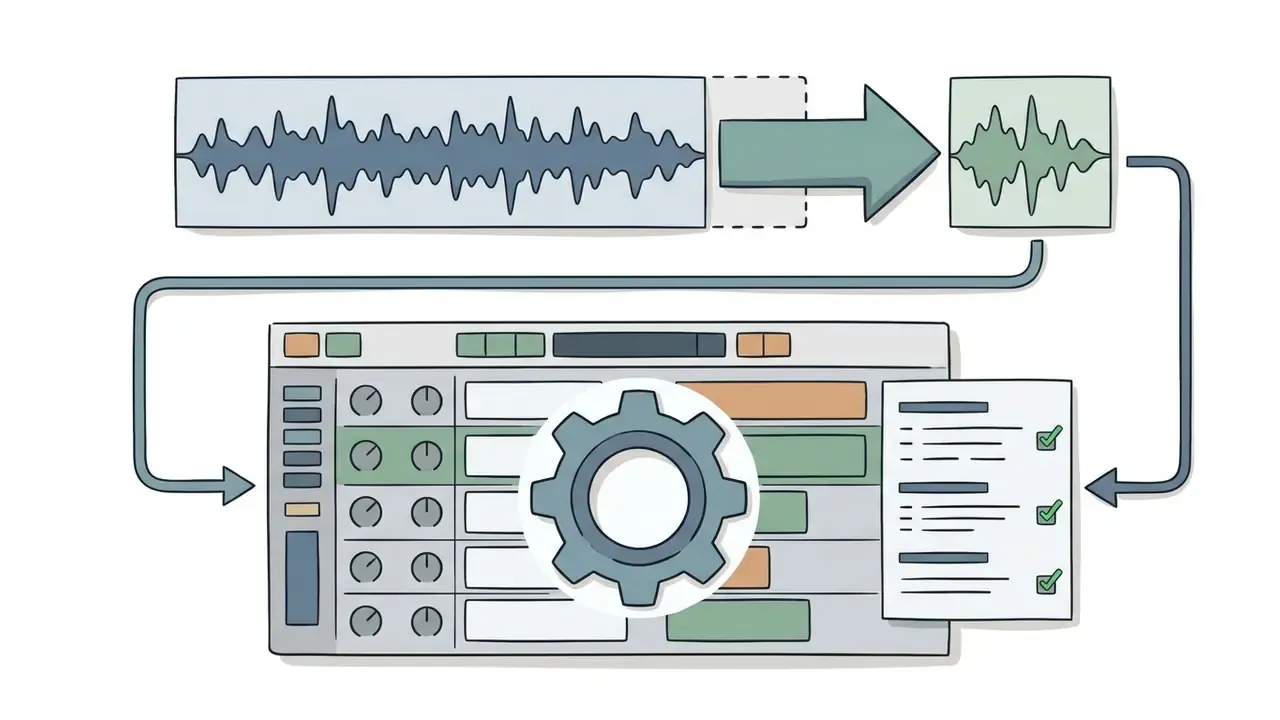
Platforms have moved past the single-prompt era. Most now ship a post-processing suite that takes a raw AI track close to release condition without external software.
- In-painting / replace section select a specific span (say 0:32 to 0:40) and regenerate only that span, preserving key, tempo and the surrounding structure. This is the primary weapon against local artifacts, a swallowed word or a cracked note.
- Bar-level intensity tuning shape dynamics per bar through a mixer, mute or solo instruments, thin the arrangement in the verse, add expression on the chorus. The engine rebuilds in place, no DAW round trip.
- Neural vocal remover and stem splitter split a finished stereo file into isolated tracks. Vendor documentation describes both two-stem modes (vocal / instrumental) and multi-stem splits of 7 to 12 tracks, including user-uploaded audio. Comparable functions exist in free editors through source-separation plugins with 2-stem and 4-stem modes.
- Song extension (continuation engine) extends a composition seamlessly, holding harmonic movement, tempo and timbral balance. This is how a 60-second sketch becomes a full-length track.
- Cover song / vocal swap re-sings an existing melody with a different timbre or in a different genre while keeping structure. Legal risk peaks here. Swapping vocals on someone else's recording does not create a clean new work.
- Add tracks / layering add individual parts over an existing base instead of regenerating everything for one new line.
The production economics are simple. These features move the point of correction from "regenerate the whole track" down to "bar 8", which directly reduces credit burn on free and entry-level plans.
Can AI-Generated Music Be Used Commercially?
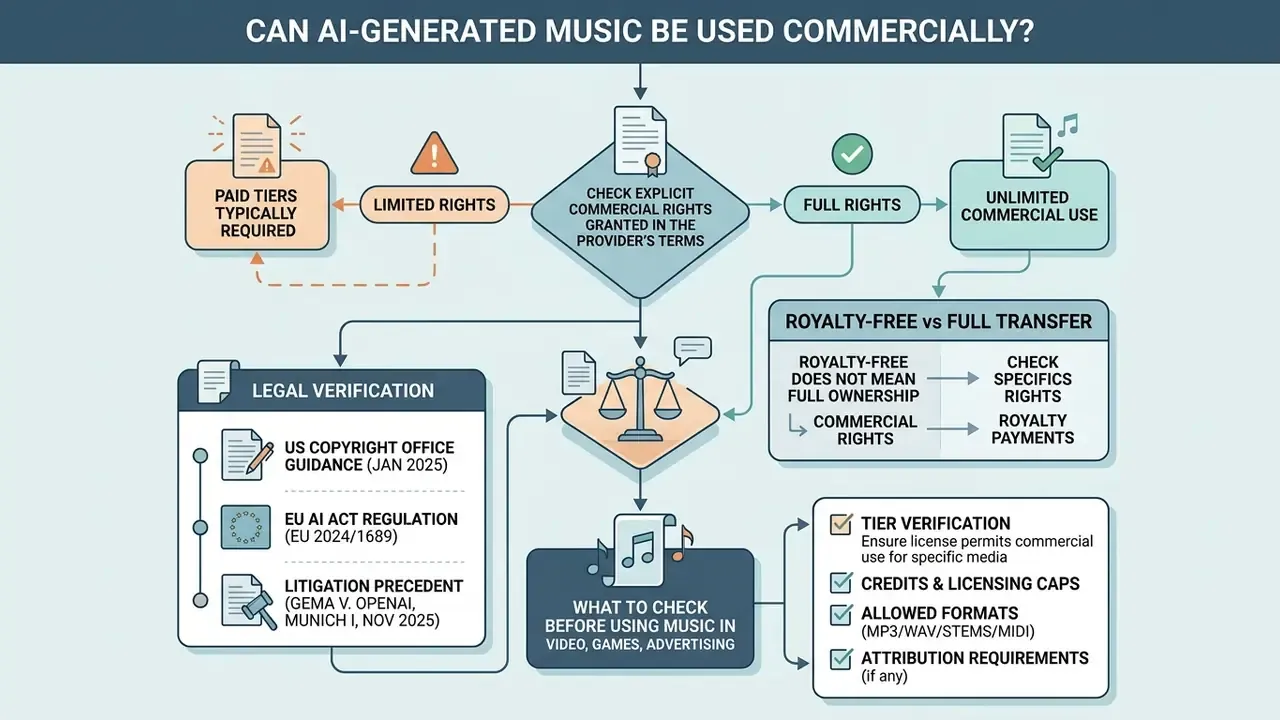
Commercial use of AI-generated music is permitted only where the provider's terms grant explicit commercial rights, which is typically limited to paid tiers. Purely AI-generated compositions lack federal copyright protection under United States law, so commercial rights function as contractual grants rather than enforceable IP ownership. Verify license scope, platform monetization eligibility and third-party copyright exposure before deployment.
Legal Verification: Commercial Rights and Copyright Status
Commercial deployment of AI audio crosses several regulatory frameworks.
- US Copyright Office (January 2025 guidance): output produced entirely by AI, with no human authorship, cannot be registered. Human creative selection, arrangement or modification is required for copyrightable elements to exist. Anyone tempted to list a model as the creator of ai content on a registration form should read that guidance first.
- EU AI Act (Regulation EU 2024/1689)providers of general-purpose AI models must comply with EU copyright law, maintain transparent training-data policies and publish detailed summaries of copyrighted material used in training. Important nuance: the regulation does not settle ownership of the output. It governs provider transparency and copyright compliance.
- Litigation precedent (GEMA v. OpenAI, Munich I, November 2025)storing and reproducing protected lyrics or musical works within model weights constitutes unauthorized reproduction. Providers and commercial users can face direct liability where output replicates protected source material.
Royalty-Free Does Not Mean Full Transfer of Rights
"Royalty-free"
indicates that the user owes no recurring royalty per play or broadcast. It does not grant exclusive IP ownership or unlimited usage rights.
- Royalty-free: removes ongoing performance and mechanical royalty payments, but the track stays bound by provider restrictions such as non-transferability and platform limits. RouteNote Licensing Blog (2026). https://licensing.routenote.com/blog/public-domain-royalty-free-creative-commons-what-do-they-mean/
- Public domain: material entirely free of copyright restriction, open to modification, sale and ownership claims. AI outputs do not automatically enter the public domain as protected assets. Bensound Blog (2026). https://blog.bensound.com/licensing-copyright/music-licensing-for-ai-generated-videos/
- Commercial license: a contract that explicitly permits monetized distribution, client work, advertising and digital sales under a named plan tier. MusicGenerate / RaoMusic Commercial License (2026). https://musicgenerate.ai/blog/is-ai-music-copyright-free
Read those two papers together and one practical conclusion emerges. Even under a formally royalty-free license, a track that recognizably imitates a specific artist sits inside developing legal risk. That risk is highest in advertising, where recognition is the entire point.
When corporate legal teams assess exposure across generative formats, video, voice and graphics included, they often lean on specialized risk frameworks or view the guide to emerging AI litigation trends.
What to Check Before Using Music in Video, Games and Advertising
In-House Datasets vs Web-Scraped Datasets: Provenance as a Control
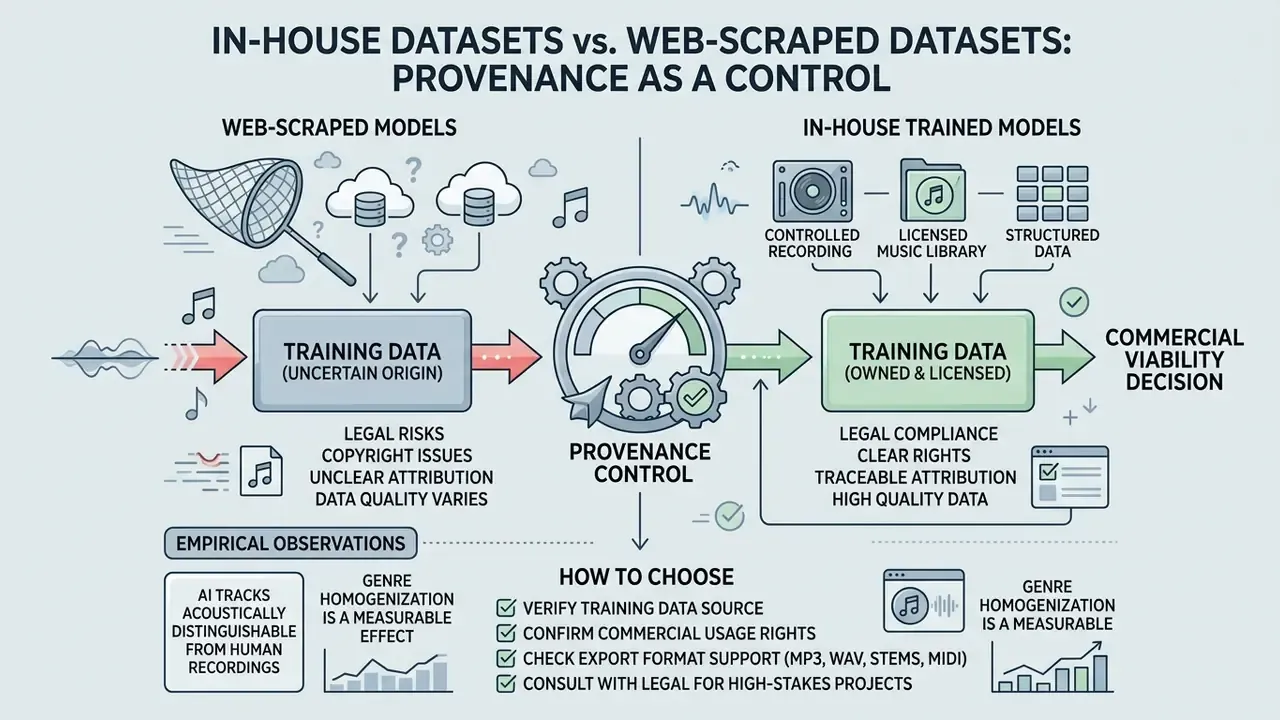
When selecting a generator for commercial work, the decisive criterion is not audio quality. It is training-data provenance. By 2026 the market had split into two architectural and legal models.
1. Web-scraped models. These networks were trained on copyrighted material collected from the open web. An output track does not infringe automatically, but the user receives no guarantee against claims from rightsholders of the source material. That is exactly the scenario examined in GEMA v. OpenAI (Munich I, November 2025), where memorization of lyrics in model weights was found to be unlawful reproduction. Upside: broad genre coverage and strong vocals. Downside: DMCA exposure, unstable export terms (Udio after its label settlement is the reference case) and no indemnification.
2. In-house trained models. These platforms train exclusively on music recorded by staff producers, holding master and publishing rights across the whole training set. SOUNDRAW states the position plainly: "No scraped songs, no legal gray areas." Each composition ships with a perpetual worldwide commercial license permitting distribution to Spotify, Apple Music and TikTok, with 100% of royalties retained by the user. Upside: predictability for brand safety and enterprise procurement. Downside: genre coverage limited to the vendor catalog, and vocal capability that is usually more modest than scraped models.
How to choose. For user-generated content, drafts and internal decks, the difference barely matters. For advertising, games, apps and label releases, one criterion decides: a written warranty of training-data provenance plus indemnification. If a vendor will not publish its dataset source, treat that silence as a risk factor in its own right, not a neutral detail.
The empirical side is documented too.
Put differently, genre homogenization is a measurable effect, not a matter of taste. The closer your brief sits to a niche genre, the more manual work and stem editing you should budget.
Distributing AI Tracks on Spotify, Apple Music and YouTube
Monetizing AI music on streaming depends on three independent permission layers: the generator license, distributor rules, and platform policy.
- Generator license.Check whether your plan includes "distribute and monetize songs (Spotify, Apple Music, and so on)". Several vendors include this even at entry level, but with a monthly upload cap: 10 tracks on a starter artist plan, 20 on a Pro plan with WAV and STEMs, uncapped at the top tier.
- Perpetual license after cancellation.This is the practical question for any release. Look for language stating that anything exported during an active subscription stays licensed forever, even after cancellation. Platforms with in-house datasets tend to declare this explicitly. The opposite model, where rights live only while the subscription lives, makes long-term catalog presence impossible.
- Royalties."100% royalty ownership" means the vendor claims no share of streaming income. It does not remove distributor fees, and it does not create copyright where the law grants none.
- YouTube.Monetization follows YouTube Partner Program rules. Repetitious and inauthentic content can be rejected, so bulk-uploading AI tracks with no human contribution is a fragile strategy. Registering a purely AI track in Content ID is generally unavailable.
- Cross-platform rights.Music licensed inside TikTok does not travel to YouTube. Rights attach to the platform, and Content ID can still claim the same audio elsewhere.
How to Choose an Unlimited AI Music Generator for Your Task
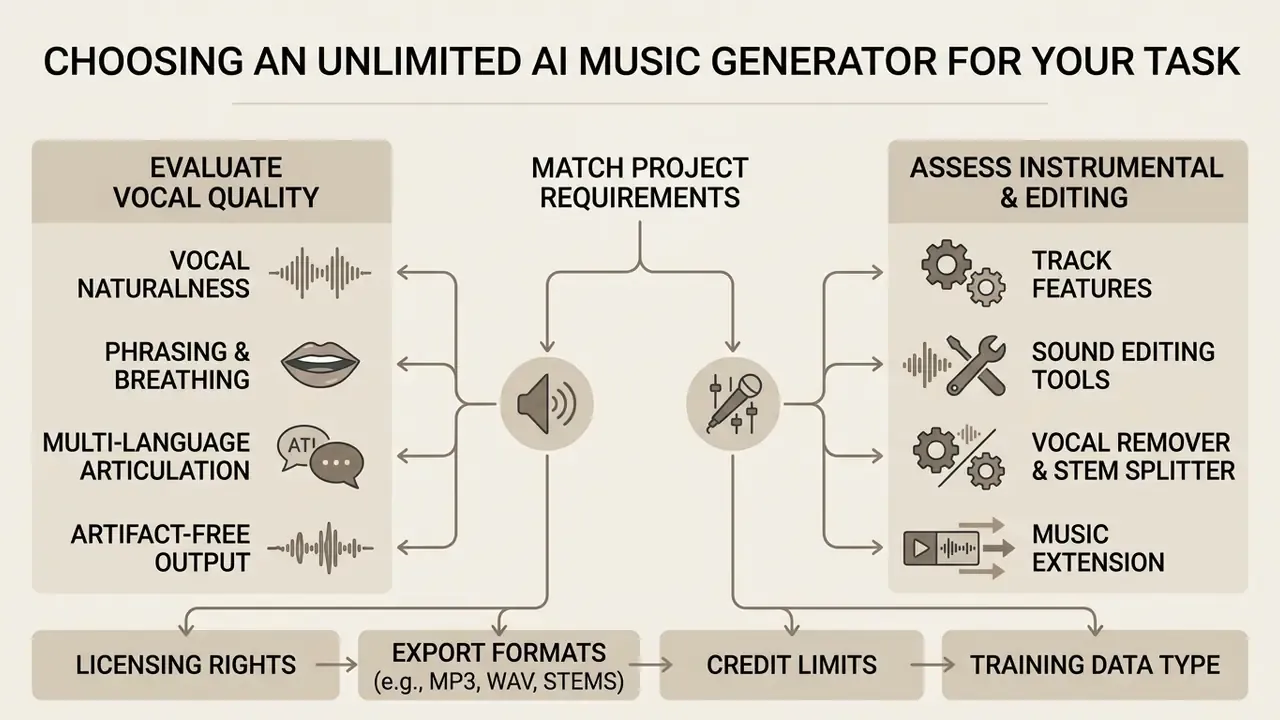
Selecting an unlimited AI music generator means matching project requirements, vocal fidelity, instrumental depth, stem separation and licensing, against platform capability and fee structure. Platforms differ sharply in specialization, rendering quality and export options. An operational matrix prevents an expensive workflow migration mid-production.
| Platform / Engine | Primary Focus | Free Tier Allowance | High-Quality Export Formats | Commercial Use Rights | Pro Subscription Cost |
|---|---|---|---|---|---|
| Suno | Full vocal songs, studio editing | 50 credits/day (about 10 tracks), non-commercial | MP3, WAV (Pro/Premier, desktop), multitrack STEMs (up to 12), MIDI (Premier) | Included on Pro/Premier; not retroactive to free-tier tracks | about $10 (Pro) to $30 (Premier) per month |
| Udio | Vocal styling, audio references | About 10 credits/day, about 100/month, tracks to 2:10, export restricted | MP3, WAV (paid tiers) | Restricted under post-settlement terms; verify by generation date | about $10 (Standard) to $30 (Pro) per month, annual billing |
| SOUNDRAW | Customizable instrumental tracks, in-house dataset | Unlimited generation and preview (no download) | MP3 (Creator), MP3 + WAV + STEMs (Artist Pro and above) | Perpetual worldwide license, 100% royalties, included in paid plans | €5.83 (Creator, annual) to €17.42 (Artist Unlimited) per month; Enterprise on request |
| AIVA | Classical and cinematic composition | 3 downloads/month, up to 3 minutes, non-commercial | MP3, MIDI, WAV (Pro) | Included on Pro/Ultimate | about €33 per month (billed yearly) |
| OpenMusic AI | Background and commercial media | Credit-limited trial; no commercial license | MP3 (monthly plans), MP3 + WAV (annual plans) | Annual plans only; PDF license issued after upgrade | Tier-based: monthly without commercial rights, annual with license |
| Sonauto | Free-first song generation | Advertised as fully free with no generation cap | MP3 (format set varies by version) | Verify in current terms | Free-first model |
| Local Open-Source (MusicGen / Stable Audio Open / ACE-Step) | Self-hosted generation and research | Unlimited (GPU-bound only) | WAV / FLAC / any post-processing format | Defined by the weights license, not a subscription | $0 subscription plus GPU and electricity cost |
Prices and limits reflect public pricing pages as of Q1 2026 and change often. Reconcile against vendor checkout before purchase.
Teams selecting audio and video stacks together usually merge both matrices into one sheet, the same way they handle a comparison of free AI video generators. To evaluate specialized generative platforms across image, video and audio systematically, technical teams can compare multi-modal toolsets side by side.
Song Features: Lyrics, Vocals and Text to Music
Full song production requires natural vocal synthesis, accurate articulation, emotional dynamics and flexible lyric alignment. Key evaluation dimensions follow.
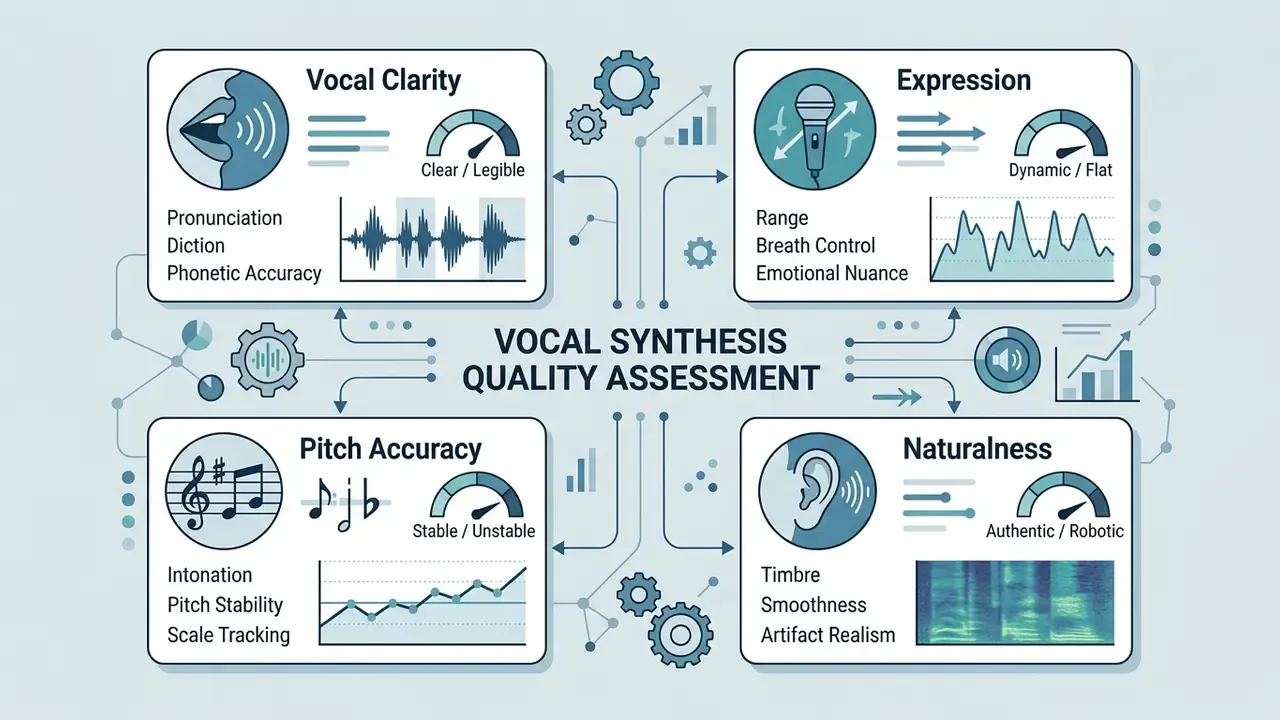
Creators building multimodal projects frequently combine song engines with visual synthesis tools such as a d-id ai video generator or an animation maker to assemble complete digital characters.
Instrumental Track Features and Sound Editing
Instrumental sound design needs precise arrangement control, extension capability and isolated editing.
- Vocal remover and stem splitter neural processing that isolates vocals, drums, bass and melody into 2-stem or 4-stem files for independent mixing.
- Music extension (track continuation) algorithms that analyze an existing clip and generate continuous audio matching original tempo, key and instrumentation.
- In-painting and region editing highlight a specific five-second span and regenerate only those bars, leaving the surrounding composition intact.
- Genre blending mix two or more genre tags in one prompt (Hip-Hop plus Orchestra, Trap plus Lo-Fi) as a countermeasure to the genre homogenization documented in the TTM audit.
Free, Pro and Paid Plans: Reading Pricing Without Mistakes
Analyzing AI music pricing requires reading the fine print underneath the headline rate.
Open-Source and Local Models: The Real Free Unlimited
The only way to get generation with no credits, watermarks or export locks is to run the model yourself. This class of solution rarely appears in review roundups, for an obvious reason: nobody can monetize it with a subscription.
What is available:
- Meta MusicGen / AudioCraft: a family of autoregressive text-to-music models with open weights. Typical use covers text-to-music and melody-conditioned generation, with genre, instruments and mood declared in the prompt. Fine-tuning guides from 2025 note that genre-specific prompts noticeably improve control.
- Stable Audio Open: an open model for short instrumental fragments, loops and sound effects.
- ACE-Step 1.5: a project aimed at fast full-song generation, claiming under 2 seconds per song on an A100 and under 10 seconds on an RTX 3090. Requirements: Python 3.11-3.12 and a CUDA GPU, with MPS, ROCm, Intel XPU or CPU as fallbacks.
- DiffRhythm: a research model generating compositions up to 4:45 in roughly 10 seconds of synthesis (arXiv, 2025).
- What you gain: unlimited generations, full control over sample rate and format (WAV or FLAC), prompt privacy, and independence from vendor pricing changes.
- What you lose: legal indemnification, first of all. You also inherit the duty to check the weights license yourself (research-only versus commercial), the hardware cost, and, as a rule, weaker vocals than closed commercial models. One more point matters for compliance functions: running locally does not resolve training-data provenance. It transfers the responsibility to you.
- Risk-management takeaway: if employees are using AI music outside policy, in other words shadow AI, local models are the most likely route, because they leave no payment trail. Write the acceptable-use policy to cover self-hosted tooling, not only SaaS subscriptions. An inventory that only lists vendors with invoices is not an inventory.
FAQ on AI Music Generator Free Unlimited
Do you need a music education to use an AI music maker?
No. A modern AI music maker requires no formal grounding in music theory, chord progression design or audio engineering. Text-to-music systems process plain-language prompts describing style, tempo, instruments and emotion. Interface controls handle harmonic structure, key alignment and mixing automatically, which lets non-musicians produce polished compositions immediately.
"Text interfaces are especially accessible to users without musical training, allowing genre, mood and instruments to be specified in natural language." (Survey of AI music generation tools and models, 2023) Vendor documentation says the same thing about the entry threshold. Adobe states directly that no knowledge of music theory or audio engineering is needed for its AI music tooling (Adobe Firefly AI Music Generator, 2026, https://www.adobe.com/products/firefly/features/ai-music-generator.html). Production-level work is a different bar: programs such as Berklee Online's AI in music course assume basic DAW fluency (https://online.berklee.edu/courses/ai-in-music-composition-production-and-analysis). The distinction is simple. Anyone can generate a track. Not everyone can finish one.
How fast does an AI generator create songs and tracks?
Updated: speed depends on the model class and on which metric the vendor chooses to publish. Cloud services usually advertise maximum output length rather than synthesis time. Suno's documentation cites tracks up to 8 minutes per generation in V4.5/V5 (earlier versions allowed 1:20, 2 and 4 minutes), while Google describes full-length Lyria 3 Pro songs as "a couple of minutes" of music, with fixed 30-second clips in Lyria 3 Clip. Research and local models publish wall-clock instead. DiffRhythm claims a full composition up to 4:45 in about 10 seconds of synthesis (arXiv, 2025), and ACE-Step 1.5 claims under 2 seconds on an A100 and under 10 seconds on an RTX 3090. Real cloud latency additionally depends on queue load, chosen sample rate (44.1 versus 48 kHz) and track length.
Can songs be created in different languages and genres?
Yes. Leading AI song generators accept multilingual prompts and synthesize sung lyrics across dozens of languages, including English, Spanish, French, German, Japanese, Korean, Chinese and Hindi. These engines also render a wide genre range: pop, rap, heavy metal, classical orchestration, lo-fi hip-hop, EDM, jazz and regional folk styles, by weighting prompt descriptors against training data. Quality, however, is unevenly distributed. The GlobalDISCO study (2026), covering roughly 73,000 commercially generated tracks, recorded lyrics in 147 languages but with English dominant at 39.41% and Spanish at 14.67%. A 2025 paper on cross-lingual genre recognition reported weighted F1 rising from 0.35 to 0.69, so multilingual genre accuracy is achievable yet far from uniform. The sharpest data point comes from a 2026 study on AI-text detection, where one detector showed 0% recall for Italian jazz and Turkish folk. Practical conclusion: for niche national genres, budget more iterations and more manual finishing.
What output quality do you get, and is it enough for broadcast?
Official 2026 model specifications cite high-resolution 44.1 kHz stereo (Lyria 3) and 48 kHz WAV in the previous generation. For YouTube, podcasts and social, that is sufficient. For television and film, target WAV 24-bit/48 kHz (about 2,304 kbps stereo) plus guaranteed access to STEMs. Without stems you cannot fit the mix around dialogue and sound design.
Is there a genuinely free unlimited generator?
Yes, with conditions. Option one is a free-first service such as Sonauto, where generation is uncapped, though terms can change at any moment and commercial rights need separate verification. Option two, the durable one, is local open-source models (MusicGen/AudioCraft, Stable Audio Open, ACE-Step), where the only limit is your GPU. Everything else sold as free unlimited turns out, on inspection, to be a credit model or an export model.
Can an AI track be registered in Content ID to collect royalties?
Purely AI-generated tracks usually fail Content ID requirements, both because original human authorship is absent and because of explicit exclusions for samples, loops, covers and public domain material. Streaming royalties are a separate question. Platforms trained on in-house datasets declare that users keep 100% of royalties, but that is a contractual promise from a vendor, not the equivalent of copyright.
Appendix A: Wording Revisions and Version Notes
This section stays in place for editorial transparency and source auditing.
- Original wording (replaced)"documented platform policies show Suno providing 7 lifetime downloads for free accounts." Reason: the specific figure is not supported by the supplied source corpus and shifted during 2025-2026. Current wording: "free accounts receive either a hard-capped export quota or reduced-bitrate export under promotional terms; verify current Terms of Service."
- Original wording (clarified): "Research published in 2025 demonstrates that combining T5 local embeddings with CLAP global embeddings improves prompt adherence." Attribution added to the 2025 preprint on a diffusion TTM model with global and local text conditioning.
- Original wording (clarified): "Modern cloud-based AI music platforms synthesize complete 2-to-3-minute songs or instrumental tracks in approximately 10 to 60 seconds" and "report synthesis speeds under 2 to 10 seconds per full song" were rewritten to separate two different metrics: synthesis wall-clock (research and local models) versus maximum output length (vendor documentation).
- Relocated linkthe internal anchor on AI image artifacts was moved out of the audio export section, where it was off-topic, and placed in the multimodal campaign context, where visual review gates are the subject. A production pipeline block covering "track, edit, compress" was added with matching links.
- Policy volatilityevery quantitative tier limit reflects Q1 2026 and requires re-verification as of the track's generation date, since rights do not apply retroactively.
- Language and typography passthe article was consolidated into English throughout, and long dashes were replaced with commas, colons and hyphens for cleaner reading across editors and CMS exports.