To create your own AI voice, you have two technical routes. Either convert consented audio samples into a reusable neural speaker embedding through voice cloning, or design a non-replicative synthetic voice profile from text-based acoustic parameters. Modern text-to-speech systems let organizations and creators generate lifelike speech, localize content across languages, and hold a consistent voice brand while the legal ground keeps shifting under FCC TCPA rulings and the EU AI Act.
Search queries vary widely. People type "create my own ai voice", "ai voice generator from my voice", "create own ai voice", "how to create a ai voice", "ai voice generator with your voice", or "create my voice ai". They all describe the same two paths: clone a real speaker, or design a synthetic one.
Executive summary
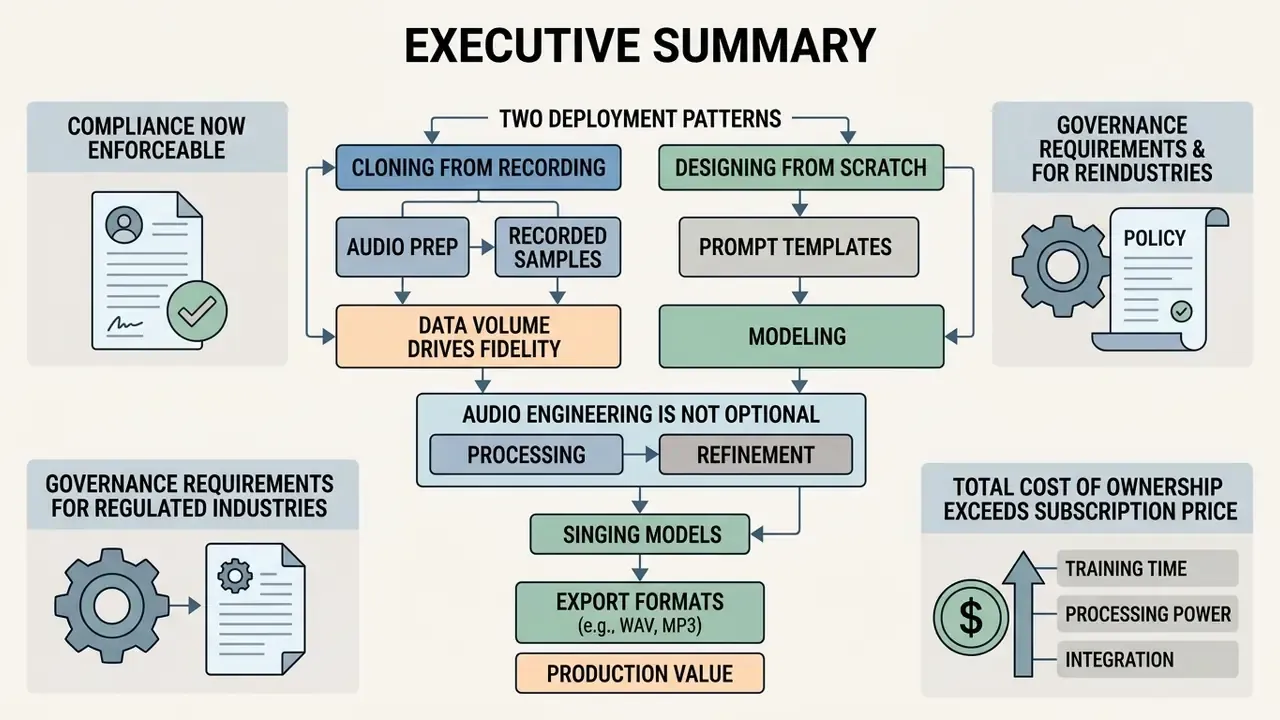
- Two deployment patterns exist. Voice cloning reuses a consented speaker's recorded audio to build a reusable speaker embedding. Custom voice design creates a brand-new synthetic identity from a text description with no source audio, which removes personality-rights exposure.
- Data volume drives fidelity. Instant (zero-shot) cloning works from 10 to 30 seconds of clean reference audio. Studio-grade fine-tuning needs 10 to 15 minutes of phonetically balanced speech, and Microsoft's Custom Neural Voice workflow requires at least 300 recorded utterances plus a recorded consent statement (Microsoft Learn, 2026, https://learn.microsoft.com/en-us/azure/ai-services/speech-service/custom-neural-voice).
- Audio engineering is not optional. Target 24 kHz or 48 kHz 16-bit PCM WAV, SNR above 35 dB, peaks between −3 dB and −6 dB, then apply the four-stage pre-processing pipeline (80 Hz high-pass, de-essing, mild compression, de-reverberation) documented below.
- Compliance is now enforceable. The FCC confirmed in 2024 that voice-cloned calls fall under the TCPA (FCC-24-84A4). EU AI Act deepfake transparency duties apply from 2 August 2026. Tennessee's ELVIS Act protects identifiable voice simulations, and Illinois BIPA treats voiceprints as biometric identifiers requiring written release.
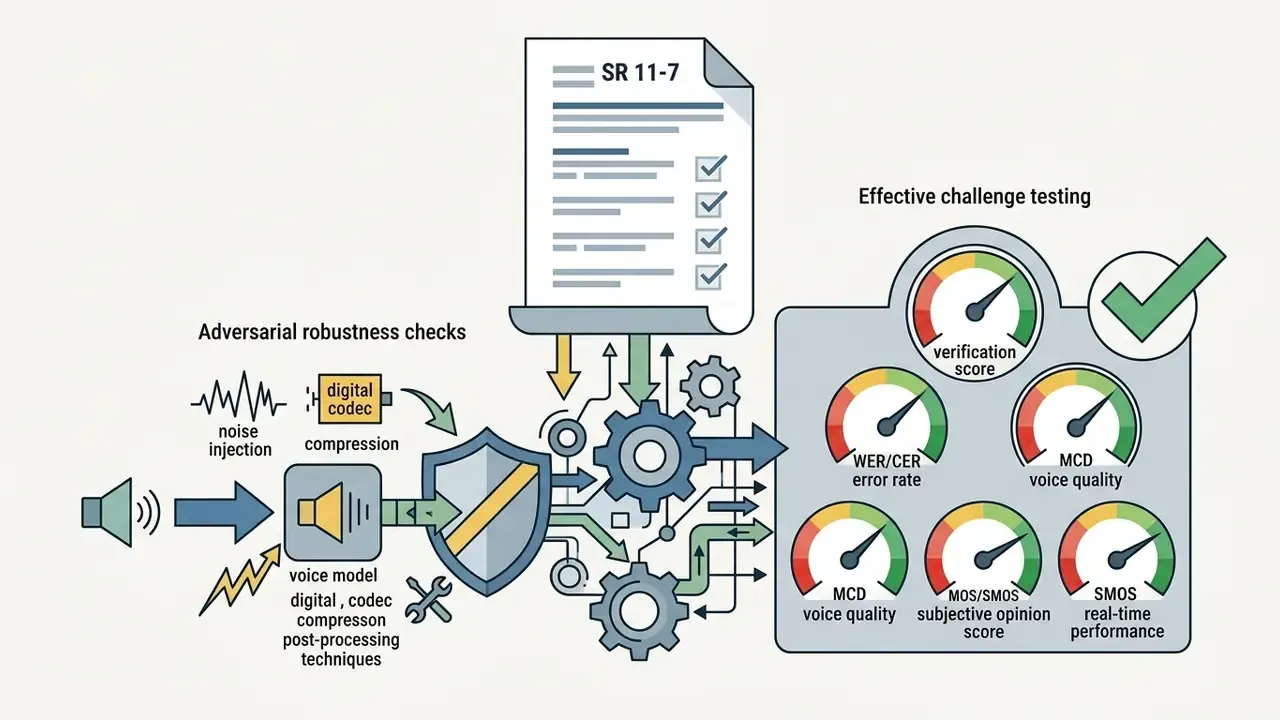
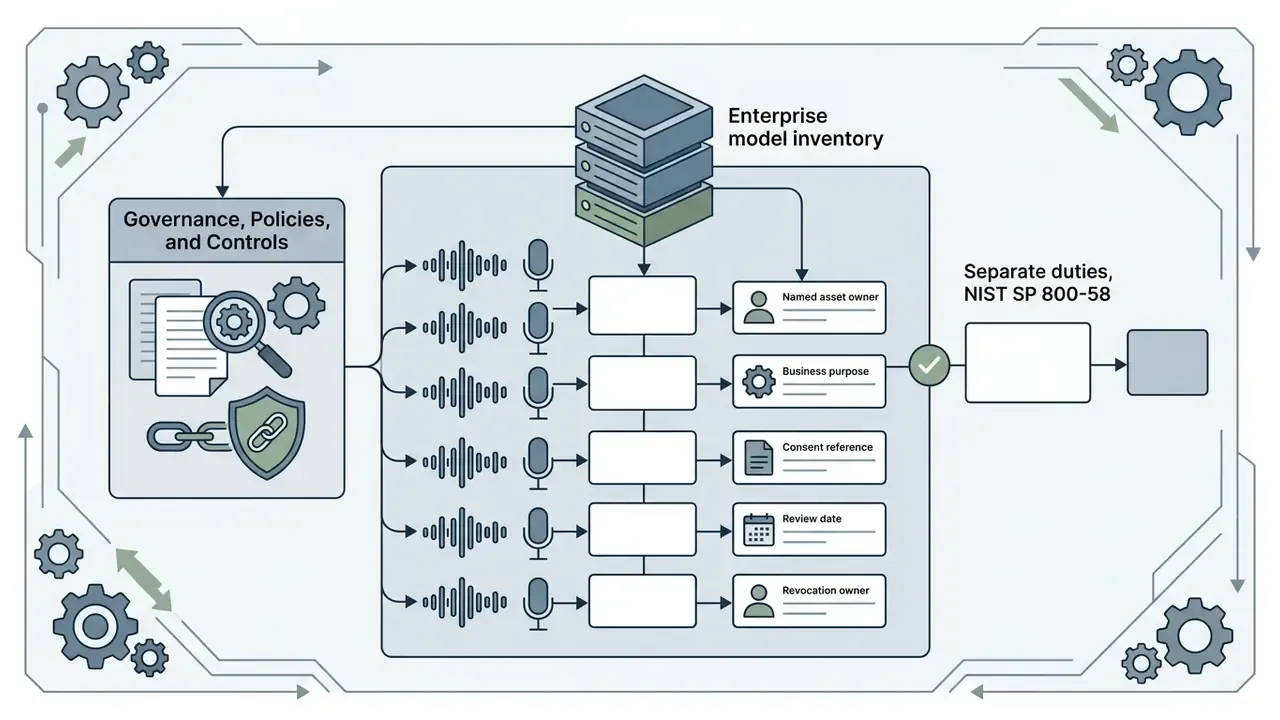
- Governance requirements for regulated industries. Register every voice model in the enterprise model inventory, assign a named asset owner, map controls to Federal Reserve SR 11-7 model risk management expectations, and document an automated revocation path, the kill switch.
- Total cost of ownership exceeds subscription price. Budget for character quotas, consent verification labor, watermark and detection controls, storage sanitization, and residual risk retained after controls.
- Export flexibility determines production value. Beyond WAV, evaluate SRT/VTT/JSON timestamp sidecars, CapCut and Premiere-ready packages, and portable RVC v2 model weights.
How to use this guide (decision snapshot)
Three questions decide almost everything that follows. Answer them before you record a single second of audio. Keep those answers in the same document as your model inventory record. Auditors ask for intent, not just artifacts.
- Does the deployment need a specific human identity? If yes, you are in cloning territory, with consent, biometric, and publicity-rights obligations attached. If no, design a synthetic voice and cut the legal surface dramatically.
- Will the output touch a regulated channel? Outbound calls, collections, KYC verification prompts, or customer notifications sit inside TCPA and disclosure rules. Internal training narration does not.
- Who owns the asset after launch? A voice handle without a named owner, an expiry date, and a revocation path is shadow AI with a friendly interface.
What does it mean to create your own AI voice?
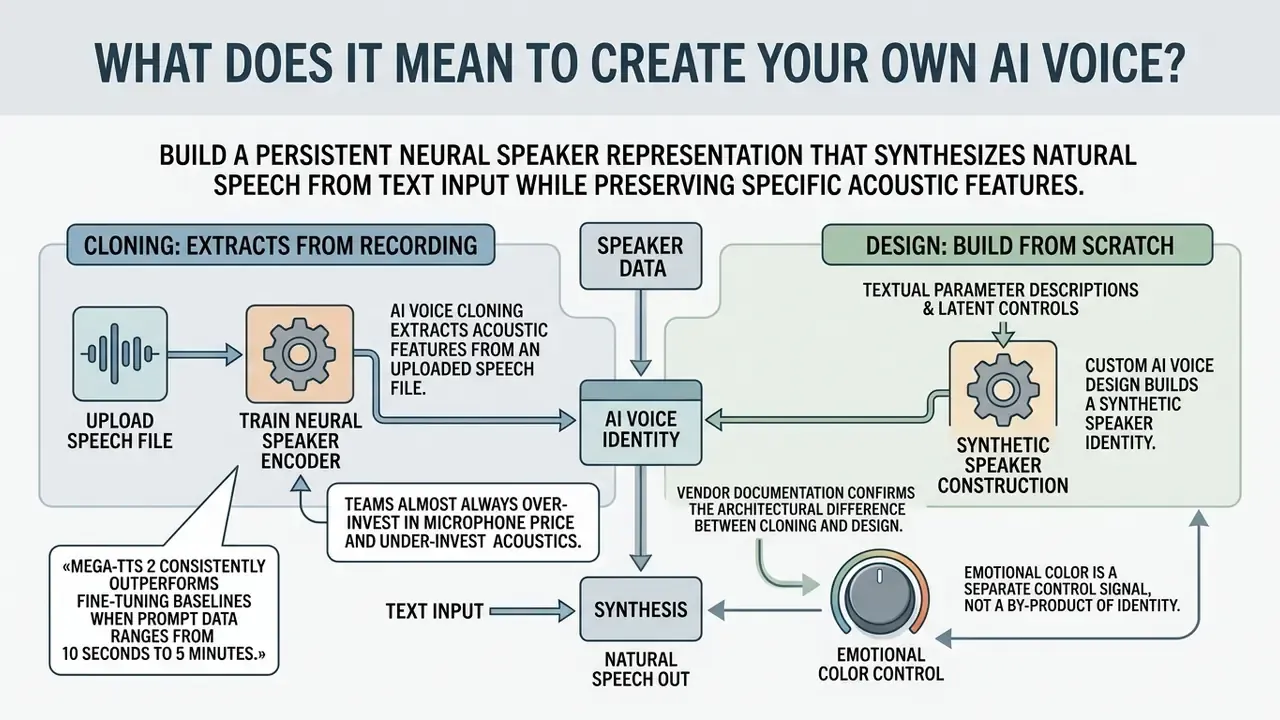
To create your own AI voice means building a persistent neural speaker representation that synthesizes natural speech from text input while preserving specific acoustic parameters like pitch, timbre, and cadence. Organizations and creators reach that outcome through zero-shot voice cloning from existing audio, text-prompted custom voice design from scratch, or by adjusting catalog presets inside an ai voice generator.
«Zero-shot voice cloning synthesizes speech for an unseen speaker using only a few seconds of reference audio, without retraining the underlying model.»
When you evaluate how to create a custom AI voice, the right methodology depends on the speaker identity you need, the audio datasets you already hold, and your regulatory posture. The comparison below sits early on purpose. Risk committees and model-risk functions normally pick the deployment pattern before any audio is collected.
Comparison of AI voice creation methodologies
| Parameter | Voice cloning (from recording) | Custom voice design (from scratch) | Catalog preset selection |
|---|---|---|---|
| Input data required | 5 seconds to 15 minutes of clean reference speech with explicit consent verification. | Text descriptions of acoustic traits (age, gender, tone, accent) without human voice samples. | None; selection from pre-built, vendor-curated voice catalogs. |
| Speaker similarity | High acoustic identity match to the target speaker (SMOS above 3.5 reported across modern zero-shot systems in peer-reviewed benchmarks). | Zero identity match to real individuals; creates a unique synthetic speaker profile. | Fixed identity match tied to standard catalog voices shared across platform users. |
| Evidence for similarity claims | Cosine similarity between speaker embeddings, automatic speaker-verification score, MCD, plus human SMOS panels. | Not applicable; verification focuses on proving the absence of identity match to living persons. | Vendor-published voice cards and catalog documentation. |
| Customization controls | Independent prosody, emotion, rate, and pitch modulation via style-disentangled decoders. | High style and attribute control based on text prompts and acoustic parameter sliders. | Basic adjustments limited to speaking rate, volume, and predefined emotional presets. |
| Primary scenarios | Executive communications at scale, IVR and contact-center prompts, multi-speaker video dubbing, assistive speech restoration. | Branded virtual assistants, imaginary character voices, non-impersonative media production. | Rapid prototyping, internal onboarding and training videos, generic low-risk content production. |
| Residual legal exposure | Highest: publicity rights, biometric statutes (BIPA), TCPA consent, EU AI Act disclosure. | Lowest: no natural person's biometric identifier is processed, though disclosure duties may still apply. | Low, but licensing scope is defined solely by vendor terms. |
AI voice cloning from your own recording
AI voice cloning extracts acoustic features from an uploaded speech file to train a neural speaker encoder. Those features include mel-frequency cepstral coefficients (MFCCs), fundamental frequency (), spectral energy, spectral centroid and bandwidth, and prosodic timing. Modern zero-shot architectures such as OpenVoice, XTTS v2, CosyVoice, F5-TTS, and ControlSpeech make an ai voice generator from my voice setup possible by isolating vocal timbre from speaking style, which enables instant synthesis without retrained model weights (OpenVoice, arXiv, 2023, https://arxiv.org/pdf/2312.01479).
Emotional colour is a separate control signal, not a by-product of identity. Research presented at EMNLP 2024 on emotion control in voice cloning pairs neutral and emotional reference samples with fine-grained emotion embeddings. The finding is practical: pitch contour, rhythm, and loudness envelopes have to be preserved independently of timbre, or expressive transfer collapses during synthesis.
One observation from reviewing pilot datasets: teams almost always over-invest in microphone price and under-invest in room treatment. The room is what you actually bake into the embedding.
Custom AI voice design from scratch
Custom AI voice design builds a synthetic speaker identity from textual parameter descriptions and latent acoustic embeddings, with no human recording involved. Text-prompted generation tools let developers create custom ai voice from scratch by specifying gender, target age, accent, pitch range, and vocal breathiness. The result carries zero risk of unauthorized human voice replication, which is why compliance teams often prefer it for branded assistants.
Vendor documentation confirms the architectural difference. Resemble AI states that Voice Design generates AI voices from text descriptions and requires no audio recordings, while Inworld AI documents Voice Design as the path "for cases where there are no existing audio recordings for voice cloning" (Inworld AI Documentation, 2026, https://docs.inworld.ai/tts/voice-design). Microsoft's responsible-AI disclosure adds a governance nuance worth quoting in a control narrative: a synthetic voice model is a binary parameter set that contains no audio recordings and cannot be reverse engineered back into a person's recordings (Microsoft Learn, 2026, https://learn.microsoft.com/en-us/azure/foundry/responsible-ai/speech-service/text-to-speech/disclosure-voice-talent).
Teams that also prototype conversational front ends may find the adjacent primers on ai app creation and ai architecture generator useful, since voice endpoints rarely ship alone.
What you need before creating an AI voice from your voice
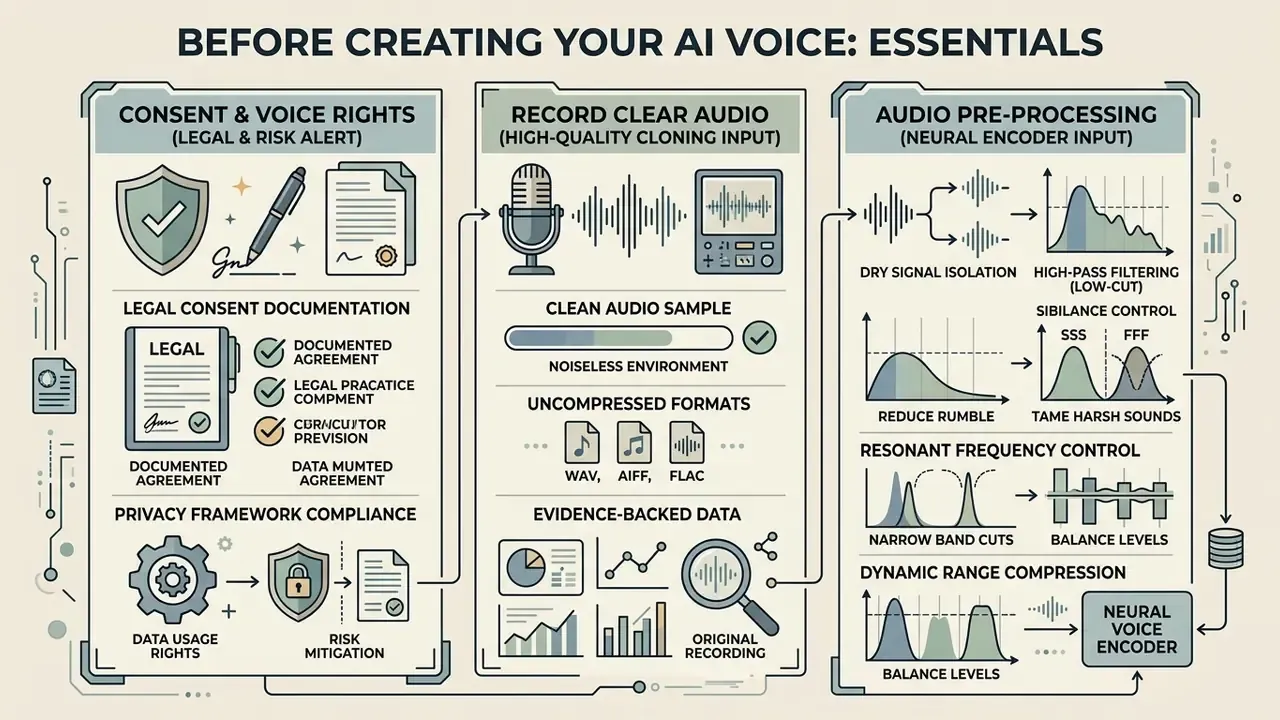
Before you deploy an ai voice generator using my voice, collect a clean, uncompressed audio sample and establish documented legal consent that satisfies privacy frameworks and model audit requirements. Clean reference speech drives better acoustic feature extraction and prevents recognition errors during text-to-speech generation.
LEGAL & RISK ALERT: CONSENT AND VOICE RIGHTS
How to record clear audio for voice cloning
High-fidelity voice cloning needs lossless audio, typically 24 kHz or 48 kHz 16-bit PCM WAV, with a signal-to-noise ratio above 35 dB and peak levels between −3 dB and −6 dB. Research on acoustic feature extraction shows that low background noise and the absence of mid-word clipping prevent artifacts during continuous neural speech generation. Microsoft's custom-voice specification also recommends 100 ms of leading and trailing silence, never above 200 ms, while Azure custom speech training caps individual training files at 40 seconds.
Updated, evidence-backed data requirements (this supersedes the unattributed internal test summary retained in Appendix A):
Read together, these findings define a practical tolerance band. Pristine studio conditions are ideal, yet robust encoders survive moderate noise contamination. What consistently destroys speaker similarity is different: lossy compression artifacts and baked-in room reverberation. Those two remain the reliable failure modes.
Audio pre-processing protocol for neural encoder input
To maximize speaker encoder fidelity and reach an SMOS above 4.0, raw recordings should pass through a strict four-stage pipeline before feature extraction.
- High-pass filtering (low-cut)apply a steep 24 dB/octave high-pass filter at 80 Hz to remove sub-bass rumble, HVAC noise, and mic-stand thumps without touching vocal fundamentals ().
- Sibilance and resonant frequency controlinsert a de-esser targeting 5 kHz to 8 kHz to tame harsh sibilants ("s", "z", "ch"). Uncontrolled sibilance produces high-frequency buzzing artifacts in zero-shot TTS decoders.
- Dynamic range compressionapply mild opto-style compression (2:1 to 3:1 ratio, slow attack, fast release) to level speaking volume peaks. Keep dynamic variation inside a controlled 10 dB RMS window.
- Dry signal isolationmake sure every reference sample is 100% dry. Remove spatial reverb, delay, and room reflections with neural de-reverberation or acoustic isolation, because latent decoders bake room acoustics permanently into the speaker embedding.
Subtle pitch correction can also be applied before training when the dataset contains unstable intonation. Avoid aggressive tuning, though. Heavy formant-shifting artifacts propagate into the speaker embedding and cut perceived naturalness.
Dataset tiers: instant cloning vs. studio fine-tuning
Audio dataset requirements by cloning tier
| Tier | Reference audio volume | Technical format | Typical fidelity outcome | Recommended use |
|---|---|---|---|---|
| Instant / zero-shot cloning | 5 to 30 seconds (vendors commonly accept 10 s to 5 min; MiniMax recommends under 8 s with a transcript, Cartesia calls 5 s the "sweet spot"). | MP3/M4A/WAV accepted, single speaker, max ~20 MB. | Recognizable timbre; limited emotional range and edge-case pronunciation. | Prototyping, short social clips, internal demos. |
| Professional cloning | 1 to 5 minutes of diverse, phonetically varied speech. | 24 kHz or 48 kHz 16-bit mono PCM WAV, SNR above 35 dB. | Stable prosody across long-form scripts. | Podcast narration, e-learning modules, IVR prompt libraries. |
| Studio fine-tuning | 10 to 15 minutes minimum, 30+ minutes recommended (Azure Custom Neural Voice requires 300+ utterances; one research case study used 3+ hours). | Lossless WAV/FLAC, 40 s maximum per training file, full diphone coverage. | Highest naturalness, robust emotional and multilingual transfer. | Brand voices, broadcast dubbing, assistive speech prosthesis. |
Phonetic coverage matters more than raw duration. A neural voice cloning case study reported all 26 Spanish phonemes present in two corpora, yet diphone coverage still differed, 428 against 384. That gap explains why two datasets of identical length can produce measurably different clone quality.
Consent and ownership when using a voice
Legitimate control over a synthetic voice model rests on clear documentation showing that the voice owner explicitly licensed their biometric vocal data for model training and commercial usage. Copyright law generally protects specific sound recordings rather than the abstract timbre of a human voice, so protection leans on state publicity rights (Tennessee's ELVIS Act, for example), privacy laws, biometric statutes, and contractual voice licensing.
Consent artifacts that survive internal audit include a signed written or electronic release scoped specifically to synthetic voice model creation, a recorded spoken verification statement from the speaker (required by BeyondWords, Hume, and Microsoft's personal-voice workflows), a defined purpose, territory, and term, and a documented revocation mechanism. The US Copyright Office's digital-replica analysis frames voice misuse through consent and replica controls rather than ownership of a voice as a copyrightable object. UK guidance notes that the person whose identity is copied is unlikely to be the copyright owner of the generated work. In China, the Civil Code protects voice as a personality right by reference to portrait-right rules.
Keep the consent record and the model record joined by a single identifier. Split systems age badly.
How to create an AI voice of yourself step by step
Creating a personal clone means uploading clean reference audio, verifying authorization rights, training or extracting the neural speaker embedding, then running synthesis. Follow the workflow below to create an ai voice of yourself while holding voice quality and audit compliance together. The pipeline splits into an internal operational workflow (your datasets, your tenancy) and a third-party risk workflow (vendor-hosted cloning, where consent evidence and retention terms must be contractually enforced).
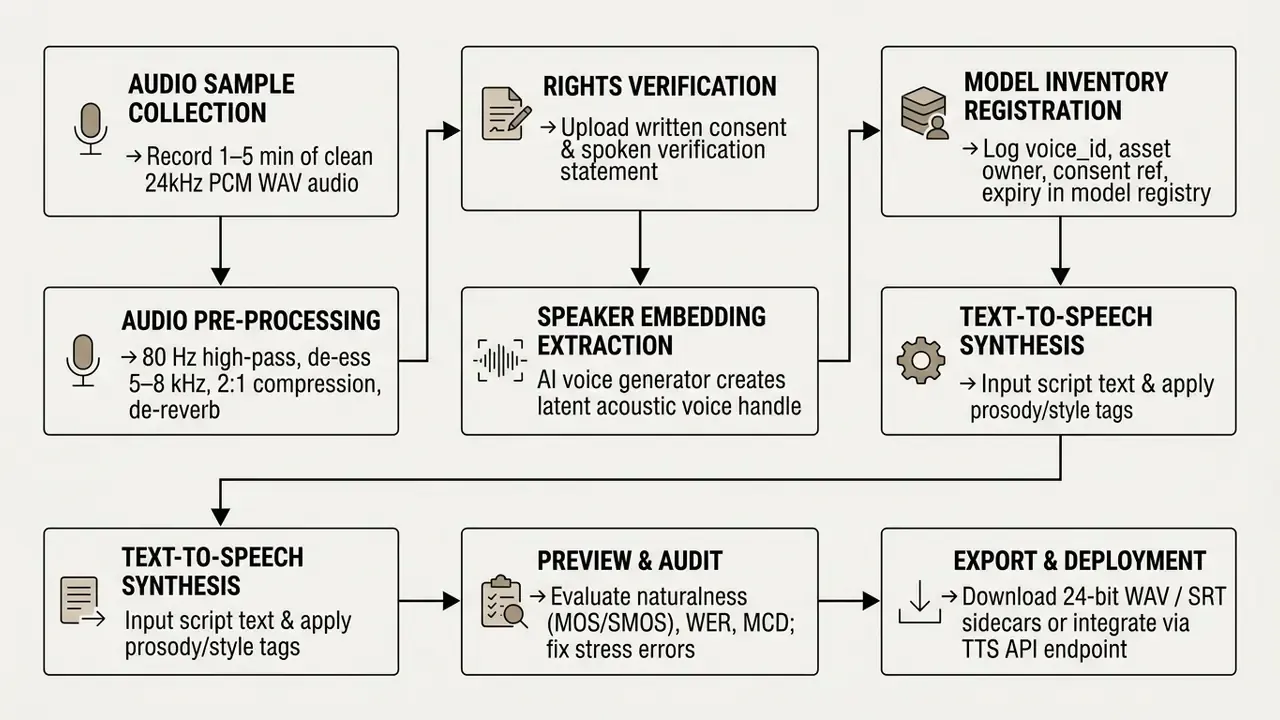
Process diagram, text equivalent: create your own ai voice step by step, from sample collection through consent verification, embedding extraction, inventory registration, synthesis, audit, and export.
Upload or record your voice sample
The first step in an ai voice generator of my voice workflow is uploading clean audio files or reading a standardized, phonetically balanced script directly into the recording interface. For zero-shot platforms, 30 seconds to 5 minutes of speech containing diverse diphones and sibilants gives the speaker encoder enough acoustic context to map your timbre. Vendor limits are explicit: MiniMax accepts MP3/M4A/WAV between 10 seconds and 5 minutes at a 20 MB maximum, and both Hume and Inworld require an affirmative confirmation that the user holds cloning rights before the model is created.
That confirmation checkbox is not a formality. Treat it as an attestation, log who clicked it, and store the identity of the approver with the voice record.
Train and preview your AI voice model
Once the reference file is uploaded, the platform runs it through a speaker encoder to extract a fixed-dimensional voice vector, sometimes called a voice handle, representing your vocal signature. You then generate test phrases and preview the output, checking speaker similarity and naturalness against the original reference.
Verification should be quantitative, not impressionistic. The established evaluation axes are cosine similarity between speaker embeddings and automatic speaker-verification score for identity, WER and CER from an independent ASR pass for intelligibility, mel-cepstral distortion for spectral fidelity, MOS and SMOS listening panels following ITU-T P.808 crowdsourcing methodology for perception, and real-time factor for operational latency. A clone can score brilliantly on identity while failing intelligibility, so log every axis separately in the audit record.
Generate speech from text and download audio
After the voice handle validates, feed your target script into the synthesis engine. Enterprise platforms support multi-format delivery built for post-production and localized distribution.
- Uncompressed broadcast audio export 24-bit 48 kHz linear PCM WAV for professional editing systems such as Adobe Premiere Pro and DaVinci Resolve.
- Automated subtitle and timestamp generation export synchronized sidecar files in
.SRT,.VTT, or structured.JSONwith word-level timestamp alignments for captions and interactive media. - NLE project integration export audio timeline packages optimized for mobile suites such as CapCut and Descript, then finalize publishing in a YouTube video editing workflow.
- Custom RVC model export save extracted speaker embeddings as trained Retrieval-based Voice Conversion (RVC v2) weight files (
.pthand.index) for local real-time inference and open-source production tools. - Portability caveat export rights are vendor-specific. Google Cloud's Chirp 3 Instant Custom Voice writes cloned-voice output directly to a file using a
voice_cloning_key, and Pocket TTS exports a reusable.safetensorsvoice embedding, whereas ElevenLabs states that cloned voices cannot be exported outside its platform. Confirm portability before you standardize on a vendor.
Alternatively, stream audio straight into software pipelines using the developer material in AI Media API Guides, or benchmark adjacent generation endpoints such as the Google Veo implementation guide when voice and video come out of the same pipeline. For a wider view of neighbouring stacks, see the AI video generator glossary entry and the notes on how an ai app generator packages such endpoints into shippable products.
How to create a custom AI voice without an existing recording
Creating a custom AI voice without source audio means using a voice design tool to define synthetic acoustic traits through text prompts, acoustic sliders, and demographic profile settings. This is how developers create custom voice ai assets that replicate no real individual, which removes identity infringement risk from the equation.
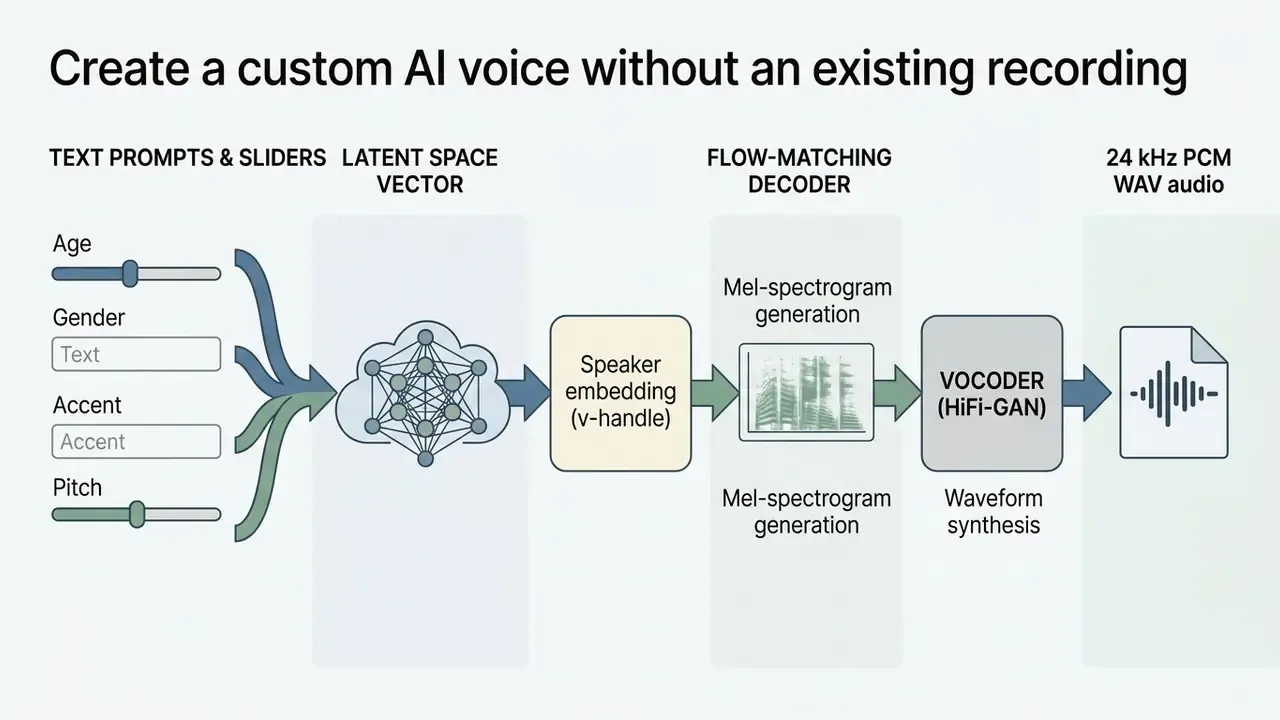
Diagram, text equivalent: architectural pipeline of text-prompted synthetic voice design without human voice samples. Prompt inputs (age, pitch, gender, accent) convert into latent speaker embeddings, pass through a flow-matching decoder, and are rendered by a neural vocoder into continuous speech.
Choose voice characteristics and speaking style
When you configure a synthetic voice, select demographic and acoustic parameters: target age bracket, gender presentation, regional accent, pitch variance, vocal warmth. Advanced control frameworks, including those catalogued in the AI Media Glossary, accept natural-language prompts such as "a calm, authoritative female narrator with a subtle mid-Atlantic accent".
Contemporary controllable-TTS research exposes discrete controls for age and gender alongside continuous controls for pitch mean, pitch variation, emotion label, SNR, and simulated reverberation. Commercial APIs usually surface higher-level labels instead: gender, age band, accent, style. Low-level phonation controls, breathiness, aspiration, roughness, flutter, formant frequency, and formant bandwidth, exist in research systems and legacy synthesis patents but are not standardized across vendors. Breathing-cue realism in particular remains an area where synthetic speech still diverges from human recordings.
Standardized text prompt templates for voice synthesis
To generate precise synthetic identities without human reference audio, use structured prompts that combine demographic traits, vocal texture, dynamic delivery, and acoustic environment.
| Use case | Recommended text prompt architecture | Key parameter sliders |
|---|---|---|
| Corporate e-learning | "A calm, authoritative male voice in his early 40s with a neutral General American accent. Mid-range pitch, resonant vocal depth, steady pacing (130 wpm), zero breathiness, recorded in a dry studio environment." | Pitch: 0% · Speed: −5% · Warmth: +15% |
| High-energy commercial | "An energetic, articulate female voice in her late 20s with a subtle British Received Pronunciation accent. Bright vocal timbre, slightly elevated pitch, dynamic cadence, expressive emphasis on key adjectives." | Pitch: +10% · Speed: +10% · Energy: +25% |
| Audiobook narration | "A warm, storytelling male narrator in his late 50s with a rich, gravelly timbre and deep resonant bass. Slow cadence (110 wpm), noticeable micro-pauses between clauses, intimate close-mic proximity." | Pitch: −15% · Speed: −12% · Breathiness: +10% |
| Technical support bot / IVR | "A clear, empathetic non-binary voice, mid-20s, neutral mid-Atlantic accent. Flat emotional curve, precise consonant articulation, steady conversational rhythm, zero vocal fry." | Pitch: 0% · Speed: 0% · Clarity: +20% |
| Confident brand narration | "A confident, measured female voice in her mid-30s, neutral accent, controlled dynamic range, deliberate stress on brand terms, minimal sibilance, dry acoustic space." | Pitch: +3% · Speed: −3% · Presence: +12% |
| Calm, soothing wellness | "A soft, soothing voice with slow exhaled phrasing, low volume, gentle downward intonation contours, extended pauses between sentences, close intimate mic placement." | Pitch: −8% · Speed: −18% · Breathiness: +20% |
A practical note for regulated brands: keep prompt strings in version control. If a designed voice later appears in a customer-facing IVR, you will need to show exactly how the identity was produced and that no living person was referenced.
Test multiple custom voices for different content
To optimize engagement, generate candidate profiles and run structured testing across your intended content types. Testing multiple candidate vectors against instructional, narrative, and promotional scripts confirms that the selected synthetic voice keeps clarity and appropriate emotional delivery across distinct media formats.
A defensible split-testing method follows four rules. Randomly assign listeners to persistent groups so the same person always hears the same variant. Play identical scripts across variants. Randomize presentation order. Score each content type, conversational, instructional, narrative, separately using MOS panels compliant with ITU-T Recommendation P.808 (ITU-T, 2021, https://www.itu.int/ITU-T/recommendations/rec.aspx?id=14665).
Updated, evidence-backed framing. The earlier unattributed 200-listener figure is retained in Appendix A and should be treated as an unverified internal observation.
The implication is blunt. Candidate selection is a listening-panel problem, not a data-volume problem. Once the dataset crosses the sufficiency threshold, further gains come from prosody tuning and content-specific voice selection.
Customize your AI voice for natural text-to-speech
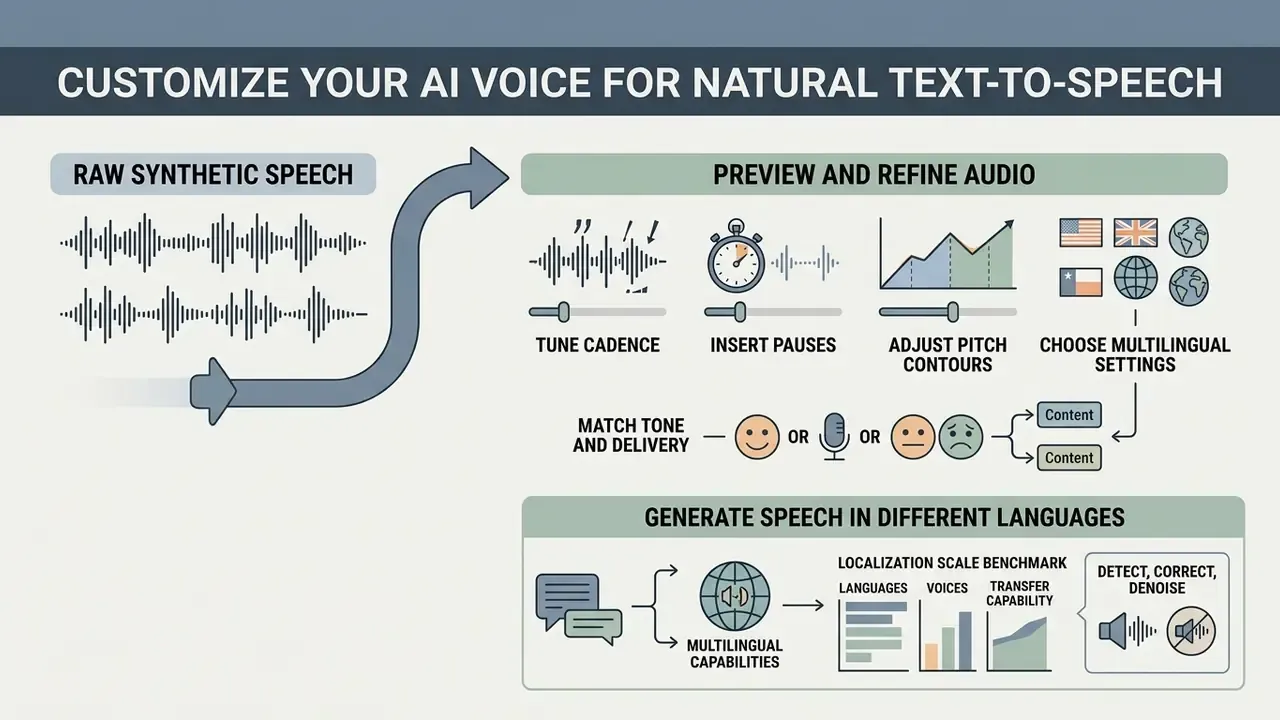
Turning raw synthetic speech into lifelike audio means tuning cadence, inserting strategic pauses, adjusting pitch contours, and choosing the right multilingual settings. Standard Speech Synthesis Markup Language (SSML) tags combined with neural prosody controls let a custom voice deliver human-like expressiveness.
SSML control matrix for synthetic speech tuning
| SSML element | Controlled attribute | Practical syntax | Documented vendor limits |
|---|---|---|---|
<prosody> | Pitch, contour, range, rate, volume | <prosody rate="-8%" pitch="+2st">…</prosody> | Google Cloud supports speed 50% to 200%; Amazon Alexa supports x-slow through x-fast or percentage rate values. |
<break> | Pause insertion and duration | <break time="500ms"/> or <break strength="strong"/> | Alexa caps pauses at 10,000 ms; Azure allows up to 20,000 ms. |
<phoneme> | Pronunciation and syllable stress | <phoneme alphabet="ipa" ph="ˈdeɪtə">data</phoneme> | Microsoft rejects invalid phone strings with HTTP 400; IPA and SAPI stress marks shift emphasis. |
<emphasis> and style tags | Word-level stress, emotional style | <emphasis level="strong">critical</emphasis> | Style and emotion tags are vendor-specific and sit outside the W3C SSML 1.1 core. |
Match tone and delivery to your content
Adjusting emotional tone and speaking rate aligns your ai voice generator with your own voice configuration to the script context. For compliance training or technical documentation, configure a steady, neutral delivery with moderate pauses (<break time="500ms"/>). Promotional or narrative scripts benefit from wider pitch variation and higher energy settings.
«U-Style significantly outperforms state-of-the-art methods in unseen-speaker cloning on naturalness and similarity by disentangling timbre from style.»
Fine-tuning evidence supports that separation of concerns. A 2024 study reported subjective MOS of 3.89 for naturalness and 3.96 for voice consistency after fine-tuning on only 19 hours of in-domain child speech. A 2024 conversational-TTS study pre-trained on spontaneous speech, then fine-tuned on dialogue annotated for pleasantness and arousal to steer emotional naturalness.
Generate AI speech in different languages
Multilingual architectures such as XTTS v2, CosyVoice, F5-TTS, and their flow-matching successors let a single cloned or designed profile synthesize speech across languages while preserving core speaker identity.
Updated (this supersedes the bare "PFluxTTS Study 2026" mention retained in Appendix A):
«PFluxTTS reached MOS 4.11 ± 0.14 and SMOS 3.51 ± 0.17 in cross-lingual synthesis, reducing WER by 23% versus ChatterBox.»
| Capability dimension | Entry-tier consumer tools | Mass-market platforms | Enterprise and research-grade stacks |
|---|---|---|---|
| Language coverage | ~10 to 20 languages | 40+ languages and regional accents | 154+ languages and accents in leading commercial catalogs |
| Catalog voice count | 20 to 50 preset voices | 100+ preset voices | 1,500+ voices plus unlimited custom-designed identities |
| Accent variants per language | Single default accent | 2 to 4 regional variants (US, UK, AU English) | Multiple regional and sociolect variants with per-voice accent tuning |
| Cross-lingual prosody transfer | Not supported | Partial: identity retained, prosody re-generated per language | Full zero-shot timbre and style transfer with SMOS above 3.5 plus speaker-verification validation |
| Dubbing constraints | Manual re-recording | Length-limited clips (Adobe Firefly AI Dubbing requires at least 5 s of single-speaker audio, files up to 5 min) | Full-episode dubbing with subtitle-driven synchronization |
Teams building multilingual campaigns often pair voice synthesis with text-to-video AI tools, so localized narration, captions, and visuals get produced in a single pass.
Preview and refine generated audio
Auditing generated speech means checking for pronunciation errors, awkward inflection, and mechanical artifacts before final export. When the engine misreads word stress, use SSML phoneme overrides (<phoneme alphabet="ipa" ph="...">) or manual stress markers in the input text.
A repeatable three-step remediation workflow, consistent with vendor documentation and speech-editing research, looks like this.
- Detectincorrect stress or mispronunciation by comparing generated audio against an independent ASR transcript, flagging WER and CER outliers at token level.
- Correctpronunciation explicitly: insert IPA or SAPI stress marks (Microsoft documents that invalid phone strings return HTTP 400), or add manual stress marks in text or SSML where contextual stress fails, as documented for Russian TTS by Sber.
- Denoisethe manipulated signal. Adobe Research describes generating controllable prosody features, applying pitch-shift and time-stretch, then running a denoising stage to remove artifacts introduced by signal manipulation.
If a specific brand term keeps breaking, freeze its phoneme string in a pronunciation lexicon. Fixing it once per script is wasted effort.
Where you can use your own AI voice
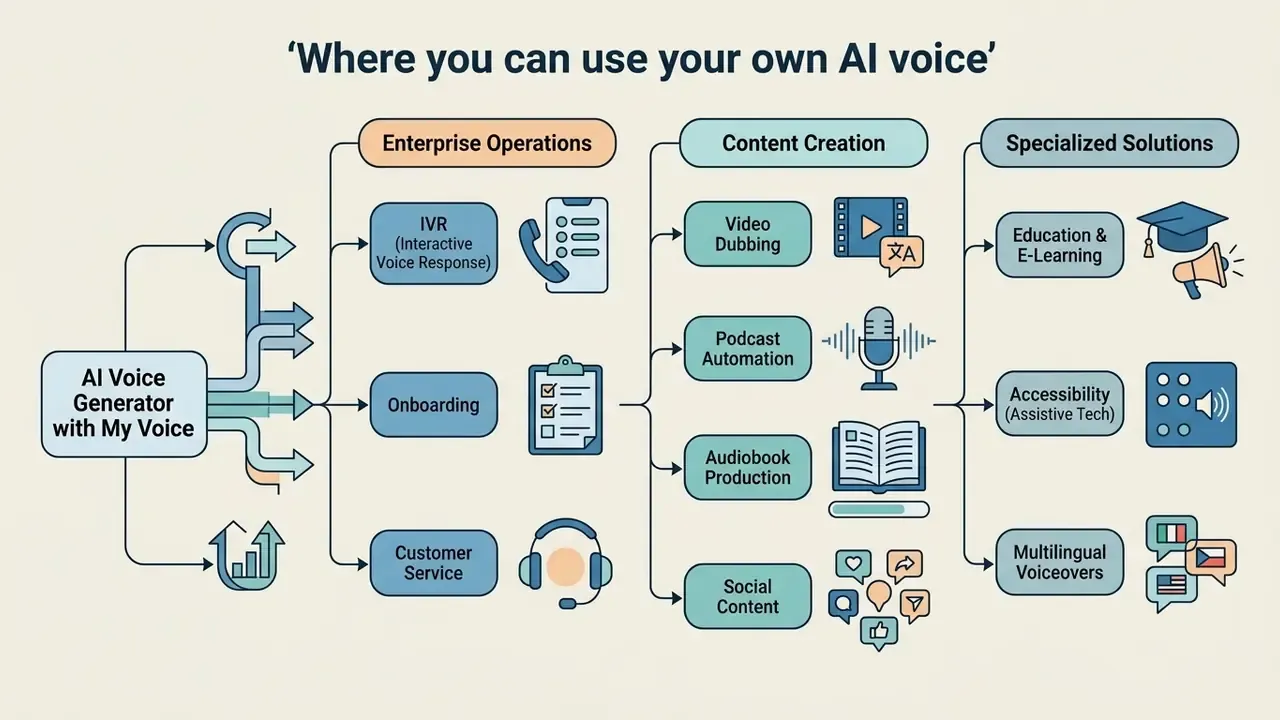
An ai voice generator with my voice workflow lets organizations scale audio production across customer operations, internal enablement, video dubbing, podcast automation, corporate training, and international localization, without booking continuous studio sessions. Creators who simply want to create my own voice ai for a channel gain the same leverage at smaller scale.
Enterprise operations: IVR, onboarding, and customer service
Regulated organizations typically deploy synthetic voice on four controlled surfaces: IVR prompt libraries that need updating without re-booking voice talent, employee onboarding and compliance-training narration, internal knowledge-base audio for field staff, and outbound customer notifications. That last category carries the heaviest regulatory load. Under FCC-24-84A4, calls using voice-cloning technology sit squarely inside TCPA consent rules, so outbound synthetic-voice campaigns require prior express written consent and, in several jurisdictions, an audible plain-language disclosure. Hawaii HB 2137 mandates exactly that for realistic digital imitations.
A hypothetical but instructive scenario: a mid-size lender refreshes 400 IVR prompts monthly using a designed synthetic voice, not a cloned executive. Legal exposure drops, brand consistency holds, and the model inventory record stays simple. Sometimes the boring option is the governed one.
Education, accessibility, and multilingual voiceovers
Educational institutions and accessibility teams use AI voices to convert documents, PDFs, and slide decks into clear spoken audio for screen readers and visually impaired learners. The University of California, Riverside Student Disability Resource Center documents NaturalReader AI text-to-speech for reading PDFs, HTML, DOCX, and PPTX with OCR support for image-based files. The CAST AEM Center's 2024 guidance "AI & Accessibility: Supporting All Learners" describes AI text-reading and content adaptation for diverse learner needs. The US Department of Education's 2025 Dear Colleague Letter states that AI tools must themselves be accessible to children, educators, providers, and family members with disabilities.
Global organizations also lean on cross-lingual synthesis to translate courses into regional languages while preserving the original instructor's recognizable identity. That approach is mirrored in 2026 research on multilingual localization engines for skill courses combining translation, voice input and output, and export.
Personal and assistive use matters just as much. Providing a voice clone for people who have lost the ability to speak is a widely recognized legitimate application, documented by both FTC commentary and vendor policy frameworks.
How to create AI voices for singing and vocal performance
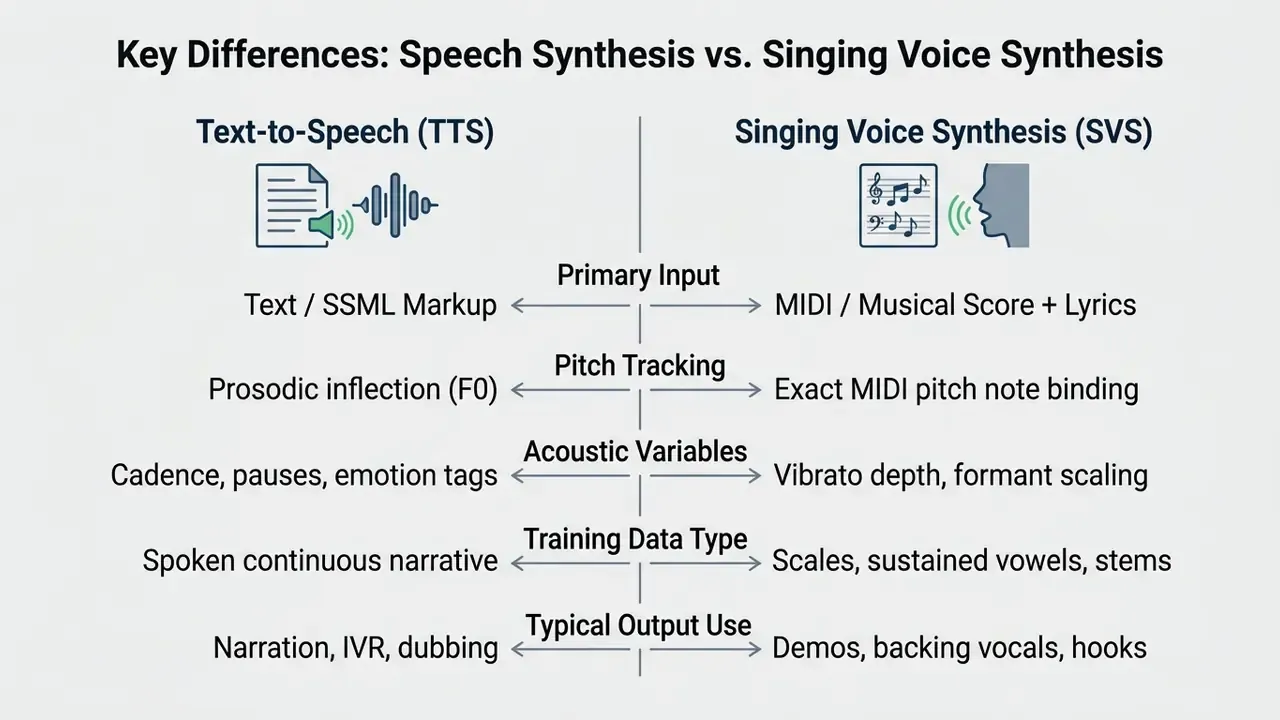
Creating a singing model requires acoustic parameters that differ from standard speech synthesis. Text-to-speech leans on prosody and speech rhythm. Singing voice synthesis (SVS) maps pitch trajectories ( contours), vibrato rate, formant shifts, and breath management across musical scales.
Dataset requirements for singing voice cloning
- Audio length at least 10 to 15 minutes of isolated, dry vocal stems, monophonic, no backing tracks, pitch-corrected.
- Vocal range recordings must cover the singer's full dynamic register (chest voice, head voice, falsetto) across a minimum of two octaves.
- Preprocessing apply tight noise gating and remove background instrument bleed with source separation algorithms such as Demucs v4 before training, then verify that no reverb tail remains in the stem.
- Pre-processing chain clean EQ adjustments, subtle pitch correction, and gentle compression measurably improve model authenticity, because the encoder receives sharper spectral data instead of smeared transients.
Key differences: speech synthesis vs. singing voice synthesis
Practical singing workflows
- Songwriting demos generate a studio-clarity vocal demo from a scratch take, so ideas reach collaborators or labels without booking a session singer.
- Backing vocals and harmonies duplicate a lead vocal into stacked harmony layers with per-layer pitch offsets, keeping timbre consistent across the stack.
- Remote collaboration share trained voice models instead of raw stems, so distributed producers can iterate on arrangement without re-recording.
- Vocal enhancement use clone-based re-synthesis to recover clarity, tone, and depth in recordings captured on imperfect equipment.
Rights caution: singing models fall under the same consent regime as speech models, and often stricter contractual terms. Tennessee's ELVIS Act defines "voice" to include any sound readily identifiable with a person, including simulations, and extends protection to unauthorized commercial and noncommercial public uses. Never train a singing model on commercially released recordings you do not control.
Pricing, commercial use, and privacy for custom AI voices
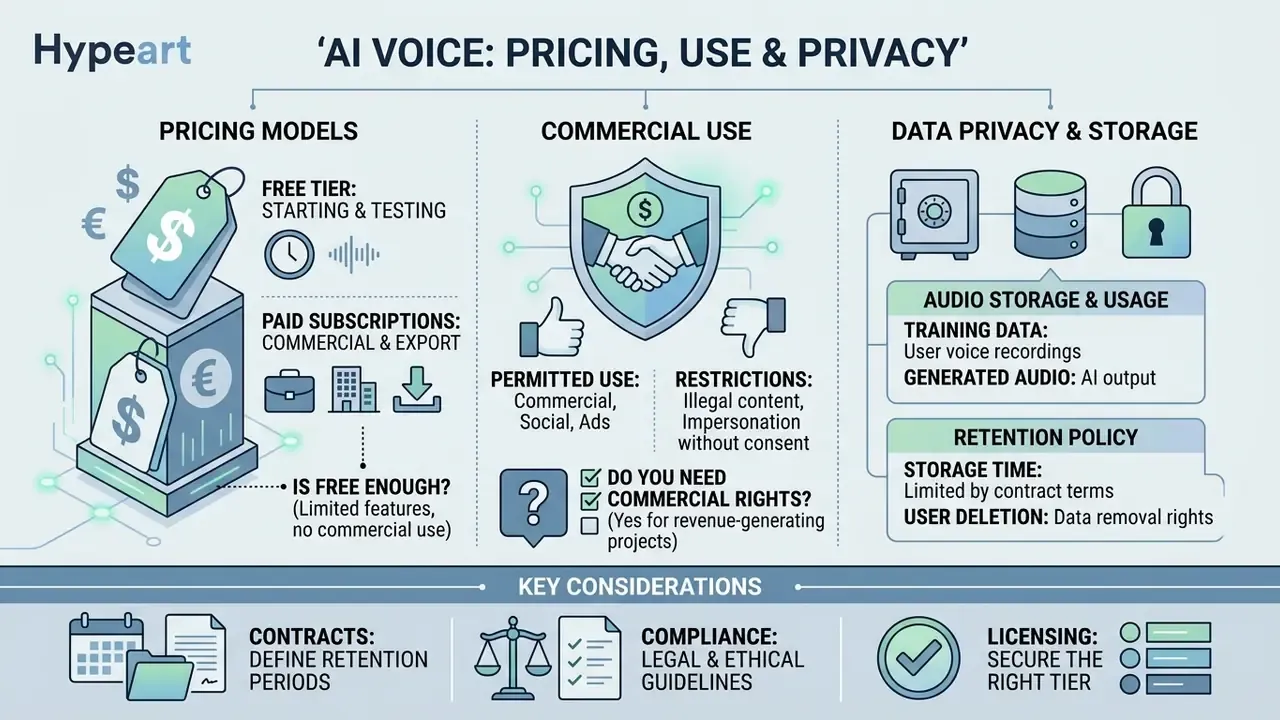
Evaluating platforms means examining monthly character quotas, commercial usage rights transfers, data retention policies, and security protections for stored voice embeddings.
Overview of AI voice generator plans and commercial licensing terms
| Feature category | Free tier provisions | Paid / professional tier provisions | Enterprise tier provisions |
|---|---|---|---|
| Monthly generation quota | 10,000 characters per month (ElevenLabs free tier). Cloud APIs differ: Google Cloud offers recurring free monthly allowances up to 4M Standard/WaveNet characters, Amazon Polly 5M Standard characters, Azure Free F0 roughly 0.5M characters. | 100,000 to 500,000 characters per month. Google Cloud bills Chirp 3 HD at US$30 per 1M characters and Instant custom voice at US$60 per 1M. | Custom unconstrained character allocations with negotiated rate limits. |
| Voice cloning access | Restricted, or limited to basic voice design tools. | Instant voice cloning included from entry paid tiers; custom fine-tuning available. | High-fidelity professional cloning with dedicated model support. |
| Commercial usage rights | Prohibited; non-commercial personal use with mandatory attribution. | Full commercial rights transferred for generated audio outputs (commercial licenses typically begin at the Starter tier). | Full commercial rights with custom indemnity and IP agreements. |
| Data security and retention | Standard cloud storage; audio logs may be retained for system monitoring; leading platforms now apply 24-hour automatic deletion of uploaded files. | Encrypted audio storage (TLS in transit, AES-256 at rest) with user control over voice profile deletion. | Zero Data Retention (ZRM) options, private single-tenant deployment, contractual sanitization SLAs. |
| Indicative price points | US$0 with feature caps and throughput limits (some model APIs list the free tier as unsupported for RPM and TPM). | From about US$10 per month (200K characters) to US$49 per month professional tiers; commercial reader plans from US$29 per user per month. | Custom contracts; US$199 per month premium published tiers at the top of self-serve pricing. |
Is a free AI voice generator enough to get started?
Free tiers provide initial character allocations, typically around 10,000 characters per month on creator platforms, which suits testing voice design features, evaluating preview quality, and building simple non-commercial prototypes. Free plans usually block commercial monetization, require platform attribution, and enforce strict API rate limits that rule out production deployment.
The structural differences matter more than the headline number. Google Cloud presents its allowance as a recurring monthly free tier. Amazon Polly limits several non-Standard tiers to the first 12 months. Some model APIs publish "not supported" for free-tier requests per minute, which means the free tier cannot sustain production throughput at all. So the honest answer is: free is enough to decide, never enough to launch.
Can you use an AI voice for commercial projects?
Commercial usage of synthesized audio requires a paid tier that explicitly transfers rights to monetize generated media. Before publishing AI voice tracks in paid advertising, broadcast media, or commercial software, verify plan details in the AI Media Pricing Guides and confirm that your voice samples do not infringe third-party trademark or publicity rights. Readers comparing rights across modalities can review the equivalent terms for AI image generators and commercial use.
Contractual practice is now settled in one respect. Template clauses for voice and AI work require a separate agreement covering voice cloning, with use bounded by purpose, territory, and term. Absent that clause, AI-related uses are prohibited by default. Legal commentary is consistent that commercial use of another person's voice, including AI-generated voice in songs or advertisements, needs prior permission from the rights holder.
Will your voice recordings and generated audio be stored?
Data privacy protocols vary widely between providers, so review how servers store reference audio samples and generated neural voice models. Robust platforms implement encryption at rest and in transit, conform to NIST SP 800-209 Rev. 1 storage security guidelines, apply NIST SP 800-88 Rev. 2 media sanitization for retired media, and offer enterprise features such as Zero Data Retention so user audio is never kept for unauthorized model training.
Retention regulation to require in contracts: enforce a 24-hour automatic deletion rule for session audio, previews, and intermediate cache in public multi-tenant clouds. Leading platforms already publish this control ("uploaded files are automatically removed to protect user privacy"), and it aligns with the WHO Personal Data Protection Policy principle, effective 15 April 2024, that personal data must not be kept longer than necessary for the processing purpose. Persistent artifacts, the speaker embedding, the consent record, and the audit log, should be the only objects that survive a session, each with a documented destruction schedule as biometric statutes like BIPA require.
«CloneShield lowers cloned-audio PESQ from 3.90 to 1.07 and speaker-similarity score from 0.93 to 0.08, defending voices against unauthorized cloning.»
«Fed-PISA keeps speaker timbre parameters on-device and transmits only a lightweight style-LoRA to the server, reducing voice-identity leakage risk.» - Fed-PISA (2025)
Platform policy adds a control layer. ElevenLabs states that voice data used for identity verification may constitute biometric data processed as sensitive personal data, verifies that other users hold consent to use your voice data, and prohibits replicating another person's voice without consent or legal right, including deceptive use and election misinformation. Confirm equivalent contractual commitments for any vendor you onboard, because not all providers publish comparable policy detail. If a vendor cannot answer retention questions in writing, that silence is your answer.
Technical specifications and audit framework
When you present AI voice cloning architecture to risk committees, compliance boards, or model governance teams, use a standardized control matrix.
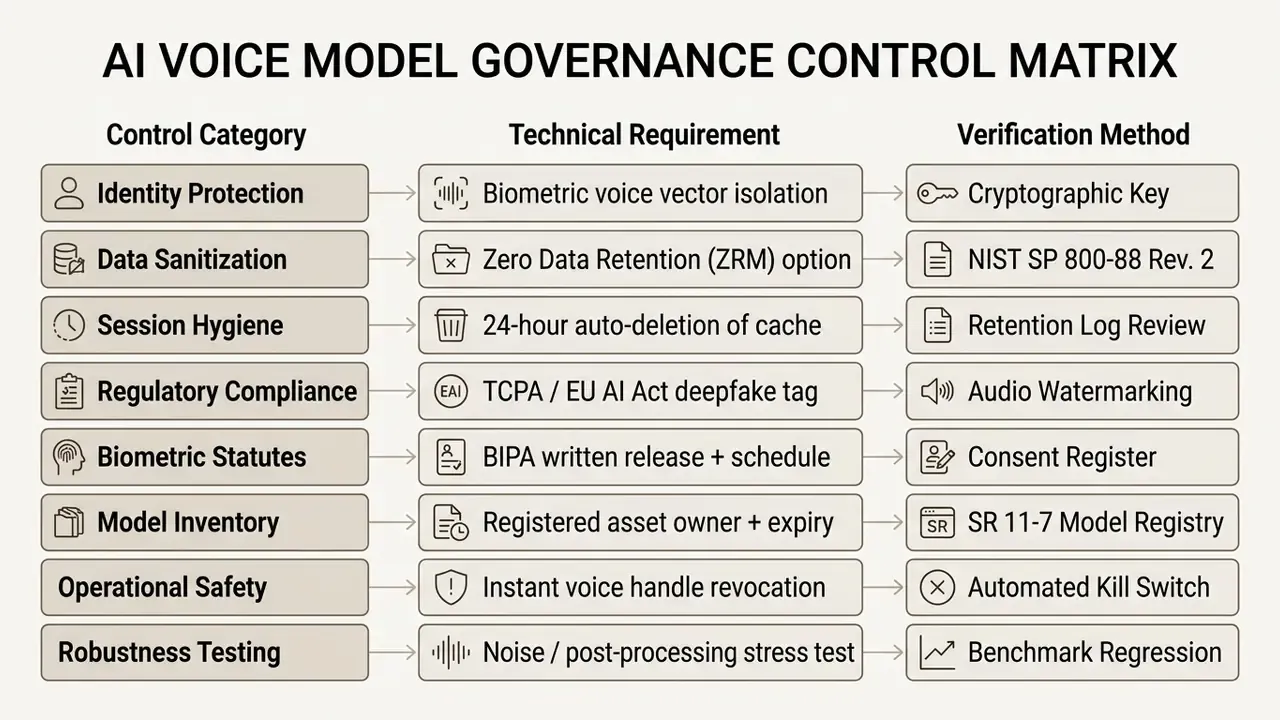
«RVCBench shows cloning performance degrades sharply under common input shifts and post-processing, especially in long-form and cross-lingual scenarios.»
Model risk management integration (SR 11-7 alignment)
For banks and other regulated institutions, a synthetic voice is a model asset, not a marketing toy. Map each deployment to the three pillars of Federal Reserve guidance SR 11-7.
If you plan to create your own ai voice model inside a bank, treat this triad as the minimum viable governance package. Anything less becomes an audit finding later.
Total cost of ownership and residual risk
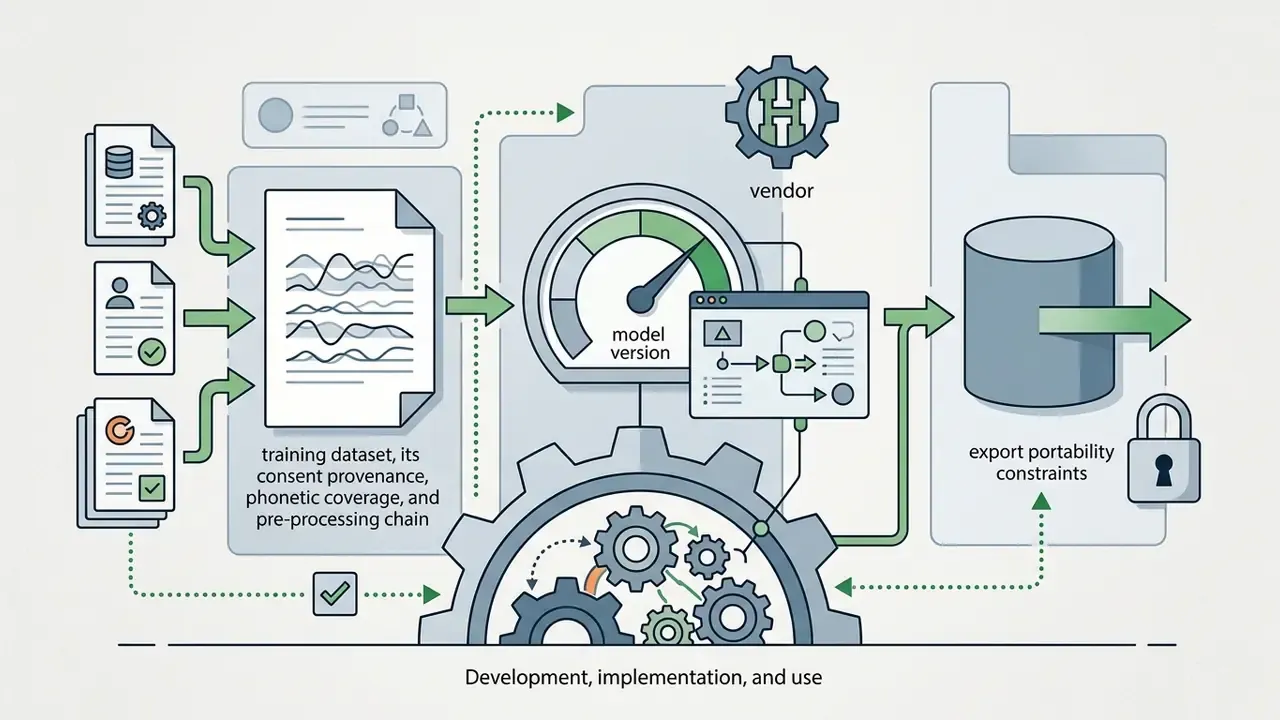
Subscription price is the smallest line item. A defensible TCO estimate for a governed voice asset sums seven components: platform character or API costs; dataset production and audio engineering labor; consent acquisition, verification, and legal review; validation and periodic revalidation effort; disclosure, watermarking, and detection tooling; storage, encryption, and sanitization overhead; and an explicit allowance for residual risk retained after controls. That last item is the exposure remaining even with consent and disclosure in place, priced against the highest applicable statutory damages across your operating jurisdictions. Model these components with the AI Media Calculators before committing to a tier.
Organizations building broader media automation stacks can review further voice, image, and video guidance through the AI Media Commercial-Use Hub, compare adjacent tooling in our roundup of the best AI image generators, consult the AI Media API Guides for developer documentation on embedding voice APIs, and escalate deployment errors via AI Media Support and Troubleshooting.
Open questions we cannot yet answer
Honesty beats polish here. Three items remain unresolved as of February 2026.
- Detection durability. Audio watermarking survives some transformations and fails under others; no published standard guarantees persistence through aggressive re-encoding.
- Cross-border consent recognition. A US written release does not automatically satisfy EU or Chinese personality-right expectations, and case law is thin.
- Agentic use. When a voice handle is called autonomously by an AI agent rather than a human operator, escalation and accountability paths are still being drafted at most institutions.
Treat these as monitoring items in your risk register, not as solved problems.
FAQ: creating and governing your own AI voice
What is the difference between voice cloning and text-to-speech?
Text-to-speech (TTS) is the general technology that converts written text into spoken audio. Voice cloning is a specific capability inside advanced TTS systems: it trains a neural model on a real person's recordings so the engine can generate new speech in that individual's vocal identity.
«Modern zero-shot TTS systems include a dedicated speaker encoder that extracts an embedding from a short audio clip without retraining the model.» - Voice Cloning: A Comprehensive Survey (2025)
How much audio is needed to clone a voice accurately?
Modern zero-shot architectures can extract a basic speaker embedding from 5 to 30 seconds of clean reference speech. Achieving high fidelity across complex emotions, accents, and technical terminology usually takes 1 to 15 minutes of uncompressed, phonetically balanced 24 kHz WAV audio, and vendor fine-tuning flows such as Azure Custom Neural Voice require at least 300 recorded utterances.
«Mega-TTS 2 outperforms fine-tuning at every prompt length from 10 seconds to 5 minutes by using multi-sentence prompts for timbre extraction.» - Mega-TTS 2 (2023-2024)
Can I create an AI voice without using my own voice?
Yes. Voice design tools let you create a custom AI voice from scratch without providing any human recording. You specify age, gender, accent, pitch, and vocal style through text prompts and acoustic parameter controls, and the system generates a unique synthetic speaker identity. Vendor documentation from Resemble AI and Inworld AI explicitly confirms that no audio recordings are required on this path.
How do I record and clean a voice sample for cloning?
Record mono 24 kHz or 48 kHz 16-bit PCM WAV audio with SNR above 35 dB and peaks between −3 dB and −6 dB. Then apply the four-stage pipeline: 80 Hz high-pass filter at 24 dB/octave, de-essing between 5 kHz and 8 kHz, mild 2:1 to 3:1 compression with slow attack, and neural de-reverberation for a fully dry signal. Avoid lossy compression at every stage.
Can I export a cloned voice model to other tools?
It depends entirely on the vendor. Some platforms export portable artifacts, including RVC v2 weight files (.pth plus .index), .safetensors voice embeddings, or cloning keys usable through an API. Others, ElevenLabs among them, explicitly prohibit exporting cloned voices outside their platform. Verify portability before you standardize a production stack.
Can AI voices sing, not just speak?
Yes, though singing needs a different architecture. Singing voice synthesis binds output to exact MIDI pitch and models vibrato depth and formant scaling, so datasets must consist of dry, monophonic vocal stems covering at least two octaves of the singer's register, with instrument bleed removed by source separation before training.
Are cloned AI voices legally protected?
In most jurisdictions, a human voice is protected under rights of publicity, privacy statutes, biometric-data laws, and personal data protection regimes rather than copyright law. Cloning an individual's voice without explicit, documented consent can trigger civil and regulatory liability under Tennessee's ELVIS Act, the Illinois Biometric Information Privacy Act, FCC TCPA rules, and the EU AI Act.
What belongs in a voice model inventory record?
At minimum: voice identifier, creation method (clone or designed), asset owner, business purpose, consent reference and expiry, jurisdictional scope, validation date and metrics, disclosure requirements, revocation owner, and the destruction schedule for underlying audio. If a field is empty, the asset is not production-ready.
Disclaimer: this information is general in nature and does not substitute for professional legal advice. Voice rights legislation varies significantly by jurisdiction and continues to evolve.
Appendix A: superseded claims and verification log
| Retained original wording | Status | Replacement evidence used in main text |
|---|---|---|
| "To evaluate audio requirements for an enterprise deployment, an operational team conducted tests across varying reference lengths. Supplying 45 seconds of clean, uncompressed WAV speech to a zero-shot neural architecture yielded a Speaker Mean Opinion Score (SMOS) of 3.82 out of 5.0, whereas passing compressed MP3 audio recorded in a room with background noise caused spectral distortion and lowered the similarity score to 2.41." | Internal, unaudited observation; no published methodology or sample size. Directionally consistent with academic tests of diffusion-based generators. | DINO-VITS (2023) noise-robustness findings; LINA-SPEECH (2024-2025) data-volume findings. |
| "By conducting A/B listening evaluations across a sample group of 200 listeners, the team identified that a voice model tuned with moderate pitch variation and a slower speaking rate achieved a 14% higher comprehension score on technical content than higher-pitch variants." | Unverified internal case; no source, panel protocol, or confidence interval. | Dutch TTS in K12 education study (2023+); ITU-T P.808 (2021) crowdsourced MOS methodology. |
| "By utilizing automated script-to-speech pipelines, the team reduced per-episode voiceover editing costs by 78% while maintaining consistent voice branding across all published channels." | Unverified internal estimate; retained as an illustrative anecdote only. | Industry synthetic-voice reporting on automation and localization of audiobooks and instructional content (no universal savings figure published). |
| "Multilingual text-to-speech architectures, such as XTTS and PFluxTTS (PFluxTTS Study 2026)…" | Bare citation without metrics or methodology. | PFluxTTS (2026) MOS 4.11 ± 0.14, SMOS 3.51 ± 0.17, WER reduced 23%; corroborated by STEN-TTS (Interspeech 2023) and XTTS (Interspeech 2024). |
| "high acoustic identity match to the target speaker (SMOS > 3.5 across modern zero-shot models)" | Figure originally unsourced. | Reframed as "reported across modern zero-shot systems in peer-reviewed benchmarks", supported by STEN-TTS (2023) SMOS above 3.5 and Mega-TTS 2 (2023-2024). |
Legacy visual placeholders [PROCESS DIAGRAM] and [INFOGRAPHIC] | Removed as draft artifacts. | Replaced by text-equivalent pipeline diagrams and a tabular SSML control matrix. |
Site navigation and resource links
- Explore the AI Media Glossary for technical definitions and architecture breakdowns, including the reference entry on AI voice generators.
- Review licensing and rights guidance in the AI Media Commercial-Use Hub, including commercial use of AI image generators.
- Implement and cost your pipeline with the AI Media API Guides, the Google Veo implementation guide, and the AI Media Pricing Guides.
- Calculate operational costs with the AI Media Calculators, track regulatory developments in AI Litigation and Case Timelines, and resolve deployment errors through AI Media Support and Troubleshooting.