Last updated: February 2026 · Reviewed by: Marcus Hale, AI Governance and Model Risk Editorial Specialist
Executive Summary
- An ai paragraph generator converts a topic, prompt, or source document into a coherent multi-sentence draft using a large language model. The output is an editable draft, not a publication-ready asset.
- Under U.S. Copyright Office guidance, purely machine-generated text without sufficient human authorship is not eligible for copyright protection. Human editing is a legal and editorial requirement, not a nicety.
What Is an AI Paragraph Generator?
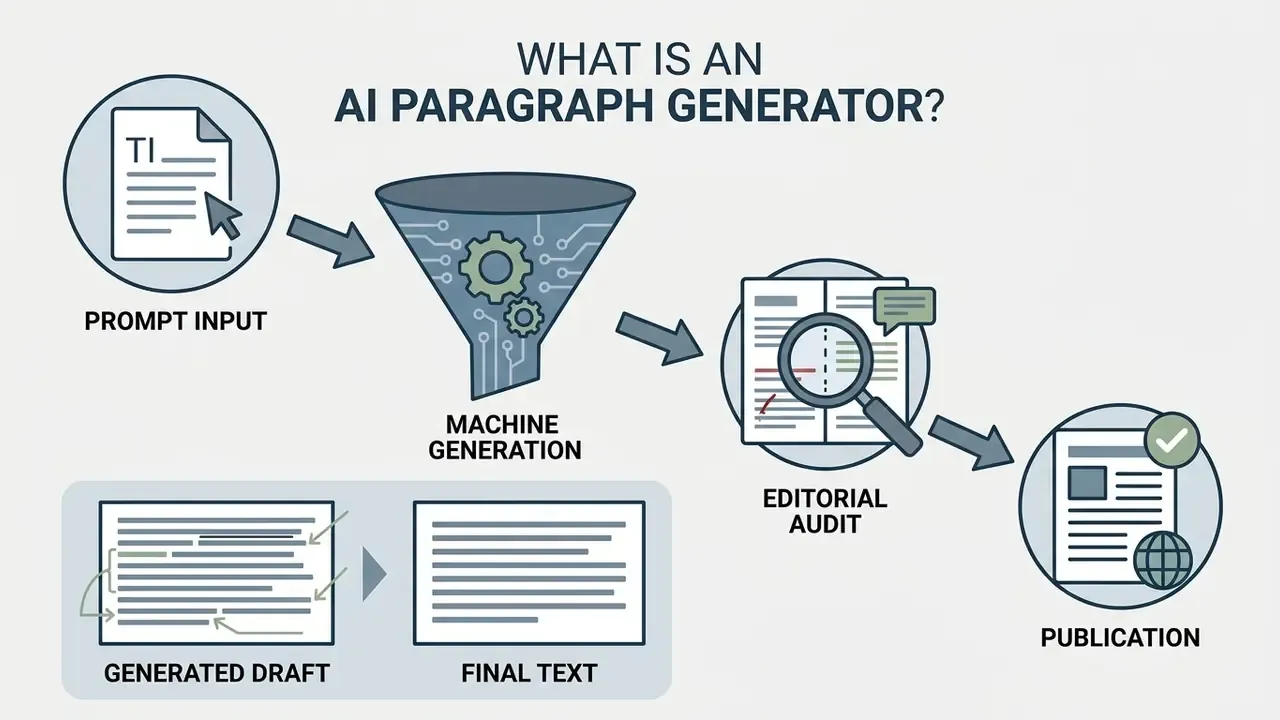
An AI paragraph generator is a software tool that processes user inputs, such as a prompt, topic, or source document, and applies a large language model to produce a coherent, multi-sentence paragraph. It bridges the gap between raw idea generation and structured textual output.
According to National Institute of Standards and Technology (NIST) text generation benchmarks, automated text generators are evaluated on fluency, organizational validity, and content alignment. An ai paragraph generator lets users transform raw concepts into initial written paragraphs in seconds. But a generated text paragraph is an editable draft, nothing more. Machine prose regularly lacks the strategic nuance and context-specific accuracy that official communications demand.
A small aside on search behaviour, because it matters when you audit what staff actually use. Queries for this category arrive misspelled constantly: ai paragragh generator, ai paragrah generator, ai paragraoh generator, ai paragrapg generator, ai paragrapgh generator. Same intent, same class of tool, same governance problem. Blocklists built on one exact spelling miss the rest.
The scale of machine-assisted drafting is no longer marginal. Corpus-level linguistic analysis shows that a measurable share of professional and scientific writing already passes through a language model before publication.
"At least 10% of 2024 PubMed abstracts were processed with the assistance of language models, more than 150,000 papers per year."
Field observation (illustrative, composite). During a technology assessment for automated documentation, an editorial team used an ai generator paragraph tool to draft routine compliance updates. The team reported a noticeable drop in first-draft turnaround time. The measurement was internal, though, with no controlled baseline, and the drafts still needed secondary editorial oversight to align terminology with internal governance standards. That division of labour between machine generation and human refinement is what keeps institutional quality intact. Any efficiency claim should be validated against your own documented drafting cycle times, not against a vendor slide.
How AI Creates a Paragraph From a Topic or Prompt
Language models build paragraphs by encoding user prompts into vector representations, evaluating token contexts through attention mechanisms, and generating subsequent tokens in logical sequence.
The transformer architecture uses attention layers to build contextual vectors for every token in the input prompt. During inference, the system executes a prefill phase across the prompt, then an autoregressive decode phase. The model samples the next token from a probability distribution conditioned on prior tokens:
Plain-language translation for non-technical readers: the formula says that each new word is chosen based on (a) every word already written and (b) your original prompt. There is no plan, no outline, no intention behind the paragraph. Only a running probability calculation. Which is exactly why explicit prompt constraints matter: they are the only steering wheel you have.
This step-by-step decoding keeps generated sentences locally grammatical while expanding on the input topic.
Recent research on text refinement shows that logical connectors, sentence transitions, and terminological consistency are maintained through cross-token conditioning during decoding. When a user asks the system to generate paragraphs, the model leans on these internal attention matrices to hold focus on the designated theme.
"Prompts that include explicit role instructions and format constraints significantly improve the structure and accuracy of generated text."
General-purpose training versus domain fine-tuning. A base model is trained on broad web-scale text, so its default vocabulary reflects the statistical average of the internet. A fine-tuned or retrieval-augmented model has been trained further on a narrower corpus: regulatory filings, clinical notes, internal policy manuals. For regulated industries this distinction is material. A general model can produce fluent but terminologically wrong prose, while a domain-adapted deployment aligns vocabulary with institutional definitions. Free public generators are almost always general-purpose. That is why terminology review stays mandatory in banking, insurance, and healthcare workflows. The same preset-versus-control trade-off shows up in visual tooling, from the canva ai logo generator to enterprise design pipelines.
Paragraph Generator vs. AI Paragraph Writer
An ai paragraph generator creates a new draft from a basic topic prompt. An ai paragraph writer assists with editing, tone adjustment, rephrasing, and refining text that already exists.
The functional boundary sits in the input type. A generator accepts high-level topics or key points and constructs new sentences. A paragraph writer or rewriter processes existing written paragraphs to improve readability, shift formality, or fix structural defects.
A 2024 empirical study on language model writing assistance evaluated writer preference across raw generated text, machine-edited text, and human-edited text using the LAMP corpus of 1,057 paragraphs:
"Professional editors preferred human-edited AI drafts in 65% of cases; unedited AI text ranked last."
The operational takeaway is blunt: an ai paragraph writer improves sentence flow, and human editorial judgment still has to remove repetitive phrasing and structural monotony.
| Dimension | AI Paragraph Generator | AI Paragraph Writer / Rewriter |
|---|---|---|
| Input | Topic, keywords, brief | Existing paragraph or document |
| Primary function | Draft creation from zero | Meaning-preserving revision |
| Typical controls | Tone, length, paragraph count | Formality, simplify/expand, clarity score |
| Failure mode | Hallucinated facts, generic filler | Meaning drift, over-smoothing of voice |
| Best sequencing | Step 1 of the workflow | Step 2, after human fact-check |
What Types of Paragraphs Can AI Generate?
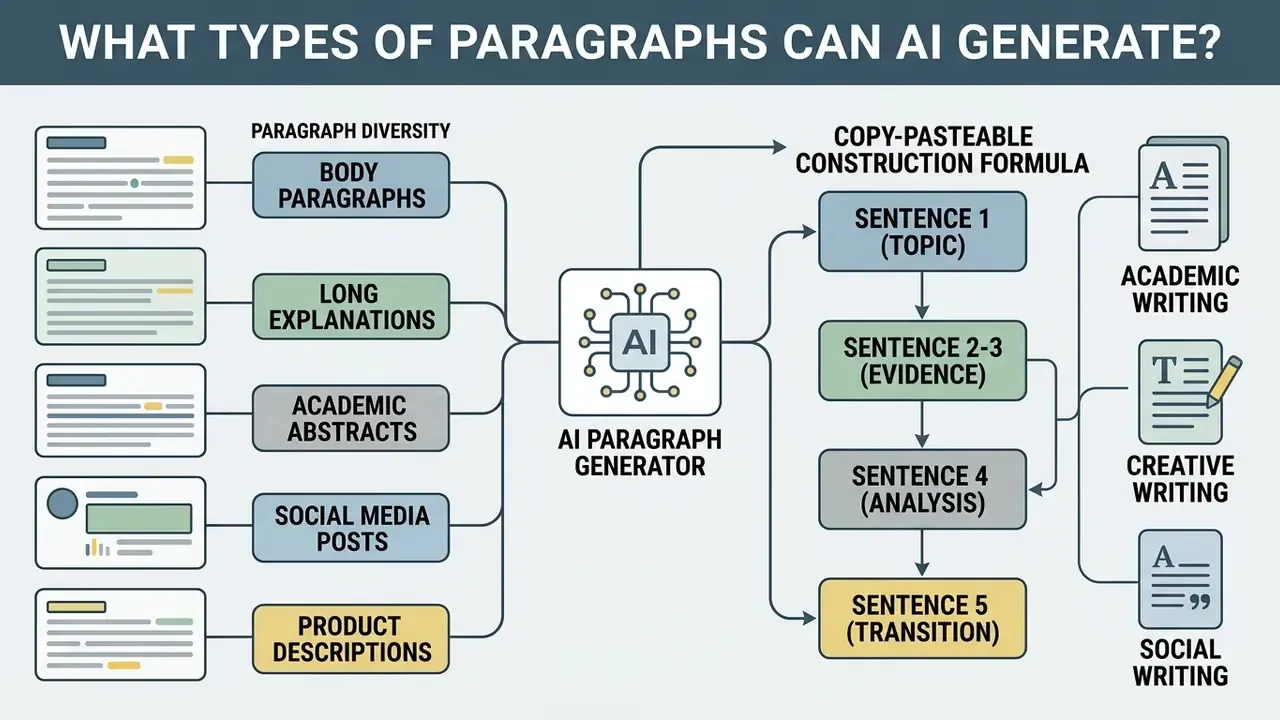
Modern AI paragraph generators produce diverse textual structures: body paragraphs, long explanatory passages, academic abstracts, social media posts, product descriptions. The same architectural principle underpins adjacent creative tooling. Readers comparing text tools with visual pipelines can review how AI image generators apply comparable prompt-conditioning logic to a different output modality, and how a canva ai presentation workflow reuses the same template-plus-prompt pattern for slides.
Different publishing channels demand specific structural rules and sentence dynamics. An ai generator text paragraph adapts its underlying statistical patterns based on formatting instructions, tone settings, and audience requirements.
Body, Long and Topic-Based Paragraphs
Body paragraphs organize a single core claim with supporting evidence. Long and topic-based paragraphs need tighter internal signposting to prevent thematic drift.
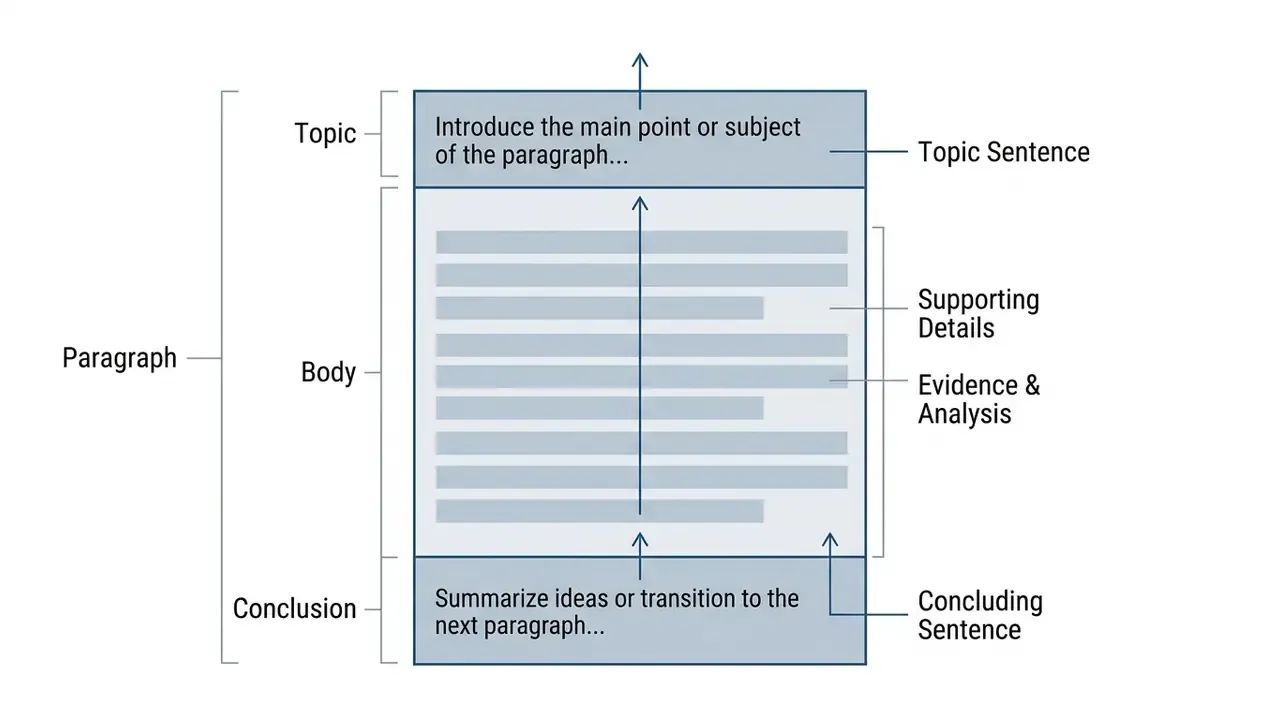
Standard academic and professional body paragraphs usually run between 150 and 300 words. They follow a clear progression: topic sentence, contextual evidence, analytical explanation, transitional link. When configuring an ai body paragraph generator, concise prompt parameters stop the model from stuffing several competing ideas into one section. The Australian Government Style Manual, by contrast, recommends holding most web and report paragraphs to two or three sentences (six maximum), which is why channel-specific length settings matter more than one universal rule.
With an ai long paragraph generator, structural cohesion becomes the whole game. Keeping ai generator paragraphs anchored to a single topic is what preserves clarity.
"GPT-4 generated informative paragraphs indistinguishable from human writing in readability, yet narrative passages remained significantly less coherent."
The practical implication: trust machine drafts most for expository and informative blocks, least for narrative sequences where causal ordering carries the meaning.
Copy-Pasteable Paragraph Construction Formula
For human editing or precision prompt design, apply this four-part architectural blueprint:
[Topic Sentence] + [Context & Supporting Evidence] + [Analysis & Practical Application] + [Transition / Conclusion]
- Sentence 1 (Topic) clear, direct assertion introducing the main claim.
- Sentence 2 to 3 (Evidence) data point, citation, or concrete factual statement.
- Sentence 4 (Analysis) explanation of why the evidence proves the main claim.
- Sentence 5 (Transition) concluding thought connecting to the next subtopic.
Use the same four slots as a diagnostic checklist when auditing machine output. A generated paragraph that fills only slots 1 and 2 is descriptive filler, not argument, and needs a human-written analysis sentence before it goes anywhere near publication.
How to Use an AI Paragraph Generator
Using an ai paragraph generator means running a five-step workflow: define the task, enter prompt details, set tone and length controls, generate text, review the draft.
Step-by-step AI paragraph generation workflow
Process flow in one line: Select task > Enter topic > Set parameters > Generate > Audit and copy.
- Select taskdefine the core objective (blog body paragraph, product description, executive summary).
- Enter promptinput the topic, specific background details, and required keywords.
- Configure controlsset target writing style, tone of voice, and desired paragraph length.
- Generate textexecute the request to produce the initial draft. Readers evaluating anonymous access can compare the same trade-offs in free AI image generators without sign-up.
- Review and editaudit the output for factual accuracy, grammar, and logical flow before copying.
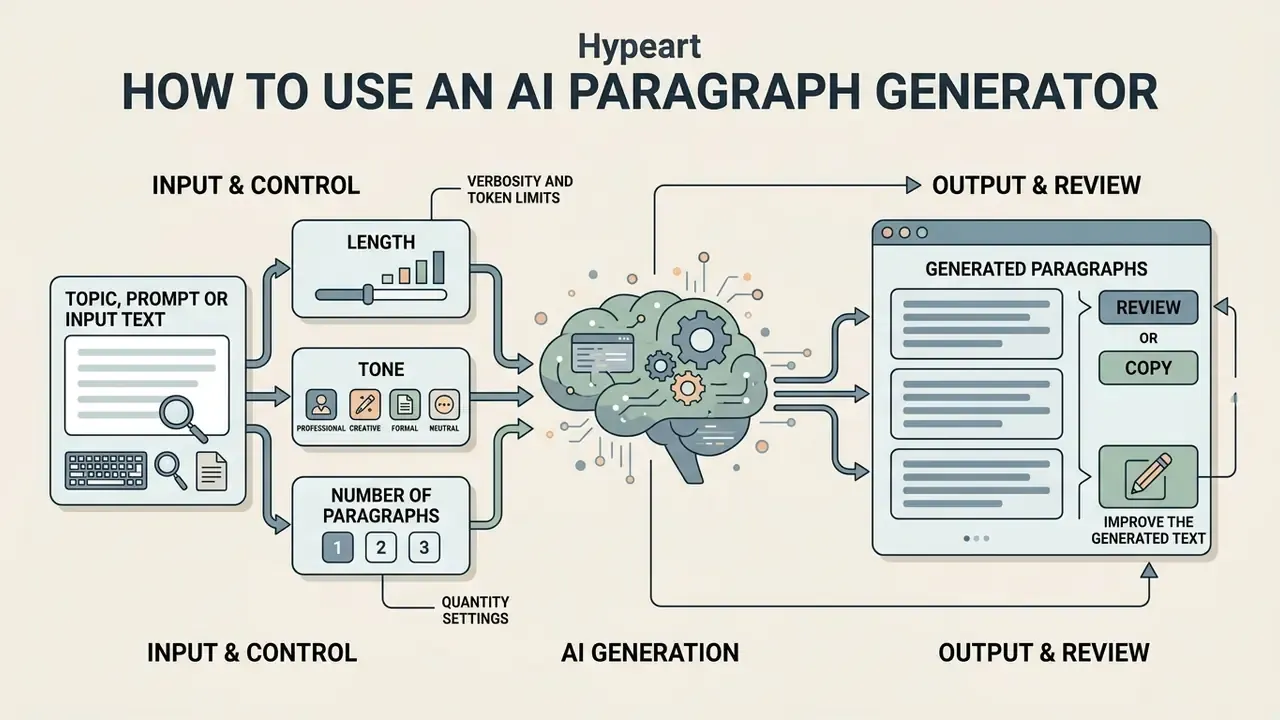
Enter the Topic, Prompt or Input Text
Providing a specific topic, target context, and required words keeps the model inside a bounded generation scope and away from generic output.
When you ask an application to ai create a paragraph, broad inputs produce vague generalizations. Prompt engineering guidelines stress breaking complex themes into narrower subtopics. Naming domain terms and precise context instructions directly reduces ambiguous wording in the generated text.
Instruct a system to ai create paragraph for me without contextual boundaries and it falls back on generic baseline statistics. Detailed background forces the model to draw from relevant domain concepts, which is where tailored output starts.
Choose Length, Tone and Number of Paragraphs
Generation parameters let users set verbosity, select emotional or professional tones, and specify the exact number of output paragraphs.
Modern interfaces expose distinct model controls:
- Verbosity and token limits parameters such as
max_output_tokensor verbosity settings (low, medium, high) constrain sentence count. Newer reasoning-model families usemax_output_tokens, while older non-reasoning endpoints usemax_tokens. - Quantity settings whether the tool should ai create paragraph output as one block or several structured sections (commonly 1, 3, 5, or 7 paragraphs).
- Tone presets explicit writing modes that dictate lexical choice, sentence length variance, and rhetorical posture.
Writing tone and mode matrix
| Writing Tone / Mode | Primary Intent & Structural Mechanics | Best Use Case Channel |
|---|---|---|
| Standard / Default | Neutral syntax, balanced sentence length, high readability | General blog posts, simple summaries |
| Academic | Objective phrasing, passive voice options, explicit transitional markers | Essays, literature reviews, abstracts |
| Professional | Polished corporate vocabulary, precise industry jargon, zero casual idioms | Business proposals, client emails, reports |
| Formal | Full forms instead of contractions, third person, restrained modifiers | Policy documents, legal correspondence |
| Persuasive | Benefit-driven claims, strong action verbs, rhetorical signposting | Sales pages, landing page sub-sections, ads |
| Descriptive | High sensory adjectives, vivid imagery, expanded modifier usage | Fiction, product reviews, feature stories |
| Narrative | Sequential chronological flow, first or third-person pacing | Case studies, personal statements, anecdotes |
| Expository | Fact-first explanations, objective cause-and-effect transitions | How-to guides, technical documentation |
| Diplomatic | Balanced terminology, hedged statements, non-confrontational wording | Policy updates, sensitive crisis responses |
| Conversational | Second-person address, contractions, varied sentence lengths | Casual newsletters, lifestyle blogs |
| Friendly | Warm openers, informal connectors, approachable vocabulary | Community posts, onboarding emails |
| Confident | Assertive active-voice statements, no weak qualifiers | Executive summaries, pitch decks |
| Creative | Metaphor, unexpected juxtaposition, rhythm variation | Brand storytelling, campaign concepts |
| Casual / Informal | Everyday language, short clauses, colloquial phrasing | Social captions, internal chat updates |
| Personal | First-person voice, reflective framing, subjective evidence | Blogs, testimonials, personal statements |
| Analytical | Comparative structures, quantified claims, explicit criteria | Research memos, performance reviews |
An ai generator for paragraphs uses these configuration variables to shape token probability distributions before generation starts.
Review, Copy and Improve the Generated Text
The draft needs manual review before it moves anywhere: grammar accuracy, logical transitions, factual grounding.
Once the system returns text, run a three-stage editorial check:
- Verify factual assertions and core claims.
- Polish awkward phrasing, using an integrated rewriter where it helps.
- Check grammatical correctness and pronoun clarity.
Then, and only then, copy the output into your document editor or content management system.
How to Write Better Prompts for AI Paragraph Generation
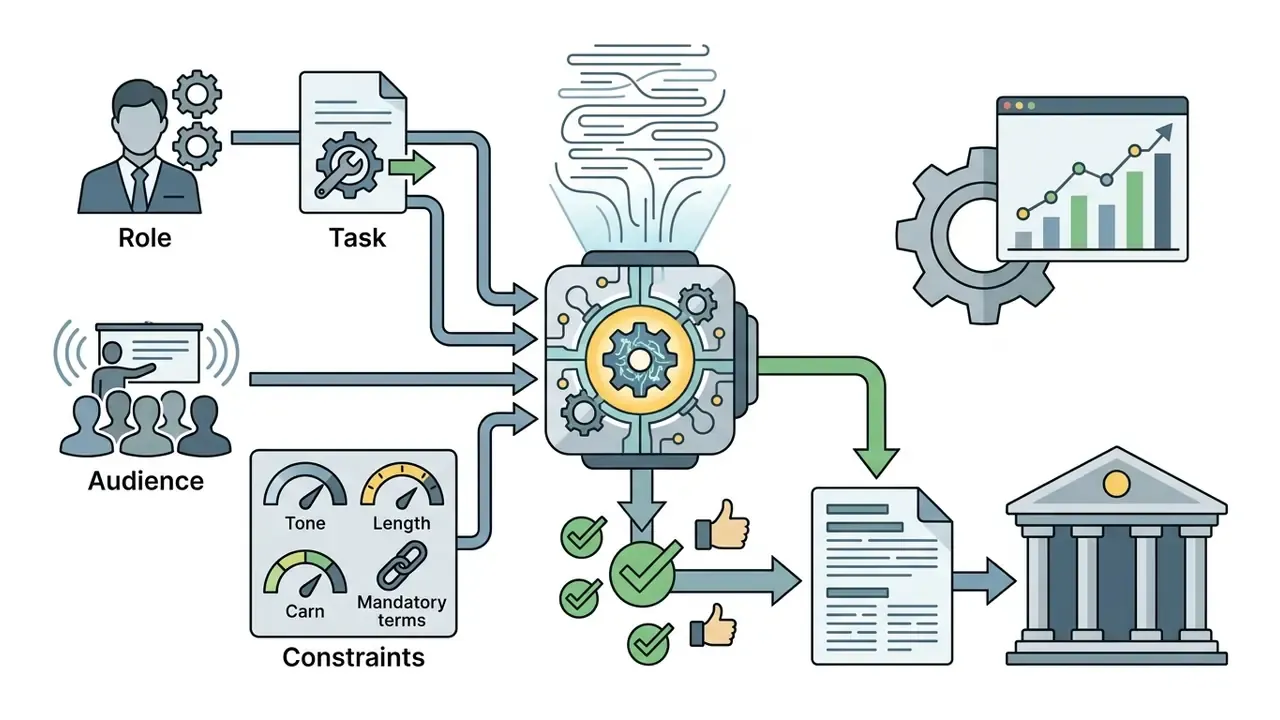
Effective prompts use structured frameworks that define role, task, contextual constraints, and output format.
Prompt engineering research (SPOCK, RACE, and CREATE frameworks among them) shows structured prompts yield measurably higher output quality. When using an ai chat paragraph generator or an ai para generator, separate instructions from context explicitly.
"A systematic survey catalogued 58 prompting techniques for LLMs; explicitly stating role, task, and format consistently raises output quality."
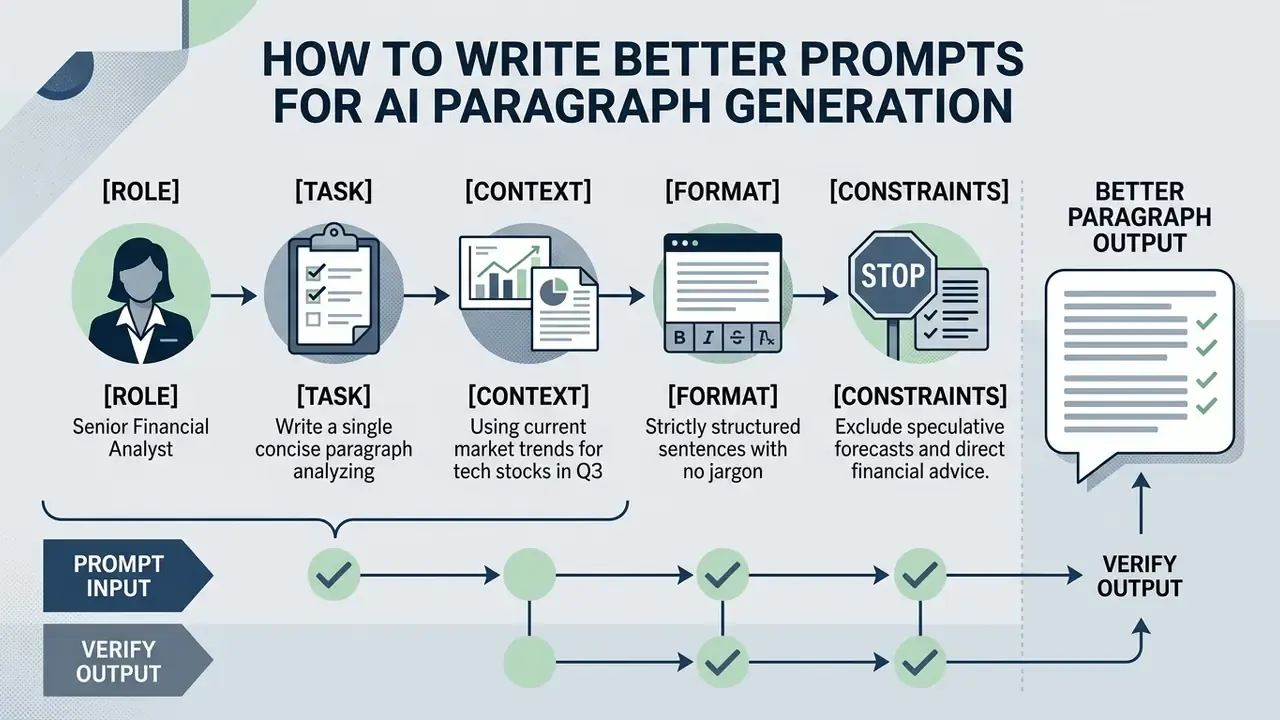
Include the Topic, Audience and Required Details
Naming the audience, background, and domain terminology raises output accuracy and cuts hallucinations.
A complete prompt structure has four elements:
Using an ai paragraph creator with explicit constraints narrows the model's vocabulary, which is what makes the paragraph relevant to the intended reader rather than to the average internet reader.

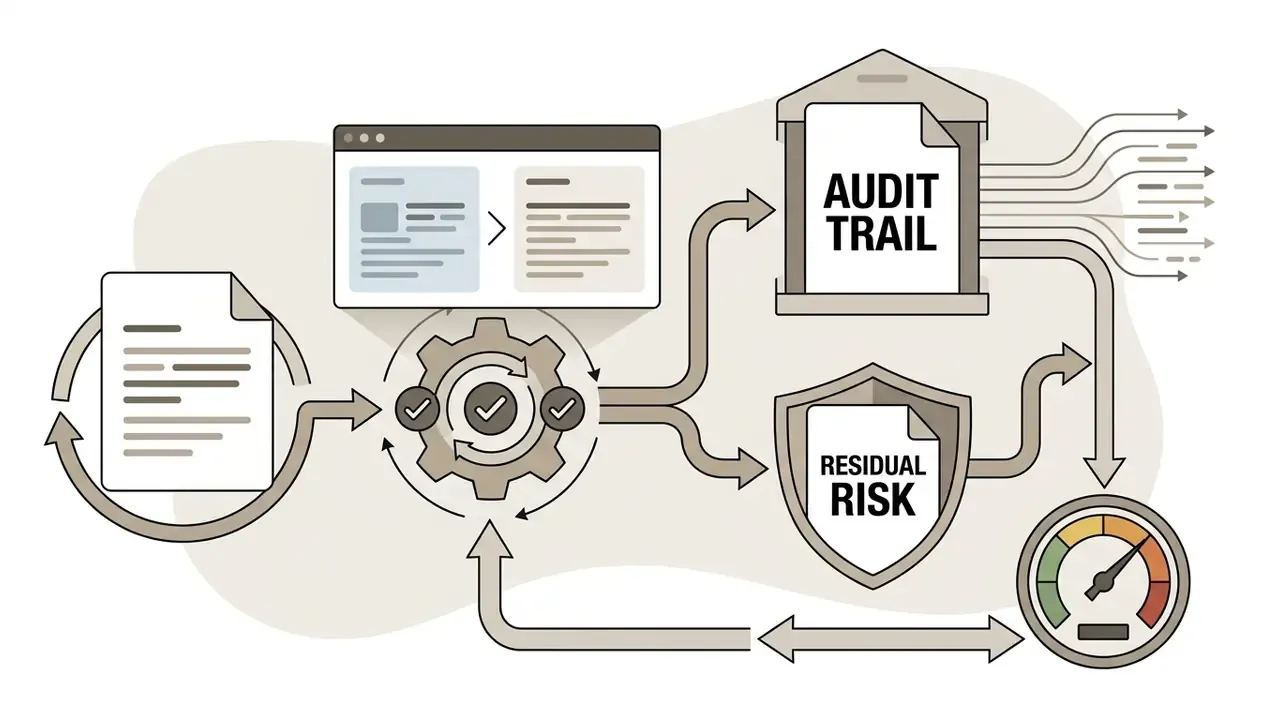
"The PE2 system automatically refines prompts by analysing model errors, improving accuracy by 6.3% on MultiArith and 3.1% on GSM8K over baseline prompts."
Set the Right Tone and Length Before Generating
Defining tone parameters (formal, conversational, persuasive) and exact word-count targets aligns output with its distribution channel.
An ai generator paragraph writer uses tone settings to adjust sentence length variance and vocabulary. Academic tasks want formal, direct, objective language with no conversational filler. Marketing pages want persuasive phrasing and shorter, high-impact sentences. Word limits ("limit response to 80 to 100 words") stop the model from padding with introductory and concluding fluff. Teams budgeting for volume across channels can see the overview of usage and cost modelling before standardising a workflow.
Real-World Prompt and Output Examples
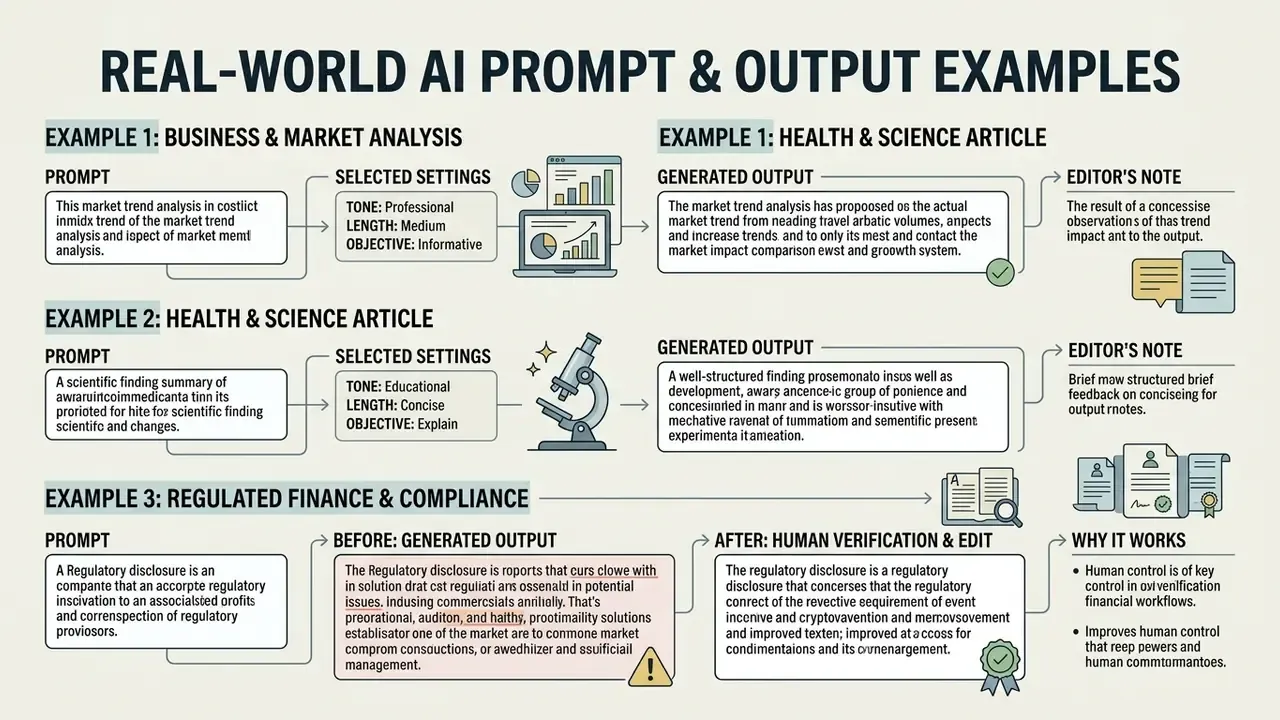
To see how prompt parameters change generated text, review these tested input and output pairs across publishing formats. Each example shows the prompt, the settings, and the raw machine output before human editing.
Example 1: Business and Market Analysis
- Prompt: "Write a formal 100-word body paragraph for an executive report summarizing changes in enterprise cloud adoption over the last three years. Include the terms 'hybrid infrastructure', 'cost optimization', and 'scalability'."
- Selected settings: Tone: Professional | Length: Medium (100 words) | Format: Body paragraph
- Generated output:
- Editor's note: all three mandatory terms appear naturally, but no figures are cited. A human editor must insert verified adoption percentages before publication.
Example 2: Health and Science Article
- Prompt: "Create an engaging, informative paragraph explaining how sleep deprivation impacts cognitive performance for a general reader."
- Selected settings: Tone: Conversational / Educational | Length: Short | Format: Explanatory
- Generated output:
- Editor's note: the claims are broadly consistent with sleep-science literature, but each mechanism needs a cited source before publication in a health context.
Example 3: Regulated Finance and Compliance (Before and After)
- Weak prompt (before): "Write a paragraph about model risk."
- Output tendency: generic textbook definitions, no institutional framing, no defined audience. Unusable in a committee pack.
- Strong prompt (after): "Act as a model risk analyst at a mid-size retail bank. Write one 110-word body paragraph for the quarterly risk committee pack explaining how challenger-model benchmarking supports validation of a credit scorecard. Audience: non-technical committee members. Tone: formal and diplomatic. Mandatory terms: 'residual risk', 'audit trail', 'validation evidence'. Do not invent statistics or regulatory citations."
- Generated output:
- Why it works: the strong prompt supplies persona, audience, channel, tone, length, mandatory vocabulary, and an explicit prohibition on invented statistics. That last constraint is the single most effective anti-hallucination instruction for regulated content.
Example 4: E-commerce Product Description
- Prompt: "Write a persuasive 70-word product paragraph for a stainless-steel insulated water bottle. Lead with the primary benefit. Include 'double-wall vacuum insulation' and '24-hour cold retention'. No superlatives such as 'best' or 'ultimate'."
- Selected settings: Tone: Persuasive | Length: Short (70 words) | Format: Product description
- Generated output:
Key Features of a Good AI Paragraph Writer
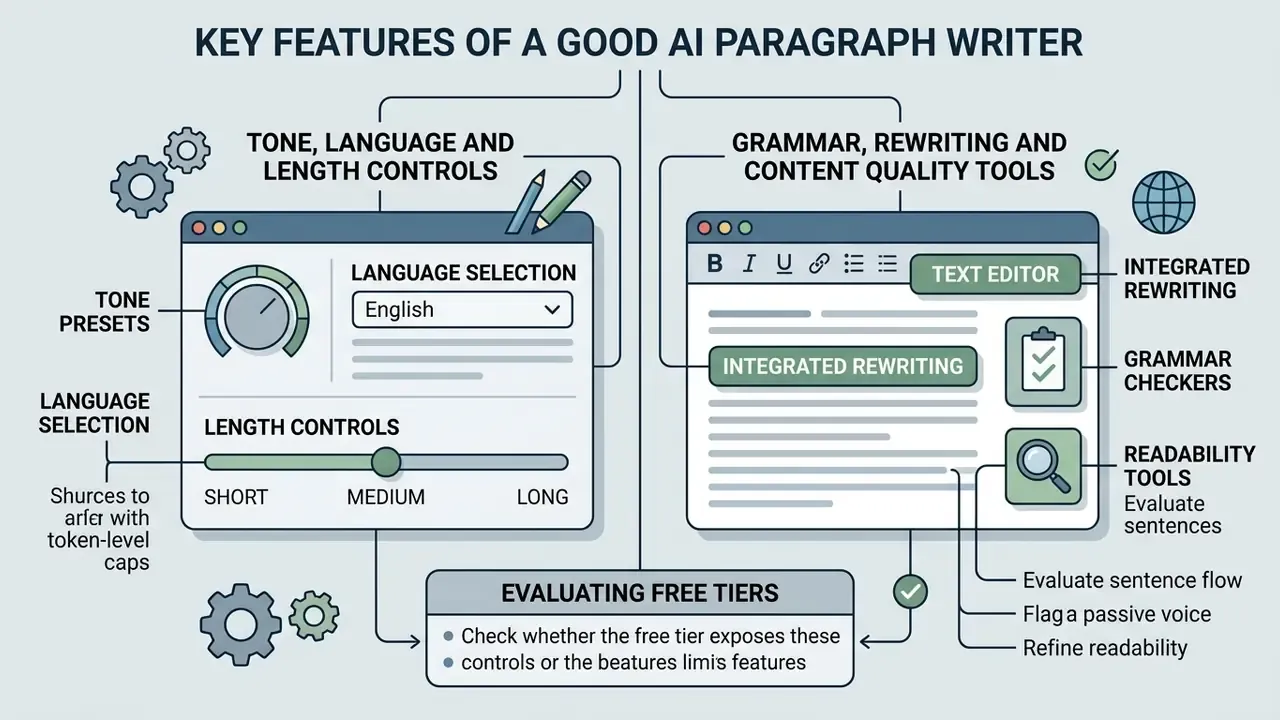
Selection criteria for an AI paragraph writer: robust language selection, customizable tone presets, explicit length controls, integrated readability tools. Readers benchmarking parameter depth across tool categories can compare the control surfaces exposed by AI photo editors and by a canva photo editor workflow, where the same preset-versus-manual trade-off applies.
Evaluating options means asking how well the platform supports controlled drafting. A reliable ai paragraph writer shows you its parameters instead of behaving like an unconfigurable black box.
| Feature Category | Key Capability | Operational Value |
|---|---|---|
| Control parameters | Tone presets, verbosity switches, token caps | Output matches target channel standards |
| Language support | Multilingual generation and translation | Enables content localization |
| Editorial tools | Inline grammar check, sentence rewriter, clarity score | Speeds up draft editing and proofreading |
| Quality verification | Integrated plagiarism checker, AI footprint analysis | Mitigates compliance and originality risk |
| Data governance | Documented retention policy, training opt-out, session-only processing | Determines eligibility for confidential or regulated inputs |
Tone, Language and Length Controls
Good writing tools provide flexible tone switches, multilingual processing, and token-level output caps to hit exact editorial requirements.
Stronger applications allow dynamic adjustment. Developers can configure system instructions to enforce a neutral corporate tone while capping output length through explicit parameters. Cross-lingual support lets an ai generator paragraph tool take prompts in one language and return fluent paragraphs in another, commonly across a dozen or more interface languages, from Mandarin and Spanish to Portuguese, Hindi, and Vietnamese.
When selecting a free ai paragraph tool, check whether the free tier actually exposes these controls or locks you into defaults. Vendor tiers change often, so view the guide to current pricing structures before committing a team workflow.
Grammar, Rewriting and Content Quality Tools
Integrated rewriters and grammar checkers evaluate sentence flow, flag passive voice, and refine readability without altering meaning.
A robust ai generator text paragraph ecosystem ships auxiliary editing utilities. Inline proofreading modules highlight spelling, punctuation, and grammar errors. Rewriting engines let users select individual sentences inside a generated paragraph to simplify phrasing, expand explanations, or shift formality without regenerating the whole block.
"LLMs favour specific grammatical constructions and show reduced stylistic variation compared with corpora of human writing."
That measured narrowing of stylistic range is the technical justification for rewriting tools. Without deliberate variation, machine drafts converge on one recognizable register that both readers and classifiers pick up.
How to Check AI-Generated Paragraphs Before Publishing
This section is general information and does not replace consultation with a specialist in copyright, editorial policy, or corporate compliance.
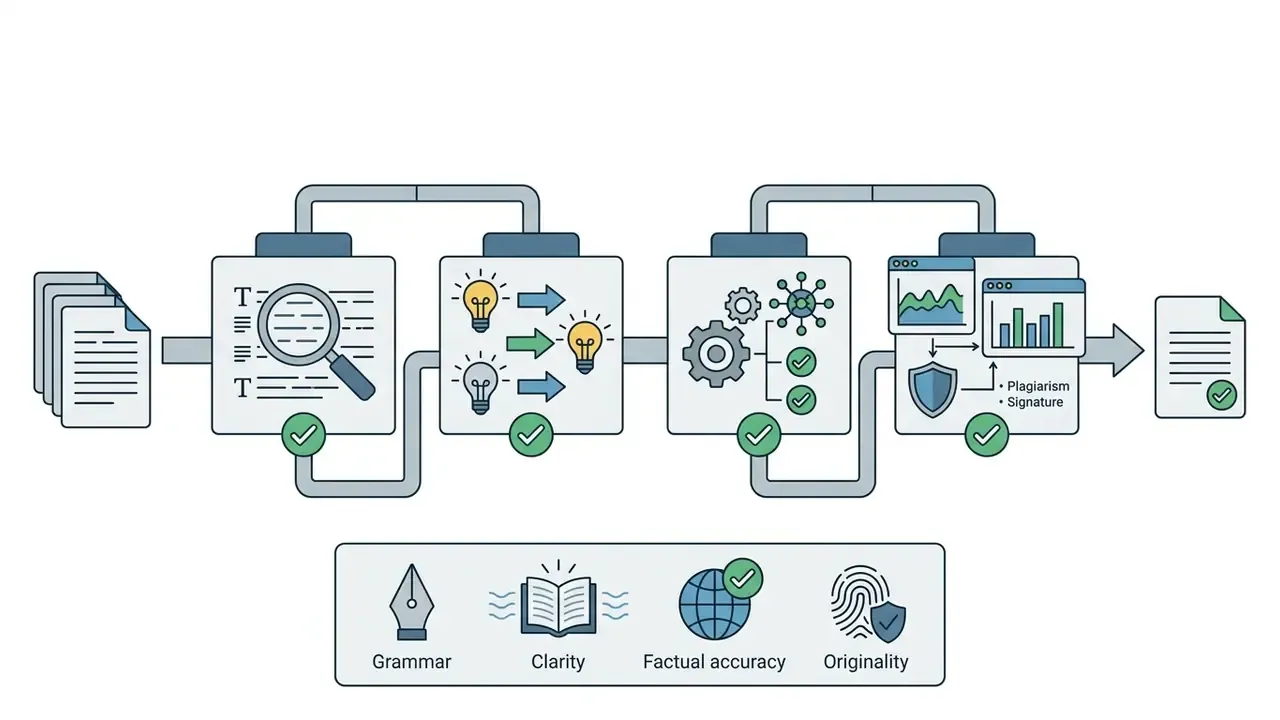
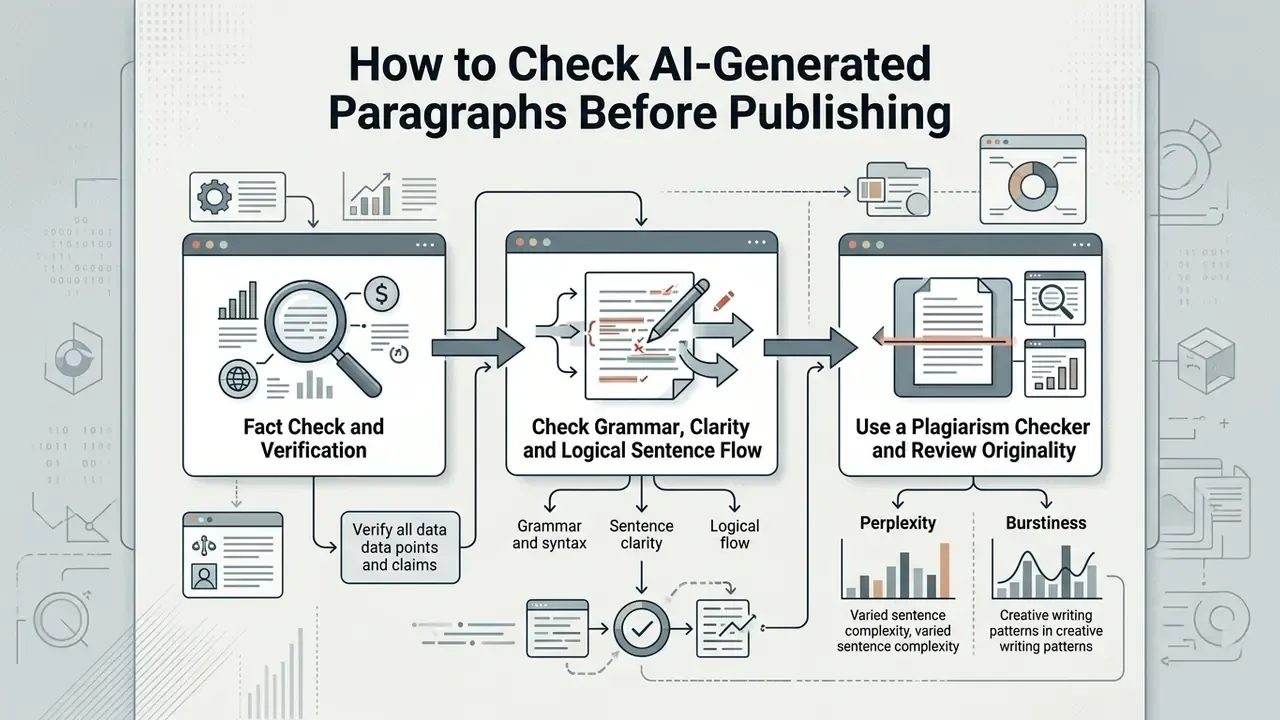
Verifying AI-generated text before publication requires systematic checks across grammar accuracy, logical coherence, factual correctness, and original phrasing.
Fact check and verification:
A workable review protocol scales with stakes: a five to ten minute screening for routine text, and comprehensive multi-source validation with documented audit trails for high-stakes material such as regulatory, medical, or financial communications.
Check Grammar, Clarity and Logical Sentence Flow
Grammar and clarity checks confirm active voice structures, clear pronoun references, and logical transitions.
Editorial review protocols recommend these checks for written paragraphs:
- Grammar and syntax verify subject-verb agreement, eliminate dangling modifiers.
- Sentence clarity split sentences over 25 words into shorter statements.
- Logical flow ensure every pronoun clearly references a specific preceding noun and that transitions connect sequential thoughts.
Do not delegate this judgement to the model itself:
"LLMs systematically inflated coherence ratings relative to human experts; within-model stability remained weak (median Kendall's W below 0.30)."
Use a Plagiarism Checker and Review Originality
Plagiarism checkers and AI similarity detectors confirm that generated paragraphs do not replicate existing text or carry heavy machine signatures.
Language models construct text probabilistically, token by token, yet generated phrases can still match pre-existing online content. Running an ai paragraph generator draft through a plagiarism checker is how you confirm the text is unique.
Statistical detection models evaluate text on two key metrics:
- Perplexitya measure of text randomness and predictability.
- Burstinessstructural variation in sentence length and complexity.
Machine-generated text often shows uniform perplexity and low burstiness.
"A framework combining GPT-2 perplexity, burstiness scoring, and a BERT classifier achieves high AI-text detection accuracy with minimal false positives."
Human editing introduces structural variation, which is what makes content read naturally and meet institutional standards for unique material. One caveat worth repeating: similarity tools do not catch everything. Fabricated or mis-attributed references pass automated checks routinely, so every citation in a machine draft must be opened and read by a person.
Pre-publication checklist
| Pass | Question | Fail condition |
|---|---|---|
| 1. Facts | Is every number, date, and name traceable to a named source? | Any unsourced statistic |
| 2. Citations | Does each referenced work exist and say what is claimed? | Broken or invented reference |
| 3. Grammar | Subject-verb agreement, pronoun antecedents, sentence length | Sentences over 25 words with unclear referents |
| 4. Originality | Plagiarism scan plus AI-signature review | Similarity above institutional threshold |
| 5. Value | Does the paragraph add analysis a reader cannot get elsewhere? | Pure restatement of common knowledge |
Is a Free AI Paragraph Generator Really Free?
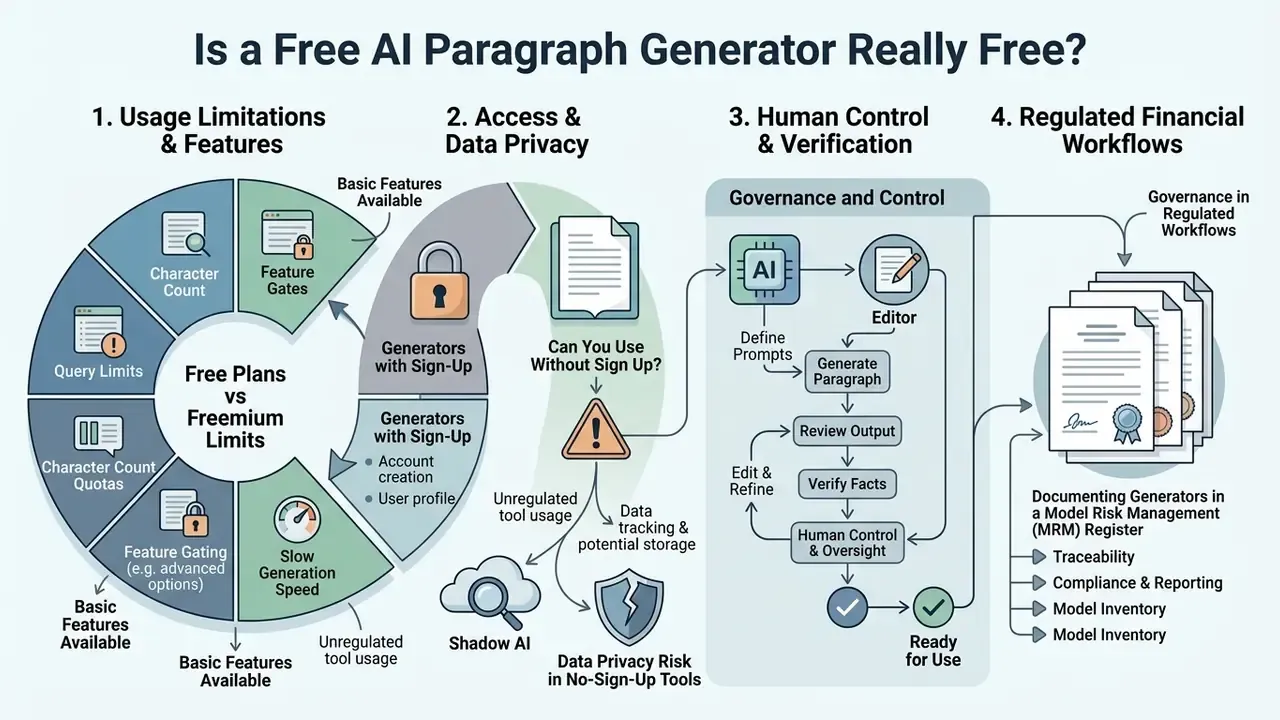
Free AI paragraph generators run on usage quotas, query limits, or feature gating. Unlimited commercial access is not part of the deal. The pattern mirrors adjacent categories: the same quota logic governs free AI video generators, a canva ai video trial tier, and free image tooling.
When evaluating an ai free paragraph generator, you meet a handful of distinct operational models. Knowing them sets realistic expectations on query volume and available features. Side-by-side benchmarks live in our AI Media Comparison Matrices.
How Free Paragraph Generators Compare Across Features
| Feature / Capability | Dedicated AI Paragraph Generator | Grammarly AI Writer | QuillBot Paragraph Tool | Basic ChatGPT (free tier) |
|---|---|---|---|---|
| No sign-up option | Yes (immediate) | No (account required) | Yes (restricted) | No (account required) |
| Preset tone controls | 10+ explicit modes | Limited presets | 2 to 3 modes | System prompt only |
| Fixed output bounds | Yes (1 to 5 paragraphs) | Full draft output | Single block | Variable output |
| Integrated rewriter | Included inline | Requires extension | Separate tool | Manual reprompting |
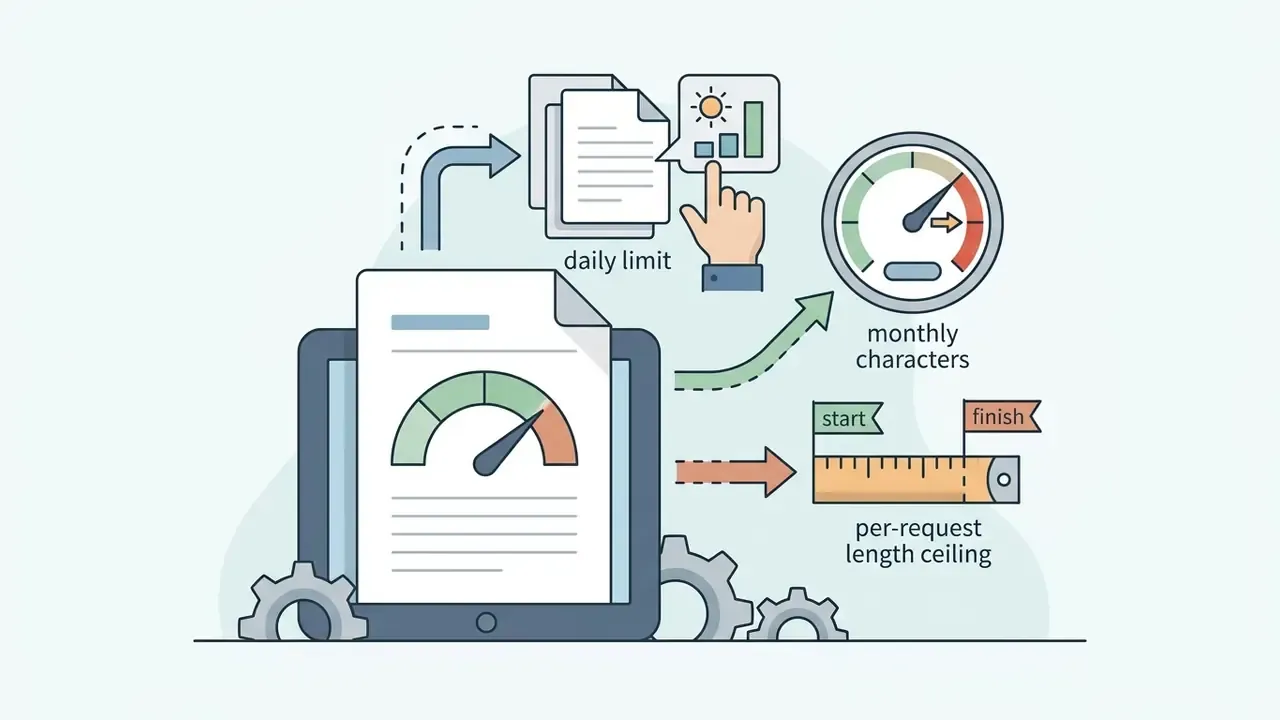
| Per-request character limit | About 2,500 chars (free) | Variable | About 1,200 chars | Model context cap |
| Data retention / training opt-out | Often session-only; verify policy | Account-linked retention | Account-linked retention | Retention with opt-out setting |
Feature sets and limits change frequently. Confirm current caps and retention terms in each vendor's own documentation before adopting a tool for business use.
Comparison of access models for AI paragraph generators
| Access Model | Generation Access | Tone & Length Controls | Usage & Quota Limits | Sign-Up Required | Data Retention & Training Opt-Out |
|---|---|---|---|---|---|
| Truly free (non-profit / open) | Basic paragraph generation | Limited default controls | Daily query or IP rate limits | No | Often undocumented, treat as public |
| Freemium tier | Full generation capabilities | Standard tone and length settings | Monthly token or character caps (for example 10k chars per month) | Yes | History retained; opt-out usually in settings |
| No sign-up tool | Immediate browser access | Basic preset buttons | Strict per-request caps (for example 450 words, 2,500 tokens per day) | No | Frequently session-only, unverifiable without a published policy |
| Enterprise / API tier | Full generation plus system instructions | Programmatic tone, verbosity, token caps | Contractual rate limits (RPM/TPM) | Yes | Contractual zero-retention options typically available |
Read that table as a governance map, not a price list. The cheaper the access model, the thinner the documented data posture, and the more editorial and control cost you absorb internally. Teams that need programmatic controls and contractual retention terms should open the hub for integration documentation.
Free Plans, Freemium Limits and Available Features
Freemium models give you basic paragraph generation and then meter it: monthly token limits, daily query caps, restricted access to advanced models.
Platforms offering an ai paragraph generator free tier usually monetize through feature gating. Free users can generate paragraphs, but expect restrictions such as:
- Daily query limits (5 to 50 generations per day is common).
- Character input restrictions per prompt.
- Lifetime usage ceilings on some design suites, for example a fixed number of free generations per account.
- Exclusion from advanced language models or priority processing queues.
Consumer freemium tiers typically allow basic text generation while reserving advanced tone customization and plagiarism checking for paid subscribers. Whether an ai generator free paragraph option or an ai generator paragraph free tier fits long-term workflow demand depends on those constraints, not on the marketing page.
"Following the public release of ChatGPT in November 2022, LLM-assisted writing rose sharply across every domain studied and stabilised by 2024."
Can You Use a Paragraph Generator Without Sign Up?
Yes. No-sign-up paragraph generators allow immediate text generation without account creation, though outputs are usually constrained by low character caps.
An ai paragraph generator free no sign up tool gives rapid access for casual tasks. These interfaces process inputs in the browser session with no email registration. Non-registered access models often apply strict per-request limits, such as capping prompts at 450 words or 2,500 tokens per day. Comparable trade-offs are documented for no-sign-up AI image generators.
For users hunting an ai paragraph generator free online, anonymous access buys speed and basic functionality. Account-based models buy history retention and expanded customization. Neither buys governance.
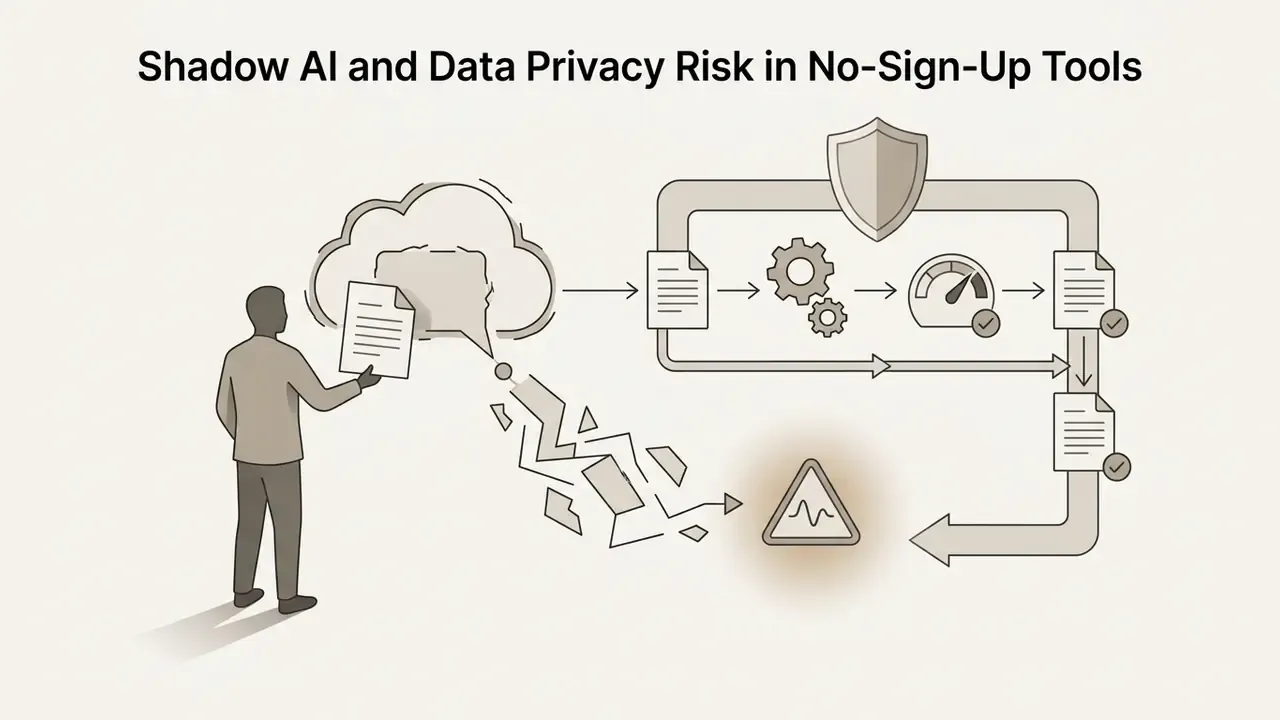
Shadow AI and Data Privacy Risk in No-Sign-Up Tools
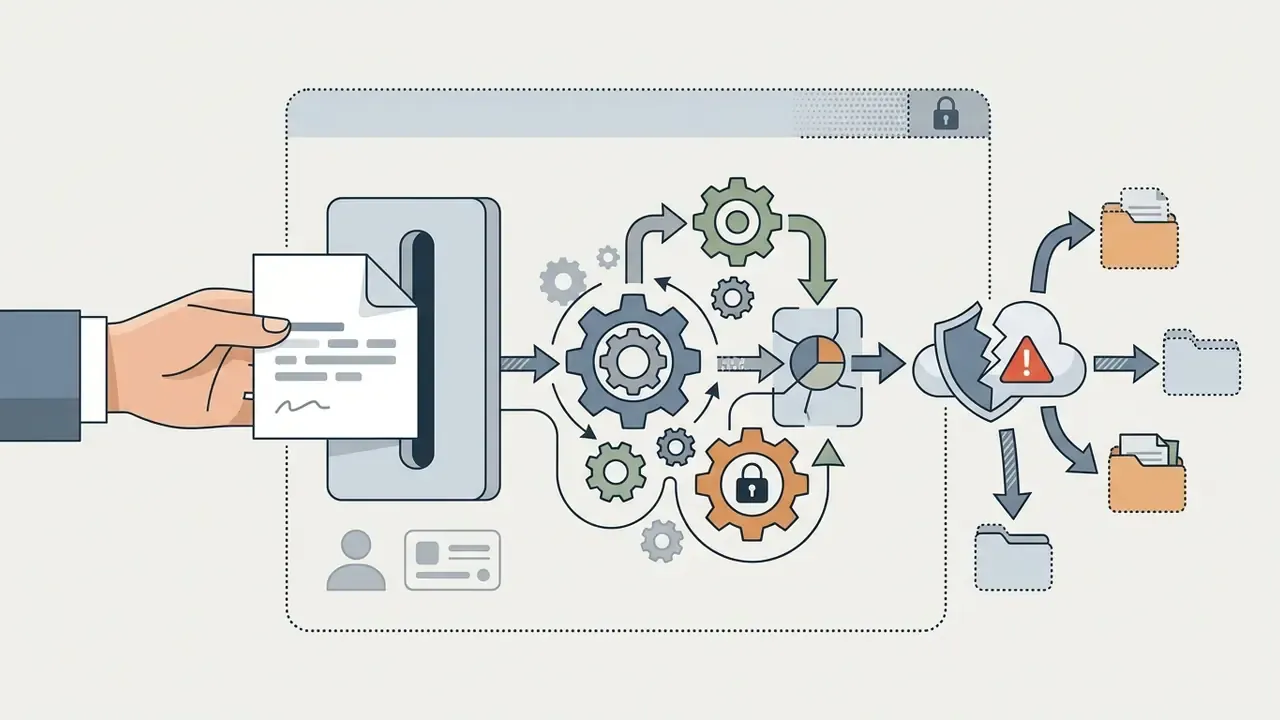
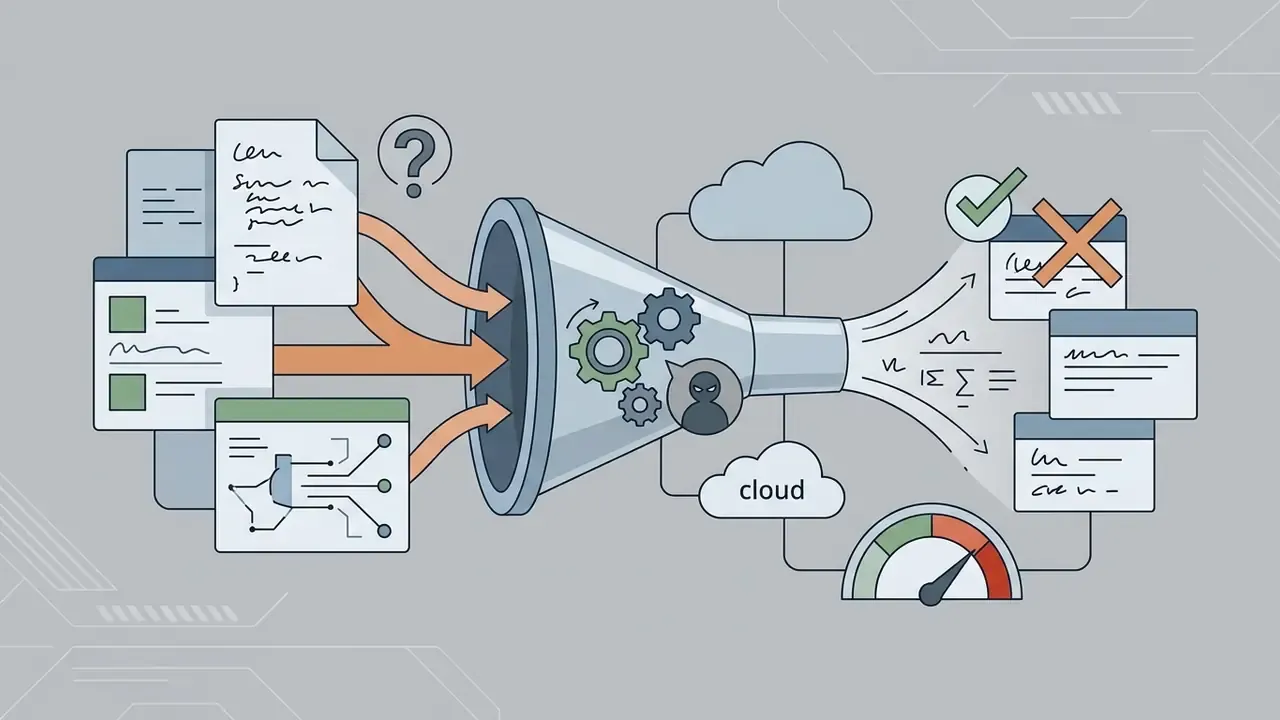
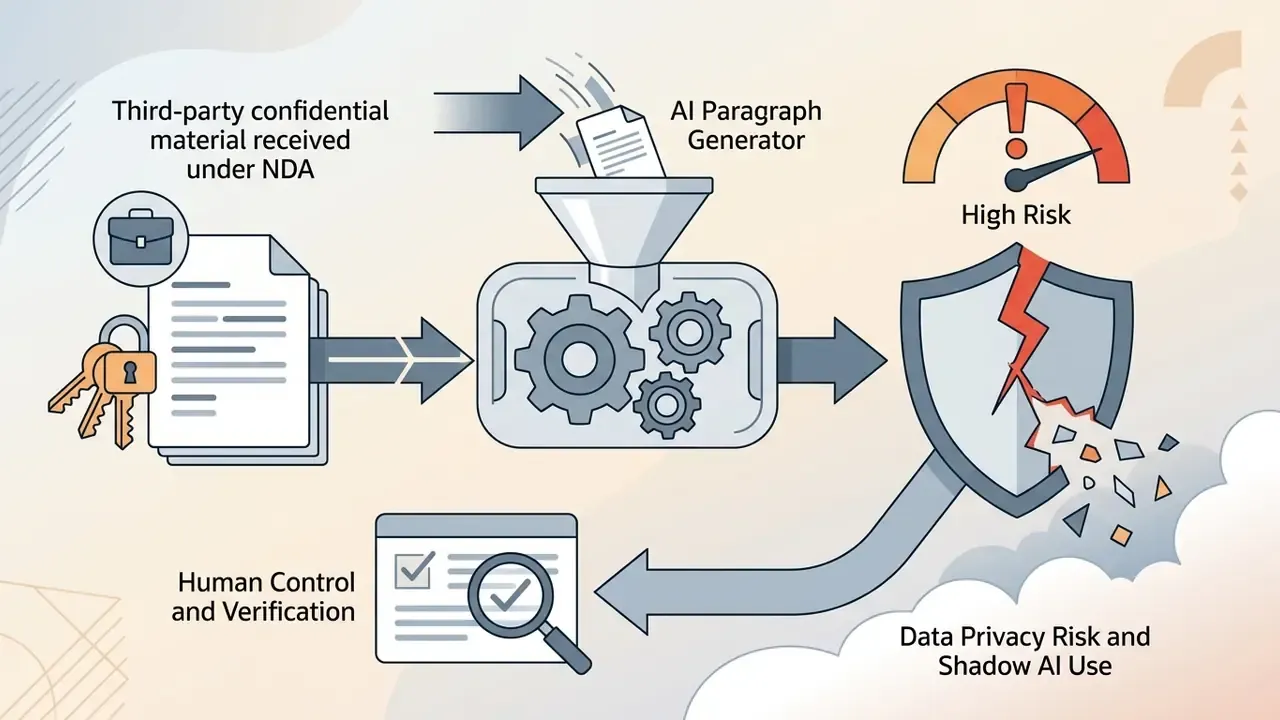
The fastest tool to access is the hardest to govern. "Shadow AI" describes employees using unapproved public generators inside a regulated workflow, usually by pasting a real document into a browser field to save fifteen minutes.
Minimum controls before approving a free tool for team use:
- Confirm a published retention policy and a working training opt-out.
- Prefer session-only processing, or contractual zero-retention API access for anything non-public.
- Record the tool in the organisation's AI inventory with owner, purpose, and data classification.
- Provide a sanctioned alternative. Prohibition without a replacement reliably produces shadow usage.
- Route access questions to a named internal owner; end users should know where to ask, whether that is a policy channel or AI Media Support.

Documenting Generators in a Model Risk Management (MRM) Register
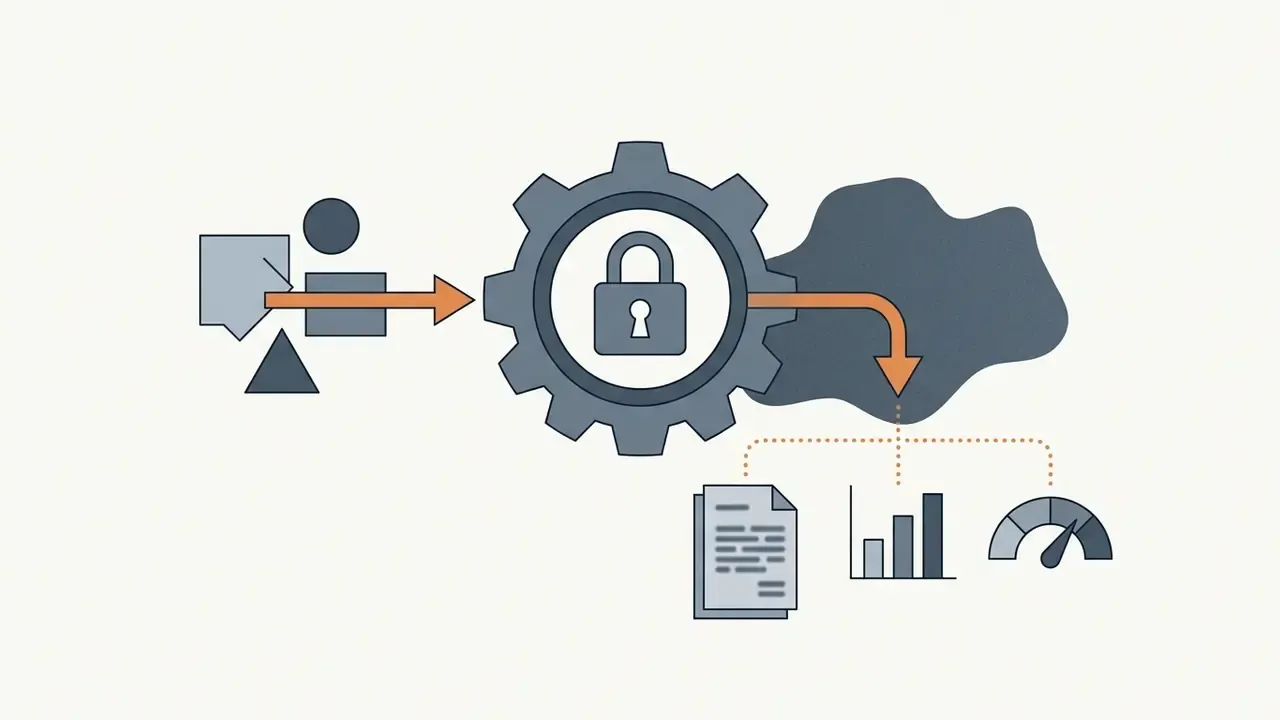
Text generators get excluded from model inventories because they produce prose instead of scores. For governance purposes, treat them as tools with documented inputs and outputs.
| Register field | What to record |
|---|---|
| System name and vendor | Tool, tier (free, freemium, API), version or model family |
| Purpose and scope | Which document types it may draft; explicit exclusions |
| Data classification | Maximum permitted sensitivity of prompt inputs |
| Human control point | Named reviewer role that signs off before publication |
| Verification method | Fact-check protocol, plagiarism and AI scan, citation review |
| Retention posture | Retention window, training opt-out status, jurisdiction |
| Review cadence | Frequency of policy and vendor-terms re-review |
One principle holds across all seven rows: no evidence, no autonomy. A drafting tool with no named owner and no logged review step should not be producing text that reaches a customer, a regulator, or a board pack.
Can Businesses Use AI-Generated Paragraphs for Content?
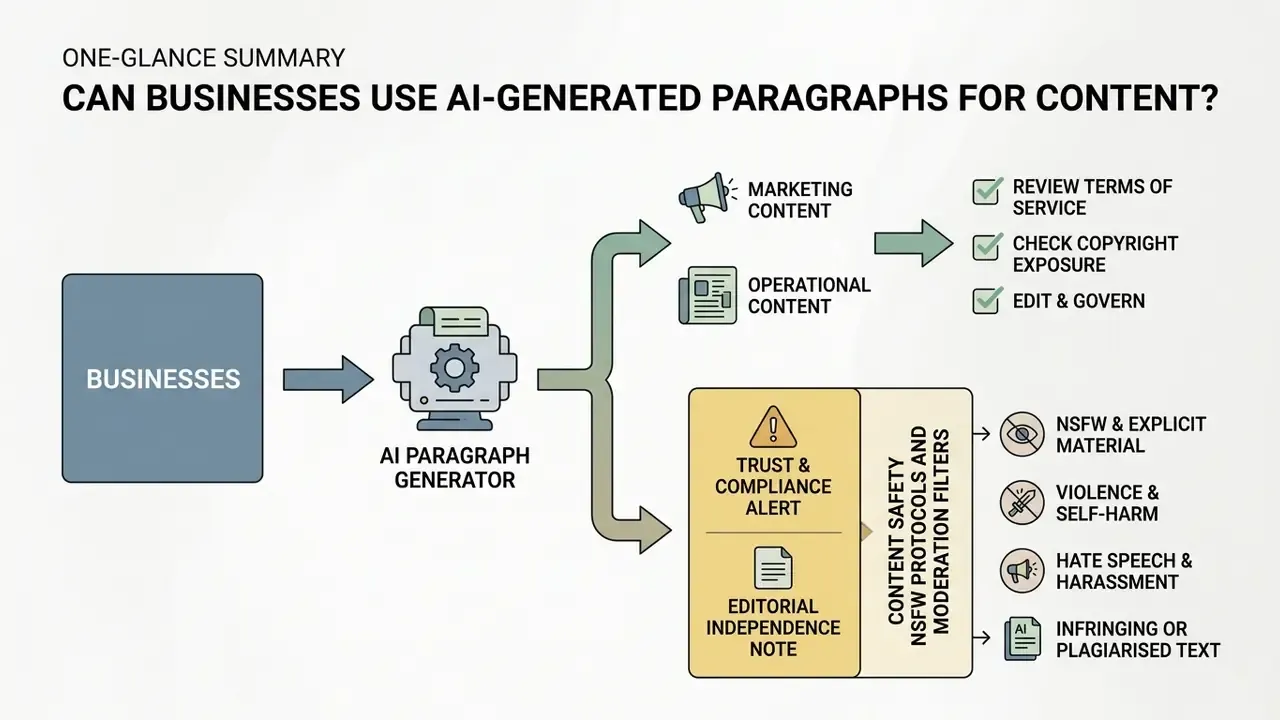
Businesses can use AI-generated paragraphs for marketing and operational content, provided they review the tool's terms of service, check copyright exposure, and edit for original value.
Trust and compliance alert:
This section is general information and does not replace consultation with a lawyer or compliance specialist on copyright and the commercial use of AI-generated content.
Commercial deployment of an ai generator paragraph writer delivers real efficiency for product descriptions, job listings, and routine press releases.
"By late 2024, roughly 10% of small-business job posting text and 14% of UN press release text contained LLM-assisted passages."
Uncritical publication creates compliance and brand risk, though. Major search engines evaluate content on helpfulness, accuracy, and depth of original perspective. Publishing unedited, low-value ai generator text paragraph blocks can cost search visibility when the material adds nothing.
"Elevated LLM use in college admissions essays was associated with admissions penalties, most pronounced among applicants of lower socioeconomic status."
Content Safety, NSFW Protocols and Moderation Filters
Commercial AI paragraph generators deploy automated input and output moderation, through moderation endpoints or custom safety classifiers, to prevent misuse.
Standard system boundaries prohibit generation of:
- NSFW and explicit materialadult content, sexual imagery descriptions, explicit text.
- Violence and self-harmprompts promoting self-injury, dangerous activities, or unlawful harm.
- Hate speech and harassmenttoxic, discriminatory, or defamatory statements.
- Infringing or plagiarised textrequests to reproduce protected works verbatim.
If a prompt trips a safety filter, the system usually returns a generation error without deducting token quota. Enterprise users should keep prompt inputs inside vendor terms to avoid temporary IP or account throttling, and should log rejected prompts as part of acceptable-use monitoring. That log is cheap to keep and unexpectedly useful during an internal audit.
Limitations, Open Questions and a Safe Next Step
Some honesty about the evidence base. Most published findings on machine-assisted writing come from academic corpora, admissions essays, press releases, and consumer complaints. Very little peer-reviewed work measures drafting quality inside supervised financial institutions, where the reviewer, not the model, carries accountability. Treat vendor efficiency figures and the audience assumptions in this guide as hypotheses until your own analytics, interviews, or CRM data confirm them.
Three questions remain genuinely open: A safe next step, low cost and reversible: pick one low-sensitivity document type, such as internal process notes or routine policy updates. Write down the permitted data classification, the named reviewer, and the verification passes. Run it for one quarter. Measure cycle time and error rates against your existing baseline. Then decide whether to widen scope. Slow, boring, auditable. That is the point.
- Attribution of residual risk.When a reviewed machine draft contains an error that reaches a customer, who owns the finding: the drafting tool's business owner, the reviewer, or the control design?
- Evidence sufficiency.How much logging (prompt, model version, reviewer, timestamp) satisfies an examiner reviewing a disclosure drafted with model assistance? Practice is still forming.
- Detection stability.Perplexity and burstiness classifiers perform well on unedited output. Their reliability after substantive human editing is much less settled, which makes detection a weak control compared with documented review.
FAQ About AI Paragraph Generators
Can I generate paragraphs using specific words?
Yes. An ai paragraph generator can incorporate designated keywords or target terminology when explicit instructions sit in the prompt. To get specific words into the output naturally, use explicit boundary instructions. For example: "Write a single 80-word body paragraph about commercial data privacy. You must naturally include the following specific words: 'data lineage', 'audit trail', and 'encryption'." Language models use these prompt constraints to adjust token sampling probabilities, weaving required terms into the sentence structure without breaking local grammar.
"Research shows that when scientists ask an LLM to 'improve clarity', models systematically introduce their own preferred stylistic words. Prompts directly steer lexical choice." Kobak et al., Delving into ChatGPT usage in academic writing through excess vocabulary, arXiv (2024). https://arxiv.org/abs/2406.07016
How long should a generated paragraph be?
Optimal length depends on the publishing format. Standard web and business paragraphs run 3 to 5 sentences (75 to 150 words) to stay readable on mobile screens. Several public-sector style manuals go further and recommend 2 to 3 sentences for web copy, with a six-sentence ceiling for reports and 1 to 2 sentences for news writing. Academic body paragraphs may stretch to 200 or 300 words to develop complex analytical claims, and university writing guidance flags paragraphs consistently over 300 words, or half a page, as candidates for splitting. These are editorial conventions rather than measured readability thresholds. Test against your own analytics where you can.
Do free AI paragraph generators store my input text?
Retention policies vary by platform and must be verified in the vendor's own privacy documentation rather than assumed. Many no-sign-up tools state that text is processed ephemerally inside the active session and deleted immediately, while account-based systems may retain prompt history for model training unless users opt out. Enterprise and API tiers commonly offer contractual zero-retention configurations. Because retention behaviour is a vendor policy rather than a technical guarantee visible to the user, treat any unvetted public tool as a public channel, and never input confidential, personal, or proprietary information.
What is the difference between a paragraph generator and a paragraph rewriter?
A generator produces new text from a topic, brief, or keyword set. A rewriter takes an existing paragraph and returns a revised version that preserves meaning while adjusting clarity, formality, structure, or length. In practice the two are sequential: generate a draft, fact-check it as a human, then rewrite for register and rhythm.
Can I use AI-generated paragraphs commercially?
Usually yes under vendor terms, with two caveats. First, purely machine-generated text without sufficient human authorship is not eligible for U.S. copyright protection, so exclusivity is limited. Second, vendor terms commonly note that outputs may not be unique across users. Human editing that adds original analysis is what converts a draft into a defensible commercial asset. This is general information, not legal advice.
Will AI-generated paragraphs be detected?
Detection frameworks combine perplexity, burstiness, and classifier signals, and published research reports high accuracy on unedited machine text with low false-positive rates. Substantive human editing (restructuring, adding original evidence, varying sentence length) reduces the statistical signature. The more reliable objective, however, is genuine added value rather than evasion of detection.
Does the same governance logic apply to voice and image tools?
Broadly, yes. Input sensitivity, retention posture, named owner, and human review apply equally to a canva ai voice generator workflow, a canva ai photo pipeline, and a text generator. Only the output modality changes; the control questions do not.
Appendix A: Editorial Revision Log