Last updated: August 2026 · Reviewed by: Marcus Hale, author.
Why should a CRO or head of model risk care about a drafting toy? Because it rarely stays a toy. Once a rewriter touches disclosures, credit memos, or complaint letters, it sits inside your control perimeter whether it is inventoried or not.
Executive Summary
What Is an AI Rewrite Generator?
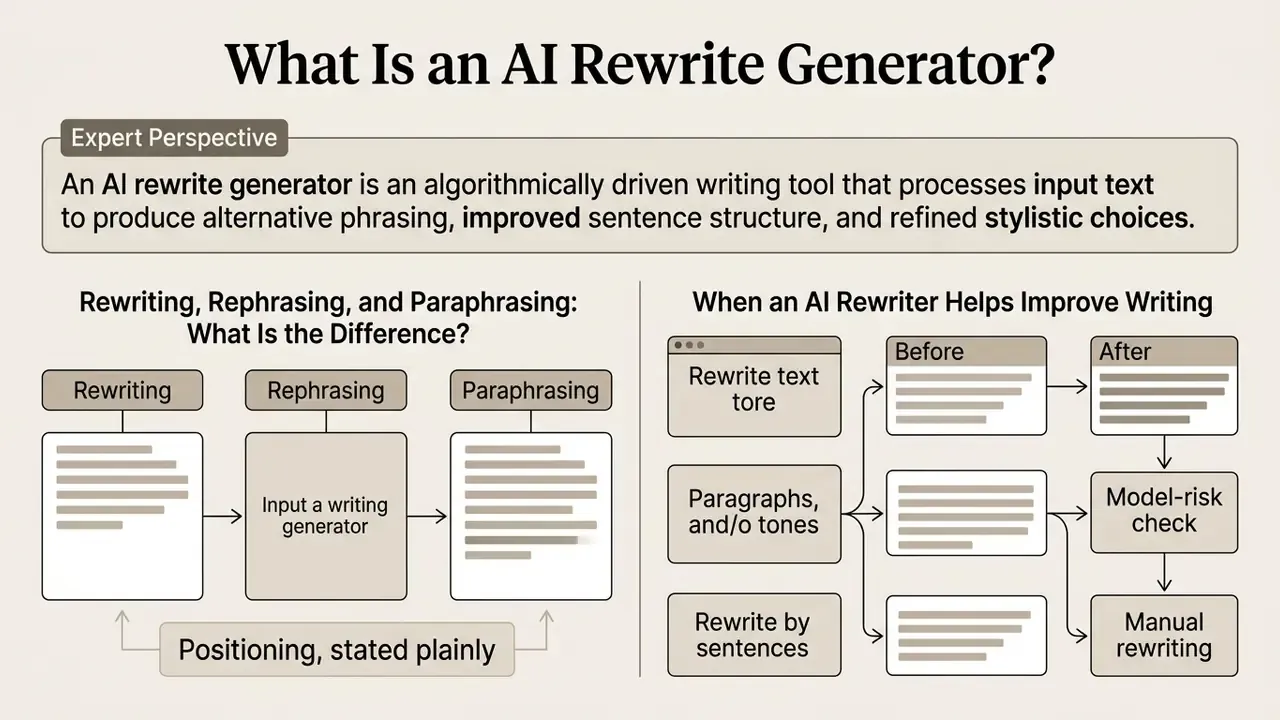
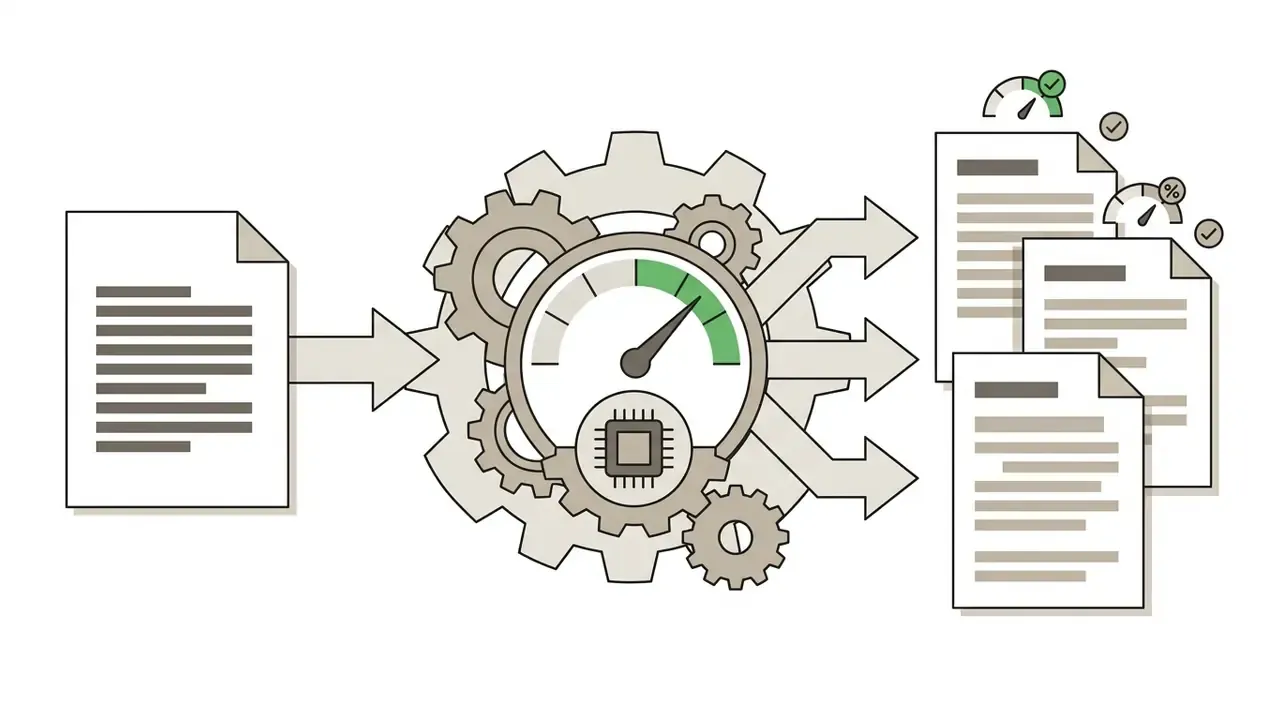
An AI rewrite generator is an algorithmically driven writing tool that processes input text to produce alternative phrasing, improved sentence structure, and refined stylistic choices while maintaining semantic fidelity. Modern architectures use deep learning to evaluate contextual relationships between words across whole passages, not simple dictionary-based synonym swapping.
Academic literature classifies these products as algorithmically-driven writing tools (ADWTs): systems that transform text while retaining source meaning. That is precisely the functional core of an AI rewrite generator.
“Algorithmically-driven writing tools transform existing text while preserving the writer’s intended meaning.”
Expert perspective. Operationalising an ai rewriter generator inside an enterprise requires plain risk management, not enthusiasm. These tools do accelerate content production and readability adjustments. Still, governance should treat every rewriter tool as an unvalidated system that needs human oversight before anything commercial or client-facing leaves the building.
Rewriting, Rephrasing, and Paraphrasing: What Is the Difference?
“Paraphrase plagiarism is rewording a source document while preserving its meaning and structure without attribution.”
Positioning, stated plainly: rewriting outranks paraphrasing, which sits close to rephrasing, in terms of structural change. Rewriting may reorganise whole paragraphs. Paraphrasing preserves scope and length while replacing lexis and syntax. Rephrasing is the lightest intervention of the three, usually a clause or a phrase.
When an AI Rewriter Helps Improve Writing
An AI rewriter improves writing by spotting passive constructions, resolving grammatical inconsistencies, adjusting tonal register, and lowering reading complexity scores. Controlled experiments confirm that measurable readability improvement is the most reliably documented benefit of LLM-based rewriting.
“All four large language models significantly improved readability, reducing average complexity to a sixth-to-seventh grade level (p < 0.001) across five standard metrics.”
Professional communicators use writing ai platforms during editorial work to generate several drafting options fast. Qualitative research on real writing processes supports that pattern rather than leaving it as an assertion:
“Users apply generative AI across the full writing cycle, from brainstorming and drafting to restructuring and grammar editing, and consistently rate it valuable for language editing.”
When you adapt complex policy documents or financial disclosures, a rewriter is particularly useful for converting jargon-heavy prose into plain language. On sourcing: the governing plain-language mandate for public-facing US government communication is the Plain Writing Act of 2010 and its implementation guidance (plainlanguage.gov). Investor-facing disclosure readability is guided by the SEC Plain English Handbook (U.S. Securities and Exchange Commission). NIST SP 800-63B remains relevant only in its narrow scope: it requires that user-facing authentication instructions be written in plain language for the intended audience (NIST, 2025). It should not be cited as a general text-readability standard.
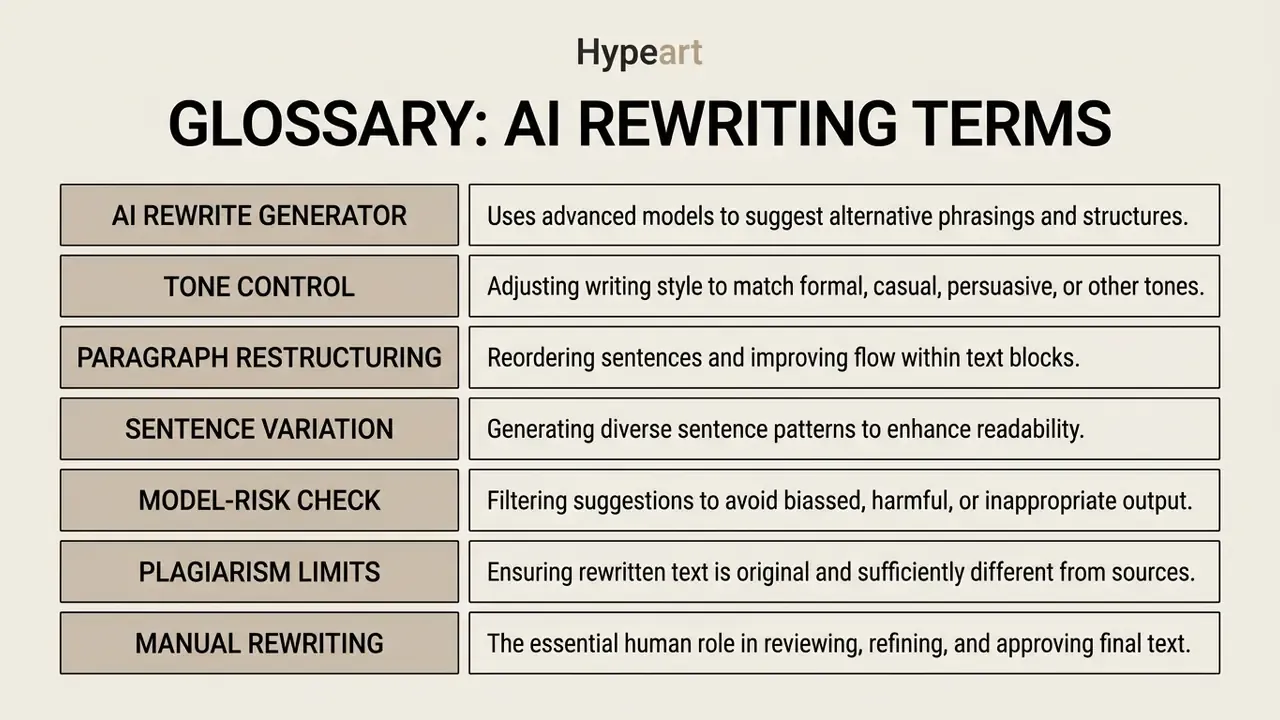
How to Use an AI Generator to Rewrite Text
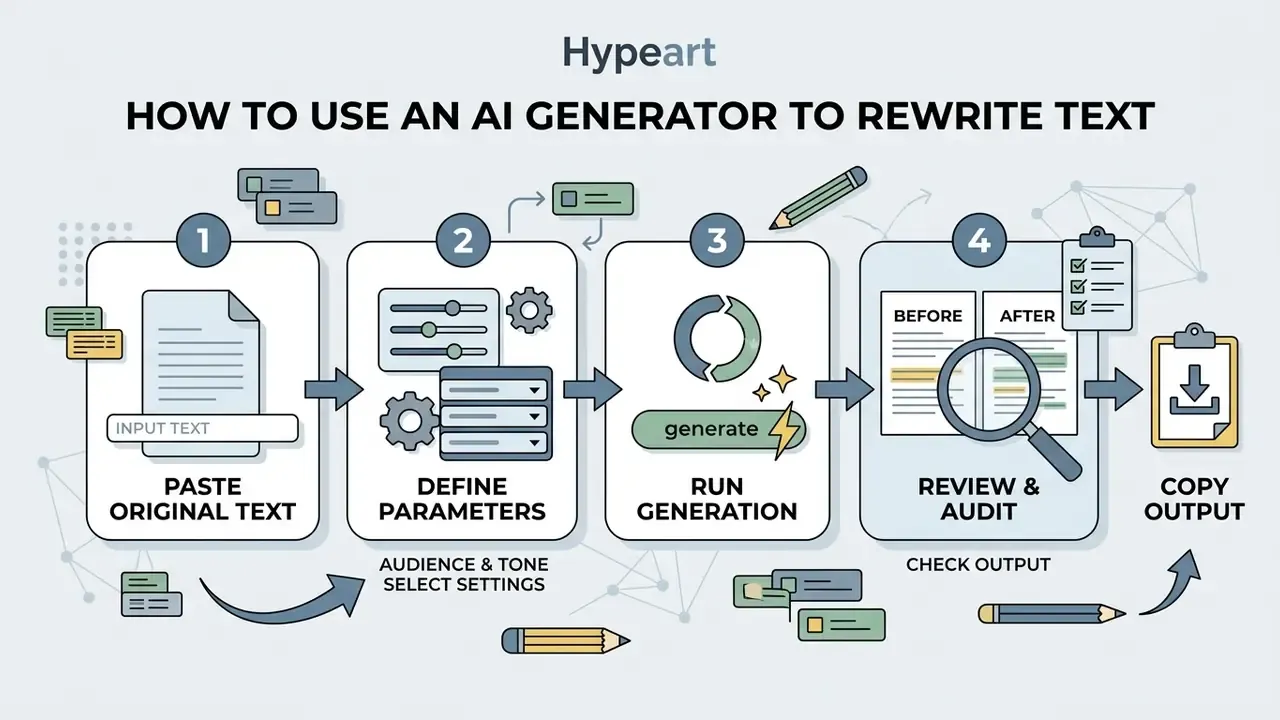
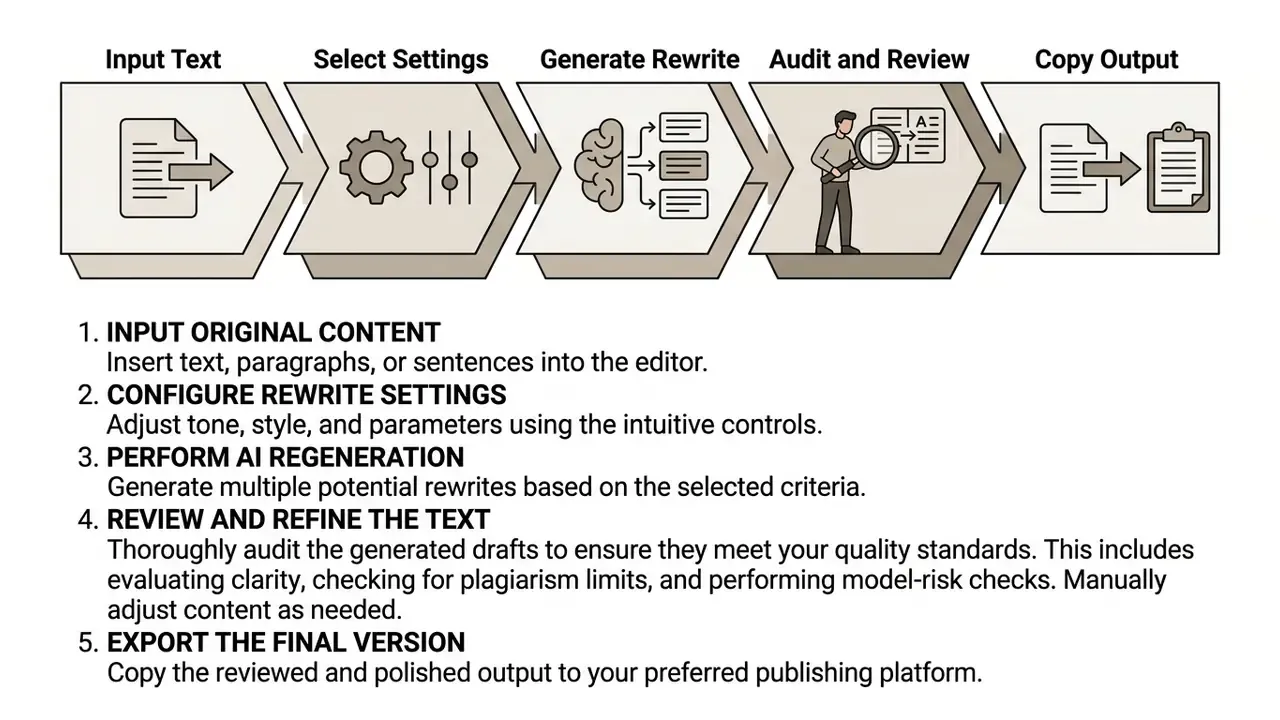
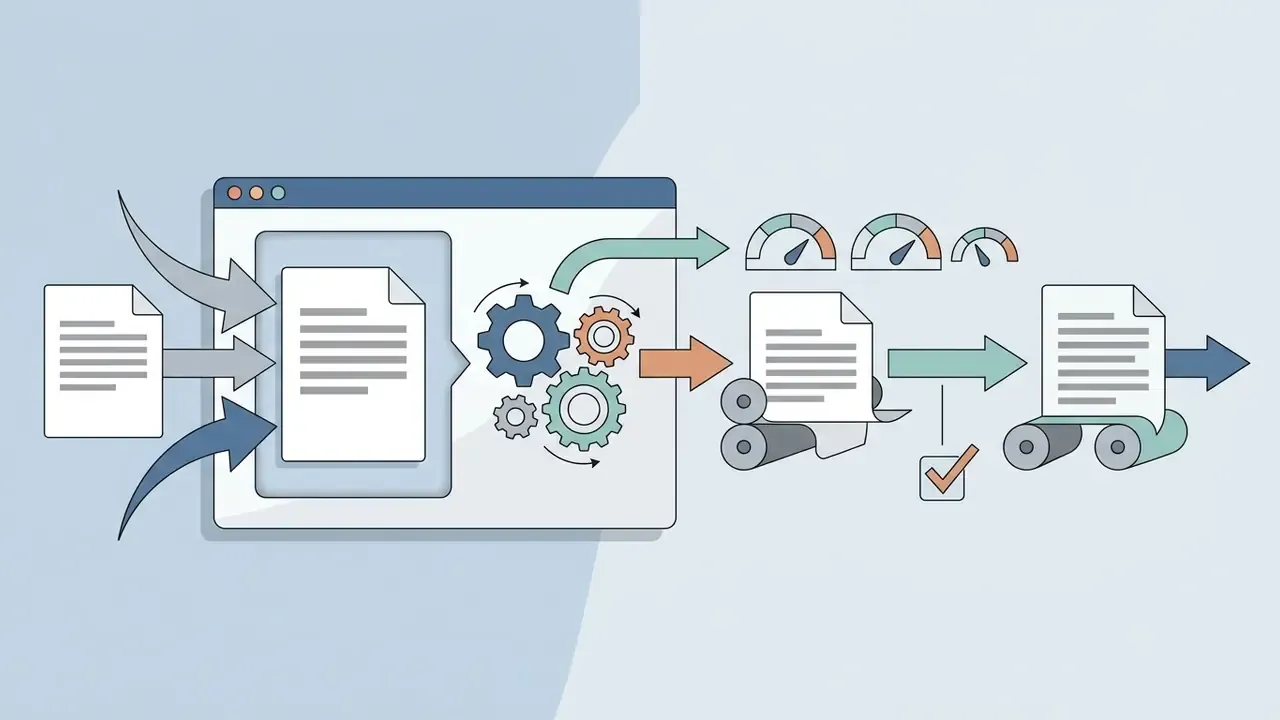
Using an AI generator to rewrite text means four things in sequence: submit source copy, define parameters such as audience and tone, run generation, then review the output manually before adoption. This workflow keeps automated output aligned with organisational standards and protects semantic precision.
Operational control note (data-handling gate). Before the first paste, confirm the vendor’s retention and training terms. That gate matters more than any feature list. As an illustration of the verification standard: no verified public information exists on the operational status, security certifications, or proprietary models of hypeart.ai as of August 2026, so it cannot be treated as an approved processor for proprietary copy. Any platform without documented zero-retention terms belongs in the non-confidential drafting bucket only. The free versus paid comparison further down lists the security parameters that separate consumer tiers from enterprise contracts.
Paste the Original Text and Choose Rewrite Settings
To start, paste the original passage into the input module of an ai generator to rewrite text and select the output parameters you actually need. Choosing a specific control, formal or persuasive or casual, directs the underlying model to adjust vocabulary density and sentence length.
When setting up an ai generator rewrite task, you can define the scope of structural transformation, from conservative grammar repair to full paragraph restructuring. Systems documented in OpenAI API developer guides (OpenAI, 2026) use temperature settings, top-p sampling, and prompt constraints to dictate how far the output strays from the original phrasing. Specifying target languages or regional terminology keeps the output aligned with local publication standards.
Teams that benchmark generative tooling across media types can reuse the evaluation logic from our comparison of AI art generators by output quality, style control, and licensing: identical prompts, identical settings, scored side by side. The broader method sits in the AI Media Comparison hub.
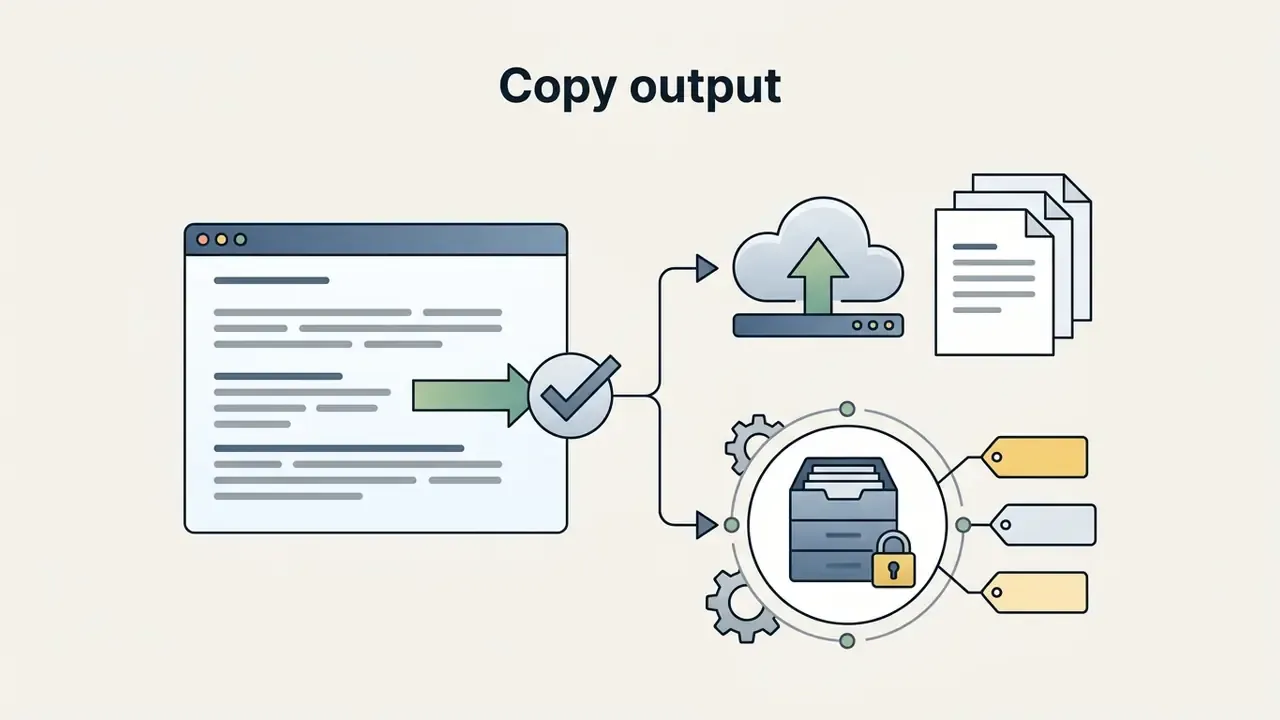
Review the Rewritten Text Before You Copy It
Inspect generated text for factual hallucinations, altered meaning, and unnatural phrasing before copying or publishing. An ai paragraph generator rewriter speeds up drafting, yes. It can also misread contextual nuance or quietly delete a critical conditional statement during simplification.
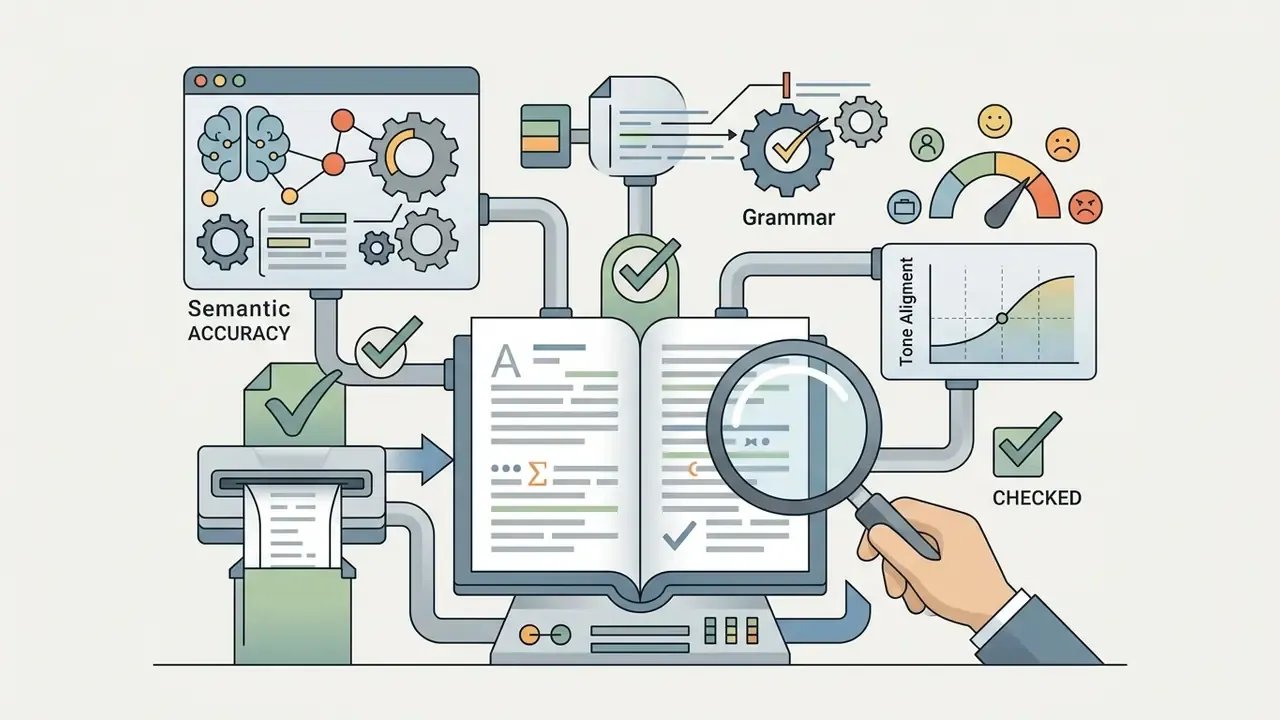
An editorial review protocol should verify three layers: factual accuracy against the source document, grammatical correctness, and alignment with internal brand guidelines (AI-Generated Content Review Checklist, 2026).
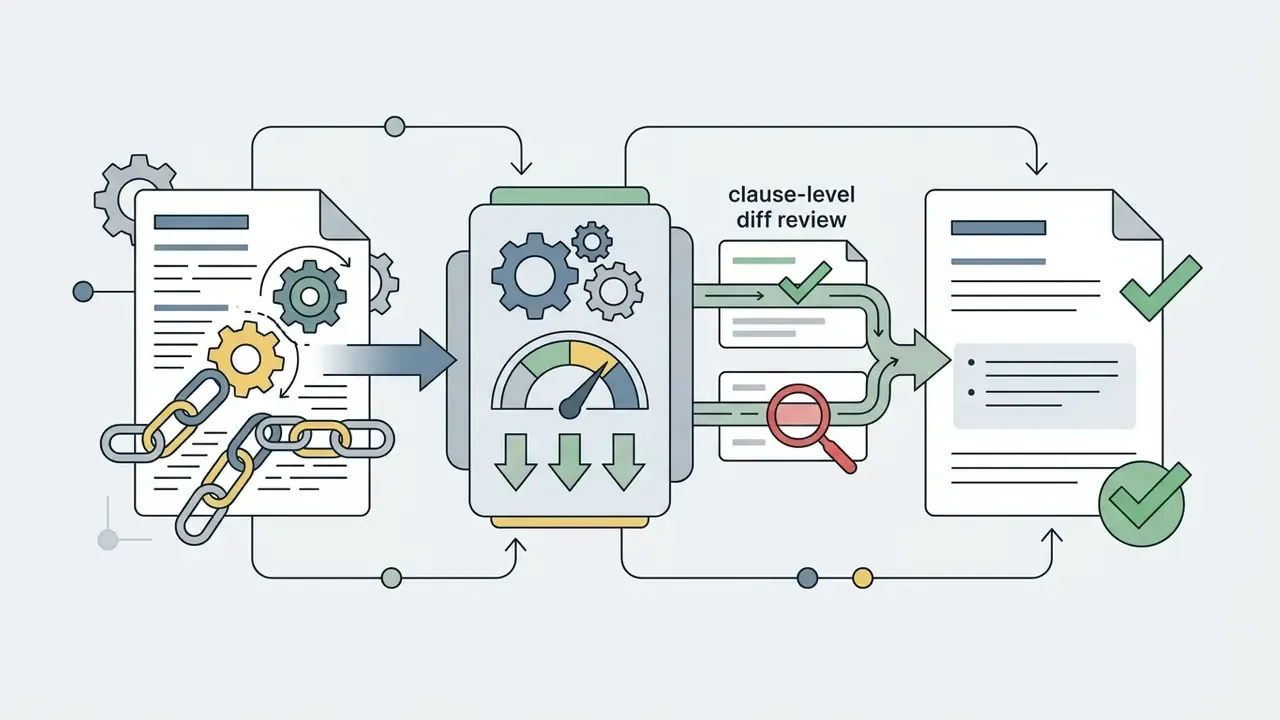
Engagement observation, not published research. During an internal evaluation of automated compliance-document drafting for a US financial services client, a model risk team deployed a structured sentence-level validation layer. In that single engagement, the review layer flagged semantic drift in roughly one in seven rewritten regulatory disclosure clauses before human sign-off. It prevented unapproved policy changes and shortened drafting cycles materially. Let me be precise here: these figures are engagement-specific, were not independently audited, and should not be read as an industry benchmark.

AI Paragraph Rewriter Features That Affect the Result
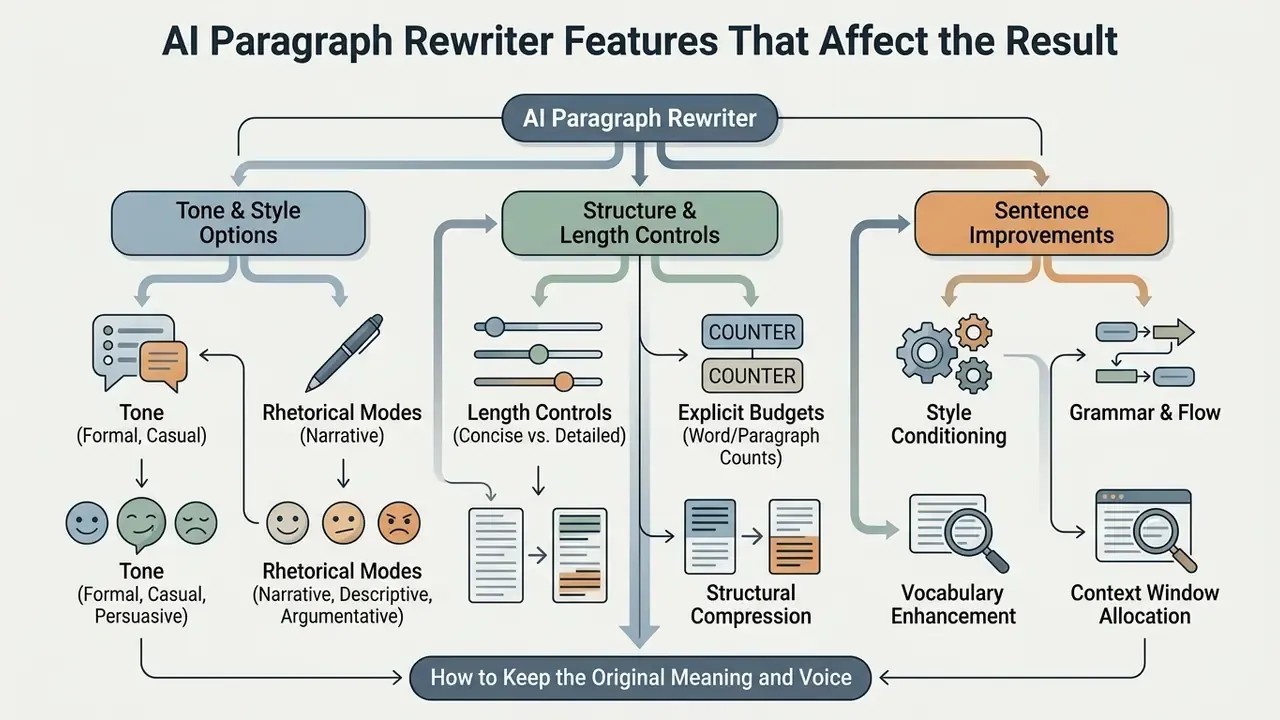
An AI paragraph rewriter depends on a handful of core features: style conditioning, context window allocation, and fine-grained parameter tuning. How well an ai paragraph rewriter balances lexical substitution against structural preservation is what decides final quality. Nothing else comes close in impact.
Tone, Style, and Language Options
Tone, style, and language controls change output vocabulary, register, and grammatical formality to match a reader profile. Official style guidance shows the mechanism: an institutional phrase such as “By registering with us, you can access member services online” converts to a formal register as “Online services are restricted to registered members” (Australian Government Style Manual, 2025).
Advanced tools separate tone from register. Tone defines emotional delivery, for example direct, diplomatic, or encouraging. Style governs formal syntax and domain vocabulary (DeepL Documentation, 2026).
“Tone and phrasing changes in prompts can materially shift model performance and bias metrics.”
Multilingual options let the model rewrite source content into localised variants while adjusting idiomatic expressions for regional compliance.
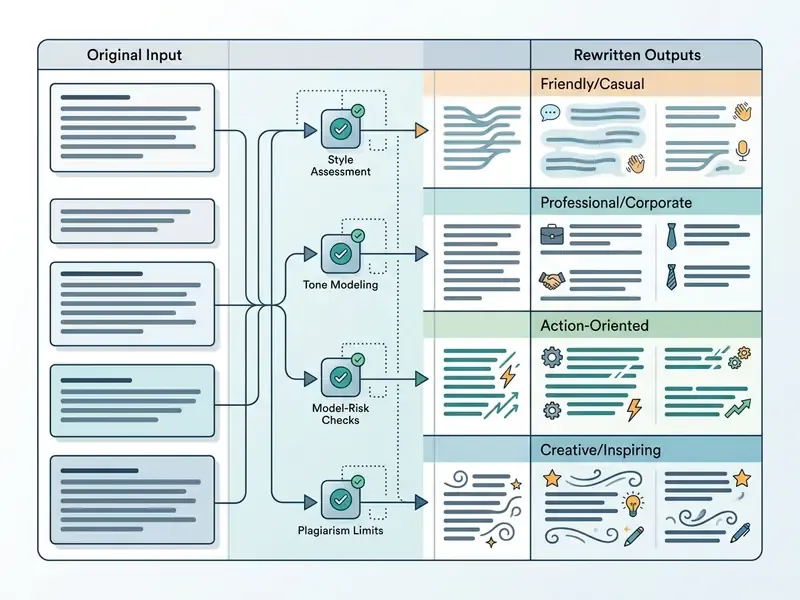
| Transformation mode | Original input passage | AI-rewritten output |
|---|---|---|
| Formal / institutional | Users can sign up on our site to get access to members-only stuff online. | Access to digital portal features is restricted exclusively to authenticated registered members. |
| Simplified (10-year-old reader) | Algorithmic content generation requires continuous human oversight to mitigate hallucinations. | A person must always double-check computer-written stories to fix silly mistakes. |
| Persuasive marketing | Our software rewrites text automatically to save time for your editorial team. | Cut editorial bottlenecks with automated, precision rewriting your team can review in minutes. |
| Academic / expository | We looked at 42,000 pages and AI-only content almost never ranked first. | Analysis of 42,000 indexed pages indicates that exclusively AI-generated content rarely attains the first ranking position. |
| Concise / compression | In the event that a customer decides that they would like to request a refund, they should get in touch with our support team as soon as possible. | To request a refund, contact support promptly. |
Each rewrite above preserves the factual scope of its input. Watch the compression example in particular: confirm that no conditional clause (“in the event that”, deadlines, eligibility limits) disappears silently when word count drops.
Paragraph Structure, Length Controls, and Rhetorical Modes
For multi-sentence rewrites, advanced systems let you dictate structural scope through specific settings:
- Structural compression (concise versus detailed) concise modes prune auxiliary adjectives and dependent clauses, cutting word count by roughly 30 to 50%. Detailed expansion inserts explanatory context, transitions, and supporting clauses.
- Explicit word or paragraph budgets public tools commonly cap free input at 125 to 1,000 words per run and batch output into one to five paragraphs. Enterprise tiers extend this to 1,500 to 3,000 words or full document processing.
- Rhetorical mode adaptations descriptive enriches sensory detail and spatial vocabulary; expository prioritises logical flow and cause-and-effect transitions; persuasive injects rhetorical devices, active verbs, and value propositions; narrative optimises chronological sequence and event flow.
A paragraph is a series of interconnected sentences developing one controlling idea, and the four canonical types above determine which rewriting mode fits. Average paragraph length in professional prose sits near 100 to 200 words, though no fixed rule applies. Web copy runs shorter. Regulatory and academic prose runs longer, because conditional logic resists compression.
Sentence-Level Rewriting and Paragraph Improvements
Sentence-level algorithms optimise local flow between adjacent clauses. Paragraph-level engines evaluate structural unity and thematic progression across a whole passage. Sentence-level coherence is about neighbour-to-neighbour connection. Paragraph-level coherence is about the passage holding together as one thought, which is why paragraph-level systems must model inter-sentence dependencies to avoid logical gaps.
“A QLoRA fine-tuned LLaMA-3.1-8B reduced clinical text to a 7.6 Flesch-Kincaid grade level while maintaining 0.845 BERTScore semantic fidelity.”
Methodological insight. Sentence-level edits preserve clause structure but risk choppy transitions across longer sections. Paragraph-level rewriters reorganise idea hierarchies and consolidate redundant thoughts, which improves cohesion. Paragraphs carrying several top-level ideas usually need splitting rather than rewording. The trade-off logic mirrors our comparison methodology for compression trade-offs, where quality loss is weighed against size reduction in media files.
How to Keep the Original Meaning and Voice
Keeping meaning and brand voice intact during heavy transformation requires strict system prompts: explicit voice parameters, banned phrasing, and transformation boundaries. Enterprise brand teams supply positive and negative examples, the “write like this, never write like this” pattern, inside context prompts to anchor generation behaviour (Glean Brand Voice Guide, 2026).
“Paraphrase inversion recovered source text from paraphrased versions with 0.95 semantic and 0.91 stylistic similarity, confirming authorial voice is recoverable.”
Repeating core constraints at the end of an instruction prompt, for example “preserve all technical product names and regulatory condition clauses”, reduces semantic drift during complex ai text generator rewrite tasks. Quality itself is best measured on four axes: content preservation, factuality, coherence, and fluency. A high natural-language-inference score paired with a moderate edit ratio is the combination you want.
Use Cases for an AI Rewrite Generator
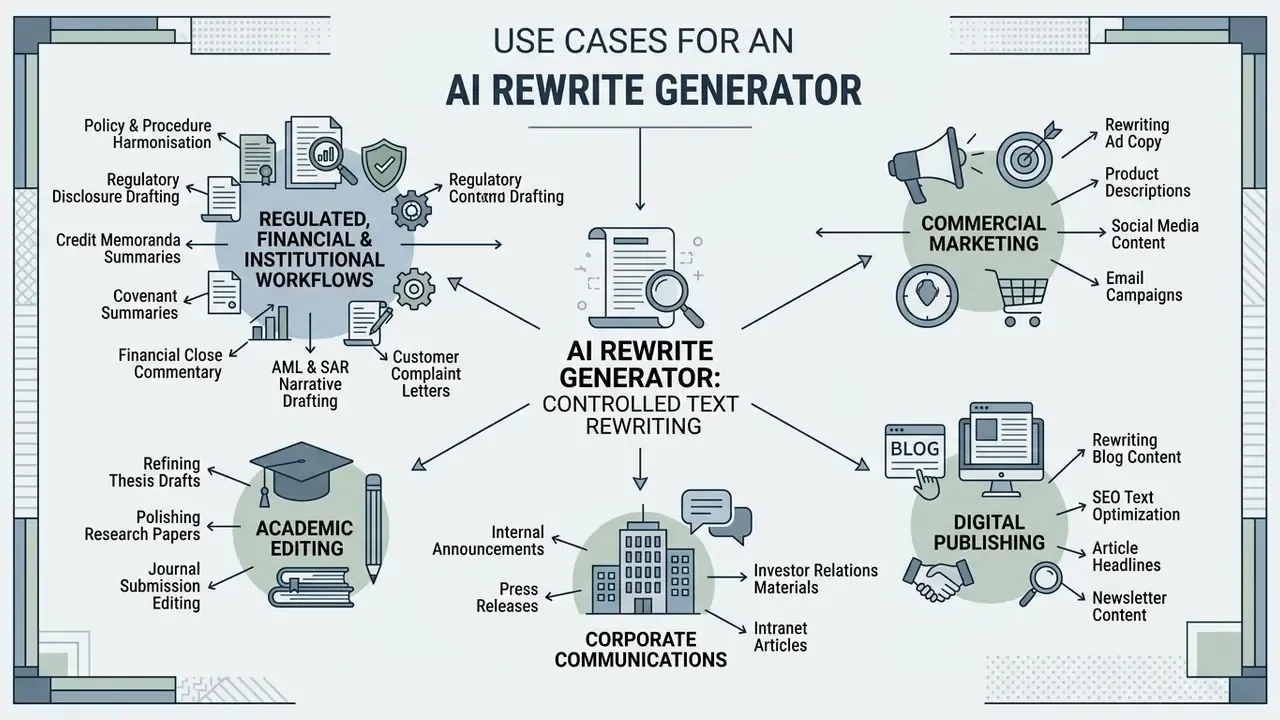
AI rewrite generators serve regulated financial workflows, commercial marketing, academic editing, corporate communications, and digital publishing. Application-specific requirements decide whether automated rewriting supports the goal or quietly creates legal and quality exposure. The same due-diligence logic appears in our review of the commercial use of AI reverse-image-search tools and across the AI Media Commercial-Use Hub.
Regulated, Financial, and Institutional Workflows
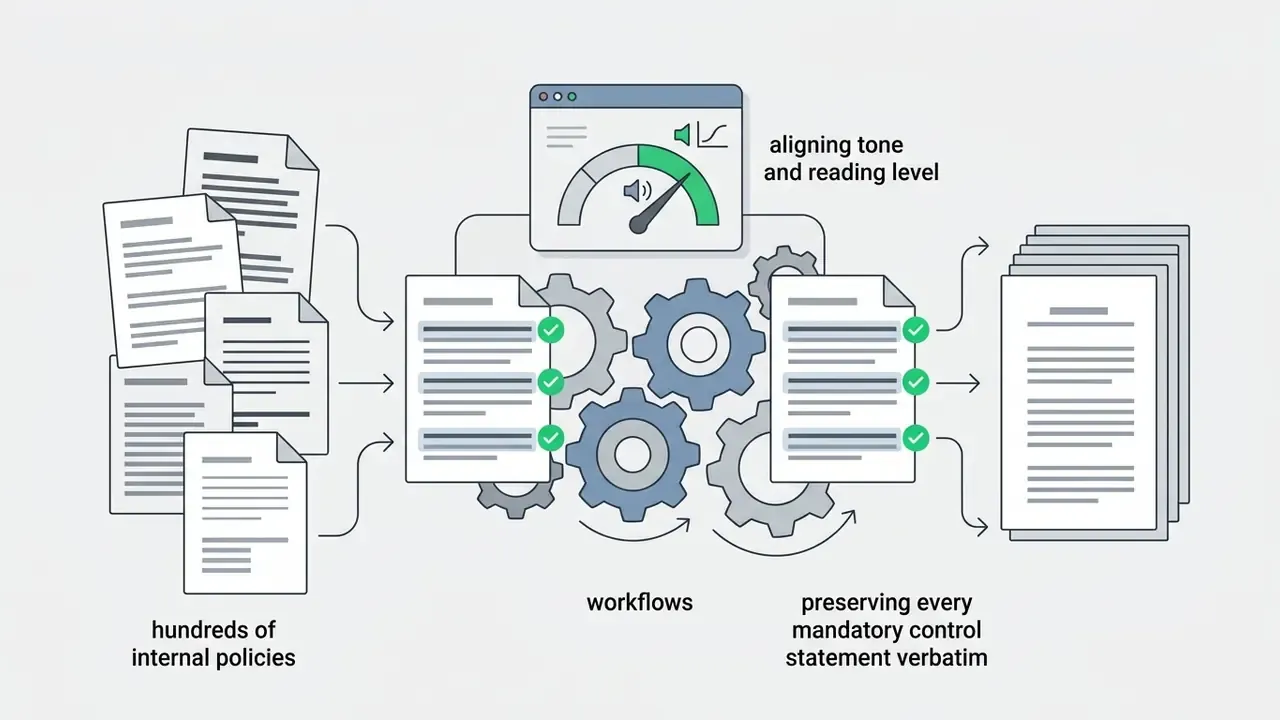
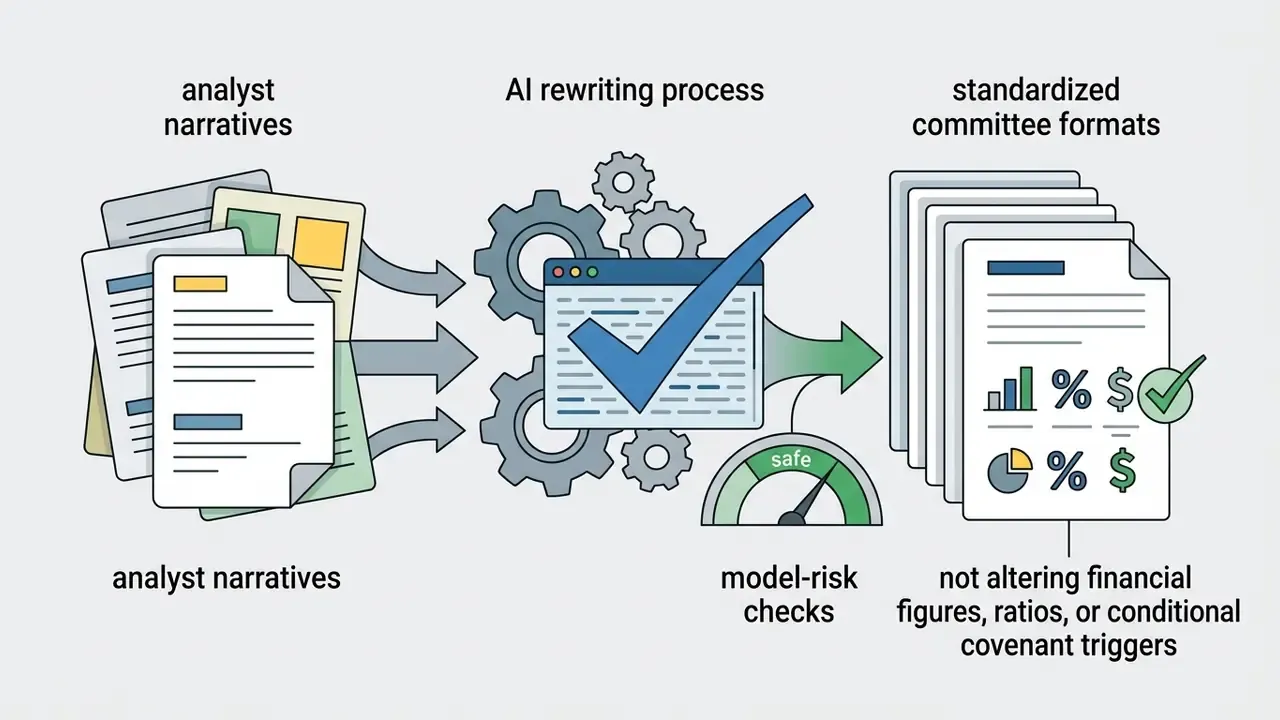
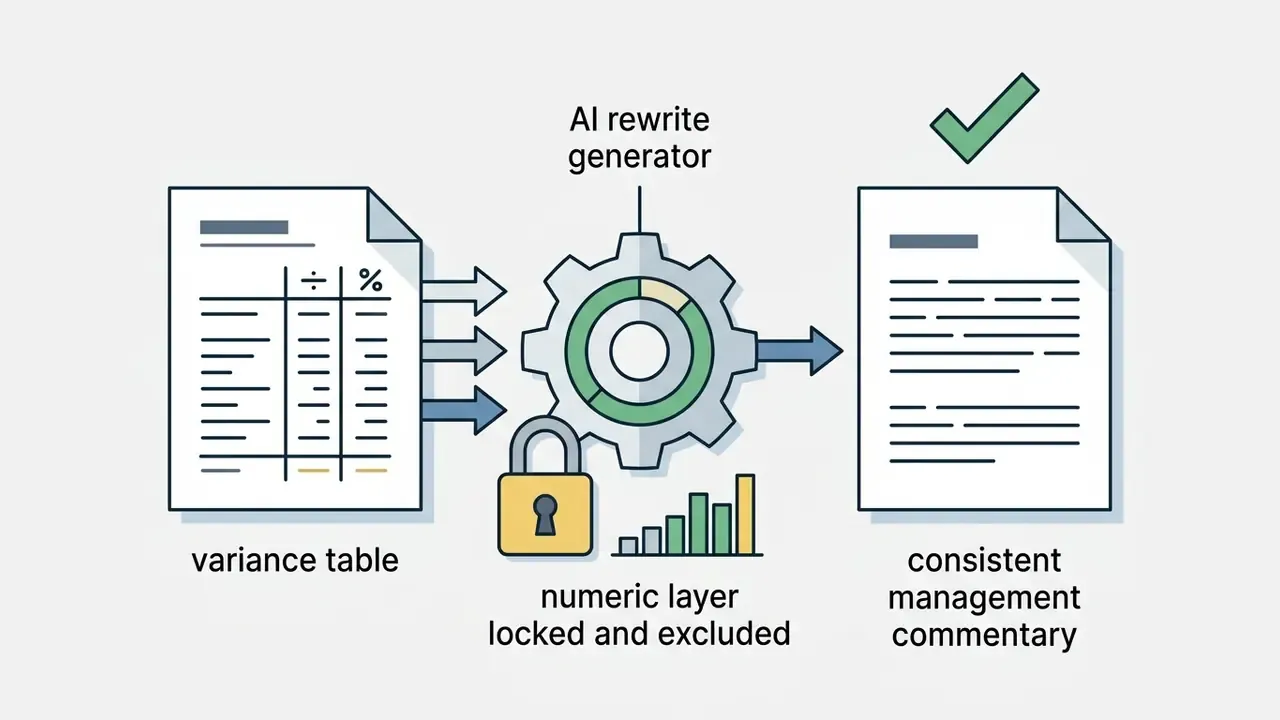
Banks, insurers, and regulated intermediaries deploy rewriting tools inside controlled environments where the drafting benefit is real and the tolerance for semantic drift is close to zero. High-value, control-heavy scenarios include:
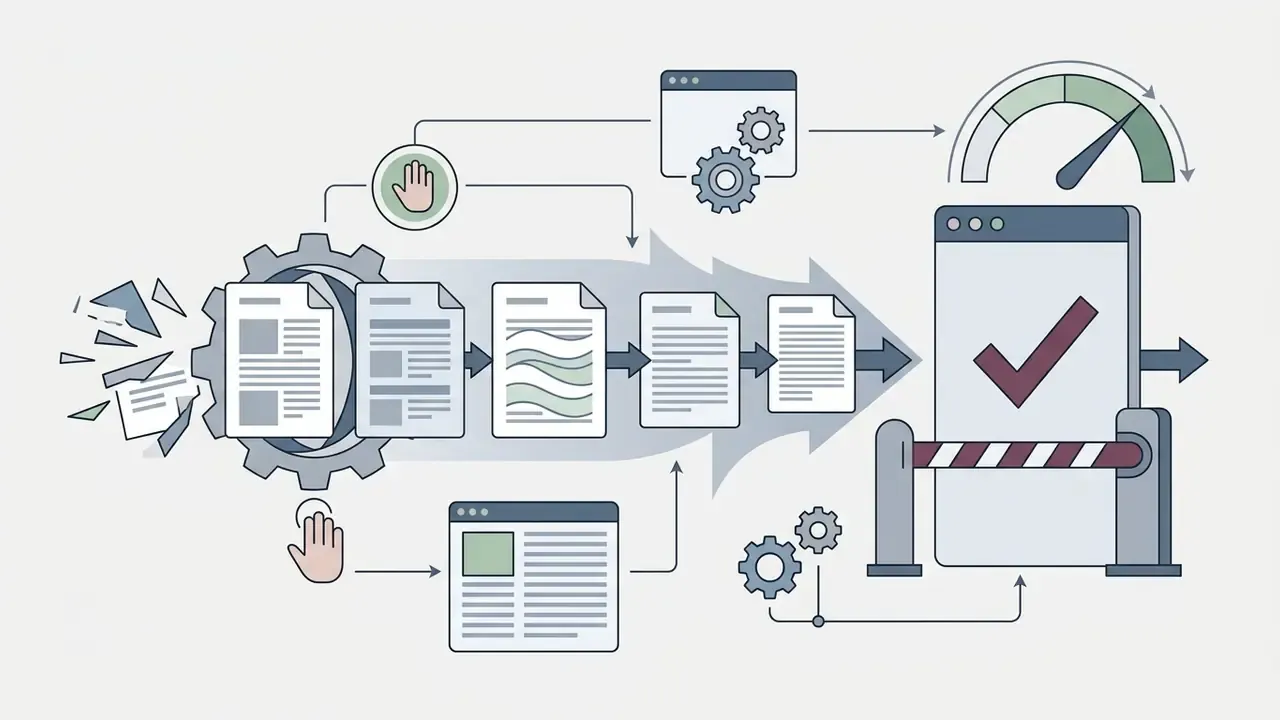
In every case the tool is a drafting accelerator subject to model-risk controls, never an authoritative source of content. That distinction is the whole game.
Rewriting Blog Content and SEO Text
Digital publishers use an ai text generator rewrite tool to refresh older articles, optimise metadata, adapt existing copy for new search intent, and lift readability. SEO platforms note that rewriting existing articles improves engagement metrics by replacing passive voice and outdated terminology with direct phrasing (Ahrefs Paraphrasing Guide, 2026). Sensible SEO rewriting workflows preserve semantic keywords, monitor uniqueness scores, and check keyword density plus “fluff” metrics after each pass.
Commercial study data indicates that search algorithms judge content on originality, depth, and helpfulness rather than on whether AI assisted the drafting.
“Content ranking in position one was human-authored or heavily human-edited 80.5% of the time; unedited AI output secured position one in only 9 to 10% of cases.”
Workflow strategy. Marketing teams use an ai paragraph rewriter generator to create campaign variations quickly while human editors verify product claims and hold the brand voice steady. Teams building multi-format campaigns often pair rewriting with AI voice generation and its licensing rules for audio adaptations of the same script.
Academic Writing, Research, and Professional Texts
“Students report using generative AI at every stage, from brainstorming and drafting to restructuring and grammar editing, and unanimously describe it as a valuable language-editing aid.”
Tailored Solutions Across Professional Roles
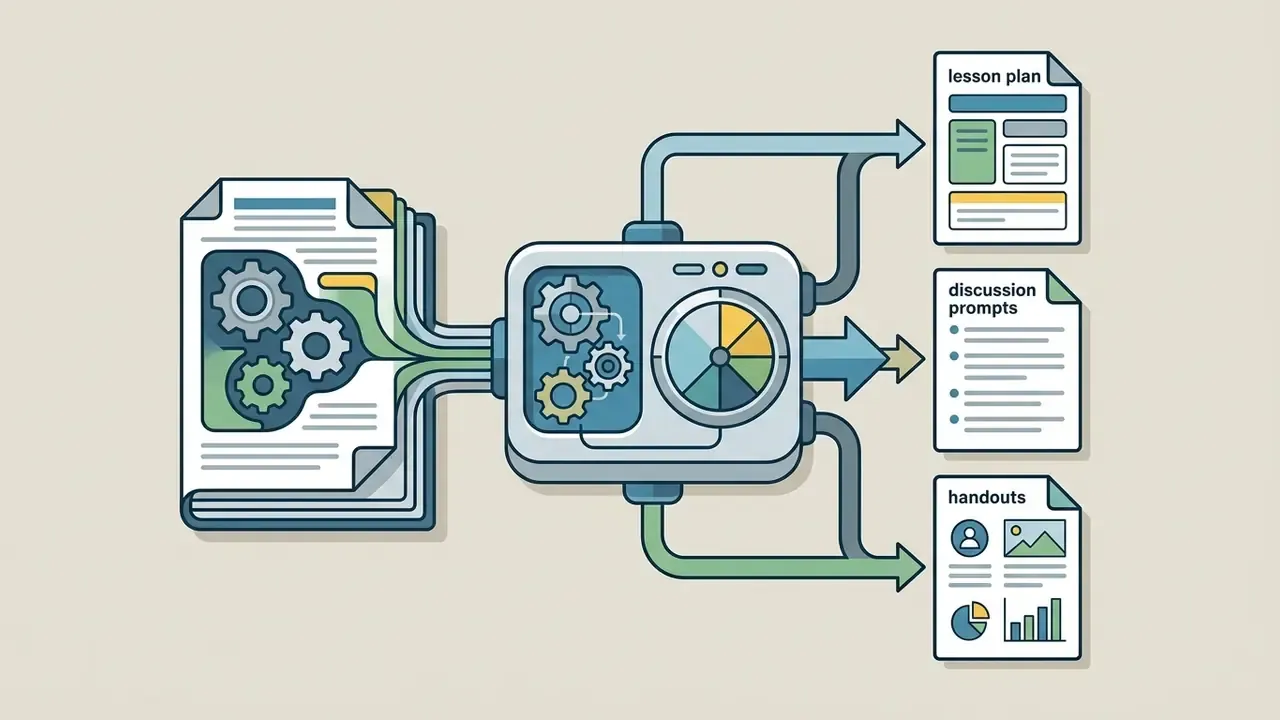
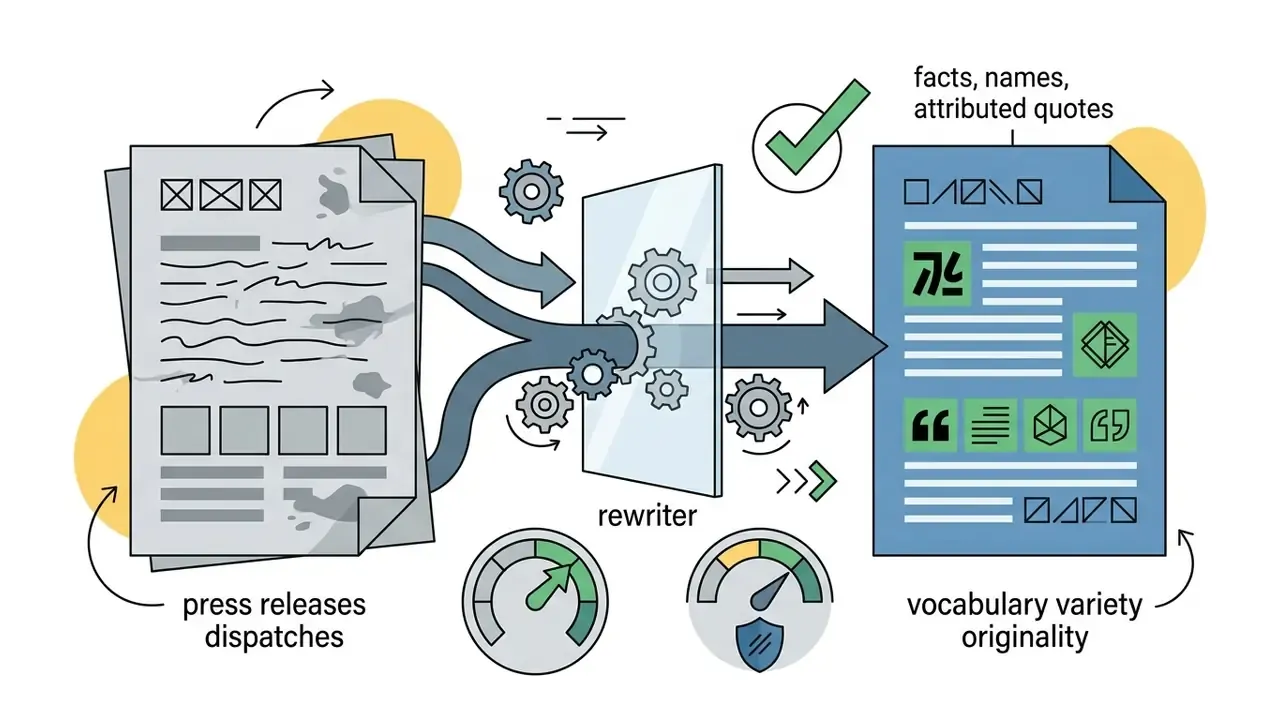
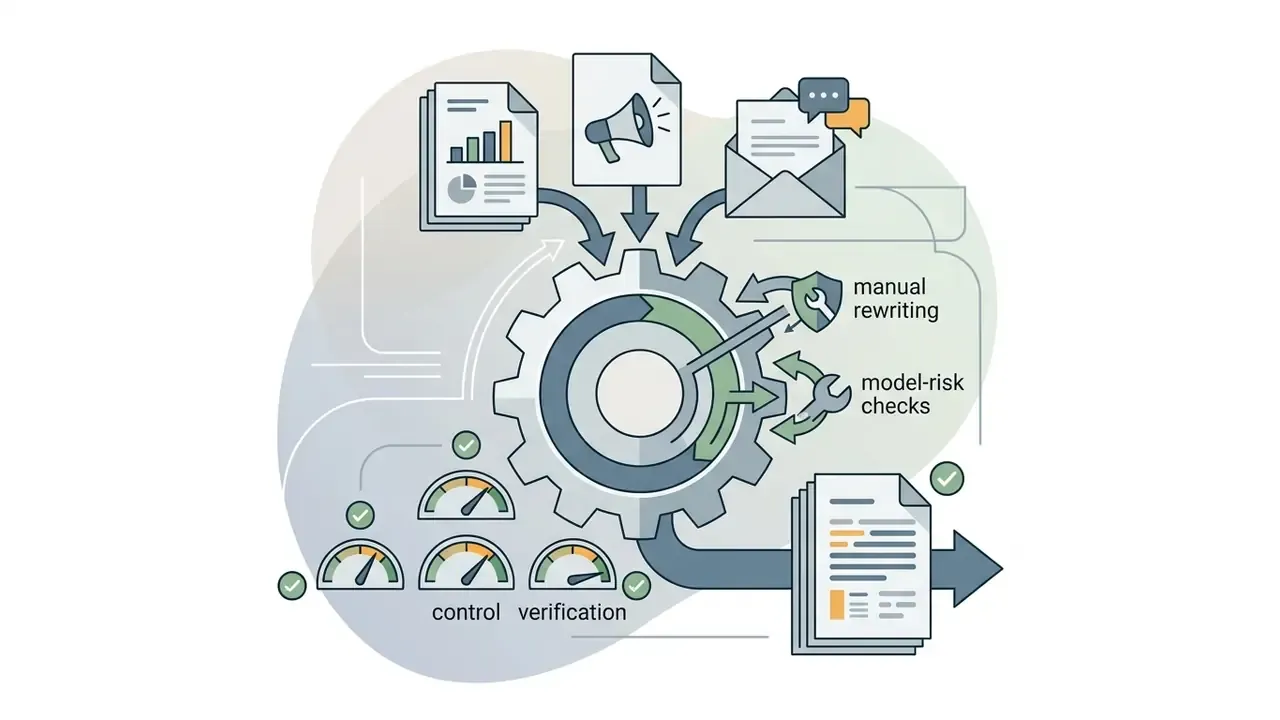
Different domains lean on an ai paragraph rewriter generator to clear specific bottlenecks:

Quality, Grammar, and Plagiarism: What to Check After Rewriting
Why Rewritten Text Still Needs a Grammar and Meaning Check
Automated rewriters can introduce subtle semantic errors, shift core arguments, or distort factual data during simplification passes. The strongest verified evidence for this failure mode comes from error-annotated human assessment, not automatic scoring.
Detection tooling is no substitute for that human check, and its unreliability cuts both ways:
“Lightly AI-edited published abstracts were flagged as AI-generated in 64 to 80% of cases by Pangram and 38 to 49% by GPTZero, while fully humanized texts escaped detection in over 96% of cases.”
“Experienced ChatGPT users correctly classified 299 of 300 articles as AI-generated or human-written, outperforming commercial detectors even on humanized text.” Human Detection of AI-Generated Text study (2025), 300 non-fiction articles, expert annotators.
The practical implication for editors: treat detector percentages as weak signals and trained human review as the primary control.
Editorial quality rule. Never copy automated output straight to production. Run a manual comparison pass between source input and generated output, and confirm that numbers, technical specifications, and regulatory conditions are untouched.
Running an independent grammar checker and verifying factual statements against reference materials prevents public distribution of inaccurate information. The same discipline applies to visual assets, where AI detection and provenance tools for images play the analogous role. Human proofreading also catches awkward transitions, odd vocabulary, and contextual errors that automated systems miss entirely.
Rewriting Is Not a Guarantee of Plagiarism-Free Content
Transforming text through an AI rewriter does not make the output original if the underlying ideas, structure, or arguments stay uncredited. Academic integrity frameworks define close paraphrasing without citation as plagiarism regardless of whether an AI tool performed the rewording (CASRAI Research Integrity Standards, 2025).
Plagiarism detection software flags AI-paraphrased text by analysing semantic structures and sentence patterns. Since July 2024, Turnitin reports “AI-generated only” and “AI-generated text that was AI-paraphrased” as separate signals, which means rewording does not erase machine-origin markers (Turnitin AI Detection Updates, 2024).
“PlagBench comprises roughly 46,500 synthetic plagiarism cases; GPT-3.5 Turbo produced the highest-quality paraphrases, yet LLMs struggled to detect summary plagiarism.”
E-E-A-T alert and fact check: AI transformation limits. An AI rewrite generator does not verify factual accuracy, confirm copyright clearance, or ensure freedom from plagiarism. National standards bodies warn that generative models lower the barrier for spreading inaccurate information through convincing confabulations, and that text detectors remain imperfect for deciding whether content is synthetic (NIST AI RMF and Generative AI Profile, 2024). Major search engines require automated content to prioritise factual accuracy and user value, and they penalise systems deployed mainly to manipulate rankings (Google Search Central, 2023). One more item, flagged as emerging rather than settled: European court practice reported in 2026 has begun attributing direct liability to platform operators for inaccurate AI-generated summaries published under their brand. Case identifiers and appeal status vary by jurisdiction, so treat it as a liability trend that needs counsel review, and track developments through our AI Litigation and Case Timelines hub. Always verify manually and run a dedicated plagiarism checker before publishing transformed content.
Manual Paragraph Rewriting Framework: Step-by-Step
To rewrite complex paragraphs without leaning entirely on automation, follow this six-step editing sequence:
- Deconstruct the core thesisread the source paragraph fully and isolate the central argument in one statement.
- Identify key terminologymark immutable terms (technical specifications, brand names, statutory references, figures) against replaceable descriptive vocabulary.
- Draft a new topic sentenceexpress the main idea using alternative syntax and fresh structural framing.
- Reorganise supporting evidencereorder data points or examples for logical coherence, keeping every supporting sentence subordinate to the topic sentence.
- Apply transition anchorsconnect adjacent sentences with logical conjunctions (furthermore, conversely, consequently) and close with a sentence that ties back to the controlling idea.
- Verify semantic equalitycross-examine the final draft against the original to confirm zero omission of conditional constraints, then cite the source and run an originality check.
Model Risk Validation Checklist for AI Rewriters
Institutions under model-risk supervision, for example the OCC and Federal Reserve SR 11-7 framework, should document rewriting tools like any other decision-support system, mapped to the govern, map, measure, and manage functions of the NIST AI Risk Management Framework.
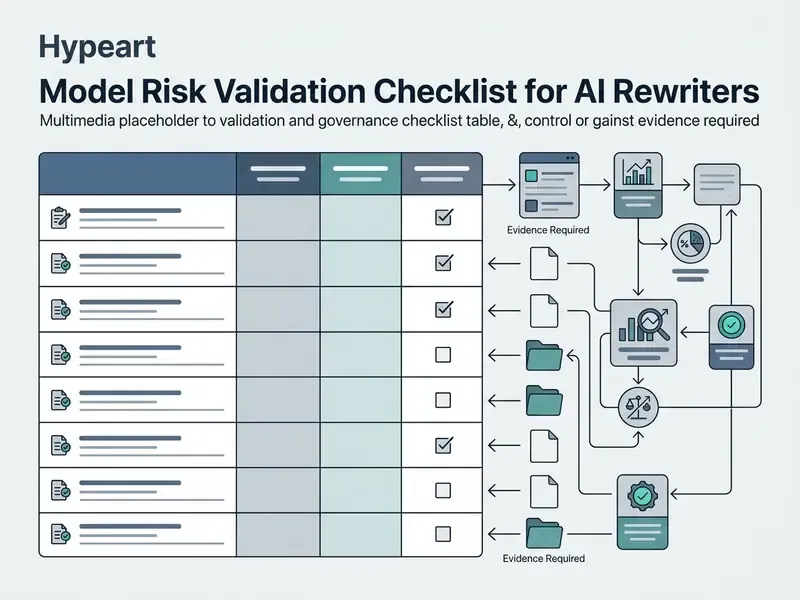
| Control area | Evidence required |
|---|---|
| Inventory and ownership | Tool registered in the model or tool inventory with a named business owner and an intended-use statement (drafting aid, not decision engine). |
| Conceptual soundness | Documented model family, version pinning, temperature and top-p settings, and prompt templates under change control. |
| Outcome testing | Benchmark set of 50 to 200 representative source paragraphs scored on content preservation, factuality, coherence, and fluency; NLI or BERTScore-style similarity thresholds and a maximum acceptable edit ratio defined in advance. |
| Readability targets | Pre and post Flesch-Kincaid or ARI measurement against the audience target, for example grade 7 to 9 for retail disclosures. |
| Human-in-the-loop | Mandatory reviewer sign-off recorded per document; four-eyes review for regulated disclosures. |
| Audit trail | Retained log of source text hash, prompt, model version, output, reviewer identity, and timestamp, exportable for internal audit and examiners. |
| Data protection | Contractual zero-retention and no-training terms, encryption in transit and at rest, PII screening before submission, per NIST SP 800-47 Rev. 1 information-exchange requirements. |
| Shadow AI controls | Network and DLP policy blocking unapproved public rewriters; approved-tool list published to staff. |
| Ongoing monitoring | Periodic re-testing after model upgrades; drift and incident log with escalation thresholds. |
Net ROI framing for a control-heavy environment:
Net benefit = (drafting hours saved × loaded hourly cost) − (review hours added × loaded reviewer cost) − (validation and monitoring cost, annualised) − (licence and infrastructure cost) − (expected residual risk cost)
Estimate residual risk cost as: probability of an uncorrected semantic error reaching publication × expected remediation, restatement, or regulatory cost. Projects that ignore the review and validation terms routinely overstate savings, sometimes by a factor of two. Cost-modelling discipline for AI tooling is discussed further in our API cost and usage-limit implementation guide, and unit-economics templates sit in the AI Media Calculators hub.
Is a Free AI Rewrite Generator Enough for Commercial Use?
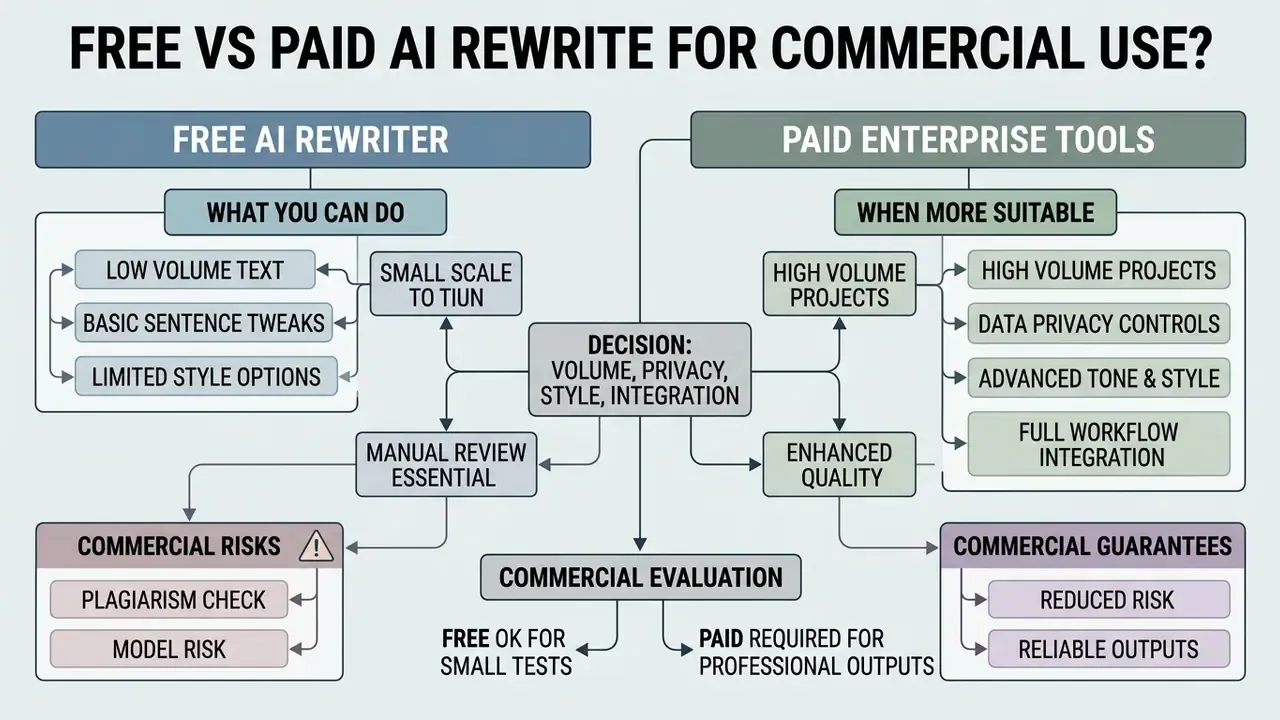
Choosing between a free AI rewriter and a paid enterprise subscription comes down to volume, data privacy protections, style controls, and workflow integration. Free tools handle casual editing. Commercial deployments usually need higher allowances and proper administrative controls.
“70% of SEO teams cite speed as AI’s main advantage, while only 19% believe AI improves content quality.”
That gap between speed and quality is the real dividing line. Free tiers buy speed. Paid tiers buy control.
What You Can Do With a Free AI Rewriter
A free ai rewrite generator lets you rephrase short passages, test tone adjustments, and correct local grammatical errors without spending anything. Most public platforms offer a free tool tier capped at roughly 125 to 1,000 words per request. Some measure limits in characters, 500 to 10,000, and others in prompts per month, which suits lightweight tasks such as social posts or email polishing (QuillBot Pricing Terms, 2026). Free tiers also tend to expose only one or two rewriting styles, Standard and Fluency being the common pair, with additional modes behind premium plans.
Anyone evaluating a free ai option can test interface behaviour and baseline rewriting quality before signing a commercial contract. It is the same trial-first approach we recommend when assessing free AI art generators and their watermark and licensing limits or free photo editors with export restrictions. Free tiers do restrict advanced models, limit custom style prompts, and usually exclude API integration. And a point worth repeating: “free to use” does not mean “free to use commercially”. Usage rights follow the vendor’s terms of service, not the price tag. Comparative pricing structures are collected in our AI Media Pricing Guides.
When Paid Rewriting Tools May Be More Suitable
Commercial organisations need paid subscriptions for high-volume processing, custom brand voice templates, API connectivity, and enterprise-grade data protection. Paid tiers drop per-submission character limits, which lets teams reword long reports, whole websites, and large document libraries (OpenAI API Usage Tiers, 2026).
Commercial evaluation note. Procurement teams must read the terms of service, not the marketing page. Paid tiers often guarantee that input text is neither logged nor used to train public models, a hard requirement for financial and legal operations. Comparable pricing-transparency criteria appear in our review of design-platform AI pricing, exports, and commercial licensing.
Commercial contracts also provide service level agreements, multi-user seat management, and integrated plagiarism scanning, all of which matter for institutional governance. Moving to enterprise tools ai platforms buys operational stability and alignment with regulatory record-keeping rules. If a rollout stalls at the integration stage, our AI Media Support and Troubleshooting hub covers the usual failure points.
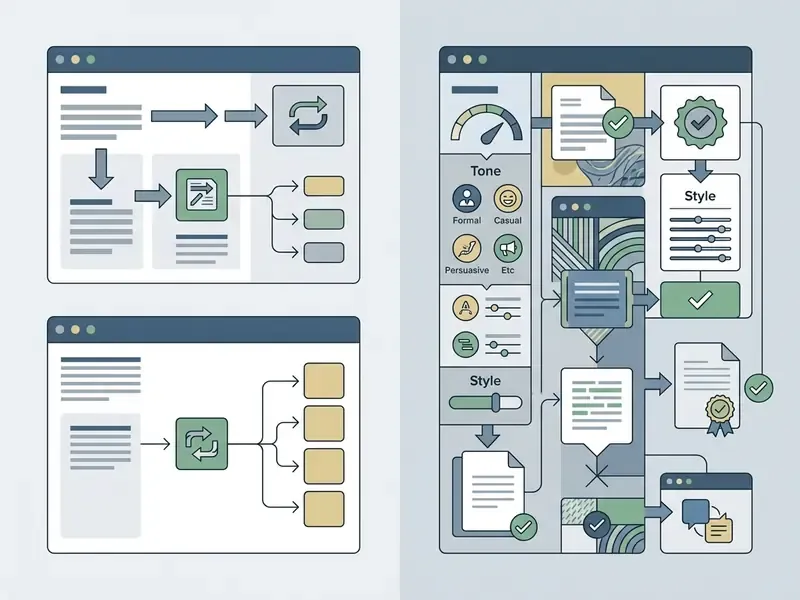
| Feature dimension | Free AI rewrite tool | Expanded paid AI rewriting tool |
|---|---|---|
| Submission volume limit | Short passages only (125 to 1,000 words, or 500 to 10,000 characters per run) | High-volume input (1,500 to 3,000+ words per run, batch and document processing) |
| Tone and style options | One or two basic styles, for example Standard and Fluency | 10+ preset tones, custom brand voice rules, role presets, unlimited custom modes |
| Length and structure controls | Fixed defaults, limited concise or detailed switching | Explicit word budgets, concise and expand modes, rhetorical mode selection |
| Model capabilities | Standard lightweight processing models | Advanced multi-modal LLMs, higher reasoning accuracy, version pinning |
| Language support | Basic translation and rewriting in major languages | Comprehensive global language coverage with regional dialects |
| Grammar and plagiarism integration | Basic error detection, no plagiarism checks | Deep grammar checking plus real-time plagiarism scanning |
| API and workflow integration | Usually unavailable | API access, seat management, CMS and helpdesk integrations |
| Data privacy and logging | Standard public privacy terms, possible data logging | Enterprise privacy SLAs, zero data retention for training, exportable audit logs |
| Commercial usage rights | Depends on public ToS, often ambiguous for resale contexts | Explicit commercial licence terms and indemnity provisions |
In short: the free tier tells you whether the output quality is acceptable. The paid tier tells your auditor where the evidence lives.
FAQ About AI Rewriting Generators
Can an AI Rewriter Work in Different Languages?
Yes. Modern AI rewriting tools support multiple languages by drawing on multilingual training corpora, covering English, Spanish, French, German, and Mandarin among others. European administrative portals draw a useful line between translation tools, which convert text between languages while preserving layout, and rewriting utilities, which adapt language complexity within the same language for public accessibility (European Commission AI translation and language tools portal).
“LLMs show consistent paraphrase generation performance across English, Swedish, and French, though quality varies by language and task.” Dürlich et al., Hallucination Detection in Translation and Paraphrasing (2025), Mixtral-8x7B and META-LLAMA-3-70B on 138 SHROOM examples. Review non-English output carefully. Localised idioms and formal address registers are where quality slips first.
How Is AI Rewriting Different From Machine Translation?
Machine translation changes the language of a document while preserving structure, layout, and meaning. Modern document-translation platforms cover 100+ target languages and retain tables, numbering, and formatting. AI rewriting keeps the language constant and changes wording, register, or reading level. The two are complementary: translate first to reach a new market, then rewrite in-language to match local reading level and brand tone.
Can AI Rewriting Make Text Sound More Human?
An AI rewriter can make generated text read more naturally by varying sentence length, breaking long sentences, simplifying vocabulary, shifting word order, replacing passive phrasing with active verbs, and applying casual tone settings. Research on humanization implements this as constrained AI-to-human style transfer that preserves meaning while shifting surface style.
“After humanization, over 96% of fully rewritten AI texts escaped detection by Pangram and GPTZero, yet expert human reviewers still identified them correctly.” Why AI Detection Fails for Academic Integrity (2024 to 2025). Evading a detector is not the same as producing original, accurate writing. Expert evaluators keep spotting AI-assisted text by reading narrative cohesion, repetitive vocabulary, and suspiciously abstract conclusions (Human Detection of AI-Generated Text study, 2025).
Is It Safe to Paste Text Into an AI Rewriter Tool?
Disclaimer: general information only, not a substitute for advice from your information security team or data protection counsel. Pasting confidential, proprietary, or personally identifiable information into public AI rewriters carries privacy risk if the platform logs inputs for model training. Federal security frameworks state that organisations must protect data exchanges before, during, and after processing, and formalise agreements with vendor platforms (NIST SP 800-47 Rev. 1, 2025). The NIST Privacy Framework supplies the governing privacy risk-management structure. Inspect the vendor privacy policy first: is input retained, encrypted, or used for training? Transparency note on the evidence base. No reliable peer-reviewed study published between 2023 and 2025 quantifies the confidentiality risk of specific commercial AI rewriting products. Assessments therefore rest on vendor contract terms and general security frameworks rather than measured breach data. Risk teams should record that evidence gap explicitly instead of implying certainty.
Is Using an AI Paragraph Rewriter Considered Cheating?
Using a rewriting tool is not inherently misconduct when the original source is cited and AI assistance is disclosed. Institutional policies vary, and some programmes prohibit paraphrasing tools outright, so confirm the rule with your instructor or integrity office before submission. Presenting rewritten material as original unattributed work is plagiarism regardless of who, or what, did the rewording.
How Long Should a Rewritten Paragraph Be?
No fixed rule exists. Professional prose averages roughly 100 to 200 words per paragraph, web copy often runs 40 to 80 words for scannability, and regulatory or academic passages run longer because conditional logic cannot be compressed safely. Set an explicit word budget in the prompt, then verify that compression has not deleted a qualifying clause.
What Metrics Should I Use to Score a Rewriter’s Output?
Four documented axes cover most needs: content preservation (semantic similarity or NLI entailment), factuality (clause-level diff against the source), coherence (paragraph unity and transitions), and fluency (grammatical quality). Add a readability metric such as Flesch-Kincaid or ARI when the goal is audience simplification, and track edit ratio so that “rewriting” does not quietly become “rewriting away” essential content.
Appendix A: Superseded Statements and Corrections Log
For editorial transparency, earlier versions of this guide contained the following statements, now corrected:
About the reviewer: Marcus Hale is the author. The associated background, validating decision-support and language models in regulated financial services, is illustrative and Article reviewed and updated August 2026.
Resource navigation: technical definitions and governance resources live in the AI Media Glossary. Related evaluations include our guides to AI voice generators and commercial licensing, online photo editors and commercial workflows, video compressors and quality trade-offs, AI headshot generators and privacy considerations, animation makers and export options, plus comparisons such as best AI art generators, free AI video generators, and ChatGPT image generation versus alternatives. Operational resources sit in the AI Media Calculators, AI Media Support and Troubleshooting, AI Media API Guides, and AI Litigation and Case Timelines hubs.
- Readability citation.
- Style-transfer readability findings were previously attributed to an arXiv identifier that does not resolve. Replaced with Gustilo et al. (2024), a controlled readability experiment across five metrics.
- Paraphrase-generation citation.
- A non-resolving arXiv identifier for paragraph-level paraphrase generation was replaced with the QLoRA fine-tuned LLaMA-3.1-8B clinical simplification study (2024).
- Voice-preservation citation.
- A non-resolving instruction-tuning identifier was replaced with the Paraphrase Inversion study (2024), reporting 0.95 semantic and 0.91 stylistic similarity.
- Plagiarism statistic.
- The claim that “28% of generated paraphrases scored 100% similarity on standard plagiarism checkers” is withdrawn as unverified, since the cited identifier did not resolve. Replaced with PlagBench (2024) findings and Turnitin’s AI-paraphrase reporting change of July 2024.
- Plain-language standard.
- NIST SP 800-63B was previously cited as a general readability standard. Scope corrected: it governs plain language in user-facing authentication text, while general plain-language obligations derive from the Plain Writing Act of 2010 and the SEC Plain English Handbook.
- Judicial liability claim.
- A 2026 Munich ruling was previously presented as settled precedent with an unrelated URL. Reformulated as an emerging European liability trend requiring legal verification.
- Engagement metrics.
- The 14% semantic-drift and 40% turnaround figures are retained but relabelled as unaudited, single-engagement observations rather than industry benchmarks.
- Conversion claim.
- The assertion that channel-specific tailoring “increases conversion rates” is narrowed to the documented benefit, reduced production cycle time, with conversion impact deferred to first-party testing.