Reviewed by: editorial team specializing in AI media tooling, model-risk validation, and commercial licensing analysis. Last updated: 2026.
Executive Summary
- An ai story generator with pictures is a multimodal pipeline that turns one prompt into narrative text, scene-matched illustrations, page layouts, optional voiceover, and an export-ready file (PDF, EPUB, or image bundle).
- The decisive technical variable is not text quality but visual consistency. Training-free methods such as ConsiStory, 1Prompt1Story, and StoryDiffusion keep the same character recognizable across pages without fine-tuning a model.
- The decisive commercial variable is licensing, not the ownership sentence in a marketing page. Purely machine-generated output cannot be registered for copyright in the United States, yet contractual terms still allow commercial exploitation on most paid tiers.
- For risk, governance, and compliance leaders, the safe adoption path is a short vendor checklist: no training on prompts, retention controls, watermark and provenance metadata, audit logs, and a mapped control framework (NIST AI RMF or ISO/IEC 42001).
Who This Guide Is For, and Why the Detail Matters
Most guides on this topic stop at "type a prompt, get a picture book". That is fine for a weekend project. It is not enough when the artifact carries your brand, your compliance language, or a customer's name.
Three reader profiles shaped this piece. A parent building a birthday keepsake needs one thing: speed and a printable file. A marketer needs style control and clean commercial rights. A risk or compliance lead in a US bank or fintech needs something quite different: proof of who generated what, with which model, under which license, and whether the prompt carried personal data.
So the guide runs in both registers. Practical steps first. Then the control layer, because the control layer is where illustrated-story pilots usually stall.
An ai story generator with pictures is an integrated multimodal system that converts a text prompt or structured outline into a complete narrative paired with scene-by-scene visual illustrations. Modern platforms combine large multimodal language models (MLLMs) and latent diffusion image models to build multi-page storybooks, comic panels, or visual presentations automatically.
What Is an AI Story Generator With Pictures and What Can It Create?
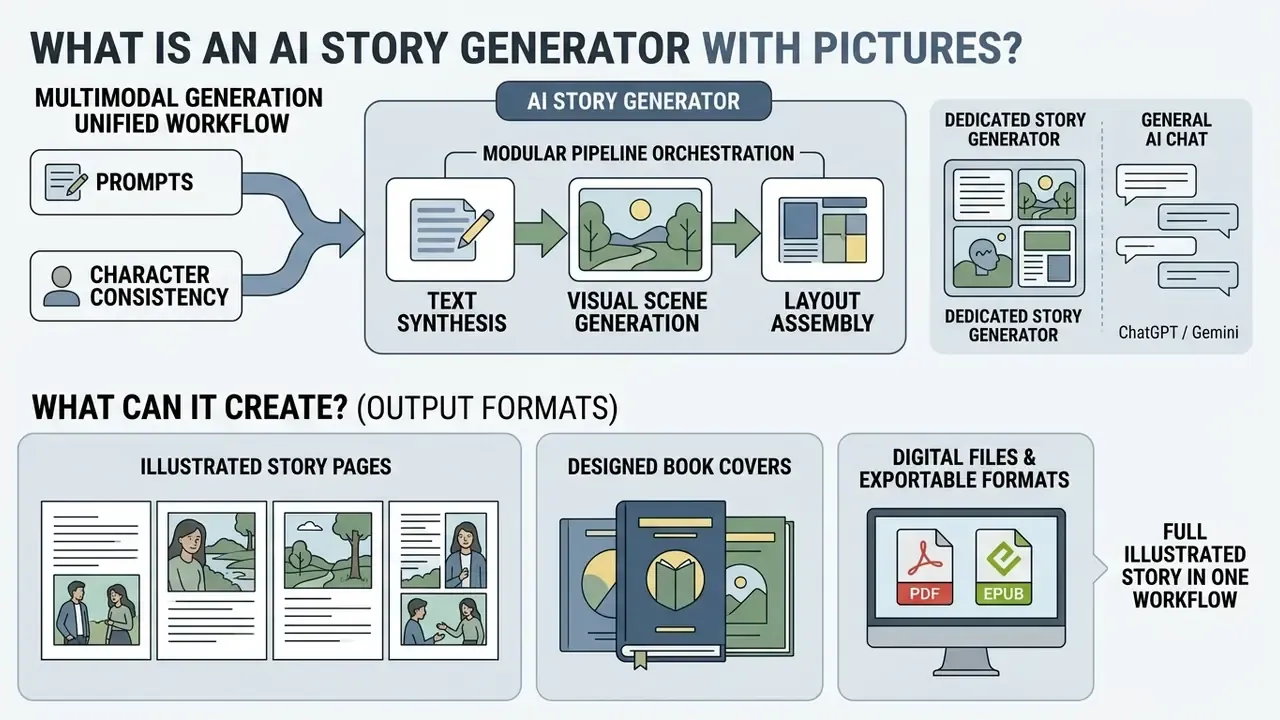
An ai story generator with pictures is a generative framework that unifies text synthesis, visual scene generation, and layout assembly into one operational workflow. Instead of treating text and images as separate media, an ai image and story generator links narrative beats directly to image prompts, producing cohesive visual storybooks, character arcs, and multi-frame narratives.
Unifying Narrative, Character Consistency, and Visuals
An ai picture story generator carries context across narrative text, character attributes, and generated visuals inside a shared execution pipeline. Modern systems use language representations to structure plot beats while conditioning the image model to preserve key character traits across scenes.
"SEED-Story uses discrete visual tokenization and a multimodal attention sink to generate up to 30 interleaved steps while preserving narrative and visual context."
Research into multimodal storytelling architectures points to two main technical approaches.
- Joint multimodal generation.Models such as SEED-Story (TencentARC, 2024) use discrete visual tokenization and a multimodal attention sink to generate interleaved text and image tokens across up to 30 continuous steps, holding visual and narrative context together. The published pipeline runs in three stages: image reconstruction pretraining, interleaved text-image next-token training, and SD-XL tuning through regressed image features that preserve character and style continuity.
- Modular pipeline orchestration.Pipelines such as ViSTA (2025) split execution into language synthesis, scene parsing, and diffusion-based image generation. On the StorySalon benchmark (11,280 storybooks), ViSTA reached a CLIP-Text score of 0.316, a TIFA alignment score of 0.765, and an FID of 46.45, which indicates strong text-to-visual alignment.
"ViSTA outperforms the StoryGen baseline on CLIP-T (0.316 vs 0.313) and TIFA (0.765 vs 0.750) with comparable FID across 11,280 StorySalon storybooks."
Older systems were strictly sequential. The 2024 "Imagining from Images" tool, for example, split work between a visual analyzer, a storywriter, and an illustrator built on GPT-4o Vision and Stable Diffusion XL. Newer architectures fold text and image tokens into one generation loop, then add a separate de-tokenization or consistency stage before rendering.
By unifying text and graphics, an ai story with pictures generator removes the manual effort of drafting prose and sourcing matching artwork separately. Creators can compare rendering engines through our overview of AI image generators and check broader terminology in the AI Media Glossary to see how multimodal models handle media synthesis.
Dedicated Story Generator vs General AI Chat (ChatGPT / Gemini)
The most common question from first-time users: why buy a specialized tool when a general chat assistant already writes stories and draws pictures? The difference is not raw generation capability. It is orchestration, layout, continuity, and packaging.
| Storytelling feature | General AI chat (ChatGPT / Gemini) | Specialized AI picture story generator |
|---|---|---|
| Character continuity | Constant re-prompting; high visual drift | Locked reference sheets and automated seed mapping |
| Illustration layout | Raw standalone images; manual placement | Pre-formatted page layouts (text plus panel alignment) |
| Multi-page export | Manual copying into external design software | One-click print-ready PDF, EPUB, and KDP packages |
| Audio narration | Separate TTS generation required | Synchronized native voiceover across 8+ languages |
| Character setup | Re-described inside every new prompt | Guided creation with saved, reusable character profiles |
| Execution speed | Multi-step manual pipeline (15 to 30 minutes) | Automated end-to-end run (often under 60 seconds) |
In practice, a general assistant is an excellent drafting surface. A dedicated ai story generator picture engine behaves more like an assembly line: it holds character state, enforces one visual style, aligns text blocks to panels, and hands back a shareable artifact instead of a folder of loose files.
Output Formats: Story Text, Illustrated Pages, Covers, and PDF
A standard ai story generator image tool outputs complete digital publications: structured story chapters, individual illustrated pages, designed covers, and print-ready PDF files.
The primary output formats include:
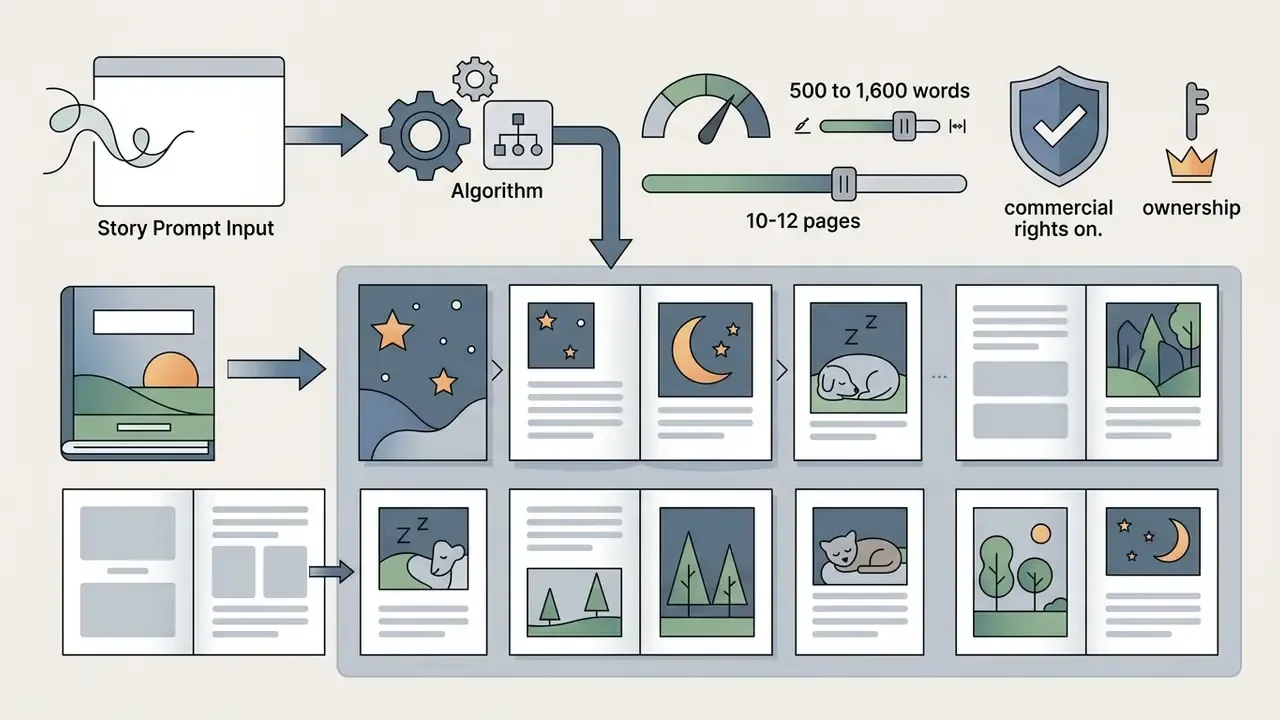
- Illustrated story pages. Page-by-page layouts with two or three sentences of narrative text paired with a dedicated visual panel. Most consumer platforms standardize on an illustrated cover plus 10 to 12 interior pages.
- Designed book covers. Front, back, and full-wrap covers, spine dimensions included, sized for digital publishing or self-printing services such as Amazon KDP.
- Digital and exportable files. Printable PDFs, EPUB and DOCX formats, and high-resolution JPEG or PNG bundles.
- Shareable digital editions. A hosted read-online link with optional narrator audio, useful when a printed keepsake is not the goal.
One illustrative scenario, not a client case: a fintech enablement team prototyping customer-facing financial literacy modules used an ai story writer with pictures to convert dense regulatory guidance into 10-page illustrated narratives. With a fixed scene structure and automated PDF export, asset creation dropped from roughly three weeks to a few hours, and every generated page kept its prompt, seed, and reviewer record. Treat the numbers as a hypothesis to validate on your own baseline.
Diagram: anatomy of an illustrated AI story
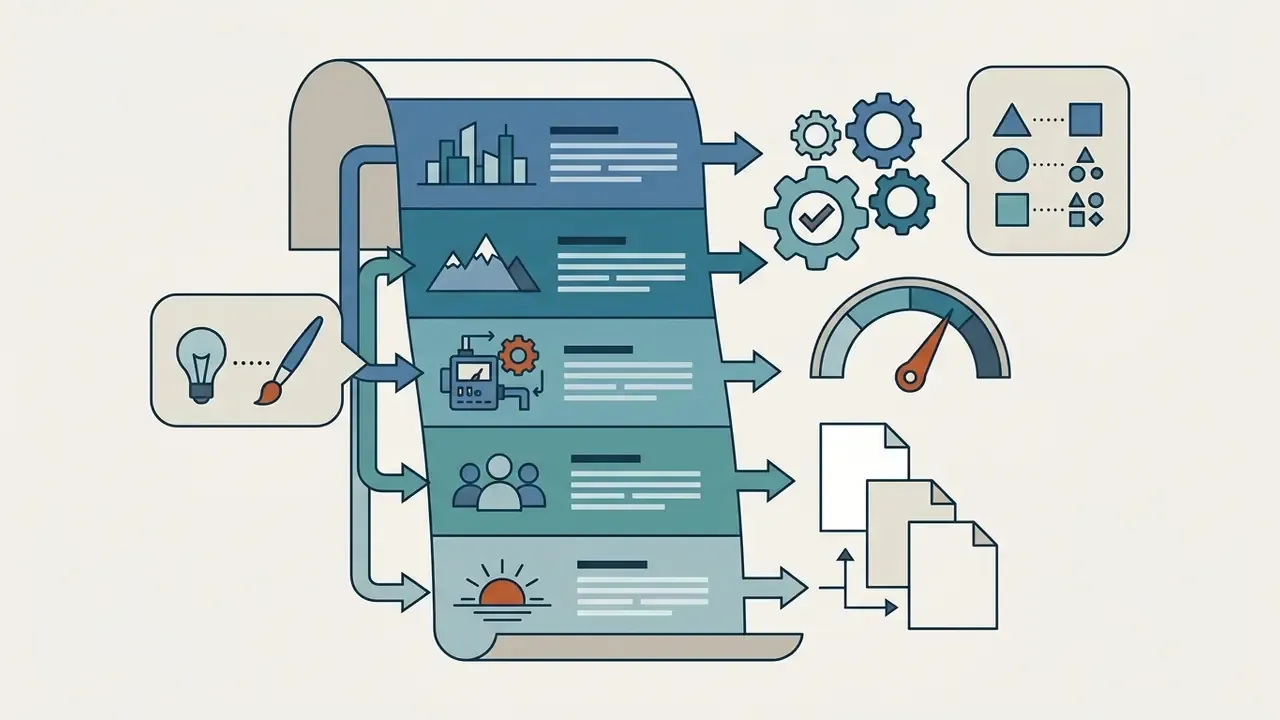
Idea or prompt → plot beats → character sheets → scene breakdown → image generation → assembled pages → export (PDF / EPUB / images / audio).
How to Generate an Illustrated AI Story Step by Step
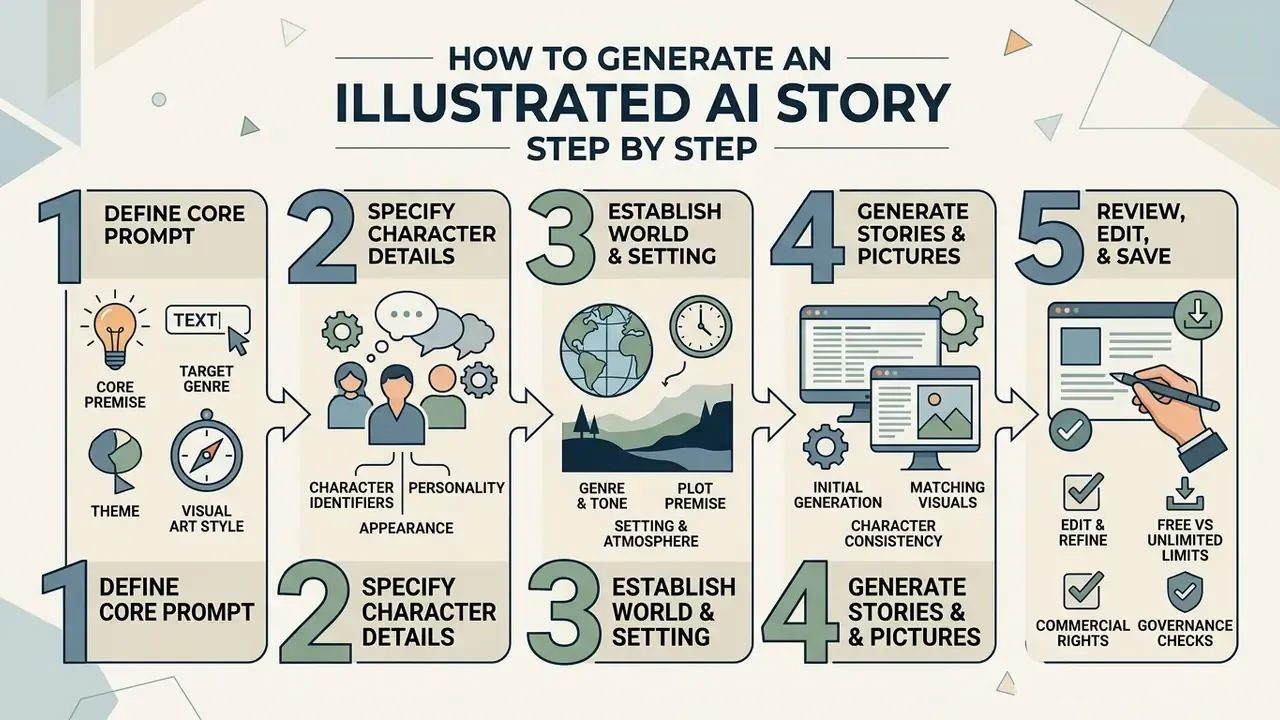
To generate story content with matching visuals, you supply a foundational prompt: core premise, target genre, character details, visual art style. The system parses the input, builds narrative scenes, renders images, and returns a complete illustrated story ready for editing or export.
Add the Idea, Genre, Theme, and Character Description
Good output needs a structured prompt that defines narrative role, setting, central conflict, and specific character visual cues. Explicit parameters prevent character drift and incoherent panels.
"Training-free methods such as ConsiStory require detailed, consistent character attribute descriptions in the prompt to preserve visual identity."
To raise output fidelity in an ai story generator picture application, cover five prompt components.
Prompt-engineering research on text-to-image systems suggests prompts that foreground subject and style keywords beat prompts padded with connective filler. That is a direct lever on stylistic unity across pages.
When working inside tools like the Canva AI Generator, structured prompt parameters keep both text and visual output aligned with brand or publishing guidelines. Teams reusing layouts across a series often pair generated art with canva video templates when the same story later moves into short-form video.
Generate, Edit, and Save the Story With Images
Once parameters are set, the platform runs the text and image generation loop and opens an interactive workspace for frame-by-frame edits, text tweaks, and export.
Flowchart: step-by-step story generation
The post-generation workflow follows four operational steps.
- Write the prompt (idea, genre, characters, occasion).
- Select story parameters (length, tone, language, illustration style).
- Generate the narrative text and matching images.
- Review pages, regenerate weak frames, verify continuity.
- Download, print, or share the finished story.
- Initial generation.The model builds the narrative arc alongside raw scene illustrations, usually in 3 to 15 seconds.
- In-line text and frame editing.Editors adjust phrasing, reshape a beat, or trigger a frame-specific regeneration when an image strays from the script. Professional tools flag AI-generated frames explicitly, so a segment can be regenerated or reverted to the original asset.
- Consistency verification.Visual elements get checked against reference frames: proportions, hairstyle, clothing, accessories, eye color, distinguishing marks. Slow, but this is the step that saves reprints.
- Export and distribution.The finished story is saved as a multi-page PDF or EPUB, pushed through API endpoints, or published as a share link. Technical teams building custom interfaces can review integration options in our api overview.
Key Settings Controlling AI Story Quality and Image Consistency
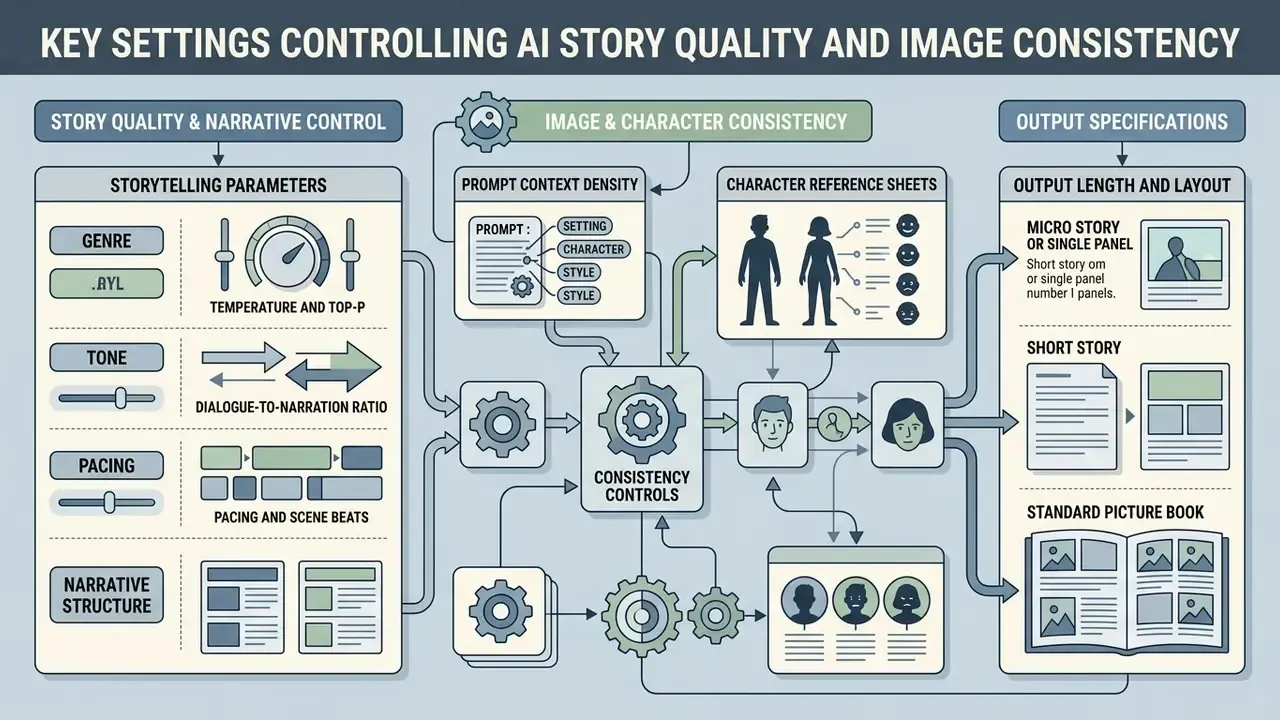
Output stability in an ai story generator with image platform depends on model temperature, prompt context density, character reference sheets, and consistency controls. Tuning these variables balances narrative creativity against precise visual execution.
Genre, Tone, Pacing, and Narrative Structure
Text generation parameters set pacing, dialogue proportion, and thematic depth. Lower randomness (temperature near 0.2 to 0.5) enforces logical structure and factual steadiness; higher settings (0.7 to 0.9) widen stylistic variation.
Key text configuration parameters include:
- Temperature and Top-P. These control token sampling randomness. Pushing temperature toward zero narrows sampling to the highest-probability tokens, which makes output far more repeatable. That is the standard setting when a story must match a fixed script or an approved compliance narrative. (Updated: attribution to a specific vendor document was removed pending verification; the mechanism itself is a general property of sampling-based decoding.)
- Dialogue-to-narration ratio. Genre conventions decide the balance. Children's stories want frequent dialogue; technical case studies favor descriptive exposition. The useful editorial test is functional: dialogue should characterize, deliver exposition, set the scene, advance the plot, or foreshadow. Otherwise it just inflates word count.
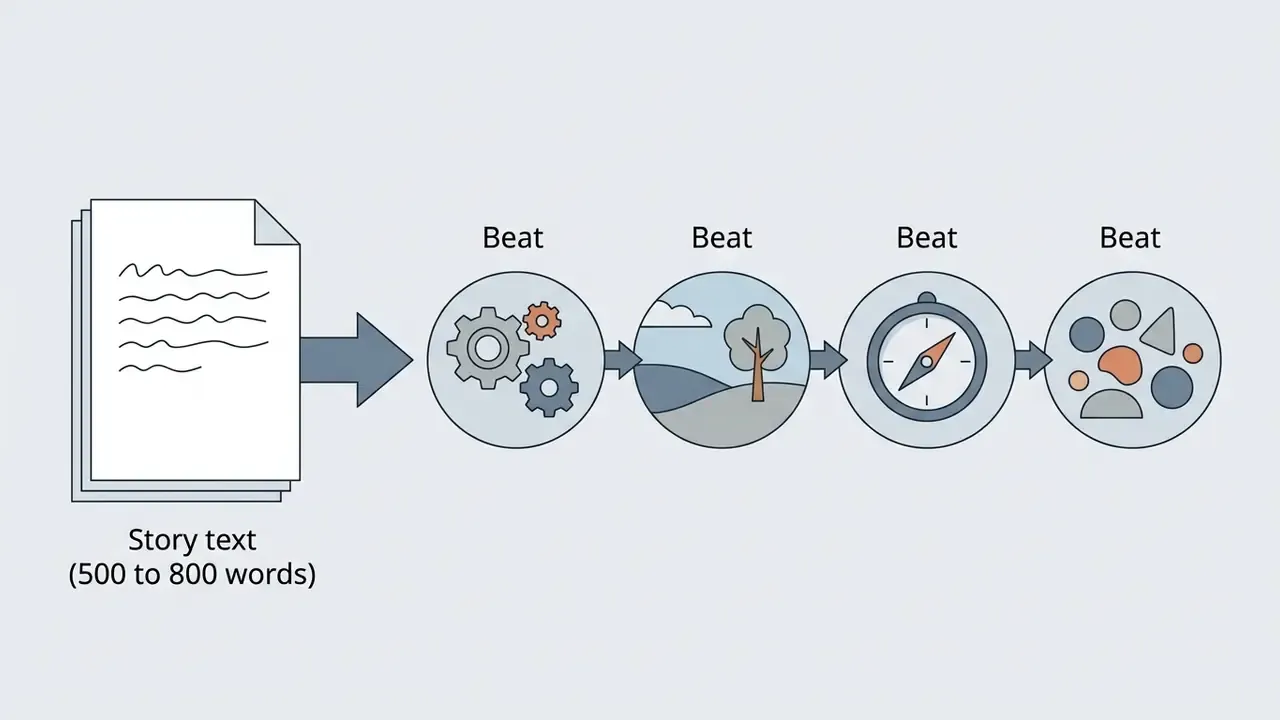
- Pacing and scene beats. Segmenting a story into 100 to 150 word scene blocks makes text-to-image prompt extraction cleaner for diffusion engines.
Output length and layout specifications
Characters, Scenes, and a Unified Illustration Style
Holding a character's appearance stable across panels is the hardest technical problem in visual story generation. Current tools lean on attention feature injection, seed control, and reference character sheets.
"ConsiStory runs roughly 20x faster than trained alternatives and requires no fine-tuning, preserving subject consistency and text alignment."
| Consistency method | Technical mechanism | Operational benefit |
|---|---|---|
| Shared attention (ConsiStory) | Internal activation mapping across diffusion passes | Roughly 20x faster than fine-tuning; zero training required |
| Narrative graph prompting | Explicit character names plus repeated seeds plus scene graph | Preserves facial identity across complex multi-scene sequences |
| 1Prompt1Story (ICLR 2025) | Prompt concatenation plus cross-attention reweighting | Training-free visual alignment across pages |
| StoryDiffusion | Consistent Self-Attention plus Semantic Motion Predictor | Extends identity consistency from stills into video transitions |
"StoryDiffusion extends consistency to video through a Semantic Motion Predictor, producing smooth scene transitions while preserving character identity."
Commercial Usage Rights and Copyright Realities
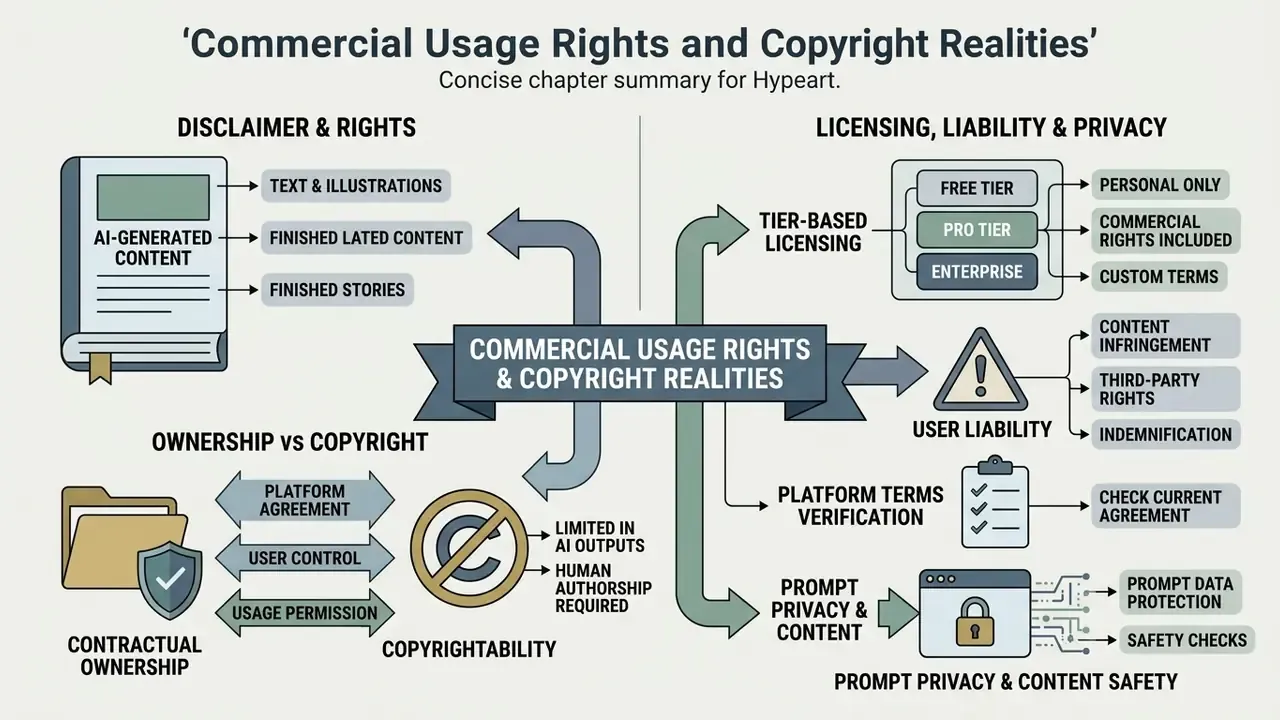
Commercial deployment of AI-generated stories and illustrations turns on three things: platform contract terms, the user's creative contribution, and regional copyright law. Leading platforms assign output rights to paying users, yet purely machine-generated assets still hit hard limits at the registration desk.
Rights to AI-Generated Text, Illustrations, and Finished Stories
Under guidance from the U.S. Copyright Office (report published January 2025, still the operative guidance in 2026), purely machine-generated text and images that lack substantial human creative input cannot be registered. The Office states that prompts alone do not create copyrightability, while human-authored arrangements, edits, and selections can be protected. Applicants must disclose AI-generated portions and may claim rights only over their own contributions.
Key commercial licensing principles:
Prompt Privacy and Content Safety
Enterprise adoption of an ai story maker with images requires strict alignment with data privacy standards and automated content safety filters. Leading platforms run classifiers to block the ingestion or generation of sensitive personal data.
"BookAgent integrates Value-Aligned Storyboarding and Temporal Cognitive Calibration, auditing narrative safety compliance before image generation begins."
Enterprise safety and privacy criteria:
- Prompt data protection. Confirm in writing that the provider does not use input prompts or proprietary character lore to train public foundation models, and pin down retention windows and opt-out mechanics.
- Automated content guardrails. Managed image services document layered safety filters with configurable thresholds. Published usage policies from major providers prohibit privacy violations, non-consensual intimate imagery, CSAM, harassment, and self-harm content, with prompt blocking applied when classifiers flag a violating input.
- Watermark and provenance compliance. The EU Code of Practice on Transparency of AI-generated Content requires providers to mark AI-generated image output in machine-readable, detectable form where technically feasible. Consumer tools such as Gemini expose watermark settings and apply invisible SynthID-style marking.
- Personal data in outputs. Regulators including Australia's OAIC state that privacy obligations apply both to personal information entered into an AI system and to AI-generated output containing personal information. That matters the moment a real child, employee, or customer is illustrated.
AI Governance Checklist Before Approving a Vendor
Use this short control list to curb Shadow AI and to keep an illustrated-story pipeline defensible in an internal audit.
- Training opt-out.Contractual confirmation that prompts, uploads, and outputs are excluded from public model training.
- Retention and residency.A documented retention period, ideally zero data retention, plus data-location commitments.
- Access controls.SSO or SAML, role-based permissions, revocable seats.
- Auditability.Exportable generation logs (prompt, model version, seed, timestamp, operator) sufficient to reproduce any published page.
- Provenance.Machine-readable AI labeling or invisible watermarking on every exported visual.
- Content safety.Documented classifier coverage and an escalation path for blocked or borderline output.
- Licensing fit.Commercial rights adequate for the distribution channel and the company's revenue tier.
- Framework mapping.Controls mapped to NIST AI RMF or ISO/IEC 42001, so the tool lands inside existing model-risk governance rather than next to it.
- Human-in-the-loop record.Evidence of human authorship contributions, since that is the layer still protectable under current copyright guidance.
Fact check and legal verification notice:
Free vs Unlimited AI Story Generators: Licensing and Limits
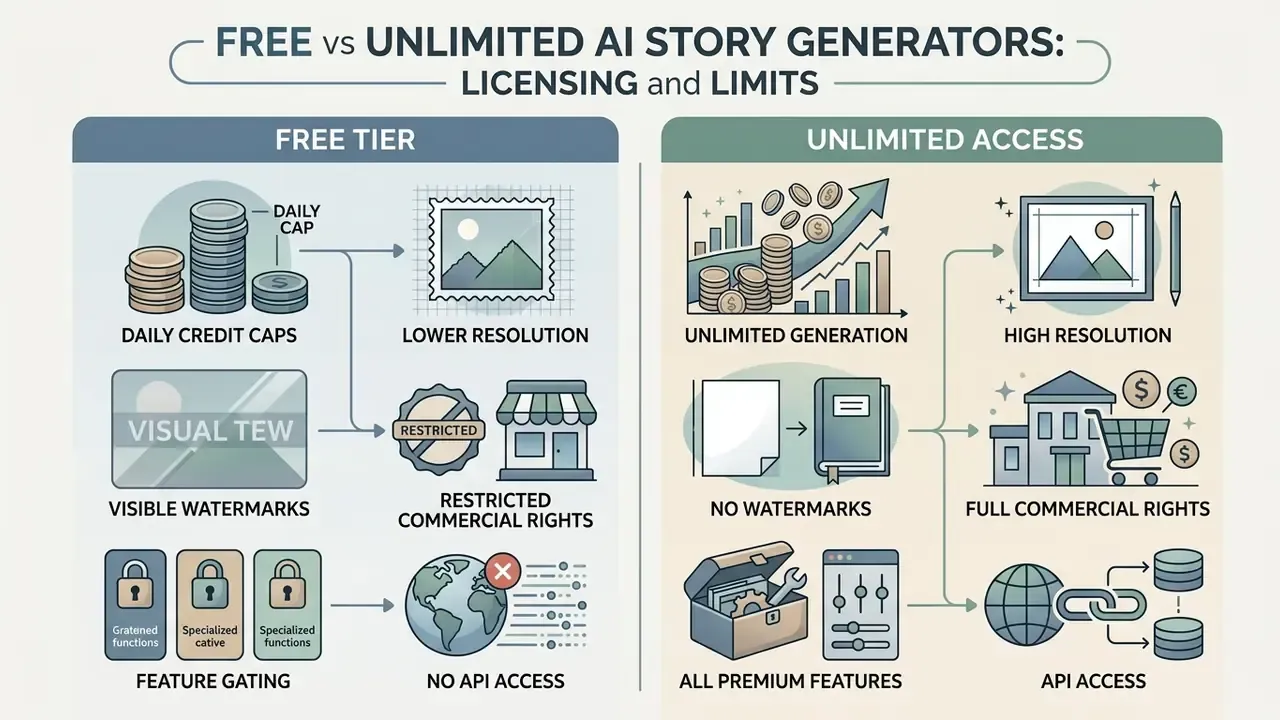
Free tiers for an ai image story generator free tool typically impose daily credit caps, lower resolution, visible watermarks, or restricted commercial rights. Premium and unlimited plans unlock high-resolution exports, larger generation volume, and full commercial licenses.
How a Free AI Story Generator Differs From Unlimited Access
An ai story generator free unlimited with pictures service usually runs inside firm boundaries. "Unlimited" often means trial credits rather than unrestricted compute.
Standard free-tier limitations include:
- Generation caps. Three to five stories per day, or a fixed pool of one-time trial credits. NovelAI's free access, for example, is a one-time trial of roughly 50 generations (actions), not 50 tokens. Ad-supported tools such as Perchance need no signup and are effectively uncapped for short stories, while paid platforms cluster around USD 10 to 25 per month.
- Resolution and watermarking. Images rendered at standard definition (512 x 512 or 1K) with embedded visible or imperceptible watermarks such as Google SynthID. Managed image models commonly support 1K or 2K sizing and one to four images per request, with higher resolutions gated behind paid plans.
- Feature gating. Multi-character consistency sheets, long-form chapter generation, EPUB and DOCX export, and audio narration sit on paid tiers.
- API access. Some providers list the free tier as explicitly unsupported for image-generation API throughput, which means automation needs a paid plan from day one.
Readers weighing zero-cost options should scan our roundup of free AI image generators before subscribing to anything.
Which Features Belong to Paid Plans
Paid subscriptions, roughly USD 9.99 to 25.00 per month, turn a basic free ai story generator with pictures into a production engine. Premium tiers add high-volume generation, vector and PDF exports, and custom voiceovers. Vendor documentation in this segment cites chapter quotas (for example, 35 chapters per month on mid-tier plans), print-ready PDF export, narration in 30+ languages, and commercial rights on upper tiers.
Comparison of tier capabilities
| Feature capability | Free / trial tier | Unlimited / paid tier (USD 10 to 25/mo) | Enterprise tier |
|---|---|---|---|
| Monthly story generations | 3 to 10 stories, capped credits | Unlimited text, high-volume images | Contracted volume with SLA |
| Image output resolution | Standard definition (1K max) | High definition (2K or 4K) | 4K plus batch rendering pipelines |
| Character consistency | Single-prompt matching | Master reference sheets and seed locking | Versioned asset library with approval workflow |
| Export options | Basic web text or PNG | Print-ready PDF, EPUB, DOCX | API delivery, DAM integration, bulk export |
| Watermark enforcement | Visible or digital watermark | Clean export without watermarks | Configurable provenance metadata |
| Commercial rights | Personal or non-commercial only | Full commercial and distribution license | Negotiated license plus indemnification |
| Security and governance | Not applicable | Basic account controls | SSO/SAML, zero data retention, audit logs, private endpoints, SOC 2 evidence |
To benchmark subscription pricing across creative tools, explore our AI Media Pricing Guides, the AI Media Comparison Matrices, and our analysis of leading AI image generators for platforms with the commercial rights you actually need.
Primary Use Cases: Enterprise Enablement, Bedtime Books, Storyboards, and Game Worlds
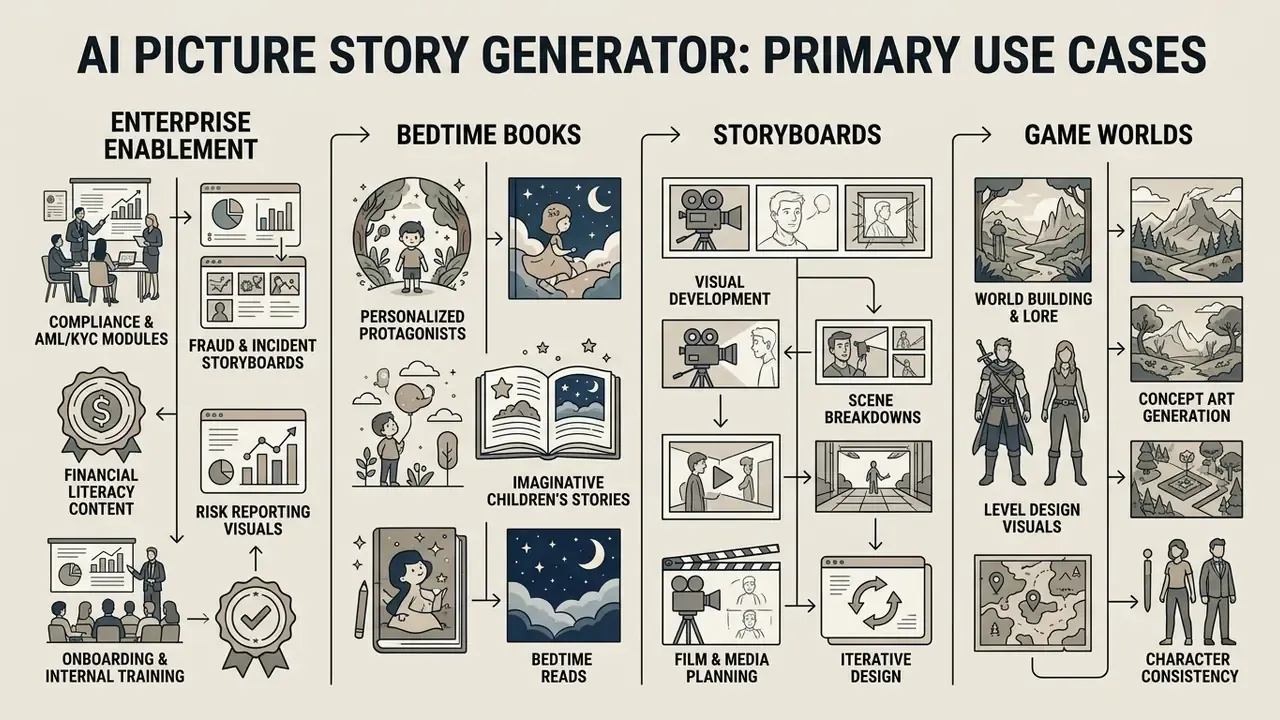
An ai picture story generator covers a wide spread of operational and creative work: regulated-industry training assets, visual compliance narratives, personalized bedtime stories, film storyboards, game design, marketing campaigns.
Enterprise, Compliance, and Regulated-Industry Storytelling
For risk, compliance, and innovation leaders, illustrated generation is a production-efficiency tool for explanatory content that must be accurate, reviewable, and reproducible.
High-value B2B scenarios include:
- Compliance and AML/KYC training modules. Turning policy text into short illustrated scenarios that show what a suspicious pattern looks like in practice, rather than describing it in abstract.
- Fraud and incident storyboards. Visualizing attack paths, social-engineering scripts, and customer-service response flows for tabletop exercises.
- Customer-facing financial literacy. The 10-page illustrated formats described earlier, produced under a fixed layout template with archived prompts and seeds.
- Risk reporting visualization. Converting dense model-risk or audit findings into panel narratives for board-level briefings.
- Onboarding and internal enablement. Repeatable, brand-consistent explainers instead of one-off slide decks that nobody updates.
A practical risk-adjusted ROI frame for a pilot: subtract governance costs from gross savings before claiming value.
Risk-Adjusted ROI = ((Baseline production cost − AI production cost) − (Validation + Legal review + Governance overhead)) ÷ Total AI program cost
Governance overhead is not optional. Reviewer time, licensing checks, provenance labeling, and log retention are the price of making generated assets publishable in a regulated environment. Teams that skip this line item tend to overstate savings by a wide margin, sometimes by a factor of two. Model it as a hypothesis, then measure it.
Personalized Protagonists and Children's Storybooks
"A study with 20 children showed Storypark improved comprehension of key story ideas, generalization, and knowledge transfer, with high participant engagement."
"Parents demand transparency, control, and protective filters in children's AI storytelling tools, particularly around data storage and age-appropriate content." "Exploring Parent's Needs for Children-Centered AI to Support Preschoolers' Interactive Storytelling", ACM CSCW (2024). https://dl.acm.org/doi/10.1145/3686904
- Bedtime story generation. Fast custom tales built around a behavioral theme or a bedtime routine, with comprehension questions for older readers.
Sample size of 20, by the way. Encouraging, not conclusive.
Native Audio Voiceover and Multilingual Narration
Premium visual story engines bolt a text-to-speech pipeline onto the export step to add synchronized narration. Modern systems produce natural-sounding voiceovers across English, Spanish, French, German, Italian, Portuguese, Dutch, and Polish, and some publishing platforms advertise audiobook narration in 30+ languages. That turns a static PDF into an interactive audiobook for early literacy, second-language learning, and accessibility.
Three details matter when evaluating narration:
Creators adding audio to visual storybooks can explore the canva ai voice generator or review broader options in our guide to AI voice generators.
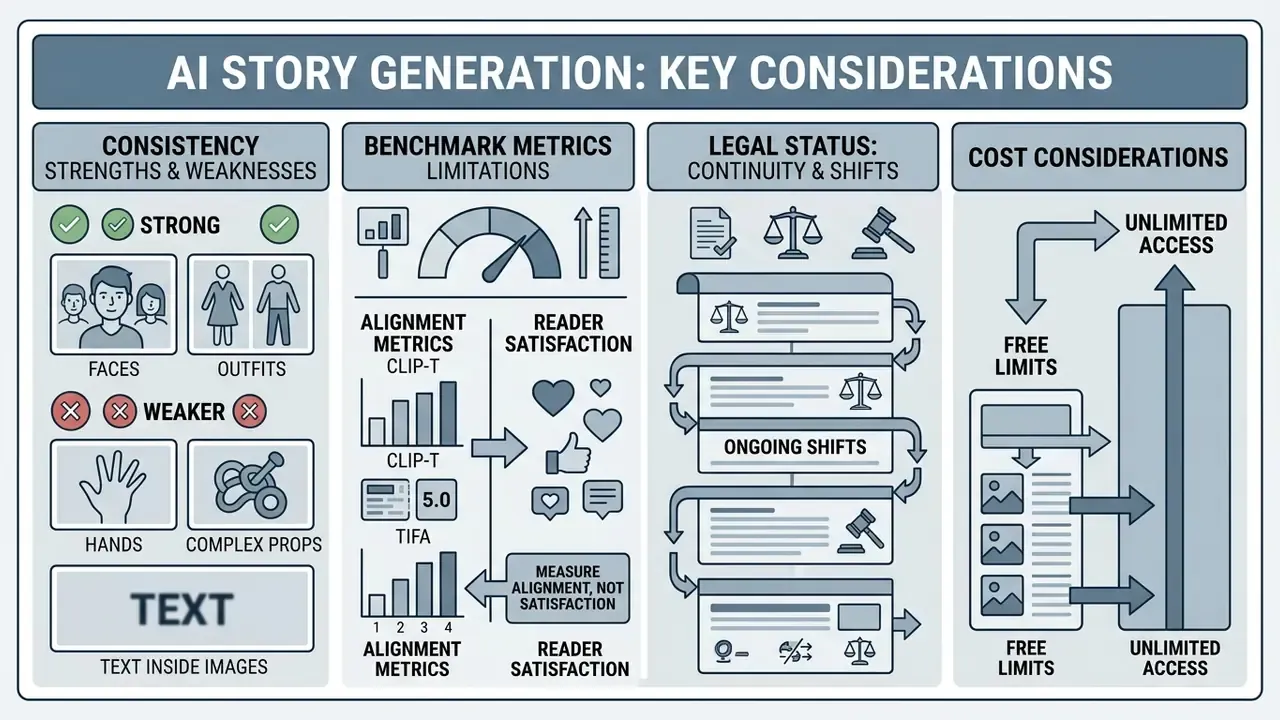
Limitations and Open Questions
FAQ: AI Story Generator With Images
Can our prompts and uploaded assets be used to train the vendor's public models?
That depends entirely on the contract, and it is the first clause a governance team should read. Enterprise agreements state that customer inputs and outputs are excluded from public model training, define a retention window (ideally zero data retention), and specify data residency. Consumer tiers frequently reserve broader rights. Since published policies also warn that inputs and generated outputs may contain personal information, treat prompts describing real people, customers, or internal processes as regulated data.
How do we make generated illustrated content auditable?
Log four elements for every published page: the exact prompt, the model and version, the random seed, and the human reviewer with a timestamp. Combined with fixed seeds and stored character reference sheets, that makes any page reproducible on demand, which is precisely what an internal auditor or examiner will ask for. Map those controls to NIST AI RMF or ISO/IEC 42001 so the tool sits inside your existing model-risk framework instead of beside it.
Who owns the output, and can we publish it commercially?
Ownership and copyrightability are different questions. Most major providers assign output ownership to the user by contract and permit commercial use, while the U.S. Copyright Office holds that purely machine-generated material lacking substantial human creative input cannot be registered. Practical consequence: you can usually publish and monetize, but you may not be able to enforce exclusivity over the raw generated elements. Document human contributions, that is outline, edits, selection, arrangement, and layout, because that is the protectable layer.
Do free tiers create a Shadow AI risk?
Yes. Free tiers often lack SSO, audit logs, retention controls, and commercial licensing, and they may stamp visible watermarks that are unusable in production. Publishing free-tier output externally can breach both licensing terms and internal data policy at the same time. The standard mitigation is a short approved-tools list plus a lightweight intake form for any new generative service.
Can I start generating without registration?
Many online platforms offer instant guest access, so you can test basic free ai image story generator features without an account. Guest modes usually cap daily requests (three to five generations is common) and block saving projects or exporting high-resolution PDFs. Guest sessions may also vanish when the browser tab closes. Full features require standard registration.
How fast does AI create a new story and images?
Modern multimodal architectures produce a complete illustrated page, meaning one text beat plus one visual panel, in roughly 2.5 to 5.0 seconds. Text synthesis is the cheap part; image synthesis dominates total latency. Published measurements support that split: in the NeurIPS 2023 GILL work, generating one image from an image token took about 3.5 seconds on average while retrieval overhead stayed under 0.001 seconds, and 2025 comparisons of multimodal architectures report end-to-end times of roughly 1.8 to 4.0 seconds per request. Serving-efficiency research also flags image encoding as a primary bottleneck in time-to-first-token. (Updated: the previously cited "over 80 percent of latency" figure was reworded because the referenced source could not be verified.)
Is the generator suitable for beginners and different languages?
Yes. Modern story generators use form-based interfaces that need no prompt-engineering skill, since genre, tone, length, and audience are dropdowns rather than syntax. Platforms built on models such as Gemini, ChatGPT, and GigaChat support multi-language generation, so users can write prompts and receive fully illustrated storybooks in English, Spanish, German, French, Italian, Portuguese, Dutch, Polish, and Russian. One caveat: interface localization and narration coverage do not always match text-generation coverage, so verify both. For complex deployments or audio and video troubleshooting, use our AI Media Support and Troubleshooting portal.
Editorial Corrections and Sourcing Log
For transparency, this update revised three earlier formulations.
Explore additional resources in our AI Media Glossary and model your own scenario with the AI Media Calculators.