Synthetic speech has stopped being a novelty in enterprise workflows. It now sits inside outbound notifications, IVR trees, servicing scripts, and internal training modules, which means it sits inside your control environment too. The ElevenLabs AI voice generator is currently the reference deep-learning stack for high-fidelity text-to-speech, voice cloning, and automated dubbing across digital media and automated customer channels. Evaluating AI voice generator & text to speech | ElevenLabs capabilities properly means looking at four things at once: neural architecture, credit-based pricing, commercial licensing limits, and the security and risk controls behind the contract.
Executive Summary: What Decision-Makers Need to Know
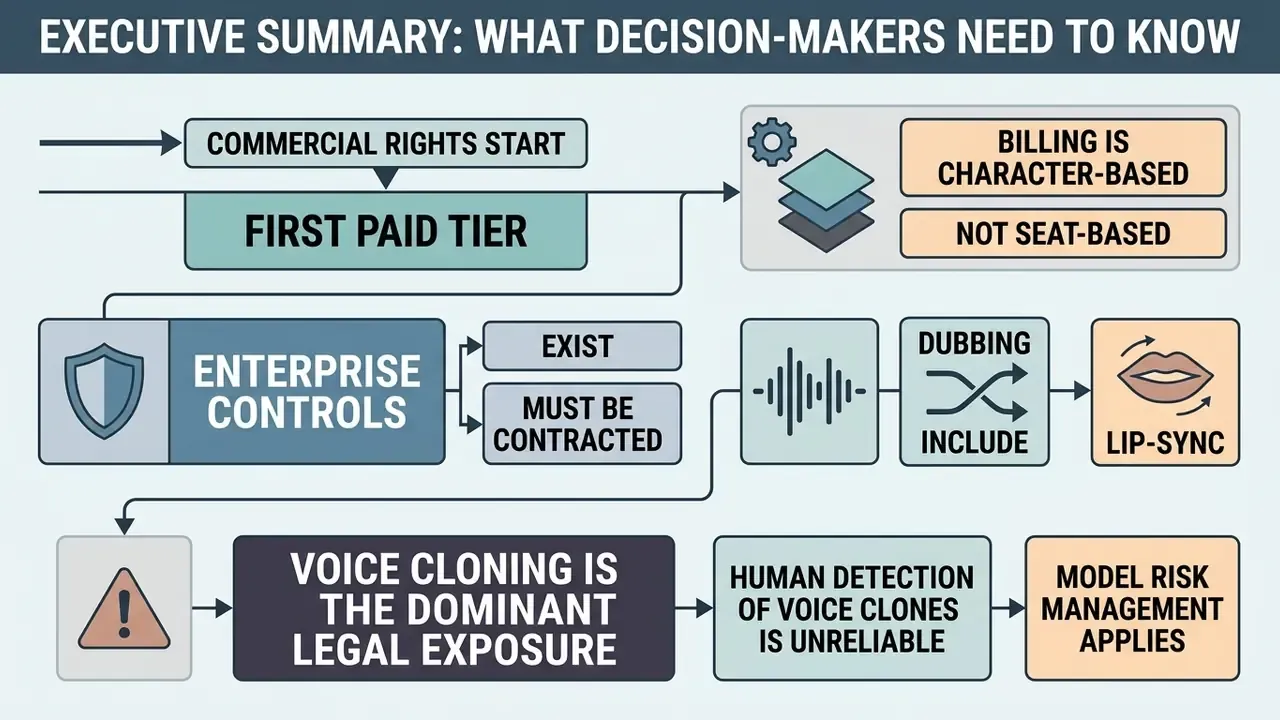
- Commercial rights start at the first paid tier. Free-tier audio is licensed for non-commercial use only and requires attribution. The Starter plan ($5 to $6 per month) is the minimum threshold for monetized or client-facing output (ElevenLabs Terms of Service, 2026).
- Billing is character-based, not seat-based. Standard models consume 1 credit per input character. Flash and Turbo v2.5 consume 0.5 credits per character on self-serve plans, which effectively doubles output per dollar for latency-sensitive workloads.
- Enterprise controls exist but must be contracted. SOC 2 Type II, ISO 27001, HIPAA, PCI DSS Level 1, GDPR, Zero Retention Mode, and regional data residency (US, EU, India) are available, mostly through Enterprise agreements rather than self-serve plans.
- Dubbing does not include lip-sync. ElevenLabs Dubbing v2 preserves speaker timbre across 90+ languages but performs no visual mouth alignment. That is a hard constraint for on-camera content.
- Voice cloning is the dominant legal exposure. Right-of-publicity statutes (Tennessee's ELVIS Act, 2024), FCC TCPA rules on AI voices in robocalls (2024), and state biometric privacy laws such as Illinois BIPA all apply to cloned-voice deployments.
- Human detection of voice clones is unreliable. Independent research shows listeners misclassify synthetic speech at rates close to chance. That raises the bar for voice-biometric authentication in banking and contact-center environments.
- Model risk management applies. Generative voice models in customer-facing channels fall within supervisory model risk expectations (SR 11-7 and OCC 2011-12 framing), which means documented validation, monitoring, and reproducible audit evidence.
Who This Guide Is For and Which Questions It Answers
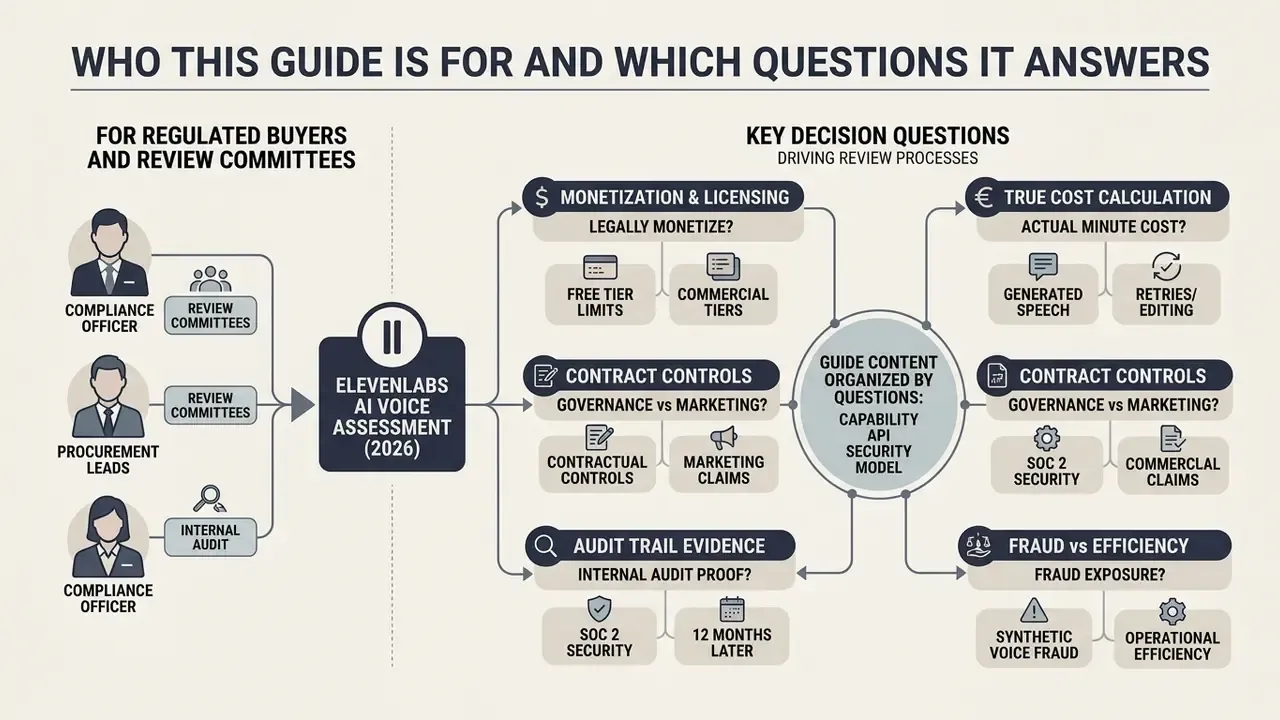
This is not a creator-blog walkthrough with a coupon at the bottom. It is written for the people who have to sign off: risk officers, model validation leads, procurement, and the finance transformation teams funding the pilot.
Five questions drive most of the decisions we see raised in review committees:
- Can we legally monetize this audio, and on which subscription tier?
- What does a single minute of generated speech actually cost once retries are counted?
- Which controls come with the contract, and which ones are marketing pages?
- What evidence will internal audit ask for twelve months from now?
- Where does synthetic voice create fraud exposure rather than efficiency?
Everything below is organized around those questions, in that rough order: capability, API, security, model risk, deepfake exposure, licensing, pricing, free-tier limits, interface mechanics, and vendor selection. If you own the budget, the pricing and licensing sections matter most. If you own the risk register, start at model risk. Teams comparing spend across tooling categories can also use our AI Media Pricing Guides and AI Media Calculators to build the cost model before the demo call.
What Is the ElevenLabs AI Voice Generator and Which Tasks It Solves
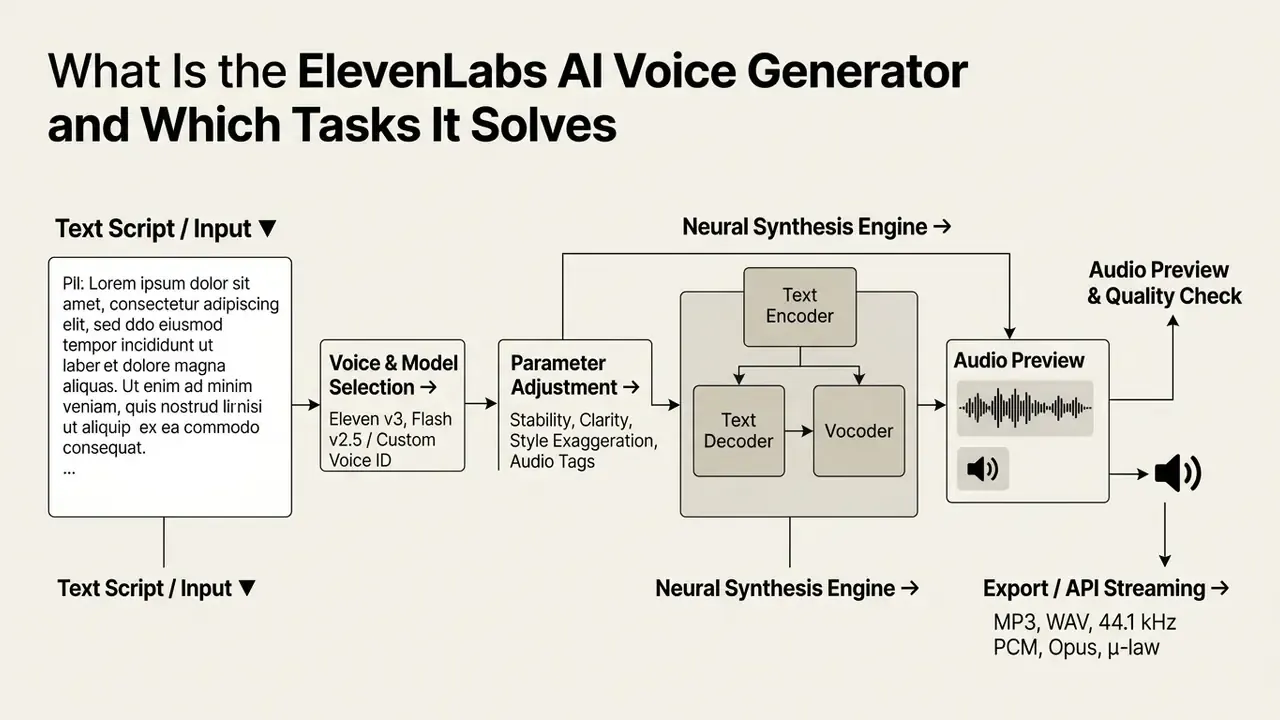
ElevenLabs is an AI audio research and deployment platform that turns written text into lifelike synthetic speech, builds voice clones, and translates audio tracks across languages. The core ElevenLabs AI voice generator text to speech engine uses deep neural networks to reproduce human prosody, emotional nuance, and pacing for commercial content, media production, and digital agents.
Company Profile and Institutional Trust Signals
ElevenLabs was founded in 2022 by Piotr Dąbkowski, a former Google machine-learning engineer, and Mati Staniszewski, a former Palantir deployment strategist. Operations are headquartered in London and New York. The elevenlabs ai voice generator elevenlabs company stack now spans text-to-speech, speech-to-text (Scribe), Instant and Professional voice cloning, voice design, dubbing, music generation, and real-time conversational agents.
Adoption signals matter for procurement committees weighing vendor durability. According to market analyses published across 2025 and 2026, ElevenLabs is used by roughly 41% of Fortune 500 companies, with named customers in media and publishing (The Washington Post, TIME, HarperCollins), gaming (Epic Games, Paradox Interactive), technology platforms (Meta, Salesforce, Square, Revolut, IBM via watsonx Orchestrate), telecommunications (Deutsche Telekom, RingCentral), and public-sector bodies. The same analyses cite a $500M raise at an $11B valuation in early 2026 and roughly $330M in annual recurring revenue for 2025.
How AI Voice Generation and Text-to-Speech Work
The Eleven Labs AI voice generator converts raw text into acoustic features using sequence-to-sequence neural architectures. Those features are then rendered into time-domain waveforms by high-fidelity neural vocoders. Unlike older parametric or concatenative synthesis, deep-learning text-to-speech predicts intonation, micro-pauses, and emotional inflection from context windows inside the input text (ElevenLabs Documentation, 2026).
«Neural TTS models predict intonation and emotional colouring from context windows in the input text, which separates them fundamentally from parametric systems.»
Text-to-speech and speech-to-text are opposite operations, and the distinction shows up on your invoice. Text-to-speech turns textual tokens into audible waveforms and bills per character. Speech-to-text, such as ElevenLabs Scribe, processes acoustic signals into written transcripts with word-error-rate minimization, and bills per audio minute.
Which Content Formats You Can Voice with ElevenLabs
The AI voice generator ElevenLabs platform supports a wide spread of audio production workflows across digital channels, enterprise media, and software interfaces. Creators and commercial teams use it for:
- Video voiceovers and social media narrated tracks for YouTube, TikTok, Reels, and promotional media. Teams publishing at volume usually pair generation with a repeatable YouTube video editing workflow.
- Audiobook narration and long reads multi-chapter manuscripts and ePub files converted into structured, multi-character audiobooks via ElevenLabs Studio, with chapter-level regeneration and editable narration.
- Podcasts and localized media multi-speaker segments, automated intros, transcription, and localized foreign-language editions.
- Corporate training and presentations synchronized voice tracks for compliance modules, slideshows, PDF and ePub imports, and internal documentation. This is where regulated firms tend to start, and sensibly so: no customer is on the other end.
- Conversational agents and applications low-latency streaming audio for support agents, IVR telephony, and interactive software. Buyers comparing vendors in this category can review our broader guide to AI voice generators.
Key Capabilities of the ElevenLabs AI Voice Generator
Reviewing the ElevenLabs AI voice generator features shipped across 2025 and 2026 shows a layered functional stack built for three very different buyers: individual creators, production studios, and software teams. Expressive synthesis, multi-language localization, cloning, and automated dubbing all run through one credit meter.
| Feature Area | Key Functionality | Primary Operational Benefit |
|---|---|---|
| Expressive Synthesis | Promptable emotion, audio tags ([whispers], [laughs]), parameter sliders | Precise control over vocal delivery, pitch stability, and style exaggeration |
| Multilingual Support | Up to 74 languages in Eleven v3, native accent preservation, four English accents | Global localization without replacing base speaker identities |
| Voice Cloning | Instant Voice Cloning (few-shot) and Professional Voice Cloning (PVC) | Rapid replication or high-fidelity biometric voice modeling |
| Video Dubbing | Automated multi-speaker translation with timing and tone matching, no lip-sync | Scalable international distribution across 90+ BCP-47 language codes |
| Developer API | REST, WebSockets, Python and TypeScript SDKs, low-latency streaming, 19 output codecs | Real-time integration into products, games, and conversational agents |
| Enterprise Governance | SOC 2 Type II, ISO 27001, HIPAA, PCI DSS L1, GDPR, Zero Retention Mode | Contractable controls for regulated industries and customer-data workflows |
Naturalness, Emotional Expressiveness, and Delivery Control
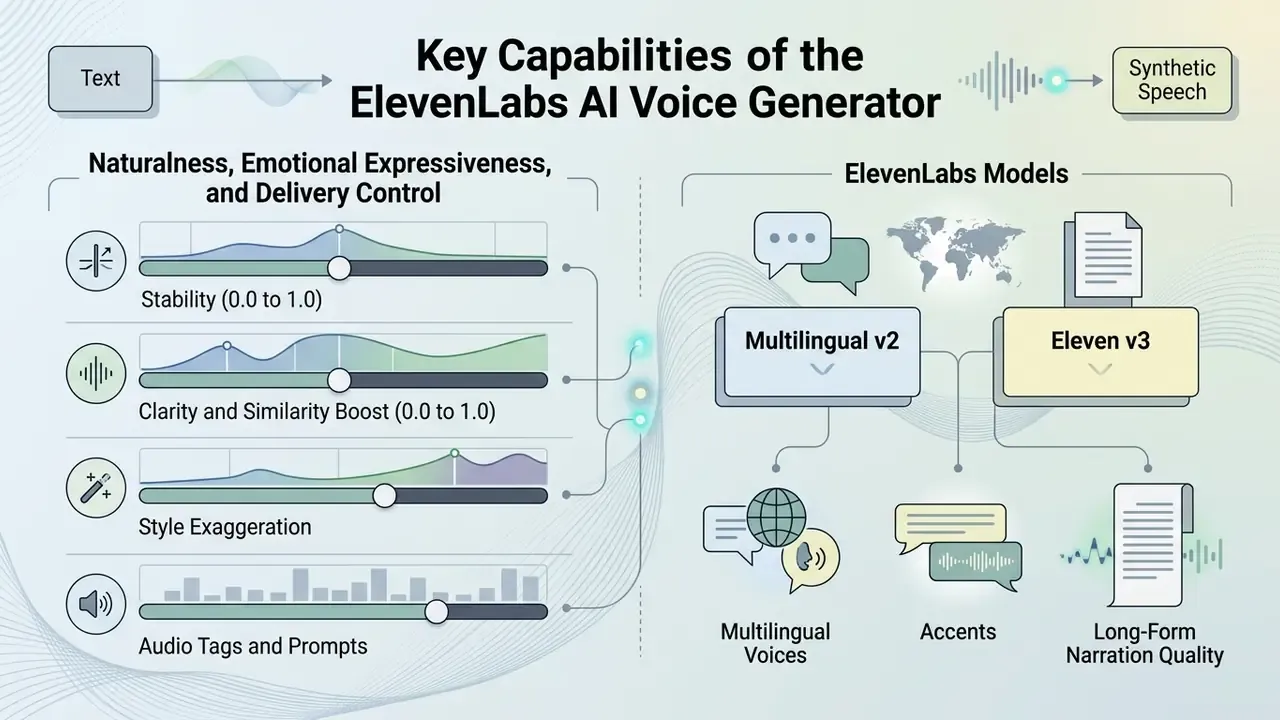
The ElevenLabs voice engine exposes four primary controls over delivery and prosody:
- Stability (0.0 to 1.0)lower values increase emotional variance and dynamism. Higher values enforce steady intonation, which suits news reads and technical documentation. API default is 0.5 (ElevenLabs Documentation, 2026).
- Clarity and Similarity Boost (0.0 to 1.0)mapped to
similarity_boostin the API and to "Clarity + Similarity Enhancement" in the web app. It sharpens target speaker presence, though pushing it too high introduces audible artifacts. Default: 0.75. - Style Exaggerationamplifies the distinctive stylistic traits of the underlying speaker. Default is 0.0. Anything above zero raises compute, adds latency, and slightly reduces stability, so documentation recommends leaving it alone unless you genuinely need dramatic emphasis.
- Audio Tags and Promptsinline bracketed directives such as
[whispers],[excited],[pauses],[laughs],[sighs],[sarcastically], or[rushed]inject non-verbal expression and emotional shifts straight into the script.
Practical tagging example:
[excited] The quarterly results are in, and they beat every internal forecast.
[pauses] [whispers] But there's one number nobody expected.
[laughs] Turns out the compliance team was right all along.
Tags are voice-dependent and context-dependent. Some voices honour a given tag reliably, others shrug at it. Test tag behaviour per voice ID before you lock a production script, especially for anything a customer will hear.
ElevenLabs Models, Multilingual Voices, Accents, and Long-Form Narration Quality
The platform maintains separate model families tuned to different latency, cost, and expressiveness targets:
- Eleven v3 the flagship expressive model, 70+ languages, built for character dialogue, long-form narration, and wide emotional range. It supports four base English accents with emotion preserved: American, British, Australian, and Indian, plus word-level timestamps for subtitling and alignment.
- Multilingual v2 the studio-quality benchmark model, 29 primary languages, recommended in official documentation as the default for audiobooks and formal long reads. It carries the same four English accent variants and trades emotional range for reliability across structured scripts (ElevenLabs Documentation, 2026).
- Flash v2.5 and Turbo v2.5 low-latency inference models covering 32 languages (v2 languages plus Hungarian, Norwegian, and Vietnamese), optimized for real-time use and high-volume API pipelines at half the standard credit cost per character.
Updated benchmark evidence. Independent evaluation gives measured signals rather than promotional ones:
«The MAMBA benchmark evaluated five leading TTS systems on 1,334 challenging samples; ElevenLabs Multilingual v2 and v3 ranked among strong baseline models.»
For audiobook and documentary work this matters more than a polished single-sentence demo. Speaker identity preservation across chapters, not per-sentence realism, decides whether a production needs manual re-recording. One drifting chapter can cost more studio time than the entire subscription saved.
Voice Cloning, Dubbing, and APIs for Products and Agents
The ElevenLabs AI stack reaches past basic text rendering into acoustic replication and programmatic integration:
Instant Voice Cloning: Exact Upload Requirements
Critical Dubbing Constraint: No Lip-Sync
Developer API: Parameters, Output Formats, and Code
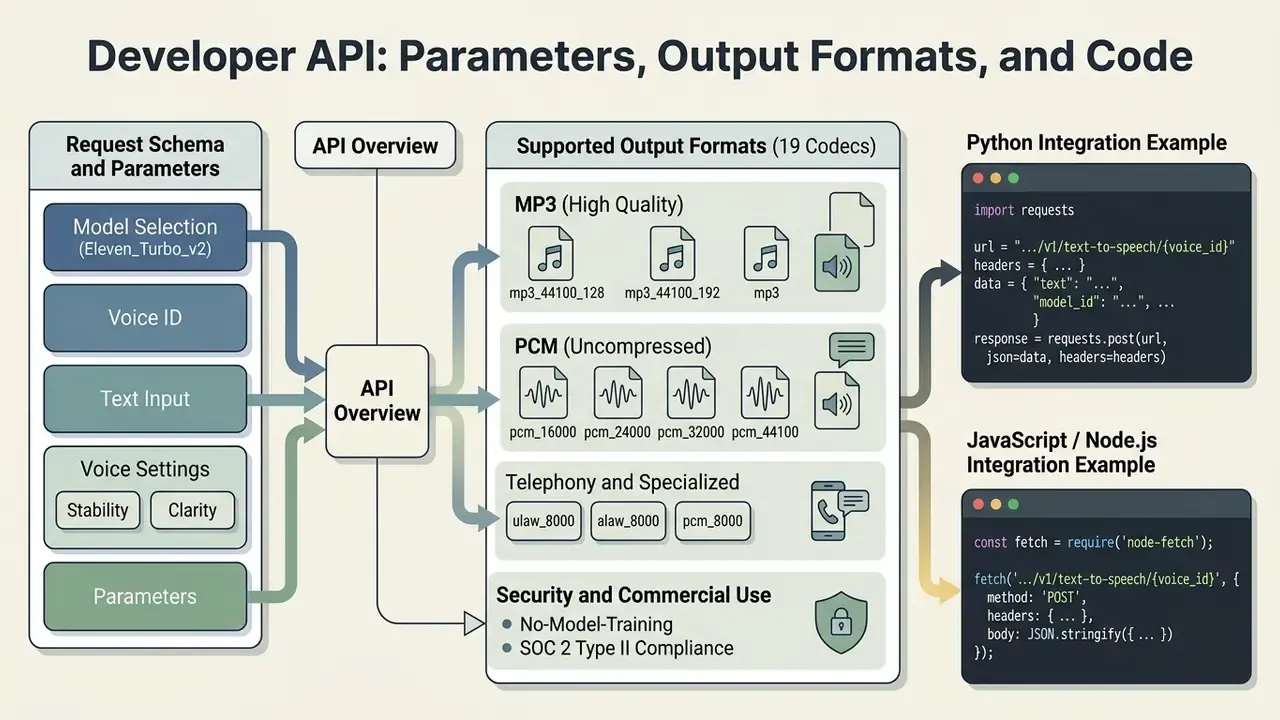
Enterprise deployments live in the API, not the browser. Studio is a prototyping surface; the API carries production traffic. Text-to-speech bills per input character, speech-to-text bills per audio minute, and API access is included on every plan, with concurrency and audio quality gated by tier.
Request Schema and Parameters
| Parameter | Type | Description | Default |
|---|---|---|---|
text | string | Source text, supports inline audio tags ([laughs], [whispers], [excited]) | Required |
voice | string | Voice name or voice ID (Aria, Rachel, Roger, Sarah, Laura, Charlie, George, Callum, River, Liam, Charlotte, Alice, Matilda, Will, Jessica, Eric, Chris, Brian, Daniel, Lily, Bill) | "Rachel" |
model_id | string | Synthesis model (eleven_v3, eleven_multilingual_v2, eleven_flash_v2_5) | Plan-dependent |
stability | float (0..1) | Tonal stability; lower means more expressive variation | 0.5 |
similarity_boost | float (0..1) | Closeness to the reference voice | 0.75 |
style | float (0..1) | Style exaggeration; raises compute and reduces stability | 0.0 |
speed | float | Playback speed multiplier | 1.0 |
language_code | string | ISO 639-1 code to force a specific language | null |
apply_text_normalization | enum | Expansion of numbers, dates, abbreviations (auto, on, off) | auto |
seed | int | Numeric seed for reproducible generations, essential for audit evidence | null |
timestamps | bool | Returns per-word timings for subtitles, QA, and alignment | false |
output_format | enum | Codec, sample rate, and bitrate | mp3_44100_128 |
Supported Output Formats (19 Codecs and Bitrates)
- MP3
mp3_22050_32,mp3_44100_32,mp3_44100_64,mp3_44100_96,mp3_44100_128(default),mp3_44100_192 - PCM (uncompressed)
pcm_8000,pcm_16000,pcm_22050,pcm_24000,pcm_44100,pcm_48000 - Telephony and specialized
ulaw_8000,alaw_8000,opus_48000_32,opus_48000_64,opus_48000_96,opus_48000_128,opus_48000_192
Practical guidance. Use ulaw_8000 or alaw_8000 for legacy contact-center and SIP telephony trunks. Reserve pcm_44100 and pcm_48000 for broadcast-standard mastering; both sit on Pro tier and above. For WebRTC conversational agents, opus_48000_* is the efficient default.
Example Request and Response
{
  "text": "Hello! [excited] This is a test of the text to speech system. [whispers] How does it sound?",
  "voice": "Aria",
  "model_id": "eleven_v3",
  "stability": 0.5,
  "similarity_boost": 0.75,
  "speed": 1,
  "apply_text_normalization": "auto",
  "seed": 42,
  "timestamps": true,
  "output_format": "mp3_44100_128"
}
{
  "audio": { "url": "https://cdn.example.media/files/output.mp3" },
  "timestamps": [
    { "word": "Hello", "start": 0.00, "end": 0.42 },
    { "word": "This",  "start": 0.71, "end": 0.93 }
  ]
}
Python Integration Example
import requests, os
resp = requests.post(
    "https://api.elevenlabs.io/v1/text-to-speech/{voice_id}",
    headers={
        "xi-api-key": os.environ["ELEVENLABS_API_KEY"],
        "Content-Type": "application/json",
    },
    json={
        "text": "Quarterly compliance briefing, section one.",
        "model_id": "eleven_multilingual_v2",
        "voice_settings": {"stability": 0.6, "similarity_boost": 0.8, "style": 0.0},
        "seed": 42,
    },
    params={"output_format": "pcm_44100"},
    timeout=60,
)
resp.raise_for_status()
open("briefing.wav", "wb").write(resp.content)
JavaScript / Node.js Integration Example
const res = await fetch(
  `https://api.elevenlabs.io/v1/text-to-speech/${voiceId}?output_format=mp3_44100_128`,
  {
    method: "POST",
    headers: {
      "xi-api-key": process.env.ELEVENLABS_API_KEY,
      "Content-Type": "application/json",
    },
    body: JSON.stringify({
      text: "Your appointment has been confirmed.",
      model_id: "eleven_flash_v2_5",
      voice_settings: { stability: 0.5, similarity_boost: 0.75 },
    }),
  }
);
const buffer = Buffer.from(await res.arrayBuffer());
Security requirement: API keys must never sit in client-side code, mobile bundles, or browser JavaScript. Route every request through a server-side proxy you control, and log seed, model_id, voice_id, and a request hash per call so downstream audit reconstruction is possible. If that logging feels like overhead now, compare it with the cost of reconstructing a disputed customer call from memory.
Enterprise Security, Data Privacy, and SOC 2 Compliance
For regulated buyers, banks, insurers, healthcare providers, and fintech platforms, voice quality is the secondary criterion. Three questions control the decision: where does the audio live, who can access it, and is it used to train future models?
| Control Domain | Available Capability | Procurement Note |
|---|---|---|
| Security attestation | SOC 2 Type II, ISO 27001 | Request current report and bridge letter under NDA |
| Healthcare | HIPAA alignment, BAA availability | BAA is Enterprise-contract dependent |
| Payments | PCI DSS Level 1 | Confirm scope boundary for voice-channel data |
| Privacy regimes | GDPR with DPA available, CCPA and CPRA | Confirm sub-processor list and transfer mechanism |
| Training-data usage | Zero Retention Mode | Prompt and audio retention disabled; confirm contractually, not by UI toggle |
| Data residency | US, EU, India regions | Verify region pinning for both TTS and STT paths |
| Access control | Workspace seats, SSO and SAML on higher tiers | Map to internal joiner-mover-leaver process |
Data-governance questions to close before pilot approval:
Self-serve tiers do not substitute for these controls. A Business plan buys throughput. Only an Enterprise agreement buys the contractual assurances that model-risk and vendor-management committees actually accept. Procurement teams building comparison sheets across vendors may find our AI Media Comparison Matrices useful as a starting frame, and our AI Media Support notes cover escalation questions worth writing into the order form.
Model Risk Management and Audit Evidence
The moment synthetic voice touches customers, through outbound notifications, IVR, collections, or servicing, it becomes an in-scope model under supervisory expectations (SR 11-7 and OCC 2011-12 framing). The checklist below turns that expectation into a reproducible artifact set.
Checklist0 / 12
Vendor models get updated without your permission. That single fact makes timestamped, seeded request logs the only realistic way to reconstruct what a customer heard on a given date. Build the logging before the pilot, not after the audit finding. Firms tracking how disputes over generated content play out can follow the AI Litigation and Case Timelines for pattern awareness.
Deepfake Risk, Voice Spoofing, and Shadow AI Controls
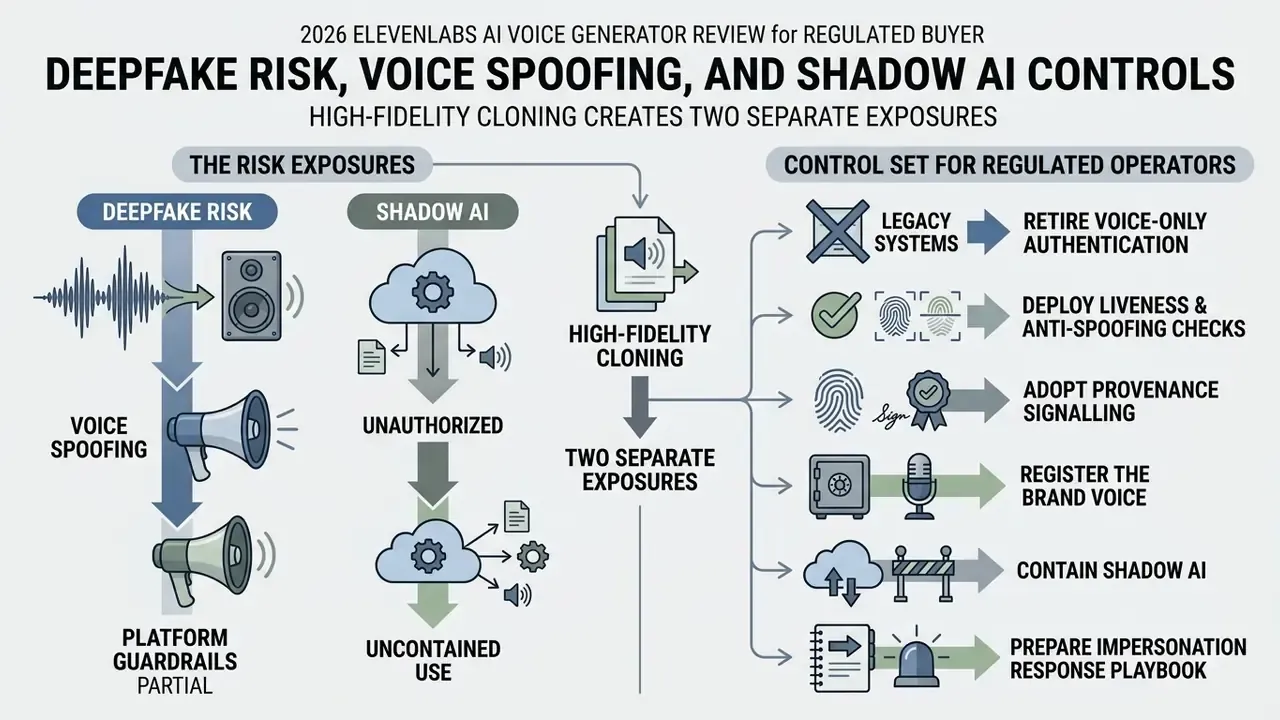
High-fidelity cloning creates two separate exposures. Your brand voice can be impersonated externally. And your own authentication stack can be defeated by synthetic audio. Different problems, same technology.
Human detection is not a control. Experimental work quantifies how poorly listeners perform:
«Participants misattributed an AI voice to a real person in 79.8% of cases and identified synthetic speech correctly only 66.3% of the time.»
Platform guardrails are partial. A structured NGO test of commercial cloning tools found real variance between vendors:
«Six popular voice-cloning tools produced convincing clones of politicians in 80% of 240 attempts; ElevenLabs alone blocked cloning of US and UK political figures.»
Control set for regulated operators:
- Retire voice-only authentication. Voiceprint matching belongs inside a multi-factor decision as a low-weight signal, never as a standalone credential for account access or high-value transactions.
- Deploy liveness and anti-spoofing checks in the IVR path: challenge-response, device and telephony metadata signals, replay detection. Speaker-similarity scoring alone is not enough.
- Adopt provenance signalling. Where available, apply audio watermarking and C2PA-style content credentials to first-party synthetic audio, so downstream systems can tell authorized brand voice from impersonation.
- Register the brand voice. Keep an internal registry of approved voice IDs, cloned-voice consent records, and the exact channels each voice may appear in. Anything outside the registry is suspicious by default.
- Contain Shadow AI. Employees generating voice assets on personal free-tier accounts create three problems at once: no commercial licence, no data-processing agreement, no audit trail. Mitigate with egress controls on unmanaged AI endpoints, a sanctioned enterprise workspace, and expense-policy rules that stop personal AI subscriptions being reimbursed. This pattern is not limited to audio, and the same gap shows up wherever consumer AI tools reach staff, from image tooling to chat companions such as the filter debates around did character ai products.
- Prepare an impersonation response playbook: takedown contacts, evidence-preservation steps, customer notification templates, and a pre-agreed escalation route into fraud and communications teams.
Commercial Use of ElevenLabs: Voiceover Rights and Voice-Cloning Risk
Putting synthesized audio into revenue-generating channels triggers obligations under copyright, right of publicity, and telecommunications regulation. Assessing the ElevenLabs AI voiceover generator for commercial work means setting those controls before the first publish, not after.
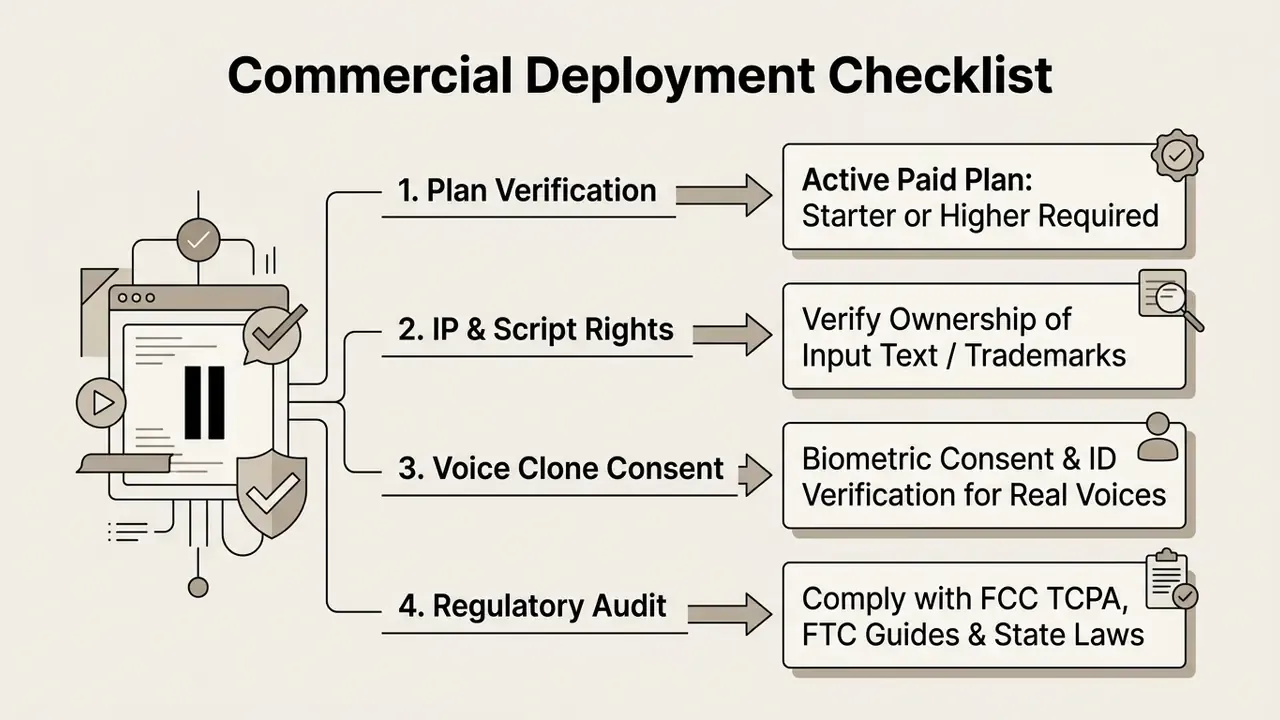
Which Commercial-Use Conditions to Verify in Your Plan
Commercial rights attach to paid subscription tiers only:
«Free Users may use the Services only for non-commercial purposes, while Paid Users may use the Services for commercial purposes, subject to the Prohibited Use Policy.»
Licensing language varies sharply between generative vendors, which is why cross-tool comparisons help. Our AI Media Commercial-Use Hub tracks those differences, including the Canva AI Generator commercial-use overview.
What to Consider When Creating a Voice Clone
Cloning a real person's voice introduces legal and regulatory risk that has to be governed explicitly:
- Biometric consent and rights of publicityunauthorized cloning of an individual's voice breaches right-of-publicity statutes, for instance Tennessee's ELVIS Act of 2024, and common-law privacy doctrines (FTC Enforcement Guidance, 2024). In states with biometric privacy statutes, a voiceprint may qualify as a biometric identifier requiring written release, retention schedules, and disclosure.
- Identity verification policiesElevenLabs enforces technical voice verification for Professional Voice Cloning, matching submitted samples against real-time voice consent recordings. Help-centre policy further restricts Professional Voice Clones to the account holder's own voice, even where third-party consent exists.
- Telecommunications regulatory riskthe Federal Communications Commission determined in 2024 that AI-generated human voices in telemarketing and robocalls fall under the Telephone Consumer Protection Act, requiring prior express written consent.
«The FCC ruled in 2024 that AI-generated voices used in robocalls fall under the TCPA and require prior express written consent.»
- Prohibited-use alignment: the platform's Prohibited Use Policy forbids intentionally replicating another person's voice without consent or legal right, including acting on that person's behalf. Mirror that language in internal policy so contractual and platform obligations do not drift apart.
Alert Box: verify rights before commercial publication
ElevenLabs Pricing, Credits, and Choosing a Plan for Your Workload
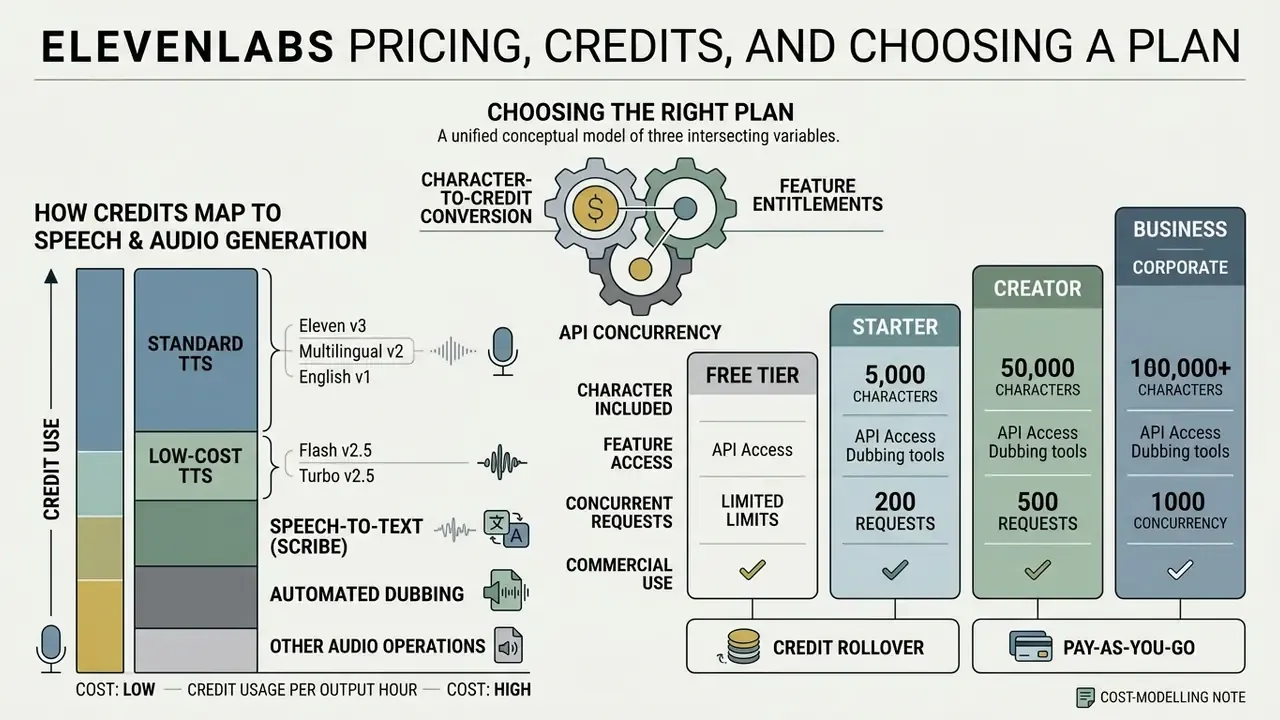
Choosing the right plan means modelling three variables together: character-to-credit conversion, feature entitlements, and API concurrency. Buyers building comparative cost models across creative tooling can also review our comparison of leading AI art generators for adjacent budgeting patterns.
| Plan Tier | Price (Monthly / Annual) | Monthly Credits | Approx. TTS Minutes | Voice Cloning Rights | Commercial License | API Access & Concurrency |
|---|---|---|---|---|---|---|
| Free | $0 | 10,000 | ~10 mins | None (3 custom slots) | No, non-commercial | Basic API, 2 to 4 concurrent |
| Starter | $5 / $6 | 30,000 | ~30 mins | Instant Voice Cloning | Yes, commercial | Standard API |
| Creator | $18.33 / $22 | 121,000 | ~121 mins | Professional Voice Cloning | Yes, commercial | Standard API |
| Pro | $82.50 / $99 | 600,000 | ~600 mins | Professional Voice Cloning | Yes, commercial | High-speed API, 44.1 kHz PCM, 10 to 20 concurrent |
| Scale | $249.17 / $299 | 1,800,000 | ~1,800 mins | 3 professional clones | Yes, commercial | 15 to 30 concurrent, 3 workspace seats |
| Business | $825 / $990 | 6,000,000 | ~6,000 mins | 10 professional clones | Yes, commercial | Enterprise SLA, low-latency TTS from $0.05/min, 10 seats |
| Enterprise | Custom | Custom | Custom | Custom clone allocation | Yes, negotiated terms | Dedicated concurrency, data residency, Zero Retention, SSO |
Data verified against official ElevenLabs pricing and Terms documentation as of August 2026.
«The Creator plan at 121,000 credits delivers roughly 121 minutes of TTS monthly; the Pro plan at 600,000 credits delivers roughly 600 minutes.»
How Credits Map to Speech and Audio Generation
The Eleven Labs AI voice generator platform runs one credit system across the whole toolset:
- Standard TTS (Eleven v3, Multilingual v2, English v1, Multilingual v1) 1 credit per input character.
- Low-cost TTS (Flash v2.5, Turbo v2.5) 0.5 credits per input character on self-serve plans. Enterprise agreements may land between 0.5 and 1 credit depending on negotiated discounting.
- Speech-to-Text (Scribe) about 330 credits per minute of processed audio in the web interface, roughly $0.22 per hour via API.
- Automated dubbing 1 credit per character for each added translation language, plus standard character-rate audio generation per target language.
- Other audio operations such as voice isolation are billed per second of processed audio rather than per character.
- Credit rollover and pay-as-you-go unused credits roll over for up to two billing cycles on paid plans. Top-up credits stay valid for 12 months, with up to 250 top-ups permitted per month.
Cost-modelling note. Published credit-to-character rules have differed between the main pricing page and individual help-centre articles across 2026 updates. Finance teams should confirm the applicable conversion rate in their own order form rather than trusting a marketing page. And model spend against characters submitted, not audio minutes delivered: retries and rejected takes consume credits at full rate. In one internal estimate we ran for a 40-episode e-learning series, retries added close to 18% on top of the first-pass character count. Directional, not audited, but it changed the budget line.
How to Choose a Plan for Creators, Teams, and API Projects
Tier selection follows output volume, team structure, and deployment model:
- Independent creators the Creator plan at $22 per month is the practical sweet spot, with 121,000 credits and Professional Voice Cloning unlocked for audiobooks and social channels.
- Production studios and agencies Pro at $99 or Scale at $299 provide high-volume credit pools, 44.1 kHz PCM studio exports, and multi-seat workspaces. Studios standardizing a post-production stack may also want our guide to video compressors for delivery-format planning.
- Software developers and enterprises Business at $990 or Enterprise tiers deliver dedicated concurrency queues, sub-100 ms latency SLAs, and custom commercial terms for automated voice agents. A lower-cost API-only entry point, from roughly $11 per month with 11k credits, exists for early integration testing.
«The Pro plan allows 10 concurrent Multilingual requests and 20 concurrent Flash requests; Scale and Business raise these ceilings to 15 and 30.»
Concurrency, not credit volume, is usually what breaks a conversational-agent rollout first. A contact centre handling 40 simultaneous calls cannot run on a 20-concurrency ceiling, no matter how healthy the credit balance looks on the dashboard.
The Free ElevenLabs AI Voice Generator: What the Free Tier Includes
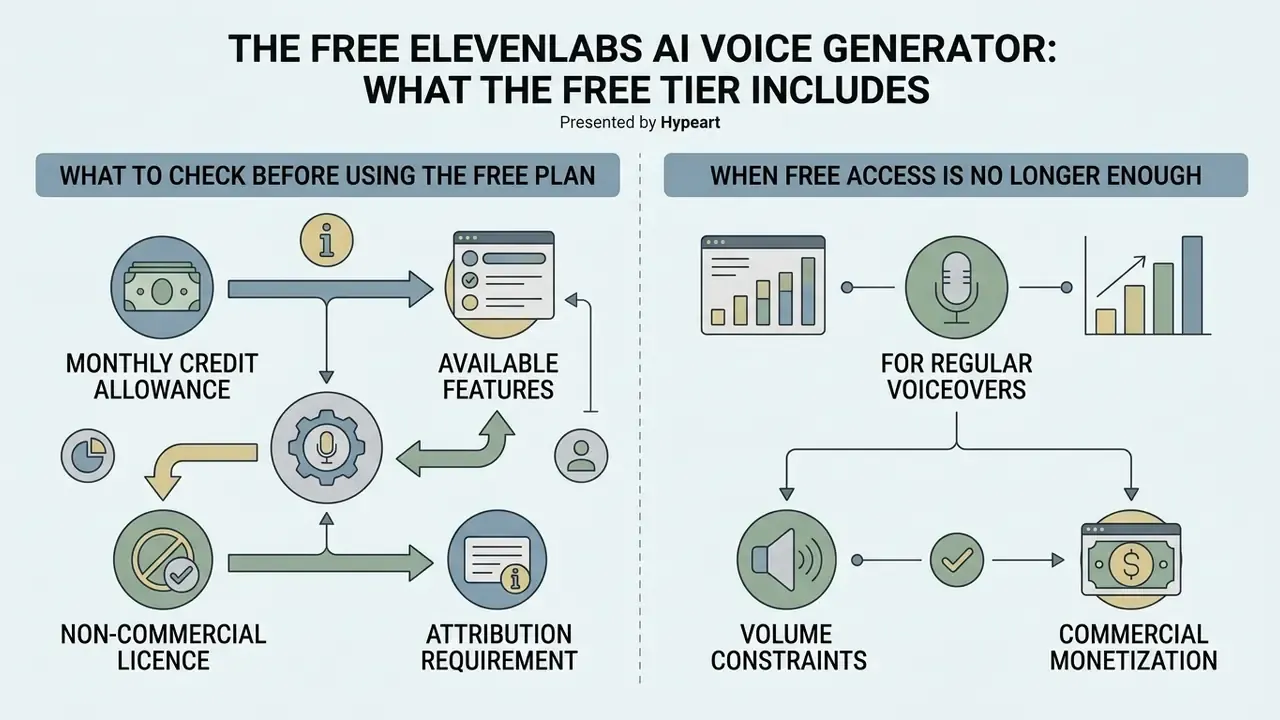
Understanding the capability and legal limits of the ElevenLabs free AI voice generator tier matters for individual creators and for enterprise evaluation teams sizing a pilot before they commit budget.
What to Check Before Using the Free Plan
The ElevenLabs AI voice generator free plan is a low-risk way to test the platform:
- Monthly credit allowance 10,000 credits per month, roughly 10,000 text characters or about 10 minutes of standard TTS audio on standard models.
- Available features default stock voices, Voice Design parameter tools, limited speech-to-text via Scribe, and up to 3 custom voice slots.
- Non-commercial licence free-tier output is limited strictly to non-commercial, personal, or educational projects (ElevenLabs Terms of Service, 2026).
- Attribution requirement public distribution of free-tier audio requires explicit attribution in the project title or description, naming "elevenlabs.io" or "11.ai", with a separate label applied to Eleven Music output. Teams benchmarking free-tier limits across categories can compare patterns in our guide to free photo editors.
«The free plan includes 10,000 credits, roughly 10 minutes of TTS; Flash and Turbo models effectively double that volume at 0.5 credits per character.»
When Free Access Is No Longer Enough for Regular Voiceovers
The eleven labs free ai voice generator tier, sometimes marketed as free forever access, stops being sufficient once needs move past prototyping:
- Volume constraints10,000 credits per month disappear into roughly one 1,500-word script. Using a standard English ratio of about 5.5 characters per word including spacing, a 1,500-word narration consumes around 8,250 characters, and regenerating a few imperfect takes eats the rest. (Character-per-word ratio is an editorial estimate based on standard English prose; actual consumption varies by language, punctuation density, and retry count.)
- Commercial monetizationmonetizing on YouTube, in social ads, in podcasts, or in client deliverables requires a paid commercial licence.
- Voice cloning accessInstant and Professional cloning are blocked on the free plan and need Starter or Creator.
- Broadcast audio standardsuncompressed 44.1 kHz PCM WAV exports and higher concurrency belong to higher tiers.
- Governance gapsfree accounts come with no data-processing agreement, no retention controls, and no workspace-level access management. That alone disqualifies them from any regulated or customer-data workflow.
Using the ElevenLabs Interface: Creating and Exporting a Voiceover
This section is a practitioner quick-reference. Readers focused on API, security, and governance can move straight to the vendor-selection section below.
Generating custom audio through the ElevenLabs AI voice generator interface follows a browser-based workflow inside ElevenLabs Voiceover Studio. You pick a model, configure voice parameters, enter the script, preview, and export.
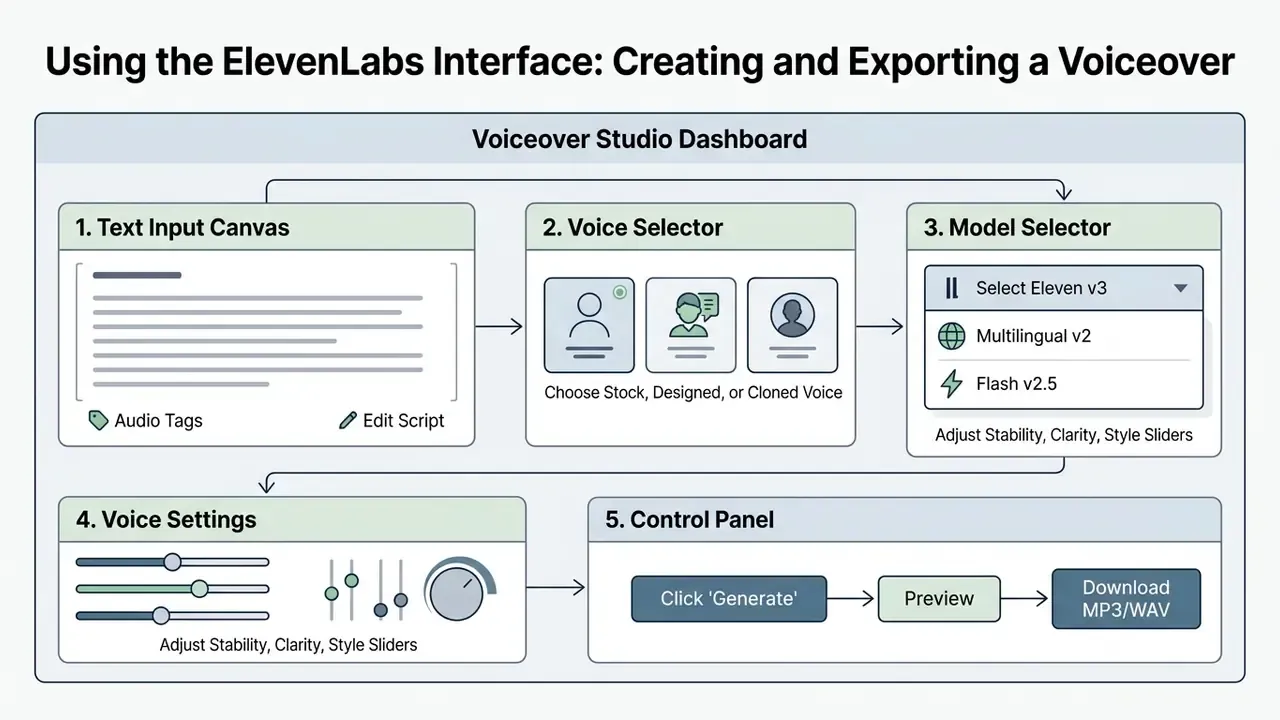
Choosing a Voice, Model, and Settings Before Generation
To prepare a generation on the ElevenLabs AI voice generator site:
- Open Voiceover Studio from the main navigation panel, Audio Tools then Voiceover Studio, on the ElevenLabs AI voice generator website.
- Open the Voice Selector to choose a stock acoustic profile, a community voice from the Voice Library, or a cloned voice profile of your own. Filters cover age, gender, accent, and use case.
- Select the Model: Eleven v3 for maximum expressiveness, Multilingual v2 for audiobooks, Flash v2.5 for fast drafts.
- Adjust the Voice Settings sliders: Stability near 0.50 for balanced delivery, Clarity near 0.75 for clear articulation, and Style Exaggeration left at 0.0 unless you need dramatic emphasis.
Entering Text, Reviewing Output, and Downloading Audio
Once parameters are set in the AI voice generator 11 Labs workspace:
Key interface elements:
- Type or paste the target script into the primary text canvas.
- Embed optional audio tags, for example
[pauses]or[soft tone], to guide prosody where it matters. - Click Generate to render the script into speech.
- Preview the result in the inline player. If specific lines need work, edit that block or tweak its settings and re-generate only that block. This is the single easiest way to conserve credits.
- Click Export to download. Choose compressed MP3 at 128 or 192 kbps, or uncompressed WAV / 44.1 kHz PCM on Pro and higher tiers. The export tab shows bitrate and sample rate before download. From there, editors can move into their YouTube publishing workflow for assembly and delivery.
- Script editor canvasmulti-paragraph text area supporting inline audio tags and segment-level editing.
- Voice library pickersearchable filtering by age, gender, accent, and use case.
- Model selection menutoggles between flagship, multilingual, and low-latency Turbo and Flash models.
- Parameter adjustment panelfine-tunes Stability, Similarity and Clarity, and Style Exaggeration.
- Generation and download bartriggers rendering, shows live credit consumption, exports MP3 and WAV.
Teams that also build visual assets around voiced content, from thumbnails to community graphics, often keep adjacent reference material nearby, such as our discord intro template guide for short branded openers.
When to Choose ElevenLabs for Voice Generation and When Other Tools Fit Better
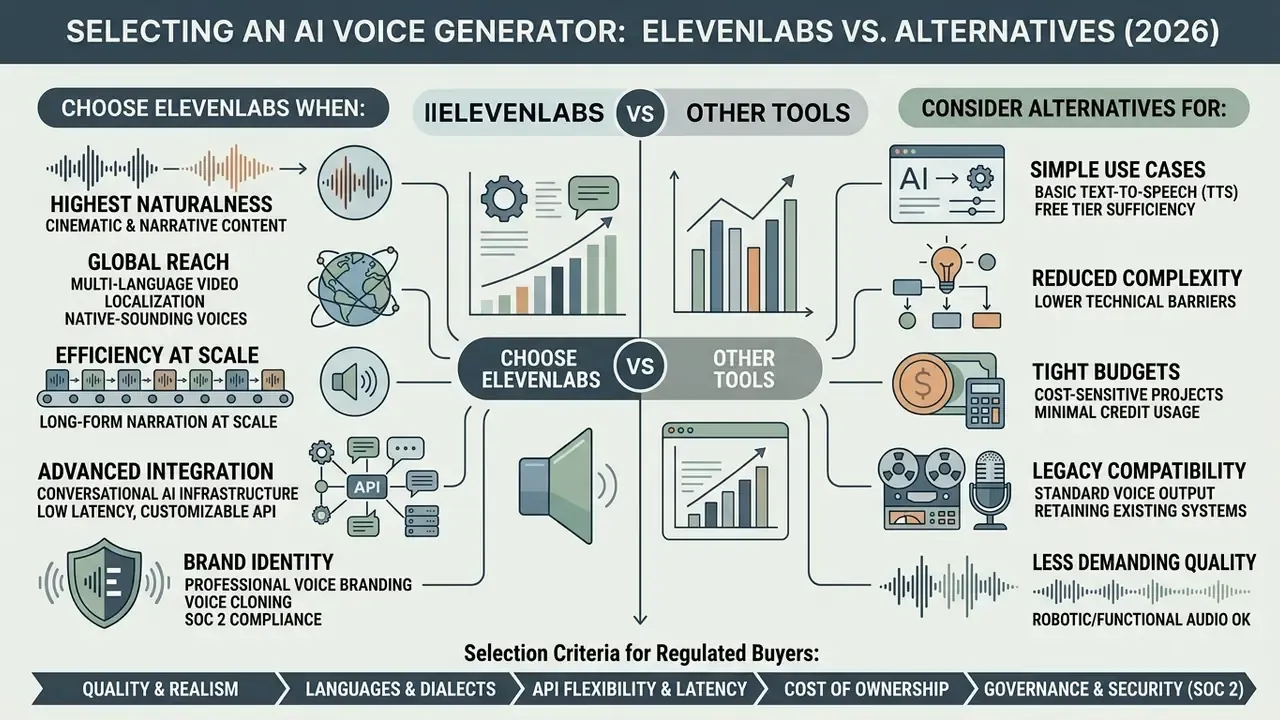
Deciding between the ElevenLabs AI voice generator and alternative platforms comes down to naturalness, latency, architecture, governance features, and total cost of ownership. A wider market view sits in our guide to AI voice generators.
Scenarios Where ElevenLabs Is Especially Strong
The eleven ai voice generator stack leads in several specific domains:
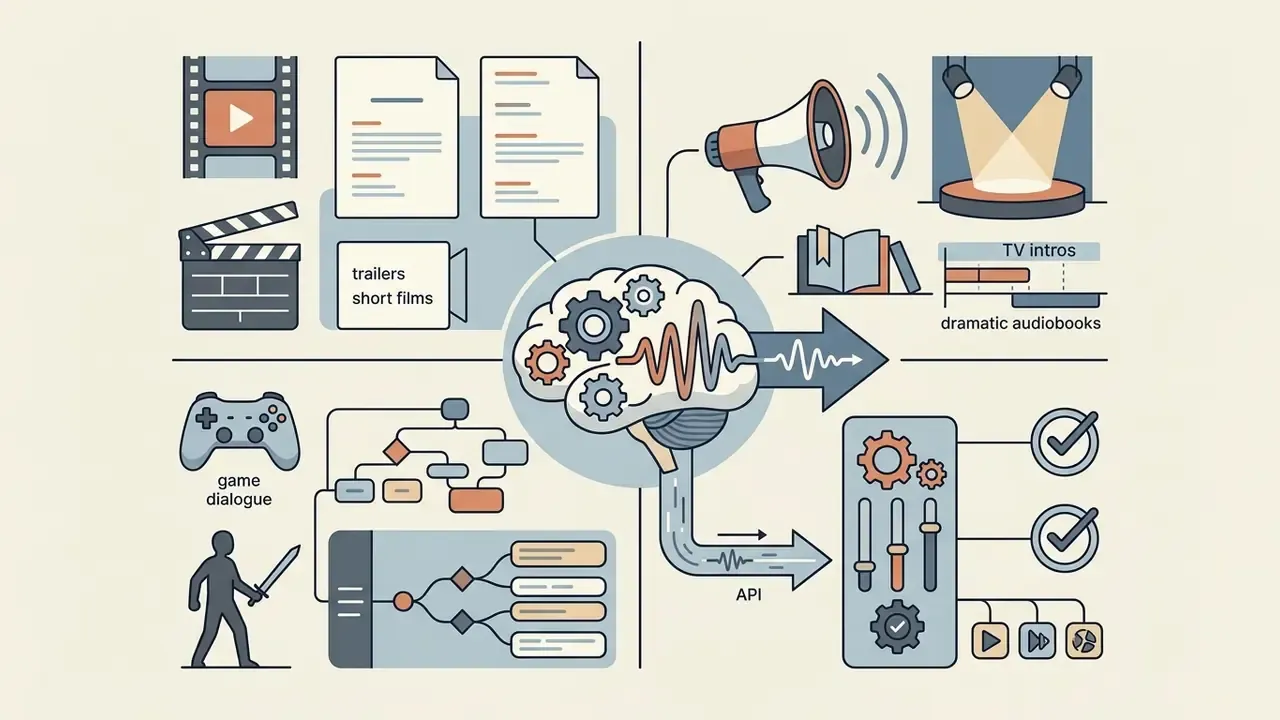
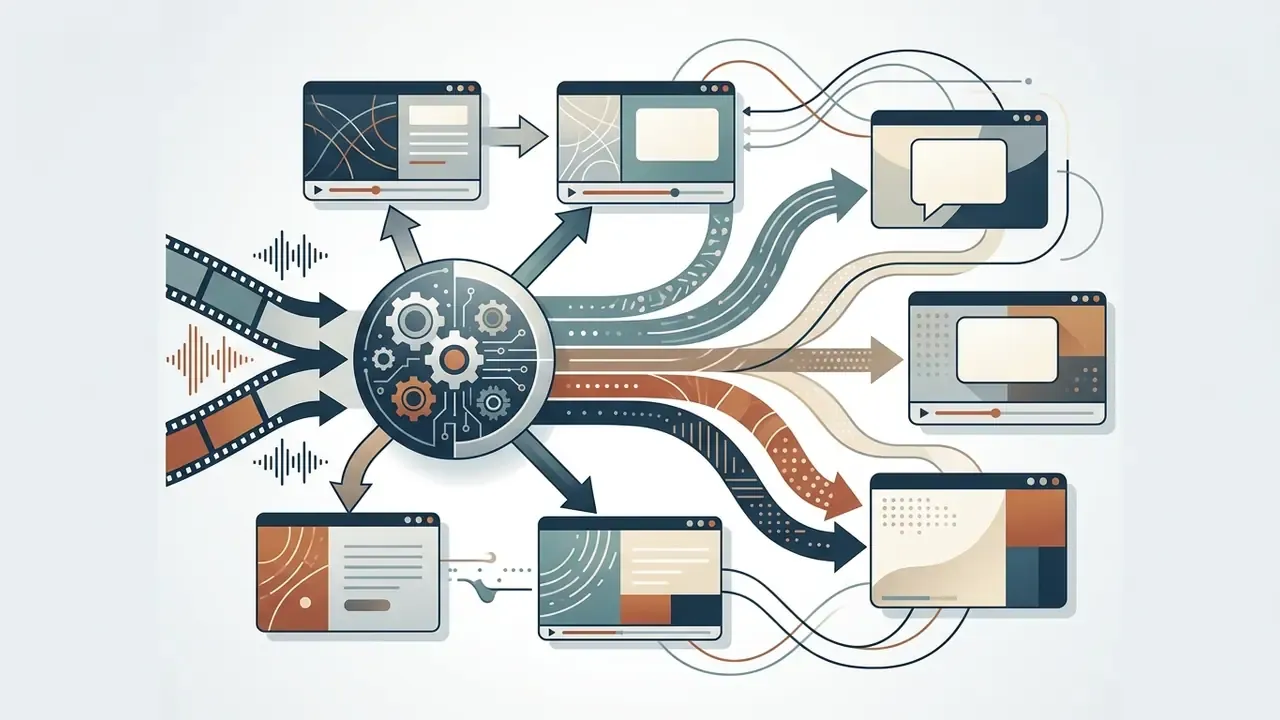
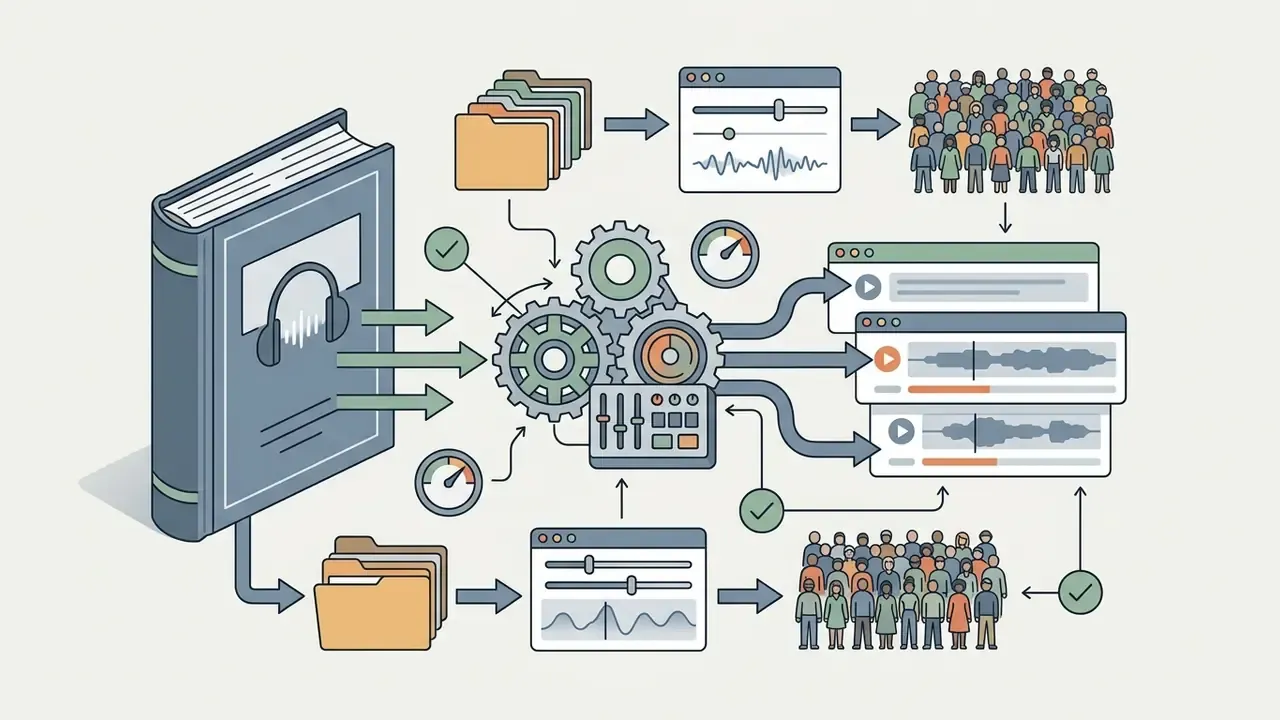
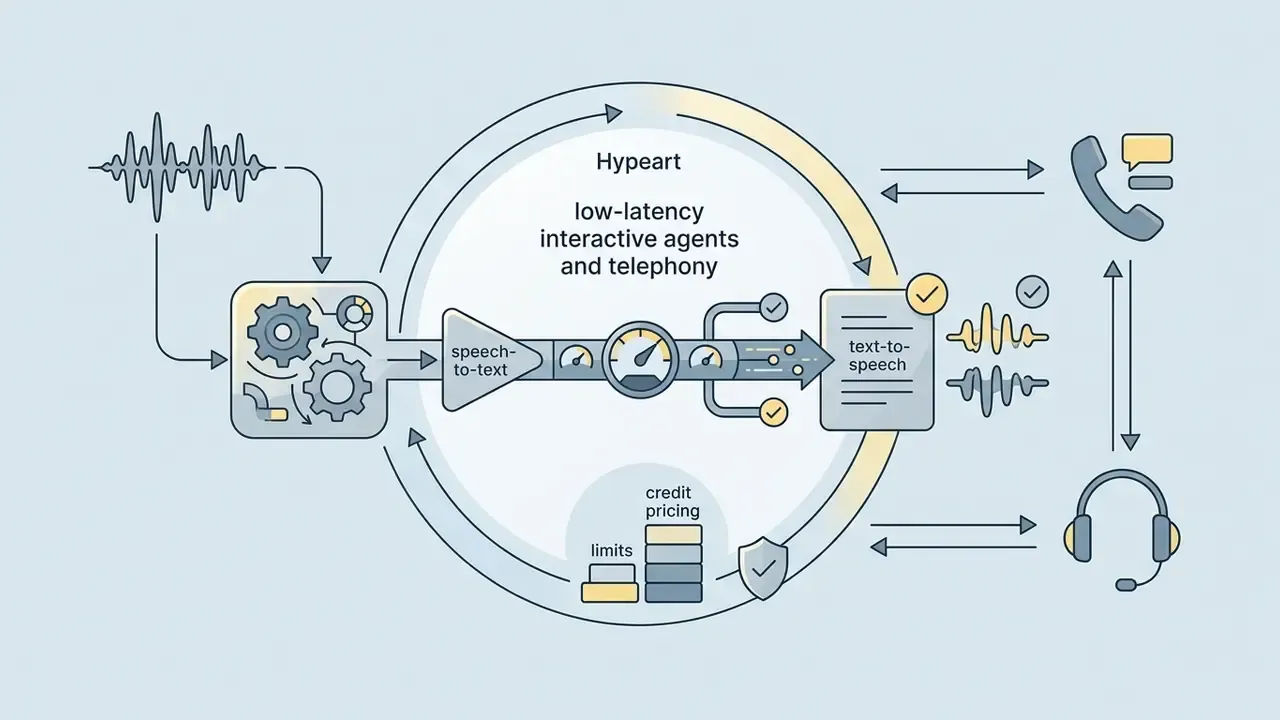
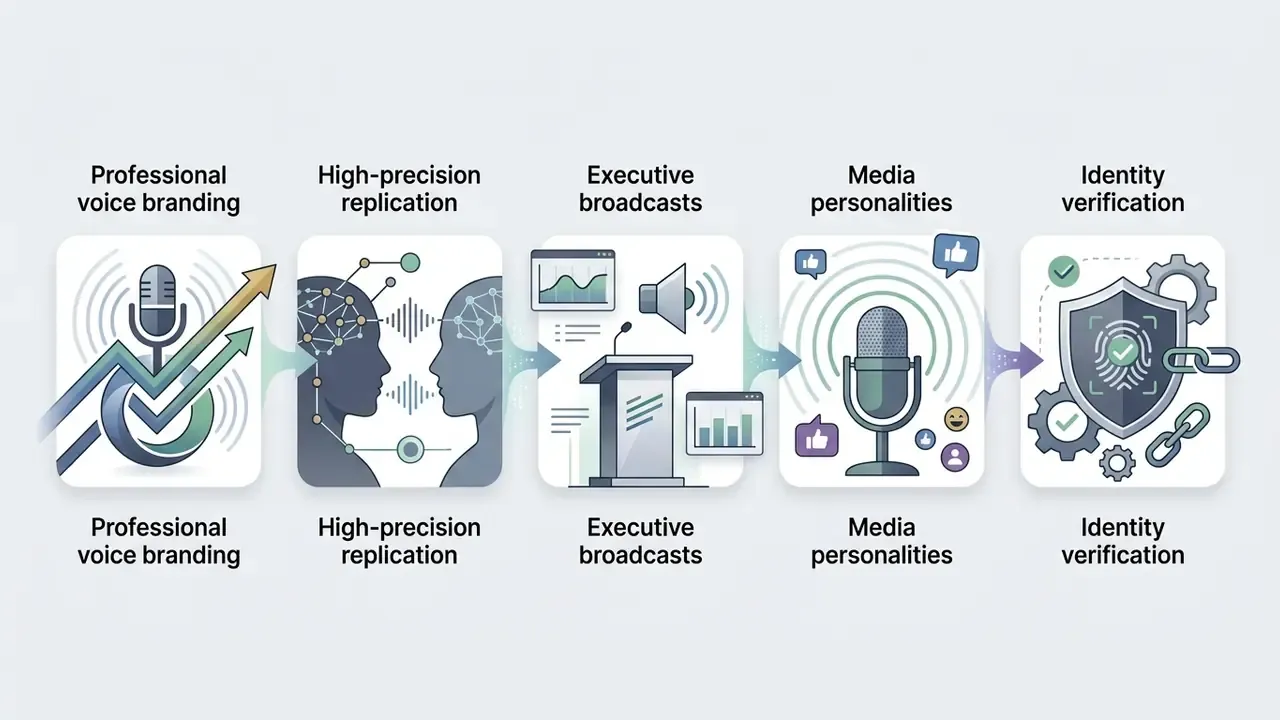
Creative teams working across modalities frequently combine voice with stylized visuals, whether that is a disney ai generator aesthetic for family content, dnd ai art assets for tabletop channels, a playful dog to human ai generator segment, or a fast domain name generator pass while naming a new show.
Selection Criteria: Quality, Languages, API, Cost, and Control
Set against market alternatives such as Murf.ai, Play.ht, or OpenAI TTS, the trade-offs become clearer:
| Evaluation Metric | ElevenLabs | OpenAI TTS (tts-1-hd) | Murf.ai |
|---|---|---|---|
| Audio naturalness and emotion | Benchmark leader (Eleven v3) | High stability, moderate emotion | Balanced corporate tone |
| Language support | 74 languages TTS, 90+ dubbing | ~57 languages | 35+ languages |
| API model latency | ~75 ms inference, Flash v2.5, vendor-published | ~200 to 500 ms | ~130 ms end-to-end, vendor-published |
| Pricing model | Credit-based, $0.05 to $0.10 per 1k chars | Flat, $0.015 to $0.030 per 1k chars | User seat tiers |
| Voice cloning | Instant and Professional cloning | Not supported via standard API | Custom voice add-on |
| Enterprise safeguards | SOC 2 II, ISO 27001, HIPAA, Zero Retention | Enterprise agreements available | Varies by tier |
«MAMBA found MARS8-Pro reached WavLM speaker similarity of 0.87 and CAM similarity of 0.71, ahead of ElevenLabs Multilingual v2 and v3 on voice similarity.»
The honest reading of that benchmark: ElevenLabs is not first on every acoustic metric. Its edge is breadth, language coverage, cloning modes, dubbing, STT, agents, and enterprise attestations inside a single contract, rather than a monopoly on raw similarity scores. Where a deployment demands on-premise or air-gapped inference, built-in deepfake detection, or native speech-to-speech conversion, a competing vendor may satisfy the control requirement better even at slightly lower perceived naturalness. That is a governance decision, not an audio-quality one.
For a broader evaluation of generative tooling, teams can explore our AI media comparison matrices and the guide to AI voice generators.
FAQ About the ElevenLabs AI Voice Generator
Do I need an app or a download to use ElevenLabs?
Workflows are primarily web-based and API-based, reachable through modern desktop and mobile browsers.
- Mobile and desktop apps: official iOS and Android apps handle basic generation and playback, but full workspace tooling runs in the browser on the ElevenLabs AI voice generator app page. Mobile-first creators often pair this with free AI video generators for end-to-end production.
- Software download: no local install is required (ElevenLabs AI voice generator download). Rendering happens on ElevenLabs cloud infrastructure.
- Language support, for example Hindi: the platform provides native support for regional languages, with dedicated voice models and separate TTS and STT pages on ElevenLabs AI voice generator Hindi.
- Speech-to-text integration: built-in recognition via ElevenLabs Scribe v2, including a realtime variant covering 90+ languages.
«In the RW-Voice-EQ benchmark, Scribe leads three of four robustness tracks, accents, emotion, and noise, at an average WER of 6.72%.» Real World Voice-EQ Bench (2024). https://arxiv.org/abs/2410.03791
Can free-tier audio be used in a monetized YouTube video?
No. Free-plan output carries a non-commercial licence and an attribution obligation. Monetized channels, client work, and paid advertising need an active Starter plan or higher at the moment of generation.
Does an expired subscription revoke rights to previously generated audio?
No. Audio generated while a paid subscription was active keeps commercial usage rights indefinitely. Audio generated before upgrading, or after cancelling, does not acquire those rights retroactively.
Which model should be used for a 10-hour audiobook?
Official documentation recommends Multilingual v2 as the default for long-form narration, because it prioritizes cross-chapter consistency. Eleven v3 is the better pick where character dialogue and dramatic delivery outweigh uniformity.
Can ElevenLabs dubbing replace human localization for on-camera video?
Not on its own. Dubbing v2 covers translation, speaker detection, timing, and timbre preservation, but performs no lip-sync. On-camera footage bound for premium distribution still needs visual synchronization tooling or a human-adapted script.
Is voice-cloned audio safe for authenticating banking customers?
Voice biometrics should never act as a standalone credential. Independent research shows human listeners cannot reliably tell clones apart, and automated speaker-similarity scoring is vulnerable to high-fidelity synthesis. Combine liveness checks, device signals, and out-of-band verification.
How is API usage billed compared with the web interface?
Text-to-speech is billed per input character in both surfaces, and speech-to-text is billed per audio minute. API access is included on all plans, while audio quality ceilings such as 44.1 kHz PCM and concurrency limits are tier-dependent.
What evidence should we keep for each generated audio asset?
At minimum: the request payload hash, seed, model_id, voice_id, parameter set, output asset hash, timestamp, and the identity of the requesting service. Add consent artifacts for any cloned voice. That set is what makes a disputed customer interaction reconstructable a year later.
Further Resources and the AI Media Ecosystem
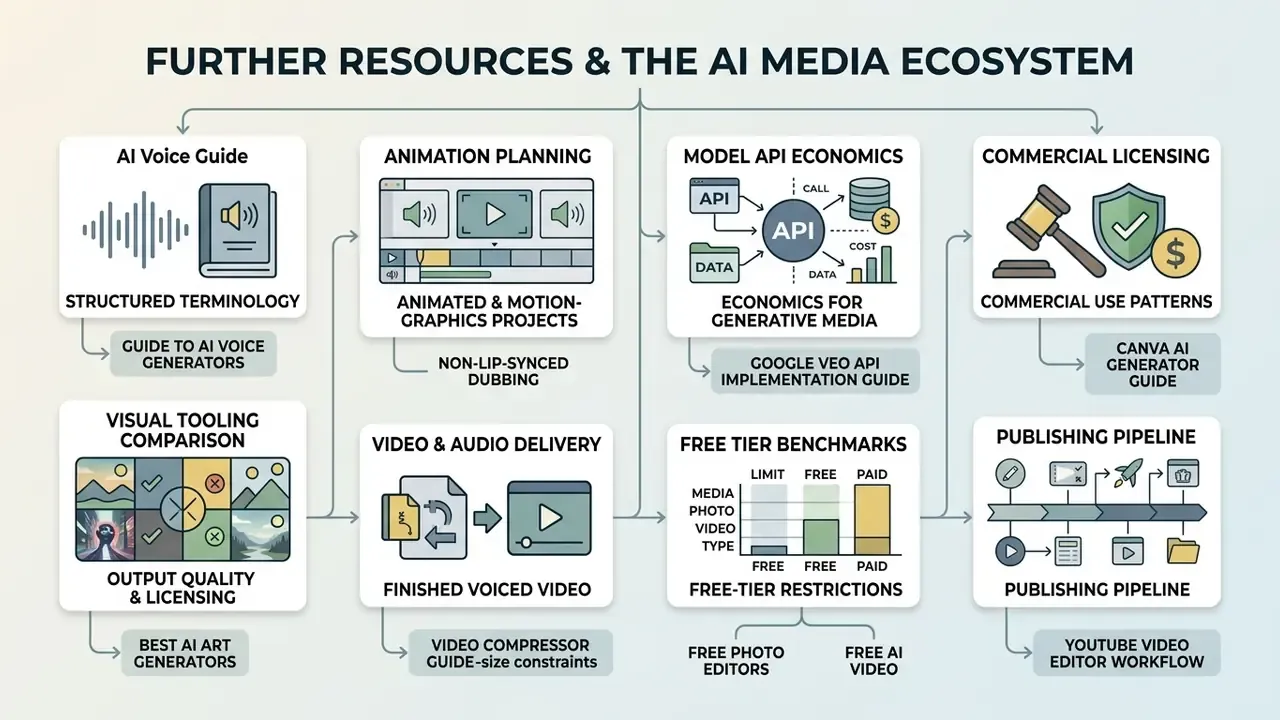
To keep exploring synthetic media tooling, commercial guidelines, and interactive calculators, use the following resources in our knowledge hub:
- Explore structured terminology in our guide to AI voice generators.
- Plan animated and motion-graphics projects, the format best suited to non-lip-synced dubbing, with our animation maker guide.
- Model API-side economics for generative media with our Google Veo API implementation guide.
- Review commercial licensing patterns across generative tools in the Canva AI Generator commercial-use overview.
- Compare output quality and licensing across visual tooling in our best AI art generators comparison.
- Evaluate delivery and file-size constraints for finished voiced video using our video compressor guide.
- Benchmark free-tier restrictions across categories with our free photo editor guide and free AI video generator comparison.
- Build a publishing pipeline around generated audio with our YouTube video editor workflow guide.
- Browse definitions, vendor entities, and control terminology in the AI Media Glossary.
Appendix A: Superseded Claims and Verification Notes
Being explicit about which statements were revised, and why, is part of the same evidence discipline this article recommends to its readers.
| Original claim | Status | Updated treatment |
|---|---|---|
| "Independent evaluations demonstrate that ElevenLabs maintains strong acoustic fidelity and speaker identity preservation across long scripts, preventing pitch drift common in earlier parametric TTS models." | Superseded, unquantified | Replaced with cited MAMBA benchmark figures (1,334 samples, comparative WavLM and CAM similarity scores), showing ElevenLabs as a strong baseline rather than an unqualified leader. |
| "Average word error rate of 6.72% across noisy and emotional audio (Real World Voice-EQ Bench, 2024)", cited without URL or sample size | Superseded, under-verified | Replaced with a quoted extract including robustness-track results, rating volume of 785,000+ human ratings, and a direct source URL. |
| "IVC generates a clone from 1 to 5 minutes of clean reference audio without offline training" | Retained, flagged | Vendor-documented parameter; no independent measurement of minimum viable sample length is currently published. |
| "PVC requires 30+ minutes of studio-grade audio" | Retained, flagged | Vendor-documented threshold, not independently benchmarked. |
| "~75 ms model inference" | Retained, flagged | Vendor-published figure; no independent production-load latency test available at review date. |
| "10,000-credit cap is exhausted by a single 1,500-word script, about 8,000 characters" | Retained, with methodology | Editorial estimate based on roughly 5.5 characters per English word including spacing; consumption varies by language and retry count. |
| Market-share and valuation claims (98% mid-market spend, $11B valuation, $330M ARR) | Flagged, needs external verification | Sourced from vendor and marketplace promotional material for 2025 to 2026, not audited disclosures; presented as analyst commentary only. |
Reviewer statement. All pricing figures, licence conditions, model language counts, and codec lists in this article were checked against live ElevenLabs documentation, the public pricing page, and the Terms of Use in August 2026. Where official pages disagreed with each other, most visibly on character-to-credit conversion between the pricing page and individual help-centre articles, the discrepancy is stated in the text rather than resolved silently, and readers are directed to their own contractual order form as the controlling document.
Update Cadence and How to Re-Verify This Page
Voice AI pricing and licensing move faster than most vendor categories, so treat any snapshot as perishable. Our review cycle for this page runs quarterly, with an out-of-cycle check whenever a model family is deprecated or a pricing page changes materially.
Before you cite anything here in a committee paper, re-verify four items: the current credit-to-character conversion on your order form, the commercial-use clause for your tier, the concurrency ceiling attached to your plan, and the validity dates on the SOC 2 Type II report. Those four move most often. Everything else, architecture, codecs, tag behaviour, tends to hold.
One last note from the reviewer. The interesting question is rarely "does the voice sound human enough". It is "can we prove, six months from now, exactly what we said to a customer and who authorized it". Answer that first.