If you publish creative assets at scale, this is not only an aesthetics question. It is a control question.
Executive Summary
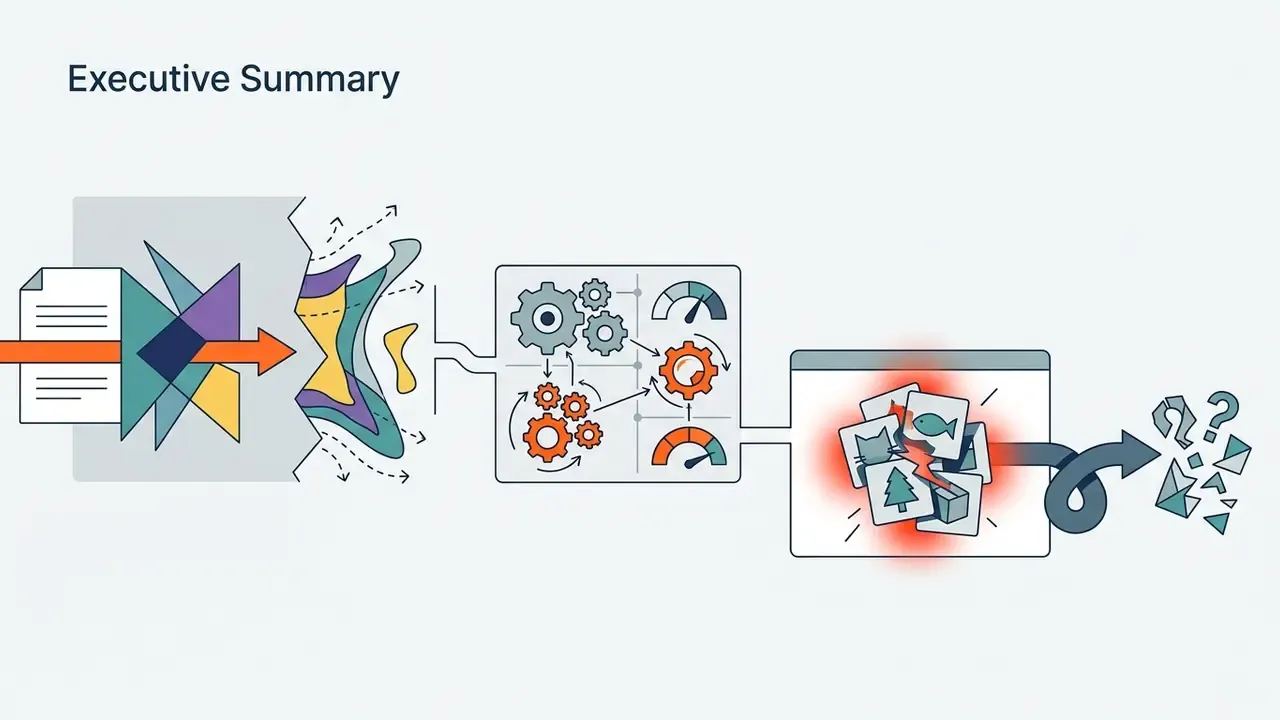
- Weird AI images are a measurable model behavior, not only a style. Benchmarks quantify the gap: Stable Diffusion v1.1 scores 0.98 on single-object accuracy but only 0.41 on overall prompt correctness, and positional tasks collapse to roughly 0.02 to 0.03, statistically indistinguishable from random object placement (GenEval: Object-Focused Evaluation Framework, 2023).
- Compliance precedes creativity for commercial teams. From 2 August 2026, EU AI Act Article 50 transparency duties require machine-readable marking and visible labels for synthetic media. In the United States, purely AI-generated output without substantial human creative intervention is not registrable for copyright.
- Control is achievable. Seed locking, negative prompts, inpainting, ControlNet conditioning, and CFG tuning convert random weirdness into reproducible creative direction. Those are the same levers a model-risk function can use to suppress unwanted anomalies in brand assets.
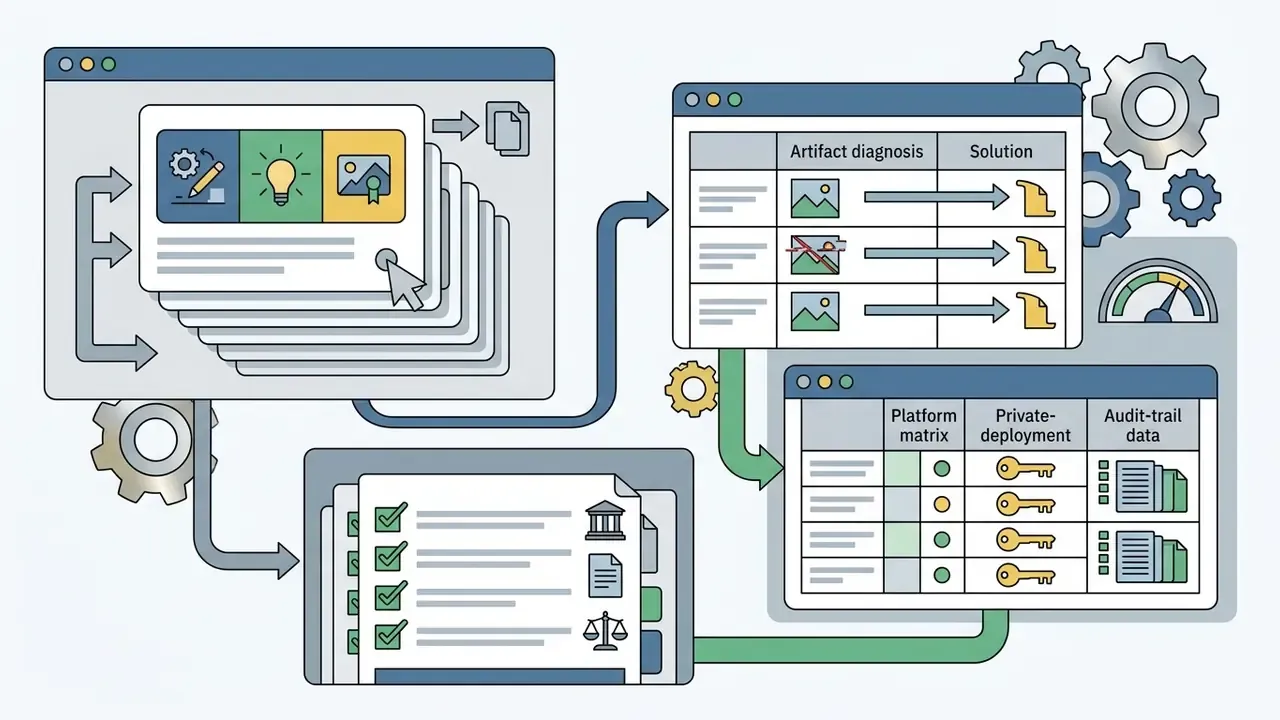
How to Use This Guide (Three Reader Paths)
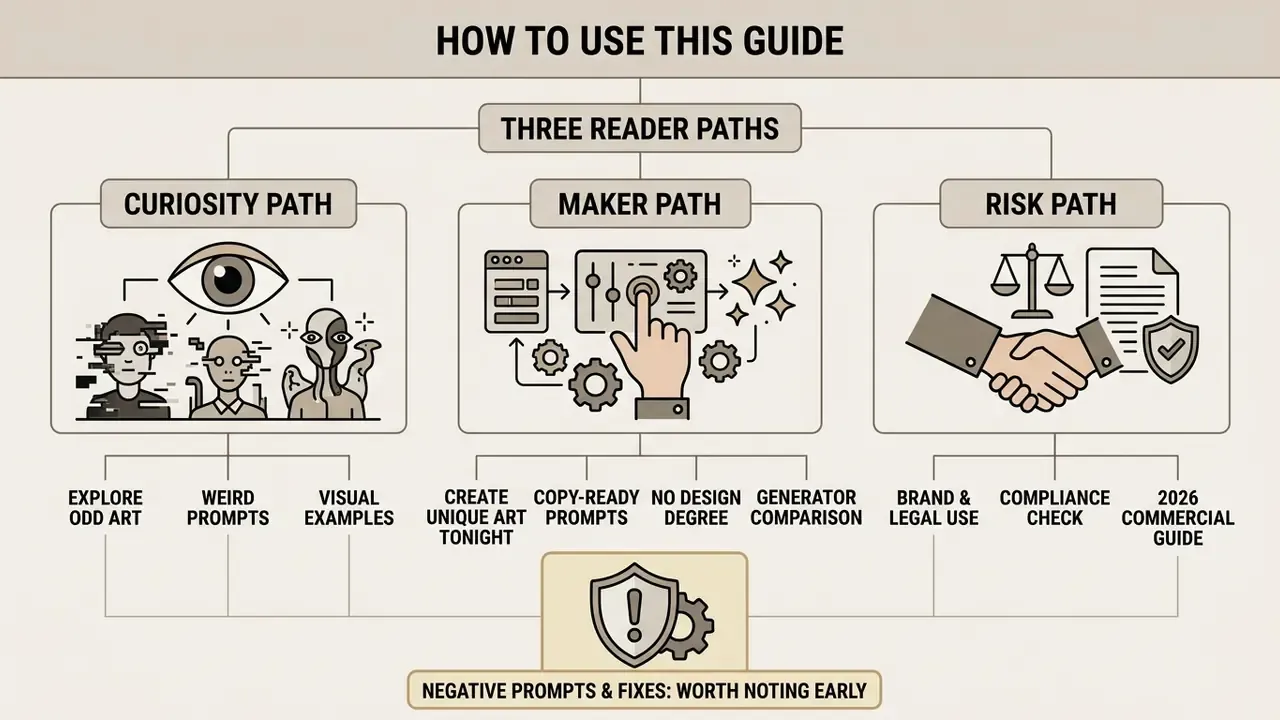
Most readers arrive here for one of three reasons, and the guide is built so you can skip the rest.
- Curiosity path. You saw a viral post of ai weird pictures and want to know what you are looking at. Start with visual signatures and the prompt gallery.
- Maker path. You want your own unique output tonight, no design degree required. Jump to prompt formulas, then the refinement levers.
- Risk path. You own brand, legal, or compliance sign-off. Read the commercial-use section and the escalation matrix first, then the platform table with audit-trail columns.
One more thing worth saying early. Nothing here is a substitute for validating model behavior on your own stack. Benchmarks describe specific model versions, not your prompt library.
What Are Weird AI Images and Why They Attract Attention
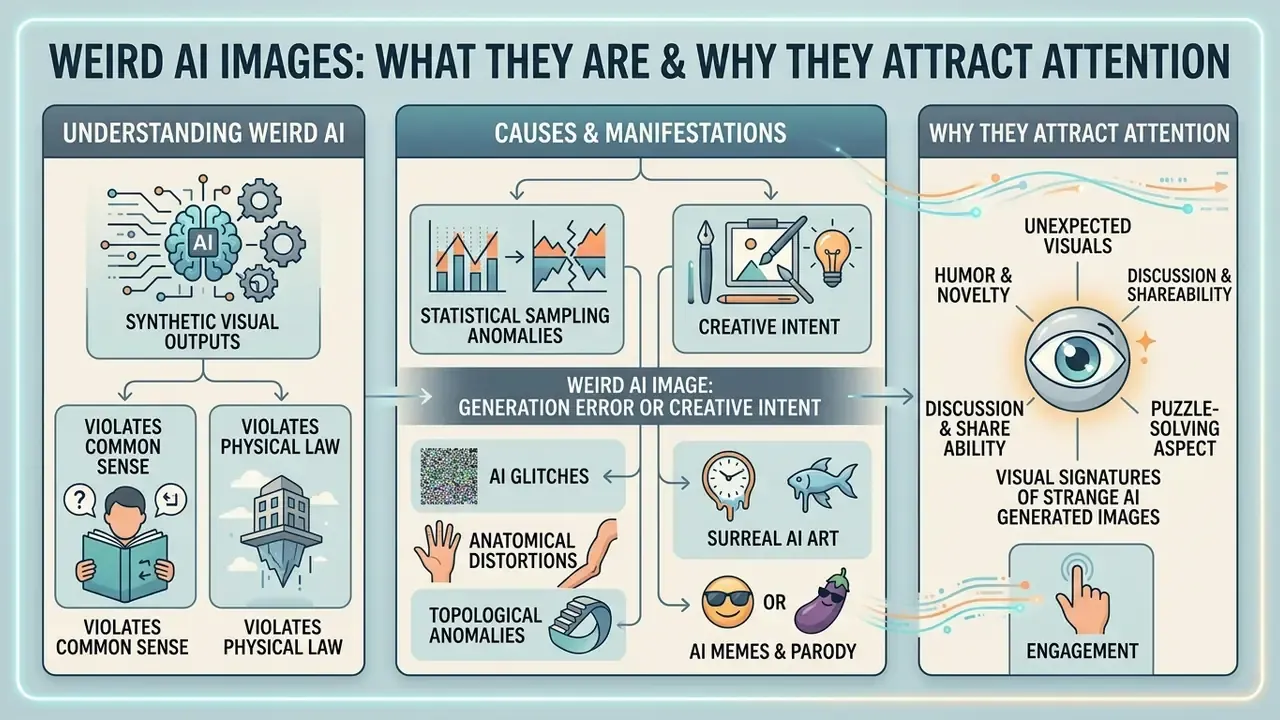
Weird AI images are synthetic visual outputs that violate expected human commonsense, anatomical structure, or physical law, either through statistical sampling anomalies or through deliberate prompt engineering. They depart from conventional synthetic imagery because they expose non-human operational logic: structural distortion, broken object binding, or surreal conceptual pairings.
«The WHOOPS! dataset defines such images as deliberately commonsense-defying, for example famous footballers seated at a chessboard instead of a pitch.»
That academic framing matters more than it first appears. Weirdness is treated as a norm violation, not a rendering bug. The image feels wrong because the system fails in a non-human way to reproduce human coherence, while ordinary ai generated images are just synthetic visuals assembled from learned statistical patterns.
The phenomenon hit mainstream meme recognition in mid-2022, when DALL·E Mini screenshots flooded social networks. Cultural analyses of generative aesthetics note that early user communities gravitated toward "nightmare aesthetics" and surrealist body horror, borrowing from dream logic and the exquisite corpse tradition (DALL·E Mini and Surrealist Body Horror Study, 2022). Between 2024 and 2026, communities such as Reddit's /r/weirddalle shifted the practice from celebrating accidental glitches to engineering bizarre themes on purpose.
Why do people stare? Two mechanisms stack: the uncanny valley effect and plain cognitive dissonance. Viewers recognize a familiar face or kitchen table, then notice an impossible spatial or logical configuration inside it.
«Participants who made the most errors classifying AI faces were the most confident in their judgments, a Dunning-Kruger effect.»
Weird AI Image: Generation Error or Creative Intent
A weird AI image can be a controlled artistic outcome produced by precise prompt engineering, or an unintended model glitch from out-of-distribution mode interpolation. The difference lives in three places: user intent, prompt structure, and how controllable the parameters are.
Intentional surrealism happens when a user deliberately builds prompts containing conflicting concepts, surrealist art references, or physical impossibilities. CHI 2022 research on text-to-image steering shows that users lean on specific prompt structures to push diffusion models toward bizarre aesthetic domains, and that identical prompts under different seeds produce substantially different generations (CHI Conference on Human Factors in Computing Systems, 2022). Accidental glitches are the opposite case. Studies of default image behavior show diffusion pipelines repeating structural artifacts across unrelated prompts, which exposes training data gaps rather than creative direction.
«GenEval records an overall correctness score of just 0.41 for Stable Diffusion v1.1, even though single-object accuracy reaches 0.98.»
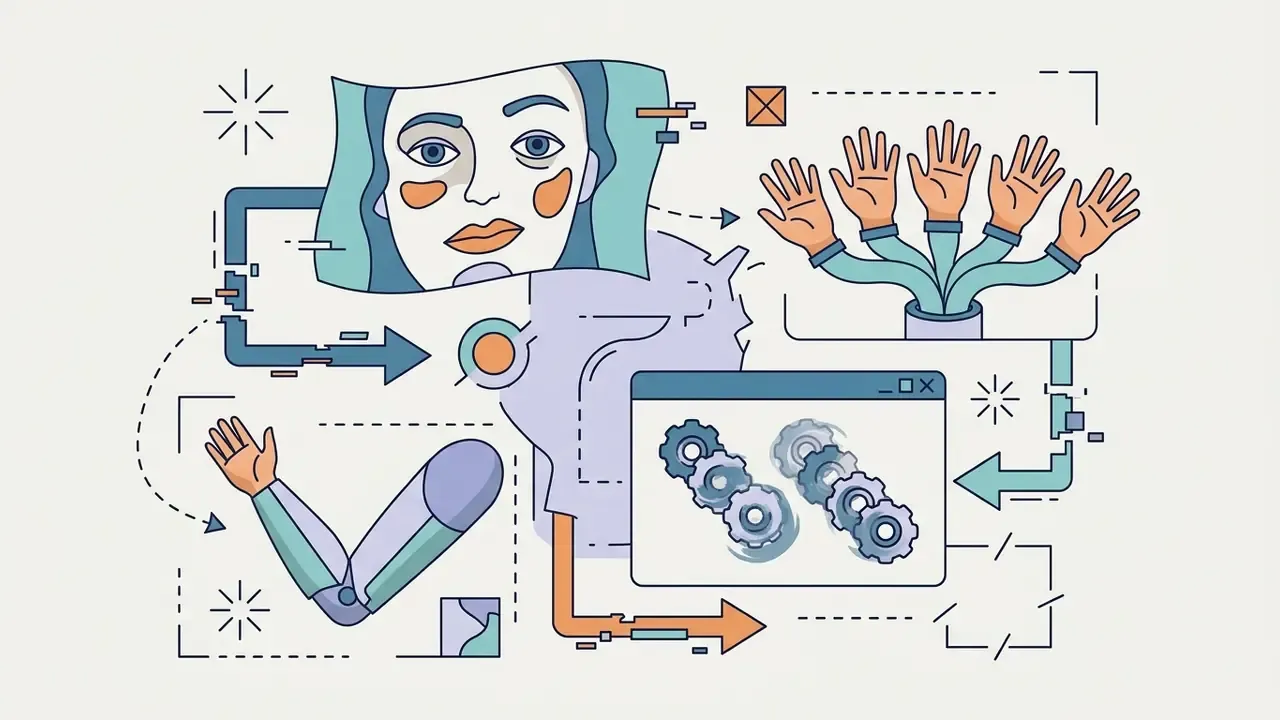
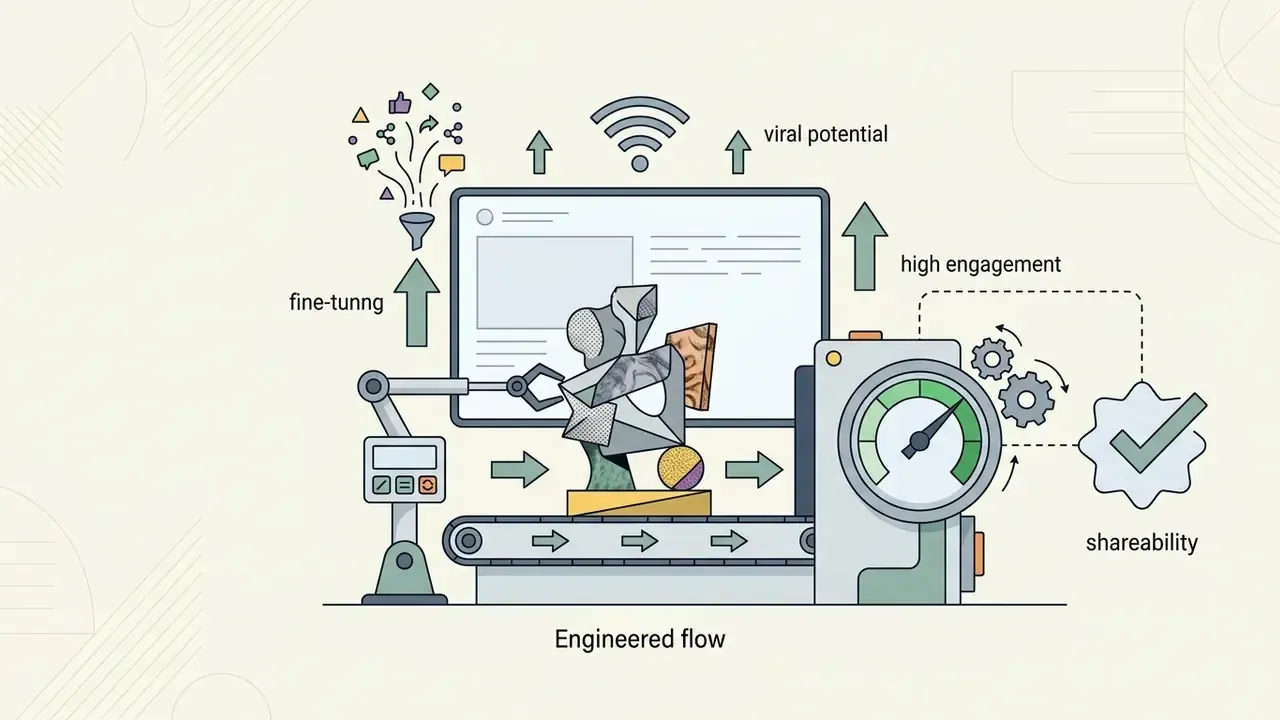
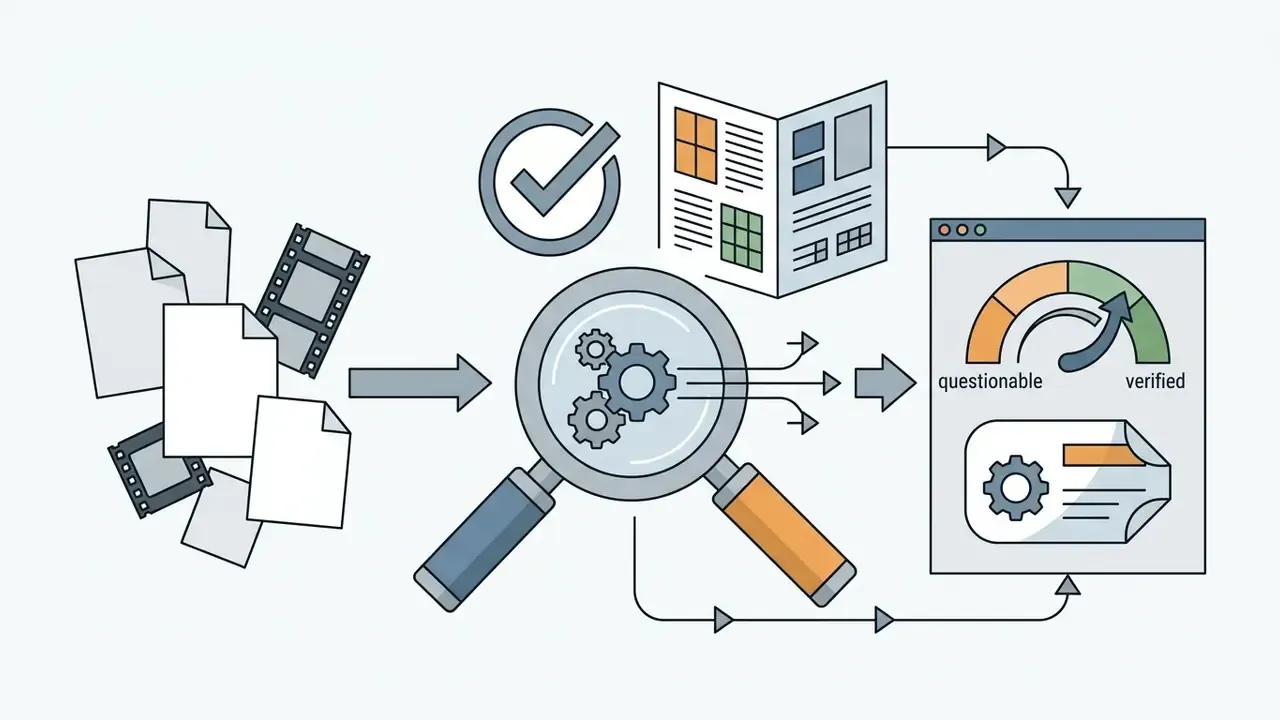
Those two numbers are the cleanest available proof that structural weirdness is systemic rather than anecdotal. The model renders things almost perfectly and renders relationships between things badly. Four practical categories therefore coexist in the wild:
Visual Signatures of Strange AI Generated Images
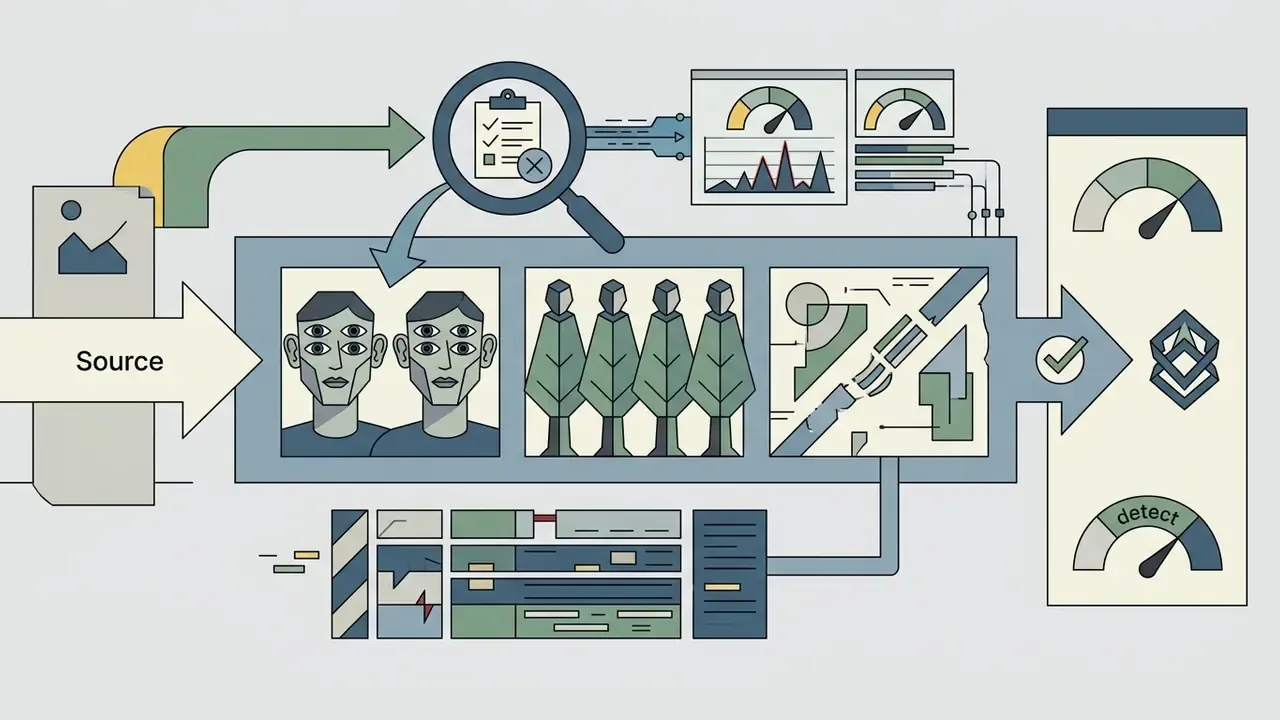
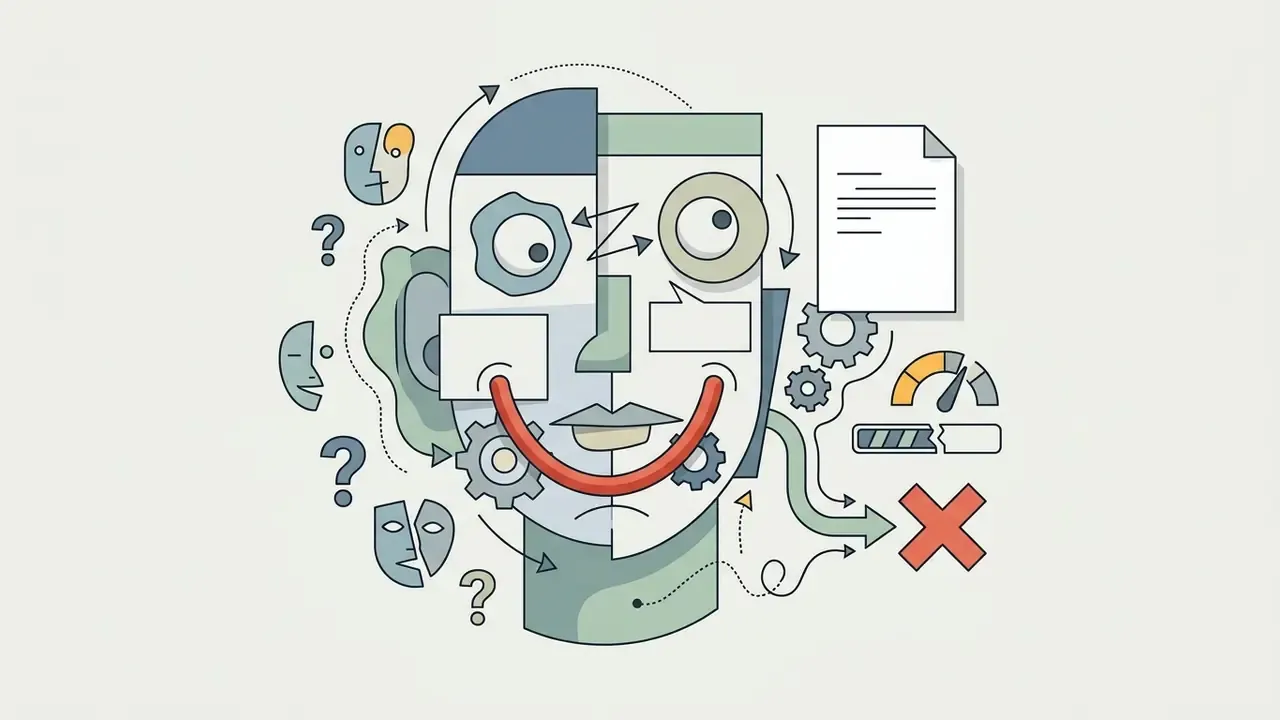
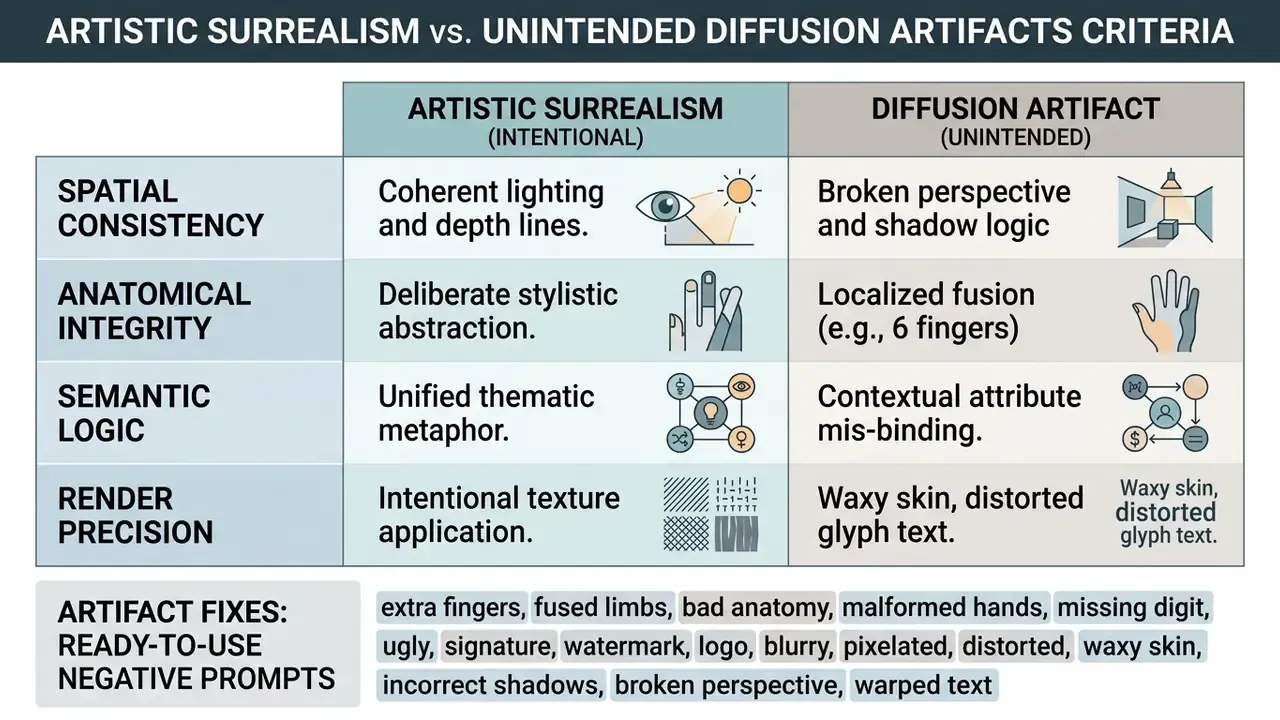
Strange ai generated images carry specific structural markers that separate them from photography or hand illustration. Artifact taxonomies catalogue these markers so teams can tell a technical failure from an intentional composition.
The primary visual markers include:
- Anatomical distortions: incorrect finger counts, fused limbs, asymmetric facial features, unnatural joint bend angles.
«Object-counting tasks remain a weak point even for large models, and increasing model size does not improve counting.»
Artifact Diagnosis Table (with ready-to-use negative prompts)
| Visual defect (artifact) | Technical cause | Fix strategy | Ready negative prompt |
|---|---|---|---|
| Extra fingers / fused limbs | Local attention drift in the U-Net across fine detail regions | Enable ControlNet OpenPose; mask and re-render with inpainting | extra fingers, mutated hands, fused digits, poorly drawn hands, missing fingers |
| Blurred or glyph-like text | No character-level tokenization in CLIP; text learned as visual texture | Switch to models with a T5-XXL text encoder (FLUX.1 / Ideogram) | garbled text, unreadable glyphs, distorted lettering, blurry fonts |
| Waxy skin | Overfitting to smoothed studio photography in training data | Lower CFG scale to 3.5 to 5.0; add film grain and skin-texture terms | plastic skin, smooth skin, airbrushed, 3d render artifact, cgi smoothness |
| Broken shadow perspective | No 3D lighting engine inside latent space | Apply ControlNet Depth, or re-render through ControlNet Lineart | inconsistent shadows, mismatched light direction, floating objects |
| Duplicated subjects / cloned faces | Mode interpolation between nearby training modes | Reduce prompt entity count; lock seed and regenerate in small steps | duplicate person, cloned face, repeated subject, twin artifacts |
| Attribute bleeding (wrong colors on wrong objects) | Cross-attention saturation across stacked modifiers | Split the prompt; use regional prompting or sequential inpainting | color bleeding, mixed attributes, wrong object colors, merged objects |
Readers who want the tooling category first, before experimenting, can start with the fundamentals of AI art generators and their control surfaces.
Uncanny Family Photos and Domestic AI Horror
Subtle anatomical anomalies inside ultra-familiar domestic scenes trigger stronger cognitive dissonance than any monster design. This sub-genre, often called "liminal family archives," simulates analog photography from the 1980s and 1990s. The horror lands when the viewer registers that an otherwise mundane snapshot contains a duplicated family member, an impossible limb extension, or a face dissolving into wallpaper pattern.
Family photographs work so well as a carrier format because the viewer already knows the grammar: matching outfits, direct flash, a sofa, a birthday cake. Once that grammar is set, one extra hand resting on a shoulder does more perceptual damage than a fully synthetic creature ever could.
To replicate the aesthetic, combine vintage camera specifications with an explicit instruction for minor spatial incoherence:
- Aesthetic prompt:
1980s candid family photo in a carpeted basement, vintage flash spill, authentic chromatic aberration, muted film palette, normal sitting arrangements, subtle unsettling limb distortions --ar 4:3
Because this genre is built to be mistaken for a real archive, it is the category where provenance marking and clear AI labeling are least optional. Anyone publishing this style commercially should verify origin signals with AI image detectors before distribution.
Prompt Gallery: 10 Copy-Ready Weird, Crazy, and Goofy AI Image Prompts
A gallery of weird, crazy, and goofy AI images functions as an inspirational taxonomy: uncanny portraits, impossible hybrids, absurd food, historical parody, domestic absurdity, viral characters. Each card below is a complete prompt with generation flags, so you can move from inspiration to output in one paste.
1. Uncanny Portrait (anatomical shift)
Cinematic studio portrait of a Victorian gentleman, flawless skin, symmetrical features, but with subtle mismatched eye gaze angles, impossible iris reflections, hyperrealistic 8k, dramatic chiaroscuro lighting --ar 4:5
2. The Impossible Family Photo (domestic horror)
A 1990s flash photography family portrait in a cozy living room, normal smiling parents, but with extra subtle hands appearing from shoulders, duplicated facial features on background individuals, film grain, vintage color shift --ar 16:9
3. Bizarre Historical Scenario (historical absurdity)
Archival black and white 1920s photograph of astronauts in fully detailed spacesuits attending an elegant outdoor tea party in a Victorian garden, highly detailed texture, historical photo scratches, authentic vintage lens blur --ar 3:2
4. Absurd Food Architecture
A towering gourmet hamburger being assembled by miniature construction cranes on a fine dining porcelain plate, glowing blue pasta interior, macro food photography, Michelin star presentation, volumetric studio lighting --ar 1:1
5. Mechanical Hybrid Creature
A majestic peacock seamlessly fused with a vintage 1940s mechanical typewriter, iridescent bronze clockwork feathers, polished chrome key joints, macro photograph, dark moody backdrop, 8k render --ar 16:9
6. Domestic Absurdity (weather indoors)
A cozy suburban living room where all furniture is made of soft white clouds, indoor rain falling from miniature storm clouds near the ceiling, wet carpet reflections, soft diffused daylight, photorealistic interior photography --ar 3:2
7. Fake Movie Still (1970s psychological thriller)
Film still from a fictional 1970s psychological thriller, a mysterious woman in a vintage trench coat alone on a rain-soaked city street at midnight, anamorphic lens flare, heavy film grain, period color grading, practical neon light --ar 2.39:1
8. Creature That Should Not Exist (scale violation)
A whale-sized flightless bird walking slowly across a cracked desert salt flat, feathers textured like weathered canvas, tiny human observers for scale, hazy telephoto compression, golden hour light, photorealistic wildlife documentary style --ar 16:9
9. Animal With Human Behavior (corporate satire)
A serious tabby cat in a tailor-made pinstripe suit delivering a quarterly business pitch to a boardroom of bored pigeons, glass conference room, corporate fluorescent lighting, photorealistic 50mm lens --ar 4:3
10. Viral Weird AI Character
A goofy oversized toad wearing a tailored business suit delivering a corporate presentation with a laser pointer, expressive exaggerated eyes, stylized 3D render, soft rim lighting, clean studio background, mascot design sheet --ar 1:1
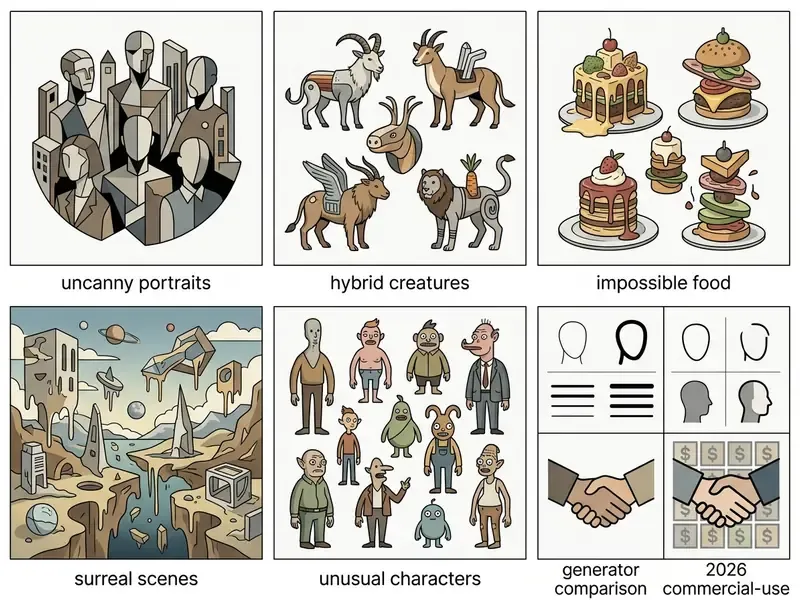
Figure caption: categorized inspiration grid of weird AI images and bizarre AI images, each card paired with a reproducible prompt and an aspect-ratio flag.
Uncanny Portraits and People With Impossible Features
Uncanny portraits present synthetic human faces with subtle anatomical misalignment or unnatural surface texture. They trigger intense perceptual discomfort. The strongest examples look entirely normal for the first few seconds and only reward the second look, which is exactly why they outperform obvious distortion in engagement metrics.
Research in Psychological Science shows that synthetic faces from generative adversarial networks (GANs) often pass straight through the traditional uncanny valley and get read as "more real" than genuine human photos, thanks to hyper-symmetry and smooth skin.
«In an experiment with 124 participants, AI faces were classified as "real" more often than genuine photographs, the AI hyperrealism phenomenon.»
However, once diffusion models introduce dynamic expression mismatch, an unaligned gaze or an inconsistent smile micro-expression, perceived trustworthiness drops fast.
«Diffusion models generate faces that are less photorealistic than GAN faces, yet rated as more trustworthy than both GAN faces and real photographs.»
Animals, Hybrids, and Creatures That Should Not Exist
Hybrid creatures dominate the bizarre ai images genre, merging organic fauna with inanimate objects or a second animal species. These concepts stress-test the model's ability to interpolate features across distant semantic categories.
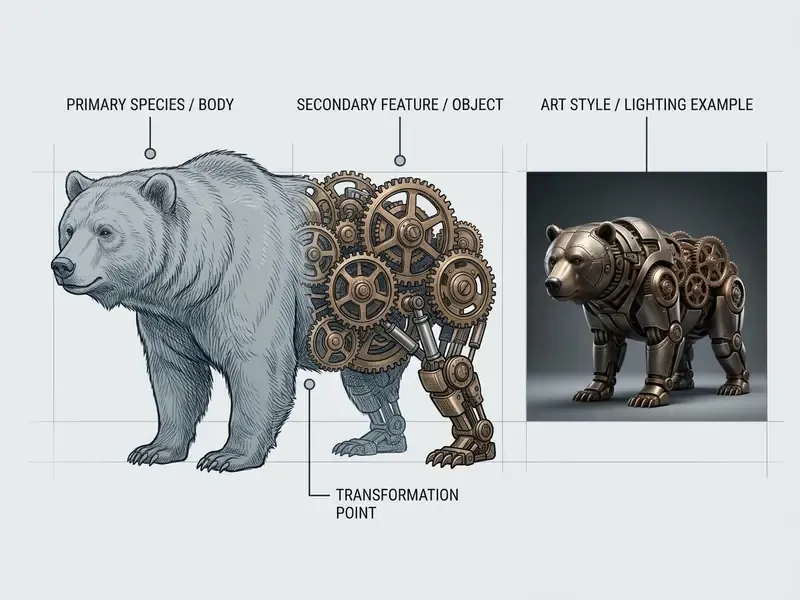
Good hybrids are not lucky. They follow templates. Five reusable ones recur across practice:
- Two-species blend: name two animals and state which one supplies the body.
- Dominant species plus two or three traits: keep secondary traits limited so the silhouette stays readable.
- Explicit join point: specify shoulders, tail, wings, or eyes as the transformation boundary, otherwise the result looks taped together.
- Object-as-organ: replace one anatomical part with a manufactured object such as gears, typewriter keys, or camera lenses.
- Style and habitat anchor: add medium, lighting, and environment so the impossible biology still obeys one consistent world.
Strange Food, Objects, and Domestic Scenes
Absurd food and surreal domestic scenes modify object scale, texture, and physical properties inside ordinary household environments. The style gained heavy traction on short-form video platforms through 2025 and into 2026.
Media analyses of viral content workflows note that creators reuse specialized prompt templates to mass-produce surreal culinary concepts, from talking fruit to glowing liquid structures. One widely circulated tutorial for building these clips reached nearly two million views (Viral AI Culinary Content Trends, 2026). The concepts subvert everyday domestic expectation while keeping surface texture photoreal.
Food is unusually effective as a weirdness carrier because audiences hold precise priors about how a dish should look and behave. A construction crane assembling a hamburger, a miniature human wading through soup, a menu where every item is oversized: each inverts those priors while retaining plausible texture, lighting, and plating. That combination is what makes a crazy ai picture stick in memory.
Impossible Historical, Cinematic, and Fantasy Scenes
Fake movie stills and synthetic chronicles use retro camera artifacts, film grain, and period lighting to simulate archives that never existed. A fictional 1970s horror release. An invented mid-century science-fiction classic. A documented event that never occurred.
E-E-A-T vendor note: provenance standards for synthetic media "Authenticity in synthetic historical media relies on cryptographic origin tracking rather than visual inspection alone. Adherence to C2PA metadata specifications ensures synthetic chronicles remain clearly labeled." - Technical Standards Summary, IEC/ISO/ITU Report (2025).
Provenance frameworks are unusually honest about their own limits. NIST AI 100-4 (2024) describes provenance tracking as a record of origins and editing history, including whether an image was generated or edited with AI, while noting that watermarks and metadata are not fully robust against downstream manipulation. Organizations deploying synthetic historical media should therefore adopt C2PA plus W3C PROV as interoperability baselines rather than treating a single watermark as proof. Additional legal implications for synthetic archives are documented in the AI Litigation and Case Timelines resource center.
Stylized animation deserves a separate note. Studio-look prompts sit closer to protected expression than generic surrealism, which is why overviews such as ai generated pixar movies are worth reading before a campaign commits to a recognizable house style.
Absurd Comedy, Visual Gags, and Funny AI Images
Visual humor in synthetic media runs on conceptual incongruity: familiar entities dropped into absurd, low-stakes conflict. Generative models amplify comedy because they render ridiculous setups with unearned photographic seriousness. The lighting, the depth of field, the skin texture, all of it insists that a philosophizing potato is a documentary subject.
Key visual gag mechanics:
- Role reversal assign complex human professions or technical failures to animals or inanimate objects.
- Scale incongruity over- or under-size everyday items relative to their environment.
- High-stakes melodrama render trivial mishaps, a spilled glass of milk, a tangled ball of yarn, in epic cinematic lighting.
- Competence mismatch a character attempting a task their anatomy forbids, penguins flying with umbrellas, a robot knitting with metallic fingers.
Comedic prompt templates
- Over-dramatized animal failure:
A cat wearing a tiny pristine white chef hat frantically attempting to contain a comically overflowing giant cake, flour explosion in air, cinematic 3D animation render, expressive eyes, dramatic kitchen lighting --ar 16:9 - Philosophical inanimate objects:
A group of raw potatoes sitting in a circle in a dimly lit Parisian café having an intense philosophical debate, one potato wearing a miniature red beret, realistic oil painting style, Rembrandt lighting --ar 4:3 - Low-tech sci-fi failure:
An astronaut awkwardly riding a tiny unicycle across the dusty lunar surface while carrying a basket of glowing baguettes, photorealistic Apollo mission camera aesthetic, sharp shadows, high contrast Earth in background --ar 16:9
If the first attempt is not funny, iterate on a single variable. Keep the seed, exaggerate one element (hat size, spill volume, facial expression), re-render. Humor in generative media is usually a calibration problem, not a concept problem.
Weird AI Characters for Memes, Stories, and Creative Projects
Weird AI characters work as recurring visual archetypes across meme culture, digital marketing, and brand storytelling. They also show that absurd visual concepts can carry real commercial engagement, sometimes at national scale.
Notable cultural and commercial implementations between 2025 and 2026 include:
- Italian Brainrot meme wave viral short-form video series featuring hybrid AI creatures with pseudo-Italian names such as Bombardiro Crocodilo and Chimpanzini Cocossini (TikTok Creator Analytics, 2025).
- Fiverr "GAIrry" mascot an all-AI advertising mascot constructed entirely from freelancer prompts to anchor a national campaign (Fiverr Campaign Case Study, 2025).
- BETC Paris "Fluffy GOAT" a fully synthetic mascot designed for Woolite, replacing a traditional celebrity endorsement contract (BETC Agency Press Release, 2025).
Why AI Generated Images Become Weird
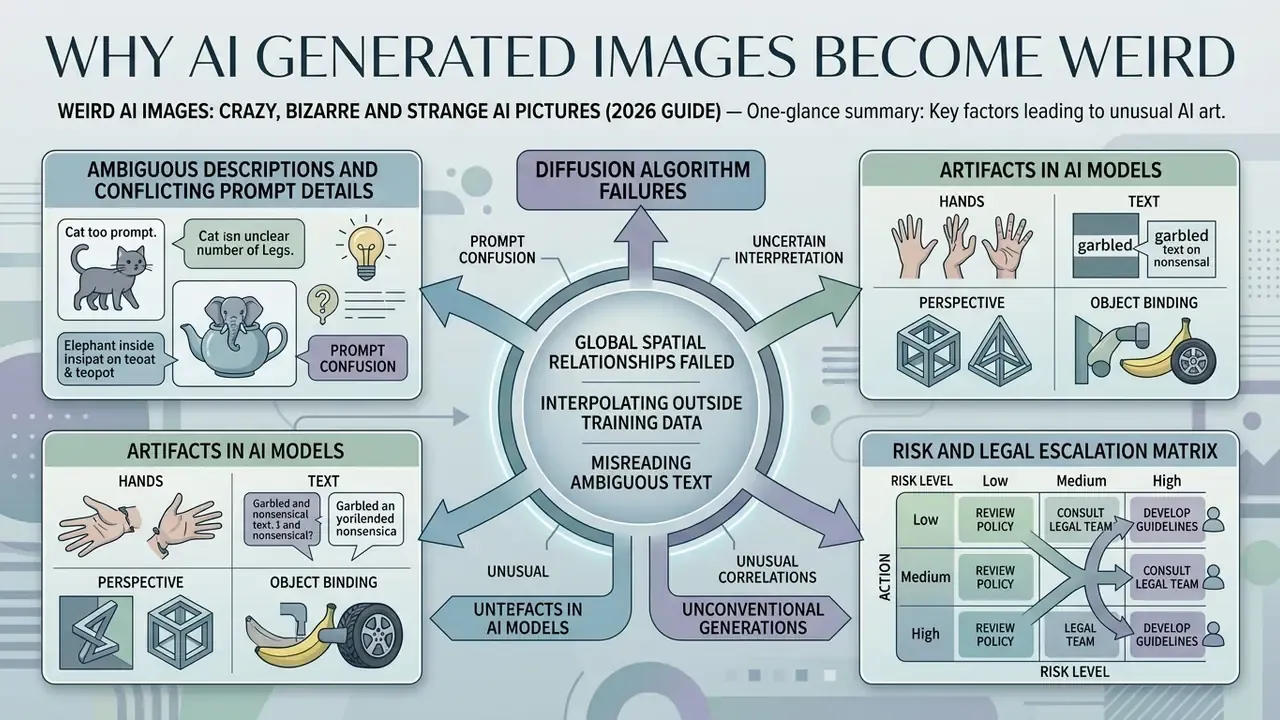
AI generated weird images appear when diffusion algorithms fail to model global spatial relationships, interpolate outside the training distribution, or misread an ambiguous text prompt. Explaining that properly means looking at the mathematics, not the vibes.
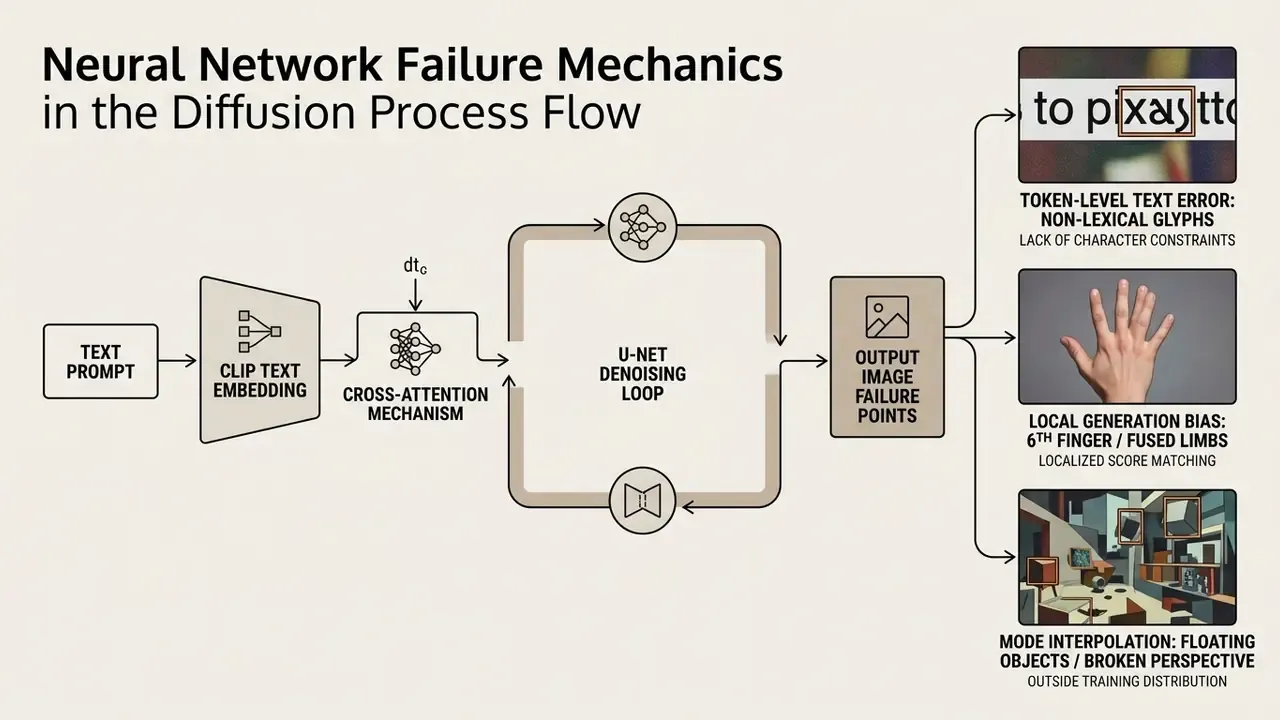
Diffusion models synthesize visuals by gradually removing noise from random latent vectors under text conditioning. When prompts introduce complex spatial constraints or genuinely novel concept combinations, the attention mechanism may misallocate feature weights across local image patches. Research on hallucination in diffusion models attributes part of this to mode interpolation: the sampler glides between nearby training modes and lands outside the original data support, producing distorted hands, extra legs, and hybrid objects that existed in no training example.
«GenAI-Bench records that DALL·E 3 leads on nearly every task except negation, and models routinely include forbidden objects despite the instruction.»
That negation failure is the commercially dangerous one. A brand brief that says "no logos, no text, no second person in frame" is precisely the instruction class current models honor least reliably. Which is why negative prompting and post-generation review stay mandatory controls, not optional polish.
Ambiguous Descriptions and Conflicting Prompt Details
Semantic ambiguity forces the model to pick an implicit camera viewpoint or resolve contradictory spatial constraints on its own. Text encoders such as CLIP process tokens with no intrinsic understanding of 3D geometry.
«GenAI-Bench shows that comparison, differentiation, and logic tasks trigger the highest error rates even in top-tier models.»
Work on spatial-language ambiguity using the COMFORT evaluation protocol shows that text-to-image and vision-language pipelines default to egocentric camera frames when prepositions such as "behind" or "left of" lack an explicit reference frame, and that English in particular defaults to a relative, camera-anchored reading (ICLR Spatial Language Protocol, 2025). Requires further model-specific validation: the default frame varies by architecture and language, so teams standardizing a prompt library should benchmark it on their own stack rather than assume.
The practical mitigation is dull and effective. Declare the viewpoint explicitly, "from the camera's viewpoint," "from the subject's left," and limit each prompt to a single spatial relation. Stack multiple relations and the cross-attention layers hit semantic saturation, which shows up as scrambled placement and attribute bleeding.
Artifacts in AI Models: Hands, Text, Perspective, and Object Binding
Technical artifacts such as extra fingers, garbled glyph text, and overlapping geometry occur because diffusion models process local image patches without 3D or lexical rules.
«Positional tasks in GenEval score roughly 0.02 to 0.03, effectively random placement of objects relative to specified spatial relations.»
Creators who want a model with a lower baseline artifact rate can compare architectures in our review of the best AI image generators.
Deep generative network neuron analysis shows that rarely activated neurons inside score-matching networks correlate directly with artifact production (Neuron Activation in Deep Generative Networks, 2022). ICLR 2025 work on local generation bias adds the complementary mechanism: score networks trained by score matching over-rely on localized input regions, which is why distorted fingers and meaningless text appear as local defects inside otherwise coherent frames. For portrait work specifically, the ai generated photos of me workflows document how to mitigate localized facial rendering bugs.
Commercial Use of Weird AI Images: What to Verify Before Publishing
«Users who deliberately craft strange prompts and curate results exercise creative authorship, even when the technical rendering is performed by AI.»
«Style is a bundle of expressive choices: individually unprotected, but in aggregate capable of constituting protectable expression.» - Fromer, Elements of Style: Copyright, Similarity, and Generative AI, SSRN (2024). https://ssrn.com
The second point closes a gap most commercial checklists miss. Prompting "in the style of" a living artist may not copy any single protected element, yet a sufficiently dense aggregation of that artist's expressive choices can still raise a substantial-similarity question. Material consideration for campaign assets with national reach.
Escalation matrix for risk and legal teams
| Trigger event | First-line owner | Required action | Escalation threshold |
|---|---|---|---|
| Synthetic asset depicts a real, identifiable person | Brand / Creative lead | Remove or replace; document prompt and model | Any external publication |
| Asset resembles a living artist's signature style | Legal counsel | Style-similarity review; re-prompt with generic descriptors | Paid media or packaging use |
| Photorealistic image could be mistaken for news or an event | Compliance | Apply C2PA credentials plus visible label | Any distribution in the EU |
| Provenance metadata missing or stripped | AI governance | Re-export with content credentials; log model, seed, prompt | Regulated-industry campaigns |
| Third-party logo, trademark, or character appears | Legal counsel | Inpaint out or discard asset | Any commercial use |
Before publication, commercial teams should verify asset origin with AI image detectors and review the frameworks collected in the AI Media Commercial-Use directory.
How to Create Your Own Weird AI Images
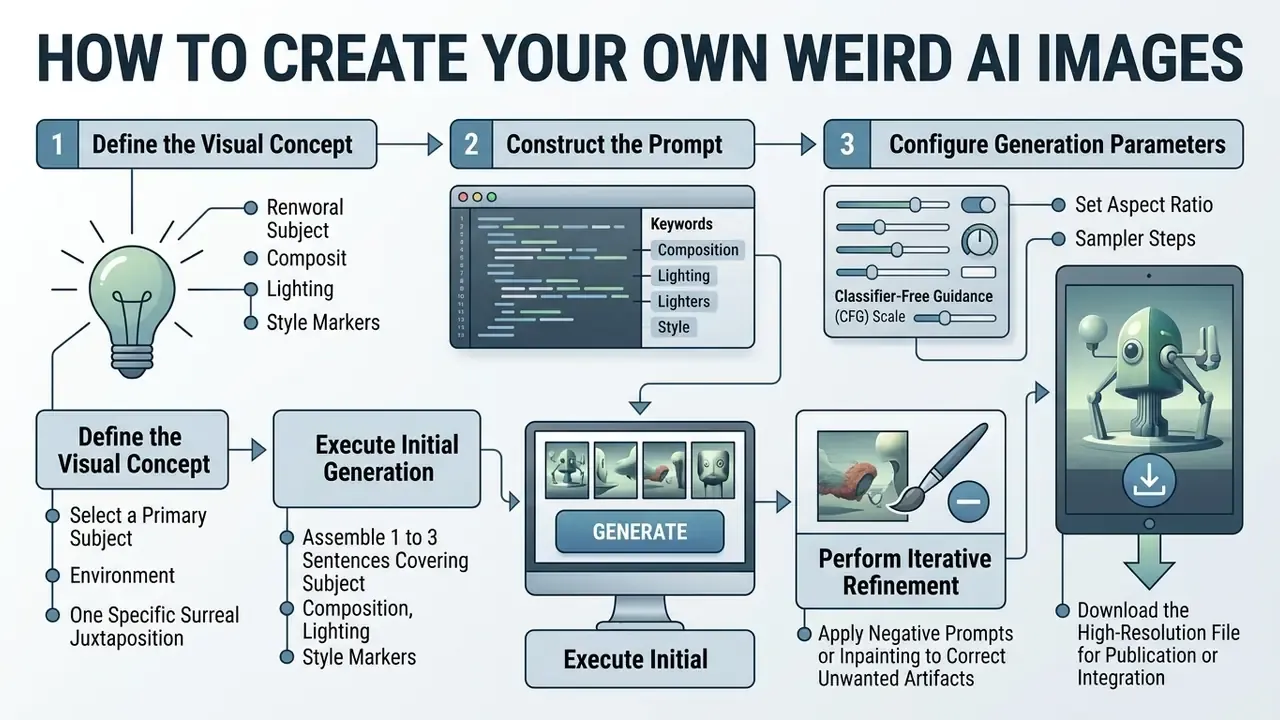
Creating custom weird AI images needs a structured workflow: concept selection, prompt engineering, parameter tuning, iterative refinement. Systematic workflows turn random output into predictable creative execution.
«Diffusion models are trained on web data without correctness verification, learning correlations rather than causal relationships between objects and scenes.»
Which is why step 5 is not optional. Because the model internalized statistical co-occurrence rather than physical causation, the first batch is a sample from a distribution, not an answer to your brief. Controlled surreal generation in the research literature follows the same shape: a structured prompt specification, an optional base or reference image, then iterative refinement of prompt and settings. A 2024 study on surrealistic-like image generation found its highest-rated surreal outputs came from 50-word structured prompts built on objects detected in reference artworks. Longer, object-anchored prompts outperformed short ones, at least for this genre.
Prompt Formulas for Crazy AI Pictures: Idea, Style, and the Unexpected Element
A crazy ai pictures prompt relies on a formula: core subject, action, environmental context, art style, plus a deliberate juxtaposition element. Combining incompatible concepts is how you get controlled dissonance instead of noise.
Recommended prompt architecture according to 2026 developer documentation:
- Subject: "A Victorian mechanical owl"
- Action or state: "reading an ancient glowing leather-bound book"
- Environment: "inside an underwater glass library surrounded by deep-sea fish"
- Style and lighting: "cinematic dark moody lighting, hyperrealistic 8k texture, volumetric rays"
- Juxtaposition operator: "juxtaposed with modern neon sign lettering"
«IMAGINE-E records that FLUX.1 and Ideogram 2.0 lead on structured and stylistic tasks, while other models deliver inconsistent results.»
Two more levers come from prompt-modifier research and vendor documentation. A 2024 taxonomy of prompt modifiers groups usable terms into six classes: subject terms, image prompts, style modifiers, quality boosters, repeating terms, and "magic terms." That gives you a checklist for stacking weirdness without breaking coherence. Vendor guidance, meanwhile, advises keeping prompts to one to three clear sentences, referencing multiple input images by order, and using spatial anchors (left, right, foreground, background) when combining elements.
Quick AI Prompt Constructor
Pick one option per column and read the row left to right. Three choices, one prompt.
| Subject | Surreal element | Style | Assembled result |
|---|---|---|---|
| A Victorian owl | with clocks for eyes | hyperrealistic 35mm photograph, 8k | A Victorian owl with clocks for eyes, hyperrealistic 35mm photograph, 8k |
| A cat in a tailor suit | reading a glowing pasta book | 1970s dark sci-fi movie still, film grain | A cat in a tailor suit reading a glowing pasta book, 1970s dark sci-fi movie still, film grain |
| An astronaut on a unicycle | riding a giant snail | detailed oil painting, chiaroscuro | An astronaut on a unicycle riding a giant snail, detailed oil painting, chiaroscuro |
Mix rows freely. The constructor is deliberately small, because the fastest route to the craziest ai generated images is usually one unexpected element, not five.
Creators evaluating commercial generator toolsets can explore the AI Media Comparison Matrices and our ranking of the best AI image generators to compare rendering performance across model architectures.
How to Improve the Result After the First Generation
Iterative refinement uses targeted tools, inpainting, outpainting, seed locking, and negative prompts, to fix defects while preserving the surreal composition you actually wanted.
When fine-tuning a generation:
- Seed locking: keep a constant seed while making small adjustments to prompt wording, which holds composition stable. Switch seeds only when you want a genuinely new variant (Vendor Prompt Engineering Guide, 2024).
- Inpainting: mask localized defect areas such as extra fingers or garbled text, then re-render only the selected pixels.
- Outpainting: extend the canvas beyond the original frame to add environmental context without regenerating the subject.
- Negative prompting: add explicit terms such as
photorealistic, ordinary, symmetrical, extra limbs, blurto suppress model defaults and push the output toward unusual composition. Peer-reviewed evaluation across 1,000 prompts and five seeds per prompt confirms the technique is both seed- and prompt-sensitive, so test changes across at least three seeds before adopting them into a template. - CFG tuning: lower guidance (3.5 to 5.0) restores texture and reduces waxy skin, while higher guidance enforces prompt adherence at the cost of plasticity.
For expanding image borders beyond the original framing, creators can use the image border expansion techniques documented in our outpainting guide.
AI Models and Tools for Creating Strange AI Images
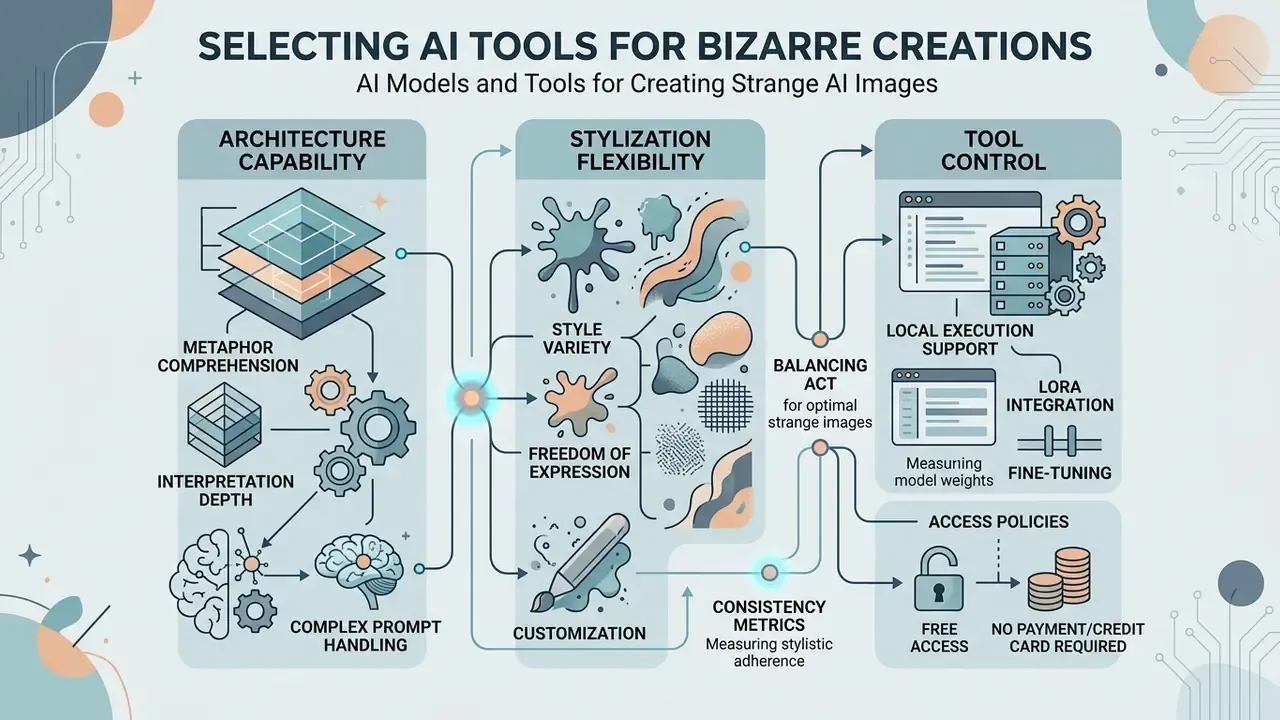
Choosing the right AI models and AI tools comes down to balancing architecture capability, stylization flexibility, and local execution support. Generators differ sharply in censorship filters, custom training options, and credit pricing.
What to Consider When Choosing an AI Image Generator
Evaluating an ai image generator means checking visual metaphor comprehension, style consistency, prompt adherence, and content moderation boundaries.
Key evaluation criteria for experimental art models:
- Metaphor comprehension: measured with benchmarks such as VMetaphor-Bench, which tests 1,500 samples for whether output matches both metaphor structure and intended meaning (VMetaphor-Bench Evaluation, 2024).
«VQAScore, the automated metric behind GenAI-Bench, improves image-to-prompt alignment measurement by two to three times over competing evaluation methods.»
Teams comparing enterprise image tools can consult the Best AI Art Generator Comparison for benchmarks, or weigh no-cost options in our review of free AI image generators.
- Stylization freedom
- the ability to override default photographic settings without a safety filter blocking the artistic prompt. Vendor policy on adult content, celebrity likeness, and style references decides whether a brief executes at all. A model can benchmark well technically and still reject the job. Category overviews such as ai generated porn images and ai generated porn videos document where platform filters typically hard-stop, which matters for any team writing an acceptable-use policy.
- Local control and LoRA support
- open-weights architectures such as Stable Diffusion 3.5 allow local execution and custom Low-Rank Adaptation (LoRA) weights fine-tuned on surrealism (Diffusers LoRA Documentation, 2024). LoRA scale runs from 0 (disabled) to 1 (full fine-tuned weight), and public surrealism LoRAs exist for both SD 1.5 and SDXL.
- Style consistency metrics
- recent stylized-synthesis reviews separate fidelity and diversity from style adherence, measuring the latter with Style Consistency, CLIP-based Semantic Alignment, and human preference studies.
Free Access, No Payment, and Credit Card Requirements
Platforms vary across fully free tiers, credit-based trials where a credit card is required, and paid API subscriptions. Review access terms before starting a creative project. Enterprise buyers in regulated sectors must additionally check deployment, data-retention, and audit conditions.
| Platform / Model | Base Architecture | Free Tier / No Payment Terms | Surreal Query Performance | Private / VPC Deployment | Training Opt-Out | Audit Trail Support | Output Usage Rights |
|---|---|---|---|---|---|---|---|
| Midjourney v6 | Proprietary diffusion | No free tier; paid subscription required | Exceptional visual polish and complex style blending | Not offered | Limited; Stealth mode on higher tiers | Web history only | User owns outputs; commercial revenue above $1M requires Pro plan; platform retains broad license to inputs and outputs |
| Stable Diffusion 3.5 | Latent diffusion (open weights) | Free local execution; no credit card required | High control via LoRAs and local parameters | Full self-host or air-gapped | Not applicable when self-hosted | Full local logging of prompt, seed, model hash | Permissive open license for commercial derivative use |
| DALL·E 3 / GPT-Image-2 | OpenAI transformer-diffusion | Prepaid API credit system; credit card required | Strong prompt adherence; weak on negation prompts | Enterprise agreements only | Available for API and business tiers | API request logs and usage dashboards | Commercial rights granted; subject to safety filtering |
| Flux.1 | Flow-matching transformer | Free options via third-party hosts | Superior anatomical rendering and prompt adherence | Self-host for open variants; varies by host | Depends on host | Depends on host implementation | Commercial licensing depends on host platform terms |
| Ideogram 2.0 | Proprietary diffusion plus strong text encoder | Limited free daily generations | Best-in-class legible in-image text; strong stylistic tasks | Not offered | Limited | Account-level history | Commercial use on paid plans; verify current terms |
Read the table this way. If you need no payment and full auditability, self-hosted Stable Diffusion is the only row that gives both. If you need legible in-image text, Ideogram or FLUX.1 win. If your governance team needs prompt, seed, and model hash retained for evidence, hosted consumer tiers will not satisfy that requirement without an enterprise agreement.
For readers who specifically want access without card details, our overview of AI image generators with no sign-up lists tools that run without registration. For cost planning across visual AI tools, review the AI Media Pricing Guides or estimate rendering expenses with the AI Media Calculators.
FAQ About Weird AI Images
Frequently asked questions about weird AI images cover required skills, style enforcement, labeling duties, and brand risk.
Do You Need Design Skills to Create Weird AI Pictures?
No. Viral ai weird images do not require classical graphic design training or an art degree. Research on text-to-image interaction design points to one primary skill: iterative prompt engineering. Learn to structure descriptive keywords, technical camera terms, and stylistic markers, then test combinations until the output matches intent.
«Oppenlaender et al. show that users frequently attribute intentionality to features that are byproducts of model architecture and training data.» - Oppenlaender et al., Perceptions and Realities of Text-to-Image Generation, Mindtrek (2023). https://dl.acm.org
Updated: this attributed conference paper replaces an earlier unsourced reference. Peer-reviewed work also defines prompt-engineering skill as the use of language plus prior knowledge to steer generative models, a creative competency rather than a prerequisite credential. You write natural language; the model handles the rendering.
For niche stylistic work, creators can also explore tools like the Ghibli AI Image Generator Comparison.
Can You Get Strange AI Art in a Specific Style?
Yes. Odd ai images can be pushed into a specific aesthetic, Salvador Dalí surrealism, 1970s photorealism, film noir, cyberpunk, using targeted style conditioning, reference style transfer, and negative prompts.
Documented stylization methods:
- Prompt style conditioning: place explicit aesthetic descriptors early, for example
in the style of 1970s dark noir photography, high-contrast shadows, 35mm film grain, then follow with lighting, color, and mood terms (Adobe Firefly Prompt Guidance, 2026). - Neural style transfer: combine a content image with a reference style image to re-render structure in a target artistic texture.
«Neural style transfer separates content and style representations through convolutional networks, allowing content to be rendered in a target artistic texture.» - Gatys, Ecker & Bethge, CVPR (2016). https://cv-foundation.org
- Photorealistic reference transfer: deep photo style transfer applies a reference look while preserving photographic realism, the documented route to convincing vintage film aesthetics.
- Style-specific LoRAs: load Low-Rank Adaptation weights trained on historical art movements directly into a local Stable Diffusion pipeline.
- Constraint-based suppression: use negative prompts to strip default photorealism (
photo, dslr, sharp focus, modern) so the requested style dominates.
Readers choosing a tool for a specific movement can compare options among the best AI art generators or test ideas at no cost with free AI art generators. For integration help, visit the support portal or consult the api reference library.
Do Weird AI Images Need to Be Labeled?
It depends on realism and jurisdiction. Obvious surrealism, a typewriter-peacock hybrid, carries low deception risk. Photorealistic synthetic people, events, or news-like scenes fall squarely inside transparency regimes. Under the EU Code of Practice on Transparency of AI-Generated Content, obligations under Article 50(2) and (4) apply from 2 August 2026, requiring detectable marking of synthetic media, metadata identifiers, cryptographic provenance, and prominent labels for deepfake-style images. NIST AI 100-4 (2024) documents watermarking and metadata as the current technical methods while cautioning that neither is tamper-proof. Research disclosure norms point the same way: U.S. HHS ORI guidance asks researchers to disclose generative AI tools used in research and in manuscript or grant preparation.
What Are the Brand and Financial Risks of Weird Outputs in Automated Creative Pipelines?
Organizations auto-generating marketing creative at scale inherit three compound risks. First, artifact leakage: with positional accuracy near random and negation frequently ignored, an unreviewed batch will eventually publish an asset with six fingers, a garbled sign, or a forbidden object. Second, authenticity exposure: if photorealistic assets ship without provenance credentials, later challenges cannot be rebutted with records. Third, IP aggregation risk: style prompting that accumulates one artist's expressive choices can raise similarity questions even without copying a specific work.
Mitigation is procedural rather than technical. Mandatory human review gates. Logged prompt, seed, and model metadata for every published asset. Negative-prompt standards enforced at the template level, not left to individual creators.
How Should a Regulated Team Document Synthetic Assets for Audit?
Treat each published asset like a model output, because that is what it is. A defensible record usually holds five fields: model name and version, prompt and negative prompt, seed and sampler settings, reviewer identity with approval date, and the provenance credential applied at export. Keep that record where internal audit already looks, not in a designer's local folder. One practical warning: hosted consumer tiers often expose generation history in a web interface but offer no export, so the evidence disappears when the subscription lapses.
Methodological note: findings about model behavior summarized here come from published benchmarks and peer-reviewed studies on specific model versions. Behavior varies by model, version, sampler, and prompt language, so validate conclusions on your own datasets and deployment configuration before writing them into policy.
Appendix A: Source Revision Log
For transparency, several citations present in the previous version of this article were replaced with attributed, peer-reviewed alternatives. The superseded references are recorded here rather than silently removed:
| Superseded reference | Problem | Replacement |
|---|---|---|
| "Perception of Generative AI Imagery Study, 2025" (arxiv.org) | No authors, method, or reported figures | Miller, Nightingale & Farid, Psychological Science (2023) |
| "Default Image Artifacts in Generative Models, 2025" (openreview.net) | No authors or methodology; claim unquantified | GenEval: Object-Focused Evaluation Framework (2023) |
| "Facial Expression Anomalies in Synthetic Media, 2024" (sciencedirect.com) | No authors or journal title | AI-generated faces are becoming more trustworthy (2024) |
| "Design Principles for Text-to-Image Tools, 2026" (acm.org) | No authors or methodology | Oppenlaender et al., Mindtrek (2023) |
| "OpenReview Diffusion Hallucination Study, 2024" | Unattributed; retained for context, now supported | GenAI-Bench (2024) and mode-interpolation literature |
| "ICLR Spatial Language Protocol, 2025" | Default-viewpoint claim not fully attributable | Retained with an explicit validation caveat |