For a risk owner in a US bank or a regulated fintech, that shift is not just a cost story. It changes who holds the evidence.
Executive Summary: What Decision-Makers Need in 30 Seconds
| Decision Question | Short Answer |
|---|---|
| Is "open source" the same as "open weights"? | No. The Open Source Initiative requires the freedom to use, study, modify, and share, including pipeline documentation. Most image checkpoints (SDXL, FLUX.1 Dev) are open-weight releases governed by model-specific agreements. |
| Which models matter in 2026? | Stable Diffusion XL / 3.5 for fine-tuning depth, FLUX.1 for photorealism, Qwen-Image for typography and multilingual text, Nano Banana Pro for multi-reference consistency. |
| What does it really cost? | Hosted open-model APIs cluster between roughly $0.003/image (FLUX.1 Schnell tier) and $0.08/image (premium Stability tiers). A 24/7 self-hosted RTX 4090 node is benchmarked near $504/month at $0.69/hr. True TCO must also include validation, monitoring, and legal review labor. |
| Where should it run? | Local workstation (maximum privacy), self-hosted GPU cluster (team scale plus control), serverless API (zero hardware), or a decentralized GPU network (no hardware, open weights, sub-cent renders). |
| What is the biggest residual risk? | Intellectual-property exposure from training-data provenance and indirect reproduction of protected characters, plus demographic bias that persists even as unsafe-content rates fall. |
| What must be documented for audit? | Model inventory entry, weight provenance and hash, license file snapshot, seed/sampler/CFG logs, safety-filter configuration, and human-review sign-off. |
Bottom line for risk owners: open weights shift cost from variable API credits to fixed infrastructure plus a permanent control function. Budget both. "Open source" status never transfers regulatory or copyright accountability away from the deploying organization.
What Open Source AI Image Generator Means and Who It Is For
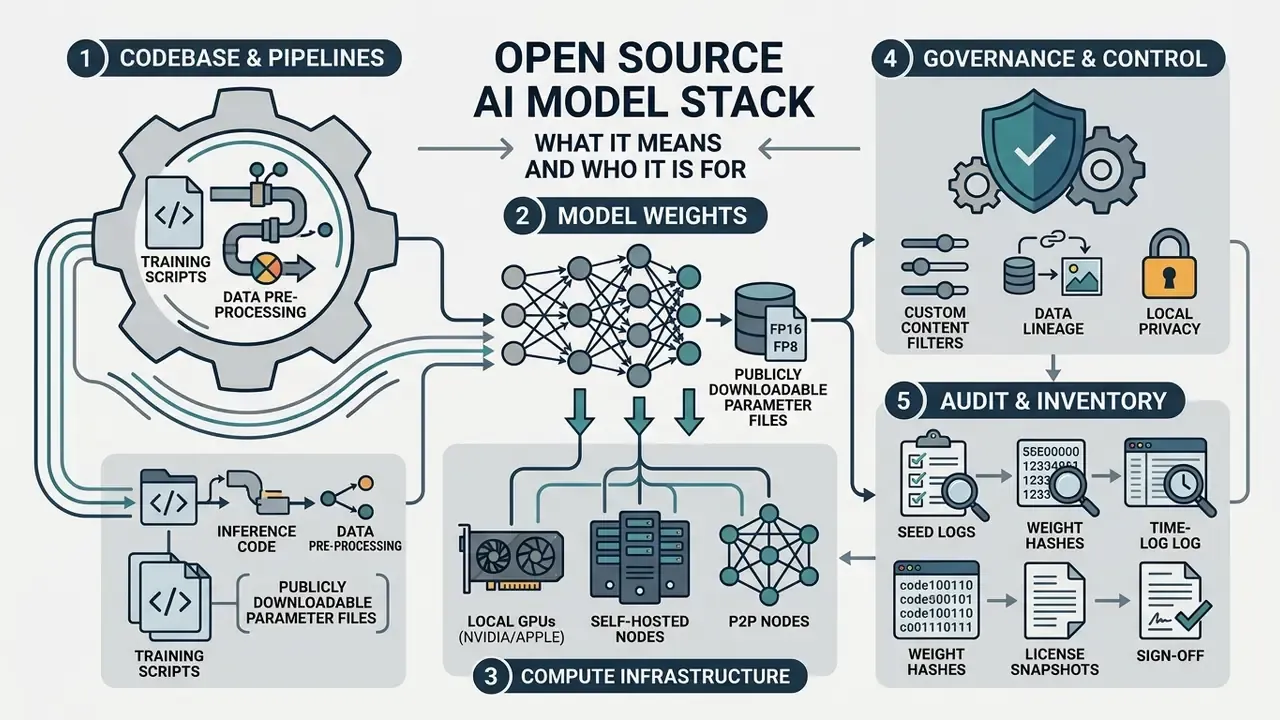
An open source ai image generator provides accessible source code and downloadable model weights. That combination lets organizations run, audit, and fine-tune image synthesis pipelines on self-hosted or local infrastructure. The architecture suits enterprises, software engineering teams, and visual artists who need strict data privacy, real creative freedom, and predictable operating expenditure.
Unlike proprietary SaaS products that process user prompts on external servers, an open ai image framework keeps prompts and visual artifacts under internal control. According to the Open Source Initiative, genuine open-source AI requires more than downloadable parameters. It also requires the data pipeline documentation and tooling needed to inspect, modify, and replicate the underlying architecture (Open Source Initiative, 2025).
Under the Hood: Diffusion, Autoregressive, and MMDiT Architectures
Understanding the generation mechanism helps operators tune prompt structure, sampling parameters, and hardware sizing. It also helps validators explain model behavior to auditors in plain language.
- Diffusion models (e.g., Stable Diffusion XL, SD3.5).Generation starts from a pure Gaussian noise tensor. Over roughly 20 to 50 iterative steps, a U-Net denoiser removes noise while conditioned on text embeddings, resolving structure first, then texture, then fine detail. Too few steps yield draft-grade blur. Too many waste compute without proportional gain.
- Autoregressive models.Instead of denoising the whole canvas at once, these systems predict visual tokens sequentially, much as a language model emits text tokens, using each generated chunk as context for the next. The approach delivers strong spatial reasoning, numeric and positional accuracy, and legible text. Generation is slower, and it usually returns a single image per request.
- Multimodal Diffusion Transformers (MMDiT, e.g., FLUX.1, Qwen-Image).The U-Net backbone is replaced by a transformer that processes text tokens and image latents jointly in a unified latent space. Joint attention sharply improves complex prompt adherence, compositional control, and typography, which is exactly why MMDiT checkpoints dominate 2026 open-weight leaderboards.
A practical consequence worth internalizing: the same prompt behaves differently per architecture. Stable Diffusion rewards keyword weighting and negative prompts. MMDiT models reward descriptive natural-language paragraphs. Step counts and guidance ranges are not transferable between families, so do not copy settings across model cards.
Open-Source Code, Open-Weight Models, and Licensing Terms
Open-source code provides public access to training scripts and model architecture. Open-weight models distribute trained parameter files under specific usage agreements. The distinction is not academic. It decides whether a commercial product is clean or exposed.
«Licenses act as bottlenecks that govern how knowledge flows into innovation ecosystems, and their type must be verified at the level of each individual model.»
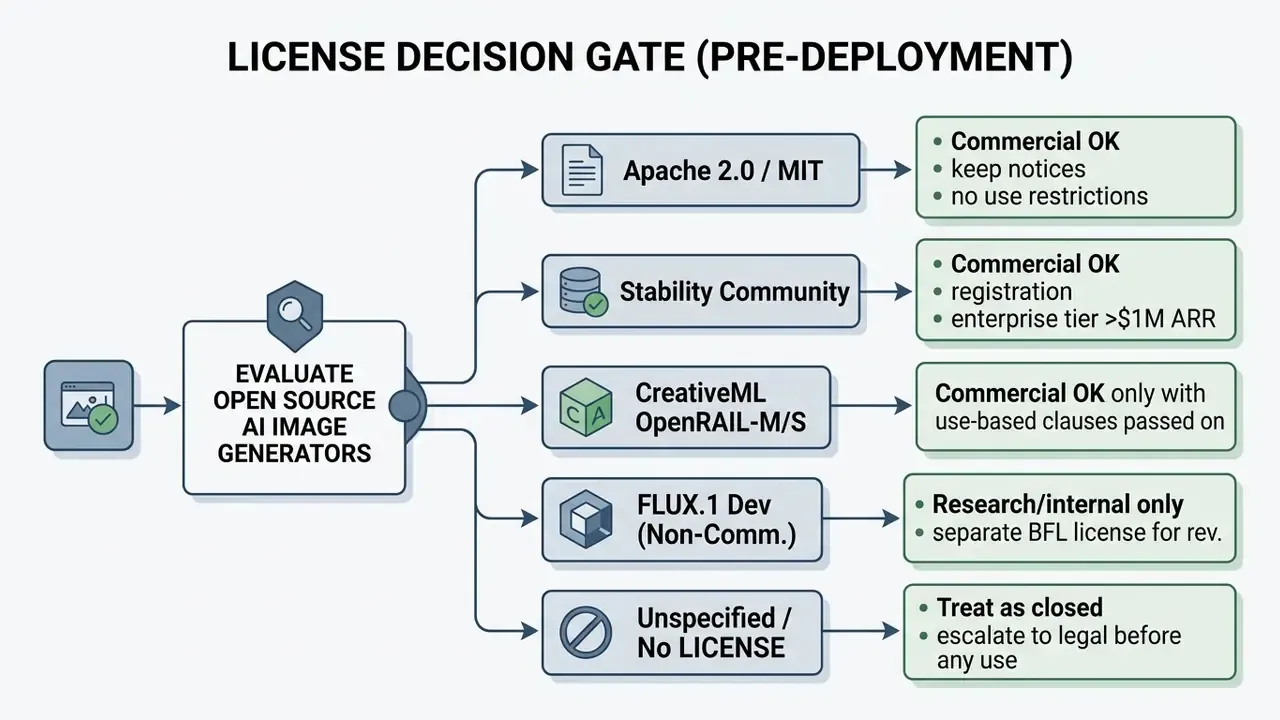
Permissive frameworks such as Apache 2.0 and MIT permit unrestricted commercial deployment, modification, and royalty-free redistribution (Granite Code Technical Report, 2024). Apache 2.0 grants a perpetual, worldwide, royalty-free right to reproduce, modify, sublicense, and distribute, including inside commercial products, provided license text and attribution notices survive. MIT allows commercial redistribution with the copyright notice retained and adds no use-based restrictions.
Specialized licenses behave differently. CreativeML OpenRAIL-M and Open RAIL-S permit commercial reuse only when specific behavioral and downstream usage restrictions are respected, and those restrictions must be passed to every redistributor and API consumer. Models released under explicit Non-Commercial terms prohibit integration into revenue-generating services or paid enterprise workflows.
«Just two generic keywords can trigger a recognizable copyrighted character without naming it, a phenomenon the authors call indirect anchoring.»
That finding is the core intellectual-property risk in commercial deployment. Prompt-level keyword bans do not eliminate infringement exposure, because indirect anchoring reproduces protected characters and trade dress without any named reference. Control therefore belongs at the output-review layer, not only at the prompt layer.
Legal notice: this material is general in nature and does not replace advice from qualified counsel on copyright, AI model licensing, and regulatory compliance.
Free Generator Does Not Always Mean Zero Cost
Downloading an ai image generator free open source checkpoint carries no upfront software licensing fee. Running it carries real infrastructure and compute expense. Migration from third-party APIs shifts spend from variable per-image credits to fixed hardware amortization or cloud server rentals.
Local execution needs desktop hardware with high-VRAM graphics cards. Self-hosted deployments need cloud GPU instances on providers such as RunPod or Vast.ai. RunPod publishes per-second billing with an RTX 4090 at roughly $0.34/hr on Community Cloud and $0.69/hr on Secure Cloud. Vast.ai operates a marketplace where the same card class frequently clears between $0.13/hr and $0.50/hr depending on supply. A continuously running single-4090 node is therefore benchmarked near $504/month at $0.69/hr.
«An eight-GPU NVIDIA H200 system serves roughly 14 queries per second on Stable Diffusion XL; a dual L40S configuration holds latency under two seconds single-stream.»
Hosted API options for open models typically cost between $0.003 and $0.08 per generated image. That is an economical middle ground for low-to-medium volume production without hardware maintenance. Published 2026 tariffs place FLUX.1 Schnell near $0.003/image, higher-fidelity FLUX variants near $0.03 to $0.05/image, and Stability tiers between roughly $0.03/image (Core) and $0.08/image (Ultra). Because the spread is a multiple rather than a percentage, migration economics are driven almost entirely by monthly volume.
Total Cost of Ownership formula for regulated environments:
TCO(12 months) =
   [ Compute ]        GPU hours x hourly rate  OR  hardware capex / amortization
 + [ Storage ]        checkpoint + LoRA + output archive (GB x $/GB-month)
 + [ Engineering ]    MLOps FTE % x loaded salary  (deploy, patch, upgrade)
 + [ Validation ]     Model risk FTE % + independent review cycles per release
 + [ Controls ]       safety filtering, watermark/provenance checks, audit logging
 + [ Legal ]          license review, IP clearance, regulatory documentation hours
 + [ Residual Risk ]  expected cost of takedown, rework, or reputational remediation
 - [ Avoided Fees ]   displaced SaaS subscriptions and per-credit API spend
The frequent error in migration business cases is comparing only Compute against Avoided Fees. For a bank or a fintech, the Validation, Controls, and Legal lines are rarely smaller than the compute line in year one. They also persist long after the hardware is amortized.
| Category | Source Code Availability | Weight Access | Data Control & Privacy | Cost Structure | Commercial Licensing |
|---|---|---|---|---|---|
| Open-Source AI Generator | Complete access to training and inference code | Publicly downloadable under permissive terms | High; all data remains on local or private infrastructure | Hardware, power, and maintenance overhead | Permissive (e.g., Apache 2.0); broad commercial reuse allowed |
| Open-Weight Model | Inference code published; training pipeline limited | Downloadable parameters under specific agreements | Moderate to High; self-hosted execution supported | Hardware overhead plus potential licensing tiers | Conditional; may enforce revenue caps or prohibit commercial use |
| Closed Proprietary SaaS | None; proprietary closed-source codebase | Inaccessible; hosted behind vendor APIs | Low; prompts and outputs processed on third-party servers | Recurring subscription tiers or per-credit API billing | Governed by vendor Terms of Service and API policies |
No matching rows Clear one or more filters to restore the matrix.
Figure 1: Comparative breakdown of software access, data privacy, and operational costs across AI image generator deployment types. Teams that want a tool-by-tool view after reading this typology can compare leading AI image generators side by side.
Data Retention and Retraining Exposure Matrix
| Platform / Deployment | Data Retention | Model Retraining on Prompts | Commercial Ownership |
|---|---|---|---|
| Local Open Source (SD / FLUX) | Zero (100% on-premise) | No | 100% user owned |
| Self-Hosted Cloud (RunPod / AWS / K8s) | Isolated database under your keys | No | 100% user owned |
| Decentralized GPU Network | Transient task payloads on peer nodes | No (network-dependent; verify terms) | User owned, subject to model license |
| Closed Commercial SaaS | Vendor cloud retention windows | Yes, unless enterprise opt-out is signed | Governed by vendor ToS |
How to Choose an Open-Source Image Generation Model
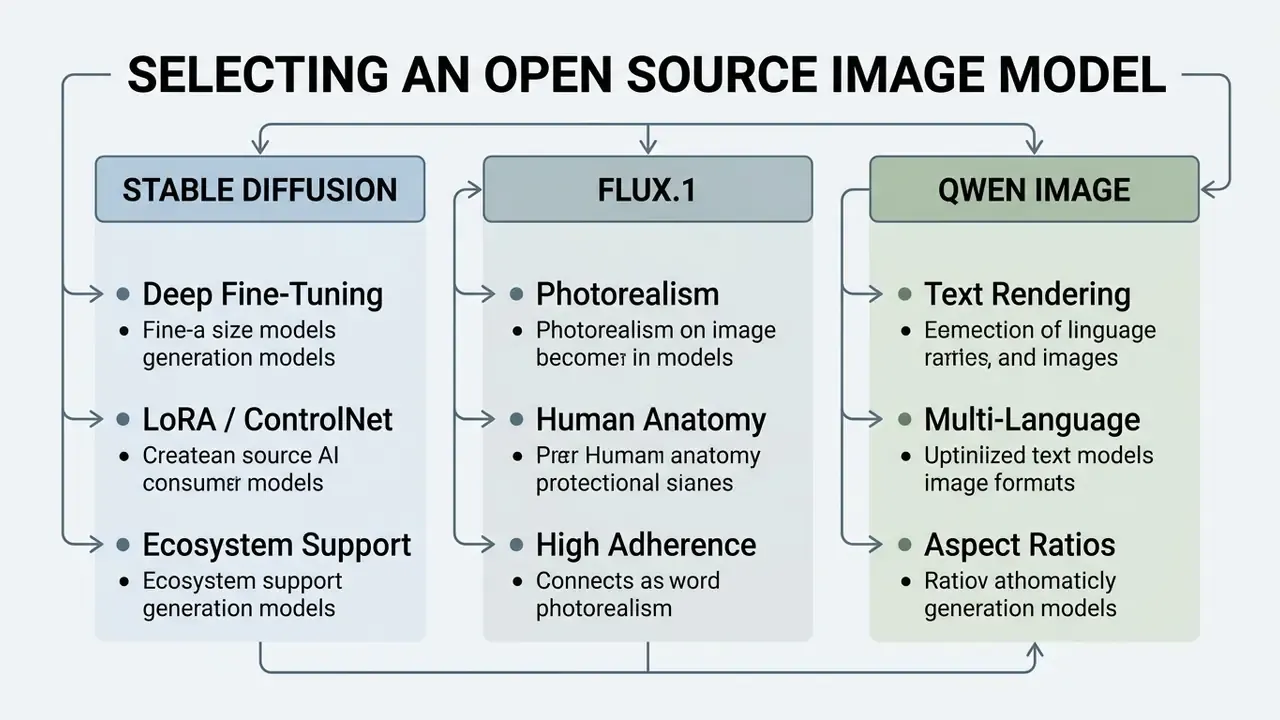
Selecting an image generation ai open source checkpoint means evaluating visual fidelity, prompt adherence, text rendering, VRAM consumption, and license conditions together. Matching architecture to operational need prevents infrastructure bottlenecks and keeps output quality stable.
Evaluating the current field of free ai image generation models open source requires testing across general visual art, photorealism, multi-reference handling, and precise graphic typography. Benchmark literature is blunt about the remaining gap. Text-focused suites such as STRICT (2025) and OneIG-Bench (2025) still rank GPT-4o and Gemini-class systems ahead of most open checkpoints on character accuracy and long-string legibility, even where open models match them on aesthetics.
Stable Diffusion for Flexible Local Generation and Fine-Tune
The stable diffusion model family (including SDXL and SD3.5) remains the industry baseline for customizable local generation and custom checkpoint training. Its mature developer ecosystem supports advanced conditioning tools such as ControlNet for structural guidance and IP-Adapter for visual style transfer. Diffusers documents IP-Adapter support across SD, SDXL, and SD3, including combined ControlNet plus IP-Adapter pipelines.
«SDXL scales the UNet backbone roughly threefold versus earlier versions and adds a second text encoder for richer cross-attention, reaching results comparable with closed generators.»
Running SDXL or SD3.5 locally requires between 12 GB and 24 GB of VRAM for comfortable inference and LoRA fine-tuning (Hugging Face Diffusers Documentation, 2026). Community training guidance converges on roughly 12 GB VRAM as the practical floor for SDXL LoRA work, and 24 GB (3090 or 4090 class) for comfortable full fine-tuning.
Enterprise teams pick Stable Diffusion when they need brand-aligned visual pipelines with fine-grained control over subject composition and stylistic consistency. It is an adaptable alternative to closed platforms such as midjourney ai image generation.
- Hugging Face Diffusers Documentation, 2026
«The average share of unsafe images fell from 0.209 in SD-1.5 to 0.113 in SDXL, yet gender bias became more pronounced.»
For model-risk functions, that nuance decides the test plan. A newer checkpoint is not automatically a safer checkpoint. Safety and fairness improvements move independently, so they must be validated as separate dimensions with separate prompt batteries.
FLUX for Detailed and Photorealistic Images
Developed by Black Forest Labs, the flux architecture delivers strong prompt adherence, credible human anatomy, and precise lighting. The family splits into operational tiers: Pro for hosted commercial production, Dev for research-grade local fidelity, and Schnell for rapid iteration and prompt testing.
FLUX.1 Schnell ships under Apache 2.0 for fast, commercially unrestricted generation. FLUX.1 Dev offers higher visual detail under a non-commercial research license and requires a separate agreement with Black Forest Labs for revenue-generating use. Read that distinction before it reaches production.
«FLUX.1 Kontext, combined with a language model and three-stage training, achieves the best StructScore results on structured visual tasks.»
Through quantized builds such as FP8 and GGUF, local developers can run FLUX models on consumer hardware with 8 GB to 12 GB of VRAM (Black Forest Labs, 2024). Published deployment guides report roughly 24 GB at FP16/BF16, about 12 GB at FP8, and 6 GB to 8 GB with GGUF Q4 quantization.
Qwen Image and Nano Banana for Text, References, and Modern Tasks
Qwen image is a 20-billion parameter Multimodal Diffusion Transformer (MMDiT) built by Alibaba, engineered for complex typography and multi-language text rendering (Qwen-Image Technical Report, 2025).
«Qwen-Image is the only open-source model in the AI Arena platform; it ranks third by Elo, more than 30 points above GPT-Image 1 High, and leads the Alignment and Text categories.»
It resolves the garbled lettering common in earlier diffusion architectures, producing crisp text on graphics, logos, and promotional assets. Alibaba Cloud documents aspect-ratio presets from 1:1 through 16:9 and 9:16, with total pixel budgets between 512×512 and 2048×2048.
«DALL-E 3 reaches about 10% OCR accuracy for full strings and about 50% for substrings; SD and SDXL sit near zero, which lowers text-attack risk but limits typography.»
Nano Banana Pro offers specialized multi-reference processing, accepting roughly 4 to 14 reference images to hold character identity and composition across variable aspect ratios, with 2K and 4K output tiers. It is, however, a proprietary hosted model. Place it in an evaluation matrix as a quality ceiling, not as an open-weight deployment option.
| Model Name | Photorealism & Detail | Text Rendering Accuracy | Reference Image Support | Local Fine-Tuning | Min VRAM (Inference) | Commercial License |
|---|---|---|---|---|---|---|
| Stable Diffusion XL | High | Low to Moderate | Excellent (ControlNet / IP-Adapter) | Extensive (LoRA / Checkpoints) | 8 GB (FP16) | Permissive (Community License) |
| Stable Diffusion 3.5 | Very High | Moderate | Good (IP-Adapter) | Extensive (LoRA / full FT) | 12-24 GB | Community License (registration; enterprise >$1M ARR) |
| FLUX.1 Schnell | Very High | Moderate | Good | Moderate (LoRA) | 6 GB (GGUF Q4) | Apache 2.0 (Free Commercial) |
| FLUX.1 Dev | Exceptional | High | Good | Moderate (LoRA) | 12 GB (FP8) | Non-Commercial (License Required) |
| Qwen Image | High | Exceptional (Multi-Language) | High | Emerging | 16 GB (FP8 / Multi-GPU) | Apache 2.0 (Free Commercial) |
| Nano Banana Pro | Very High | High | Exceptional (Up to 14 refs) | Limited | Cloud API / Hosted | Proprietary Terms |
Figure 2: Performance specifications and hardware benchmarks across primary open-source and open-weight visual models. Post-generation finishing usually pairs these checkpoints with dedicated AI image upscalers for print-grade output.
E-E-A-T Verification / License Audit:
Always inspect the
LICENSEfile in the official repository of any open-weight checkpoint before deploying it in a revenue-generating product. Terms on annual revenue limits, derivative weight redistribution, and automated output attribution vary significantly between releases. Archive a timestamped copy of that license file alongside the weight hash. Auditors will ask which version of the terms applied on the deployment date, and "we checked the website once" is not an answer.
Where to Run Open-Source AI Image Generation: Local, Self-Hosted, or Online
Choosing where to execute a local image generation ai open source pipeline depends on available hardware, team size, data confidentiality requirements, and engineering capacity.
Organizations weigh four trade-offs: local hardware independence, self-hosted cloud scalability, decentralized peer compute, and serverless managed API convenience.
Local Launch for Privacy and Full Control
Executing an ai image generator open source checkpoint locally on a workstation guarantees data confidentiality and offline capability. No prompt inputs or visual outputs leave the machine, which protects intellectual property and unreleased corporate assets.
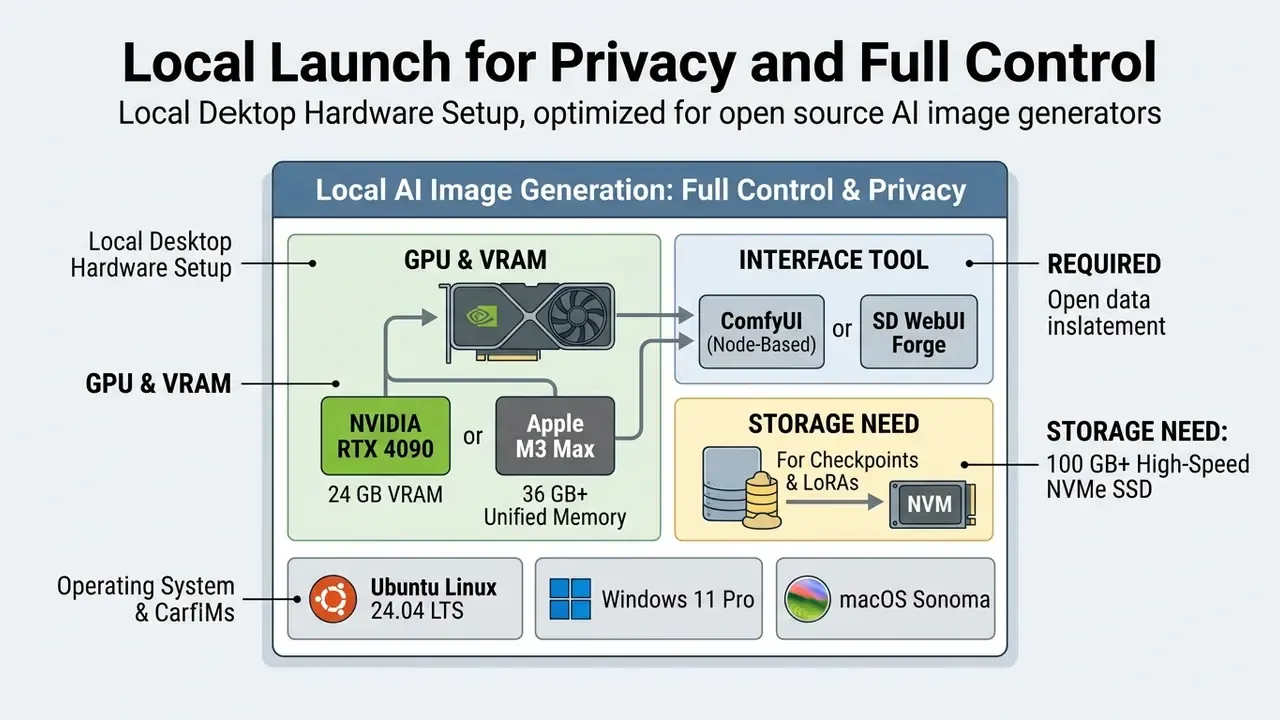
«On an eight-GPU H200 system SDXL delivers roughly 14 queries per second; a dual L40S configuration keeps single-stream latency under two seconds at about 578 W.»
On Apple Silicon, Diffusers and ComfyUI run through the Metal Performance Shaders (MPS) backend, using unified memory instead of discrete VRAM. Practical guidance places 16 GB unified memory as a floor for SDXL at 1024×1024, and 32 GB or more for comfortable FLUX FP8 or multi-model workflows. Throughput is lower than a comparable NVIDIA card, though thermal and power behavior suits quiet desk-side batch work.
For team members on Apple Silicon or workstations without a high-end dedicated GPU, a dedicated local ai image setup guide covers installation details, quantization choices, and memory limits step by step.
Essential Open-Source Frameworks & Inference Engines
Weights are only half the stack. The execution layer decides VRAM footprint, API shape, and how auditable your pipeline actually is.
| Repository / Engine | Primary Use Case | Supported Hardware | Key Advantage |
|---|---|---|---|
| Hugging Face Diffusers | Python library for model pipeline execution | NVIDIA / Apple Silicon / AMD | Industry standard for programmatic inference and fine-tuning |
| InvokeAI | Professional WebUI and unified canvas editor | NVIDIA (CUDA) / macOS (MPS) | Node-based workflows, strict color management, documented safety-checker flags |
| LocalAI | Self-hosted OpenAI-compatible REST API | Any hardware (CPU + GPU) | Zero-GPU fallback via quantized GGUF models; drop-in API compatibility |
| ComfyUI | Modular graph/node interface | NVIDIA / Apple Silicon | Precise pipeline control, low VRAM footprint, embedded generation metadata |
| AUTOMATIC1111 / WebUI Forge | Mature browser UI for SD-family models | NVIDIA / AMD / macOS | Largest extension ecosystem for ControlNet, LoRA, and upscaling |
Docker publishes a local model-runner path that pulls Stable Diffusion and wires it to a web UI. That makes container-first deployment the fastest reproducible starting point for teams who must recreate an identical environment for audit six months later.
Self-Hosted Deployment for Teams or Custom Products
Enterprise teams needing multi-user access, or building proprietary SaaS applications, deploy open visual models on self-hosted cloud GPU infrastructure. Containerized environments managed through Docker and Kubernetes give reliable scaling, load balancing, and private API integration.
Self-hosting on RunPod, Vast.ai, or AWS EC2 GPU nodes lets organizations stand up dedicated API endpoints with custom authentication, usage tracking, and white-label branding.
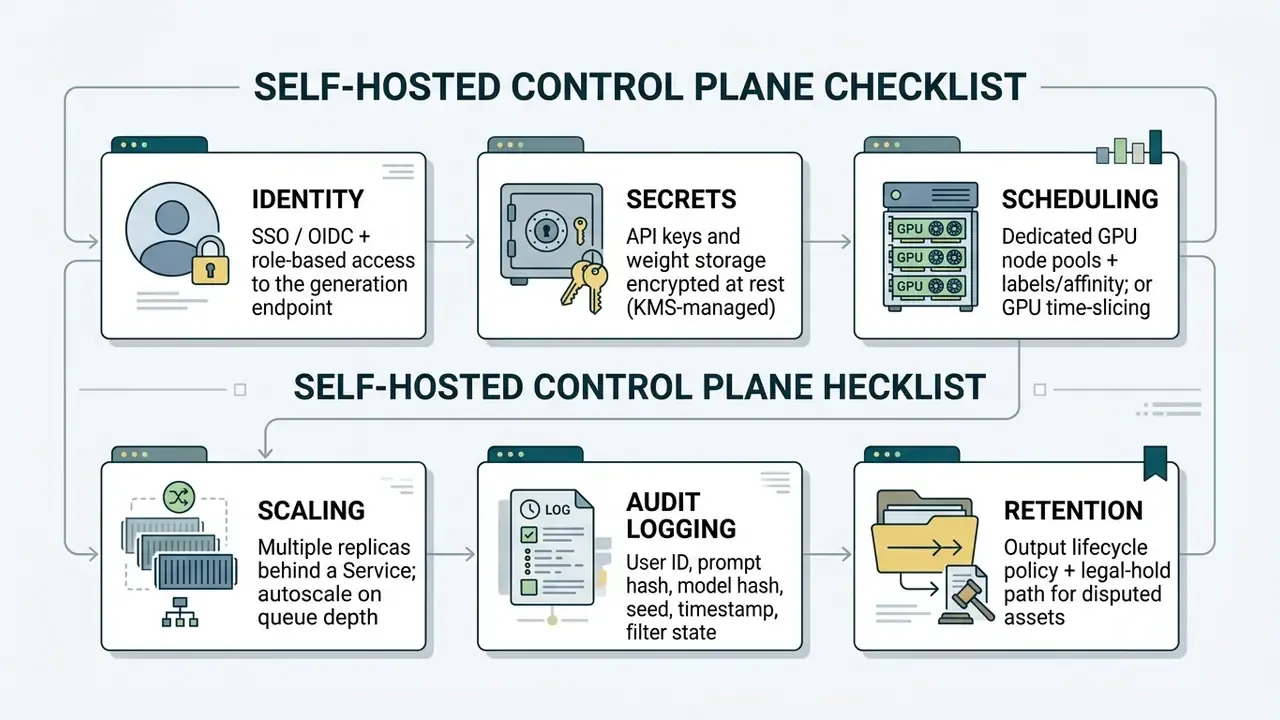
Kubernetes guidance splits between running multiple full-GPU replicas and sharing a physical GPU through time-slicing, commonly four virtual GPUs per card. Replica-per-GPU suits latency-sensitive interactive use. Time-slicing suits bursty batch queues where throughput matters more than per-request latency.
Decentralized GPU Networks: Zero-Hardware Alternative
For teams that want open-model flexibility without upfront hardware or high-tier cloud commitments, decentralized peer-to-peer compute networks (Sogni Supernet, Petals, and similar) offer a genuine middle ground. Distributing inference across community-contributed GPU nodes gives developers access to 100+ open-weight checkpoints, including FLUX, Qwen-Image, and Chroma variants, through unified APIs at sub-cent per-image costs. Local VRAM ceilings stop being the constraint.
Practical characteristics to verify before adopting a decentralized network in a regulated environment:
- Node trust model. Prompts and outputs traverse third-party machines. Confirm payload encryption, retention behavior, and whether node operators can inspect job content.
- Model licensing per checkpoint. Networks often mix Apache 2.0 models with restricted community fine-tunes on one price list. License responsibility stays with you, not with the network.
- Determinism. Heterogeneous hardware and driver versions can alter output at a fixed seed. Lock the worker class if bit-level reproducibility is a validation requirement.
- Pricing model. Credit-free "fair use" subscriptions, commonly around $20/month, remove per-render counting but usually cap resolution tiers.
Online Interfaces and APIs for Quick Start Without GPU
For organizations without local GPU infrastructure, serverless cloud platforms provide instant access to open-source models through REST APIs. Together AI, Fal.ai, Replicate, and Hugging Face Spaces manage GPU provisioning automatically and charge only for active inference time. Together AI documents serverless models with "no GPUs to provision or manage". Fal runs globally distributed serverless inference that autoscales. Hugging Face exposes hundreds of models through serverless Inference Providers.
A free ai image generation api open source tier lets development teams prototype features, run automated integration tests, and validate prompt structures before committing to dedicated self-hosted instances. Shortlists of free AI image generators help scope which tiers realistically survive production volume.
# Serverless call against an open-weight model (Fal.ai style payload)
import fal_client
result = fal_client.subscribe(
    "fal-ai/flux/schnell",
    arguments={
        "prompt": "A minimal fintech dashboard on a matte desk, soft window light, 35mm",
        "image_size": {"width": 1344, "height": 768},
        "num_inference_steps": 4,
        "seed": 4289103,
        "num_images": 4
    }
)
print([img["url"] for img in result["images"]])
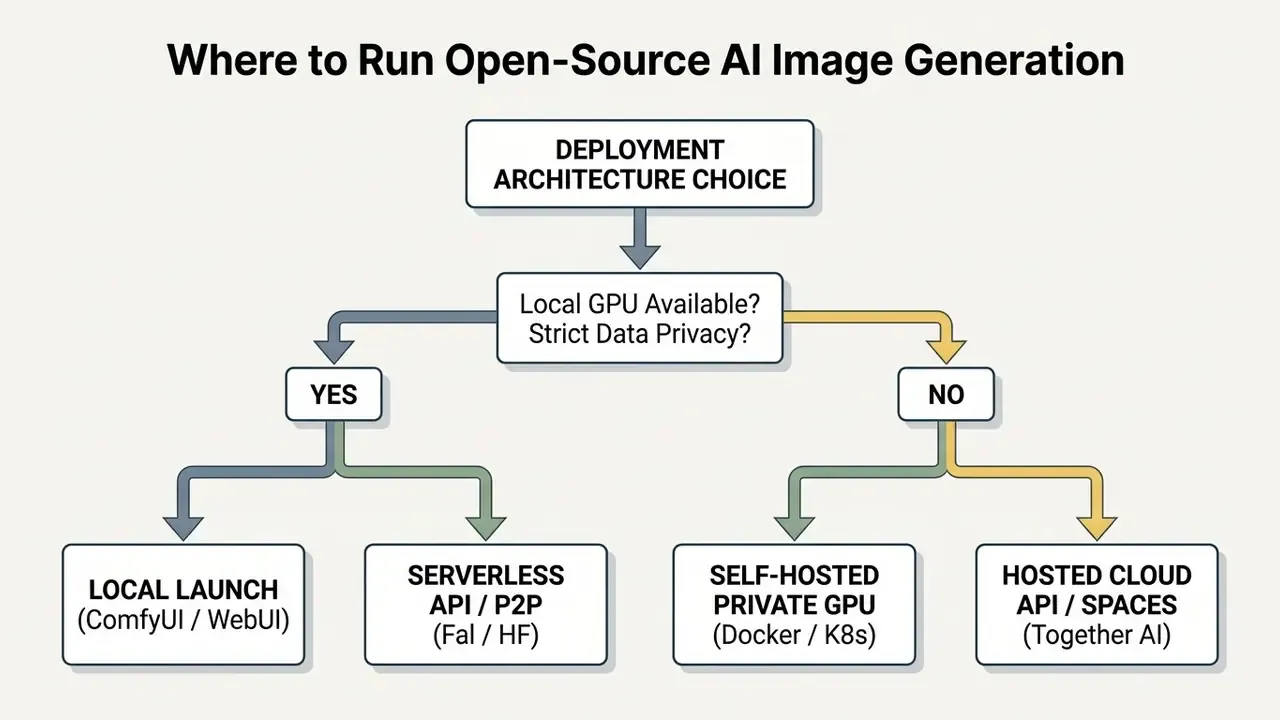
- Node 1: Hardware Evaluation. Does the team have local NVIDIA GPUs with 12 GB VRAM or more, or Apple Silicon Macs with 32 GB unified memory or more?
- If YES → proceed to Node 2 (Privacy Audit).
- If NO → proceed to Node 3 (Infrastructure Budget).
- Node 2: Data Privacy Audit. Does the project handle confidential customer data or unannounced brand assets?
- If YES → choose Local Launch (ComfyUI / local WebUI).
- If NO → choose Local Launch or Serverless API based on batch generation volume.
- Node 3: Infrastructure Budget and Engineering Capacity. Does the organization maintain DevOps capacity for Kubernetes GPU nodes?
- If YES → choose Self-Hosted Cloud Deployment (Docker / cloud GPUs).
- If NO → choose Serverless Managed APIs (Fal.ai / Replicate / Together AI), or a Decentralized GPU Network when per-image cost dominates and payloads are non-confidential.
Integrating Open Models Into Enterprise Model Governance
Open weights do not sit outside the control perimeter. They enter it. A regulated institution treats a deployed image checkpoint as a model asset with a named owner, a validation record, and a retirement date.
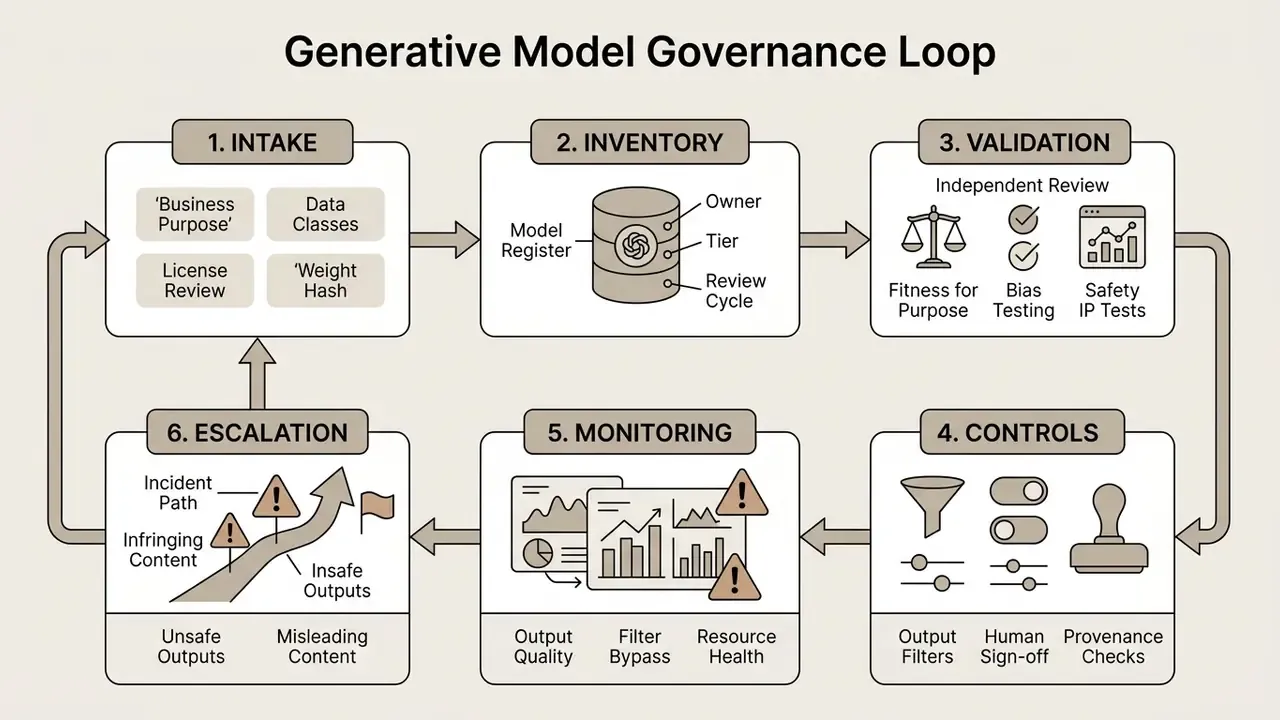
Anchor the process to frameworks your examiners already read. SR 11-7 sets the model risk management discipline: conceptual soundness, ongoing monitoring, outcomes analysis, and independent validation. The NIST AI Risk Management Framework, together with NIST's 2025 generative-AI image evaluation plan, shapes test design across prompts, resolutions, and rendering conditions. NIST specifically warns that content filters bundled with open-source packages can be bypassed more easily than hosted equivalents. Output-side screening, not model-side trust, becomes the controlling mitigation.
Shadow AI is the failure mode to design against. A designer who cannot get an approved pipeline will install an unlogged local checkpoint on a personal machine. An approved, inventoried, monitored internal endpoint is therefore a risk-reduction control, not merely a productivity project. That argument tends to land better with a board than a cost comparison does.
Regulatory notice: this material is general in nature and does not replace advice from a qualified specialist on EU AI Act obligations, SR 11-7 expectations, and applicable national law.
How to Switch From Closed AI Image Generators to Open-Source Tools
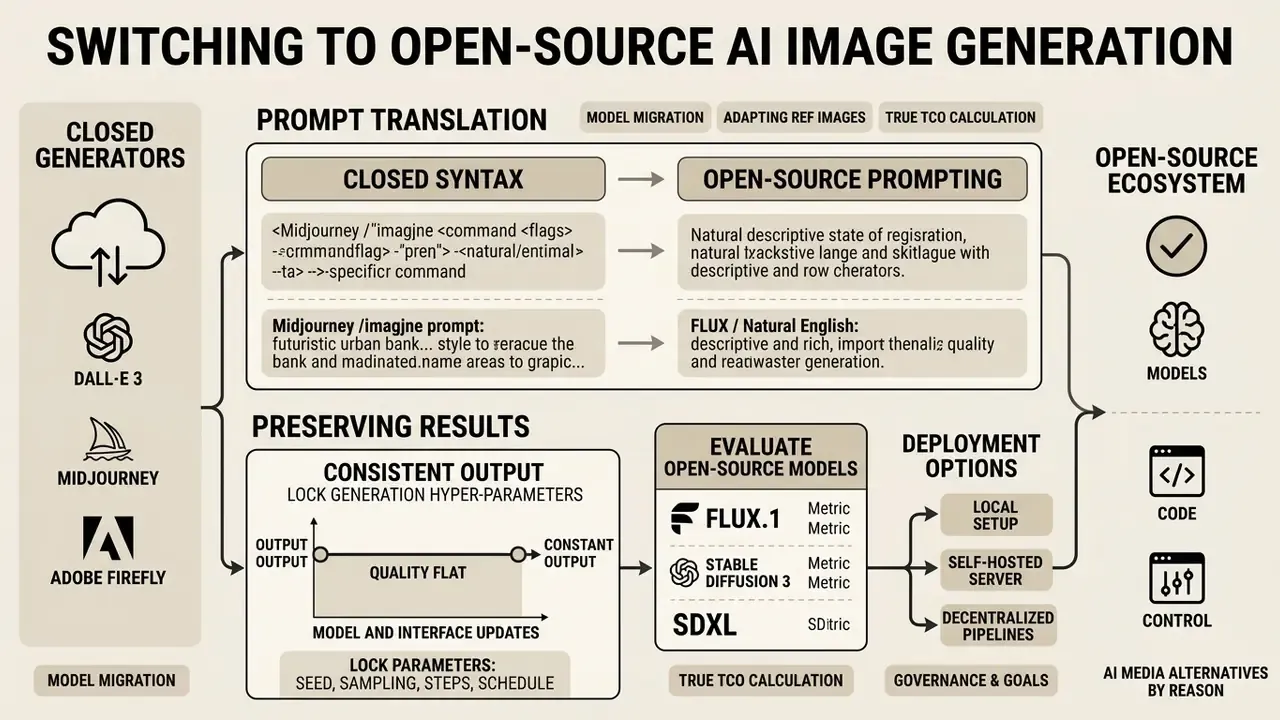
Migrating from proprietary SaaS platforms (Midjourney, DALL-E 3, Adobe Firefly) to open-source alternatives means translating prompt structures, adapting reference image conditioning, and setting quality evaluation benchmarks before the switch, not after.
A phased method keeps quality flat. Capture a baseline first: task volume, accepted output rate, edited rate, failed rate. Then run a gated pilot on a representative subset, and only then expand. Gates should be binary: text correctness, instruction following, subject preservation, locality of edits. Layer 0 to 5 rubrics on top for realism, layout, and artifact severity. Where pixel-level comparison is meaningful, SSIM, PSNR, and MSE quantify drift between legacy and replacement outputs.
Organizations can review comprehensive AI Media Alternatives by Reason to evaluate specific visual feature gaps and functional migration paths.
Porting Text Prompts and Configuring New Image Prompts
Proprietary platforms rely on platform-specific command flags, such as Midjourney's --no or :: weight syntax. Open diffusion models use dedicated negative prompt fields and numerical weighting brackets like (keyword:1.3). Midjourney documents --no as equivalent to a -0.5 multi-prompt weight, while Stable Diffusion exposes a separate negative field instead.
When moving to transformer-based models such as FLUX, prompting shifts toward natural, descriptive English paragraphs rather than disconnected keyword tags. Black Forest Labs recommends positive-only prompting: exclusions are rewritten as description rather than passed to a negative field. Stripping platform-specific syntax helps the text encoder read the subject, setting, and composition correctly.
«ConceptMix shows that explicitly naming objects, colors, shapes and spatial relations in the prompt materially raises concept coverage in complex scene generation.»
MIGRATION PROMPT TRANSLATION EXAMPLE:
[Midjourney / Closed Syntax]
/imagine prompt: futuristic urban bank vault, hyperrealistic, metallic walls,
cinematic lighting, highly detailed --no extra doors, text, blur --ar 16:9 --v 6.0
[Open Source / Stable Diffusion Syntax]
Positive Prompt : (futuristic urban bank vault:1.2), metallic walls, polished steel,
                  cinematic dramatic lighting, architectural photography, sharp focus
Negative Prompt : extra doors, text, watermark, signature, blurry, low resolution
[FLUX.1 / Natural Language Syntax]
Positive Prompt : A wide angle 16:9 architectural photograph of a futuristic urban
                  bank vault. The interior features heavy polished metallic walls
                  with subtle ambient blue lighting reflecting off the steel surfaces.
                  A single sealed circular door dominates the far wall; no signage.
Preserving Results Across Model and Interface Changes
Consistent visual output across software updates requires locking generation hyper-parameters: the random noise seed, sampling method (Euler, DPM++ 2M, UniPC), sampling steps, and Classifier-Free Guidance (CFG) scale. In ComfyUI, an identical seed with identical parameters reproduces an image exactly. Set seed = -1 and reproducibility is gone.
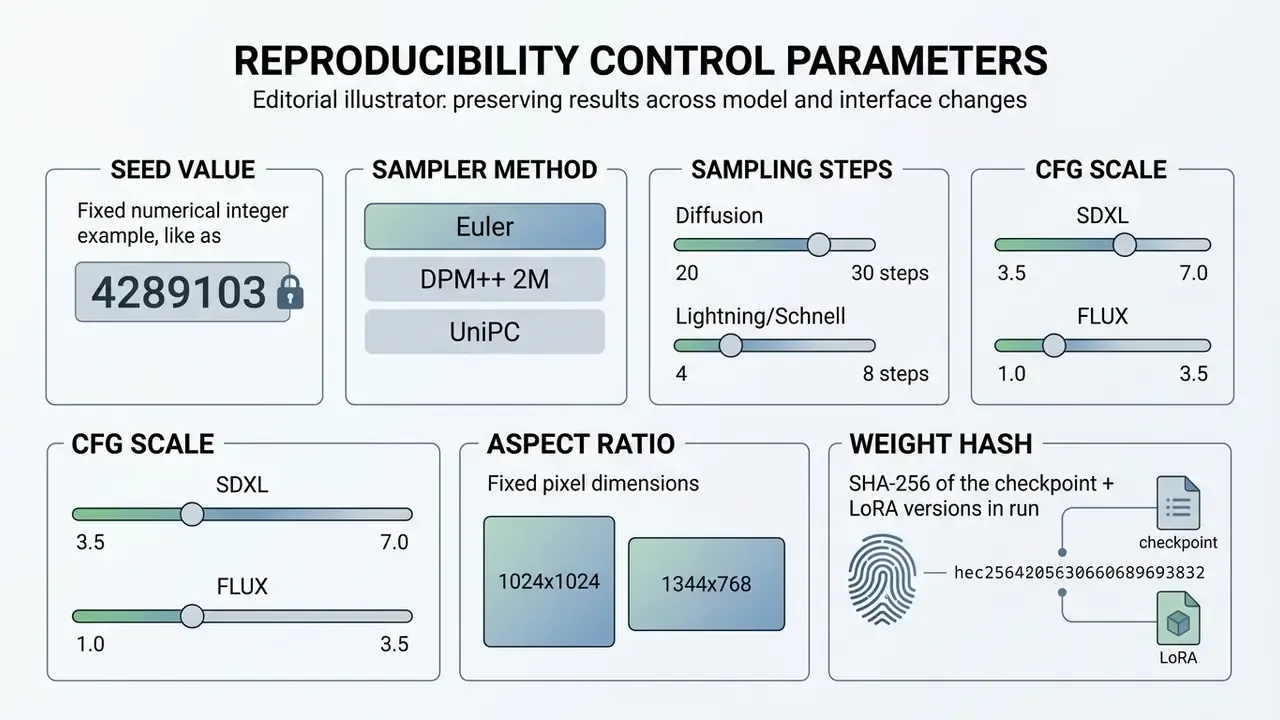
Composition and character continuity transfer through reference conditioning, not prompt wording alone. ControlNet accepts a structural conditioning image with a tunable controlnet_conditioning_scale. Reference-only mode links attention layers to an independent reference image, and reference_adain handles appearance transfer.
Organizations that moved internal design pipelines from proprietary generators to SDXL workflows report substituting recurring per-credit API spend with fixed infrastructure cost, while holding visual style consistent through custom LoRAs and locked seed configurations. Savings depend entirely on monthly volume and the internal cost of validation labor, so model the reduction with the TCO formula above instead of assuming a headline percentage.
How to Start Generating AI Images with an Open-Source Model
To generate ai images effectively with open source models, operators follow a structured workflow: select an optimized checkpoint, craft structured text prompts, define aspect ratios, then run iterative refinement passes. Vendor documentation converges on the same order. Set prompt language and aspect ratio before generation, and finish with upscaling, keeping in mind that upscalers frequently crop to the nearest supported ratio.
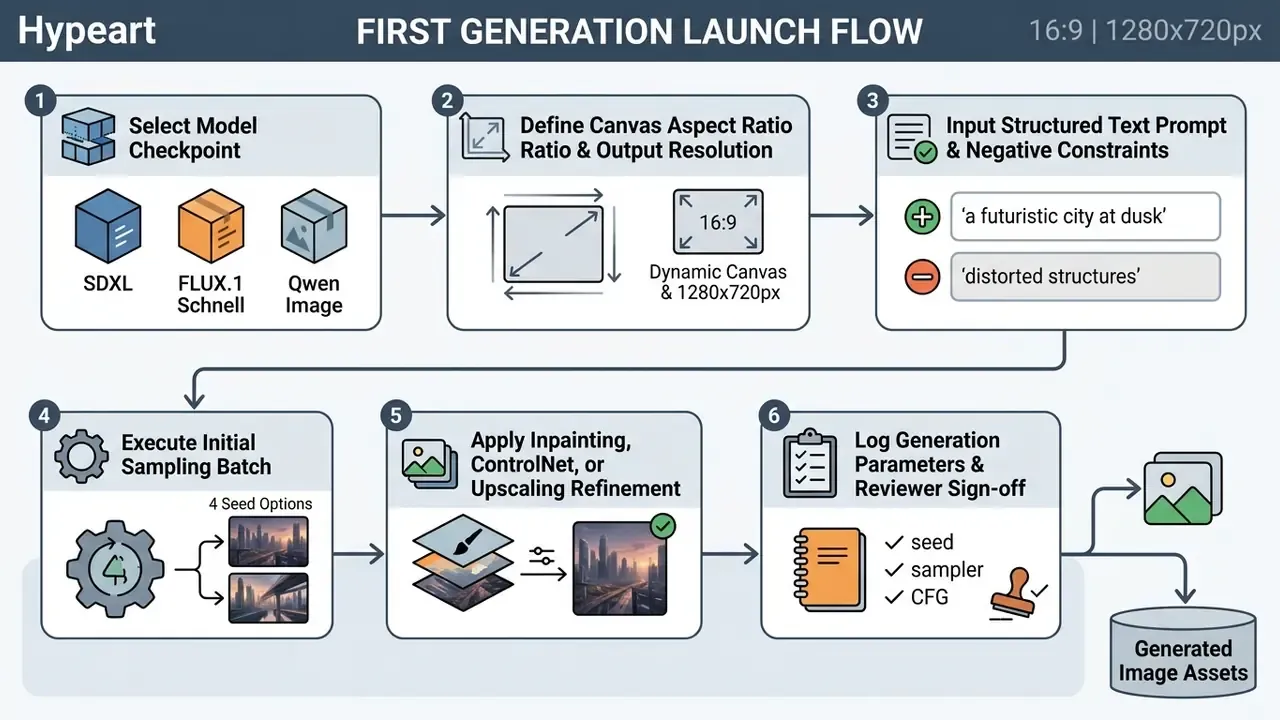
Crafting Text Prompts for Predictable Results
Effective prompt engineering for open models structures the description into four components: main subject, environmental background, lighting style, and camera composition (Columbia CHI Prompt Engineering Guidelines, 2022). The same guideline notes something counterintuitive: rephrasing with identical keywords rarely improves output. Keyword substance beats sentence polish.
«Alignment-tuned models such as Qwen-Image score highest in the Alignment and Text categories precisely when prompts are detailed and attribute-explicit.»
PROMPT STRUCTURE TEMPLATE:
[Subject] + [Environmental Context] + [Lighting & Color Palette] + [Composition & Camera]
EXAMPLE:
"A commercial enterprise server room with sleek dark storage racks, subtle glowing blue
LED status lights, dramatic moody side lighting, medium wide-angle shot, 35mm lens."
Generating an initial batch of 3 to 9 random seeds lets operators judge the visual distribution of a prompt before committing to high-resolution upscaling. That sample range is the one explicitly recommended in the CHI guideline.
References, Existing Images, and Image-to-Image Editing
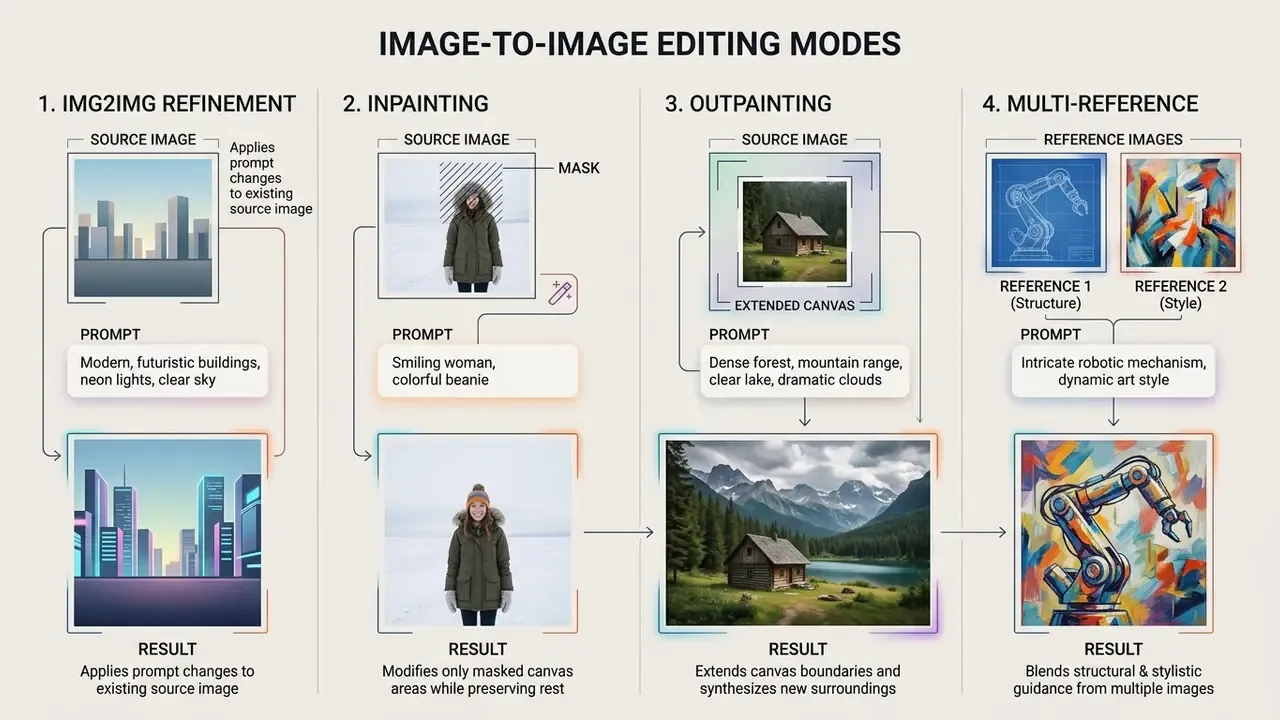
Modifying existing visual assets involves image-to-image (img2img) diffusion, inpainting masked canvas regions, or outpainting to extend boundaries (Palette: Image-to-Image Diffusion Models, 2022). Palette trains inpainting on free-form and rectangular masks covering 10% to 40% of the image, which explains why very large masks degrade coherence. Multi-reference research (TransFill, TransRef) instead aligns several source images and fuses features progressively. Teams comparing dedicated image-to-image generators will recognize the same four primitives behind every UI.
First Generation Launch Checklist
Canvas extension deserves its own workflow discipline, since position-aware diffusion behaves differently from masked infill. A comparison of AI outpainting tools shows how widely boundary handling varies between implementations. For teams exploring specialized cloud features, reviewing leonardo ai image generation workflows illustrates how web UIs wrap image-to-image controls around open diffusion checkpoints.
Checklist0 / 18
Enterprise AI Model Validation & Audit Checklist
Checklist0 / 12
Troubleshooting: Why an Open-Source Generator Returns Errors or Weak Results
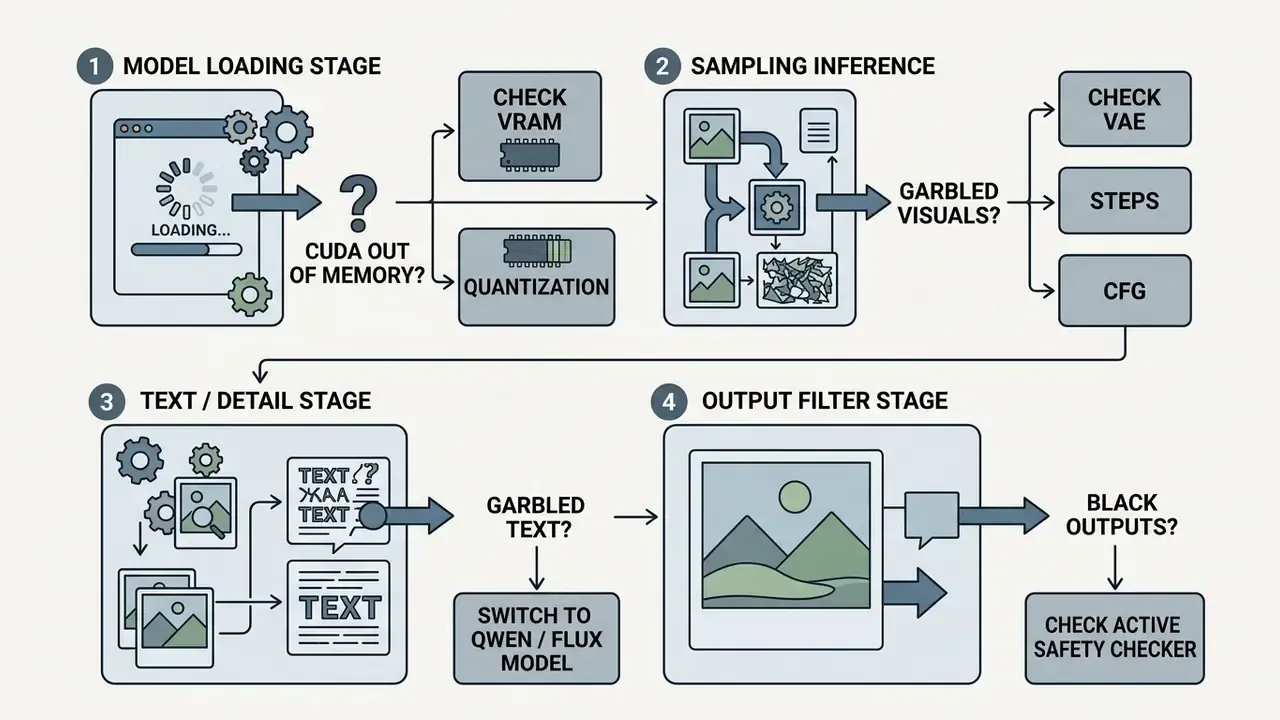
Operational errors during local model inference come from hardware memory exhaustion, Python package version mismatches, faulty prompt construction, or active content filter restrictions.
Systematic troubleshooting isolates whether failure occurs during model loading, sampling tensor processing, or output image encoding. NIST's diagnostic logic is worth borrowing wholesale: determine whether the fault sits at model-build, generation, or output-validation stage before changing anything. Changing three variables at once teaches you nothing.
Resilience, Resource Monitoring, and Safe Defaults
Before the console commands, set the operating posture. In a supervised pipeline, three fail-safe mechanisms matter more than any individual fix:
- Capacity guardrails. Cap concurrent jobs and resolution per role, so a single 4K batch cannot exhaust shared VRAM and stall the endpoint. Queue depth, not raw speed, is the metric worth alerting on.
- Safe defaults on restart. Filters, resolution caps, and watermark settings must reload in their approved state after every container restart. Configuration drift is the most common silent control failure.
- Observability with evidence value. Resource telemetry (VRAM, temperature, queue latency) plus generation metadata (model hash, seed, filter state) should land in the same log store. An incident review then reconstructs exactly what produced an asset.
Installation Errors, Model Incompatibility, and Resource Shortages
CUDA Out of Memory (OOM) errors appear when model parameters, text encoders, and VAE decoders exceed available GPU VRAM. PyTorch guidance is consistent: reduce batch size, load a smaller or more heavily quantized checkpoint, release unused tensors, and confirm no other process is holding the card.
# Terminal command to monitor real-time GPU VRAM allocation on Linux:
nvidia-smi --loop=1 --query-gpu=memory.used,memory.free,temperature.gpu --format=csv
# PyTorch command within Python scripts to clear unused cached VRAM:
import torch
torch.cuda.empty_cache()
Resolving installation errors requires matching PyTorch releases with compatible CUDA drivers and a supported Python version, since some LTS builds cap at Python 3.8. On Windows, building xFormers or FlashAttention v2 often hits platform limits, because PyTorch has not supported building FlashAttention v2 on Windows. Pre-compiled wheel files or xFormers-free launch arguments are the practical workaround (PyTorch Core Architecture Documentation, 2025/2026 Updates).
Low Quality, Poor Text Rendering, and Prompt Non-Compliance
Blurriness, malformed hands, or distorted facial features appear when sampling steps are too low, or when a checkpoint is pushed beyond its native trained resolution. Targeted negative prompts (extra fingers, mutated hands, deformed face) suppress the most frequent anatomical defects, and localized inpainting repairs what negatives miss.
When a project needs legible typography, switching from standard diffusion models to specialized architectures such as Qwen Image removes garbled text issues at the root.
«SD and SDXL show near-zero OCR accuracy on full strings; moving to Qwen-Image or FLUX.1 Kontext resolves this through architectural specialization in text rendering.»
Localized artifacts on faces or hands should be fixed with targeted inpainting passes rather than a full regeneration. Prompt non-compliance responds best to structural rewriting (subject, setting, style, lighting, technical details) rather than to longer adjective chains.
Content Filters, Licenses, and Commercial Use Restrictions
Built-in NSFW safety checkers analyze generated tensor outputs and overwrite flagged content with solid black images (InvokeAI Safety Documentation, 2026). Fal.ai documents enable_safety_checker as a boolean defaulting to true, returning has_nsfw_concepts alongside the replaced image. InvokeAI exposes --nsfw_checker and --no-nsfw_checker CLI flags. Some hosted platforms restrict filter settings by access tier, so "disable" is not universally available.
# Disabling safety checkers in Fal.ai API payloads (where permitted by law/terms):
response = fal_client.subscribe(
    "fal-ai/flux/dev",
    arguments={
        "prompt": "A modern architectural building detail",
        "enable_safety_checker": False  # Boolean flag controlling active post-filter
    }
)
Modifying or disabling safety filters in open software distributions can conflict with downstream commercial licenses. Verify model license terms before deploying unfiltered generators in a public web application.
«The drop in unsafe content in SDXL comes together with stronger gender bias, a mixed picture that demands a separate bias audit.»
Managing Safety Checkers and Uncensored Community Fine-tunes
Proprietary SaaS platforms enforce blanket keyword bans that frequently block legitimate work: surgical illustration, forensic reconstruction, mature-audience graphic fiction. Open architectures separate generative weights from the classification layer, which changes the question from "is it allowed?" to "who owns the decision and the log?"
- Technical deactivation. Safety checkers run as post-processing tensor classifiers, for example
diffusers.safety_checker. In a private deployment, removing the checker stage eliminates false-positive black-image outputs on medical or artistic renders. Record the change as a configuration decision with an approver, not as an undocumented code edit. - Community uncensored fine-tunes. Community checkpoints (Chroma1-HD, Dark Beast-style Krea fine-tunes, similar FLUX derivatives) are retrained without restrictive filtering, enabling adult graphic novels, medical visualization, and unconstrained concept design. Several hosted networks surface 50+ such models behind an opt-in sensitive-content flag with age gating.
- Non-negotiable boundaries. The Stable Diffusion license text forbids using the model to "exploit any of the vulnerabilities of a specific group of persons", and InvokeAI's documentation warns that serving unfiltered output publicly may be unlawful in some jurisdictions. Removing a technical filter never removes a legal prohibition. Age verification and output logging become mandatory, not optional.
- Enterprise posture. For banking, insurance, and healthcare deployments, the defensible configuration is filter-on by default, with a narrow, documented exception process for specific validated use cases.
CRITICAL LEGAL & SAFETY ALERT:
Legal notice: this material is general in nature and does not replace advice from qualified counsel on copyright, AI model licensing, and regulatory compliance.
Use Cases: Practical Applications for Open-Source AI Image Generators
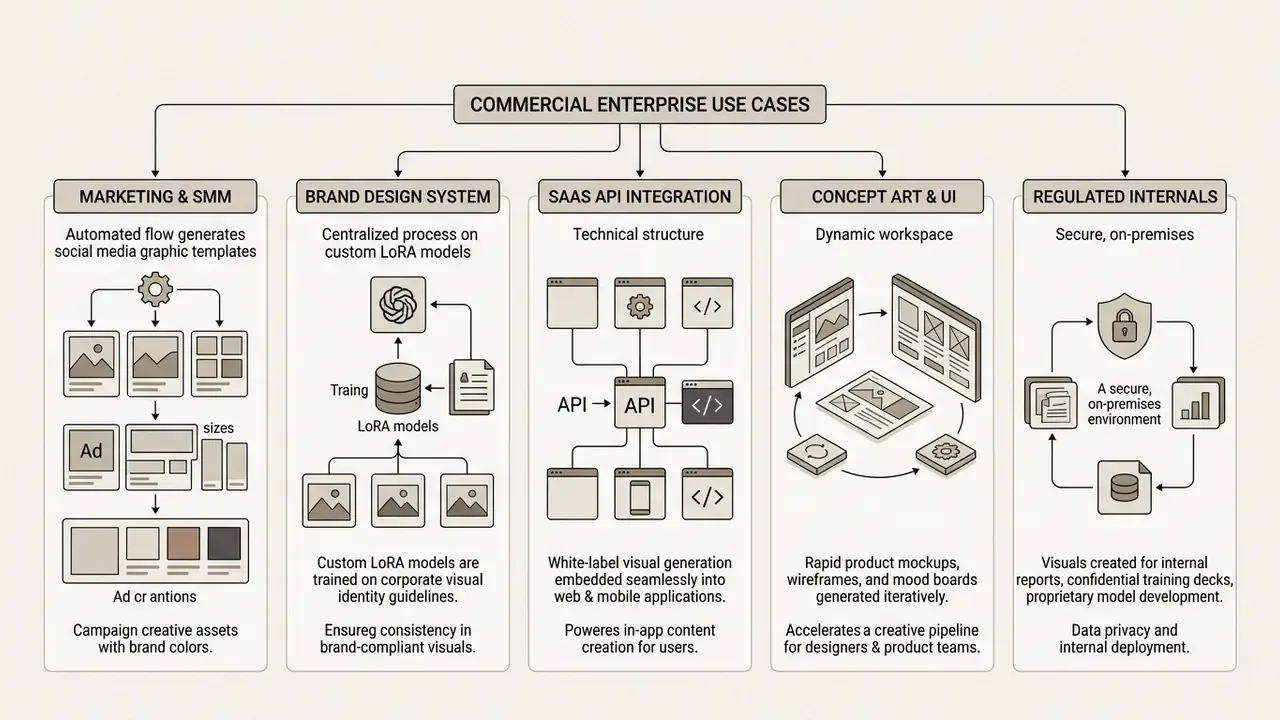
Adopting an ai art generator open source pipeline lets commercial businesses, marketing agencies, and software platforms automate media creation while keeping full visual control.
Regulated-Sector Scenarios: Banking, Insurance, and Fintech
Financial institutions adopt open weights for a narrower and more defensible reason than volume pricing. The prompt never leaves the perimeter.
- Internal reporting and training material. Risk committees and compliance academies need diagrams, scenario illustrations, and slide artwork that reference unreleased products, portfolio names, or incident details. Local generation removes third-party processing from the workflow entirely.
- Fintech product UI and concept design. Pre-launch app screens, onboarding flows, and card designs can be explored without exposing roadmap information to a vendor cloud.
- Marketing production under brand-risk control. Campaign variants are generated against an approved LoRA and screened through IP and fairness test batteries before release, with every asset traceable to a seed and a model hash.
- Customer-facing caution zone. Synthetic imagery of people, property, or performance outcomes in regulated advertising carries fair-lending and misleading-representation exposure. Treat these as higher-tier models requiring pre-publication legal review and disclosure.
Automated Production Pipelines: Webhooks & Serverless Integration
Connecting open-source image pipelines to business software, through Zapier, n8n, or direct REST webhooks, turns generation from a manual craft task into a triggered production step. Typical triggers: a new form submission, a CRM stage change, a product record created in the commerce catalog, or a content-calendar row reaching its publish date.
import requests
# Example: triggering a self-hosted FastAPI/ComfyUI endpoint from an HTTP webhook
payload = {
    "prompt": "A modern tech product display on a minimal white pedestal, 8k photo",
    "width": 1344,
    "height": 768,
    "steps": 25,
    "seed": 42,
    "model": "flux1-schnell-fp8",
    "requested_by": "[email protected]"
}
response = requests.post(
    "https://api.yourdomain.com/v1/generate",
    json=payload,
    headers={"Authorization": "Bearer ${SERVICE_TOKEN}"},
    timeout=120
)
result = response.json()
image_url = result["output_url"]
# The endpoint then posts the asset + metadata back to Slack, HubSpot,
# or a Shopify asset store, while writing seed/model_hash/filter_state to the audit log.
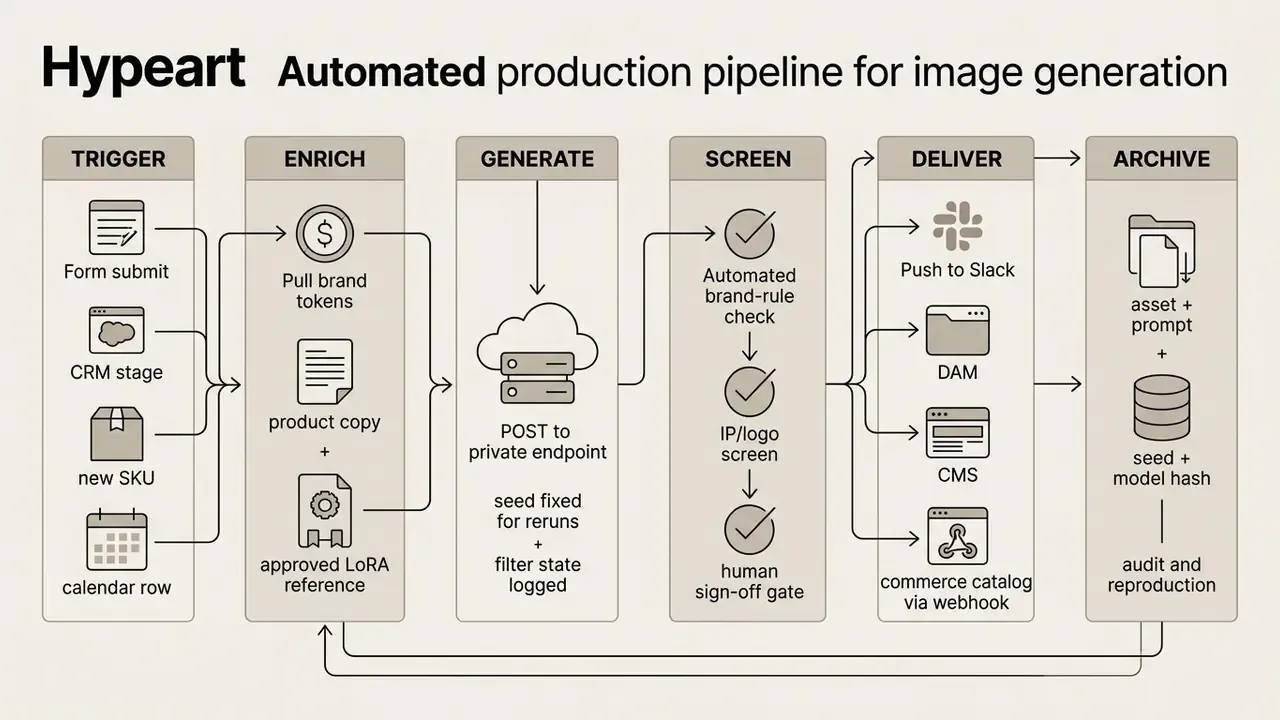
The screening stage is what makes automation safe rather than merely fast. An unreviewed generation loop publishing straight to a public channel is an incident waiting for a volume spike.
Commercial Projects and Custom AI-Powered Products
Software vendors embed self-hosted open source models into commercial web platforms and mobile applications through custom APIs. White-label integration lets software companies offer generative media features without passing variable SaaS subscription fees to end users. LocalAI-style OpenAI-compatible endpoints simplify the pattern, because existing client SDKs can be repointed at a private URL with minimal refactoring.
Under the EU AI Act (2025-2026 guidelines), general-purpose open-source AI models benefit from specific documentation exemptions only when model parameters, architecture, and usage terms are fully public (European Commission GPAI Guidelines, 2025).
«Under the EU general-purpose AI guidelines, the documentation exemption applies only when parameters, architecture and terms of use are fully publicly disclosed.»
Even where an exemption applies upstream, downstream integrators still need technical documentation from the model provider, a copyright policy, and, for GPAI providers, a published training-content summary. Teams weighing rights and restrictions before shipping should review how commercial use of AI image generators differs across licenses and hosting models.
Organizations planning production deployments can use interactive calculators to model hardware cost, estimate serverless API bandwidth, and review detailed AI Media Pricing Guides before scaling infrastructure.
Regulatory notice: this material is general in nature and does not replace advice from a qualified specialist on EU AI Act obligations and applicable national law.
FAQ: Legal, Risk, and Operations Questions
Is an Apache 2.0 model automatically safe for commercial use?
The license is permissive for the weights and code, and it makes no warranty about training-data provenance or about the content you generate. License compliance and output liability are two separate assessments, and they need two separate sign-offs.
What if a model generates a third-party trademark or a recognizable protected character?
Treat it as an incident. Quarantine the asset, log the prompt, seed, and model hash, then route to legal before any publication. Research shows that generic keyword combinations can trigger protected characters without naming them, so prompt-side bans alone are not a sufficient control.
Does running open weights locally remove regulatory obligations?
No. Open-source status can reduce specific documentation duties for model providers under the EU AI Act when parameters, architecture, and usage terms are fully public. It does not transfer accountability for deployed outputs away from the deploying organization.
Can we disable the NSFW safety checker?
Technically yes in most self-hosted stacks, and some hosted APIs expose a boolean flag. Whether you may depends on the model license and the jurisdiction, and some platforms restrict the setting by access tier. Document the justification, the approver, and the compensating controls.
How do we prove reproducibility to an auditor?
Log seed, sampler, steps, CFG, resolution, LoRA stack, engine version, and checkpoint hash for every published asset. A fixed seed with identical parameters reproduces the image exactly. A -1 seed does not.
Which deployment has the lowest data-leakage risk?
Local execution first, then self-hosted infrastructure under your own keys. Decentralized networks distribute work to third-party nodes, and closed SaaS processes prompts in a vendor cloud with retention and retraining terms that deserve a line-by-line read.
Where do savings actually come from when leaving a closed platform?
High-volume workloads. The cheapest hosted open-model tiers sit near $0.003 per image, while mid-tier proprietary APIs cluster at $0.03 to $0.08, so the gap is a multiple rather than a margin. At low volume, validation and engineering labor can exceed the credits you displace.
Who should own an image generator in the model inventory?
A named business owner, with model risk providing independent validation and internal audit testing the evidence trail. Shared ownership without a single accountable name is the pattern examiners question first.
Technical Appendix & Regulatory References
- Open Source Initiative (2025).The Open Source AI Definition (Draft / Final Guidelines). OSI Legal Frameworks.
- Qwen-Image Team (2025).Qwen-Image Technical Report: A 20B MMDiT Foundation Model for Multilingual Text Rendering and Precise Editing. Alibaba Cloud / Hugging Face.
- Black Forest Labs (2024).FLUX.1 Model Family: Open-Weight High-Fidelity Text-to-Image Synthesis. BFL Technical Disclosures.
- Stability AI (2023-2025).Stable Diffusion XL and SD3 Technical Architecture and Refinement Pipelines. Stability AI Research Papers.
- NIST (2025).Generative AI Evaluation Plan for Image Generators and Safety Audit Protocols. National Institute of Standards and Technology.
- NIST (2023-2025).AI Risk Management Framework (AI RMF 1.0). National Institute of Standards and Technology.
- Board of Governors of the Federal Reserve System / OCC.SR 11-7: Guidance on Model Risk Management.
- European Commission (2025).Guidelines on General-Purpose AI (GPAI) Model Obligations Under the EU AI Act. EC Compliance Directives.
- MLCommons (2024-2025).MLPerf Inference Benchmarks, Stable Diffusion XL Results. https://mlcommons.org
- SSRN (2023-2025).Measuring the Openness of AI Foundation Models. https://ssrn.com
- arXiv (2024).: Fantastic Copyrighted Beasts and How (Not) to Generate Them. https://arxiv.org
- arXiv (2024).: Image-Perfect Imperfections: Safety, Bias, and Authenticity in Popular Text-to-Image Models. https://arxiv.org
- arXiv (2024).: Multimodal Pragmatic Jailbreak on Text-to-Image Models (MUMP dataset). https://arxiv.org
- arXiv (2024).: ConceptMix: A Scalable and Flexible Benchmark for Compositional Text-to-Image Generation. https://arxiv.org
- arXiv (2025).: When Image Generation and Editing Meet Structured Visuals (StructBench). https://arxiv.org
- arXiv (2025).: Unified Benchmark for Image Editing and Reward Models. https://arxiv.org
- Hugging Face (2026).Diffusers Documentation: IP-Adapter, ControlNet SDXL, Safety Checker. https://huggingface.co/docs/diffusers
- PyTorch (2025/2026 Updates).Core Architecture Documentation and Previous-Version Install Matrices. https://pytorch.org
Appendix A: Editorial Revisions and Fact-Check Notes
Retained for transparency, with the corrected version used in the body text above.
Status: Unverified. Updated: Replaced with benchmarked AI Arena Elo positioning and MUMP OCR accuracy figures, which support the typography advantage without an unsourced efficiency percentage.
Status: Unverified percentage. Updated: Reformulated as a directional finding (recurring per-credit spend replaced by fixed infrastructure cost) with a pointer to the TCO formula, since realized savings depend on volume and validation labor.
Status: Date inflation risk. Updated: Cited as PyTorch Core Architecture Documentation (2025/2026 Updates).
- Original statement: "Evaluating Qwen Image for automated ad banner production demonstrated a 40% reduction in typography post-processing effort compared to legacy diffusion models."
- Original statement: "Migrating an internal design pipeline from a proprietary generator to an SDXL workflow cut API software costs by 85% while preserving visual style consistency."
- Original citation"PyTorch Installation Matrix, 2026."
- Verified without changeOSI 2025 open-source AI definition; Qwen-Image 20B MMDiT attribution; hosted open-model API pricing range of roughly $0.003 to $0.08 per image, consistent with Fal.ai, Replicate, Together AI, and Stability tariffs.
- Persona labelingall commentary attributed to Marcus Hale is marked as the author, with no implied employment, client relationship, or regulatory authority.