Last updated: 2026 · Reviewed by: Marcus Hale, AI Governance & Model Risk Editorial Lead
One caveat before anything else: a generator produces ideas, not clearance. That distinction drives almost everything below.
What You Need to Know in 30 Seconds
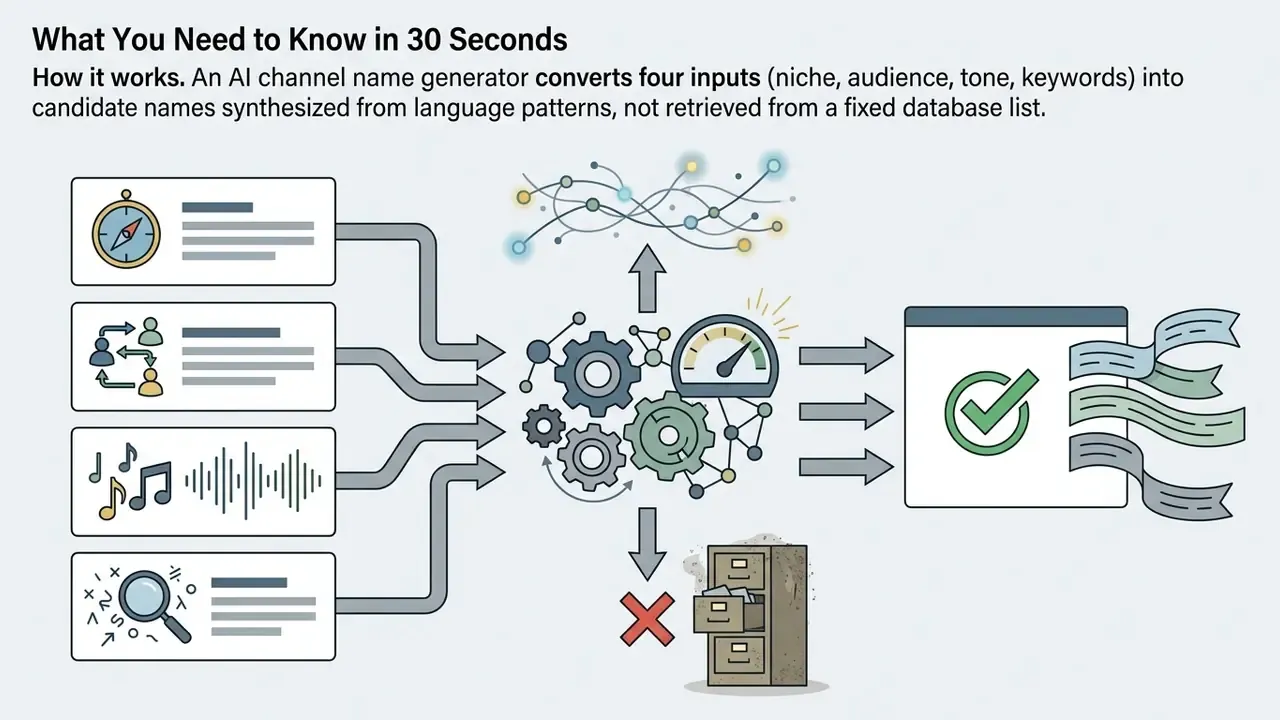

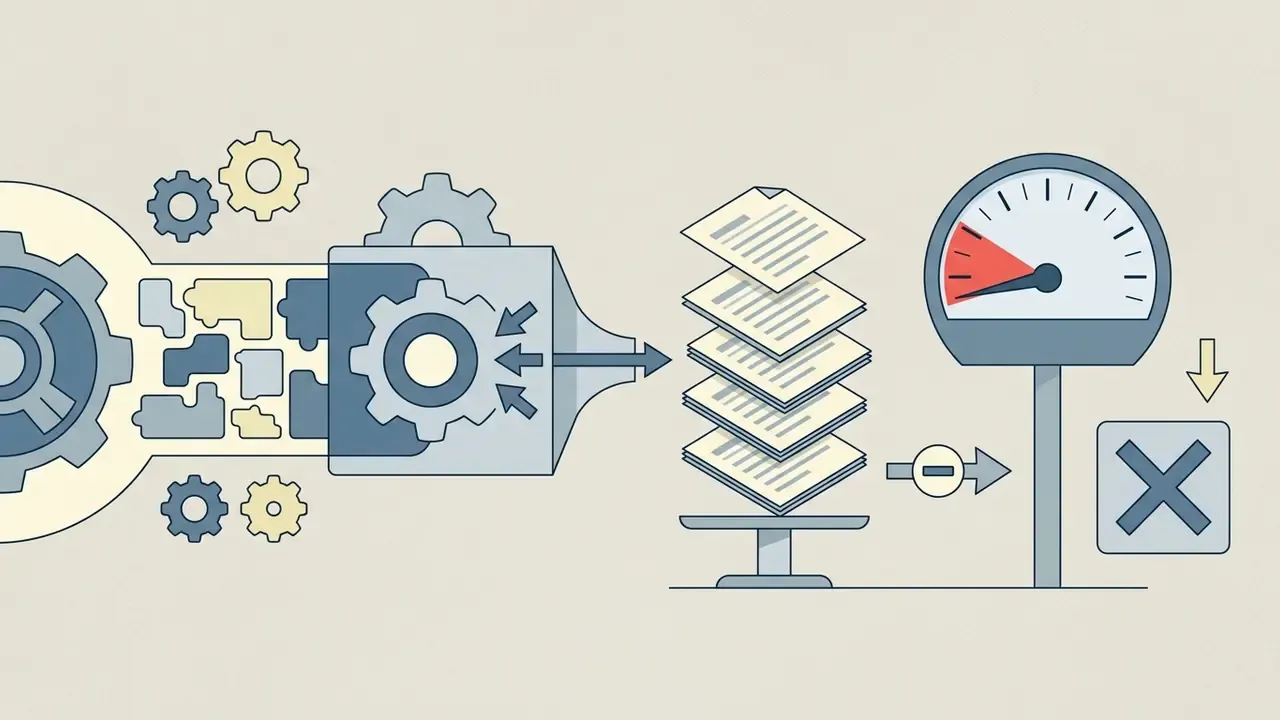
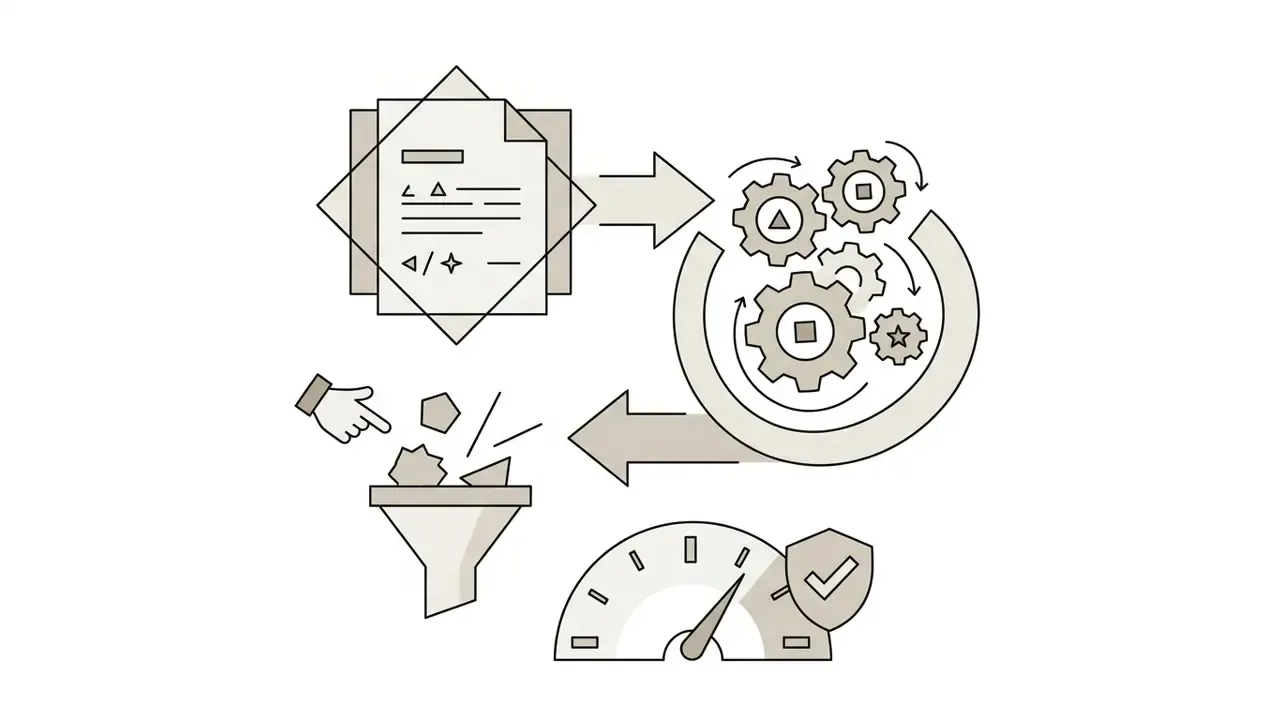
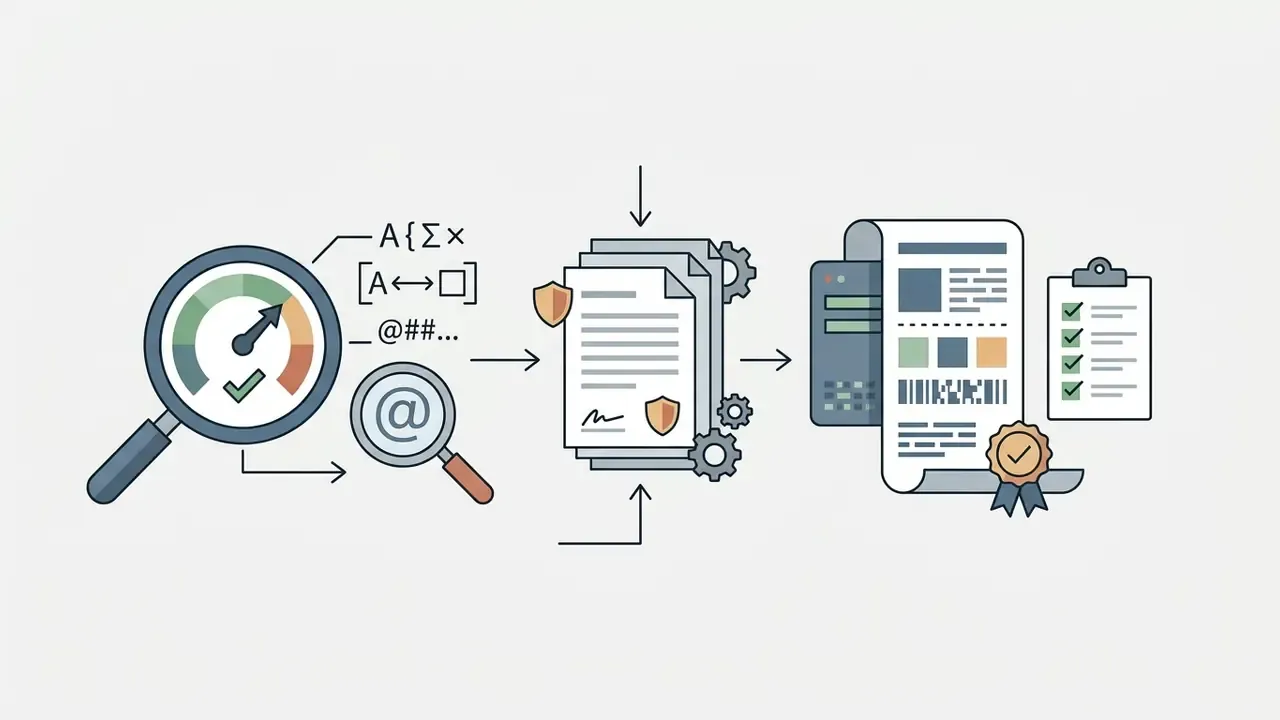
@handle availability (3-30 characters, unique, non-URL-like), run a trademark clearance search in the relevant commercial classes, and preserve a prompt-and-output audit trail before you publish.
Who This Guide Is Written For
Three groups tend to land on this page with very different questions.
Independent creators want speed: a usable youtube name in ten minutes, ideally free. Brand and content teams inside companies want defensibility: a name that survives legal review, works across platforms, and does not collide with a registered mark. Marketing leaders in regulated industries, including financial services, want a third thing entirely: proof that the naming decision was made by a human, documented, and reproducible on request.
The workflow in this article serves all three, but the governance sections matter most to the last group. If your channel promotes lending, investing, insurance, or payments products, the name is a compliance surface, not just a creative asset. It appears in disclosures, in ad libraries, and in consumer complaints. Treat it accordingly.
The core decision question: can you show, months later, how this name was generated, scored, cleared, and approved? If not, the generator gave you ideas and nothing else.
How an AI YouTube Channel Name Generator Works
In two sentences: An AI channel name generator turns a written description of your channel into dozens of structured name candidates using large language models. It does not query a pre-built list; it synthesizes new word combinations from learned linguistic patterns.
An ai youtube channel name generator is an automated software tool that applies large language models (LLMs) to transform qualitative channel descriptions into candidate titles. Instead of retrieving names from a pre-compiled database, a channel name generator ai analyzes language patterns, semantic associations, and niche terminology to output original channel name ideas.
According to a 2025 meta-analysis by Holzner, Maier, and Feuerriegel synthesizing 28 experimental studies across 8,214 participants, human collaboration with generative AI yields a statistically significant increase in creative task performance (g = 0.27).
«Human collaboration with generative AI produces a significant gain in creative productivity (g = 0.27) compared with humans working alone.»
Using an ai channel name generator lets creators explore structured linguistic combinations in seconds, replacing manual guesswork with systematic pattern generation. The trade is real, though: you gain volume and lose variance. More on that shortly.
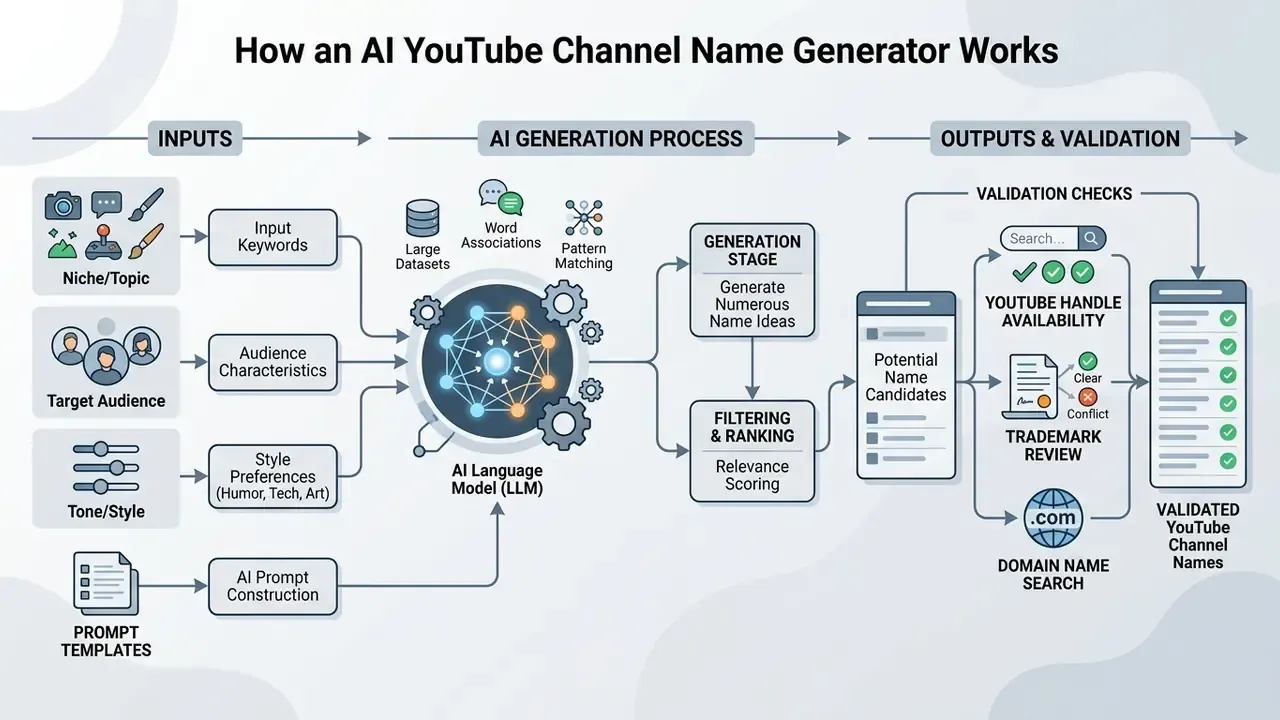
AI YouTube Channel Name Generator: How a Name Is Built
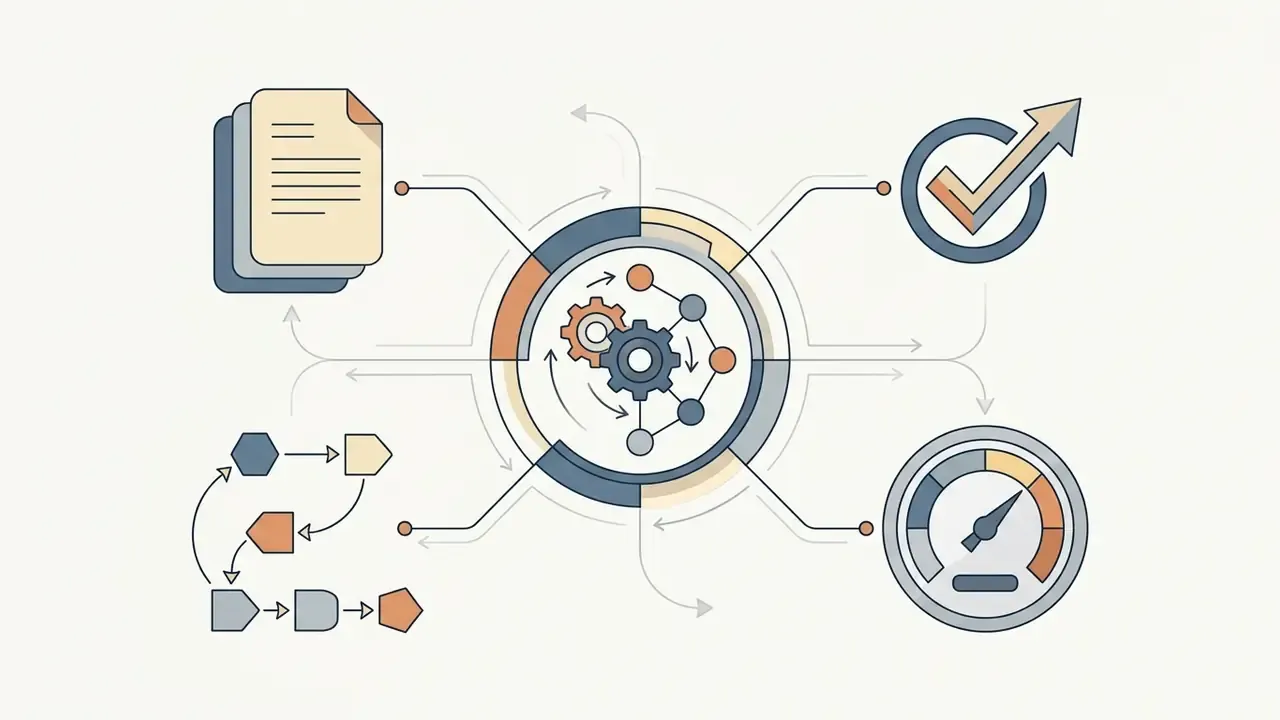
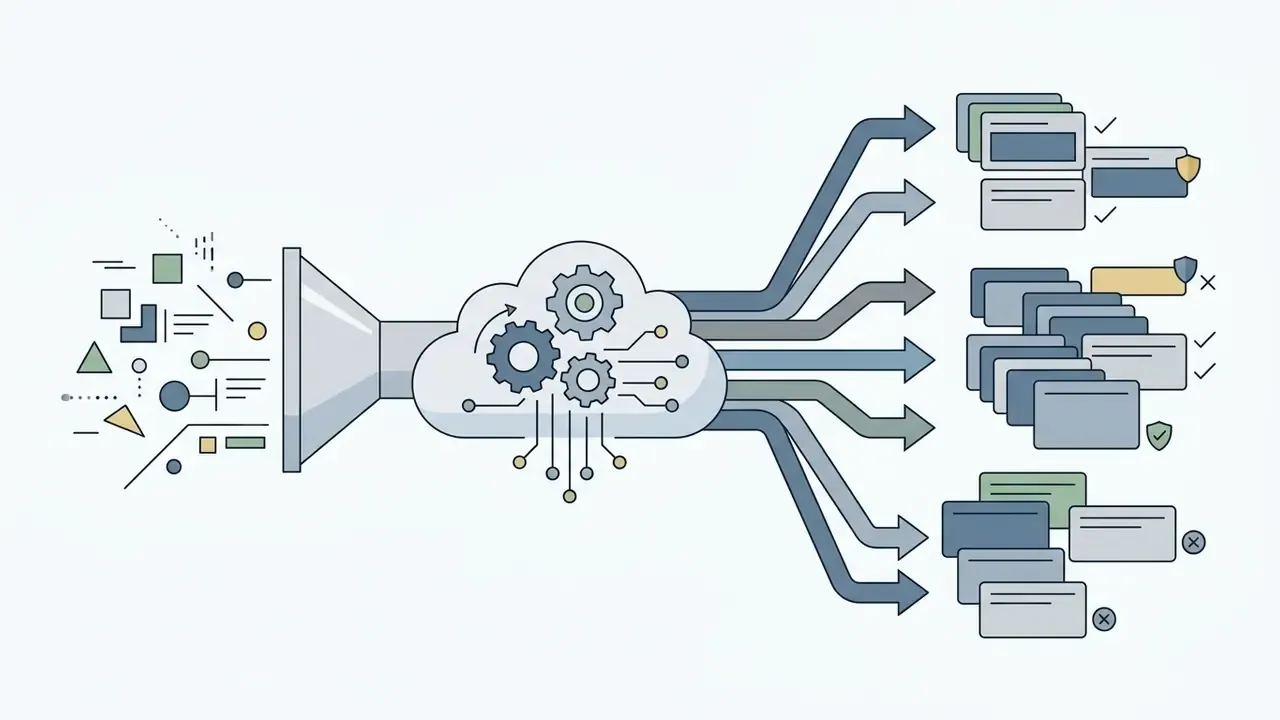
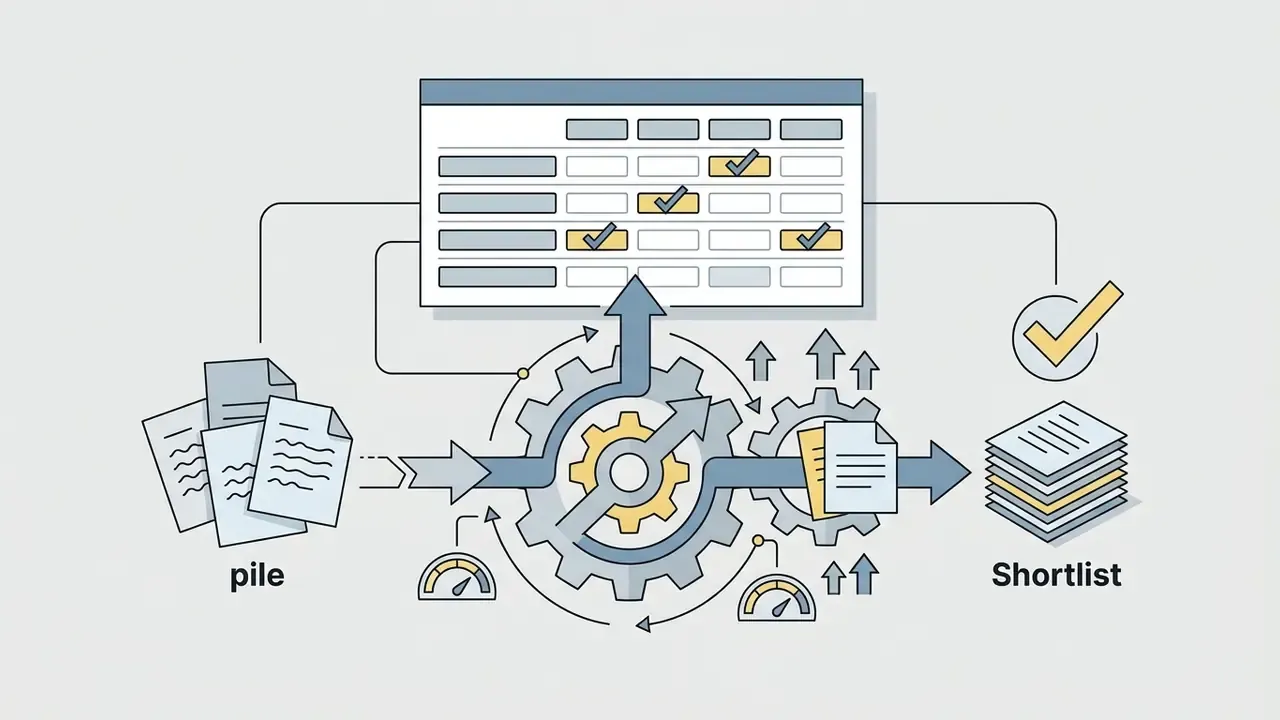
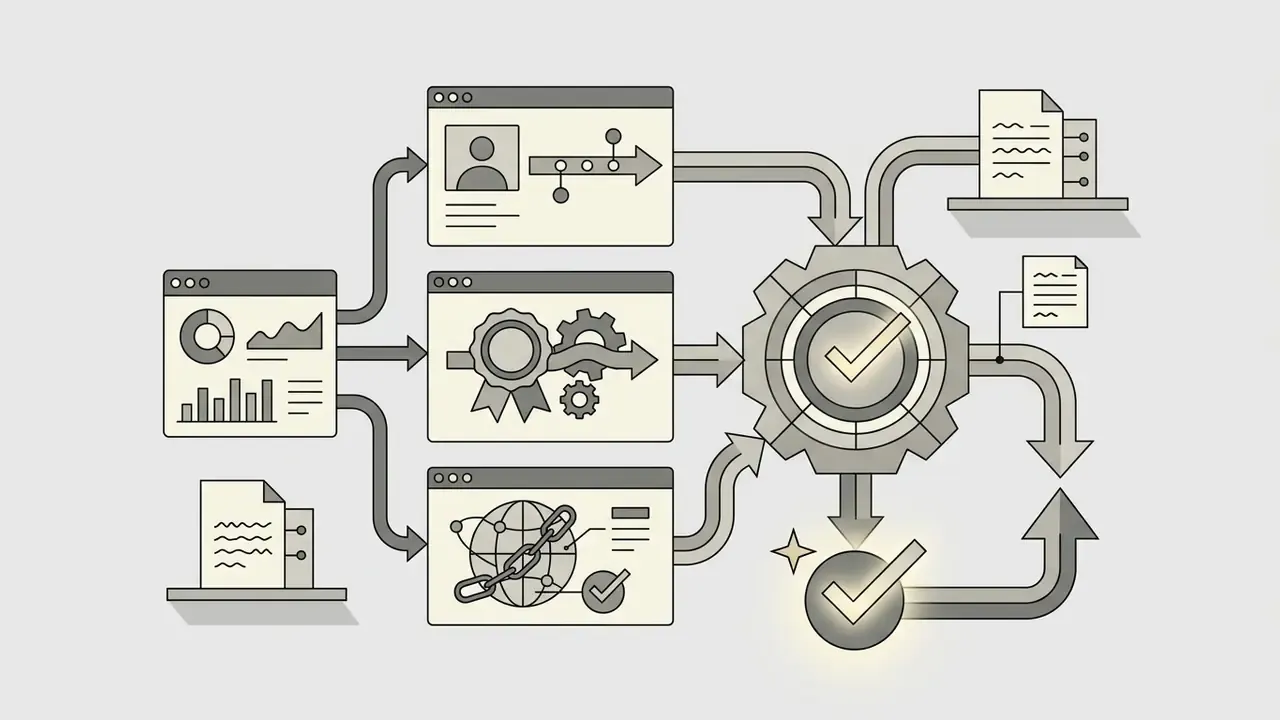
Caption / alt text: ai youtube channel name generator, the path from channel concept to a verified channel identity.
What Kinds of Channel Name Ideas AI Produces
An ai name generator youtube constructs several structural categories of names, each tuned to a different media format:
- Descriptive names direct combinations of niche keywords and modifiers (TechSimplified, FinanceMaven, AI Tools Daily).
- Abstract and coined names invented terms or linguistic blends designed for unique brand protection (Neural Forge, Veritasium, Kurzgesagt).
- Compound and rhythmic names alliterative or paired words built for vocal recall (ClipCraft, Prompt Kitchen, Pixel Pottery, Story Studio).
- Gaming and culture-coded names niche jargon and action verbs tailored to community subcultures (Pixel Pushers, Respawn Lab, Beat Lab).
- Identity-based names personal brand plus niche signal, the structure behind Linus Tech Tips or Smith Personal Finance, durable when content strategy shifts.
Different channel formats reward different structures. A technical tutorial hub benefits from explicit descriptive terms. An entertainment property leans on abstract coining, because coined words are easier to own legally and easier to grow into.
Why AI Beats Manual Brainstorming, and Where It Falls Short
Generative models accelerate ideation by producing dozens of structured outputs instantly, removing cognitive friction and overcoming creative fatigue. In a controlled experiment with 168 participants, hybrid human-AI teams achieved higher productivity and creative quality than human-only groups, outperforming both nominal and interactive human-only conditions, while benefiting from the near-zero marginal cost of LLM inference.
«In an experiment with 168 participants, hybrid "human + AI" groups outperformed both nominal and interactive human groups on productivity and idea quality.»
The counterweight matters as much as the headline. That same 2025 meta-analysis records a strong negative effect on idea diversity when humans collaborate with AI (g = -0.86). Outputs converge toward statistically likely word pairings, which is exactly how three unrelated channels end up named TechPulse. Traditional brainstorming, by contrast, is documented as fast and high-volume, dozens of ideas in minutes, and solo brainstorming can still produce the highest raw idea count.
So the practical conclusion is not "AI instead of brainstorming". It is: brainstorm first, then let the model expand and refine what you already believe.
When evaluating production assets across digital ecosystems, creators often consult specialized workflows such as AI Media Workflows to streamline production, and move directly from naming into visual identity with AI logo generators for channel branding. A youtube name generator ai gives you breadth in seconds. Judgment is still yours.
Why Your YouTube Channel Name Matters for Branding and Discovery
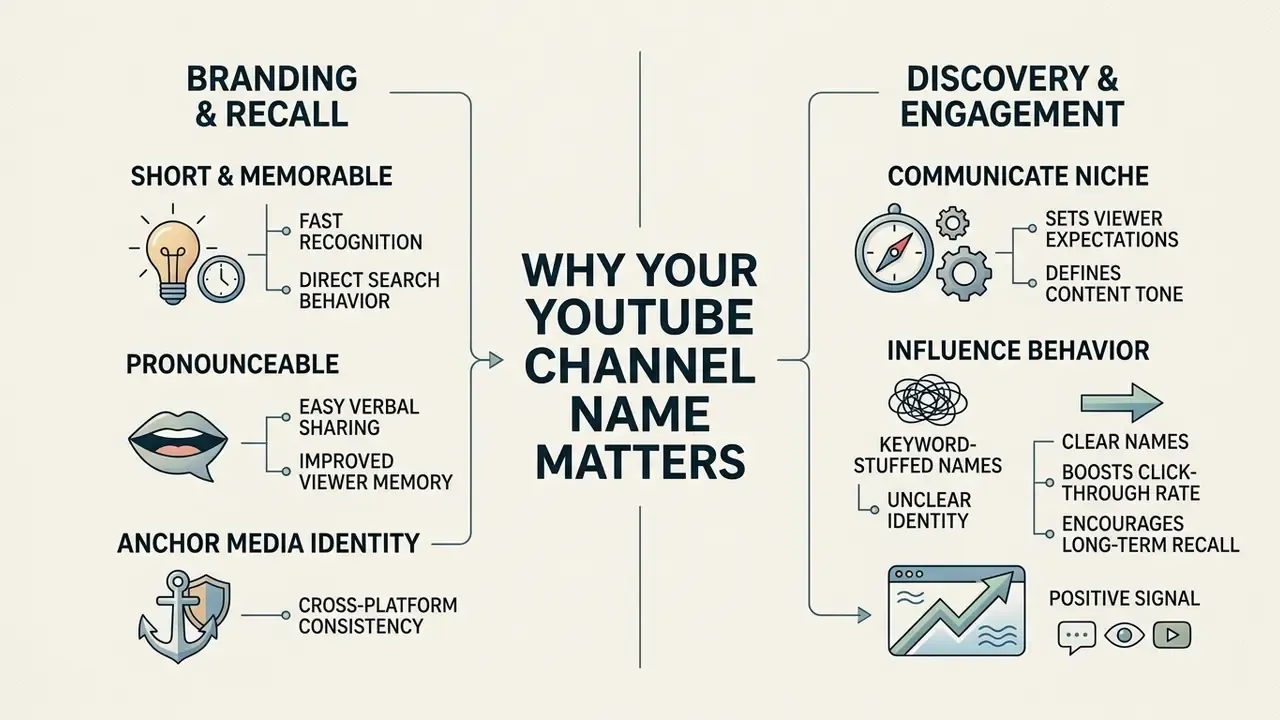
In two sentences: Your channel name is the semantic anchor viewers use to recognize, recall, and search for your content. It influences click behaviour and brand memory far more than it influences algorithmic ranking.
A youtube channel name serves as the primary visual and semantic anchor for a media identity across search results, watch pages, and external embeds. It forms the core of viewer recognition, driving return visits and word-of-mouth discovery.
Commercial guides often claim that keyword-stuffed channel names boost search rankings. Official YouTube documentation and independent empirical evaluations point elsewhere: algorithmic placement relies primarily on watch time and user engagement.
A clear youtube name still moves the needle on click-through behavior and long-term brand recall. YouTube's own channel-branding documentation treats name, handle, and avatar as core identity fields displayed across channel pages and search surfaces. That is why channel-name terms help viewers locate a specific channel, even when they do not act as a ranking lever for individual videos.
Keep It Short, Pronounceable, and Memorable
Concise, pronounceable names measurably improve viewer memory and direct search behavior. Research by Zee et al. (2026) on brand name properties demonstrated an inverted U-shaped relationship between phonemic length and brand attitude, showing that moderate, spoken-friendly names outperform both overly complex constructions and ultra-short acronyms.
«Names shorter than three phonemes trigger less positive attitudes; moderate length balances memorability and likeability.»
Empirical data from the BRAND 2024 database (Raffaelli et al.), spanning 244,400 consumer responses across 32 industries, established that brand familiarity correlates strongly with recall (r = 0.53).
A clear youtube channel name accelerates that familiarity curve by being easy to repeat, spell, and share. Practical benchmarks converge on the same numbers: keep the display name under roughly 30 characters or 2 to 3 words, drop decorative numbers and symbols, and confirm that a listener can spell it correctly after hearing it once.
One more small test I rely on: say the name out loud to someone in a noisy room. If they ask "sorry, what?", it fails.
Communicating Niche and Content Tone
A structured name signals content expectations before a viewer clicks a thumbnail. Industry terms or stylistic markers establish positioning instantly. The difference shows up in a single pair: Smith's Channel communicates nothing, while Smith Personal Finance communicates category, audience, and expected format in three words.
When planning digital assets, creators examine AI Media Comparison Matrices to evaluate tool capabilities and shortlist the best AI image generators for branding. Aligning a youtube channel title with its content focus keeps incoming traffic matched to the intended audience profile. And a caution repeated across 2026 practitioner guidance: do not force keywords into the name for an assumed ranking advantage, because YouTube does not document channel-name keywords as a meaningful search-ranking signal.
Key Input Parameters for High-Precision Name Generation
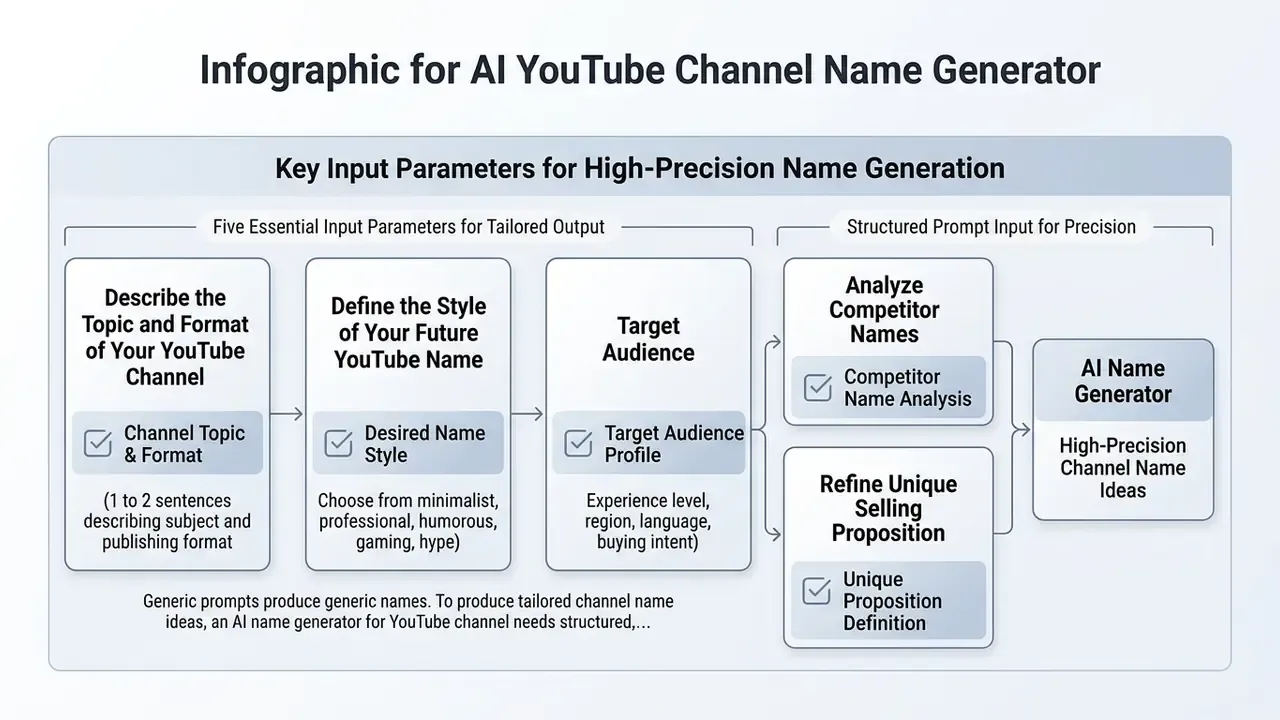
In two sentences: Generic prompts produce generic names. Five structured input blocks (context, objective, tone, audience, explicit constraints) separate a usable shortlist from a wall of noise.
To produce tailored channel name ideas, an ai name generator for youtube channel needs structured, high-context inputs. Prompts that specify target demographics, platform goals, and stylistic boundaries generate substantially higher precision than one-line queries.
Frameworks established by NIST (2026) and academic prompt-design guidelines emphasize five essential components: context, task objective, tone, target audience, and explicit constraints. NIST's Quick-Start Guide for Using Artificial Intelligence formalizes this as C.O.S.T.A.R. (Context, Objective, Style, Tone, Audience, Response), while the Nielsen Norman Group's CARE framework reduces it to Context, Ask, Rules, and Examples. Model parameters matter too: for reproducible, conservative output, set a low temperature; for wider lexical exploration, raise it toward 0.8 to 1.0 and generate in batches.
Complete before you generate:
- ☐ Niche and topic - 1 to 2 sentences describing subject and publishing format
- ☐ Target audience - experience level, region, language, buying intent
- ☐ Style - minimalist, professional, humorous, gaming, hype
- ☐ Core keywords - 3 to 8 terms you want echoed or evoked
- ☐ Exclusions - no numbers, no hyphens, no complex symbols, no single-game references
- ☐ Output format - how many names, grouped into which structural categories
- ☐ Length limit - target under 30 characters to stay handle-compatible
Describe the Topic and Format of Your YouTube Channel
The primary input field should summarize the channel's core subject, publishing format, and audience value proposition. YouTube official guidelines limit channel descriptions to 1,000 characters (video descriptions allow up to 5,000), and only the first line appears in the channel header before the "Show more" cutoff. Essential positioning belongs in the opening sentence.
For example, specifying "a channel providing concise Python tutorials and cloud architecture breakdowns for junior software engineers" gives a youtube channel name ai generator exact context, so it returns relevant professional terms instead of generic technology buzzwords.
Define the Style of Your Future YouTube Name
Stylistic parameters dictate vocabulary, tone, and structural complexity in the generated youtube name. Setting boundaries up front prevents the model from drifting off-brand.
| Style Category | Primary Linguistic Characteristics | Sample Keywords / Modifiers | Target Channel Format |
|---|---|---|---|
| Professional / Corporate | Clean, authoritative, brandable | Lab, Studio, Insights, Collective | B2B, Finance, Enterprise Tech |
| Minimalist | 1 to 2 words, concise, easy spelling | Shift, Axis, Current, Core | Design, Productivity, Personal Vlogs |
| Humorous / Playful | Puns, unexpected word pairings | Geek, Hacks, Daily, Oddity | Casual Entertainment, Commentary |
| Gaming / High-Energy | Action verbs, culture jargon, modifiers | Respawn, Quest, Pixel, Meta | Esports, Let's Plays, Stream Cutdowns |
| Hype / Trend-Driven | Urgency words, impactful terminology | Pulse, Apex, Next, Edge | Viral Tech, Trend Reviews |
| Clickbait-Adjacent | Curiosity and superlative framing | Top, Ultimate, Unfiltered, Exposed | Commentary, Reaction, Drama |
A note on the last row. Curiosity framing performs in the short term and ages badly. If the channel supports a regulated product, skip it entirely.
Copy-Paste Prompt Templates for AI Name Generation
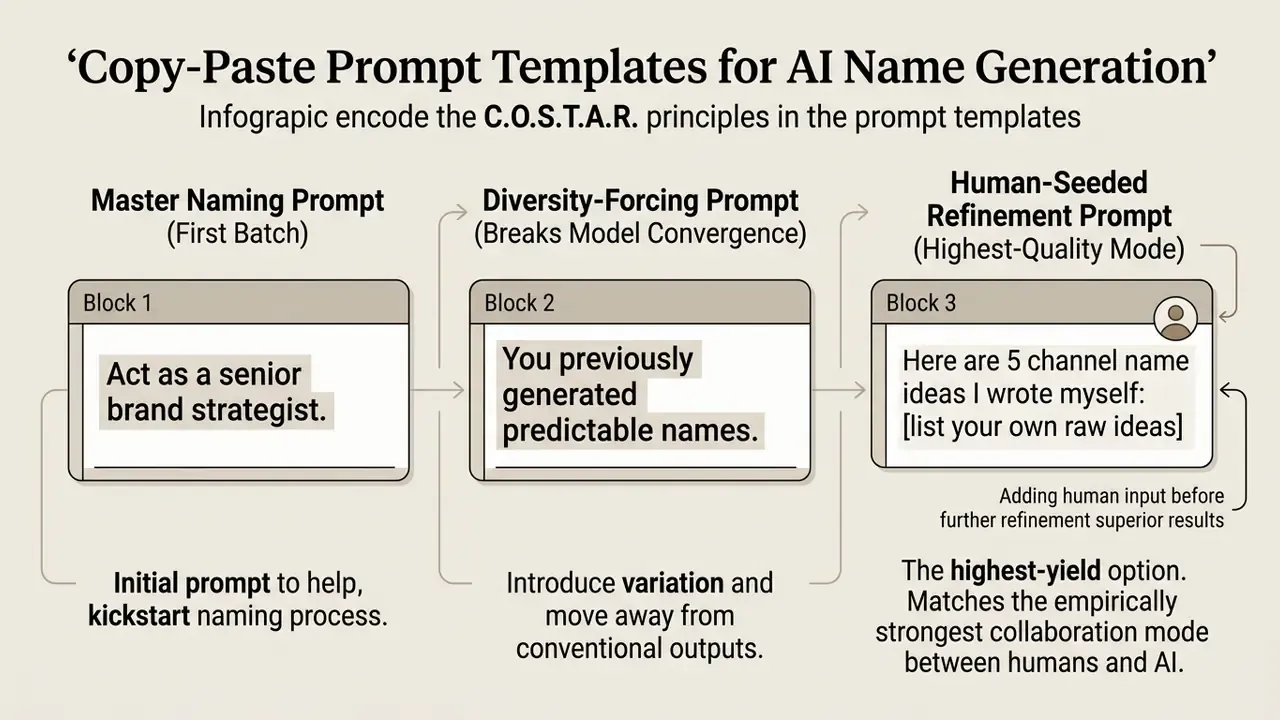
In two sentences: These three templates encode the C.O.S.T.A.R. structure directly. Paste them into any LLM interface, replace the bracketed fields, and you receive categorized output instead of an undifferentiated list.
Template 1: master naming prompt (first batch)
Act as a senior brand strategist. I am launching a YouTube channel with the following parameters:
- Niche: [e.g., Python Tutorials & Cloud Architecture]
- Target Audience: [e.g., Junior Software Engineers, US/EU, English]
- Desired Style: [e.g., Minimalist & Professional]
- Core Keywords: [e.g., Code, Cloud, Byte, Architecture]
- Constraints: No numbers, no hyphens, max 2 words, under 25 characters,
  must sound clear when spoken aloud, must not reference a single product or game.
Generate 15 distinct channel name options categorized into:
1) Descriptive, 2) Abstract/Coined, 3) Compound/Rhythmic.
For each name, add one line explaining the positioning logic and the syllable count.
Template 2: diversity-forcing prompt (breaks model convergence)
You previously generated predictable names. Now regenerate under adversarial constraints:
- Ban the following overused tokens: Hub, Pulse, Verse, Vision, Tech, AI, Daily, Zone, Pro.
- Produce 5 names derived from Latin or Greek roots.
- Produce 5 names derived from physical craft vocabulary (forge, kiln, press, loom).
- Produce 5 names built as [concrete noun] + [abstract noun] with no semantic overlap.
Niche: [insert]. Audience: [insert]. Each name must be under 20 characters.
Output as a markdown table: Name | Category | Etymology | Syllables | Spoken-clarity risk.
Template 3: human-seeded refinement prompt (highest-quality mode)
Here are 5 channel name ideas I wrote myself: [list your own raw ideas].
Do not discard them. For each one:
1) Diagnose weaknesses (length, ambiguity, pronunciation, trademark collision risk).
2) Produce 3 improved variants preserving the original concept.
3) Rank all variants against: distinctiveness, memorability, pronounceability,
   semantic fit, and legal/linguistic risk (score 1-5 each, show the total).
Constraints: [insert]. Return only the ranked table plus a final top-3 recommendation.
Template 3 is the highest-yield option, because it matches the empirically strongest collaboration mode: human seeds, AI revisions.
«When humans propose the initial ideas and GPT-4 refines them, the result surpasses the quality and diversity of either party working alone.»
Niche Name Matrices: Input to Output by Vertical
In two sentences: Every vertical rewards a different structural archetype. This matrix shows what to feed the generator and what shape of output to expect.
| Niche / Vertical | Input Keywords & Concept | AI Output Candidates | Structural Archetype |
|---|---|---|---|
| Tech & Software | Python guides, cloud native, concise | ByteArchitecture, CloudCraft, DevAxis | Descriptive / Minimalist |
| Cooking & Food | Quick vegan meal prep, budget-friendly | SproutSpeed, Plants & Plates, VeggieForge | Compound / Rhythmic |
| Personal Finance | Index funds, wealth building, Gen Z | WealthVector, LedgerMind, AssetPulse | Professional / Abstract |
| Lifestyle & Vlog | Solo travel in Asia, minimalist living | NomadCurrent, Drift & Frame, SoloShift | Abstract / Coined |
| Gaming & Esports | Retro gaming, funny commentary, co-op | Respawn Lab, Pixel Pushers, Vanguard Tactics | Culture-Coded / Persona |
| Education & Science | Explainer breakdowns, curious adults | Curious Kiln, Field Notes, Atlas Method | Compound / Abstract |
| Fitness & Health | Home workouts, no equipment, beginners | FormFirst, Reps & Rest, MobilityLab | Descriptive / Rhythmic |
Read the matrix as a diagnostic, not a copy list. A tech channel launching as DevAxis inherits brand headroom to move from Python into DevOps. A channel launching as Python4Beginners does not, and renaming later costs recognition you already paid for.
Finance verticals carry an extra constraint worth flagging. Names that imply advice, guaranteed returns, or regulated status (advisor, fund, bank, capital) can attract both trademark and regulatory attention in the US. Screen those tokens out at the prompt stage rather than at legal review.
Once a direction is locked, the next production dependency is content tooling. Creators typically move straight from naming into YouTube video editors and thumbnail production.
Step-by-Step Workflow for AI YouTube Name Generation
In two sentences: Treat naming as an iterative loop, not a single query. Change one prompt variable at a time so you can attribute output quality to a specific parameter.
Operating a youtube ai name generator effectively requires an iterative workflow rather than a single initial prompt. Systematic variable testing is what turns a random list into a shortlist.
- Step 1- define niche and tone
- Step 2- execute the LLM prompt
- Step 3- filter to a shortlist of 10 to 20
- Step 4- regenerate with exactly one variable changed
- Step 5- score against the rubric
- Step 6- check handle, trademark, domain
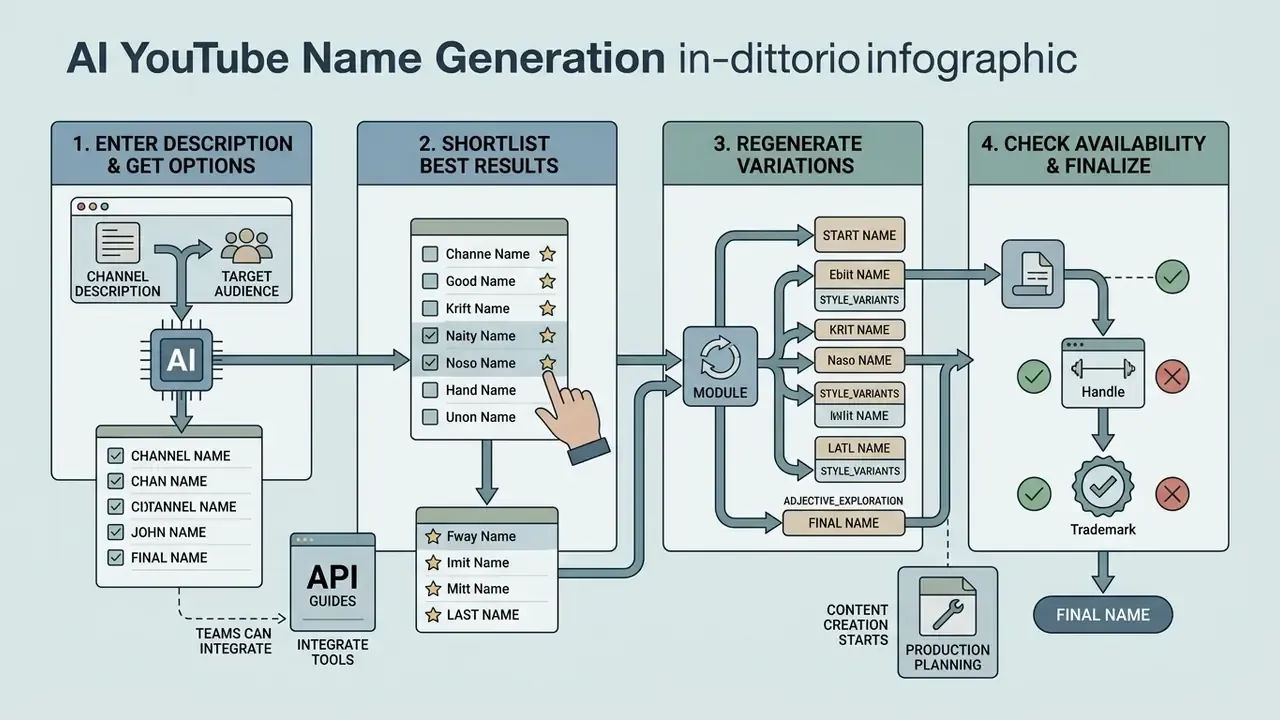
Enter the Channel Description and Get Name Options
Begin by feeding a structured prompt into the youtube channel name generator ai: channel description, target style, and 3 to 5 core keywords.
During media creation, teams often consult AI Media API Guides to integrate generation tools into automated production pipelines. For name generation, an initial batch yields a baseline pool of 10 to 20 candidates for preliminary review. Resist the urge to decide here. First-batch output reflects the model's default statistical preferences, not your brand.
Shortlist the Best Results and Regenerate Variations
Review the first batch and mark the most promising options. Research on human-AI co-creation (Chen & Chan, 2024) shows that combining human seed ideas with generative revisions yields the best balance of novelty and contextual fit.
Feed the chosen candidates back into the youtube name generator ai free tool and request targeted variations, for example "generate 10 minimalist variations based on 'TechShift'". Adjust one prompt variable per round so you can isolate which parameter produced the strongest concept. Documented refinement loops across vendor guidance (IBM, AWS, US Department of Energy) follow the same cycle: generate, evaluate, tighten constraints, regenerate, folding the strongest wording from previous rounds into the next prompt instead of starting over.
Parallel production planning usually starts around here, since a channel launch needs both an identity and a content pipeline. Many creators evaluate free AI video generators while the shortlist is still open.
Automating Name Generation via API
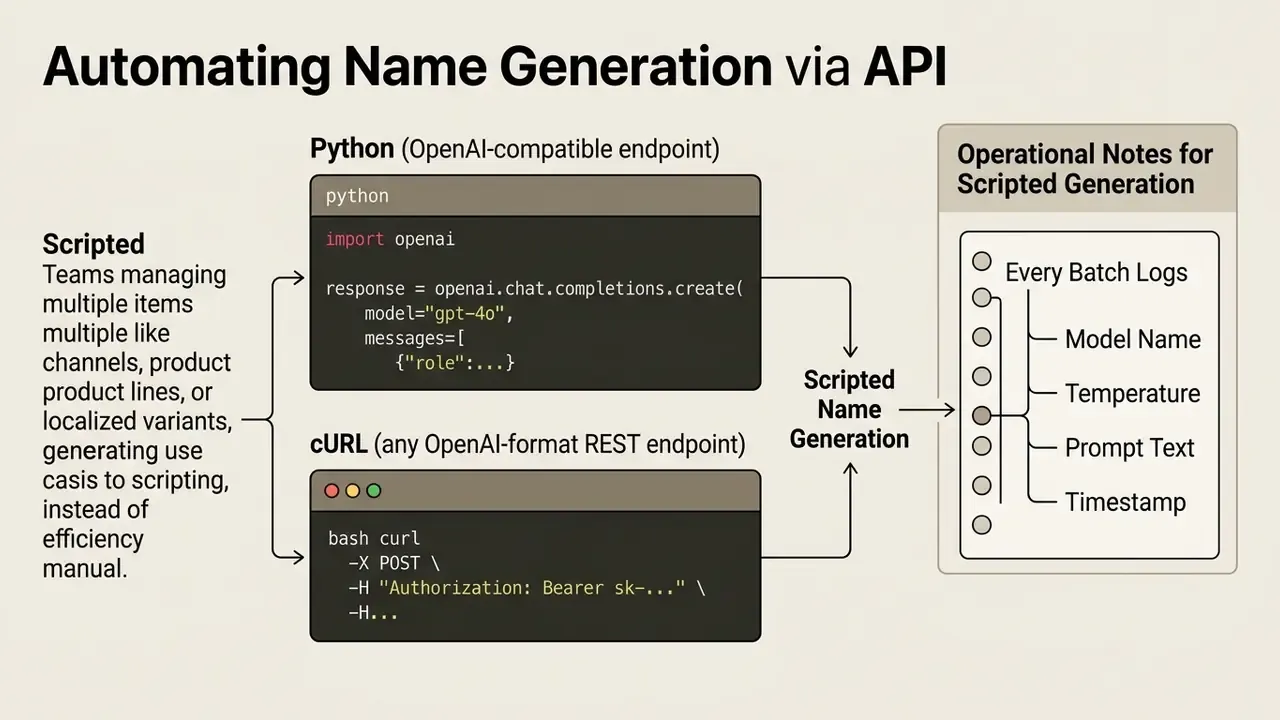
In two sentences: Teams naming multiple channels, product lines, or localized variants should script generation instead of clicking. Both examples below return structured batches you can pipe into a scoring sheet.
Python (OpenAI-compatible endpoint):
import openai
response = openai.chat.completions.create(
    model="gpt-4o",
    messages=[
        {"role": "system", "content": "You are a specialized brand naming assistant. "
                                      "Return output as CSV: name,category,syllables,risk_note."},
        {"role": "user", "content": "Generate 10 minimalist YouTube channel names for a "
                                    "DevOps tutorial channel. Max 2 words, under 20 characters, "
                                    "no numbers, no hyphens, ban the tokens: Hub, Pulse, Zone."}
    ],
    temperature=0.7
)
print(response.choices[0].message.content)
cURL (any OpenAI-format REST endpoint):
curl -X POST https://api.your-provider.com/v1/chat/completions \
  -H "Authorization: Bearer sk-..." \
  -H "Content-Type: application/json" \
  -d '{
    "model": "gpt-4o-mini",
    "temperature": 0.2,
    "messages": [
      {"role": "user",
       "content": "Generate 15 YouTube channel names for a tech review niche. Output JSON array with fields: name, archetype, character_count."}
    ]
  }'
Two operational notes for scripted generation. First, run the same prompt across at least two different model families and merge the pools, since multi-model rotation is one of the documented methods for restoring idea diversity. Second, use a low temperature when you need reproducible output for an audit record, and a higher temperature only during exploratory rounds.
Log the model name, temperature, prompt text, and timestamp for every batch. That log is your evidence file later, and it costs nothing to keep.
Evaluating and Validating AI-Generated Name Candidates
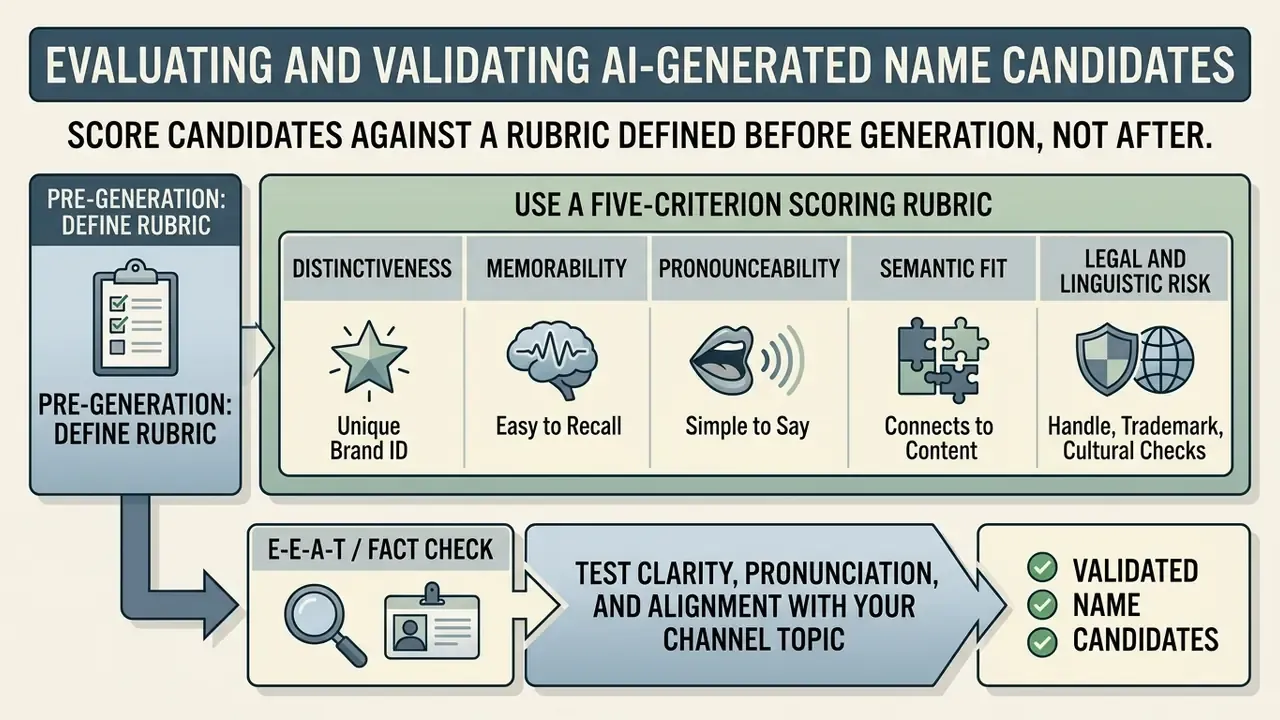
In two sentences: Score candidates against a rubric defined before generation, not after. Evaluation guidance from Stanford's AI evaluation materials and Microsoft's entity-evaluation documentation converges on the same principle: pre-specified criteria plus human validation.
Evaluating generated channel name ideas requires objective criteria for long-term viability, brand fit, and legal safety. A permanent identity deserves a structured review, not a subjective impulse at 1 a.m.
«In an experiment with 602 participants, greater AI assistance reduced perceived human authorship, yet audiences still assigned responsibility for the result to the human.»
E-E-A-T / Fact check. AI generators produce name options based on language patterns, but they do not perform trademark clearance, do not check @handle availability across all regions, and do not guarantee the absence of brand or patent conflicts. Final responsibility for brand uniqueness rests exclusively with the channel owner.
Sources: US Patent and Trademark Office (USPTO) Guidance on Use of AI-Based Tools in Practice (2024); YouTube Official Handle and Impersonation Policies (2025-2026).
Use a Five-Criterion Scoring Rubric
Define the rubric before you generate, then score every shortlisted candidate 1 to 5 on each axis:
Total the scores and keep the sheet. The sheet is the artifact, not the winner.
- Distinctivenessdoes it stand apart from the top 20 existing channels in your niche?
- Memorabilitycan a test listener repeat it 10 minutes later?
- Pronounceabilitycan a listener spell it correctly after hearing it once aloud?
- Semantic fitdoes it represent the content without misleading prospective viewers?
- Legal and linguistic riskany trademark collisions, unintended meanings, or offensive readings in other languages?
Test Clarity, Pronunciation, and Alignment With Your Channel Topic
Run every finalist through four usability standards:
- Pronunciation and radio test.Can a listener spell the name correctly after hearing it spoken once? W3C WCAG 2.2 (SC 3.1.6) treats ambiguous pronunciation as an accessibility problem requiring a disambiguation mechanism, which works well as a proxy for naming risk.
- Visual clarity.Is the text readable in lowercase and inside a small social avatar?
- Semantic alignment.Does the title accurately represent the channel's core subject without misleading prospective viewers? Where meaning is unclear in context, rewrite rather than explain.
- Plain-language check.Government style guidance (Australian Government Style Manual, 2026) requires plain language and active construction. A name that needs an explanation fails this test.
Verify Availability Before Publishing Your Channel
Before committing to a youtube channel name, complete a three-step availability verification:
- YouTube handle availability. Confirm the unique
@handlein YouTube Studio. Under Google's 2026 handle policies, handles start with@, must be 3 to 30 characters, must be unique, cannot be URL-like or phone-number-like, and must comply with Community Guidelines, including the impersonation policy that prohibits deceptive copying of branding, content, or usernames. - Domain and digital footprint. Verify
.comor the relevant TLD if the channel plans to expand into an independent platform or commercial use merchandise brand. ICANN treats trademark screening and domain availability as two separate layers: registrars verify availability with the registry operator, while trademark-covered labels trigger Trademark Clearinghouse claim notices. Creators monetizing outputs should also review commercial use terms for AI generators. - Trademark registrations. Search public trademark databases such as the USPTO TESS system to confirm the name does not infringe registered marks in relevant commercial classes. USPTO guidance (2024) is clear that AI involvement does not change standard trademark analysis: distinctiveness, likelihood of confusion, and correct owner identification still apply. If a match appears in a different class or jurisdiction, document the class analysis, and where the stakes are material, escalate to counsel before launch.
Preserve a Reproducible Audit Trail
For corporate, agency, or regulated-industry channels, availability checks alone are not enough. You need evidence that the check happened, with a date and a name attached. Maintain a naming record containing:
| Audit Artifact | What to Capture | Why It Matters |
|---|---|---|
| Prompt log | Full prompt text, model, temperature, timestamp | Demonstrates the generation method and absence of intent to copy a known mark |
| Output batch | Complete candidate list, not only the winner | Shows the selection was a reasoned choice among alternatives |
| Scoring sheet | Rubric scores per candidate, reviewer name | Documents human review and decision ownership |
| Clearance evidence | Screenshots of handle check, TESS search, domain lookup, with dates | Establishes good-faith clearance at a specific point in time |
| Sign-off | Named human approver and approval date | Assigns accountability, consistent with the finding that audiences attribute responsibility to humans regardless of AI assistance |
This is the same evidence logic applied to model documentation in regulated environments: an unlogged decision is, functionally, an undefended one. When scaling channel production, teams frequently measure workflow performance using standardized metrics published in AI Media Benchmarks and Review Proof.
Free AI Channel Name Generators: Features and Operational Limits
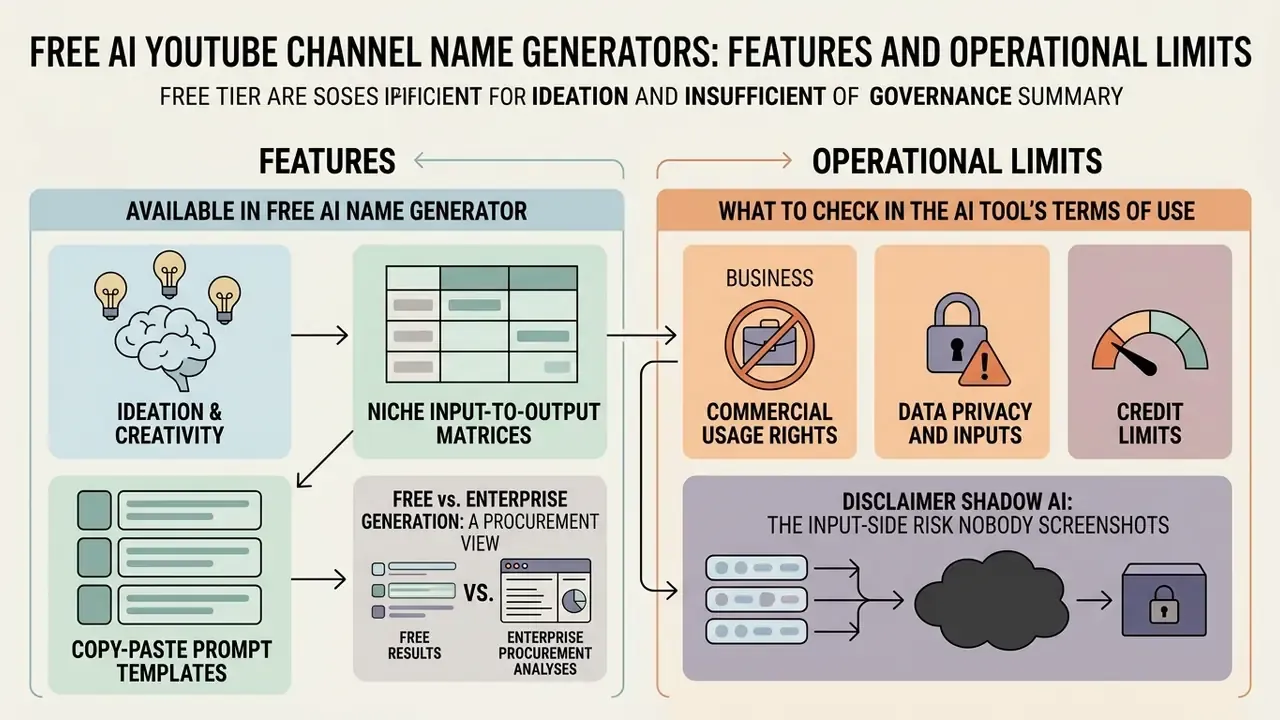
In two sentences: Free tiers are sufficient for ideation and insufficient for governance. Understand the quota model, the rights model, and the data model before you type anything confidential.
Free tiers of an ai youtube name generator free tool give new creators an accessible entry point, inside fairly specific functional limits. Knowing those boundaries keeps production schedules honest.
What Is Available in a Free AI Name Generator
A free youtube channel name generator ai typically offers core ideation functions at no cost:
- Instant generation of 5 to 20 candidate names per prompt query.
- Basic style and keyword filtering controls.
- Standard LLM model access suitable for general linguistic brainstorming.
- Copy-to-clipboard or a simple shortlist export.
Free access models cluster into three documented patterns: hard caps per day or month (for example, 50 requests per day on some aggregated API tiers, or 2,500 to 5,000 tokens per day on tool platforms), credit-based trial buckets (5 credits covering up to 50 name ideas, availability checks included), and "free unlimited basic generation with paid availability checks or premium models". Access requirements vary as well. Some tools need no account and no card, others require a free account without a card. Readers comparing entry barriers often also review free AI image generators with no sign-up.
Free vs. Enterprise Generation: A Procurement View
| Dimension | Free Tier | Paid / Enterprise or API |
|---|---|---|
| Throughput | 5 to 20 names per query, daily quota caps | Batch generation, scriptable, rate limits negotiated |
| Model quality | Base or "mini" models, top models often excluded | Frontier models, selectable per request |
| Determinism | Temperature usually fixed and undisclosed | Temperature, stop sequences, max tokens under your control |
| History and export | Often session-only, copy-paste | Saved history, JSON export, versioned prompt logs |
| Data handling | Inputs may be logged and used for model improvement | Contractual no-training terms, enterprise DPAs available |
| Output rights | Governed by consumer ToS, variable | Explicit commercial-use assignment in the agreement |
| Audit suitability | Weak, limited reproducibility evidence | Strong, full prompt and response records retrievable |
Creators evaluating tool choices across software categories often consult open-access calculators to estimate production costs and usage quotas.
What to Check in the AI Tool's Terms of Use
Before commercializing a channel, review the service's Terms of Service. Three items carry the most weight:
- Commercial usage rights. Ensure the ToS permits commercial exploitation of generated outputs without royalty obligations. Under US Copyright Office guidance (2025-2026), purely AI-generated text lacks copyright protection, which makes contractual assignment from the provider essential. Major providers handle this contractually rather than by copyright: OpenAI's terms assign its rights in output to the user, while Google's Gemini API terms state that Google claims no ownership of generated content but may generate identical or similar content for other users.
- Data privacy and inputs. Verify whether input prompts are logged and used to train public models.
- Credit limits. Check daily generation quotas, account registration requirements, and whether availability checks sit behind a paywall.
«Participants perceived AI as a tool rather than a co-author: disclosing AI assistance was considered less obligatory than disclosing human assistance.»
A parallel legal point often missed: the European Parliament's 2025 analysis reaches the same conclusion as US guidance. Purely AI-generated output without meaningful human creative input is not eligible for copyright and effectively falls into the public domain. Your defensible asset is therefore the trademark built through use in commerce, not the generated string itself.
Shadow AI: The Input-Side Risk Nobody Screenshots
Naming exercises are deceptively sensitive. A prompt reading "name our unannounced Q3 fintech education channel targeting Gen Z cardholders in Brazil" leaks strategy, launch timing, and segmentation in a single field, into a free consumer tool whose terms may permit prompt retention and model improvement. Classic Shadow AI: individually rational, organizationally unacceptable.
Mitigations that cost nothing:
- Abstract the prompt. Replace confidential specifics with generic equivalents ("personal finance education channel for young adults") and re-insert real context only during internal scoring.
- Classify before you paste. Treat unannounced product names, launch dates, and internal codenames as data that never enters a consumer tier.
- Prefer no-training endpoints. Where a naming project touches non-public strategy, use an enterprise agreement or API tier with contractual no-training and retention terms.
- Centralize the workflow. One logged, approved generation pipeline beats eleven employees using eleven free tools.
- Evaluate ToS on three axes before approving any tool: retention period, training usage, and output-rights assignment. If any of the three is undisclosed, treat the tool as unsuitable for confidential inputs.
AI Gaming Channel Name Generator: Niche-Specific Frameworks
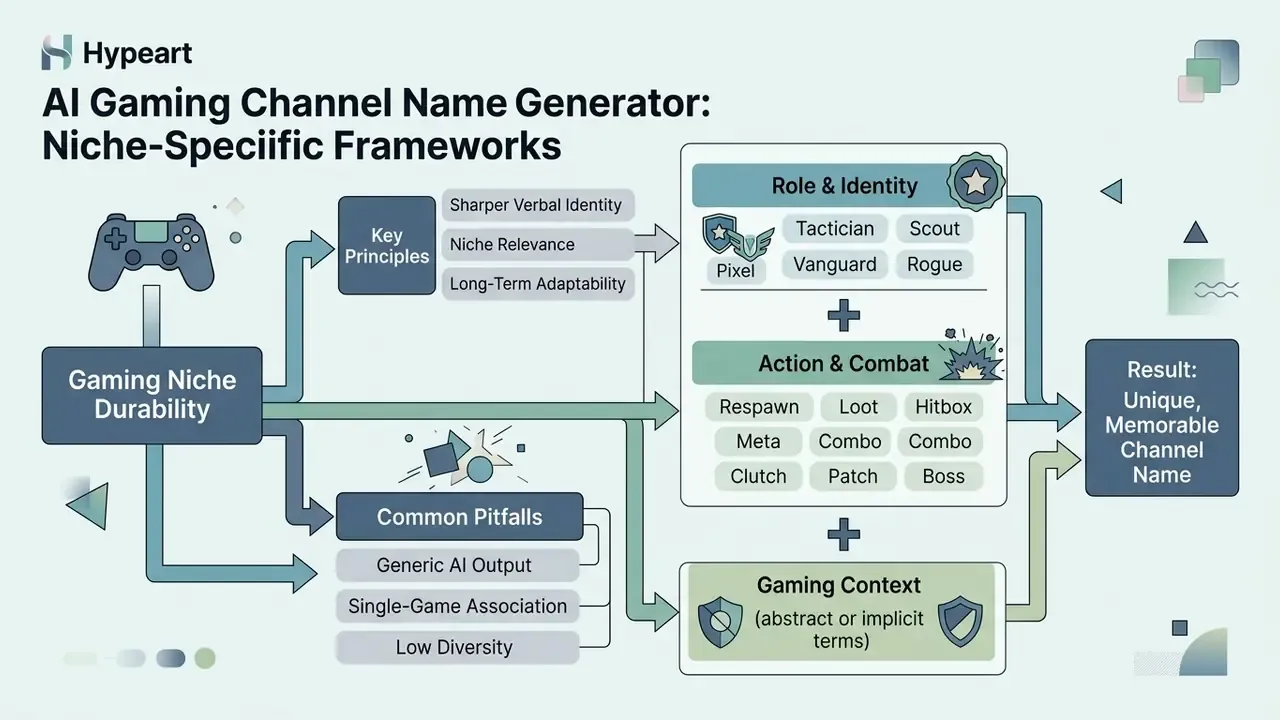
In two sentences: Gaming is the most saturated naming environment on the platform, and generic AI output fails fastest here. Winning names pair a persona or abstract term with game-native vocabulary while avoiding single-title lock-in.
Gaming remains one of the most competitive verticals on YouTube, which forces sharper verbal and visual positioning. Creator guidance across 2025 and 2026 consistently reports that gaming names cluster around short, brandable, niche-signaling formats, usually 2 to 3 words with easy spelling, precisely because saturation makes generic labels like "Gaming" unusable on their own. An ai gaming channel name generator helps creators navigate gaming terminology, esports jargon, and subculture slang. Cross-platform handle availability is treated as part of naming in this vertical, not as a later branding chore.
Which Words and Styles Work for a Gaming Channel Name
Effective gaming titles balance niche relevance against long-term adaptability, avoiding single-game restrictions that cap channel growth.
That finding maps straight onto Template 2 above: ban the saturated tokens, force etymological variety, merge outputs from two or three model families. Once the name is locked, gaming creators typically move into production tooling and compare the best AI video generators for gamers for clip editing, highlight reels, and channel trailers.
Limitations and Open Questions
FAQ About AI YouTube Name Generators
Do I need to create an account to use the name generator?
Access requirements vary by vendor rather than following one rule. Documented patterns include tools usable with no account and no payment card, tools requiring a free account without a card, and tools gating generation behind registration to enforce daily quotas. Advanced platforms offering saved histories, domain availability lookups, or API access generally require at least a free user account. Verify the specific tool's access terms instead of assuming an industry default.
Can I save and compare generated name options?
Standard tools provide basic copy-to-clipboard or shortlist functions. Developer interfaces add side-by-side comparison modes and JSON export for prompt iteration logs. Some platforms document explicit compare modes (generate two variants, keep one), prompt favoriting, and JSON import and export, while others support only data export in HTML or JSON. For governance purposes, prefer any tool that lets you export the full prompt-and-output record, not just the winning name.
Can I use AI-generated channel names for commercial projects?
Yes, provided the tool's Terms of Service grant commercial usage rights. Because generative models synthesize text from public data patterns, you must independently confirm that the name does not violate third-party trademark registrations or YouTube impersonation policies. USPTO guidance (2024) is explicit that AI involvement does not exempt a mark from standard analysis: descriptiveness refusals, likelihood-of-confusion refusals, and owner-identification errors remain live risks. Commercial channel operators also plan production capacity in parallel and often compare video editors for a YouTube channel.
Can I change my YouTube channel name later without losing subscribers?
Yes. YouTube lets you update your channel name and handle in YouTube Studio without losing subscribers, watch history, or existing content. Channels holding official verification may need to re-apply after a rename, and frequent identity changes weaken brand recall. Which is exactly why the rubric-and-clearance process above is worth completing once, properly.
What is the maximum character limit for a YouTube channel name?
YouTube channel names can run up to 100 characters, but brand-identity guidance recommends staying well under 20 to 30 characters, roughly 2 to 3 words, for visual clarity on mobile screens. Handles are stricter: 3 to 30 characters, unique, with no URL-like or phone-number-like formats.
Does a keyword-rich channel name improve YouTube search rankings?
There is no official YouTube documentation establishing channel-name keywords as a meaningful ranking signal. Large-scale correlation analyses point to engagement metrics, comments, views, and watch time, as the dominant factors, with description keywords showing minimal correlation. Channel-name keywords do help viewers find your specific channel by name and set expectations before a click, so treat them as a clarity and recall device rather than a ranking lever.
Is it safe to enter confidential brand information into a free generator?
Not by default. Free consumer tiers frequently reserve the right to log prompts and use them for model improvement, which makes unannounced launch plans, internal codenames, and segmentation strategy unsuitable inputs. Abstract the prompt, or use an API or enterprise tier with contractual no-training and retention terms. See the Shadow AI section above.
Who owns the copyright in an AI-generated channel name?
Under current US Copyright Office guidance, purely AI-generated text is not protected by copyright, and the European Parliament's 2025 analysis reaches an equivalent conclusion for the EU. Practical ownership comes from two other places: the provider's terms of service, which typically assign output rights to the user, and trademark rights acquired through actual use in commerce and, optionally, registration.
What is a safe first step if my organization has no naming policy yet?
Start small and reversible. Pick one approved tool, one documented prompt template, one scoring rubric, and one named approver. Run a single pilot naming project end to end, keep the artifacts listed in the audit-trail table, then review what broke. A one-page policy built from a real pilot outperforms a ten-page policy written from assumptions.