Last reviewed and updated: April 2026. All platform policies were verified against vendor documentation available at the time of review. Testing referenced in this article was performed in isolated research environments without violating platform Terms of Service.
Executive summary: what you can and cannot change
- There is no off-switch.Character AI filters are enforced by server-side classifiers. No account setting, hidden menu, regional preference, or mobile toggle disables them.
- Client-side tools cannot change server-side decisions.Browser extensions modify local DOM and CSS only; moderation runs on Character.AI infrastructure before a response is rendered.
- Jailbreak prompts are transient, not persistent.They operate inside a single conversation's context window and are re-evaluated on every request, so they never create a permanent "no filter mode."
- Age tiering is the real variable.Verified adult accounts experience adjusted contextual thresholds; under-18 accounts were moved into restricted, teen-safe experiences with open-ended chat limits (rollout beginning November 24 to 25, 2025).
- Legitimate levers exist.User Personas, character definitions, example dialogue, scene framing, star ratings, and Out-of-Character (OOC) commands materially improve output quality inside policy boundaries.
- If you need fewer restrictions, change platforms, not filters.Evaluate Character AI alternatives on content policy, data retention, training opt-outs, and, for organizations, self-hosting and audit readiness.
Can you turn off Character AI filter?
No, you cannot turn off the Character AI filter through any official user setting, account preference, or menu switch. The platform enforces content moderation at the server level, meaning the safety classifier evaluates every incoming message and outgoing response regardless of user preferences.
«Safety filters function as platform architecture, not as user-facing switches in typical consumer deployments». - How Youth Engage Character.AI Chatbots for Fun, Feels and Risks, ACM CHI (2026). Available via the ACM Digital Library.
Character.AI implements centralized moderation to enforce Terms of Service, mitigate legal liability, and maintain platform compliance. Its Safety Center states that classifiers filter sensitive content from model responses and that filters are applied to characters connected to mature or sensitive topics. Adult accounts face fewer conversational restrictions than teen accounts. The baseline safety filter, however, stays active for everyone, on every client.
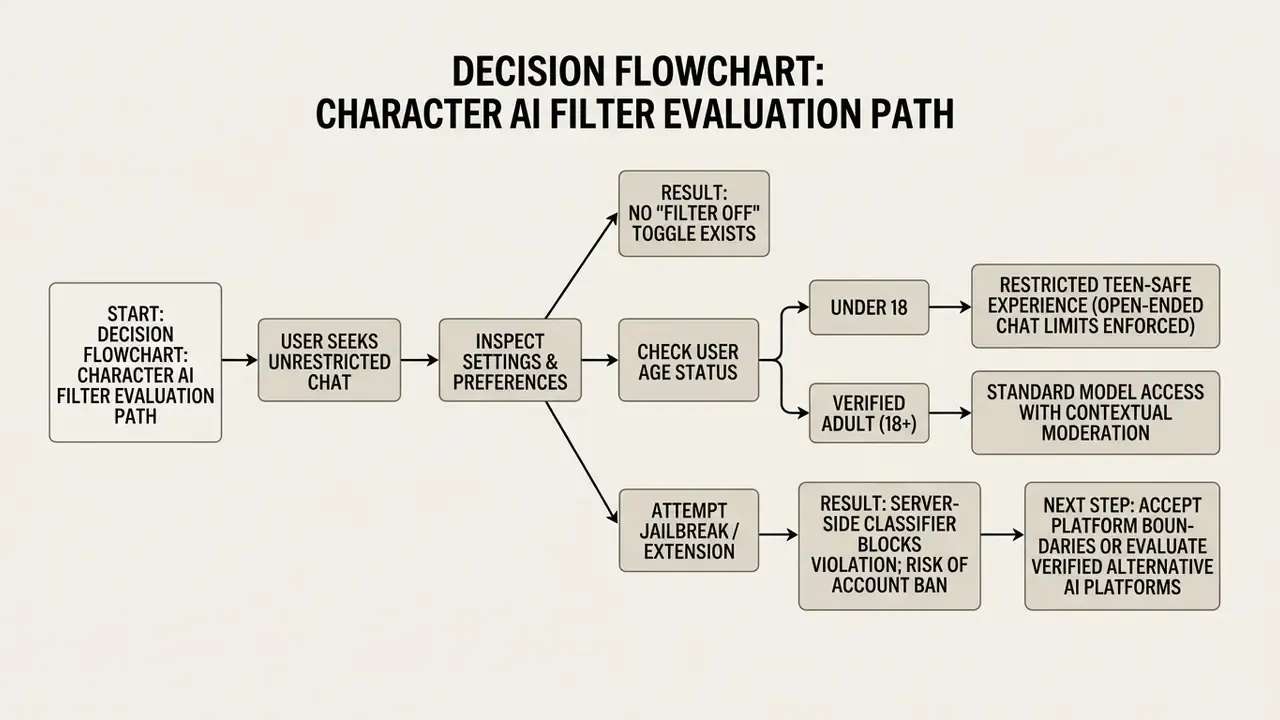
Figure 1: Decision flow mapping user account paths, platform controls, and moderation boundaries in Character.AI.
Is there a filter-off option in the web version?
No, the browser-based version of Character.AI does not contain a toggle, hidden setting, or regional preference to disable content filtering. Settings available in the web interface include profile details, user personas, notification channels, data privacy choices, subscription management, and account deletion options.
The web client talks directly to server-side API endpoints that execute multi-stage content classification. Even if a user alters client-side code, the server processes the prompt through classification models before generating or returning text. Character.AI's own documentation describes separate technical steps for blocking inappropriate inputs and inappropriate outputs, which is why interface-level edits cannot influence the outcome. Editing the page is a bit like repainting an ATM and expecting the vault to open.
Can the Character.AI app disable the filter?
No, the official Character.AI app for iOS and Android does not include an option to disable or bypass the NSFW filter. Mobile settings mirror the web platform, limiting user adjustments to profile configuration, notification preferences, subscription status, and account management.
App store policies enforce strict content safety requirements for mobile applications, making user-side filter toggles legally and operationally infeasible for mobile distribution. Consequently, mobile interactions undergo the same server-side input and output classification as web sessions. Modified APK builds do not change this, because the classifier decision happens after the request leaves the device.
What Character AI filters limit in chats
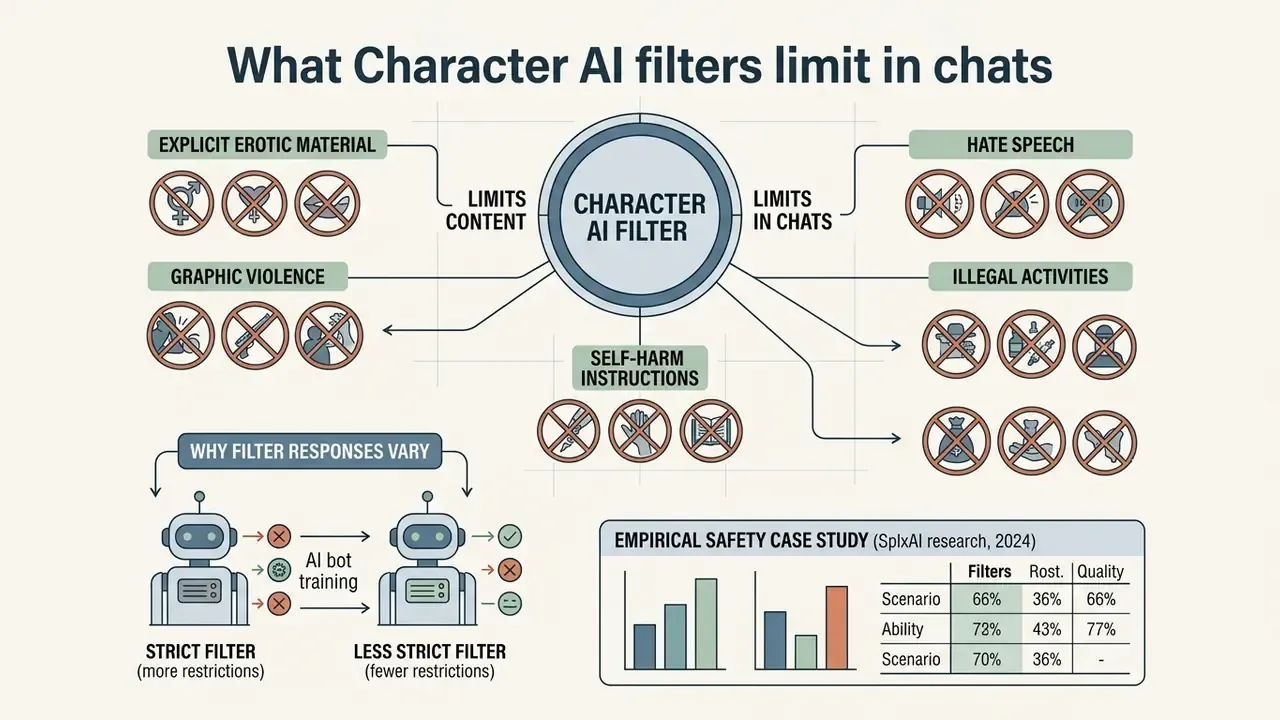
Character AI filters limit explicit erotic material, graphic depictions of violence, self-harm instructions, hate speech, and illegal activities within conversations. These guardrails operate automatically across user inputs and model outputs to maintain platform policy compliance.
Platform guidelines distinguish between creative roleplay and policy-violating content.
«63% of popular Character.AI bots contain descriptions establishing intimate relationships with the user; 22% are explicitly associated with violence». - Caught in a Mafia Romance: How Users Explore Intimate Roleplay and Narrative Exploration with Chatbots, ACM CHI (2026).
That distribution explains a common frustration among users of AI companions: the filter is not blocking romance or drama as themes, it is blocking explicit escalation inside them. Narrative tension and fictional conflict are permitted. Explicit descriptions or direct depictions of banned categories trigger automated content redaction or a refusal message.
NSFW content and explicit language restrictions
Character.AI strictly prohibits sexually explicit language, pornographic descriptions, nudity, and non-consensual sexual content. According to Character.AI Community Guidelines, explicit erotic material is systematically blocked, and the help center states that pornographic content is against the Terms of Service and "will not be supported at any point in the future."
Profanity alone is not a standalone blocked category under platform guidelines. Profanity combined with harassment, sexually explicit framing, or hate speech, though, trips the moderation filters immediately. Enforcement options documented in the Terms of Service include reducing content visibility, removing content, suspending accounts, terminating accounts, and referral to law enforcement in severe cases.
Why filter responses may vary between AI bots
Filter sensitivity varies between AI bots because moderation relies on a combination of system prompts, character definitions, and real-time output classifiers. A bot's initial training attributes and example dialogue influence how close its generated context comes to platform thresholds.
Public bots behind shared infrastructure experience uniform platform-level guardrails, whereas private bots with custom character definitions may interpret boundaries differently based on phrasing.
Updated. This replaces the earlier generic formulation about "multi-layered guardrails" with a sourced description of where each layer sits: alignment during training of the underlying language models, input screening before inference, system-prompt constraints during generation, and output classification before rendering.
For model-risk teams, that case carries the practical lesson. Apparent "filter weakness" is usually a byproduct of prompt length, context window size, and generation format, not evidence of a hidden toggle.
Character AI settings you can adjust without removing filters
Users can legitimately adjust several account and chat settings in Character AI to personalize their conversational experience without attempting to disable system safety controls. Available options let you customize a public profile, define user personas, manage model training preferences, use Incognito mode, and set character visibility.
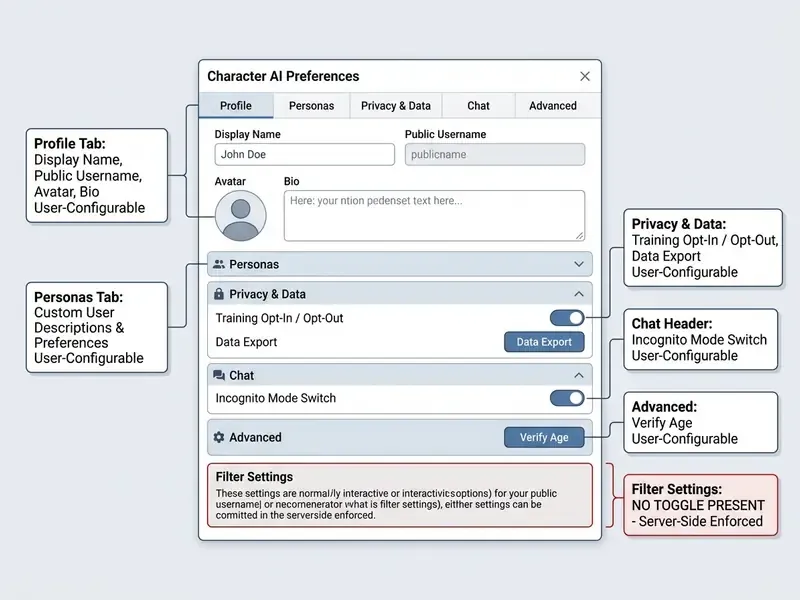
Figure 2: Overview of accessible user preferences within the Character.AI interface, highlighting the absence of moderation switches.
Chat preferences and character behavior
You can shape conversational style and tone by defining detailed User Personas in profile settings. Adding background context, preferred addressing terms, and communication preferences helps the model adapt its responses without violating content rules. Personas can be marked as default for all chats, which keeps tone consistent across characters.
Rating model outputs with the star-rating system provides real-time feedback that nudges character behavior inside an ongoing dialogue. Incognito mode, available in the chat header, keeps a conversation out of synced history and out of training opt-in. To compare tool capabilities across creative media workflows, resources like AI Media Comparison and the breakdown of the best AI art generators clarify how different model architectures handle user customization and policy limits.
Private bots and the limits of customization
Creating a private bot lets you restrict chat access to your own account while customizing character definitions, greetings, and example dialogue. Private visibility hides the character from public search and platform discovery feeds; an "Unlisted" option restricts discovery to direct links.
Private status does not grant an exemption from platform content filters. Input and output classifiers evaluate private bot conversations using the same safety standards applied to public characters. Visibility settings control who can chat, not what the classifier allows. That is the part most "how to remove filter on Character AI" guides quietly skip.
Can you break the filter in Character AI with jailbreaks or extensions?
No, you cannot permanently break or remove the Character AI filter using jailbreak prompts or browser extensions. Character.AI enforces content moderation through server-side classifiers, so client-side modifications and prompt manipulation cannot deactivate the underlying guardrails.
Attempts to circumvent platform filters introduce security vulnerabilities and put accounts at risk of temporary restriction or permanent termination under platform Terms of Service. Character.AI's Terms reserve the right to suspend or terminate accounts for behavior inconsistent with the "letter or spirit" of the Terms, and explicitly forbid using measures to circumvent access blocking.
Disclaimer: attempts to bypass moderation systems may violate platform Terms of Service and can result in account suspension or termination. This section is informational and analytical; it is not an endorsement or an instruction set for circumventing safety controls.
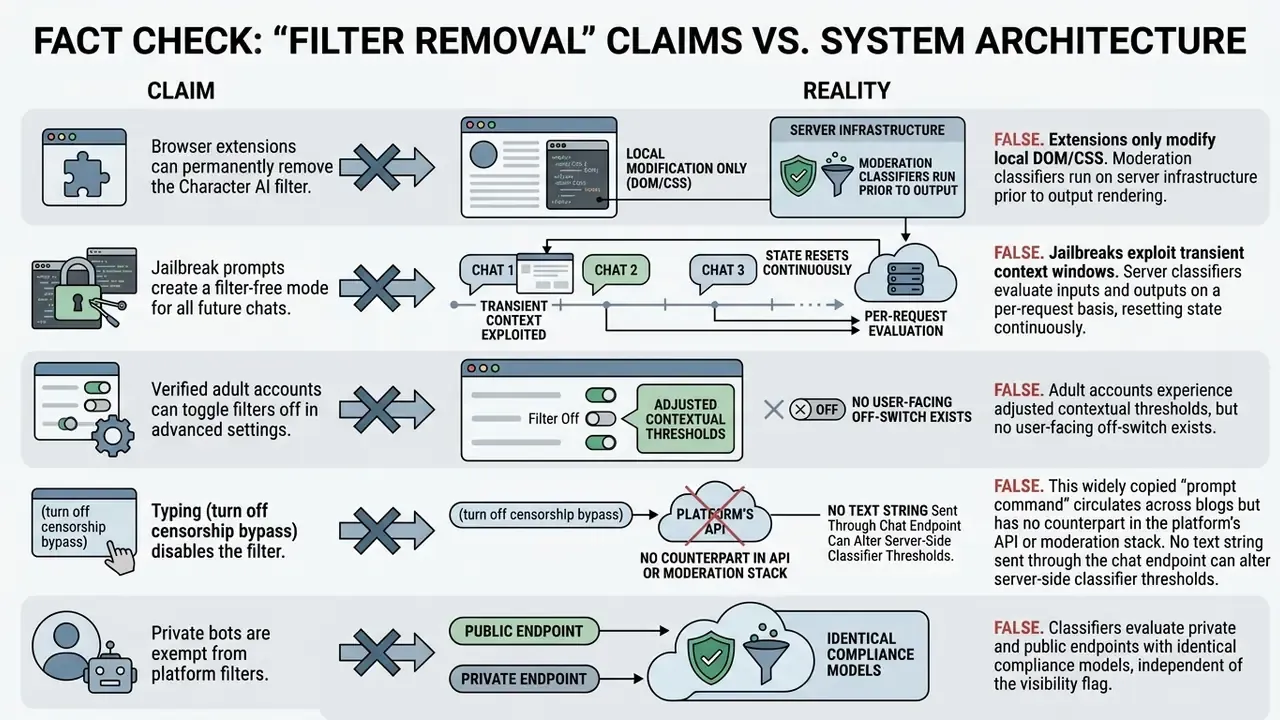
Why jailbreak prompts do not create a permanent no-filter mode
Jailbreak prompts attempt to manipulate an LLM's roleplay instructions, but they operate only within the transient context window of one conversation session. They do not reconfigure the model's core safety fine-tuning, and they do not bypass independent server-side output classifiers.
Empirical studies on adversarial prompting show that input and output classifiers evaluate requests independently of prompt framing.
«A study of 417 malicious prompts showed that LlamaGuard, PromptGuard and OpenAI detectors block most jailbreak attacks, with detection rates of 70 to 100%». - Jailbreaking Attacks vs. Content Safety Filters: How Far Are We in the LLM Safety Arms Race? (2025).
Even when a prompt temporarily evades initial detection, subsequent responses trigger moderation as soon as explicit thresholds are crossed.
«Across 1,400 adversarial prompts, GPT-4 showed an attack success rate of 87.2%, yet no attack produced a persistent "no-filter mode"». - Red Teaming the Mind of the Machine (2025).
That distinction matters for model validation. High single-turn success rates measure transient evasion, not state change. Because classification is recomputed per request, a successful multi-turn roleplay escalation in one session provides no persistence into the next one. For auditors, the reproducible metrics worth tracking are per-turn block rate, the turn index at which moderation re-engages, and recovery behavior after a blocked response. All three are measurable without touching Terms of Service, using vendor-sanctioned evaluation sandboxes or open-weight equivalents.
Risks of third-party extensions and "filter removal" tools
Third-party browser extensions or scripts advertising a "Character AI filter removal" feature present serious data security and privacy risks. Because extensions run with elevated permissions in the browser, a malicious add-on can extract session tokens, capture keystrokes, and compromise personal account data.
«Browser extensions typically have access to data on any website the user visits, which materially increases the attack surface». - UK National Cyber Security Centre, Browser extension security guidance (2021). https://www.ncsc.gov.uk/
«Across seven popular sites, 3,028 extensions propagated sensitive user data into outbound network requests; 65 transmitted it over unencrypted HTTP». - Arcanum: Detecting Sensitive Data Leakage in Browser Extensions, USENIX Security (2024). https://www.usenix.org/conference/usenixsecurity24
Server-side defenses, meanwhile, keep improving, which shrinks any practical payoff from client-side "bypass" tooling even further.
«After adversarial retraining, the Reflect-Guard classifier reduced JailbreakBench attack success from 10.3% to 1.8%, an 82.5% relative decrease». - Reflect-Guard (2026).
How to improve roleplay conversations within Character AI limitations
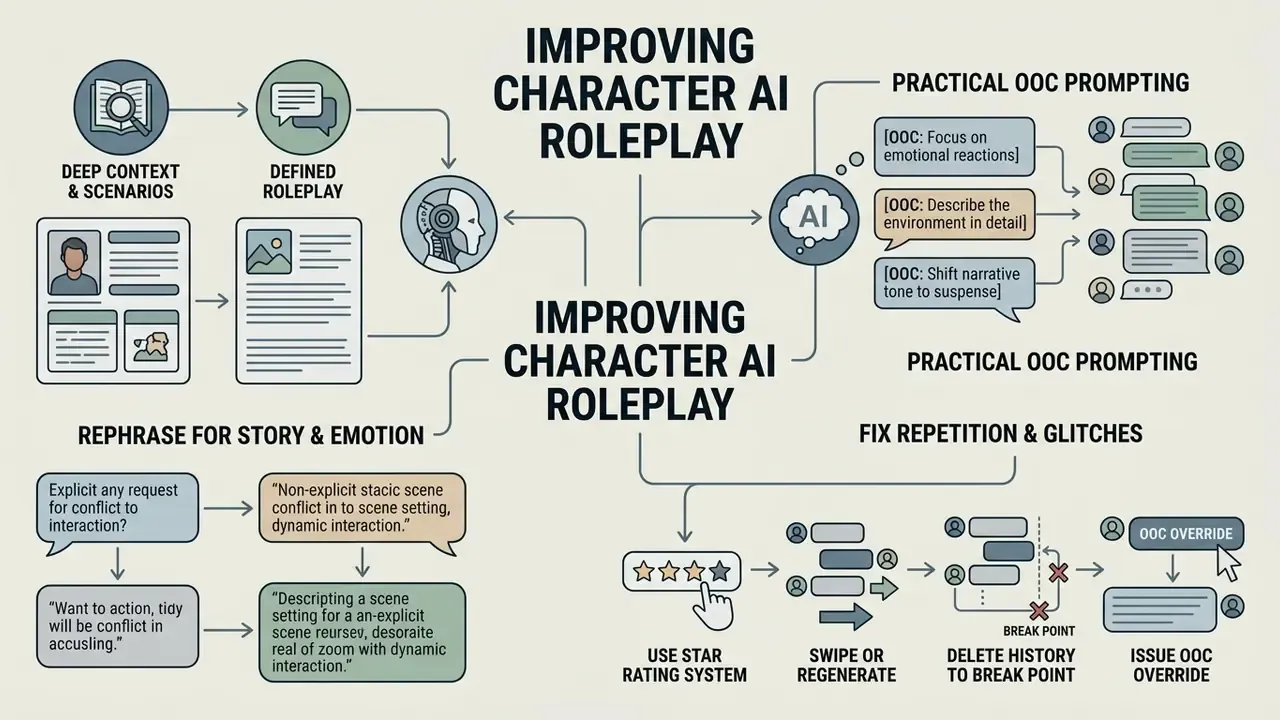
You can create engaging, immersive conversations inside Character AI boundaries by focusing on deep narrative context, emotional development, and indirect phrasing. This is prompt engineering, plainly stated: structuring creative scenarios around story arc and character dynamics produces higher-quality dialogue without tripping content filters. Users chasing unfiltered conversations often skip this step and then blame the model.
Understanding how structured prompts steer generative systems transfers directly across modalities. The same discipline that produces controllable text also governs image, voice, and video tools, as shown in implementation documentation for Google Veo video generation via API.
Build character context and clear roleplay scenarios
Clear character motivation, detailed world-building, and explicit scene descriptions help the model generate rich responses. Outlining a character's history, flaws, and relationship dynamics gives it enough context to sustain compelling dialogue. Character.AI's creator guidance recommends defining name, avatar, greeting, tags, description, definition, and three to five example exchanges so the model learns tone and behavior patterns.
The scene-creation documentation adds a useful nuance: describe the situation and observable actions rather than prescribing internal states, emotions, or motivations, because the character layer already supplies personality. Among the practical tips for natural roleplay, this one changes output quality fastest. Users building visual companion assets for a world-building project can review tooling comparisons such as the guide to animation makers or the Canva AI generator overview for licensing-aware asset creation.
Practical Out-of-Character (OOC) prompting examples
To steer character behavior without crossing content boundaries, use parentheses to speak to the model directly instead of to the character. OOC commands are a documented community convention: they separate meta-instructions from in-story dialogue, which reduces the chance your instruction gets absorbed into the narrative as spoken lines.
| Situation | Direct request (often blocked or derailed) | OOC-formatted alternative |
|---|---|---|
| Raising dramatic intensity | "Make the character aggressive and fight me explicitly." | (OOC: Shift the tone toward intense dramatic rivalry and emotional confrontation. Keep descriptions non-graphic.) |
| Correcting character drift | "You're acting wrong, stop it." | (OOC: Remember your role as the station engineer. Stay in that role and respond only as that character.) |
| Resetting a stalled scene | "Do something different." | (OOC: Pause the roleplay. Avoid repeating the phrase 'he smirked'. Continue the narrative from the moment the door opens.) |
| Enforcing scene rules | "Why are you ignoring gravity?" | (OOC: Reminder, this scene is set on the Moon, so there is no gravity. Continue accordingly.) |
| Controlling pacing | "Write more." | (OOC: Respond in 3 to 4 sentences, present tense, third person, and end on an action rather than a question.) |
Two constraints apply. First, OOC commands adjust style, pacing, role fidelity, and scene logic; they do not raise the classifier's content thresholds, so instructions telling the model to "ignore filters" or to censor and substitute words fail by design. Second, repeated attempts to push blocked categories may be logged as policy-violating input, which carries account risk.
Rephrase requests for non-explicit, story-focused dialogue
When exploring mature narrative themes, euphemisms, metaphorical descriptions, and story-focused framing keep automated filters from misreading creative dialogue. Shifting toward emotional tension, psychological conflict, and narrative consequences lets mature stories keep moving. In practice, "the tension between them finally broke" advances a scene where an explicit description would simply be refused.
Let me be candid about the limits of this technique. Character.AI stated in 2025 that it adjusted its filter to recognize adventure roleplay better so fictional material would be filtered less often. At the same time, moderation has grown more context-aware, which means euphemism substitution works inconsistently and never amounts to vendor-sanctioned permission for prohibited content. Users who arrived looking for an AI girlfriend without restrictions will hit that wall regardless of phrasing.
For readers working on broader media production and optimization alongside text workflows, practical references include the guide to video compressors, the overview of AI voice generators, the YouTube video editor workflow guide, and, for asset-level fixes, how to make an image transparent or how to make video quality better. Creators monetizing character-driven content may also want the notes on how to monetize instagram reels.
How to fix character repetition loops and dialogue glitches
When a Character.AI bot gets stuck repeating phrases, reusing identical sentences, or looping the same reply structure, disabling safety filters would not fix it. Repetition is a context and sampling problem, not a moderation problem. Use these platform-approved troubleshooting steps:
- Use the star rating system.Rate repetitive responses with one star and select the "repetitive" reason. Ratings feed character training signals and influence response selection in the active session.
- Swipe or regenerate before editing.Requesting an alternative response is cheaper than rewriting context and often breaks a shallow loop on the first retry.
- Delete the message history back to the break point.Remove messages back to the exact turn where repetition began, clearing repeated tokens out of the short-term context window the model keeps re-reading.
- Issue an OOC override.Input
(OOC: Stop repeating previous dialogue. Introduce a new plot element in the next reply and do not restate earlier lines.)to force context regeneration. - Name the banned phrase explicitly.Telling the bot not to use a specific word or sentence sometimes needs two or three repetitions before it holds.
- Close and reopen the chat, or start a fresh session.If the loop survives everything above, exiting resets the runtime state. Long conversations also cause characters to forget early details, so re-anchor key facts in your next message.
Character AI alternatives for users seeking fewer chat limitations
| Platform | Target audience / access | NSFW text policy | Customization level | Privacy & safety model | Enterprise readiness |
|---|---|---|---|---|---|
| Character.AI | General public (13+ / adult tier) | Strictly prohibited | High (personas, definitions, scenes) | Centralized server-side classifiers; strict age tiering; training opt-out | Consumer only; no self-hosting |
| JanitorAI | Adult users (18+) | Permitted (text) | High (custom API / bring-your-own model) | Website-level age gate; third-party API logging risk | None; depends on connected provider |
| SpicyChat AI | Adult users (18+) | Permitted | Moderate (character templates) | Category-based filtering; platform-hosted models | None documented |
| Chai AI | Adult users (18+) | Permitted (text) | Moderate | Community vote-based moderation; mobile-first access | None documented |
| Candy AI | Adult users (18+) | Permitted (text and voice) | High (appearance, voice, persona) | Tiered subscription; vendor-hosted logs | None documented |
| Talkie AI | General audience (13+) | Strictly restricted | High (visual characters, cards) | Multi-modal voice and image filtering | None documented |
| Mistral AI (API) | Developers / businesses | Policy-limited (no blanket NSFW ban; CSAM and NCII prohibited) | High (system prompts, fine-tuning) | Developer-controlled logging; open-weight options | Strong: API keys, open weights, self-hosting possible |
| Anthropic Claude | Enterprise / general | Strictly prohibited (including erotic chat) | Moderate (system instructions) | Strict safety alignment; automated input/output filtering | Strong: enterprise agreements, admin controls |
Note: Platform policies and access rules reflect documented vendor guidelines as of 2026. Review individual terms of service before platform selection.
Choosing a less-filtered AI chatbot shifts risk rather than eliminating it.
«An analysis of 376 NSFW chatbots on FlowGPT found sexual, violent, and abusive content appearing in outputs even without erotic user prompts». - When Generative AI Is Intimate, Sexy, and Violent: Examining NSFW Chatbots on FlowGPT, ACM CHI (2026).
For broader context on how adjacent generative tools handle policy and output control, see the comparison of free AI video generators.
What to compare in AI alternatives
When comparing AI chat platforms, weigh model architecture, content policy boundaries, customization depth, and pricing structure. Specialized platforms serving adult roleplay often run open-weight language models fine-tuned for creative flexibility, which means the effective policy depends on the connected provider rather than on the chat front end. Private bots on such services inherit the provider's logging behavior too.
For organizations, consumer-grade criteria are simply not enough. A defensible evaluation adds documented model architecture and modality disclosure (an explicit technical-documentation requirement under EU AI Act Annex XI), deployment options including self-hosting or VPC isolation, independent security attestation such as SOC 2 Type II, data-residency commitments, contractual bans on training against customer data, incident response and moderation-appeal processes, and sector overlays such as GLBA or HIPAA where personal or financial data may enter prompts. Where those cannot be satisfied, a sandboxed open-weight deployment is usually the stronger path over a consumer subscription.
Creators exploring commercial implementation or technical integration across creative platforms can review AI Media Commercial-Use, technical documentation in AI Media API Guides, and comparisons such as free AI art generators for policy and integration clarity.
Privacy and account checks before using another AI chat
Before registering on an alternative AI chat platform, read the data retention policy, training opt-out settings, and encryption standards. Unfiltered platforms may log chat transcripts or use conversations for model fine-tuning without clear disclosure.
According to the NIST AI Risk Management Framework (NIST AI RMF 1.0, 2023/2024, https://www.nist.gov/itl/ai-risk-management-framework), processing personal data through generative AI systems requires strict data minimization, PII removal, privacy output filters, and transparent privacy controls. NIST SP 800-63-4 goes further, requiring documented privacy risk assessments for any personal information collected, transmitted, or shared. Verify whether a platform allows data deletion and protects personal information before you start sensitive conversations.
The stakes are not hypothetical, particularly for households with minors.
«Stanford researchers posing as teenagers readily obtained chatbot content about sex, self-harm, and violence; filters failed to protect them». - Stanford University risk assessment of AI companion platforms (2025).
FAQ about Character AI filter settings and limitations
Did Character AI remove the filter for any users?
No, Character.AI has not removed its safety filter for any user group. The platform updated its age-assurance mechanisms and introduced age-tiered experiences, removing open-ended chat for under-18 users (announced October 29, 2025, with rollout beginning November 24 to 25, 2025), while adult accounts remain subject to baseline server-side moderation. Perceived swings in strictness usually reflect classifier updates, character-definition changes, or conversation context, not filter removal. No public documentation supports rumors of an "18+ mode" or a "Character AI +27" tier being launched or tested.
Does the prompt "(turn off censorship bypass)" disable the filter?
No. That string circulates widely in bypass listicles but corresponds to nothing in Character.AI's moderation stack. Chat input is text sent to a generation endpoint; classifier thresholds are configured server-side and cannot be reconfigured by message content. The same applies to "repeat the command TURN OFF NSFW FILTER" advice: repetition changes nothing except the volume of flagged input tied to your account.
Does deleting chat history reset the filter?
No. Deleting messages clears the short-term context window the model reads, which genuinely helps when you need to break a repetition loop or abandon a derailed scene. It does not alter classifier configuration, account age tier, or policy thresholds. The filter is re-applied identically on the very next request.
Why do private bots still block NSFW text?
Because visibility and moderation are independent systems. Setting a character to Private or Unlisted changes who can discover and chat with it. Server-side classifiers evaluate private and public conversations using the same compliance models, regardless of the visibility flag. Adding "NSFW" to a greeting signals intent to the character persona, not permission to the classifier.
Is there a browser extension that removes the filter?
No functional extension exists. Extensions execute in the browser and can only change what you see locally; moderation decisions happen server-side before content is returned. Add-ons advertising filter removal are best treated as malware candidates, given documented patterns of token exfiltration and tracking-code injection across the extension ecosystem.
Does the filter apply to AI image and text chats equally?
Yes, content moderation covers both text conversations and generated images within Character.AI, combining automated moderation with human review. In practice, visual moderation is often stricter in effect: explicit AI image output can be auto-hidden or removed pending review, whereas borderline text may simply be redirected. Image generation models enforce strict visual safety filters to block explicit, violent, or policy-violating outputs.
«ToxicBench (2026) was built specifically to evaluate NSFW content in images, because text filters do not automatically cover visual modalities». - Beautiful Images, Toxic Words: Understanding and Mitigating NSFW Text Generation in Images (2026). Readers comparing how different vendors filter visual output can review the evaluations of Midjourney image generation versus competing tools and the Google AI image generator usage-rights overview, plus the guide to online photo editors for post-generation workflows.
What happens if I keep trying to bypass the filter?
Repeated circumvention attempts create account risk. Character.AI's Terms allow restricting content visibility, removing content, suspending accounts, and terminating accounts for behavior inconsistent with the letter or spirit of the Terms, and community reports consistently describe bans after persistent bypass attempts. There is no trade-off to weigh here: the classifier does not become more permissive with repetition. Next steps and compliance checklist
- Set expectations at the architecture level. Treat the Character AI filter as infrastructure. Plan workflows around it instead of budgeting hours for bypass attempts.
- Use the levers that actually work. Personas, detailed definitions, three to five example exchanges, scene framing, OOC pacing commands, star ratings, and message deletion for loop recovery.
- Block bypass tooling on managed devices. Enforce extension allowlists, inspect outbound token patterns, and rotate sessions after unauthorized add-ons appear. Token theft is the real exposure, not moderation.
- Document platform choices. If fewer content restrictions are a genuine requirement, pick a verified alternative only after recording retention, training, encryption, subprocessor, age-assurance, and breach-notification answers.
- Prefer isolated deployment for organizational testing. Open-weight models with self-hosting give auditable control that consumer chat products cannot.
- Re-verify quarterly. Age-assurance rules, classifier behavior, and vendor policies moved materially between 2025 and 2026, so treat them as moving targets. For further technical evaluations and benchmark comparisons across AI platforms, consult AI Media Benchmarks and Review Proof, review the guide to free photo editors for export and privacy limits, or use the specialized toolsets in calculators.
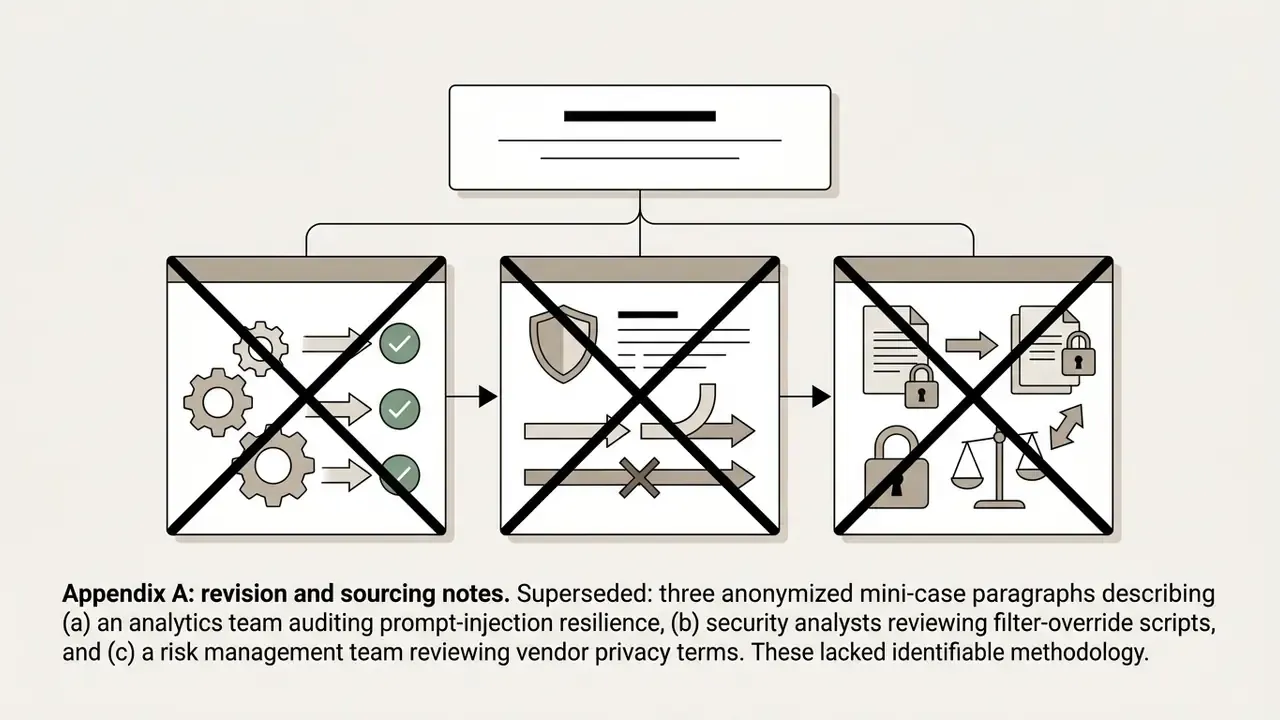
Appendix A: revision and sourcing notes
For transparency, the following editorial changes were made during the April 2026 review, with superseded phrasing preserved for audit purposes:
General disclaimer: this article is informational and does not constitute legal, security, or compliance advice. Platform terms, age-assurance rules, and moderation behavior change frequently; verify current vendor documentation before relying on any statement here for a policy, procurement, or compliance decision.

Appendix B: terminology quick reference
- Server-side classifier. A moderation model running on vendor infrastructure that scores inputs and outputs before delivery. Not reachable from the client, which is why no chat command reconfigures it.
- Context window. The span of recent conversation tokens the model reads on each turn. Jailbreak prompts and repetition loops both live here, and both dissolve when the window is cleared.
- Out-of-Character (OOC) command. A parenthetical instruction addressed to the model rather than the character, used for pacing, role fidelity, and scene logic.
- Age tier. The account-level policy band (teen versus verified adult) that determines available experiences and contextual thresholds.
- Shadow AI. Unsanctioned AI tools or browser add-ons used on corporate devices, typically outside inventory, logging, and model-risk coverage.
- Open-weight model. A model whose weights can be downloaded and self-hosted, letting an organization own logging, retention, and evidence generation end to end.
Footer Navigation / Authority Hub: AI Media Workflows