Executive summary
How to read this analysis before a commercial decision
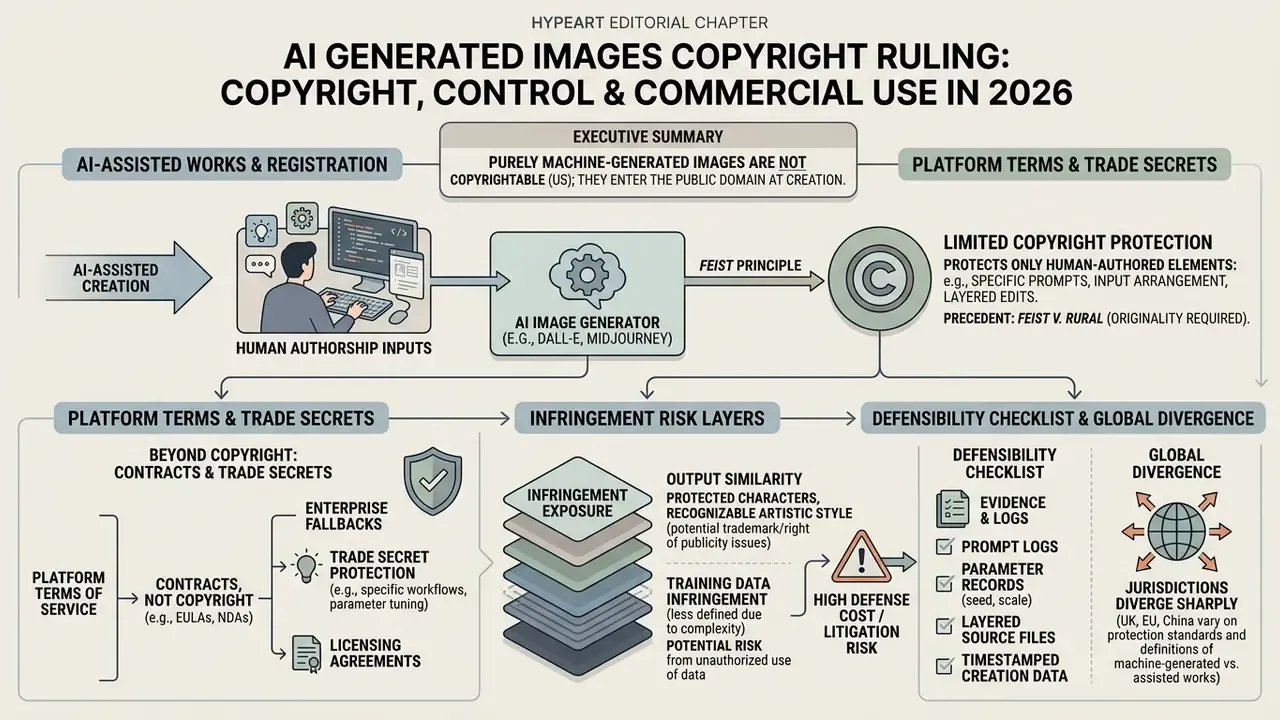
Three questions decide almost every case, and they are not the same question.
A workflow can pass the second test and fail the first and third simultaneously. That mismatch is where most enterprise losses actually occur, and it is why governance teams should treat AI imagery as a control problem rather than a creative one. For a broader map of adjacent decisions, see the overview of commercial-use guidance.
What the AI generated images copyright ruling means today
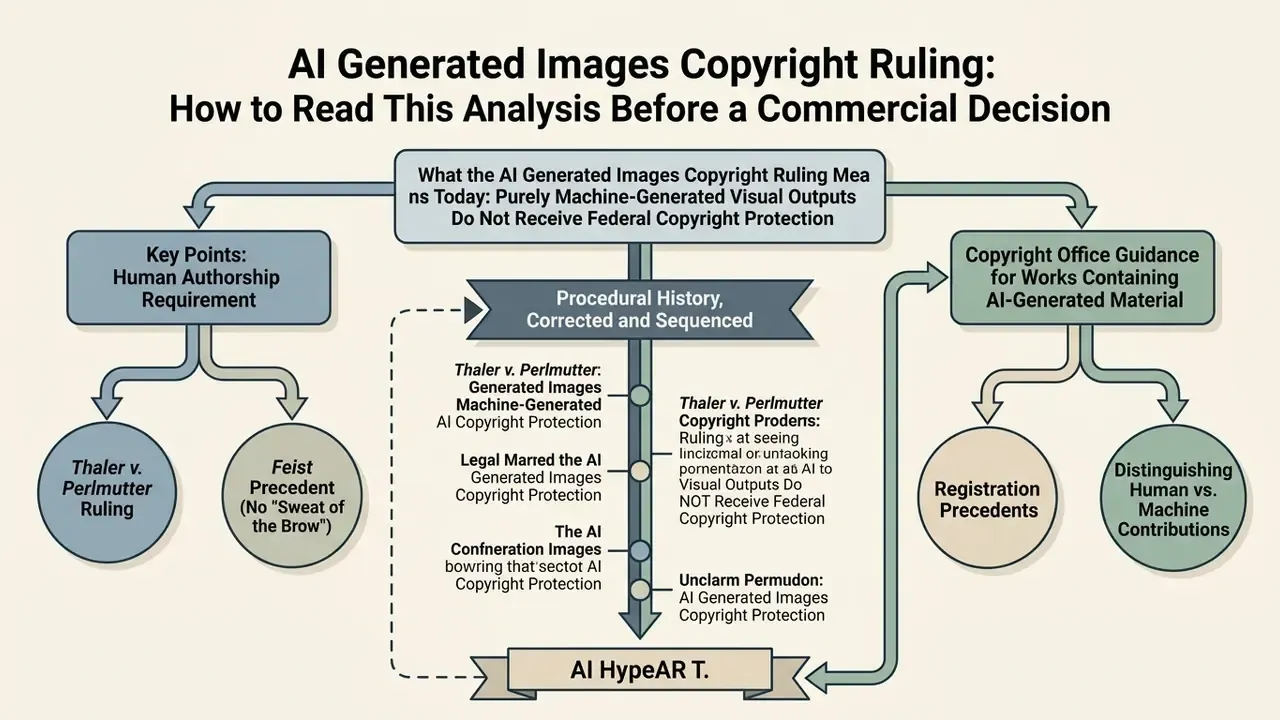
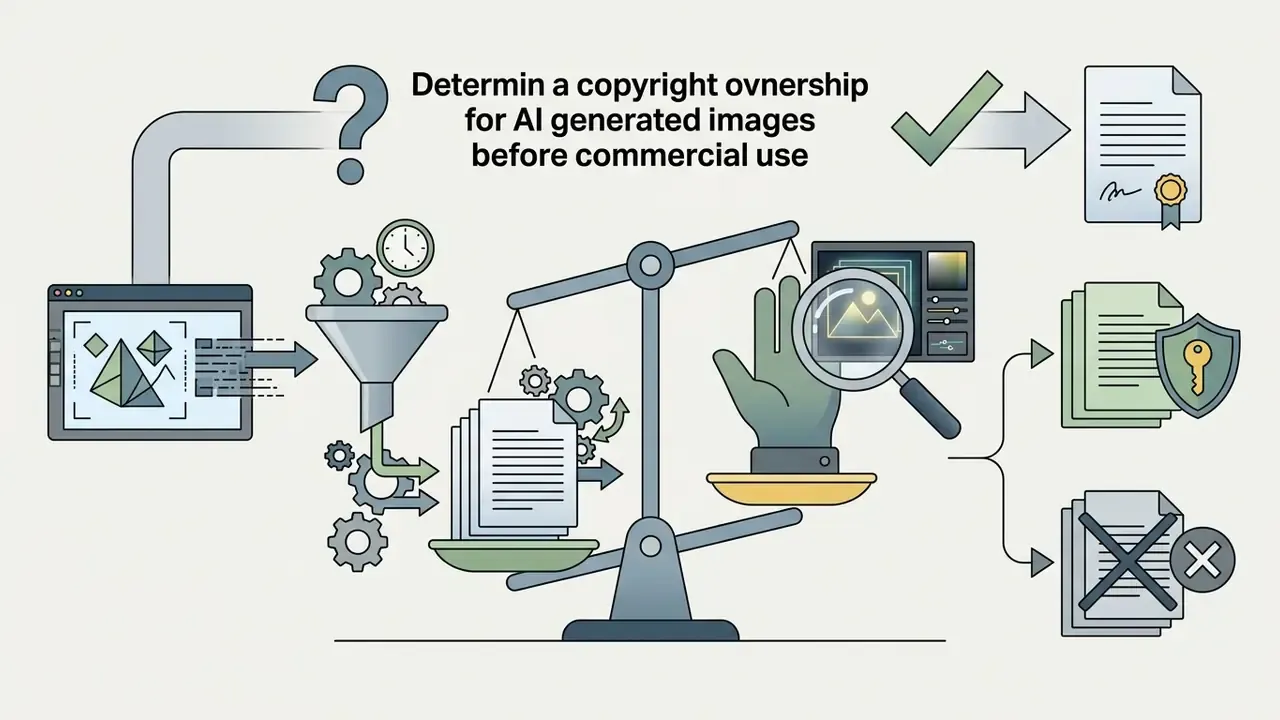
Copyright Office guidance for works containing AI-generated material
Two procedural points get misread by enterprise filing teams almost every time. Applicants are not required to name the specific AI tool, vendor or training corpus. And they may not list an AI system or its provider as an author. The disclosure duty concerns the boundary between human and machine contribution, not the technology stack behind it.
In January 2025 the Office published Copyright and Artificial Intelligence, Part 2: Copyrightability Report. That report confirmed what practitioners suspected: prompt engineering alone does not confer authorship, because prompts operate like instructions given to a commissioned artist.
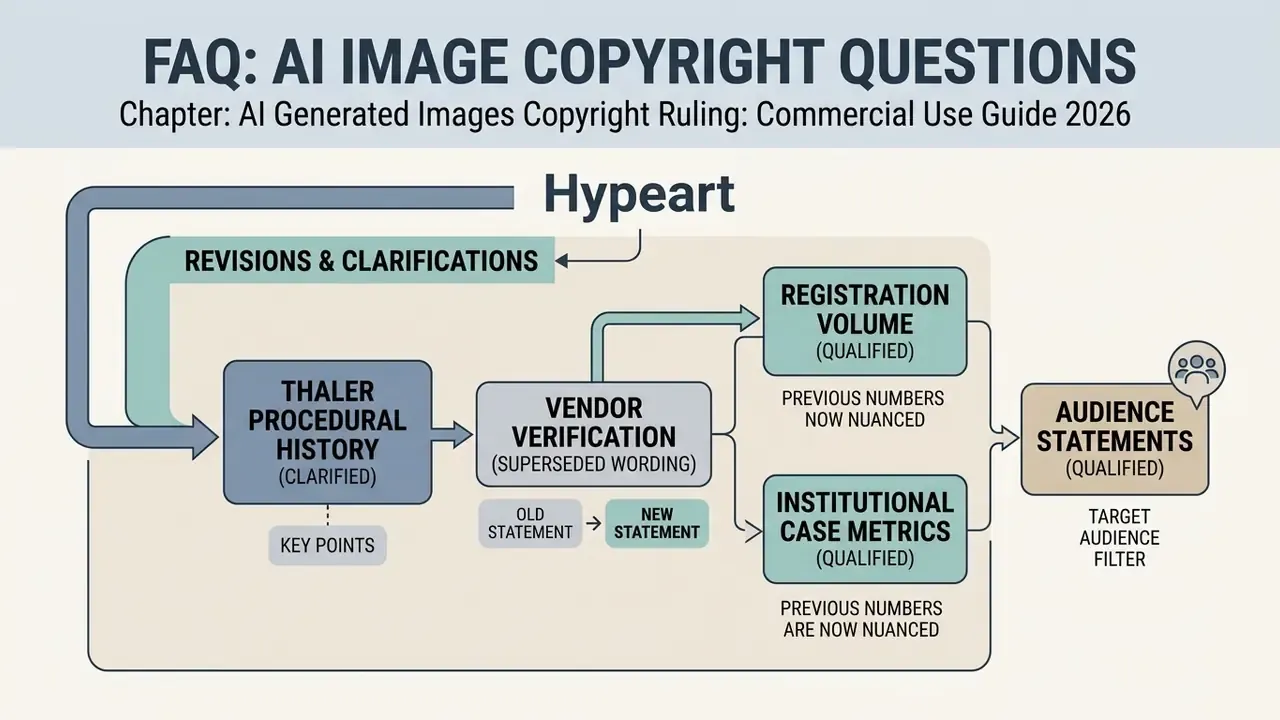
By early 2026, the Office reported registering over 7,000 mixed-material claims under this framework, which amounts to a standardised administrative path for works combining human authorship with generative tools. Treat that aggregate as an Office-reported programme metric rather than an audited statistic, and verify current figures against the registration record before citing them in a filing. Procurement teams comparing platforms for regulated deployments can review the best AI art generators by licensing and output control to align tool selection with registration strategy.
Can AI-generated art be copyrighted?
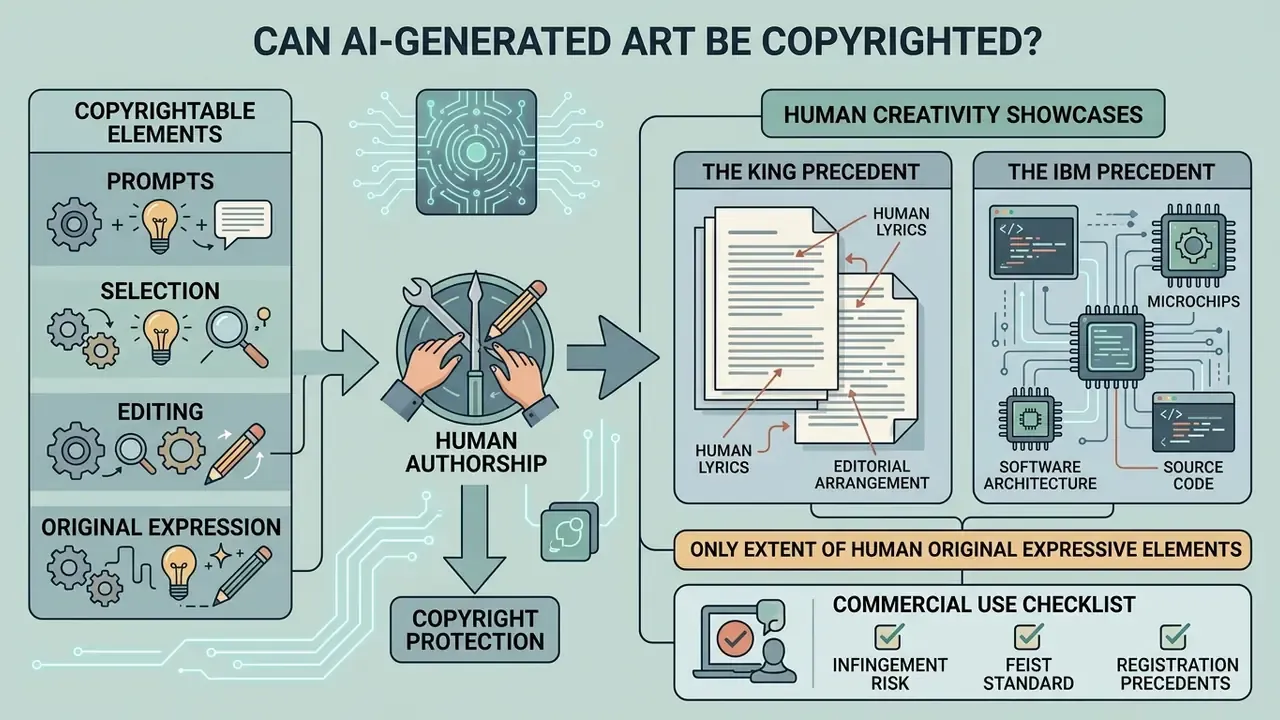
AI-generated art can be copyrighted only to the extent a human author contributes original expressive elements to the final output. Pure machine outputs are ineligible. AI-assisted works containing sufficient human creativity receive protection for the human-authored components only. The test turns on whether a human exercised ultimate creative control over the specific visual expression.
Answering can ai generated art be copyrighted means walking the creative process step by step. When examiners weigh is ai art copyrightable, they separate automated algorithmic execution from human design choices. For enterprise operations, securing ai generated art copyright requires documented evidence of the human author's direct contribution to selection, arrangement and post-generation modification. Documentation is the asset here, not the image.
| Category | Level of human contribution | Copyright protection status | Risk of registration refusal |
|---|---|---|---|
| Fully AI-generated images | Minimal; simple text prompts with no manual modification or arrangement. | No copyright protection; the work enters the public domain immediately upon creation. | High; the US Copyright Office rejects applications lacking human authorship. |
| AI-assisted works | Substantial; creative selection, complex composition, layering and manual post-editing. | Protected exclusively for human-authored modifications and creative arrangements. | Moderate; requires explicit disclosure and exclusion of raw AI elements. |
| Human-authored works | Complete; traditional digital or physical creation where AI serves only as a minor utility. | Full protection across all creative elements under standard statutory law. | Low; standard registration procedures apply without special disclaimers. |
Table: comparison of human contribution, copyright protection and registration risk.
When prompts, selection and editing may show human creativity
Text prompts alone are generally insufficient to establish human authorship under current US law. Standard image generators interpret text through probabilistic machine learning models, so the system, not the prompter, determines the visual expression of lighting, shading and line work. Submitting an elaborate prompt to an art generator does not make the user the legal author of the resulting image. It rarely feels that way to the creative team, which is part of the governance problem.
Under established US jurisprudence (Feist Publications, Inc. v. Rural Telephone Service Co., 499 U.S. 340 (1991)), copyright requires independent creation possessing at least a "modicum of creativity," the constitutional "spark" separating original work from raw data such as the white pages of a telephone directory. Standard prompt inputs fail that test because probabilistic models execute the expressive choices. The Feist threshold is deliberately low, which makes the outcome instructive: AI-assisted work is not being held to an elevated standard. A text instruction simply contributes no fixed expression of its own.
Human creativity appears when a creator exercises sustained editorial control. Filtering hundreds of iterations against stated aesthetic criteria. Combining disparate visual elements into an original composite layout. Manually altering colour balance, masks and forms in graphic software. Documented, these choices demonstrate the sufficient human input needed to satisfy the authorship requirement. Undocumented, they may as well not exist.
That finding has an operational consequence that surprises most legal teams. Disclosed AI involvement may statistically raise the probability of claims being pursued against a commercial asset. The correct response is stronger documentation of human authorship, not thinner disclosure.
A major US financial institution evaluated an AI-assisted marketing workflow for public-facing assets. Its risk management team built an audit log capturing prompt iterations, parameter settings and graphic layer edits before any image cleared production. According to the institution's own internal programme reporting, the bank subsequently defended its registration filings with the US Copyright Office and recorded no copyright infringement claims across the cleared visual library, roughly 1,200 deployed assets. These are self-reported control metrics, not externally audited figures. Still, they show the shape of a defensible pipeline: log first, publish second.
What parts of an AI-assisted work may receive copyright protection
In an AI-assisted creation, protection attaches strictly to human-authored elements, while the underlying machine-generated content stays uncopyrightable. The Office isolates protectable human additions, such as original text overlays, custom digital brushwork or unique spatial arrangements, from the raw algorithmic output.
| Layer | Origin | Protection status | Registration treatment |
|---|---|---|---|
| Layer 1: base background and scene generation | Model output from text prompt and seed | Unprotectable (no human authorship) | Disclaim under "Material Excluded" |
| Layer 2: manual retouching, masking, brushwork | Human, in a layered editor | Protectable if more than trivial | Claim as human-authored modification |
| Layer 3: original typography and graphic elements | Human-created vector and text assets | Protectable as original expression | Claim as human-authored content |
| Layer 4: composite arrangement of multiple outputs | Human selection, coordination, arrangement | Protectable as compilation authorship | Claim selection and arrangement only |
Table: separation of human authorship in AI-assisted works. Only Layers 2 to 4 enter the copyright claim; Layer 1 remains available for public use.
Administrative precedent shows how hybrid filings get dissected in practice.
- Human lyrics and editorial arrangement (the King precedent). In registering a hybrid musical and audiovisual work, the Office granted protection explicitly restricted to the human-authored "lyrics and editing of AI-generated footage," while disclaiming the raw AI video components. Composition and lyrics qualified as original human expression. The machine-generated footage did not.
- Software architecture and source code (the IBM precedent). In AI-assisted software filings, including IBM's enterprise code registrations, the Office excluded raw AI-generated source code, prior versions and third-party contributions, while granting protection to human-authored code architecture, original algorithmic selection and structural integration. Structuring, selecting and refining AI-assisted output can meet the authorship threshold. Merely accepting machine output cannot.
When registering works containing AI material, creators must disclaim the machine-generated baseline. The resulting protection covers only the incremental human contribution. Competitors are blocked from copying those specific human modifications, while the raw AI elements stay publicly available. That produces a structural enforcement gap: a third party may extract, recombine or re-render unprotected machine elements without infringing, provided it avoids the human-authored layers. Substantial-similarity analysis in hybrid works filters out AI material before comparison begins.
Copyright law for AI art in the United States and other jurisdictions
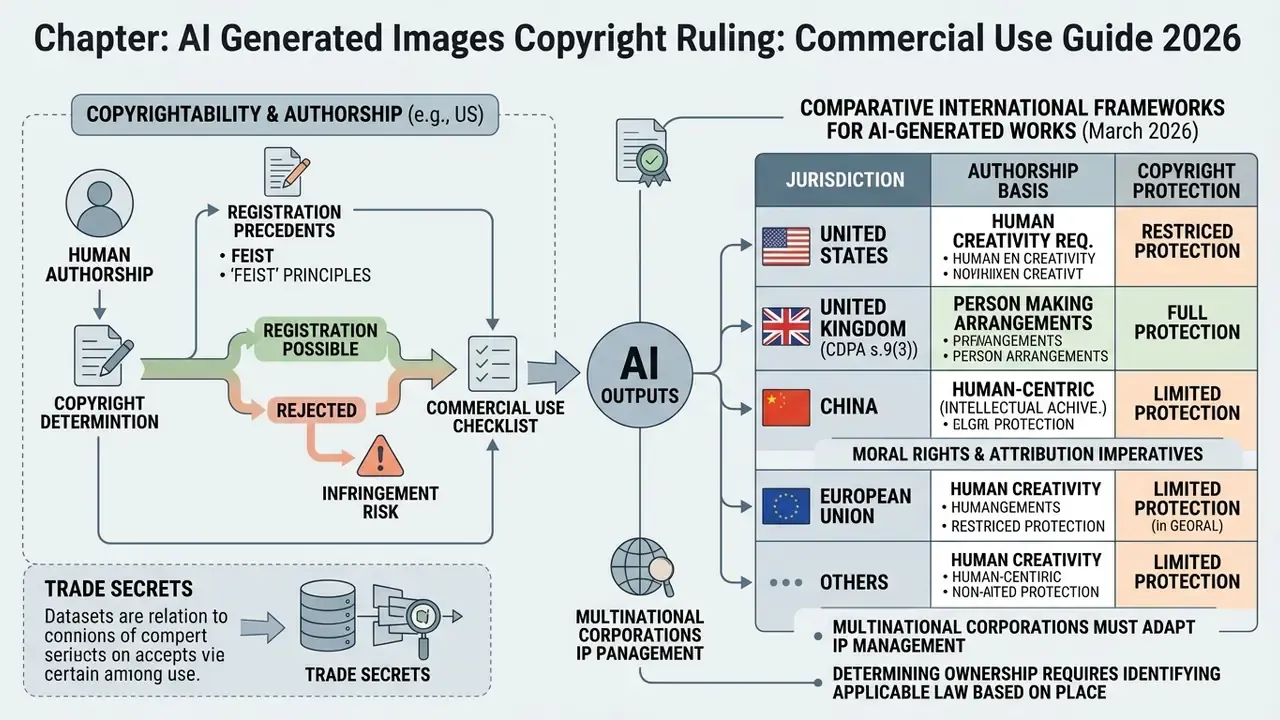
Enforcement for AI-generated art varies sharply across jurisdictions. The United States applies a strict human-authorship requirement; other frameworks use different statutory mechanisms for computer-generated media. For a distributed enterprise, the practical question is not "is this copyrightable?" but "in which market, under which statute, and with which labelling duty?"
| Jurisdiction | Pure AI-generated works | AI-assisted works (human contribution) | Key commercial action before release |
|---|---|---|---|
| United States | Uncopyrightable; public domain on creation. Non-human entities cannot be authors under the Copyright Act. | Protected only for human-authored selection, arrangement and modifications; AI portions must be disclaimed. | Disclose AI material to the Copyright Office; disclaim unprotectable machine elements; retain process evidence. |
| United Kingdom | Protected as a computer-generated work under CDPA 1988 s.9(3) for 50 years from creation, with no human author required. | Standard originality and authorship rules apply; the human author owns the human-created expression. | Document the person or entity making the "necessary arrangements" and funding the compute; record moral-rights attribution. |
| European Union | Falls into the public domain; protection requires the "author's own intellectual creation" by a natural person. | Protected where human creative choices are meaningful and perceptible in the result. | Apply machine-readable watermarks and metadata disclosures under EU AI Act Article 50; observe moral rights. |
| China | Contextual; courts have declined protection where human input is negligible. | May be protected where prompt selection, parameter tuning and aesthetic choices reflect original human creativity (Beijing Internet Court, Stable Diffusion image). | Maintain detailed logs of parameter adjustments, software configurations and prompt iterations as creativity evidence. |
| Australia | Unprotected absent a human author contributing "independent intellectual effort" under the Copyright Act 1968 (Cth). | Protected where the human contributes substantial intellectual effort; AI cannot own copyright. | Credit human contributors; assess whether training-data reproduction was licensed or covered by a fair-dealing exception. |
Table: comparative international frameworks for AI-generated works, positions reviewed as of March 2026.
The united states enforces its restrictions through the Copyright Office and the federal courts. Section 9(3) of the UK Copyright, Designs and Patents Act 1988 runs the other way, protecting purely computer-generated works for 50 years and assigning ownership to whoever made the arrangements necessary for creation. Two allied common-law systems, opposite defaults. That alone should stop any global campaign from relying on a single legal memo.
Multinational corporations must adapt IP management to the target distribution market, and, more importantly, must resolve which law applies before assuming ownership at all.
Moral rights and attribution imperatives. Unlike US law, the EU, UK and Australia recognise statutory moral rights, including attribution and integrity. AI engines cannot hold moral rights, since only human authors and performers are granted them. Human creators using AI tools must still be correctly attributed whenever their editing or structural arrangement meets local authorship thresholds. The reverse also holds: a person who contributed no substantial intellectual effort is not entitled to an authorship credit. Missing attribution for human-assisted edits can trigger moral-rights disputes entirely independent of economic copyright claims, which is a live exposure in European and Australian campaigns where agency staff or freelancers perform the editing layer. There is generally no statutory duty to disclose that AI was used, though transparency and explainability are treated as best practice in national AI ethics frameworks, and the EU AI Act converts disclosure into a hard obligation for certain synthetic content.
Who owns an AI image: copyright, platform terms and commercial rights
This section is general in nature and does not replace consultation with a qualified intellectual property specialist.
Commercial rights granted by platform terms of service are legally distinct from statutory copyright ownership. A commercial licence from an AI vendor grants contractual permission to use an output. It cannot manufacture copyright where human authorship is absent. Terms of service govern the relationship between user and platform provider; copyright law dictates enforceable property rights against the world.
Fact check. Commercial terms of service do not equal copyright protection. A platform agreement permitting commercial exploitation does not grant the user an exclusive copyright. If an output lacks sufficient human authorship, third parties may copy the raw image without infringing, whatever the platform's premium tier promises in its marketing page.
Enterprise software agreements, whether for Microsoft-ecosystem surfaces such as a bing ai art generator or bing ai art workflow, a bing ai image pipeline, or for competing enterprise suites, typically grant broad commercial usage rights and, in premium tiers, indemnification. Those contractual permissions do not alter federal statutory law. Risk teams should read three clauses in sequence before deployment:
Teams benchmarking Microsoft-stack options can review the bing ai image commercial terms overview and the Microsoft AI image generator access and usage terms before signing.
How IP indemnity actually behaves. Vendor indemnities usually cover defence costs and third-party damages for claims that the service output infringed copyright, provided the customer used the tool as documented, did not disable safety filters, and did not prompt for identifiable protected works or brands. Most enterprise indemnities do not cover assets produced on consumer tiers, outputs from customer fine-tuning on customer-supplied data, or losses from asset withdrawal such as recall, reprint and media-buy write-offs. That gap is the commercially interesting part. The indemnity may pay the lawyers while the marketing budget absorbs the recall. Where fine-tuning is involved, negotiate an explicit extension or book the residual risk in the register and say so out loud.
Organisations should separate software licensing cost from long-term intellectual property asset value. Commercial licences protect users from breach-of-contract claims by the vendor; they do not create exclusive proprietary assets on the balance sheet. Enterprise risk frameworks therefore need to evaluate both contractual coverage and statutory copyrightability before generated media enters a primary brand campaign. Vendor status belongs in procurement diligence: a resolvable corporate entity, a documented compliance posture, published commercial terms and a named legal counterparty. Where no verified corporate entity, compliance certification or product catalogue can be confirmed, positioning that vendor as enterprise-grade remains strictly hypothetical and should be kept out of production pipelines. See the appendix for the corrected vendor-verification statement.
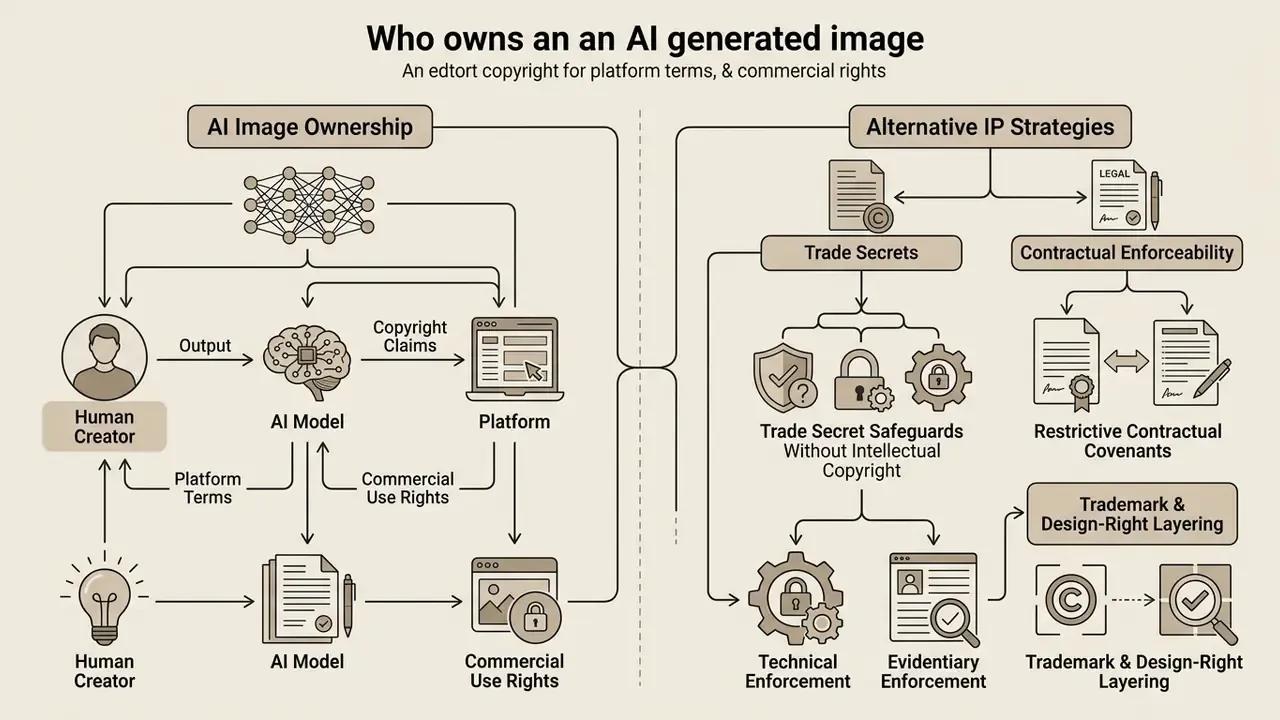
Alternative IP strategies: trade secrets and contractual enforceability
When visual assets or generative workflows cannot secure statutory copyright because of the human-authorship limit, enterprises need non-copyright protection. Many AI-generated works are effectively public domain, so contract and secrecy become the primary value-retention mechanisms.
- Trade secret safeguards. Protect proprietary prompt structures, fine-tuned dataset parameters, style references, seed libraries and generation pipelines under trade secret law: restrict disclosure, enforce internal access controls, mark materials confidential, log access. A prompt library that never leaves the environment keeps competitive value even when every individual output is unprotectable.
- Restrictive contractual covenants. Use B2B terms, end-user licence agreements and NDAs to forbid scraping, re-use, reverse-engineering or redistribution of custom outputs. Agency and freelancer contracts should assign all human-authored layers to the company and require delivery of layered source files as a payment condition.
- Technical and evidentiary enforcement. Combine contract with C2PA provenance metadata, watermarking and access-controlled distribution, so unauthorised downstream use becomes a demonstrable breach even without a copyright claim.
- Trademark and design-right layering. Where a generated visual functions as a source identifier (logo, packaging motif, mascot), trademark registration and, in some jurisdictions, registered design protection supply the exclusivity copyright cannot.
This is the pivot policy analysts keep flagging. As more machine output falls outside copyright, commercial protection migrates toward licensing terms and confidentiality regimes that keep models, datasets and workflows out of public reach. Governance teams standardising these controls across business units can compare options in operational workflow templates.
When AI-generated images can infringe existing copyright
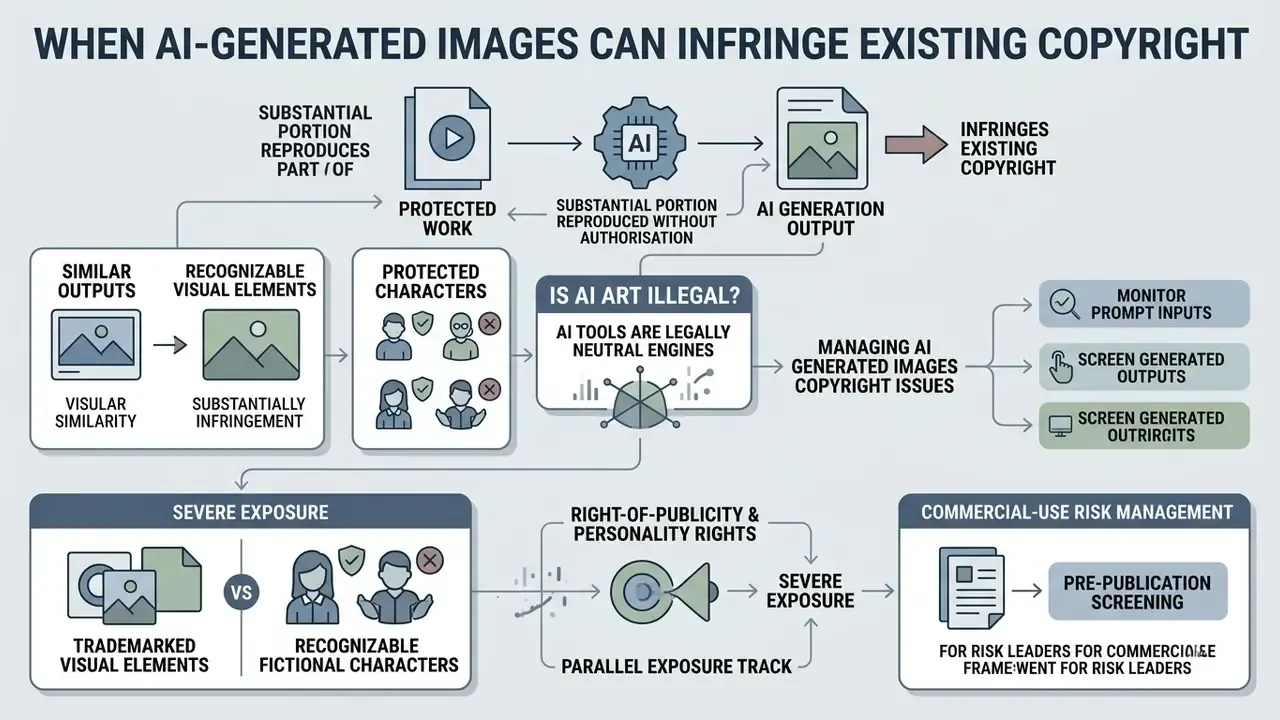
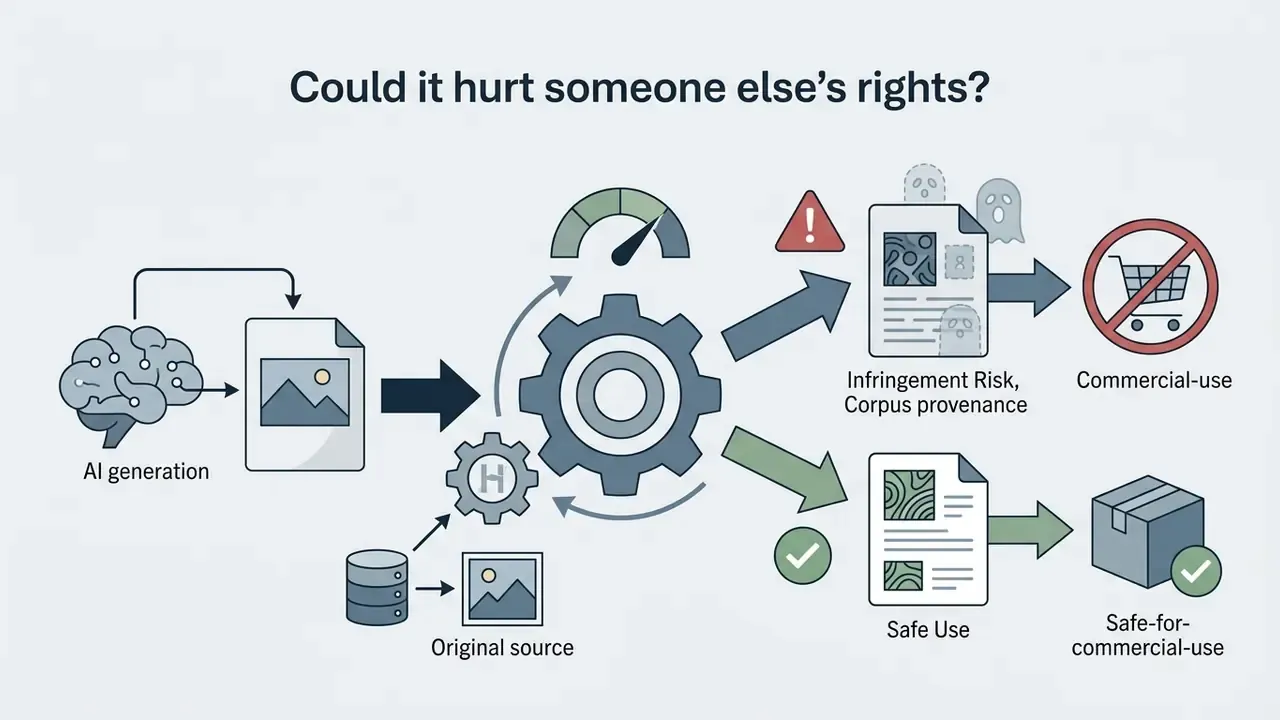
An AI-generated image infringes existing copyright if it reproduces a substantial portion of a protected work without authorisation. Infringement lands at the output layer, where a generated image shares substantial similarity with a pre-existing copyrighted asset and the underlying model had access to that work during training. Note the asymmetry that makes this category genuinely dangerous: an output can be unprotectable (no human authorship) and infringing (substantial reproduction of someone else's expression) at the same time. You own nothing, and you still owe damages.
Managing ai generated images copyright issues means monitoring both prompt inputs and generated outputs. If an enterprise uses an ai image tool to replicate proprietary visual media, it faces copyright infringement claims from copyright owners holding rights in the original copyrighted works. Liability under US copyright law is strict. Intent is not an element, and unintentional reproduction still generates exposure.
Similar outputs, protected characters and recognizable visual elements
Outputs featuring trademarked visual elements or recognisable imaginary characters carry severe exposure. Fictional characters hold independent copyright protection, separate from the publications where they appear. Prompting a model for recognisable media characters produces unauthorised derivative works that infringe the owner's exclusive rights. Regulatory guidance in several markets goes further and warns users not to prompt for outputs that are the same as, or similar to, an identified existing work. The legally operative question is similarity in the output, not the wording of the prompt.
Right-of-publicity and personality rights form a parallel exposure track. Generated likenesses of identifiable individuals, synthetic endorsements and style-mimicry of living artists can trigger claims even when the copyright analysis stays inconclusive.
To manage this, risk leaders install pre-publication screening. Enterprise teams check generated assets against image databases using an ai reverse image search tool, verifying that the output does not inadvertently copy protected artistic elements or branded content before release. Comparative evaluations of reverse image search tools for infringement screening help standardise that control across business units, and the screening record itself becomes evidence of reasonable diligence.
Is AI art illegal?
The broad question is ai art illegal needs a split answer: general tool usage versus specific unlawful application. Using generative artificial intelligence software is entirely legal under federal law. Deployment becomes illegal when the output infringes existing copyright, violates right-of-publicity statutes, or breaches trade secret protections.
Debates around ai art legality concern execution and deployment rather than the software. There are no general laws against ai art prohibiting the operation of generative models, and none appear imminent in the US. Exposure arises when users employ these tools to copy copyrighted material without permission or licence, when disclosure duties in a target market are ignored, or when synthetic media is used deceptively. Three failure modes, all controllable.
Training data disputes and the legal risk around AI models
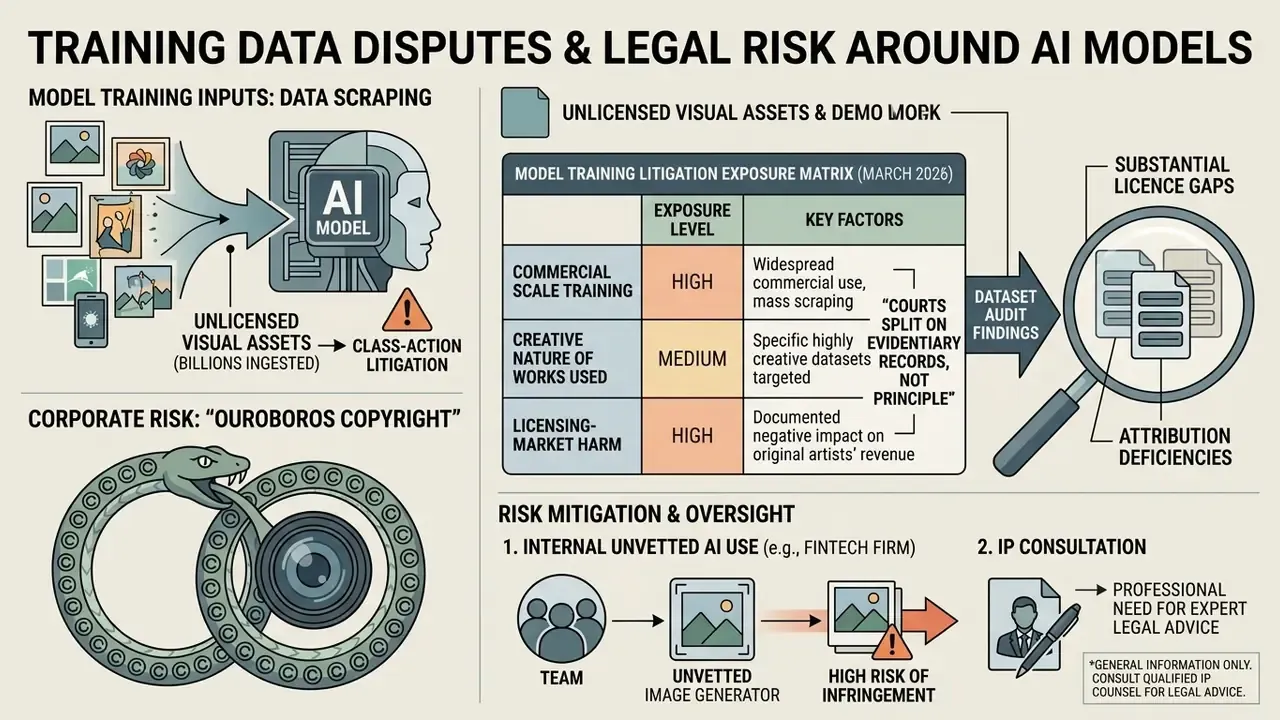
Training generative models requires ingesting billions of visual assets, which has produced extensive class-action litigation over unauthorised data scraping. Copyright owners argue that ingesting protected images to train commercial models is unauthorised reproduction under Section 106 of the Copyright Act. Model developers answer that dataset ingestion is fair use, because training creates new statistical parameters rather than copying expressive content.
The Copyright Office's own analysis of generative-AI training declines to prejudge outcomes, stating that some training uses will qualify as fair use and others will not. Which is precisely why downstream commercial users cannot treat the question as settled in either direction, however confidently a vendor deck states otherwise.
| Matter | Plaintiff group | Core defence | Status and outcome | Downstream risk tier for commercial users |
|---|---|---|---|---|
| Kadrey v. Meta Platforms, Inc. (N.D. Cal.) | Authors | Fair use, transformative training | Fair use found on the specific trial record (2025) | Moderate: record-specific, not a general safe harbour |
| Thomson Reuters v. Ross Intelligence Inc. (D. Del.) | Legal publisher | Fair use, intermediate copying | Fair use rejected; training on proprietary structures held infringing (2025) | High: competing-product use cases |
| Andersen v. Stability AI (N.D. Cal.) | Visual artists (class) | Fair use; no substantial similarity in outputs | Active; discovery on training data continuing into 2026 | High: image-generation pipelines |
| Getty Images v. Stability AI (UK High Court) | Stock image licensor | Territoriality; no training in-jurisdiction | Judgment [2025] EWHC 2863 (Ch), 4 Nov 2025; claims largely rejected, limited trademark findings | Moderate: liability focus shifted toward the model provider |
| Anthropic books litigation | Book copyright owners (certified class) | Fair use; acquisition-channel defences | Class certified 17 Jul 2025 for works downloaded from pirate libraries | Moderate to high: provenance of source corpora |
Table: model training litigation exposure matrix as of March 2026. Vendor due diligence should map each supplier's exposure tier, indemnity scope and corpus provenance disclosures.
This section is general in nature and does not replace consultation with a qualified intellectual property specialist. It describes active litigation with uncertain outcomes.
Courts have split, and they have split on evidentiary records rather than on principle. In Kadrey v. Meta Platforms, Inc. (2025), the Northern District of California found that Meta's model training was fair use on the record before it; the decision is narrow and should not be read as an industry-wide licence. In Thomson Reuters v. Ross Intelligence Inc. (2025), the court held that training a commercial tool on proprietary legal structures was not fair use, reported as the first substantive US decision rejecting fair use for AI training. Andersen v. Stability AI remains active in federal court, sustaining downstream uncertainty for commercial deployments, while the UK High Court's November 2025 Getty Images v. Stability AI judgment resolved only part of the territorially bounded questions.
Corporate risk warning: the "ouroboros copyright" effect. Enterprise workflows compound their exposure when commercial models train on unlabelled AI outputs that previously ingested copyrighted material. Scholars call this an "ouroboros copyright": if a generative system holds even a single copyrighted input, its entire output corpus is potentially exposed, and the exposure multiplies once that output is fed back into other systems. For a bank or fintech, translate it into dataset hygiene. Unlabelled synthetic assets recycled into internal fine-tuning sets can invalidate downstream IP claims, defeat provenance attestations and amplify multi-tier infringement liability across iterative media. Controls are unglamorous and effective: label synthetic assets at creation, prohibit re-ingestion of unlabelled outputs into fine-tuning corpora, and require vendor attestations on synthetic-data proportions.
A fintech firm discovered that internal marketing teams were running an unvetted image generator trained on unassigned web data. Classic shadow AI, found during a licence audit rather than a risk review.
Risk leaders then implemented a shadow AI discovery protocol, replacing unverified utilities, including consumer-grade tools such as free photo editors, a general-purpose video compressor or an animation maker adopted ad hoc by decentralised teams, with enterprise platforms offering commercial indemnity and documented corpus provenance. The transition removed a layer of downstream liability while preserving deployment speed across six product divisions. Speed survived; ownership of the pipeline changed.
For brand-risk purposes that sentiment is not ethical background noise. It shapes reputational exposure, campaign backlash probability and the likelihood that rightsholders pursue claims instead of settling quietly.
Commercial-use checklist before publishing or selling AI art
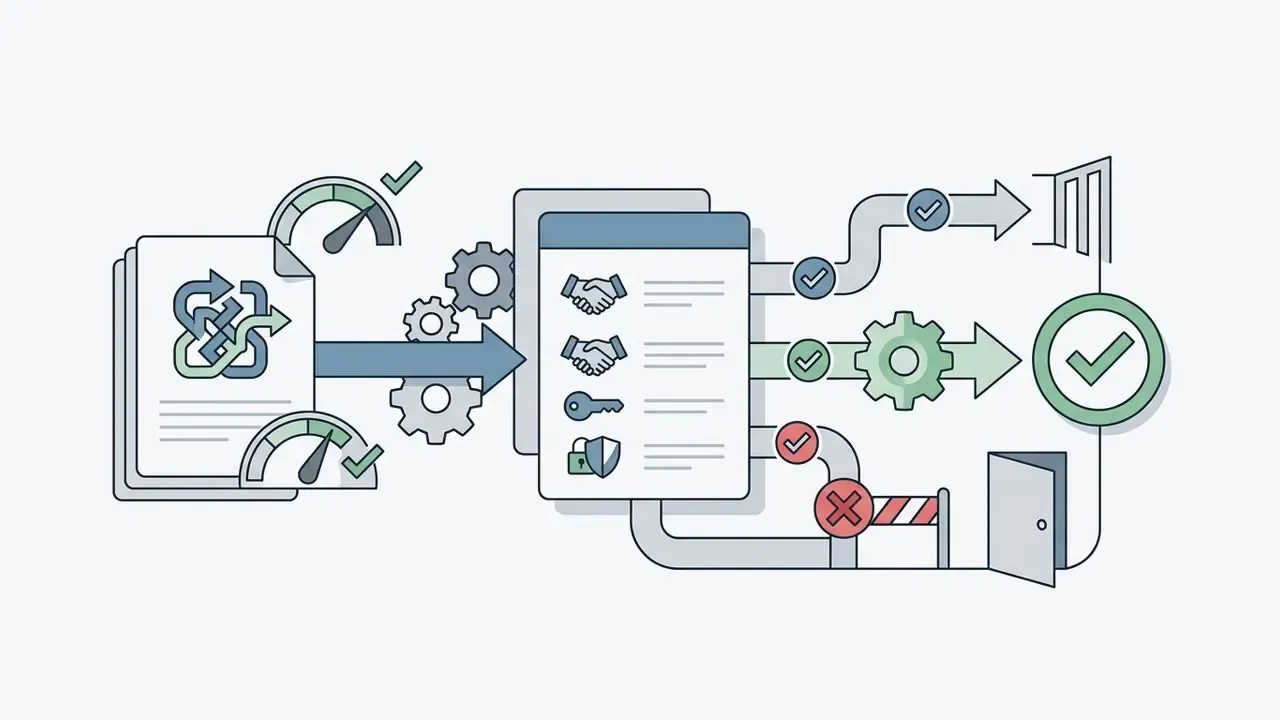
Before generated visual assets enter a commercial campaign, risk officers and creative leads should run a structured compliance audit. The workflow verifies software licensing, evaluates human authorship, screens for third-party infringement and preserves evidentiary records. Four gates, in order.
Commercial AI image deployment checklist
- If yes: proceed to step 2.
- If no: upgrade the platform tier or select an enterprise-grade utility before commercial use.
- If yes: archive creative project files and log human edits for potential copyright registration.
- If no: treat the output as public domain, do not list the asset as exclusive company IP, and protect value through trade secret and contractual controls instead.
- If clear: proceed to step 4.
- If similar: modify the human creative layers or reject the asset to prevent infringement claims.
- If required: embed C2PA metadata tags and attribution credits before public distribution.
- If not required: file the final clearance record in the internal governance inventory.
- Verify vendor licence terms.Does the commercial agreement explicitly permit commercial exploitation and grant indemnification against third-party copyright claims?
- Evaluate human authorship contribution.Did a human creator contribute substantial selection, layer editing, brushwork or structural composition?
- Conduct infringement and similarity screening.Has the final output been checked against reverse image databases to confirm it does not copy protected characters, artist-specific style signatures, identifiable likenesses or branded assets?
- Execute transparency labelling.Does the distribution market require digital watermarking or AI disclosure metadata under local regulation (for example EU AI Act Article 50), and are human contributors correctly attributed where moral rights apply?
One practical note from institutions that run this well: the checklist lives in the asset management system, not in a slide deck. If the clearance record cannot be retrieved during an audit in under a minute, it is not a control.
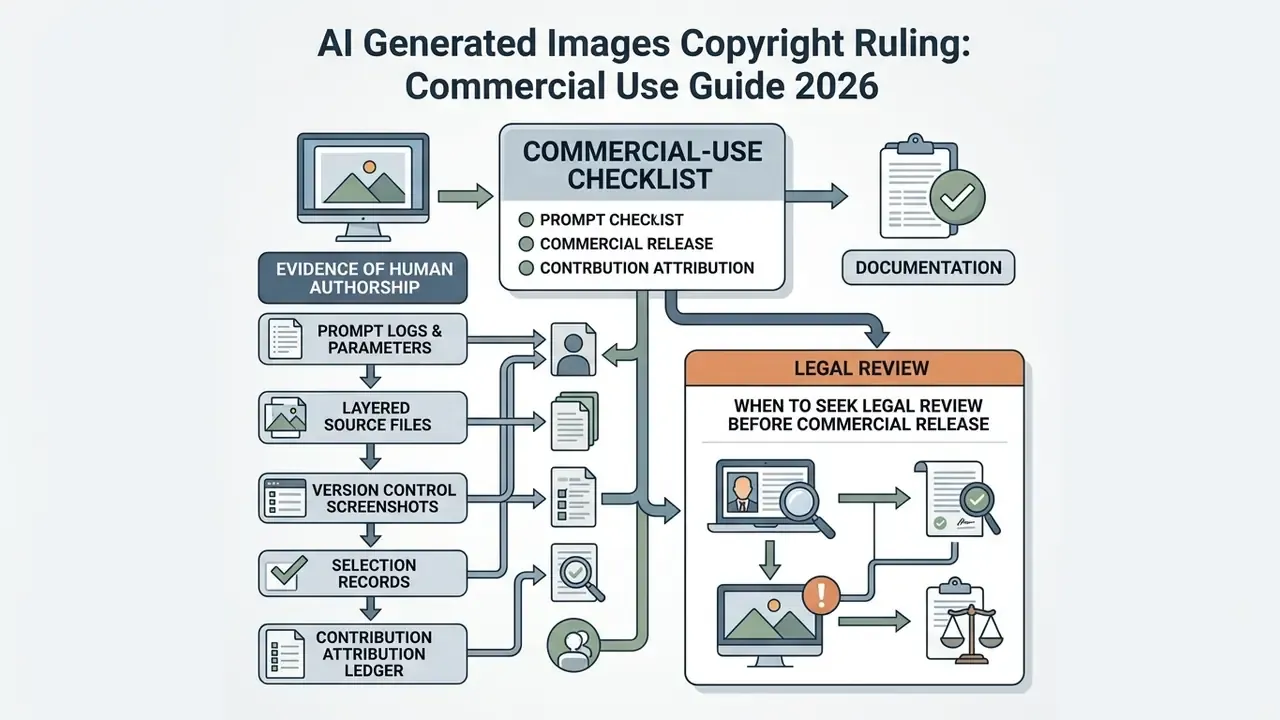
When to seek legal review before commercial release
Legal review is mandatory when assets involve high-value distribution, public-facing brand campaigns or sensitive regulatory environments. Consult intellectual property counsel on these triggers:
- Deployment of generated assets in tier-one global advertising campaigns or core product packaging.
- Commercial reliance on outputs resembling famous artistic styles or proprietary brand elements.
- Any asset destined for registration, securitisation or licensing as a balance-sheet IP asset.
- Content addressing matters of public interest, where EU transparency rules require human editorial responsibility before publication.
- Integration of generated media into high-visibility video projects where compression and motion pipelines (for example a specialised video compressor or an animation maker) re-render third-party visual elements at scale.
- Distribution of synthetic voice assets using an AI voice generator with documented commercial licensing, or commercial portraits produced via an AI headshot generator with defined privacy and usage terms. Both raise personality-rights and biometric-data questions alongside copyright.
When expanding visual assets for print or digital formats with an AI outpainting and image-expansion utility, re-screen the expanded background areas for inadvertent copyright replication. Outpainted regions are generated afresh and were never covered by the original clearance, a detail that has caught more than one otherwise careful team. High-risk deployments should be benchmarked against a verified b2b trust checklist to confirm organisational alignment before release.
Enterprises weighing multi-modal AI investments should also review specialised analysis matrices. The AI Media Comparison Matrices, including head-to-head assessments such as Midjourney versus competing image generators on licensing and controls, help evaluate vendor security models, indemnification terms and model training transparency before procurement contracts are signed.
FAQ: frequently asked questions on AI image copyright
Can I trademark an AI-generated logo?
Yes. Trademark protection depends on commercial source identification rather than copyright authorship. An AI-generated logo can be registered if it is used in commerce to distinguish goods or services and does not confuse consumers with existing marks. The underlying copyright in the unedited image still cannot be owned exclusively, so competitors may reuse the raw visual in non-confusing, non-source-identifying ways. Teams exploring generation options should compare tools by output rights and export quality, for example through the comparison of leading AI art generators.
Does modifying an AI image with a photo editor make it copyrightable?
It depends on the extent of the modifications. Minor edits, such as basic colour correction or automated cropping, do not add sufficient originality. Substantial human edits, such as manual digital painting, complex composition layering, or the addition of original graphic elements, are protectable, and only those human-authored increments enter the claim.
If an AI tool's terms grant me full ownership, can I sue someone for copying my image?
Not on copyright grounds alone, if the image is purely machine-generated. Terms of service create contractual rights between you and the vendor; they cannot override federal copyright law. Where the image lacks human authorship, it is in the public domain, which blocks an infringement claim against third parties. Contractual restrictions, trade secret protection and trademark rights are the available substitutes.
What happens if I accidentally publish an AI image that infringes another artist's work?
Unintentional infringement still carries strict liability under US copyright law. The owner can issue a takedown notice or file suit seeking statutory damages. Pre-release similarity searches and commercial indemnification insurance mitigate the financial exposure. Confirm whether the policy or vendor indemnity covers asset withdrawal and reprint costs, not only legal defence.
Do I have to disclose that an image was made with AI?
It depends on the market and the use. US registration rules require disclosure of more-than-de-minimis AI material to the Copyright Office, though not to the public. EU AI Act Article 50 imposes transparency and labelling duties for certain AI-generated and manipulated content. The UK's current position includes no general duty for developers to publish the copyrighted works used in training. Australia's AI ethics principles treat transparency as non-binding best practice.
Who owns an AI-assisted work when several contributors are involved?
Ownership follows the human-authored contributions and the contracts governing them. Where a designer supplies sketches, an agency performs the AI-assisted rendering and an in-house team composites the final asset, each human-authored layer must be assigned in writing. In moral-rights jurisdictions, attribution obligations persist even after economic rights are assigned.
Can a competitor legally reuse the AI portions of my registered hybrid work?
Frequently, yes. Because AI-generated elements are filtered out of the infringement analysis, a third party may extract or re-render the unprotected machine layers while avoiding the protected human contributions. That is the principal argument for layering trade secret, trademark and contractual protections over commercially important assets.
How should this sit inside an existing model risk framework?
Treat generative image workflows as a model-adjacent process with a named owner, an approved use case, access limits, a logging requirement and a defined escalation path. Copyright clearance becomes a control test with recorded evidence, reviewed like any other. No evidence, no autonomy.
Appendix: corrected and superseded statements