What an AI Art Critic Is and What Feedback It Actually Returns
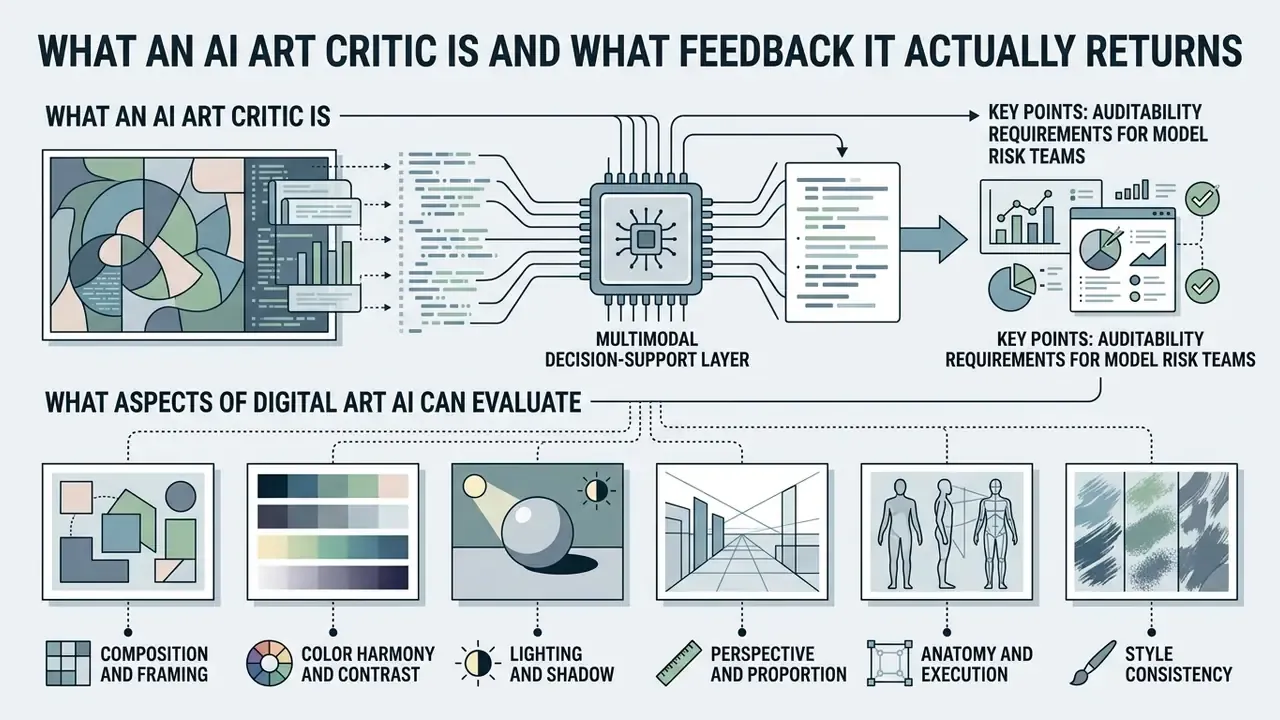
The tool works as a multimodal decision-support layer that converts visual features into structured language. Unlike basic image aesthetics assessment (IAA) models, which return a single numeric score, a modern art critic ai combines convolutional networks or ViTs with transformer language models. The result is descriptive, interpretive and, at best, actionable commentary.
«Hybrid GAN-CNN models outperform traditional methods in producing diverse artistic images and automatically score them for quality, diversity, innovation and artistry.»
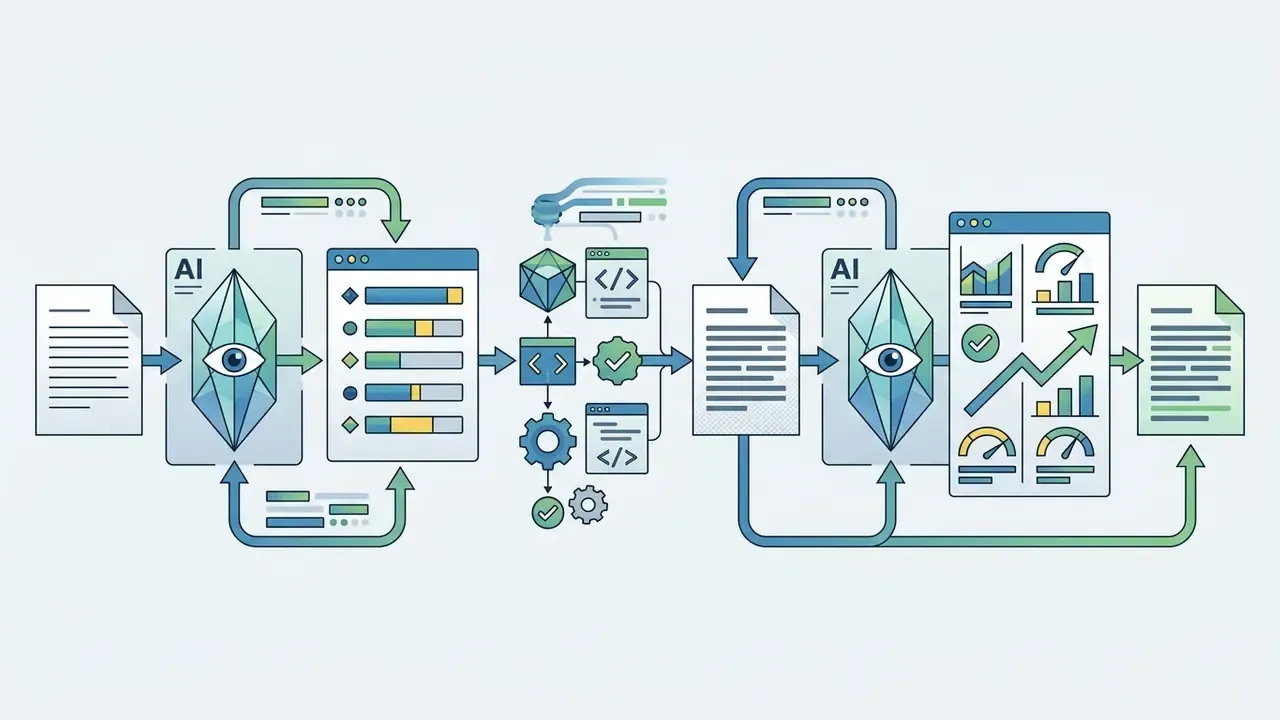
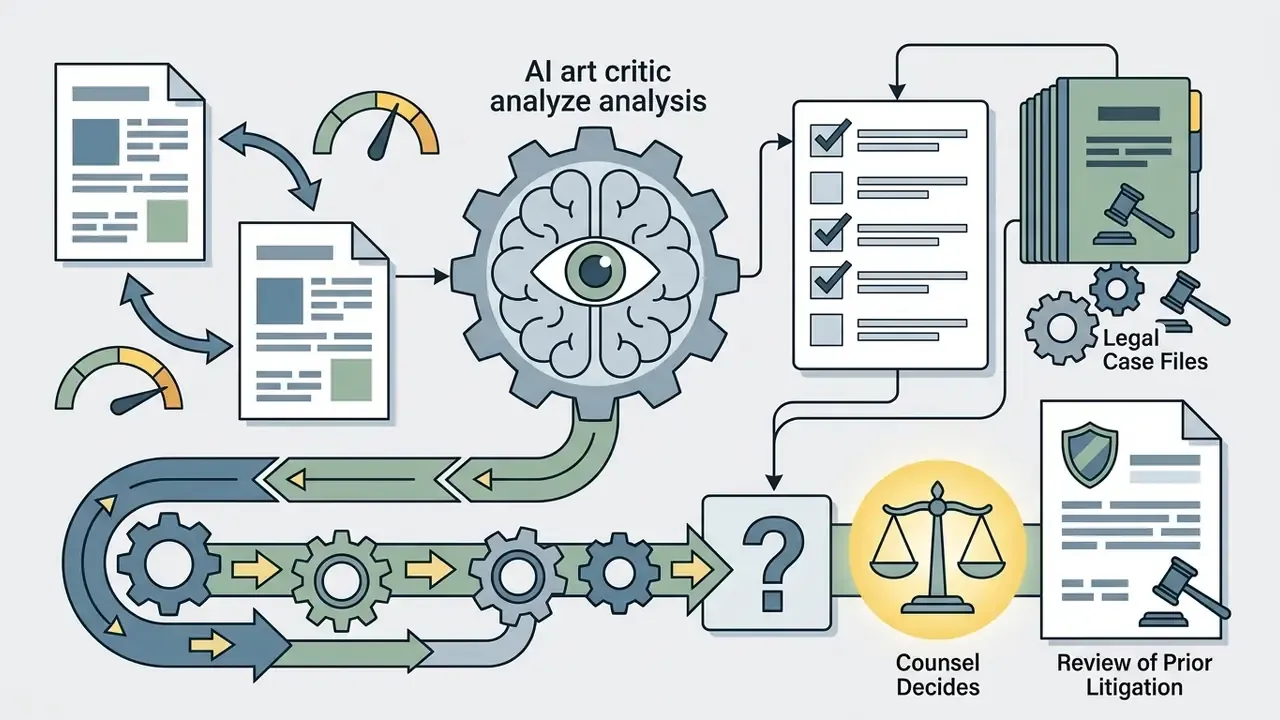
Process diagram: the working pipeline of an AI art critique generator
| Step | Stage | What happens | Output |
|---|---|---|---|
| 1 | Upload and preprocessing | The user submits a digital file with optional metadata: genre, intent, audience, historical period, artist background | Normalized image plus a context brief |
| 2 | Feature extraction | CNN or ViT encoders pull out composition, lighting, perspective, color balance, texture and style markers | Vector representations of visual attributes |
| 3 | Multimodal fusion | The MLLM merges visual vectors with context prompts and governance constraints | One combined "image plus intent" representation |
| 4 | Structured generation | The system emits score cards, a written constructive review and concrete edit steps | Score cards, critique text, modification list |
Purpose of the diagram: explain quickly how an ai art critique tool works before anyone uploads a file. Layout semantics: figure with a caption reading "Workflow diagram of an ai art critique generator process".
Independent creators, design teams and marketing departments use an ai art critique tool for fast technical triage before publication or client delivery. Depending on the request, an ai art critique can range from a terse one-paragraph ai art review flagging obvious compositional errors to a multi-page art critique ai breakdown covering color harmony, focal lighting and spatial hierarchy.
Buyers selecting automated systems for enterprise asset review should examine model lineage and reasoning depth. In one illustrative internal audit of multimodal review pipelines, a media team wired a two-stage vision-language stack into promotional asset review. The system flagged contrast deficits and edge-separation errors across 140 candidate images in about six minutes. The manual bottleneck disappeared at the screening stage, yet human approval remained mandatory for every final creative asset.
Auditability requirements for model risk teams. To make critique reproducible and reviewable, record: (a) model version and snapshot date; (b) the full system and user prompt; (c) temperature and seed parameters where the API exposes them; (d) a hash of the uploaded file. Attention or saliency maps help too. They show which regions the model treated as significant, which separates a grounded observation from a hallucination. Readers studying evaluation often study the inverse problem in parallel, so compare approaches in our overview of AI art generators.
What Aspects of Digital Art AI Can Evaluate
An art critique generator assesses both technical execution and visual structure across several defined dimensions. Computer-vision research confirms that multimodal models extract formal visual features with useful specificity, which lets an art feedback ai point to the exact regions that need work:
- Composition and framing. Rule-of-thirds alignment, focal weight, leading lines, negative-space balance.
- Color harmony and contrast. Color-temperature consistency, palette unity, value distribution, saturation limits.
- Lighting and shadow. Directional continuity, highlight clipping, shadow density, specular accuracy.
- Perspective and proportion. Horizon drift, mismatched vanishing points, structural distortion.
- Anatomy and execution. Anatomical defects, displaced hands and fingers in ai generated figures, inconsistent line weight.
- Style consistency. Whether visual elements match the declared style: impressionism, concept art, corporate minimalism.
Updated with research data.
«Perception of visual attributes, interesting content, good lighting, vivid colors, depends heavily on image theme, so two-level "theme to attribute" reasoning aligns better with human perception.»
Practical implication: name the genre in the prompt. Lighting standards for a noir illustration and a children's book cover are not the same standard. Without theme, the model defaults to an averaged internet-wide rule, which reads as competent and says almost nothing.
How AI Critique Differs From a Professional Art Review
An ai critique generator delivers fast, scalable analysis of visual features. What it lacks is connoisseurship, historical awareness and the institutional lens of a human critic. Automated tools work by detecting statistical patterns across millions of training images. A professional curator judges provenance, cultural resonance and the authenticity of a human statement.
| Evaluation criterion | Automated AI art critic | Human critic or curator |
|---|---|---|
| Analysis speed | Near instant, roughly 2 to 10 seconds per image | Hours to days for a full review |
| Formal feature detection | High accuracy on composition, light and palette | Qualitative judgment of craft |
| Historical and cultural context | Limited to pattern matching inside training data | Deep grasp of art history, culture and intent |
| Subjective authenticity | No felt emotion, no lived experience to assess | Judges authorial agency, depth, emotional truth |
| Scalability | Thousands of assets in parallel | Bounded by reviewer capacity |
| Attribution and authorship | Brushstroke and authorship classification scores well in controlled tests, yet stays probabilistic | Weighs provenance, documents, physical examination |
If the comparison leaves you curious about adjacent tooling, our roundup of the best AI art generators shows how generation models and evaluation models complement each other inside one pipeline.
Museum-practice research supports the same conclusion: machine learning supplements human expertise, it does not replace it. A paper in Curator: The Museum Journal (2022) states directly that AI «supplements and depends on human expertise» in questions of authenticity and lived history. Automated systems excel at pattern identification and first-pass technical screening. The curator remains indispensable for artistic intent and historical significance.
«Strict lexical metrics reveal only weak overlap between AI critique and human reviews: models reproduce a general house style rather than image-specific observations.»
Creators hunting for specialized tools inside visual workflows can align model capability with budget through our AI Media Pricing Guides, and finance-minded teams can model the cost per reviewed asset with our calculators.
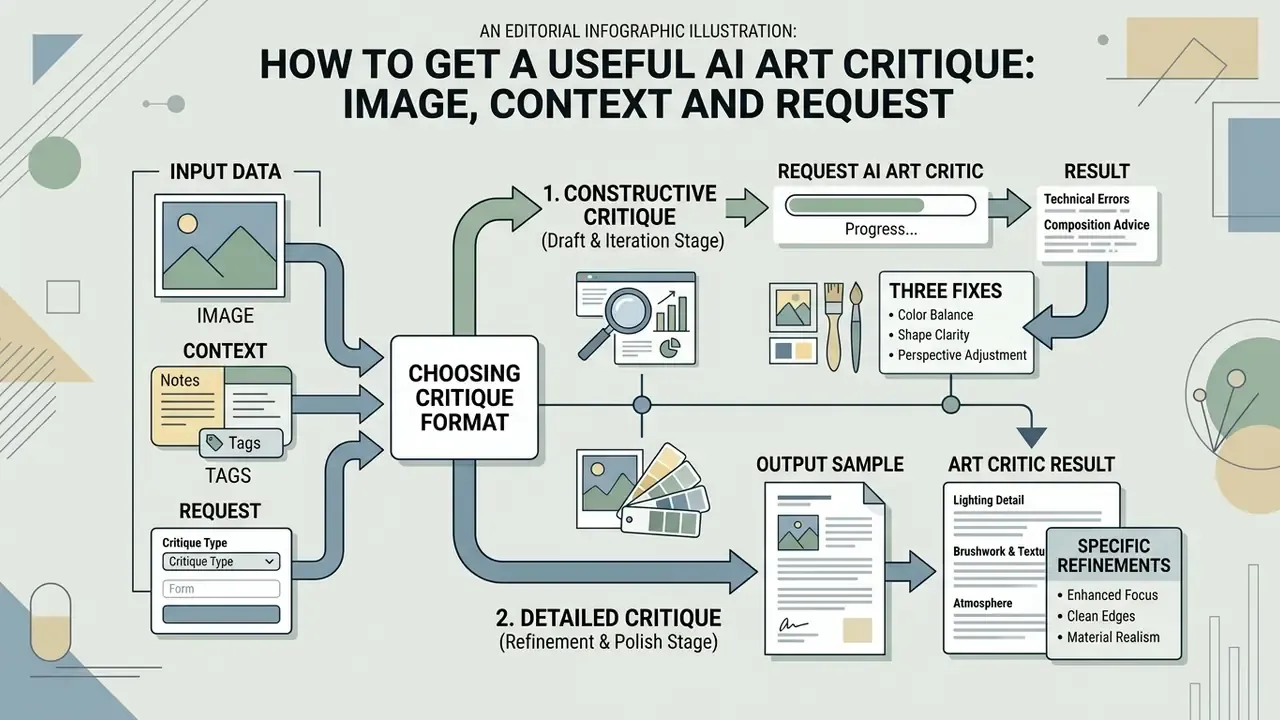
How to Get a Useful AI Art Critique: Image, Context and Request
To pull actionable, high-precision feedback from an ai art critique generator free tier or a paid enterprise plan, you need a clean visual input plus explicit context constraints. An image submitted raw, with no explanation, produces a generic surface reading. Worse, deliberate stylistic choices get filed as technical errors.
Checklist: preparing artwork for submission to an AI art critic
- Image quality uncompressed high-resolution file (PNG or WEBP, 72 dpi minimum), no watermarks, no interface overlays.
- Structural views for complex pieces, attach the full canvas, a crop of the focal zone, and a grayscale version for tonal checking. Add an earlier work-in-progress stage if you have one.
- Context brief genre, target audience, medium, the situation and reason for creating the piece, and the primary emotional task.
- Explicit goals state your top three concerns, for example character lighting, background separation, hand anatomy.
- Output constraints set the feedback format (constructive, detailed, creative) and the response structure, such as "What works" and "Areas to improve".
- Versioning date your files and keep prompt history. It tracks progress and documents human authorship.
Prompt-engineering guidance from academic institutions makes one point repeatedly: multimodal models perform best with an explicit role, clear criteria and structural boundaries. Precise style parameters keep an ai feedback art engine from sliding into universal aesthetic rules that fit nothing in particular.
«Structured prompts specifying originality, methodological rigor and clarity criteria help models generate better-calibrated, more useful feedback.»
Anti-examples: prompts that waste your upload
| Weak prompt | Why it fails | Working reformulation |
|---|---|---|
| "Rate my art" | No role, no criteria, no boundaries, so the model returns polite praise and three generic composition rules | "Act as a game studio art director. Judge silhouette readability at 30% scale." |
| "Is this good or bad?" | A binary question invites sycophancy | "Name the two weakest tonal-contrast decisions and say exactly where they sit." |
| "Make it beautiful" | No measurable criterion, so recommendations turn random | "Propose three palette options with HEX codes that keep the cold atmosphere." |
| Upload including the Photoshop interface | The model will discuss panels and the cursor as compositional elements | Export a clean frame with no UI elements |
Choosing the Critique Format: Constructive, Detailed or Creative
Format choice follows the production stage. Pick the wrong feedback mode and you get irrelevant recommendations that also break your creative momentum.
1. Constructive critique (draft and iteration stage). Problem-solving focus: the main visual bugs, the strongest elements, and concrete iteration steps.
Prompt: "Act as an art critic ai. Analyze this concept draft. Identify the top 2 compositional weaknesses and provide three concrete steps to improve focal separation."
2. Detailed critique (refinement and polish stage). A full visual audit against formal criteria, including lighting, tonal contrast and edge quality.
Prompt: "Provide a detailed art feedback ai breakdown of this illustration across five categories: composition, color harmony, value structure, anatomy, and style consistency. Rate each from 1 to 10."
3. Creative critique (ideation stage). Explores narrative readings, thematic extensions and alternative artistic directions.
Prompt: "Evaluate this piece as a creative director. What alternative color palettes or lighting scenarios could heighten its emotional mood? Provide three innovative concepts."
4. Extra mode: sarcastic or witty (a cliché stress test). An ironic read catches tired tropes before publication.
After the critique comes the editing pass. Our roundup of AI photo editors helps with local fixes, and teams matching stills against moving footage will want the guide to YouTube video editors. Anyone learning the craft from scratch can start with a free video editing course online and, on macOS, a free video editor.
Critiquing Abstract and Conceptual Art
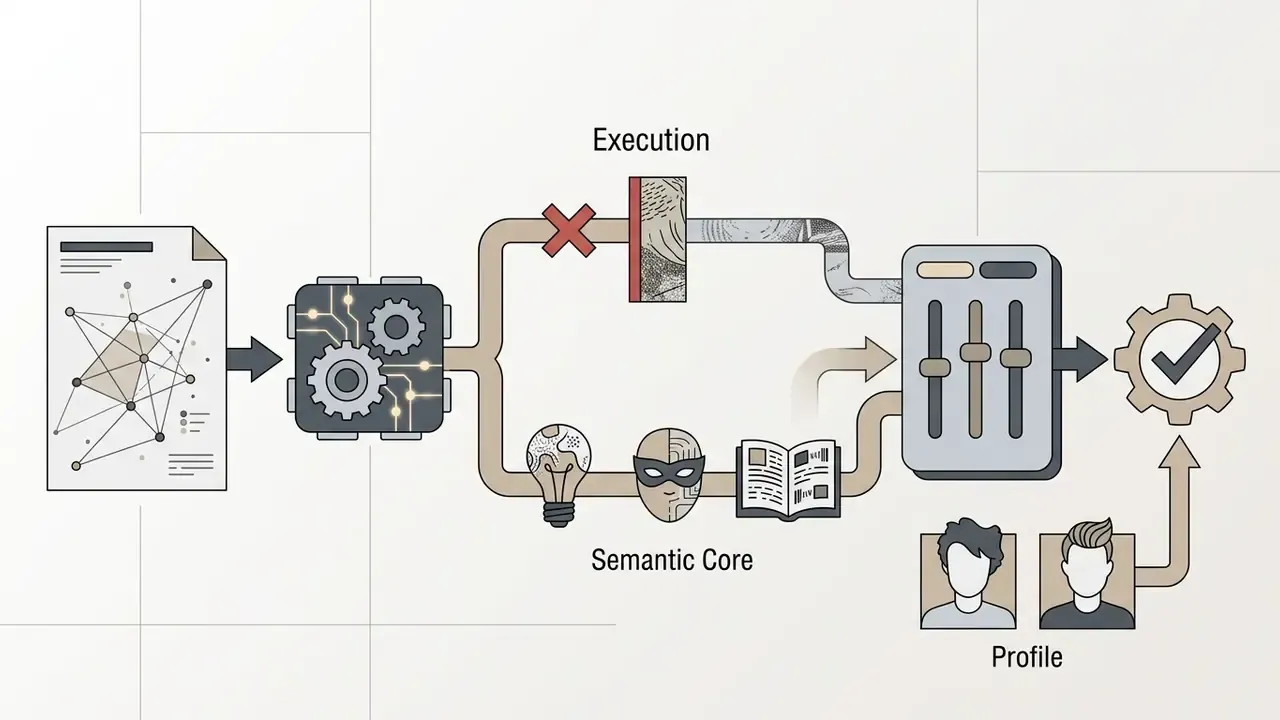
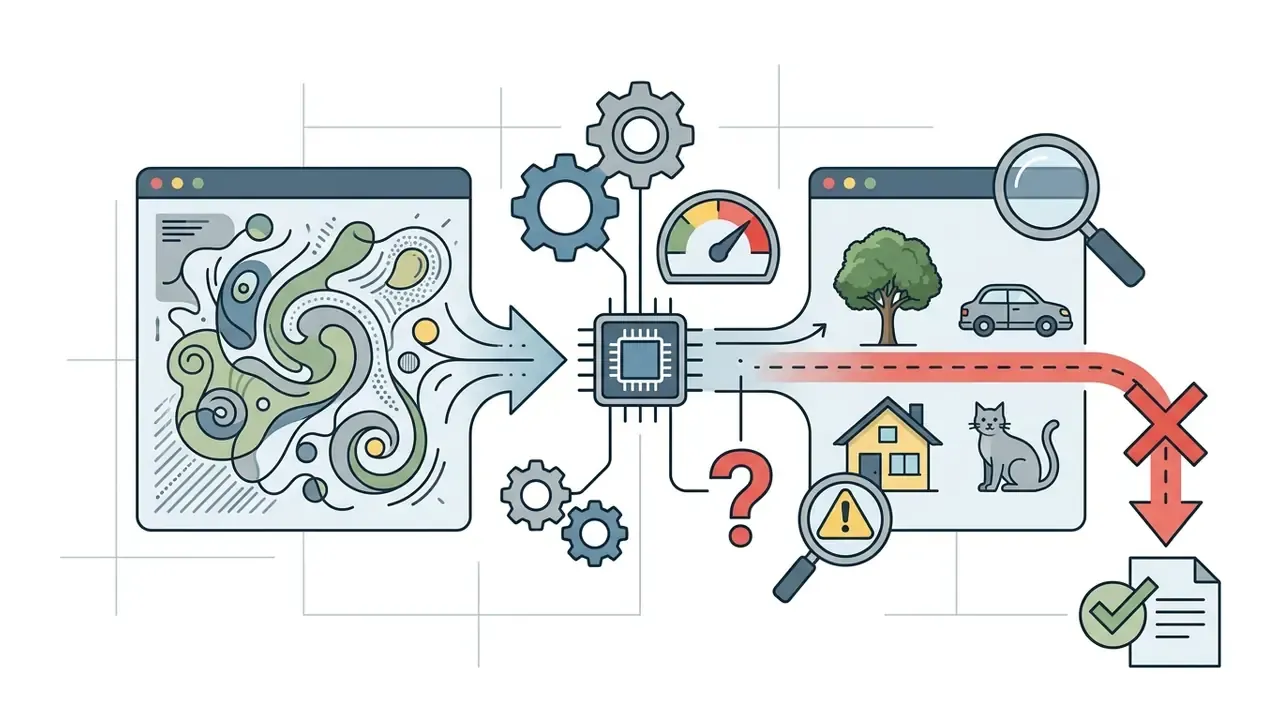
Abstraction is where computer vision breaks first. Multimodal models are trained to recognize object entities, so when no objects exist, the system invents them. The classic failure: the model reports "two trees" because vertical dark masses statistically resemble trunks.
How to request critique of abstract work:
- Turn off the anatomical and spatial modules. State it plainly in the prompt: "Analyze exclusively formal visual elements: color balance, edge weight, rhythm, texture hierarchy, and emotional weight. Do NOT infer figurative objects."
- Supply intent as context. Models read tonal tension and mass balance reasonably well. Describe the emotional state or the concept so the system can judge whether visual rhythm serves your idea.
- Ask for a range of readings, not a verdict. Request three possible interpretations instead of one "correct" reading. You end up with raw material for an artist statement, plus a map of what the work communicates unaided.
- Remember labeling ambiguity. Reviews of AI art quality assessment (2024) use partial visual criteria such as beauty, color, texture, detail, line and style. Abstraction has no single ground truth, so a low score may only mean divergence from an averaged dataset pattern.
There is an inverse effect worth naming. Many abstract painters report that the model describes texture and composition with surprising fidelity to their internal state at the moment of making. When the text lands, it becomes a strong articulation tool for galleries and viewers. When it misses, it is a reminder that this field stays subjective.
Reverse Prompting: Turning Critique Into the Next Piece
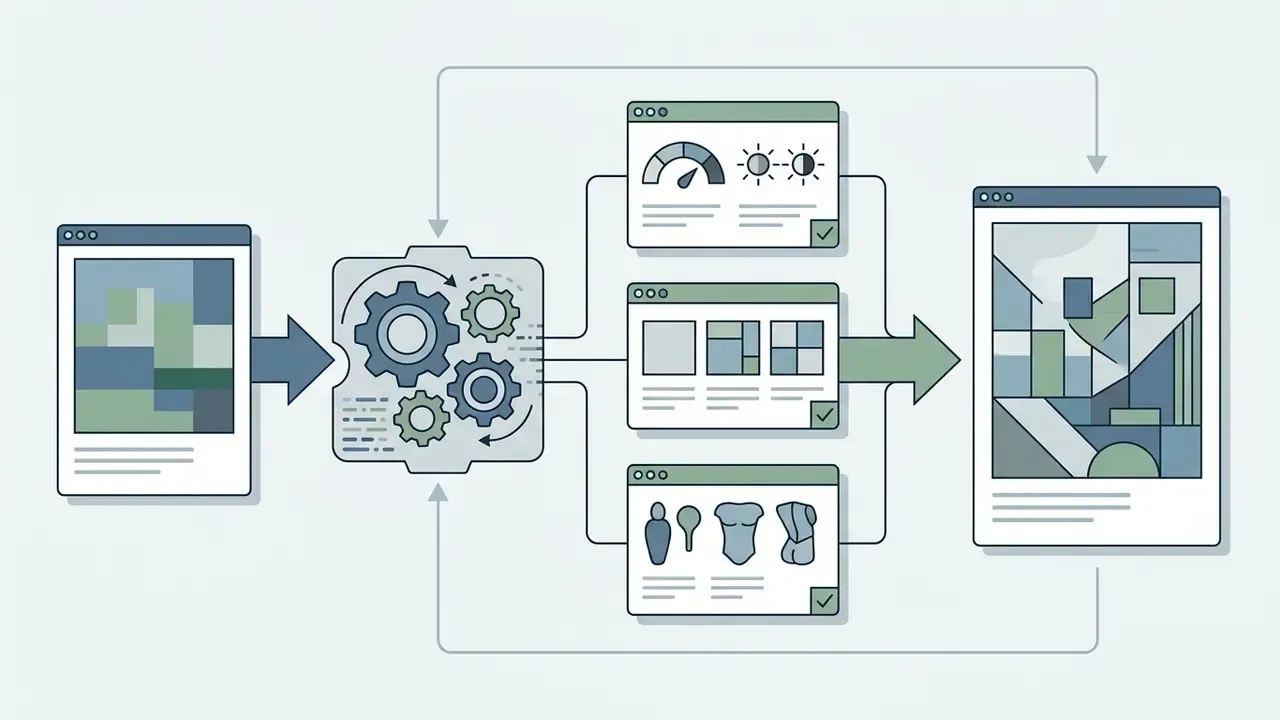
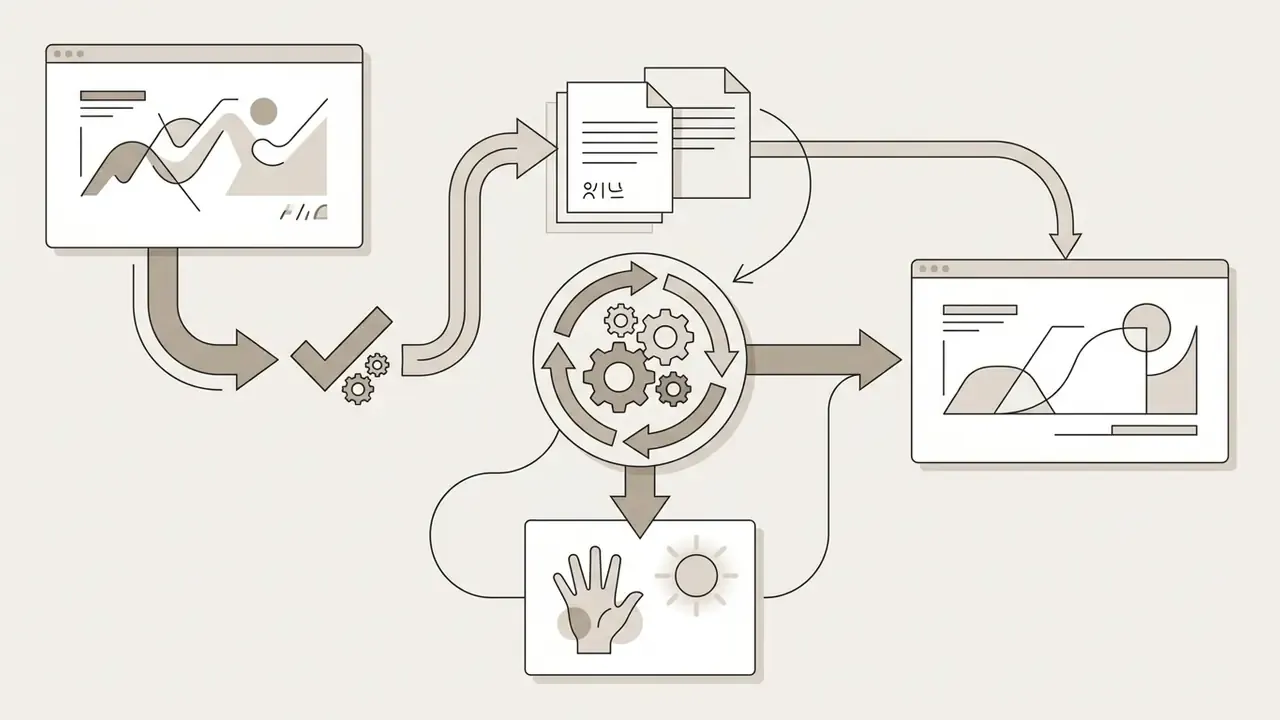
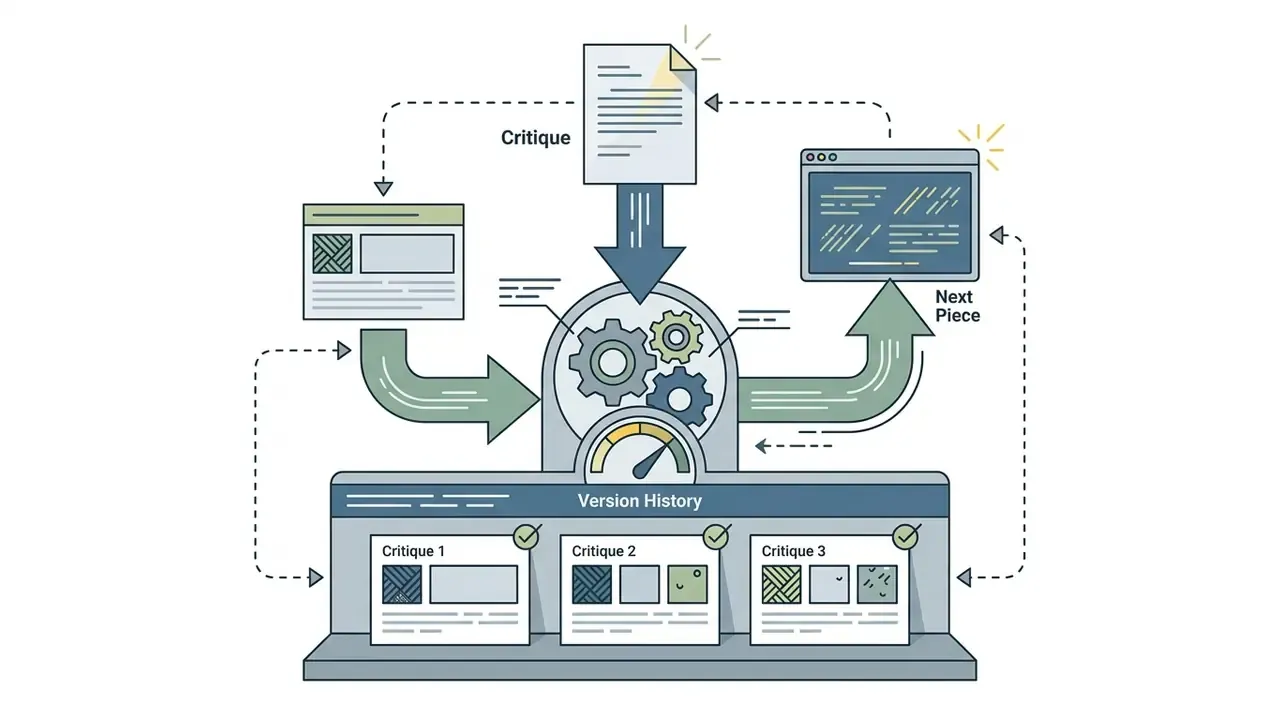
The output of an ai art critic is not only a review. It is also a usable text descriptor of your work. Technical notes convert into precise prompts for generators such as Midjourney v6, Flux.1 or Stable Diffusion XL, closing the loop from generation to critique to regeneration.
This works in both directions. You can analyze a physical painting or a photograph and use the breakdown as a prompt base, or dissect a generated image to see which visual devices deserve a place in handmade work. Multimodal models are indifferent to raster origin. Anything goes: DALL-E, Flux.1, Stable Diffusion, Midjourney output, plus photographs, diagrams, logos, marketing layouts, even funny ai generated images you plan to publish.
Reading AI Feedback Without Losing Your Own Vision
The artist keeps absolute authority over final creative decisions. Treat ai art feedback as probabilistic data, not a directive. Because multimodal models are trained on dominant online trends, their recommendations gravitate toward mainstream composition rules. They occasionally penalize the deliberate deviation that makes a piece worth looking at.
«Models reproduce a persistent house style instead of image-specific observations: embedding similarity is high, yet strict metrics show weak overlap with expert reviews.»
You are the captain of your own ship. The most common question runs like this: if the AI clearly prefers one of my styles, should I lean into it? Treat it as one variable in a decision. If a human mentor or gallerist said the same thing, you would take it as data and refuse to let it redefine your direction. A machine deserves slightly more skepticism, not less. Check whether the note resonates with something you already suspected, and whether it opens an unconsidered thought about composition. If yes, use it. If the direction feels inauthentic, drop it.
Escalation rules for human-in-the-loop review. A model note must go to a person when:
In one illustrative commercial design project, a team of digital illustrators received automated critique recommending higher background saturation on a fantasy book cover. The lead illustrator recognized that added saturation would destroy the deliberate atmospheric haze carrying the narrative mystery. The team rejected that recommendation and accepted a secondary note about shadow contrast on the protagonist. The human-in-the-loop decision preserved artistic integrity and still fixed a genuine technical defect.
The Collector's Lens: Marketability Assessment
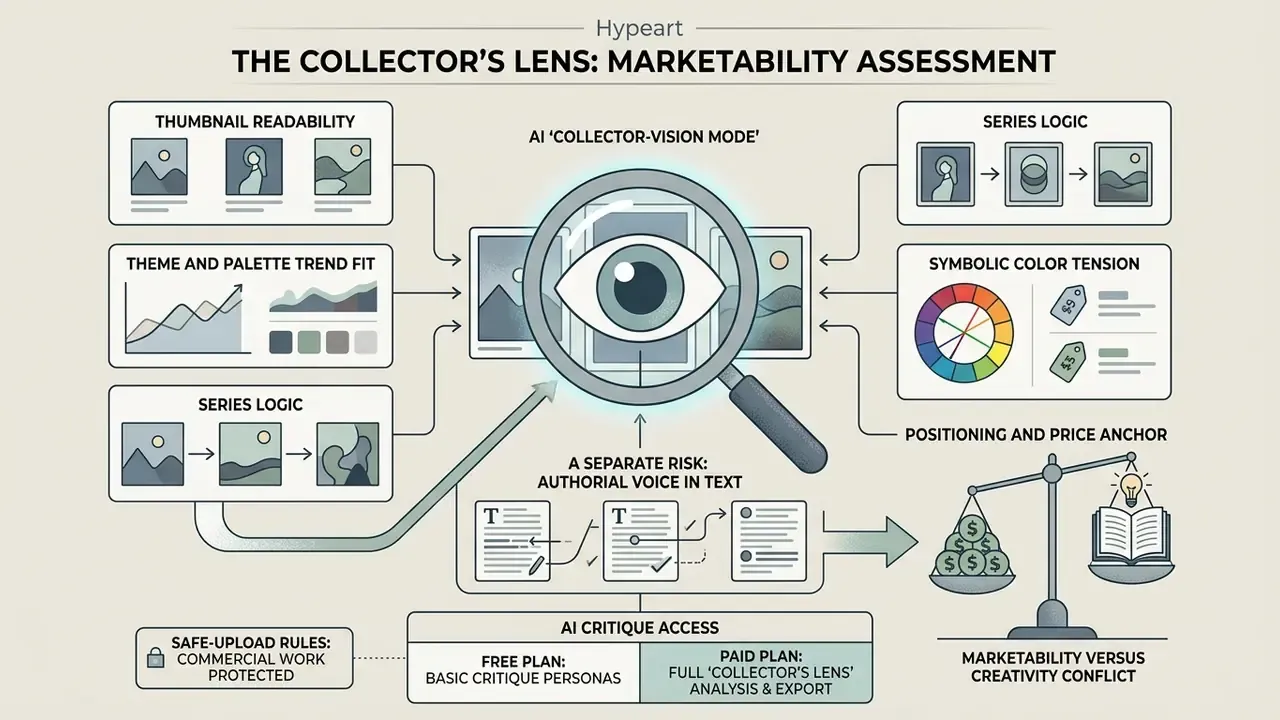
Models are trained on enormous datasets describing what is popular and broadly accepted. So when a system critiques a piece, it almost always smuggles marketability into the score. Bring that mode into the open and use it deliberately, as a separate lens: what does my work say to a collector?
What an art market analyst or collector-vision mode can evaluate:
- Thumbnail readability. Does the composition survive at 400 by 400 pixels, the format in which most buyers first see it?
- Theme and palette trend fit. How closely the subject and color range intersect current demand in interior, publishing or game segments.
- Series logic. Whether the piece reads as part of a recognizable series, a key factor for gallery selections and repeat purchases.
- Symbolic color tension. How contrasting pairs, orange against blue for instance, land emotionally with viewer and collector.
- Positioning and price anchor. Comparison against similar work by technique and format; some services propose positioning and a price band.
The marketability versus creativity conflict. Say you paint a hard scene of a car crash. The model will most likely recommend reducing graphic intensity "for broader appeal". On the data, it is right: graphic violence has a smaller buyer pool than a serene landscape. Does that mean the painting should change? Not necessarily. If your artistic intent is to convey the horror of the crash, marketability comes second. The machine can tell you what sells widely. Only you decide what you want to say.
A perception nuance worth pricing in. There is empirical evidence on how audiences react to the mere mention of AI in the process:
«Using AI increases perceived process novelty, yet lowers perceived quality for tangible products such as paintings, while intangible products such as music are judged more positively.»
A separate risk: authorial voice in text. Artists who use AI for descriptions and statements report a recurring problem. Left unedited, the eloquence of the output drifts away from the author's natural speech, and followers read that gap as inauthenticity. The working rule: draft with AI to save time, then rewrite until the text sounds like you rather than like a model.
Commercial Use: Image Rights, Privacy and AI Feedback
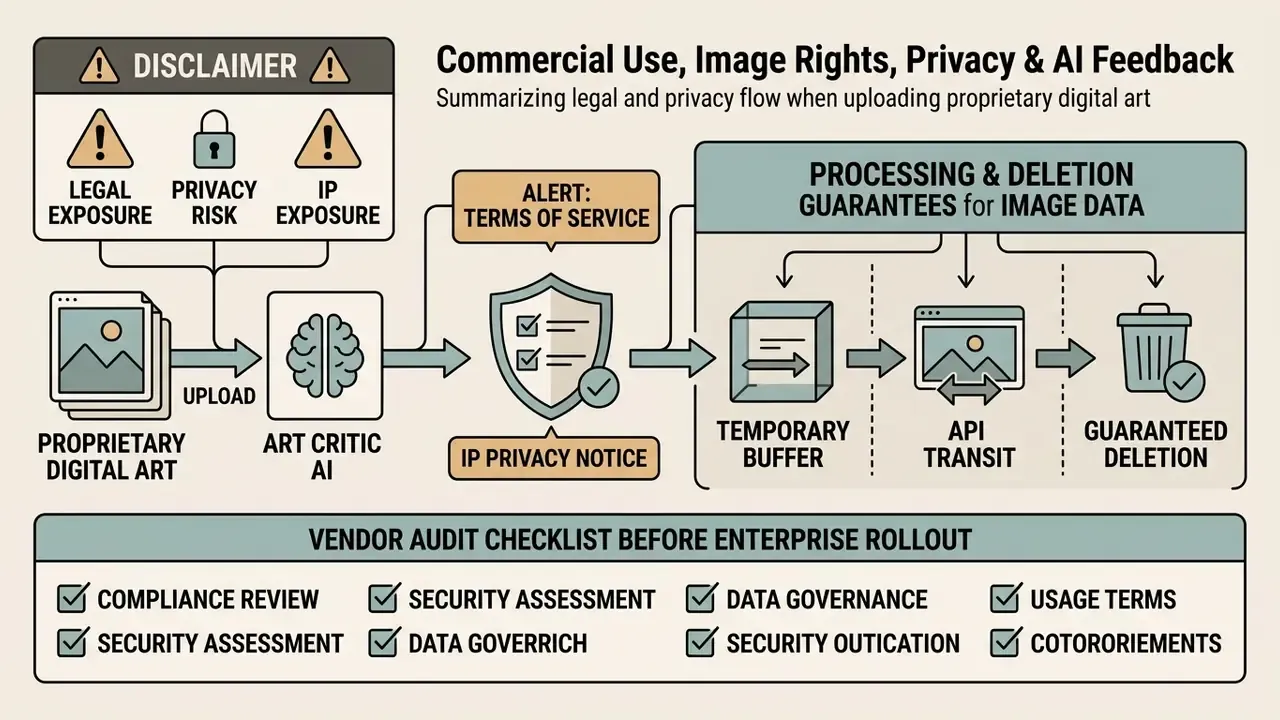
Uploading proprietary digital art to an art critic ai platform creates legal, privacy and IP exposure. Creative studios and enterprise operators should read the terms before sending unreleased visual assets or client work. That is why risk comes before pricing here. Data security, not analytical depth, usually decides between a free service and a paid one.
Alert: terms of service and IP privacy notice
Key legal and operational factors for commercial use:
- Copyright ownership. U.S. Copyright Office guidance (2026) confirms that purely ai generated output, absent human creative control, cannot be registered. Human-made digital art uploaded for critique retains full copyright protection, provided the platform terms do not claim a transfer of rights.
- Audience bias against AI authorship.
«Participants consistently rated works labeled as AI-created lower on all four criteria, especially depth of meaning and perceived value.» Whether and why we prefer human-created compared to AI-created artworks (2023). https://doi.org/10.1037/aca0000570
Marketing implication: disclosure is an ethical requirement, but the wording should separate "AI as an analysis tool" from "AI as the author of the work".
- Model training opt-outs. Verify whether submitted images feed future vision models. Enterprise plans should provide a zero-retention policy. Vendor practice diverges sharply: some services reserve the right to train on uploads, including reference images, while others exclude user files from training sets outright.
- Marketing copy and licensing. Check whether generated text (exhibition descriptions, promotional captions) is licensed for commercial distribution without mandatory attribution.
- Reverse image discovery. Public critique databases can expose unreleased visuals to image search engines. Enterprise teams audit exposure with ai reverse image search and screen incoming contractor files with AI image detectors. For the full risk picture, browse the hub.
Processing and Deletion Guarantees for Image Data
- Temporary buffer.The uploaded file is encrypted (AES-256) and held in an isolated temporary server cache for the processing session, typically under 60 seconds.
- API transit.The image travels over TLS to an enterprise API endpoint (for example OpenAI or Anthropic Enterprise) with the zero data retention flag enabled.
- Guaranteed deletion.Once the review is generated, the source file is wiped from server memory with no backups and no use in model training.
An important clarification about "trusted third parties". Wording such as "the image is sent to a trusted third-party AI service and then deleted from our systems" describes the wrapper site only, not the model provider. Standard public APIs without enterprise status may retain logs for up to 30 days for abuse monitoring. Demand a documented distinction: standard API versus enterprise API with ZDR. If you are wiring critique into your own product, compare options before committing to an endpoint.
Vendor Audit Checklist Before Enterprise Rollout
- SOC 2 Type II or ISO/IEC 27001, with the report available under NDA.
- A contractual Zero Data Retention SLA at the subprocessor level, not only at the wrapper level.
- An explicit model-training opt-out written into the DPA, not into marketing copy.
- SSO and SCIM, role-based access, and upload logging tied to a named user.
- Processing region and a current subprocessor list.
- A dedicated endpoint or VPC deployment for assets under NDA.
- Deletion on request with verifiable timelines and deletion attestation.
- Output ownership terms and commercial distribution rights for generated text.
- A ban on human review of submitted content, or its explicit conditions.
- An incident reporting procedure with agreed breach notification windows.
Catalog of Critique Personas and Evaluation Styles
Modern multimodal models let you deploy specialized system prompts for narrowly targeted feedback. Public services offer up to 23 preset styles, from formal academic analysis to the imagined view of a specific master. Here is the map by category.
| Style category | Persona or mode | Primary analytical focus | Best fit |
|---|---|---|---|
| Entry level | Default general art expert; beginner's art appreciation | Overall readability, techniques explained in plain language | Beginners, teachers, students |
| Expert academic | Technical composition analysis | Geometry, rule of thirds, color contrast, tonal balance | Illustrators, 3D artists |
| Medium specialists | Graphic design expert; realism expert; abstract art specialist | Fit with a medium's conventions, cleanliness of execution | Designers, realists, abstract painters |
| Movement specialists | Impressionism specialist; modern art critic; Renaissance scholar | Period style norms, handling of light and form | Painters, copyists, art history students |
| Master stylizations | Virtual Van Gogh; Picasso's perspective; surrealist Dali; pop art Warhol; Georgia O'Keeffe's view | Brushstroke expressivity, emotional temperature, pure color, deconstruction of form | Painters, concept artists |
| Art market and galleries | Art market analyst; collector vision | Market potential, theme trend fit, commercial appeal, price positioning | Selling artists, NFT creators |
| Conceptual analysis | Symbolism interpreter; historical context analysis; cultural significance evaluator | Historical parallels, hidden metaphor, semiotics of visual storytelling | Abstract and gallery-represented artists |
| Emotional lens | Emotional impact assessment | Match between visual rhythm and declared emotion, emotional weight of masses | Authors of narrative series |
| Comparative analysis | Contemporary art comparison | Positioning against current artists and trends | Open-call and competition entrants |
| Provocation and humor | Witty art humorist; hyper-critical critiquer | Ironic cliché hunting, hard stress test of the idea | Self-review before publishing |
| Competitive scoring | Competition judge; quick review; in-depth critique | Rubric-based scoring, express screening | Competition prep, portfolio reviews |
One practical trick: name a reference alongside the persona, for example "in the register of a nineteenth-century art critic" or a specific author's name as an anchor. It tells the model which critical tone you actually expect.
AI Art Critic Free: What to Check in the Free Tier and Paid Plans
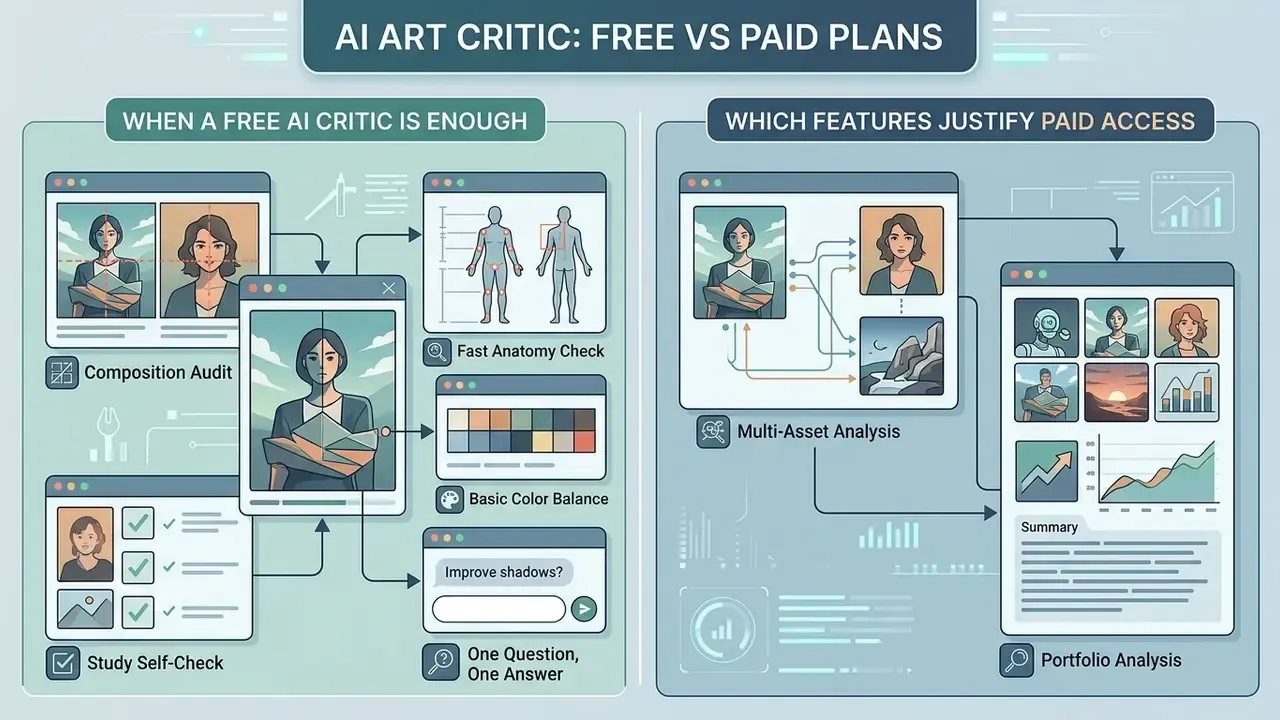
Evaluating an ai art critic free plan means checking quotas, privacy disclosure and analytical depth. Free web tools are fine for testing basic functionality. Commercial production pipelines usually need larger context windows and multi-asset handling.
| Feature or metric | Free tier (ai art critique free) | Paid plan or subscription |
|---|---|---|
| Upload limits | 1 to 5 analyses per day, often a single demo analysis | Unlimited or large credit quotas, 100+ per day |
| File size and format | Up to 5 MB; basic JPG, PNG, WEBP, GIF support | High-resolution PNG, WEBP, PSD; up to 50 MB |
| Analysis depth | One review paragraph or three bullet points | Multi-criteria scoring, zone-by-zone breakdown, paint-over hints |
| Context memory | None, isolated single uploads | Version history, portfolio tracking, custom prompts |
| Commercial license | Personal use only; logging into public datasets | Business-use rights; private data processing |
| Marketing tooling | Not available | Artist statements, captions and tag generation |
| Market price range | $0 | Roughly $5 to $17 per month at niche services; annual plans save 25% to 40% |
«Multimodal models such as MiniGPT-4 and LLaVA are openly available for basic analysis, whereas high-performance models like GPT-4V, suitable for detailed critique, are generally offered through commercial APIs.»
To model the total cost across adjacent creative utilities, review our consolidated AI Media Pricing Guides and compare per-call operating costs.
When a Free AI Art Critique Generator Is Enough
A free word art generator utility or an ai art critique generator free tier fully covers one-off technical checks and quick error hunting. Independent creators and students get real value from free access during a first-pass audit of personal projects; our list of free AI art generators pairs well for generation experiments.
Creators on a tight budget for adjacent media tasks can also see our guide to choosing a free photo editor for canvas edits after the critique, and a free video translator when the same asset travels across markets.
Which Features Justify Paid Access
Moving to a professional ai art critique tool plan makes sense when visual evaluation directly affects commercial deadlines, marketing strategy or enterprise asset governance. Paid tiers unlock deeper model architectures, higher context limits and specialized writing features.
Teams running a wider production stack can browse the hub to see how multimodal critique generators fit alongside enterprise design platforms, and studios scaling review capacity often pair the tooling with a freelance video editor for adjacent motion work.
FAQ on AI Art Critique and Art Critique Generators
Can an AI art critic be fully objective?
No. An ai art critic is not objective. Multimodal models train on human-labeled datasets and inherit the aesthetic preferences, cultural assumptions and dominant style trends of those sources. The feedback is a statistical summary of common visual patterns, not neutral truth.
«IAA models use mean opinion scores (MOS) or distributions of scores (DOS) from multiple reviewers, acknowledging that aesthetic judgment is inherently subjective and ambiguous.» Image Aesthetics Assessment Via Learnable Queries, ICASSP (2024). https://ieeexplore.ieee.org/document/10447896
Is an AI critique generator suitable for abstract digital art?
An ai critique generator can assess formal attributes of abstract work: color harmony, tonal contrast, visual balance, edge variation. Because abstraction deliberately rejects representational rules such as anatomy and perspective, automated systems may misread conceptual decisions and invent objects that are not there. Always supply explicit intent context and forbid the model from inferring figurative objects.
Is it useful to run several AI art reviews on one piece?
Yes. Prompting different multimodal models (GPT-4o, Claude 3.5 Sonnet, Gemini 1.5 Pro) or different personas (technical illustrator versus contemporary gallery curator) yields divergent perspectives. Comparing several ai art reviews surfaces the stable technical consensus and filters single-model bias. Ensemble approaches in art classification tasks likewise prove steadier than single architectures.
«GPT-4V, Gemini 2.0 and GPT-4 analyze artworks across ten or more criteria, proportion, spatial dynamics, emotional themes, light and shadow, generating structured reviews in the style of a human critic.» Large Language Models for Automating Art Analysis and Criticism, preprint (2025). https://arxiv.org/abs/2025.artanalysis
How does an AI art critique tool help with marketing materials?
Advanced art critique generator tools translate visual features into descriptive language. Artists and marketing teams use that output as a draft for artist statements, exhibition texts, social captions and SEO descriptions. The rule that matters: edit until the authorial voice survives. For extra visual copy support, a free word art generator or other platform marketing tools can help.
Can I upload client work covered by an NDA?
Only with contractual Zero Data Retention at the model provider level, a signed DPA and client permission. Privacy-policy wording such as "the image is deleted after the critique is generated" describes the wrapper site, not third-party API logs, which may persist for up to 30 days. For NDA assets, use an isolated enterprise endpoint.
Which images can be analyzed, and in which formats?
Photographs, drawings, diagrams, logos, marketing layouts, reproductions of traditional painting and ai generated images from any text-to-image model, including DALL-E, Flux.1, Stable Diffusion and Midjourney. Typical free-tier formats: JPG, JPEG, PNG, WEBP, GIF, with a size cap near 5 MB. Paid plans accept high-resolution files and PSDs in the tens of megabytes.
Where can I find more guides on visual content tools?
Full implementation guides, comparisons and creative tools sit in the main glossary index. For platform assistance, see the overview in the support section. What to Do Next: Three Implementation Steps
- Pilot on non-public assets. Take 10 pieces, run them through a free tier with the full preparation checklist, and compare output against your art director's read. Record the percentage of notes that actually matched.
- Run the security audit before scaling. Clear all ten checklist items (SOC 2, ZDR SLA, DPA, SSO, processing region) before any client asset goes up. One overlooked clause in the terms can void an NDA.
- Close the loop. Deploy the prompt loop: critique, tag extraction, regeneration, re-critique with a recorded per-criterion delta. That is how one-off reviews turn into a measurable quality process.