Executive Summary
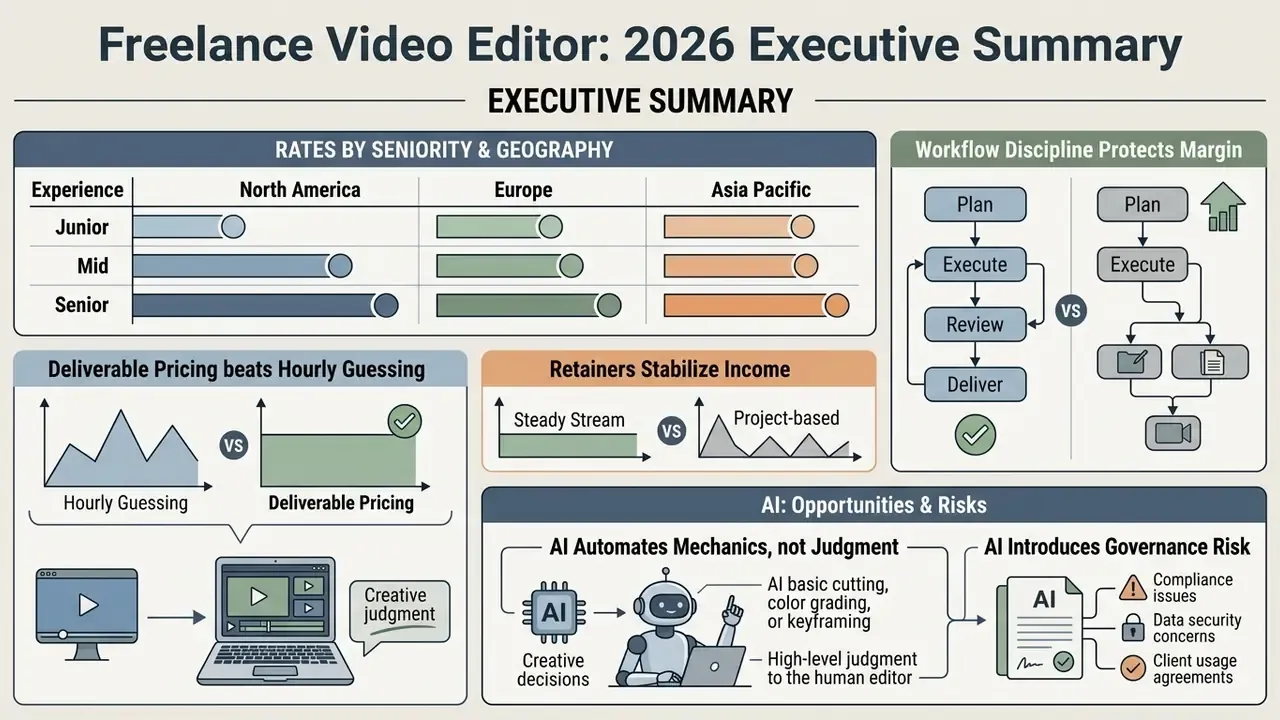
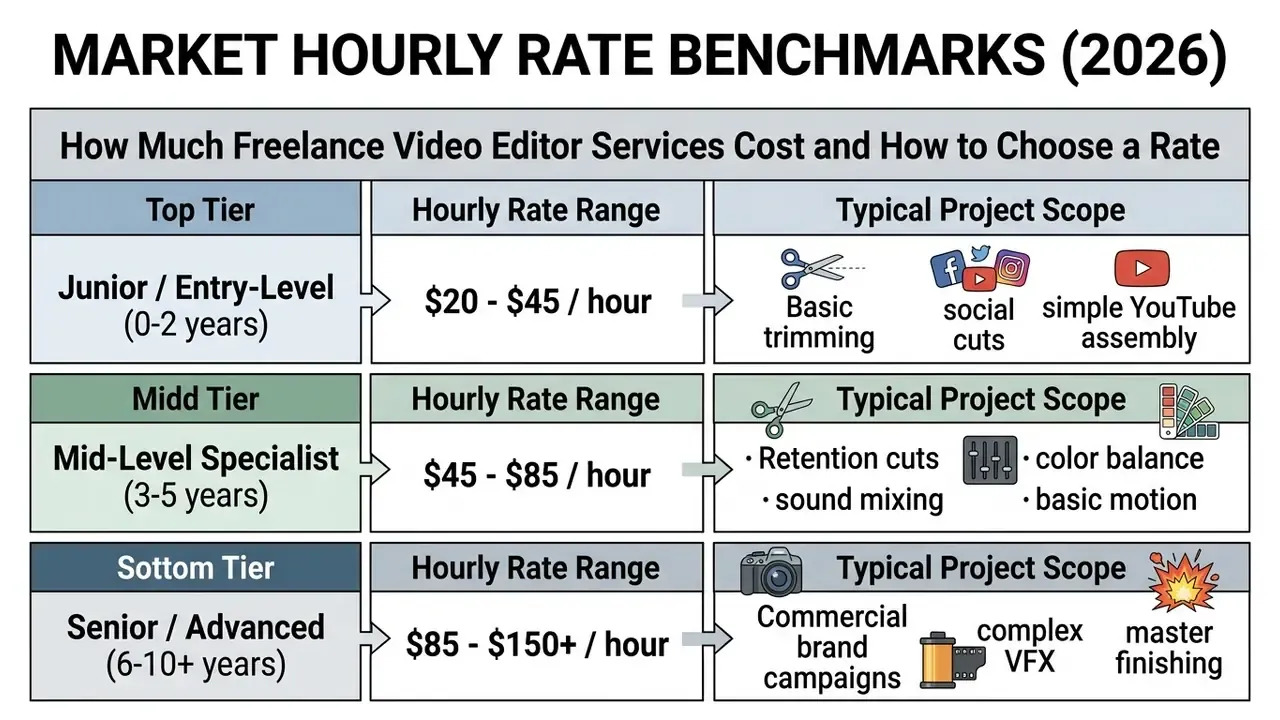
- Rates split by seniority and geography. Entry-level editors bill $20 to $45 per hour, mid-level specialists $45 to $85, and senior commercial editors $85 to $150+. Editors based in the US, UK, Canada and Australia anchor to $24 to $50 per hour on vetted marketplaces, while offshore editors in LATAM, Eastern Europe and APAC typically start at $9 to $35. Full US rate parity is achievable, but usually through direct enterprise outreach rather than open bidding.
- Deliverable pricing beats hourly guessing. A short-form vertical clip carries $25 to $500, a 10 to 15 minute YouTube edit $120 to $2,000+, a 60 to 90 second corporate promo $300 to $10,000+, and a wedding highlight film $400 to $1,500.
- Retainers stabilize income. Monthly retainers (fixed output volume for a fixed fee) reduce onboarding friction for clients and smooth cash flow for contractors. Enterprise dedicated freelance contracts reach $60 to $90 per hour.
- Workflow discipline protects margin. Lock technical specs in the brief, cap revisions at two rounds, review through timestamped platforms such as Frame.io or Wipster, and release unwatermarked masters only after full payment or escrow clearance.
- AI automates mechanics, not judgment, and it introduces governance risk. Transcript-based cutting, noise isolation, upscaling and reframing are now largely automated. Uploading client footage to public generative services without written consent creates Shadow AI, confidentiality and intellectual property exposure that must be managed contractually.
How to Read This Guide: Two Tracks and Six Terms
This article is written for two readers at once, and they want different things.
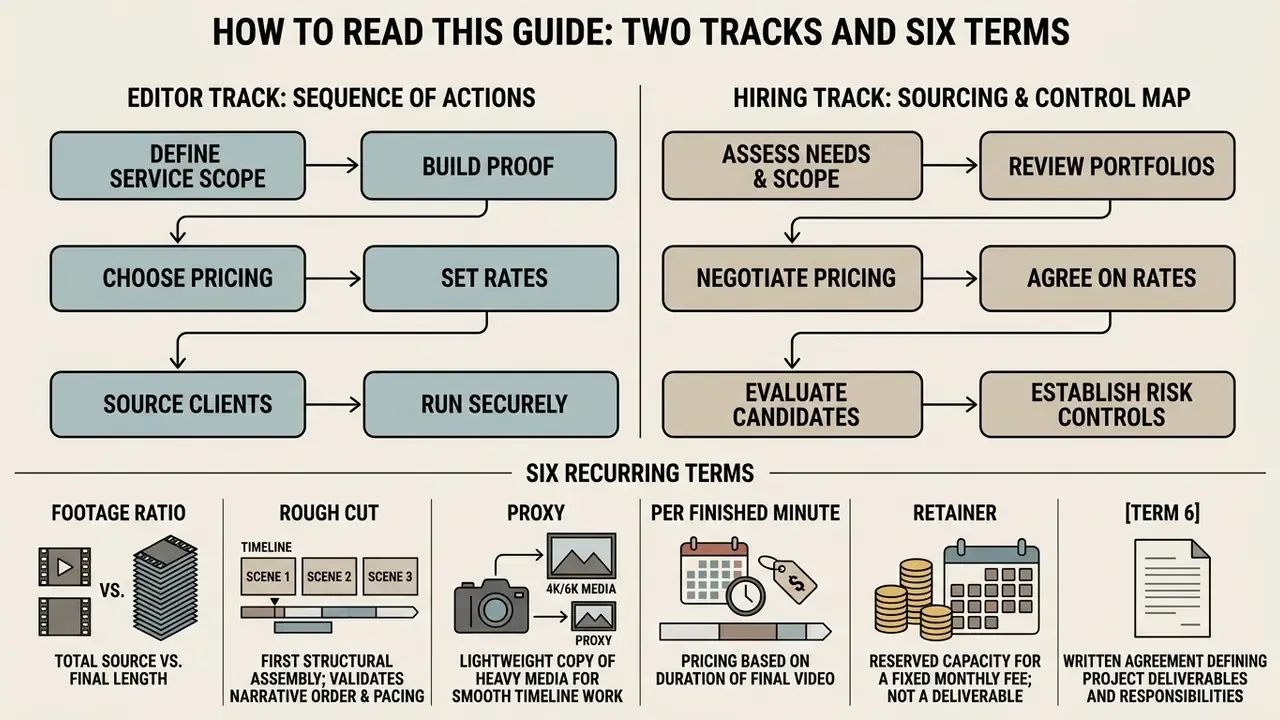
If you are the editor, treat the sections as a sequence: define your service scope, build proof, choose acquisition channels, set a rate floor, then harden your workflow so that enterprise clients can actually approve you. The last part is where most freelancers lose contracts they had already won on creative merit.
If you are hiring, read the same sections as a sourcing and control map. Each channel carries a different vetting depth, payment mechanism and contract instrument. A $40 hourly saving means very little if the confidentiality terms are unenforceable.
Six terms recur throughout, so let us fix their meaning early:
- Footage ratio. The relationship between source runtime and finished runtime. Five hours of raw material for a ten-minute edit is a 30:1 ratio, and it is the strongest single cost driver in post-production.
- Rough cut. The first structural assembly, made to validate narrative order and pacing before any polish.
- Proxy. A lightweight copy of heavy 4K or 6K media used for smooth timeline work, with the full-resolution files relinked at export.
- Per finished minute. Pricing based on the duration of the delivered video rather than hours worked. Common for corporate and educational libraries.
- Retainer. Reserved capacity for a fixed monthly fee, not a purchased deliverable. Included hours, roll-over rules and overage pricing must be written down.
- Shadow AI. Any AI service used on client material without approval, disclosure or a documented data-handling basis. It is the newest and least tracked risk in freelance post-production.
Keep those in mind. Most pricing arguments and most compliance failures trace back to one of them.
Who is a Freelance Video Editor and What Tasks Do They Perform
A freelance video editor is an independent post-production specialist who ingests, organizes, cuts and refines raw audiovisual footage into finished digital media assets for enterprise clients, marketing agencies or individual content creators. Working on a contract basis, a video editor bridges raw production media and final distribution requirements across digital channels.
According to data from the US Bureau of Labor Statistics (May 2024), median annual compensation for salaried film and video editors sits at roughly $70,570 to $70,980, or $33.93 per hour. In the contract market, an experienced freelance video editor commands higher nominal rates to offset operating overhead, administration, software licensing and non-billable time. Research by Gigsentry (2026) analyzing global platform volume shows video editing as the second-largest overall skill category on major labor marketplaces, with more than 47,000 active listings for video editor jobs freelance and over 140,000 listings across the broader post-production ecosystem.
«Video editing ranks second by active listing volume on Upwork, 47,230 postings, trailing only graphic design with 81,301 listings». Gigsentry, Platform Skill Analysis (2026). https://gigsentry.com
Market-scale context reinforces that demand. MBO Partners State of Independence / Creator Economy Trends (2024) estimates roughly 8.1 million independent creators operating in the United States alone, and most of them outsource at least part of their post-production workload rather than editing in-house.
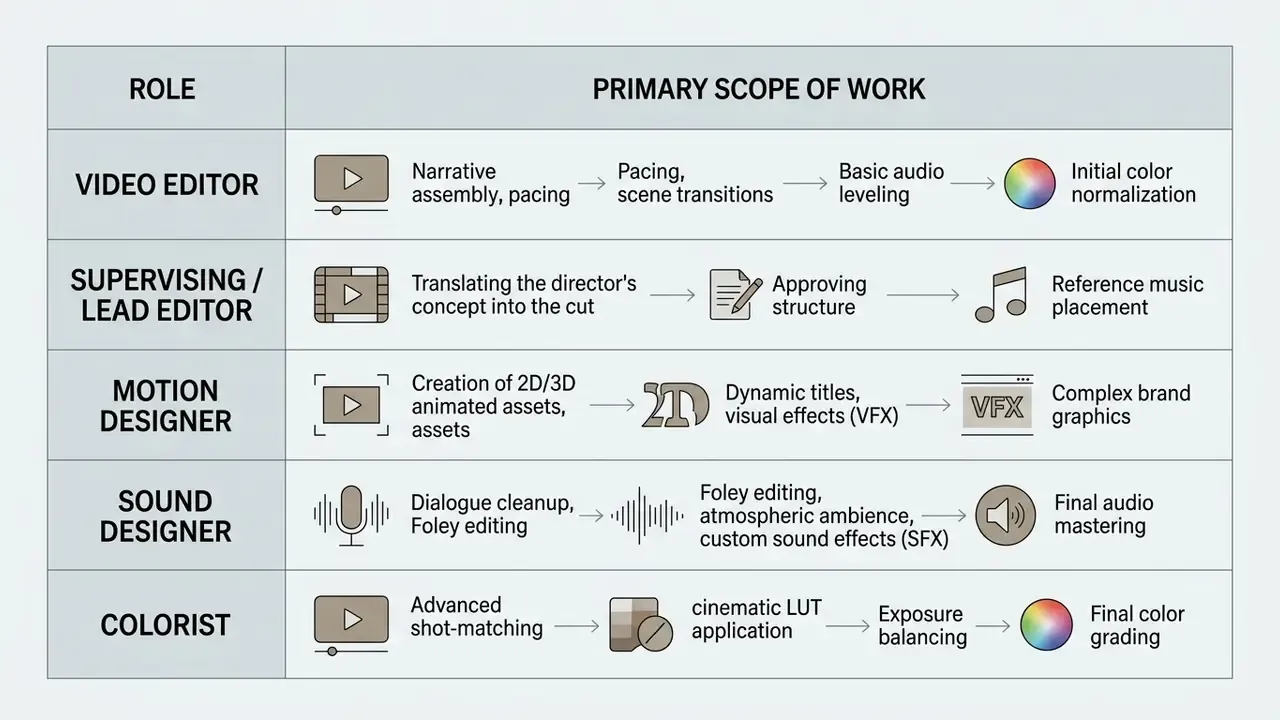
Scope discipline separates a profitable contract from an unpaid overrun. An editor hired for narrative assembly should not silently absorb 3D animation, full mix mastering or cinematic grading. Those tasks belong to adjacent specialists and must be quoted as separate line items or subcontracted with the client's knowledge.
That principle frames everything below: task definition, contract model, rate structure, review workflow, AI governance.
Typical Tasks in Freelance Video Editing
The primary operational task in freelance video editing is turning unstructured media assets into a structured narrative timeline that satisfies the project guidelines. Work begins with ingesting raw multi-camera footage, performing transcript-based logging, and constructing a rough cut to validate flow and pacing.
Once the initial cut is approved, the editor handles the finishing passes:
- Audio engineering. Cleaning background noise, balancing dialogue, integrating background music, and executing basic sound design. Projects that need synthetic narration or localized voiceover increasingly rely on AI voice generators instead of re-booking talent.
- Visual polish. Applying primary color correction to normalize exposure and color balance across disparate camera angles.
- Graphic integration. Adding lower-thirds, call-to-action overlays, text captions and motion graphics templates, often assembled with a dedicated animation maker for repeatable brand elements.
- Final exporting. Rendering high-resolution final videos in specified codecs and aspect ratios for web, broadcast or social distribution.
One practical note from reviewing dozens of intake forms: the projects that go wrong are almost never the technically hard ones. They are the ones where nobody wrote down what "done" looks like.
Content Formats That Require Freelance Video Editors
Demand for freelance video editors clusters around social platforms, digital advertising, corporate communications and life-event media. The Epidemic Sound Creator Economy Report (2024) indicates that 74.7% of content creators produce video as their primary medium, distributing assets across multiple channels to keep income stable.
«74.7% of creators name video as their primary format; YouTube delivers 28.6% of creator revenue, ahead of TikTok and Facebook». Epidemic Sound, Future of the Creator Economy Report (2024). https://www.epidemicsound.com/blog/creator-economy-report/
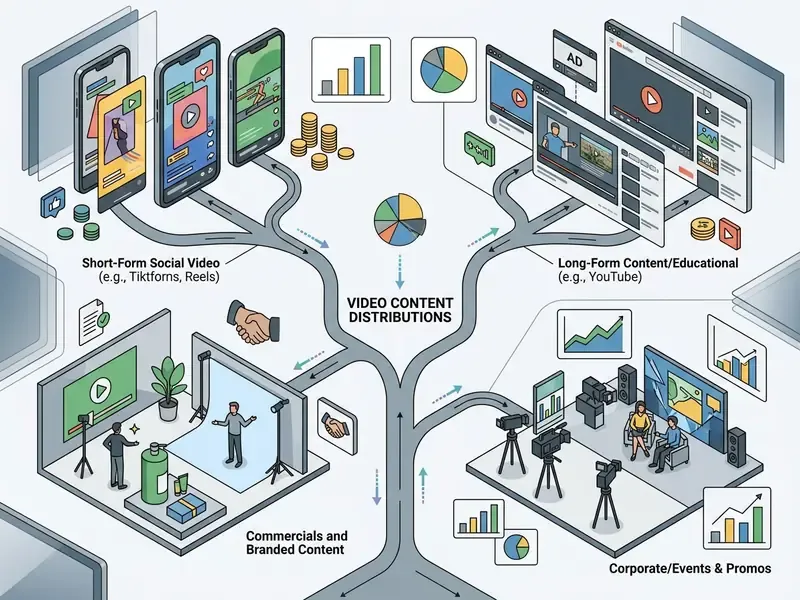
- Long-form media (YouTube and podcasts). In-depth educational, tutorial and entertainment programming requiring structural editing, retention-focused pacing, multi-cam switching and custom graphic overlays. Economic analysis by Oxford Economics (2025) shows YouTube's creative ecosystem contributing over $55 billion to US GDP, which creates structural demand for qualified long-form editors.
«YouTube's ecosystem supported more than 490,000 full-time-equivalent jobs and paid over $70 billion to creators in the three years to January 2024». Oxford Economics / Google, YouTube Economic Impact Report (2025). https://www.oxfordeconomics.com/resource/the-youtube-effect/
- Short-form vertical content (Reels, TikTok, Shorts). High-velocity 9:16 edits built for rapid retention, generally 9 to 60 seconds with the hook-body-close structure recommended by platform ad guidance itself.
«YouTube Shorts reached 200 billion daily views globally, up from 70 billion in March 2024». Kapwing, Short-Form Video Statistics (2026). https://www.kapwing.com/resources/short-form-video-statistics-tiktok-reels-and-shorts-by-the-numbers-in-2026/
- Commercial and performance marketing. High-production ad creatives, product demos and brand stories designed to convert inside social feeds and ad networks. Brand-side work carries an extra compliance layer: advertising standards and brand asset rules require officially supplied logos and approved claims.
- Corporate and internal communications. Training modules, executive presentations, investor updates and case-study videos built to institutional standards, frequently priced per finished minute.
- Wedding and event post-production. A profitable niche running on seasonal retainers or per-wedding contracts of $400 to $1,500 per highlight film. It demands emotional storytelling, multi-cam synchronization of ceremony and speeches, careful grading for skin tones, and licensed background audio from services such as Musicbed or Artlist. Videographers routinely outsource raw footage to remote editors to clear backlogs in peak season, which makes event editing one of the most reliable entry paths for a new freelance video editor.
Worth adding a sixth, quieter category: archive and repurposing work. Brands sitting on years of old media pay well for editors who can restore it, and some of that work overlaps with tools that convert video to alternative display formats for retail screens and mobile placements.
Skills and Tools for Freelance Video Editing Jobs
Securing high-paying freelance video editing jobs online requires a balance of technical proficiency in post-production software and solid project management. Independent contractors carry both the narrative work and the multi-platform delivery constraints.
The BBC & ScreenSkills Digital Content Creator Landscape Study (2026) notes that highly rated video editors stand out through transversal skills: platform literacy, rapid storytelling, audience awareness and structured client communication. Technical competence alone does not guarantee renewals. Editors must translate messy briefs into precise digital deliverables, again and again.
«Successful digital creators must combine platform literacy, storytelling, two-way audience communication, and resilience to algorithmic change». BBC & ScreenSkills, Digital Content Creator Landscape Study (2026). https://www.screenskills.com/
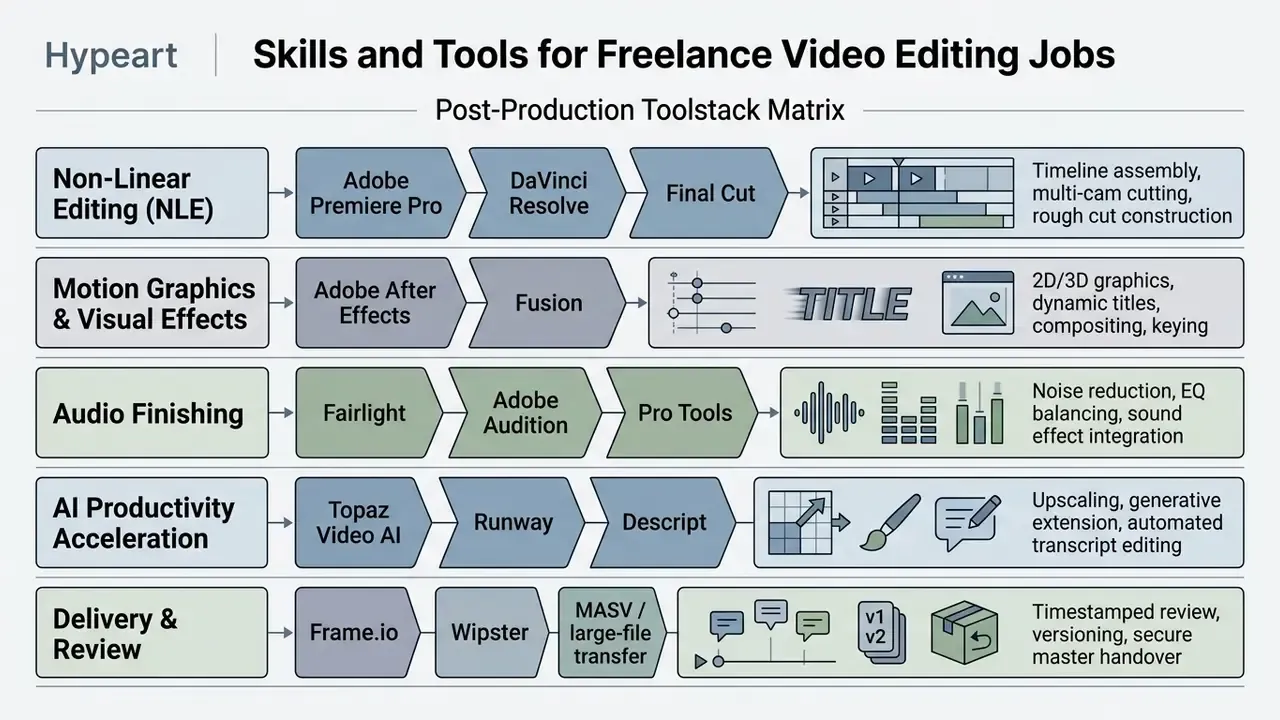
Technical Skills: Editing, Audio, Graphics and Motion
Core competencies for a professional video editor cluster in five areas. Skill depth here is not a soft claim; labour-market research classifies most of these roles as high-skilled work.
«At least 59% of workers in creative arts and 42% in video and television production are classified as high-skilled professionals». ILO, Digital Platforms and Conditions of Work in Media and Culture (2024). https://www.ilo.org/global/research/global-reports/
- Timeline assembly and pacing. Cutting footage to establish rhythm, continuity and engagement without jarring transitions. Beginners comparing video editing tools and their capabilities should verify multi-cam, proxy and transcript-editing support before paying for a licence.
- Audio cleanup and sound design. Using equalizers, compressors and noise-reduction plugins to keep dialogue clear, music balanced and effects crisp.
- Color correction and grading. Reading video scopes (waveform, vectorscope) to fix exposure inconsistencies, balance white levels and apply a creative grade. Adobe's current colour documentation and Blackmagic's DaVinci Resolve training both treat scopes-based correction as baseline practice, not an advanced extra.
- Motion graphics and visual effects. Designing dynamic lower-thirds, animated logos, screen transitions and compositing elements in After Effects or Fusion. Stylized passes that convert video to illustrated or animated looks have become a paid add-on rather than a novelty.
- Subtitling, captions and multi-format delivery. Burned-in and sidecar caption workflows, safe-zone control for 9:16 crops, and codec-correct exports per platform.
Soft skills that convert briefs into repeat contracts: client communication and review facilitation, problem-solving under compressed deadlines, asset organization and naming discipline, and transparent billing terms agreed before work starts. That last one is unglamorous. It also prevents most disputes.
Software and AI Tools for Video Editors
Modern post-production environments run on established software suites augmented by generative and automated AI features. Rate surveys by Freelancecalc (2026) indicate that mid-level and senior editors systematically integrate automated workflows to speed up repetitive tasks.
- Adobe Premiere Pro and After Effects. The predominant commercial ecosystem. Adobe's 2026 release cycle added AI Object Masking (processed on-device), Generative Extend, caption translation, Enhance Speech and Speech to Text, with generative features drawing on monthly credits. After Effects received a parallel motion-design upgrade. Editors on a tight budget can benchmark paid suites against free alternatives for video editing before committing to a subscription.
- DaVinci Resolve. The preferred platform for professional grading and finishing. Resolve 21 introduced AI CineFocus, AI IntelliSearch and text-to-voice generation via the DaVinci Neural Engine, alongside existing facial recognition, voice isolation and object tracking.
- Runway. Positioned as an AI-first editorial companion. The 2026 updates added Aleph 2.0, Edit Studio, ProRes 4444 and PNG export, plus direct drop-in of generated assets into Resolve or Premiere timelines.
- AI video generation and enhancement tools. Specialized platforms used to streamline media production. Editors lean on Topaz Video AI for artifact-free upscaling, frame-rate interpolation and footage restoration. Teams evaluating generative integrations can review the best AI video generators and consult the Google Veo implementation guide for supplemental B-roll inside production pipelines.
- Still-image pipelines. Thumbnail and pitch-deck work increasingly borrows from generative imagery. Editors who need cool ai images for concept boards should still verify licence terms before anything reaches paid media.
A caveat on credits: metered generative features change per-project cost in a way hourly billing hides. Model it before you quote.
What Types of Freelance Video Editing Jobs Exist Online
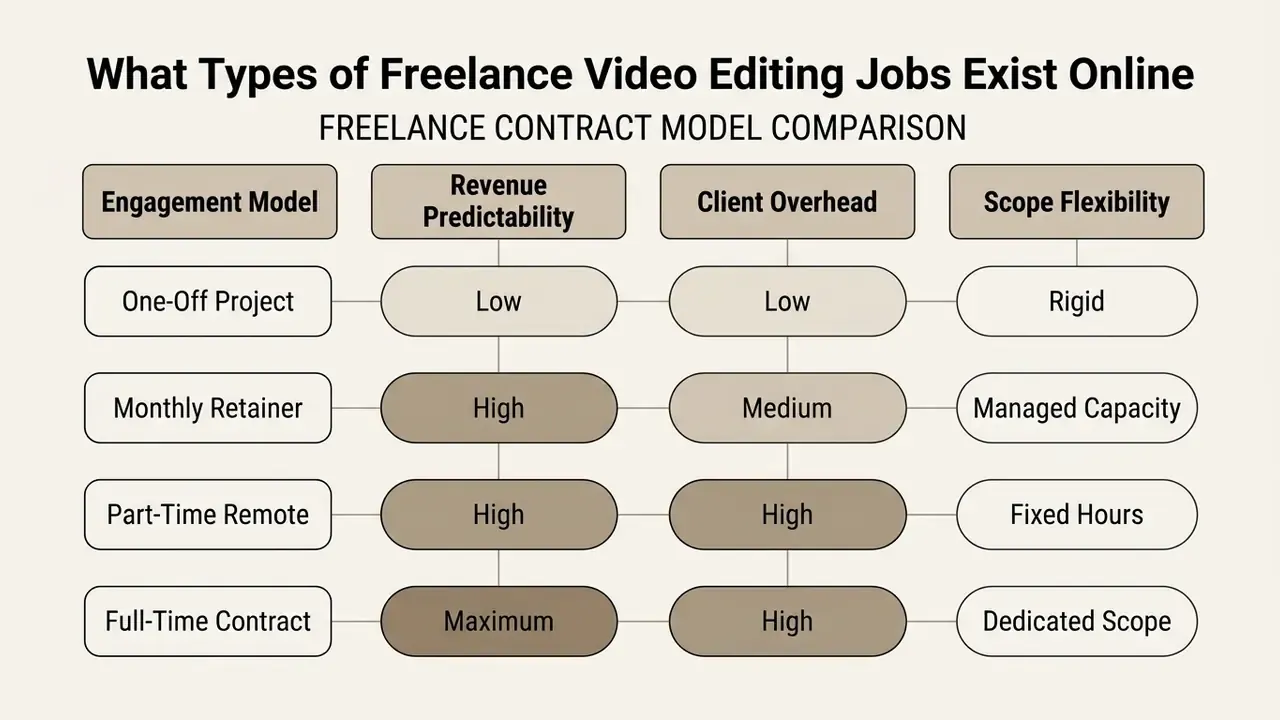
Contract opportunities for video editors freelance run from single-asset commissions to ongoing retainers and part-time remote employment. Understanding these structures lets editors build predictable revenue and gives clients flexibility in resource allocation.
Analysis of open listings across major recruitment portals suggests clients deploy four distinct engagement models, depending on content velocity and operational complexity.
One-Off Projects, Recurring Clients and Part-Time Work
- One-off contract gigs. Fixed-scope tasks such as a single promotional video, a corporate event recap or a short film. Payment is tied strictly to defined deliverables on sign-off, and the contract ends when the deliverable is accepted.
- Monthly retainer contracts. A predictable arrangement where a client reserves a set amount of the editor's time or output each month, for example four YouTube videos and twelve vertical clips for a fixed fee. Retainers reserve capacity rather than purchase a deliverable, so well-drafted agreements state included hours, roll-over rules and the price of overage. This model cuts client onboarding friction and stabilizes contractor cash flow.
- Part-time and full-time remote positions. Structured roles with fixed weekly hours, say 20 hours per week, dedicated to internal video asset production and compensated hourly or monthly as an employee or long-term contractor.
Income volatility is the structural risk of the one-off model, which is exactly why retainers matter:
«In the creative arts sector, 59% of workers are engaged on temporary contracts, the highest share of any media and culture subsector». ILO, Digital Platforms and Conditions of Work in Media and Culture (2024). https://www.ilo.org/global/research/global-reports/
During a commercial digital transformation initiative, an asset management firm needed continuous video support for quarterly market updates but had no internal post-production headcount. Placing a specialized editor on a monthly retainer with guaranteed turnaround cleared the bottleneck, and internal stakeholders reported a material reduction in external agency spend over the following two quarters. The exact saving was not independently audited, so treat it as a directional indicator rather than a benchmark. This example is illustrative.
Where to Find Video Editor Freelance Jobs and Clients
Consistent freelance jobs for video editors come from several acquisition channels at once: public marketplaces, portfolio-first networks, entertainment-industry boards, professional social networks and direct cold outreach.
«In 2023, 1.4 million creative independents in the US earned $39.2 billion, roughly 20% of all professional-services freelancers». Fiverr, Freelance Economic Impact Report (2024). https://www.fiverr.com/resources/reports/freelance-economic-impact
This section is deliberately two-sided. Editors should read it as a channel-selection map. Hiring managers, creative directors and procurement leads should read it as a sourcing map, because each channel carries a different vetting depth, payment-protection mechanism and contract instrument.

Table 1. Comparison of primary job acquisition channels for freelance video editors (2026 data)
| Platform / Channel | Primary Job Types | Competition Level | Average Ticket Value | Payment Protection | Client Communication |
|---|---|---|---|---|---|
| Upwork | YouTube, social clips, corporate edits | High | $150 to $2,500 per project | Escrow and hourly tracker | In-platform messaging and calls |
| Fiverr / Kwork | Preset gigs, quick edits, intro animation | Very high | $35 to $500 per gig | Upfront buyer prepayment | Strict platform messaging |
| Guru | Fixed-price, task-based, recurring work | Medium | $100 to $1,200 per project | SafePay, funded before start | WorkRooms and milestones |
| LinkedIn Jobs | Retainers, part-time, corporate contracts | Medium | $2,000 to $8,000 per month | Direct invoicing and contract | Direct email or InMail |
| Mandy Network | Film, TV, documentary, feature post | Medium | $250 to $600 per day | Contract-based, MSA | Direct recruiter contact |
| Glimmer.io | High-end brand content, enterprise clients | High (vetted) | $500 to $3,500 per project | Built-in platform escrow | Enterprise workrooms |
| Direct agency outreach | Commercials, brand assets, high-end ads | Low to medium | $85 to $150 per hour | Commercial Master Services Agreement | Direct communication channels |
Freelance Platforms and Websites with Posted Video Editing Jobs
LinkedIn, Instagram and Direct Client Search
Direct outreach to businesses, agencies and established creators often yields better margins than public bidding.
- LinkedIn outreach. Turn your profile into a sales page for one niche, for example "B2B SaaS video editor". Identify decision-makers such as Heads of Content, Creative Directors or Marketing Managers, and open with a personalized note focused on operational efficiency. LinkedIn's own guidance discourages generic blasts: lead with a relevance hook, ask one clear question, close with a soft call to action.
- Instagram and social networking. Engage with high-growth creators by studying their formats and naming a specific improvement. DM outreach works when accounts are warmed gradually, messages are scripted but personalized, and positive replies convert into booked calls.
- Cold email practices. Keep pitches short and plain-text, use accurate headers, include a valid physical address and a working opt-out, and honour unsubscribe requests within 10 business days. Structure the message in three beats: one specific problem in the prospect's current video strategy, your proposed edit solution, one relevant portfolio link.
- Regional and multilingual channels. Editors serving Spanish-speaking clients can broaden reach with localized resources such as our guide on how to crear videos con inteligencia artificial gratis, which doubles as a conversation starter with LATAM marketing teams.
For hiring managers: treat channel choice as a control decision. Escrow-backed marketplaces reduce payment-fraud exposure but limit direct NDA enforcement. Direct MSA engagement gives stronger confidentiality and IP assignment terms, yet requires internal vendor onboarding and invoice verification. Neither option is free of overhead. Pick the one whose overhead you can actually staff.
How to Prepare a Profile and Portfolio for Video Editing Jobs
A high-converting portfolio demonstrates technical mastery, visual sense and narrative pacing within seconds. Clients scan past work to judge reliability and stylistic fit for their brand, and they scan fast.
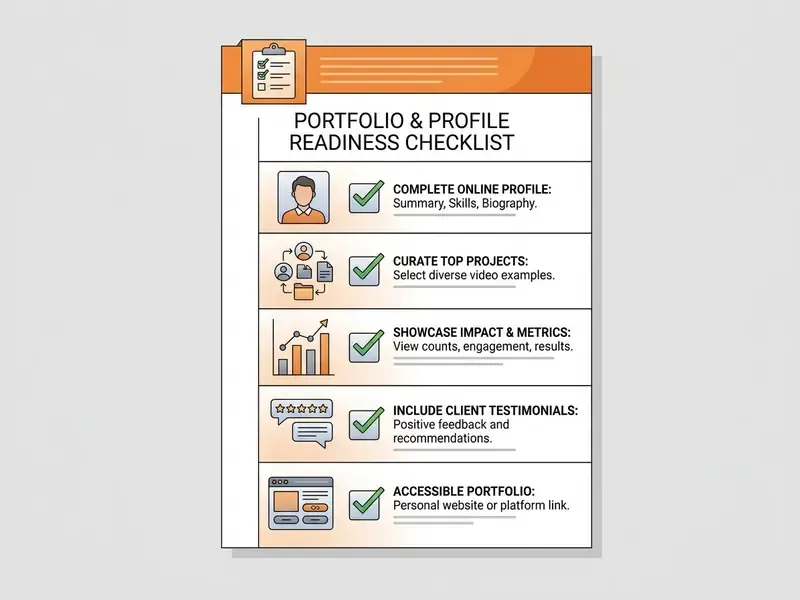
Checklist0 / 9
What to Include in a Video Editor Portfolio
A competitive portfolio pairs concise showreels with detailed project breakdowns.
- The client brief. Objective of the campaign.
- The technical challenge. Unorganized multi-cam footage, degraded audio, compressed deadline.
- Your execution. Software used, effects created, narrative choices made.
- The final deliverable. Link to the published asset with verified performance metrics such as retention improvement or ad click-through rate.
- The showreel (60 to 90 seconds).Lead with your strongest clips. Highlight dynamic cutting, precise visual sync, kinetic typography, grading and audio design inside the first 20 seconds, because casting and creative directors form their judgment in that window. Longer reels should stay under three minutes.
- Featured case studies (four to eight projects).Instead of uncontextualized embeds, present breakdowns that cover:
- Platform presentation.Behance case studies perform best in the sequence overview, challenge, process, solution, reflection. Vimeo organizes reel-based work into Collections and showcases. A personal site should embed the reel above the fold with a single contact CTA. If you need a fast interim page, tools that convert image to video online free can generate placeholder motion cards while the real reel is being cut.
How to Apply for a Video Editor Freelance Job
Proposals for freelance video editing jobs online need tailored messaging that answers the brief. Generic cover letters listing years of experience get skipped. Formal cover letters should stay within one page, use a professional 10 to 12 pt font, ship as PDF, and open with a clear statement of purpose.
- Address the client by name. Personalization separates you from automated bids. If the name is not published, make a real effort to find it first.
- Reference specific elements. Mention a timing choice, audio transition or graphic style from their existing library.
- Include a targeted portfolio link. One or two samples directly relevant to the scope, not the root directory of everything you have ever made.
- State commercial terms early. Rate model, revision allowance, turnaround. Ambiguity here is the most common root cause of later disputes.
- Propose a clear next step. Close with a low-friction question, such as their target delivery date.
How Much Freelance Video Editor Services Cost and How to Choose a Rate
Setting rates for freelance video editing means reading project scope, turnaround, visual complexity, geography and market benchmarks across skill tiers, together rather than separately.
Global marketplace pricing surveys from Cutjamm (2026) and YunoJuno (2025/2026) show clear tier structures.
Geographic Rate Disparity and Offshore Arbitrage
Rates for a freelance video editor vary sharply with client location and editor residency.
- US, UK, Canada and Australia-based editors. Baseline hourly rates for entry-to-mid specialists sit between $35 and $85, scaling past $150 for senior commercial editors. Vetted marketplaces report a narrower practical band of $24 to $50 per hour at entry-to-mid level.
- LATAM, Eastern Europe and APAC-based editors. Offshore rates for standard mid-level editing typically fall between $15 and $35 per hour, with the lowest tiers on high-supply marketplaces starting near $9. However, non-US editors approaching tier-1 US corporate clients directly through LinkedIn can reach full parity, roughly $50 to $90 per hour, by demonstrating fluent English communication, asynchronous workflow mastery and documented enterprise references.
- Currency and local market effects. Locally denominated listings are not directly comparable to global hourly benchmarks. Some regional marketplaces cluster around the equivalent of $10 to $28 per hour, with project prices such as $30 to $80 for a sub-ten-minute YouTube edit and $25 to $60 per vertical clip. Platform-rate guidance and local job-posting data measure different things, so avoid stacking them in the same comparison.
Table 2. Standard deliverable-based project rates for freelance video editing (2026)
| Content Deliverable Format | Beginner / Entry Rate | Mid-Level Specialist Rate | Senior / Commercial Rate |
|---|---|---|---|
| Short-form vertical clip (Reels/TikTok) | $25 to $75 per clip | $75 to $200 per clip | $200 to $500+ per clip |
| YouTube video (10 to 15 minutes) | $120 to $250 per edit | $280 to $650 per edit | $700 to $2,000+ per edit |
| Corporate brand / promo video (60 to 90s) | $300 to $600 per project | $600 to $2,500 per project | $2,500 to $10,000+ per project |
| Wedding highlight film (3 to 6 minutes) | $400 to $700 per event | $700 to $1,200 per event | $1,200 to $1,500+ per event |
«Editing a two-minute corporate brand video typically costs $600 to $2,500; a 60-second explainer runs $1,000 to $5,000». ReelRate, Video Editing Pricing Statistics (2026). https://reelrate.com/
Rate verification and industry data sources (E-E-A-T):
What Determines Hourly Rates and Project Costs
Key factors that push project cost upward:
- Footage ratio and volume. Processing five hours of raw multi-cam material for a ten-minute edit requires far more ingestion and logging time than cutting from a pre-trimmed script. Source runtime is the strongest cost driver, full stop.
«On Fiverr, licensed music adds $15 to $60 to a project, while professional sound design is priced at $40 to $200 as a separate add-on». Media-Tools Online, Fiverr Video Editing Pricing Analysis (2026). https://media-tools.online/
- Motion graphics complexity. Custom 3D elements or frame-by-frame effects demand specialized software and hardware, and 3D is consistently priced above 2D in production guides.
- Audio engineering needs. Dialogue restoration, multi-track music mixing and atmospheric design add labour hours that clients rarely anticipate.
- Revision volume. Rounds beyond the contracted allowance are a billable line item, not goodwill.
- Rush turnaround. Sub-24-hour deliveries carry 50% to 100% surcharges.
- Rights and licensing scope. Full copyright assignment, perpetual paid-media usage or territory-wide broadcast rights are billed separately from the edit itself.
- Compliance overhead. Professional indemnity insurance, software licence audits, security questionnaires and NDA review time are legitimate cost inputs on enterprise contracts. Price them in rather than absorbing them.
When to Choose Hourly Pay vs Project-Based Pay
- Hourly billing. Best when scope is variable, requirements are still forming, or revision rounds are open-ended. It guarantees payment for time spent, and it favours the client only when the task is short and closely monitored.
- Fixed project billing. Ideal when briefs, scripts and asset boundaries are locked upfront. Experienced editors capture higher margins through fast, automated workflows, and clients get cost certainty.
- Per finished minute billing. Common for standardized corporate or educational libraries, pricing the delivered duration directly. Most profitable when output is repeatable and per-minute edit time is predictable.
How Clients Compare Proposals from Freelance Video Editors
Institutional buyers select contractors through structured evaluation, mirroring formal procurement practice where price is scored alongside technical quality, past performance, personnel qualification and management capability.
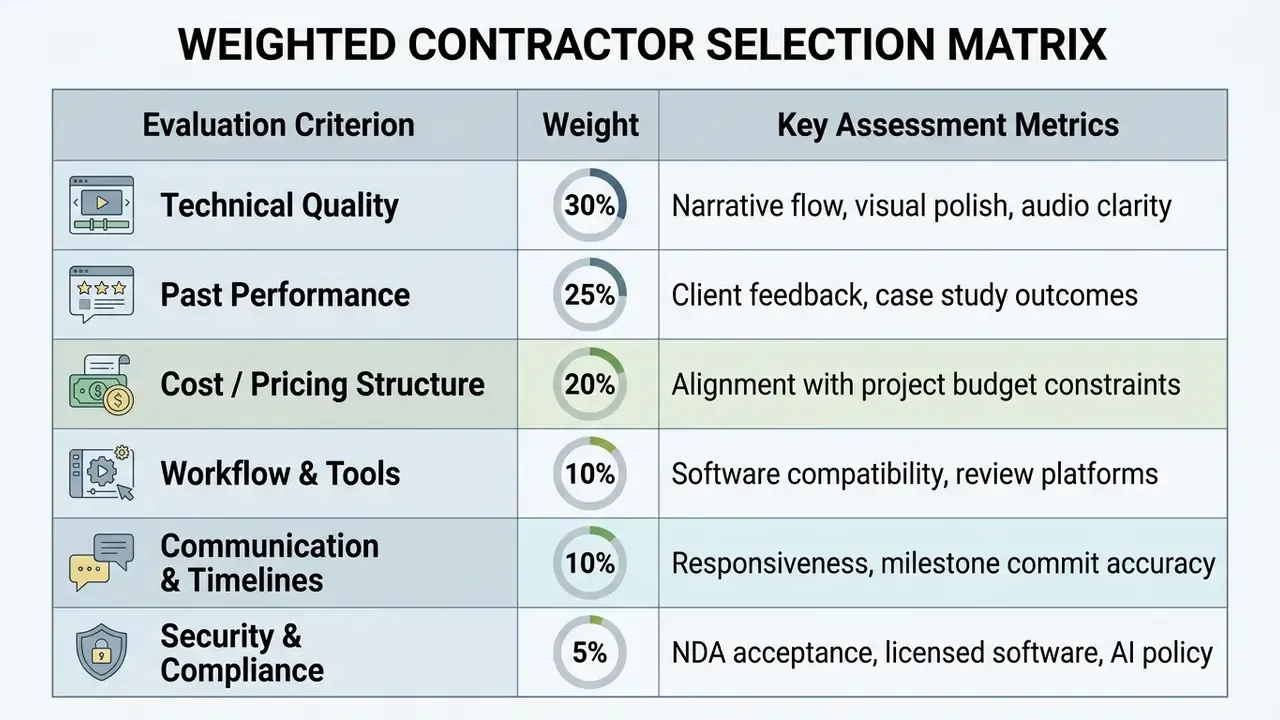
One honest caveat on that weighting. In regulated or brand-sensitive environments, the 5% security line behaves less like a score and more like a gate. Fail it and the other 95% never gets read.
How to Organize Work with a Client and Complete a Video Project
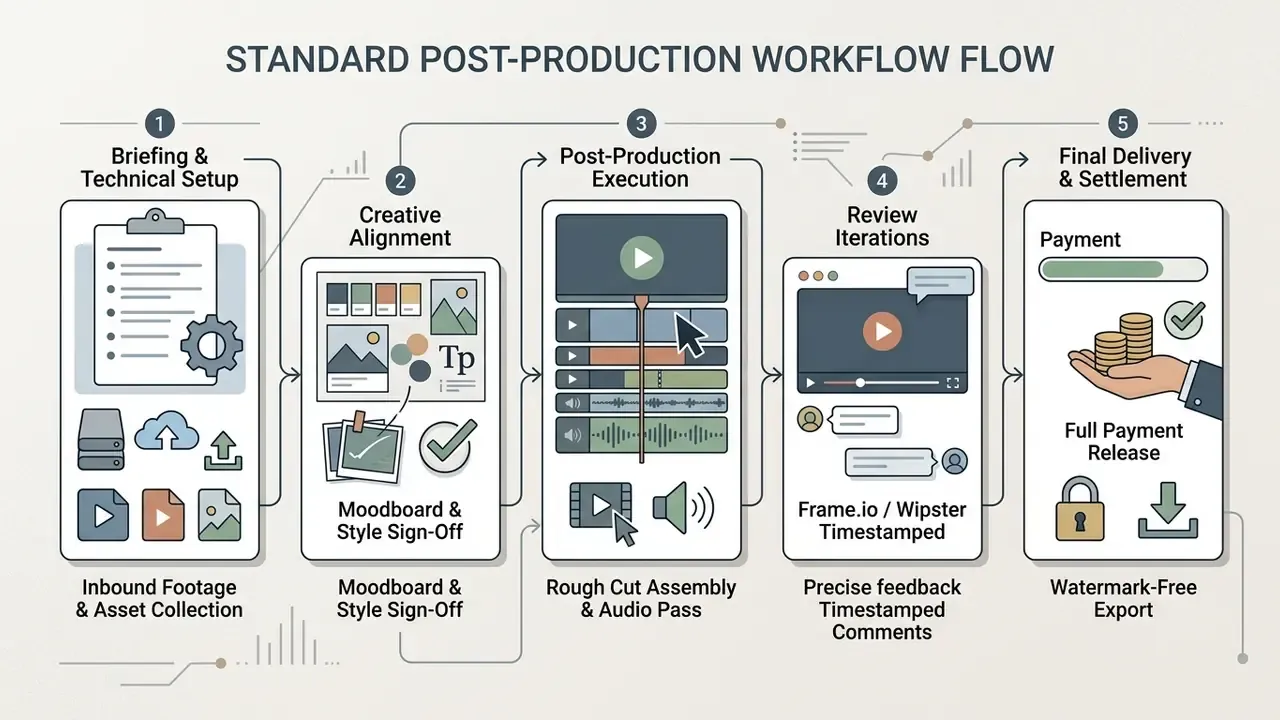
A structured post-production workflow prevents scope creep, keeps communication clean and gets projects finished and paid on time.
Briefs, Source Footage and Aligning Creative Direction
- The creative brief.
- Lock technical specifications before cutting: aspect ratios (16:9, 9:16), target resolution (4K, 1080p), export codecs (H.264, ProRes), platform destinations and style references. A complete brief also records objective, audience, concept, logistics and the inventory of available source materials, including photos, video, texts and print assets.
- Asset transfer.
- Move raw footage, audio, visual assets and brand guidelines through approved cloud storage with access logging. Never through personal consumer accounts.
- Reference and moodboard approval.
- Review three to five reference videos with the client, annotate exactly what is approved in each, and record explicit anti-references to prevent style drift. Present two or three named directions for sign-off rather than one blended board, then freeze the technical specification after the direction is approved.
- Deposit rule.
- Do not start post-production without either a 50% upfront deposit for direct invoicing clients, or fully funded escrow milestones on platforms such as Upwork or Guru, where the employer funds SafePay before work begins. Add a clause limiting raw and project-file transfer until final payment clears.
Revisions, Final Video Delivery and Getting Paid
- Managing revision rounds. Limit contracts to two standard iteration rounds and state that number explicitly. Make the final round approval-only. Extra revisions bill at your standard hourly rate.
- Collaborative review tools. Use timestamped platforms such as Frame.io or Wipster to centralize feedback, track versions side by side, and kill contradictory email threads. Frame.io documents enterprise-grade controls including SOC 2 Type 2, ISO 27001 and TPN Gold Shield certification, which is a material argument when onboarding regulated clients.
- Secure handover and payment release. Deliver review drafts with embedded watermarks or lower-resolution proxies. Release unwatermarked masters (H.264 for distribution, ProRes for archive) only after full payment or milestone escrow release. Editors optimizing delivery weight for web platforms should review video compressors for final export. Technical questions on export failures can be routed through AI Media Support and Troubleshooting.
- Acceptance and rights transfer. Formalize handover with an acceptance act or written sign-off stating which rights transfer, for which territories and channels, and from which date. Usually on receipt of the final payment.
How AI is Changing the Work of a Freelance Video Editor
AI tools are reshaping post-production by automating mechanical tasks, which frees contractors to concentrate on pacing, storytelling and client strategy. The judgment layer has not moved. The button-pressing layer has.
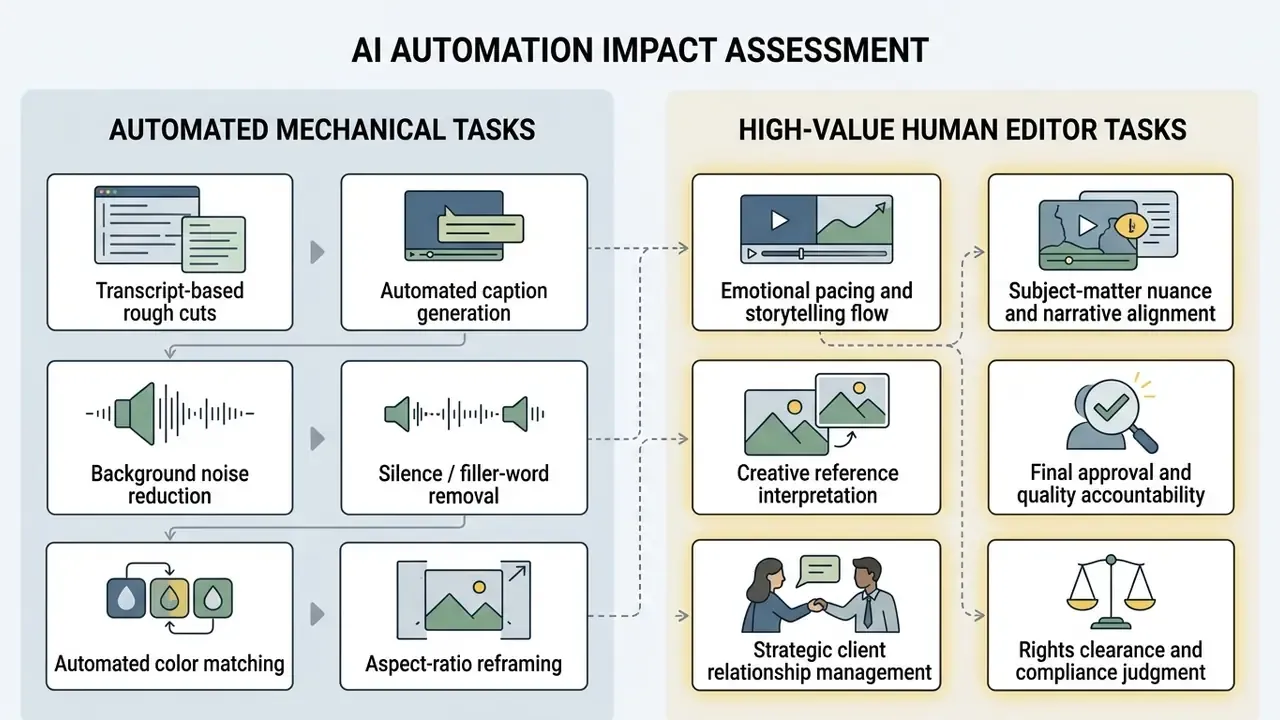
Modern pipelines apply AI across the editing lifecycle, by function:
- Transcription and text-based editing. Speech-to-text engines generate time-synced transcripts, letting editors cut by manipulating text and remove silences and filler words in bulk. Teams pushing this into script-driven production increasingly evaluate text-to-video AI for storyboard and pre-viz passes.
- Audio restoration. Noise-isolation and dialogue-enhancement models clean weak recordings in seconds, replacing manual spectral repair on non-critical work.
- Upscaling and restoration. Frame interpolation and artifact-free upscaling bring archival or low-bitrate footage back to deliverable resolution.
- Generative asset support. Generative tools extend frames, produce B-roll and reframe horizontal media for vertical distribution. Editors comparing options for supplemental footage can review AI video generators and, for still-to-motion assets, image-to-video AI tools.
- Budget and cost modelling. Estimators help model per-project compute credits, licence costs and timelines before quoting, which matters now that major NLEs meter generative features on monthly credit allowances.
Commercial diligence sits alongside tooling. Teams assessing licensing and IP should consult the AI Media Commercial-Use Hub, track AI Litigation and Case Timelines for shifts in enforceable practice, and review the AI Media API Guides when wiring generation endpoints into a client pipeline.
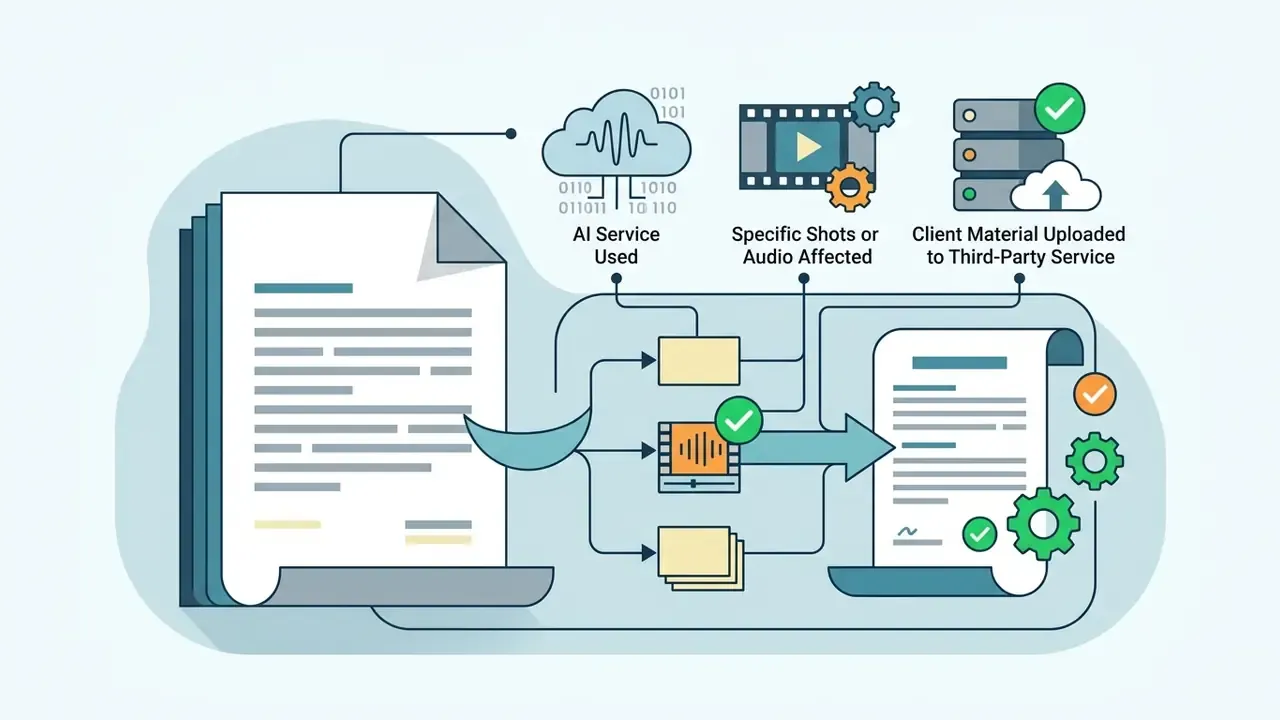
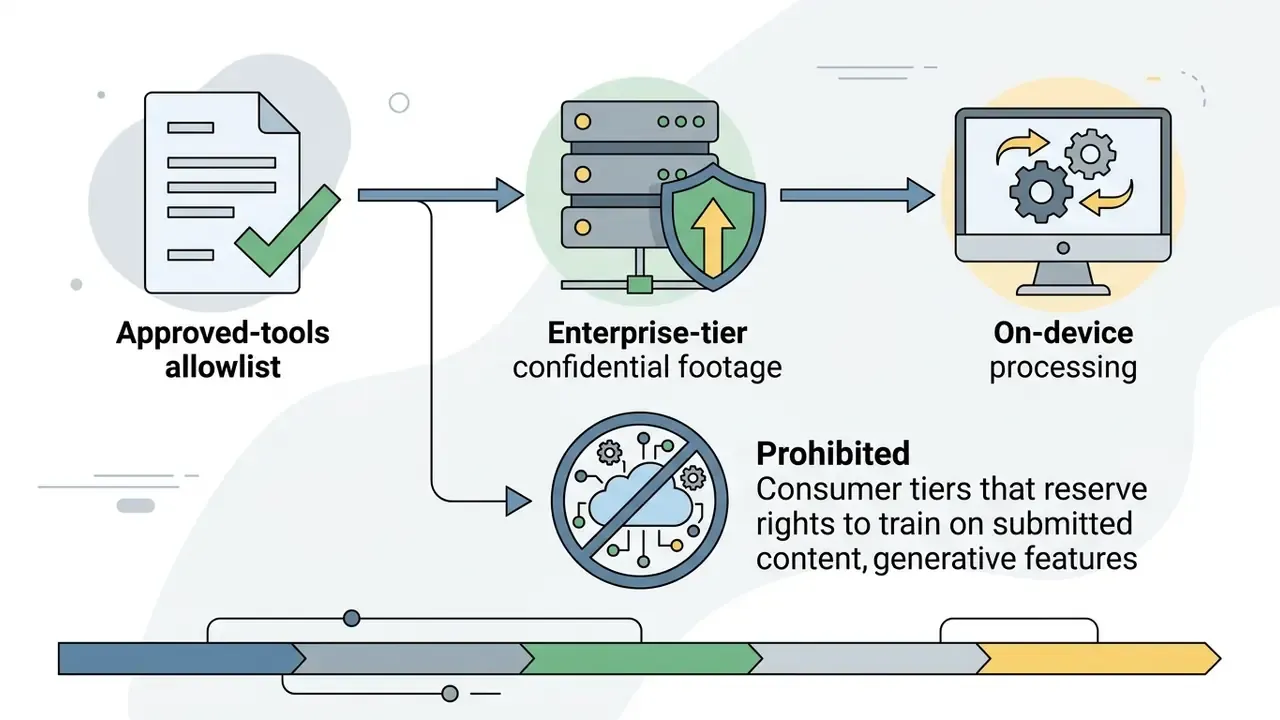
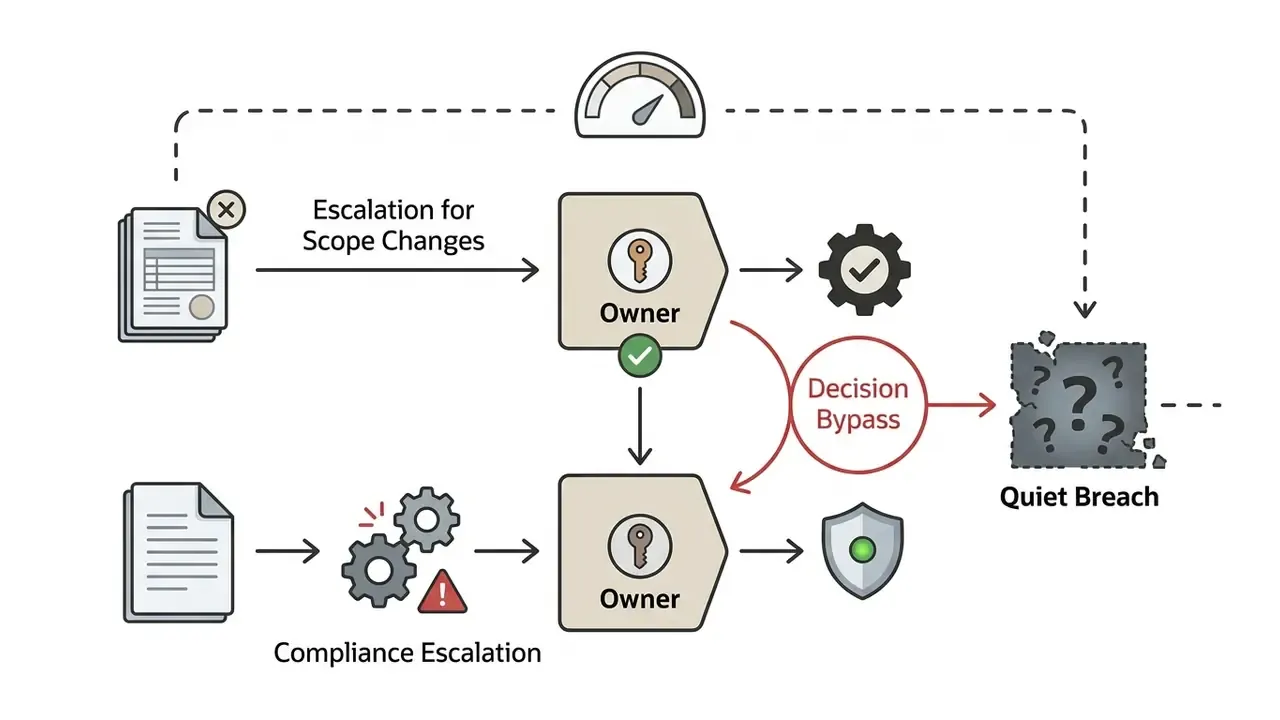
Security, Data Privacy and Shadow AI Risks
For enterprise buyers, and for any editor who wants to keep working with them, post-production is a data-handling function rather than a purely creative one. Unreleased product footage, executive interviews, investor updates, medical or financial content and pre-launch brand assets are confidential material moving through a contractor's personal hardware.
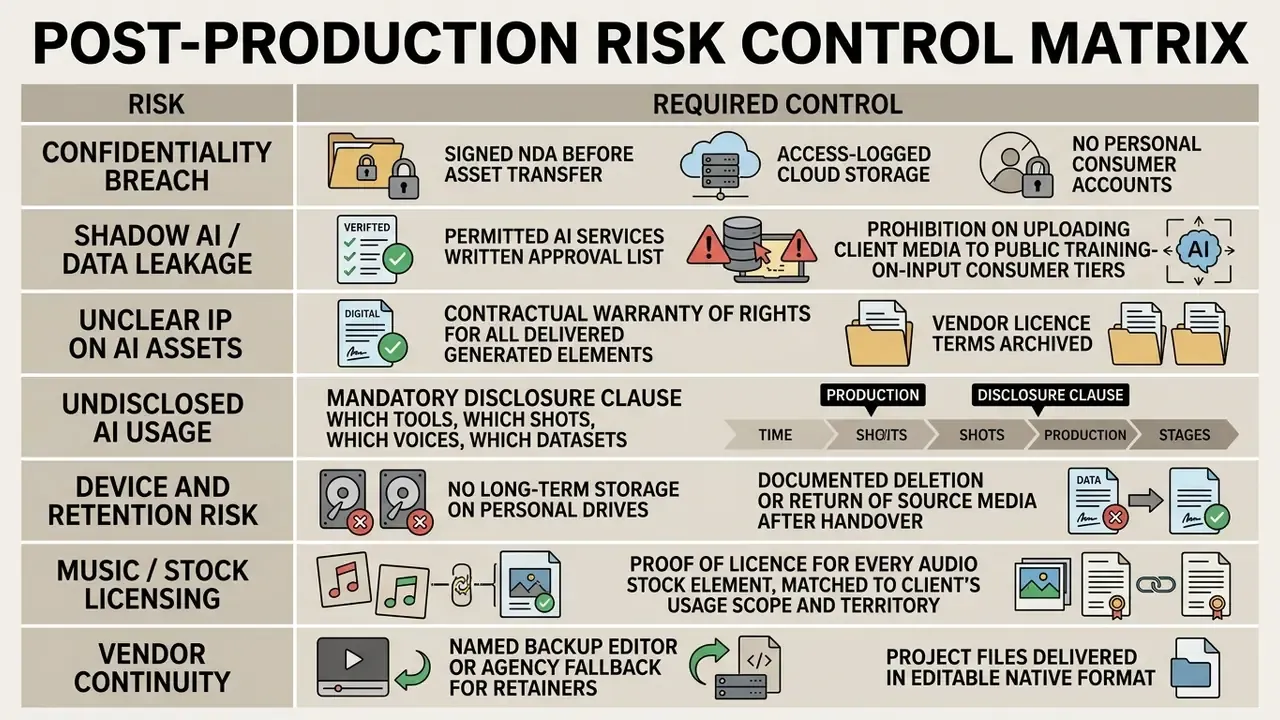
What remains unresolved, and worth saying plainly: vendor terms for generative video change faster than most contract templates, and courts have not settled several of the underlying IP questions. Treat today's clauses as a moving control, reviewed each renewal, not a solved problem.
For freelancers, none of this is pure friction. It is a pricing lever. Documented compliance is the most common reason non-US editors successfully bill at tier-1 US parity rates.



FAQ: Freelance Video Editor Rates, Tools and Contracts
How can a freelance video editor land their first client with no experience?
Build three or four hypothetical case studies by editing publicly available raw footage from sources such as Pexels or Coverr, or by re-cutting existing long-form videos into dynamic vertical clips. Package the samples into a 60-second showreel, then send personalized outreach to growing creators, local wedding videographers and small businesses, offering a low-risk trial project. Volunteer and event overflow work builds portfolio proof fastest, mostly because the deliverables are standardized.
What software is required for professional freelance video editing?
Adobe Premiere Pro and DaVinci Resolve carry most commercial work. Premiere Pro remains the standard for general commercial editing and social production, while Resolve is preferred for grading and finishing. Adding After Effects for motion graphics widens your billable range, and Resolve's free tier lets beginners assemble a full pipeline before paying for licences.
Should freelance video editors charge hourly or fixed project rates?
Use hourly rates when scope is ambiguous or the client tends toward open-ended revisions. Shift to fixed project rates once the brief, footage volume and deliverable specs are locked. Fixed pricing rewards experienced editors who work efficiently with templates and AI tools. For repeatable corporate or educational output, per-finished-minute pricing is usually the cleanest structure for both sides.
How much can I charge if I do not live in the US or Western Europe?
Offshore editors typically start at $9 to $35 per hour on high-supply marketplaces, but that band reflects platform competition rather than a skill ceiling. Editors working directly with tier-1 corporate clients, with fluent written English, asynchronous updates, security compliance and documented references, regularly bill $50 to $90 per hour on comparable work. The channel you sell through moves your rate far more than your postcode does.
Who owns the copyright to the final video, and when does it transfer?
Ownership terms must be stated in the contract. The standard commercial arrangement assigns exclusive rights to the client on receipt of full and final payment, documented by an acceptance act or written sign-off specifying transferred rights, territories, channels and duration. Until payment clears, the editor retains rights to the edit and delivers only watermarked or proxy versions. Licensed third-party elements, meaning music, stock, fonts and AI-generated assets, transfer only within the scope of their own licences, which belong in the handover documentation.
What should a client ask before hiring a freelance video editor?
Ask for the specific role performed on each portfolio piece, the native project file format, the revision policy, the review platform used, NDA willingness, proof of software licensing, and a written statement of which AI tools will touch the footage. Those seven questions filter out most operational and compliance risk before signature.
How do retainers get priced without losing money on overage?
Start from a measured hours-per-deliverable baseline over at least four completed projects, then reserve capacity slightly below your true throughput. State included hours, the roll-over policy, and an overage rate at or above your standard hourly figure. Review the baseline quarterly. Retainers fail when the editor guesses the effort once and never remeasures.
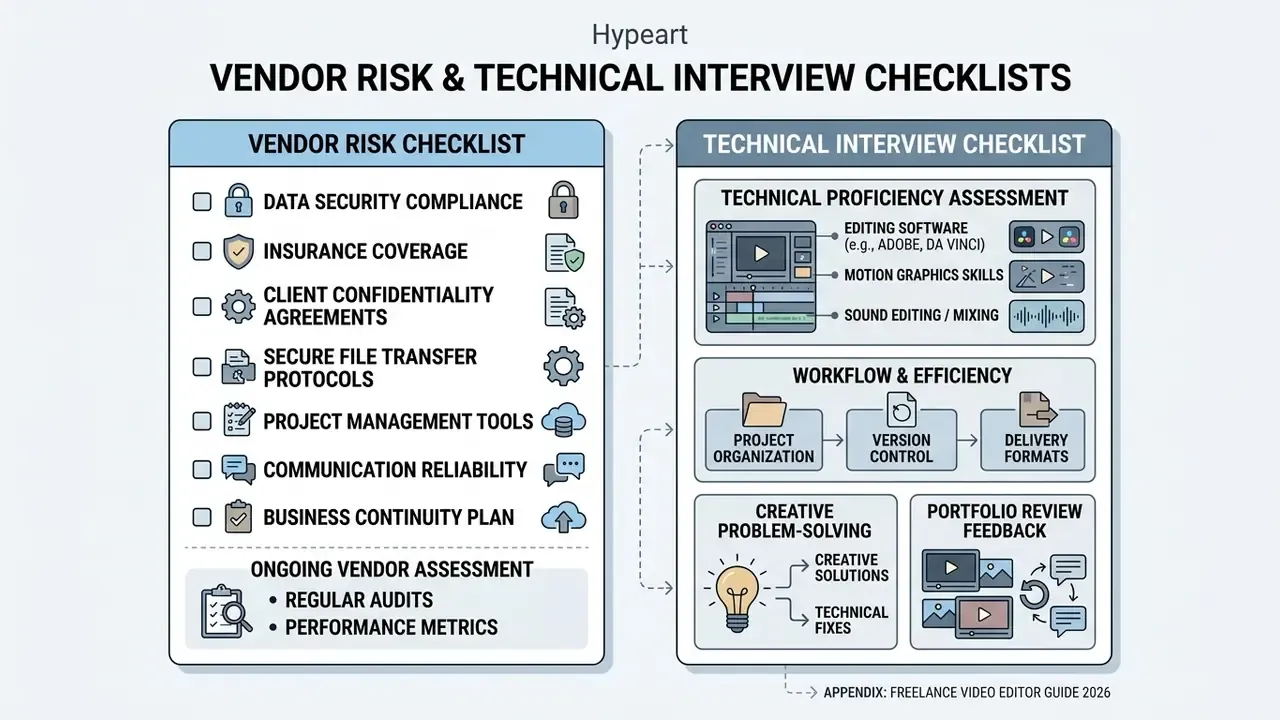
Appendix: Vendor Risk and Technical Interview Checklists
B. Technical interview questions (client-side, 15 minutes)
1. Walk me through your ingest and proxy workflow for 5 hours of multi-cam 4K footage.
2. How do you match exposure and skin tones across two cameras with different profiles?
3. What is your process for repairing dialogue recorded in a reflective room?
4. Which parts of your last project were AI-assisted, and what did you verify manually?
5. How do you version and deliver: native project files, codecs, naming conventions?
6. What is included in your standard two revision rounds, and what triggers extra billing?
7. How do you handle a client who requests a structural rewrite after the final round?
8. Where does client footage physically live during the project, and for how long after?
Checklist0 / 9
C. Rate-setting worksheet (editor-side)
Target annual income + overhead (software, hardware, storage, insurance, taxes)
  divided by realistic billable hours (typically 55-65% of working hours)
  = minimum viable hourly floor
Then apply modifiers: seniority tier, geography-of-client, footage ratio, motion complexity,
rights scope, rush surcharge (50-100%), compliance overhead.
Quote the deliverable, not the hour. But always know the hour underneath it.
Continue in the AI Media Glossary for definitions, tool comparisons and workflow references linked throughout this guide.
Last updated: 2026. Editorial review: Marcus Hale, author. Market figures are sourced from the reports cited inline and reflect advertised or surveyed ranges, not audited transaction data.