Definition first. An ai facebook ad generator is a software system that uses artificial intelligence, typically large language models for copy and diffusion or video-diffusion models for visuals, to automate the creation of Meta-ready advertising assets. It ingests structured product briefs, landing page URLs, product feeds or uploaded visuals, then returns primary text, headlines, calls to action, static images and short-form video ads formatted for Meta placements.
Executive Summary: The Verdict in 60 Seconds
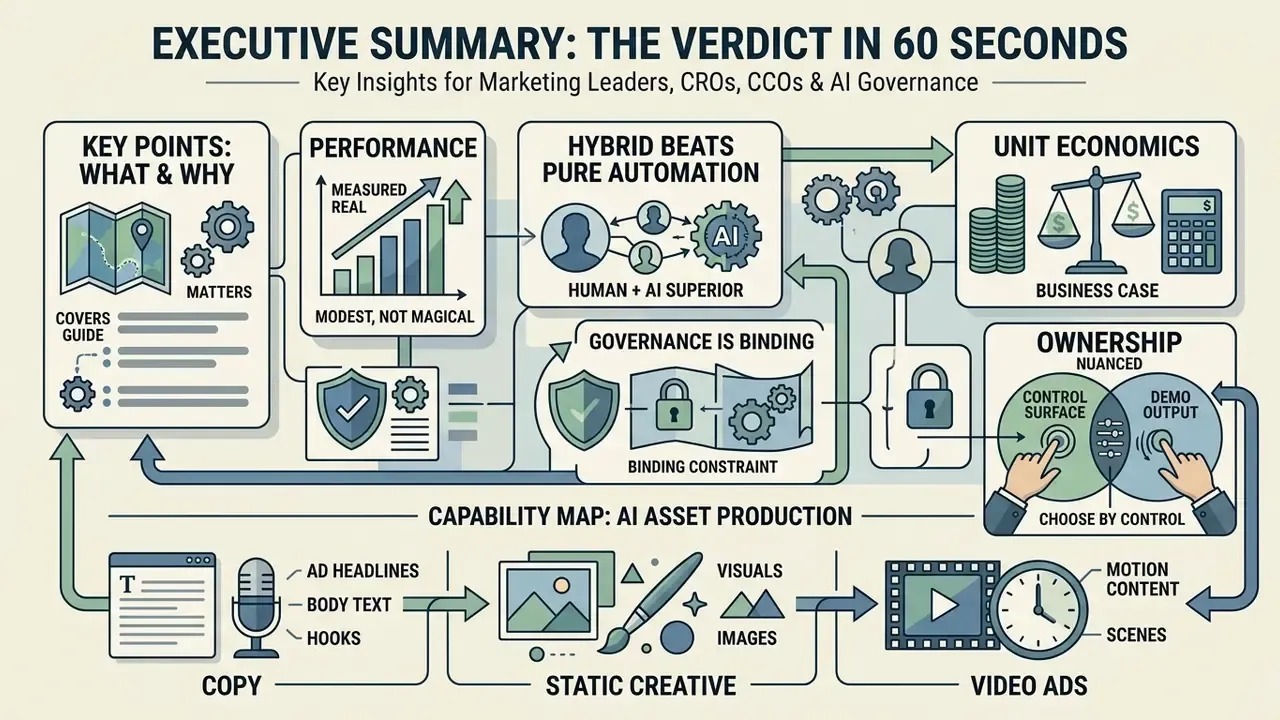
For marketing leaders, CROs, CCOs and AI governance owners who want the conclusion before the detail:
- Measured performance is real but modest, not magical. In Meta's own 10-week randomized controlled trial across 34,849 advertisers, AI text suggestions produced a 6.7% CTR lift and 18.5% more text variations. That is a useful gain, not a step-change in ROAS.
- Hybrid beats pure automation. Human-edited AI copy delivered the highest measured CTR uplift, +26% against fully manual creative. Unedited model output ranked lower, at +19%.
- Unit economics carry the business case. Synthetic image generation costs roughly $0.04 per asset at scale, against multi-hundred-dollar studio or agency production cycles.
- Governance is the binding constraint. Meta applies an "AI info" label to detected generative edits, mandates disclosure for social, electoral and political ads, and enforces account-level penalties for repeat violations. Regulated sectors add FTC and UDAAP-style substantiation duties on top of that.
- Ownership is nuanced. Purely synthetic output is generally not copyrightable in the United States, yet it remains commercially usable under most vendor terms. That distinction matters for brand-asset defensibility, not for permission to run the ad.
- Choose tools by control surface, not by demo output. Brand-kit locking, Meta Marketing API depth, catalog and feed synchronization, and exportable audit trails separate enterprise-grade platforms from consumer toys.
What This Guide Covers, and Why Each Part Matters
- Capability map: what asset classes a facebook ad ai generator actually produces, so scope is set before procurement.
- Workflow: the step sequence from competitor evidence to live ad set, including the human review gate.
- Tool selection: the feature dimensions that survive a risk review, not the ones that win demos.
- Free tiers and verified pricing: where trial limits stop and paid economics begin.
- Business use cases: e-commerce, SaaS, services, and tightly regulated financial marketing.
- Meta policy preparation: disclosure, labeling, restricted categories, audit evidence.
- Testing discipline: what to split-test first, and how to scale winners without resetting delivery.
- Limits and open questions: where the evidence is still thin.
What Is an AI Facebook Ad Generator and What Ads Does It Create?
An ai ad generator for facebook converts raw product information into complete, formatted Meta advertising assets across Feed, Stories, Reels and Collection placements. It handles brief intake, extracts value propositions, drafts ad copy, and formats media to platform specification. The repetitive part of campaign preparation disappears. The accountable part does not.
Modern facebook ads production leans on automated workflows to remove manual asset assembly. According to Meta's developer documentation, native generative features in the Marketing API support primary text generation, image expansion and background replacement directly inside ad set configuration (Meta Marketing API Documentation, 2026). Third-party ai facebook ad generator tools extend that base by returning multi-format creative packages from a single input: static banners, multi-card carousels, UGC-style avatar videos, and shooting scripts, generated from a brief, a product URL, or a synced e-commerce catalog.
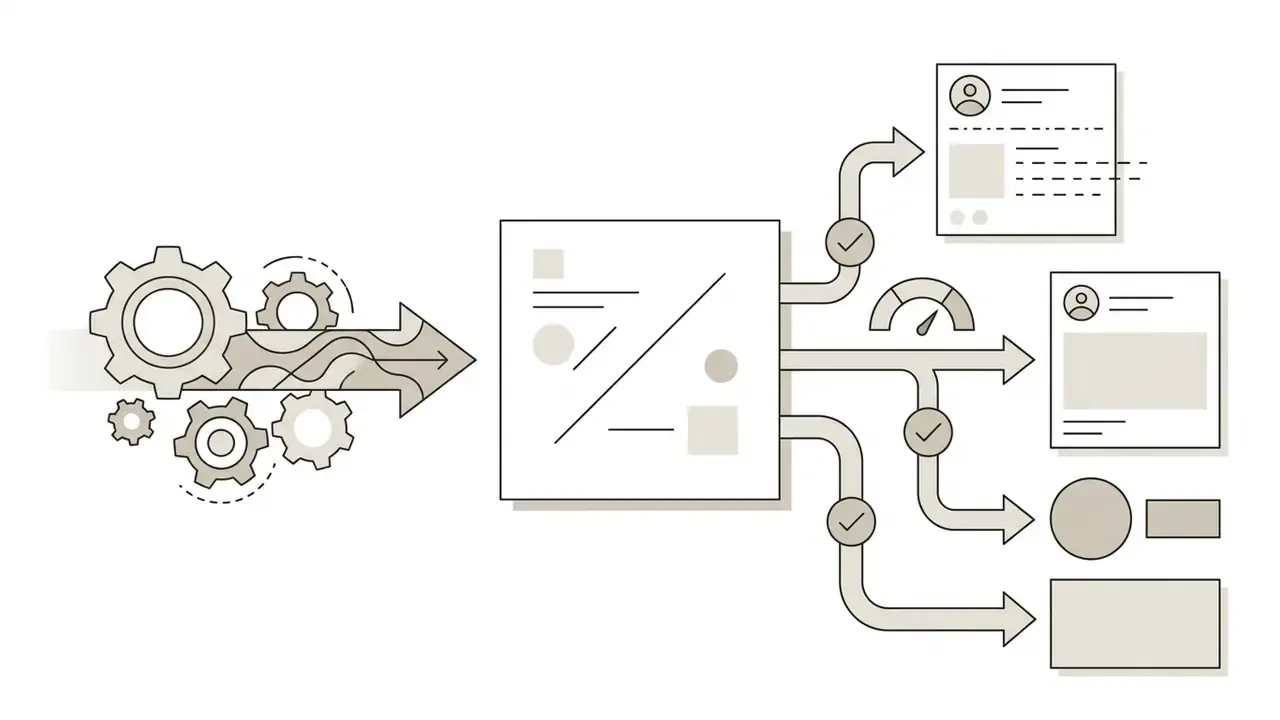
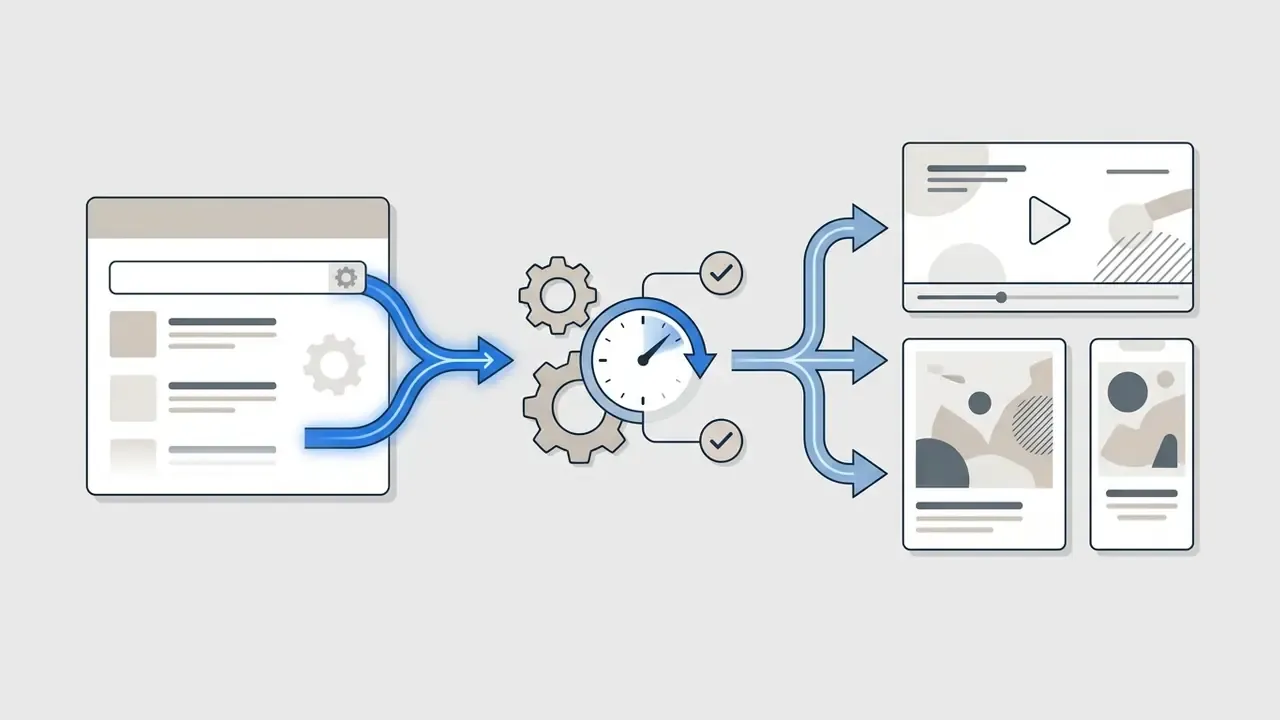
The pipeline moves through four discrete stages: structured input ingestion, model-level synthesis of copy and visuals, human review of the generated package, and export or API-level publication into Meta Ads Manager.
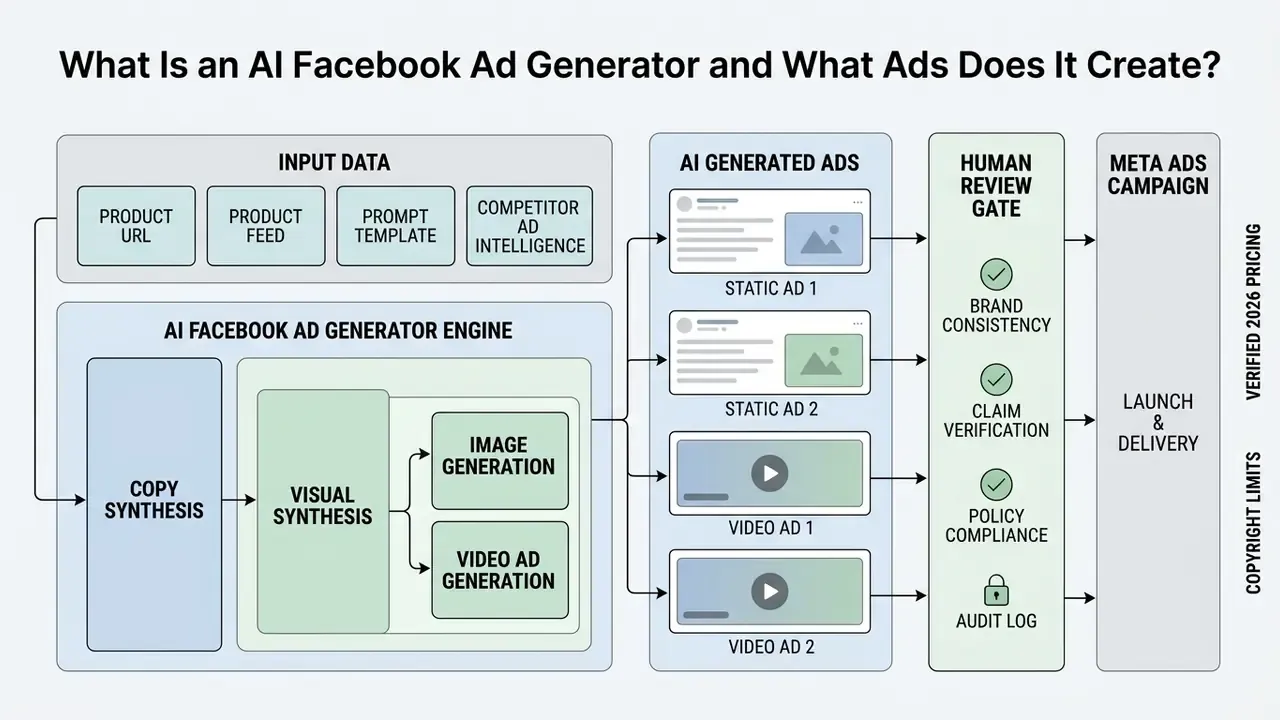
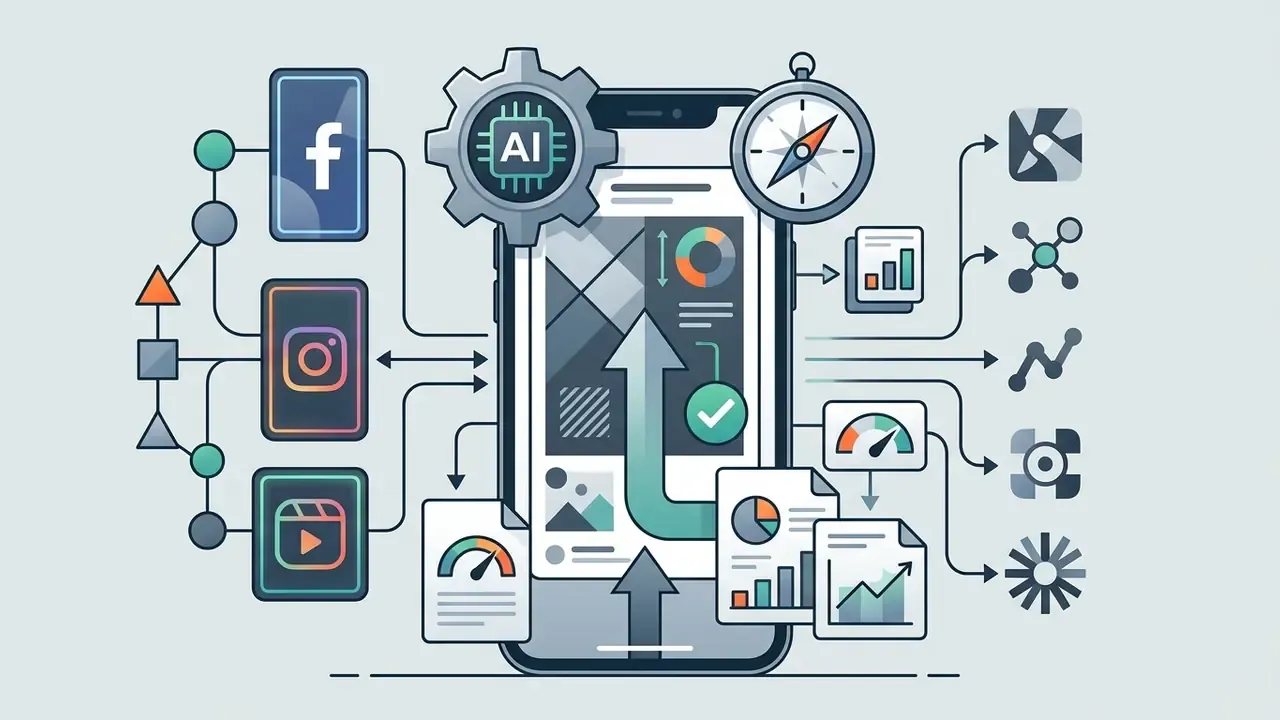
Media note: schematic to be rendered as an accessible inline diagram with text labels available in the DOM and alt text "ai facebook ad generator process".
Asset Types a Facebook AI Ad Generator Produces
| Asset Class | Typical Output | Primary Meta Placement |
|---|---|---|
| Primary text | 3 to 10 variations per angle | Feed, Marketplace, Audience Network |
| Headlines and descriptions | 5 to 20 short-form variants | Feed, Right Column |
| Single-image creative | 1:1 and 4:5 static banners | Facebook and Instagram Feed |
| Carousel | 3 to 10 dynamically populated cards | Feed, Catalog / Advantage+ Shopping |
| Short-form video | 6 to 30 second multi-clip renders | Reels, Stories, In-Stream |
| UGC avatar video | Lip-synced spokesperson reads | Reels, Stories, Explore |
| Localized variants | Copy plus voiceover in 20+ languages | All placements, per-market ad sets |
AI Facebook Ad Copy: Headlines, Primary Text and CTAs
An ai facebook ad copy generator uses structured prompts and tuned language models to produce headlines, body copy and action-oriented CTAs aligned to a campaign objective. The system weighs audience attributes, promotional angle and value proposition, then returns distinct variations for A/B testing.
Here is the part most decks skip. Controlled field testing of dynamic product ads on Facebook suggests the editing layer, not the generation layer, drives most of the measurable gain:
At platform scale, Meta deployed its proprietary AdLlama model inside Meta Ads Manager to power the Text Generation feature. In a 10-week randomized controlled trial covering 34,849 advertisers, businesses using AI text suggestions recorded a 6.7% increase in click-through rate against the control group.
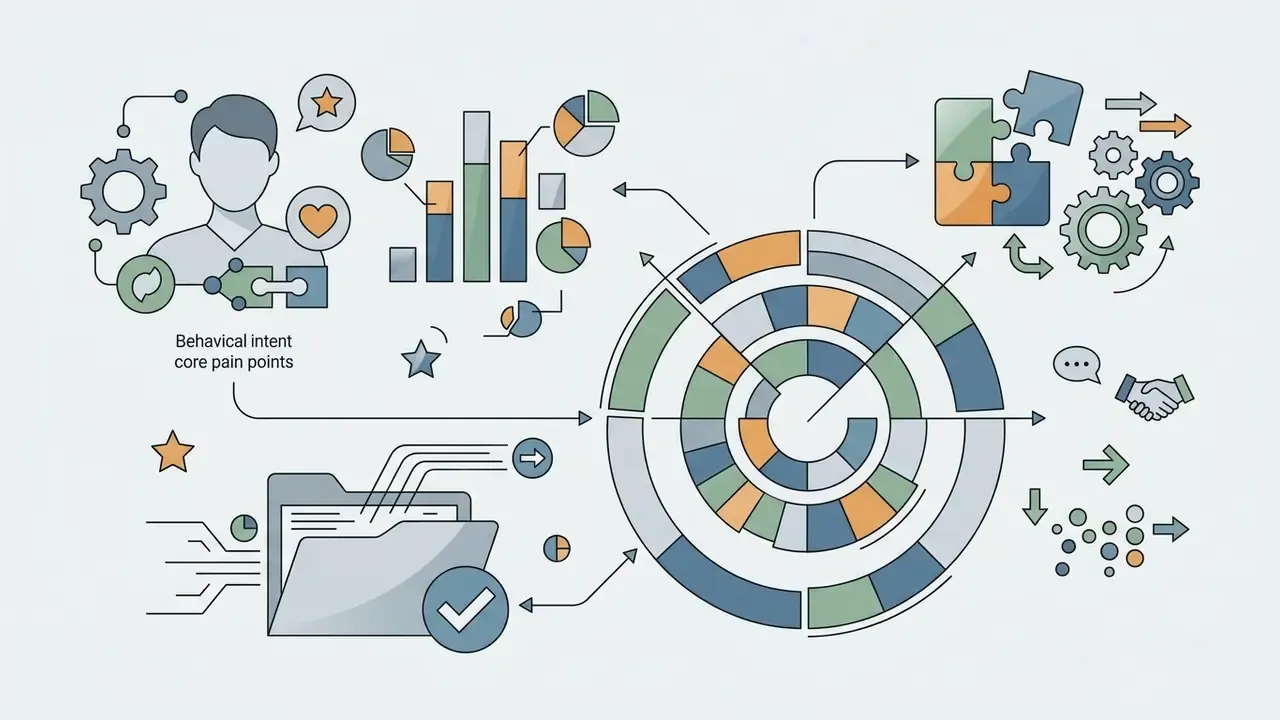
When drafting facebook ad copy, structure the prompt around four variables:

Ready-to-Use Master Prompt Templates for Meta Ads
Abstract prompts underperform explicit role-based instructions. The templates below encode role, framework, audience and constraint in one request. That structure tends to return launch-ready first drafts rather than filler.
1. E-commerce retargeting (abandoned cart):
"Act as a direct-response media buyer. Generate 3 Meta Primary Text options
and 2 Headlines for [PRODUCT NAME]. Target Audience: users who added the
product to cart in the last 7 days. Core pain point: high initial price.
Angle: offer a 15% discount with code [CODE]. Tone: urgent, friendly.
Constraints: max 125 characters primary text, no absolute claims.
CTA: Shop Now."
2. SaaS and lead generation (cold audience):
"Act as a B2B SaaS copywriter. Create 3 Meta ad text variations using the
Problem-Agitate-Solve (PAS) framework for [SOFTWARE NAME]. USP: [KEY
FEATURE]. Target audience: [JOB TITLE] at [COMPANY SIZE]. Goal: free-trial
sign-ups. Include one relevant emoji per variant. CTA: Learn More."
3. Local service business (offer-led):
"Act as a performance marketer for a local [BUSINESS TYPE]. Write 3 Facebook
ad variants promoting [OFFER] for residents within 10 miles of [CITY].
Include social proof, a scarcity element, and a booking CTA. Avoid superlatives
and unverifiable guarantees. CTA: Book Now."
4. Mobile app install (awareness stage):
"Act as a mobile growth marketer. Generate 3 awareness-stage Meta ad copy
variants for [APP NAME], an app that helps [AUDIENCE] achieve [OUTCOME].
Explicitly reference the install action. Provide one short hook (under 40
characters) per variant for the video overlay. CTA: Download Now."
5. Product launch (new SKU drop):
"Act as a launch strategist. Produce 3 Meta primary texts and 3 headlines
announcing [PRODUCT] launching on [DATE]. Emphasize [DIFFERENTIATOR] against
the category norm. Include an early-access framing. Tone: confident, concrete,
no hype adjectives. CTA: Get Offer."
6. Regulated financial product (constraint-first):
"Act as a compliance-aware performance marketer for a US financial product.
Write 2 Meta primary texts for [PRODUCT]. Prohibited terms: guaranteed,
risk-free, no-loss, instant approval. Every benefit must be phrased as
conditional and reference [DISCLOSURE TEXT]. No projected returns. Do not
imply advisory status. CTA: Learn More."
That last template is the one governance teams should keep. Constraints belong inside the prompt, not in a red-pen pass afterwards.
For teams analyzing dedicated text generation architectures, our guide on the ai notes generator offers additional context on structured language workflows.
Static Creatives and Video Ads for Facebook
An ai facebook ad creator builds visual assets by combining text prompts, uploaded product images or a target URL into single-image banners, carousels and video ads. Visual engines apply background generation, subject extraction and aspect-ratio adaptation across 1:1 square, 4:5 vertical feed and 9:16 full-screen Stories and Reels formats. Teams comparing underlying engines can review our benchmark of AI image generators for commercial creative pipelines.
Large-scale quasi-experimental research covering more than 16 billion ad impressions found AI-generated visuals outperforming human-designed display creative on click-through rate:
One caveat from the same work deserves emphasis: effectiveness depended heavily on perceived artificiality. Visuals that avoided hyper-saturated color and surreal artifacts performed materially better than obvious synthetic renders. Uncanny sells worse.
For short-form video, tools assemble product images, landing page text and automated voiceover into multi-clip assets. In an empirical trial covering 21,000 consumers, personalized AI video outperformed personalized static imagery:
Generative Video Engines and Faceless UGC Avatar Synthesis
Video generation has moved past slideshow animation. Commercial platforms now orchestrate specialized generative architectures to render short-form assets without cameras, studios or paid creators:
- Current video engines enterprise stacks route generation through foundational video models, including Google Veo 3.1, Google Gemini, Minimax, Kling 3, Nano Banana Pro and ByteDance Seedance 2.0. These handle physical motion, camera movement, object permanence and fluid transitions that diffusion-only pipelines rendered poorly.
- Model orchestration for advertising rather than exposing one model, leading platforms layer ad-tuned models on top of these engines, so hooks, pacing and product framing optimize for conversion instead of aesthetic novelty.
- Faceless UGC and avatar synthesis libraries of 150+ photorealistic avatars across age, ethnicity, setting and delivery style provide lip-sync with native voice cadence, breath and pacing in 20+ languages. Brands get UGC-style Reel ads without appearing on camera, at a fraction of creator-shoot cost.
- Audience-matched casting advanced tools select avatar profiles by which demographic and delivery style historically performs in the advertiser's category. Casting becomes a data decision rather than a taste decision.
Teams building repeatable pipelines can review our comparison of AI video generators and, for developer-level work, the Google Veo API Guide. To inspect comparative evaluations across media formats, browse the AI Media Comparison directory.
How to Create a Facebook Ad With AI: From Idea to Launch
Creating a Meta campaign with a facebook ad generator ai follows a repeatable sequence: intelligence gathering, objective definition, brand asset assembly, generation, human review, then export into Meta Ads Manager.
A standardized workflow protects creative quality and reduces policy failure. In a controlled field study of dynamic product ads, teams that generated concepts with AI and then edited the output achieved 26% higher CTR than fully manual creative production (Pencil Creative Study, 2023. https://www.pencil.li/blog/ai-vs-human-copywriting).
Step 0: Competitor Ad Intelligence Before Generation
The highest-leverage step happens before a single asset exists. Advanced generators integrate with the Meta Ad Library to analyze top-performing competitor creative inside your category, so generation starts from evidence rather than a blank prompt.
- Creative angle extractionthe system parses competitor primary text at scale to identify dominant hooks, price-led, social-proof-led, problem-agitate-solve or authority-led, and how often each recurs among long-running ads.
- Format benchmarkingit determines whether your category responds to short UGC video intros, static social-proof frames or multi-card catalog carousels, and which aspect ratios dominate active spend.
- Longevity signalsads running continuously for weeks act as proxies for profitability. Advertisers rarely sustain spend on losing creative.
- Iterative differentiationthe generator then drafts counter-messaging that foregrounds your USP against the weakest recurring claim in the set, instead of reproducing the category average.
- Spend allocation guidanceafter launch, side-by-side tracking against competitor formats indicates which angle deserves the next incremental dollar.
Governance note: competitor intelligence should rely on publicly available ad-library data. Scraping restricted surfaces or replicating protected brand assets creates legal exposure that no CTR gain repays.
Required Input Data Before Ad Generation
To return accurate, high-converting variants, an ai facebook ad maker needs precise context before the model runs. Vague inputs push the system toward generic boilerplate, and boilerplate underperforms every time.
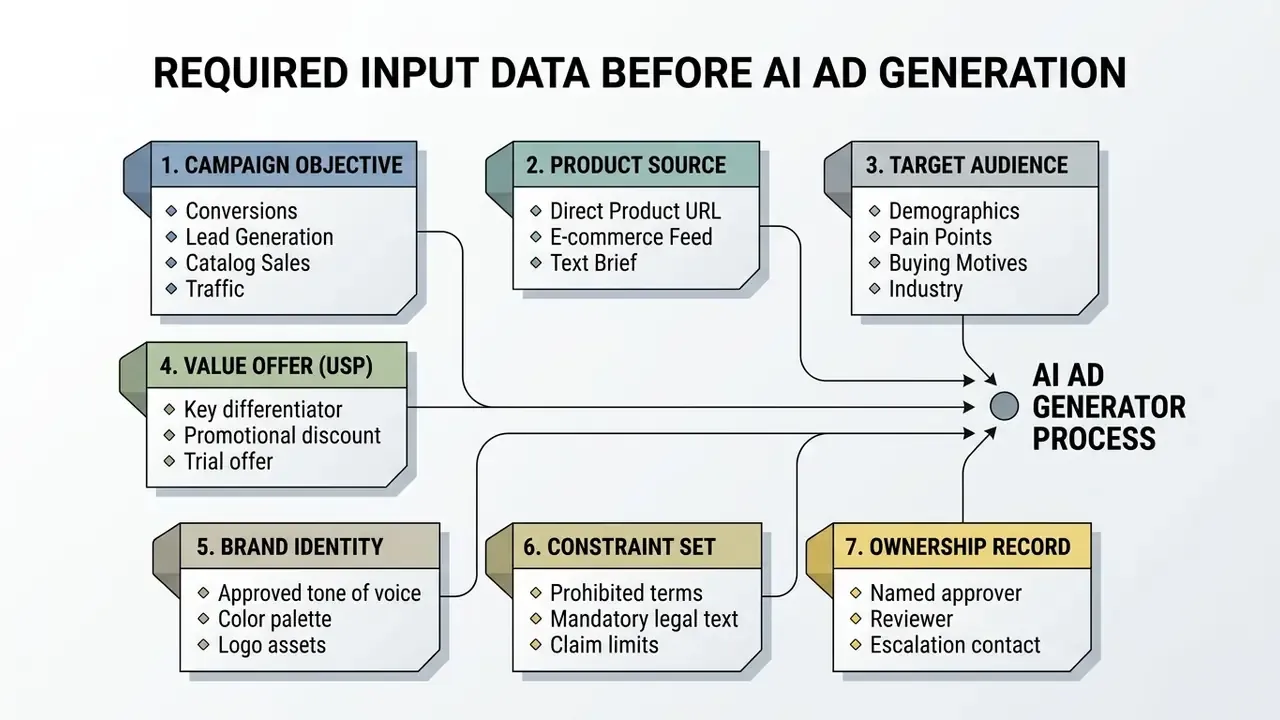
Verified landing page content is the input most teams underuse. Feeding it in allows retrieval-augmented generation, where the model grounds copy in the destination page rather than inventing benefits. Message consistency through the funnel improves, and so does cost:
How to Edit AI-Generated Ads Before Publication
Human-in-the-loop validation is mandatory before synthetic content reaches a live ad set. Unedited ai generated creative carries three recurring risks: factual error, brand drift, and regulatory exposure.
A pattern worth naming. Compliance teams in regulated marketing environments report automated copy generators producing absolute performance language, for example guaranteed-return phrasing for a wealth-management product, because the model optimizes for persuasive fluency rather than substantiation. In a well-governed workflow, a pre-launch compliance gate flags the phrasing, a reviewer rewrites the claim into approved substantiated language, and only the corrected variant reaches delivery. Note where the control sits: in the gate, not in the model's restraint.
Six-Point Manual Review Methodology
Pre-Launch Preparation Checklist
- Establish objectives and parametersdefine goals, audience segments, format requirements (Feed versus Stories and Reels), and budget limits.
- Generate initial variantsfeed briefs or URLs into the facebook ai ad generator to produce primary text options, headlines and visual assets.
- Run brand and compliance reviewverify factual accuracy, brand voice alignment and regulatory adherence.
- Develop A/B variationsselect approved core concepts, then request secondary variants covering alternate headlines, visual hooks and CTA buttons.
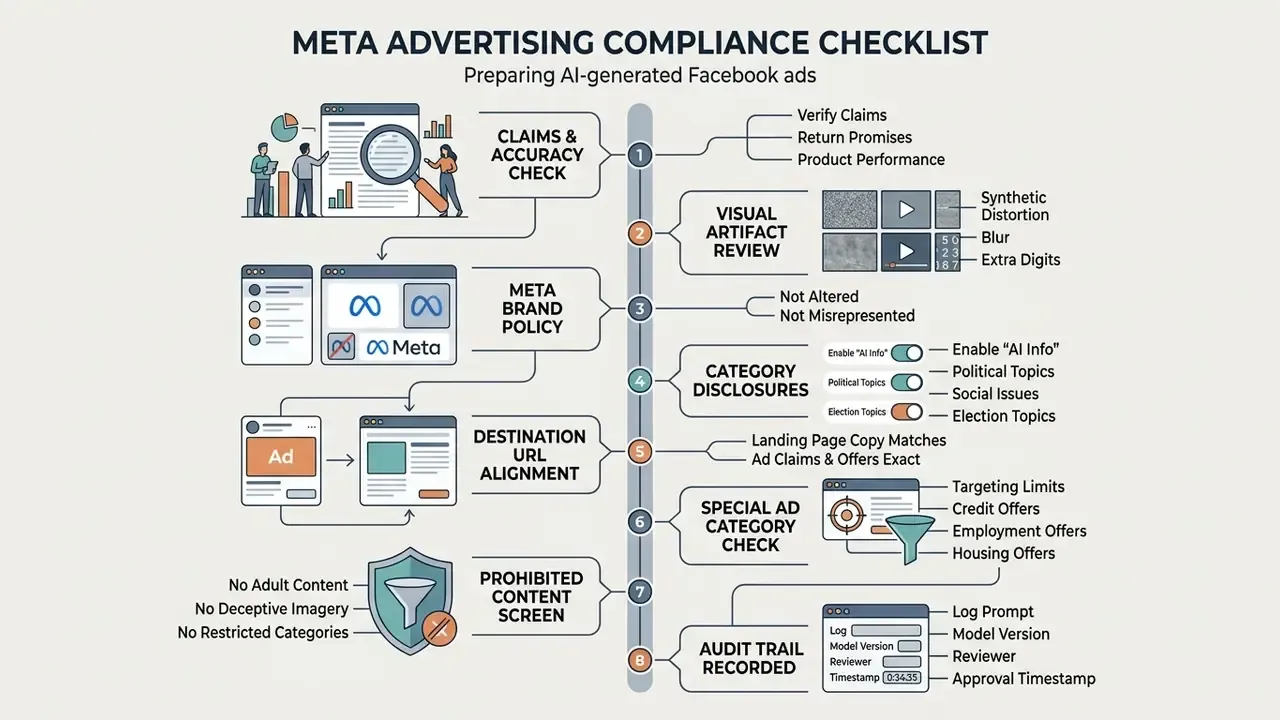
- Maintain an audit traillog the prompt, model version, reviewer identity and approval timestamp for every published asset.
- Finalize export and launchcomplete human sign-off, verify destination URLs, and transfer assets to Meta Ads Manager via API or manual export.
Teams sourcing audio or voice assets for video workflows can examine our guide to the ai voice generator.
How to Choose an AI Facebook Ad Generator Tool
Choosing an ai facebook ad generator tool means evaluating copywriting depth, visual flexibility, video automation, template libraries, brand governance controls and native Meta API integration. Demo output tells you almost nothing about the second of those. Control surface does.
Specialization varies widely. Native features in Meta Ads Manager cover text suggestions and background enhancement. Specialized third-party platforms add cross-channel asset generation, batch production and centralized brand kits. Tool choice also interacts with team seniority, which most procurement processes ignore:
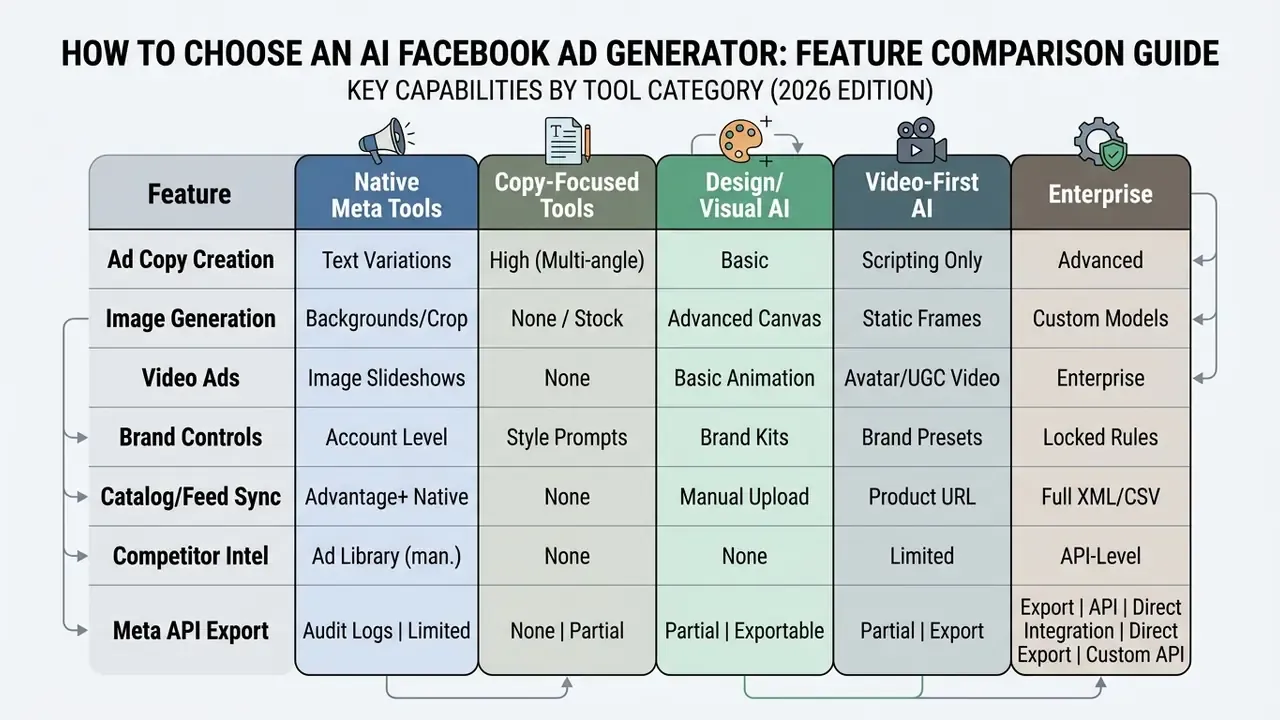
Mapping categories to real platforms. Native Meta tools correspond to Advantage+ Creative and Marketing API generative features. Copy-focused tools cover text-only assistants and ad-copy assistants. Design and visual AI includes template-and-canvas suites of the Canva or Adobe Express class. Video-first AI covers avatar and UGC generators built around a product URL. Enterprise tiers are the platforms offering locked brand rules, workspace separation, approval flows and Marketing API automation. That last tier is the only one that survives a serious review in regulated advertising or multi-client agency work.
AI Ad Maker Features for Copy, Design and Video
An enterprise-ready ai facebook ads generator should combine generation and control in one workspace. The capabilities that matter:
Organizations investigating outpainting and canvas expansion can review our analysis of tools that ai expand image assets for vertical placements. For a wider view of licensing and rights-cleared workflows, browse the hub covering commercial-use assessments.
Support for Facebook, Instagram and Other Social Platforms
Cross-platform format adaptation is a baseline requirement now. Meta runs Facebook and Instagram inventory through the same Ads Manager, so creative built for Feed must transfer cleanly to Stories, Reels and Explore.
Core aspect ratios every facebook ad maker ai must support:
TikTok In-Feed placements are vertical-first, while Meta feeds remain 1:1 and 4:5 friendly. Practical reuse therefore means exporting multiple safe-zone-aware crops from one master creative, not redesigning per channel.
Teams evaluating broader design suite integration can review our assessment of the canva ai generator.

Free AI Facebook Ad Generator: What to Check in Free Plans and Tier Pricing
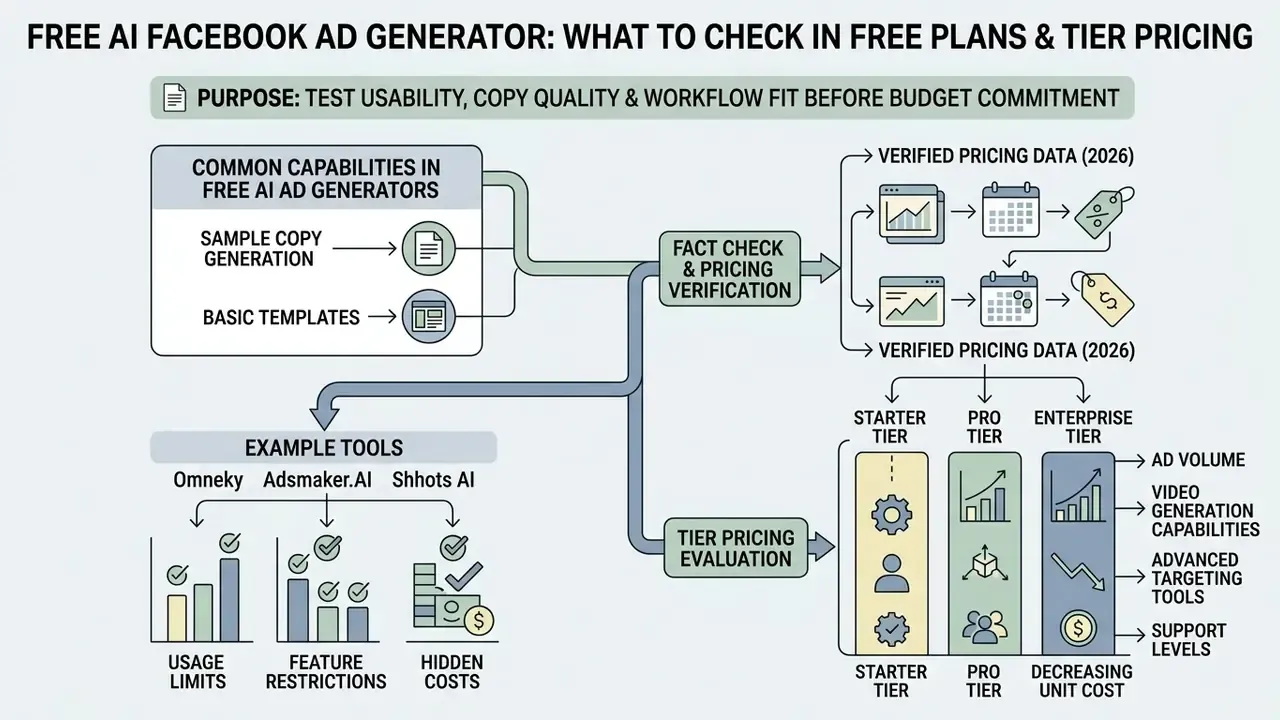
A free ai facebook ad generator is useful for exactly one job: testing usability, copy quality and workflow fit before you commit budget. Every free tier enforces caps somewhere, usually on generations, resolution or export rights.
Before scaling synthetic visuals, weigh the perception risk documented in consumer research:
A check of current commercial offerings shows how differently vendors price the same promise:
Fact check and pricing verification (verified pricing data, 2026):
Credits are the unit to interrogate. A "1,000 credit" plan means little until you know what one video render consumes.
Common Capabilities in Free AI Ad Generators
Free tiers from an ai facebook ad generator free service typically include:
Businesses looking for free visual editing options can compare our guide to free photo editor platforms or our benchmark of the best free ai video generator tools.
When Businesses Need Advanced Features for Campaigns
Upgrade triggers are usually operational, not aspirational. Volume outgrows the trial, and the workflow breaks. Common thresholds:
- Batch generationproducing dozens of variants at once for multivariate testing across ad sets. Batch video pipelines commonly accept up to 100 items per request.
- Watermark removal and high-resolution exportclean 1080p, sometimes 60 FPS, suitable for paid placement.
- Multilingual campaignslocalized copy and voiceover across dozens of languages through dedicated API pipelines.
- Brand kit lockingenforcing exact brand color, typography and logo placement automatically across every output.
- API-level deploymentpushing approved creative straight into campaign structures instead of exporting files by hand.
- Audit and access controlrole-based permissions and exportable logs, which is where most consumer tiers simply stop.
To review structured pricing options, teams can explore the hub for tier breakdowns.
Business Use Cases for AI Facebook Ads Creators
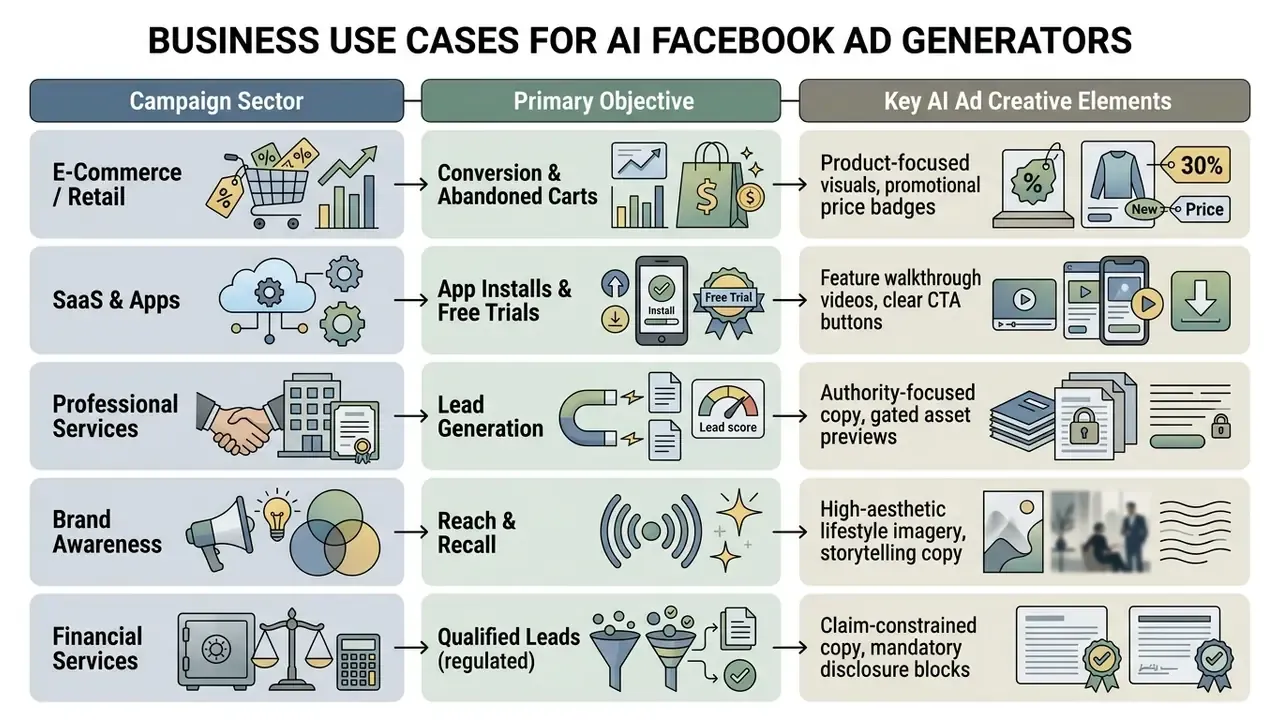
Marketing and commercial teams apply an ai facebook ads creator across very different risk profiles, from high-intent e-commerce promotion to broad awareness work and tightly regulated financial marketing.
Product Launch, Sales and eCommerce Advertising
E-commerce advertisers depend on a facebook ad creator ai for continuous creative refresh. In direct response, fatigue arrives fast: audiences see the same frame repeatedly, CTR decays, CPC climbs.
In Meta's documented case studies, footwear brand On ran automated Advantage+ shopping campaigns with dynamic creative:
Beauty retailer Living Proof used generative assets inside Advantage+ ad sets aimed at Gen Z audiences, reporting an 18% increase in total purchases and a 43% reduction in cost per purchase.
Recurring e-commerce applications:
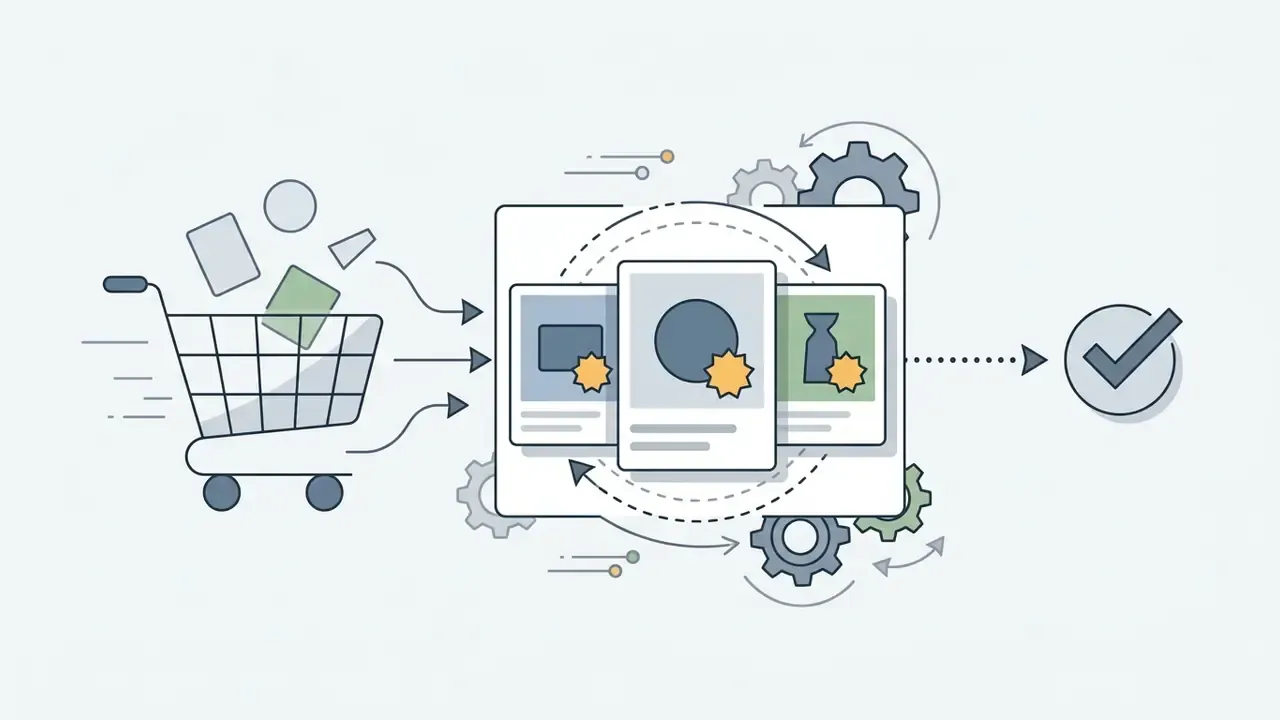

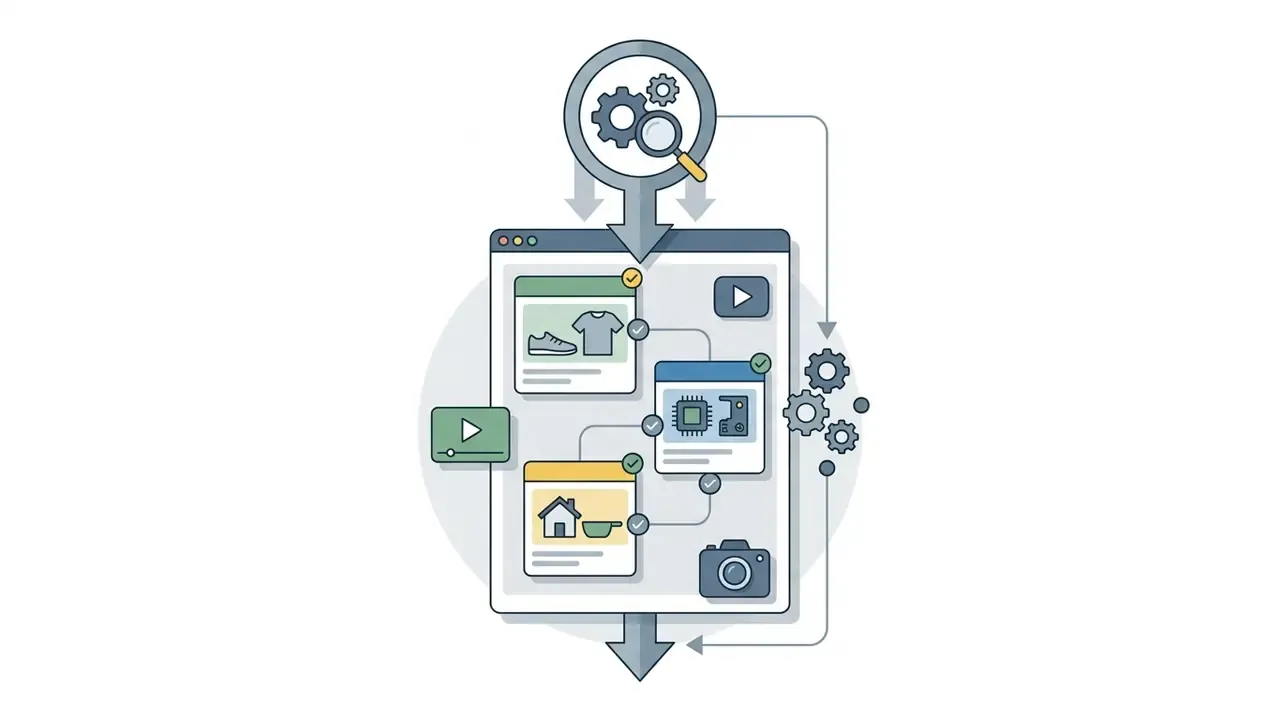
Native catalog and feed sync. Modern generators connect to Shopify, WooCommerce and custom XML or CSV feeds. Syncing live inventory lets the system pull titles, high-resolution images, price variants and stock status, then batch-build dynamic catalog carousels without manual upload. Two operational wins follow. Out-of-stock SKUs stop consuming spend automatically, and price or promotion changes propagate into creative without a designer touching a file.
Organizations evaluating portrait generation for team or executive promotion can consult our guide to the ai headshot generator.
Awareness and Promotion for New Services or Apps
For startups, mobile apps and professional services, an ai fb ad generator accelerates top-of-funnel testing. Early launches need many value propositions tested quickly, because nobody knows yet which message lands.
App creative should show functionality explicitly and carry a direct CTA such as "Download Now" or "Try Free", with branding visible early and throughout the asset. On synthetic spokespeople in service advertising, the evidence is more favorable than many brand teams expect:
Financial Services, FinTech and Other Regulated Sectors
Preparing AI-Generated Facebook Ads for Meta Policy Compliance
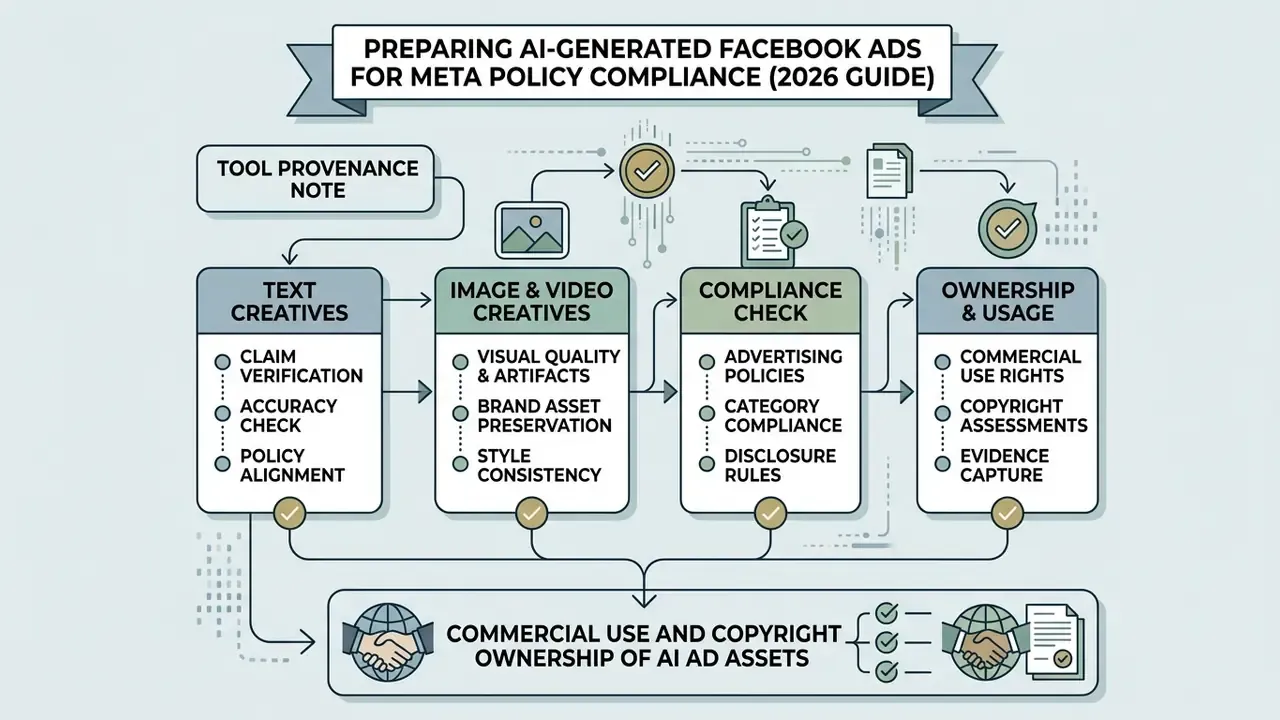
Publishing synthetic media on Meta requires compliance with Meta Advertising Standards. Missed disclosure or deceptive content can produce rejections, account warnings, and permanent disabling of ad accounts after repeated violations.
Disclosure is not only a policy question. It also moves response:
Meta requires advertisers to disclose digitally created or altered media when ads concern social issues, elections or politics (Meta Transparency Standards, 2025 to 2026). Immaterial edits such as cropping or sharpening are excluded. Consumer expectation, however, runs ahead of the minimum rule:
For general commercial products, Meta may apply an "AI info" tag automatically when platform detection identifies significant generative edits, or when synthetic media tools were used in asset creation.
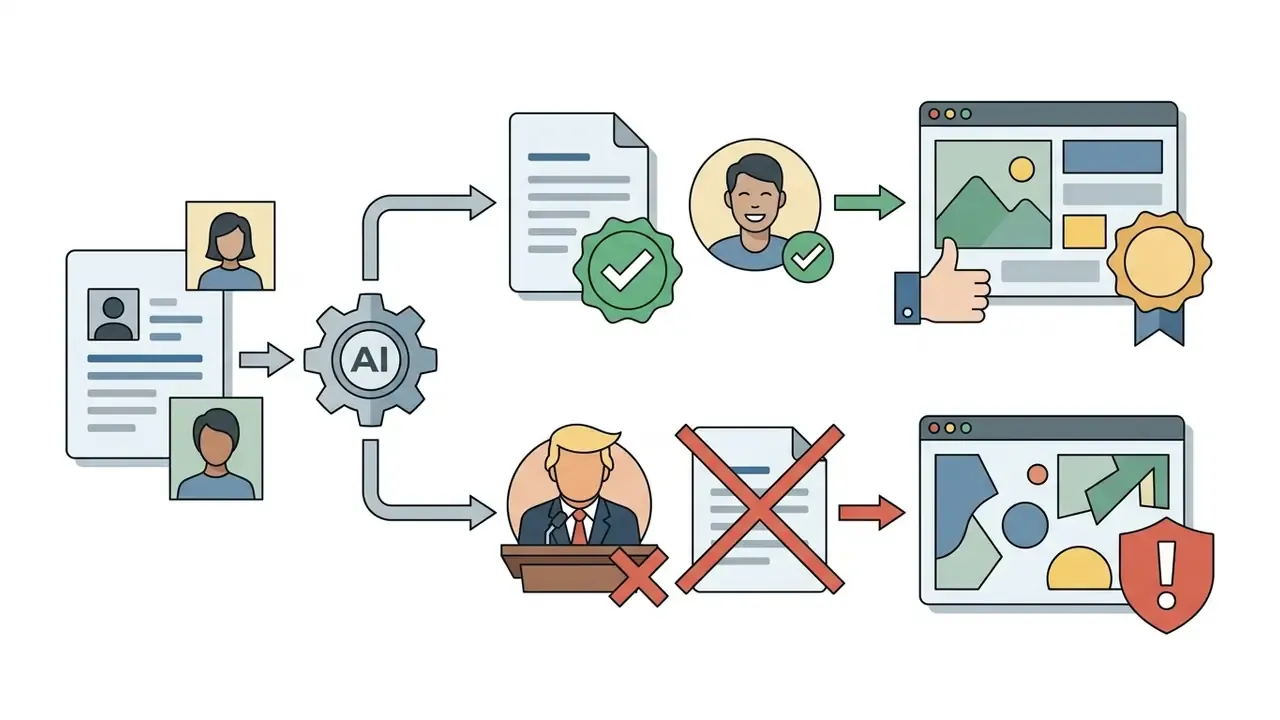
A note on tool provenance. Not every generative tool belongs anywhere near a Meta ad account. Meta prohibits adult and sexualized content outright, so output from categories such as ai nsfw video engines, ai nude art tools, an ai nude filter, any ai nude generator free service or an ai nude maker is categorically ineligible for advertising use and carries additional consent and likeness risk. Procurement teams should screen vendor capabilities, not just vendor marketing, and keep such tools off corporate accounts entirely.
Reviewing Text, Image and Video Creatives
To protect account health, run a formal pre-launch validation pass on every synthetic asset. Presented below as a standing alert block for creative reviewers.
PRE-LAUNCH AUDIT: META POLICY AND QUALITY CONTROL
- Text and claim verification review primary text and headlines for deceptive promises, absolute financial guarantees or misleading health claims. Confirm CTA clarity.
- Visual quality and artifact inspection inspect renders at 100% zoom. Remove artifacts, distorted in-image text, unrealistic body proportions and unnatural backgrounds. Where the provenance of a supplied asset is unclear, AI image detectors can support the check.
- Brand asset preservation confirm logo clear space and accurate color profiles, with no synthetic distortion, and confirm Meta brand marks are never modified or made dominant.
- Policy and category compliance check restrictions for housing, employment, credit and financial services. Verify the landing page matches ad messaging precisely.
- Evidence capture save the approved variant, the prompt, the reviewer name and the timestamp in a retrievable location.
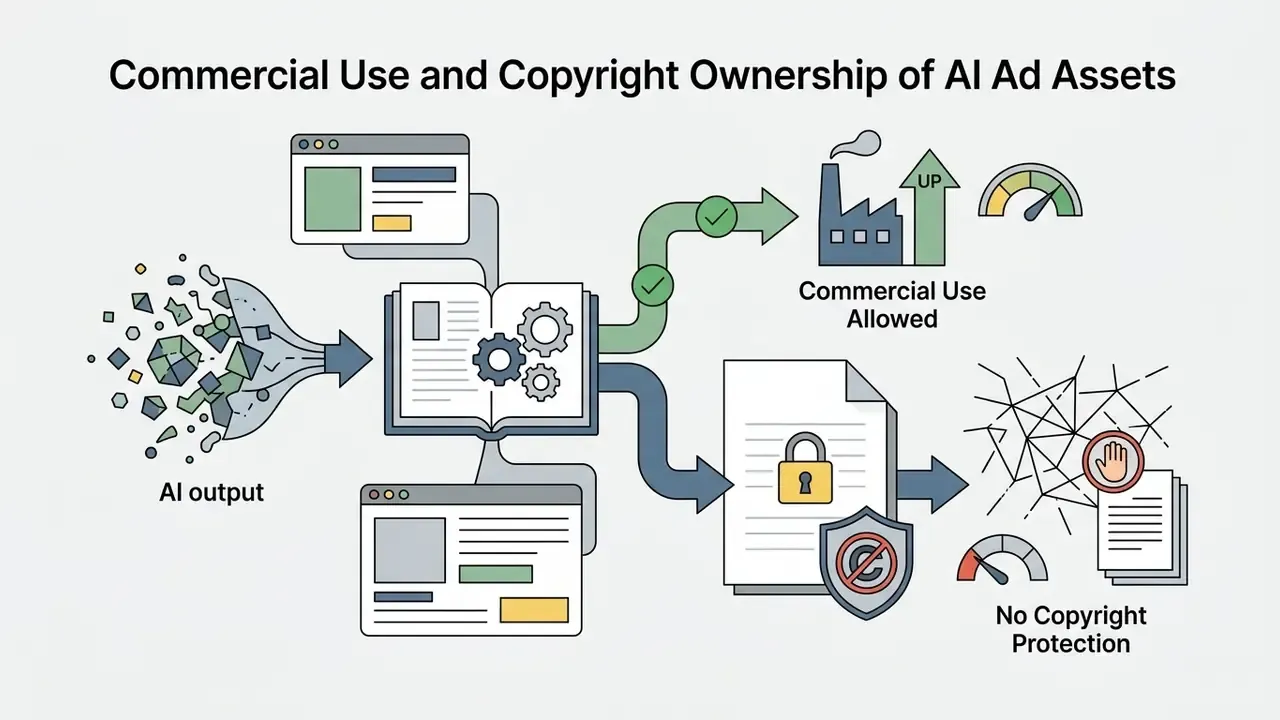
Commercial Use and Copyright Ownership of AI Ad Assets
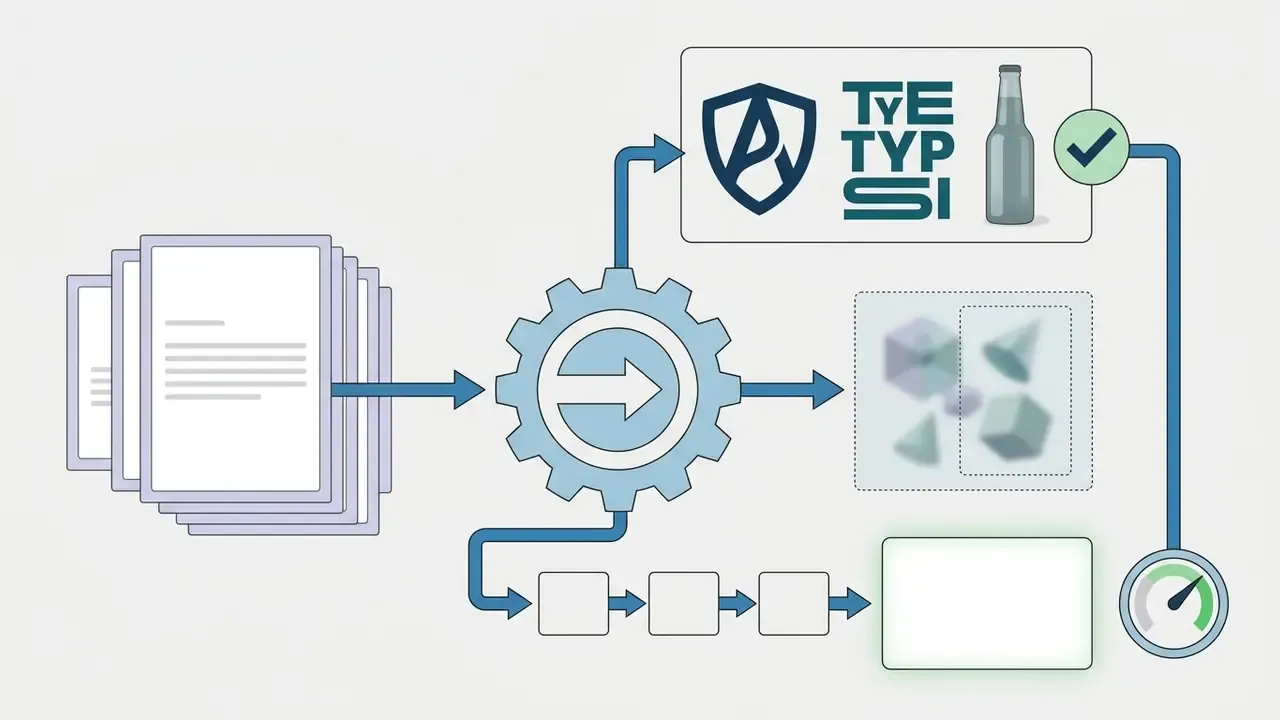
A recurring enterprise question: are AI-generated ad assets protected, and are they licensed for commercial advertising? Three issues need separating.
For organizations mapping wider regulatory exposure, our documentation on AI Litigation and related compliance risk provides useful legal context.

Testing Ad Variations and Improving Campaign Performance
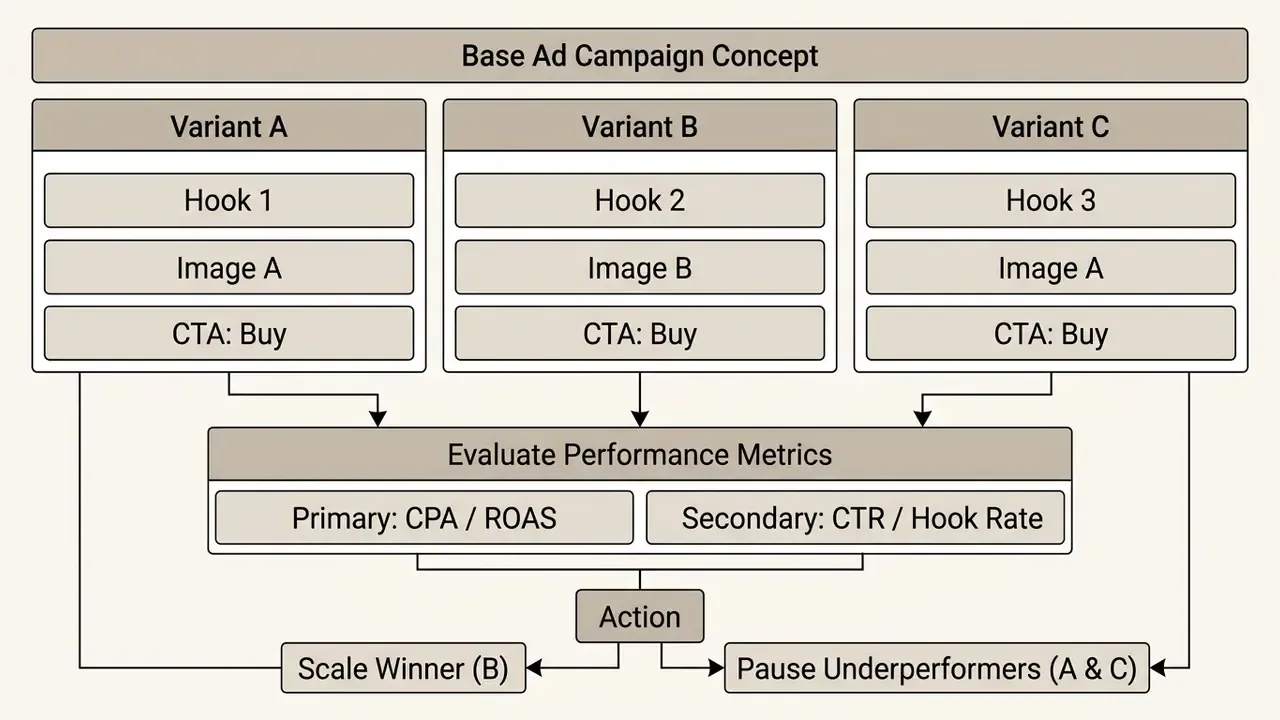
The strategic value of a facebook ads ai generator lies in volume: many variants, tested systematically, instead of one concept defended emotionally. Marketing teams deploy multi-variant ad sets to find winning combinations empirically.
Split-testing isolates one variable at a time, for example three primary text options against a constant video background, to measure true incremental lift. Volume itself appears to be part of the mechanism:
Priority Elements to Split-Test in Facebook Ads
Test in order of impact on attention and conversion, changing one variable per test against the same audience:
- Visual hook (first three seconds of video, or the static focal point)the single strongest factor in stopping the scroll. Compare product close-up, lifestyle context and UGC-style delivery.
- Formatstatic image versus video versus carousel, holding the value proposition constant.
- Headlinesbenefit-driven against discount-driven or curiosity-driven phrasing.
- Primary text framingshort direct copy against long-form storytelling or bulleted feature lists.
- Call-to-action buttons"Shop Now" against "Learn More" or "Get Offer", including placement variants inside video end-screens.
Marketers assessing broader visual generation options for creative testing can inspect our benchmark of the best ai art generator tools.
Acting on Test Results to Scale Winning AI Ads
Test results need decision rules, agreed before the test runs:
- Identify winners by primary KPI: judge on cost per acquisition or ROAS, not CTR alone. High CTR with zero conversions usually signals misleading copy, and that is a compliance signal as much as a performance one.
- Allow delivery stabilization: run tests for 7 to 14 days, targeting at least 50 conversion events per variant before calling a winner.
- Scale winners iteratively: move winning creative into scaling campaigns and raise budget gradually, roughly 15% to 20% per day, to avoid resetting the learning phase. Teams industrializing winning video concepts can review text-to-video AI tools for repeatable production.
- Feed performance data back into generation: use successful headlines and visual styles as prompt baselines for the next cycle. Persuasion structure matters when deciding which angle to replicate:
Automated Meta API Integration and Fast-Track Approval
Advanced tools use direct Meta Marketing API connections to close the loop between generation and spend management:
- Faster policy audits direct API submissions through official Meta partner integrations routinely receive automated review decisions within one to six hours, versus slower manual upload cycles.
- Budget reallocation rule engines monitor real-time CPA and ROAS, shifting daily budget away from fatigued creative toward winning variants without manual intervention.
- Fatigue detection and auto-refresh when frequency rises and CTR decays past a threshold, the system regenerates the winning concept with a new hook instead of pausing the concept outright.
- Structured deployment campaign, ad set and ad hierarchies are created programmatically, so naming conventions, UTM parameters and creative IDs stay consistent for downstream attribution.
- Governance caveat bound automated budget shifting with hard caps and human escalation thresholds. Autonomous spend authority without limits is an operational risk dressed as efficiency.
Limitations and Open Questions
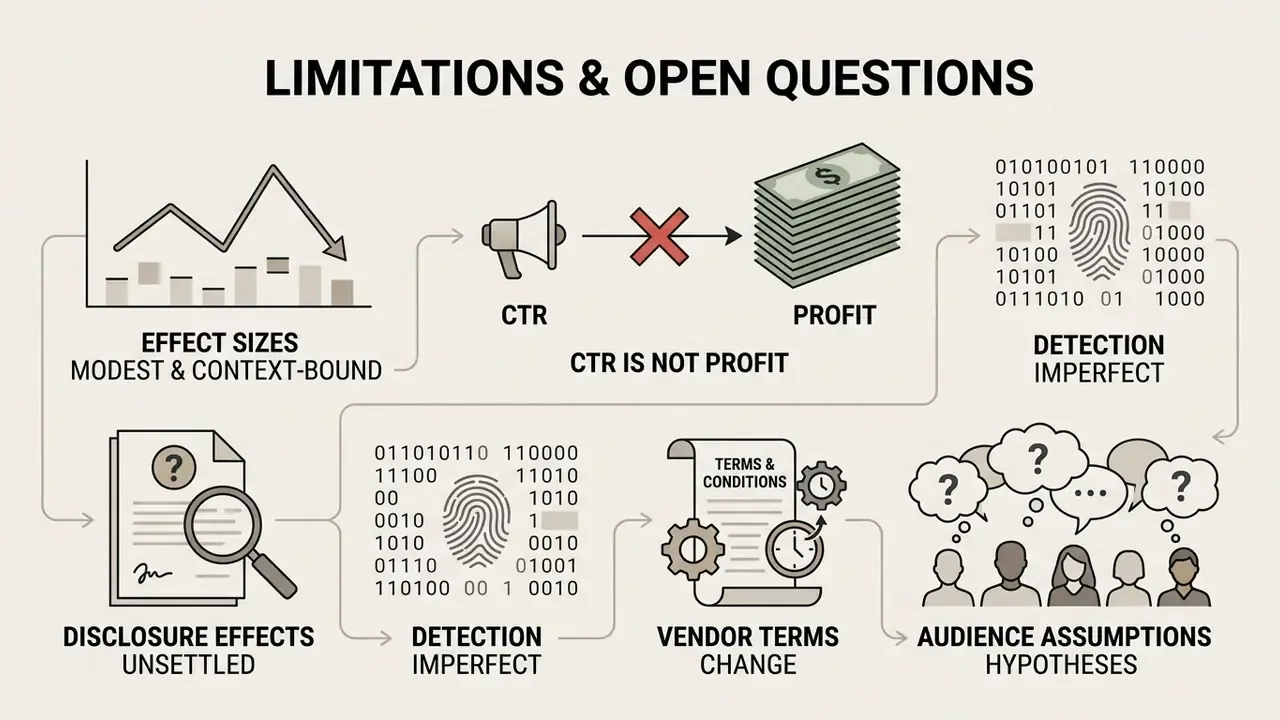
Honesty about the evidence base is part of the control environment. A few gaps remain unresolved.
- Effect sizes are modest and context-bound. A 6.7% CTR lift in a platform-run trial does not transfer automatically to your category, audience or offer. Treat published lifts as hypotheses to retest, not benchmarks to promise upward.
- CTR is not profit. Most published research measures click-through, occasionally conversion. Very little measures incremental margin after control costs, review time and rework.
- Disclosure effects are unsettled. One study finds disclosure depresses ad attitude, while survey data shows consumers expect it. Both can be true, which leaves a genuine tension for brand teams.
- Detection is imperfect. Platform labeling of generative edits is probabilistic. Do not build a compliance posture that assumes labels appear consistently.
- Vendor terms change. Commercial-use grants, watermark rules and credit definitions shift between releases. Re-verify before each campaign cycle, not annually.
- Audience assumptions remain hypotheses. Statements about how your buyers respond to synthetic creative should stay labeled as hypotheses until supported by analytics, interviews or CRM evidence.
FAQ About AI Facebook Ad Generators
Are Design and Copywriting Skills Required for an AI Ad Maker?
An ai facebook ad maker automates first-draft generation, but strategic direction, messaging judgment and brand editing stay human. Research on collaboration mode explains why the mode matters more than the model:
«Using an LLM as a sounding board raised novices' ad quality toward expert level; for experts, using it as a pure generator reduced originality.» Source: Human-LLM Collaboration Study, SSRN (2023 to 2024). https://papers.ssrn.com/sol3/papers.cfm?abstract_id=4641653 Non-specialists can produce functional creative quickly using templates. Experienced copywriters and designers remain critical for refining messaging, verifying facts, enforcing brand safety and configuring campaign structure. The practical division of labor: AI drafts and diversifies, humans decide strategy, claims and final approval.
Can You Customize AI Facebook Ads to Match Your Brand?
Yes. Commercial tools support brand kits where teams lock official logos, HEX color values, approved fonts, imagery standards and voice guidelines. Systems allow manual override of synthetic copy, layout adjustment, replacement of generated image components, and compliance rule enforcement before publication. Mature brand systems go further, specifying prohibited terms, required legal elements, and whether AI-assisted imagery must carry an internal label in asset metadata.
Is an AI Ad Generator Only Suitable for Facebook?
No. Although optimized for Meta formats, output from an ai facebook ads maker adapts to other channels. Exports in standard ratios of 1:1, 4:5 and 9:16 transfer to Instagram, TikTok, YouTube Shorts, LinkedIn and Pinterest campaigns. Reuse inside the Meta ecosystem is natively supported, including running existing Instagram posts as ads. Reuse on external networks is a file-and-spec exercise, so verify each platform's safe zones and content policies independently. Teams planning multi-channel output can compare our review of the best AI video generators. Developers evaluating integration paths for video pipelines can review our AI Media API Guides or the Google Veo API Guide.
Can AI Facebook Ad Generators Translate and Localize Ads for International Campaigns?
Yes. Enterprise tools support cross-lingual generation across roughly 19 to 20-plus languages, including English, Spanish, German, French, Portuguese and Mandarin. Strong implementations do not translate word for word. They adapt idioms, re-record voiceover with native cadence, adjust on-screen text length to prevent layout breakage, and shift visual tone to regional expectation. Batch pipelines expand one master video into a per-market asset set, which is why multilingual work is among the most common reasons teams leave free tiers.
Who Owns AI-Generated Facebook Ad Creatives?
Commercially, most vendors grant full rights to run generated assets in paid campaigns under their terms. Legally, purely synthetic output is generally not copyrightable in the United States without meaningful human creative contribution, which limits your ability to stop others copying it. Practical rule: use AI assets freely for performance advertising, and keep protectable brand elements, trademarks, proprietary product photography and distinctive design systems, at the center of anything you intend to defend.
Do AI-Generated Ads Get Flagged or Labeled by Meta?
Ads created or significantly edited with Meta's generative tools, or with third-party tools detected by platform systems, may receive an "AI info" label in the ad's About section. Labeling by itself is not a penalty. Rejection risk comes from policy violations: unsupported claims, deceptive framing, restricted-category targeting errors, altered Meta brand assets, or a gap between ad promise and landing page.
What Evidence Should We Keep for Audit?
At minimum: the prompt or brief, the tool and model version, the generated variant, the edited final variant, the reviewer identity, the approval timestamp, and the disclosure decision with its rationale. Store it where internal audit can retrieve it without asking the marketing team for screenshots. That last detail sounds trivial. In practice it decides whether an audit takes an hour or a week.
Editorial Summary and Strategic Recommendations
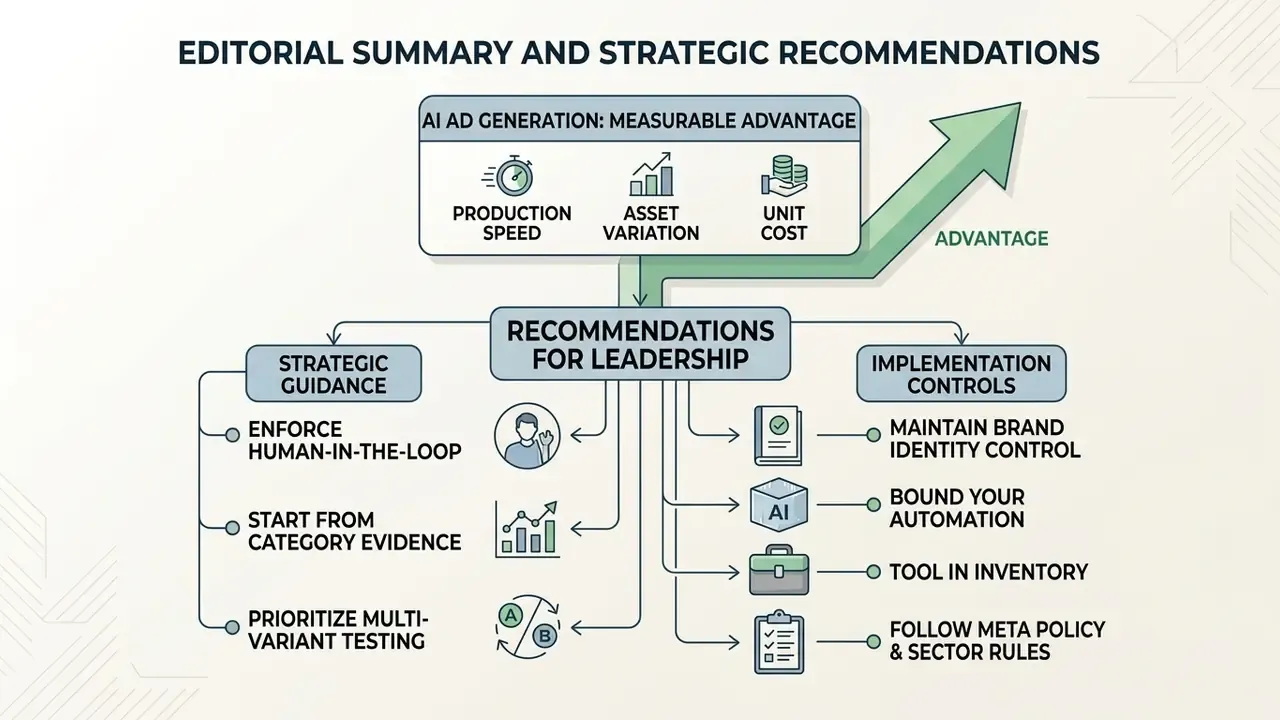
An ai facebook ad generator delivers measurable advantage in production speed, asset variation and unit cost. Sustained ROAS, though, comes from treating generative AI as a production assistant with a defined owner, not as an autonomous campaign operator.
Recommendations for Marketing and Executive Leadership
For teams planning wider media production workflows, compare options in our interactive tool directory, or browse the hub for technical resources and documentation. For the full terminology set, open the hub in our editorial glossary.
About This Review and Editorial Notes
This analysis was compiled by our editorial research team, with commentary from Marcus Hale, the author whose contributions focus on AI governance, model-risk review and controlled deployment of generative systems in regulated marketing environments. Any framework or example attributed to Marcus Hale is illustrative and does not document a specific client engagement, regulatory position, or business result.
Pricing data was independently verified against vendor pricing pages at the time of publication and is marked with verification dates. Research citations link to primary sources.
Mentions of brands, vendors and case studies, including On, Living Proof, Omneky, Adsmaker.AI and Shhots AI, are cited for evidentiary purposes only. They do not constitute endorsement, sponsorship or a commercial relationship. Vendor pricing and platform policy change frequently, so verify current terms with each provider and with Meta's official documentation before deployment.