An ai person generator is a software tool that uses machine learning models to synthesize visual representations of synthetic human beings from text prompts or uploaded reference photos. Modern generative pipelines let a team ai create a person with customized facial features, clothing, poses and backgrounds, with no physical photoshoot involved.
Why does this matter to a bank, an insurer or a mature fintech? Because a synthetic face in a customer email is no longer only a creative asset. It is a model output, produced by a third party, sometimes conditioned on a real employee's photograph, and increasingly subject to disclosure law. That combination puts an ai human generator inside the same conversation as vendor risk, consent records and audit evidence.
Executive summary
- What it is An ai person generator renders synthetic humans as static images, talking avatars, or fully embodied digital humans. The three categories carry different control models, different interactivity levels and, importantly, different risk tiers.
- Risk tiering first A static image generator used for internal mockups is a low-risk deployment. A customer-facing interactive digital human that answers questions is a high-risk use case under transparency and disclosure regimes such as the EU AI Act (Regulation 2024/1689, Article 50).
- Legal baseline Purely AI-generated output is not copyrightable in the U.S. without human creative control. Synthetic media must be machine-readably marked and visibly disclosed in the EU from August 2026. Biometric-based digital twins require explicit, informed, revocable consent.
- Production reality Photorealism is high enough that human reviewers fail under time pressure. Misclassification of AI images as real rises from roughly 17% to 43% when viewing time is capped at one second (CHI 2025). Human-in-the-loop review is not optional.
- What to control operationally pose (ControlNet and OpenPose reference libraries), wardrobe (garment inpainting or virtual try-on), identity persistence (brand-kit character tagging, LoRA, reference feature injection) and voice persistence (locked neural voice profiles).
- What to demand from vendors commercial-rights clarity, zero data retention, SOC 2 Type II or ISO 27001, private VPC or regional processing, C2PA content credentials, audit logs and export flexibility up to 4K.
How to read this guide
Three reading paths, depending on the seat you occupy:
- Risk, compliance and model risk: start with commercial use, consent and the audit-trail template, then the vendor security matrix. That is where the decision actually sits.
- Marketing, e-commerce and L&D: start with the workflow for creating an AI person from text or a photo, then customization, pose libraries and video conversion.
- Procurement and finance: go straight to free tiers, pricing structure and the ten-step pre-purchase checklist. Cost per asset is easy; cost per controlled asset is the number that matters.
A short vocabulary note, since search phrasing varies wildly. An ai human creator, an ai generator for people, an ai creator person tool and an ai generator person platform all describe the same underlying capability: conditioned generation of an ai human image. Differences appear in the control surface, not in the marketing label. Where a vendor promises to ai create people at scale, ask what it exposes for pose, identity and provenance before believing the demo reel.
What is an AI person generator?
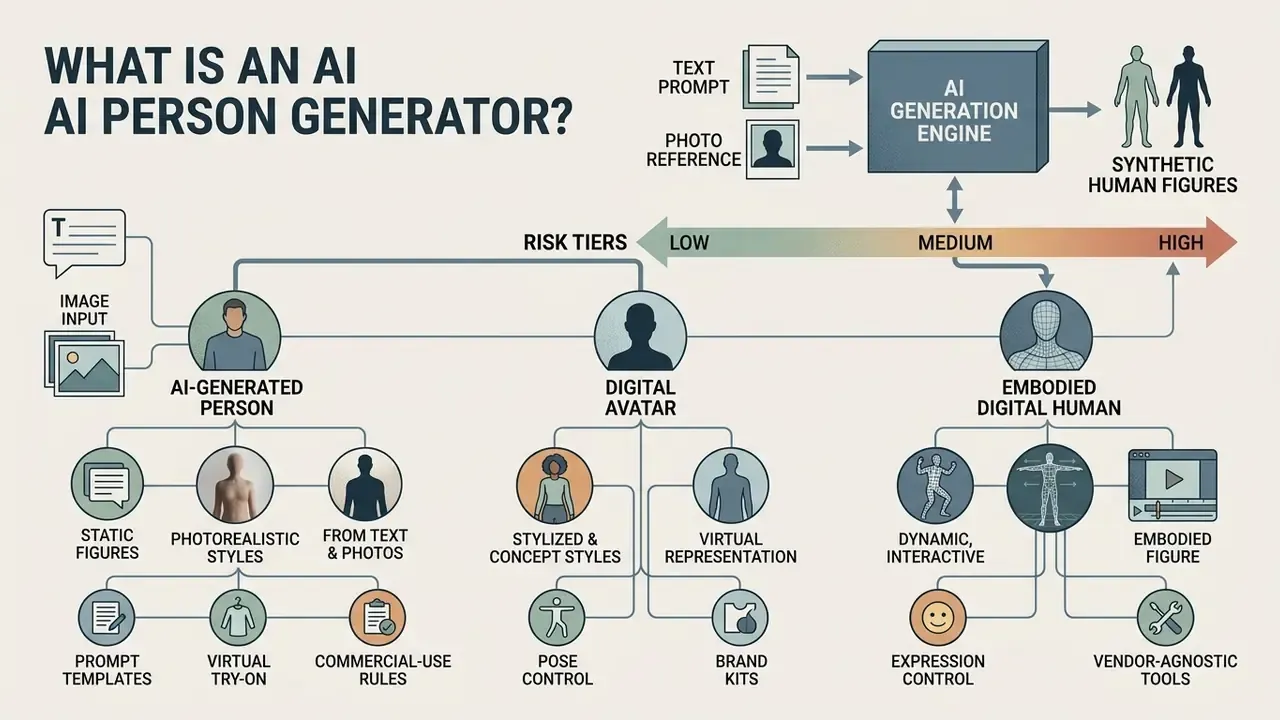
An ai person generator is a generative artificial intelligence system engineered to render static or dynamic synthetic human figures. These systems process natural language prompts or reference images through diffusion algorithms and hybrid Generative Adversarial Networks (GANs) to output high-resolution imagery. Organizations and creators use an ai generator person to streamline asset creation, produce marketing collateral and build digital presenters without relying on physical production teams.
Realism is now high enough that visual verification cannot be delegated to intuition alone.
"Diffusion-generated images can be indistinguishable from real photographs at a glance, yet frequently contain artifacts and implausibilities."
AI-generated people, avatars and digital humans
Synthetic humans exist across a spectrum of interactivity, control models and visual depth:
- AI-generated person A static synthetic image produced by deep learning models. Tools in this category let users ai generate human image assets or produce an ai generated person image for marketing material, stock photos and UI mockups. Teams evaluating platforms for this workflow can compare AI image generators by output quality and usage rights.
- Digital avatar A synthetic human representation designed to present scripted content or react to real-time user inputs. Avatars are frequently driven by text-to-speech engine outputs and facial landmark animation pipelines.
- Embodied digital human A complex 3D or neural-rendered entity combining automated speech recognition, natural language processing and behavioral logic to conduct real-time interactive dialogues in virtual or web environments.
Mapping synthetic human types to risk tiers
For AI inventories and model-risk registers, the three categories should not share one risk classification. The practical mapping used by governance teams:
| Synthetic human type | Interactivity | Data footprint | Indicative risk tier | Primary controls |
|---|---|---|---|---|
| Static AI-generated person | None (rendered asset) | Prompt text; optional reference photo | Low to Medium (Medium if a real face is referenced) | Artifact review, licensing check, watermark or credentials |
| Scripted digital avatar (talking head) | One-way playback | Script, voice sample, avatar likeness | Medium | Disclosure label, script approval, voice consent record |
| Interactive / embodied digital human | Two-way, real time | User utterances, session logs, possible personal data | High (customer-facing, advisory, or regulated content) | Human escalation path, transcript retention policy, model-risk validation, Article 50 disclosure at first interaction |
Summary: the visual pipeline may be identical, but interactivity and audience determine oversight depth. Static generation is a content-production control problem. Interactive digital humans are a model-risk and disclosure problem.
Realistic, stylized and custom AI persons
An ai human generator can produce diverse aesthetic outputs, depending on model architecture and user intent:
- Photorealistic styles High-fidelity rendering designed to mimic camera sensors, skin textures, natural lighting and anatomical details. Users seeking an ai generate realistic person output rely on specialized photorealism checkpoints to reach photo-quality assets.
- Stylized and concept styles Artistic representations ranging from vector illustrations and 3D render styles to anime and digital paintings.
- Custom character identities Controlled generation pipelines that preserve consistent facial geometry, hairstyle and age across multiple scene generations.
| Type | Creation method | Customization level | Typical uses | Output formats |
|---|---|---|---|---|
| AI-generated person (static image) | Text-to-image diffusion or GAN and diffusion hybrid models conditioned on text prompts or reference photos | High for visual attributes (face, body, clothing, setting); low for runtime behavior | Marketing visuals, social content, stock photo alternatives, visual concept design | PNG, JPEG, WEBP |
| Digital avatar (talking head) | Neural rendering (2D, 3D, NeRF) driven by audio scripts, text-to-speech, or pose parameters | High for voice, script, facial expressions and language delivery | Training videos, compliance modules, digital presenters, customer support | MP4, WebM, real-time interactive canvas |
| AI character (stylized human) | Generative models fine-tuned for artistic or illustrative outputs | High for artistic styling; medium for photographic realism | Storytelling, game design, mascot creation, editorial illustration | PNG, JPEG, vector exports |
| Stock photo (real human) | Studio or location photography capturing real individuals under contract | Fixed image; limited to cropping, filtering and basic retouches | Standard marketing campaigns, news illustrations, generic web assets | Pre-defined JPEG and TIFF files |
Summary of comparative table: Static synthetic humans offer complete control over visual parameters at lower cost than physical stock photography, whereas digital avatars add temporal and audio-driven speech capabilities for dynamic video production.
Commercial use, privacy and responsible AI person generation
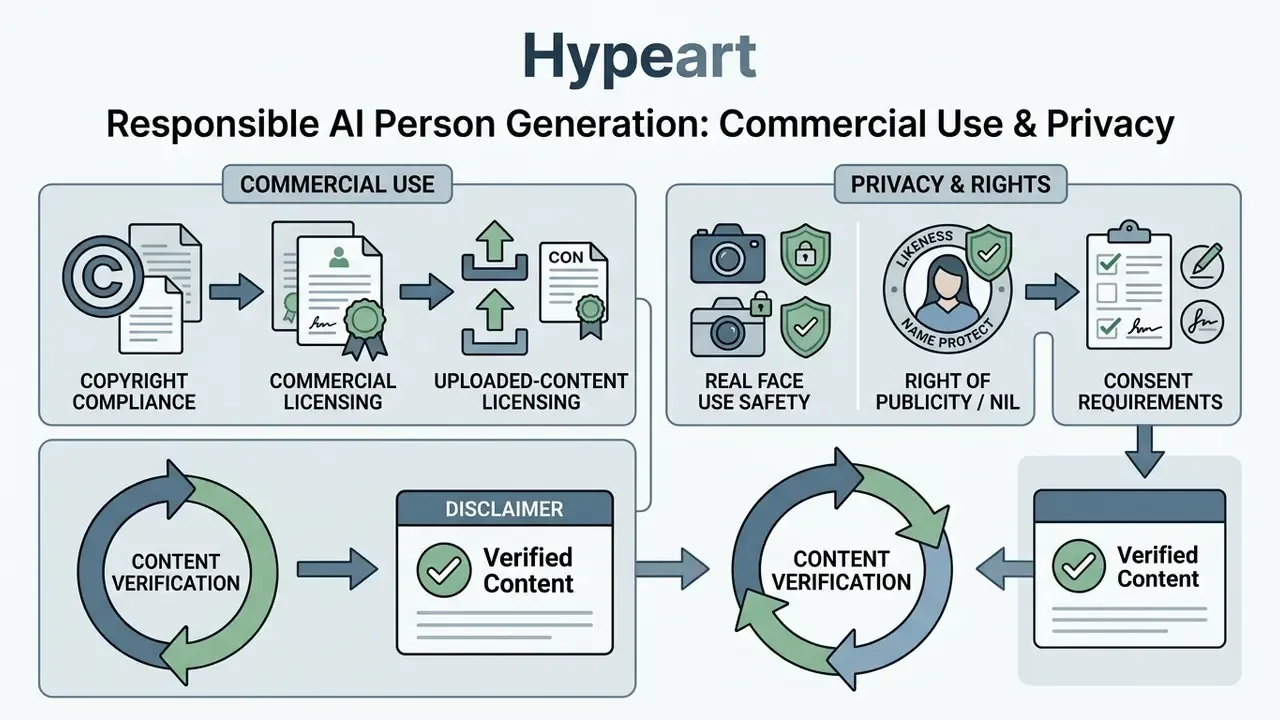
Deploying an ai generated human image in commercial channels requires strict adherence to copyright frameworks, personal privacy laws and content verification standards. This section sits before the production workflow deliberately: for risk, compliance and brand-safety owners, licensing and consent decisions gate the workflow, not the reverse.
Can AI-generated people be used for commercial purposes?
Commercial usage rights depend on platform licensing terms and relevant regional intellectual property regulations:
- Copyright considerations: According to official guidance from the U.S. Copyright Office (2025 to 2026), purely AI-generated visual outputs lacking human creative control are not eligible for federal copyright protection. Human-authored elements arranged with synthetic imagery may, however, receive protection.
- Commercial licensing
- Paid tiers of reputable AI platforms standardly grant commercial usage rights over generated outputs. Verify whether your plan tier includes full commercial rights or restricts commercial exploitation. Terms diverge sharply between vendors: some stock-media providers explicitly withhold download and usage rights for images produced inside test programs, while consumer generators assign output ownership to the user. Where free access is used for pilots, review the constraints of free AI image generators without sign-up before any external publication, and check current plan tiers on the pricing overview rather than relying on a cached comparison.
- Uploaded-content licensing
- Read the inbound clause, not only the outbound one. Several platforms take a perpetual, sublicensable, worldwide licence over uploaded reference photos. That is an unacceptable condition when the upload contains employee or customer imagery.
Using photo references and real faces safely
Generating synthetic images based on real individuals introduces significant legal and privacy exposure:
- Right of publicity and NIL
- Generating an ai generated realistic people asset that closely resembles a living person without explicit written consent infringes Name, Image and Likeness (NIL) rights and right-of-publicity statutes. The USPTO notes that trademark registration can additionally protect a name or likeness used in endorsements, adding a second layer of exposure.
- Consent requirements
- Regulatory guidance from the Australian Information Commissioner (OAIC, 2024) and the European Data Protection Board (EDPB, 2026) emphasizes that processing identifiable facial biometric data to construct synthetic digital twins requires explicit, informed and revocable consent. Consent must be current, specific, voluntary and capable of withdrawal. A privacy notice alone does not create it.
"Synthetic data can obscure discriminatory practice: organisations deploy diverse synthetic characters while masking real-world bias."
- Corporate policy and Shadow AI
- Prohibit uploading unauthorized employee or consumer photos into public generative tools. Practical controls include an approved-tool allowlist, egress monitoring for image uploads to unsanctioned generative domains, an internal request channel so teams do not improvise with consumer accounts, and mandatory zero-retention contract clauses for any sanctioned vendor. Where enterprise generation is centralized, route requests through managed endpoints (see the API documentation for the integration pattern) and compare vendors among AI image generators for commercial use with documented data-handling terms.
How to review distorted, offensive or inappropriate results
Synthetic image generation models occasionally produce visual artifacts, anatomically incorrect renderings, or unintended outputs. Organizations must implement human-in-the-loop inspection protocols prior to publishing synthetic assets, supported by AI image detectors as a second screen.
FACT CHECK & REGULATORY COMPLIANCE BOX
• EU AI Act (Regulation 2024/1689, Article 50): machine-readable marking of synthetic
  output and visible labeling of deepfakes; applicable from August 2026.
• Utah Code 20A-11-1104: visible disclosure labels plus tamper-evident provenance for
  AI-generated political and public-advocacy audiovisual media.
• NIST AI 600-1 (2024): generative AI safety guidance requires content filtering against
  NCII, abusive, degrading and harmful outputs, plus pre-deployment testing.
• NIST AI 100-4 (2024): provenance, watermarking and metadata recording for synthetic content.
• Brand safety protocol: every commercial AI person asset undergoes human review for
  anatomical realism, bias evaluation, disclosure labeling and legal clearance.
A research study published in CHI 2025 ("Characterizing Photorealism and Artifacts in Diffusion Models") analyzed 749,828 human observations from 50,444 participants across 450 diffusion images. Viewers identified synthetic images in the majority of standard observations. Restricting exposure time collapsed that accuracy.
Brief ad impressions can therefore hide rendering flaws, which is why pre-publication audit checks need to be rigorous. Reviewers must inspect assets deliberately, at full resolution, instead of approving thumbnails in a feed. Nobody catches a six-fingered hand at 240 pixels wide.
An internal governance team evaluated synthetic visual assets for customer portal onboarding. They tested outputs against a deepfake detection suite and an artifact verification checklist before public deployment. The screening identified 14% of synthetic samples with rendering flaws, preventing brand exposure to invalid visual assets. (Internal, non-audited program data from a single deployment. Treat the figure as directional rather than as a benchmark, since published rejection-rate statistics for enterprise synthetic-media screening are not yet available.)
Audit trail template for model-risk sign-off
To convert review activity into evidence acceptable to internal audit or a supervisor, record the following per published asset:
| Field | Content to capture |
|---|---|
| Asset ID and channel | Unique reference, destination channel, publication date |
| Generation inputs | Prompt text, negative prompt, seed, reference images (hash), model and version |
| Consent record | Consent form ID for any real-person reference; scope and expiry |
| Review outcome | Reviewer name, artifact checklist result, bias assessment note |
| Detection screen | Detector tool, score, decision threshold |
| Disclosure applied | Visible label text, C2PA or machine-readable marking status |
| Approval | Legal or brand approver, timestamp, retention location |
Sequential retention of these fields satisfies the documentation expectation in the NIST AI Risk Management Framework Generative AI Profile: prompts, parameters and model versions should be documented, and outputs validated before acceptance. One practical tip from teams that have been audited: store the record with the asset, not in a separate spreadsheet. Spreadsheets drift.
How to create an AI person from text or a photo
To ai create person assets efficiently, users follow a structured generation pipeline that converts structured inputs into finalized image files. Current generative engines support both text-driven synthesis (text-to-image) and image-guided conditioning (photo-to-image), and the same engine can ai create human figures either way.
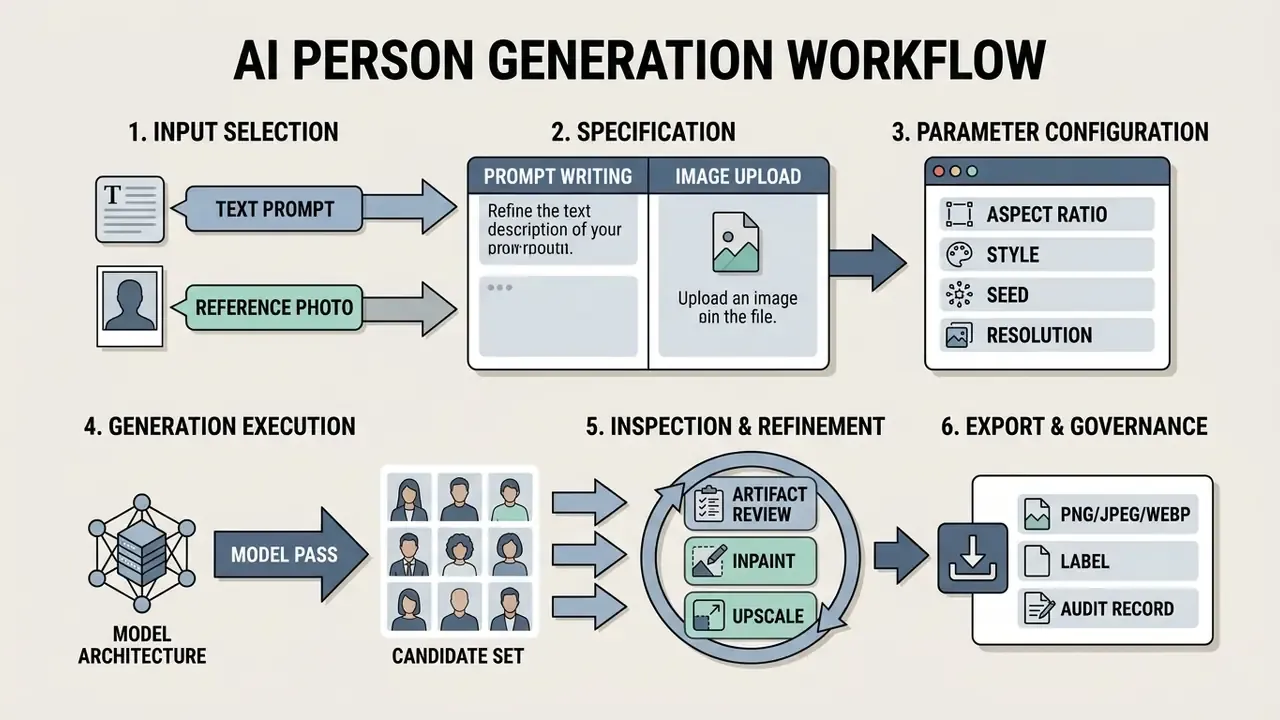
- Input selection
- Choose between text-prompted generation or uploading a reference portrait.
- Specification
- Enter descriptive parameters covering subject traits, clothing, framing and environment, or upload a clear source image to act as a structural anchor.
- Parameter configuration
- Set technical specs including aspect ratio, rendering seed, negative prompts and target resolution.
- Generation execution
- Run the model pass to produce initial image candidates.
- Quality inspection and refinement
- Review candidate outputs for anatomical or lighting artifacts; apply inpainting or detail adjustments as needed.
- Export
- Download the finalized high-resolution file in the desired format, apply the disclosure label and register the asset in the audit log.
Describe the person in a text prompt
Generating synthetic humans via text prompts relies on descriptive natural language instructions. Users seeking an ai generator realistic human asset must specify subject demographics, expression, attire, camera angle, lighting and environmental context.
An effective prompt follows a structured hierarchy: subject, then expression and pose, then attire, then environment, then lighting and camera specs, then style modifiers. For instance, "a 35-year-old female operations executive looking directly at the camera, neutral confident expression, dark navy blazer, soft studio lighting, shallow depth of field, neutral office background" yields far more reproducible results than a handful of generic keywords. Vendor prompt guidance from major providers converges on the same ordering: subject and scene first, then key details, then explicit constraints, with framing, viewpoint and lighting stated rather than implied.
Model choice materially changes which part of the prompt is honoured.
"DALL·E 2 scores highest on text and image alignment, while Dreamlike Photoreal leads on quality and originality."
Because alignment and aesthetic quality do not peak in the same model, select engines by priority. Literal prompt compliance for product accuracy, photorealism for lifestyle assets. Then validate your shortlist against the best AI image generators comparison before standardizing a workflow.
Create an AI human from a photo reference
An ai human generator from photo system uses an uploaded image as a structural or facial guide. This approach lets an ai fake person creator produce variations of an existing identity, or transform a real portrait into a stylized synthetic persona. The same conditioning logic underpins general image-to-image generators.
Optimal source photos must meet specific quality baselines:
Identity preservation is measured, not assumed. Research pipelines evaluate success by face-embedding cosine similarity between source and generated output while attributes are edited.
"Synthetic data may be used to circumvent consent, blurring the link between source data and its synthetic derivative."
Practical implication: any photo-reference workflow involving a real, identifiable face needs a documented consent record before the first upload. See the consent requirements above.
A financial media team needed rapid promotional imagery without live photoshoots. They configured a diffusion model with strict brand styling and multi-angle lighting prompts. The team reduced image sourcing turnaround from three weeks to two days while maintaining visual consistency. (Internal, non-audited program data. Cycle-time gains vary with review depth and legal clearance requirements, and no peer-reviewed benchmark currently quantifies this reduction.)
Generate, refine and download the image
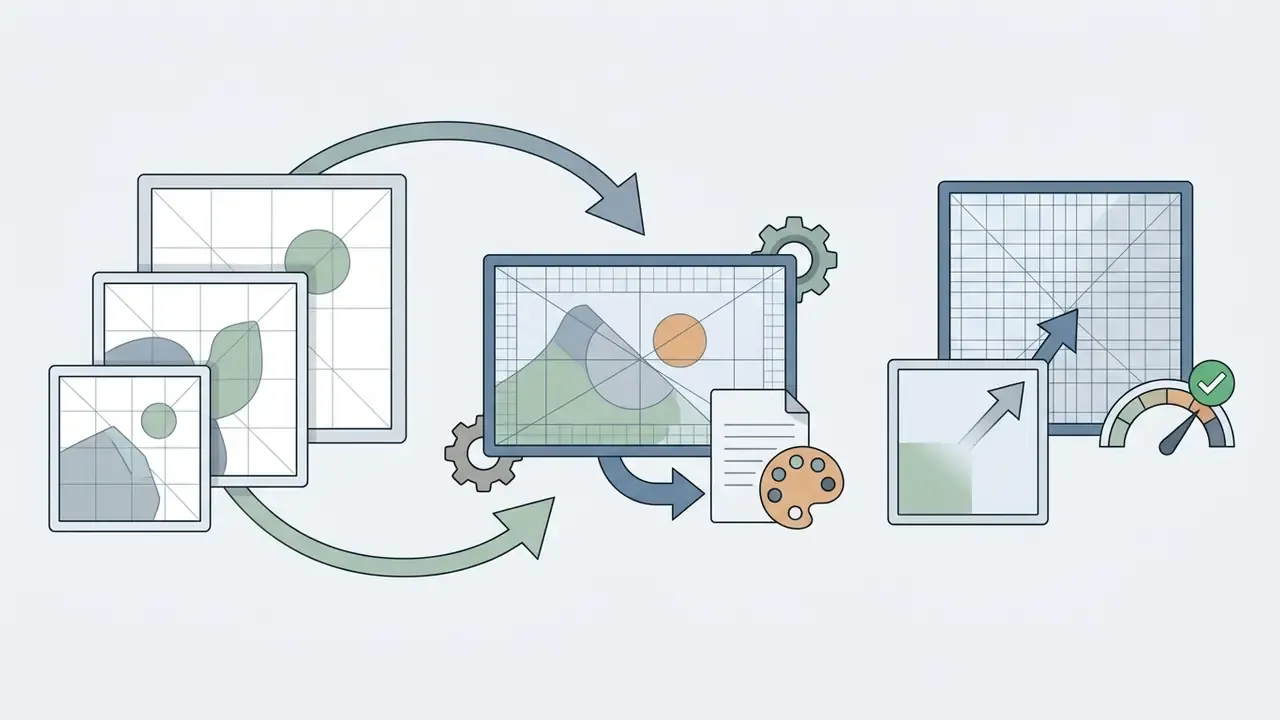
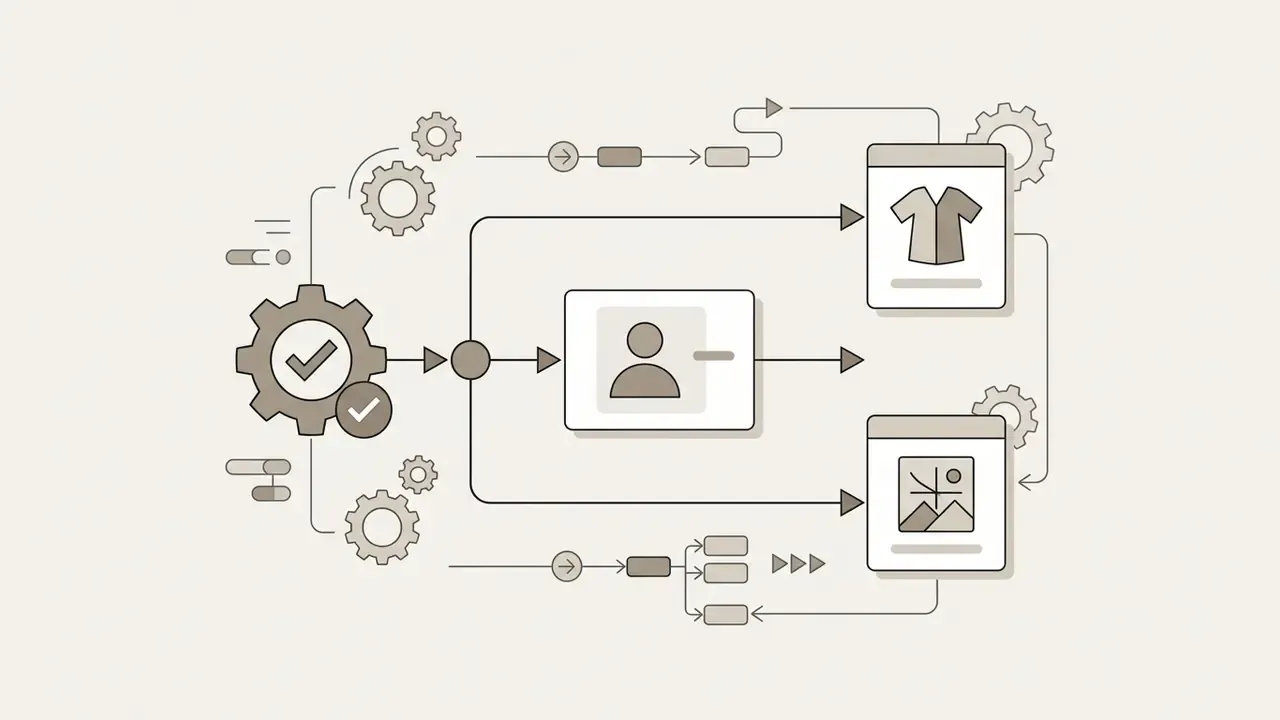
Once the initial generation completes, inspect the synthetic output for visual anomalies. Modern image processing pipelines support iterative refinement through inpainting (editing localized regions), outpainting (expanding frame boundaries) and upscaling. To review structural tools for expanding background framing, compare dedicated AI outpainting tools by background-generation quality and licensing.
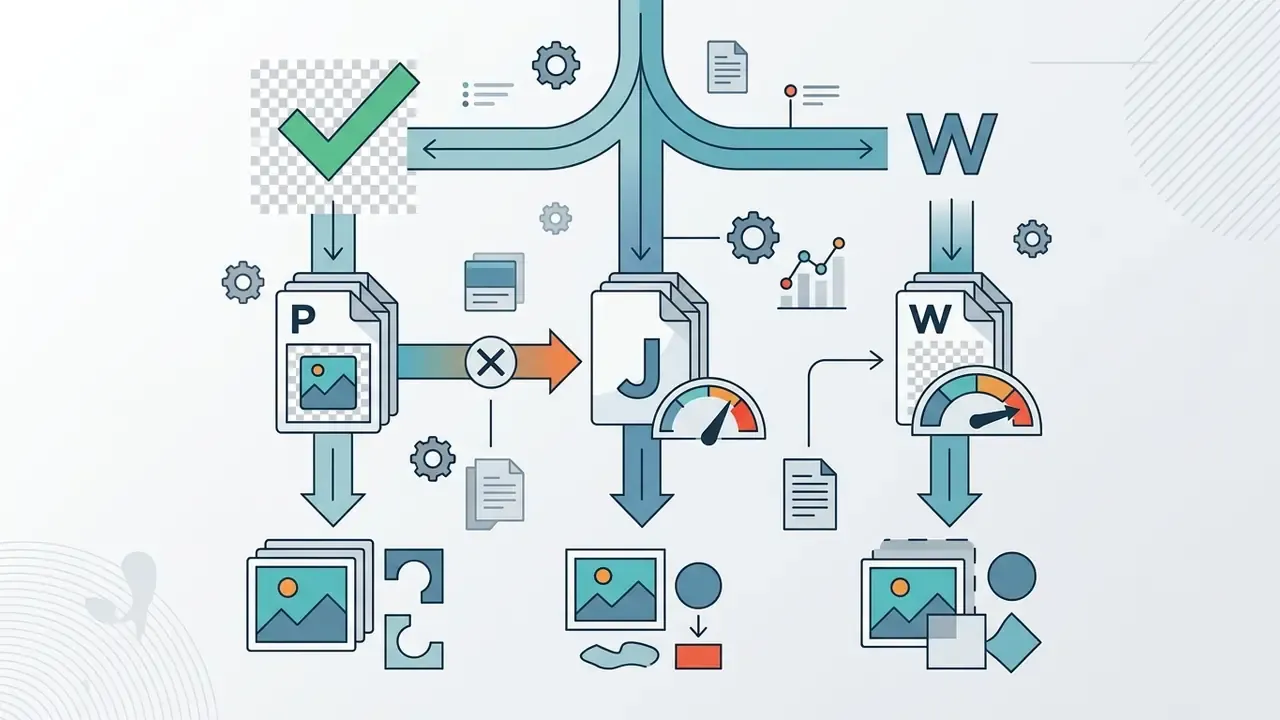
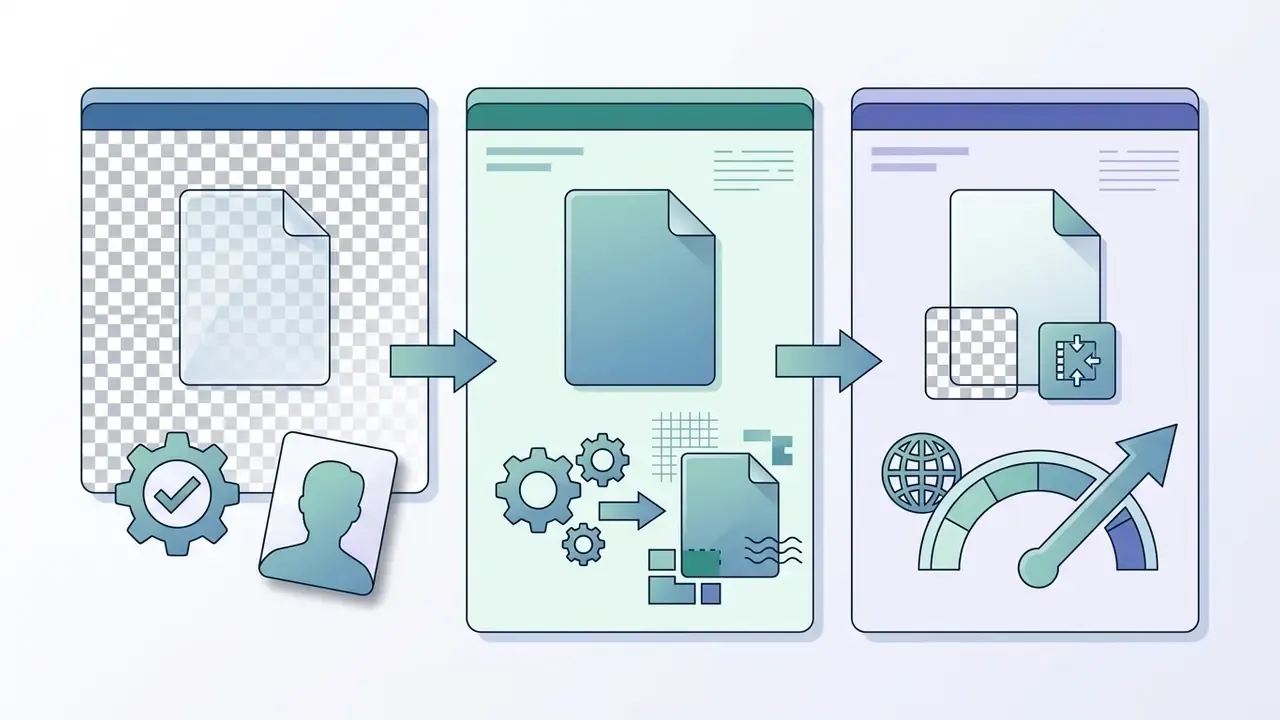
Supported export parameters across enterprise generators standardly include:

Prompt template for a realistic AI person
To maintain visual consistency across generated assets, use the following standardized prompt structure:
Add a constraint tail for reproducibility and compliance: Negative: extra fingers, warped hands, distorted text, asymmetric eyes, plastic skin. Fixed seed: [value]. Aspect ratio: [16:9 | 1:1 | 9:16].
Save the filled template in your workspace as a shared preset. A prompt that lives in one designer's notes is not a control.
What can you customize in an AI-generated person?
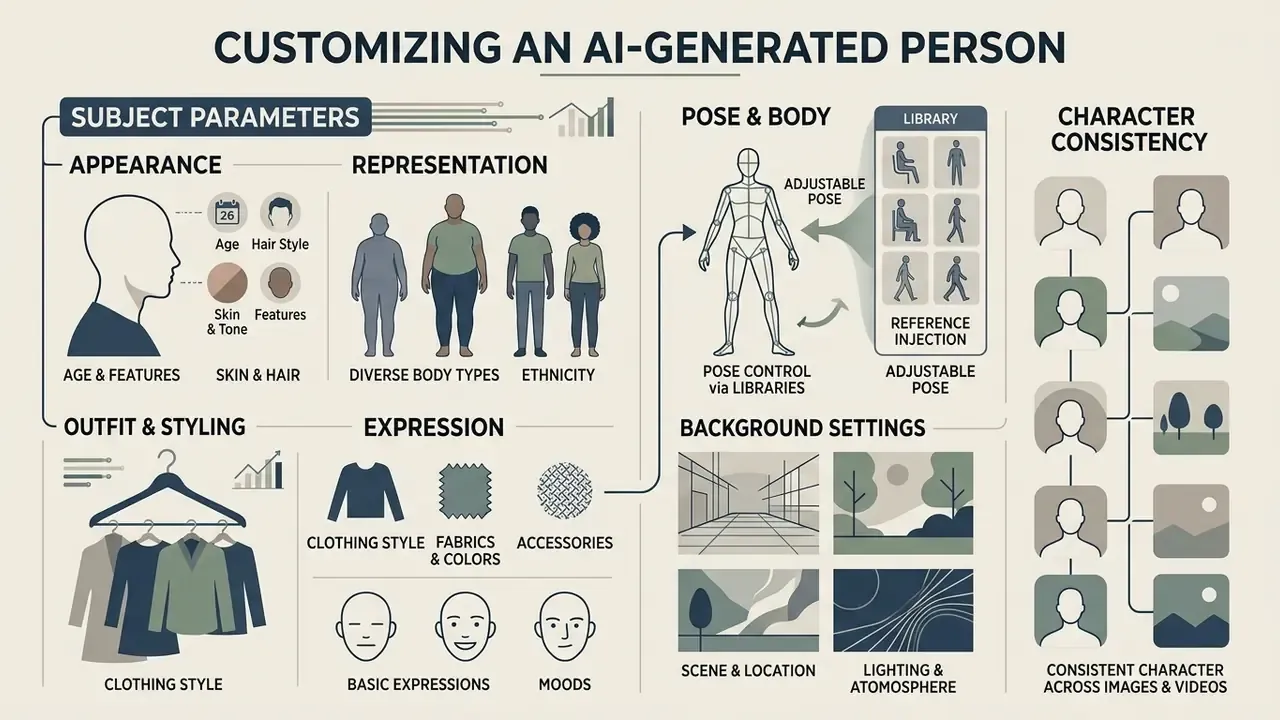
Modern ai creator person platforms provide granular control over subject parameters prior to model execution. Careful parameter selection keeps generated imagery aligned with brand guidelines, representation requirements and campaign themes.
Appearance, face and diverse representation
Generative frameworks allow precise conditioning over physical features. Users can configure age categories, facial structures, skin tones, hair textures and distinct features such as freckles, eyewear, grey hair, or makeup intensity. Research pipelines demonstrate explicit conditioning on age brackets (child, youth, adult, middle-age, senior), gender and ethnicity categories, which is exactly the control surface marketing teams need for balanced casting when they ai generate images of people at volume.
Empirical evaluations emphasize the necessity of deliberate demographic prompt design. Updated: the representational-bias evidence base is drawn from peer-reviewed measurement work rather than from an unverified attribution.
"Some models under-represent certain demographic groups or depict them with stereotypical features, reflecting bias in training data."
The NIST AI RMF Generative AI Profile (2024) correspondingly requires organizations to benchmark and document representational bias in generated output. Unconditioned model defaults frequently over-index on younger, lighter-skinned and conventionally attractive faces. Explicitly defining age, ethnicity and facial characteristics, then auditing the resulting asset library as a set rather than image by image, helps keep media asset creation balanced and inclusive.
Outfit, pose, expression and background
Beyond facial features, an ai generator of people supports detailed environmental and contextual customization:
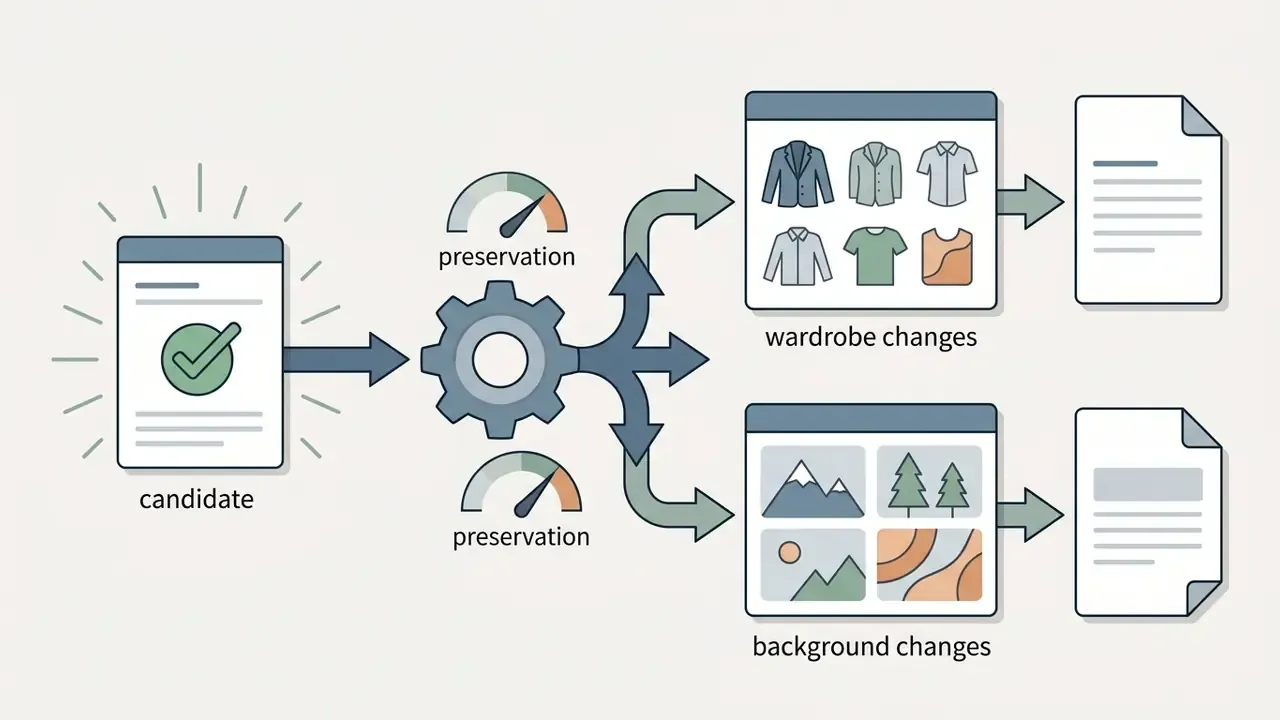
- Outfit and styling Configure wardrobe styles ranging from formal corporate attire and medical scrub uniforms to technical outerwear and casual streetwear.
- Pose and expression Direct subject posture (seated executive, standing presentation pose) and facial affect (approachable smile, serious analytical expression).
- Background settings Isolate subjects against plain studio backdrops, active office environments, industrial facilities, or transparent layers for seamless UI integration. Production APIs commonly expose
poseandbackgroundas discrete string fields, plus abackground="transparent"flag for PNG or WEBP output.
Controlling poses via reference pose libraries
Standard text prompts often fail to replicate precise physical postures. Modern AI human generators resolve this by integrating spatial control networks such as OpenPose or ControlNet. Upload a reference image of any posture, whether sitting cross-legged, mid-stride, looking up sideways, or pointing at a product, and the tool extracts its skeletal map. The generator then applies that pose onto the target AI person while maintaining unique facial features, wardrobe and environmental styling.
Practically, teams build a custom pose library: a stored set of reference skeletons per campaign type (catalogue front-facing, three-quarter lifestyle, seated interview, hands-on-product demonstration). Because the extracted map encodes joint angles, including head tilt and limb rotation, the same pose can be reproduced across different characters. That guarantees shot-to-shot continuity in a series without re-describing posture in prose. Where the reference photo shows a real person, the pose data is retained but the identity must not be. Verify that the pipeline conditions on the skeleton only.
Consistent characters across multiple images and videos
Maintaining character consistency across sequential assets is a primary requirement for multi-image campaigns and video storytelling. Modern generative frameworks preserve visual identity across disparate prompts using specialized techniques:
- Reference feature injection Models such as Animate Anyone (CVPR 2024) use reference networks with spatial attention, a pose guider and temporal modeling to extract facial embeddings and lock subject identity while varying poses and backgrounds.
- Latent alignment Aligning latent space coordinates across sequential generations prevents facial drift between frames. Spatial latent alignment and pixel-wise guidance serve the same purpose in animated-character video.
- Multi-shot feature sharing Cross-shot feature sharing with framewise attention and query injection maintains one identity across separate shots of the same sequence.
- Custom fine-tuning Training lightweight LoRA (Low-Rank Adaptation) models on a specific synthetic identity maintains consistent facial geometry across long-term brand campaigns.
Workflow: saving characters to an enterprise brand kit
Technical pipelines use LoRA weights. Platform interfaces simplify character retention through tagged asset libraries:
- Step 1 Generate or upload your anchor AI person portrait, ideally two to three angles for a stronger reference set.
- Step 2 Save the output to your workspace Brand Kit and assign a character tag (for example
@Executive_Sarah), with a short written description of wardrobe defaults and permitted contexts. - Step 3 Call the character in new prompts using its handle:
"Photo of @Executive_Sarah presenting a product in a modern office". The system automatically injects stored facial embeddings to prevent visual drift. - Step 4 Share the tag across the team so designers, social editors and L&D reuse the same identity without re-uploading references or forking the character.
- Step 5 Version the character. When wardrobe or hairstyle changes, save a new tag (
@Executive_Sarah_v2) instead of overwriting, so published assets remain traceable in the audit log.
From a static image to an AI person video
Converting a static ai generated realistic person image into a dynamic video presenter involves speech synthesis plus facial motion mapping:
- Source image selectionSelect a high-resolution, frontal synthetic photo.
- Audio script generationInput a written script or upload a voice recording, keeping sentences short enough for natural phrase-level pacing.
- Lip-sync and facial alignmentNeural audio-to-video pipelines analyze phonemes and map corresponding mouth movements, eye blinks, head motion and micro-expressions onto the static frame.
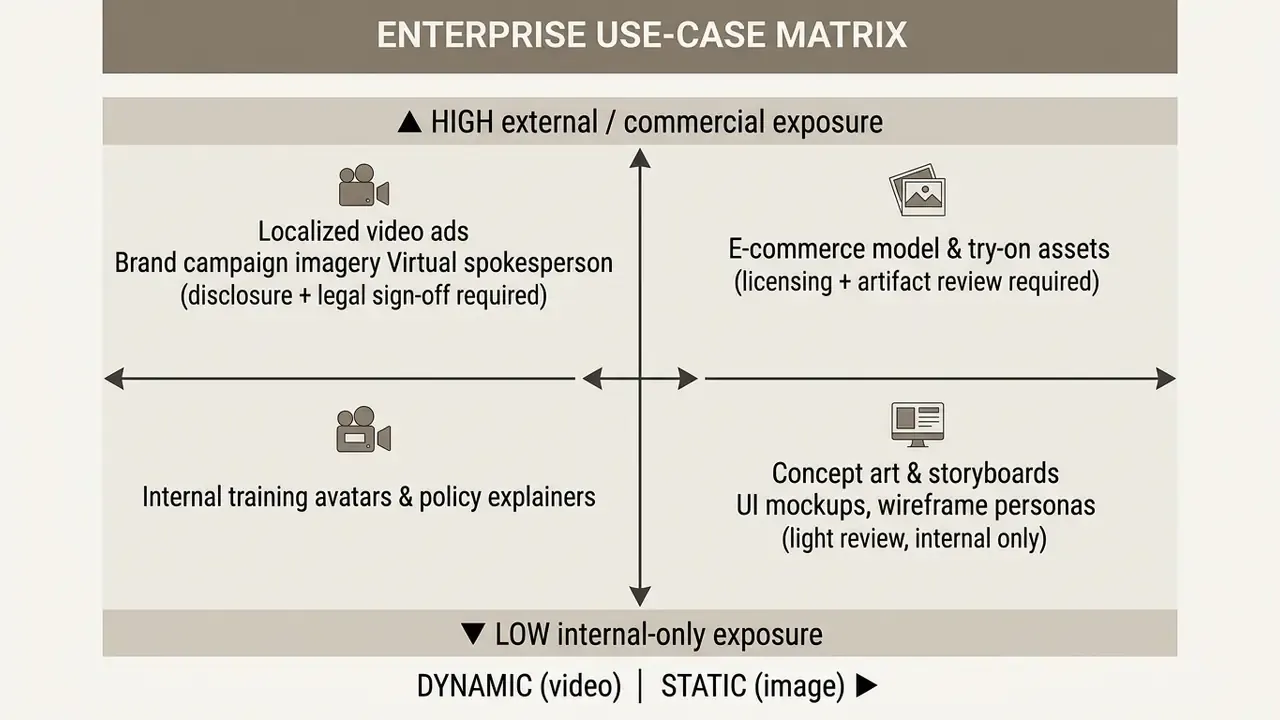
Where to use AI-generated people
Organizations deploy ai generated realistic people across diverse operational contexts to optimize production costs, accelerate asset delivery and scale visual messaging.
Character design, storytelling and stock-photo alternatives
"Synthetic avatars matched live presenters on knowledge transfer and brand perception: 53.9% of participants mistook the avatar for a real human."
For narrative work, a 2024 conference study on generative AI and visual storytelling reported positive user interviews and strong emotional resonance, though at qualitative scale rather than as a field experiment. The practical reading: synthetic humans are already competitive as a stock-photo substitute and as a presenter stand-in, while claims of dramatic performance uplift should be validated with your own A/B tests before they enter a business case. Model the cost side too, ideally with the ROI calculators rather than a napkin estimate.
AI people for videos, training and localization
| Scenario | AI person format | Key settings and customization |
|---|---|---|
| Social media content | Static images or short talking head clips | Brand-aligned styling, vibrant lighting, expressive facial framing, concise messaging |
| Product cards and e-commerce | Static full-body or close-up portraits | Neutral backgrounds, precise pose and hand control, garment inpainting, product-focused lighting |
| Stock photo replacement | High-resolution static photos | Natural lighting, candid poses, high skin detail, realistic environmental settings |
| Character design and storytelling | Concept sheets, stylized character art | Artistic medium controls, distinct wardrobe, exaggerated or narrative-specific traits |
| Corporate training videos | Dynamic talking head avatars | Professional attire, neutral background, clear speech cadence, consistent character tag |
| Multilingual video ads | Dynamic localized video presenters | Localized speech dubbing, lip-sync precision, locked voice profile per persona |
| Customer-facing digital human | Interactive embodied agent | Disclosure at first interaction, escalation to human, transcript retention policy |
Is an AI human generator free, and what should you compare before choosing one?
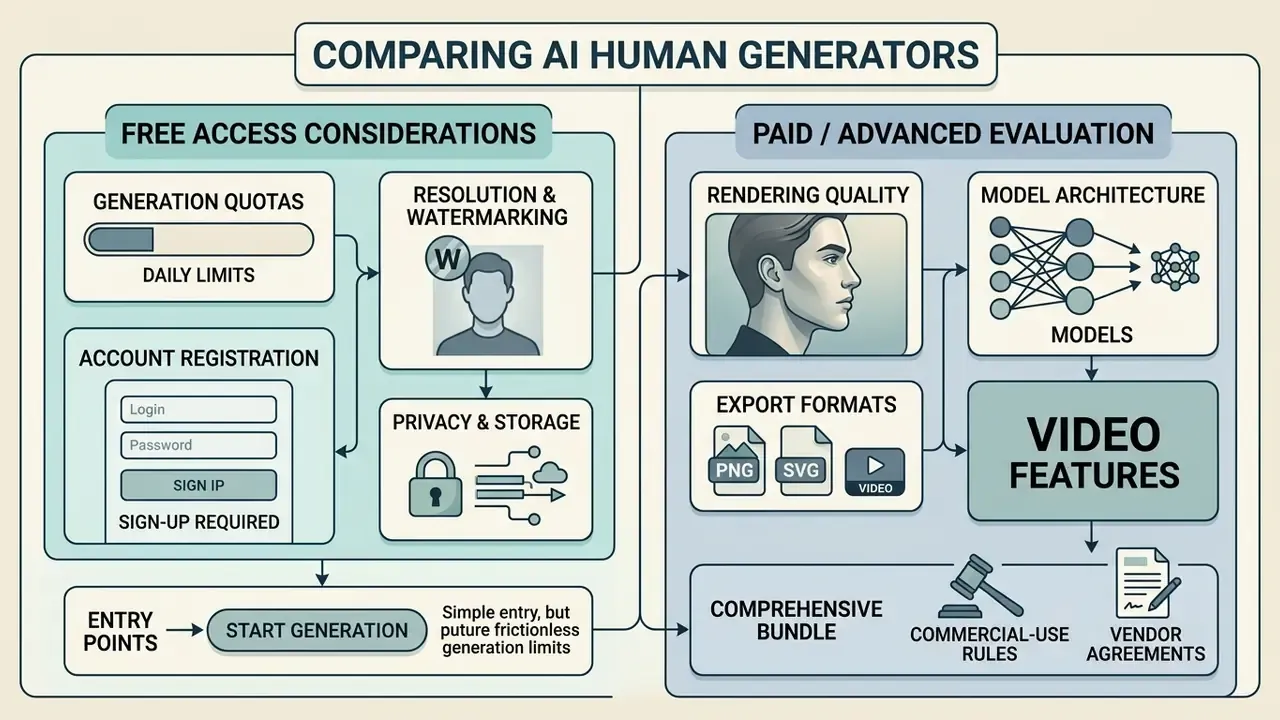
Selecting an ai human generator from photo free or paid tool requires evaluating platform constraints, rendering quality, data privacy guarantees and export formats.
Free access, limits and account requirements
Free AI generation platforms provide accessible entry points, with predictable operational limits:
- Generation quotas Free tiers often restrict users to a daily credit pool or fixed monthly allowance, sometimes extendable through referrals or daily check-ins. Cloud free tiers are also commonly time-boxed: trial credit windows of 30 days or promotional storage allowances of six months are typical.
- Resolution and watermarking Free exports may be capped at lower resolutions and carry platform watermarks.
- Account registration Most services require account creation to manage cloud storage, whereas unregistered "no sign-up" tools typically offer limited queue priority and reduced quality controls. Review the trade-offs across free AI image generators without sign-up before using one for client work.
- Privacy and storage Free tiers may reserve rights to use uploaded prompts and generated imagery for training public base models. This is the single most common source of Shadow AI data leakage.
- Entry points and frictionless generation Web-based generators often offer no-sign-up instant trial tiers with default parameters, for example standard 1:1 aspect ratios and a small daily credit allowance. Professional scaling requires account creation to unlock cloud asset storage, custom resolution controls (3:2, 2:3, 16:9), brand-kit character storage and priority GPU queues.
Image quality, models, export and video features
When evaluating enterprise-grade against free generator tools, decision-makers compare core technical parameters:
- Underlying model architecture: Advanced generative ecosystems integrate top-tier base models depending on the target medium. FLUX and Midjourney v6/v7 for hyper-realistic skin textures. Google Nano Banana and Nano Banana Pro plus OpenAI gpt-image models for strict prompt compliance and in-image text. Kling, Seedance 2.5, Seedream, Grok Image and Stability Core for fluid motion and complex multi-subject rendering. Adobe Firefly and Ideogram where commercial-safety controls or typography accuracy dominate the requirement. Multi-model platforms let a team switch engines per shot instead of accepting one model's weaknesses across an entire campaign, which is a meaningful hedge against ecosystem lock-in. Compare the leading AI image generators on quality, price and rights before consolidating spend.
"In several experiments, deepfake faces were perceived as more real and more trustworthy than genuine photographs."
- Export flexibility
- High-tier tools support multi-format exports (PNG, WEBP, JPEG), layer isolation (transparent backdrops), arbitrary aspect ratios and high-resolution output up to 4K (3840 px long edge).
- Advanced editing capabilities
- Localized inpainting, face replacement, pose transfer, custom identity training, brand-kit character tagging and direct static-to-video conversion pipelines.
- Face-specific tooling
- For portrait-led workloads, review our specialized guide to AI face generator systems and, for professional corporate portraits, AI headshot generators with documented privacy handling.
- Support and escalation
- Check whether incident response and takedown assistance are contractual or best-effort. The support documentation is usually a faster signal than a sales deck.
Enterprise security and governance criteria
Feature parity is rarely the deciding factor in regulated environments. The following matrix reflects what procurement, security and model-risk functions actually score:
| Criterion | Question to ask the vendor | Why it matters |
|---|---|---|
| Commercial rights | Does the plan grant full, irrevocable commercial rights to output? Any test-program carve-outs? | Terms differ radically; some providers withhold usage rights entirely for output generated in trial programs |
| Inbound content licence | What licence does the vendor take over uploaded reference photos? | Perpetual sublicensable clauses are incompatible with employee or customer imagery |
| Zero data retention | Are prompts, uploads and outputs excluded from model training, and deleted on a defined schedule? | Prevents biometric and campaign-confidential leakage |
| Certifications | SOC 2 Type II, ISO/IEC 27001, penetration-test summary | Standard evidence for third-party risk assessment |
| Deployment isolation | Private VPC, regional processing, BYOK encryption | Data-residency and GDPR transfer obligations |
| Provenance and labeling | C2PA content credentials, machine-readable watermarking, visible label templates | Required for EU AI Act Article 50 and election-media statutes such as Utah Code 20A-11-1104 |
| Audit logs and roles | Per-user generation logs, prompt retention, SSO/SCIM, role separation | Supplies the audit trail for model-risk sign-off |
| Safety filtering | NCII and harmful-content filters, minor-protection controls, red-team results | Aligns with NIST AI 600-1 expectations |
| Model independence | Multiple base models; exportable assets and characters | Avoids single-ecosystem lock-in and model-deprecation shocks |
| Cost predictability | Credit model, overage pricing, seat versus usage billing | Enables volume forecasting across campaigns |
Pre-purchase and pre-publication checklist (10 steps)
- Classify the use caseas static image, scripted avatar, or interactive digital human, and assign the corresponding risk tier in the AI inventory.
- Confirm commercial rightsin the specific plan tier, including any restriction on generated output and any licence granted over uploads.
- Verify data handlingzero retention, no training on customer prompts or images, defined deletion schedule, regional processing.
- Collect consent recordsfor every real face, voice, or likeness used as a reference; store scope, duration and revocation path.
- Lock the identity layersave approved characters to a brand kit with tags and versions; document LoRA or reference-set provenance.
- Standardize prompts and seedsusing the template above, and record prompt, negative prompt, seed, model and version per asset.
- Control pose and wardrobe explicitlyvia reference pose libraries and garment conditioning rather than free-text approximation, especially for product accuracy.
- Run the artifact review at full resolutionhands, teeth, eyes, jewellery, text, seams, logos. Never approve from a thumbnail, since time-limited viewing measurably degrades detection.
- Apply disclosure and provenancevisible label where required, C2PA or machine-readable marking, plus channel-specific statutory language for political or advocacy media.
- File the audit record(inputs, consent, review outcome, detector score, approver, timestamp) before publication, and set a re-review trigger for any asset reused in a new market or channel.
FAQ: AI person generators
Do AI person generators produce genuinely realistic people?
Yes. Current diffusion models render skin texture, lighting and anatomy well enough that human viewers misidentify synthetic faces at meaningful rates, particularly under short exposure. Errors still cluster in hands, teeth, jewellery, eyewear and in-image text, so review remains mandatory.
Can I create the same person across many images and videos?
Yes, through three complementary mechanisms: reference feature injection (image-to-image with a stored anchor portrait), brand-kit character tagging (@CharacterName) and lightweight fine-tuning such as LoRA for long-running campaigns. For video, add a locked voice profile so the audio identity matches the visual one.
Can an AI person wear a real product from a photo?
Yes. Mask the apparel region on the AI model, upload the real garment image as a conditioning reference and run an inpainting pass. Verify colour, print placement and seam continuity against the physical sample before publishing.
Can I control the exact pose?
Yes. Upload a reference photo and let the generator extract its skeletal map via a spatial control network such as OpenPose or ControlNet. The character's face and wardrobe stay fixed while the posture is transferred. Storing several extracted skeletons creates a reusable pose library.
Is an AI person generator free?
Most platforms offer a free tier with daily credits, capped resolution and sometimes watermarks; some allow generation without sign-up. Free tiers frequently reserve training rights over your inputs, which makes them unsuitable for confidential briefs or any real-person reference.
Which models are typically available?
FLUX, Midjourney, Google Nano Banana and Nano Banana Pro, OpenAI gpt-image, Kling, Seedance 2.5, Seedream, Grok Image, Stability Core, Adobe Firefly and Ideogram are the engines most commonly exposed by multi-model platforms in 2026.
Do I own the copyright to a generated person?
In the United States, output generated purely by AI without human creative control is not eligible for copyright protection; protection may attach to human-authored selection and arrangement. Commercial use rights, by contrast, are granted contractually by the platform. Ownership and usability are separate questions.
Do I have to disclose that a person is AI-generated?
Increasingly, yes. EU AI Act Article 50 requires machine-readable marking of synthetic output and clear disclosure of deepfakes, applicable from August 2026. U.S. state statutes such as Utah Code 20A-11-1104 already mandate visible labels and tamper-evident provenance in political media.
Do I need design or prompt-engineering experience?
No. Prompt-enhancement features, preset styles and stock character libraries lower the entry barrier considerably. Governance discipline, meaning consent, disclosure and review, is the harder requirement, and it is organisational rather than technical.
Conclusion and governance summary
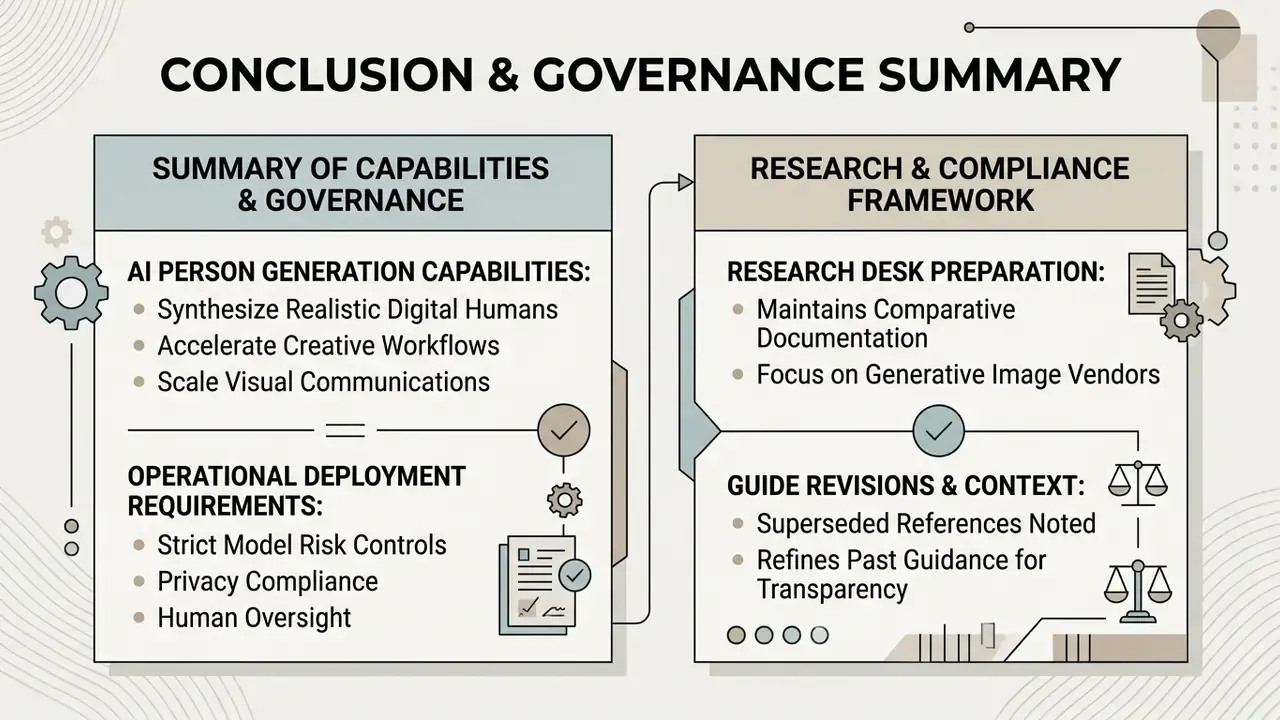
An ai person generator provides powerful capabilities for synthesizing realistic digital humans, accelerating creative workflows and scaling visual communications. The 2026 production stack is no longer only about prompt quality. It is about controllable identity (brand kits, LoRA, reference injection), controllable geometry (pose libraries and garment conditioning), controllable voice (locked neural profiles) and controllable evidence (prompts, consent, detector scores and approvals stored per asset). Teams ready to animate approved characters can continue with image-to-video AI tools that accept a static frame plus audio.
Operational deployment must be paired with strict model risk controls, privacy compliance and human verification pipelines. As regulatory frameworks such as the EU AI Act enforce explicit synthetic content labeling, enterprise adoption has to balance generation speed against verifiable governance. The organisations that scale synthetic humans safely are the ones that can show, per published asset, who approved it, on what evidence and under which licence. That is the whole test.
About this guide
Prepared by our commercial-use research desk, which maintains comparative documentation on generative image, video and voice platforms. Reviewed against primary regulatory sources (EU AI Act Regulation 2024/1689, NIST AI 600-1 and AI 100-4, U.S. Copyright Office AI guidance, Utah Code 20A-11-1104, OAIC and EDPB guidance) and peer-reviewed literature published between 2024 and 2026. Expert commentary contributed by Marcus Hale, author. Regulatory citations reflect the state of publicly available texts at the date of last update and are provided for orientation only. Related definitions are collected in the AI glossary hub, and licensing questions by tool category in the commercial-use library.
Appendix A: revision notes on superseded references
For transparency, the following statements appeared in earlier versions of this guide and were replaced with verified sources. They are retained here as revision history and should not be cited:
- "Research published in Carnegie Mellon University studies on Bias in Generative AI (2026) and NIST AI RMF (2024) demonstrates that unconditioned model defaults frequently display representational bias, over-indexing on specific demographic subsets." The Carnegie Mellon attribution and year could not be verified; superseded by Analyzing Quality, Bias, and Performance in Text-to-Image Generative Models (arXiv, 2024) together with the NIST AI RMF Generative AI Profile (2024).
- "According to a 2024 empirical study evaluating synthetic visual marketing content (Journal of Advertising Research, 2024), AI-generated ad banners reached up to 50% higher click-through rates compared to conventional stock photography." The journal attribution could not be verified against a primary source; superseded by Can AI-Powered Avatars Replace Human Trainers? (randomised study, 2024).
- Internal, non-audited program figures (three-week to two-day sourcing cycle; 28% training-completion uplift; 14% artifact-rejection rate) are retained in the main text with explicit labelling as single-organisation observations, pending published benchmarks.
- Non-descriptive navigational anchors ("browse the hub", "explore the hub", "see the overview", "compare options", "view the guide", "open the hub") and links to unrelated tool categories were replaced with descriptive anchors pointing to topically matched resources.