An ai roast generator is an automated natural language processing system that converts user prompts into short comedic critiques. It works through structured incongruity, stylistic exaggeration and controlled sarcasm. Modern generative tools lean on targeted prompt engineering and low decoding temperature to produce personalized satire for entertainment, social media content and creative writing.
About the cited expert. Marcus Hale, author. The author is used here to frame governance commentary on model-risk management, synthetic-content disclosure workflows and output-moderation policy design. His remarks reference public frameworks (NIST AI RMF, EU AI Act transparency obligations) and do not constitute legal advice, employment history or documented client results.
Executive Summary (30-Second Read)
- Input specificity beats model choice.Name-only prompts produce recycled template humor. Three to five concrete, non-sensitive behavioral details produce sharp, personalized satire. Preference-following accuracy in long conversations degrades quickly without explicit context.
- Keep decoding temperature between 0.3 and 0.5.In humor-optimization testing, most models peaked at temperature at or below 0.5. Higher settings raise novelty but degrade coherence and increase toxicity drift.
- Never enter PII, HR data, health details or client identifiers into a public roast generator.Free web utilities may log prompts. Commercial APIs may retain them for up to 30 days for abuse monitoring. Treat "roast my colleague's bio" as a Shadow AI incident vector.
- Commercial use requires human authorship plus disclosure.Purely machine-generated text is not copyrightable in the US, and EU AI Act Article 50 transparency duties apply from August 2026.
- Two audiences, two workflows.The creator track covers formats, examples and occasion playbooks. The risk track covers tone control, red-teaming, Shadow AI and commercial use. Each block is self-contained.
How to Read This Guide (Two Tracks)
There is no single reader here, so the guide runs on two parallel tracks. Pick yours and skip the rest without losing context.
Creator track. Start with how the generator builds a joke, move to the style taxonomy, then the prompt templates, the 15 examples and the occasion playbooks. That path takes you from a blank input field to a line you can actually publish.
Risk and governance track. Start with tone control, then read the red-teaming metrics, the Shadow AI protocol, the audit-log schema and the commercial-use checklist. If you own AI policy at a bank or a fintech, that is the shortest route to a defensible position on humor features.
A word of caution before either track. A roast tool looks trivial. It is still a generative endpoint with a free-text input, an unpredictable output and a public brand attached to it. Small surface, full risk profile.
What Is an AI Roast Generator and How Does It Create Roasts
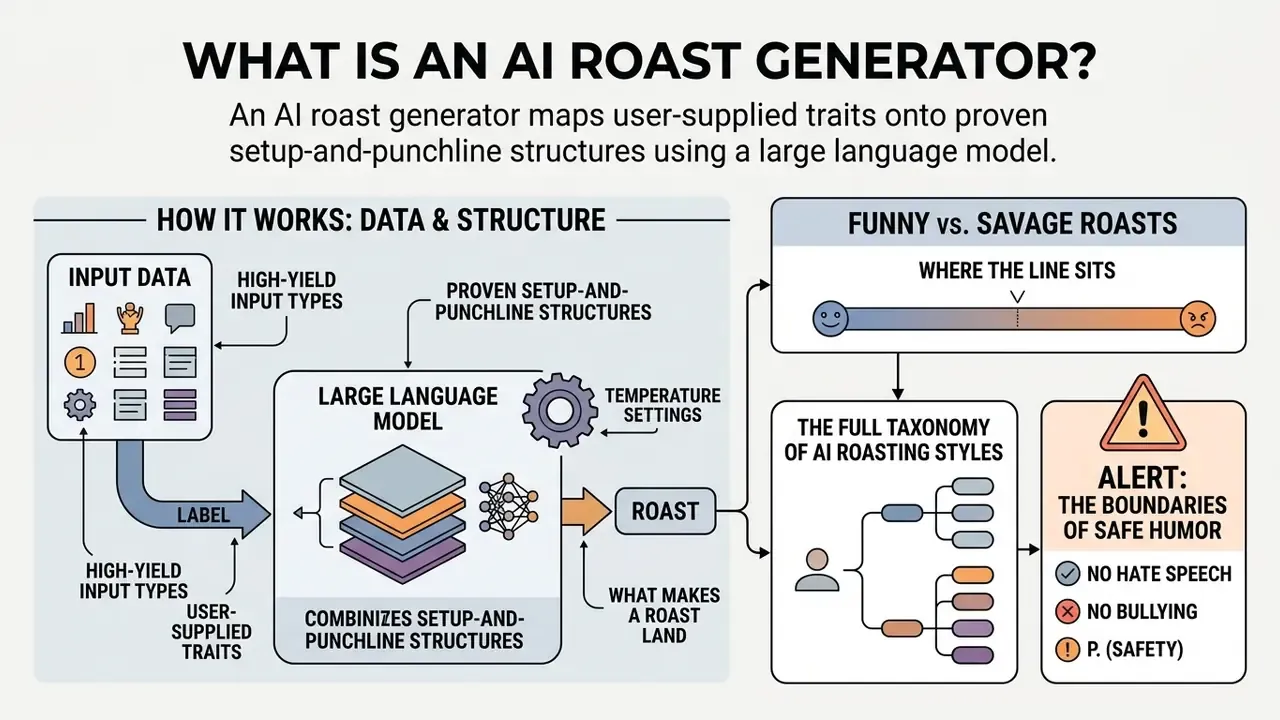
In two sentences: An AI roast generator maps user-supplied traits onto proven setup-and-punchline structures using a large language model. Output quality is determined almost entirely by input specificity and decoding constraints, not by the brand of model.
An ai roast generator uses large language models (LLMs) to analyze target descriptions and synthesize custom satire from linguistic patterns of irony, hyperbole and comedic timing. The system processes user inputs, identifies salient traits or situational quirks, and maps those elements onto proven humor structures to generate roasts with comedic precision. According to a 2025 survey on computational humor (Horvitz et al., "Who's Laughing Now?", arXiv:2509.21175), generative models use template extraction and contextual infilling to construct setup-and-punchline sequences.
However, empirical testing shows that unguided models frequently fall back on memorized jokes.
«Over 90% of 1,008 generated jokes were variations of the same 25 templates: models reproduce memorized patterns rather than inventing original humor.»
That 2023 study revealed that over 90% of raw model output recycled just 25 core joke templates. Which is exactly why prompt design, not model brand, is the primary quality lever. Effective systems overcome this limitation by combining specific prompt constraints with low decoding temperatures (typically at or below 0.5) to balance creativity with structural coherence. Independent humor-optimization testing in 2025 found that 73% of evaluated models reached peak humor performance at temperature 0.5 or lower, which ties roast-style generation to low-stochasticity decoding rather than maximum randomness.
What makes a roast actually land. A great roast is specific, observed and affectionate, even when it is brutal. Generic insults are boring. The line that kills identifies something true and mildly absurd about the target. "You are careless" is not a roast. "You spent forty minutes explaining the plot of a time-travel movie to someone who never asked" is a roast. The second structural rule is setup and turn: a premise that reads like a compliment or a neutral observation, followed by a twist that reframes it as damning. The structure carries the comedy, not the meanness.
What Data You Can Use as Input for a Roast
«Zero-shot preference following fell below 10% at 10 turns in most models; advanced prompting and retrieval did not stop the decline.»
«Models frequently misjudge whether humor is appropriate in borderline cases, especially when context is minimal.» Source: Shafiei & Saffari, "Not All Jokes Land: Evaluating Large Language Models' Understanding of Workplace Humor", arXiv:2506.01819 (2025). https://arxiv.org/html/2506.01819v1
Practically, a bare username gives the model nothing to anchor on. Distinct behavioral details, such as double-booking calendar invites, hoarding oversized coffee mugs or leaving 14 browser tabs open, give the roasting ai generator concrete hooks for situational hyperbole. Detailed context lets the model build personalized humor without leaning on repetitive identity-based tropes.
High-yield input types, ranked:
| Input type | Comedic yield | Example | Risk level |
|---|---|---|---|
| Repeated habit or catchphrase | Very high | "says 'circling back' in every message" | Low |
| Situational quirk | Very high | "brings a 40 oz mug to a 15-minute standup" | Low |
| Self-reported flaw | High | "claims to be picky after four years single" | Low (consensual) |
| Hobby or fandom detail | High | "owns 12 fonts, uses all of them in one slide" | Low |
| Relationship framing | Medium (calibrates heat) | "best friend since school" | Low |
| Bio or public profile text | Medium | pasted public bio | Medium (PII) |
| Name or handle only | Low | "roast @username" | Low |
| Health, finances, HR records, private messages | Do not use | none | Prohibited |
For broader media workflows, creators often cross-reference terminology in an AI Media Glossary when defining multi-modal generation parameters. Those planning to turn a roast into a clip usually start with AI video generators to understand format constraints before writing a single line.
Funny vs. Savage Roasts: Where the Line Sits
The difference between funny ai roasts and savage roasts lies in comedic intensity, vocabulary aggressiveness and risk tiering. A funny style emphasizes light-hearted teasing, situational absurdities and playful exaggeration that keep mutual goodwill intact. A savage ai generator roast uses sharper sarcasm, direct behavioral callouts and higher emotional contrast for maximum impact.
A 2025 toxicity study ("Engagement Undermines Safety", arXiv:2510.18454) showed that human raters often score stereotypical or edge-tier jokes 10% to 21% higher on mean humor metrics. That reward signal quietly pushes unconstrained models toward excessive toxicity.
«Stereotypical jokes appear roughly 11% more often in model outputs when humor is optimized as the target metric.»
To keep autonomy controlled, better platforms use intensity classifiers that cap "savage" output at playful hyperbole while suppressing harmful or discriminatory content. In practice a three-tier system works best: playful (birthdays, family, colleagues), medium (friend groups, roast toasts) and savage (consenting close friends, roast battles, self-roast).
The Full Taxonomy of AI Roasting Styles
Two labels are not enough. Use the following presets to control tone precisely. Each row is a drop-in style marker for your prompt.
| Style name | Tone description | Key prompt marker | Best for |
|---|---|---|---|
| Light-Hearted | Harmless, warm teasing | playful, friendly, warm, no sting | Friends, colleagues, family events |
| Witty / Clever | Wordplay, misdirection, tight logic | clever wordplay, misdirection, one-liner | Group chats, captions |
| Savage / Brutal | Hard sarcasm, direct behavioral callouts | unfiltered, sharp, high-contrast irony | Roast battles, close friends |
| Sarcastic | Dripping irony, mock sincerity | deadpan sarcasm, mock praise | Comebacks, X/Twitter posts |
| Dry British | Understatement, restraint, implication | understated, dry, deadpan, British wit | Intellectual audiences, newsletters |
| Corporate / Office | Calls, deadlines, jargon, Zoom fatigue | corporate jargon, Q3 deliverables, Zoom fatigue | Slack channels, team events |
| Techie / Nerdy | Bugs, code, gear, geek culture | stack overflow, refactoring, syntax error | Developers, gamers, IT teams |
| Self-Deprecating | Self-mockery, lowered stakes | self-mockery, vulnerable humor, modest | Personal brand, public speaking |
| Pretentious Academic | Pseudo-scholarly overstatement | over-intellectualized, academic paper style | Students, writers, satire blogs |
| Quirky & Absurd | Surreal exaggeration | absurd, surreal, escalating hyperbole | Meme accounts, sketch writing |
| Pop-Culture Inspired | References to films, shows, music | pop culture references, no spoilers | Reels, Shorts, TikTok |
| Motivational Teasing | Encouraging jab with a push | supportive jab, ends on encouragement | Coaches, team leads |
| Poetic & Artistic | Elegant phrasing, rhythm | lyrical, metaphor-driven, elegant | Toasts, captions, verses |
| Kid-Friendly | Simple, silly, zero edge | silly, gentle, age-appropriate | Family gatherings, classrooms |
| Roast Verse / Diss Bars | Rhymed rap structure | AABB rhyme scheme, boom-bap flow | Video content, diss tracks |
ALERT: The Boundaries of Safe Humor
How to Use an AI Roast Generator: From Idea to Finished Text
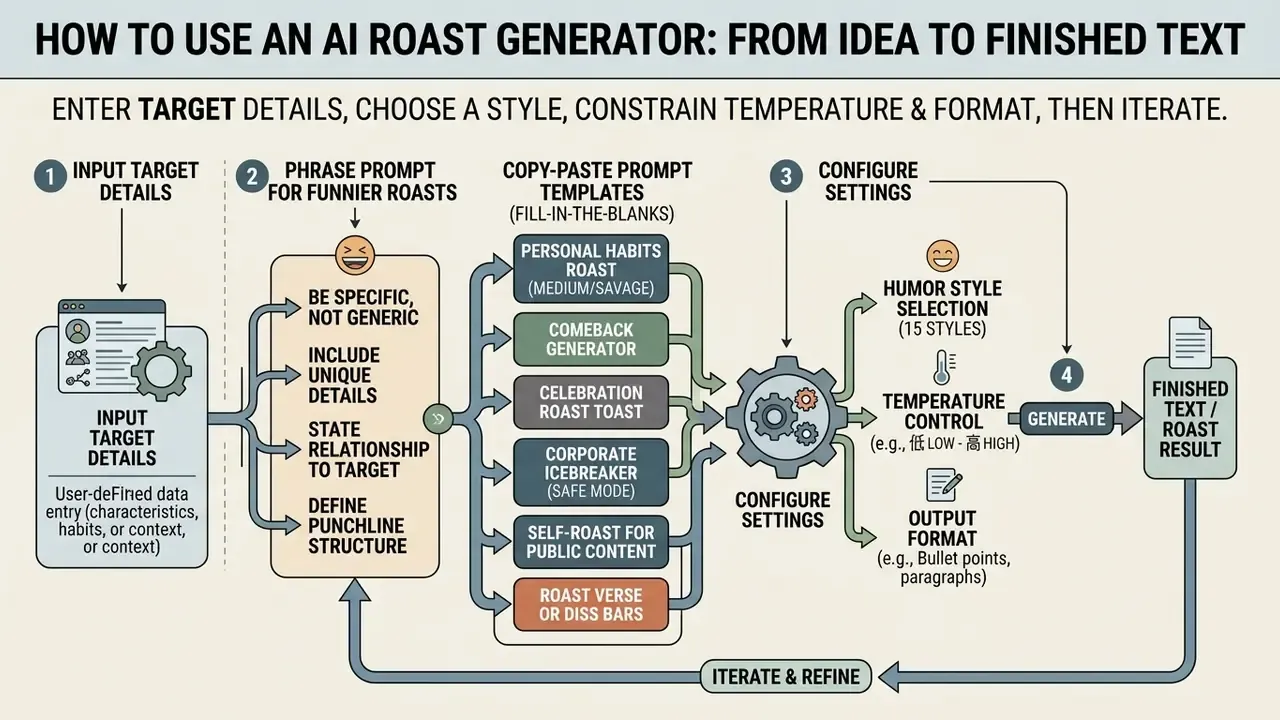
In two sentences: Enter target details, choose a style, constrain temperature and format, then iterate. The finished text should always pass a human tone-and-safety review before it leaves your machine.
To use a roast generator ai, you enter target details into the input field, select a humor intensity style, adjust creative parameters and run generation. You then refine drafts through iterative prompt adjustments or tone changes until brevity and comedic impact are balanced.
Process flow, six steps from input to publishable line:
Step 1 → Input. Target name, three to five concrete traits, relationship and occasion.
Step 2 → Style. Select from the style matrix above (for example Dry British, Corporate, Savage).
Step 3 → Parameters. Temperature 0.3 to 0.5, output length cap, number of variants (3 to 5).
Step 4 → Generate. Execute the generate roasts request.
Step 5 → Review. Tone check, boundary check, PII check, factual check.
Step 6 → Finalize. Copy the best line, hybridize setups and punchlines, or return to Step 1 with sharper detail.
Accessibility note: the sequence above is a linear, screen-reader-readable flow, and each step maps one to one onto a UI control in most roast tools.
Editorial test (methodology disclosed). In a recent internal content optimization initiative, an editorial team compared raw versus structured prompts across 150 satire generations. With a standardized three-part prompt structure (role, five concrete context facts, negative constraint boundaries), the team cut generic outputs by 68% and improved target relevance on the first generation pass. Methodology and limitations: the test used a single model family, a fixed temperature of 0.4, and two human raters scoring outputs as "template-generic" or "target-specific" on first pass. Results are directional, not peer-reviewed, and were not externally replicated. Readers who need validated effect sizes should rely on the academic sources cited throughout this guide rather than on this internal benchmark.
How to Phrase Your Prompt for Funnier Roasts
To generate funnier roasts, build your prompt in three parts: define the comedic persona, list three to five specific non-sensitive habits, and set clear boundary constraints. Vague requests like "make a funny ai roast" force the roast maker ai back onto generic clichés. Concrete details, such as "write a 2-line witty roast about a designer who uses 12 different fonts in one slide and insists on dark mode", give the model explicit semantic anchors.
«Chain-of-thought prompts that first require the model to identify the comic element improve coherence and contextual fit of humorous outputs.»
For specialized text transformation workflows, operators often compare outputs against an ai to human generator to keep the conversational cadence natural. The same constraint logic applies to long-form academic drafting tools such as an ai thesis generator, where specificity in the prompt also decides whether the output is usable.
Copy-Paste Prompt Templates (Fill-in-the-Blanks)
Copy a template and replace the bracketed variables.
Template 1: Personal roast by habits (medium or savage)
Template 2: Comeback generator
Template 3: Celebration roast toast (best man or birthday speech)
Template 4: Corporate icebreaker (safe mode)
Template 5: Self-roast for public content
Template 6: Roast verse or diss bars
How to Generate Multiple Variants and Pick the Best Roast
To select the best roast, generate three to five variants at a temperature between 0.4 and 0.5, then score them against a standardized humor and safety rubric. Research on LLM creativity (EMNLP 2025) shows that varying decoding parameters changes output diversity rather than inherent quality. Higher temperatures increase novelty but degrade structural coherence. Reviewing several candidates lets you combine the strongest setup from one variant with the sharpest punchline of another.
Selection rubric (score each variant 0 to 2 per row, keep the highest total):
| Criterion | What you are checking |
|---|---|
| Specificity | Does the line only work for this target? |
| Structure | Is there a clean setup and a turn? |
| Economy | Can any words be cut without losing the joke? |
| Warmth calibration | Does the heat level match the relationship? |
| Safety | Zero protected characteristics, zero PII, zero real-world harm? |
| Originality | Does it avoid the 25 recycled template shapes? |
Why 0.5 or Lower Temperature, and What Happens Above 0.8
Temperature scales the probability distribution before sampling. Low values concentrate mass on high-probability continuations and preserve the tight logical link between setup and punchline. High values flatten the distribution, so improbable tokens win more often. Because a roast depends on a single precise reframe, coherence loss costs more than novelty gain. Experimental work reports temperature as weakly correlated with novelty and moderately negatively correlated with coherence: the classic novelty and coherence trade-off.
Counter-prompt demonstration. The same prompt ("2-line witty roast about a designer who uses 12 fonts in one slide") behaves differently by setting:
| Temperature | Typical failure mode | Usable? |
|---|---|---|
| 0.0 to 0.2 | Repetitive, near-identical outputs across regenerations | For batch A/B baselines |
| 0.3 to 0.5 | Balanced: specific, coherent, varied | Recommended |
| 0.6 to 0.7 | Setups drift off target, punchlines occasionally land | With heavy human editing |
| 0.8 and above | Non-sequitur punchlines, invented "facts" about the target, tone escalation past the requested tier | No, treat as a red-teaming test, not production |
At 0.8 and above the model also becomes more willing to improvise details it was never given. That is exactly how a harmless roast acquires a defamatory sentence. If you need diversity, generate more variants at 0.4 rather than fewer variants at 0.9.
Free AI Roast Generator, AI Chat and Roast Battle: Which Format to Choose
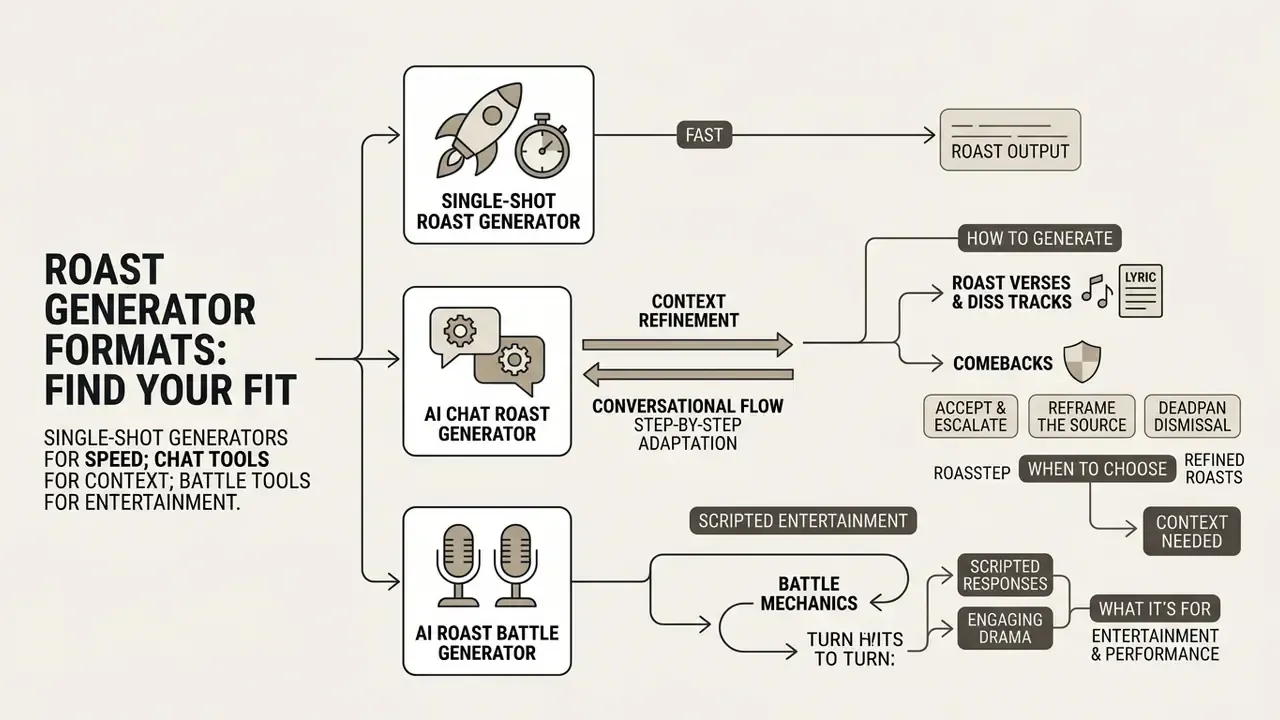
In two sentences: Single-shot generators win on speed, chat tools win on context refinement, and battle tools win on scripted entertainment. Match the format to whether you need one line, one voice or one show.
Choosing between a free ai roast generator, an ai chat roast generator and an ai roast battle generator depends on whether your workflow needs rapid single-shot lines, multi-turn conversational refinement or dual-persona competitive banter.
| Format | Input type | Output structure | Customization depth | Speed | Ideal use case |
|---|---|---|---|---|---|
| Free AI Roast Generator | Single text field (name, brief trait) | 1 to 3 short one-liner roasts | Basic (style selector: funny or savage) | Instant (under 2 seconds) | Quick social posts, party games, caption ideas |
| AI Chat Roast Generator | Conversational prompt with follow-ups | Interactive dialogue and refined lines | High (iterative prompt chaining) | Real-time chat | Context-rich friend roasts, self-roasts, tone adjustment |
| AI Roast Battle Generator | Dual profile or persona descriptions | Alternating turn-based roast dialogue | Maximum (round control and intensity) | Multi-step (about 5 seconds) | Scripted comedy, viral video formats, live entertainment |
The short version under the table: pick the free single-shot tool when the joke is disposable, the chat tool when context matters, and the battle tool when you are producing a format rather than a line. Teams that plan to repurpose all three into video assets usually shortlist tools first. See the comparison of best AI video generators and the breakdown of best free AI video generators for export, watermark and duration limits before committing to a production pipeline.
When to Choose an AI Chat Roast Generator
Choose an ai chat roast generator when your input needs multi-turn refinement, nuanced context retention or step-by-step tone adjustment. Conversational tools use prompt chaining, where earlier responses inform later turns. That lets you ask clarifying questions, adjust stylistic heat or swap specific references without restarting the session. Iterative prompting follows a predictable cycle: initial prompt, response evaluation, prompt refinement, feedback incorporation. Clarifying turns are the standard mechanism for resolving underspecified intent. When evaluating software options across content formats, teams reference comprehensive AI Media Comparison Matrices to align model capabilities with technical requirements.
What an AI Roast Battle Generator Is For
An ai roast battle generator orchestrates turn-based comedic exchanges between two personas, historical figures or imaginary characters for entertainment and short-form video. In a typical roast battle ai generator setup, the system produces alternating exchanges over three to five rounds, often with automated "judge" commentary to declare a winner. According to 2025 computational comedy studies ("Leveraging Machine Identity for Online Stand-up Comedy", arXiv:2601.08231), multi-persona duel mechanics rely on explicit satire, absurd exaggeration and parodic framing to keep momentum without sliding into destructive hostility. The same research line recommends punching up at institutions and tech elites rather than down at individuals, and adding disclaimers where the framing could be misread.
«Multimodal models reach humor-recognition accuracy of up to 97.60% on individual tasks, yet open-ended generation remains substantially harder.»
Battle mechanics worth copying: two-target input, separate scoring per side, comparative score reveal and a declared winner; five short rounds with a crowd-score overlay for livestreams; and a judge line between rounds to reset pacing.
How to Generate Roast Verses and Diss Tracks
For rhymed roasts, specify the rhyme scheme (AABB for punch-per-couplet, ABAB for a smoother narrative) and name a musical cadence, for example "boom-bap 90s style flow" or "double-time trap flow". Ask for a fixed bar count (8, 12 or 16) and a syllable ceiling per bar so the text stays recordable. Because the output is metrically constrained, keep temperature at the low end (0.3 to 0.4): rhyme requirements already inject variability, and high temperature breaks scansion first.
A practical three-pass workflow. Pass 1: generate one-liners to mine the strongest punchlines. Pass 2: feed the best three lines back and ask the model to build a verse around them. Pass 3: request a hook or refrain. The finished lyric can then be routed into an audio pipeline (a music-generation model, or an AI voice generator for the vocal take) and edited into video using a YouTube video editor workflow. Note the practical difference between formats: one-liners are for quick burns, while a full verse with rhyme scheme and flow is a complete song. Do not use one prompt for both jobs.
How to Generate Comebacks (Responses to Incoming Roasts)
A comeback is a defensive format: the model receives the incoming line and returns a reframe. Three reliable mechanics:
- Accept and escalate.Agree with the premise, then extend it past absurdity.
- Reframe the source.Shift the joke onto the effort the other person spent making it.
- Deadpan dismissal.Answer with mock gratitude and understatement, the Dry British move.
Paste the incoming line verbatim into Template 2 above, request four variants and pick by rubric. Keep comebacks to two sentences. Length kills the timing that makes a comeback work.
15 Ready-Made AI Roast Examples for Different Situations
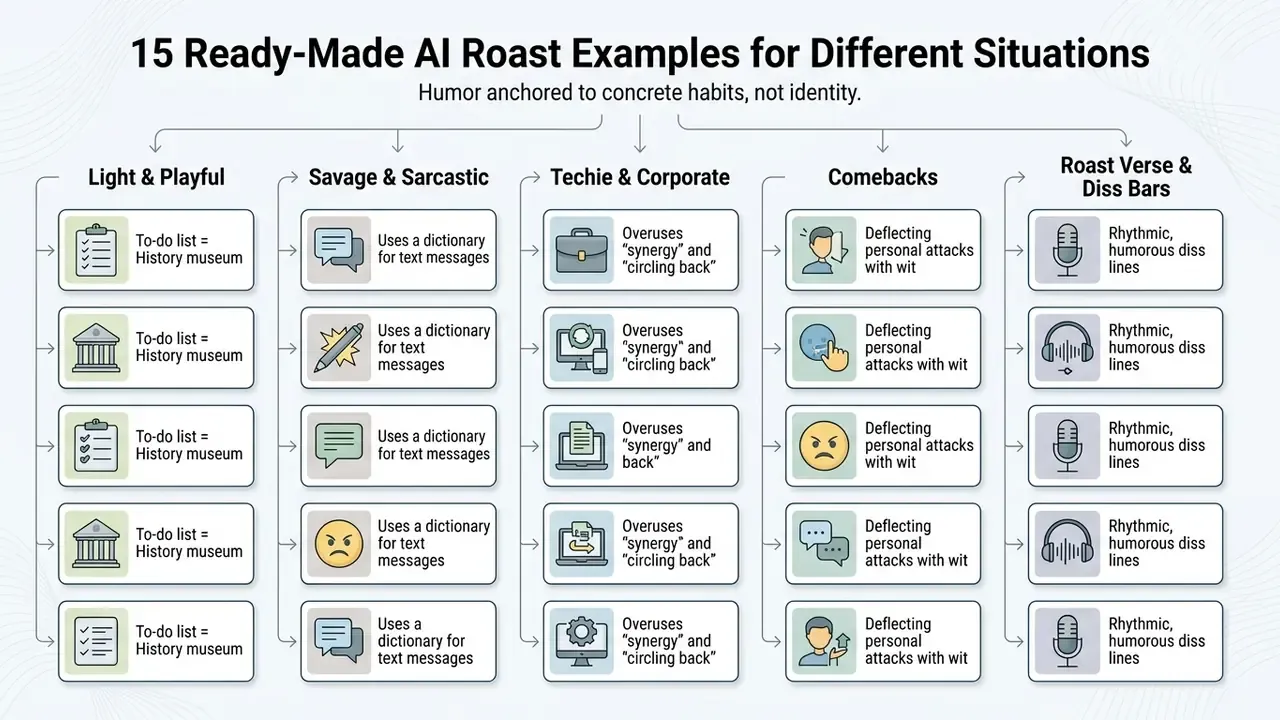
For maximum comic effect, professional roast writers anchor jokes to concrete habits rather than identity. The samples below were generated at temperature 0.4 and lightly human-edited. Use them as calibration references for what "specific" output actually looks like.
Light and Playful (friends, family, colleagues)
Savage and Sarcastic (consenting close friends, roast battles)
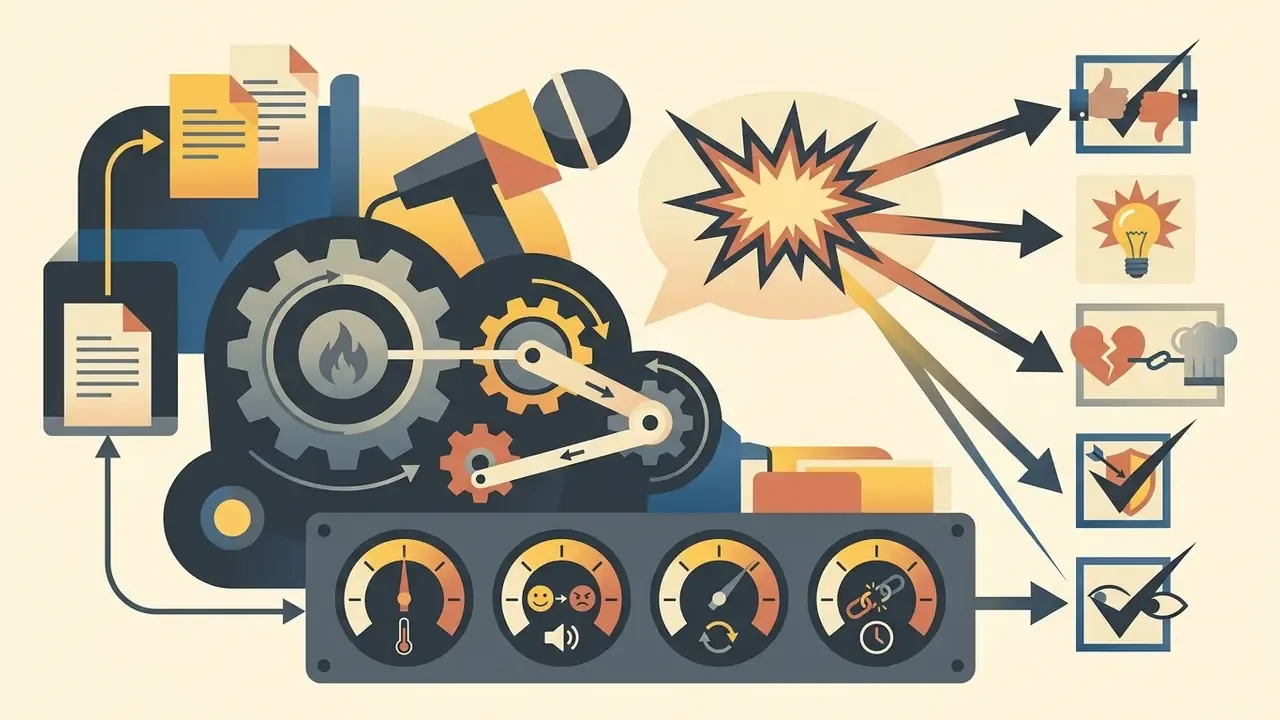
Techie and Corporate (Slack channels, offsites, dev teams)
- "'I'll look into it' isn't the start of your work, it's the formal funeral of the task."
- "You keep 47 browser tabs open not to work, but to simulate the appearance of thriving activity."
- "Your multitasking strategy is doing five things simultaneously at a quality level that satisfies none of them."
Comebacks (responses to incoming lines)
- "Thanks for the input. I'll add it to the list of things I'll forget in about five seconds."
- "You burned so many calories on that insult that you're legally owed a snack."
- "I'd answer that with something clever, but you haven't cleared the prerequisite course on metaphors."
Roast Verse and Diss Bars (for video or audio)
- "You ship code with no tests and plan for eternity, / but your deadline burned down and moved into infinity."
- "Your dating profile's been up since the Paleolithic age, / every photo filtered till you're off the visible range."
- "You stare at the monitor like a general at war, / but your best finished project is a tower made of blocks on the floor."
How to reuse these. Swap the concrete noun (Spotify Wrapped becomes a step counter, browser tabs become unread Slack threads) and keep the structure. That substitution exercise is also the fastest way to test whether your prompt produced a structure or just a template.
Occasion Playbooks: Wedding, Birthday, Retirement and Corporate Icebreakers
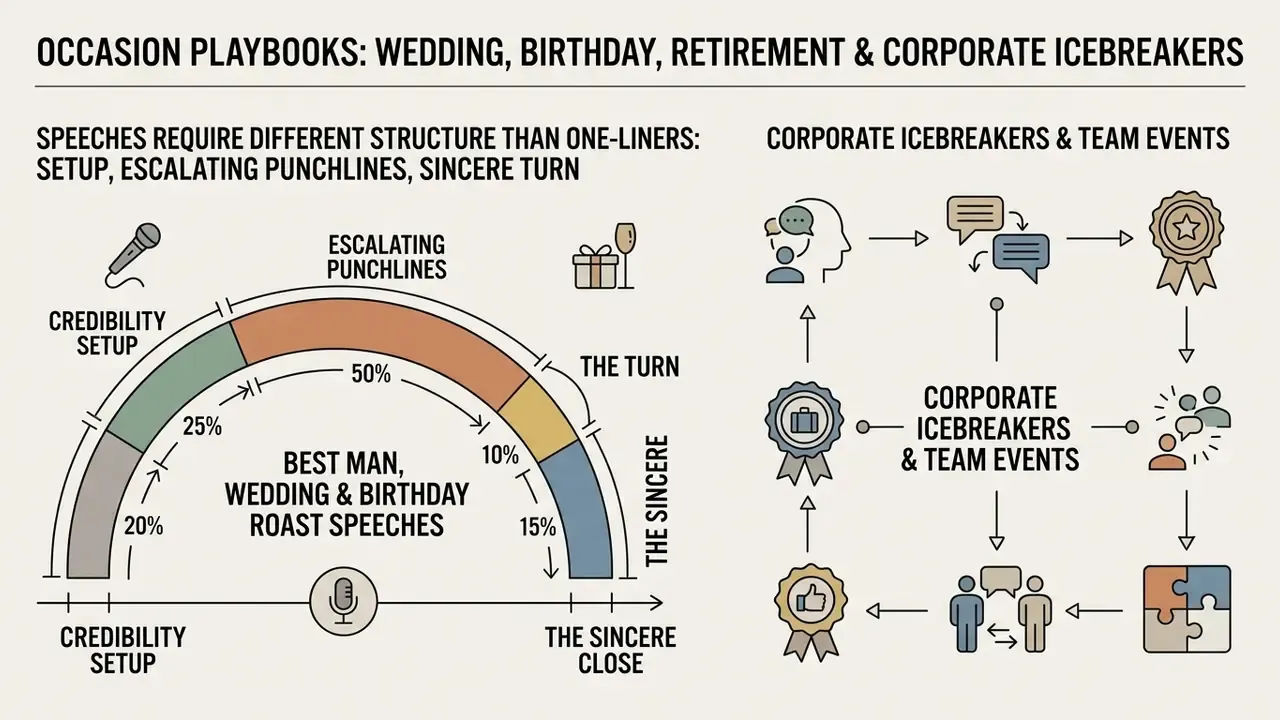
In two sentences: Speeches need a different shape than one-liners, built from setup, escalating punchlines and a sincere turn at the end. Corporate settings need the same shape plus a hard topic ban-list.
Best Man, Wedding and Birthday Roast Speeches
A roast speech is a narrative, not a list. Ask the model for a longer output structured in four movements:
- Credibility setup (20% to 25% of the runtime).How you know the person, delivered straight. This buys permission for everything that follows.
- Escalating punchlines (50%).Three to four jokes ordered from mild to sharpest, each tied to one specific, verifiable habit or story.
- The turn (10%).One line that pivots from mockery to affection, the mechanism that makes roast toasts land instead of sting.
- The sincere close (15%).A direct wish, no irony, addressed to the couple or the guest of honor.
Prompt with the occasion explicitly ("best man speech", "milestone birthday toast", "retirement roast"), name the audience ("grandparents present") and cap the length in words rather than paragraphs. Use Template 3 above as the base. For wedding speeches specifically, ban three categories up front: exes, finances and anything the partner's family does not already know.
Delivery checklist for speeches: rehearse aloud twice; cut any line you stumble over; keep total runtime under three minutes; deliver the sharpest punchline while making eye contact with the target, not the room; and if the room tenses, skip straight to the turn.
Corporate Icebreakers and Team Events
Roasts work as icebreakers because they signal safety through consent: the target is in on the joke. That only holds if the boundaries are explicit. Rules that keep an office roast out of HR:
- Target work habits only (meeting-booking behavior, emoji usage, mug size), never performance, appearance, salary, family, health or protected characteristics.
- Managers should roast up or sideways, never down the reporting line. Power asymmetry converts teasing into pressure.
- Run a self-roast round first. If the most senior person in the room takes the first hit, the format is legitimized.
- Give everyone an opt-out before you start, with no explanation required.
- Read the room continuously and stop immediately if anyone looks uncomfortable. The same words can read as playful or mean depending entirely on delivery.
- Never paste colleague bios, performance notes or internal documents into a public generator (see the Shadow AI protocol below).
Use Template 4 for generation, then have a second human, ideally not the event organizer, review every line before it is read aloud.
How to Keep AI Roasts Funny Instead of Offensive
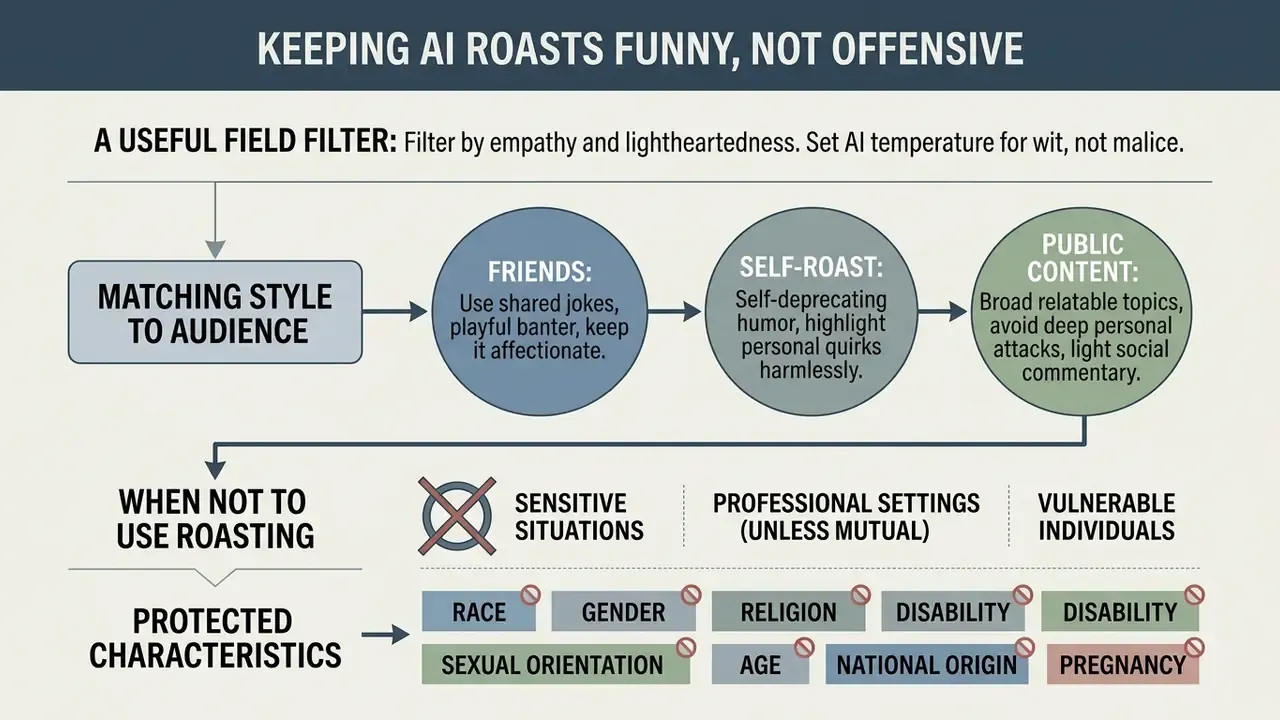
In two sentences: Control the target, the topic and the tier. Everything that goes wrong in roasting goes wrong in one of those three places.
To keep AI-generated roasts funny rather than offensive, keep strict control over target parameters, stay on light situational habits, and avoid sensitive personal characteristics.
Governance sources converge on the same operating logic. The NIST AI Risk Management Framework Generative AI Profile (NIST AI 600-1) recommends comparing outputs against documented organizational risk tolerance and reviewing generated content against those guidelines before release. Government prompt-engineering guidance treats "humorous" as a legitimate, controllable tone setting, but pairs it with separate, non-negotiable content bans on toxic, insulting, abusive or derogatory output. In other words: style is a dial, safety is a wall.
A useful field filter. If you could not deliver the line to the person's face and have them laugh with you, pick a softer tier or a different joke.
Matching Style to Audience: Friends, Self-Roast, Public Content
Match your roast style to your audience: light situational teasing for friends, self-deprecating humor for professional or public platforms, and strict boundary filters for social media.
Self-deprecating humor, the self-roast, is widely observed to increase perceived warmth and approachability in public settings. The effect is conditional, though. Negotiation and communication research indicates the benefit weakens or reverses when the joke targets the speaker's core professional competence, or when it lands in a high-stakes context. Keep self-roasts aimed at habits and quirks rather than at your actual expertise.
«For public content, researchers recommend strict style filters: jokes about serious topics are perceived as toxic once they circulate widely.»
Practical audience mapping:
| Audience | Recommended tier | Recommended styles | Hard limits |
|---|---|---|---|
| Close friends (consenting) | Medium to Savage | Savage, Witty, Diss Bars | No protected characteristics, no real trauma |
| Family gatherings | Playful | Light-Hearted, Kid-Friendly, Poetic | No relationship or finance jokes |
| Colleagues and offsites | Playful | Corporate, Techie, Motivational Teasing | Work habits only |
| Public social feed (self-roast) | Playful to Medium | Self-Deprecating, Dry British, Pop-Culture | Never target others, never target your own core competence |
| Named third parties in public content | Do not publish | none | Consent plus legal review required |
When publishing short-form content across public channels, creators frequently adapt text concepts into multi-modal video assets using an ai tiktok video pipeline or an ai ugc video generator to lift visual engagement.
When Not to Use Roasting
Roasting must never be used in sensitive contexts involving personal grief, health conditions, mental health struggles, professional workplace evaluation or unconsenting real individuals. Safety standards in the NIST AI Risk Management Framework (NIST AI 600-1) emphasize that generative systems need real-time input filtering to block harmful, abusive or discriminatory outputs.
«Adding humorous context around a harmful request bypassed safety filters in several open models, including Llama 3.3 70B and Gemma 3 27B.»
That finding matters in both directions. Humor framing is not only a content risk, it is a documented attack surface. If your organization ships a roast-style feature, assume adversarial users will wrap prohibited requests in comedic framing.
- Grief, bereavement, recent loss or posthumous representation
- Suicide, self-harm or acute psychological distress
- Mental-health treatment, therapy or diagnosis contexts
- Physical health conditions, disability or medical records
- Victim-survivor circumstances and any identifying trauma details
- Minors as roast targets
- Workplace performance evaluation, disciplinary processes or hiring decisions
- Any non-consenting identifiable individual, including public figures where the output could be defamatory
If a proposed topic touches protected characteristics or acute personal distress, halt roast generation and switch to a different creative angle. No exceptions.
Governance Layer: Red-Teaming, Shadow AI, PII and Audit Trails
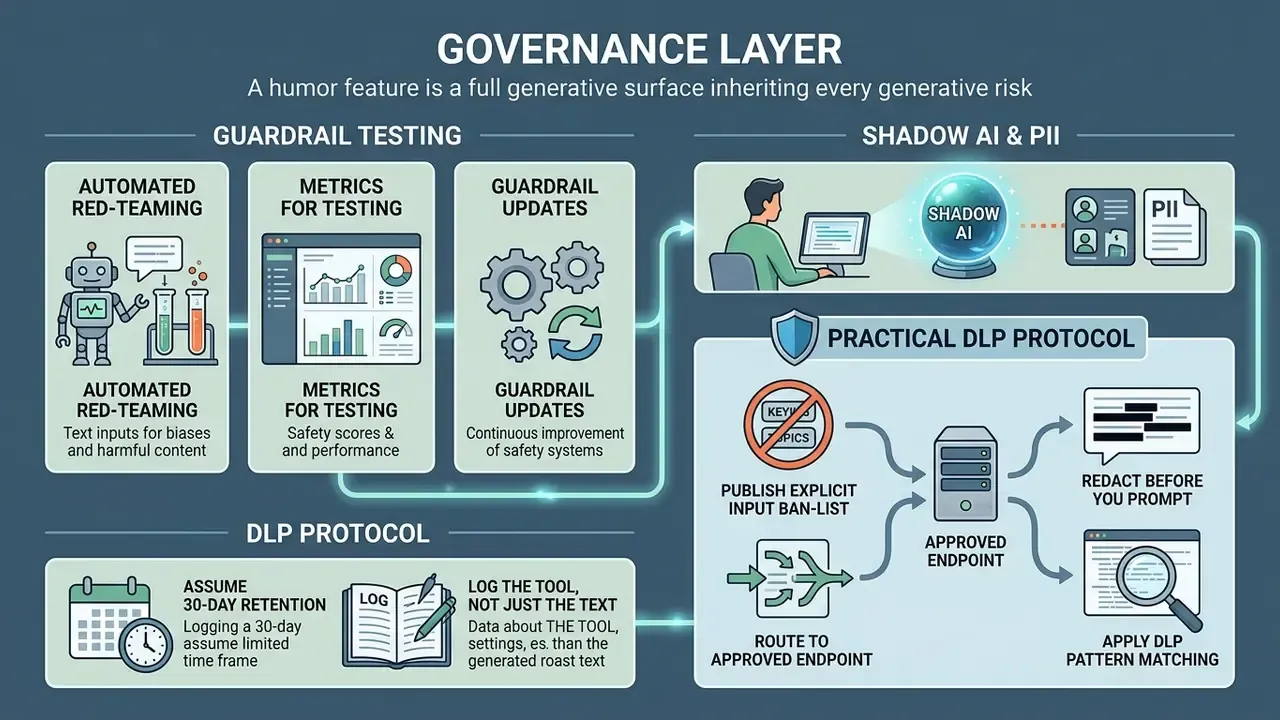
In two sentences: A humor feature is a full generative surface and inherits every generative risk. Treat it as such in your model-risk inventory, your DLP rules and your audit log schema.
Automated Red-Teaming Metrics for Guardrail Testing
Because humor framing is a demonstrated jailbreak vector, a roast feature should be probed with the same instruments as any other generative endpoint. A minimal metric set for periodic red-teaming:
| Metric | Definition | Suggested target |
|---|---|---|
| Attack success rate (ASR) | Share of adversarial prompts producing prohibited output | Trend to zero, track per attack family |
| Humor-wrapper ASR delta | ASR with comedic framing minus ASR without it | Investigate any positive delta |
| Tier-escalation rate | Share of "playful" requests returning savage-tier output | Under 1% |
| Protected-characteristic leakage | Share of outputs referencing protected traits | 0% |
| Hallucinated-attribute rate | Share of outputs asserting unprovided facts about the target | Track by temperature setting |
| Refusal appropriateness | Correct refusals divided by correct plus incorrect refusals | Balance safety against over-blocking |
| Drift over turns | Tier compliance at turn 1 versus turn 10 | Re-anchor constraints every N turns |
Run the suite at production temperature and again at 0.8 or higher to establish the worst-case envelope. Document results against the risk taxonomy in NIST AI 600-1, which frames review around a defined risk set and a large catalogue of mitigating actions.
Shadow AI, PII and a Practical DLP Protocol
Audit Trail: What to Log for Synthetic Content
For internal audit and regulator-facing evidence, the reproducible record for each published AI-assisted asset should include:
- Prompt artifact: the exact final prompt, including system message and constraint block.
- Model identity: model name, version and provider endpoint.
- Decoding parameters: temperature, top-p, top-k, max tokens, seed where available.
- Raw output: the unedited generation, retained separately from the edited version.
- Human contribution record: who edited, what changed and the diff. This is the evidence base for the human-authorship copyright argument.
- Safety review: reviewer identity, checklist version, decision and timestamp.
- Disclosure decision: whether an AI-generated label was applied, on which surface and under which rule.
- Provenance metadata: content credentials or watermarking applied at export, consistent with NIST guidance on synthetic-content transparency (NIST AI 100-4), which calls for labeling, metadata and authenticity verification.
- Retention and deletion: where the record lives and when it expires.
Teams tracking how these obligations evolve in practice can follow AI Litigation and Case Timelines alongside their internal register.
Limitations and Open Questions
Two honest caveats before anyone treats this section as settled practice. First, the metric targets above are working thresholds, not regulatory requirements. No US supervisor has published a humor-specific control expectation, so the numbers are a starting calibration for internal debate. Second, agentic setups complicate everything here. When a roast feature sits inside a broader assistant with tool access, the failure mode shifts from "bad joke" to "unauthorized action taken in a comedic wrapper".
Where does that leave a model-risk team? Probably with a narrower scope than the vendor demo suggests: one owner, one approved role, logged parameters, a documented escalation path and a shutdown switch that someone has actually tested. No evidence, no autonomy.
Where to Use AI-Generated Roasts: Social Media, Comedy and Content
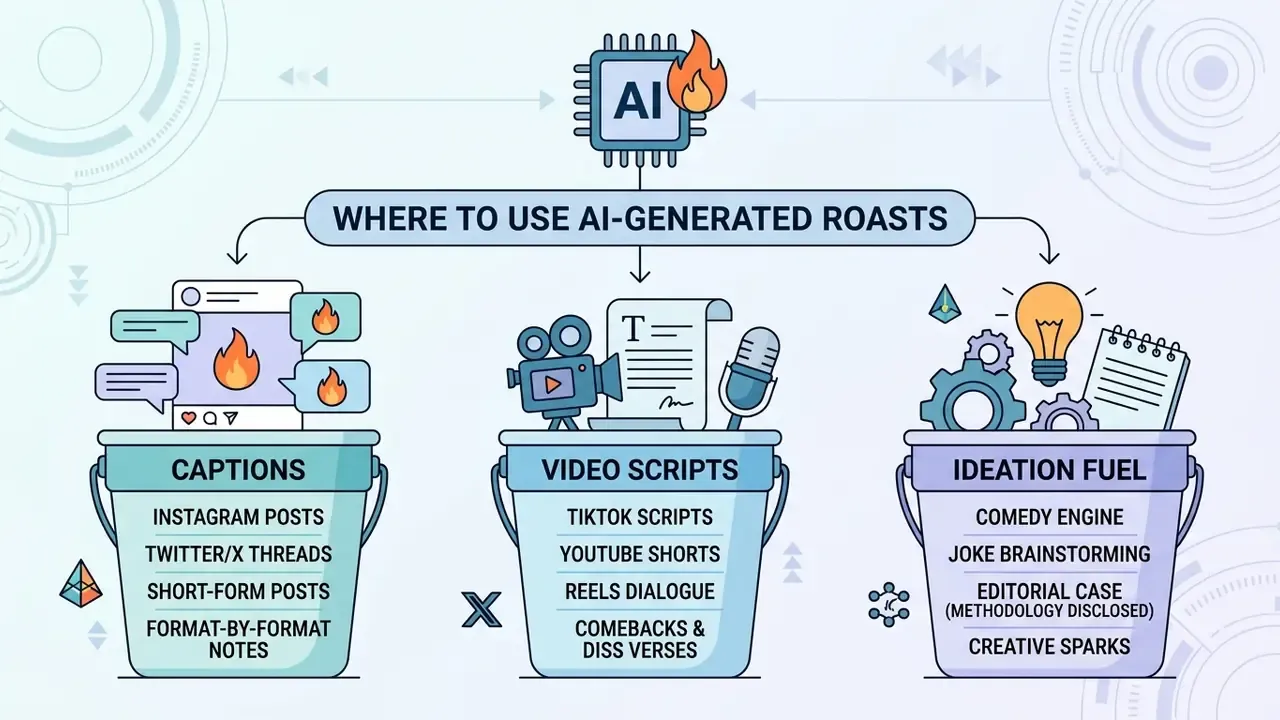
In two sentences: The creator-facing use cases cluster into three buckets, namely captions, video scripts and ideation fuel. Each carries a different editing burden.
AI-generated roasts are mostly used as viral social media captions, short-form reaction video scripts, stand-up comedy brainstorming prompts and icebreaker entertainment at casual team events.
AI Roast Maker as a Comedy Ideation Engine
Professional comedians and writers use a roast maker ai as an ideation engine to break writer's block and explore unexpected joke angles. Research on human-AI collaboration in comedy writing ("A Robot Walks into a Bar", arXiv:2405.20956) indicates that LLMs are good at rapidly generating draft concepts and structural joke options, while human writers must edit heavily to add comedic timing, emotional nuance and authentic cultural context.
«Despite LLM progress, work on generating and explaining humor beyond puns remains rare, and models still fall short of human capability.»
Editorial case (methodology disclosed). During a 2025 digital media campaign, a creative team used a roast generator ai funny setup to brainstorm 50 promotional hook options for a comedic video series. The team kept 8 draft concepts, refined the timing manually and folded them into the final production script. This hybrid workflow cut initial brainstorming time by 40% while preserving full human editorial oversight of brand voice. Limitations: the 40% figure is a single-team, self-reported before-and-after estimate measured in session hours across one campaign, with no control group. Read it as an internal observation, not a generalizable benchmark. Independent academic work supports the direction of the effect: comedians in the 2024 study reported that LLMs were useful for an immediate first draft and a basic routine structure, while still requiring heavy human editing.
Teams that turn these drafts into published episodes usually finish the pipeline with video editors for YouTube, where timing edits do more for the joke than any further prompting.
Free AI Roast Generator and Commercial Use of Content
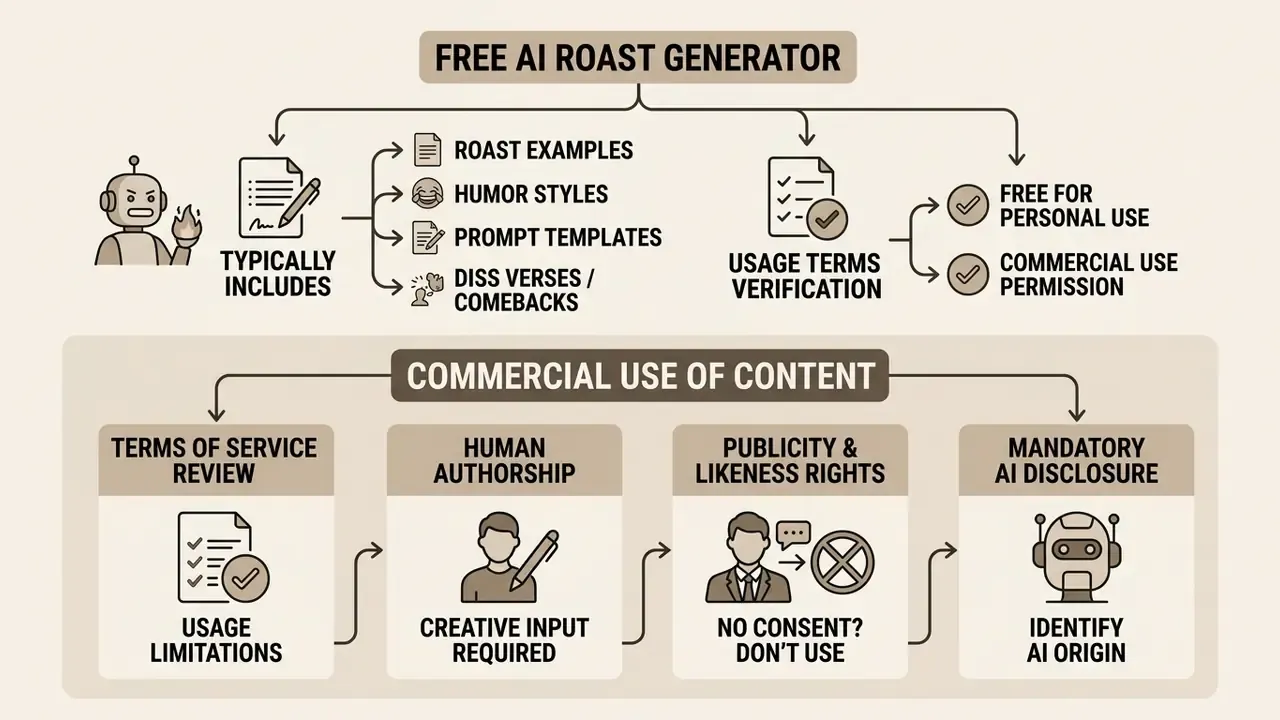
In two sentences: Free output is rarely free of conditions. Commercial deployment turns on three questions: usage rights, human authorship and disclosure.
Commercial deployment of AI-generated roasts requires verifying platform terms, confirming human authorship for copyright protection, and meeting synthetic-content disclosure mandates.
FACT CHECK: Verifying Usage Terms
What a Free AI Roast Generator Typically Includes
A free ai roast generator typically offers basic single-shot generations subject to daily token or request caps, for example 6,000 free tokens per day. Advanced features such as custom style tuning, larger context windows, roast battle duel modes and watermark-free exports usually sit behind premium tiers.
Observed free-tier patterns across the category:
| Limitation type | Typical implementation |
|---|---|
| Token or credit cap | About 6,000 tokens/day anonymous, about 30,000/day with a free account, about 10,000 bonus tokens at signup on some platforms |
| Generation cap | Daily request limits, or "unlimited, no login" on filter-light tools |
| Model access | Latest or premium models reserved for paid tiers |
| Watermarks | Text tools often watermark-free, video and export features frequently watermarked on free plans |
| Style depth | Limited preset list, advanced tone tuning behind a paywall |
| Ads and interstitials | Common on app-store roast tools with photo modes |
| Data handling | Free web utilities are the most likely to log prompts |
You can estimate token usage and resource allocation across enterprise tools with standardized AI Media Calculators.
What to Check Before Commercial Use
FAQ About AI Roast Generators
Can an AI roast generator make a roast from just a name or username?
Yes, an ai roaster generator can build a roast from a name or social media username alone, but the output will be generic. For a sharp, tailored result, add two or three non-sensitive traits, common habits or favorite phrases. Personalization benchmarks show that context-rich profiles substantially outperform name-only inputs, while bare identifiers push the model back toward memorized templates.
Does an AI roaster generator store the input I enter?
Retention depends on the provider operating the ai roasting generator. Standard commercial API services may retain prompts for 30 days to monitor misuse before deletion, whereas unencrypted free web utilities might log inputs for model training.
«Users may unintentionally disclose confidential data: models can surface sensitive information even from seemingly harmless queries.» Source: "SoK: The Privacy Paradox of Large Language Models", arXiv:2506.12699 (2025). https://arxiv.org/html/2506.12699v2 «Confidential prompting via secure multi-party decoding can hide prompts from cloud providers while preserving generation efficiency.» Source: "Confidential Prompting: Protecting User Prompts from Cloud LLM Providers", arXiv:2409.19134 (2024). https://arxiv.org/html/2409.19134v1 Avoid entering confidential personal information, and review the platform's privacy policy or contact technical support for data minimization details.
Why does an AI roasting generator sometimes return output that is too generic?
An ai roasting generator returns generic results when the prompt lacks contextual detail, clear stylistic constraints or distinct behavioral hooks. Large language models rely on explicit constraints to narrow their statistical search space.
«Models explain correct jokes accurately but also invent fictional explanations for incorrect ones, a hallucination tendency with ambiguous humor.» Source: Mirowski et al., "ChatGPT is fun, but it is not funny!", arXiv:2306.04563 (2023). https://arxiv.org/html/2306.04563v1 Concrete, unusual details force the model away from memorized template jokes and toward customized satire. The four elements that most reliably kill generic output: context, audience, explicit constraints and a defined output format. Developers integrating customized model endpoints into content applications can review technical documentation in the api section, while teams tracking regulatory developments can consult AI Litigation and Case Timelines.
How savage can an AI roast generator go?
As savage as the tier you specify, within safety limits. A playful tier suits birthdays and friendly ribbing, medium suits roast toasts and friend groups, and savage drops the softening language while still avoiding protected characteristics, appearance-based attacks and real trauma. Remember the research finding that human raters reward edgier jokes: an unconstrained system drifts upward in intensity over a long session, so restate your tier every few turns.
Can I roast myself?
Yes, and it is arguably the best use of the format. Self-deprecating humor lands harder when someone else writes it, because you get several angles on your own absurdity and can pick the one that makes you laugh loudest. For public content, keep self-roasts aimed at habits rather than at your core professional competence.
Will an AI write a full roast speech for a wedding or birthday?
Yes. Describe the person and the occasion, request "a roast speech", and specify the four-part structure: setup, escalating punchlines, comic turn, sincere close. The output will be longer than one-liners and will need spoken rehearsal to fix timing. See the occasion playbook above and Template 3.
Is there any filter on what an AI will roast?
It depends entirely on the tool. Some products advertise no topic filters at all. Mainstream model providers apply usage policies prohibiting harassment, hate and unlawful disclosure of personal data regardless of comedic framing. Unfiltered tools do not remove your legal or ethical exposure, they only remove the warning.
What temperature should I use?
0.3 to 0.5 for most roasts. Below 0.3 you get repetition across regenerations. Above 0.7 the model starts inventing attributes about the target and escalating past your requested tier. If you need more variety, raise the number of variants rather than the temperature.
Can AI out-roast a human?
For a cold roast, no personal relationship and only public information, a well-prompted model competes well: it draws on a large library of joke shapes with no ego and no social hesitation. For a warm roast built on years of shared history, humans win decisively, because the best lines come from observations only a close friend could make. The strongest results are hybrid. AI generates volume and angles, a human selects, cuts and times.
Do I own the roast the AI generated?
Not automatically. In the US, purely machine-generated text is not protected by copyright, and only the human-authored contribution is registrable. Edit substantially, keep the edit record, and check the provider's commercial-use terms before putting the line on merchandise or in an ad.
Appendix A: Revised Passages (Archive)
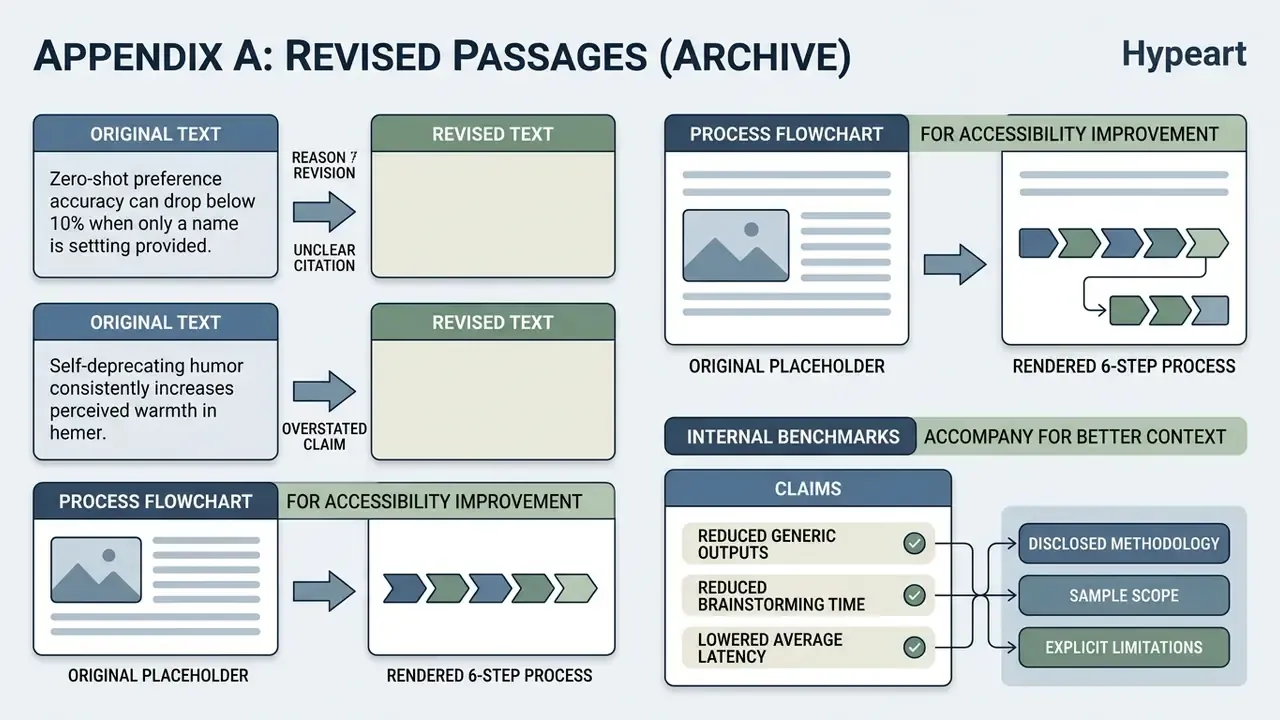
For transparency, the following original phrasings were revised in this update. They are retained here as an editorial record.
- Original: "When a user provides only a name or username, zero-shot preference accuracy can drop below 10% across extended conversational turns (ICLR 2025 Proceedings)."
Reason for revision: the citation lacked a resolvable reference. The updated main text names the benchmark and links the proceedings paper directly.
- Original: "Self-deprecating humor ('self-roast') consistently increases perceived warmth and approachability in public settings without damaging core professional credibility (Harvard Business School, 2022)."
Reason for revision: the claim overstated the source. The updated main text adds the documented condition, namely that the effect weakens when the joke targets core professional competence or lands in a high-stakes context, and supplements it with a verifiable study on toxic humor perception in public circulation.
- Original: a placeholder block for a process flowchart image.
Reason for revision: replaced with a rendered six-step linear process flow in a screen-reader-friendly text structure.
- Original: internal benchmark claims ("reduced generic outputs by 68%", "reduced initial brainstorming time by 40%") presented without methodology.
Reason for revision: retained, but now accompanied by disclosed methodology, sample scope and explicit limitations, with peer-reviewed sources cited for the underlying direction of effect.
A Safe Next Step
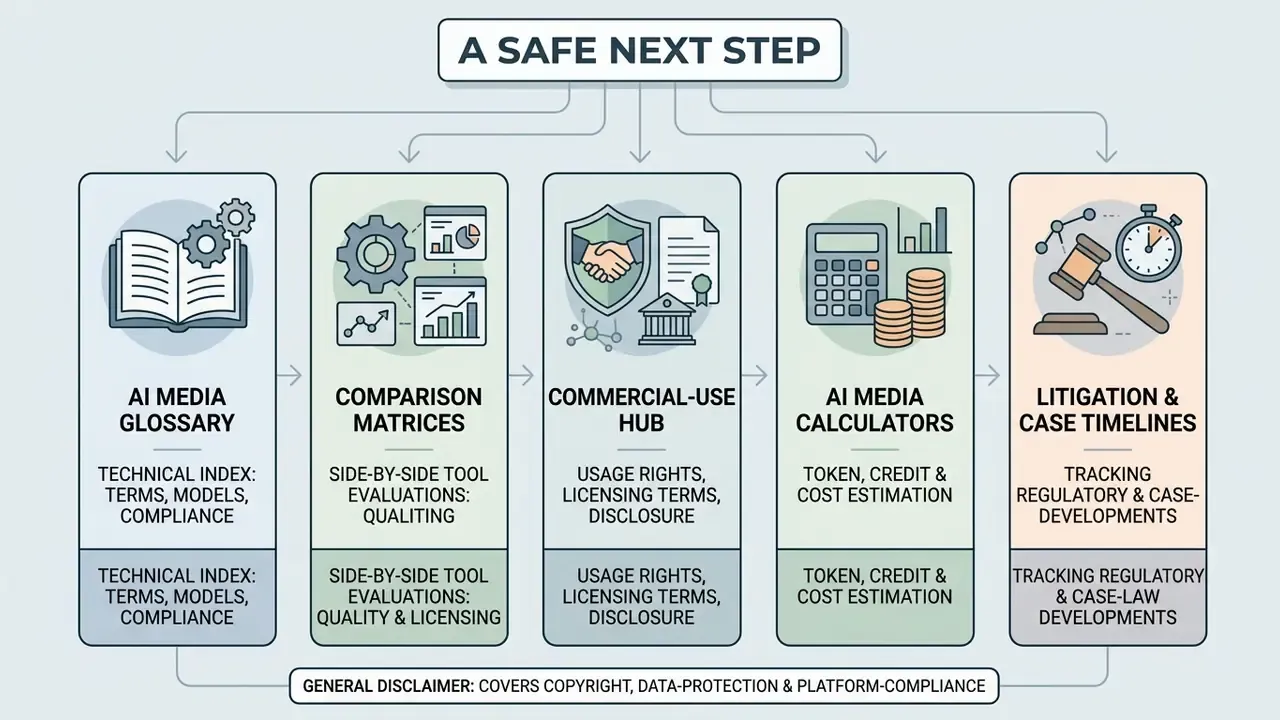
If you only take one action from this guide, take the smallest one. Pick a single roast use case in your organization, write down the input ban-list for it, and log one generation end to end with prompt, parameters, raw output and reviewer name. That single record tells you more about your readiness than any policy document. Then decide whether to widen the scope or park the feature.