Last updated: February 2026 · Reading time: ~15 minutes · Audience: brand leaders, marketing operations, AI governance and compliance teams
Executive Summary
- An ai slogan generator converts a structured business brief into dozens of candidate short-form brand phrases in seconds. The model is an ideation engine. It is not the decision-maker.
- Slogan, tagline, motto and catchphrase are not synonyms. Each has a different lifespan, audience and placement rule, and each needs its own prompt constraint set.
- Prompt quality drives output quality: richer brand context measurably improves consumer liking and purchase intent versus thin prompts (Redden et al., 2025).
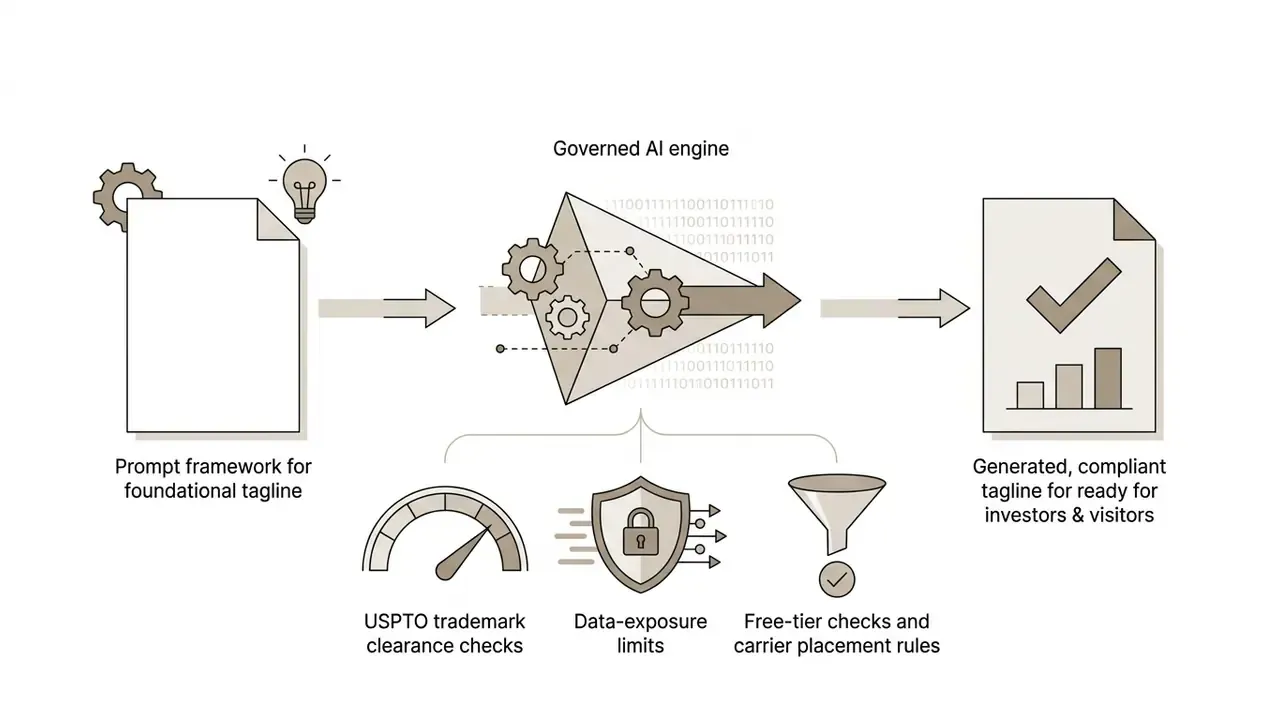
- Purely machine-generated text is not registrable with the U.S. Copyright Office. Human editing, arrangement and trademark clearance through the USPTO database are mandatory before commercial release.
- Free tiers create two distinct risks: generation caps and data exposure. Never paste non-public product, pricing or roadmap data into consumer-grade free tools.
- SEO risk is largely overstated. Among 600,000 pages in Google's top 20, 86.5% contained AI-assisted content, and the correlation between AI-text share and ranking position was 0.011, effectively zero (Ahrefs, 2023–2024, https://ahrefs.com/blog).
What an AI Slogan Generator Is, and How a Slogan Differs From a Tagline
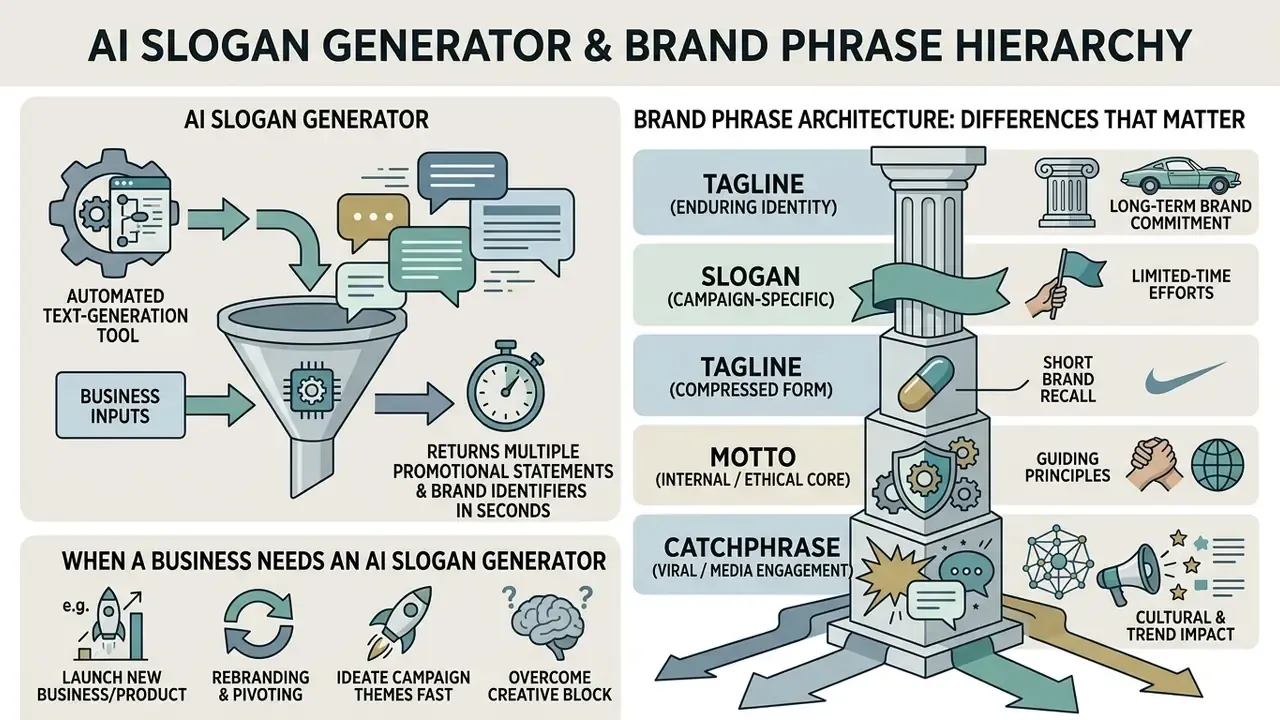
An ai slogan generator is an automated text-generation tool that processes business inputs and returns multiple short promotional statements and brand identifiers in seconds. A slogan generator is built to compress the first mile of copywriting, giving teams rapid options for campaigns, product launches and identity refreshes. Understanding how is a slogan different from a tagline, motto or catchphrase is not academic hair-splitting: it determines prompt constraints and the governance controls you place over generated commercial copy.
In enterprise environments, an ai tagline generator, ai business tagline generator, ai motto generator, ai catch phrase generator or ai catchphrase generator is a front-end interface over large language models (LLMs). Research on creative collaboration modalities suggests something counterintuitive: the mode of collaboration matters more than raw model power.
«Using an LLM as a sounding board reduces semantic divergence from expert-level content for non-specialists, whereas ghostwriter mode degrades quality for experts through anchoring effects.»
The practical implication is architectural, not stylistic. When human teams draft the core business positioning first and only then use an ai slogan creater or ai slogan maker to generate variations around that anchor, the resulting copy scores higher on semantic quality while avoiding the anchoring traps of pure machine output. Controlled consumer testing shows the ceiling and the floor of machine performance at the same time.
«Across tests with more than 6,000 consumers, AI taglines on average trailed the originals on ad liking and purchase intent, yet the single best AI variant per ad was statistically indistinguishable from the original.»
That single finding defines the operating model for every governed deployment: generate volume, then test and select. Do not publish the first plausible line.
Slogan, Tagline, Motto and Catchphrase: Differences That Matter for Brand Architecture
The primary difference between these categories lies in longevity, audience focus and proximity to core identity. A tagline is an enduring public identifier attached to the brand mark. A slogan is usually campaign-specific and rotates with product cycles or promotional objectives. A motto encodes internal values and ethical principles. A catchphrase is a repeated, highly memorable hook engineered for media and viral reuse.
In practice, working with an ai motto generator means feeding it governance and mission inputs. An ai catchy phrase generator or ai tag line generator, by contrast, prioritises sound patterning, brevity and immediate consumer resonance.
Real-world examples across phrase categories
To see how these concepts behave in the wild, look at how global market leaders deploy them:
- Slogan (campaign-specific) Subway, "Eat Fresh", foregrounds an immediate product benefit and a nutritional angle.
- Tagline (enduring identity) MasterCard, "There are some things money can't buy. For everything else, there's MasterCard.", sets emotional positioning next to the brand mark.
- Tagline (compressed form) United Airlines, "Fly the friendly skies", a durable identity line reused across decades of media.
- Motto (internal / ethical core) Impossible Foods, "Restoring the planet by making delicious meat from plants.", guides R&D and policy decisions.
- Catchphrase (viral / media engagement) Verizon, "Can You Hear Me Now?", a repeatable cultural hook built for broadcast.
Notice the structural pattern. Taglines survive leadership changes. Slogans survive a campaign cycle. Mottos govern internal behaviour. Catchphrases live inside media properties. Machine output collapses all four into one register unless the prompt separates them explicitly.
Empirical evaluation of AI-generated advertising copy points the same direction: generic outputs default to overused phrasing unless constrained by documented brand guidelines.
«Generative AI opens new possibilities for branding, but machine creativity alone is insufficient and can be counterproductive when content is generic, inconsistent, or misaligned with the brand.»
Evaluating tool options through structured AI Media Comparison Matrices helps branding teams keep campaign slogans and permanent identity taglines in separate buckets. Pairing the text layer with an AI logo generator keeps the verbal and visual identity systems in sync from day one, which saves an unpleasant round of rework at design freeze.
When a Business Actually Needs an AI Slogan Generator
A business reaches for an ai business slogan generator or ai company slogan generator at growth inflection points: rebranding, launching a product line, or scaling paid acquisition. Writing campaign messaging by hand across multiple ad groups, email sequences and social channels burns creative bandwidth fast. An ai slogan generator for business accelerates option generation while holding messaging alignment across landing pages and social bios.
Three recurring triggers dominate real deployments:
- Rebranding or identity refresh.A new visual system ships with a new external line, so the tagline must be locked before design freeze.
- New product or product-line launch.Announcement packages need a headline hook, a benefit statement and a short call-to-action line, all derived from one positioning statement.
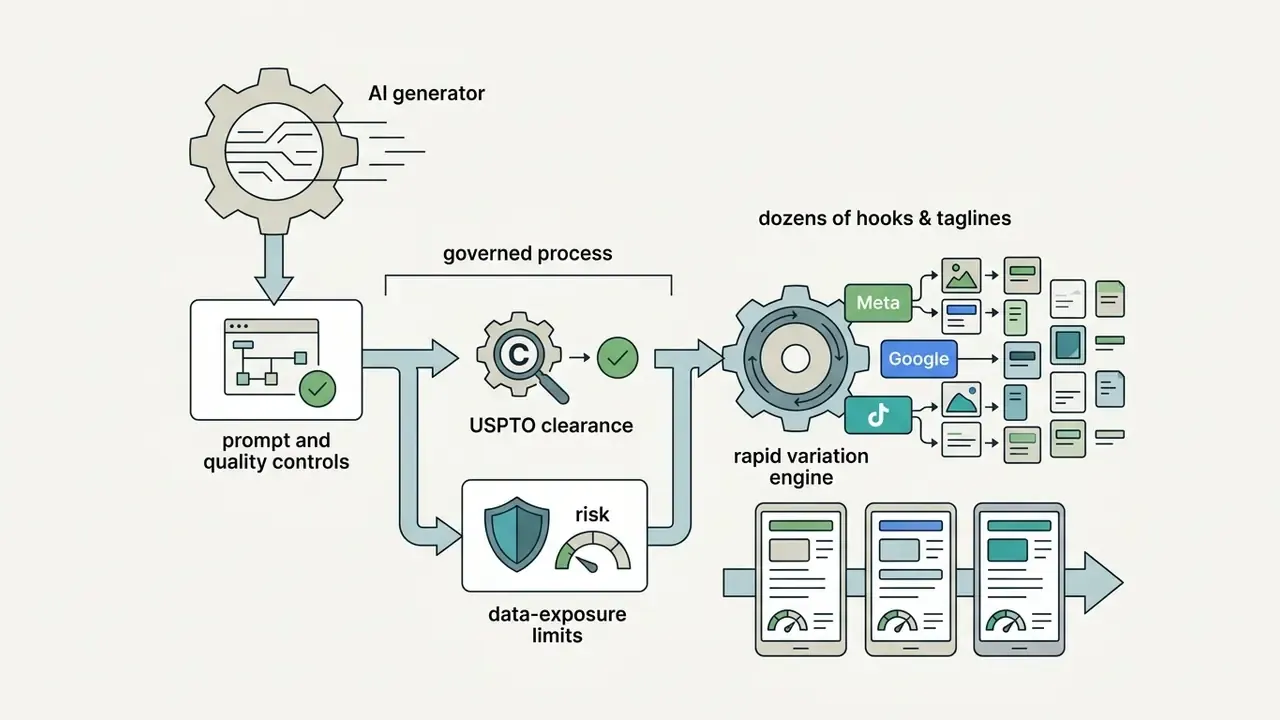
- Paid and organic social campaigns.Dozens of hook variations are required at once for A/B and multivariate testing.
Before generated text goes anywhere near production, teams inspect YouTube video editor workflows and comparable pipelines to confirm the chosen line survives compression into overlays, thumbnails and six-second pre-roll. A company preparing a multi-channel campaign can use an ai generator for slogans to produce dozens of hooks for paid-media testing, then promote only the winners into permanent brand assets.
Comparison table: slogan, tagline, motto and catchphrase with AI prompt templates and sample model outputs
| Phrase type | Primary purpose | Link to core brand identity | Typical usage points | Example prompt to an AI generator | Sample AI output (generated lines) |
|---|---|---|---|---|---|
| Slogan | Communicate a specific benefit or campaign message | Moderate to high; may change with campaigns | Ad headlines, video spots, campaign landing pages | "Create a campaign slogan highlighting eco-friendly delivery for an artisan coffee brand." | 1. "Sip Sustainably: Fresh Beans, Zero Emissions." 2. "Craft Coffee, Clean Footprint." |
| Tagline | Express enduring brand promise or positioning | Very high; appears next to logo for years | Logo lockups, website headers, corporate stationery | "Generate a short brand tagline under 5 words capturing our identity as an innovative fintech platform." | 1. "Finance, Unlocked." 2. "Smarter Wealth, Simple Tech." |
| Motto | State internal values or guiding principles | High internally, moderate externally | Mission statements, about pages, internal governance docs | "Write a company motto showing our commitment to transparent data privacy and auditability." | 1. "Integrity in Every Byte." 2. "Transparent Data, Uncompromised Trust." |
| Catchphrase | Create a memorable, repeated hook for audience engagement | Variable; tied to campaign or media property | Social media content, video ads, merchandise | "Suggest a memorable catchphrase for a youth-focused gaming accessory brand." | 1. "Level Up Your Play." 2. "Game Harder, Sound Sharper." |
Read the output column as raw draft material, never as finished copy. Every line above still needs trademark clearance, factual verification of any implied claim (that "zero emissions" would not survive legal review as written) and a brand-voice pass before publication.
How an AI Slogan Generator Works: From Business Description to Candidate Lines
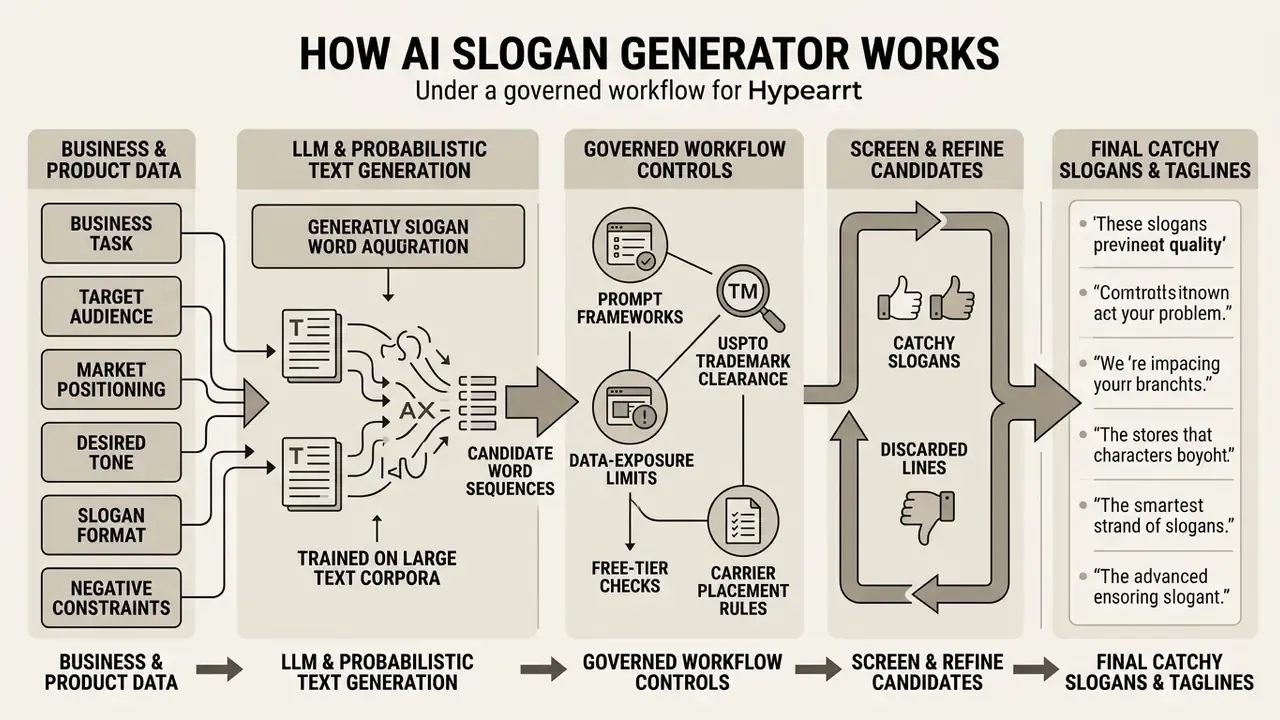
An AI slogan generator processes user-submitted business context through an LLM trained on large text corpora, then outputs probabilistic word sequences matching the requested length, tone and formatting constraints. To ai create a slogan or ai create slogan, the underlying ai generator maps input keywords against brand positioning patterns absorbed during pre-training. Knowing that pipeline lets marketing teams structure prompts that maximise relevance and suppress generic filler.
When teams ask an ai slogans generator to generate slogans or create slogans, the model weighs word associations, phonetic structures and rhythmic balance. Research on advertising taglines shows that detailed context inputs lift both quality and consumer liking scores compared with thin prompts.
«ChatGPT-4 with a detailed prompt outperformed ChatGPT-3.5 with a basic prompt: ad liking and purchase intent were significantly higher when the brand description was richer.»
«An AI slogan generator is a controlled ideation engine rather than an autonomous branding authority. Model output requires strict human oversight, clear risk tiering, and empirical performance validation before public release.»
Which Business and Product Data to Include in the Prompt
To get tailored output from an ai generator slogan, supply a comprehensive business description: the core value proposition, target audience demographics, primary product features and desired tone of voice. Omit the audience and the model reliably serves up high-frequency clichés such as "Quality You Can Trust" or "Innovation Redefined." I have seen both in the same output batch, twice.
A production-grade prompt carries six components:
- Task.The exact artefact requested (tagline, campaign slogan, motto) plus its word ceiling.
- Audience.Demographic, professional and psychographic descriptors.
- Positioning.The one differentiating claim the phrase must carry.
- Tone.Authoritative, conversational, technical, playful.
- Format.Number of variants and character limits per carrier.
- Negative constraints.Banned buzzwords, prohibited claims, competitor lines to avoid.
Including positioning keywords and explicit negative constraints, such as forbidding a buzzword list, is what lets the ai slogan creator produce genuinely distinct options. Teams using an api connection to generative models can inject structured brand guidelines into every request programmatically, keeping compliance intact at scale. A comparable pattern is documented in the Google Veo API implementation guide, where parameters travel with every call instead of being typed by hand.
Data-handling rule. The prompt is a data-transfer event. Unreleased product names, pricing tables, roadmap dates and customer identifiers must be abstracted or removed before submission to any third-party endpoint not covered by an enterprise data-processing agreement. That rule is boring and it is the one most often broken.
How to Generate, Screen and Refine Candidate Lines
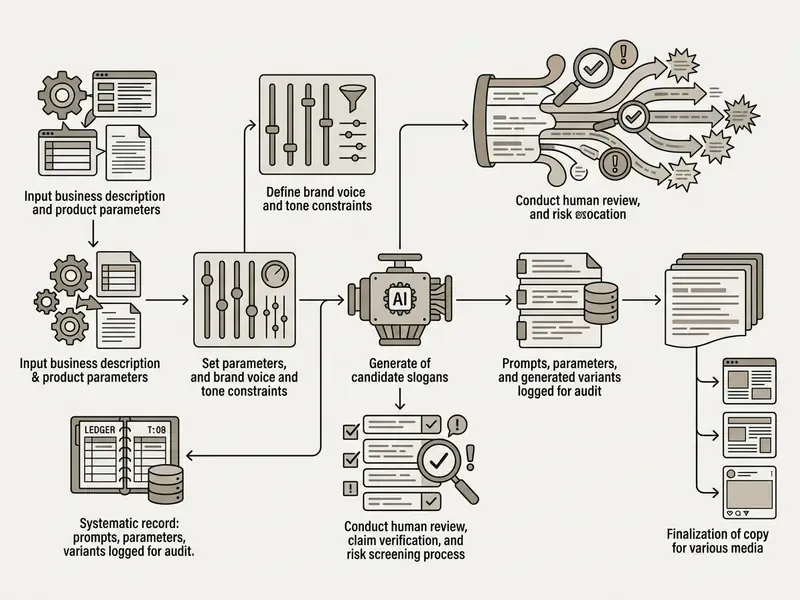
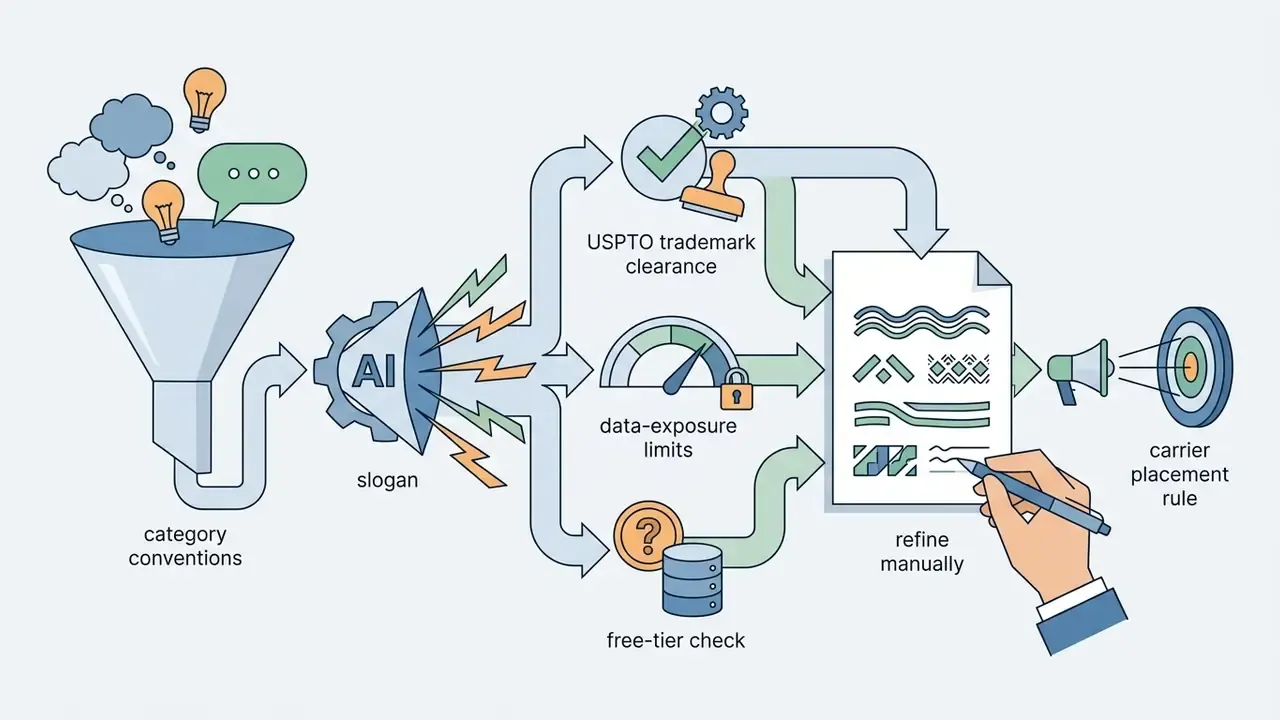
The workable sequence is bulk generation, systematic review, human filtering, then iterative polishing. An ai slogan design generator returns dozens of candidate phrases in a single batch, and an ai generator slogans run of 40 to 60 lines is cheap. Human review then removes options that collide with trademark constraints, cultural norms or brand guidelines.
Why the human filter is structural rather than cosmetic:
Illustrative scenario (composite, non-attributed). Consider a financial technology firm testing an ai slogan maker to refresh messaging for a commercial lending product. The team generates 50 draft lines, applies an automated compliance filter to strip unverified return and safety claims, and brings five finalists to executive stakeholders. In this kind of human-in-the-loop model, creative review cycles compress from roughly two weeks to a few business days while regulatory oversight stays intact. The figures illustrate the shape of the workflow. They are not audited benchmark data.
Audit-trail step (mandatory in regulated environments). Log the prompt text, model and version, timestamp, operator, raw output batch, rejection reasons and the final human edit into the MRM or GRC system of record. Without that evidence chain, a brand cannot later demonstrate the human authorship required for copyright registration, nor reconstruct why a rejected line was rejected. Auditors ask the second question more often than people expect.
AI Business Slogan Generator for Company, Product and Marketing Layers
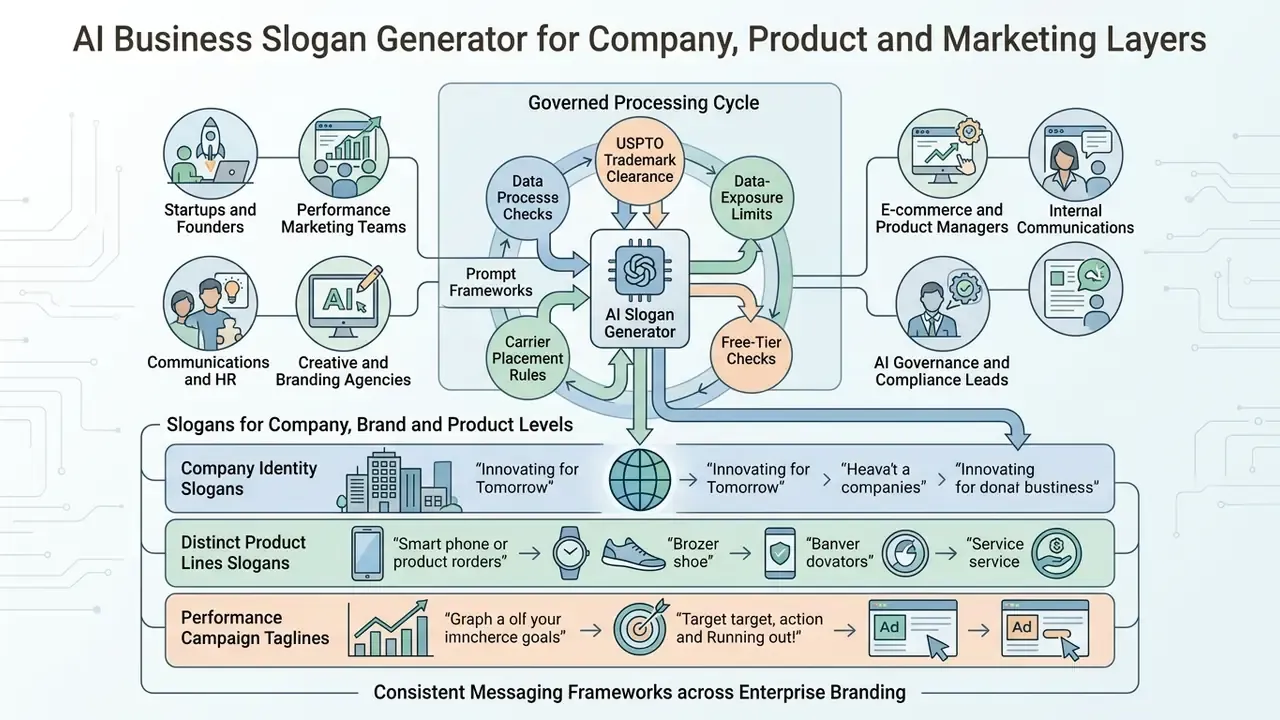
An ai business slogan generator supports enterprise branding by producing consistent messaging frameworks for corporate identity, distinct product lines and performance campaigns. An ai company slogan generator or ai slogan generator for business lets cross-functional teams align external messaging with strategic objectives while collateral production speeds up.
Rolling an automated slogan tool across channels means matching output density to media formats. Teams building multi-channel content operations often consult the AI Media Commercial-Use Hub to clarify IP rules across text, image and video generators, and the AI video generator glossary when the same line has to work in motion.
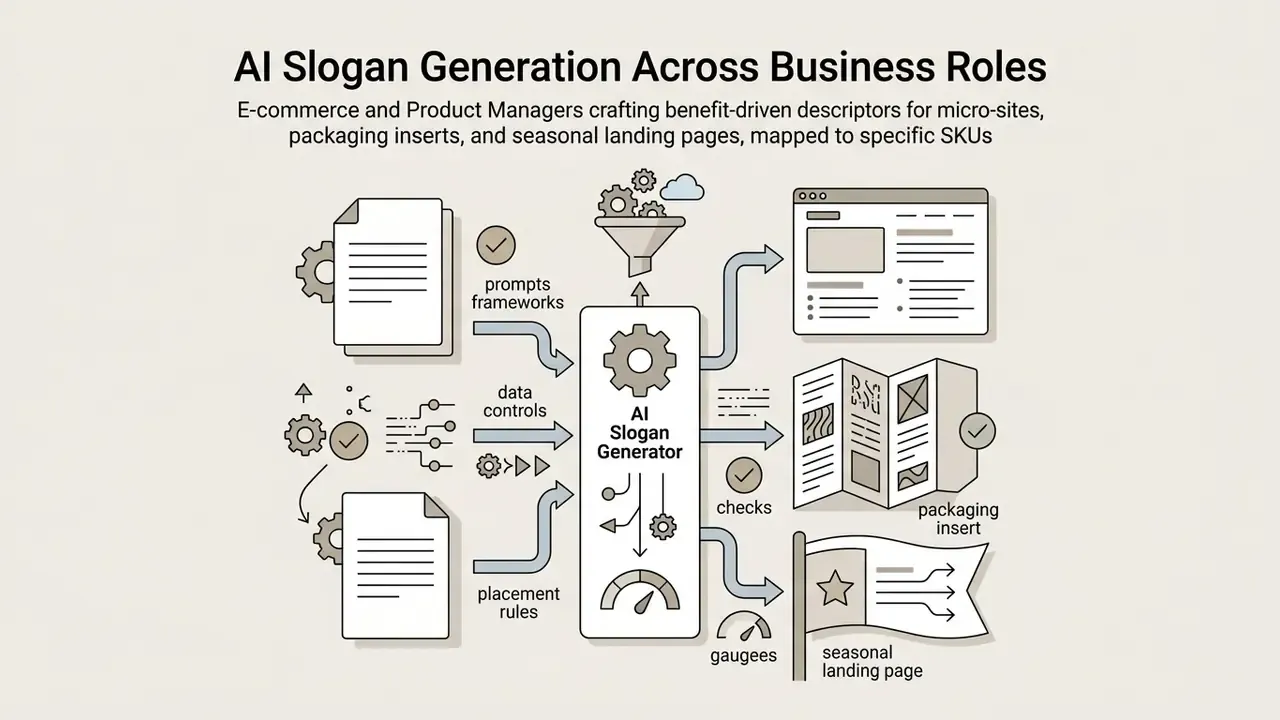
AI Slogan Generation Across Business Roles
Different functions use an ai slogan generator for business to solve different tactical problems:
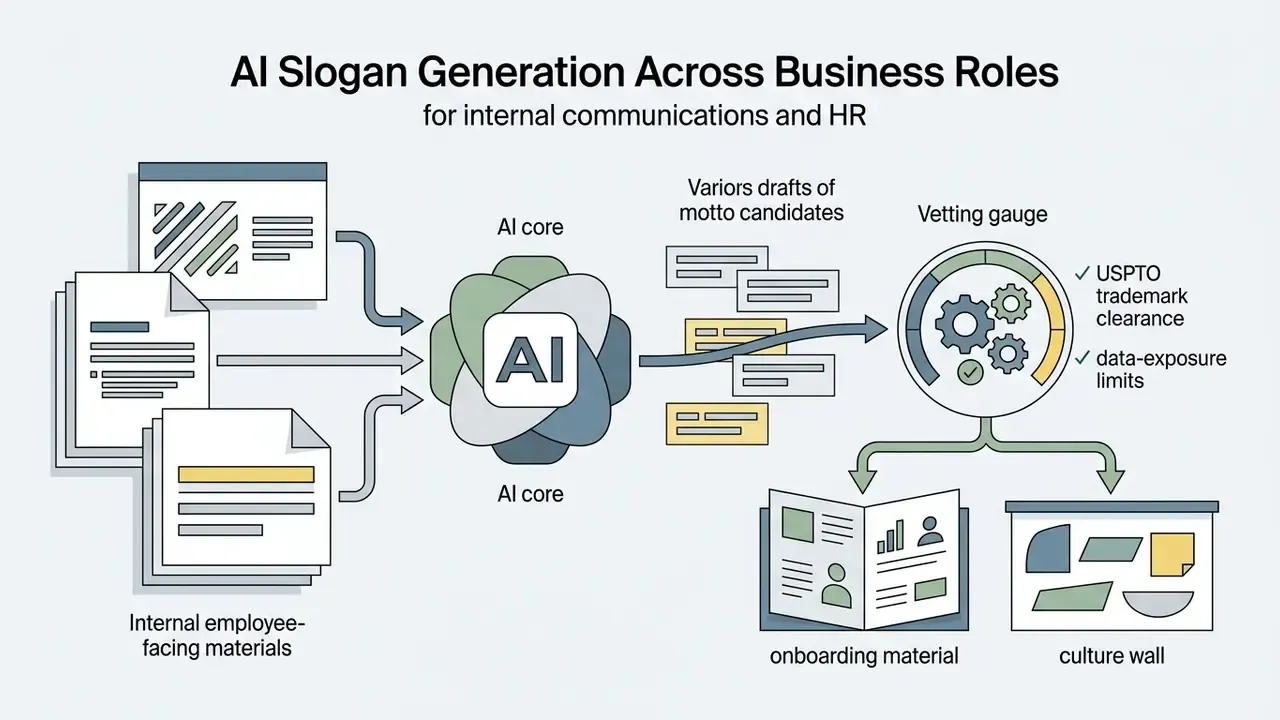
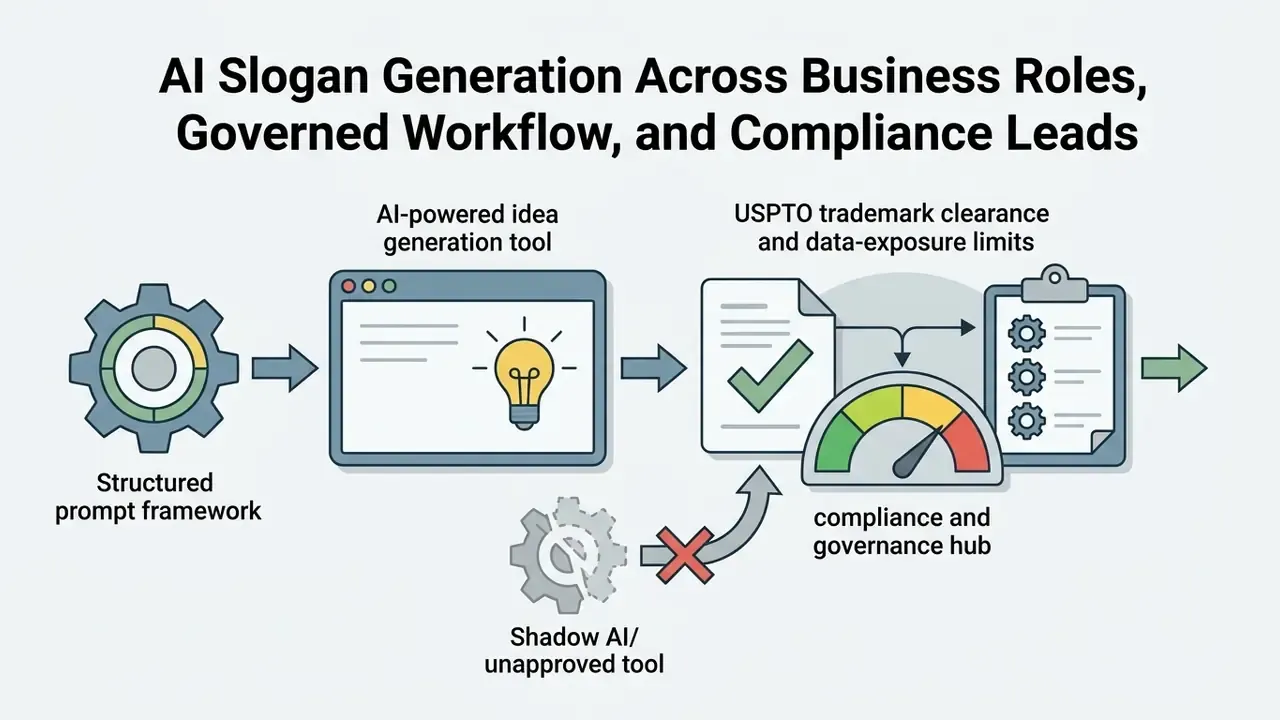
Slogans for Company, Brand and Product Levels
Company-level slogans express institutional purpose, governance standards and long-horizon market commitments. Product-level slogans push immediate consumer benefit, functional utility and competitive differentiation. Keeping the hierarchy clean prevents messaging dilution across multi-product enterprises.
«Generative AI must be contextualised within the brand, flexible, aligned with brand guidelines and consistent across all communication channels.»
Product prompts should specify concrete operational advantages: throughput, latency, coverage, warranty, integration count. Company prompts do the opposite. They describe mission, governance posture and long-term commitments, and they must never inherit product claims that expire with the next release cycle.
A quick test. If a line stays true after the company sunsets its current flagship product, it belongs at brand level. If it becomes false, it is a product slogan and needs version control like any other controlled artefact.
Where to Deploy a Slogan or Tagline After Generation
Selected slogans and taglines should be rolled out systematically across the primary digital and physical touchpoints: website hero sections, social profile headers, email signatures, business cards, print collateral, brochures, office signage and packaging. In web layouts the core tagline usually sits in the header next to the brand mark, reinforcing identity on first paint. In small-avatar contexts the logo travels alone, because compressed lockups turn illegible.
For performance campaigns, shorter slogan variants act as ad headlines or call-to-action hooks. Creative teams pair generated lines with custom assets and campaign visuals. Comparing output quality and licensing across AI art generators helps ensure the textual and visual layers are cleared for commercial use under the same standard, and the imagery side of that governance is consolidated in the commercial-use rules for AI image generators. When a line has to sit inside short-form edits, checking capcut video editor features early prevents late discoveries about caption length and safe margins.
What Makes a Slogan Catchy and Memorable
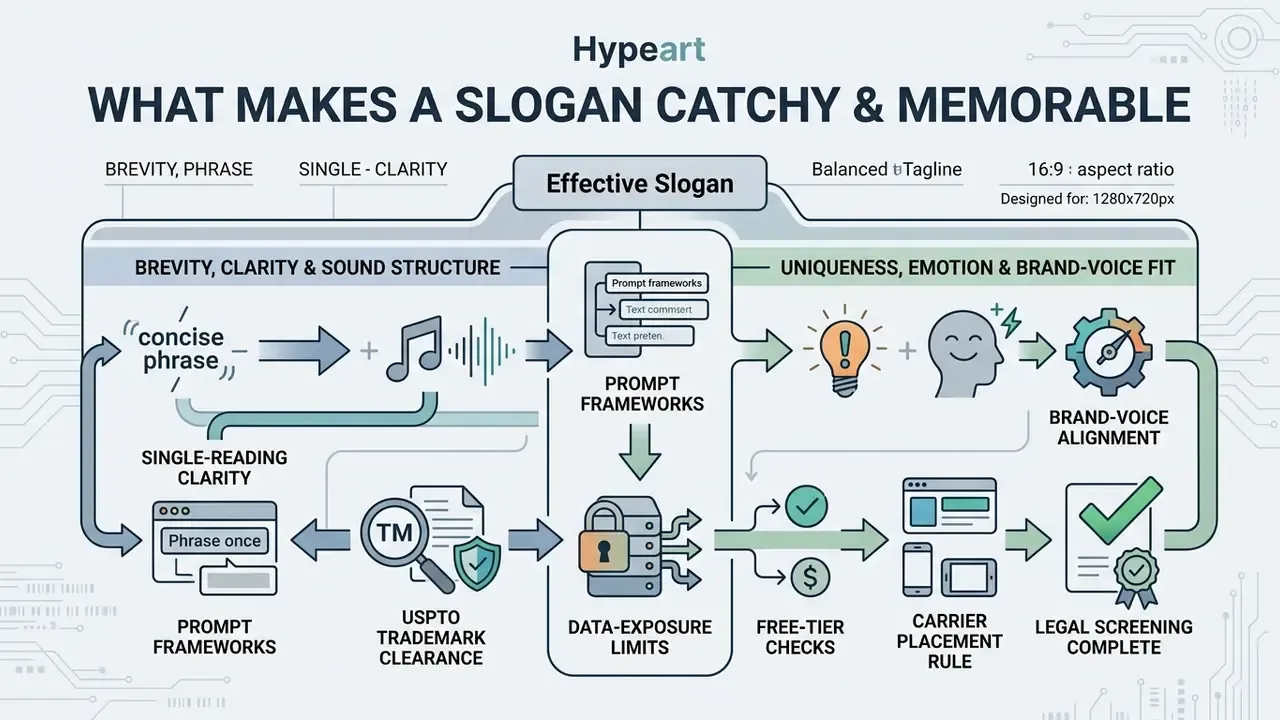
An effective slogan balances brevity, single-reading clarity, emotional resonance and precise brand-voice alignment. Producing catchy slogans and memorable slogans means dodging corporate jargon while using rhythmic and phonetic structure to help recall.
The trade-off between liking and recall is length-dependent, and shorter is not universally better.
«Brevity helps slogans lodge in memory and fit dense mobile visual environments, while clarity lowers cognitive load and removes ambiguity.»
Multi-method slogan research adds a caveat worth planning around. Shorter slogans tend to be liked more on first exposure, whereas slightly longer, more descriptive slogans, especially those containing the brand name and concrete nouns, tend to be remembered better over time. So branding leaders must decide whether a campaign prioritises immediate engagement or sustained retention before copy is finalised, because those two objectives pull length in opposite directions.
Brevity, Clarity and Sound Structure in a Tagline
A strong tagline delivers maximum semantic impact in minimum words, typically three to six. Brevity is also a layout requirement: the line has to fit inside logo lockups, ad banners and mobile navigation headers without crowding the interface.
Sonic qualities matter more than most briefs admit. Alliteration, cadence, assonance and rhyme measurably improve how easily a tagline is spoken and remembered. Corpus studies of advertising slogans repeatedly find rhyme as the most frequent sound device, alliteration second, with metrically ordered stress alternation as a core rhythmic feature. During review, creative directors read lines aloud to catch awkward syllable clusters, consonant collisions and stress patterns that shatter in translation.
Practical screening questions at this stage:
- Can the line be said in one breath, without re-reading?
- Does it survive being spoken by a voice actor, a call-centre agent and a customer, unchanged?
- Does it keep its rhythm when the brand name is prefixed or appended?
Teams producing voice-over and audio assets alongside text often review AI voice generator capabilities to confirm the chosen line reads naturally in synthesised speech before it is locked for broadcast.
Uniqueness, Emotion and Brand-Voice Fit
Uniqueness prevents market confusion and protects the brand from being misattributed to a direct competitor. LLMs gravitate to statistically common word pairings, so human review must screen every output for distinctiveness against the live competitive set, not only against registered marks.
«Brand personality, the set of human characteristics attributed to a brand, must be expressed consistently through tone, wording and rhythm of short phrases across every touchpoint.»
Emotional triggers such as trust, empowerment, relief or curiosity build stronger connection than transactional description. Voice consistency requires that each slogan reflects documented personality traits: a mature financial institution needs an authoritative, measured register, while a consumer startup can go conversational. Assessment practice in advertising separates three test dimensions, and each should be scored independently instead of collapsing into a single "do we like it" verdict:
- Brand fit. Does the line evoke the intended emotion and match brand values?
- Distinctiveness. Could it be misattributed to a competitor?
- Voice alignment. Does the wording match the documented voice brief?
Organisations building whole identity systems around a generated line often evaluate design suites such as the Canva AI Generator to see how the phrase behaves inside templates, export formats and licensing terms before standardising it. Brands with illustrated mascots run the same check against a cartoon character maker so the line and the character read as one system.
Checklist0 / 8
Passing seven or more criteria suggests the generated slogan is ready for trademark clearance sign-off and campaign testing. If the legal or audit boxes stay unchecked, the line is not releasable, whatever its creative score.
Free AI Slogan Generator: What to Verify Before Using the Output
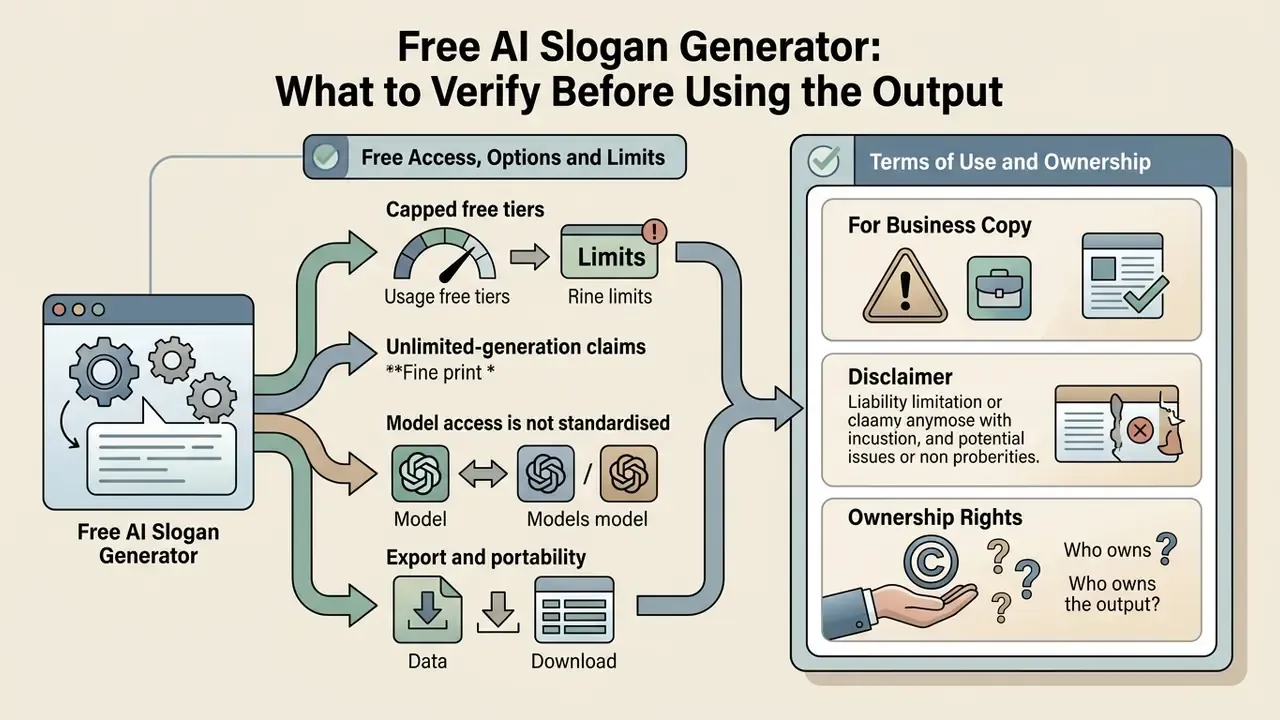
An ai free slogan generator, ai slogan generator free or ai tagline generator free gives you zero-cost ideation. Before commercial deployment, though, verify the platform terms of service, output usage rights and data-privacy policy. Free platforms routinely impose usage quotas, model limitations or specific commercial licensing restrictions that deserve a careful read.
Shadow AI and data-retraining risk. The most under-managed exposure in free-tier usage is not licensing. It is input handling. Consumer free tiers often reserve the right to use submitted prompts for model improvement, and they rarely offer contractual deletion guarantees. Pasting an unreleased product name, an internal pricing structure, a confidential positioning deck or customer data into a free ai slogan tool is a data-disclosure event, not a creative shortcut. Practical controls: publish an approved-tool list, block unsanctioned endpoints at the network layer, require abstracted prompts (category descriptors instead of confidential specifics), and route regulated business units to enterprise tiers backed by data-processing agreements.
Knowing the operational boundaries of free ai tooling prevents intellectual property conflicts and unauthorised corporate data exposure. Organisations sizing campaign tool budgets can consult AI Media Pricing Guides to compare free-tier allowances against enterprise subscription models.
Free Access, Options and Limits of Slogan Generators
Free slogan tools typically cap daily generation batches, restrict access to advanced model architectures, or withhold export options such as CSV download. Basic generators also tend to repeat templates and offer little tone or audience customisation.
Patterns observed across the current vendor landscape:
- Capped free tiers. Some suites allow a limited number of AI generations per day, with higher allowances reserved for paid, team or nonprofit plans.
- Unlimited-generation claims. Other tools advertise unrestricted slogan generation on the free plan, occasionally with CSV export included.
- Model access is not standardised. The model behind a "100% free" page can be upgraded or downgraded at the vendor's discretion, which turns reproducibility into a governance issue: the same prompt may return materially different output next quarter.
- Export and portability. Copy-to-clipboard is universal. Structured export (CSV, DOCX) is inconsistent, and it matters when outputs must enter a review log.
When managing cost structures across creative teams, leaders review operational tools through resources like AI Media Calculators to project software expenses, and benchmark adjacent categories through comparisons of free AI image generators, where free-tier mechanics follow the same quota-and-watermark logic. A similar quota pattern shows up in any cartoon maker app with a free plan. Whether a free tool clears enterprise security standards is the gate before organisational adoption, not after.
How to Verify Terms of Use and Ownership for Business Copy
Before publication, legal teams must confirm that the vendor grants commercial usage rights over model outputs. Under U.S. Copyright Office guidance, purely machine-generated text lacking sufficient human authorship is not eligible for copyright protection (U.S. Copyright Office, 2023–2026, https://www.copyright.gov/ai/). Human editing and creative arrangement are therefore necessary to establish proprietary rights over brand slogans, and the record of that human contribution should be retained rather than reconstructed later from memory.
«Businesses should independently review the terms of the specific tool: clauses on ownership of generated content, commercial use, and limitations of liability.»
Keep two legal questions apart. First, copyrightability: can we own this line? Second, freedom to operate: does using this line infringe someone else's mark? A slogan can be fully permitted under a vendor's terms and still trigger a trademark conflict. Commercial usability therefore requires formal searches through the USPTO database (https://www.uspto.gov/trademarks) and equivalent national registries in every launch market. Reviewing the frameworks tracked in AI Litigation and Case Timelines helps compliance officers build defensive protocols for AI-assisted branding assets.
| Platform / Vendor Tier | Commercial Usage Grant | Copyright Protection Eligibility | Output Verification Requirement | Data & Retraining Exposure | Recommended Governance Control |
|---|---|---|---|---|---|
| OpenAI ChatGPT (Free & Paid) | Explicitly assigned to user under Terms of Use | Human modification required for copyright registration | High risk of trademark overlap with existing slogans | Consumer tiers may use prompts for improvement unless opted out | Conduct USPTO search and human editorial rewrite; restrict confidential inputs |
| Google Cloud Generative AI (GA) | Generated output treated as Customer Data; no vendor ownership claim | Requires human creative contribution | Moderate risk of statistical similarity to corpus | Covered by cloud data-processing terms | Verify claim accuracy and log human editing steps |
| Generative AI Preview / Beta Products | Evaluation and testing only; production use typically prohibited without written permission | Same human-authorship requirement | Unstable model behaviour between versions | Preview telemetry may be broader | Exclude from production branding workflows |
| Public Free Slogan Tools | Varies widely by vendor Terms of Service | Generally unregistrable as pure machine output | High likelihood of generic template repetition | Often undisclosed; assume prompts are retained | Treat output as raw draft material only; never submit non-public data |
How to Improve a Generated Slogan Before Publication
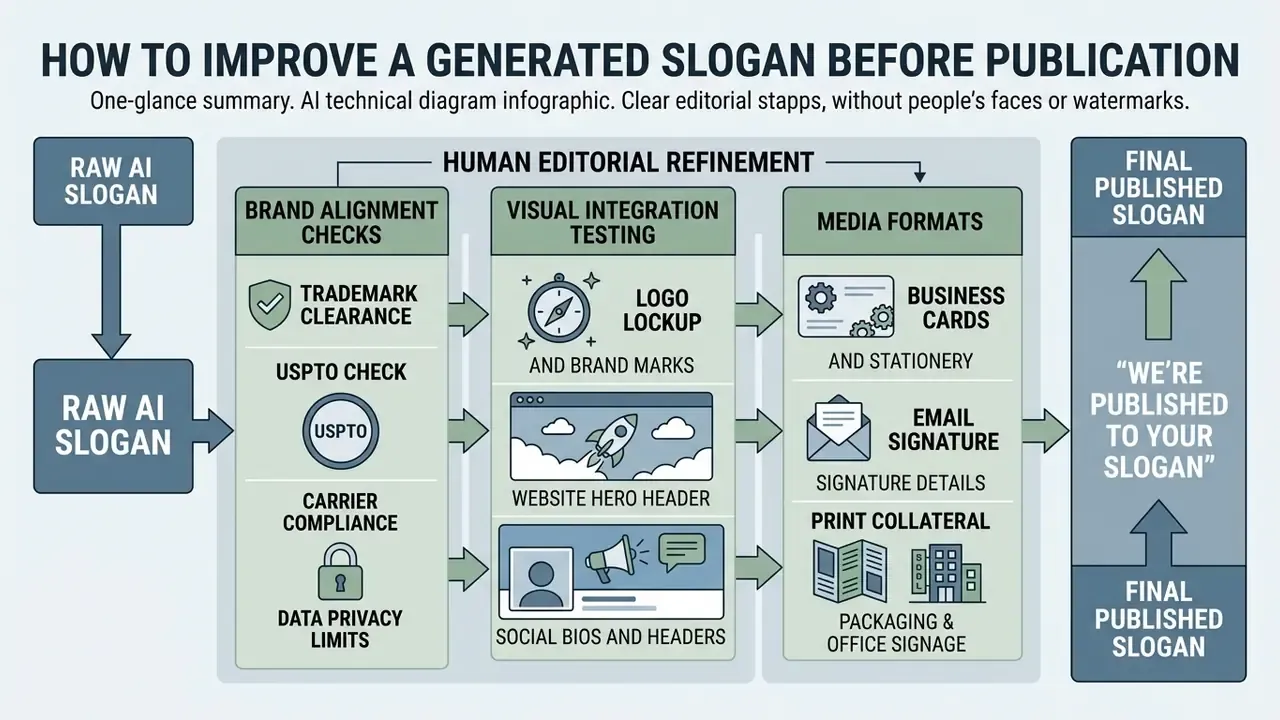
Improving an AI-generated slogan takes human editorial refinement, brand alignment checks and visual integration testing across the intended media formats. Raw output usually needs compression, rhythm adjustment or word substitution to purge jargon and hit channel specifications.
On the recurring question of search-engine risk, the large-scale evidence is reassuring:
So the operative risk is commercial and legal, not algorithmic. An undifferentiated line damages positioning, or collides with an existing mark, long before it affects rankings.
A structured refinement process is what turns generic drafts into brand assets. Recommended pre-publication gates, consistent with mainstream generative-AI playbooks: human oversight sign-off, factual validation of every implied claim, brand-compliance review against the voice brief, bias and inclusivity screening, and standardised side-by-side evaluation of variants using the same prompt and the same scoring rubric. Teams that hit workflow bottlenecks during copy integration can pull operational guidance from AI Media Support and Troubleshooting.
FAQ About AI Slogan Generators
Can an AI Slogan Generator Produce Lines in Tagalog and Other Low-Resource Languages?
Yes. ai slogan generator tagalog capability exists in advanced multilingual LLMs and in mainstream design suites, some of which advertise slogan output in roughly 20 languages and others in 80 or more, Tagalog and Taglish included. Quality across that list is not uniform, and vendors rarely say so.
«Systematic surveys of multilingual LLMs record coverage of Austronesian-family languages in benchmarks, yet quality and cultural appropriateness for specific languages, including Tagalog, require empirical verification.» Multilingual Large Language Models: A Systematic Survey, ArXiv (2024). https://arxiv.org/abs/2411.11072 Tagalog remains comparatively low-resource in standard pretraining corpora. One analysis of common multilingual corpora recorded only a few thousand Tagalog tokens in one model family and none in another, while Filipino-centric benchmarks such as Batayan (ArXiv, 2025, https://arxiv.org/abs/2502.14911) exist precisely to close that evaluation gap. Machine output can therefore miss local idioms, code-switching conventions and colloquial register. There is a second, less obvious failure mode. The prompt language itself shifts the model's cultural posture: «When prompted in Chinese, generative AI displays a more interdependent social orientation and a more holistic cognitive style than when prompted in English, a stable effect of differing language contexts.» MIT Sloan, Generative AI's Hidden Cultural Tendencies (2024). https://mitsloan.mit.edu Generated Tagalog slogans should therefore be reviewed by native language specialists, not validated through back-translation alone. Two compliance notes apply to the Philippine market: primary advertising wording is expected in English and/or Filipino, and foreign-language materials require English and/or Filipino translations. Localisation is a regulatory workflow, not only a creative one. The same discipline extends to every low-resource market: assume dialect variation, verify idiom, confirm the line carries no unintended connotation.
Can You Create a Slogan From Just the Company Name?
Yes. An ai company slogan generator, ai slogan creator or ai slogan maker can build slogans from a company name plus a short category descriptor. Three documented techniques sit underneath: direct insertion of the brand name into the phrase, template or "slogan skeleton" generation from a concept, and associative-chain generation, where the model derives semantically linked words from the name and uses them as raw material. Modern models read phonetic structure, root words and brand associations of the submitted name to produce rhyming, alliterative or benefit-focused taglines. One behavioural caveat deserves attention before you announce the method internally:
«When participants believed slogans were AI-created, perceived task meaningfulness fell by roughly 0.07 standard deviations and willingness to propose their own slogan dropped by 3.4 percentage points.» Brookings Institution, When People Think AI Did the Creative Work, Task Meaning and Effort Decline (2024). https://www.brookings.edu Positioning the tool as a brainstorming accelerator that human teams edit and own, rather than as a replacement author, protects internal engagement in the branding process. A distinctive company name helps the ai slogan generator craft personalised hooks instead of filler; adding one differentiating claim sharpens specificity further. Teams building combined verbal and visual identities often pair name-based slogan tools with the template systems reviewed in the Canva AI Generator overview, and with a cartoon maker when the brand leans illustrative, to keep export formats and licences consistent.
Should Prompts and Outputs Be Audited?
Yes. In regulated industries, brand copy is a controlled artefact. Retain the prompt text, model identifier and version, timestamp, operator identity, the full raw output batch, documented rejection reasons and the final human-edited line. That log does three jobs at once: it evidences the human authorship needed for copyright registration, it supports incident reconstruction if a published claim is challenged, and it enables reproducibility testing when a vendor quietly upgrades the underlying model.
Can the Same Generator Serve Slogans, Taglines and Mottos?
Technically yes, but only with different constraint sets. A single prompt asking for "a catchy phrase" blurs categories and yields campaign language where enduring identity language is required. Maintain three templates, campaign slogan, brand tagline and internal motto, each with its own word ceiling, audience field and claim-verification requirement, and store them next to the brand guidelines rather than inside individual chat histories.
What Should a Team Do Next Without Overcommitting?
Start small and reversible. Pick one low-risk campaign, name an owner for the workflow, run 40 to 60 generated candidates through the checklist above, and log everything. Review the results with legal and brand after one cycle, then decide whether to extend the pattern to identity-level copy. If the audit log is thin at that review, the honest answer is: not yet.
Sources and Further Reading
- Özergin, Der Einsatz generativer KI in Markenkommunikation und Branding, Springer (2026). https://link.springer.com
- Artificial Creativity? A Morpho-Semantic Investigation of Neologisms and Wordplay in AI-Driven Advertising Discourse (2024–2025).
- Ahrefs, AI-Generated Content Does Not Hurt Your Google Rankings (2023–2024). https://ahrefs.com/blog
- MIT Sloan, Generative AI's Hidden Cultural Tendencies (2024). https://mitsloan.mit.edu
- Brookings Institution, When People Think AI Did the Creative Work, Task Meaning and Effort Decline (2024). https://www.brookings.edu
- Computational Generation of Slogans, Cambridge University Press (2020). https://www.cambridge.org/core
- U.S. Copyright Office, Copyright and Artificial Intelligence (2023–2026). https://www.copyright.gov/ai/
- U.S. Patent and Trademark Office, trademark search and 2024 AI-tool practice guidance. https://www.uspto.gov/trademarks
More terminology, tool definitions and governance notes are collected in the glossary, including the capcut video editor entry for teams pushing generated lines into short-form video.
- *Large Language Model in Creative Work
- The Role of Collaboration Modality and User Expertise*, University of Minnesota (2024). https://carlsonschool.umn.edu
- Redden et al., *Test for the Best
- Using ChatGPT to Create Effective Ad Taglines* (2025).
- *Multilingual Large Language Models
- A Systematic Survey*, ArXiv (2024). https://arxiv.org/abs/2411.11072
- *Batayan
- A Filipino NLP Benchmark*, ArXiv (2025). https://arxiv.org/abs/2502.14911