About the review desk: This guide is maintained by the AI Media editorial team specialising in generative-model evaluation, model-risk documentation, and commercial licensing of AI outputs. Technical claims are traced to peer-reviewed publications, standards bodies such as NIST, or official platform policies. Vendor marketing claims are labelled as marketing.
Executive Summary
- What it is An AI story generator expands a prompt into structured prose, from a 300-word flash fiction piece to a 40,000-word novel, using large language models guided by templates, outlines, and state tracking.
- What works Ideation, alternative scene directions, outline construction, world-building lore, children's bedtime stories, screenplay scaffolding, and comedic premise testing.
- What breaks Long-range coherence. Standard autoregressive models forget character attributes and contradict prior plot events after roughly 8,000 tokens. Long works therefore require chapter-by-chapter workflows, story bibles, and context summarization.
- What costs money Free tiers usually cap output at 500 to 1,000 words per request and 10 to 20 credits per month. Paid tiers, priced at $10 to $50 monthly, unlock context windows from 8,000 up to 1,000,000 tokens, story-bible integration, and API access.
- What to check legally Purely machine-generated prose is not registrable for copyright in the United States. Amazon KDP requires disclosure of AI-generated text. Human creative contribution and post-editing are mandatory for protectable authorship.
- What enterprises must control Prompt logging, exclusion of personal data, data-retention terms, shadow-AI prevention when employees quietly use consumer free tiers, and a documented editorial-review gate before publication.
- Marketing claims to distrust "250-page novel in a couple of minutes." One-shot generation at that scale reliably produces state drift, hallucinated entities, and plot contradictions. Staged generation is the working alternative.
Core Terms Used in This Guide
Before the workflows, a short vocabulary check. Most confusion about these tools comes from mixing up three different things: the model, the scaffolding around it, and the editorial process.
- Prompt The instruction set you send. It carries role, genre, characters, constraints, and output format.
- Context window How much text the model can hold at once, measured in tokens. Roughly 750 words per 1,000 tokens in English.
- State drift The slow decay of established facts. A character loses an injury, a timeline reverses, a rule of the world quietly stops applying.
- Story bible An external reference sheet with immutable traits, timeline events, and world rules, reloaded into every generation call.
- Contradiction audit A structured comparison of new output against a fact table extracted from earlier chapters.
- Shadow AI Unapproved tool use inside an organisation. Invisible to logging, invisible to audit, and therefore unmanageable.
One note on search behaviour, since it affects navigation: many readers arrive after mistyping the query, for example as ai atory generator, ai atory maker or ai dtory generator. The intent behind those variants is identical to the correct spelling, and this guide answers all of them.
What an AI Story Generator Is and What Stories It Produces
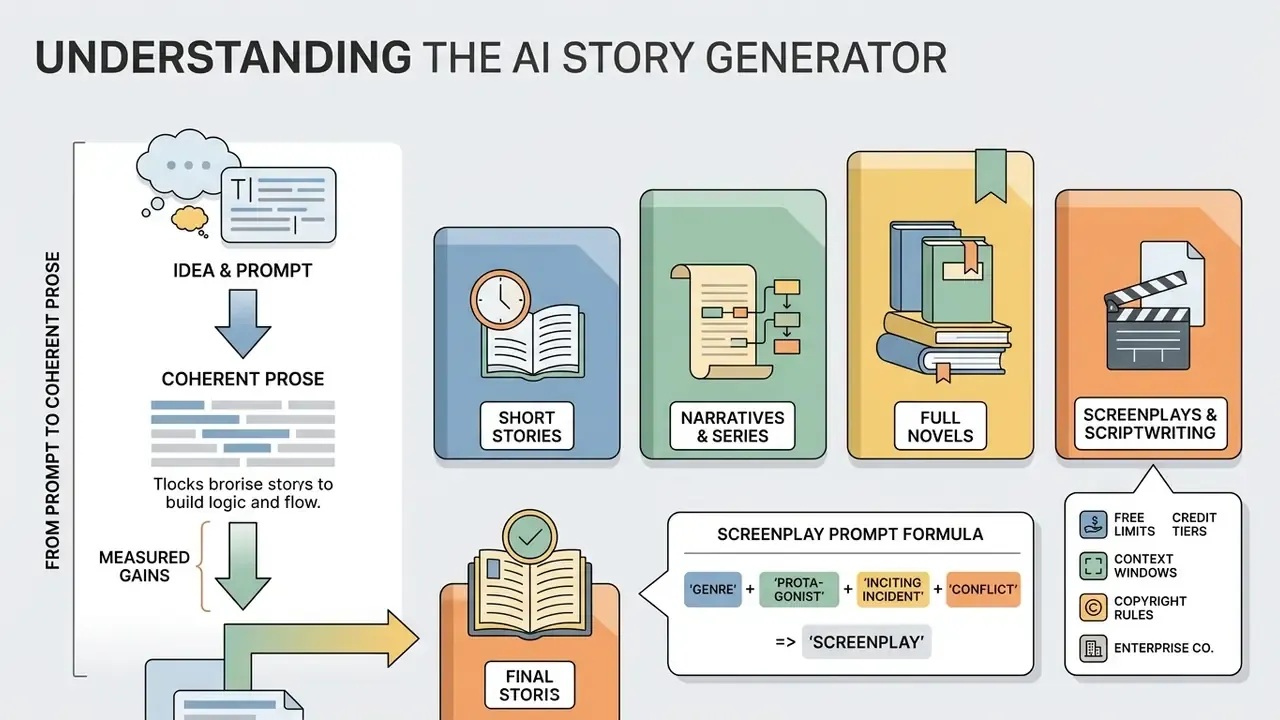
In short: An AI story generator turns a prompt into coherent prose, not a random string of sentences. The level of control over genre, characters, and structure decides whether you get filler or a workable draft.
An AI story generator is a software tool powered by large language models that transforms user prompts into narrative prose. Rather than producing arbitrary sentences, a modern ai based story generator interprets narrative premises, genre constraints, and character profiles, then outputs structured storylines, short fiction, or multi-chapter drafts. The same engine class powers an ai fiction generator, an ai narrative generator, and the chat-style tools marketed as an ai chat story generator or ai bot story generator.
From Idea and Prompt to a Finished Narrative
The move from an initial idea to a polished narrative relies on autoregressive language decoding guided by structured task templates. When a user submits a prompt to an ai generator for stories, the system maps the text against internal contextual instructions and expands raw concepts into chronological scenes (Stanford CS224N, 2025). The documented pipeline is sequential: task-specific template, then input instantiation, then filled prompt, then autoregressive decoding, then output text. Generative tasks consume the model output directly, without a post-classification step.
Empirical evaluations show that structured prompt patterns, which specify role, context, and structural bounds, reduce narrative errors compared with unstructured inputs.
«Structured prompts that specify role, context and constraints significantly reduce narrative errors compared to unstructured requests.»
Prompt-pattern research reinforces this. Prompts can encode rules, automate multi-step processes, and shape output through reusable patterns such as role assignment, context priming, few-shot examples, and iterative refinement (A Prompt Pattern Catalog to Enhance Prompt Engineering, Vanderbilt University).
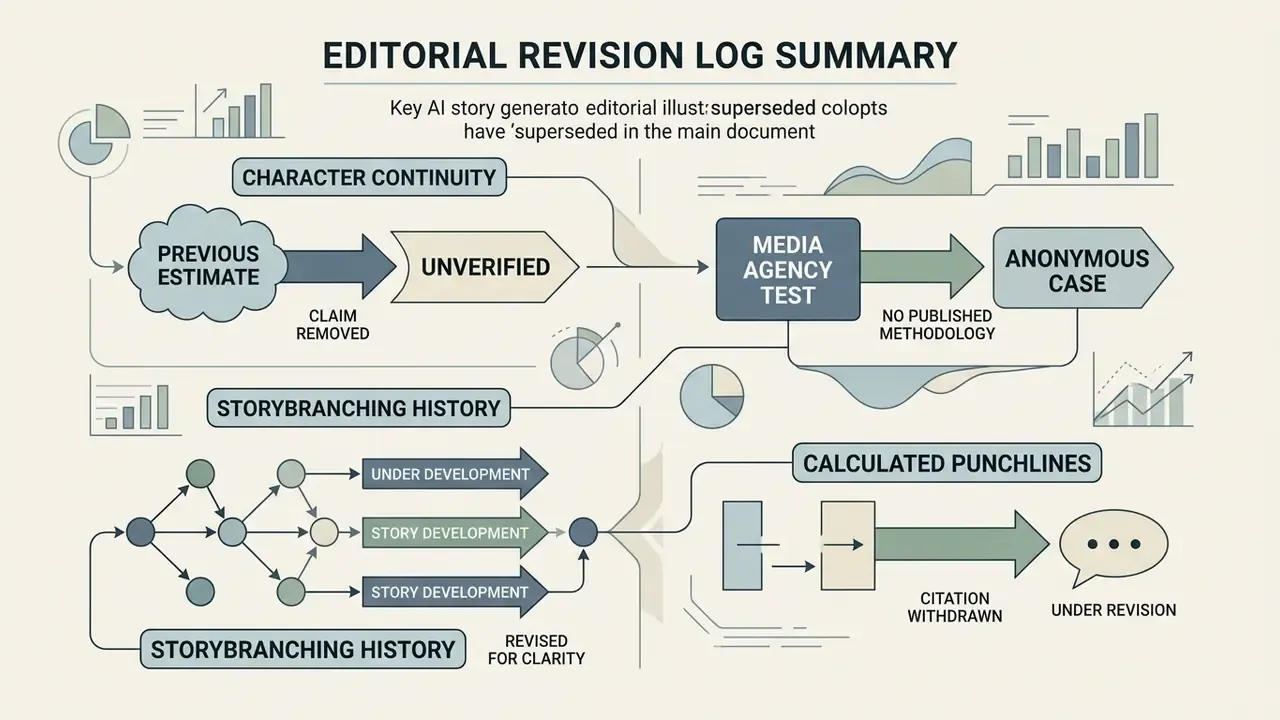
Editorial note on measured gains. In institutional publishing workflows, unstructured prompts frequently produce erratic scene transitions and repeated continuity failures across chapters. Teams that migrate to structured narrative templates consistently report fewer character-continuity defects per chapter. We deliberately publish no single headline percentage: no peer-reviewed benchmark currently isolates template structure as the sole variable, and internal editorial audits are not comparable across genres or model versions. Treat template adoption as a directional improvement, then measure it inside your own pipeline with a fixed contradiction-audit checklist. The originally drafted "35%" figure is preserved for transparency in the revision log and should be read as an unverified internal estimate.
AI Story, Short Story, or Full Novel
An ai generator story can take several distinct formats, depending on target length and structural complexity.
When expanding a story concept into multi-media formats, authors often reach for creative assets such as a free word art tool for cover titles and visual branding, paired with an AI image generator for covers for consistent artwork.
Screenplays and Scriptwriting
Prose is not the only supported output. Modern generators can emit industry-standard script structure, including sluglines (INT. and EXT.), action blocks, character cues, and dialogue, provided the format is declared explicitly in the prompt. Platforms marketed to screenwriters advertise creation of "books, novels, and screenplays for print and online," yet formatting fidelity depends on your prompt constraints rather than on model defaults.
Screenwriters moving from script to production can compare tooling in our guide to the best free video editing software.
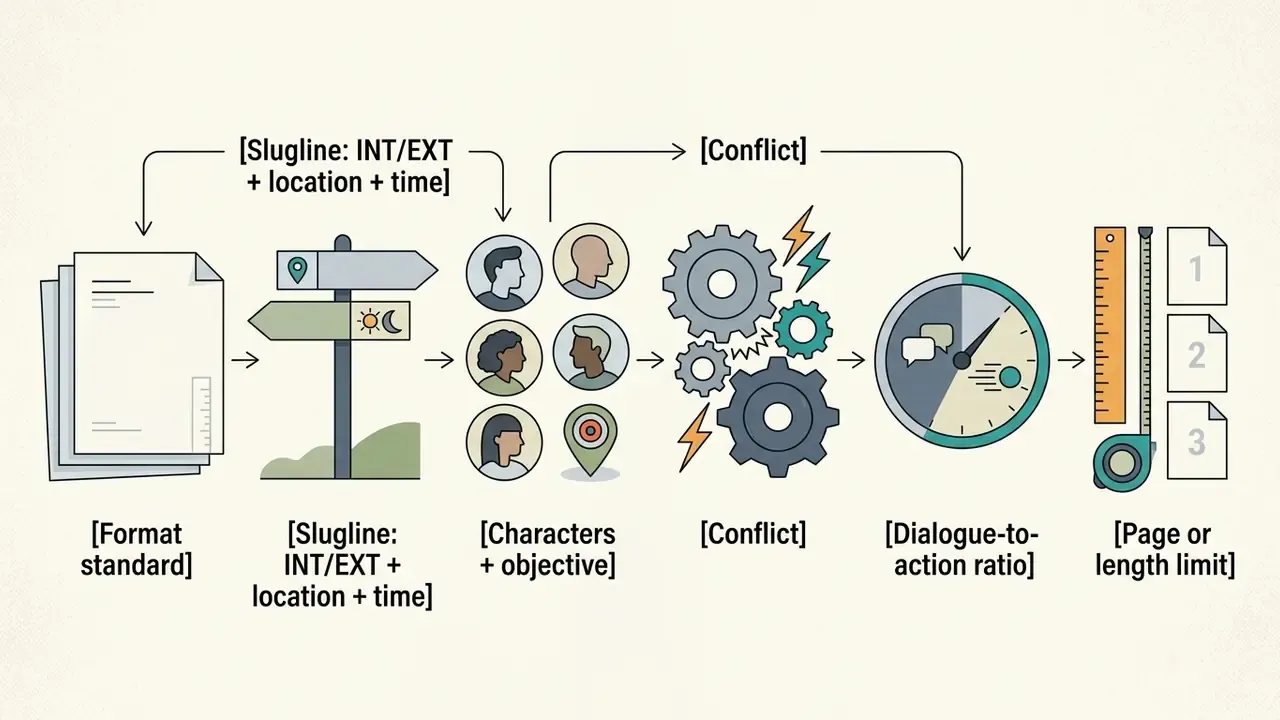
[Format standard] + [Slugline: INT/EXT + location + time] + [Characters + objective] + [Conflict] + [Dialogue-to-action ratio] + [Page or length limit].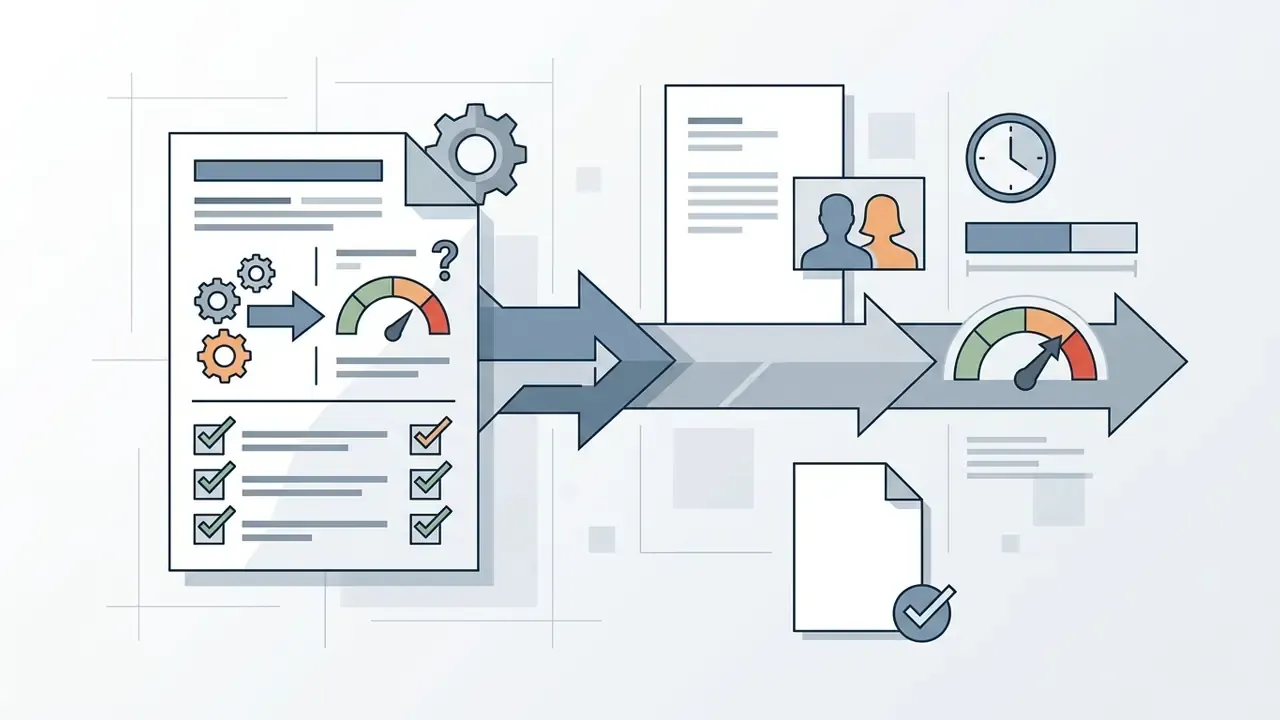
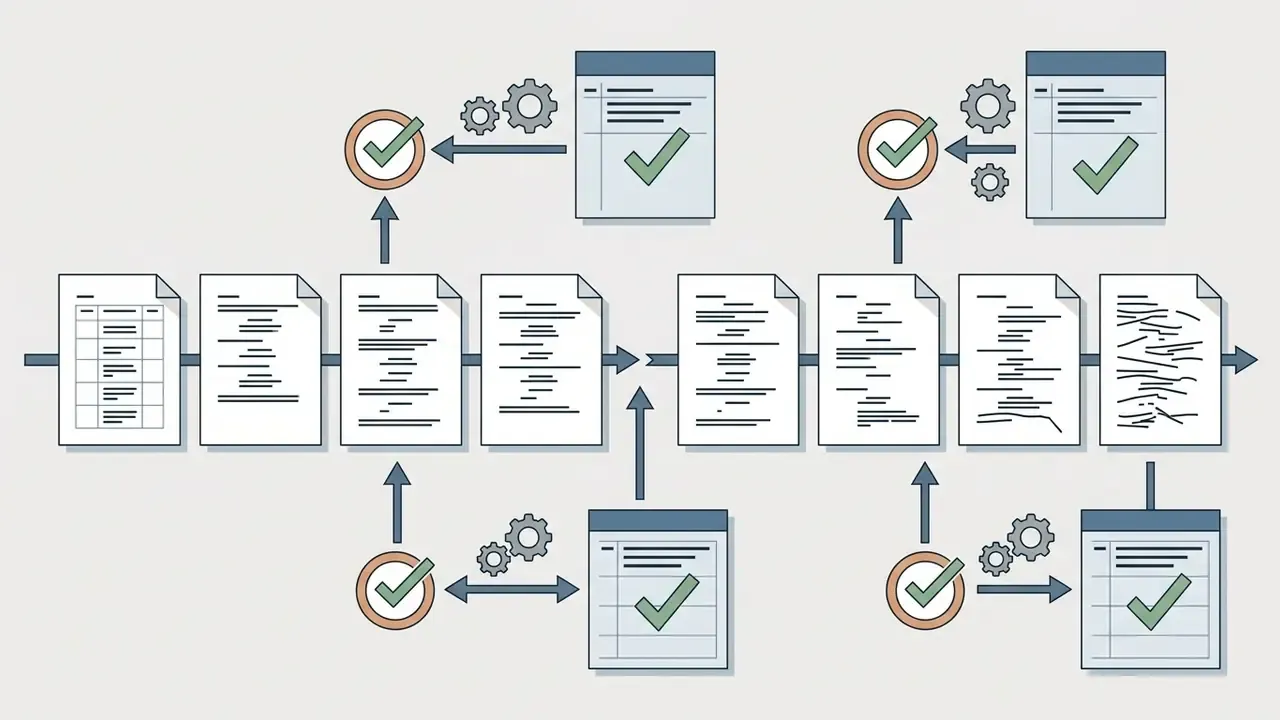
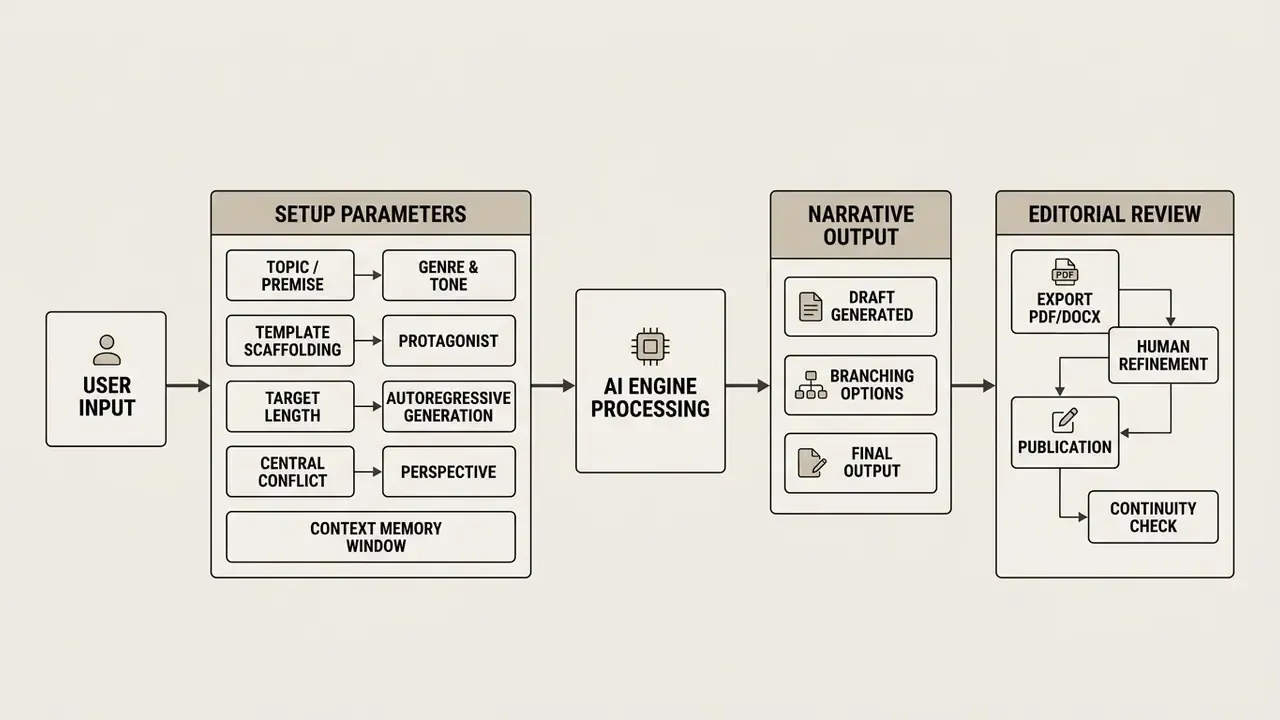
Flowchart description: visual mapping of the narrative generation pipeline, from premise input and parameter selection through autoregressive processing, human editorial refinement, and final publication export. Stage list in reading order: user input, setup parameters, AI engine processing, narrative output, editorial review, final output.
Who an AI Story Generator Is For
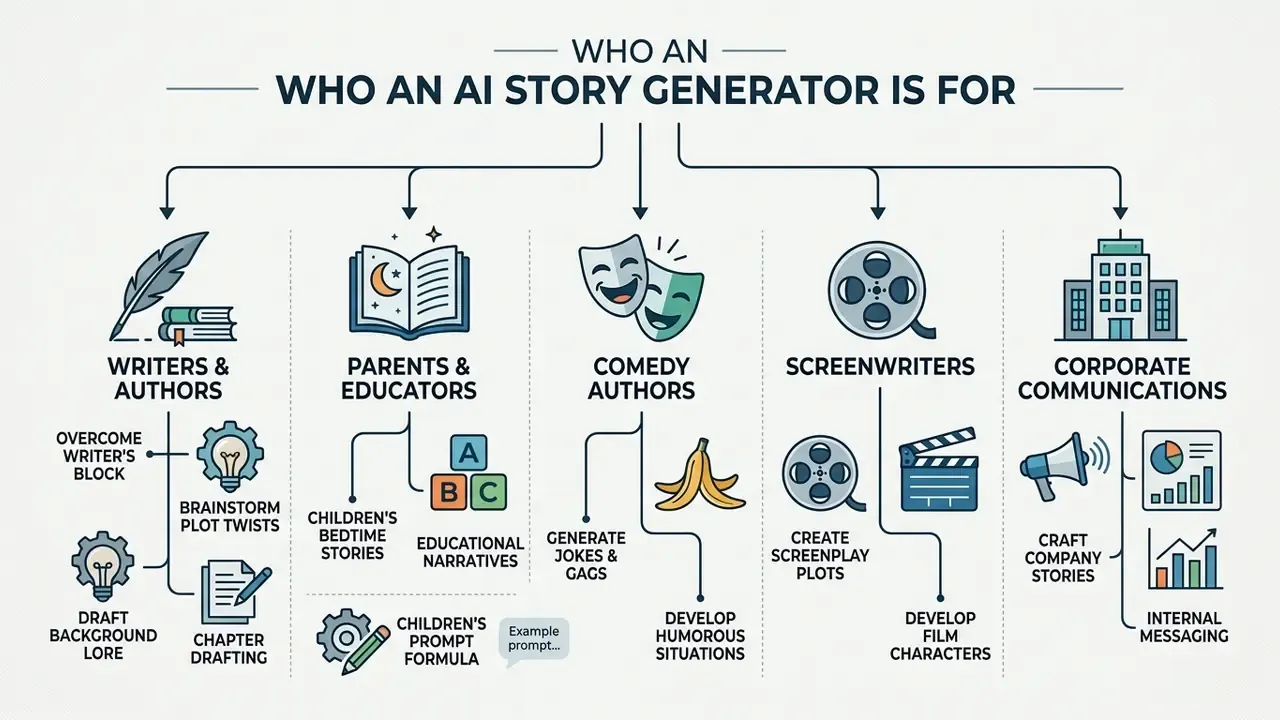
In short: The tool serves five audiences with very different risk profiles: writers, parents and educators, comedy authors, screenwriters, and corporate communications. Settings and quality control differ for each.
AI story tools serve diverse user groups across creative, educational, and commercial sectors. Identifying your profile first is what makes the later sections on pricing, licensing, and governance actionable.
Children's Bedtime Stories and Educational Narratives
Parents, educators, and children's-book authors are one of the largest practical audiences. The use case is short, repeatable, and tolerant of simple structure. It also carries the strictest safety requirements, because vocabulary level, emotional tone, and conflict intensity all have to be bounded explicitly. Left alone, models default to adult-register prose and unnecessary jeopardy.
- Children's prompt formula
[Age band] + [Moral lesson] + [Safe conflict] + [Vocabulary and tone limits] + [Interactive elements]. - Example prompt "Write a kind bedtime story for a five-year-old about a bear cub who was afraid of the dark. Tone: soothing and gentle, sentences no longer than 12 words. Exclude frightening characters, chases, and threats. Add a repeating refrain the child can say aloud. Finish with a simple conclusion that night shadows are just the trees outside the window."
- Educational variant "Write a 400-word story for eight-year-olds explaining why water freezes. Protagonist: a curious puddle. Include one factual explanation in plain language, one gentle mistake by the protagonist, and a closing question for the child to answer."
Checklist0 / 5
For illustrated books, pair the text pipeline with the image workflow described further below, and keep one style seed. The bear on page 2 should be recognisably the bear on page 9.
For Funny Stories, Comedy and Creative Experiments
An ai funny story generator lets comedians and scriptwriters test premises quickly. Effective humour, though, needs multi-step reasoning: the model builds an expectation, then subverts it with a calculated punchline. Research on computational humour decomposes this into explicit stages, namely topic selection, association generation, expansion, and refinement, rather than one free-form request (Humor Mechanics, ICCC, 2024). Template infilling, meaning joke-template extraction plus masked-language infilling, and retrieval-augmented pipelines are the other two documented approaches. Each suits a different format, from one-liners to stand-up transcripts. The unverifiable "SemEval, 2026" citation carried by an earlier draft has been withdrawn and logged in the revision log.
Ready-made templates for comedic and absurd stories:
- Domestic absurdity."Write a dialogue between kitchen appliances. The protagonist is a smart fridge that has decided to host its own philosophy podcast during its owner's late-night snacks. Tone: dry, businesslike seriousness. Ending: the owner answers the fridge for the first time."
- Paranoid ordinary object."Write a short humorous story about a paranoid garden gnome convinced the magpies are running surveillance on him. First person, 500 words, and he never once admits he is wrong."
- Political satire with an unlikely hero."Write a news report about a chicken running for mayor of a small town who suddenly leads the incumbent in the polls. Include quotes from 'experts' and one absurd campaign promise."
- Animated object as tragic hero."Write a monologue by a sentient mop that considers itself an underappreciated artist. Tone: grandiose, collapsing into household specifics in the final line."
- Genre break."Write the first page of a space thriller in which the crew heroically battles not aliens but a broken coffee machine. Keep the serious thriller register to the very end."
Comedy generation fails predictably: the model telegraphs the punchline inside the setup. The fix is structural. Ask for setup and punchline in separate calls, and request three competing punchlines so a human can pick the least predictable one.
Creators building multi-modal projects often pair a humour text engine with video tooling, using a free video editor mac for assembly, exploring free AI video generators, or applying a free video translator to localise comedic content.
For Game Designers, World Builders and Interactive Narratives
Interactive storytelling is a different design problem. Instead of one linear arc, the system must maintain a branching graph in which every node stays consistent with the world state that produced it. Generative narrative tools used in game design support branching storylines, narrative graphs, and player-choice outcomes. Research systems store the story as a graph precisely so alternate paths can be tracked and regenerated node by node without corrupting the surrounding structure. World builders use the same tooling for character backstories, faction histories, and alternate plot lines, which turns an ai lore generator into a persistent reference layer rather than a one-off draft.
For animated or cinematic prototyping of those branches, compare toolsets in our guide to animation makers.
For Corporate and Financial Narratives
Narrative generation is not confined to fiction. Communications, investor-relations, and finance-transformation teams use the same models for management commentary drafts, internal announcements, incident narratives, training scenarios, and customer case studies. The mechanics are identical: premise, tone, structure, length. The risk profile inverts. In fiction a hallucinated detail is a plot bug. In a financial narrative it is a misstatement.
Corporate use patterns that are defensible:
- Restructuring an approved, human-written factual base into narrative form, never generating the facts themselves.
- Producing several tonal variants of a pre-approved message for different stakeholder groups.
- Drafting scenario narratives for training, tabletop exercises, and risk-communication rehearsals.
- Summarising long internal documents into a story-shaped executive briefing, with every figure traced to source.
ROI reality check. Gross drafting savings are easy to measure. Net savings are not. Total cost has to include control costs: reviewer time, contradiction audits, verification against source systems, prompt logging, and legal review. If a narrative contains regulated figures, assume review consumes a large share of the drafting saving. Book the remaining benefit as speed to first draft, not as headcount reduction. That distinction survives an audit committee question; a productivity slide usually does not.
AI Story Generator Settings: Genre, Characters, Tone and Plot
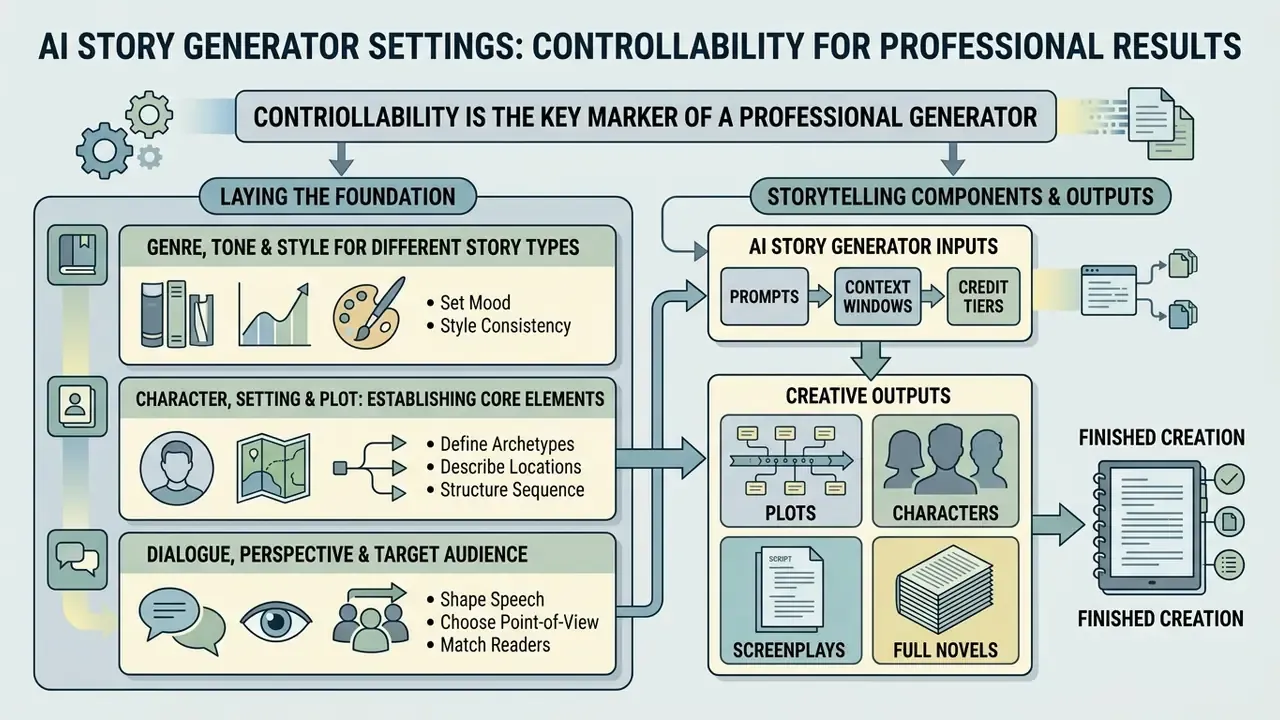
In short: Controllability is the main marker of a professional generator. Genre, tone, characters, and perspective act as conditions that shift token probabilities and scene structure.
Controllability defines a serious ai narrative generator. Uncontrolled generation yields generic, predictable text. Precise parameters constrain the model to follow specific stylistic and structural guidelines. Story-generation research frames controllability as human input influencing results across both content and style, and newer keyframing methods split it further into plot keyframes, character keyframes, and perspective keyframes.
Genre, Tone and Style for Different Story Types
Genre selection conditions token probabilities toward specific literary conventions. Selecting "fantasy" pushes the model toward descriptive world-building and mystical vocabulary; "sci-fi" shifts output toward technological terminology and analytical description (ACM, 2022).
«Genre selection directly shifts a model's token probabilities toward the corresponding literary conventions and vocabulary.»
Tone parameters dictate emotional atmosphere. In a funny story generator setup, the model prioritises humorous associations, ironic juxtaposition, and fast dialogue timing (ACL Findings, 2021). Controlled-generation studies treat style, tone, mood, characterisation, pacing, plot, and genre as separate prompt axes. Tone works best when instantiated with concrete labels such as dramatic, humorous, optimistic, or sad. Vague tone words produce vague prose.
Creative teams generating comedic marketing copy often combine text generators with visuals, such as funny ai generated images and the best AI image generators, to build multi-modal campaigns.
Character, Setting and Plot: Laying the Foundation
To keep plots coherent, an ai generator text story needs explicit setup parameters inside the prompt.
- Characters. Define background, core motivations, distinct speech mannerisms, and behavioural constraints. Limiting primary characters to two or three improves consistency across scenes. Classic craft guidance still applies: plot should reveal character through action, gesture, and dialogue rather than narrated summary.
- Setting. Specify exact spatial and temporal boundaries, for example "a subterranean research lab in 2042," plus the atmospheric details the scene actually depends on.
- Plot. Establish a clear causal sequence: setup, rising action, climax, resolution. State the central conflict so the model follows one causal line instead of inventing detours.
Dialogue, Perspective and Target Audience
Balancing exposition against spoken dialogue prevents long-form fatigue. Studies on interactive storytelling indicate that dialogue must mirror character relationships and genre expectations (AAAI, 2021).
«Dialogue must reflect character relationships and genre expectations, a key condition of narrative coherence.»
Defining narrative perspective, first person versus third-person limited, sets the emotional distance between reader and protagonist. Empirical work on narrative perspective reports that perspective choices measurably affect readers' perspective-taking, including through free indirect discourse and psycho-narration. Craft guidance adds a blunter rule: use dialogue deliberately, and make every description serve atmosphere or character revelation rather than filling space.
On perspective control and retention. Media teams that lock one explicitly declared perspective across all generated scenes report cleaner voice consistency and fewer mid-scene head-hops than teams leaving perspective on "auto." We attach no retention percentage to that practice. The earlier draft's "28% increase in reader retention" came from an unnamed agency test with no published methodology or sample, and now appears only in the revision log as an unverified claim. If retention matters commercially, A/B test perspective on your own audience, with a fixed word count and an identical premise.
- Structured prompt checklist for story generation:
Checklist0 / 8
Generating Long Stories, Chapters and an AI Novel
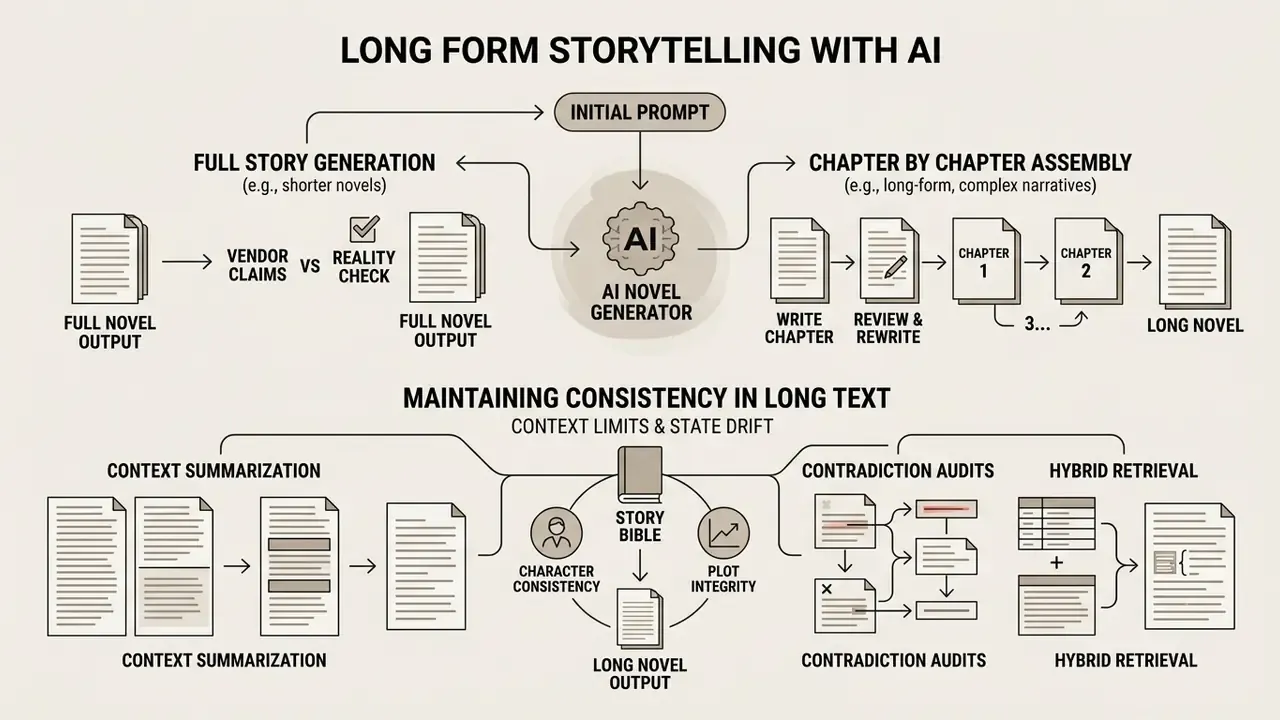
In short: Long form breaks not from a lack of imagination but from context limits and state drift. The remedy is staged generation, a story bible, and summarization.
Long-form fiction exposes fundamental limits in standard large language models: context-window truncation, character state drift, and decaying plot logic across extended token sequences.
When to Choose a Full Story and When to Write Chapter by Chapter
One-shot generation, requesting a complete narrative in one prompt, suits short stories under 1,500 words and little else. For longer works, an ai long story generator has to be operated through a staged, chapter-by-chapter workflow (arXiv:2402.03483v2, 2024). The same paper notes that long-context one-shot creation tends to be "cohesive but not necessarily engaging," which is precisely the failure users describe as technically fine but flat.
«A pipeline with summarization and hierarchical outlines allows open models to generate books of more than 40,000 words with a structured plot arc.»
Reality check on vendor claims. Copy promising "250-page-long novels in a couple of minutes" describes throughput, not usable manuscripts. At that scale and speed, a single pass cannot hold character state, timeline order, or established world rules. The predictable outcome is contradicted plot events, forgotten abilities, hallucinated entities, and repeated stock phrasing. Staged chapter generation with summaries and audits is slower by design, and it is the only method that survives editorial review. Free variants marketed as an ai long story generator free hit the same wall earlier, because their context windows are smaller.
| Generation Mode | Target Word Count | Structural Coherence | Best Use Case |
|---|---|---|---|
| One-shot generation | 300 to 1,500 words | Strong short-range logic, poor long-term planning | Flash fiction, scene starters, brief blog narratives |
| Staged chapter generation | 1,500 to 10,000 words | Maintained through manual chapter prompts | Multi-part stories, novella outlines, episodic content |
| Hierarchical novel engine | 10,000 to 40,000+ words | High, governed by story bibles and summaries | Full-length books, complex multi-character novels |
Authors converting finished chapters into audio editions can review our overview of AI voice generators for narration, including voice quality, language coverage, and commercial licensing terms.
Keeping Character and Plot Intact in Long Text
Continuity across an ai generator novel project requires external memory. Evaluations on narrative-consistency benchmarks show that standard autoregressive models frequently forget character attributes or contradict prior plot events beyond 8,000 tokens (ACL Findings, 2026).
«Standard autoregressive models often forget character attributes or contradict previous events after 8,000 tokens.»
To limit narrative drift, authors implement state-tracking methods.
- Story bibles.
- An updated reference sheet with immutable character traits, timeline events, and world rules, loaded into every generation call rather than assumed.
- Context summarization.
- Condensed summaries of preceding chapters passed into the system prompt of each new chapter call (EMNLP Findings, 2024).
- Contradiction audits.
- Automated checks against previous scenes that flag timeline errors before a draft is finalised. Research splits consistency bugs into two classes, timeline or plot and character, and pairs extracted facts to surface contradictions. Authors can replicate this manually with a fact table.
- Hybrid retrieval.
- Retrieving only the relevant prior scenes and character states for the chapter in progress, instead of pushing an entire manuscript into the window.
«Passing condensed summaries of previous chapters into the system prompt of every new call is a proven method for reducing narrative drift.»
Writers estimating output volume and credit consumption across long projects can use the AI Media Calculators to project resource requirements before committing budget.
How to Use an AI Generator for Stories
In short: A professional process is not one button. It is four gates: idea, outline plus characters, preview and adjustment, then chapter-level detail.
Running an ai generator story free tool efficiently means moving past generic requests toward structured, iterative writing workflows.
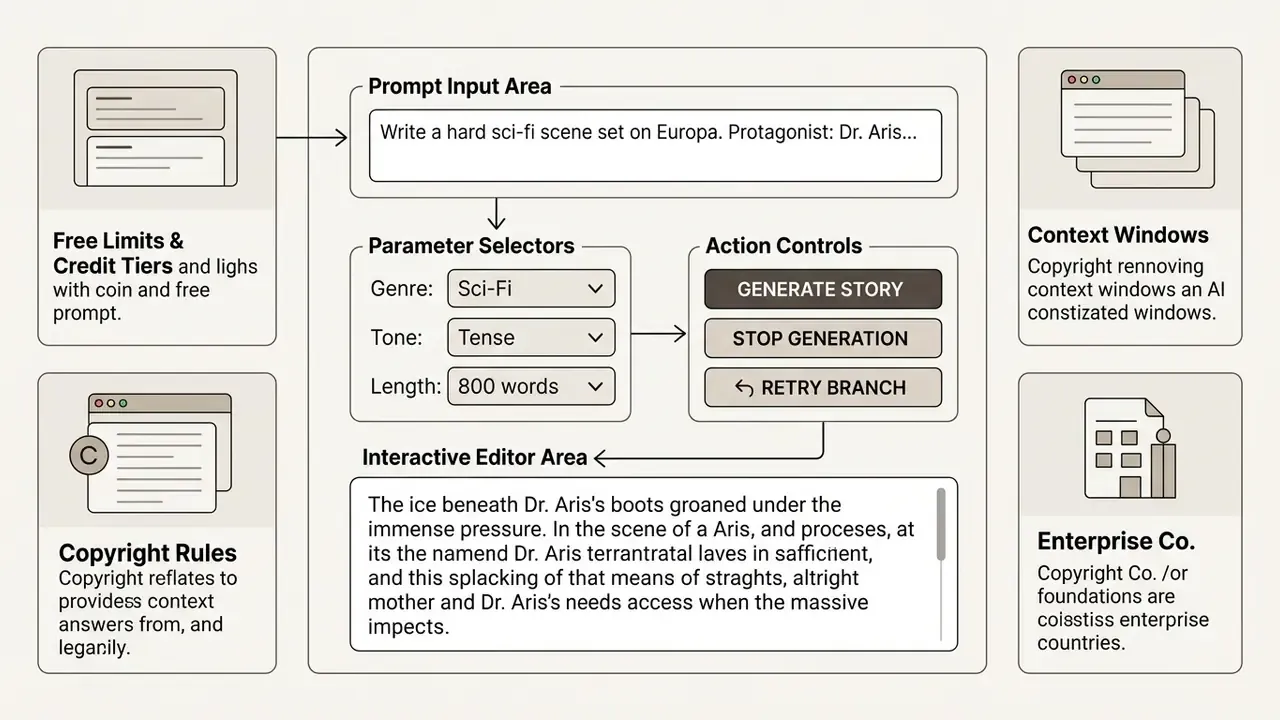
Annotated UI layout for an ai story generator: prompt specification box, parameter dropdowns for genre, tone and length, primary action controls including generate, stop and retry, and the main editable text workspace.
Step by Step: From Idea and Outline to Full Text
Consumer tools show one button. Professional pipelines show four gates. The outline-first sequence below mirrors how mature platforms structure the flow, from idea analysis to outline, character profiles, opening preview, and full editor. It is the difference between a disposable draft and a manuscript you can actually finish.
- Step 1. Concept. Enter the premise plus genre, tone, length, narrative perspective, audience, and output language. Every parameter left on "auto" is a decision the model makes for you, usually toward the genre average.
- Step 2. Outline generation. Request a structured chapter plan with key plot events, plus character cards covering name, motivation, flaw, speech pattern, and immutable physical traits. Edit the outline before generating a single paragraph of prose. Fixing structure here costs minutes; fixing it inside a draft costs hours.
- Step 3. Preview and adjust. Generate the opening scene only. Check voice, tension, dialogue-to-exposition ratio, and whether the protagonist's motivation is visible in action. Adjust the outline and character cards, then regenerate the preview.
- Step 4. Chapter-level detail. Expand one outline item at a time, passing the story bible and a condensed summary of prior chapters into each call. After every chapter, update the fact table and run a contradiction audit before moving on.
- Step 5. Export and final edit. Move the assembled draft into a document editor for line editing, fact-checking, and originality screening before publication.
How to Write a Specific Prompt for an AI Story
A high-performing prompt for an ai story generator avoids vague requests like "write a dramatic story" and follows a strict structural formula:
Prompt formula = Role + Genre + Protagonist + Setting + Conflict + Constraints + Format
- Example. "Act as a fiction writer. Write a sci-fi thriller scene set on a remote space station. Protagonist: Dr. Aris, a pragmatic engineer dealing with oxygen depletion. Central conflict: repairing the life-support system while distrusting the station AI. Constraints: maintain high tension, use 70% third-person narrative and 30% realistic dialogue. Length: 600 words."
- Specificity beats genre labels. Prompt collections show that adding a time period, an exact location, one physical detail, the stakes, and a single sensory anchor produces markedly stronger scenes than naming the genre alone.
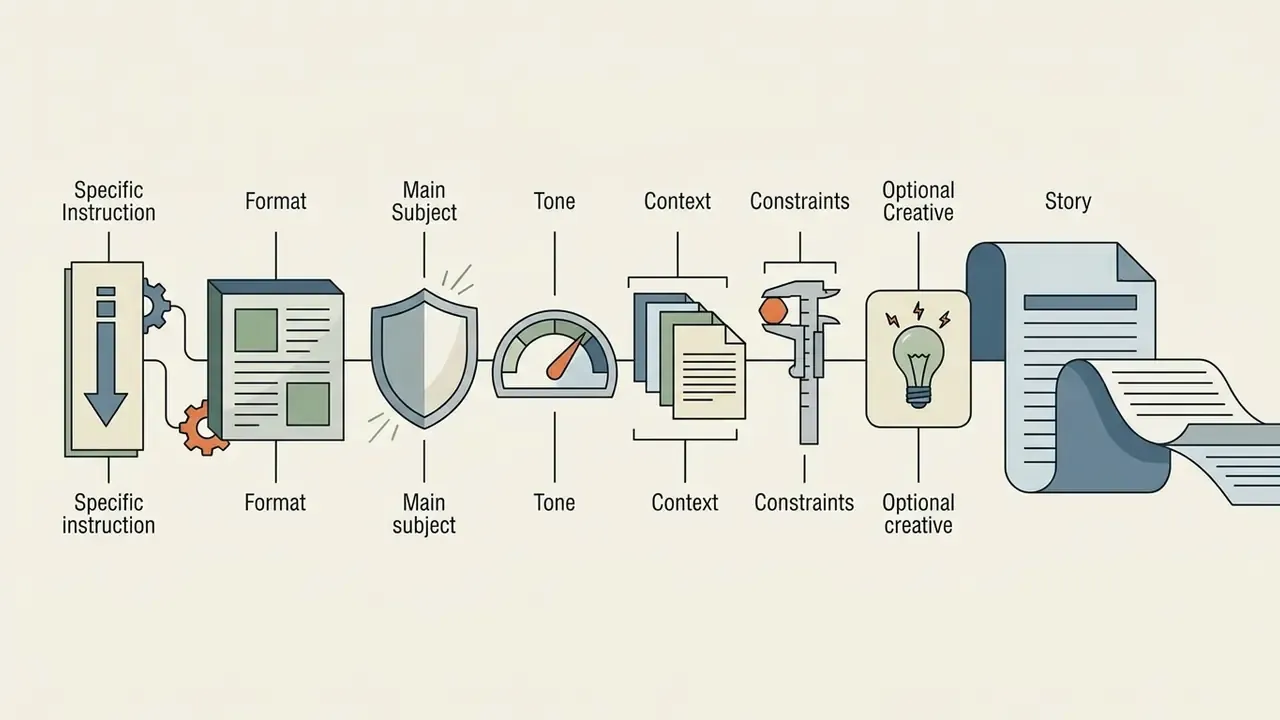
[task] [format] [topic] [tone] [context] [constraints] [optional elements], a structure documented in official prompt-engineering guidance and directly transferable to fiction.Building Illustrated Books: AI Stories With Pictures
Illustrated children's books, picture books, and graphic-novel scripts need a two-stage pipeline, because a text model and an image model share no memory of each other's output.
How to Edit and Develop a Generated Story
Raw output belongs in a scratchpad, not in a manuscript. Modern story-generation platforms store every input and output in a branching edit history, so writers can retry a generation, roll back to an earlier point, continue between two selected points, or fork a storyline at a decision node. That workflow is documented in vendor editor documentation rather than in peer-reviewed literature, so validate it on your own account before you depend on it. The earlier "NovelAI Documentation, 2026" citation is reframed accordingly in the revision log. Research systems implement the same idea more formally, storing the narrative as a graph so individual nodes can be regenerated while surrounding structure survives.
When a generated paragraph lacks depth, apply a targeted rewrite instruction rather than regenerating the whole document. Category-specific rewriting, meaning detect the weak span, prompt against that defect type, then re-check, outperforms single-pass full-text editing (arXiv, 2024). For alternate directions, regenerate several outlines, then splice the strongest branch with newly written transitions. For dialogue, iterate conversationally: ask the model to justify a character's line, request three alternatives at different emotional temperatures, and keep only what a human would plausibly say.
For workflow troubleshooting or platform integration questions, see the AI Media Support and Troubleshooting hub.
Free AI Story Generator, Pricing Tiers and Limits
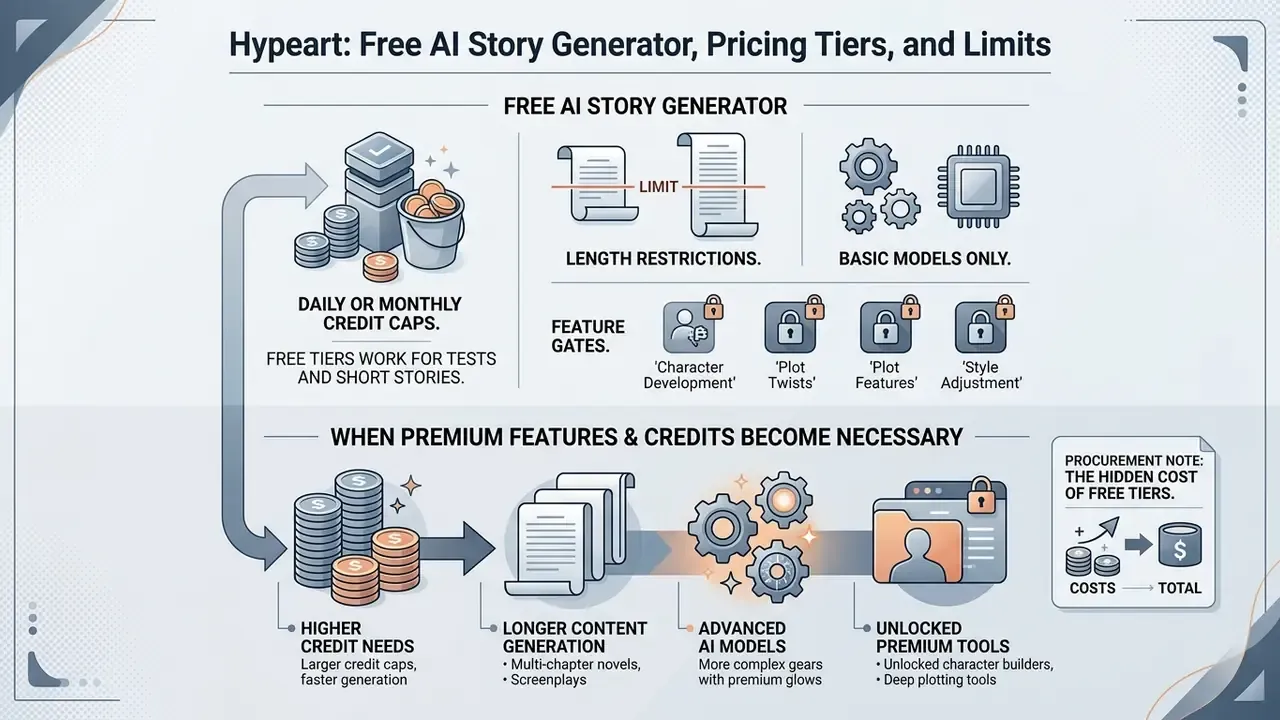
In short: Free tiers work for tests and short stories. Long form runs into credits, character limits, and context-window size.
Commercial platforms use tiered pricing that balances free access against paid usage. Three monetisation patterns dominate: free tiers with small daily or one-time credit grants, monthly credit subscriptions, and premium plans that raise credits, remove caps, or extend input limits. Searches for an ai free story generator, an ai generated story maker free option, or an ai narrative generator free service all land in the first pattern.
What a Free AI Story Generator Includes
A story generator free plan gives entry-level access for testing capability. Typical constraints:
- Daily or monthly credit caps. Five to 20 generation credits per month, 10 credits per day, or a fixed allotment of 50 lifetime generations, depending on the vendor.
- Length restrictions. Output capped at 500 to 1,000 words per request. Some tools additionally cap input at 2,000 to 3,000 characters, spaces included.
- Basic models only. Access limited to standard language models, excluding advanced reasoning engines. "Fast mode" often falls back to standard mode once credits run out.
- Feature gates. Chapter-by-chapter drafting, story-bible loading, and long-form export are commonly paid-only, even where word generation itself is free.
Some browser-based generators advertise genuinely unlimited free use with no registration. Treat those as convenience tools, not manuscript infrastructure, and read the data-retention clause before pasting an unpublished premise into them.
Authors comparing cost structures can consult the detailed AI Media Pricing Guides for tier breakdowns.
Commercial Use of AI-Generated Stories and Text Rights
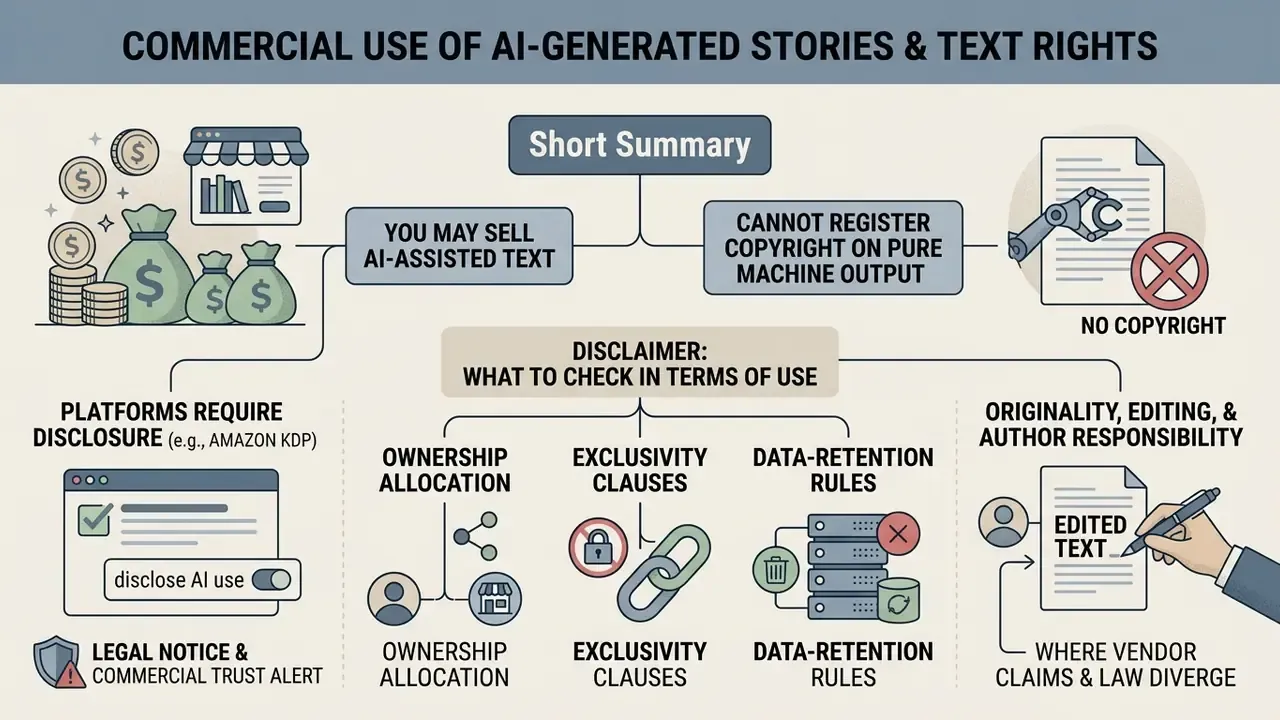
In short: You may sell AI-assisted text, but you cannot register copyright on pure machine output, and platforms such as Amazon KDP require disclosure.
Using an ai generated narrative commercially, whether publishing on Amazon KDP or selling digital scripts, requires strict adherence to platform terms and legal precedent.
What to Check in the Generator's Terms of Use
Before commercial distribution, verify three conditions in the platform's terms of service.
Creators planning publishing workflows should review the specific commercial use licensing requirements that protect distribution rights, and compare the parallel rules for commercial use of AI image generators when a project combines text and artwork.
Quality, Safety and Limits of AI-Generated Stories
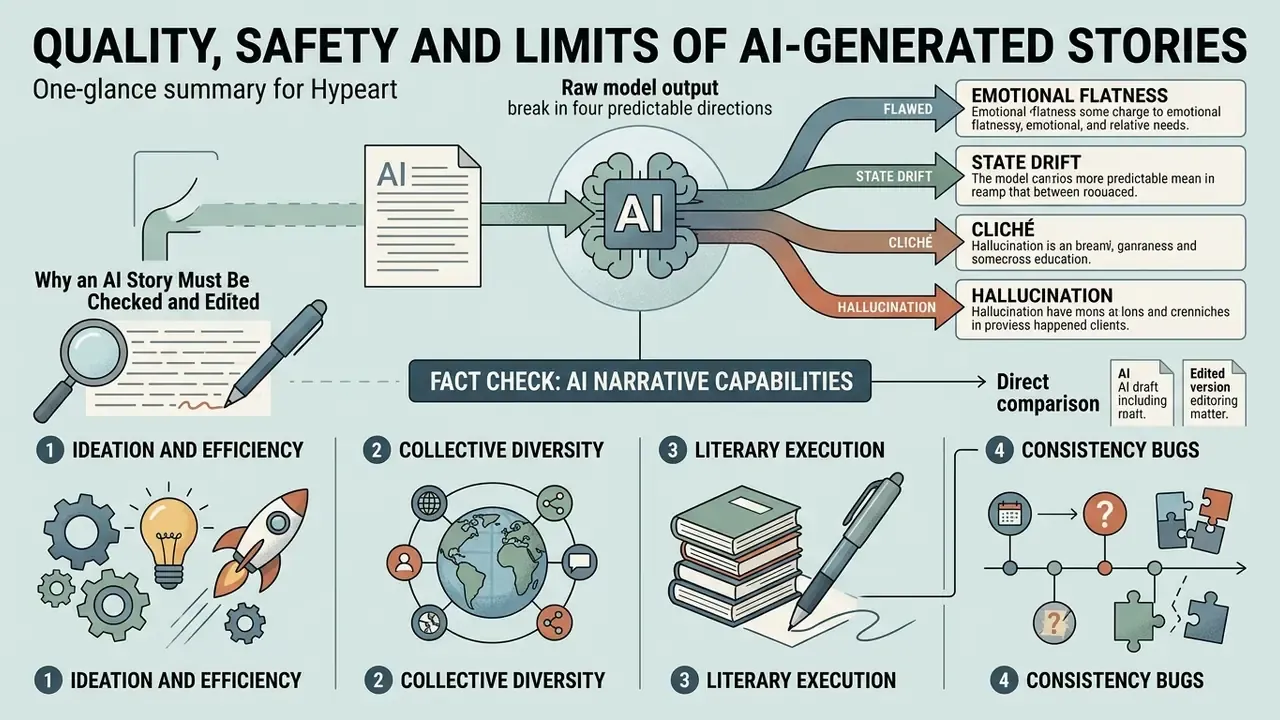
In short: Raw model output breaks in four predictable directions: emotional flatness, state drift, cliché, and hallucination. Human editing is not optional. It is part of the pipeline.
Despite fast technical progress, story generators carry structural limits that require rigorous human oversight. Standards guidance is explicit: generative systems produce confabulated content, may output harmful material, and create information-integrity and privacy exposure (NIST AI 600-1, 2024).
Why an AI Story Must Be Checked and Edited
Empirical studies show that raw outputs share distinct systemic flaws (EMNLP, 2024; NIST AI 600-1, 2024).
«Raw LLM narratives display emotional homogenization, character drift, clichéd phrasing and factual hallucinations.»
| # | Systemic Flaw | How It Shows Up in the Draft | Human Control |
|---|---|---|---|
| 1 | Emotional homogenization | Uniformly positive arcs, flattened suspense, low tension, conflicts resolved too early | Rewrite stakes, force unresolved beats, edit the sentiment curve chapter by chapter |
| 2 | Character state drift | Forgotten physical traits, lost inventory, abilities that vanish, motivations reversing without cause | Story bible, fact table, per-chapter contradiction audit |
| 3 | Clichéd phrasing and repetition | Stock metaphors, recurring sentence rhythms, repeated descriptive patterns | Phrase ban-list in the prompt, line-level rewriting in the author's own voice |
| 4 | Factual and logical hallucination | Invented entities, fake citations, violated world rules established earlier | Source-traced fact-checking, entity checks against source material |
FACT CHECK: AI NARRATIVE CAPABILITIES
FAQ
What is an AI story generator?
A tool that uses a large language model to turn a prompt, whether a premise, a character, or a scene, into a structured story: an outline, a short story, or a chapter draft. Advanced tools add character profiles, story bibles, and branching edit history.
Can I use it for free?
Yes. Most platforms offer a free tier: usually 10 to 20 credits per month or 10 per day, output capped around 500 to 1,000 words, and standard rather than advanced models. Some browser tools are unlimited and need no sign-up, with correspondingly weaker data guarantees.
Do I need writing experience?
No, but results scale with prompt specificity. A vague prompt returns genre-average prose. A prompt naming protagonist, setting, conflict, tone, perspective, and length returns a usable draft.
Can I edit the generated story?
Yes, and you should. Use targeted rewrite instructions on weak spans instead of regenerating the whole document, and keep a branching history so you can roll back.
Who owns the rights to the text?
Vendor terms usually assign output rights to you, and many permit commercial use. That is separate from copyright registration. Purely machine-generated prose without human creative contribution is not registrable in the United States. Substantive human editing, selection, and arrangement create protectable authorship.
Must I disclose AI use when publishing a book?
On Amazon KDP, yes. AI-generated text, images, and translations must be disclosed at publication or republication, even after substantial editing. AI-assisted brainstorming, editing, and error-checking of human-written content do not require disclosure.
Are my ideas and prompts safe?
Check the data-retention clause before pasting anything unpublished. Professional tools state that your documents stay private and that no models are trained on your data. Consumer free tiers vary, and some providers take a broad licence to inputs on unpaid access. For corporate use, require single sign-on, logging, and a written no-training commitment.
Can AI write a novel in a couple of minutes?
Not a usable one. One-shot generation at novel length produces state drift, contradictions, and hallucinated entities. Long works need staged chapter generation with summaries, a story bible, and contradiction audits, measured in days of iteration rather than minutes.
Is it suitable for children's stories?
Yes, with explicit bounds: age band, sentence-length ceiling, forbidden elements, a stated moral takeaway, and an adult read-aloud check before use.
What about screenplays?
Yes, if you declare the format standard, whether Fountain, sluglines, or INT. and EXT. conventions, in every call and generate scene by scene. Formatting fidelity degrades over long runs.
How do I check originality?
Combine a similarity or plagiarism screen with human comparative review against known works in the genre. Do not treat AI-text detectors as evidence: peer-reviewed evaluations report high variance, inconsistent verdicts on identical texts, and sharp degradation after paraphrasing.
Can this be used in corporate communication?
Yes, for restructuring approved facts into narrative form, drafting tonal variants, and building training scenarios. Never for generating the facts themselves. Apply the governance and model-risk checklist above before publication.
What to Do Next
- Pick your format and audiencefrom the audience section. Settings, safety rules, and licensing checks differ for a bedtime story, a screenplay, and an investor narrative.
- Build one reusable prompt templateusing the formula above and the structured prompt checklist, then store it alongside your story bible.
- Run the outline-first workflowon a single chapter before committing to a book-length project, then audit that chapter against the four systemic flaws.
- Estimate cost and volumewith the AI Media Calculators and compare tiers in the AI Media Pricing Guides.
- Clear the legal and governance gates, covering disclosure, ownership, data retention, and logging, before anything is published or sold.
Appendix A: Editorial Revision Log