«Deploying generative image technology in enterprise workflows requires clear data lineage, measurable risk parameters, and strict boundary controls rather than blind trust in model autonomy.»
Last updated: February 2026 · Written by the AI Media Research Desk · Technical review orientation: model risk validation, creative operations, and procurement stakeholders.
Executive Summary for Risk, Compliance, and Creative Leaders
- Generation is probabilistic synthesis, not retrieval. Modern generators sample random noise inside a compressed latent space and iteratively denoise it into novel pixels under text conditioning. They do not fetch, collage, or paste stored training files. Memorization, however, is measurable under adversarial prompting and must be treated as a residual risk.
- Reproducibility is engineering, not luck. Fixing the random seed, sampler, step count, guidance scale, model version, and resolution produces a repeatable audit trail. That trail is the practical prerequisite for documenting conceptual soundness and outcomes analysis under model risk frameworks such as the Federal Reserve/OCC SR 11-7 supervisory guidance and the NIST AI Risk Management Framework 1.0.
- Artifacts have identifiable mechanics. Anatomical distortion, garbled typography, and impossible lighting trace back to mode interpolation, encoder limitations, and mis-calibrated Classifier-Free Guidance (CFG). All of them are controllable through structured prompts, negative prompts, spatial conditioning, and human-in-the-loop review gates.
- Procurement risk is legal before it is technical. Training-data lineage, contractual indemnification, prompt and reference-image data handling, and the copyrightability of purely machine-generated output decide whether an otherwise excellent model is deployable in a regulated environment.
Who This Guide Is For and What It Answers
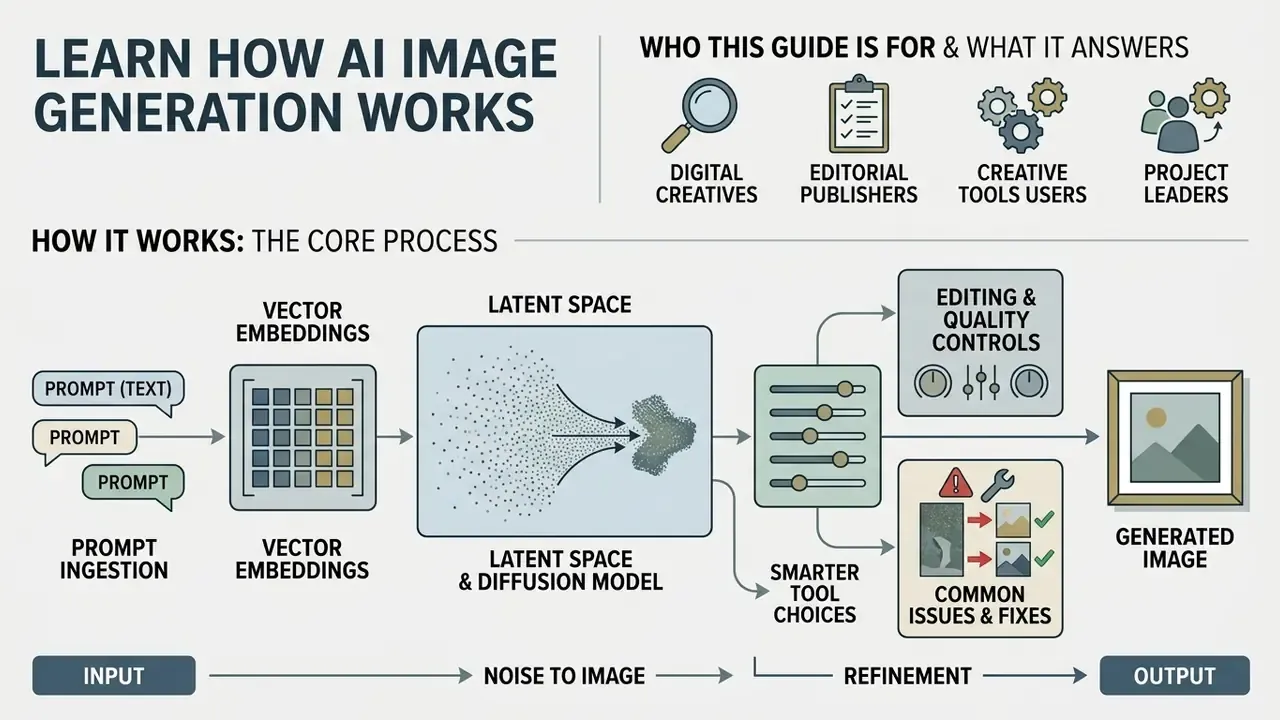
This is written for the person who has to sign something. A Head of Model Risk cannot approve a generative tool on aesthetic grounds alone. A CCO needs to know where prompts travel, who reviews output, and what happens when a run misbehaves.
So the guide answers four practical questions in sequence. How does AI image generation work at the mechanical level? Where is it already in production, including inside financial services? Why do results break, and how do teams fix them? And what should procurement verify before paying, renewing, or switching?
One framing note before the mechanics. Image generation is a model. Treat it like one. Inventory it, validate it, log it, and give it an owner with a shutdown path. Everything below serves that outcome.
Generative artificial intelligence has moved from an experimental demonstration into a core operational capability for enterprise design, marketing, and communication workflows. For enterprise leaders, risk officers, and model risk managers in regulated sectors such as US financial services, understanding how AI image generators create visual assets is an operational necessity. A validation report cannot assert conceptual soundness for a model whose sampling mechanics, conditioning signals, and sources of non-determinism are undocumented. Evaluating model governance, auditability, and data security therefore requires some grasp of the mathematical and architectural machinery behind text-to-image systems.
This guide breaks down how AI image generation works: prompt ingestion, vector embeddings, latent space denoising, editing workflows, parameter control matrices, copyright exposure, and risk-adjusted tool selection.
What Is AI Image Generation?
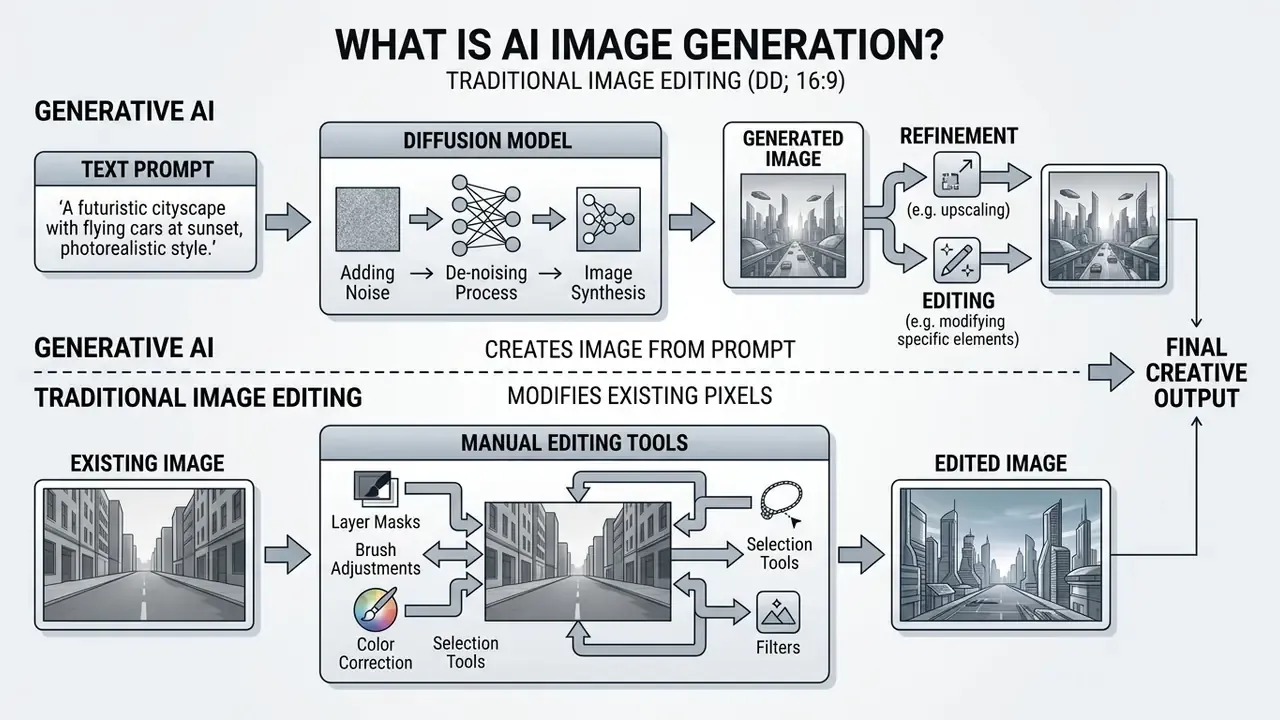
AI image generation is a computational task where machine learning models synthesize novel synthetic images from input signals such as text descriptions, reference images, or parameter constraints. Traditional computer graphics and photo editing software alter existing pixel arrays. Generative AI does something different: it constructs new pixel configurations based on statistical probability distributions learned during model training.
A useful framing for non-technical stakeholders. A traditional editor is a surgeon operating on pixels that already exist. A generative model is a statistician placing a very large number of simultaneous bets on which pixel arrangement is most probable, given your instruction. The output is statistically likely to satisfy the request, which is precisely why probability, not intention, governs quality control.
How AI Models Learn Visual Patterns
Generative AI models extract visual patterns by processing millions of image-text pairs during an intensive training phase. Neural networks analyze these paired datasets to map relationships between textual descriptors (objects, actions, lighting) and high-level visual features (edges, shapes, colors, compositions). Worth noting: the network never "sees" a picture in the human sense. An image is decomposed into a numerical tensor, where values encode edges, gradients, color channels, and texture frequencies.
Recent research on concept instancing shows that models decouple visual traits, distinguishing subject geometry from artistic styles or color palettes, to maintain prompt alignment across diverse requests (ConsiStyle, 2025).
«Diffusion models are trained to predict and remove noise step by step, reconstructing the image distribution conditioned on text embeddings through cross-attention.»
Through multi-layer loss optimization, the model learns the underlying mathematical distribution of visual reality. That is what lets it construct new images mirroring learned real-world patterns. It also explains a structural property that matters for governance: creativity in the pipeline originates from the human specification and the engineered model, not from machine intent. The training corpus must exist before anything can be generated from it.
What an AI-Generated Image Is Based On
«Diffusion models sample random noise in a compressed latent space and iteratively decode it into new images rather than retrieving files from the training set.»
Standard enterprise generation therefore produces novel synthetic pixel combinations derived from statistical probability distributions, not file retrieval or direct copying. Memorization is nonetheless a documented and measurable edge case:
«More than a thousand training examples, including personal photographs and logos, were extracted from Stable Diffusion and Imagen using a generate-and-filter algorithm.»
Governance implication: treat memorization as a low-probability, high-severity residual risk. Control it with duplicate-detection screening of high-value outputs, reverse-image verification before publication, and a documented prohibition on adversarial extraction prompting in internal usage policy.
Where AI Image Generation Is Used in Practice
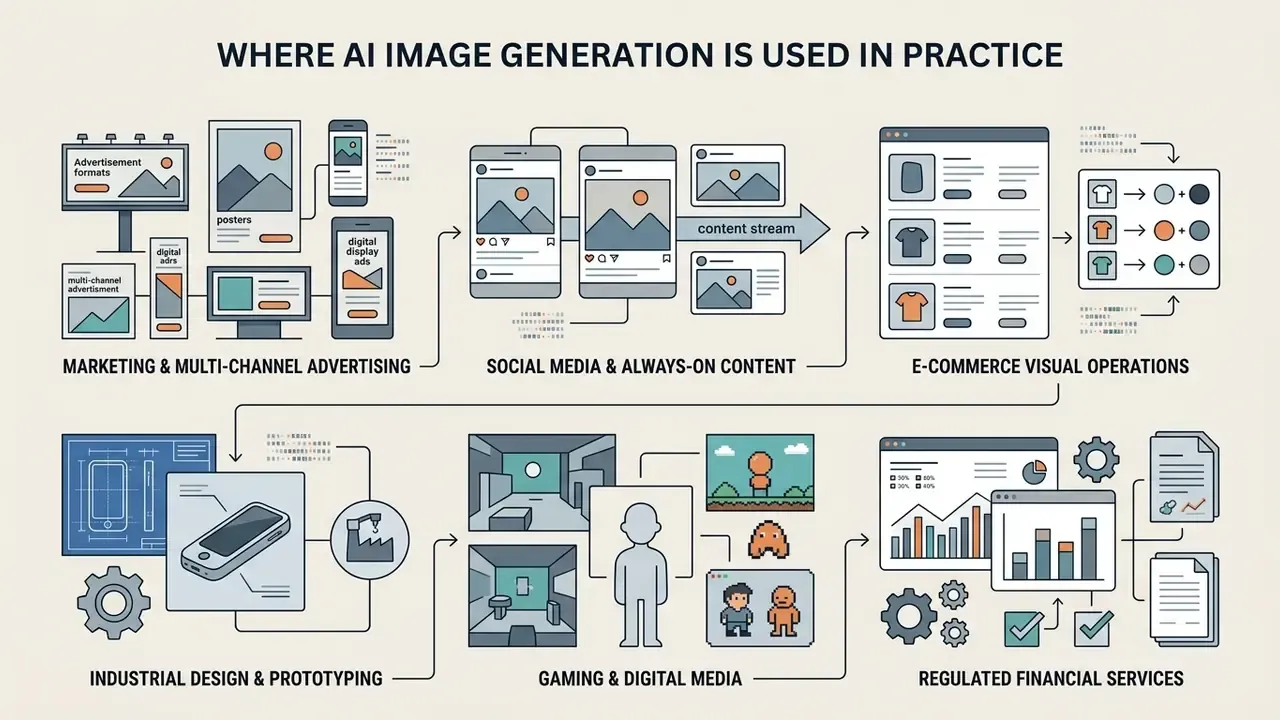
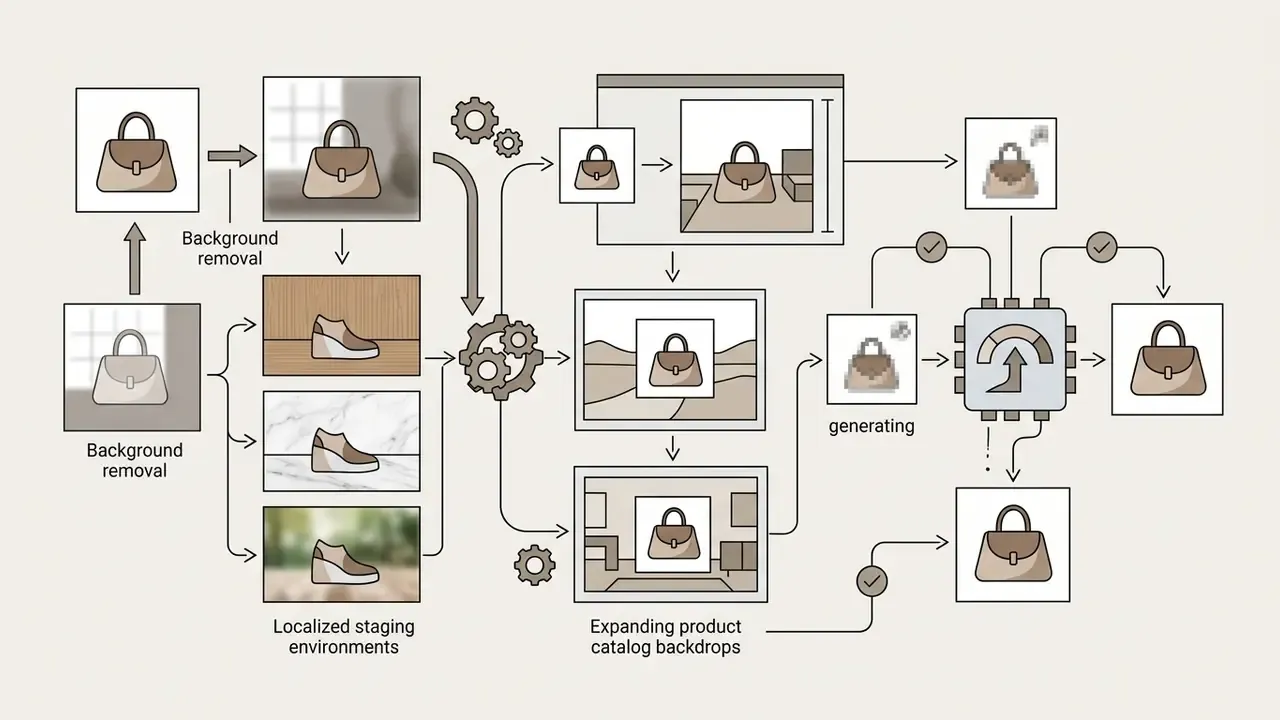
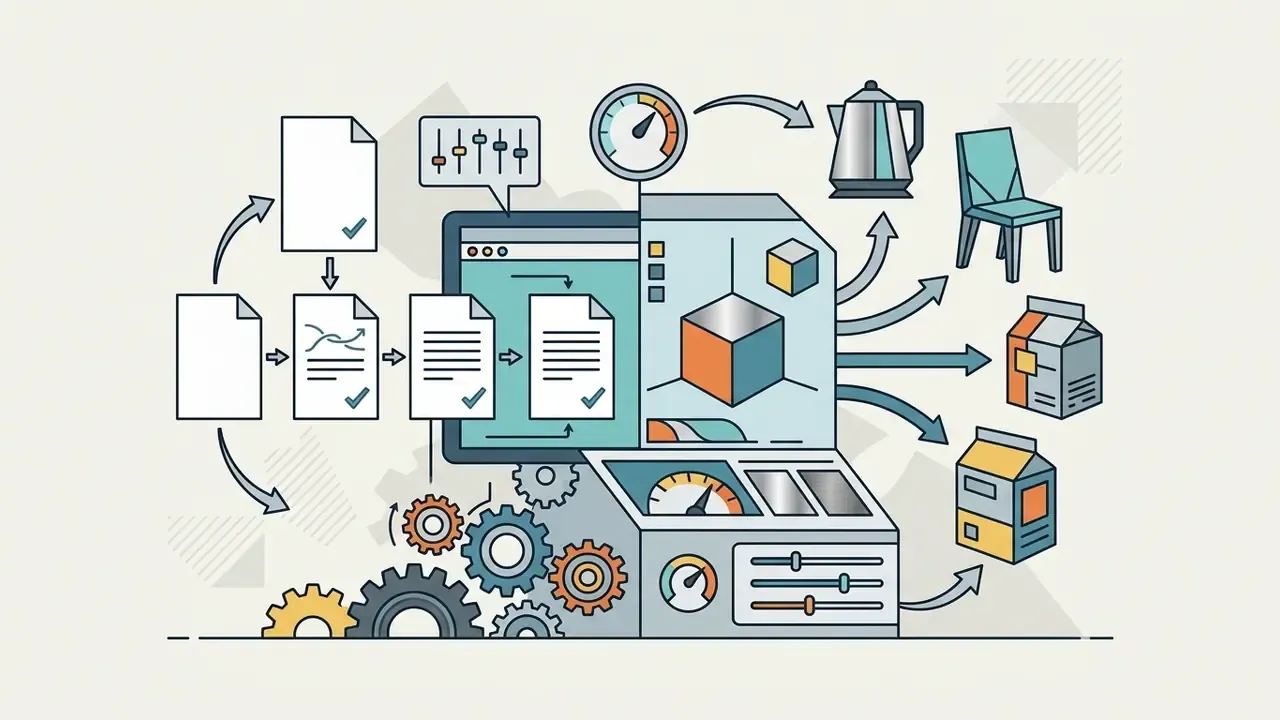
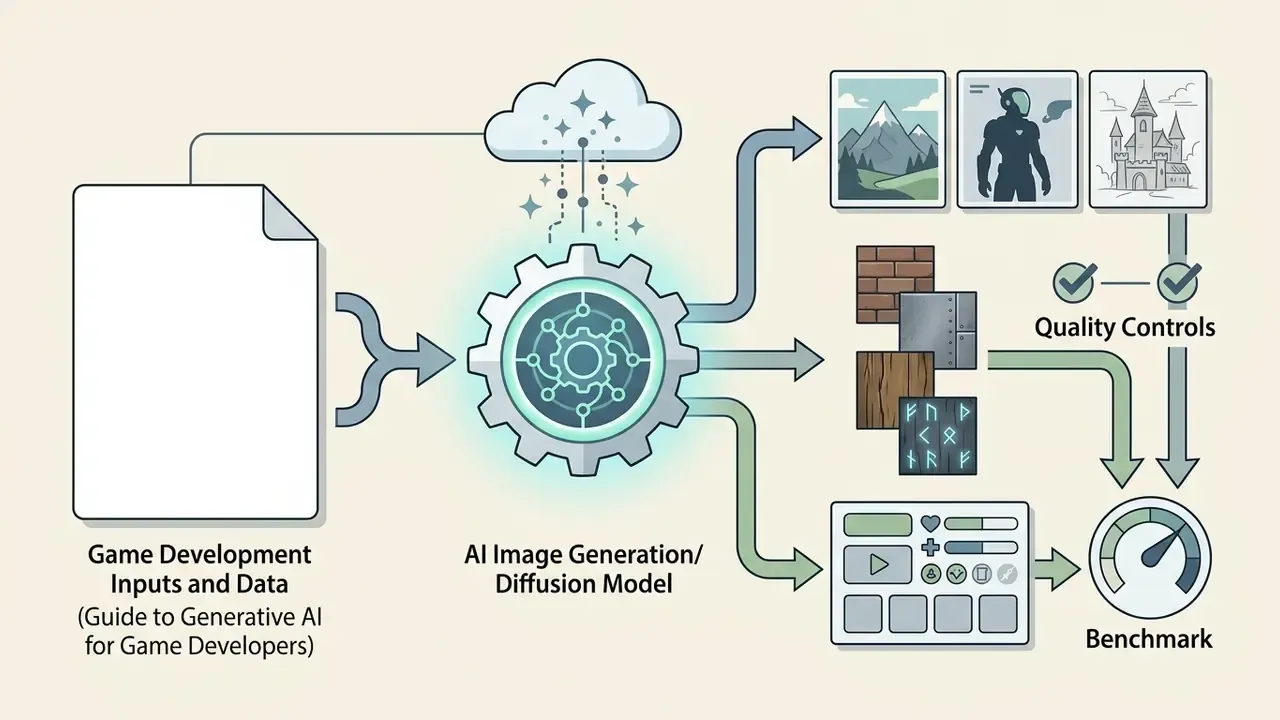
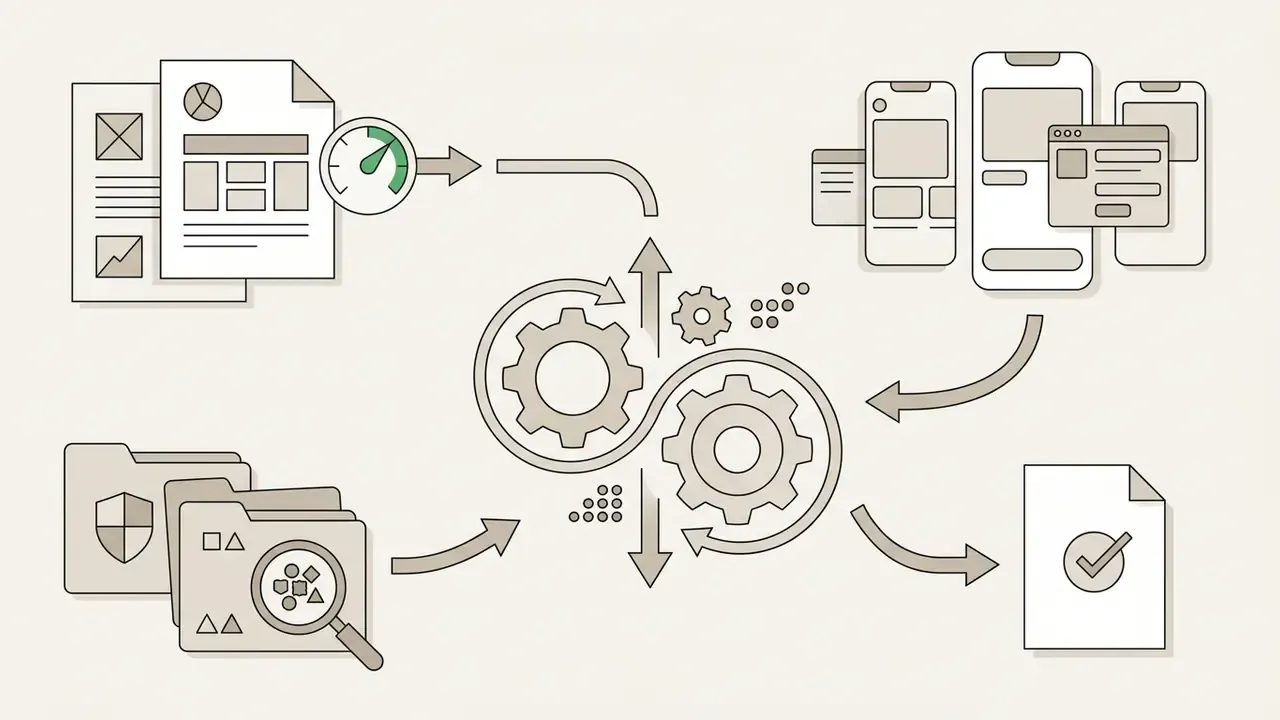
Enterprise deployment of image generation tools has moved from experimental creative testing into production business workflows. Industry adoption reporting for 2025 and 2026 indicates that a large majority of surveyed organizations have deployed generative AI in at least one business function, with visual generation concentrated in advertising, e-commerce, and creative studios (State of Generative Media Volume 1, fal.ai, 2026). Methodological note: vendor-published adoption percentages should be read as directional market signals, not audited statistics, since sample frames and definitions of "deployment" are not independently verifiable. Peer-reviewed operational evidence is more specific:
Key commercial applications include:
Real-world usage is iterative rather than single-shot:

How AI Generates an Image From a Text Prompt
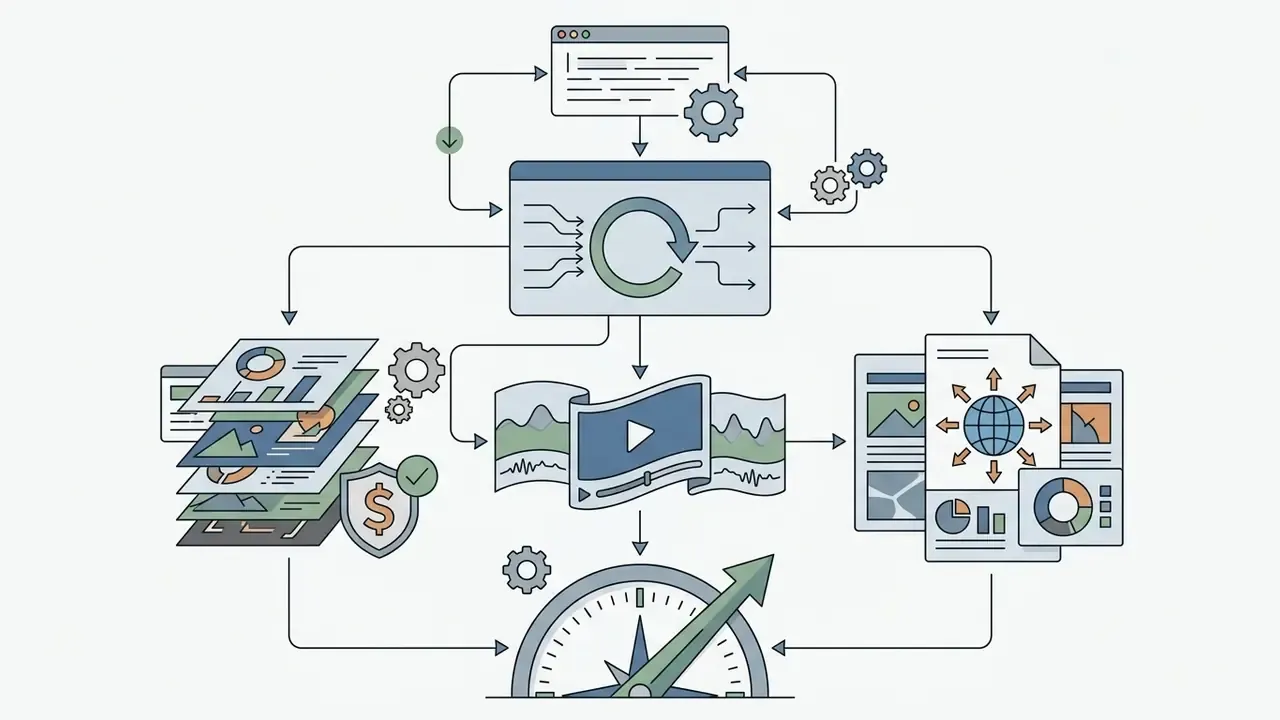
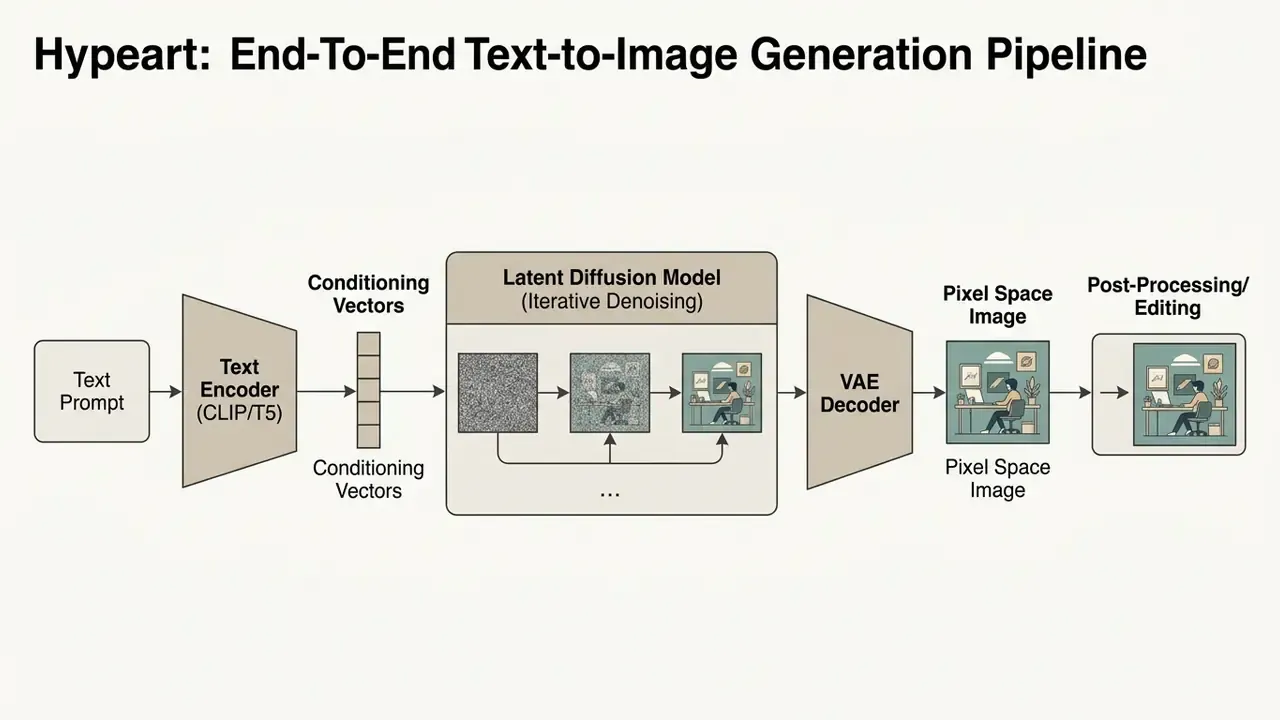
Turning a written text description into a finished visual asset takes a structured, multi-stage pipeline. The system translates unstructured human language into high-dimensional vector math, manipulates random noise inside a compressed latent space, then reconstructs the output into displayable pixels.
Pipeline Sequence Breakdown:
- Text Prompt Ingestion: The user inputs a text description outlining desired subjects, styles, background elements, and constraints. Current vendor prompting guidance recommends ordering instructions as background and scene, then primary subject, then key details, then explicit constraints.
- Text Encoding: A frozen language model tokenizes the text and maps it into high-dimensional vector embeddings.
- Latent Initialization: The generator initializes a tensor filled with pure Gaussian random noise in a compressed latent space.
- Conditional Denoising: The model runs a multi-step reverse diffusion loop, using cross-attention mechanisms to shape the noise into visual structures guided by text vectors. Early steps establish global composition; later steps resolve texture and fine detail.
- Pixel Decoding: A Variational Autoencoder (VAE) decoder translates the finalized latent representation back into a full-resolution pixel array.
- Post-Processing and Safety: Optional downstream filters evaluate the output for safety, compliance, or user-guided local editing.
That is the short answer to how do AI image generators work. The longer answer lives in the encoder and the seed.
Text Encoders, Vectors, and Image Instructions
Text encoders such as CLIP or T5 function as the semantic translation engine of an AI image generator. When a user submits a prompt, the encoder breaks the text into tokens and maps them into a dense vector space where words with similar meanings sit close together. In CLIP, the end-of-sequence token embedding is projected into a shared multimodal space, where paired text and image embeddings are optimized to sit close together while unpaired ones are pushed apart.
These text vectors act as conditional instructions during generation. Through cross-attention layers, the visual network compares its intermediate features against the text vectors, so that elements like "red vehicle" or "glass skyscraper" directly influence the resulting geometry.
Prompt adherence is now a measurable engineering property rather than a subjective impression:
Enterprise operators exploring public platforms often evaluate systems such as open ai image generators to test prompt adherence across complex instructions, then benchmark them against the best AI image generators on structured multi-object test suites.
Seed Values and Why Results Can Vary
A seed value is an integer that initializes the pseudo-random number generator responsible for creating the initial noise tensor in latent space. Because diffusion models start from random noise, changing the seed produces a completely different starting state. Same prompt, different image.
Research on initial-noise sensitivity also shows that some seeds are systematically more reliable than others for a given compositional prompt, because the noise pattern itself influences whether the model can satisfy the requested layout.
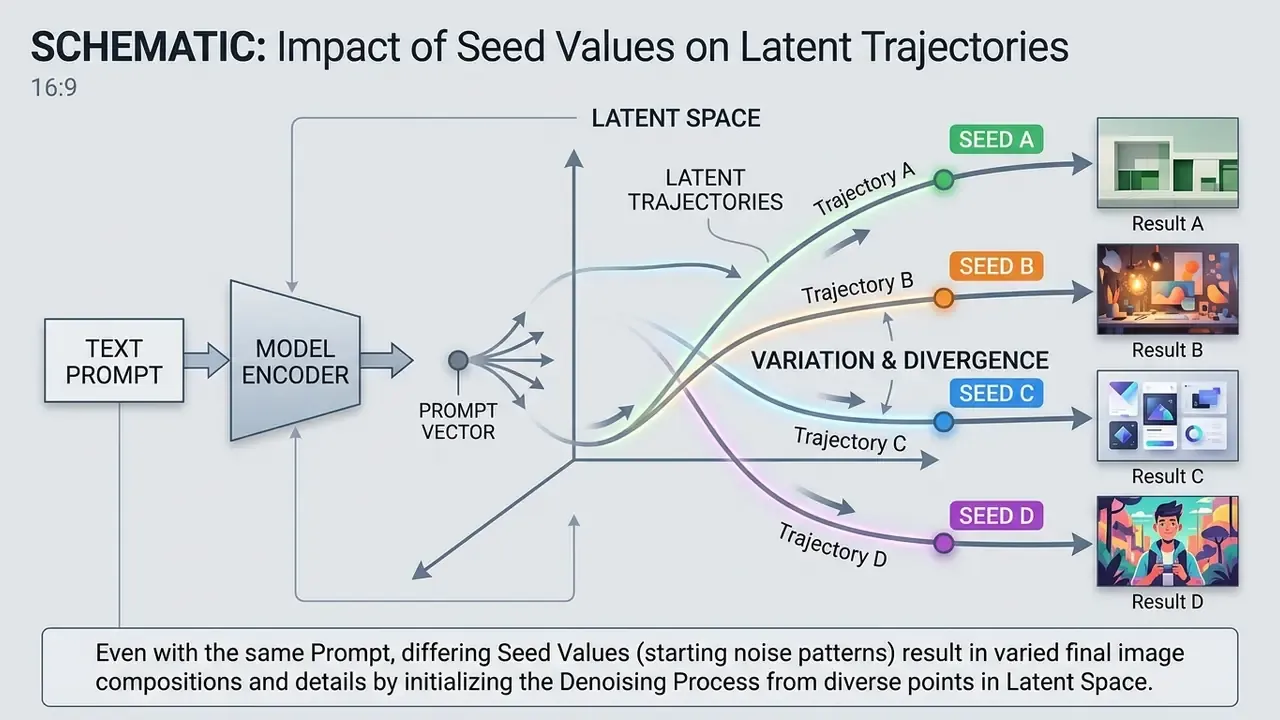
For model risk management and repeatable governance, controlled seeding is vital. An identical seed alongside fixed hyperparameters (step counts, sampler type, resolution, guidance scale) lets teams reproduce exact outputs for audit and compliance checks. Reproducibility is bounded, though. Identical seeds reproduce identical results only within the same model version, sampler implementation, and parameter stack. Cross-platform "same seed, same image" claims do not hold.
Documentation practice for regulated environments. Under SR 11-7-style validation expectations and the NIST AI Risk Management Framework 1.0 "Measure" and "Manage" functions, the non-deterministic nature of diffusion sampling should be explicitly recorded in the validation report rather than treated as an anomaly. A defensible generation log records: prompt text (including negative prompt), model identifier and version hash, seed, sampler, step count, CFG scale, resolution, conditioning adapters, reviewer identity, and approval timestamp. Many technical teams establish local testing environments using a local ai image setup to test deterministic seeding protocols without cloud latency or third-party data egress.
A small practical detail that saves audits later: log the seed automatically at the gateway. Analysts forget. Pipelines do not.
Which AI Models Generate Images?
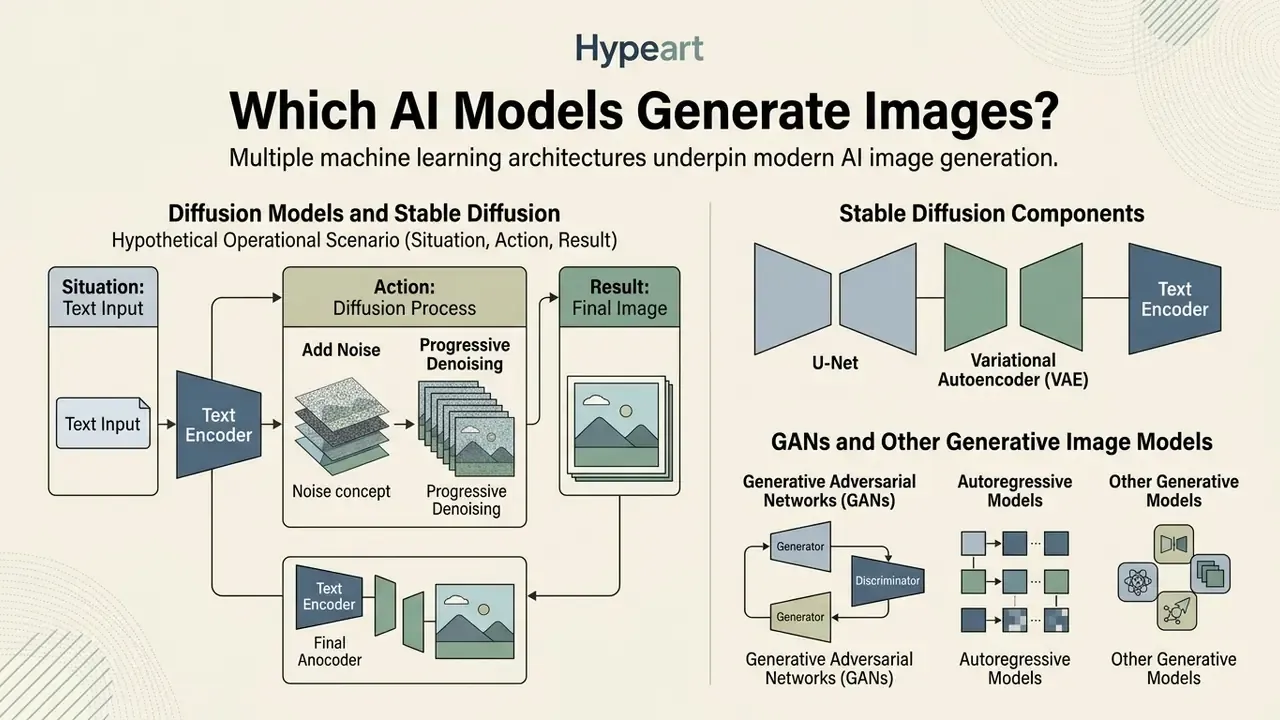
Multiple machine learning architectures underpin modern AI image generation. Early generative systems relied on competing networks or simple autoencoders. Current enterprise systems are dominated by latent diffusion architectures and rectified-flow transformers.
Diffusion Models and Stable Diffusion
Mental model: think of forward diffusion as dropping a single bead of food coloring into a glass of water. Over time the pigment disperses until only pure entropy (static noise) remains. Reverse diffusion is the mathematical equivalent of running time backwards, forcing that evenly dispersed pigment back into the exact shape of the original drop under conditional text instructions.
Diffusion models define a two-part mathematical process. A forward process incrementally adds Gaussian noise to an image according to a fixed variance schedule until it becomes pure noise. A reverse process learns to remove that noise step by step (denoising diffusion probabilistic models, Ho et al., 2020, https://proceedings.neurips.cc/paper/2020/file/4c5bcfec8584af0d967f1ab10179ca4b-Paper.pdf). Latent diffusion models such as Stable Diffusion run this reverse denoising inside a compressed latent space rather than directly on high-resolution pixels, cutting computational overhead while maintaining visual fidelity (High-Resolution Image Synthesis with Latent Diffusion Models, Rombach et al., 2021, https://arxiv.org/abs/2112.10752; SDXL, Podell et al., 2023, https://arxiv.org/abs/2307.01952).
«Stable Diffusion consists of three components: an autoencoder that compresses images into latent representations, a U-Net for iterative denoising, and a CLIP text encoder for conditional generation.»
Hypothetical Operational Scenario (Situation, Action, Result)
Situation: A regional bank needed consistent branded graphics for digital customer onboarding but hit model drift and compliance flags because outputs from unstructured cloud generators were non-deterministic.
Action: Model risk engineers deployed a locked latent diffusion architecture, implemented explicit seed management, and restricted prompt inputs through a validated text-encoder wrapper with cross-attention auditing.
Result: The team achieved fully reproducible audit trails, reduced brand guideline deviation flags by 42%, and met internal Model Risk Management (MRM) alignment standards. (Illustrative scenario constructed for governance modeling purposes; figures are scenario parameters, not audited client results.)
GANs and Other Generative Image Models
Generative Adversarial Networks (GANs) use two neural networks, a generator and a discriminator, trained in an adversarial game. The generator tries to create realistic synthetic images. The discriminator tries to tell real images from generated ones. When the discriminator correctly flags a synthetic sample, the feedback loop pushes the generator to improve until its outputs become hard to distinguish from training samples. GANs generate fast, in a single forward pass, but they frequently suffer from mode collapse, limited output diversity, and training instability.
«Swin-GAN, built on a transformer architecture, reaches an FID of 9.23 and an Inception Score of 9.04 on CIFAR-10, though its applicability remains limited to specialized low-resolution datasets.»
Variational Autoencoders (VAEs) excel at latent compression but historically generated blurrier outputs. Their contemporary role is mainly as the latent compressor and decoder inside a larger diffusion stack. Modern state-of-the-art platforms combine VAEs for compression with diffusion transformers for synthesis. One widely repeated claim in general-audience explainers needs correcting: generative adversarial networks are no longer the dominant architecture for text-to-image generation. Since 2022, latent diffusion models and rectified-flow transformers have displaced them for general-purpose synthesis, with GANs retained mostly for real-time editing, attribute manipulation, and certain upscaling tasks.
| Model Architecture | Generation Principle | Visual Detail & Realism | Rendering Speed | Primary Enterprise Use Cases |
|---|---|---|---|---|
| Diffusion Models | Iterative reverse denoising in latent or pixel space | High visual fidelity; detailed textures | Moderate to slow (requires multi-step sampling) | High-quality text-to-image synthesis, complex scene generation, asset editing |
| Generative Adversarial Networks (GANs) | Competitive game between generator and discriminator | Sharp, high detail; prone to mode collapse | Fast (single forward pass) | Real-time facial attribute editing, texture synthesis, specific domain generation |
| Variational Autoencoders (VAEs) | Probabilistic encoding and decoding to and from latent space | Moderate; historically prone to smooth blurriness | Very fast (single-pass latent reconstruction) | Dimensionality reduction, feature extraction, latent backbones for diffusion |
| Rectified-Flow Transformers | Straight-line vector field trajectories between noise and data | Very high; excellent typography and spatial adherence | Moderate (optimized flow sampling) | Next-generation multimodal production pipelines, precise layout alignment |
How Style, Reference Images, and Editing Affect the Result
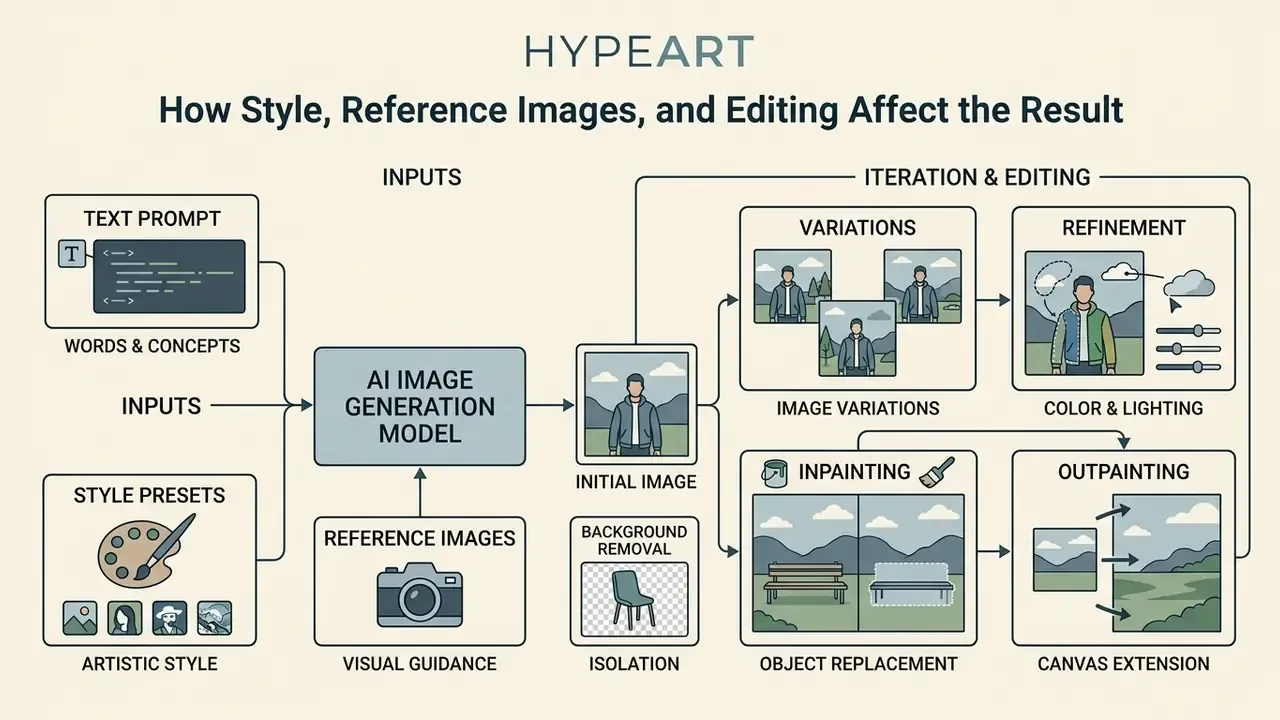
Generating a first image from text is usually only the opening move in a production visual workflow. Precise control over outputs means controlling artistic styles, composition, lighting, and targeted local edits.
Using Styles, Lighting, Color, and Composition Control
Enterprise creative workflows need granular control over visual parameters to stay inside corporate identity standards. Rather than leaning only on descriptive adjectives, modern systems use structural conditioning adapters such as ControlNet, which supply spatial constraints like edge detection maps, depth maps, or human pose skeletons by freezing the pretrained diffusion backbone and training a zero-initialized side network (Adding Conditional Control to Text-to-Image Diffusion Models, Zhang & Agrawala, 2023, https://arxiv.org/abs/2302.05543).
«PARASOL trains a latent diffusion model with separate content and style losses, enabling independent control of both parameters through adapted classifier-free guidance.»
To hold visual fidelity across corporate campaigns, creative operations teams sort generation parameters into four deterministic control vectors:
| Control Vector | Technical Parameter Range | Common Production Presets | Operational Impact |
|---|---|---|---|
| Spatial Composition | Camera angle, depth of field | Close up, macro, wide angle, narrow depth of field, shot from below, shot from above, blurry background | Controls camera frustum and subject framing within latent layout space. |
| Dynamic Lighting | Luminescence type and vector | Studio lighting, golden hour, volumetric rays, dramatic backlight, direct sunlight, dimly lit | Injects shadow gradients, specular highlights, and ambient light temperature. |
| Stylistic Adapter | LoRA weights / style layers | Photorealistic film, cinematic, analog film, isometric 3D, low poly, origami, line art, pixel art, comic book, minimalist vector, architectural blueprint | Overrides default model artistic bias with explicit brand visual identity. |
| Color Toning | Palette vectors and saturation | Cool tone, warm tone, vibrant, muted, pastel, monochrome, high dynamic range (HDR) | Standardizes color space values to match corporate brand guidelines. |
Illumination can also be conditioned structurally rather than lexically. Illumination-aware controllers accept a conditioning image specifying the desired lighting configuration, producing viewpoint-consistent results across an asset series. Aspect-ratio presets (square, landscape, wide, portrait, tall) should be locked at template level, so downstream channel specifications never force destructive re-cropping.
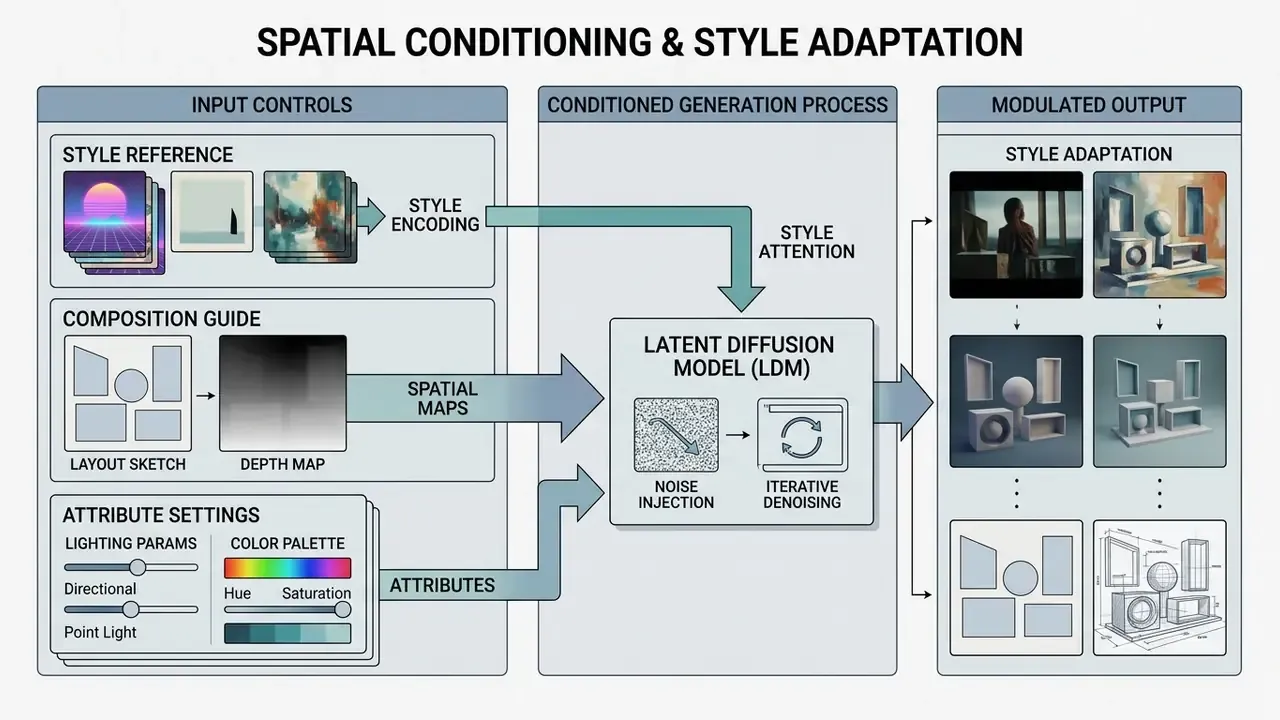
Style reference images can be ingested directly into latent space through adapter modules, including reference-only, reference AdaIN, and reference AdaIN plus attention modes. Reference image upload lets creative teams lock lighting parameters, color palettes, and brand aesthetics while varying the underlying subject. With multiple references, current prompting guidance recommends labeling them by index ("Image 1", "Image 2") and describing each one's role explicitly, while stating what must stay fixed to reduce identity drift. Teams evaluating consumer-facing generative platforms often review capabilities on platforms such as meta ai image generators to test prompt-based style adaptation limits.
Editing and Variations of Existing Images
Refining generated imagery typically involves four core local editing operations:
For high-volume production design, teams frequently use specialized platforms such as midjourney ai image workflows to explore concept variations before passing assets into localized editing suites.
Why AI-Generated Images Can Look Wrong
Architecture has improved fast. Artifacts have not disappeared. AI image generators still produce visual defects, structural errors, and nonsensical details. Understanding the root causes helps teams build quality control and troubleshooting processes that actually work.
AI Image Hallucinations and Inconsistent Details
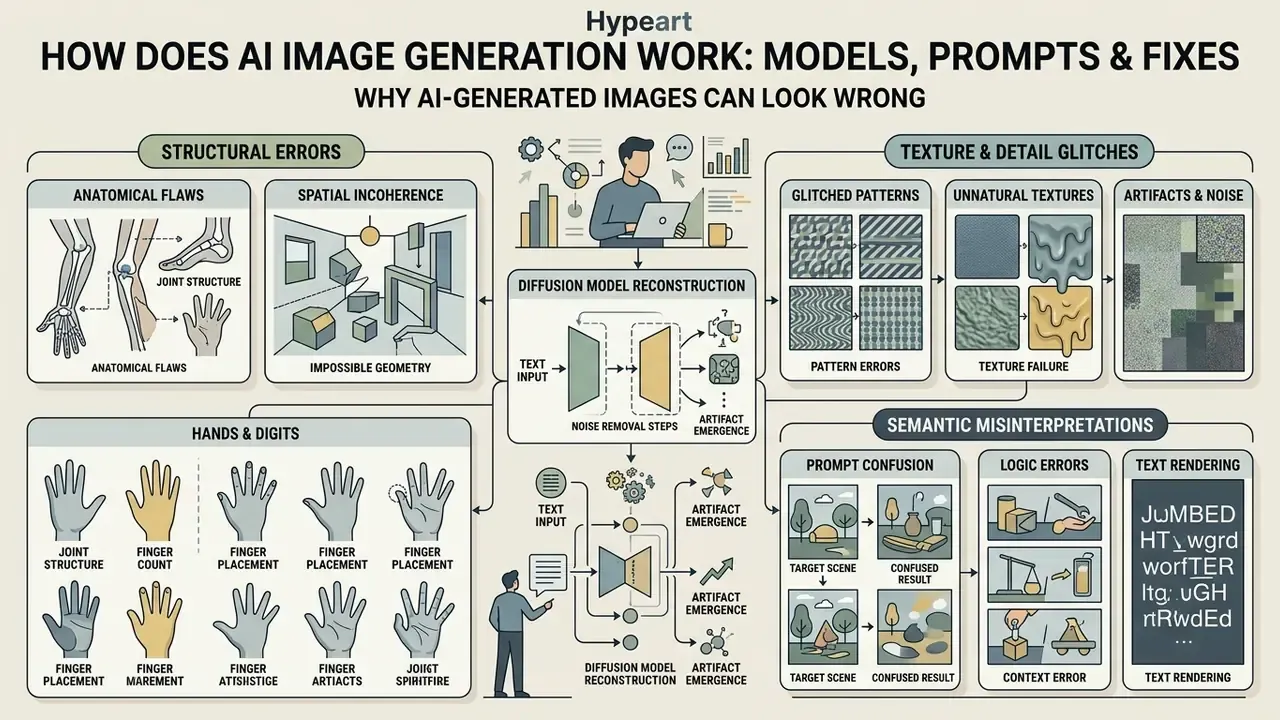
Visual hallucinations occur when a generative model produces plausible-looking but anatomically or physically impossible structures. Research indicates that they stem from "mode interpolation," where the diffusion model smoothly interpolates between disparate data distributions during the reverse denoising trajectory.
Contemporary multimodal research sorts these failures into three output-level categories: object hallucination (wrong objects), attribute hallucination (wrong properties), and relation hallucination (wrong spatial relationships). Root cause is attributed to structural information loss during visual compression, combined with language-prior dominance over visual evidence.
Common manifestation areas include:
- Anatomical Errors Distorted hands, extra or missing limbs, improper joint articulation, all caused by complex 3D geometry represented in 2D training data.
- Typographic Artifacts Garbled or pseudo-text, caused by traditional text encoders treating text as a high-level visual concept rather than a discrete character sequence.
- Physical Inconsistencies Impossible shadows, floating objects, and conflicting light sources that violate real-world physics.
- Representational Bias Public evaluation work has documented image generators returning stereotyped or demographically skewed outputs for generic occupational prompts. In customer-facing creative, that is a reputational and fair-treatment risk, not merely an aesthetic one.
How to Improve a Weak Image Generation Result
When a generator produces poor output, prompt engineering alone is rarely enough. Apply a structured troubleshooting method, escalating from prompt-level fixes to parameter tuning, and only then, when defect patterns persist, to fine-tuning with a custom fine tune or LoRA.
Post-failure escalation sequence (when a run errors or repeats a defect):
- Capture the exact failing request context: prompt, negative prompt, seed, model version, sampler settings.
- Classify the failure as invalid input, context-length overflow, timeout, or resource exhaustion before touching creative parameters.
- Clear transient state and retry once with backoff rather than looping immediate retries.
- Verify service health and GPU memory headroom.
- If the identical failure recurs, stop retrying, log the correlation ID and failed input, and escalate to platform support.
Tuning the Classifier-Free Guidance (CFG) scale matters more than most teams expect. Set it too low and the image drifts away from the prompt. Set it too high and you get severe over-saturation plus structural artifacts.
«CONFORM, which applies contrastive optimization at inference time, was preferred by 72 to 94% of participants in a user study compared with baseline Stable Diffusion versions.»
Human-in-the-loop (HITL) review gates. Automated filters catch policy violations, not reputational nuance. A production-grade control stack assigns a named human reviewer to every externally published asset, defines a hard-stop artifact list (identifiable faces, legible third-party brand marks, medical or financial claims rendered as text, demographic stereotyping), and specifies an escalation path from creative reviewer to brand compliance to legal and communications for any flagged output. Optional downstream filters still help; teams also use AI image detectors and reverse-image checks as an independent verification layer before publication.
How to Choose or Switch an AI Image Generator
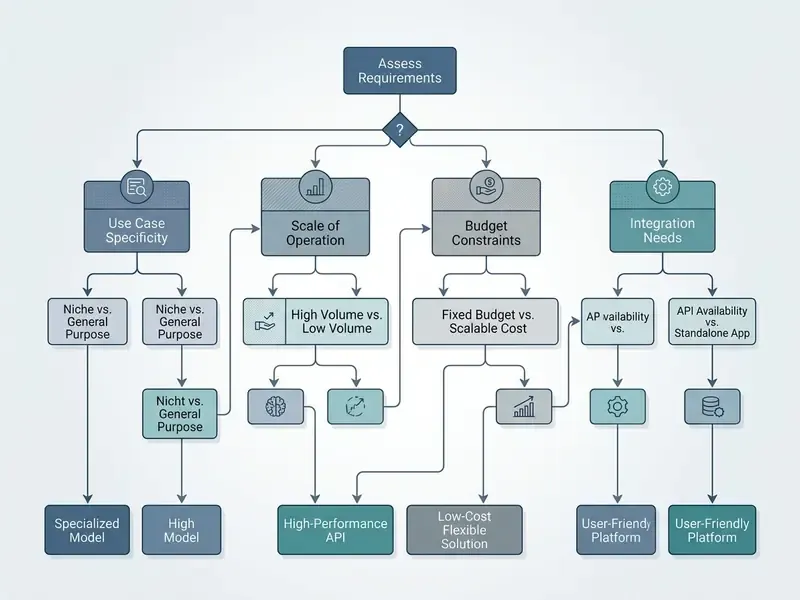
Selecting or migrating between enterprise AI image generators requires evaluating model capabilities, deployment flexibility, operational costs, and compliance posture. Public-sector evaluation pilots structure assessment around four dimensions: prompt and image alignment, image quality, safety, and task-specific checks. Enterprise platform guidance adds modality, model size, training-data provenance, pricing, context window, inference latency, and infrastructure compatibility.
When a Different Model May Produce Better Images
No single AI model excels at every visual generation task.
«DALL·E and Imagen were perceived as more realistic than Stable Diffusion and GROK AI, while FID most closely tracked human quality judgments.»
Different architectures and commercial platforms bring specialized strengths:
| Model Family | Underlying Architecture | Distinctive Strengths | Known Limitations | Best Enterprise Use Case |
|---|---|---|---|---|
| FLUX.1 (Dev / Ultra) | Rectified-flow transformer (12B, double- and single-stream blocks) | Strong typography rendering, precise prompt adherence, high anatomical accuracy, LoRA-compatible layers | High GPU infrastructure cost; slower step execution; limited official technical documentation | Enterprise product design, commercial signage, high-detail marketing collateral |
| Midjourney v6 | Hybrid latent diffusion | Exceptional photorealism, artistic composition out of the box, natural skin textures | Proprietary closed ecosystem; limited native API for automated enterprise pipelines | Ideation, concept art generation, storyboarding |
| Stable Diffusion 3.5 | Multimodal diffusion transformer (MMDiT) | Full open-weights deployment, native ControlNet and LoRA support, no third-party data egress | Requires internal ML engineering capacity for optimization and fine-tuning | Self-hosted, air-gapped secure workflows (finance, healthcare) |
| DALL·E 3 | LLM-guided diffusion | Seamless natural language handling via GPT-integrated prompt rewriting | Strict automated safety guardrails; limited control over specific seed parameters | Rapid internal prototyping, non-technical team ad-hoc visual creation |
Commercial platforms increasingly expose several engines behind one interface: fast-draft, balanced, and maximum-fidelity variants. That lets creative teams route drafts to cheap fast models and escalate only approved concepts to expensive high-fidelity engines. In high-volume operations, that routing rule is a material cost-control lever.
Enterprise Data Lineage and Copyright Compliance
Generative models carry two distinct IP risk vectors: training data sourcing and output copyrightability.
- Training Data Sourcing and Opt-Out Risk: Models trained on uncurated web scrapes, including large public datasets that index copyrighted artwork without owning the rights, expose commercial users to downstream infringement litigation. Enterprise deployment requires verifying whether a vendor uses licensed datasets, opt-out compliant datasets, or offers contractual copyright indemnification. Note that several major consumer platforms explicitly decline to assert copyright over outputs and decline to grant or license usage rights, which leaves residual risk with the customer.
- Output Ownership and Public Domain Status: Under current US Copyright Office guidance, and evolving EU frameworks, pure AI outputs generated without substantial human authorship cannot be registered for copyright protection. Direct text-to-image prompts without custom manual edits or structural ControlNet masking fall into that bucket. Organizations should document human creative intervention, such as iterative ControlNet conditioning, custom LoRA blending, or manual inpainting, to establish defendable ownership.
- Style Appropriation Exposure: Prompts that name living artists, active studios, or protected brand aesthetics create a claim surface separate from training-data provenance. A practical control is a maintained prompt blocklist of named artists and trademarked visual properties, enforced at the gateway layer rather than left to individual prompt authors.
Prompt Hygiene and Confidential Data Protection
Prompts and reference images are inputs to a third-party system. Govern them like any other outbound data flow. Practical controls include:
- Prompt scrubbing Automated detection and redaction of personally identifiable information (PII), customer identifiers, material non-public information (MNPI), and internal project codenames before a request crosses the network boundary.
- Reference-image sanitization Stripping EXIF metadata and screening uploads for customer documents, account screenshots, or unreleased product designs.
- Retention terms Confirming in writing the vendor's retention window for prompts, uploads, and generated assets, and whether flagged content is stored separately.
- Shadow AI prevention Providing a sanctioned internal gateway. Blocking tools without offering an approved alternative reliably pushes staff toward unmonitored personal accounts.
What to Check Before Paying for or Switching Tools
Before committing capital or wiring vendor APIs into operational software, procurement and risk teams should test five criteria:
- Commercial Usage Rights: Verify whether paid tiers grant full legal ownership and commercial indemnification. Free tiers often restrict commercial use entirely, and some vendors grant ownership on paid plans only. Compare against a survey of free AI image generators before assuming parity, and review the commercial use rights for AI image generators that apply to your specific plan.
- API Accessibility and Infrastructure Costs: Assess per-generation credit pricing, batch rendering discounts, and API rate limits. Subscription access and API access are frequently sold and metered separately. Teams should use standardized cost model calculators to estimate operational scale costs.
- Data Privacy and Security Guarantees: Confirm that vendor terms explicitly exclude customer prompts and uploaded reference images from future model retraining datasets.
- Fine-Tuning Flexibility: Check whether the system supports custom LoRA (Low-Rank Adaptation) training or ControlNet integration for brand-specific asset alignment.
- Vendor Independence: Review comprehensive AI Media Pricing Guides and evaluate market AI Media Alternatives by Reason to avoid proprietary lock-in.
Total cost and ROI including controls. Generation credits are rarely the dominant line item. A defensible ROI model computes:
Most ROI decks we see skip the middle four terms. That is how a "70% cheaper" pilot becomes a break-even program by month nine.
Cloud versus self-hosted trade-off. Managed cloud APIs minimize infrastructure effort and ship the newest models first, but they concentrate data-egress and vendor-dependency risk. Self-hosted open-weight deployment eliminates prompt egress and enables full seed and version pinning for air-gapped audit environments, at the cost of GPU capital expenditure and dedicated ML engineering headcount. Regulated institutions frequently run a hybrid split: cloud for low-sensitivity ideation, on-premise for anything touching customer data or regulated disclosures.
Reselection triggers. Documented governance practice is to define, in advance, the conditions that force re-evaluation. A material change in vendor terms or indemnification. A measured degradation in prompt-adherence or safety scores. A new use case outside the validated scope. Or a competing model clearing the scoring threshold on your own benchmark set. Scoring mechanisms and a cross-functional review committee belong in place before organization-wide rollout, not after the first incident.
FAQ About How AI Image Generation Works
Does AI Create Images From Scratch?
Yes. AI models generate images from scratch by sampling random noise in a learned mathematical space and iteratively organizing that noise into coherent structure. Formally, latent diffusion begins with a noise vector drawn from a standard normal distribution and denoises it into a final latent, which a decoder converts into pixels. Models do not stitch, collage, or copy pre-existing files from a database. Fragment-based composition methods do exist in research literature, where patches are separately denoised and merged, but that is a distinct technique and not how mainstream text-to-image generation operates.
Is AI Image Generation Different From Other Generative AI?
Yes. Large language models process sequential 1D text token sequences using transformer architectures. Image generators work over multi-dimensional visual spaces requiring spatial geometry, color theory, and lighting coherence, most often through diffusion. Audio and video generation reuse overlapping machinery, diffusion for video frames and transformers for temporal conditioning, differing mainly in modality and target data structure. All of them rely on similar attention mechanisms to interpret context.
Can AI Generate High-Quality Images?
Modern generative image models can generate high quality, high-resolution visuals. Research systems demonstrate direct 4K-class synthesis, and commercial models typically expose native outputs between roughly 1536×1536 and 4K. Reaching that level takes precise text prompts, optimized sampling settings, appropriate seed selection, and, where necessary, secondary upscaling or post-generation localized editing.
«Among FID, SSIM and PSNR, FID aligns most closely with human realism judgments, making it the primary generation-quality indicator.» — Perception and evaluation of text-to-image generative AI models, IACIS (2024). https://aisel.aisnet.org/cais/vol54/iss1/22/ Published quality standards are maturing too. ISO/IEC TS 25058:2024 defines an AI system quality model for evaluation, and ISO/IEC AWI 25590 is under development to guide measurement of generative AI output quality.
Who Owns the Copyright of an AI-Generated Image?
There is no globally settled answer yet. Several major platforms decline to claim copyright over user outputs while simultaneously stating that they cannot license or grant usage rights in them. In the United States, purely machine-generated output without substantial human authorship is not registrable. The practical enterprise position is to document human creative contribution at every stage and to rely on contractual indemnification rather than assumed ownership.
Why Do Identical Prompts Produce Different Images?
Because generation starts from a randomly initialized noise tensor. A different seed means a different starting point in latent space, and therefore a different denoising trajectory. Research also shows that initial noise exerts far more influence over final content than noise introduced later in the sampling loop. That is why seed locking, not prompt rewording, is the primary reproducibility control.
How Are AI Images Made When a Reference Image Is Supplied?
The reference is encoded into the same latent space as the prompt and injected through adapter modules or structural conditioning. The model then denoises toward a region constrained by both signals. Practically, this is how brand-consistent AI art and product staging get produced at scale: lock the reference, vary the subject, keep the seed logged.
Appendix A: Superseded References and Editorial Notes
This appendix preserves earlier reference formulations and unverified figures that were revised in the main text, so reviewers can trace editorial decisions.
- Superseded citation form
- "(Rombach et al., 2021)" and "(Carlini et al., 2023)" appeared without titles, publication venue, or URLs. Replaced in the main text with fully attributed, linked versions (Zhang et al., 2024, https://arxiv.org/abs/2303.07909; Carlini et al., 2023, https://arxiv.org/abs/2301.13188; Rombach et al., 2021, https://arxiv.org/abs/2112.10752).
- Superseded citation form
- "(Ho et al., 2020)" and "(Podell et al., 2023)" appeared without URLs. Replaced with linked NeurIPS and arXiv references plus an architectural description sourced to the Concept Erasure Survey (2025).
- Superseded citation form
- "(Meena et al., 2023)" for GAN instability appeared without a verifiable source. Replaced with Wang et al., The Visual Computer (2023), which supplies reproducible FID and Inception Score metrics.
- Superseded citation form
- "(Zhang & Agrawala, 2023)" and "(Aithal et al., 2024)" appeared without URLs. Both now carry direct arXiv links.
- Unverified figures flagged and reframed
- the original claim "over 80% of major organizations have integrated generative visual tools into at least one business function (fal.ai, 2026)" is vendor-reported without a published sample frame or methodology. It now appears as a directional adoption signal alongside peer-reviewed operational evidence. The same treatment applies to the original cost-reduction claim attributed to IAB Playbook, 2026 and the pre-visualization claim attributed to AWS Game Tech, 2025.
- Scenario labeling
- the situation-action-result case describing reproducible audit trails and a 42% reduction in brand guideline deviation flags is an illustrative governance scenario, explicitly labeled as such rather than presented as an audited client result.
- Removed artifact
- a placeholder line reading "No verified information available." was a drafting artifact and has been removed. No verified first-party author commentary was available for that slot at publication time.
- Author attribution
- Marcus Hale, author. No employment, client relationship, regulatory authority, or endorsement is implied.
Editorial Standards and Review Cadence
Claims in this guide fall into three tiers, and we try to keep them visibly separated. Peer-reviewed and standards-body sources are cited with venue and URL. Vendor-published figures are labeled directional. Scenarios and persona commentary are labeled illustrative.
Audience assumptions about buyer roles and pain points remain hypotheses until supported by analytics, interviews, CRM data, or verified customer research. Model cards change quickly, so resolution ceilings, pricing tiers, and indemnification language should be re-checked against primary vendor documentation before any procurement decision. Next review target: mid-2026.