An artificial intelligence model is a mathematically defined program that processes input data to recognize patterns, calculate predictions, or generate original content. Creating an enterprise-grade AI model requires a structured lifecycle that spans risk governance, dataset engineering, algorithm selection, experimental training, rigorous evaluation, and post-deployment monitoring.
In modern software architecture, model engineering is no longer a localized trial-and-error task. Under frameworks like the NIST AI Risk Management Framework (AI RMF 1.0), NIST SP 800-218A, and, for banks, insurers, and regulated lenders in the United States, Federal Reserve SR 11-7 / OCC Bulletin 2011-12 (Supervisory Guidance on Model Risk Management), building an AI model demands a repeatable, documented workflow. Data lineage, independent validation, and escalation controls get defined before the first line of training code is written.
That sequencing is the whole game.
Executive Summary for Risk and Governance Leaders
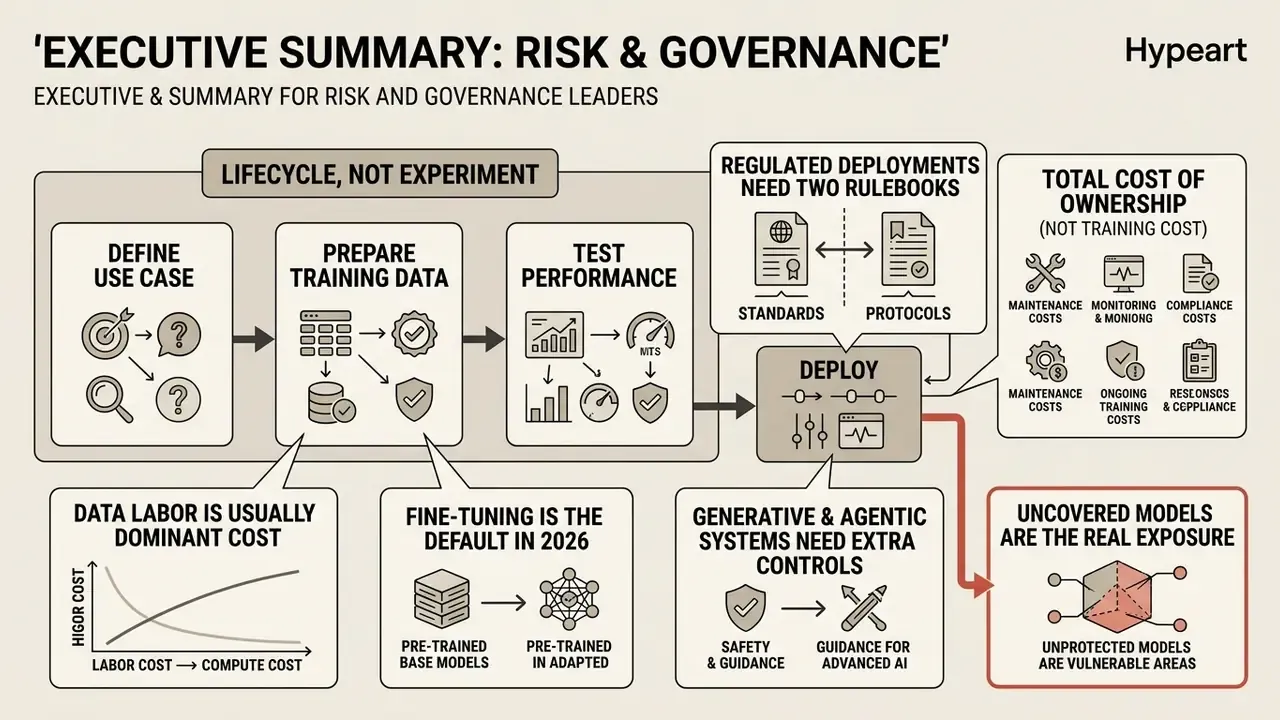
- Lifecycle, not experiment. Production AI follows a governed sequence: problem framing, data sourcing and labeling, architecture selection, training and tracking, TEVV (test, evaluation, verification, validation), deployment, drift monitoring, then retraining or decommissioning. NIST AI RMF 1.0 organizes this around four functions: Govern, Map, Measure, Manage.
- Fine-tuning is the default in 2026. Pre-training a foundation model consumes thousands of GPU-days. Parameter-efficient fine-tuning (LoRA/QLoRA) reaches comparable domain accuracy with hundreds to thousands of curated examples and single-GPU compute budgets.
- Data labor, not compute, is usually the dominant cost. Analyses of large language model development show labor costs for training data can exceed raw training compute by one to three orders of magnitude.
- Regulated deployments need two rulebooks. Technical standards (NIST AI RMF 1.0, NIST AI 600-1, NIST AI 800-4, ISO/IEC TR 29119-11) plus sector supervision (SR 11-7 / OCC 2011-12 in US banking, Article 10 and Article 50 of the EU AI Act in the EU).
- Generative and agentic systems need extra controls. Tool-calling validation, prompt-injection defenses, RAG groundedness scoring, hallucination bounds, and documented human-in-the-loop escalation paths come before autonomy is granted.
- Total cost of ownership is not training cost. Budget independent validation, continuous monitoring, audit-trail infrastructure, legal review, and retraining cycles as separate, recurring line items.
- Uncovered models are the real exposure. A model that never entered the inventory cannot be monitored, challenged, or switched off. Shadow AI is a documentation failure long before it becomes a loss event.
What Is an AI Model and What Can You Build?
An AI model is a parameterized algorithm trained on historical data to approximate complex, non-linear relationships between inputs and target outputs. Organizations build AI models to automate classification, forecast numerical values, or synthesize synthetic media and text across enterprise workflows.
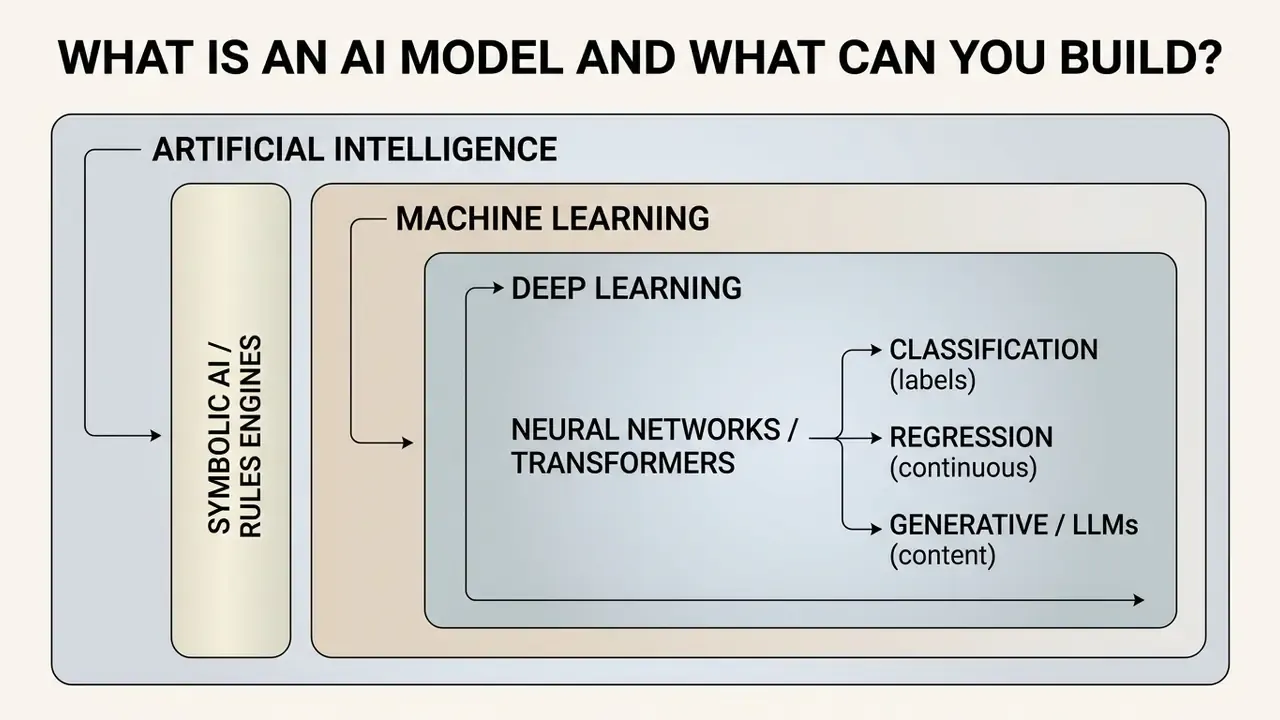
In standard machine learning, algorithms extract statistical dependencies from structured feature vectors to predict discrete classes or continuous metrics. Deep learning expands this capability by using multi-layered neural networks that learn representations directly from high-dimensional, unstructured sources such as text, audio, and images.
Foundational pattern recognition theory frames it precisely:
«Pattern recognition is concerned with the automatic discovery of regularities in data, and with the use of these regularities to take actions such as classifying the data into different categories.»
Put plainly: these architectures recognize patterns by mapping complex input spaces into decision boundaries, without an analyst writing an explicit rule for every edge case.
Symbolic AI (Rules Engines) vs. Statistical Machine Learning
Before statistical algorithms took over, enterprises relied on symbolic AI, also called rules engines or expert systems. These non-learning models execute hardcoded if-then-else logic defined by domain experts. A credit policy that declines any application with a debt-to-income ratio above a fixed threshold is symbolic AI, not machine learning.
Symbolic systems are deterministic, cheap to run, and fully auditable. Those properties still make them attractive for regulatory decision layers and hard safety limits. Their weakness is scale: manual rule sets cannot capture high-dimensional, non-linear interactions, and they degrade into unmaintainable rule spaghetti as exceptions accumulate. Anyone who has inherited a 900-rule AML alerting engine knows the feeling.
Statistical machine learning replaces manually authored logic with inference. The model derives mathematical decision boundaries directly from empirical datasets and can keep optimizing performance as new data arrives. A practical consequence for governance teams: all ML models are AI models, but not all AI models learn. Rule-based engines require change-management controls and version history. Learning models additionally require dataset lineage, drift monitoring, and retraining governance.
Modern ML techniques divide into three learning regimes:
- Supervised learning. Labeled examples teach the model the mapping from features to targets (fraud flags, credit outcomes, document classes).
- Unsupervised learning. The algorithm detects inherent structure without labels (customer segmentation, anomaly clustering, recommendation signals).
- Reinforcement learning. The model learns by trial and error through rewards and penalties (dynamic pricing, algorithmic execution, autonomous control).
Generative, Classification, and Regression Models
Machine learning tasks split into three core paradigms, defined by their target output structure and probabilistic assumptions:
- Classification models (discriminative paradigm). Discriminative models learn the decision boundary between classes by modeling the conditional probability distribution of a discrete label given input features . Unlike generative models, which model the full joint distribution , discriminative algorithms optimize the class boundary only. That makes them computationally efficient for tabular fraud detection, credit decisioning, and document triage. A 2024 comparative evaluation of 16 algorithms for cyber-threat classification by Chen et al. showed that ensemble architectures like Extra Trees surpassed standard Random Forest baselines by 2.67 percentage points in recall and 1.16 points in F1-score, confirming the advantage of non-linear tree ensembles on structured risk data.
«Using 5-fold and 10-fold cross-validation, ensemble models consistently outperformed non-ensemble models on recall and F1-score.» - Chen et al., Comparative Analysis of 16 ML Algorithms for CSRF Detection (2024).
- Regression models. Regression algorithms map input vector to a continuous numerical target , typically by estimating . Financial institutions rely on regression models for interest rate forecasting, default loss estimation (PD/LGD/EAD components), and algorithmic price discovery. Performance depends on minimizing deviation metrics such as Mean Squared Error (MSE) or Root Mean Squared Error (RMSE).
- Generative models. Generative AI estimates the underlying joint probability distribution or the marginal to synthesize novel data samples, including synthetic text, code, tabular records, and images. Because generative models represent the full data distribution, they can also be repurposed for classification via Bayes' theorem, computing which class most probably generated the observation. Modern generative systems use diffusion architectures, variational autoencoders (VAEs), or transformer-based large language models. Teams exploring applied generative pipelines can review practical text-to-video AI tools to see how these architectures surface in shipped products. Research on multimodal generation by Huang et al. (MMGenBench, 2024) indicates that evaluating generative model performance requires specialized probabilistic alignment tools, such as VQAScore, which correlate more closely with human quality benchmarks than legacy word-bag metrics like CLIPScore.
«On GenAI-Bench with 38,400 human ratings, VQAScore showed substantially higher correlation with human judgments than CLIPScore and competing metrics.» - Lin et al., GenAI-Bench / VQAScore (2024).
| Paradigm | Probabilistic target | Typical input to output | Representative architectures |
|---|---|---|---|
| Classification (discriminative) | Feature vector to discrete label | Logistic regression, XGBoost, Extra Trees, RoBERTa, CNNs | |
| Regression | Feature vector to real value | Ridge/Lasso, LightGBM, Gaussian processes, MLPs | |
| Generative | or | Noise, prompt, or context to new sample | Diffusion models, VAEs, GANs, transformer LLMs |
One governance note that saves months later: the paradigm you choose determines the validation package you owe. A scorecard-style logistic regression invites sensitivity analysis on coefficients. A generative assistant invites hallucination measurement and prompt-injection testing. Different evidence, different reviewers.
Training From Scratch vs. Fine-Tuning a Base Model
Engineers face a fundamental choice: pre-train a custom base model from scratch, or fine-tune an existing foundation model. Pre-training requires processing massive datasets, often hundreds of gigabytes to petabytes of raw data, and consumes thousands of GPU compute days across hundreds or thousands of accelerators.
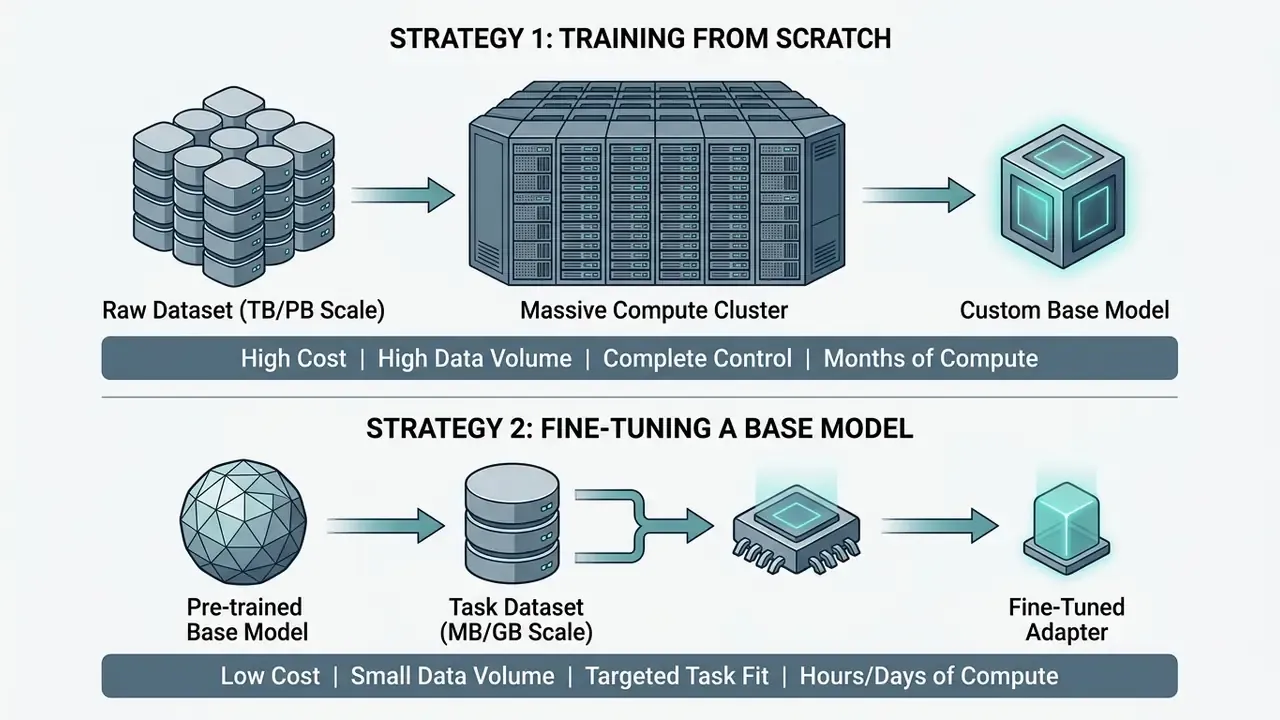
Fine-tuning adapts a trained model by adjusting its weights on a smaller, domain-specific dataset where quality matters far more than raw volume. Evidence from materials science modeling by Kornbluth et al. (2026) showed that fine-tuned foundation models achieved accurate structural predictions using only 10% of the target training data, while models trained from scratch failed to converge on the same volume.
Similarly, UK Government foundation model research confirms that fine-tuning compute requirements are orders of magnitude lower than pre-training, which makes fine-tuning the default choice for domain-specific deployment.
Training from scratch remains justified in narrow circumstances: proprietary sensor modalities with no pre-trained equivalent, formats incompatible with existing tokenizers or encoders, or a regulatory mandate for complete weight provenance. Otherwise, the decision matrix favors adaptation.
Define the Use Case, Goal, and Success Criteria
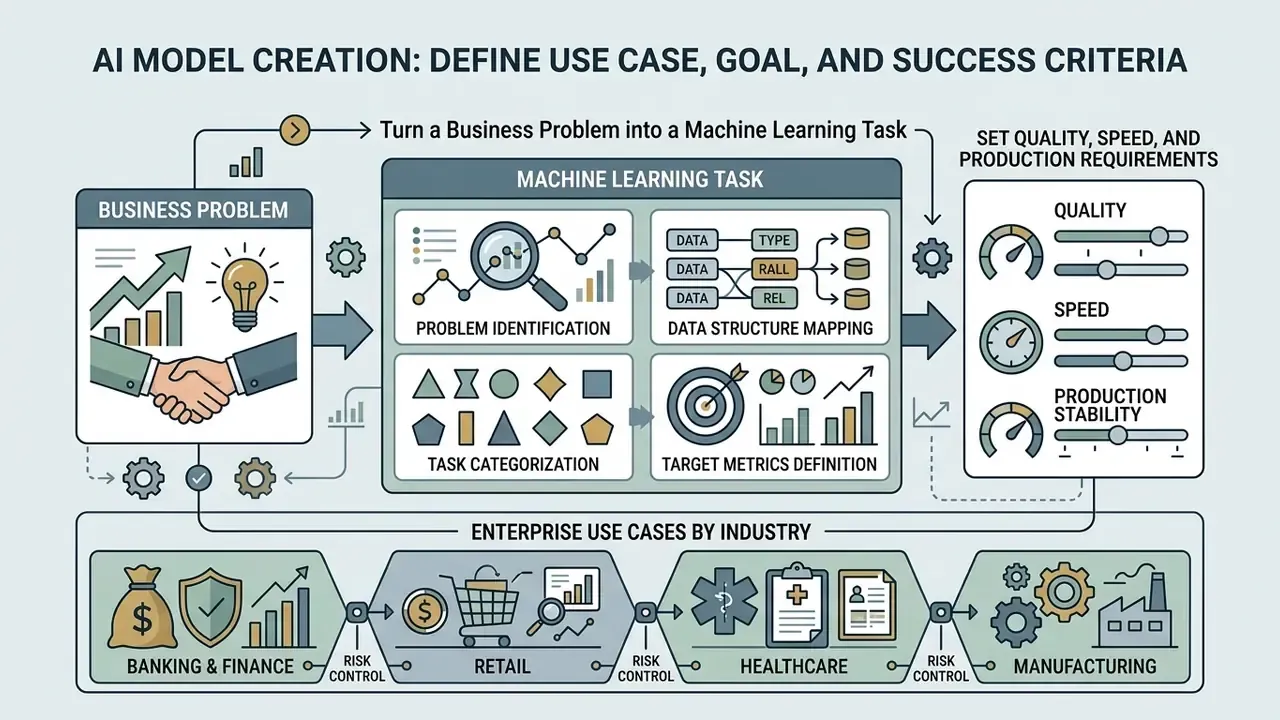
Every model development initiative must begin by converting a commercial objective into a well-defined machine learning task. Failing to establish clear scope, input-output bounds, and target metrics creates alignment risk and delays production deployment. NIST AI RMF Playbook guidance is explicit: the organization's mission and relevant AI goals must be understood and documented before implementation begins.
Set Quality, Speed, and Production Requirements
In regulated institutions, operational and regulatory constraints define the solution space before the ML formulation is chosen. A 4-second inference path cannot serve a real-time payment authorization decision regardless of its AUC. So teams define latency, throughput, memory bounds, and explainability obligations alongside baseline accuracy targets.
Under the MLPerf Inference benchmark standard, system performance is specified as a joint envelope: the maximum throughput (queries per second) achievable while holding a strict latency threshold (for example, 95th-percentile latency under 100 milliseconds) at a predefined accuracy target. Public-sector AI testing guidance measures average and p95 latency, requests per second, and horizontal scalability as separate production metrics. Research on inference frameworks like LoCoML (2025) shows that orchestration overhead adds minimal latency, under 2% of total runtime, meaning raw model inference speed and hardware selection dominate production responsiveness.
«Across 16 chained models, orchestration overhead totalled 845 ms, just 1.8% of end-to-end runtime.»
Requirements worth freezing in the project charter before modeling:
- Latency envelope: average and p95/p99 response time at expected peak QPS.
- Accuracy floor: minimum F1 score, AUC, or RMSE below which the model must not be promoted.
- Explainability obligation: whether adverse-action reasons or feature attributions must be produced per decision.
- Fallback behavior: deterministic rule or human queue when the model is unavailable or low-confidence.
- Data freshness: maximum acceptable lag between event occurrence and feature availability.
Turn a Business Problem Into a Machine Learning Task
Translating a commercial objective into a mathematical problem means mapping operational events to supervised, unsupervised, or generative formulations. The decision path below shows how data modality and goal category determine the architecture family.
graph TD
    A[Business Problem] --> B{Data Modality?}
    B -->|Tabular Data| C{Goal Category?}
    B -->|Unstructured Text| D[Transformer Architectures: Llama / Mistral / RoBERTa]
    B -->|Images / Spatial| E[CNNs / Vision Transformers]
    C -->|Predict Category| F[Classifiers: XGBoost / Extra Trees / Logistic Regression]
    C -->|Predict Continuous Metric| G[Regression: LightGBM / Ridge / GLM]
    C -->|Synthesize Samples| H[Generative Models: Diffusion / VAEs / LLMs]
    D --> I{Latency and Explainability Constraints}
    E --> I
    F --> I
    G --> I
    H --> I
    I -->|Real-time + auditable| J[Distilled model + rule guardrails]
    I -->|Batch + documented TEVV| K[Full-capacity model]
How to create an AI model, decision path: start with the business problem; map input data type to the target output; select a classification, regression, or generative framework; then apply real-time latency, accuracy, and explainability constraints.
- Problem identification. Document the operational bottleneck (for example, manual loan document review consuming 4,200 analyst hours per quarter).
- Data structure mapping. Determine whether available inputs are tabular records, text sequences, image files, or multimodal combinations.
- Task categorization. Assign the problem to binary classification, multi-class categorisation, continuous value regression, clustering, or text and image generation.
- Target metrics definition. Establish quantitative targets for latency (say, sub-200ms response), accuracy, F1 score, or alignment thresholds, plus the business KPI each metric is expected to move.
Concrete translations:
- Customer churn prevention. Binary classification. Input features (transaction history, platform activity, support contacts) map to a probability score for cancellation within 90 days. Published churn studies typically pair this classifier with SHAP-based segmentation so retention teams receive actionable cohorts, not just scores.
- Payment fraud detection. A hybrid of supervised classification and unsupervised anomaly detection. Transaction metadata passes through tree ensembles or graph neural networks, where node labels are inferred from both attributes and neighbour labels, to flag suspicious patterns in real time.
- KYC and AML alert triage. Multi-class prioritisation over sanctions screening and transaction-monitoring alerts, tuned for recall on true positives and paired with mandatory human adjudication of every escalation. Suppression logic here is a model decision with legal consequences, so keep the suppression rate itself under monitoring.
- Automated customer operations. An intent classification model combined with a domain-tuned text generator. User queries route via intent classifiers before triggering a standard response, an API call, a database lookup, or generated text.
- Document review and routing. Multi-label classification plus named-entity extraction, with confidence thresholds that route low-certainty documents to human adjudication.
Enterprise Use Cases by Industry
- Banking and financial risk. Gradient-boosted ensembles and logistic scorecards estimate $P(\text{default} | x)$ for credit decisioning, while regression models forecast expected loss and liquidity flows. These models sit squarely inside SR 11-7 scope and require independent validation, conceptual soundness review, and ongoing outcome analysis.
- Healthcare and diagnostics. Computer vision models (ResNet, 3D U-Net) map volumetric medical scans () to binary anomaly indicators () to flag early-stage lesions, with clinician-in-the-loop confirmation.
- Retail and e-commerce. Collaborative filtering and matrix factorization models estimate $P(\text{click} | \text{user}, \text{item})$ to generate personalized real-time recommendations; demand-forecasting regressors drive replenishment.
- Manufacturing and industrial. Survival and regression models predict time-to-failure from sensor telemetry, enabling predictive maintenance scheduling.
- Finance operations. Invoice matching, reconciliation break classification, and close-process anomaly detection, where the benefit is measured in analyst hours and audit findings avoided rather than revenue lift.
- Autonomous systems. Deep reinforcement learning algorithms optimize continuous control parameters in real time from multi-sensor telemetry, with hard safety envelopes enforced by deterministic controllers.
Organizations reviewing specialized generative pipelines can examine the structured AI Media Workflows library to see how task decomposition applies across multi-stage media and document processing systems.
Collect, Label, and Prepare Training Data
Data quality dictates the absolute ceiling of model performance. Preparing an enterprise dataset requires systematic collection, deduplication, annotation, cleaning, missing-value imputation, bias screening, and leak-free dataset splitting. Under EU and German supervisory guidance, data preparation is formally positioned before modeling in the lifecycle, not alongside it.
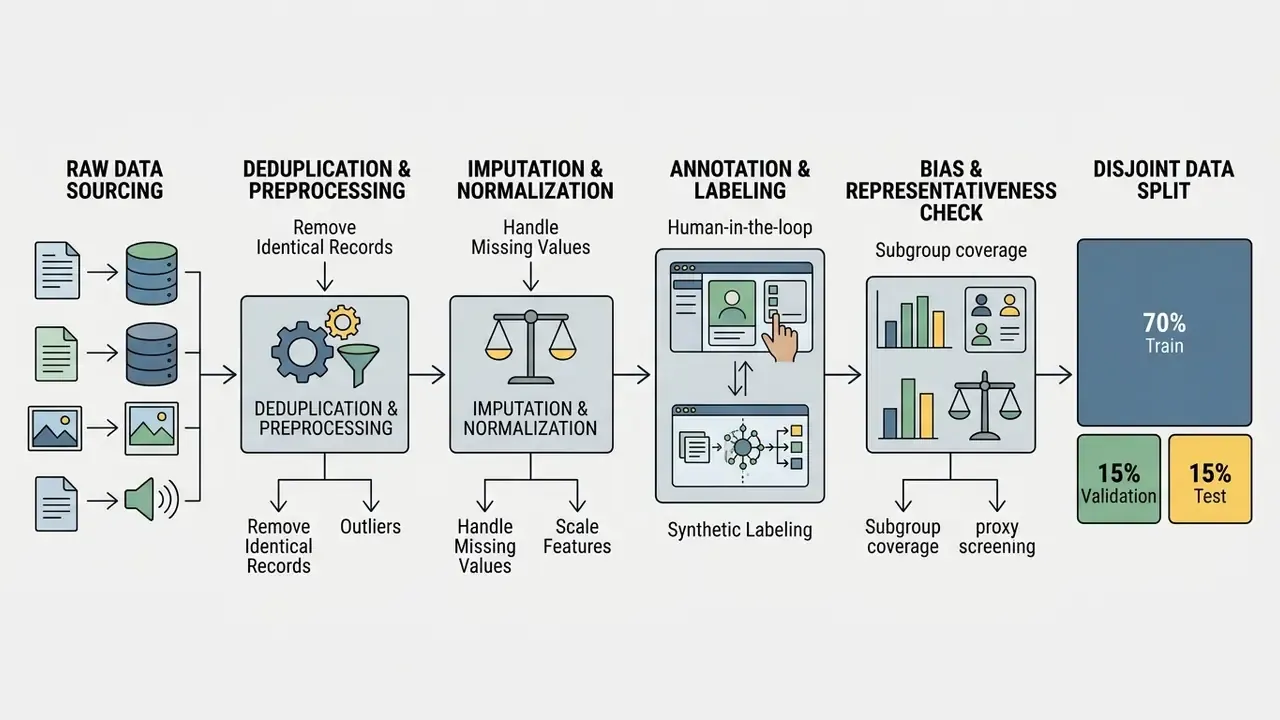
Choose Data Sources and Create a Labeling Pipeline
Building a dataset begins with identifying relevant internal and external data sources. For supervised learning, raw records must be annotated with consistent labels. Engineering teams use three primary labeling workflows:
- Human-in-the-loop (HITL) annotation. Domain experts manually annotate complex inputs. NIST's validated framework for human-supervised technical document annotation shows why HITL remains the standard for high-stakes compliance, legal, and medical text workflows.
«Human-in-the-loop Technical Document Annotation: Developing and Validating a System» - National Institute of Standards and Technology (2024). https://www.nist.gov/publications/human-loop-technical-document-annotation-developing-and-validating-system-provide
- Reinforcement learning from human feedback (RLHF). Used extensively in large language models to align generative outputs with human preferences. NIST's generative AI guidance defines RLHF as human-involved fine-tuning that reduces unwanted behavior. Peer-reviewed multimodal work quantifies the benefit.
«RLHF-V uses fine-grained human correctional feedback on 1.4k annotated samples, reducing hallucination rates by 34.8% versus the base model.» - Yu et al., RLHF-V, IEEE/CVF CVPR Proceedings (2024). https://openaccess.thecvf.com
- Synthetic data generation and LLM pre-labeling. Automated systems use base models to draft initial label candidates, which human reviewers then audit. Studies on public-sector data pipelines show pre-labeling accelerates development but needs continuous expert oversight to stop error propagation.
«On the Brasil Participativo platform, LLM pre-labeling accelerated delivery but introduced traceability and reliability risks absent continuous expert validation.» - Brasil Participativo ML Pipeline Study (2025).
Labor economics matter as much as tooling. Across 64 analyzed LLM projects, dataset construction dominated the budget:
«Estimated training-data labor costs exceed the cost of model training compute by factors of 10x to 1000x.»
One practical detail that keeps auditors calm: record inter-annotator agreement per label class. If two senior credit analysts disagree on 18% of "suspicious document" labels, the model's ceiling is already set, and no amount of architecture search will fix it.
Clean Data and Handle Missing Values
Raw datasets frequently contain incomplete entries, duplicate records, and formatting inconsistencies. Preprocessing must follow standardized protocols, such as CDC patient-level deduplication rules, Federal Committee on Statistical Methodology survey standards, and NIST SP 800-55v1 guidance on normalization, validation, and imputation:
- Deduplication. Strip identical or near-identical feature vectors to prevent artificial variance reduction during cross-validation, and remove placeholder or unknown-value tokens before matching.
- Missing-value imputation. Avoid naive row deletion when missingness ratios reach 5% to 50%. Use mean or median substitution for low-variance numerical features, or apply iterative k-Nearest Neighbors (k-NN) and Multivariate Imputation by Chained Equations (MICE) for complex distributions. Always encode a missingness indicator so downstream users can audit imputed values.
«The choice of imputation algorithm materially affects model accuracy, particularly at missingness rates between 5% and 50%.» - Peer-reviewed comparative study on missing value imputation algorithms (2025).
- Feature normalization. Rescale continuous numerical features using Z-score standardization () or Min-Max scaling so gradients weight features evenly during model training.
- Bias screening. Verify subgroup representativeness before modeling. Aggressive cleaning can silently delete minority-group records, which turns a data-quality step into a discrimination risk.
Split Data for Training, Validation, and Testing
To measure generalization honestly, datasets must be divided into strictly disjoint subsets:
- Training set (70 to 80%). Used by the learning algorithm to optimize model weights.
- Validation set (10 to 15%). Used during training for hyperparameter selection, early stopping, and architecture comparison.
- Test set (10 to 15%). Held out entirely until final evaluation, to assess real-world performance on new data.
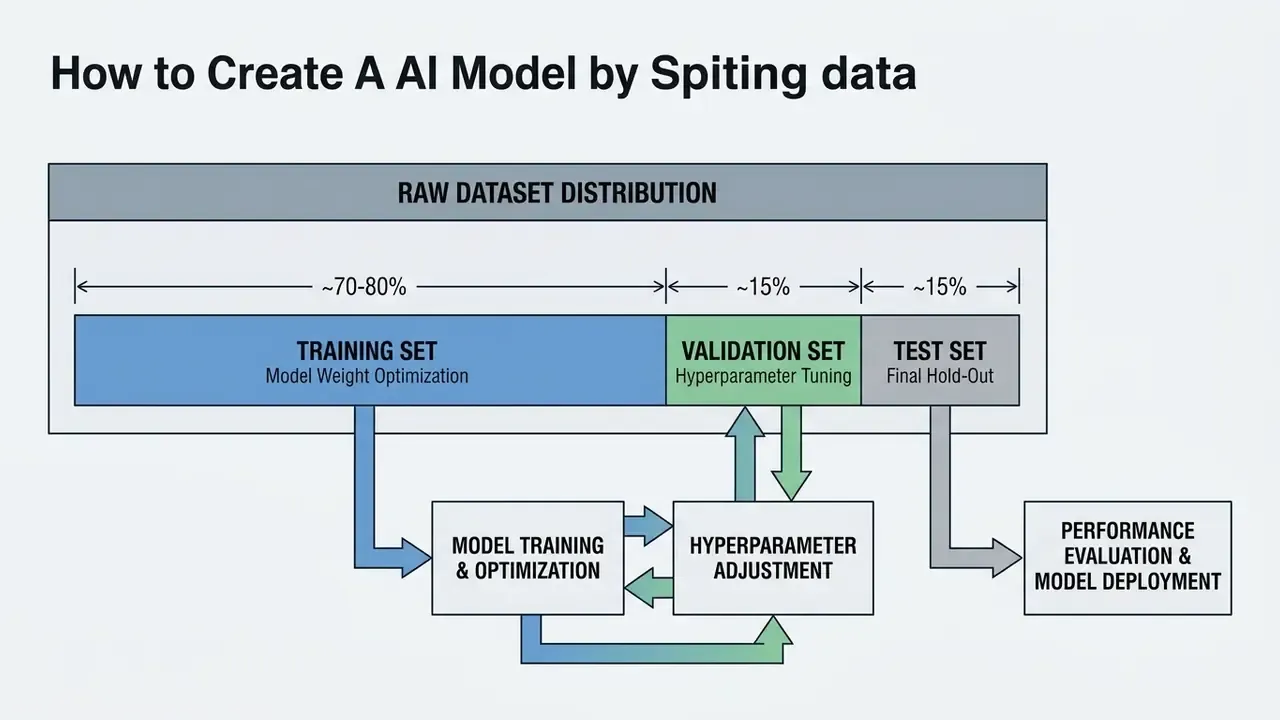
Common ratios are 70/15/15 for mid-sized datasets and 80/10/10 or 90/5/5 for very large corpora. Stratified splitting is recommended for small or imbalanced data.
Data leakage happens when information from the validation or test set slips into the training pipeline. To prevent it, fit all scalers, imputers, and feature encoders exclusively on the training set before transforming validation and test sets. For time-series or grouped customer records, use chronological splits or GroupKFold strategies so all data from a single entity, one patient, one borrower, one merchant, stays in exactly one partition.
Ownership Matrix: Who Signs Off on What
| Lifecycle stage | Business line | Data science / model dev | Model Risk Management (2nd line) | Internal audit (3rd line) |
|---|---|---|---|---|
| Problem framing and success criteria | Owner | Contributor | Reviewer | Observer |
| Data sourcing, labeling, lineage | Contributor | Owner | Reviewer (data quality, bias) | Periodic testing |
| Architecture and algorithm selection | Consulted | Owner | Challenger (conceptual soundness) | Not applicable |
| Training runs and experiment logs | Not applicable | Owner | Reproducibility review | Evidence sampling |
| TEVV, fairness and stress testing | Consulted | Contributor | Owner (independent validation) | Effectiveness review |
| Production deployment approval | Co-approver | Contributor | Co-approver | Observer |
| Drift monitoring and retraining | Consulted | Owner | Threshold approval | Control testing |
| Decommissioning | Co-approver | Executor | Co-approver | Record verification |
If a row in that matrix has no name attached, you do not have a control. You have an intention.
Choose the Model Architecture, Algorithm, and Development Tools
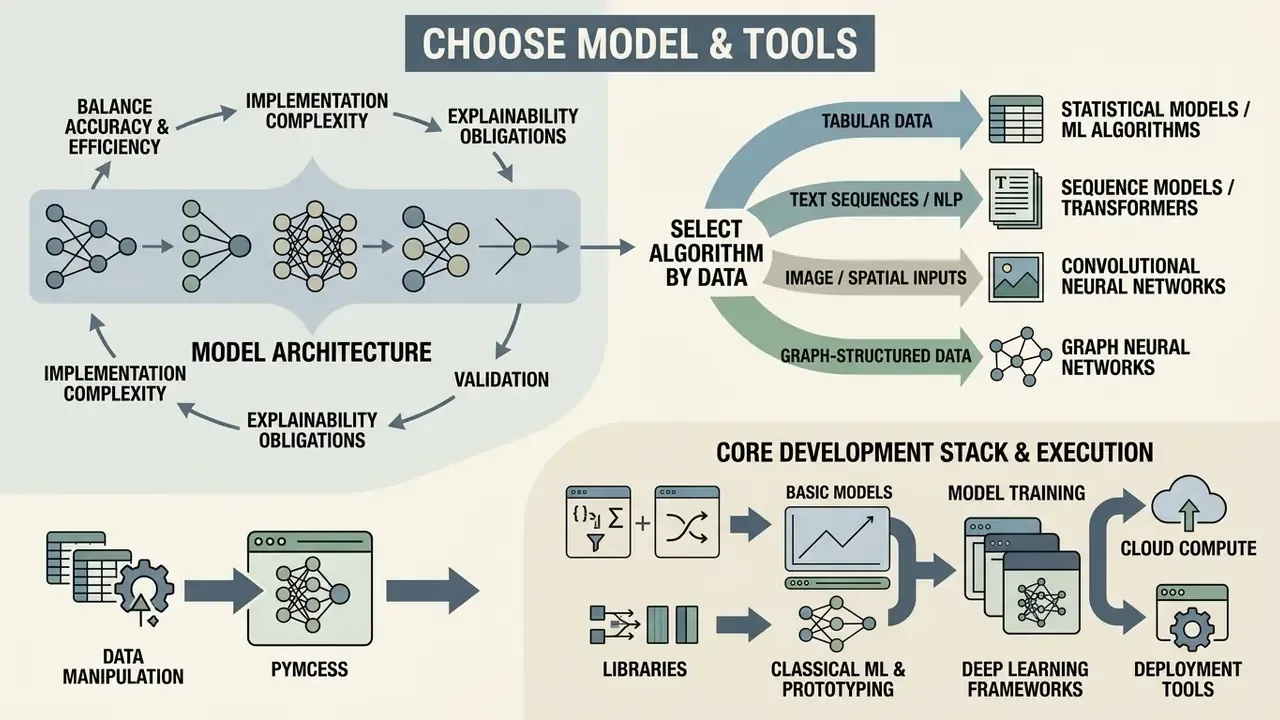
Selecting an optimal model architecture means balancing predictive accuracy against computational footprint, implementation complexity, explainability obligations, and validation burden. Cloud architecture guidance converges on the same criteria set: task fit, generalization on held-out data, compute and memory cost, security and compliance posture, regional availability, and inference-time constraints.
Select an Algorithm That Matches the Data and Use Case
Algorithm choice depends on data modality, dataset size, and interpretability constraints:
- Tabular data. Tree-based ensemble models such as XGBoost, LightGBM, and Extra Trees consistently outperform deep learning architectures on structured tabular records, with fast training times and clear feature importance scores. For credit and capital models, monotonic constraints and scorecard-style logistic regression often win on validation cost alone.
- Text sequences and natural language. Transformer architectures (RoBERTa, Llama 3, Mistral) are the standard choice for language tasks, using self-attention to capture long-range contextual relationships.
- Image and spatial inputs. Convolutional neural networks (CNNs) and Vision Transformers (ViTs) serve image classification, object detection, and visual feature extraction.
- Graph-structured data. Graph neural networks and collective classification handle relational fraud rings, beneficial-ownership networks, and payment graphs where neighbour labels carry signal.
Core AI Development Stack and Execution Blueprint
Production AI development relies on an integrated open source ecosystem:
- Data manipulation and processing
Pandas,NumPy,Polars,Apache Spark - Classical ML and baseline prototyping
Scikit-Learn,XGBoost,LightGBM,CatBoost - Deep learning and foundation modeling
PyTorch,TensorFlow/Keras,Hugging Face Transformers,PEFT - Experiment tracking and registry
MLflow,Weights & Biases - Serving and optimization
ONNX Runtime,TensorRT,vLLM,FastAPI - Interactive development
Jupyter,VS Code, containerized dev environments - Validation and explainability
SHAP,Evidently,Alibi Detect,Fairlearn
Minimal code example: training and evaluating a baseline classifier in Python
import numpy as np
from sklearn.model_selection import train_test_split
from sklearn.ensemble import RandomForestClassifier
from sklearn.metrics import f1_score, roc_auc_score
# 1. Prepare features (X) and target (y) - replace with your governed dataset
X, y = np.random.rand(1000, 20), np.random.randint(0, 2, size=1000)
# 2. Disjoint, stratified split (80/20) with a fixed seed for reproducibility
X_train, X_test, y_train, y_test = train_test_split(
    X, y, test_size=0.2, stratify=y, random_state=42
)
# 3. Model initialization and training
model = RandomForestClassifier(n_estimators=100, random_state=42)
model.fit(X_train, y_train)
# 4. Evaluation on the held-out set
predictions = model.predict(X_test)
probabilities = model.predict_proba(X_test)[:, 1]
print(f"Baseline F1-Score: {f1_score(y_test, predictions):.4f}")
print(f"Baseline ROC-AUC: {roc_auc_score(y_test, probabilities):.4f}")
Always establish this kind of baseline before investing in deep architectures. If a 15-line Random Forest reaches 95% of the target metric, the marginal value of a transformer rarely survives its validation and monitoring cost.
Decide Between Open Source Models and Model Generators
Engineering teams can choose from four development approaches:
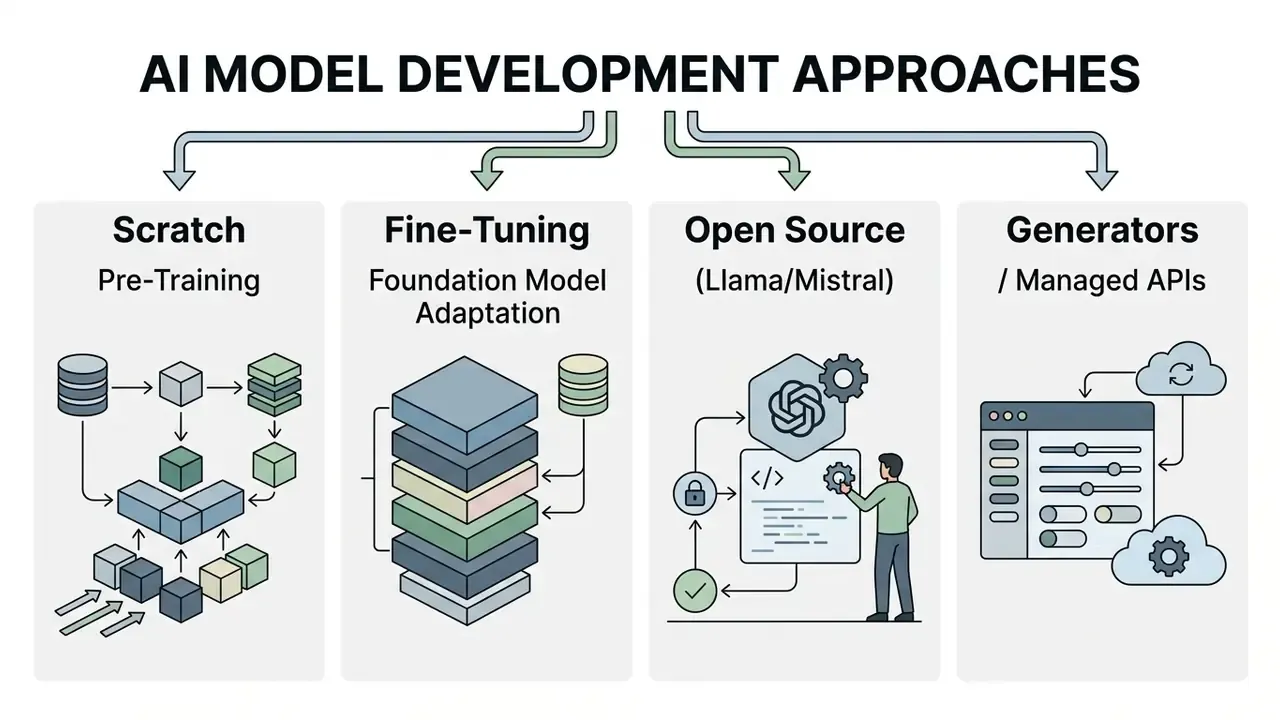
- Training from scratch.Maximum control over model weights and architecture, at the price of massive training datasets and extensive compute infrastructure.
- Fine-tuning base models.Adapts pre-trained foundation models to domain tasks, balancing speed, task accuracy, and resource efficiency. Vendor guidance suggests 50 to 100 high-quality examples for feasibility testing and 500 or more for production-grade adaptation.
- Open source adaptation.Using open-weights models (Llama 3, Mistral 7B under Apache 2.0) provides full code transparency, local deployment flexibility, and complete data privacy without third-party API exposure. That is the decisive factor when customer data cannot leave the institution's perimeter.
- Managed model generators and APIs.Managed proprietary services give immediate access to capability, and zero visibility into internal weight updates or training data lineage. That is a structural problem for independent validation under SR 11-7, where the validator must assess conceptual soundness, not just outcomes.
The cost frontier has shifted sharply in favour of adaptation:
«DeepSeek-V3 matches GPT-4-class performance at $0.27 per million inference tokens, roughly 100x cheaper than 2023 pricing.»
Teams comparing managed generative endpoints on licensing, throughput, and pricing before committing to in-house training can review vendor-level breakdowns of AI image generators and implementation-level cost analysis such as the Google Veo API implementation guide.
AutoML sits between these options. Automated feature engineering, neural architecture search, and hyperparameter optimization compress build time. One published AutoML strategy reported a 79% average runtime reduction at under 2% average accuracy loss. The resulting pipelines still need the same documentation and validation evidence as hand-built models, which teams routinely forget until the first exam.
Plan Computing Power and Development Infrastructure
Computing infrastructure planning must account for GPU memory (VRAM), system RAM, and cluster interconnect bandwidth. Hardware benchmark analyses from LLMOrbit (2025) and NIST AI platform guidelines, where a reference AI/ML node is specified with 4 V100 GPUs and 1 TB RAM and procurement targets set 4 GB per CPU core and 80 GB per GPU card as memory minimums, suggest the following tiers:
- Small ML workloads (tabular, standard ML). Multi-core CPUs or single low-tier GPUs (NVIDIA RTX 4090, L4) with 16 to 32 GB VRAM are sufficient.
- Medium fine-tuning workloads (7B to 13B parameter models). Professional GPU hardware (NVIDIA A10G, A100 40GB/80GB) using parameter-efficient fine-tuning (PEFT) methods.
- Large foundation pre-training (40B+ parameter models). Multi-node GPU clusters (NVIDIA DGX systems with H100/H200 nodes interconnected via InfiniBand) plus dedicated high-throughput NVMe storage arrays.
| Development approach | Training data volume | Compute power required | Development speed | Model weight control | MRM validation difficulty and regulatory risk | Production readiness |
|---|---|---|---|---|---|---|
| Training from scratch | Millions to billions of records | Extreme (distributed GPU clusters) | Slow (months) | Complete (100%) | High effort, but full evidence chain available | Custom integration required |
| Fine-tuning base model | Hundreds to thousands of records | Moderate (single or multi-GPU node) | Fast (days to weeks) | High (adapter level) | Moderate: base-model provenance must be documented | High |
| Open source adaptation | Task-specific samples | Low to moderate | Very fast (days) | High (open weights) | Moderate: weights inspectable, licence review required | High |
| Model generators / APIs | Prompt context only | Minimal (provider managed) | Immediate (hours) | None (vendor managed) | Highest: opaque weights, vendor dependence, third-party risk controls needed | Immediate (API bound) |
Read that last column twice. Speed to launch and speed to approval are different clocks, and only one of them is on the committee agenda.
Train the AI Model and Improve Its Performance
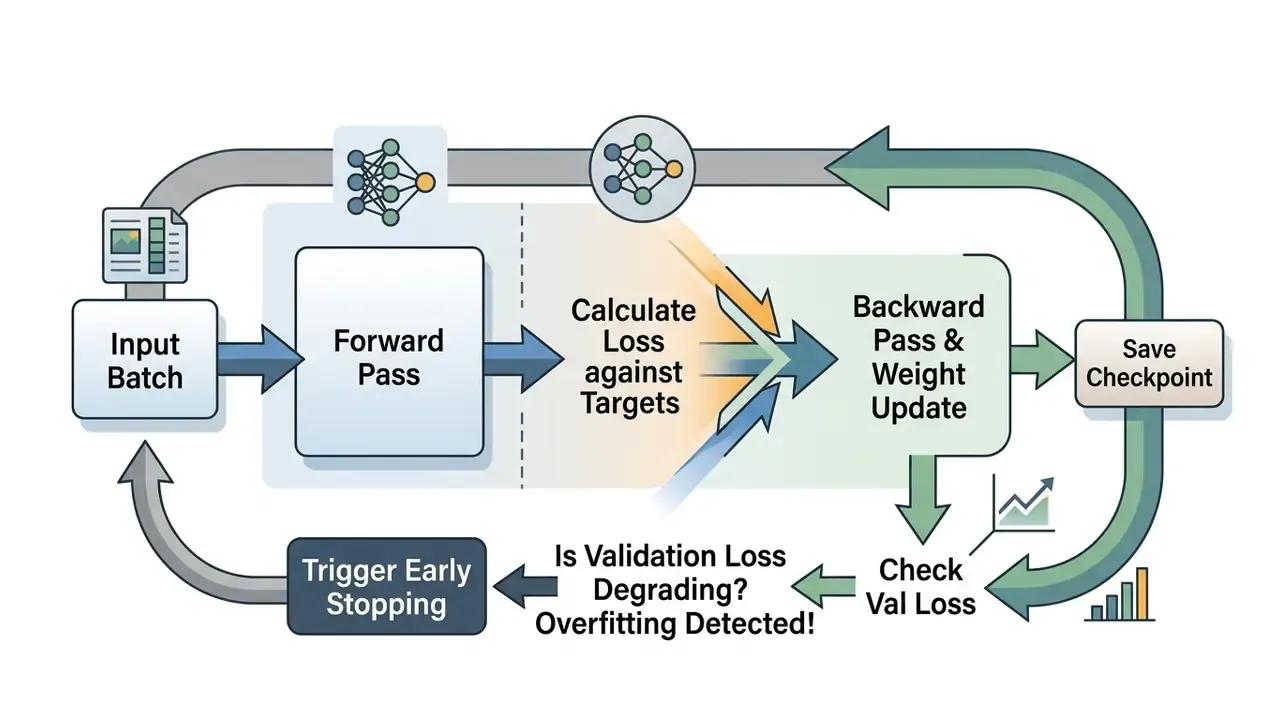
Model training is an iterative process. The chosen algorithm adjusts its parameters to minimize loss on the training data while holding generalization on unseen validation inputs.
Run Model Training and Track Experiments
Modern training workflows rely on systematic experiment tracking platforms like MLflow or Weights & Biases to ensure reproducibility. In both tools the atomic unit is the run, grouped into experiments, with parameters, code version, metrics, and artifacts recorded automatically. For every training run, engineers should log:
- Exact source code commit hash and random seed values.
- Hyperparameter configurations (learning rate, batch size, optimizer weight decay).
- Epoch-by-epoch loss curves and validation metric trajectories.
- Model artifact checkpoints, dataset version identifiers, and runtime environment hardware specs.
- System metrics (GPU utilization, memory) to support cost attribution and capacity planning.
Automated logging guarantees that every model artifact deployed to production can be traced back to its exact training dataset version and code configuration. That is precisely the evidence an independent validator or examiner will request, usually with a two-week deadline. Hyperparameters themselves should be selected through systematic search validated by nested or repeated k-fold cross-validation rather than manual tinkering, which reduces the risk of overfitting the selection process itself.
Avoid Overfitting and Underfitting
The gap between training loss and validation loss reveals whether a model suffers from capacity mismatch:
Loss
 ^
 |    / Validation Loss (Overfitting)
 |   /
 |  /----------------- Validation Loss (Optimal)
 | /
 |/___________________ Training Loss
 +-----------------------------------------> Epochs
- Underfitting. Both training loss and validation loss stay high and track each other closely. The model lacks capacity to capture data patterns. Fix: increase capacity (add layers or parameters), enrich features, reduce regularization penalties, or train for more epochs.
- Overfitting. Training loss keeps falling while validation loss flattens and then rises. The model is memorizing training samples instead of learning generalizable features. Fix: apply L1/L2 weight decay, add Dropout, introduce data augmentation, increase training data volume, or trigger early stopping when validation loss degrades over consecutive evaluations. Stratified and repeated cross-validation further stabilizes estimates on small or imbalanced datasets.
A quiet warning sign worth naming: a model that looks flawless on the test set usually means leakage, not genius.
Fine-Tune a Base Model for a Specialized Task
Evaluate, Test, Deploy, and Monitor the AI Model
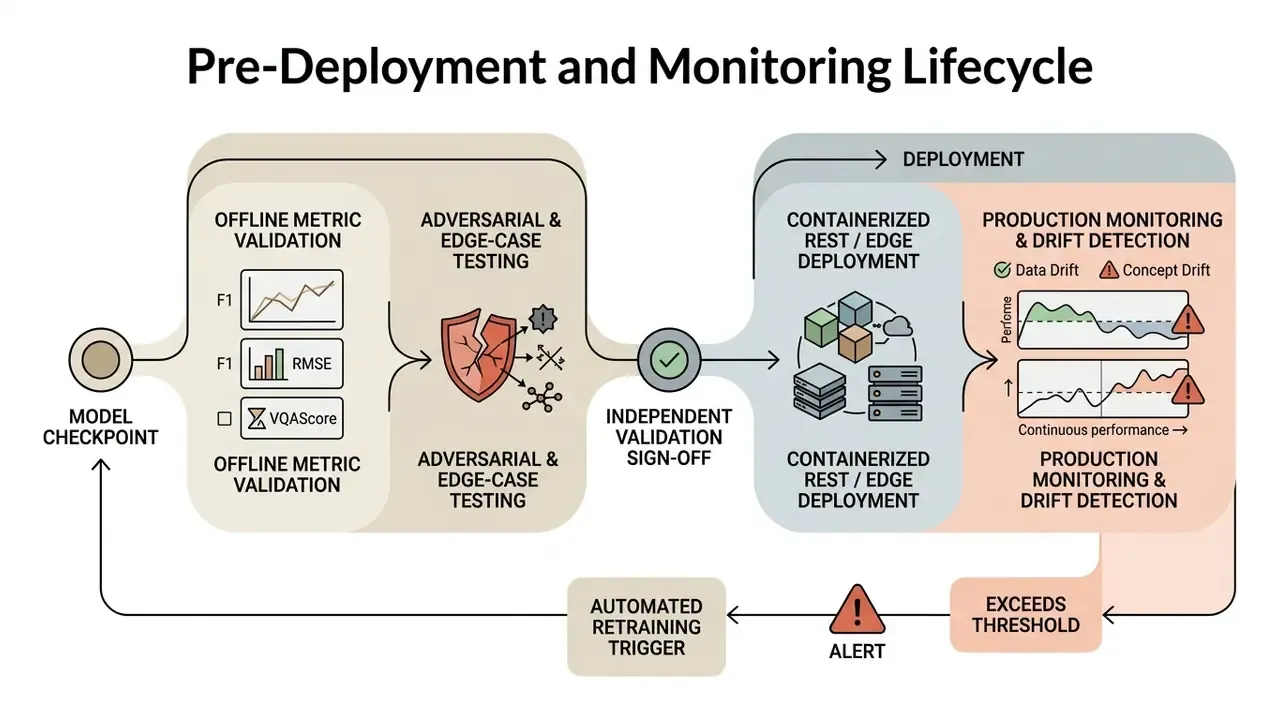
A model cannot move to production until it passes objective quantitative testing, boundary validation, edge-case stress testing, fairness assessment, and real-world drift monitoring.
Choose Metrics That Match the Model Type
Performance metrics must align with the mathematical formulation of the task:
Classification metrics.
ROC-AUC measures class separation across all decision thresholds. Use F1 score and Precision-Recall AUC for imbalanced datasets rather than raw accuracy.
Regression metrics.
RMSE penalizes large outlier errors more heavily than MAE.
- Generative metrics. Evaluate text-to-image alignment using VQAScore or SelfEval likelihood scoring. Evaluate generated text with BLEU and ROUGE combined with expert human panels scoring adequacy, fluency, and overall usefulness.
«SelfEval repurposes a diffusion model to compute the likelihood of real images given text prompts, achieving strong agreement with human faithfulness judgments.» - Rambhatla & Misra, SelfEval: Generative Models as Discriminative Evaluators (2024).
Teams benchmarking generative output quality across commercial systems before setting internal acceptance thresholds can consult comparative evaluations such as the best AI video generators and best AI art generators analyses, which document how quality scoring translates into practical selection criteria.
Test the Model Before Production Deployment
Pre-deployment verification means executing systematic Test, Evaluation, Verification, and Validation (TEVV) suites. NIST AI RMF 1.0 requires documented test sets and metrics (MEASURE 2.1) and documented fairness and bias evaluation (MEASURE 2.11). US Department of Defense TEVV guidance adds k-fold cross-validation and explicit bias checks as baseline procedures:
- K-fold cross-validation. Partition training data into disjoint folds to verify that metric performance is stable across different subsets; report variance using confidence intervals, standard error, or bootstrapping.
- Adversarial and edge-case stress testing. Evaluate stability under noisy inputs, missing feature combinations, adversarial perturbations, and out-of-distribution prompts. NIST's ARIA pilot materials use stress tests specifically to surface adverse outcomes under extreme scenarios.
- Bias and fairness audits. Assess predictive performance across demographic or regional sub-groups to support fair lending and non-discrimination compliance, and document proxy-variable screening.
- Benchmark and challenger comparison. Under SR 11-7, independent validation expects comparison against a challenger model or benchmark, plus outcome analysis and sensitivity testing of key assumptions.
- Reproducibility replay. Re-run training from the logged commit, seed, and dataset version to confirm the reported metrics can be regenerated.
Developers building financial or resource estimation models can use specialized web-based calculators to test input validation logic and edge-case response bounds before API integration.
Deploy, Monitor, and Retrain With New Data
Once validated, models are deployed as microservices behind REST or gRPC endpoints, or embedded on edge devices using optimized runtime engines like ONNX Runtime, TensorRT, or vLLM.
«A decentralized microservice architecture with an API gateway empirically improved latency and fault tolerance versus centralized generative model deployment.»
Production environments degrade in two primary ways:
- Data drift.The input distribution changes over time (economic shifts alter customer transaction distributions) even if the relationship holds.
- Concept drift.The statistical relationship between inputs and targets changes (fraud patterns evolve, rendering historical rules ineffective).
Monitoring engines use statistical tests like ADWIN (Adaptive Windowing) or the Kolmogorov-Smirnov test to detect distribution shifts. ADWIN compares sliding sub-windows of the data stream and flags drift when their distributions diverge. Resource-constrained edge deployments often substitute centroid-distance tests that retrain only when a distance threshold is breached.
«Across seven drift detectors, ADWIN and HDDM_W balanced accuracy against energy consumption, while DDM and EDDM were unsuitable due to low accuracy.»
When drift exceeds established thresholds, the system raises an automated alert or starts a retraining pipeline on newly acquired data. NIST AI 800-4 frames post-deployment monitoring across five dimensions: functionality, operational, human factors, security, and compliance. NIST RMF Playbook guidance additionally requires documented user feedback channels, appeal and override mechanisms, incident response, recovery, change management, and decommissioning plans.
To compare generative frameworks, visual model architectures, and operational trade-offs, engineering teams can consult the curated AI Media Comparison Matrices for structured evaluation benchmarks.
Validate Generative and Agentic AI Systems
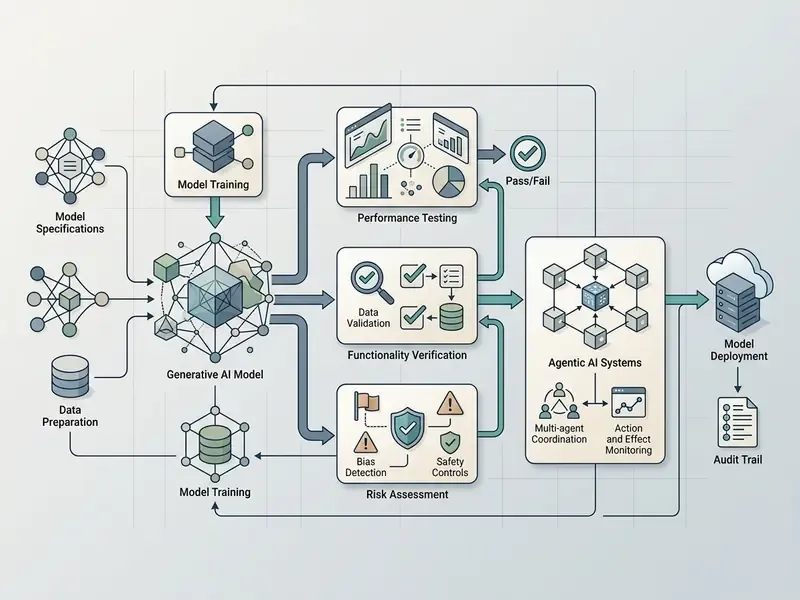
Traditional model risk frameworks assume a fixed input vector, a deterministic scoring function, and a bounded output space. Generative and agentic systems break all three assumptions: outputs are open-ended text or actions, the model can call external tools, and behavior depends on retrieved context that changes hourly. Extending validation to these systems requires additional controls.
1. Tool-calling and action validation. Enumerate every function the agent may invoke, define an allow-list with typed parameter schemas, and validate arguments before execution. Log every tool call with inputs, outputs, latency, and authorization context. Irreversible actions, meaning payments, account changes, or external communications, should require either a deterministic policy check or explicit human approval.
2. Prompt-injection and data-exfiltration defense. Treat all retrieved documents, user messages, and third-party API responses as untrusted input. Controls include instruction and content separation, output filtering for credential and PII leakage, least-privilege tool credentials, and red-team suites that attempt indirect injection through retrieved content. NIST SP 800-218A places these squarely inside secure development practices for generative and dual-use foundation models.
3. RAG quality triad. For retrieval-augmented generation, score three dimensions per response:
- Groundedness. Is each claim supported by the retrieved context?
- Answer relevance. Does the response address the user's actual question?
- Context relevance. Did retrieval return the documents needed to answer it?
Low groundedness with high answer relevance is the classic hallucination signature, and it should trigger abstention rather than a confident reply.
4. Hallucination bounds and abstention policy. Define the maximum acceptable rate of unsupported claims per task class, measure it on a frozen evaluation set, and implement a refusal path ("I don't have the information to answer that") that is itself tested. RLHF-style correctional feedback has been shown to reduce multimodal hallucination rates materially. It does not eliminate them, and any vendor claiming otherwise deserves a follow-up question.
5. Human-in-the-loop escalation design. Specify, per decision type: the confidence threshold that routes to a human, who that human is, the maximum queue latency, the reviewer's authority to override, and the record written to the audit trail. An escalation path that exists in architecture diagrams but not in staffing plans is a control failure.
6. Autonomy tiering. Grant autonomy incrementally: (0) suggest only, (1) act with pre-approval, (2) act with post-hoc review, (3) act autonomously within a bounded envelope. Promotion between tiers should require documented performance evidence, not project deadlines. No evidence, no autonomy.
7. Continuous evaluation. Generative systems drift when the vendor updates the base model, when retrieval corpora change, or when users discover new phrasings. Maintain a versioned regression suite and re-run it on every model, prompt, or index change. Treat vendor model upgrades as a change event requiring re-validation.
Verified regulatory and framework references
- NIST AI Risk Management Framework (AI RMF 1.0), National Institute of Standards and Technology (2023). Govern, Map, Measure, Manage across the full AI lifecycle.
- NIST Generative AI Profile (NIST AI 600-1). Risk controls for generative foundation models, including adversarial testing and documented TEVV (2024).
- (https://doi.org/10.6028/NIST.AI.800-4). Post-deployment monitoring categories (2026).
- NIST SP 800-218A. Secure Software Development Practices for Generative AI and Dual-Use Foundation Models (2024).
- Federal Reserve SR 11-7 / OCC Bulletin 2011-12. Supervisory Guidance on Model Risk Management: development, implementation, use, validation, and governance.
- EU AI Act, Article 10. Data and data governance requirements for high-risk AI systems; Article 50 covers transparency and disclosure duties.
- (https://www.iso.org/standard/79016.html). International testing standards for AI-based systems, including black-box and neural-network white-box testing.
- MLPerf Inference (MLCommons). Standardized latency-bounded throughput benchmarking at fixed accuracy targets.
How Much Does It Cost to Create an AI Model and When Should You Hire Experts?
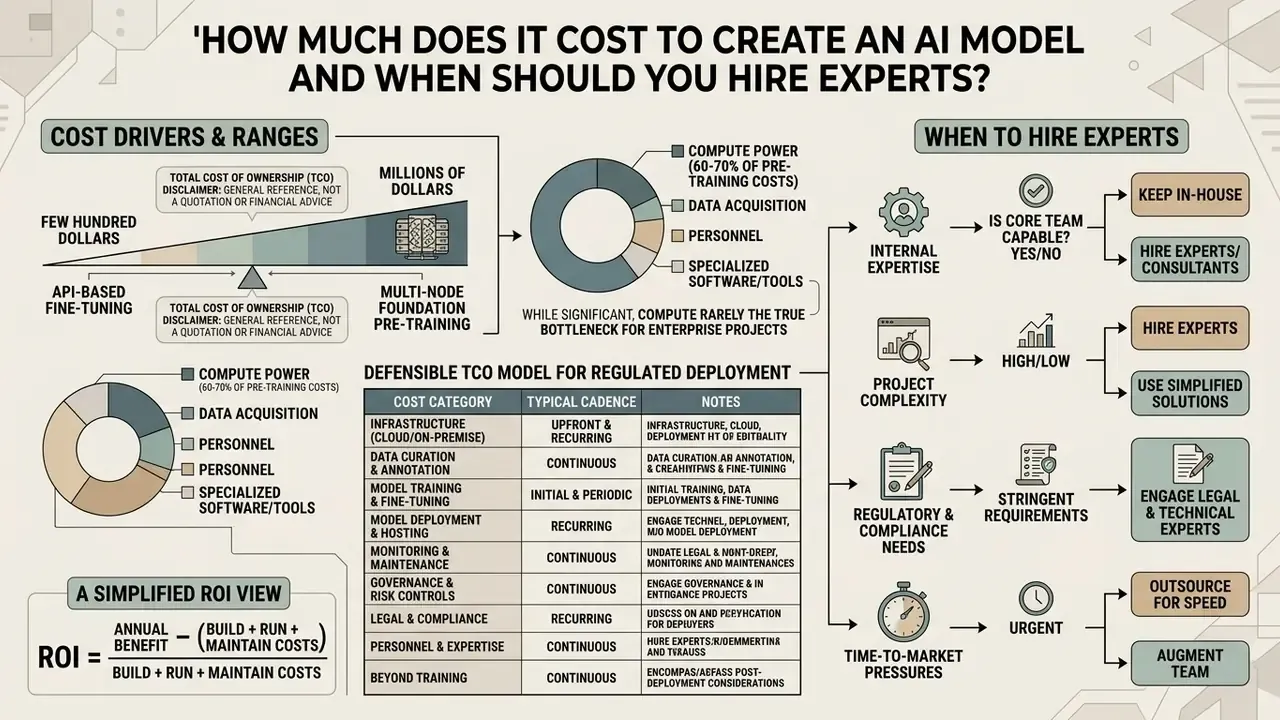
AI model development costs range from a few hundred dollars for API-based fine-tuning to millions of dollars for multi-node foundation pre-training.
Expense drivers fall into three categories: compute power (60 to 70% of pre-training costs), specialized data collection and annotation (35 to 50% of domain project costs, of which QA, adjudication, and SME review alone typically consume 25 to 35%), and senior engineering expertise. Frontier-scale training budgets have escalated sharply:
«Training costs rose roughly 30x in five years: $3.3M for GPT-3, $84.5M for GPT-4, and $110.7M for DeepSeek-V3.»
Compute, though, is rarely the true bottleneck for enterprise projects:
«Estimated training-data costs reach 300x the training cost for GPT-4 and 6000x for DeepSeek-V3 under conservative wage assumptions.»
Total Cost of Ownership: The Control Line Items Teams Forget
A defensible TCO model for a regulated deployment includes, beyond training:
| Cost category | Typical cadence | Notes |
|---|---|---|
| Data annotation, QA, adjudication | Project plus refresh cycles | Domain experts (clinicians, senior credit analysts) command multiples of crowd-labeling rates |
| Independent validation (2nd line or external) | Pre-deployment plus annual | Includes challenger model build, sensitivity and outcome analysis |
| Continuous monitoring infrastructure | Monthly | Drift detectors, dashboards, alerting, prediction log storage |
| Audit-trail and lineage tooling | Monthly | Experiment tracking, model registry, dataset versioning, immutable logs |
| Legal, privacy, and licence review | Per model plus per vendor change | Copyright, PII, special-category data, vendor terms |
| Retraining and revalidation cycles | Quarterly to annually | Triggered by drift thresholds or the governance calendar |
| Incident response and rollback readiness | Retainer | Kill-switch testing, fallback rule maintenance |
| Vendor and third-party risk management | Annual | Mandatory when weights or inference are outsourced |
A simplified ROI view: . Projects that look profitable on compute alone frequently invert once independent validation, monitoring, and audit infrastructure are priced honestly. Worth noting: residual risk belongs in the denominator conversation too, even when it resists a clean number.
Engineers seeking technical implementation specifications can review the structured AI Media API Guides to examine integration standards and cost structures across enterprise endpoints.
| Decision criteria | Option A: fine-tune open source model | Option B: train from scratch | Option C: managed API generator | Option D: hire external AI experts |
|---|---|---|---|---|
| Task complexity | Moderate to high | Extreme or novel modality | Low to moderate | High or specialized domain |
| Internal ML expertise | Intermediate | Advanced ML staff required | Minimal | None (external team fills the gap) |
| Data availability | 500 to 5,000 labeled samples | 1M+ labeled samples | Prompting only | Raw or unstructured domain data |
| Compute budget | $100 to $5,000 (single GPU days) | $100,000 to $1M+ (cluster weeks) | Pay-per-token consumption | Consulting fees plus infrastructure |
| Control over weights | High (adapter level) | Complete | None | Depends on contract terms |
| Validation and regulatory burden | Moderate | High but fully evidenced | Highest (opaque model) | Moderate (documented by vendor) |
| Deployment speed | 1 to 3 weeks | 3 to 6 months | 1 to 3 days | Timeline bound by contract |
Organizations evaluating commercial usage rights, IP protection, and vendor selection parameters can consult the AI Media Commercial-Use Hub for operational compliance templates.
Build internally or engage external consultants? It depends on risk exposure and specialized domain needs. For routine classification or standard assistant integrations, internal engineering teams using open source base models can reach production quickly. External expertise becomes economically rational when the labeling task requires credentialed domain judgment (clinical, legal, credit underwriting), when error cost per false decision is high, when the institution lacks independent validation capacity, or when the delivery window is shorter than the internal hiring cycle. For high-stakes models in regulated industries, healthcare diagnostics or banking risk systems in particular, engaging external AI governance experts helps ensure that data pipelines, safety controls, and TEVV documentation satisfy audit requirements under SR 11-7 and the EU AI Act.
To review empirical benchmarks, hardware efficiency tests, and independent performance proof, technical leaders can reference the AI Media Benchmarks and Review Proof repository.
Model Risk Readiness Checklist (Sandbox to Production Inventory)
Before a model moves from pilot to the unified model inventory, the artifacts below should exist, be version-controlled, and be retrievable on request. Missing entries are the primary mechanism by which shadow AI enters an organization.
Checklist0 / 29
Limitations, Open Questions, and a Safe Next Step
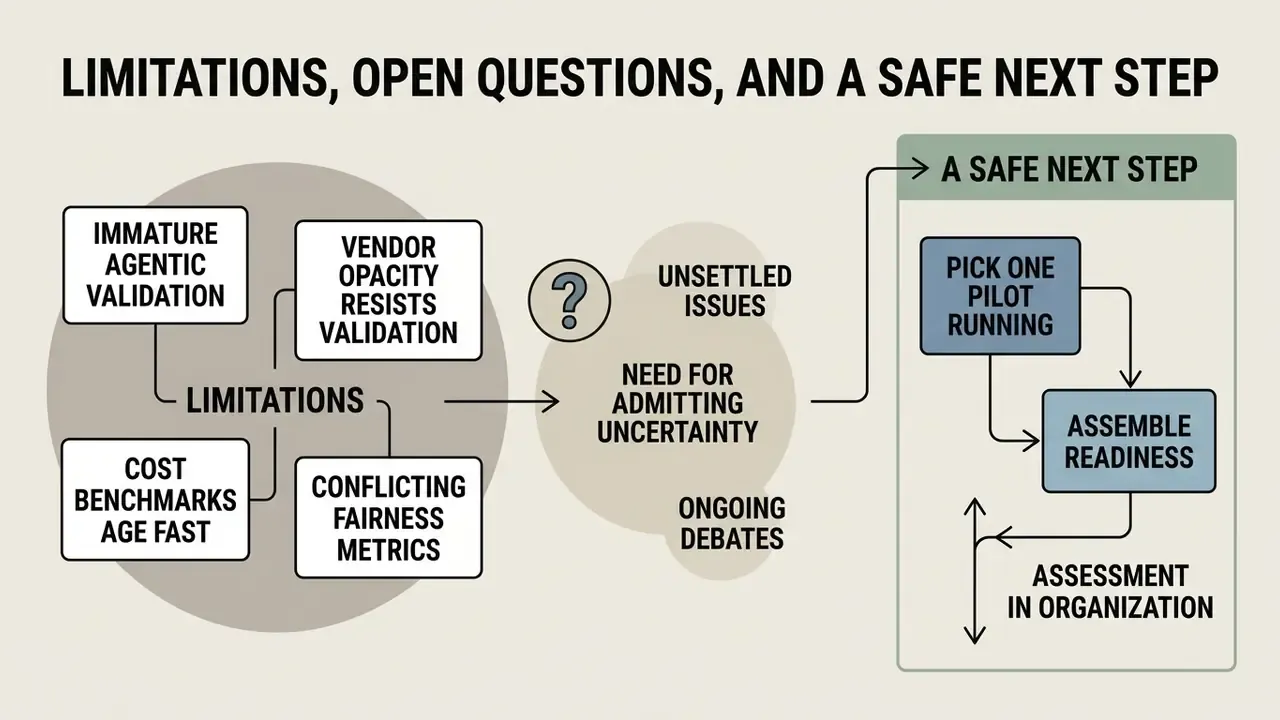
Some things are still unsettled, and pretending otherwise would be worse than admitting it.
- Agentic validation practice is immature. There is no widely accepted quantitative standard for "acceptable" autonomy in a regulated workflow. Autonomy tiering is a reasonable interim control, not a settled methodology.
- Vendor opacity resists validation. When weights, training data, and update schedules sit behind a managed API, conceptual soundness review becomes partly inferential. Contractual evidence rights help; they do not fully substitute.
- Cost benchmarks age fast. Inference pricing fell roughly two orders of magnitude between 2023 and 2026. Any cost model older than two quarters should be re-checked.
- Fairness metrics conflict. Optimizing equal opportunity and equal outcome simultaneously is often mathematically impossible. The choice is a policy decision for the governance committee, documented, not delegated to a data scientist's default setting.
A safe next step: pick one pilot already running in your organization, then try to assemble its readiness checklist from existing artifacts. Whatever you cannot produce in a day is your actual roadmap. No new budget required to run that exercise.
FAQ: Timelines, Budgets, and Regulatory Risk
How long does it take to create a production AI model?
For a fine-tuned or open-source-adapted model on existing governed data, 1 to 3 weeks of engineering plus 2 to 6 weeks of validation and integration is typical in regulated environments. Training a foundation model from scratch runs 3 to 6 months of compute and engineering before validation even begins. In practice, data acquisition and independent validation dominate the calendar, not training.
What is the minimum dataset size to start?
For fine-tuning, 50 to 100 high-quality labeled examples are enough to test feasibility, and 500 or more for a production-grade adapter. Classical tabular classifiers typically need thousands of labeled events with adequate minority-class representation. Training from scratch generally requires millions of labeled examples.
Do I need a GPU to build my first model?
No. Tree-based ensembles on tabular data train on CPU in seconds to minutes. GPUs become necessary for deep learning, and the 40 to 80 GB VRAM classes are the practical entry point for fine-tuning 7B to 13B parameter language models.
Can I use public data or a proprietary API and stay compliant?
Sometimes, though both paths carry documented risk. Public and scraped corpora raise copyright, licence, and memorization exposure; NIST AI RMF 1.0 explicitly flags copyrighted training data as an infringement pathway. Managed APIs raise third-party risk and validation opacity, since an independent validator cannot assess weights they cannot inspect. Both require legal review and a vendor risk assessment before production use.
How often should a model be retrained?
Retraining should be event-driven rather than calendar-driven where possible: trigger on drift-detector alerts (ADWIN or KS thresholds) or on performance decay against a monitored ground-truth stream, with a governance-mandated maximum interval as a backstop. Every retrain is a change event requiring revalidation proportional to the model's criticality tier.
What does independent validation actually require?
Under SR 11-7, three components: evaluation of conceptual soundness, ongoing monitoring including process verification and benchmarking, and outcomes analysis including back-testing. The validator must be independent of the development team and hold the authority to block deployment.
Which metric should I report to executives?
Report the business KPI first (loss avoided, hours saved, conversion lift) and the model metric second, with its operating threshold. A single accuracy number without a threshold, base rate, and confidence interval is not decision-grade information.
How do we find models nobody registered?
Start with spend and access data: API keys, cloud billing lines, browser extensions, and unmanaged notebooks. Then interview line managers about spreadsheets and assistants that influence customer-facing decisions. Shadow AI is usually discovered through procurement records rather than through code scanning.
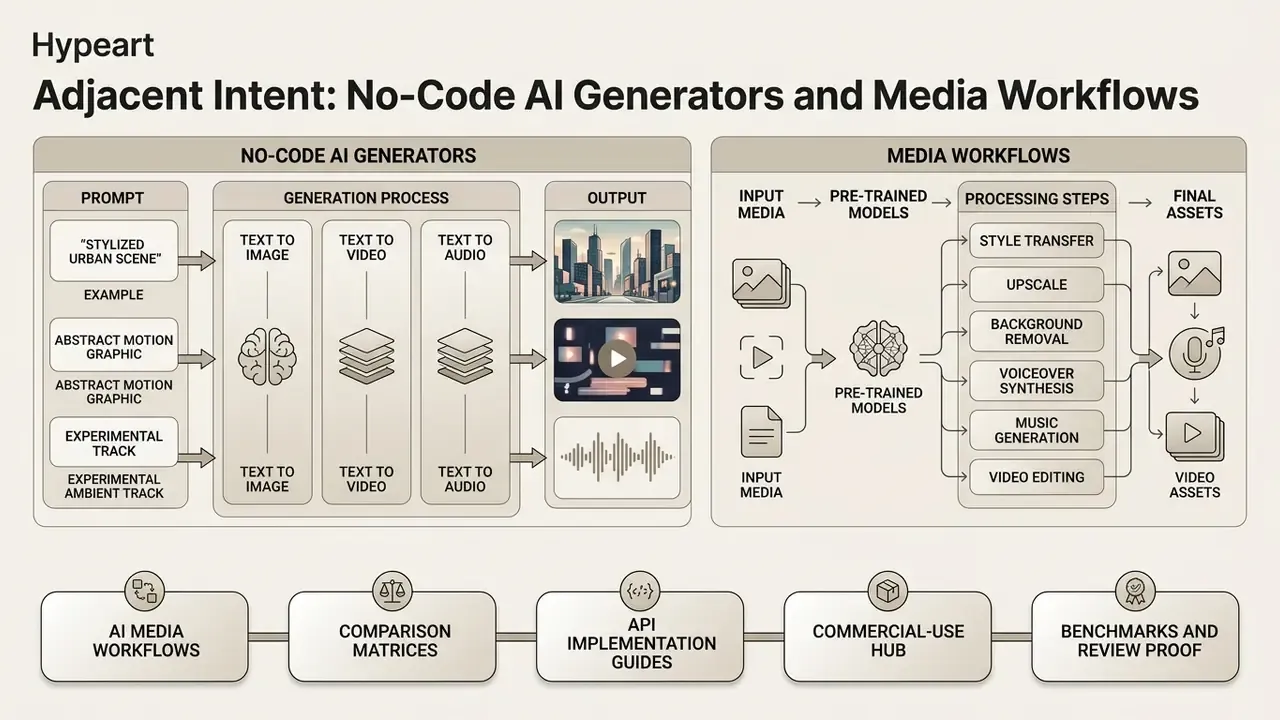
Adjacent Intent: No-Code AI Generators and Media Workflows
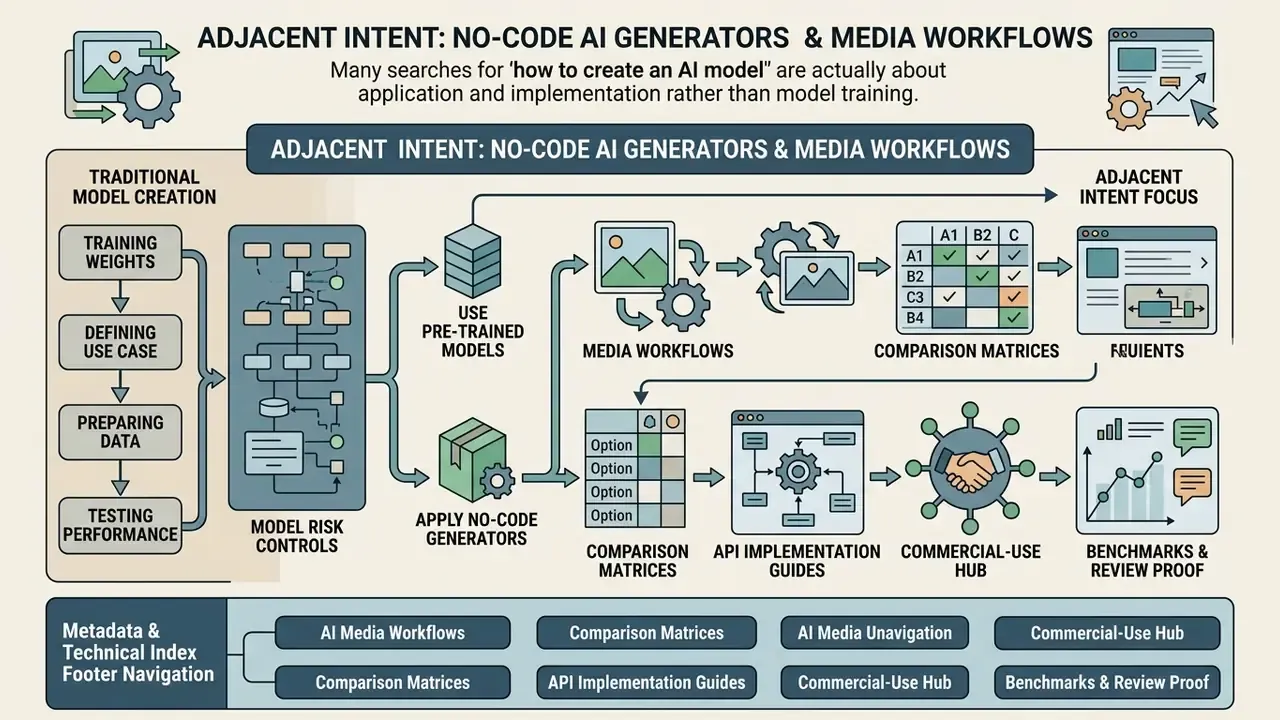
Many searches for "how to create an AI model" are not about training weights at all. They are about generating an asset: a 3D mesh, an image, an avatar, a video, or a voiceover produced by an existing model in under a minute. Those workflows share vocabulary with ML engineering and little else. No dataset splits, no validation packages, no drift monitoring. Instead: prompt design, credit budgets, export formats, and licensing terms.
This section consolidates the applied-media references relevant to that intent, so the engineering sections above stay uninterrupted:
- Video-oriented training and production pipelines. Organizations building video datasets or custom synthetic assets can explore an ai youtube video maker workflow to see how automated video assembly aligns with structured data ingestion standards, or compare tool capabilities across AI video generators and the YouTube video editor workflow guide.
- Image preprocessing and avatar pipelines. Teams evaluating multimodal generation or avatar processing can inspect specialized utilities like an avatar cropper to understand image preprocessing logic prior to model consumption, and review the AI headshot generator guide for portrait-specific quality and privacy considerations.
- Managed generation inside enterprise workflows. Companies deploying internal instructional video tools can review the structured AI Avatar Training Video Workflow as an example of integrating managed generation services within enterprise processes.
- Channel assets and brand visuals. For teams building custom channel assets or visual interfaces, deploying a specialized tool like a banner maker for social workflows illustrates how automated generation APIs operate in client-facing applications.
- Stylized and generative image models. Organizations working with stylized image transformation models can compare specialized tools like a cartoon avatar maker to understand how domain-specific generation metrics apply in practice, or evaluate options across the best AI image generators comparison.
- Monetization and content policy. Teams evaluating monetization frameworks for AI-driven channel media can reference the analysis on whether can ai generated videos be monetized on youtube to assess how content quality guidelines affect automated media deployment.
- Voice and audio generation. For synthetic narration and multilingual audio assets, the AI voice generator guide covers voice quality, language coverage, pricing, and commercial licensing terms.
If your objective sits in this category, the governance burden shifts from model validation to usage rights and disclosure: confirm the licence permits commercial output, retain provenance records of prompts and generated assets, and, in the EU, respect Article 50 transparency duties requiring that AI-generated or manipulated content be disclosed to users.