For a CRO or a head of model risk, the practical question is narrower than the public debate. Can a probabilistic image score safely sit inside a KYC decision, a refund approval, or a claims payout? That is the question this guide answers.
Last reviewed and updated: 2026. Editorial ownership: AI Governance & Model Risk desk.
Key Takeaways
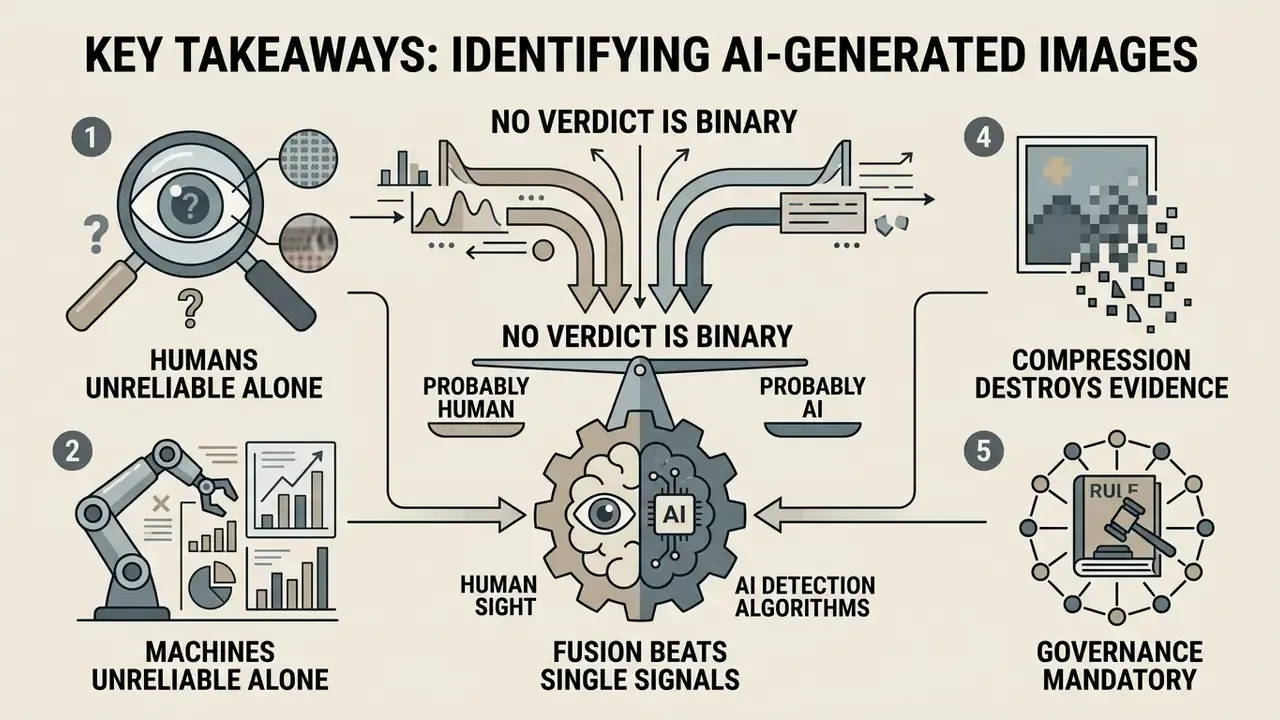
- No verdict is binary. AI image detection produces probabilistic confidence scores, not proof of authorship. NIST AI 100-4 explicitly frames detector output as thresholded probability metrics (TPR@FPR, AUC, EER), not evidence of origin.
- Humans are unreliable alone. In the HPBench human study, participants classified images correctly only 61.3% of the time, roughly one error in three.
- Machines are unreliable alone too. Zero-shot benchmarks of open-source detectors against the newest commercial generators (Flux Dev, Firefly v4, Midjourney v7) recorded average accuracy of only 18 to 30%, close to random guessing.
- Fusion beats single signals. Combine visual inspection, metadata and C2PA provenance, reverse image search, passive classifiers, and contextual account analysis.
- Compression destroys evidence. Lossy JPEG re-encoding (quality below 70), cropping, and screenshotting strip the high-frequency traces detectors depend on; metadata detection rates collapse from 71.0% on originals to 0.47% after manipulation.
- Governance is mandatory. Define explicit score thresholds, escalation owners, and audit logging before deploying detectors in KYC, claims, or moderation pipelines.
How to Use This Guide
This is written for the people who own the consequences: model risk, compliance, fraud, and the operations leads who sign off on automated decisions. It is not a tool review disguised as a framework.
Read it in the order the work actually happens. First, understand what detection can and cannot establish. Second, learn the visual and provenance checks that a reviewer can run in minutes. Third, wire detectors into a pipeline with explicit thresholds and owners. Fourth, document the limits, because those limits are what an examiner will ask about.
One caveat before you start. Every accuracy figure quoted here comes from a published study with its own data mix. Your production traffic will behave differently, sometimes much worse. Treat the numbers as a planning baseline, not a promise.
Can AI-Generated Images Be Detected Reliably?
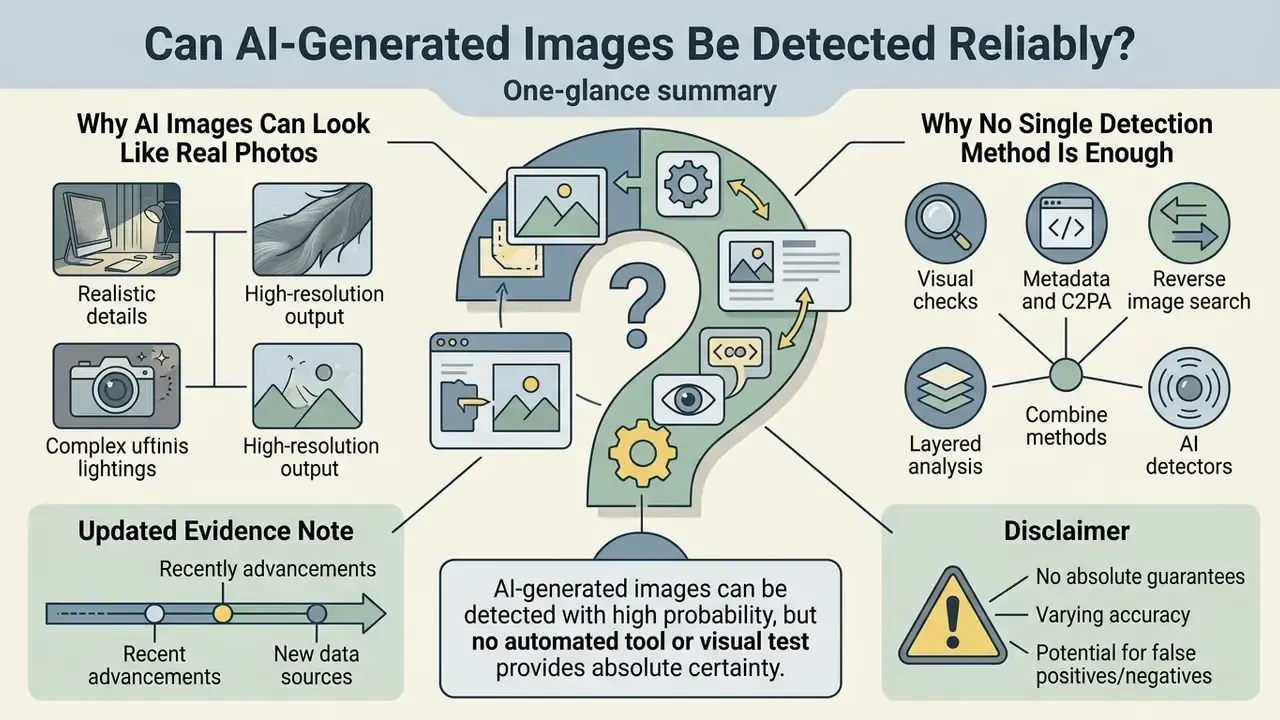
AI-generated images can be detected with high probability, but no automated tool or visual test provides absolute certainty. Modern detection frameworks combine statistical pattern recognition, file container analysis, and provenance verification to evaluate uploaded images against known synthetic signatures.
The core technical challenge stems from how neural architectures generate visual content. Rather than copying pixels from training datasets, diffusion systems and generative adversarial networks (GANs) construct images from high-dimensional noise using learned mathematical distributions. Because the output is synthesized rather than sampled from a physical sensor, the forensic question is never "which pixels were copied?" but "which statistical fingerprint does this pixel distribution resemble?"
So, can AI see images the way a fraud analyst does? Not really. A classifier reads statistical texture, not meaning, and that gap explains most of its failures.
Why AI Images Can Look Like Real Photos
Generative systems synthesize hyper-realistic images by mastering complex lighting models, micro-textures, and high-frequency visual details. Recent advances in latent diffusion allow image generators to render natural depth of field, plausible subsurface scattering on skin, and intricate reflections.
When users evaluate generated visuals from platforms like Midjourney v7 or Flux Dev, superficial visual checks often fail. High-resolution output obscures traditional rendering glitches, which makes modern synthetic media visually indistinguishable from authentic photographs to unaided human observers.
Why No Single Detection Method Is Enough
Relying on a single inspection technique introduces severe model risk and high false-positive rates. Passive algorithmic detectors evaluate statistical pixel distributions, while metadata checks review technical file markers like EXIF data or C2PA cryptographic manifests.
Because metadata can be stripped during social media uploads, and because passive classifiers degrade when tested on unseen generative models, isolated checks yield incomplete results.
An enterprise verification workflow must therefore combine visual inspection, provenance tracking, reverse image search, and algorithmic classifier scores. To evaluate how automated workflows process media across enterprise platforms, teams review specialized frameworks in AI Media Workflows.
The institutional evidence base supports this fusion approach directly. According to the NIST AI 100-4 report Reducing Risks Posed by Synthetic Content (NIST, 2024, https://nvlpubs.nist.gov/nistpubs/ai/NIST.AI.100-4.pdf), provenance-data detection inspects stored metadata, but those fields may be falsified, which makes metadata useful only when the chain of custody is trusted. NIST also records that cross-generator detector accuracy fell to 61% to 70% in one 2023 evaluation and 50% to 62% in a 2022 evaluation, and that performance drops further after compression and resizing. The INTERPOL 2024 study Beyond Illusions adds a complementary finding: file-structure analysis can reliably separate camera-original files from synthetic files at scale, but it cannot identify which content within a file was altered. ENFSI's Best Practice Manual for Digital Image Authentication (2021) frames content checks and metadata checks as mutually reinforcing steps that guide further testing rather than standalone proof.
Taken together, these sources establish a single operating principle. Algorithmic detector scores must be treated as probabilistic confidence estimates, never as legally binding proof of origin.
Visual Clues That Help You Spot AI-Generated Images
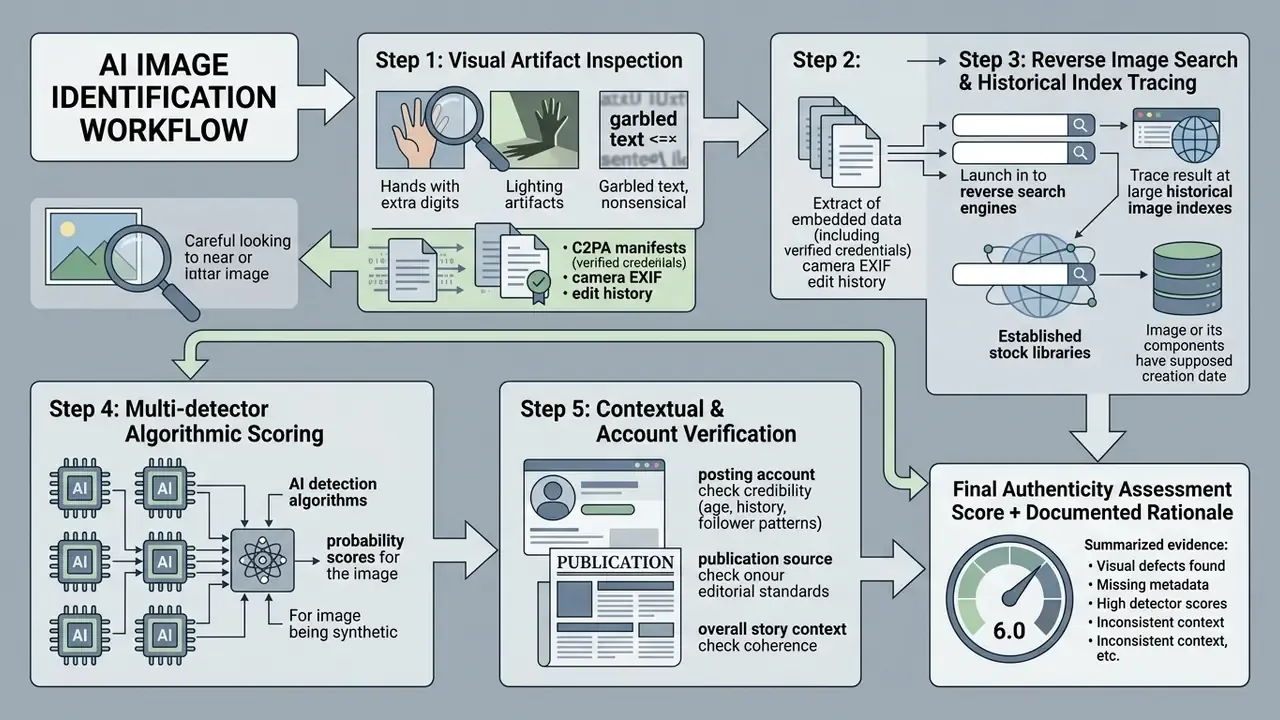
Visual inspection remains a critical first line of defense when reviewing suspicious media for operational risk or compliance checks. Identifying visual anomalies requires systematic scrutiny of anatomical structures, physics-based lighting alignments, and rendered background textures.
While image generators continue to improve, structural failure modes persist across complex spatial relationships and fine-dimensional details. A 2025 taxonomy groups recurring AI-image artifacts into five classes: anatomical implausibilities, stylistic artifacts, functional implausibilities, violations of physics, and sociocultural implausibilities.
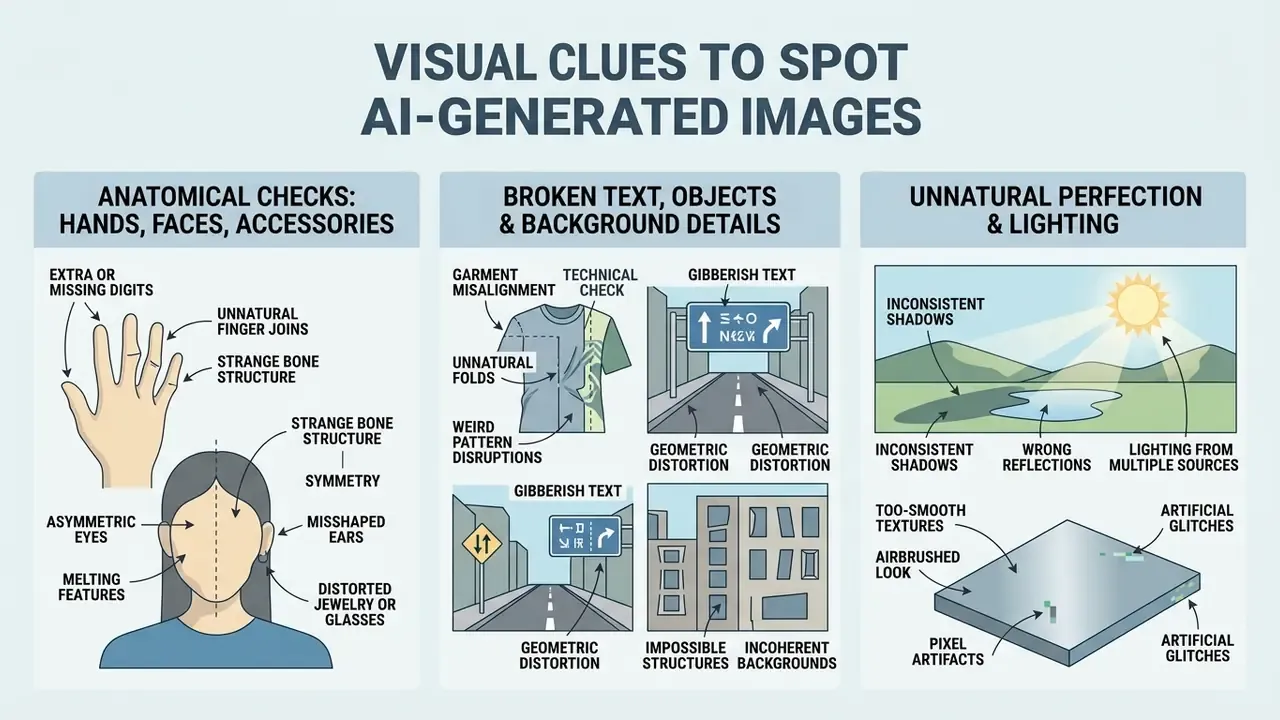
| Region | Inspection target | Typical synthetic failure |
|---|---|---|
| A | Hand anatomy | Finger fusion, impossible knuckle joints, irregular or absent fingernails |
| B | Facial biometrics | Asymmetric teeth alignment, irregular iris patterns, mismatched eyewear hinges |
| C | Rendered typography | Warped characters, nonsensical text geometry, dissolving baselines |
| D | Background elements | Floating objects, disconnected architectural perspective lines |
| E | Physical lighting | Diverging shadow vectors from a single light source |
| F | Boundary transitions | Smudged pixel cutouts, unnatural anti-aliasing at object edges |
Check Hands, Faces, Clothing and Accessories
Anatomical errors offer immediate visual evidence when learning how to identify AI generated images of people. Generative architectures frequently distort complex physical geometry, which produces missing or extra fingers, unnatural joint bending, fused teeth, or asymmetric iris shapes. Documented artifacts include disproportionate necks, empty gazes, overlapping teeth and mouth structures, and merged body parts when several people appear in one frame.
When inspecting profile pictures on corporate networks, scrutinize accessories and clothing details carefully. Synthetic images regularly exhibit asymmetrical spectacle frames, mismatched earrings, floating neck collars, broken chain links, or zippers that merge directly into fabric textures without functional seams. Because fraudulent onboarding attempts increasingly rely on generated portraits, review teams benchmark the tooling that produces them in our guide to AI headshot generators, and study the consumer-side production path in how to create ai images of yourself.
Look for Broken Text, Objects and Background Details
Rendered typography and background consistency serve as key indicators when learning how to tell AI pictures apart from authentic photography. Generative tools struggle to maintain character legibility across text rendered within an image frame. NIST's 2025 GenAI pilot evaluation plan for image generators formalizes this: image systems are tested on generation quality and on artifact detection, covering visible failures in rendered text and object structure.
Look closely at background signage, street logos, or printed documentation within uploaded images. AI-generated visual content frequently displays warped letters, non-existent characters, or text baselines that dissolve into meaningless lines. Background objects may show broken geometry, such as table legs that fail to meet floor surfaces, or repeating architectural patterns that duplicate unnaturally.
That finding matters operationally. Partial edits produce false negatives, so a "likely authentic" verdict on a partially inpainted image should never close a review.
Be Wary of Unnatural Perfection and Lighting
Synthetic visuals often exhibit a distinct "waxy" texture, over-smoothed skin tones, and hyper-idealized color composition. Research on diffusion photorealism describes exactly this class of stylistic artifact, including shiny or plastic-looking surfaces and visually over-smooth, idealized skin (Characterizing Photorealism and Artifacts in Diffusion Model-Generated Images, Groh et al., 2025, https://mattgroh.com/pdfs/2502.11989v1.pdf). This artificial perfection appears when generation algorithms optimize for visually appealing contrast at the expense of realistic physical imperfections. The same smoothing signature can also be introduced legitimately by conventional photo editors, which is precisely why perfection alone is a weak signal.
Physical lighting mismatches provide stronger evidence of manipulation. Check whether shadow angles correspond accurately to visible light sources, and confirm that eye reflections mirror the actual environmental surroundings. In real photos, light rays follow strict geometric laws. Synthetic generators, by contrast, regularly produce contradictory shadow vectors across a single scene.
This asymmetry is the strongest argument for human-in-the-loop review. On physics-based reasoning, trained reviewers currently outperform classifiers by more than 30 percentage points, even though classifiers outperform humans on spectral and frequency-domain signatures.
Verify an Image's Source, Metadata and Online History
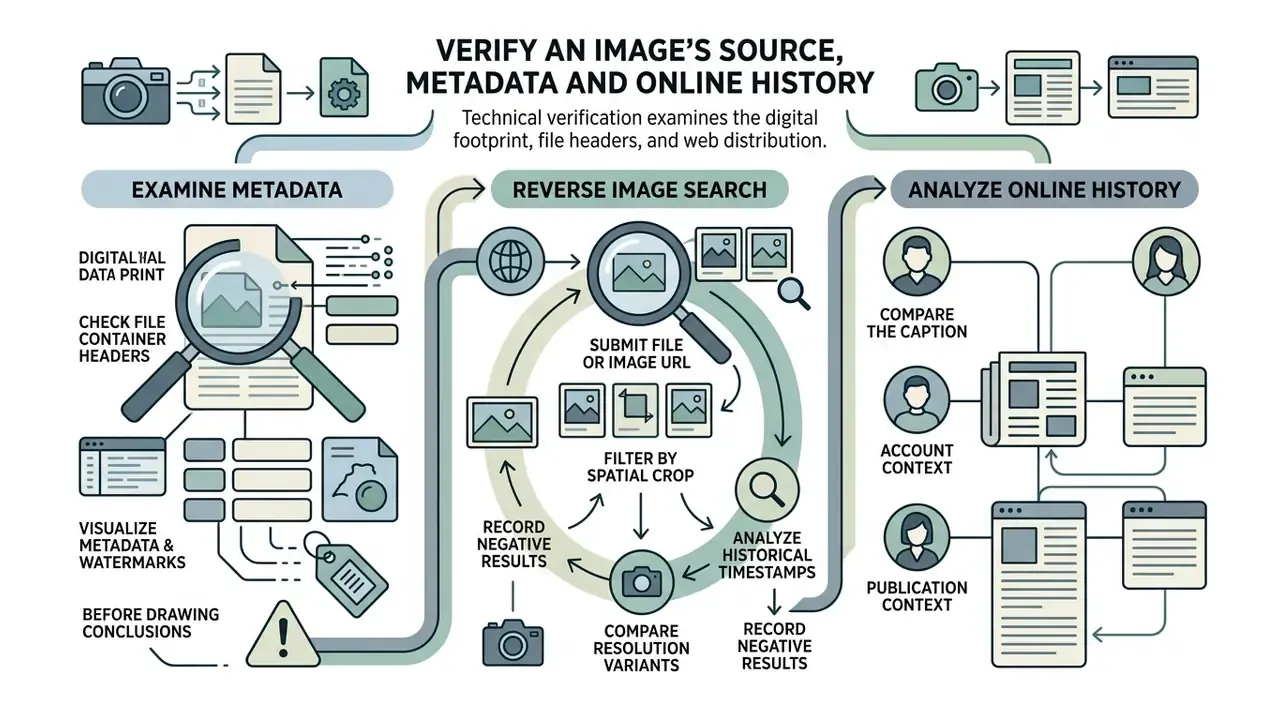
Technical verification moves beyond visual inspection by examining the digital footprint, file container headers, and web distribution history of target assets. Tracking an image back to its earliest publication date clarifies context and helps detect deceptive media campaigns.
Establishing a verifiable evidence chain requires checking embedded technical tags, executing reverse visual searches, and analyzing publishing account behaviors. The 2021 NIST Standard Guide for Image Authentication requires examination of image structure alongside file-format and metadata review. NISTIR 8325 describes manipulation-history graphs that link original and modified images, which is the formal basis for tracing reuse across versions.
Check Metadata and Watermarks Before Drawing Conclusions
Technical metadata embedded within file containers provides valuable records regarding camera settings, software processing, and creation timestamps. EXIF data records hardware capture metrics, while open provenance standards like C2PA (Content Credentials) attach cryptographically signed manifests to digital assets. The C2PA 2.4 specification additionally allows invisible watermarks to act as soft bindings, recorded in the manifest through a c2pa.watermarked.bound action.
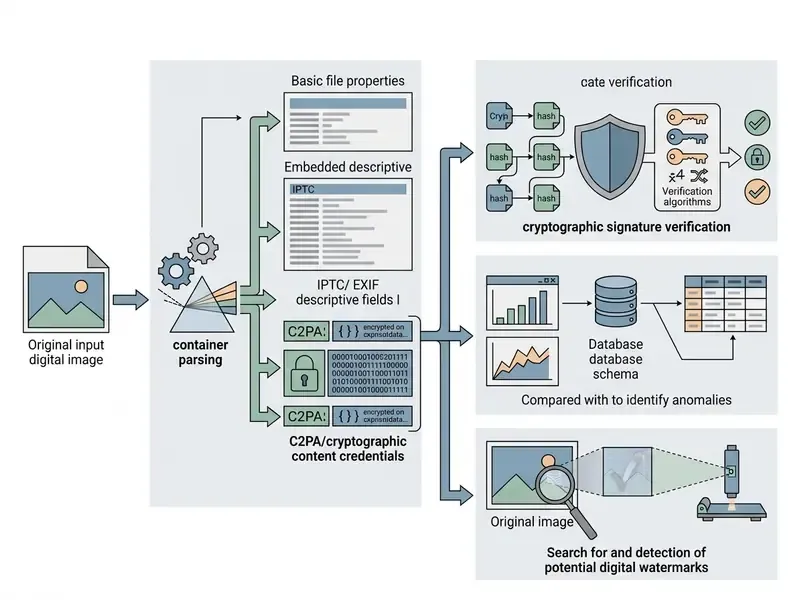
- Parse the container header and confirm the declared format matches the actual byte structure.
- Extract EXIF/XMP/IPTC fields and record capture device, software tags, and timestamps.
- Validate C2PA manifests against the signing certificate chain and hash the asset against any trusted provenance repository.
- Test for invisible watermark payloads (for example SynthID-class marks) where the suspected generator supports them.
- Log every step, including negative findings, for audit reconstruction.
Missing EXIF data, however, does not prove an asset was generated by an AI model. Major social media platforms routinely strip file metadata and invisible watermarks during upload processing to minimize file sizes and protect user privacy.
Coverage is uneven by design. C2PA is an open, multi-vendor provenance standard adopted across publishers, camera makers, and software vendors, while SynthID is concentrated inside Google products and models. Neither covers community-modified open-source pipelines, which frequently disable default watermarking. In organizational settings where assets require web deployment and long-term retention, teams standardize export and enhancement paths that preserve crucial asset data rather than flattening it through unlogged third-party re-encoders.
Use Reverse Image Search to Trace Earlier Versions
Reverse image search tools allow analysts to locate earlier indexed copies of a visual asset, uncover higher-resolution source files, and review historical context. Submitting suspicious media to reverse engines reveals whether an image previously appeared in authentic news reporting or originated within AI art repositories. TinEye explicitly frames the task as source tracing and reuse tracking, meaning where an image came from, where it appears, and whether modified or higher-resolution variants exist. Google Lens returns matching images, similar visuals, and the pages containing them.
- Submit file or image URL open Google Lens, TinEye, or Bing Image Search and upload the target visual asset or paste its direct web link. If your team publishes assets for review, the mechanics of how to create a url for an image matter, because broken or redirecting links silently fail at the fetch stage.
- Filter by spatial crop crop the search area to focus specifically on primary subjects, distinct background logos, or unedited facial regions.
- Analyze historical timestamps review indexing dates across returned visual matches to identify the earliest online appearance of the asset.
- Compare resolution variants download higher-resolution original variants to inspect pixel-level noise distributions and uncompressed technical details.
- Record negative results note that reverse search cannot detect generation itself. A newly created, never-published synthetic image returns zero matches, and that is not evidence of authenticity.
Evaluating specialized reverse search utilities for corporate brand protection is detailed across our comparative evaluations of AI Media Commercial-Use tools.
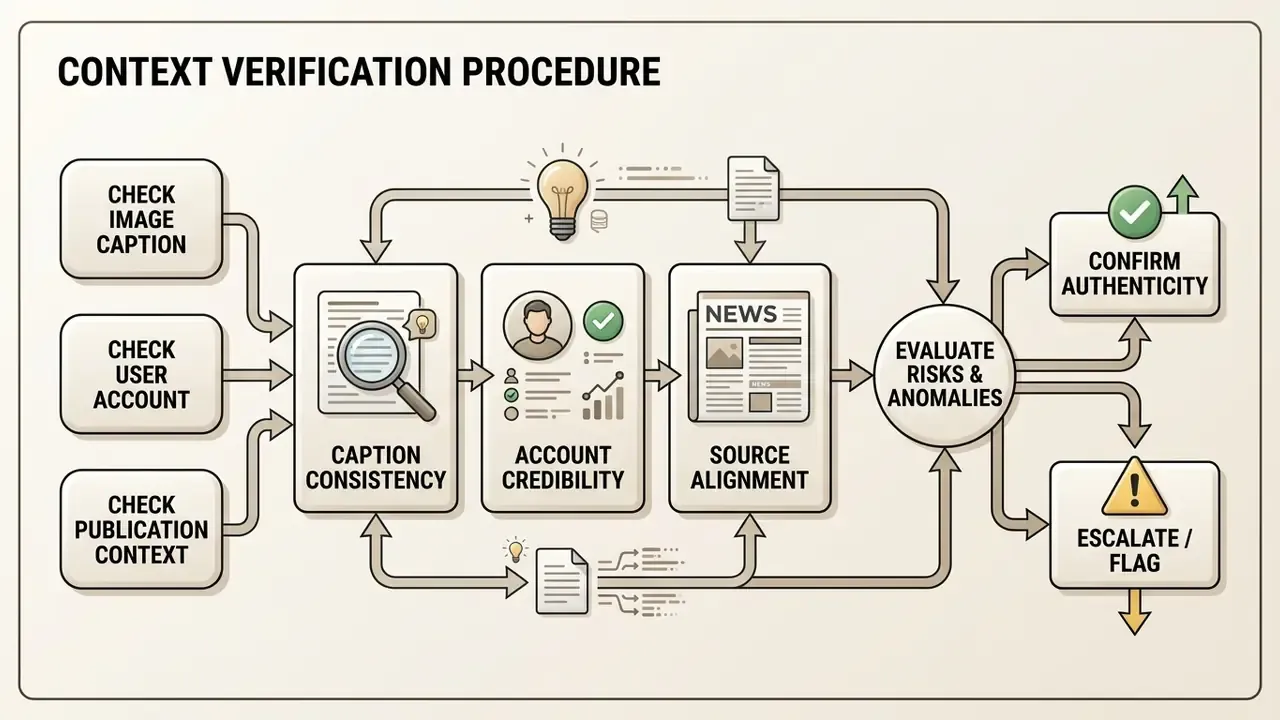
Compare the Caption, Account and Publication Context
Contextual analysis evaluates the relationship between an uploaded image, its accompanying textual claims, and the publishing entity's history. Misleading visual content frequently pairs real historical photography with fabricated headlines, or distributes AI-generated visuals through unverified accounts.
Check account creation dates, historical posting frequency, and cross-platform profile links when evaluating viral social media assets. Inconsistent publishing dates or mismatching geotags strongly signal coordinated inauthenticity or automated bot activity. NIST SP 800-12 Rev. 1 notes that fake and unverified social accounts are routinely used to impersonate colleagues or customer-service staff for social engineering. That makes account credibility an inseparable part of image verification rather than a separate exercise.
How to Use an AI Image Detector
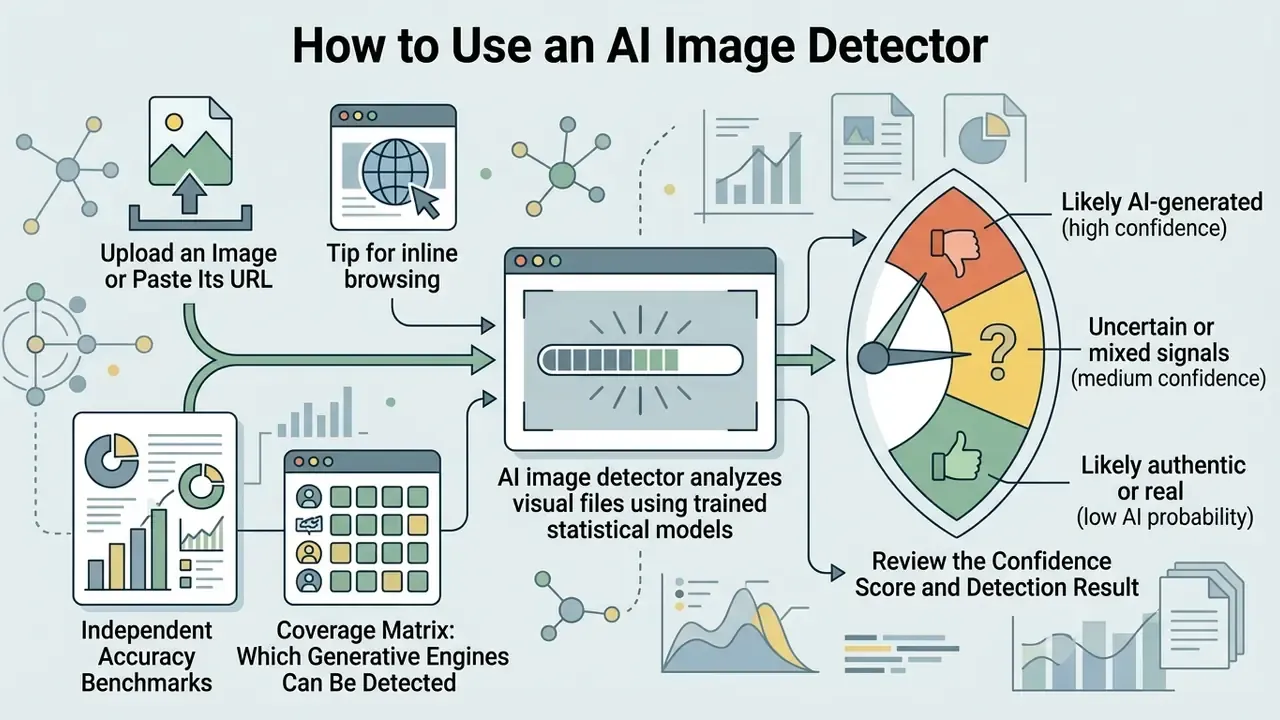
An AI image detector analyzes visual files using trained statistical models to calculate the likelihood that an asset was generated by artificial intelligence. Integrating automated detectors into review pipelines accelerates screening while providing objective confidence metrics.
Effective detector use requires precise operational procedures, both to control input quality and to keep output scores interpretable.
| Verification stage | Primary tool / technique | Key signal examined | Robustness to compression | Compute cost | Limitation / risk |
|---|---|---|---|---|---|
| 1. Visual inspection | Manual and expert review | Anatomical errors, lighting vectors, broken text | Medium | Low (human time) | Subjective; accuracy drops on high-quality outputs |
| 2. Technical metadata | EXIF parsers, C2PA verification | Cryptographic signatures, camera hardware logs | Very low | Very low | Frequently stripped by social platforms; fields can be forged |
| 3. Reverse search | Google Lens, TinEye, Bing Search | Index timestamps, source domain attribution | High | Low | Fails on newly generated, unpublished images |
| 4. Passive AI detectors | Statistical pattern classifiers | High-frequency noise, VAE reconstruction error | Low | Medium | Susceptible to false positives after JPEG compression |
| 5. Multi-signal fusion | Cross-detector consensus engine | Consolidated score alignment across platforms | Medium | High | Requires orchestration, thresholds, and audit logging |
Independent Accuracy Benchmarks
Buyers should demand third-party evaluation rather than vendor self-reporting. According to multi-generator evaluation benchmarks conducted across 80,000 synthetic and authentic visual assets in a joint study by researchers at the University of Rochester and the University of Kansas, leading passive statistical detectors achieve up to 98% accuracy on uncompressed base outputs such as GAN and early diffusion models. Accuracy, however, decays by 14 to 32% when testing cross-generator media, for instance Flux Pro or Sora 2 outputs, or assets subjected to lossy social-media re-compression at JPEG quality below 70.
These numbers should be read alongside the zero-shot findings cited earlier. A detector can be state of the art on a public benchmark and still approach chance level on a generator released after its training cut-off. Model risk teams therefore track two separate metrics: benchmark accuracy, and time-to-coverage for newly released generators.
Coverage Matrix: Which Generative Engines Can Be Detected
| Generation engine category | Core models covered | Forensic fingerprint evaluated | Detection reliability |
|---|---|---|---|
| Latent diffusion (text-to-image) | Midjourney v5 to v7, Flux.1 (Dev/Schnell/Pro), Stable Diffusion 1.5 to 3.5, SDXL, Ideogram 3.0, Seedream 3.0, Reve 1.0 | High-frequency latent noise, VAE reconstruction loss | High (88% to 96%) |
| Autoregressive and multimodal | GPT-4o / GPT image generation, Grok Imagine, Google Imagen 3, Nano Banana Pro, Recraft V3, Qwen-VL, Adobe Firefly 2 to 4 | Spatial text geometry, synthetic anti-aliasing, token-grid regularity | Medium-high (82% to 91%) |
| Video generation systems | OpenAI Sora / Sora 2, Google Veo 1 to 3, Kling 1.5 to 3.0, Wan 2.5 to 2.7, Runway Gen-2/Gen-3/Gen-4, Hailuo 02, Pika, LTX Video, Vidu, Seedance | Temporal frame consistency, optical-flow vectors, inter-frame noise drift | Moderate (70% to 84%) |
| Legacy and GAN architectures | StyleGAN2/StyleGAN3, BigGAN, deepfake face swaps | Spectral frequency spikes, eye-iris symmetry, periodic upsampling traces | Very high (95% to 99%) |
Detection in this matrix operates on pixel content, not on metadata, so results should hold even when EXIF has been stripped and no visible watermark remains. Coverage is continuously updated as engines ship. Still, expect a gap of several weeks between a major model launch and stable detection performance on its outputs. Teams integrating video pipelines can review model-level capabilities and cost structures in our Google Veo implementation guide, check the slideshow and animation paths described in how to create a video with pictures, and compare image-side vendor terms in the Microsoft AI Image Generator overview.
Upload an Image or Paste Its URL
To achieve accurate analysis results, upload original, uncompressed files directly into the detection platform whenever possible. Submitting re-compressed screenshots or low-resolution web thumbnails degrades high-frequency pixel data and reduces classification precision.
Ensure target image links point directly to raw image files rather than container web pages, and confirm the URL is publicly reachable if the endpoint fetches remotely. Common API constraints include a hard file-size ceiling (frequently 2 to 100 MB), a fixed format allowlist (JPG, JPEG, PNG, WebP, AVIF, HEIC), and rejection of password-protected or image-only containers without extractable structure.
# Enterprise multi-detector API request example (cURL)
curl -X POST 'https://api.example-verify.com/v1/media/verify' \
  -H 'Authorization: Bearer YOUR_API_KEY' \
  -H 'Content-Type: application/json' \
  -d '{
    "image_url": "https://example.com/suspicious-asset.jpg",
    "detection_models": ["genai_spectral", "deepfake_face", "c2pa_manifest"],
    "min_confidence_threshold": 0.85,
    "return_heatmap": true,
    "audit_reference": "CASE-2026-04417"
  }'
# Python equivalent with local file upload
import requests
with open("suspicious-asset.jpg", "rb") as asset:
    response = requests.post(
        "https://api.example-verify.com/v1/media/verify",
        headers={"Authorization": "Bearer YOUR_API_KEY"},
        files={"media": asset},
        data={
            "detection_models": "genai_spectral,deepfake_face,c2pa_manifest",
            "min_confidence_threshold": "0.85",
            "audit_reference": "CASE-2026-04417",
        },
        timeout=30,
    )
result = response.json()
print(result["verdict"], result["confidence"], result["model_votes"])
Always persist the full JSON response, including model votes, threshold, and API version, rather than only the final verdict. Without the raw response, a decision cannot be reconstructed for an auditor. For complex digital workflows, teams reference developer documentation in AI Media API Guides to automate direct image submission pipelines.
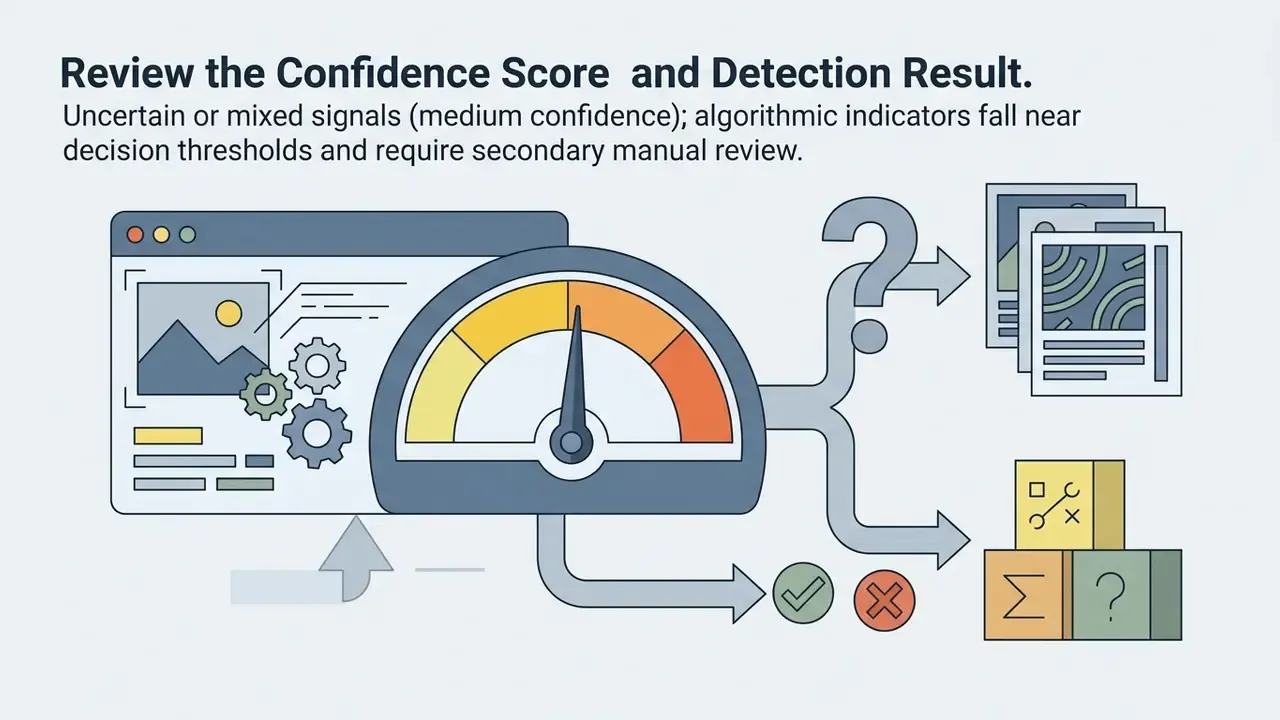
Review the Confidence Score and Detection Result
Automated classifiers return a numerical confidence score ranging from 0.0 to 1.0 (or 0% to 100%), representing the statistical probability that an asset is AI-generated. Results are categorized into standard verdict tiers:
Interpret these outputs as probabilistic risk scores rather than definitive legal proof. NIST's 2025 image-discriminator evaluation plan treats the confidence score as a 0 to 1 likelihood that an image was AI-generated, and requires the decision cutoff to be stated explicitly, because performance is assessed across thresholds via ROC/AUC rather than at one universal point. Calibration matters as much as discrimination: two detectors with identical AUC can differ substantially in Brier score, meaning one produces better-calibrated probabilities than the other at the same ranking quality.
Model risk frameworks therefore require explicit cutoff thresholds, such as a 0.85 score threshold for automated flags, tailored to organizational risk tolerance, with the rationale for that choice written down.


Compare Results From More Than One Detector When Stakes Are High
Because individual detector architectures exhibit dataset bias and variance across different generative models, high-stakes decisions require multi-detector consensus scoring. An AI photo checker optimized for Stable Diffusion may underperform when evaluating Midjourney or proprietary enterprise generators.
Run target assets through at least two independent detection tools operating on distinct methodologies, for example combining a frequency-domain spectral detector with a VAE reconstruction-error engine. Formalize the consensus rule rather than eyeballing it:
- Run two or more independent detectors on the identical source file.
- Align localized outputs (heatmaps or bounding regions) using an explicit overlap criterion such as an IoU threshold.
- Accept a positive finding only when consensus exceeds a preset majority or overlap rule.
- Route disagreements to a second-pass consensus score or to expert human review.
When detectors yield conflicting scores, escalate the file. To compare leading classification technologies, teams review detailed metrics in AI Media Benchmarks and Review Proof.
Governance: Confidence Thresholds, Escalation and Auditability
A detector without a decision policy is an unmanaged model risk. The following matrix converts probabilistic output into accountable action. Calibrate it per use case, because KYC onboarding, refund approval, and content moderation tolerate very different false-positive rates.
| Fused confidence score | Interpretation | Automated action | Operational owner | Evidence retained |
|---|---|---|---|---|
| 0.00 to 0.49 | No material synthetic signal | Auto-approve, log score | L1 automated pipeline | Score, model version, timestamp |
| 0.50 to 0.74 | Weak or mixed signals | Queue for standard review within SLA | L1 reviewer | Full JSON response plus reviewer note |
| 0.75 to 0.84 | Elevated synthetic likelihood | Mandatory manual review; request original uncompressed file | L2 compliance analyst | Detector outputs, metadata report, reverse-search results |
| 0.85 to 0.94 | High synthetic likelihood | Hold transaction or account action; second independent detector required | L2 analyst plus fraud investigation | Consensus record from two or more detectors |
| 0.95 to 1.00 | Very high synthetic likelihood | Escalate to fraud investigation; no automated adverse action without human sign-off | Fraud/AML investigator, with model-risk oversight | Complete case file including C2PA manifest and audit trail |
Auditability rules. Store the C2PA manifest (or the explicit finding that none exists), the raw detector response, the threshold in force at decision time, the detector and model version, the reviewer identity, and the final rationale. This record is what allows a bank or platform to demonstrate, after the fact, that an adverse decision rested on multi-signal evidence rather than a single probabilistic score.
Model risk alignment. Detectors used in credit, onboarding, or claims decisions fall within standard model-risk expectations for validation, documentation, and ongoing monitoring, including the supervisory guidance on model risk management issued jointly by the U.S. Federal Reserve (SR 11-7) and the OCC (Bulletin 2011-12). Practically, that means periodic back-testing against fresh generator outputs, tracking drift as new models launch, documenting threshold changes, and recording the compensating controls that apply when a classifier is known to be weak, for example on hybrid inpainted assets or heavily recompressed uploads. NIST SP 800-63-4 similarly frames automated facial comparison as one component of identity proofing, not as a standalone determination.
One further point that tends to surface late in procurement. If image verification is delegated to an automated agent that queues, scores, and routes cases without a person in the loop, the agent itself becomes a model under governance, with a named owner, approved scope, access limits, escalation path, and shutdown mechanism. Teams designing that layer should treat the design decisions in how to create ai agents as governance decisions, not engineering preferences. No evidence, no autonomy.
Limits of AI Image Detection: Edits, Deepfakes and Uncertain Results
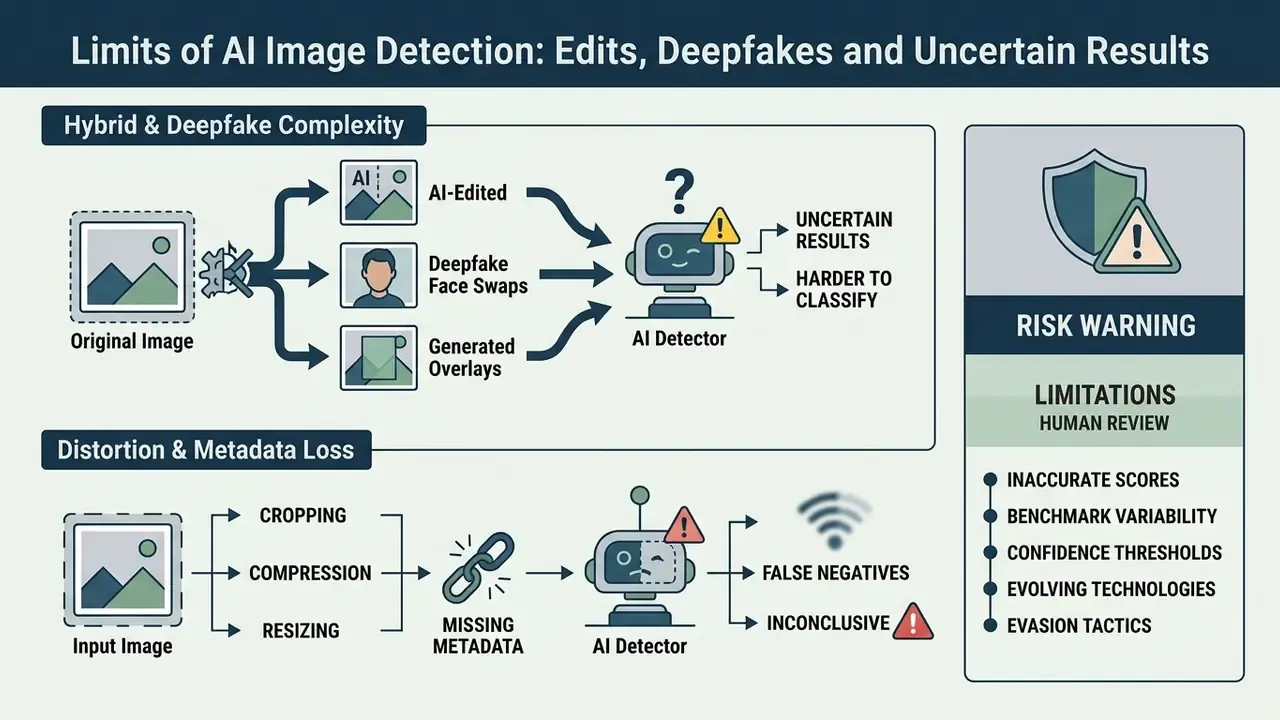
Automated detection tools face inherent technical constraints when evaluating real-world media assets. File compression, partial generative editing, and sophisticated post-processing pipelines can alter forensic signatures, which leads to false positives or false negatives.
Understanding these operational boundaries is essential for risk managers and compliance officers designing automated content workflows.
AI-Edited and Hybrid Images Are Harder to Classify
Hybrid images, meaning authentic photos containing localized generative edits such as AI background replacement or generative fill, present severe challenges to passive detectors. Most commercial AI image checkers evaluate global file fingerprints rather than localized pixel regions.
When an authentic photograph undergoes local inpainting, the underlying real content often suppresses global AI indicators, so detectors misclassify the asset as entirely real. NIST's definition of synthetic content covers media "significantly altered or generated by algorithms," explicitly including assets altered only in part, which is precisely why partial edits sit in the blind spot between "edited photo" and "AI image." Conversely, passing a real image through a generative encoder-decoder filter during basic retouching can trigger false positive flags across the entire file.
Watermark-based provenance can partially compensate, but only where it survives adversarial handling:
When modifying visual backgrounds or extending frames in corporate workflows, teams consult structured guidance on AI outpainting and background generation tools and the step sequence in how to change the background of a picture, so that generative edits are logged rather than silently baked into the final asset.
Cropping, Compression and Missing Metadata Affect Results
Standard image post-processing significantly degrades detection accuracy. Operations like lossy JPEG compression, spatial resizing, center cropping, and color quantization remove the subtle high-frequency noise patterns that statistical detectors rely upon for classification.
Recent empirical studies show that heavy JPEG compression can reduce cross-generator detection accuracy from above 85% down to near-chance levels.
Metadata-layer detection collapses even faster. A 2026 evaluation recorded C2PA and IPTC marker detection falling from 71.0% on original files to 0.47% after manipulation, with center-cropping leaving markers detectable in only 1.00% of cases and JPEG recompression in 0.21%. Cropping also removes edge artifacts and background structures, which makes it far harder to detect deepfakes or cropped synthetic assets.
Risk warning. An automated AI detector verdict must never serve as the sole legal or institutional justification for accusing an individual of fraud, identity theft, or academic misconduct. The U.S. Identity Fraud Detection Playbook (2026) directs analysts to assess fraud using multiple signals, including system audit logs, anomaly analytics, and multi-factor verification, rather than a single automated indicator. Institutional policy guidance in academic settings reaches the same conclusion: a high AI score can trigger a review but cannot establish misconduct, and documented false positives cluster in specific populations and content styles. The purpose of this control is to prevent improper administrative or financial action caused by algorithmic false positives on real or minimally edited assets.
When AI Image Verification Matters Most
Verifying image authenticity is vital across high-risk commercial, legal, and operational environments. Deploying controlled verification frameworks mitigates financial loss, reputational damage, and regulatory compliance breaches.
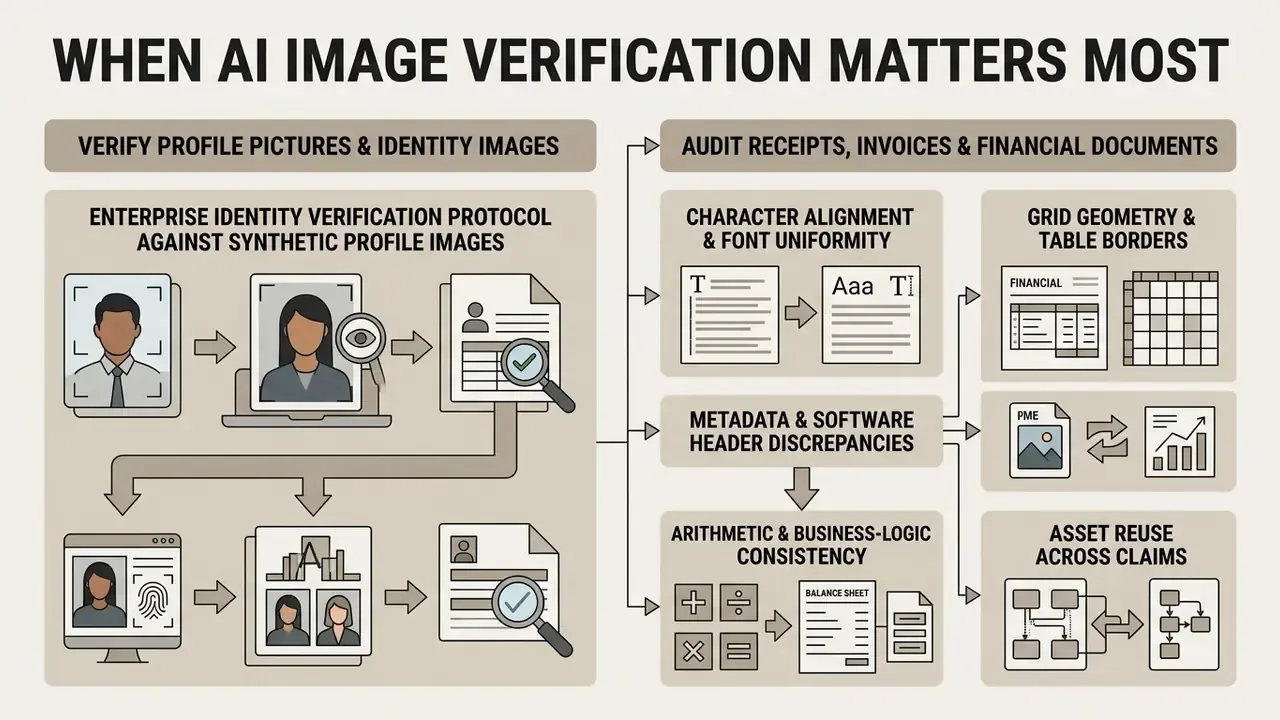
Verify Profile Pictures and Identity Images
Financial institutions and digital platforms face growing risks from synthetic profile pictures used in social engineering and account takeover schemes. Fraudsters generate realistic synthetic avatars to build convincing fake profiles across professional networks and dating services. The FBI's IC3 public alert (2024) reports that criminals use generative AI to create fraudulent identities and advises limiting public exposure of images and voice samples. DHS reporting (2025) documents AI avatar impersonation used for social engineering against personnel, and ESMA (2026) records fraudsters generating fake profiles to identify victims on social media and dating apps.
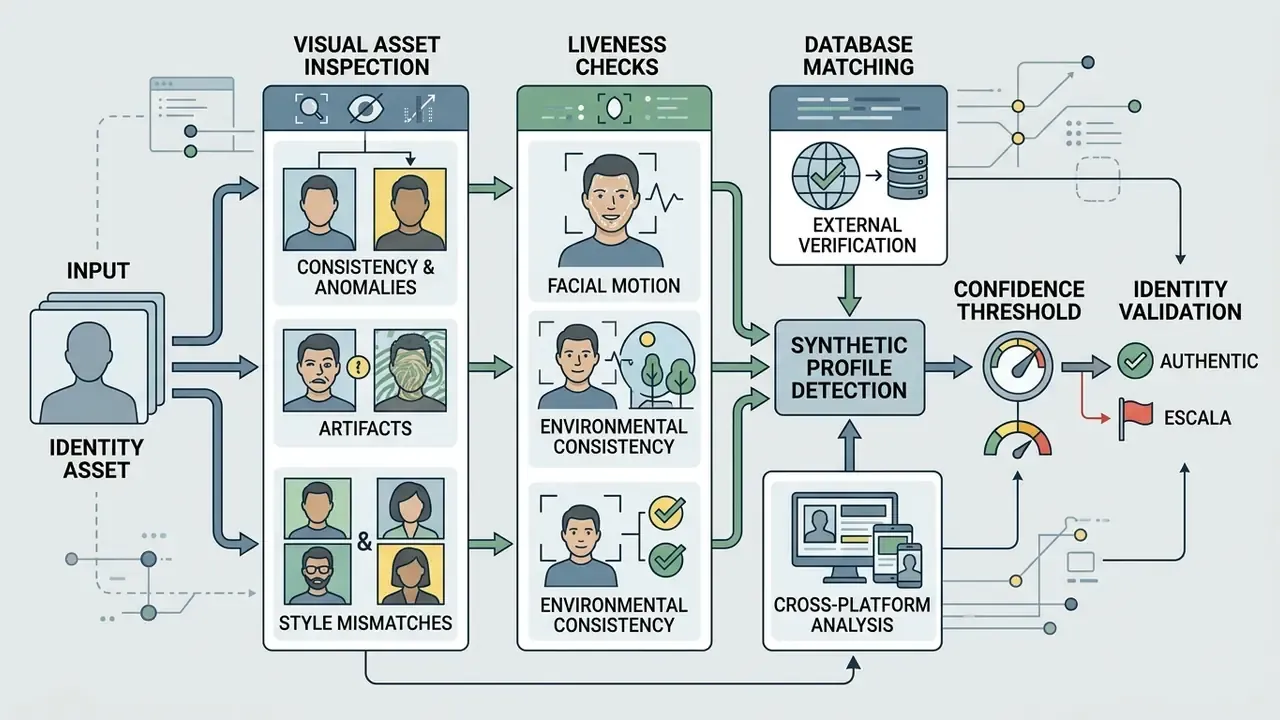
To combat identity theft, enterprise onboarding systems combine automated liveness detection with facial asset analysis. Verifying profile pictures prevents impersonation fraud during remote customer onboarding and compliance verification.
That range is the quantitative justification for automation. A reviewer operating unaided on a high-volume onboarding queue performs close to coin-flip on the hardest assets, which is why NIST SP 800-63-4 pairs automated facial comparison with liveness capture rather than relying on either alone.
Audit Receipts, Invoices, and Financial Documents
Automated fraud networks increasingly deploy generative text-and-layout engines to forge proof-of-payment receipts, bank statements, delivery confirmations, and invoices. These documents drive irreversible cash movements: refunds, reimbursements, claims payouts, supplier settlements. Detecting synthetic financial documentation therefore requires specialized audit procedures beyond standard facial checks:
- Character alignment and font uniformitygenerative models often alter font kerning, baseline elevation, and character heights mid-string, most visibly inside numerical totals, tax lines, and reference numbers.
- Grid geometry and table bordersinspect pixel-level continuity along invoice bounding boxes and tabular rules. Synthetic edits introduce anti-aliasing blur along sharp vector boundaries that a native PDF renderer would keep crisp.
- Metadata and software header discrepanciesauthentic scanned or digital PDF receipts retain EXIF/XMP printer logs or rendering-engine tags (for example Adobe PDF or Quartz). AI-generated document images typically lack structured container streams or show generic canvas exports.
- Arithmetic and business-logic consistencyrecompute line items against subtotals, tax rates, and stated totals. Verify merchant identifiers, invoice numbering sequences, and payment timestamps against internal records.
- Asset reuse across claimshash and index submitted documents so the same receipt image cannot be recycled across unrelated accounts or repeated refund requests.
Financial-services fraud teams, KYC units, and high-volume marketplace or delivery platforms apply these checks before approving payouts, disputes, and seller verifications. These are the workflows where a single image can authorize a real transfer of funds.
Check Product Listings and Marketplace Images
E-commerce platforms and digital marketplaces must identify synthetic product visuals that misrepresent item quality or promote non-existent inventory. Fraudulent sellers use generative tools to create pristine product listings, which misleads consumers and increases chargeback risk.
Marketplace risk engines check uploaded product images for broken text, mismatched lighting, and duplicate visual assets across unrelated merchant accounts. Published 2026 marketplace-fraud guidance describes exactly this multi-signal pattern: image artifacts such as warped on-pack text, inconsistent lighting and mismatched shadows; reverse-image search for reuse across unrelated stores; near-duplicate or templated product descriptions; and seller-age plus price-outlier checks. Vendor fraud documentation adds automated analysis of pixel artifacts, metadata, structural layers, and generator fingerprints to score listing media before publication, while a 2026 peer-reviewed study on AI-generated fake review detection treats coordinated language patterns and account-behavior similarity as measurable fraud indicators.
Whole storefronts are now stood up in an afternoon, which is why a listing review cannot stop at the product photo; the site build itself is a signal, as anyone who has followed a guide on how to create a website with ai will recognize. Automated seller risk scoring therefore combines image analysis with seller age metrics and pricing analytics to catch commercial fraud early, rather than treating image classification as a standalone gate.
FAQ: Frequently Asked Questions About AI Image Detection
Can a Detector Identify the AI Model That Generated an Image?
Yes, specialized attribution detectors can identify the specific AI model family (such as Stable Diffusion, Midjourney, or Bing Image Creator) used to generate an image, provided the file retains its original generative signatures or embedded metadata. Published research benchmarks demonstrate source attribution accuracies between 75% and 92% under controlled laboratory conditions. The WACV 2025 paper Detecting Origin Attribution for Text-to-Image Diffusion Models reported above 90% attribution accuracy on its benchmark (90.03% and 90.96% in the best settings), and the NeurIPS 2023 study Where Did I Come From? Origin Attribution of AI-Generated Images reported 87.5% calibrated detection accuracy and over 90% detection accuracy on Stable Diffusion v2. A 2025 training-free resynthesis method reached 0.95 plain source-attribution accuracy, but fell to roughly 0.58 under some post-processing conditions, and a 2025 real-world benchmark placed the best method at 89.59%.
Attribution accuracy drops significantly, though, if the target file undergoes heavy compression, cropping, or custom fine-tuning. While tools like Bing Image Creator (Microsoft Image Creator) routinely attach C2PA provenance credentials, community-modified open-source generators often remove default watermarks, which makes precise model identification probabilistic rather than absolute. Midjourney outputs currently carry no C2PA manifest and no publicly documented invisible watermark, so pixel-only attribution there is weaker than for provenance-rich pipelines.
«User-aware watermarking systems demonstrate high detection and attribution rates under standard post-processing, but lose effectiveness under aggressive editing.» User-aware watermark detection and attribution study (2024 to 2026)
Can AI Identify a Picture Without Any Surrounding Context?
Partly. A classifier can score a bare image file, because it reads pixel statistics rather than context. What it cannot do is tell you who published the asset, when, or why, and those three facts often decide the case. In practice, a strong pipeline runs the pixel score first, then rebuilds context through reverse search, timestamps, and account history.
Does Detection Work Without Metadata or Watermarks?
Yes. Pixel-level classifiers operate on image content, not on EXIF fields, C2PA tags, or visible watermarks, all of which are commonly stripped when files are uploaded to social networks, messaging apps, or marketplaces. The trade-off is that pixel-only detection is more sensitive to compression and cropping. So the absence of metadata shifts you into the least robust part of the accuracy curve rather than removing the limitation.
What Is the Difference Between AI Detection and Deepfake Detection?
AI detection identifies any image or video generated or substantially edited by a generative model. Deepfake detection targets a narrower task: face swaps and facial manipulation. The two answer different questions, and most high-risk workflows benefit from running them together. A face-swap deepfake built on an authentic photograph may score low on a generic genAI classifier while scoring high on a face-manipulation model.
How Quickly Are New Generators Covered?
Expect a lag. Detectors are typically updated within weeks of a major model release, and during that window accuracy on the new model's outputs is materially lower than on established generators. Governance frameworks should treat "newly released generator" as an explicit exception condition that raises the review tier rather than trusting the score.
What Do C2PA and SynthID Actually Guarantee?
C2PA (Content Credentials) attaches cryptographically signed manifests to an asset, recording creation and editing history; version 2.4 also permits invisible watermarks as soft bindings recorded in the manifest. Google's SynthID embeds imperceptible watermarks at generation time and is designed to survive common modifications. Both raise confidence when present. Neither proves anything when absent: C2PA is an open multi-vendor standard with broad but incomplete adoption, SynthID is concentrated in Google's own products and models, and platform re-encoding routinely destroys both.
Can These Tools Replace Human Judgment?
No. Detector output is a screening signal. Different detectors carry different error profiles, since some maximize recall and generate many false positives while others miss synthetic assets entirely, and both directions cause harm when acted on automatically. Human review remains the decision authority in every adverse-action pathway.
Reviewer Checklist and Next Steps
Before escalating a suspicious image, an L1 reviewer should be able to answer all of the following:
Evaluating digital media authenticity requires an integrated approach that balances automated detection tools with human oversight. Organizations building AI governance frameworks should treat image detection outputs as probabilistic risk indicators inside a broader evidence chain, documented well enough to withstand later scrutiny.
A safe next step, if you are early in this work, is narrow rather than sweeping. Pick one high-volume pathway, refunds or onboarding, set thresholds, run detectors in shadow mode for a month, and measure false positives against manual outcomes before anything becomes automatic.
To explore comparative tool analyses, strategic implementation guides, and enterprise integration workflows, consult our related resources:
- Examine model evaluations and side-by-side performance tests across our compare matrix, including the best AI art generator comparison for understanding which engines your pipeline must cover.
- Calculate operational risk-adjusted metrics and cost models using our interactive business calculators.
- Review provenance-preserving editing and export practices in our guide to online photo editors.
- Trace reuse, geolocation, and publication history with the tools covered in our AI reverse-image-search comparison.
- Assess video-generation coverage requirements and API economics in the Google Veo implementation guide.
- Map end-to-end verification and moderation pipelines across AI Media Workflows.
Checklist0 / 10