If you sit in a risk, compliance, or communications seat at a US bank or a mature fintech, the topic has already crossed your desk. Maybe as a marketing request. Maybe as a fraud incident. Synthetic imagery is now both a production tool and an attack surface, and the two arrive through the same door.
The landscape of visual digital media has shifted structurally as generative AI tools moved from technical novelty into everyday enterprise adoption. Organizations and newsrooms process thousands of synthetic visuals daily, which makes provenance and authentication governance priorities rather than creative preferences. Teams building a controlled implementation path in regulated sectors can start with a structured review of AI art generator capabilities and licensing before any production rollout.
Executive Summary for risk, compliance and communications leaders
- Detection is no longer the primary control. Regulators and standards bodies have moved from "spot the fake" to mandatory provenance. EU AI Act Article 50 requires machine-readable marking from 2 August 2026, California SB 1000 requires provider-side detection tooling, and NASA already mandates permanent watermarking plus embedded metadata for external media.
- Human visual inspection fails structurally, not occasionally. Australian National University research documented "AI hyperrealism": people identify synthetic faces as real more often than they identify genuine human faces as real. Visual review cannot be the final authentication step for any material decision.
- Financial exposure is already realized, not hypothetical. A single deepfake video-conference fraud produced a $39 million AUD payment authorized by one employee. Synthetic imagery has moved markets (the fabricated Pentagon explosion) and triggered union and regulator escalation (Meta's Muse Image rollback after SAG-AFTRA pressure).
- Commercial use requires vendor-level and role-level controls. Dataset transparency, native C2PA support, and legal indemnification differ sharply between Adobe Firefly, Midjourney, DALL-E 3, and open-weight models such as Flux. Every published asset needs a named decision owner and a documented escalation path.
What changed in 2026, in three shifts
Before the cases and the checklists, three changes are worth stating plainly, because they reframe the budget conversation.
First, the trust anchor moved into hardware. Cameras from Leica, Sony, Nikon, and Canon now sign frames cryptographically at capture. Provenance starts upstream of Photoshop, which means enterprises can demand signed source material from agencies and stringers.
Second, the legal clock started ticking. Two enforceable regimes share the same effective date of 2 August 2026 on opposite sides of the Atlantic. Multinational campaigns no longer get to wait for guidance.
Third, and least discussed: detection accuracy is trending down, not up. Generators improve faster than classifiers. Any control design that assumes a detector will keep pace is borrowing against a declining asset. That single point reshapes how AI image news should be read by a model-risk function.
What is happening in AI image news and why the topic became critical
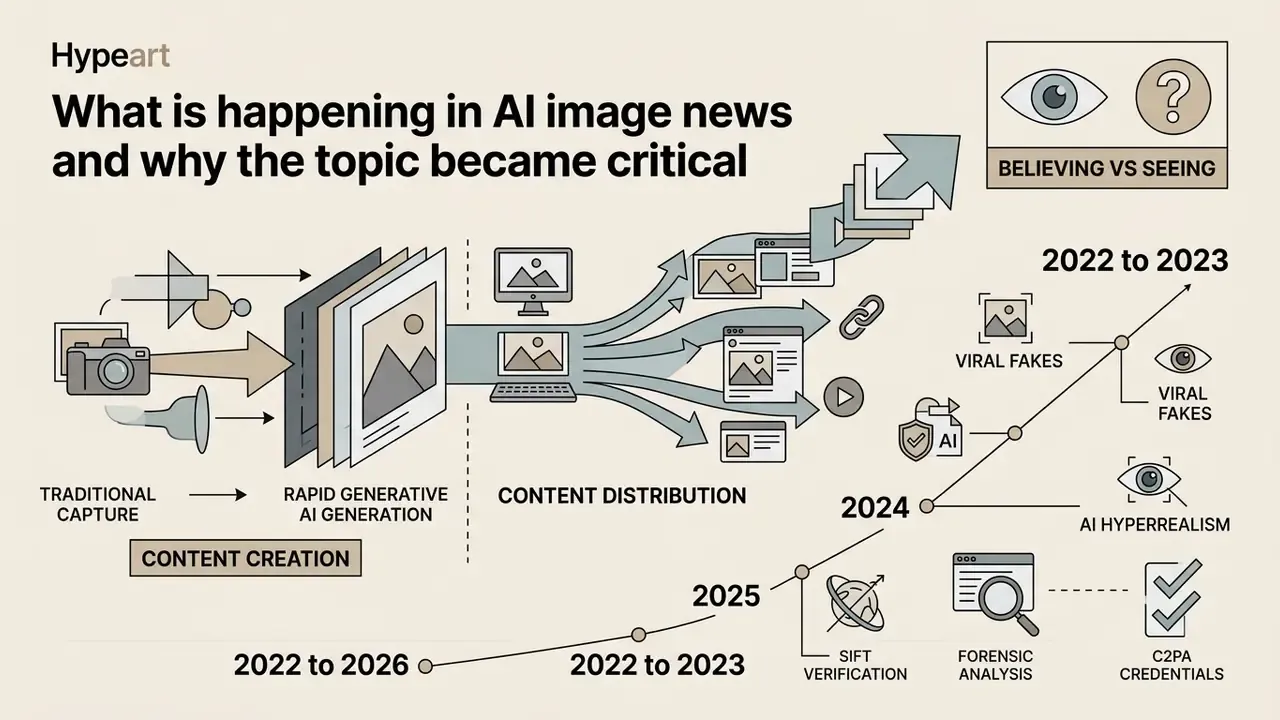
The rapid rise of AI image news reflects a structural shift in how visual content is created, distributed, and verified across digital channels. As artificial intelligence models became capable of generating photorealistic media on demand, public and corporate trust in visual information declined sharply.
According to the Reuters Institute Digital News Report 2024, 59% of news audiences express concern about distinguishing authentic content from synthetic media online. The same report documented publishers already using Midjourney and DALL·E inside editorial graphics workflows. Synthetic imagery is now both a risk vector and a production tool.
The widespread adoption of image generators across social media has turned synthetic imagery into a central risk factor for brand reputation and news integrity. There is historical continuity here, and it is worth noting. Disinformation has accompanied every major shift in reproduction technology. Benjamin Franklin printed fabricated atrocity stories from his Paris basement to build support for the colonists during the Revolutionary War, and the arrival of Photoshop in the 1990s triggered a comparable panic about photographic truth. Generative AI did not invent falsification. It collapsed the cost, the skill threshold, and the production time to almost nothing.
How generative AI changes the creation and distribution of visual content
Generative AI reduces visual asset creation time while sharply increasing content output volume across digital media. Modern architectures let non-technical operators produce high-resolution generated content from basic text prompts.
Academic research on content production indicates that generative tools can cut creation time by 37.8% while increasing visual asset volume by 63.7%. Those figures come from a self-media creator survey, so treat them as an indicative industry benchmark rather than a universal constant. Independent replication data is still limited. Media-production benchmarks report steeper compression: complete video packages falling from 8.5 hours to 33 minutes, and full visual asset sets generated in under 15 minutes from a structured brief.
Why seeing an image no longer means believing it
The spread of photorealistic fake images and altered image files has severed the traditional link between visual evidence and objective truth. Human visual inspection alone can no longer reliably separate a real photograph from a synthetic composite.
Research published in the iProov Deepfake Blindspot Report 2025 reports that 49% of surveyed users trust social media less after learning about deepfake capabilities, and that only 0.1% of a 2,000-person UK and US sample correctly identified every real and fake stimulus. A 2025 public trust survey adds that 85.4% of respondents said realistic deepfakes reduced their confidence in online photographs. That is a single-survey figure, directionally consistent with Reuters Institute and iProov data, though the underlying methodology is not fully published.
Seeing an unverified image is no longer proof that an event occurred.
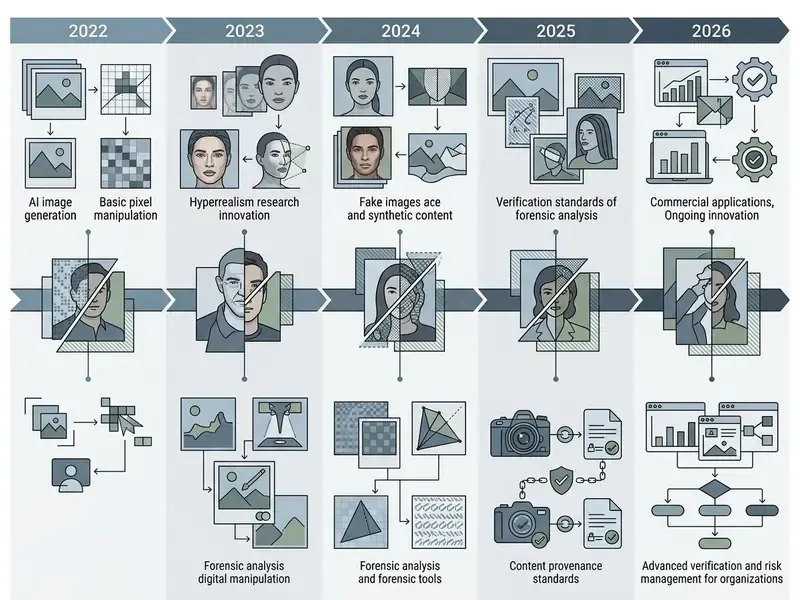
The most notable AI-generated images news cases
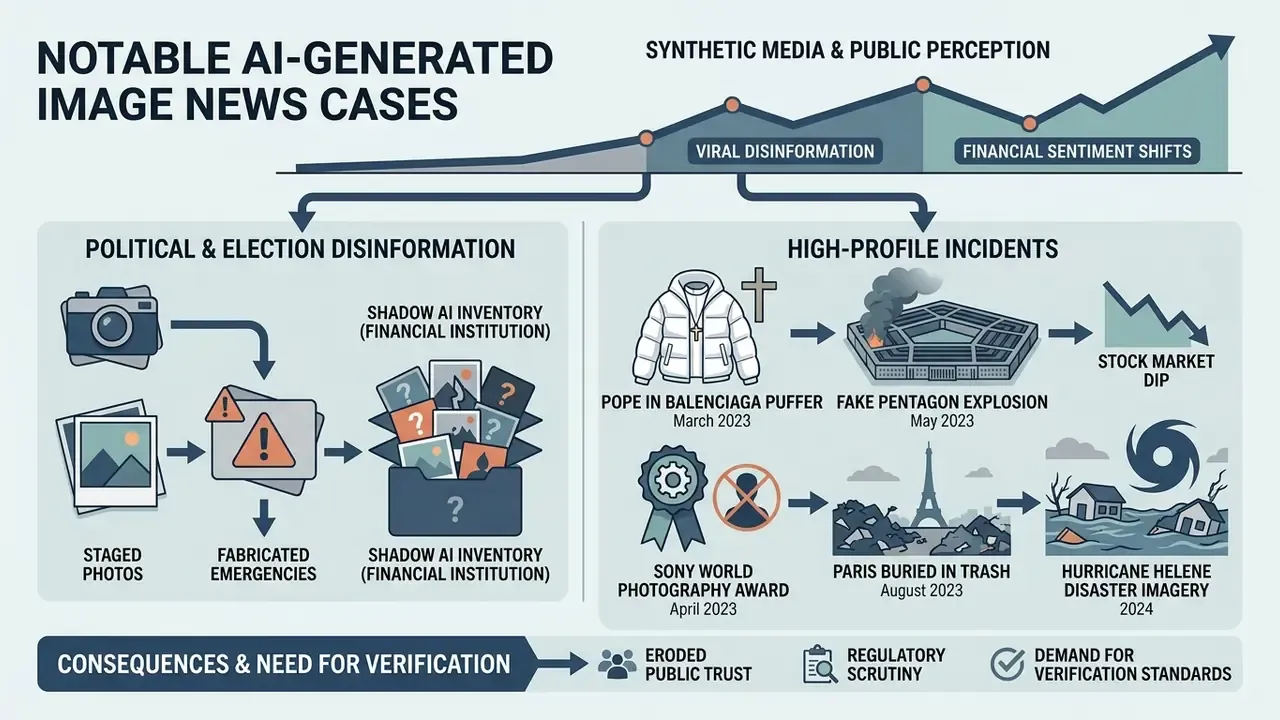
High-profile synthetic media incidents during global elections and viral news cycles have proven that fake images can move public perception and financial sentiment quickly. Unverified generated content shared across social media platforms can trigger immediate market volatility before factual corrections land.
Political AI images, elections and disinformation
Political deepfakes targeting election candidates, including former president Donald Trump and other global leaders, appeared in 80% of countries holding 2024 national elections. Social amplification turns political AI-generated images into potent instruments of electoral influence.
According to a 2025 summary for policymakers by the International Panel on the Information Environment, 90% of documented election incidents involved synthetic content creation, 25% of attributable incidents originated from political candidates or parties, 20% from foreign actors, and 69% were assessed as harmful to election integrity.
Testing by the Center for Countering Digital Hate found that leading image generators produced election-disinformation visuals in 41% of 160 test runs, covering 40 political prompts across Midjourney, ChatGPT Plus, DreamStudio, and Microsoft Image Creator. Vendor guardrails have since been updated, so those figures describe the 2024 test window. AI-generated portraits featuring president Donald Trump circulated widely across political networks, blurring the boundary between satire and deliberate fake news.
Documented Trump-related precedents illustrate the full spectrum of harm. In March 2023, Bellingcat founder Eliot Higgins published Midjourney images of a fabricated Trump arrest, viewed 6.7 million times despite his disclosure of AI use. In August 2024, Trump shared AI-made images implying a Taylor Swift endorsement, later acknowledging they were not real. That same year he accused a Harris campaign rally photo of being AI-enlarged, and the image was authentic. That inverse risk matters just as much: AI can be weaponized to discredit genuine evidence. In April 2026, an AI image of Trump as a Jesus-like healer drew cross-partisan criticism and was deleted within a day.
Comparable patterns appeared elsewhere. The Kofi Annan Foundation and Democracy Reporting International documented Italy's Lega running 19 GenAI posts with synthetic images amplified as ads to roughly 3 million Meta users during the 2024 European Parliament elections. The Adria Digital Media Observatory logged 90 generative-AI disinformation cases around the 2024 to 2025 Croatian presidential elections. Partisan usage patterns also diverge by platform:
Viral fakes: from staged photos to fabricated emergencies
Viral fake images spread through emotional salience, algorithmic repetition, and identity-driven sharing. A false sense of consensus forms before verification even starts. Digital platforms prioritize high-arousal visual content, which accelerates the reach of fabricated crisis photos.
A 2026 evidence summary by the University of Edinburgh confirms that platform algorithms systematically amplify high-velocity multimodal content, and that repetition itself manufactures an illusion of truth.
The canonical cases are worth recording precisely, because they are the reference points most stakeholders already half-remember:
| Case Title | Source and Date | Distribution Channel | Fact-Checker Verdict |
|---|---|---|---|
| Artemis II Earth Photo | Reuters Fact Check (2026) | X, Facebook, Instagram | False: image was generated using AI, not captured by NASA spacecraft. |
| Commons Speech Video Clip | Reuters Fact Check (2026) | TikTok, social media | False: synthetic clip containing a fake parliamentary exchange; source account primarily posted AI content. |
| London Police Tackle Incident | Reuters Fact Check (2026) | X, viral messaging | False: AI-generated video and image sequence depicting fabricated arrests. |
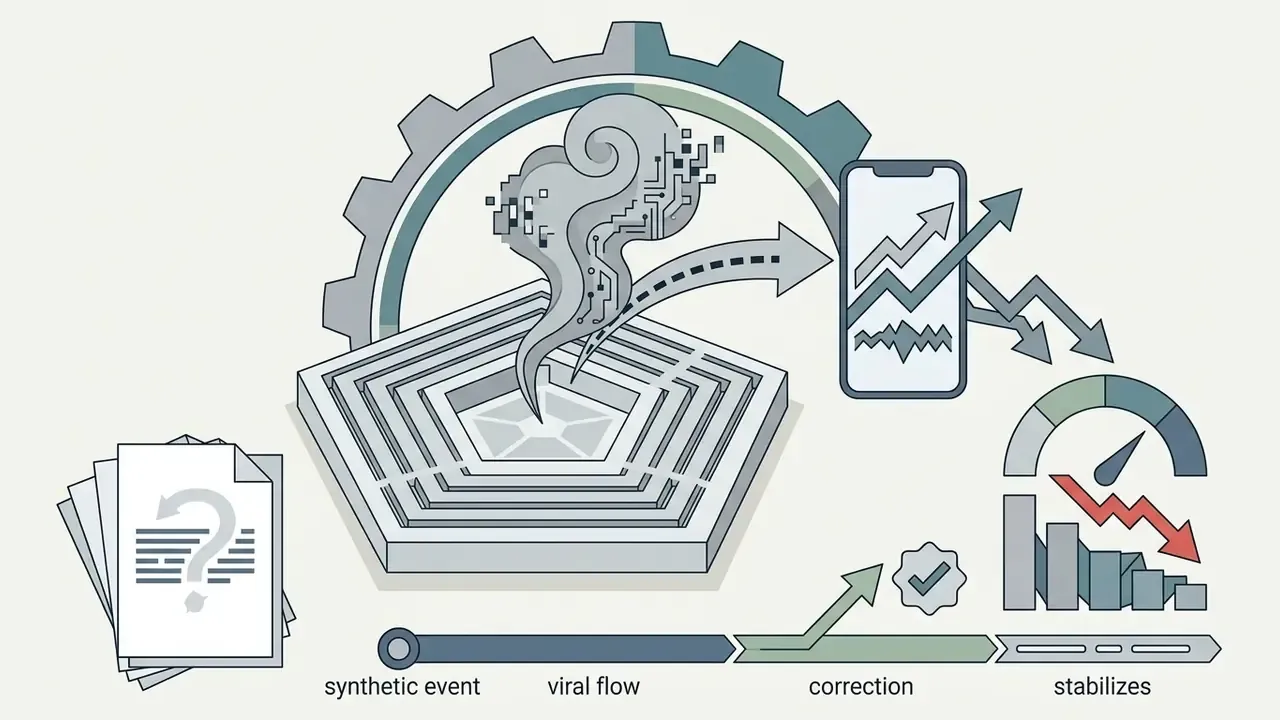
| Pentagon Explosion | AFP / Reuters (2023) | X (Twitter) | False: synthetic image; caused a short-lived market reaction. |
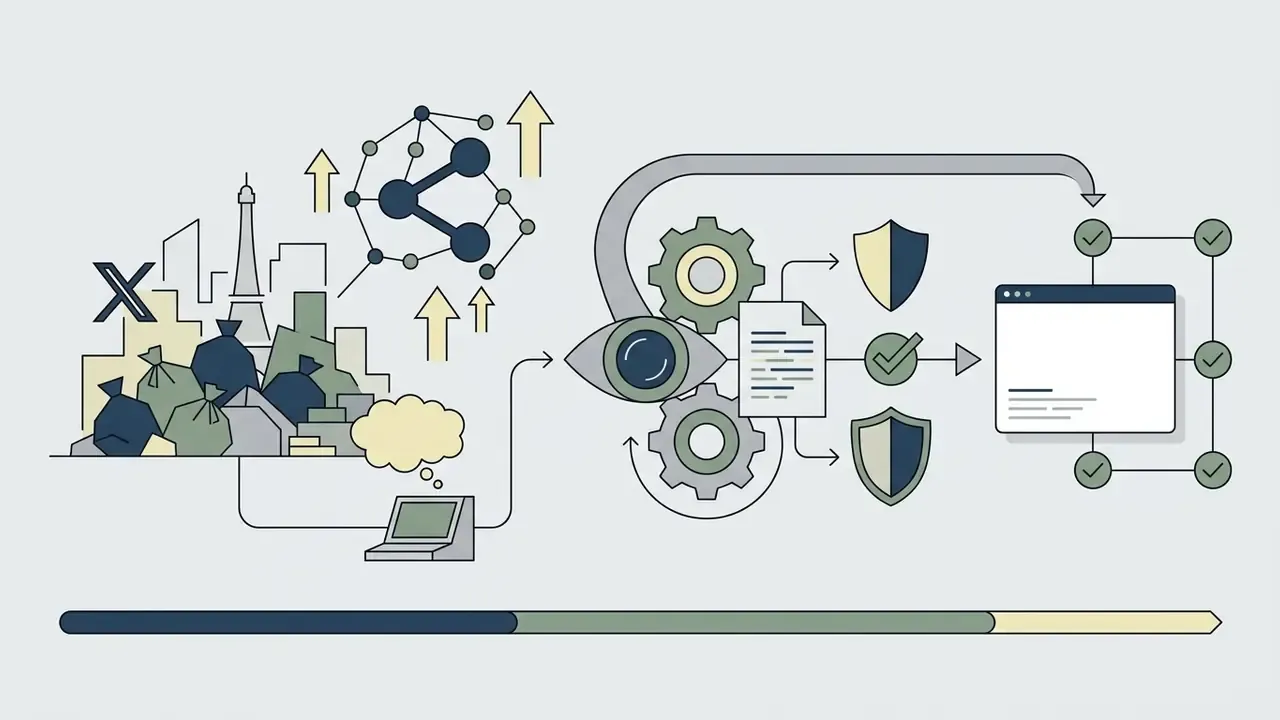
| Paris Trash Crisis Images | AFP Fact Check (2023) | TikTok, Facebook | False: created in Midjourney by artist "Nik Art". |
Each row above records the first known source, the date of appearance, the distribution path, and the independent verdict. That four-field record is the minimum documentation standard worth adopting internally for any inbound image that shapes a decision.
Deepfake fraud, KYC exposure and likeness-rights conflicts
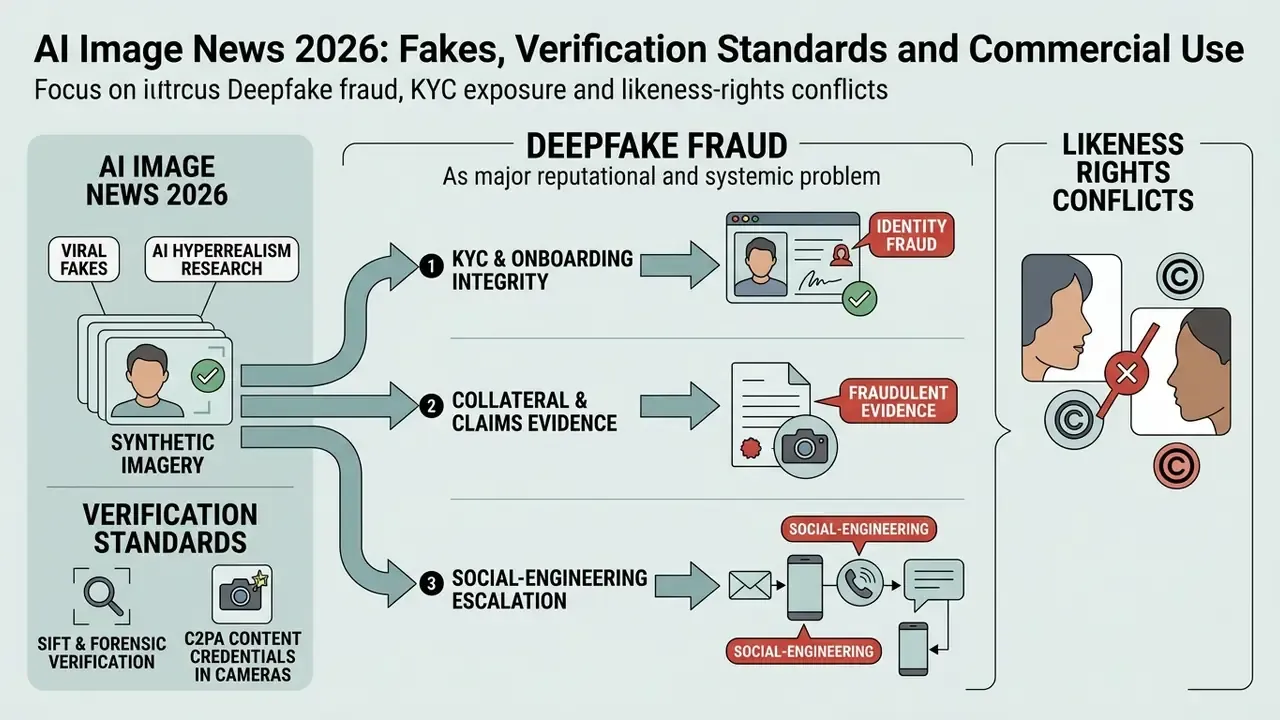
Synthetic imagery is not only a reputational problem for newsrooms. It is an operational fraud channel for regulated institutions. In February 2024, a finance employee authorized payments totalling $39 million AUD after a video conference in which every other "colleague", senior executives included, was a generative deepfake. The control that failed was not technical detection. It was process design: a visual and voice channel was treated as sufficient authorization evidence.
For banks, insurers, and payment providers, three adjacent exposures follow directly.
- KYC and onboarding integrity. Synthetic portrait generation and document manipulation can defeat image-based identity proofing. Liveness checks and cryptographic document provenance become mandatory rather than optional, and AML alert triage inherits the same weakness when evidence arrives as an image.
- Collateral and claims evidence. AI-generated photographs of property damage, inventory, or collateral condition can be submitted in lending and insurance workflows. Provenance validation belongs in evidence intake, not in post-hoc audit.
- Social-engineering escalation. Fabricated imagery of executives, offices, or incidents supports pretexting attacks and market-moving rumours about the institution itself.
Likeness rights are the second front. In July 2026, Meta withdrew its Muse Image feature days after launch. The tool let Meta AI users tag public-facing Instagram accounts and generate altered images from that content, with users opted in by default. Meta conceded it had "missed the mark" and that the feature was "no longer available." SAG-AFTRA called the reversal a "win", having warned of an "utter miscalculation of public sentiment regarding the obvious dangers and harms inherent in such use", while Privacy International described the launch as "the latest sign AI companies see people's images and data as raw material to be exploited." The governance lesson is explicit: consent for likeness use must be opt-in, documented, and revocable, particularly for employee, customer, and spokesperson imagery. Where disputes escalate beyond internal remediation, coordination with counsel handling litigation should start before any public statement.
How to tell an AI-generated image from a real photograph
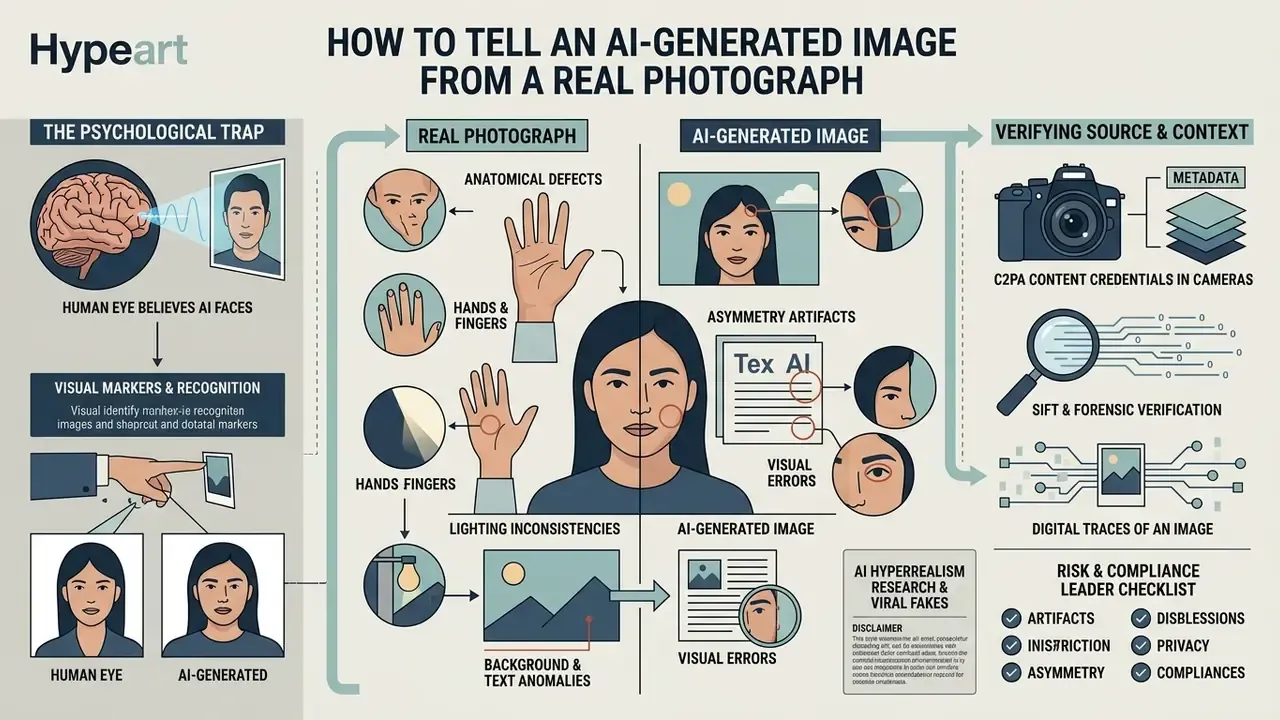
Distinguishing an AI-generated image from a real photograph requires a dual-track strategy: visual artifact analysis plus digital metadata verification. Detection cannot rely on one parameter, because model outputs keep improving in fidelity.
The NIST 2026 Guidelines on Reducing Risks Posed by Synthetic Content emphasize treating visual assessment as a combined evidence process rather than a single-cue judgment. Forensic specialists often use an ai sharpen image pass to raise local density and expose edge transitions, and they inspect suspect regions with professional photo editing and inspection tools.
The psychological trap: why the human eye believes AI faces
Before listing artifacts, understand why artifact-hunting fails on faces. Researchers at the Australian National University documented a phenomenon they named AI hyperrealism: participants identified AI-generated faces as real people more often than they identified photographs of actual humans as real. In the ANU stimulus set, 92% and 93% of participants judged specific synthetic faces to be real people, while 84% to 90% misclassified genuine human faces as AI-generated.
The mechanism is measurable. Generative models synthesize averaged facial features, and averaged faces read as more symmetrical, more attractive, and less memorable. Participants used attractiveness and familiarity as intuitive authenticity cues, and applied them in the wrong direction. Digital media lecturer Brendan Murphy of Central Queensland University notes that a trained eye can still find mismatches ("even if you look at things like teeth you might find that they're slightly asymmetrical, one too many, one too few"), while warning that "I don't think it's far in the future that there won't be any ways for a human to tell by eye."
Practical consequence for enterprise policy: visual review may reduce false positives, but it cannot be the terminating control for any decision with financial, legal, or editorial consequence.
Visual markers: faces, hands, text, lighting and background detail
Structural anomalies in AI-generated images appear most often in complex anatomical features, background lighting vectors, and text rendering. Baseline image generators have improved, yet fine-grained details still betray synthetic origin.
According to the OpenReview FAKEXPLAIN Detection Framework (2026), the key visual indicators include:
- Anatomical defects extra, missing, or fused fingers, impossible joint angles, teeth merging into a single block or overlapping the lips, irregular or non-circular pupil geometry, and unnaturally smooth, waxy, poreless skin.
- Lighting inconsistencies shadow vectors that conflict with the primary light source, non-circular specular reflections in the eyes, and shiny "water splotch" blobs across the frame.
- Background and text anomalies nonsensical background architecture, room corners that fail to meet, repeating patterns that drift or become implausibly perfect, warped signage, and garbled, illegible text.
- Asymmetry artifacts mismatched earrings, crooked or jagged eyeglass frames, and differing collar or fabric structure on the left and right side of a subject.
Because many artifacts live at the pixel level, reviewers frequently apply AI resampling and outpainting tools in reverse, magnifying suspect regions to reveal interpolation seams before rendering a judgment. Where captions or overlays obscure detail, an ai remove text from image step can expose the geometry underneath, while an ai remove background pass isolates the subject from an inconsistent backdrop. Synthetic product and architecture renders deserve separate scrutiny: output from an ai rendering generator or an ai stl generator can look photographic while describing an object that was never built.
Automated detectors materially outperform human review on curated datasets:
Verifying source, context and the digital traces of an image
Technical verification means examining file-level EXIF and XMP headers, confirming hash fixity, and running reverse image searches across established news indexes. Preserving the original digital asset is critical for forensic validity, and the choice of ai reverse image tooling determines whether an earlier publication of the asset can be found at all.
The NIST/OSAC Forensic Image Authentication Guide outlines a strict sequence: retain native file formats, calculate cryptographic hashes such as SHA-256 with documented fixity checks, inspect quantization tables and hex-level file structure, examine EXIF and XMP for camera make, model, serial number and timestamps, test noise characteristics including PRNU for source consistency, and trace publication history. ENFSI and SWGDE guidance add a distinct final step: confirm that the image's news context is coherent with the image itself.
An asset management firm once flagged a viral image purporting to show structural damage at a portfolio company's core facility. By running a four-step verification process, hash fixity, reverse image search, and structural metadata review, the risk team confirmed synthetic origin in 12 minutes and avoided an unnecessary market reaction. Twelve minutes. That is the entire window in which such a decision usually has to be made.
The SIFT method: fast verification for editors and non-specialists
- Preservation and fixity: retain the raw native file, compute and document the SHA-256 cryptographic hash, and work only on verified copies.
- Visual inspection: examine high-risk zones, meaning fingers, teeth, eye reflections and pupil shape, light symmetry, background geometry, and rendered text.
- Digital trace analysis: inspect EXIF, XMP, file headers, quantization tables and noise characteristics, and look for C2PA cryptographic manifests.
- Context cross-checking: run reverse image searches and cross-reference wire services to verify the event, then document the verdict and the evidence basis.
Teams that want the same sequence as a repeatable operating procedure can compare options for embedding it into existing intake pipelines.
Labeling, Content Credentials and defenses against visual disinformation
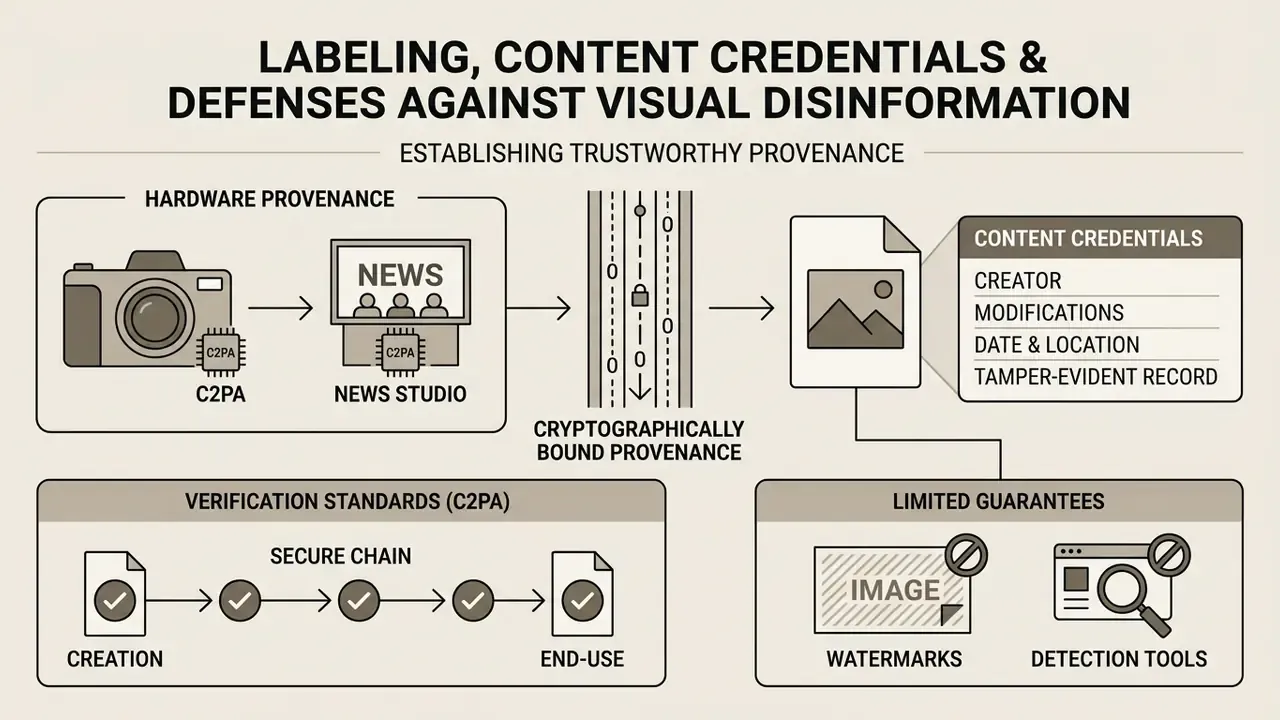
Technical defenses against visual disinformation rely on cryptographically bound provenance standards, primarily Content Credentials (C2PA), to establish a tamper-evident record of media creation and editing. These standards shift defense from reactive detection toward proactive origin verification.
The C2PA Technical Specification (2024) defines an open interoperable standard supported by the Coalition for Content Provenance and Authenticity, whose steering ecosystem includes Adobe, Google, Microsoft, Intel, Meta, and OpenAI, with more than 200 members overall and ISO standardization in progress (ISO/TC 171/SC 2, referenced as ISO 22144). Organizations expanding their technical vocabulary around asset categories can review a glossary-level breakdown of AI portrait generation, one of the highest-risk categories for likeness misuse, or explore the hub for adjacent definitions.
How Content Credentials and provenance authentication work
Content Credentials work by embedding cryptographically signed manifests into or alongside media files. Those manifests chain together assertions about creation devices, software tools, AI model usage, and post-production edits.
Each C2PA manifest carries an origin assertion, cryptographic asset hashes, exactly one hard binding to the content, and digital signatures issued by verified certificate authorities, usually with a trusted timestamp. If an altered image is modified after signing, the cryptographic binding breaks and validation systems flag tampering. Multiple manifests can sit on a single asset, so successive edits remain visible as a provenance trail instead of overwriting history.
In practice, a Content Credential pin works like a nutrition label on packaged food. It does not tell the viewer whether to trust the content. It discloses where the asset came from and what was done to it.
Hardware provenance: C2PA inside cameras and news agencies
A critical and often-missed development: C2PA has moved from a software metadata convention into the capture hardware itself. Leica, Sony, Nikon, and Canon have shipped or announced C2PA-compliant camera bodies and firmware that sign the image cryptographically at the moment the shutter fires. That places the trust anchor upstream of any editing software.
News organizations are operationalizing it. The Associated Press has been field-testing Sony's C2PA cameras, Getty Images is expected to test Canon's implementation, and Reuters has run provenance pilots with partner vendors. A browser extension released in beta now lets embedded Content Credentials and invisible watermark data be inspected on any website, even where the site does not display provenance natively.
The binding constraint is economic, not technical. Wire services can amortize C2PA-capable bodies and signing infrastructure across large operations. Hundreds of cash-constrained local outlets cannot. That risks a two-tier provenance ecosystem in which verifiable imagery becomes a premium attribute of well-funded publishers, which is an uncomfortable outcome for anyone relying on regional reporting as a data source.
Why watermarks and detection do not provide absolute guarantees
Invisible watermarks and automated detection algorithms do not deliver absolute security, because ordinary file transformations can strip or distort the embedded signal. Technical controls must be paired with editorial review.
According to NIST AI 100-4 (2025), latent tree-ring watermarks can be removed when adversaries gain sufficient detector access or apply specific model fine-tuning, and text watermarks fail more often on low-entropy content. Research presented at IJCAI confirms that standard compression, spatial cropping, format conversion, and even routine model fine-tuning can degrade watermark integrity, which makes standalone detection insufficient for high-risk decisions.
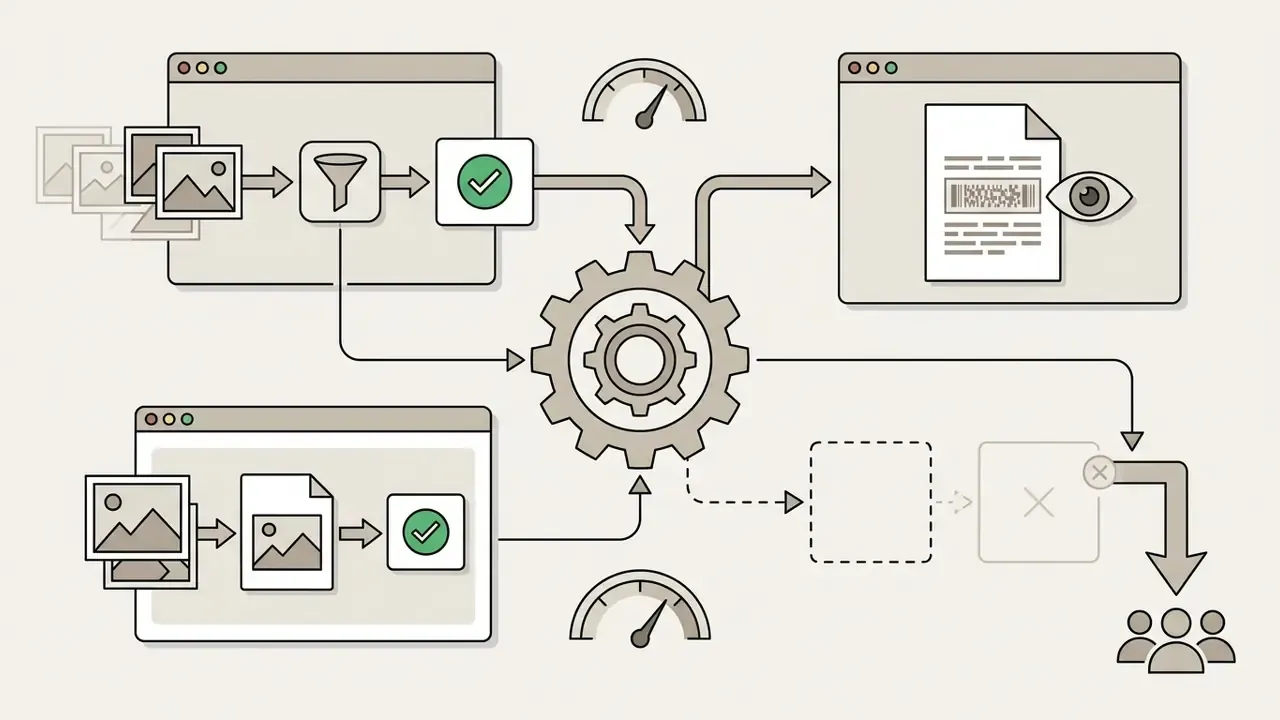
Stage 1, media asset ingestion. Stage 2, check for a C2PA Content Credentials manifest. If a manifest is present, validate the digital signature and assertion hashes, then verify edit history and creation-source credentials. If the manifest is missing, run forensic visual and statistical detectors, then cross-reference context and perform a reverse image search. Both branches converge on stage 5, the final editorial trust verdict.
Pipeline description: incoming media files are checked for embedded C2PA manifests. If present, digital signatures, hard bindings, ingredients, timestamps, and revocation status are cryptographically validated. If absent, the file goes through statistical detection, patch analysis, and contextual cross-checking before a verdict is recorded. A non-verified result is a legitimate output. The absence of credentials is not proof of falsity, and their presence is not proof of truthfulness about the depicted event.
AI image generators for business: choosing a tool and a use case
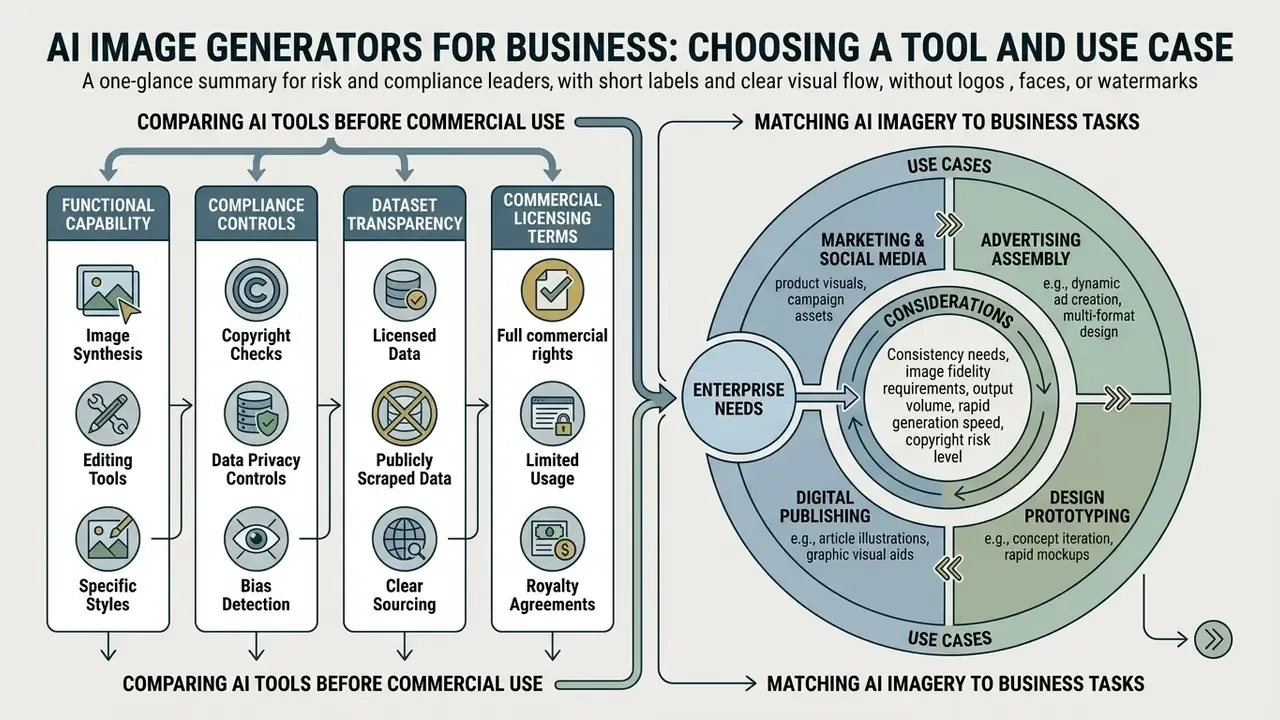
Enterprise selection of AI image generators requires matching functional capability with compliance controls, dataset transparency, and commercial licensing terms. Uncontrolled adoption of consumer generative tools exposes institutions to legal and operational liability that rarely appears in the original business case.
The NIST 2025 GenAI (Pilot) Evaluation Plan for Image Generators sets evaluation parameters around output fidelity, prompt adherence, safety, and operational robustness. Decision-makers assessing creative stacks can review matrices of Midjourney versus competing generators and of ChatGPT image generation against alternatives before standardizing, or view the guide for the full reference set.
Which business tasks AI imagery can solve
Commercial organizations use AI image tools to accelerate marketing asset production, prototype design concepts, and generate illustrative media for corporate communications. Controlled usage lets creative teams iterate faster while trimming external sourcing costs.
Common enterprise application areas:
- Marketing and social media tailored campaign visuals and ad variations through a generate, refine, review pipeline.
- Advertising assembly combining generated visuals with headlines and calls to action in an ideate, generate, assemble loop.
- Design prototyping early-stage mood boards, concept art, and interface mockups. This is where 2026 workflow research finds the heaviest legitimate adoption, mostly because nothing leaves the building.
- Digital publishing custom editorial illustrations, poster concepts, newsletter covers, and logo drafts for news releases and analytical reports.
For image-conditioned transformation of existing brand assets rather than net-new synthesis, teams usually evaluate integrated design-suite AI generators, which keep template, brand-kit, and export governance inside one audited environment.
How to compare AI tools before commercial use
Comparing commercial AI tools comes down to four core parameters: dataset origin transparency, commercial license scope, native C2PA metadata support, and legal indemnification. A fifth is routinely underestimated, namely total cost of ownership. Seat and credit pricing is usually a minority of real cost once legal review, provenance tooling, disclosure workflow, and audit-log retention are included. Teams testing entry-level options should still document licensing terms for any free or bundled AI image generator before publication.
| AI Image Generator | Commercial License | Native C2PA Support | Training Data Transparency | Legal Indemnification |
|---|---|---|---|---|
| Adobe Firefly | Included (Enterprise/Teams) | Yes, built in | High (licensed Adobe Stock and public domain) | Yes (enterprise terms) |
| Midjourney | Paid tier terms | Partial or in development | Undocumented publicly | No |
| DALL-E 3 (OpenAI) | Included (paid/API) | Yes, metadata supported | Undocumented publicly | Limited |
| Flux (open source) | Varies by license type | Dependent on implementation | Open, model dependent | None |
Risks of commercial use of AI-generated content
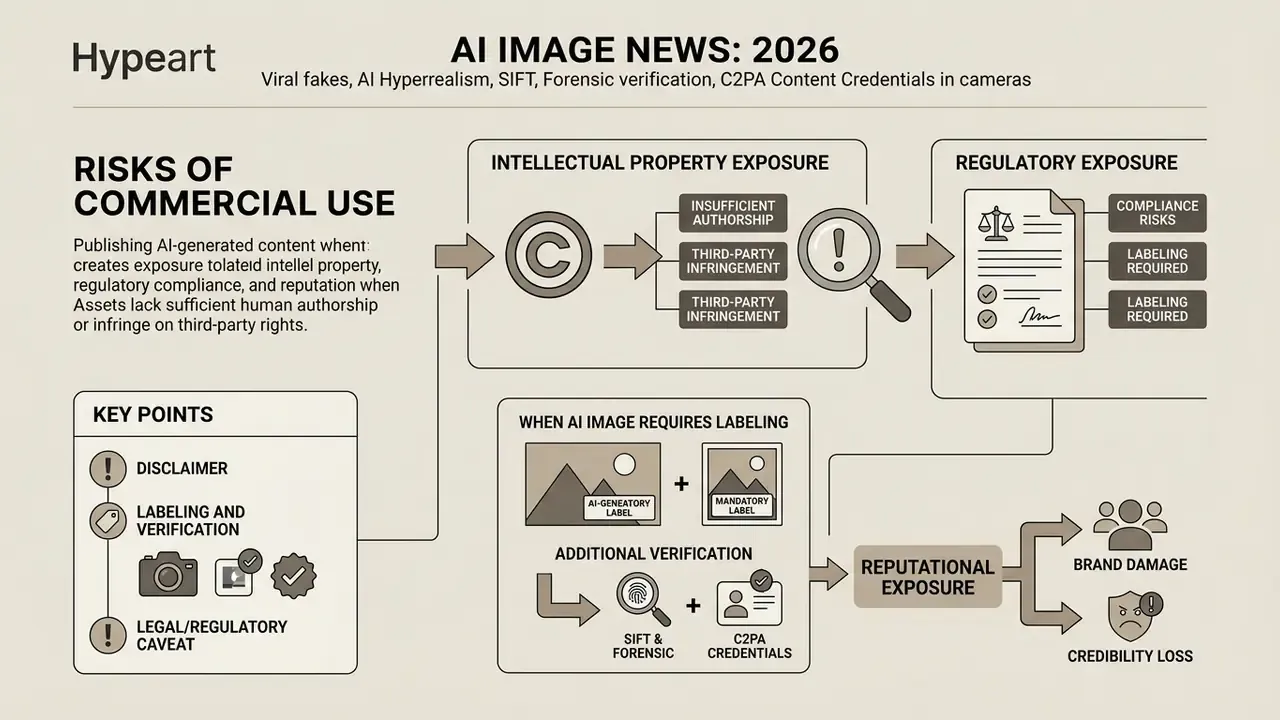
Publishing AI-generated content creates intellectual property, regulatory, and reputational exposure when assets lack sufficient human authorship or infringe third-party rights. Organizations should set a risk management framework before deploying AI visuals in commercial campaigns, not after the first takedown request.
The U.S. Copyright Office has stated that copyright protection extends only to human contributions. Where AI determines the expressive elements, that material is not protected, and applicants must disclaim AI-generated portions when registering mixed works.
Marketplace policy compounds the exposure. Getty Images began High Court proceedings against Stability AI in January 2023 over alleged unlicensed copying of millions of copyrighted images and metadata, launched "Generative AI by Getty Images" on 25 September 2023 as a commercially safe tool trained on its own licensed catalog, and continues to reject contributor submissions created with external generative models such as Stable Diffusion, DALL-E 2, or Midjourney. In other words, the same company is simultaneously a litigant, a vendor, and a gatekeeper. That triple role is a useful signal about where the market is heading.
When an AI image requires labeling and additional verification
Disclosure and labeling become legally or operationally mandatory when AI content materially affects authenticity, depicts real individuals, or falls under statutory frameworks such as EU AI Act Article 50 or California SB 1000.
Under the EU AI Act Article 50 (2026), providers and deployers must mark synthetic audio, image, and video content in machine-readable formats and disclose deepfakes clearly and distinguishably at the latest upon first exposure, with Recital 107 additionally requiring a detailed training-content summary for rights holders. California SB 1000 obliges covered providers to offer an AI detection tool and latent disclosure for AI-generated image, video, and audio content from 2 August 2026. NASA's 2025 directive requires AI-generated media used externally to be permanently watermarked, to carry embedded metadata, and to be clearly labeled.
Industry frameworks are converging on a risk-based rather than universal model. The IAB AI Transparency and Disclosure Framework V2 and IAB Canada guidance require plain-language labels such as "AI-generated" when omission would mislead a reasonable consumer about authenticity, identity, or representation, while exempting routine post-production and obvious fantasy content. India's ASCI draft guidelines permit distinct wording for "created using AI" versus "enhanced using AI". The divergence to plan for: the EU mandates machine-readable marking plus disclosure, whereas North American frameworks favour targeted disclosure. Multinational campaigns must satisfy the strictest applicable regime, which in practice means building to the EU baseline and layering local wording on top.
Decision ownership and escalation framework
Most failures documented above were governance failures rather than detection failures: no named owner, no escalation trigger, no documented verdict. The allocation below is the minimum viable control structure for a regulated institution publishing or ingesting synthetic imagery.
| Stage | Decision owner | Escalation trigger | Required artifact |
|---|---|---|---|
| Tool approval | Head of AI Governance | New generator, new license tier, or open-weight deployment | Vendor assessment: dataset transparency, C2PA support, indemnification, TCO |
| Asset generation | Creative or marketing lead | Depicts a real person, real location, or a news-adjacent event | Prompt log, model version, generation timestamp |
| Provenance tagging | Digital asset manager | Missing or broken C2PA manifest | C2PA manifest plus SHA-256 hash recorded in the DAM |
| Legal and disclosure review | IP or regulatory counsel | Likeness use, comparative advertising, EU or California distribution | Labeling decision memo citing the applicable regime |
| Inbound media verification | Editorial or fraud operations | Image influences a payment, claim, market statement, or publication | Completed four-step verification record with verdict and evidence |
| Incident escalation | Model risk / CRO plus communications | Synthetic asset published in error, or fabricated imagery targets the firm | Incident timeline, corrective action, external statement |
| Final publication sign-off | Named accountable executive, not the asset creator | Any residual ambiguity after review | Signed approval retained in the audit trail |
Two rules make that table operational. First, separation of duties: whoever generated an asset never grants its final approval. Second, default deny on ambiguity: if provenance cannot be established and the asset is material to a financial, legal, or editorial claim, the asset is not used. Both mirror standard model-risk practice and translate cleanly into existing three-lines-of-defence structures.
What remains unresolved? Two things, honestly. There is no settled method for validating agentic pipelines that generate and publish imagery without a human in the loop, and there is no accepted way to price residual risk when detector accuracy is a declining variable. Anyone claiming otherwise is selling certainty that the evidence does not yet support.
FAQ
Can any tool tell me definitively whether an image is AI-generated?
No. Detectors reach very high accuracy on curated benchmarks, up to 99.77% on CIFAKE in hybrid CNN-ViT testing, but they degrade on compressed, cropped, and cross-model real-world content, and CONVEX data shows accuracy declining over time. Treat detector output as one weighted input alongside provenance and context.
Does a C2PA Content Credential prove an image is true?
It proves origin and edit history, not factual accuracy. A signed image can still be captioned deceptively. Provenance answers "where did this file come from". Context-checking answers "did the event happen".
Are AI-generated images copyrightable for commercial use?
Purely AI-generated output is not protected under current U.S. law. Only human authorship, meaning selection, arrangement, and modification, can be. Plan brand assets on the assumption that generated imagery may be unprotectable and freely copyable.
Do we have to label every AI-assisted image?
Not universally. The EU requires machine-readable marking of synthetic content and clear deepfake disclosure. North American industry frameworks require disclosure where omission would mislead about authenticity, identity, or representation. Routine enhancement and obvious fantasy content are generally exempt, but the strictest applicable jurisdiction governs multinational distribution.
What is the fastest useful check for a non-specialist?
SIFT: Stop, Investigate the source, Find better coverage, Trace the original context. Pair it with two concrete artifact cues, rendered text and hands, which evidence shows outperform generic media-literacy advice.
Next steps
- Inventory every image generation tool in use, including contractor and agency tooling.
- Adopt the four-parameter vendor matrix (dataset transparency, license scope, C2PA, indemnification) as a procurement gate.
- Wire C2PA validation and SHA-256 fixity into your DAM ingestion pipeline.
- Publish the decision-ownership table above as internal policy, then train editorial, marketing, and fraud-operations staff on SIFT. Start with the inventory. It is the cheapest step and it usually reveals the surprises.
Appendix: regulatory reference map
| Instrument | Jurisdiction / Scope | Core obligation | Effective |
|---|---|---|---|
| EU AI Act, Article 50 | European Union | Machine-readable marking of synthetic media; clear deepfake disclosure at first exposure; training-content summary (Recital 107) | 2 August 2026 |
| California SB 1000 | California, USA | Provider-side AI detection tool and latent disclosure for AI image, video, audio | 2 August 2026 |
| NIST AI 100-4 | USA (guidance) | Detection, authentication, and labeling of synthetic content; documents watermark removability | 2024 to 2025 |
| NASA AI media directive | US federal agency | Permanent watermarking, embedded metadata, clear external labeling | 2025 |
| C2PA Technical Specification | Industry standard (ISO track) | Cryptographically bound provenance manifests; hard binding to content | 2024, updating |
| ISO/IEC CD TS 22443 | International | Identifying and addressing societal and ethical AI concerns across the lifecycle | 2025 |
| IAB / IAB Canada / ASCI frameworks | USA, Canada, India (self-regulatory) | Risk-based targeted disclosure where omission would mislead | 2026 |