Executive summary
- What it is AI brainrot animals are AI-generated animal-object hybrids with pseudo-Italian names, chant-like audio hooks, and exaggerated male text-to-speech narration, built for vertical short-form video.
- When it started The linguistic base phrase "Tralalero Tralala" traces to October 2023 meme clips; the recognizable character format launched on TikTok in early January 2025.
- Why it spreads Rhythmic repetition, extreme visual contrast, and 5 to 15 second loops optimized for completion-rate-driven recommendation systems, plus a gaming layer (Roblox's "Steal a Brainrot") that turned characters into collectibles.
- Who consumes it Generation Alpha (born 2010 to 2025) and the youngest cohort of Gen Z, for whom these characters function as shared cultural shorthand.
- How to build one Concept hybrid, then pseudo-Italian name, then text-to-image frame, then image-to-video motion, then TTS plus captions, then 9:16 export. Prompt formulas are included below.
- Commercial and governance risk Purely AI-generated output is not registrable with the U.S. Copyright Office, free tiers usually forbid commercial use, trademarked assets such as branded sneakers create infringement exposure, and Italy's Law No. 132/2024 introduced criminal penalties for unlawful dissemination of AI-altered media.
A short framing note before the detail. This looks like a joke topic. It is not, at least not entirely: the same consumer tooling that produces a shark in sneakers also produces untracked synthetic assets inside regulated organizations, and somebody has to own that inventory.
What are AI Brainrot Animals and Italian Brainrot
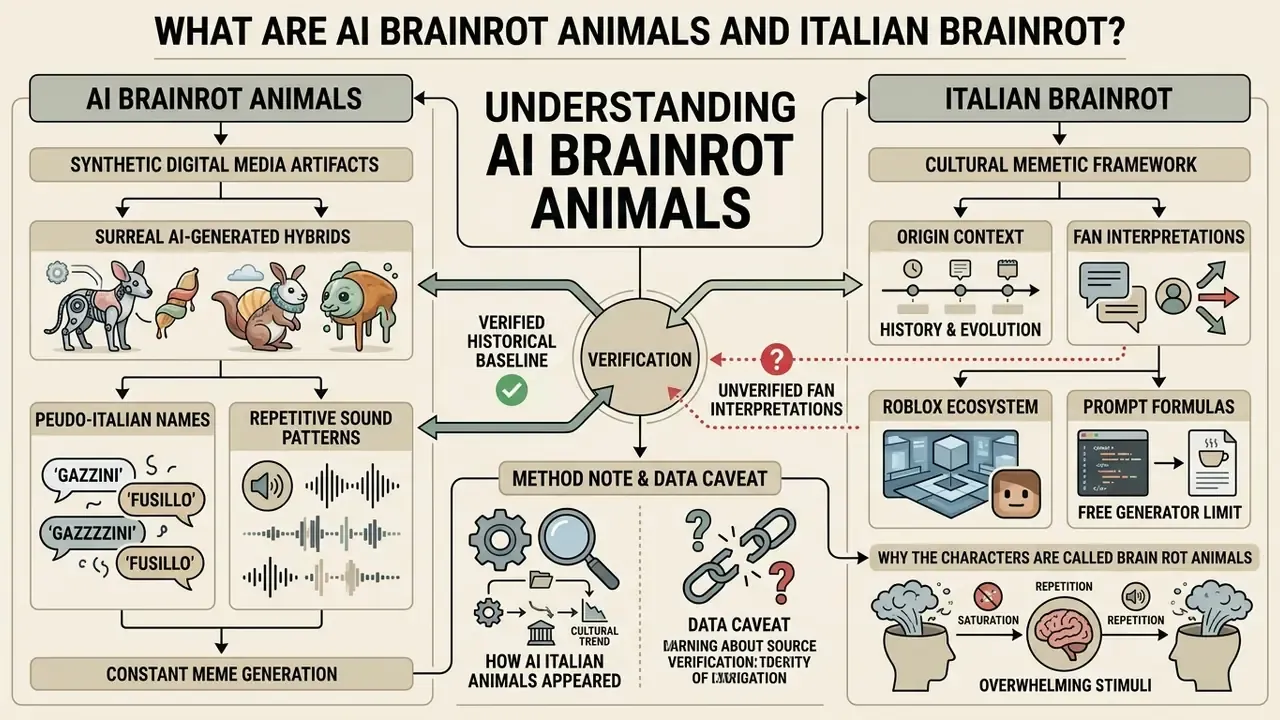
AI brainrot animals are synthetic digital media artifacts featuring surreal, AI-generated animal-object hybrids paired with pseudo-Italian names, repetitive sound patterns, and exaggerated text-to-speech narration. These constructs combine text-to-image generative diffusion outputs with looped audio chants designed specifically for short-form social video feeds.
The term brain rot was codified by Oxford University Press as its 2024 Word of the Year, describing the deterioration of mental state caused by overconsumption of trivial or unchallenging content.
«The frequency of the term brain rot increased by 250% between 2023 and 2024.»
«Italian brainrot is a genre of short videos with absurd AI characters and pseudo-Italian names, carrying implicit ethical contradictions.»
How AI Italian Animals appeared
AI Italian Animals originated on short-form video platforms in early January 2025 through rapid iteration of text-to-image prompts and text-to-speech audio synthesis. The first documented viral iteration was uploaded by TikTok user @eZburger401, featuring a synthetic shark in athletic shoes accompanied by rhythmically chanted pseudo-Italian phrasing.
The trend expanded rapidly in February 2025 when creator @armenjiharhanyan introduced "Bombardiro Crocodilo" on 20 February 2025, establishing a multi-character model. By spring 2025 the format had migrated from TikTok to YouTube Shorts and Instagram Reels, and contemporaneous trend reporting placed aggregate hashtag exposure above 3 billion views.
Data caveat: the 3-billion figure circulates in 2025 trend write-ups without a published methodology, platform-level attribution, or a dated snapshot. Treat it as an order-of-magnitude indicator rather than a verified metric. A single character, Ballerina Cappuccina, was independently reported at more than 55 million TikTok views in early 2025 (Associated Press reporting, republished by FOX Television Stations, 2025). One audited number beats three unaudited ones.
Why the characters are called brain rot animals
These synthetic entities are labeled brain rot animals because their design relies on intentionally repetitive phonemes and looping audio tracks that capture immediate attention. The structural format prioritizes rapid auditory recognition over logical narrative sequence. There is no plot to follow. That is the point.
Research on memetic audio on TikTok describes the mechanism as "repetition-with-variation": a reusable rhythmic pattern is recognized instantly, then modified just enough to justify a new upload. Earworm research on trending sounds points the same direction, since audiences re-expose themselves to recognizable audio hooks, which makes repeated phrases more shareable than novel ones.
Participatory youth research points to a second driver: teenagers describe brain rot as deliberately unproductive content that relieves the pressure of self-optimization.
«Teenagers describe brain rot as intentionally unproductive content that provides relief from self-optimization pressure.»
Every AI Brainrot Animal: popular characters and names
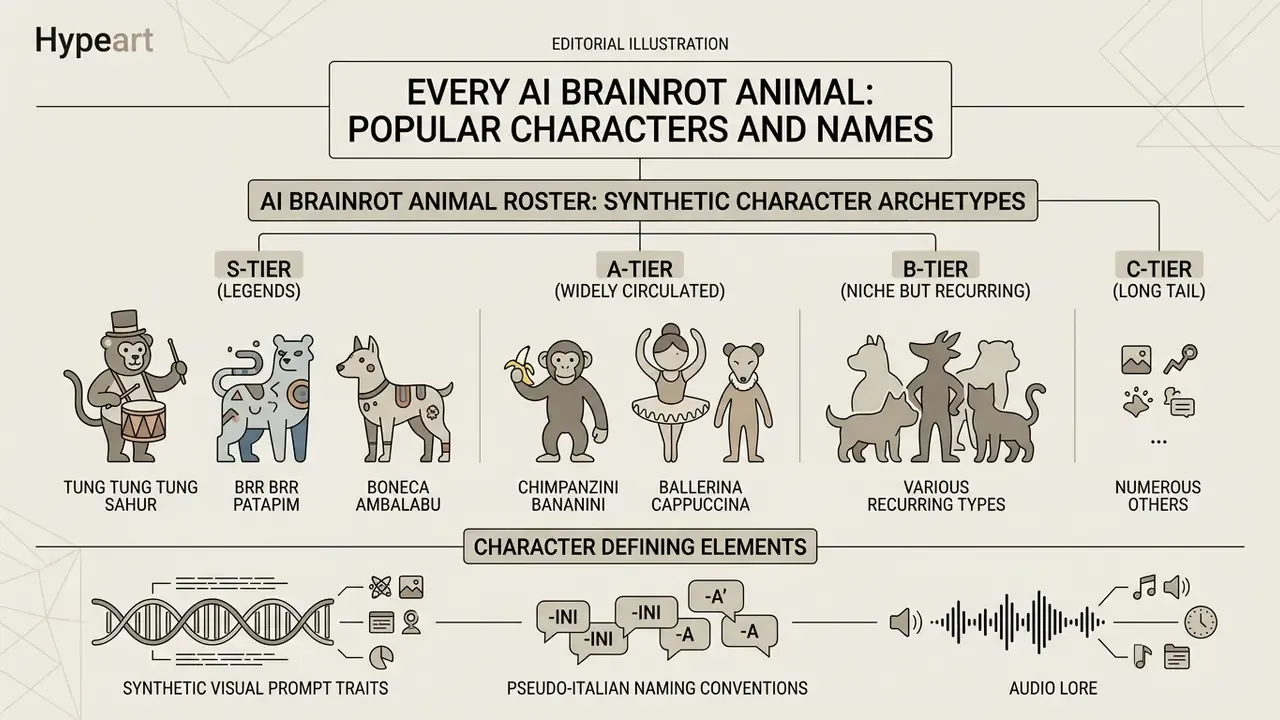
The AI Brainrot Animals roster consists of recurring synthetic character archetypes, each defined by specific visual prompt traits, pseudo-Italian naming conventions, and audio hooks. The list below is the most complete catalog available in English-language coverage. Note that fan wikis disagree on spellings, counts, and attributes, and no official canonical roster exists. Anyone claiming to publish "all AI brainrot animals" is publishing a snapshot, not a registry.
Table: catalog of documented AI brainrot animal archetypes.
| Character name | Visual concept hook | Audio signature pattern | Italian Brainrot association |
|---|---|---|---|
| Tralalero Tralala | Three-legged shark wearing blue Nike sneakers | Chanted "Tralalero Tralala" male TTS loop | Established as the foundational archetype of the trend in January 2025. |
| Bombardiro Crocodilo | Crocodile head fused with a military bomber plane body | Explosive engine audio with rhythmic pseudo-Italian narration | Expanded the genre into military-animal hybrid visuals in February 2025. |
| Tung Tung Tung Sahur | Wooden stick-figure drum spirit tied to pre-dawn scenes | Rhythmic drum-like "Tung tung tung sahur" loop | Cross-cultural adaptation linking pseudo-Italian structure with Indonesian Ramadan motifs. |
| Brr Brr Patapim | Oversized proboscis monkey head merged with tree limbs and roots | Low-register "Brr brr patapim" phonetic chant | Represents organic giant creature prompts; a forest guardian in fan lore. |
| Boneca Ambalabu | Frog-headed doll entity with a tyre body and human legs | High-pitched repeating vocalization loop | Demonstrates multilingual influences incorporating Indonesian and Portuguese elements. |
| Chimpanzini Bananini | Chimpanzee merged with banana peel attire and motifs | Upbeat rhyming vocal track ending in "-ini" suffixes | Combines primate visual themes with bright fruit aesthetics. |
| Ballerina Cappuccina | Ballet dancer figure topped with a cappuccino cup head | Melancholic melodic rhythm with Italian narration | Introduced stylized beverage-human hybrid designs; reported at 55M+ TikTok views. |
| Aeromucca Armata | Militarized cow with aerial wings and mechanical armor plating | Aviation drone hum layered over heavy rhythmic TTS vocals | Aircraft-animal character within the military sub-genre. |
| Apollino Cappuccino | Anthropomorphic cappuccino cup with classical Apollo statue elements | Energetic quasi-operatic TTS melody | Cultural hybrid of Greco-Roman mythology and coffee aesthetics. |
| Frigo Camelo | Camel with a refrigerator torso, wearing sneakers | Blowing icy wind effects with freezing sound artifacts | Built to fight desert heat; in fan lore it melts in hot weather yet stays cheerful. |
| Trippi Troppi | Dual character: shrimp-cat hybrid, or a fat bear-fish with a flexible belly | Fast tongue-twister babble "Trippi Troppi Troppa Trippa" | Classic representative of the absurd marine roster; naming varies by source. |
| Bombombini Gusini | Goose fused with jet fighter airframes | Percussive engine bursts with "-ini" rhyme endings | Framed in lore as the brother-rival of Bombardiro Crocodilo. |
| Bobrito Bandito | Beaver bandit in a black jacket, dark glasses, and hat | Staccato outlaw-style chant with rolled consonants | Recurring antagonist figure in the fan-written "Croco-Avian" storylines. |
| Fruli Frula | Round neon-blue bird from the 2025 neon-palette wave | Two-syllable sing-song loop "Fruli Frula" | Illustrates the shift toward saturated color palettes in later 2025 characters. |
| Blueberry Octopus | Octopus fused with a blueberry | Bubbling wet sound effects under soft TTS narration | Named by a UK secondary-school teacher as a class favorite (The Guardian, 2025). |
| Armadillo Crocodillo | Armadillo packed inside a coconut shell | Hard-shell knocking percussion with rhyming narration | Cited in Associated Press coverage as part of the first wave of follow-on characters. |
| Lirilì Larilà | Elephant-cactus hybrid wearing open sandals | Repeated syllabic phrase "Lirilì Larilà" with clock ticking | Early expansion of the format into plant-animal hybrid prompts. |
| Cappuccino Assassino | Coffee cup ninja with a mask, blade, and limbs | Whispered stealth cues punctuated by sharp accents | Paired romantically with Ballerina Cappuccina in fan lore. |
| Girafa Celestre | Giraffe on a celestial or rural journey, cosmic background elements | Airy sustained vowels with slow TTS cadence | Name translates loosely as "celestial giraffe," expanding the roster into cosmic themes. |
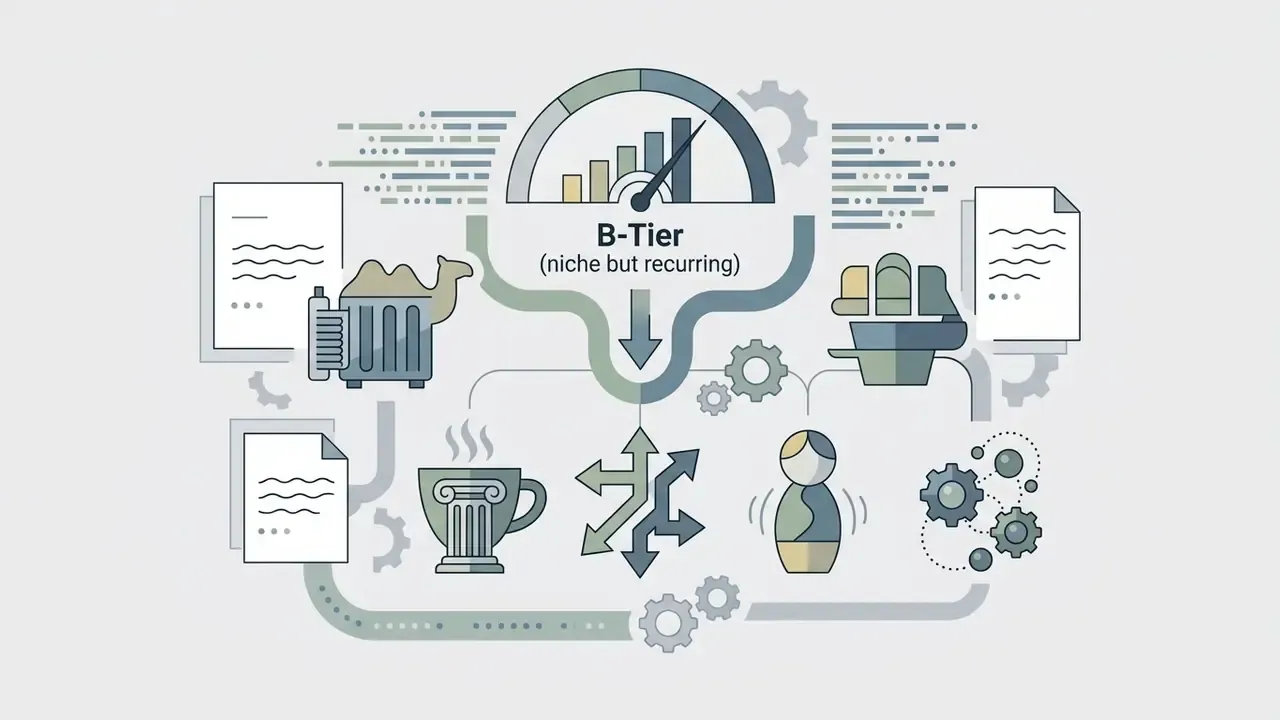
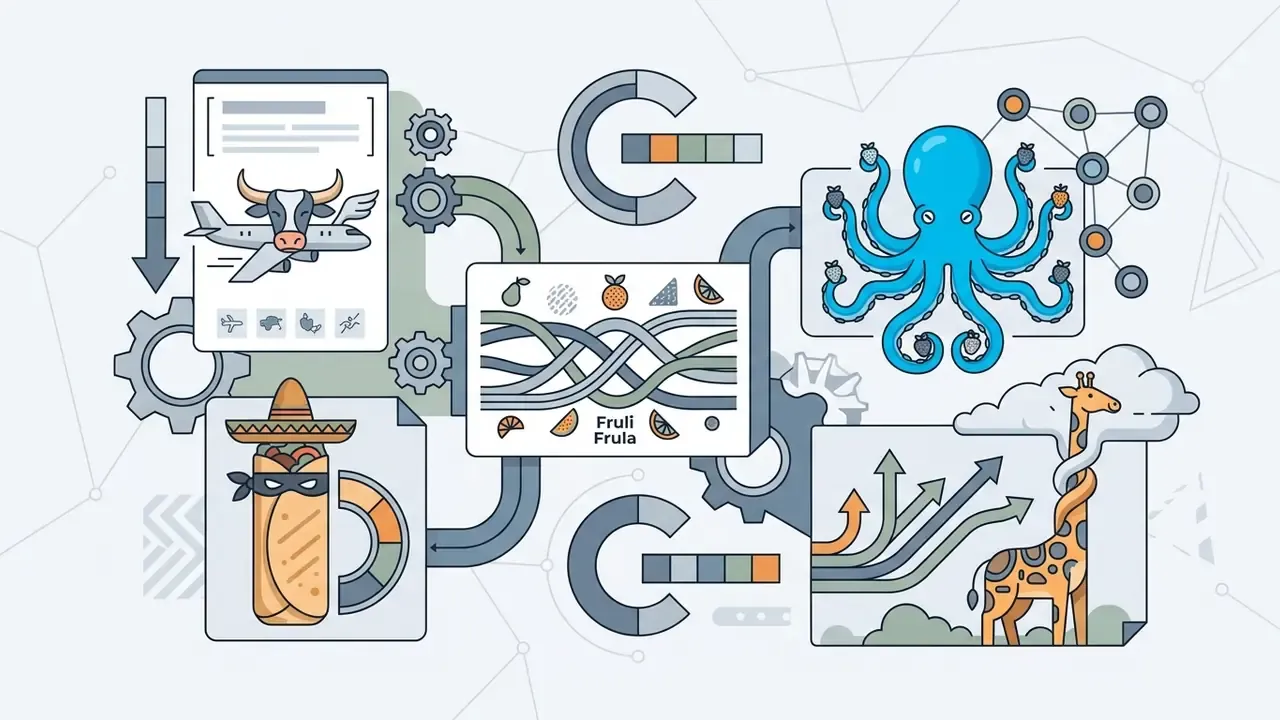
Brainrot tier list, based on observed TikTok and YouTube Shorts prominence
Tier placement reflects relative visibility in coverage and fan ranking activity, not audited view counts. Community tier lists disagree substantially, which is itself part of the format's participatory appeal: arguing about the ranking is half the entertainment.
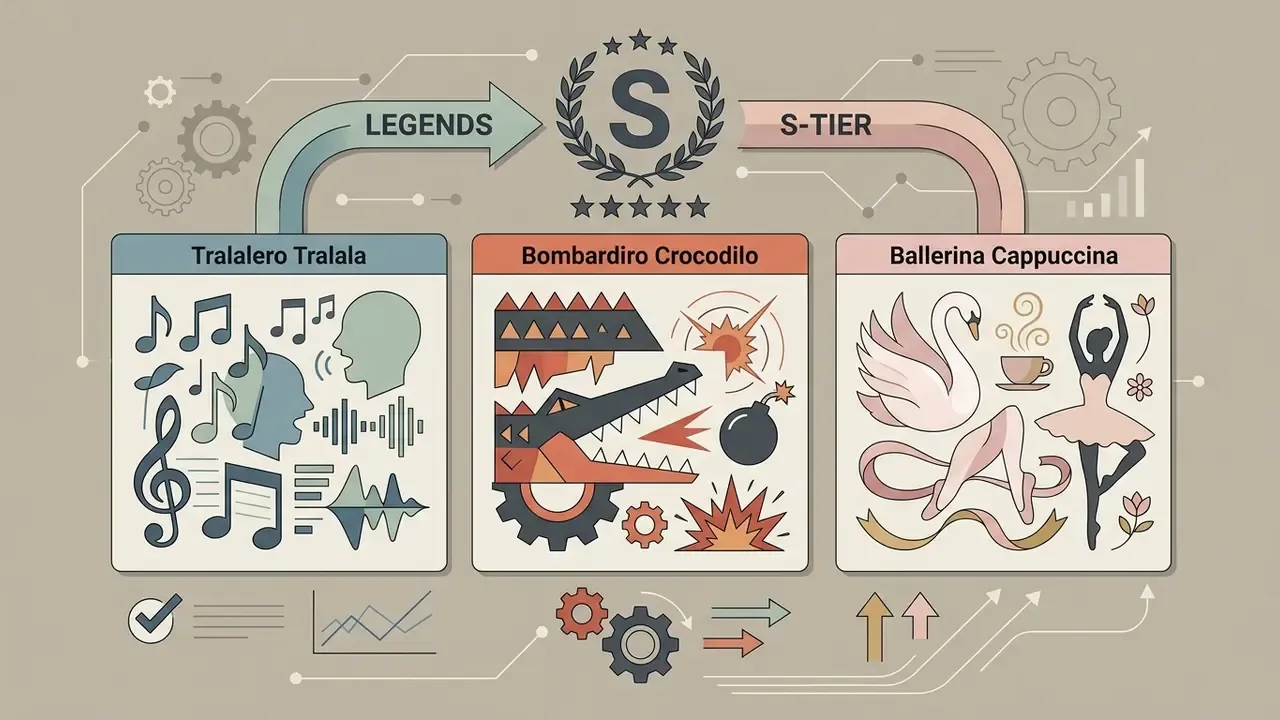
Tralalero Tralala and Bombardiro Crocodilo
Tung Tung Tung Sahur, Brr Brr Patapim, and Boneca Ambalabu
Tung Tung Tung Sahur incorporates onomatopoeic percussion sounds paired with vocal calls associated with pre-dawn sahur meals during Ramadan. The sound pattern relies on heavy bass rhythm to hold viewer engagement across short-form video loops, and it is the clearest documented case in the roster of a rhythm derived from a real cultural practice rather than invented phonetics. In fan descriptions it appears as a wooden figure carrying a bat, waking, or hunting, humans.
Brr Brr Patapim uses an oversized primate structure combined with dense forest vegetation prompts. Know Your Meme's editor-in-chief Don Caldwell describes it simply as "a proboscis monkey that is also a tree," and identifies it as one of the characters that broke out of TikTok onto YouTube. Boneca Ambalabu introduces doll-like visual elements, a frog head, a tyre body, human legs, demonstrating how the genre incorporates phonetic and cultural structures well beyond traditional pseudo-Italian roots. Note that authoritative confirmation of the exact rhythmic patterns for Brr Brr Patapim and Boneca Ambalabu is thin; descriptions rely largely on fan documentation.
Chimpanzini Bananini, Ballerina Cappuccina, and other characters
Chimpanzini Bananini combines a chimpanzee torso with vibrant yellow banana visual elements, described in The Guardian (2025) as "a chimpanzee fused with a banana." The associated vocalization uses exaggerated rhyming suffixes like "-ini" and "-ano" to reinforce its auditory identity, and quiz-format videos frequently use it as a matching prompt.
Ballerina Cappuccina pairs delicate dance attire with a coffee cup structure and is often depicted in a relationship with Cappuccino Assassino, a stealth-themed coffee cup ninja. Secondary variants include Lirilì Larilà, an elephant-cactus hybrid wearing open sandals, and Girafa Celestre, whose name translates loosely as "celestial giraffe."
«From Chimpanzini Bananini to Ballerina Cappuccina: how Gen Alpha went wild for Italian brain rot animals.»
Creators comparing rendering styles across characters, photorealistic versus cartoon versus painterly, can review a comparison of AI art generators by image quality and style control before locking a visual identity for a recurring character. If your priority is holding one creature consistent across episodes, a dedicated tool such as a perchance ai character generator is worth a test pass alongside the general-purpose models.
Why AI Italian Animals became viral memes
The virality of AI Italian Animals stems from a precise combination of synthetic image aesthetics, rhythmic sound loops, short-form recommendation algorithms, and, critically, a gaming layer that converted passive viewing into collecting.
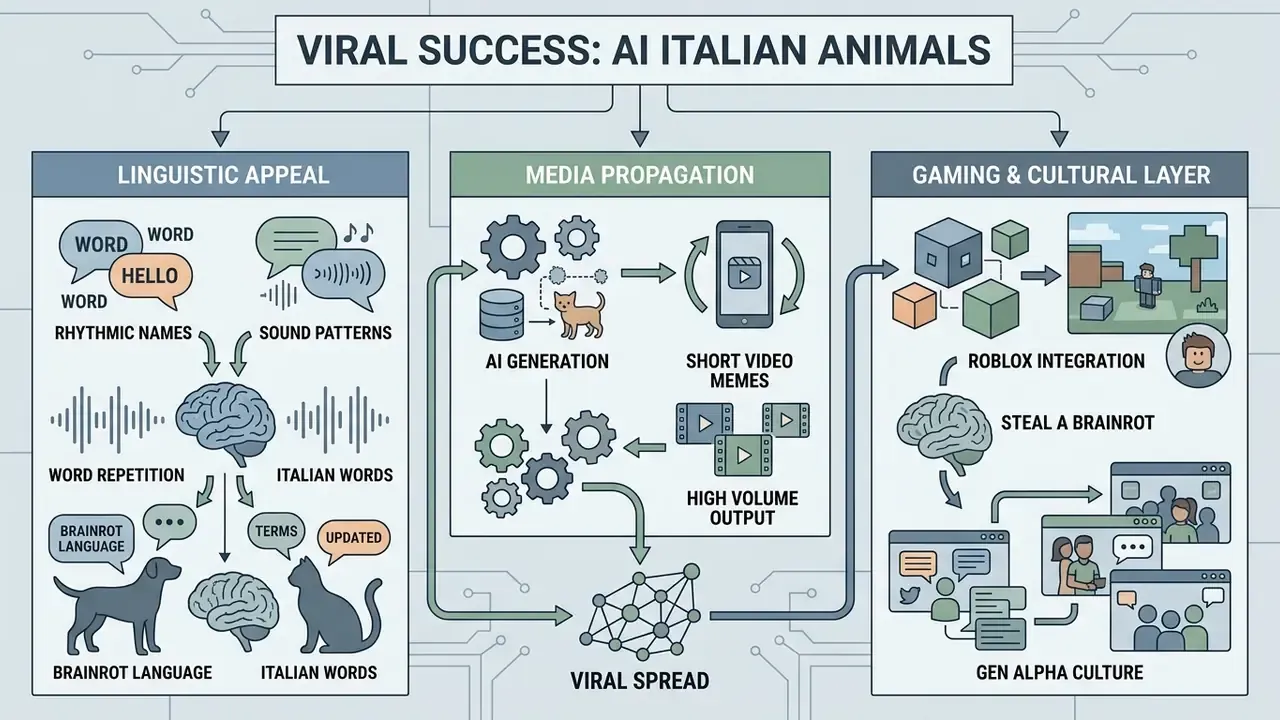
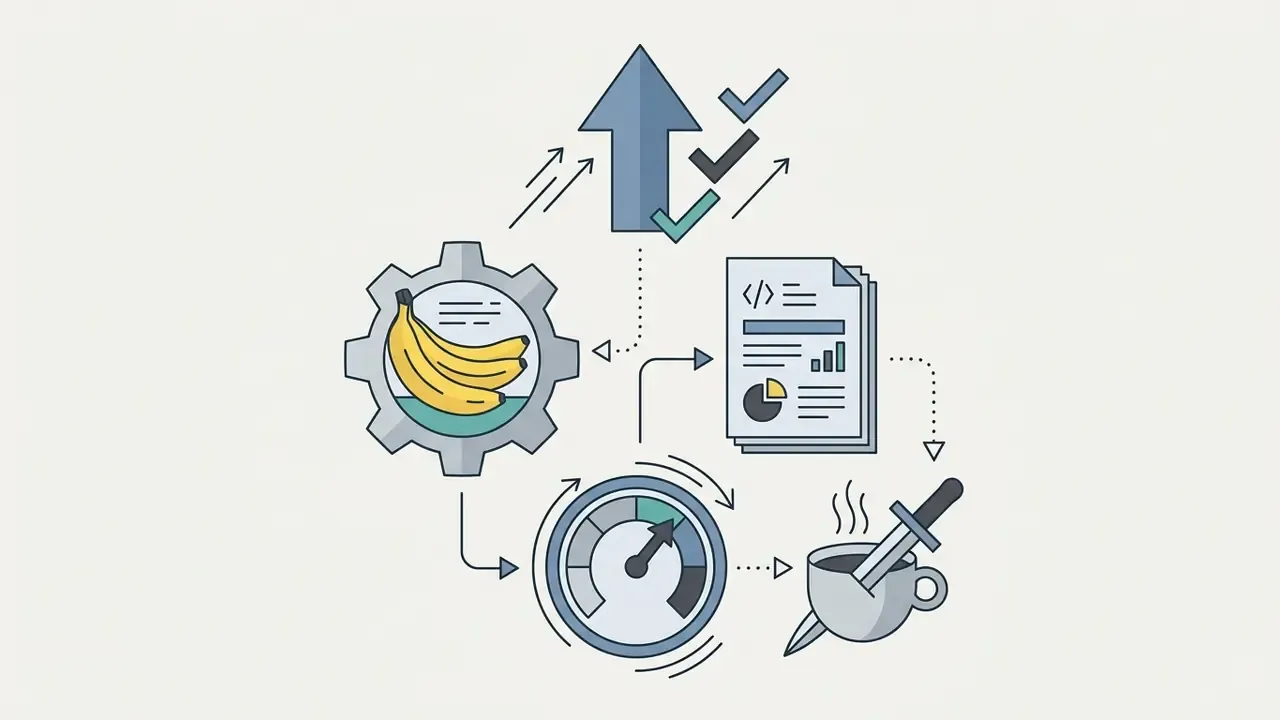
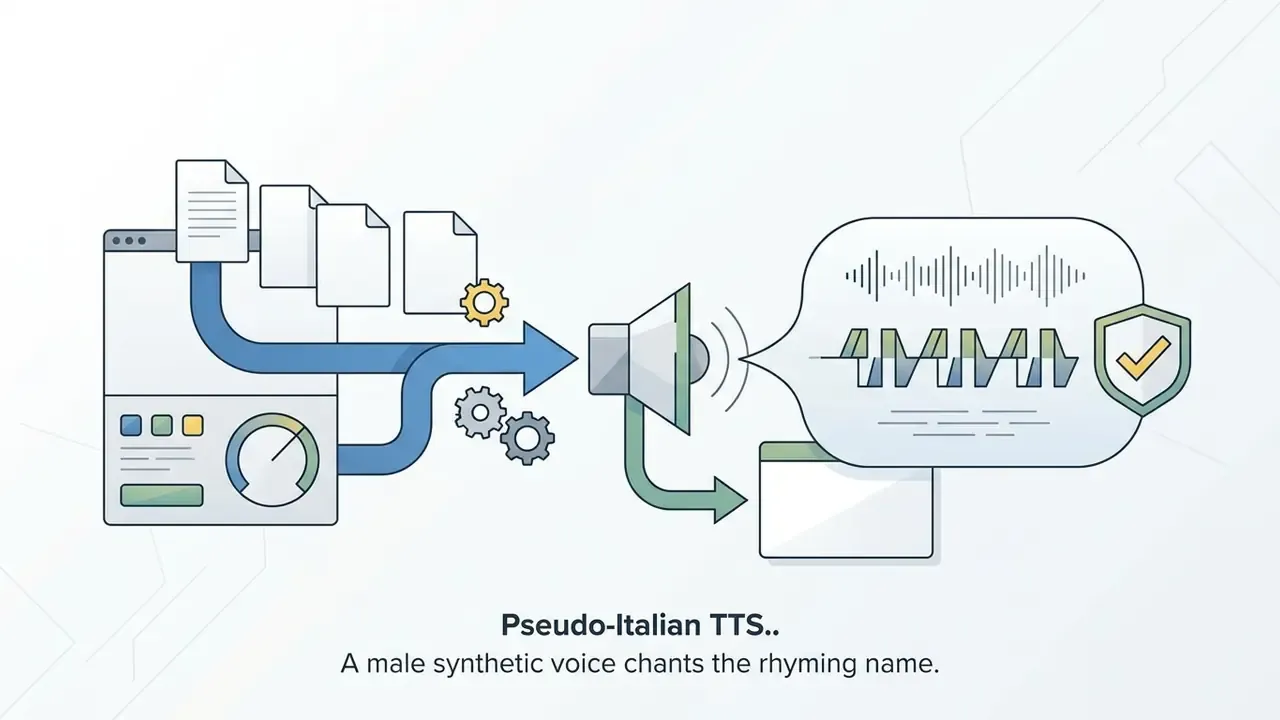
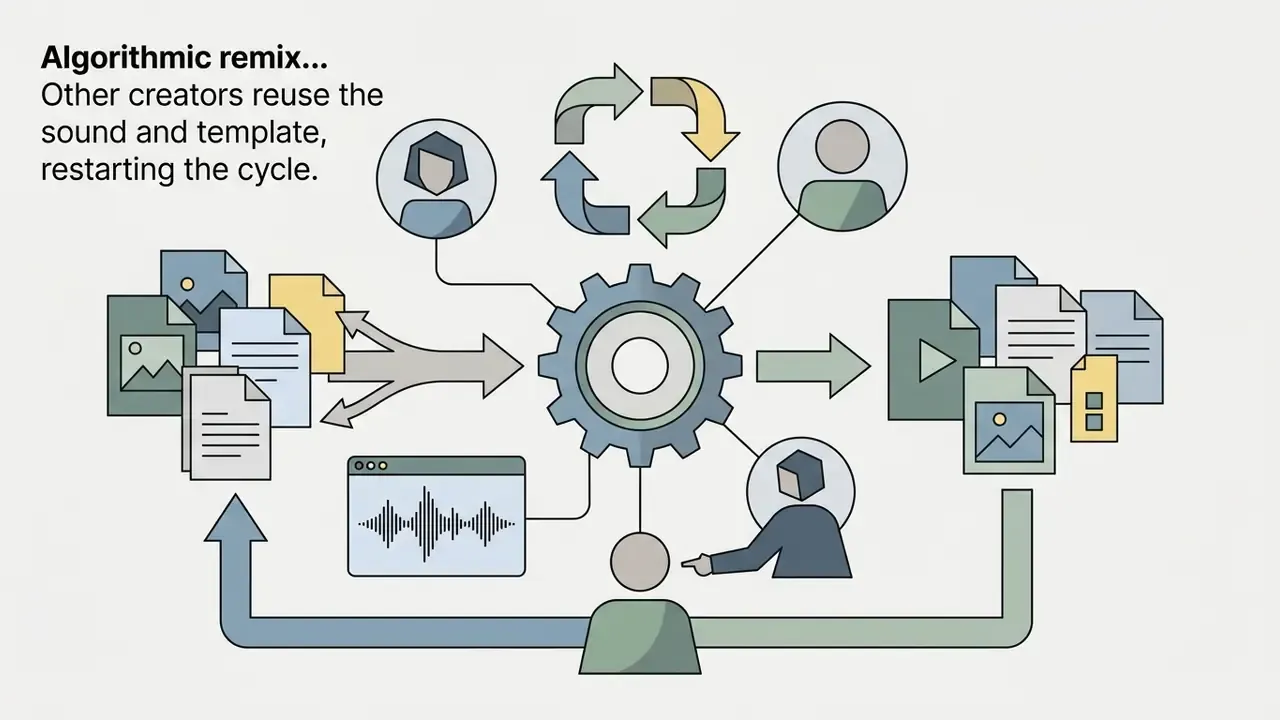
Figure 1: structural lifecycle of an AI brainrot animal meme from initial prompt generation to algorithmic distribution.
On YouTube, stage 4 is a documented product feature rather than an abstraction. Creators can sample audio from an existing Short, or up to 90 seconds from a music video, then generate a new Short from "Use this sound." That mechanic turns one successful upload into a reusable template, which is precisely how a single shark clip became a roster of dozens of characters.

Rhythmic names, sound, and word repetition
The audio layer relies heavily on pseudo-Italian diminutives like "-ini", "-ello", "-one", "-etto", and "-ina". These suffixes create an impression of Italian linguistic structure while attaching to arbitrary or nonsensical root words.
A 2025 comparative multimodal analysis of Italian brain rot scripts found a higher frequency of exact rhyme, wider melodic range, and higher loudness than in comparison short-form narration sets, measurable properties that support the chant-like naming pattern. Broader meme research adds a second finding worth internalizing: format matters more than provenance.
«Meme format is a stronger predictor of engagement than the fact of AI generation: structural repetition and familiar templates drive circulation.»
«These memes highlight the confusion between what is real and what stands in for the real.»
«The AI is making the image, there's a text-to-speech voice, but the joke itself is being invented by an actual person behind a computer.» — Don Caldwell, editor-in-chief, Know Your Meme, in The Guardian (2025). https://www.theguardian.com/society/2025/jun/25/from-chimpanzini-bananini-to-ballerina-cappuccina-how-gen-alpha-went-wild-for-italian-brain-rot-animals
Caldwell also notes that the audio is "at least as important, if not more important than the imagery," and that the exaggerated delivery, "Tra-la-lero! Tra-la-lala!", is doing the memorability work. Phonetic chants like "tralala", "tung", and "brr" function as persistent auditory hooks precisely because they carry no semantic load to decode. Nothing to interpret, everything to repeat.
Teams building recurring voice identities for characters can compare synthesis quality and licensing in this guide to AI voice generators, voice quality, and commercial licensing.
The role of AI images and short video memes
Generative AI platforms let creators produce high-contrast, surreal images from text prompts within seconds. The unusual pairing of biological organisms with manufactured objects creates immediate visual curiosity in video feeds, and the curiosity resolves in under two seconds, which is roughly the window a scrolling thumb allows.
Vertical 9:16 aspect ratio formatting optimizes these assets for mobile devices. Short-form platforms behave structurally differently from long-form video: consumption and recommendation patterns diverge, and the first seconds of playback dominate retention outcomes.
«Short-form video platforms show fundamentally different consumption and recommendation dynamics compared with long-form platforms; the opening seconds are decisive for retention.»
The gaming layer: Roblox, "Steal a Brainrot," and Gen Alpha culture
The phenomenon did not stay inside social feeds. On Roblox, one of the platform's most popular titles of summer 2025 was "Steal a Brainrot", in which players compete to collect characters such as Tralalero Tralala and Ballerina Cappuccina. Competition became intense enough that accusations of "admin abuse", administrators allegedly taking characters unfairly, produced viral videos of children in tears.
That collection mechanic mirrors the virality logic of Skibidi Toilet, the 2023 YouTube animated series that spread among the youngest Gen Z cohort before Italian Brainrot did the same for Generation Alpha (born 2010 to 2025). Both function less as content than as vocabulary: shared jokes, references, and status markers.
«It's funny because it's nonsense. Seeing something so dark, in a way, and out of the ordinary, that breaks all the norms of what we would expect to see on TV, that's just super appealing.»
«It's very normal for everyone to need to switch their brains off now and again.» — Emilie Owens, children's media researcher, to the Associated Press (2025)
Classroom evidence reported by The Guardian shows the same dynamic from the adult side. A UK secondary-school teacher described a year 8 class where "as soon as it's mentioned by one person, the entire class starts talking about it," noted that pupils default to brainrot creatures in creative writing assignments, and eventually started inserting "Tung Tung Tung Sahur" as a decoy answer in multiple-choice quizzes to hold attention. His own favorite, he said, is Blueberry Octopus.
Researchers quoted in the same coverage frame the parental concern as one of volume rather than content: the amount of time spent scrolling, not the absurdity of the characters, is the measurable variable. Whether Italians find it offensive is largely settled by participation. As Caldwell puts it, "it seems Italians have been all over this."
How to make an AI Brainrot Animal: image, name, and video
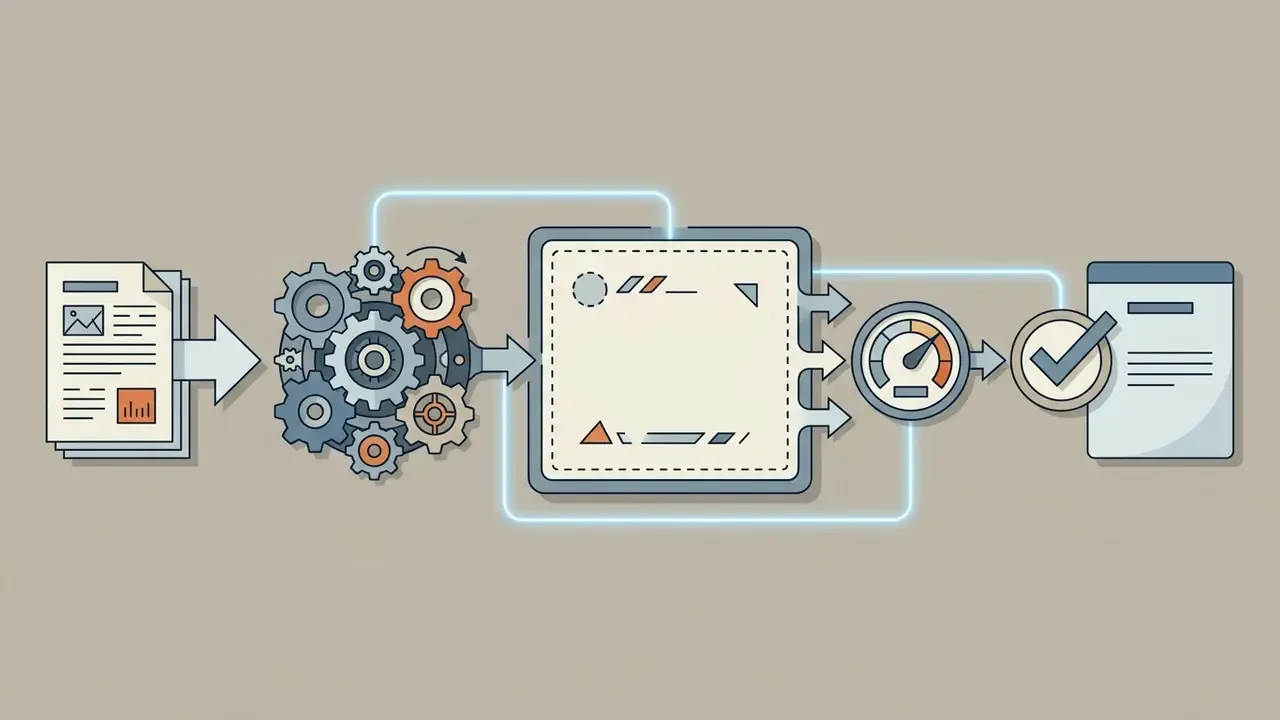
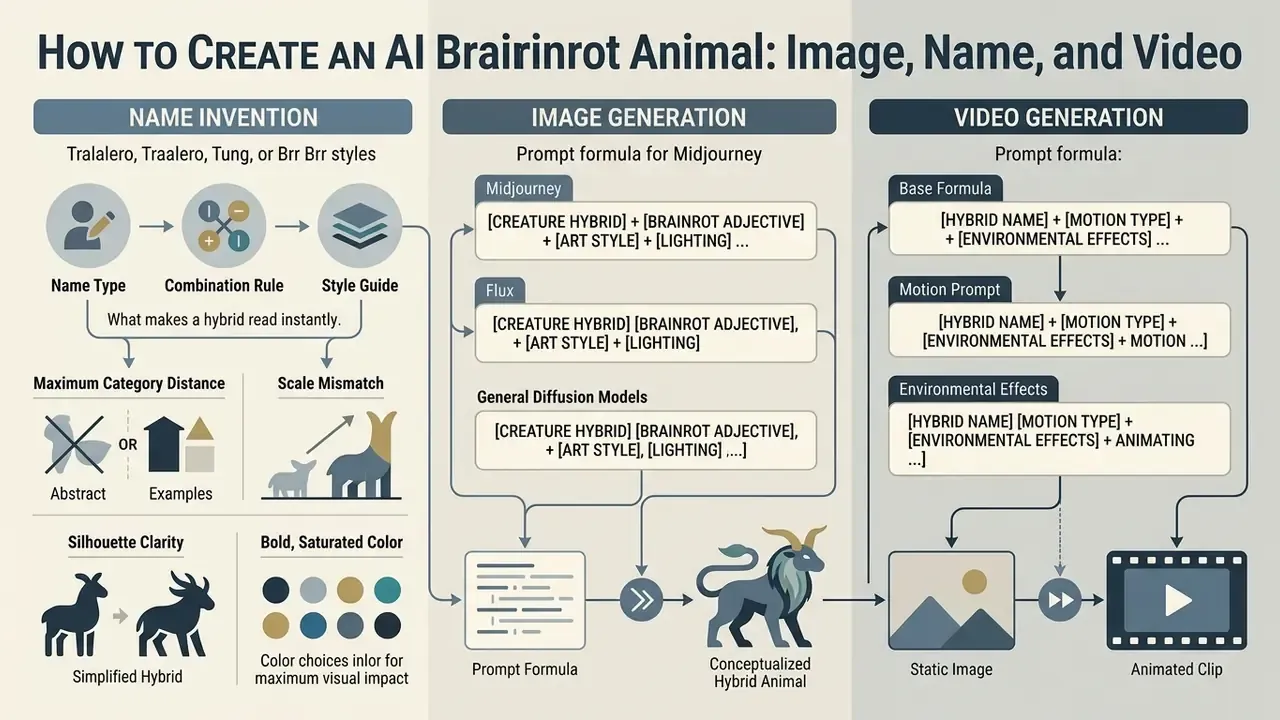
Creating a custom AI brainrot animal involves a four-step pipeline: conceptual design, pseudo-Italian naming, visual diffusion generation, and audio-video synchronization. Five steps if you count the export, and you should, because that is where most first attempts fall apart.
Checklist0 / 5
How to invent a name in the Tralalero, Tung, or Brr Brr style
Constructing an authentic-sounding brainrot name means combining base nouns with pseudo-Italian grammatical endings. Standard formulas pair doubled consonants with melodic vowels to maximize vocal rhythm.
- Suffix addition: attach "-ini", "-ino", "-ello", "-etto", "-oni", or "-ina" to standard objects (Chimpanzini, Bananini, Apollino).
- Phonetic doubling: repeat opening syllables to create chant-like patterns (Brr Brr, Tung Tung).
- Rhyming cadence: make sure the first and second words share matching final vowels (Tralalero Tralala).
- Playful alliteration: front-load matching consonants across both words (Frigo Camelo, Fruli Frula).
- Syllable count discipline: keep the full name to 5 to 8 syllables so it can be chanted twice inside a 10-second loop.
Combination rules: what makes a hybrid read instantly
Before writing a prompt, lock the concept using four contrast rules distilled from the highest-performing characters.
- Maximum category distance.Combine items from unrelated domains: predator plus footwear, reptile plus aircraft, dancer plus beverage. Similar items produce forgettable results.
- Scale mismatch.Mix a large body with a small object, or the reverse, so the silhouette looks wrong at a glance.
- Silhouette clarity.Both source shapes must remain recognizable in a 3-centimeter thumbnail; complex hybrids collapse into noise on mobile.
- Bold, saturated color.High-contrast palettes outperform muted ones in vertical feeds, which is why the 2025 neon wave (Fruli Frula) took hold.
How to assemble the AI image, sound, and short video
Free AI Italian Brainrot generators and usage terms
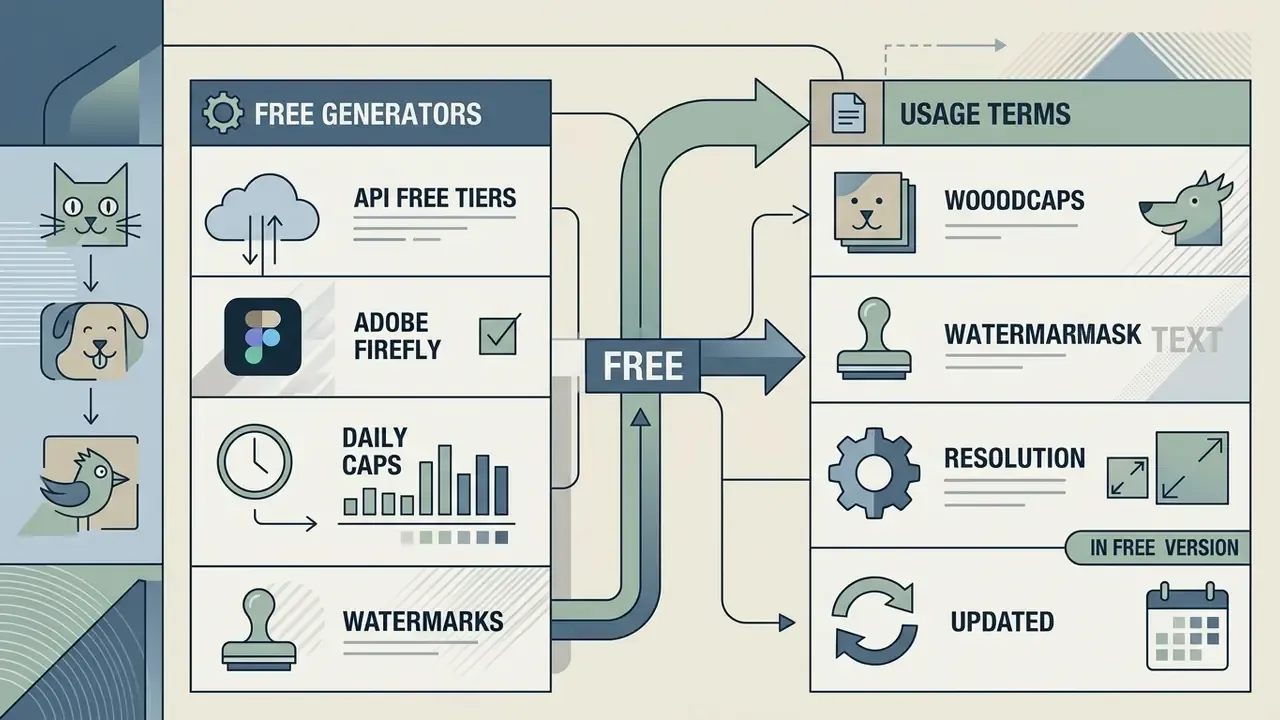
Accessing generative software for synthetic meme creation means navigating tiered access models, usage limits, and licensing restrictions. The free tier is generous enough to hook you and narrow enough to matter the moment money is involved.
Table: comparison of generative AI media capabilities across access tiers.
| Platform capability | Free tier access characteristics | Paid or advanced tier characteristics |
|---|---|---|
| Image generation | Daily credit allotments (roughly 5 to 30 images); standard resolutions; visible watermarks or invisible SynthID marking. | High-volume credit pools; upscaled resolutions; watermark-free downloads; commercial usage rights. |
| Video generation | Short clip durations (2 to 8 seconds); restricted generation queues; lower frame rates. | Extended and extendable clips; priority rendering; 1080p to 4K upscaling; multi-frame and reference-image controls. |
| Audio and voice synthesis | Basic text-to-speech models; preset voice profiles; public usage constraints. | Custom voice cloning; multi-track mixing; sound-effect generation; full audio export permissions. |
| Commercial licensing | Personal, non-commercial use only on many plans; platform disclosure requirements for AI content. | Explicit commercial exploitation rights; enterprise indemnification tiers. |
Before committing budget, compare options across plans, because per-generation economics differ sharply between image-heavy and video-heavy workflows. For volume forecasting, view the guide to cost modeling.
What is usually available on the free tier
When advanced video and sound capabilities are required
Institutional context: Shadow AI, brand safety, and asset governance
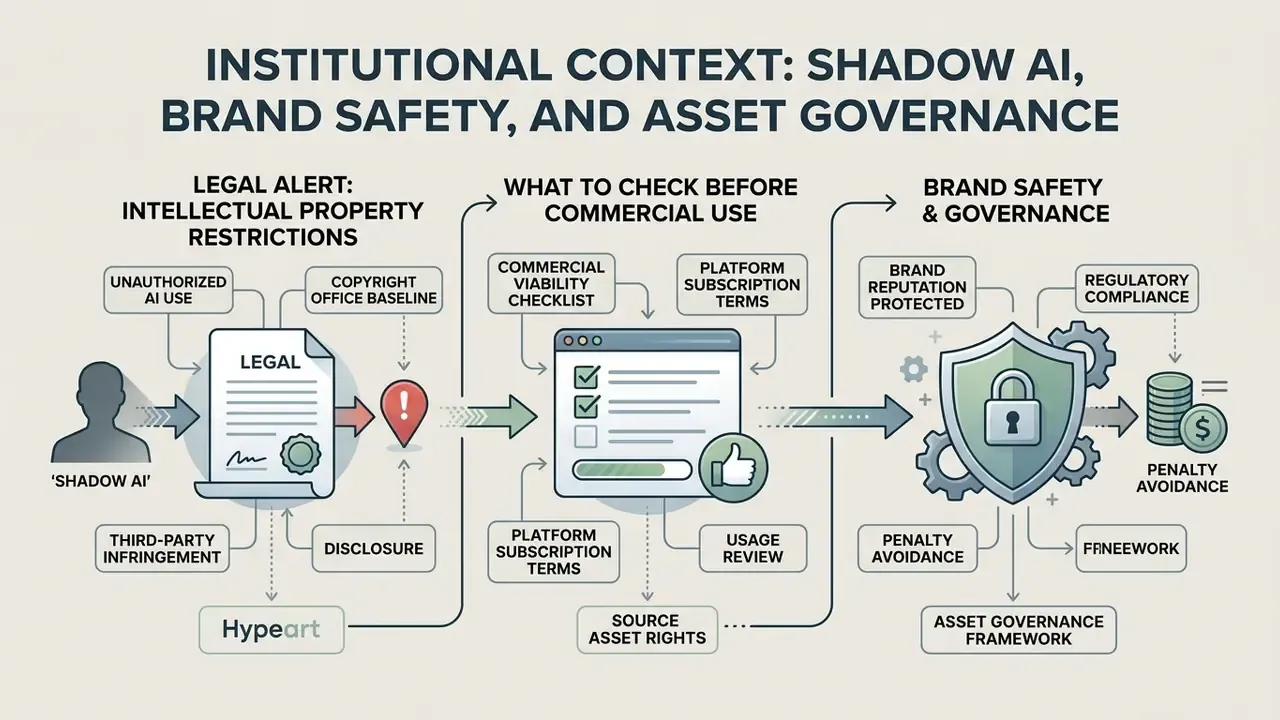
This section consolidates the organizational material that previously sat inside the character descriptions, where it broke the reading flow. It is relevant for one reason: the same tools that produce a shark in sneakers produce untracked synthetic assets inside corporate perimeters, and governance teams inherit the consequences.
Illustrative governance scenario (anonymized, unaudited). In an internal review of unauthorized AI media distribution across a corporate network, security teams identified roughly 140 unmonitored generation accounts producing synthetic character variations. Compliance officers responded by deploying automated asset inventory that tagged synthetic outputs at the network edge, reportedly cutting untracked media generations by about 88% within thirty days. This scenario is reported without independent verification, published methodology, or a named organization; treat the figures as directional illustration of a control pattern, not as a benchmark. The transferable lesson is the control itself, edge-level tagging plus account inventory, not the percentage.
Why this matters commercially. Reputational exposure now travels with synthetic output. Discourse analysis of 25 million comments found that pejorative "AI slop" accusations rose more than tenfold on Hacker News and Reddit, and that the "slop" frame accounts for the overwhelming majority of inauthenticity accusations (That's AI Slop, You Bot!, preprint, 2026). Meanwhile, qualitative interviews with Chinese creators describe industrialized viral short-video production through account matrices and format benchmarking (AI-generated viral short video production in China, AI & Society, 2025 to 2026), evidence that brainrot output is already a managed supply chain rather than incidental play.
Minimal risk matrix for public generators inside an organization
| Risk vector | Trigger | Likelihood | Control |
|---|---|---|---|
| Prompt data leakage | Proprietary text or images pasted into a consumer free tier used for product improvement | High | Approved-tool allowlist; enterprise plans with training opt-out |
| Untracked asset sprawl | Personal accounts generating brand-adjacent media | High | Asset inventory with edge tagging; account attestation |
| Trademark exposure | Branded footwear, logos, or likenesses inside generated frames | Medium | Pre-publication visual review; reverse-image verification |
| Provenance loss | Missing watermark or C2PA-style metadata on published assets | Medium | Retain SynthID and provenance metadata; log prompt and model version |
| Licence mismatch | Commercial publication of free-tier output | Medium | Plan-level licence check before every campaign |
| Disclosure failure | AI content published without labeling where required | Medium | Platform-specific disclosure workflow (EU AI Act transparency, Canva disclosure rule) |
These controls map cleanly onto recognized frameworks: the govern, map, measure, and manage functions of the NIST AI Risk Management Framework, and the management-system requirements of ISO/IEC 42001, alongside existing model-risk-management documentation practice. Two open questions remain, and pretending otherwise would be dishonest. First, agentic pipelines that generate and publish media without a human in the loop are poorly covered by validation methods designed for scored models. Second, ownership of the disclosure decision often sits nowhere: marketing assumes legal owns it, legal assumes marketing does.
A practical starting point is an owner, an approved role, an access limit, an escalation path, an audit trail, and a shutdown mechanism for every automated publishing agent. No evidence, no autonomy. Provenance verification workflows are covered further in this comparison of AI reverse-image-search tools by accuracy and business use, and teams tracking downstream disputes over synthetic media can see the overview of active matters. If a control question comes up mid-deployment, open the hub for implementation notes.
Can AI Brainrot Animals be used commercially
What to check before commercial use of images and videos
FAQ about AI Brainrot Animals
Are all brainrot animals AI-generated?
No. While the majority of viral Italian Brainrot characters originate from generative text-to-image diffusion models, the complete production pipeline relies on human post-production. Creators manually edit clips, adjust audio timing, and add typography overlays.
Published pipelines make the split explicit: brainrot production tooling documents discrete steps (script generation, audio generation, character image assignment, then render) while creator guides describe a separate manual edit, caption, and export stage. Some characters also incorporate traditional 2D and 3D digital artwork, manual audio pitch shifts, and physical collage elements. Generative AI serves as the primary visual engine; human editing shapes the final video format.
Data caveat (updated): no published source quantifies the share of manual editing versus generated assets. The earlier version of this passage cited "Brainrot Production Pipeline Documentation, 2026," which is not a verifiable publication. The claim is retained as a qualitative description of documented pipeline stages, with the numeric split marked as unknown.
Can brainrot characters be made in styles other than Italian?
Yes. The structural framework, surreal animal hybrids plus repetitive audio chants, is language-agnostic, and the trend has already expanded well beyond Italian-coded naming.
Documented examples include Indonesian-coded iterations such as Tung Tung Tung Sahur and Boneca Ambalabu, German-language animal-object hybrids, and Spanish and Portuguese variants using local slang and phonetics. The Straits Times reported in August 2025 that Italian brainrot audiences spanned Kenya, Spain, and South Korea, with some of the most popular videos referencing Indonesian language and culture instead. A 2026 analysis described the format as having "rapidly moved beyond Italianness," reconfigured in Indonesia through Tung Tung Tung Sahur. Cross-language meme research supports this: meme templates stay recognizable while language-specific and culture-specific references are transcreated.
The core viral drivers depend on auditory rhythm and visual contrast rather than any single language. Creators comparing generation stacks for non-Italian variants can review this evaluation of Midjourney versus competing image generators by quality, controls, and licensing.
Should parents be worried about brainrot content?
Researchers quoted in Associated Press coverage frame the main concern as screen time volume rather than the content itself. Most videos are engineered to be silly, and children's media researcher Emilie Owens compares parental suspicion to earlier waves of concern about comic books, television, and video games. The clinical literature on heavy low-quality-content consumption among students does flag attention and motivation effects, so balance, knowing what is being watched and for how long, is the practical lever.
Is Italian Brainrot offensive to Italians?
Available reporting suggests not, largely because Italian creators and audiences participate heavily in the trend. As Don Caldwell put it in The Guardian, "it seems Italians have been all over this." Individual characters attached to real-world political narratives are a separate matter and warrant editorial caution.
What is "Steal a Brainrot" on Roblox?
It is a Roblox collection game, among the platform's most popular titles in summer 2025, in which players compete to acquire brainrot characters. Its prominence explains why many children encounter the characters through gameplay rather than through TikTok.
How long should a brainrot video be?
Observed practice clusters at 5 to 15 seconds, with vendor-imposed clip lengths of 4, 6, or 8 seconds per generation that are then chained or looped. Short-form retention dynamics reward completing the loop, so a chant that fits twice inside the runtime outperforms a longer narrative.
Can I sell merchandise based on a character I generated?
Only after clearing the four checks in the commercial section above: your plan's licence, third-party asset rights, applicable synthetic-media regulation, and, because purely AI-generated output is not registrable in the United States, an honest assessment of how little exclusivity you actually hold over the design. Trade dress and consistent character continuity may carry more weight than the image file itself.
Do we need an AI inventory entry for a marketing meme generator?
If it touches company data, brand assets, or public distribution, yes. Treat the generator as a tool with an owner, a purpose, and a licence record. Most shadow AI findings start with something that looked too trivial to log.
Editorial appendix: preserved original fragments
For transparency, the wordings replaced or reframed during this update are preserved below. The main text carries the corrected versions.
- Relocated from the Tralalero Tralala and Bombardiro Crocodilo section"During an evaluation of unauthorized AI media distribution within a corporate network, security teams identified 140 unmonitored generation accounts creating synthetic character variations. Compliance officers established an automated asset inventory that tagged all synthetic outputs at the edge. This control mechanism reduced untracked media generations by 88% within thirty days." Moved to the Shadow AI governance section and labeled anonymized and unverified.
- Reframed in the commercial section"In an operational audit of automated marketing pipelines, a media firm discovered that 32% of generated video assets contained proprietary sound loops taken from unverified sources. Risk managers halted distribution and deployed automated content-matching filters. This protocol eliminated copyright infringement risks while maintaining compliance across all commercial ad channels." Retained as an illustrative, unattributed scenario; the absolute claim of eliminated risk has been softened.
- Replaced pseudo-citations"Oxford University Press, 2024", "Journal of Sonic Media, 2025", "Oslo Youth Media Study, 2024", "Multimodal Meme Analysis, 2025", "Short-Form Platform Dynamics Study, 2025", "Digital Media Report, 2025", "Viggle AI Platform Terms, 2026", "Google AI Image Documentation, 2026", "Google Cloud Veo Guide, 2026", "OpenAI Developer Documentation, 2026", "Google AI Documentation, 2026", "Italian Legislative Framework, 2024", "Brainrot Production Pipeline Documentation, 2026", "Cross-Cultural Meme Research, 2026". Each was replaced with a named source, a described methodology, or an explicit data caveat.
- Revised internal linksnavigation now points to maintained guides on photo editing, background cleanup, character and story generation, video generation, Veo implementation, voice synthesis, reverse-image verification, pricing, and commercial-use terms.
Reference desk: for definitions of the terms used above, from diffusion models to text-to-speech licensing, open the hub.