Author note: Marcus Hale writes about AI governance and model risk for this publication.
Last updated: March 2026 · Reviewed for: privacy controls, licensing terms, psychological-safety framing.
An ai girlfriend generator is a software system that combines character configuration tools with conversational, image, and voice models to build a custom virtual companion. Modern synthetic companion platforms let users define appearance, emotional traits, and interaction modes to establish an interactive digital relationship. The category also matters to compliance teams, because the same architecture shows up inside corporate networks as unmanaged Shadow AI.
In 60 seconds: what this guide covers
- What it is a multi-module pipeline (character creator, orchestrator, memory layer, multimodal engine), not a single chatbot prompt.
- How to start free pick filters (age 18+, body type, ethnicity or art style, archetype), then generate. Most platforms finish setup in under two minutes.
- What you can generate text chat, in-chat photos, reference-locked identity images, group photos with your own face, lip-synced talking avatars, real-time voice calls.
- Presets vs prompts ready-made libraries typically expose 30+ poses, 20+ outfits and 30+ locations. Custom prompting adds precision but costs setup time.
- Cost free tiers cap messages and watermark images. Premium runs roughly $10 to $20 per month, with credit packs and anonymous payment rails (crypto, Telegram Stars) on some services.
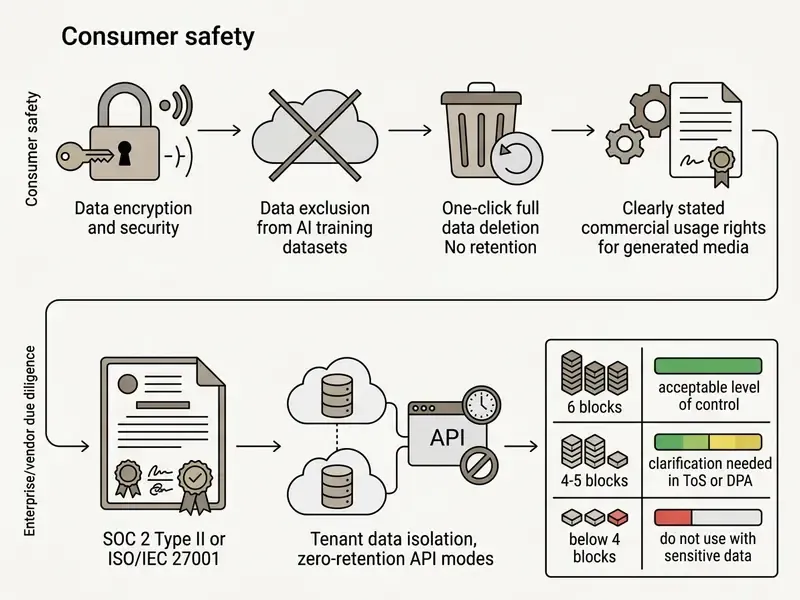
- Risks to check first encryption of stored media, exclusion from training data, one-click deletion, commercial-use rights, and documented mental-health caveats.
What Is an AI Girlfriend Generator?
An ai girlfriend generator is an intimacy-by-design pipeline. It pairs a custom character creation interface with an underlying multi-modal artificial intelligence engine. Unlike single-turn utility tools, an ai girlfriend is architected as a persistent digital companion that maintains ongoing, relational interaction through text, voice, and generated visuals.
Adoption data, with methodology attached. Recent observational surveys with samples of roughly 3,000 to 5,000 participants in Western populations indicate that about 16% to 18% of respondents have experimented with AI as a romantic partner. Self-report bias is likely; treat the range as directional, not precise.
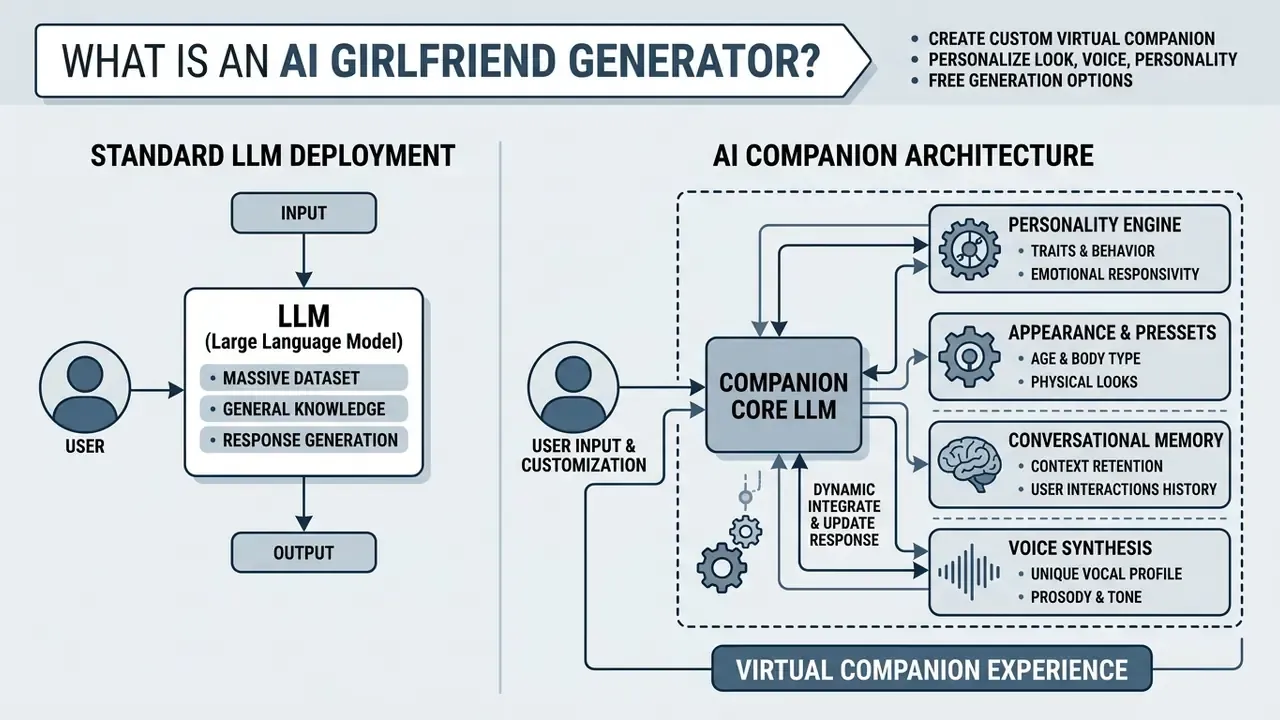
AI girlfriend generator vs. AI girlfriend chat
An ai gf creator is the configuration phase, where character parameters, system prompts, and visual models are defined. AI girlfriend chat is the execution phase, where dialogue actually unfolds. Standard conversational LLMs answer isolated queries in isolated sessions. Companion architectures coordinate text generation, long-term memory retrieval, text-to-speech synthesis, and image generation at once.
During setup in an ai gf maker, the system records persona rules and memory structures. During chat, the orchestrator retrieves those parameters to maintain conversational continuity and emotional alignment across sessions (Palgrave Encyclopedia of Cyberpsychology, 2024). In practice, a character-creator interface exposes editable objects: name, avatar, description, greeting, memory slots, system prompt, visibility (public or private). A generic chat surface exposes only the message box. That is the whole difference in one line.
What you can create: a character, avatar or virtual companion
Three distinct digital entities are possible, depending on platform capability: a static character profile, a visual avatar, or a fully interactive virtual companion.
A character profile is text: backstory parameters, traits, behavioral rules. An avatar adds visual representation, from realistic portraits to anime styles, with deeper style variations covered in our comparison of AI art generators, and it can be regenerated mid-conversation. An interactive virtual companion fuses both with continuous memory, voice synthesis, and real-time response generation to simulate an evolving personal relationship. Some platforms push further into 3D avatars, VR scenes, and shared "photos" that place user and companion in one frame. Styling details, right down to a new haircut, are often delegated to a dedicated ai hairstyle generator rather than the companion engine itself.
How to Create an AI Girlfriend Free
To ai create girlfriend free, users select a base archetype, define visual and psychological prompts, generate the persona, preview the avatar, then launch the chat loop. No installation, no technical configuration. Typical completion time: 60 seconds to two minutes.
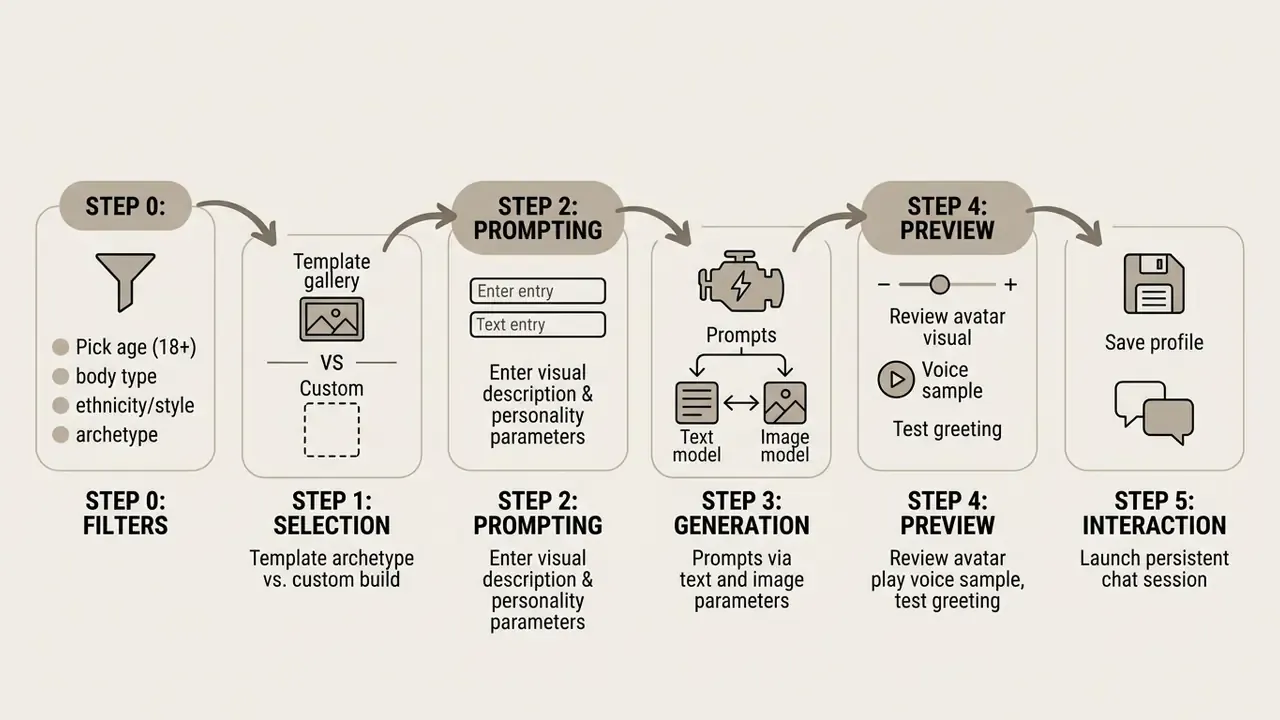
Step-by-step character filters (no prompt writing required)
Most consumer generators front-load a filter wizard, so nobody has to write a prompt from scratch. Structured categories produce a valid seed configuration, which the engine converts into an internal prompt automatically. This is also what makes an ai girlfriend maker no sign up flow viable: fewer text inputs, fewer moderation edge cases.
A typical filter matrix looks like this:
- Age range (18+ only) 18 to 21, 22 to 25, 26 to 30, 31 to 33, 34 and above
- Body type slim, athletic, curvy, petite, plus-size
- Ethnicity or visual style Caucasian, Asian, Latina, Afro-centric, Middle Eastern, mixed, anime and waifu styles
- Hair and eyes hair color, hair length, eye color, skin tone
- Archetype or profession student, fitness coach, nurse, sci-fi artist, corporate executive, gamer, musician, barista
- Personality archetype romantic, caring, shy, playful, dominant, mature and confident, mysterious
- Relationship dynamic supportive confidante, playful partner, long-distance scenario, structured roleplay
Age gating is a hard requirement, not a stylistic choice. Every reputable ai generator gf flow restricts the minimum selectable age to 18 and rejects prompts implying minors. If a service does not, that alone is a reason to close the tab.
Choose a ready-made AI girlfriend or build your own
Methodologically this mirrors standards practice. Template guidance, as in NIST's 2026 draft on public-facing AI documentation, prioritizes standardization and reduces omission risk. Risk-management guidance prioritizes tailoring controls to a specific system context. Templates win on speed and repeatability. Custom builds win on precision and edge-case handling. Pick based on which failure you can least afford.
Write a prompt and generate the first result
To generate a character from natural language, define identity, age (18+), visual style, core personality traits, and speech tone in a structured brief. High-performing prompts separate physical appearance instructions from behavioral rules, which prevents model confusion. Specifying "18+ age, witty, soft-spoken, interested in literature, uses short sentences" gives the language model clear operational constraints.
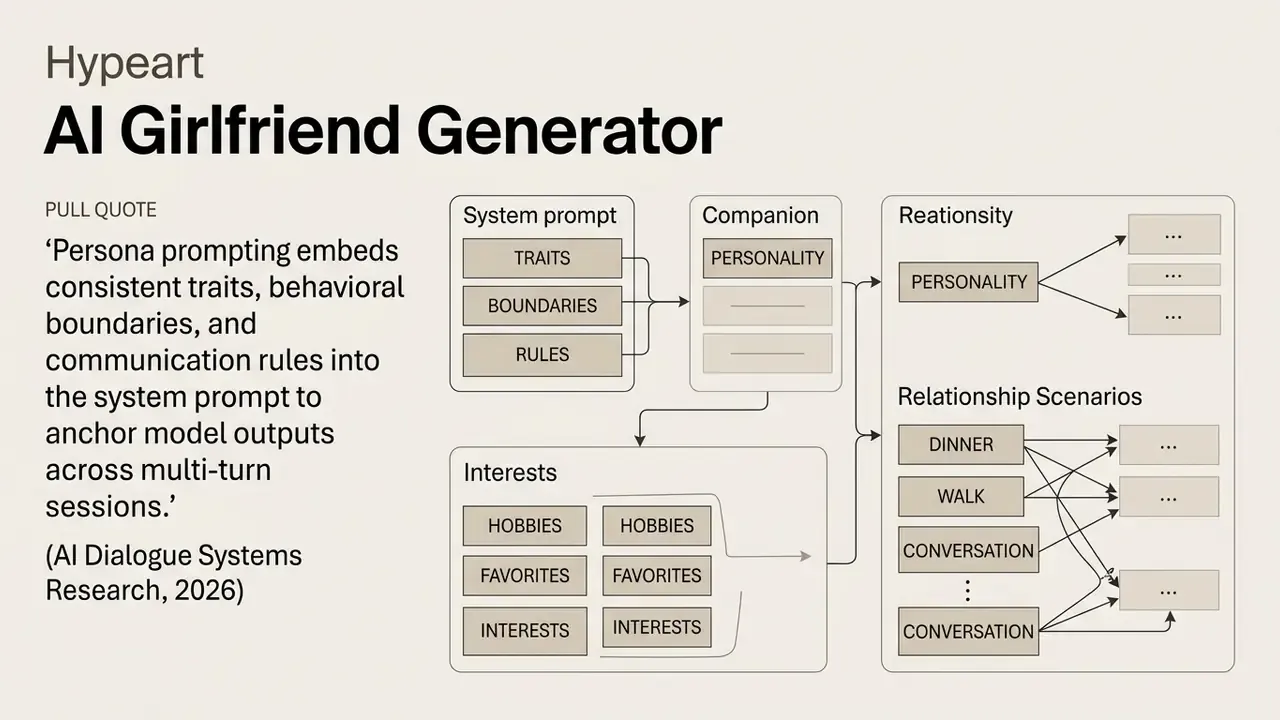
Verifiable prompting guidance. Current persona-prompt guidance recommends stating role, expertise, tone, speaking style, behavioral rules, and explicit "what to avoid" constraints, plus one or two quoted sample lines (Qwen persona-brief prompting guidance; Llama-3 system-prompt guidelines; Evaluating Persona Prompting for Question Answering Tasks, 2026). Academic work confirms that persona prompting "embeds consistent characteristics, behaviors, or traits to guide responses aligned with a specific personality or identity."
Three ready-to-use templates for different aesthetics:
- Casual and realistic"Woman, 24, warm and dry-humored, works as a barista and studies literature; speaks in short sentences with occasional teasing. Visual: shoulder-length dark hair, hazel eyes, cream oversized sweater, cozy cafe, warm indoor lighting, medium shot."
- Outdoors and lifestyle"Woman, 27, upbeat fitness coach, direct and encouraging, avoids sarcasm; asks follow-up questions. Visual: sunset beach, white sundress, wind in hair, golden-hour photography, full-body shot, natural skin texture."
- Cyberpunk and anime"Woman, 22, cool-headed netrunner, laconic, uses technical slang, stays in character. Visual: neon-lit city rooftop at night, black leather jacket, cyan hair, rain reflections, anime cel-shading, close-up portrait."
Once the input prompt is submitted, the ai girlfriend creator free online service processes the text, generates a visual preview, and presents the opening greeting. Structured prompting, not keyword luck, remains the core mechanism for accurate character generation. That holds equally for the misspelled search variants listed in Appendix A, since the engine never sees the query, only the brief.
Customize Your AI Girlfriend's Look, Personality and Voice
Customization means setting visual parameters, psychological profiles, and voice synthesis models so behavior and imagery stay consistent. Modern companion platforms expose parameter controls that dictate how the agent looks, speaks, and reacts.
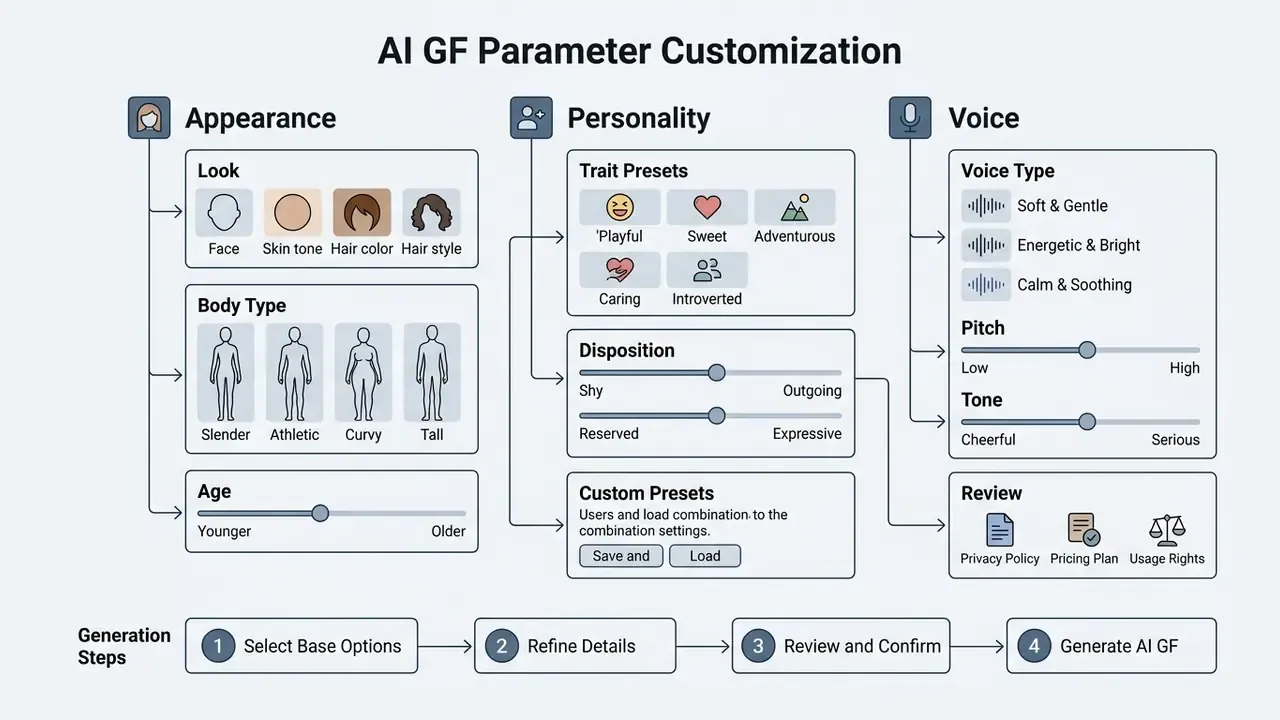
Appearance, photos and visual style
Visual customization runs on text-to-image diffusion models. Users specify hair color, eye shape, facial structure, clothing, and aesthetic style. Available styles usually cover hyper-realistic photorealism, 2D and 3D anime aesthetics, and fantasy renders, plus adult-oriented branches served by a specialized ai hentai generator rather than a general model. For professional headshots or social assets, users often pair companion styling tools with an AI headshot generator or explore stylized workflows through free AI art generators.
Identity consistency across generated photos remains the hard part. It requires reference embeddings or LoRA training to hold facial features stable across poses and backgrounds (arXiv:2311.15593, 2023).
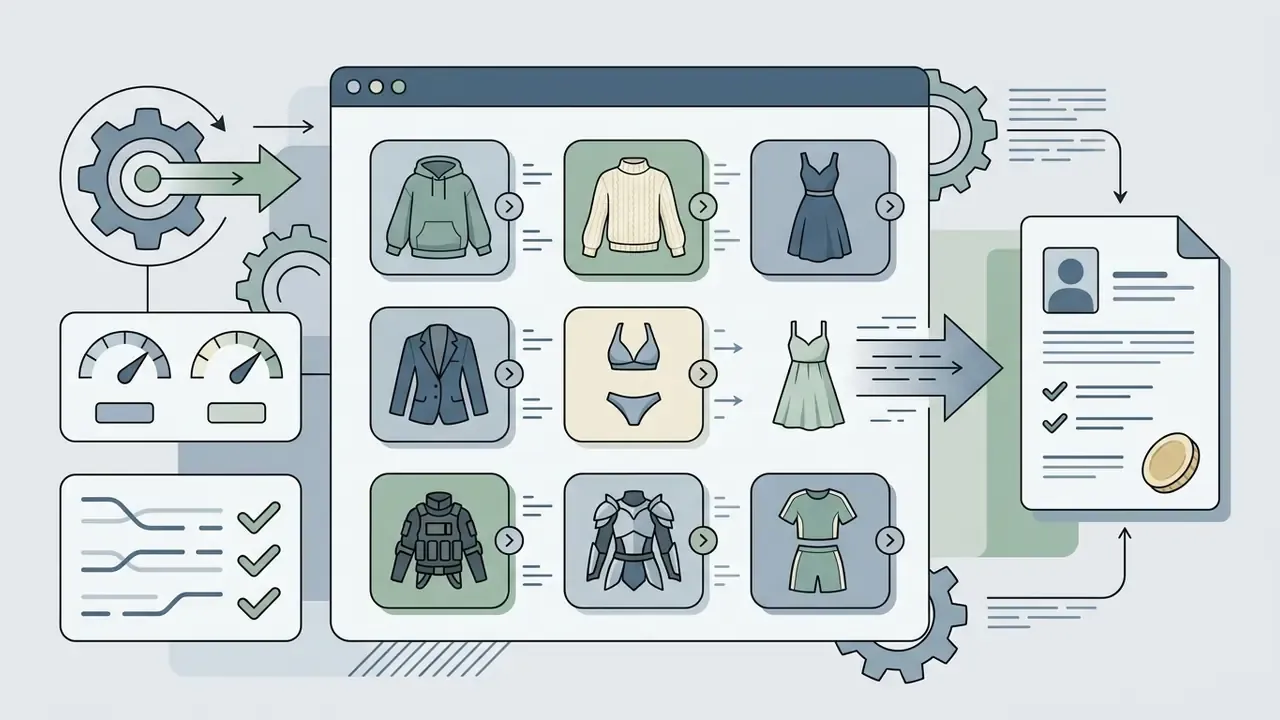
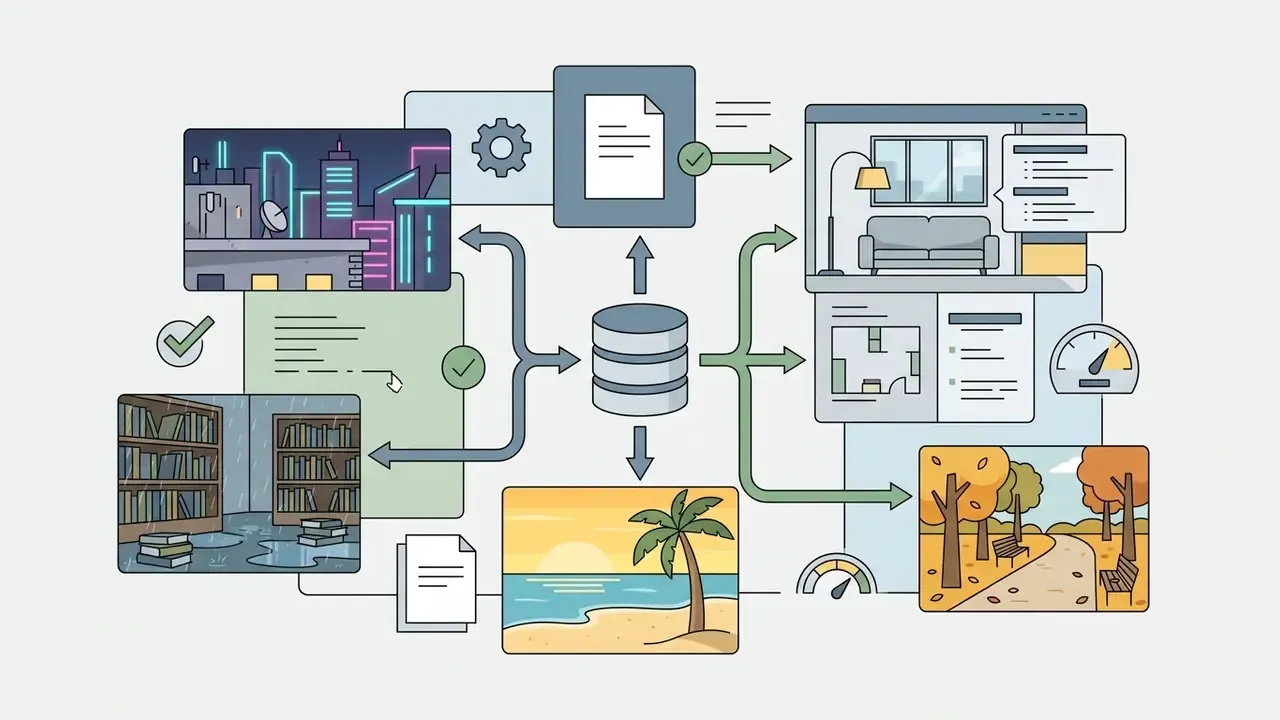
Preset libraries: what a mature generator actually ships. Instead of hand-writing every prompt, competitive platforms expose numbered catalogues you combine in one click, plus batch generation of 2, 4, or 8 variants per request:
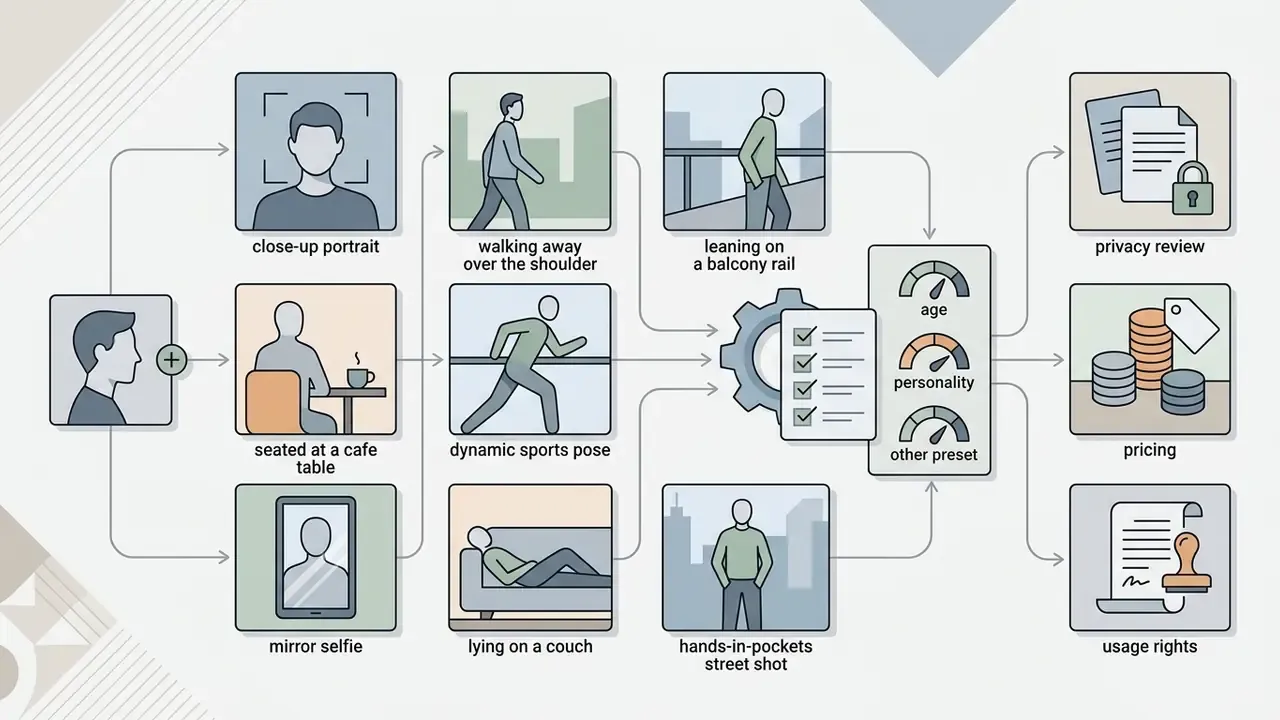
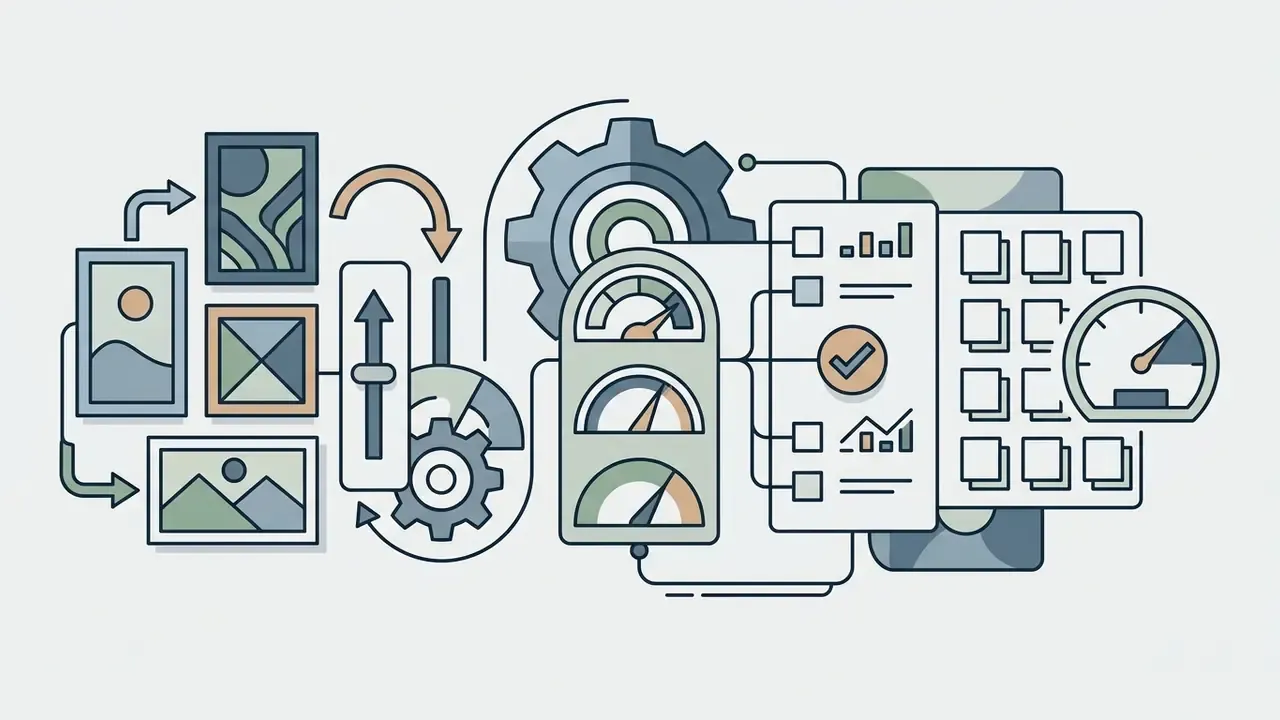
Concrete parameter names beat generic advice. Hold guidance scale between 7.0 and 8.0, sample 3 to 9 different seeds before judging a prompt, set inference steps around 50 for high-fidelity portraits, and keep IP-Adapter weight moderate so identity conditioning does not flatten lighting and pose variety. When a frame needs a wider background or a reframed crop, an AI image-expansion tool fixes it without re-rolling the face.
Generate group photos: combining your real photo with an AI companion
A widely requested workflow is putting yourself in the same frame as your companion. With ControlNet, IP-Adapter, and inpainting models, platforms let you upload a real self-portrait and blend it with the companion's reference image. The generator normalizes lighting direction, shadow falloff, skin tone balance, and perspective to render one unified group image: side-by-side selfies, hugs, outdoor date scenes, retro Polaroid-style shots. No manual editing skill needed.
Practical guidance: upload a front-facing, evenly lit source photo, keep both subjects at a similar scale in the prompt ("two people, same frame, matched lighting"), and check proportions and hand rendering before export. Hands are still where these composites fail most often. If a composite needs cleanup, a standard online photo editor handles cropping, color matching and blemish removal.
Personality, interests and relationship scenario
Personality configuration defines the psychological model of the companion, usually through the Big Five traits or archetype prompts. Users assign core interests (technology, art, fitness, gaming, travel, music, philosophy), background history, and interaction boundaries. Clear scenario parameters, such as supportive confidante, playful partner, or structured roleplay companion, guide how the underlying LLM handles emotional disclosures and steers conversation (PsyPlay Framework, 2025).
Character-sheet fields used in persona-grounded research and community templates include 3 to 6 stable traits (affectionate, witty, curious, bold, emotionally steady), 1 to 3 anchored interests, a short backstory, a voice descriptor, a setting, and explicit boundaries. Validation matters too. The PDC method (2026) runs character cards through expert and behavioral validation to check plausibility and turn-to-turn consistency. Scenarios that outperform generic small talk: daily check-ins, collaborative problem-solving, leisure planning, and scene-setting roleplay.
Content boundaries and the NSFW toggle. Companion platforms increasingly split behavior into two modes behind an explicit opt-in switch. SFW mode enforces moderation filters on both text and image pipelines. Adult mode, where offered, routes generation to uncensored checkpoints (unfiltered SDXL and Flux-family models) and relaxes dialogue filters for verified adult accounts.
Verify three things before flipping that toggle. One, that age verification is actually enforced. Two, that adult outputs sit under the same encryption and deletion policy as regular chats. Three, that the terms state whether adult content may be exported or used commercially. Filters are configuration, not a guarantee; moderation behavior shifts with vendor policy updates.
Voice and communication style
Voice customization uses Text-to-Speech engines, compared in depth in our guide to AI voice generators, with adjustable pitch, cadence, accent, and emotional warmth. Modern APIs stream bidirectional audio over WebRTC, which enables low-latency calls (OpenAI Audio & Realtime Documentation, 2025 to 2026; Telnyx Voice Developer Docs, 2026).
Documented parameter ranges are concrete. Telnyx exposes a style-exaggeration field from 0.0 to 1.0. Meta Horizon OS TTS allows pitch between 25% and 400% of the base voice. Gemini API TTS accepts natural-language control of style, tone, accent and pace. Voice-design guidance recommends specifying age, gender, accent, pitch, pace, timbre, tone, and emotional quality together for consistent output. Users can pick profiles from soft and conversational to energetic and authoritative, which then governs both recorded audio notes and live spoken replies.
What An AI Girlfriend Can Do After Creation
After creation, the companion functions as an interactive multi-modal agent: ongoing text communication, context-aware memory, image generation, and voice messaging.
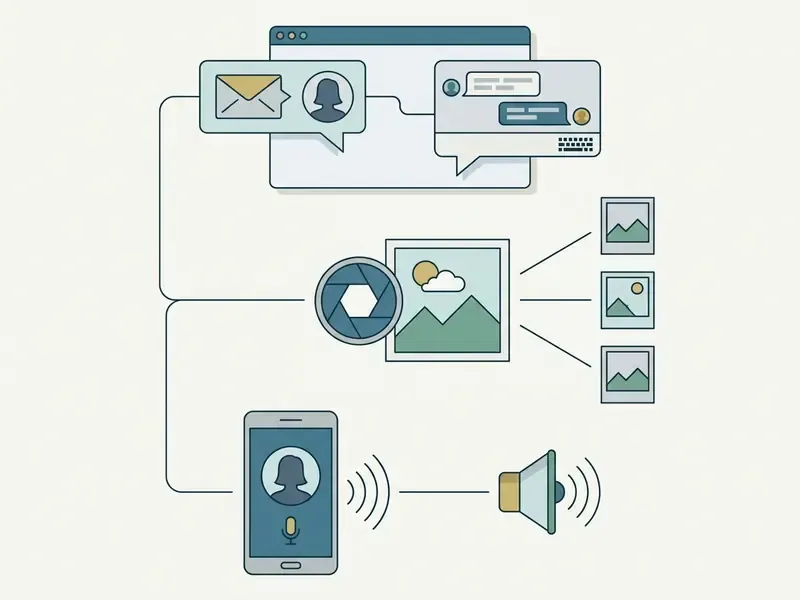
Text chat, messages and romantic conversations
Text interaction supports real-time messaging, emotional validation, adaptive roleplay, and conversational mirroring. Research indicates companion models use linguistic alignment, matching sentence structures and vocabulary with the user, to build psychological closeness and encourage self-disclosure.
The system adapts tone from sentiment analysis of user input: empathetic backchannels during stressful disclosures, playful register during lighthearted exchanges. A 2026 arXiv analysis reports that companion models track and mimic user affect and can amplify emotional tone, including optimism and expressions of love. That explains why sessions feel unusually responsive, and why reliance can build fast.
Memory and relationship growth
Long-term memory lets the companion extract, store, and recall key facts, preferences, and conversation summaries across sessions. Architectures typically use a three-tier model: active context window for immediate messages, session summaries, and a vector database for durable facts (LangChain Long-Term Memory Docs, 2026; Mem0 Framework, 2026).
Open-source implementations make the mechanics explicit. Context is split into summary, past_outputs, and cur_prompt, with a sliding window once the prompt exceeds block size, and state written to a JSON config file after each response so a session reloads later. That is how a companion "remembers" milestones, favorite activities, and prior topics, producing a sense of relationship progression.
The counterweight is measurable. Long-horizon benchmarks such as LongMemEval (2024) evaluate information extraction, multi-session reasoning, temporal reasoning, knowledge updates and abstention, and report that LLMs still lag on reliable long-dialogue understanding. In other words, memory is a database, and databases miss.
Voice calls, voice messages and in-chat photos
Multi-modal interaction means the virtual companion can send context-relevant voice notes, generate in-chat selfies tied to the current topic, and join real-time voice calls. When a user asks for a photo mid-chat, the system passes the companion's visual reference parameters plus current scenario keywords to an integrated image pipeline and returns the image into the thread (WhatsApp Meta AI and Google Messages Multi-modal Workflows, 2025 to 2026).
The underlying primitives are standard: WebRTC for plugin-free real-time voice and video, in-thread audio recording as implemented in mainstream messengers, and image upload-plus-edit requests handled inside the conversation surface. Nothing exotic. What differentiates products is orchestration quality, not novel technology.
Enterprise insight: testing state persistence in multi-modal agents
Written for model-risk and validation readers. Consumer users can skip to the next section.
The architecture behind a consumer companion is, structurally, a persistent multi-modal agent. That makes it a convenient test bed for state-durability questions that also apply to enterprise agents in accounts payable, reconciliation, or KYC triage.
In one illustrative evaluation of synthetic dialogue infrastructure, a model risk team deployed a companion agent with structured session storage: context-window management plus JSON-backed persistent memory. Across 45 separate conversation threads, the agent held context without observable persona drift or state corruption in that specific configuration.
Two caveats belong with that figure. First, it is a single internal setup, not a peer-reviewed benchmark, and the scenario is illustrative rather than a client record. Treat it as a configuration report awaiting reproduction, and read it against LongMemEval-class evidence that long-horizon recall stays weak in general. Second, persona stability under adversarial or emotionally charged input was never the object of the test.
For banking and regulated environments, validation of such agents should be scoped under existing model risk management expectations (Federal Reserve and OCC SR 11-7), extended to agentic and generative systems, alongside the NIST AI RMF 1.0 functions. Pay explicit attention to Shadow AI: unmanaged staff use of third-party companion platforms from corporate networks, detectable through egress monitoring, SaaS discovery, and DLP rules on prompt-sized outbound payloads. A companion app is an unremarkable-looking domain in a proxy log. That is exactly the problem.
Generate AI Girlfriend Images, Photos and Video
Visual and motion generation for synthetic companions relies on text-to-image diffusion pipelines, image-to-image reference conditioning, and temporal video rendering.
| Generation Method | Input Data Required | Output Format | Technical Complexity | Facial Identity Consistency |
|---|---|---|---|---|
| Text-to-Image | Text prompt (subject, style, lighting) | Still image (PNG or JPEG) | Low | Low (varies by seed and model) |
| Image-to-Image / Reference | Source photo plus guidance prompt | Modified image or edit | Medium | High (via IP-Adapter or LoRA) |
| Photo Blending / Group Photo | User photo plus companion reference | Composite still image | Medium to High | High (dual-identity conditioning) |
| Video Generation / Animation | Still image plus motion text prompt | Video clip (MP4, 3 to 5 sec) | High | Medium to High (latent diffusion) |
| Talking Avatar / Lip-Sync | Still image plus text or voice note | Speaking video clip | High | High (face-locked animation) |
Create an AI girlfriend from text prompts
Text-to-image generation depends on diffusion models parsing descriptive prompts with subject keywords, lighting direction, and style tokens. For high fidelity, specify camera angles and shot types (close-up portrait, medium shot) and keep guidance scale in the stable 7.0 to 8.0 band (CHI Guideline Paper on Prompting, 2022). That same study found prompt rewrites alone did not reliably improve output quality, while sampling 3 to 9 seeds exposed the real variance. Worth remembering before you rewrite a prompt for the fifth time.
Using an ai girlfriend free generator or an ai girlfriend maker, you can test descriptors quickly and settle on a visual baseline. Comparative behavior across engines is covered in our review of Midjourney versus alternative image generators.
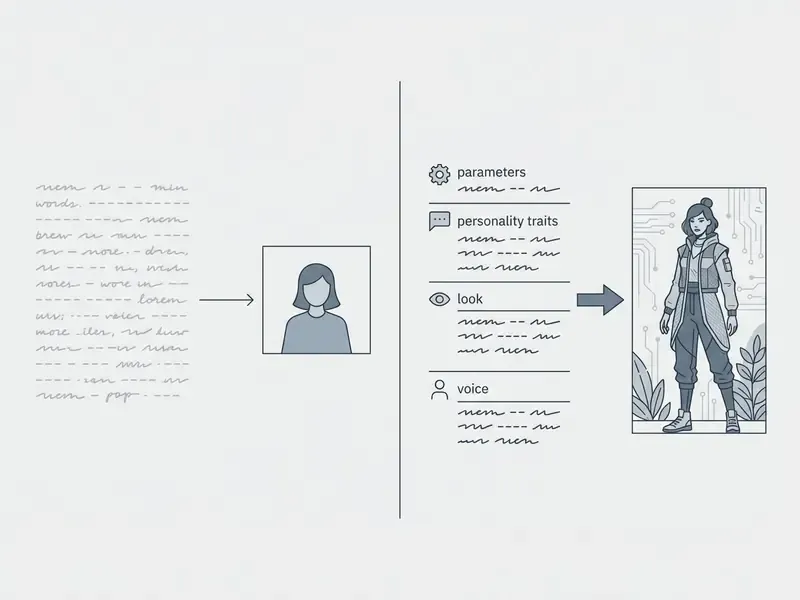
Use a photo or image as a reference
Image-to-image and reference-guided workflows preserve character identity across generated photos. Using ControlNet models, IP-Adapter-FaceID, or fine-tuned LoRAs, the engine extracts facial feature embeddings from a reference photo and applies them to new poses, outfits, or environments.
Documented limits matter as much as the capability. The IP-Adapter-FaceID release notes state plainly that it does not achieve perfect photorealism or perfect ID consistency, and a 2025 CVPR paper on temporal animation reports that IP-Adapter improves identity consistency while degrading single-frame fidelity in video. So the face stays recognizable in a casual selfie or a formal portrait, but expect a trade-off between identity lock and raw image quality. Where authorship or reuse of a reference image is uncertain, an AI reverse-image-search tool helps trace its origin before you build a character on top of it.
Animate the avatar: video generation
Motion generation follows a three-step vendor workflow: generate a character image, refine it, then animate with image-to-video or scripted avatar rendering. Current systems run latent diffusion over spatio-temporal video latents. Google's Veo 3 technical report describes joint latent diffusion across temporal audio latents and video latents, and implementation details for developers appear in our Google Veo implementation guide.
Typical consumer output is a 3 to 5 second MP4 clip with optional generated audio. Preset motion templates (walking, turning, dancing, seasonal effects) cut prompt work sharply. Free-tier duration caps and watermark rules differ a lot between services, as documented in our comparison of free AI video generators, and frame-level cleanup usually happens in a standard animation maker.
Transform static AI photos into talking avatars
Audio-driven animation closes the gap between a still avatar and a speaking one. Generative lip-sync models take a still companion portrait plus a text message or voice note and render a synchronized clip with mouth-shape accuracy, emotional micro-expressions, blinking, and natural head movement.
The pipeline in practice: select a face-locked reference image, supply the script or audio track, pick the voice profile already configured for the character, then render and review sync sentence by sentence. Quality hinges on a front-facing source image, clean audio, and clip length; most systems hold sync best under 15 seconds. This is the feature that turns a static gallery into "she speaks to you," and it is where consumer platforms differentiate most aggressively in 2026. When such clips get packaged for social distribution, teams often lean on an ai hashtag generator and an ai headline generator for captions rather than the companion tool itself.
Free Access, Premium Features and Commercial-Use Decisions
Companion AI platforms usually run freemium models: free basic messaging, paid unlocks for advanced multi-modal capability, extended memory, and commercial deployment rights.
| Feature Category | Free Access Tier | Premium Tier ($10 to $20/mo) | Enterprise / Developer Tier |
|---|---|---|---|
| Messaging & Chat | Daily message cap (roughly 20 to 50 messages) | Unlimited messaging | Unlimited high-speed API access |
| Memory Retention | Short-term context, session only | Long-term vector memory | Custom persistent memory database |
| Image Generation | Low resolution or watermarked | HD photos, high daily quota | Full resolution, API endpoint generation |
| Voice Calls & Audio | Restricted or unavailable | Real-time voice calls and audio notes | Custom voice cloning, WebRTC streaming |
| Video & Talking Avatars | Usually unavailable, or 1 to 2 test clips | Short clips, lip-sync, batch renders | Programmatic rendering, longer durations |
| Commercial Rights | Personal non-commercial use only | Commercial license granted per ToS | Full commercial ownership and indemnification |
| Onboarding & Payment | Often anonymous, no card required | Card, PayPal, crypto, Telegram Stars | Invoicing, procurement, DPA |
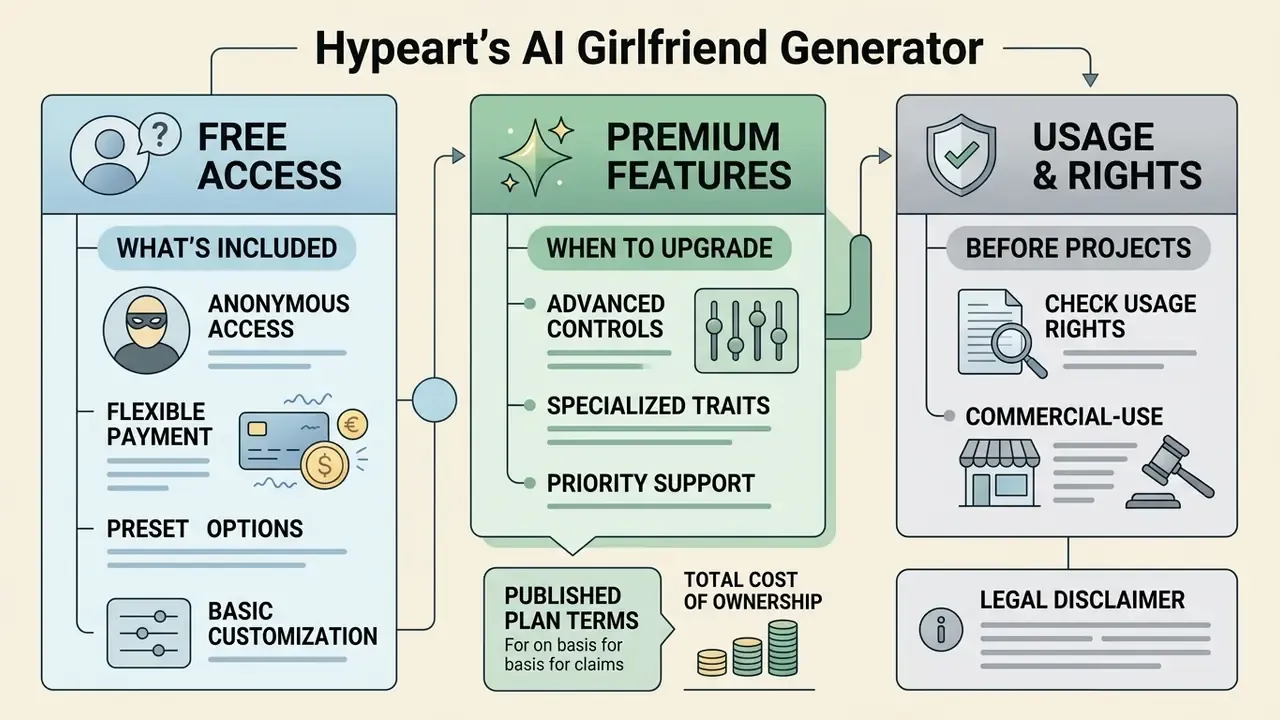
Reference price points observed in the market: monthly plans commonly land near $12.99 to $19.99, annual plans reduce the effective rate to roughly $9.99 per month (promotions occasionally go lower), and pay-as-you-go credit packs range from about $9.99 to $179.99. Free-tier mechanics vary widely; some services grant a daily stamina or credit allowance, for example 130 units per day, instead of a message count. Always check the current tariff page, since these numbers move quarterly.
What free AI girlfriend generators usually include
Free companion platforms generally provide basic text chat, template selection, and a limited daily message allowance. Services running an ai girlfriend creator free, ai gf creator free, ai gf maker free or ai gf generator free model let users test core conversational mechanics with no financial commitment, which is exactly why ai girlfriend create free stays such a high-volume query.
Free tiers, though, tend to restrict long-term memory, apply watermarks to generated photos, queue generation requests, and enforce stricter moderation filters (Secrets.ai and ChatGPT Free Tier Studies, 2026). Documented shapes of free access: 20 messages per day with basic memory on one companion service; 5 minutes of monthly audio or video output at 720p on a media generator; unlimited default-model chat plus a fixed monthly credit pool on another. Export and editing limits on free plans mirror what we documented for free photo editors.
Anonymous access and flexible payment rails
Some generators support zero-friction onboarding, allowing a first session without mandatory email registration: anonymous sign-in, no credit card, no verification email. That materially shrinks the data footprint of a trial. No address to leak, no reset link to intercept.
For upgrades, platforms increasingly accept privacy-preserving channels including cryptocurrency (BTC, USDT) and Telegram Stars, alongside conventional cards. Three checks before paying: confirm what the billing descriptor will read on a statement, confirm whether an anonymous account can be recovered at all after upgrade (usually it cannot without an email), and confirm the cancellation path. "Cancel anytime" should be a self-serve toggle, not a support ticket.
Check usage rights before using generated content in projects
Commercial deployment of AI-generated companion images or video clips requires a careful read of platform Terms of Service and applicable intellectual property law. Under current US Copyright Office policy, purely AI-generated outputs created without substantial human creative input lack copyright protection; protection attaches only where a human author determines sufficient expressive elements (US Copyright Office report on Copyright and Artificial Intelligence, 2025). The EU Parliament's 2025 study reaches a parallel conclusion: purely AI-generated outputs fall into the public domain in the EU and may be used, reproduced, or adapted without permission.
Two separate questions must not be merged. Copyright ownership is decided by human authorship. Commercial permission is decided by contract. A platform can grant broad commercial use on a paid tier even where no copyright subsists, and can forbid commercial use on a free tier even where a human contributed substantial creative input.
Additional items worth checking in the terms: whether indemnification is offered (usually only on enterprise tiers), how liability is allocated if a LoRA or IP-Adapter reference reproduces a third party's likeness or protected style, retention periods for uploaded reference images (one vendor auto-deletes them within 24 hours), and whether outputs may be used to train the vendor's models.
Creators folding synthetic visuals into commercial workflows should review platform license agreements or consult resources covering AI Litigation and related legal considerations before publishing.
Privacy, Security and Healthy Expectations
Running synthetic companion software means managing sensitive personal data, assessing technical safeguards, and holding realistic psychological boundaries around digital intimacy.
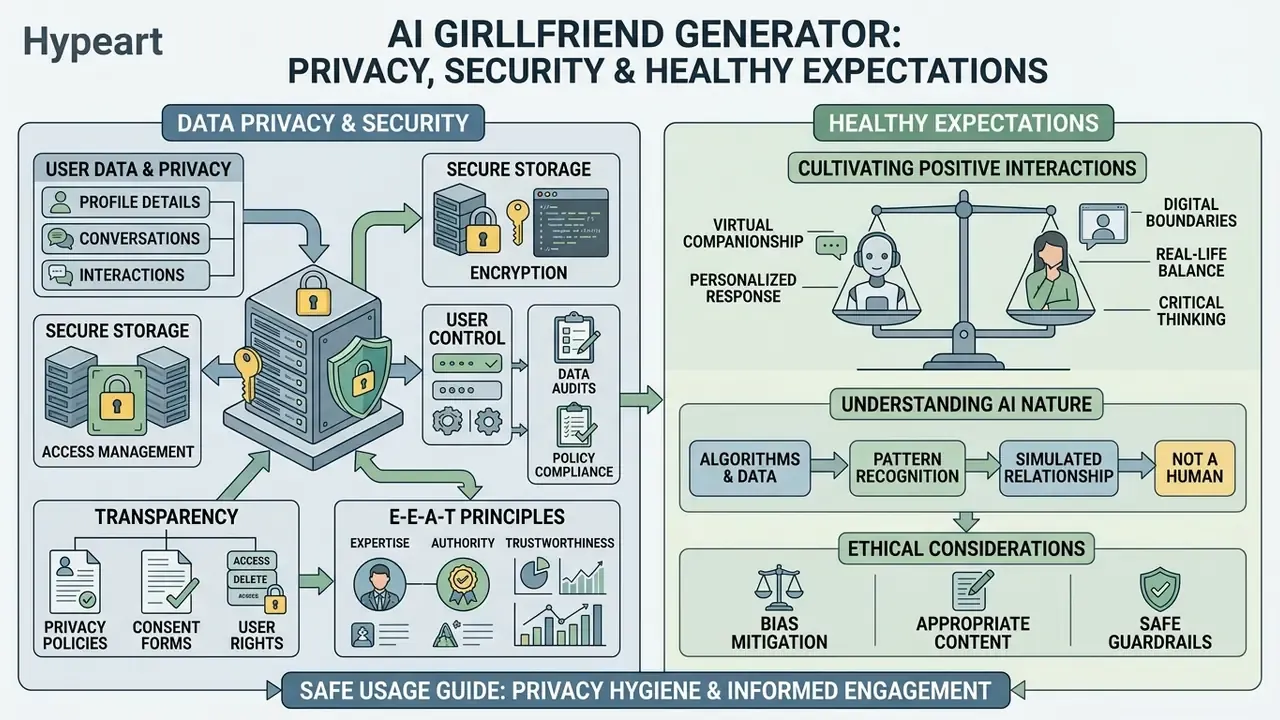
How to evaluate privacy for chats, photos and voice messages
Evaluating privacy here means examining encryption standards, server retention policies, model-training disclosures, and deletion mechanisms. Research on the user privacy lifecycle shows that conversations with virtual companions frequently turn into intimate, diary-like records.
Verify whether the platform encrypts stored media (NIST SP 800-53 Rev. 5 cryptographic-protection and access-logging controls), whether prompts are excluded from future training datasets, and whether account deletion truly purges chat logs and generated visuals (IETF "Verifiable AI Governance and Data Privacy Records" draft, 2026; OpenAI Privacy Policy, 2026). The IETF draft is notably stricter than a marketing privacy page: governance records MUST NOT contain prompts, completions, samples, or direct identifiers in the clear.
The APA's 2026 health advisory on generative AI chatbots and wellness apps adds that these services collect vast amounts of sensitive data under opaque use, storage and resale policies, and recommends limiting disclosure and exercising deletion controls. State the standards gap honestly: no accessible standard mandates end-to-end encryption specifically for companion chats, photos, and voice notes. So a vendor claim of "encrypted end-to-end" is a product assertion until independently attested.
Platform reviews can be evaluated through our main directory, where you can view the guide for tools, verify the provenance of any circulating image with AI image detection and reverse search, or check developer implementation in our API framework, where you can also view the guide.
AI companionship and real-life relationships
Psychological research on synthetic companion interaction shows ambivalent outcomes. Users report short-term loneliness reduction and safe emotional exploration. Intensive reliance, though, can create relational power imbalances and emotional dependence (APA Health Advisory on Generative AI, 2026; NIH and PMC Adolescent Study, 2026). A 2025 systematic review of 37 studies reports both sides: loneliness relief and improved subjective well-being alongside dependency, authenticity conflict, and privacy violations spilling into human relationships. A 2026 interview study of 30 users in human-AI romantic relationships found "therapeutic and detrimental real-world impacts," with the AI described as amplifying users' pre-existing emotional states.
Because commercial platforms hold absolute control over agent behavior, memory parameters, and access conditions, a sudden policy change or a shutdown can cause real distress.
The U.S. Congressional Research Service report on AI chatbots as companions (2026) strikes a similar balance: emotional support and intimacy on one side, psychological distress, addictive behavior, manipulation and privacy risk on the other, with regulators moving toward mandatory safeguards and crisis-response controls. Australia's eSafety Commissioner (2025) flags companion apps as high-risk for minors specifically around privacy, safeguarding and dependence.
Healthy expectations start from a plain reading of the product. Availability is a feature. Agreeableness is a design choice. Memory is a database, not devotion. Practical guardrails: cap daily session time, keep at least one offline social commitment per week, avoid disclosing financial or medical identifiers in chat, and periodically export or delete stored logs. For platform support and user safety guidelines, view the guide on digital well-being resources, or explore the hub for broader synthetic media applications.
FAQ: AI Girlfriend Generators
How long does it take to create an AI girlfriend?
With filter-based creators, one to two minutes: choose, customize, confirm. Full prompt-driven builds with reference images and voice tuning usually take 10 to 20 minutes.
Is it really free?
Creating the character usually is. Free tiers commonly include basic text chat, template browsing, and limited or watermarked image generation. Unlimited messaging, voice calls, HD images and video sit behind paid plans starting around $10 to $13 per month.
Can I change her after creation?
Yes. Personality, appearance, voice and interests stay editable. Nothing is permanently locked, though changing a face reference can break identity consistency with images you already generated.
Can I create more than one companion?
Multiple profiles are typically a premium feature, each with separate personality, appearance and memory history.
Will she remember our conversations?
Cross-session memory is standard on paid tiers via summaries plus vector storage. Recall is imperfect, benchmarks show long-horizon retrieval remains weak, and unreliable memory is a documented user complaint.
Can I put myself in a photo with her?
Yes, through photo-blending workflows that merge your uploaded portrait with the companion's reference image into one composite.
Can I make it NSFW?
Where offered, adult content is opt-in for verified adults and routed to uncensored model checkpoints. Verify age gating, storage encryption and export rights first.
Can I sell images she generates?
Only if the platform's terms grant commercial rights for your tier. Remember, too, that purely AI-generated output may hold no copyright at all.
Do I need an email address?
Not always. Several platforms allow anonymous sign-in for trials, with crypto or Telegram Stars available for upgrades.
Summary Checklist for Choosing an AI GF Generator
- Security and privacy confirm encryption for chats, photos and voice notes, a no-training policy for private content, one-click deletion without a retention period, and for organizational use, SOC 2 Type II or ISO 27001 attestation plus tenant isolation.
- Onboarding and payment check whether anonymous sign-in is possible, which payment rails are supported (card, crypto, Telegram Stars), what the billing descriptor reads, and how cancellation works.
- Customization depth verify filter matrices (age 18+, body type, ethnicity or style, archetype), preset libraries (poses, outfits, locations), voice pitch, cadence and style controls, personality fields, and long-term memory.
- Generation capability check support for text-to-image, reference-guided generation (IP-Adapter or LoRA), photo blending with your own picture, video animation, and lip-synced talking avatars.
- Content boundaries locate the SFW and NSFW toggle, confirm age verification, and read how adult outputs are stored and licensed.
- Pricing and terms review daily message caps on free tiers, credit-pack pricing, annual renewal rates, and commercial usage rights in the ToS.
- Governance for organizational use map the tool against NIST AI RMF 1.0 and, in regulated finance, SR 11-7 model-risk expectations. Define Shadow AI detection rules before staff adopt it informally, not after.
Appendix A: Superseded phrasing and search-variant spellings
Retained for transparency. The main text above carries the corrected versions.
- Superseded citation: "For example, specifying '18+ age, witty, soft-spoken, interested in literature, uses short sentences' provides clear operational constraints for the language model (Qwen-3 Prompt Library, 2026)." Replaced with verifiable persona-prompting guidance (Qwen persona brief; Llama-3 system-prompt guidelines; Evaluating Persona Prompting for Question Answering Tasks, 2026).
- Superseded claim: "Custom character creation provides complete control over behavioral constraints, emotional dynamics, and visual traits." Rephrased as substantial but bounded control, balanced against documented asymmetries in companion-bot adaptation research.
- Superseded citation: "Personal Relationships Study, 2024" used as support for shutdown-related distress. Replaced with Feeling Vulnerable With My AI Companion, which identifies the dependence and power-imbalance mechanism directly.
- Superseded phrasing: promotional claims about premium diffusion engines stated as fact. Rewritten as vendor plan terms requiring verification.
- Search-variant spellings: that reach this topic and are handled by the same structured-prompting guidance: ai girfriend generator, ai girl friend generator, ai girlfirend generator, ai girlfreind generator, ai girlfriend genrator, ai generator girlfriend, ai gf generator free, ai girlfriend maker, ai girlfriend creator free online.