Generative artificial intelligence has moved past text and static imagery into synthetic audio production. Modern neural audio architectures, from score-based diffusion models to autoregressive language models trained on discrete audio tokens, synthesize music, sound effects, and vocal tracks straight from natural-language descriptions. For marketing executives, brand managers, and digital media teams, an ai jingle generator offers an automated way to produce short branded audio assets without the delay and cost of a studio booking.
A caveat before anything else. Speed is the easy part; provenance, licensing, and the audit trail are where programmes stall.
Executive Summary
- What it is
- A text-to-audio (and audio-to-audio) system that converts prompts, slogans, reference recordings, or full lyric scripts into 2-to-30-second branded audio assets: sonic logos, radio stingers, podcast bumpers, and app notification cues.
- Why it matters commercially
- Audio brand assets measurably outperform visual assets in advertising effectiveness, with Ipsos data showing a 3.44× effectiveness multiplier and an 8.53× higher presence in top-performing campaigns.
- How it works operationally
- Structured prompt (genre + mood + instrumentation + tempo + vocal style + lyrics) → parameter locks (BPM, key, instrumental toggle) → negative prompting and exclusion tags → multi-variant generation → compliance sign-off → multi-format export (WAV, MP3, MP4, SRT, stems).
- Where the risk sits
- Purely AI-generated audio is not registrable for copyright in the United States; the EU AI Act (Article 50(4)) mandates synthetic-audio disclosure from 2 August 2026; and automated Content ID fingerprinting on YouTube, Twitch, and Meta can flag licensed AI audio as a false positive.
- What still requires humans
- Comparative research from Stephen Arnold Music and SoundOut indicates AI systems hit roughly 20% accuracy against a specific emotional brief, so human curation, DAW refinement, and listener panels remain the deciding step.
Who This Guide Is Written For
Three readers get value here, and they read it differently.
Brand and content teams want the workflow: prompt structure, style controls, export formats, and the fastest route from slogan to finished audio. Risk, legal, and compliance functions want the control layer: licensing evidence, disclosure duties, model versioning, and dispute handling. Finance leaders want the arithmetic: cost per usable asset once rejects, review hours, and labeling work are included.
If you sit inside a regulated institution, treat a jingle ai generator the way you already treat any unstructured-media model. Documented owner, approved use case, access limits, human review point, retention terms, and a shutdown path. No evidence, no autonomy. That principle costs very little to apply to a 15-second radio sting, and it saves an uncomfortable conversation later.
What Is an AI Jingle Generator and What Can It Create?
An ai jingle generator is a text-to-audio system that transforms natural-language prompts, slogans, or short scripts into brief, branded audio assets such as radio stingers, podcast bumpers, and promotional hooks. These tools generate both instrumental arrangements and synthetic vocal performances in standard digital audio formats.
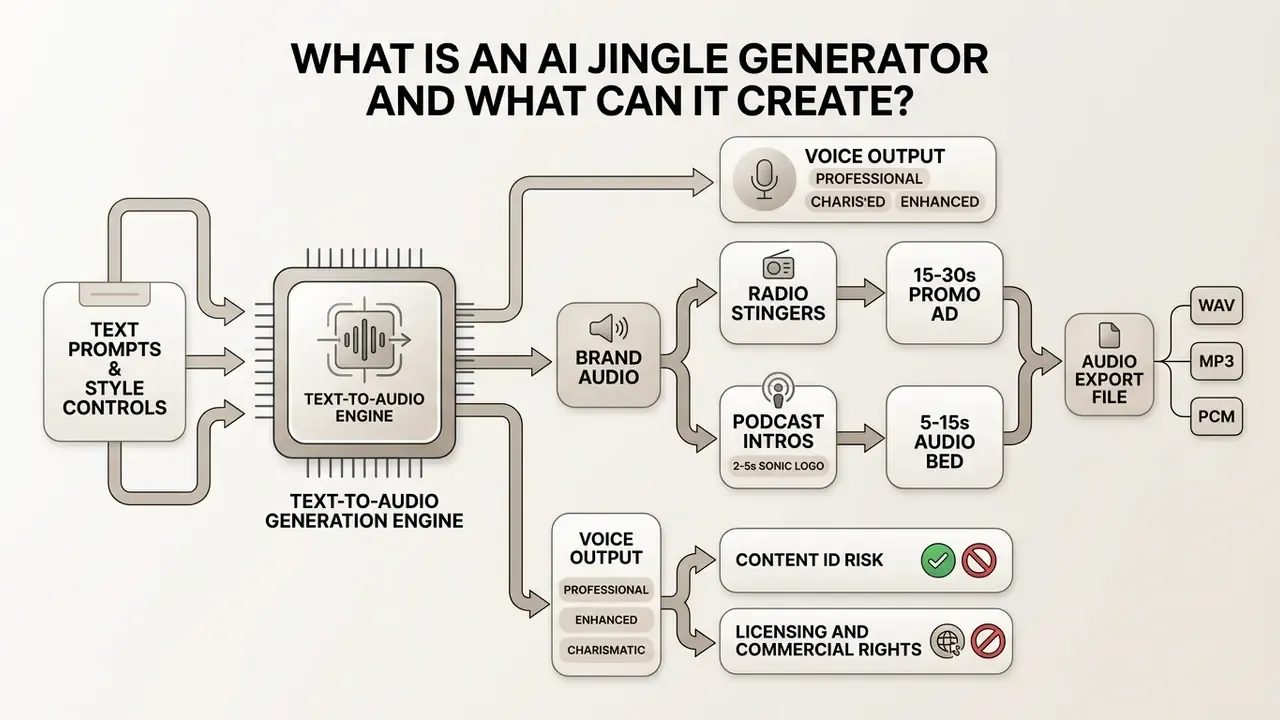
At its core, an ai jingle creator relies on deep learning models: latent diffusion networks or autoregressive transformer frameworks such as Qwen-Music and MiDashengLM-Gen. These architectures process text conditioning inputs, including genre, emotional mood, tempo, and exact lyrical scripts, then output synthesized waveforms. By restricting output duration and focusing model conditioning on a memorable melodic hook, a jingle generator ai yields finished audio built for immediate commercial recall.
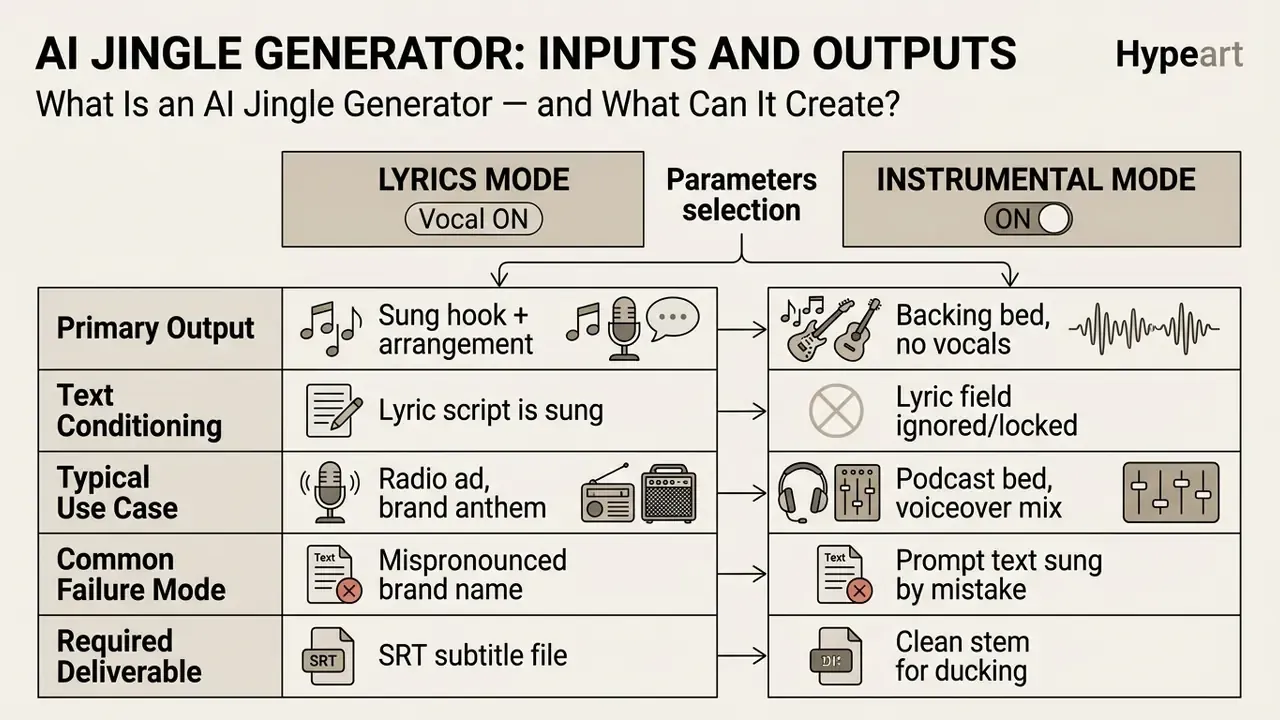
Two base generation modes govern every interface on the market. Confusing them is the single most common cause of unusable output.
Brand, Radio and Promotional Jingles
Brand, radio, and promotional jingles are concise audio signatures, typically 2 to 30 seconds, engineered to lift brand recall and emotional association across advertising channels. These short elements work as sonic logos, station identifiers, and campaign hooks.
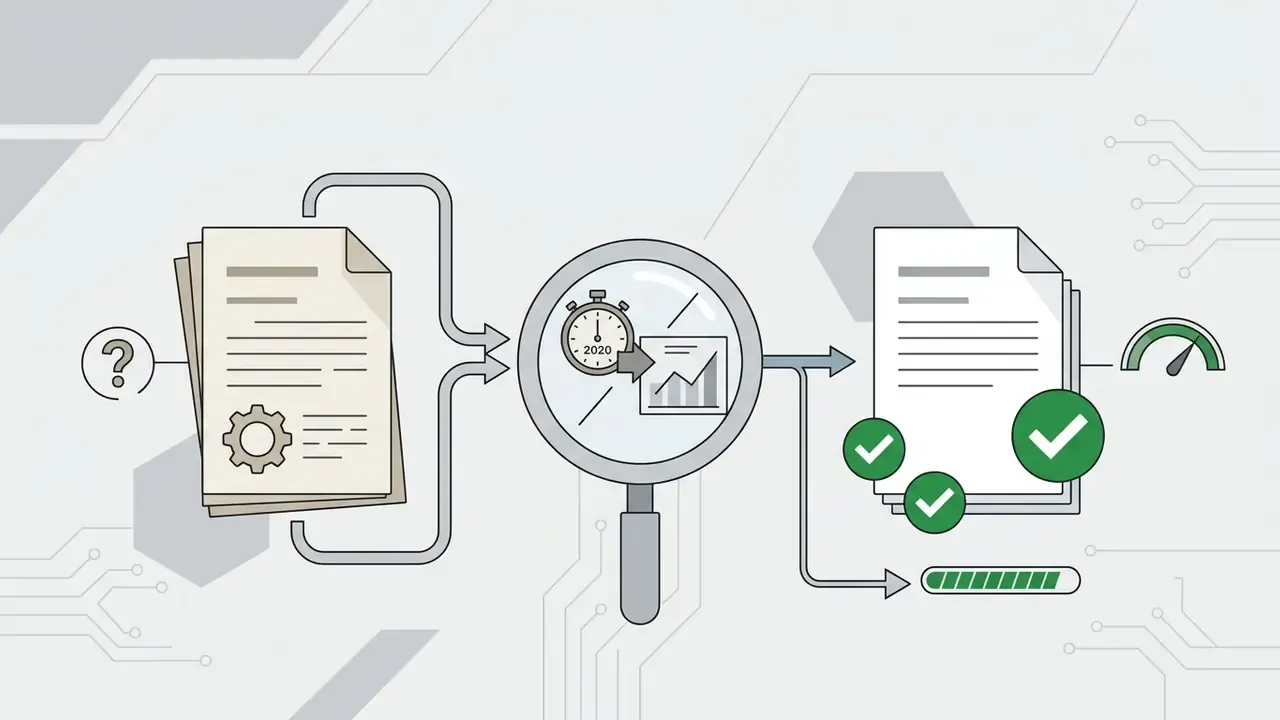
Research in sensory marketing quantifies the effect. A study by market research firm Ipsos (2020) showed that brand audio assets were 3.44 times more effective than visual assets in driving high-performing advertisements. Sonic brand cues were also 8.53 times more likely to appear in top-performing campaigns than other asset types.
«Audio assets are on average 3.44 times more effective than visual assets at producing high-performing advertising, and sonic brand cues appear 8.53 times more often in top campaigns.»
When deploying audio across broadcast channels, industry guidelines such as the IAB Brasil Audio Creative Guide (2024) recommend 15-second spots containing 10 to 15 seconds of focused brand messaging, opening with brand name plus slogan, while 30-second radio slots accommodate broader narrative context. Google's Display & Video 360 audio creative guidance states the same constraint in words: roughly 40 words for a 15-second spot and 55 to 75 words for a 30-second spot. Organizations mapping new creative workflows often start at an ai app creation hub to see how automated media tools plug into wider enterprise architecture.
Instrumental, Vocal and Voice-Based Audio Output
An ai music jingle generator produces three primary outputs: pure instrumental compositions, synthetic singing vocals tied to custom lyrics, and spoken-word voiceovers layered over background music beds.
- Instrumental OutputFocuses on harmonic structure, rhythm, and orchestration with no vocal elements. These tracks serve as podcast intro beds, software notification sounds, or commercial backing tracks.
- Vocal OutputCombines singing voice synthesis with natural-language processing. Models sing lyrics while holding to requested musical keys, vocal timbres, and rhythmic patterns. Contemporary open-source song generators additionally support optional three-second reference voice cloning, which raises consent and likeness questions covered in the compliance section below.
- Voice-Based OutputBlends text-to-speech narration with automated background music. Systems like MiDashengLM-Gen use flow-matching techniques to keep speech intelligible over musical arrangements.
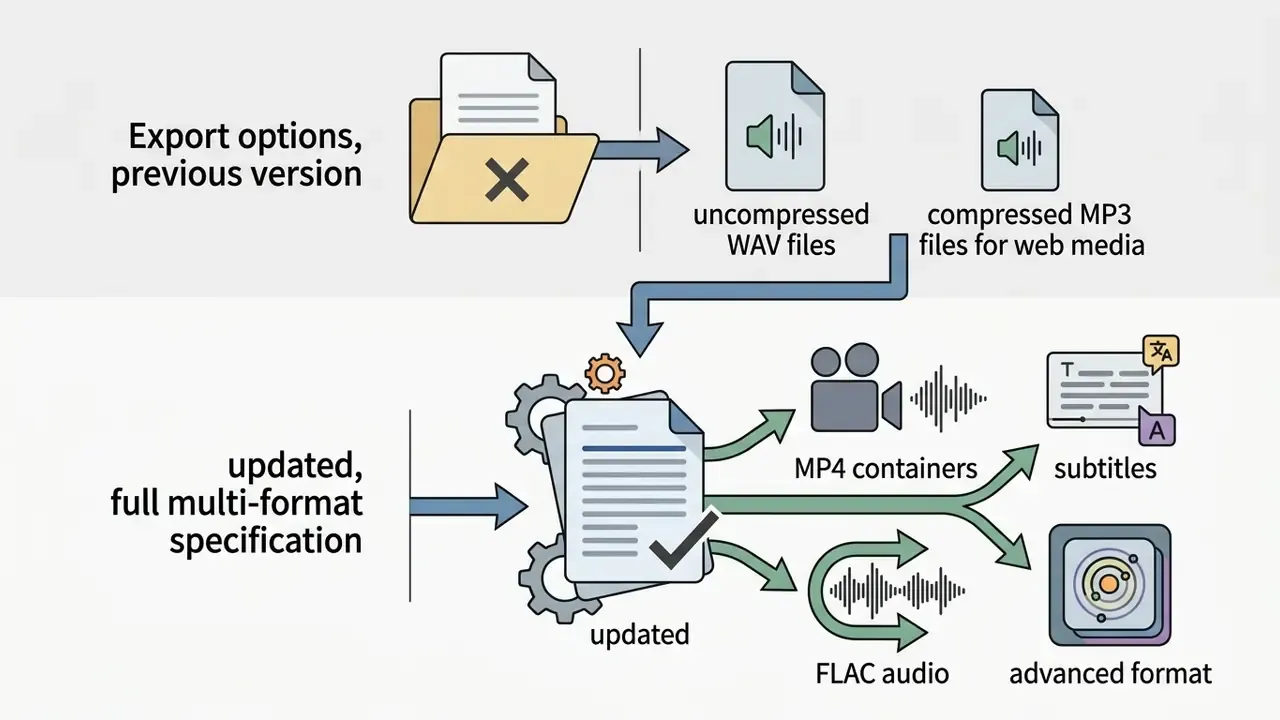
For professional distribution, outputs are rendered as uncompressed WAV files (typically 24-bit/48 kHz for broadcast specifications) or compressed MP3 files (160 to 320 kbps) for web media. Teams managing voice assets across platforms can review specialized tools in our guide to AI voice generators.
How to Create a Jingle with AI
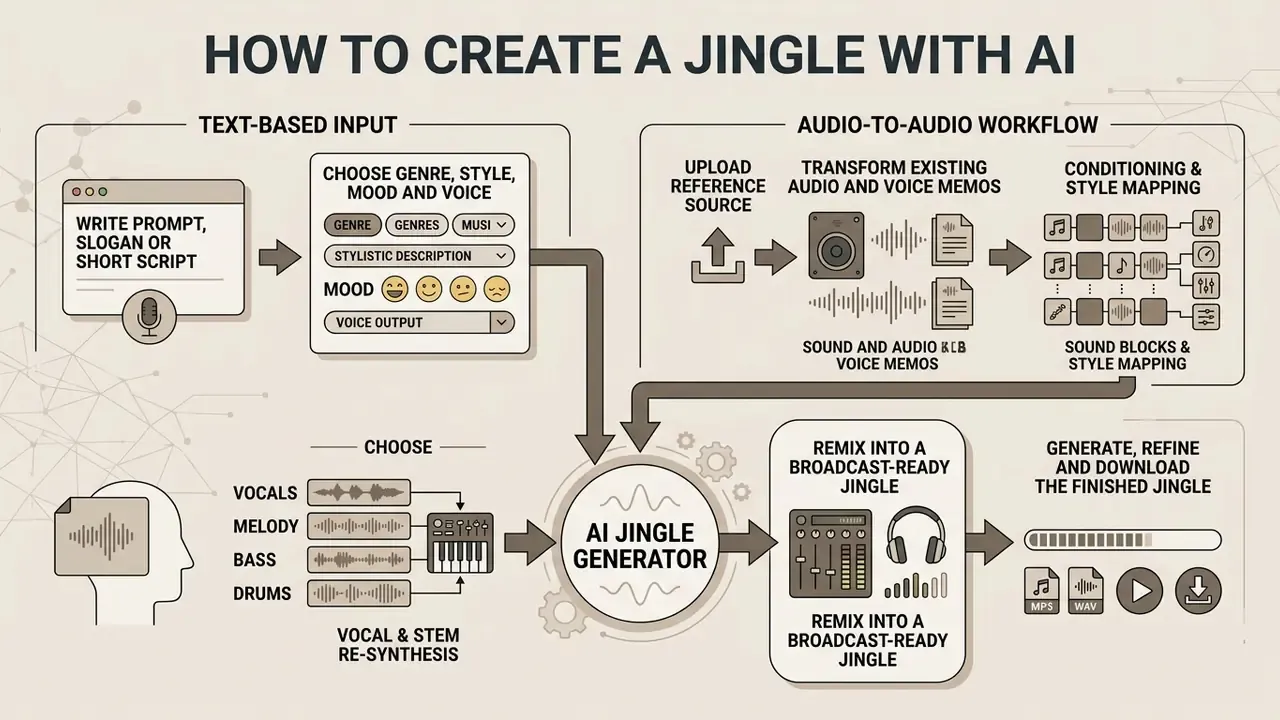
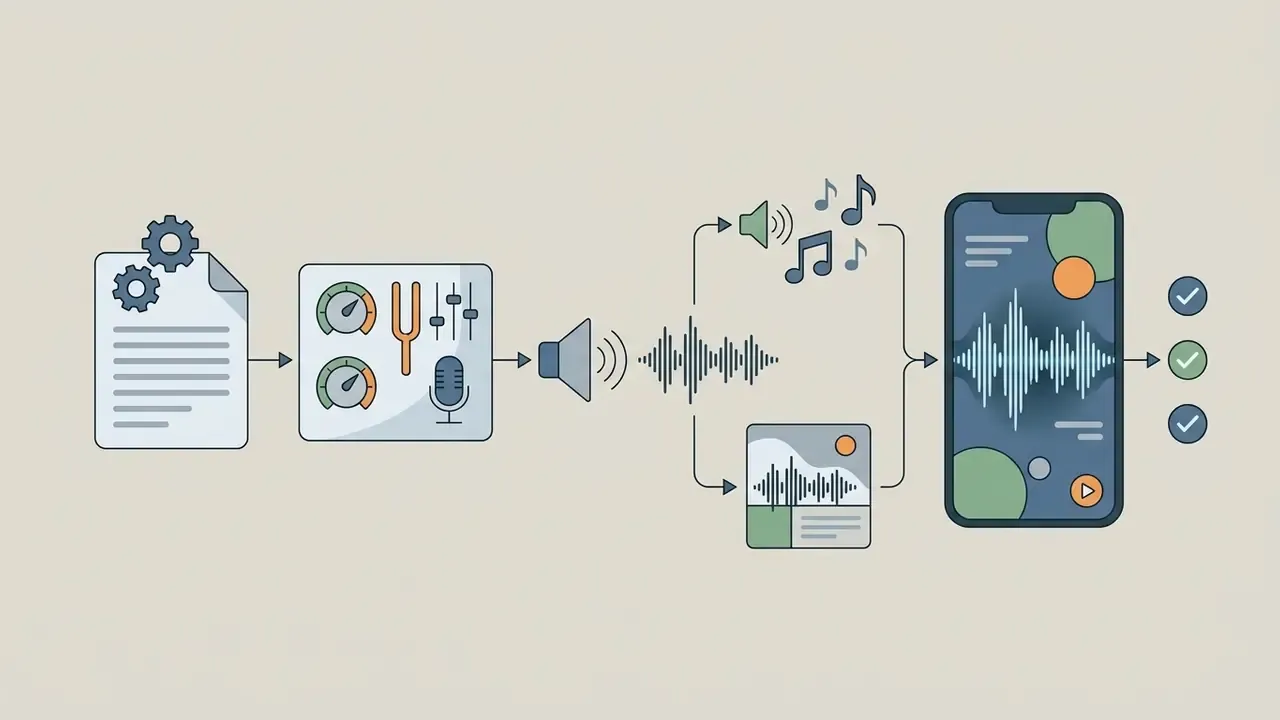
To create a jingle with ai, you enter a structured text prompt containing brand messaging, select a musical genre, tempo, and vocal profile, generate candidate variants, refine the output, clear it through an internal approval gateway, then export the finalized file. The workflow removes studio composition friction without removing enterprise control.
Process flowchart: step-by-step AI jingle generation
An ai jingle maker tool turns audio production into an operational pipeline. With precise inputs, teams move from creative brief to finished, signed-off audio in minutes instead of production weeks. The bottleneck shifts from the studio calendar to the approval queue, which is a different problem, and a more manageable one.
- Step 1: Text and prompt input.Write a structured prompt, slogan, or lyrical script incorporating brand values, desired style tags, and explicit system tokens that separate musical instructions from sung text.
- Step 2: Parameter selection.Set musical genre, emotional mood, tempo (BPM), musical key, and vocal characteristics (male, female, calm, energetic), plus exclusion tags for unwanted instrumentation.
- Step 3: Neural generation.Run the engine to sample audio tokens and synthesize candidate waveforms.
- Step 4: Iterative refinement.Evaluate variants, adjust prompt instructions or stem balances, and regenerate specific sections rather than the whole track.
- Step 5: Compliance and model-risk sign-off.Route the shortlisted candidate through legal and model-risk review. Verify licensing terms, log prompt history and model version, confirm no protected lyrics or cloned voices, and apply required synthetic-media disclosure labels before release.
- Step 6: Master export and download.Export the approved track in broadcast-ready WAV, web-optimized MP3, social-ready MP4, subtitle SRT, or multi-stem bundles.
Write a Prompt, Slogan or Short Script
An effective jingle prompt translates brand positioning into specific musical descriptors: genre, mood, instrumentation, tempo, and exact lyrical text. Audio generation models depend heavily on descriptive specificity to guide conditioning.
Industry prompt frameworks, such as Google Cloud's Lyria prompt structure, organize inputs into discrete descriptor categories:
[Genre & Style] + [Mood] + [Instrumentation] + [Tempo & Rhythm] + [Vocal Style & Language] + [Lyrical Text].
- Example prompt: "Upbeat acoustic pop jingle, bright and trustworthy mood, featuring acoustic guitar and handclaps, 120 BPM, female singing vocal: 'Fresh coffee, brighter mornings, start your day with Daily Roast.'"
Vendor guidance converges on the same principle from different angles. Google's Gemini music-generation documentation recommends declaring key and scale plus structural section tags. Stability AI's Stable Audio prompt guide stresses realistic duration and phrasing aligned with the model's training distribution. MiniMax's prompt guide, by contrast, advises writing vivid full English sentences rather than comma-separated tag lists. All three can be right, depending on the model family you licence.
Clear structural tags keep musical direction separate from vocal lyrics, which stops the engine from singing your technical instructions aloud. It happens more often than vendors admit. Teams building automated prompt pipelines can examine the wider application logic in our ai app generator overview.
Transform Existing Audio and Voice Memos (Audio-to-Audio Workflow)
When redeveloping a legacy brand identity or refining a rough melodic idea, modern generators support audio-to-audio synthesis alongside text prompts. This is the correct entry point whenever a brand already owns a hummed motif, an archival radio sting, or a low-fidelity phone recording from a creative workshop.
- Upload reference source: Input an existing snippet, voice memo, or legacy brand stinger. Commonly supported formats: MP3, WAV, M4A, usually up to 50 MB, with some platforms accepting video containers up to 100 MB for soundtrack extraction.
- Conditioning and style mapping: Select the target transformation, for example converting an acoustic guitar voice memo into an upbeat electronic synth promo. Set the Style Influence parameter (recommended range 40% to 60%) to keep the melodic curve while altering orchestration. Lower values keep the reference recognizable; higher values effectively rewrite the composition.
- Vocal and stem re-synthesis: Enable stem isolation to separate the reference melody from background noise, then apply text-to-singing layer replacement to overlay new branded lyrics on the legacy chord progression. Reverse workflows are equally common: upload an instrumental and let the model add a vocal hook, or upload dry vocals and let the model compose the arrangement.
- Remix into a broadcast-ready jingle: Choose the final target style, regenerate, then trim the winning take to the required 5-, 15-, or 30-second slot. This route turns rough demos and workshop recordings into deliverable campaign assets without a tracking session.
Technically, the capability comes from conditioning on learned audio embeddings rather than text alone. Google's MusicLM, for instance, conditions generation on MuLan residual-vector-quantized tokens (12 codebooks of size 1024), while textual-inversion research maps reference audio into new pseudoword tokens that can be reused inside prompts to preserve a proprietary brand motif across an entire campaign family.
Choose Genre, Style, Mood and Voice
Selecting genre, mood, and voice parameters constrains the network's token sampling to your brand identity criteria. These attributes decide the harmonic language, instrumentation density, and performance style of the jingle maker ai.
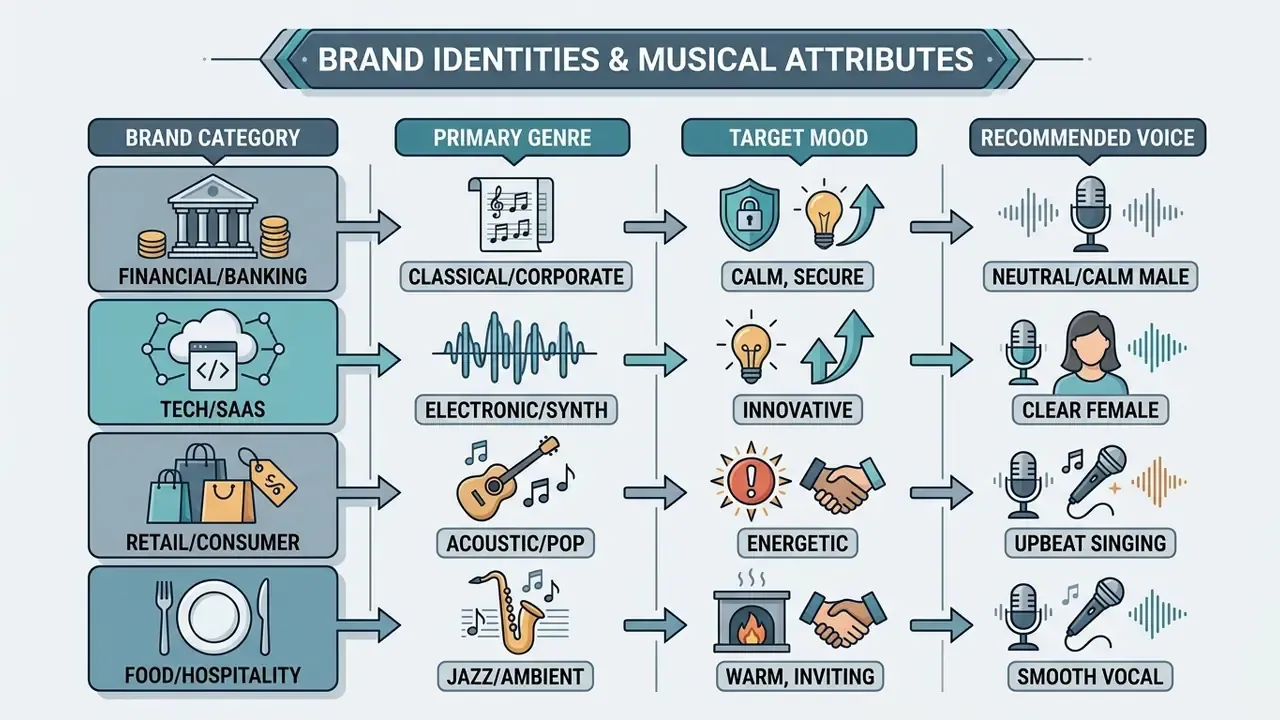
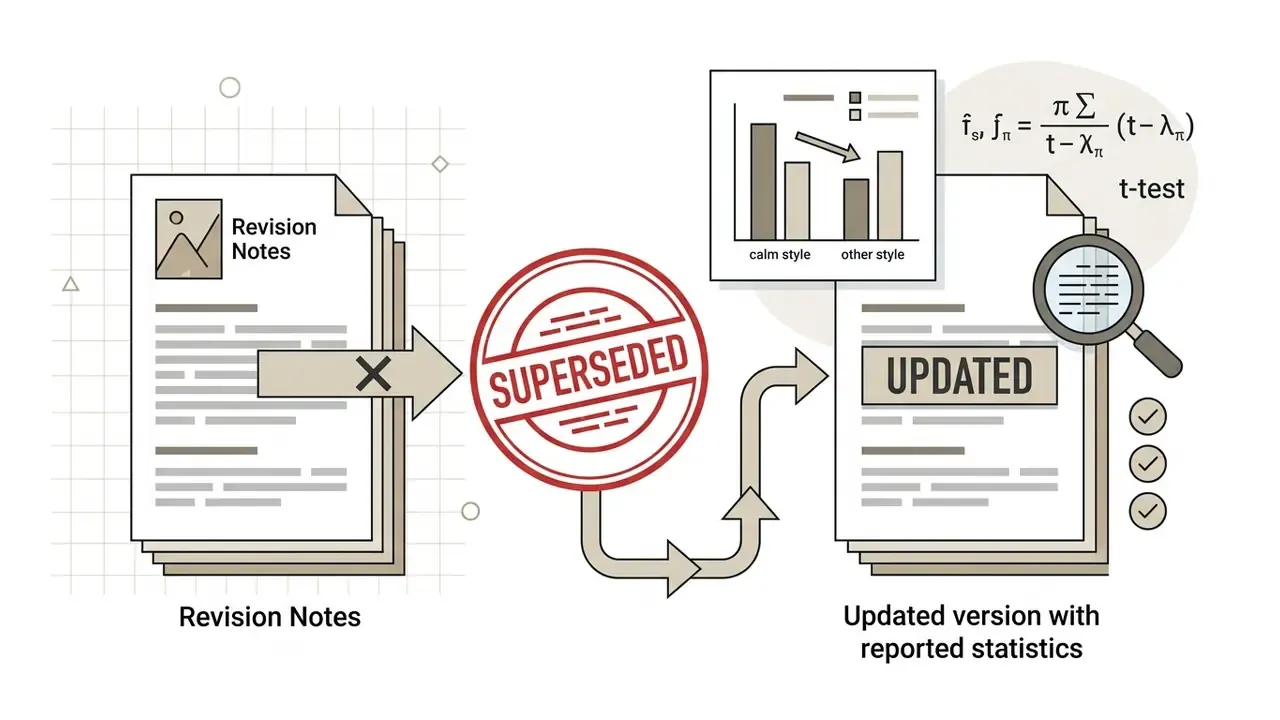
Research on synthetic voice delivery indicates that acoustic character shifts listener perception measurably. An Estonian study evaluating synthetic voices in commercial advertising found that listeners strongly preferred calm performance styles over high-energy, aggressive delivery.
«The calm synthetic voice style, quieter, more sonorous and neutral, was significantly preferred over the energetic style: mean likability 0.09 versus −0.21, t(474) = 3.4, p < 0.001.»
So moderate, calm voice parameters usually improve acceptance in corporate and service-oriented jingles. Not always, granted, since a youth retail campaign may want the opposite, but it is the safer default for a bank. Brand teams producing audio and moving image in the same sprint can align toolchains with our overview of AI video generators.
Generate, Refine and Download the Finished Jingle
The generation and refinement phase means producing multiple candidates, tweaking section dynamics or lyrics, and downloading the finalized file in uncompressed or compressed form.
During generation, the system processes the prompt and returns several 5-to-30-second variations. Advanced editing interfaces let you separate instruments from vocal stems, adjust master volume, or extend length. The practice documented by vendors is to start at a 30-second render, then add or replace sections with conversational instructions such as "make the chorus more energetic," rather than regenerating everything from scratch. Once the mix is settled, you download the jingle generator output. Broadcast workflows require uncompressed Linear PCM WAV; digital marketing campaigns typically use compressed MP3.
How to Choose an Online AI Jingle Maker
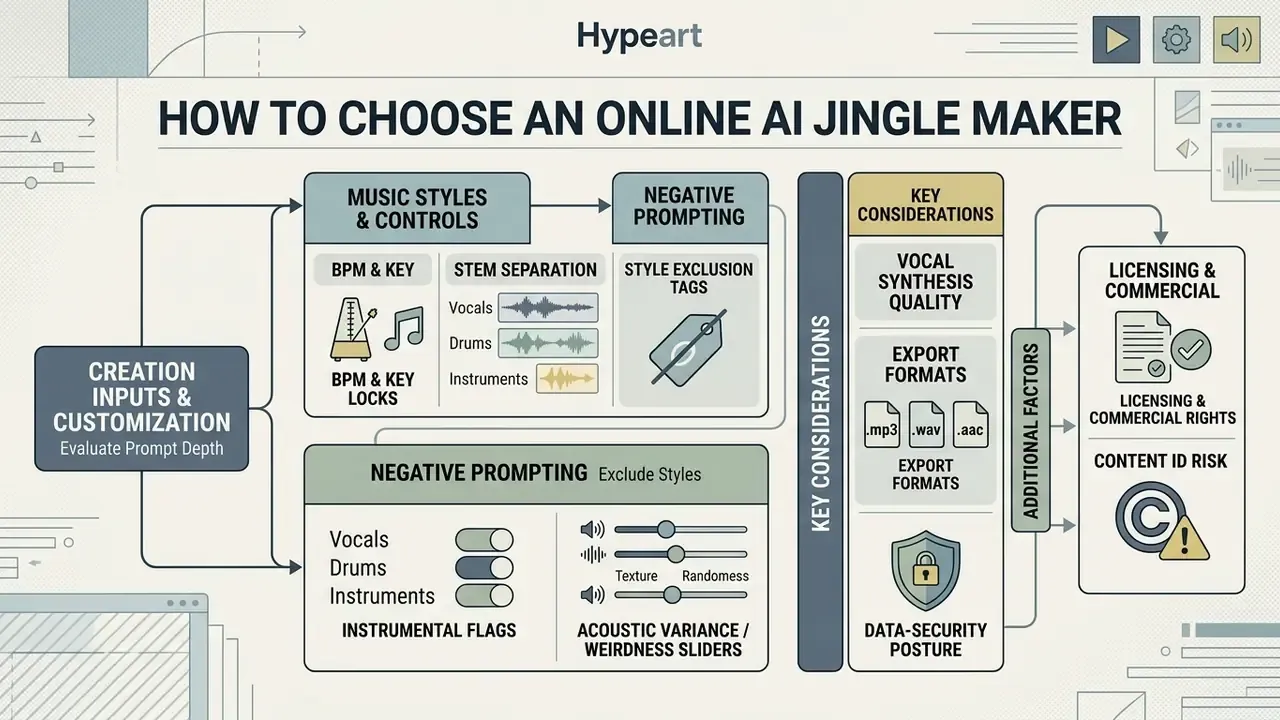
Choosing an ai jingle maker online means evaluating prompt customization depth, genre and stem controls, vocal synthesis quality, export formats, data-security posture, and explicit commercial licensing terms. Anyone comparing an ai jingle maker online free trial against a paid enterprise plan should run both through the same seven criteria below.
Comparative criteria for selecting an AI jingle maker
| Evaluation Criterion | Technical Capabilities | Operational Requirement | Commercial Impact |
|---|---|---|---|
| Prompt customization | Structured text tags, token conditioning, reference audio uploads | Supports exact brand slogan and script inputs | Output aligns with brand positioning |
| Music style controls | Explicit BPM, musical key selection, instrument toggles | Exact tempo and key matching for video sync | Consistent sonic identity across campaigns |
| Negative prompting | Style exclusion fields, variance sliders, instrumental hard locks | Suppresses unwanted instruments and vocal artifacts | Lower reject rate and less credit burn |
| Vocal synthesis | Singing voice synthesis, TTS voiceovers, multilingual support | Intelligible speech and correct singing pronunciation | Prevents mispronunciation of brand names |
| Audio export formats | Uncompressed WAV (24-bit/48 kHz), MP3 (320 kbps), MP4, SRT/VTT, stem separation | Meets broadcast, social, and digital platform standards | No re-encoding and no audio degradation |
| Data security and privacy | SOC 2 Type II attestation, zero data retention options, no-training-on-customer-prompt guarantees, regional data residency, SSO/SCIM | Keeps unreleased slogans and product names out of third-party training corpora | Enables procurement approval in regulated sectors and blocks shadow AI |
| Licensing and rights | Commercial use grants, royalty-free status, copyright indemnification, Content ID whitelisting | Written terms for paid media deployment | Mitigates infringement and litigation exposure |
Evaluating tools against these parameters keeps selected platforms inside enterprise media requirements. For institutions already governed by model-risk frameworks such as SR 11-7 or OCC 2011-12, the pragmatic move is to treat a generative audio vendor as an unstructured-media model: document intended use, inputs, human review points, and fallback procedures in the same inventory that holds your quantitative models. The audio is short. The governance obligation is not.
Creation Inputs and Prompt Customization
Music Styles, Moods and Advanced Controls
Advanced controls allow explicit beats-per-minute settings, key signatures, instrumental-only toggles, and multi-stem isolation for professional mixing.
- BPM and key locks: Engines such as MiniMax Music 2.6 report over 99% prompt adherence to exact BPM and key specifications.
«YuE attains the highest CLaMP 3 alignment score (0.240) among tested systems, correlating with genre controllability and emotional expressiveness.»
- Stem separation API-level isolation splits a generated track into vocal, drum, bass, and instrumental stems, ranging from 2 to 12 stems in Suno API configurations, including instrument-specific advanced splitting.
- Instrumental flags Instrumental mode suppresses vocal synthesis entirely, giving clean beds for voiceover mixing.
Negative Prompting and Negative Style Exclusion
Professional output control means telling the model what to leave out. Advanced interfaces provide explicit exclusion fields and weight controls:
- Style exclusion tags Suppress unwanted elements with syntax tags, for example
--no electric guitar, acoustic drums, harsh vocals. Brand guidelines that ban distorted guitars or aggressive trap hi-hats should be encoded once as a reusable exclusion string and attached to every campaign brief. - Acoustic variance / weirdness sliders These control sampling randomness in the diffusion process. Variance between 30% and 50% holds output inside commercial genre conventions; above 70% you get experimental harmonic shifts that rarely survive brand review.
- Style influence weighting When a reference track or style preset is attached, the influence weight (commonly defaulted to 50%) decides how strongly the reference dominates the text prompt.
- Vocal isolation toggles Hard-locking the system to "Instrumental Only" forces the model to ignore lyric conditioning, preventing stray vocal artifacts or spoken prompt leakage in backing tracks.
These controls let generated assets drop cleanly into professional digital audio workstations. Teams analyzing modern generative model structures can read further in our ai architecture generator framework.
Audio Quality, Downloads and Export Options
Professional workflows need uncompressed Linear PCM WAV at 48 kHz / 24-bit for broadcast compliance, compressed MP3 for web distribution, and video-native containers for social platforms.
Broadcast delivery specifications, such as those enforced by BBC Radio (RIFF/WAV, Linear PCM, 48 kHz, 16-bit or higher) and CBC/Radio-Canada (preferred uncompressed 24-bit/48 kHz WAV, MP3 at 160 to 320 kbps per channel accepted as fallback), mandate uncompressed Linear PCM WAV. The EBU Tech 3285 and ITU-R BS.1352 Broadcast Wave Format standards remain the interchange baseline. Uncompressed files preserve full dynamic range and frequency response. Web platforms, by contrast, prioritize smaller sizes with 320 kbps MP3 or OGG Opus. An online jingle maker tool built for enterprise use has to export in all of these.
«YuE demonstrates a KL divergence of 0.372 and FAD of 1.624, competitive audio-quality metrics among leading music generation systems.»
Broadcast and video workflows dictate distinct export configurations per distribution node:
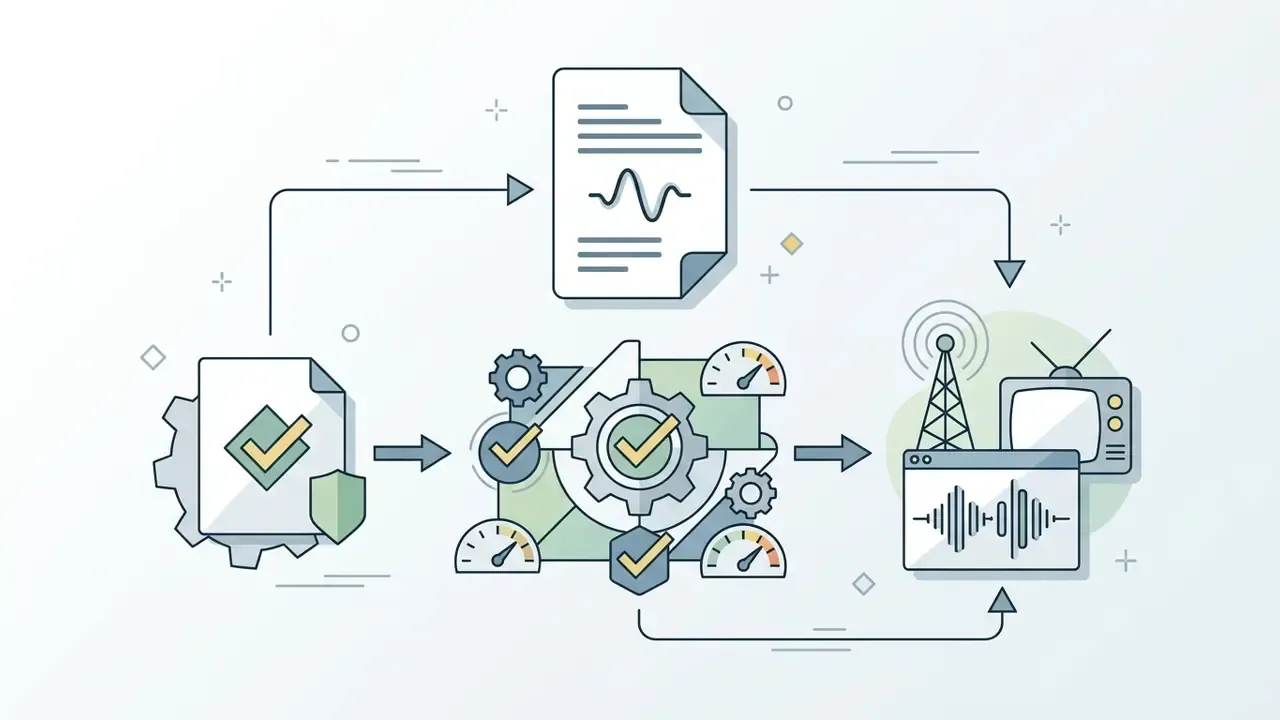
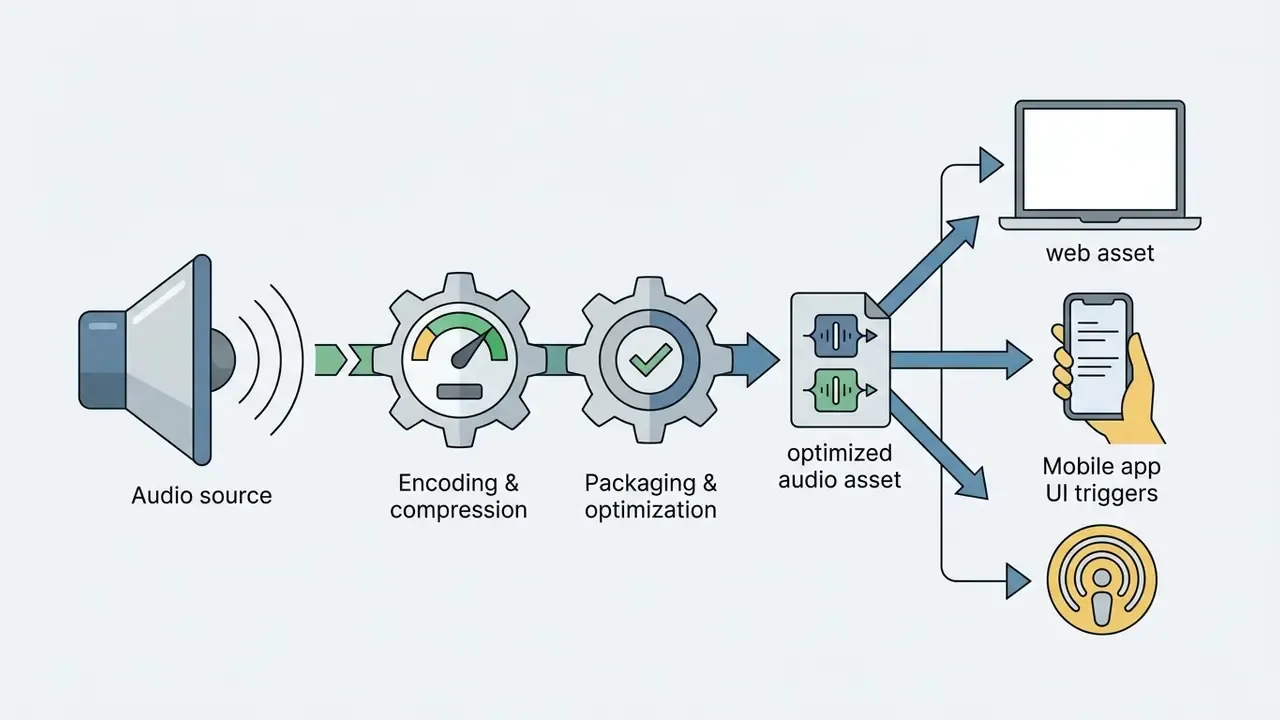
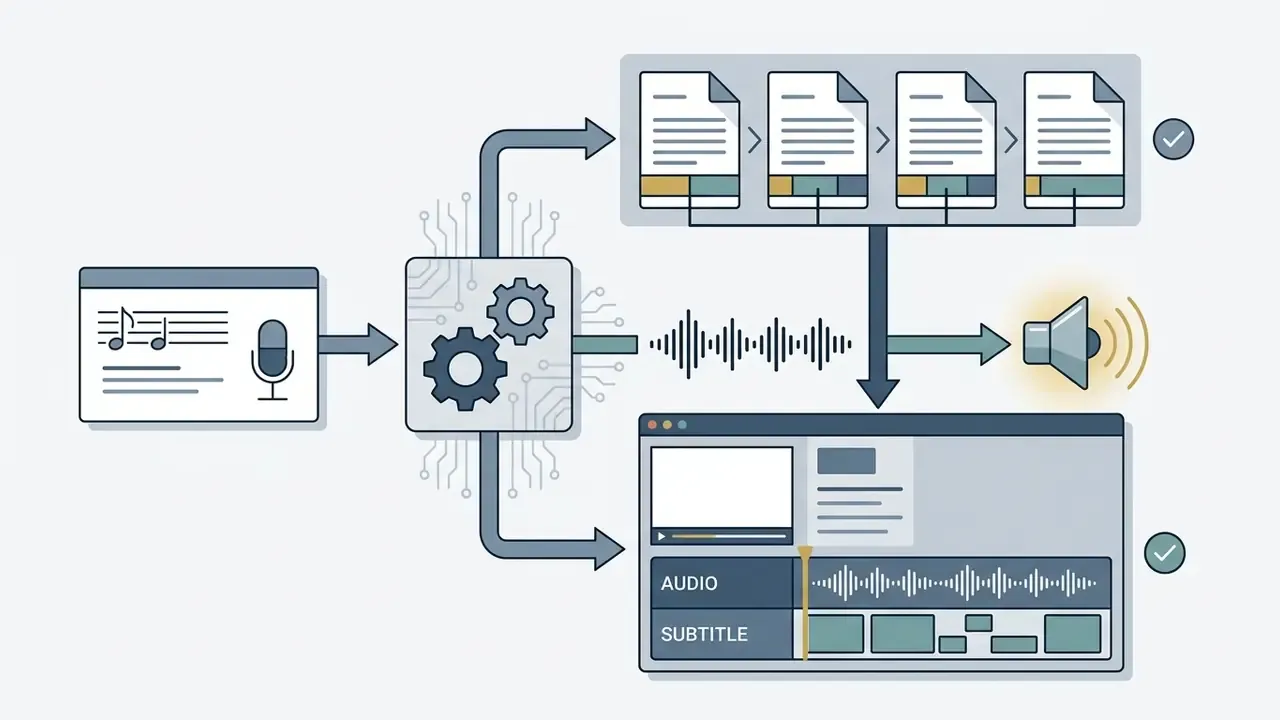
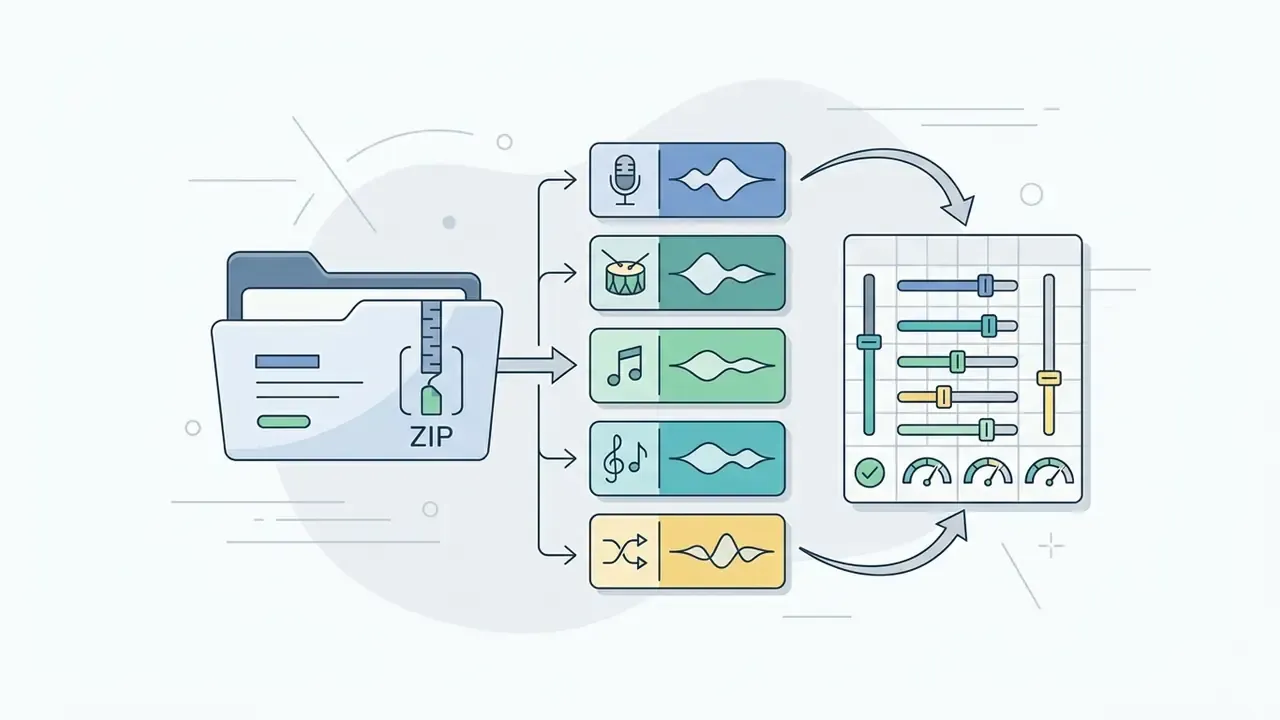
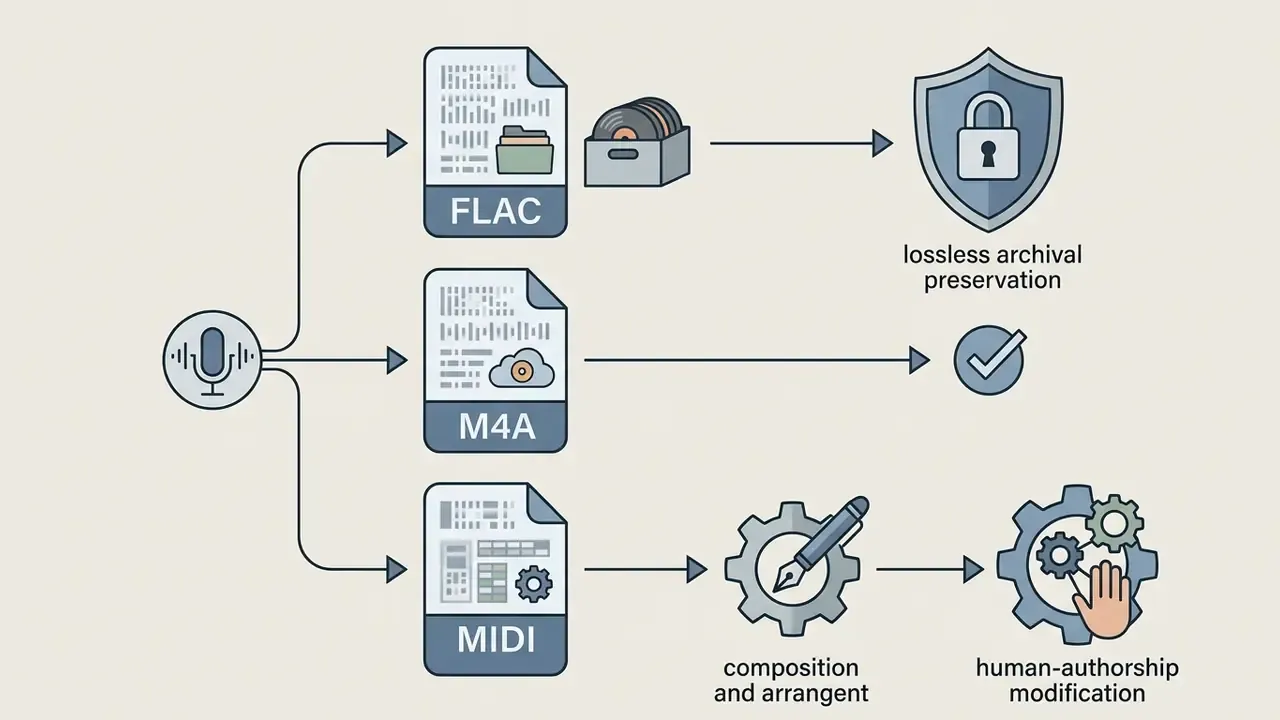
Export capability varies materially by vendor. Some generators currently deliver MP3 only, with other formats marked "coming soon," while editing and library platforms document full WAV/MP3/OGG/FLAC/M4A sets plus duration matching to video length. Confirm the delivered format list against your broadcast partner's spec sheet before signing an annual plan. A missing WAV export has killed more launch dates than any model quality issue.
Is an AI Jingle Generator Free to Use?
Most online tools run a freemium model: basic text-to-audio generation and preview playback are free, while high-resolution downloads, advanced stem controls, and commercial licences sit behind paid tiers. A third model is common too, one-time credit packs sold without a subscription, where credits do not expire.
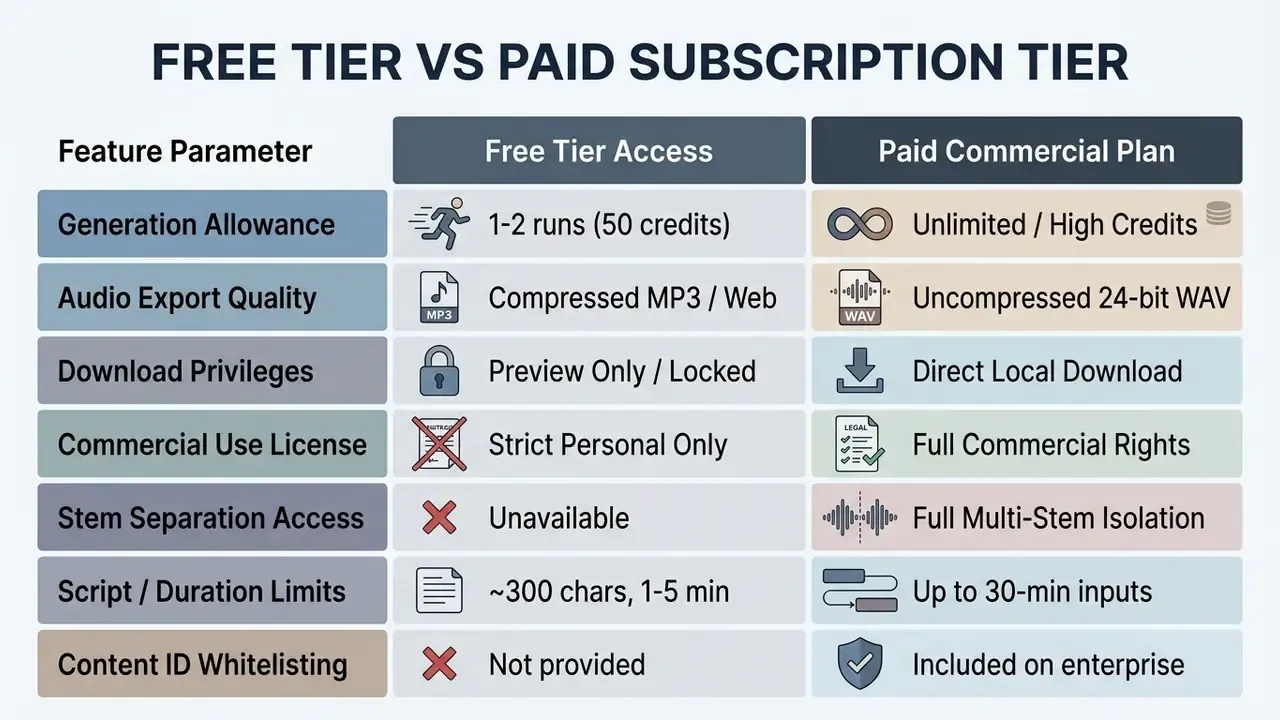
An ai jingle generator free tier is fine for experimentation. Organizations pushing assets into paid campaigns almost always need a paid plan, and the reason is licensing paperwork rather than sound quality.
What a Free AI Jingle Maker Typically Includes
Free plans usually provide 1 to 2 trial runs or roughly 50 monthly credits, standard MP3 previews, a limited preset library, and non-commercial or personal-use terms. The same pattern holds whether you search for an ai jingle maker free plan, a free ai jingle maker online trial, or a free ai jingle maker app on mobile.
Musicraft AI, for example, limits free users to 50 credits per month, roughly two songs plus two editing runs, with downloads restricted to preview playback. Canvas-style media suite free tiers (allowances around 900 tokens per month and up to ten soundtracks per day) restrict generated audio strictly to internal personal projects, prohibiting external downloads or commercial distribution. The asymmetry repeats across modalities, which is why teams benchmarking entry tiers often cross-reference free AI video generators before committing budget. For cost structures across tools, explore the hub on our pricing index, or review specialized media applications in our guide to ai apps with relaxed safety filters.
One warning worth repeating. Rights terms are not standardized: one vendor markets output as "100% royalty-free," while another confines free jingle maker ai output to personal projects only. Never infer commercial clearance from the word "free." A free jingle maker online page that says nothing about licensing has told you nothing at all.
When Advanced Generation Features Matter
Paid plans become necessary when projects require legal commercial clearance, custom voice cloning, full script lengths, uncompressed WAV downloads, high-resolution or 4K video export, or multi-track stem exports.
Commercial deployment demands explicit written grants. Paid tiers unlock full commercial rights, remove watermarks, expand input context (script inputs up to 30 minutes against free caps near 5 minutes), and enable high-definition rendering.
«Explicit labeling of AI-generated advertising significantly affects consumer behavioral engagement, with emotional intensity acting as a negative moderator.»
That finding has a direct commercial consequence. Because disclosure is increasingly mandatory, brands need plans whose licensing documentation is transparent enough to support a public "AI-assisted audio" label without contractual ambiguity. Teams evaluating commercial asset platforms can read our analysis of the Canva AI Generator for additional enterprise workflow context.
Commercial Use, Royalty-Free Rights and Copyright Checks
E-E-A-T compliance alert: commercial licensing and copyright due diligence
What to Verify Before Using a Jingle in Ads
Before deploying an AI jingle in paid advertising, verify platform commercial grants, audit prompt inputs for protected lyrics, confirm voice cloning authorization, and check jurisdiction-specific disclosure rules.
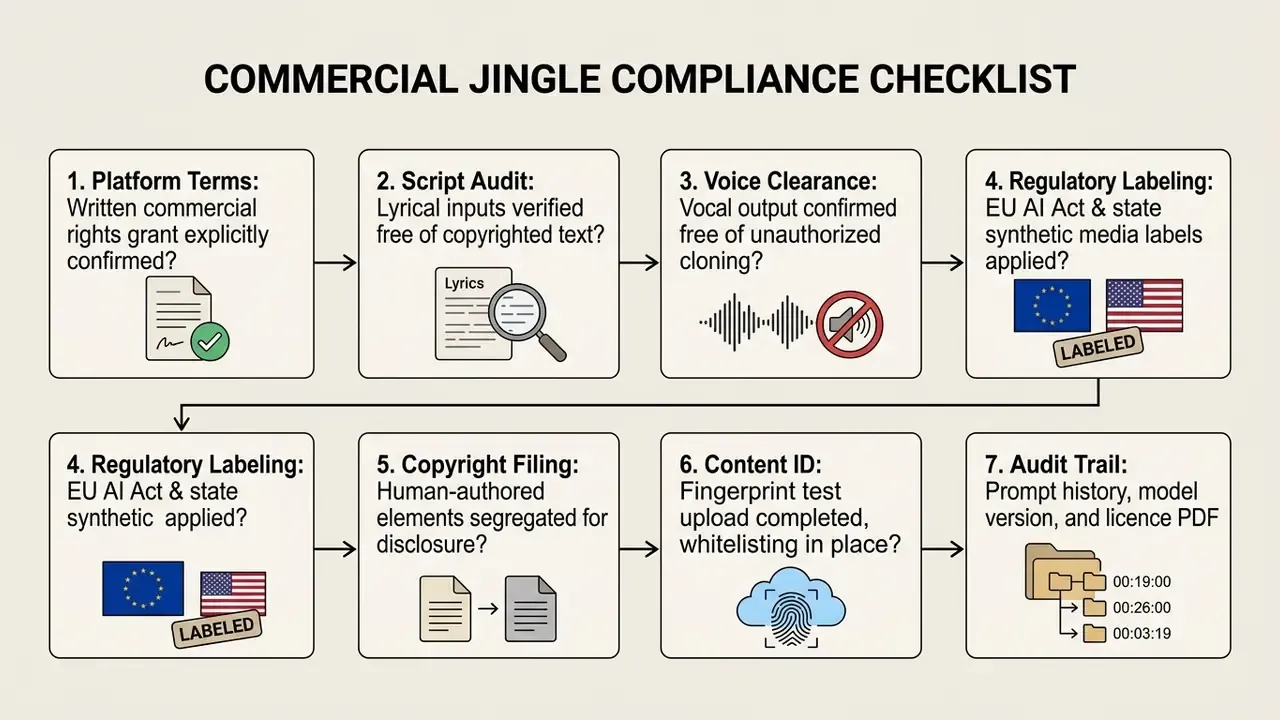
Here is an illustrative, composite scenario rather than a documented client engagement. A regional financial services institution wants to automate localized radio advertisements using an online jingle creator ai. The compliance team runs a pre-launch audit of the generated files. They find that although the platform grants "royalty-free" usage, the input prompts reused trademarked slogans from a competing firm. The institution rewrites its prompting protocol to mandate original script inputs, adds synthetic media disclosures per state rules, and secures full commercial clearance before broadcast. Nothing exotic. Just a review gate placed before the media buy instead of after it.
«Unauthorized reproduction of protected song lyrics in AI systems infringes exclusive rights under 17 U.S.C. §106; monetization raises statutory damages exposure to as much as $150,000 per work.»
Organizations tracking intellectual property policy and generative media disputes can open the hub on our legal and litigation resource center, and licensing leads can open the hub covering commercial-use rules by asset type.
Platform Content ID Clearance and Monetization Protection
Publishing AI jingles on YouTube, Twitch, or Meta introduces automated fingerprinting risk. Even fully licensed generative audio can trigger false-positive copyright claims when output tokens produce something resembling an existing registered track. For creators this is a far more frequent operational problem than litigation: a claim can demonetize or block a video within minutes of upload, no matter what licence sits in your document management system.
How to Make an AI Jingle Match Your Brand Sound
Aligning an AI jingle with an established brand sound means translating identity guidelines into structural prompt attributes, generating multiple candidates, and evaluating outputs through structured listener testing.
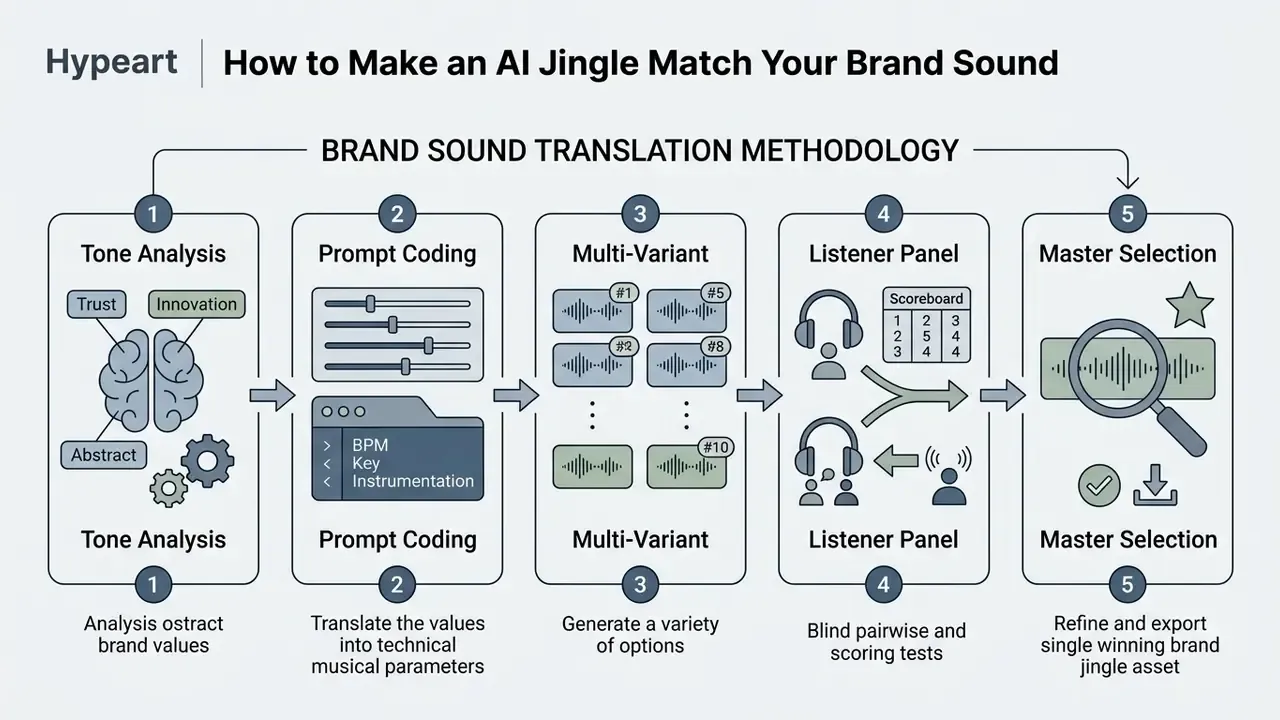
A structured translation method keeps synthetic assets consistent with existing visual and acoustic identity standards. Formal sound-branding systems operationalize the same logic at greater granularity. The GROVES model sequences ten modules from Brand Audit and Market Review through Sound Workshop, Sound Production, Sound Implementation, Brand Sound Guidelines, and Sound Tracking. The RadioZentrale Audio Branding Whitepaper compresses it into four phases, analysis, conception, production, implementation, followed by ongoing brand-sound maintenance.
Turn Brand Tone into a Clear Jingle Prompt
Converting tone of voice into a music prompt means mapping emotional attributes to genres, tempos, timbres, and vocal performance styles.
Audio branding frameworks, such as the GROVES Sound Branding system, split sonic adaptation into distinct creative parameters:
- Trust and security Acoustic piano instrumentation, warm string pads, moderate tempos (80 to 100 BPM), calm neutral vocal timbres.
- Energy and innovation Synth-driven electronic arrangements, crisp percussion, faster tempos (120 to 130 BPM), bright dynamic vocals.
At the mix level, ethnographic sound-design research separates composer-side features (genre, theme, orchestration, timbre) from engineer-side features (loudness, pitch, tempo, spatiality, dynamics). That division is useful when writing a brief: the first group belongs in the prompt, the second belongs in the DAW. Creators aligning specialized aesthetic generators can also explore our index on ai art app design workflows and our overview of AI logo generators, since sonic and visual identity usually go through the same approval cycle.
Generate Variants and Refine the Best Output
Selecting the optimal jingle requires generating several candidates and running blind A/B preference tests or multi-dimensional scoring across target audience panels.
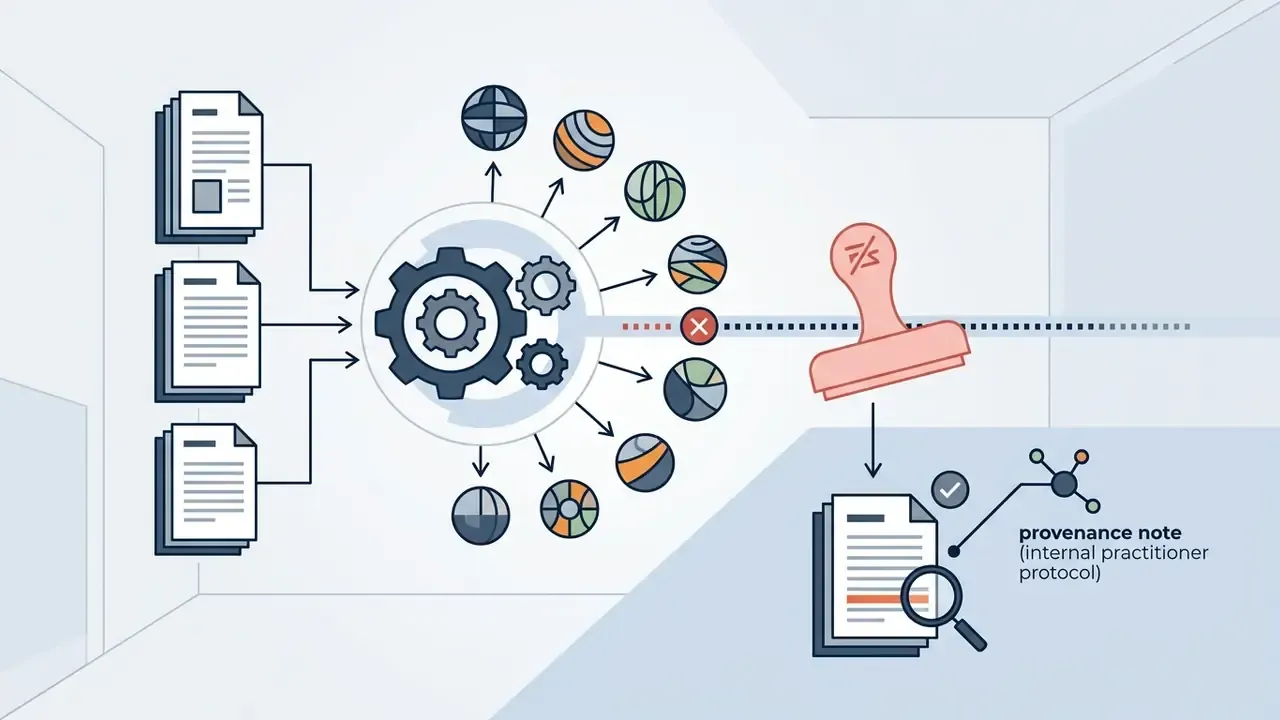
In a documented internal brand-management workflow of this type, a team generated eight variants using a jingle maker free ai tool to establish a sonic logo for a new product line. (Case reported by the practitioner team; company name withheld, and the figures reflect their internal protocol rather than published third-party data.) The team ran blind multi-rater listening tests with six evaluators, three specialists and three non-specialists, across five dimensions: production quality, emotional alignment, textual clarity, brand recall, and distinctiveness. Scoring surfaced two top candidates, which were then refined in a DAW to match exact campaign timing specs.
That protocol mirrors published methodology. A 2025 text-to-audio evaluation framework specifies written rater guidelines, a calibration phase, blind randomized presentation, unlimited replay, and three expert plus three non-expert raters per clip across five dimensions (Content Enjoyment, Content Usefulness, Production Complexity, Production Quality, Textual Alignment). A 2026 benchmark study aggregated more than 15,600 pairwise audio comparisons from over 2,500 participants, confirming that pairwise human choice scales as a ranking mechanism. Objective metrics such as Fréchet Audio Distance complement these subjective tests; they do not replace them.
Human curation stays decisive rather than optional:
«AI systems show only about 20% accuracy in producing music that matches a specific emotional brief; human composers outperform AI on emotional accuracy and overall appeal.»
Practically, budget eight to ten generations per slot, not one, and reserve human time for final selection and mix. Anyone promising a first-take hit is selling something.
AI Jingle Maker Use Cases for Creators and Businesses
AI jingle makers serve a wide range of media workflows, from local radio spots and social ad campaigns to podcast intro stingers, YouTube openers, and mobile app notification sounds.
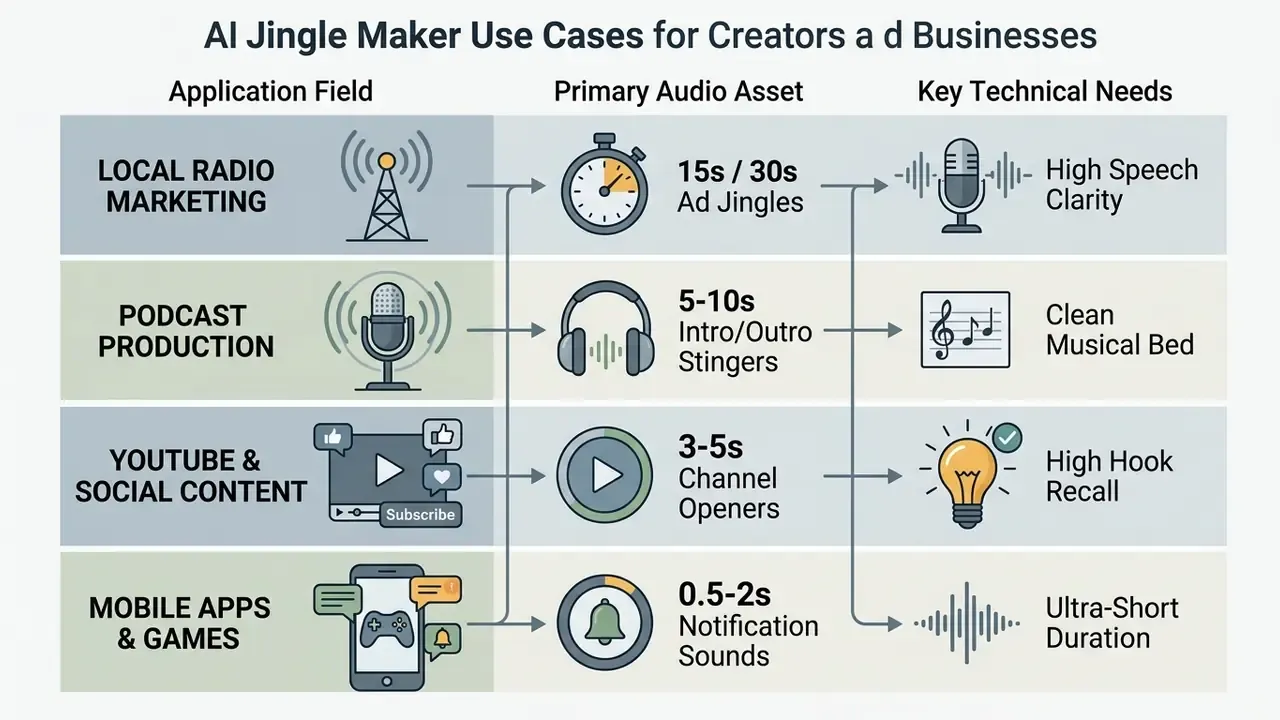
An ai jingle maker app provides output formats tailored to each channel's technical requirements.
«A bibliometric review of 48 publications from 2014–2024 identified three clusters: sonic branding and consumer engagement; brand reputation in hospitality, healthcare and retail; and the psychological impact of sound on decision-making.»
That distribution explains why demand for short branded audio is not concentrated in entertainment. Hospitality, healthcare, and retail account for a substantial share of documented sonic-branding activity, and each carries distinct duration and tone constraints.
Ads, Radio Promos and Business Branding
Businesses use AI jingles to produce low-cost radio commercials, localized SMB campaigns, and dynamic background music for regional spots.
Small and medium-sized businesses often lean on a free jingle maker ai or a paid online generator to script local radio spots without studio overhead. Vendor use-case documentation from 2025 and 2026 explicitly targets local radio, national radio, internet radio, on-hold business music, brand bumpers, and radio stings. By generating campaign variants in parallel, marketing teams run localized A/B tests across regional radio and digital audio streams, tracking click-through rate, completion rate, watch time, and brand recall. Video producers folding audio into larger editing pipelines can review our guide to YouTube video editors.
Can an AI Jingle Maker Create Multilingual Jingles?
Modern AI jingle generators support multilingual voice synthesis and lyrics generation, letting brands produce localized audio across dozens of languages while holding a consistent musical theme.
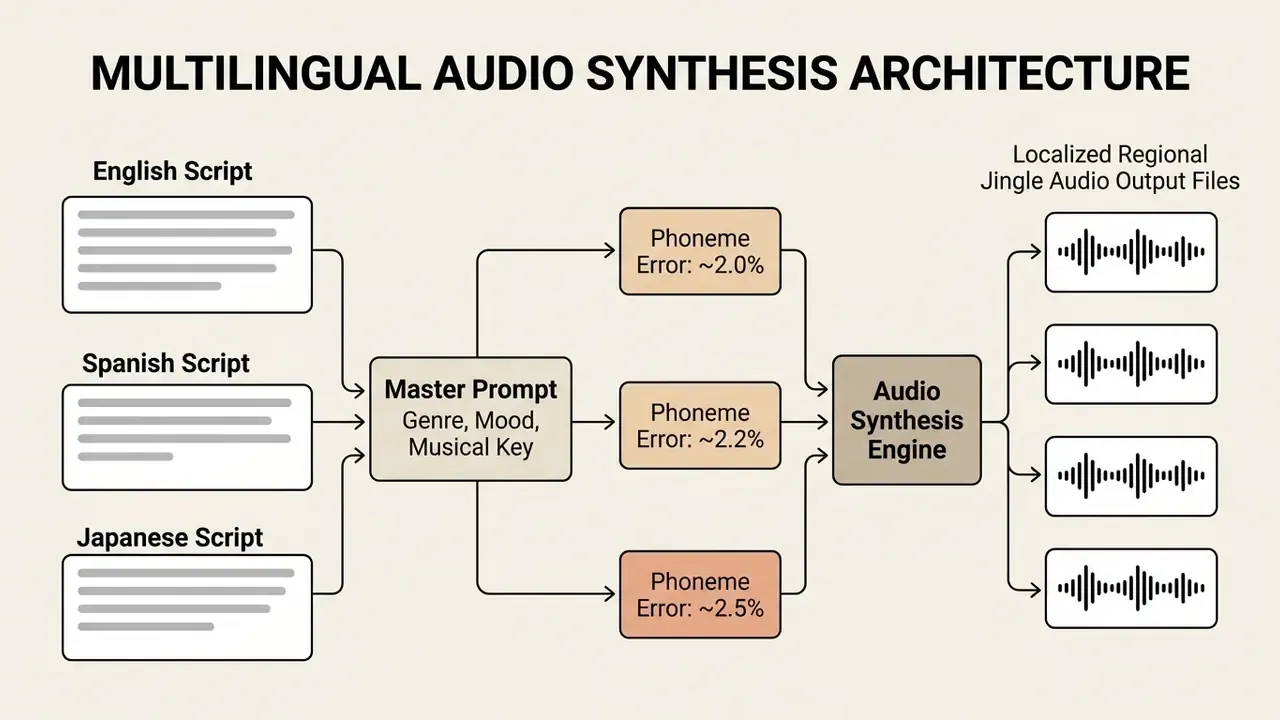
Recent technical evaluations support the feasibility of cross-lingual speech and singing synthesis. Research published by Amazon Science (2025) on multilingual text-to-speech reported context-based pronunciation accuracy reaching average word-level Phoneme Error Rates of 2.09% and sentence-level PER of 0.97% across diverse locales.
«MiDashengLM-Gen reduces word error rate from 12.15% to 2.79% on the Seed-TTS benchmark, approaching specialized TTS systems at 1.24% WER.»
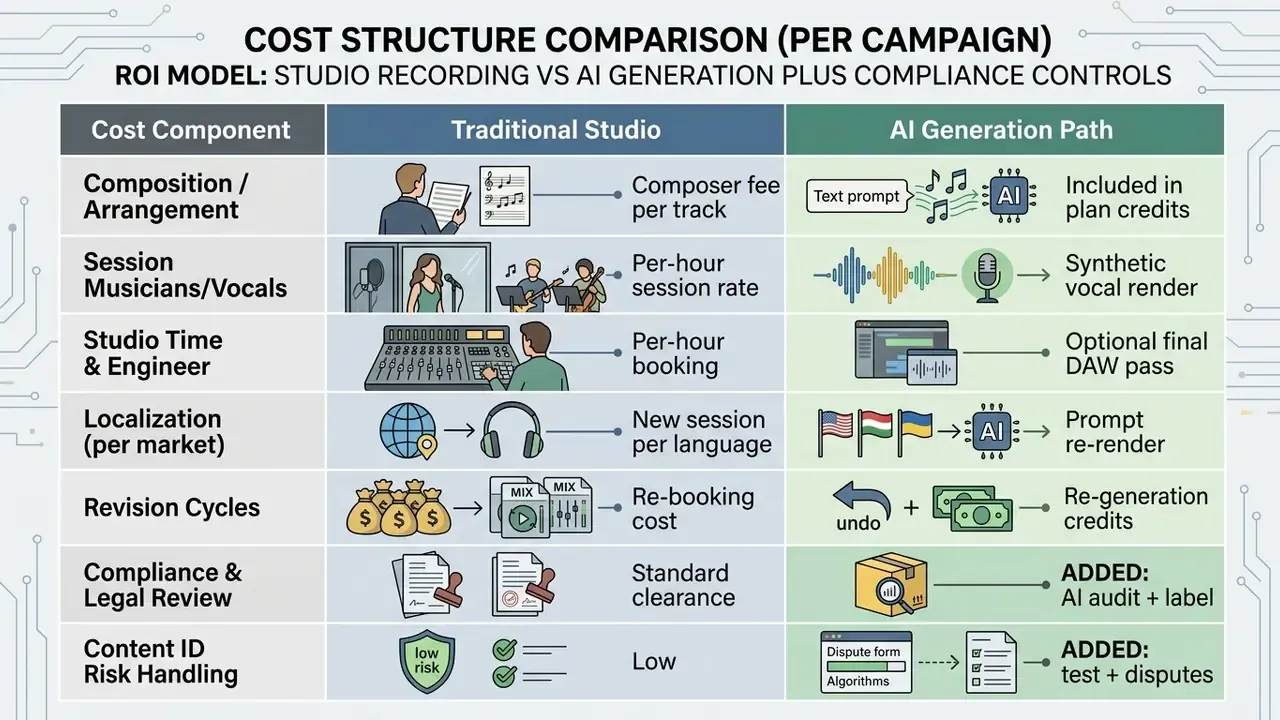
ROI Model: Studio Recording vs AI Generation Plus Compliance Controls
Finance stakeholders rarely approve a generative audio programme on creative merit. The comparison below gives a transparent, adaptable structure rather than fixed prices, since studio rates and vendor plans vary by market.
Working formula:
Total AI Cost = Subscription (annualized) + (Credits per asset × Assets) + (Legal review hours × Rate) + (DAW refinement hours × Rate) + Content ID testing time
Net Benefit = Traditional Cost − Total AI Cost − Reject-Rate Overhead
Two adjustments matter most. First, apply a realistic reject-rate multiplier: if AI systems match a specific emotional brief in roughly 20% of attempts, budget five to ten generations per usable asset. Second, do not omit the compliance line. Audit, labeling, and archival steps are recurring operating costs, not one-off setup. The strongest financial case sits in high-variant, high-localization campaigns, many markets and many spot lengths, while a single flagship brand anthem intended for long-term registration often still justifies human composition.
One more caution for governance leads. Cost per asset is the easy metric; claim incidence and rework hours are the ones that reveal whether the control layer actually works.
Enterprise Action Plan: Next Steps
- Define the asset taxonomy.Document required durations (2 to 5s sonic logo, 5 to 15s bumper, 15s and 30s spots) and target formats (WAV master, MP3, MP4, SRT, stems) before selecting a vendor.
- Run a vendor security review.Request SOC 2 documentation, zero-data-retention terms, a written no-training-on-customer-inputs guarantee, data residency options, and SSO/SCIM support.
- Codify prompt standards.Store an approved template using the six-field structure plus a permanent negative-exclusion string derived from brand guidelines.
- Insert the compliance gateway.Add the Step 5 sign-off to the production workflow, with mandatory logging of prompt text, model version, licence reference, and Content ID test results.
- Pilot on low-risk inventory.Launch first on owned social channels or on-hold music, then expand to paid radio and TV once the audit trail and dispute playbook are proven.
- Measure and iterate.Track completion rate, brand recall lift, claim incidence, and cost per usable asset against the ROI formula each quarter, and re-review vendor terms ahead of the 2 August 2026 EU AI Act disclosure deadline.
FAQ: Common Questions About AI Jingle Generators
Can I use an AI jingle in paid advertising without a lawyer's review?
For low-risk internal or owned-channel use, a documented internal checklist may be enough. For paid broadcast, TV, or cross-border campaigns, legal review is strongly advised, because commercial clearance depends on vendor-specific terms, per-feature exceptions, and jurisdictional disclosure rules that change frequently.
Will an AI-generated jingle trigger a YouTube copyright claim?
It can, as a false positive. Automated fingerprinting compares uploaded audio against registered reference files, and generative output occasionally resembles them. Mitigation is procedural: run a private test upload, keep the vendor's licence and your generation log, use platform whitelisting where offered, and favour vendors that provide indemnification.
Can I own the copyright in an AI jingle?
Not in its purely AI-generated form under current US Copyright Office guidance. Protection extends only to human-authored contributions, original lyrics, arrangement decisions, manual edits, which must be disclosed at registration. Performing-rights organizations apply comparable policies to prompt-only works.
Which export format should I request for each channel?
24-bit/48 kHz Linear PCM WAV for radio and TV masters; 320 kbps MP3 or OGG Opus for web and podcast; MP4 with rendered waveform for Shorts, Reels, and TikTok; SRT or VTT alongside any vocal jingle destined for video; and multi-stem ZIP bundles when your team performs the final mix in a DAW.
What is the fastest way to reuse a jingle we already own?
Use the audio-to-audio workflow: upload the legacy stinger or voice memo, set style influence around 40% to 60% to retain the melodic contour, isolate stems to remove noise, then overlay a new sung lyric layer. Brand recognition survives, orchestration gets modernized.
How do we prevent unwanted instruments or artifacts in the output?
Combine negative prompting (--no electric guitar, harsh vocals), variance settings in the 30% to 50% range for commercial conventionality, and a hard instrumental lock when no vocals are wanted, which stops the model from singing prompt text aloud.
Does a free plan ever work for commercial audio?
Occasionally, when the vendor states commercial rights in writing on the free tier. More often it does not: an ai jingle generator online free page tends to grant preview playback and personal use only. Read the licence page, not the landing page.
Appendix A: Editorial Revision Notes