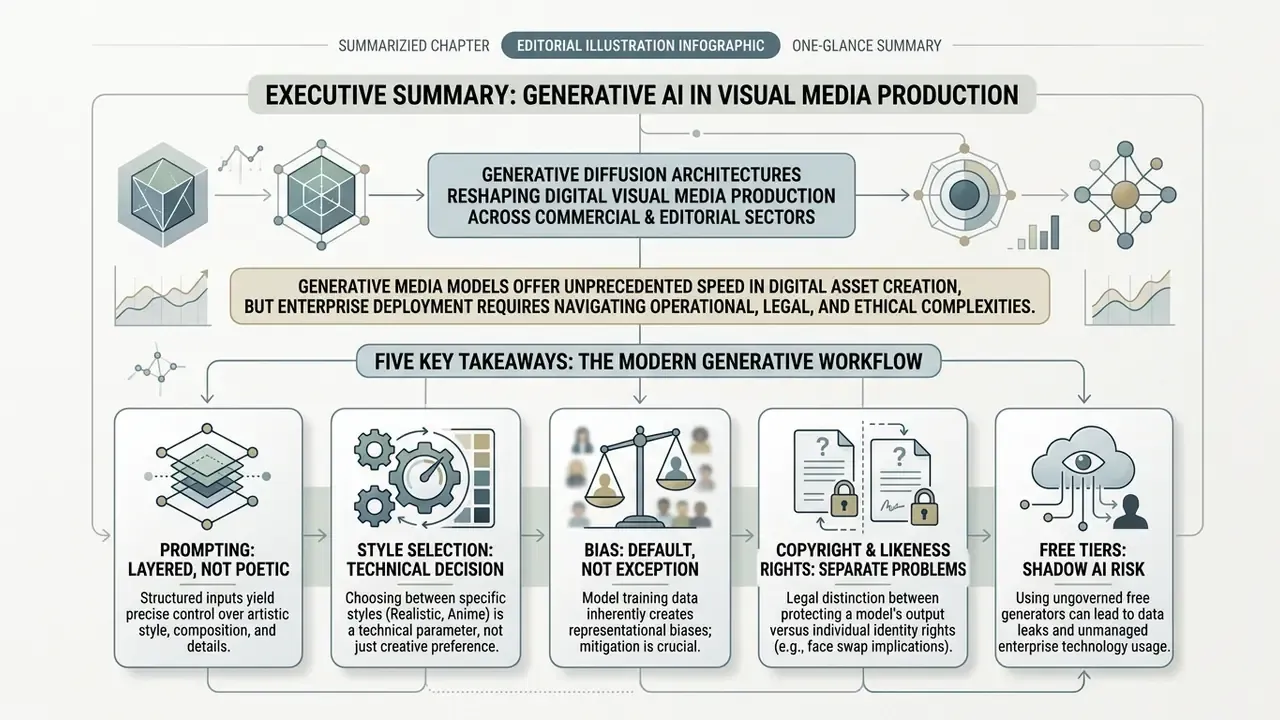
Executive Summary
Business context. Teams generate stylized female characters for brand avatars, campaign creatives, game assets, social content, and editorial illustration. Diffusion pipelines compress days of illustration work into seconds. That speed is why marketing loves them. It is also why copyright, likeness, bias, and data-handling exposure now land on the desk of whoever signs off on brand assets.
Five things to take away:
- Prompting is layered, not poetic. Order descriptors as subject, key details, environment, lighting, camera, then style constraints. Pair them with negative prompts to suppress anatomy artifacts.
- Style selection is a technical decision. Photorealistic, anime girl, chibi girl, digital hybrid, Ghibli-like painted, 3D cartoon or CGI, and cyberpunk waifu aesthetics each need different trigger tokens and shading terms.
- Bias is the default, not the exception. Unconstrained outputs skew toward light skin tones, younger ages, and stereotyped roles. Explicit parameters and guardrails are mandatory for regulated brands.
- Copyright and likeness rights are separate problems. Purely machine-generated imagery is generally not copyrightable in the US, yet it can still infringe publicity rights, trademarks, or third-party source media.
- Free tiers are Shadow AI risk. Consumer free plans usually restrict commercial use, and uploading corporate photos or confidential briefs into unvetted external services can breach internal data-handling policy.
Generative diffusion architectures have reshaped digital visual media production across commercial and creative sectors. Modern text-to-image systems let teams produce stylized character illustrations, photorealistic female portraits, and marketing assets in seconds. In practical terms, a brand team can move from a written creative brief to a set of on-model character variants before a traditional illustration kick-off call would have finished.
Organizing visual media creation around predictable model behavior means understanding three things at once: how diffusion pipelines respond to tokens, how aesthetic prompting is structured, and where commercial compliance limits sit. Standardized terminology helps here, and centralized hubs such as the glossary keep vocabulary consistent across teams that rarely talk to each other.
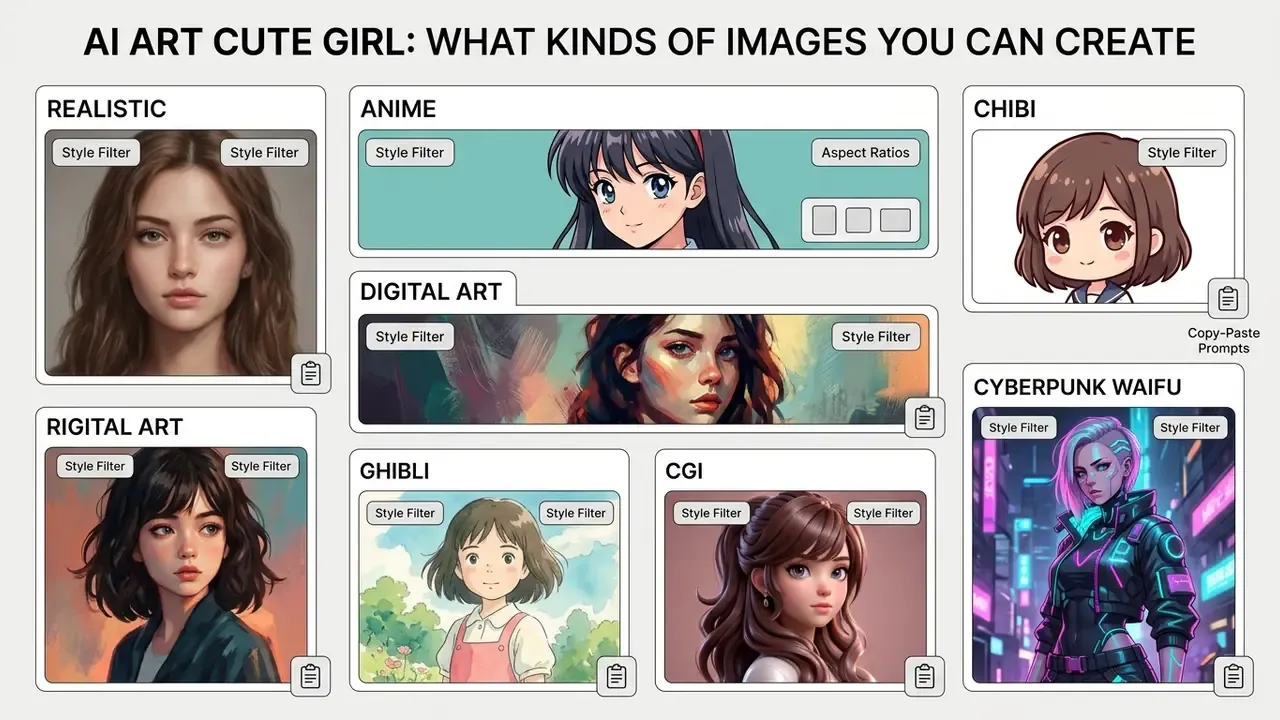
AI Art Cute Girl: What Kinds of Images You Can Create
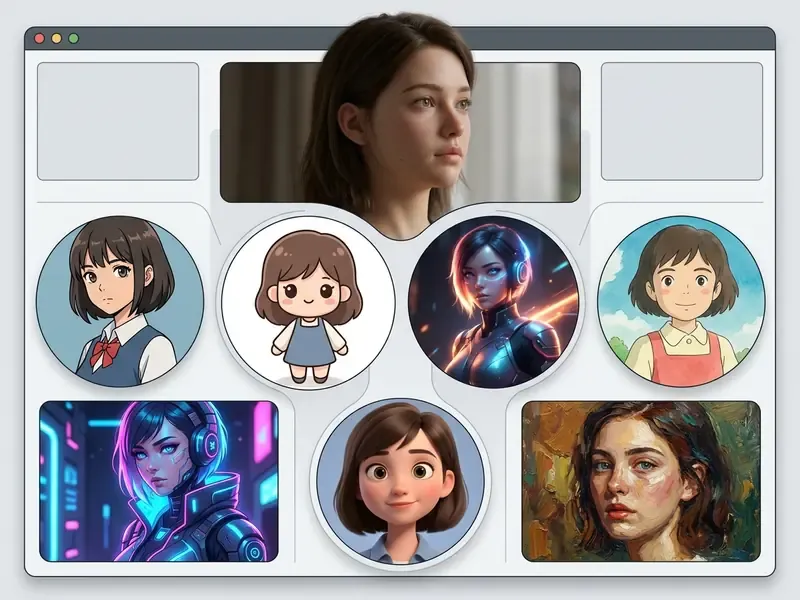
AI image generators cover seven practical aesthetic categories: photorealistic portraits, stylized anime characters, chibi figures, digital art hybrids, Ghibli-like painted illustration, 3D cartoon or CGI renders, and gothic or cyberpunk waifu designs. Diffusion models turn complex visual requests into cohesive renders using patterns learned from multi-million image training corpora. Nothing is retrieved or pasted; everything is synthesized.
Quick style triggers (copy any tag to the end of your prompt):
Neutral phrasing is not a safety net. Research on multilingual generation shows that scrubbing gendered wording from a prompt does not remove stereotype amplification, and it can even weaken text-image alignment.
Empirical work on anime-focused architectures shows the scale required for high-fidelity character generation. The Illustrious open illustration project evaluated Animagine XL V3.1, trained on 2.1 million high-resolution images with tag-based annotations (Illustrious Model Benchmark, 2024).
"Animagine XL V3.1 was trained on 2.1 million high-resolution tagged images, which sets the model's strong visual priors."
That training scale explains a practical asymmetry. Tag-driven anime checkpoints respond better to booru-style token lists, while general-purpose commercial models respond better to descriptive natural language. So model choice should follow the target aesthetic, not brand familiarity or whichever subscription your team already pays for.
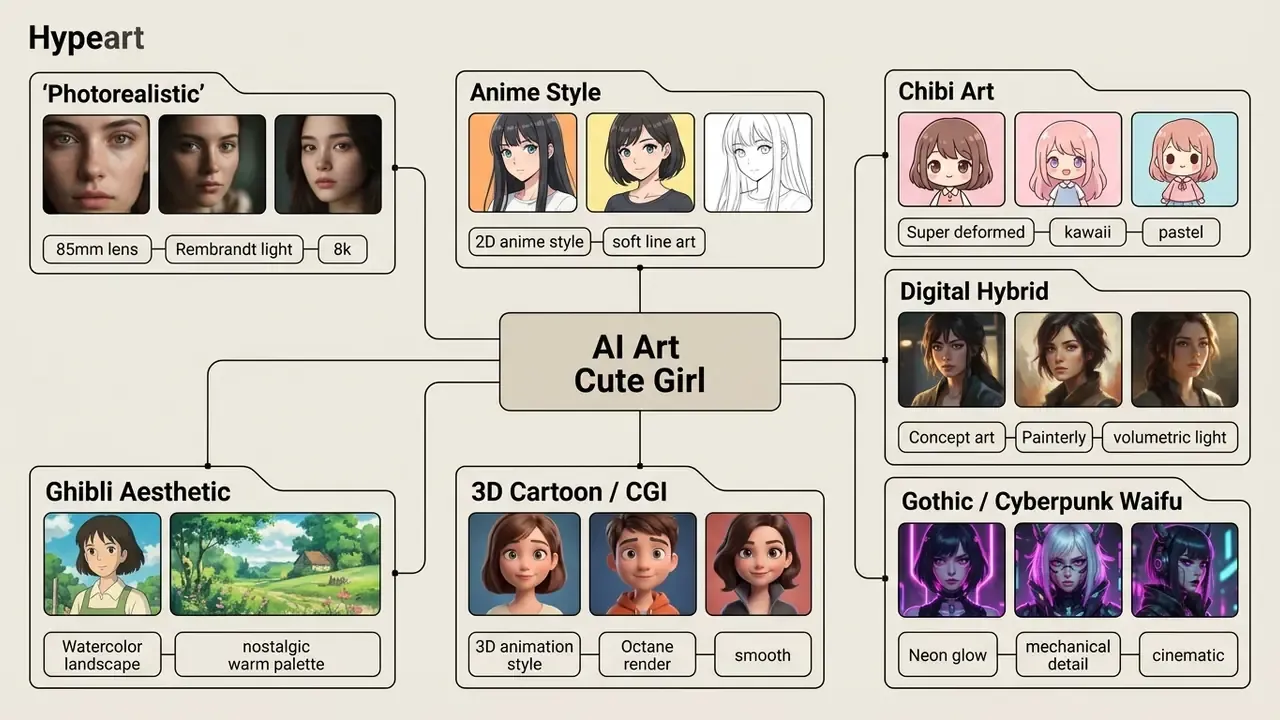
Case note (directional). A marketing design team evaluated diffusion models to build custom female brand avatars for campaign assets. By standardizing prompt structure across categories, the team reported roughly a 40% drop in visual iteration cycles while keeping character consistency across several campaign variants. That number comes from an internal, unpublished workflow review. It is directional, not an external benchmark. Measure your own baseline iteration count before and after prompt standardization if you plan to quote a figure like this to a steering committee.
Teams weighing broader media editing options can explore the hub for complementary software suites, or read the best AI image generator comparison before committing budget to a single vendor.
Realistic AI Girl and Beautiful AI Photos
Photorealistic female portraiture needs layered prompts covering facial features, hair rendering, fashion attributes, and studio lighting. Parameters such as "detailed skin texture", "sharp iris reflections", and "soft natural window light" prevent the plastic, over-smoothed look that gives cheap output away instantly. Hair responds to strand-level cues ("shiny strands", "natural growth direction") rather than hairstyle names alone. Eyes respond to explicit catchlight terms.
Default aesthetic skews are measurable. A 2025 study of beauty standards across 5,984 generated images found an 86.5% light skin tone bias and a 74% skew toward younger apparent age in unconstrained outputs (Erasing 'Ugly' from the Internet, 2025).
"22% of generated images contained explicit content despite the models running under safe-for-work settings."
That leakage rate is the core argument for enabling platform safety checkers and standing negative prompts on any corporate workstation. Relying on model defaults is not a control. It is a hope.
Beautiful girl ai art also depends on restraint. Balance lighting and camera parameters instead of stacking quality buzzwords, and the render usually improves on the first pass.
If gender, age range, skin tone, and body type matter to the brief, state them. Leaving them implicit hands the decision to training-data priors, which is a strange way to run brand governance. Specialized tools listed in the AI headshot generator guide offer dedicated workflows for professional portrait rendering, including consistent lighting across a whole leadership page.
Anime Girl, Chibi Girl, and Digital Art
Anime and chibi styles rely on distinct structural proportions, line weight control, and shading technique. Anime prompts use triggers such as "cel shading", "clean manga outlines", and "flat color tones". A chibi girl needs "oversized round head", "super deformed proportions", "huge expressive eyes", "rosy cheeks", and "pastel background", usually with soft even lighting.
Model note. Anime-oriented model families, including the Niji series built for Eastern illustration aesthetics, are trained or fine-tuned on specialized illustration datasets. Vendor release notes describe gains in character coherency, eye and reflection clarity, and literal prompt adherence between generations. Version numbering changes often, so verify the current model generation and its documented capabilities in the vendor's live documentation before you standardize a production workflow around it.
Digital art hybrids sit between realism and illustration. They apply photographic rim lighting to stylized features, so detail level, finish, and palette all have to be stated explicitly rather than implied.
"Analysis of 2.29 million images shows women dominate caregiving and domestic scenes, while men dominate technical and financial roles."
For character design this matters directly. If a stylized art girl has to read as an engineer, a trader, or a surgeon, then occupation, tools, and setting must be spelled out. Otherwise scene priors drift toward domestic or caregiving contexts, and your fintech campaign quietly ships a stereotype.
Creators handling video alongside static ai artwork can review the animation maker guide for motion integration, and the video caption generator guide when the same character appears in subtitled shorts.
How to Create an AI Art Girl in a Generator
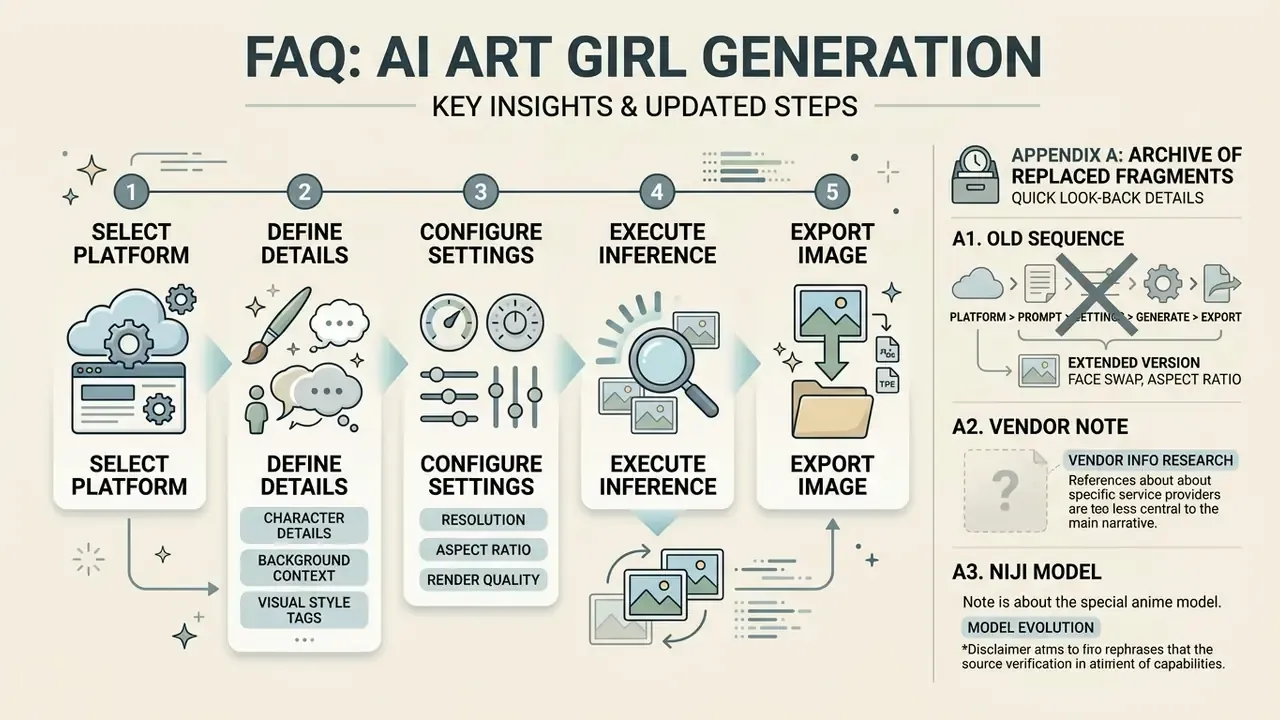
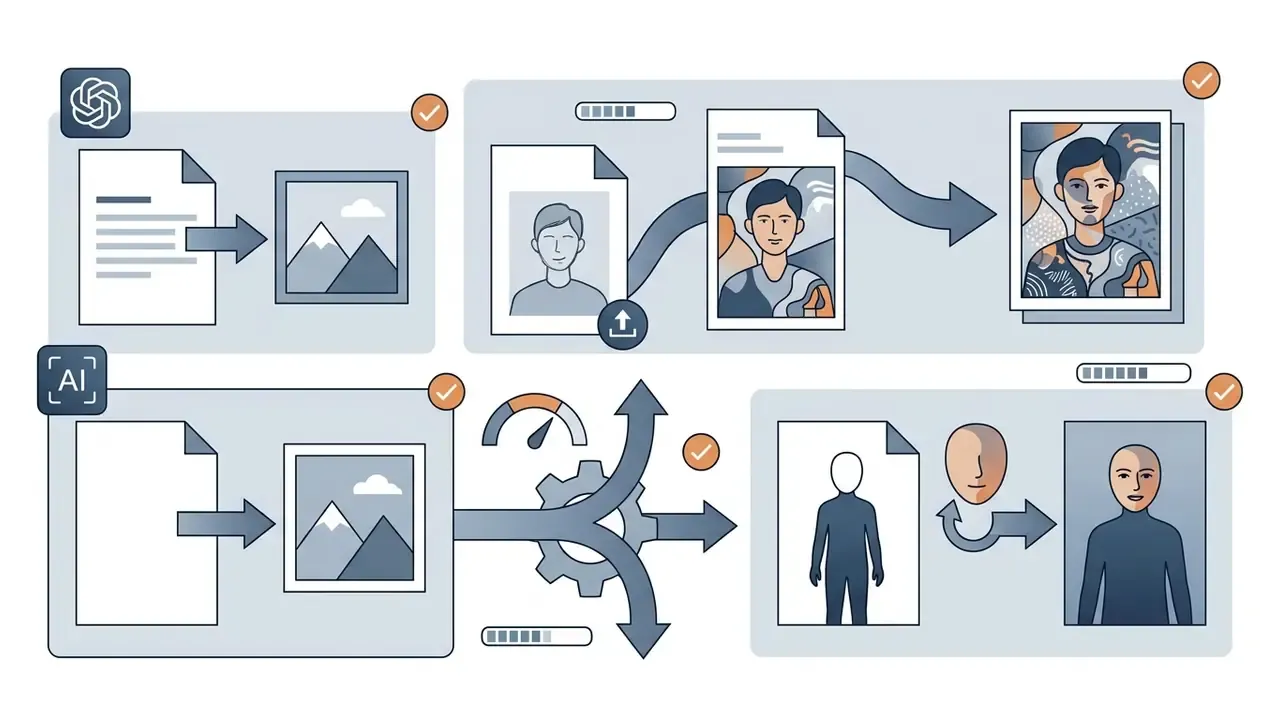
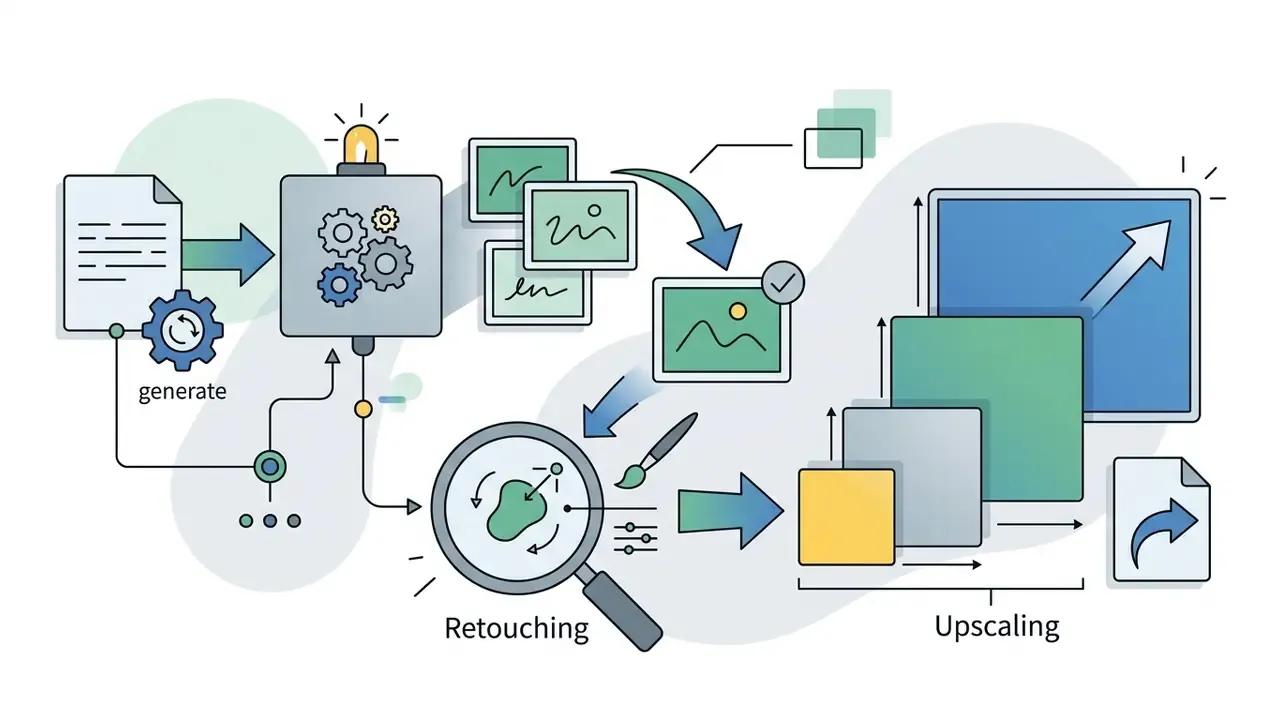
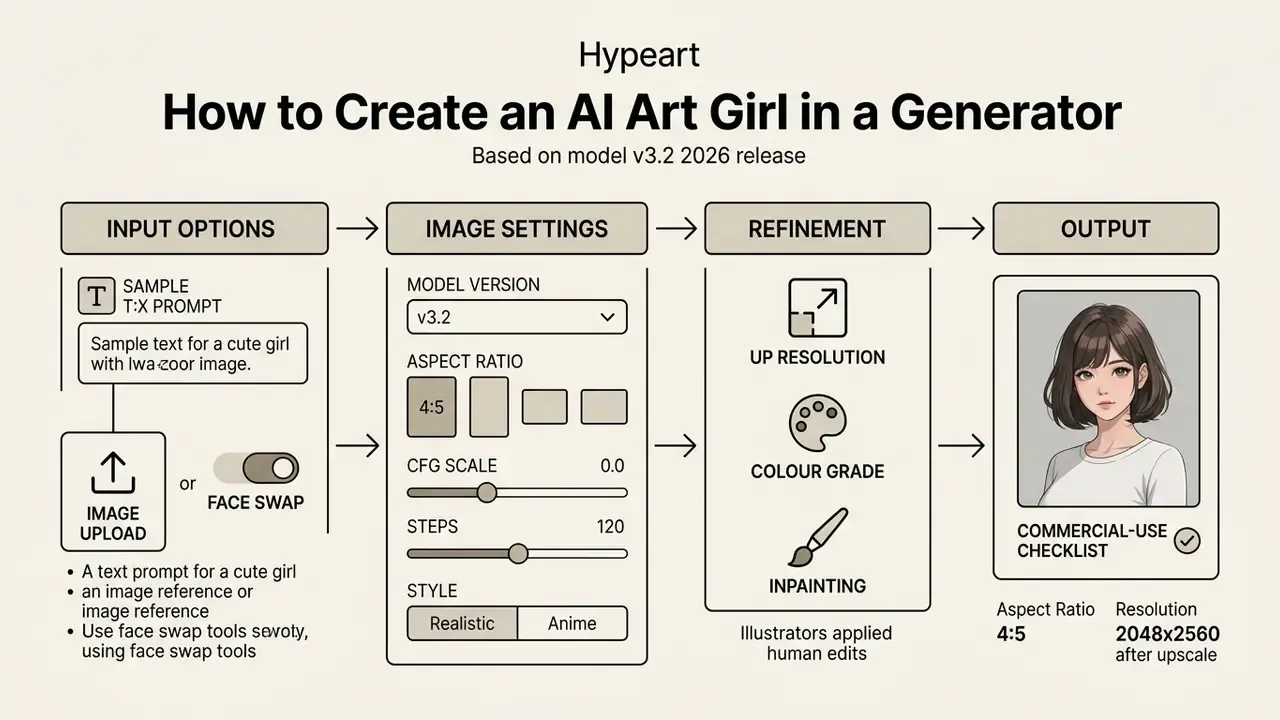
Creating an ai art girl involves five moves: pick a platform, choose a generation mode, write structured prompt descriptors, tune render controls, and export the finished file. Standard online workflows support text-to-image generation, image-to-image transformation, and face swap on template compositions. Readers comparing platforms first can start with the AI image generators comparison.
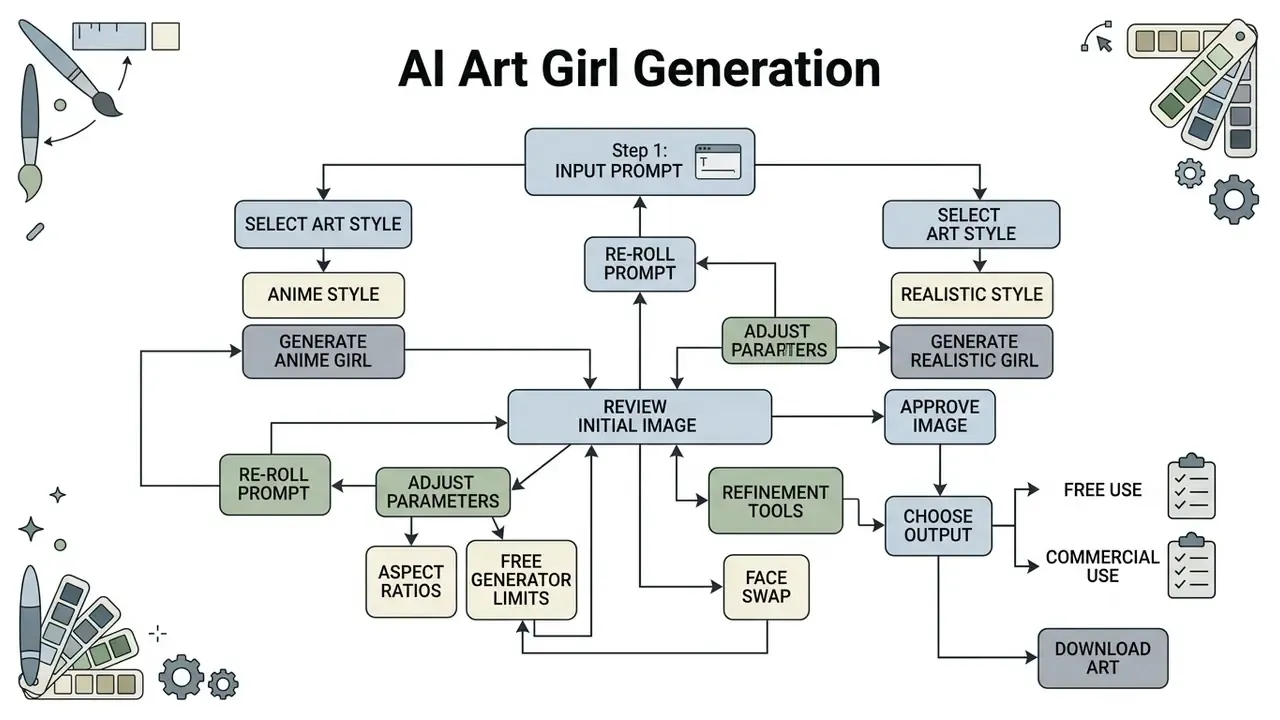
Audit trail template: fix generation parameters for reproducibility. Model-risk and brand-compliance reviews assume any published asset can be regenerated on demand. Log these fields alongside every approved output:
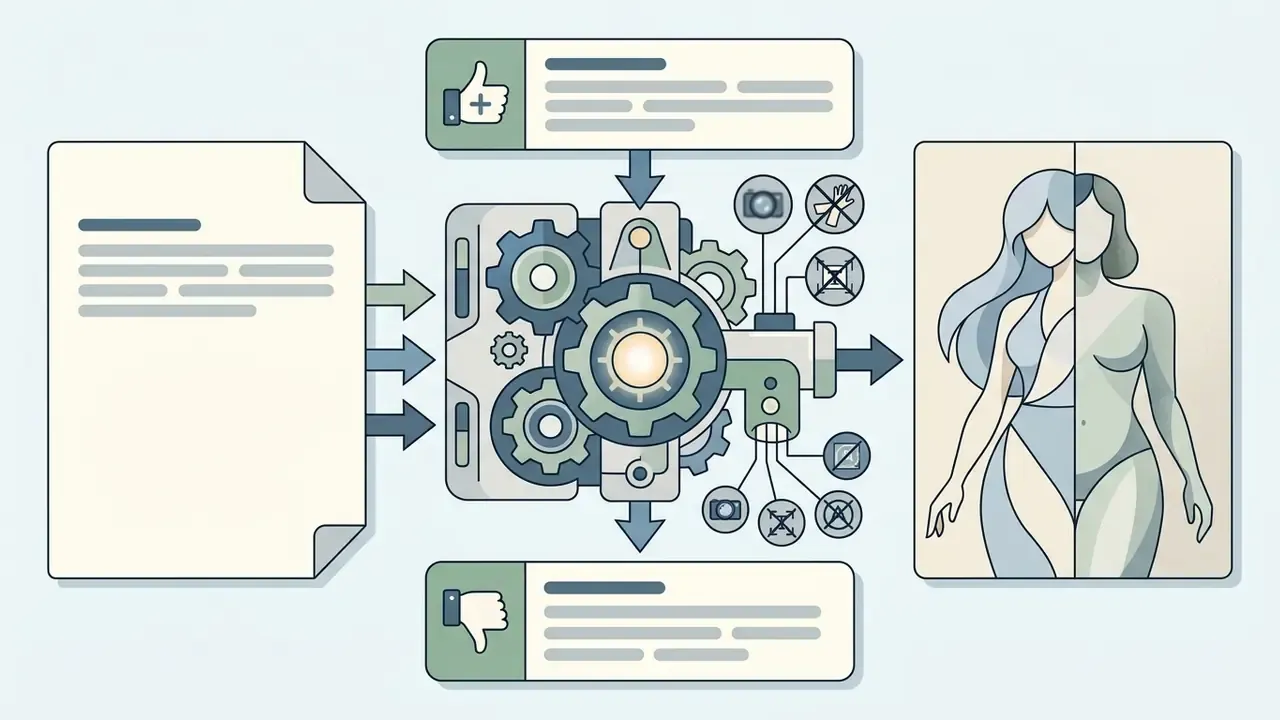
blurry, deformed hands, extra fingers, fused limbs, plastic skin, watermark, text artifacts, lowres.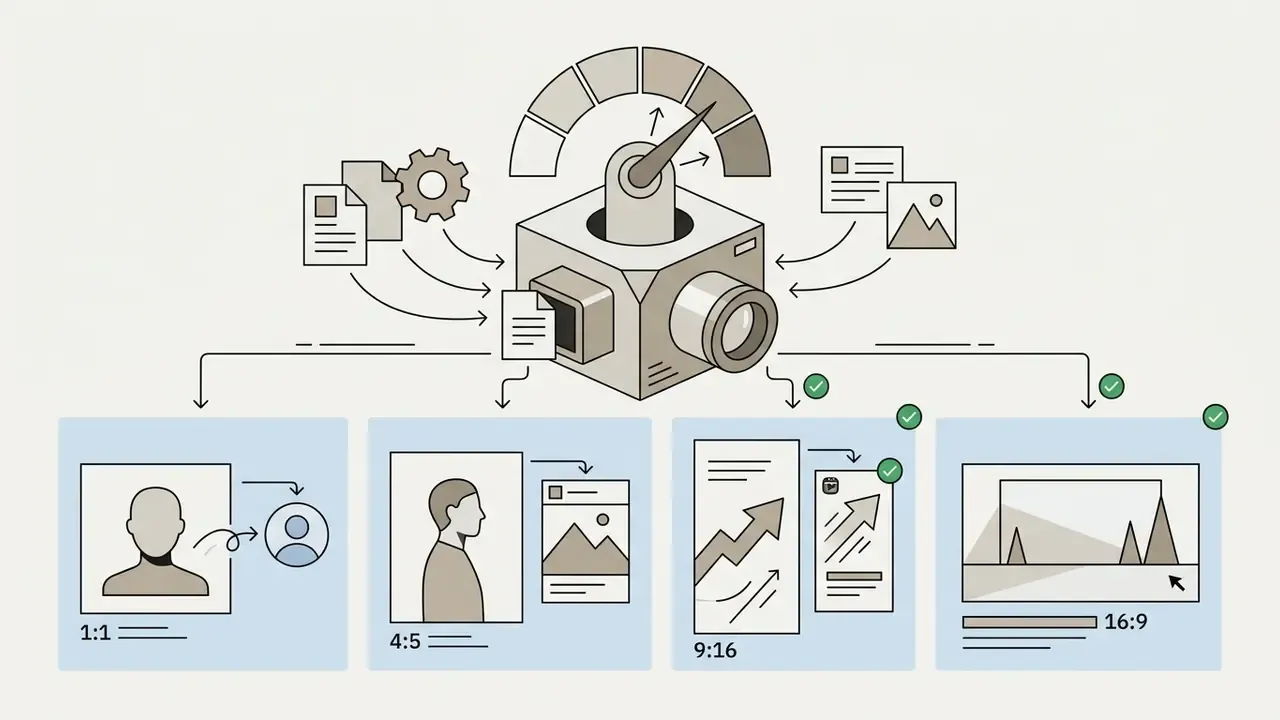
1:1 for avatars and profiles, 4:5 for portrait posts, 9:16 for Stories, Reels, and TikTok, 16:9 for desktop wallpapers, covers, and slides.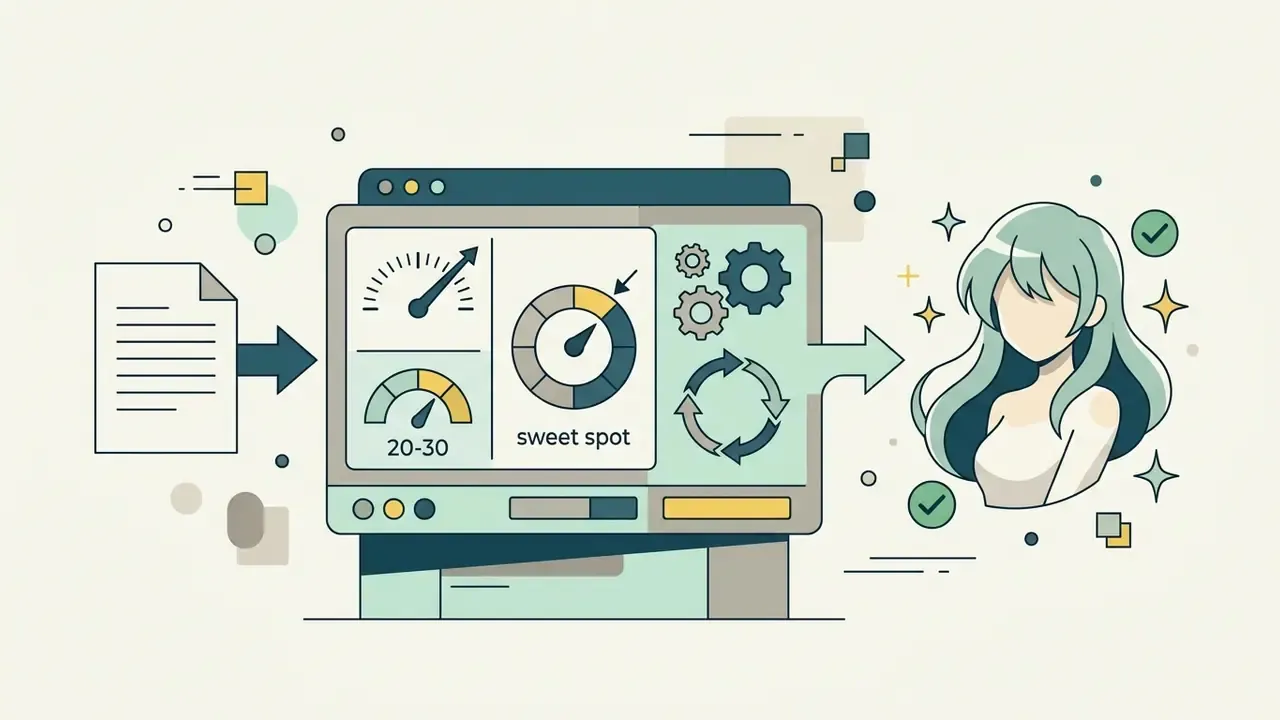
Generate an AI Girl from a Text Description
Text-to-image generation converts structured textual descriptors into high-resolution pixels through guided denoising steps. Strong prompts split information into layers: subject definition, facial attributes, clothing, environment, and camera settings.
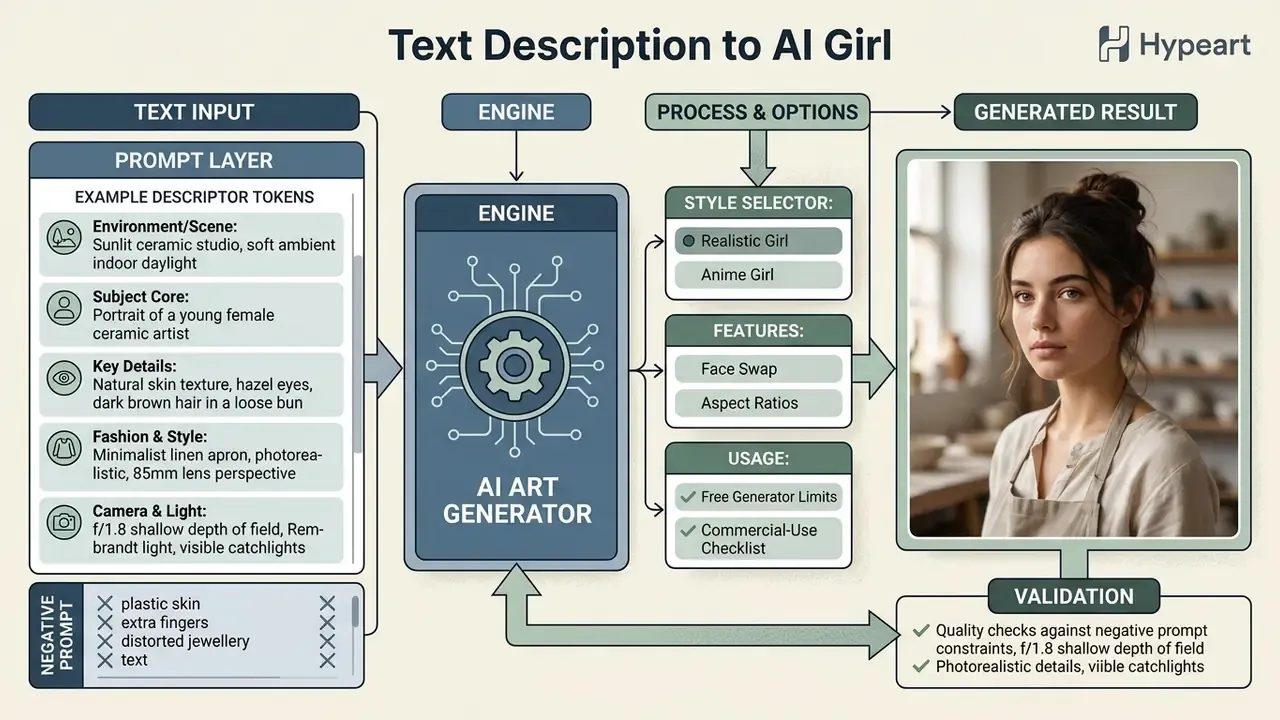
Copy-paste prompts
- Photorealistic portrait
A realistic 8k portrait of a young woman, natural skin texture, visible pores, hazel eyes with sharp catchlights, soft window lighting, 85mm lens perspective, f/1.8, photorealistic, highly detailed, indoor ceramic studio background --ar 4:5 - Fantasy elf girl
Digital art of a fantasy elf girl, long silver hair, glowing green eyes, holding a luminous orb, ethereal rim lighting, intricate armour engraving, highly detailed 4k, cinematic composition --ar 16:9 - 90s anime style
A girl in 90s anime aesthetic, wearing a school uniform, sitting by a rain-streaked window, soft nostalgic pastel palette, cel shading, clean line art, flat colour tones --ar 1:1 - Cyberpunk character
Cyberpunk girl portrait, neon pink and blue ambient lighting, mechanical eye implant, reflective leather jacket, rain-slicked city backdrop, volumetric light, cinematic 4k --ar 9:16 - Kawaii chibi mascot
Super deformed chibi girl, oversized round head, huge expressive eyes, rosy cheeks, tiny body, pastel mint background, soft even lighting, clean simple linework, sticker-ready --ar 1:1 - Ghibli-like illustration
Hand-painted anime girl standing in a windswept summer meadow, lush watercolour background, warm nostalgic palette, gentle cloud shading, film-still framing --ar 16:9 - 3D cartoon avatar
3D cartoon style portrait of a cheerful young woman, smooth subsurface shading, expressive oversized eyes, Octane render, studio three-point lighting, glossy highlights --ar 1:1 - Universal negative prompt
blurry, lowres, deformed hands, extra fingers, fused limbs, mutated anatomy, plastic skin, oversaturated, watermark, signature, text artifacts, duplicate face
Drop hype terms such as "ultra detailed" and use concrete photographic language instead; fidelity usually improves. Describe mood ("elegant", "melancholic", "playful") and framing ("head and shoulders shot", "three-quarter body") rather than piling up synonyms for "beautiful". Ten adjectives meaning pretty will not make an image prettier. For detailed software evaluations, see the best AI art generator comparison.
Creating an AI Girl from an Existing Photo
Image-to-image generation turns reference photographs into stylized artwork while holding core facial identity features. Advanced pipelines use reference face conditioning and local patch-based diffusion to keep structural feature alignment (ICASSP Conference Proceedings, 2025).
Prohibited-use boundary. One category deserves a hard line rather than a policy nudge. Tools in the undress ai generator category, and any workflow that produces intimate imagery of a real person without consent, sit outside acceptable commercial use in every jurisdiction we track. Block them at the network level, name them explicitly in acceptable-use policy, and make the escalation path for accidental exposure obvious to staff. The reputational and legal downside here dwarfs any creative upside.
Organizations that need to extend background canvas around generated portraits can review the AI expand image comparison. Teams reusing footage or stills from external sources should also check provenance rules before touching a url video downloader or a browser capture tool.
Commercial Usage of AI-Generated Girl Images: What to Check First
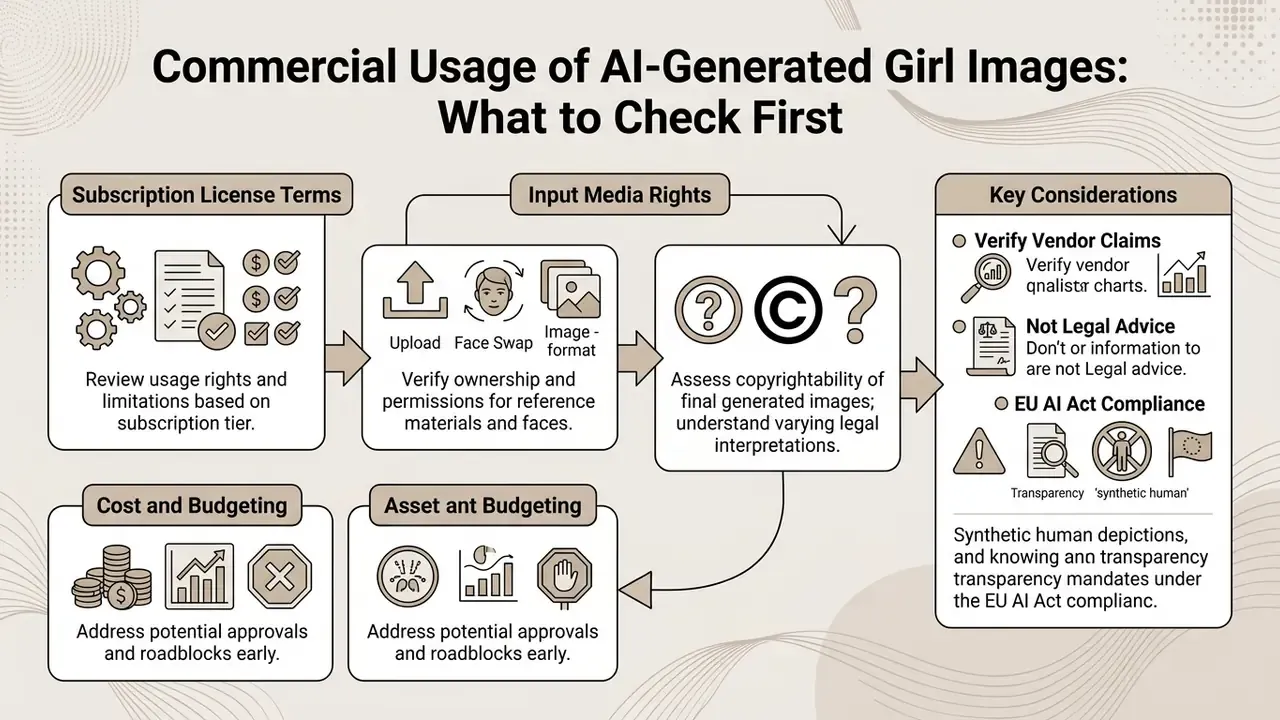
Commercial deployment of ai-generated girl images requires checking three separate things: subscription license terms, input media rights, and the copyright status of the output. Purely machine-generated visuals without substantial human creative authorship are not protected by copyright under US guidance (US Copyright Office Guidance, 2024). Where the model determines the expressive elements, only the human-authored contribution can be claimed, and AI-generated portions must be disclaimed at registration.
"SafeGen removes 99.4% of sexual content while preserving high quality on safe images, outperforming eight baseline methods."
Vendor claims deserve calibration in both directions. Marketing copy promising images that are "copyright-free for personal or commercial purposes" conflates two different ideas. Absence of copyrightability in a machine-made output does not create legal safety, because likeness, trademark, and source-media rights operate independently. Blanket "licensed for commercial use" claims are equally conditional: commercial rights usually depend on subscription tier, region, and the platform's current terms of service. Read the clause that applies to your plan, not the landing page.
Checklist0 / 7
"The CPDM dataset contains 21,000 images across four infringement categories: style, portrait, artistic image, and licensed illustration."
Deployers producing synthetic human depictions must meet transparency mandates under the EU AI Act (EU AI Act Service Desk, 2024). Where AI generates or manipulates image content resembling real persons, the artificial origin must be disclosed clearly, whatever the sector. Right-of-publicity laws also protect against unauthorized commercial exploitation of an individual's likeness in advertising (IAB Legal Review, 2024), and in the US these are state-level rights with uneven scope. The US Copyright Office's 2024 digital-replica report treats generated images of identifiable persons as a separate exposure category again.
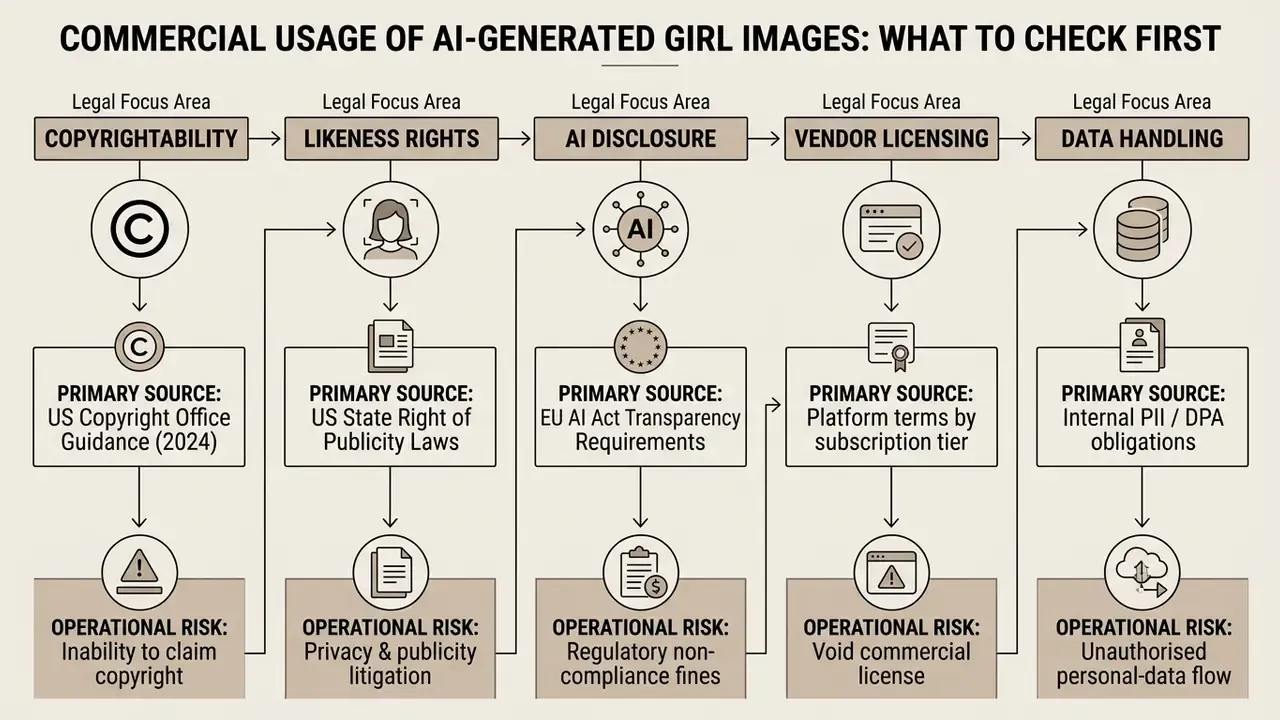
A short note on cost, since this is where approvals stall. Risk-adjusted ROI for a creative pipeline has to include review time, licence tier upgrades, archive storage for audit trails, and the residual cost of pulling an asset after publication. Speed alone is a vanity metric. Weighing legal considerations across enterprise platforms is easier with the AI image generators commercial use guide and the wider AI Media Commercial-Use hub. Organizations formalising governance can also view the guide on compliance and dispute standards.
Free AI Cute Girl Photo: What You Get at No Cost
Free platforms give access through rolling daily quotas, promotional credit allotments, or trial tiers. Free plans commonly cap export resolution, slow the queue, and restrict commercial usage. So an ai cute girl photo free download is fine for a mood board and risky for a paid campaign.
Fact check: free access parameters in 2026
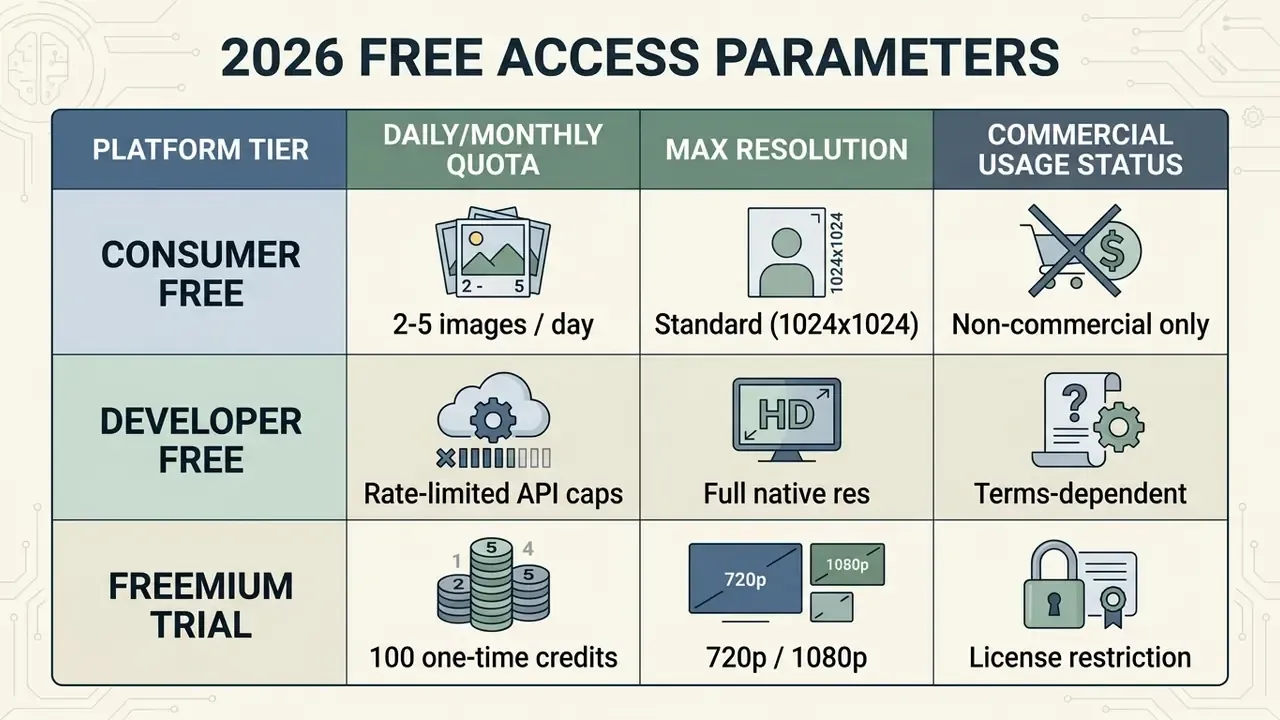
Readers who want to test a girl generator without creating an account can review no-sign-up AI image generators. A broader feature-by-feature view sits in the best free AI image generator comparison.
Users benchmarking free capability can consult the best free AI art generator analysis. Cost structures across paid plans are covered in the AI Media Pricing Guides.
Additional Resources and Learning Material
- Review complete media editing workflows in the photo editor guide.
- Explore free utility limits in the free photo editor overview.
- Examine corporate portrait options in the AI headshot generator guide.
- Compare painted-illustration engines in the Ghibli AI image generator comparison.
- Analyze enterprise design generator terms in the Canva AI generator evaluation.
- Review Microsoft's visual generator terms in the Microsoft AI image generator summary.
- Check access requirements and commercial terms in the Bing AI image guide.
- Compare standalone tools against conversational interfaces in the ChatGPT picture generator comparison.
- Evaluate leading engines in the Midjourney AI image generator review.
- Understand Google's visual tools in the Google AI image generator analysis.
- Investigate provenance technology in the AI reverse image search comparison.
- Implement video frameworks using the YouTube video editor workflow guide, and check hosting steps for how to upload video online.
- Get technical help through AI Media Support and Troubleshooting.
FAQ: Common Questions About AI Art Girl Generation
Can AI-generated girl images be copyrighted for commercial products?
Under current US Copyright Office guidance, purely AI-generated images made without substantial human creative authorship cannot be registered. Commercial usage is then governed by vendor subscription agreements and adjacent property law, including trademark and right-of-publicity rules.
What is the difference between anime and photorealistic prompt design?
Photorealistic prompts lean on photographic parameters: focal length, natural lighting setups, skin pore detail. Anime prompts lean on style triggers such as cel shading, line art weight, flat colour tones, and domain-specific artistic tags.
Are free AI girl generators safe for commercial advertising?
Usually not without an upgrade. Free tiers restrict commercial rights and may export watermarked or downscaled files. Advertising needs a paid tier with explicit commercial licensing, plus documented consent for any real-person reference material.
How do generators prevent underage character generation?
Enterprise platforms run automated NSFW and age-related safety filters, including safety checkers and prompt classifiers, which block inputs and outputs depicting minors or risky age-coded aesthetics. Those filters apply to stylized modes such as anime and anime-to-realistic conversion as well as photorealistic output. Published removal benchmarks such as SafeGen show high filtering accuracy is achievable without wrecking quality on safe prompts.
Are my uploaded reference photos used to train future models?
Major commercial platforms state that uploads are processed in memory for immediate inference, encrypted in transit, deleted after generation, and excluded from retraining datasets. Policies differ by vendor and plan, so confirm the retention and training clauses in the terms of service before uploading identifiable faces.
Can a generator accidentally duplicate real faces or copyrighted artwork?
Diffusion architectures synthesize novel features from high-dimensional latent distributions rather than retrieving or stitching existing images, so they produce original characters. Residual risk remains when a prompt names a real person or a protected character, which is why unlearning benchmarks such as CPDM and pre-publication likeness checks belong in the review workflow.
Which aspect ratio should I choose for each channel?
Use 1:1 for avatars and profile images, 4:5 for portrait social posts, 9:16 for Stories, Reels, and TikTok, and 16:9 for wallpapers, thumbnails, and slides. Choosing the ratio before generation avoids destructive face cropping during layout.
What should go into a negative prompt for character portraits?
Start with anatomy and artifact suppression: deformed hands, extra fingers, fused limbs, mutated anatomy. Add finish controls such as plastic skin, oversaturated, lowres, blurry, then provenance controls such as watermark, signature, text artifacts. Keep the list stable across a campaign so outputs stay visually consistent.
Appendix A: Archive of Replaced Fragments