Why does this matter to a compliance or risk owner rather than a marketing lead? Because the moment a policy document, an AML procedure or a customer disclosure enters a generation pipeline, you are running a model on regulated content. That changes the question from "does it look good?" to "can you prove what it did?"
Last updated: 2026. Reviewed for AI governance, model-risk and commercial-licensing accuracy.
Executive Summary
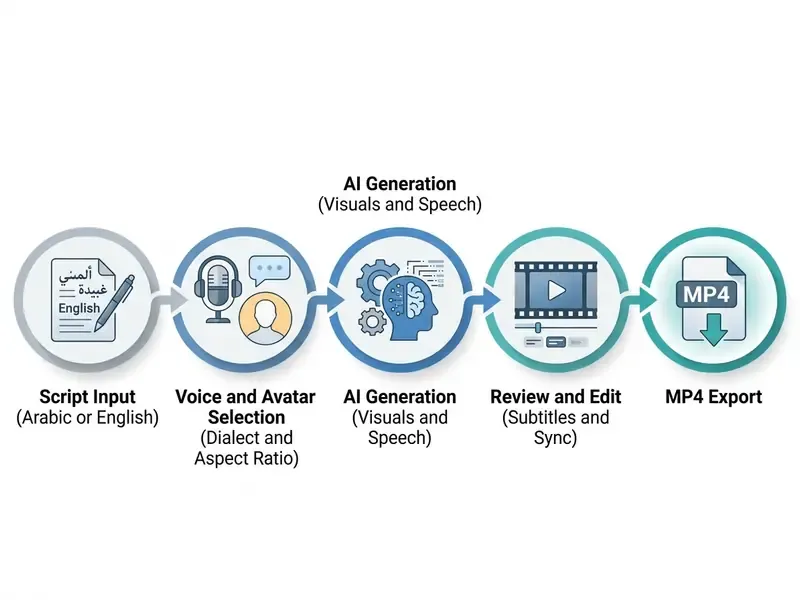
- What the technology is A modular pipeline. Arabic script input, then LLM scene planning, then Arabic TTS synthesis, then diffusion-based visual rendering, then lip-sync alignment, then MP4 export with SRT/VTT captions.
- The three failure points to test first Right-to-Left (RTL) glyph shaping in burnt-in captions, diacritic-driven pronunciation accuracy (target Word Error Rate below 3%), and dialect coverage beyond Modern Standard Arabic.
- Data governance is the enterprise gate, not features Before any pilot, verify Zero Data Retention SLAs, SOC 2 Type II and ISO 27001 attestations, regional data residency for MENA jurisdictions, SSO/SAML, and audit logging.
- Model risk Generative video belongs inside existing model-risk frameworks (SR 11-7 logic). Use the validation checklist in this guide to test diacritic rendering, semantic drift during automated paraphrasing, and voice-cloning consent records.
- Licensing reality Purely AI-generated output without human creative control is not registrable under U.S. Copyright Office guidance. Commercial protection depends entirely on vendor licenses and indemnification, which differ sharply between free and paid tiers.
- Commercial upside The same pipeline serves corporate compliance training, government public-service announcements, religious and cultural campaigns, MENA ad creatives, and creator monetization on YouTube, Vimeo OTT, and stock marketplaces.
- ROI must include control cost Net ROI = Savings minus (Tool Cost + Validation/Audit Cost + Residual Risk Provision).
Who this guide is for. Risk, compliance and communications owners who have to approve an ai text to video generator arabic purchase, plus the operations teams who will run it daily. The order of sections is deliberate: governance sits before production workflow, because a tool that fails vendor due diligence should never reach a pilot. If you only have ten minutes, read the validation checklist and the licensing section.
What Is an AI Video Generator Arabic Text to Video
An ai video generator arabic text to video system is a software pipeline that converts written Arabic text into a synchronized video file featuring visual scenes, voiceover audio, and captions. These platforms combine multimodal large language models for scene orchestration with neural text-to-speech engines and latent diffusion models.
Organizations deploy an arabic ai video generator to accelerate content creation without traditional camera setups or studios. The software parses written scripts, generates corresponding imagery or presenter avatars, synthesizes spoken audio, and burns in formatted captions. Modern ai text to video arabic platforms support both short-form social formats and full widescreen presentation layouts. Delivery varies too: some vendors ship a browser workspace, others an ai video generator app arabic teams install on mobile, and a few expose only an API. Readers new to the category can start with the baseline definitions in our reference entry on AI video generators.
How AI Turns Arabic Text Into Video
A generative video engine converts arabic text into video through a modular, multi-stage processing pipeline. The system processes the input text, structures temporal scene transitions, synthesizes speech audio, renders matching visual frames, and applies precise temporal lip-sync alignment.
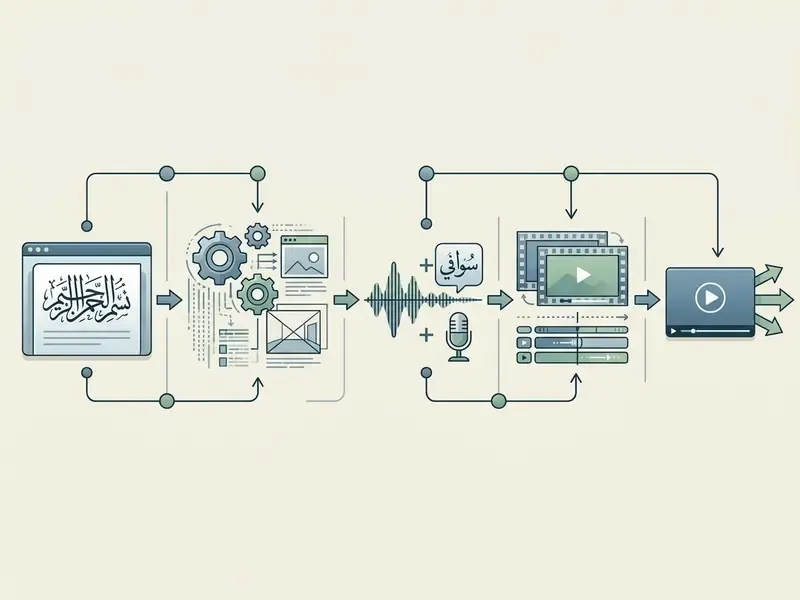
According to research on multimodal generative backends, large language models decompose natural language prompts into structured temporal scene instructions for specialized diffusion models.
"Large language models decompose textual prompts into structured temporal instructions for specialized diffusion models."
On the speech front, diacritization volume directly determines pronunciation accuracy in Arabic synthesis. Models trained on large diacritized corpora reach word error rates of 1.67%, compared with 3.18% for undiacritized training data. That gap is not cosmetic. In a compliance script, a mispronounced technical term can flip the meaning of an instruction.
"Models trained on 4,000 hours of diacritized text reach a 1.67% word error rate versus 3.18% without diacritics."
This front-end phonetic processing ensures accurate pronunciation prior to visual frame synthesis. For teams benchmarking underlying generation models and their API economics, the implementation notes in our Google Veo implementation guide document typical cost and limit structures.
What Formats of Arabic Videos You Can Create
Generative video software produces diverse visual styles and aspect ratios tailored to specific distribution channels. Users can generate vertical 9:16 video outputs for mobile social channels or horizontal 16:9 widescreen assets for corporate learning management systems.
- Corporate and training Horizontal 16:9 modules featuring AI avatars for employee onboarding, policy rollouts and compliance refreshers.
- Government and public sector Public service announcements and e-government instructions in strict Modern Standard Arabic (Fusha) with accessible SRT/VTT captions.
- Commercial ads High-paced promotional clips with dynamic text overlays and call-to-action cards.
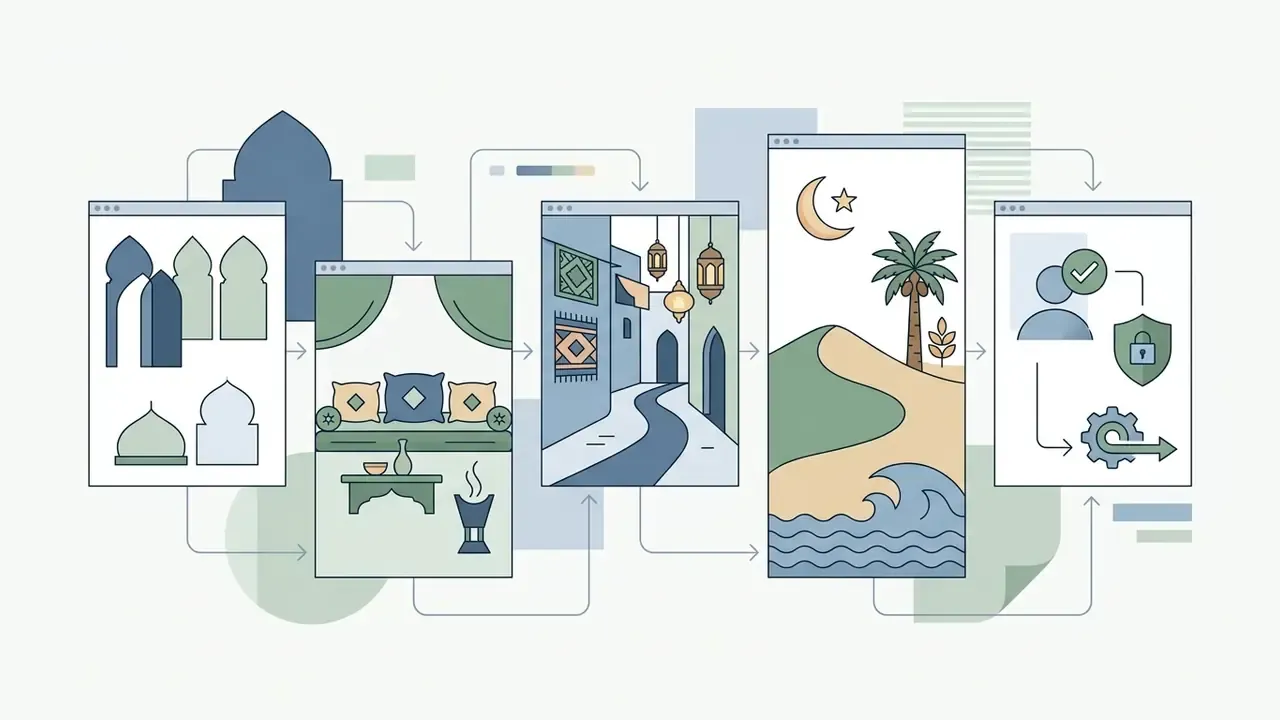
- Religious and cultural content Seasonal greetings for Ramadan and Eid, heritage explainers and historical narratives using culturally appropriate ornamentation.
- Social content Vertical 9:16 clips designed for TikTok, Instagram Reels, and YouTube Shorts.
- Visual styles Photorealistic human presenters, cinematic synthetic landscapes, and 2D or 3D animated explainer graphics. A comparison of animation approaches is available in our guide to animation makers.
Documented deployment example (internal benchmark, methodology below). A corporate compliance team converted written policy manuals into localized video modules for regional MENA branch staff. By passing diacritized scripts into a script-to-video workflow, the team generated 14 vertical video explainers featuring verified voiceover alignment within two business days. Rather than citing a single unverified percentage, the team measured turnaround against three agency quotes for equivalent scope and recorded a materially shorter delivery window (two business days versus multi-week quoted timelines), while retaining a human reviewer on every script. Figures reflect one internal engagement, not an audited industry benchmark; comparable savings require your own baseline measurement. Additional workflow guides and terminology can be reviewed in the comprehensive AI Media Glossary.
What Arabic Language Support Means in an AI Video Generator
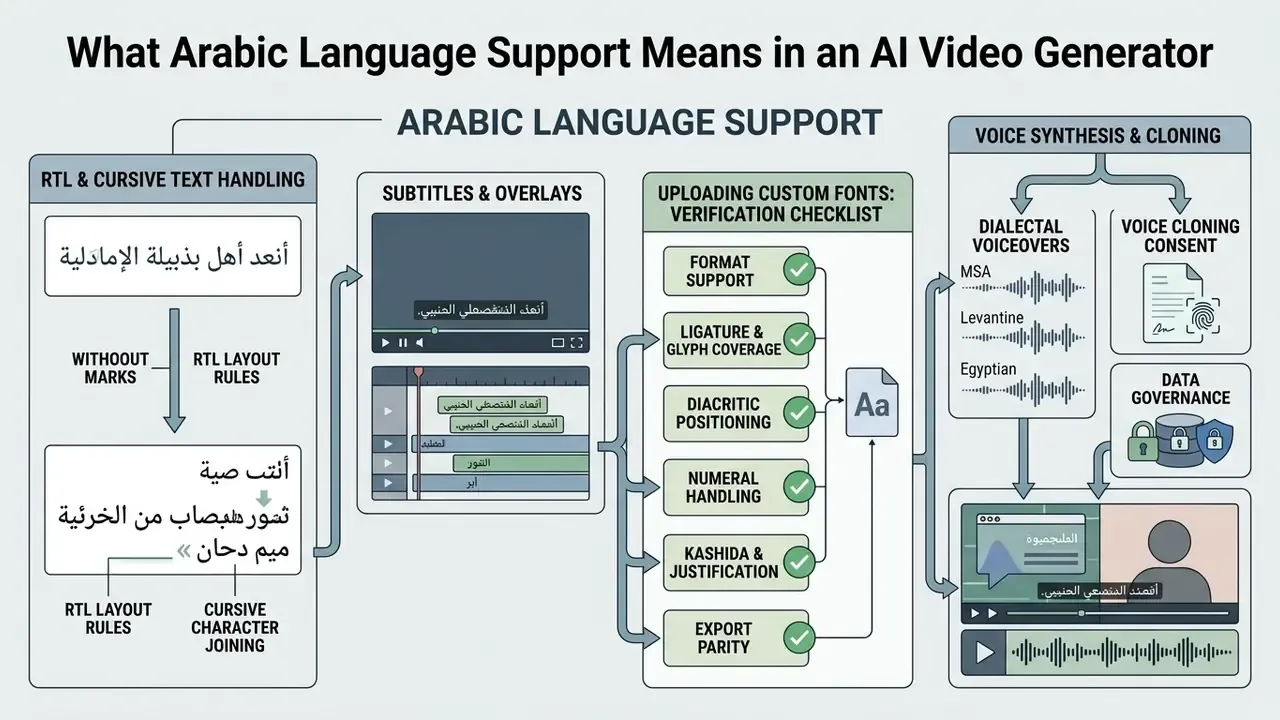
Robust ai video generator arabic language support requires full compatibility with Right-to-Left (RTL) layout rules, cursive character joining, dialectal voice synthesis, and bidirectional text handling. True linguistic integration goes beyond user interface localization to ensure correct caption rendering and lip-sync precision.
Selecting a platform that genuinely offers ai video generator arabic support demands verification of font shaping and audio-visual synchronization. When a vendor claims its ai video generator supports arabic, ask which layer that claim covers: the interface, the voice library, or the render engine. Improper font handling leads to disconnected letters or inverted line breaks, while generic speech models fail to reflect natural regional cadence.
RTL Text, Subtitles, and Arabic Text Overlays
Right-to-Left (RTL) support ensures that written Arabic renders with correct letter shaping, unreversed word sequencing, and properly positioned punctuation marks across captions and text overlays. The risk is documented across product generations. Users of mainstream editors reported in 2023 that video-canvas captions and animated overlays still rendered left-to-right for RTL languages, breaking word order and punctuation. Creative SDK release notes from 2025 (IMG.LY CE.SDK v1.66) then announced full RTL text input with automatic direction switching and correct cursor behavior for Arabic, Hebrew and Persian. Standard video engines designed for Left-to-Right (LTR) languages therefore frequently detach Arabic characters or reverse punctuation unless explicit directional parameters are enforced.
Technical analyses show that wrapping subtitle cues with explicit Unicode directional tags, RLE (Right-to-Left Embedding) at the start of each cue and PDF (Pop Directional Formatting) at the end, protects character ordering during playback.
"Precise visual and textual alignment is critical for non-Latin scripts; errors cause cognitive fatigue and reading mistakes during playback."
Uploading Custom Arabic Fonts: A Verification Checklist
Brand typography is where most Arabic video projects break. Before committing a font to production, run this check inside the generator's editor:
- Format supportConfirm the editor accepts WOFF2 and TTF/OTF uploads rather than only its preset library.
- Ligature and glyph coverageRender a test string containing initial, medial, final and isolated forms plus the lam-alif ligature.
- Diacritic positioningVerify that fatha, kasra, damma and shadda marks sit above or below the correct glyph and are not clipped by the caption bounding box.
- Numeral handlingTest both Eastern Arabic-Indic (٠١٢٣) and Western (0123) numerals inside RTL sentences to catch bidirectional inversion.
- Kashida and justificationCheck that automatic line wrapping does not sever cursive joins in Naskh or Kufic styles.
- Export parityRe-inspect the rendered MP4, not only the editor preview. Burnt-in captions are re-rasterized at export and can regress.
One practical note from review work: preview-only checks pass far more often than exports do. Test the file you will actually publish.
Arabic Dialects and AI Voiceover
High-quality video production requires access to an ai video generator arabic voice library spanning Modern Standard Arabic (MSA) and primary regional dialects. Formal broadcasts require MSA, whereas localized consumer ads rely on regional speech patterns.
- Modern Standard Arabic (MSA / Fusha) Standardized formal language for news, government announcements, corporate communications, and educational courses.
- Egyptian dialect Widely understood conversational tone across media and consumer marketing.
- Gulf (Khaleeji) Essential for localized campaigns targeting Saudi Arabia, the UAE, Qatar, and Kuwait.
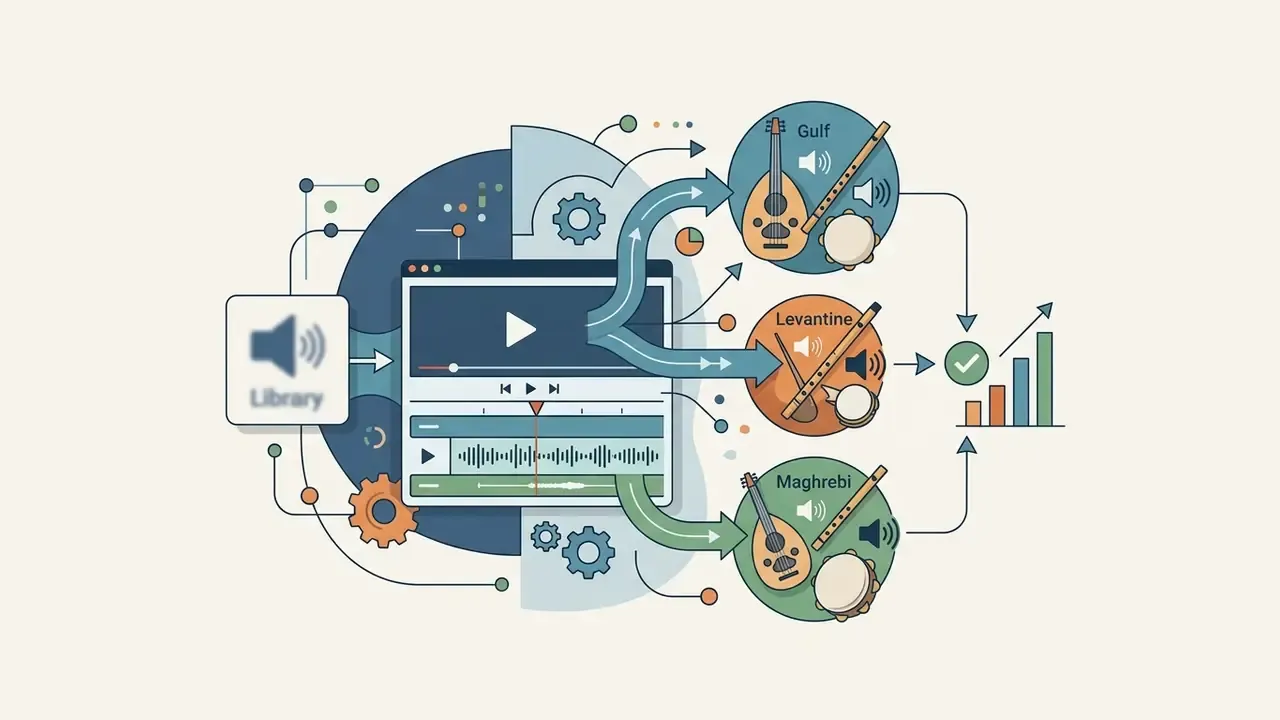
- Levantine and Maghrebi Specialized regional accents for localized community engagement.
- Iraqi, Sudanese, Yemeni and Najdi Increasingly exposed by dedicated Arabic speech vendors for narrow regional targeting.
Recent speech synthesis research confirms substantial progress in regional dialect modeling.
"NileTTS contains 9,521 utterances from two speakers across healthcare, sales and conversational domains, formatted to the XTTS v2 specification."
"FastPitch models trained on the ASC corpus (1,813 utterances, 3h 32m) reduce mel-spectrogram oversmoothing measured through cepstral metrics." Arabic TTS with FastPitch: Reproducible Baselines, Adversarial Training, and Oversmoothing Analysis (2025). https://arxiv.org/abs/2502.09320
Conditioning acoustic decoding on domain corpora therefore mitigates spectrogram oversmoothing, yielding natural ai video generator arabic voiceover options rather than flat, robotic delivery.
Working With Audio: Voice Cloning and Noise Reduction
Two audio features decide whether an Arabic video sounds like a brand asset or a template:
- AI voice cloning Vendors typically require between ten seconds and two minutes of clean reference audio to build a digital voice clone that preserves MSA phonetics and dialectal cadence. Enterprise use adds a control requirement: retain written, dated consent from the voice owner, store the consent artifact alongside the model ID, and restrict cloned-voice exports to approved campaign workspaces. Cloning a third party's voice for advertising without documented consent is the single most common licensing failure in this category.
- Automated background noise reduction When teams upload their own Arabic narration instead of using synthesis, neural denoising filters (RNNoise-class models and their successors) strip room echo, HVAC hum and handling noise before the lip-sync stage. Cleaner input audio directly improves phoneme detection, which in turn improves mouth-shape alignment accuracy.
- Practical sequencing Denoise first, normalize loudness second, then run lip-sync. Running lip-sync on noisy audio propagates alignment errors that cannot be corrected downstream without re-rendering.
Teams evaluating standalone speech tooling can compare capabilities in our guide to AI voice generators.
Table: Technical specifications for Arabic language support in AI video generators
| Feature category | Technical requirement | Validation criterion | Operational impact |
|---|---|---|---|
| Typography and layout | Native Right-to-Left (RTL) rendering with Unicode bidi support | Correct letter joining and unreversed punctuation in burnt-in captions | Prevents garbled text and unreadable video overlays |
| Voice synthesis | Multi-dialect TTS engines (MSA, Gulf, Egyptian, Levantine) | Natural pitch, correct diacritic handling, Word Error Rate under 3% | Ensures authentic regional audience engagement |
| Voice cloning | Reference-audio enrollment with consent recording | 10 seconds to 2 minutes of clean sample; stored written consent per voice ID | Enables branded narration without legal exposure |
| Audio cleanup | Neural background noise reduction on uploaded tracks | Echo and steady-state noise removed before lip-sync stage | Improves phoneme alignment and perceived production quality |
| Subtitle export | SRT and VTT caption files with UTF-8 encoding | Timestamp alignment synchronized within 100 milliseconds of audio | Maintains accessibility compliance across video players |
| Custom fonts | WOFF2/TTF upload with full Arabic glyph coverage | All four positional forms plus diacritics render at export, not only preview | Preserves brand typography without broken cursive joins |
| Prompt input | Bilingual prompt handling (Arabic script and English parameters) | Accurate interpretation of cultural cues and visual style directives | Allows flexible production workflows for global teams |
Read the table as a test plan, not a feature wish list. Each row maps to something a reviewer can pass or fail with a sample render, which is exactly the evidence an internal audit will ask for later. Teams can compare full technical benchmarks across our AI Media Comparison Matrices or move directly to the shortlist in our review of the best AI video generators.
Enterprise Data Governance, Security, and Model Risk
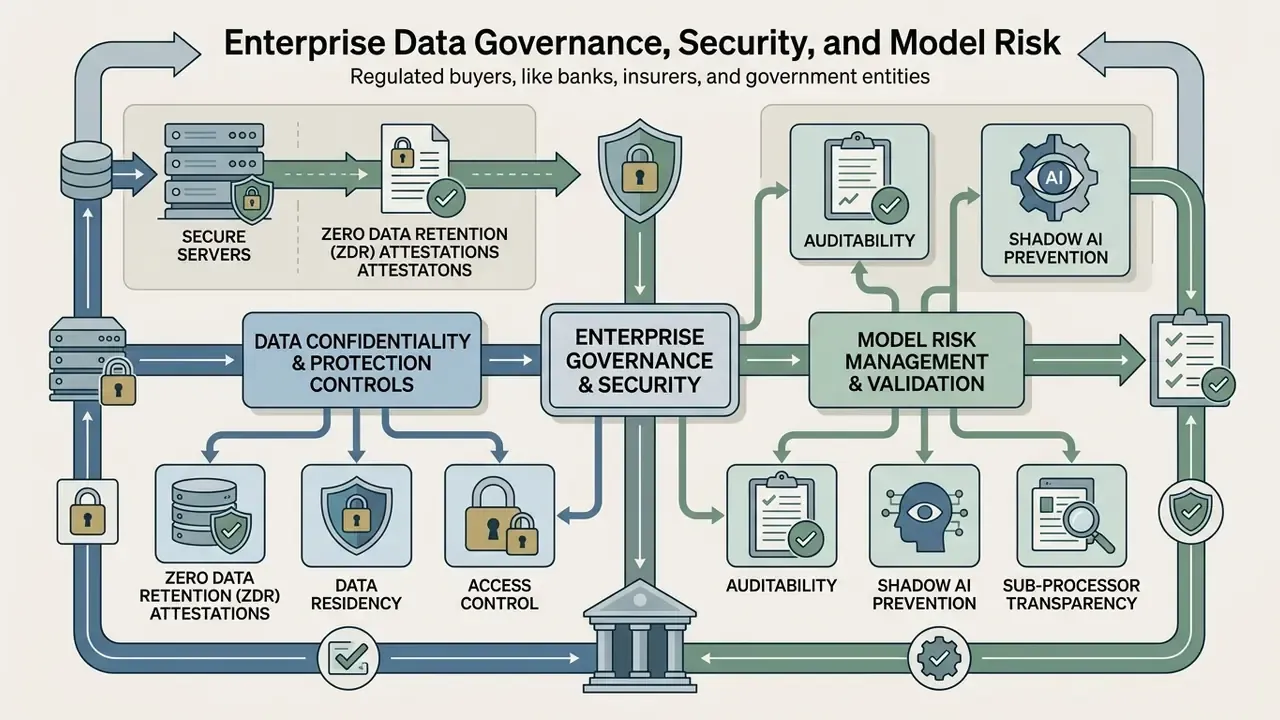
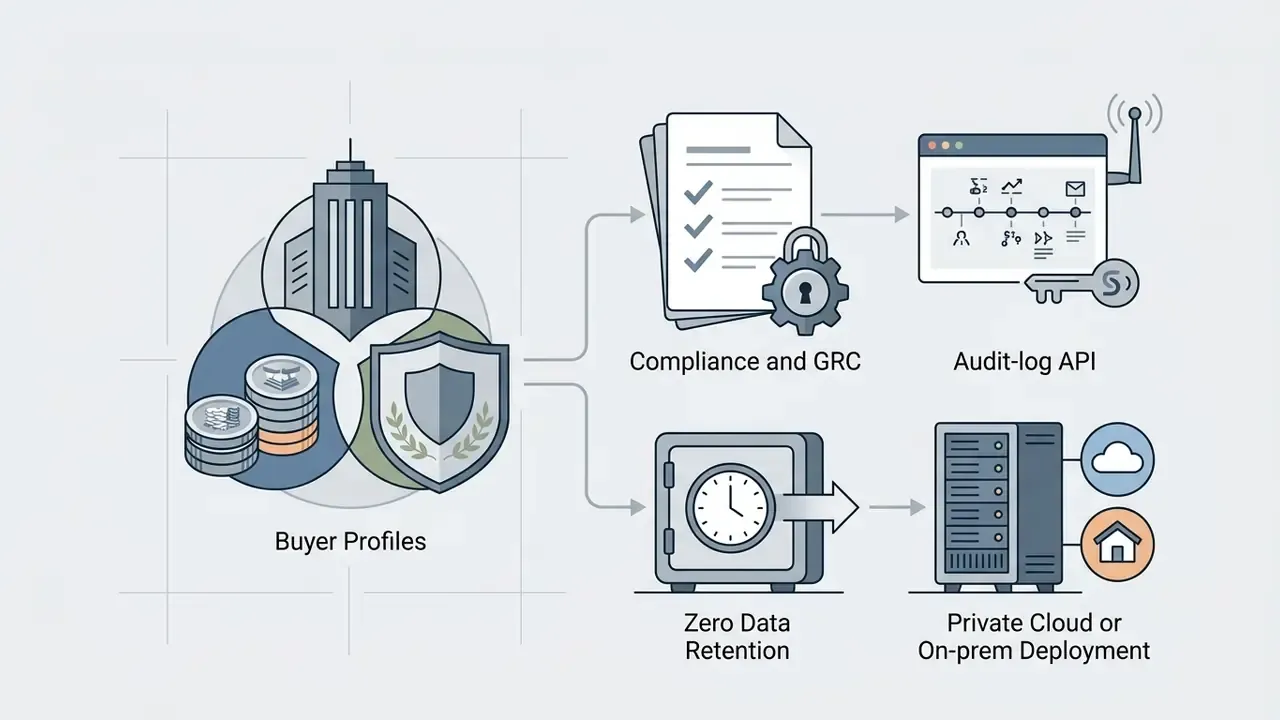
For regulated buyers, meaning banks, insurers, healthcare providers and government entities, the deciding criteria are not template libraries but data handling and validation evidence. Any ai video generator arabic site that cannot produce current attestations is a testing sandbox, not a production system.
Confidentiality and Data Protection Controls to Demand
- Zero Data Retention (ZDR): Contractual commitment that prompts, uploaded documents, reference audio and rendered outputs are not persisted beyond the request lifecycle and are excluded from model training.
- Attestations: SOC 2 Type II report, ISO/IEC 27001 certification, and, where applicable, ISO/IEC 42001 for AI management systems. Request the current report, not a marketing badge.
- Data residency: Confirm processing region. Saudi NDMO data-management rules and the UAE federal personal-data-protection framework constrain cross-border transfer of personal data; MENA-hosted or private-cloud inference may be mandatory.
- Access control: SSO/SAML or OIDC, role-based permissions, workspace isolation between business units, and enforced MFA.
- Auditability: Immutable audit logs covering prompt text, model version, operator identity, approval step and export event. That is the minimum evidence set for a post-incident review.
- Shadow AI prevention: Block unmanaged consumer tiers at the network layer and publish an approved-tool list. Consumer free tiers frequently reserve training rights on submitted content.
- Sub-processor transparency: Many video platforms route generation to partner models. Obtain the sub-processor list and confirm that ZDR terms flow down to each one.
Validation Checklist for Arabic Multimodal Models
ROI With Control Costs Included
Cost models that count only subscription fees overstate returns. Use:
Net ROI = Savings minus (Tool Cost + Validation/Audit Cost + Residual Risk Provision)
- Savings avoided studio, talent, translation and agency fees, plus reduced time-to-publish.
- Tool cost licenses, credits, API render minutes, storage and egress.
- Validation and audit cost bilingual review hours, model-validation effort, legal review of licensing terms, consent administration.
- Residual risk provision budgeted exposure for mistranslation, disclosure breaches, or IP claims not covered by vendor indemnity.
Teams modelling render and API spend can build the first two terms with our AI Media Calculators.
How to Create an Arabic AI Video From Text: Step-by-Step
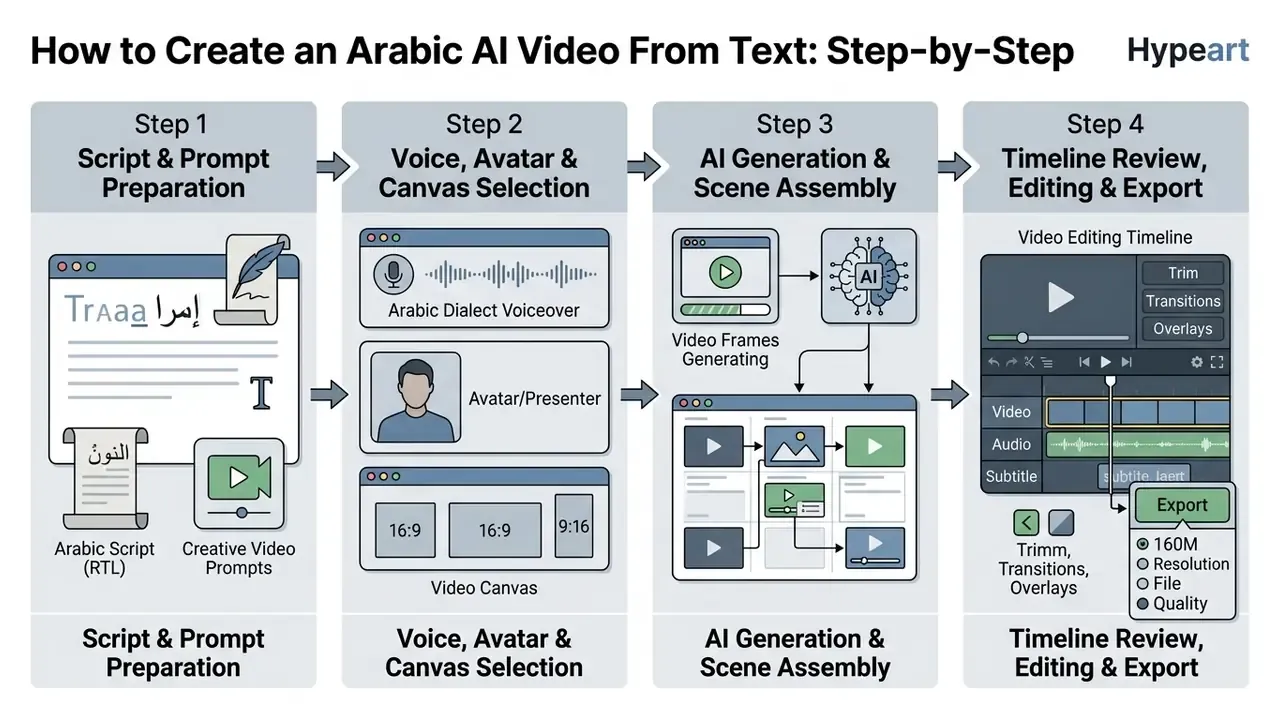
Creating localized video content using an ai video generator from text arabic pipeline follows four systematic steps. This process allows teams to turn text scripts into published video assets without manual filming, a workflow category covered more broadly in our overview of text-to-video AI tools.
Prepare the Idea, Prompt, or Arabic Script
Write or paste a detailed Arabic text script into the generator interface. Ensure proper diacritization on technical terms to guide speech pronunciation engines. Prompts can specify visual environments, camera angles, color palettes, lighting styles, and character descriptions.
"Adding explicit cultural and environmental parameters to the prompt significantly improves the visual relevance of generative outputs for MENA audiences."
Practical prompt scaffold: subject, then setting, then cultural references, then mood, then camera and shot distance, then color grading, then on-screen text language, then animation style. Research-backed prompt augmentation (expanding a short brief into a culturally specified prompt) plus native-speaker review of the output remains the most reliable combination.
Choose the Voice, Style, and Video Format
Select an AI voice model that matches your target audience region and desired emotional tone. Choose between photorealistic presenter avatars, stylized 3D graphics, or cinematic scene generation. Set your target canvas aspect ratio: 16:9 horizontal for web platforms, LMS players and training portals, or 9:16 vertical for TikTok, Reels and Shorts.
Select presenter avatar framing based on export resolution. Vendor documentation for studio avatars specifies waist-up framing for 4K capture and chest-up framing for standard FHD canvases, because framing must fit the capture resolution to avoid cropping (Synthesia Docs, 2026, "Studio avatars"). Background images should be composed at the final output ratio so no borders or crops appear at export.
Generate, Edit, and Export the Video
Initiate generation to synthesize visual scenes, voiceover audio, and captions. Review draft playback in the editor timeline to verify phonetic alignment and text layout. Correct any subtitle misspellings, fix speaker labels and punctuation, adjust speech pacing, fine-tune background audio levels, and export the finished MP4 video file alongside sidecar SRT captions. Where distribution bandwidth matters, check output size against the guidance in our video compressor guide before publishing.
How to Choose AI Video Creation Tools for Arabic
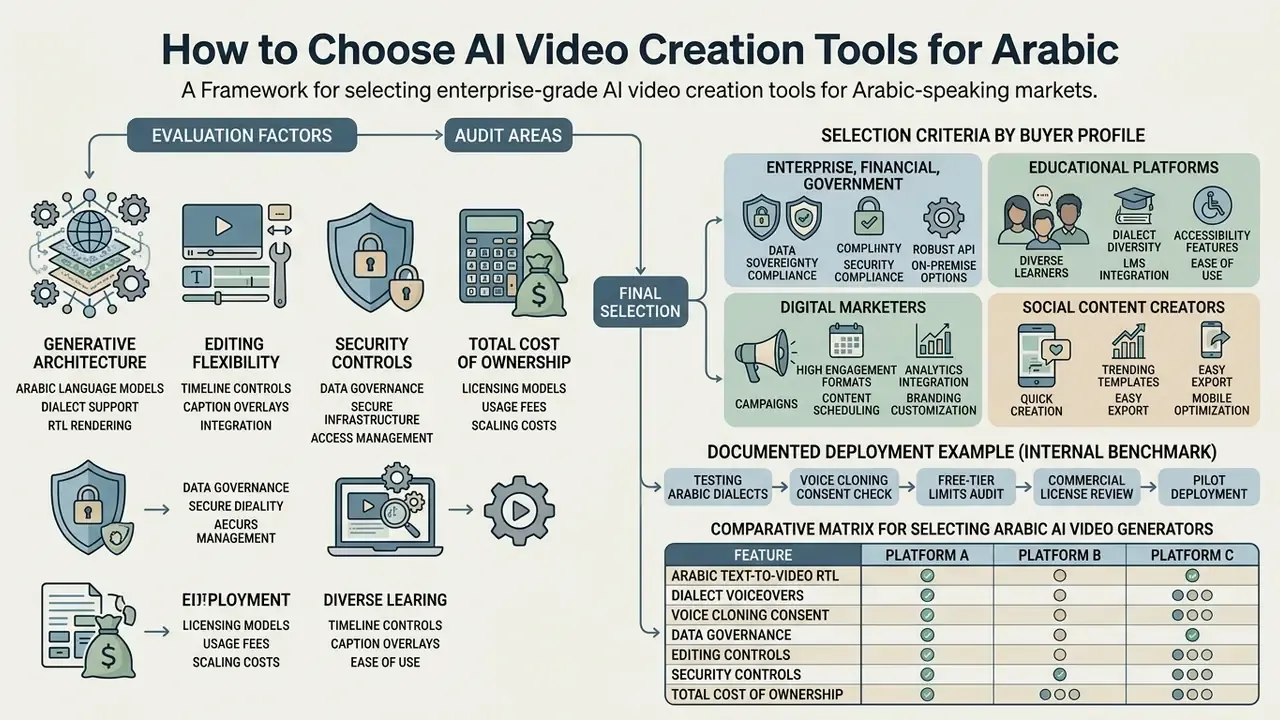
Selecting enterprise ai video creation tools arabic requires auditing generative architecture, editing flexibility, security controls, and total cost of ownership. Organizations should test platforms across multiple video models to verify asset continuity. Teams comparing ai video creation tools arabic text to video side by side should run identical scripts through each candidate; identical inputs make differences visible fast.
Enterprise buyers compare ai video generation tools arabic based on model flexibility and integration access. Evaluating software APIs allows organizations to embed automated video rendering directly into internal content management platforms and, critically, to keep generation inside a governed environment instead of unmanaged consumer accounts. Depth of ai video generation tools arabic language support is the differentiator that survives procurement; template count rarely is.
Video Generation and Editing Capabilities
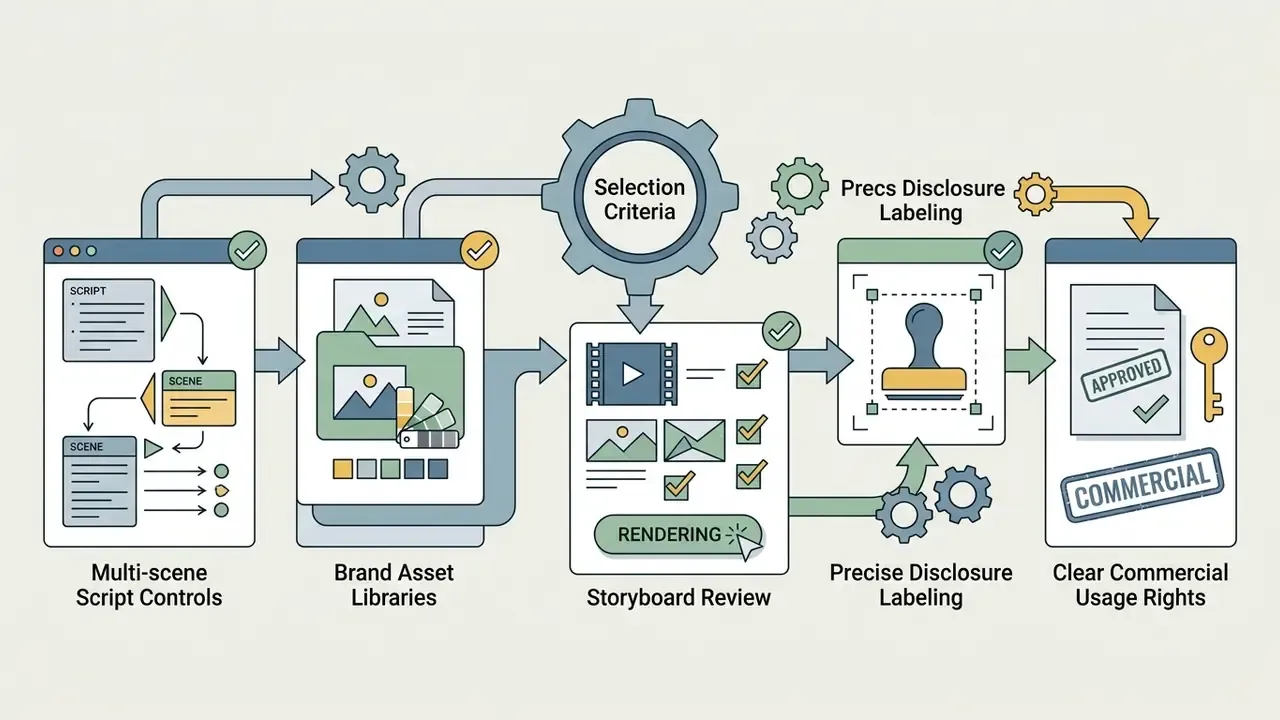
Advanced video platforms support multi-modal input processing, generating scenes from written scripts, reference images, reference audio or existing video footage. Connected scene planning algorithms ensure visual consistency across multi-shot video projects by carrying scene descriptions, entities, backgrounds and consistency groupings between shots. Current flagship models also expose local region editing, allowing a single object or caption plate to be regenerated without re-rendering the full clip.
"JUST-DUB-IT adapts a diffusion audio-video model through a lightweight LoRA, delivering dubbing with improved visual fidelity and lip synchronization."
"SyncVoice uses visual lip-motion information to guide TTS synthesis, improving alignment between dubbed audio and the video track." Towards Video Dubbing with Vision-Augmented Pretrained TTS Model (2026). https://arxiv.org/abs/2504.09646
Together these capabilities enable rapid correction of individual dialogue lines or background graphic assets. That is the practical difference between a fixable asset and a full re-shoot.
Selection Criteria by Buyer Profile
Operational requirements vary significantly depending on primary production goals and distribution channels:


Documented deployment example (internal benchmark). An e-learning provider converted hundreds of textbook modules into accessible training videos. Using an enterprise video platform with document processing capabilities, the organization generated structured lessons with synchronized Arabic voiceover. Rather than a single headline percentage, the provider tracked cost per finished lesson-minute against its prior studio-recording baseline and recorded a substantial reduction, driven mainly by eliminated studio booking and re-recording cycles. A bilingual reviewer remained in the loop for every module. The figure derives from one provider's internal accounting and is not an independently audited benchmark. Organizations planning automated media infrastructure can inspect integration costs using AI Media API Guides.
Table: Comparative matrix for selecting Arabic AI video generators
| Selection parameter | Enterprise, financial and public sector | Educational platforms | Digital marketers | Social creators |
|---|---|---|---|---|
| Primary video format | Horizontal 16:9 (LMS, intranet, town halls) | Horizontal 16:9 (LMS, YouTube) | Multi-aspect (9:16, 16:9, 1:1) | Vertical 9:16 (Shorts, Reels, TikTok) |
| Voice and dialect need | Strict MSA (Fusha), consistent corporate voice ID | Clear Modern Standard Arabic | Brand-aligned localized accents | Conversational regional dialects |
| Input source types | Policies, regulatory circulars, controlled documents | PDFs, slide decks, long articles | Campaign briefs, URLs, ad copy | Short text prompts and trends |
| Security and identity | SSO/SAML, RBAC, private cloud or on-prem, ZDR, SOC 2 Type II | SSO, student-data privacy alignment | Workspace roles, brand-asset locking | Standard account security |
| Governance and audit | Immutable audit logs, GRC/API export, model-version tracking | Version history for course content | Approval workflows for claims review | Not typically required |
| Editing flexibility | Text-accurate re-render of single scenes, no silent model swaps | Transcript editing and captions | Layered timelines and brand assets | Quick template filters and stickers |
| Licensing and compliance | Full commercial rights plus written indemnification | Accessibility and educational rights | Full commercial and ad rights | Standard platform terms |
Buyers testing options without budget commitment can start from our comparison of free AI video generators and escalate to paid evaluation only after the RTL and dialect tests pass.
Free Arabic AI Video Generators, Pricing, and Commercial Use
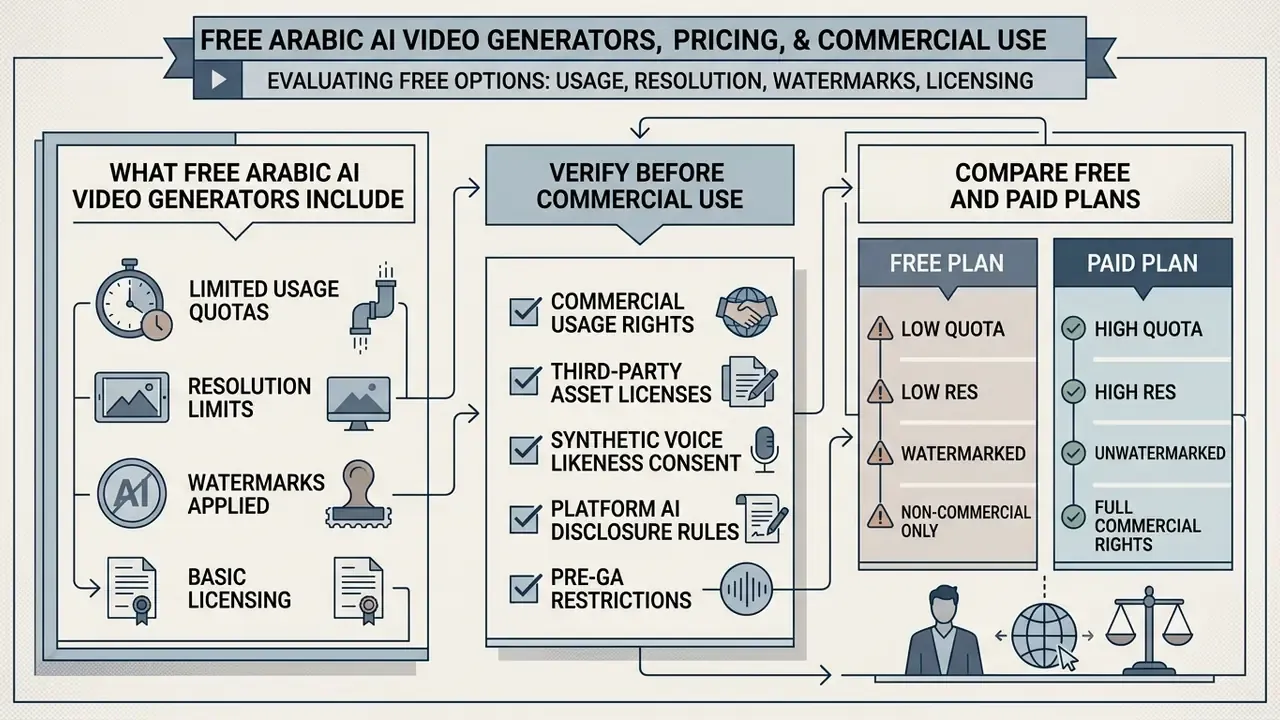
Evaluating an ai video generator arabic free option requires checking usage quotas, resolution limits, watermarks, and licensing restrictions. Free tiers provide initial feature testing but rarely grant commercial usage rights.
Testing an ai video generator arabic free online tier lets creators inspect RTL rendering before paying for anything. A caveat worth repeating: an ai video generator free online arabic trial tells you about output quality, not about contractual safety. Organizations intending to monetize videos must verify licensing conditions carefully.
What Free Arabic AI Video Generators Include
An ai video generator free arabic tier typically provides entry-level features to evaluate rendering speed and UI workflows. However, free accounts enforce operational boundaries:
- Monthly credit caps: Limited free rendering minutes or credits that reset monthly or upon signup; published examples range from small one-time credit grants to modest daily allowances.
- Resolution restrictions: Video exports capped at standard definition (480p or 720p), though some vendors advertise watermark-free 1080p on free tiers.
- Watermarking: Platform watermarks burned into exported clips.
- Voice access: Access restricted to basic MSA voice models without dialect options or custom voice cloning. Claims of ai video generator free arabic support often mean interface strings only.
- Data rights: Free plans are the most likely to reserve training rights on submitted content, a disqualifier for confidential material.
Anyone testing an ai video generator free arabic text to video route on real corporate documents should stop and read the data clause first. Creators seeking cost-free testing options can evaluate standalone tools listed in the guide to free ai video generator platforms.
What to Verify Before Commercial Use
Deploying generated Arabic videos for commercial advertising, YouTube channel monetization, or paid client deliverables requires verifying legal licensing terms:
- Commercial usage rightsConfirm that platform terms explicitly grant commercial rights for generated visual and audio assets, and that the grant covers the plan you actually hold.
- Third-party asset licensesAudit stock music, background footage, logos, trademarks and 3D models embedded within generated scenes for commercial clearance.
- Synthetic voice likenessVerify consent models when using cloned human voices or real-person avatars in advertising campaigns; check portrait and publicity rights in each target market.
- Platform AI disclosure rulesEnsure compliance with YouTube, TikTok, and Meta policies requiring disclosure labels on realistic synthetic or altered media. Disclosure duties are broader in advertising contexts than in organic uploads.
- Pre-GA restrictionsEarly-access or pre-general-availability video models frequently prohibit commercial monetization regardless of subscription level.
Commercial protection therefore depends entirely on contractual vendor licenses and indemnification provisions rather than automatic authorship. Adjacent rules for still imagery are collected in our review of commercial use of AI image generators.
How to Compare Free and Paid Plans
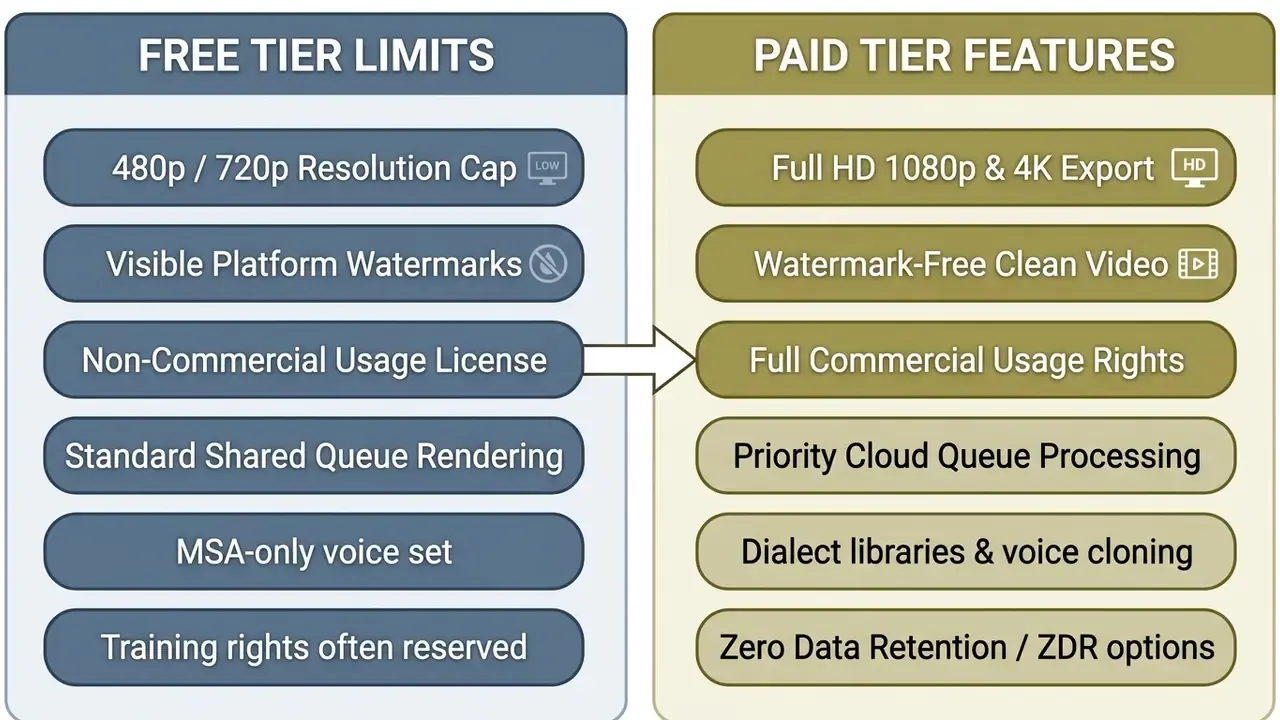
Upgrading to a paid plan unlocks high-definition 1080p or 4K downloads, uncompressed audio exports, priority queue rendering, dialect voice libraries, premium partner models, and explicit commercial indemnification. Teams evaluating tiers across vendors can analyze plan structures on our pricing guide, and compare narration costs separately through our guide to AI voice generators.
E-E-A-T fact check: 2026 usage terms verification
Arabic AI Video Ideas: Compliance Training, Public Sector, Ads, and Social
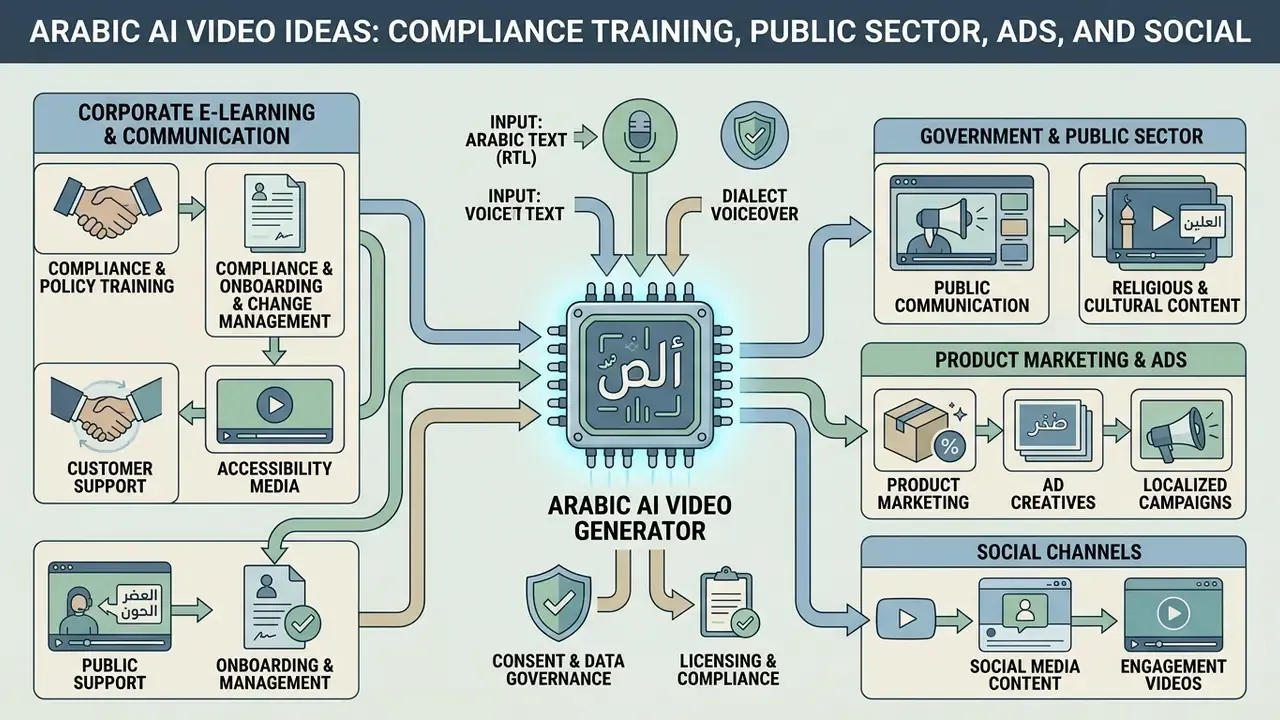
Organizations leverage an ai video generator arabic workflow to produce localized content across corporate training, government communication, marketing, and social media channels. Automated video rendering allows teams to adapt message scripts for regional MENA sub-markets rapidly.
Combining synthetic voiceover with automated captions accelerates distribution across multiple channels. Content managers can compare tool parameters in our guide to free ai video generators with built-in narration.
Corporate E-Learning, Compliance, and Internal Communication
In enterprise settings, generative video pipelines turn static written documentation into engaging video media:
- Compliance and policy training Transforming HR manuals, AML procedures and technical documentation into structured video courses with reviewer sign-off at every stage.
- Onboarding and change management Consistent MSA delivery of the same message across Gulf, Levantine and North African offices.
- Customer support Automated video resolution guides generated directly from knowledge base articles.
- Accessibility media Adding synchronized captions and audio descriptions to reach diverse regional audiences. Captions synchronized within 100 ms plus a full transcript are the working baseline for accessible AI-generated audiovisual content.
Government and Public Sector Communication
Public bodies use Arabic AI video for service explainers, regulatory announcements and citizen-facing instructions. Requirements differ from marketing use in three ways: strict Modern Standard Arabic (Fusha) with no dialectal drift, accessibility deliverables (SRT/VTT captions, transcript, audio description) as a default rather than an option, and provenance metadata so citizens can distinguish synthetic presenters from recorded officials. Where personal data enters the pipeline, processing location must satisfy national data-management rules.
Religious and Cultural Content
Seasonal and heritage content is one of the highest-engagement categories in MENA. Practical guidance: keep Ramadan and Eid greetings visually restrained and typographically led; use ornamental geometry and calligraphic panels rather than photorealistic depictions of religious figures; verify any quoted text character by character with a qualified reviewer, since a single diacritic error changes meaning. Historical and heritage explainers benefit from documentary pacing and archival-style color grading.
Product Marketing and Ad Creatives
- Product ad creatives Rapid generation of localized promotional video variants for regional ad campaigns, including 6-second bumpers and 15-second cut-downs.
- E-commerce Product demos and unboxing-style clips generated from catalogue copy and product images.
- Storyboard review before render Approve scenes and claims before spending render credits. It is the cheapest point to catch a compliance problem.
Marketers planning commercial campaigns can review legal deployment frameworks within the AI Media Commercial-Use Hub.
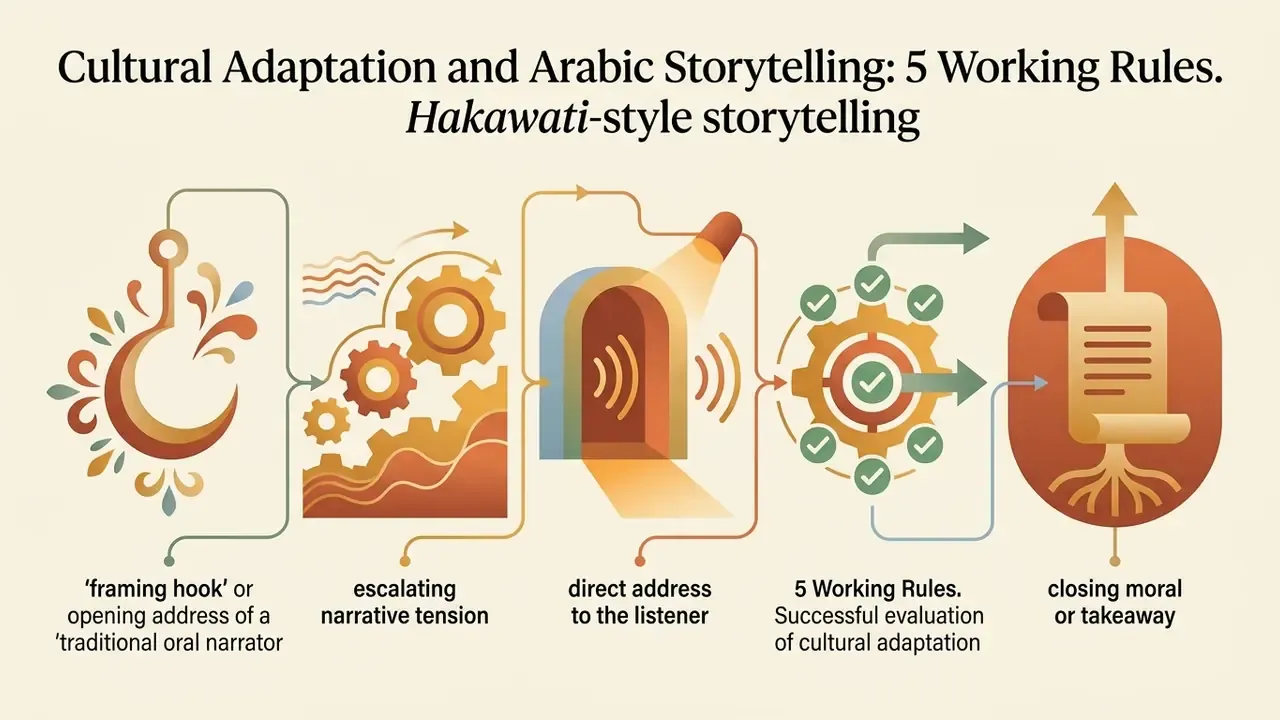
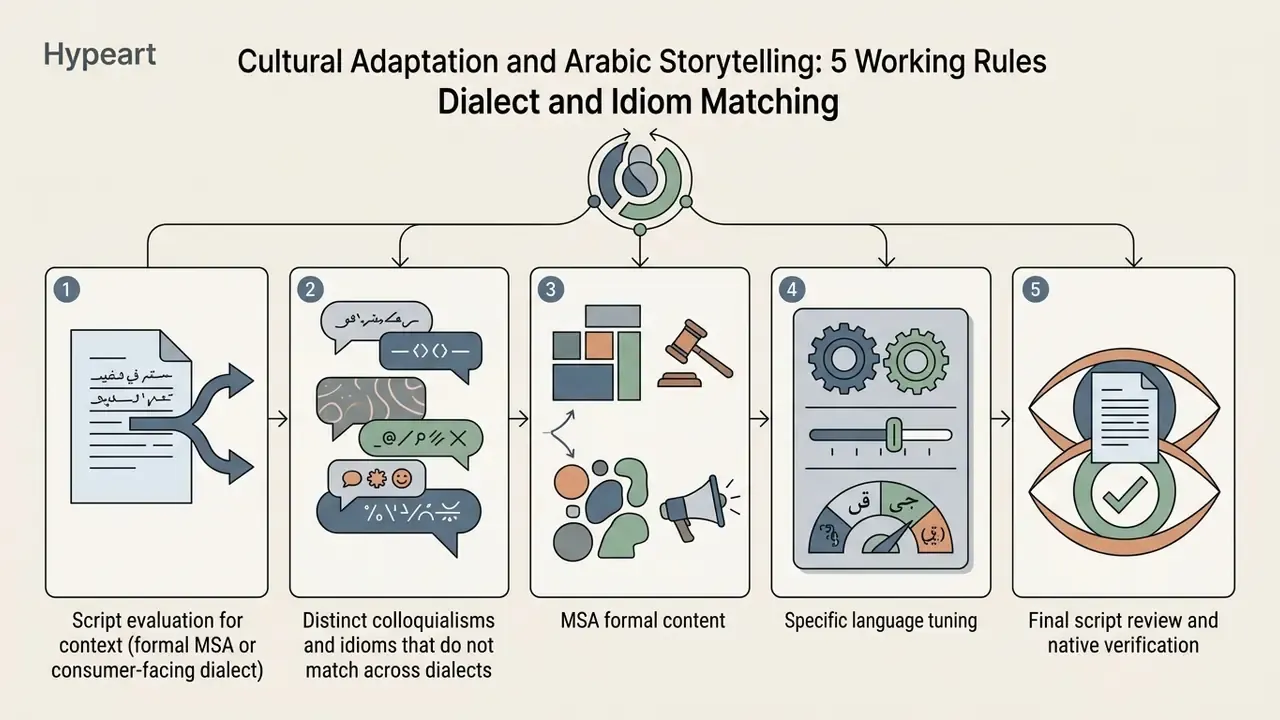
Cultural Adaptation and Arabic Storytelling: 5 Working Rules
Translation is not localization. Arabic video that performs in MENA markets is built around cultural structure, not swapped vocabulary.
Anti-patterns to avoid: mirroring an English layout and pasting Arabic into it; left-aligned Arabic body text; mixing Eastern and Western numerals inconsistently within one video; using one dialect's slang for a pan-Arab campaign; depicting religious subjects photorealistically.

How to Monetize Arabic AI Videos
Cost reduction is only half the business case. The same pipeline supports direct revenue for creators, freelancers and studios.
Two prerequisites for every route above: written commercial rights from your generation platform covering the specific plan you are on, and documented consent for any cloned voice or real-person likeness. Monetizing content you do not hold rights to is the fastest way to lose a channel.
- YouTube AdSense and ShortsBuild dialect-specific channels, Gulf or Egyptian, around short factual explainers, historical digests, science summaries or language-learning micro-lessons. Vertical 9:16 for Shorts, 16:9 for long-form, with two-line captions on every clip. Disclose synthetic presenters where platform policy requires it.
- Stock footage salesUpload 4K generated sequences (traditional Arabic architecture, desert and coastal landscapes, geometric motion backgrounds, calligraphic title plates) to Shutterstock, Adobe Stock and similar marketplaces. Confirm the generating platform grants resale rights; many free tiers do not.
- Paid courses on Vimeo OTT and similar platformsPackage MSA-dubbed training programs in high-value niches such as Islamic finance, compliance, IT certification prep and professional Arabic. Subscription or one-time purchase models both work; captions and transcripts increase completion rates.
- Client services and localization retainersSell Arabic localization of existing English marketing libraries (dubbing plus lip-sync plus caption delivery) to brands entering MENA. Price per finished minute and carry the vendor's commercial license terms through to your client contract.
- Social commerce and affiliate contentGenerate high-volume Arabic product review and demo clips for Instagram and TikTok, monetized through affiliate links or brand deals.
- Templated productizationBuild repeatable Ramadan and Eid greeting kits, corporate onboarding templates or real-estate walkthrough formats and license them as products rather than one-off deliverables.
Limitations and Open Questions
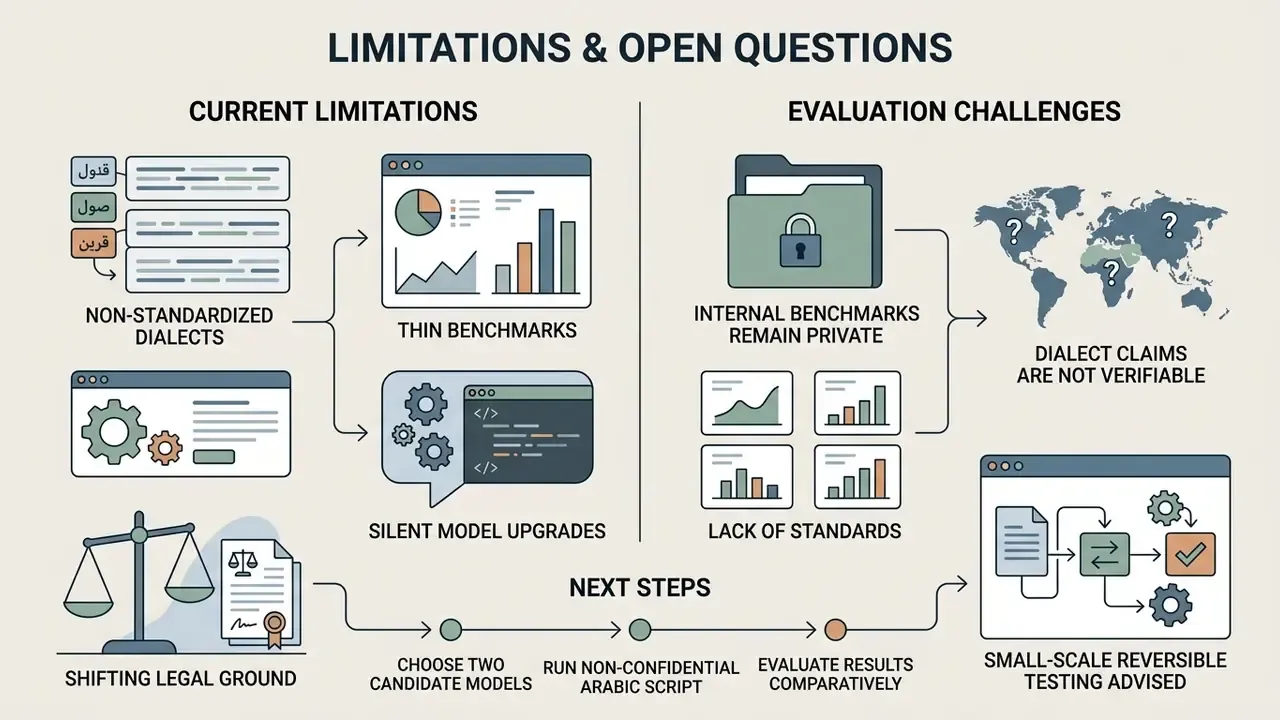
Honest scope note. Several things in this category are still unsettled, and buyers should treat them as open risks rather than solved problems.
- Dialect claims are not standardized. Vendors publish voice counts, not dialect taxonomies. Two platforms advertising "Gulf Arabic" may deliver noticeably different cadence. Request a sample render in your exact target market.
- Benchmarks are thin. Word Error Rate figures cited in research come from controlled corpora. Your scripts contain proper nouns, product names and regulatory terminology that no public benchmark covers.
- Silent model upgrades. Vendors swap underlying models without notice. Pronunciation and caption rendering can shift between two renders of the same script, which is precisely why the validation suite must be re-run on a schedule.
- Legal ground is moving. Copyright registrability, publicity rights for synthetic likeness and platform disclosure duties all evolved during 2024 to 2026 and continue to change. Terms verified today should be re-checked before each launch.
- Internal benchmarks are internal. The two deployment examples in this guide reflect single engagements. Treat them as illustrative, not as industry averages.
A reasonable next step is small and reversible: run one non-confidential Arabic script through two candidate platforms, score the exports against the pre-publication checklist below, and only then start a procurement conversation.
FAQ About AI Video Generators for Arabic
Can English prompts be used to create Arabic videos?
Yes. Most multimodal video platforms accept English visual prompts to define camera motion, lighting, and art styles, while taking separate Arabic scripts for voice synthesis and captions.
"Including explicit Arabic cultural terms in the prompt pipeline increases visual relevance for MENA audiences." HBKU Multilingual Prompting Study (2025). https://arxiv.org/abs/2503.09117 English prompts adequately control visual layout and camera language, but culture-specific detail transfers more reliably when the prompt itself carries Arabic context, either through direct Arabic wording or prompt augmentation that injects cultural cues before generation.
Can I add my own Arabic voiceover after generation?
Yes. Advanced video editors allow users to upload custom pre-recorded Arabic audio tracks or voiceovers via direct upload, public URL, or an asset ID from a media library. The system's neural lip-sync engine automatically re-animates the presenter avatar's mouth movements to synchronize with the new audio track, and dubbing tools can process a source video or link, then apply lip sync per target language and per speaker.
"Vision-augmented models align mouth movement to external speech audio while preserving natural facial expression." Towards Video Dubbing with Vision-Augmented Pretrained TTS Model (2026). https://arxiv.org/abs/2504.09646 Run noise reduction on the uploaded track before lip-sync for best alignment. Teams evaluating standalone speech generation tools can consult our guide to free ai voice generator applications.
Can an AI video generator create videos from blog posts?
Yes. Leading text-to-video platforms feature document-to-video and URL-to-video converters. These tools ingest written Arabic blog posts, article links, or PDF documents, extract main narrative points, generate a multi-scene script, assign matching visual scenes, add voiceover and branding, and export finished MP4 presentations automatically. Related conversion formats, including still-image animation, are covered in our overview of image-to-video AI workflows. Because this step involves automated summarizing and paraphrasing, it is the highest-risk stage for regulated content. Always have a bilingual reviewer confirm that meaning and figures survived the rewrite. For editorial teams drafting scripts before video conversion, specialized options are reviewed in our guide to free ai writing tools that need no signup.
Is background noise removed from uploaded audio?
Many platforms apply automated neural denoising to uploaded narration, removing steady-state noise, room echo and handling artifacts before synthesis or lip-sync. Effectiveness depends on the specific audio stack, so test with your worst-case recording rather than a studio sample before committing to a workflow.
Which Arabic dialects are realistically supported?
Modern Standard Arabic is universal across vendors. Egyptian and Gulf are the most commonly available dialects; Levantine and Maghrebi appear on specialist Arabic speech platforms alongside Iraqi, Sudanese, Yemeni and Najdi. Vendor dialect counts are not normalized. Some publish exact dialect sets while others advertise only "8+ voices" or "select voices", so request a sample render in your target dialect.
Do free plans allow commercial publishing?
Frequently not. Free tiers commonly grant a limited non-commercial license, apply watermarks, and may reserve rights to use submitted content for training. Adobe Firefly and Canva document commercial use under their paid terms; several other vendors restrict it entirely on free plans. Verify per plan, per date.
Technical Appendix and Operational Resources
Organizations building automated video creation pipelines can consult additional technical guides across our media hub:
Pre-Publication Checklist
Checklist0 / 10