If you run risk, compliance, or model governance at a US bank, "free training" is not a budget question. It is a control question. Who approved the curriculum, where do learner prompts land, and what evidence survives an audit six months later? That is the lens used throughout this guide.
Executive Summary for Risk, Compliance, and L&D Leaders
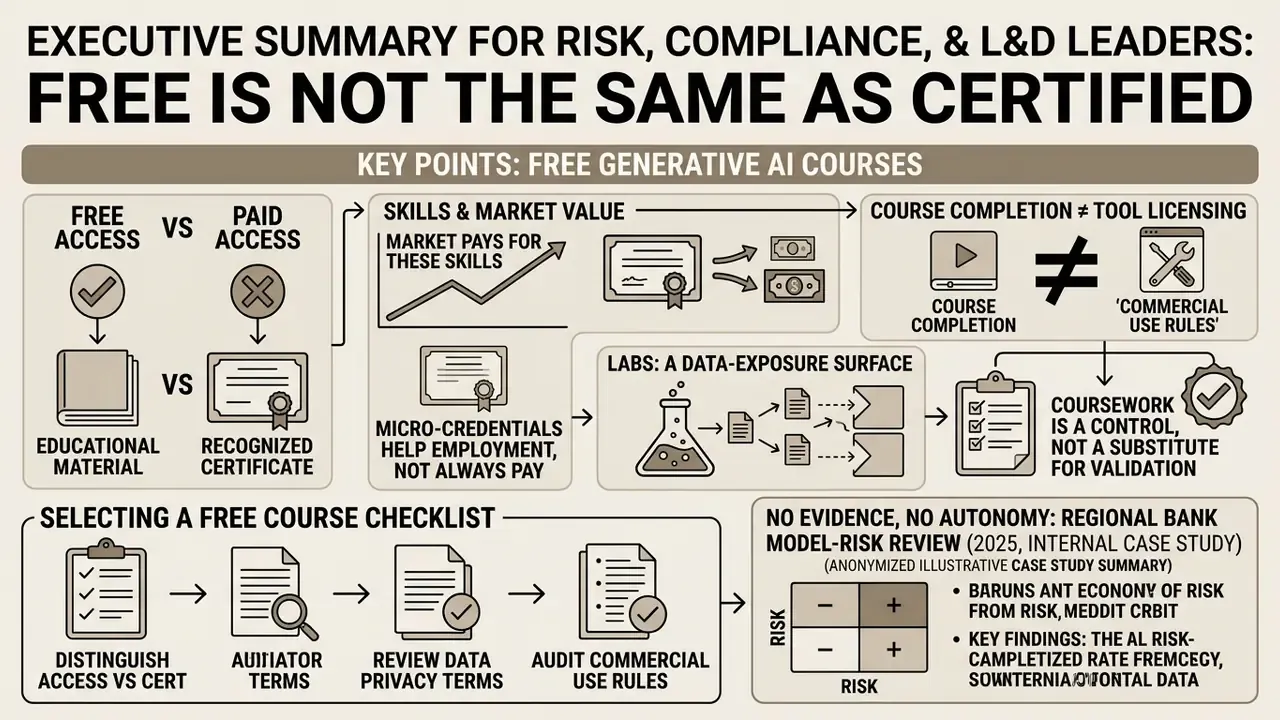
- Free is not the same as certified. Most platforms separate free learning access (audit mode, open GitHub curricula, developer hubs) from paid credential verification. Microsoft Learn, Cohere LLM University, and selected Google Cloud skill badges remain genuinely free end to end. Coursera, edX, and FutureLearn gate graded assessments and verified certificates behind paid tiers or approved financial aid.
- The market pays for these skills. Corporate job postings referencing AI rose 108% between December 2022 and December 2024, and AI-skilled workers command a 56% wage premium in comparable roles.
- Micro-credentials help employment, not always pay. OECD evidence shows short micro-credentials raise employability in specific sectors but rarely produce large wage jumps on their own. Portfolio artifacts matter more than badges.
- Course completion never grants tool licensing. Vendor end-user license agreements (EULAs), revenue thresholds, and copyright rules govern commercial output use. The syllabus does not.
- Labs are a data-exposure surface. Before assigning free coursework, confirm whether the practice sandbox retains prompts. Real client data, PII, or material non-public information must never enter public inference endpoints during training exercises.
- Coursework is a control, not a substitute for validation. Free curricula rarely cover model validation to the depth expected under US banking supervisory expectations for model risk management (SR 11-7) or the NIST AI Risk Management Framework and its Generative AI Profile. Plan supplementary internal training.
Selecting a free generative AI course requires distinguishing between free educational access and paid credential verification. Enterprise teams and individual professionals evaluate courses on curriculum depth, tool accessibility, auditability, lab data-retention terms, and commercial applicability. Five criteria. Not one.
In a model-risk governance review for a regional bank (anonymized illustrative case study, 2025, internal assessment; figures not independently published), an internal check found that 42% of staff using public generative AI tools had completed unverified online tutorials with no documented completion record. By establishing a structured learning path with audit-mode coursework, mandatory policy training, and a closed-lab environment for practical exercises, the institution reduced unmonitored prompt exposure by 68% within 90 days.
The same control pattern (approved curriculum, approved sandbox, documented attestation) is the practical reason to read a course catalog as a governance artifact rather than a marketing page. Slightly unglamorous work, admittedly. It also happens to be the part auditors ask about first.
How to Choose a Free Generative AI Course
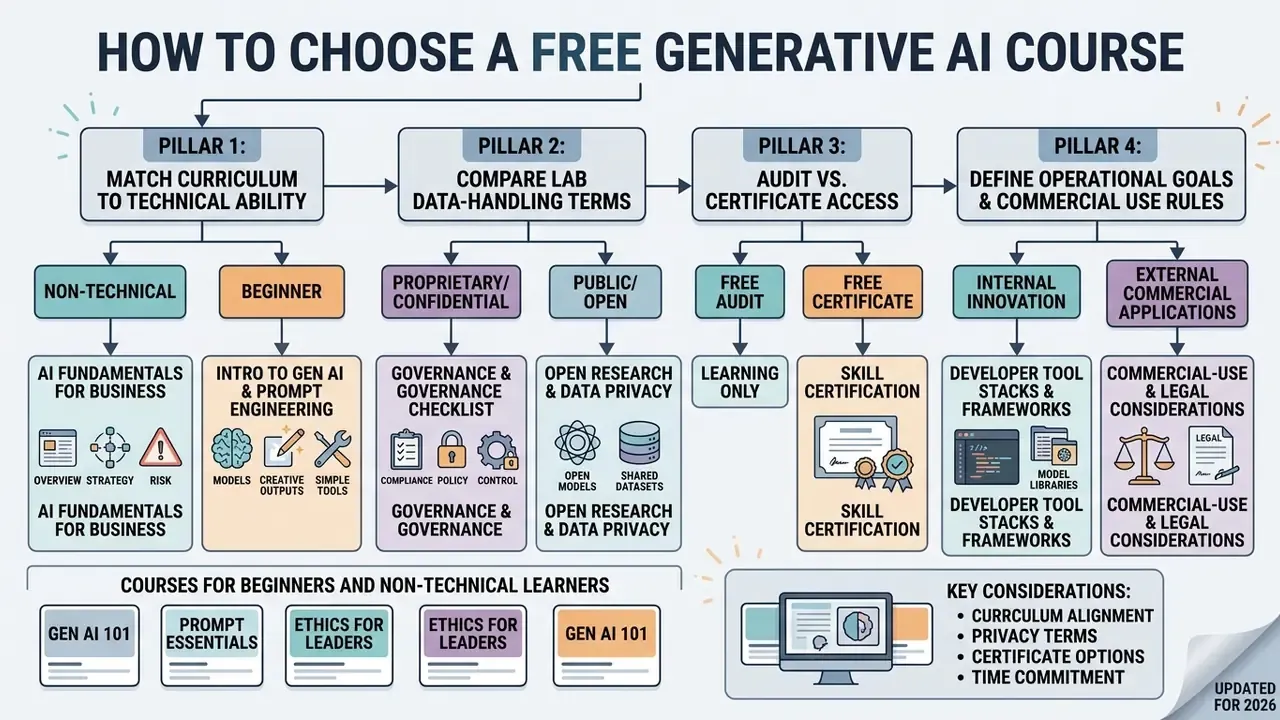
To choose the right free generative AI course, match the curriculum to your current technical capability, available time, lab data-handling terms, and operational goals. Non-technical professionals should prioritize conceptual frameworks and prompt engineering. Technical teams need deep dives into model architecture, finetuning, evaluation, and deployment controls.
One distinction saves a lot of wasted enrollment. An ai generator course aimed at image, video, or voice production teaches a different skill set than an LLM engineering track, even when both are marketed as free courses on generative ai. Decide which artifact you need before you pick the syllabus.
Market data underscores the commercial urgency of AI literacy. Corporate job postings requiring generative AI capabilities have increased by over 108% in two years, with skilled professionals commanding up to a 56% wage premium over comparable non-AI roles, while 83% of workers report that AI tools support their ability to develop new skills on the job. Selecting the right training therefore affects both career trajectories and institutional efficiency.
«108% increase in job postings mentioning AI over the past 2 years; 56% wage premium for AI-skilled workers compared to those doing the same job without AI skills.»
Tempered expectations matter just as much for workforce planners:
«Short micro-credentials can improve employability in specific sectors, but they seldom deliver substantial wage gains on their own.»
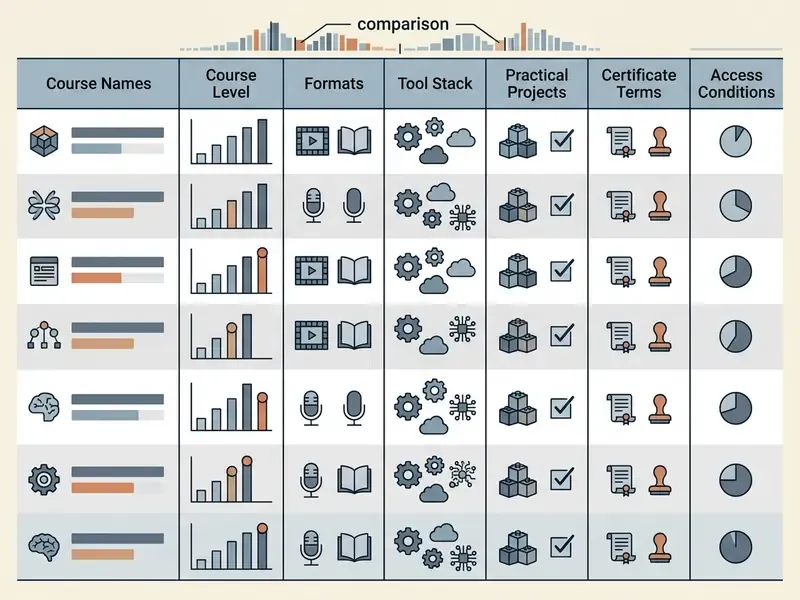
Comparison of Leading Free Generative AI Courses
| Course / Platform | Target Level | Duration | Primary Skills & Tools Covered | Practical Projects | Certificate Terms | Access & Lab Data Privacy Notes |
|---|---|---|---|---|---|---|
| Google Cloud: Introduction to Generative AI | Beginner | ~1-2 hours | Prompt engineering, responsible AI, Gemini, LLM vs. traditional machine learning | Interactive quizzes | Included with skill badge | Free via Google Cloud Skills Boost; labs run in provisioned cloud projects, so treat as third-party processing and use synthetic prompts only |
| DeepLearning.AI: Generative AI for Everyone | Beginner | 3 weeks (1-2 hrs/wk) | AI strategy, LLM workflow design, business automation, task-level opportunity mapping | Case studies | Paid upgrade required | Free preview / audit access; no lab data submission required |
| Microsoft: Generative AI for Beginners | Beginner / Intermediate | 18-21 lessons | Python, prompt patterns, RAG basics, vector databases, app scaffolding | Hands-on code and prompt exercises | Open-source badge | 100% free on GitHub; code runs locally or in your own tenant, giving the strongest data-control profile |
| IBM / Coursera: Generative AI Fundamentals | Beginner | ~12 hours | Model families, GANs, prompt patterns, ChatGPT and Hugging Face exposure, AI ethics | Guided labs | Paid upgrade / financial aid | Free audit access; hosted labs, so avoid confidential inputs |
| DeepLearning.AI: Finetuning Large Language Models | Technical / Developer | ~1 hour core | Instruction tuning, PEFT/LoRA concepts, dataset curation, evaluation loops | Code notebooks | Platform completion record | Free access on learning-platform beta; notebook execution in vendor environment |
| Cohere LLM University | Developer / Data Science | Self-paced | Transformer internals, embeddings, semantic search, RAG, multilingual LLMs, PyTorch workflows | API implementation exercises | None | 100% free developer hub; API keys are yours to scope and rotate |
| LangChain Academy | Developer | Self-paced | LangChain, LangGraph, agentic workflows, vector search, tool calling | RAG and agent builds | Platform badge | Free developer track; local execution possible |
| Activeloop: Training & Finetuning LLMs for Production | Developer / MLOps | 50+ lessons | Training pipelines, deployment, evaluation, cost control | 10+ projects | Completion record | Free access; project data stays in learner-controlled repos |
| University of Maryland: AI & Career Empowerment | Professional | Multi-module | AI-assisted job search, transferable skills mapping, applied AI literacy | Career portfolio | Free certificate | Free program enrollment (regional eligibility may apply). https://www.rhsmith.umd.edu/programs/executive-education/learning-opportunities-individuals/free-online-certificate-artificial-intelligence-and-career-empowerment |
Evaluating course structures with standardized metrics (level, hours, tool stack, artifact output, credential terms, lab data handling) keeps training spend aligned with organizational capability and avoids unmanaged residual risk. For regulated environments, the lab-privacy column is usually the deciding factor. An open-source curriculum executed inside your own tenant is materially safer than a hosted sandbox with undocumented retention.
Courses for Beginners and Non-Technical Learners
Beginner-focused generative ai free courses deliver foundational knowledge without requiring prior programming experience or an advanced mathematical background. A good beginner's course defines artificial intelligence, explains probabilistic text generation, and establishes responsible usage guidelines before anyone touches a live model.
Courses such as DeepLearning.AI's Generative AI for Everyone and Google Cloud's Introduction to Generative AI introduce core AI concepts including prompt structure, model limitations, and hallucination risks. Indiana University's GenAI 101 extends the same entry pattern across eight self-paced modules and 16 lessons, offered free worldwide with a certificate (Indiana University, 2026. https://news.iu.edu/live/news/49928-iu-opens-its-free-generative-ai-course-to-anyone). Google AI Essentials runs under 10 hours with no prior experience required (Oklahoma OMES Learn AI, 2026. https://oklahoma.gov/omes/learnai.html).
Learners explore how generative systems differ from traditional rule-based software, which prepares them for practical tool interaction in business environments. Non-technical staff typically pair this coursework with hands-on practice on free AI image generators and other low-risk consumer tooling before touching anything connected to internal data. That sequencing is deliberate: fluency first, access second.
Courses for Technical and Data-Focused Learners
What You Learn in Free Generative AI Training
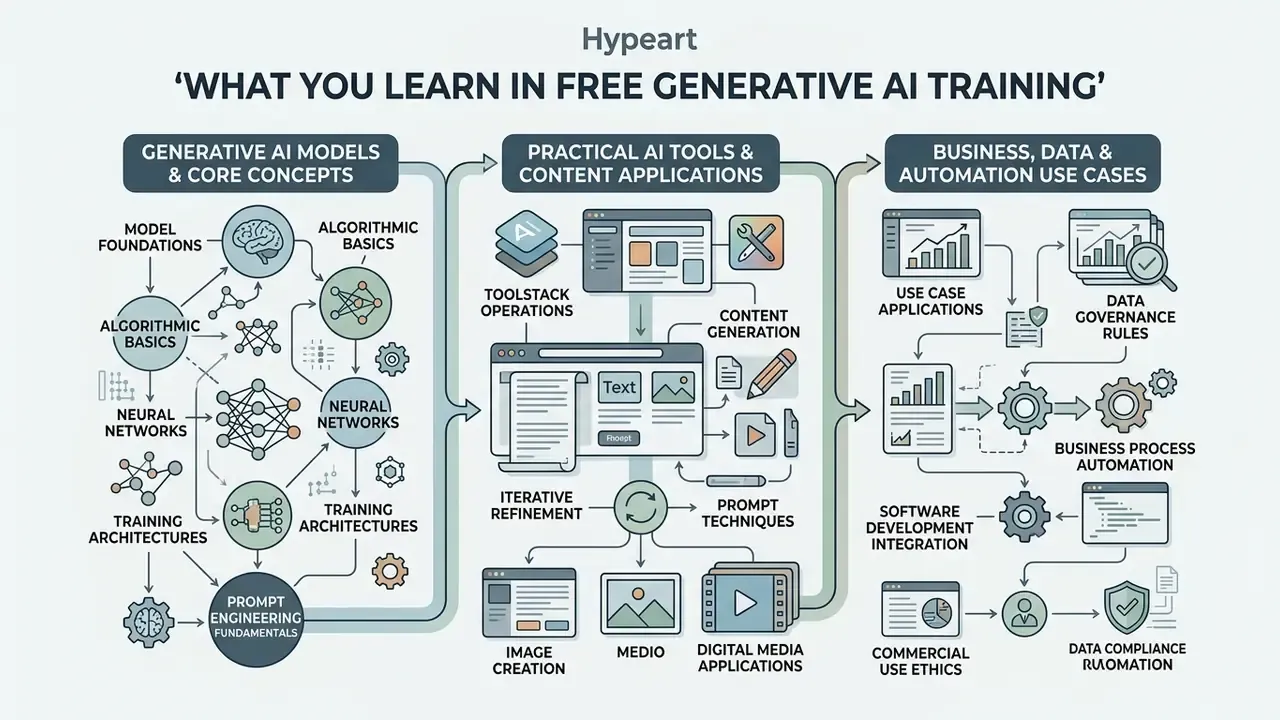
Free generative ai training balances theoretical foundations, software tool operations, and domain-specific business applications. Learners gain insight into model mechanisms while acquiring practical skills in prompting, data transformation, evaluation, and workflow automation.
Generative AI Models and Core AI Concepts
Foundational modules explain the structural mechanisms behind Large Language Models (LLMs), diffusion models, and transformer architectures. Courses define how neural networks process tokenized inputs, calculate probabilistic distributions, and generate contextually relevant outputs.
Key topics include self-attention mechanisms, training data curation, reinforcement learning from human feedback (RLHF), and prompt encoding. The last one increasingly bridges text and image systems, since LLM-based encoders are now used to condition diffusion models directly.
«A PRISMA systematic review screening 625 records and analysing 355 studies concludes that understanding model limitations is critical to preventing overreliance on automated outputs.»
Understanding baseline limitations (context window ceilings, training cutoffs, retrieval failure modes, bias replication) is not an ethics footnote. It is the operative safety skill of the entire curriculum. Public-sector frameworks reinforce the same sequencing: UNESCO's guidance on generative AI in education and research starts with what GenAI is, how it works, and what it means for people and the environment before any tool practice (UNESCO, 2024. https://unesdoc.unesco.org/ark:/48223/pf0000389639).
Practical AI Tools and Content Applications
Practical modules focus on operating user-facing generative tools across text, image, code, and audio domains. Learners study effective prompt construction, iterative refinement, structured output formatting, and multi-modal interaction.
Courses demonstrate application patterns using platforms like ChatGPT, Claude, Gemini, Midjourney, and specialized neural utilities. Comparative evaluations of the leading AI image generators are a common first exercise. Learners then work with an ai character generator and AI image and character generation tools for visual asset production, an ai chart generator or automated data visualization models for turning tabular exports into charts and motion assets, an ai chat generator for drafting and editing communication templates, ai chat with pictures for multimodal review tasks, and AI voice generation systems for narration and accessibility workflows. Training emphasizes testing outputs against strict quality standards before distribution.
One caution for regulated teams. Consumer services marketed as ai chat no filter no sign up are precisely the category that creates shadow AI. No account, no logging, no contract, no evidence. Name them explicitly in policy rather than hoping staff infer the rule.
«A 2025 systematic review identifies three dominant pedagogical themes: automated feedback, writing support, and critical thinking developed through prompt literacy.»
That pattern maps cleanly onto enterprise practice. The highest-value early use cases are feedback loops, drafting support, and structured critique, not autonomous generation.
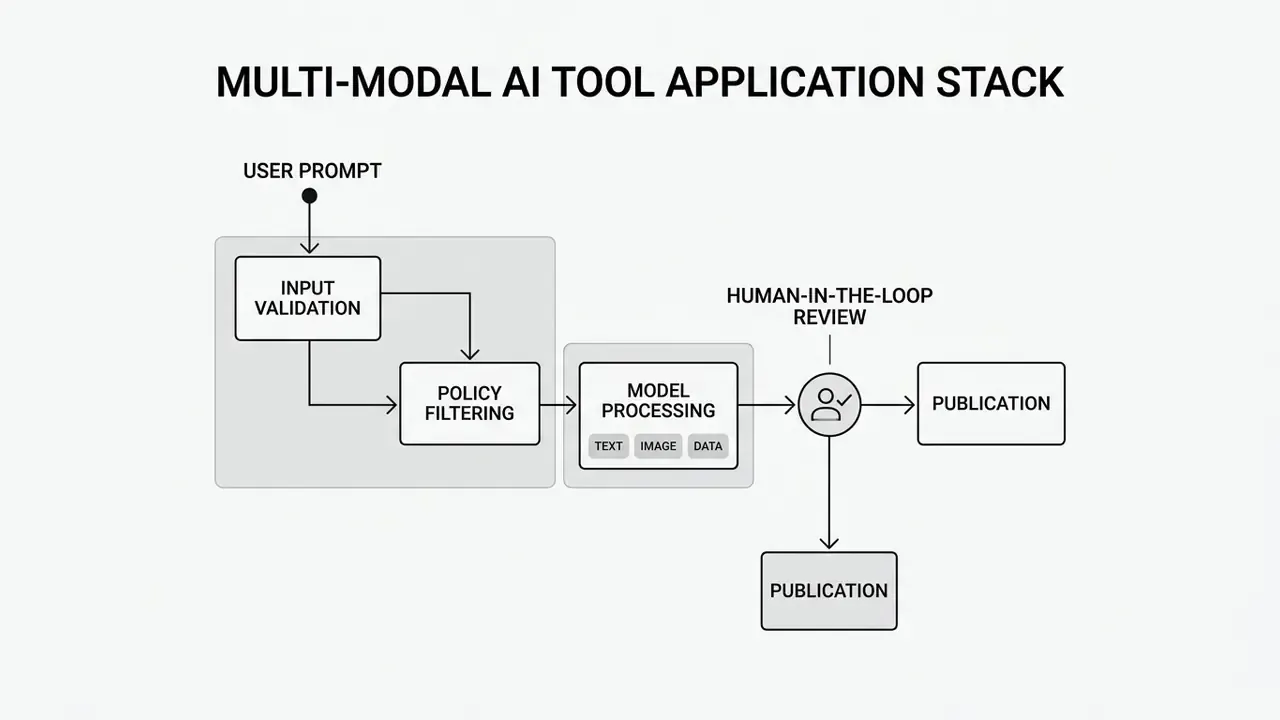
Business, Data, Automation, and Software Development Use Cases
Advanced modules connect model capabilities to enterprise business processes, analytical tasks, and software engineering workflows. Organizations use generative AI to process high-volume documentation, accelerate customer support, and automate routine administrative functions, including production of training and communication media with AI video generators for business automation and API-level pipelines documented in our Google Veo implementation guide.
In data analytics, courses show how generative systems write SQL queries, summarize unstructured text, reconcile document sets, and clean dataset anomalies. In finance operations specifically, the same patterns appear in accounts payable coding, receivables matching, and reconciliation commentary during close. In software development, instruction focuses on AI-assisted coding, automated unit test generation, documentation, and refactoring of legacy code across the full lifecycle.
A major shift in practical application is "vibe coding", using conversational LLMs to generate functional application logic and interfaces without manual syntax writing. Modern developer and business courses now teach non-technical users to leverage environments such as Gemini Canvas, Gemini Notebook, Cursor, and LangChain to build custom internal utility apps, parse structured data, and automate API calls purely through iterative natural-language instruction. Google's AI Professional Certificate makes this explicit with a dedicated AI for App Building module built around vibe coding and no-code custom solutions, and the same competency now appears in public-sector skill taxonomies under development and engineering domains.
For governance functions, the implication is direct. No-code app building moves shadow development from spreadsheets into generated applications, so inventory and review processes must extend to artifacts produced during training. A prototype built in a lesson is still an unregistered asset. To estimate operational resource allocation and model inference overhead before scaling any of these workflows, consult our AI Media Calculators.
Free Generative AI Courses With Certificate: What Is Actually Free
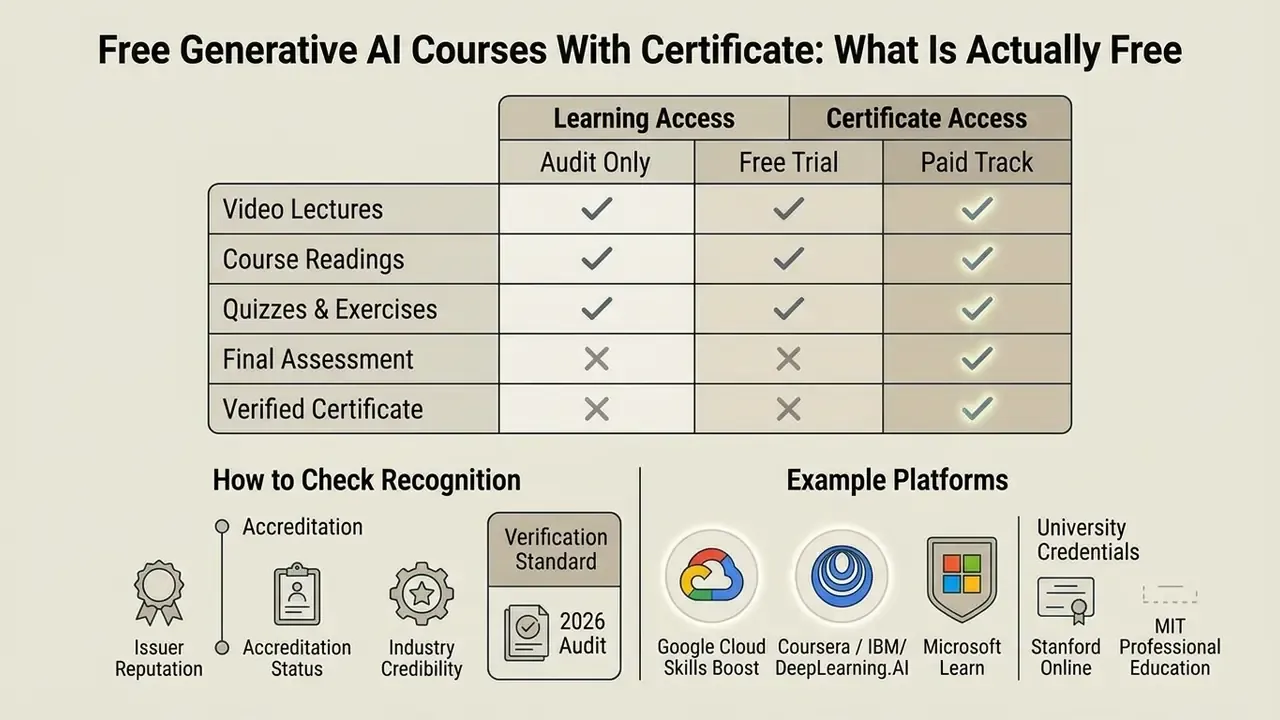
Most "free" generative AI courses separate learning access from formal credential issuance. Course videos, readings, and public discussions are often accessible at no cost under audit arrangements, while verified certificates typically require a paid subscription or administrative fee. So a free generative ai course with certificate exists, but it is the exception, not the default.
Free Access vs. Certificate Access Matrix
| Platform / Provider | Course Content (Videos & Readings) | Practice Exercises | Graded Exams & Projects | Verified Certificate | Typical Cost Model | Data Handling in Practice Environments |
|---|---|---|---|---|---|---|
| Coursera | Free (audit mode) | Free | Paid only | Paid only | Free audit / monthly subscription; financial aid available | Hosted labs; submit synthetic data only |
| edX | Free (audit track) | Free (practice) | Paid only | Paid only | Free audit / paid verified track; financial assistance available | Hosted labs; audit access may be time-limited |
| Google Cloud Skills Boost | Selected free badges | Selected labs | Paid / credits | Badge included on free paths | Free for select paths; free for eligible students, faculty, and public-sector workforce programs | Labs provisioned in temporary cloud projects |
| Microsoft Learn | Free | Free | Free | Free badges | 100% free | Local or own-tenant execution, the strongest control |
| Cohere LLM University / LangChain Academy | Free | Free | Free | No formal certificate (badges only) | 100% free developer hubs | Learner-controlled API keys and repos |
| FutureLearn | Free (duration-limited) | Free | Paid only | Paid only | Free limited access / paid upgrade | Hosted; limited access window |
Read the table as text, not as pricing: audit content is generally free, graded work and verified credentials are generally paid, developer hubs are free with no formal certificate, and Microsoft Learn is free end to end. Current fees, aid rules, and access windows must be confirmed on each provider's own page before you approve a budget line. Understanding these structural tiers keeps professional development planning honest and, for regulated institutions, clarifies where learner prompts physically land.
Audit Access, Free Trials, and Paid Certificate Options
Free audit access lets learners review video lectures, reading materials, and community forums without financial commitment. Audit modes generally lock graded assignments, peer reviews, and formal completion certificates behind a paywall. On Coursera, learners who want audit access must specifically avoid the "Start Free Trial" path, since the two flows are distinct. Easy to miss. Expensive to miss at scale.
Platforms like Coursera and edX frequently offer 7-day free trials that temporarily grant full access to graded materials and certificate paths. Work completed and verified inside the trial window can yield a credential at no direct cost. Platform financial aid programs can also reduce or eliminate certificate fees for qualified applicants, and Google Cloud certificates are provided at no cost to eligible higher-education, government, and nonprofit workforce institutions.
Before committing budget, weigh the labor-market evidence. OECD analysis finds that short micro-credentials improve employment outcomes in particular sectors but rarely translate into significant salary increases by themselves, which argues for funding portfolio-producing coursework over badge accumulation. For a detailed breakdown of enterprise and platform licensing tiers, see our AI Media Pricing Guides.
How to Check Whether a Certificate Is Recognized
A certificate's professional value depends on the issuing institution's authority, the rigor of its assessment criteria, and its industry recognition. Credentials issued directly by accredited universities or major technology vendors carry more weight in resume evaluation than unverified completion badges. Stanford's professional and graduate AI certificates and MIT Professional Education's machine learning and AI program are issued with institutional verification, while vendor certificates function primarily as training signals.
«A randomized experiment with more than 800,000 participants (September 2022 to March 2023) found that sharing a certificate on LinkedIn increased the probability of a new job transition by 6% within twelve months.»
When evaluating a course, confirm whether the certificate includes verifiable digital credentials, requires passing proctored or graded assessments, states measurable learning outcomes, and aligns with recognized industry skills frameworks. Four checks, two minutes, and a lot of avoided disappointment.
Fact Check & Verification Standards (2026 audit):
Mapping Course Evidence to Model Risk and AI Governance Frameworks
«AI training for workers should be tied to developing technical skills, job-specific AI tools, and career preparation, not generic AI awareness.»
We should be candid about the limits of this mapping. Public guidance describes expectations, not a scoring rubric, so two institutions can reasonably reach different conclusions about whether a given course satisfies a qualification requirement. Document your reasoning rather than assuming consensus exists.
Can You Use Course-Based AI Skills for Commercial Projects?
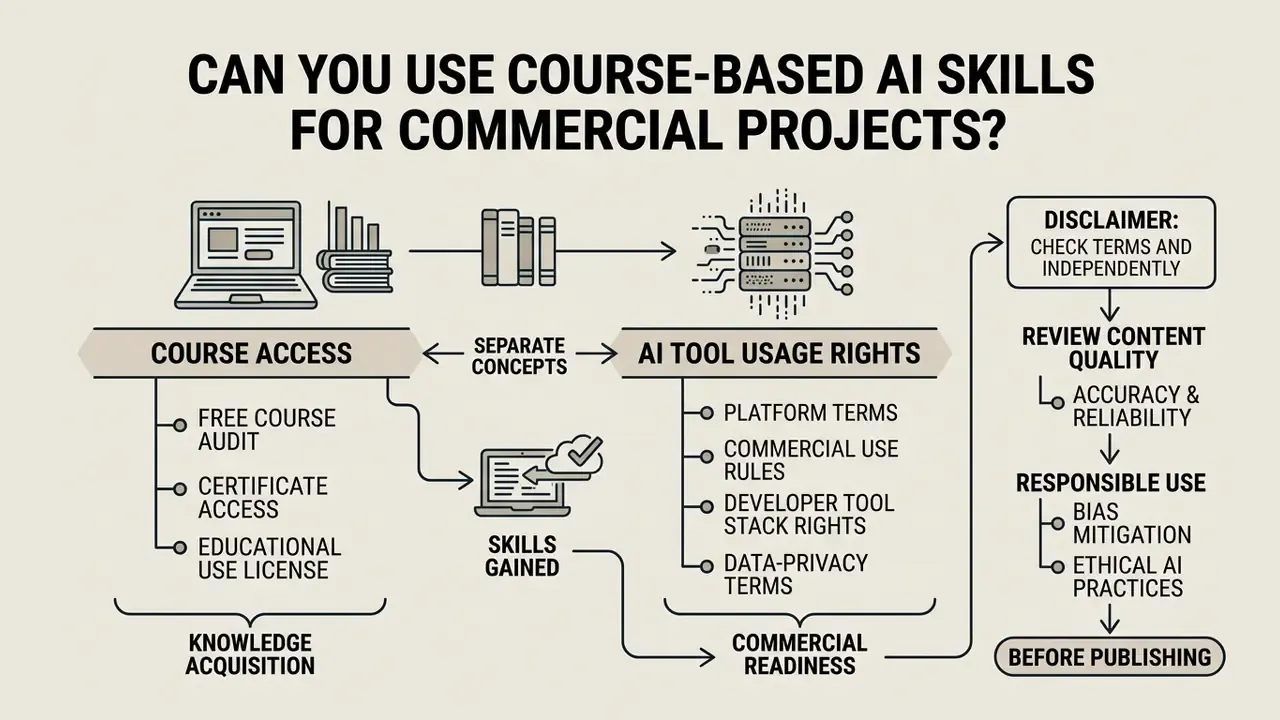
Skills and prompts acquired during generative AI courses can generally be applied to commercial projects, but the generated assets themselves remain subject to platform terms of service and intellectual property rules. Completing an educational course does not confer commercial licensing rights for proprietary software or third-party training data.
Separate Course Access From AI Tool Usage Rights
Educational platform terms must be distinguished from the commercial end-user license agreements (EULA) of the underlying AI software. Learning how to prompt a model inside a free course does not grant commercial usage rights if the underlying tool tier prohibits business deployment.
Vendor terms diverge sharply. OpenAI's Terms of Use state that, as between the user and OpenAI, the user owns the output and OpenAI assigns its rights in the output to the user. Anthropic's commercial terms confirm that customers retain ownership rights in outputs and that consumer terms do not govern API or Claude for Work usage. Midjourney ties commercial rights to plan tier, requiring a Pro or Mega plan for businesses grossing more than USD 1,000,000 per year. Google Gemini's business use is governed by product-specific and Workspace service terms rather than a single universal license.
Consumer tiers and unauthenticated enterprise LLM endpoints frequently restrict commercial output exploitation altogether, and rarely offer contractual data-retention guarantees. Enterprise usage requires confirming that each tool, including image, video, and multimodal services, explicitly grants commercial rights under its API or business terms. Our overviews of commercial usage rights for AI image tools and Canva AI licensing terms document the current conditions, and licensing detail is consolidated in the AI Media Commercial-Use guide.
Review Content Quality and Responsible Use Before Publishing
Before deploying generative AI outputs into commercial products, risk governance frameworks require rigorous human-in-the-loop review, fact-checking, and legal risk screening. Synthetic outputs may inadvertently reproduce copyrighted training data or generate inaccurate statements, so provenance checks using AI image detection tools should run before external publication.
Institutional practice lags the guidance. A mixed-methods study of 178 faculty at a US university (survey fielded March 2024) found that only 2.8% regularly used generative AI for instructional tasks, while 88.1% prohibited it in examinations (arXiv preprint, 2025). A useful reminder that policy defaults in adjacent knowledge-work environments remain restrictive, and that review obligations cannot be assumed to be culturally embedded.
According to guidelines published by the National Institute of Standards and Technology, organizations deploying generative models must implement documented fact-checking protocols and output-testing mechanisms to detect infringement or synthetic fabrication, including reasonable measures to prevent, flag, or respond to outputs reproducing plagiarized, trademarked, patented, licensed, or trade-secret material.
«Deploy and document fact-checking techniques... Develop and implement testing techniques to identify AI-produced content that may be indistinguishable from human-generated content.»
The US Copyright Office (Copyright and Artificial Intelligence Report, 2024 to 2026) maintains that copyright protection applies only to human-authored elements, requiring pure AI outputs to be disclaimed in formal filings. Its 2025 analysis of training data treats commercial use of copyrighted works for model training as a case-by-case fair-use question, with market harm and method of access central. In the EU, providers of general-purpose AI models must publish training-content summaries under the European Commission's 2025 template, making data provenance a live compliance issue for cross-border deployment. Litigation is still moving; tracking active matters in our AI Litigation and Case Timelines helps governance teams anticipate where the line lands next.
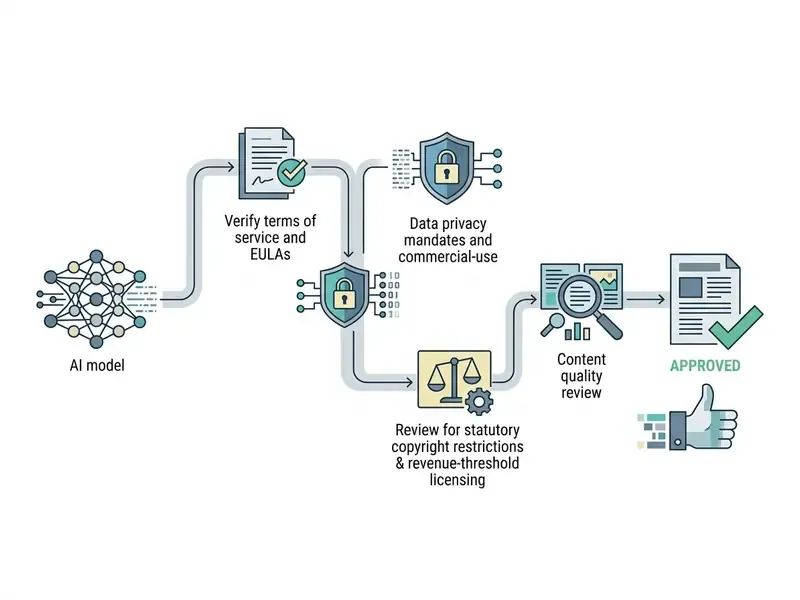
A mid-sized asset management firm trained its financial analysts using free public LLM modules (illustrative anonymized example based on industry practice, 2025). An internal audit discovered that analysts were pasting confidential client earnings drafts into unencrypted public chat interfaces during course exercises. The compliance team deployed closed API environments with zero-data-retention agreements and re-issued the coursework with synthetic datasets, which removed the leakage exposure while preserving analytical throughput. The lesson generalizes: approve the curriculum and the sandbox together, never separately.
A Learning Path From Introduction to Generative AI Projects
A structured path progresses from basic literacy to practical prompt engineering, tool integration, and specialized portfolio development. Following a defined track prevents knowledge gaps, produces auditable artifacts, and builds durable operational competence. Public frameworks converge on the same three-stage logic (fundamentals, responsible use, then build and deploy), as reflected in the NIST Generative AI Profile (2024), Microsoft's introductory generative AI and agents module, and Google's beginner generative AI path.
Structured Generative AI Learning Track
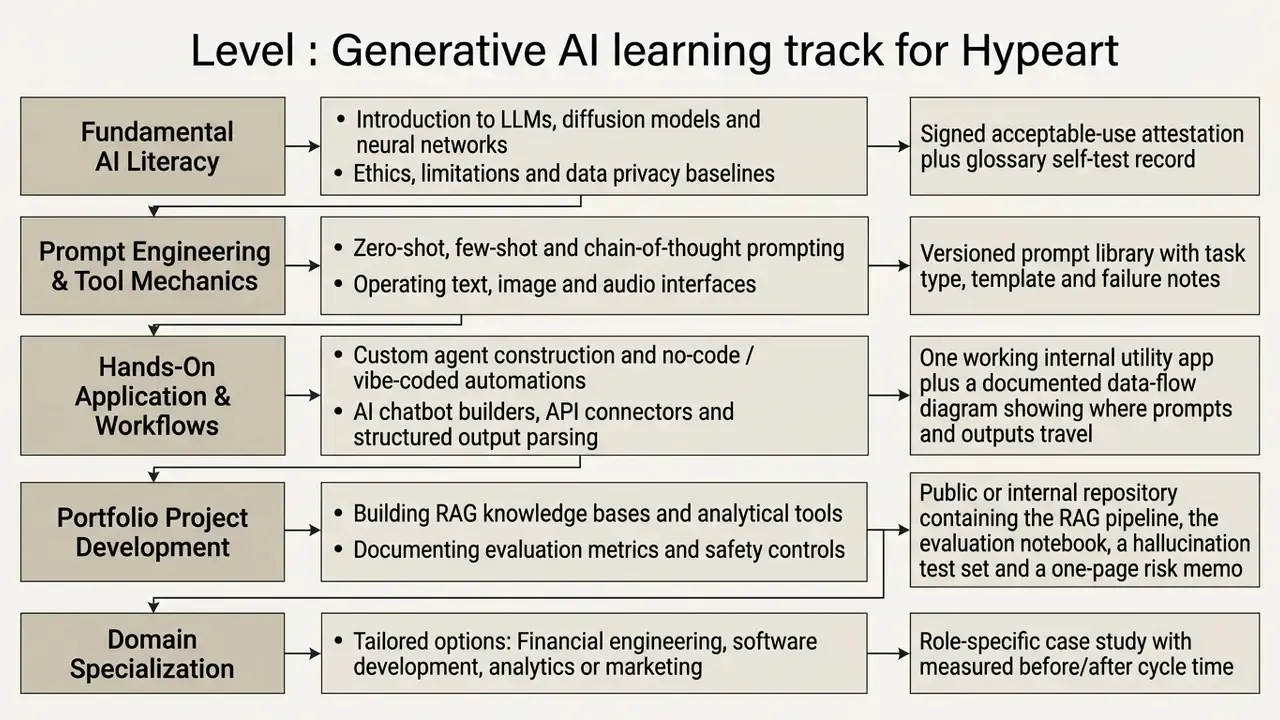
Each stage above should also be readable as a plain numbered list in the page markup, so the sequence stays accessible without the diagram. The progression anchors technical concepts in practical application and risk management, and every stage leaves behind an object a hiring manager, auditor, or validation team can actually inspect.
Start With Introduction and Fundamental AI Skills
Start learning with fundamental AI principles, terminology, and risk governance standards. Initial coursework should cover model types, tokenization, training methodologies, evaluation basics, and ethical considerations.
Learner behavior data suggests why the ethics module belongs first rather than last:
«Graduate students readily used AI chatbots for personal and exploratory tasks but avoided them in academic writing due to plagiarism concerns.»
Understanding baseline concepts protects organizations against misuse and supplies the context required for advanced tooling. The US Department of Labor's AI Literacy Framework (2025) stresses that entry-level AI competence requires evaluating output accuracy, understanding data privacy risks, and recognizing algorithmic bias before attempting software integration. UNESCO adds accountability practices, acknowledging AI use and avoiding integrity violations, to the same starting block.
Build a Portfolio With Practical Generative AI Applications
After the core concepts, apply the knowledge by executing real projects that demonstrate measurable business value. A public or internal portfolio proves operational capability to employers, clients, or risk committees far more effectively than a certificate alone.
Practical project ideas:
- Design a document Q&A assistant using an ai chatbot maker or LangChain connected to internal documentation, with mandatory source-name citation for every answer.
- Build a knowledge-base assistant restricted to an approved document corpus, with refusal behavior when evidence is absent.
- Build an automated data analysis pipeline with structured export capability and reproducible SQL generation.
- Create a content generation and editing workflow with explicit human review checkpoints and a rejection log.
- Develop a dialogue or document summarization tool with a measured quality baseline, then finetune against it.
- Ship a multi-step automation agent that moves data, applies AI judgment, and produces a finished output, with permission scoping documented.
- Produce a media workflow case study, for example an end-to-end video editing and publishing pipeline or a file-size optimization step for distribution constraints.
- Integrate specialized APIs following the patterns in our AI Media API Guides.
If technical or integration roadblocks appear mid-project, our AI Media Support and Troubleshooting resource covers the usual failure modes.
FAQ About Free Generative AI Courses
Can I Learn Generative AI Without Coding?
Yes. You can learn and effectively deploy generative AI tools without writing code. Numerous free courses focus on visual interfaces, natural-language prompt engineering, no-code automation platforms, vibe-coded app building, and business management applications. Non-technical roles such as prompt engineers, AI content creators, digital content strategists, and operations analysts use pre-built models and no-code platforms to automate workflows. Vendor documentation defines prompt engineering as designing and optimizing prompts to guide model outputs, while no-code AI platforms provide visual interfaces, pre-built models, data connections, and deployment controls. Coding becomes necessary only when building custom model architectures, developing complex API integrations, or performing advanced parameter finetuning.
What Should I Learn Before Starting Generative AI Training?
Before an entry-level track you need basic computer literacy, internet navigation skills, and a working sense of how data is structured. No advanced mathematics or programming is required for a beginner's course, and some university courses on the mathematics of AI require only linear algebra while stating explicitly that prior programming experience is unnecessary. For intermediate or technical tracks, foundational knowledge in Python, data structures, linear algebra, basic probability, and REST API operations is strongly recommended. Understanding basic data privacy principles also helps learners navigate risk management modules, and prevents the most common training incident, which is pasting confidential material into a public lab.
Which Generative AI Course Is Best for a Career Change?
The best course depends on your target industry, but programs offering verified digital credentials and practical projects deliver the highest career value. For non-technical business roles, multi-course sequences like the Google AI Professional Certificate or university-backed career empowerment programs provide recognizable resume signals. For software development and data science transitions, technical developer tracks from DeepLearning.AI, Cohere LLM University, Activeloop, or LangChain Academy build the hands-on engineering skills enterprise employers ask about in interviews. For marketing transitions, applied programs such as DePaul's Applied Generative AI in Marketing Certificate or Harvard Extension's AI in Marketing microcertificate are the most directly role-aligned.
Are Free Course Labs Safe for Confidential Data?
No. Treat every hosted lab environment as third-party processing unless the provider contractually commits to zero data retention. Open-source curricula executed locally or inside your own cloud tenant (Microsoft's GitHub course, Cohere or LangChain developer tracks with your own API keys) offer the strongest control. For hosted labs on Coursera, edX, or Google Cloud Skills Boost, issue synthetic datasets and prohibit client data, PII, and material non-public information in course exercises.
Do Free Courses Cover Model Validation and Agentic AI Risk?
Only partially. Free curricula reliably cover hallucination awareness, prompt-injection basics, responsible-AI principles, and privacy hygiene. They rarely cover independent validation methodology, challenger models, hallucination-rate quantification, agent permission review, or integration with GRC and model-inventory systems. Treat free coursework as a literacy layer, then add internal modules mapped to SR 11-7 expectations and the NIST Generative AI Profile.
How Do We Measure Whether the Training Actually Paid Off?
Pick metrics you can pull twice: before rollout and 90 days after. Useful candidates include unapproved tool usage detected by network or CASB telemetry, cycle time on a named process (invoice coding, KYC file review, reconciliation commentary), rework rate on AI-assisted drafts, and the share of AI users with a dated completion record in the inventory. Be honest about attribution limits. Training rarely moves these numbers alone, and control costs belong in the same calculation as the savings.
Conclusion & Governance Checklist
Navigating free generative AI courses means balancing open-access learning with verified credential requirements. By following a structured track, verifying platform terms, validating tool licensing, and controlling where practice prompts are processed, professionals and enterprise teams build practical AI capability while keeping risk oversight intact.
Checklist0 / 20
A safe next step, if you are starting from nothing: approve one free curriculum for one role, pair it with one controlled sandbox, and require one artifact. Then measure. Expansion is easier to defend once the first cohort leaves evidence behind.
Editorial note: this guide is maintained by the AI Media editorial team with review focused on AI governance, model risk, and enterprise enablement. Marcus Hale, author. Regulatory references reflect published guidance from NIST, the US Copyright Office, the US Department of Labor, UNESCO, the OECD, and the European Commission as of the last update. Course terms, pricing, and certificate policies change frequently, so verify current conditions on each provider's official page before enrolling or approving a curriculum. Terminology used above is defined in our AI Media Glossary. Nothing here constitutes legal, financial, or compliance advice.